Category Archives: Movies

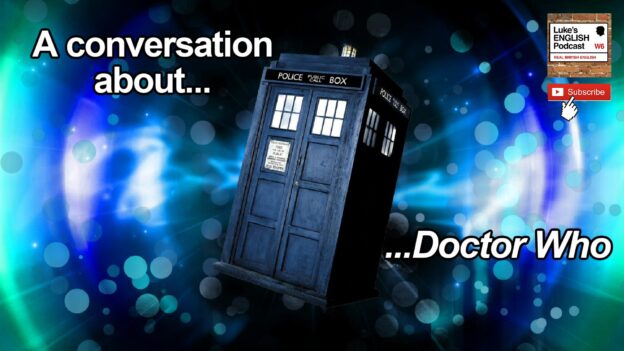
32. Doctor Who (with Lee Arnott)

This episode is all about Doctor Who. There are some announcements at the beginning of the episode, then an interview with an expert on Dr Who.

The interview begins at approximately 10.00 minutes into the episode.

Small Donate ButtonRight-click here to download this episode.

Transcript available below. Luke’s English Podcast is a free service for people who are learning English as a foreign language. Luke is a well qualified teacher of English with over 12 years’ experience in Japan, the UK and France. He speaks British English, and teaches at a language school in London, and now at a university in Paris. You can use this podcast to get exposure to native speakers using natural English. Learn phrasal verbs, idioms, useful expressions, linkers, etc. Find Luke on Facebook (search for Luke’s English Podcast) or Twitter (@EnglishPodcast). Cheers!

Some good advice for iPhone users (courtesy of a helpful listener from Russia, called Nikita Kolganov): Copy and paste the tapescript from a podcast into the ‘lyrics’ section of each podcast on your iPhone. To do this, first copy the text from this webpage. Then go into iTunes and ‘right click’ the podcast episode there. Then choose ‘Get Info’, then select ‘Lyrics’. You can add the transcript into the text box there, and then read while you listen to the podcast. Thanks Nick!

Here’s the tapescript for the interview with Lee, about Dr Who:

Luke: Right, if you imagine somebody who’s never heard of Dr Who before, right, how can you explain who he really is. So, so, if, what are the most important things that you should know about Dr Who if you’ve never heard of him before, basically.

Lee: Well, Dr Who is, err, a TV show that it’s main character, a character called The Doctor, who is in fact an alien, has a machine that can travel through time and space, which means that he is able to go anywhere in any planet, any point in the future, the past, whenever.

Luke: Erm, what’s the name of that machine?

Lee: It’s called The Tardis.

Luke : And can you just describe The Tardis? That’s like his spaceship, yeah? Can you describe The Tardis for us? Because in Britain here, everybody knows The Tardis, like, almost everybody knows it. It’s very familiar to us. It’s almost like an icon of British culture. But what is The Tardis? What does it look like?

Lee: Well, The Tardis looks like a 1960s police box, and in the days before mobile telephones and actually people having telephones in their houses, these blue police boxes were like an old phone box, and they also had a double function in that if a criminal caught a policeman [if a policeman caught a criminal] they would be locked up inside this police box, and they also had a phone, so they were a very common object in 1960s Britain, early 1960s Britain when Dr Who started.

Luke: So, it looks a bit like a red telephone box, but it’s blue, and it’s something the police use to make telephone calls. And they could use it to keep criminals in. They could lock a criminal in there if they needed to.

Lee: Exactly. It was a very everyday object which everybody would have known.

Luke: Ok, so everybody knows about what a police box is so…

Lee: But of course it’s not really just a police box because it’s actually bigger on the inside than on the outside.

Luke: Ok, so Dr Who’s spaceship is in the shape of a police box. It’s called The Tardis but it’s actually bigger on the inside than it is on the outside. Ok, right, fine. Um, actually, people these days often use the word Tardis to mean something that’s bigger on the inside than on the outside. Can you give me an example of how we might use the word Tardis to mean something else?

Lee: Well actually there’s quite a famous example when Tony Blair was Prime Minister, in one of the last interviews he did before he left the post, I think it was with The Guardian, the interviewer asked him what was 10 Downing Street like…

Luke: That’s the Prime Minister’s house.

Lee: And he said, oh it’s like The Tardis, and he didn’t need to say anything else but everybody would know that he means it looks smaller on the outside but it’s much bigger on the inside.

Luke: Right, ok. I’ve heard people say that, like, a woman’s handbag is like The Tardis, sometimes, because it looks like a small handbag, but you can actually keep lots and lots of things inside it…

Lee: And such is the power of the programme that even if you’ve never seen Dr Who in this country, you will know if somebody says “It’s like a Tardis”, you will know that it’s bigger on the inside than the outside.

Luke: Right, ok, so that’s what Tardis means to everybody now. OK, what are the other important things that we need to know about Dr Who?

Lee: Erm, well, we need to know the fact that the programme started in 1963, and that means that you get a very good representation of how British society evolved in a kind of televisual way. A record of the times, our changing attitudes to race, to women’s lib, to even things like joining of the common market in the early 70s…

Luke: What do you mean by women’s lib?

Lee: Well The Doctor, traditionally is always accompanied by a female companion, and this was specifically because the programme’s original remit was to entertain a family audience on Saturday afternoon.

Luke: It’s a family show

Lee: Yeah, it’s very much a family show. One that was designed to catch the fathers who’d been watching an afternoon of sport on a saturday, with family who watched, like a pop music programme… it was designed to keep everybody watching, and of course it was hugely successful when it started so it achieved its aim.

Luke: Ok. So, ok, so basically err, he always has a female companion. I think that Dr Who has also had, like, a robot companion as well, right?

Lee: He has, he has, and err, he had a robot companion in the late 70s but he actually… people have thought that it was because Star Wars came out, and C3PO and R2-D2 but actually Dr Who was a year before Star Wars, so…

Luke: Really? So before… everybody knows about Star Wars, they know about R2-D2 and C3P0, but Dr Who before Star Wars had K9. K9 was like a robot dog! (laughs)

Lee: Of course the most important thing to remember is that when the show first started in 1963, the guy who was playing The Doctor was a very old guy, and after 3 years playing the role, it became very obvious that he was ill and he couldn’t do it, and they were like “what are we going to do?”. So, they devised… because we didn’t know who this character was, or where he came from, in 1966 they changed the actor, but made it a part of his personality, and that allows… has allowed the programme to continue to this day nearly 50 years later.

Luke: OK, so this is another important thing about Dr Who, is that you have to know that… How many actors have played him now, actually?

Lee: Erm, well we’re now on number 10 and number 11 starts filming next month.

Luke: OK, erm, the interesting thing about Dr Who is that when Dr Who dies, he doesn’t die. He doesn’t die, instead he changes into a new form, so he becomes a new person, but it’s still Dr Who but he becomes a new person, and it’s like a really important event when Dr Who. It’s… to be honest it’s a way for them to change the actor, right? But in the show, Dr Who… one Dr Who dies and he changes into a new Dr Who, and it’s always like a really big event for the show, right? Erm, so it’s really just a way for them to continue the show. It’s a bit like James Bond in that sense.

Lee: Hmm, but I think it’s more believable than James Bond because its not supposed to be exactly the same character. So each Doctor, well each actor has been allowed to have his own, his own way of playing the part.

Luke: So, his own personality. So every time it’s like a new, different kind of Doctor with a different personality.

Lee: Even though it’s the same, we know it’s the same character behind it, but it’s like a new person to get used to and that keeps the show fresh and it’s kept it going all this time.

Luke: OK, so there have been 10 Doctors, and the 11th Doctor is coming very soon. Who do you think is the nation’s favourite Dr Who so far?

Lee: Well, for many years, everybody would have said immediately, Tom Baker, an actor who played the part from 1974 to 1981.

Luke: Tom Baker actually, err, the Tom Baker Dr Who is probably the most famous one until the most recent one. And he’s famous for having a long scarf, and he was in The Simpsons. He was in the American comedy show The Simpsons.

Lee: He was also in Family Guy …

Luke: He’s in Family Guy as well

Lee: Until Dr Who, because Dr Who was off the air, it stopped being made in 1989 until 2005 when it came back. And until 2005, everybody would have said Tom Baker was the Doctor, but as you’ve said in 2006 the current Doctor David Tenant has taken the programme to new heights of success that it never ever had in it’s original format.

Luke: So Dr Who, even before, erm, the latest Doctor, Dr Who was really really big and really successful, but it’s become even more successful with this new Doctor played by David Tenant, who’s like a great actor, Shakespearian actor

Lee; Yeah, he’s just done Hamlet, and they’re going to be filming Hamlet for television

Luke: It’s a great thing. Because David Tenant is so popular as Dr Who, now he’s playing Hamlet, it’s going to be shown on TV, millions of people in the UK are going to watch Hamlet, which is written by Shakespeare, so it’s a really good way of

Lee: And that kind of fits in with the original, the kind of format of Dr Who in that, because he’s able to go back in the past and meet people like Shakespeare and Agatha Christie, it inspires people to go out and learn more about… you know… the original brief of the show was that it had to go to the future and then the past. So not only would it educate the viewers in a very 1960s BBC way, but it would also entertain, and it would inspire people to go and learn about things

Luke: That’s what the BBC was all about. It was to educate, to entertain and to inform, right? Ok, actually I think I need to clarify just a little bit more about Dr Who just to make sure everybody understands who he is. Dr Who is a Timelord, and that means he’s a kind of alien. He’s not a human, he’s from another planet, but he came to Earth because he, he loves humans, right?

Lee: Yeah, but he doesn’t live on earth, he’s always… just Earth happens to be convenient because that’s where they can film on the cheap

Luke: So, he doesn’t live on earth, but he comes to earth quite a lot

Lee: but he can go anywhere, in time or space. But we have to remember that The Doctor, ok he’s the main character, but what really really made the programme successful and which we cannot not talk about are The Daleks.

Luke: Right, ok, so we’ve talked about, err, Dr Who’s spaceship, his companions, err K9, but another very important thing is to know the enemies that Dr Who has, and you just mentioned The Daleks, right? So who are Dr Who’s enemies? There’s probably, like, three maybe four most popular, most famous enemies

Lee: Well, The Daleks are, if you, again it’s like the word Tardis, if you say to somebody who’s never seen Dr Who in their life, they’ll know, if you say Dalek, they will know what you mean and may even do an impression of one by talking like this

Luke: Exterminate! Exterminate!

Lee: Exactly! Exterminate. So, I mean, Dr Who’s first story in 1963 was a bit of a dull… and it was set in caveman times. It’s very much introducing the characters. It was four weeks later, the introduction of these things called The Daleks, which just literally took the public imagination by storm. You can’t work out why. If you see them they look like a pepper-pot walking around. Maybe it’s the voice. There’s been lots of theories of why people just, why they’re so important to people, but whether they’re reseblent [reminiscent] of Nazis, because you remember the war had finished just 20 years before, you know. There’s just something about a Dalek, and again it’s just a proper cultural icon. So much so that in 1996 there was a survey to find out icons of British culture the public wanted put on stamps, and the first class stamp was The Dalek.

Luke: So there was a survey, and the British public voted The Dalek as the number 1 icon to put on a stamp! That’s even before the Queen, so they didn’t want the Queen’s head, they wanted a Dalek on there. So, just again to clarify a Dalek is like a robot…

Lee: It’s a robot but it’s got a creature inside it controlling it that hates anything … (laughter) …if you see them, it’s like “What is it?”, but there’s something about them. It’s a creature inside that controls them, and this creature wants to kill anything that is not like yourself [itself]. Now, I have to stress, the programme, although it sounds violent again is for a family audience, so y’know, the kids were watching, with their parents and although they were scary, it was a safe kind of fear because you could hide in Mum and Dad’s arms, you know, or hide behind the sofa, which is very much again the tradition of the…

Luke: These are other important things about Dr Who, is that it’s a family show, so so, erm, most people in the UK grew up as children watching Dr Who on a Saturday night. I watched it with my family…

Lee: I watched it with my Mum, my Mum watched it with her Mum, you know…

Luke: Everybody knows it, it’s like something really important about British culture. Erm, one of the things that everybody says about Dr Who is that because it’s quite scary, erm, you end up watching it from behind the sofa. So you can’t just sit in front of the TV and watch it. You have to hide behind the sofa, and sort of like, y’know, look over the top of the sofa to watch it because it’s so scary.

Lee: Now, you see, you’re lucky because when I was a child, our sofa was pushed against the wall. So I had to hide behind a cushion.

Luke: So you couldn’t hide behind the sofa.

Lee: Which is very very scary…

Luke: But that’s another expression, it’s another bit of erm, vocabulary that everybody knows now ‘to hide behind the sofa’, because of Dr Who. OK, so we’ve talked about The Daleks… now another thing about Dr Who is that it’s kind of funny, isn’t it?

Lee: Mmmm, it’s got a very British dry sense of humour, and partly because the programme has never had much money spent on it, so… rather than have lots of special effects you have to have a very good script that’s sharp, that’s funny. The Doctor is a character who never carries a weapon. He uses words, he uses his brains, he uses his intellect to get out of situations, so… and it has an, it it has a kind of humour that’s very British, but also, as you say very funny, you know, so…

Luke: I…

Lee: It doesn’t take itself too seriously

Luke: It’s not a serious show. It’s very much a kind of camp, funny kind of show. And also, one of the…

Lee: …and scary and exciting

Luke: That’s right, it manages to mix, like, comedy and erm, like, satire and fashion or something, and serious science fiction as well. It’s just great. Erm, what was I going to say? Oh yeah, err, one of the funny things about Dr Who is, like, the special effects.

Lee: Mmm, they were. In the old series, which as I said started in 1963, ended in 1989… famously, Dr Who never had any money, which means that there was no money for special effects, but you have to remember, the news series is different. It’s got amazing spe… award winning special effects. But you have to remember that the BBC as an institution in the 1960s and the 1970s was at the cutting edge, was at the front of this new technology, and all the stuff you see with green screen now is because of the stuff the BBC were doing with Dr Who in 1969 when colour television had just been invented, and you see that early experiments in yellow screen it was then, but you know this is why we have these special effects now.

Luke: So Dr Who innovated a lot of special effects.

Lee: Exactly. People like Ridley Scott was one of the designers…

Luke: Ridley Scott is now a famous director who’s directed films like Gladiator, but, and Ridley Scott worked on Doctor Who in the 60s. But I remember when I was younger when I watched Doctor Who on TV in the 80s, the special effects were quite funny because usually the monster was, a kind of man in a suit. It was basically a man in a suit. You know? In a bit… in a similar way to, in Japan, the way Godzilla was so popular. Godzilla when you watch the original movie, it’s obviously a man in a rubber suit.

Lee: Well I think the thing about 80s Doctor Who is, it’s very 80s. You know, 70s Doctor Who, 60s Doctor Who is, and to a certain extent it’s all very scary but there’s something about 80s Doctor Who which just looks over lit, the colours are really garish, and it’s just very 80s. Very much a product of its time. And maybe in a way that 60s and 70s Doctor Who was very much ahead of its time.

Luke: Ok, so Now though, Dr Who is very popular, more popular than it was before.

Lee: More popular than it’s ever been before. It’s the top rated drama on the BBC, it gets the highest ratings for a drama. The audience appreciation figures, which are a rating of how much the audience actually enjoys it are always in the lower 90% which for a drama which is very popular which is unheard of, umm. It’s always in the press because remember the newspapers have a 50 year history to draw back on and public interest in Dr Who at the moment has never ever been higher and now with David Tenant, the most, arguably the most popular Doctor ever, about to change at Christmas and New Year, then the future once again looks…

Luke: Great. So basically, umm, the important thing about Dr Who, if you’re a learner of English right, is it important to know about Dr Who? Why is it important for learners of English to know about something like Dr Who?

Lee: I wouldn’t say it was important but I would say it offers a very good insight into British culture, the British view of things, the British sense of humour, and also it’s just a great way to pass 50 minutes just lapping up British culture.

Luke: It’s just a great show, it’s very fun, very entertaining.

Lee: It’s very easy to watch. You don’t have to know everything about it. Each week there’s somewhere new, you know, so

Luke: It’s one of those things I guess, that … if a learner of English listens to two English people, often they don’t understand it because often the English people will talk about things that the learner of English doesn’t understand, and one of those things might be Dr Who. It’s kind of something that everybody knows about, something that people talk about quite a lot. For example, like, mentioning the Tardis or The Daleks

Lee: I think there was a great interview with, erm, when the Queen’s golden jubilee about 5 years ago, 6 years ??. there’s an interview with Prince Andrew and he said he had really happy memories of watching Dr Who with his Mum and Dad in the early 70s.

Luke: So even the royal family watch Dr Who

Lee: David Beckham gets the box sets for Christmas, delivered to his house. Everybody watches it.

Luke: OK, so there you go. Everybody is a fan of Dr Who. Is it possible to watch Dr Who in other countries?

Lee: Yes, it’s the BBC’s biggest export in terms of where it’s sold to, and it’s currently available in 42 different countries, you know. It has a regular audience of 165,000,000 viewers, so… everywhere from Saudi Arabia… it’s the number 1 export show in South Korea, so…

Luke: Really? So, a lot of South Korean people…

Lee: It even beats CSI

Luke: Even more popular than CSI? …in South Korea. So if you’re from South Korea and you’re listening to this, then send me a message if you’ve seen Dr Who, tell me what you think of it. Now, I think that they did show Dr Who in Japan, but I heard that nobody understood it at all. They didn’t get it, and erm, I think…

Lee: But they did, to be fair, they did show this back in the 1980s when they showed the last 3 years of the show and, quite frankly, unless you were a fan of Dr Who it probably would have been the weirdest thing that definitely may even have got a cult audience, but not a…

Luke: I think the late 80s Dr Who was probably the worst Dr Who. It’s terrible, right?

Lee: That’s a bone of argument I have to say

Luke: For me, after Peter Davidson, it wasn’t very interesting. I didn’t like it myself. I stopped watching it at that point.

Lee: Anyway, shall we end on a positive note?

Luke: Yeah. Umm, ahh, just a thing about in Japan. They even changed the name of Dr Who, they put it into katakana, that’s Japanese characters. And in Japan everybody knows Dr Who as Do-ku-ta-fhooo. Dokuta-fhuuu, which is kind of funny. Ok, so, right, are you looking forward to the new Doctor?

Lee: Yes, again, you know, the, having been a fan of Dr Who since I was 5 years old, errm… I’m still very young… ermm, I errr,… I love it when he changes. It’s so exciting, you never know what’s going to happen

Luke: Do you think this new guy is going to be a good Doctor?

Lee: I’m sure… because, they guy who’s now in charge of the show is one of the best writers of the last couple of years, so I’m sure it’s in very safe hands, and you know, I think it’s going to be great.

Luke: OK, great, so, erm… If you’re interested in Dr Who you can buy the box set, the DVDs on Amazon. You could probably watch some Dr Who clips on YouTube

Lee: Yeah, for real…

Luke: Erm, if you’re interested, you can watch it. But otherwise, just umm, errr I don’t know what I’m going to say now! I hope you enjoyed that conversation anyway. Thank you very much Lee.

Lee: Bye, thank you

Luke: Oh oh, one more thing. Why do you know so much about Dr Who?
Lee: As I said, because I’ve loved it since I was 5 years old, and erm, for me it’s just, I don’t know, I have a really strong emotional attachment to Dr Who, you know, he was always there… because he was such a constant character in my childhood and even in my adulthood.
Luke: You’re also an expert, aren’t you, on Dr Who
Lee: Yeah, but I have my limits… My house is not full of toy daleks of every description
Luke: Just a few… because you’re not a total geek or anything
Lee: No, I’m not. I haven’t got Dalek pajamas or… which are available!
Luke: If you’re wondering what to buy Lee for his birthday or Christmas
Lee: Dalek underpants or pajamas please
Luke: Dalek underpants or pajamas. I think they’re available on the internet
Lee: Marks and Spencer!
Luke: or Marks and Spencer, do they do them? Right, well I think on that note, err, I’ll end the conversation. Thanks very much Lee.
Lee: Thank you very much
Luke: OK

An interview with Matt Smith, the 11th Doctor:

[youtube=http://www.youtube.com/watch?v=Zog-6SrGxE0&hl=en_US&fs=1&color1=0x234900&color2=0x4e9e00]

Language Analysis

The following language analysis was written by Richard Gallen, a fellow teacher at The London School of English. Richard has written analysis of part of the interview between me and Lee. Use this in order to get a detailed understanding of some of the useful language used in the interview. If you a teacher, you may be interested in using this language analysis as a way of adapting the podcast for teaching in the classroom. Thanks to Richard Gallen.

Lee and Luke explain Doctor Who – language for explaining and describing

Luke: Right, if you imagine somebody who’s never heard of Dr Who before, right, how can you explain who he really is. So, so, if, what are the most important things that you should know about Dr Who if you’ve never heard of him before, basically.

Lee: Well, Dr Who is, err, a TV show that it’s main character, a character called The Doctor, who is in fact an alien, has a machine that can travel through time and space, which means that he is able to go anywhere in any planet, any point in the future, the past, whenever.

Luke: Erm, what’s the name of that machine?

Lee: It’s called The Tardis.

Luke : And can you just describe The Tardis? That’s like his spaceship, yeah? Can you describe The Tardis for us? Because in Britain here, everybody knows The Tardis, like, almost everybody knows it. It’s very familiar to us. It’s almost like an icon of British culture. But what is The Tardis? What does it look like?

Lee: Well, The Tardis looks like a 1960s police box, and in the days before mobile telephones and actually people having telephones in their houses, these blue police boxes were like an old phone box, and they also had a double function in that if a criminal caught a policeman [if a policeman caught a criminal] they would be locked up inside this police box, and they also had a phone, so they were a very common object in 1960s Britain, early 1960s Britain when Dr Who started.

Extra information clauses

Describing a film or book can be a little difficult. It’s quite hard to keep people interested. That’s why when we introduce a character we sometimes say something interesting or exciting about them

a character called The Doctor, who is in fact an alien

..then there’s Princess Leia who is fact Luke’s sister

In 1988 she met this man called Greenlee, who was in fact the top CIA agent in Bolivia at the time.

In the examples above ‘who’ refers to the noun before it (The Doctor/Princess Leia/ this man called Greenlee). In the example below ‘which means that’ doen’t only refer to the noun before, it refers to the whole clause before:

It’s a machine that can travel through time and space, which means that he is able to go anywhere in any planet, any point in the future, the past, whenever

The most common verb after ‘which’ in extra information clauses is ‘means’ .It often says something about the result of an event

I slept through my alarm clock which meant that I had to run like crazy for the train

Gilardino scored a goal very late in the match which meant that Italy qualified for the 2010 World Cup in South Africa.

In that..

When Lee was describing police boxes in England he said:

they had a double function in that if a policeman caught a criminal they would be locked up inside this police box

we use ‘in that’ when we think we could be more precise about something we’ve just said :  ‘in that’+example

He was quite reserved in many ways but he was also very sociable in that he liked entertaining,

It’s already old news (in that it was announced 6 hours ago…) but President Obama has been awarded the Nobel peace prize

The most common adjectives that come just before ‘in that’ are:

unique / unlucky / unusual/ fortunate

UNICEF is unique in that they are in countries, before, during and after emergency situations and humanitarian crises

Gordon Brown was unlucky, in that he became PM when we were on the edge of a disaster

She was fortunate, in that she had so much money she didn’t need to work

Like

‘Like’ is very common when we describe:

And can you just describe The TARDIS? That’s like his spaceship, yeah?

Luke is trying to explain what the TARDIS is…. But he can’t find exactly the right words. This is very common in conversation and when we describe things because it’s difficult to be precise all the time

As the examples below show, sometimes we are imprecise because we want to exaggerate. ‘Like’ is very common to introduce an exaggeration:

It’s [almost] like….. an icon of British culture

Because in Britain here, everybody knows The TARDIS, like, almost everybody knows it

Some other examples:

..and it was so good, it was like, one the best meals I ever had.

..and for a few months he was like, crazy about me, he was calling me and sending me flowers

Notice how we pause just after ‘like’ when we use it in this way

Other uses of  ‘like’

We use ‘like’ in questions to ask for a description:

But what is The TARDIS? What does it look like?

‘Like’ also means similar to:

These blue police boxes were like an old phone box

When ‘like’ means ‘similar to’ we use adverbs to make the comparison softer or stronger

a bit like /rather like /  (to soften)

just like /exactly / a lot like (to strengthen)

Horse surfing is a lot like surfing, just with horses

The currents in the sea were really strong and, for a minute, it is was almost like a huge monster was sucking me under

The following ‘sense’ verbs are common before ‘like’ when we use it in this way.

feel/ taste/ sound/ look/ smell

It felt like I had been waiting for hours but it was in fact only 20 minutes

He smelt like he hadn’t had a shower for weeks

She looks like she’s been crying

18. 10 More Phrasal Verbs

Learn 10 more phrasal verbs in this episode. These ones are all particularly useful in business English when you have meetings.
Listen to the meeting I had with my staff members (Robert DeNiro, Al Pacino and Sean Connery) about ideas for the next podcast on passive verb forms. Can you find the 10 phrasal verbs?
Full transcript available below

Right-click here to download this episode.
Small Donate Button

Transcript of the meeting (A full transcript of the whole episode is also available below)

“Good morning everybody, hello. Yep, hi, hi Rob. Yep, hello Al. Good morning Sean. So yep, excuse me! Hello, sorry could you just listen… thank you. Err, Sean? Thank you. Ok so good morning to everyone, I’d just like to kick off by saying I hope you had a good weekend, and that you’re rested and ready to get down to some good work on the podcast this week. So, there are a few matters I would like to bring up in this meeting, but before we get on to that I’ve got a couple of messages here to read out.

I’ve got one here from Barack Obama. He says ‘Thanks Luke for the interesting podcast on Michael Jackson. It was educational, entertaining and informative. Well done.’ Well, I think we knew that already, didn’t we? Another one here from Yoda. Yeah, you know, Yoda? The Jedi Master? From Star Wars. Yeah, that’s right… and Yoda said, ‘Your Susan Boyle podcast I enjoyed. Listened to it 3 times I have. Very useful for my English the podcast is.’ Well, thanks Yoda. Erm, Bob – is he still going to grammar lessons? His sentence structure hasn’t improved much. Look, ‘do’ or ‘do not’ okay Bob? There is no ‘try’. Okay? Right, thank you. Thank you very much.

Now, Al asked me recently, yep that’s right Al, if we could upload a new video onto YouTube soon in order to compete with other YouTube teachers like MrDuncan and that guy with the stupid hat, yeah. Well, I’d like to put that aside for today and come back to it later. I’m not too worried about those guys really, and I’d like to focus on the audio podcast rather than the YouTube videos at the moment. I’m sure I don’t need to spell out how important it is for us to just concentrate on audio podcasts. You know, people can listen to them anywhere, or while they’re having a bath or driving or on the toilet or whatever. I really don’t need to spell it out for you, do I? The main thing for us to deal with is, at the moment now, is the grammar rules for our next podcast on passive verb forms. Bob, can I ask you to deal with that? Ok, check it in the grammar book, read the main rules, and then just sum them up on paper for me. Ok, great.

So, now I’d like to just run through the diary for this week. Now, Al, on Thursday you’re going to interview somebody about the weather, okay? For our British weather podcast. Okay Al? Great. Now Bob, you’re doing the grammar research. I’m going to interview Keira Knightley on Thursday as well. Sean, let’s see… Sean could you perhaps just erm, go down to Tescos and get some biscuits and some coffee for us? That’s great, thank you very much. Okay, so, any questions? No? No? Great. Okay, let’s get started then…”

Here are the 10 phrasal verbs from the meeting:

1. to kick off / to kick something off
2. to get down to something
3. to bring something up
4. to get on to something
5. to put something aside
6. to come back to something
7. to spell something out
8. to deal with something
9. to sum something up
10. to run through something

Here are some definitions (check the meeting for examples):
1. to kick off = to start something
2. to get down to something = to start doing something seriously and with a lot of attention and effort
3. to bring something up = to say something, mention something, to start to talk about something (especially in a situation like a meeting)
4. to get on to something = to start talking about it after you have discussed something else
5. to put something aside = to not discuss something now so that we can discuss something else, to leave it until later
6. to come back to something = to return to something later
7. to spell something out = to clearly describe or explain something
8. to deal with something = to discuss something, give attention to it, fix it, do it, solve a problem
9. to sum something up = to summarise something, to put it in a short and basic way
10. to run through something = to repeat something to make sure it is correct, to check each point one by one

That’s it!

Here are some pictures of my production team:

Full Transcript
18. 10 More Phrasal Verbs

You are listening to Luke’s English podcast. For more information visit teacher Luke.podomatic.com

Hello, welcome to Luke’s English podcast. Today I am going to teach you some more useful phrasal verbs and it’s going to be done like this:
First I am going to play you a recording of a meeting. Okay? In that meeting recording there are 10 phrasal verbs. I’d I like you to try and find the phrasal verbs. So, listen to the recording and try to find ten phrasal verbs. I’d like you to imagine that I am having a meeting with my production team for Luke’s English podcast.
Now, actually I just produce the podcast on my own. But I’d like you to imagine that maybe I have got a production team of people who work together to produce episodes of Luke’s English podcast. Okay?
So, imagine I am talking to my production team on Monday morning. We are having a little meeting to talk about ideas for my next podcast. Okay?
So, in the production team I have got some actually, some people you might know.
There is me of course. I am the project manager and then you’ve got …then I have got Robert De Niro. He is one of my members of staff and I’ve got Al Pacino, as well. And also I’ve got Sean Connery working for me, too.
So, it’s a small team. It’s just me, Robert De Niro, Al Pacino and Sean Connery together working on the podcast. Okay?
So, I’d like you to listen to the meeting that we have on Monday morning and try and find 10 phrasal verbs. I will explain all of them, after you have listened to the recording, okay?

“Good morning everybody, hello. Yep, hi, hi Rob. Yep, hello Al. Good morning Sean. So yep, excuse me! Hello, hello, just sorry, could you just listen… thank you. Err, Sean? Thank you. Ok so good morning to everyone, I’d just like to kick off by saying I hope you had a good weekend, and that you’re rested and ready to get down to some good work on the podcast this week. So, there are a few matters I would like to bring up in this meeting, but before we get on to that I’ve got a couple of messages here to read out.

Let’s see! Well, I’ve got one here from Barack Obama. He says ‘Thanks Luke for the interesting podcast on Michael Jackson. It was educational, entertaining and informative. Well done.’ Well, I think we knew that already, didn’t we? Another one here from Yoda. Yeah, you know, Yoda? The Jedi Master? From Star Wars. Yeah, that’s right… and Yoda said, ‘Your Susan Boyle podcast I enjoyed. Listened to it 3 times I have. Very useful for my English the podcast is.’ Well, thanks Yoda. Erm, Bob – is he still going to grammar lessons? His sentence structure hasn’t improved much. Look, ‘do’ or ‘do not’ okay Bob? There is no ‘try’. Okay? Right, thank you. Thank you very much.

Okay, now, Al asked me recently, yep that’s right Al, if we could upload a new video onto YouTube soon in order to compete with other YouTube teachers like MrDuncan and that guy with the stupid hat, yeah. Well, I’d like to put that aside for today and come back to it later. I’m not too worried about those guys really, and I’d like to focus on the audio podcast rather than the YouTube videos at the moment. Okay? I’m sure I don’t need to spell out how important it is for us to just concentrate on audio podcasts. You know, people can listen to them anywhere, or while they’re having a bath or driving or on the toilet or whatever. I really don’t need to spell it out for you, do I? The main thing for us to deal with is, at the moment now, is the grammar rules for our next podcast on passive verb forms, okay? Bob, can I ask you to deal with that? Ok, check it in the grammar book, read the main rules, and then just sum them up on paper for me. Ok, great.

So, now I’d like to just run through the diary for this week. Now, Al, on Thursday you’re going to interview somebody about the weather, okay? For our British weather podcast. Okay Al? Great. Now Bob, you’re doing the grammar research. I’m going to interview Keira Knightley on Thursday as well. Sean, let’s see… Sean could you perhaps just erm, go down to Tescos and get some biscuits and some coffee for us? That’s great, thank you very much. Okay, so, any questions? No? No? Great. Okay, let’s get started then…”

Okay, what a very successful meeting that was. But did you manage to hear the 10 phrasal verbs? Well, here is a list of the phrasal verbs that I used there. I am just going to read the list to you now:
Here we go.

to kick off, to kick off by doing something
to get down or to get down to something
to bring something up, to bring something up
to get on to something, to get on to something
to put something aside, to put something aside
to come back to something, to come back to something
to spell something out, to spell something out
to deal with something, to deal with something
to sum something up, to sum something up and
to run through something, to run through something.

Okay? So now I’d like to …just go through or run through those 10 phrasal verbs one by one. I’ll explain what they mean, I’ll explain how they are used and I’ll give you some examples, okay?
So, let’s start with the first one: So, the first one I used was to kick off, to kick something off. In this case to kick off a meeting and it means to start something.
It’s just a phrasal verb which comes from football, actually. At the beginning of a football game, one team kicks off. They kick off the game.
So, we can use that expression in other things like, for example, in a meeting.
And I said: I’d just like to kick off by saying good morning to everyone. Okay? So it’s very common in a meeting. We say: I’d like to kick off by running through the agenda, okay?
So, to kick of by doing something!
I’d like to kick of by saying hello.
I’d like to kick of the meeting by saying hello to everyone, okay?
To kick off!
You could say to kick the meeting off. I’d like to kick the meeting off by asking you a question, for example. So, to kick off!

The next phrasal verb was to get down to something. Now I’ve talked to you about this before. To get down to something, it means to start doing something seriously and with a lot of your attention and effort, okay? To get down to something!
In the meeting I said: I hope that you are rested and ready to get down to some good work on the podcast, okay? That means I hope you are rested and ready to seriously start with concentration and effort some good work on the podcast.
An example for you as a learner of English might be something like: I had a free evening, so I managed to get down to my homework. I managed to get down to doing my homework. Okay?
Unless you are students in my class, because for some reason many of them can’t be bothered to do their homework at the moment and keep giving me these funny excuses like: Oh sorry, Luke, I did my homework, but my dog ate it, right, okay, yeah!. Yeah, sure, your dog ate it, right.
Actually, I can’t really blame them for using that excuse because I taught it to them. So, I suppose they are learning something even if it’s just the ability to come up with ridiculous excuses.
Anyway! The phrasal verb there is to get down to something. I need to get down to some work or let’s get down to some work on the podcast, okay? Okay!

The next phrasal verb was to get on to something, to get on to something. And that means to do something after you have done something else. Okay? Now in the meeting example there I said, there are a few matters I’d like to bring up in this meeting but before we get on to that, I’ve got a couple of messages to read out, okay? So, that’s to get on to something, meaning to do something next.

After that we had to put something aside. To put something aside!
Well, that means to not talk about something, so that you can discuss something else, okay? It’s a bit like saying I’d like to leave it until later or I’d like to wait until later before we discuss it. So, I’d like to put that aside for today and come back to it later, okay?
So, in the meeting that’s exactly what I said. I said: Well, I’d like to put that aside for today and come back to it later, okay?

Come back is the next phrasal verb, okay? Come back. And it’s quite clear I think that ….I expect most of you know that expression. It means to return to discuss it later, okay? To come back to it later, return to discuss it later.
Those are very, very common expressions that people use in meetings for example. It might be, well, I’d like to put that aside for today and come back to it later. It means I don’t want to discuss it now, I’d like to discuss it later, okay?

Okay, so after that, next phrasal verb was to spell something out. To spell something out! And that means to explain something in detail, to explain it in detail. Now, in the meeting I said: I am sure I don’t need to spell out how important it is for us to just concentrate on audio podcasts, okay?
I don’t need to spell it out for you, right?
So, what I meant was: I am sure I don’t need to explain in detail how important it is, okay? I don’t need to explain it in detail. I don’t need to spell it out for you. We used the word spell, as well, when we are talking about how to write a word. How do you spell it? Yeah? How do you spell that? We also use the expression to spell something out to mean to explain it in detail, as well. So it’s quite common in a question. If you don’t understand what someone is saying, like if you don’t understand a suggestion that they have made, you can say: Sorry, I don’t quite understand that. Could you spell that out for me, alright?
Maybe could you explain that to me in detail. Right!

The next phrasal verb was to deal with something. To deal with something! And to deal with something means to discuss it, to give all of our attention to it and to fix it or solve it, okay?
So, in the case of the meeting, I said, the main thing for us to deal with is the grammar rules for our next podcast on passive verb forms. Okay?
So, that means the next thing for us to talk about, discuss and solve or fix is the grammar rules for our next podcast. Okay?

And then I said: Bob, can I ask you to deal with that? So that means I want Bob to do it, to fix it, to solve that problem, to work on that task, to do that job. I want him to deal with that. Okay?
Again, very, very common expression, that one!

Okay, the next phrasal word was to sum something up. To sum something up! Obviously that means to give a summary of something, okay? To sum something up, to give a summary of it, to summarise something, okay?
In the meeting, I said …I said to Robert de Niro: Read the main rules and then sum them up for me on paper. So, I am asking Robert, or Bob, as I call him – most of his friends call him Bob – actually, I said to him: Read about the grammar rules for passive verb forms and sum them up, so summarise them, write them in a simple way, in a simple form, right? Just the basic points, to sum something up.

Next phrasal verb was to run through something. To run through something! And that, that means to repeat something in order to make sure it is correct, to repeat it in order to make sure, it’s correct. Or to talk about it step by step in order to make sure it’s correct. So, I said: Okay, now I’d like to run through the diary for this week. So, you can imagine that means I am going to talk about each day, step by step in order to make sure that everybody understands it. To run through it! You can run through a lot of things. Run through dates in a diary, run through the points on an agenda for a meeting, run through comments for your customers, for example. So, run through something.

And that is it!
That’s the end of this little podcast about phrasal verbs. 10 useful phrasal verbs for you!
Don’t forget you can visit the web page: teacher Luke.podomatic.com and there you can read the phrasal verbs. You can also read a transcript of the meeting that I had with Bob and Al and Sean.
You can read a transcript and you can also read definitions and examples of the 10 phrasal verbs.

That’s it!
I hope you enjoyed that. I hope find it useful. If you want me to leave a message for Robert De Niro or Al Pacino or Sean Connery, just send me an email. The address is Luketeacher@hotmail.com. I’ll be glad to leave them a message for you. They are very nice people and I am sure they will be very happy to hear from you.

That’s the end of this short podcast. Thanks very much!
Bye, bye, bye, bye, bye

Thanks for listening to Luke’s English podcast. Don’t forget to email me at Luketeacher@hotmail.com.

12. Extra Podcast – Quick Hello 3

Another quick “hello” from me and a few other comments.

Small Donate ButtonRight-click here to download this episode.

For a full transcript of this episode, click here.
Another quick podcast to say “hello” and “I am still alive”. I will upload a longer podcast soon – about my trip to Spain, or my band. I haven’t decided the topic yet, but you’ll be able to listen to it soon – I promise!

Thanks for the emails from Mariano and Inna, and to other people around the world who have said hi to me on the webpage (Taewook, Seaisal, Tomo, Kaori, Marsha, Kev).

The comedy sketch for you to listen to, study and enjoy today is from the film Monty Python and The Holy Grail (look here for the Amazon link to the film – you can buy it in your country and watch the whole thing – it’s a classic British comedy and very very funny: Buy Monty Python & The Holy Grail on Amazon.

In the scene, a king talks to his son about all the land he is going to inherit, but the son is not interested – he’d rather sing, and write poetry. He’s not even interested in the beautiful Princess Lucky, whose Father owns the biggest tracts of open land in the islands! Also, the prince is guarded by two very stupid guards… Here’s the script for you to study, and the YouTube video as well. Enjoy!


FATHER: One day, lad, all this will be yours!
PRINCE HERBERT: What, the curtains?
FATHER: No. Not the curtains, lad. All that you can see, stretched out over
the hills and valleys of this land! This’ll be your kingdom, lad.
HERBERT: But Mother–
FATHER: Father, lad. Father.
HERBERT: B– b– but Father, I don’t want any of that.
FATHER: Listen, lad. I built this kingdom up from nothing. When I started
here, all there was was swamp. Other kings said I was daft to build a
castle on a swamp, but I built it all the same, just to show ’em. It sank
into the swamp. So, I built a second one. That sank into the swamp. So
I built a third one. That burned down, fell over, then sank into the
swamp. But the fourth one… stayed up! And that’s what you’re gonna get,
lad: the strongest castle in these islands.
HERBERT: But I don’t want any of that. I’d rather–
FATHER: Rather what?!
HERBERT: I’d rather…
[music]
…just… sing!
FATHER: Stop that! Stop that! You’re not going into a song while I’m here.
Now listen, lad. In twenty minutes you’re getting married to a girl whose
father owns the biggest tracts of open land in Britain.
HERBERT: B– but I don’t want land.
FATHER: Listen, Alice,–
HERBERT: Herbert.
FATHER: ‘Erbert. We live in a bloody swamp. We need all the land we can get.
HERBERT: But– but I don’t like her.
FATHER: Don’t like her?! What’s wrong with her?! She’s beautiful. She’s
rich. She’s got huge… tracts of land.
HERBERT: I know, but I want the– the girl that I marry to have…
[music]
…a certain… special… something!
FATHER: Cut that out! Cut that out! Look, you’re marrying Princess Lucky, so
you’d better get used to the idea!
[smack]
Guards! Make sure the Prince doesn’t leave this room until I come and get
him.
GUARD #1: Not to leave the room even if you come and get him.
GUARD #2: Hic!
FATHER: No, no. Until I come and get him.
GUARD #1: Until you come and get him, we’re not to enter the room.
FATHER: No, no. No. You stay in the room and make sure he doesn’t leave.
GUARD #1: And you’ll come and get him.
GUARD #2: Hic!
FATHER: Right.
GUARD #1: We don’t need to do anything, apart from just stop him entering the
room.
FATHER: No, no. Leaving the room.
GUARD #1: Leaving the room. Yes.
[sniff]
FATHER: All right?
GUARD #1: Right.
GUARD #2: Hic!
FATHER: Right.
GUARD #1: Oh, if– if– if– uhh– if– if– w– ehh– i– if– if we–
FATHER: Yes? What is it?
GUARD #1: Oh, i– if– i– oh–
FATHER: Look, it’s quite simple.
GUARD #1: Uh…
FATHER: You just stay here, and make sure ‘e doesn’t leave the room. All
right?
GUARD #2: Hic!
FATHER: Right.
GUARD #1: Oh, I remember. Uhh, can he leave the room with us?
FATHER: N– no no. No. You just keep him in here, and make sure he–
GUARD #1: Oh, yes. We’ll keep him in here, obviously. But if he had to
leave and we were with him–
FATHER: No, no, no, no. Just keep him in here–
GUARD #1: Until you, or anyone else–
FATHER: No, not anyone else. Just me.
GUARD #1: Just you.
GUARD #2: Hic!
FATHER: Get back.
GUARD #1: Get back.
FATHER: All right?
GUARD #1: Right. We’ll stay here until you get back.
GUARD #2: Hic!
FATHER: And, uh, make sure he doesn’t leave.
GUARD #1: What?
FATHER: Make sure ‘e doesn’t leave.
GUARD #1: The Prince?
FATHER: Yes. Make sure ‘e doesn’t leave.
GUARD #1: Oh, yes, of course.
GUARD #2: Hic!
GUARD #1: Ah. I thought you meant him. You know, it seemed a bit daft me
havin’ to guard him when he’s a guard.
FATHER: Is that clear?
GUARD #2: Hic!
GUARD #1: Oh, quite clear. No problems.
FATHER: Right. Where are you going?
GUARD #1: We’re coming with you.
FATHER: No, no. I want you to stay here and make sure ‘e doesn’t leave.
GUARD #1: Oh, I see. Right.
HERBERT: But Father!
FATHER: Shut your noise, you! And get that suit on!
[music]
And no singing!
GUARD #2: Hic!
FATHER: Oh, go and get a glass of water.

[youtube=http://www.youtube.com/watch?v=g3YiPC91QUk&hl=en&fs=1&color1=0x234900&color2=0x4e9e00]

6. Vampires! (with vocabulary for describing feelings & emotions)

This podcast episode today is about vampires! It includes a lecture on the myth of the vampire in modern popular culture, with a language focus on really useful vocabulary and expressions to describe feelings and emotions.

Small Donate ButtonRight-click here to download.

Transcript Available below.

Hello everyone. This podcast feature today is about vampires! The language section is about really useful vocabulary and expressions to describe feelings and emotions.

See below for the transcript for this episode. Just scroll down the page. After the language notes you can read the transcript. 

I hope you’re well. I know I said that I would talk about men & women in this podcast. Well, that podcast isn’t ready yet. Instead, I’ve done this one about vampires.  I can hear you asking the question “Why vampires??”. It’s because there are some movies out at the moment which are about vampires. Actually, there’s always a movie out which is about vampires! If you think about it, we love vampires, don’t we? People seem to think they are interesting. There are hundreds of movies and books about them. They’ve been in literature for hundreds of years… but why? That’s what this podcast is about.

The first part of the feature section is about Twilight. Twilight is a very popular American movie. It was recently released on DVD. It’s particularly popular with teenagers (especially teenage girls) and it’s about a girl who falls in love with a vampire. Hmm, interesting. It’s also a very successful book by Stephanie Meyer. I think it’s the most popular book on Amazon.com at the moment.

The second part of the feature section is about the history of the vampire in literature and movies. The information comes from a lecture by the British academic Sir Christopher Frayling (http://en.wikipedia.org/wiki/Christopher_Frayling) who is a brilliant and intelligent expert on popular culture. He gave a lecture a few years ago about vampires. I listened to it, and have summarised it for you here. It’s all about why we find vampires interesting, and why there are so many movies about vampires in the cinema every year.

The language section is about useful words and expressions to describe your emotions. Here is the language summary of those words and expressions. Remember, if you don’t use them – you lose them!!

Fear / Being Frightened

“I was absolutely petrified / terrified” – This just means, I was really really scared! “I was scared stiff” – This means I was really frightened, and I couldn’t move. “It frightened the life out of me” – This means, it really frightened me. “I jumped / It made me jump” – This is when something scares or surprises you and you jump into the air.

Shocked – I was really shocked

“I was speechless” – This means that I was so shocked that I didn’t know what to say. I was lost for words. “I was shocked and stunned” – I was so shocked that I didn’t know what to do. If you are stunned, it means you can’t move. “I couldn’t believe my eyes” – This is when you see something shocking and you can’t believe it! “I couldn’t believe my ears” – This is when you hear something, like some shocking news, and you don’t believe it!

Angry

“I was absolutely furious!” – I was really really angry. “I was so pissed off” – Pissed off means angry. It’s informal, and a bit rude. In American English they say “I was pissed”, but in British English ‘pissed’ means ‘drunk’. “I lost my temper” – I became angry. We never use the word ‘temper’ on its own. We only use it in expressions like this. “Don’t lose your temper” “You’re so bad tempered” “I hit the roof” – This is an idiom which means ‘I became really really angry’ The roof is the top part of your house, so if you hit the roof, it means you fly through the top of the house with anger!

Happy

“I was absolutely delighted” – This means I was really really happy. “I was chuffed (to bits)” – Chuffed means really happy or pleased. It is informal English. It isn’t rude. “I was over the moon” – This is an idiom which means I was really really happy.

Disappointed

“I was absolutely devastated” – This means I was really really disappointed. I was so disappointed, that I was nearly destroyed. Very serious. “I was gutted” – Again, this means I was really disappointed. ‘Gutted’ is an informal expression. It isn’t rude.

Sad

“I was absolutely heart-broken” – I was really really sad, like when your girlfriend has left you… So sad… :( “I was really down in the dumps” – This means I was depressed & sad. E.g. after my girlfriend left me, I was down in the dumps for weeks & weeks.

OK, so that’s it for the language section. Remember: you can email me and ask me more questions if you want to: luketeacher@hotmail.com

Transcript:

Episode 6 – Vampires!

You are listening to Luke’s English podcast. For more information visit teacherLuke.wordpress.com.

Hello to everyone out there in podcast land. Thanks very much for downloading the podcast. It’s a Saturday lunch time right now and it’s a beautiful day outside, the sun is shining, the sky is blue and I am sitting here indoors in front of a computer. So obviously I have got my priority to write, haven’t I? I think that as soon as I finish this I am gonna go outside and enjoy the good weather because to be honest, here in London, the weather isn’t always good. You’ve got to try and make the most of it when it is good, so I shouldn’t be sitting here in front of the computer, should I? I should be out there enjoying the sunshine. So I will be doing that soon.

So first of all I would like to say thank you again for downloading the podcast. On my podcast page I can see all of the downloads that I have had all over the world and it’s fantastic actually because I get like a map  of the world with little flags that show where I’ve been downloaded and people are listening to me in Canada, somewhere way up in the north of Canada, I’ve being listened to in the middle of America , in Toronto, Ireland, all over the UK, in Spain, in Algiers in North Africa – as well as there I am being downloaded in Holland. Some people are listening to me in Luxembourg. Let’s see where else: Milan in Italy, Greece, Istanbul in Turkey. I am being listened to in Kazakhstan and a couple of places in China. Some people are downloading me in South Korea. I am being listened to in Japan in Tokyo and in Sapporo as well so it’s really great to be able to communicate with people all over the world, like this and I am enjoying it very much. Don’t forget to send me a message as well. I really like to hear from you.

Let’s see, in today’s podcast in the feature section I am going to be talking about vampires. Now I know that before I said I was going to be talking about men and women. Well, actually I have changed my mind. I am not going to talk about men and women in this podcast. It’s going to be about vampires instead. That’s because I was planning to talk about men and women but that’s not ready. That podcast isn’t ready yet. I’ve interviewed some people about that but I’d like to interview some more people as well. So it’s not ready yet. You have to wait until probably next time to hear about men and women. So instead this one is about vampires. Now that’s because there are a couple of movies which have come out recently. the first one being ‘Twilight’ which is an American film which recently has been released on DVD and another film is a Swedish movie called: ‘Let the right one in’ and they are both vampire movies, both very popular and so I am going to first of all talk about Twilight which is this very very popular vampire movie –  particularly popular with  teenagers – and then I am going to be talking about vampires in popular culture, the history of vampires in literature and movies and talking about why are vampires so popular. What do they really mean? What is it about vampires that makes them interesting for us, okay?

So that’s the feature section.

Then in the language section I am going to teach you some useful vocabulary you can use to describe emotions and feelings. That’s like different ways of describing being scared or being frightened – being sad, being shocked, being very happy, being very angry, being disappointed. Lots of really good useful language that you can use just when you are describing things,  when you are describing things that happened to you. I will write the vocabulary and the definitions on the web page and then you can start using them and making them part of your normal vocabulary. So you can look forward to that in the language section.

I know what you are – you are impossibly fast and strong. Your skin is pale and white and ice cold.

Are you afraid?

Only afraid of losing you

That’s a clip from the movie Twilight and if you didn’t catch that -she said: I know what you are – you are impossibly fast and strong. Your skin is pale white and ice cold.

And he says: are you afraid? and she said: I am only afraid of losing you.

Mmmm, well she should be afraid, really because it turns out that this guy is a vampire, believe it or not. Now, Twilight is a massively popular film. It’s huge. It’s particularly popular with teenage girls. It is based on a series of books by Stephenie Meyer. The books are currently the number one bestsellers on amazon.com. It’s a whole series of books and they are all very very popular all over the world. Basically, this is the new Harry Potter and the first movie which was released last year is massive. Okay, especially with teenagers and especially with teenage girls. Now Twilight is about a girl called Bella, whose parents split up. So she has to move to a small town with her dad and she has to go to a new school. Now, normally in these Hollywood films where a teenager has to go to a new school, you get the usual problems.- for example they find it difficult to make  friends – perhaps they get bullied by nasty members of the school. But this doesn’t really happen in this film . Bella goes to the new school and  actually the other kids are very friendly. She gets on very well with them. But what happens is that, she thinks that the other kids at the school are actually a bit simple. They seem to be quite sort of a  basic, a bit stupid really. She notices another group of people at the school who seem a bit strange and a bit mysterious and they don’t hang around with all the other kids at the school and they look very – kind of romantic looking. They look a bit gothic and very mysterious and interesting and one of them in particular. His name is Edward. She becomes very fascinated with and  – let’s see – she quickly becomes very attracted to Edward and she thinks he is very fascinating but she doesn’t know why he keeps avoiding her. Now, like I said before it turns out that well, he is a vampire. I don’t think I am giving away any secrets about the film there. It is a vampire movie. So it turns out he is a vampire. But he is not a bad vampire. A lot like someone like Dracula for example because him and his little vampire family – they are not bad vampires, they are good vampires because they don’t kill people, they don’t drink people’s blood – what they do is, they catch animals and they drink animal blood and they avoid people if they can. Okay, so, they are basically good vampires. Now basically what happens is that Bella and Edward – they are obviously very attracted to each other – they fall in love. But they are very afraid that they will lose control over each other because basically if Edward  loses control – if he gets to passionate, then he won’t be able to stop himself and he bites her. Okay?

So what we’ve got is a kind of teenage romance high school movie with a vampire scene and romantic elements with the fact that these two people love each other but they can’t really be together because he is a vampire.

Now actually I saw this film in Norway. I was in Oslo a couple of months ago and it was a Saturday night and I had nothing to do because I was there on my own and I decided to go and see this film. It was showing at the local cinema and I went to the cinema and before the film started, I was almost alone in the cinema – so I thought – okay fine, I’m just gonna be able to sit here quietly and watch the movie.

But slowly but surely more and more people arrived  and the cinema basically filled up with lots of teenage Norwegian girls and me. Right? So I am sitting there on my own, surrounded by   teenage Norwegian girls, right? Which I mean I am not complaining or anything –   it wasn’t bad, but it was a bit strange. And the movie starts and the first time you see Edward these girls just went crazy. I mean they were all giggling and laughing and talking to each other. Now obviously Edward is a very popular character with the girls out there and the actor actually is called –  I can’t remember his name,   I think he’s called Robert Pattinson and he’s been in a couple of other movies. Most famously he played Cedric Diggory in a  Harry Potter series and in this film he is made to look very handsome indeed and is very popular with teenage girls. And like I said before Twilight is a very very popular vampire film.

Now, what I’d like to do now is just talk about vampires in movies and in literature and what I’m going to say here is based on a lecture that I heard by the great academic whose name is Christopher Frayling, actually Sir Christopher Frayling. He is also the head of the society of arts here in the UK and he is a great academic and an  expert on popular culture. So that’s things like literature and movies and he gave a lecture about vampires in popular culture. So I am going to give you a kind of summary of what he’d said.

So the vampire myth really started in the 18th century and in that time there were stories that people told each other that involves vampires and blood suckers and so on and at that time the vampire was a kind of – let see – a countryside figure, a rural folklore figure from agricultural society, okay? So actually at that time vampires were working class labourers who worked in the countryside and the vampire story when it first started involved lots of superstition and some very primitive societies, Okay? So it’s a kind of…it was part of stories that people told each other by word of mouth and the vampire was related to a kind of folklore myth. These stories were based in Eastern Europe basically. Then in 1816 on Lake Geneva there was a very famous meeting of a number of famous horror writers. They included Byron, Shelley and Mary Godwin. They had their summer holiday there at Lake Geneva and the weather was terrible, so what they did for entertainment was they told each other very scary horror stories. And these horror stories became some of the most famous horror stories that we know now. Things like Frankenstein, Dr. Jekyll and Mr Hyde I think and as well as that the first vampire story which was told by Byron. Now his story was about a Lord who went around corrupting young men. So that means he went around, making these young men immoral, interested in sex and alcohol but not interested in the church. The story was set in Greece where this Lord finally died a romantic death, a bit like Dracula and then is brought back to life in the  moonlight. So it’s really the first vampire story that showed vampires as we know them now and it was different to the old folklore stories because in the Byron story the vampire is not a rural character not in the country side biting sheep and things. Now the vampire is a high class character and is sexualised, a kind of sexual person. Also this new vampire story kind of looks at the bad reputation that upper class aristocrats had in the 19th century. So then later in the 19th century the story gets repeated and rewritten by lots of people. Some of the things change for example you get female vampires as well and some things like that. Some of the things stay the same, for example the location. Pretty much all of these stories are based on the edge of western catholic Europe,  so somewhere out  on the edge were…we  don’t quite know what happens on the edge of western Europe. Now the most famous telling of the vampire story is Dracula by Bram Stoker. This is the version that everybody knows and which has been repeated many many times. Now in the Bram Stoker story Dracula all the basic elements of a vampire story are introduced, okay? So the vampire is a powerful man, a sort of Lord or aristocrat, someone in upper class society related to the aristocracy, okay? He has to bite people and then they become a vampire. He bites someone on the neck, he has sharp teeth, sharp canine teeth. Vampires hate crosses. Sunlight kills them, You can kill a vampire with a wooden stake which is kind of like a sharp stick and you stab the vampire in the heart and that can kill them. You can also kill a vampire by chopping his head off. Vampires in this story can change shape, they can become a bat or perhaps a dog or a wolf. Now, all of these classic vampire elements get repeated in lots of movies after that and lots of other stories. And this is really what we now know a vampires to be. One of the most famous images of Dracula comes from the British Hammer horror movie called Dracula which star the actor Christopher Lee as Dracula and often when people think of Dracula they see the Christopher Lee performance. And Christopher Lee in the movie is a very tall handsome charming Dracula with the sharp teeth. Now, later on, after this image of Dracula is produced by movies and by Bram Stoker, later on the vampire becomes domesticated which means he becomes closer to  home and more similar to us. So this is done for example in books like Steven King’s book ‘Salem’s Lot’ and also  other Hollywood movies. So the whole vampire thing gets updated and is put into contemporary modern America – as sort of normal every day set in. So this is a new way of making vampires frightening and scary. So for example a vampire can live on your street or even in your house. They don’t just live in a big castle in another country somewhere or in the countryside. They can live in your town, okay? Also the vampire becomes americanised, so that’s put into normal American society. Now this is a very common pattern in horror stories. Many horror myths start as a European folk myth so not written down by but shared by word of mouth, then the stories get written by 19th century British writers and then later they are made into American Hollywood movies and they are updated. So it’s a very common pattern in all. And one that we can see has happened with vampires. So, now the vampire is an ordinary person like a teenager in a high school for example. So he gets things like the TV programme ‘Buffy the Vampire Slayer’ or movies like Twilight, for example.  And first of all this is more scary because it makes it a bit more realistic but also teenagers, for example, who are the target market for these vampire movies usually – teenagers can relate to vampires and vampire movies and then these movies are about issues that effect normal American people, okay?

So the vampire has really changed and it has survived through from old old eastern European folks stories through the 19th century British horror writers into modern day American Hollywood films. So the vampire is very flexible, very adaptable and the vampire can survive. You can’t kill it, you just can’t kill the vampire. It will always survive in popular culture because for some reason it’s very meaningful for us and we can see lots of important issues, meaningful issues to us in the vampire myth. So the vampire movie is like a metaphor. So on the surface it’s a scary movie but underneath that the vampire movie allows us to think about lots of other issues and a vampire movie can be about more than just being scared,  but it’s also about a number of different issues that relate to us in society, okay?

Right, so I am going to at …just quickly look at some of the themes that you can find in many vampire stories. So one of the first themes that you see in a vampire film is the theme of disease. Now this is a very old thing which you can see in the first vampire film which is called ‘Nosferatu’. That’s a German film from 1921. In that film the vampire is presented  as like a plague of rats. So the vampire’s bite is like the bite of a disease which infects your blood. The disease spreads as well  from person to person through the blood. Although there is a sexual connection with seduction and the exchange of body fluids.  So in that sense Dracula or vampires can be seen as a metaphor for even something like the aids virus which is a big issue in society at the moment. For example if you look at Francis Ford Coppola’s  movie which is called Bram Stoker’s Dracula. There are scenes in that movie which show a doctor looking at someone’s blood under the microscope and seeing that it’s infected by vampire’s kind of micro organisms. So certainly in a lot of vampire books and movies they are a metaphor for disease in society.

Also sexuality is a big theme in vampire stories and movies. Vampires are in a way a safe way for us to look at eroticism. So, the vampire really is a very sexual creature. Often he seduces his victim, he bites women and then turns them into whores, he appears in women’s bedrooms, he bites on the neck, he sucks out body fluids. These are all very sexual images. Also the desire to bite and it’s an __________ like sexual desires which is part of a sinful act.

Now as well as those themes you have a theme of the fear of death or growing old. So vampires can represent both the fear of death and the fantasy of immortality. That’s never dying. So if you like, beating death. So by becoming a vampire you can escape death but you have to hide from society and kill people. So there is the tragedy of becoming a vampire which combines the fantasy of never dying with the tragedy of having to escape from society. Also  the tragedy of seeing your loved ones grow old and die and you can see that theme in the famous movie with Tom Cruise and Brett Pit called interview with a vampire which deals with the whole theme of immortality and the tragedy of having to kill in order to survive and stay immortal.

You can also see the theme of drugs in some of these vampire films. Being a vampire means that you have to live at night. You become very pale skinned. You need to drink blood in order to stay alive and if you don’t, you get sick. So in that sense it’s similar to kind of heroin addiction perhaps.

Now, movies like the Lost boys with Kiefer Sutherland which is an 1980th Hollywood movie. A great movie. I used to watch it when I was a kid with my brother. We loved it. Movies like the Lost Boys are about loss of innocence and the pressure to copy people of your age. So do the same as people of your age. There are about temptation and the night time drug culture of young Californians.

In the Lost Boys it’s about two brothers who moved to a small seaside town in California and how one of them becomes seduced by a group of vampires who live in the area. And for me it’s like – the subtext of the film is like he becomes a drug addict. If you watch the film and imagine-  he is not a vampire but a drug addict it becomes very meaningful, I think.

Okay, so you can see how vampires are kind of very important in a way in our culture and how meaningful they are. It’s interesting how the vampire film consists to survive. It never dies. Instead it gets revised, it changes and it also becomes a way for us to look at various issues in society.

So if you haven’t seen Twilight then I ….I can recommend it. I thought it was very sweet story about first love and how it can be very hard to lose control of your feelings when you first fall in love as a teenager. It’s also about the danger of passion and your emotions and the power of attraction and how it can be very confusing and frightening when you first fall in love because the feelings can be very strong and that can be quite frightening. Now, I thought the film was quite corny, it was a bit embarrassing sometimes.

Some of the sequences were a little bit funny but basically I think it is a sweet film and I think it is a good film and so if you haven’t seen it I recommend it. There is also another Swedish film which is in the cinemas at the moment called: ‘Let the right one in’ and I haven’t seen that but apparently it’s excellent. All the critics are saying this, that it is very very good vampire film, indeed. So I hope to see that very soon. If you have seen that and if you have seen Twilight then send me a message. Let me know what you thought of both of those films. Remember the email address is Luketeacher@hotmail.com and I look forward to hearing from you.

Okay, so this is the language section and like I said at the beginning of the podcast this is going to be about expressing your emotions, describing your feelings. Now all of the language in this section you could use for example when you are telling a story about something or when you are describing an experience that you had. So all the examples  I am going to give will be in the past tense. So you might use this language for example if you are describing an experience like for example how you felt about your exam results or how you felt when you first heard about some news. So  the areas I am going to talk about are being frightened or being scared, being shocked, feeling angry, feeling happy, feeling disappointed and feeling sad.

So obviously very very common emotions and very very common in our daily experience and when you’re describing your experiences it is very very good to use these colourful descriptive language to express how you felt at the time. So all the language I am going to teach you I will write on my web page so you can see all of the expressions on the web page with some definitions. Don’t forget the web page is teacherLuke.podamatic.com  and you can see all of it explained for you there.

So we’ll start with fear or being scared.Being frightened. So one thing you could say if you were very scared, you could say: I was really scared or I was really frightened, of course. You can also say: I was absolutely petrified. I was absolutely petrified. So petrified is an extreme adjective means very very scared. I was absolutely petrified. You could say: I was absolutely terrified, as well. Another thing you could say is: I was scared stiff. I was scared stiff. That means you was so scared, so frightened that you couldn’t move, right? I was scared stiff.

Another one would be: It frightened the life out of me. It frightened the life out of me. That means: I was really really scared. Basically :It frightened the life out of me.

Another one is sometimes when you are very scared, when something scares you – you jump – you kind of go “huuu!”, so you could say: I jumped or it made me jump.

Let me give you a couple of examples.

For example: I woke up last night because I could hear noises from downstairs. I thought it was robbers in my house. I was absolutely petrified. I couldn’t move. I was scared stiff. I managed to pluck up the courage to go downstairs. I picked up a cricket bat and I went into the kitchen. I could hear some really strange noises so I went through the kitchen and suddenly my cat jumped down from the window. “Huu” it made me jump! Right? It frightened the life out of me. I thought it was a robber but it was just my cat. Now in that story I said I plucked up the courage to do something. So if you pluck up the courage it means even if you are scared you kind of become brave enough to do something. I plucked up the courage to do something.

The next one is being shocked


So for example when you hear some really shocking news like for example if you hear on the radio that someone has died or a famous person has died like if you  heard on the radio that John Lennon had died, for example you could say: I was really shocked or you could say: I was absolutely speechless, I was absolutely speechless. That means: I couldn’t say anything. I was so shocked, right? You can say. I was shocked and stunned, I was shocked and stunned and they always go together.

Stunned means that you couldn’t move. You were so shocked, you didn’t know what to do. I was shocked and stunned. And the other expression is: I couldn’t believe my eyes. I couldn’t believe my eyes. So that is if you see something shocking and it’l like: Is that real? I couldn’t believe my eyes. Like when I saw the UFO I just couldn’t believe my eyes. You also could say: I couldn’t believe my ears. That’s if you heard some very shocking news. So for example when I heard on the radio that John Lennon had died, I was absolutely speechless. I didn’t know what to say. When I won the lottery I was shocked and stunned. I didn’t know what to do. And, let’s see, when I saw my exam results, when I saw that I failed my exams, I couldn’t believe my eyes. All right?

The next one is about being angry.

Being angry. Of course you can say: I was really angry. But you could also say as an extreme emotion, you could say: I was absolutely furious. I was absolutely furious, which means very very angry. A slightly rude expression would be: I was really pissed off. I was really pissed off. And that’s a British English informal expression which is a little bit rude to mean, I was angry. Now in America they would say I was  pissed, just pissed, not pissed off. Now in British English I was pissed means I was drunk. So there is a difference between the British and American English.  In British English we say: I was really pissed off. Pissed off. A little bit rude and a bit informal. If you become angry you could say: I lost my temper. I lost my temper and that means I became angry, okay? And another kind of idiom expression you can use is: I hit the roof. That means I became really angry. I hit the roof. So for example, when my dad heard that I had failed my exams he was absolutely furious. He was so pissed off. He really lost his temper and he hit the roof and was very angry with me.

Now, the next one is about being happy.

Now, of course you can say: I was really really happy, but a more extreme adjective you can use is delighted. I was absolutely delighted. I was absolutely delighted. Probably a good idea to repeat that, right? Practising it by repeating. I was absolutely delighted. An informal British English expression is the word chuffed. Chuffed to bits. I was chuffed to bits. You can read that on the web page if you don’t know how to spell it. I was chuffed to bits. And an idiom you can use when you are really happy would be: I was over the moon. I was over the moon. So for example: When I passed the exam I was absolutely delighted, or if you are a girl you can say: When he asked me to marry him, I was over the moon. And when I got the job I was chuffed to bits.

The next one is about being disappointed.

Being disappointed, okay? So, obviously you can say: I was really disappointed. But you can also use an extreme adjective which is devastated. Devastated. That’s when you are really really disappointed like really badly disappointed. I was absolutely devastated. So for example: When my dog died – I really loved my dog – right, I really loved it. When my dog died I was absolutely devastated. An informal British expression is: Gutted, gutted. I was absolutely gutted which means really really disappointed. So for example, when England lost the football game, I was gutted. I was absolutely devastated. Because obviously football is very important here in the UK, especially in England.

The next one is about being sad


So obviously you can say: I was really really sad, but an extreme adjective would ‘heartbroken’, heartbroken. I was absolutely heartbroken. And an expression you can use to describe someone who is sad is down in the dumps. Down in the dumps. Down in the dumps. He was really down in the dumps. That means really sad, so when my girlfriend left me, I was absolutely heartbroken and then for weeks I was really down in the dumps.

So there it is, some useful language for you to express your emotions and opinions when you’re describing your experiences. Of course you should try to use some of those expressions when you are chatting, when you are speaking in English. It will make you sound  like a more advanced speaker. So, you might not be able to remember all of them, but I’ve given you lots of useful expressions there. Try to use some of them. You don’t have to use them all. Just try to use some of them. Look at my web page you will see all of the expressions written, so you can see what the words look like and how to spell them and you can check them in the dictionary as well if you like.

But that’s the end of the language section and it’s also the end of the podcast. And so I am going to end with a final question: I’d like you to tell me – let’s see – okay

Two questions. One question is: Have you seen the movie ‘Twilight’ or have you seen the other movie ‘Let the right one in’ ? And if you have seen them what did you think of them. Also have you read the book Twilight. For it’s a very very popular book. It’s I think, one of the most popular books in the world on  amazon.com at the moment. So if you’ve read that what do you think of the book? Is it better than the movie or worse and the second question is: Tell me about something, tell me about an experience that was very frightening or maybe disappointing or something that made you very happy. Tell me about it. I’ll read it out on the podcast and you can tell the rest of the world about your experience that way. Okay? So I hope you enjoyed that podcast. I hope you found it interesting. Don’t forget to download and listen to more podcasts in  the future and to download and listen to the old ones again. I recommend that you listen to them several times. Listen to them more than once cause it’s a really good way of practising your listening.

If you have any suggestions for me, if you want me to speak about something or if you want me to do something differently just let me know and I will try to do those things.

Okay, so that’s the end of the podcast. See you later.

Bye,bye,bye,bye

Thanks for downloading Luke’s English podcast. Don’t forget to email me at Luketeacher@hotmail.com.

VIDEO
Still want more vampire action? Here’s a really interesting documentary on vampires by Sir Christopher Frayling.

5. Joaquin Phoenix

An episode all about the mysterious story of Joaquin Phoenix, including an English lesson about modal verbs of deduction in the past and present.

Right click here to download.

Introduction

Joaquin Phoenix is a famous Hollywood A List actor. He appeared in Gladiator and Walk The Line (the Johnny Cash story). Recently he announced that he wants to quit acting to become a rapper. Also, his appearance has become very strange! He looks more like a homeless person than a Hollywood star. His decision has become a Hollywood mystery. Is it real, or is it a joke? No one really knows.

In this episode of the podcast, Luke talks about Joaquin Phoenix with his friend and colleague Howard. You can listen to the conversation – some of the vocabulary is defined below. The language section of the podcast is about making speculations with modal verbs. See below for more information. Also, below you will see some pictures of Joaquin Phoenix, and some YouTube videos – one of him announcing his retirement from acting, and one of him rapping (badly) and then falling off the stage! For more strange Joaquin Phoenix videos, have a look on YouTube. We can’t wait to find out if it is real, or if it is all a big joke. We really hope that it is a joke, because if it isn’t, he could be in real trouble…

Some vocabulary that Luke & Howard used in their conversation + definitions

Howard: “He’s from a famous acting dynasty” – a dynasty means a large and powerful family
Howard: “He looks like a homeless (person), or a tramp or something” – ‘homeless’ and ‘tramp’ both mean someone who doesn’t have a home and has to live on the street. ‘homeless’ is also an adjective
Luke: “He’s making a fly-on-the-wall documentary” – a fly-on-the-wall documentary is a documentary film or programme which is filmed to look like the people in the film are not really aware of the cameras, so they act naturally and it is like the viewer is a ‘fly on the wall’ just watching what is happening. This is not a reality show like Big Brother. It’s a type of documentary.
Luke: “A comedy movie a bit like Borat” – Borat is a satirical comedy about a man called Borat, played by Sacha Baron Cohen
Luke: “The thing about rapping is that you have to have a flow” – a rapper’s ‘flow’ is his rhythmical style of rapping. E.g. Eminem has a fast flow. Joaquin Phoenix’s flow is slow, and elementary.
Howard: “He looks like a twat” – a twat is a slightly rude word which means ‘an idiot’
Luke: “He’s let himself go” – to ‘let yourself go’ means you stop looking after yourself and your appearance goes bad, e.g. you gain wait, your hair grows too long, etc.
Luke: “It sounds like he’s slurring his words” – to ‘slur’ your words means that you don’t pronounce your words properly, like when you are drunk.
Luke: “He’s famous for a method approach to acting” – a method approach is an acting style which involves the actor totally becoming the character he is performing. The actor lives as that character all the time, even at home. Famous method actors are Robert DeNiro and Al Pacino. DeNiro famously put on a lot of weight to become Jake LaMotta in the film Raging Bull (an excellent film!)
Howard: “His family are very eccentric” – ‘eccentric’ means slightly crazy, odd, weird, bizarre, strange
Howard: “A lot of craziness” – craziness is the noun from ‘crazy’
Howard: “A lot of weird and wacky things happening” -wacky is another word for crazy, bizarre, weird, odd, etc
Luke: “I’m a bit sceptical” – ‘I’m sceptical’ means ‘I don’t really believe it is true’
Luke: “Someone in the crowd was heckling him” – to heckle someone means to shout criticisms from the crowd. Comedians are often heckled, by hecklers during stand-up comedy routines – e.g. “That’s not funny!!”
Luke: “It’s a piss take” – a ‘piss take’ is a joke. designed to fool everyone, to make fun of everyone.
Howard: “It sounds like he’s on the edge” – on the edge means ‘close to being crazy’ or ‘close to a nervous breakdown’
Luke: “I’m leaning towards ‘it’s all a joke'” – to be leaning towards something means that you are starting to take that opinion. You are favouring that opinion.
Howard: “I think it might be for real” – ‘for real’ means genuine, not fake.
Luke: “Finally, he’s cracked” – he’s ‘cracked’ means he’s ‘lost his mind’

Summary of Language Section – Modal Verbs:

Use might, must, could or can’t to speculate about things.

1. For present or future use modal + infinitive (without to)
e.g. He may have an emotional problem

or modal + be + -ing for the continuous form
e.g. He may be having emotional problems

2. For speculations about the past, use modal + have + past participle
e.g. He may have got tired of Hollywood

3. Use ‘must’ when you’re sure that something is true
e.g. It must be a joke! (or It has to be a joke!)

4. Use ‘may’ ‘might’ or ‘could’ when you’re less sure that something is true.
e.g. He might be serious, but I’m not sure to be honest.

5. Use ‘can’t’ when you’re sure that something isn’t true or didn’t happen.
e.g. He can’t be for real
e.g. He can’t have given up acting.