Category Archives: Vocabulary

9. Travelling in India (with Ben Butler)

An episode with my friend and colleague Ben, with common social english questions, a conversation about going travelling in India and some useful vocabulary explained at the end.

Small Donate ButtonRight-click here to download.

In this special extra-large podcast, I’m joined by my friend & colleague Ben.
In Part 1, I talk about the good review of Luke’s English Podcast which we got on the iTunes store (thanks to Bookshop Worker).
In Part 2, I get to know Ben with some really common social english questions. This is a great example of a typical natural conversation in which you get to know someone.
In Part 3, Ben and I talk about going travelling and our experiences in India.
Then in Part 4, I explain the useful language we used in part 3. It’s a massive 1 hour podcast this time! I recommend that after you listen to part 4, you should listen to Part 3 again because you’ll understand it more…

Useful Language from Part 2 – The Interview with Ben.

Here are some bits of language from the conversation I had with Ben. I have written explanations and advice under each bit of language.

Luke: “How’s it going?”
-‘How’s it going’ is a very common way to say ‘how are you?’
Ben: “Yeah, good. Just finished work for the day”
…
Luke: “How long have you worked there?”
-This question is in the present perfect tense. We use this tense to ask a ‘how long’ question for an action that someone started in the past, but is still doing now.
Ben: “I’ve worked there for 4 years now”
-Again, present perfect to describe an action which started in the past and is still happening now. ‘for’ is used with a duration of time. ‘since’ would be used for a point in time, e.g. ‘I’ve worked there since 2005’
Ben: “I’ve been teaching for about 6 and a half, 7 years I think”
-Ben used the present perfect continous. In this situation, present perfect continuous has the same use as present perfect. Listen to podcast 7 for more information.
Luke: “Where did you work before?”
Ben: “I lived in Oxford”
-I used the past simple tense for this question, because it is about a finished period of time. Present Perfect – actions in an unfinished time. Past simple – actions in a finished time.
Luke: “What did you do at university?”
-Again, past simple for a finished time. ‘What did you do?’ means ‘What did you study?’
Ben: “I studied Social Science, which is, umm, it’s quite a mixed subject”
-Ben used a relative clause ‘which is…’ to add extra information to the noun ‘social science’. Using relative clauses is very common for giving more information. They’re really useful for fluency.
Ben: “I finished there and I worked in an office for a while”
-Ben used past simple tense to describe a sequence of actions.
Luke: “Do you teach business?”
-I used present simple because I’m talking about what he does now, regularly. If I had said “Are you teaching business?” it would be a question about a temporary period. “I teach business”-permanent period now. “I’m teaching business”-temporary period now (will maybe finish in a couple of weeks).
Luke: “Umm, yeah, wicked, cool”
-‘wicked’ and ‘cool’ are informal expressions which mean ‘great, excellent, good, etc’
Luke: “You live nearby, right?”
-‘nearby means’ near, or close to here. ‘right?’ is a simple kind of tag-question. You can use it to check that something is true. Tag questions are often used when you get to know someone. You can use them to check information you already know.
Luke “Aren’t you a QPR fan?”
-This is another way to check something you already know – use a negative question. I think ben is a QPR fan, but I want to check. I could have said “You’re a QPR fan, aren’t you?”
Luke: “They’re not in the Premiership though, are they?”
-Here I’m using a tag-question (are they?) to check something, but also I’m making a joke by showing that QPR are not a very good team!
Ben: “They were taken over last year by some very wealthy millionaires”
-‘they were taken over’ means that the club was bought by new owners. If a company is ‘taken over’ it means that another company buys the majority of its shares, and then becomes the boss of that company. ‘Wealthy’ means ‘rich’.
Ben: “I live in hope!”
-to live in hope means that you are always hoping for something. In this case, Ben is living in hope that QPR will become a big & successful London football team.

The language in Part 2 is all REALLY useful – especially the way Ben & I used the different tenses (Present perfect, past simple, present simple).

Useful Language from Part 3 (explained in Part 4):

“to go traveling” – This is a very common expression which means that you visit another country and you live there for quite a long time and just travel around. It’s different from a holiday – on holiday you usually stay for a shorter time and stay in one place. If you go travelling it means that you stay for longer, and travel around to different places.
“to do / to go on a trip somewhere” – This means that you make a short visit to somewhere. E.g. I did a trip to Hampi
“to fly into somewhere” – This means that you arrived there by plane. You can also ‘fly out of somewhere’.
“it’s on the coast” – This means that the location is next to the sea, on the edge of the country.
“it’s inland” – this means it is not on the coast, but in the country. E.g. in Brazil Rio de Janeiro is on the coast, but Brasilia is inland.
“it’s off the coast of…” – This is used to describe the position of an island. E.g. The Isle of White is off the south coast of England.
“it’s in the north/south/east/west of…” -This is used to describe the position of something in an area. E.g. Manchester is in the north of England.
“it’s to the north/south/east/west of …” -This describes the location of something in relation to another place, E.g. “Oxford is to the north of London”- it is above London.

Good Things:
‘there’s a good exchange rate” – This means that the English pound is stronger than the Indian rupee, so you get more rupees for each pound when you exchange your currency.
“the pound has dropped in value” – This means that the economic value of the pound has gone down
“our economy is a bit screwed” – If something is ‘screwed’ it means it is damaged, in bad condition.
“they’ve really, sort of, messed it up” – To ‘mess something up’ means to do it badly, to make mistakes, to make it go bad. E.g. the bankers have messed up the economy.
“it’s the recession, the credit crunch” – The recession describes the bad economic situation. The credit crunch is how people describe that it is very difficult to borrow money. Businesses and individuals can’t borrow money (get credit) because no one will lend it. This is the credit crunch – a pressured situation due to lack of credit.
“there’s a light breeze’ – This is about the weather, and a light breeze is a cool, light wind. Lovely.
“what’s nice about Goa is that it’s really chilled, isn’t it?” – ‘it’s really chilled’ means that it is relaxing. ‘chilled out’ means relaxed/relaxing.
“there’s a really relaxed vibe” – A ‘vibe’ is a slang word for an atmosphere.
“before you know it, you’re absolutely baked in the heat” – ‘Before you know it’ means ‘suddenly, or before you expect it’, and to be ‘baked’ means that you are cooked by the sun. You’re really hot, basically.
“you do find that time, sort of, slips by” – This means that time passes and you don’t realise.
“speaking like a geezer – Alright mate!” – A ‘geezer’ is a slang word for a man. It also means a kind of typical Londoner who is quite confident and possibly aggressive. ‘Alright mate’ means, ‘hello friend, how are you?’
“they’re wearing these beautifully coloured saris” – A sari is a traditional clothing that Indian women wear.
“the old part of Goa was a Portuguese colony” -A colony is a settlement or civilisation of people who come from another country and take over in that area. E.g. the British colonies in India, The Caribbean, etc (became The Commonwealth). Colonial (adjective). E.g. beautiful colonial architecture.
“it’s quite diverse, open minded” -Diverse means that there are many different types of people, from different religions and ethnicities. Open minded means they are not conservative and they accept different kinds of lifestyle and. behaviour.
“you can go off the beaten track” -This means to go to places that tourists don’t usually go to. The beaten track is the places where everyone goes.
“Hampi is great. It’s like this old pilgrimage site. It’s stunning” -A pilgrimage site is a place where people make religious journeys to. E.g. Mecca is a pilgrimage site for Muslims.
“there are huge boulders” -Boulders are very very big rocks.
“it’s very strange, the landscape. It’s very atmospheric” -‘Atmospheric’ means that the atmosphere is very strong and impressive.

The Bad Things:
“there are loads of people who just keep hassling you” -‘hassle’ means disturb or annoy. In India, you are always hassled by people who want to sell you something, or offer you a taxi ride. Everyone wants you to use their taxi, or buy their products!
“just chill out man!” -Just relax!
“we’re not used to that sort of thing in London” -We’re not accustomed to that. (see podcast Episode 3 language section)
“you have to haggle for pretty much everything you buy” -To haggle means to negotiate the price. E.g. £10 – no £3! -no £7 – are you crazy? £5! – OK, £5.
“have you got a missed call?” -A missed call means that someone has called you but you didn’t answer and your mobile says ‘you have 1 missed call’.
“you’re worried that you’re going to get sick, particularly an upset stomach” -An upset stomach means that you feel sick in your stomach.
“you get, like, diarrhea or Delhi Belly” -Diarrhea is a sickness when your poo is not solid! You have to run to the toilet and do a horrible ‘liquid’ poo! Delhi Belly is the name that tourists to India use to describe an upset stomach or diarrhea.
“you might be throwing up or something” -To throw up means to vomit. When you’re sick and your food comes out of your mouth! EEEEEEEEAAAAACHHH!!
“it makes you really paranoid” -If you’re paranoid, it means that you are very worried that something bad is going to happen, or you think that something bad is happening, but actually it isn’t. E.g. “oh my god I really hope I haven’t got malaria! Maybe I’ve got malaria!” or “I don’t think John likes me. It’s the way he looks at me sometimes. Actually, I think everyone thinks I’m stupid. They’re always looking at me like I’m stupid…” “Shut up! You’re just paranoid! Everyone likes you…”
“I had to hunt it down and kill it” -To hunt something means to follow something and kills it (usually for food, but sometimes for sport)
“I went back and slept like a baby” -To sleep like a baby means that you sleep very very well.
“the malaria tablets as well can have some side effects” -A side effect is another effect of medicine. E.g. Asprin will stop a headache, but the side effect is a bad stomach. The side effect of malaria tablets is bad dreams.
“there is quite a lot of poverty” -Poverty means the bad conditions that people live in when they have no money. In developing countries there is a lot of poverty, and India is no exception.
“it’s quite depressing” -It can make you sad, depressed when you see the poverty.
“it can make you feel a bit guilty” -When you see the poverty, and you know you have lots of money, you feel responsible and bad about it – like it’s your fault, or you’re not doing anything to stop the poverty. In fact, you’re having a holiday there, but they local people are very poor.
“what you’re haggling over is the principle” -You’re not really negotiating over the money, but the fact that you just don’t want to pay more than you think is right. The principle means the point that you believe in – in this case, it is the fact that you don’t want to lose the negotiation and pay ‘too much’.
“we’re always worried about being, sort of, ripped off” -To be ripped off means to pay too much for something. E.g. “You paid £5 for that can of Coca Cola (TM)?? You were ripped off!!”
“but basically, on balance, India is great” -When you compare the good things and bad things and then get a conclusion you can say ‘on balance’.
“laid back” -This means ‘relaxed, easy going’.
“there must be a word I can use to describe the fact that I can’t describe it… err… does it make you… speechless?” -I said this because I was embarrassed that I couldn’t think of a 3rd adjective to describe India!

OK, so that’s the end of this huge podcast! I hope it has been useful. Don’t forget to email me: luketeache@hotmail.com

Photos

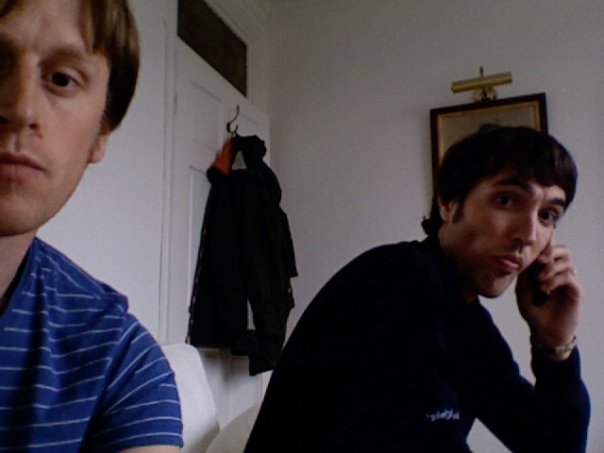
The first one is of Ben and me during our recording. Ben is talking on his mobile phone (as per usual!)
3867_86638111805_6895810_n


Baking in the sun on Benaulim Beach in Goa:

2108_50429406805_1087_n


The view from our accommodation in Hampi:

2108_50429171805_120_n


Climbing up to the Monkey Temple in Hampi. That’s my cousin Oliver in the picture.

2108_50429191805_774_n


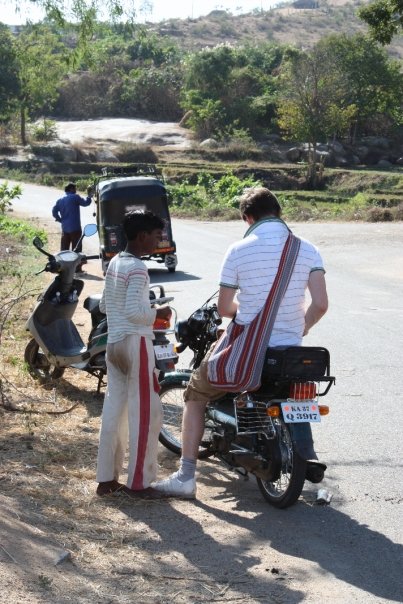
I stopped to take a photo and this boy started hassling me for money. I think I gave him some rupees, but he wanted more. Also he wanted a pen or some paper, but I didn’t have any.

2108_50429231805_2485_n


2075_123324985082_3539_n


Going ‘off the beaten track’ on our scooters.

2108_50429236805_2720_n


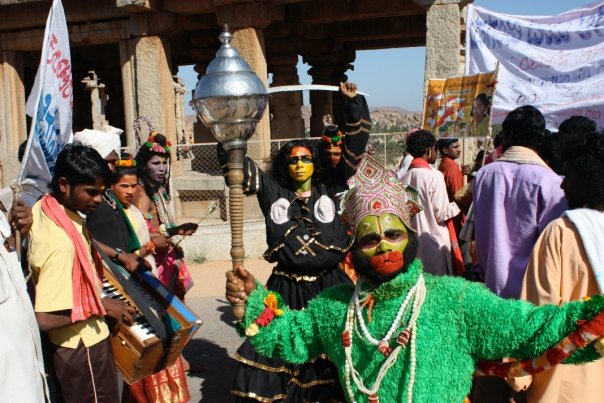
These are pilgrims on their way to visit the temples in Hampi. They have dressed up as Hindu characters. The man in green is dressed as Hanuman, the monkey king.
2075_123325080082_8931_n


Two children we met outside one of the temples:

2108_50429206805_1356_n


The Hanuman Temple (monkey temple).
2108_50429286805_5064_n


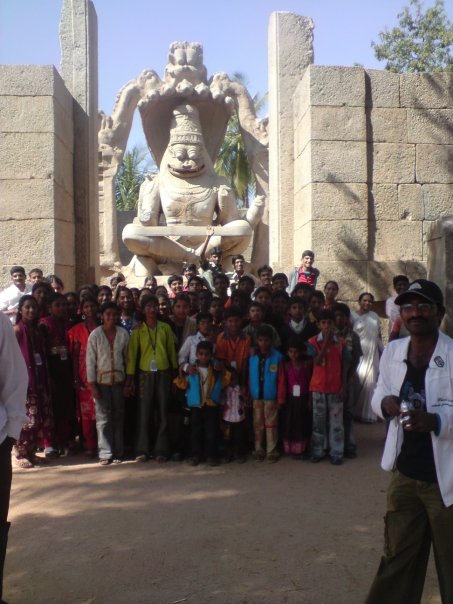
This is a group of Indian school children visiting Hampi. In the background you can see a statue of Hanuman (the monkey king).
2108_50429341805_7865_n


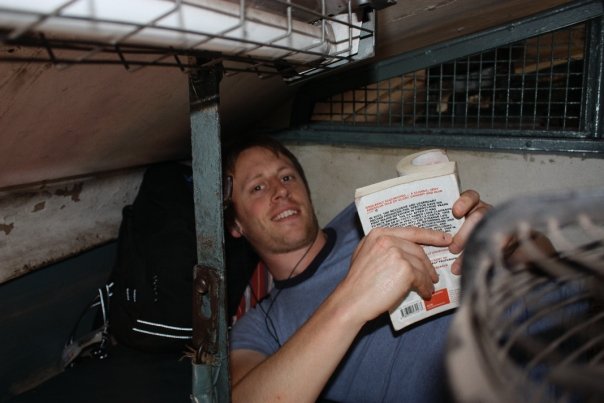
This is me on the train back from Hampi to Goa. Our seats were at the top of the train and we had to lie down like this for most of the journey. You can also sit on the doorstep of the train and watch the world go by, but it’s a bit dangerous…
2075_123325145082_3155_n


5. Joaquin Phoenix

An episode all about the mysterious story of Joaquin Phoenix, including an English lesson about modal verbs of deduction in the past and present.

Right click here to download.

Introduction

Joaquin Phoenix is a famous Hollywood A List actor. He appeared in Gladiator and Walk The Line (the Johnny Cash story). Recently he announced that he wants to quit acting to become a rapper. Also, his appearance has become very strange! He looks more like a homeless person than a Hollywood star. His decision has become a Hollywood mystery. Is it real, or is it a joke? No one really knows.

In this episode of the podcast, Luke talks about Joaquin Phoenix with his friend and colleague Howard. You can listen to the conversation – some of the vocabulary is defined below. The language section of the podcast is about making speculations with modal verbs. See below for more information. Also, below you will see some pictures of Joaquin Phoenix, and some YouTube videos – one of him announcing his retirement from acting, and one of him rapping (badly) and then falling off the stage! For more strange Joaquin Phoenix videos, have a look on YouTube. We can’t wait to find out if it is real, or if it is all a big joke. We really hope that it is a joke, because if it isn’t, he could be in real trouble…

Some vocabulary that Luke & Howard used in their conversation + definitions

Howard: “He’s from a famous acting dynasty” – a dynasty means a large and powerful family
Howard: “He looks like a homeless (person), or a tramp or something” – ‘homeless’ and ‘tramp’ both mean someone who doesn’t have a home and has to live on the street. ‘homeless’ is also an adjective
Luke: “He’s making a fly-on-the-wall documentary” – a fly-on-the-wall documentary is a documentary film or programme which is filmed to look like the people in the film are not really aware of the cameras, so they act naturally and it is like the viewer is a ‘fly on the wall’ just watching what is happening. This is not a reality show like Big Brother. It’s a type of documentary.
Luke: “A comedy movie a bit like Borat” – Borat is a satirical comedy about a man called Borat, played by Sacha Baron Cohen
Luke: “The thing about rapping is that you have to have a flow” – a rapper’s ‘flow’ is his rhythmical style of rapping. E.g. Eminem has a fast flow. Joaquin Phoenix’s flow is slow, and elementary.
Howard: “He looks like a twat” – a twat is a slightly rude word which means ‘an idiot’
Luke: “He’s let himself go” – to ‘let yourself go’ means you stop looking after yourself and your appearance goes bad, e.g. you gain wait, your hair grows too long, etc.
Luke: “It sounds like he’s slurring his words” – to ‘slur’ your words means that you don’t pronounce your words properly, like when you are drunk.
Luke: “He’s famous for a method approach to acting” – a method approach is an acting style which involves the actor totally becoming the character he is performing. The actor lives as that character all the time, even at home. Famous method actors are Robert DeNiro and Al Pacino. DeNiro famously put on a lot of weight to become Jake LaMotta in the film Raging Bull (an excellent film!)
Howard: “His family are very eccentric” – ‘eccentric’ means slightly crazy, odd, weird, bizarre, strange
Howard: “A lot of craziness” – craziness is the noun from ‘crazy’
Howard: “A lot of weird and wacky things happening” -wacky is another word for crazy, bizarre, weird, odd, etc
Luke: “I’m a bit sceptical” – ‘I’m sceptical’ means ‘I don’t really believe it is true’
Luke: “Someone in the crowd was heckling him” – to heckle someone means to shout criticisms from the crowd. Comedians are often heckled, by hecklers during stand-up comedy routines – e.g. “That’s not funny!!”
Luke: “It’s a piss take” – a ‘piss take’ is a joke. designed to fool everyone, to make fun of everyone.
Howard: “It sounds like he’s on the edge” – on the edge means ‘close to being crazy’ or ‘close to a nervous breakdown’
Luke: “I’m leaning towards ‘it’s all a joke'” – to be leaning towards something means that you are starting to take that opinion. You are favouring that opinion.
Howard: “I think it might be for real” – ‘for real’ means genuine, not fake.
Luke: “Finally, he’s cracked” – he’s ‘cracked’ means he’s ‘lost his mind’

Summary of Language Section – Modal Verbs:

Use might, must, could or can’t to speculate about things.

1. For present or future use modal + infinitive (without to)
e.g. He may have an emotional problem

or modal + be + -ing for the continuous form
e.g. He may be having emotional problems

2. For speculations about the past, use modal + have + past participle
e.g. He may have got tired of Hollywood

3. Use ‘must’ when you’re sure that something is true
e.g. It must be a joke! (or It has to be a joke!)

4. Use ‘may’ ‘might’ or ‘could’ when you’re less sure that something is true.
e.g. He might be serious, but I’m not sure to be honest.

5. Use ‘can’t’ when you’re sure that something isn’t true or didn’t happen.
e.g. He can’t be for real
e.g. He can’t have given up acting.

2. Easter / Interview with my Dad / Language Focus: Adverbials

A conversation with my Dad about Easter, and a language point about adverbials. Full transcript available below.

Right click here to download this episode.

Small Donate Button This is the transcript to “EPISODE 2 – EASTER”
Hello, and welcome to Luke’s English podcast, the real British English podcast. This is episode two of the podcast and I’m very pleased because I’ve already had a couple of emails from a couple of people who’ve listened to the podcast, and one of those emails comes from Jose Manuel in Alicante in Spain and he asks me about Easter because it’s Easter at the moment. He asks me what we do normally in the UK at Easter and, well it’s funny you should ask that Jose (Jose, I’m sure that’s how you say it) because right now I’m at my parents’ place. I’ve travelled up on the train from London and I’m at my parents house which is in the countryside in Warwickshire and this is a typical thing that people of my age do, they normally travel back to their parents’ houses and they spend time with their families together and actually in this episode I’m going to be joined by my dad so I’m going to interview my dad about Easter, so he’ll tell you some typical things about Easter time in the UK and so that’s going to be our feature in part two and then at the end of the podcast I’m going to talk about some adverbs, some useful adverbs in response to another email that we got and so that’s what’s going to happen in today’s podcast.

Luke: OK, so I’m now joined by my dad, Rick, but obviously I call him Dad, I don’t call him Rick. Hi Dad,
Rick: Hello Luke
Luke: How are you?
Rick: I’m fine, thank you very much
Luke: Good, so, obviously I’m here at my parents’ house because it’s Easter, at your house. This is what I normally do, isn’t it?
Rick: Yes, it is, it’s a time to get together with the family
Luke: Right, ok so, so Easter then. Now Easter is a season when we remember the death and rebirth of Jesus Christ by telling our children that a large rabbit comes in the night and leaves chocolate eggs in the garden, now I don’t know about you but that seems a bit strange to me I don’t know what the connection is between the Jesus thing and a big rabbit and chocolate and eggs and things, what do you think about that?
Rick: Well this idea of the Easter rabbit coming and bringing eggs is a bit of an American idea really and I think that it’s a very interesting mixture between Christianity and old pagan beliefs, I mean, obviously the Christian celebration of Easter is, as you say, about the crucifixion and, after three days, the resurrection of Christ, so it’s a crucial celebration and stands alongside Christmas, the birth of Christ and then the death of Christ, the two big Christian festivals.
Luke: That’s the Christian thing, you said something about Pagan, what does that mean?
Rick: Well of course you know experts will tell you that 2,000 years ago when Christianity started to spread across Europe it did, if you like, take over the Pagan festivals that already existed
Luke: So Pagan is the kind of religion that people had …
Rick: it’s pre-Christian …
Luke: … before christianity,
Rick: Yes and it’s got a lot to do with various gods and superstition and of course pagan times there was a big winter festival and there was a big spring festival and the spring festival was of course the festival of fertility and growth and new growth …
Luke: …and new life
Rick: … of new life and of course if you lived in a society where it was very important that the crops didn’t fail this was a time when you wanted to have all the good luck you could get, to have the gods on your side to make sure that the crops had a very successful season …
Luke: OK, so before Christianity then, Easter was a festival, a pagan festival when people celebrated the start of new life and spring time and good luck for your, you know, farming for that year, right?
Rick: yes
Luke: now I understand the egg connection because an egg is the symbol of new life right? But why … now actually one of my students asked me this last week, why do we have chocolate eggs, why chocolate?
Rick: Well I must admit I’m not entirely sure, but my guess is that people have given each other eggs at Easter time, or if you like, at spring time as a gift because it is, as you say, the time when all the birds are laying their eggs
Luke: right, chickens and stuff
Rick: well chickens but all the wild birds are nesting and making nests and laying eggs and remember that in the old days people used to use the natural resources very very much, the berries and the eggs were a resource …
Luke: so they …
Rick … and they would go out into the countryside and gather the eggs and eat them …
Luke: right, so they used …
Rick … so the egg season came in and people would no doubt give each other eggs and presents and then when we discovered the joys of chocolate I suppose it was a natural thing to give people chocolate eggs instead
Luke: just a sort of gift …
Rick: … a gift which symbolises new life
Luke: so its nicer really to give someone a chocolate egg than just an egg because just an egg, I mean, it’s alright, you can boil it or fry it or something but it’s nicer as a gift to give someone a chocolate egg I suppose
Rick: yes I suppose
Luke: right so let’s see, what do English families usually do then at Easter in the UK? oh um yea, what do English families normally do at Easter?
Rick: well it is a traditional time for the family to get together and it’s a long weekend, Friday, Saturday, Sunday, Monday and those four days is when most families, you know, get together and these days they get in the car and they drive to the parents or the grandparents and it is very much a family get together and they give each other chocolate eggs in most households.
Luke: When I was a kid I remember what you and mum used to do is at Easter you used to hide eggs, you used to hide chocolate eggs around the house or around the garden and me and James, (James and I) would go and try and find the eggs, so that was always fun.
What did you do when you were a child?
Rick: Well I remember I used to go to my grandparents’ house. They lived up in the north of England in the countryside, and they had real boiled eggs, hard boiled eggs which were boiled in water that had been coloured with something so you were given a pink egg or a blue egg or a green egg and we would roll them, this was really quite a well established tradition that you roll the eggs down some kind of bank, down a hill, you roll the eggs down a hill, why I’m not sure but that’s what people did, they used to roll the eggs down the hill and run after them as a kind of game
Luke: so you’d walk up a little hill with your blue or pink eggs and then you would sort of roll them down the hill and then run after them and have a lot of fun running after some blue and pink …
Rick: … that’s right and if your egg broke it didn’t matter because it was hard boiled it was cooked and then you would eat the egg at the bottom of the hill, that’s what you did, you rolled the egg down the hill and you chased after it and you caught it and you ate it.
Luke: Right, well that sounds like lots of fun I suppose these days if … I think probably children are so lazy now that if you hid some chocolate eggs in the house they would probably, you know, be too lazy to get up and try and find them, you’d probably have to leave ipods or something around the garden, because if you left an ipod in the garden then a child would probably get up from in front of the TV and try and find it. I think kids these days are too lazy to do anything really unless there’s an ipod involved.
Rick: I don’t really agree with you Luke and I know you’re really just teasing, but the point is of course is that it’s fun and kids do like to search for things, to hunt for things whether it be a little chocolate egg or indeed a little chocolate rabbit and sometimes you hide little chocolate rabbits around the house and ask the children to find them and they love it.
Luke: I hit a rabbit the other day in the car when I was driving.
Rick: Really?
Luke: There’s lots of rabbits around here, you know I was I – um my parents live in the countryside, listeners – and there’s lots and lots of rabbits especially at this time of year and I was driving the car to the station to pick up my brother James, and a rabbit ran out in front of the car and I didn’t hit the rabbit with the wheels so I didn’t squash it but the rabbit went under the car and I heard a kind of noise …
Rick: … clonk …
Luke: … a kind of dum noise as the rabbit, probably the rabbit hit his head on something under the car. I looked in the mirror and there was just a dead rabbit
Rick: what a horrible thought! Mind you you do see an awful lot of dead rabbits on the roads these days there are thousands of them and they do have a terrible habit, a rabbit habit of running out in front of your car …
Luke: they’re stupid aren’t they?
Rick: … they wait until you’re coming and then they run out
Luke: They’re just stupid really aren’t they. Anyway there are so many of them that it doesn’t matter
Rick: Well it’s a pity for that particular rabbit but there’s nothing much you can do about it when it hurls itself in front of your car
Luke: Well there’s plenty of food for the birds
Rick: That’s quite right lots of birds eat the dead rabbits – the crows, the magpies and the buzzards, they live on the rabbits which are killed on the roads.
Luke: Well, thanks very much Dad for, you know, for agreeing to talk to me, yea, it was very nice, thank you
Rick: ok and I hope you have a very happy Easter Luke
Luke: Yes, happy Easter to you too
Rick: Thank you.

Ok so that was my dad, um a very nice man, very well educated, he knows a lot of things about history and all sorts of things so I’m very lucky to be able to interview him.
Now like I said at the beginning of the show, I had another email about an English question, now I got an email from Miho in Yokohama in Japan and she asked me what ‘basically’ means, because she heard me in the first podcast using the word ‘basically’ a lot and she’s right I do say ‘basically’ quite a lot, it’s a very common word, particularly for me. Lots of people use the word ‘basically’. Now the word ‘basically’ is an adverb and adverbs are great words, very useful words that you can use at the beginning of a sentence. Now a word like ‘basically’ doesn’t really mean very much but people use it almost like a habit. Really, ‘basically’ is used to say … before you say something you use the word ‘basically’ to show that you are going to say something in a simple or basic way, OK? So for example if I use the word ‘basically’ you put it at the beginning of the sentence and you’d say something like this: “basically, this is a podcast to give learners of English some listening practice” OK?
Now there are lots of other adverbs that you can use in a similar way at the beginning of a sentence and you’ll probably know adverbs because most of them end in ly, now we get lots of different kinds of adverbs in different positions in the sentence but the adverbs I’m going to teach you now are ones you can use at the start of a sentence. So we’ve got adverbs like basically, actually, obviously, strangely enough, frankly speaking, recently, unfortunately, amazingly and hopefully. Ok so I’m just going to give you some examples of that now, so we’ll start with ‘actually’:
“Actually this is only the second podcast I have ever done” ok? So there’s an example. Now if you speak Spanish and some other European languages, ‘actually’ in your language means ‘currently’, meaning ‘now’ so actually doesn’t mean ‘now’i t just means ‘as a matter of fact’, right? So, “actually this is only the second podcast I have ever done”.
The third one is ‘obviously’. Now we use “obviously” to say something that is obvious, so say something that everybody knows. Now, football players use ‘obviously’ a lot when they are doing interviews now, just as an example you might say “obviously we were the best team in the competition” right? Now you would say ‘obviously’ because your team won so of course your team was the best one. “Obviously my team was the best team in the competition” for example.
The next one is ‘strangely enough’, now that’s used to say something that is strange. OK, so for example, “strangely enough I don’t really like fish and chips, even though I’m English” right? So that’s strange because most English people like fish and chips, so “strangely enough I don’t really like fish and chips even though I’m English”.
The next one is ‘frankly speaking’, now this is something you would say that’s rather honest, OK, so for example, “frankly speaking it was the worst film I’ve seen in a long long time” so if you are being very honest about something you can say ‘frankly speaking’, “Frankly speaking it was the worst film I’ve ever seen”.
The next one is ‘recently’. Now you probably know ‘recently’, we use it to say something that happened in near or close time. Right? So for example “recently I’ve been listening to lots of Rolling Stones records”. Ok? “Recently I’ve been listening to a lot of Rolling Stones records”.
The next one is ‘unfortunately’, and we use that one to talk about something bad that’s happened, OK? something that you regret, OK? So for example, “unfortunately, I had to leave before the end of the lesson” OK ? “unfortunately I had to leave before the end of the lesson”. So that would be a bad thing because, obviously you want to be in the classroom for the whole lesson, but “unfortunately I had to leave before the end of the lesson and I missed the most important part”, for example.
And finally, the next one I’d like to teach you is ‘amazingly enough’. We use that one to describe something amazing for example “Amazingly enough, I’ve never been to Edinburgh” “Amazingly enough I’ve never seen a musical” and “amazingly enough I’ve never been to Harrods”. Now that’s amazing because I live in London and I’ve never been to Harrods, right? So “amazingly enough I’ve never been to Harrods”, OK?
Oh there’s one more, and that’s ‘hopefully’. Now if you hope for something then you can use ‘hopefully’, for example “hopefully this podcast isn’t boring” right? Ok?
Right, so that’s the end of part three and that’s the end of this podcast. Don’t forget to email me. I’d like to end with a question again now, and the question this time is: what kind of music is popular in your country at the moment? so what are people interested in at the moment in terms of music in your country? So, for example is it mainly English language music so music from American or Britain, or is music from your country more popular than English Language music? So, don’t forget to email me, that’s: luketeacher@hotmail.com and I look forward to hearing from you very soon. That’s the end of the podcast, bye bye bye bye bye…..