Category Archives: Uncategorized

174. How to Learn English with Luke’s English Podcast

This episode contains lots of ideas, advice and suggestions for ways of improving your listening, reading, writing and speaking using Luke’s English Podcast. A transcript is available below. ;)

Download Episode  Small Donate Button
This should be a useful episode. I’m going to go through a whole bunch of ways that you can improve your English with Luke’s English Podcast. You’ll find a list of these points on my website. I’m going to expand on them here.

I’ll be talking about key areas: listening, reading, writing, speaking, grammar, vocabulary, pronunciation and discourse. Much of what I’m saying is written on my website. Just find the episode called “How to Learn English with Luke’s English Podcast”. I’ve written a lot of this down because it contains lots of specific bits of information which I wanted to make sure I included. I try not to do too many episodes in which I read things to you. I promise that the next one will be unscripted. Anyway, I’ll do my best to make this sound as natural as possible, which is an art in itself. Actually, you could use this script to help you practise your pronunciation, you could record yourself reading this too, and compare it to my version. What are the differences in your version and mine? What can you learn from that? Record yourself doing it again, and compare that to your first attempt. It’s bound to sound a lot better. In fact, I guarantee that you’ll sound more natural and convincing with each attempt. More on that later.

For now, here is a list of tips and advice for learning English with LEP. ;)

Just listen
First of all, you don’t really have to do much more than just listen to the episodes. I realised some time ago that a lot of the students of English that I met at school in London did not listen to enough authentic English. They were willing to spend money and travel across the world in order to improve their English, and yet most of them, for some reason, were not prepared to take a bit of time every day to listen to something in English. Why? I think partly this is because they didn’t know what to listen to. A lot of people watch TV and movies in English. Fine. But honestly, that might not be the best way to improve your English. Film is very visual. A lot of what you understand from a movie is the visual storytelling. It’s important to just focus on the audio – on the language. So, a lot of students didn’t know what to listen to. They thought that they didn’t have much choice. Actually, there’s plenty of choice out there. The BBC has plenty of podcasts, there are loads of podcasts on different topics on iTunes – but they’re all made for native speakers. They’re too difficult to listen to, and ultimately, that’s not motivating. There are some podcasts out there which are made for learners of English, but a lot of them are just focused on language learning, at the expense of entertainment. They’re useful, but they’re a bit dull. This is less the case now, because 5 years after starting this podcast, there are more interesting things out there for learners of English, including my podcast. So I decided that I’d try and create something for learners of English to listen to that they would actually want to listen to, beyond just learning English. Ultimately, I think to listen to English for extended periods of time, you have to have an interest in what is being talked about, or you have to find it entertaining. Otherwise, it’s hard to really sustain your concentration and it becomes like a chore. There is real value in listening to English for extended periods of time, but it’s difficult to achieve because you get put off by not understanding things, or because the recording is a bit patronising and dull. I don’t want to blow my own trumpet here too much, because I’m sure that my podcast is not always as entertaining or as engaging as it could be, but I think the only way to get people to keep listening, is to try and make it entertaining as well as informative about English. So, I record this podcast with you in mind, but I try to keep it as authentic as possible. I try to avoid being simplistic. I try not to grade my English too much. I know it might be challenging for you sometimes but I attempt to hold your attention by talking in an enthusiastic way about subjects which I personally find interesting. Hopefully, the result is that you keep listening, and that you feel personally involved in it somehow. Then, by exposing yourself to lots of English in this way, you are able to acquire the language – to pick it up, in a variety of ways.

Stephen Krashen & Language Acquisition Theory
Let me now refer to the language acquisition theory of Stephen Krashen. This theory is very well known among language learning theorists, and it underpins a lot of what we know about learning and teaching English. Krashen believed that there are two ways to develop our language learning skills. One is through language acquisition and the other is through language learning. Language acquisition means that it is possible for adults and children to learn language in a subconscious way – meaning, in a kind of passive way – by simply engaging with the language. The important thing is that you focus on the message in a bit of language. So, when listening to Luke’s English Podcast this means focusing exactly  on what I really mean, rather than just on the specific items of language I’m using. The primary focus is to just understand what I mean (hopefully at a fairly deep level – in order to laugh at something I’ve said, or feel moved by it) and then you kind of ‘pick up’ the language as a result of that. You might not be immediately aware that you’ve learned some new language in this way. In fact, this kind of acquisition probably informs your passive knowledge of the language. According to Krashen, another type of language development is language learning. This is when you focus on learning specific forms  – like studying grammar rules for example. It involves having some instruction by a teacher, perhaps in the form of error correction, or from a grammar book which explains the ‘rules of English’. The downside of this kind of learning is that it is rather dogmatic, can be boring, complex and abstract. It doesn’t necessarily replicate the organic way in which we pick up language as children, and doesn’t quite allow the subconscious acquisition of language that occurs from just engaging with the language in order to understand a message being communicated.

Alright, so how does this apply to the way you can learn English? Well, I think it’s pretty important to get both aspects of language learning into your life. This is what I call “having a balanced diet”. You shouldn’t just study the grammar rules in a dogmatic way, although that is undeniably important. You should also attempt to just engage with the language as it is used in natural, authentic and meaningful situations. How can you do that? Ideally, this would mean going out into the world and doing things in English. In fact, this might be the best way to improve your English. If you get a job that requires you to use English all day you will improve quickly. It’ll be really hard, but you’d be forced to improve. That’s like a boot camp for language acquisition because you’re not really studying the language, you’re just attempting to survive in it. You’re really focusing on the communicative acts you are trying to achieve. You’re really focusing on meaningful messages, and you naturally learn the most direct and effective way to understand and communicate meaningful messages. You might not be able to do that in your life. You might not have access to native speakers in that way. So, my podcast can be a substitute. It’s not really the same as attempting to work in an English speaking environment, but the key point is that you can replicate aspects of that experience by just attempting to follow/keep up with what I’m saying, and do that regularly, over long periods of time, and you’ll pick up massive amounts of English.

So, just listen, try to follow everything I’m saying, try to enjoy it and engage with it, listen regularly, listen for extended periods. This will all contribute to your acquisition of English, as described by Stephen Krashen.

That’s language acquisition, but you can also do more traditional language learning alongside Luke’s English Podcast. First of all, outside of listening to the episodes, you can do your formalised language studying from a book or in class, and use LEP as a companion to that. Study the language, and then try to notice aspects of the language that you’ve studied in episodes of the podcast. For example, if you’ve studied verb tenses, you can listen to a story I’ve told on the podcast and try to notice those verb tenses, how I’m using them, how I’m pronouncing them, and so on. It can back up, confirm or clarify the language study you’ve been doing. You should always refer to authentic language usage as a way of checking language that you’ve studied.

Also, you can study the things I say in the podcast more directly. The podcast can be a study tool. Here are some ways you can do some active language study with the podcast:

Use transcripts
You could read a transcript and check new words in a dictionary as you find them. Pay attention to the way I use the words, including the grammatical context, collocations between words and pronunciation. Any new words or structures you find, make a note of them and practise using them yourself.

You could attempt to write your own transcripts. This reveals a great deal about the gap between the English you know, and the English that I use in the podcast.  Try transcribing a section of one episode. You could do an episode that has already been transcribed. Listen carefully to it, and try to write down every single word. There may be certain utterances that you just can’t identify. Mark them with question marks. Listen again and again. You could just focus on a specific 5 minute section of an episode. Keep listening until you’ve done your best. Now check the proper transcript for that section and compare it to what you wrote. What are the differences? Now you can identify the gap between what you understand, and what I said. Try to close that gap. Check the words you didn’t know. Identify why you missed the pronunciation of something. Think about how I say these words and phrases, and their definitions. Then you can start working them into your English when you speak. We’ll look at ways of developing your speaking in a few minutes.

A note on transcripts. You may be aware that a lot of my episodes have transcripts, which can really help you to study the language (although you shouldn’t read them all the time). But you can also contribute transcriptions to my website. If you fancy transcribing a few minutes of an episode, please send it to me and I’ll be able to correct it and publish it on my website. I have a transcript collaboration going on using Google documents. You might already know about this because I did an episode on that subject a couple of months ago. You can go to my website and click “transcripts” to find out more. Basically, writing transcripts of my episodes is not only a great way to use the podcast to improve your English, it also helps me to provide an even better service to my listeners.

So, Luke’s English Podcast is best consumed as part of a balanced diet. Listen freely and just try to enjoy and understand what I’m saying, and let your mind naturally acquire the language, but also mix this with more formalised language study to get the full 360 degree effect.

You might think the formalised language study part of that is boring and time consuming. That’s fine. You don’t have to do any of that, but as a compromise, what you can do is just be mindful when you’re listening. Your first aim is to focus on the message, but you can also try to notice specific aspects of the language too. Try to identify words, phrases and grammatical structures. You don’t have to formally study them, just notice them as you hear them. Like “oh he’s saying depend on” so it must be “depend on” in English, not “depend of”. Things like that. Just be mindful when listening.

I record different types of episode here. My main aim is to engage you and keep you interested, while presenting English to you in an authentic way. In some episodes I try to draw your attention to the language more specifically. For example, I teach/explain/demonstrate vocabulary items referring to a topic, or bring your attention to an aspect of pronunciation. In those episodes, you can just chill out and follow what I’m saying, but you can be more active, and make notes of the vocabulary, try to remember phrases, listen again and pause the recording to test your memory.

Listen in comfort, and enjoy the experience. Krashen also writes about the affective filter hypothesis. This relates to the conditions in which learning takes place, and how these can have a big effect on the successful acquisition of language. Basically, good conditions for learning are: motivation (the listener really wants to hear what’s being said, and is keen to learn the language), high self-esteem and relaxation. These things allow the flow of acquisition to move freely, without being blocked. Mental blocks occur when the learner is stressed, anxious or feeling bad about themselves. This creates a mental block to the acquisition of language. I guess this relates to one of those situations in which you’re in an unhappy language class. You feel stressed because of pressure from the teacher or from the judgement of your classmates, you feel low self-confidence because you don’t get any positive reinforcement from taking part in a communicative exchange and you’re just not enjoying the experience of being there in the classroom. As a result, there is a kind of mental barrier which really prevents you learning anything. In fact, it might even make it worse because you associate learning English with painful or boring classroom situations. The advantage of Luke’s English Podcast is that the emphasis is on fun, a lot of the time. You have nothing to fear or worry about when you listen to this. In fact, it can be an extremely pleasurable experience. I’m not just bigging myself up here. I know what it’s like to listen to your favourite podcast. It’s quite a personal experience. I listen to Mark Kermode & Simon Mayo’s Film Review Podcast on my way to work, and I can’t begin to explain the joy of listening to it. They’re like my friends, and I’m sharing a really nice conversation with them. I listen to their voices in private, through headphones, while I’m sitting on a smelly underground train with miserable people all around me, but I’m in my comfort zone. In fact, sometimes I’m disappointed when I reach my metro station, because I just want to keep listening to the podcast. Hopefully, listening to Luke’s English Podcast is a similar experience for you. That’s certainly the idea. This should be a personal and enjoyable experience for you, and I invite you to just enjoy being part of the podcast community, and remember that all around the world there are other people like you, listening to me ramble on about stuff. There’s no chance of the affective filter giving you a mental block in this situation because you should be in your comfort zone. That’s the advantage of podcasting. You really can listen to this whenever and wherever you want, and you are free to get as comfortable as you please. As I’ve said before, feel free to listen to this in the bath, on the loo, or as you softly and slowly drift off to sleep at night. Of course, you can also listen at your desk, with a pen in your hand, or while typing, in order to make notes or write transcripts. You can also sit up and read transcripts. It’s up to you. The main thing is to just enjoy yourself and let the English go into your head. Just imagine that my voice is bouncing around inside your mind, and lots of the words, and sounds are sticking in there.

You should certainly listen to episodes more than once. In fact, if you’re interested in really learning English from this podcast, I think it’s vital to listen several times. Once is not enough. In fact, you might only scratch the surface if you listen just once. Listening again and again will allow you to get really familiar with what’s being said. You’ll notice and remember things that you didn’t catch the first time. Repetition is really important as a way of helping your brain notice patterns. After a couple of listens, you’ll remember certain phrases, bits of intonation or responses and they will be reinforced when you listen again. It might be asking too much of you, but you could even start to remember and repeat some of the things you’ve heard on Luke’s English Podcast. I don’t necessarily expect you to repeat everything I say, but perhaps you could memorise the lines of a comedy sketch that I present to you, and then repeat the lines to yourself or your friends, or just while you’re listening again. I’m a bit of a geek and I love Star Wars. When I was a kid I used to watch Star Wars on heavy rotation. I’d watch it again and again. Now I can remember all the lines from the film. In fact, I don’t just remember the lines, I remember the bits of music and sound effects too, as they occur in the film. It’s the same with Monty Python films and sketches. I’ve watched them so many times that I can repeat a lot of the script from memory, and in fact some phrases from those movies have found their way into my vocabulary. You can do that too, by listening to episodes more than once, and listening to some comedy sketches which I present to you many times. Soon I’ll be doing an episode about Monty Python. For some reason, Monty Python’s sketches are very memorable. In fact, there are several generations of people in the UK and America who grew up watching Monty Python films and who are able to recite whole sketches to each other. Again, you can do the same thing, realise that there are some terrifically funny things in English, and use that as a way to pick up language.

There are a number of different areas to focus on with English.
4 skills:
Listening
Reading
Writing
Speaking

Language systems:
Grammar
Vocabulary
Pronunciation
Discourse

Listening
I’ve already talked a lot about the benefit of just listening for fun, or listening in a more active way. I did mention that it’s good to be comfortable when listening. I should add too that I think it’s important to try and listen to things that you don’t completely understand. It’s fine to listen to things that you don’t understand completely, and the general opinion on this seems to be that you should push yourself when you listen, and don’t get put off if there are things you don’t understand. It’s in that challenging experience that your brain is really piecing things together. For example, if you struggled to understand my conversation with Daniel Burt, that’s fine – in fact, that struggle is good. Listen again, and keep trying. Don’t give up. Push through those moments when you don’t understand. Keep going. Don’t let confusion stop you.
Also, try to identify subtle differences between accents. You may only notice little differences at first, but eventually you’ll be more and more aware of the differences between accents. Eventually, you’ll be able to say “this guy is from the north of England”, “This one’s from Australia” or whatever.

Reading
Reading transcripts on my webpage.
Outside of the podcast – read a variety of texts. Again, try to find things that you enjoy. You should also be aware of your purpose for learning the language. What are you going to use English for in the future? You may need to read emails, or business reports. It may be worth reading articles that talk about business trends. Otherwise, just reading any well-written text for enjoyment is a really good way to improve your literacy. I must add a page on my website with recommendations for reading. There’s loads of reading you can do – blogs, newspapers but also books which you can download free online. I haven’t done it yet, but I’m planning to give you a list of some good things to read.

Writing
Again, this is not one of the things that I focus on a lot on Luke’s English Podcast. The focus is mainly on spoken English. However, transcribing podcast episodes can be good for your writing. You could also write your own blog which contains your opinions or your outlook on a topic. Feel free to write a response to episodes of my podcast in the comments section. You should aim to concisely express your opinion, in a structured way, using the most appropriate words you can find (perhaps including some words you’ve picked up from that episode of the podcast). Think about the person reading the comment – make it easy and enjoyable for them to read, and focus on stating very clearly and efficiently exactly what it is you want to say. Considering those ideas can help you to make your writing more effective.
If, however, you need to practise writing for the IELTS test, you will need to do more specifically focused writing practice, probably using an IELTS preparation book, or following an IELTS course of some kind. My podcast can help you with general skills (vocab, etc) but for specific kinds of writing work, you should do some specific writing practice. Practice practice practice. As I said before – to get the best out of Luke’s English Podcast, use it as part of a balanced diet.

Speaking
Perhaps the best way to improve your speaking is to actually practise it in real-life situations. The requirements of that situation will train you to say the right things at the right time, with the right tone. You should certainly be aware of how intonation is important in affecting a message. These are things you can learn from trying to enter into meaningful acts of communication and learning from your mistakes. You might also need a teacher to actively correct your errors. But, you can definitely use Luke’s English Podcast to improve your speaking too. Let’s look at some ways to do that:
Just try to take some aspects of my speech and apply it to your speech. You could just add some words or phrases you’ve heard from me, and use them yourself. Or you can pick up some speech patterns, pronunciation from me and add that to your speech too. If you like, you could use my speaking as a kind of model for your own speech.
More specifically, you could copy and repeat some of my sentences. Listen to a line I say, and then repeat it and try to sound exactly like me. You could listen to phrasal verb episodes, and whenever I present an example sentence, pause the episode and repeat it after me. Keep doing that until you feel you’re version is pretty similar to mine. So, just listen and repeat until you’ve worked out how to make the same sounds as me. Think about vowel & consonant sounds, combinations of consonants and how to make those sounds with your mouth, think about connected speech – what happens when words are pronounced fluently together in a sentence – they might get pronounced differently, certain sounds may be dropped when words are linked, and some sounds may be added when words are linked too. Pay attention to these aspects of pronunciation. I should do a whole episode on connected speech, and it’s one I’ve had in the back of my mind for ages.
Pick an extract from the podcast, with transcript, and record yourself saying it. Compare your version with my version. Then, work on the transcript. Underline the stressed words, add lines to represent pauses for emphasis, identify word links in pronunciation. Listen to me saying that extract again, and check your ‘sound scripted’ transcript. Now record yourself doing it again, this time adding the intonation, pausing and sentence stress. Compare that to the original. This can help you develop awareness, and control of speech patterns.
Record yourself just talking in response to one of my podcast episodes. If I’ve talked about UFOs for example (not yet, but I will!) then you could record yourself talking about UFOs too. Try to include any words I’ve presented to you on that topic. If you like you could leave an audio comment on my Audioboo page, and let the world know how you feel about something.
Or, you could start doing your own podcast, like Zdenek from Zdenek’s English Podcast. He’s not a native speaker, but following a suggestion in one of my episodes he decided to do his own podcast. He now has followers and listeners and he’s really into it. Listening to his episodes I get the sense that his confidence is developing and he’s finding his own voice. It must be very good for his English (which, of course, is already excellent). You could do it too if you want.
The main thing is practice. Use as many opportunities to practise as you can. Join clubs to meet English speakers. Use the internet. Find groups on Meetup.com in which people are doing language exchanges. Put yourself outside your comfort zone. Don’t be shy, give it a try. Take the initiative. No-one can do the speaking for you. There’s no shame in making mistakes. You have to be in it to win it, so open your mouth and get talking. Remember that English is about what you can do, not just about what you know. Be active, find your voice in English. If you’re in a classroom – don’t be one of those quiet students. It’s completely up to you to start talking, and why not do it in the safety of a language class. That’s the whole point! Speak up in class and use that as a safe place to experiment and make mistakes. Experiment! Switch off your editor! Don’t listen to the voice in your head which is telling you to keep quiet, or telling you that you can’t say something because it might be wrong. It does not matter if you’re wrong. Remember that you have to say something wrong about 5 times before you get it right. Get through those 5 times nice and quick, and then you’ll be fine! Sometimes, opening your mouth is the hardest thing to do, but once you’ve started speaking it gets easier. Keep up the momentum. Keep your voice warm. Stay positive, enjoy expressing yourself. Your teacher will love it if you are an active member of class. In fact, you need to prove to your teacher that you’re making an effort. We always like those talkative and positive students. Use that to your advantage – you’ll be more likely to get good grades, and get levelled up. Be nice, be friendly, be talkative. But also listen to others and help them too. That’s a recipe for success for any language learner!
Actually, I just sent Zdenek a message and asked him for his comments on the subject of using LEP to improve your English (particularly speaking) and here are his comments, which I agree with wholeheartedly. In fact, before I read his comments it may be necessary to remind you that Zdenek is a well-qualified teacher of English from the Czech Republic who lived in the UK for a number of years and who has got a master’s degree in English Language. So, he definitely knows what he’s talking about. I’m sure many of you listening to this have similarly good advice and comments on this subject. I am very keen to encourage you to share that information – you can leave text or audio comments under this episode. So here are Zdenek’s comments:
How can listening to LEP improve your speaking skills? It can mainly improve the following skills/subskills:
1) listening (obvious)
2) reading, spelling (reading scripts, additional notes)
3) writing, spelling (script, feedback or thanksgiving emails to Luke),
4) grammar (listening to grammar patterns as part of exposure theory)
5) vocabulary (learning new vocab also guided by the exposure theory),
6) pronunciation (passive listening)
As for the speaking, it is a different question. If you want to improve your speaking through LEP, you have to approach this actively. Not everyone is willing to do this. Some people tend to be shy, have approach anxiety etc…and prefer listening to the podcast as passive recipients. That is fine. However, here are some suggestions on how you can actually improve even your speaking skills.
1) Contact someone via LEP community. There are a lot of interesting people eager to learn English from all around the world. Contact those who have a similar level as you – this way you can both benefit and learn from each other and no one will get bored. Ideally, have an interest in common (sci-fi films, sport, you already have one important topic in common = LEP)…try to befriend these people, add them on facebook, start skype conversations with them or something.
2) Record yourself speaking about a topic. Ask yourself questions related to LEP. Answer these questions or just practice vocabulary Luke teaches you. Listen back to yourself. Try correcting your errors. Re-record. Compare your recordings you made some time later to see your improvements.
3) Record comments in Audioboo (max 3 minutes) –why is everyone so shy? Is everyone afraid that they will be judged? Who cares? Just be friendly and you should be accepted by the community. Luke is a teacher. He deals with mistakes every day. We all make mistakes. Never be afraid to make mistakes. A man who never made mistakes, never made anything. Are you afraid to take on a challenge and face our greatest fear – public humiliation? Well don’t be! If we fight it actively without fear, we can significantly improve our speaking skills this way.
[I just want to add a couple of points here about making a fool of yourself, my experience of speaking French, and of fear of public speaking]
4) Try running your own podcast. Most of you can do it. Again it is only about facing your fears of making mistakes and exposing yourself to the public. This podcast can be just for you and your friends. I make loads of mistakes in my podcast and I am a teacher. I feel ashamed; I have to edit them out. But if you are not teachers, why worry? And even as teachers? You shouldn’t worry.
5) You can always speak to yourself in the mirror and go crazy. Become the next Hamlet. Speaking is not about passivity so move your arse and find some interaction
Note: By following these tips, you will work on your English speaking skills, pronunciation (actively), grammar, vocab (you can focus on trying to use expressions Luke has taught you), listening skills (as you listen to your friends talking for example). There are so many benefits to active speaking practice.

Thank you Zdenek. As I said before, I welcome your comments too. Let’s share our thoughts on this subject together. It’s time for my LEP ninjas to come out of the shadows and deliver some powerful advice! LEP NINJAS – ASSEMBLE!!!

Regarding language systems, I have some things to say about grammar, vocabulary, pronunciation and ‘discourse’.
To be honest, I’ve already spoken enough about grammar & vocab. Let me just remind you of the theory of ‘exposure’. I have talked about this before. The idea is that by listening to lots of English over extended periods, you’re feeding your subconscious with all the patterns of English usage. Your brain is hearing all these patterns of English, including frequent word combinations (like prepositions), tenses, features of pronunciation etc. Ultimately, it all goes into your head, and informs your sense of instinct for the language, so that when you come to do a test in English, you feel the answer. You know that this particular preposition goes with this particular verb, just because you’ve heard it a number of times before and so it feels natural. Feed your head with English. Feel the English rather than knowing it. Use the force young jedi, and remember, the force will be with you… always. Oh, and don’t forget – you’re never too old for this. Language study is a great way to keep your mind fresh and supple. My grandfather is over 90 years old and he’s still really sharp. Perhaps this is because he’s still going to French and Spanish classes on a regular basis.

Regarding pronunciation – a lot of the tips you’ve been given here will help with that. But, I just want to add that improving your listening skills will naturally improve your pronunciation skills too. The two things go hand in hand. The more you’re able to understand natural spoken English, the more you are able to decode the sounds used to make it. Understanding this natural sound code can allow you to start using it too. There is a direct connection between listening and pronunciation, but to fully reap the benefits, you need to need to actively practise pronunciation. The methods I’ve mentioned already in this episode – repeating, recording, re-recording, comparing, speaking in front of the mirror, etc – they’re all good approaches to practising and improving your pronunciation. Don’t be shy, give it a try. You’ve got nothing to lose, just things to gain. Go for it!

As for discourse, this is really about how you structure your speaking. How do you link your ideas up? When you listen, try to notice any specific phrases I use to link my ideas together, move from one topic to another, deal with moments when I don’t know what I’m saying and so on. What are the tools I use to perform certain functions. Can you identify these things and take them on yourself? Try talking about a topic for 5 minutes. See how difficult it is to talk on your feet. Do it again and again until you develop methods of thinking and talking at the same time. Listen to discussions and focus on the ways in which people interrupt, agree, disagree or whatever. Think about the way we use the language to be polite or indirect. How is humour added to what we say? How does intonation affect the hidden meaning behind our words? Explore these ideas when you listen, and then test them out in your speaking.

That’s it for this episode. I hope you have found it motivating, and inspiring. Leave your comments, and I wish you all the very best of luck keeping up your English. I’m sure you’re doing great. Well you must be, because you’re already listening to Luke’s English Podcast – and long may it continue.

BYE!

171. A Cup of Tea with Daniel Burt (Part 2)

[2/2] Here’s the second part of my conversation with Daniel Burt, who is a journalist, comedy writer and performer from Melbourne, Australia.

Download Episode  Small Donate Button
In this conversation we talk about these things:
Daniel’s move to London
Aussie pubs in Paris and London
Cliches about Australian people
Australian pronunciation
Typical Australian English phrases
The Australian character and national identity
Australian politicians
The future of Australia & Australia’s image of itself
Sport & competition
Interviewing Benedict Cumberbatch (Sherlock), Martin Freeman (The Hobbit), Matt Smith & David Tennant (Doctor Who)

To contribute a few minutes of transcription for this episode, click here to work on the google document:

If you have any questions, feel free to leave a comment.

All the best,
Luke

Daniel’s Video Showreel
[youtube http://www.youtube.com/watch?v=u9V3cKGvISU&w=500&h=281]

165. English Premier League Football (with James Simpson)

A discussion about football with a focus on the basic things you need to know about the Premier League and being a footy fan in England.

Download Episode   Small Donate Button

Luke’s Intro
Hello listeners, this episode is all about football! Saturday afternoon, down the pub, going to a match, listening to the radio, the results coming in on your phone, the mixed emotions of a big game, the joy, the tension the disappointment, the celebrations, the rivalries, the joy of being a kid and playing football in the park, jumpers for goalposts, to the international spectacle of The World Cup – huge moments of drama witnessed by the whole world simultaneously, star players, controversial refereeing decisions, angry & stressed out managers, tears & injuries, that magic sponge that they use to cure injuries, the glamourous and sexy footballers’ wives, the sight of a perfectly struck free-kick – the ball spinning and curling in the air in slow motion as it glides over the wall and over the heads of defenders, curving in space and beyond the tips of the goalkeeper’s fingers as it sails majestically right into the top corner of the goal, sending the net billowing back and cascading behind it – the goalkeeper still falling, the player staring – there’s that brief moment of silence before the entire stadium explodes like a million tonnes of dynamite, but in a good way!

FOOTBALL! Our old friend.

Or maybe you can’t stand it. Maybe for you it’s just 90 minutes of crushing boredom – watching powerless while a bunch of overpaid prima donnas kick an air-filled sack around a green rectangle, while nothing happens, nothing changes. Men get either drunk, depressed and violent, or even worse; drunk, depressed and violent. The inarticulate players cheat, dive onto the floor like broken flowers – injured beyond repair, and then jump up back to full health, their wounds miraculously cured, to argue with the referee. The managers shout and just look stressed, no-one makes any sense when they talk about it, there’s way too much money involved and it never ever ends. Football.

But we love it, yes we do. It’s the world’s number 1 sport…

This episode is included in the transcript collaboration. Click here to transcribe part of this episode using a Google doc.

James Simpson
James is an English actor, comedian and Sheffield United fan. He now lives in Paris, and is one of the voices behind The Paris Pod, which is a great podcast about the life of English ex-pats in Paris.

163. Skype Chat with My Brother / British Films

The return of James Thompson + some British film recommendations.

Download Episode   Small Donate Button

Sometimes my listeners ask me “Where’s your brother, James?” It seems, for some mad reason, that you like listening to him. Well, in this episode he’s back! And he has some British films to recommend to you.

This is what happens in this episode:
– I call James on Skype, and commence a ‘trans-channel broadcast’, improving ‘Anglo-French discourse’.
– We discuss a pointless plan to go back in time in order to assassinate Hitler.
– We talk about James’s new year’s eve and his new year’s resolutions.
– James recommends some of his favourite British movies of all time!
– His mate Will arrives with a nice bottle of French wine, and immediately becomes famous in Colombia.

Get the episode transcript here 👇

163. Skype Chat with My Brother _ British Films TRANSCRIPT

(Some of) James’ Favourite British Movies of All Time
Here are some links and trailers for the films James mentioned.
1. Withnail & I
The IMDB page.
Trailer:
[youtube=http://www.youtube.com/watch?v=xT5qhPoRS9g&w=500&h=375]
Full movie on YouTube:
[youtube=http://www.youtube.com/watch?v=Yhq-8TrRlsM&w=500&h=281]
2. Dead Man’s Shoes
The IMDB page.
Trailer:
[youtube=http://www.youtube.com/watch?v=fFi6FrAV9SE&w=500&h=281]
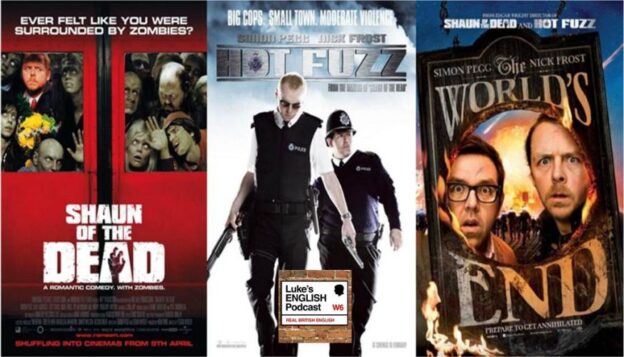
3. Shaun of the Dead
The IMDB page.
Trailer:
[youtube=http://www.youtube.com/watch?v=CfBewQPFdKE&w=500&h=281]
Full movie on YouTube:
[youtube=http://www.youtube.com/watch?v=6_IK4438vNA&w=500&h=375]
4. Hot Fuzz
The IMDB page.
Trailer:
[youtube=http://www.youtube.com/watch?v=8NiQfvx_qrE&w=500&h=281]
5. The World’s End
The IMDB page.
Trailer:
[youtube=http://www.youtube.com/watch?v=rQA7HcRcLNg&w=500&h=281]
6. The Ipcress File
The IMDB page.
Trailer:
[youtube=http://www.youtube.com/watch?v=QesO-BRvUAM&w=500&h=375]
7. Performance
The IMDB page.

162. Having Babies: Vocabulary / A Male Perspective

TRANSCRIPT AVAILABLE BELOW
This is a follow up to the previous episode in which I interviewed my friend Amber, who is pregnant. In this episode I explain some key vocabulary to you, and discuss the issue of childbirth from a man’s point of view.


Download Episode   

Small Donate Button

Transcript starts here:
Hi everyone, how are you doing? I hope you’re fine and that life is generally treating you well. All’s well here at Luke’s English Podcast. I just had some soup, which was nice. It was tomato soup.

The last episode I recorded was all about having babies – creating human life and all that stuff – which is a fascinating topic, if a little bit sensitive, intimate, personal and ultimately quite heavy. I mean – it’s not a light topic is it. It’s not like chatting about cooking recipies or golf or movies or something.

“Hi how are you? Haven’t seen you in a while. What have you been up to?”
“Oh not much, just working, watched the new Tolkein movie, had a baby”
“Oh yeah, how is the Hobbit?”
“That’s no way to talk about my child!”
“No, I mean the movie – The Hobbit! How was it? I don’t really care about your baby…”
“Oh, yeah, right, well The Hobbit was pretty good yeah, and the baby’s fine”

No, it’s a fairly heavy topic, but interesting nonetheless. Also, it’s just something that comes up now and again. When you meet a pregnant woman, you’ll undoubtably have to have the ‘pregnancy conversation’ and will you know all the relevant words and phrases?

In the last episode, I didn’t get through everything, and I didn’t say everything I wanted to say on this subject. I made a list of vocabulary, so I’ll be explaining that in this episode, but also I’d like to discuss the subject a little bit from the man’s perspective, and then you’re going to listen to comedian Louis CK talking about his experience of becoming a father, which is a pretty honest and frank personal account.

Why have I chosen to cover this topic in this episode? Am I going to have a baby myself? Am I pregnant? Well, I have put on weight, and I did feel a bit sick this morning, but I think that’s beer – not a baby. But seriously it’s just because I think it’s interesting. I’d like to have kids, not right now, I’m recording a podcast, but soon and so I’m curious about all this. I’m a grown up man (honestly), and I should be well informed about these things! Also I think this is a way to introduce you to lots of new vocabulary.

So, first, let’s go through the vocab. You will have heard Amber and me say some of these things in the previous episode. How many of these words do you know? Can you use them all in your conversations? Let’s see…

Vocabulary related to pregnancy

she’s pregnant
synonyms:
– she’s expecting
– she’s preggars
– she’s ‘with child’
– she’s up the duff (!)
-She’s got a bun in the oven (!)
-She’s knocked up (!)
a mum-to-be
conception / The baby was conceived
Scientific/Biological terms:
(egg)
(fertilise)
(sperm)
(embryo)
(foetus)
a pregnancy test
morning sickness
feeling a bit hormonal
hormones
anenatal = before birth
antenatal classes
an antenatal scan
kicking
to give birth / to have a baby
due – it’s due on 30 January
the due date
contractions
my water broke
to go into labour
the maternity ward
a midwife (midwifery)
to deliver the baby
an epidural
to give birth
the birth
the baby is born
a natural birth
the umbilical chord
the belly button / tummy button
the placenta
twins
identical twins
conjoined twins
triplets
nappies
the facts of life
the birds and the bees

More vocabulary: Some negative words & associations
abortion
pro-life
pro-choice
to induce labour
to be overdue
a caesarean or c-section
a miscarriage
to lose a baby
a premature birth
stretch marks
postnatal depression
baby blues

Comments and opinions on pregnancy, from the man’s point of view.
Pregnancy is a wonderful thing and all that. Imagine finding out that you’re going to be a Mum or a Dad. For the man I imagine it’s a complex feeling of pride, joy, protectiveness towards the woman, and total panic. Not for all men, but for some. It’s scary for the woman of course because she goes through all these physical changes and it can feel like there’s an alien inside her, but also because she’s facing the moment of childbirth – which must be very daunting because of the pain and the danger! Not to mention the pressure of then looking after the baby when it arrives. These fears are also accompanied by amazing joy I guess, but let’s face it – it’s also pretty scary.

But it can scare men quite a lot too. Obviously, it depends on the individual, and everyone’s different. But we often hear about men’s reactions to finding out that they’re going to be a dad. A lot of men are really proud and over them moon, which is great. But some men will freak out and run a mile at the mere mention of having kids. I’m sure you’ve experienced something like that. When you’re in a relationship, and perhaps (if you’re a girl) you bring up the subject of children, and your boyfriend just freaks out, avoids the question, gets defensive or perhaps just refuses to even talk about it. Guys, you know what I’m talking about, right? When that subject comes up, you just want to say “Woah there!” or just “Um, I’ve just realised that I’ve got to go… yeah, I’ve just remembered that I’ve got to leave, and, escape to… to somewhere else… I’ve got to go to Alaska, yes, because… because of salmon… there’s lots of samon that need to be caught and it’s very important because the world needs salmon, so bye!”

Why is this?

I’m not a Dad yet, so I don’t really have first hand experience. But I suppose this is a very big deal because a whole new responsibility has arrived, and we want to do it properly. So, it’s a change, and that’s a control issue. Suddenly the rules have changed and we feel a bit out of depth or something. Also we feel we are the providers, and so we want to make sure everything is provided for – money, security and so on. Men will often get a bit serious and look for more job security.

I’m talking about men’s reactions to having kids, but I realise that to an extent it’s a heavier burden for women – it must be a massive thing to do – to bring someone into the world, but then again I suppose the girls get the advantage of being able to create human life, which is pretty exceptional. They don’t do it alone though, hopefully the’ll have someone else with them.

Women immediately face the reality of pregnancy (although some deny it). But sometimes it takes a while for the news to sink in for a man. It can take more time – for example, it doesn’t sink in until they hear the heartbeat or see the sonogram of the baby, or even until birth in some cases!

Those are just my thoughts, and as I said – I’m not a dad yet, so I’m just speculating. I did do a quick google search and found 7 fears that men experience. This is from a website called babycenter.com. I would never normally search for this kind of thing. Maybe I’m subconcsiously gearing myself up for being a Dad. Who knows. Anyway, what are those 7 fears?http://www.babycenter.com/0_seven-fears-expectant-fathers-face_8247.bc?page=1

Security fears
The biggest fear men face is the one most deeply hardwired into our culture: Will I be able to protect and provide for my family?

Performance fears
More than 80 percent of the fathers I come across in my practice say they were worried they wouldn’t be able to perform when their partner was in labor. They were afraid of passing out, throwing up, or getting queasy in the presence of all those bodily fluids.

Paternity fears
About half the new and expectant dads I interviewed eventually came around to admitting they had fleeting thoughts that they weren’t really the baby’s father.

Mortality fears
When you’re a part of the beginning of a life, you can’t avoid thinking about the end of life. Thoughts about your own mortality can loom large: You’re not the youngest generation anymore, your replacement has arrived, and if everything works out right, you’ll die before your child dies.

Fear for your partner’s or child’s health
Childbirth is such a nerve-racking experience. Scary things can happen to the person you love most in the whole world.

Relationship fears
Men often fear that their partner will love the baby more than anyone on earth — and exclude them from that intimate relationship. It’s a very real fear of being replaced. 

Fears of “women’s medicine”
Men are not used to the ob-gyn establishment. It’s foreign, it’s cold, it’s something we don’t understand well. Even as observers, many men feel embarrassed and inhibited around stirrups and gynecological exams.

Fears of “women’s medicine”
Men are not used to the ob-gyn establishment. It’s foreign, it’s cold, it’s something we don’t understand well. Even as observers, many men feel embarrassed and inhibited around stirrups and gynecological exams.

Obstetrics and gynaecology (or obstetrics and gynecology; often abbreviated to OB/GYN, OBG, O&G or Obs & Gynae) are the two surgical–medical specialties dealing with the female reproductive organs in their pregnant and non-pregnant state, respectively, and as such are often combined to form a single medical specialty and postgraduate training programme.

Zdenek’s English Podcast – have a look here.

Transcript continues…
In the end though, although it is a bit overwhelming, it is also great because you get to see your child grow through all these important stages in their life (first words, first steps etc) and you get to re-live your childhood a little bit too.

Let’s hear from a real father expressing his experience in a really honest way. This is Louis CK talking about being a father. Who is Louis CK? Basically, he’s a really funny, in my opinion, comedian from the States…

First you’ll hear him defending himself against people who might assume he’s a bad father because they see him texting on his mobile phone while walking with his daughter. It looks like he’s not really giving her the proper amount of attention. But in fact, he’s a pretty good dad. He’s not perfect, but it seems his kids love him. He also talks about how he decided to be a good dad, and give it his best shot. So here it is, Louis CK talking about being a father:

A few days ago I was leaving a restaurant with my youngest daughter, and I was holding her hand, and I was texting with this hand. Yeah, I’m that guy. A woman walked by and she gave me a dirty look, like “Hmm you should pay more attention to your kid.”

Ok, guilty!

But I have something to say to that woman. This is why I’m able to spend time with my kids when I should be at work. It was noon on a Thursday, okay? I had a crazy amount of work to do, but my kid graduated from pre-school that day and I wanted to take her to lunch!

And it was a great lunch.

We sat at the same side of the table the way she likes. We shared a chicken cutlet. I ate some of her chicken cutlet. We looked at her drawings. She told me many stories about the chinchilla in the classroom.

And so now I’m texting and you walk by  “errr bad father!”

What do you know?!

OK, I’m being defensive, I’m sorry. I shouldn’t have been texting.

You know when my kids were younger. I used to avoid them. I used to sit on the toilet until my legs fell asleep.

You want to know why your father spent so long in the toilet? Because he’s not sure he wants to be a father.

I felt like being a dad was taking away everything I wanted to be.

And I was right.

But so what? What’s so great about our lives? What the hell is an adult without kids, what’s the point? So I got off the toilet, I flushed down my personal dreams and I decided, I’m going to be a dad. I’m not going to be Mum’s assistant. That’s depressing, don’t do that if you’re a dad, just wait for her to write you a list, walk round the store staring at it and call her from the cereal isle to make sure you’ve got the right thing. Be a man! Make your own list. [Do we need any avocadoes?]

Fathers have skills that they never use at home. You run a landscaping business and you can’t dress and feed a four year old? Take it on. Spend time with your kids and have your own ideas about what they need. Get into it. It won’t take away your manhood. It’ll give it to you.

I did that. I spent more time with my kids. I took it on.

I found out that I’m a pretty bad father. I make a lot of mistakes. I don’t know what I’m doing, but my kids love me. Go figure.

http://www.youtube.com/watch?v=PkMi_X-Hwgc

“Struggling to be a dad, and then facing up to it and taking on the challenge of being a dad.”

Thanks for listening. What are your thoughts and experiences on the subject? Leave your comments below.


161. She’s Having a Baby (with Amber Minogue)

Baby on Board! 2aka “A Cup of Tea with Amber Minogue”

LISTENER: Who’s having a baby? Is it your girlfriend?! WOW!!! CONGRATU…
LUKE: Wait! It’s not my girlfriend. It’s my friend, Amber.
LISTENER: Ah, I see! Well, congratulations to Amber then!
LUKE: Yes, congratulations Amber!


Small Donate ButtonRight-click here to download this episode of the podcast.

Click here to help write a transcript of this episode using a Google Doc.

SO, my friend Amber is having a baby soon, and I thought it would be interesting to interview her for the podcast. I wanted to know; what is it really like to be a pregnant English girl, and what should we say or do when we meet a pregnant woman? Listen to the episode to find out the answers, and to hear plenty of vocabulary on the topic of pregnancy and having a baby. You’ll see notes and a vocabulary list below. Happy listening!

Introduction

In this episode I’m going to talk to my friend Amber, who as well as being an interesting and lovely person, is also pregnant. In fact, she’s really pregnant because the baby is due in just a few weeks.

I’ve decided to interview Amber so that you can listen to her nice accent, but also so we can find out about what it’s really like to be a pregnant English girl, which I’m sure all of you have always wanted to know. I certainly have. The episode is going to go a bit like this:

First, we’ll get to know Amber a little bit. I’ll ask the usual questions like where she’s from and all that.

Then we’ll talk about being pregnant, and what that’s really like. Amber can tell us her experiences.

The episode is going to feature lots of vocabulary on the topic of having babies – not making babies (you’ll have to check the podcasts about slang, or swear words for that kind of fruity language) but the language of having a baby – being pregnant and giving birth. Hopefully we’ll keep it nice and clean and not too messy.

Lots of phrases and vocabulary will come up naturally in our conversation, but I have also made a list of vocabulary and expressions associated with pregnancy and having a baby.

So, finally we’ll go through that list of vocab and just explain it for you.

This could be a long episode, so I suggest you download it, & listen to it in stages, or just listen to it while you’re doing something else like travelling, doing the housework or just sitting on the sofa and staring into space. OK? So, let’s go!

Amber

Congratulations again!

How are you?

Where are you from?

What do you do?

How do we know each other?

Pregnancy

How did it happen? Hahaha etc (actually that’s a question that kids ask sometimes – where do babies come from?)

I can hardly imagine what it’s like, as a man, but if I imagine pretty hard… I still can’t picture how it feels. I have no idea really. It’s probably different for each woman.

What’s it like for you? (physically, but also mentally too)

What about people’s reactions? Do people give you their seat on the train? Anything else?

Have you taken advantage of your pregnancy in any way?

What advantages have you experienced?

Have you had any cravings?

Any morning sickness?

Is it a boy or a girl?

What are you looking forward to?

WHAT SHOULD WE SAY WHEN WE MEET A PREGNANT WOMAN?

Things you shouldn’t say or do…

Anything that makes her feel unattractive

“You look like you’re ready to burst!”

“Have you considered taking some exercise?”

Anything that makes her feel scared

“Get all the sleep you can now…” (because later you will get no sleep at all and it will be a nightmare)

“Enjoy ____ now while you can” (because afterwards you won’t be able to enjoy anything)

Questions about breastfeeding and nappies

Commenting on how much she ate – women are still women when they’re pregnant, and this is always a slightly offensive thing to talk about

“Oh wow, look at how much you ate! I guess you’re eating for 2 now…”

Anything that implies a mistake…

“Was that planned?”

Touching the woman’s belly – is this okay?

Things you should say or do when you meet a pregnant person

You look great

You’ll make a great mother (only if you know the person well)

This is going to be one lucky kid

It’s amazing news

Would you like to sit down? Please take my seat.

Let me get that for you.

Hey sit down, I’ll do that.

From the point of view of a man, meeting a pregnant woman

You’re supposed to say “congratulations” as soon as possible, but getting that wrong – misjudging when someone is pregnant or not – can be the worst social faux pas – so sometimes we’re a little bit ‘slow on the uptake’.

Similarly, giving your seat can be a little tricky. It’s the worst thing when you offer your seat to someone who turns out not to be pregnant. It should be obvious though – it really should. That might explain why guys don’t always jump up to let you sit down.

Some women in London actually wear a badge that says “baby on board” to make it completely clear, although I understand why some women might not want to wear one of them.

Not touching the woman’s belly. Women often get very tactile and touchy-feely when meeting another pregnant woman. Men are less likely to do it- perhaps because we’ve learned that you shouldn’t just dive in and put your hands on a woman without getting her okay first. Anyway, we’re probably not that interested in a baby unless it’s ours (and even then it’s no guarantee for some men – wow, some men are right bastards)

From the point of view of a man who’s girlfriend/wife is pregnant

I imagine it’s a complex feeling of pride & joy, protectiveness towards the woman, and total panic.

There’s some freaking out to be done. This is a very big deal because a whole new responsibility has arrived, and we want to do it properly. So, it’s a change. We feel we are the providers, and so we want to make sure everything is provided for – money, security and so on. Men will often get a bit serious and look for more job security.

Sometimes it takes a while for the news to sink in.

Women immediately face the reality of pregnancy (although some deny it). For men, it takes more time – for example, it doesn’t sink in until they hear the heartbeat or see the sonogram of the baby, or even until birth in some cases!

In the end though, although it is frightening, it is also great because you get to see your child grow through all these important stages in their life (first words, first steps etc) and you get to re-live your childhood a little bit too.

[youtube=http://www.youtube.com/watch?v=OqsBuxC2g1k&w=500&h=281]

Transcript [Unfinished, work in progress]

EPISODE 161 [2:14] – [6.20]

[BEGINS FROM 00:01:43]

and in the end you will be totally clued up about all of the English that you need to know about this subject, which, I think you will agree, is a brilliant thing.

So finally, we will go through this list and that will be that.

This could be quite a long episode so, I would suggest that you download it. Listen to it in stages or listen to it while doing something else, like: travelling, doing housework or just sitting on a sofa and staring into space.

Let’s go!

Luke – Hello, Amber!

Amber – Hello, Luke!

Luke – Congratulations, again.

Amber – Thank you.

Luke – I don’t know if it is appropriate for me to say “Congratulation, again” at this stage.

Amber – You can.

Luke – Really?

Amber – Yep.

Luke – Is there a time limit on, you know, when you can say “congratulations” to a pregnant person?

Amber – I don’t think there is a time, really. I think, there is an appropriate number of congratulations.

Luke – …and do you know what that number is?

Amber – I think, one or two congratulations is fair enough and then, it is obvious you have forgotten. And then it just becomes rude.

Luke – I think, actually, the first time that I realised that you were pregnant, I didn’t say congratulations early enough. Did you realise? Did you notice that? You probably did.

Amber – Em, noooooooo.

Luke – No? Because, em, we will come to this in a minute. This is the subject knowing when to say “Congratulations” to someone who is pregnant. Anyway, so, it’s very nice to be here. I mean in your flat. You have given me a cup of tea, which is lovely. Thank you for that.

Amber – You’re welcome.

Luke – Now, first of all, so, how many months pregnant are you now, in fact?

Amber – I’m eight and half months pregnant.

Luke – Okay, alright. So, it is nearly due I suppose.

Amber – Very soon.

Luke – Okay, we will come to the pregnancy in a minute, but first of all, let’s talk about you. Amber? Yeah. Tell us a little bit about yourself. Where are you from, in fact?

Amber – I’m from London.

Luke – Okay, which part?

Amber – North-West London. Edgware

Luke – Oh, yeah. I know it. Well I know Edgware Road.

Amber – It’s not the same. It’s much further away.

Luke – Alright.

Amber – zone six

Luke – That’s quite far.

Amber – Technically London. It’s hanging on. Clinging, to the edge of London

Luke – Is there a Tube station for Edgware

Amber – Edgware

Luke – Okay.

Amber – It’s at the end of the Northern line.

Luke – I see. Okay.

Amber – at the very end.

Luke – Alright. There’s Edgware Road, and then there’s Edgware, and I expect people get them mixed up.

Amber – They do, but I don’t mind, because Edgware Road is actually, quite a lot nicer than Edgware

Luke – It’s quite posh, isn’t? Edgware Road

Amber – Yeah.

Luke – So, Edgware Road at the top of the Northern line.

Amber – Yeah.

Luke – … and you are living here in Paris now, how long have you been living here?

Amber – I’ve lived here 12 years.

Luke – Okay, alright. So,  you speak good French, I imagine?

160. The A to Z of Christmas

HO HO HO MERRY CHRISTMAS EVERYONE!!!
In this extra-special Christmas episode of the podcast I am joined by my good friend Raphael Miller. Together we go through an A to Z list of words associated with Christmas in England.

Small Donate ButtonRight-click here to download this episode.

255631_10150209021106947_6709581_nRaphael is an English teacher, a scouser (from Liverpool) and a graduate of Oxford University. He has appeared on Luke’s English Podcast before (in the Notting Hill Carnival video – click here to see it).

Below you can see the list of Christmas words that we refer to during this episode. As you can see it is extra Christmassy, and extra long! I hope listening to this puts you in the Christmas spirit. Enjoy!

The A to Z of Christmas
A – advent calenders, angels
B – bells, Bethlehem, Boxing Day, brandy butter, bread sauce
C – cards, carols, chimney, chocolate, Christians, Christ, church, cranberry sauce, crackers, charades, candles, Chrimbo, Christmas cake, Christmas pudding
D – dinner, decorations, Doctor Who
E – Ebeneezer Scrooge, elves
F – Father Christmas, frankincense, friends, football, fireplace
G – gifts, gold, gravy
H – holy, holidays, holly, hymns, hangovers
I – icicles, ivy
J – jingle bells, Jesus, Joseph
K – Kings (the three wise men)
L – list
M – manger, Merry Christmas, mistletoe, myrrh, mulled wine, mine pies
N – nativity, new year, Noel
O – office party
P – presents, put off doing your Christmas shopping until the last minute (hello Raph!)
Q – the Queen’s speech (not the Queen’s peach)
R – receipt, reindeers, robins
S – sales, Santa Claus, shopping, sleigh, sledge, star, snowman, stockings, stress, stuffing, songs, shepherds, secret santa
T – toys, tradition, turkey, tinsel, tree
U – unwrap
V – virgin Mary
W – wise men, wrapping, white Christmas
X – Xmas
Y – Yuletide
Z – zest, zesty

Merry Christmas, seasons greetings, all the best for the Christmas season and have a happy new year too. Cheers! Bye!

Luke

Doctor Who Episode – Language Analysis

doctor-who-50th-largeHello Luke’s English Podcast People, (LEPPers?)

Remember the podcast episode about Doctor Who from a few years ago? (Click here to listen) It featured a conversation with Lee Arnott, who is something of an expert on Doctor Who. He knows more about Doctor Who than most people in the whole universe.

Well, here is some language analysis by a very brilliant English teacher called Richard Gallen, who I used to work with in London. Richard analysed the conversation I had with Lee, and wrote the following text for you to read. You can use this analysis to learn more about descriptive language, and to understand in more detail the conversation I had with Lee about The Doctor.

If you’re a Doctor Who fan, you can use this as an excuse to get excited about the 50th Anniversary of Doctor Who which is coming soon (not to mention the arrival of the 12th Doctor, played by the brilliant Peter Capaldi).

If you’re not a Doctor Who fan (or interested in linguistics) then scroll down to the bottom of the  page. There’s a cat video for you to enjoy (I’m assuming you like cat videos. I mean, who doesn’t like cat videos?)

Cheers!

So, here is the language analysis by Richard Gallen:

Language Analysis

Lee and Luke explain Doctor Who – language for explaining and describing

Luke: Right, if you imagine somebody who’s never heard of Dr Who before, right, how can you explain who he really is. So, so, if, what are the most important things that you should know about Dr Who if you’ve never heard of him before, basically.

Lee: Well, Dr Who is, err, a TV show that it’s main character, a character called The Doctor, who is in fact an alien, has a machine that can travel through time and space, which means that he is able to go anywhere in any planet, any point in the future, the past, whenever.

Luke: Erm, what’s the name of that machine?

Lee: It’s called The Tardis.

Luke : And can you just describe The Tardis? That’s like his spaceship, yeah? Can you describe The Tardis for us? Because in Britain here, everybody knows The Tardis, like, almost everybody knows it. It’s very familiar to us. It’s almost like an icon of British culture. But what is The Tardis? What does it look like?

Lee: Well, The Tardis looks like a 1960s police box, and in the days before mobile telephones and actually people having telephones in their houses, these blue police boxes were like an old phone box, and they also had a double function in that if a criminal caught a policeman [if a policeman caught a criminal] they would be locked up inside this police box, and they also had a phone, so they were a very common object in 1960s Britain, early 1960s Britain when Dr Who started.

Extra information clauses

Describing a film or book can be a little difficult. It’s quite hard to keep people interested. That’s why when we introduce a character we sometimes say something interesting or exciting about them

a character called The Doctor, who is in fact an alien

..then there’s Princess Leia who is fact Luke’s sister

In 1988 she met this man called Greenleewho was in fact the top CIA agent in Bolivia at the time.

In the examples above ‘who’ refers to the noun before it (The Doctor/Princess Leia/ this man called Greenlee). In the example below ‘which means that’ doen’t only refer to the noun before, it refers to the whole clause before:

It’s a machine that can travel through time and space, which means that he is able to go anywhere in any planet, any point in the future, the past, whenever

The most common verb after ‘which’ in extra information clauses is ‘means’ .It often says something about the result of an event

I slept through my alarm clock which meant that I had to run like crazy for the train

Gilardino scored a goal very late in the match which meant that Italy qualified for the 2010 World Cup in South Africa.

In that..

When Lee was describing police boxes in England he said:

they had a double function in that if a policeman caught a criminal they would be locked up inside this police box

we use ‘in that’ when we think we could be more precise about something we’ve just said :  ‘in that’+example

He was quite reserved in many ways but he was also very sociable in that heliked entertaining,

It’s already old news (in that it was announced 6 hours ago…) but President Obama has been awarded the Nobel peace prize

The most common adjectives that come just before ‘in that’ are:

unique / unlucky / unusual/ fortunate

UNICEF is unique in that they are in countries, before, during and after emergency situations and humanitarian crises

Gordon Brown was unlucky, in that he became PM when we were on the edge of a disaster

She was fortunate, in that she had so much money she didn’t need to work

Like

‘Like’ is very common when we describe:

And can you just describe The TARDIS? That’s like his spaceship, yeah?

Luke is trying to explain what the TARDIS is…. But he can’t find exactly the right words. This is very common in conversation and when we describe things because it’s difficult to be precise all the time

As the examples below show, sometimes we are imprecise because we want to exaggerate. ‘Like’ is very common to introduce an exaggeration:

It’s [almost] like….. an icon of British culture

Because in Britain here, everybody knows The TARDIS, like, almost everybody knows it

Some other examples:

..and it was so good, it was like, one the best meals I ever had.

..and for a few months he was like, crazy about me, he was calling me and sending me flowers

Notice how we pause just after ‘like’ when we use it in this way

Other uses of  ‘like’

We use ‘like’ in questions to ask for a description:

But what is The TARDIS? What does it look like?

‘Like’ also means similar to:

These blue police boxes were like an old phone box

When ‘like’ means ‘similar to’ we use adverbs to make the comparison softer or stronger

a bit like /rather like /  (to soften)

just like /exactly / a lot like (to strengthen)

Horse surfing is a lot like surfing, just with horses

The currents in the sea were really strong and, for a minute, it is was almost like a huge monster was sucking me under

The following ‘sense’ verbs are common before ‘like’ when we use it in this way.

feel/ taste/ sound/ look/ smell

It felt like I had been waiting for hours but it was in fact only 20 minutes

He smelt like he hadn’t had a shower for weeks

She looks like she’s been crying

Now here’s that  cat video I promised you…
[youtube=http://www.youtube.com/watch?v=IytNBm8WA1c&w=500&h=300]

Podcast Statistics 2012-2013

Podcast Stats

Click the link above that says Podcast Stats and you can read statistics for downloads of Luke’s English Podcast.

You can find out:

  • The number of downloads per day.
  • The top countries where the podcast is downloaded
  • The most popular episodes of the year
  • The total number of downloads per year (over 1.2 million!)

    Thanks for listening ;)

Old Comments Box Archive

I’ve just removed the comments box from the sidebar of Luke’s English Podcast but I didn’t want to lose all the comments that people had left, so here are all the comments as an archive.

unnimoonali2 months ago
how can i log in?
Respond·More…

jawaid2 months ago
Its wonderful podcast to improve English>

Anonymous2 months ago
Hello,
I’m a learner of English. Thanks a lot for devoting so much time to the podcasts. Each episode engages my interest and helps improve my English, with lots of useful and commonly used vocab and expressions. I’ve discovered that the more I learn English, the more I find native English speakers brilliant and prodigious!!!
Cheers

Anonymous3 months ago
Video games are a huge industry. I don’t dislike them, but Ii is desesperating to be in front of a screen trying to win a game trying to compete with an amazing machine. They are pdesigned to give more and more!!! Nice pods!Congratulations!!!

Anonymous3 months ago
Hi Teacher Luke,
How’s it going? I enjoy listening to your podcasts very much and I find it invaluable. Actually I’ve got a question to consult you. I wanna ask if you (personally and as a native English speaker) omit the vowels of some words when you’re speaking very fast? e.g. the word ‘university’, do you pronounce it ‘u-ni-ver-si-ty’ or ‘u-ni-ver-s-ty’ (omitting the vowel ‘i’)? Or another e.g. the word ‘duplicitous’, do you pronounce it ‘du-pli-ci-tous’ or ‘du-plis-tous’? (omitting the vowel ‘i’)

Cheers

Anonymous3 months ago
Hello Luke,

I always enjoy your podcasts.

I listened to your latest podcast “126. Your Emails, Comments and Questions” and found that a Japanese commented that he or she couldn’t make donation using PayPal due to Japanese law.

I tried to donate using PayPal just now and I could do it without any trouble. I just clicked the “Donate” button in this site and login to PayPal. It was very easy.

Best regards,
Hiroshi

luke teachera year ago
Competition Results:
Winner: Camila from Brazil
Runners-Up: Kiyomi from Japan and Kirill from
Belarus.
Congratulations to the winners. Commiserations to
people who took part but didn’t win. Thanks for votes.
L :)

Anonymous11 months ago
commiseration or comiseration?

Luke9 months ago
Comiseration is the correct one.
Thanks for the correction.
3 gold stars to you ;)

rikman7 months ago
Sorry to interrupt Luke
but what does mean
runner-up ? Please explain
it for me in simply words.
In my view we can talk
about person is better than
another competitiors but
not winner.
We rewarded the people
for their efforts and good
results. Am I right ? :)

luke teacher7 months ago
Runner up means someone who didn’t win, but got 2nd or 3rd place. The winner and 2 runners up won dictionaries, which they have received by post!

Anonymous3 months ago
Thanks a lot Luke for your explanation. Yet, I have one question to you. Could you tell me how we should read the year 1010 or for example 2010 ? I don’t know which form is correct: ten ten or one/a thousand (and) ten. Cognately we read the 2010 as twenty ten or two thousand (and) ten ? I’ll be thankful for your help.

PS. I like very much your video podcasts. The video presentation entitled “Say: I like it” is my favourite ! I’d like to have more this type of videos. In my opinion it’s wonderful way to improve our English skills.

Hispanomexicano5 months ago
please reply me in order to know you read it :D hahhaha
happy new year 2013!! a new ear indeed
2013= 0,1,2,3… :D

luke teacher4 months ago
Hi, I read your comment and hope to reply fully soon.
Cheers!

Anonymous4 months ago
Oh my goodness!! they are funny conversations!!!

vidurangae5 months ago
I’ve been listening to your podcast & thought you might be able to help me with something. I’m a final year med student from South Asia trying to learn Manchester accent in my leisure time simply because i love it. Would you mind helping me with providing some sources that I could use in my accent training? Thank you.

Hispanomexicano5 months ago
Luke!! what’s up! I really like your accent I have
heard some English accents and they’re not the
most understandable for me lol no offense :) by the
way the episodes 120-121 were definitely awesome
why don’t you do the Australian, Canadian version?
I live in the Mayan land and nothing happened the 21 december hahaha God bless please performe American English
to have fun!

Anonymous6 months ago
What happened to the episode 119?

luke teacher6 months ago
Technical difficulties… but it’s there now!

Ning7 months ago
I just learned from your podcast that you were doing cultural studies for your university degree. I’m going to join the same program in the UK next year. As a foreigner, I was a bit worried about whether or not I could pick up British cultures as soon as possible, so any tips besides listening to your podcasts? LOL

Luke7 months ago
Listen to BBC Radio 4. It’s full of cultural
information and it’s good for your English
too. http://www.bbc.co.uk/radio4/

nounou8 months ago
hello,luke!how are u doing?i am ABDENOUR from Algeria and I am a regular listener of your podcasts.in fact I do listen to them almost everyday.yet,it’s been a long time since u haven’t recorded a podcast;we do miss your qualitative and educative podcasts really!luke,can I ask you afavour? i would really like it if u record some podcasts on british culture.that would be a mind-boggling thing really..to let u know,my realm of study is English-that’s why I would love it if u do record some podcasts about the subject asked for above since it is far ahead different to learn things from a native speaker than from other resources,though I believe not all native speakers are like yourself.glad to be a listener of your podcasts.keep up mate.you are doing a great job.
All the best
nounou

hassan9 months ago
it’s amazing efforts,thank you.

Gabor10 months ago
Yes. Hearing a conversation presented by drunk people sounds interesting

klaa year ago
Who won??? (Im at work and cant check it out myself). Tell me, pls.

luke teachera year ago
VOTING IN THE COMPETITION IS NOW CLOSED.
I WILL PUBLISH THE RESULTS SOON.
ONLY VOTES MADE IN THE COMMENTS
SECTION FOR COMPETITION EPISODES
ARE VALID. Sorry, those were the rules.
EXPECT A WINNER TO BE ANNOUNCED SOON!
GOOD LUCK ;)

nima.1988a year ago
i vote for romina adel .

nimaa year ago
fantastic job ! – i vote for romina adel .

kláraa year ago
Hi teacher Luke, I just listened to the very first podcast and it’s a bit strange, because I’ve been listening to your podcasts quite long time… Hope you’re doing well, and thanks for your podcasts :) Klara

Camilaa year ago
Teacher Luke what means ” Live life on the edge” ? That’s a stupid question, I know… I have an idea but I’m not sure of what it means. : ) Thanks in advice.

Barbara, Italya year ago
Thank you very much, Luke, for these helpful podcasts, and mostly for the passion and professionality you put in doing them, which are very important qualites.
My best wishes to achieve the success you deserve.
Bye!

Adelaa year ago
I vote for Regina from Russia. :)

elisaa year ago
The whole competition has been hilarious ! Although it was really odd experience to record your own voice at the same time it was liberating:)
I made many mistakes but I decided not to correct them… what is done is done.
And then, I was over the moon when Sergei wrote that “I sounded like BBC news programs” …You must be kidding.. anyway thanks! Heartfelt thanks to Romain and Hiroshi :) The competition ends on 16 May, so Your votes are already my gift.. because the 16 May is my birthday :)
I wish you all the best, elisa
And You Luke, You are the best, really!

Hiroshia year ago
I vote for Elisa from Finland

Myselfa year ago
Very nice your radio show : ) The songs are great and seems like you used to do that for long time. I’m pleased you making a personal project. But please, don’t forget your listeners from Luke’s English Podcast! Haha. I’m joking. Go for it!

Catarina Marciaa year ago
Teacher Luke, I’m addicted to your podcast. I can’t stop listening.I hope you become rich and famous through this podcast. You deserve it.

Claudia, Germanya year ago
I vote for Regina from Russia.

jta year ago
great!
i vote for Ewelina from poland

Camilaa year ago
Hello teacher Luke, Camila here. Thanks for you feedback. I forgot to mention Mr. Bean when I talked about tv series. I grown up watching it. It’s very famous here. : )

Lukea year ago
Hmm… I seem to be having some problems with
the appearance of this page. The right side is cut
off. Is anyone else having problems seeing the
whole page?

xue shena year ago
Hi Luke. Thanks a lot for your contribution.I come from Mainland of China and i living in Australia now. Although I am a student but i donated my saving moeny from my work. I will continue to my donation to help you make this websithe better. Thanks.

luke teachera year ago
Thank you so much for your contribution.

Lukea year ago
Thanks very much for your competition entries. So far I have received quite a lot of audio ones and a couple of written ones. If you are thinking about sending me something, don’t be shy – just give it a try!

ewelinaa year ago
People jog/run because they want to be able to get away when the zombies come. Slow people will get eaten first and the runners may even survive the zombie attack :P

Lukea year ago
It’s not just running that will save you from zombies. Eventually you will end up stuck in a building surrounded by them and running won’t help you then, only a blunt instrument of some kind and hopefully a helicopter.

ewelinaa year ago
if you’re fit enough to get to the closest supermarket where you’ve got plenty of food to survive ages, it can actually save your life. i think so, but i guess we have to wait and see.

Lukea year ago
All it takes is one zombie to break into the back of the supermarket and bite one lazy member of your group, who then keeps it secret because he has too much pride and then before you know it you have a surprise dead-head in your group and he’ll take you all down to zombie town before the end of the day. It doesn’t matter how many boxes of corn flakes you have then. What you need is weapons. Find a gun shop or weapons cache, stock up and find a secure place like a bunker or a castle or something (or a decent pub with big wooden doors) and just wait as long as possible until the government (who are responsible for all this shit in the first place) clean it all up with some kind of anti-zombie gas or something, or a special-ops swat team. Job done.

ewelinaa year ago
you can use all the things u can find at tesco’s (well, at least at the polish tesco’s) like lawnmowers to kill some of the zombies, and to barricade all the doors, windows and other stategic places, and there’s also tonnes of ketchup (i recommend pudliszki) which u can use to distract the zombies, it’s red so they could take it for blood, you never know, and while they r discracted you can use the back door to try n find some other place to hide. there’s no point waitin for the polish government to sort out the situation, coz they r not able to make sensible decisions in advance (the preparation for Euro 2012) let alone in some kind of emergency situations.

samukaa year ago
Hello Luke. Just an idea… We could analyze the match from the perspective bellow. For instance, you would read each minute and comment them… Cheers
HALF TIME

8 min Drogba collects a short pass in his own half from Romeu and charges forward, which gets Stamford Bridge roaring. He lays it off to Mata on the left, and Chelsea have four on three, albeit with them all over on the other side of the pitch. Mata tries an early ball towards Sturridge, but it’s well off target and Clichy collects it calmly.

7 min Balotelli and Augero swap roles from the goal, with the Italian picking up the ball on the right and looking for the Argentine in the middle of Chelsea’s high line. Terry and Bosingwa crowd him out on this occasion, but that was very close to being another one-on-one against Cech for City.

5 min Sloppy opening period here, don’t think either side has had more than four consecutive passes in a row. Ray Wilkins nots that Chelsea appear to have reverted to their high-line, early pressure approach. Which probably explains why they conceded that potentially catastrophic goal.

2 min GOAL!! Chelsea 0 Man City 1 (Balotelli)
Great work from Sergio Aguero, who picks up the ball wide on the right, and quite deep, having drawn Terry out with him from central defence. He turns inside, accelerates and plays the ball just in front of Balotelli who’s off Ivanovic’s shoulder in a moment and one-on-one against the exposed Cech. Ivanovic dangerously slides in on him from behind in the box but Balotelli stays on his feet, rounds Cech, and finishes from a tight angle into the empty net.

1 min City get us started. It’s absolutely teeming it down at Staford Bridge.

Lukea year ago
Good idea. There’s TONNES of language in those first 8 minutes alone. it could be another 90min podcast.

samukaa year ago
That’s it Luke. It will be fantastic… Deadly addicted to your podcasts.. they’re amazing… Just listening the “Mind the gap” Lads are very funny… Way to go!!!!

samukaa year ago
Hello Luke…
Great podcast. May I suggest one podcast about Premier League. We have exciting things to talk about that, don’t we? some polemic involving Carlos Tevez from the Blues, L Soares from Liverpool and the Red Evils etc… Cheers. Sammy

Lukea year ago
Yes, good idea. I’ve had quite a few messages from people who’d like a podcast (or two) about football. I need to get together with a couple of football loving mates and have a big chat I think. Watch this space.

ewelinaa year ago
hey, i’ve listen to the whole random episode and i think you really deserve the holiday ;) n i deserve a medal coz i managed to listen to it lol

Lukea year ago
Please send me your mp3s at luketeacher@hotmail.com

milaa year ago
Hi, it’s me again. I’ve just come across an American website for English learners. I contains real natural phrases you can use on everyday basis. But I’m not sure if i can really rely on it… I mean, at this moment my goal is to learn British English in order to get by in the UK, and I’m afraid that those phrases are too “American”. Could you give it a look? The address is www.phrasemix.com . I would just like to know if these expressions are common in the UK.

Regards,
mila

Lukea year ago
Phrasemix is a good site as far as I can see. It is American English but most of the phrases I saw on the site would be fine in British English too. It looks good.

milaa year ago
Many thanks.

Anonymousa year ago
Hi teacher Luke. Just wanted to tell you I was going today on pavement, listenning to the podcast about Learning to playing the drums, step by step in those rythms, and sometimes laughed loudly :) It was really funny! People must have thought I´m a bit crazy :DD Bye, Klára

luke teachera year ago
Hello to my listeners from Japan. I miss Yokohama. When I think about that place I think “Ah, Nihon natsukashii”

Shina year ago
Come back to Japan, mate!

milaa year ago
OMG, three brand new podcasts. You rock! :-)

Camilaa year ago
Heey!! I just want to say HELLO! THE GREAT LUKE!!!

ewelinaa year ago
hey,
could you do a podcast episode about St. Patrick’s Day?
cheers in advance.

Camilaa year ago
Hey teacher Luke! The podcast about Criminal Law it’s amazing! Very interesting! Thank you very much!

alexandraa year ago
Hi Luke,
Thank you for such a great podcast ! I’m in London since April 2011 and my English is still bad ! :( I’m trying to improve it by listening your podcast, study grammar, reading, watching Tele, speaking with people, sometimes I’m going to Cinema. Soon will go for Comedy ! Maybe I will see you !

I love your British Accent and I must say you’re amazing ! Teacher, comedian, singer, drum player ! Well done !

Cheers,

Alexandra from Romania

Anonymousa year ago
Thank you so much, you have really made me forget about American accent that I switched to some years ago, and get back to the British one, I love it.

nabela year ago
totally love this site..I do love English, but my English is not that good..after all, I am a learner..:)

Luke Teachera year ago
Hello everyone. Thanks for visiting the site. Please leave your comments here!
Luke

nabela year ago
Thank God, I found your site..this is very helpful for me as I am taking English course..:D

Camilaa year ago
Hey teacher Luke. I found this video: http://www.youtube.com/watch?v=tENkiKyZolY It’s man speaking with british accent ( he’s not native ) what do you think about it?

Camilaa year ago
Hello teacher Luke I enjoyed a lot your podcast about british accents. I was really surprised after that because I didn’t know that Britain could have so many differents sorts of accents. Very interisting. My favourite one is the London accent. Awesome!! Thank you.

Japana year ago
We love Luke’s English Podcast!!! Go Luke!!!

Polanda year ago
Hello Luke!
Today I had a presentation about how to learn English effectively. I had a whole 3 min about your blog and everybody liked it. I hope that some of my classmates will check up this site and be one of the fans of your blog;)thanks for doing it!

Lukea year ago
Thanks for that!

luke teachera year ago
Another episode should be available on Saturday. Watch this space.

milaa year ago
Could you record some more podcasts about social English used in everyday life, please? I mean a set of expressions which are useful, but generally unknown to English learners. I’m probably going to go to the UK in a month or two and I’m really anxious that I won’t be able to buy a train ticket or order food cause nobody will understand me :( All expressions I know are quite formal and I’m not even sure if they are used (e.g. “how do you do” still taught in Polish schools).
PS. If u can’t/don’t want to/don’t have time to prepair such a podcast, could u at least provide some links to such expressions? I know “How to…?” series by BBC, but it still isn’t enough.
I’m sorry for being so pushy, but I’m quite desperate.

Lukea year ago
I’ll do what I can Mila. I’m quite a busy guy so I don’t know when I’ll have a chance to do more podcasts about social English but I will be thinking about it. In the meantime I will look at some other websites for you. Damn, I am a good man… Luke

milaa year ago
Thank you so much!!! Cheers.
mila

Evgeniyaa year ago
Are you a teacher at The London school of English?))
If so I took courses there 5 times!

I have came across this site by accident and I can say I like it!
I have been learning English constantly for 6 years. My final goal – to be a fluent speaker.
I love English and London.
I find your site very helpful for me, will wait your new podcasts.

Lukea year ago
Yes, I’ve been teaching at The London School of English for the last 6 years.

Kláraa year ago
Are you sure you want everyone to leave a note when he is on this site? I don´t know how long would you be interested, because there are many of us :) By the way I really like this site, Klára

Lukea year ago
Yes I don’t mind. I like seeing people’s responses, as long as they’re not abusive or anything. It’s nice to hear from my listeners. Luke

Matsua year ago
Hi Luke.May I want to know what are you and your brother think about ACTA? In my country (Poland) it’s very popular and controversional subject. In my opinion it’s global problem.

Pilara year ago
Hi dude! Today while having our “holly” sunday roast in the pub and talking about your brilliant website, we just have started practising our swearing in English not realizing that everyone was staring at our table in amazement … ooops! There is not a single day when you don’t crop up in our conversations. Sweet. If you ever come to Norwich don’t forget to visit your fan club. Lots of regards! Pilar

Anonymousa year ago
Everyone’s looking at my page today, and the first thing they see is an episode about swearing. It’s not usually this rude to be honest.

silvinaa year ago
I loved it! ;)

nausikaaa year ago
Ha, ha, ha what a shame!! Certainly, I wouldn’t like a podcast about Mary Poppins. Please teacher, don’t regret(stolen from French )
Edith Piaf – Non, je ne regrette rien (Officiel) [Live Version] – YouTube

silvinaa year ago
Lovely material, Luke!!! Keep it up! I enjoy every one of your podcasts. Have a nice weekend!!! Silvina from Buenos Aires, ARGENTINA

luke teachera year ago
Expect another podcast episode in the next few days! I’m just enjoying glory of victory at the moment, and catching up on all my housework.

Dannya year ago
You are the champion my friend, and you’ll keep on fighting till the end, you are the champion, you are the champion. No time for losers.’cause you are the champion of the world.

luke teachera year ago
…enjoying the glory of victory…

Blondiea year ago
The sticker rocks !!!

luke teachera year ago
Just one day left in the competition, it actually looks like Luke’s English Podcast is going to win!
You can still vote here: CLICK HERE TO VOTE

nausikaaa year ago
It smells like victory!!
Oh Jesus-Christ, what a thrill! 1522votes!!
Here comes our commercial break, quite old fashion…
Gin Fockink – YouTube

Vote for the winner!!
(I don’t know what actually I mean, do I?)

luke teachera year ago
GIN GIN GIN – FOCKING! -NICE!

Bettinaa year ago
You certainly will win! I hope you’ll celebrate the victory. I’m so glad that so many listeners voted for you. After all, you’re the best,right?

Blondiea year ago
You’re clearly the best !

Lukea year ago
I WON THE FREAKIN COMPETITION!!!!

nausikaaa year ago
Hip, Hip, Hurrah!

ula(PL)a year ago
Congratulations!! I knew you will win:)

nausikaaa year ago
QUEEN – WE ARE THE CHAMPIONS LYRICS and VIDEO
We are the champions – my friends
And we’ll keep on fighting – till the end –
We are the champions –
We are the champions
No time for losers
‘Cause we are the champions – of the world –

luke teachera year ago
Ha ha, love it

Waltera year ago
Hey Luke, you’re doing a fantastic job. I simply enjoy listening to you. It’s such a convenient way to learn English. And your sarcasm is exactly what I’ve been looking for in an english podcast.

Alimaa year ago
I think these comments from such a frustrating person will actually help you Luke ! We’re even more to vote to express our support for you ! Continue doing your podcasts, they’re great !

xxxa year ago
COME ON LUKE !!!
You’re gonna win because you deserve it !!!!!!!

Anonymousa year ago
evidence-web stats don’t add up.including facebook,twitter. blogs with way more subscribers and hits don’t get as many votes.
2)your votes come in waves-are you seriously telling me that over 200 people voted for you in an hour.
3)there are websites on the other sectiion with 50,000 hits a day who don’t have that many votes in over 6 weeks.
btw-i’m not in the competition,i just voted for one blog then went back to see who was winning and yes i have listened to the podcasts along with the 200 odd subscrbers . not over a 1000 comments are there.?
If it’s that important to you then good luck,i along with some peoplewho are in the competition also know it’s a tainted victory.
final question,if it’s that popular,how come it took so long to be nominated.?

luke teachera year ago
I really should be asleep because I’m teaching tomorrow, but I just couldn’t help responding again!
Just a few things.
1. If my web stats don’t add up, then tell me – of these websites getting 50,000+ hits a day, why the hell can’t they get more than 1000 votes in 6 weeks? Come on John! These figures just don’t add up!
2. Yes, I think it’s reasonable to say that over 200 people voted for me in an hour. Perhaps in the hour just after I publish a podcast when thousands of people listen to me saying “Please go out and vote for my podcast!” – it only takes a percentage of them to go and do it.
3. I have about 280 followers on podomatic, a small number, but I have many more on iTunes. Podomatic is a hassle to subscribe to, and as a listener it’s unnecessary. So not many people do it. However, for owners of apple products, subscribing to iTunes is standard. I imagine most of my listeners have subscribed via iTunes. I can’t tell you why I don’t get many comments on my page, but after all it is an audio podcast so people tend to listen to it away from the computer.
4. I’ve been obsessively promoting my podcast and encouraging my listeners to vote. That could account for all the votes I’ve got. That’s hardly cheating. Who knows, maybe I’ve peaked now and no-one will vote for me this week. Perhaps Film English will get the award. It is a really good website, and they’ve won lots of awards before. They don’t seem to be promoting the competition very much though.

In the end it’s just a competition to win a dictionary!

alexa year ago
Luke, I think he has a lot of free time and he enjoys teasing you. It’s not worth answering to this crazy guy. Just make more podcasts, they are great!

Alicjaa year ago
That’s right! I’ve subscribed via iTunes!! Your Podcasts are great. I love them. I’m sure that many people feel the same way as I do. Hope you’ll win!!!
Ps. Can I donate using Google Checkout?

Lukea year ago
I don’t know how you can donate using Google Checkout at the moment, so just PayPal I’m afraid…

luke teachera year ago
Could you send me your email address? I’d rather conduct this conversation privately please.
Your guess is as good as mine regarding the statistics. I know my facebook page has fewer subscribers than others, and I have fewer twitter followers, etc. According to podomatic though I get something like 40,000 downloads each month. That’s what they tell me. Isn’t it possible that after I publish a podcast episode in which I ask people to vote for me that some of them vote in the same hour?
But really, I can’t account for the number of votes I’m getting. I’m also surprised by the numbers, and I’m just pleased about it. And I assure you I’m no internet hacker who is capable of breaking into Macmillan’s voting system in order to win a dictionary, if that is what you’re suggesting. Believe it or not, I’m just happy to have been voted for and I hope I win the award. It makes me sad that in your eyes it’s a tainted victory. Please, do send me an email if you’d like to respond: luketeacher@hotmail.com Thanks.

PFa year ago
Dear John,

If you were well informed which is clearly not the case, you would know that it’s a listener who nominated Luke for the award (cf. Facebook)
Do you seriously suggest Luke hacked Macmillan website or what ?
I asked all my facebook friends to vote for Luke’s blog and I know other people who also did it. Yes Facebook is frequented by million people so 200 votes in an hour are nothing.
Just to clear your mind, I’m gonna be very logical : Luke did a podcast about voting/polls/US elections + another one about swearing and he asked his listeners to vote for him if they liked the podcast.
Is promoting your work through it an act of cheating ?
His podcast is available on iTunes so it means, each person who subscribed has the new episode automatically when one’s plugs his iPhone for instance.
Of course, when we start listening to the podcast, the 1st thing we do is voting ! And we’re thousands to be fan.
No cheat.
It’s pure defamation and it’s sad you taint the competition with such allegations.
The victory will go to the best : Luke (I hope) or another one.

Good night

Bettinaa year ago
You’re just jealous and envious ! Poor guy ! Your nasty anonymous comment doesn’t even merit to discuss. Listeners love Luke’s podcast, that’s a fact and I hope he’ll win the dictionary. He deserves way more than 200 votes per hour !

Andya year ago
John,

I think you are the one who overdid it by posting your comments here.

I listen to Luke’s podcast every now and then, and I listen online. I don’t download it, I don’t subscribe to it, but I like it. I’m sure there are many others who do the same, so your point about comments and subscribers doesn’t really make any sense.

Luke produces this podcast in his own time as a hobby to help others learn English. Like many of the nominees, I’m fairly certain he doesn’t get paid to do it either. There are a lot of people who really appreciate his efforts, yet you feel that it’s appropriate to come on here and accuse him of cheating.

Fortunately your comments reflect poorly on just one person, and that person is you.

Claudiaa year ago
Hello,

I just felt that I had to write something in support of Luke’s fantastic English podcast as I can’t believe how bitter your messages are. I voted for Luke’s podcast because I think it’s brilliant and as a language teacher I know that my students love it too. I listen to it and I’m not subscribed to it on here. I’ve had students independently recommend it to me and had to tell them that they are preaching to the converted. People just really enjoy it. So it is absolutely no surprise to me that Luke’s podcast is smashing it and I think you, John, should focus more on just listening to podcasts rather than getting freakishly hung up on twitter stats!

Go Luke and Good day to you sir.

¿¿a year ago
Mr. ?? You are a clear example of mosca cojonera. I’m afraid there is not translation in English. Major Pita?

hexaa year ago
Luke is a brilliant teacher. I’m not a subscriber or a twitter follower, and not interested to make comments. Only here for studying. The evidence is just his personality which shows itself throught his works. Friendly, spontaneous, professional, lively, articulate, with exciting subjects. I’m not surprised of his podcast’s popularity at all. Go on Luke!!!

johna year ago
Cheat,all this just to a win a dictionary,Macmillan are aware of what you are up to,can’t wait to see your comments when they disqualify you. 1,000 votes in over a week,you overdid it.

Blondiea year ago
John, are you in the competition ? Frustated by the fact you’re gonna loose ?
If one day you do more than 80 podcasts with more than 20,000 worldwide dowloads a month one, I think you’ll be legitimate to raise your voice.
But accusing someone who’s dedicated to a voluntary work and passionnate about what he’s doing is really low.
Do you know the concept of “having fans” ? Apparently not.
More than 1100 votes in few days is just the expression of our gratefulness for Luke.
Think about it.

B

eliza_chana year ago
Yes, that’s the truth. I’m your fan and I really enjoy your podcasts. I’m learning a lot with them. Thanks a lot for everything and I hope you can win this competition.

nermina year ago
What’s your problem? You haven’t listened to his podcasts have you? Lots of people enjoy listening to his podcasts and lots of people learn a lot from it….so can’t wait to see your comment when Luke wins the award he deserves…if someone gets 1,000 votes in over a week this only proves that people appreciate his work…

luke teachera year ago
I think it’s uunfair that you’re accusing me of cheating John. Where’s your evidence? I have lots of listeners, and I work hard to make the podcast popular. Also, it’s not just for a dictionary, it’s also for the award itself.

Russiaa year ago
Hi Luke, thank you a lot for your job, I think you should get this Macmillan Dictionary “Love English” Awards 2011! I’m sure you win. My vote was definitaly for you man!

luke teachera year ago
Hi everyone – this is the new comments box.
Please leave your comments here. Thanks!
100%
Agree
0%
Disagree

Brazila year ago
Hi Luke. I’m Camila, I live in Brazil and I’ve been studying english for 3 years. Here almost all of the english courses teach the american accent. I enjoy a lot to visit your website because I always wanted to learn the british accent and I think I’m much better. Thank you very much for helping people to learn your language.

Lukea year ago
Please vote!
CLICK HERE