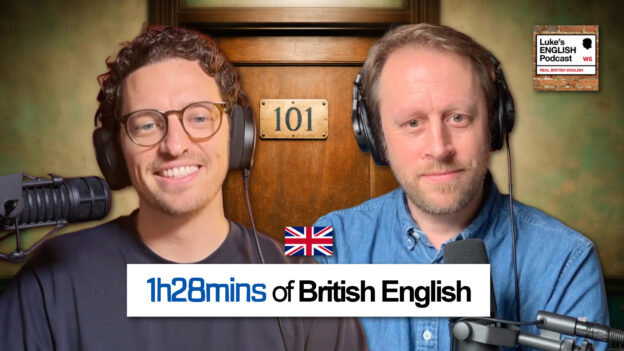
[980] Practise listening to British English conversation and enjoy some complaining, ranting and funny anecdotes in this episode based on the concept of a popular BBC TV chat show. My guest is Charlie Baxter from The British English Podcast. Charlie has chosen 3 things which he wants to be locked inside the mythical “Room 101” 🚪 an imaginary place where all the things you hate in the world are stored forever. What would Charlie like to remove from the world to be kept inside this room? And what is the shocking revelation about a certain popular British English YouTuber 👩🏫that could break the internet? 🤔
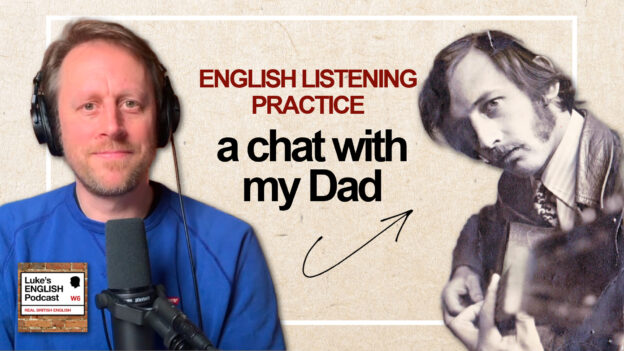
Following my chat with my mum last week, now it’s my dad’s turn! In this episode my plan was to ask my dad lots of questions about his life, and to listen to him talking about the various choices, moments and experiences he has had. The result is another deep chat about family history, and my dad’s life story. I hope you enjoy listening to it as much as I enjoyed recording it. Full transcript available.
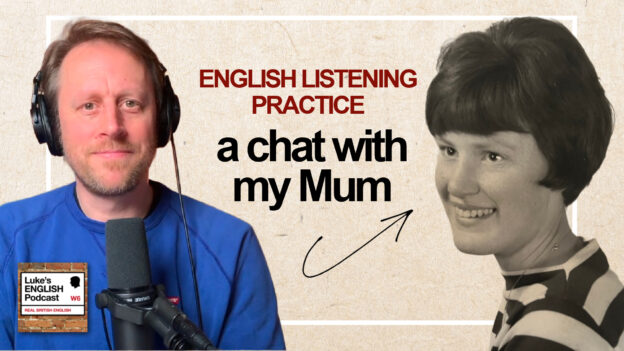
[977] Recently I visited my parents at their home, and while I was there I took the time to record conversations with them both. This first one is with my mum. I asked her questions about her life story, our family history, her memories of growing up and so many other things that I was curious about. The result is this recording. I hope you will find that it is not only good for your English listening practice, but also fascinating and absorbing as a piece of personal history. Full transcript available.
[976] Here’s an epic rambling episode in which I talk about learning English with BBC Radio and TV 📻 expressions with the word ‘thumb’ 👍 the story of how I became a taxi driver on the streets of Paris 🚖 the grammar of Yoda 🐸 fantastic haikus written by my listeners ✍️ and getting pecked in the face by a swan 🦢. 3h30min+ of English from me to you.
Here’s a bonus episode, and it’s for fans of my brother’s music. James’ new album is out now and so we decided to record this episode in order to promote it and also to talk generally about music, including a chat about favourite albums, first albums we ever bought, albums we discovered in our parents’ record collection and more.
Join me for an unplanned rambling episode about various things including: hump day, bed bugs in Paris 🐞, fashion trends I followed when I was younger 👟👖, CDs 💿 vs cassettes 📼 vs vinyl 🎵, the most relaxing place in the world 🛏, Japanese zen gardens ⛩, Hunter S Thompson 🚬, the most disgusting job I ever had 🤮, and more…
Steve Kaufmann is a very prolific language learner. He has learned at least 20 languages to varying degrees during his life. Some of them he learned during his career as an international diplomat and businessman, and others he has learned during his (semi) retirement. In this interview Steve talks about his language learning experiences, methods and motivations. We talk about various metaphors and similes for language learning including ocean voyages 🚢, cows 🐮, skiing ⛷ and cutting grass🏡, and I ask Steve about cross-cultural experiences he has had during his career. There is a video version but only the audio version contains my intro and ending rambles about getting my hair cut and how you need to remember that you’re a baby cow-shark on skis 🐄🦈🎿😅.
The third (and final) adventure in this series of mini-mysteries on LEP. Can I improve my detective skills to work out the disappearance of a priceless painting and a series of gruesome murders? Story by Peter Carlson and available on textadventures.co.uk
Wishing everyone a happy new year and taking stock of the main aims and methods of this podcast, plus some frequently asked questions. Video version available on YouTube.
In this episode the plan is to wish you a happy new year, welcome back all my regular listeners (and maybe some irregular listeners too) and also say a big hello to any new listeners who might have just discovered this podcast and are wondering what it’s all about. I normally do episodes like this at the start of the year because at this time, during the new year period, it’s normal to turn over a new leaf, make a fresh start, perhaps make some new year’s resolutions and generally try to pick up some good habits for the year to come – and that often includes working on your English and trying to find good listening resources to help you do that.
So, in this episode I’d like to welcome you to LEP or welcome you back to LEP, just summarise what this podcast is all about, restate my objectives for doing this and generally make sure we are all on-track for a good year of podcasting and learning English in 2021.
I’ve decided to answer some Frequently Asked Questions. These are the questions people typically ask me when they find out that I have a podcast for learning English and they want to know more.
So during the episode, you’ll learn or be reminded of what the main ideas are for this podcast, what teaching principles this is based on, what my methods are, what you can expect from my episodes in general, how you can use them to improve your English and also some info about me too, because it’s a good idea to get to know the person you’re listening to, isn’t it? I have always found, as a teacher, that it really helps when I put my personality into my English lessons. It just seems to make things more enjoyable and effective for the learners. Not because I have an award-winning personality or anything, but just that I think learning a language is a deeply personal process and so it makes sense to have a more personal approach to teaching it as well as learning it. It helps if you know who I am. It gives you context, it brings the language to life and it’s just more fun too, isn’t it. If you like, as you listen to this, you can imagine we’re in a cafe or something (even though I’m doing all the talking – but you can pause me at any time and put your thoughts into words if you want. I can’t hear or respond to you, but it’s better than nothing isn’t it? That’s the least you can say about my podcast , haha, “Well, it’s better than listening to nothing”)
By the way, other podcasts are available of course. As you probably know, there are quite a lot of podcasts for learners of English including ones by the BBC and other ones by other people, and they’re great, but obviously I hope you listen to my podcast, don’t I?
So, what’s this podcast? How can it help your English? Who are you listening to? Those are the sorts of questions we’ll be covering, but also plenty of other random bits and pieces.
JINGLE
Happy New Year!
Welcome back to the podcast! I hope you had a fairly good holiday period – as good as it can be during this mad mad time that we are all living in. When’s the world going to go back to normal? When’s that going to happen? We don’t know. Was it even normal in the first place? Probably not. In any case – I hope you’re well and that you’ve started 2021 in a reasonably positive frame of mind and that you’re ready to embark on some new audio adventures with me and my podcast.
If you are a brand new listener – then welcome. I really hope you simply enjoy listening to me talking to you, or talking with my guests in English in these episodes. I hope that this will help you to get regular English listening practise into your life, and that you enjoy it too.
Because enjoying your listening practise is so important. This will help you to listen regularly, listen for longer periods of time and listen long-term in your life as well.
We all know that it is very important and useful to listen to plenty of clear, natural English, spoken at a fairly normal speed, focusing on a variety of topics.
Reading is good. Studying grammar, vocabulary and pronunciation – that’s good. Doing plenty of speaking practice is really important. Watching videos in English is helpful. But do not underestimate the importance of just listening to English – for as long as possible each time. That’s what this podcast aims to help you do – at a very minimum. There is more to it than that of course. A lot more. But basically – I want you to do more listening in English.
The first and most basic aim of this podcast is just to help you to get more English in your life through listening to the spoken word – listening to English as it is spoken naturally, by me in this case, and my guests.
Let’s go through my list of frequently asked questions, which will form the backbone of this episode, which is probably quite long.
What is this podcast?
Is it for me?
It’s for everyone, but it might be difficult if → You’re lower than an intermediate level (intermediate might be hard – you’ll have to be extra motivated) or you are a really visual learner. (My wife doesn’t listen to podcasts – even in French. She can’t really do it. She feels she has to close her eyes or do nothing else, whereas I love just listening to audio and it works really well for me – better than watching videos because I can multi task)
How long have you been doing it?
Why did you start doing this podcast?
Who are you Luke? I mean, can you tell us a bit more about yourself, your background and your career so that we can feel totally confident that you know what you’re talking about and that you’re just some guy who can speak English?
Will it really help my English to listen to this?
Yes.
How do you know? First-hand accounts from listeners.
Common sense. Of course. It’s about a billion times more effective than listening to nothing at all. Plus, what else are you going to do? Watch Netflix with subtitles (yes, do that too, but switch the subs off sometimes) REad books (yes definitely – both graded and non-graded ones if you’re ready) Speak English with people you know who speak English (yes) Take English classes (good idea as long as you take part properly and take responsibility for your learning too). You can do all of those things. But I don’t want to make this complicated. Listen to my podcast regularly and it will help with your English.
Academic studies I’ve done – while preparing my teaching qualifications I read a lot of books and other texts based on proper academic studies into how people learn languages.
Professional experience after having met many thousands of learners of English from many places, and working with them closely to help their English. Observing what works for them, what people respond to, the realities of learning a language.
All of that has shown me that regularly listening to something like my podcast can help your English a lot. I could go into that more (and I have in previous episodes) but that’s all I will say at this point.
Will it help me improve my grammar, vocabulary and pronunciation?
Yes, both directly (when I teach language) and indirectly (through exposure). I can also help you think about the way that you learn, which can make you a more skillful and effective learner.
What’s your method then, Professor Thompson?
5 Ls, 5 Ss, 5 Ps, being a smart-learner, the 5 Ms, DISCIPLINE, commitment. There are many ways to approach language learning. You have to choose one that works for you and that helps you to keep doing it even when it’s tough. Basic: Get as much English into your life as possible and make it meaningful. Hopefully I can help by giving you something you enjoy and want to listen to. More complex: Be a conscious learner too → notice structures and phrases, notice pronunciation (how I say things), try to record them, understand them in context, remember them, record them and repeat them. My premium content is designed specifically to help you do that. I cut out a lot of the annoying work and put it all on a plate for you. Just listen, follow the PDFs and do what I tell you to do – memory tests, repeat after me etc.
Can I really learn English on my own, only by listening to you Luke?
I always recommend my podcast as “part of a balanced diet” and that does include doing other things, especially plenty of speaking practise with real people, probably qualified teachers who can help give you bits of feedback and correct your errors, but also just speaking with people helps you develop the social side of using in English for communication.
I should also mention writing and reading of course, but since this is an audio podcast we focus mainly on the spoken version of English.
What level is it for?
Should I do anything else, other than just listening?
Share your thoughts in the comment section on my website – practise little bits of writing there and chat with other listeners.
Your episodes are quite long. Aren’t they too long, in fact?
How should I listen? (the technology you can use, what you can do while listening, where you listen, how often you listen)
Are there transcripts for these episodes?
What’s your accent Luke?
Do you only have native speakers on your podcast? Most of the time my guests have English as a first language, but sometimes I talk to people who have learned English in adulthood because these people are extremely inspiring as they have done what so many people want to do, and they have great insights into the process of learning English and it’s also really important for you to listen to non-native English speakers speaking English too because it’s vital to hear a variety of English being spoken in your life. English is a diverse language. There are many people around the world using it and speaking it in slightly different ways. It’s important for you to be able to understand all those different varieties. This is true for the different accents and dialects in native English speakers too – you should become accustomed to hearing English spoken with various regional accents. If you only ever listen to my standard RP which is probably very clear to your ears, you might not be able to understand others. Also I really want to encourage you to love the different regional accents and to see their value. Sometimes learners of English will say that they only want RP and they see other accents as somehow being “lower forms of English” with less value. I don’t agree with this of course. The idea that a regional accent makes you sound uneducated or even lazy or something – that idea deserves to stay in the 1950s where it belongs.
Having said that – let me put my cards on the table and be as clear as possible.
What accent should you develop in English?
The first thing is that you need to be clear. People need to understand you. Work on that.
It’s a good idea to pick a certain accent which you can use as a model. This is the accent/pronunciation you can aim for or try to copy. Why not choose RP? It’s a perfectly good choice as most people will be familiar with it. If you have a particular reason for wanting to copy a regional accent, then go for it. Perhaps you live in the north of England and you want to do things like your neighbours. Or maybe you just love a certain regional accent for personal reasons and you’ve decided that this is the one for you. That’s fine too. Go for it. Try to keep things natural. I could talk about this more but I won’t go on about it too much.
Basically – I love all the accents in English. I really do. But I would probably recommend RP as the one to go for, just because it’s still a standard form. I know someone is thinking “but only about 5% of English speakers use RP” yes – but I can’t think of another accent which is more common. Think of British accents in a pie chart. There isn’t one accent that really dominates that chart, I expect. Each segment in the chart is probably around the same size. So which one do you pick? Again, I think RP is fine and makes sense because it’s a standard. I don’t mean you should speak like a posh person, like The Queen or something, because that would be weird.
Listening for understanding others Listening in order to develop your pronunciation
How do I pronounce your name, actually?
How do I pronounce the name of the podcast?
What sort of episodes can we expect?
What are your favourite episodes?
You’re on episode 699 of LEP. Do you have anything special planned for episode 700? No, I don’t! I think it will just be another episode this time. I can’t think of anything specific I can do. Maybe I will do a YouTube livestream “Ask Me Anything” kind of thing. I’ll see. I know that if I do a YouTube live stream then you will all want to know about it in advance. This isn’t always possible. You’ll just have to subscribe to my YouTube channel.
What are LEPsters?
Where are your listeners?
In many places around the world! All over the world.
Why do you talk about ninjas sometimes? What are LEP Ninjas?
Can you explain the Russian Joke please? No.
What do you think of Brexit? It’s a bad idea. I think it was an opportunity for a bunch of nutters to take control of my country and push it in a different direction. I think it’s the wrong direction, but now we have to live with it and make it work. I am not a fan of Boris Johnson and his gang. I feel they’re doing a bad job. That’s probably enough politics isn’t it. Oops, nearly slipped on politics there. Watch out everyone, there’s some politics on the floor. Don’t step in it. “Can someone clean that up please?” (I have made that joke before)
Do you have a team of people helping you to do this? No, it’s just me.
Can we see you perform stand-up comedy on stage?
Are you married and do you have kids and stuff?
What’s your favourite football team?
Do you like music? Do you play music? Do you have any songs stuck in your head today?
Can you sing songs for us on the podcast sometimes? Yes, I do that occasionally, when I feel inspired to do it. I’m not the greatest singer or the greatest guitarist. I’m just learning. But I love it and I feel moved to do it. If I do sing in an episode, most of the time, I do it right at the end of the episode so that people who might not like it don’t feel obliged to listen to it. But the ones who like hearing my versions of other people’s songs (I usually sing cover versions of songs) those people can listen and hopefully enjoy hearing me. I always make an effort to sing clearly so you can hear all the words of the song. I also don’t use any reverb to cover up the imperfections in my voice or guitar playing. I just get the guitar on my lap, point the microphone somewhere between the guitar and my mouth and do my best.
Are you on YouTube?
Yes, I have a YouTube channel as you may know.
I post my audio episodes there, usually with a single static image. I don’t think YouTube is necessarily the best way to listen to my content, but I guess if you are sitting at your computer, perhaps doing something else (like gaming or working or something) then it’s convenient to have one of my episodes running in the background. But also, YouTube’s automatically generated subtitles are usually pretty accurate. When I’m talking on my own, the accuracy is about 95% but when I’m with guests that accuracy can drop to about 85-90% I think. That’s not 100 perfect, but it’s pretty good.
I’m always working on ways to deliver 100% correct transcripts to you because I know how useful and important they are. To an extent I’m just waiting for the technology to catch up. I think it won’t be long before automatic transcriptions are basically perfect but we’ll see.
I’ve been working with some new software which is quite mind-blowing. I don’t want to make any promises about it because I’m just experimenting with it at the moment, but basically it allows me to generate transcripts for episodes in a really convenient way, then edit those transcripts quite easily while also editing the audio. This is too complicated to get into now.
Have you forgotten anything?
Yes, I am certain that I have forgotten to mention something really important, and someone is going to think “Hey you forgot to mention this specific thing! Or You didn’t mention this specific person!” Sorry about that.
You ramble quite a lot Luke, you sometimes talk too much and repeat yourself a bit.
Yes, I do. Sue me. To paraphrase Shakespeare: There is a method in my madness.
From Shakespeare’s Hamlet, 1602. The actual line from the play is ‘Though this be madness yet there is method in it’.
The main message I want to give you here is this:
Listen to my episodes regularly and enjoy doing it.
Download my app to get easy access to all the episodes on your phone. (more than in Spotify and anywhere else)
Become a premium listener if you want to go further in your learning with me.
Don’t be a ninja – come out of the shadows and write a comment from time to time.
Hello and welcome to Luke’s English Podcast. This episode is number 669 and it’s called How To Learn English.
That’s quite a bold title but this really is a lot of what I have to say about learning English. If you really want to learn this language, this is my advice.
I’ve been teaching for about 20 years, podcasting for over 11 years now and I keep finding out more about learning a language through teaching it, getting feedback from listeners and also through my experiences of trying to learn French.
This episode is a distillation of many of my thoughts and advice on how to learn English. It’s not going to cover absolutely every aspect of it, because language learning is a huge subject that encompasses so many different things and you could talk about it all day, but I have decided to talk about learning English, breaking it down into the 4 skills, and giving you as much advice as I can in this single podcast episode. I hope you enjoy it and find it useful.
For those of you who are not so familiar with me and my work. My name is Luke Thompson, I think I am the 4th most famous Luke Thompson in the world. I’m an English teacher, a podcaster, a comedian, a husband and a dad. I am from England but these days I live in France. My podcast is free and is downloaded all over the world. I also have a premium subscription in which I focus specifically on improving your vocab, grammar and pronunciation. To find out more about that go to teacherluke.co.uk/premiuminfo
I expect you want to learn English, right? That’s the main reason you’re listening to this I expect. You want to learn English.
Well, good news! It’s definitely possible. You can learn English and you will if you put in the time and the effort. It’s important to remember that.
What do I mean by “learn English”, though? I mean that you can learn to speak English fluently, clearly and with confidence, expressing yourself with shades of meaning, adapting your English for the situation both in speaking and in writing, knowing and being able to use a wide variety of vocabulary and accurate grammar and ultimately being yourself in the language and developing beneficial relationships with others based on effective communication. Yes, you can. Where there’s a will, there’s a way.
That’s it, just a positive and encouraging message at the start. It’s important to always remember that making progress in your learning is a realistic prospect and will happen when you put in the time and effort, and more good news: the more you enjoy it, the easier it is.
I hope this podcast helps you to enjoy getting English into your life on a regular basis, which is a key part of learning the language effectively.
But what else should you be doing in order to improve your English overall?
In this episode I’d like to talk in some detail about learning English and how you can do it.
This episode is a sort of “come to Jesus moment”, which I feel I should do regularly, just to remind everyone listening that there is a method or approach at work here and that it’s not just you listening to people talking.
A “come to Jesus moment” in the world of business is when someone does a passionate speech or event in which fundamental priorities and/or beliefs are reassessed, or reaffirmed. It’s like when Jesus gathers his disciples around him in order to reaffirm their belief in what he’s preaching or to say some deep stuff which strengthens their faith.
This is a come to Jesus moment for me.
Not that I’m comparing myself to Jesus. No, not at all. Not even a little bit, and anyway that’s not for me to say, that’s for other people to point out isn’t it, not me. Anyway…
I’ve said it before and I’ll say it again. There is a method to the madness.
In my podcast episodes, I’m always teaching you, using my particular set of professional skills, but rather than presenting it all as a lesson I usually try to present it more like a radio show or a comedy show even.
So, amidst the episodes about music, comedy, interviews and so on, I thought it would be worth restating the core values of LEP, which I seem to do about once every 6 months or so.
I’m going to give loads of advice here, and this is all based on what I’ve learned from:
Teaching for about 20 years
Meeting thousands of learners of English, some of them successful, some of them not, working directly with them as their teacher and listening to them talk about their studying habits and experiences
The academic studies I’ve done, especially the DELTA which involved extensive reading and writing on various aspects of how people learn and teach English
Doing my podcast and getting testimonies over the years from many listeners who told me about how they’ve used it to improve their English
There’s also my own personal experience of working on my French
Anyway, the plan is to talk about learning English with a focus on the 4 skills: listening, speaking, reading and writing.
I have talked about these points quite a few times before on this podcast, and have given tons of specific advice about working on your English, including in episodes like 174 (and others)
So I will probably repeat myself a bit. But I still get asked to talk about “how to learn English” very regularly and I think it’s important for me to talk about learning English on this podcast on a regular basis. Obviously, that is what this podcast is about, first and foremost, even though a lot of the time in my episodes you’ll hear me and my guests talking about all sorts of other things.
Learning English is the main aim of this podcast
Essentially the thinking is that you should listen to natural conversation on a variety of topics and it’s simply listening to things in English (not just listening to things about English) that’s going to help you learn this language, especially if you enjoy the content.
I’ll probably talk about this again in a bit, but let’s say that ultimately the plan with the free episodes is to help you listen to English regularly, for longer periods of time, long term. The more, the better. If the content is enjoyable, that should just make it easier for you to achieve that. In fact, if you’re really into what you’re listening to, you don’t really even notice the time passing.
Then there’s the premium content, which is an effort to push your learning beyond the gains you get from all the exposure and input you get from just listening. The premium content is designed to let you get the benefit of my experience and teaching skills in order to cut out a lot of work that you would otherwise have to do yourself, so I can essentially take you by the hand and lead you through some intensive practice to work on your English more directly.
So that’s my content, but let’s talk now about learning English as a whole then.
Learning English is a holistic thing. It encompasses many aspects and skills that are connected as a whole.
There are receptive skills like listening and reading, productive skills like speaking and writing, language systems like grammar, spelling, vocabulary and phonology, social and psychological factors that come into play when we use language when interacting with others, then there are other factors that come into play like identity issues, body language, culture, literature, pragmatics and all sorts of other things. It’s hard to know where to start when talking about it.
You need to learn it to the point where you don’t even think about it any more.
The more you talk and think about it, the more it starts to sound like the force from Star Wars.
Stretch out with your feelings.
Do or do not, there is no try.
Do not think, feel.
Let go, let the English flow through you.
I am your father (oh wait)
It’s about learning how to do something which goes right to the core of who you are in fact.
It’s a holistic thing. It incorporates many aspects as part of a whole process and so it’s quite tricky to know where to start.
Let’s put it like this. Language goes in, and language comes out. (I told you it sounds like The Force)
Language is within you and language is without you. It flows through you. It binds the galaxy together.
There are receptive skills (this is how language goes in)
And there are productive skills (this is how language goes out)
There’s the written language
And there’s the spoken language
This is our system.
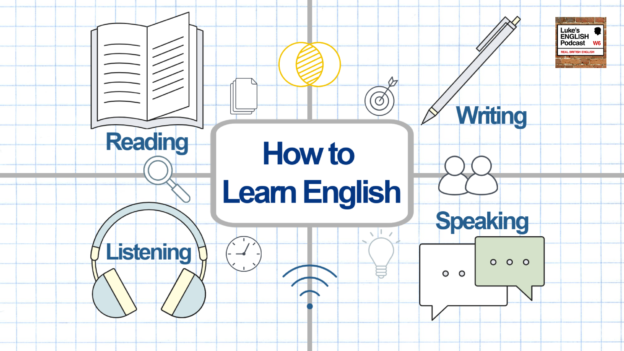
Think of it like a table with two categories on the horizontal axis and two on the vertical axis, so it’s like a grid with 4 squares in it.
On the horizontal access we have receptive and productive skills.
On the vertical we have written and spoken English.
Within the table we have 4 skills – the 4 squares.
So in the box marked “written” and “receptive” we have reading.
Below that in the “spoken” and “receptive” categoriy we have listening.
On the right in the “written” and “productive” side we have writing.
And then in the “spoken” and “productive” side we have speaking.
Those are your four skills. Reading, writing, listening and speaking.
The 4 skills are connected in various ways.
Reading and writing deal with the written word of course.
Reading helps you to write. It helps you to see how the language is built, how words are spelled and how sentences, paragraphs and texts are put together with grammar and textual conventions.
Listening and speaking deal with the spoken word.
Listening helps you to learn how English actually sounds, how words join together in sentences or longer utterances, it helps you get familiar with the speed, rhythm, flow and intonation of the language. It helps you get used to natural pronunciation which in turn helps you produce English in the same way.
Words exist in visual form, and in spoken form.
But reading and listening are connected too because they’re both receptive skills. They provide us with input which is the essential foundation of language learning.
And speaking and writing are connected because they’re productive skills.
These are the skills you need to use when using language for various purposes. This is where you are more active in the sense that you are constructing language and putting it down visually in the form of writing, or using your body to produce it orally.
Let’s talk about those receptive skills and input.
The reading thing there is something we’ll come back to in the section about reading.
This is the academic who is always mentioned in this context, when talking about how to learn English these days. Krashen was one in a long line of linguists who came up with theories about how language is learned and should be taught.
Arguably, we still don’t really know how people learn languages, but various academics over the years have put forward different hypotheses to explain it and these have been the backbone of our understanding of language learning that has informed the way we all learn and teach languages over the years.
Krashen though is the one that people often talk about today, including all the many YouTubers who regularly post videos about the best ways to learn, the only ways to learn, the secrets of learning and all that sort of thing. Krashen is usually brought up because his ideas fit in quite nicely to a model of language learning for today. I mean, it involves a lot of consumption of content in English – plenty of listening and reading and that sort of content is in plentiful supply online, like for example episodes of Luke’s English Podcast.
In his input hypothesis in which he makes the case for the importance of comprehensible input for language learning, he states that in fact the only way we can successfully increase our underlying linguistic competence. This is our system of linguistic knowledge or let’s say that “language instinct” that you have, which even subconsciously gives us a sense of when language is right or wrong. I suppose it could be active in that you know a certain grammar rule and can see when it’s been broken, or passive in that you just feel that something is right or wrong but can’t necessarily explain it.
I would say the passive knowledge is the vital one because ultimately you just want to be able to feel that language is right or wrong without thinking about it.
But that being said, your active knowledge can be really useful when doing things like avoiding common errors as a result of your first language, or consciously pushing yourself to create language which is normal.
Anyway, Krashen says the only way to increase your linguistic competence is through comprehensible input, meaning reading and listening to things that we mostly understand and that with the context of what you do understand, you are able to work out the bits that you don’t know. This is how we acquire new languages.
So basically, we learn a language when we understand it. So, naturally, according to Krashen, the receptive skills come first.
I think this makes a lot of sense to me. I think it’s bound to be true that we learn language by listening to it and reading it. But what about those moments when you have to speak or write, what about learning the grammar and all the rest of it?
Krashen would say that we learn the grammar, vocabulary and pronunciation of a language by listening to it or reading it, and that it’s a natural process and part of how we decode language through comprehensible input.
So, don’t worry about grammar rules and all the rest of it, just listen and do your best to keep up and work out what’s going on, and do it regularly.
Again, I am sure this is true but I also think it’s worth studying the language a bit too, breaking it down a bit, seeing how it works, actively trying to learn more vocabulary, checking up on the rules of grammar and doing some controlled practice. Working on your pronunciation by copying and training your mouth and brain to cooperate with each other, like the way we practise certain movements in sport or musical parts on an instrument.
I do believe that controlled practice and conscious learning like that must also be beneficial because I’ve seen it happen. Doing some active studying can be like a fast track of English learning. It can cut out a lot of time by helping you realise certain things about the language quickly, and I think if you then notice it again while listening and reading that only reinforces what you’ve learned.
Of course, you shouldn’t get blinded by grammar or pronunciation rules and so on, to the point that you can’t see the wood for the trees.
Try not to get hung up on grammar, because it can make you process language in an unnatural and contrived way. It can get stuck in your head and block you a bit. Instead, try to notice patterns and incorporate them into your use of English. Try to see grammar study as a way of confirming things you’ve already noticed, or a way of consulting with a reference book as you also just absorb English more naturally. If you only study English with the grammar, it’s going to be a weird abstract process for learning the language. It’s better to focus on consuming English in the form of messages which you are trying to understand, and then perhaps check your grammar later to straighten things out.
The premium subscription is where I help you with that sort of thing, hopefully combining with the free content to give you all the stuff you need to attack English from several angles.
How can you learn this language if you haven’t heard it and read it a lot?
Read and listen to things that are slightly above your level, so you can understand 60-80%. You need to be able to understand that much for your brain to work out the remaining 20-40% that you don’t know. Meaningful context is vital.
Basically, listen x5 and read x5.
It’s largely a question of finding the right stuff to listen to.
There’s this podcast of course. Others are available.
Watch TV and films with and without subtitles.
Hopefully you’ll find content that you actually want to listen to, not just for studying English. So if you do get addicted to a Netflix series and you can’t wait to find out what happens next, that’s good! That means you will get more comprehensible input and you will be much more focused and involved in it, which is great for your English. Or maybe you want to hear another stupid and funny conversation with my friends just because it makes you laugh and you feel some sort of connection to it. All of that is great because it will help you listen more, listen longer and listen long term.
Reading
This one is also a pleasure to talk about because it’s a pleasure to do and there are lots of great things to read.
Let’s hear from Krashen again as he is the master of the whole input model.
This is again from Wikipedia, which I think is fine usually for the basics like this.
Extensive reading, free reading, book flood, or reading for pleasure is a way of language learning, including foreign language learning, through large amounts of reading. As well as facilitating acquisition of vocabulary, it is believed to increase motivation through positive affective benefits. It is believed that extensive reading is an important factor in education. Proponents such as Stephen Krashen (1989) claim that reading alone will increase encounters with unknown words, bringing learning opportunities by inferencing. The learner’s encounters with unknown words in specific contexts will allow the learner to infer and thus learn those words’ meanings.
Of course that system is disputed because this is the academic arena we’re dealing with and people are always putting forward ideas, defending them, disputing them and so on. It’s how we move forwards and learn about this stuff.
So this is extensive reading which is different to the sort of intensive reading you do in English lessons, where you spend ages on just one page of text, break it down into tiny chunks, understanding every single morsel. With extensive reading it’s all about just getting as much English into your head as you can by reading as much as you can, and you focus on reading enjoyable things, especially stories and you don’t stop too much to analyse the language or even check words, you just keep trying to follow what you’re reading. The more involved in it you are, the better.
Again, this point about input is that it feeds your instinct for the language. You get a subconscious sense of what is right or wrong, which comes in very handy for when you’re doing those nasty sentence transformations and use of English tasks in a Cambridge exam like CAE. What you really want in those situations is to know exactly which preposition or auxiliary verb is missing, or to be able to manipulate sentences in a variety of forms. I reckon it helps to do a bit of language practice as well, with a few controlled exercises but the idea is that it should all go in naturally giving you this sense of language competence.
It’s important though to choose texts which are not too difficult for you. You need to be able to understand enough to be able to get a grip on the rest of the language.
So which books do you choose?
We’ve talked about the importance of choosing stuff that’s interesting to you, that reflects the type of English you might need.
Genre isn’t an issue. People assume you need to read or listen to the news but as we’ve already established they don’t really talk like normal people on the news, and they also write in a certain “newsy” style. Funnily enough it might be more useful to read the tabloid papers as they write in a more conversational style, but I think it’s worthwhile looking beyond the news.
Basically, read whatever you want.
Even comic books or graphic novels as they’re known for adults.
Graphic novels can be brilliant because they support your understanding with the images and often the English is in the form of speech so you learn really directly how to apply that stuff to real life. I love graphic novels in French. It’s my favourite way to work on the language.
You could consider the current bestsellers. If other people like the books then why shouldn’t you? Look in the fiction and non-fiction categories.
Or try graded readers, which are an excellent and underused resource. I really recommend them if you’re not a strong reader. They’re previously published books, and often some of the great classics and modern classics in English, but they’re republished with English that is graded for certain levels. The number of words is reduced, it’s truncated and essentially it’s a way to increase the percentage you do understand, and decrease the amount you don’t understand, getting to that 80/20 spot where you can maximise your language learning.
There are lots of titles to choose from and various publishers. Check these ones out
But your English may well be good enough now to have a go at a book for native speakers. So go for it. You have loads of options. Just make sure you enjoy reading on a regular basis.
I would also add that it’s important to choose texts which are written in modern style and perhaps about an area that you are particularly interested in. Perhaps think of it like this – what is the kind of English you want printed on the back of your head (on the inside)? Odd question, but I mean, what is your target English. Perhaps it’s the involving and descriptive storytelling of fiction, or it’s the matter-of-fact world of non-fiction. I reckon non-fiction is probably better because it reflects the kind of English you are more likely to be writing, especially if it’s things like academic work or reports at work, because they’re all about presenting you with information, data, commenting on what’s going on, describing how to do things and that’s probably the sort of thing you’ll need to use English for, especially in writing.
This might be a bit dry but it will really show you loads of examples of emails with full explanations, so you can read and learn.
David Crystal
The Story of English in 100 Words
Anything by David Crystal is fantastic, but this non-fiction book will teach you the entire story of the English language through 100 words and there are some great words in there like
Loaf, Street, Riddle, Arse, Jail, Wicked, Matrix and Skunk, to name but a few.
So you’re bound to learn tons from that.
Biography
Le Freak: An Upside Down Story of Family, Disco and Destiny By Nile Rodgers
Fiction
The War of the Worlds by HG Wells
The writing is a bit old fashioned. I have to be honest, but it’s mostly modern in style and I think it’s worth it because the story is amazing and it’s not too long. It’s wonderfully descriptive and much better than any movie version could be. Definitely one of my favourite books of all time.
Productive skills / output
This is where we get to the more nebulous world of productive skills. It’s like an alien land where monsters roam, a bit like war of the worlds maybe.
OK I’m exaggerating here but I mean that productive skills are a bit harder to pin down because even more psychological and social factors come into play. You have the public aspect of it, the fact that you’re trying to manipulate the language and get your ideas across in the right way, being coherent and cohesive and in the right style with the right level of politeness with the correct conventional replies and requests and on and on it goes!
Again, I’m making it sound tricky, but I mean that you are involved so much more because you’re making the language and actually using it. This is exciting because you get to express yourself which is the most wonderful and gratifying thing you can do in another language, and when it slides out quite fluidly and you’re not too blocked by who knows what, then it’s all gravy. But sometimes it just doesn’t seem to work out that way and you get mixed up and it doesn’t come out right at all. There’s a sense of performance in productive skills, and a sense that you have to be aware of the right way to conduct yourself, and to be able to utter things in English instantly, following what the other person is saying, it’s all done in a sort of unconscious blur and thinking about grammar in that situation is a killer.
So it’s about getting a level of ease, a level of comfort, a platform from which you can bob and weave your way through the conversation, finding other ways to say things and switching correctly between tenses and situations. I think you get what I mean.
So how do you work on these things?
Ease – a voice, fluency
Control – grammar, vocab, pronunciation
Range – a wide range of language for a wide range of things
Coherence – does it all make sense? Can people follow you easily?
Cohesion – particularly in writing, how does the whole text make sense as a whole?
Social factors – knowing how to put things and how to manage relationships through language
Again, the idea is that this language is just built into you from all that exposure and input.
I would say that there’s a great deal of other stuff you can do to improve your productive skills beyond reading and listening a lot, of course.
In both writing and speaking the first thing to remember is you need to engage in it as much as possible. Real writing and real speaking.
Ultimately this means trying to use language to communicate a message in some way and that’s what you should be focusing on. Meaningful interactions, especially ones in which you have something to offer or something to gain, such as negotiations or even information gap situations in which you’re telling someone something they don’t know. Also social interactions involving being polite or building relations with people. Ultimately, doing it for real is the best workshop in which you can work, rolling with the punches and trying to keep track of what you’re learning.
This is why people learn English best when they’re forced to do it because of their surroundings. They learn by being a waiter in London for a year or working in an office with native speakers, or being plunged into a foreign university for a year, or moving to a new country and having to cope with all the challenges that brings and in a second language. I suppose this is immersion, but it;s more than that. I recommend actually conversing with people to just practise. It’s the 5 Ps.
It’s like going to the gym. Fluency is like physical fitness in your mind and also in your body because you’re using your mouth, your breathing and your head and hands to communicate too.
It applies to writing too. You can observe the way other people write their emails and kind of copy their style, you have to really think about what you’re saying and doubtless you will end up writing emails with requests, with information, with questions and with complaints and so on, so you will have to learn on the job. Being thrown in at the deep end, or if you just have to use English at work it could either be a big stress for you or a huge opportunity to just go for it.
Anyway, let’s talk about specific productive skills – writing and reading, and how to work on them.
Let’s say you’re not actually in a situation where you can talk to people or have correspondence with people, or have to write things which other people will ultimately have to read. Unless you find a tutor on italki for example then that person could be your practice point for speaking and writing, giving you feedback as you go. But let’s say for the purposes of this episode, it’s just you and the English language, facing each other off in a kind of wild west fashion.
How can you practise on your own?
Writing
Obviously you need to write. But what are you going to write and who is going to read it?
Firstly – just write, write regularly, write meaningfully and write with a reader in mind, even if nobody reads it. This is important because it will help you get used to simply putting your ideas into words. It’s a creative process and also a mechanical process to an extent. Building sentences is a sort of art or a craft. You have to practise it in order to get some level of comfort with it. Let’s imagine there’s a muscle in your head (this is not scientific at all) which, if you never exercise it, will be quite weak and underdeveloped. But if you exercise that muscle regularly it will be strong, reactive and quick. I expect there is a part of the brain responsible for creating written language, and a sub-section for creating written English. Keep that part of your brain fresh by writing English as much as you can. That’s as scientific as I can get here.
So, here are some things you could write
What to write
Anything
A diary
Email an imaginary person (spooky?) or yourself (think outside the box here ok?)
Academic writing – text types
Emails – email types and conventions
Reports – same!
Formal and informal letters – same!
Applications – same same!
Basically – Whatever you have to write, you should try to find some samples of these texts and aim to copy them. Copy the style, the arrangement, the language they use and reproduce it yourself. Texts that you write will invariably be very practical so it’s about reporting information and asking questions. Look at the sample texts and copy them.
It helps if you have a specific workbook. I recommend Email English by Paul Emmerson. It’s a simple workbook that helps you work on almost all those things and I’m not even sponsored by Macmillan or anything, it’s genuinely a great book.
They also have downloadable email writing tasks on the Macmillan website or here
Ideally you’ll have a teacher to proofread your work, correct you and give you feedback.
If this isn’t possible, it’s still a good idea to write.
Other ideas
A diary (just describe things that happened, or make it more personal and really explore your thoughts and feelings. If the words don’t come, just use basic words. If you feel unable to express yourself perfectly, express yourself imperfectly but try to express yourself.
Writing is not just sentences, it’s paragraphs and pages. The thing you are writing will define how you write it. This means – conventions of certain texts, formality level of the language.
Specific exam tasks → IELTS, FCE, CAE, CPE, BEC higher and vantage
These will often push you to learn the conventions of different types of text, so it could be a good idea to take a Cambridge exam if you want to work on your writing.
Vocabulary Notes
You might write some notes on vocab and I would recommend here that you take a more extensive approach to doing this. Don’t just have one word per line. I want to see one word or phrase at the top of the page, and then loads of text underneath full of examples and your own examples with the language. You can then come back and cover up some of the words and try to remember. Alternatively you can use my PDFs with the notes and memory tests if you’re a premium subscriber. Little plug there for my other podcast.
But making more extensive vocabulary notes with plenty of examples means that not only are you recording vocabulary, you’re practising using it in writing too.
Speaking
I mentioned italki before and you can find tutors, teachers and conversation partners there for regular practice and I do recommend doing that.
Otherwise, let’s look at some ways you can work on your speaking other than in actual spoken practice with others. Developing your speaking on your own.
This is quite a tricky thing to do because normally speaking is an instantly interactive form of communication. It also involves a lot of listening and then being able to produce English instantly and without hesitating too much.
It’s also quite physical as it involves using your mouth to produce words and sentences in the right way.
And of course there are all those cultural things to think about too.
But really speaking should just be your attempt to find your own voice in English, with fluency and with a specific tone. Of course it comes through a lot of practice, of having conversations in which you’re not really thinking about what you’re saying on a grammatical level but it’s pouring out of you due to necessity and not being able to really think a lot. Doing that regularly helps your brain map out the extent of the English you have and increase it, keeping it sort of fresh. That’s not scientific but more a metaphor of what I think speaking can do. It activates something in you that you have to maintain and keep active or those parts of the brain go dull.
So practice x5
But with who?
The fact is, it just helps to talk to other people and that’s the best and most basic advice I can give. Outside of that, you have to manipulate your surroundings and use your imagination to practise speaking on your own.
Talking on your own (and even in your head)
This might sound a bit odd, but it’s a surprisingly effective way to activate English that is in your head. You essentially talk to yourself, out loud, in English, describing what’s going on, what you’re doing, what you’re thinking about, say it all in English. Alternatively you can just do it in your own head and just think the sentences. This also keeps that system of language production in your head fresh.
Listen and repeat
You can use certain audio and play a bit, pause, repeat what you heard, rewind, repeat again and keep going until you’ve got it, and then check the transcript or subtitles to see if you’re correct, check any new words and carry on. Always find ways to vocalise the things you are learning and that means saying them out loud even to yourself.
You can also practise different speaking scenarios.
Preparing for a Cambridge exam you can find past papers with speaking part preparation and practise. Find out what’s required in the different parts, watch videos of people taking the speaking part on YouTube, practise answering common questions about yourself, practise speaking on a topic for a minute or two, practise discussing your opinion on the issues of the day. Those are all specific speaking skills that you can practise on your own. I particularly recommend listen and repeat, especially when you have to take quite a long utterance in English, hold it in your head and repeat it like it’s one word? It’s like going to the gym in English. It involves a lot of things: Understanding the clip, identifying the words and grammar, being able to remember it all, being able to produce it in a similar way. That’s a whole punch of different kinds of practice. And if you repeat the sentence straight away, and again, you might notice certain little errors you’re making and correct them. So repeat over and over again, a bit like practising boxing combinations in the ring before the big fight.
In reality, the 4 skills are often mashed up together and you find you are doing things like listening and speaking at the same time, while also taking notes, looking at visuals and so on. It all gets very messy when language is actually applied to real communication in the real world.
A little note about pronunciation and a sort of disclaimer.
The disclaimer
I think there are probably plenty of other things I have not mentioned in this episode, such as not talking about specific memory techniques (done that) or specific features of pronunciation (done that) or exactly how to read a book to learn English (done) or plenty of other things probably. To be honest this is just a podcast episode that I wanted to make about the 4 skills and it expanded into an episode all about learning English as a holistic process.
Anyway, the note about pronunciation
It is worth learning the phonemic script
It is worth getting the sounds app on your phone
It is worth doing drills and practising different features
It’s worth getting a book called Ship or Sheep or other books of that nature.
It’s worth remembering that if you have an accent when you speak that is fine and it’s part of who you are, the main thing is that you speak clearly, not which regional accent you have. Clarity is the thing to achieve. Also, it’s extremely difficult to “lose” your accent in English. Hardly anyone does it. But you can still be fine with your accent. English is quite open like that. Everyone’s welcome.
But there you have it. That was quite a comprehensive look at how I think learning English is best when you combine two things: comprehensible input, and a clever studying routine.
I think it can work wonders for your English.
And that’s what I try to do with this podcast. Give you all the input in the free episodes and then do some more focused studying in the premium content. Hopefully, together those two channels can boost your English to the max.
Thanks for listening.
To sign up to lep premium go to https://www.teacherluke.co.uk/premiuminfo for all the details.
This website uses cookies to improve your experience while you navigate through the website. Out of these, the cookies that are categorized as necessary are stored on your browser as they are essential for the working of basic functionalities of the website. We also use third-party cookies that help us analyze and understand how you use this website. These cookies will be stored in your browser only with your consent. You also have the option to opt-out of these cookies. But opting out of some of these cookies may affect your browsing experience.
Necessary cookies are absolutely essential for the website to function properly. These cookies ensure basic functionalities and security features of the website, anonymously.
Cookie
Duration
Description
cookielawinfo-checkbox-analytics
11 months
This cookie is set by GDPR Cookie Consent plugin. The cookie is used to store the user consent for the cookies in the category "Analytics".
cookielawinfo-checkbox-functional
11 months
The cookie is set by GDPR cookie consent to record the user consent for the cookies in the category "Functional".
cookielawinfo-checkbox-necessary
11 months
This cookie is set by GDPR Cookie Consent plugin. The cookies is used to store the user consent for the cookies in the category "Necessary".
cookielawinfo-checkbox-others
11 months
This cookie is set by GDPR Cookie Consent plugin. The cookie is used to store the user consent for the cookies in the category "Other.
cookielawinfo-checkbox-performance
11 months
This cookie is set by GDPR Cookie Consent plugin. The cookie is used to store the user consent for the cookies in the category "Performance".
viewed_cookie_policy
11 months
The cookie is set by the GDPR Cookie Consent plugin and is used to store whether or not user has consented to the use of cookies. It does not store any personal data.
Functional cookies help to perform certain functionalities like sharing the content of the website on social media platforms, collect feedbacks, and other third-party features.
Performance cookies are used to understand and analyze the key performance indexes of the website which helps in delivering a better user experience for the visitors.
Analytical cookies are used to understand how visitors interact with the website. These cookies help provide information on metrics the number of visitors, bounce rate, traffic source, etc.
Advertisement cookies are used to provide visitors with relevant ads and marketing campaigns. These cookies track visitors across websites and collect information to provide customized ads.