Author Archives: Luke Thompson

About Luke Thompson

I've been teaching English for over 20 years in London, Japan and France. I also do an award-winning podcast for learners of English called "Luke's English Podcast". In my free time I'm a stand-up comedian who regularly performs shows in English in Paris and sometimes London.

53. Discussing Grammar with My Brother

Can an ordinary native speaker of English (my brother) explain the rules of English grammar? That’s the question in this interview. I wanted to know how much my brother James knows about the rules of grammar which learners of English study every day. The results are quite revealing.Transcript available below.

Right-click here to download this episode. 
At the end of the interview I explain the grammar rules which we discuss

Here are the lyrics to James’ rap at the beginning of the episode!
It’s Luke’s English Podcast
We’re sitting in his flat
We’re discussing English
and shit like that
We’re getting educated
because that’s the way we do
so listen up close
because his name is Luke

TRANSCRIPT
Here’s the first part of the transcript. The beginning of this transcript was sent in by Bettina from France. Thanks again Bettina ;)

You’re listening to Luke’s English Podcast. For more information visit teacherluke.podomatic.com

Uh… say what
Uh… what what what what

It’s Luke’s English Podcast
We’re sitting in his flat
We’re discussing English
and shit like that
We’re getting educated
because that’s the way we do
So listen up close
because his name is Luke

Yeah, we’re learning English
Luke’s English Podcast
Learning some English
Luke’s English podcast
with Luke’s English podcast, yeah

Good evening Ladies and Gentlemen and especially you Ladies,
you’re in safe hands, it’s Luke’s English podcast.

This week Luke takes a long slow lingering linguistic look at the English language.
So lay back, run yourself a deep bath and relax to the smoothing sounds of Luke’s English podcast.

Hello everyone and welcome to another episode of Luke’s English podcast. In this episode I talk to my brother James, err, about grammar. We have a little grammar discussion in which I ask James to try and answer some questions about English grammar. Now the idea of this episode is that I wanted to show people who are learning English, what most normal English native speakers really know about grammar.

Now my brother is a fairly ordinary Londoner. Um, he works as a graphic designer . Um, he is very good. He did the logo for my podcast, the Luke’s English Podcast logo. He designed that, so he is very good. He went to University, and so he is a normal educated professional Londoner. Umm, but as a native speaker, I wanted to ask him some questions about grammar because often learners of English are really surprised that native speakers don’t really know anything about the rules of grammar even though they speak the language perfectly. So here’s the conversation. I’ll explain some things at the end.

Erm, right, okay, so I’m with my brother Jim, and erm… would you say that you’re, like, an average man on the street?
James: Yeah
Luke: You are. Are you on a street now?
James: Erm, I’m very near one. I’m not on a street, no. But I quite often am on the street.
Luke: Okay, so you’re, sort of, typical person
James: I’m the average person, in the world
Luke: You are the most average person in the world
James: Yeah
Luke: Is that what your girlfriend says? …he hey… That’s just a joke. Wasn’t very funny. Umm, anyway, so my brother is basically, sort of, the average man on the street. Umm, right, so, how much, kind of, English grammar did you study at school?
James: Don’t really remember to be honest.
Luke: Don’t remember, okay.
James: Probably… a fair amount but I’d say more of it was just picked up in speech than learned, err, in a classroom
Luke: Ok, so you just, you didn’t really study any grammar. We don’t really study grammar at school.
James: Well, we did, but, yeah I’m sure we studied it. I remember that stuff happening. I just don’t know if I was paying any attention
Luke: Ok, so if I asked you for example, what’s the difference between a noun and adjective and a verb? Can you tell me?
James: An adjective is …erm…
Luke: Yeah, an adjective
James: An adjective is a doing word
Luke: A doing word. For example?
James: For example, erm, err, to run.
Luke: To run. So, you’re saying ‘to run’ is an adjective. Ok, I’ll come back to that.
James: Can we delete this?
Luke: No no! This is brilliant! No this is perfect because, the fact is that students don’t know that most English people don’t know…
James: Yeah, but I’m more stupid than most people
Luke: No you’re not more stupid than most people.
James: Most people know this
Luke: No, most people don’t know this. A lot of people don’t know this. I didn’t know this until I started learning to become a teacher.
James: No, an adjective would be, erm, ‘flying’
Luke: No, that’s not… well, ‘flying’ could be an adjective, but, that’s actually…
James: Fat
Luke: Fat is an adjective, yes.
James: Right, yeah
Luke: So, it’s a describing word. Right, what about a noun?
James: A noun is a… a descriptive word like ‘a plant’
Luke: Right, so it’s like the name of a thing, like ‘a plant’, okay. What’s a verb?
James: To run, to fly
Luke: To run, to fly, okay. That’s a doing word.
James: To drive
Luke: To drive. Okay, what’s, err, what’s an adverb?
James: Describing the person, a ‘driver’
Luke: No, that’s a noun.
James: Dunno (don’t know)
Luke: An adverb describes a verb, so ‘he drives well’, so ‘well’ is an adjective [adverb].
James: right
Luke: Err,
James: Oh, it’s all coming back to me now.
Luke: But the fact is that most
James: Thing is though I think I speak quite well
Luke: Yeah, well of course you do
James: I generally make myself understood, I just may not know the exact correct definition of everything.
Luke: That’s the thing for native speakers of English. It’s like “well I don’t need to know the rules, because obviously I know that, basically …
James: I’m confident enough that I know the language well enough to speak it well, and to make myself understood and to be clear
Luke: I think that’s…
James: and I speak, I think I speak quite well but I just don’t know the exact definitions of all the words
Luke: Okay, well that’s exactly what English native speakers. That’s their whole attitude, and that’s totally fine, because the fact is they know how to speak English of course, because they were born in an English speaking environment
James: You’d definitely notice if someone got it wrong though
Luke: Yeah, but if you got it wrong, you notice, that’s right, but you just instinctively know what’s right and what’s wrong
James: but it feels like it’s instinctive but I’m sure it was learned
Luke: No, it is instinctive because we don’t learn
James: No, but it’s picked up isn’t it, through practice
Luke: Yeah, it’s picked up through experience of just speaking and, for example, your parents correcting you and things like that. But learners of English have got to learn all these rules, and it’s like, it’s the language of the English language for them, because in order to take apart the language, they use all this other… all these other terms and I often think when I’m teaching that my students know English grammar, like, ten times better than how most native English speakers do, right?
James: yeah
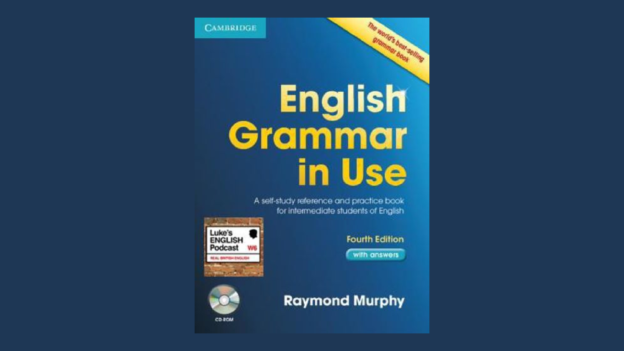
Luke: So, I’ve got here a book, which is called English Grammar In Use by Raymond Murphy and it’s the most popular grammar book for learners of English. It’s sold millions of copies all around the world, it’s a famous book, it’s known as ‘the blue book’, ‘the blue grammar book’
James: and you’re saying it’s basically useless
Luke: No, I’m not saying it’s useless! I’m just saying it’s interesting that most native speakers have got no idea what any of this stuff means. You talk about present continuous tense and third conditionals and things like that
James: Wouldn’t have a clue
Luke: You’ve got no idea, right. What I’m quite curious to do is, another thing is, that in English language classes teachers are always asking students to explain what things mean, right, so they always say things like “what is present perfect and how do we use it?” or “what’s the difference between these two sentences?”, right, and it’s interesting to see what a native speaker, someone who’s already able to speak English perfectly and functionally would answer those questions, because sometimes
James: You’re probably going to get them wrong
Luke: Well, you, it’s, the point is that, a lot of the exercises you do in class are, kind of, unrealistic, and unnatural so even if you were a native speaker you wouldn’t be able to do it, you know?
James: Yeah
Luke: So, like, if I said to you what’s the difference between, ‘I painted the house’ and ‘I have painted the house’? What’s the difference in meaning?
James: ‘I painted the house’ implies that you’ve just done it
Luke: You’ve just done it
James: and ‘I have painted the house’ could be any time
Luke: Ok. Couldn’t you say ‘I painted the house last year’?
James: Yeah, you could say that
Luke: Right, so ‘I painted the house’ could be any time
James: But you couldn’t say ‘I have painted the house last year’
Luke: Ah, right. Why not?
James: Because it’s too… it’s, it’s… I don’t know. There’s two levels to it. Once you say ‘I have painted the house’, you’ve already established the fact that you’ve painted it.
Luke: Right
James: Err, I don’t know! It just sounds wrong!
Luke: It just sounds wrong, yeah, that’s exactly it. The fact is, ‘I have painted the house’ means, you were right originally, you don’t know when it happened, it’s just that it happened in the past some time, and it’s connected to now, because you’re relating it to your whole experience of your life up to now, so there’s a connection to now, ‘I have done it’, like, I’ve got that experience. ‘I have painted the house’. You can’t say ‘I have painted the house yesterday’, because we just don’t use that tense
James: But you’ve already said, ‘I have painted the house’
Luke: Which implies that there’s no time, or that it’s an unfinished period of time.
James: Or just… it just doesn’t work, I don’t know why
Luke: But you can say, “I have painted the house today”, but you can’t say “I have painted the house yesterday”
James: ‘I have painted the house today’, would you say that?
Luke: At the end of the day, ‘so what have you done today?’, oh well…
James: You’d say ‘I painted the house’
Luke: Ok at the end of the day
James: Or ‘I’ve been painting the house’
Luke: But at lunchtime, “what have you done?”
James: Oh, I’ve painted the house
Luke: yeah, exactly
James: What have you been doing this morning? – I painted the house. I don’t know if you’d say ‘I’ve’
Luke: Well if it was finished you would
James: “well, I’ve come in, I’ve picked up the paint brush”
Luke: NO, that’s, that’s
James: I’ve run in, I’ve grabbed the ladder, I’ve put it up against the wall and I’ve painted the house.
Luke: That’s what native speakers say as an error. That’s what footballers do. They say things like, “Well, yeah, I’ve got the ball”… what they should say is “I got the ball outside the penalty box, right, I passed it to Wayne Rooney, he passed it back to me, I beat the defender and I shot and I scored. But what they’d say is “Well, I’ve got the ball outside the penalty box, and I’ve passed it to Wayne Rooney and he’s passed it back to me, and I’ve looked up, and I’ve seen the open goal, and I’ve shot and I’ve scored”, so all this weird present perfect, but it’s kind of wrong isn’t it.
James: Yeah
Luke: They’re actually speaking completely incorrectly
James: Because he’s kind of talking about the present and the past at the same time. “I’ve picked up the ball, passed it to Rooney. You know, I’ve collected the ball and passed it to Rooney”
Luke: So he’s talking about, it’s like, it happened just now, it’s like, in the moment
James: But he’s using “I’ve”
Luke: “I’ve” to, sort of, create that link to ‘now’ somehow
James: It’s like he’s running through it in his head.
Luke: It’s kind of like…
James: This isn’t going to be any use to anyone
Luke: It is. No, it is it is, it’s exactly
James: No-one’s going to listen to this
Luke: No, it’s not true, it’s not true. People will be interested to hear this
James: If you’re listening to this, I’m very sorry
Luke: No, people will be interested to hear about how a native speaker understands,
James: or doesn’t
Luke: or doesn’t understand grammar. Just let me ask you two more things and then we’ll call it a day. Right, er, another one is, what’s the difference between ‘for’ and ‘since’. That’s a question that students ask all the time. What’s the difference between ‘for’ and ‘since’?
James: In what context?
Luke: So, ‘I have done something for…’ and ‘I have done something since…’
James: for?
Luke: For, yeah, f-o-r. “i’ve been doing something for…”
James: 10 years
Luke: Yeah, I’ve been doing something for 10 years. I’ve been doing something since…
James: 1990… 2000
Luke: Yeah, since 2000, so what’s the difference between ‘for’ and ‘since’?
James: …erm… well you say ‘for’ when you’re about to describe the length of time that you have spent doing something. ‘Since’ sets the date that you started.
Luke: Yeah, exactly, yeah. Perfect. Yeah, you’re quite good.
James: That blew your theory out of the water
Luke: No no, it’s just interesting. I don’t have a theory. Right, here’s another one, ok. This is a classic one. What’s the difference between saying, okay this is conditionals. What’s the difference between saying “If I…” now you’ll get this because this is easy… “If I had bought a lottery ticket, I would have won the lottery” and “If I bought a lottery ticket, I would win the lottery” What’s the difference.
James: One’s talking about the past and one’s talking about the future.
Luke: Right, okay, yes, spot on. Nailed it. Yeah. Okay, I need to give you a really difficult one. Erm, hmm, I’ll go to the back of the book. Ok, prepositions, right? Let’s go for, what do you want? Let’s have adjective + preposition, which is, prepositions are the thing that learners have the most difficulty with, and they’re little words like ‘of’ ‘to’ ‘at’ ‘in’, stuff like that
James: Ok, go on, first question
Luke: So, you’ve just got to complete the sentence, erm, hmm,

LUKE: Erm, hmm, wait a minute. Right, wait a second

JAMES: I think you should edit this down.

LUKE: Yeah, okay, right, here we go. I’ll give you a sentence. You’ve got to put the prepositions in the right place, in the gap, okay?
I was delighted ….. the present you gave me. I was delighted … the present you gave me.

JAMES: ‘ with ‘

LUKE: Yes, well done. Brilliant.

JAMES: I don’t know why ? But…

LUKE: I’ve just had an idea whenever you get anything right, I’m gonna do this (ping!), okay? Right, so here’s the next one.

JAMES: This is bad.

LUKE: It was very nice … you, to do my shopping for me. Thank you very much.

JAMES: ‘ of ‘ but I don’t know why it’s ‘ of ‘. I couldn’t tell you the rules behind that. I just know that’s what it is.

LUKE: Why are you always so rude … your parents? Can’t you be nice … them.

JAMES: ‘ to ‘

LUKE: ‘ to ‘ yes, well done !

JAMES: Can you not do that? (referring to the BING)

LUKE: Okay, hmm, but why is it nice to, be nice to the parents?

JAMES: Well, because they brought you up and I dunno, bought you stuff at christmas

LUKE: No, I’m meaning, why do you use the word ‘to’? Nice, be nice to your parents.

JAMES: Because, you’re sort of, I don’t know.

LUKE: Yeah

JAMES: You’re giving some kind to them. You’re kind of, just doing something for their benefit, I suppose or something towards them. Something towards them. A big nice towards them. Now, it’s that
your parents, I couldn’t tell you.

LUKE: You’ve to look up, to look toward them.

JAMES: I couldn’t tell you.

LUKE: The fact is, it’s just impossible to create a rule about it. In fact, you’ve just got to learn that some words go with other words. Just got know it’s ‘ be nice to someone ‘ . You’ve just to learn ‘nice to’. So,
you have to see words existing together in little partnerships.

JAMES: Well, learn how they work together.

LUKE: Yeah, that’s it. It’s just learning two words together. Not just one on its own. So, that’s it. That’s the end of the experiment. Have you learnt anything from this, from this experience?

JAMES: No, no.

LUKE: No?

JAMES: Hm, I just hope that you get something out of this. You know making me look stupid basically.

LUKE: No, I think you got quite a few questions right. Didn’t you?

JAMES: Hhhh yeah,

LUKE: Okay, well, congratulations anyway. I’m gonna give you a certificate now which just shows that you’ve, two certificates, want to show that you completed the course.

JAMES: So, I’ll keep the certificate. Can I have this bit of chewing gum?

LUKE: Yeah, you can have the chewing gum.

JAMES: Sorry, thanks.

LUKE: Hmm, and the second certificate is just something I like to give to all the guests that I have on a program. It’s a little certificate just proving that you’d appeared on, on an episode of Luke’s English
Podcast. So thanks very much for coming and I hope to see you soon.

JAMES: Thanks very much. Luke’s English Podcast is brought to you by Wrigley chewing gum and Castllero del Diablo wine.

Okay folks, what I would now like to do is just explain some of the grammar points that I spoke to my brother about during that conversation. I asked him some questions about a few areas of grammar to see if he could answer them and I think you can see there that the point is, I guess, that native speakers surprisingly don’t understand or don’t really know the rules of grammar. They don’t know terms like ‘present perfect’ or even words like ‘adjectives’ or ‘nouns’. They don’t really know what those terms mean. So when you’re studying all that stuff at school, you’re in a way more articulate than they are, because you know how to describe the language and native speakers don’t know how to do that. That’s quite interesting but native speakers know, umm, what’s right and what’s wrong by instinct. They just sort of, they learn it as children without thinking about it and then when they get older they know that something is wrong but they don’t know why it’s wrong, they just know it’s wrong. It’s the same for you when you’re learning your language as a child.

Umm, what does that tell us about learning English? Well you could say, that it, some people might say it means that learners of English shouldn’t worry about learning the rules of grammar. That instead they should just try to listen to a lot of English, to read a lot of English and by doing that ,erm, see and hear the language so much that they just learn what’s right and wrong, just by frequency. So they know for example that people will say things, just because they have heard it said so many times before and they know what’s right and wrong just because they have heard and read the language a lot and they’ve started to learn, started to get a sense of all the patterns that you find in English.
Maybe that’s true, maybe that’s a good way to learn or maybe learners of English should study the rules or at least study the patterns and do practice exercises in order to understand what’s right and what’s wrong. I think it’s a combination of both. That you need to study the language , you need to test yourself with it , you need to do exercises but also you need to combine that with high exposure to lots of listening and lots of reading and so the more you see of the language , the more you start to develop a feel for it. Hum, that’s my opinion, um, but nevertheless, um, some of the things that I discussed with my brother there, I think I should just clarify for you, anyway.
Um, so the first thing I asked him was, what’s the difference between a noun, an adjective and a verb and he couldn’t really answer the question, but as you may know, a noun is a word which is used to give something a name. We use things like, you know, a table, a chair, a cat, those are all nouns. They can be plural or singular. Three cats for example.
They can be countable or uncountable. If they’re countable you can, you can count them. For example three, you know, tables. A table is a countable noun because you can say one, two or three tables but a word like sugar isn’t countable, instead we just say some sugar. So it’s like a mass of tiny little granules of sugar that together makes something uncountable. They can also be abstract, for example the names of things you can’t actually touch or feel. Umm, so concepts like ‘love’ is a noun. Umm, it’s also a verb but you could say ‘all you need is love’ and in that sentence it’s a noun. It’s an abstract one there and it’s uncountable. That’s nouns. Obviously there’re, nouns can be very complex, they can be larger, kind of phrases you could say like a noun phrase like for example, hum, let’s see, umm, like mobile phone technology is a kind of noun phrase and you can use that as the start of a sentence. Mobile phone technology is developing very quickly, right? So nouns can also be sometimes a number of words together.

Umm, right, the next one is a adjective. Well, an adjective is a word we use to describe a noun. Umm, it’s used to describe a noun, so we would say for example, the food was delicious, right? So delicious describes the food. How was the food ? It was delicious. You could also say delicious food. Like that, of course. Umm, so that’s an adjective.

Umm, and then the next one was a verb and the verb is the doing word. These are words we use to express sort of actions, um, so like play, eat, go, for example. Those are verbs, um, and we also have little verb phrases, which are things like phrasal verbs and that’s a verb in combination with other words and phrasal verbs are difficult because, well, somme of them are easy and some of them are difficult . The easy ones are easy to understand because the meaning is very similar to the original verb. So, if you’re talking about, um, oh, let’s see, hmm, ‘ go on’ , like ‘ go on’, meaning continue. I’s fairly clear what that means because go, we know what ‘ go’ means. ‘ Go on ‘ just means go and don’t stop going, continue. That’s fairly easy but some of them are difficult like if you take the expression ‘give up’. ‘ Give up ‘ umm, meaning to quit. Hum, that’s not quite so easy because the verb ‘ give’ you know, we think, well, ‘ give’ . Give someone a birthday present but in this sentence ‘give up’ has a completely different meaning to give which makes it very difficult and the fact is as learners of English you just have to learn phrasal verbs. You just have to try and learn them because they are all unique words with their own meanings, just a combination of a few words. So that’s, umm, that was the first thing I asked my brother. The next thing was about ‘present perfect’ and ‘past simple’.

So we know the ‘present perfect’. One of the, actually this is one of the most common bits of grammar that you study when you’re learning English. Present perfect of course is like ‘ have’ plus a past participle or ‘ has’ plus a past participle, like I have lived in Japan for example. Umm, she has eaten a pizza, right? And ‘past simple’ obviously everyone knows. I lived in Japan, she ate a pizza, for example. Umm, so the difference, well that’s quite a big one and it’s something that everyone is studying. So the difference between ‘past simple’ and ‘present perfect’ basically we use, we use ‘past simple’ to talk about a finished action in the past but the time period is important and we tend to, with ‘past simple’ express a kind of distance from the act. So there is a distance in time basically, which means that the action
happened in a finished time period. I lived, erm, well let’s say, umm, I ate, no, I drank a coffee. It’s pretty, probably suggests that you that you drank a coffee yesterday or you drank a coffee last week or you drank a coffee, umm, during breakfast, right? So it’s like in a finished time. ‘Present perfect’ is used to describe finished actions which happened in an unfinished time. So there’s a connection to now. That’s the most important thing. So, basically you might say for example, I have drunk three cups of coffee today. Umm, today is not finished, so you can say, I have drunk three cups of coffee today. Hum, so the time period is always connected to now. It’s a bit more complicated than that but that’s is all basic difference.
Hum, to be honest, if I was to explain ‘present perfect’ and ‘past simple’, I’d need to record a completely new podcast and I could do that. So, I might, I might do that.. ‘Past simple’ and ‘present perfect’.

The next one was about 2nd and 3rd conditionals. So we know the 2nd conditional would be for example, umm, let’s see. Err, if I bought a lottery ticket, I would win the lottery. Not a very good example because, it’s not definite that you’d win, so, if I?
Okay, let’s say, if I, if I went outside, I, no, no, no … Okay, if I studied hard, I would pass the exam. So, you’re talking about the future but you use past tense like studied, if I studied, now, we’re not talking about the past , we’re talking about the future. And we know, it’s the future because we’ve said’ if’ . So ‘ if ‘ plus a ‘past tense’ is actually used to describe a kind of unreal future. So you use the past tense not to create distance in time but to create distance in reality. In this sense it’s an unreal or hypothetical future because you don’t think it’s realistic. So, if I studied hard, I would pass the exam but I’m not going to study hard because I don’t want to, right? So compare that with the 1st conditional. If I study hard, I will pass the exam. Umm, ‘present tense’ after ‘ if ‘ , still talking about the future but here we think it’s a realistic future. So, there’s no distance from reality. We think it’s real and it’s followed by ‘ will ‘. Umm, if I study hard, I will pass the exam. So, that’s it, it’s like a definite future with its definite future consequence!

The 3rd conditional talks about the past and there we use ‘had’ plus a ‘past participle’ in the ‘if clause’, in the second clause we have ‘would have’ and a ‘past participle’. So, let’s say, the exam was last week and I failed, you could say, ‘ If I had studied for the exam, I would have passed, right? The fact is, I didn’t study and I didn’t pass but if I had studied, now here we’re using ‘ had studied’ and that’s like, it looks like past perfect, but it’s not actually past perfect, it just looks like it, but it’s used to create distance from reality in this sense, in the past. Umm, so we go from ‘past simple’ I didn’t study, we go one tense back to what looks like ‘past perfect ‘. ‘If I had studied’ and then in the second part ‘I would have passed ‘. Again to refer to a past consequence.

It’s all very complicated and to be honest rather boring but you kind of have to learn it. Again, I could do a completely separate podcast all about conditionals because it’s such a big topic.

The last thing I talked about with my brother was ‘prepositions’ and if you’re learning English you’ll know about prepositions. They’re very, very difficult. They are the little words that we use to connect nouns and verbs and adjectives together and you find the prepositions are linked to other words and there isn’t really a decent set of rules to explain these links. The fact is, you just have to learn them. You just have to learn that we say ‘to be nice to someone’ right? ‘Nice to’ those words go together. You’ve just to learn that you have to remember it and there’re lots of combinations of verbs and prepositions, nouns and propositions and adjectives and prepositions and there are so many lists, really that, it’s just a case of noticing them and then try to remember them. Umm, what you should do, is realize that prepositions are linked to other words and then see these word combinations as separate units of meaning that you should learn. So, you don’t just learn the word for example ‘consist’ but you learn the expression ‘consist of’ right? Okay, so a hamburger , a Big Mac consists of bread, salad, beef and cheese for example. Umm, so, ‘consists of’. Those words always go together.

Umm, so that’s basically it. Those are the things I’d discussed with my brother. I expect, if you’re a learner of English, you understood the rules of grammar a little bit better than my brother did. Umm, in which case you should feel quite good about yourself. Um, remember you’re, you’re learning the grammar of the English language and you’re learning the grammar actually better than most native speakers. So, well done you.
Umm that’s the end of this podcast, I hope you found it interesting. That’s all for me . Bye, bye, bye, bye, bye…

Enjoy.

52. London Video Interviews Part 4

More conversations with native English speakers in the centre of London. Tapescript available below. Enjoy!

Luke’s English Podcast is a free service, but PLEASE DONATE SOME MONEY to help me pay for this website. Only donate a few dollars/euros/pounds if you listen. Your donations make this podcast possible. No donations = no more podcasts.

Video Transcript

Luke: So what’s the best thing about being in London for you?
Man with red tie: The food
Luke: Really? That’s interesting. A lot of people who aren’t from England, foreigners, think that the food’s awful. What kind of food?
Man: Indian. Italian. Good food.
Luke: Right, okay, what’s the worst thing about London?
Man: Feeling unclean when you get home. The grime.
Luke: The, sort of, grime, the pollution and stuff. Okay, thank you very much.
Man: You’re welcome.

Girls: Hi
Luke: Hi, where are you both from?
English girl: Nottingham
Luke: Okay
Canadian girl: And I’m from Canada
Luke: Okay, right, but you’ve both lived in London before, right?
Girls: Yep
Luke: I’m just asking people what the best and worst things about London are…
Nottingham: The amount of things to do… the best thing
Luke: Yep
Canada: Free museums and galleries, those are really good things.
Luke: Okay, right, what about the worst things?
Canada: The tube
Luke: What about the tube?
Canada: Too crowded, too hot, doesn’t work very well.
Luke: Right. What do you think?
Nottingham: That’s about it actually, yeah. Travel, yeah, travelling.
Luke: Alright, thank you very much.
Canada: You’re welcome
Luke: Cheers
Canada: Good luck with that
Luke: Thanks very much, cheers.

White t-shirt man: Hello
Luke: You’re from London as well are you?
Man: I am from London yeah. Do you want me to talk to you or to the lens?
Luke: Umm, both, whatever.
Man: Okay, yeah
Luke: Whatever’s more comfortable.
Man: Alright
Luke: So, what’s the best thing about London?
Man: Umm. I would say, the diversity, the culture diversity, the galleries, the fact that you can walk around the city and there’s so many different types of… walks of life you know, culturally and also it’s constantly changing and reinventing itself. It’s got lots of different opportunities creatively. I think that’s what, really, what makes London thrive really.
Luke: Right, it’s the place where you can, kind of, go with a creative idea and make it work
Man: Yeah, it’s a very dynamic city, culturally dynamic, which is what makes it great
Luke: Okay. What about the worst things?
Man: Err, overcrowding, the tube, erm… stress levels, pressure, people not looking you in the eye when they [are] going through their day to day [life]. That’s probably the worst thing about London.
Luke: So there’s a sort of impersonal thing as well
Man: It can be, yeah
Luke: Okay
Man: Alright?
Luke: Great, thanks very much, bye.

51. Luke Answers Your Emails and Questions

It’s back! The return of Luke’s English Podcast. Responses to the comments and questions I have received over the last few months. I haven’t done a podcast for quite a long time, so here it is!

Small Donate ButtonRight-click here to download this episode.
Luke’s English Podcast is a free service for people learning English as a second language. Use this podcast to develop your listening skills, your awareness of pronunciation patterns, your knowledge of vocabulary and grammar and your cultural understanding too. Each podcast is fairly long, usually more than 30 minutes. There is a lot of content in this podcast. You can use it to develop your English by doing ‘long term listening’ which means you listen for something for a longer period (not just the 5 minutes of listening you do in class), and you listen to it regularly and sometimes more than once. This allows you to ‘get to know’ the podcast, the sound of my voice and the way I teach. You can listen to it anywhere. After a while you will start to pick up lots of things I say, and possibly start speaking like me.

In this podcast I just respond to messages I have been sent recently. If you have sent me a message I might reply to it personally on this podcast episode. I answer some questions too, so it is a good chance to understand some tricky things in English and get some advice.

Cheers.

Luke

50. Good Things Come To Those Who Wait

Useful and natural vocabulary and expressions on the subject of Waiting and Being Patient.

Small Donate ButtonRight-click here download.

Good Things Come To Those Who Wait

Welcome back to Luke’s English Podcast. This is Luke, and this is the long awaited next episode! I expect some of you have been waiting for the next episode to be uploaded. Well, here it is! Proof, surely, that good things come to those who wait.

In fact, that is what this episode is about; waiting and being patient. I’m going to teach you some useful words and expressions on the subject of waiting.

Here are the expressions I will be teaching you. First I will list them, then I will talk and use them in context. You will have to listen to the podcast to hear me give definitions and explanations.

Vocabulary and expressions: Waiting and being patient (23 items of vocabulary)

Good things come to those who wait
Persevere
Stick at it
Don’t give up
Keep going
It’s worth it in the end
Hold on
Hang on
Hang in there
Hold tight
Hold your horses
See how things go
Wait and see
Bear with me
All in good time!
Don’t be impatient
I’m looking forward to it/doing it
I can’t wait for it
I can’t wait to do it
Don’t hold your breath
An anticlimax
To queue up for something
To hold out for something

Here are the expressions in context. Listen and notice the expressions. You can read and find them here too:

They say that Good things come to those who wait, and I’m sure it’s true. If you have the patience to wait for a long time, eventually something good will come to you. For example, if you’re looking for Mr Right or Mrs Right – if you want to get married, it’s no good if you just marry the first person you meet. You need to be patient until you find the right person for you. If you’re starting a business, you might need to persevere before you get success. Success might not come immediately – if you think you have a good business idea, just stick at it and eventually success will come along. Good things come to those who wait – patience is a virtue! So, if you’re waiting for something, don’t give up – keep going! This is true for learning English – it is a long term thing. You can’t get big success in a short time, you have to stick at it. Keep listening a lot, keep studying, keep taking risks with English. It is worth it in the end. You’ll improve in the long run. There’s no short, quick solution to learning English, unfortunately. So, if you’re impatient to become a fluent speaker, keep practising and hang in there. Hold on, hang on and hold tight – you’ll get there in the end if you keep trying. Sometimes students ask me what their English will be like in 3 months time, or 6 months time. I usually say – if you work hard and have the right attitude, you could make a lot of progress, but I can’t really predict the future – you’ll have to just wait and see. Sometimes my students are so keen to improve that they ask me to give them extra work to do after school (don’t worry – I have plenty of students who are happy to do nothing after school!) and usually I have to say “OK, I’ll have to go into the teachers’ room to photocopy something for you. Just bear with me, I’ll be back in a few minutes”.
Sometimes if my students do a test in class, they want to know their results immediately, but they have to wait until I’ve checked their answers. “Can I see my score please Luke?” They say. “All in good time! I haven’t checked your tests yet! Don’t be impatient!” I might say.
Often at school, the students work pretty hard and they just want the weekend to come so they can go out and enjoy themselves. They might say “I can’t wait for the weekend!”. Some students get tired of living in London because they’re homesick, and it’s cold here and the food isn’t very good. They might say something like, “I’m really looking forward to going back to my country”.
Sometimes, teachers at my school organize trips out of class (e.g. to interesting places in London). The students often look forward to these and say things like “I can’t wait for the trip into London”, but I might say “Don’t hold your breath! – it might not be that good. It might rain or something, and that would spoil the trip, wouldn’t it?” There’s nothing worse than building something up, expecting it to be great, and then it being an anticlimax in the end.
Some students think that the British are naturally patient people because we seem to enjoy queueing up for things. They always see people standing in lines at ATM machines or outside theatres. Perhaps it’s true – maybe we are quite patient. I think we like to queue up because it makes life easier. Who wants to live in a place where people push and shove and don’t respect each other?
So, are you finding this episode useful? I know some of you have been holding out for this one for a while. I hope it is what you expected, and not too much of an anticlimax.

That’s it. You’ll have to listen to the podcast in order to hear my explanations and examples of the 23 items of vocabulary listed above.

You can also hear me chat with English Robot 3000.

If you listen to this podcast, please donate just 1 dollar to me via PayPal. You can do that by clicking the ‘Donate Via PayPal’ button in the top right of the webpage.

Hang in there!

49. Stand Up Comedy (with Claudia)

Guest presenter Claudia Edwards interviews Luke about Stand Up Comedy. Vocabulary notes are included below.

Small Donate ButtonRight-click here to download.

Luke’s English Podcast is a free service for learners of English. In a recent made up survey, a group of over 1000 international students were asked what was the best way to learn English. 99% of the students said that Luke’s English Podcast was the best way to learn English. 1% of the students did not understand the question.

London is said to be the comedy capital of the world. There are more comedians here than in any other city. Comedy is a BIG part of our culture here. Going to a stand up comedy show is a very normal way to spend an evening. There are many famous and successful stand up comedians in the UK as well as the USA. But what is stand up?

I’ve recently started doing stand up comedy myself, so in this podcast I was interviewed by my friend & colleague Claudia Edwards. I’m sure you’ll agree, it is very nice to listen to a female voice presenting the podcast for a change. Enjoy!

Here are the questions asked by Claudia, and some of the vocabulary I used in my answers:

Claudia’s Interview Questions + Vocabulary
Can you tell me what exactly is stand up?

stand up comedy = a kind of comedy performance which involves a comedian standing up in front of an audience with a microphone, in order to make people laugh
sit coms = situation comedies – these are TV shows which usually feature a few characters in a familiar situation. The events and the conversation are funny. E.g. Friends

What makes it unique as a kind of performance?
a script = all the words for a play, or a movie which the actors have to learn
dying on stage = being unsuccessful on stage – doing your performance, but failing because nobody is laughing

What are the good things and the bad things about it?
you can’t blame anyone else
to blame someone = to say that someone was responsible for something bad. e.g. “it’s the director’s fault”
time consuming = it takes up (uses) a lot of time
you’re putting yourself on the line
to put yourself on the line = to put yourself in a position in which you might fail

What’s it like? How do you feel?
the palm of your hand = the middle part of your hand (with the lines on it)
you’ve got the audience in the palm of your hand = the audience are completely under your control
it’s paid off = the work you have done is resulting in success
beforehand = before

Have you ever had a mind blank?
a mind blank = when your mind goes blank, and you can’t think of anything

How long have you been doing it?

What exactly do you do, just tell jokes?
the navigational systems of the plane = the computer which helps the plane to go in the correct direction
you wouldn’t be able to take them on as hand luggage

What do you think makes a stand up comic good?

Do any other countries do stand up, or is it just the UK?
they will often pick on the audience
to pick on someone = to make fun of / tease someone (sometimes in a nasty way – like a bully at school)
alternative comedy = subversive, critical comedy
subversive = critical, radical, revolutionary, against the government or the ‘way things are now’

How long have people been doing stand up in the UK, do you know?

If people listening want to see some stand up, what should they do?

Some vocabulary from Luke’s stand up set:
bollocks = a rude British English swear word which is like the American word ‘bullshit’. It actually means ‘testicles’.
shuffle all songs = a function on the ipod which plays all your songs in random order

Some of my favourite comedy clips:

Richard Pryor – When kids lie
Richard Pryor is definitely one of the best stand up comedians ever. Unfortunately he is dead now, but his comedy is still with us. He was one of the people who invented the kind of stand up comedy which everybody does now. In this clip Pryor talks about how children behave when they lie about breaking something.

Steve Martin – Sex Jokes
I absolutely love Steve Martin, but a lot of people don’t ‘get’ it (they don’t understand why he’s funny). Unfortunately there aren’t many good clips of him doing stand up on YouTube, but this one is quite good. Steve’s comedy is not obvious. It’s subtle. He used his voice and his body a lot, and just little physical movements or changes in the way he spoke were hilarious. This clip is a bit old fashioned, but I believe Steve Martin is still one of the best stand up comedians we’ve had.

Michael McIntyre – Live at The Apollo
McIntyre is probably the biggest stand up comedian in the UK at the moment. He is extremely popular. His comedy is accessible (he talks about things which everybody can relate to), he uses a lot of physical humour and different voices, and he is very energetic on stage.
In this clip, he talks about how English people always want to know exactly where you live when you introduce yourself. “Hi, I’m from London” – “Whereabouts whereabouts!”
He speaks very quickly.
[youtube http://www.youtube.com/watch?v=Es2l4yUBY6M&hl=en_US&fs=1&]

Eddie Izzard – Computers
One of the top comedians in the world. Yep. He has a unique, surreal style, but he talks about every day things like the problems we experience with computers.

Flight of the Conchords – Business Time
These guys are a musical comedy duo from New Zealand. They sing comedy songs. This one is about ‘making love’! Oh yeah, it’s business time! In the song, Jemane sings to his girlfriend about making love on a Wednesday evening. Listen carefully to the lyrics and you’ll understand that Jemane is not a very good lover!

Here’s a clip of some Japanese comedy. It comes from a BBC TV show called “Adam and Joe Go Tokyo” in which British comedians Adam and Joe go to Tokyo to learn about Japanese culture. It was broadcast about 6 years ago.
[youtube http://www.youtube.com/watch?v=Nf7V-Fuqtak&hl=en_US&fs=1&]

There are many many more comedians and videos that I love, but I can’t recommend them all. To be honest, I think that it is very difficult to understand the humour if you don’t understand the English perfectly. This is why I think comedy is one of the best ways of improving your English. Think of it like this:
1. Watch some comedy that you don’t understand
2. Realise that other people are laughing, so it must be funny
3. Think: What am I missing?
4. Watch again and try really hard to understand what is so funny about it. Is it the specific words? Is it the subject? Is it something specific to the culture that you don’t understand?
5. If you can understand comedy in English – you are making a lot of progress!!

I totally believe in comedy as one of the best things in life – and of course I think comedy in English is wonderful, and there is SO MUCH of it. Don’t miss out on English language comedy. GET INTO IT TODAY!

48. Useful Expressions for Travelling (with Claudia)

A conversation about travelling and backpacking, with plenty of useful vocabulary for talking about this subject.

Right-click here to download this episode. 

Small Donate ButtonVocabulary
Here is the list of expressions which I use and explain in this podcast. It is all very useful for when you are travelling.
You’ll notice a lot of uses of Present Perfect Tense (have/has + past participle) in questions.
You’ll also notice the phrasal verbs – made of a verb + particle combination. They are very common, and there are lots in this podcast. There’s a transcript of the travelling conversation from this episode, just scroll down.

Here are the expressions:

Mind if I join you?
How’s it going?
Whereabouts?
Where in London?
I’m just up the road
No way!
How weird!
That’s right by my work
Really?
It’s a small world
How long have you been here?
I’ve been here about a week now
Are you staying long?
What about yourself?
We’re travelling through the whole area
Just travelling up through Vietnam
Where have you been so far?
I flew into Ho Chi Min City
I saw the sights
I flew up to Hanoi
I’ve got a mate up there
We had a laugh
Are you just travelling down the coast now?
Have you been to Hue?
No, we’re travelling south to north
I’m a bit templed out
They’re worth visiting
Beautiful views on the way
It’s pretty rank
Are you just going to stick around in Hanoi for a bit?
The plan is, just stick around here for a while
and then head down to Nha Trang
Chill out on the beach
I’m going to pass through Dalat
Do you know any good places to stay around here?
Just walk down this street
There’s an ATM on the corner
See you around!

Transcript [12:37] to [16:32]
L – Luke
C – Claudia

[12:37]
L: Excuse me, do you mind if I join you?
C: No, yes, fine.
L: All right. Cool, thanks. How’s it going?
C: Yeah, pretty good, thanks. Yourself?
L: Yeah, not bad, thanks. So where are you from?
C: I’m from England.
L: Yeah, yeah, me too.
C: Oh yeah, whereabouts?
L: London.
C: Yeah, me too.
L: Really? Where in London?
C: Do you know it quite well?
L: Yeah, yeah.
C: West London.
L: Really? Me too.
C: Yeah.
L: Me too.
C: Really? Chiswick?
L: I’m in Hammersmith.
C: Really?
L: I’m just up the road.
C: Yes, literally just up the road.
L: No way.
C: How weird.
L: So, where in Chiswick are you?
C: You know the green where the church is?
L: Yeah, do.
C: Just there. What about you?
L: Really? I’m up the road. Do you know the Tescos up the road?
C: Yeah.
L: I live opposite the Tescos.
C: Really? That’s right by my work.
L: Is it?
C: Yeah.
L: No way. Where do you work?
C: At the London school of English.
L: Really? So do I.
C: (sound of surprise) What the? no way.
L: Yeah. I’ve been working there for about three years.
C: Really? I only started just two months ago.
L: Ok, Are you Westcroft Square.
C: Yeah, just over your flat.
L: I haven’t been there for a while. I’ve been working in the other school.
C: That’s so weird.
L: No way. That’s amazing. It’s a small world.
C: It is. So, how long have you been here?
L: Well, I’ve been here about a week now.
C: Ok, not too long. Are you staying long?
L: I’ve got about a week left. So, yeah, just a couple of weeks.
C: Ok, just a holiday.
L: So what about yourself?
C: We’re travelling through the whole area. Done Thailand, a bit of Cambodia. Just travelling up through Vietnam and then to Loas.
L: Wow, you’re doing the whole thing. Enjoying it?
C: Definitely. It’s amazing. We’re loving Hoi-An. Ho Chi Min was cool too but a bit busy. So, where have you been so far?
L: Well, I flew in to Ho Chi Min and spent a couple of days there and just saw the sights. And then I flew up to Hanoi, because I’ve got a mate up there. And I spent New Year’s Eve there and I took a bus out to Halong Bay and I did that, stayed on a boat overnight.
C: Really? What was that like?
L: It’s pretty funny, really. The boat actually had mice on it.
C: Oh no.
L: And the engine was really loud at night, but it was funny. You know, there was good people on a boat. We had a really good laugh.
C: Cool. So, are you travelling down the coast now?
L: Yeah. That’s right. I fly out of Ho Chi Min City again in about a week. So I’m just going down the coast now by bus and train, visiting the main spots. Have you been to Hue?
C: No, not yet. We are travelling from south to north.
L: Oh right, ok. Hue is really nice. Go and see the imperial city. It’s really interesting.
C: What? Temples?
L: Yeah.
C: A bit templed out, to be honest.
L: A bit templed out. Lots of temples in Cambodia?
C: Yeah.
L: It is more temples, but they are pretty good. They’re worth visiting.
C: Ok.
L: So, after Hue, I took the train down here, beautiful views on the way. Really nice. I definitely recommend the train journey. Don’t eat the food though.
C: No?
L: No, it’s pretty rank.
C: Oh, ok. So are you just going to stick around in Hoi-An for a bit.
L: Yeah, yeah. The plan is just stick around here for a while and then head down to Nha Trang and chill out on a beach for a while and then I’m going back to Ho Chi Min City. I’m going to pass through Dalat as well.
C: Yeah, cool. Oh you’ll like Nha Trang. You should do a boat tour, you’ll have a really good time, yeah. So, do you know any good places to stay around here?
L: Yeah, there is loads of places, just walk down this street and there’s a few hotels. There is an ATM on the corner as well.
C: Oh good. Nice one. Ok. Well, have a great time.
L: Yeah. Thanks a lot. Maybe see you around in Hoian?
H: Yeah. yeah.
L: Ok. Bye, bye.
C: See you.
[16:32]
Vietnam

Here’s a funny video by a pair of musician/comedians from New Zealand. This song is dedicated to English Robot 3000 and English Robot 4000. Which one should I choose to be my number 1 robot? Email me: luketeacher@hotmail.com
[youtube http://www.youtube.com/watch?v=mvrva8NoMLM&hl=en_US&fs=1&]

47. Travelling in Vietnam

EnglishRobot3000 interviews me about my holiday in Vietnam.

Small Donate ButtonRight-click here to download this episode.

I recently bought an English speaking robot from Japan. His name is English Robot 3000, and he’s very nice. In this podcast, English Robot 3000 asks me questions about my holiday in Vietnam and I talk about what I did, where I went and how it felt.

The next podcast will contain lots of really useful language for meeting people when you are travelling.

Hope you enjoy the episode, and happy new year!

Photos
Here’s a slide show of my Vietnam holiday snaps

Here’s a picture of EnglishRobot3000
EnglishRobot

Get the PDF transcript here 👇

45. Luke & Andy’s Crime Stories (with Andy Johnson)

A conversation with my friend Andy. We share some anecdotes. By coincidence, they’re also about petty crime. Some samples of vocabulary and expressions are listed below. I give definitions in the podcast – so listen to check the meaning.

Right-click here to download this episode.
This is a completely natural and authentic conversation. None of it was planned, so it is completely real and not fake.
This is really good listening practice for you. Listen to two native speakers talking naturally with each other. If you can understand the conversation, then you’re at the same level as a native speaker. You’ll understand the little comments and jokes that we make with each other. I recommend listening to the podcast a few times until you completely understand the conversation, and start remembering bits of vocabulary that we said. Also: Enjoy yourself!

Some vocabulary and expressions from our conversation:

The night Andy Got Arrested:
They know them by heart
For some reason we thought it might be funny to start throwing snowballs at the police station
He didn’t have a helmet, he had one of those little hats and it knocked his hat off
We started laughing hysterically
They put us in the cells for the night – “blimey”
We weren’t charged with anything, we were given, like, a verbal caution
I was very contrite and quiet and very apologetic
My friend Gareth, he got really indignant and really angry
Because he was mouthing off he didn’t get anything
They released us with a slap on the wrist and told us not to do it again
‘Snow crime officer!” – “Snow joke Luke!”

The Time Luke Got Caught by The Police for Skateboarding:
I consider myself to be a law abiding citizen, with a few minor indiscretions under my belt, but generally, you know, quite an honest, law abiding person
When I was twelve, I did have a run in with the police
I wasn’t a naughty child
My brother and I were both very into skateboarding at the time
An indoor shopping precinct
I felt quite awkward most of the time
Anyway right, cut a long story short…
Suddenly a police riot van turned up
This is like, a big van, with like, protection, you know, like a sort of, armoured van pulled up, and the doors swung open and just loads of police all just piled out of this van, and just, sort of, it was like an organised attack
A pincer movement
I decided to make a run for it too, kind of half heartedly
I just, sort of, casually ran towards the stairs, and the next thing I know; big hand on my shoulder, a big hairy policeman’s hand grabbed my shoulder
You’re nicked! Come here!
I looked up at him with these tears in my eyes, and with my lip trembling…
I wasn’t even capable of thinking straight
I was just really deeply traumatised
I went into a sort of state of shock
Next thing I know, policeman’s hand on my shoulder
The policeman looked at me, and felt pity and said “alright sonny, I’ll let you go”
He was a very friendly, kind of, jolly kind of policeman
Did they cuff you? They didn’t cuff us, no.
I think it’s terrible the way you’ve treated these children!
How dare you be so angry and aggressive!
Your Dad went ‘buck wild on their asses’!
My Dad just didn’t hold back
In the end I felt vindicated because my Father protected me, stood up for me against the, frankly brutal West Midlands Police.
Oppressive police reigime
I’ve always thought that you had potential criminal tendencies

Andy’s “I was wrongly accused of theft as a child!” Anecdote:
I’ve got a twin brother. “What, identical twin?” No, non identical. He’s the good looking one.
We were in this shop and we were looking at erasers, rubbers.
Apparently I just reached into my pocket and took the rubber out
We went home and he told my Mum.
Just, sort of, grassed you up to your parents.
I think I bought it. I must have bought it. I don’t think I deliberately stole it.
If I did steal it, it wasn’t intentional.
It was, kind of like, the manslaughter of theft.
Unintentional theft. There may have been mitigating circumstances.
Yeah, like it didn’t happen! That’s the mitigating circumstance.
You legitimately purchased it!
My brother was laughing in the background, smiling away.
We will be conducting a full investigation into the theft of the eraser.
They’re going to bring you in as well. You’re going to be an accessory.
I’ll just grass you up. I’ll do a deal with the Police.
You’re going to be a supergrass!
You’ll frame me.

Luke’s “Law breaking in Canada” photo album:
You might be wanted by interpol.
Maybe the mounties. The mounties always get their man!
They’re going to chase after me and get me. They might even make a sort of light hearted drama about it. Like, ‘a Canadian mountie travels to London in order to track down an infamous criminal’.
A fish out of water – riding around Regent Street on his big horse.
We decided we would take photos of ourselves breaking all of these by-laws.
That probably counted as a crime wave. It probably had the mounties baffled during the summer of ’97.
If I went back to Canada, they wouldn’t let me in. They’d bang me up.
Is that why you’ve been growing your hair, so they won’t recognise you?
Let’s stick the Queen’s speech on, shall we?
Everyone will be sat there with a glass of sherry.
“On a slightly sadder note. On one of my recent perusals of Luke’s English Podcast, it has been drawn to my attention, that there is a criminal on the loose in England! His name is Andy Johnson! And we must lock him up! Immediately!
People are going to leave their houses with bats, and they’ll be like an angry mob knocking on my Father’s door.
There’ll be, like, burning torches, pitch forks.
You can commit as many crimes as you like, and they don’t even bat an eyelid.
They’re very tolerant. They’re very liberal.
I think my crimes pale into (in)significance compared to what you did.
If you can get away with it, I’m going to get away with it.
People used to get hung, drawn and quartered for that in the middle ages.
Maybe he was aiming for the face, which for me is an aggravating circumstance.
Festive snowball attack.

44. Telling Anecdotes

Improve your speaking by telling interesting and amusing anecdotes. In this episode you’ll learn about anecdotes, listen to a couple of stories told by some BBC radio DJs and learn some new vocabulary. Good extended listening practice. There are vocabulary notes and a grammar practice exercise below. Enjoy!

Right-click here to download this episode.
Anecdotes
What are the characteristics of an anecdote?

• They’re quite funny
• They contain a story
• They include lots of descriptive details – like exactly what happened and what it looked like
• They include descriptions of the thoughts and feelings of the person involved
• Some details are exaggerated to make the story more interesting!
• They involve a comment at the end – e.g. what you’ve learned, what you think of the situation now

You’re going to listen to an anecdote by Adam Buxton, a BBC Radio DJ and comedian from South London.

The Adam & Joe Show is a weekly radio programme on BBC 6 Music every Saturday morning. The show is also available as a podcast from the BBC here: http://www.bbc.co.uk/podcasts/series/adamandjoe/

Adam and Joe have known each other since they were children. They both grew up together in London, and became famous for making comedy television programmes and radio shows. Adam Buxton is also an actor who has been in British films such as Hot Fuzz, Stardust and Son of Rambow. Joe Cornish is now a film director and his latest film is called Attack The Block, and it’s a sic-fi horror film about a group of kids in London who fight back against aliens that attack their block of flats. It’s great, and it features young Londoners speaking in their real local dialect.

Untitled-5

Listen to Adam’s anecdote and answer these questions:

1. Where was Adam when this happened and why was he there?
2. How does Adam know this happened when he was incredibly young?
3. What was lying on the floor? How did it get there?
4. Why did Adam think it was free?
5. What was Adam doing when his Dad found him?
6. What did Adam’s Dad say when he realised Adam had stolen the gum?
7. How did Adam’s Dad make his point?
8. What exactly happened to the gum?

Vocabulary
Here’s some of the vocabulary from the recording of Adam and Joe. To get explanations of this language, you’ll have to listen to the podcast. I start giving definitions at about 22m40sec.

1. Do you think of me as a bit of a crim?
2. These are crimes you commit on kind of an instinctive basis
3. We don’t condone it. In fact if you enter this text competition we might pass your details on to the coppers.
4. This is one of my formative memories
5. The earliest memory I’ve got stashed away in my brainium
6. This is in the days when my Ma and Pa used to smoke cigs
7. Someone had knocked a packet of Wrigley’s Doublemint Gum off the shelf
8. The floor is no man’s land
9. That’s what Ronnie Biggs said in his defence. “It was on the floor! The gold fell on the floor!”
10. So, anyway, to cut a long story short, I stuffed the Wriggles in my pockles
11. I was fairly brazen about it
12. My Dad found me happily chomping some Wriggles
13. It’s tricky to get rid of the evidence. Just chew it. You can’t swallow it either
14. The police can forensic it
15. I was very freaked out
16. Gum’s not even flammable, is it?
17. It’s like a sort of a hellfire response! It’s like he’s a Baptist minister.
18. The foil just went all charcoaly and the gum just sort of melted

Grammar Exercise
Practise your English by completing Adam’s story. This is a slightly basic version of the story (not exactly the same as the one in the recording). Don’t listen, just try and put the verbs in the correct form:

Well, my introduction to the shady world of crime (come about) __________ when I suppose I (be) _______________ about four or five. We (be) ____________ at the corner shop. This (be) _______________ in the days when my Ma and Pa (smoke) _______________ cigs. We (live) _______________ in Earl’s Court and we (be) _______________ at the corner shop. My Dad (buy) _______________ some cigs. I (know) _______________ I (be) _______________ incredibly young because the only shelf I (see) _______________ (be) _______________ the absolute bottom shelf, and that (be) _______________ where all the sweeties (be) _______________. And someone (knock) _______________ a packet of Wrigley’s Spearmint Gum off the shelf and it (just lie) _______________ on the floor, (call) _______________ my name. And I (be) _______________ the only one down there at that level, and I (look) _______________ at it and I (think) _______________ “Free gum! Free gum!”. I (remember) _______________ very clearly the logic process I (go through) _______________ in order to justify to myself that it (be) _______________ ok, because inside I (know) _______________ that it (steal) _______________. I remember (think) _______________ “it (fall) _______________ off the shelf and they don’t want it any more”.

Anyway, I (shove) _______________ the gum into my pocket, and (get) _______________ home and I (go) _______________ into my room. I didn’t believe I (commit) _______________ a serious crime, but my Dad (find) _______________ me happily (chomp) _______________ some gum, and he said “where did you get this gum? I didn’t buy you any chewing gum. You’re not allowed gum.” And I said “It was on the floor, it was broken!” And he said, “you (just steal) _______________ something! You stole this! You didn’t pay for it! If the police (find) _______________ out, you (go) _______________ to prison.”

I (be) _______________ very freaked out, and (make) _______________ his point even more forcefully, my Dad (burn) _______________ the gum. The foil just (go) _______________ all charcoaly and the gum just kind of (melt) _______________. It (smell) _______________ minty.

Transcript of the Adam & Joe Anecdotes
Here’s the complete script if you need it:

Well, my introduction to the shady world of crime came about when I suppose I must have been about four or five. We were at the corner shop. This is in the days when my Ma and Pa used to smoke cigs. We lived in Earl’s Court and we were at the corner shop. My Dad was buying some cigs. I know I was incredibly young because the only shelf I could see was the absolute bottom shelf, and that’s where all the sweeties were, and someone had knocked a packet of Wrigley’s Spearmint Gum off the shelf and it was just lying on the floor, calling my name. And I was the only one down there at that level, and I was looking at it and I was thinking “Free gum! Free gum!”. I remember very clearly the logic process I went through in order to justify to myself that it was ok, because inside I knew that it would be stealing.

I remember thinking “it’s fallen off the shelf and they don’t want it any more”.
Anyway, I shoved the gum into my pocket, and got home and I went into my room. I didn’t believe I had committed a serious crime, but my Dad found me happily chomping some gum, and he said “where did you get this gum? I didn’t buy you any chewing gum. You’re not allowed gum.” And I said “It was on the floor, it was broken!” And he said, “you’ve just stolen something! You stole this! You didn’t pay for it! If the police found out, you could go to prison.”

Rules of Life
p.s. Here those ‘rules of life’ I talked about at the beginning of the podcast:

1. Don’t be dead
2. Get a job
3. Get money
4. Get food
5. Find friends / a life partner
6. Get married
7. Buy a nice house in a good neighbourhood – get on the property ladder
8. Get a broadband internet connection (so you can download Luke’s English Podcast)
9. Get an HD TV
10. Negotiate a good mobile phone contract
11. Look after your teeth
12. Eat plenty of fibre
13. Eat 5 portions of fruit or vegetables a day
14. Get plenty of sleep – at least 6 hours
15. Get regular sex
16. Reduce your carbon footprint – insulate your home
17. Watch the latest American dramas on TV
18. Consolidate all your monthly loan repayments
19. Learn another language
20. Call your parents
21. Exfoliate
22. Follow your dreams
23. Enjoy yourself.

So, the 23rd rule of life – Just ENJOY YOURSELF!

24. Listen to Luke’s English Podcast every day.