
Author Archives: Luke Thompson

About Luke Thompson

I've been teaching English for over 20 years in London, Japan and France. I also do an award-winning podcast for learners of English called "Luke's English Podcast". In my free time I'm a stand-up comedian who regularly performs shows in English in Paris and sometimes London.

145. Nightmare Teaching Experiences (Part 1)

This episode is all about English teaching and some stories of bad classroom experiences. Transcript available below.

Small Donate ButtonRight-click here to download.

Hello listeners, how are you doing? It’s a beautifully clear and sunny September day here. This time of year always reminds me of going back to school after the summer holidays. So, because of that, I’m going to talk about some teaching experiences in various schools I have worked in over the years.

In this episode I’m going to talk to you about my experiences of being an English Language Teacher. I’ll tell you what it’s like from the teacher’s point of view, share with you a few really bad experiences I’ve had as a teacher and then explain what I learned from them.

If you would like to read and study every word of what I am saying then you can because there is a full transcript for this episode, which is available at http://teacherluke.wordpress.com. Just find or search for this episode on that page. 145. Nightmare Teaching Experiences

There you can read every single word I’m saying, you can copy+paste words into google to check them, or you can transcribe some of what I’m saying and then compare it to the correct version provided on my website. There’s lots of ways to use the transcript as a tool in your English learning. If you need more ideas, just leave a comment below asking for suggestions.

You should also look out for some idiomatic expressions I use in this episode. I have scattered a number of idioms throughout the episode. I think they’re useful, common and expressive ones. Can you notice them? I will deal with them in the next episode.

So, let’s get started. Listen to my stories, leave our thoughts in the comments section and watch out for some idioms too.

I’ve been teaching for 12 years. I’ve taught in a few countries around the world, including the UK, Japan, France and Norway.
It’s a really great job.
I get to meet people from all walks of life and all different countries.
I’ve met some truly fascinating and amazing individuals.
For example, over the years I have met high-ranking politicians, expert scientists, movie stars, executives from successful car manufacturers, IT systems engineers, computer games makers, World Cup winning football players, F1 drivers, musicians, even a porn star and plenty of other interesting people.
In the classroom I’m pretty much my own boss.
I can be creative
I can have an idea in the evening and realise it during the next day
I can think up my own tasks and have the students do them (e.g. bank robbery, planning a TV show, presenting their own political manifesto, role plays, comedy improvisation games, business meetings etc)
Sometimes I can just make things up on the spur of the moment and then make them happen there and then.
I can see students learning and improving
I get to know my students and have a chance to learn about life all around the world.
I sometimes have the opportunity to make the whole room laugh, or to laugh myself at very funny people in my classes.
I have opportunities to travel and see the world, and I think that is extremely important as a way of developing a sense of perspective about life in general. So, I am very happy to be an English Language Teacher. I think of it as a proper career which involves hard work, and unique rewards.

There are some downsides to the job though, which we shouldn’t really complain about. I will at least mention some of the things which are a common frustration for career TEFL teachers.
Usually it’s that the job is undervalued by others. It seems a lot of people consider a career in TEFL to be trivial and easy. For example, I’m sure most of my friends think that basically, all I do in my job is sit in a lovely quiet room surrounded by 4 cute Japanese children, showing them big flashcards – blue, red, green and yellow! GOOD! and then have loads of holiday. It’s not like that at all. People always say things like, “so how are the kids?” or “SO I guess you’re on holiday at the moment!” and I’m like “I don’t teach kids!!! I teach finance directors!!!” and “I don’t know the meaning of the word holiday!!!” Also, lots of people consider TEFL to be a holiday job. Like, “oh TEFL, yeah I did that on my year off during university”. Some people consider it to be the job you can do if everything else in your life fails – like it’s a kind of step down to a more relaxed, less challenging lifestyle. A friend of mine told me once “sometimes I feel like just giving up, dropping out and becoming a TEFL teacher”.

The fact is, the job can be whatever you want it to be. If you consider it to be something to do while you travel, or something to do while you focus on writing your first novel then fine. It can be just a means to an end. If you consider it to be a genuine career move, you find the human interaction, the pedagogy and the linguistics to be fascinating and you’re prepared to work very hard at it, it can be a great career. There are some millionare English teachers out there. For example, Raymond Murphy, the guy who wrote English Grammar In Use. That’s now one of the biggest selling books of all time, all around the world. I wouldn’t be surprised if you had a copy of that book yourself.

I’m thinking of writing my own book actually. It would be full of grammar and vocabulary exercises as well as lots of other things to read. It would be full of my humour, but it would also be really useful and a great companion to these episodes of the podcast. Would you be interested in that? Does that sound like your cup of tea? Let me know.

Anyway, regarding TEFL, it’s more challenging, professional, multi-skilled and demanding than people realise. It can be incredibly energy sapping, emotional and painful at times, if things don’t go well. Of course it can also be very enjoyable and rewarding. Sometimes it is easy, but sometimes it’s very stressful. It’s swings and roundabouts really, but generally I have found it to be a great career.

I think there’s a misconception going around that if you can speak English, you can teach English. Not the case at all. It takes years of experience and a couple of academic qualifications under your belt. It might even be possible to prevent people from learning if you do it wrong! I also hate that kind of charisma man – the guy who just loves the attention he gets from a class of learners of English and turns it into his own special one man show. He doesn’t realise that they give him that attention because they’re there to learn from him. Sometimes my worst fear is that I’m just another charisma man teacher. But of course, that’s ridiculous…

Learning a language is not like learning another subject, like maths or history. You’re not just learning information, but learning how to do something – and not something like cooking or playing tennis, but how to express yourself and interact with other people. There’s something deeply personal about learning a language, and often the best students are the ones who throw themselves and their personalities into the learning process.

So, teaching English means working closely with people, and this can be wonderful. It can also be very challenging, ridiculous, embarrassing and difficult. I’ve worked directly with people before, in shops, restaurants and bars and you learn after a while that a certain percentage of the people you meet will be either weird, a twat or an arsehole. It’s just the way it is. It’s human nature. There’s always one person who makes life difficult. There’s always someone who will throw a spanner in the works. Some people call it the 1/30 rule. That at least 1 person in 30 is a dickhead. It’s true in English teaching too. The majority of the students you have in your class are great, but then sometimes there is one of those ‘1/30’ students, who will kind of screw up your class, spoil what you try to do, upset other students or convince them to turn against you. Sometimes you have a few classes that are perfect, and everyone is great. You enjoy it, but in the back of your mind you’re thinking – I’m going to get 2 or 3 “30s” in my next class, I know it! The reasons for why some people have to act like total dicks is a kind of mystery. Let me give you an example of what I mean…
-Huffing and puffing a lot when you ask them to do normal exercises
-Constantly interrupting whatever you are doing with completely unrelated questions
-Being cruel to other students in the class to the point that none of them want to open their mouths
-Disagreeing with what you say even though they’re wrong – why? Nobody knows.
-Acting like whatever you are doing is really easy and boring even though they’re consistently getting it wrong
-Turning up late and getting very shirty with you if you bring up the subject
-Convincing other members of the group that whatever you’re doing is wrong and that some kind of mutiny would clearly help everyone learn English
-Preventing anyone else from speaking and practising their English, and assuming that when they speak they speak for everyone.
-Generally disrupting the class and destroying the nice atmosphere which is essential to creating the right conditions for learning – and for what reason? Usually because of ego, or because of insecurity or being an especially spoiled brat who can’t handle it if the universe is not spinning around them every second of every minute of the day…

I realise that talking about experiences like this is especially negative, and I hope you don’t get the wrong impression about my classes. The vast majority have been really great, with some super cool people and a really positive atmosphere which allows language to develop properly. It’s just that every now and then you have a bad experience which sticks in your memory, but the crucial thing is to learn from these bad experiences, which is not just true in teaching – it’s also true in life. We regret the things we don’t do, and we learn from the mistakes we make and the bad experiences we have. Which is a pretty damn good reason for going out there, being courageous and doing things for the first time.

So, back to these 1/30 people who can torpedo your class. If you’ve been a language learner in a classroom, you may have met one of these people. Usually, they have no idea they are doing doing something wrong, which is kind of frightening because it means at any time we could be acting like a total dick without realising it. Sometimes it is because they have a sense of entitlement – being spoiled by their parents means that they are not comfortable unless everything is based around them, and they have to be the centre of attention, whether that is good for everyone or not. This means they just can’t handle being in a group situation, where they have to put others first or consider themselves to be one among many who have to work together to make the experience more fruitful for everyone. Sometimes I expect these people don’t even realise they are being rude, but think that they are doing something good.

It’s not just the odd student who can derail a lesson though. There are many other reasons. The teacher probably holds the most responsibility (I’d say it’s something like about 60/40 between teacher and students) but also plenty of other things, including the time of day, the weather outside, the day of the week, the season, the nationality of all the students in the class, the facilities – the room, the atmosphere, the light, the quality of the equipment, the seating arrangement, the noise levels, the number of students in the class, the material being used (published or not, self-made or not, the condition of photocopies) and so on and so on. The list goes on.

Many of you have probably experienced things from the point of view of the student. You probably have a different side of the story for what makes a good lesson. That’s another episode of the podcast! I’d like to read your comments about experiences of being a student in a language class. Maybe you met some terrible teachers, or shared classes with terrible students. Send me your comments please! This episode really is a chance for me to share some nightmare teaching experiences with you, and then to reflect on what I learned from them as a teacher. Why have I chosen the nightmare experiences? Because they’re the more interesting stories and there are things I learned from those experiences. I think we learn more from our bad experiences than from our good ones. I’d like to share some of those things with you, and just tell you some stories that you might like to hear.

I know I have a lot of teachers listening to this too, so feel free to add your comments and stories below. Teaching is a great, important and undervalued job, and it comes with a unique set of challenges. I think part of the uniqueness of teaching is the fact that as a teacher you are kind of outnumbered by the students. There’s more of them than there is of you. As a teacher you can feel an enormous pressure to deliver the right kind of training, and if your students are not happy, that is a real nightmare for you because it means that somehow you are personally responsible. That may not be the case, because as we have seen above, there are many factors for a good lesson, but teachers often feel they are on the front line. We can suffer a lot if a lesson goes badly, whether it’s our fault or not. Sometimes weeks of your life can be full of drama and bad vibes just because your class is going badly. Of course the students suffer too – in fact that’s the main point of all this. We’re trying to help the students learn English, but sometimes it just doesn’t work that way and it can feel like either you’re fighting some kind of pointless battle, or that the gods are acting against you somehow. It’s important to learn from bad experiences in class, to learn how to prevent them or just how to react to them correctly.

As learners of English in class you also have a responsibility to make a class work well. It’s great when students know this and work together with a teacher to allow a class to be a success. One of the roles of a teacher is to be a facilitator. That means to help to create the right conditions in which the students can learn for themselves. Being a teacher should not mean just standing there doing most of the speaking, lecturing to the class like they used to in the old days. The teacher shouldn’t really be the centre of attention. The students should be at the centre of what happens in class, but that gives a lot of responsibility to those students. They have to work together, allow the right conditions for learning to develop, be unselfish, help others, attend regularly etc. With the wrong attitude, the students can totally torpedo the lesson. With the right attitude (seeing everything as an opportunity to get involved in an active learning process) they can take a lesson to new heights. All it takes is for them to accept some responsibility for the success of a class, then enthusiastically take whatever the teacher gives them, and run with it.

It’s also the responsibility of the school manager to create the right conditions for learning. Creating an air of respect or positivity in the school helps. Making sure classrooms are in good condition certainly helps. Giving the teacher the tools to do his/her job effectively definitely helps. Managing the numbers of students in class helps a lot. If you have too many students in class, it can be very hard to teach them effectively. If students are dropping in and out of classes, it’s hard to build a team spirit. If the students can move up or down a level whenever they want it can spoil any sense of unity, morale, solidarity or rapport which is essential to creating the right conditions for learning. Also, the manager should put in place some method of ensuring that the students are divided properly by level. An entry exam + interview is pretty important. Also, a good balance of nationalities and genders in class is important.

Seating the students is crucial too. If they’re all seated separately, with lots of space between them, it’s unlikely that they’ll be able to engage comfortably in speaking tasks. Teachers should try to arrange the tables and chairs before a lesson to bring the students close together in comfort, so they can see each other, interact with everyone, see the teacher and the board clearly. Putting students all around one table makes them feel they are connected and working as a team. Putting them on separate tables makes it feel more like an individual test. Having them stand up and walk around can replicate real life speaking tasks and allow body language to come into play. Moving the students can help the blood and oxygen flow better and prevent people falling asleep.

Intelligence types are a consideration too. People learn in different ways. Some prefer analysing language, some prefer to see visual representations of grammar or vocabulary (e.g. time lines, mind maps or just images) and others learn best when involved in some physical movement. So a variety of activity types is important. Get the students moving around and interacting in different ways, rather than just sitting at their desks for the whole lesson.

We should also remember that you can’t please all the people all the time, and so there will always be someone who’s not really into a particular activity. On those rare occassions that everyone is into it, everyone can reap the benefits.

Preparation by the teacher makes a massive difference. The more you know about the students in advance the better. You can then try to directly meet their language learning needs. Hopefully they all have similar needs – that’s the management’s job. PLacing students in classes based on their needs (business English, exams, academic English etc). Writing a careful plan, with learning objectives and a good balance of language and skills work, with all the correct types of support exercises, communicative techniques and so on, is vital in assessed lessons, but a very good idea in other lessons as a way of ensuring quality. But then again, it’s important to know when to throw the plan away and just improvise a lesson there and then. You should teach the students not the plan.There’s no point doggedly sticking to a plan if the students don’t really need that particular language point. Sometimes it’s necessary to leave the plan, and follow something that comes up in class and which is clearly what the students need or are interested in. It’s ok to go off on a tangent as long as it is relevant and the whole class goes with you.

TTT is something we should cut down on in the language learning classroom. People often assume that as a teacher I talk all the time, and you could be forgiven for thinking that if you listen to this podcast. But I believe that a really good teacher must be a good listener. We’ve got two ears and one mouth for a reason. You must listen very carefully to your students. Listen to their English to see what they need, or what they’re doing wrong. Listen to their reactions to different things you do in class – that helps you to choose the right kinds of activities, and generally you must listen in order to encourage them to speak. People are naturally more willing to talk extensively if they feel that someone is really listening. Have you ever talked to a friend, but felt like they weren’t listening? It makes you feel “oh, what’s the point, I’ll just keep my mouth shut”. It’s the same in class. If you feel no-one cares, you’re not going to talk. So the teacher should listen, show you’re listening and encourage others to listen too.

Marketing can also have an effect on your class. If the students have been led to believe they’re going to get something from a course, that is going to affect how they react to what you’re doing. If your school has an amazing website that makes lots of grand promises they probably will come into the class with a lot of expectations, especially if it is an expensive school with a good reputation. You have to beware of those expectations and try to meet them immediately! An expensive school, with a powerful marketing drive can set the bar very high for its teachers – putting all the pressure on them to deliver the end product. That can be very stressful for a teacher, but it is also a good process to go through for training you into a good teacher, because you are forced to raise your game.

As you can see, there are loads of factors to take into account as a teacher. There are plenty of other things I could mention, but really I would like to start telling you some stories of real teaching situations I’ve encountered.

So, here are some experiences:

1. My first teaching experience
-Where to put my hands?
-Awkwardly leaned/sat on a desk
-Students were really rude to each other and completely lacked any sense of cultural awareness or sensitivity (one guy was from Iraq, and another guy immediately mimed firing a gun at him – facepalm)
-I had no idea about the language point I was teaching. I could only explain it by using the tense itself.
-I was teaching present continuous. The best I could do is print off a load of clip art with people doing things like dancing, playing basketball, and the students just had to explain what was happening in the pictures. Not bad, but that was it.
-I had no voice – I couldn’t string a really coherent and confident question together. I had no engaging classroom presence. I was not able to frame activities effectively. I came across as mild and weak.
-I was really put off by the reactions of the students. Often, students in TEFL classes will look at you with a kind of pained expression on their face. This is because they’re listening carefully and possibly struggling to understand. Whenever I saw this pained expression it went straight to my heart.
-I was crippled by nerves. I couldn’t function.
-Every day after my teaching practice I would go home and watch Bill Hicks videos to cheer myself up, wishing that I could have his confidence in front of other people.
-There was doubt over my ability to do the job at all and in the middle of the course my tutor warned me that I might fail.
-One woman said to me, “seriously Luke, why don’t you just concentrate on music? Why do you want to become a teacher?”
-It was actually quite a difficult time because I couldn’t imagine having a career in music. It was too unreliable. I wanted steady employment. But for the first 5-6 years, before doing the DELTA I was in a shaky position as a language teacher, frequently wanting to get out of it but not really knowing how to do it, and not having the courage to just do something else. In the end, perhaps I’ve decided to make a go of it. I don’t know if that matters to you or not, but perhaps you can relate to my situation then, by thinking of your situation – what was it that led you to follow the career you’re doing? Did you always want to do that? I’ve never known what I want to do with my life, or quite where it is going. I just know I want to do what I do well, and I want some level of success. TEFL might not be the high-reward job, but ultimately it is all about the individual – what can you do to make your dreams come true? With the right attitude and a desire to work, you can do anything you want to. Just be positive and work hard, don’t give up, be dedicated, don’t let failures stop you but see failures as an opportunity to learn. Look for possibilities beyond the work you’re doing now. Think outside the box. These are all standard bits of wisdom for success. I wish I followed that wisdom all the time, every day. But you’ve got to try.

What I learned: Confidence is vital. Even if you feel a bit depressed or not in a good mood, it’s important to put a smile on your face when you walk into the room. Put on a brave face because somehow your mood has a massive influence on the mood of a lesson. Also, knowing your stuff is very important. You have to study the rules of English grammar a lot so that you can answer any question that people ask you. At the beginning it feels almost like you’re making it up because you’re unsure of yourself. This confidence comes with time and experience.

2. Sweat and Stress Rashes
This is when I taught my first multi-national groups after teaching in Japan. For some reason it was terrifying. Generally the Japanese are quiet, sweet, non-confrontational. I went back to London where the standard of teaching seemed to be much higher. There were lots of people who’d been doing it for a long time. Lots of well qualified career TEFL teachers who worked for Cambridge sometimes, things like that. Lessons were observed more, and generally there was the feeling that the students had travelled hundreds of miles to come to London to study English, paying lots of money for an intensive English course, and so they want to improve fast and effectively. This was stressful for me as I was used to dealing with small groups, using the same old material time and time again, not really dealing with much grammar, but working on creating a safe environment for people to feel comfortable speaking English.
So, when I joined my new group of 16 students from around the world, it was quite a culture shock when I realised they were all from many different places I’d never been to, or met anyone from. I had students from Poland, Ukraine, Russia, Thailand, Saudi Arabia, Korea, Japan, France, Turkey, Czech Republic and Brazil. That is quite a broad range, which is very interesting. But certainly a lot of those countries are more direct than the English and the Japanese. In fact I was quite surprised by the directness of people in the way they interacted, showed their emotions clearly (like disagreement) and spoke quite loudly with some interruption. They were all keen to learn and to be challenged. They’d been studying with another teacher who they really liked. She was quite strict and did a lot of grammar with them. They enjoyed that. So, they asked me lots of things that she had taught them, kind of checking their knowledge but also testing me too. I felt a sense of challenge, distrust and tension. They were already a group who knew each other. I was entering their circle, as the kind of leader or alpha male, and I was still relatively young and I looked young for my age too. I was probably dressed too casually too, because I hadn’t worked out that the way you look is very important. If you go in wearing a suit, people will immediately think you are professional, serious and experienced. If you wear jeans and a t-shirt, they might not feel they are getting what they paid for. I was wearing jeans, and a shirt untucked. Not bad, but these days I always make an effort to control the first impression by dressing smarter so they know they’re getting a professional. Small details can be important. Also, it’s good to be strict and not too friendly at the start, and then ease that off slowly until you become more relaxed and friendly in the middle, and then motivational and trustworthy. Humour can help a lot, but you have to use it sparingly and dryly as well. If you go for big laughs and make lots of effort, you’ll come across as a dick who is desperate for attention. If you make subtle jokes which are understated, with a straight face, there’s less chance that you’ll come out of it badly, and it will improve the atmosphere rather than make it awkward. You shouldn’t tell jokes, although I do, and pay the price for it. I mean, pre-written or well known jokes. Usually jokes are received badly because no-one understands them. Sometimes a joke comes up that people love because they learn from it, but usually they just make the students feel bad because humour excludes them. The best thing is to allow the students to be funny and make each other laugh. This is immensely rewarding for them. You can help by allowing people to laugh, laughing yourself or engaging the students in conversation with a view to them saying something funny. You may even be able to feed the students some funny lines, which allow them to say something funny in response, which lets them take the credit for any laughter which occurs.

So, I didn’t know any of that, or know how to do it then. Instead, there I was standing in front of them, not making a good first impression, very nervously attempting to keep control of myself and run an effective class. It was not a strong first few lessons. I would often get stuck on a grammar question, lose the answers in the teachers book, get the CD on the wrong track, make mistakes on the whiteboard and so on. It was really tough and embarrassing. I felt like my reputation was hanging by a thread. I went to class every day really early to get ready and I dreaded the arrival of the students. I would use copious amounts of energy running around the classroom in a stressed out state, my face bright red, sweat patches under my arms, my sweat dripping on students books as I lean over to help them. I developed a rash because of the stress. I had little red spots on my wrists and arms. Amazingly I managed to work out grammar points and answer questions about them at the same time. There’s a lot of pressure in dealing with grammar that you don’t even know yourself and trying to explain something you don’t understand, while everyone is looking at you. They say people’s biggest fear is speaking in front of people, like in a presentation or speech. It was like that for me every day. That’s pretty awful, but also ridiculous. It brought out the ridiculousness in me. I couldn’t help seeing the whole thing as some kind of bizarre joke. Here’s me in front of all these people from around the world, and I don’t even know how it happened or if what I’m doing is useful at all. I developed a slightly eccentric teaching style, with quite a lot of bizarre humour which really came from my feeling very weird to be teaching. Eventually it worked and I began to make the students laugh all the time, and laugh quite hard sometimes. Not all the time, but sometimes. The key thing was that I was using laughter to aid the teaching, not just to create laughter. Students began to tell me how much they enjoyed the classes because the atmosphere was good, and that they really learned things.

In the end, that class went very well. We all got to know each other, and in some cases became friends who I am still in touch with now, nearly 10 years later.
What I learned:
You should stick to what you know – play to your strengths, but don’t be afraid to take some risks because that’s how you learn. Be yourself and add some personality to lessons. Not too much though – you shouldn’t dominate or anything, but students tend to respond well when you give something of yourself to your lessons. It seems that students are quite preoccupied by teachers expressing their own personality in classes. Don’t be afraid to be a little bit vulnerable in class, but at the same time you have to be completely sure and confident about the language. It’s a difficult combination of being human and super-human at the same time. Study the grammar, prepare well in advance, have fun and treat the students with RESPECT at all times. Never get angry, never tell anyone to shut up. Go for a drink with the students or take them out of the classroom every couple of weeks. Don’t get too close to them though, because ultimately you are their teacher, not their friend.

I looked young, and students would never realise I was the teacher. Sometimes I’d have to convince them. New students would often come into class with a form from reception. They had to give the form to the teacher. They’d come in the room and look around, then give the form to the most ‘teacherly’ looking person in there, usually the oldest. I would always have to put my hand up and say ‘I’m over here! I’m the teacher, hello, my name is Luke, like Luke Skywalker… Luke, I am my father…. etc”
I guess you should look like a teacher, or be aware that people have ideas of what a teacher should look like or behave like. You can use that to your advantage – by being ‘original’ but it can also work against you if you seem unprofessional or inappropriate.

These stories continue in part 2 of this episode – 146. Nightmare Teaching Experiences (Part 2)
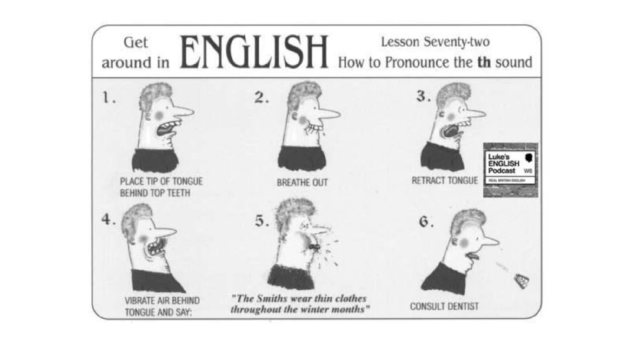
144. The Chaos of English Pronunciation

3 poems that demonstrate some difficulties with English spelling and pronunciation. You can read the poems below, and listen to me reading them out loud in this episode, which will help you to understand how these difficult words are really pronounced.

Small Donate ButtonRight-click here to download this episode.

Small Donate ButtonToday I shared a poem on Facebook. It was written to highlight all the inconsistencies in English spelling and pronunciation. In this episode I read the poem to you, demonstrating the correct way to say all the words. It’s a very challenging poem, so I hope I get them all right! If you find any errors, correct me by leaving a comment below.

I also read a couple of other poems about English pronunciation below.

Enjoy the episode and I hope you find it useful.

Poem 1: “The Chaos” by  Gerard Nolst Trenité

Dearest creature in creation,
Study English pronunciation.
I will teach you in my verse
Sounds like corpse, corps, horse, and worse.
I will keep you, Suzy, busy,
Make your head with heat grow dizzy.
Tear in eye, your dress will tear.
So shall I! Oh hear my prayer.
Just compare heart, beard, and heard,
Dies and diet, lord and word,
Sword and sward, retain and Britain.
(Mind the latter, how it’s written.)
Now I surely will not plague you
With such words as plaque and ague.
But be careful how you speak:
Say break and steak, but bleak and streak;
Cloven, oven, how and low,
Script, receipt, show, poem, and toe.

Hear me say, devoid of trickery,
Daughter, laughter, and Terpsichore,
Typhoid, measles, topsails, aisles,
Exiles, similes, and reviles;
Scholar, vicar, and cigar,
Solar, mica, war and far;
One, anemone, Balmoral,
Kitchen, lichen, laundry, laurel;
Gertrude, German, wind and mind,
Scene, Melpomene, mankind.

Billet does not rhyme with ballet,
Bouquet, wallet, mallet, chalet.
Blood and flood are not like food,
Nor is mould like should and would.
Viscous, viscount, load and broad,
Toward, to forward, to reward.
And your pronunciation’s OK
When you correctly say croquet,
Rounded, wounded, grieve and sieve,
Friend and fiend, alive and live.

Ivy, privy, famous; clamour
And enamour rhyme with hammer.
River, rival, tomb, bomb, comb,
Doll and roll and some and home.
Stranger does not rhyme with anger,
Neither does devour with clangour.
Souls but foul, haunt but aunt,
Font, front, wont, want, grand, and grant,
Shoes, goes, does. Now first say finger,
And then singer, ginger, linger,
Real, zeal, mauve, gauze, gouge and gauge,
Marriage, foliage, mirage, and age.

Query does not rhyme with very,
Nor does fury sound like bury.
Dost, lost, post and doth, cloth, loth.
Job, nob, bosom, transom, oath.
Though the differences seem little,
We say actual but victual.
Refer does not rhyme with deafer.
Foeffer does, and zephyr, heifer.
Mint, pint, senate and sedate;
Dull, bull, and George ate late.
Scenic, Arabic, Pacific,
Science, conscience, scientific.

Liberty, library, heave and heaven,
Rachel, ache, moustache, eleven.
We say hallowed, but allowed,
People, leopard, towed, but vowed.
Mark the differences, moreover,
Between mover, cover, clover;
Leeches, breeches, wise, precise,
Chalice, but police and lice;
Camel, constable, unstable,
Principle, disciple, label.

Petal, panel, and canal,
Wait, surprise, plait, promise, pal.
Worm and storm, chaise, chaos, chair,
Senator, spectator, mayor.
Tour, but our and succour, four.
Gas, alas, and Arkansas.
Sea, idea, Korea, area,
Psalm, Maria, but malaria.
Youth, south, southern, cleanse and clean.
Doctrine, turpentine, marine.

Compare alien with Italian,
Dandelion and battalion.
Sally with ally, yea, ye,
Eye, I, ay, aye, whey, and key.
Say aver, but ever, fever,
Neither, leisure, skein, deceiver.
Heron, granary, canary.
Crevice and device and aerie.

Face, but preface, not efface.
Phlegm, phlegmatic, ass, glass, bass.
Large, but target, gin, give, verging,
Ought, out, joust and scour, scourging.
Ear, but earn and wear and tear
Do not rhyme with here but ere.
Seven is right, but so is even,
Hyphen, roughen, nephew Stephen,
Monkey, donkey, Turk and jerk,
Ask, grasp, wasp, and cork and work.

Pronunciation — think of Psyche!
Is a paling stout and spikey?
Won’t it make you lose your wits,
Writing groats and saying grits?
It’s a dark abyss or tunnel:
Strewn with stones, stowed, solace, gunwale,
Islington and Isle of Wight,
Housewife, verdict and indict.

Finally, which rhymes with enough —
Though, through, plough, or dough, or cough?
Hiccough has the sound of cup.
My advice is to give up!!!
*This poem is a nightmare!*

Poem 2: “Why English is so hard to learn”

We’ll begin with a box, and the plural is boxes,
But the plural of ox becomes oxen, not oxes.
One fowl is a goose, but two are called geese,
Yet the plural of moose should never be meese.
You may find a lone mouse or a nest full of mice,
Yet the plural of house is houses, not hice.

If the plural of man is always called men,
Why shouldn’t the plural of pan be called pen?
If I speak of my foot and show you my feet,
And I give you a boot, would a pair be called beet?
If one is a tooth and a whole set are teeth,
Why shouldn’t the plural of booth be called beeth?

Then one may be that, and three would be those,
Yet hat in the plural would never be hose,
And the plural of cat is cats, not cose.
We speak of a brother and also of brethren,
But though we say mother, we never say methren.
Then the masculine pronouns are he, his and him,
But imagine the feminine: she, shis and shim!

Poem 3: Reasons why the English language is so hard to learn

1) The bandage was wound around the wound.

2) The farm was used to produce produce.

3) The dump was so full that it had to refuse more refuse.

4) We must polish the Polish furniture.

5) He could lead if he would get the lead out.

6) The soldier decided to desert his dessert in the desert.

7) Since there is no time like the present, he thought it
was time to present the present.

8) A bass was painted on the head of the bass drum.

9) When shot at, the dove dove into the bushes.

10) I did not object to the object.

11) The insurance was invalid for the invalid.

12) There was a row among the oarsmen about how to row.

13) They were too close to the door to close it.

14) The buck does funny things when the does are present.

That’s it for now. More episodes soon.

143. A Cup of Tea with… Robert Hoehn

Some ironic conversation with Robert Hoehn. Some of this episode is transcribed below. Some listeners may find Robert’s views a little controversial, but I assure you, he is just being ironic and none of this conversation should be taken too seriously, except the linguistic content which is all authentic and spontaneous, and presented here for your listening practice.

Right-click here to download this episode.

In this episode I was invited to the apartment of my friend Robert for a cup of very specially brewed tea and some conversation, which you can actually listen to here, right now, with your ears (and some kind of headphones/speaker system).

Robert is 110% American, and was born in Minnesota, which is in the heart of the American mid-west. This makes him a kind of red-neck cowboy in my opinion. He is also a direct descendent of William Wallace (yes, Braveheart) and now lives in Paris where he works as a voice-over artist, comedian and clown. He also looks a bit like Heath Ledger, the Joker from the Batman movie The Dark Knight.

Click here to visit Robert’s website http://www.frenchfriedtv.com

In our conversation, which you can listen to whenever you want, I interview Robert using the usual questions: What made you move to Europe? Did you experience culture shock when you moved to France? What are the differences between France and the USA? Have you been to London? How did you manage to learn French to a good standard? But we talk about all kinds of ridiculous stuff along the way!

Thanks for listening, leave comments below as always, and please consider making a donation by clicking the button on top-right of this page. Your donations help to keep this podcast alive and kicking.

All the best,
Luke

TRANSCRIPT
Part of this episode has been transcribed by a listener called Artiz. Thanks Artiz! You can read it below:

Hello ladies and gentlemen and welcome to another episode of Luke’s English Podcast. In this one I´m joined by a friend of mine who is at the moment in the kitchen making a cup of tea, well, making two cups of tea. We’ve been discussing the techniques of doing it. We’ve decided to go, maybe for the first time for me, we’ve decided to go for the cocktail, and that means we’re gonna mix two different brands, and different flavours, types of tea in the same pot, ok? I’ve never done this before, and I drink a lot of tea, but Robert is American, as you’ve just heard and he’s a maverick, he doesn’t play by the rules. He’s like the character Maverick in Top Gun. You never know what he’s gonna do next. You think: “ok, let’s just have a cup of tea with Robert”, and Robert’s all kind of like “let’s mix the tea bags!” And then, you know, next thing you know you’re on some wild adventure into the land of cocktailed tea. We’ll be letting you know the standard  of this new tea recipe which Robert has come up with. The two teas which we’re mixing, and it’s gonna be a very complicated mix, because I just bought from the supermarket a box of Twinning’s green tea with mint and spices. Now that´s got at least three spices. I don´t know the name of them because they’re written in French, but I think it´s cinnamon and several other things. So that’s already, quite a complicated mix: Green tea, mint and three types of spices. That’s pretty much five things. And that´s just one of the types of tea. And ok, and Robert has got already in the flat a box from “Monoprix”, which is a local supermarket, so we’re mixing brands as well as different types of tea. And this is black tea, so we’re mixing green tea and black together? You can’t do that. Can you? (Background Robert’s voice: Madness, is pure madness!!). It is, isn’t it? It´s got to be crazy. I don’t think anyone’s ever done this before: mixed green tea and black tea. It´s a revolution. But we’ll tell you how it is while we’re drinking it. And so this black tea has got a caramel flavour to it (Background Robert´s voice: it is the longest introduction I’ve ever had in my live). This is not the longest introduction. Maybe the longest introduction you’ve ever had, but sometimes, episodes of Luke’s English Podcast are, sort of,  seventy five per cent introduction and twenty five per cent actual content. Ok? Often the way it works. So, I’m still in the process of introducing Robert here. He kindly invited me over to his place where he’s making tea and we’re going to record a ground breaking podcast for you to listen to. It’s pure madness, apparently. You’re gonna  hear from Robert properly in due course, when I finally get round to actually talking to him. But let me just give you a little bit of background, a little bit of information about Robert. His name is Robert Hoehn, and you got to pronounce the name correctly. Otherwise you’ll be in a world of pain…or champagne!…maybe, I don´t know, maybe if you are a lady and you pronounce the name wrong, then that’s just quite a nice introduction to the world of Robert Hoehn. So anyway, his name is Robert Hoehn, he’s been living here in Paris for a number of years. “How many years now?” Robert: “eleven”. Eleven years is he’s been living here. He is originally from the United States of America. He’s from Minnessota I believe. We´ll be talking about that properly in a few moments. He is also the guy behind the amazing online video channel “French fried TV” which you can find if you visit my web site, you just can find a link to it there. Otherwise just go on to google and type in “French fried TV” and you’ll see all his videos there. They’re very entertaining, and he’s also the guy behind the French Fried comedy night, which is a comedy show, a stand up comedy show, in English, in Paris at the moment, which takes place every Tuesday evening at a Place called the Café Paname, near Republique metro station. So, I think it´s pretty much my introduction. He’s  a full time American but now living in Paris. Hundred and ten per cent American. Ok, so Robert, I’m gonna now talk to you and ask you various questions. Robert is currently creeping across his apartment in order to check his mobile phone cause he just receive, quite possibly, a very important message. So I’m just padding now. I’m just padding, just sort of…continuing to talk. The intro is still going on even though Robert is otherwise engaged. Ok, you’re back now. Ok, right, let´s go. Let’s go and speak to Robert Hoehn, “shall we”? Let’s move over to the counter area here in the kitchen, and we’re going to…we’re going to talk to Robert and ask him a few questions. I don’t know why I’m speaking like this. Suddenly I’m the presenter of a children’s TV show from the nineteen eighties. Anyway, I’m here with Robert. He’s an actual American. It´s quite exciting!

LUKE: So, Robert, how are you?

ROBERT: Awesome.

L: Awesome?

R: Yeah! Pretty good.

L: What you’ve been doing today?

R: Wow, I’ve…I did a quite a bit of work on the internet: speaking with people like my agent…

L: You have an agent!

R: I have a voice over because I do voice over jobs speaking in English.

L: That’s brilliant!

R: The American English, not the Queen’s, and…

L: Wait wait a minute, you’ve got to tell us about the voice over work. What kind of voice overs

do you do?

R: I do stuff everything you can imagine, that has to do with commercials, I did pure power for Loreal, expert…

L: How did it go?

R: Yesterday…It´s the best job in the world, you go in you say, a couple of lines of text. They say: “Can you say that with a little bit more of energy, or slower?” and you do it, and then they give you later on, a couple months later they give you a cheque for that, so it´s a pretty good work.

L: Can you tell us exactly what do you said, and repeat it for us?

R: I don’t know, it’s technically …yes! As long as you promise not to tell anyone! It´s something

along the lines of a: “are you sick of black heads, oily spots, zits, bad skin? Well, we have the cure!” And then it  goes on to name the product which I’m not going to mention so you don’t get sued.

L: But actually there’s a good vocab in that. Are you tired of black heads? What’s a black head?

R: Black heads it’s a kind of…in French it´s a “bouton”, like on your forehead, like you know it’s a…

L: Like a spot on your face. Specifically, those little spots which have black heads…they’re very ugly. It´s disgusting. Black heads, spots of course are just like red spots on your face. No your face, Robert, your skin is beatifully clean.

R: Thank you!

L: And zits as well, a zit is another word for spot. So you’re learning vocab about the face and when the face goes wrong.

R: “Pizza face” (Sarah Donnelly  ) calls it

L: (Sarah Donnely  ) our friend refers to  it, rather unsympathetically, as “Pizza face” syndrome?

R: No, just “pizza face”. Oh, they kid has “total Pizza Face”

L: haha ok, “total Pizza face” as well.

R:  to be completely, grammatically incorrect.

L: But I think Sarah has licence to do that cause she mentioned that she’s still has…like…the skin of a teenager, doesn’t she?, so she’s able to, you know, criticize the skin of others, specially when they have the face of a Pizza. Right, so, ok that’s brilliant! Voice over work sounds amazing and I would love to do that myself.

R: Of course you would!

L: What a surprise! Can you help me? Can you put me in touch with…

R: Absolutely not! haha I’m the only guy in Paris right now so…no! Well you know, once I have too much money, Luke, then totally I’m gonna tell you how can you do it, but no…actually that’s not true at all because you and I have totally different voices so I’d love to help you. It’s pretty easy actually if you me want to tell you my formula for doing that…

L: Yes!

R: I can break it down. You do ten character voices of cartoon characters, your favourite cartoon voices, you write down two minutes of text for then, or thirty seconds of text for each character, then you do ten different kinds of commercials like publicity, like hard sell, soft sell, medical research sell, a crazy…we’ve got too many bubbles over here!, come, buy bubbles now from 9.99, you know? And we did things like that. Then you record them all and then you pay a sound engineer, a hundred euros, and he mixes them together and he adds like “ding ding” some bells and whistles, and I did that in 2004 and I’ve never auditioned for a job since that.

L: Seriously?

R: Yeah yeah…And you can make some really good money. Cause sometimes those little jobs I did yesterday for example they become big jobs.

L: Well, obviously, I don’t want to steal any of your work and I’ll probably just stick to British accents if that’s err…

R: Your American accents are very good! Especially Christopher Walken and then your Batman, is pretty good!

L: Batman is not that hard…just make your voice very low…”I’m Batman”…like that. It’s fun! Anyone can do that, really!

R: Yeah, I’m more of the Joker.

L: Yeah, can you do the Joker?

R: No! I just lick my lips.

L: That’s what a performance was, really, wasn’t it? It was Heath Ledger just licking his lips. Robert, am I the first person to say you look a little a bit like Heath Ledger?

R: Ehh, no, ladies ( ) all the time. They confuse me with him…until he died. That was the last day I actually spoke with the girl.

L: Well, ladies and gentleman, if you can imagine I’m here with Heath Ledger just the joker himself. He looks exactly like him, it’s amazing! Except all the makeup. But Heath Ledger on a day off. That’s what I’ve got in front of me right now. And…I think it’s time to ask you a few questions, Robert…

R:  I’d like to ask you a question, first.

L: Yes, go ahead!

R: Who do you think you are?

L: I think I’m Luke, from Luke’s English Podcast.

R: Ok good enough, good answer!

L: It’s that…acceptable?

R: I believe it’s correct. I don’t know if it’s acceptable!

L: Ok… That question: “who do you think you are” has got several meanings to it, hasn’t it? Which one were you aiming for, when you asked…

R: I think it was open interpretation, so you did the best you could with the material you had I think

L: Yes, I hope so. I think I’m Luke Thompson from Luke’s English Podcast, and when it comes to the actual…the more existential question: “who am I really” well I think I can be anyone, I want to be as long as it complies with the law.

R: Have you ever read Nietzsche?

L: No, I didn’t but I know some of the things he said. Nietzsche was a philosopher, wasn’t it?

R: He was a philosopher, and apparently people, young people sometimes they go on a…they have periods where they chose not to speak, at all, like the…they choose to be silent. But  I don’t know why, and I was hoping maybe…cause you seem pretty educated, and…so I was curious if you know why people who read Nietzsche decide that they don’t want to speak.

L: You mean these sort of nihilists, for example who become sort of existential or philosophers who…that actually make a context decision to stop talking.

R: Correct. And then there was “Driving Miss Daisy” …no…”Little miss Sunshine”

L: The movie, yes, that’s a character in it who stops talking.

R: Yeah, and then I met someone yesterday who told me they did the same thing because they saw Nietzsche, and I didn’t know if she was lying, or confusing herself with the character in Little Miss Sunshine, or if she actually had done the exact same thing as that guy.

L: I haven’t read a lot of Nietzsche so I don’t know exactly what he said but maybe it’s something to do with, you know, just “why bother” I think maybe that might be the philosophy. I don’t know!

R: Ok. Thank you for answering the question!

L: That’s fine. If you want to ask any questions at any point feel free, ok? Maybe we can ask bounce question of each other…or maybe not, maybe I can just interview you.

R: Ok, I appreciate your being open to my questions as well, and…I’ve… asked my question now…it’s your turn.

L: Ok, it’s my turn. So the question I’m sure you’ve been asked this loads of times. Why do you moved to Paris?

R: I originally came to Paris in 2002 to continue my theatre studies and went to the Royal Academy of Dramatic Arts for a little while and I also went to Boston university to study acting and when I got to Paris the idea was that I would study Comedie del’Arte which is the origins of theatre…and…well, in the occidental world, anyway.

L: Occidental world, that’s the west, isn’t it?

R: Yeah…It’s all the occidenties, occidentaux.

L: You’re speaking French to me now.

R: Right! I thought I could fake it and sound latin

L: Western world! The occidental world

R: Right right, I mean that there was Greek theatre, and the Romans before that they did their drama…

L: Yes, Greek theatre is the origin of comedy, isn’t it?

R: Yeah?? I don’t remember any really laughing, and any Greek theatre study class that I took. I remember like Antigone. That was a pretty funny one.

L: What happens in Antigone?

R: Well…It’s…Oedipus is, you know? Her Dad’s Oedipus, you know.

L: Oedipus from the great myth about the guy who falls in love with his mother and wants to kill his father.

R: Well, he did kill his father and the he made love with his mum and he was felt so bad about the whole thing that he poked out his eyes . That is hilarious!! LOL

So the Greeks didn’t make comedy! LOL And then after that…anyway…so I came to Paris to study Comedy Del’Arte which I believe started in Italy and it’s six principal characters, you know what it is? So, you’ve got the young female, the young hero, the old guy, who can be the general, who can also be the old wise man, then you’ve got the father character, you’ve always got a clown character, so these six or seven characters could do every piece of theatre. Sometimes they are young troupes and they would go around. Anyway, that transformed into Marcel Marceau…

L: He was a mime artist, wasn’t he?

R: Pretty much yeah but his origins are from Comedy Del’Arte which uses a lot of masks, pantomimes to tell stories, and I wanted to go deeper into that, and there is a school here called the Jaques Le Coque school.

L: Yes, is a…famous clown.

R: Correct, like Marcel Marceau. So, I got here and then I found out that the school cost six thousand euros a year, that he was dead, Jack, Jack was dead, or he is dead, all of his students have left there in other schools become kind of the sausage factory for pumping out clowns, I was working as a dishwasher without papers at the time, illegally, under the table, in black, as they say… and I was making forty nine francs an hour, but this is back in the day when they had francs.

L: Forty nine francs is about five pounds an hour, isn’t it?

R: Seven euros.

L: Yes, about five pounds. It’s not very much.

R: It’s not very much, but I was happy just to survive, and that’s how I got started, and so I didn’t go to school on my limited budget and I just…cause I’m already a kind of a clown! You know…whatever man!

L: Ok, so you started as an actor, and so you started really as an actor, you came to France in order to train as a sort of theatre performer.

R: A deeper actor.

Podcast Statistics 2012-2013

Podcast Stats

Click the link above that says Podcast Stats and you can read statistics for downloads of Luke’s English Podcast.

You can find out:

  • The number of downloads per day.
  • The top countries where the podcast is downloaded
  • The most popular episodes of the year
  • The total number of downloads per year (over 1.2 million!)

    Thanks for listening ;)

142. The Annual General Meeting (Part 2)

Here is the second part of the AGM. For more information, see episode 141.

Small Donate ButtonRight-click here to download this episode.

Thanks for attending the AGM. Here is the agenda:

Part 2 – Agenda
13. Set List Show (see video below)
14. Meeting listeners
15. Music mixes
16. Holidays and weather
17. New job
18. New episodes
19. Wearing trainers without socks – The Dangers
20. Flip flops in Paris – The Dangers
21. The sound of your own voice
22. Zdeněk Lukáš
23. Length of episodes
24. Pacific Rim
25. Statistics
26. Emails
27. The new Star Wars movies
28. AOB

Thanks for attending the meeting. If you have any other business, just leave a comment below. Happy holidays. Luke

Your donations make this podcast possible.

Set list show
[youtube=http://www.youtube.com/watch?v=Z6ZrNS_HwOQ&w=500&h=281]

141. The Annual General Meeting (Part 1)

You are formally invited to attend The LEP AGM (Luke’s English Podcast Annual General Meeting) which will take place during the recording of this episode.

Small Donate ButtonRight-click here to download this episode.
The AGM is a chance for me to just summarise some news and give some information before we all go away for our summer holidays.

Here is the agenda for the meeting (which is split into two parts).

Luke’s English Podcast
Annual General Meeting
August 2013
Location: Baddesley Clinton House (not haunted)
AGENDA:
1. New listeners
2. Thank you
3. Sweat
4. Bassline
5. Best voice for the podcast
6. Toilet seats
7. Playstation 3 – system update required
8. Time
9. Happy music
10. Robert DeNiro and Al Pacino
11. Pedagogical Approach
12. Whiskey in meetings
13. Background music

…This episode continues in the next episode of Luke’s English Podcast

Part 2 – Agenda
14. Set List Show
15. Meeting listeners
16. Music mixes
17. Holidays and weather
18. New job
19. New episodes
20. Wearing trainers without socks – The Dangers
21. Flip flops in Paris – The Dangers
22. The sound of your own voice
23. Zdeněk Lukáš
24. Length of episodes
25. Pacific Rim
26. Statistics
27. Emails
28. The new Star Wars movies
29. AOB

Thanks for attending the meeting. If you have any other business, just leave a comment below. Happy holidays. Luke

Your donations make this podcast possible

Small Donate Button

140. Ghost Stories – True Tales of Really Creepy Experiences

Keep cool in the hot summer weather with some chilling stories. *Transcript available below*


Small Donate ButtonRight-click here to download this episode.

This is a long episode so I recommend you download it and listen to it in sections. If you use your iPhone or an mp3 player it should remember the point that you stopped listening, and it will carry on from that point. Or, you can sit down with a cup of tea and listen to it all in one go!

This episode is all about ghosts, strange things, the unexplained, demons and things that go bump in the night. I’m talking about the paranormal, ghosts, phantasms, specters, spirits, poltergeists, unexplained phenomena, and all that kind of weird stuff that you don’t want to hear about when you’re alone in the house at night. I hope you’re not alone right now, because this could be the creepiest episode of Luke’s English Podcast so far. To help you feel okay I suggest you get a teddy bear to hold onto or a pillow to hide behind, close the doors, close the curtains, do not look in the mirror, and keep the light on. You could burn a candle if that makes you feel better, as traditionally it is said that a flame can protect you from evil spirits. Ideally, listen with other people around. People say that undead spirits and demons can be attracted by accounts of paranormal activity. If someone talks about ghosts, it brings the world of ghosts closer to you, and in some cases can attract spirits into your world. So if you notice anything strange going on around you while listening to this, I suggest that you stop listening, turn on the lights, get a drink from the fridge in the kitchen and just put scary thoughts out of your mind. I don’t believe in it myself, but who knows what is really out there in the darkness. I’ll give you some more tips on that later. Basically, in this episode I’m going to tell you some scary and weird stories, which I thought of or which are completely real and really happened to me.

Do you believe in ghosts? Is it really possible that our world could be visited by spirits or other beings that we don’t normally see? The answer you’re thinking of may be “no”. But have you ever experienced something really strange, which you can’t explain and which, when you think about it without ignoring it, it makes you really frightened? To tell you the truth, I have had some strange experiences that I can’t explain and that I don’t like to think about very often.

Personally, I consider myself to be a rational person. I don’t really believe in ghosts. But I believe there are things in the world that we don’t understand yet. I don’t think we should always conclude that unexplained things are the result of supernatural or paranormal causes, but at the same time I know that there are plenty of things about the world that we really don’t understand and can’t even see. Even in science there are many mysteries. Massive puzzles that scientists are trying to work out. Quantam physics, our basic understanding of space and time, the origins or destiny of the universe, parallel worlds, other dimensions, the possibility of ghosts living around us or inhabiting certain spaces in our homes or outside our windows. These are all areas of mystery to us. 500 years ago people were relatively clueless. People thought the world was flat, that headaches were caused by evil spirits and that tobacco was good for you. All completely wrong. Like, totally wrong. These are quite big things to get wrong. Imagine if we are similarly wrong about what we know now. Maybe we’ve only just scratched the surface of knowledge about the world. There could be so much more that we don’t realize. Answers to the questions of what happens to us after we die, is there such a thing as the soul and does it live on separately from us, are there other invisible worlds full of demons or spirits living all around us, that we can’t see. Is it possible for us to disturb these spirits or upset them by doing wrong things without realizing it? As I said, I don’t believe in ghosts or the paranormal because I require evidence for these things. But still, there are things that I just can’t explain. And to be honest, that is frightening sometimes. There are things I’ve experienced that have freaked me out, and continue to bother my memory today. Sometimes these memories make me scared. Maybe it will be creepy but I’m going to share those things with you in this podcast episode.

I’m going to tell you some stories but some real ones, not made up ones. The stories I’m going to tell you are all ones that I’ve experienced personally. They’re not fictional bedtime stories or anything. They’re not fun stories for kids. They’re real accounts of some weird and scary stuff that has happened to me at various times. I don’t often talk about these things with my friends or family these days. They say it makes them feel uncomfortable. A lot of people don’t really like their world to be challenged by strange unexplained things. They’d rather not think a lot about things they don’t really understand, or things which are disturbing. But sometimes I can’t sleep and I think of weird things I’ve experienced and they make me quite scared, but they’re fascinating to me too so I thought I would share these experiences with you. Maybe you can explain them, or maybe you’ve experienced similar things. Some people might say that I shouldn’t talk about these things publicly or share them, because it could scare people, or even attract spirits into the homes of people who are listening to this. I’m not sure about that but I’d like to suggest that you listen carefully to this episode. If you are easily scared then just think twice about listening to this. It might disturb you. Don’t listen just before you go to bed. Turn on the lights if you’re in a dark room, so you can see everything. Close cupboard doors or doors to dark rooms so that you don’t get scared when you imagine that something or someone is waiting in there while you listen to this. If you’re not too scared, try to have a look under the bed or behind the sofa, because sometimes you can be very disturbed by the thought that there is something or someone there, watching you and waiting. Try not to imagine dark shapes or the idea that there is a person with you, because your mind will play tricks on you.

If it is night time and there are windows in your room, just quickly close the curtains and make sure the windows are sealed so you don’t worry about things that our outside getting inside, and so you don’t worry about seeing a face appear in the window, even for a moment. Closing windows or closing curtains will make you feel more comfortable because you won’t be able to see whatever is out there, and if there’s something out there, it won’t be able to see you either. Just be careful, when you close the window, do it quickly and don’t look out of the window into the darkness.

Quickly check empty rooms in your house if you aren’t too scared. It can really freak you out when you get the feeling that you’re not alone in your own home, and that there’s something or someone in another room, and maybe they’ve been there for some time without you knowing. So, if you can, have a quick look around the house. Go upstairs or downstairs and visit empty rooms, just to make your mind feel more comfortable and so you don’t get too scared while you’re listening to my voice. And if you need to go to the toilet or the kitchen you’ll be frozen because you don’t want to go alone so try to remember there’s someone there in the house with you, even if you are alone, there’s someone nearby and you can hear my voice and you’ll be okay. You could stop listening and wait until the day time if you like, but I suggest that you listen to all of this, just so that you can get to the end of it, hear the music at the end of the episode and although it might be frightening to be in silence, you know that you completed the episode and that’s the end of the scary stories and everything will be back to normal again.
One other thing – don’t look in the mirror while you listen to this. In fact, avoid reflections of any kind – seeing your reflection in a window, the glass of your mobile or computer monitor. Mirrors or reflections are said to be like portals to the spirit world. I’m not sure I believe it but it’s better to be on the safe side, certainly when discussing ghosts or demons. Who knows what elements of old folklore are based on knowledge that we have lost? Maybe folklore is all true to an extent. The subject of spirits and the supernatural was very popular in England during the 19th century and lots of strange events were documented during that period. Many well respected people such as Arthur Conan Doyle, the author of the Sherlock Holmes stories were very interested in this subject, and wrote about their experiences. Apparently, people used to gather together in séances (meetings often took place in dark rooms in houses that were said to be haunted or regularly visited by apparitions or other phantoms) in order to contact the dead, or communicate with the spirit world. They used various devices to contact the other side, including oiji boards but also mirrors. What these practitioners would do was to read pages of old texts designed to attract ghosts from the other side, and then at certain moments they would all stare without blinking into a mirror in order to see the spirits appearing. Apparently, the mirror was one of the most common ways that spirits reveal themselves to the living. They might appear just as a shape or shadow, sometimes overlaid on top of someone else’s face (very weird) or they would appear clearly as someone else in the room, usually standing behind the people). There are also lots of urban myths about standing in front of the mirror and saying special words, which bring a demon into the room with you, with your reflection. The story goes that once the demon has arrived in your mirror, he will always be there in any reflection of you, until you find a way to remove him. The only way to remove him is to tell someone else about it, persuading them to say the words while looking in a mirror. The demon is then transferred into their reflection, leaving you free again. Finally, the only solution is for a blind person to say the words in front of the mirror. They take the demon, but can’t see it and so it has no power over him.

I said before that traditionally people believed that spirits can be attracted by talking about them, and that describing or thinking about the other side can make the gap between our world and the world of spirits thinner, allowing them to visit us more freely. That’s why people tend to whisper or speak quietly when talking of these things. You shouldn’t go around shouting the names of demons or spirits, especially at night, and you should not look in the mirror while listening to this, or soon after listening to this. It’s not advisable and I would warn you not to do it. I mean, I don’t necessarily believe it myself and I don’t know what you believe, but sometimes it’s worth paying attention to traditional wisdom even if science disagrees with it. Sometimes science can be proved wrong, as I said before. So, avoid mirrors during this episode.
I hope you’re not getting freaked out or scared by all this talk of scary monsters visiting you. If you are superstitious, then you do what you’ve got to do. Say a short prayer if that helps, or try repeating some words to yourself in order to make yourself feel okay. Apparently, a common thing that people can say to protect themselves from evil spirits is this, and you can try repeating it quietly to yourself if it makes you feel any better.
“I am alone – I know they are not here”
“I am alone – I know they will not come”
“I am alone – I know they have not found me”
Say it three times. Just make sure you get the word ‘not’ in the correct position. Don’t say “I am not alone – I know that they are here” or “I know they will come” or “I know they have found me” – don’t say that three times while looking into a mirror, at any time. OK? Do not do that. I hope that’s clear.
If you’re with someone else, good. I recommend that you just squeeze the person’s hand or just touch them on the shoulder, just as a way to say “you’re here too”! If they react badly to that, like, if they tell you “get off!” or “what you doing?” Just explain calmly that you’re just making physical contact with another person in order to create a protective boundary between you and the spirit world in order to prevent any weird or scary things from happening. I’m sure your friend or loved one will understand. If you are on public transport, you could try touching the person sitting next to you but I am not responsible for the consequences. All I’ll say is that sometimes people on busses and trains can be much more dangerous than ghosts…

Finally, if you do get scared while listening to this or you notice anything strange going on around you, leave a comment explaining what has happened. It could be fascinating to read about it. Also, if you have any other strange things you’ve experienced, and how you explain them, let us know by leaving a comment.

OK let’s get started. I’m going to tell you about some strange things that have happened to me over the years. Let me know what you think? How would you explain some of this stuff?

The Japanese running tap

I spent 3 weeks during the summer, alone in my apartment while waiting for another flatmate to come. During that time some pretty weird things happened in the flat, and I don’t mean earthquakes although I did experience some of them. Not earthquakes, but something that I can’t explain.
The kitchen tap kept turning on by itself. I would go to bed in the tatami room. In the middle of the night I would wake up to noise coming from the kitchen. I went into the kitchen to find the kitchen tap running cold water. Freezing cold – much colder than usual. I’d have to turn it off by turning the tap around in my hand, before going back to bed. This happened 3 times. The third time was the worst because I distinctly remember making sure the tap was turned off before bed. I remember getting myself a glass of water, and then turning off the tap. When I woke up to hear the sound of the tap running, I DID NOT want to get up, but I had to investigate and I had to stop the tap. Perhaps the worst part was walking past an empty room which had large windows at the other side. I couldn’t bear to look into the room because I had a horrible feeling about it. It felt like there was something in the apartment with me. Turning off the tap, it was very cold again. I didn’t want to turn round to go back to my room and I must admit I was very frightened and I left the light on in the kitchen. I’m not normally scared by stuff, but sometimes I can’t stop thinking about that tap. How on earth is that possible? Can a tap turn itself on? Water pressure? Water which is left in the pipe coming out? Perhaps I did it in my sleep – maybe I walked to the sink and turned on the tap, which is pretty scary – why would I get up in the night, do something and then not remember doing it? I told all my students in Japan about it, and a lot of them were not really surprised by it. A lot of people in Japan are quite superstitious. Apparently there are many different types of ghost in Japanese folklore, and belief in ghosts and ghost stories is quite common in Japan. One particular old woman I used to teach on Fridays, was very knowledgeable and told me a lot about it, saying how ghosts or Yuurei are quite common, and even accepted by most people are being real. Apparently, these yuurei are spirits of people who have been prevented from having a peaceful afterlife because of the way they died or the trauma they experienced during their life, which is basically the same explanation given for ghosts in the UK too. It’s weird that ghosts feature in folklore from so many cultures around the world, and they all seem to be explained by this idea of a spirit that can’t rest. Anyway, this woman suggested that my tap thing was caused by, and I’ll never forget the name, a Zashiki-warashi or the ghost of a child. Apparently Zashiki-warashi are often mischievous, meaning they do naughty little things, rather than seriously scary or dangerous things. She said they commonly arrive and do things during the Japanese ‘witching hour’ between 2 and 3 o’clock in the morning, which is when the gap between our world and the spirit world are closest. She said that strange things that happen at night in Japan are sometimes attributed to zashiki-warashi. This didn’t make me feel better though, because the idea that I had some little Japanese child ghost in my apartment between 2 and 3 o’clock at night was not fun. The tap thing stopped after I got a new flatmate called Peter in August. For a couple of weeks though, I had a slightly disturbing time alone in the apartment, trying not to think of the tap. It hasn’t happened to me since, so maybe it was just then. If it does happen again, I will freak out I know it. Ive never told me girlfriend about it, because it would worry her. Any ideas what that was? If you’re from Japan, have you heard of zashiki-warashi, or other types of ghost? Do you think the woman was making it up or not?

*This is where the transcript ends. You can read some notes for the other stories below*

The bouncing ball

Freaky and still disturbs me to this day, even though I didn’t really want to believe it at the time.

Frozen in bed and the weird clock

Very scary at the time, but there is a rational explanation.
Here is a link to the TedEd video about sleep paralysis:

The Lapworth Walk

Nothing particularly weird or supernatural happened directly to me, but it was a time when I was really genuinely scared.

I’m originally from London. I was a city kid until I was 9. Then my parents moved to the countryside. Moved away from all my friends to a new place. I didn’t know the area. The countryside is different. Spooky. Owls at night etc.

Teenager – went out in Birmingham. Had fun with friends. Time to go home. Train on my own. Avoided fights in Birmingham. Everyone left the train. I had 20mins more journey. Then I had to walk through country lanes to where my parents lived. Often it would be able 1AM.
Walking through darkness in the countryside is very scary. I can remember the walk very clearly because I did it so many times.

Town, houses etc.

Turn right at the end, the streetlights stop. You have to walk into the darkness, leaving the houses and lights behind. It doesn’t feel natural.
Hump backed bridge over the canal. Something under the bridge? In fact, there could be something on the other side of the bridge. Don’t let your mind wander. All my friends are at home, in bed. I’m walking in the dark, miles from home, scared.

Baddesley Clinton House

Here is some text from the National Trust website about the haunted old house I had to walk past on the Lapworth Walk

“A lovely old manor house I have visited several times is Baddesley Clinton in Knowle, Solihull. This building dates right back to the early Middle Ages, and it is thought to be haunted by one of its former owners, a man called Nicholas Brome.

The Brome family lived here during the Wars of the Roses and, unfortunately for them, in 1461 they found themselves on the losing side. This led to a serious falling out with the Earl of Warwick, culminating in the murder of the family’s patriarch, John Brome. Shortly afterwards, John’s son, Nicholas took a bloody revenge and stabbed to death the Earl of Warwick’s Steward. Nicholas Brome had an appetite for violence and people crossed him at their peril.
One night he returned home to find his wife in a compromising position with no less a person than the local parish priest. The priest, it seems, was tickling his mistress, “under ye chinne”. This was more than enough to send Nicholas into a terrible rage.

He drew his dagger and slew the amorous priest on the spot. Killing a man of God was a serious offence and could have cost Nicholas his own life, however he had the good fortune to be pardoned by both the King and the Pope. His penance was to build nearby St. Michaels church, where he was eventually buried standing up (another penance for his many sins).
It could be that Nicholas Brome, his soul never properly laid to rest, still wanders the dark rooms and hallways of Baddesley Clinton. (A dark red stain on the wooden floor of the library is said to be the priest’s blood, but I must say I am not entirely convinced!).

In the Tudor period the house was taken over by the Ferrers family who bravely gave sanctuary to catholic priests during the reign of Elizabeth I. The tiny “priest holes”, where they would hide from Elizabeth’s soldiers, can still be seen.

This must have been a particularly frightening time because the punishment for observing the “old religion” was terrible indeed. Priests could be burnt at the stake, while their protectors ran the risk of being “hanged, drawn, and quartered”.

Traumatic experiences do seem to trigger paranormal activity. Members of the Ferrers family and many visitors to Baddesley have reported hearing raised voices and hurried footsteps coming from empty rooms. Could this be the chilling echoes of long dead catholics trying to evade their protestant hunters?”

Let me know of your scary stories. Leave a comment below.

139. Hard Driving / Car Vocabulary

One Man. One Car. One Destination. Lots of vocabulary.

Small Donate ButtonRight-Click here to download this episode.
In this episode you join me in a BMW Mini as I attempt to drive across Paris, through some of Europe’s busiest streets, on a very hot July afternoon. My mission is to deliver the car to a car-park while avoiding angry Parisian drivers, pedestrians with prams, and busses full of Japanese tourists. The ultimate goal – a glass of cold beer on the terrace of a cafe, and to save the world through another episode of Luke’s English Podcast, of course.

Do I manage to complete my mission? And what driving-related vocabulary can you learn during this episode?

Listen, and you will find out…

Vocabulary
Here are extracts of the transcript for this episode that contain all the driving-related vocabulary.

  1. Hard Driving – driving vocabulary


[5:42]

The car is on. I’ve got my hand on the handbrake on my right. I’m in the first gear. And I’m going to get moving, so I just lift the handbrake up. I’ve got the clutch. My left foot is on the clutch. I’ve put myself on the first gear. Handbrake is down.

[6:00]


[16:05]

So, [the] vocab is, what I’m holding, what I’ve got in front of me, the wheel. The thing that I’m turning in order to control the direction of the car, that’s the steering wheel, folks. The steering wheel. Turning the steering wheel to go left and right.

[16:27]


[16:45]

The gear stick to control the gears.

[16:51]


[17:32]

Gear stick. First gear, second gear, third gear, fourth gear, fifth gear, sixth gear sometimes and reverse gear, of course. Handbrake, I’ve already mentioned that. That’s the way you can sort of… how you stop the car when you’re on a hill, or you park, you pull the handbrake up. Sometimes, if you’re in a Hollywood movie and you need to like turn the car around very quickly, you might pull the handbrake and do the handbrake turn. It’s very dramatic and exciting. But I’m not going to be doing it today, folks, no! I’m going to try drive safely.

[18:08]


[19:35]

So, the pedals on the floor to…

[19:37]


[20:40]

So, the pedals on floor, the one on the furthest right is the accelerator pedal or the throttle, which is the accelerator.

The accelerator pedal, the brake pedal on the middle and the clutch on the left. OK. I’ve got some switches behind the steering wheel. You can hear the indicator switch, which sounds like this: “Indicator sound” Yeah. This is the indicators, they indicate left and right. And I’ve also got things like headlights, and stuff like that. I’ve got the speedometer in front of me, I’ve got a fuel gauge, rev counter which tells me how I’m revving the engine.

[21:40]


[24:07]

We also have the glove compartment on the right in front of the passenger seat, which never contains gloves. They call it the glove compartment, you know, it’s like a little box that little storage cupboard thing in front of the passenger seat. I don’t know why they… I know why they call it the glove compartment. It’s because traditionally that’s where you keep gloves. I’ve never ever seen a pair of glove in the glove compartment. Usually, it’s just like an old map or some boiled sweets or something like that. Never, never any gloves in the glove compartment.

[24:50]


[25:16]

There’s the horn, which makes the car go “Beep beep beep” this is the horn. The seatbelt, which can obviously save your life if you have a crash. Hopefully, that’ll never happen. You also have mirrors, don’t you? Mirrors, what you can, which allow you to see behind you. You’ve got the wing mirrors on the left and the right. And then you have the rear view mirror.

[25:41]


[37:02]

So, the windows, the window in front of me, we call it the windscreen, in front of me, it’s the big window at the front of the car. The windscreen. In America, they call it the windshield, but we call it the windscreen. Then the other one, it’s just this the window in the back window. It’s just pragmatic. The front part of the car that you open if you want to look at the engine, it’s called the bonnet. But in America, they call it the, what do they call it, the hood, hood, but we call it the bonnet. The front of the car is the bumper. That’s the part which is used to sort of bump other cars.

[37:43]


[53:46]

Summary


I’m just going to run through the vocab of the car that I attempted to teach you during the journey just as a summary.

  1. You got in the car. You’ve got the steering wheel, which you use to turn left or right or to steer the car. You have accelerator pedal, the brake pedal and the clutch pedal. You use the clutch to change the gear. And also you have a stick on the right if you’re in Europe and that’s the gear stick.

You have the seat-belt to keep you safe. If you have a crash, then the airbag will come out and protect you so that you don’t get badly injured in the event of an accident. You have mirrors, the rear view mirror in the middle, the wing mirrors on the left and right. You have the indicator to show which direction you’re going to turn, left or right. Tick, tick, tick, tick, like that. The indicator. You’ve also got things like the windscreen wipers, which are those things that clean the water of your windows or the dead insects after a long journey, you use the windscreen wipers to wipe them off. You also have like jets of water which spray onto the windscreen. And if you angle the jets correctly, you can spray pedestrians as you drive past them, which is quite good fun, isn’t it?


You’ve got the… the back window with a windscreen wiper on it, you’ve got the brake lights, you have bumper at the back, bumper at the front. You’ve got the boot of the car or in Ameri… that’s the back, that’s the storage area at the back of the car. We call it the boot. In American English, they call it the trunk. The front of the car, you’ve got the bonnet, which covers the engine. And in America, they call that the, what do they call it, the hood. That’s right. You’ve got also the petrol cap, which you remove in order to fill a car up with fuel.


Let’s see, what else? So, the number plate on the back and the number plate on the front, they have the registration number of the car. Also the wheels, of course, they’re very important. If you want to actually travel anywhere. You got the wheels… the wheels have, what are do they called it?, alloy covers, often if you’ve got like you know very nice cool car, you might have alloys on the wheels, which look cool. Then you’ve got the rubber bits that go around and they’re filled with air. Those are called tyres [tires in US English], of course. The tyres that go around the wheel. Just the same as a bicycle, in fact. Headlights on the front help to illuminate the road as you’re driving.

[57:23]


[57:27]

There are some verbs we associate with driving, as I mentioned before you. You accelerate. You brake, brake means to stop [or slow down]. You turn left, you turn right, you steer the car. You reverse, I mean, you go backwards. Mirror signal manoeuvre. Mirror, obviously, check the mirror before you move. Signal, that’s to indicate which direction you’re going to go. And manoeuvre, that means to turn or to make some sort of specific movement in the car. A manoeuvre. A manoeuvre might be, for example, a 3-point turn or a U turn or a… if you reverse into a parking space, to parallel park, which is one of the most difficult things that you can do when you’re driving is parallel park. When you’re learning to drive, that’s very difficult. If you have a space in the road and you have to try and park the car in that space. So, that’s nicely positioned, close to the curb, without too much space between the car and the curb and you don’t actually touch either the car in front or the car behind. That’s… if you can master that art, then you should be able to pass your driving test, how to parallel park.

[58:36]


Other vocab:

  • traffic
  • traffic lights
  • zebra crossing
  • satnav
  • petrol

A listener has written a finished transcript of this episode. Click here to read it. Be aware that it hasn’t been fully corrected yet, but is about 90% accurate.

138. Discussing Movies (Part 2)

The second part of this discussion about films.

Small Donate ButtonRight-click here to download this episode.
This is the second in a 2-part series all about films. In this one, Henry and I answer listeners’ questions from Facebook. See below for more details.

Please feel free to leave your comments. I love talking about movies, and I have plenty of things to say about them in the future. In fact, I am planning episodes on these subjects: Zombies!
Classic Movie Scenes (listen to some movies scenes, then understand everything which is said)
Great British movies (what movies can I recommend?)
Star Wars
Superhero Movies
Back To The Future
Which ones would you like to listen to most? Let me know. The episodes should eventually be recorded for your listening pleasure…

As for this episode, here are the questions from Facebook, which I discuss with Henry. You can find the names of movies we mention under each question. Enjoy the episode!

Ilona Lolo Wysocka What’s the movie that every British should know?
*We dealt with this episode in part 1

Israel Mtz Hi Luke here’s Israel (a Spanish newcomer in London). Why people often overrate films like Casa Blanca, Amelie, etc.?
*We answered this one in part 1 too

K: Why do (most) men love action movies with guns, explosions, blood and sexy girls but no real storyline ?
17 June at 16:02
Movies mentioned:
The Fast & The Furious 6
Toy Story
Cars
Wall-E
A Bug’s Life

Amirzade Al-Alim Mutasodirin Do you know how much money animation software costs? For instance software for iron man movie.
17 June at 16:09 · Edited · Like
Iron Man
Motion (animation software)
The Simpsons Movie

Hamid Naveed English spoken in some Hollywood movies is very easy to understand while in others it is so difficult.Why? Right now i can’t think of any movie
17 June at 16:22 · Like
Apollo 13 (they use a lot of tecnhical language, which is hard to understand)
Taxi Driver (the director made a stylistic decision to make the dialogue natural and improvised and therefore less clear and harder to understand than other films)
Nacho Libre (a Jack Black comedy with simple English – the character is a Mexican monk who speaks pidgin English)
Tinker Tailor Soldier Spy (it’s difficult to understand because the characters mumble a lot – to create an atmosphere of mystery)

Rajesh Vt Master Luke , hi to the guest of our Pod , everyone likes comedy films so what are the all time best comedy films ? Who is his favourite comedian ?
Anchorman
Talledega Nights
Pineapple Express
Knocked Up
This is Forty
Superbad
Step Brothers
Night at the Roxbury
Superstar
Ace Ventura: Pet Detective
Ace Ventura: Pet Detective 2 – When Nature Calls
Monty Python & The Holy Grail
Spinal Tap (A fake documentary about a British rock band)

Thu Hien Nguyen Great. i have missed questions when you made a podcast Rickipedia. Now i can add a question. What makes a film excellent?
17 June at 17:48 · Edited · Like
Ace Ventura
Harry Potter films

Kohei Okutani Hi! I’d like you to ask him about the Cannes Film Fes!! Of course, your opinion, too. Japanese movie’s awarded this year. So, any comments on that, anything. Or, tell us what the decisive factor of the differences between the Cannes and other movie festivals from your points of views!!
17 June at 16:44 via mobile · Edited · Like
Like Father Like Son (a Japanese movie, which won the Jury’s Award at Cannes this year)

José Luis Sánchez González Hi, Monster!!!Here you have my questions: Could you tell us a few titles of movies which could be easy to understand for improving our level of english listening??? Which do you think that could be the best way to watch movies for learning english: with original subtitles or with subtitles in our language??? Thanks
17 June at 16:57 · Like · 1
Nacho Libre (again)
Advice for using films to improve English:
Stage 1 – Watch the film in English with subtitles in your language (to just enjoy and fully understand the movie)
Stage 2 – Watch the film again in English but with English subtitles (you can identify and pick up specific words or pronunciation)
Stage 3 – Watch the film a 3rd time in English but with no subtitles (it’s important to listen without subtitles because it replicates natural listening experiences
“Never watch dubbed versions!”

Ken Yorioka Hi Luke, here’s a question frim different angle of “movie”. Since when do you think popcorn became a symbol food of movie theater and why?
What British food do you think would replace popcorn? Don’t say fish n chips!!
Cheers
17 June at 17:12 via mobile · Like · 1
Crisps – Walkers Crisps (nut noisier than popcorn)
Biscuits!

Rom Hein Thoughts about the latest Tarantino movie? Is Christian Bale a good actor to you (The Prestige, The machinist…)?
17 June at 17:25 via mobile · Like
Rom Hein Cheers
Django Unchained
Pulp Fiction
Jackie Brown
Kill Bill
Deathproof
Inglourious Basterds

Karim Mrouj Do you agree that ‘citizen Kane’ is the best film made in the 20th century ?
17 June at 17:25 · Like
Citizen Kane
Taxi Driver
Pulp fiction

Артем Косенко Are people in the UK (or the US) familiar with russian movies? Did you watch any of those? By the way, if you find my name difficult to pronounce it is Arty.
17 June at 17:26 · Like · 1
Nightwatch & Daywatch (Russian vampire films)
The Battleship Potemkin

Mariana Ramirez What do you think about stereotypes of French movies? I really love French movies but I must admit i couldn’t understand the plot of some movies. Why do directors and plots get so hard to understand? See this parody with the cliches of French movies http://youtu.be/ajop7imecgc
Entre Les Murs
La Haine

Agnieska – what is an underrated film in your opinion?
Ace Ventura Pet Detective 2 – When Nature Calls!
The Mask

Aritz Jauregi Hi Luke. From Pamplona, living now in London. Do you like the trilogy of Back to the Future? What do you think about it? Could you do a complete episode talking about that? Thank you!!!
17 June at 17:38 · Like
*Yes, I would love to do a full episode about Back To The Future because it is one of my all-time favourite movies.

Luke’s English Podcast We’ve finished recording now. Thank you for your questions! We answered almost all of them… I will answer others at a later time…
17 June at 19:19 · Like

137. Discussing Movies (Part 1)

A cup of tea and a chat about movies with a student of film studies!

Right-click here to download this episode.
Henry Dean joins me for a cup of tea and a chat about movies. Part 2 will be available in the next few days.

In this episode, I talk to Henry about his background, his university course, his writing work and his interest in film and movies in general. We also explain and discuss various items of vocabulary related to film. We’ll teach you various words and phrases that you can use to talk about films with your friends. We also begin to answer questions which were sent in to us via Facebook. We continue to answer the questions in part 2, which will be available soon!

Click here to get Henry’s book “Stories from Paris” at Amazon.co.uk.

I know that a transcript of this episode would be useful. Unfortunately, a transcript of this episode is not available at the moment, but if you would like a challenge why not transcribe the episode yourself and send it to me? Then, eventually, I will be able to check/edit the transcript you have written and provide it for everyone. So, no transcript yet, but maybe in the future if I get help from a listener…

Thanks for listening. Your comments are welcome. I love talking about films, so there will be more film-related episodes in the future.

All the best, Luke