New video on YouTube – Luke’s English Podcast – I Like It!
VIDEO VERSION
The podcast today is an audio version of this video.
KEEP SCROLLING FOR THE FULL TRANSCRIPT (GO DOWN!)
Here’s a description of the vocabulary.
16 Ways to say “I Like It”:
1. I’m into it – this means you’re interested in an activity or a subject. E.g. I’m really into playing football, I’m really into The Beatles, I’m really into Kung-Fu movies…
2. I’m keen on it – this just means that you’re interested in it, you like it, you want to learn more about it. e.g. I’m really keen on playing the guitar, I’m keen on her, I’m keen on movies by Quentin Tarantino
3. I’m fond of it – this means you like it because you’ve liked it for a long time, and you have an emotional attachment to it. E.g. I’m fond of my pet dog, I’m fond of my car, I’m fond of my family photos
4. It appeals to me – this means that it sounds/looks good or it’s a good idea. E.g. living in Hawaii appeals to me.
5. It goes down well (with people) – this means that other people like something that you do. E.g. This joke always goes down well, the presentation went down really well with the class.
6. It’s to my liking – this is just a formal way to say I Like It
7. I’m partial to it – this means I like to eat or drink something, maybe too much. E.g. I’m partial to a glass of wine. I’m partial to a nice cake.
8. I’m crazy about it – I just love it! I love doing it! E.g. I’m crazy about playing the drums. I’m crazy about her.
9. I’m mad about it – this is the same as “I’m crazy about it”
10. I’m attached to it – this means I like it and I don’t want to live without it. I’d feel sad if I lost it. E.g. I’m really attached to my mobile phone – I always have it with me.
11. I’m passionate about it – this means I’m really interested and excited about it. E.g. I’m passionate about the music of Miles Davis. I’m passionate about doing charity work.
12. I’m addicted to it – this means I like it so much that I can’t stop doing it. E.g. I’m addicted to playing PlayStation 3. I’m addicted to this TV programme. (we also use ‘addicted’ in a negative way – e.g. addicted to drugs, addicted to cigarettes)
13. I’ve grown to like it – this means you didn’t like it before, but slowly you have learned to like it. E.g. I’ve grown to like the music of Radiohead.
14. I’ve got a soft spot for her – this means that you like someone a little more than you like other people. E.g. My grandmother always had a soft spot for my sister. She was always her favourite grandchild.
15. I fancy her/him – this means you think someone is attractive, sexy, good-looking. E.g. I really fancy Rachel McAdams (see picture below) – I think she’s gorgeous…
16. I can’t get enough of it – this means I love doing it and I don’t want to stop – e.g. I can’t get enough of this TV programme, I can’t get enough of Luke’s English Podcast!!
Rachel McAdams
FULL TRANSCRIPT
13. Video Podcast – I like it!
Right, now I just uploaded a new video on the Luke’s English podcast YouTube page.
Now, if you haven’t seen that, go and see it. You can find it on YouTube or actually it is probably easier if you just follow the link that I will post on the webpage. I am always asking you to visit the webpage. That’s because there is lots of useful things on there, you know, like for example if I teach you something on the podcast, I will type out the language explanation on the web page. You might be able to read scripts for content of this podcast on the web page. I often post videos and photos on the web page as well. So if you do listen to this podcast but you don’t ever look at the webpage, I suggest that you do look at it because it will help you to understand it and enjoy it a bit more. Okay? I always repeat the webpage and that is: you can just simply type to your web browser www.teacherluke.podomatic.com. Right? So check it out.
I have got a YouTube page for Luke’s English podcast and every now and then sometimes I make a video podcast. Usually I do an audio podcast but sometimes I do a video podcast, so you can actually look at the video and I will teach you something and you can see me moving, you can see me talking and you can see me showing you things and doing things.
Now, the video I just made is me, teaching you some vocabulary. And what I am teaching is lots of different ways to say: I like it. Okay?
Now, there are many many different ways of saying I like it or expressing, let’s see, expressing preferences or talking about liking things. Right?
Now, if you are a low-level-speaker of English, you probably just use like.
You know, I like this, I like that. I like him, I like her. I don’t like that, I don’t like this. You might say things like: I quite like that, for example or I really like that. But if you are a more advanced speaker of English you will know, that there are many many more ways to say: I like it.
And in the video that is on the webpage, is on YouTube now, I teach you 16 different ways to say: I like it. So that’s 16 really good bits of vocabulary. Now you can go to YouTube and you can type in: 16 ways to say I like it. Yeah? Or you can just find my YouTube page by clicking on the link on this podcast webpage.
Okay, that’s probably the best way to do it.
But, I am also going to now on this podcast play you the audio to the video. Now, of course it’s better if you watch the video because you can see me moving and see me showing you things. Also on the video I added text on the screen, so you can read the text and it will help you understand it.
But, I have got the audio from that video and I am going to play it to you now on the podcast.
If you can’t see the video, just let me explain it to you now. Basically on the video you get a bit of text on the screen, which says the piece of vocabulary that I am going to teach and then there is a bit of video of me, doing something that I like and then using that piece of vocabulary. Okay?
So, because this is just the audio, I am going to say the piece of vocabulary and then you can listen to me doing something and talking about it and then I will teach you the definition of it as well. Okay?
So, this audio is slightly different to the audio on the original video. Okay?
I hope that’s clear because I have been talking about audio and video and things – a little bit confusing. I hope it is clear. Anyway! You can now listen to the audio of the video which I have just posted on YouTube. I hope you are not too confused. If you are confused, don’t forget, you can always email me and ask me something if you don’t understand it. Yeah! You know the email address? It is Luketeacher@hotmail.com.
I am always happy to answer your emails.
Okay, here it comes. The video-audio-track.
Okay, here we go!
Okay, it’s simple. I am just going to teach you different ways to say: I like it. So here we go.
Number 1: I am really into it. I am really into it.
I am really into football.
If you say I am really into it just means you really like it, you are really interested in an activity or you are really interested in a subject. Yeah! Just really into it. Like this!
I am really into football.
Number 2: I am keen on it. I am keen on it.
I am really keen on playing the guitar. This means I am really interested in doing it and learning about it.
Not very good, though.
Number 3: I am fond of it. I am fond of it.
I am very fond of this picture of the queen. This means that you like something a lot, because you have liked it for a long time. Now, I am not like a big royal-family-supporter. I don’t love the royal family or anything, but I do like this picture, I am very fond of it. My parents used to own it and it used to be in the house where I grew up and I am just very fond of it. You know, I have owned it for a long long time and it is kind of nice. She looks quite pretty in the picture. I am not particularly fond of the queen. It’s just that I am fond of this picture. I like the frame, I like the photo. It is kind of like pop art. If you know what that means, like Andy Warhol, the print quality is quite interesting. Well, if you can see it. Anyway! It’s nice. I am really; I am just really fond of this picture.
So here we go, very fond of it.
Number 4: It appeals to me. It appeals to me.
Living in Hawaii really appeals to me. I think it would just be great. This means it sounds or looks like a really good idea to you. Imagine, kind of living near the beach, drinking cocktails in the sunshine, you know ….. beautiful music, beautiful, girls everywhere and that really appeals to me.
Oh, yeah!
Next one is: it goes down well. It goes down well with people. It goes down well.
This usually goes down well with kids. Now, you can’t see the video, but I am doing something with my fingers like a magic trick with my fingers. It usually goes down really well with kids. They love this. I don’t know why, but they love it. It goes down well means that people really enjoy something you do like for example a joke or a magic trick.
Mmmmh, this wine is to my liking. Mmmmh, very nice.
This wine is to my liking, right? So, it’s to my liking. Yeah? Mmmh, very nice, definitely to my liking, this wine. This wine is to my liking. That’s right.
It’s a slightly formal expression. It just means that you like it. This is to my liking. Just a bit formal.
I am partial to a glass of wine sometimes. I am partial to it means: It is something I really like to eat or drink and I do it possibly a little bit too much.
Mmmh, very good, lovely., cheers.
Number 8 is: I am crazy about it. I am crazy about it. Okay!
I am just crazy about doing this. This just means that you really love doing something and you do it a lot, like playing the drums.
And you could also say: I am mad about it or I am mad about doing it. I am mad about doing this. Means the same thing. You just love doing it and you want to do it all the time. That’s it. Maybe my neighbours are crazy, though.
Okay, number 10 is: I am attached to it. I am attached to it.
I am very attached to my mobile phone. This means you like it because you need it. Or if you lost it, you would be very sad. Couldn’t live without it. Very attached to it.
Number 11 is: I am passionate about it or I have a passion for it.
I am very passionate about the music of Miles Davis. If you are passionate about something or you have a passion for something, it means you really really love something and it makes you very excited. You are very interested in it. Love it.
Number 12 is: I am addicted to it. I am addicted to it.
That’s a computer game. I am completely addicted to Street Fighter 4. I can’t stop playing it. It’s brilliant. So if you really love something and you can’t stop doing it. In this case it is a computer game. I call it Street Fighter 4 on the PlayStation.
Number 13 is: I’ve grown to like it. I have grown to like it.
I didn’t use to like Radiohead., but I have really grown to like them.
This means, you didn’t like it before, but then slowly you started to like it. So, you didn’t use to like it, but now you do like it.
When I first bought the album I didn’t really like it very much, but it really grew on me. And I really like it now. An acquired taste but once you get to like them, they are fantastic. …I really love them now. Brilliant.
Number 14: I have got a soft spot for her.
I have a soft spot for the waitress in the café down the road from my house. She is just nice. I like her smile.
This means that you like someone more than you like other people. And it might mean that you have maybe romantic feelings for someone, possibly.
She is cute. I’ve got a soft spot for her. I don’t know if she knows me but every time I go in there
I always hope that she is going to serve me because well I’ve got a bit of a soft spot for her. What can I say?
Number 15 is: I fancy her. I fancy her.
I really fancy Rachel McAdams. She is an actress, American (Canadian) actress. This means you think someone is very attractive, good looking, like for example, I think she is gorgeous. I fancy her. She’s been in a few movies and I think she is gorgeous. I really fancy her, she is nice.
And finally number 16 is: I can’t get enough of it. I can’t get enough of it.
I just can’t get enough of this. It’s brilliant. And this also means that I love doing it so much that I just can’t stop doing it.
So that’s it, that’s the end of the video. But, yeah, if you liked it keep listening to my audio podcast. Don’t forget. You can go to my website which is teacherLuke.podomatic.com. and you can listen to Luke’s English podcast and you can learn lots more useful language and have a lot of fun when you are doing it, I hope.
So, that’s it from me.
Bye bye bye bye
Okay, now that’s the end of the video. The video is finished. You really have to watch the video because then you will understand it a lot more. It is not really supposed to be an audio podcast, that one. It is supposed to be a video.
So, I have really done this podcast in order to tell you about that video and to encourage you to watch it. I will upload more videos in the future, so that you can watch them and enjoy them and learn more English in another way, through video.
So, that’s the end of this short podcast. I will upload a proper full-length audio podcast very very soon. You can look forward to that, can’t you?
So, that’s it from me.
Bye bye bye bye bye
Thanks for listening to Luke’s English podcast. Don’t forget you can download and listen to all the old episodes by going to teacherLuke.podomatic.com.
This episode is all about men & women. Are they different? Do they communicate differently? It is inspired by a book called “Men are from Mars, Women are from Venus”, which is a very popular and successful guide to help men and women understand each other. I talk to 2 male friends, and then 2 female friends. There is lots of useful natural English for you to study, remember and copy – and become a more advanced speaker of English! I hope you enjoy the podcast…
This podcast is all about Men & Women. Are they different? Do they communicate differently? It is inspired by a book called “Men are from Mars, Women are from Venus”, which is a very popular and successful guide to help men and women understand each other. In the podcast today I talk to 2 male friends, and then 2 female friends. There is lots of useful natural English for you to study, remember and copy – and become a more advanced speaker of English! I hope you enjoy the podcast…
Here’s the extract from Men are from Mars, Women are from Venus which is about Martians (Men):
“Martians value power, competency, efficiency and achievement. They fantasize about powerful cars, faster computers, gadgets and new, more powerful technology. They are concerned with outdoor activities like hunting, fishing and racing cars, and are more interested in objects and things than in people and feelings. Martians pride themselves on doing things all by themselves since asking for help when you can do things yourself is perceived as a sign of weakness. So, they will keep their problems to themselves unless they require help from another person to find a solution. When they get upset they prefer not to burden their friends with what is bothering them, and instead retreat into their caves to mull over their problems. If they can’t find a solution, they do something to relax and disengage their mind; or they engage in something more challenging like racing a car, competing in a contest or climbing a mountain.”
And here is the extract about Venusians (Women):
“Venusians value love, beauty and relationships. They find happiness through supporting and helping each other and their sense of identity is defined through sharing and the quality of their relationships. Rather than building highways and tall buildings, they are more interested in living together in harmony, community, and loving co-operation. Communication is very very important and sharing their feelings is much more important than achieving goals and being successful. They pride themselves on being intuitive, and considerate of the feelings of others. When Venusians feel upset, or stressed, or confused or hopeless they find relief by sharing their problems with friends and talking about their problems in detail.”
Language from the conversation with Howard & Nick:
“blokes” – a bloke is a man. It’s an informal word that British people use to say ‘man’. It’s not rude, but it is quite informal. People use this word a lot
“I had a difficult girlfriend and it helped me to deal with her” – to deal with something (e.g. a problem or a difficult person) means to ‘cope with’ it, ‘fix’ it, ‘manage’ it or learn to live with it.
“I found myself turning off and not tuning in” – to ‘turn off’ means to lose concentration and stop being interested in it, e.g. if you’re reading a boring book you might turn off… We also say ‘turn off’ for TVs, lights, radios etc. To ‘tune in’ means that you concentrate or focus on something. We also tune into a radio station on an FM radio.
“it’s a chick’s book” – a chick is a woman. It’s kind of a slang word, and some women think it is a bit rude. A chick also means a baby chicken.
“whinging, going on about stuff, moaning” – all of these words mean ‘complaining’
“just back her up…” – to back someone up means to support & agree with someone
“the bestselling book of two thousand and whatever” – ‘whatever’ is a useful word which can mean ‘I don’t know’ or ‘I don’t care’ or ‘I don’t mind’. Here, Howard used it to mean “I’m not sure which year it was, but it doesn’t matter”.
Transcript of the conversation between Luke, Shirley & Michelle:
Luke: Hello hello, 1 2 3 speak…
Shirley: Hello hello, 1 2 3
Michelle: Hello this is Michelle…
Luke: OK, I thought I needed a female perspective on this, so I’m speaking to Shirley and Michelle about the whole thing, erm, so… First of all, what do you think of the, erm, comments that Nick and Howard just made about this book?
Shirley: Well I think that’s probably the reason the book had to be written in the first place, because of comments like that, I’d say.
Luke: Right, so…
Michelle: Interesting that it was actually written by a bloke though, that’s the thing.
Luke: So it was written by a man
Michelle: It was written by a bloke, yeah. John Grey I think his name is.
Luke: Right, ok, do we know when it was released?
Shirley: Erm…
Michelle: Late 90s?
Shirley: I’m not sure actually
Luke: OK, so late nineties, alright, so, errrm, first of all then, have you read the book?
Shirley: Well, err, a friend of mine gave it to me to read, and I was reading it when I was on holiday but I got a bit bored of it quite quickly actually. Some of it’s funny, I have to say, some of it’s funny and you can really recognise
Michelle: Definitely
Shirley: err, you recognise yourself and whatever in it, but… it’s just it’s a bit repetitive at the end of the day, and I got a bit bored with it
Michelle: Yeah, I’ve only read about half of it as well and, yeah, I also got bored with it and that… well, some of it, I started to find myself quite annoyed with women to be honest. I found myself identifying more with men. I’m not sure what that says about me…
Luke: I’m not sure either!
Michelle: Does it mean I’m from Mars?
Luke: Maybe. I think that… err… One thing that I can say for sure, definitely, is that women aren’t from Venus, men aren’t from Mars. Men and women are both from Earth, right?
Michelle: I think you’re probably right…
Luke: I think they are, aren’t they?
Shirley: I think that’s a fair enough statement Luke, yeah
Luke: Basically what I’m saying is, it’s a bit silly in that sense, but, umm, do you think it’s … well you said it was kind of a bit boring in some places…
Shirley: No, I think it’s valid because, at the end of the day, men and women are different
Luke: yeah
Shirley: It’s as simple as that, and sometimes, y’know, you have miscommunications with someone
Luke: Hmmm
Shirley: Just because of the different ways that you use language, for example
Luke: Yeah, yeah
Shirley: and, err, and so I think something like this is quite valid. I mean, the guy who wrote it, as far as I’m aware, I might be wrong, is a linguist
Luke: Right…
Shirley: and he deals with gender miscommunication
Luke: Right
Shirley: So, erm, so he’s kind of like, erm, it’s got a valid base to it I think
Luke: OK. ERM, One of the things that Howard and Nick identified as being, kind of, true or useful about this book, is the idea that, err, when men are listening to women, they often don’t realise how to listen to women, and that what they do is they offer solutions when they should just be listening. Do you agree with that? Is that true?
Michelle: I think that’s a fair point in the book actually. I did identify with that. Very often if I’ve sort of, got something to complain about or just something I want to get off my chest, that’s all I literally want to do. I’m not looking for solutions, I’m just looking for somebody to listen, or at least pretend to listen
Luke: Yeah
Shirley: Howard!
Michelle: Yeah
Luke: Ha ha, so Howard, you’ve got to learn from that…
Michelle: but, definitely, from, sort of, past relationships I’ve learned that when a bloke is talking to me about problems, especially work related things, y’know, he would always want me to offer a solution, he would always say “what would you do?”, and erm, I’m not aware that I usually ask people that kind of thing in that situation
Shirley: Well I think that is, I mean, just from listening to Nick and Howard having that little discussion, Nick seems to think women can’t make decisions, and Howard just seems to think that they just whine all the time. I think we’re perfectly capable of making decisions, and just by sounding off, and telling somebody how, that something’s going on, doesn’t mean we need you to fix it. We can fix it ourselves.
Michelle: Very often it helps you to come to your own solution to…
Shirley: Yeah, exactly…
Luke: So…
Shirley: Saying that you’re weak because you can’t make a decision…
Luke: Alright, but essentially what you’re saying is that you agree, that when men listen they don’t have to offer solutions, they just need to listen
Shirley: yeah
Michelle: yeah
Luke: OK, umm, so, uhhh, one of the other things that they said, err, I think Nick said this, I might be wrong… I might have agreed with them as well actually… umm, anyway… one of the things that they said is that it seems that the book was written for women, which means that women don’t understand men, and that they said that, well, men are ok because we understand women I think, so do you agree? Who understands who?
Shirley: From the first bit I’d say yes the book is written for women, and I don’t think that a lot of men would be terribly interested in reading it, but I think that that’s not just because women need to understand men, I think women have more of a want to understand
Michelle: Yeah, I’d say that’s a fair comment
Shirley: I think that they’re more interested in working out what it is that’s the miscommunication and trying to fix it .
Luke: Men are more interested in, just…
Shirley: Football
Luke: football, yeah. Michelle?
Michelle: But I also don’t like people talking to me when the football’s on, so, I don’t think that’s necessarily gender
Shirley: You see I don’t like people talking to me when I’m watching a particular programme. Does it matter if it’s football, or…?
Luke/Michelle: It doesn’t matter
Shirley: So, there you go
Luke: The fact is, football tends to last longer than most programmes
Shirley: And it’s, y’know, and, y’know, it might be a controversial topic but it’s incredibly dull
Luke: No it’s not. Football isn’t dull, is it?
Michelle: It’s definitely not dull
Shirley: Well, is it?
Luke: No. Football isn’t dull. Fact. Erm, right, so that’s it. That’s all I wanted to ask you. Thanks very much for…
Michelle: It’s a pleasure
Luke: … agreeing to answer my questions
Shirley: That’s no problem Luke at all
Luke: OK, thanks very much
Shirley: OK, bye…
All the words are written there! Listen to the podcast to hear me explain some of the things that Shirley & Michelle said!
There’s lots of useful language there. Here’s some USEFUL ADVICE:
HOW TO USE LUKE’S ENGLISH PODCAST TO IMPROVE YOUR ENGLISH:
1. Expose yourself to the language – This means Listen and Read a lot.
2. Notice the language – This means, look at the language, think about it, see how it is used, try to see patterns, study the ‘rules’.
3. Think about your language – This means, think about how you use English, and what you would say about the topic.
4. See the difference – What is the difference between your language, and a native’s language?
5. Repeat Repeat Repeat – This means that you should do everything more than once!! Listen to the podcast more than once. Read the transcript more than once. Say the words to yourself more than once.
6. Copy – You can try to copy the native speakers. You can repeat the conversation with a friend and try to use the same language as in the recording. You can try to use the language when you have your conversations in real life or in your English class.
That’s REALLY GOOD ADVICE from a QUALIFIED AND VERY EXPERIENCED ENGLISH TEACHER, and also it is COMPLETELY FREE!!!!
An episode with my friend and colleague Ben, with common social english questions, a conversation about going travelling in India and some useful vocabulary explained at the end.
In this special extra-large podcast, I’m joined by my friend & colleague Ben.
In Part 1, I talk about the good review of Luke’s English Podcast which we got on the iTunes store (thanks to Bookshop Worker).
In Part 2, I get to know Ben with some really common social english questions. This is a great example of a typical natural conversation in which you get to know someone.
In Part 3, Ben and I talk about going travelling and our experiences in India.
Then in Part 4, I explain the useful language we used in part 3. It’s a massive 1 hour podcast this time! I recommend that after you listen to part 4, you should listen to Part 3 again because you’ll understand it more…
Useful Language from Part 2 – The Interview with Ben.
Here are some bits of language from the conversation I had with Ben. I have written explanations and advice under each bit of language.
Luke: “How’s it going?”
-‘How’s it going’ is a very common way to say ‘how are you?’
Ben: “Yeah, good. Just finished work for the day”
…
Luke: “How long have you worked there?”
-This question is in the present perfect tense. We use this tense to ask a ‘how long’ question for an action that someone started in the past, but is still doing now.
Ben: “I’ve worked there for 4 years now”
-Again, present perfect to describe an action which started in the past and is still happening now. ‘for’ is used with a duration of time. ‘since’ would be used for a point in time, e.g. ‘I’ve worked there since 2005’
Ben: “I’ve been teaching for about 6 and a half, 7 years I think”
-Ben used the present perfect continous. In this situation, present perfect continuous has the same use as present perfect. Listen to podcast 7 for more information.
Luke: “Where did you work before?”
Ben: “I lived in Oxford”
-I used the past simple tense for this question, because it is about a finished period of time. Present Perfect – actions in an unfinished time. Past simple – actions in a finished time.
Luke: “What did you do at university?”
-Again, past simple for a finished time. ‘What did you do?’ means ‘What did you study?’
Ben: “I studied Social Science, which is, umm, it’s quite a mixed subject”
-Ben used a relative clause ‘which is…’ to add extra information to the noun ‘social science’. Using relative clauses is very common for giving more information. They’re really useful for fluency.
Ben: “I finished there and I worked in an office for a while”
-Ben used past simple tense to describe a sequence of actions.
Luke: “Do you teach business?”
-I used present simple because I’m talking about what he does now, regularly. If I had said “Are you teaching business?” it would be a question about a temporary period. “I teach business”-permanent period now. “I’m teaching business”-temporary period now (will maybe finish in a couple of weeks).
Luke: “Umm, yeah, wicked, cool”
-‘wicked’ and ‘cool’ are informal expressions which mean ‘great, excellent, good, etc’
Luke: “You live nearby, right?”
-‘nearby means’ near, or close to here. ‘right?’ is a simple kind of tag-question. You can use it to check that something is true. Tag questions are often used when you get to know someone. You can use them to check information you already know.
Luke “Aren’t you a QPR fan?”
-This is another way to check something you already know – use a negative question. I think ben is a QPR fan, but I want to check. I could have said “You’re a QPR fan, aren’t you?”
Luke: “They’re not in the Premiership though, are they?”
-Here I’m using a tag-question (are they?) to check something, but also I’m making a joke by showing that QPR are not a very good team!
Ben: “They were taken over last year by some very wealthy millionaires”
-‘they were taken over’ means that the club was bought by new owners. If a company is ‘taken over’ it means that another company buys the majority of its shares, and then becomes the boss of that company. ‘Wealthy’ means ‘rich’.
Ben: “I live in hope!”
-to live in hope means that you are always hoping for something. In this case, Ben is living in hope that QPR will become a big & successful London football team.
The language in Part 2 is all REALLY useful – especially the way Ben & I used the different tenses (Present perfect, past simple, present simple).
Useful Language from Part 3 (explained in Part 4):
“to go traveling” – This is a very common expression which means that you visit another country and you live there for quite a long time and just travel around. It’s different from a holiday – on holiday you usually stay for a shorter time and stay in one place. If you go travelling it means that you stay for longer, and travel around to different places.
“to do / to go on a trip somewhere” – This means that you make a short visit to somewhere. E.g. I did a trip to Hampi
“to fly into somewhere” – This means that you arrived there by plane. You can also ‘fly out of somewhere’.
“it’s on the coast” – This means that the location is next to the sea, on the edge of the country.
“it’s inland” – this means it is not on the coast, but in the country. E.g. in Brazil Rio de Janeiro is on the coast, but Brasilia is inland.
“it’s off the coast of…” – This is used to describe the position of an island. E.g. The Isle of White is off the south coast of England.
“it’s in the north/south/east/west of…” -This is used to describe the position of something in an area. E.g. Manchester is in the north of England.
“it’s to the north/south/east/west of …” -This describes the location of something in relation to another place, E.g. “Oxford is to the north of London”- it is above London.
Good Things:
‘there’s a good exchange rate” – This means that the English pound is stronger than the Indian rupee, so you get more rupees for each pound when you exchange your currency.
“the pound has dropped in value” – This means that the economic value of the pound has gone down
“our economy is a bit screwed” – If something is ‘screwed’ it means it is damaged, in bad condition.
“they’ve really, sort of, messed it up” – To ‘mess something up’ means to do it badly, to make mistakes, to make it go bad. E.g. the bankers have messed up the economy.
“it’s the recession, the credit crunch” – The recession describes the bad economic situation. The credit crunch is how people describe that it is very difficult to borrow money. Businesses and individuals can’t borrow money (get credit) because no one will lend it. This is the credit crunch – a pressured situation due to lack of credit.
“there’s a light breeze’ – This is about the weather, and a light breeze is a cool, light wind. Lovely.
“what’s nice about Goa is that it’s really chilled, isn’t it?” – ‘it’s really chilled’ means that it is relaxing. ‘chilled out’ means relaxed/relaxing.
“there’s a really relaxed vibe” – A ‘vibe’ is a slang word for an atmosphere.
“before you know it, you’re absolutely baked in the heat” – ‘Before you know it’ means ‘suddenly, or before you expect it’, and to be ‘baked’ means that you are cooked by the sun. You’re really hot, basically.
“you do find that time, sort of, slips by” – This means that time passes and you don’t realise.
“speaking like a geezer – Alright mate!” – A ‘geezer’ is a slang word for a man. It also means a kind of typical Londoner who is quite confident and possibly aggressive. ‘Alright mate’ means, ‘hello friend, how are you?’
“they’re wearing these beautifully coloured saris” – A sari is a traditional clothing that Indian women wear.
“the old part of Goa was a Portuguese colony” -A colony is a settlement or civilisation of people who come from another country and take over in that area. E.g. the British colonies in India, The Caribbean, etc (became The Commonwealth). Colonial (adjective). E.g. beautiful colonial architecture.
“it’s quite diverse, open minded” -Diverse means that there are many different types of people, from different religions and ethnicities. Open minded means they are not conservative and they accept different kinds of lifestyle and. behaviour.
“you can go off the beaten track” -This means to go to places that tourists don’t usually go to. The beaten track is the places where everyone goes.
“Hampi is great. It’s like this old pilgrimage site. It’s stunning” -A pilgrimage site is a place where people make religious journeys to. E.g. Mecca is a pilgrimage site for Muslims.
“there are huge boulders” -Boulders are very very big rocks.
“it’s very strange, the landscape. It’s very atmospheric” -‘Atmospheric’ means that the atmosphere is very strong and impressive.
The Bad Things:
“there are loads of people who just keep hassling you” -‘hassle’ means disturb or annoy. In India, you are always hassled by people who want to sell you something, or offer you a taxi ride. Everyone wants you to use their taxi, or buy their products!
“just chill out man!” -Just relax!
“we’re not used to that sort of thing in London” -We’re not accustomed to that. (see podcast Episode 3 language section)
“you have to haggle for pretty much everything you buy” -To haggle means to negotiate the price. E.g. £10 – no £3! -no £7 – are you crazy? £5! – OK, £5.
“have you got a missed call?” -A missed call means that someone has called you but you didn’t answer and your mobile says ‘you have 1 missed call’.
“you’re worried that you’re going to get sick, particularly an upset stomach” -An upset stomach means that you feel sick in your stomach.
“you get, like, diarrhea or Delhi Belly” -Diarrhea is a sickness when your poo is not solid! You have to run to the toilet and do a horrible ‘liquid’ poo! Delhi Belly is the name that tourists to India use to describe an upset stomach or diarrhea.
“you might be throwing up or something” -To throw up means to vomit. When you’re sick and your food comes out of your mouth! EEEEEEEEAAAAACHHH!!
“it makes you really paranoid” -If you’re paranoid, it means that you are very worried that something bad is going to happen, or you think that something bad is happening, but actually it isn’t. E.g. “oh my god I really hope I haven’t got malaria! Maybe I’ve got malaria!” or “I don’t think John likes me. It’s the way he looks at me sometimes. Actually, I think everyone thinks I’m stupid. They’re always looking at me like I’m stupid…” “Shut up! You’re just paranoid! Everyone likes you…”
“I had to hunt it down and kill it” -To hunt something means to follow something and kills it (usually for food, but sometimes for sport)
“I went back and slept like a baby” -To sleep like a baby means that you sleep very very well.
“the malaria tablets as well can have some side effects” -A side effect is another effect of medicine. E.g. Asprin will stop a headache, but the side effect is a bad stomach. The side effect of malaria tablets is bad dreams.
“there is quite a lot of poverty” -Poverty means the bad conditions that people live in when they have no money. In developing countries there is a lot of poverty, and India is no exception.
“it’s quite depressing” -It can make you sad, depressed when you see the poverty.
“it can make you feel a bit guilty” -When you see the poverty, and you know you have lots of money, you feel responsible and bad about it – like it’s your fault, or you’re not doing anything to stop the poverty. In fact, you’re having a holiday there, but they local people are very poor.
“what you’re haggling over is the principle” -You’re not really negotiating over the money, but the fact that you just don’t want to pay more than you think is right. The principle means the point that you believe in – in this case, it is the fact that you don’t want to lose the negotiation and pay ‘too much’.
“we’re always worried about being, sort of, ripped off” -To be ripped off means to pay too much for something. E.g. “You paid £5 for that can of Coca Cola (TM)?? You were ripped off!!”
“but basically, on balance, India is great” -When you compare the good things and bad things and then get a conclusion you can say ‘on balance’.
“laid back” -This means ‘relaxed, easy going’.
“there must be a word I can use to describe the fact that I can’t describe it… err… does it make you… speechless?” -I said this because I was embarrassed that I couldn’t think of a 3rd adjective to describe India!
OK, so that’s the end of this huge podcast! I hope it has been useful. Don’t forget to email me: luketeache@hotmail.com
Photos
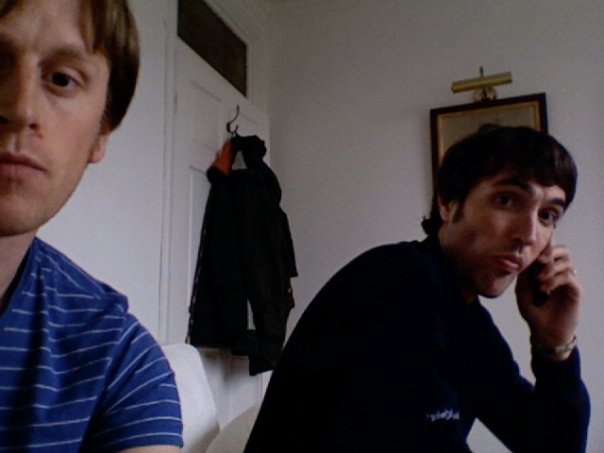
The first one is of Ben and me during our recording. Ben is talking on his mobile phone (as per usual!)
Baking in the sun on Benaulim Beach in Goa:
The view from our accommodation in Hampi:
Climbing up to the Monkey Temple in Hampi. That’s my cousin Oliver in the picture.
I stopped to take a photo and this boy started hassling me for money. I think I gave him some rupees, but he wanted more. Also he wanted a pen or some paper, but I didn’t have any.
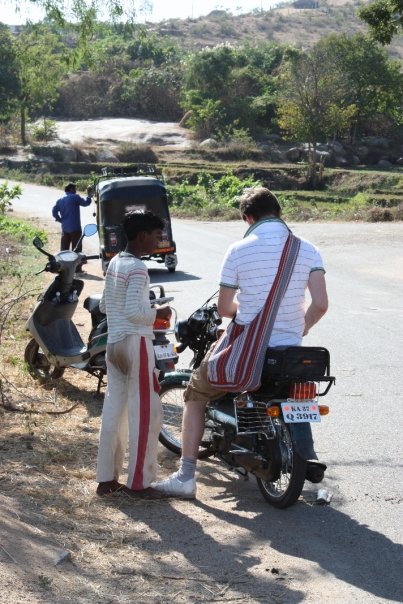
Going ‘off the beaten track’ on our scooters.
These are pilgrims on their way to visit the temples in Hampi. They have dressed up as Hindu characters. The man in green is dressed as Hanuman, the monkey king.
Two children we met outside one of the temples:
The Hanuman Temple (monkey temple).
This is a group of Indian school children visiting Hampi. In the background you can see a statue of Hanuman (the monkey king).
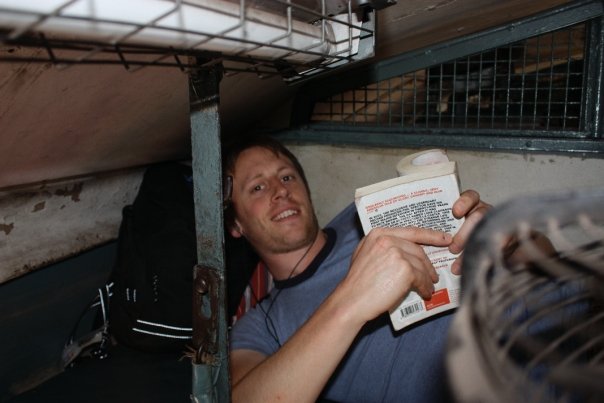
This is me on the train back from Hampi to Goa. Our seats were at the top of the train and we had to lie down like this for most of the journey. You can also sit on the doorstep of the train and watch the world go by, but it’s a bit dangerous…
This episode is about words and expressions related to dating & relationships. In part 1 I talk about what I’ve been doing recently, and talk about the Present Perfect Continuous Tense. Part 2 is the feature section which is about dating & relationships. I play you a BBC TV comedy sketch about a blind date. Part 3 – I teach you some of the most common words and expressions that English people use when they talk about dating & relationships. FULL TRANSCRIPT NOW AVAILABLE BELOW!
Right-click here to download. Hello, and welcome to Luke’s English Podcast. This episode is in 3 parts:
Part 1 – I’m going to talk about what I’ve been doing recently, and I’m going to talk about the Present Perfect Continuous Tense
Part 2 – This is the feature section which is about dating & relationships. I’m going to play you a BBC TV comedy sketch about a blind date.
Part 3 – I’m going to teach you some of the most common words and expressions that English people use when they talk about dating & relationships.
Part 1 – What have you been up to?
A typical conversation between friends who haven’t seen each other for a while would be like this:
A: Hi, how’s it going? (Hi, how are you?)
B: Fine thanks, you?
A: Not bad. What have you been up to?
B: Not much. I’ve been working hard recently. Work is really busy at the moment…
So, we use this question to ask about recent activities: “What have you been up to?” or “What have you been doing?”
‘up to’ – means ‘do’ or ‘doing’.
The tense here is the Present Perfect Continuous tense: have/has + been + -ing
This tense is used in the question and answer: “What have you been doing recently?” “I’ve been working hard”
It’s very common for people to use this when they see their friends.
E.g. “Hi Luke, what have you been up to?”
-I’ve been teaching a legal English course recently
-I’ve been playing football in Regents Park
-I’ve been enjoying the good weather
-I’ve been looking forward to the new Star Trek movie
-I’ve been listening to a lot of funk music
-I’ve been on a couple of dates recently
(Present Perfect Simple tense)
Part 2 – Here’s the transcript of the comedy sketch:
Woman: I’m really glad Lisa set us up together
Man: Me too Woman: I normally hate it when friends pair you off with complete strangers
Man; Yeah
Woman: Thing is… all the guys I’ve been out with recently have been unbelievably stupid… I think you’re different though… well, touch wood! [she knocks on the table]
Man: [thinking it is the front door] Sorry, that’ll be the door… [he walks to the front door]
Woman: Good…
Part 3 – Useful expressions for talking about relationships & dating
To flirt with someone: When you like a boy or girl, you act in a way which shows that you like them. E.g. girls will laugh at a boy’s jokes, she might play with her hair, she might smile at him a lot, she might touch him on the arm and laugh… When a boy flirts with a girl he might try to make her laugh or show her how strong he is.
To fancy someone: This means that you think someone is attractive. E.g. “I really fancy Jane! I think she’s really good looking.”
To chat someone up: This is when you talk to someone to make them fancy you. E.g. when a man sees a nice woman in a bar, he might chat her up by asking her if she wants a drink. “Would you like a drink? Do you come here often? You’ve got beautiful eyes…”
To go out with someone: This has 2 meanings. 1 – It means that you go on a date with someone. 2 – It means you are someone’s boyfriend/girlfriend. E.g. “We’ve been going out with each other for 2 years. We’re getting married next year.”
To ask someone out: This means to ask someone to go on a date. “Would you like to have dinner with me on Friday?” -he asked her out.
To have chemistry: This means there is a natural magic feeling between people who fancy each other. Chemistry is very important in a relationship.
To fall for someone: This means to fall in love with someone
To drift apart: This is when a relationship goes bad. You drift apart when you become interested in different things, and you don’t enjoy being with each other any more. It means that you slowly become bored with your partner.
To split up with someone: This means that the relationship finished. E.g. “Brad Pitt and Jennifer Anniston split up with each other a couple of years ago”
To dump someone: This means that you leave your partner and end the relationship. E.g. “She’s really sad because he dumped her. He told her that he didn’t love her any more and that he didn’t want to see her again…”
OK, so that’s it! Those are really useful expressions for talking about dating. Don’t forget to email me if you have any questions or comments. luketeacher@hotmail.com Bye for now!
p.s. here’s the comedy sketch on YouTube:
The TV show is called Man Stroke Woman (BBC)
TRANSCRIPT TO 8. DATING & RELATIONSHIPS
Hello, welcome to Luke’s English Podcast. Thank you very much for listening and downloading. Um… I’ve been getting various messages from people. Um… Basically saying that they love the podcast and some people are using it just to learn English when they are, for example, driving to work, or travelling on the bus, or on the underground, and some people are teachers who are using the podcasts in their English lessons. So, I’m happy about that, very glad that it’s becoming so popular. Um, you can, of course, find this podcast on iTunes. If you go to the iTunes Store, you can do a search for Luke’s English podcast and you will find it there and you can subscribe to the podcast using iTunes there. And also, you can leave a short review of the podcast on that page. Um… and I’ve had couple of ratings but I haven’t had any reviews yet. So, please leave a review saying how brilliant the podcast is, okay? I mean, I’d like you to say how brilliant it is of course so that way I can get more listeners, yeh? You don’t have to say it is brilliant. I mean you can be honest, for example, and say ‘I think it’s quite good but I found some of the episodes are a bit too long these days’ or something like that. Or you can say ‘I think it’s very useful but the problem is Luke doesn’t write a transcript for the episodes. It would be better if there is a transcript,’ something like that. Just write a comment, leave a message. I’d like this to be an interactive podcast. So the more messages you send me, the better. So you can leave a review on my iTunes page or you can send me an e-mail by teacherLuke… no, it’s luketeacher@hotmail.com.
Now, in today’s podcast, first of all, I’m just going to tell you what I’ve been doing recently. So I’m going to give you an update on things that I’ve been doing. And, when I talk about that, I am going to be telling you as well about the present perfect continuous tense and how useful that can be when you are talking about recent news, okay? So, the first part would be little bit about my recent news and the present perfect continuous tense. Then, in the feature section, you are going to listen to a small comedy sketch about a date, okay? And then in the language section at the end of the podcast, I’m going to teach you some really really really useful and very important expressions that you can use to talk about dating and relationship, okay?
[3’08” Jingle playing]
Right, so what have I been up to recently? What have I been doing? Well, I’m going to tell you in a second. But before I do that, I’m going to teach you something really useful about English, some really useful and important language, okay? Now when you see your friends, for example, if you haven’t seen your friends for a week or two, in English, it’s very very common to say something like: ‘What have you been up to?’ or ‘What have you been doing?’ Right? ‘What have you been up to?’ or ‘What have you been doing?’ And those questions are about your recent activities, okay? Maybe since the last time you met. So, a common conversation might be something like:
A: Hi, How’s it going?
B: Fine. Thanks. You?
A: Not bad. What have you been up to?
B: Well, …[and then you talk about what you’ve been up to.]
Okay? So that’s ‘Hi, How’s it going.’ ‘How’s it going’ is another way of saying ‘how are you’.
A: How’s it going?
B: Fine. Thanks. You?
A: Not bad. What have you been up to? [‘Up to’ means ‘doing’ actually.]
B: Well, nothing. [Very common for people to say nothing. ]
‘What have you been up to?’
‘Well, nothing.’ [Nothing really or nothing special.]
But sometimes, you know, you can talk about the things that you have been doing. Right? And when we talk about recent news like that, we often use the present perfect continuous tense or sometimes the present perfect tense. Okay? So, the present perfect continuous tense is structured like this, we have ‘have’ or ‘has’ + ‘been’ and then an ‘-ing’ form. For example, ‘I’ve been teaching English’ Right? Or, ‘I’ve been playing a lot of football recently.’ Yeah? I’ve been doing something. And we use that form in the question as well, ‘What have you been doing recently.’ Yeah? So, for example, if you ask me: ‘Hi, Luke. How’s it going?’ And I’d say: ‘I’m fine. Thanks.’ And you’d say: ‘What’ve you been up to recently?’ Well, I’d say:
I’ve been teaching a legal English class recently. Um… At school at the moment, I’m teaching a law course – Legal English, which is very interesting. It’s quite difficult. Some of the language is a little bit complicated. But it’s very interesting to be teaching a different kind of English, in this case, English that is used to describe a legal system or civil court procedures and so on and so forth. That’s very interesting. Also, I’ve been playing football in Regents Park. Regents Park is one of the many parks in London. It’s very beautiful there actually. It’s close to London Zoo. And it’s right in the middle of the city. And every Wednesday, I play football in Regents Park. So, I’ve been playing football in Regents Park recently. Um, I’ve been enjoying the good weather. At the moment, it’s spring here in the London and the sun is shining and the birds are singer and it’s really really nice. London is so much better when the weather is good. It’s really fantastic. So, I’ve been enjoying the good weather. Um… Let see, what else… I’ve been looking forward to the new Star Trek movie. So ‘looking forward to’ means waiting for something because you want it to happen, right? So, waiting for something that is good. Something that is good is going to happen. I’ve been looking forward to the new Star Trek movie. Now I’m not like a big Star Trek fan. I prefer Star Wars actually. But all the critiques say that the new Star Trek film is very very good. So, I’m looking forward to seeing it. I might see it later today actually. And then I can tell you what it’s like. You can see the trailer for the new Star Trek film on the Internet if you go to YouTube and type Star Trek movie. It should be a very good science friction movie, very entertaining. Um… I’ve been listening to a lot of funk music recently. Now, I love music, right? And probably my favourite genre of music is funk or jazz funk. And that sort of music that was being made in the 70s and it’s good music to dance to. And it also got some jazz in it. So there’s [re] some really great solos in jazz funk or funk music. And the musicians are excellent. So it’s really a real pleasure for me to listen to that kind of music. If you don’t know what jazz funk or funk sound like, well, it sounds a bit like this.
[8’35” Funk music playing]
I think you get the idea. Isn’t great? Sounds fantastic, doesn’t? Um, you might say that it’s a little bit cheesy. Right. But I love it. I love that kind of music. Anyway, what else have I been doing recently? Well, I’ve been listening to a lot of funk music like that. And also I’ve been on a couple of dates recently. Um… Now, I’m single at the moment and I’ve been trying to meet someone. So, I went on a[n] online dating service. Now, you might think: Ugh, online dating? That’s a bit sad, isn’t it? Well, I mean it’s not really sad anymore. In London lot and lot of people sign up to online dating services. A lot of my friends are on various online dating services. Lot of people do it here in London. It’s actually a good way to meet people I think. It’s not really sad anymore to do that. So, I signed up for one called Guardian Soulmates, which is run by the Guardian newspaper here. And I’ve had a couple of dates actually from it, which is great. Now, I’m not going to tell you any more about that because it’s person and private. And it’s, well, it’s none of your business really, is it. Yeah, so, I’m not going to tell you any more about that. You will just have to use your imagination to try and guess how those dates went and what the girl was like and all those things. So, yes, I’m not going to tell you any more about it. Instead, I’m going to move very quickly on to the feature section of this podcast, which is all about dating, actually. So, there you go. Just before we move onto the feature section, let me just summarise the little bit of grammar that I told you about there. So, we use present perfect continuous to talk about things that like activities that we have done recently. And, so, you should start using present perfect continuous like that. When you have conversations with your friends. So:
Hi! How’s it going?
Fine. Thanks. You?
Pretty good. What have you been doing recently?
Well, I’ve been listening to Luke’s English podcast.
Luke’s English podcast, what’s that? It sounds fantastic.
Well, it is fantastic actually. It’s brilliant. It’s a really interesting and useful way to learn English.
Wow, what’s the address?
Well, it’s teacherluke.podomatic.com and so on.
Okay? So, don’t forget to use present perfect continuous to talk about your recent activities. Now, let’s move on to the feature section of the podcast. Here we go.
[11’54” Jingle playing]
Okay, so, the feature section today is about dating. Um… Right, going out with people. Trying to find someone so that you can have a relationship with them. Now, in England, people meet their girlfriend of boyfriend in lots of different ways. Um, so, how do people meet each other? Well, it might be that their friends hook them up, right? If your friends hook you up with someone, it means that they know you and they know you are single, they also know someone else. So, it might be they know you but they also know a girl, or a boy that they think will like you. And, so, they arrange for you to meet. So they hook you up, right?
Um… And it could be a blind date, for example. They might hook you up on a blind date. So you end up meeting somebody that you’ve never met before. And that’s usually quite a difficult kind of date to go on because it can be very embarrassing if you don’t like each other. It can be a bit difficult and you have to try to make conversation. Ugh, it’s usually quite an awkward situation – a blind date. But a lot of people meet like that. How else? Some people meet at work. You know, I think actually most people in relationships meet their boyfriend or girlfriend at work. It’s very very common.
So, they might, for example, meet at work and flirt with each other and chat each other up at work, and then go out with each other. It might be the guy if he fancies a girl at work. They might flirt with each other and then he might ask her out. And then they go on a date and then you know, who knows, they might fall in love or something. I think it’s very common. By the way, I might use some English expressions in this part of the podcast that you don’t understand. But don’t worry, I m going to teach you those useful expressions at the end of the podcast, okay? Listen to this now and if you don’t understand something, I will explain it later. Also you can send me an email of course if you got any questions.
Okay. So they might meet at work. A lot of people meet in a bar or in a pub or in a nightclub, and it’s a very very common way to meet someone actually. People tend to go out on a Friday or Saturday night, they dress up in their best cloths, they put some perfume or aftershave on and they go out and they drink usually so they get a little bit drunk, which makes it easier to meet someone I think. And they go out and they dance with people and they chat each other up. And then eventually maybe get a telephone number form them and then arrange to meet up on a date in the future. Right? So a lot of people meet each other when they are drinking in a pub or in a club or something. Some people, especially these days, meet each other on the Internet.
So, if you are single, you might decide that you’re going to sign up to an online dating agency. And then you can find someone very quickly and very easily. But the problem is that there are so many people on the Internet that you have to kind of go through a lot of people before you find someone who is right for you. As well as that, a lot of people meet on holiday. [It is] very popular to go to places like Ibiza or Spain or other popular holiday destinations and you meet lots of other people who are at the same age as you. And something being on a holiday means that it’s a romantic situation. And so lots of people have meet[met] their boyfriend or girlfriend on a romantic holiday or something.
And these days some people go speed dating. Now, speed dating is a kind of very quick way to meet lots of people in one night. What happens in speed date is you go to a bar and first of all you have to sign up, so you apply to do it over the telephone. And then you go to a bar, and there might be about 10 or 15 tables in the bar and all the girls sit at the tables. And all the boys have… Well, you have 3 minutes, basically, to try and chat each other up. And after 3-minute, someone rings a bell – ding, ding ,ding – and then you have to move, all the boys move onto the next table. And you talk to the next person. And you got 3 minutes to talk to them. And then the bell rings again and you move to the next table and meet the next girl and talk to them and after about an hour, you have met about 15 people in one night. And then at the end, you write little comments on a piece of paper about them. And you can decide who[m] you’d like to meet again. If both people say that they’d like to meet each other, then they can exchange telephone numbers and have a date in the future. So, it’s very popular these days. A lot of people do it.
Um… Now, you’re going to… I’m going to play you, now, the audio from a little comedy sketch, which is from a BBC television programme, a comedy programme. Now, in this sketch, you are going to hear a conversation between a man and woman who are on a blind date. Okay? Now their friends have set them up, they’ve hooked them up with each other. And you hear the girl talking about how usually it’s very difficult when her friends hook her up with men. And usually, the men that her friends hook her up with are very stupid. But she is very pleased that this guy seems to be different. So, she’s very happy that they met each other. But there is a little joke, a comedy joke in the sketch. Now, I’m not going to explain any more about it. I’m just going to play it to you now. And I’d like you to see if you can understand what is funny about it. What’s the funny thing about this little sketch, okay? So, I’ll explain it to you afterward if you don’t understand. So, here is the sketch:
[18’57” Comedy sketch playing]
Woman: I’m really glad Lisa set us up together Man: Me too
Woman: I normally hate it when friends pair you off with complete strangers Man; Yeah Woman: Thing is… all the guys I’ve been out with recently have been unbelievably stupid… I think you’re different though… well, touch wood! [she knocks on the table] Man: [thinking it is the front door] Sorry, that’ll be the door… [he walks to the front door] Woman: Good…
Okay. Now, don’t worry if you didn’t understand that or you didn’t find it funny. Um… It’s very difficult to understand comedy if you are learning the language. And probably comedy is one of the things that you will appreciate or enjoy later when you become a more advanced speaker of English. So don’t worry if you didn’t find it funny. The main thing here that I’d like to do is to help you understand what happened in that sketch. Now, maybe you understood it but if you didn’t, I’m going to explain it for you bit by bit now. So let’s just quickly listen to some of the sketch again. So here is the first little bit:
Woman: I’m really glad Lisa set us up together
Man: Me too
Okay. So she says, ‘I’m so glad that Lisa set us up together,’ and he says, ‘me too.’ So, I’m so glad that Lisa, that’s her friend, set us up, that means arranged for us to meet. Okay? ‘I’m so glad that Lisa set us up together.’ ‘I’m so glad that Lisa arranged for us up to meet.’ And he said me too. Fine, easy. Now, here is the next bit.
Woman: I normally hate it when friends pair you off with complete strangers
Man: Yeah
I normally hate it when friends pair you off with complete strangers. Okay? So, when a friend pairs you off with someone, it means that your friend put you in a pair with someone. So, your friends arrange for you to meet someone so that you’d become a pair, you’d become a partner. Okay? Now, a complete stranger is someone that you’ve never met before. So, she means I usually hate it when my friends put me on a blind date with someone. Okay? Right, here is the next bit.
Woman: Thing is… all the guys I’ve been out with recently have been unbelievably stupid…
The thing is all the guys I’ve been out with recently have been unbelievably stupid. Okay? Now, ‘the thing is’, that’s like saying, ‘the problem is,’ all the guys I’ve been out with recently. So, to go out with someone means to go on a date with them. Right. So, all the guys I’ve gone on a date with recently have been unbelievably stupid. So, ‘unbelievably stupid’ means really really stupid. Okay? Now, so, here is the next bit.
Woman: I think you’re different though
Okay, she said, ‘But I think you’re different though.’ But I think you’re different though. She thinks that he’s not like the other guys that he’s not unbelievably stupid. Okay. Well, she hopes so anyway.
Woman: Well, touch wood!
Okay, there she says, ‘well, touch wood.’ Now, to touch wood in England is a superstition. It’s like a kind of good luck thing. So, if you hope that something will happen or you hoped something is true, you touch wood like that. Okay? So, she’s saying ‘you’re not stupid like the other guys’. Well, I hope you are not anyway. Touch wood, right. Yeah, so, that’s what that bit means.
Man: That’ll be the door
Woman: Good…
He says, ‘Oh, that will be the door.’ Right, so, what happen is, she said, ‘I hoped you are not like the other guys, I think you are not like the other guys. Well, touch wood. Actually, he thought that was somebody knocking on the door. So he is very very stupid actually. Because when she went touch wood, he said that would be the door and he left the table because he thought somebody was knocking on the front door. So, he is very very stupid, yeh, or an idiot. And then she said ‘good’ at t he end but she doesn’t really mean it. I think she is shocked or surprised. So, I’m just going to play you the whole sketch again, so that you can listen to it from the start to the finish.
[23’24” Comedy sketch playing]
Okay, so there it is. I hope you enjoy that, I hope you find it funny. Now, in the next section – the language section, I’m going to teach you really useful expressions to talk about dating and relationships.
[23’56” Jangle playing]
Okay, in English, there are numbers of expressions that we always use when we are talking about romantic relationships, boyfriends, girlfriends, and going on a date. Okay? And you really have to learn these expressions because people always use them when they are talking about this subject, okay? So, these expressions are really important and really useful for you. So, I recommend that you learn them and use them, okay? Now, I used some of these expressions in the feature section when I was talking about dating, okay? So, you… I’m going to explain some of those expressions for you now. Okay, so, let see. First expression is a verb, and it’s ‘to flirt’, to flirt with someone, ‘to flirt’. Um… To flirt with someone is when you… If you like someone, if you think someone is attractive, then you act, you behave in a way show that shows you like them. Okay? So, for example, girls might play with their hair. Right? They often play with their hair when the flirt. Or they laugh at everything that the guy says. So, even if the guy says really bad jokes, she’ll laugh about it. ‘Oh, you’re so funny.’ And she might, for example, back her eye lids at him, or just act in a way that shows she really fancies him, she really likes him, okay? Um… Guys when they flirt, they try to make girls laugh, they might try to show how strong they are, show off their muscles or something, so that’s flirting. And people flirt all the time. When they like someone. Okay?
Another expression is ‘to fancy someone’, ‘to fancy someone’, and ‘fancy’ is a verb. And if you fancy someone, it means you think they are attractive, you think that they are good looking. Okay? So, if you fancy someone, you might start flirting with them, for example. So, ‘fancy’. Yeah. Um…
Next expression is ‘to chat someone up’, ‘to chat someone up’. And that’s a phrasal verb – ‘To chat up, to chat someone up’. If you chat someone up, it means that, first of all, you find them attractive, you fancy them, and then you start talking to them, to try to make them fancy you. Okay? Now I think usually, traditionally, men chat women up. Um… These days, women chat men up a bit as well, but traditionally it’s men who chat women up. And, so, for example, if a man sees a girl in a bar and he fancies her, he might walk over to her and start to chat her up. And there are typically things that man say when they chat women up. So, they’ll say ‘hi, would you like a drink?’ or ‘hi, do you come here often’ or something like that. And then they start chatting, talking to try [to] make the girl fancy him, okay? So, typically things are: ‘Do u come here often,’ ‘Can I buy you a drink,’ or ‘you’ve got lovely eyes,’ that kind of things. So that’s to chat someone up.
Next expression is to go out with someone, to go out with someone. And, there are two meanings of these really. One meaning is to go out with someone means to go on a date, right? So, to go out with someone just means to go on a date. ‘I went out with her last night.’ But we also use ‘to go out’ to mean that you’re someone’s girlfriend or boyfriend. And, often in a continuous form, so, ‘I’m going out with her,’ means she is my girlfriend. Or ‘are you going out with anyone at the moment,’ means do you have a boyfriend or a girlfriend at the moment? Yeah? I’ve been going out with her for 6 months, for example, means she’s been my girlfriend for 6 months. Yeah? ‘To go with someone.’
Another useful expression is ‘to have chemistry with someone’, ‘to have chemistry’. Now if you have chemistry with someone, it means that you get on with each other and there is some like magic between you, so you just really get on with each other and you both fancy each other and just naturally, when you are together, there’s like a magic feeling between you, and that’s called chemistry. And chemistry is really really important in a relationship. You have to have chemistry, because it’s the chemistry actually, the interaction between you that makes it exciting, that makes it interesting, okay? So, for example, if you go on a date with someone, and there is no chemistry, then the date will be really boring. You will think that whatever they are saying is not interesting; it’s not exciting. Yeah? But if there is chemistry, it’s kind of exciting, you fancy each other, you know, you might want to kiss each other, and there’s a good feeling between you and that’s called chemistry. Chemistry is also the word of the name of kind of science. But we also use it to mean good feeling between boy and girl, Chemistry.
Now you can, if you fall in love with someone, you can say that you fall for someone, so ‘to fall for someone’. So, for example, you know, she’s been going out with him for about four weeks, and she really fancies him, and actually, I think she’s starting to fall for him means she’s starting to fall in love with him. So, ‘to fall for someone’. Okay.
Now, for example, if you meet some one, you fancy each other, you flirt with each other, you stat to chat each other up, maybe, if you fancy them, you can ask them out, so, to ask them to go on a date with you. You ask some one out. So, may be the boy fancies her, he asks her out and she says yes, so they go on a date with each other. There is chemistry between them and they start going out with each other so they start becoming boyfriend and girlfriend, and then, maybe the fall for each other And then, eventually, perhaps, who knows, they get engaged and get married and have children and live a lovely happy life.
But sometimes it goes bad; sometimes a relationship will go wrong. Okay? And, so there are few expressions that we can use to describe when a relationship goes bad. For example, you might say that, um… You and your girlfriend are drifting apart. To drift apart, so, that means you are slowly moving away from each other, slowly moving away, so you are drifting apart, okay? Um… And if u are drifting apart, if you don’t love each other anymore, then you may split up with each other. So that’s a phrasal verb, ‘to split up with someone. So if you split up with each other, it means that the relationship is s finished. Okay? So, for example, they were going out with each other, but then they split up with each other and now they are single. Okay? ‘To split up with someone.’ Now, you can also use an expression to mean that you leave some or you’ve finished a relationship, and that is to dump someone. Okay? So, for example, if, you know, she was going out with him for three months. But after three months, she realised that he was really boring and she didn’t fancy him anymore, and so, she dumped him. Right? When you dump someone, you have to tell them a reason, you have to say, ‘look, I’m sorry but I don’t think this is working’ or ‘I’m sorry, but I don’t fancy you anymore’ or ‘I’m sorry, but it’s not you, it’s me you know. I’m not ready for a long relationship.’ Okay? And when you say that, you’d say, ‘I don’t think we should see each other any more.’ Then you dumped that person. It’s very sad. It’s not a good thing to do over the telephone, for example. Although a lot of people do it over the telephone, so to dump someone. So, those are some of the sort of most important expressions, I think, to describe a dating and relationships.
There are more expressions that you can use. And I think that because this is a good subject, I’m going to do more podcasts about this in the future. And, in fact, what I’d like to talk about in the future would be good chat up lines, so that’s good things you can say to chat someone up. And things that people often say when they dump each other. I think it’s a interesting subject, so, hopefully, I’m going to interview some of my friends and get their good chat up lines and things that they might say if they dump someone, okay? Now I will write all of the expressions that I’ve explained on the podcast home page, which is, of course, teacherluke.podomatic.com. You can see all the expressions written and I’ll also write a transcript of the comedy sketch that you listened to. So, don’t forget to visit the site to get some of the words and expressions that I’ve explained for you here. And also, don’t forget to send me an email. I’m going to end this podcast with a question. And the question is, ‘how do people meet each other in your country.’ Now, I told you about how people meet in England, but I know that in some countries like, for example, in Japan, there are different ways to meet your partner. So, how do you meet each other in your country? Send me an email; I’d very much like to hear from you. That’s the end of the podcast. I hope you have a nice day. And I hope you enjoyed listening. Take care. See you soon. Bye. Bye. Bye. Bye. Bye. Bye….
Transcript of Luke’s ENGLISH Podcast episode: Music / The Beatles
You’re listening to Luke’s English Podcast. For more information visit teacherluke.wordpress.com
Hello and welcome to episode 3 of the podcast. Thanks very much for listening and downloading, and possibly subscribing to the show using iTunes, that’s fantastic. In today’s show we’re going to be talking about music and I’m going to talk to my Mum about The Beatles because she was a big Beatles fan in the 1960s. I’m also going to respond to a couple of emails that I’ve had and then in the last part of the podcast, the language part, I’m gonna talk about habits, habits and behavior in the past. So things like ‘use to’ and ‘would’ and some other useful language. So stay tuned for that.
Now, I’ve had an email from Alessandro in Italy in response to the question that I asked at the end of the last podcast. That question was: What kind of music is popular in your country at the moment? Is it kind of English language music or do you have music that is just exclusive to your country? And Alessandro from Italy says that, he still thinks that ‘Opera’ is the most famous Italian music, of course. Everyone knows Opera, erm, people like Luciano Pavarotti, Andrea Bocelli of course that’s the most famous Italian music, but also in Italy, Rock music is very popular and they have all English language bands, the ones we have, obviously have here as well. Things like, you know, U2, The Red Hot Chili Peppers, Coldplay. All these really big bands are popular in Italy as well. But also there are lots of Italian Rock bands. They’re really popular there but (they) aren’t very well known outside of Italy and I think this is probably true in most countries, erm, I know it’s true in Japan, that there are big very successful bands, they’re just famous in that country and because the lyrics are not in English, they’re not famous in America or in the UK. So it’s probably, hmm, a bit lazy, in terms, sort of British people. We don’t listen to very much music that isn’t in English. We’re probably missing out on quite a lot of good music. So thanks very much for your emails. I appreciate that very much and remember, if you want to email me, you can. It’s luketeacher@hotmail.com and I love hearing from you. So send me your emails and all your comments and stuff and I’ll get back to you through the podcast.
Ask the girl what she wanted to be
She said baby, can’t you see
I wanna be famous, a star of the screen
But you can do something in between
Baby you can drive my car
Yes, I’m gonna be a star
Baby you can drive my car
And maybe I’ll love you
A little bit of Beatles there. That was ‘Drive my car’ from the ‘Rubber Soul album’ and I’m playing that because the Beatles and Apple Corps which is their company and EMI music have finally decided to re-release all of the Beatles studio albums in remastered form. So they’re all going be digitally remastered and so that means you’ll be able to listen to them and hear them sounding better than they’ve ever sounded before. Some of the albums that they released, particularly the early ones were recorded in mono, and there are CD versions of those albums in mono but now they’re going to be digitally remastered, so that they’ll sound really crystal clear and perfect and they’ll be all in stereo which obviously makes the listening experience a lot better. Now, right, so with me here now, is my Mum.
LUKE: Hello Mum
Mum: Hello Luke
LUKE: How are you?
Mum: I’m very well.Thank you.
LUKE: Now, umm, I thought that I’d talk to my Mum today because she used to be, back in the sixties, a massive Beatles fan. Is that right?
Mum: That’s right, yes.
LUKE: Okay, so, umm, right, so I hope you don’t mind if I ask you some questions.
Mum: No, that’s okay.
LUKE: Umm, so how did you first hear about the Beatles then when you were younger
Mum: Umm, oh, it’s very hard to remember but I can, I have, do have one memory of being on the school bus and hearing two other girls talking about this group
LUKE: yeah
Mum: called the Beatles and looking at pictures of them and saying ‘ which is your favorite?’ and I think maybe that was the first time I heard of them but I, I really can’t remember the first, the actual first time.
LUKE: Yeah, now they, they were a really massively popular band, weren’t they?
Mum: They were
LUKE: I mean, everyone was crazy about them. Umm, so, you obviously heard about them from some friends and then started
Mum: And then started to talk about them and look at pictures of them, listen to the music and I didn’t actually buy any records of theirs until the 2nd LP which was called ‘With the Beatles’ which my parents bought me because I didn’t really have much money of my own in those days.
LUKE: That’s nice of them. How old were you in those days, tell me?
Mum: Umm, I would have been about twelve or thirteen, I suppose.
LUKE: Twelve or thirteen, so you would have been the target audience really
Mum: Hum, I suppose so, yes.
LUKE: So why did you like them? Well, they were so popular but why, why did you like them?
Mum: Oh, it’s very hard to explain why. Umm, they were, they were just so unusual, just so different, all the Pop music we’ve had up ’til then seemed to be mainly from America. I mean there were one or two the English people like Cliff Richard and Adam Faith. Umm, but they were just so different. I mean the first time I ever saw a group, you know with three guitars and drums. Before it was just a singer.
LUKE: They had something else about them, didn’t they?
Mum: Oh yes!
LUKE: They had a kind of personality
Mum: Yep !
LUKE: They had a good sense of humor, they were sort of charismatic
Mum: They were from Liverpool, which, and so they had these wonderful Liverpool accents which, um, of course I didn’t really know about in those days. I had never heard about another Liverpudlian I think.
LUKE: Yep
Mum: And they were very witty and very funny and very quick and just wonderful really.
LUKE: Right, so, did you actually ever see them?
Mum: I did, I saw them twice. I think the first time I saw them was in 1963 I think in Wolverhampton and then I saw them again in Birmingham the following year.
LUKE: So they were probably playing in a theatre or something like that, right? Umm, I can’t remember were they were in Wolverhampton. It was probably a Cinema or a Theater or somewhere like that and in Birmingham there were the Odeon in New Street which again was a Cinema but it had a stage and so it could be used for concerts as well.
LUKE: So, what was the experience like? I mean, what was it like actually seeing them, what was the audience like, first of all?
Mum: The audience was completely hysterical. We were all screaming and shouting and it was, I remember, the compere the shows sort of, that’s the man who did, who introduced the acts. When it got to the Beatles because they were the last on the bill and he sort of start the audience up even more by saying ‘Do you want to see them, do you want to see them?’
LUKE: And everyone was like ‘Yeah,
Mum: Everybody was shouting and screaming and the curtain came up and we could see their feet, and then we could see their legs and then you could see them and then the music started and that was all extremely exciting.
LUKE: There’s lots of video footage of The Beatles concerts where they’re playing and you can’t really hear the band. You can just hear all this ridiculous screaming .
Mum: Yes, that’s what is was like. I don’t really think we could hear them properly at all.
LUKE: So, it was just total madness, really.
Mum: Yeah, absolutely.
LUKE: Yah, Yah, I expect probably at the time because it was the early 1960s, young people didn’t really have anything, you know, interesting like The Beatles. They just, I mean, I think, I might be wrong but I think that life was kind of boring, right?
Mum: Umm, no, I never thought it was boring. It’s just the way it was in those days but it was very different from the way it is today. There wasn’t
LUKE: Now, now teenagers have just got so much, so many, you know so much music, so many, hmm, movies and all kind of things there to entertaining them.
Mum: And it’s so much more accessible than it was in my day. You had to actually go to the cinema or buy a record.
LUKE: Yeeah, Yeah
Mum: There was no downloading stuff from the internet or watching DVDs or anything like that.
LUKE: Right, so erm, which Beatle was your favorite because everyone had a favorite Beatle, didn’t they?
Mum: My favorite Beatle was, it was a toss-up between John and Ringo.
LUKE: Yeah, okay
Mum: I think, mainly my favourite was John, because he was so outrageous.
LUKE: Yeah, he was controversial, wasn’t he?
Mum: He was
LUKE: Yah, okay, so just the fact that he was controversial and outrageous, that, that
Mum: That was mainly it, yes he was very witty and very funny.
LUKE: Yah, he was, wasn’t he? Yeah, and what about now? Is John still your favorite now?
Mum: Ha ha,umm, oh it’s hard. I can’t really think of it in those terms anymore really, because I, I just, I’m very fond of George now.
LUKE: Yah
Mum: I appreciate him more now than I did then, I think.
LUKE: Yah, okay. So do you still listen to The Beatles these days?
Mum: Not very much, no,hmm
LUKE: Why not?
Mum: I find it quite strange listening to them now.
LUKE: Hmm
Mum: It just, it’s, hum, I don’t know, it’s very hard to explain. It just reminds me of those days and I don’t really want to go back and think about those days anymore. I’d rather live here and now.
LUKE: Yeah, alright, okay, thanks very much for talking to me.
Mum: It’s a pleasure.
LUKE: Yeah, hmm, alright, well, that’s, that’s it then. Oh, I think I might buy a couple of these new CDs when they come out.
Mum: Okay, right
LUKE: Because you knoz I’m a big fan.
Mum: Yes, well, I might listen to them if you buy them.
LUKE: Yeah, you’ll probably enjoy them.
Mum: Hmm
LUKE: Okay, well
Mum: Okay
LUKE: Thanks very much
Mum: Okay
Okay, so now it’s time to do the language part of the podcast. This is where I teach you something and in the last episode you heard my Dad talking about his Easter experiences when he was a child. And so he was talking about things that he usually did, things that he did regularly or every year when he was a kid. So we’re going to look at some language that he used and that you can use to talk about regular habits in the past. Now there are some really common ways of doing this. The most common way is to use ‘used to’.You’ve probably studied that, you, you probably know about ‘used to’. Erm, so it’s erm, u-s-e-d t-o, used to. So for example, hum, something my Dad said was ‘ we used to paint our easter eggs different colors, okay? Hmm, another example for me would be ‘I used to live in Japan’, right? Or I used to smoke. I don’t smoke anymore, because it’s very bad for your health, right? I used to smoke but then I gave up.
So this is something really useful. Now, you may know about ‘used to’ and you may have studied it but do you actually use it? Now the most, this is very important, you might know about different kinds of grammar. You might have studied different bits of vocabulary but the difference between a learner of English and a native speaker is that a native speaker uses all of this stuff. They actually use it regularly when they speak. They use a variety of different grammar and a variety of vocabulary, okay? And ‘used to’ is something that people use all the time when they are talking about the past, when they’re talking about things they did regularly in the past, okay? So you should use ‘used to’ a lot. You might think that this isn’t a new language for you but the most important thing is that you’re actually using it okay? Umm, something I always tell people is, it’s not important what you know, it’s important what you do in English. So the important thing here is that you actually use something like ‘used to’, okay. Hum, just some other important points about ‘used to’ , pronunciation. So obviously it should be ‘I ‘used to’, so that’s ‘used to’ not used to, and not ‘used to’ or ‘used to’ (listen to the audio to hear the pronunciation Luke is de,onstrating here). Hmm, I sometimes hear people saying ‘used to’ or ‘used to’ but it’s not that , it’s ‘used to’, ‘used to’. Also in negative or in question forms it doesn’t have a ‘d’, so that’s when you write, ‘used to’ in a negative it doesn’t have a ‘d’ . So I didn’t use to smoke. Right? So it’s without a ‘d’. So it’s didn’t u-s-e t-o, right? And it’s the same in questions,right? Did you use to, for example.
Umm, now ‘used to’ is commonly confused with, erm, another, erm, very similar structure and that is ‘to be used to doing something’. For example, I am used to living in London. Okay? So you’ve got ‘used to’, which is ‘I used’ to live in London and ‘be used to doing something’. I am used to doing something. I am used to living in London. So those forms are completely different.
Right? So, hum, I’ve told you about ‘used to’ to talk about past habits, now let me tell you about ‘to be used to doing something’ or ‘I am used to doing something’. Right? Which is totally different from just ‘used to’ okay. So, hum, okay let’s see, so if you say ‘I am used to doing something’ or ‘I got used to doing something’ it means that before something was difficult or strange for you but now it’s okay. Now you’re okay with it. You got accustomed to it. Okay? So for example something that you might say, you might say ‘when I first moved to London I thought it was very difficult to live here but now I’m used to living here. Okay, now I’m used to living here. So, it could be ‘now, I understand the culture a bit more, I can speak better English, I remember that people drive on the left, so I’m used to living here now. So that is totally different from ‘I used to’ live in London, which means that I lived in London in the past but I don’t live in London now. Okay? Right.
So another way of talking about a past habit which is similar to ‘used to’, is the modal verb ‘would’. Now ‘would’ is usually, when it is used to talk about a past habit we use ‘would’ but in the contracted form. Okay? So for example you may have heard my Dad in the last episode say something like this:’ We’d roll our easter eggs down a hill and then we’d eat them at the bottom’ Okay? So, um, this use of ‘would’ in the contracted form, for example ‘we’d eat them at the bottom or ‘ we’d buy each other chocolate eggs every christmas, not christmas, what am I talking about? Not Chrismas! Sorry! We ‘d buy each other chocolate eggs every easter. Right? Um, this use of ‘would’ is very similar to ‘used to’. We use it to talk about things we did regularly in the past. Okay? For example for me, when I lived in Japan, I’d see businessmen asleep on the underground everyday, okay? I’d see businessmen asleep on the underground everyday. Or I’d sometimes get woken up by noisy motor bike gangs in the middle of the night. Right? I’d sometimes get woken up by noisy motorbike gangs in the middle of the night. That’s true actually. I used to get woken up all the time by motorbike gangs because I lived in, I lived near Yokohama and sometimes in the summer there was these big motorcycle gangs, they would ride around, hum, in the city in the middle of the night and that was so loud, so for example, you know, I used to wake up to the noise of these motorbikes and I’d get up and I’d go out onto my balcony and I’d look down on the street and I’d see all these motorbikes riding past. It’s quite frightening because they were quite scary because some of them had samurai swords on their backs which is quite scary.
Anyway, anyway, I was talking about ‘would’ so for example’ I’d sometimes get woken up by noisy motor bike gangs’. Okay? So try to use ‘would’ like that in the contracted form to talk about regular things that happened in the past. Now, it’s very similar to ‘used to’ but it is different. The only difference with ‘used to’ is that we don’t use, we don’t use ‘would’ like this with state verbs, okay? Now, you’ve got state verbs and you got action verbs. Action verbs are the most common ones. Action verbs all describe an action. Right? For example, something that you do rather than a kind of state or condition that you’re in. So an action verb might be to go, to play, to eat, something like that, okay.
Right so we don’t use, okay that’s action verbs. play, go eat an so on. Now, state verbs are not used to describe an action but they describe a situation or a state or a condition. Right? These include verbs like live, know, like, understand, hate, okay? Now, we can’t, we don’t use would in the contracted form to talk about past habits with state verbs. Okay?
So for example, you can say ‘I used to live in London. Right? ‘Live’ is a state verb. You can say I used to live in London but you can’t say ‘I’d live in London’ if you’re talking about the past. Okay? That’s because ‘live’ is a state verb. So you can say ‘when I lived in London, I’d take the underground to school everyday and I’d often go to the pub after school on a friday. So you can say that because ‘take’ is an action verb and ‘go’ is an action verb. Alright?
So, remember that, you can only use, ‘would’ contracted for past habits with action verbs and not state verbs. If you’re interested in, action verbs and state verbs and what the difference is, it’s really simple. Just go to Google. Right? Go to the Google search engine and type ‘state verbs’. Have a look at the results and you’ll see lots of grammar pages from, you know, Oxford, um, University or something like that and they’ll show you lists of state verbs and action verbs and the differences between the two. Okay? Umm, that’s it. That’s, that’s the end of the language section.
Um, so, erm, yeah, I hope you found that useful. Don’t forget you can email me questions. If there is something you don’t understand or there is another question you have about language, email me. The email address is : luketeacher@hotmail.com and I will answer questions that you, that you sent me in the podcast. Now, I might not be able to answer every question that is sent to me because I, I get quite a few questions. So if, if I don’t answer the question, you’ve sent me, I’m sorry. I’ll try to answer all the questions that I get sent but sometimes I can’t answer them all. Umm, okay, so that’s, that’s the end of the podcast.
Now, I’m gonna end with a final question and the question this time, umm, is about skateboarding. Now, it’s about skateboarding because erm, I was talking to my brother recently and he loves skateboarding, right. He’s, he’s a, he’s a skater, he skates a lot. Now, I was talking to him about it recently and I was thinking that I might interview him for the podcast in the future. So I might have an interview with, with my brother James about skateboarding but I’d like to ask you a question about skateboarding. What do you think, is skateboarding popular in your country? Right? And do you think skateboarding is vandalism or is it okay? Now what does vandalism mean? Vandalism is when people damage public property. Okay? So what skateboarders do, is, is, they use public property, umm, for their skateboarding. So they do things like, eh, they will ride on, hmm, on like a bench or they will ride on a handrail for their skating and it damages the bench and it damages the handrail and a lot of people in this country think that skateboarding is vandalism, that it damages public property but a lot of people think it’s kind of like an art form or a sport or something. So what do you think? Do you think skateboarding is vandalism or do you think it’s okay? So that’s the question.
Umm, that’s the end of the podcast. I hope you enjoyed it and don’t forget to email me luketeacher@hotmail.com and I’m looking forward to hearing from you. So, that’s it! Cheers, bye, bye, bye, bye, bye, bye, bye……..
__________________________________________________________________________________________________________________________________________
(Thanks to Bettina for providing this transcript – Thanks Bettina, I appreciate it very much and I’m sure the listeners do too)
TRANSCRIPT
Hello, and welcome to Luke’s English podcast – the podcast for learners of English. This is the very first podcast that I’ve done and it will be the first of many more podcasts that you will be able to download and listen to in the future, so because this is the first podcast, it’s a bit short, it’s shorter than the other ones will be and in this podcast basically I’m going to introduce myself to you so that you can get to know me a little bit and then I’m going to tell you about what is going to happen in other podcasts in the future.
Let’s see, first of all my name’s Luke – Luke Thompson. Now the name Luke can be a little bit difficult for learners of English to pronounce sometimes and I meet lots of people who can’t pronounce my name and they call me Look or maybe Luck, but it’s not Look or Luck, it’s Luke of course, and let’s see, I live in London. I work as an English teacher in an English language school in West London and I’ve been teaching English for about 8 years now. I first started teaching in Japan and I lived in Japan for two years in an area near Tokyo called Kanagawa Prefecture and I taught English there for two years and it was really great, I had a really good time. It was a very interesting experience for me and I’ve got lots of interesting stories to tell about my time in Japan. So, I taught there for two years and then I came back to London and I have been teaching English in London for about six years now. I’ve worked in a few different schools. I used to work in a school near Oxford Street and I worked in another school in Waterloo and now I work in a school which has two buildings, one in Holland park and the other one in Chiswick in West London and I enjoy my job very much because I get to meet lots of very interesting people, possibly people like you, people who need to learn English and they come to London. They come to my school, for example and it’s very interesting for me to meet these people from around the word and to introduce them to the English language and the English culture as well.
Let’s see, as well as being a teacher, an English teacher, I’m also interested in lots of other things. I love music, I’m a big music fan, for example I love the Beatles, of course, because I’m English and we all love the Beatles don’t we? So, I love the Beatles and I love lots of different kinds of music as well. I play music sometimes, I play the drums and I play the guitar. I’m not very good at the guitar to be honest I’m just trying to learn how to do that, but I’ve been playing drums for a long time now. I play in a band at the school and we play concerts sometimes and that’s really great fun. I’m also into lots of other things. I love movies and I like sport, like football of course, again because I’m English and we all love football, right? and I also like rock climbing too.
So, that’s just a little bit of information about me and, OK, now I’m also interested in you, and your opinions and your stories and your questions as well, so if you have any questions for me, if there are stories that you’d like to tell me, you can email me. Now at the end of each podcast I will actually ask you a question and I really want this to be an interactive podcast, which means that you can email me your answers to the question that I will ask you at the end of the podcast and it will be a chance for you to tell me what you think about some of the things that we’ll be talking about. So if you want to email me you can write to this address, its: Luketeacher@hotmail.com and I’ll be very glad to hear from you.
You’re still listening to Luke’s English Podcast. If you’d like some more information visit teacherluke.podomatic.com.
Now, let me tell you about the podcast. Now obviously this is the fist podcast so it’s slightly different from podcasts in the future, but really what is so fantastic about this podcast is that the whole thing will be real, natural British English so that means that if you are interested in having a good listening experience, practising your listening but also finding something that will be interesting and entertaining and fun then this is the podcast for you. Like I said, it will all be totally natural British English, so the sort of English that I speak with my friends for example, the kind of real English that people in Britain speak all the time. I record the podcast here in my apartment in London. At the moment I’m sitting on my sofa and it’s a Saturday morning. So I record the podcast at home in my free time and a typical podcast will have three parts: the first part will be a little bit of conversation with me. So I might talk about something that’s happening at the moment. So possibly a news story or what’s been going on recently and I will also answer your questions and I will read out your comments that you send to me via the email address that I read out earlier on.
That’s the first part, the second part of the podcast will be a feature. So that means that it will be probably an interview with someone, so I might interview one of my friends or interview a member of my family and so you’ll be able to listen to a natural conversation between native speakers for example. It will be like you are spending time with some native English speakers. I know it’s difficult to find native English speakers to meet and talk to but if you listen to this podcast you’ll be able to listen to me talking to some of my friends or family, so again, a really good chance for you to listen to natural British English being spoken. So, like I said, the second part will be a feature, maybe an interview with someone. I might for example go into London and interview people on the street or I’ll interview people I meet in the pub, for example and we’ll talk about lots of interesting topics.
Then the third part of the podcast I will look at some of the language that I’ve used in part one and part two and I’ll actually teach you some really useful vocabulary and really useful expressions, the kind of natural language that normal British people speak when they talk to each other.
So this podcast is a really good chance for you to try and push your level of English up and if you start using some of the vocabulary that you hear on this podcast you can really start to push your level up to an advanced level of English. Another good thing about the podcast is that you can download it from the internet. You can put it on to your ipod or your mp3 player and then you can listen to it anywhere you like, I mean, you can listen to this on the bus on the way to work, or on your way to school. You can listen to it maybe when you are in the gym doing your exercise. I mean you can listen to it anywhere you like, I mean, you can listen to it on the toilet for example or maybe when you’re having a bath! I suppose that might be a bit weird or a bit strange if you’re listening to me while you are having a bath or when you are on the toilet! but I mean I don’t really care, I don’t really care where you are or what you’re doing as long as you actually listening to the podcast, that’s the most important thing for me. Also you can listen to this anywhere in the world, so if you’ve come to London to study English – you might have been at my school, you might have been one of my students and if you come to London and then you go back to your country you can keep downloading and listening to this podcast from your country and it’s a really good chance to extend your British English learning experience. Now, there are lots of other podcasts that you can download from the internet, lots of learning English podcasts. If you go to iTunes, if you’ve got iTunes on your computer for example, if you go to the iTunes store and do a search for learning English podcasts you’ll find lots of different English language podcasts available, but in my opinion most of them are rubbish actually and I think that this will be probably better than all the others! Now I’m not being very modest there, but I think I’m just being confident, which is a good thing, but I’ve listened to a lot of other podcasts that you can find on the internet and first of all most of them seem to be American and they have American English – which is fine because American English is great and all that – but you might want to listen to British English, right? Or sort of London English which is what I can offer in this podcast. So also a lot of the podcasts that I’ve listened to seem to be very patronising, and by patronising I mean that they talk to you like you’re a bit stupid, or maybe like you’re a bit of a child so they might be something like:
“Welcome to the American English podcast from podcasts.com. Today’s podcast is about dogs. Dogs are a kind of pet that you keep in your home or in your house…”,
for example, right? Sort of, a bit slow, a bit boring and a bit patronising so I think that this podcast will be hopefully more interesting than that, not as patronising, not very boring hopefully, sort of natural and fun and you will actually want to listen to it for entertainment so it’s not like studying but more like just something that you listen to just because it’s interesting I hope so anyway.
So, I think that’s it really, that’s the end of this first podcast. Don’t forget to listen to the second one and the third one because they will be more interesting than this because they’ll be things like interviews with people and other stuff like that.
So, I’d like to end this podcast with a question which I would like you to answer through the email address and the question is: What would you like me to talk about? so what would you like to hear me talk about on this podcast? so send me a question. It could be a question about perhaps Britain or British culture or about London or it could be a question about English – if you’ve got a question about English vocabulary or grammar I’m happy to answer your questions on the podcast. So, that’s the first question: what would you like me to talk about? And that’s it, that’s the end of the podcast. Don’t forget you can email me at: Luketeacher@hotmail.com. I’m very much looking forward to hearing from you in the future, so that’s it.. bye bye bye bye….
Cookies on teacherluke.co.uk
Click “Accept All”, to consent to the use of all cookies on this website, or visit "Cookie Settings" to control your consent settings.
This website uses cookies to improve your experience while you navigate through the website. Out of these, the cookies that are categorized as necessary are stored on your browser as they are essential for the working of basic functionalities of the website. We also use third-party cookies that help us analyze and understand how you use this website. These cookies will be stored in your browser only with your consent. You also have the option to opt-out of these cookies. But opting out of some of these cookies may affect your browsing experience.
Necessary cookies are absolutely essential for the website to function properly. These cookies ensure basic functionalities and security features of the website, anonymously.
Cookie
Duration
Description
cookielawinfo-checkbox-analytics
11 months
This cookie is set by GDPR Cookie Consent plugin. The cookie is used to store the user consent for the cookies in the category "Analytics".
cookielawinfo-checkbox-functional
11 months
The cookie is set by GDPR cookie consent to record the user consent for the cookies in the category "Functional".
cookielawinfo-checkbox-necessary
11 months
This cookie is set by GDPR Cookie Consent plugin. The cookies is used to store the user consent for the cookies in the category "Necessary".
cookielawinfo-checkbox-others
11 months
This cookie is set by GDPR Cookie Consent plugin. The cookie is used to store the user consent for the cookies in the category "Other.
cookielawinfo-checkbox-performance
11 months
This cookie is set by GDPR Cookie Consent plugin. The cookie is used to store the user consent for the cookies in the category "Performance".
viewed_cookie_policy
11 months
The cookie is set by the GDPR Cookie Consent plugin and is used to store whether or not user has consented to the use of cookies. It does not store any personal data.
Functional cookies help to perform certain functionalities like sharing the content of the website on social media platforms, collect feedbacks, and other third-party features.
Performance cookies are used to understand and analyze the key performance indexes of the website which helps in delivering a better user experience for the visitors.
Analytical cookies are used to understand how visitors interact with the website. These cookies help provide information on metrics the number of visitors, bounce rate, traffic source, etc.
Advertisement cookies are used to provide visitors with relevant ads and marketing campaigns. These cookies track visitors across websites and collect information to provide customized ads.
 Right-click here to download the audio for this episode.