Category Archives: Personal

68. Childhood / Growing Up / School Days – Phrasal Verbs and Expressions

Plenty of good vocabulary for describing your childhood and school days, plus some stuff about Luke’s early days.

Small Donate ButtonRight-click here to download this episode.

Here you will find lots and lots of really natural and common expressions for describing your childhood, school days and plenty of other things too.

Listen to the podcast a few times to get the most benefit.

Transcript – The Section about My Childhood & Schooldays
This is a transcription of the first part of the episode, in which I describe my childhood. There is also a list of vocabulary below.

[1:40 – Childhood / Growing Up / School Days story]
Let’s get started. So, childhood, my childhood.

Well, I was born in 1977 and in fact my mum gave birth to me on a Sunday in 1977. My parents decided to name me Luke. They decided to call me Luke. Now, I wasn’t named after Luke Skywalker even though I was born in 1977. I wasn’t named after Luke Skywalker from Star Wars. Although I am a big Star Wars fan. I’ve always loved Star Wars, but I wasn’t named after him. I wasn’t named after Cool Hand Luke, the Paul Newman movie either. Instead I was actually named after my great-great-grandfather, who was also called Luke. And my mum in particular really looked up to him, because he was like very successful person in our family. So basically my mum really looked up to him. So they decided to kind of… I think they liked the name Luke anyway, but they also partly wanted to name me after my great-great-grandfather.

So I grew up in West London. That’s where we lived in a place called Ealing in West London. So that’s where I grew up initially. In fact, I grew pretty quickly, my parents used to measure me on the wall. So I’d stand at the wall and they’d use a pencil to mark a line on a wall and then every few months or something they’d measure me again and we can see how much I’d grown. I grew pretty quickly like most kids grow pretty fast. I was brought up by my parents, of course. My parents brought me up, I think, to be quite a good lad.

My parents were quite strict sometimes but not too strict. I don’t think I was spoilt as a child either. I mean there were plenty of things we weren’t allowed. For example we weren’t allowed to watch James Bond movies or The A Team. I wasn’t allowed to have a TV in my bedroom for example. I wasn’t allowed to eat too many sweets, things like that, but they weren’t too strict either.

My parents were comfortable with money, but not really well off or rich or wealthy, but they were just comfortable. So I wasn’t really born with a silver spoon in my mouth or anything like that. I’m just from a normal family. My parents and family used to say that I looked.. I took after my Dad. They said that I really took after my Dad because I looked like him and I was quite sporty and good at music, like him.

So, also I could be a bit naughty and badly behaved at times and my parents would sometimes tell me off and send me to my room but it was never that serious. Actually, I went through quite a kind of naughty phase, I was quite stubborn for a few years. I remember like my mum having trouble kind of like… she took me to the shops when we walked back if was kind of like annoyed or something, I’d just stop walking and say: “I’m not moving”. So, I was quite naughty and a bit stubborn, but I grew out of it. Actually I grew out of that phase.

I have an older brother so I would get a lot of his old clothes. So I’d wear his hand-me-down clothes. And we also used to play with toys that had been handed down by my dad and my uncle. So we had all these old toys that we used to play, that had been handed down by my father.

I kind of went through a sort of lying phase for a little while, when I was a kid. I think, that’s quite normal for children and my parents would sort of suspect that I was lying about something. You know, they would know that I was telling fibs or telling tall tales and they’d make me own up to it. But I got over my lying phase. I grew out of it. I was quite a hyperactive as a kid. I always had too much energy, I was always full of beans. My parents would wonder where I’d get my energy from. It turns out, the orange squash that I used to drink, when I was a kid, was just full of e-numbers, so full of chemicals that made me hyperactive. Sometimes by brother and I would stay up late listening to the radio or playing with our Star Wars figures. Obviously we had to be very quiet, because we weren’t allowed to stay up past a certain time.

I used to look up to my older brother quite a lot. He’s only two years older than me, but that’s quite a lot when you are a kid. So you know, I used to look up to him. He had cool friends, I’d sort of enjoy having out with him and kind of watching him do his art work. He used to do lots of artwork and I kind of sit there watching him doing his art work. So, I kind of looked up to him. To be honest, I was probably quite an annoying little brother and sometimes he would just tell me to get lost and things like that.

Birthdays and Christmas were always really great days. I’d look forward to them so much that I’d be literally counting down the days before my birthday and I wouldn’t be able to sleep the night before. When you’re a kid, teeth, your teeth are quite important, because really your first set of teeth, your baby teeth or your milk teeth, they kind of would fall out sometimes and that was always quite a big event when a tooth came out. And you’d try to keep the tooth and then put it under your pillow for the tooth fairy who’d come in the night and replace it with a coin. This is like one of those things that you believe when you are a child. The only thing is that I was actually scared of the tooth fairy, I was afraid of it, frightened of the tooth fairy and so I would actually put my pillow outside my room, in the hallway with the tooth under it. And then, that way the tooth fairy didn’t have to come into my bedroom, because I was scared of it. It’s kind of pathetic, I know.

I also found out when I was a child that Father Christmas, Santa Claus wasn’t real. When one night I couldn’t sleep because I was too excited and sometime during the night someone entered the room and started filling my stocking with presents. I thought it was Father Christmas, so I pretended to be asleep but secretly watched him. It was my Dad. He wasn’t even dressed as Santa. So obviously, then I realised that Santa didn’t really exist.

I went to a nursery school, which is a kind of preschool. When you’re about sort of 3 or 4 years old. All I remember doing there was just playing games. Then I went to a normal comprehensive state school. In the UK here, in Britain, the names of our schools can be a bit confusing, because basically, first off all, you have comprehensive schools and those are ones which are paid for by the government. So they are like state schools, free schools let’s say, comprehensive school or states schools. Then you got private schools which are… you have to pay to go to one of those schools, you have to pay. And most of them have a kind of entry level exams. You have to be a certain level of student to get into a private school then your parents have to pay, okay. But then you’ve got level schools and those strangely are called public schools. Now, public schools are actually just private schools. They’re very exclusive, private schools. And what we would call a public school would be a comprehensive school. Right? Actually, in England a public school is like a very very… difficult to get into and very expensive, very high-level. These are schools like Eton and Harrow. Prince William went to Eton, I think. Just kind of give an example of what kind of school that is.

So I just went to comprehensive school. And the first school you go to is your primary school. That’s from age about 5 to 11. And then from primary school you move on to Secondary School. Secondary school would be kind of 11 to 15 or 16 years old. And then if you can… You can leave school then and get a job, if you want but if you choose to you can go on to study more and you would do.. you’d probably go to college like a sixth form college. When you’re 15 or 16 you take exams called GCSEs and most people take about 9 subjects. Things like: English language, English literature, history, geography, physics, biology, chemistry, stuff like you know maths, maybe French, drama, music, things like that. And after that you go on to do A levels which is the next level of qualification. You take your A levels when you’re about 18 years old. And most of people take about three A levels or maybe about 6 As levels. And once you get your A level, you can then sort of apply to go to university and you need a certain number of A levels to get into good universities.

In the universities here, you’ve got basically like… probably like 3 types of university here. The most famous ones are obviously Oxford and Cambridge. They’re very well established, very famous universities. And those two universities together are called “Oxbrigde”. So if you went to an Oxbridge university it means you go to a very good university. Then the next level of university and these are also excellent places, these the next level down, would be the red brick universities. And they are called that, because they’re typically the buildings are made using red brick, because they were built, let’s see, around the turn of the century, maybe a bit earlier than then. So that was typical of architecture at that time though. Buildings would be constructed using red bricks. So those are the red brick universities. They are very good.

Then, the third level of university would be the ex-polytechnic universities or former Polytechnic universities. A polytechnic college actually sort of twenty or thirty years ago would have been a college of further education that specialized in technical qualifications. And they actually gained the rights to be called universities some time ago. And then they offered similar courses to the other universities in the country. And those are called ex-polytechnic universities or ex-polys. I went to an ex-polytechnic university called Liverpool John Moores and actually the department in which I studied was very good, had a very good reputation. So all of those universities are.. sort of 3 types of university.

So I went to primary school when I was a kid, of course. I absolutely hated my first day. I didn’t want to go at all. My mum had to drag me in to the building literally and I cried. It was an absolute nightmare. But, you know, I got used to it slowly. And when I was 9 years old my Dad got a promotion in his job and so we moved out of London.

And we moved to an area, basically, in the countryside just in to the middle of nowhere. So we moved from like the city out into the countryside which was quite a big change. I went to countryside school, which was quite weird, because I was a city lad, you know, I was from the city, a city kid. And all the other kids kind of picked on me because I talked differently. I didn’t really get bullied but I did get picked on. Eventually I learned to stand up for myself and the other kids stop picking on me.

Now, I wasn’t really a swot or a teacher’s pet, but I was quite bright, if a little bit cheeky at times. I was quite cheeky to my teachers, but I got away with it, because basically I was nice. A couple of times I got told off by teachers. I got a couple of detentions and I had to write lines as punishment. In those days there was no physical punishment at school. The cane had been banned some years before. So now I usually did my homework although sometimes I didn’t do it and I’d have to give some kind of bad excuse. Like: I lost it or something like that. Some kids were really badly behaved. They’d kind of bunk off school or bully the other kids and some kids got expelled or suspended. My school was a bit rough but you know that’s quite normal really for comprehensive schools.

Obviously I had to wear a uniform in every school that I went to. I had wear a uniform. In my secondary school my uniform was that I had to wear black trousers, black shoes, a white or gray t-shirt, a black blazer which had a badge on it and a school tie which had a particular color. My school tie was black with red diagonal stripes. And my previous school was blue tie with yellow strips across it. So I had to wear a uniform which I think is quite good, it’s quite a good idea to make kids wear uniforms. Because at least it makes all the children kind of the same. You know, you don’t get that sense that some of the kids are very poor. Some of the kids are kind of very rich or well off. Instead if they all wear the same clothes, means they’re kind of on an equal kind of level which I think is a good thing. You also get the idea that when you’re in a uniform it feels like you’re being prepared for work. You know, like later on when you wear a suit when you go to work, it feels like you’re wearing a school uniform. So, I guess it’s kind of quite clever really as a way of training people to be a little bit formal or something, I don’t know.

So, I started growing up into my teenage years. So I became a teenager. I became an adolescent. You know, I had all those psychical changes. I went through puberty and basically I got through school okay, despite the difficulties that you typically go through when you are a kid. In the UK secondary school can be quite tough because of peer pressure from the other kids. You feel very sensitive at that time. And it’s hard, because you’re really learning who you are. There’s lots of hormones racing round inside your body. And you’re changing a lot psychically. It can be very embarrassing at that time of your life. Now, in the UK you have to just kind of to get by without losing the respect of the other kids. You have to be quite popular in order to avoid embarrassment or avoid being picked on and bullied. You have to try and impress girls, avoid the bullies, be popular, be quite good at sport. If you’re not good at sport, you have to be funny. You shouldn’t be too geeky or swotty. You should basically avoid trouble with the teachers, do you work, get good results and keep your parents happy. That’s basically what you’ve got to achieve at school.

It can be hard, I survived by playing football just all the time. I was completely obsessed with football and every moment would be spent playing football or thinking about football. I also learned to play the piano and that was like my own private thing that I do on my own. Just play the piano. That was very nice experience and I kind of learned that I’d had some kind of skill as a musician. I kind of lived in my own world really. I feel like I was just slightly disconnected, just in my own world. I listened to like lots of good music on my walkman all the time. And I had all these tapes that had been given to me by my uncle and my dad. And they listened to lots of really good music. So I was listening to things like Jimi Hendrix and the Beatles and the Rolling Stones and things like that and the Clash and the Sex Pistols and these great bands that I’d been introduced to. And I was 13 years old. I was listening on to this music on my walkman all the time. I think like… none of my friends liked that music until later until they left school and then they decided that they liked that music. So personally I feel I was like ahead of my time in that way.

You know, adolescence gave me a lot of spots. I had lots of like spots on my face, and greasy hair. I was quite self-conscious and awkward. You know, I was really too embarrassed to be cool. So I just used to make lots of really bad jokes all the time and nothing really changed there, I imagine. I was quite kind of awkward, quite uncomfortable with girls. I was, you know, fairly popular with them, but I couldn’t really imagine having a girlfriend. Because I just wasn’t really confident enough. I studied quite well at school. I mean I often would lose concentration but I was quite imaginative, so I did all right. I got above average GSCEs and particularly at drama and music. I left school at 16 and I went to college. And that was really quite a different world and I kind of realized that when I left it was brilliant. I just sort of didn’t have to wear a uniform at college. And I was with lots of other kids at the same age as me from different places that had never met me before. And I really felt like I could sort of become myself. And I actually learned to have a personality, I think, for the first time, when I went to college. And then kind of grew up and became an adult and that’s a separate story, that one, separate podcast.
[20:11]

Vocabulary
Here you will see a list of some of the expressions I used. Listen to the episode to get definitions and examples.

1. I was born in 1977
2. My Mum gave birth to me on a Sunday.
3. My parents decided to name me Luke
4. I wasn’t named after Luke Skywalker or Cool Hand Luke
5. I was named after by great-great-grandfather, who my Mum in particular looked up to
6. I grew up in West London
7. I grew pretty quickly. My parents used to measure me
8. I was brought up by my parents
9. My parents brought me up to be a good lad
10. my parents were quite strict but not too strict
11. I don’t think I was spoiled/spoilt as a child
12. There were plenty of things we weren’t allowed to do
13. My parents were comfortable but not really well off, rich or wealthy
14. I wasn’t born with a silver spoon in my mouth
15. My parents said I took after my Dad because I looked like him and I was good at sport and music, like him
16. I could be a bit naughty and badly behaved at times and my parents would tell me off and send me to my room but it was never that serious
17. Apparently I went through a naughty phase
18. I was quite stubborn but I grew out of it
19. I have an older brother so I would get his old clothes, I’d get his hand-me-down clothes
20. We used to play with toys that had been handed down by my Dad
21. I went through a lying phase, which is quite normal for kids, and my parents would suspect I was lying about something
22. They knew I was telling fibs or telling tall tales and they’d make me own up to it
23. I got over my lying phase. I grew out of it.
24. I was quite a hyperactive kid
25. I was always full of beans
26. Turns out the orange squash used to contain lots of e-numbers, like E102
27. Sometimes by brother and I would stay up late listening to the radio or playing with Star Wars figures
28. I used to look up to my older brother quite a lot
29. I was probably the annoying little brother and sometimes he’d tell me to get lost
30. Birthdays and Christmas were always great days. I’d look forward to them so much that I’d be counting the days before my birthday and then I wouldn’t be able to sleep
31. Teeth were important as a kid too because your first set (milk teeth) would fall out sometimes and that was quite a big event.
32. You’d keep the tooth and put it under your pillow for the tooth fairy who’d come in the night and replace it with a coin
33. I was scared/afraid/frightened of the tooth fairy
34. I’d put my pillow out on the landing
35. I found out that Santa wasn’t real when one night I couldn’t sleep because I was too excited
36. Some time during the night someone entered the room and started filling my stocking with presents. I thought it was Santa so I pretended to be asleep but secretly watched. It was my Dad. He wasn’t even dressed as Santa.
37. I went to nursery school
38. I went to a normal comprehensive state school. Comprehensive schools / private schools / public schools
39. Primary / Secondary (GCSEs) / College (A levels) / University (degree)
40. Oxbridge university (Oxford or Cambridge) / Red brick university / Ex-polytechnic University
41. I hated my first day of primary school but I got used to it
42. When I was 9 my Dad got a promotion
43. We moved to the countryside to the middle of nowhere
44. The other kids picked on me because I had a different accent
45. I didn’t get bullied but I did get picked on
46. I learned to stand up for myself
47. I wasn’t a swot or a teacher’s pet
48. I could be quite cheeky
49. I got told off by teachers
50. I got a couple of detentions and I had to write lines
51. The cane had been banned a few years earlier
52. Some kids were badly behaved and they would bunk off school or bully the other kids
53. My school was a bit rough but that’s normal for comprehensive schools
54. I used to wear a uniform
55. I became a teenager and an adolescent
56. I went through puberty
57. Secondary school can be tough because of peer pressure
58. You feel sensitive and you’re learning about your identity
59. There are a lot of hormones
60. You have to get by without losing the respect of the other kids
61. You have to be quite popular to avoid embarrassment
62. You have to try to impress girls, avoid bullies, be popular, be good at sport – if not be funny, don’t be too geeky or swotty, avoid trouble with teachers, do you work, get good results and try to keep your parents happy
63. I was ahead of my time because of the music I listened to
64. I was uncomfortable with girls. I felt awkward and embarrassed a lot.
65. I studied quite well. I lost concentration but I was imaginative.
66. I got above average GSCE results and went to college.
67. The rest is history!

Here’s a funny sketch from a TV show. Kevin becomes a teenager.
[youtube http://www.youtube.com/watch?v=dLuEY6jN6gY&w=425&h=349]

63. German and British Cultural Identity – Paco Erhard interview part 2

This is the continuation of my interview with the German comedian Paco Erhard in which we talk about British and German cultural identity.

Right-click here to download this episode.
Visit Paco’s website here: www.germancomedy.com/www.pacoerhard.com

Paco is a great comedian who is doing very interesting work related to cross-cultural understanding. Do check out his show if you get the chance!

Here are the details of Paco’s Brighton and Edinburgh shows which you must check out!

Brighton Fringe Festival:

9.05., 10.05., 11.05., 16.05., 18.05.2011 – 7.45pm – The Hobgoblin

Edinburgh Fringe Festival:

05.08. – 28.08.2011 – 6pm – Three Sisters / Gothic Room

If you have any questions, please feel free to email me: luketeacher@hotmail.com

Cheers!

Luke

62. Learning English – Advice from a German comedian living in London

This is the first in a series of 2 interviews with the comedian Paco Erhard from Germany. Paco was living in London at the time of this interview, performing comedy in English. This episode focuses on Paco’s experiences of learning English.
Transcript available below.

Small Donate ButtonRight-click here to download this episode.
Paco is originally from Germany but he has lived in America and Spain and he currently lives in London. He speaks 4 languages and is a proficient speaker of English. He is a performer of stand up comedy in both English and German. His show was a big success at the Edinburgh Fringe Festival in 2011.

Paco is a regular performer on the London comedy scene and at the moment he is preparing a big 1 hour comedy show which he will perform at the Edinburgh comedy festival in August this year. The show is called “The 5 Step Guide to Being German” and explores what it really means to be German in the modern world.

Visit his website here: http://www.germancomedy.com
In this episode, Paco talks about his experiences as a learner of English. He gives some essential advice for anyone hoping to get good at English. Then he talks about his experiences of performing comedy in his 2nd language.

Paco is a great example of someone who has learned English to a very high standard. He is proof that YOU CAN DO IT TOO!

Enjoy the interview. Part 2 is coming soon. If you have any questions, email me: luketeacher@hotmail.com

I try to respond to emails when I can but I get a lot of messages these days and I can’t reply to them all!

Cheers,
Luke.

Transcript
This Transcript was provided by Dennis from Germany. Thank you for your hard work Dennis. Good job!

L: Right, actually we’ve started recording Paco, so we do need to speak fairly clearly, imagine there’s sort of lots of learners of English all around the world listening to this hanging on every single word

P:Okay

L: just desperately trying to understand exactly what we’re saying in order to become masters of the English language.

P: Easy to do really!

L: Alright, so Paco hello!

P: Hello.

L: Paco Erhard?

P: Erhard.

L: Erhardt okay that now. You’re fromGermanyright?

I am yeah

Paco doesn’t seem to be typically German name. Is there a typical German?

It’s not particularly my name it’s a nick name really I lived in Spain for 8 years and my real first name is Erhardt actually that is in reality my first name but in Spain nobody can pronounce that. So at some point basically my neighbour called down from her floor: alaman alaman German German I’ve forgotten your name again!

And you can’t keep on calling me German all the time

L: They actually called you German?

German guy German guy you know I’ve forgotten your name again. What’s your name?

My middle name is Frank, as you can call me Franco. Franco NO NO NO NO

L:That’s a bad bad name in Spain

P: she didn’t really like that for some reason.

Of course , I’ll explain that later if necessary

For some reason it’s weird but it’s true Paco is short for Francisco so basically it’s a real version of my middle name , so that’s where I came from and I stuck with it ever since

L : you kept it.

Ok so you are from Germany even though Paco is just like a Spanish nick name you picked up. You’re living in Tenerife right?

P I Lived in Tenerife for 5 or 6 years and before that lived in Mallorca for half a year and before that in Valencia for a year. For quite a while.

So, When did you leave Germany then?

Let me think. In 2002 I think. I think it was 2002 …. Nine years ago.

And how long have you been living here in the Uk?

Just about 2 years.

Alright ok

So like that kind of brings me back to the whole English thing? It’s been Luke’s English pod cast

Obviously you speak kind of really proficient English. How did you manage to get your English up to such a good level?

well, For one thing I’ve been speaking it for 25 years now.

How many languages do you speak?

4 . 4 and a half, if you count my horrible French. It’s not very good.

I speak German English Spanish and Italian

Really wow that’s very impressive.

So which one is your second language?

Oh English most definitely yeah then Spanish then Italian.

Let’s say you’ve been speaking English for about 25 years.

How did you first start speaking English then?

Well the first thing was really that when my parents didn’t want me and my sisters to understand something, I mean we’re talking about Christmas presents or whatever, they tended to speak English, my mum lived in London in the sixties for 2 years and well they spoke English. For us it was   “ we need to understand this.”

So you’re parents if they wanted to keep something secret, they would like use English as a code language?

Exactly, that we children didn’t understand

And so whenever they spoke this secret language obviously we really to know all the more what they were talking about

And so when I was 8 I asked for a cassette tape course, like then would nowadays be a cd course

L: like an English course on tape

Exactly So when I was 8 I started learning English just by myself as much as I could and school then I lived in America for a year when I was 17.

L: wow really??

P and all for my time in Spain mainly worked with British people.

Yeah okay alright so you’ve kind of .  that’s so many different things  P: Lots

L:so many good experiences for learning English

Lots

P:   And I was pretty good at school too in languages at least in languages.

So I mean that question then is how did you get so proficient in English? I guess you got like that influence from childhood. Of your parents speaking English sometimes.

Yes having the real motivation to learn it.

Yeah as a child you’re desperate to find out what your parents were talking about when they secretly used English to talk about your Christmas presents or something

P:Absolutetly.

That exposure to English as a child

And you lived in America for a year?

Yeah I was an exchange student.

Right.

In North Carolina.

Okay awesome and then you worked with English people in Spain for another year.

Yes exactly.

Okay what I was gonna ask you was like what you think is like really important for learning English. Do you have any advice or tips for people out there who are trying to speak English well.

Most of all if you have the chance speak it. Go to where the people are who speak it .That’s the only real way to learn it. It’s not enough to  you can study grammar all you want you can study vocabulary  it’s never going to stick for a long time unless you use it. If you go to another country you might only speak 3 words of the language but if you keep on trying you will speak 30 by the end of that day. And it will just keep on growing. Well I’ve done it before when I moved to Spain I spoke basically nothing of the language and it’s physically tiring  to speak a language and you’re frustrated because you can’t express all your thoughts and it’s really exhausting but you learn so quickly  and again of course it’s important when you notice that you don’t know how to say a certain thing that you go back and look in your books and look how you can say this better but that is just secondary to actually going out and speaking it and listening to it and that’s really how you learn it

It’s quite like Learning by doing or like survival learning

Yes I think there’s no other way it’s quite similar to comedy actually. I had somebody who asked me how should I do this how should I do comedy how should I write. I said how many gigs have you done? And he said none, I have my first next week. Basically if you’ve never done it you wouldn’t even know what I’m talking about. If you see words on the page you will never know how it’s spoken in real life.

Yeah okay. The main point  I guess is going out and do it. Right?

No other way!!

That’s hard though for people in some countries who have no access to like native speakers of English in this case. In the absence of that I mean that’s different to how you learned.  But that’s the problem for lot people. They don’t have access to native speakers of that language.

Yes well to be honest in the end you learn the language in order to speak it. That’s your goal anyway I think  If you don’t have access to English speakers then that’s one thing. In most larger cities you have language groups or conversation groups that you can go in and even in smaller villages you have somebody who speaks the language.

Yeah

One important thing I think that is important for many people that you mustn’t be afraid of doing it cause it’s very easy to say : no I’m not enough for that yet  yes you are you might be crap at first but you will learn and you will get better and I’ve had it in my life and lots of people have it that they postpone actually doing that thing until they are good at it but you won’t get good until you do it. However listening to your pod casts is probably a great way; at least you listen to it then and trying to speak it.

L: yes you got it also trying to enjoy it in some way

Oh YES!

Like If you have no access to opportunities to speak

yes

then at least you’ve got to try and get some English in your life

Listen to music watch films in English,

Listen to Luke’s English podcast.

That’s the most important thing of all!

The main thing is like: don’t be shy  you’ve got to be confident you’ve got to be brave enough to just go out there and open your mouth and try and survive in English.

And people will help you. It’s… people might be scared: OH I will look stupid! NO!  People will be happy that you’re making the effort. They will want to help you. And it’s just go out there and do it it’s going to be lovely because that’s when it is fun when you speak to other people that’s fun  and without fun it’s not worth doing it in the first place.

Yeah yeah. Just do it then. Okay cool. So let’s move on to another topic area. Not only have you kind of learned English to a really proficient level but as well you do comedy. You’re a stand up comedian.

YES

And if people listening to previous episodes I do some comedy too and it’s really cool thing and very popular in London. Paco you do comedy as well right? So how you have you been doing comedy? How long have you been doing stand up comedy?

Well in the strict sense of the word probably ever since I came here 2 years.  But before that in Germany in Spain occasionally I did it for a few years before that sporadically.

Sporadically?

Yes occasionally, sporadically …

Off and on ..

Exactly

and of course I was a compere in Tenerife, meaning that I was on a stage, how would you call it? Introducing comedians and playing around with the audience trying to make them laugh on a spontaneous level.

In Tenerife, there are these big tourist resorts where lots of English tourists go for their summer holidays and part of the tourist experience for them is not only spending some time on the beach and getting sun tan but in the evenings going to the kind of entertainment show

And getting hammered.

And getting hammered like getting really drunk and they go to these entertainment shows which are provided by the tourist companies or hotels and the entertainment shows are basically variety shows with different forms of entertainment during the evening and there would be a host of the show.

Yeah that’s a really good way of putting it .

A bit like it was a TV show , the host would be there to introduce the acts to kind talk to members of the audience to create the right atmosphere and that’s a really important job in an entertaining show

That is exactly what I did; you have to warm up audiences you know. Once they flown for hours sometimes and they are not in a good mood so you have to get them in a good mood and get them laughing.

Right

And lots of hosts or comedians or comperes are very good singers and I’m shit if I can say that at singing, so I had no choice but be funny and that’s how it started how I got comfortable on stage and

How did you end? Sorry. How did you end up becoming a compare of an entertainment show in Tenerife?

Oh that’s a long answer

It’s a long story.

It’s a long story

Basically?

Basically I used to be a writer or let’s say a wanna-be writer and ehm in Valencia and I just lived in my little room and tried to write something meaningful and completed a novel that I may now say is crap probably

You wrote a novel?

Yes it wasn’t very good but basically for years I tried to be an artist and deprive myself of you know living, of speaking to people and I’m very much a people person

yeah

and I need people around me so at some point on a whim I was looking for a job and saw a job ad at the job centre for hotel entertainers in Majorca and basically very much like I said on a whim very suddenly I decided that’s what I was  going to do  just get our of my life and doing something completely different

You were an artist, you were a writer and you weren’t making any money

NO

you needed a job and you saw an advertisement for a hotel entertainer and you thought “right, I’ll just do that” and that’s pretty brave.

That’s how I kind of ended up on the stage. Because we had to do sports but only you know did lots of comedy shows game shows and that’s what I did for half a year while at the same time I was studying philosophy it’s all the bit strange

You were studying philosophy too??

Yes I’m a master of philosophy because there nothing more useful economically.

Yeah probably one of the most less practical subjects

YES

that you can study philosophy. Ok so in the end you ended with years of stage experience

exactly

as entertainer let’s say and then you came to London? right? Yes exactly   and you continued to perform on stage here in London That’s right.  And because London is the comedy capital of the world  YES  I mean it is isn’t it?? I’ve been told that it is. I’ve been told by quite a few people who’ve been to New York and say that New York can’t compete with London in how much comedy is going on  and how quality comedy is . Of course when we talk about Chris rock yes HE IS AMAZING yes. I mean the big American comedians are great yes but if you want to grow up and become a comedian then as far as I’m aware London is the place to be.

It’s like there are so many opportunities to do this comedy here in London. It’s fantastic. And …

I think there are probably 80 or 90 open mics per week that is I’m very sure that that is I’m very sure more than in all of Germany combined. Really? yeah yeah I’m pretty sure that’s incredible actually. It’s Incredible.  I should be doing more of those open mics.

Ok so you basically came to London. You’ve been in comedy here because London is like the place to do stand up comedy. Alright so, and how long? you have been doing comedy in London for 2 years. Why? This is may be a stupid question but why are you doing stand up comedy? Now I do stand up myself and I meet a lot people who are doing stand up and actually a lot of my friends ask me: Why did you decide to start doing stand up comedy? So I wanna ask you that. Paco why did you start doing stand up comedy? It’s, in a way, its kind of crazy thing to do it’s really difficult.

Yeah it is a strange question because it’s not quite like you say one day “you know what I want to be a comedian” and then you do it and  I kind of slipped into it. I was an entertainer first then I was a host. But I’ve always been somebody who I want to express my opinions I want to make a difference in some way. And now that I’m in it I can say that stand up comedy is fantastic in many ways because you are really in control of more or less everything. You write what you want to say you can really do it from the heart, it’s very immediate you don’t have to play anything you can really write your things then perform them, basically be your own director too because you have to review how you say something on stage and how you act on stage and everything’s under your control and your in touch with the audience at the same time. So no two nights are the same.

You’re always have a different audience who react differently. You have to be spontaneous as well. There’s a good book on standard comedy called “Zen and the art of standard comedy”

Really?

and I think the title is very well chosen because it is a bit of Zen of even in a way that you can’t really plan what’s going to happen you have to be in the moment and you have an empty head just being ready to react at any second. You have your written material but at the same time you have to be spontaneous you have to see what’s going on in the audience you have to be ready to abandon your material and do something different somebody drops a glass you better say something about it otherwise people will think: well are you just reciting material just written stuff?? And you don’t want to seem like that so it’s very it’s hard to say it’s so much interesting stuff that enters into it. Acting writing being with people and also the thrill of being on a stage and having everybody look at you. Probably I just want to be loved.

Yeah well that’s a very concise answer I guess. Its true there are so many different aspects to performing stand-up comedy it makes it a really integrating exciting kind of performance to do

I would agree yes

and when it works and when you actually make the whole room laugh yeah there’s no feeling quite like it!

It’s an incredible thrill and when everybody laughs and you sort of sometimes you just have the right timing and you say the next thing just at the right point so you play with your audience and you just you raise them higher and higher and the energy rises and your energy goes out to them and theirs comes back. It’s just orgasmic!

Wow okay

it is great! And ehm and it’s ….

You’re doing because it’s like a great sort of buzz like a real rush of excitement to do. Buzz and it allows me to express things and be an artist to be honest. I want to… I don’t just want to be …… I want to make points. You want to actually say something to people  yes something important about what I consider important in my view. It might be rubbish for everybody else.

That’s an opportunity for you to kind of basically give some kind of message to people.  YES

Okay. Don’t you feel nervous doing in stand-up another language? Cause like I mean I do stand up in my first language and I feel really nervous before I do it

oh do you ?

yeah I do and I feel nervous during it sometimes unless it’s going well then I’m fine. I think about it . If I’ve got a performance I think about it for days in advance  Oh what exactly am I gonna say?? and I pour over word for word what I’m gonna do and I worry about it too much. Maybe that’s just me. But isn’t it really hard to do that in a second or a third language even or a second language?

I have done it in my third language actually.

Really? Spanish??

I did it in Spanish in Buenos Aires one and a half years ago it worked pretty well actually I can’t remember how nervous I was. Ehm but normally may I ask …  how many gigs have you done?

I’ve done … I think it’s about 50. 49 .. or one like 49 50.

Ok. Alright that’s a pretty good number I think. Well I think I still get nervous when it’s a really important gig and I know that some important promoter is looking at me or whatever … then I’d still get nervous. But not so much on stage well rather before. I used to be incredibly nervous especially in Tenerife when I did comedy there and I didn’t do very well because you know it’s very very uneducated audiences is there.

English tourists

Lovely, lovely people really but not really my comedy wasn’t exactly for them, so I tried to adapt and to do theirs, which is very…  lots of sexism , racism, and some very dodgy things entering into that. And ehm very crude stereotypes of the Germans and since I hate it what I did  I think if you know what you want to say and nobody laughs you can still say “ well still I expressed what I wanted. I can go out of here with my back straight and my head up high..” and aehm “I don’t really care! “ so that gives you , that way you’re less nervous. But if you say something just to in a way of PLEASE LAUGH… I make this joke for you then you basically have nothing to go by .. if they don’t laugh then you’re just an idiot who tried . and basically that’s what happened to in Tenerife a few times and my knee was visibly shaking and I’ve never been to nervous in my life. I don’t think it has much to do with the language to be honest.

Really?

If you speak the language well. I speak English pretty well. Ehm I’m used to it. Of course I will never speak English quite like an native speaker, not nearly, but never quite I guess but good enough I can play with words I can have a laugh with the language I can bend it to my needs and I’m comfortable in it. I feel at home in it . It would actually make me more nervous to do stand up comedy in German because I’ve done it once or twice and I’m simply… I have good material in English, good jokes in English and I know they work, I know my attitude with them, I know I deliver them, I know how to react to audiences. In German structure of sentences is difficult. Melody of the language is different word order like lot’s different things. You can’t just translate it you have to rewrite it all anew.

Do you think it’s ehm, maybe this is just my imagination, but do you think that English in terms its structure, in the intonation. Do you think that it suits comedy?

I’m not sure. I know that famously comedian Steward Lee some might be familiar with, said about the German language that it didn’t lend itself to comedy so much because of German sentence structure the punch lines sometimes have to be delivered before the end of the sentence.

Right

I don’t agree with that. I think you can always construct the sentence in a way that that doesn’t happen. Maybe a little bit. I’m not sure. But … I wouldn’t say that. I used to think that when I lived in America I was very much into Rap.

.I still like it

Yeah. Rap. Hip Hop

Yes and when I came back I thought Hip hop in Germany was horrible.  And it was just ridiculous

German Hip Hop? In German?

In German yeah. And I thought it’s probably just the language that doesn’t lend itself to Hip Hop. It’s just not good for it. But now there are some fantastic artists who do Hip Hop in Germany. It’s fabulous, it’s wonderful, it’s poetry, it’s brilliant. And I think it’s the same with comedy. I think that we have, even on TV, have lots of crap comedians in Germany.

Yeah.

But I don’t think it’s the language’s fault. I’m not sure

It’s not the fault of the language. It’s more the fault of; it’s more just something in the culture which means that people are less receptive to it. Like I wonder why in many other countries stand-up comedy is not as big as it is. Because in England… I recently went to comedy store which for listeners is London’s number one standard comedy venue. One of the best.

Comedy Mecca

It’s the Mecca of the standard comedy. And I was in there and it was just an incredible atmosphere for like 2 and half hours the show goes on for 2 and half hours the whole audience is just totally gripped by laughter for 2 and a half hours and you come out exhausted. And like it’s an amazing experience and there are comedy shows all over the country, comedy venues that do the same thing. It’s such a big thing. Why is it not so big in other countries?

I’m not sure. I know that it exists in Spain, in Argentina, definitely in Germany because it is there and people like it. I just think well there have been very good comedians in the sixties and … whether it was Heinz Erhard , I mean now if you listen to him it’s a bit, very old school, Jürgen von der Lippe is still very good I think and Otto Walkes when he was young. He used to be very good. They were great. They didn’t even call themselves comedians yet. They called themselves some German term I don’t even quite know but then about 10 years ago stand up comedy all of a sudden called this, this came over from England or was imported by German television all of a sudden there was a wave of this new thing called comedy which wasn’t really about being funny. And there’s lots of funny Germans don’t get that wrong. But all of the sudden it was this hype and the media created something huge that they simply didn’t have the resources for all of a sudden comedians were on telly that are simply not very funny, but people love them anyway. And I just think, people if we knew how good comedy can be, there’s such a thankful audience. It’s hard. It’s painful.

Basically comedy became kind of culture. I guess.

It’s imposed by the media.

Did it become an industry?

Yeah, an industry but without the right people. Definitely it’s an industry here but you have very very good people to fulfil those roles of being funny and I think in Germany there are probably much funnier people in the little clubs. I think in general, I don’t know if it’s the same with television here in Britain that I believe German television seems to think that a large majority of their viewers are stupid and they want simple stupid things. But I think if they were a lot more clever and better quality people will still get it.

It has something to do with the broadcasting culture which we have in the UK. Maybe like the  BBC with their unique way the BBC broadcasts, like quite sort of original things. Something to do with that.

Possibly. I’m not sure. I’m not familiar enough with how television works exactly here, but I think that there are more programs for clever people or even that it simply expect more from the viewers, well don’t get me wrong. X factor is crap. It’s not it’s really well done but it’s simply targeted and for non-thinking masses. To be honest these days I think there are more … the TV has been dumbed down quite a lot and lot of the content going on TV is really rubbish.

That’s probably the word I was looking for.- I think television in Germany is dumbed down even a lot more that’s when it pains me.

Is it because in Germany you have like, Is there any national tv  is all private. Is it all private channels with advertising? Are there any non-adverstising channels?

Absolutely they’re struggling. Their audiences are ancient they are just really old. I don’t know what they are doing wrong but there’s something just not quite. I think it could be a lot better. And I don’t really want to tell those people how to do their jobs. Because they probably know very well why they do what they do. I just know that comedy that I see on German television and those probably earn millions and I sit in front of it without forcing myself not to laugh I simply think this is lame. Why are you trying to make me laugh with that? yeah. Please stop! Really?  Sometimes there are a few good things. I mean there are a few very good things but few.

Yeah ok alright so then we’ve just been talking about comedy and the question of why is comedy is such a big industry here in the uk why is it less big as in industry in other countries? Maybe it’s something to do with broadcasting standards or culture of broadcasting or something but anyway. We’re gonna move on to talk about your comedy. Paco now you’re at the moment I know you’re very busy. You’re preparing for a show right? Yes. You’re doing the biggest comedy festival in the country is Edinburgh. The Edinburgh comedy festival. In the world even.  Is it in the world? I think Montreal might be a little bit bigger but that’s just very industrial. Montreal in Canada there’s another one in Australia  Adeleide.  Adeleide.  Melbourne is that. Yeah sorry  but Edinburgh I think is probably the biggest let’s say in the world.   That’s just say it. It sounds better. It’s good.

So you’re preparing to actually do an Edinburgh show you’re doing the whole month?. I am yes, except I will have Saturdays off . ok   that’s a lesson from last year when we didn’t have any day off.  Right  it’s just very hard. There’s 20 shows, is it? I think it yeah was 22 or something plus of course all the little spots that you do like the 10 minute spots that you do to show yourself at other places, so I think in the month like 60 . 70 gigs or something like that. Wow. So basically if you’re work in comedy if you’re sort of serious comedian or serious comedy performer, Edinburgh is where you go in august every year the whole of august is devoted to the comedy show . If you’re a tourist and you’re interested in going into the Uk and you’re gonna be in the uk in August you have to go to Edinburgh. Yes you have to! Basically there’s so many things , so many entertaining things happening, so many stand up shows going on in the city of Edinburgh in August. It’s really fantastic. And so Paco you’re at the moment preparing yourself to perform there like almost every night in the week yes  in August.. so tell us about your show. What’s the show about?

Well my show is called “My 5 Step to being German”

The 5 Step Guide to Being German.

55. Mini Podcasts Collection 1

My first 7 mini podcasts in one full length episode. Idioms with ‘about’, politics, how to make a perfect cup of tea, a comedy song about badgers and some sentence stress and intonation practice.

Right-click here to download this episode.
Mini-Podcasts – Overview
There are 7 mini podcasts in this episode:

1. Introduction (losing my voice)
I talk about the new mini mobile podcasts and what to expect in the future.

2. Idioms with ‘about’
I teach you some common idioms and expressions using the word ‘about’

3. Government Cuts
At the moment in the UK the government is making large cuts to public spending. What will be the effect of those cuts on the funding of BBC Learning English? Are we going to lose BBC Learning English? This is an example of how we are living in an increasingly connected society where economic conditions in one country immediately effect people in other countries.

4. How to make the perfect cup of tea
I talk to my colleague Richard McNeff about making the perfect cup of tea. Listen closely for language for ‘how to describe a process’ – which is exactly the kind of thing you need to do in an IELTS writing exam.

5. Computer Games
Are games an art form like movies and television? What about the characters, the stories and the graphics?

6. New Guitar
I’ve got a new guitar and I’d like to play you a song. It’s a comedy song – remember that – it is supposed to be funny! So, look for the jokes in the lyrics of the song. The lyrics are printed below:

Bill Bailey – Hats Off To The Zebras (Tribute to Brian Adams)

The horse is a noble beast
From the mustangs of the west
To the stallions of the east
But the horse has a distant cousin
It lives I-do-not-know-where
But it’s message of racial harmony is one that we all can share

Hats off to the zebras
They are black and white
But they don’t fight
‘Cos they’re not very good at it

In a world of confusion
We all need a sign
If only we could live side by side
Like the stripes down a zebras spine

Hats of to the zebras, yeah

The humble badger
Takes a sip of morning dew
He’s totally colourblind
So he can’t judge you

But the badger is a dreamer
The badger has a plan
He knows that his destiny
Is to help his fellow man

Hats off to the badger
He is black and white
But he doesn’t fight
Except for mating rights and territory

Black man and a white man
Both they need to shave
United by the badger brush
He’s helping from beyond the grave

Hats off to the badger
What about the tapeer
Half zebra half pig
Imagine the stig-ma
But the tapeer stands proud
Hats off to the tapeer

Badgers and zebras
Skunks, oh yeah
Little ring-tailed leemurs
Living together in harmony

And if the killer whales can do it, why can’t we?
Tell me why can’t we?

It’s a song about how we can use the examples of black and white animals to learn to live together in racial harmony.

For the the funniest lines are “because they’re not very good at it…” and “except for mating rights and territory”

7. Sentence Stress / Intonation / Get Candy!
In this one I demonstrate the importance of sentence stress and intonation in emphatic speech. Listen to the same text read twice. First time I read with flat intonation. It sounds dull and meaningless. Second time I add emphasis, stress and intonation – it sounds more passionate and meaningful.

Here’s the text below. You should practise listening to it, marking where I pause and emphasize. Then say the text and try to copy the way I do it. Listen to the previous podcast about halloween to head a real comedian reading the text.

So the first time you hear the concept of halloween, when you’re a kid. Do you remember the first time you even heard about it? It’s like, your brain can’t even… “what is this? who’s giving out candy? Someone’s giving out candy? who is giving out this candy? Everyone we know is just giving out candy?? I gotta be a part of this, take me with you, I want to do it, I’ll do anything that they want! I can wear that. I’ll wear anything I have to wear. I’ll do anything I have to do. I will get the candy from these fools, that are so stupidly giving it away!”

53. Discussing Grammar with My Brother

Can an ordinary native speaker of English (my brother) explain the rules of English grammar? That’s the question in this interview. I wanted to know how much my brother James knows about the rules of grammar which learners of English study every day. The results are quite revealing.Transcript available below.

Right-click here to download this episode. 
At the end of the interview I explain the grammar rules which we discuss

Here are the lyrics to James’ rap at the beginning of the episode!
It’s Luke’s English Podcast
We’re sitting in his flat
We’re discussing English
and shit like that
We’re getting educated
because that’s the way we do
so listen up close
because his name is Luke

TRANSCRIPT
Here’s the first part of the transcript. The beginning of this transcript was sent in by Bettina from France. Thanks again Bettina ;)

You’re listening to Luke’s English Podcast. For more information visit teacherluke.podomatic.com

Uh… say what
Uh… what what what what

It’s Luke’s English Podcast
We’re sitting in his flat
We’re discussing English
and shit like that
We’re getting educated
because that’s the way we do
So listen up close
because his name is Luke

Yeah, we’re learning English
Luke’s English Podcast
Learning some English
Luke’s English podcast
with Luke’s English podcast, yeah

Good evening Ladies and Gentlemen and especially you Ladies,
you’re in safe hands, it’s Luke’s English podcast.

This week Luke takes a long slow lingering linguistic look at the English language.
So lay back, run yourself a deep bath and relax to the smoothing sounds of Luke’s English podcast.

Hello everyone and welcome to another episode of Luke’s English podcast. In this episode I talk to my brother James, err, about grammar. We have a little grammar discussion in which I ask James to try and answer some questions about English grammar. Now the idea of this episode is that I wanted to show people who are learning English, what most normal English native speakers really know about grammar.

Now my brother is a fairly ordinary Londoner. Um, he works as a graphic designer . Um, he is very good. He did the logo for my podcast, the Luke’s English Podcast logo. He designed that, so he is very good. He went to University, and so he is a normal educated professional Londoner. Umm, but as a native speaker, I wanted to ask him some questions about grammar because often learners of English are really surprised that native speakers don’t really know anything about the rules of grammar even though they speak the language perfectly. So here’s the conversation. I’ll explain some things at the end.

Erm, right, okay, so I’m with my brother Jim, and erm… would you say that you’re, like, an average man on the street?
James: Yeah
Luke: You are. Are you on a street now?
James: Erm, I’m very near one. I’m not on a street, no. But I quite often am on the street.
Luke: Okay, so you’re, sort of, typical person
James: I’m the average person, in the world
Luke: You are the most average person in the world
James: Yeah
Luke: Is that what your girlfriend says? …he hey… That’s just a joke. Wasn’t very funny. Umm, anyway, so my brother is basically, sort of, the average man on the street. Umm, right, so, how much, kind of, English grammar did you study at school?
James: Don’t really remember to be honest.
Luke: Don’t remember, okay.
James: Probably… a fair amount but I’d say more of it was just picked up in speech than learned, err, in a classroom
Luke: Ok, so you just, you didn’t really study any grammar. We don’t really study grammar at school.
James: Well, we did, but, yeah I’m sure we studied it. I remember that stuff happening. I just don’t know if I was paying any attention
Luke: Ok, so if I asked you for example, what’s the difference between a noun and adjective and a verb? Can you tell me?
James: An adjective is …erm…
Luke: Yeah, an adjective
James: An adjective is a doing word
Luke: A doing word. For example?
James: For example, erm, err, to run.
Luke: To run. So, you’re saying ‘to run’ is an adjective. Ok, I’ll come back to that.
James: Can we delete this?
Luke: No no! This is brilliant! No this is perfect because, the fact is that students don’t know that most English people don’t know…
James: Yeah, but I’m more stupid than most people
Luke: No you’re not more stupid than most people.
James: Most people know this
Luke: No, most people don’t know this. A lot of people don’t know this. I didn’t know this until I started learning to become a teacher.
James: No, an adjective would be, erm, ‘flying’
Luke: No, that’s not… well, ‘flying’ could be an adjective, but, that’s actually…
James: Fat
Luke: Fat is an adjective, yes.
James: Right, yeah
Luke: So, it’s a describing word. Right, what about a noun?
James: A noun is a… a descriptive word like ‘a plant’
Luke: Right, so it’s like the name of a thing, like ‘a plant’, okay. What’s a verb?
James: To run, to fly
Luke: To run, to fly, okay. That’s a doing word.
James: To drive
Luke: To drive. Okay, what’s, err, what’s an adverb?
James: Describing the person, a ‘driver’
Luke: No, that’s a noun.
James: Dunno (don’t know)
Luke: An adverb describes a verb, so ‘he drives well’, so ‘well’ is an adjective [adverb].
James: right
Luke: Err,
James: Oh, it’s all coming back to me now.
Luke: But the fact is that most
James: Thing is though I think I speak quite well
Luke: Yeah, well of course you do
James: I generally make myself understood, I just may not know the exact correct definition of everything.
Luke: That’s the thing for native speakers of English. It’s like “well I don’t need to know the rules, because obviously I know that, basically …
James: I’m confident enough that I know the language well enough to speak it well, and to make myself understood and to be clear
Luke: I think that’s…
James: and I speak, I think I speak quite well but I just don’t know the exact definitions of all the words
Luke: Okay, well that’s exactly what English native speakers. That’s their whole attitude, and that’s totally fine, because the fact is they know how to speak English of course, because they were born in an English speaking environment
James: You’d definitely notice if someone got it wrong though
Luke: Yeah, but if you got it wrong, you notice, that’s right, but you just instinctively know what’s right and what’s wrong
James: but it feels like it’s instinctive but I’m sure it was learned
Luke: No, it is instinctive because we don’t learn
James: No, but it’s picked up isn’t it, through practice
Luke: Yeah, it’s picked up through experience of just speaking and, for example, your parents correcting you and things like that. But learners of English have got to learn all these rules, and it’s like, it’s the language of the English language for them, because in order to take apart the language, they use all this other… all these other terms and I often think when I’m teaching that my students know English grammar, like, ten times better than how most native English speakers do, right?
James: yeah
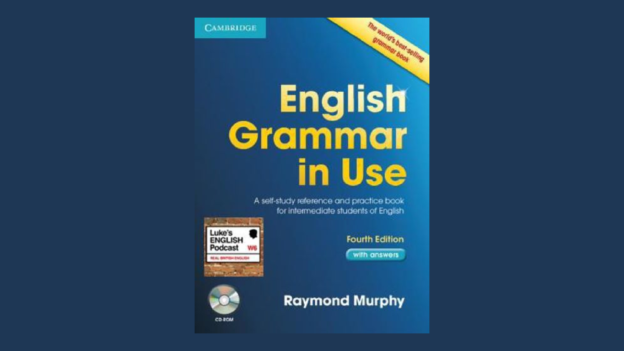
Luke: So, I’ve got here a book, which is called English Grammar In Use by Raymond Murphy and it’s the most popular grammar book for learners of English. It’s sold millions of copies all around the world, it’s a famous book, it’s known as ‘the blue book’, ‘the blue grammar book’
James: and you’re saying it’s basically useless
Luke: No, I’m not saying it’s useless! I’m just saying it’s interesting that most native speakers have got no idea what any of this stuff means. You talk about present continuous tense and third conditionals and things like that
James: Wouldn’t have a clue
Luke: You’ve got no idea, right. What I’m quite curious to do is, another thing is, that in English language classes teachers are always asking students to explain what things mean, right, so they always say things like “what is present perfect and how do we use it?” or “what’s the difference between these two sentences?”, right, and it’s interesting to see what a native speaker, someone who’s already able to speak English perfectly and functionally would answer those questions, because sometimes
James: You’re probably going to get them wrong
Luke: Well, you, it’s, the point is that, a lot of the exercises you do in class are, kind of, unrealistic, and unnatural so even if you were a native speaker you wouldn’t be able to do it, you know?
James: Yeah
Luke: So, like, if I said to you what’s the difference between, ‘I painted the house’ and ‘I have painted the house’? What’s the difference in meaning?
James: ‘I painted the house’ implies that you’ve just done it
Luke: You’ve just done it
James: and ‘I have painted the house’ could be any time
Luke: Ok. Couldn’t you say ‘I painted the house last year’?
James: Yeah, you could say that
Luke: Right, so ‘I painted the house’ could be any time
James: But you couldn’t say ‘I have painted the house last year’
Luke: Ah, right. Why not?
James: Because it’s too… it’s, it’s… I don’t know. There’s two levels to it. Once you say ‘I have painted the house’, you’ve already established the fact that you’ve painted it.
Luke: Right
James: Err, I don’t know! It just sounds wrong!
Luke: It just sounds wrong, yeah, that’s exactly it. The fact is, ‘I have painted the house’ means, you were right originally, you don’t know when it happened, it’s just that it happened in the past some time, and it’s connected to now, because you’re relating it to your whole experience of your life up to now, so there’s a connection to now, ‘I have done it’, like, I’ve got that experience. ‘I have painted the house’. You can’t say ‘I have painted the house yesterday’, because we just don’t use that tense
James: But you’ve already said, ‘I have painted the house’
Luke: Which implies that there’s no time, or that it’s an unfinished period of time.
James: Or just… it just doesn’t work, I don’t know why
Luke: But you can say, “I have painted the house today”, but you can’t say “I have painted the house yesterday”
James: ‘I have painted the house today’, would you say that?
Luke: At the end of the day, ‘so what have you done today?’, oh well…
James: You’d say ‘I painted the house’
Luke: Ok at the end of the day
James: Or ‘I’ve been painting the house’
Luke: But at lunchtime, “what have you done?”
James: Oh, I’ve painted the house
Luke: yeah, exactly
James: What have you been doing this morning? – I painted the house. I don’t know if you’d say ‘I’ve’
Luke: Well if it was finished you would
James: “well, I’ve come in, I’ve picked up the paint brush”
Luke: NO, that’s, that’s
James: I’ve run in, I’ve grabbed the ladder, I’ve put it up against the wall and I’ve painted the house.
Luke: That’s what native speakers say as an error. That’s what footballers do. They say things like, “Well, yeah, I’ve got the ball”… what they should say is “I got the ball outside the penalty box, right, I passed it to Wayne Rooney, he passed it back to me, I beat the defender and I shot and I scored. But what they’d say is “Well, I’ve got the ball outside the penalty box, and I’ve passed it to Wayne Rooney and he’s passed it back to me, and I’ve looked up, and I’ve seen the open goal, and I’ve shot and I’ve scored”, so all this weird present perfect, but it’s kind of wrong isn’t it.
James: Yeah
Luke: They’re actually speaking completely incorrectly
James: Because he’s kind of talking about the present and the past at the same time. “I’ve picked up the ball, passed it to Rooney. You know, I’ve collected the ball and passed it to Rooney”
Luke: So he’s talking about, it’s like, it happened just now, it’s like, in the moment
James: But he’s using “I’ve”
Luke: “I’ve” to, sort of, create that link to ‘now’ somehow
James: It’s like he’s running through it in his head.
Luke: It’s kind of like…
James: This isn’t going to be any use to anyone
Luke: It is. No, it is it is, it’s exactly
James: No-one’s going to listen to this
Luke: No, it’s not true, it’s not true. People will be interested to hear this
James: If you’re listening to this, I’m very sorry
Luke: No, people will be interested to hear about how a native speaker understands,
James: or doesn’t
Luke: or doesn’t understand grammar. Just let me ask you two more things and then we’ll call it a day. Right, er, another one is, what’s the difference between ‘for’ and ‘since’. That’s a question that students ask all the time. What’s the difference between ‘for’ and ‘since’?
James: In what context?
Luke: So, ‘I have done something for…’ and ‘I have done something since…’
James: for?
Luke: For, yeah, f-o-r. “i’ve been doing something for…”
James: 10 years
Luke: Yeah, I’ve been doing something for 10 years. I’ve been doing something since…
James: 1990… 2000
Luke: Yeah, since 2000, so what’s the difference between ‘for’ and ‘since’?
James: …erm… well you say ‘for’ when you’re about to describe the length of time that you have spent doing something. ‘Since’ sets the date that you started.
Luke: Yeah, exactly, yeah. Perfect. Yeah, you’re quite good.
James: That blew your theory out of the water
Luke: No no, it’s just interesting. I don’t have a theory. Right, here’s another one, ok. This is a classic one. What’s the difference between saying, okay this is conditionals. What’s the difference between saying “If I…” now you’ll get this because this is easy… “If I had bought a lottery ticket, I would have won the lottery” and “If I bought a lottery ticket, I would win the lottery” What’s the difference.
James: One’s talking about the past and one’s talking about the future.
Luke: Right, okay, yes, spot on. Nailed it. Yeah. Okay, I need to give you a really difficult one. Erm, hmm, I’ll go to the back of the book. Ok, prepositions, right? Let’s go for, what do you want? Let’s have adjective + preposition, which is, prepositions are the thing that learners have the most difficulty with, and they’re little words like ‘of’ ‘to’ ‘at’ ‘in’, stuff like that
James: Ok, go on, first question
Luke: So, you’ve just got to complete the sentence, erm, hmm,

LUKE: Erm, hmm, wait a minute. Right, wait a second

JAMES: I think you should edit this down.

LUKE: Yeah, okay, right, here we go. I’ll give you a sentence. You’ve got to put the prepositions in the right place, in the gap, okay?
I was delighted ….. the present you gave me. I was delighted … the present you gave me.

JAMES: ‘ with ‘

LUKE: Yes, well done. Brilliant.

JAMES: I don’t know why ? But…

LUKE: I’ve just had an idea whenever you get anything right, I’m gonna do this (ping!), okay? Right, so here’s the next one.

JAMES: This is bad.

LUKE: It was very nice … you, to do my shopping for me. Thank you very much.

JAMES: ‘ of ‘ but I don’t know why it’s ‘ of ‘. I couldn’t tell you the rules behind that. I just know that’s what it is.

LUKE: Why are you always so rude … your parents? Can’t you be nice … them.

JAMES: ‘ to ‘

LUKE: ‘ to ‘ yes, well done !

JAMES: Can you not do that? (referring to the BING)

LUKE: Okay, hmm, but why is it nice to, be nice to the parents?

JAMES: Well, because they brought you up and I dunno, bought you stuff at christmas

LUKE: No, I’m meaning, why do you use the word ‘to’? Nice, be nice to your parents.

JAMES: Because, you’re sort of, I don’t know.

LUKE: Yeah

JAMES: You’re giving some kind to them. You’re kind of, just doing something for their benefit, I suppose or something towards them. Something towards them. A big nice towards them. Now, it’s that
your parents, I couldn’t tell you.

LUKE: You’ve to look up, to look toward them.

JAMES: I couldn’t tell you.

LUKE: The fact is, it’s just impossible to create a rule about it. In fact, you’ve just got to learn that some words go with other words. Just got know it’s ‘ be nice to someone ‘ . You’ve just to learn ‘nice to’. So,
you have to see words existing together in little partnerships.

JAMES: Well, learn how they work together.

LUKE: Yeah, that’s it. It’s just learning two words together. Not just one on its own. So, that’s it. That’s the end of the experiment. Have you learnt anything from this, from this experience?

JAMES: No, no.

LUKE: No?

JAMES: Hm, I just hope that you get something out of this. You know making me look stupid basically.

LUKE: No, I think you got quite a few questions right. Didn’t you?

JAMES: Hhhh yeah,

LUKE: Okay, well, congratulations anyway. I’m gonna give you a certificate now which just shows that you’ve, two certificates, want to show that you completed the course.

JAMES: So, I’ll keep the certificate. Can I have this bit of chewing gum?

LUKE: Yeah, you can have the chewing gum.

JAMES: Sorry, thanks.

LUKE: Hmm, and the second certificate is just something I like to give to all the guests that I have on a program. It’s a little certificate just proving that you’d appeared on, on an episode of Luke’s English
Podcast. So thanks very much for coming and I hope to see you soon.

JAMES: Thanks very much. Luke’s English Podcast is brought to you by Wrigley chewing gum and Castllero del Diablo wine.

Okay folks, what I would now like to do is just explain some of the grammar points that I spoke to my brother about during that conversation. I asked him some questions about a few areas of grammar to see if he could answer them and I think you can see there that the point is, I guess, that native speakers surprisingly don’t understand or don’t really know the rules of grammar. They don’t know terms like ‘present perfect’ or even words like ‘adjectives’ or ‘nouns’. They don’t really know what those terms mean. So when you’re studying all that stuff at school, you’re in a way more articulate than they are, because you know how to describe the language and native speakers don’t know how to do that. That’s quite interesting but native speakers know, umm, what’s right and what’s wrong by instinct. They just sort of, they learn it as children without thinking about it and then when they get older they know that something is wrong but they don’t know why it’s wrong, they just know it’s wrong. It’s the same for you when you’re learning your language as a child.

Umm, what does that tell us about learning English? Well you could say, that it, some people might say it means that learners of English shouldn’t worry about learning the rules of grammar. That instead they should just try to listen to a lot of English, to read a lot of English and by doing that ,erm, see and hear the language so much that they just learn what’s right and wrong, just by frequency. So they know for example that people will say things, just because they have heard it said so many times before and they know what’s right and wrong just because they have heard and read the language a lot and they’ve started to learn, started to get a sense of all the patterns that you find in English.
Maybe that’s true, maybe that’s a good way to learn or maybe learners of English should study the rules or at least study the patterns and do practice exercises in order to understand what’s right and what’s wrong. I think it’s a combination of both. That you need to study the language , you need to test yourself with it , you need to do exercises but also you need to combine that with high exposure to lots of listening and lots of reading and so the more you see of the language , the more you start to develop a feel for it. Hum, that’s my opinion, um, but nevertheless, um, some of the things that I discussed with my brother there, I think I should just clarify for you, anyway.
Um, so the first thing I asked him was, what’s the difference between a noun, an adjective and a verb and he couldn’t really answer the question, but as you may know, a noun is a word which is used to give something a name. We use things like, you know, a table, a chair, a cat, those are all nouns. They can be plural or singular. Three cats for example.
They can be countable or uncountable. If they’re countable you can, you can count them. For example three, you know, tables. A table is a countable noun because you can say one, two or three tables but a word like sugar isn’t countable, instead we just say some sugar. So it’s like a mass of tiny little granules of sugar that together makes something uncountable. They can also be abstract, for example the names of things you can’t actually touch or feel. Umm, so concepts like ‘love’ is a noun. Umm, it’s also a verb but you could say ‘all you need is love’ and in that sentence it’s a noun. It’s an abstract one there and it’s uncountable. That’s nouns. Obviously there’re, nouns can be very complex, they can be larger, kind of phrases you could say like a noun phrase like for example, hum, let’s see, umm, like mobile phone technology is a kind of noun phrase and you can use that as the start of a sentence. Mobile phone technology is developing very quickly, right? So nouns can also be sometimes a number of words together.

Umm, right, the next one is a adjective. Well, an adjective is a word we use to describe a noun. Umm, it’s used to describe a noun, so we would say for example, the food was delicious, right? So delicious describes the food. How was the food ? It was delicious. You could also say delicious food. Like that, of course. Umm, so that’s an adjective.

Umm, and then the next one was a verb and the verb is the doing word. These are words we use to express sort of actions, um, so like play, eat, go, for example. Those are verbs, um, and we also have little verb phrases, which are things like phrasal verbs and that’s a verb in combination with other words and phrasal verbs are difficult because, well, somme of them are easy and some of them are difficult . The easy ones are easy to understand because the meaning is very similar to the original verb. So, if you’re talking about, um, oh, let’s see, hmm, ‘ go on’ , like ‘ go on’, meaning continue. I’s fairly clear what that means because go, we know what ‘ go’ means. ‘ Go on ‘ just means go and don’t stop going, continue. That’s fairly easy but some of them are difficult like if you take the expression ‘give up’. ‘ Give up ‘ umm, meaning to quit. Hum, that’s not quite so easy because the verb ‘ give’ you know, we think, well, ‘ give’ . Give someone a birthday present but in this sentence ‘give up’ has a completely different meaning to give which makes it very difficult and the fact is as learners of English you just have to learn phrasal verbs. You just have to try and learn them because they are all unique words with their own meanings, just a combination of a few words. So that’s, umm, that was the first thing I asked my brother. The next thing was about ‘present perfect’ and ‘past simple’.

So we know the ‘present perfect’. One of the, actually this is one of the most common bits of grammar that you study when you’re learning English. Present perfect of course is like ‘ have’ plus a past participle or ‘ has’ plus a past participle, like I have lived in Japan for example. Umm, she has eaten a pizza, right? And ‘past simple’ obviously everyone knows. I lived in Japan, she ate a pizza, for example. Umm, so the difference, well that’s quite a big one and it’s something that everyone is studying. So the difference between ‘past simple’ and ‘present perfect’ basically we use, we use ‘past simple’ to talk about a finished action in the past but the time period is important and we tend to, with ‘past simple’ express a kind of distance from the act. So there is a distance in time basically, which means that the action
happened in a finished time period. I lived, erm, well let’s say, umm, I ate, no, I drank a coffee. It’s pretty, probably suggests that you that you drank a coffee yesterday or you drank a coffee last week or you drank a coffee, umm, during breakfast, right? So it’s like in a finished time. ‘Present perfect’ is used to describe finished actions which happened in an unfinished time. So there’s a connection to now. That’s the most important thing. So, basically you might say for example, I have drunk three cups of coffee today. Umm, today is not finished, so you can say, I have drunk three cups of coffee today. Hum, so the time period is always connected to now. It’s a bit more complicated than that but that’s is all basic difference.
Hum, to be honest, if I was to explain ‘present perfect’ and ‘past simple’, I’d need to record a completely new podcast and I could do that. So, I might, I might do that.. ‘Past simple’ and ‘present perfect’.

The next one was about 2nd and 3rd conditionals. So we know the 2nd conditional would be for example, umm, let’s see. Err, if I bought a lottery ticket, I would win the lottery. Not a very good example because, it’s not definite that you’d win, so, if I?
Okay, let’s say, if I, if I went outside, I, no, no, no … Okay, if I studied hard, I would pass the exam. So, you’re talking about the future but you use past tense like studied, if I studied, now, we’re not talking about the past , we’re talking about the future. And we know, it’s the future because we’ve said’ if’ . So ‘ if ‘ plus a ‘past tense’ is actually used to describe a kind of unreal future. So you use the past tense not to create distance in time but to create distance in reality. In this sense it’s an unreal or hypothetical future because you don’t think it’s realistic. So, if I studied hard, I would pass the exam but I’m not going to study hard because I don’t want to, right? So compare that with the 1st conditional. If I study hard, I will pass the exam. Umm, ‘present tense’ after ‘ if ‘ , still talking about the future but here we think it’s a realistic future. So, there’s no distance from reality. We think it’s real and it’s followed by ‘ will ‘. Umm, if I study hard, I will pass the exam. So, that’s it, it’s like a definite future with its definite future consequence!

The 3rd conditional talks about the past and there we use ‘had’ plus a ‘past participle’ in the ‘if clause’, in the second clause we have ‘would have’ and a ‘past participle’. So, let’s say, the exam was last week and I failed, you could say, ‘ If I had studied for the exam, I would have passed, right? The fact is, I didn’t study and I didn’t pass but if I had studied, now here we’re using ‘ had studied’ and that’s like, it looks like past perfect, but it’s not actually past perfect, it just looks like it, but it’s used to create distance from reality in this sense, in the past. Umm, so we go from ‘past simple’ I didn’t study, we go one tense back to what looks like ‘past perfect ‘. ‘If I had studied’ and then in the second part ‘I would have passed ‘. Again to refer to a past consequence.

It’s all very complicated and to be honest rather boring but you kind of have to learn it. Again, I could do a completely separate podcast all about conditionals because it’s such a big topic.

The last thing I talked about with my brother was ‘prepositions’ and if you’re learning English you’ll know about prepositions. They’re very, very difficult. They are the little words that we use to connect nouns and verbs and adjectives together and you find the prepositions are linked to other words and there isn’t really a decent set of rules to explain these links. The fact is, you just have to learn them. You just have to learn that we say ‘to be nice to someone’ right? ‘Nice to’ those words go together. You’ve just to learn that you have to remember it and there’re lots of combinations of verbs and prepositions, nouns and propositions and adjectives and prepositions and there are so many lists, really that, it’s just a case of noticing them and then try to remember them. Umm, what you should do, is realize that prepositions are linked to other words and then see these word combinations as separate units of meaning that you should learn. So, you don’t just learn the word for example ‘consist’ but you learn the expression ‘consist of’ right? Okay, so a hamburger , a Big Mac consists of bread, salad, beef and cheese for example. Umm, so, ‘consists of’. Those words always go together.

Umm, so that’s basically it. Those are the things I’d discussed with my brother. I expect, if you’re a learner of English, you understood the rules of grammar a little bit better than my brother did. Umm, in which case you should feel quite good about yourself. Um, remember you’re, you’re learning the grammar of the English language and you’re learning the grammar actually better than most native speakers. So, well done you.
Umm that’s the end of this podcast, I hope you found it interesting. That’s all for me . Bye, bye, bye, bye, bye…

Enjoy.

49. Stand Up Comedy (with Claudia)

Guest presenter Claudia Edwards interviews Luke about Stand Up Comedy. Vocabulary notes are included below.

Small Donate ButtonRight-click here to download.

Luke’s English Podcast is a free service for learners of English. In a recent made up survey, a group of over 1000 international students were asked what was the best way to learn English. 99% of the students said that Luke’s English Podcast was the best way to learn English. 1% of the students did not understand the question.

London is said to be the comedy capital of the world. There are more comedians here than in any other city. Comedy is a BIG part of our culture here. Going to a stand up comedy show is a very normal way to spend an evening. There are many famous and successful stand up comedians in the UK as well as the USA. But what is stand up?

I’ve recently started doing stand up comedy myself, so in this podcast I was interviewed by my friend & colleague Claudia Edwards. I’m sure you’ll agree, it is very nice to listen to a female voice presenting the podcast for a change. Enjoy!

Here are the questions asked by Claudia, and some of the vocabulary I used in my answers:

Claudia’s Interview Questions + Vocabulary
Can you tell me what exactly is stand up?

stand up comedy = a kind of comedy performance which involves a comedian standing up in front of an audience with a microphone, in order to make people laugh
sit coms = situation comedies – these are TV shows which usually feature a few characters in a familiar situation. The events and the conversation are funny. E.g. Friends

What makes it unique as a kind of performance?
a script = all the words for a play, or a movie which the actors have to learn
dying on stage = being unsuccessful on stage – doing your performance, but failing because nobody is laughing

What are the good things and the bad things about it?
you can’t blame anyone else
to blame someone = to say that someone was responsible for something bad. e.g. “it’s the director’s fault”
time consuming = it takes up (uses) a lot of time
you’re putting yourself on the line
to put yourself on the line = to put yourself in a position in which you might fail

What’s it like? How do you feel?
the palm of your hand = the middle part of your hand (with the lines on it)
you’ve got the audience in the palm of your hand = the audience are completely under your control
it’s paid off = the work you have done is resulting in success
beforehand = before

Have you ever had a mind blank?
a mind blank = when your mind goes blank, and you can’t think of anything

How long have you been doing it?

What exactly do you do, just tell jokes?
the navigational systems of the plane = the computer which helps the plane to go in the correct direction
you wouldn’t be able to take them on as hand luggage

What do you think makes a stand up comic good?

Do any other countries do stand up, or is it just the UK?
they will often pick on the audience
to pick on someone = to make fun of / tease someone (sometimes in a nasty way – like a bully at school)
alternative comedy = subversive, critical comedy
subversive = critical, radical, revolutionary, against the government or the ‘way things are now’

How long have people been doing stand up in the UK, do you know?

If people listening want to see some stand up, what should they do?

Some vocabulary from Luke’s stand up set:
bollocks = a rude British English swear word which is like the American word ‘bullshit’. It actually means ‘testicles’.
shuffle all songs = a function on the ipod which plays all your songs in random order

Some of my favourite comedy clips:

Richard Pryor – When kids lie
Richard Pryor is definitely one of the best stand up comedians ever. Unfortunately he is dead now, but his comedy is still with us. He was one of the people who invented the kind of stand up comedy which everybody does now. In this clip Pryor talks about how children behave when they lie about breaking something.

Steve Martin – Sex Jokes
I absolutely love Steve Martin, but a lot of people don’t ‘get’ it (they don’t understand why he’s funny). Unfortunately there aren’t many good clips of him doing stand up on YouTube, but this one is quite good. Steve’s comedy is not obvious. It’s subtle. He used his voice and his body a lot, and just little physical movements or changes in the way he spoke were hilarious. This clip is a bit old fashioned, but I believe Steve Martin is still one of the best stand up comedians we’ve had.

Michael McIntyre – Live at The Apollo
McIntyre is probably the biggest stand up comedian in the UK at the moment. He is extremely popular. His comedy is accessible (he talks about things which everybody can relate to), he uses a lot of physical humour and different voices, and he is very energetic on stage.
In this clip, he talks about how English people always want to know exactly where you live when you introduce yourself. “Hi, I’m from London” – “Whereabouts whereabouts!”
He speaks very quickly.
[youtube http://www.youtube.com/watch?v=Es2l4yUBY6M&hl=en_US&fs=1&]

Eddie Izzard – Computers
One of the top comedians in the world. Yep. He has a unique, surreal style, but he talks about every day things like the problems we experience with computers.

Flight of the Conchords – Business Time
These guys are a musical comedy duo from New Zealand. They sing comedy songs. This one is about ‘making love’! Oh yeah, it’s business time! In the song, Jemane sings to his girlfriend about making love on a Wednesday evening. Listen carefully to the lyrics and you’ll understand that Jemane is not a very good lover!

Here’s a clip of some Japanese comedy. It comes from a BBC TV show called “Adam and Joe Go Tokyo” in which British comedians Adam and Joe go to Tokyo to learn about Japanese culture. It was broadcast about 6 years ago.
[youtube http://www.youtube.com/watch?v=Nf7V-Fuqtak&hl=en_US&fs=1&]

There are many many more comedians and videos that I love, but I can’t recommend them all. To be honest, I think that it is very difficult to understand the humour if you don’t understand the English perfectly. This is why I think comedy is one of the best ways of improving your English. Think of it like this:
1. Watch some comedy that you don’t understand
2. Realise that other people are laughing, so it must be funny
3. Think: What am I missing?
4. Watch again and try really hard to understand what is so funny about it. Is it the specific words? Is it the subject? Is it something specific to the culture that you don’t understand?
5. If you can understand comedy in English – you are making a lot of progress!!

I totally believe in comedy as one of the best things in life – and of course I think comedy in English is wonderful, and there is SO MUCH of it. Don’t miss out on English language comedy. GET INTO IT TODAY!

47. Travelling in Vietnam

EnglishRobot3000 interviews me about my holiday in Vietnam.

Small Donate ButtonRight-click here to download this episode.

I recently bought an English speaking robot from Japan. His name is English Robot 3000, and he’s very nice. In this podcast, English Robot 3000 asks me questions about my holiday in Vietnam and I talk about what I did, where I went and how it felt.

The next podcast will contain lots of really useful language for meeting people when you are travelling.

Hope you enjoy the episode, and happy new year!

Photos
Here’s a slide show of my Vietnam holiday snaps

Here’s a picture of EnglishRobot3000
EnglishRobot

Get the PDF transcript here 👇

45. Luke & Andy’s Crime Stories (with Andy Johnson)

A conversation with my friend Andy. We share some anecdotes. By coincidence, they’re also about petty crime. Some samples of vocabulary and expressions are listed below. I give definitions in the podcast – so listen to check the meaning.

Right-click here to download this episode.
This is a completely natural and authentic conversation. None of it was planned, so it is completely real and not fake.
This is really good listening practice for you. Listen to two native speakers talking naturally with each other. If you can understand the conversation, then you’re at the same level as a native speaker. You’ll understand the little comments and jokes that we make with each other. I recommend listening to the podcast a few times until you completely understand the conversation, and start remembering bits of vocabulary that we said. Also: Enjoy yourself!

Some vocabulary and expressions from our conversation:

The night Andy Got Arrested:
They know them by heart
For some reason we thought it might be funny to start throwing snowballs at the police station
He didn’t have a helmet, he had one of those little hats and it knocked his hat off
We started laughing hysterically
They put us in the cells for the night – “blimey”
We weren’t charged with anything, we were given, like, a verbal caution
I was very contrite and quiet and very apologetic
My friend Gareth, he got really indignant and really angry
Because he was mouthing off he didn’t get anything
They released us with a slap on the wrist and told us not to do it again
‘Snow crime officer!” – “Snow joke Luke!”

The Time Luke Got Caught by The Police for Skateboarding:
I consider myself to be a law abiding citizen, with a few minor indiscretions under my belt, but generally, you know, quite an honest, law abiding person
When I was twelve, I did have a run in with the police
I wasn’t a naughty child
My brother and I were both very into skateboarding at the time
An indoor shopping precinct
I felt quite awkward most of the time
Anyway right, cut a long story short…
Suddenly a police riot van turned up
This is like, a big van, with like, protection, you know, like a sort of, armoured van pulled up, and the doors swung open and just loads of police all just piled out of this van, and just, sort of, it was like an organised attack
A pincer movement
I decided to make a run for it too, kind of half heartedly
I just, sort of, casually ran towards the stairs, and the next thing I know; big hand on my shoulder, a big hairy policeman’s hand grabbed my shoulder
You’re nicked! Come here!
I looked up at him with these tears in my eyes, and with my lip trembling…
I wasn’t even capable of thinking straight
I was just really deeply traumatised
I went into a sort of state of shock
Next thing I know, policeman’s hand on my shoulder
The policeman looked at me, and felt pity and said “alright sonny, I’ll let you go”
He was a very friendly, kind of, jolly kind of policeman
Did they cuff you? They didn’t cuff us, no.
I think it’s terrible the way you’ve treated these children!
How dare you be so angry and aggressive!
Your Dad went ‘buck wild on their asses’!
My Dad just didn’t hold back
In the end I felt vindicated because my Father protected me, stood up for me against the, frankly brutal West Midlands Police.
Oppressive police reigime
I’ve always thought that you had potential criminal tendencies

Andy’s “I was wrongly accused of theft as a child!” Anecdote:
I’ve got a twin brother. “What, identical twin?” No, non identical. He’s the good looking one.
We were in this shop and we were looking at erasers, rubbers.
Apparently I just reached into my pocket and took the rubber out
We went home and he told my Mum.
Just, sort of, grassed you up to your parents.
I think I bought it. I must have bought it. I don’t think I deliberately stole it.
If I did steal it, it wasn’t intentional.
It was, kind of like, the manslaughter of theft.
Unintentional theft. There may have been mitigating circumstances.
Yeah, like it didn’t happen! That’s the mitigating circumstance.
You legitimately purchased it!
My brother was laughing in the background, smiling away.
We will be conducting a full investigation into the theft of the eraser.
They’re going to bring you in as well. You’re going to be an accessory.
I’ll just grass you up. I’ll do a deal with the Police.
You’re going to be a supergrass!
You’ll frame me.

Luke’s “Law breaking in Canada” photo album:
You might be wanted by interpol.
Maybe the mounties. The mounties always get their man!
They’re going to chase after me and get me. They might even make a sort of light hearted drama about it. Like, ‘a Canadian mountie travels to London in order to track down an infamous criminal’.
A fish out of water – riding around Regent Street on his big horse.
We decided we would take photos of ourselves breaking all of these by-laws.
That probably counted as a crime wave. It probably had the mounties baffled during the summer of ’97.
If I went back to Canada, they wouldn’t let me in. They’d bang me up.
Is that why you’ve been growing your hair, so they won’t recognise you?
Let’s stick the Queen’s speech on, shall we?
Everyone will be sat there with a glass of sherry.
“On a slightly sadder note. On one of my recent perusals of Luke’s English Podcast, it has been drawn to my attention, that there is a criminal on the loose in England! His name is Andy Johnson! And we must lock him up! Immediately!
People are going to leave their houses with bats, and they’ll be like an angry mob knocking on my Father’s door.
There’ll be, like, burning torches, pitch forks.
You can commit as many crimes as you like, and they don’t even bat an eyelid.
They’re very tolerant. They’re very liberal.
I think my crimes pale into (in)significance compared to what you did.
If you can get away with it, I’m going to get away with it.
People used to get hung, drawn and quartered for that in the middle ages.
Maybe he was aiming for the face, which for me is an aggravating circumstance.
Festive snowball attack.

32. Doctor Who (with Lee Arnott)

This episode is all about Doctor Who. There are some announcements at the beginning of the episode, then an interview with an expert on Dr Who.

The interview begins at approximately 10.00 minutes into the episode.

Small Donate ButtonRight-click here to download this episode.

Transcript available below. Luke’s English Podcast is a free service for people who are learning English as a foreign language. Luke is a well qualified teacher of English with over 12 years’ experience in Japan, the UK and France. He speaks British English, and teaches at a language school in London, and now at a university in Paris. You can use this podcast to get exposure to native speakers using natural English. Learn phrasal verbs, idioms, useful expressions, linkers, etc. Find Luke on Facebook (search for Luke’s English Podcast) or Twitter (@EnglishPodcast). Cheers!

Some good advice for iPhone users (courtesy of a helpful listener from Russia, called Nikita Kolganov): Copy and paste the tapescript from a podcast into the ‘lyrics’ section of each podcast on your iPhone. To do this, first copy the text from this webpage. Then go into iTunes and ‘right click’ the podcast episode there. Then choose ‘Get Info’, then select ‘Lyrics’. You can add the transcript into the text box there, and then read while you listen to the podcast. Thanks Nick!

Here’s the tapescript for the interview with Lee, about Dr Who:

Luke: Right, if you imagine somebody who’s never heard of Dr Who before, right, how can you explain who he really is. So, so, if, what are the most important things that you should know about Dr Who if you’ve never heard of him before, basically.

Lee: Well, Dr Who is, err, a TV show that it’s main character, a character called The Doctor, who is in fact an alien, has a machine that can travel through time and space, which means that he is able to go anywhere in any planet, any point in the future, the past, whenever.

Luke: Erm, what’s the name of that machine?

Lee: It’s called The Tardis.

Luke : And can you just describe The Tardis? That’s like his spaceship, yeah? Can you describe The Tardis for us? Because in Britain here, everybody knows The Tardis, like, almost everybody knows it. It’s very familiar to us. It’s almost like an icon of British culture. But what is The Tardis? What does it look like?

Lee: Well, The Tardis looks like a 1960s police box, and in the days before mobile telephones and actually people having telephones in their houses, these blue police boxes were like an old phone box, and they also had a double function in that if a criminal caught a policeman [if a policeman caught a criminal] they would be locked up inside this police box, and they also had a phone, so they were a very common object in 1960s Britain, early 1960s Britain when Dr Who started.

Luke: So, it looks a bit like a red telephone box, but it’s blue, and it’s something the police use to make telephone calls. And they could use it to keep criminals in. They could lock a criminal in there if they needed to.

Lee: Exactly. It was a very everyday object which everybody would have known.

Luke: Ok, so everybody knows about what a police box is so…

Lee: But of course it’s not really just a police box because it’s actually bigger on the inside than on the outside.

Luke: Ok, so Dr Who’s spaceship is in the shape of a police box. It’s called The Tardis but it’s actually bigger on the inside than it is on the outside. Ok, right, fine. Um, actually, people these days often use the word Tardis to mean something that’s bigger on the inside than on the outside. Can you give me an example of how we might use the word Tardis to mean something else?

Lee: Well actually there’s quite a famous example when Tony Blair was Prime Minister, in one of the last interviews he did before he left the post, I think it was with The Guardian, the interviewer asked him what was 10 Downing Street like…

Luke: That’s the Prime Minister’s house.

Lee: And he said, oh it’s like The Tardis, and he didn’t need to say anything else but everybody would know that he means it looks smaller on the outside but it’s much bigger on the inside.

Luke: Right, ok. I’ve heard people say that, like, a woman’s handbag is like The Tardis, sometimes, because it looks like a small handbag, but you can actually keep lots and lots of things inside it…

Lee: And such is the power of the programme that even if you’ve never seen Dr Who in this country, you will know if somebody says “It’s like a Tardis”, you will know that it’s bigger on the inside than the outside.

Luke: Right, ok, so that’s what Tardis means to everybody now. OK, what are the other important things that we need to know about Dr Who?

Lee: Erm, well, we need to know the fact that the programme started in 1963, and that means that you get a very good representation of how British society evolved in a kind of televisual way. A record of the times, our changing attitudes to race, to women’s lib, to even things like joining of the common market in the early 70s…

Luke: What do you mean by women’s lib?

Lee: Well The Doctor, traditionally is always accompanied by a female companion, and this was specifically because the programme’s original remit was to entertain a family audience on Saturday afternoon.

Luke: It’s a family show

Lee: Yeah, it’s very much a family show. One that was designed to catch the fathers who’d been watching an afternoon of sport on a saturday, with family who watched, like a pop music programme… it was designed to keep everybody watching, and of course it was hugely successful when it started so it achieved its aim.

Luke: Ok. So, ok, so basically err, he always has a female companion. I think that Dr Who has also had, like, a robot companion as well, right?

Lee: He has, he has, and err, he had a robot companion in the late 70s but he actually… people have thought that it was because Star Wars came out, and C3PO and R2-D2 but actually Dr Who was a year before Star Wars, so…

Luke: Really? So before… everybody knows about Star Wars, they know about R2-D2 and C3P0, but Dr Who before Star Wars had K9. K9 was like a robot dog! (laughs)

Lee: Of course the most important thing to remember is that when the show first started in 1963, the guy who was playing The Doctor was a very old guy, and after 3 years playing the role, it became very obvious that he was ill and he couldn’t do it, and they were like “what are we going to do?”. So, they devised… because we didn’t know who this character was, or where he came from, in 1966 they changed the actor, but made it a part of his personality, and that allows… has allowed the programme to continue to this day nearly 50 years later.

Luke: OK, so this is another important thing about Dr Who, is that you have to know that… How many actors have played him now, actually?

Lee: Erm, well we’re now on number 10 and number 11 starts filming next month.

Luke: OK, erm, the interesting thing about Dr Who is that when Dr Who dies, he doesn’t die. He doesn’t die, instead he changes into a new form, so he becomes a new person, but it’s still Dr Who but he becomes a new person, and it’s like a really important event when Dr Who. It’s… to be honest it’s a way for them to change the actor, right? But in the show, Dr Who… one Dr Who dies and he changes into a new Dr Who, and it’s always like a really big event for the show, right? Erm, so it’s really just a way for them to continue the show. It’s a bit like James Bond in that sense.

Lee: Hmm, but I think it’s more believable than James Bond because its not supposed to be exactly the same character. So each Doctor, well each actor has been allowed to have his own, his own way of playing the part.

Luke: So, his own personality. So every time it’s like a new, different kind of Doctor with a different personality.

Lee: Even though it’s the same, we know it’s the same character behind it, but it’s like a new person to get used to and that keeps the show fresh and it’s kept it going all this time.

Luke: OK, so there have been 10 Doctors, and the 11th Doctor is coming very soon. Who do you think is the nation’s favourite Dr Who so far?

Lee: Well, for many years, everybody would have said immediately, Tom Baker, an actor who played the part from 1974 to 1981.

Luke: Tom Baker actually, err, the Tom Baker Dr Who is probably the most famous one until the most recent one. And he’s famous for having a long scarf, and he was in The Simpsons. He was in the American comedy show The Simpsons.

Lee: He was also in Family Guy …

Luke: He’s in Family Guy as well

Lee: Until Dr Who, because Dr Who was off the air, it stopped being made in 1989 until 2005 when it came back. And until 2005, everybody would have said Tom Baker was the Doctor, but as you’ve said in 2006 the current Doctor David Tenant has taken the programme to new heights of success that it never ever had in it’s original format.

Luke: So Dr Who, even before, erm, the latest Doctor, Dr Who was really really big and really successful, but it’s become even more successful with this new Doctor played by David Tenant, who’s like a great actor, Shakespearian actor

Lee; Yeah, he’s just done Hamlet, and they’re going to be filming Hamlet for television

Luke: It’s a great thing. Because David Tenant is so popular as Dr Who, now he’s playing Hamlet, it’s going to be shown on TV, millions of people in the UK are going to watch Hamlet, which is written by Shakespeare, so it’s a really good way of

Lee: And that kind of fits in with the original, the kind of format of Dr Who in that, because he’s able to go back in the past and meet people like Shakespeare and Agatha Christie, it inspires people to go out and learn more about… you know… the original brief of the show was that it had to go to the future and then the past. So not only would it educate the viewers in a very 1960s BBC way, but it would also entertain, and it would inspire people to go and learn about things

Luke: That’s what the BBC was all about. It was to educate, to entertain and to inform, right? Ok, actually I think I need to clarify just a little bit more about Dr Who just to make sure everybody understands who he is. Dr Who is a Timelord, and that means he’s a kind of alien. He’s not a human, he’s from another planet, but he came to Earth because he, he loves humans, right?

Lee: Yeah, but he doesn’t live on earth, he’s always… just Earth happens to be convenient because that’s where they can film on the cheap

Luke: So, he doesn’t live on earth, but he comes to earth quite a lot

Lee: but he can go anywhere, in time or space. But we have to remember that The Doctor, ok he’s the main character, but what really really made the programme successful and which we cannot not talk about are The Daleks.

Luke: Right, ok, so we’ve talked about, err, Dr Who’s spaceship, his companions, err K9, but another very important thing is to know the enemies that Dr Who has, and you just mentioned The Daleks, right? So who are Dr Who’s enemies? There’s probably, like, three maybe four most popular, most famous enemies

Lee: Well, The Daleks are, if you, again it’s like the word Tardis, if you say to somebody who’s never seen Dr Who in their life, they’ll know, if you say Dalek, they will know what you mean and may even do an impression of one by talking like this

Luke: Exterminate! Exterminate!

Lee: Exactly! Exterminate. So, I mean, Dr Who’s first story in 1963 was a bit of a dull… and it was set in caveman times. It’s very much introducing the characters. It was four weeks later, the introduction of these things called The Daleks, which just literally took the public imagination by storm. You can’t work out why. If you see them they look like a pepper-pot walking around. Maybe it’s the voice. There’s been lots of theories of why people just, why they’re so important to people, but whether they’re reseblent [reminiscent] of Nazis, because you remember the war had finished just 20 years before, you know. There’s just something about a Dalek, and again it’s just a proper cultural icon. So much so that in 1996 there was a survey to find out icons of British culture the public wanted put on stamps, and the first class stamp was The Dalek.

Luke: So there was a survey, and the British public voted The Dalek as the number 1 icon to put on a stamp! That’s even before the Queen, so they didn’t want the Queen’s head, they wanted a Dalek on there. So, just again to clarify a Dalek is like a robot…

Lee: It’s a robot but it’s got a creature inside it controlling it that hates anything … (laughter) …if you see them, it’s like “What is it?”, but there’s something about them. It’s a creature inside that controls them, and this creature wants to kill anything that is not like yourself [itself]. Now, I have to stress, the programme, although it sounds violent again is for a family audience, so y’know, the kids were watching, with their parents and although they were scary, it was a safe kind of fear because you could hide in Mum and Dad’s arms, you know, or hide behind the sofa, which is very much again the tradition of the…

Luke: These are other important things about Dr Who, is that it’s a family show, so so, erm, most people in the UK grew up as children watching Dr Who on a Saturday night. I watched it with my family…

Lee: I watched it with my Mum, my Mum watched it with her Mum, you know…

Luke: Everybody knows it, it’s like something really important about British culture. Erm, one of the things that everybody says about Dr Who is that because it’s quite scary, erm, you end up watching it from behind the sofa. So you can’t just sit in front of the TV and watch it. You have to hide behind the sofa, and sort of like, y’know, look over the top of the sofa to watch it because it’s so scary.

Lee: Now, you see, you’re lucky because when I was a child, our sofa was pushed against the wall. So I had to hide behind a cushion.

Luke: So you couldn’t hide behind the sofa.

Lee: Which is very very scary…

Luke: But that’s another expression, it’s another bit of erm, vocabulary that everybody knows now ‘to hide behind the sofa’, because of Dr Who. OK, so we’ve talked about The Daleks… now another thing about Dr Who is that it’s kind of funny, isn’t it?

Lee: Mmmm, it’s got a very British dry sense of humour, and partly because the programme has never had much money spent on it, so… rather than have lots of special effects you have to have a very good script that’s sharp, that’s funny. The Doctor is a character who never carries a weapon. He uses words, he uses his brains, he uses his intellect to get out of situations, so… and it has an, it it has a kind of humour that’s very British, but also, as you say very funny, you know, so…

Luke: I…

Lee: It doesn’t take itself too seriously

Luke: It’s not a serious show. It’s very much a kind of camp, funny kind of show. And also, one of the…

Lee: …and scary and exciting

Luke: That’s right, it manages to mix, like, comedy and erm, like, satire and fashion or something, and serious science fiction as well. It’s just great. Erm, what was I going to say? Oh yeah, err, one of the funny things about Dr Who is, like, the special effects.

Lee: Mmm, they were. In the old series, which as I said started in 1963, ended in 1989… famously, Dr Who never had any money, which means that there was no money for special effects, but you have to remember, the news series is different. It’s got amazing spe… award winning special effects. But you have to remember that the BBC as an institution in the 1960s and the 1970s was at the cutting edge, was at the front of this new technology, and all the stuff you see with green screen now is because of the stuff the BBC were doing with Dr Who in 1969 when colour television had just been invented, and you see that early experiments in yellow screen it was then, but you know this is why we have these special effects now.

Luke: So Dr Who innovated a lot of special effects.

Lee: Exactly. People like Ridley Scott was one of the designers…

Luke: Ridley Scott is now a famous director who’s directed films like Gladiator, but, and Ridley Scott worked on Doctor Who in the 60s. But I remember when I was younger when I watched Doctor Who on TV in the 80s, the special effects were quite funny because usually the monster was, a kind of man in a suit. It was basically a man in a suit. You know? In a bit… in a similar way to, in Japan, the way Godzilla was so popular. Godzilla when you watch the original movie, it’s obviously a man in a rubber suit.

Lee: Well I think the thing about 80s Doctor Who is, it’s very 80s. You know, 70s Doctor Who, 60s Doctor Who is, and to a certain extent it’s all very scary but there’s something about 80s Doctor Who which just looks over lit, the colours are really garish, and it’s just very 80s. Very much a product of its time. And maybe in a way that 60s and 70s Doctor Who was very much ahead of its time.

Luke: Ok, so Now though, Dr Who is very popular, more popular than it was before.

Lee: More popular than it’s ever been before. It’s the top rated drama on the BBC, it gets the highest ratings for a drama. The audience appreciation figures, which are a rating of how much the audience actually enjoys it are always in the lower 90% which for a drama which is very popular which is unheard of, umm. It’s always in the press because remember the newspapers have a 50 year history to draw back on and public interest in Dr Who at the moment has never ever been higher and now with David Tenant, the most, arguably the most popular Doctor ever, about to change at Christmas and New Year, then the future once again looks…

Luke: Great. So basically, umm, the important thing about Dr Who, if you’re a learner of English right, is it important to know about Dr Who? Why is it important for learners of English to know about something like Dr Who?

Lee: I wouldn’t say it was important but I would say it offers a very good insight into British culture, the British view of things, the British sense of humour, and also it’s just a great way to pass 50 minutes just lapping up British culture.

Luke: It’s just a great show, it’s very fun, very entertaining.

Lee: It’s very easy to watch. You don’t have to know everything about it. Each week there’s somewhere new, you know, so

Luke: It’s one of those things I guess, that … if a learner of English listens to two English people, often they don’t understand it because often the English people will talk about things that the learner of English doesn’t understand, and one of those things might be Dr Who. It’s kind of something that everybody knows about, something that people talk about quite a lot. For example, like, mentioning the Tardis or The Daleks

Lee: I think there was a great interview with, erm, when the Queen’s golden jubilee about 5 years ago, 6 years ??. there’s an interview with Prince Andrew and he said he had really happy memories of watching Dr Who with his Mum and Dad in the early 70s.

Luke: So even the royal family watch Dr Who

Lee: David Beckham gets the box sets for Christmas, delivered to his house. Everybody watches it.

Luke: OK, so there you go. Everybody is a fan of Dr Who. Is it possible to watch Dr Who in other countries?

Lee: Yes, it’s the BBC’s biggest export in terms of where it’s sold to, and it’s currently available in 42 different countries, you know. It has a regular audience of 165,000,000 viewers, so… everywhere from Saudi Arabia… it’s the number 1 export show in South Korea, so…

Luke: Really? So, a lot of South Korean people…

Lee: It even beats CSI

Luke: Even more popular than CSI? …in South Korea. So if you’re from South Korea and you’re listening to this, then send me a message if you’ve seen Dr Who, tell me what you think of it. Now, I think that they did show Dr Who in Japan, but I heard that nobody understood it at all. They didn’t get it, and erm, I think…

Lee: But they did, to be fair, they did show this back in the 1980s when they showed the last 3 years of the show and, quite frankly, unless you were a fan of Dr Who it probably would have been the weirdest thing that definitely may even have got a cult audience, but not a…

Luke: I think the late 80s Dr Who was probably the worst Dr Who. It’s terrible, right?

Lee: That’s a bone of argument I have to say

Luke: For me, after Peter Davidson, it wasn’t very interesting. I didn’t like it myself. I stopped watching it at that point.

Lee: Anyway, shall we end on a positive note?

Luke: Yeah. Umm, ahh, just a thing about in Japan. They even changed the name of Dr Who, they put it into katakana, that’s Japanese characters. And in Japan everybody knows Dr Who as Do-ku-ta-fhooo. Dokuta-fhuuu, which is kind of funny. Ok, so, right, are you looking forward to the new Doctor?

Lee: Yes, again, you know, the, having been a fan of Dr Who since I was 5 years old, errm… I’m still very young… ermm, I errr,… I love it when he changes. It’s so exciting, you never know what’s going to happen

Luke: Do you think this new guy is going to be a good Doctor?

Lee: I’m sure… because, they guy who’s now in charge of the show is one of the best writers of the last couple of years, so I’m sure it’s in very safe hands, and you know, I think it’s going to be great.

Luke: OK, great, so, erm… If you’re interested in Dr Who you can buy the box set, the DVDs on Amazon. You could probably watch some Dr Who clips on YouTube

Lee: Yeah, for real…

Luke: Erm, if you’re interested, you can watch it. But otherwise, just umm, errr I don’t know what I’m going to say now! I hope you enjoyed that conversation anyway. Thank you very much Lee.

Lee: Bye, thank you

Luke: Oh oh, one more thing. Why do you know so much about Dr Who?
Lee: As I said, because I’ve loved it since I was 5 years old, and erm, for me it’s just, I don’t know, I have a really strong emotional attachment to Dr Who, you know, he was always there… because he was such a constant character in my childhood and even in my adulthood.
Luke: You’re also an expert, aren’t you, on Dr Who
Lee: Yeah, but I have my limits… My house is not full of toy daleks of every description
Luke: Just a few… because you’re not a total geek or anything
Lee: No, I’m not. I haven’t got Dalek pajamas or… which are available!
Luke: If you’re wondering what to buy Lee for his birthday or Christmas
Lee: Dalek underpants or pajamas please
Luke: Dalek underpants or pajamas. I think they’re available on the internet
Lee: Marks and Spencer!
Luke: or Marks and Spencer, do they do them? Right, well I think on that note, err, I’ll end the conversation. Thanks very much Lee.
Lee: Thank you very much
Luke: OK

An interview with Matt Smith, the 11th Doctor:

[youtube=http://www.youtube.com/watch?v=Zog-6SrGxE0&hl=en_US&fs=1&color1=0x234900&color2=0x4e9e00]

Language Analysis

The following language analysis was written by Richard Gallen, a fellow teacher at The London School of English. Richard has written analysis of part of the interview between me and Lee. Use this in order to get a detailed understanding of some of the useful language used in the interview. If you a teacher, you may be interested in using this language analysis as a way of adapting the podcast for teaching in the classroom. Thanks to Richard Gallen.

Lee and Luke explain Doctor Who – language for explaining and describing

Luke: Right, if you imagine somebody who’s never heard of Dr Who before, right, how can you explain who he really is. So, so, if, what are the most important things that you should know about Dr Who if you’ve never heard of him before, basically.

Lee: Well, Dr Who is, err, a TV show that it’s main character, a character called The Doctor, who is in fact an alien, has a machine that can travel through time and space, which means that he is able to go anywhere in any planet, any point in the future, the past, whenever.

Luke: Erm, what’s the name of that machine?

Lee: It’s called The Tardis.

Luke : And can you just describe The Tardis? That’s like his spaceship, yeah? Can you describe The Tardis for us? Because in Britain here, everybody knows The Tardis, like, almost everybody knows it. It’s very familiar to us. It’s almost like an icon of British culture. But what is The Tardis? What does it look like?

Lee: Well, The Tardis looks like a 1960s police box, and in the days before mobile telephones and actually people having telephones in their houses, these blue police boxes were like an old phone box, and they also had a double function in that if a criminal caught a policeman [if a policeman caught a criminal] they would be locked up inside this police box, and they also had a phone, so they were a very common object in 1960s Britain, early 1960s Britain when Dr Who started.

Extra information clauses

Describing a film or book can be a little difficult. It’s quite hard to keep people interested. That’s why when we introduce a character we sometimes say something interesting or exciting about them

a character called The Doctor, who is in fact an alien

..then there’s Princess Leia who is fact Luke’s sister

In 1988 she met this man called Greenlee, who was in fact the top CIA agent in Bolivia at the time.

In the examples above ‘who’ refers to the noun before it (The Doctor/Princess Leia/ this man called Greenlee). In the example below ‘which means that’ doen’t only refer to the noun before, it refers to the whole clause before:

It’s a machine that can travel through time and space, which means that he is able to go anywhere in any planet, any point in the future, the past, whenever

The most common verb after ‘which’ in extra information clauses is ‘means’ .It often says something about the result of an event

I slept through my alarm clock which meant that I had to run like crazy for the train

Gilardino scored a goal very late in the match which meant that Italy qualified for the 2010 World Cup in South Africa.

In that..

When Lee was describing police boxes in England he said:

they had a double function in that if a policeman caught a criminal they would be locked up inside this police box

we use ‘in that’ when we think we could be more precise about something we’ve just said :  ‘in that’+example

He was quite reserved in many ways but he was also very sociable in that he liked entertaining,

It’s already old news (in that it was announced 6 hours ago…) but President Obama has been awarded the Nobel peace prize

The most common adjectives that come just before ‘in that’ are:

unique / unlucky / unusual/ fortunate

UNICEF is unique in that they are in countries, before, during and after emergency situations and humanitarian crises

Gordon Brown was unlucky, in that he became PM when we were on the edge of a disaster

She was fortunate, in that she had so much money she didn’t need to work

Like

‘Like’ is very common when we describe:

And can you just describe The TARDIS? That’s like his spaceship, yeah?

Luke is trying to explain what the TARDIS is…. But he can’t find exactly the right words. This is very common in conversation and when we describe things because it’s difficult to be precise all the time

As the examples below show, sometimes we are imprecise because we want to exaggerate. ‘Like’ is very common to introduce an exaggeration:

It’s [almost] like….. an icon of British culture

Because in Britain here, everybody knows The TARDIS, like, almost everybody knows it

Some other examples:

..and it was so good, it was like, one the best meals I ever had.

..and for a few months he was like, crazy about me, he was calling me and sending me flowers

Notice how we pause just after ‘like’ when we use it in this way

Other uses of  ‘like’

We use ‘like’ in questions to ask for a description:

But what is The TARDIS? What does it look like?

‘Like’ also means similar to:

These blue police boxes were like an old phone box

When ‘like’ means ‘similar to’ we use adverbs to make the comparison softer or stronger

a bit like /rather like /  (to soften)

just like /exactly / a lot like (to strengthen)

Horse surfing is a lot like surfing, just with horses

The currents in the sea were really strong and, for a minute, it is was almost like a huge monster was sucking me under

The following ‘sense’ verbs are common before ‘like’ when we use it in this way.

feel/ taste/ sound/ look/ smell

It felt like I had been waiting for hours but it was in fact only 20 minutes

He smelt like he hadn’t had a shower for weeks

She looks like she’s been crying

31. Hello! / Argument Sketch

Another quick “hello” from me and the chance for you to practise your listening skills with some comedy.

Small Donate ButtonRight-click here to download this episode.

Some vocabulary and a listening transcript for the argument sketch are provided below. Learn English vocabulary (phrasal verbs, natural expressions, idioms, commonly used British English) and grammar (hopefully not boring) by listening to this podcast. Practise listening by playing the podcast on your iPod or computer. Develop awareness of pronunciation by repeating what you hear and recording yourself. Listening regularly is vital for the development of your English – so listen to Luke’s English Podcast, enjoy yourself and have fun!

In this podcast:

  • Some news from me – Why haven’t I uploaded a podcast for a while? I’ve been a bit busy… (some vocabulary is defined below)
  • Listen to a comedy sketch about two people having an argument (transcript below)

Here is some vocabulary from the ‘news’ section of the podcast:

“I’m in a bit of a rush” – in a rush means in a hurry. I’ve got lots of things to do, and not much time to do them, so I’m doing everything quickly. I’m in a bit of a rush.

“My little handheld mp3 recorder” – handheld is an adjective to describe something you hold in your hand. E.g. a handheld video camera, a handheld microphone, a handheld device

“I haven’t uploaded a podcast recently” – upload is a verb which means to put a file (a photo, video, music file) onto a website from your computer.

“My little egotistical moment” – egotistical is an adjective which means self-centred, selfish, vain, narcissistic

“Maybe it’s a little self indulgent” – self indulgent is an adjective which means you excessively do things which only please yourself. You indulge in your own desires and interests

“I’m just going to ramble” – to ramble is a verb which means you talk and talk without a particular plan or direction. “Luke just keeps rambling on and on about his podcast, it’s really boring” etc.

“Vocab which comes up will be defined” – vocab means ‘vocabulary’, and comes up is a phrasal verb which means ‘arise’, ‘happen’, ‘be mentioned’. You can use ‘come up’ in many situations, e.g. “An issue about the website came up yesterday in the meeting” – an issue was raised by someone. “A few questions about the IELTS exam came up during the lesson” – during the lesson, some people asked questions about the IELTS exam (and then everyone agreed they should listen to Luke’s English Podcast for good practice)

“It makes it difficult for you to navigate the page” – to navigate is a verb which means to move through something, to find your way through something. You can navigate a ship or a plane too.

“If you’re using the scroll bar on the side of the page to move up and down” – to scroll is a verb which means to move a computer page up, down, left or right. The scroll bar is the tool on the right or bottom of the page which you use to do this.

“Don’t use your cursor to grab the scroll bar” – the cursor is the arrow on-screen which you control with your mouse.

“RSS feed” – this is an internet term which stands for Really Simple Syndication. Basically, it’s a way to publish recently updated content on a website. E.g. when I upload a new episode of the podcast, iTunes uses the RSS feed for my site to access the new podcast.

“If you’re struggling to find content on the page – use iTunes” – to struggle is a verb which means ‘to have difficulty’

“Your subconscious is where English should go” – subconscious is a noun and an adjective. There are two parts of your mind – the conscious (the thoughts you are aware of – like a voice in your head) and the subconscious/unconscious (the thoughts in ‘the back of your head’ which you are not aware of, but which are still very important for making decisions, having opinions etc). For more information have a look at this: http://en.wikipedia.org/wiki/Subconscious

“A stand-up comedian” – this is a comedian with a microphone who stands up in front of an audience and makes them laugh just by talking to them. Like this:

“Dr Who is a household name. Everybody knows him” – a household name is something that everybody knows. The origin of this expression is products which everyone has in their house, so everybody knows them. E.g. Coca-Cola, Corn Flakes, etc. We also say that people can be a household name, if everyone (adults and children) knows who they are

“I bought some graphic novels” – graphic novels means comic books for adults. In Japan comic books are called ‘manga’.

“I’m keeping my fingers crossed” – to keep your fingers crossed means to cross your fingers for good luck (see photo). E.g. “I’m keeping my fingers crossed for you” fingers-crossed

“I think The Beatles are overrated” – overrated is an adjective which means ‘it isn’t as good as everyone says’. E.g. “I think U2 are overrated – they’re really popular and successful, but I think their music is boring”

Monty Python’s Flying Circus – The Argument Sketch (Transcript Below)

Man: Is this the right room for an argument?
Other Man: (pause) I’ve told you once.
Man: No you haven’t!
Other Man: Yes I have.
M: When?
O: Just now.
M: No you didn’t!
O: Yes I did!
M: You didn’t!
O: I did!
M: You didn’t!
O: I’m telling you, I did!
M: You didn’t!
O: Oh I’m sorry, is this a five-minute argument, or the full half hour?
M: Ah! (taking out his wallet and paying) Just the five minutes.
O: Just the five minutes. Thank you.
O: Anyway, I did.
M: You most certainly did not!
O: Now let’s get one thing perfectly clear: I most definitely told you!
M: Oh no you didn’t!
O: Oh yes I did!
M: Oh no you didn’t!
O: Oh yes I did!
M: Oh no you didn’t!
O: Oh yes I did!
M: Oh no you didn’t!
O: Oh yes I did!
M: Oh no you didn’t!
O: Oh yes I did!
M: Oh no you didn’t!
O: Oh yes I did!
M: No you DIDN’T!
O: Oh yes I did!
M: No you DIDN’T!
O: Oh yes I did!
M: No you DIDN’T!
O: Oh yes I did!
M: Oh look, this isn’t an argument!
(pause)
O: Yes it is!
M: No it isn’t!
(pause)
M: It’s just contradiction!
O: No it isn’t!
M: It IS!
O: It is NOT!
M: You just contradicted me!
O: No I didn’t!
M: You DID!
O: No no no!
M: You did just then!
O: Nonsense!
M: (exasperated) Oh, this is futile!!
(pause)
O: No it isn’t!
M: Yes it is!
(pause)
M: I came here for a good argument!
O: AH, no you didn’t, you came here for an argument!
M: An argument isn’t just contradiction.
O: Well! it CAN be!
M: No it can’t!
M: An argument is a connected series of statement intended to establish a
proposition.
O: No it isn’t!
M: Yes it is! ’tisn’t just contradiction.
O: Look, if I *argue* with you, I must take up a contrary position!
M: Yes but it isn’t just saying “no it isn’t”.
O: Yes it is!
M: No it isn’t!
O: Yes it is!
M: No it isn’t!
O: Yes it is!
M: No it ISN’T! Argument is an intellectual process. Contradiction is just
the automatic gainsaying of anything the other person says.
O: It is NOT!
M: It is!
O: Not at all!
M: It is!
The Arguer hits a bell on his desk and stops.
O: Thank you, that’s it.
M: (stunned) What?
O: That’s it. Good morning.
M: But I was just getting interested!
O: I’m sorry, the five minutes is up.
M: That was never five minutes!!
O: I’m afraid it was.
M: (leading on) No it wasn’t…..
O: I’m sorry, I’m not allowed to argue any more.
M: WHAT??
O: If you want me to go on arguing, you’ll have to pay for another five
minutes.
M: But that was never five minutes just now!
Oh Come on!
Oh this is…
This is ridiculous!
O: I told you…
I told you, I’m not allowed to argue unless you PAY!
M: Oh all right. (takes out his wallet and pays again.) There you are.
O: Thank you.
M: (clears throat) Well…
O: Well WHAT?
M: That was never five minutes just now.
O: I told you, I’m not allowed to argue unless you’ve paid!
M: Well I just paid!
O: No you didn’t!
M: I DID!!!
O: YOU didn’t!
M: I DID!!!
O: YOU didn’t!
M: I DID!!!
O: YOU didn’t!
M: I DID!!!
O: YOU didn’t!
M: I-dbct-fd-tq! I don’t want to argue about it!
O: Well I’m very sorry but you didn’t pay!
M: Ah hah! Well if I didn’t pay, why are you arguing??? Ah HAAAAAAHHH!
Gotcha!
O: No you haven’t!
M: Yes I have!
If you’re arguing, I must have paid.
O: Not necessarily.
I could be arguing in my spare time.

Click here to buy Monty Python DVDs on Amazon.com

Check Amazon.com for “Low Moon” by Jason
lowmoon