Category Archives: Culture

59. Billy Connolly Interview / Scottish Accent (Glasgow)

Listen to an interview with comedian, actor and musician Billy Connelly who comes from Glasgow in Scotland.

Small Donate ButtonRight-click here to download this episode.

Practise listening to more samples of British English, in particular the Scottish accent in this episode. Billy Connelly comes from Glasgow and is one of the UK’s favourite comedians. He is also an actor who has appeared in Hollywood films (such as Mrs Brown with Judy Dench).

In this podcast you will listen to an interview with Billy on a television show presented by Clive James (an Australian born writer and comedian). Also in the interview you will hear Sir David Attenborough who speaks classic BBC English.

Listen to the interview
Try to understand Billy, Clive and Sir David
Keep listening and I will explain the things they said in more detail
Enjoy the experience of listening!
The interview begins at about 13 minutes in. The first 13 minutes is just me TALKING TOO MUCH ABOUT NOT VERY MUCH AT ALL, as I usually do in these podcasts. I do apologise for talking and talking in such a boring way sometimes. Perhaps I should talk less, but I suppose that is why you download this podcast, so you can listen to a native speaker talking fluently to you, a learner of English. I guess you could just imagine that you’re in a pub with a boring person, but a boring person who keeps speaking English to you, in quite a clear voice.

You can watch the video of this interview on YouTube here. The internet is a wonderful thing (in the right hands).

Tapescript
Dear listeners – if you think you can do it, please provide a transcript to the interview (13.30-ish). It would be a good listening exercise for you, and it would benefit other learners of English who really need the transcript. Learners of English – COME TOGETHER! And help each other. Send interview transcripts to luketeacher@hotmail.com

Thank you very much to people who send me messages of encouragement. I am very glad that so many people like the podcast and use it to improve their English. It’s fantastic to know that it really does make a difference to your English.

Enjoy the podcast, and if you feel like it, send me a small donation via PayPal.

Best regards!

Luke

58. Scotland / Scottish Accents (with Leslie)

An interview with a native speaker from Scotland. We talk about Scottish culture and stereotypes, and features of scottish accents.

Small Donate ButtonRight-click here to download this episode.
Use this episode to develop your cultural understanding of the English language, and to practise identifying and understanding different accents.

Transcript
Here is a full transcript for this entire episode. It was contributed by listeners to the podcast using the transcript collaboration project on teacherluke.co.uk. For those listeners who contributed part of this script – thank you very much indeed! Transcribing requires time and concentration. Your work will be very helpful to other listeners and learners of English.

Luke’s Introduction – Transcript
You are listening to Luke’s English podcast. For more information visit teacherluke.podomatic.com

Hello ladies and gentlemen. You are listening to Luke’s English podcast. My name is Luke. It’s my podcast. That’s why it’s called Luke’s English podcast. The English part of it is because it’s for people who are learning English as a foreign language. That’s right, there’s millions of you all over the world, you’re all desperately needing to improve your English, mainly if you live in countries where it’s very difficult to find native English speakers.
So, what you want is an authentic source of real English. You could listen to movies on DVD but you know there ….all those movies are scripted, it’s not really natural English. Let’s see, you could listen to the news, couldn’t you? on the radio, on the internet but to be honest most people don’t speak like that in real life. On the news they speak in a different way in a slightly unnatural way which is not really the same as the way most people in their everyday life use English. For example on the news for some reason on the news everything sounds like this. So that’s the way people speak on the news – obviously we don’t normally talk like that, do we?
But, so you want….. you are looking for of a great sort of really natural conversational English. Perhaps some British English because most of the English that you probably come in contact with through TV shows and movies and so on is American English and that’s great. I love American English. More people speak American English in the world than British English, but I know that a lot of my listeners really want to hear some British English because of various reasons. Some people prefer British English, some people consider it to be the original form English. I am not sure about that. Obviously the language changes all the time. The English that we speak in Britain is a bit different to the English they speak in America but that doesn’t mean one is better than the other.

Let’s see! So, those of my listeners, I am sure you are one of those people who need a good source of English to practice your listening. You also want to kind of learn more about the culture of the English language, maybe the culture of the UK, that kind of thing. You also would like to hear a variety of different accents so you can get a sense of all the different ways in which we speak English and also I am sure you want to pick up lots of really really useful bits of vocabulary – natural things.
So, you’ve come to the right place. This is where you are going to find all those things. It’s Luke’s English podcast. I do it on my own in my free time. I am an English language teacher who works in London. I’ve been teaching English for about 10 years now. I’ve got loads of experience of English teaching. I teach in a language school in Holland park in London and I teach general English, exam courses, business English, legal English and everything else in between. So you know that you can trust me as a decent source of English language teaching.
So I know if you are thinking this is amazing. Is this all free? Is this free or do I have to pay? Well, ladies and gentlemen, it is free. It is completely free but bear in mind I do have to pay for the web space. I have to pay the company that hosts this website. I have to pay them every month and so I do ask people to…..if they listen to the podcast I ask people to make a donation to me just to help me cover the cost of running the website. It would be ridiculous, wouldn’t it, if I did this and actually lost money every month. Well, the fact is that I do often kind of lose money. I spend money on this so that you can get free English lessons online.
If you are a business person you’re probably thinking that’s ridiculous. It defies every sense, every kind of business idea that you have, you know, obviously the idea is to make profit. But I’m not making any profit, that’s for sure so I can’t really call this a business instead it’s a kind of …it’s an experiment, really for me and it’s a kind of hobby and a chance for me to practice….do the things like presenting, maybe using my voice on radio. That kind of thing. It’s a bit of fun, a bit of fun for me, plus I know that there are people in parts of the world like in places like India or parts of Asia, for example, where they really have no access to facilities, no access to native English speakers who teach English and all of the materials that are out there are very expensive. So I like to think that somehow I’m helping the world. People who are in a difficult part of the world, the developing countries, who have an internet connection, they can listen to this and learn English for free, which is a very good thing as far as I am concerned.

So, I know you are thinking: enough of the chat, Luke. Get down to the point, will you please. What is this episode about? Well, this one is about Scotland and the Scottish accent. Now I’m doing a series of podcasts, I’m doing them very slowly because I’ve got various other things going on in my life but I’m doing a series of podcasts about different regional accents in the UK.
So in this episode we are going to be looking at Scotland and the Scottish accent. Now, I interviewed a teacher I know who works in the same school as me. She’s been teaching English for years and years in different countries. She comes from Scotland, originally and but she’s lived in Brazil and lived in England and lived in other countries in the world. She is kind of an international person but originally she comes from Scotland and I’d say she is a pretty good spokesperson for Scotland and, you know, things like the Scottish accent and Scottish culture. So I thought I’d interview her. Her name is Leslie. She is really nice, really lovely and she’s got a lovely voice, very pleasant Scottish accent. So asked Leslie a few questions about differences between English culture and Scottish culture and asked her questions about the Scottish accent and how does the Scottish accent sound and Leslie talked about features of the Scottish accent. Obviously I can’t really say the Scottish accent because that’s a generalisation. There are actually many different types of Scottish accents and Leslie will tell you all about that in the interview. Now, I am just going to post this on the site and I don’t have time to write a transcript for it now, but I am going to post it up and when I find the time I’ll put a transcript on there. Now, I expect some of you don’t really need the transcript and you are happy just to listen. You don’t need to read all the listening you just want to practice your listening skills. Others who are listening to this probably want to read the transcript so that they understand every single word. I understand that. But since this is a free thing, I can’t always do to the hard work and type transcripts.
But let me know if you feel like you can’t really use this episode without a transcript. That’s reasonable but let me know and then I can start writing a transcript for you. So, let’s see, here is the interview with Leslie and it’s a genuine interview with a native speaker from Scotland. Here we go:

INTERVIEW WITH LESLEY – TRANSCRIPT
Conversation between Luke and Leslie:

Luke: Whereabouts are you from?
Leslie: Well, I’m actually from Dundee, which is probably the third biggest city in Scotland.
Luke: Right
Leslie: And it’s on the east coast, it’s just a bit further north than Edinburgh, about an hour really in the train
Luke: Right, okay. And…but you’re living in England at the moment
Leslie: Yes, yes
Luke: How long have you been here?
Leslie: I’ve been in London… well, this is actually my third time here, living here, but more recently this is probably year three of living here.
Luke: Right, okay. So, let’s see, I thought that I’d ask you then it’s considering you’ve been living here for a few years…I think it’s okay, still working
Leslie: Okay
Luke: Yes, it’s still recording.. ‘cause you’ve been living here for a few years now, right? what’s… have you noticed any differences between life in England and life in Scotland?
Leslie: Well, in my case it’s a little complicated because I actually left Scotland when I was about … um, let me think, I finished university there and then I came to London for the first time and I was probably about twenty-one at the time. And I lived here for a couple of years, and then I went to Brazil
Luke: Really?
Leslie: And I stayed there for twenty years
Luke: I didn’t know that
Leslie: Yeah, that’s right
Luke: Really, whereabouts did you stay in Brazil?
Leslie: Eh, most of my time I spent in Brasilia, the capital, but the last couple of years we were in San Paulo before coming back to Britain
Luke: Do you speak Portuguese?
Leslie: Oh yes, I speak Portuguese at home
Luke: Do you really? At home?
Leslie: Yeah
Luke: So your husband is Portuguese?
Leslie: No, it’s even more complicated! I met my husband in Brazil but he’s from Iran
Luke: He’s from Iran? Okay, so you speak Portuguese to each other
Leslie: We speak Portuguese to each other, ‘cause when I met him, he didn’t speak English!
Luke: I see, I see
Leslie: So we both started the relationship both speaking horrific Portuguese
Luke: Right, but now you speak fluent Portuguese
Leslie: Now we both speak fluent Portuguese and our children of course were brought up there, so they’re bilingual really
Luke: Right, wow
Leslie: but Portuguese is the language at home
Luke: Wow, that’s amazing… So, do you speak Portuguese with the Scottish accent?
Leslie: I don’t think so but a Brazilian would probably say that we are definitely foreigners
Luke: Yeah
Leslie: but I don’t speak as bad Portuguese as an English person might speak it
Luke: Yeah, okay… because…
Leslie: Sorry
Luke: That’s alright… because…
Leslie: I think basically because Scottish is a bit harder and it’s much better for Portuguese… the sounds are quite strong and so I think it makes it easier
Luke: Right, I see. Well, so, okay. So you’ve lived in Brazil for most of your time…
Leslie: A lot of my life was spent there… but coming back to Britain, I think… One thing that strikes me is that your Scottish accent never really leaves you, now I don’t know how deliberate that is. I do remember as a young person trying to hide my Scottish accent
Luke: Right. Why? Why would you do that?
Leslie: Exactly, this I can’t really work out, but I think I probably just wanted to fit in with everybody else
Luke: Yeah
Leslie: So I trying to dilute it a bit, and also I was teaching, so I had to be sure that I wasn’t teaching all my Brazilian students “a wee boy” instead of “a little boy”
Luke: Okay. That’s interesting because it kind of raises the idea of what kind of English should we teach
Leslie: Exactly – should it be the standard BBC English or are we allowed to speak the English we know
Luke: Right. I suppose, I mean, it seems that most people, most of us teachers have decided that there’s a kind of standard BBC style, RP, kind of English that we should teach
Leslie: I think you’re right, Luke, I think so
Luke: But nevertheless I think when students, for example, come to England, when they listen to people speaking English, sometimes they’re kind of shocked by the fact that they don’t understand something. And they think “I met this man in the pub and I can understand everything you’re saying Luke, but this guy – I couldn’t understand anything he was saying. I think he was from Scotland”. So they always say is that “Oh, I think he must be from Scotland”
Leslie: The people that they don’t understand, must be Scottish
Luke: Exactly, yeah
Leslie: Well, I know, I know
Luke: So I guess from the point of view of our students we’ve got at least show them all the different other variations of English that they can have come across
Leslie: Exactly, and the more they’re exposed to these differences the better it is for them
Luke: Yeah, they might choose to speak in a kind of BBC English style but they should at least know or be aware of the different styles of English
Leslie: Exactly
Luke: Okay, alright, then I guess that now we’re talking about accents, aren’t we?
Leslie: Yes, that’s what we’re doing
Luke: Is it fair when people say that there’s a Scottish accent? Like people say “Oh, I think he had a Scottish accent” Is that fair to say that?
Leslie: Well, I think it’s probably true, because even I, when I’m listening to people and I know they are obviously Scottish, I don’t necessarily know where they’re from, which part of Scotland they’re from
Luke: But you know that they’re Scottish
Leslie: All the time, and I will always recognize event a slight Scottish lilt, because it’s quite distinctive. I think the biggest difference in Scotland is the difference between East and West, and I think that’s the obvious difference, and I think most people will pick that up if they’re exposed to Scottish English in any way
Luke: Okay, so is Glasgow in the west and Edinburgh in the east end?
Leslie: That’s right
Luke: I see. ??? 13:56
Leslie: But anyone from the west, and it could be anywhere, and I never would automatically get it right, anybody in the west will always say something like ???
Luke: Okay, right.

Leslie: That’s right.
Luke: I see.
Leslie: Yeah…
Luke: Really my knowledge of …
Leslie: But anyone from the West … and it could be anywhere and I would never automatically get it right. Anybody in the West will always say something like “oh, so you’re gonna away for the weekend”.
Luke: Ok.
Leslie: That’s the kind of sound it is. All is ee and ee.
Luke: “So you are gonna away for the weekend”
Leslie: That’s it!
Luke: Ok.
Leslie: Whereas on the East coast I think… I think… I don’t know if I’m being fair here, because I’m an Eastern person, but I think it’s a bit more musical. It’s not so much e ee, but it’s more like… more like singing. So we go up and down a little more. So we kind of bounce along and try to pronounce things in the right way.
Luke: Ok.
Leslie: So it sounds a little more pleasant to the ear.
Luke: You’re saying basically that the East of Scotland is better than the West.
Leslie: Well, obviously, Luke! This is my opportunity to get it out there!
Luke: Ok. Hm… All right. So, you could say then … East, well, East is a bit more singsong or something like that.
Leslie: Yes, it’s a little more musical, I think it’s a little more pleasing to the ear. But, of course, there are … there are people from my home city that I cannot understand …
Luke: Right.
Leslie: Because they just refuse to speak any English that anybody can recognize. And it can be horrible.
Luke: Right. So you get I suppose… There are … I mean just like there are all over the country in Scotland you get dialects which are kind of region-specific…
Leslie: Yes.
Luke: To an … to a certain extent, and when you get those extreme dialects, they can be… they are so far removed from received pronunciation that they can be difficult to understand.
Leslie: That’s right, that’s right.
Luke: And just like in any other part of the country, you get that in Scotland.
Leslie: You do, indeed. I think you would also have to say that there are specific vocabulary words which are different.
Luke: Hm, yeah.
Leslie: Mm… Just as I said before the “wee”…
Luke: Yeah, wee…That I hear… That … That’s something that I recognize in Scottish sort of dialect of whatever.
Leslie: Yes, and it seems to be becoming fashionable. I hear a lot of Americans saying it now.
Luke: Oh, yeah, yeah…
Leslie: “A wee boy”
Luke: Oh, yeah…
Leslie: It does sound a little strange when an American says that…
Luke: I guess, an … a lot of Americans kind of think “Oh, you know, I’m gonna get back to my roots. You know, you know, my great… My great grandfather’s uncle was Scottish, so, you know, I like to use “wee” cause it… It, you know, brings me back to my heritage. I can’t speak a very good at…
Leslie: Yes, but it’s true. People strangely enough love to thing that they have Scottish origins, and I’m not sure why.
Luke: I’d a friend from New Zealand and she used to say “wee” things.
Leslie: Oh, really?
Luke: And she used to use bits of sort of Scottish English.
Leslie: Yes…
Luke: But I think that may be because in New Zealand there’s a lot of… Lot of Scottish people populated New Zealand, so…
Leslie: The Scotts have gone very far all over the world. And I think anybody who has any kind of connection to Scotland will… will really appreciate it much more than I possibly would do. So…
Luke: Right.
Leslie: So it’s quite funny there…
Luke: Ok. So… All right. So… Can you give me any more examples of … accent
Leslie: Yes. I think the Scottish accent is basically… You’ve… The “r” sound when we are talking about my new dress which is bright red.
Luke: Right.
Leslie: I think a Scottish person would quite… quite normally say “bright red”. So we do roll “r”s a little. We don’t do it an awful lot. You know, you hear comedians talking about brrrright. I don’t think anybody actually ever says that, but we do do it once. Bright. We give a bit of a snick if you like.
Luke: A bit of a roll. More…
Leslie: Yeah, that’s right.
Luke: More than me. Cause I would…I wouldn’t say that. I wouldn’t say “bright”, I’d never say “bright”, “bright red”.
Leslie: No, because it’s… it’s lot of tongue work in fact, when you have to roll the “r” to “bright, bright”.
Luke: So, that’s the one feature of Scottish tongue.
Leslie: Yes. I think so. I think another difference might be… there are four words that an English person might say in two different groups. If you look at “bath”: “every day I have a bath”…
Luke: Yeah.
Leslie: “And I like to have a good laugh with my friends.” Now in Scotland we would probably not make the difference between “bath” and “man”, because we say “bath”. “I’m going to have a bath”, “I’d like to have a laugh”,
Luke: Yeah…
Leslie: And “I’ve met a man”, and “it was a trap”. So in fact that “a” sound is all the same in Scotland.
Luke: So, so in… in England we say “bath”, “laugh”, but then we say “man” and “trap”, so…
Leslie: That’s right. So you have two different sounds with “a”.
Luke: Words like… Yeah… So, it’s like in… in many parts of the North of England, as well, they did the same thing.
Leslie: That’s right. You don’t have this…
Luke: So, let’s say “bath”… “I’m gonna have a bath”…
Leslie: That’s it. And then I’m going out to the pub and have a laugh.
Luke: Yeah, I’m gonna have a right laugh with me mates and then I’m gonna go home and have a bath… But they… they wouldn’t say “man” …
Leslie: And then I’m going home and feed a man….
Luke: Yeah.
Leslie: Exactly!
Luke: So… That’s actually something that divides the whole of Britain. It’s not just S… Well, it’s… I mean, it’s somewhere in… somewhere around Birmingham …
Leslie: Noth-South divide I think…
Luke: Divides the South and North of Britain as a whole.
Leslie: That’s right, that’s right, I think that’s true.
Luke: People in the South say “bath” and “laugh”, and in the North they’d say “bath” and “laugh”.
Leslie: That’s right, that’s right.
Luke: All right. Anything else?
Leslie: Ehh… Another thing I was reading about recently. Funnily enough the Scottish accent seems to be becoming a bit more fashionable than it used to be.
Luke: Yeah.
Leslie: And in a recent survey I saw that a Scottish accent is desirable in business…
Luke: Really?
Leslie: Conveying above average honesty in the personality of the owner.
Luke: Right.
Leslie: Now, that’s an interesting one.
Luke: That is interesting… Hm, I…
Leslie: Considering the banking …
Luke: Disaster…
Leslie: Exactly! More recently with big Scottish banks collapsing…
Luke: Royal Bank of Scotland.
Leslie: That’s right.
Luke: But that’s interesting, because… yeah… I heard that too, that the Scottish accent conveys a kind of sense of trustworthiness particularly around money.
Leslie: Exactly! That’s what they say. Yes, for any financial reports or serious money matters they do prefer a Scottish accent, because it seems to promote sobriety, that’s…
Luke: But…
Leslie: And that’s a laugh in itself
Luke: Yeah.
Leslie: Most people think that Scottish people are drunk all the time.
Luke: That’s … that’s a cliché or a stereotype of the Scottish is that they drink a lot
Leslie: That’s right.
Luke: But another cliché is that they er… hold onto their money.
Leslie: Oh, yes! Stinginess.
Luke: Right.
Leslie: Oh, yes. We are renowned for this, and funnily enough, I only ever heard that Scottish people were tightfisted or stingy when I went to Brazil.
Luke: Right.
Leslie: I had never heard this before.
Luke: Well, you only kind of realize it when you step outside, you know, the world you live in.
Leslie: That’s right, that’s right. And in fact, if you… if you think about it historically, I suppose, that is certain amount of truth in it, because Scottish people have always been the impoverished cousin of the English. So I suppose they never had a lot of money.
Luke: Yeah, yeah.
Leslie: So…
Luke: They kept hold of what they have in case the English came and stole it from them.
Leslie: Exactly.
Luke: It’s true, cause my … my bank, Lloyd TSB, right…
Leslie: Yeah?
Luke: They got phone -back service, and whenever I phone them up, it’s always a Scottish person.
Leslie: Is it really?
Luke: And I’m sure they’ve employed Scottish people for that reason, or may be that they might’ve done… But every time I call them they say “Welcome to TSB phone bank. And…”
Leslie: “This is Maggie speaking. How can I help?”
Luke: “How can I help you with your money, Mr. Thompson?” And it does make me think “Oh, I’m in safe hands here”.
Leslie: All right, yes. It is possibly true. And in fact I think it is true. I do… I do… Possibly, because I’m Scottish, but when I do hear a Scottish voice on the phone, I think “Oh, well, mate, just let’s stop talking about whatever we were talking about. Where’re you from? And how do you doing down here?” It is quite interesting.
Luke: Yes.
Leslie: Another … another er… wonder… I always forget until I go home, and I soon as go home I start saying it is the word “Aye”.
Luke: Um-hm. Right.
Leslie: So we use the word “Aye” all the time when we’re agreeing with somebody.
Luke: All right.
Leslie: So obviously it just means yes. So, “aye”. “Are you going to the pub tonight?” “Aye, I think I will”.
Luke: Right.
Leslie: That’s… it’s, it’s a homely word for me. And as soon as I go home I start saying it.
Luke: It’s a sort of thing you’d see in a kind of … Advertises use it, don’t they, to kind of drop an image like in advertisement for some whiskey or something.
Leslie: Oh, yes.
Luke: “Would you like a wee drop of whiskey?” “Aye, I would”
Leslie: “Och aye”. And that’s another interesting part. The … the sound of “och”
Luke: Och.
Leslie: Now English people find that very hard.
Luke: What does “Oh aye” mean?
Leslie: It just means “Oh, yes!”
Luke: Right.
Leslie: So “Och” just means “yes”.
Luke: There is a cliché, isn’t there, that Scottish people say “Oh aye, the noo”? “Och aye, the noo!” But what does that…? Do people say that in Scotland?
Leslie: No! I’ve never said it in my life and I never will! But it’s just one of these little clichés that has appeared.
Luke: So, and “Och aye” just means “Oh yes”?
Leslie: That’s right, that’s right.
Luke: Ok, ok.
Leslie: So I still keep on saying “och” quite frequently, but I’ve dropped the “aye”, but…
Luke: Yeah, so if I said to you, for example “Oh, it’s a lovely day, isn’t it, today?”
Leslie: Yes, it is, Luke, you’re right! I’ve been here too long, obviously, Luke, it’s time to go home, I think.
Luke: Ok, it’s the English way of saying it.
Leslie: Yeah.
Luke: Ok. Right. I think we’re pretty much done here. It’s very interesting to hear from genuine Scottish person, even someone who spent most of their time in Brazil.
Leslie: Exactly. I fled my home as soon as I could. But no, no… It’s funnily enough though, I do often think about going back to Scotland.
Luke: Yeah.
Leslie: Having been away, and it’s only when you go back, that you see how, how beautiful it is!
Luke: Yeah.
Leslie: I mean if you think how many people actually live in Scotland.
Luke: Hm.
Leslie: The population of the UK is about sixty-five million now or more. And how many people live in Scotland?
Luke: Not many. It’s about ten or fifteen per cent.
Leslie: Five, five million.
Luke: Really?
Leslie: And if you think of the geographical size of the country, it’s not that much smaller than England, but most of it just mountains and sheep.
Luke: I mean, it’s… if you want wilderness in the UK, than Scotland is the place to go.
Leslie: Oh, that’s where you should go, that’s where to go, exactly.
Luke: And you have … you have mountains and you’ve got weather, you’ve got like… the sky is incredible in Scotland.
Leslie: Well, the sky is something to see, but the weather is not our most famous advertisement slogan.
Luke: It’s even more extreme or even more changeable than the English weather.
Leslie: Oh yes!
Luke: People come to London and complain about the weather, but that’s nothing compared to…
Leslie: Put them on a train to Scotland, Luke, and they’ll know what weather is.
Luke: Ok. All right.
Leslie: Good.
Luke: Thank you very much, Leslie. It was …
Leslie: You are very welcome, Luke. It was nice to speak to you.

56. British Accents and Dialects

First in a series of episodes about accents. Learn differences between accents from the UK. This is information that all learners of English need to know!

Small Donate ButtonRight-click here to download this episode. 

Click here to listen to my previous episode about British and American Pronunciation.

Here are the notes which I used to record this podcast episode. It’s not a transcript, but I do read from these notes during the episode.

Accents and Dialects

I’m going to do a series of podcasts about accents. I’ve already done one about British and American accents, but I think accents are fascinating and a lot of fun so I’m going to do more. They are also very important for you, because:
-You need to be aware of different styles of English
-You shouldn’t listen to just ONE style of English because there’s a wide range of ways to say the same thing
-You need to be aware of the different sounds in English and what they mean
-You need to choose the accent you want, and then copy it
-You need to be able to understand different accents when you hear them

One of the most interesting things for me about accents is what and accent can tell you about a person. When I hear someone speak, their accent immediately gives me lots of associations. Just the sound of someone’s voice might tell me; their social class, which part of the country they are from, if they’re from the town or countryside, what their background might be, what their attitudes might be.

Obviously we shouldn’t judge people by their accents, and these are just pre-conceptions but the point is, I get all these associations but learners of English don’t. They can’t tell if someone is from the north or south or what social class they might come from. Native speakers usually can.

I’m interested in bridging that gap between what a native speaker knows/understands about accents and what a learner knows/understands.

Firstly, what is an accent and what is a dialect. A dialect is the usage or vocabulary that is characteristic of a specific group of people. An accent is the way in which a language is pronounced. So, dialect is differences in vocabulary and accent is differences in pronunciation.

Secondly, how many accents can you find in the UK? There are lots! At least 10.

How many accents are there in the world? Again, there are lots. Between different English speaking countries, and also within those countries. There are lots of ways of saying the same sentence in English!

Is it true that there is such thing as a British accent and an American accent? It’s not true that there is just one American or British accent. There are so many in America and so many in Britain but you can group accents as ‘British’ because they share many features and come from Britain. You can do the same for America too. But there is not just 1 British accent or 1 American accent.

There are general differences between British and American accents, and I’ve been into this before in previous podcasts. Click here to listen to my previous episode about British and American Pronunciation. . The differences include the /t/ sound, the /r/ sound, the /ɑ/ sound and the fact that American English often sounds more nasal.

If we focus on the UK we can see lots of different accents that are linked closely with different regions and cultures in the UK.

The standard accent which is used by the BBC World Service, Oxford & Cambridge dictionaries and the commonly used phonemic chart is called RP (received pronunciation) or BBC English. This is a standard form without a specific region. It’s traditionally associated with educated people who speak ‘correctly’. These days we’re more politically correct so any accent is ‘correct’ but RP is considered to be clear and non-region specific. I would say that it is more common in the south. I would also say that I speak with an RP accent with a few traces of accents I have picked up, particularly the Birmingham accent, because I lived there for a few years.

Then there are regional accents. I can’t go into great detail, but I will run through a few. There will be more podcasts in which I play you real samples of these accents. Here’s a list of different accents from the UK: Cornwall, Bristol (South West), London, East Anglia, Midlands (Birmingham), Wales, Liverpool, Manchester, Yorkshire, Newcastle, Scotland, Northern Ireland, Republic of Ireland.

In the next few episodes I will play you extracts of different accents and highlight their features. Hopefully you’ll get familiar with a range of accents.

An interesting video in which an actor goes around the map of England, doing the different accents:
[youtube http://www.youtube.com/watch?v=A8k7ajlq0eI&fs=1&hl=en_US]

55. Mini Podcasts Collection 1

My first 7 mini podcasts in one full length episode. Idioms with ‘about’, politics, how to make a perfect cup of tea, a comedy song about badgers and some sentence stress and intonation practice.

Right-click here to download this episode.
Mini-Podcasts – Overview
There are 7 mini podcasts in this episode:

1. Introduction (losing my voice)
I talk about the new mini mobile podcasts and what to expect in the future.

2. Idioms with ‘about’
I teach you some common idioms and expressions using the word ‘about’

3. Government Cuts
At the moment in the UK the government is making large cuts to public spending. What will be the effect of those cuts on the funding of BBC Learning English? Are we going to lose BBC Learning English? This is an example of how we are living in an increasingly connected society where economic conditions in one country immediately effect people in other countries.

4. How to make the perfect cup of tea
I talk to my colleague Richard McNeff about making the perfect cup of tea. Listen closely for language for ‘how to describe a process’ – which is exactly the kind of thing you need to do in an IELTS writing exam.

5. Computer Games
Are games an art form like movies and television? What about the characters, the stories and the graphics?

6. New Guitar
I’ve got a new guitar and I’d like to play you a song. It’s a comedy song – remember that – it is supposed to be funny! So, look for the jokes in the lyrics of the song. The lyrics are printed below:

Bill Bailey – Hats Off To The Zebras (Tribute to Brian Adams)

The horse is a noble beast
From the mustangs of the west
To the stallions of the east
But the horse has a distant cousin
It lives I-do-not-know-where
But it’s message of racial harmony is one that we all can share

Hats off to the zebras
They are black and white
But they don’t fight
‘Cos they’re not very good at it

In a world of confusion
We all need a sign
If only we could live side by side
Like the stripes down a zebras spine

Hats of to the zebras, yeah

The humble badger
Takes a sip of morning dew
He’s totally colourblind
So he can’t judge you

But the badger is a dreamer
The badger has a plan
He knows that his destiny
Is to help his fellow man

Hats off to the badger
He is black and white
But he doesn’t fight
Except for mating rights and territory

Black man and a white man
Both they need to shave
United by the badger brush
He’s helping from beyond the grave

Hats off to the badger
What about the tapeer
Half zebra half pig
Imagine the stig-ma
But the tapeer stands proud
Hats off to the tapeer

Badgers and zebras
Skunks, oh yeah
Little ring-tailed leemurs
Living together in harmony

And if the killer whales can do it, why can’t we?
Tell me why can’t we?

It’s a song about how we can use the examples of black and white animals to learn to live together in racial harmony.

For the the funniest lines are “because they’re not very good at it…” and “except for mating rights and territory”

7. Sentence Stress / Intonation / Get Candy!
In this one I demonstrate the importance of sentence stress and intonation in emphatic speech. Listen to the same text read twice. First time I read with flat intonation. It sounds dull and meaningless. Second time I add emphasis, stress and intonation – it sounds more passionate and meaningful.

Here’s the text below. You should practise listening to it, marking where I pause and emphasize. Then say the text and try to copy the way I do it. Listen to the previous podcast about halloween to head a real comedian reading the text.

So the first time you hear the concept of halloween, when you’re a kid. Do you remember the first time you even heard about it? It’s like, your brain can’t even… “what is this? who’s giving out candy? Someone’s giving out candy? who is giving out this candy? Everyone we know is just giving out candy?? I gotta be a part of this, take me with you, I want to do it, I’ll do anything that they want! I can wear that. I’ll wear anything I have to wear. I’ll do anything I have to do. I will get the candy from these fools, that are so stupidly giving it away!”

54. Halloween / Guy Fawkes Night

English cultural information and expressions about Halloween and Guy Fawkes Night (5th Nov), some entertaining stand up comedy about Halloween and all the usual useful bits of language and vocabulary.

Small Donate ButtonRight-click here to download this episode.
Click Here to read Wikipedia’s information about Halloween (I used it as a source of information in this episode)

Click Here to read about Guy Fawkes Night on Wikipedia too.

TRANSCRIPT – 54. Halloween / Guy Fawkes Night – First 15 Minutes

Hello everybody, welcome to Luke’s English Podcast. It’s actually 5 November here and I’m just going to tell you some things about Halloween in this podcast. So I’ll be talking about, you know, Halloween and what people usually do at Halloween and some of the story behind the Halloween festival and exactly what it is. I’ll also be talking about 5 November which is also an important day in the calendar here, in England. We celebrate Guy Fawkes Night on 5 November. And there is an interesting story behind that as well. So I’ll tell you about that too. Also in this podcast we are going to listen to a bit of stand up comedy and you’re going to learn some interesting expressions using the word “up” and the word “down”. So cultural information, bit of entertainment and some genuine language learning opportunities for you. Isn’t that fantastic? Yes it is. Ladies and gentlemen, yes it is.

So Halloween. Now, as you know probably, Halloween falls on 31 October every year. And it’s a kind of traditional festival, which is celebrated in many different countries around the world. We celebrate it here, but it’s not quite as important a day here, in England as it is in America. In fact many British people think that Halloween really is more of an American invention or an American festival. We tend to celebrate 5 November, I’ll talk about that a bit later.

But what’s Halloween all about? Well, we do do it here, we do celebrate it. And, let’s see… well it’s rather complicated, because there is a bit of history to it. Basically, before I go into the history, Halloween is a kind of, generally something that children enjoy in Britain. And it’s a kind of a chance for kids to go out and, sort of, celebrate basically the end of summer and the beginning of winter. They do it by using bits of, kind of, horror imagery symbols that represents, kind of, scary things.

So you got lots of pumpkins with scary faces, spiders, skeletons, you know, demons, Dracula that kind of thing. And kids have little parties where they dress up in different costumes, like horrible costumes of ghosts and skeletons. And typically will go in their neighbourhood and they would knock on people’s doors and go “Trick or treating”, which is basically a way for them to just kind of knock on the door of a neighbour and they say “Trick or treat”. And the neighbour has two options: either they can give the child or children a treat, which is typically some sweats, you know. Or they choose trick and in that case the children then play a trick on that person in some way. And often it would involve some kind of practical joke like maybe spraying them with the some silly spray or I don’t know playing another trick on them, you know, doing something like splashing water or them or something like that, usually quite mild tricks. So that’s “Trick or treating”. So that’s it, but…

Some of the background information. I’m just going to read some things to you from wikipedia, the slightly unreliable online encyclopedia. Basically Halloween, as it says here, it’s an annual holiday observed on 31 October. Yeah, 31 October, if you say it properly like that. And it has its root in Celtic festival of Samhain, I think, and the Christian holiday All Saint’s Day. But these days it’s largely a secular celebration. So, not really a religious holiday. But it has its roots in, kind of, religious festivals. So, common Halloween activities include “Trick or treating”, wearing costumes, attending costume parties, carving jack-o’-lantern. In America they call them jack-o’-lanterns, in here we just call them Halloween pumpkins. Ghost tours, bonfires. A bonfire is like a large fire that you’d have in your garden or in a park. Apple bobbing – that is like a little game, where you put apples in a big bowl of water and you have to try catch the apples with your teeth and pull them out. And the person who gets most number of apples is the winner, and telling ghosts stories and watching horror films.

So, some of the history to Halloween. Let’s see… Basically, I think it comes from ancient Celts. Well, the Celts were a kind of race of people who lived in Great Britain and Ireland, probably more Ireland, I think, certainly after, you know, Britain was invaded by people like Normans and Vikings and so on. But the ancient Celts basically believed that they were two halves of the year: the light half and the dark half. Basically, kind of summertime and wintertime. Right? Now they believe that it’s on the border between the light half and the dark half of the year, which falls around at the end of October, the beginning of November. At that time the kind of border between this world and the spirit world becomes very thin. Right? And it allows spirits both harmless like playful harmless spirits, but also harmful scary spirits to pass through. So it’s kind of when we get close to the spirit world and some of the spirits come through into our world. Right? Now basically, traditionally, this was a time where families’ ancestors, so sort of spirits of dead relatives were invited into the house and welcomed. But the dangerous harmful spirits were kind of warded off or scared away. Right?

People believe that originally people started to wear scary costumes and masks as a way of trying to scare off the harmful spirits. Ok? So, as well as that, as well as kind of wearing these masks and using symbols to frighten away the scary spirits, people had these big bonfires, which kind of represented some act of cleansing using fire to kind of cleanse the evil spirits away. Then I guess more and more, as that festival was celebrated, it’s become kind of commercialized really. You know these days, particularly in America, that’s what a lot of people say, it’s very commercialized.

So you see all the shops are filled with you know toys and masks and costumes and pumpkins and things like that. “Trick or treating” is something that I used to do, when I was a kid. It was quite fun really. We’d get dressed up in different costumes, wearing our masks. And then we’d go walking… go walking around the neighbourhood. Knocking on doors, saying “Trick or treat” and of course people would generally give us some sweets and things and actually if you think about it. It’s quite a… It’s really a great day to be a kid, because suddenly all the people in your neighbourhood are willing to just give you free sweets and free candy. And so it’s quite an amazing day, really. So that’s pretty much it. Like I said it’s not such a big festival here in the UK. It’s more of a big deal in America. And here we tend to celebrate 5 November actually around this time of year.

And 5 November is also called Guy Fawkes Night. Basically on 5 November we celebrate the death of a man called Guy Fawkes. And he wasn’t a hero here. He was actually a bad guy. He basically tried to kill the Royal Family and the Prime Minister of Britain by blowing up the Houses of Parliament. There was a plot, which is called Gunpowder Plot, where Guy Fawkes and his men planned to use dynamite to blow up Big Ben and the Houses of Parliament in order to kill the Royal Family. Now the reason they did that because they were Catholics and at that time there was a lot of conflict between the Catholics and the Protestants in Britain. And we had a Protestant Royal Family and [the] Guy Fawkes, who was a Catholic terrorist actually, decided that he wanted to have them killed.

So, now I’m just having a look at it on Wikipedia actually right now and I’m going to tell you some details of the story. So here we go. Guy Fawkes Night which is also known as Bonfire Night is an annual celebration held primarily in Great Britain on or around the evening of 5th November. Festivities are centred of the use of fireworks and the lighting of bonfires. Some formal British colonies also celebrate the date. Historically the celebrations mark the anniversary of the failed Gunpowder Plot of 5th November 1605. The date was originally made a public holiday in England by the anti-Catholic thanksgiving act of 1605, which was later repealed in 1859. So, basically Guy Fawkes Night originates from the Gunpowder Plot of 1605, which was a failed conspiracy by a group of provincial English Catholics to assassinate the Protestant King James I of England and James VI of Scotland and replace him with a Catholic head of state. The survival of the King was first celebrated on 5 November after Guy Fawkes left in charge of the Gunpowder placed underneath the House of Lords was discovered and arrested.

So ever since that day we’ve celebrated the capture of Guy Fawkes and actually when he was caught, he was punished, because he committed one of the greatest crimes that you can commit here, which is attempting to kill the monarch or the king or queen. And back in 1605 it was quite a brutal time, so Guy Fawkes was hung, drawn and quartered, which is a particularly horrible act of punishment. And as well as obviously trying to punish him for doing what he did, it was a kind of warning to anyone else in the country that they shouldn’t try and do something similar.

And to hang, drawn and quartered basically means first of all Guy Fawkes was hung by the neck. So they hung him up with the rope by his neck until he was almost dead. They didn’t kill him, but they nearly kill by hanging him. Then he was taken down and he was drawn, which basically means that his abdomen, his stomach was cut open and his guts were pulled out. It’s disgusting, isn’t it? But this is a Halloween podcast, so what did you expect? His stomach was cut open, his guts were pulled out and then finally he was quartered, which means he was cut into four pieces. That’s right, his head was removed and he was cut into four pieces. And those bits of his body were then displayed in various public places around the country, for example on spikes on Tower Bridge. So really horrible actually. Really, really horrible thing for us to remember.

And now every year we have a bonfire and typically we will burn a kind of effigy of Guy Fawkes and that will be like a kind of, how would you call it, sort of a representation of Guy Fawkes. So typically it would be like a man made out of old clothes and old bits of newspaper and we put him on the bonfire and burn him as a way of celebrating the fact that Guy Fawkes was caught and he didn’t manage to kill the King in 1605. We also have fireworks, big firework displays. So if you are in Britain on 5 November you will notice lots of big firework displays and that’s because we’re celebrating Guy Fawkes Night.

So that’s pretty much it. That’s my cultural information there about Halloween and Bonfire Night. Now then, I think what we do is listen to a bit of stand up comedy. Now, one of mine favourite comedians from America is Jerry Seinfeld. Now you might know the tv show that he was in a few years ago, which was called Seinfeld, which is about his everyday life basically. As well as being famous for his tv shows he’s also a great stand up comedian. And one of his CDs which you can purchase from Amazon and from lots from other websites and shops. It’s a great CD. I highly recommend that you buy it. It’s called “I’m telling you for the last time” by Jerry Seinfeld. So I highly recommend it. I’ll put a link to the Amazon page, where you can get it.

I’m going to play you a little clip from it, where he talks about Halloween. So have a listen to this, this is Jerry Seinfeld talking about Halloween. When we have finished listening, I’ll explain some of the details for you, so you can understand it perfectly just like a native speaker.
[15:05]

Here is the transcript of Jerry Seinfeld’s stand up comedy bit about Halloween. Please buy a copy of “I’m Telling You For The Last Time” as it is a great comedy CD/DVD which everyone can enjoy. Click this link to see the Amazon page.

Transcript: Jerry Seinfeld “Halloween”

When you’re a kid you can eat amazing amounts of food. And that… just candy. That’s all I ate when I was a kid. The only thought I had growing up was “get candy”. That was the only thought in my brain for the 10 years of human life, just “get candy get candy get candy get candy”. Family, friends, school these were all obstacles in the way of getting more candy. That’s why you had to teach kids not to take candy from strangers if they’re playing in a playground. And they can barely understand it. “don’t… no candy from the, strangers, alright. candy, strangers, no candy? Alright, because otherwise I’m taking the candy anywhere I can get it.” They’re such candy moron idiot brains, just “this man has candy I’m going with him goodbye, I don’t care what happens to me, get candy get candy get candy”. “No don’t go they’ll torture you, they’ll kidnap you”, “it doesn’t matter, he has an O Henry I have to take that chance, get candy get candy get candy”.

So the first time you hear the concept of Halloween, when you’re a kid. Do you remember the first time you even heard about it? It’s like, your brain can’t even… “what is this? who’s giving out candy? Someone’s giving out candy? who is giving out this candy? Everyone we know is just giving out candy?? I gotta be a part of this, take me with you, I want to do it, I’ll do anything that they want! I can wear that. I’ll wear anything I have to wear. I’ll do anything I have to do. I will get the candy from these fools, that are so stupidly giving it away!”

So the first couple of years I made my own costume, they, of course, sucked. Ghost, hobo, no good. So I’m begging the parents, “you’ve got to get me one of the ones from the store, the cardboard box, the cellophane top. So one year, third year, finally got it, Superman costume, not surprisingly. Mask included in the set! Remember the rubber band on the back of that mask, that was a quality item there wasn’t it? That was good for about 10 seconds before it snapped out of that cheap little staple that they put it in there with. Thinnest grey rubber in the world. You go to your first house, “Trick or SNAP – it broke, I don’t believe it. Wait up, I’ve got to fix it you guys! Come on! Wait up!”

That’s a kid thing, “wait up!”. Kids don’t want other kids to wait, they must wait ‘up’. “Wait up!”, because when you’re little life is ‘up’, you’re growing up, everything is ‘up’. Wait up, hold up, shut up! Mom, I’ll clean up! Let me stay up!

Parents of course are just the opposite. “Just calm down! Slow down! Come down here, sit down, put that down. You are grounded! Now keep it down in there.”

So I had my superman Halloween costume, I was physically ready, I was mentally prepared, and I assumed when I put this costume on I would probably look exactly like the Superman I had come to know on television and in the movies. Now you remember these costumes, it’s not exactly the super fit that you are hoping for! You look more like you’re wearing superman’s pyjamas, is what you look like. It’s all loose and flowing. Neck line kind of comes down to about there. You’ve got that flimsy little ribbon string holding it together in the back. Plus my mother makes me wear my winter coat over the costume anyway. I don’t recall superman wearing a jacket!

So you’re going out there, you know, and the mask keeps breaking, so the rubber band keeps getting shorter, it gets tighter and tighter on your face, and you can’t even see, you’re trying to breathe through that, remember that little hole that gets all sweaty in there? And the mask starts slicing into your eyeballs, “I can’t see, I can’t breathe, but we’ve got to get the candy, let’s keep going!” About a half hour into it you take that mask off “Oh to hell with it!” BING BONG” “Yeah it’s me, give me the candy! I’m superman look at the pant legs, what the hell’s the difference?”

Remember those last few Halloweens, getting a little too old for it. Just kind of going through the motions. BING BONG “come on lady let’s go, Halloween, doorbells, candy, let’s pick up the pace.” You come to the door, they always ask you those same stupid questions, “What are you supposed to be?” “I’m supposed to be done by now, you want to move it along, we’re the three musketeers. I’ve got 18 houses on this block alone. You just hit the bag, we hit the road, that’s the routine, let’s just pick it up”. Sometimes they give you that white bag, twisted on the top, you know that’s going to be some crap candy. It’s got to have those official Halloween markings on it. “Hey old lady, wait a second, what is this, the orange marshmallow shaped like a big peanut? Do me a favour, you keep that one. Yeah, we’ve got all the doorstops we need already thank you very much. We’re going for name candy only this year.”

And I think about how I used to eat when I was a kid, I remember Halloween, I would get, you know I would have like a punch bowl, and I would fill it with candy. The top of it would be curved, that’s how much candy would… And I would consume the entire punch bowl that night! Next day? Feel fantastic.

That’s it!

What’s Halloween like in your country? Do you have a traditional festival at this time of year? Leave your comments below.

53. Discussing Grammar with My Brother

Can an ordinary native speaker of English (my brother) explain the rules of English grammar? That’s the question in this interview. I wanted to know how much my brother James knows about the rules of grammar which learners of English study every day. The results are quite revealing.Transcript available below.

Right-click here to download this episode. 
At the end of the interview I explain the grammar rules which we discuss

Here are the lyrics to James’ rap at the beginning of the episode!
It’s Luke’s English Podcast
We’re sitting in his flat
We’re discussing English
and shit like that
We’re getting educated
because that’s the way we do
so listen up close
because his name is Luke

TRANSCRIPT
Here’s the first part of the transcript. The beginning of this transcript was sent in by Bettina from France. Thanks again Bettina ;)

You’re listening to Luke’s English Podcast. For more information visit teacherluke.podomatic.com

Uh… say what
Uh… what what what what

It’s Luke’s English Podcast
We’re sitting in his flat
We’re discussing English
and shit like that
We’re getting educated
because that’s the way we do
So listen up close
because his name is Luke

Yeah, we’re learning English
Luke’s English Podcast
Learning some English
Luke’s English podcast
with Luke’s English podcast, yeah

Good evening Ladies and Gentlemen and especially you Ladies,
you’re in safe hands, it’s Luke’s English podcast.

This week Luke takes a long slow lingering linguistic look at the English language.
So lay back, run yourself a deep bath and relax to the smoothing sounds of Luke’s English podcast.

Hello everyone and welcome to another episode of Luke’s English podcast. In this episode I talk to my brother James, err, about grammar. We have a little grammar discussion in which I ask James to try and answer some questions about English grammar. Now the idea of this episode is that I wanted to show people who are learning English, what most normal English native speakers really know about grammar.

Now my brother is a fairly ordinary Londoner. Um, he works as a graphic designer . Um, he is very good. He did the logo for my podcast, the Luke’s English Podcast logo. He designed that, so he is very good. He went to University, and so he is a normal educated professional Londoner. Umm, but as a native speaker, I wanted to ask him some questions about grammar because often learners of English are really surprised that native speakers don’t really know anything about the rules of grammar even though they speak the language perfectly. So here’s the conversation. I’ll explain some things at the end.

Erm, right, okay, so I’m with my brother Jim, and erm… would you say that you’re, like, an average man on the street?
James: Yeah
Luke: You are. Are you on a street now?
James: Erm, I’m very near one. I’m not on a street, no. But I quite often am on the street.
Luke: Okay, so you’re, sort of, typical person
James: I’m the average person, in the world
Luke: You are the most average person in the world
James: Yeah
Luke: Is that what your girlfriend says? …he hey… That’s just a joke. Wasn’t very funny. Umm, anyway, so my brother is basically, sort of, the average man on the street. Umm, right, so, how much, kind of, English grammar did you study at school?
James: Don’t really remember to be honest.
Luke: Don’t remember, okay.
James: Probably… a fair amount but I’d say more of it was just picked up in speech than learned, err, in a classroom
Luke: Ok, so you just, you didn’t really study any grammar. We don’t really study grammar at school.
James: Well, we did, but, yeah I’m sure we studied it. I remember that stuff happening. I just don’t know if I was paying any attention
Luke: Ok, so if I asked you for example, what’s the difference between a noun and adjective and a verb? Can you tell me?
James: An adjective is …erm…
Luke: Yeah, an adjective
James: An adjective is a doing word
Luke: A doing word. For example?
James: For example, erm, err, to run.
Luke: To run. So, you’re saying ‘to run’ is an adjective. Ok, I’ll come back to that.
James: Can we delete this?
Luke: No no! This is brilliant! No this is perfect because, the fact is that students don’t know that most English people don’t know…
James: Yeah, but I’m more stupid than most people
Luke: No you’re not more stupid than most people.
James: Most people know this
Luke: No, most people don’t know this. A lot of people don’t know this. I didn’t know this until I started learning to become a teacher.
James: No, an adjective would be, erm, ‘flying’
Luke: No, that’s not… well, ‘flying’ could be an adjective, but, that’s actually…
James: Fat
Luke: Fat is an adjective, yes.
James: Right, yeah
Luke: So, it’s a describing word. Right, what about a noun?
James: A noun is a… a descriptive word like ‘a plant’
Luke: Right, so it’s like the name of a thing, like ‘a plant’, okay. What’s a verb?
James: To run, to fly
Luke: To run, to fly, okay. That’s a doing word.
James: To drive
Luke: To drive. Okay, what’s, err, what’s an adverb?
James: Describing the person, a ‘driver’
Luke: No, that’s a noun.
James: Dunno (don’t know)
Luke: An adverb describes a verb, so ‘he drives well’, so ‘well’ is an adjective [adverb].
James: right
Luke: Err,
James: Oh, it’s all coming back to me now.
Luke: But the fact is that most
James: Thing is though I think I speak quite well
Luke: Yeah, well of course you do
James: I generally make myself understood, I just may not know the exact correct definition of everything.
Luke: That’s the thing for native speakers of English. It’s like “well I don’t need to know the rules, because obviously I know that, basically …
James: I’m confident enough that I know the language well enough to speak it well, and to make myself understood and to be clear
Luke: I think that’s…
James: and I speak, I think I speak quite well but I just don’t know the exact definitions of all the words
Luke: Okay, well that’s exactly what English native speakers. That’s their whole attitude, and that’s totally fine, because the fact is they know how to speak English of course, because they were born in an English speaking environment
James: You’d definitely notice if someone got it wrong though
Luke: Yeah, but if you got it wrong, you notice, that’s right, but you just instinctively know what’s right and what’s wrong
James: but it feels like it’s instinctive but I’m sure it was learned
Luke: No, it is instinctive because we don’t learn
James: No, but it’s picked up isn’t it, through practice
Luke: Yeah, it’s picked up through experience of just speaking and, for example, your parents correcting you and things like that. But learners of English have got to learn all these rules, and it’s like, it’s the language of the English language for them, because in order to take apart the language, they use all this other… all these other terms and I often think when I’m teaching that my students know English grammar, like, ten times better than how most native English speakers do, right?
James: yeah
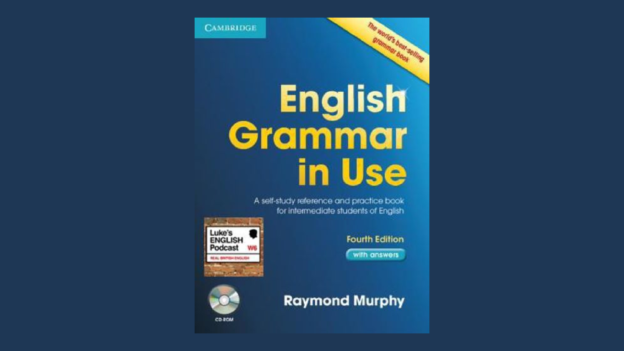
Luke: So, I’ve got here a book, which is called English Grammar In Use by Raymond Murphy and it’s the most popular grammar book for learners of English. It’s sold millions of copies all around the world, it’s a famous book, it’s known as ‘the blue book’, ‘the blue grammar book’
James: and you’re saying it’s basically useless
Luke: No, I’m not saying it’s useless! I’m just saying it’s interesting that most native speakers have got no idea what any of this stuff means. You talk about present continuous tense and third conditionals and things like that
James: Wouldn’t have a clue
Luke: You’ve got no idea, right. What I’m quite curious to do is, another thing is, that in English language classes teachers are always asking students to explain what things mean, right, so they always say things like “what is present perfect and how do we use it?” or “what’s the difference between these two sentences?”, right, and it’s interesting to see what a native speaker, someone who’s already able to speak English perfectly and functionally would answer those questions, because sometimes
James: You’re probably going to get them wrong
Luke: Well, you, it’s, the point is that, a lot of the exercises you do in class are, kind of, unrealistic, and unnatural so even if you were a native speaker you wouldn’t be able to do it, you know?
James: Yeah
Luke: So, like, if I said to you what’s the difference between, ‘I painted the house’ and ‘I have painted the house’? What’s the difference in meaning?
James: ‘I painted the house’ implies that you’ve just done it
Luke: You’ve just done it
James: and ‘I have painted the house’ could be any time
Luke: Ok. Couldn’t you say ‘I painted the house last year’?
James: Yeah, you could say that
Luke: Right, so ‘I painted the house’ could be any time
James: But you couldn’t say ‘I have painted the house last year’
Luke: Ah, right. Why not?
James: Because it’s too… it’s, it’s… I don’t know. There’s two levels to it. Once you say ‘I have painted the house’, you’ve already established the fact that you’ve painted it.
Luke: Right
James: Err, I don’t know! It just sounds wrong!
Luke: It just sounds wrong, yeah, that’s exactly it. The fact is, ‘I have painted the house’ means, you were right originally, you don’t know when it happened, it’s just that it happened in the past some time, and it’s connected to now, because you’re relating it to your whole experience of your life up to now, so there’s a connection to now, ‘I have done it’, like, I’ve got that experience. ‘I have painted the house’. You can’t say ‘I have painted the house yesterday’, because we just don’t use that tense
James: But you’ve already said, ‘I have painted the house’
Luke: Which implies that there’s no time, or that it’s an unfinished period of time.
James: Or just… it just doesn’t work, I don’t know why
Luke: But you can say, “I have painted the house today”, but you can’t say “I have painted the house yesterday”
James: ‘I have painted the house today’, would you say that?
Luke: At the end of the day, ‘so what have you done today?’, oh well…
James: You’d say ‘I painted the house’
Luke: Ok at the end of the day
James: Or ‘I’ve been painting the house’
Luke: But at lunchtime, “what have you done?”
James: Oh, I’ve painted the house
Luke: yeah, exactly
James: What have you been doing this morning? – I painted the house. I don’t know if you’d say ‘I’ve’
Luke: Well if it was finished you would
James: “well, I’ve come in, I’ve picked up the paint brush”
Luke: NO, that’s, that’s
James: I’ve run in, I’ve grabbed the ladder, I’ve put it up against the wall and I’ve painted the house.
Luke: That’s what native speakers say as an error. That’s what footballers do. They say things like, “Well, yeah, I’ve got the ball”… what they should say is “I got the ball outside the penalty box, right, I passed it to Wayne Rooney, he passed it back to me, I beat the defender and I shot and I scored. But what they’d say is “Well, I’ve got the ball outside the penalty box, and I’ve passed it to Wayne Rooney and he’s passed it back to me, and I’ve looked up, and I’ve seen the open goal, and I’ve shot and I’ve scored”, so all this weird present perfect, but it’s kind of wrong isn’t it.
James: Yeah
Luke: They’re actually speaking completely incorrectly
James: Because he’s kind of talking about the present and the past at the same time. “I’ve picked up the ball, passed it to Rooney. You know, I’ve collected the ball and passed it to Rooney”
Luke: So he’s talking about, it’s like, it happened just now, it’s like, in the moment
James: But he’s using “I’ve”
Luke: “I’ve” to, sort of, create that link to ‘now’ somehow
James: It’s like he’s running through it in his head.
Luke: It’s kind of like…
James: This isn’t going to be any use to anyone
Luke: It is. No, it is it is, it’s exactly
James: No-one’s going to listen to this
Luke: No, it’s not true, it’s not true. People will be interested to hear this
James: If you’re listening to this, I’m very sorry
Luke: No, people will be interested to hear about how a native speaker understands,
James: or doesn’t
Luke: or doesn’t understand grammar. Just let me ask you two more things and then we’ll call it a day. Right, er, another one is, what’s the difference between ‘for’ and ‘since’. That’s a question that students ask all the time. What’s the difference between ‘for’ and ‘since’?
James: In what context?
Luke: So, ‘I have done something for…’ and ‘I have done something since…’
James: for?
Luke: For, yeah, f-o-r. “i’ve been doing something for…”
James: 10 years
Luke: Yeah, I’ve been doing something for 10 years. I’ve been doing something since…
James: 1990… 2000
Luke: Yeah, since 2000, so what’s the difference between ‘for’ and ‘since’?
James: …erm… well you say ‘for’ when you’re about to describe the length of time that you have spent doing something. ‘Since’ sets the date that you started.
Luke: Yeah, exactly, yeah. Perfect. Yeah, you’re quite good.
James: That blew your theory out of the water
Luke: No no, it’s just interesting. I don’t have a theory. Right, here’s another one, ok. This is a classic one. What’s the difference between saying, okay this is conditionals. What’s the difference between saying “If I…” now you’ll get this because this is easy… “If I had bought a lottery ticket, I would have won the lottery” and “If I bought a lottery ticket, I would win the lottery” What’s the difference.
James: One’s talking about the past and one’s talking about the future.
Luke: Right, okay, yes, spot on. Nailed it. Yeah. Okay, I need to give you a really difficult one. Erm, hmm, I’ll go to the back of the book. Ok, prepositions, right? Let’s go for, what do you want? Let’s have adjective + preposition, which is, prepositions are the thing that learners have the most difficulty with, and they’re little words like ‘of’ ‘to’ ‘at’ ‘in’, stuff like that
James: Ok, go on, first question
Luke: So, you’ve just got to complete the sentence, erm, hmm,

LUKE: Erm, hmm, wait a minute. Right, wait a second

JAMES: I think you should edit this down.

LUKE: Yeah, okay, right, here we go. I’ll give you a sentence. You’ve got to put the prepositions in the right place, in the gap, okay?
I was delighted ….. the present you gave me. I was delighted … the present you gave me.

JAMES: ‘ with ‘

LUKE: Yes, well done. Brilliant.

JAMES: I don’t know why ? But…

LUKE: I’ve just had an idea whenever you get anything right, I’m gonna do this (ping!), okay? Right, so here’s the next one.

JAMES: This is bad.

LUKE: It was very nice … you, to do my shopping for me. Thank you very much.

JAMES: ‘ of ‘ but I don’t know why it’s ‘ of ‘. I couldn’t tell you the rules behind that. I just know that’s what it is.

LUKE: Why are you always so rude … your parents? Can’t you be nice … them.

JAMES: ‘ to ‘

LUKE: ‘ to ‘ yes, well done !

JAMES: Can you not do that? (referring to the BING)

LUKE: Okay, hmm, but why is it nice to, be nice to the parents?

JAMES: Well, because they brought you up and I dunno, bought you stuff at christmas

LUKE: No, I’m meaning, why do you use the word ‘to’? Nice, be nice to your parents.

JAMES: Because, you’re sort of, I don’t know.

LUKE: Yeah

JAMES: You’re giving some kind to them. You’re kind of, just doing something for their benefit, I suppose or something towards them. Something towards them. A big nice towards them. Now, it’s that
your parents, I couldn’t tell you.

LUKE: You’ve to look up, to look toward them.

JAMES: I couldn’t tell you.

LUKE: The fact is, it’s just impossible to create a rule about it. In fact, you’ve just got to learn that some words go with other words. Just got know it’s ‘ be nice to someone ‘ . You’ve just to learn ‘nice to’. So,
you have to see words existing together in little partnerships.

JAMES: Well, learn how they work together.

LUKE: Yeah, that’s it. It’s just learning two words together. Not just one on its own. So, that’s it. That’s the end of the experiment. Have you learnt anything from this, from this experience?

JAMES: No, no.

LUKE: No?

JAMES: Hm, I just hope that you get something out of this. You know making me look stupid basically.

LUKE: No, I think you got quite a few questions right. Didn’t you?

JAMES: Hhhh yeah,

LUKE: Okay, well, congratulations anyway. I’m gonna give you a certificate now which just shows that you’ve, two certificates, want to show that you completed the course.

JAMES: So, I’ll keep the certificate. Can I have this bit of chewing gum?

LUKE: Yeah, you can have the chewing gum.

JAMES: Sorry, thanks.

LUKE: Hmm, and the second certificate is just something I like to give to all the guests that I have on a program. It’s a little certificate just proving that you’d appeared on, on an episode of Luke’s English
Podcast. So thanks very much for coming and I hope to see you soon.

JAMES: Thanks very much. Luke’s English Podcast is brought to you by Wrigley chewing gum and Castllero del Diablo wine.

Okay folks, what I would now like to do is just explain some of the grammar points that I spoke to my brother about during that conversation. I asked him some questions about a few areas of grammar to see if he could answer them and I think you can see there that the point is, I guess, that native speakers surprisingly don’t understand or don’t really know the rules of grammar. They don’t know terms like ‘present perfect’ or even words like ‘adjectives’ or ‘nouns’. They don’t really know what those terms mean. So when you’re studying all that stuff at school, you’re in a way more articulate than they are, because you know how to describe the language and native speakers don’t know how to do that. That’s quite interesting but native speakers know, umm, what’s right and what’s wrong by instinct. They just sort of, they learn it as children without thinking about it and then when they get older they know that something is wrong but they don’t know why it’s wrong, they just know it’s wrong. It’s the same for you when you’re learning your language as a child.

Umm, what does that tell us about learning English? Well you could say, that it, some people might say it means that learners of English shouldn’t worry about learning the rules of grammar. That instead they should just try to listen to a lot of English, to read a lot of English and by doing that ,erm, see and hear the language so much that they just learn what’s right and wrong, just by frequency. So they know for example that people will say things, just because they have heard it said so many times before and they know what’s right and wrong just because they have heard and read the language a lot and they’ve started to learn, started to get a sense of all the patterns that you find in English.
Maybe that’s true, maybe that’s a good way to learn or maybe learners of English should study the rules or at least study the patterns and do practice exercises in order to understand what’s right and what’s wrong. I think it’s a combination of both. That you need to study the language , you need to test yourself with it , you need to do exercises but also you need to combine that with high exposure to lots of listening and lots of reading and so the more you see of the language , the more you start to develop a feel for it. Hum, that’s my opinion, um, but nevertheless, um, some of the things that I discussed with my brother there, I think I should just clarify for you, anyway.
Um, so the first thing I asked him was, what’s the difference between a noun, an adjective and a verb and he couldn’t really answer the question, but as you may know, a noun is a word which is used to give something a name. We use things like, you know, a table, a chair, a cat, those are all nouns. They can be plural or singular. Three cats for example.
They can be countable or uncountable. If they’re countable you can, you can count them. For example three, you know, tables. A table is a countable noun because you can say one, two or three tables but a word like sugar isn’t countable, instead we just say some sugar. So it’s like a mass of tiny little granules of sugar that together makes something uncountable. They can also be abstract, for example the names of things you can’t actually touch or feel. Umm, so concepts like ‘love’ is a noun. Umm, it’s also a verb but you could say ‘all you need is love’ and in that sentence it’s a noun. It’s an abstract one there and it’s uncountable. That’s nouns. Obviously there’re, nouns can be very complex, they can be larger, kind of phrases you could say like a noun phrase like for example, hum, let’s see, umm, like mobile phone technology is a kind of noun phrase and you can use that as the start of a sentence. Mobile phone technology is developing very quickly, right? So nouns can also be sometimes a number of words together.

Umm, right, the next one is a adjective. Well, an adjective is a word we use to describe a noun. Umm, it’s used to describe a noun, so we would say for example, the food was delicious, right? So delicious describes the food. How was the food ? It was delicious. You could also say delicious food. Like that, of course. Umm, so that’s an adjective.

Umm, and then the next one was a verb and the verb is the doing word. These are words we use to express sort of actions, um, so like play, eat, go, for example. Those are verbs, um, and we also have little verb phrases, which are things like phrasal verbs and that’s a verb in combination with other words and phrasal verbs are difficult because, well, somme of them are easy and some of them are difficult . The easy ones are easy to understand because the meaning is very similar to the original verb. So, if you’re talking about, um, oh, let’s see, hmm, ‘ go on’ , like ‘ go on’, meaning continue. I’s fairly clear what that means because go, we know what ‘ go’ means. ‘ Go on ‘ just means go and don’t stop going, continue. That’s fairly easy but some of them are difficult like if you take the expression ‘give up’. ‘ Give up ‘ umm, meaning to quit. Hum, that’s not quite so easy because the verb ‘ give’ you know, we think, well, ‘ give’ . Give someone a birthday present but in this sentence ‘give up’ has a completely different meaning to give which makes it very difficult and the fact is as learners of English you just have to learn phrasal verbs. You just have to try and learn them because they are all unique words with their own meanings, just a combination of a few words. So that’s, umm, that was the first thing I asked my brother. The next thing was about ‘present perfect’ and ‘past simple’.

So we know the ‘present perfect’. One of the, actually this is one of the most common bits of grammar that you study when you’re learning English. Present perfect of course is like ‘ have’ plus a past participle or ‘ has’ plus a past participle, like I have lived in Japan for example. Umm, she has eaten a pizza, right? And ‘past simple’ obviously everyone knows. I lived in Japan, she ate a pizza, for example. Umm, so the difference, well that’s quite a big one and it’s something that everyone is studying. So the difference between ‘past simple’ and ‘present perfect’ basically we use, we use ‘past simple’ to talk about a finished action in the past but the time period is important and we tend to, with ‘past simple’ express a kind of distance from the act. So there is a distance in time basically, which means that the action
happened in a finished time period. I lived, erm, well let’s say, umm, I ate, no, I drank a coffee. It’s pretty, probably suggests that you that you drank a coffee yesterday or you drank a coffee last week or you drank a coffee, umm, during breakfast, right? So it’s like in a finished time. ‘Present perfect’ is used to describe finished actions which happened in an unfinished time. So there’s a connection to now. That’s the most important thing. So, basically you might say for example, I have drunk three cups of coffee today. Umm, today is not finished, so you can say, I have drunk three cups of coffee today. Hum, so the time period is always connected to now. It’s a bit more complicated than that but that’s is all basic difference.
Hum, to be honest, if I was to explain ‘present perfect’ and ‘past simple’, I’d need to record a completely new podcast and I could do that. So, I might, I might do that.. ‘Past simple’ and ‘present perfect’.

The next one was about 2nd and 3rd conditionals. So we know the 2nd conditional would be for example, umm, let’s see. Err, if I bought a lottery ticket, I would win the lottery. Not a very good example because, it’s not definite that you’d win, so, if I?
Okay, let’s say, if I, if I went outside, I, no, no, no … Okay, if I studied hard, I would pass the exam. So, you’re talking about the future but you use past tense like studied, if I studied, now, we’re not talking about the past , we’re talking about the future. And we know, it’s the future because we’ve said’ if’ . So ‘ if ‘ plus a ‘past tense’ is actually used to describe a kind of unreal future. So you use the past tense not to create distance in time but to create distance in reality. In this sense it’s an unreal or hypothetical future because you don’t think it’s realistic. So, if I studied hard, I would pass the exam but I’m not going to study hard because I don’t want to, right? So compare that with the 1st conditional. If I study hard, I will pass the exam. Umm, ‘present tense’ after ‘ if ‘ , still talking about the future but here we think it’s a realistic future. So, there’s no distance from reality. We think it’s real and it’s followed by ‘ will ‘. Umm, if I study hard, I will pass the exam. So, that’s it, it’s like a definite future with its definite future consequence!

The 3rd conditional talks about the past and there we use ‘had’ plus a ‘past participle’ in the ‘if clause’, in the second clause we have ‘would have’ and a ‘past participle’. So, let’s say, the exam was last week and I failed, you could say, ‘ If I had studied for the exam, I would have passed, right? The fact is, I didn’t study and I didn’t pass but if I had studied, now here we’re using ‘ had studied’ and that’s like, it looks like past perfect, but it’s not actually past perfect, it just looks like it, but it’s used to create distance from reality in this sense, in the past. Umm, so we go from ‘past simple’ I didn’t study, we go one tense back to what looks like ‘past perfect ‘. ‘If I had studied’ and then in the second part ‘I would have passed ‘. Again to refer to a past consequence.

It’s all very complicated and to be honest rather boring but you kind of have to learn it. Again, I could do a completely separate podcast all about conditionals because it’s such a big topic.

The last thing I talked about with my brother was ‘prepositions’ and if you’re learning English you’ll know about prepositions. They’re very, very difficult. They are the little words that we use to connect nouns and verbs and adjectives together and you find the prepositions are linked to other words and there isn’t really a decent set of rules to explain these links. The fact is, you just have to learn them. You just have to learn that we say ‘to be nice to someone’ right? ‘Nice to’ those words go together. You’ve just to learn that you have to remember it and there’re lots of combinations of verbs and prepositions, nouns and propositions and adjectives and prepositions and there are so many lists, really that, it’s just a case of noticing them and then try to remember them. Umm, what you should do, is realize that prepositions are linked to other words and then see these word combinations as separate units of meaning that you should learn. So, you don’t just learn the word for example ‘consist’ but you learn the expression ‘consist of’ right? Okay, so a hamburger , a Big Mac consists of bread, salad, beef and cheese for example. Umm, so, ‘consists of’. Those words always go together.

Umm, so that’s basically it. Those are the things I’d discussed with my brother. I expect, if you’re a learner of English, you understood the rules of grammar a little bit better than my brother did. Umm, in which case you should feel quite good about yourself. Um, remember you’re, you’re learning the grammar of the English language and you’re learning the grammar actually better than most native speakers. So, well done you.
Umm that’s the end of this podcast, I hope you found it interesting. That’s all for me . Bye, bye, bye, bye, bye…

Enjoy.

49. Stand Up Comedy (with Claudia)

Guest presenter Claudia Edwards interviews Luke about Stand Up Comedy. Vocabulary notes are included below.

Small Donate ButtonRight-click here to download.

Luke’s English Podcast is a free service for learners of English. In a recent made up survey, a group of over 1000 international students were asked what was the best way to learn English. 99% of the students said that Luke’s English Podcast was the best way to learn English. 1% of the students did not understand the question.

London is said to be the comedy capital of the world. There are more comedians here than in any other city. Comedy is a BIG part of our culture here. Going to a stand up comedy show is a very normal way to spend an evening. There are many famous and successful stand up comedians in the UK as well as the USA. But what is stand up?

I’ve recently started doing stand up comedy myself, so in this podcast I was interviewed by my friend & colleague Claudia Edwards. I’m sure you’ll agree, it is very nice to listen to a female voice presenting the podcast for a change. Enjoy!

Here are the questions asked by Claudia, and some of the vocabulary I used in my answers:

Claudia’s Interview Questions + Vocabulary
Can you tell me what exactly is stand up?

stand up comedy = a kind of comedy performance which involves a comedian standing up in front of an audience with a microphone, in order to make people laugh
sit coms = situation comedies – these are TV shows which usually feature a few characters in a familiar situation. The events and the conversation are funny. E.g. Friends

What makes it unique as a kind of performance?
a script = all the words for a play, or a movie which the actors have to learn
dying on stage = being unsuccessful on stage – doing your performance, but failing because nobody is laughing

What are the good things and the bad things about it?
you can’t blame anyone else
to blame someone = to say that someone was responsible for something bad. e.g. “it’s the director’s fault”
time consuming = it takes up (uses) a lot of time
you’re putting yourself on the line
to put yourself on the line = to put yourself in a position in which you might fail

What’s it like? How do you feel?
the palm of your hand = the middle part of your hand (with the lines on it)
you’ve got the audience in the palm of your hand = the audience are completely under your control
it’s paid off = the work you have done is resulting in success
beforehand = before

Have you ever had a mind blank?
a mind blank = when your mind goes blank, and you can’t think of anything

How long have you been doing it?

What exactly do you do, just tell jokes?
the navigational systems of the plane = the computer which helps the plane to go in the correct direction
you wouldn’t be able to take them on as hand luggage

What do you think makes a stand up comic good?

Do any other countries do stand up, or is it just the UK?
they will often pick on the audience
to pick on someone = to make fun of / tease someone (sometimes in a nasty way – like a bully at school)
alternative comedy = subversive, critical comedy
subversive = critical, radical, revolutionary, against the government or the ‘way things are now’

How long have people been doing stand up in the UK, do you know?

If people listening want to see some stand up, what should they do?

Some vocabulary from Luke’s stand up set:
bollocks = a rude British English swear word which is like the American word ‘bullshit’. It actually means ‘testicles’.
shuffle all songs = a function on the ipod which plays all your songs in random order

Some of my favourite comedy clips:

Richard Pryor – When kids lie
Richard Pryor is definitely one of the best stand up comedians ever. Unfortunately he is dead now, but his comedy is still with us. He was one of the people who invented the kind of stand up comedy which everybody does now. In this clip Pryor talks about how children behave when they lie about breaking something.

Steve Martin – Sex Jokes
I absolutely love Steve Martin, but a lot of people don’t ‘get’ it (they don’t understand why he’s funny). Unfortunately there aren’t many good clips of him doing stand up on YouTube, but this one is quite good. Steve’s comedy is not obvious. It’s subtle. He used his voice and his body a lot, and just little physical movements or changes in the way he spoke were hilarious. This clip is a bit old fashioned, but I believe Steve Martin is still one of the best stand up comedians we’ve had.

Michael McIntyre – Live at The Apollo
McIntyre is probably the biggest stand up comedian in the UK at the moment. He is extremely popular. His comedy is accessible (he talks about things which everybody can relate to), he uses a lot of physical humour and different voices, and he is very energetic on stage.
In this clip, he talks about how English people always want to know exactly where you live when you introduce yourself. “Hi, I’m from London” – “Whereabouts whereabouts!”
He speaks very quickly.
[youtube http://www.youtube.com/watch?v=Es2l4yUBY6M&hl=en_US&fs=1&]

Eddie Izzard – Computers
One of the top comedians in the world. Yep. He has a unique, surreal style, but he talks about every day things like the problems we experience with computers.

Flight of the Conchords – Business Time
These guys are a musical comedy duo from New Zealand. They sing comedy songs. This one is about ‘making love’! Oh yeah, it’s business time! In the song, Jemane sings to his girlfriend about making love on a Wednesday evening. Listen carefully to the lyrics and you’ll understand that Jemane is not a very good lover!

Here’s a clip of some Japanese comedy. It comes from a BBC TV show called “Adam and Joe Go Tokyo” in which British comedians Adam and Joe go to Tokyo to learn about Japanese culture. It was broadcast about 6 years ago.
[youtube http://www.youtube.com/watch?v=Nf7V-Fuqtak&hl=en_US&fs=1&]

There are many many more comedians and videos that I love, but I can’t recommend them all. To be honest, I think that it is very difficult to understand the humour if you don’t understand the English perfectly. This is why I think comedy is one of the best ways of improving your English. Think of it like this:
1. Watch some comedy that you don’t understand
2. Realise that other people are laughing, so it must be funny
3. Think: What am I missing?
4. Watch again and try really hard to understand what is so funny about it. Is it the specific words? Is it the subject? Is it something specific to the culture that you don’t understand?
5. If you can understand comedy in English – you are making a lot of progress!!

I totally believe in comedy as one of the best things in life – and of course I think comedy in English is wonderful, and there is SO MUCH of it. Don’t miss out on English language comedy. GET INTO IT TODAY!

47. Travelling in Vietnam

EnglishRobot3000 interviews me about my holiday in Vietnam.

Small Donate ButtonRight-click here to download this episode.

I recently bought an English speaking robot from Japan. His name is English Robot 3000, and he’s very nice. In this podcast, English Robot 3000 asks me questions about my holiday in Vietnam and I talk about what I did, where I went and how it felt.

The next podcast will contain lots of really useful language for meeting people when you are travelling.

Hope you enjoy the episode, and happy new year!

Photos
Here’s a slide show of my Vietnam holiday snaps

Here’s a picture of EnglishRobot3000
EnglishRobot

Get the PDF transcript here 👇

32. Doctor Who (with Lee Arnott)

This episode is all about Doctor Who. There are some announcements at the beginning of the episode, then an interview with an expert on Dr Who.

The interview begins at approximately 10.00 minutes into the episode.

Small Donate ButtonRight-click here to download this episode.

Transcript available below. Luke’s English Podcast is a free service for people who are learning English as a foreign language. Luke is a well qualified teacher of English with over 12 years’ experience in Japan, the UK and France. He speaks British English, and teaches at a language school in London, and now at a university in Paris. You can use this podcast to get exposure to native speakers using natural English. Learn phrasal verbs, idioms, useful expressions, linkers, etc. Find Luke on Facebook (search for Luke’s English Podcast) or Twitter (@EnglishPodcast). Cheers!

Some good advice for iPhone users (courtesy of a helpful listener from Russia, called Nikita Kolganov): Copy and paste the tapescript from a podcast into the ‘lyrics’ section of each podcast on your iPhone. To do this, first copy the text from this webpage. Then go into iTunes and ‘right click’ the podcast episode there. Then choose ‘Get Info’, then select ‘Lyrics’. You can add the transcript into the text box there, and then read while you listen to the podcast. Thanks Nick!

Here’s the tapescript for the interview with Lee, about Dr Who:

Luke: Right, if you imagine somebody who’s never heard of Dr Who before, right, how can you explain who he really is. So, so, if, what are the most important things that you should know about Dr Who if you’ve never heard of him before, basically.

Lee: Well, Dr Who is, err, a TV show that it’s main character, a character called The Doctor, who is in fact an alien, has a machine that can travel through time and space, which means that he is able to go anywhere in any planet, any point in the future, the past, whenever.

Luke: Erm, what’s the name of that machine?

Lee: It’s called The Tardis.

Luke : And can you just describe The Tardis? That’s like his spaceship, yeah? Can you describe The Tardis for us? Because in Britain here, everybody knows The Tardis, like, almost everybody knows it. It’s very familiar to us. It’s almost like an icon of British culture. But what is The Tardis? What does it look like?

Lee: Well, The Tardis looks like a 1960s police box, and in the days before mobile telephones and actually people having telephones in their houses, these blue police boxes were like an old phone box, and they also had a double function in that if a criminal caught a policeman [if a policeman caught a criminal] they would be locked up inside this police box, and they also had a phone, so they were a very common object in 1960s Britain, early 1960s Britain when Dr Who started.

Luke: So, it looks a bit like a red telephone box, but it’s blue, and it’s something the police use to make telephone calls. And they could use it to keep criminals in. They could lock a criminal in there if they needed to.

Lee: Exactly. It was a very everyday object which everybody would have known.

Luke: Ok, so everybody knows about what a police box is so…

Lee: But of course it’s not really just a police box because it’s actually bigger on the inside than on the outside.

Luke: Ok, so Dr Who’s spaceship is in the shape of a police box. It’s called The Tardis but it’s actually bigger on the inside than it is on the outside. Ok, right, fine. Um, actually, people these days often use the word Tardis to mean something that’s bigger on the inside than on the outside. Can you give me an example of how we might use the word Tardis to mean something else?

Lee: Well actually there’s quite a famous example when Tony Blair was Prime Minister, in one of the last interviews he did before he left the post, I think it was with The Guardian, the interviewer asked him what was 10 Downing Street like…

Luke: That’s the Prime Minister’s house.

Lee: And he said, oh it’s like The Tardis, and he didn’t need to say anything else but everybody would know that he means it looks smaller on the outside but it’s much bigger on the inside.

Luke: Right, ok. I’ve heard people say that, like, a woman’s handbag is like The Tardis, sometimes, because it looks like a small handbag, but you can actually keep lots and lots of things inside it…

Lee: And such is the power of the programme that even if you’ve never seen Dr Who in this country, you will know if somebody says “It’s like a Tardis”, you will know that it’s bigger on the inside than the outside.

Luke: Right, ok, so that’s what Tardis means to everybody now. OK, what are the other important things that we need to know about Dr Who?

Lee: Erm, well, we need to know the fact that the programme started in 1963, and that means that you get a very good representation of how British society evolved in a kind of televisual way. A record of the times, our changing attitudes to race, to women’s lib, to even things like joining of the common market in the early 70s…

Luke: What do you mean by women’s lib?

Lee: Well The Doctor, traditionally is always accompanied by a female companion, and this was specifically because the programme’s original remit was to entertain a family audience on Saturday afternoon.

Luke: It’s a family show

Lee: Yeah, it’s very much a family show. One that was designed to catch the fathers who’d been watching an afternoon of sport on a saturday, with family who watched, like a pop music programme… it was designed to keep everybody watching, and of course it was hugely successful when it started so it achieved its aim.

Luke: Ok. So, ok, so basically err, he always has a female companion. I think that Dr Who has also had, like, a robot companion as well, right?

Lee: He has, he has, and err, he had a robot companion in the late 70s but he actually… people have thought that it was because Star Wars came out, and C3PO and R2-D2 but actually Dr Who was a year before Star Wars, so…

Luke: Really? So before… everybody knows about Star Wars, they know about R2-D2 and C3P0, but Dr Who before Star Wars had K9. K9 was like a robot dog! (laughs)

Lee: Of course the most important thing to remember is that when the show first started in 1963, the guy who was playing The Doctor was a very old guy, and after 3 years playing the role, it became very obvious that he was ill and he couldn’t do it, and they were like “what are we going to do?”. So, they devised… because we didn’t know who this character was, or where he came from, in 1966 they changed the actor, but made it a part of his personality, and that allows… has allowed the programme to continue to this day nearly 50 years later.

Luke: OK, so this is another important thing about Dr Who, is that you have to know that… How many actors have played him now, actually?

Lee: Erm, well we’re now on number 10 and number 11 starts filming next month.

Luke: OK, erm, the interesting thing about Dr Who is that when Dr Who dies, he doesn’t die. He doesn’t die, instead he changes into a new form, so he becomes a new person, but it’s still Dr Who but he becomes a new person, and it’s like a really important event when Dr Who. It’s… to be honest it’s a way for them to change the actor, right? But in the show, Dr Who… one Dr Who dies and he changes into a new Dr Who, and it’s always like a really big event for the show, right? Erm, so it’s really just a way for them to continue the show. It’s a bit like James Bond in that sense.

Lee: Hmm, but I think it’s more believable than James Bond because its not supposed to be exactly the same character. So each Doctor, well each actor has been allowed to have his own, his own way of playing the part.

Luke: So, his own personality. So every time it’s like a new, different kind of Doctor with a different personality.

Lee: Even though it’s the same, we know it’s the same character behind it, but it’s like a new person to get used to and that keeps the show fresh and it’s kept it going all this time.

Luke: OK, so there have been 10 Doctors, and the 11th Doctor is coming very soon. Who do you think is the nation’s favourite Dr Who so far?

Lee: Well, for many years, everybody would have said immediately, Tom Baker, an actor who played the part from 1974 to 1981.

Luke: Tom Baker actually, err, the Tom Baker Dr Who is probably the most famous one until the most recent one. And he’s famous for having a long scarf, and he was in The Simpsons. He was in the American comedy show The Simpsons.

Lee: He was also in Family Guy …

Luke: He’s in Family Guy as well

Lee: Until Dr Who, because Dr Who was off the air, it stopped being made in 1989 until 2005 when it came back. And until 2005, everybody would have said Tom Baker was the Doctor, but as you’ve said in 2006 the current Doctor David Tenant has taken the programme to new heights of success that it never ever had in it’s original format.

Luke: So Dr Who, even before, erm, the latest Doctor, Dr Who was really really big and really successful, but it’s become even more successful with this new Doctor played by David Tenant, who’s like a great actor, Shakespearian actor

Lee; Yeah, he’s just done Hamlet, and they’re going to be filming Hamlet for television

Luke: It’s a great thing. Because David Tenant is so popular as Dr Who, now he’s playing Hamlet, it’s going to be shown on TV, millions of people in the UK are going to watch Hamlet, which is written by Shakespeare, so it’s a really good way of

Lee: And that kind of fits in with the original, the kind of format of Dr Who in that, because he’s able to go back in the past and meet people like Shakespeare and Agatha Christie, it inspires people to go out and learn more about… you know… the original brief of the show was that it had to go to the future and then the past. So not only would it educate the viewers in a very 1960s BBC way, but it would also entertain, and it would inspire people to go and learn about things

Luke: That’s what the BBC was all about. It was to educate, to entertain and to inform, right? Ok, actually I think I need to clarify just a little bit more about Dr Who just to make sure everybody understands who he is. Dr Who is a Timelord, and that means he’s a kind of alien. He’s not a human, he’s from another planet, but he came to Earth because he, he loves humans, right?

Lee: Yeah, but he doesn’t live on earth, he’s always… just Earth happens to be convenient because that’s where they can film on the cheap

Luke: So, he doesn’t live on earth, but he comes to earth quite a lot

Lee: but he can go anywhere, in time or space. But we have to remember that The Doctor, ok he’s the main character, but what really really made the programme successful and which we cannot not talk about are The Daleks.

Luke: Right, ok, so we’ve talked about, err, Dr Who’s spaceship, his companions, err K9, but another very important thing is to know the enemies that Dr Who has, and you just mentioned The Daleks, right? So who are Dr Who’s enemies? There’s probably, like, three maybe four most popular, most famous enemies

Lee: Well, The Daleks are, if you, again it’s like the word Tardis, if you say to somebody who’s never seen Dr Who in their life, they’ll know, if you say Dalek, they will know what you mean and may even do an impression of one by talking like this

Luke: Exterminate! Exterminate!

Lee: Exactly! Exterminate. So, I mean, Dr Who’s first story in 1963 was a bit of a dull… and it was set in caveman times. It’s very much introducing the characters. It was four weeks later, the introduction of these things called The Daleks, which just literally took the public imagination by storm. You can’t work out why. If you see them they look like a pepper-pot walking around. Maybe it’s the voice. There’s been lots of theories of why people just, why they’re so important to people, but whether they’re reseblent [reminiscent] of Nazis, because you remember the war had finished just 20 years before, you know. There’s just something about a Dalek, and again it’s just a proper cultural icon. So much so that in 1996 there was a survey to find out icons of British culture the public wanted put on stamps, and the first class stamp was The Dalek.

Luke: So there was a survey, and the British public voted The Dalek as the number 1 icon to put on a stamp! That’s even before the Queen, so they didn’t want the Queen’s head, they wanted a Dalek on there. So, just again to clarify a Dalek is like a robot…

Lee: It’s a robot but it’s got a creature inside it controlling it that hates anything … (laughter) …if you see them, it’s like “What is it?”, but there’s something about them. It’s a creature inside that controls them, and this creature wants to kill anything that is not like yourself [itself]. Now, I have to stress, the programme, although it sounds violent again is for a family audience, so y’know, the kids were watching, with their parents and although they were scary, it was a safe kind of fear because you could hide in Mum and Dad’s arms, you know, or hide behind the sofa, which is very much again the tradition of the…

Luke: These are other important things about Dr Who, is that it’s a family show, so so, erm, most people in the UK grew up as children watching Dr Who on a Saturday night. I watched it with my family…

Lee: I watched it with my Mum, my Mum watched it with her Mum, you know…

Luke: Everybody knows it, it’s like something really important about British culture. Erm, one of the things that everybody says about Dr Who is that because it’s quite scary, erm, you end up watching it from behind the sofa. So you can’t just sit in front of the TV and watch it. You have to hide behind the sofa, and sort of like, y’know, look over the top of the sofa to watch it because it’s so scary.

Lee: Now, you see, you’re lucky because when I was a child, our sofa was pushed against the wall. So I had to hide behind a cushion.

Luke: So you couldn’t hide behind the sofa.

Lee: Which is very very scary…

Luke: But that’s another expression, it’s another bit of erm, vocabulary that everybody knows now ‘to hide behind the sofa’, because of Dr Who. OK, so we’ve talked about The Daleks… now another thing about Dr Who is that it’s kind of funny, isn’t it?

Lee: Mmmm, it’s got a very British dry sense of humour, and partly because the programme has never had much money spent on it, so… rather than have lots of special effects you have to have a very good script that’s sharp, that’s funny. The Doctor is a character who never carries a weapon. He uses words, he uses his brains, he uses his intellect to get out of situations, so… and it has an, it it has a kind of humour that’s very British, but also, as you say very funny, you know, so…

Luke: I…

Lee: It doesn’t take itself too seriously

Luke: It’s not a serious show. It’s very much a kind of camp, funny kind of show. And also, one of the…

Lee: …and scary and exciting

Luke: That’s right, it manages to mix, like, comedy and erm, like, satire and fashion or something, and serious science fiction as well. It’s just great. Erm, what was I going to say? Oh yeah, err, one of the funny things about Dr Who is, like, the special effects.

Lee: Mmm, they were. In the old series, which as I said started in 1963, ended in 1989… famously, Dr Who never had any money, which means that there was no money for special effects, but you have to remember, the news series is different. It’s got amazing spe… award winning special effects. But you have to remember that the BBC as an institution in the 1960s and the 1970s was at the cutting edge, was at the front of this new technology, and all the stuff you see with green screen now is because of the stuff the BBC were doing with Dr Who in 1969 when colour television had just been invented, and you see that early experiments in yellow screen it was then, but you know this is why we have these special effects now.

Luke: So Dr Who innovated a lot of special effects.

Lee: Exactly. People like Ridley Scott was one of the designers…

Luke: Ridley Scott is now a famous director who’s directed films like Gladiator, but, and Ridley Scott worked on Doctor Who in the 60s. But I remember when I was younger when I watched Doctor Who on TV in the 80s, the special effects were quite funny because usually the monster was, a kind of man in a suit. It was basically a man in a suit. You know? In a bit… in a similar way to, in Japan, the way Godzilla was so popular. Godzilla when you watch the original movie, it’s obviously a man in a rubber suit.

Lee: Well I think the thing about 80s Doctor Who is, it’s very 80s. You know, 70s Doctor Who, 60s Doctor Who is, and to a certain extent it’s all very scary but there’s something about 80s Doctor Who which just looks over lit, the colours are really garish, and it’s just very 80s. Very much a product of its time. And maybe in a way that 60s and 70s Doctor Who was very much ahead of its time.

Luke: Ok, so Now though, Dr Who is very popular, more popular than it was before.

Lee: More popular than it’s ever been before. It’s the top rated drama on the BBC, it gets the highest ratings for a drama. The audience appreciation figures, which are a rating of how much the audience actually enjoys it are always in the lower 90% which for a drama which is very popular which is unheard of, umm. It’s always in the press because remember the newspapers have a 50 year history to draw back on and public interest in Dr Who at the moment has never ever been higher and now with David Tenant, the most, arguably the most popular Doctor ever, about to change at Christmas and New Year, then the future once again looks…

Luke: Great. So basically, umm, the important thing about Dr Who, if you’re a learner of English right, is it important to know about Dr Who? Why is it important for learners of English to know about something like Dr Who?

Lee: I wouldn’t say it was important but I would say it offers a very good insight into British culture, the British view of things, the British sense of humour, and also it’s just a great way to pass 50 minutes just lapping up British culture.

Luke: It’s just a great show, it’s very fun, very entertaining.

Lee: It’s very easy to watch. You don’t have to know everything about it. Each week there’s somewhere new, you know, so

Luke: It’s one of those things I guess, that … if a learner of English listens to two English people, often they don’t understand it because often the English people will talk about things that the learner of English doesn’t understand, and one of those things might be Dr Who. It’s kind of something that everybody knows about, something that people talk about quite a lot. For example, like, mentioning the Tardis or The Daleks

Lee: I think there was a great interview with, erm, when the Queen’s golden jubilee about 5 years ago, 6 years ??. there’s an interview with Prince Andrew and he said he had really happy memories of watching Dr Who with his Mum and Dad in the early 70s.

Luke: So even the royal family watch Dr Who

Lee: David Beckham gets the box sets for Christmas, delivered to his house. Everybody watches it.

Luke: OK, so there you go. Everybody is a fan of Dr Who. Is it possible to watch Dr Who in other countries?

Lee: Yes, it’s the BBC’s biggest export in terms of where it’s sold to, and it’s currently available in 42 different countries, you know. It has a regular audience of 165,000,000 viewers, so… everywhere from Saudi Arabia… it’s the number 1 export show in South Korea, so…

Luke: Really? So, a lot of South Korean people…

Lee: It even beats CSI

Luke: Even more popular than CSI? …in South Korea. So if you’re from South Korea and you’re listening to this, then send me a message if you’ve seen Dr Who, tell me what you think of it. Now, I think that they did show Dr Who in Japan, but I heard that nobody understood it at all. They didn’t get it, and erm, I think…

Lee: But they did, to be fair, they did show this back in the 1980s when they showed the last 3 years of the show and, quite frankly, unless you were a fan of Dr Who it probably would have been the weirdest thing that definitely may even have got a cult audience, but not a…

Luke: I think the late 80s Dr Who was probably the worst Dr Who. It’s terrible, right?

Lee: That’s a bone of argument I have to say

Luke: For me, after Peter Davidson, it wasn’t very interesting. I didn’t like it myself. I stopped watching it at that point.

Lee: Anyway, shall we end on a positive note?

Luke: Yeah. Umm, ahh, just a thing about in Japan. They even changed the name of Dr Who, they put it into katakana, that’s Japanese characters. And in Japan everybody knows Dr Who as Do-ku-ta-fhooo. Dokuta-fhuuu, which is kind of funny. Ok, so, right, are you looking forward to the new Doctor?

Lee: Yes, again, you know, the, having been a fan of Dr Who since I was 5 years old, errm… I’m still very young… ermm, I errr,… I love it when he changes. It’s so exciting, you never know what’s going to happen

Luke: Do you think this new guy is going to be a good Doctor?

Lee: I’m sure… because, they guy who’s now in charge of the show is one of the best writers of the last couple of years, so I’m sure it’s in very safe hands, and you know, I think it’s going to be great.

Luke: OK, great, so, erm… If you’re interested in Dr Who you can buy the box set, the DVDs on Amazon. You could probably watch some Dr Who clips on YouTube

Lee: Yeah, for real…

Luke: Erm, if you’re interested, you can watch it. But otherwise, just umm, errr I don’t know what I’m going to say now! I hope you enjoyed that conversation anyway. Thank you very much Lee.

Lee: Bye, thank you

Luke: Oh oh, one more thing. Why do you know so much about Dr Who?
Lee: As I said, because I’ve loved it since I was 5 years old, and erm, for me it’s just, I don’t know, I have a really strong emotional attachment to Dr Who, you know, he was always there… because he was such a constant character in my childhood and even in my adulthood.
Luke: You’re also an expert, aren’t you, on Dr Who
Lee: Yeah, but I have my limits… My house is not full of toy daleks of every description
Luke: Just a few… because you’re not a total geek or anything
Lee: No, I’m not. I haven’t got Dalek pajamas or… which are available!
Luke: If you’re wondering what to buy Lee for his birthday or Christmas
Lee: Dalek underpants or pajamas please
Luke: Dalek underpants or pajamas. I think they’re available on the internet
Lee: Marks and Spencer!
Luke: or Marks and Spencer, do they do them? Right, well I think on that note, err, I’ll end the conversation. Thanks very much Lee.
Lee: Thank you very much
Luke: OK

An interview with Matt Smith, the 11th Doctor:

[youtube=http://www.youtube.com/watch?v=Zog-6SrGxE0&hl=en_US&fs=1&color1=0x234900&color2=0x4e9e00]

Language Analysis

The following language analysis was written by Richard Gallen, a fellow teacher at The London School of English. Richard has written analysis of part of the interview between me and Lee. Use this in order to get a detailed understanding of some of the useful language used in the interview. If you a teacher, you may be interested in using this language analysis as a way of adapting the podcast for teaching in the classroom. Thanks to Richard Gallen.

Lee and Luke explain Doctor Who – language for explaining and describing

Luke: Right, if you imagine somebody who’s never heard of Dr Who before, right, how can you explain who he really is. So, so, if, what are the most important things that you should know about Dr Who if you’ve never heard of him before, basically.

Lee: Well, Dr Who is, err, a TV show that it’s main character, a character called The Doctor, who is in fact an alien, has a machine that can travel through time and space, which means that he is able to go anywhere in any planet, any point in the future, the past, whenever.

Luke: Erm, what’s the name of that machine?

Lee: It’s called The Tardis.

Luke : And can you just describe The Tardis? That’s like his spaceship, yeah? Can you describe The Tardis for us? Because in Britain here, everybody knows The Tardis, like, almost everybody knows it. It’s very familiar to us. It’s almost like an icon of British culture. But what is The Tardis? What does it look like?

Lee: Well, The Tardis looks like a 1960s police box, and in the days before mobile telephones and actually people having telephones in their houses, these blue police boxes were like an old phone box, and they also had a double function in that if a criminal caught a policeman [if a policeman caught a criminal] they would be locked up inside this police box, and they also had a phone, so they were a very common object in 1960s Britain, early 1960s Britain when Dr Who started.

Extra information clauses

Describing a film or book can be a little difficult. It’s quite hard to keep people interested. That’s why when we introduce a character we sometimes say something interesting or exciting about them

a character called The Doctor, who is in fact an alien

..then there’s Princess Leia who is fact Luke’s sister

In 1988 she met this man called Greenlee, who was in fact the top CIA agent in Bolivia at the time.

In the examples above ‘who’ refers to the noun before it (The Doctor/Princess Leia/ this man called Greenlee). In the example below ‘which means that’ doen’t only refer to the noun before, it refers to the whole clause before:

It’s a machine that can travel through time and space, which means that he is able to go anywhere in any planet, any point in the future, the past, whenever

The most common verb after ‘which’ in extra information clauses is ‘means’ .It often says something about the result of an event

I slept through my alarm clock which meant that I had to run like crazy for the train

Gilardino scored a goal very late in the match which meant that Italy qualified for the 2010 World Cup in South Africa.

In that..

When Lee was describing police boxes in England he said:

they had a double function in that if a policeman caught a criminal they would be locked up inside this police box

we use ‘in that’ when we think we could be more precise about something we’ve just said :  ‘in that’+example

He was quite reserved in many ways but he was also very sociable in that he liked entertaining,

It’s already old news (in that it was announced 6 hours ago…) but President Obama has been awarded the Nobel peace prize

The most common adjectives that come just before ‘in that’ are:

unique / unlucky / unusual/ fortunate

UNICEF is unique in that they are in countries, before, during and after emergency situations and humanitarian crises

Gordon Brown was unlucky, in that he became PM when we were on the edge of a disaster

She was fortunate, in that she had so much money she didn’t need to work

Like

‘Like’ is very common when we describe:

And can you just describe The TARDIS? That’s like his spaceship, yeah?

Luke is trying to explain what the TARDIS is…. But he can’t find exactly the right words. This is very common in conversation and when we describe things because it’s difficult to be precise all the time

As the examples below show, sometimes we are imprecise because we want to exaggerate. ‘Like’ is very common to introduce an exaggeration:

It’s [almost] like….. an icon of British culture

Because in Britain here, everybody knows The TARDIS, like, almost everybody knows it

Some other examples:

..and it was so good, it was like, one the best meals I ever had.

..and for a few months he was like, crazy about me, he was calling me and sending me flowers

Notice how we pause just after ‘like’ when we use it in this way

Other uses of  ‘like’

We use ‘like’ in questions to ask for a description:

But what is The TARDIS? What does it look like?

‘Like’ also means similar to:

These blue police boxes were like an old phone box

When ‘like’ means ‘similar to’ we use adverbs to make the comparison softer or stronger

a bit like /rather like /  (to soften)

just like /exactly / a lot like (to strengthen)

Horse surfing is a lot like surfing, just with horses

The currents in the sea were really strong and, for a minute, it is was almost like a huge monster was sucking me under

The following ‘sense’ verbs are common before ‘like’ when we use it in this way.

feel/ taste/ sound/ look/ smell

It felt like I had been waiting for hours but it was in fact only 20 minutes

He smelt like he hadn’t had a shower for weeks

She looks like she’s been crying

Notting Hill Carnival – 40 Phrasal Verbs


Learn 40 Phrasal verbs in this video! Also, learn about London culture at the Notting Hill Carnival 2009. Luke’s English Podcast is a FREE service for people learning English as a foreign language. Use this podcast as an entertaining way to learn English, pick up vocabulary, understand grammar and develop your pronunciation. Each episode is about a different topic, and includes a different language point. This episode is about phrasal verbs (a popular area of vocabulary), and is my first real video podcast, or ‘vodcast’. I hope you like it. Email me your comments, suggestions and feedback here: luketeacher@hotmail.com

The phrasal verbs are all in this transcript. You can find them and then read definitions below the transcript.

Luke: Hi everyone, this is Luke. Hello, and today I’m going to the Notting Hill Carnival. You probably know about Notting Hill from the movie with Hugh Grant, which looks a bit like this… But the Notting Hill Carnival is a slightly different view of Notting Hill, and it looks a bit like this… It’s the biggest carnival in Europe. It happens every year. It’s a Caribbean carnival so you get lots of Caribbean music, Caribbean food, Caribbean culture, and I’m going to take you, my video camera in order to just video the event and give you an idea, give you a flavour of what the Notting Hill Carnival is all about.
So I went out and I got some cash out of the bank, and I got on the bus and I paid with my Oyster card, which I’d just topped up. And I went to the back of the bus, and I got a seat and waited for the bus to take me to the carnival. There’s Notting Hill. You can see lots of people at the end of the street, and it’s just hotting up at the moment. That’s Notting Hill Gate.
I’m in Notting Hill now, and I got stuck in traffic on the way here. The bus took ages because there was so much traffic. I got stuck in traffic for a while but I’m here now and I’m just walking through Notting Hill. The police are here and they’ve blocked offlots of the streets so that cars can’t drive through. So all the streets are just for pedestrians now. So I’m just walking through Notting Hill with everyone, and I can hear some music in the distance, and I’m going to go and meet up with my friend Raph. So, here we go.
So, you have to queue up for toilets at the carnival because there aren’t many toilets around. That’s a bit annoying. There’s a typical street in Notting Hill, and that’s a typical little shop that you might come across if you walk around. There’s one of the musical floats playing a kind of Caribbean music. I don’t know how that child is still asleep, because it’s very noisy. You can see so many people, so many kinds of people at Notting Hill Carnival. And lots of police as well. There’s Raphael in the distance, waving at… waving and pointing at me. He’s with his girlfriend. Yeah, there he is, doing, like, a crazy dance, because he’s a crazy guy. Here’s Raph. He’s a bit surprised to see me I think.
Raphael: Mr Multimedia! How’s it going buddy, you ok?
Luke: You can pick up lots of nice food from barbecues on the street. Lots of, kind of, Caribbean food like jerk chicken. And this is Portabello Road, which is the main road in Notting Hill. And more musical floats, with people dancing on them, and extremely loud music. They have huge speakers, which pump out very loud music. I’m not sure which flag that is, but it’s one of the islands of the Caribbean I think. These people got covered in red stuff. I don’t know what that stuff is, but they got completely covered init. Lots of police again, just looking after everyone, making sure that we’re not doing anything wrong.
Katherine: Hi, I’m Katherine and I’m loving Notting Hill Carnival.
Liam: I’m Liam Foster from Sunderland in the North East [of England] and I’m loving London at the moment.
Holly: Hi, I’m Holly.
Liliana: Hi, I’m Liliana.
Luke: Very loud music. You can hear the bass. So strong.
Raph: My hair’s shaking!
Luke: Not the best place to bring a bicycle, I think.
Luke: So, what do you think of carnival?
Holly: Erm, it’s rammed.
Luke: It’s rammed.
Holly: It’s rammed. No, I like the music, and the loud sound systems.
Luke: Yeah, isn’t it a bit…
Holly: The colours
Luke: The colours, yeah yeah. Is it the first time you’ve been to carnival?
Holly: Yep.
Luke: Okay, alright. Err, great, thank you. Do you usually carry two beers?
Holly: All the time.
Luke: Really?
Holly: Yeah. It’s the best way to live.
Luke: So, it’s not just a carnival thing.
Holly: No, every day.
Luke: You’ve always got two beers, ok. Ok, is that…? Ok, thanks.
Holly: You were gonna ask another question then and you couldn’t!!
Raph: Check out the chopper.
Luke: Check out this big chopper. The police are, like, cracking down on… well, crime. Even using a chopper. So what’s happening Raph?
Raph: As you can see the area’s quite packed. Erm, and it’s just like basically just like loads of floats and everything going past. A bit of police action up top, erm, and everyone’s just drinking loads of, err, Red Stripe, and whatnot. It’s sort of like a carnival staple, if you will.
Luke: Any phrasal verbs, perhaps?
Raph: Check out the Red Stripe!
Luke: Check it out, yeah. Do you need… Do you usually have 4 Raph?
Raph: Erm… Nah, it’s not, it’s not absolutely necessary to erm, see off four beers or anything, you know? But, maybe later on I’ll just like, get a few more down, you know?
Luke: Yeah, crack open a couple more later…
Raph: Exactly, you know, err
Luke: How does it feel having the camera right in your face, like this?
Raph: It’s quite close

Luke: So, you’re the sergeant, are you?
Sergeant: Yes
Luke: So, how many times have you done carnival?
Sergeant: This is my 25th carnival
Luke: Really? So what’s it about? What’s carnival all about?
Sergeant: It’s about culture, it’s about people enjoying themselves, it’s about everyone having a good time in a good atmosphere, erm, just partying on. It’s the second largest carinival in the world. We could learn a lot from Rio. We could, sort of like, have it more organised, but it’s the spontaneity. It’s the nature of the event.
Luke: Ok. Is it… it’s the second largest in the world is it?
Sergeant: Yes
Luke: I didn’t know that. I knew it was the largest in Europe. Do you normally have any trouble?
Sergeant: Only minor, but then you have trouble at any large public gathering.
Luke: Yeah, ok, thanks very much.
Sergeant: No problem

Luke: So, can I interview you then? So, what’s carnival all about guys? What’s it all about for you?
French guy: So, an English boy, so French boy…
Luke: Huh?
French guy: So, French boy…
Luke: You’re French?
French guy: Yeah
Luke: Where in France are you from?
French guy: From Paris
Luke: Ah, did you come here today?
French guy: Yeah
Luke: Just for the carnival?
French guy: Yeah
Luke: Really? How many times have you been to carnival? Is it your first time?
French guy: First time
Luke: So, what do you think? [They blow their whistles!!]
Luke: Yeah?
Someone off screen (in French): Ca va bein?
Luke: Ok, have a good time yeah…

Luke: Hello, hi, just get everyone in, hello. So, what’s carnival all about for you guys? What’s it all about?
Pirate guy: I dunno, coming onto the street, having a bit of fun, I dunno, not having a massive race riot
Pink hat guy: You sound like a tory
Luke: Not having a massive race riot
Pirate guy: Yeah, definitely. It is, that’s that’s the history of it.
Luke: Have you dressed up today?
Pirate guy: Err, what are you saying?
Pirate girl: It’s so we can spot each other. This is my normal clothes, but we can see him from very far away because he’s in pink.
Luke: Right
Pirate guy: He’s very boring, he never makes any sense though.
Pink hat guy: I dunno who you’re teaching English to, but do they have fake tan in wherever they’re from?
Pirate girl: Yeah, my fake tan went very very wrong.
Luke: That’s fake tan?
Pirate girl: But it tastes really really good
Luke: What’s it made of?
Pirate girl: Chocolate
Luke: Ah, ok, lovely. Ok, well, have a great time.
Pirate guy: You too man. Good luck with the EFL
Luke: Nice one, thanks a lot, bye!

Luke: Err, what do you think of carnival?
Rabbit: I don’t think about it
Luke: You don’t think about it
Rabbit: I don’t think about it, I’m just a f*cking rabbit, man.
Luke: Are you enjoying it?
Rabbit: Err, in a way.
Luke: Have you had any carrots?
Rabbit: People, they are so greedy. They didn’t give me one.
Luke: They didn’t give you any?
Rabbit: Nah
Luke: You can get carrots, right, if you just go in that direction there’s loads of carrots.
Rabbit: Yeah, sure man.
Luke: Ok, have a good one, bye!

Luke: So, you can just see lots of people dancing, walking along Portabello Road, in all their different costumes and things. All sorts of weird and wonderful people, like this guy. This is Bongoman.
Luke: Hey, err, what’s your name?
Bongoman: Oh, I’m Bongoman
Luke: Sorry?
Bongoman: I’m Bongoman
Luke: Bongoman?
Bongoman: Yeah
Luke: Where are you from Bongoman?
Bongoman: Africa
Luke: From where?
Bongoman: Africa
Luke: Africa, okay. So, err, what’s carnival all about for you?
Bongoman: It’s all about peace and love, being together, and sharing love for one another.
Luke: Yeah, nice. Ok. Is that… how does the bongo fit into all of that?
Bongoman: Oh, through African roots culture going back centuries, so…
Luke: Yeah, like the rhythm, the heart beat, all that… Thanks a lot
Bongoman: I’d like to say to my fans, I love you all. Part of my soul is with them. If they’re watching, or if they’re watching on YouTube or Facebook, here’s to them – I love you all, my fans. Keep supporting me all the way. Love you.
Luke: Cheers man

Luke: Thanks Bongoman. I’ve no idea who Bongoman is, but he may be famous on YouTube. These people were completely covered in Chocolate. Someone had a big load of chocolate and they were throwing it at everyone. She’s doing a kind of carnival dance. And that woman got chocolate on my face.
Luke: They got me! Argh!

Luke: Hello, what are your names?
Girl 1: Gem(?)
Girl 2: My name is D’Arcy(?)
Luke: What’s carnival all about? Are you enjoying it?
Girls: Yeah we are enjoying it, very nice.
Luke: Do you live in London?
Girl 2: Yeah, we live in London, we live in South East London, yeah
Luke: Oh yeah? So what is carnival all about for you?
Girl 2: Sorry?
Luke: What’s it all about? What’s the main… thing?
Girl 1: We are in London just as tourists, because we are not English speaking, we are French and…
Girl 2: We come just for the carnival
Luke: Right, so what do you think of carnival then?
Girl 1: Very good.
Girl 2: Very good. It’s very nice, maybe we will come back next year.
Luke: Ok, thanks very much!

Luke: That man tried to hit the camera out of my hands.

Luke: What’s carnival all about man? What’s it all about?
Rastaman: All about? It’s a festival, it’s ????? man. Alright? Everybody enjoy themselves, do everything. Enjoy yourself, ???? ?????
Luke: Right, thank you

Luke: Right, I had no idea what he said, didn’t understand a word of it actually. You can see Popeye and Olive Oil having a good time, enjoying the carnival. Much taller than I expected.

MC: Where’s the beer crew!? Stella Artois! Budweiser! Fosters!

Luke: All the jerk chicken there. Massive barbecues with people chopping it up there on the table. Very tasty it is. It’s quite spicy.

Luke: What’s your name?
Ella: Err, my name is Ella.
Luke: Err, how’s the fest… how’s the carnival?
Ella: Pretty good, it’s pretty busy.
Luke: Yeah, have you been here before?
Ella: Yeah, two years ago
Luke: Okay, is this one better or worse than the last time?
Ella: Err, I think better. I’m with more people, so it’s better.
Luke: Ok, alright. What’s carnival all about?
Ella: Err, I don’t know. Partying. I’m sure there’s like, some historical reason, but…
Luke: What’s it about for you?
Ella: I dunno, having a laugh, getting drunk in the daytime. What about you? What’s it for you?
Luke: The same – having a good laugh, listening to the music, getting into the sort of community spirit of it, and all that. Yeah. Okay, thank you…

Luke: I’m an idiot because I didn’t get her phone number. I should have tried to chat her up, but I didn’t.

Koreans: Hello!
Luke: Where are you from?
Koreans: South Korea!
Korean Girl 1: He is North Korea!
Luke: What do you think of carnival?
Korean Girl 2: Sorry?
Luke (shouting): What do you think of the carnival??
Random guy: Yeah!!! Hypnotic brass dot net! Yeah yeah! What’s up maan? What’s up?
Korean Girl 2: Very nice!
Luke: What do you think of carnival?
Korean Girl 2: Very nice!
Luke: Very nice?
(North) Korean Guy 1: This carnival is wonderful, yeah!
Luke: Yeah, brilliant. Nice one, cheers.
Korean Girl 1: You are very nice!
Luke: Cheers

Luke: You can see St. Luke’s Mews, err, named after me actually. It wasn’t really, erm, yeah. So the Spanish tapas bar was open, but the Japanese café was closed. Typical. It’s very difficult to squeeze through the crowds at the carnival. There’s so many people, it’s difficult to squeeze through. … See, more people dancing in the street. Getting down. Another massive speaker. Very very loud. Seriously loud music. And, erm, you see all the people, kind of, getting down, grooving, dancing, blowing their whistles. It’s just a great party in the street. I mean, normally these streets are very quiet, very nice places, but during carnival they just become crazy parties, with everyone just dancing and drinking, it’s great fun.

This here is, erm, Miss Dynamite, and she’s actually quite famous in the UK. She’s got a recording contract. So you can see she’s getting everyone into it. That’s basically the end of this carnival video. After this, my tape ran out. I had no more tape left. It ran out, so I had to leave a final message for you.

Luke: Ok, erm, I’m just in a toilet now, in someone’s house, someone I don’t know. Erm, the sun’s gone down, the carnival’s going crazy out there, completely insane, so I’ve run out of tape, so that’s the end of this, that’s the end of this video, so ciao, peace, rastafari…

So, that’s the end of the video. I hope you enjoyed it. Now, there are loads of phrasal verbs in the whole video. So, did you manage to spot all the phrasal verbs? I’ll give you a list of the phrasal verbs in this video, at the end of the video, but of course you’ll have to listen to Luke’s English Podcast again in order to find all the meanings. I’ll actually explain all of the phrasal verbs and give you definitions for all of them. Every one that has appeared in this show, in this video, okay? So, what you should do now is watch the video again and try and pick up all of the phrasal verbs, ok?
That’s it, bye bye bye bye bye bye byebybybye

What is a phrasal verb?
It’s a verb which is made of two or more words. A verb and one or two particles. Particles are prepositions or adverbs. E.g. To get on with someone. ‘get’ is the verb, ‘on’ and ‘with’ are prepositions, or particles. (to get on with someone means to have a good relationship with someone – e.g. “I get on really well with my brother. We’re good friends”)
There are 2 types of phrasal verbs: Literal ones and idiomatic ones.
The literal ones are quite easy to understand. The meaning of the phrasal verb is not too different to the meaning of just the verb in the phrase. The particle just modifies the meaning slightly, or is used to connect the verb to a noun. e.g. I know about the Notting Hill Carnival ‘Know about’ is very similar to ‘know’, but slightly different. E.g. I know Tom Cruise (I know who he is), I know about Tom Cruise (I’ve read about him, I know information about him).
Idiomatic phrasal verbs are the difficult ones because the meaning is different from the individual words. E.g. to give up smoking (to quit smoking)
The meaning of the word ‘give’ and the phrase ‘give up’ are completely different.

So, when you see a verb + particle combination (phrasal verb), think about if it is a literal one or an idiomatic one. Luckily, almost every phrasal verb in this video is a literal one (yey!).

Here’s the list of phrasal verbs, and a brief description of their meanings:

  1. To know about something – you have information or knowledge about it. You might have read about it, or heard about it from someone.
  2. To go out – to leave the house, and go outside. It also means to leave the house to go to a pub, bar or club.
  3. To get some cash out – to withdraw money
  4. To get on the bus – to enter the bus
  5. To top up your Oyster card – an Oyster card is an electronic bus/train card. To ‘top it up’ means to put money onto it.
  6. To wait for something – this just means to wait, but we always use the preposition ‘for’ to add an object
  7. To hot up – to become more exciting, busier and more active. E.g. “The carnival is hotting up!”
  8. To get stuck in traffic – to be delayed in a traffic jam. E.g. “Sorry I’m late, I got stuck in traffic”
  9. To walk through somewhere – to walk from one end of an area to the other end. E.g. “I’m just walking through Notting Hill at the moment”
  10. To block off the street – to stop people entering or exiting the street. The police do it with ‘road blocks’. “The police have blocked off the street”
  11. To drive through the street – to drive from one end of the street to the other end. “People can’t drive through the street”
  12. To meet up with someone – to meet someone, usually in an informal/social way. “I’m going to meet up with my friend Raph”
  13. To queue up for something – to wait for something in a line/que with other people. To stand in a queue for something. “You have to queue up for the toilet”
  14. To come across something – to find something while you are walking somewhere, or while you are doing something else. E.g. “I was surfing the internet and I came across a really good podcast about The Beatles.”
  15. To walk around – this means to walk, but not to one destination, just to walk to various places in an area without a specific destination. E.g. “You might come across shops like this when you’re walking around Notting Hill”
  16. To wave at someone – to shake your hand in the air to someone (in order to say hello)
  17. To point at someone – to use your finger to bring attention to someone
  18. To pick something up – to buy it, get it, take it. E.g. “You can pick up loads of nice caribbean food at the carnival”
  19. To pump out music – to play music really loud. E.g. “The speakers were pumping out music until 2AM”
  20. To get covered in something – to have something all over you (it’s passive). E.g. “They covered me in chocolate. I got covered in chocolate.”
  21. To look after someone – to protect, care for someone. “The police are here, just looking after everyone”
  22. To check something out – to look at something “Check out the helicopter!”
  23. To crack down on something – to try to stop something happening, to become strict on something. Usually the government or the police do this. E.g. “The police are cracking down on drug dealing”
  24. To see something off – to eat or drink something completely. To finish eating or drinking something. “You’ve already finished off two beers!”
  25. To get something down – to eat or drink something. “I’m going to get a couple more beers down later”
  26. To crack open a beer – to open a beer! ‘Crack’ is the sound the can of beer makes when you open it.
  27. To party on – to continue partying
  28. To come out into the street – to leave the house and go into the street
  29. To dress up – to put on special clothes (smart clothes, or fancy dress)
  30. To think about something – to consider something. ‘about’ is the preposition we use to connect ‘think’ to an object. You can also say ‘think of’ something.
  31. To go back centuries – to have a long history (hundreds of years). “The roots of African music and culture go back centuries”
  32. To come back – to return to this place again. “I think I’ll come back next year”
  33. To hit something out of your hands – to make someone drop something by ‘hitting’ it while they are holding it. “That man tried to hit the camera out of my hands”
  34. To chop something up – to cut something into pieces with a knife, sword etc. “These people are chopping up the jerk chicken”
  35. To chat someone up – to talk to someone because you think they are attractive, and you want to make them fancy you. Hopefully, you’ll get their mobile phone number, or you’ll be able to go on a date with them, or kiss them… “I should have tried to chat her up”
  36. To name something after someone – To give someone/something the same name as someone else. E.g.”I was named after Luke Skywalker because my parents are big Star Wars fans.” [that’s not actually true, they don’t love Star Wars (IV – VI) as much as me…]
  37. To squeeze through a crowd – to walk through a crowd of people by making your body smaller. “It’s really hard to squeeze through the crowds”
  38. To get down to the music – to dance to the music “Look at all the people getting down!”
  39. To get people into something – to encourage/make people enjoy something “Miss Dynamite really got everyone into it!”  n>
  40. To run out of something – to use all of something, so you have nothing left. E.g. “I ran out of fuel, so I couldn’t drive all the way. I ran out of water in the desert, and I died – that’s why I’m in heaven now, doing a podcast, in heaven, yes, silly example, sorry.”

That’s it, bye bye bye bye bye bye byebyebyebyebyyeyeyeyeyeyyey eye eye eye eye eye eye eye