Category Archives: Family

76. Mind The Gap – How to use the London Underground (with Oli & Pasquale)

In this episode you’ll listen to a conversation between me, my cousin Oli and our friend Pasquale from Canada. We give some useful advice for using the tube, and have a good laugh at the same time.

Small Donate ButtonRight-click here to download the episode.
How to use this episode to improve your English
You should:
Try to follow the conversation between 3 native speakers
Notice any differences in accent (Oli and I are from London, Pasquale is originally from Montreal in Canada)
Try to notice specific bits of language, phrases, expressions which are used.
There’s a lot of humour in the conversation – do you find it funny? Why? Why not?

If you like, you can transcribe some parts of the conversation. You’ll find this really focusses your listening and allows you to pick up phrases, vocabulary and features of pronunciation more effectively.

Advice for using the Tube
Here is a summary of the advice given in the episode:
1. Keep moving! Don’t stop! Don’t hold up the passengers behind you. Don’t block the corridors or the platforms.
2. Top up your Oyster card before you travel. Don’t waste time searching through your pockets or your handbag (ladies!)
3. Stand on the right of the escalators. Let people walk past on the left.
4. When you reach the platform, move down to the end.
5. If the platform is crowded, stand near the platform exit – more people will get off the train there and it will be easier to find space in the carriage.
6. To get on the train first you need to find out where the doors will stop. Do this by looking at the yellow line on the platform. Find the places where the paint is worn down and then wait there. The paint gets worn away by people who step off the train onto the yellow line. Where the paint is worn down is where the doors will stop!
7. Let other people get off the train first.
8. When you get on, move down inside the carriage. Don’t be shy!
9. If you’re wearing a back-pack or a rucksack, take it off. It will use up too much space.
10. Take care of your personal hygiene. Use some deodorant so you don’t smell of BO (body odour)
11. Give up your seat for elderly, disabled, injured or pregnant passengers.
12. Don’t talk too loudly or be anti-social
13. Don’t play your music too loud
14. Don’t feel you need to talk to everyone. People don’t want to be disturbed. They just want to get from A to B.
15. Chill out and read a book!

That’s it. Enjoy! Any questions, email me: luketeacher@hotmail.com

Your donations make this podcast possible. Feel free to donate any amount you consider appropriate.

Transcript for the introduction to “Mind the Gap – The London Underground”

Mind the Gap, Ladies and Gentleman, because this episode is all about the London Underground and in this episode you’re going to listen to a conversation between me, my cousin Oliver and our friend Pasquale as we talk about using the London Underground and giving you some particularly good, and very useful advice on exactly how you should use the Underground effectively.

Now in London basically there are two …, well, there is about 7 million people living in London, and as well as that we get millions of tourists visiting the city every year. Particularly next year 2012, because of the Olympic Games, there will be an estimated, something like, something ridiculous, like another 6 million people are gonna come to the city, so we thought, it would be very important to give some advice, share some tips on how you should use the Underground to make sure it doesn’t get blocked and it doesn’t get too crowded.

Now, for like Londoners, for people, who live in London, there are basically two types of tourist, now: on one hand you’ve got the bad tourists, now these are the ones, who come to the city in large numbers, and they don’t know how to operate, they don’t know, they don’t realise, that they are visiting a city, which is full of people, who need to get from A to B as quickly as possible, because they need to do their job, right, so these tourists: they come, because they are on holiday, they don’t realize and they just come, and they might, for example, just stand around on the street in large groups, just blocking the street, or they would get into the underground system, and just, sort of stop in a passage way and look at their tourist maps, because they are trying to work out where to go, and all of the time, they’re just blocking people, getting in the way, making life difficult for the ordinary Londoners who have to get from A to B in order to do their work, right? So that’s the bad tourists, those are the ones that are just, sort of like, standing around in the street, just going: ‘oh, la, la, la la la, I’m just having a lovely holiday’ and meanwhile, the rest of London gets blocked behind them.

Then, on the other hand you’ve got the good tourists, and these are the ones, who kind of do a little bit of research before they come to the city and they realize, they’re not just going on a holiday to a city, but they also becoming part of a very complicated system of people moving around, right, and they realize that really to appreciate the city properly, they’ve got to sort of think about using the Underground system or the buses or whatever, they’ve just got to think about moving around as if they were real Londoners, so they realize that they’re in a city, which is full of people moving around and they just keep cool, they go to the cool places and they don’t get in the way too much and they see what London is really like, rather than just living in some sort of dreamworld holiday, kinda thing, right.

So now in this episode, hopefully, you’ll get some advice which will allow you to be one of those good tourists, one of those cool tourists. I don’t know maybe you already live in London, maybe you’re learning English here and you live here in London, in which case you probably use the Underground every day and so you should definitely follow this advice, it will really help you, and, or maybe you’re not even learning English, maybe you’re just like a teacher of English or just someone who enjoys listening to this podcast and maybe you live in London too, well you use the Underground as well so why don’t you listen to this as well? And use it to kind of, you know, give you a few ideas of maybe how you can get on that crowded train that you keep missing, or how you can just get a seat if you usually can’t find a seat. There’s an art in using the underground, and you’re going to learn about it in this episode.

Now, let me just give you a few facts about the London underground, well, basically there’re, as I said, more than 7 millions residents in London, everyday millions of people use the Underground, it’s the oldest Underground railway in the world, it was first opened in 1890. Londoners called it ‘the Tube’, or ‘the Tube’ (different pronunciation), that’s because the shape of the tunnels is a bit like a tube. I call it ‘the Tube’, right, or the Underground In France in Paris, they call it ‘the Metro’, that’s the Paris metro, is their underground system, in New York the underground system is called ‘the Subway’, and then here in London it’s called the Underground or the Tube. And it’s an international icon for London, you probably know that the logo for the London underground is blue circle with the red horizontal line, you probably know, the London underground map, because that’s also a kind of cultural icon, which represents London. It’s a design classic-the London underground map, and it was developed with many different stages and it’s now very famous, the London underground map. There’re 270 stations on the underground, and 402km of track. Each year more than 1 billion individual journeys are made, it’s the 3rd biggest metro system in Europe, after Moscow and Paris, and it’s the 2nd biggest, sorry, it’s the 3rd busiest metro system in Europe, after Moscow and Paris, and it’s the 2nd biggest metro system in the world after Shanghai.

So, what else can I tell you about this episode, well, you’re going to get some advice, like I said. The conversation, you’re going to hear, is between me and my cousin Oli (Oliver). Now Oli is a very, very close friend of mine and my cousin, we are basically the same age, he is 2 years older, no, he is 2 weeks older than me, Pasquale is a friend of both of ours, and he is from Montreal in Canada, but he’s been living in London for 3 years. Now Oli has been using the underground to get to work every day for 10 years. Everyday he spends 2 hours on the underground, that’s one hour to get to work and one hour to get back. Two hours every day for 10 years, that pretty much makes him a kind of an expert on the London underground, in my opinion. He knows all the secrets, he knows how to get a seat, he knows the best ways to make sure that you don’t block the corridors and that you can find the exit points easily. He’s a master of using the Underground; he’s got some very advanced tips to give you. Pasquale has been living in London for 3 years, even though, originally he is from Canada, you’ll be able to hear his Canadian accent, in fact. But he’s been living in London for 3 years, he doesn’t really like using the Underground, because he thinks it’s too crowded, and it’s not very healthy, he prefers to cycle, which is even more dangerous in my opinion. If you cycle on the streets of London, you’ve got to be some sort of crazy adrenaline junkie or something, but, I guess, that’s what he likes to do. It gets him from A to B, so you’re going to listen to us talking.

Now, the conversation is pretty quick, because there’s 3 of us, and so we give bits of advice. Now I thought I’d summarize the advice for you, just to make it useful, so you can just hear the advice basically from me now, and the you can listen to the conversation and enjoy it, and you’ll know basically what we are talking about. So it should help you to understand the conversation. Let me just summarize the advice now.

Now, this advice really comes from Oli, because he’s the heavy user of the underground, right. He says 1st thing: you’ve got to keep moving, don’t stop, OK? Keep moving, so when you get to the gate you must have your oyster card ready. An oyster card is an electronic ticket, and you can top up the oyster card with credit, so you put money on it, before you travel, and then, when you go through the gates you beep your oyster card: beep, like that on a sensor. You beep it and that automatically takes some credit away from your card, OK, so you don’t need to keep paying for a ticket every time you travel. You top up at the beginning of the week and then you just beep in and beep out, so you must have your oyster card ready, don’t sort of, don’t block everyone by going through your pockets, trying to find your oyster card. Women, get your oyster card ready, because there’s nothing more time consuming than waiting for you to find your oyster card in your handbag, because we know that a handbag is a bit like a, it’s like the Tardis, you know, from Doctor Who, it’s, they look small, but inside there’s massive amount of space. So get your oyster card out of your handbag, before you get to the gate. Then you won’t block everyone, you won’t waste time that way, OK? Next thing, when you’re using the escalators, the escalators, by the way are those electronic stairs, the stairs, that kind of automatically take you down or up the escalators. When you’re using the escalators in London, you must stand on the right, and let passengers walk past you, on the left. It’s one of the worst things, that tourists do, the thing that annoys Londoners the most. It’s when tourists get onto the escalator, and they just stop. They stand in the middle and they block it and people can’t get past.

So if you’re lazy and you don’t wanna walk up or down the escalator you must make sure you’re standing on the right, and that there’s enough space on the left. So stand on the right of the escalator. When you reach the station platform, don’t stop there, oh, no, no, no. You must keep moving. Move down the platform. The same goes, when you get onto the train. Don’t just stop when you get onto the train, you must move down inside the car, move down inside the carriage, because you’ve got to remember, there’s million Londoners behind you, who wanna get on that train, so you must make space. Don’t be shy, move down inside the carriage, right? Now, here is some tips for getting on the train, when it’s really crowded. Now these are some advanced level tips. And Oliver will tell you more about them during the conversation you’re going listen to. So here’s one tip: you should find the exit from the platform and stand there. Because when the train comes in, all of the clever travellers will have got onto that car near where the exit will be. And they will all exit the train at that point, and then you’ll just stand to one side, let them all exit and then you can slip into the train. And there is going definitely be space, because everyone got off near the exit right? That’s some pretty clever advanced level stuff. The other thing is:how do you know where the doors will stop? It’s difficult to know where the doors will stop. In Japan there’re markings on the platform, that tell you exactly, where the doors will stop. That’s not the case in London. So how do you know where the doors will stop? The one thing you could do is look at the yellow line. There’s one yellow line on the platform that you should stand behind so that you’re safe. Look at that yellow line and where the paint has worn down, where the pant has worn down, you’ll know that’s when the doors open. People get off the train there and they step on the yellow line and they wear down the paint. Then you know if you can see that the paint has been worn down, you know that’s where the doors are gonna open. So you stand there. Clever, isn’t? Clever stuff. Stand near where the paint has been worn away, coz that’s where the doors will be. Then the doors will open, right, near you, you let people get off first, then you can get on the train. Bingo! You’ve got a seat, you can relax, you can chill out, you can read a book, or you just chill, whatever you wanna do, right? Because you’ve managed to find that most coveted prize on the London Underground. And that’s a seat Ladies and Gentleman, that’s right. So next thing, that you’re gonna hear about is etiquette. Now etiquette basically means things that you should do or things you shouldn’t do in a social situation. Etiquette, right. So let’s see etiquette when you get…,err, etiquette, let’s see, etiquette you should get out of the way. So if you’re gonna stop on the platform, make sure you get out of the way, so you can let people pass. It’s common sense really. Next thing is, when the train stops and the doors open let the passengers off the train first, allow, give them space to get off that train and I know there’s 100 people on the platform and they all want to get onto the train. They all wanna get a seat, but you still got to be polite, you must make space. Let the passengers off the train first and then get on and then move down inside the carriage, right? Now, if you’re wearing a backpack, wearing a rucksack, a big bag on your back, you should take that off, because otherwise you’re going to use up a lot of space. Take the bag off your back, put it down by your feet. It creates more space. When you’re…, you must pay attention to your personal hygiene. That’s basically, you’re got to be, try stay clean, coz it’s horrible, if there’s BO. Do you know what BO means? Well, it’s body odour, right? BO. BO can be horrible on the Underground. If you’re trapped next to a guy, who’s got a BO, oh, it can make you feel really sick. It can destroy your day and put you in a really bad mood. So before you get on the Underground, check the BO situation, OK? Make sure you’re using some nice deodorant, yeah? Keep yourself clean (laugh).
Next thing, don’t listen to music too loud on your iPod, right, because otherwise you’ll distract and irritate the other passengers. So there’s nothing more annoying that (imitated techno music sounds) throughout your journey. It’s just really annoying. Secondly, if you’ve got a mobile phone that plays music, use some headphones. Don’t just play the music out loud; no one cares about your music. So use some headphones and don’t play the music too loud, OK? Don’t eat smelly food, that’s disgusting. Don’t go onto the…, err, don’t take your McDonald’s onto the train, unless you have to, unless you’re dying of hunger or something. Don’t bring the McDonald’s, or the pizza or the kebab onto the train, it’s disgusting, right? Eat first, travel second, something like that. Some kind of a rule there. Don’t bring smelly food onto the Underground. If you see an elderly person, an old person, if you see a disabled person, an injured person or a pregnant woman. You’re very unlikely to see a pregnant man, so don’t worry about that. So a pregnant woman, a pregnant person. If you see any of those things, please consider giving up your seat for that person. That’s just politeness and it’s also one of the rules of etiquette on the Underground. If you don’t give up your seat, you’re gonna look like a nasty, horrible person. And there’s nothing, nothing worse than being a nasty, horrible person, is there? Oh, no. There isn’t. So give up your seat to elderly, injured, disabled or pregnant people.
Don’t talk too loudly, don’t shout on the Underground. It’s not a social club. Keep it, keep it peaceful, if you can. Or you’ll Stuck it on, one of these trains underground, it’s not the most fantastic experience, don’t spoil it by shouting across the train at your friends. It’s just antisocial. Be a bit, be a bit considerate. OK? So: no antisocial behaviour. That’s pretty much it, that’s pretty much the…, pretty much the basic advice that we give. Now you could listen to the conversation between me and Oli, and Pasquale. And enjoy it. Do enjoy the conversation. And you’ll be able to listen to more episodes from ‘Luke’s English Podcast’ very soon. That’s it. Enjoy the conversation. Bye.
Mind the Gap. OK, let me start then by introducing my two guests here on the podcast today. To my right I have Mr Oliver Thompson.
– Hello
– Hello Oliver and Oliver is my cousin, is that true?
– That’s correct. My father is your father’s brother.
– My father is…. No, your father is my father’s brother?
– Yes.
– That’s not confusing at all, is it?
– No.
– So my Dad and his Dad are brothers, which pretty much makes us cousins. It does in fact.
– First cousins.
– First cousins exactly. And to my left I have Mr Pasquale Tro…., right?
– That sounds good.
– And so Pasquale. Where are you from exactly, in fact.
– I’m originally from Montreal, Canada. And I’ve been living in London for last three years now.
– OK. Right. I see. How’s London?
– Hmm, its amazing. I don’t know its difficult to sum up in a few words, but it’s a very busy city, it’s got lots of people, and lots of activities and I don’t know it’s up there in terms of cool things, cool places to live. Definitely
-Yeah, it’s one of the cool… No, lets face it, it’s one of the best places in the world.
– On planet Earth.
– Well, no. Just in the universe.
– In the universe.
– Yeah, better than. I mean apparently some of the planets that orbit Jupiter are pretty good, but I think none of them really compares to …
– Capital city like London.
– West London, specifically.
– Yeah.
– It’s better than everywhere else. So I thought that we would today talk about travelling around London because Oliver first of all, I know that you travel in the Underground a lot.
– I do.I’ve spent for the last 6 years. I’ve spent 2 hours a day on the London Underground. And I’ve got to know it very well indeed. And I have some top tips how to navigate and some etiquette about how one should behave on the London Underground.
– Yeah, yeah, yeah. OK. So I thought then we could just share those tips and look at, exactly what it’s really like travelling on the Underground. Pasquale, do you use the Underground much?
– Actually, I try to avoid it as much as possible, to be honest. But I do have some tips as well.
-Yeah?
– Mainly: don’t use it.
-Really? Why? How come?
– Well, I have to say, it’s really hot, there’s too many people on it and it breaks down a lot.
-Yeah?
– So you know, so instead I cycle.
– Right.
– Which means I save a lot of money too.
– Can you read when you’re cycling?
– No, coz you’ve got to concentrate so you don’t get run over by London’s crazy drivers.
– London’s buses, the other public transport.
– Yeah.
-Yeah, that’s right.
– But the best tip I have for cyclist would be for them to take up the entire lane. So that buses or vehicles can’t squeeze by you.
– How do you take up the entire lane on the bike?
– Just ride in the middle of the lane. And if they honk at you, tough.
– Like, so if you get (honking sound) then you kind of go like: So what? What are you going to do: run me over?
– Yeah, especially, in the best parts when they’re honking at you, and they’re rushing to get somewhere, right?
-Yeah.
– But they’re just rushing to the queue of the traffic, so when they have to stop and wait at the traffic light, because it’s already traffic. That’s when you stop and you have to ask them: where are you rushing to? This spot right here, where you have to actually stop, can actually consume more gas. That’s when you flip them the bird and cycle away.
– Flip them the bird? What do you mean?
– Oh, that means giving them the middle finger.
– You give them your middle finger?
– No, as like a gesture.
– Right.
– Like you show them your hand and then you fold away all your fingers except for the middle one.
– Right, and that’s …
– That’s flipping the bird.
– Right you’re giving the bird sometimes
– Giving the bird.
– Giving the bird, yeah.
– Showing the bird.
– It’s an international gesture I think.
– I think yeah.
– I think it’s rude, I think it’s pretty much everywhere.
– Yes, certainly is, yeah.
– But you have to be able… The one thing, though, is you just don’t do it to anybody.
– Right. Who should you do it to?
– Old people coz you can get away from them faster.
– Children.
– Bus drivers coz they can’t get out of their cage.
– I don’t know, I’ve seen bus drivers get out of their little bus driver cage.
– Really?
– Yeah. They can leap out of those cages pretty quickly.
– They can flip everybody, every bus driver is basically on the edge.
– Yeah. Oh, who’s telephone is that? That’s my telephone, isn’t it?
– It’s your friend- Emina.
– It’s Emina calling me. OK. I’m gonna have to pause the podcast. Pause.
– OK, so we’re back. I paused the podcast, but if you’re listening you couldn’t have noticed. It’s the magic of editing. So then, can I just, maybe, we’ll just start again in a way coz we got caught up in a …tangent, didn’t we? So
– We went over-ground. That’s what happened.
– We did. We got lost on a bicycle. So Oliver, just let us know again how often do you use the Underground?
– So, I use, I live in Tooting which is where the Northern line in the south London and I have to travel to White City, which is on the Central line in West London. So I have to use the Northern Line and Victoria Line and the Central Line everyday . And that’s a journey of about 45 mins on a very good day. On a bad day, it could be hours, it could take all day.
– Right, and you work at the BBC, don’t you?
– I work at the BBC yeah, that’s right.
– I thought I’d add that. It sounds good.
– Give you some kind of credibility.
– Yeah, that,s right. And you Pasquale work at the BBC, too, don’t you?
– I just happen to yes.
– Wow, so two genuine actual BBC people on a free podcast.
– That’s right. That’s value for money.
– It is. It’s definitely.
– That’s your license fee and a little bit extra.
– That’s right. Pasquale you don’t use the Underground very often.
– No, I really try to avoid it actually. I’m lucky though. I work in White City as well and I live in the West London in Fulham by Chelsea stadium, the Old Stanford Bridge. So, because I live in West London I choose to cycle, which means a 20-minute cycle ride as opposed to an hour on a Tube of Death.
– But the cycling can be quite …
– The vessel of contagion?
– Right vessel of contagion
– The lymphatic cancer of, yes
– Of London
– Yes
– So you’re not a fan of the Underground
– No, but I have to con… with it so I have some tips on my own.
– Ok so lets focus on those tips, shall we?
– Ok
– So we’re going, in this podcast, you’re going to listen to us basically giving you some very important advice on how to use the Underground effectively, and how to not only survive your journey, but maybe enjoy it a little bit too.
– That’s right. This could be the key to your, to enjoying your London experience.
– Ok.
– Conquer the transport and you conquer the London.
– Ok, can I just also add here that we’re eating chocolate while recording this podcast. It’s probably not such a good idea to eat, to talk with your mouth full.
– True
– That’s not a coincidence, is it?
– You’re not supposed to talk with your mouth full in England, no.
– But that’s the beauty of radio
– Why?
– Coz you can’t see
– Yeah but you can certainly hear, it sounds like talking, like this: yeah(breaking a piece of choc off), well (munch) what I think, obviously, using the Underground.that’s not necessarily going to sounds good, is it?
– An excuse to eat some chocolate.
– You know what I am going to do?
– Take it away
– I’m going to take the chocolate away here.
– No.
– Its your fault, you brought it.
– I brought it in as a gift, but I’m taking that gift away from you now. You can have more chocolate when we finish. Right as like a…
– Like a dog, do your trick
– Yeah, yeah
– You’ll reward me with chocolate.
– I’ll give you a chocolate reward when it’s finished.
– Ok
– Right, so. Let’s just start by listing some bits of advice. So Oliver
– So some key advice: there’s two ticket option on the London Underground, so you can either have a paper ticket which you buy in the station and that takes time, you’re going to slot it into a little ticket hole in the gate and collect it at the other side and it holds up the flow with the passengers. So what you should do is buy an Oyster card, which is a plastic card and all you have to do is touch it at the gate and the gate is open. But before you get to the station, there’s two things you should do: you should make sure that you’ve got some money on your Oyster card, you can top up online and add money to your account, to your Oyster card account. And also make sure you’ve got it out of your pocket before you get to the gate, because otherwise you’ll get to the gate and you’ll have a queue of people behind you just crushing you slowly at the gate, as you’re trying to get out your Oyster card out of your pocket.
– Right, so yeah, go on.
– I don’t wanna be sexist but this particularly applies to women, who can spend 3 or 4 hrs going through their handbag, looking for their Oyster card at the gate, I’ve found.
– so can I just briefly summarize what you’ve just said? It might be useful to people listening to this, right? So we got two ways to buy the tickets: one os to buy paper ticket, one is to buy; paper ticket is a bit old fashioned now, isn’t it?
– It is.

68. Childhood / Growing Up / School Days – Phrasal Verbs and Expressions

Plenty of good vocabulary for describing your childhood and school days, plus some stuff about Luke’s early days.

Small Donate ButtonRight-click here to download this episode.

Here you will find lots and lots of really natural and common expressions for describing your childhood, school days and plenty of other things too.

Listen to the podcast a few times to get the most benefit.

Transcript – The Section about My Childhood & Schooldays
This is a transcription of the first part of the episode, in which I describe my childhood. There is also a list of vocabulary below.

[1:40 – Childhood / Growing Up / School Days story]
Let’s get started. So, childhood, my childhood.

Well, I was born in 1977 and in fact my mum gave birth to me on a Sunday in 1977. My parents decided to name me Luke. They decided to call me Luke. Now, I wasn’t named after Luke Skywalker even though I was born in 1977. I wasn’t named after Luke Skywalker from Star Wars. Although I am a big Star Wars fan. I’ve always loved Star Wars, but I wasn’t named after him. I wasn’t named after Cool Hand Luke, the Paul Newman movie either. Instead I was actually named after my great-great-grandfather, who was also called Luke. And my mum in particular really looked up to him, because he was like very successful person in our family. So basically my mum really looked up to him. So they decided to kind of… I think they liked the name Luke anyway, but they also partly wanted to name me after my great-great-grandfather.

So I grew up in West London. That’s where we lived in a place called Ealing in West London. So that’s where I grew up initially. In fact, I grew pretty quickly, my parents used to measure me on the wall. So I’d stand at the wall and they’d use a pencil to mark a line on a wall and then every few months or something they’d measure me again and we can see how much I’d grown. I grew pretty quickly like most kids grow pretty fast. I was brought up by my parents, of course. My parents brought me up, I think, to be quite a good lad.

My parents were quite strict sometimes but not too strict. I don’t think I was spoilt as a child either. I mean there were plenty of things we weren’t allowed. For example we weren’t allowed to watch James Bond movies or The A Team. I wasn’t allowed to have a TV in my bedroom for example. I wasn’t allowed to eat too many sweets, things like that, but they weren’t too strict either.

My parents were comfortable with money, but not really well off or rich or wealthy, but they were just comfortable. So I wasn’t really born with a silver spoon in my mouth or anything like that. I’m just from a normal family. My parents and family used to say that I looked.. I took after my Dad. They said that I really took after my Dad because I looked like him and I was quite sporty and good at music, like him.

So, also I could be a bit naughty and badly behaved at times and my parents would sometimes tell me off and send me to my room but it was never that serious. Actually, I went through quite a kind of naughty phase, I was quite stubborn for a few years. I remember like my mum having trouble kind of like… she took me to the shops when we walked back if was kind of like annoyed or something, I’d just stop walking and say: “I’m not moving”. So, I was quite naughty and a bit stubborn, but I grew out of it. Actually I grew out of that phase.

I have an older brother so I would get a lot of his old clothes. So I’d wear his hand-me-down clothes. And we also used to play with toys that had been handed down by my dad and my uncle. So we had all these old toys that we used to play, that had been handed down by my father.

I kind of went through a sort of lying phase for a little while, when I was a kid. I think, that’s quite normal for children and my parents would sort of suspect that I was lying about something. You know, they would know that I was telling fibs or telling tall tales and they’d make me own up to it. But I got over my lying phase. I grew out of it. I was quite a hyperactive as a kid. I always had too much energy, I was always full of beans. My parents would wonder where I’d get my energy from. It turns out, the orange squash that I used to drink, when I was a kid, was just full of e-numbers, so full of chemicals that made me hyperactive. Sometimes by brother and I would stay up late listening to the radio or playing with our Star Wars figures. Obviously we had to be very quiet, because we weren’t allowed to stay up past a certain time.

I used to look up to my older brother quite a lot. He’s only two years older than me, but that’s quite a lot when you are a kid. So you know, I used to look up to him. He had cool friends, I’d sort of enjoy having out with him and kind of watching him do his art work. He used to do lots of artwork and I kind of sit there watching him doing his art work. So, I kind of looked up to him. To be honest, I was probably quite an annoying little brother and sometimes he would just tell me to get lost and things like that.

Birthdays and Christmas were always really great days. I’d look forward to them so much that I’d be literally counting down the days before my birthday and I wouldn’t be able to sleep the night before. When you’re a kid, teeth, your teeth are quite important, because really your first set of teeth, your baby teeth or your milk teeth, they kind of would fall out sometimes and that was always quite a big event when a tooth came out. And you’d try to keep the tooth and then put it under your pillow for the tooth fairy who’d come in the night and replace it with a coin. This is like one of those things that you believe when you are a child. The only thing is that I was actually scared of the tooth fairy, I was afraid of it, frightened of the tooth fairy and so I would actually put my pillow outside my room, in the hallway with the tooth under it. And then, that way the tooth fairy didn’t have to come into my bedroom, because I was scared of it. It’s kind of pathetic, I know.

I also found out when I was a child that Father Christmas, Santa Claus wasn’t real. When one night I couldn’t sleep because I was too excited and sometime during the night someone entered the room and started filling my stocking with presents. I thought it was Father Christmas, so I pretended to be asleep but secretly watched him. It was my Dad. He wasn’t even dressed as Santa. So obviously, then I realised that Santa didn’t really exist.

I went to a nursery school, which is a kind of preschool. When you’re about sort of 3 or 4 years old. All I remember doing there was just playing games. Then I went to a normal comprehensive state school. In the UK here, in Britain, the names of our schools can be a bit confusing, because basically, first off all, you have comprehensive schools and those are ones which are paid for by the government. So they are like state schools, free schools let’s say, comprehensive school or states schools. Then you got private schools which are… you have to pay to go to one of those schools, you have to pay. And most of them have a kind of entry level exams. You have to be a certain level of student to get into a private school then your parents have to pay, okay. But then you’ve got level schools and those strangely are called public schools. Now, public schools are actually just private schools. They’re very exclusive, private schools. And what we would call a public school would be a comprehensive school. Right? Actually, in England a public school is like a very very… difficult to get into and very expensive, very high-level. These are schools like Eton and Harrow. Prince William went to Eton, I think. Just kind of give an example of what kind of school that is.

So I just went to comprehensive school. And the first school you go to is your primary school. That’s from age about 5 to 11. And then from primary school you move on to Secondary School. Secondary school would be kind of 11 to 15 or 16 years old. And then if you can… You can leave school then and get a job, if you want but if you choose to you can go on to study more and you would do.. you’d probably go to college like a sixth form college. When you’re 15 or 16 you take exams called GCSEs and most people take about 9 subjects. Things like: English language, English literature, history, geography, physics, biology, chemistry, stuff like you know maths, maybe French, drama, music, things like that. And after that you go on to do A levels which is the next level of qualification. You take your A levels when you’re about 18 years old. And most of people take about three A levels or maybe about 6 As levels. And once you get your A level, you can then sort of apply to go to university and you need a certain number of A levels to get into good universities.

In the universities here, you’ve got basically like… probably like 3 types of university here. The most famous ones are obviously Oxford and Cambridge. They’re very well established, very famous universities. And those two universities together are called “Oxbrigde”. So if you went to an Oxbridge university it means you go to a very good university. Then the next level of university and these are also excellent places, these the next level down, would be the red brick universities. And they are called that, because they’re typically the buildings are made using red brick, because they were built, let’s see, around the turn of the century, maybe a bit earlier than then. So that was typical of architecture at that time though. Buildings would be constructed using red bricks. So those are the red brick universities. They are very good.

Then, the third level of university would be the ex-polytechnic universities or former Polytechnic universities. A polytechnic college actually sort of twenty or thirty years ago would have been a college of further education that specialized in technical qualifications. And they actually gained the rights to be called universities some time ago. And then they offered similar courses to the other universities in the country. And those are called ex-polytechnic universities or ex-polys. I went to an ex-polytechnic university called Liverpool John Moores and actually the department in which I studied was very good, had a very good reputation. So all of those universities are.. sort of 3 types of university.

So I went to primary school when I was a kid, of course. I absolutely hated my first day. I didn’t want to go at all. My mum had to drag me in to the building literally and I cried. It was an absolute nightmare. But, you know, I got used to it slowly. And when I was 9 years old my Dad got a promotion in his job and so we moved out of London.

And we moved to an area, basically, in the countryside just in to the middle of nowhere. So we moved from like the city out into the countryside which was quite a big change. I went to countryside school, which was quite weird, because I was a city lad, you know, I was from the city, a city kid. And all the other kids kind of picked on me because I talked differently. I didn’t really get bullied but I did get picked on. Eventually I learned to stand up for myself and the other kids stop picking on me.

Now, I wasn’t really a swot or a teacher’s pet, but I was quite bright, if a little bit cheeky at times. I was quite cheeky to my teachers, but I got away with it, because basically I was nice. A couple of times I got told off by teachers. I got a couple of detentions and I had to write lines as punishment. In those days there was no physical punishment at school. The cane had been banned some years before. So now I usually did my homework although sometimes I didn’t do it and I’d have to give some kind of bad excuse. Like: I lost it or something like that. Some kids were really badly behaved. They’d kind of bunk off school or bully the other kids and some kids got expelled or suspended. My school was a bit rough but you know that’s quite normal really for comprehensive schools.

Obviously I had to wear a uniform in every school that I went to. I had wear a uniform. In my secondary school my uniform was that I had to wear black trousers, black shoes, a white or gray t-shirt, a black blazer which had a badge on it and a school tie which had a particular color. My school tie was black with red diagonal stripes. And my previous school was blue tie with yellow strips across it. So I had to wear a uniform which I think is quite good, it’s quite a good idea to make kids wear uniforms. Because at least it makes all the children kind of the same. You know, you don’t get that sense that some of the kids are very poor. Some of the kids are kind of very rich or well off. Instead if they all wear the same clothes, means they’re kind of on an equal kind of level which I think is a good thing. You also get the idea that when you’re in a uniform it feels like you’re being prepared for work. You know, like later on when you wear a suit when you go to work, it feels like you’re wearing a school uniform. So, I guess it’s kind of quite clever really as a way of training people to be a little bit formal or something, I don’t know.

So, I started growing up into my teenage years. So I became a teenager. I became an adolescent. You know, I had all those psychical changes. I went through puberty and basically I got through school okay, despite the difficulties that you typically go through when you are a kid. In the UK secondary school can be quite tough because of peer pressure from the other kids. You feel very sensitive at that time. And it’s hard, because you’re really learning who you are. There’s lots of hormones racing round inside your body. And you’re changing a lot psychically. It can be very embarrassing at that time of your life. Now, in the UK you have to just kind of to get by without losing the respect of the other kids. You have to be quite popular in order to avoid embarrassment or avoid being picked on and bullied. You have to try and impress girls, avoid the bullies, be popular, be quite good at sport. If you’re not good at sport, you have to be funny. You shouldn’t be too geeky or swotty. You should basically avoid trouble with the teachers, do you work, get good results and keep your parents happy. That’s basically what you’ve got to achieve at school.

It can be hard, I survived by playing football just all the time. I was completely obsessed with football and every moment would be spent playing football or thinking about football. I also learned to play the piano and that was like my own private thing that I do on my own. Just play the piano. That was very nice experience and I kind of learned that I’d had some kind of skill as a musician. I kind of lived in my own world really. I feel like I was just slightly disconnected, just in my own world. I listened to like lots of good music on my walkman all the time. And I had all these tapes that had been given to me by my uncle and my dad. And they listened to lots of really good music. So I was listening to things like Jimi Hendrix and the Beatles and the Rolling Stones and things like that and the Clash and the Sex Pistols and these great bands that I’d been introduced to. And I was 13 years old. I was listening on to this music on my walkman all the time. I think like… none of my friends liked that music until later until they left school and then they decided that they liked that music. So personally I feel I was like ahead of my time in that way.

You know, adolescence gave me a lot of spots. I had lots of like spots on my face, and greasy hair. I was quite self-conscious and awkward. You know, I was really too embarrassed to be cool. So I just used to make lots of really bad jokes all the time and nothing really changed there, I imagine. I was quite kind of awkward, quite uncomfortable with girls. I was, you know, fairly popular with them, but I couldn’t really imagine having a girlfriend. Because I just wasn’t really confident enough. I studied quite well at school. I mean I often would lose concentration but I was quite imaginative, so I did all right. I got above average GSCEs and particularly at drama and music. I left school at 16 and I went to college. And that was really quite a different world and I kind of realized that when I left it was brilliant. I just sort of didn’t have to wear a uniform at college. And I was with lots of other kids at the same age as me from different places that had never met me before. And I really felt like I could sort of become myself. And I actually learned to have a personality, I think, for the first time, when I went to college. And then kind of grew up and became an adult and that’s a separate story, that one, separate podcast.
[20:11]

Vocabulary
Here you will see a list of some of the expressions I used. Listen to the episode to get definitions and examples.

1. I was born in 1977
2. My Mum gave birth to me on a Sunday.
3. My parents decided to name me Luke
4. I wasn’t named after Luke Skywalker or Cool Hand Luke
5. I was named after by great-great-grandfather, who my Mum in particular looked up to
6. I grew up in West London
7. I grew pretty quickly. My parents used to measure me
8. I was brought up by my parents
9. My parents brought me up to be a good lad
10. my parents were quite strict but not too strict
11. I don’t think I was spoiled/spoilt as a child
12. There were plenty of things we weren’t allowed to do
13. My parents were comfortable but not really well off, rich or wealthy
14. I wasn’t born with a silver spoon in my mouth
15. My parents said I took after my Dad because I looked like him and I was good at sport and music, like him
16. I could be a bit naughty and badly behaved at times and my parents would tell me off and send me to my room but it was never that serious
17. Apparently I went through a naughty phase
18. I was quite stubborn but I grew out of it
19. I have an older brother so I would get his old clothes, I’d get his hand-me-down clothes
20. We used to play with toys that had been handed down by my Dad
21. I went through a lying phase, which is quite normal for kids, and my parents would suspect I was lying about something
22. They knew I was telling fibs or telling tall tales and they’d make me own up to it
23. I got over my lying phase. I grew out of it.
24. I was quite a hyperactive kid
25. I was always full of beans
26. Turns out the orange squash used to contain lots of e-numbers, like E102
27. Sometimes by brother and I would stay up late listening to the radio or playing with Star Wars figures
28. I used to look up to my older brother quite a lot
29. I was probably the annoying little brother and sometimes he’d tell me to get lost
30. Birthdays and Christmas were always great days. I’d look forward to them so much that I’d be counting the days before my birthday and then I wouldn’t be able to sleep
31. Teeth were important as a kid too because your first set (milk teeth) would fall out sometimes and that was quite a big event.
32. You’d keep the tooth and put it under your pillow for the tooth fairy who’d come in the night and replace it with a coin
33. I was scared/afraid/frightened of the tooth fairy
34. I’d put my pillow out on the landing
35. I found out that Santa wasn’t real when one night I couldn’t sleep because I was too excited
36. Some time during the night someone entered the room and started filling my stocking with presents. I thought it was Santa so I pretended to be asleep but secretly watched. It was my Dad. He wasn’t even dressed as Santa.
37. I went to nursery school
38. I went to a normal comprehensive state school. Comprehensive schools / private schools / public schools
39. Primary / Secondary (GCSEs) / College (A levels) / University (degree)
40. Oxbridge university (Oxford or Cambridge) / Red brick university / Ex-polytechnic University
41. I hated my first day of primary school but I got used to it
42. When I was 9 my Dad got a promotion
43. We moved to the countryside to the middle of nowhere
44. The other kids picked on me because I had a different accent
45. I didn’t get bullied but I did get picked on
46. I learned to stand up for myself
47. I wasn’t a swot or a teacher’s pet
48. I could be quite cheeky
49. I got told off by teachers
50. I got a couple of detentions and I had to write lines
51. The cane had been banned a few years earlier
52. Some kids were badly behaved and they would bunk off school or bully the other kids
53. My school was a bit rough but that’s normal for comprehensive schools
54. I used to wear a uniform
55. I became a teenager and an adolescent
56. I went through puberty
57. Secondary school can be tough because of peer pressure
58. You feel sensitive and you’re learning about your identity
59. There are a lot of hormones
60. You have to get by without losing the respect of the other kids
61. You have to be quite popular to avoid embarrassment
62. You have to try to impress girls, avoid bullies, be popular, be good at sport – if not be funny, don’t be too geeky or swotty, avoid trouble with teachers, do you work, get good results and try to keep your parents happy
63. I was ahead of my time because of the music I listened to
64. I was uncomfortable with girls. I felt awkward and embarrassed a lot.
65. I studied quite well. I lost concentration but I was imaginative.
66. I got above average GSCE results and went to college.
67. The rest is history!

Here’s a funny sketch from a TV show. Kevin becomes a teenager.
[youtube http://www.youtube.com/watch?v=dLuEY6jN6gY&w=425&h=349]

53. Discussing Grammar with My Brother

Can an ordinary native speaker of English (my brother) explain the rules of English grammar? That’s the question in this interview. I wanted to know how much my brother James knows about the rules of grammar which learners of English study every day. The results are quite revealing.Transcript available below.

Right-click here to download this episode. 
At the end of the interview I explain the grammar rules which we discuss

Here are the lyrics to James’ rap at the beginning of the episode!
It’s Luke’s English Podcast
We’re sitting in his flat
We’re discussing English
and shit like that
We’re getting educated
because that’s the way we do
so listen up close
because his name is Luke

TRANSCRIPT
Here’s the first part of the transcript. The beginning of this transcript was sent in by Bettina from France. Thanks again Bettina ;)

You’re listening to Luke’s English Podcast. For more information visit teacherluke.podomatic.com

Uh… say what
Uh… what what what what

It’s Luke’s English Podcast
We’re sitting in his flat
We’re discussing English
and shit like that
We’re getting educated
because that’s the way we do
So listen up close
because his name is Luke

Yeah, we’re learning English
Luke’s English Podcast
Learning some English
Luke’s English podcast
with Luke’s English podcast, yeah

Good evening Ladies and Gentlemen and especially you Ladies,
you’re in safe hands, it’s Luke’s English podcast.

This week Luke takes a long slow lingering linguistic look at the English language.
So lay back, run yourself a deep bath and relax to the smoothing sounds of Luke’s English podcast.

Hello everyone and welcome to another episode of Luke’s English podcast. In this episode I talk to my brother James, err, about grammar. We have a little grammar discussion in which I ask James to try and answer some questions about English grammar. Now the idea of this episode is that I wanted to show people who are learning English, what most normal English native speakers really know about grammar.

Now my brother is a fairly ordinary Londoner. Um, he works as a graphic designer . Um, he is very good. He did the logo for my podcast, the Luke’s English Podcast logo. He designed that, so he is very good. He went to University, and so he is a normal educated professional Londoner. Umm, but as a native speaker, I wanted to ask him some questions about grammar because often learners of English are really surprised that native speakers don’t really know anything about the rules of grammar even though they speak the language perfectly. So here’s the conversation. I’ll explain some things at the end.

Erm, right, okay, so I’m with my brother Jim, and erm… would you say that you’re, like, an average man on the street?
James: Yeah
Luke: You are. Are you on a street now?
James: Erm, I’m very near one. I’m not on a street, no. But I quite often am on the street.
Luke: Okay, so you’re, sort of, typical person
James: I’m the average person, in the world
Luke: You are the most average person in the world
James: Yeah
Luke: Is that what your girlfriend says? …he hey… That’s just a joke. Wasn’t very funny. Umm, anyway, so my brother is basically, sort of, the average man on the street. Umm, right, so, how much, kind of, English grammar did you study at school?
James: Don’t really remember to be honest.
Luke: Don’t remember, okay.
James: Probably… a fair amount but I’d say more of it was just picked up in speech than learned, err, in a classroom
Luke: Ok, so you just, you didn’t really study any grammar. We don’t really study grammar at school.
James: Well, we did, but, yeah I’m sure we studied it. I remember that stuff happening. I just don’t know if I was paying any attention
Luke: Ok, so if I asked you for example, what’s the difference between a noun and adjective and a verb? Can you tell me?
James: An adjective is …erm…
Luke: Yeah, an adjective
James: An adjective is a doing word
Luke: A doing word. For example?
James: For example, erm, err, to run.
Luke: To run. So, you’re saying ‘to run’ is an adjective. Ok, I’ll come back to that.
James: Can we delete this?
Luke: No no! This is brilliant! No this is perfect because, the fact is that students don’t know that most English people don’t know…
James: Yeah, but I’m more stupid than most people
Luke: No you’re not more stupid than most people.
James: Most people know this
Luke: No, most people don’t know this. A lot of people don’t know this. I didn’t know this until I started learning to become a teacher.
James: No, an adjective would be, erm, ‘flying’
Luke: No, that’s not… well, ‘flying’ could be an adjective, but, that’s actually…
James: Fat
Luke: Fat is an adjective, yes.
James: Right, yeah
Luke: So, it’s a describing word. Right, what about a noun?
James: A noun is a… a descriptive word like ‘a plant’
Luke: Right, so it’s like the name of a thing, like ‘a plant’, okay. What’s a verb?
James: To run, to fly
Luke: To run, to fly, okay. That’s a doing word.
James: To drive
Luke: To drive. Okay, what’s, err, what’s an adverb?
James: Describing the person, a ‘driver’
Luke: No, that’s a noun.
James: Dunno (don’t know)
Luke: An adverb describes a verb, so ‘he drives well’, so ‘well’ is an adjective [adverb].
James: right
Luke: Err,
James: Oh, it’s all coming back to me now.
Luke: But the fact is that most
James: Thing is though I think I speak quite well
Luke: Yeah, well of course you do
James: I generally make myself understood, I just may not know the exact correct definition of everything.
Luke: That’s the thing for native speakers of English. It’s like “well I don’t need to know the rules, because obviously I know that, basically …
James: I’m confident enough that I know the language well enough to speak it well, and to make myself understood and to be clear
Luke: I think that’s…
James: and I speak, I think I speak quite well but I just don’t know the exact definitions of all the words
Luke: Okay, well that’s exactly what English native speakers. That’s their whole attitude, and that’s totally fine, because the fact is they know how to speak English of course, because they were born in an English speaking environment
James: You’d definitely notice if someone got it wrong though
Luke: Yeah, but if you got it wrong, you notice, that’s right, but you just instinctively know what’s right and what’s wrong
James: but it feels like it’s instinctive but I’m sure it was learned
Luke: No, it is instinctive because we don’t learn
James: No, but it’s picked up isn’t it, through practice
Luke: Yeah, it’s picked up through experience of just speaking and, for example, your parents correcting you and things like that. But learners of English have got to learn all these rules, and it’s like, it’s the language of the English language for them, because in order to take apart the language, they use all this other… all these other terms and I often think when I’m teaching that my students know English grammar, like, ten times better than how most native English speakers do, right?
James: yeah
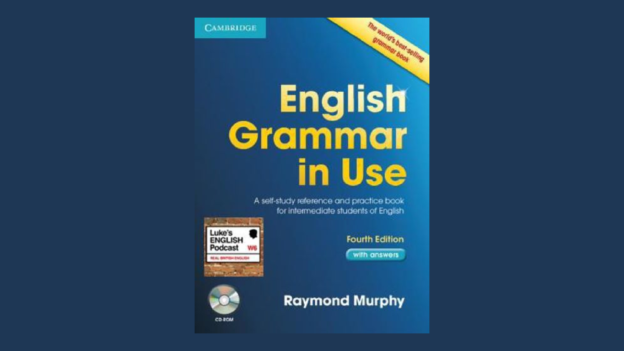
Luke: So, I’ve got here a book, which is called English Grammar In Use by Raymond Murphy and it’s the most popular grammar book for learners of English. It’s sold millions of copies all around the world, it’s a famous book, it’s known as ‘the blue book’, ‘the blue grammar book’
James: and you’re saying it’s basically useless
Luke: No, I’m not saying it’s useless! I’m just saying it’s interesting that most native speakers have got no idea what any of this stuff means. You talk about present continuous tense and third conditionals and things like that
James: Wouldn’t have a clue
Luke: You’ve got no idea, right. What I’m quite curious to do is, another thing is, that in English language classes teachers are always asking students to explain what things mean, right, so they always say things like “what is present perfect and how do we use it?” or “what’s the difference between these two sentences?”, right, and it’s interesting to see what a native speaker, someone who’s already able to speak English perfectly and functionally would answer those questions, because sometimes
James: You’re probably going to get them wrong
Luke: Well, you, it’s, the point is that, a lot of the exercises you do in class are, kind of, unrealistic, and unnatural so even if you were a native speaker you wouldn’t be able to do it, you know?
James: Yeah
Luke: So, like, if I said to you what’s the difference between, ‘I painted the house’ and ‘I have painted the house’? What’s the difference in meaning?
James: ‘I painted the house’ implies that you’ve just done it
Luke: You’ve just done it
James: and ‘I have painted the house’ could be any time
Luke: Ok. Couldn’t you say ‘I painted the house last year’?
James: Yeah, you could say that
Luke: Right, so ‘I painted the house’ could be any time
James: But you couldn’t say ‘I have painted the house last year’
Luke: Ah, right. Why not?
James: Because it’s too… it’s, it’s… I don’t know. There’s two levels to it. Once you say ‘I have painted the house’, you’ve already established the fact that you’ve painted it.
Luke: Right
James: Err, I don’t know! It just sounds wrong!
Luke: It just sounds wrong, yeah, that’s exactly it. The fact is, ‘I have painted the house’ means, you were right originally, you don’t know when it happened, it’s just that it happened in the past some time, and it’s connected to now, because you’re relating it to your whole experience of your life up to now, so there’s a connection to now, ‘I have done it’, like, I’ve got that experience. ‘I have painted the house’. You can’t say ‘I have painted the house yesterday’, because we just don’t use that tense
James: But you’ve already said, ‘I have painted the house’
Luke: Which implies that there’s no time, or that it’s an unfinished period of time.
James: Or just… it just doesn’t work, I don’t know why
Luke: But you can say, “I have painted the house today”, but you can’t say “I have painted the house yesterday”
James: ‘I have painted the house today’, would you say that?
Luke: At the end of the day, ‘so what have you done today?’, oh well…
James: You’d say ‘I painted the house’
Luke: Ok at the end of the day
James: Or ‘I’ve been painting the house’
Luke: But at lunchtime, “what have you done?”
James: Oh, I’ve painted the house
Luke: yeah, exactly
James: What have you been doing this morning? – I painted the house. I don’t know if you’d say ‘I’ve’
Luke: Well if it was finished you would
James: “well, I’ve come in, I’ve picked up the paint brush”
Luke: NO, that’s, that’s
James: I’ve run in, I’ve grabbed the ladder, I’ve put it up against the wall and I’ve painted the house.
Luke: That’s what native speakers say as an error. That’s what footballers do. They say things like, “Well, yeah, I’ve got the ball”… what they should say is “I got the ball outside the penalty box, right, I passed it to Wayne Rooney, he passed it back to me, I beat the defender and I shot and I scored. But what they’d say is “Well, I’ve got the ball outside the penalty box, and I’ve passed it to Wayne Rooney and he’s passed it back to me, and I’ve looked up, and I’ve seen the open goal, and I’ve shot and I’ve scored”, so all this weird present perfect, but it’s kind of wrong isn’t it.
James: Yeah
Luke: They’re actually speaking completely incorrectly
James: Because he’s kind of talking about the present and the past at the same time. “I’ve picked up the ball, passed it to Rooney. You know, I’ve collected the ball and passed it to Rooney”
Luke: So he’s talking about, it’s like, it happened just now, it’s like, in the moment
James: But he’s using “I’ve”
Luke: “I’ve” to, sort of, create that link to ‘now’ somehow
James: It’s like he’s running through it in his head.
Luke: It’s kind of like…
James: This isn’t going to be any use to anyone
Luke: It is. No, it is it is, it’s exactly
James: No-one’s going to listen to this
Luke: No, it’s not true, it’s not true. People will be interested to hear this
James: If you’re listening to this, I’m very sorry
Luke: No, people will be interested to hear about how a native speaker understands,
James: or doesn’t
Luke: or doesn’t understand grammar. Just let me ask you two more things and then we’ll call it a day. Right, er, another one is, what’s the difference between ‘for’ and ‘since’. That’s a question that students ask all the time. What’s the difference between ‘for’ and ‘since’?
James: In what context?
Luke: So, ‘I have done something for…’ and ‘I have done something since…’
James: for?
Luke: For, yeah, f-o-r. “i’ve been doing something for…”
James: 10 years
Luke: Yeah, I’ve been doing something for 10 years. I’ve been doing something since…
James: 1990… 2000
Luke: Yeah, since 2000, so what’s the difference between ‘for’ and ‘since’?
James: …erm… well you say ‘for’ when you’re about to describe the length of time that you have spent doing something. ‘Since’ sets the date that you started.
Luke: Yeah, exactly, yeah. Perfect. Yeah, you’re quite good.
James: That blew your theory out of the water
Luke: No no, it’s just interesting. I don’t have a theory. Right, here’s another one, ok. This is a classic one. What’s the difference between saying, okay this is conditionals. What’s the difference between saying “If I…” now you’ll get this because this is easy… “If I had bought a lottery ticket, I would have won the lottery” and “If I bought a lottery ticket, I would win the lottery” What’s the difference.
James: One’s talking about the past and one’s talking about the future.
Luke: Right, okay, yes, spot on. Nailed it. Yeah. Okay, I need to give you a really difficult one. Erm, hmm, I’ll go to the back of the book. Ok, prepositions, right? Let’s go for, what do you want? Let’s have adjective + preposition, which is, prepositions are the thing that learners have the most difficulty with, and they’re little words like ‘of’ ‘to’ ‘at’ ‘in’, stuff like that
James: Ok, go on, first question
Luke: So, you’ve just got to complete the sentence, erm, hmm,

LUKE: Erm, hmm, wait a minute. Right, wait a second

JAMES: I think you should edit this down.

LUKE: Yeah, okay, right, here we go. I’ll give you a sentence. You’ve got to put the prepositions in the right place, in the gap, okay?
I was delighted ….. the present you gave me. I was delighted … the present you gave me.

JAMES: ‘ with ‘

LUKE: Yes, well done. Brilliant.

JAMES: I don’t know why ? But…

LUKE: I’ve just had an idea whenever you get anything right, I’m gonna do this (ping!), okay? Right, so here’s the next one.

JAMES: This is bad.

LUKE: It was very nice … you, to do my shopping for me. Thank you very much.

JAMES: ‘ of ‘ but I don’t know why it’s ‘ of ‘. I couldn’t tell you the rules behind that. I just know that’s what it is.

LUKE: Why are you always so rude … your parents? Can’t you be nice … them.

JAMES: ‘ to ‘

LUKE: ‘ to ‘ yes, well done !

JAMES: Can you not do that? (referring to the BING)

LUKE: Okay, hmm, but why is it nice to, be nice to the parents?

JAMES: Well, because they brought you up and I dunno, bought you stuff at christmas

LUKE: No, I’m meaning, why do you use the word ‘to’? Nice, be nice to your parents.

JAMES: Because, you’re sort of, I don’t know.

LUKE: Yeah

JAMES: You’re giving some kind to them. You’re kind of, just doing something for their benefit, I suppose or something towards them. Something towards them. A big nice towards them. Now, it’s that
your parents, I couldn’t tell you.

LUKE: You’ve to look up, to look toward them.

JAMES: I couldn’t tell you.

LUKE: The fact is, it’s just impossible to create a rule about it. In fact, you’ve just got to learn that some words go with other words. Just got know it’s ‘ be nice to someone ‘ . You’ve just to learn ‘nice to’. So,
you have to see words existing together in little partnerships.

JAMES: Well, learn how they work together.

LUKE: Yeah, that’s it. It’s just learning two words together. Not just one on its own. So, that’s it. That’s the end of the experiment. Have you learnt anything from this, from this experience?

JAMES: No, no.

LUKE: No?

JAMES: Hm, I just hope that you get something out of this. You know making me look stupid basically.

LUKE: No, I think you got quite a few questions right. Didn’t you?

JAMES: Hhhh yeah,

LUKE: Okay, well, congratulations anyway. I’m gonna give you a certificate now which just shows that you’ve, two certificates, want to show that you completed the course.

JAMES: So, I’ll keep the certificate. Can I have this bit of chewing gum?

LUKE: Yeah, you can have the chewing gum.

JAMES: Sorry, thanks.

LUKE: Hmm, and the second certificate is just something I like to give to all the guests that I have on a program. It’s a little certificate just proving that you’d appeared on, on an episode of Luke’s English
Podcast. So thanks very much for coming and I hope to see you soon.

JAMES: Thanks very much. Luke’s English Podcast is brought to you by Wrigley chewing gum and Castllero del Diablo wine.

Okay folks, what I would now like to do is just explain some of the grammar points that I spoke to my brother about during that conversation. I asked him some questions about a few areas of grammar to see if he could answer them and I think you can see there that the point is, I guess, that native speakers surprisingly don’t understand or don’t really know the rules of grammar. They don’t know terms like ‘present perfect’ or even words like ‘adjectives’ or ‘nouns’. They don’t really know what those terms mean. So when you’re studying all that stuff at school, you’re in a way more articulate than they are, because you know how to describe the language and native speakers don’t know how to do that. That’s quite interesting but native speakers know, umm, what’s right and what’s wrong by instinct. They just sort of, they learn it as children without thinking about it and then when they get older they know that something is wrong but they don’t know why it’s wrong, they just know it’s wrong. It’s the same for you when you’re learning your language as a child.

Umm, what does that tell us about learning English? Well you could say, that it, some people might say it means that learners of English shouldn’t worry about learning the rules of grammar. That instead they should just try to listen to a lot of English, to read a lot of English and by doing that ,erm, see and hear the language so much that they just learn what’s right and wrong, just by frequency. So they know for example that people will say things, just because they have heard it said so many times before and they know what’s right and wrong just because they have heard and read the language a lot and they’ve started to learn, started to get a sense of all the patterns that you find in English.
Maybe that’s true, maybe that’s a good way to learn or maybe learners of English should study the rules or at least study the patterns and do practice exercises in order to understand what’s right and what’s wrong. I think it’s a combination of both. That you need to study the language , you need to test yourself with it , you need to do exercises but also you need to combine that with high exposure to lots of listening and lots of reading and so the more you see of the language , the more you start to develop a feel for it. Hum, that’s my opinion, um, but nevertheless, um, some of the things that I discussed with my brother there, I think I should just clarify for you, anyway.
Um, so the first thing I asked him was, what’s the difference between a noun, an adjective and a verb and he couldn’t really answer the question, but as you may know, a noun is a word which is used to give something a name. We use things like, you know, a table, a chair, a cat, those are all nouns. They can be plural or singular. Three cats for example.
They can be countable or uncountable. If they’re countable you can, you can count them. For example three, you know, tables. A table is a countable noun because you can say one, two or three tables but a word like sugar isn’t countable, instead we just say some sugar. So it’s like a mass of tiny little granules of sugar that together makes something uncountable. They can also be abstract, for example the names of things you can’t actually touch or feel. Umm, so concepts like ‘love’ is a noun. Umm, it’s also a verb but you could say ‘all you need is love’ and in that sentence it’s a noun. It’s an abstract one there and it’s uncountable. That’s nouns. Obviously there’re, nouns can be very complex, they can be larger, kind of phrases you could say like a noun phrase like for example, hum, let’s see, umm, like mobile phone technology is a kind of noun phrase and you can use that as the start of a sentence. Mobile phone technology is developing very quickly, right? So nouns can also be sometimes a number of words together.

Umm, right, the next one is a adjective. Well, an adjective is a word we use to describe a noun. Umm, it’s used to describe a noun, so we would say for example, the food was delicious, right? So delicious describes the food. How was the food ? It was delicious. You could also say delicious food. Like that, of course. Umm, so that’s an adjective.

Umm, and then the next one was a verb and the verb is the doing word. These are words we use to express sort of actions, um, so like play, eat, go, for example. Those are verbs, um, and we also have little verb phrases, which are things like phrasal verbs and that’s a verb in combination with other words and phrasal verbs are difficult because, well, somme of them are easy and some of them are difficult . The easy ones are easy to understand because the meaning is very similar to the original verb. So, if you’re talking about, um, oh, let’s see, hmm, ‘ go on’ , like ‘ go on’, meaning continue. I’s fairly clear what that means because go, we know what ‘ go’ means. ‘ Go on ‘ just means go and don’t stop going, continue. That’s fairly easy but some of them are difficult like if you take the expression ‘give up’. ‘ Give up ‘ umm, meaning to quit. Hum, that’s not quite so easy because the verb ‘ give’ you know, we think, well, ‘ give’ . Give someone a birthday present but in this sentence ‘give up’ has a completely different meaning to give which makes it very difficult and the fact is as learners of English you just have to learn phrasal verbs. You just have to try and learn them because they are all unique words with their own meanings, just a combination of a few words. So that’s, umm, that was the first thing I asked my brother. The next thing was about ‘present perfect’ and ‘past simple’.

So we know the ‘present perfect’. One of the, actually this is one of the most common bits of grammar that you study when you’re learning English. Present perfect of course is like ‘ have’ plus a past participle or ‘ has’ plus a past participle, like I have lived in Japan for example. Umm, she has eaten a pizza, right? And ‘past simple’ obviously everyone knows. I lived in Japan, she ate a pizza, for example. Umm, so the difference, well that’s quite a big one and it’s something that everyone is studying. So the difference between ‘past simple’ and ‘present perfect’ basically we use, we use ‘past simple’ to talk about a finished action in the past but the time period is important and we tend to, with ‘past simple’ express a kind of distance from the act. So there is a distance in time basically, which means that the action
happened in a finished time period. I lived, erm, well let’s say, umm, I ate, no, I drank a coffee. It’s pretty, probably suggests that you that you drank a coffee yesterday or you drank a coffee last week or you drank a coffee, umm, during breakfast, right? So it’s like in a finished time. ‘Present perfect’ is used to describe finished actions which happened in an unfinished time. So there’s a connection to now. That’s the most important thing. So, basically you might say for example, I have drunk three cups of coffee today. Umm, today is not finished, so you can say, I have drunk three cups of coffee today. Hum, so the time period is always connected to now. It’s a bit more complicated than that but that’s is all basic difference.
Hum, to be honest, if I was to explain ‘present perfect’ and ‘past simple’, I’d need to record a completely new podcast and I could do that. So, I might, I might do that.. ‘Past simple’ and ‘present perfect’.

The next one was about 2nd and 3rd conditionals. So we know the 2nd conditional would be for example, umm, let’s see. Err, if I bought a lottery ticket, I would win the lottery. Not a very good example because, it’s not definite that you’d win, so, if I?
Okay, let’s say, if I, if I went outside, I, no, no, no … Okay, if I studied hard, I would pass the exam. So, you’re talking about the future but you use past tense like studied, if I studied, now, we’re not talking about the past , we’re talking about the future. And we know, it’s the future because we’ve said’ if’ . So ‘ if ‘ plus a ‘past tense’ is actually used to describe a kind of unreal future. So you use the past tense not to create distance in time but to create distance in reality. In this sense it’s an unreal or hypothetical future because you don’t think it’s realistic. So, if I studied hard, I would pass the exam but I’m not going to study hard because I don’t want to, right? So compare that with the 1st conditional. If I study hard, I will pass the exam. Umm, ‘present tense’ after ‘ if ‘ , still talking about the future but here we think it’s a realistic future. So, there’s no distance from reality. We think it’s real and it’s followed by ‘ will ‘. Umm, if I study hard, I will pass the exam. So, that’s it, it’s like a definite future with its definite future consequence!

The 3rd conditional talks about the past and there we use ‘had’ plus a ‘past participle’ in the ‘if clause’, in the second clause we have ‘would have’ and a ‘past participle’. So, let’s say, the exam was last week and I failed, you could say, ‘ If I had studied for the exam, I would have passed, right? The fact is, I didn’t study and I didn’t pass but if I had studied, now here we’re using ‘ had studied’ and that’s like, it looks like past perfect, but it’s not actually past perfect, it just looks like it, but it’s used to create distance from reality in this sense, in the past. Umm, so we go from ‘past simple’ I didn’t study, we go one tense back to what looks like ‘past perfect ‘. ‘If I had studied’ and then in the second part ‘I would have passed ‘. Again to refer to a past consequence.

It’s all very complicated and to be honest rather boring but you kind of have to learn it. Again, I could do a completely separate podcast all about conditionals because it’s such a big topic.

The last thing I talked about with my brother was ‘prepositions’ and if you’re learning English you’ll know about prepositions. They’re very, very difficult. They are the little words that we use to connect nouns and verbs and adjectives together and you find the prepositions are linked to other words and there isn’t really a decent set of rules to explain these links. The fact is, you just have to learn them. You just have to learn that we say ‘to be nice to someone’ right? ‘Nice to’ those words go together. You’ve just to learn that you have to remember it and there’re lots of combinations of verbs and prepositions, nouns and propositions and adjectives and prepositions and there are so many lists, really that, it’s just a case of noticing them and then try to remember them. Umm, what you should do, is realize that prepositions are linked to other words and then see these word combinations as separate units of meaning that you should learn. So, you don’t just learn the word for example ‘consist’ but you learn the expression ‘consist of’ right? Okay, so a hamburger , a Big Mac consists of bread, salad, beef and cheese for example. Umm, so, ‘consists of’. Those words always go together.

Umm, so that’s basically it. Those are the things I’d discussed with my brother. I expect, if you’re a learner of English, you understood the rules of grammar a little bit better than my brother did. Umm, in which case you should feel quite good about yourself. Um, remember you’re, you’re learning the grammar of the English language and you’re learning the grammar actually better than most native speakers. So, well done you.
Umm that’s the end of this podcast, I hope you found it interesting. That’s all for me . Bye, bye, bye, bye, bye…

Enjoy.

Episode 3 – Music & The Beatles / Interview with Mum / Language Focus: Used to

A conversation with my Mum about The Beatles, and a language point about ‘used to’. Full transcript available below.

Right click here to download this episode.

Transcript of Luke’s ENGLISH Podcast episode: Music / The Beatles

You’re listening to Luke’s English Podcast. For more information visit teacherluke.wordpress.com

Hello and welcome to episode 3 of the podcast. Thanks very much for listening and downloading, and possibly subscribing to the show using iTunes, that’s fantastic. In today’s show we’re going to be talking about music and I’m going to talk to my Mum about The Beatles because she was a big Beatles fan in the 1960s. I’m also going to respond to a couple of emails that I’ve had and then in the last part of the podcast, the language part, I’m gonna talk about habits, habits and behavior in the past. So things like ‘use to’ and ‘would’ and some other useful language. So stay tuned for that.

Now, I’ve had an email from Alessandro in Italy in response to the question that I asked at the end of the last podcast. That question was: What kind of music is popular in your country at the moment? Is it kind of English language music or do you have music that is just exclusive to your country? And Alessandro from Italy says that, he still thinks that ‘Opera’ is the most famous Italian music, of course. Everyone knows Opera, erm, people like Luciano Pavarotti, Andrea Bocelli of course that’s the most famous Italian music, but also in Italy, Rock music is very popular and they have all English language bands, the ones we have, obviously have here as well. Things like, you know, U2, The Red Hot Chili Peppers, Coldplay. All these really big bands are popular in Italy as well. But also there are lots of Italian Rock bands. They’re really popular there but (they) aren’t very well known outside of Italy and I think this is probably true in most countries, erm, I know it’s true in Japan, that there are big very successful bands, they’re just famous in that country and because the lyrics are not in English, they’re not famous in America or in the UK. So it’s probably, hmm, a bit lazy, in terms, sort of British people. We don’t listen to very much music that isn’t in English. We’re probably missing out on quite a lot of good music. So thanks very much for your emails. I appreciate that very much and remember, if you want to email me, you can. It’s luketeacher@hotmail.com and I love hearing from you. So send me your emails and all your comments and stuff and I’ll get back to you through the podcast.

Ask the girl what she wanted to be
She said baby, can’t you see
I wanna be famous, a star of the screen
But you can do something in between
Baby you can drive my car
Yes, I’m gonna be a star
Baby you can drive my car
And maybe I’ll love you

A little bit of Beatles there. That was ‘Drive my car’ from the ‘Rubber Soul album’ and I’m playing that because the Beatles and Apple Corps which is their company and EMI music have finally decided to re-release all of the Beatles studio albums in remastered form. So they’re all going be digitally remastered and so that means you’ll be able to listen to them and hear them sounding better than they’ve ever sounded before. Some of the albums that they released, particularly the early ones were recorded in mono, and there are CD versions of those albums in mono but now they’re going to be digitally remastered, so that they’ll sound really crystal clear and perfect and they’ll be all in stereo which obviously makes the listening experience a lot better. Now, right, so with me here now, is my Mum.

LUKE: Hello Mum

Mum: Hello Luke

LUKE: How are you?

Mum: I’m very well.Thank you.

LUKE: Now, umm, I thought that I’d talk to my Mum today because she used to be, back in the sixties, a massive Beatles fan. Is that right?

Mum: That’s right, yes.

LUKE: Okay, so, umm, right, so I hope you don’t mind if I ask you some questions.

Mum: No, that’s okay.

LUKE: Umm, so how did you first hear about the Beatles then when you were younger

Mum: Umm, oh, it’s very hard to remember but I can, I have, do have one memory of being on the school bus and hearing two other girls talking about this group

LUKE: yeah

Mum: called the Beatles and looking at pictures of them and saying ‘ which is your favorite?’ and I think maybe that was the first time I heard of them but I, I really can’t remember the first, the actual first time.

LUKE: Yeah, now they, they were a really massively popular band, weren’t they?

Mum: They were

LUKE: I mean, everyone was crazy about them. Umm, so, you obviously heard about them from some friends and then started

Mum: And then started to talk about them and look at pictures of them, listen to the music and I didn’t actually buy any records of theirs until the 2nd LP which was called ‘With the Beatles’ which my parents bought me because I didn’t really have much money of my own in those days.

LUKE: That’s nice of them. How old were you in those days, tell me?

Mum: Umm, I would have been about twelve or thirteen, I suppose.

LUKE: Twelve or thirteen, so you would have been the target audience really

Mum: Hum, I suppose so, yes.

LUKE: So why did you like them? Well, they were so popular but why, why did you like them?

Mum: Oh, it’s very hard to explain why. Umm, they were, they were just so unusual, just so different, all the Pop music we’ve had up ’til then seemed to be mainly from America. I mean there were one or two the English people like Cliff Richard and Adam Faith. Umm, but they were just so different. I mean the first time I ever saw a group, you know with three guitars and drums. Before it was just a singer.

LUKE: They had something else about them, didn’t they?

Mum: Oh yes!

LUKE: They had a kind of personality

Mum: Yep !

LUKE: They had a good sense of humor, they were sort of charismatic

Mum: They were from Liverpool, which, and so they had these wonderful Liverpool accents which, um, of course I didn’t really know about in those days. I had never heard about another Liverpudlian I think.

LUKE: Yep

Mum: And they were very witty and very funny and very quick and just wonderful really.

LUKE: Right, so, did you actually ever see them?

Mum: I did, I saw them twice. I think the first time I saw them was in 1963 I think in Wolverhampton and then I saw them again in Birmingham the following year.

LUKE: So they were probably playing in a theatre or something like that, right? Umm, I can’t remember were they were in Wolverhampton. It was probably a Cinema or a Theater or somewhere like that and in Birmingham there were the Odeon in New Street which again was a Cinema but it had a stage and so it could be used for concerts as well.

LUKE: So, what was the experience like? I mean, what was it like actually seeing them, what was the audience like, first of all?

Mum: The audience was completely hysterical. We were all screaming and shouting and it was, I remember, the compere the shows sort of, that’s the man who did, who introduced the acts. When it got to the Beatles because they were the last on the bill and he sort of start the audience up even more by saying ‘Do you want to see them, do you want to see them?’

LUKE: And everyone was like ‘Yeah,

Mum: Everybody was shouting and screaming and the curtain came up and we could see their feet, and then we could see their legs and then you could see them and then the music started and that was all extremely exciting.

LUKE: There’s lots of video footage of The Beatles concerts where they’re playing and you can’t really hear the band. You can just hear all this ridiculous screaming .

Mum: Yes, that’s what is was like. I don’t really think we could hear them properly at all.

LUKE: So, it was just total madness, really.

Mum: Yeah, absolutely.

LUKE: Yah, Yah, I expect probably at the time because it was the early 1960s, young people didn’t really have anything, you know, interesting like The Beatles. They just, I mean, I think, I might be wrong but I think that life was kind of boring, right?

Mum: Umm, no, I never thought it was boring. It’s just the way it was in those days but it was very different from the way it is today. There wasn’t

LUKE: Now, now teenagers have just got so much, so many, you know so much music, so many, hmm, movies and all kind of things there to entertaining them.

Mum: And it’s so much more accessible than it was in my day. You had to actually go to the cinema or buy a record.

LUKE: Yeeah, Yeah

Mum: There was no downloading stuff from the internet or watching DVDs or anything like that.

LUKE: Right, so erm, which Beatle was your favorite because everyone had a favorite Beatle, didn’t they?

Mum: My favorite Beatle was, it was a toss-up between John and Ringo.

LUKE: Yeah, okay

Mum: I think, mainly my favourite was John, because he was so outrageous.

LUKE: Yeah, he was controversial, wasn’t he?

Mum: He was

LUKE: Yah, okay, so just the fact that he was controversial and outrageous, that, that

Mum: That was mainly it, yes he was very witty and very funny.

LUKE: Yah, he was, wasn’t he? Yeah, and what about now? Is John still your favorite now?

Mum: Ha ha,umm, oh it’s hard. I can’t really think of it in those terms anymore really, because I, I just, I’m very fond of George now.

LUKE: Yah

Mum: I appreciate him more now than I did then, I think.

LUKE: Yah, okay. So do you still listen to The Beatles these days?

Mum: Not very much, no,hmm

LUKE: Why not?

Mum: I find it quite strange listening to them now.

LUKE: Hmm

Mum: It just, it’s, hum, I don’t know, it’s very hard to explain. It just reminds me of those days and I don’t really want to go back and think about those days anymore. I’d rather live here and now.

LUKE: Yeah, alright, okay, thanks very much for talking to me.

Mum: It’s a pleasure.

LUKE: Yeah, hmm, alright, well, that’s, that’s it then. Oh, I think I might buy a couple of these new CDs when they come out.

Mum: Okay, right

LUKE: Because you knoz I’m a big fan.

Mum: Yes, well, I might listen to them if you buy them.

LUKE: Yeah, you’ll probably enjoy them.

Mum: Hmm

LUKE: Okay, well

Mum: Okay

LUKE: Thanks very much

Mum: Okay

Okay, so now it’s time to do the language part of the podcast. This is where I teach you something and in the last episode you heard my Dad talking about his Easter experiences when he was a child. And so he was talking about things that he usually did, things that he did regularly or every year when he was a kid. So we’re going to look at some language that he used and that you can use to talk about regular habits in the past. Now there are some really common ways of doing this. The most common way is to use ‘used to’.You’ve probably studied that, you, you probably know about ‘used to’. Erm, so it’s erm, u-s-e-d t-o, used to. So for example, hum, something my Dad said was ‘ we used to paint our easter eggs different colors, okay? Hmm, another example for me would be ‘I used to live in Japan’, right? Or I used to smoke. I don’t smoke anymore, because it’s very bad for your health, right? I used to smoke but then I gave up.
So this is something really useful. Now, you may know about ‘used to’ and you may have studied it but do you actually use it? Now the most, this is very important, you might know about different kinds of grammar. You might have studied different bits of vocabulary but the difference between a learner of English and a native speaker is that a native speaker uses all of this stuff. They actually use it regularly when they speak. They use a variety of different grammar and a variety of vocabulary, okay? And ‘used to’ is something that people use all the time when they are talking about the past, when they’re talking about things they did regularly in the past, okay? So you should use ‘used to’ a lot. You might think that this isn’t a new language for you but the most important thing is that you’re actually using it okay? Umm, something I always tell people is, it’s not important what you know, it’s important what you do in English. So the important thing here is that you actually use something like ‘used to’, okay. Hum, just some other important points about ‘used to’ , pronunciation. So obviously it should be ‘I ‘used to’, so that’s ‘used to’ not used to, and not ‘used to’ or ‘used to’ (listen to the audio to hear the pronunciation Luke is de,onstrating here). Hmm, I sometimes hear people saying ‘used to’ or ‘used to’ but it’s not that , it’s ‘used to’, ‘used to’. Also in negative or in question forms it doesn’t have a ‘d’, so that’s when you write, ‘used to’ in a negative it doesn’t have a ‘d’ . So I didn’t use to smoke. Right? So it’s without a ‘d’. So it’s didn’t u-s-e t-o, right? And it’s the same in questions,right? Did you use to, for example.

Umm, now ‘used to’ is commonly confused with, erm, another, erm, very similar structure and that is ‘to be used to doing something’. For example, I am used to living in London. Okay? So you’ve got ‘used to’, which is ‘I used’ to live in London and ‘be used to doing something’. I am used to doing something. I am used to living in London. So those forms are completely different.

Right? So, hum, I’ve told you about ‘used to’ to talk about past habits, now let me tell you about ‘to be used to doing something’ or ‘I am used to doing something’. Right? Which is totally different from just ‘used to’ okay. So, hum, okay let’s see, so if you say ‘I am used to doing something’ or ‘I got used to doing something’ it means that before something was difficult or strange for you but now it’s okay. Now you’re okay with it. You got accustomed to it. Okay? So for example something that you might say, you might say ‘when I first moved to London I thought it was very difficult to live here but now I’m used to living here. Okay, now I’m used to living here. So, it could be ‘now, I understand the culture a bit more, I can speak better English, I remember that people drive on the left, so I’m used to living here now. So that is totally different from ‘I used to’ live in London, which means that I lived in London in the past but I don’t live in London now. Okay? Right.

So another way of talking about a past habit which is similar to ‘used to’, is the modal verb ‘would’. Now ‘would’ is usually, when it is used to talk about a past habit we use ‘would’ but in the contracted form. Okay? So for example you may have heard my Dad in the last episode say something like this:’ We’d roll our easter eggs down a hill and then we’d eat them at the bottom’ Okay? So, um, this use of ‘would’ in the contracted form, for example ‘we’d eat them at the bottom or ‘ we’d buy each other chocolate eggs every christmas, not christmas, what am I talking about? Not Chrismas! Sorry! We ‘d buy each other chocolate eggs every easter. Right? Um, this use of ‘would’ is very similar to ‘used to’. We use it to talk about things we did regularly in the past. Okay? For example for me, when I lived in Japan, I’d see businessmen asleep on the underground everyday, okay? I’d see businessmen asleep on the underground everyday. Or I’d sometimes get woken up by noisy motor bike gangs in the middle of the night. Right? I’d sometimes get woken up by noisy motorbike gangs in the middle of the night. That’s true actually. I used to get woken up all the time by motorbike gangs because I lived in, I lived near Yokohama and sometimes in the summer there was these big motorcycle gangs, they would ride around, hum, in the city in the middle of the night and that was so loud, so for example, you know, I used to wake up to the noise of these motorbikes and I’d get up and I’d go out onto my balcony and I’d look down on the street and I’d see all these motorbikes riding past. It’s quite frightening because they were quite scary because some of them had samurai swords on their backs which is quite scary.

Anyway, anyway, I was talking about ‘would’ so for example’ I’d sometimes get woken up by noisy motor bike gangs’. Okay? So try to use ‘would’ like that in the contracted form to talk about regular things that happened in the past. Now, it’s very similar to ‘used to’ but it is different. The only difference with ‘used to’ is that we don’t use, we don’t use ‘would’ like this with state verbs, okay? Now, you’ve got state verbs and you got action verbs. Action verbs are the most common ones. Action verbs all describe an action. Right? For example, something that you do rather than a kind of state or condition that you’re in. So an action verb might be to go, to play, to eat, something like that, okay.

Right so we don’t use, okay that’s action verbs. play, go eat an so on. Now, state verbs are not used to describe an action but they describe a situation or a state or a condition. Right? These include verbs like live, know, like, understand, hate, okay? Now, we can’t, we don’t use would in the contracted form to talk about past habits with state verbs. Okay?
So for example, you can say ‘I used to live in London. Right? ‘Live’ is a state verb. You can say I used to live in London but you can’t say ‘I’d live in London’ if you’re talking about the past. Okay? That’s because ‘live’ is a state verb. So you can say ‘when I lived in London, I’d take the underground to school everyday and I’d often go to the pub after school on a friday. So you can say that because ‘take’ is an action verb and ‘go’ is an action verb. Alright?

So, remember that, you can only use, ‘would’ contracted for past habits with action verbs and not state verbs. If you’re interested in, action verbs and state verbs and what the difference is, it’s really simple. Just go to Google. Right? Go to the Google search engine and type ‘state verbs’. Have a look at the results and you’ll see lots of grammar pages from, you know, Oxford, um, University or something like that and they’ll show you lists of state verbs and action verbs and the differences between the two. Okay? Umm, that’s it. That’s, that’s the end of the language section.

Um, so, erm, yeah, I hope you found that useful. Don’t forget you can email me questions. If there is something you don’t understand or there is another question you have about language, email me. The email address is : luketeacher@hotmail.com and I will answer questions that you, that you sent me in the podcast. Now, I might not be able to answer every question that is sent to me because I, I get quite a few questions. So if, if I don’t answer the question, you’ve sent me, I’m sorry. I’ll try to answer all the questions that I get sent but sometimes I can’t answer them all. Umm, okay, so that’s, that’s the end of the podcast.
Now, I’m gonna end with a final question and the question this time, umm, is about skateboarding. Now, it’s about skateboarding because erm, I was talking to my brother recently and he loves skateboarding, right. He’s, he’s a, he’s a skater, he skates a lot. Now, I was talking to him about it recently and I was thinking that I might interview him for the podcast in the future. So I might have an interview with, with my brother James about skateboarding but I’d like to ask you a question about skateboarding. What do you think, is skateboarding popular in your country? Right? And do you think skateboarding is vandalism or is it okay? Now what does vandalism mean? Vandalism is when people damage public property. Okay? So what skateboarders do, is, is, they use public property, umm, for their skateboarding. So they do things like, eh, they will ride on, hmm, on like a bench or they will ride on a handrail for their skating and it damages the bench and it damages the handrail and a lot of people in this country think that skateboarding is vandalism, that it damages public property but a lot of people think it’s kind of like an art form or a sport or something. So what do you think? Do you think skateboarding is vandalism or do you think it’s okay? So that’s the question.

Umm, that’s the end of the podcast. I hope you enjoyed it and don’t forget to email me luketeacher@hotmail.com and I’m looking forward to hearing from you. So, that’s it! Cheers, bye, bye, bye, bye, bye, bye, bye……..
__________________________________________________________________________________________________________________________________________
(Thanks to Bettina for providing this transcript – Thanks Bettina, I appreciate it very much and I’m sure the listeners do too)

2. Easter / Interview with my Dad / Language Focus: Adverbials

A conversation with my Dad about Easter, and a language point about adverbials. Full transcript available below.

Right click here to download this episode.

Small Donate Button This is the transcript to “EPISODE 2 – EASTER”
Hello, and welcome to Luke’s English podcast, the real British English podcast. This is episode two of the podcast and I’m very pleased because I’ve already had a couple of emails from a couple of people who’ve listened to the podcast, and one of those emails comes from Jose Manuel in Alicante in Spain and he asks me about Easter because it’s Easter at the moment. He asks me what we do normally in the UK at Easter and, well it’s funny you should ask that Jose (Jose, I’m sure that’s how you say it) because right now I’m at my parents’ place. I’ve travelled up on the train from London and I’m at my parents house which is in the countryside in Warwickshire and this is a typical thing that people of my age do, they normally travel back to their parents’ houses and they spend time with their families together and actually in this episode I’m going to be joined by my dad so I’m going to interview my dad about Easter, so he’ll tell you some typical things about Easter time in the UK and so that’s going to be our feature in part two and then at the end of the podcast I’m going to talk about some adverbs, some useful adverbs in response to another email that we got and so that’s what’s going to happen in today’s podcast.

Luke: OK, so I’m now joined by my dad, Rick, but obviously I call him Dad, I don’t call him Rick. Hi Dad,
Rick: Hello Luke
Luke: How are you?
Rick: I’m fine, thank you very much
Luke: Good, so, obviously I’m here at my parents’ house because it’s Easter, at your house. This is what I normally do, isn’t it?
Rick: Yes, it is, it’s a time to get together with the family
Luke: Right, ok so, so Easter then. Now Easter is a season when we remember the death and rebirth of Jesus Christ by telling our children that a large rabbit comes in the night and leaves chocolate eggs in the garden, now I don’t know about you but that seems a bit strange to me I don’t know what the connection is between the Jesus thing and a big rabbit and chocolate and eggs and things, what do you think about that?
Rick: Well this idea of the Easter rabbit coming and bringing eggs is a bit of an American idea really and I think that it’s a very interesting mixture between Christianity and old pagan beliefs, I mean, obviously the Christian celebration of Easter is, as you say, about the crucifixion and, after three days, the resurrection of Christ, so it’s a crucial celebration and stands alongside Christmas, the birth of Christ and then the death of Christ, the two big Christian festivals.
Luke: That’s the Christian thing, you said something about Pagan, what does that mean?
Rick: Well of course you know experts will tell you that 2,000 years ago when Christianity started to spread across Europe it did, if you like, take over the Pagan festivals that already existed
Luke: So Pagan is the kind of religion that people had …
Rick: it’s pre-Christian …
Luke: … before christianity,
Rick: Yes and it’s got a lot to do with various gods and superstition and of course pagan times there was a big winter festival and there was a big spring festival and the spring festival was of course the festival of fertility and growth and new growth …
Luke: …and new life
Rick: … of new life and of course if you lived in a society where it was very important that the crops didn’t fail this was a time when you wanted to have all the good luck you could get, to have the gods on your side to make sure that the crops had a very successful season …
Luke: OK, so before Christianity then, Easter was a festival, a pagan festival when people celebrated the start of new life and spring time and good luck for your, you know, farming for that year, right?
Rick: yes
Luke: now I understand the egg connection because an egg is the symbol of new life right? But why … now actually one of my students asked me this last week, why do we have chocolate eggs, why chocolate?
Rick: Well I must admit I’m not entirely sure, but my guess is that people have given each other eggs at Easter time, or if you like, at spring time as a gift because it is, as you say, the time when all the birds are laying their eggs
Luke: right, chickens and stuff
Rick: well chickens but all the wild birds are nesting and making nests and laying eggs and remember that in the old days people used to use the natural resources very very much, the berries and the eggs were a resource …
Luke: so they …
Rick … and they would go out into the countryside and gather the eggs and eat them …
Luke: right, so they used …
Rick … so the egg season came in and people would no doubt give each other eggs and presents and then when we discovered the joys of chocolate I suppose it was a natural thing to give people chocolate eggs instead
Luke: just a sort of gift …
Rick: … a gift which symbolises new life
Luke: so its nicer really to give someone a chocolate egg than just an egg because just an egg, I mean, it’s alright, you can boil it or fry it or something but it’s nicer as a gift to give someone a chocolate egg I suppose
Rick: yes I suppose
Luke: right so let’s see, what do English families usually do then at Easter in the UK? oh um yea, what do English families normally do at Easter?
Rick: well it is a traditional time for the family to get together and it’s a long weekend, Friday, Saturday, Sunday, Monday and those four days is when most families, you know, get together and these days they get in the car and they drive to the parents or the grandparents and it is very much a family get together and they give each other chocolate eggs in most households.
Luke: When I was a kid I remember what you and mum used to do is at Easter you used to hide eggs, you used to hide chocolate eggs around the house or around the garden and me and James, (James and I) would go and try and find the eggs, so that was always fun.
What did you do when you were a child?
Rick: Well I remember I used to go to my grandparents’ house. They lived up in the north of England in the countryside, and they had real boiled eggs, hard boiled eggs which were boiled in water that had been coloured with something so you were given a pink egg or a blue egg or a green egg and we would roll them, this was really quite a well established tradition that you roll the eggs down some kind of bank, down a hill, you roll the eggs down a hill, why I’m not sure but that’s what people did, they used to roll the eggs down the hill and run after them as a kind of game
Luke: so you’d walk up a little hill with your blue or pink eggs and then you would sort of roll them down the hill and then run after them and have a lot of fun running after some blue and pink …
Rick: … that’s right and if your egg broke it didn’t matter because it was hard boiled it was cooked and then you would eat the egg at the bottom of the hill, that’s what you did, you rolled the egg down the hill and you chased after it and you caught it and you ate it.
Luke: Right, well that sounds like lots of fun I suppose these days if … I think probably children are so lazy now that if you hid some chocolate eggs in the house they would probably, you know, be too lazy to get up and try and find them, you’d probably have to leave ipods or something around the garden, because if you left an ipod in the garden then a child would probably get up from in front of the TV and try and find it. I think kids these days are too lazy to do anything really unless there’s an ipod involved.
Rick: I don’t really agree with you Luke and I know you’re really just teasing, but the point is of course is that it’s fun and kids do like to search for things, to hunt for things whether it be a little chocolate egg or indeed a little chocolate rabbit and sometimes you hide little chocolate rabbits around the house and ask the children to find them and they love it.
Luke: I hit a rabbit the other day in the car when I was driving.
Rick: Really?
Luke: There’s lots of rabbits around here, you know I was I – um my parents live in the countryside, listeners – and there’s lots and lots of rabbits especially at this time of year and I was driving the car to the station to pick up my brother James, and a rabbit ran out in front of the car and I didn’t hit the rabbit with the wheels so I didn’t squash it but the rabbit went under the car and I heard a kind of noise …
Rick: … clonk …
Luke: … a kind of dum noise as the rabbit, probably the rabbit hit his head on something under the car. I looked in the mirror and there was just a dead rabbit
Rick: what a horrible thought! Mind you you do see an awful lot of dead rabbits on the roads these days there are thousands of them and they do have a terrible habit, a rabbit habit of running out in front of your car …
Luke: they’re stupid aren’t they?
Rick: … they wait until you’re coming and then they run out
Luke: They’re just stupid really aren’t they. Anyway there are so many of them that it doesn’t matter
Rick: Well it’s a pity for that particular rabbit but there’s nothing much you can do about it when it hurls itself in front of your car
Luke: Well there’s plenty of food for the birds
Rick: That’s quite right lots of birds eat the dead rabbits – the crows, the magpies and the buzzards, they live on the rabbits which are killed on the roads.
Luke: Well, thanks very much Dad for, you know, for agreeing to talk to me, yea, it was very nice, thank you
Rick: ok and I hope you have a very happy Easter Luke
Luke: Yes, happy Easter to you too
Rick: Thank you.

Ok so that was my dad, um a very nice man, very well educated, he knows a lot of things about history and all sorts of things so I’m very lucky to be able to interview him.
Now like I said at the beginning of the show, I had another email about an English question, now I got an email from Miho in Yokohama in Japan and she asked me what ‘basically’ means, because she heard me in the first podcast using the word ‘basically’ a lot and she’s right I do say ‘basically’ quite a lot, it’s a very common word, particularly for me. Lots of people use the word ‘basically’. Now the word ‘basically’ is an adverb and adverbs are great words, very useful words that you can use at the beginning of a sentence. Now a word like ‘basically’ doesn’t really mean very much but people use it almost like a habit. Really, ‘basically’ is used to say … before you say something you use the word ‘basically’ to show that you are going to say something in a simple or basic way, OK? So for example if I use the word ‘basically’ you put it at the beginning of the sentence and you’d say something like this: “basically, this is a podcast to give learners of English some listening practice” OK?
Now there are lots of other adverbs that you can use in a similar way at the beginning of a sentence and you’ll probably know adverbs because most of them end in ly, now we get lots of different kinds of adverbs in different positions in the sentence but the adverbs I’m going to teach you now are ones you can use at the start of a sentence. So we’ve got adverbs like basically, actually, obviously, strangely enough, frankly speaking, recently, unfortunately, amazingly and hopefully. Ok so I’m just going to give you some examples of that now, so we’ll start with ‘actually’:
“Actually this is only the second podcast I have ever done” ok? So there’s an example. Now if you speak Spanish and some other European languages, ‘actually’ in your language means ‘currently’, meaning ‘now’ so actually doesn’t mean ‘now’i t just means ‘as a matter of fact’, right? So, “actually this is only the second podcast I have ever done”.
The third one is ‘obviously’. Now we use “obviously” to say something that is obvious, so say something that everybody knows. Now, football players use ‘obviously’ a lot when they are doing interviews now, just as an example you might say “obviously we were the best team in the competition” right? Now you would say ‘obviously’ because your team won so of course your team was the best one. “Obviously my team was the best team in the competition” for example.
The next one is ‘strangely enough’, now that’s used to say something that is strange. OK, so for example, “strangely enough I don’t really like fish and chips, even though I’m English” right? So that’s strange because most English people like fish and chips, so “strangely enough I don’t really like fish and chips even though I’m English”.
The next one is ‘frankly speaking’, now this is something you would say that’s rather honest, OK, so for example, “frankly speaking it was the worst film I’ve seen in a long long time” so if you are being very honest about something you can say ‘frankly speaking’, “Frankly speaking it was the worst film I’ve ever seen”.
The next one is ‘recently’. Now you probably know ‘recently’, we use it to say something that happened in near or close time. Right? So for example “recently I’ve been listening to lots of Rolling Stones records”. Ok? “Recently I’ve been listening to a lot of Rolling Stones records”.
The next one is ‘unfortunately’, and we use that one to talk about something bad that’s happened, OK? something that you regret, OK? So for example, “unfortunately, I had to leave before the end of the lesson” OK ? “unfortunately I had to leave before the end of the lesson”. So that would be a bad thing because, obviously you want to be in the classroom for the whole lesson, but “unfortunately I had to leave before the end of the lesson and I missed the most important part”, for example.
And finally, the next one I’d like to teach you is ‘amazingly enough’. We use that one to describe something amazing for example “Amazingly enough, I’ve never been to Edinburgh” “Amazingly enough I’ve never seen a musical” and “amazingly enough I’ve never been to Harrods”. Now that’s amazing because I live in London and I’ve never been to Harrods, right? So “amazingly enough I’ve never been to Harrods”, OK?
Oh there’s one more, and that’s ‘hopefully’. Now if you hope for something then you can use ‘hopefully’, for example “hopefully this podcast isn’t boring” right? Ok?
Right, so that’s the end of part three and that’s the end of this podcast. Don’t forget to email me. I’d like to end with a question again now, and the question this time is: what kind of music is popular in your country at the moment? so what are people interested in at the moment in terms of music in your country? So, for example is it mainly English language music so music from American or Britain, or is music from your country more popular than English Language music? So, don’t forget to email me, that’s: luketeacher@hotmail.com and I look forward to hearing from you very soon. That’s the end of the podcast, bye bye bye bye bye…..