Category Archives: Learning

53. Discussing Grammar with My Brother

Can an ordinary native speaker of English (my brother) explain the rules of English grammar? That’s the question in this interview. I wanted to know how much my brother James knows about the rules of grammar which learners of English study every day. The results are quite revealing.Transcript available below.

Right-click here to download this episode. 
At the end of the interview I explain the grammar rules which we discuss

Here are the lyrics to James’ rap at the beginning of the episode!
It’s Luke’s English Podcast
We’re sitting in his flat
We’re discussing English
and shit like that
We’re getting educated
because that’s the way we do
so listen up close
because his name is Luke

TRANSCRIPT
Here’s the first part of the transcript. The beginning of this transcript was sent in by Bettina from France. Thanks again Bettina ;)

You’re listening to Luke’s English Podcast. For more information visit teacherluke.podomatic.com

Uh… say what
Uh… what what what what

It’s Luke’s English Podcast
We’re sitting in his flat
We’re discussing English
and shit like that
We’re getting educated
because that’s the way we do
So listen up close
because his name is Luke

Yeah, we’re learning English
Luke’s English Podcast
Learning some English
Luke’s English podcast
with Luke’s English podcast, yeah

Good evening Ladies and Gentlemen and especially you Ladies,
you’re in safe hands, it’s Luke’s English podcast.

This week Luke takes a long slow lingering linguistic look at the English language.
So lay back, run yourself a deep bath and relax to the smoothing sounds of Luke’s English podcast.

Hello everyone and welcome to another episode of Luke’s English podcast. In this episode I talk to my brother James, err, about grammar. We have a little grammar discussion in which I ask James to try and answer some questions about English grammar. Now the idea of this episode is that I wanted to show people who are learning English, what most normal English native speakers really know about grammar.

Now my brother is a fairly ordinary Londoner. Um, he works as a graphic designer . Um, he is very good. He did the logo for my podcast, the Luke’s English Podcast logo. He designed that, so he is very good. He went to University, and so he is a normal educated professional Londoner. Umm, but as a native speaker, I wanted to ask him some questions about grammar because often learners of English are really surprised that native speakers don’t really know anything about the rules of grammar even though they speak the language perfectly. So here’s the conversation. I’ll explain some things at the end.

Erm, right, okay, so I’m with my brother Jim, and erm… would you say that you’re, like, an average man on the street?
James: Yeah
Luke: You are. Are you on a street now?
James: Erm, I’m very near one. I’m not on a street, no. But I quite often am on the street.
Luke: Okay, so you’re, sort of, typical person
James: I’m the average person, in the world
Luke: You are the most average person in the world
James: Yeah
Luke: Is that what your girlfriend says? …he hey… That’s just a joke. Wasn’t very funny. Umm, anyway, so my brother is basically, sort of, the average man on the street. Umm, right, so, how much, kind of, English grammar did you study at school?
James: Don’t really remember to be honest.
Luke: Don’t remember, okay.
James: Probably… a fair amount but I’d say more of it was just picked up in speech than learned, err, in a classroom
Luke: Ok, so you just, you didn’t really study any grammar. We don’t really study grammar at school.
James: Well, we did, but, yeah I’m sure we studied it. I remember that stuff happening. I just don’t know if I was paying any attention
Luke: Ok, so if I asked you for example, what’s the difference between a noun and adjective and a verb? Can you tell me?
James: An adjective is …erm…
Luke: Yeah, an adjective
James: An adjective is a doing word
Luke: A doing word. For example?
James: For example, erm, err, to run.
Luke: To run. So, you’re saying ‘to run’ is an adjective. Ok, I’ll come back to that.
James: Can we delete this?
Luke: No no! This is brilliant! No this is perfect because, the fact is that students don’t know that most English people don’t know…
James: Yeah, but I’m more stupid than most people
Luke: No you’re not more stupid than most people.
James: Most people know this
Luke: No, most people don’t know this. A lot of people don’t know this. I didn’t know this until I started learning to become a teacher.
James: No, an adjective would be, erm, ‘flying’
Luke: No, that’s not… well, ‘flying’ could be an adjective, but, that’s actually…
James: Fat
Luke: Fat is an adjective, yes.
James: Right, yeah
Luke: So, it’s a describing word. Right, what about a noun?
James: A noun is a… a descriptive word like ‘a plant’
Luke: Right, so it’s like the name of a thing, like ‘a plant’, okay. What’s a verb?
James: To run, to fly
Luke: To run, to fly, okay. That’s a doing word.
James: To drive
Luke: To drive. Okay, what’s, err, what’s an adverb?
James: Describing the person, a ‘driver’
Luke: No, that’s a noun.
James: Dunno (don’t know)
Luke: An adverb describes a verb, so ‘he drives well’, so ‘well’ is an adjective [adverb].
James: right
Luke: Err,
James: Oh, it’s all coming back to me now.
Luke: But the fact is that most
James: Thing is though I think I speak quite well
Luke: Yeah, well of course you do
James: I generally make myself understood, I just may not know the exact correct definition of everything.
Luke: That’s the thing for native speakers of English. It’s like “well I don’t need to know the rules, because obviously I know that, basically …
James: I’m confident enough that I know the language well enough to speak it well, and to make myself understood and to be clear
Luke: I think that’s…
James: and I speak, I think I speak quite well but I just don’t know the exact definitions of all the words
Luke: Okay, well that’s exactly what English native speakers. That’s their whole attitude, and that’s totally fine, because the fact is they know how to speak English of course, because they were born in an English speaking environment
James: You’d definitely notice if someone got it wrong though
Luke: Yeah, but if you got it wrong, you notice, that’s right, but you just instinctively know what’s right and what’s wrong
James: but it feels like it’s instinctive but I’m sure it was learned
Luke: No, it is instinctive because we don’t learn
James: No, but it’s picked up isn’t it, through practice
Luke: Yeah, it’s picked up through experience of just speaking and, for example, your parents correcting you and things like that. But learners of English have got to learn all these rules, and it’s like, it’s the language of the English language for them, because in order to take apart the language, they use all this other… all these other terms and I often think when I’m teaching that my students know English grammar, like, ten times better than how most native English speakers do, right?
James: yeah
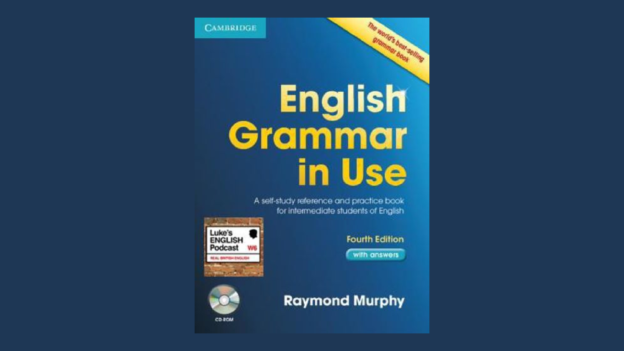
Luke: So, I’ve got here a book, which is called English Grammar In Use by Raymond Murphy and it’s the most popular grammar book for learners of English. It’s sold millions of copies all around the world, it’s a famous book, it’s known as ‘the blue book’, ‘the blue grammar book’
James: and you’re saying it’s basically useless
Luke: No, I’m not saying it’s useless! I’m just saying it’s interesting that most native speakers have got no idea what any of this stuff means. You talk about present continuous tense and third conditionals and things like that
James: Wouldn’t have a clue
Luke: You’ve got no idea, right. What I’m quite curious to do is, another thing is, that in English language classes teachers are always asking students to explain what things mean, right, so they always say things like “what is present perfect and how do we use it?” or “what’s the difference between these two sentences?”, right, and it’s interesting to see what a native speaker, someone who’s already able to speak English perfectly and functionally would answer those questions, because sometimes
James: You’re probably going to get them wrong
Luke: Well, you, it’s, the point is that, a lot of the exercises you do in class are, kind of, unrealistic, and unnatural so even if you were a native speaker you wouldn’t be able to do it, you know?
James: Yeah
Luke: So, like, if I said to you what’s the difference between, ‘I painted the house’ and ‘I have painted the house’? What’s the difference in meaning?
James: ‘I painted the house’ implies that you’ve just done it
Luke: You’ve just done it
James: and ‘I have painted the house’ could be any time
Luke: Ok. Couldn’t you say ‘I painted the house last year’?
James: Yeah, you could say that
Luke: Right, so ‘I painted the house’ could be any time
James: But you couldn’t say ‘I have painted the house last year’
Luke: Ah, right. Why not?
James: Because it’s too… it’s, it’s… I don’t know. There’s two levels to it. Once you say ‘I have painted the house’, you’ve already established the fact that you’ve painted it.
Luke: Right
James: Err, I don’t know! It just sounds wrong!
Luke: It just sounds wrong, yeah, that’s exactly it. The fact is, ‘I have painted the house’ means, you were right originally, you don’t know when it happened, it’s just that it happened in the past some time, and it’s connected to now, because you’re relating it to your whole experience of your life up to now, so there’s a connection to now, ‘I have done it’, like, I’ve got that experience. ‘I have painted the house’. You can’t say ‘I have painted the house yesterday’, because we just don’t use that tense
James: But you’ve already said, ‘I have painted the house’
Luke: Which implies that there’s no time, or that it’s an unfinished period of time.
James: Or just… it just doesn’t work, I don’t know why
Luke: But you can say, “I have painted the house today”, but you can’t say “I have painted the house yesterday”
James: ‘I have painted the house today’, would you say that?
Luke: At the end of the day, ‘so what have you done today?’, oh well…
James: You’d say ‘I painted the house’
Luke: Ok at the end of the day
James: Or ‘I’ve been painting the house’
Luke: But at lunchtime, “what have you done?”
James: Oh, I’ve painted the house
Luke: yeah, exactly
James: What have you been doing this morning? – I painted the house. I don’t know if you’d say ‘I’ve’
Luke: Well if it was finished you would
James: “well, I’ve come in, I’ve picked up the paint brush”
Luke: NO, that’s, that’s
James: I’ve run in, I’ve grabbed the ladder, I’ve put it up against the wall and I’ve painted the house.
Luke: That’s what native speakers say as an error. That’s what footballers do. They say things like, “Well, yeah, I’ve got the ball”… what they should say is “I got the ball outside the penalty box, right, I passed it to Wayne Rooney, he passed it back to me, I beat the defender and I shot and I scored. But what they’d say is “Well, I’ve got the ball outside the penalty box, and I’ve passed it to Wayne Rooney and he’s passed it back to me, and I’ve looked up, and I’ve seen the open goal, and I’ve shot and I’ve scored”, so all this weird present perfect, but it’s kind of wrong isn’t it.
James: Yeah
Luke: They’re actually speaking completely incorrectly
James: Because he’s kind of talking about the present and the past at the same time. “I’ve picked up the ball, passed it to Rooney. You know, I’ve collected the ball and passed it to Rooney”
Luke: So he’s talking about, it’s like, it happened just now, it’s like, in the moment
James: But he’s using “I’ve”
Luke: “I’ve” to, sort of, create that link to ‘now’ somehow
James: It’s like he’s running through it in his head.
Luke: It’s kind of like…
James: This isn’t going to be any use to anyone
Luke: It is. No, it is it is, it’s exactly
James: No-one’s going to listen to this
Luke: No, it’s not true, it’s not true. People will be interested to hear this
James: If you’re listening to this, I’m very sorry
Luke: No, people will be interested to hear about how a native speaker understands,
James: or doesn’t
Luke: or doesn’t understand grammar. Just let me ask you two more things and then we’ll call it a day. Right, er, another one is, what’s the difference between ‘for’ and ‘since’. That’s a question that students ask all the time. What’s the difference between ‘for’ and ‘since’?
James: In what context?
Luke: So, ‘I have done something for…’ and ‘I have done something since…’
James: for?
Luke: For, yeah, f-o-r. “i’ve been doing something for…”
James: 10 years
Luke: Yeah, I’ve been doing something for 10 years. I’ve been doing something since…
James: 1990… 2000
Luke: Yeah, since 2000, so what’s the difference between ‘for’ and ‘since’?
James: …erm… well you say ‘for’ when you’re about to describe the length of time that you have spent doing something. ‘Since’ sets the date that you started.
Luke: Yeah, exactly, yeah. Perfect. Yeah, you’re quite good.
James: That blew your theory out of the water
Luke: No no, it’s just interesting. I don’t have a theory. Right, here’s another one, ok. This is a classic one. What’s the difference between saying, okay this is conditionals. What’s the difference between saying “If I…” now you’ll get this because this is easy… “If I had bought a lottery ticket, I would have won the lottery” and “If I bought a lottery ticket, I would win the lottery” What’s the difference.
James: One’s talking about the past and one’s talking about the future.
Luke: Right, okay, yes, spot on. Nailed it. Yeah. Okay, I need to give you a really difficult one. Erm, hmm, I’ll go to the back of the book. Ok, prepositions, right? Let’s go for, what do you want? Let’s have adjective + preposition, which is, prepositions are the thing that learners have the most difficulty with, and they’re little words like ‘of’ ‘to’ ‘at’ ‘in’, stuff like that
James: Ok, go on, first question
Luke: So, you’ve just got to complete the sentence, erm, hmm,

LUKE: Erm, hmm, wait a minute. Right, wait a second

JAMES: I think you should edit this down.

LUKE: Yeah, okay, right, here we go. I’ll give you a sentence. You’ve got to put the prepositions in the right place, in the gap, okay?
I was delighted ….. the present you gave me. I was delighted … the present you gave me.

JAMES: ‘ with ‘

LUKE: Yes, well done. Brilliant.

JAMES: I don’t know why ? But…

LUKE: I’ve just had an idea whenever you get anything right, I’m gonna do this (ping!), okay? Right, so here’s the next one.

JAMES: This is bad.

LUKE: It was very nice … you, to do my shopping for me. Thank you very much.

JAMES: ‘ of ‘ but I don’t know why it’s ‘ of ‘. I couldn’t tell you the rules behind that. I just know that’s what it is.

LUKE: Why are you always so rude … your parents? Can’t you be nice … them.

JAMES: ‘ to ‘

LUKE: ‘ to ‘ yes, well done !

JAMES: Can you not do that? (referring to the BING)

LUKE: Okay, hmm, but why is it nice to, be nice to the parents?

JAMES: Well, because they brought you up and I dunno, bought you stuff at christmas

LUKE: No, I’m meaning, why do you use the word ‘to’? Nice, be nice to your parents.

JAMES: Because, you’re sort of, I don’t know.

LUKE: Yeah

JAMES: You’re giving some kind to them. You’re kind of, just doing something for their benefit, I suppose or something towards them. Something towards them. A big nice towards them. Now, it’s that
your parents, I couldn’t tell you.

LUKE: You’ve to look up, to look toward them.

JAMES: I couldn’t tell you.

LUKE: The fact is, it’s just impossible to create a rule about it. In fact, you’ve just got to learn that some words go with other words. Just got know it’s ‘ be nice to someone ‘ . You’ve just to learn ‘nice to’. So,
you have to see words existing together in little partnerships.

JAMES: Well, learn how they work together.

LUKE: Yeah, that’s it. It’s just learning two words together. Not just one on its own. So, that’s it. That’s the end of the experiment. Have you learnt anything from this, from this experience?

JAMES: No, no.

LUKE: No?

JAMES: Hm, I just hope that you get something out of this. You know making me look stupid basically.

LUKE: No, I think you got quite a few questions right. Didn’t you?

JAMES: Hhhh yeah,

LUKE: Okay, well, congratulations anyway. I’m gonna give you a certificate now which just shows that you’ve, two certificates, want to show that you completed the course.

JAMES: So, I’ll keep the certificate. Can I have this bit of chewing gum?

LUKE: Yeah, you can have the chewing gum.

JAMES: Sorry, thanks.

LUKE: Hmm, and the second certificate is just something I like to give to all the guests that I have on a program. It’s a little certificate just proving that you’d appeared on, on an episode of Luke’s English
Podcast. So thanks very much for coming and I hope to see you soon.

JAMES: Thanks very much. Luke’s English Podcast is brought to you by Wrigley chewing gum and Castllero del Diablo wine.

Okay folks, what I would now like to do is just explain some of the grammar points that I spoke to my brother about during that conversation. I asked him some questions about a few areas of grammar to see if he could answer them and I think you can see there that the point is, I guess, that native speakers surprisingly don’t understand or don’t really know the rules of grammar. They don’t know terms like ‘present perfect’ or even words like ‘adjectives’ or ‘nouns’. They don’t really know what those terms mean. So when you’re studying all that stuff at school, you’re in a way more articulate than they are, because you know how to describe the language and native speakers don’t know how to do that. That’s quite interesting but native speakers know, umm, what’s right and what’s wrong by instinct. They just sort of, they learn it as children without thinking about it and then when they get older they know that something is wrong but they don’t know why it’s wrong, they just know it’s wrong. It’s the same for you when you’re learning your language as a child.

Umm, what does that tell us about learning English? Well you could say, that it, some people might say it means that learners of English shouldn’t worry about learning the rules of grammar. That instead they should just try to listen to a lot of English, to read a lot of English and by doing that ,erm, see and hear the language so much that they just learn what’s right and wrong, just by frequency. So they know for example that people will say things, just because they have heard it said so many times before and they know what’s right and wrong just because they have heard and read the language a lot and they’ve started to learn, started to get a sense of all the patterns that you find in English.
Maybe that’s true, maybe that’s a good way to learn or maybe learners of English should study the rules or at least study the patterns and do practice exercises in order to understand what’s right and what’s wrong. I think it’s a combination of both. That you need to study the language , you need to test yourself with it , you need to do exercises but also you need to combine that with high exposure to lots of listening and lots of reading and so the more you see of the language , the more you start to develop a feel for it. Hum, that’s my opinion, um, but nevertheless, um, some of the things that I discussed with my brother there, I think I should just clarify for you, anyway.
Um, so the first thing I asked him was, what’s the difference between a noun, an adjective and a verb and he couldn’t really answer the question, but as you may know, a noun is a word which is used to give something a name. We use things like, you know, a table, a chair, a cat, those are all nouns. They can be plural or singular. Three cats for example.
They can be countable or uncountable. If they’re countable you can, you can count them. For example three, you know, tables. A table is a countable noun because you can say one, two or three tables but a word like sugar isn’t countable, instead we just say some sugar. So it’s like a mass of tiny little granules of sugar that together makes something uncountable. They can also be abstract, for example the names of things you can’t actually touch or feel. Umm, so concepts like ‘love’ is a noun. Umm, it’s also a verb but you could say ‘all you need is love’ and in that sentence it’s a noun. It’s an abstract one there and it’s uncountable. That’s nouns. Obviously there’re, nouns can be very complex, they can be larger, kind of phrases you could say like a noun phrase like for example, hum, let’s see, umm, like mobile phone technology is a kind of noun phrase and you can use that as the start of a sentence. Mobile phone technology is developing very quickly, right? So nouns can also be sometimes a number of words together.

Umm, right, the next one is a adjective. Well, an adjective is a word we use to describe a noun. Umm, it’s used to describe a noun, so we would say for example, the food was delicious, right? So delicious describes the food. How was the food ? It was delicious. You could also say delicious food. Like that, of course. Umm, so that’s an adjective.

Umm, and then the next one was a verb and the verb is the doing word. These are words we use to express sort of actions, um, so like play, eat, go, for example. Those are verbs, um, and we also have little verb phrases, which are things like phrasal verbs and that’s a verb in combination with other words and phrasal verbs are difficult because, well, somme of them are easy and some of them are difficult . The easy ones are easy to understand because the meaning is very similar to the original verb. So, if you’re talking about, um, oh, let’s see, hmm, ‘ go on’ , like ‘ go on’, meaning continue. I’s fairly clear what that means because go, we know what ‘ go’ means. ‘ Go on ‘ just means go and don’t stop going, continue. That’s fairly easy but some of them are difficult like if you take the expression ‘give up’. ‘ Give up ‘ umm, meaning to quit. Hum, that’s not quite so easy because the verb ‘ give’ you know, we think, well, ‘ give’ . Give someone a birthday present but in this sentence ‘give up’ has a completely different meaning to give which makes it very difficult and the fact is as learners of English you just have to learn phrasal verbs. You just have to try and learn them because they are all unique words with their own meanings, just a combination of a few words. So that’s, umm, that was the first thing I asked my brother. The next thing was about ‘present perfect’ and ‘past simple’.

So we know the ‘present perfect’. One of the, actually this is one of the most common bits of grammar that you study when you’re learning English. Present perfect of course is like ‘ have’ plus a past participle or ‘ has’ plus a past participle, like I have lived in Japan for example. Umm, she has eaten a pizza, right? And ‘past simple’ obviously everyone knows. I lived in Japan, she ate a pizza, for example. Umm, so the difference, well that’s quite a big one and it’s something that everyone is studying. So the difference between ‘past simple’ and ‘present perfect’ basically we use, we use ‘past simple’ to talk about a finished action in the past but the time period is important and we tend to, with ‘past simple’ express a kind of distance from the act. So there is a distance in time basically, which means that the action
happened in a finished time period. I lived, erm, well let’s say, umm, I ate, no, I drank a coffee. It’s pretty, probably suggests that you that you drank a coffee yesterday or you drank a coffee last week or you drank a coffee, umm, during breakfast, right? So it’s like in a finished time. ‘Present perfect’ is used to describe finished actions which happened in an unfinished time. So there’s a connection to now. That’s the most important thing. So, basically you might say for example, I have drunk three cups of coffee today. Umm, today is not finished, so you can say, I have drunk three cups of coffee today. Hum, so the time period is always connected to now. It’s a bit more complicated than that but that’s is all basic difference.
Hum, to be honest, if I was to explain ‘present perfect’ and ‘past simple’, I’d need to record a completely new podcast and I could do that. So, I might, I might do that.. ‘Past simple’ and ‘present perfect’.

The next one was about 2nd and 3rd conditionals. So we know the 2nd conditional would be for example, umm, let’s see. Err, if I bought a lottery ticket, I would win the lottery. Not a very good example because, it’s not definite that you’d win, so, if I?
Okay, let’s say, if I, if I went outside, I, no, no, no … Okay, if I studied hard, I would pass the exam. So, you’re talking about the future but you use past tense like studied, if I studied, now, we’re not talking about the past , we’re talking about the future. And we know, it’s the future because we’ve said’ if’ . So ‘ if ‘ plus a ‘past tense’ is actually used to describe a kind of unreal future. So you use the past tense not to create distance in time but to create distance in reality. In this sense it’s an unreal or hypothetical future because you don’t think it’s realistic. So, if I studied hard, I would pass the exam but I’m not going to study hard because I don’t want to, right? So compare that with the 1st conditional. If I study hard, I will pass the exam. Umm, ‘present tense’ after ‘ if ‘ , still talking about the future but here we think it’s a realistic future. So, there’s no distance from reality. We think it’s real and it’s followed by ‘ will ‘. Umm, if I study hard, I will pass the exam. So, that’s it, it’s like a definite future with its definite future consequence!

The 3rd conditional talks about the past and there we use ‘had’ plus a ‘past participle’ in the ‘if clause’, in the second clause we have ‘would have’ and a ‘past participle’. So, let’s say, the exam was last week and I failed, you could say, ‘ If I had studied for the exam, I would have passed, right? The fact is, I didn’t study and I didn’t pass but if I had studied, now here we’re using ‘ had studied’ and that’s like, it looks like past perfect, but it’s not actually past perfect, it just looks like it, but it’s used to create distance from reality in this sense, in the past. Umm, so we go from ‘past simple’ I didn’t study, we go one tense back to what looks like ‘past perfect ‘. ‘If I had studied’ and then in the second part ‘I would have passed ‘. Again to refer to a past consequence.

It’s all very complicated and to be honest rather boring but you kind of have to learn it. Again, I could do a completely separate podcast all about conditionals because it’s such a big topic.

The last thing I talked about with my brother was ‘prepositions’ and if you’re learning English you’ll know about prepositions. They’re very, very difficult. They are the little words that we use to connect nouns and verbs and adjectives together and you find the prepositions are linked to other words and there isn’t really a decent set of rules to explain these links. The fact is, you just have to learn them. You just have to learn that we say ‘to be nice to someone’ right? ‘Nice to’ those words go together. You’ve just to learn that you have to remember it and there’re lots of combinations of verbs and prepositions, nouns and propositions and adjectives and prepositions and there are so many lists, really that, it’s just a case of noticing them and then try to remember them. Umm, what you should do, is realize that prepositions are linked to other words and then see these word combinations as separate units of meaning that you should learn. So, you don’t just learn the word for example ‘consist’ but you learn the expression ‘consist of’ right? Okay, so a hamburger , a Big Mac consists of bread, salad, beef and cheese for example. Umm, so, ‘consists of’. Those words always go together.

Umm, so that’s basically it. Those are the things I’d discussed with my brother. I expect, if you’re a learner of English, you understood the rules of grammar a little bit better than my brother did. Umm, in which case you should feel quite good about yourself. Um, remember you’re, you’re learning the grammar of the English language and you’re learning the grammar actually better than most native speakers. So, well done you.
Umm that’s the end of this podcast, I hope you found it interesting. That’s all for me . Bye, bye, bye, bye, bye…

Enjoy.

47. Travelling in Vietnam

EnglishRobot3000 interviews me about my holiday in Vietnam.

Small Donate ButtonRight-click here to download this episode.

I recently bought an English speaking robot from Japan. His name is English Robot 3000, and he’s very nice. In this podcast, English Robot 3000 asks me questions about my holiday in Vietnam and I talk about what I did, where I went and how it felt.

The next podcast will contain lots of really useful language for meeting people when you are travelling.

Hope you enjoy the episode, and happy new year!

Photos
Here’s a slide show of my Vietnam holiday snaps

Here’s a picture of EnglishRobot3000
EnglishRobot

Get the PDF transcript here 👇

30. The Mystery Continues

Part 2 of the mystery story which I started in the previous episode.

Small Donate Button[DOWNLOAD] [LISTEN TO PART 1] [FREE AUDIOBOOK OFFER]

Part 2 of the strange story from the last episode. Use this podcast to improve your listening, reading, vocabulary and pronunciation. You should listen to it after listening to the previous episode “Mystery Story / Narrative Tenses”.

This episode of the podcast is continues the story of the last episode. Find out the answers to the mystery of the strange Doctor.

This podcast includes:

  • Lots of very descriptive language – learn how to describe people, places and feelings
  • Complex sentences and examples of effective use of narrative tenses
  • Clear pronunciation in a couple of slightly different accents – raise your awareness of connected speech and intonation
  • Some amusing cultural information about London’s heritage – learn more about the culture of the language

How to use this podcast to improve your English:

I recommend that first, you listen to the podcast and just follow the story. Second, listen to pick up language – use the tapescript if you like. Third, pronunciation – use the script to copy sentences from the story. Fourth, record yourself telling the story, and try to make it sound really interesting, and alive and funny. Listen to yourself and do it again, focussing on the weak points from the first time. You will improve more quickly, and develop an instinct for the structure of the language, which helps you make quick decisions about what is right and wrong in English. There is no other way to do it: exposure to natural English is very important in learning the language.

So, now! Enjoy the story…

The Man & The Moon, part 2…

When I arrived home that night, I immediately wrote everything that had happened into my diary.
“I could make a great podcast out of this”, I thought to myself…

The next day I told my friend what had happened.

“I know just the person who can help you!” he said, “There’s a man who lives in Baker Street, in the centre of London”, he said.

“Yes, I know where Baker Street is – it’s quite a famous street y’know”

“Yes! Anyway, this man is the best detective in London! He’s the most brilliant mind there is. The police have to use him to solve all their crimes, and some say that even the Queen asks him for help when she has lost her TV remote control down the back of the sofa! You should go and visit him. I’m sure he’ll be able to help you.”

I took the address and immediately went to Baker Street on the underground. I took the Picadilly Line from Hammersmith, and changed at Green Park station, but the Jubille line was closed, so I had to get back on the Picadilly Line and then change at Leicester Square onto the Northern Line, but that was delayed due to engineering works and a signal failure at Waterloo station. But finally, after an hour an a half on the underground, I arrived at Baker Street. I found the address: Flat number 21b and knocked on the door. An elderly woman answered.

“Yes?” she said.

“Umm, hello, I’m here to get some help. A friend told me to come”

“Alright, come in then.”

We walked through into the hallway. I could smell pipe tobacco, and what sounded like a cat being murdered in the next room. Then I realised it was a violin being played, very badly.

The woman knocked on the door of the front room, and the violin stopped playing.

“There’s a man here to see you” “Yes, yes, I know” said a loud, commanding voice from inside the room. “Show him in Mrs Hudson, thank you”

Mrs Hudson stepped aside, and I walked into the room.

I immediately felt nervous and awkward. There, standing at the fireplace was a very unique looking man. He was tall and thin, and old. I’m not sure how old he was exactly. His hair was going grey, and his skin was wrinkled, but his eyes were bright and youthful. He could have been as old as 80, but he had the spirit of a much younger man.

He was wearing a brown suit, with a waistcoat, and long leather winter boots. In his hand, he was holding a Stradivarius violin, of very fine quality. On the mantelpiece next to him was a smoking pipe.

“Umm, my friend Smith recommended you. He said that you would be able to assist me” I said.

“Smith? Hmmm?” said the man. “And…?”

“Oh, and, well, the thing is, I need your help… it’s…”

“Well, what do you think Watson?” Said the man, quickly, and only then did I realise that there was a third person in the room. To my right, in a dark leather armchair, there was a red faced man, probably about 65 years old. He had a large brownish red moustache which covered his top lip. In his hand was a large glass of Brandy, and in his other hand, a cigarette. He seemed very comfortable, as if he had just woken up from a lovely sleep by the fire”

“Huh…? Oh, hello! How do you do?” he said, smiling at me and yawning.

“What do you think Watson?” Snapped the man with the violin.

“Oh, err… a student? Perhaps a waiter… erm… ah! An unemployed librarian!”

“No no no! Watson. Completely wrong! Don’t overcomplicate matters! Now, let me try…”

I stood there, feeling confused. The tall man looked at me. “Your name is Thompson, am I right?”

“Well, how on earth did you guess…?”

“Not a guess Mr Thompson… Not a guess… Allow me to demonstrate something for you, if I may”

I stood in silence. I was in the presence of a great mind, I could understand that now.

“Let me see…”

He looked me up and down for a second.

“I would say that you are an English teacher… of no more than 10 years experience, but no less than 5. Let’s say 8 and a half years.”

I was gobsmacked.

“You worked in the far east, didn’t you?” “In Japan?”

“yes! Yes I did!”

“Kanagawa prefecture?”

“Oh my god, yes!”

“Now, I suppose something happened to you, near the river, which you don’t understand, and you need answers, so your friend told you to come and see me so I could sort it all out for you, is that right?”
“Oh – My – GOD! How did you know…? It must be magic, or … a trick!”

“Alright, I’ll tell you” he said, with a bored look on his face.

“Using simple empirical methods of observation and deduction, the truth will almost always reveal itself to you as the most reasonable answer. You just look at the evidence, and think logically. Usually, the simple answer is the best.”

“Would you like a cup of tea? He might take a while” It was Mrs Hudson.

“Oh, yes please” “two sugars”…

The man continued… “One simple look at your hands revealed your occupation. Your nails are badly chewed and damaged. This must be due to stress. A common problem for any teacher, but especially one that has to deal with demanding students from different countries who all want to know about the difference between all the past perfect continuous passive conditional verb tenses, and adjectival noun phrases and reduced non defining relative participle clauses and such matters.” I looked at my fingers, he was right. The nails were a terrible mess… “I saw also that your hands are very dirty with blue and red ink. This must be from using whiteboard marker pens. You write on the board, and in your haste you make a mistake, and then quickly rub it off with your hand, hoping that no-one notices…”

“Umm, yes, that’s true.”

“That’s the evidence which told me that you must be an English teacher.”

“Wow!” I said

“Yes, that and the fact that you’re holding a copy of New Headway Upper Intermediate Teacher’s Book by Liz and John Soars, which kind of gave it away… oh, and Watson googled you before you arrived, but anyway… On your face I noticed wrinkles – around your mouth and eyes. This is from smiling all the time, to keep your students happy, is it not?”

“Yep. Well done. Right again”, I said, sipping my tea, getting a little impatient. “Umm, sorry but could you hurry up a bit? It’s just that this is going to be a really long podcast, and I don’t want anyone to stop listening…”

“Yes yes! I counted the wrinkles on your face, and estimated that since graduating from university, you have been smiling at students for exactly 8.5 years. Simple: Count the wrinkles on the face, divide by 5 (the average teaching hours per day) and the result: 8.5 years.”

“Fair enough” I said.

“And when you entered the room, you bowed slightly. This must be body language which you picked up while living in Japan.”

“Yep. Well done… very good”

I was getting annoyed and impatient. I gulped down my sugary tea.

“OK, you’ve convinced me, you’re a brilliant detective. Now, will you help me out please, Mr…?”

“It’s Holmes, Sherlock Holmes, and this is my companion, Dr Watson”

“Wow, it really is Sherlock Holmes”, I thought. “I’ve read so much about him, but I never thought he was real! And his faithful companion Dr Watson! Fantastic!” I looked again at Watson. He was fast asleep in his chair.

“WAKE UP WATSON!” shouted Holmes, throwing a chess piece at him. It bounced off Watson’s head, and he woke up suddenly, and smiled at me sleepily. “So, how can we help you then Mr Simpson?”

“It’s Thompson you fool!” Shouted Holmes quickly” “And we must hurry to the riverside in Hammersmith immediately! There’s another mystery to solve! Come Watson!”

“How did you know it was Hammersmith…?”
“Oh, never mind…” said Holmes.

The three of us jumped in a cab on Baker Street and drove to Hammersmith bridge. On the way there, I told Holmes about how I’d sat down by the river the night before, how it had been a full moon, how a green monster had nearly grabbed me, how I’d heard weird noises and seen a strange blue light and how I’d been saved by a mysterious man called The Doctor. When we arrived I took Holmes and Watson to the spot where everything had happened. A cold chill ran down my spine as I remembered it all again.

“This is where it happened Mr Holmes” I said.

“Excellent” Said Holmes, a magical light shining in his eyes. “Stand back! I shall investigate the area.”

“He always does this” Said Watson. “He’ll be busy for an hour or two I reckon.”

Holmes was bent over, studying the ground next to the river with a magnifying glass. Occasionally he stopped suddenly, and picked something up and placed it carefully in his pocket. He walked close to the water and looked in. He looked up at the sky and down at the river again. He sniffed the air with his big nose. He picked up a stone and dropped it into the water, and then went back to look at the steps where I had been sitting the night before.

Watson yawned, and said to me “There’s a pub over there, fancy a pint while Holmes does his investigation stuff?”

Watson pointed at a pub called The Black Lion. “Umm, alright. Yeah, why not!?” I replied.

“We’re just off for a pint in that pub” shouted Watson.

“Hmmm” said Holmes, as he studied some markings on the ground.

Watson and I sat in the pub next to the fire, and made small talk.

“So, you’re a doctor, are you?”

“Yes, that’s right”

“Hmm, that’s interesting…”

“Yeah, it’s alright, I suppose. Most of the time I just hang out with Holmes to be honest. Do a bit of writing. That sort of thing. It’s pretty boring really. I like a quiet life, you know?”

“Yeah, I suppose so. The man I met last night said he was a doctor. You don’t know who he is, do you?”

“A doctor? Doctor who?”

“I don’t know, he didn’t say his name. He just said ‘you can call me The Doctor…’ and then he disappeared. It’s really annoying…”

ly: ‘book antiqua’, palatino;”>Just then Holmes burst into the room.

“Come with me Watson, we must walk up the river bank and investigate the mud near the sewage outlet for evidence!”

“Umm, do we have to? I mean, why don’t we just stay here in the pub, and you go and look in the mud near the sewage outlet? How about that?” said Watson, sipping another pint of beer and warming his feet by the fire.

“Oh Watson, you stay here then, if you must. Your love of the local Chiswick ale will be the end of you Thompson, what about you? Fancy getting up to your knees in mud??”

“Erm, I think I’ll stay here with Watson actually, if that’s all right.”

“Fine, stay here, both of you! I shall return within one hour.”

59 minutes and 59 seconds later, Holmes returned. His leather boots were covered in brown mud, and he had a grim look on his face. He suddenly looked much older, and tired. I was a little bit worried about him.

< /p>

We took a cab back to Baker Street and Holmes remained quiet and moody for the whole journey. I stared out of the window and dreamed about the present perfect continous passive tense. Watson fell asleep.

When we got in, Mrs Hudson brought us some cake and Watson opened the drinks cabinet. “Brandy anyone?” he said, pouring himself a large glass.

Holmes ignored him, and sat in his chair, smoking his pipe.

For what felt like 2 hours, Watson drank brandy and nodded off by the fire, while Holmes sat silently in the chair surrounded by clouds of his own smoke, his face tight with concentration. The sun went down, and Holmes stayed in the chair, and his pipe smoke stretched outwards across the room, running along the ground and wrapping itself around my legs like claws. The moon shone in through the window, and I began to fall asleep.

Suddenly Holmes jumped out of his chair, a young man again. The room seemed brighter.

“THOMPSON! I have solved your mystery!” Shouted Holmes, confidently!

“Wow, that was quick!” I said. I looked over at Watson. He was fast asleep.

Holmes proceeded to walk around the room, rubbing his hands and laughing to himself.

“So! What’s it all about??” I asked, impatiently.

“I have read about cases such as this before Thompson, and I have been very much looking forward to having the opportunity of working on one myself. And this Doctor of yours… well, I never thought I would be lucky enough to…”

“To what?? I asked… just tell me what’s going on, please! This is going to be such a long podcast, and I’m really worried that all my listeners will be really bored, and they’ll stop listening, and, there’s not enough pedagogical content, and…”

“ENOUGH!” Shouted Holmes. “I will explain everything. You would be wise to listen carefully. I have looked at the evidence, which has been presented to me. There wasn’t much, but there was enough. First, you told me that this happened near the river. Inspection of the riverbank revealed several things to me.”

“I discovered some vital clues. I found two green hairs, which must have come from the ‘monster’ which you talked about. I checked the hairs, and they perfectly match hairs which have been discovered near the Thames before. They are hairs from a lunaris goblarmunas – a moon goblin!”
“Yes, I already know that! What the hell is a Moon Goblin!”

“Oh, it’s a monster which lives in the water, and which comes out when there’s a full moon to eat people. They worship the moon, and some people say that they are aliens which once lived on the moon, but they escaped to earth millions of years ago when the moon lost its atmosphere.”

“Oh, right… wow, I never knew about that. How did they travel to the earth, through space”

“Oh, err, well, they’re actually robots”

“Robots, what do you mean?”

“Oh never mind, it’s too difficult to explain…Yep, it’s true, there’s loads of them in the Thames. They’re responsible for a lot of stuff actually. The Queen knows all about it, so does the Prime Minister…”

“They do?”
“Yeah. Anyway, when I investigated the mud up the river, I noticed that there were lots of goblin footprints. They’re very active. In fact, there’s many more of them than I first thought. I will have to tell her majesty all about it. She will want to know.”

“I’m sure she will… Anyway, what about this Doctor guy…”

“Oh yes, while you and Watson were having such a lovely time in the pub, I inspected the area near where you were sitting last night. I found some very interesting scratches on the ground. They were blue scratches. They must have been caused by something very heavy, blue in colour, and square in shape.”

“What, like a big blue box?” I said.

“Exactly Thompson! Exactly!” I estimate that it was similar in size to a telephone box. It must have been there for a moment, and then it moved away quickly.

“So you’re telling me there was a big blue telephone box there one minute, and then the next minute it was gone?”
“Precisely”

“I also found some footprints near where the box had been. Those must have been the footprints of your Doctor. The size of the feet match the description you gave me. I also found this lying on the ground, near where the blue telephone box had been”

He showed me a silver ticket. It was a concert ticket, made of an amazing shiny material. It said “Prince Michael Jackson II – Live in Concert – Wembley Arena September 16th 2021”

“Oh my god! Prince Michael II? That’s Michael Jackson’s son! But, how is this possible!? How can the doctor have a ticket for a concert from the future?”
“Let me explain. Look at the evidence. The goblins from space, the blue ‘telephone box’, the strange sound, the blue flash of light, the man who called himself the doctor who appeared and disappeared out of nowhere, the thing he pointed at that goblin, the special knowledge he had about the moon goblins, the ticket from the future. It all means one thing.”

“What!? What does it mean?!” I demanded.

Holmes stared at me with dark eyes. Watson snored in the corner of the room.

“There is no other answer. The Doctor you told me about. Well, he must be a Timelord.”

“What? Is that your answer? What the hell is a Timelord?” I asked him.

Holmes stood up, and said.

“If you want to find out, then YOU’LL HAVE TO LISTEN TO THE NEXT EPISODE OF LUKE’S ENGLISH PODCAST!!!!”

I sighed with frustration.

“Don’t worry Thompson.” Said Holmes. “I know an expert on Timelords, and he will tell you everything he knows about The Doctor. Just wait for the next episode of the podcast, and you’ll learn everything.”

I left 21B Baker Street wishing I had never gone there in the first place. Holmes wasn’t quite the brilliant man I thought he was, but I was still determined to get to the bottom of this mystery. I had managed to get some answers: The Doctor was a Time Lord who travelled around through space and time in a blue telephone box. That explained the strange light, the sound, and how The Doctor appeared and disappeared so quickly. But who was he really, where had he come from and what on earth was going on?”

With the address of the Timelord expert in my hand, I jumped on a number 27 bus towards Hammersmith, desperately hoping to get some final answers to this mystery, and silently hoping that none of my listeners got really bored with this stupid Sherlock Holmes story and stopped listening and decided to unsubscribe from Luke’s English Podcast because it’s gone a bit strange, and where are the phrasal verbs and idiomatic expressions that he said he would teach us…? I decided that I had to end this mystery as soon as possible, and then I could go back to teaching useful expressions and pronunciation… But before that, I was determined to find out about Timelords, and The Doctor… I arrived at the address, and went inside to meet the Timelord expert who Holmes had recommended…

To be continued…


29. Mystery Story / Narrative Tenses in English

Learn narrative tenses in English with a short mystery story.

Small Donate Button[DOWNLOAD THIS EPISODE] [LISTEN TO PART 2] [FREE AUDIOBOOK OFFER]
This podcast is about narrative tenses (past simple, past continuous & past perfect – see details below). We use these tenses to sequence stories about the past. To master the use of these tenses you have to deal with their form, their use and their pronunciation – both for listening and speaking. Use this podcast to help you deal with all of those things, and then start using narrative tenses fluently whenever you describe something. Make your descriptions more detailed and colourful!

Below you can read the mystery story from the podcast, and then grammar details and a tense review exercise.

Listen to the story, and notice the different verb forms being used. If you like you can try to remember the story and repeat it to yourself until you’re using all the tenses correctly. You can then transfer what you’ve learned and remembered from the story when you talk about something else.

Subscribe to Luke’s English Podcast to improve your English every day, and have fun in the process! Add your email address to the mailing list on the right of this page, or subscribe using iTunes.

The mystery story:
Last night I was walking home next to the river Thames, when something strange happened to me. It was late at night and I’d had a long and difficult day at work. There was a large full moon in the sky and everything was quiet. I was tired and lonely and I’d just had a few pints of beer in my local pub, so I decided to stop by the riverside and look at the moon for a while. I sat on some steps very close to the water’s edge and looked up at the big yellow moon and wondered if it really was made of cheese. I felt very tired so I closed my eyes and after a few minutes, I fell asleep.

When I woke up, the moon had moved behind a cloud and it was very dark and cold. The wind was blowing and an owl hooted in a tree above me. I rubbed my eyes and started to get up, when suddenly I heard a splash. I looked down at the water and saw something. Something terrible and frightening, and unlike anything I’d ever seen before. Something was coming out of the water and moving towards me. Something green and strange and ugly. It was a long green arm and it was stretching out from the water to grab my leg. I was so scared that I couldn’t move. I’d never been so scared in my whole life. The cold green hand was moving closer and closer when suddenly there was a blue flash and a strange noise from behind me. Someone jumped onto the stairs next to me. He was wearing strange clothes and he had a crazy look in his eyes. He shouted “Get Back!” and pointed something at the monster in the water. There was a bright flash and the monster hissed and disappeared.

I looked up at the man. He looked strange, but kind. “Don’t fall asleep by the river when there’s a full moon”, he said “The Moon Goblins will get you.” I’d never heard of moon goblins before. I didn’t know what to do. “Who… who are you?” I asked him. “You can call me… The Doctor.” He said. I was trying to think of something else to say when he turned around and said, “Watch the stars at night, and be careful of the full moon”. I was trying to understand what he meant, when there was another blue flash and I closed my eyes. When I opened them again, he had gone.

I couldn’t believe what had happened. What on earth were Moon Goblins, and who was the mysterious Doctor? And why had he saved me? I was determined to find the answers to these strange questions. I stood up, looked at the moon and quickly walked home.

Listen to just the story again here [Download audio]

Narrative Tenses
Past simple tense
Form: the simple past form of the verb. E.g. “We met on holiday, we talked about art and music, we fell in love, I asked her to marry me and when she said yes I kissed her passionately on the lips.”
Use: To explain the main events of the story in sequence. We use ‘then’, ‘after that’, ‘first’ and ‘finally’ to link them up. E.g. “First I finished work, then I went to the pub, after that I had a few pints, then I sat down by the river and then I fell asleep, after that the moon moved, and then I woke up and then an owl hooted and after that I heard a splash and then a monster tried to grab my leg and after that the Doctor rescued me and then he disappeared, and finally I went home.
We can also use conjunctions to link up clauses with past simple verb forms. ‘When’ is probably the most common. E.g. “When I woke up, and owl hooted.” Or “An owl hooted when I woke up”.

Past continuous
Form: was/were + -ing E.g. “We were talking about my Swiss bank account when suddenly she pulled me close and kissed me again.”
Use: To describe longer or repeated actions. It’s often used to describe the general situation at the beginning of a story. E.g. “I was walking home when something strange happened.”
Also, we use it to sequence events when it is combined with the past simple. Past continuous is the long or repeated action which is interrupted by a short, quick past simple action. E.g. “The green hand was moving towards me when suddenly there was a blue flash and a man jumped onto the stairs next to me”.
We use ‘when’ or ‘while’ to link the actions in a sentence. E.g. “When I woke up, the wind was blowing. The wind was blowing when I woke up. While I was walking, something happened. Something happened while I was walking.”

Past Perfect
Form: had + past participle E.g. “When I arrived at the airport I realised that she had stolen my wallet and passport”.
Use: To express that an action happened before the main events of the story. E.g. “When I woke up, the moon had moved” [the moon moved, then I woke up], which is different to “The moon moved when I woke up” [I woke up, then the moon moved].
Sometimes it is used a bit like present perfect, but when everything is in the past. E.g. “I’ve never heard of moon goblins before” But for yesterday it would be “I had never heard of moon goblins.”

Pronunciation drills:

1. Andrew had done the test before, so he found it very easy.

2. I didn’t laugh at the joke because I had heard it before.

3. We left the restaurant when we had finished dinner.

4. When I found my wallet, I discovered that somebody had taken all the money from it.

Practice:
Here’s the transcript to the mystery story, but with some of the verbs ‘gapped’. Try to put them in the correct tense. Listen again to check.
The mystery story:
Last night I _________________ (walk) home next to the river Thames, when something strange _________________ (happen) to me. It was late at night and I _________________ (have) a long and difficult day at work. There was a large full moon in the sky and everything was quiet. I was tired and lonely and I _________________ (just have) a few pints of beer in my local pub, so I decided to stop by the riverside and look at the moon for a while.

I _________________ (sit) on some steps very close to the water’s edge and looked up at the big yellow moon and wondered if it really was made of cheese. I felt very tired so I _________________ (close) my eyes and after a few minutes, I _________________ (fall) asleep. When I woke up, the moon _________________ (move) behind a cloud and it was very dark and cold. The wind _________________ (blow) and an owl _________________ (hoot) in a tree above me. I rubbed my eyes and started to get up, when suddenly I _________________ (hear) a splash. I _________________ (look) down at the water and saw something. Something terrible and frightening, and unlike anything I’d ever seen before. Something _________________ (come) out of the water and _________________ (move) towards me. Something green and strange and ugly. It was a long green arm and it _________________ (stretch) out from the water to grab my leg. I was so scared that I couldn’t move. I _________________ (never be) so scared in my whole life. The cold green hand _________________ (move) closer and closer when suddenly there was a blue flash and a strange noise from behind me. Someone _________________ (jump) onto the stairs next to me. He _________________ (wear) strange clothes and he had a crazy look in his eyes. He shouted “Get Back!” and _________________ (point) something at the monster in the water. There was a bright flash and the monster hissed and disappeared.

I looked up at the man. He looked strange, but kind. “Don’t fall asleep by the river when there’s a full moon”, he said “The Moon Goblins will get you.” I _________________ (never hear) of moon goblins before. I didn’t know what to do. “Who… who are you?” I asked him. “You can call me… The Doctor.” He said. I _________________ (try) to think of something else to say when he turned around and said, “Watch the stars at night, and be careful of the full moon”. I was trying to understand what he meant, when there was another blue flash and I closed my eyes. When I opened them again, he _________________ (go).

I couldn’t believe what _________________(happen). What on earth were Moon Goblins, and who was the mysterious Doctor? And why had he saved me? I was determined to find the answers to these strange questions. I stood up, looked at the moon and quickly walked home.

Would you like to know what happens next in the story?
CLICK HERE TO LISTEN TO THE NEXT EPISODE IN WHICH THE STORY CONTINUES: EPISODE 30 “THE MYSTERY CONTINUES”

Other episodes:
CLICK HERE TO LISTEN TO ANOTHER EPISODE ABOUT VERB TENSES
CLICK HERE TO LISTEN TO AN EPISODE ABOUT THE DOCTOR WHO TV SHOW

26. Are you a good learner of English?

Plenty of advice about the right attitudes and habits for learning English effectively.

Small Donate ButtonRight-click here to download this episode.

Hello everyone. I’m really glad so many of you liked my Notting Hill Carnival video. I’m planning some longer ones which I will produce and upload soon. Before I do that, I hope you enjoy this one which is about being a good learner of English.

I was thinking about all the learners I have met, and what made some of them ‘good learners’. I realised that it was their attitude towards learning, and towards life in general, that affected how they learned the language. I thought it would be good if I wrote some statements that a good learner of English might say. You can just think about these statements. Can you relate to them? Are they true for you? Try repeating them to yourself. It will help you if you really believe them! It’s good for your attitude, and that’s good for your English.

Here are the statements I wrote, and which I read out in the podcast. Thanks a lot, and keep listening!

1. English is not just something I know, it’s something I can do. It’s no good if you can just learn words, and just understand what people say – it doesn’t stop there. English is not just something I know, it’s something I can do.

2. I love using new words that I’ve learned. New words to me are like golden coins which I collect and then use later. (cheesy!)

3. English is part of my personality. There is no separation between the English language, and me. We exist together. It’s not separate from me, it’s part of me. When I use English, it’s my language too.

4. I might not think in English every day, but I know that English exists in my sub-conscious and it helps me to understand and to communicate effectively.

5. I feel like a better person now because I can do more with English.

6. I know that I don’t need to learn everything in one go. I’m becoming a good speaker of English every day, bit by bit, step by step.

7. English gives me the freedom to become a different person when I use it.

8. I love to really listen and investigate the English that I hear. When I study something in English, I feel like a detective solving a puzzle.

9. Because it’s a mental challenge, learning English is a really good way for me to keep my brain fresh and young.

10. English gives me an opportunity to take risks, and I know that when I take risks I learn more quickly.

11. English is frustrating sometimes, but I enjoy the challenge. And what is life if it isn’t a challenge?

12. I like to ask questions because if I don’t ask, I don’t learn.

13. I don’t just need English. I’ve learned that I want English too.

14. We’re all individuals, and we have our own unique ways of learning English. I like discovering my own particular learning strategies and then using them.

15. I am a bit embarrassed by my mistakes sometimes, but I see them as a great opportunity to learn.

16. I like learning English with others, because it makes me feel like I’m part of a group of people who are sharing the same experience as me.

17. I love the variety, colour and history of the English language. It’s amazing to see how people in history have used it for so many things, and when I use English I become part of that long tradition.

18. Speaking English is a physical action. I don’t just use my mouth to do it, I use my whole body.

19. The culture of the English language is different to my first language. So it’s fun to think and act in a new way when I speak English.

20. English liberates me. It gives me the freedom to communicate with everyone, and connect with the whole world.

21. Oops – I missed this one! I got the numbers wrong… It should be: I know that if I had the time, I could master this language.

22. I enjoy finding out about things I love in English. I use the internet to help me to do this. I watch YouTube videos and listen to podcasts in English, for fun.

23. Sometimes English is confusing for me, but I can make sense of it if I have time.

24. The journey is the best part, not just the destination. This is true in English, but also in life.

25. Actually, I do use English well and I do communicate in English every time I use it. So, really, I’ve already started speaking English and I’ve already started communicating in English effectively.

26. I’m a brilliant, and special person because I listen to Luke’s English Podcast, and I know that Luke’s English Podcast is probably the best way of learning English in the whole world!

I realise that some of these statements are quite cheesy. Cheesy is quite a difficult word to explain. Here’s a list of explanations of what cheesy means:

-it has been said many times before and so now it sounds quite silly, boring or tiresome
-it is too sincere, and so it sounds ridiculous
-it is old-fashioned, or out of date
-it is over-emotional, or sentimental

Here are some examples of things that are cheesy:
-The emotional happy endings of Hollywood films
-The predictable things that Hollywood heroes always say, like James Bond making a joke about killing a bad guy with a telephone cable, and then the telephone ringing, and Bond saying “I’m afraid he’s a little tied up at the moment”, or when Arnold Schwarzenegger says “I had to let him go” after he drops a man off a building
-80s rock bands with big hair and spandex jump-suits (e.g. Van Halen)

Actually, the word ‘cheesy’ is such a big concept that I could do a whole podcast episode on it!

Notting Hill Carnival – 40 Phrasal Verbs


Learn 40 Phrasal verbs in this video! Also, learn about London culture at the Notting Hill Carnival 2009. Luke’s English Podcast is a FREE service for people learning English as a foreign language. Use this podcast as an entertaining way to learn English, pick up vocabulary, understand grammar and develop your pronunciation. Each episode is about a different topic, and includes a different language point. This episode is about phrasal verbs (a popular area of vocabulary), and is my first real video podcast, or ‘vodcast’. I hope you like it. Email me your comments, suggestions and feedback here: luketeacher@hotmail.com

The phrasal verbs are all in this transcript. You can find them and then read definitions below the transcript.

Luke: Hi everyone, this is Luke. Hello, and today I’m going to the Notting Hill Carnival. You probably know about Notting Hill from the movie with Hugh Grant, which looks a bit like this… But the Notting Hill Carnival is a slightly different view of Notting Hill, and it looks a bit like this… It’s the biggest carnival in Europe. It happens every year. It’s a Caribbean carnival so you get lots of Caribbean music, Caribbean food, Caribbean culture, and I’m going to take you, my video camera in order to just video the event and give you an idea, give you a flavour of what the Notting Hill Carnival is all about.
So I went out and I got some cash out of the bank, and I got on the bus and I paid with my Oyster card, which I’d just topped up. And I went to the back of the bus, and I got a seat and waited for the bus to take me to the carnival. There’s Notting Hill. You can see lots of people at the end of the street, and it’s just hotting up at the moment. That’s Notting Hill Gate.
I’m in Notting Hill now, and I got stuck in traffic on the way here. The bus took ages because there was so much traffic. I got stuck in traffic for a while but I’m here now and I’m just walking through Notting Hill. The police are here and they’ve blocked offlots of the streets so that cars can’t drive through. So all the streets are just for pedestrians now. So I’m just walking through Notting Hill with everyone, and I can hear some music in the distance, and I’m going to go and meet up with my friend Raph. So, here we go.
So, you have to queue up for toilets at the carnival because there aren’t many toilets around. That’s a bit annoying. There’s a typical street in Notting Hill, and that’s a typical little shop that you might come across if you walk around. There’s one of the musical floats playing a kind of Caribbean music. I don’t know how that child is still asleep, because it’s very noisy. You can see so many people, so many kinds of people at Notting Hill Carnival. And lots of police as well. There’s Raphael in the distance, waving at… waving and pointing at me. He’s with his girlfriend. Yeah, there he is, doing, like, a crazy dance, because he’s a crazy guy. Here’s Raph. He’s a bit surprised to see me I think.
Raphael: Mr Multimedia! How’s it going buddy, you ok?
Luke: You can pick up lots of nice food from barbecues on the street. Lots of, kind of, Caribbean food like jerk chicken. And this is Portabello Road, which is the main road in Notting Hill. And more musical floats, with people dancing on them, and extremely loud music. They have huge speakers, which pump out very loud music. I’m not sure which flag that is, but it’s one of the islands of the Caribbean I think. These people got covered in red stuff. I don’t know what that stuff is, but they got completely covered init. Lots of police again, just looking after everyone, making sure that we’re not doing anything wrong.
Katherine: Hi, I’m Katherine and I’m loving Notting Hill Carnival.
Liam: I’m Liam Foster from Sunderland in the North East [of England] and I’m loving London at the moment.
Holly: Hi, I’m Holly.
Liliana: Hi, I’m Liliana.
Luke: Very loud music. You can hear the bass. So strong.
Raph: My hair’s shaking!
Luke: Not the best place to bring a bicycle, I think.
Luke: So, what do you think of carnival?
Holly: Erm, it’s rammed.
Luke: It’s rammed.
Holly: It’s rammed. No, I like the music, and the loud sound systems.
Luke: Yeah, isn’t it a bit…
Holly: The colours
Luke: The colours, yeah yeah. Is it the first time you’ve been to carnival?
Holly: Yep.
Luke: Okay, alright. Err, great, thank you. Do you usually carry two beers?
Holly: All the time.
Luke: Really?
Holly: Yeah. It’s the best way to live.
Luke: So, it’s not just a carnival thing.
Holly: No, every day.
Luke: You’ve always got two beers, ok. Ok, is that…? Ok, thanks.
Holly: You were gonna ask another question then and you couldn’t!!
Raph: Check out the chopper.
Luke: Check out this big chopper. The police are, like, cracking down on… well, crime. Even using a chopper. So what’s happening Raph?
Raph: As you can see the area’s quite packed. Erm, and it’s just like basically just like loads of floats and everything going past. A bit of police action up top, erm, and everyone’s just drinking loads of, err, Red Stripe, and whatnot. It’s sort of like a carnival staple, if you will.
Luke: Any phrasal verbs, perhaps?
Raph: Check out the Red Stripe!
Luke: Check it out, yeah. Do you need… Do you usually have 4 Raph?
Raph: Erm… Nah, it’s not, it’s not absolutely necessary to erm, see off four beers or anything, you know? But, maybe later on I’ll just like, get a few more down, you know?
Luke: Yeah, crack open a couple more later…
Raph: Exactly, you know, err
Luke: How does it feel having the camera right in your face, like this?
Raph: It’s quite close

Luke: So, you’re the sergeant, are you?
Sergeant: Yes
Luke: So, how many times have you done carnival?
Sergeant: This is my 25th carnival
Luke: Really? So what’s it about? What’s carnival all about?
Sergeant: It’s about culture, it’s about people enjoying themselves, it’s about everyone having a good time in a good atmosphere, erm, just partying on. It’s the second largest carinival in the world. We could learn a lot from Rio. We could, sort of like, have it more organised, but it’s the spontaneity. It’s the nature of the event.
Luke: Ok. Is it… it’s the second largest in the world is it?
Sergeant: Yes
Luke: I didn’t know that. I knew it was the largest in Europe. Do you normally have any trouble?
Sergeant: Only minor, but then you have trouble at any large public gathering.
Luke: Yeah, ok, thanks very much.
Sergeant: No problem

Luke: So, can I interview you then? So, what’s carnival all about guys? What’s it all about for you?
French guy: So, an English boy, so French boy…
Luke: Huh?
French guy: So, French boy…
Luke: You’re French?
French guy: Yeah
Luke: Where in France are you from?
French guy: From Paris
Luke: Ah, did you come here today?
French guy: Yeah
Luke: Just for the carnival?
French guy: Yeah
Luke: Really? How many times have you been to carnival? Is it your first time?
French guy: First time
Luke: So, what do you think? [They blow their whistles!!]
Luke: Yeah?
Someone off screen (in French): Ca va bein?
Luke: Ok, have a good time yeah…

Luke: Hello, hi, just get everyone in, hello. So, what’s carnival all about for you guys? What’s it all about?
Pirate guy: I dunno, coming onto the street, having a bit of fun, I dunno, not having a massive race riot
Pink hat guy: You sound like a tory
Luke: Not having a massive race riot
Pirate guy: Yeah, definitely. It is, that’s that’s the history of it.
Luke: Have you dressed up today?
Pirate guy: Err, what are you saying?
Pirate girl: It’s so we can spot each other. This is my normal clothes, but we can see him from very far away because he’s in pink.
Luke: Right
Pirate guy: He’s very boring, he never makes any sense though.
Pink hat guy: I dunno who you’re teaching English to, but do they have fake tan in wherever they’re from?
Pirate girl: Yeah, my fake tan went very very wrong.
Luke: That’s fake tan?
Pirate girl: But it tastes really really good
Luke: What’s it made of?
Pirate girl: Chocolate
Luke: Ah, ok, lovely. Ok, well, have a great time.
Pirate guy: You too man. Good luck with the EFL
Luke: Nice one, thanks a lot, bye!

Luke: Err, what do you think of carnival?
Rabbit: I don’t think about it
Luke: You don’t think about it
Rabbit: I don’t think about it, I’m just a f*cking rabbit, man.
Luke: Are you enjoying it?
Rabbit: Err, in a way.
Luke: Have you had any carrots?
Rabbit: People, they are so greedy. They didn’t give me one.
Luke: They didn’t give you any?
Rabbit: Nah
Luke: You can get carrots, right, if you just go in that direction there’s loads of carrots.
Rabbit: Yeah, sure man.
Luke: Ok, have a good one, bye!

Luke: So, you can just see lots of people dancing, walking along Portabello Road, in all their different costumes and things. All sorts of weird and wonderful people, like this guy. This is Bongoman.
Luke: Hey, err, what’s your name?
Bongoman: Oh, I’m Bongoman
Luke: Sorry?
Bongoman: I’m Bongoman
Luke: Bongoman?
Bongoman: Yeah
Luke: Where are you from Bongoman?
Bongoman: Africa
Luke: From where?
Bongoman: Africa
Luke: Africa, okay. So, err, what’s carnival all about for you?
Bongoman: It’s all about peace and love, being together, and sharing love for one another.
Luke: Yeah, nice. Ok. Is that… how does the bongo fit into all of that?
Bongoman: Oh, through African roots culture going back centuries, so…
Luke: Yeah, like the rhythm, the heart beat, all that… Thanks a lot
Bongoman: I’d like to say to my fans, I love you all. Part of my soul is with them. If they’re watching, or if they’re watching on YouTube or Facebook, here’s to them – I love you all, my fans. Keep supporting me all the way. Love you.
Luke: Cheers man

Luke: Thanks Bongoman. I’ve no idea who Bongoman is, but he may be famous on YouTube. These people were completely covered in Chocolate. Someone had a big load of chocolate and they were throwing it at everyone. She’s doing a kind of carnival dance. And that woman got chocolate on my face.
Luke: They got me! Argh!

Luke: Hello, what are your names?
Girl 1: Gem(?)
Girl 2: My name is D’Arcy(?)
Luke: What’s carnival all about? Are you enjoying it?
Girls: Yeah we are enjoying it, very nice.
Luke: Do you live in London?
Girl 2: Yeah, we live in London, we live in South East London, yeah
Luke: Oh yeah? So what is carnival all about for you?
Girl 2: Sorry?
Luke: What’s it all about? What’s the main… thing?
Girl 1: We are in London just as tourists, because we are not English speaking, we are French and…
Girl 2: We come just for the carnival
Luke: Right, so what do you think of carnival then?
Girl 1: Very good.
Girl 2: Very good. It’s very nice, maybe we will come back next year.
Luke: Ok, thanks very much!

Luke: That man tried to hit the camera out of my hands.

Luke: What’s carnival all about man? What’s it all about?
Rastaman: All about? It’s a festival, it’s ????? man. Alright? Everybody enjoy themselves, do everything. Enjoy yourself, ???? ?????
Luke: Right, thank you

Luke: Right, I had no idea what he said, didn’t understand a word of it actually. You can see Popeye and Olive Oil having a good time, enjoying the carnival. Much taller than I expected.

MC: Where’s the beer crew!? Stella Artois! Budweiser! Fosters!

Luke: All the jerk chicken there. Massive barbecues with people chopping it up there on the table. Very tasty it is. It’s quite spicy.

Luke: What’s your name?
Ella: Err, my name is Ella.
Luke: Err, how’s the fest… how’s the carnival?
Ella: Pretty good, it’s pretty busy.
Luke: Yeah, have you been here before?
Ella: Yeah, two years ago
Luke: Okay, is this one better or worse than the last time?
Ella: Err, I think better. I’m with more people, so it’s better.
Luke: Ok, alright. What’s carnival all about?
Ella: Err, I don’t know. Partying. I’m sure there’s like, some historical reason, but…
Luke: What’s it about for you?
Ella: I dunno, having a laugh, getting drunk in the daytime. What about you? What’s it for you?
Luke: The same – having a good laugh, listening to the music, getting into the sort of community spirit of it, and all that. Yeah. Okay, thank you…

Luke: I’m an idiot because I didn’t get her phone number. I should have tried to chat her up, but I didn’t.

Koreans: Hello!
Luke: Where are you from?
Koreans: South Korea!
Korean Girl 1: He is North Korea!
Luke: What do you think of carnival?
Korean Girl 2: Sorry?
Luke (shouting): What do you think of the carnival??
Random guy: Yeah!!! Hypnotic brass dot net! Yeah yeah! What’s up maan? What’s up?
Korean Girl 2: Very nice!
Luke: What do you think of carnival?
Korean Girl 2: Very nice!
Luke: Very nice?
(North) Korean Guy 1: This carnival is wonderful, yeah!
Luke: Yeah, brilliant. Nice one, cheers.
Korean Girl 1: You are very nice!
Luke: Cheers

Luke: You can see St. Luke’s Mews, err, named after me actually. It wasn’t really, erm, yeah. So the Spanish tapas bar was open, but the Japanese café was closed. Typical. It’s very difficult to squeeze through the crowds at the carnival. There’s so many people, it’s difficult to squeeze through. … See, more people dancing in the street. Getting down. Another massive speaker. Very very loud. Seriously loud music. And, erm, you see all the people, kind of, getting down, grooving, dancing, blowing their whistles. It’s just a great party in the street. I mean, normally these streets are very quiet, very nice places, but during carnival they just become crazy parties, with everyone just dancing and drinking, it’s great fun.

This here is, erm, Miss Dynamite, and she’s actually quite famous in the UK. She’s got a recording contract. So you can see she’s getting everyone into it. That’s basically the end of this carnival video. After this, my tape ran out. I had no more tape left. It ran out, so I had to leave a final message for you.

Luke: Ok, erm, I’m just in a toilet now, in someone’s house, someone I don’t know. Erm, the sun’s gone down, the carnival’s going crazy out there, completely insane, so I’ve run out of tape, so that’s the end of this, that’s the end of this video, so ciao, peace, rastafari…

So, that’s the end of the video. I hope you enjoyed it. Now, there are loads of phrasal verbs in the whole video. So, did you manage to spot all the phrasal verbs? I’ll give you a list of the phrasal verbs in this video, at the end of the video, but of course you’ll have to listen to Luke’s English Podcast again in order to find all the meanings. I’ll actually explain all of the phrasal verbs and give you definitions for all of them. Every one that has appeared in this show, in this video, okay? So, what you should do now is watch the video again and try and pick up all of the phrasal verbs, ok?
That’s it, bye bye bye bye bye bye byebybybye

What is a phrasal verb?
It’s a verb which is made of two or more words. A verb and one or two particles. Particles are prepositions or adverbs. E.g. To get on with someone. ‘get’ is the verb, ‘on’ and ‘with’ are prepositions, or particles. (to get on with someone means to have a good relationship with someone – e.g. “I get on really well with my brother. We’re good friends”)
There are 2 types of phrasal verbs: Literal ones and idiomatic ones.
The literal ones are quite easy to understand. The meaning of the phrasal verb is not too different to the meaning of just the verb in the phrase. The particle just modifies the meaning slightly, or is used to connect the verb to a noun. e.g. I know about the Notting Hill Carnival ‘Know about’ is very similar to ‘know’, but slightly different. E.g. I know Tom Cruise (I know who he is), I know about Tom Cruise (I’ve read about him, I know information about him).
Idiomatic phrasal verbs are the difficult ones because the meaning is different from the individual words. E.g. to give up smoking (to quit smoking)
The meaning of the word ‘give’ and the phrase ‘give up’ are completely different.

So, when you see a verb + particle combination (phrasal verb), think about if it is a literal one or an idiomatic one. Luckily, almost every phrasal verb in this video is a literal one (yey!).

Here’s the list of phrasal verbs, and a brief description of their meanings:

  1. To know about something – you have information or knowledge about it. You might have read about it, or heard about it from someone.
  2. To go out – to leave the house, and go outside. It also means to leave the house to go to a pub, bar or club.
  3. To get some cash out – to withdraw money
  4. To get on the bus – to enter the bus
  5. To top up your Oyster card – an Oyster card is an electronic bus/train card. To ‘top it up’ means to put money onto it.
  6. To wait for something – this just means to wait, but we always use the preposition ‘for’ to add an object
  7. To hot up – to become more exciting, busier and more active. E.g. “The carnival is hotting up!”
  8. To get stuck in traffic – to be delayed in a traffic jam. E.g. “Sorry I’m late, I got stuck in traffic”
  9. To walk through somewhere – to walk from one end of an area to the other end. E.g. “I’m just walking through Notting Hill at the moment”
  10. To block off the street – to stop people entering or exiting the street. The police do it with ‘road blocks’. “The police have blocked off the street”
  11. To drive through the street – to drive from one end of the street to the other end. “People can’t drive through the street”
  12. To meet up with someone – to meet someone, usually in an informal/social way. “I’m going to meet up with my friend Raph”
  13. To queue up for something – to wait for something in a line/que with other people. To stand in a queue for something. “You have to queue up for the toilet”
  14. To come across something – to find something while you are walking somewhere, or while you are doing something else. E.g. “I was surfing the internet and I came across a really good podcast about The Beatles.”
  15. To walk around – this means to walk, but not to one destination, just to walk to various places in an area without a specific destination. E.g. “You might come across shops like this when you’re walking around Notting Hill”
  16. To wave at someone – to shake your hand in the air to someone (in order to say hello)
  17. To point at someone – to use your finger to bring attention to someone
  18. To pick something up – to buy it, get it, take it. E.g. “You can pick up loads of nice caribbean food at the carnival”
  19. To pump out music – to play music really loud. E.g. “The speakers were pumping out music until 2AM”
  20. To get covered in something – to have something all over you (it’s passive). E.g. “They covered me in chocolate. I got covered in chocolate.”
  21. To look after someone – to protect, care for someone. “The police are here, just looking after everyone”
  22. To check something out – to look at something “Check out the helicopter!”
  23. To crack down on something – to try to stop something happening, to become strict on something. Usually the government or the police do this. E.g. “The police are cracking down on drug dealing”
  24. To see something off – to eat or drink something completely. To finish eating or drinking something. “You’ve already finished off two beers!”
  25. To get something down – to eat or drink something. “I’m going to get a couple more beers down later”
  26. To crack open a beer – to open a beer! ‘Crack’ is the sound the can of beer makes when you open it.
  27. To party on – to continue partying
  28. To come out into the street – to leave the house and go into the street
  29. To dress up – to put on special clothes (smart clothes, or fancy dress)
  30. To think about something – to consider something. ‘about’ is the preposition we use to connect ‘think’ to an object. You can also say ‘think of’ something.
  31. To go back centuries – to have a long history (hundreds of years). “The roots of African music and culture go back centuries”
  32. To come back – to return to this place again. “I think I’ll come back next year”
  33. To hit something out of your hands – to make someone drop something by ‘hitting’ it while they are holding it. “That man tried to hit the camera out of my hands”
  34. To chop something up – to cut something into pieces with a knife, sword etc. “These people are chopping up the jerk chicken”
  35. To chat someone up – to talk to someone because you think they are attractive, and you want to make them fancy you. Hopefully, you’ll get their mobile phone number, or you’ll be able to go on a date with them, or kiss them… “I should have tried to chat her up”
  36. To name something after someone – To give someone/something the same name as someone else. E.g.”I was named after Luke Skywalker because my parents are big Star Wars fans.” [that’s not actually true, they don’t love Star Wars (IV – VI) as much as me…]
  37. To squeeze through a crowd – to walk through a crowd of people by making your body smaller. “It’s really hard to squeeze through the crowds”
  38. To get down to the music – to dance to the music “Look at all the people getting down!”
  39. To get people into something – to encourage/make people enjoy something “Miss Dynamite really got everyone into it!”  n>
  40. To run out of something – to use all of something, so you have nothing left. E.g. “I ran out of fuel, so I couldn’t drive all the way. I ran out of water in the desert, and I died – that’s why I’m in heaven now, doing a podcast, in heaven, yes, silly example, sorry.”

That’s it, bye bye bye bye bye bye byebyebyebyebyyeyeyeyeyeyyey eye eye eye eye eye eye eye

22. Full Interview with Vicky from China

A conversation with Vicky from China about teaching English, using podcasts in the classroom, how to learn English, and more…

Small Donate ButtonRight-click here to download this episode.

Luke’s English Podcast is for learners of English as a foreign language. Use it to improve your listening, pronunciation, vocabulary, grammar and cultural awareness. Luke is a teacher at The London School of English, but this is a completely independent free podcast for everyone. Email me: luketeacher@hotmail.com

Hello everyone. This podcast is the full interview that Vicky did with me a couple of weeks ago. We talk about teaching English, using podcasts in the classroom, the advantages and disadvantages of student podcasts, how to learn English, what a guinea pig is, and how to use an all-in-one remote controller!

There’s no transcript for this episode! But, if you listen to the last podcast in which Vicky gives some advice on learning English, you’ll know that sometimes it is better for your English to listen without a transcript.

My advice for this episode is:

  • Don’t try to understand every word you hear
  • Don’t worry if you don’t understand everything – you don’ t have to
  • Just try to understand the topic of the conversation and the basic things
  • Try to use your imagination and guess some of the things you don’t understand – fill in the gaps in your listening
  • Try to enjoy listening! It should be an interesting topic with information that’s useful for you
  • Listen to the conversation more than once – you’ll understand and remember more each time
  • Play the podcast when you are at home, doing the housework – just have it on in the background

Here are some pictures of things Vicky and I talked about:

21. Learning English with Podcasts – Advice from a Chinese student at Oxford University


Small Donate ButtonRight-click here to download this episode.

Luke’s English Podcast is a free learning English audio programme for students of English as a foreign language around the world. Each podcast is about a different topic – music, culture, news, celebrities, current affairs, British life, etc. Use the podcast to practise your listening and to pick up lots of real, authentic vocabulary. Luke is a well experienced and professional teacher at The London School of English in West London.

Hello everyone, a few weeks ago I was contacted by a Chinese student called Vicky. She is studying a master’s degree in education at Oxford University (yes, the famous one) and so she wanted to interview me about teaching English and using podcasts to learn. We met, and interviewed each other. She asked me about the advantages and disadvantages of podcasts for learners and teachers. I asked her about how students around the world can use podcasts to learn English, and if she had any more advice about learning English. Vicky is Chinese, and speaks English as a second language. Her English is good enough to win a place on a master’s degree course at Oxford University, and she has been studying education and English language learning for a long time. She has some very good advice and useful comments about learning English. Also, it is interesting to hear a Chinese person’s perspective.

I’m feeling very generous today, and I have written a COMPLETE TRANSCRIPT for the interview.

Here’s some advice on how to use this podcast to help your English.

1. Listen to the podcast once without reading the transcript. Try to understand the general meaning. What are we talking about?

2. Listen again, and read the transcript. Check any words or expressions you don’t understand by using a dictionary. An English-English dictionary is better for your English, because it helps you to think in English, and prevents meaning being ‘lost in translation’.

3. Listen to the podcast for a 3rd time, but without the transcript. This time you will understand a lot more and you will remember lots of things we said. The expressions and comments will stick in your head. You will understand the details more easily. You’ll be able to use some of the words and expressions in your English conversations in the future, because hopefully the words will be stuck in your head.

So, here is the transcript to the interview. Enjoy!

Interview With Yun Xu (Vicky) on Wednesday 29th July, 5pm in Holland Park, London.

Luke: So, what’s your name?

Vicky: Vicky, and my Chinese name is Yun Xu. I know it’s quite difficult for English, British people to pronounce Yun, Y-U-N…

Luke: Right, ok, so why did you choose the word Vicky? The name Vicky?

Vicky: The name Vicky… actually my… the first name I picked was, it wasn’t picked by me. The first English name was picked by my teacher. The first day when I got into middle school, and teacher said that you had to have an English name. So, what we do, is like, draw lots…

Luke: You draw lots?

Vicky: …draw the lots. The first name I got is, I think it’s, erm… Victoria. And then I changed into May because Victoria is too long for middle school students to pronounce, and it’s quite… kind of, you know when people would like to… to… when they invite someone out, it’s like they say “Hi Sophie! Let’s go out. Hi Mary!” They would never say “Hi Victoria” – it’s too long!

Luke: Too many syllables. VIC-TO-RI-A – that’s four syllables

Vicky: and it’s hard for them to pronounce beautifully, so they will invite someone, like, called ‘Sophie’, ‘Mary’ or whatever. ‘Jane’ or whatever… so I just changed the name into May. M-A-Y

Luke: M-A-Y ‘May’

Vicky: But after a couple of years I think that Vicky [is] probably better. I would love to use the name Victoria, which is the same name as your Queen

Luke: Queen Victoria, yeah

Vicy: Queen Victoria… and I use Vicky as a nickname so that people will find it more convenient to call me

Luke: Vicky, it’s just easier to say

Vicky: Yeah, it’s just easier to say

Luke: So your teacher actually gave you the name Vicky, and you said that you drew lots. That means, obviously, that there were a load of names written in a hat… into, on bits of paper and you put them in the, a hat

Vicky: They don’t make you draw lots…people would walk in front of me and say “I will draw a lot for you and that name on the paper should be your name. Just pick on of the names and overwrap it [unwrap it]…

Luke: and you became Vicky. Right. How did that feel? To just randomly be given a name? You don’t mind?

Vicky: No, well at that age I wasn’t [didn’t] mind at all, but now when I think back I think the teacher’s kind of manipulating

Luke: You mean, just, sort of, the teacher was a bit inhumane just giving you a name

Vicky: Yeah, but it’s the fastest way for her to give a name for every student

Luke: Yeah, they have to do that

Vicky: Yeah

Luke: They

Vicky: But she has also got lots of problems because all of teacher, the students came to her and complained about their names, “I don’t like this name, I want [to] change a name”, she would say “just go home, just go home and find a name for yourself … and just tell me what your new name is”. But seldomly the students would do that. Students will have a problem finding a proper name for themselves

Luke: Yeah. It’s basically… I can imagine in China it’s just easier for the teacher to give you a name. It’s easier. I can imagine it would be very difficult to ask every student to choose their own name, because no one would know what to choose.

Vicky: And every time when they choose a name, they’d ask you whether it’s a good name for me. How can I answer a question like whether it’s a good name for you?

Luke: Yeah. Ok.

Vicky: And it’s over 30 out of 40 students in one classroom

Luke: Yeah, it’s a lot

Vicky: Uh huh

Luke: So just for practical purposes they just, sort of, randomly choose word, names for you. OK, well Vicky, that’s good, y’know. Quite a common name. My cousin is called Vic – Victoria.

Vicky: Ok

Luke: So, you’re from China, right, so are you studying here or…?

Vicky: Studying here. In Oxford University

Luke: Ah, Oxford. The prestigious Oxford University

Vicky: Kind of…

Luke: Wow… And what are you doing?

Vicky: Erm, Actually now I’m a student in… and MSc student in education, and I’m kind of doing research in podcasting and English learning as a second language

Luke: Right, so you’ve… and you’ve found me…

Vicky: Yeah. Randomly.

Luke: Randomly, ok

Vicky: Should be randomly, because I interviewed Ben, and he introduced you to me so, could be, should be called randomly

Luke: I guess so, I guess so. Erm… now, so you’re doing a master’s degree on podcasting and learning English as a second language

Vicky: I’m doing a master’s degree on education, e-learning

Luke: e-learning

Vicky: Yeah, and I am writing research on podcasting

Luke: Ok. Your dissertation is about podcasting. Ok, right, now obviously you speak Chinese as your first language, so erm, first of all, before we talk about podcasts briefly, do you have any just, ‘quick tips’ for learning English. Because, obviously, you’re studying here at Oxford University so your English is very good, so how… can you just give, like, a few quick tips for my listeners…

Vicky: The first one is that you have to be brave enough to speak. You have to be bold enough to study. And, as a Chinese I think you have to be, umm, you have to push yourself a little bit.

Luke: Push yourself

Vicky: Push myself

Luke: So you need to be brave, and you need to push yourself

Vicky: Push yourself a little bit, to memorise those vocabularies [the vocabulary] . But I think the most important thing is to study, to learn how to communicate with people. Because I still remember one thing when I, I actually, I didn’t, err, I didn’t use a lot of time, I didn’t spend a lot of time on memorising those words, and reading. I love watching movies and I love listening to audio material, because I think the, you, you have to have the input of language, of a second language, but not only the paper work. You have to have the audio things, the video things, so that you could get, umm, you look, you read, you listen, and that’s making… and that is actually making your input diversified. That is making you… you actually… I learn quicker than my peers

Luke: so, because you learn by getting audio, getting video, by reading, by having a diverse erm, kind of, erm exposure to English

Vicky: to English, and I kind of expose myself to the English speaking environment

Luke: yeah

Vicky: Erm, that’s better, and probably that’s the best way for Chinese students.

Luke: You have to, kind of, live in English

Vicky: Live in English

Luke: Don’t just learn it from a book. You have to go out there and be brave enough to try and live in English

Vicky: That’s it

Luke: It’s about taking risks isn’t it?

Vicky: Yeah, kind of

Luke: being strong enough to take the risks. But it’s also about enjoying the language isn’t it?

Vicky: Uh huh

Luke: You have to try and get some sort of pleasure out of what you’re listening to, or try and enjoy the experience of speaking the language and improving it, isn’t it?

Vicky: Yeah, so that’s why I don’t like the news. I don’t like listening to news, especially the ? news or international news which is all about sensational news, all about bombing, bombing or

Luke: Yeah, terrorism

Vicky: or about the recession. I don’t like them because…

Luke: …it’s depressing

Vicky: yeah, a bit depressing, and what is, what, actually [how does] it relate to me? It’s nothing with… it’s none of my business [it’s nothing to do with me], and I would like to, would love to listen to lecture[s] and the educational or academic things about the people I like, about the movie[s], about life, actually about life

Luke: So it’s kind of like, finding, thinking about your interests, and following them in English. I mean, I don’t speak Japanese, I speak a little bit but used to, when I lived in Japan, I used to have a radio, I bought a radio just so I could listen to Japanese radio. Because there was a radio station called ‘Shonan Beach FM’, which was the local radio station where lived, and they played, sort of, jazz music and, sort of, nice, err, y’know, soul music and jazz music and I thought it was the coolest thing to listen to, err, jazz music on a radio station in Japanese, because the DJs would speak, they’d talk about the records in Japanese and then they’d play the record. And I would listen to them speaking Japanese and I just loved hearing Japanese people talking about jazz in Japanese. I didn’t understand what they were talking about but I enjoyed the rhythm of the conversation and I enjoyed identifying who they were talking about, and I used to listen and try and guess what they were talking about, and I honestly believe that sometimes I understood. I did understand what the conversation was. You know, they’d be saying things like “well that was Miles Davis and, Miles Davis is really nice isn’t it, yeah” and err…

Vicky: You’d just guess

Luke: Yeah, and “he recorded a record with John Coltrane in 1948, and erm…” You know, just by listening to a few things I can kind of try and guess what they are saying, but I just enjoyed ‘how does a Japanese person talk about jazz music?’, and it was just nice listening to it, so if I was learning English, I would be on the internet, finding podcasts about The Beatles, and finding listening and video things about stuff I’m interested in…

Vicky: …and there’s one way, the last way, the ultimate way, if you find no way to study English, one of my friends just made this joke: If there’s no way for you to learn English better, no better way for you, just go to a bar, go into a bar and grab a British boyfriend

Luke/Vicky: Hha ha haha ah ah ahah ahah ah ah !

Vicky: Can we put that into the…?

Luke: Yeah, you can say that, yeah yeah! If there’s no other way, then just find a boyfriend of girlfriend who speaks that language, yeah. ‘Learning by doing’, I think it’s called…

Vicky: Yeah…

Luke: Just the other question actually, that I wanted to know about is erm… So we talked about how I can try and improve and, and get more out of this, but just advice for my students, or advice for learners of English who are listening to this podcast, how can they use podcasts on the internet to improve their English? Is there any, have you got any advice on that?

Vicky: Two [pieces of] advice actually. The first one is that you, first time, the first time you listen to it, don’t depend on any transcripts. Just listen to them. You could get the general message what the podcast is talking about, what this episode is talking about, even though you couldn’t understand it, it’s better not [to be] dependant on the transcript.

Luke: Yeah, ok

Vicky: And then you could turn back to the transcript if they have one and to read them. Do not read from word to word because it’s not the natural way you read things. Just pick up the general message and pick up those words you don’t understand, and check it and pick it up in a dictionary. And then you listen to them again. So, you could, without a transcript. You listen to them again. So you could see you’re actually making progress, and, that’s, which, is quite essential, it’s quite critical for those students. They could get the idea that I am making progress, so they will love it. It’s like, they’ll kind of be addicted to it because they are making progress. They’re happy with it.

Luke: yeah, yeah, I see…

Vicky: And the second one is that you could play the podcast whenever you want, even though you’re taking a bath, because one of the students I interviewed said, he just play it, he just plays it, plays the podcast whenever he’s at home, like taking a bath or cooking or whatever. Because, kind of, he just, erm, erm, how to say that? He just exists in this kind of English, just expose himself, exposes himself to this English speaking environment, so randomly he will pick up some words and memorise something and he will think… because it is inputted randomly, he will produce it randomly, which makes his English more natural.

Luke: Right. Great. Thank you very much Vicky.

Vicky: Thank you

Luke: It was nice to meet you. Thanks very much, particularly for your comments about what I could do to develop it, and I’m always thinking about it. I need to become entrepreneurial, and become an entrepreneur. Err, yep, I hope that my rambling comments were useful.

Vicky: Oh, really

Luke: Good

Vicky: Thank you

Luke: ok

Vicky: ok

Luke: That’s it

20. Beware of Bad Pronunciation

This is a podcast for learners of English as a second language. Use it to improve your vocabulary, listening, pronunciation, idioms and cultural awareness. This podcast is about how you should be a bit careful of the reliability of some videos on the internet.

Small Donate ButtonRight-click here to download this episode.

Tracy Goodwin’s infamous guide to “How to speak with a British Accent” from ‘Expert’ Village

Transcript to Tracy Goodwin’s video

“Now let’s practise the short ‘o’, and again I’ll give you words and sentences. I’ll say them standard American first, followed up with the British dialect.

Hot Hot

Coffee Coffeh!

Fought FOTT!

Not NOT

Bobby Bobbeh

Fond Fawned

Now some sentences:

Ron opted to ignore Dot

Lost coffee is not to be fought over

The dog was lost in the fog

The loft smelled like strong coffee”

OK, that’s Tracy Goodwin’s advice. Unfortunately, most of it is plain wrong. Sorry Tracy.

Here are some of the comments made on her YouTube page

Somewhere in England there’s a bunch of poor Americans walking around talking like complete dicks because of this lady. Never in my life have I heard anyone say coffee like that. Ever. And I’ve live in England all my life.
 
Never in all my days in Britain have I heared anyone say coffie like that.

HAHAHAHAHAHAHA

She doesn’t have a clue. English people can understand Americans. We’re not retards that need to be spoken to in our ‘dialect’.

LOL lol lol lol!!!! The way she says coffEH is sooooooooooooooooooooo funny!!! i have a west coast accent but live in the UK, and let me tell you, that is sooooooooooo not how these people talk. Like, not one bit!!! Especially the way she says coffee, it is so not friggin’ “coffEH”! LOL. and that barbie thing she was on about is not bobby!!!! Certainly not!! LOL, what a freak! She ain’t no expert! ;]]]

hahahahahaha

UPDATE (April 2014)
I was thinking about this podcast episode recently, and I was a bit worried that I’d been unfair to Tracy, or that it was a bit cruel to publicly shame her. I was considering removing this episode, because I think it’s not very nice to make fun of other people online. I decided I’d have another look at Expert Village, and Tracy’s videos. I watched some more videos from Expert Village – and it made me realise again – these videos are terrible! I’m sorry, but it’s just not fair to label Tracy as an expert in speaking with a British accent, and in fact many of the other videos on ‘Expert Village’ are absolutely laughable. They’re not experts, much of the advice is wrong and in some cases dangerous. It makes me wonder how this channel operates. Who are the people in the videos? Who is in charge of Expert Village? How do you get a video on this network? In some cases, the so-called ‘experts’ seem to be embarrassed by their videos. Have a look at this video below. It’s a compilation of some of Expert Village’s biggest failures. I started with sympathetic intentions, but now I think Expert Village probably deserves all the criticism it gets.

http://www.youtube.com/watch?v=jvAAycrwyIA


17. Hello To My Listeners Around The World

Here are some messages from me to you. This podcast is produced to help people to learn English as a foreign language. It is good listening practice and contains lessons on vocabulary and grammar for general English.

Right-click here to download this episode.
This episode is a chance for me to say hello to all my listeners around the world.

Every day, people from all over the world listen to and download my podcast. Some of them have been my students at The London School of English, but most of them, I have never met. In this podcast I’d like to say hello to you, and to answer some of the comments and questions you have emailed me. This is my chance to try and communicate to you, and ask you some questions.

Coming soon, podcasts about:

More Phrasal Verbs
Passive Verb Forms
British Weather
Narrative Tenses
Dr Who
…and many more!

Here’s a picture of my map which shows me my website visitors come from. Here’s some information for yesterday. We can see that Spain is the winner with 473 page views! (date: 12 June 2014)
Page views 11.06.2014

Episode Transcript

You’re listening to Luke’s English Podcast. For more information visit TeacherLuke.Podomatic.com. Hello everyone and welcome to the podcast. This is Luke and this is a kind of news update and a chance for me to say hello to you and to give you a few messages and also to give you a little bit of news.

I said in the last podcast that I was going to give you something about passive verb forms. Well that is coming. I’m planning it, I’m getting it ready at the moment and it’s nearly finished so that is coming soon.

But I’d like to just give you a little bit of news in this podcast. I’m making some changes to Luke’s English Podcast so from now on it’s going to be a little bit different. Better, I hope.

I hope it will be better. So basically I’m going to try and reduce the length of each podcast. The last one about Michael Jackson was about 71 minutes long which is really really long.

I mean that’s almost like a movie or something, it’s so long. I mean that’s fine. I like doing long podcasts because I can talk about lots of things but I understand that for you, you’re probably very busy and you don’t always have time to listen to a podcast for 70 minutes or something.

I know that you can just pause the podcast and then you know come back to it and keep listening from there but still shorter is better, I think. So I’m going to try and make the podcasts shorter and to do that I’m going to do podcasts in separate parts. So for example I’m going to separate or divide my podcasts.

So for example a feature section will just be one podcast and a language section will be in a separate podcast. So basically before I would do one hour podcasts for example which would include a feature section which is an interview or something and then a language section which would be where I teach you some grammar or vocabulary. But from now I’m just going to do one podcast for the feature section and a separate podcast for the language section.

So you’ll get the same stuff but they will be in separate podcasts. It’s just easier for you to listen that way. So you will still get lots of vocabulary in each podcast even if it’s a feature section.

I’ll still explain all the vocabulary and useful words and things but it means that each podcast will be dedicated to just interviews for example or just phrasal verbs for example or just grammar or just idioms or just an interesting topic. So yeah I’m just going to give you separate podcasts on individual things from now on. For example soon I’m going to do three podcasts on the weather.

Now before that would be just one long podcast but now it’s going to be three separate shorter podcasts. So for example the weather podcast in three sections in three different podcasts will be the first podcast will be an interview with a local Londoner about British weather for example and then the second podcast in the series will be about useful words, useful vocabulary that you can use to describe weather and then the third podcast in the series will be about some weather idioms. So before that would just be one very long podcast but now it’s going to be three separate podcasts.

I hope you understand that. So now I’d like to give you some messages and comments from me to you. If there’s anything I can do just call on me and I’ll send it along with love from me to you.

That’s right it’s from me to you. This podcast is all about you my listeners who are all over the world and now I’d like to just give some messages and comments from me to you. Now my podcast is now more popular than ever.

I had 530 downloads in the last seven days which I think is quite a lot. I’m quite happy with that. Obviously I would like more.

My aim is to get as many listeners as I possibly can and you know I want to get thousands of people listening to this every week. At the moment it’s just over 500 people every week which is quite good I think. Now on my webpage I can see how many people download me every day.

So every time someone downloads or listens to one of my podcasts I can see the download number go up by one every time. So each time that number goes up my happiness level goes up by one every time. So if you can imagine thanks to you I’m feeling pretty happy today.

In fact if you think about it my happiness level has gone up by well 530 which is which is quite good really. So obviously there are other things in my life that make me happy like my band and my music, my friends and family, my football, my job, the comedy programmes and things. But this podcast is my own special project and it’s going quite well so far I think.

Like I said my aim is actually to be the most popular English language podcast on the internet. I know that’s quite difficult because I’m competing with the BBC and with other companies who actually do professional podcasts. But I’m going to keep trying and who knows eventually I might be able to make a business out of this and actually make some money.

But who knows. At the moment I’m doing it just for the fun and just because I enjoy communicating with people around the world and I enjoy teaching. I just think it’s fun and I’m interested in the technology and the possibilities of the internet.

Also I’d quite like to be a radio or TV presenter one day possibly. Who knows. I’m not sure about that but I enjoy doing this podcast.

It’s something that I can control myself. Also on my web page I can see a map which shows me where in the world I am being listened to and downloaded. When I look at the map there are numbers in places all over the world.

So if I look at that map now I can see lots of little numbers all over the world and they show me where I am being listened to and downloaded. It’s amazing really that I can see all these numbers. But when I look at my map I’m always thinking these questions.

I’m always thinking who are all these people? Who are they? What are their names? What do they do? How much do they understand my podcast? Do they find it useful? Does everyone understand my sense of humour? If you think about it I’m looking at the map now and just to give you an idea I’ve got numbers here for downloads in the last week. I’ve got someone in Seattle. There’s 10 people in Arizona.

No 17 people in Arizona. 5 people in Mexico. 17 people in Ohio.

9 people in Massachusetts. That’s just America. In South America I’ve got 3 people in Colombia this week.

4 in Brazil. 3 people in Peru. Someone in Argentina.

In the UK I’ve got loads of people in England. 13 downloads in Oslo. About 10 in France.

Lots nearly 20 or more than 20 in Spain. 10 in Poland. Lithuania.

Turkey. All sorts of places. Let’s see.

Russia. I’m being downloaded in Russia a lot. I mean Russia is a very big country of course so I’ve got lots of people listening all over Russia.

India. Sri Lanka. Thailand.

South Korea. And all over Japan. And it’s amazing.

It’s really amazing. So just thinking about those questions. Who’s listening? Do they understand everything? Is it useful? How do you listen? Do you listen on the internet? Or do you listen on an iPhone for example? I’d be really really happy to hear from you.

From all of these numbers all over the world. At the moment you or the only information I have about you is just a number in a country. I have some information about which web pages you’re using to find me.

A lot of people are finding me through Google. Some people are finding me through the London School of English website. Some people know me because they’ve been my students.

But most of the people here I’ve never met and they’re just numbers on a map. So I’d be really happy to hear from you. I do get messages from lots of listeners.

So now I’d like to say a little hello to some of the people who’ve written messages to me and some of the people I’ve met and who’ve mentioned the podcast to me before. So let’s see in Japan I’d like to say hello to Miho, Kiyoshi, Moto, Fumi and Koyo. Azusa, Keisuke and Saki.

In Korea hello to Jaeho of course. And I’ve got a special message for you Jaeho. Here it is.

In fact two messages for you. Here they are. Okay here’s the first one Jaeho.

All right ready for this? Here it is. So obviously that was Jimi Hendrix singing Hey Joe. Where are you going with that gun in your hand? It wasn’t me singing.

But it’s a special message for you Jaeho if you’re listening. Here’s the next message for you. Okay just a couple of messages for Jaeho there.

Actually that song is the Pussycat Dolls singing Jaeho from the movie Slumdog Millionaire. Just especially for you though Jaeho from Korea if you’re listening. Also hello to Taewook.

Hello to Hannah. Hello to Hera, Changun, Sooyoung. In Thailand hello to Jack.

Hi Melanie and Mint. Hi Debbie and sorry I can’t say your Thai name but Debbie is your English nickname. I hope you can understand that.

That’s all right isn’t it? Hello to Rosa and her students in Spain. Hello to Sverre in Norway if you’re listening and to Toril from Norway as well too. Let’s see.

Hello to Mick in Thailand I think. Mick I’m not sure where you are but thanks very much for the technical advice on my RSS feed that you gave me recently and it’s really helped me quite a lot. Hello to Fabian in Munich and thank you for the advice on the length of the podcasts.

Obviously I’ve taken it into account. I will try to produce more short podcasts for you in the future. Let’s see.

Thanks also recently Fabian for the exciting tips on self-defence that you gave us in Holland Park. Very interesting, exciting. Thanks a lot for those.

Hello to Inna in Ukraine. Thanks very much for the emails and best of luck reaching your advanced level. I’m sure you can do it.

Just keep speaking and listening and reading and writing as much as possible. Hello to Anna. I’m not sure where you are.

Are you in Russia? I’m very glad that you liked the podcast about Susan Boyle and Britain’s Got Talent especially the idioms that I taught you and you’re absolutely right. It is important to get idioms that people regularly use. By the way the idiom that you mentioned in your email which was to turn the air blue that means to use rude language or to swear or to use you know offensive or rude language.

Now it’s a bit old-fashioned that idiom but people do use it to turn the air blue. Blue language means rude language. People do use it.

I mean in fact I heard somebody say that expression on TV recently to turn the air blue. If you say he turned the air blue meant that he swore or he said some rude things, right? But you’re right Anna. It’s important to get idioms that people use regularly.

It’s very hard to teach idioms because there are so many and I’m sure it’s difficult to learn them as well because you don’t know which ones are the good ones, which ones are the bad ones. But they are very important because they help you understand native speakers when they’re talking. A good way to be sure that you’re getting good idioms is to use books which have been published by Oxford University or Cambridge University or Longman for example.

That’s because the editors of those books work very hard to make sure that the language is all useful and real, okay? Hello to Mariano in Argentina. Now Mariano I’m very glad that you think my podcast is funny and useful. I’m also very pleased to be in touch with people in Argentina especially because our countries have had some bad political history over the years.

But of course all of that is water under the bridge now. So it makes me very pleased to be able to get messages from someone in Argentina. Now Mariano has actually recorded a message for me and a message which I’m going to play to you now.

I will also include a script for this message so you know if you want to read what Mariano said I’ll print that on the web page for you. But let’s hear the message that Mariano sent me via email just a few days ago. Here it is.

Here’s Mariano from Argentina. Hi Luke and to all the listeners to the podcast. First of all I would like to thank Luke for the excellent podcast he’s offering to us.

My name is Mariano from Buenos Aires, Argentina. I’m 34. I used to live with my parents and my sister.

I’ve been living alone for six years so I had to get used to doing a lot of new activities such as cooking, cleaning, washing my clothes and so on. I’ve been working at the bank since 1993. Nowadays I’m starting to be an English translator at university and I’m very glad to have decided to begin the course of studies.

In my free time I like listening to music, watching DVDs. My favourite band is the Beatles. I also enjoy listening to Queen, Pink Floyd, Elvis Presley, Eddie Cochran, Barry Halle.

Well the list of artists is huge but I especially prefer the music from the 60s. My favourite Beatle is John Lennon. Some years ago I had the possibility to do a radio programme about the Fab Four that lasted five years and luckily I made a lot of friends who were listeners to the programme.

According to the language I prefer the British accent to the American accent. I feel more comfortable with the British accent but I like to learn the differences between them. Well it’s all for today.

I send regards to all of you. If I made a mistake with grammar or pronunciation please forgive me. I hope to listen to more podcasts of the great Luke and as he says bye bye bye bye bye.

Well thank you very much Mariano. I’m very pleased that you’re liking the podcast. The great Luke.

Well that’s very flattering. Thank you. The great Luke.

I’m quite happy with that. It’s a bit like Great Britain or something isn’t it? Great Luke. Very nice.

Thank you. Yeah anyone who emails me or sends me a message feel free to call me The Great Luke. I could get used to that, certainly.

Let me see. I’m just quite interested in some of the things you said there, Mariano. Let’s see.

It is pretty difficult to get used to living on your own, isn’t it? I mean, cooking, cleaning, washing your clothes, all those domestic chores can be pretty hard to get used to, I guess. I hope you’re managing to keep up with all of that stuff, mate. Good luck with the translation studies.

I’m sure that you’ll do very well if you keep working hard. Sounds like you’re enjoying it. Your favourite band is The Beatles.

Well, I think my favourite band might be The Beatles too. I certainly love their music. Although some of my friends think that The Beatles are only for old people.

Well, I mean, you can think that if you like, if you think The Beatles are just for old people. Personally, I think The Beatles’ music is timeless. It doesn’t matter how old you are, anyone can listen to it and enjoy it.

Let’s see. So you did a radio show about the Fab Four for five years. That’s interesting.

Didn’t you run out of things to say? Well, I suppose there’s plenty of things to say about The Beatles. I mean, I know. I could talk about The Beatles all day if there was someone who wanted to listen to that.

Yeah. Well, anyway, of course you prefer the British accent. It’s much better than the American accent, isn’t it? Well, not really.

I’m just joking, of course. I like the American accent as well, as well as the British accent. Especially American accents like the Brooklyn accent or kind of California surfer kind of accent.

There are lots and lots of different American accents that sound fantastic. In fact, I’m hoping to do a podcast about more different English accents. So, thanks very much, Mariano.

Basically, that’s the end of my podcast. Just to say hello to all the people who listen to this. Yeah.

I hope you’re enjoying them. And don’t forget to email me or send me comments or send me MP3s of you talking. I’ll be glad to play them here.

Also, if you email me, let me know if you would like me to correct you. Now, what Mariano said there was all perfect, actually. He didn’t make any mistakes.

To be honest, his pronunciation is a little bit Spanish, but he is from Argentina. But in terms of the grammar and the vocabulary, I didn’t find any mistakes. So, there’s nothing for me to correct.

So, well done, Mariano. You’re really good. You’re doing very well.

But if someone emails me, just let me know if you want me to correct you, because I can. I will do that for you, if you want. I’m so helpful, aren’t I? Why am I doing it? See, I’m not getting any money.

I’m always talking about money at the end of my podcasts, but it really doesn’t matter to me, actually. It’s not important. OK, so that’s the end of this podcast.

And stay tuned for more podcasts coming soon. In fact, I’m now going to do a podcast about more phrasal verbs, which is related to this because it’s about communication. So, I’m going to teach you some phrasal verbs in the next podcast, which you will be able to download very soon.

But for now, that is the end of this podcast. So, bye, bye, bye, bye, bye, bye, bye. Thanks for listening to Luke’s English Podcast.

Don’t forget to email me at luketeacher at hotmail.com. If you enjoyed this episode of Luke’s English Podcast, consider signing up for Luke’s English Podcast Premium. You’ll get regular premium episodes with stories, vocabulary, grammar and pronunciation teaching from me and the usual moments of humour and fun. Plus, with your subscription, you will be directly supporting my work and making this whole podcast project possible.

For more information about Luke’s English Podcast Premium, go to teacherluke.co.uk/premiuminfo