Category Archives: Personal

221. A Cup of Tea with Corneliu Dragomirescu (Part 2)

Here’s the rest of my conversation with “The Son of the Dragon Tamer”. Right-click here to download this episode. Click here to listen to part 1.

In Part 2
– The difference “pleasshure” and “pleasure”, “bio” and “B.O.”
– The importance of ‘passion’ in France
– Jamie Oliver’s (fake?) cockney accent
– British & American English
– Corneliu’s experiences in America, his acting and his accent
– Corneliu’s learning experiences with a great teacher when he was a child
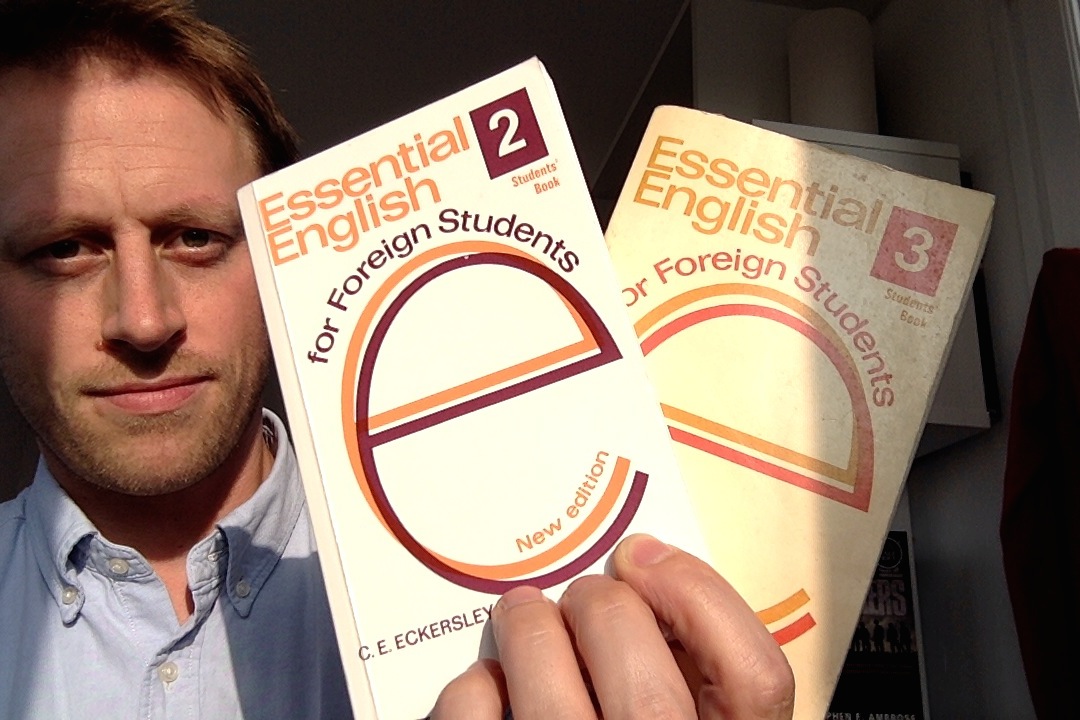
– The interesting course-book (Essential English for Foreign Students by C. E. Eckersley) which Corneliu used in his English lessons
– The myth of ‘the English gentleman’
– Depictions of Englishness in films
– Stereotypes of Romania
– Romania & Bulgaria’s entry into the EU and the media panic related to migrant workers
– Vampires, Dracula and Romania

Please leave your comments in response to this episode! We want to read your thoughts here. Thank you!
Essential English for Foreign Students by C. E. ECKERSLEY

220. A Cup of Tea with Corneliu Dragomirescu

aka “The Son of the Dragon Tamer!” or “The guy with the longest name ever on LEP”
*The conversation starts at 11.39 – so please skip my introduction if you like* Right-click here to download.

Small Donate ButtonThis is one of those episodes in which I invite a friend onto the podcast and we chat about various things. I like these episodes because it gives me a chance to get to know someone on the podcast, and you can listen to some natural free-flowing conversation in English.

Let me tell you a bit about Corneliu. He is a film maker and comedian originally from Romania. He lives in France now where he writes, directs, produces and acts in films and television projects. Corneliu is a polyglot (he speaks Romanian, French and English), he’s a movie-buff and an he’s an all-round great conversationalist and therefore is the perfect guest for another episode of LEP.

Corneliu also has the longest name of anyone ever to appear on LEP so far. His name (first name and surname, but not including middle names) has 9 syllables in it. As far as I know, that’s longest so far on LEP. It’s not a competition or anything – I mean, that’s not the purpose of LEP – to find the guy with the longest name, but still, it’s an achievement of sorts.

Speaking of competitions – thank you for voting for your favourite recordings in the YEP! series of podcasts – episodes 211-218. I’m getting votes all the time. Voting closes at midnight Paris time on 30th September of this year, that’s 2014. I’ll then count the votes and announce the winners – yes, winners. I’ve decided that there will be a winner from each episode. That’s how I roll, okay? Also, if you were wondering about how I will be counting votes, and if I can prevent people voting for themselves again and again – I can see unique codes for every person who comments, so I know when comments are coming from the same computer again and again. I’m not going to count votes which are obviously repeated votes from the same computer, either intentional ones or accidental ones. So, you can put your mind at rest on that one, if indeed you had been thinking about it.

Thank you too if you have left a comment on my last episode which was about Scottish Independence. It’s great to see that lots of people are interested in this subject, and can see parallels with the situations in their countries too in some cases. The referendum is going to take place tomorrow. We’re all waiting with bated breath to see what happens. Will Scotland leave the union? Is the UK as we know it going to change forever? Will the Scottish people make the right decision? Only time will tell.

Now, let’s get back to this episode. Corneliu is an awesome bloke with a proficient level of English and I’m really happy to have him on the podcast. I invited him into the flat and onto the podcast with the intention of asking him some of the usual questions, such as “What do you do?”, “How did you manage to learn English to your current level?”, “Could you tell us about the common myths around your home country?” We ended up chatting for something like 2 hours and got sidetracked by all kinds of interesting things including films, his son, the fall of communism in Romania and 90s pop music. In fact, it felt like it was hard to contain the inspiration in this episode, and the conversation flowed very freely. I hope that comes through in this episode.

Sometimes I find it a bit tricky to begin an episode, and I have to work out a little introduction, but in this one we had already been chatting over a pot of tea for about half an hour and I just hit the record button mid conversation, so we just hit the ground running at the beginning. If you “hit the ground running” it means you start when you’re already moving or in progress. Imagine running in the air, and then you fall, you’d hit the ground running and you’d immediately be off at some speed. That’s what happened in this episode – we hit the ground running because we were already quite deep in conversation and I just hit the record button. That’s why the episode begins quite abruptly.

You will hear a bit of strong language at the beginning – so be prepared for that. I say the “F” word quite early on. What’s the “F” word? Well… it’s the word “Fuck” isn’t it? It’s a bit silly to call it the “F” word – but I suppose it’s a way of referring to the word without actually saying it, because, you know that is a very rude word which you shouldn’t use because it’s not big and it’s not clever. I realise that I’ve just said the word, just a second ago, which defeats the purpose of warning you about the word in the first place… Anyway, you’ll hear me say it in a moment, in the form of the noun phrase “a fuck up” or “a couple of fuck ups”. “to make a fuck up” (noun phrase) = a mistake or “to fuck something up” (verb phrase) = to do something badly, to make a mess of something, to make an error and ruin something. It’s a versatile word – but remember, just because you’ve heard it on LEP it doesn’t mean you should start throwing it around in conversation. Ok, I don’t mean to patronise you, I just felt it was necessary to say that. Anyway, let’s now join my conversation with my mate Corneliu. And here it is…

In Part 1:
– Hitting the ground running, and talking about the challenges of beginning an episode of LEP
– How to say Corneliu’s full name, and how it actually means ‘son of the dragon tamer’, and how awesome that is
– How we know each other
– My (slight) obsession with the film “Taken” starring Liam Neeson
– Fatherhood, Star Wars and how lack of sleep caused Darth Vader turned to the dark side of the force
– The birth of Corneliu’s son Alexander
– The fall of communism in Romania and the film “Independence Day”
– The shock of discovering that Milli Vanilli were fake
– The effect of pop music & capitalist culture on Romania after communism
– Throwing a TV out of a window
– Seeing Hollywood films in Romania in the early 90s
– “Chaplin” by Richard Attenborough, starring Robert Downey Junior
– Martin Scorsese
– Summarising what we’ve said in part 1 so far!

Coming Up In Part 2 (soon):
– The difference “pleasshure” and “pleasure”, “bio” and “B.O.”
– The importance of ‘passion’ in France
– Jamie Oliver’s (fake?) cockney accent
– British & American English
– Corneliu’s experiences in America, his acting and his accent
– Corneliu’s learning experiences with a great teacher when he was a child
– The interesting course-book which Corneliu used in his English lessons
– The myth of ‘the English gentleman’
– Depictions of Englishness in films
– Stereotypes of Romania
– Romania & Bulgaria’s entry into the EU and the media panic related to migrant workers
– Vampires, Dracula and Romania

Please leave your comments in response to this episode! We want to read your thoughts here. Thank you!

210. A Cup of Tea with Noman Hosni

Conversation & language feedback with comedian Noman Hosni. Right-click here to download.

Small Donate ButtonHi everyone. Just before starting this episode, I would like to say a very special thank you to all of the people who have entered my competition, which is entitled “Your English Podcast”. I have received about 80 recordings in total, and very soon you’ll be able to listen to them all and then vote for your favourites. So, hold on because the special competition podcasts are coming soon. But now, let’s get started with this episode, which is number 210. Let’s go!

Hello, and welcome to LEP. How are you? I hope you’re well. Hello to all my long-term listeners, or LEPPERS as you are affectionately known. “Why is he calling them LEPPERS?” That’s “Luke’s English Podcasters” or “Luke’s English Podcast People”, or LEPPERS, if you were wondering. If you are new to this podcast, then welcome! This is a podcast specifically designed for learners of English. My name is Luke. It’s my podcast. That’s why it’s called Luke’s English Podcast. I am an English teacher & a comedian from London and with this podcast I aim to help you improve your English while also entertaining you and hopefully making you laugh a little bit in the process. I have loads of listeners from all around the world – so welcome to the community of Luke’s English Podcast people, or LEPPERS – welcome to the LEPPER community, welcome to the club! I sincerely hope you enjoy the podcast and that it helps you get a grip on your English by practising some proper authentic listening! Don’t forget to visit teacherluke.co.uk where you can get lots more information including how to download the podcast, how to find the archive of over 200 previous episodes, how to subscribe to the podcast on iTunes and how to find transcripts and notes for episodes of this magical, wonderful, fantastic, exceptional, modest, and unashamedly self-promoting FREE podcast!

Today’s Guest is Noman Hosni
Sometimes I have guests on the show, and we just have a free-flowing conversation in English for your enjoyment & listening practice. Today my guest is a very funny friend of mine called Noman Hosni. Let me tell you a little bit about him. Noman was born in France but he has a multinational background. His father is from Tunisia, his mum is from Iraq, he spent much of his childhood growing up in Switzerland and these days he is spending more and more time in London where he works as a professional stand-up comedian – a lot of my guests are comedians as you may have noticed – and Noman regularly entertains audiences in French in Paris and now in English in the UK too. I think he’s a very funny guy indeed, he always entertains me when I see him performing on stage and I’m very happy to have him on the podcast in this episode. The plan is just to have a bit of a chat with Noman Hosni, but also to find out about his background, his learning English experiences and some of the funny misunderstandings he’s had when trying to speak to people in English.

Noman’s English
Now, before we go any further. Let’s talk for a moment about English. Noman is a similar case to Yacine from episode 182, if you remember him. I’ve invited Noman on the podcast in this episode even though, admittedly, his English is not ‘perfect’ because I’m just impressed by him as a learner of English and I generally just enjoy his company. I think that’s enough as a justification. I don’t really need to justify having particular guests on the show do I? No I don’t, but nevertheless here are a few things that occur to me when I think about Noman and his approach to learning English, and these are a few things that you can consider while listening to this episode:
– Noman knows that he has to learn English by actively using it to achieve something. He does this by not only performing stand-up in English but also by going out of his way to have conversations in English, even if he gets into some slightly embarrassing situations and misunderstandings sometimes – you’ll have to listen to the rest of this podcast to find out more about that. So, the point is, he doesn’t mind making a fool of himself sometimes, because he realises that the reward is a more rapid improvement in his English. He’s prepared to go out of his comfort zone in order to develop his English skills.
– He is really serious about learning English, but he approaches it with a sense of play – I mean, he’s aware of the value of just playing around in English. Sometimes just fooling around and having fun in English is a great way to break down your lack of confidence. The point is – there’s nothing to be afraid of because we’re just having fun. That’s a good attitude that you can adopt when practising your speaking I think. It allows you to open up, improvise and enjoy expressing yourself with the language.
– He’s serious about learning English, but he doesn’t take himself too seriously, and I think that really helps with his confidence.
– I think he’s really funny (although that is subjective, but I’m not alone in finding him funny – he’s a pro) even if his English is not 100% perfect. So, what that means to me is that, he’s already achieving a lot in English and he doesn’t let his mistakes hold him back. His English may not be perfect, but he is communicating successfully.

Now, I’m not saying that you shouldn’t try to avoid making errors. Of course, you’ve got to try to iron out your mistakes to improve, and yes, Noman makes a few language errors in our conversation, as you might notice. That’s certainly not a crime or anything, and it’s all part of the learning process but I am going to correct his mistakes at the end of this podcast so that you can all learn from any errors he makes. I asked him if he minded that, and he said it was fine and that he thought it would be funny actually. Okay, so let’s embarrass Noman by correcting all his errors! No, he really doesn’t mind actually. So, if you do notice errors in Noman’s speech, don’t worry because you will hear error correction and language feedback after our conversation. Do keep listening all the way until the end because the language feedback will be really useful to listen to. You can learn from Noman’s errors. I’ll try to make sure the podcast doesn’t go on for too long so I’ll keep the language analysis brief yet insightful. So, hold tight, enjoy the interview, and stick around for the error correction, and Noman, if you’re listening – do pay attention at the end, you might learn to avoid a few common errors! And next time, you can help me with my French or even my Arabic pronunciation. OK? Alright, it’s a deal, and I’m assuming that you’ve said yes to that deal by the way. What I’m saying is, Noman, you owe me a French lesson, whether you like it or not.

So, enjoy the episode everyone – the interview, and then the language feedback afterwards. Cheers!

Noman Hosni Online
Click here for Noman’s website: http://www.noman.ch
Click here for Noman’s Instagram where he posts videos every day: http://instagram.com/nomanhosni
Click here for more of Noman’s content on Vine: https://vine.co/u/1053524188788891648

Error Correction & Language Feedback
With Noman’s permission, here are some language errors that he made in the interview, with corrections. Listen to the podcast to hear my more detailed corrections.

By the way, this might seem like a lot of errors, but if you compare it to the number of good things & correct things he said, it’s not much at all. Also, I know that many of these are just ‘slips’ rather than proper errors. I mean, Noman will kick himself when he hears some of this because he knows what’s right and wrong, but in the heat of the moment errors will just slip out. Anyway, let’s start.

1. I can smell the saliva of a lot of people. “Saliva” – sa-lee-va /sæli:væ/.
It should be sa-lai-va – /səlaɪvə/

2. What I said before is on the record. “record” – ree-cord – /ˈri:kɔ:d/.
It should be “on the re-cord” – /ˈrekɔ:d/.
/ˈrikɔ:d/ – that’s the verb. “I’m going to record another podcast”

3. He say… and I say…
He said… and I said…

4. From downstairs it don’t look so high. I see the balcony so high.
From downstairs it didn’t look so high. I saw (that) the balcony was really high.

5. You’re not in the good podcast right now.
You’re not listening to the right podcast right now. (Of course I disagree – you’re always listening to the right podcast, when you’re listening to Luke’s English Podcast)

6. “If you broke your leg, just stay down”
If you break your leg, just stay down.

7. It went good.
It went well. Although this is fine in American English (so is it wrong or right? – good question for a DEBATE)

8. One of my first gig.
One of my first gigs.

9. I was trying to put a lot of energy to remove my french accent.
I was trying to put a lot of energy into removing my french accent. To put a lot of energy into doing something.

10. I do a lot of mistakes.
I make a lot of mistakes. (That’s an ironic mistake to make)

11. I write everything and I’ve learn it to make sure there are no mistakes in my English.
I wrote everything (down) and I learned it to make sure (that) there were no mistakes in my English – That’s if he was talking about one instance in the past.

12. Don’t tell to the crowd that I’m French.
Don’t tell the crowd that I’m French.

13. He said me that, and I said, “I fail”.
He told me that and I said, “I failed”.

14. I was not raised by an English person who got an accent.
I was not raised by an English person who had an accent. “Have got” is the same as “have” but we don’t use it in the past. In the past, forget about ‘got’ for possession.

15. Some term are confusing.
Some terms are confusing.

16. There’s some term that doesn’t exist in the dictionary.
There are some terms that don’t exist in the dictionary.

17. You have to masterise all the tools.
You have to master all the tools.

18. It’s the first time I went in London to do a gig in English.
It was the first time I’d been to London to do a gig in English. (Providing background context for an event in the past – the event is the taxi conversation, the context is the line about his first time in London)

19. He seems to be not very agree with me.
He didn’t seem to agree with me. (Remember not to use ‘be’ with ‘agree’)

21. When I realise, I don’t want to correct him.
When I realised, I didn’t want to correct him. (Repeat it for muscle memory)

22. She thought I’m British. I don’t want to embarrass her.
She thought I was British. I didn’t want to embarrass her.

23. We are in Paris actually but maybe you’ll listen to this in 2 years and maybe we will not.
We’re in Paris at the moment (or currently) but maybe you’ll listen to this in 2 years and then maybe we won’t be.

24. Two years ago I can’t imagine that I have this conversation with you.
Two years ago I couldn’t have imagined that I would be having this conversation with you now.

25. I keep talking about another subject. (past)
I kept talking about another subject.
I kept changing the subject.

26. English crowd are more easy to laugh.
English audiences laugh more easily.
It’s easier to make English audiences laugh.

27. I’m agree, I’m impressed.
I agree.

28. Every time someone kill people…
Every time someone kills people…

29. I put energy on it.
I put energy into it.

30. When I speak to English person.
When I speak to English people.

31. I’m keeping push it on my accent.
I’m putting pressure on my accent.
I keep pushing my accent.

32. It was in purpose.
It was on purpose.

33. One of the only things I could remember was the warm.
One of the only things I could remember was the heat.

209. Travelling in Indonesia (Part 2)

Part 2 of my account of my travelling experience in Indonesia. Please listen to part 1 before listening to this one. Do leave your comments, thoughts and opinions below. Right-click here to download.

Just Notes
Small Donate ButtonWhat you can read here is just notes. It’s not a full transcript. These are notes I wrote to help me remember details about my travelling experience. You should listen to the episode to get the full account.

Write a Transcript
If you would like to write a transcript, just click here to access a google document for this episode.

Notes Start Here (Remember, they’re just notes – they’re not all complete sentences)

What we saw and did in each place
30 hours of travelling? Something like that.
How to deal with jet-lag.
In-flight entertainment.
Podcasting in a toilet on a plane.
Paris to Kuala Lumpur (nice airport)
KL to Jakarta (“My wife’s gone to Indonesia”)
Delayed flight to Yogyakarta. The plane just sits on the runway. Less stress if you’re late, but not if you’re in a hurry to leave!
Surrounded by people at the airport, all trying to get us into their taxi. Quite overwhelming and hard to know who to trust.
Taxi journey to the hotel. Scooter filled streets. Houses, warungs, government buildings, all kinds of shops, garages and other buildings by the side of the dusty roads. Lush green rice fields, coconut trees. More scooters. Colourful flags by the side of the road (don’t know what they represented). Friendly taxi driver but limited English.
D’Omah hotel in Tembi. Owned by an Australian man called Warwick Purser.
Employed people from the village. Worked closely with the local community, and it shows.
Lovely quiet town with friendly people.
It was nearly destroyed in an earthquake.
A labour of love for Mr Purser.
The staff were unbelievably lovely and friendly.
It was a really first class experience, thanks to my girlfriend who is good at finding these places.
We paid a bit more than normal, but we wanted a nice place to start with after our long flight. It was worth it.
Describe the rooms and hotel.
Ristafel on the first night.
Music played by the locals. So charming and sweet – a combination of ukuleles, guitars, a cello, a violin and some traditional wire percussion instruments and drums. It was lovely.
Bintang beer.
Chicken sate and other traditional food.
Yogyakarta – the sultan’s’s palace and the water castle. Apparently there is still a sheik for Yogyakarta. The region is unique as it is governed by him, yet he’s not elected. It seems a bit odd. The people of Yogya can vote in national elections, but they are governed by the sheik. He lets tourists into his palace in the mornings, and relaxes there in the evenings.
Gangs of school kids practising their English.
Broad sandy squares with pagodas for relaxing & playing music.
Galleries presenting beautiful fabrics, paintings of the sheiks through the years and various bits of treasure and so on.
Taman Sari: The water Castle, built at the end of the 18th century – a place where the sheik would spend time with his concubines. There are pools of water where his concubines (women ‘taken’ from different places he had conquered) would wait. The sultan would sit in a tower and watch them, and then pick one or more to then spend time with. He’d probably have sex with them. I wondered how that must have felt – either these women would be horrified (they’d basically been kidnapped) or would they be honoured, because in a way this was an honour and it could mean a slightly better life, and the kids of the sultan born of his concubines had privileges and were considered quite high-status people. It’s amazing that it all occurred there and we were able to see it, including his massive bed and everything.
We were shown around by a guy whose family had lived in the grounds of the castle for generations. He worked as a kind of warden and tour guide, but told us that the modern-day sultan was in the process of selling that land to foreign investors and that in fact it had been sold to Starbucks and they were going to develop it. Imagine what the place might be like in a few years.
Drinks in town – hard to find places. Fun and yet slightly worrying taxi rides in the night into nowhere.
Frogs surrounding the place.
Birds, lizards in the ceiling, a crab in the shower.
Ducks, geese and chicken roaming the village.
Children playing in the streets.
Incredibly loud call to prayer at 4.30AM.
Borobudur – it’s a buddhist temple about an hour from Yogya. It was built in the 9th century. That’s a hell of a long time ago.
6 square platforms with 3 circular platforms on top.
You walk around each platform and look at the carved reliefs on each wall. They tell different stories of the buddha’s life, and of cautionary tales of how a life of pleasure can lead to suffering. There are over 2,500 relief carvings and 504 buddha statues.
The concept/idea of the temple. Attaining Nirvana.
Apparently it was abandoned in the 14th century after the decline of Hindu religion and the introduction of Islam into Javanese culture. It was discovered again in the early 19th century by dutch engineer H.C. Cornelius, on the instruction of the then British ruler of Java Governor-General Sir Thomas Stamford Raffles. H.C. Cornelius set out into the Javanese jungle with some guidelines from the locals. They found it, but it was overgrown, covered in earth and volcanic dust. Gradually over the years it was uncovered and restored. UNESCO did a huge restoration job on it in the 70s and cleaned it up. Now it’s a pilgrimage site and the #1 tourist destination in the country.
We also visited Pranbanan – a hindu temple, similar to Ankor Wat in Cambodia. It’s a number of large temples dedicated to different hindu gods, and with all kinds of carvings on the walls of each temple. Statues of the gods used to be inside each temple but they’re not there any more. Almost the entire thing was knocked to the ground by an earthquake but was rebuilt, although many other surrounding structures are still in rubble. We stayed for the sunset and went home.
There are other things we could have done, including a demonstration of a traditional Ramayana ballet dance telling the old hindu story of King Rama. We didn’t see it in the end – again, we couldn’t do too much!
Flew to Lombok, via Surabaya – a bit of a nightmare to be honest. We stayed in a hotel which we thought was just 10 minutes from the airport, but turned out to be 90 mins away. We had a very long taxi ride in which we were convinced the driver was taking us on a very long route. We arrived at our hotel and it was a bit grim – although nothing too bad! For some reason my g/f was really turned off by it. Other people’s hair in our bed, weird stains, the smell of stale cigarettes and dirty carpet, cigarette burns on the chairs. Nothing too terrible, but enough to freak her out a bit, especially after our long taxi ride into the unknown. We went out to a great hotel (the name escapes me) and had truly delicious chinese food, and wondered why we weren’t staying there instead. We were up very early for our flight to Lombok – stressing that we were going to miss the plane again.

I can’t go into too much detail. Lombok is the next island after Bali and it’s less touristy than Bali, but just as beautiful with lush greenery, sandy beaches, friendly people and a large volcano in the middle. We stayed in the resort area of Senggigi to get some beach-side relaxation. Snorkelling, reading, listening to the live band at sunset, swimming in the pool, enjoying the delicious local food in street side warungs, buying some handicraft in the local market, strolling along the beach at night.
We also started planning our Mount Rinjani climb. I’d like to tell you about that in more detail now.

Mount Rinjani
It’s the second largest volcano in Indonesia, but it’s still pretty massive. It’s nearly 3 times the height of the UK’s highest mountain, Ben Nevis. It’s an active volcano. It rises up about 2,500 metres to the crater rim which is about 7km wide and has a large lake inside, and a smaller volcano which last erupted in 2010. Then the peak of the mountain is on one side of the crater and rises to 3726 metres above sea level.

The Boat Journey (again)
No, we didn’t really capsize in the middle of the sea. The boat arrived safely on the island and we had a lovely 3 days. But, it felt at any moment that things could have gone wrong, and in fact they did go wrong for a similar boat near another Indonesian island just a few days earlier. As I said before in this episode, travelling is an amazing experience, but at times it feels pretty scary! I just wanted to express the adrenaline rush and the fear factor that you can experience in these situations. On that boat ride, and during the Rinjani trek, I really was trying not to panic sometimes. I was trying not to get freaked out by what could have happened. You might be thinking – Luke you worry too much, or something like that, but I think I’m just being realistic. We do have these moments of fear. That’s what makes it exciting. Sometimes you have to get a little close to the edge in order to really experience real life. When everything’s so safe it can get a little boring, can’t it? It’s character building stuff.

206. Summer in London (Part 2)

Hi and welcome back to this special episode of LEP in which you join me on a walk through central London. [Download]

Small Donate ButtonLet’s re-cap on what happened in part 1. (ooh the excitement)
– I recorded this last week when I was on holiday staying at a friend’s flat in Stockwell
– I needed to go into town to visit the doctor’s for a couple of immunisation injections before going on holiday to Indonesia
– I decided to take a nice walking route to the doctors, from Victoria Underground Station, in front of Buckingham Palace, past some Royal Guards and a guy selling skunk, past some ducks, joggers & tourists, across the mall and up towards Picadilly Circus.
– We ended part one with me walking up Haymarket, towards Picadilly Circus in order to get some lunch & coffee in Soho before heading towards Wimpole Street near Oxford Circus for my jabs.
– As I said on the previous episode, London is a very noisy city so I really apologise for any background noise which makes it hard for you to hear what I’m saying. I hope you it doesn’t stop you from enjoying this trip through central London on a hot summer day.

In this episode I’ll take you through some touristy areas, some cool spots, and we’ll also investigate some of the more seedy parts of central London that you might not notice as a tourist.

Let’s go!

Music: “Day on the Town” by Madness. Click here to download it on iTunes.
357544399_ae99ba566f

205. Summer in London (Part 1)

Hello everyone! Welcome to another episode. This one was recorded last week when I was on holiday in London, and in this episode you can listen to me walking through central London and talking to you along the way. I really enjoyed recording this episode and I think you’re going to enjoy listening to it too because it’ll be like you’re actually there with me, strolling around some of my favourite parts of town, hearing all the sounds of London around you as we go. I think it’s going to be great, but before we start I’d just like to mention a couple of things as a preface to the episode. [Right-click here to download]

Small Donate ButtonLondon can be a noisy place and so, unfortunately, a lot of the recording I made on this day was not completely clear enough to broadcast because my voice got a bit drowned out by atmospheric noise. You might find that some of it is a little bit difficult to hear, and in fact I had to completely edit out large sections of the episode because the noise level was just too high. When I listened back to some of it, I was quite annoyed to discover that the sound of busses, cars, trains and wind made it quite difficult to hear my voice clearly. I’ve managed to edit out some of the bad bits, and explain the missing content by talking to you here in post-production, but some of the remaining parts might still be a little difficult to hear. If you do find some of this too noisy to listen to then I’m sorry and I understand, but I still hope it’s possible for you to follow almost all of what I’m saying.

I really wanted to upload this episode despite the noise. I think it will be quite an interesting one, as you can take a personal trip with me through some of my favourite parts of central London and I expect that most of you are probably not bothered by the noise and are happy to join my on a walk. I love London and I’m proud to present it to you, even in audio form, and I think this episode can give you quite a real feeling of actually being there with me. It would be a pity to waste the several hours of talking that I recorded just because some people would not tolerate the noise. So, I’ve decided to just upload it anyway, even if the audio quality is not perfect.

I know what most of you are thinking – it’s fine Luke, it doesn’t matter! Don’t worry about it! I appreciate that. But for those of you who are sensitive to a bit of background noise I just want to say – I know this episode is a bit noisy – but that’s just London for you! It’s a noisy place! I suggest you write a letter to London’s mayor Boris Johnson to complain!

“Dear Mr Johnson,

Recently while listening to an award-winning podcast by Luke Thompson (I’m sure you know it) I was saddened to discover that parts of the episode were inaudible due to frankly unacceptable levels of noise caused by London’s busses and traffic. So, I am writing this letter in order to complain about this matter, and suggest in the strongest possible terms that you do something about it! Maybe introduce a noise-tax, or simply ban busses and taxis from operating within central London. I appreciate that businesses and services need to operate with vehicles, but this simply cannot be allowed to interrupt our enjoyment of Luke’s English Podcast.

Yours sincerely,

L.E. Pepper
The Republic of Freedonia”

OK, I realise I’m going a bit too far, it’s not that big an issue really. In fact, you could say I’m “making a mountain out of a molehill” or “stretching it out of all proportion”. I’m “going overboard”… yes it’s all a bit “over the top” now isn’t it. Alright, that’s enough, I don’t want to “over egg the pudding” by talking about noise levels too much, so it’s time to get on with this episode, so join me now as we go back in time, all the way to last week, on a trip into central London…

Music: “London Town” by Light of the World – Download it from iTunes here.

First gap:
So, I left the flat in bright, warm sunshine and walked towards the tube station, crossing the street at a busy junction in Stockwell, near Brixton, just south of the river. Some people say it’s quite a rough area, I personally think it’s okay. In fact at that time of day there were a couple of homeless people around, an alcoholic-looking guy stumbled out of a betting shop, but generally the area’s okay. In fact, it’s got good transport connections to central London and the rent is not too high. So I crossed the street and walked to Stockwell Underground Station and I stopped to look at a mural on the wall of the station. It’s the picture of Jean Charles De Menezes, a Brazilian man who was tragically and wrongfully killed by police who thought he was a terrorist, back in 2005…

2nd gap:
I left Victoria Station and walked along Buckingham Palace road. Along that road there is a wall, and on the other side of the wall is the garden of Buckingham Palace. You can’t get in there, so you just have to wonder what it looks like. I imagine it’s a beautiful and well kept garden. There are parks in front of the palace – St James’s Park and Green Park and of course the public are allowed to go everywhere they want in those parks, and walk or like down on the grass. There’s a pond with ducks, swans, geese and even pelicans which are large birds that you normally find near the sea – they have huge beaks that can carry loads of fish. A while ago there was a video going around on YouTube of a pelican actually eating a pigeon in St James’ Park!

I walked along Buckingham Palace road next to the palace gardens, as I said, and that’s next to a busy main road, and the noise was a bit too much. I talked about what it must be like being the Queen (I expect it’s a lot of hard work actually, it might be a bit lonely although she lives in luxury, she might be very strict on her children & grandchildren, and very controlling), which I have talked about on the podcast before. I wonder about her sense of humour, and what she’s really like.

I also spoke about the Queen’s power, how our democratic monarchy works and the difference between having a president and a monarch. Unfortunately, a lot of this was drowned out by the sound of traffic, so I’ll try and sum up what I said.

People sometimes wonder about why we have a Queen & a royal family in the UK, and also suggest that it might be better to have a republic instead. It might look like an old feudal system – a kind of medieval system in which the Queen has a covenant with god. What is this game of Thrones? But if you disregard the craziness of monarchy, you can just see it for what it is. It’s a slightly strange system, which works pretty well for the UK.

Without wishing to criticise republicanism (it works fine in plenty of other countries), in the UK democratic monarchy seems to work for us quite well. In a republic, such as USA or France, the president has an executive and representative function. He leads the country and also represents the country in state ceremonies, and as the figurehead of the nation. It’s an incredibly important role. That can lead to some issues. People want to look up to the president, and celebrate him/her as he/she represents their nation, and yet the president also has a responsibility to run the country, and answer to the wishes of his citizens. People shouldn’t be too deferential to the president because ultimately he’s a civil servant who works for the people. Sure, we can respect the president if he does a good job, but often people want a figurehead who is above the political system. In the UK the responsibilities are split between the monarch and the PM. The PM runs the country, and the Queen just ‘represents’. They do have tea once a week, so she has an audience with the PM, she does have minimal powers which she doesn’t use. So Brits can celebrate the Queen as head of state, knowing that she doesn’t have any decision making power and that she doesn’t express a political preference, and then we’re free to criticise our Prime Minister without having to be overly deferential towards him. His job is to run the country. We shouldn’t lift him up to the position of someone super special. He works for us. The Queen’s job is to give us a focal point for national pride without letting political views get in the way. So, that’s how we can celebrate the Queen without it affecting the way our country is run. Hopefully. It’s a very complex issue with all kinds of opinions regarding the pros and cons of having a royal family. I’ve dealt with it before on the podcast, in episode 103. “The Queen & The Royal Family” (featuring EnglishRobot4000).

203. A Cup of Tea with Peter Sidell (The Flatmate from Japan)

English teacher, travel writer, stand-up comic, learner of Japanese, DJ, native English speaker, Machester City fan and former flatmate of Luke from Luke’s English Podcast – Peter Sidell is a guy who keeps himself busy!

[DOWNLOAD AUDIO]
Small Donate Button
I lived with Peter in Tsujidou, Japan for nearly a year. I left at the end of 2003 and he stayed there and I hadn’t seen him for about 11 years until he recently visited Paris and we got the chance to catch up with each other again. Of course I jumped at the chance to interview Peter for LEP, and you can now listen to our conversation here, now.

www.japantravel.com
Peter is a regular contributor to www.japantravel.com where you can read articles and travel advice for Japan. Are you thinking of going to Japan, or would you like to read some interesting articles about Japan in English? Just click www.japantravel.com to find out more. To see a list of articles written by Peter, click here.

During our chat you’ll hear us talking about such things as:
– Peter’s tourist activities in Paris (visiting galleries and looking at ‘crazy modern art’, drinking wine at lunchtime, attempting to deal with waiters)
– The day we first met each other in a McDonalds in 2003
– Living as an ex-pat in Japan
– Where Peter is from, and his accent
– Learning Japanese
– Cultural differences between the UK and Japan
– How it feels to go back to England after living in Japan for years
– Japantravel.com
– Destinations Peter has travelled to
– Doing stand-up in Japan
– How it feels to experience earthquakes in Japan
– The beauty of Mt Fuji seen from Hayama beach
– Luis Suarez

Thanks for listening :)10589716_10152725560062494_74912480_n
222618_5130717493_5217_n

My Interview on Zdeněk’s English Podcast

Recently I was interviewed by Zdeněk Lukas on his podcast. Zdeněk is a big fan of LEP and so he treated me rather like a celebrity, which was both flattering and fun! We met while I was in London recently and spent a couple of hours in St James’s Park discussing podcasting, English teaching, the TV show “Mind Your Language” and all kinds of other things. I thought you might like to listen to the interview, so here it is (below). There are 2nd and 3rd parts to this interview and I will put them on this page when Zdeněk has published them.
Part 1

Part 2

Part 3

In part 4 Zdenek responds to some comments he’s had about these three episodes, and then does some language analysis of our interview. Right-click here to download. He’s still beating himself up a little bit, but he is willing to dissect his own English (and mine) for your benefit.

Zdeněk is an MA-qualified English teacher from the Czech Republic. He has been podcasting for about 2 years now (or possibly more) and about a year and a half ago he discovered Luke’s English Podcast and became a big fan. In fact, it inspired the tone of his own English-teaching podcast, called Zdeněk’s English Podcast. Zdeněk has published lots of episodes in the last year or two, and while it is clearly quite inspired by LEP (he says so himself) I believe he is becoming more and more original all the time. On his podcast he teaches plenty of vocabulary and likes interviewing native speakers as a way of sampling authentic English. He also interviews learners of English, focusing on insights into their learning experience, often giving language feedback and correction of any errors that might crop up during the conversations.

You can check out ZEP by clicking the links below, and I hope you support Zdeněk in his mission to publish interesting podcasts for learners all over the world while also pushing his own English to new heights.
Zdeněk’s English Podcast on Audioboo.fm
Zdeněk’s English Podcast in iTunes
Zdeněk’s English Podcast (friendly) Facebook group

201. Nikolay Kulikov: A Russian Comedian in London

Nikolay Kulikov is an award-winning Russian screenwriter and stand-up comedian. This year he spent a couple of months living in London (and also briefly in Dublin) performing stand-up comedy. I saw one of his performances in English on video and thought he was very funny! So, I decided to contact him for an interview to find out more about him, his experiences learning English, his views on performing to British & Irish people, and how he feels about life in Russia these days. I hope you enjoy the episode! **Please be aware that this episode features some rude language and swearing** Right-click here to download.

Small Donate Button
Here is an email I sent to Nikolay, inviting him to be on the podcast, and his reply:

Dear Nikolay,

My name is Luke Thompson and I am an English teacher and stand-up comedian. I do a podcast called Luke’s English Podcast. It has listeners all around the world, and many of them are from Russia. Recently one of my Russian listeners sent me a message with a video of you performing stand-up in Ireland. I thought it was really funny. You’ve got great jokes and a lot of talent.

I was wondering if I could interview you by Skype some time and feature the interview on the podcast. Essentially, I’m interested in your story. How did you learn English? What made you start doing stand-up? Where have you performed around the world? How is your comedy received in Russia, particularly some of the slightly controversial things you say about the place?

I think you’d be a great guest and my listeners would enjoy hearing from you. You will also be heard by thousands of people around the world so it would work as publicity for you too. Let me know if you’re interested in being interviewed over Skype some time, perhaps next week.

I’m looking forward to hearing from you.

All the best,

Luke Thompson

Nikolay’s Reply:

Hi Luke!
It was a pleasure to receive such a wonderful letter.
Yes, let’s do this! I’ve got a lot to talk about and it can be real fun.
Next week is excellent.

ninja_tune_largeThanks to Anna Khazan and Natalia Dalik for bringing Nikolay to my attention and helping me to contact him. You’re my LEP Ninjas!

Nikolay’s Stand-Up in English in Ireland

Find Nikolay on Twitter, YouTube and VK Nikolay Kulikov
https://twitter.com/KolyaKulikov
http://www.youtube.com/user/krakvasha
http://vk.com/nobrainkolya

The Spoon Thing from The Matrix – “There Is No Spoon”
You might have heard Nikolay and me talking about a spoon in this episode, and wondered what we were talking about. You might have thought, “There is no spoon” – what do they mean? If you found that to be a little bit mysterious, let me explain it to you!

It’s from a scene in the movie The Matrix (1999).

I don’t know if you’ve seen the film, but the basic premise is that the human race has been enslaved by machines. The machines have connected everyone to a computer programme which replicates the real world. It’s an incredibly convincing simulation of real life. It’s so convincing that most people don’t realise that it’s just a dream, and that in reality they are slaves to machines. Some people have “woken up” and realised that the reality in which they are living is just a dream. Those people form a rebellion in order to fight against the machines. They are able to move in and out of the matrix whenever they want. One of the key members of the rebellion is a guy called Neo (Keanu Reeves). Some of the others believe he is the chosen one who will allow the humans to defeat the machines, but in order to do so he first has to learn to understand the nature of the matrix (in fact just a computer programme) and then to control it from within. In the first film we follow Neo as he learns about the matrix and begins to understand how to control it. One of the concepts at the heart of this film is that reality is just what we perceive – that there is no ‘reality’ there is just the way we perceive the world through our senses, and if you learn to control your senses, you can then control reality. The things we see are just our imagination. We’re living in a dream, and it may be possible for us to become lucid within the dream, and therefore control everything that happens all around us. It’s deep, man. There’s also some wicked kung fu.

So, the spoon thing.
There is a key scene in the film in which Neo learns about how to control the matrix. He encounters a boy who has learned to bend spoons using only the power of his mind. The boy holds up a spoon, and it bends. Neo is amazed and asks the boy how he does it. The boy says “You have to realise that there is no spoon. There is only you.” What he means is – you have to realise that the world you see is just created by your senses (which are being controlled by the matrix programme), so in order to bend the spoon you have to remember that the spoon does not exist, and that it is just the product of your senses. If you can control yourself, then you can control the world around you. Neo picks up the spoon and for a moment he manages to make it bend. This is an important moment for Neo, and after this he learns how to control the matrix, and then fight back against the machines which are enslaving the human race. You can see the scene below (YouTube video).

Some people think the film is a profound meditation about the nature of reality. Other people just think it’s an awesome kung-fu movie. For me, it’s a bit of both – philosophy and kung-fu. It’s a good combination!

200. New Competition: “Your English Podcast”

Details of a new competition for you to enter, how it feels to complete 200 episodes of the podcast, jingles, a message from Alex & Paul, and more! Right click here to download.

Small Donate Button
Introduction
Hello! And welcome to the podcast. This is a very special episode, because it’s the 200th one! Wow, I made it to 200! Amazing! Obviously I’m delighted about that. This is the 200th anniversary of LEP, and before I tell you all about how that feels, I’d like to begin this episode by telling you about a new competition I’m launching today, which I’d love you to take part in. So first I’m going to tell you all about the competition, and then I’ll celebrate 200 episodes of LEP with you. OK, so let’s get started.

This is the 200th episode of Luke’s ENGLISH Podcast and to celebrate this momentous occasion I’ve decided to launch another LEP competition in which you can send me your audio recordings. I did a similar competition over 2 years ago, and now I’m doing another one. This one’s called “Your English Podcast”. Why? Because I’d like you to imagine you are recording 5 minutes of your own English podcast. Just record and send your 5 minutes (or less) to me, I’ll play your recordings on the podcast and then listeners can vote for their favourite. I will count all the votes and announce the winner. The prize for the winner is to be interviewed on an episode of Luke’s English Podcast.

Doesn’t that sound exciting? It should do!

I did my first competition 2 years ago and it was amazing to hear the voices of my listeners. Camila Andrade from Brazil won that one. She got a very special prize – a phrasal verb dictionary.
Since then, the podcast has gone from strength to strength and I’ve picked up new listeners, old listeners have improved their English, I’ve dealt with many more topics and events on the podcast. It’s time for us to hear what the LEPPERS have to say for themselves. This is your chance to have your voice heard on Luke’s English Podcast. And ultimately, if you win, you could become famous around the world as you are interviewed on the podcast via Skype. If you’re shy, I understand – I’m nice, I’ll make sure you’re okay, and so will the listeners – because the great thing about the LEP community is that my listeners are good people. I can’t wait to hear from you, and to give you a platform to say what you’ve got to say to the world.

The Competition in a nutshell
Record yourself talking about whatever you want for 5 minutes, send the recording to me, I’ll feature all your recordings on special episodes of the podcast, listeners can vote for their favourite and the one with the most votes gets featured on an episode of the podcast in a Skype call with me.
BUT there are some rules to make sure this competition is fair and is not impossible for me to manage in my limited time!
Please carefully observe the following rules. If you don’t follow the rules, you might be disqualified from the competition. It’s important to establish some rules because otherwise this competition could be really difficult for me to manage. So, rules are rules, and here are those rules:

Rules for the Competition
– Opening date: NOW! The competition is now open so get started!

– Closing date for entries: 31 August 2014. After that I will collect all your audio recordings and take time to prepare episodes in which I showcase your competition entries. People can then vote by leaving comments on teacherluke.co.uk. I’ll give you more information about voting later on.

– Time: You’ve got 5 minutes, maximum. You can talk for less than 5 minutes if you like, but please make sure you don’t exceed the 5 minute limit.

– What to say: You can say whatever you want! This is 5 minutes of YOUR podcast. If you like, you can imagine you have your own English podcast, called “Jose’s English Podcast” or whatever your name happens to be. If you like, you can welcome listeners to your podcast at the start by saying “Hello and welcome to Jose’s English Podcast”, and say goodbye to your listeners at the end. It’s completely up to you what you say, and how you say it. This is your English podcast.

– Name & Country: Remember to tell us your name and where you come from. This will help people to remember you and vote for you.

– Voting: I will collect all the audio files which are sent to me, and I’ll play them all in one episode (or more) of LEP, in alphabetical order by name. Listeners can then vote by leaving comments.

– Audio files: Send your audio file to podcastcomp@gmail.com only. I will only accept entries which are sent to that email address. Please do not send me competition entries on Facebook or to my Hotmail account. podcastcomp@gmail.com is the only email address I will accept.

– I’m only accepting audio files – not text entries this time.

– I’ll give you more information about voting later. For now, you can start preparing your competition entries!

So in summary:
– The competition is now open. Send your audio files (max 5 minutes) to podcastcomp@gmail.com. The closing date is 31 August 2014. After that I will upload showcase episodes of LEP and you can vote for your favourite entry. More information will follow in later episodes…

Some Bits of Advice
When recording your entry, try to make the sound quality as good as possible. Most phones and computers will allow you to record your voice pretty easily, but try to be in a quiet room in your house, away from noisy windows, washing machines or other people.

You can send me audio in a variety of file formats: wav, mp3, mp4, avi etc. I prefer mp3 as it is quicker to process.

If you want you can include a jingle, sound effects or even background music, but you’ll find this is pretty time-consuming and complicated. Ultimately, people just want to hear your voice clearly, so focus on that.

It’s normal to be a bit stressed or nervous when recording yourself. Don’t let that stop you. Try to enjoy it! Enthusiasm is a very attractive quality. LEPers are all lovely people so don’t worry – you’re among friends and I’m sure people are going to be very welcoming and enthusiastic about hearing what you have to say.

Try not to read out a script which you have prepared earlier. You can do this if you like, but I think it sounds more natural if you’re not reading from a pre-written script, and ultimately it’s better for your spoken English. Writing notes is a good idea – just write the main points you want to make, but don’t write it out word for word – just write enough to help you remember.

You should practise your speech a few times until you’re comfortable.

Try to bring your speech to life and put your personality into it if possible.

If you prefer, you can just improvise the whole thing without any practice – in fact, that might be even more exciting or engaging if you do that, but it will also be slightly more challenging too.

Ultimately, just have fun and enjoy taking part in the competition. Don’t stress too much – it should be enjoyable and a fun way to practise your spoken English. I’m sure that everyone will be fascinated to hear short messages from LEPers all around the world! Personally, I can’t wait.

If you don’t know what to say and you need inspiration, perhaps you could respond to something you’ve heard on Luke’s English Podcast, or even (as a joke) you could parody my style of talking on LEP, a bit like this (from Alex Love & Paul Langton). It’s totally up to you. I’m really looking forward to receiving your audio entries at podcastcomp@gmail.com, so get started!

And now some chat about the 200th Anniversary of Luke’s English Podcast with English Robot 3000
Why did you start LEP?
When did you start LEP?
Did you ever expect to get to this point? (200 episodes, and nearly 1.5million downloads in 9 months)
What’s your objective with LEP?
What level is the podcast for?
Are you ever going to stop LEP?
What’s your favourite thing about doing LEP?
Are you happy doing LEP?
Does it ever make you unhappy? Is there anything frustrating or even scary about doing LEP?
What do you expect from your listeners? Small Donate Button
Do you ever get any negative comments, hate mail, or trolling?
Are you rich yet? How rich are you now?
What do your friends and family think of LEP?
Has LEP helped you in your life?
How does it feel to be so famous?
How much time does it take to do an episode of LEP?
Why don’t you do more videos?
How about arranging an event so that you can meet LEPPERS?
Why don’t you have your girlfriend/fiancee on the podcast?
How’s your French?
Someone told me that you have a new job? Is it true?
Do you have anything else to say to the people of the world?

Song Lyrics
P.S. The song I sing at the end of this episode is called “Always Look on the Bright Side of Life” by Eric Idle and comes from the soundtrack to the film “The Life of Brian” by Monty Python’s Flying Circus. Buy the film on iTunes here: https://itunes.apple.com/au/movie/monty-pythons-life-of-brian/id294661981

    Always Look on the Bright Side of Life – Monty Python

Am D G Em
Some things in life are bad they can really make you mad
Am D G
Other things just make you swear and curse
Am D
When you’ve chewing an life’s gristle
G Em
Don’t grumble give a whistle
Am D7
And this’ll help things turn out for the best

G Em Am D7 G Em Am D7
And always look on the bright side of life
G Em Am D7 G Em Am D7
Always look on the light side of life

Am D G Em
If life seems jolly rotten there’s something you’ve forgotten
Am D G
and that’s to laugh and smile and dance and sing.
Am D G Em
When you’ve feeling in the dumps don’t be silly chumps
Am D7
Just purse your lips and whistle – that’s the thing

G Em Am D7 G Em Am D7
And always look on the bright side of life
G Em Am D7 G Em Am D7
Come on always look on the bright side of life

Am D G Em
For life is quite absurd and death’s the final word
Am D G
you must always face the curtain with a bow
Am D G Em
Forget about your sin – give the audience a grin
Am D7
Enjoy it – it’s your last chance anyhow.

G Em Am D7 G Em Am D7
So always look on the bright side of death
G Em Am D7 G Em Am D7
just before you draw your terminal breath

Am D G Em
Life’s a pice if shit when you look at it
Am D G
Life’s a laugh and death’s a joke it’s true
Am D
You’ll see it’s all a show
G Em
keep’em laughing as you go
Am D7
just remember that the last laugh is on you

G Em Am D7 G Em Am D7
And always look on the bright side of life
G Em Am D7 G Em Am D7
Always look on the right side of life
(Come on guys, cheer up)
A F# Bm E7 A F# Bm E7
Always look on the right side of life
A F# Bm E7 A F# Bm E7
Always look on the right side of life ….
Episode 200 podpic