Author Archives: Luke Thompson

About Luke Thompson

I've been teaching English for over 20 years in London, Japan and France. I also do an award-winning podcast for learners of English called "Luke's English Podcast". In my free time I'm a stand-up comedian who regularly performs shows in English in Paris and sometimes London.

155. A Cup of Coffee with… Sarah Donnelly (Part 1)

In this episode I am joined by the lovely Sarah Donnelly, who is also an English teacher and stand-up comedian, like me. She is originally from the USA and is now living in France. In the episode we respond to questions which listeners posted on the Luke’s English Podcast Facebook page. Enjoy!

Small Donate ButtonRight-click here to download this episode.
Here are some topics we discuss in this Euro/American episode:
Coffee making techniques
Differences between English and French
Regional Accents of the UK
Shakespearian English
Learning French
Teaching English
And plenty more…!

There is a second part to this episode, which I will upload soon. :)

Sarah performs stand-up comedy regularly in Paris, and sometimes in other European cities, as well as in the USA when she is back there. Click here for details of her show “Girls Gone Funny” which she performs every Thursday, along with Phyllis Wang.

Links
Here are some links to things we mention in this episode.
BBC Learning English Pronunciation (a great way to understand and practice British English pronunciation)
The British Library – Sounds Familiar (a very in-depth study of British English dialects and accents – you can listen to recordings of different accents from all over the UK)
David Sedaris, Kurt Vonnegut (two of Sarah’s favourite American writers) www.meetup.com (a service which you can use to socialise with people in your local area – it’s a good way to meet English speaking people)
Roald Dhal (one of our favourite British authors – he’s actually Welsh, with Norwegian parents)
Nacho Libre (a film which is not too difficult to understand – it uses pretty simple English, although with a slight Mexican accent)

Any questions? Feel free to leave a comment below.

154. British Slang (H to M)

The series about informal British expressions continues here. You can read a list of the words in this episode below. *Caution – there is some rude content in this episode.*

Small Donate ButtonRight-click here to download this episode.

Other Slang Episodes In This Series
British Slang (A-C)
British Slang (D-G)
British Slang (H-M)
British Slang (N-Z)

British Slang Expressions (H to M)

Please be aware that some of the words in this episode are quite rude. Also, I must apologise for the explosive sound of the microphone whenever I say the word “KIP” – this is because of the plosive sound of the ‘K’ in ‘kip’. I had the mic a bit too close to my mouth for that one. I do apologise.

Thanks also to www.effingpot.com for providing some of the words and definitions you can read below. The explanations I give in this episode are all my own.

Haggle – To haggle is to argue or negotiate over a price. Most people that wangle stuff are usually quite good at haggling. I just learnt that in the USA you dicker over a price, particularly for used cars!

Hard – After your 20 pints of lager, the curry or the doner, your average 20 year old feels hard. Since his male organ has no chance of working at this stage, hard clearly refers to something else – it means he is ready to fight anything or anybody or to take on any bet. This is the time to make fun of drunken lads by betting them they can’t jump off the end of the pier, hang on to the back of a bus etc.

Hiya – Short for hi there, this is a friendly way of saying hello.

Horses for courses – This is a common saying that means each to his own. What suits one person might be horrible for someone else. If my Dad was trying to understand why my brother had wanted to get his ear pierced he might say “Oh well, it’s horses for courses I suppose”!

Hump – If you have got the hump it means you are in a mood. If you are having a hump, it means you are having sex. Care is advised when you try using these words for the first time. It could be embarrassing!

Hunky-dory – My English dictionary tells me that hunky-dory means excellent. We would generally use it to mean that everything is cool and groovy, on plan, no worries and generally going well.

I’m easy – This expression means I don’t care or it’s all the same to me. Not to be confused with how easy it is to lure the person into bed!

Irony/sarcasm – The cornerstones of British humour. This is one of the biggest differences between the nations. The sense of humour simply doesn’t translate too well.

Jammy – If you are really lucky or flukey, you are also very jammy. It would be quite acceptable to call your friend a jammy b****rd if they won the lottery.

Kip – A short sleep, forty winks, or a snooze. You have a kip in front of the telly on a Sunday afternoon.

Knackered – The morning after twenty pints and the curry, you’d probably feel knackered. Another way to describe it is to say you feel shagged. Basically worn out, good for nothing, tired out, knackered.

Knees up – If you’re having a knees up, you’re going to a dance or party.

Knob – Yet another word for your willy.

Knockers – Another word for breasts.

Leg it – This is a way of saying run or run for it. Usually said by kids having just been caught doing something naughty. Well it was when I was a kid!

Left, right and centre – If you have been looking left, right and centre, it means you have been searching all over.

Love bite – You call them hickies – the things you do to yourself as a youngster with the vacuum cleaner attachment to make it look like someone fancies you!

Lurgy – If you have the lurgy it means you are ill, you have the Flu. Don’t go near people with the lurgy in case you get it!

Luvvly-jubbly – Clearly another way of saying lovely. Made famous by the TV show Only Fools and Horses.

Man

Mate – Most chaps like to go to the pub with their mates. Mate means friend or chum.

Mental

Morish – Also spelt “moreish”, this word is used to describe desserts in my house, when a single helping is simply not enough. You need more! It applies to anything – not just desserts.

Mug – If someone is a bit of a mug, it means they are gullible. Most used car salesmen rely on a mug to show up so they can sell something!

Are you mugging me off?

Here’s a nasty scene from the film “The Football Factory” (not a great film really) involving the expression ‘are you mugging me off?’. Watch out, it’s full of swearing.
[youtube=http://www.youtube.com/watch?v=dPtqfAMyGq8&w=500&h=281]

153. The Talking Dog Story

Another funny improvised story to entertain you while you do more English listening practice.

Right-click here to download this episode.

In this episode I decided to improvise another story for you. A lot of listeners really liked episode 125. The Pink Gorilla Story (full transcript available), which I improvised into a microphone earlier this year. I received some very nicely written messages from people saying they’d like more of that kind of story on Luke’s English Podcast, so here is another one in a similar style. You’re a fan of Lukes English Podcast which means you must be a bright minded person, so I’m sure you’ll get a kick out of The Talking Dog Story!

The story is based on an old joke about a talking dog. The joke is usually just a minute long, but I decided to extend the joke into a longer story. Most of the details in this episode are just improvised while I talk. I’m just making it up off the top of my head. As a learner of English, your challenge is to keep up with me. Can you follow what is going on? Do you get the self-referential elements and the surreal or ironic humour? Can you identify the punch-line to the joke? I’m sure you can if you listen! As you are a fan of Luke’s English Podcast you are probably the kind of person who understands and appreciates this kind of  humourous story telling. So, get stuck in!

Keep listening to the end, because you’ll hear the short version of the story told by someone else. If you fancy it, why not have a go at transcribing some of this. It’s a really good way to develop your English in an intensive way.

Enjoy the story. You can listen to it by clicking “play” on the embedded player at the top of this page. You can download it by right clicking on the ‘download’ text, also at the top of this page.

All the best, and have a great day.

Luke

Doctor Who Episode – Language Analysis

doctor-who-50th-largeHello Luke’s English Podcast People, (LEPPers?)

Remember the podcast episode about Doctor Who from a few years ago? (Click here to listen) It featured a conversation with Lee Arnott, who is something of an expert on Doctor Who. He knows more about Doctor Who than most people in the whole universe.

Well, here is some language analysis by a very brilliant English teacher called Richard Gallen, who I used to work with in London. Richard analysed the conversation I had with Lee, and wrote the following text for you to read. You can use this analysis to learn more about descriptive language, and to understand in more detail the conversation I had with Lee about The Doctor.

If you’re a Doctor Who fan, you can use this as an excuse to get excited about the 50th Anniversary of Doctor Who which is coming soon (not to mention the arrival of the 12th Doctor, played by the brilliant Peter Capaldi).

If you’re not a Doctor Who fan (or interested in linguistics) then scroll down to the bottom of the  page. There’s a cat video for you to enjoy (I’m assuming you like cat videos. I mean, who doesn’t like cat videos?)

Cheers!

So, here is the language analysis by Richard Gallen:

Language Analysis

Lee and Luke explain Doctor Who – language for explaining and describing

Luke: Right, if you imagine somebody who’s never heard of Dr Who before, right, how can you explain who he really is. So, so, if, what are the most important things that you should know about Dr Who if you’ve never heard of him before, basically.

Lee: Well, Dr Who is, err, a TV show that it’s main character, a character called The Doctor, who is in fact an alien, has a machine that can travel through time and space, which means that he is able to go anywhere in any planet, any point in the future, the past, whenever.

Luke: Erm, what’s the name of that machine?

Lee: It’s called The Tardis.

Luke : And can you just describe The Tardis? That’s like his spaceship, yeah? Can you describe The Tardis for us? Because in Britain here, everybody knows The Tardis, like, almost everybody knows it. It’s very familiar to us. It’s almost like an icon of British culture. But what is The Tardis? What does it look like?

Lee: Well, The Tardis looks like a 1960s police box, and in the days before mobile telephones and actually people having telephones in their houses, these blue police boxes were like an old phone box, and they also had a double function in that if a criminal caught a policeman [if a policeman caught a criminal] they would be locked up inside this police box, and they also had a phone, so they were a very common object in 1960s Britain, early 1960s Britain when Dr Who started.

Extra information clauses

Describing a film or book can be a little difficult. It’s quite hard to keep people interested. That’s why when we introduce a character we sometimes say something interesting or exciting about them

a character called The Doctor, who is in fact an alien

..then there’s Princess Leia who is fact Luke’s sister

In 1988 she met this man called Greenleewho was in fact the top CIA agent in Bolivia at the time.

In the examples above ‘who’ refers to the noun before it (The Doctor/Princess Leia/ this man called Greenlee). In the example below ‘which means that’ doen’t only refer to the noun before, it refers to the whole clause before:

It’s a machine that can travel through time and space, which means that he is able to go anywhere in any planet, any point in the future, the past, whenever

The most common verb after ‘which’ in extra information clauses is ‘means’ .It often says something about the result of an event

I slept through my alarm clock which meant that I had to run like crazy for the train

Gilardino scored a goal very late in the match which meant that Italy qualified for the 2010 World Cup in South Africa.

In that..

When Lee was describing police boxes in England he said:

they had a double function in that if a policeman caught a criminal they would be locked up inside this police box

we use ‘in that’ when we think we could be more precise about something we’ve just said :  ‘in that’+example

He was quite reserved in many ways but he was also very sociable in that heliked entertaining,

It’s already old news (in that it was announced 6 hours ago…) but President Obama has been awarded the Nobel peace prize

The most common adjectives that come just before ‘in that’ are:

unique / unlucky / unusual/ fortunate

UNICEF is unique in that they are in countries, before, during and after emergency situations and humanitarian crises

Gordon Brown was unlucky, in that he became PM when we were on the edge of a disaster

She was fortunate, in that she had so much money she didn’t need to work

Like

‘Like’ is very common when we describe:

And can you just describe The TARDIS? That’s like his spaceship, yeah?

Luke is trying to explain what the TARDIS is…. But he can’t find exactly the right words. This is very common in conversation and when we describe things because it’s difficult to be precise all the time

As the examples below show, sometimes we are imprecise because we want to exaggerate. ‘Like’ is very common to introduce an exaggeration:

It’s [almost] like….. an icon of British culture

Because in Britain here, everybody knows The TARDIS, like, almost everybody knows it

Some other examples:

..and it was so good, it was like, one the best meals I ever had.

..and for a few months he was like, crazy about me, he was calling me and sending me flowers

Notice how we pause just after ‘like’ when we use it in this way

Other uses of  ‘like’

We use ‘like’ in questions to ask for a description:

But what is The TARDIS? What does it look like?

‘Like’ also means similar to:

These blue police boxes were like an old phone box

When ‘like’ means ‘similar to’ we use adverbs to make the comparison softer or stronger

a bit like /rather like /  (to soften)

just like /exactly / a lot like (to strengthen)

Horse surfing is a lot like surfing, just with horses

The currents in the sea were really strong and, for a minute, it is was almost like a huge monster was sucking me under

The following ‘sense’ verbs are common before ‘like’ when we use it in this way.

feel/ taste/ sound/ look/ smell

It felt like I had been waiting for hours but it was in fact only 20 minutes

He smelt like he hadn’t had a shower for weeks

She looks like she’s been crying

Now here’s that  cat video I promised you…
[youtube=http://www.youtube.com/watch?v=IytNBm8WA1c&w=500&h=300]

152. I’m leaving Podomatic… and moving to Audioboo.fm

In this episode I give you a news update about how Luke’s English Podcast is moving to a new host, www.audioboo.fm

You can find the relevant details below, and listen to the episode using the embedded player below.

Small Donate ButtonRight-click here to download this episode.

Why are you leaving Podomatic Luke?
There are a few reasons. One of them is that it’s too expensive for me to stay with podomatic. I can’t justify paying a fairly large amount of money every year to use Podomatic when I can find a better service for a lower price somewhere else. It’s been fantastic with Podomatic, but I don’t think they’re right for me any more. Last year I promised myself that I would move to a new host by November, and so I’m keeping to that promise.

Money is not the only reason. I also believe that www.audioboo.fm will be a better host for you as a listener to this service. It should work better, with fewer technical problems. It should be easy for you and me to embed audio players to other websites. It also gives you the chance to add voice comments to episodes of the podcast.

Where are you moving to?
All the episodes are now available here www.audioboo.fm/channel/lukesenglishpodcast
Audioboo is a British company, registered in the UK and with offices on Tower Bridge Road which is right in the heart of London. They specialise in audio hosing, providing audio sharing services for podcasters (like Stephen Fry), teachers (like me), and broadcasters (like the BBC). So I’ll be moving in with a community of like-minded people. In fact, you can use Audioboo to find plenty of other listening resources and great things to listen to as a way of keeping up-to-date with British English. Visit audioboo.fm and have a look around. You can sign up for a free account which will allow you to make comments and post your own voice messages if you want to.

What about teacherluke.podomatic.com? What about all the amazing episodes of the podcast which you’ve uploaded there?
They have all been moved over to audioboo, and they’re just sitting there waiting for you to listen to them. It could be a good opportunity to rediscover them. Go and have a look www.audioboo.fm/channel/lukesenglishpodcast
To download episodes from audioboo, just ‘right click’ the play button and you can ‘save file as’ or ‘download file’. If you want to download from an embedded player on WordPress, just click where it says ‘audioBoo’ and then you’ll visit the audioboo page for that episode. Then you right-click the play button, and download.
Podomatic will probably close my pro account soon, and I won’t be able to upload there, and you won’t be able to listen to episodes on podomatic. :( So it’s bye bye to teacherluke.podomatic.com.
I actually feel quite sad about this because I’ve been using that URL for years and I’ve grown quite attached to it. I’m never going to say “teacherluke.podomatic.com” ever again… (actually you might be quite glad about that)
Soon, I will post a link onto my podomatic page which says “I’ve moved!” and I’ll include a link to the new location. Hopefully, that will re-direct all the people who no-doubt will continue to visit the podomatic page. I expect my downloads/visits will drop as a result of this, but so be it. It was time to change, and I think it’s a step in the right direction.

What about teacherluke.wordpress.com?
That’s now THE main page for Luke’s English Podcast. That’s where I’ll post new episodes and stuff. You should go there and click Follow Blog By Email to be added to the mailing list. http://teacherluke.wordpress.com

What about iTunes? Will episodes still automatically download?
The iTunes service should not be disrupted at all. The plan is to connect iTunes to my new RSS feed where all the episodes are available. You’ll still be able to get new & old episodes from iTunes.

There may be a few technical faults as a result of the change-over. Sorry about that, but it shouldn’t last long.

So, everything’s cool?
Yes, everything’s cool. Go to teacherluke.wordpress.com for all your Luke’s English Podcast needs. I’ll still post new episodes and other stuff onto Facebook and Twitter as usual.

Tell us more about those cool audio comments you mentioned.
Okay then. This is cool because you’ll be able to record spoken responses to episodes of the podcast. It’s finally a way for you to directly interact with me and other listeners (LEPers?)
You can practise some speaking, talk to me and talk to other Luke’s English Podcast People (LEPPers?? really?)
How do you do it? Just find an episode of the podcast on www.audioboo.fm/channel/lukesenglishpodcast and scroll down to the comments section. You’ll need to sign up for audioboo, which is simple and free. Then you can click ‘Record a Comment’ and you can record something there (with your phone-mic if you’re on a smartphone or a microphone connected to the computer) or you can upload a file that you’ve prepared earlier. It’s really easy. You should go and check it out. Try leaving a comment under this episode.
Finally you, my LEPPers can speak to me and each other, directly online. HOW COOL IS THAT? (It’s quite cool)

What about old comments from podomatic?
I’ll add them as an archive under the relevant episode pages on WordPress.

What if I want to leave you a donation as encouragement for your hard work?
Go to http://teacherluke.wordpress.com and there’s a lovely donate button in the top-right corner of the page. Click that and you can use PayPal to send me something, if you fancy it.

That’s it! Thanks for listening, and I really hope you continue to enjoy the podcast and find it to be a great way to keep improving your English listening (and perhaps some speaking now as well).

Cheers!

Luke
www.teacherluke.wordpress.com
www.audioboo.fm/channel/lukesenglishpodcast

151. Google Questions

Luke answers some common auto-completed questions from Google.

Small Donate ButtonRight-click here to download this episode.
Hi listeners. Do you know what “Google auto-complete” is?
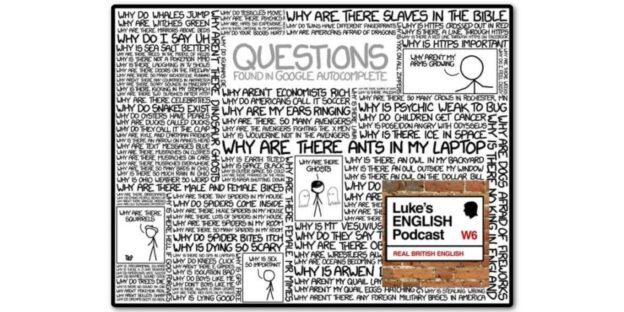
You know when you start to google something, like maybe ‘why is Luke’s English Podcast so awesome?’ and when you type ‘why is’, Google completes your question with lots of options? Those options are ‘auto-completes’. It’s when Google predicts your search based on frequently asked searches. Try typing “why is” into Google. It will give you some options, like “why is the sky blue?”

Some auto-completes are quite fascinating, because they make you think “why are people asking these crazy questions?” or “that’s a good question – what’s the answer?” Some Google auto-completes are really deep, if you take the time to consider them.

Have a look at this graphic, which was produced by xkcd http://xkcd.com/1256/ It is a montage of auto-completed questions from Google. I also posted the image on Facebook recently, here.
Here’s a link to the Adweek.com article about women’s rights I mentioned too.

In this episode I decided to try giving my answers to these Google auto-complete questions.

You can listen to my answers in this episode, but I’m also interested in your opinions and your findings from google searches.

Your task while listening to this is to Google the questions and check the results. Are my answers correct? Leave a comment below to give me your opnions.

I hope you enjoy the episode.

Cheers,
Luke

150. British Slang (D to G)

More informal English for you to pick up in this episode as we continue the series on British slang words.

Small Donate Button
Right-click here to download this episode.
Below you’ll find a list of slang words from http://www.effingpot.com/slang.shtml with some other words which I added. The explanations in this list are mainly reproduced from effingpot.com but the explanations you will hear on this podcast episode are all my own.

I hope you enjoy learning more British slang, and stay tuned for more podcasts in the near future.

Cheers!

Luke

Other Slang Episodes In This Series
British Slang (A-C)
British Slang (D-G)
British Slang (H-M)
British Slang (N-Z)

LIST OF SLANG TERMS FROM THIS EPISODE (Thanks also to www.effingpot.com/slang.shtml)
Dear – If something is dear it means it is expensive. I thought Texan insurance was dear. It’s also a term of affection that an older person might use. “Hello dear, would you like a cuppa?”
DIY – This is short for do it yourself and applies not just to the DIY stores but also to anything that you need to do yourself. For example, if we get really bad service in a restaurant (oh, you noticed!) then we might ask the waiter if it is a DIY restaurant – just to wind them up.
Do – A party. You would go to a do if you were going to a party in the UK.
Do – If you drive along a motorway in the wrong lane the police will do you. You could then tell your friends that you have been done by the police. Prosecute is another word for it!
Do someone over
Doddle – Something that is a doddle is a cinch, it’s easy. Unlike ordering water in Texas with an English accent, which is definitely not a doddle!
Dodgy – If someone or something is a bit dodgy, it is not to be trusted. Dodgy food should be thrown away at home, or sent back in a restaurant. Dodgy people are best avoided. You never know what they are up to. Dodgy goods may have been nicked. When visiting Miami I was advised by some English chums that certain areas were a bit dodgy and should be avoided!
the Dog’s bollocks – You would say that something really fantastic was the dog’s bollocks. Comes from the fact that a dog’s bollocks are so fantastic that he can’t stop licking them! Nice huh? Often shortened to just “The dog’s”.
Donkey’s years – Someone said to me the other day that they hadn’t seen me for donkey’s years. It means they hadn’t seen me for ages.
Dude
Faff – To faff is to dither or to fanny around. If we procrastinated when getting ready for bed, as kids, our Dad use tell us we were faffing around.
Fag
Fancy – If you fancy something then it means you desire it. There are two basic forms in common use – food and people. If you fancy a cake for example it means you like the look of it and you want to eat it. If you see someone then you might fancy them if you liked the look of them and wanted to get to know them a little better!!!
Fit – Fit is a word that I have heard a lot recently – it seems to be making a comeback. A fit bird means a girl who is pretty good looking or tasty! A fit bloke would be the male equivalent.
Flog – To Flog something is to sell it. It also means to beat something with a whip, but when your wife tells you she flogged the old TV it is more likely she has sold it than beaten it (hopefully!).
Fluke – If something great happened to you by chance that would be a fluke. When I was a kid my Mum lost her engagement ring on the beach and only realised half way home. We went back to the spot and she found it in the sand. That was a fluke.
Fortnight – Two weeks. Comes from an abbreviation of “fourteen nights”. Hence terms like “I’m off for a fortnights holiday” meaning “I am going on a two week vacation”.
Full of beans – This means to have loads of energy. It is a polite way of saying that a child is a maniac. I was often described as being full of beans as a kid and now it is my wife’s way of telling me to keep still when she is trying to get to sleep. Strangely the same expression in some parts of the US means that you are exaggerating or talking bollocks!
Geezer
Get lost! – Politely translated as go away, this is really a mild way of telling someone to f*** off!
Get stuffed! – Even politer way to tell someone to get lost is to tell them to get stuffed. However, this is still not a nice thing to say to someone.
Getting off with – This seems to be the objective of most teenagers on a big night out. Getting off with someone means making out or snogging them.
Give us a bell – This simply means call me. You often hear people use the word “us” to mean “me”.
Giz
Gobsmacked – Amazed. Your gob is your mouth and if you smack your gob, it would be out of amazement.
Good value – This is short for good value for money. It means something is a good deal.
Goolies – If you have been kicked in the goolies, your eyes would be watering and you would be clutching your balls!
Gormless – A gormless person is someone who has absolutely no clue. You would say clueless. It is also shortened so you could say someone is a total gorm or completely gormy.
Grub – Food. Similar to nosh. I remember my Dad calling “grub’s up”, when dinner was ready as a kid. A grub is also an insect larva. Not usually eaten in England. Actually is available in some Australian restaurants!
Gutted – If someone is really upset by something they might say that they were gutted. Like when you are told that you have just failed your driving test!

149. Backing Up Into The Cloud

Hello Dear Listeners, I’ve been a little bit quiet recently but I’m still here.

Small Donate ButtonRight-click here to download this episode.
This episode is a chance to explain what’s been going on recently, and to answer some of your questions and comments from Facebook and Twitter. Apologies for the slightly poor sound quality on this one.

Yesterday I devoted over an hour to recording an episode only to be let down by my recording device which ran out of memory space. It was very annoying indeed because I lost all the work that I had done on that recording. I’ve since learned the importance of regularly backing up your work on an external memory card or alternatively “backing up into the cloud”.

I hope you enjoy the episode and more episodes will follow before long, including the continuation of my series on The A – Z of British Slang.

Cheers,
Luke

p.s. Here are videos of Queen’s Bohemian Rhapsody, and Queen performing at Live Aid in 1985. Enjoy!
[youtube=http://www.youtube.com/watch?v=fJ9rUzIMcZQ&w=400&h=300]
[youtube=http://www.youtube.com/watch?v=eQsM6u0a038&w=400&h=300]

148. British Slang (A to C)

Part 1 in a series about informal British English words and expressions.

Small Donate ButtonSmall Donate ButtonRight-click here to download.

Slang basically means informal language which is used among friends, and which isn’t really appropriate at work or in other formal situations.

This podcast is devoted to teaching you some of the most common and well-known bits of British slang. As a British person born and bred, I have lived in London, the midlands and Liverpool. There is a lot of variation in the slang used in different regions of England or The UK. The words I’m going to teach you are words which are pretty normal for me. Scotland, Wales or Ireland may have different variations. Also, people much younger than me, or people in different ethnic groups might use different slang. The slang I present in this episode is a selection of words I grew up with, or words I often hear my friends using.

*RUDE LANGUAGE*
Slang is not rude by definition, but there are some rude words included in this episode. Please consider this before listening or before using in class.

Below you can read the slang terms I present in this episode, with some explanations.

You can expect more episodes in this series in the future.

Cheers ;)

Other Slang Episodes In This Series
British Slang (A-C)
British Slang (D-G)
British Slang (H-M)
British Slang (N-Z)

SLANG TERMS (from A to C)
Ace – If something is ace it is awesome. I used to hear it a lot in Liverpool. Kids thought all cool stuff was ace, or brill.

Aggro – Short for aggravation, it’s the sort of thing you might expect at a football match. In other words – trouble! There is sometimes aggro in the cities after the pubs shut!

All right? – This is used a lot around London and the south to mean, “Hello, how are you”? You would say it to a complete stranger or someone you knew. The normal response would be for them to say “All right”? back to you. It is said as a question. Sometimes it might get expanded to “all right mate”? Mostly used by blue collar workers but also common among younger people.

Arse – This is a word that doesn’t seem to exist in America. It basically means the same as ass, but is much ruder. It is used in phrases like “pain in the arse” (a nuisance) or I “can’t be arsed” (I can’t be bothered) or you might hear something was “a half arsed attempt” meaning that it was not done properly.

Arsehole – Asshole to you. Not a nice word in either language.
Arseholed – Drunk! Usually in the advanced stages of drunken stupor, someone would be considered “completely arseholed”. Never me, of course!

Baccy – Tobacco. The sort you use to roll your own.
bent – 1. dishonest or corrupt, 2. homosexual (mildly derogatory)

Bladdered – This rather ugly expression is another way of saying you are drunk. The link is fairly apparent I feel!

Bird – girl or girlfriend

blag – lie or talking nonsense.

Blatant – We use this word a lot to mean something is really obvious.

Blimey – Another exclamation of surprise. My Dad used to say “Gawd Blimey” or “Gor Blimey” or even “Cor Blimey”. It is all a corruption of the oath God Blind Me.

Bloke – man
Bloody – One of the most useful swear words in English. Mostly used as an exclamation of surprise i.e. “bloody hell” or “bloody nora”. Something may be “bloody marvellous” or “bloody awful”. It is also used to emphasise almost anything, “you’re bloody mad”, “not bloody likely” and can also be used in the middle of other words to emphasise them. E.g. “Abso-bloody-lutely”! Americans should avoid saying “bloody” as they sound silly.

Blooming – Another alternative to the word bloody.

Bob’s your uncle – This is a well used phrase. It is added to the end of sentences a bit like and that’s it! For example if you are telling someone how to make that fabulous banoffee pie you just served them, you would tell them to boil the condensed milk for three hours, spread it onto a basic cheesecake base, slice bananas on top, add some whipped double cream, another layer of banana and Bob’s your uncle!

Bog – Toilet
Bog roll – Toilet paper

Bogey – green sticky things that come out of your nose

Bollocks – This is a great English word with many excellent uses. Technically speaking it means testicles but is typically used to describe something that is no good (that’s bollocks) or that someone is talking rubbish (he’s talking bollocks). Surprisingly it is also used in a positive manner to describe something that is the best, in which case you would describe it as being “the dog’s bollocks”. Englishmen who live in America take great delight in ordering specialised registration plates for their cars using the letters B.O.L.L.O.X. Good eh?

Bollocking- A severe telling off

Booze – As a noun, an alcoholic drink; as a verb, to drink alcohol, particularly to excess.

Bottle – Something you have after twenty pints of lager and a curry. A lotta bottle! This means courage. If you have a lotta bottle you have no fear.

Brew – a cup of tea

Budge up – If you want to sit down and someone is taking up too much space, you’d ask them to budge up – move and make some space.

Buff – muscular, well built

Bugger – This is another fairly unique word with no real American equivalent. Like bloody it has many uses apart from the obvious dictionary one pertaining to rather unusual sexual habits. My father was always shouting “bugger” when he was working in the garage or garden. Usually when he hit his thumb or dropped a nail or lost something. Today we might use the sh** or the f*** words but bugger is still as common. The fuller version of this would be “bugger it”. It can also be used to tell someone to get lost (bugger off), or to admit defeat (we’re buggered) or if you were tired or exhausted you would be buggered. You can also call someone a bugger. When I won £10 on the lottery my mate called me a “lucky bugger”.

Bugger all – If something costs bugger all, it means that it costs nothing. Meaning it is cheap. If you have bugger all, it means you have nothing.

Bum – This is the part of your body you sit on. Your ass! It might also be someone who is down and out, like a tramp. You might also bum around, if you are doing nothing in particular, just hanging out. Finally to bum something means to scrounge it from someone.

Bung – To bung something means to throw it. For example a street trader might bung something in for free if you pay cash right now! Or you could say “bung my car keys over, mate”.

Butchers – To have a butchers at something is to have a look. This is a cockney rhyming slang word that has become common. The reason “butchers” means a look even though it doesn’t rhyme is because it is short for “butchers hook” and “hook” of course, does rhyme.

Chat up – To chat someone up is to try and pick them up. If you spotted a scrummy girly in a bar you might try to chat her up. Or a girl might try and chat up a chap!

Chav – Someone who is, or pretends to be of a low social standing and who dresses in a certain style, typically badly or in sports clothing. Often used as a form of derogation. Sometimes said to be an acronym for ‘Council-Housed and Violent’ but this appears to have come later. Most likely to come from the Romany for child; chavi.

Cheeky – “Eee you cheeky monkey” was what my mother said to me all the time when I was a kid. Cheeky means you are flippant, have too much lip or are a bit of a smart arse! Generally you are considered to be a bit cheeky if you have an answer for everything and always have the last word. My licence plate on my MX5 (Miata in American) was CHEEKY, which most Texans thought was something to do with bottoms – wrong!! A cheeky pint.

Cheers – This word is obviously used when drinking with friends. However, it also has other colloquial meanings. For example when saying goodbye you could say “cheers”, or “cheers then”. It also means thank you. Americans could use it in English pubs, but should avoid the other situations as it sounds wrong with an American accent. Sorry!

Cheesed off – This is a polite way of saying you are pissed off with something.

Chin Wag – This is another word for a Chat. You can probably tell why!

Chuffed – You would be chuffed to bits if you were really pleased about something.

Cock up – A cock up means you have made a mistake. It has nothing to do with parts of the male body.

Cockney rhyming slang – There are lots of words that make up cockney rhyming slang. These are basically rhyming words like “butchers hook” which means “look”. If you are in London and you hear someone talk about a Septic they are probably talking about you – because it’s short for “Septic tank” which equals “yank”, which is our word for an American. How do you like that!

Cor – You’ll often hear a Brit say “cor”! It is another one of those expressions of surprise that we seem to have so many of. It will sometimes be lengthened to “cor blimey” or “cor love a duck”, depending on where you are. “Cor blimey” is a variation of “Gawd Blimey” or “Gor Blimey”. They are all a corruption of the oath “God Blind Me”.

Cracking – If something is cracking, it means it is the best. Usually said without pronouncing the last “G”. If a girl is cracking it means she is stunning.

Crap – The same word in both countries – but less rude here. I loved watching Brits being interviewed on US chat shows and embarrassing the interviewer when they said something was “total crap”.

147. Idioms and Expressions from Episodes 145 & 146

Explanations, examples and definitions of idioms and natural expressions which you heard in the last two episodes of this double award-winning podcast for learners of English.

Small Donate ButtonRight-click here to download.

You can read all the phrases, definitions and examples below.

Luke’s English Podcast is a free service, but you can contribute by leaving a donation if you’re a nice, generous person who likes to do good things. If you like to get something for nothing, don’t donate. If you believe in fair play, send a donation. It doesn’t have to be much – a little bit if that’s what you want. If you don’t have any money because you’re a student, you can wait until you are rich and then send me a boat or something.

PHRASES, DEFINITIONS AND EXAMPLES

1. I get to meet people from all walks of life. – “From all walks of life” = from lots of different kinds of life, or different lifestyles.
2. Sometimes I can just make things up on the spur of the moment and then make them happen there and then. – “On the spur of the moment” means just then and there, not planned in advance, but just impulsively done then. “I came up with the idea on the spur of the moment”, or “On the spur of the moment I just asked if she wanted to go for a drink with me”.
3. sometimes I feel like just giving up, dropping out and becoming a TEFL teacher”. – “Dropping out” means to kind of give up your normal, steady life and living an alternative existence. It’s often associated with quitting your high paying job and becoming a hippy, or leaving normal straight society, quitting the rat-race to live a more enlightened lifestyle. It’s associated with the phrase “Turn on, tune in, drop out” which was made famous by Timothy Leary who encouraged people in the 60s to lead a counterculture revolution by taking LSD and rejecting the dominant culture. I find it a bit annoying when they consider becoming a TEFL teacher a way to just drop out, as if TEFL is not a proper job, but something you can do to escape the normal demands of a career. People who go into TEFL as a way of dropping out are usually shocked to discover that it is still a proper job that requires diligence and hard work.
4. If you consider it to be something to do while you travel, or something to do while you focus on writing your first novel then fine. It can be just a means to an end. – “A means to an end” is something you do with the sole purpose of achieving something else. For example, going into TEFL can be a way for people to get a bit of extra time to focus on doing something else like writing their first novel.
5. Does that sound like your cup of tea? – We all know this one, right? “Your cup of tea” just means something you like, or something that meets your preference. E.g. Horror films are not really my cup of tea. Along with “it’s a piece of cake”, I think this is one of the most well known idioms out there, because it’s kind of cute and we associate it with British people.
6. often the best students are the ones who throw themselves and their personalities into the learning process. – If you “throw yourself into something” it means that you get fully involved in it, with full enthusiasm and energy. The opposite of that would probably be “to do something half-heartedly”. E.g. “After she split up from her boyfriend, she just threw herself into her job”.
7. There’s always someone who will throw a spanner in the works. – Another idiom with ‘throw’, to “throw a spanner in the works” means to seriously disrupt something or cause a big problem that makes everything much more complicated, and ultimately prevents the thing being a success. E.g. “We were hoping to get the project started in June but the funding was withdrawn so that rather threw a spanner in the works.” In this case, the lack of funding caused lots of problems for the project and ultimately stopped it happening. In my example, I say how sometimes students can throw a spanner in the works by behaving badly in class. A spanner is a kind of tool that you use to tighten or open a nut or bolt. You know, if you need to fix a leak in a pipe in your kitchen you might use a spanner. It’s a metal tool, one piece with a kind of mouth at the end which fits around a nut, and then you can tighten it. They come in different sizes. A spanner. In some countries you call it an English key for some reason. “the works” refers to the complex inner workings of a machine – all the mechanisms inside an old industrial machine. Cogs, gears and pistons and everything. Can you imagine dropping a spanner into a machine like that? It would cause the whole thing to stop, or to grind to a halt.
8. So, back to these 1/30 people who can torpedo your class. – A torpedo is a kind of missile that goes under water, fired by a submarine. If you torpedo a boat it means you destroy it, but the attack happens in a way that is hard to notice. To torpedo a lesson means to kind of destroy a lesson from under the surface. Again, if a student causes problems in a class, it could torpedo your lesson.
9. teachers often feel they are on the front line. – This is another bit of war imagery. “On the front line” is used to refer to the position of some soldiers who are right at the front of a battle, facing the enemy and in the direct firing line. If you’re on the front line it means that you’re in a exposed position because you are right at the front, facing a difficult situation. Compare it to members of admin or marketing staff who don’t face clients directly and are therefore more protected.
10. it can feel like either you’re fighting some kind of pointless battle, or that the gods are acting against you somehow. – I guess these aren’t really idioms as such. “Fighting a pointless battle” just means fighting hard for something that is a waste of time, and if ‘the gods are against you’ it just means that everything seems to be going badly as if the gods have decided to make life difficult.
11. 11. they can take a lesson to new heights. – To “take something to new heights” means to make something excellent and better than it has been before. ‘Height’ is the noun form of ‘high’, so this means to take something higher than before.
12. take whatever the teacher gives them, and run with it. – To ‘run with something’ means to take an idea or a suggestion and make proress with it independently. So, in a classroom situation this means giving the students a task which they then independently develop into something more.
13. Creating an air of respect or positivity in the school helps. – The expression “an air of…” is used to describe an atmosphere in a place or around a person. “He had an air of sophistication” means that he seemed to be sophisticated. “The school has an air of respect” means that there is a respectful atmosphere in the school.
14. Having them stand up and walk around can replicate real life speaking tasks and allow body language to come into play. – To “come into play” means to become an important factor in something, or just to become involved in a situation. A bit like when a footballer runs onto the pitch, he comes into play and adds a new element to the game, we can also say that other things come into play in other situations.
15. On those rare occassions that everyone is into it, everyone can reap the benefits. – To “reap the benefits” means to take all the good things from a situation. “Reap” is a word we use to describe the act of collecting crops from a field with a kind of blade called a scythe. A farmer will plant seeds early in the year, then the crops grow during the summer and at the end of summer he reaps his crops. The word ‘reap’ also goes with the word ‘benefit’ meaning to take all the good things from something. For example, if you study hard now, you will reap the benefits later.
16. It’s ok to go off on a tangent as long as it is relevant and the whole class goes with you. – To “go off on a tangent” means to take a completely different direction than you intended to, usually in a conversation. So, you start talking about your plans for Christmas and then at some point you go in a completely different direction and start talking about rumours about Tom Cruise’s sexuality. A synonym is “to get sidetracked”. If you go off on a tangent in class, it means you end up talking about something different to what you started with. Sometimes tangents are the most fun parts of lessons.
17. TTT is something we should cut down on in the language learning classroom. – To “cut down on” something means to reduce it. For example, “I’m trying to cut down on smoking”.
18. We’ve got two ears and one mouth for a reason. – This is not really an idiom but just an expression which people use to tell people to listen.
19. An expensive school, with a powerful marketing drive can set the bar very high for its teachers. – To “set the bar high” means to set standards very high. The ‘bar’ refers to the bar you have to jump over in athletics, in the high jump. If the bar is set high, it means that you have to jump really well to avoid failure. In teaching, if your marketing has promised an amazing course then the bar has been set pretty high for the teacher.
20. it is also a good process to go through for training you into a good teacher, because you are forced to raise your game. – This one should be pretty clear, and it’s used in sport a lot. If you “raise your game” it just means that you improve your performance. Don’t forget the difference between the word ‘raise’ and the word ‘rise’. This is a common error.
21. In the end, perhaps I’ve decided to make a go of it. – To “make a go of it” means to try hard to make something a success. For example, “They’ve had some problems in their marriage, but they decided to make a go of it and not get divorced.”
22. Think outside the box. – This one means to think in an unrestricted way, with no limitations. Managers often ask their staff to think outside the box in order to come up with new and innovative ideas.
23. Put on a brave face because somehow your mood has a massive influence on the mood of a lesson. – To “put on a brave face” means to act brave or act like everything is alright when in fact the situation is quite bad. It means to act confident in a difficult situation. For example, if you’re having a lot of family problems which are making you very upset at home, you have to put on a brave face when you go to work so that people don’t see you are upset, and so you can still do your job well.
24. If you go for big laughs and make lots of effort, you’ll come across as a dick who is desperate for attention. – To “come across” as something, means to give other people a certain impression of you. For example, if you don’t dress smartly for your job interview you might come across as unprofessional. Or, if you talk too loudly during a negotiation you might come across as aggressive.
25. I felt like my reputation was hanging by a thread. – If something is “hanging by a thread” it means it is in a very threatened and tenuous situation, and it might just die or break or fail at any moment. A thread is a very thin piece of string or cotton. For example, if your button is hanging by a thread it might just fall off at any time!
26. I thought it might be another string to my bow so I agreed to take the training. – A “string to your bow” means another skill that you have. A bow is something you use to fire an arrow. It’s a long curved piece of wood. The string is the thread or fibre which connects the ends of the bow, and is used to fire the arrow forwards. If you have lots of strings on your bow, it means your bow is more powerful.
27. The parents were over the moon! – If you’re “over the moon” it means you’re delighted, very pleased.
28. I’ve been rudely awakened by some comment. – To be “rudely awakened” means to be shocked to discover the truth about something. We also say “I had a rude awakening”. For example, assuming that your class is fine and everyone is happy, and then being shocked to discover that they’re all unhappy.
29. I went the extra mile, I bent over backwards and I delivered a very good course. – To “go the extra mile” means to make more effort than is necessary. To do the maximum amount of effort, or more. To “bend over backwards” basically means the same thing. “They really went the extra mile to make us feel comfortable. They were great hosts.”
30. After the tough week I’ve just had, this will be a walk in the park. – A “walk in the park” is something that is very easy, just like “a piece of cake”. “This exam is going to be a walk in the park”.
31. they all seemed to like her and kind of let her get away with it – To “let someone get away with something” means to let them do something bad without punishing them. “Your Dad won’t let you get away with it if he catches you smoking again”.
32. The presentations all fell flat with the speakers just grinding to a halt after a few minutes, – To “fall flat” means to go down badly, or to be received badly by people. E.g. “the presentations just fell flat” – the audience were not impressed by the presentation and they didn’t really respond. To “grind to a halt” means to stop. Imagine a machine slowly stopping and making a grinding sound. The past form of grind is ground. “The lesson just ground to a halt after an hour”.
33. You could cut the atmosphere with a knife. – We use this expression to describe a very heavy atmosphere, usually when something really bad has happened in a room and there’s a really thick and bad atmosphere with lots of tension. E.g. “There was a lot of tension between Diane and Carol; you could cut the atmosphere in that room with a knife.”
34. I decided I had to put my foot down. – To “put your foot down” means to put your authority strongly on a situation. E.g. “The boss put her foot down and refused to accept any more changes to the plan.”
35. “I slept through my alarm clock” – This means that you overslept and your alarm clock didn’t wake you up.
36. I had a go at them for being late. – To “have a go at someone” means to tell someone off or say something angrily to someone.
37. I wanted to put my foot down, and I just ended up putting my foot in my mouth. – To “put your foot in your mouth” means to say something that you regret.
38. I finished the day completely shattered, with a mind numbing headache, with a massive heavy load on my shoulders. – A “mind numbing headache” is a really bad headache that stops you thinking properly.
39. The difficult girl I described earlier decided to lock horns with me over everything. – To “lock horns with someone” means to get into a conflict with someone, like an argument or a disagreement over something. It’s like when some animals fight with each other, they lock horns. If you can imagine two bulls fighting, the horns are the sharp things on their heads. If they lock horns, they put their horns together and kind of move around fighting. Well, people can lock horns with each other too.
40. She completely ran over me with her forceful character. – What I mean here is that she walked all over me.
41. I didn’t really know how to do this, so I generally didn’t give her any rope. I mean, I wasn’t patient with her. – What I mean by “give her any rope” is that I didn’t really give her any opportunities.
42. I’m still scratching my head trying to work out what was going on. – If you’re scratching your head, it means you’re trying hard to understand something.
43. the first week was a write off. – A “write off” is something that is so badly damaged that you can’t save it. This comes from cars, probably. IF you have a car crash and your car is damaged, and it would cost more money to repair the car than it would be to just buy another one, the car is “written off”.
44. I just became their scapegoat. – A “scapegoat” is someone you blame for all the problems. E.g. In 2007 Piers Morgan asserted that phone hacking was common practice. “Loads of newspaper journalists were doing it. Clive Goodman, the News of the World reporter, has been made the scapegoat for a widespread practice.”
45. Sometimes it hits the students for six, because they’ re not expecting it. – If you “hit someone for six” or “get hit for six” it means that something really shocks you and makes you feel bad and confused, weak. It comes from cricket – when you bowl a ball at a batsman and he hits the ball all the way off the field, he gets six points. He just hit you for six. The bowler is going to feel bad about that. E.g. “The death of his wife really hit him for six. He was never the same after that”
46. This meant that I had a false sense of security. – If you have “a false sense of security” it means you think you’re safe when you’re not. E.g. “Wearing helmets gave cyclists a false sense of security and encouraged them to take risks.”
47. It’s funny to me how I could go from one week of being the greatest teacher in the world, to hitting rock bottom in just a matter of days. – If you “hit rock bottom” it means you reach the lowest point possible.
48. in my defence I must say that I have an otherwise very good track record in my classes. – Your “track record” is your history of success or your record of performance. It comes from athletics. Usain Bolt has a great track record because if you look at the record of all his times in his races you can see he has won a lot of races. The track is what an athlete runs on. It’s red and has lines written on it. “I have a good track record in my classes” means that most of my classes in the past have been good.
49. So, this course must have been a one-off. – A “one-off” is something that only happens once.
50. Keep your chin up. – This means ‘don’t get disappointed’. IT’s like, “keep your head up”.
51. You shouldn’t tell jokes, but I do, and I pay the price for it. – If you “pay the price for something” it means that you suffer the negative consequences of doing something bad. So, I pay the price for telling jokes in class, because often nobody laughs and I feel like an idiot. Then again, I think that if I didn’t tell jokes my classes would be more boring. I know what I’m doing… Even if my jokes are quite bad sometimes, it’s not going to stop me trying!!!