An unedited ramble in which I talk without a specific plan, includes a recording of my daughter speaking English, and a few songs on the guitar. Video version available.
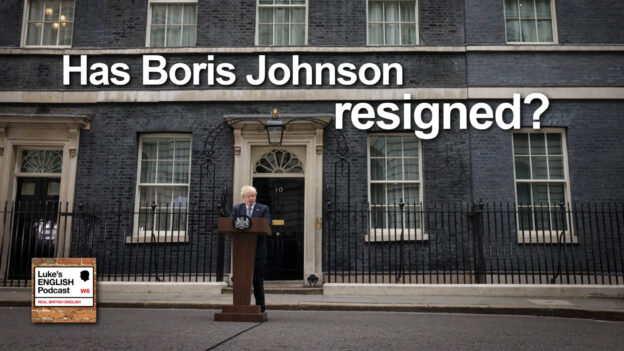
My dad talks about the latest news about Boris Johnson, who on Friday said the UK should now begin the process of finding a new Prime Minister. Why is Johnson going to step down? What scandals has he been involved in during his life? What might happen next? Listen to hear my dad’s comments in plain English.
Hello listeners. It’s new episode time. (applause)
Just before we start, I need to get a message to listeners who are subscribed to LEP Premium through Libsyn.
You’ve heard me say in recent announcements that the podcast has moved to a new host (Acast) and that people who were already subscribed to the premium subscription with the old system (Libsyn) would have to cancel, get a refund from Libsyn and then sign up with Acast. But I need to ask you to wait before doing that! Wait! Hold on! Hold your horses!
Basically – Libsyn premium subscribers – please wait before you cancel and move to the new system. Some of you are saying “but I’ve already done it!” That’s ok.
There’s been a slight problem (a hiuccup) with the process of moving LEP Premium from Libsyn to Acast. I’m working on a solution right now. Everything will be OK, but Libsyn premium subscribers – please wait before cancelling your old premium subscription and moving to Acast+. I will give you instructions as soon as possible about what to do (I’ll record an announcement and I will send you an email)
Some of you have already sent emails to Libsyn and they told you to email me. Again, just wait – I’m working on a solution and I’ll give you more instructions as soon as possible.
If you are not already a premium subscriber – you might want to know that LEP Premium is now available on Acast+. So if you want to get access to over 100 lessons from me about grammar, vocabulary and pronunciation with PDFs to download – go to teacherluke.co.uk/premium and choose the LEP Premium option.
Thanks for listening to that announcement. Now, here’s a Rick Thompson report for you to enjoy, recorded on Monday 11 July 2022.
I’ve got to do a quick intro just to help out the people listening to this who have no idea what’s going on – not generally I mean, but in UK politics. So, a 5-minute intro, then you’ll get your fill of Rick Thompson on Luke’s English Podcast. Here’s the jingle.
Jingle – You’re listening to Luke’s English Podcast. For more information visit teacherluke.co.uk
Hello listeners,
This is episode 777 and it’s a new episode of the Rick Thompson Report.
Just in case you don’t know, The Rick Thompson Report episodes are when I talk to my dad Rick Thompson about what’s been going on in the news, especially UK news and especially UK politics. My dad is a semi-retired journalist, broadcasting consultant and writer. We’re very lucky to have him as a guest on this podcast.
If you’ve seen any news from the UK recently, you’ll have seen that it’s all been about Boris Johnson (for a change). Boris Johnson is the current Prime Minister of the UK. Yes, the one with the funny scruffy blond hair, the badly fitting suits and the look on his face which makes him look like a schoolboy who’s done something wrong. Boris Johnson – our current Prime Minister. The leader of the Conservative Party and the head of the UK government.
Some of you now are thinking “But wait Luke, he’s not the current Prime Minister! Didn’t he resign on Friday?”
Well, yes, he did make a speech on Friday 8 July in which he said he the process to find a new leader of the Conservative Party and Prime Minister of the UK should begin now.
So, it looked like he resigned on Friday – he basically said he would resign when the new leader has been chosen, although he didn’t actually say the word resign in his speech (or the word sorry, or anything like that) so he is still the Prime Minister and he will be until the new one is chosen, which will probably happen in September.
What’s going on?
Why did he say he would step down?
What did he do wrong this time?
What are the events that have led up to this situation?
What might happen next?
And what do we really think of Boris Johnson?
That’s what we’re going to try and deal with in this conversation.
I hope you can follow this.
It’s all a bit complicated. To be honest, while my dad was talking during this conversation, as an English teacher, alarms were going off in my head. I mean, I kept thinking “oh, god, we’re going through a lot of quite specific and complex language here, at a fast pace, and we’re not really stopping to clarify things in the way that I know, as a teacher, that my learners often need to be done.” Maybe I could have interrupted the conversation at various points and added in some explanations, but you know what – that just wasn’t possible this time. Also, my dad was in full flow here, so I decided to just let him rip.
So, as is often the case, I’m just throwing you in at the deep end and playing the conversation for you. Hopefully you’re curious enough about this situation, and that listening to my dad is enjoyable enough, that you feel motivated to stay focused and keep listening. If you can do that, this will definitely help your English.
Perhaps I can make a premium episode explaining a lot of the language in this conversation, but – that might be difficult because I don’t have very much time available to me to do that. At the very least, I will try to add some words and phrases to the website page for this – you would check them if you want to see how certain words are spelled and you can check then in a dictionary if you like.
A lot of our conversation focuses on why Boris is resigning, and that means describing his personality, describing things he has done both as Prime Minister and before, describing the scandals he’s been involved in, and describing the way the UK government works (or doesn’t work in this case) and how leaders are chosen in the UK. Watch out for language relating to those things as well as little idiomatic phrases and so on.
But generally, I hope you can really just get into this subject and try to find out a thing or two about Boris Johnson that you weren’t aware of before. He’s not just a funny looking politician with a sense of humour. There’s more going on than that.
I’ll talk to you again briefly at the end of this, but now, let’s get started.
Sorry – I had no time to write some words and phrases from the conversation here!
Luke and James discuss their feelings about the Royal Family, with some survey results about the popularity of royal family members among British people in general.
YouTube version (Automatic subtitles should be available soon)
Introduction Transcript
Hello listeners and welcome to the podcast. This is episode 773 “What do British people think of The Queen and The Royal Family (with James)”.
Yesterday I came back from my trip to London where I was staying with my brother for a few days. I mentioned it in the last episode. My weekend with James coincided with the celebrations for the Queen’s Platinum Jubilee. You might have seen reports of the celebrations on the TV or online wherever you are.
The celebrations involved a kind of military procession called the trooping of the colour, the lighting of Platinum Jubilee beacons across the country (a series of large flaming torches which are lit as part of a long tradition at this kind of celebration), a service of thanksgiving at St Paul’s Cathedral, The Derby at Epsom on Friday (a horse racing event usually attended by the Royals), The Platinum Jubilee Party at The Palace (a big entertainment show with live music and celebrity appearances), Jubilee lunches and street parties which happened across the country (although I didn’t see any in the areas where I was visiting in South London) and The Platinum Jubilee pageant which is a sort of procession through the streets led by the Queen’s Golden Carriage. The Queen wasn’t actually in the carriage and so a sort of digital version of her was visible inside the carriage instead (this was a kind of animated projection of her waving from inside the carriage – a bit like a hologram but not, technically, a hologram).
I was planning to record an episode with James over the weekend anyway, and I felt we couldn’t avoid talking about The Royal Family because people are interested in it and so we decided to make a whole episode on this subject. The plan was to try and answer the question “What do British people think of the Queen and the Royal Family”. It’s hard to sum up what all British people feel about this, and so we decided we could only give our own opinions really, so it should really be “What do James and I think about the Queen and Royal Family” – but we are British people after all, so the original title still works.
As you’ll hear we tried to be objective and to weigh up the arguments for and against, or maybe to just express the complex feelings that we have about this – complex, mixed feelings because we can see both good and bad things about the whole thing.
So we just tried to express our feelings, but also to deal with the different points of view, and to refer to some surveys and public opinion polls that seem to show how British people in general feel about the Royals.
After recording we were slightly worried that we came across as a bit too negative or cynical towards the Royals and that perhaps we should have had a Royalist on for balance.
So here is a sort of disclaimer for the episode: We’re just two people taking and this is just how we feel. Our comments represent a very small sample of public opinion in the UK. We don’t hate the Royals or the Queen but instead we are just not completely sure about the arrangement.
As you listen you can see whether we think the monarchy should be abolished completely, or maintained, or some kind of third way. In any case, I hope you enjoy this episode and that you find that we were able to express ourselves clearly and that you understand exactly what we actually think about this subject.
I also want to say that after having published episode 772 (the one previous to this) in which I made some comments about other recent episodes like Spinal Tap and Sick In Japan – I received a lot of messages from listeners which put my mind at rest – namely that they loved the episode about Spinal Tap and they thought the audience were fine at my talk at the BC.
I do respond to a couple of those comments at the start of this, but then after 5 or 10 minutes we get properly into the topic of what we think of the Queen and The Royal Family, in quite a lot of depth. I hope you enjoy this conversation and find it informative.
Please leave your comments as usual. What do you think of the Queen and the Royal Family from your point of view. Maybe you observe these Royal events from a distance in another country, or maybe you are living in the UK and see it much more closely. In any case, let us know what you think too.
That’s it for my introduction. Let’s now travel through space and time into my brother’s living room on Friday 3 June in the middle of the Queen’s Platinum Jubilee. Make yourself a nice cup of tea, get comfortable and let’s get started.
This is an unedited monologue in which I talk about some things which are on my mind at the moment, including how my hair is stopping me from learning French (and vice versa), virtuous and vicious circles, how English is like a shark (or a river – or maybe a shark in a river), some comments about recent episodes and a visit from a friendly bat at my podcastle.
Video Version (try activating the automatic subtitles)
Some vocabulary extracts
I have been deliberating about which microphone to choose
Geeky microphone chat
I have a plethora of microphones
People who have just stumbled across this and are wondering what this is all about
Perhaps you’re in transit somewhere, maybe you’re doing some housework, maybe you’re listening to this in a classroom while your teacher takes a well-earned break, or maybe you are lying in a floatation tank or in zero gravity in the international space station
Stick with me, and enjoy being a LEPster
Here’s a run-down of some of the things I’d like to talk about.
How my hair is stopping me from learning French, and vice versa – how my French is stopping me from getting a hair cut (virtious and viciouscircles)
How my summer is looking, what my plans are and what that might mean for the podcast (busy – difficult to record podcasts in July and August – what’s new?)
Thoughts on recent episodes like Sick in Japan and Spinal Tap
Some metaphors and similes for language learning and teaching
That’s probably plenty!
I’ve been just sweeping it (my hair) back over my head
Maybe I’m being a bit precious about this but I can’t help feeling self-conscious
Taking initiative is very important but it can be hard.
It can just be taking the initiative to speak, to make an effort to communicate with someone, to risk looking a bit stupid, going out of your comfort zone.
But if you take that tiny little risk, it can pay off in various ways.
You need to keep the English moving through you like a river or the water of your English will become stagnant. We all know this.
But without that little impetus to speak, you won’t do it.
If you don’t take initiative, you don’t put yourself into situations in which your confidence can develop.
Starting a virtuous circle is a matter of taking small steps in the right direction.
Micro-decisions or micro-steps.
Now I have to go out of my way to walk to the hairdresser.
Some people commented that the crowd were quiet. Well-behaved maybe.
I should have:
Hyped the crowd up more
Done more stand up at the start
Warmed them up by getting them to make noise.
“French people make some noise!” Etc
I should have done more crowd work.
Spinal Tap – maybe not everyone’s cup of tea, but at the end of the day I am the one who decides what happens in these episodes.
I find that with my learners it’s not just listening skills or vocabulary, but just “being on the same wavelength” and that includes things like little references to culture, or just having a certain sense of humour.
It’s also important that I do stuff that I am personally invested in, or this whole thing just won’t happen. So there.
I love teaching but sometimes I get a bit frustrated because it can be a bit like banging your head against a wall.
You can bring a horse to water, but you can’t make it drink.

Two hours of PodPal action for your enjoyment. This one has a bit of everything. Some audience questions, an idioms game, some dodgy jokes, accents, impressions and more. Video version available.
I’ve got a full two hours of Amber & Paul lined up for you here. Actually, it’s about an hour and twenty mins of Amber & Paul and maybe 45 minutes of just Paul as Amber had to leave to pick up her kids.
There’s a bit of everything in this one. It’s just the usual rambling from the podpals but we answer some listener questions, do a few accents, tell some stories and dodgy jokes and Paul and I play an idioms game at the end. It’s a pretty goofy episode which shouldn’t be taken too seriously. There is a video version on YouTube as well.
Just an announcement for any LEPsters in the Paris area. I am doing a live podcast recording and storytelling show at the British Council on 19 May at 7pm. It’s free, everyone’s welcome and all you need to do is sign up to reserve a seat. All the details are available at www.britishcouncil.fr and then click on EVENTS or événements. I’ll be telling the story of how I ended up in a Japanese hospital scared out of my wits. It’s a story of culture shock, comedy and misadventure. If you can’t come, you should be able to listen to it on the podcast, if the recording comes out ok and the show isn’t a complete flop!
Right, so let’s get back to this podpals episode. I want to point out a stupid slip that I make right at the very start. I wanted to say “Hi, I’m Luke and I need a haircut” but for some reason it came out “Hi, I’m Luke and I’m need a haircut”. I suppose it just shows that native speakers make language errors from time to time, although this was more of a slip than an error. A slip is when you make a mistake even though you know the rule. It just comes out wrong accidentally. An error is when you make a mistake because you don’t know something about the language.
Anyway, I will let you enjoy my language mistake and then settle into over 2 hours of Amber and Paul in the podcastle.
Talking to Stephen from the Simple English News Daily podcast about learning English with the news and whether BBC reporters actually speak like normal humans.
In this episode you are going to listen to a conversation I had with English teacher and podcaster Stephen Devincenzi who does a podcast about learning English with the news.
We recorded a video for this but we had technical problems so only one part of that is available on YouTube. If you go to my YT channel you’ll see it. It’s the part where we discuss the pros and cons of using the news to improve your English. That’s the only video part on YouTube but the audio is fine and you’re listening to it now and this audio will be available everywhere including youTube as usual, and you can check to see if the automatic subtitles are available.
We were plagued by technical difficulties while attempting to do this episode and in fact this is the 3rd time we tried to record. We did this 3 times.
About 3 weeks before this we did another full recording of over an hour which turned out to be unusable because of issues with lag and distorted sound and horrible internet based problems, and then we set up another meeting but had to cancel that due to Stephen’s poor internet connection.
Then Stephen had fibre optic internet set up in his room.
And so did I!
And then I got electricity installed.
But then my fibre optic internet went down (and still is down) but despite the gremlins in the system we managed to record this 3rd version on Zoom with my iphone working as an internet hotspot.
This episode is all about learning English with the news, the pros, the cons, the hows the whys. But is listening to the news a good idea for learners of English? How can you do it? Let’s discuss.
I’ll chat with you again briefly at the end, but now let’s get started.
Ending
THanks for listening. Thanks to Stephen from the SEND7 podcast.
Let us know your thoughts in the comment section as usual. It’s always interesting to read what you have to say.
Have you used the news to learn English?
Did you find it useful?
How do you do it? Do you have a particular method?
Talks in English – British Council Paris – 19 May (Storytelling – Culture Shock & Live Podcast Recording)
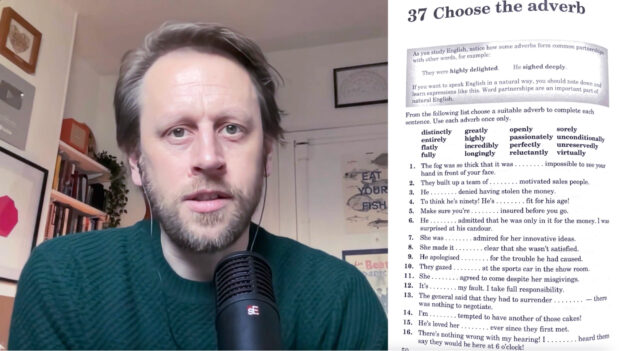
This is a chance for me to just let loose and have a ramble while inviting you to this kind of housewarming party (or perhaps just the first part of the party) in my new pod-room. In this one I am going to welcome you into the new room and do a ramble challenge in which I am restricted to only talking about things inside the room, plus reading from some random books on my shelves. Grammar rules, adverbial collocations and a game show story.
Some other things you could listen to while waiting for new episodes of LEP.
Film Gold: Monty Python & The Holy Grail
I was invited by Antony Rotunno onto one of his podcasts last week to discuss this British comedy classic.
My appearances on ZEP and RNR English at the end of last year
Episode 759 – Notes
I thought I would quickly record an episode to let you know that I’m still alive, LEP still exists, and I just want to give you a bit of an update on what’s going on and have a bit of a ramble.
I have other episodes in the pipeline and I was hoping to upload one of them this week, but for one reason or another, that’s not going to be possible so I’ve decided to record this one quickly and upload it quickly.
Again, I’m just recording this on my handheld recorder but I’m not at home because I can’t record at home, so I’m just in the street, reading some notes from my phone.
Why aren’t you recording this at home Luke?
There are guys working on the flat above ours now.
We are now experiencing what our downstairs neighbours experienced when we did work on our place.
Our flat and the flat upstairs were sold at the same time.
etc…
You can just imaging you are hanging out with me (in the streets of Paris) while I’m recording this. I’m just going walk around the neighbourhood while recording, trying to avoid noise, and trying to avoid the weird stares I might get from people in the street.
It’s been more than 3 weeks since I uploaded an episode and this is only the 4th episode in about 2 months I think.
I told you that the podcast would be delayed and disrupted, right? So it shouldn’t be a surprise.
Why haven’t there been any episodes for almost a month?
Time flies!
Time races by.
“Life is what happens to you while you’re busy making other plans” (John Lennon)
I always wondered what John Lennon meant by that.
I guess he is expressing a kind of paradox that many of us live with.
While making plans for the future, real life just happens in the meantime, day by day, moment by moment.
We aim for the future, we set our sights on things we would like to achieve, and make plans for those things.
But the fact is, life is really lived in the present, and while we are making plans, life just continues to happen to us in the present moment.
I guess he is saying that we mustn’t forget to live in the moment and enjoy the moment.
I suppose for me at the moment, I mean that while making plans for this podcast, mainly the space in which I’m going to record it, real life has just been happening day by day.
In fact, real life and the day to day tasks and challenges of it have been dominating my time recently, preventing me from being able to actually get to do the things I have been planning.
I’ve had a goal in mind for ages – sitting in my new podcast room which is more or less ready, with all my stuff arranged in a fairly tidy way (things on shelves, in drawers, guitars on walls, pictures or posters on the walls, a working internet connection, a decent desk, a comfy chair (which I might spend most of my life sitting on) the right kind of lights, a kettle, a backdrop for videos that looks pleasing to the eye, a computer which actually works and which allows me to record and edit audio and video properly, and so on and so forth, a kettle and cups of tea, another chair or two for guests… you know) but that goal or vision just keeps getting put back and put back.
Why? I can’t really even explain it – just general stuff has been getting in the way. I think a lot of people manage to move house and get back to their normal lives quite quickly, but this just seems to be taking ages and it’s because of lots of little things.
Here are some reasons why things are taking so long.
My daughter got sick with covid and I had to stay at home to look after her. My wife was also sick at the same time (not covid, mysteriously) and so I was off work looking after them. That was a week.
Teaching at the BC three mornings a week.
Wednesday afternoons with my daughter.
Not a massive amount of time. Normally it’s enough – in normal conditions, but these aren’t normal conditions.
I got sick – a couple of times actually. The first was a virus (not covid-19 – maybe covid-18 or one of the other covids). The second was a really bad back which caused loads of discomfort and a migraine. I couldn’t move, basically! Probably because of general stress but also the fact that I hadn’t sat on a comfortable chair for weeks. No sofa.
Washing machine delivered, but then broken – laundrette
Meeting with guy to fit radiators
Meeting with guy to get quotes for lots of other stuff at home, like making fitted shelves (beyond my skills) and other bits of carpentry
Meeting a guy for a quote for electricity at my office
Meeting guy who came to connect internet
Many other deliveries and things
The list goes on!
Now it’s the school holidays and we’re travelling tomorrow to the UK.
I might be able to record an RT Report or a Gill’s Book Club or something with my brother, but equally, I might not. Maybe we’ll just want to relax and have a holiday. I don’t know. I will see.
Oh, and there are guys working on the flat upstairs, and guys working on the building opposite us. It’s like the entire city is under construction at the moment.
This is just what is going on in my small corner of the universe.
I am not complaining at all. I have a nice life and I’m very happy. But I’m feeling quite impatient and a bit frustrated at not being able to do the things I would like to do, and the fact that my goal keeps slipping further away from me. I will get there eventually! It’s like being in a car and using GPS, and the arrival time keeps changing and getting later and later as the GPS recalculates your route with delays and traffic and so on.
The podcast will be back again, properly, and I will be recording, producing and publishing audio & video episodes and premium episodes at the usual rhythm soon.
Maybe this is a good chance to catch up on episodes, or listen to episodes from the archive…
Describing how I am setting up my new pod-room with a couple of stories and plenty of vocabulary for talking about DIY and doing improvements to your home. Vocabulary list available.
Hello listeners, welcome to LEP#757. In this one I am going to talk to you about how I am setting up my new podcasting room (is it an office, is it a studio?) and I’m going to teach you some vocabulary related to doing practical work with your hands at home.
Just before we start I just want to say hello properly to everyone in LEPland and deal with a little bit of podcast admin.
Hello
I hope you’re doing well. It’s been over 2 weeks since I published the last episode because of the house move (I moved house a few weeks ago). If you’re wondering how that’s going – I’ll talk about it a bit in this episode, but let’s just say that the phrase my wife and I have been using over and over is “it’s coming along” which means we are making progress, bit by bit, slowly but surely – unpacking our stuff from boxes, setting up the new place, getting things sorted out such as an internet connection at home and the important appliances like a cooker, a washing machine etc. Things are getting slightly less chaotic every day. Also I was ill for week (not COVID thankfully) which didn’t help. Anyway, if you’ve been waiting patiently for a new episode – thanks for waiting. If you’ve been waiting impatiently, I’ll still say thanks for waiting. Things are still up in the air so I can’t get back into the usual podcasting routine yet, which means there might be another delay after I publish this episode, but when I have my new podcast room set up and have done lots of other things that need doing, normal podcasting will resume. Hopefully this slowdown has allowed a lot of you to catch up with me.
3 of announcements and bits of admin before we start properly:
Premium subscribers – I am currently working (when I can) on P33 parts 3 & 4 which are turning into quite substantial episodes. Part 3 is all about word families, parts of speech and word stress patterns. That means how word stress patterns can change from the noun form of a word to the adjective, verb and adverb forms etc. (Politics – politician – political – politically, Economics – economist – economic – economically, architecture – architect – architectural – architecturally, etc)Part 4 will be pronunciation drills with full sentences, not just words on their own. So that’s coming soon to LEP Premium. If you want to sign up to LEP Premium to get all those episodes – go to teacherluke.co.uk/premiuminfo to get all the info. If you ever have problems with the registration process – try using other browsers, and not on a mobile phone.
Spotify listeners – hello! Recently loads of my episodes disappeared on Spotify. I don’t know if you noticed but episodes 1-664 just disappeared. Well, they should be back now or soon. It was just an automatic update which changed some settings, but those settings have now been reset. So everything should be normal, the episodes should be available again and you should be able to listen on Spotify as usual. In any case you can always get all the episodes in the LEP App which you can download free from the app store on your phone (just search for Luke’s English Podcast App). That’s the whole episode archive, plus about 10 bonus episodes which are only available in the app, all the mini phrasal verb episodes, some music and videos and access to the premium content too if you have a subscription.
OPP – If you’re looking for other things to listen to while waiting for new episodes of LEP at the moment, you could check out my appearances on several other podcasts. Recently several of my podcast friends reached milestone episodes and they both chose to invite me as a guest as a way of marking the occasion. Apparently I am the pod-father. First of all, Rock n’ Roll English hosted by Martin Johnston – he reached episode 250 recently and invited me on to have a chat about the ins and outs of making podcasts for learners of English and it’s a typically funny and unfiltered conversation. That’s episode 250 of Rock n’ Roll English. Also Zdenek’s English Podcast reached episode 400 recently and Zdenek invited me as a guest. I love the way Zdenek and Martin decided to pay their dues to the podfather in this way! I had an epic chat with Zdenek about loads of things including how his podcast has been inspired by mine in some ways and about the development of him as a teacher and podcaster. I think it’s a good conversation with insights about various things including what it’s like making podcast content and how confidence develops, the creative process and generally another inside look into podcasting for learners of English. Check them out – you will find links on the page for this episode. 2 other episodes of other people’s podcasts you could check out.
This is an episode about DIY – or Do It Yourself
This is not an episode about how you can teach yourself English, although I could talk about that a bit, later in the episode.
DIY is a common expression in English, meaning Do It Yourself and it relates to doing practical work at home.
People talk about doing DIY. We say things like “I’m going to do some DIY this weekend” “I’ve been doing some DIY”, “I did a bit of DIY at the weekend”, “I’m no good at doing DIY” “My husband does all the DIY in our house” “My wife tends to handle all the DIY because I’m rubbish at it, etc etc”.
DIY (Do It Yourself) means all the practical work that you might do at home from time to time – the things we do in order to make improvements to our home. I’m talking about things like putting up shelves, painting & decorating, fixing things and other similar work that you do to improve your own home without having to call someone in to do it for you, like a plumber, carpenter, decorator or electrician. You don’t call someone in to do it, you do it yourself. DIY.
It’s the sort of thing you might do at the weekend. Putting up shelves seems to be the most common example of DIY as far as I can tell. Putting up shelves – that thing that seems so simple on paper, but in reality is the sort of thing that can bring a person to their knees – and I don’t mean kneeling down in order to do some work, but to kneel down in a desperate plea to the gods of (what – wood? Screwdrivers?) in order to beg for mercy because your attempt to put up the shelves is proving to be too difficult a task. What do you mean, Luke? I mean, doing DIY, for example, putting up shelves can be a nightmare if you don’t know what you’re doing.
As I said, on paper it doesn’t seem that bad, but to do it right you have to do it properly. You have to read up on how to put up shelves, maybe watch some tutorials online, then plan a specific time to do it, go to the hardware shop or DIY shop to get all the right materials and tools. You put on some old clothes, maybe prepare an area of the home where you’re going to do your work and make sure no pets or children go anywhere near it, you get the stepladder out, and then you try and actually put some shelves on the wall, or build something or whatever, and if you’re not very good at it, if you’re not a practical person, it can be stressful and you end up making a total mess of it, and you hit your thumb with a hammer and then you start swearing and maybe break something and fall off the ladder, and have an argument with your spouse or something and then just give up and go to the pub or something. It depends how handy you are, how practical you are or not. For many of you, this isn’t a problem and the idea of putting up shelves being diffiult is laughable to you. I don’t know your life.
But I do know, that DIY is a very common thing in life and surely this is something that unites all of us to some degree. Either because we all have to do DIY sometimes, or at least we know someone who has to do DIY and it’s just a thing that happens in our lives. Do you know all the English that you need to talk about DIY? The tools, the verbs, the specific phrases for all of it? That’s what I’m dealing with here.
The reason I’m doing this episode right now might be obvious for those of you who are regular listeners. I have just moved into a new flat and also I’m setting up a new office/studio for myself and this is involving a lot of this kind of work.
In fact, this is what is taking up most of my time at the moment, which is why the podcast has been a bit delayed recently. When I’m not teaching English classes at the British Council or spending time with my wife and daughter doing family things, I’m working on the flat and working the office.
What I’m going to do in this episode, then, is:
Describe exactly what I’ve been doing in the office and talk about how I’m trying to set it up as a good base for my podcast work. I’m going to describe the DIY I’ve been doing.
Go through a vocabulary list of various words and phrases for talking about the fascinating subject of DIY.
Setting Up The Pod-Room
What is it?
Where is it?
What does it look like?
What does it need to be?
What are you doing with it?
Tell us about the shelves you put up, in as much detail as possible.
Vocabulary – DIY
Putting up shelves
Tape measure – to measure things (length, depth, width, height, distance from x to y etc)
Spirit level – to check that things are level (horizontally or vertically)
Pencil – to mark lines or crosses/spots
A drill – to drill holes (into thing)
A cordless drill
Battery / battery pack – charge it regularly
Drill bits (different bits for different materials) – to drill holes of the right size / to drill (into)
Types of material – masonry (stone and brick), wood panels (MDF, chipboard, wood (pine, oak etc)
Wall plugs / Rawlplugs – to hold screws in place and prevent damage to the walls (you push them into the holes and then when you screw in the screw, the plug expands inside the hole and grips the inside of the hole, preventing the screw from falling out) they ensure a tight and secure fit for screws in material which is brittle or porous.
Screws – screw them into the wall or into wood to attach things
Nails – hammer them into the wall or wood to attach things
Screwdriver – to screw in screws, or unscrew screws
Electric screwdriver / power screwdriver – a convenient way to screw screws
Hammer – to hammer nails or pull nails out of walls
Mallet / rubber mallet – to hammer other things, without causing damage. You can use a mallet to hammer rawl plugs into the holes, for example.
Pliers – to hold things firmly, to grip things
A saw – to saw wood (handsaw, hacksaw, etc)
Sandpaper – to sand things and make them smooth or take off rough edges – like wood, dried filler or rough patches of paint
A plane – to remove layers of wood
File – to rub against wood (usually) and change the shape, remove layers (e.g. if a door sticks and doesn’t close properly)
Rags – to wipe things, clean things, dust things (remove dust)
Dustpan and brush – to clean up dust and other bits and pieces
A multi-tool – a convenient thing to help you do lots of things, including cut your arm off if it gets trapped under a rock in the desert
Painting
Paint – to cover surfaces, to coat surfaces, to add colour, to make things look nice
Layers of paint or coat:
Primer – to prepare the wood by covering dark colours or patches, prevents things from leaking through (like some oil or sap which comes from knots in the wood) and makes the surface smooth (MDF is absorbent so the primer helps to stop the MDF from absorbing all your paint – it also causes wood fibres to stand up, so you can then sand them down) etc
Sealer – seals the wood and creates a watertight layer
Undercoat
Topcoat
Types of paint, with different appearances:
Matt (flat surface, low “sheen”, not reflective, harder to wash, prone to marks and scuffs, easy to add other coats without showing up brush strokes)
Eggshell / satin (higher level of “sheen” than matt, easier to wipe than matt, more durable than matt)
Gloss (highly reflective, has a very high “sheen” level, sometimes used in kitchens because it can be wiped clean and is therefore a bit more hygienic)
Oil-based paint
Water-based paint
A brush – to apply paint to things
A roller – to apply paint evenly and conveniently to large surfaces
A tin/tub of paint – the containers the paint comes in
Masking tape – to cover parts which you don’t want to paint, like skirting boards, windows, handles etc
Plastic sheets – to cover and protect the floor from drops of paint
That’s it!
When the pod-room is set up and I have a proper internet connection (and maybe a new computer) I will be doing podcasts with videos like in 2021 and you will be able to see the amazing and inspiring work I did on the shelves 😂
In this episode I’m going to wish you a Happy New Year, ramble a little bit about what’s going on in LEPland, restate some of my aims and objectives for this podcast, and give a few comments on how you can use the podcast to improve your English, with reference to some recommended episodes from the archive.
Happy New Year everyone! (new listeners, long-term listeners, mid-term listeners and anyone else who happens to be listening)
All the best for 2022. Try to keep up your motivation for learning English throughout the year. I hope I can help. That is my aim.
How was your Christmas/New Year? Did you have a holiday? What did you do?
What’s the situation Luke, as you record this? (summarise the last couple of weeks, and what’s going on around you)
I might not be able to upload episodes regularly for the next few weeks. If LEP goes quiet – I am still here and still working, but not able to record or upload because of all the different disruptions. My life is like a puzzle at the moment and I am putting all the pieces back together.
LUKE’S ENGLISH PODCAST – AIMS
To provide a resource of authentic speech for learners of English.
Episode suggestions
All of them! Especially ones which are unscripted.
To inform my audience about methods and strategies for improving their English.
To educate my listeners about the English language by explaining or providing examples of grammar.
Episode suggestions
Premium episodes www.teacherluke.co.uk/premiuminfo (articles, sentence structure, present perfect tense, narrative tenses, modal verbs about the past, quantifiers and more) but also a lot of episodes in the archive deal with grammar. Here’s a selection.
To entertain my audience by producing fun and interesting content specifically targeted at learners of English as a second language.
To highlight particular aspects of English (language) culture including themes about Britishness, accounts of key moments in history, politics and the arts, with a particular focus on comedy and film.
Suggested episodes
Search the archive for the words British and comedy. The Rick Thompson Report, Film Club, British Comedy, Luke’s D-Day Diary, and more…
To raise awareness of many features of British English pronunciation and provide practice of repeating certain phrases or constructions.
Suggested episodes
All premium episode series have dedicated pronunciation episodes. Also, these ones:
To keep my audience engaged in the listening process long term, by providing a resource to help them laugh while they learn.
To make people laugh out loud on public transport while listening to the podcast!
To dominate the world with an army of LEP ninjas equipped with biscuits and good English. …Ok, one of my listeners asked me to add this as an aim for my podcast, ha ha! (Thanks Chriss Benitez)
Those episodes can be found in the LEP app or via the episode archive. Most good podcasting apps will have the entire archive, but I think iTunes or Apple Podcasts doesn’t show all episodes. YouTube doesn’t show all episodes either. Only some of my episodes are on YT. I’d like them all to be there (just the audio) eventually.
HOW TO USE LUKE’S ENGLISH PODCAST TO IMPROVE YOUR ENGLISH
People from all over the world use my podcasts to improve their English, and lots of people email me to tell me how much they love the podcast and find it useful. Some of you might be wondering how you can improve your English by using the podcast. I’ll tell you more about this in a moment, but let me first recommend a couple of podcast episodes you could listen to.
Many people tell me they are completely addicted to the show. Usually they say that they found the podcast via one episode in particular and then start listening to all the others before becoming completely hooked. I have quite a hard-core following. The podcast won the Macmillan Dictionary Award four times and was nominated for a British Council ELTon award, so I must be doing something right!
L.E.P combines English teaching with plenty of entertaining conversation, humour and genuine insight into the culture of the English language. My methodology and approach are based on the idea that language is acquired by engaging with it in authentic form, over longer periods of time. Although this is not the only way to improve your English, listening to natural authentic speech over quite long periods of time can greatly improve your listening skills, pronunciation and vocabulary. This goes on to improve your spoken English, and your general instinct for grammar. I try to balance this approach by regularly recording episodes in which I directly teach you vocabulary, pronunciation or grammar.
Good grammatical awareness is based on instinct as much as on active knowledge of the rules of English. When you take an English exam you have to answer questions that test your knowledge and use of grammar or vocabulary. For example, consider this question:
FILL THE GAP IN THE SENTENCE WITH THE APPROPRIATE WORD
“I just can’t rely __ this car any more. It keeps breaking down. I need a new one.”
1. with 2. from 3. on 4. to
The answer is ‘3. on’, of course.
How did you know the answer? Really think about it. How did you know that ‘on’ was right? Do you remember learning ‘rely on’ in a book, or in a class? Maybe you did. But, for many of you, the answer just felt correct. Your instinct just said ‘on’. Well, this instinct is what you develop when you read or listen to the language a lot. Your brain builds up a kind of memory bank of all the words you have seen and heard. So, when you see ‘rely ___’ you automatically feel that ‘on’ is the right answer. Why? Because you’ve seen/heard ‘rely on’ lots of times!
The point is, that listening to English a lot can really help you to get a ‘feel’ for the language. You learn grammar rules by the frequency in which you hear patterns. You learn about good pronunciation by hearing the language a lot. You develop an ‘ear’ for English.
It’s just like when you live in a foreign country to learn English. It’s the best way to learn a language. Just live in that country and get completely surrounded by the language every day. Eventually you pick it up and learn it well. That’s because you’re hearing it so much and you’re getting used the rhythm and intonation. Every language has a beat. You can learn the beat of English by hearing it a lot.
So, you can use Luke’s English Podcast to do this. It’s like living in another country. You can listen a lot, pick up bits of vocabulary, get a ‘feel’ for the language, understand pronunciation and all kinds of cultural stuff. Not only that, but many listeners tell me the best thing about the podcast is simply that it makes them laugh out loud.
So, enjoy the podcasts and good luck with your English.
This website uses cookies to improve your experience while you navigate through the website. Out of these, the cookies that are categorized as necessary are stored on your browser as they are essential for the working of basic functionalities of the website. We also use third-party cookies that help us analyze and understand how you use this website. These cookies will be stored in your browser only with your consent. You also have the option to opt-out of these cookies. But opting out of some of these cookies may affect your browsing experience.
Necessary cookies are absolutely essential for the website to function properly. These cookies ensure basic functionalities and security features of the website, anonymously.
Cookie
Duration
Description
cookielawinfo-checkbox-analytics
11 months
This cookie is set by GDPR Cookie Consent plugin. The cookie is used to store the user consent for the cookies in the category "Analytics".
cookielawinfo-checkbox-functional
11 months
The cookie is set by GDPR cookie consent to record the user consent for the cookies in the category "Functional".
cookielawinfo-checkbox-necessary
11 months
This cookie is set by GDPR Cookie Consent plugin. The cookies is used to store the user consent for the cookies in the category "Necessary".
cookielawinfo-checkbox-others
11 months
This cookie is set by GDPR Cookie Consent plugin. The cookie is used to store the user consent for the cookies in the category "Other.
cookielawinfo-checkbox-performance
11 months
This cookie is set by GDPR Cookie Consent plugin. The cookie is used to store the user consent for the cookies in the category "Performance".
viewed_cookie_policy
11 months
The cookie is set by the GDPR Cookie Consent plugin and is used to store whether or not user has consented to the use of cookies. It does not store any personal data.
Functional cookies help to perform certain functionalities like sharing the content of the website on social media platforms, collect feedbacks, and other third-party features.
Performance cookies are used to understand and analyze the key performance indexes of the website which helps in delivering a better user experience for the visitors.
Analytical cookies are used to understand how visitors interact with the website. These cookies help provide information on metrics the number of visitors, bounce rate, traffic source, etc.
Advertisement cookies are used to provide visitors with relevant ads and marketing campaigns. These cookies track visitors across websites and collect information to provide customized ads.