Category Archives: Personal

512. My Experiences of (not) Learning French [Part 2] Learning Language in a Classroom vs Learning On Your Own

Talking more about my experiences as a student of French, this time reading from notes I took during my French lessons (when I should have been focusing on the class!) and some considerations about learning a language in a classroom and learning on your own. Notes & transcript available.


[DOWNLOAD]

Transcript & Notes

Here’s part 2 of this episode about my experiences of (not) learning French. In the last one I talked about how I learned some French as a child and how I feel I’m not learning it as an adult, despite living in Paris and I made a load of excuses about it, which is exactly what you shouldn’t do of course – because excuses are no substitute for taking action.

In this episode the plan is to talk about some more experiences I had while learning French, specifically some lessons I took at a language school a few years ago in Paris. I wrote some thoughts in a diary while taking those lessons and I’m going to read out those thoughts and then discuss the relative benefits and drawbacks of learning a language in a classroom vs learning on your own using self-guided methods. There will also be some comments and reflections on teaching a foreign language to groups in a classroom environment.

First, some comments from listeners after the previous episode. My listeners are being very kind and understanding, as usual. I received quite a few messages – I can’t read them all out here but this is a selection. On the subject of receiving messages – I’m sorry if you have written to me and I haven’t got back to you. Please know that I do read everything I receive and I appreciate your thoughts and comments very much.

Cat

Luke, I find your lack of French disturbing. 😸

Just kidding.

It must be utterly difficult for you if everyone wants to make use of you as the best known English teacher on the Internet. :) Also your head is busy with all these millions of ideas for your podcast, the gigs and so on. There is almost no room in your brain left free for other languages. You are totally absorbed with creating quality content for your audiences. You shouldn’t be judging yourself too hard. You have your priorities and are doing great job. Now with raising your child bilingually you have the task to pass on to her the exquisite English you have. 👍
We should be doing things we enjoy and not do things that other people expect from us. That guy at the party had been downright rude, he should be thoroughly ashamed of himself. 😸

Jack

C’mon King ! Don’t beat yourself (up) too much. Your French is much better than my English.

Nick

I’ve realized after listening to this ep. that I want to see a French beach!

Mj Moreno 
Funny title! 😂 I’m wishing to listen to the episode. [I’m hoping to listen to it / I’m looking forward to listening to it]

Cesar San Vicente Viñez 
Faut pas se décourager (don’t get discouraged)

Hi Luke,
Ne sois pas si dur avec toi !
I’m pretty sure that you can improve it ;)
Bon courage!
From a Parisian girl

Luke from Poland (?)

Hi Luke. Your story about drilling has inspired me to write a poem for you.
—————————————————
What about my neighbour’s drilling?
I have rather mixed feelings.
I know he just needs some holes
in his floor and in his walls
He needs even lots of drilling
In his ceiling.
But the next sound of a drill
makes me fight , makes me kill
and like a bloody beast
with bare hands, with clenched fists
I will enter his own flat
And I kill him with cold blood.
No !!! I’d rather stop this talk
and I am going for a walk….
—————————————————–
You may read it on the air and for sure it is going to save some lives of innocent neighbours. :-)

Some words & phrases

  • to beat yourself up
  • don’t be too hard on yourself
  • don’t get discouraged
  • self-flagellation (technically means whipping yourself as an act of self-punishment – but also a way to talk about excessive self criticism)

My experience of learning French in a classroom as an adult

The classroom experiences at Alliance Francaise. It’s a bit like the British Council but for French. They promote French culture and also offer French lessons.

So, a few years ago I went to Alliance Francaise to take some French lessons for a couple of weeks.

My wife bought me the lessons as a birthday present, and as an effort to get my French off the ground.

I wrote some notes while I was there. I recently found those notes. I have them here and I thought I’d just talk to you about them now, and try to remember what was running through my head in those classes.

I guess the point here is that I can reflect on my personal experience and generally make a few comments about learning a language in different contexts – paying particular focus to the classroom vs self-directed learning.

Being a student again.

Trying not to fall into all the typical student behaviour: not listening, arriving late, not doing homework and having rubbish excuses, asking unrelated questions, not paying attention to other classmates or listening to them, not really giving a crap about what’s going on, letting the teacher do all the work, not showing enthusiasm for work the teacher has clearly spent time and effort on preparing, not actually speaking French in the classroom, being shy with the other students and not wanting to talk to them, forgetting the book, not really going with activities that the teacher is attempting to set up, looking at my watch, yawning, complaining, judging the teacher on her appearance, etc.

Going for the level check

Got put in an A2 class. Probably because of accuracy, but I’m not really sure. I was never given a summary of my skills and problems.

Bought the book.

This is exactly like my normal experiences as a teacher, but from the other point of view.

Day 1

Joined a class that had already been studying together for a while.

Don’t remember doing much “getting to know you” at the start. I think it was just a quick introduction and then off we went. There were some people in the class I never spoke to at all.

Didn’t catch the teacher’s name at the start, and therefore it was lost forever. Why didn’t I just ask her?

What the class looked like.

Being late!!

Notes I wrote down during classes (when I should have been studying)

Good to see she’s keen. She makes excuses for being 2 minutes late and seems stressed.

Lots of photocopies. It’s very easy to get disorganised. It really helps if the photocopies are hole punched. I don’t mind if they’re not beautifully presented. They should be functional.

I wish she’d just let us talk freely, or try to talk freely!

Too much TTT. I’m very aware of this as a teacher in my own classes. A lot of her talking time is just lost on me. It feels very teacher oriented. She’s explaining a lot and spending a lot of time setting up activities, but I still don’t know what’s going on!

Teach the students, not the plan.

1 hour of pronunciation at the start of the class, with us trying in vain to pronounce certain vowel sounds. I suppose this is really important because mastering these different sounds can make a huge difference to your intelligibility in French. But we spend an awful lot of time on it and I wonder how useful it is. I wonder if perhaps it’s more important to develop fluency in the language, and to perhaps get some remedial correction. I’d like her to let us talk and perhaps listen to us and correct us a bit, and give us some much-needed encouragement. I desperately need encouragement. I really really need someone to tell me “Yes, that’s good! Well done, keep it up!” I can’t remember the last time anyone actually gave me positive feedback about my French. I’m in such a negative rut. I’d love it if she gave me more freedom, some praise and also some remedial correction.

She always expects perfection, but we need encouragement. Sometimes I’d like her to let us talk without interruption and perhaps correct us later. She won’t let us utter anything without it being perfect. I just feel like I’m slamming against a brick wall all the time. Maybe I’m too soft and I expect to just be great all the time. I’m too intolerant of failure. I’m too sensitive. Some of the best language learners I know can tolerate a lot of failure and just keep coming back for more, perhaps out of stubbornness or sheer bloody-mindedness. I need to toughen up a bit.

—— recording had to be abandoned at this point due to crying baby!

[Continuing the next day…]

I wonder which one is better: Loading all the grammar, vocab and pronunciation into the learner and then expecting them to produce correct language as a result, or letting the learner just struggle through with a focus on communication and then helping out in a remedial way.

I’m beginning to prefer the second option. I find it’s more responsive and even natural to emphasise the learner’s personal production of English and work from there, rather than inputting so much. I’m not here to gather information, I’m here to do things, to experiment, to make mistakes and do it my own way. Sometimes the classroom environment and teacher don’t let you own your English. But again, perhaps I’m expecting too much too soon and I might need to stop being so egotistical about it and accept my role as a learner in this situation and just get down to some good old-fashioned studying, and learn those verb conjugations. It’s quite humbling.

But back to the idea of the teacher controlling the class and using quite a rigid programme – being teacher-centred. You could argue that this is a problem from two different angles. Firstly, the teacher might rob the students of their independence, their natural tendency to just try to be understood and to communicate and to discover the language and make mistakes but to essentially “find their voice” in the target language. But also, learners might give up these things as they hand over responsibility to the teacher. In my experience, the best language learners are fiercely self-motivated and take full responsibility for their learning, but the language classroom situation tends to subconsciously cause learners to give up that responsibility to the teacher – so that if no progress is made, it’s the teacher’s fault, and if lots of progress is made – the teacher is a hero. But that ignores the fact that personal motivation might be the most important factor. So, perhaps the whole classroom situation encourages bad habits in learners, by taking personal responsibility away from the learners. Unless the teacher is particularly good, and knows this, and is always making sure that learners take responsibility for themselves while also giving them a structure and framework for learning. It’s hard to be a good teacher – you have to know when to be in charge of the class and be in control, and when to just get out of the way completely.

But then again, perhaps the classroom provides a space in which learners can basically get all the answers that they wouldn’t get if they were just out in the wild west of the real world, where nobody is there to lend a hand and it’s all just a question of survival. (sounds tough)

Anyway, the debate in my head here is about whether the teacher gets in the way of the learners, or is a vital agent in providing the learners with a moment-by-moment study plan.

All too often the teacher isn’t able to just get out of the way, and so you plough through more and more activities, being presented with language that you have to take on – which often leads to that feeling that as a student you’re kind of drowning. It might be nice to just spend some time asking the class some questions, seeing how the students answer them, and then take it from there, doing remedial work, allowing all the students to take part, giving us some discussion time with the corrected language, questions and phrases on the board. Going round, listening to us, gathering feedback to correct us afterwards. There’s not a lot of this happening, so I feel like the classroom situation is not being fully exploited.

This does require a particularly nimble teacher – one who is able to adapt on the spot and come up with feedback, drills, little practice exercises and questions that identify the specific problem the student has, how to remedy it and how to let the students practise it correctly. It also requires that the learners are able to go with the flow too. It’s often more practical to write a plan in advance and just stick to it rigidly regardless of whether the students are really on-board.

They have IWBs, which is nice.

The teacher is sweet, and she got hotter as the course went on.

Her efforts are very admirable. She intends to do an hour of pronunciation at the beginning of each class, and that has to be set up in quite a careful way, involving certain important stages in the exercises. So, she’s made an effort and has obviously spent time preparing this lesson. But a lot of her efforts are just torpedoed by late-comers or just students who seem a bit slow.

I’m aware of how it’s hard to be charming, funny or just yourself in another language. I think I must come across as quite different to my real personality, which is annoying, because I think my teacher and possibly other classmates don’t really understand what I’m saying and therefore who I am. I might give an example of what she’s saying but she doesn’t think it’s related – because I’m unable to specify what I’m talking about because of my poor French. It must seem like I’m not concentrating at all and I’m just rambling or trying to change the topic. I can see how easy it is to seem like a dickhead or a problematic student. Note: for my teaching I have to remember to always give my students a chance. Sometimes somebody will say or do something that I will find strange or perhaps rude. I have to remember that the language barrier often distorts people’s personalities. Then again, sometimes it doesn’t and you find people are the same in both languages. So, maybe I really am someone who doesn’t focus and talks without thinking and rarely makes sense, and perhaps even enjoys derailing things. I hope not.

But I find that I’m a bit weird. I have to explain myself a lot. My head goes faster than my mouth. I have a tendency to ramble and that’s because I;’m afraid that people don’t understand me so I repeat myself, so I must be pretty weird in class. I probably am a bit weird, but in English I’m quick enough to be able to flip that into being funny – I’m fast enough with the language to be able to manage my weirdness and make it humourous instead. In French, I’m just weird.

We do gap fills – paper exercises that are so common in language learning, but paper exercises don’t necessarily help in production of the language because you use different strategies for solving a gap fill exercise than producing fluent spontaneous speech.

Teacher has to be very patient and intuitive. Listening is so important for a teacher. We have to listen to our students, work out what they’re trying to say, and then give them the English they need to say that. Also, good activities are ones that present the students with a need to say certain things, so that they have to use the target language to complete the task. Then the teacher needs to pay attention to how we are completing the task, and give us the right feedback.

Sometimes the teacher thinks I don’t understand, or misunderstands me, but it’s just because I can’t explain myself properly. I feel like talking about what we’re talking about means that we’re communicating on some metaphysical level where you need meta-language to discuss the language you’re learning. It all gets terribly complicated.

U and OO sound – Imagine you’re being punched in the stomach. Imagine that your mouth is a chicken’s arse. These things totally don’t help me! It shows me how so much of our explanations are wasted if they aren’t truly clear. We have to always think from the students’ point of view. This is more about teaching than learning French isn’t it!

As a learner I get the impression I’m being told one thing about French, and then I go out and hear something different. I wonder “Are they lying or just unaware of how their own language is being used in the real world? Or maybe I’ve got it wrong.”

A lot of the time I have no idea what’s going on or what the teacher is talking about. I’m just constantly spinning in space. No idea what’s going on. I’m always right on the edge of understanding things. On the edge of my comfort zone.

It’s a humbling experience, and quite sweet too because everyone’s a bit shy and just trying to do their best, but I feel very stupid indeed.

Sometimes I just can’t explain why I don’t understand. I don’t have the ‘meta language’ to do describe what I don’t understand.

Organisation is vital in language learning. Keeping a good record of vocabulary and other learning notes – but it’s hard to stay organised when you have a busy life. Learning a language is a full-time thing. You really have to devote yourself to it. It can feel overwhelming, but with step by step practice you can do it.

Slow students in the class bring the whole level of the class down. Sometimes I think “Just leave them behind they’re dead to us!” But obviously the teacher can’t do that.

In a classroom environment everyone has a lot of responsibility to work with each other. You need quite a tight team to make the whole thing work.

I felt a weird sense of camaraderie with the teacher, because I’m a teacher too. She didn’t know this until the end. It was funny to be on the other side for a change.

At the end of the course I felt a weird emotional pull. It was a bit sad or something to be finishing the course. It was all too brief.

Learning English in the classroom vs Learning English on your own

In the Classroom

Positives:
Safe space
Teacher
Actual speaking and writing practice
Group means more varied activities and a chance to practise real communication, not just book work
Method
Programme
Text books
Tests
You can ask questions
Experiment
Other students
Learn with others / peer group / Community
Expert explanation of grammar
Correction
Exam classes
Learn from the mistakes of others – Hearing other people’s English can be a good thing
Competition
Teacher’s own material
Social life
Friends and memories
Nothing is stopping you from studying on your own as well – you can combine your private study routine with classroom study – and use the classroom as a safe space, a place to test yourself and have your questions answered
A way to ringfence several hours in the week for exclusive language practice. For some people it’s too hard to build it into the routine, so they just take classes so someone else can manage it.

Negatives:
Slower or faster than others – held back or confused. Weaker students drag you down to their level (but often these are opportunities to learn – they don’t have to be wasted moments)
Level difference (is it really a problem? The assumption is that you need to be with people who are higher than you, but this is a class, not just a social situation)
Personalities in class – sometimes the wrong balance of personalities means that nothing gets done properly
Class sizes – too big? Hard for the teacher to manage effectively, less STT
You have no control over various factors, like the topic or study point of the lesson, who speaks, what the interaction will be etc. You might get to influence that a bit, but you simply can’t expect it all to be done the way you want – it’s a group
Tendency to sit back and be spoon fed
Reduced responsibility
Reverting to the old mindset of being a pupil at school
Hearing other people’s English can be a bad thing, unless it is being corrected
TTT
Possibly annoying teacher!
Expensive & time-consuming
Choosing the right school
In your own country the students will probably be from your country – this can be an advantage in that you will share things more closely, but this can be a disadvantage in that there’s less variety and a lack of an ‘international mindset’ which is helpful in developing a broad mind and to practice speaking to other non-natives from around the world (and the chances are that these are the people you’ll be talking to anyway)

On your own

Positives:
You can use all the things I’ve ever mentioned on the podcast to create your own personalised study plan, or any other techniques or materials that you know. The world of language learning is your oyster.
There’s plenty of free stuff for learning English now
You can work out what’s best for you
Set your own schedule
You don’t have to go at someone else’s pace
You don’t have to go to someone else’s place!
If you’re organised, you can build a study plan that is tailored to you specifically
Massive amount of online stuff available including 1-2-1 lessons, e.g. with italki
Plenty of grammar practice and explanation online
You can surround yourself with English by using things like podcasts, books, italki etc
Take all the responsibility yourself
Cheap
Ultimately, this is the only way because nobody can learn a language for you. Whatever approach you choose you’ll always have to be responsible for your own learning.

Negatives:
There’s a lot of pressure on your shoulders because you’ve got to do it all yourself and keep yourself motivated
You have to be extremely organised and devoted
You have to be able to manage your time and your workflow yourself, and let’s face it most of us need a helping hand
It’s hard to build learning English into everything you do even though that’s probably what you need to get to the higher levels
There’s no teacher to correct your mistakes and give you a plan
It can be lonely
Nobody to actually talk to unless you go online
Materials – which ones?
No guidance or advice from teacher or others – or at least it’s difficult to find – support network

In the end – the classroom is a resource which you have to learn to use. It can be a convenient way to get English practice into your life.

But ultimately, whatever the situation – personal motivation and your approach to what you do – these are the most important things. If you have the right level of motivation, you can use the classroom to your advantage, but it is limited. Outside of class you’ve got more freedom, but that can often result in you doing nothing. Classroom situations give you a bit more focus.

Learning in a classroom is just part of what you can do.

It works really well for lots of people, but not well for others.

It’s all about how you approach it.

In the end – you have to get to know yourself and your own ways of learning.

If classroom learning suits you, go for it – but make sure you use that classroom as a resource and get the most from it.

If classroom learning doesn’t work for you – that’s ok but you need to be very motivated, disciplined so you develop habits in your own time, but you have to be quite organised for that.

I could go on…

I hope you’ve enjoyed listening to this. It has helped me to reflect on my French a bit. I feel a bit better now actually. I think my French is improving, just very slowly indeed – not as quickly as I’d like and it feels overwhelming, but I must remember the example of the elephant. How do you eat an elephant? Just one spoon at a time – but you do have to eat regular spoons – one spoon at a time, as often as you can and enjoy it too! I’ve no idea how an elephant tastes, but since this is just a metaphor, let’s say the elephant is made of the finest Belgian chocolate, shall we?

I also just want to say how impressed I am by those of you out there who have improved your English to a good degree. Many of my listeners – that’s you- you have developed your English really well, often starting from a very basic level and not living in an English-speaking environment and I’m really proud of you. This takes dedication, work, time and effort. I’m also impressed by those of you who have learned English using my podcast. Many of you listen until the end of episodes, you follow me banging on about stuff, you write carefully worded comments and emails, you send voice messages, and of course outside of podcast-related things I’m sure you do plenty of other things that I’m not aware of in order to push your English further and further, even when it’s difficult. You’ve done so well and I just want you to know that I’m really impressed and proud of you. I know the challenge – believe me – so I’m really impressed and proud of you and also flattered that you choose to listen to my episodes as part of your English language lifestyle. There must be moments when you’re listening to my episodes where you’re lost, confused you’ve kept going – and it’s bound to help and I’m sure it has. Well done.

Thanks for listening.

Additional notes (not used in the episode)

Let me remind you of those three things. Just consider how your learning involves these things:

Motivation
Just how motivated are you to learn the language you want to learn? Where does that motivation come from? Is it external (e.g. I feel I should learn it for other people or other reasons) or is it internal (I really want to learn it for myself). Motivation is like the driving force that you need to power your entire learning process. It’s probably the most important thing, because where there’s a will, there’s a way.

Habit
What are the things that you’re actually doing in English? Examine your habits. The main thing is that English practice is in your life as a habit. Habitual practice – regular things – every day probably. But think about those habits too. How many of those things are: Productive (involving you producing English in speaking or writing) Receptive (involving you just consuming English by listening or reading) Regular (on a regular basis – every day if possible) and long (longer than just a few minutes really). Habit is one of the most important things because it makes sure that language learning becomes a regular part of your day. It’s hard to change your lifestyle, so it’s important to try and get into the habit of doing things but little by little. That can mean just spending 10 minutes a day on English. When that has become a fixed habit, you can build on it and push towards longer periods. If you’re already maxing out your English in terms of time, think about pushing towards more intensive productive practice, like writing and speaking.

Resources
What are the things you’re using to learn English? Are there any other things you could get into your life? How can you really exploit them fully? Some simple examples:
LEP – you’re listening, but do you check the episode pages, take the vocab in the lists, read the transcriptions, check out the videos and other links I recommend?
Books – are you reading books at all? If you never finish the books you read in English – consider buying shorter books or graded books (E.g. Penguin Readers) which are appropriate for your level. Do you note certain words or phrases that you discover in the books you read? Are you choosing books that really interest you, or books that you think you should read? Are you choosing books filled with complex old-fashioned language, or books that contain more normal every day English?
Films and TV – do you sometimes watch an episode several times with and without the subtitles? Do you ever repeat the things you hear? Do you make note of new bits of language? Do you go back to those notes and test yourself? Do you record yourself saying things?
italki – get some lessons or conversations. This can be a good way to get proper, real-life communicative practice into your routine. Don’t be shy – give it a try.

511. My Experiences of (not) Learning French [Part 1]

Sharing my experiences of learning French (or not learning it). My French and Me – How I learned some French as a child and how I’m failing to learn it properly as an adult. Includes conclusions about language learning, immersion and the importance of motivation, habit and simply applying yourself. Notes & transcriptions available. *Includes some swearing and general frustration!


Small Donate Button[DOWNLOAD]

Introduction

Some rambling about attempting to record while holding the baby, and new content in the LEP app…

In this episode I’m going to talk about my experiences of learning French (or not learning it as the case may be), I’m going to read from an old diary I kept for a while when I was taking some French lessons a few years ago and I’m going to reflect on the things I have done, or more specifically have not done and how these things have affected my progress, or lack of progress, in French.

I hope that you find this interesting and applicable to your experiences of learning English. Perhaps we can use my experiences to consider various things about how we learn languages as adults in classroom environments, using self-guided learning and by being immersed in the culture and language of another country.

I’d like to start the episode by speaking some French. I know you will now be judging me, even if you can’t understand me, but what the hell, here goes – and I’m doing this just as a sort of act of solidarity with those of you who have struggled to express yourself in English. Perhaps you’ll get some comfort in hearing me struggling in another language…

And by the way, if you don’t speak French – keep listening because I will switch back to English in a moment I promise. Perhaps you can just try to work out what I’m saying? Here we go…

*Luke speaks French quite badly*

So that was some of my French. There you go, if you find it tricky sometimes speaking English – I know how you feel, I really do.

Aims for the episode (some are dealt with in part 2)

In this episode I just want to talk about my experiences of learning French, tell you a few stories and use them as a way to consider things like:

  • What it’s like to learn a language in a classroom environment vs learning on your own
  • How to learn a language in a classroom and indeed whether you should study in a group class at all
  • What it’s like to teach language in a classroom environment
  • Just other little things that occurred to me about learning languages during my experiences with French

Backstory: My French and Me – How I learned some French as a child and how I’m failing to learn it properly as an adult

My first words in French on holiday.

I was sent on a mission to the boulangerie to get the bread and stuff for breakfast.

My parents taught me the phrase: “Bonjour, quatre croissants et deux baguettes s’il vous plait!”

The interaction went something like this:

“Bonjour! blah blah blah blah blah?”

“Quatre croissants et deux baguettes s’il vous plait!”

blah blah blah blah blah! Blah blah blah blah blah! *shouting to someone in the back of the boulangerie* BLAH BLAH BLAH BLAAAH BLAAAH!

*Gives money*

Blah blah blah blah!!

*Gives croissants*

“Merci!” *leaves quickly with delicious bread and croissants*

Anything outside this interaction was impossible. E.g. if someone asked a question or did anything else, I’d just look sweetly at the person and perhaps repeat the line.

In a way, not much has changed – I’m still doing it today!

French lessons at school – not really learning anything, feeling awkward, the other kids were hopeless and so was I. I wasn’t in a great class. They streamed you. I should have tried harder because then I would have been in a better class and then I would have learned even more – I’d have been with better kids. All I remember of my French classes at school was mucking about in the language lab recording rude messages over the top of the French tapes, our teacher bringing in a dusty old tape player and listening to dialogues in the street. “Tricolore”

One day the teacher rolled in an old TV and video, and played us a video of young people (13 or 14 years old) of our age socialising. I was horrified. They all dressed like adults and acted like adults. They all kissed each other and brought each other gifts. I feel like they drank wine with lunch but this is just my imagination. It seemed like they were just socialising like a bunch of adults, and it all happened on a Wednesday. It seemed so far from my life where I was incapable of communicating with other kids of my age unless it was via a game of football, piss taking or very awkward giggling and embarrassment, especially if there were girls around. The French kids in this video all seemed so confident, sophisticated and grown up and they felt a billion miles away from us.

It didn’t help also that the sex education videos we watched were French I think (translated into English) again I might have misremembered this I’m not sure, and they showed a French family naked on the beach and that was tremendously awkward. I imagined these French kids just hanging around naked with their family and friends and being so confident and the whole time speaking in this French that made them sound so grown up and scary.

One of the other things I remember from French class was the fact that the other kids misbehaved so much. First of all it was almost impossible for the teacher to get them to actually speak French and I witnessed a number of awkward meltdowns by teachers who just couldn’t hack it. Once, one of the girls at the back of the class (seemed like a trouble maker type girl, and it felt like she was a good 2 years older than me and she probably was in terms of her hormone levels). She pretended to faint in class and there was a big drama with lots of the other girls making a big fuss and the whole class stopped for ages while the teacher attempted to deal with it and obviously didn’t really know what to do and I’m certain the whole thing was fake just so this girl could get out of class, and I even felt that the teacher was playing for time as well because she couldn’t wait for the lesson to end, and the whole time I just sat there and probably talked about Super Mario Brothers with the kid next to me or something, in English.

So, I don’t remember learning much more than “Je m’appelle Luke. J’habite a Solihull. J’ai treize ans. Je joue le football and le babyfoot” etc. Hilarious moments in class were when certain words sounded like something rude in English, notably the words “banque” (sounds like “bonk”) and “piscine” (sounds like “pissing”).

But I came out with a B at GCSE level so I must have been ok. I remember in my spoken interview I felt that I did pretty well. I seem to remember holding down a conversation that wasn’t too bad. I actually feel quite proud of myself.

Then I grew up and decades passed before I had to speak it again.

Now I actually live in France and I feel that I carry so much baggage that holds me back, or maybe that’s just another excuse.

Got together with a French girl. Our relationship is in English.

Moved to France.

Just before I moved, I took conversation classes with colleagues in London.

That helped quite a lot.

What were those classes like?

Who were you with?

What did we do?

Then moved to France

I expected to be able to speak French as a result of just living here. I thought – it’ll happen as a consequence because I will simply have to learn, or being here will mean I’ll just pick it up like magic.

The thing is, I think my life is fixed in a certain way and it doesn’t involve much need for speaking French. As well as that, hand-on-heart – I think my heart isn’t in it. Frankly, I didn’t move here to learn French, I moved here for love – which is probably the most French thing about my life!

But really, I don’t need that much French, or I can get by without it.

There are moments when it would definitely help, and moments when my lack of French reflects really badly on me. But basically I can get by without it and the vast majority of how I live my life is in English.

However – you should know that I am very ashamed of this for lots of reasons, but also because I feel like a hypocrite. I spend most of my time preaching about second language acquisition and I don’t do it myself. I don’t practise what I preach.

Some of you might be thinking “How is it possible that you haven’t learned the language?”

Well, I say “I haven’t learned the language”. I can speak a bit, but my level is nowhere near what it should or could be after 5 years here. I’m genuinely not proud of it and sometimes I feel genuinely bad about it, like when I’m with friends or family who have known me for years now and have seen no development really. I sit there at the dinner table with everyone speaking in French around me and it’s like I’m watching a tennis match, but after a while I have no idea where the ball is any more. I can follow the conversation for an hour maybe, but then my head starts spinning and I just can’t keep up or even stay conscious. It’s terribly exhausting, but nobody seems to really realise. Perhaps they think I’m being modest. Most French people will say “Oh my English is terrible” but then they’re just being modest or something and in fact their English is pretty good on balance. I say “My French is terrible” and they think I’m being modest too, like them, – they think they know what that means, but when I start attempting to say something, they realise and are shocked like “holy shit your French really is terrible!” and I feel like saying – “Yes, I told you!”

Also, Parisians can be very judgemental, I have to be honest. They’re extremely judgemental of each other’s English, and I’m certain they’re judgemental of my French. They can be just very direct and seem to spend a lot of time being brutally frank about things, including their assessments of other people. I just feel like rather a sad case in some people’s eyes. It’s rubbish, I have to tell you. I also believe that some people have no clue who I am. They think I’m this timid guy or something, with no personality – I’m certain. I’m sort of invisible or just one-dimensional. I’m sure of it. So much of who I am is connected to my understatement, sarcasm, irony, humour and general ironic detachment from everything – and all those things are communicated in my subtle use of language in English. In French I am just a completely one-dimensional person, and that one dimension is a kind of 14-year-old who hasn’t developed a personality yet. I’m basically my 14-year-old self, surrounded by all these very confident and well-dressed French kids in that video except that we’re all adults.

Imposter syndrome – yep. Then we speak English and it’s better, but I feel a bit bad about speaking English so I don’t really let go in that situation either.

I’m making it sound worse than it is – I have lots of French friends now that know me well and I am myself with them, but sometimes I get stuck at a party or at a dinner and it is exactly as I’ve described it.

I have lots of excuses.

Like I’ve said before “My French isn’t very good, but my excuses are improving all the time.” I’m fluent in excuses.

I don’t want to make excuses for what I consider to be a lack of French, but I can give reasons why my French hasn’t improved as much as I want.

I’m wary of doing this, because frankly I think it will make me look bad, especially considering how I often give advice on language learning. But perhaps there will be some of you out there who take some comfort in hearing me talk about my hangups, failures and general rubbishness in language learning. As a learner (or non-learner) of French, let me tell you – I’d love to hear other people’s stories of how they struggle. It would bring me a lot of comfort to know that there are other people out there like me who feel generally awful about their language learning. We so often hear from successful language learners, who deliver their advice like a sales pitch for how to learn a language and although I know there’s a lot of great advice in there, sometimes it feels a bit sickening to hear about other people’s great successes in language learning. I personally want to hear about people who are crap at learning languages, or at least crap at applying themselves. That would make me feel better.

So in that spirit let me talk about doing all the wrong things in learning French.

The first wrong thing is to make loads of excuses, which is what I’m going to do now.

By the way, there’s a difference between an excuse and a reason. A reason is why something happened or didn’t happen. An excuse is also a reason but it also is a way of passing the blame onto something else, or a way to avoid taking responsibility.

Here are my excuses, which ultimately are my ways of avoiding my personal responsibility for learning French, but perhaps they’re also legitimate reasons…

I think, ultimately, it comes down to motivation. Clearly I’m not that motivated to learn the language. Even though I live here, I have to go out of my way to learn the language, and the fact that I don’t makes me feel bad because I’m basically not adapting to my host culture properly.

But, I feel I should at least list some of the reasons why my French hasn’t improved as much as it should – just to get them out-of-the-way. But I realise they are all excuses.

As a teacher I feel added pressure to be an excellent language learner, and I hardly ever meet my own high standards. A lot of my friends who learned French didn’t have that expectation. They were just young and living in Paris and it happened as a consequence of their whole journey of discovery here.

I live in an English-speaking bubble – I work in English, I speak English at home, I listen to English podcasts (there are so many that I can’t give up), I watch YouTube in English, I do stand-up in English, I do LEP in English, in fact I find that I am often studying English when I prepare for lessons or do other language work in preparation for teaching or content creating
My world is predominantly in English but this doesn’t mean I have no interactions with French people. I regularly interact with local people but it often happens in English!

People’s level of English is often better than my French, so they automatically switch to English. This includes waiters, people in the street, and also people at parties etc.

Sometimes people speak good English to me, but they say their English is no good. A lot of French people are hung up about their English and are convinced they’re no good, but they’re capable of having a conversation quite confidently, but they talk about their lack of English and there’s a lot of competition here. People are very competitive about it but also quite modest, or perhaps self-critical. Then I say that my French is no good and I think they assume I mean the same thing – that it’s just not excellent. They assume that, but the fact is I really mean it! My French is no good! Then it’s embarrassing when they really hear it.

Once at a party a guy I was talking to said to me “You need to start speaking French, ok? So, don’t talk to me until you’ve learned French. He just walked away from me and left me standing on my own at this party. I felt terrible – both because of my shitty French, but also because the guy was a dick head.”

I really shouldn’t feel like this – but I often feel really ashamed and embarrassed about my level of French. This means I end up in a vicious cycle of having an embarrassing experience or a failure, and then feeling bad, and that affects my confidence, which leads to more failures – because you have to be confident to communicate well.

I actually think I’m quite a wordy person. I tend to ramble a bit and sometimes I don’t get straight to the point. In French I can’t do this, so I find it hard to really be myself. I still haven’t found myself in French yet. I feel like every time I open my mouth, I just make things more complicated and I bring more problems, because people misunderstand and misinterpret.

That’s just shyness and social awkwardness though, and I must not let that get the better of me.

People want to practise their English and they want to be nice, so we switch to English.

My wife often helps me when I need help. She’s nice like that, but it means that I don’t face the sort of ‘survival challenges’ that are necessary for developing in the second language.
I’m not making time for moments of French in my daily routine. I already feel like I have too many things to do and so I don’t fit French into my life. It’s the same with sport. I don’t do any because I think “when the hell am I going to do it?” God knows what will happen when my daughter arrives on the scene. In terms of language learning – people tell me I’ll learn because I’ll have to do more things in French for her. But also I just wonder if there’ll be any time for anything.

Note to self: Don’t be negative!!!

More excuses:
Paris is a very busy place and I feel people are impatient and even judgemental. This adds pressure to me. I feel like such a dumbass when I speak French and some people don’t always react in the way I need them to – there’s not that much sympathy and I feel they’re just thinking – oh god you’re mangling my language, let’s just speak English. Again: These are 100% excuses and I know it.
I am very good at speaking English to non-natives and they usually understand me really well, and so it’s just much easier to talk in English! Their English has to be pretty bad for French to be the choice of language!
I am a lazy student. I don’t really do any studying – I have done some but I found it to be impenetrable and frustrating. I used to do conjugation exercises in a big book but I found it hideously dull and boring. For example, I found the example sentences and gap fills frustrating because the sentences were so stupid and idiotic. I feel like a terrible person right now.
Sometimes the fact that English is the global language and most people can speak it and want to learn it – this frankly works against me and I will only learn French if I really go out of my way to learn it, even though I am living in the country itself.

I could go on but I won’t…

What my situation proves is this:

Unless you apply yourself to the task, you won’t learn a language, even if you live in a country where that language is spoken. This contradicts the old adage that immersion alone is the path to fluency in another language. Applying yourself to the language really means being prepared to spend time with that language – consuming it and producing it – either by studying it or by engaging in communication with it. If you don’t apply yourself properly, it won’t happen.

There are three important factors, which you have to have in place to learn a language. Simply living in the country where they speak that language is not enough unless you have these three factors involved.

Motivation – the desire to learn it which drives your behaviour, your curiosity, your patience and your will to continue practising and overcoming obstacles. Motivation is vital. It could be short-term motivation – like, you work as a waiter in French and you just have to understand people or you will have a miserable time – on a daily basis. So, the motivation to just get some control over the panic in every moment of the day. Or it could be a more long-term sort of motivation, which is usually the idea that you’re learning the language because you want to have it as part of your identity. You’re just drawn to it because you simply want to be a person who can speak that language.

Habits – regular practice and contact with the language. The longer and more frequent the better. Also, a certain organised approach to keeping a record of what you’ve learned, and measuring your goals and your progress.

Resources – these are the things that can help you – text books, reading books, listening materials, also people who you can talk to.

It does depend on the person too, I think. I believe some people just soak up the language – but this is down to motivation a lot of the time. The ones who soak up the language and just learn it through contact and immersion seem to be the ones who just enjoy exploring this world of the second language and who embrace their new life in a second language. I haven’t embraced my “french side”.

Perhaps I need a structured system – a regular study plan that I can apply. E.g. working through coursebooks or simply reading and listening to dialogues and doing exercises.

But ultimately motivation is the main one. If you’re motivated – you’ll actually do things to improve your level. I just don’t do enough things. I don’t apply myself. My excuse: I’m just too caught up in my world of English.

These three things (motivation, habits, resources) may be the most important factors for learning a language. Motivation is probably the big one. If you really want to learn a language, you will.

If you’re not that bothered about learning it, you won’t learn it – even if you live surrounded by that language.

So I suppose that I feel bad because my lack of French seems to suggest that I don’t care about it. That makes me feel bad because I don’t want people to think that I don’t care, or that I’m not invested in the country where I live, or that I’m not integrating with the culture. I feel bad that ultimately I’m not learning French because I just don’t care about it. I’m a bit conflicted about this. I think I do care of course, but perhaps not enough to actually do anything about it. Habit is involved here too though, because I think it’s a question of changing certain things in my lifestyle – like, basically, including some French practice into my lifestyle on a daily basis – but it’s hard to break the habits of a lifetime.

I think it is a vicious cycle.

If I don’t learn the language, I can’t appreciate the culture properly and I get alienated, and if I can’t appreciate the culture properly, I can’t really learn the language because I’m alienated from it. Add a sense of shame and the fact that I really should be a better learner because I’ve been a language teacher for a long time – the result is a bit of a mess in my head, and it all blocks my ability to learn French.

I’m also quite modest. I’m probably beating myself up a bit and I’m not utterly hopeless or anything. But my honest assessment is that I’m far from good enough especially after having lived here surrounded by French people for a few years. I think I’m A2/B1. I’m only capable of limited conversations about familiar things. I need help and patience from the person I’m talking to. I frequently come across moments where I just can’t carry on because I didn’t understand something or because I don’t have the words. I can follow a group conversation for about 20 minutes but then I get lost. Honest assessment – Pre-intermediate. Intermediate on a good day. Strengths – listening, reading, general communicative competence (all my other things are good – active listening, body language, I’m very aware of what makes a good communicator – I’m a reactive person and I’m not completely stupid). Weaknesses – speaking (fluency, accuracy, vocabulary range, pronunciation, grammatical accuracy) writing – no idea how to spell a lot of what I’m hearing, for example. Sometimes I can’t distinguish a phrase from a single word. I’m illiterate, basically! I feel like I have a similar level of intelligence as a really clever ape (like a particularly gifted chimp) or an average 4-year-old child.

Also, being a language teacher myself might actually exacerbate the problem. I’m so aware of what I should be doing, of how far I have to go, how much work I need to be doing, that I’m just defeated before I’ve even started. I’m essentially just down at the foot of the mountain, running around doing lots of things, constantly aware of the mountain looming above me and how much climbing I have to do.

Alright this isn’t supposed to be some sort of self-flagellation session or a confessional. Let me get on to those classroom experiences I was supposed to be talking about.

In Part 2:

  • Reading from the diary I wrote while taking French classes a few years ago.
  • Learning language in the classroom vs on your own.

Thanks for listening!

I might be able to respond to your comments in part 2 so go ahead and write your thoughts and questions.


510. Philosophy Quiz (with Amber & Paul)

In this episode you can listen to Amber, Paul and me as we take an online quiz and try to find out what school of philosophical thought we belong to. Are we empiricists, epicurianists, existentialists, hedonists, humanists, platonists, skeptics or stoicists? Listen on to find out more and to hear a full-on discussion of life, the universe and everything.

Small Donate Button[DOWNLOAD]

Introduction Transcript

Click here for the philosophy quiz.

In this episode you can listen to Amber, Paul and me as we take an online quiz and try to find out what school of philosophical thought we belong to. Are we empiricists, epicurianists, existentialists, hedonists, humanists, platonists, skeptics or stoicists? Listen on to find out more and to hear a full-on discussion of life, the universe and everything.

If all those terms are completely new to you (empiricists, epicurianists, existentialists, hedonists, humanists, platonists, skeptics or stoicists), don’t worry. I don’t expect you to be an expert in philosophy or anything – but this can be a good way to practise listening to a slightly complex discussion in English.

I expect those terms aren’t completely new to you actually, because I’m assuming that you listened to the previous episode of this podcast, although it’s entirely likely that some of you have skipped that episode and jumped straight to this one because you were attracted by the prospect of listening to Amber & Paul on the podcast again.

You might have thought “meh, I’ll skip that one about philosophy and language and I’ll hurl myself towards this new Amber & Paul episode instead.”

Well, allow me to gently guide you back towards episode 509 at this moment because in that episode I explained what those types of philosophy involve, using various examples including how they relate to language learning. So I highly recommend that you listen to the previous episode if you want some explanations and general clarification of some of the concepts involved. It’ll help you to make sense of this episode a bit more, I promise.

And I think the combination of this episode and the last episode should be quite useful for understanding not just the general concepts we’re discussing but also for your English too. So, as you listen watch out for some of the ideas that I was talking about in the last episode.

Often, understanding something you’re listening to is a question of familiarity with the general subject. If you just listen to this conversation without hearing episode 509 (or without having general knowledge of philosophy – which admittedly some of you might have anyway), the topic area might be unfamiliar to you because it’s not every day that we talk about how we understand the meaning of life is it?

So listening to the previous episode could help you get more familiar with the topic and that will make this episode so much more accessible, the things you’ll hear will be a bit easier to understand and it should reinforce some of the language and terms that come up in the conversation and that should all lead to a more effective and satisfying listening and learning experience.

Are you convinced? Yes? You’ve already heard episode 509? Just get on with it? OK then…

So, in this episode you’ll hear Amber, Paul and me discussing the questions in a quiz that I found on Facebook, called “Which Philosophical School of Thought Do You Fall Into?” and generally talking about our approaches to life in general.

You can take the quiz with us if you like. You’ll find the link on the page of course. Click the link and follow the quiz with us. You can read the questions and different options that we’re discussing. You might need to pause the podcast in order to consider your answers on your own before hearing what we say and which options we choose.

http://www.intellectualtakeout.org/blog/what-philosophical-school-thought-do-you-fall

Or you can just listen along without looking at the quiz – it’s up to you of course. You have free will don’t you? Or do you? Maybe all of this is predetermined either genetically, socially or as part of some divine plan by an intelligent (or perhaps not so intelligent) creator.

Now, I would like to just share some concerns with you at this point. I have a few concerns, and here they are.

I recorded this a few months ago and I’ve been sitting on it ever since. Not literally. I mean I’ve just been holding on to the recording, and wondering what to do with it. The reason for that is that, the conversation didn’t turn out exactly as I had planned or hoped. What I planned and hoped was that taking this quiz with my mates Amber & Paul could be a fun and clear way to explore some philosophical concepts for you my audience of learners of English. But what actually happened, as you’ll hear, is that we got quite frustrated by the way the quiz was written. These quizzes are always a bit annoying aren’t they? You always notice the flaws in the questioning and you wonder how accurate they will be. This quiz is no exception. Frankly, the questions and options don’t make complete sense – they’re quite vague and conceptual and you’ll hear that we spend quite a lot of time just trying to work out what each question actually means. There’s a lot of us interpreting the quiz itself, rather than discussing the philosophy.

On balance I’ve decided it’s still worth listening to, but I just want you to know that I know that it might be quite a heavy conversation for you to contend with. Of course, abstract stuff is harder to follow than down-to-earth stuff. I’m just saying – if you get overwhelmed by this one, then don’t worry – I am aware of that. I don’t mean to underestimate you, but there it is. Anyway, I’m just saying – I know that this is pretty complicated stuff, but I think you should listen to it anyway because ultimately we do finish the quiz and we do find out what school of philosophy we all belong to. It will really help if you take the quiz with us, so do get your phone out and click the link on the page or just google “which school of philosophy do you fall into?” and if you’re walking along in the street while listening to this and you’re looking at your smartphone please be careful where you are walking because I don’t want you to be doing a different quiz later, called “which hole in the street did you fall into?”

Also…

We did this recording at my place and Amber’s young son Hugo was there in the background watching “Andy’s Wild Adventures” which is a CBeebies TV show (BBC for kids). I realise that you can hear the TV in the background a bit. I don’t think it’s too disturbing, but you can hear it a bit. I don’t expect you’ll mind, but remember that I don’t record this podcast in a studio, so sometimes there might be the noise of real life going on around us.

Of course we kept an eye on Hugo during the conversation and every now and then we had to pause the podcast just to check up on him and so Amber could respond to him when he sometimes said “Mummy!”, which you might hear sometimes.

So, I just wanted to explain some of the background noises you might hear while you’re listening to this.

OK then, so get the quiz ready on your phone or computer – the link is on the page for this episode, or just search for “What school of Philosophical Thought Do You Fall In?” – and get ready for some philosophical ramblings from 3 people who quite possibly don’t really know what they’re talking about!

Alright, no more faffing about. Let’s go…!


Ending

I told you it was a heavy one didn’t I?

Are you ok? Are you still alive?

If you found that conversation difficult to follow and yet you are still listening, I just want to say “Well done” for staying the distance and sticking with it. Some people didn’t, they didn’t get here, and frankly they are just weak, generally weaker and will probably die out in the next evolutionary stage, so there. I don’t mean to say that you should feel glad that some members of our species just won’t make it, but rather that you can feel good that you’ll survive. I’m talking nonsense here of course.

Please, leave us your comments. What’s up with you? What are you thinking? What’s going on in your brain-head? We would like to know, and when I say “we” I mean the collective consciousness and the entire human race on a metaphysical level, not just me and the other members of the comment section crew.

Basically, write something in the comment section and express yourself in English!

The podcast will be back, doing it to your eardrums soon. Thanks for listening and take it easy out there in pod-land.

6 quick things left to say:

  1. Get the LEP App – it’s free and there is cool stuff in it that you can’t get anywhere else. All the cool kids are using it.
  2. Sign up to the mailing list to get email notifications of new stuff on the website, like all the cool kids do.
  3. Give yourself another slap on the back for getting this far.
  4. Write something in the comment section, and that includes just the word “something” if you  like.
  5. Check out my sponsor italki for some one-to-one lessons and the chance to talk about whatever you want with your own teacher or conversation partner. http://www.teacherluke.co.uk/talk
  6. Consider sending me a donation by clicking a donate button on the website. It would be a sincere and practical way to thank me for my continuing efforts to help you with your English in many real ways.Small Donate Button


Take care and for now – bye!!!

502. The Birth of My Daughter

Talking about the birth of my baby daughter, including accounts of the main events and how it all felt. Listen carefully for descriptive vocabulary for describing emotions and feelings as well as the language of childbirth previously explained in episodes 491 and 492.


Small Donate Button
[DOWNLOAD]

Introduction Transcript

Welcome to the podcast, happy new year. I hope you had a good one wherever you are, however you chose to celebrate it – whether you went out to a party, saw some fireworks or something, or simply chose to stay in and just read a book on your own – whatever you did, I hope you enjoyed it and that now you’re ready to get stuck into 2018 with some positivity, determination and some hope in your heart even if you are still recovering from your night of celebrations on new year’s eve.

Here’s the first episode of LEP in 2018.

I’ve chosen to make this a personal episode of the podcast.

Our baby daughter has finally arrived. She’s absolutely adorable (but I would say that of course) and my wife and I both feel extremely lucky, very grateful and proud. I tweeted about this, put a post on FB about it and also wrote something in the comment section just to let my listeners know – because I feel that quite a lot of you were keen to get updates since you’ve been following this news since I talked about it in episode 474.

This is what I wrote on FB and Twitter:

The response I got was amazing (to me). Hundreds of people wrote lovely messages of congratulation and the post got over 1000 likes on Facebook. Thank you for the lovely messages.

I was wondering whether I’d talk about this on the podcast. After all, this is a podcast which is ostensibly about learning English and not about all the details of my personal life. I don’t want this podcast to become some sort of reality show, and it won’t be.

But I have decided that perhaps I should talk about this very personal experience here on the podcast in at least one episode.

Let me explain why…

I was listening to Olly Richards Podcast on my way home from the hospital – perhaps one or two days after the baby was born. My wife was in the hospital with our brand new daughter and I was going back to our flat to tidy it up, wash some baby clothes, warm the place up and prepare it for the arrival of the baby and my wife but also my parents and my brother. It would be the first time our daughter had come home, having spent the first few days of her life in a room in the maternity ward in hospital – in safe surroundings, with midwives and nurses available around the clock, with all the care she needed – and I was suddenly aware (much more intensely aware I should say) that I needed to make our flat a proper nest for this little creature to be comfortable, warm and safe. I was aware of the importance of this before of course, and we had already done a lot of things in the Flat to get it ready – my wife’s nesting instinct had kicked in months before, but mine was only really kicking in now as the baby had arrived. So I was heading back, leaving the two girls in the hospital ward, which was the whole world as far as the baby was concerned. Feeling pretty raw and lots of emotions. Virtually sleepless night. You know how it is. I decided to listen to something and picked an episode of I will teach you a language with Olly Richards featuring a fascinating interview with Stephen Krashen. He’s a celebrated linguist and the guy behind language acquisition theory.

Olly and Stephen were talking about how people learn languages. Krashen was giving the benefit of his extensive experience and research into the subject. He’s been searching for the answer to this question for years. How do we learn languages? What are the best habits we can adopt? What can language teachers do to help?

He’s convinced that he has the answer and it’s all to do with comprehensible input – exposing yourself to lots of English (in this case) that you can understand (mostly) and that is motivating to listen to. He was particularly enthusiastic about stories. Search for interesting stories. Listen to people telling stories. Find stories in which you want to know what happens next.

He was very convincing about it.

You can listen to the interview on Olly’s Podcast.

“I Will Teach You A Language – Episode 220: Stephen Krashen Interview”

In my sleep deprived and emotional state I felt totally open to what he was saying and it struck me as being so true.

I thought of some of my best English lessons that I’ve taught and I realised that many of them included stories – not just stories in textbooks or whatever, but stories about personal experiences. Telling the students a funny personal story. Having them try to retell the story, write it down, test each other, creatively think of ways to continue the story with their own ideas, and giving them chances to tell their own similar stories. They’ve always been great lessons.

And I thought of times I’ve told stories on the podcast – like travelling experiences or episodes of the lying game. I like those episodes.

Then I thought about this episode which I felt I had to do – trying to explain what it’s like to bring a child into the world. And i thought – I’ll just try and tell it like a story, starting from the pregnancy and then going through the different stages of what happened and how they felt.

Then I started preparing some notes for it, sitting on the sofa and I asked my wife to help me with some ideas and then I just thought – why don’t I just interview her about the experience?

I’ve never had my wife on the podcast before as you know but it just made sense for her to be in this episode because after all she’s the one who did all the work in this birth and she seemed up for talking about it, and so why not just let her tell the story with me?

So, that’s what you’re going to hear – two proud parents describing the birth of their first child. I hope you find it to be interesting and that it’s not too cheesy or sentimental or anything.

So we’re going to start at the beginning (not the moment of conception, we won’t be talking about that) but we’ll start somewhere during the pregnancy and we’ll try and tell you our experience from then to now.

Hopefully this will be an engaging story that will help you learn English according to Stephen Krashen’s theory – remember you can listen to the episodes called Becoming a Dad which I recorded with Ben and Andy – that’s where you’ll find vocabulary explanations for many of the words and phrases relating to this subject.

Hopefully this will also just get across to you the weird and wonderful mix of feelings and emotions that are involved in what is a very significant moment in anyone’s life, in this case mine and my wife’s and of course our daughter’s.

Here we go…

**Conversation**

Outtro

So that was my wife on the podcast for the first time. I hope you enjoyed listening to it and that you managed to follow the whole thing.

Let us know in the comment section what you think.
Feel free to share your own experiences if you have any – that could be a good way to practise your writing a bit. Have you had children? What was it like to you? Was your experience similar to ours, or different?
Do you have any advice for us as new parents?

If you have questions about any of the language which came up, you could ask those questions in the comment section.

If you ever do that – ask specific questions about words or phrases you’ve heard – it really helps if you put a time code with your question – e.g. what did Luke say at 45:30?

It’s nice to be back on the podcast and I’m really looking forward to posting more new episodes in the coming year.

2018 will be the 9th year I’ve been doing this podcast.

Don’t forget to download the LEP app – it’s available in the app store. That’s where you can find some app-only episodes, and also some bonus content for a lot of the episodes. For example, for episode 501 the bonus content is a little video in which I show you one of the presents I received for Christmas.

Also, you should join the mailing list in order to get an email whenever I post something on the website – that’s usually a new podcast episode, but sometimes it’s other content – like for example a couple of weeks ago I posted an episode of The Earful Tower Podcast with Oliver Gee in which Oliver and I recorded a conversation about the Paris Metro while riding the Paris metro. You can find that in the episode archive on my website, but if you’re a mailing list subscriber you’ll already know about it, right?

OK, that’s it for this episode, I’ll speak to you again on the podcast soon. But for now, it’s time to say good-bye!

501. Merry Christmas! / Listener Correspondence

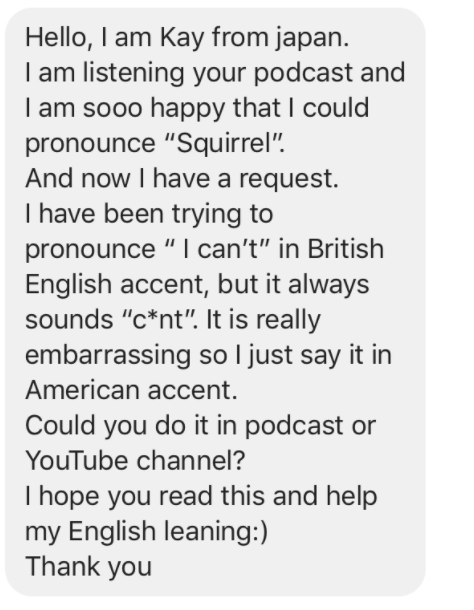
Wishing you a Merry Christmas, giving some news and responding to some messages from listeners about vocabulary lists, pronouncing “can’t” without sounding rude and more…

[DOWNLOAD]

Episode Notes

Hello! Merry Christmas!
Seasons Greetings
Happy Holidays
All the best for the festive season

Here’s episode 501 and really the point of this is that I just want to say “Hi”, wish you all the best, share a bit of news and read through some listener correspondence.

Baby news – still nothing. Both the baby and my wife are fine and in good health, but no signs of labour yet. Apparently this is quite common for a first child. Fingers crossed in any case.

Also, this probably means that our daughter will have her birthday on Christmas Day or boxing day or later, which is not ideal for her (because people don’t care after Christmas, Christmas will overshadow the birthday etc, but it’s possible to make up for it by perhaps having an “official birthday” like the Queen – later in the year).

Listener correspondence

Another message from Jesus. (Not that one)

Original message (read out in episode 500)

Name: Jesus

Message: Hi Luke, I´m one of your ninjas who has decided to come out of the shadows.

My name is Jesus and I´ve been listening regularly to your podcast for three years. I´ve never written something like this before, and forgive me, because I´m not much of a writer.

Your podcast has been the soundtrack of many of my trips, running sessions, moments of ironing, cleaning, and especially cooking. I put my earphones on, and the magic flows in the kitchen.

In a way, you´ve been there in the good moments and also in the bad moments, sadly I´ve been through those lately. Listen to you during that time helped me to move on, and also to improve my understanding of your language and culture.

Now it has also inspired me to work on a new project, it´s something related with cooking. I´m not going to tell you more because the project is still in diapers (got it? pfff I know, it sucks…) I promise you´ll have more news if it gets to something real.

In any case I just want to thank you a lot for all the effort that you put into the podcast and wish you and your wife nothing but the best for the new challenge that you have ahead. You are a great guy, and great people deserve the best.

May the force be with you. Jesus.

Response from Jesus

Name: Jesus

Message: Hi Luke, this is Jesus again.
First off all, I didn’t mind that you read my message. I wasn´t sure that you would read it, since you are very busy these days, but what I wasn´t expecting was you giving me a few minutes in such a special episode.
I know that for you it may be a little thing but it meant a lot to me, in fact, today is my birthday ( that´s right, it´s not the 24th…hehehe), so I´ve considered your gesture as THE birthday present.

I´d like to share something with your audience that it may interest them. You were saying that there are some topics ,like religion, were you have to be careful in order to not offend anybody. Well I think that as long as you are respectful and don´t cross the line with your jokes it´s all right.

Once, I was living in Edinburgh, I went there to learn english, I thought if I go for the hard one the rest would be easy.

Let me tell you that it wasn´t easy but I love the Scots.

In there, everybody had the same reaction that you had when hearing my name, or reading it, because most of the times I had to show my ID for them to believe it.

Thanks to that I wasn´t so nervous when english speakers were talking to me, they were always joking, making me feel more confident and suddenly I was speaking with them.

If you are nervous and trembly when speaking a different language, try to find something funny in common with the other person, if you don´t find anything, whisky helps.
Luke, as I told you before, it´s my birthday. I´m 32, may this be the last one? who knows…just in case I will live it to the maximum.

You said, you don´t get an email from Jesus everyday, well you don´t get to be heard by such an audience like yours everyday either.

I don´t know if you are going to read this, but if you do, this is my birthday present for the world…

Forget your f*cking ego, and use the energy that you use to think of yourself to empathize a little bit with the person next to you. We need to stop all the b*llshit, and work together because the resources are not inexhaustible ( the last part is a message from a friend called Esther, it´s a message inside a message, she also wanted to say something to the world…).

I guess that this is what rumble feels like Luke, I´m kidding, of course.

Merry Christmas, Jesus.

Huxi – Vocabulary Lists

Hi, it’s Huxi.

I absolutely love your Podcast. Thank you for sharing all this info through transcripts and vocab lists.

Talking about lists, Would it be possible to keep posting them? I personally find them incredibly valuable for reviewing, by placing them in Anki as flashcards.

Thanks a lot!

Kristin – Vocabulary Lists

Name: Kristin

Message: Dear Luke,

Before asking a question, I want to give you a big Thank You for providing us learners of English such helpful and valuable material! :-)

I want to relate to episode 496 “Ramblecast”, in which you talk about methods of learning a language and emphasise that just repeating word lists does not make a lot of sense.

Weeell, in fact I have known that, but the problem is that, during the last 2 years, I gathered 117 lists containing 100 words respectively, so about 12,000 words. Until a year or so I managed to revise the words I had until then regularly, but now it’s become too much. To cut a long story short, I am sort of obsessed with learning words, because I just wish to get better, as I love English so so much. Whenever I read an article or a book or watch something on Youtube I kind of feel obliged to look up new words and write down on my lists. It’s depressing, though, that I realize after a few weeks that I just haven’t remembered them.

My question is: Do you know if it’s somehow scientifically confirmed (or what do you personally think about it?) that people learn a language and become more fluent by reading books, listening to audiobooks and watching films without writing down and learning and repeating all the words? I just can’t imagine that I could ever memorise all the new words I pick up by dealing with English material.

Sorry for this long text, but I think I’m going to send it now anyway, because I’m currently at work and have no more time to write it once again in a shorter version.

I would be very grateful and happy if you could send me a little answer whenever you have time.

Thank you so much in advance!

Kristin

Luke’s response

Hi Kristin,

This is a great question. Please don’t think that your efforts in collecting vocabulary has been a waste of time. I’m sure it hasn’t been. I think that your approach to saving words is probably evidence of your motivation to learn and your mindfulness of language while reading and listening. Perhaps just the act of recording the words in a list (words you’ve already encountered in context) could help you acquire them.

But there are other things you could and perhaps should be doing with the words, for example adding meaningful sentences in your list for each word. This can help you remember them. Also consider how you’re revising the word lists. What are you doing as you go through the list? Are you testing yourself and trying to reproduce those words in meaningful ways?

Also, it might be wise to take a selective approach. Instead of recording all the new words you encounter, you could just pick ones that you think are more useful or common. Don’t try to consume too much. Let some words go. You’ll remember more if you try to remember less. Don’t overwhelm yourself.

Also you could try googling those words and looking at the way they are used in the news (select the news tab in google results). That can reinforce the words for you.

As for the scientific studies you asked about. I don’t think there is 100% reliable scientific proof that one particular method works better than another. There are theories, like Language Acquisition Theory by Stephen Krashen and other theories too.

I think the best source of info on this probably comes from successful language learners. You could check out Olly Richard’s Podcast and blog at iwillteachyoualanguage.com He has some good methods and advice for remembering vocabulary. That might help. You could also ask him your question and he might answer it on his Podcast. I would also like to tackle your question on the podcast if I manage to fit it into my upcoming episodes! Your mail is now saved in my to-do list.

I hope my answer helps a bit although I haven’t given a fully fleshed-out response with specific steps you can take.

As a final thought, it seems that your English is really good, with a wide range of vocabulary. So perhaps your method has worked well despite what I said on the Podcast.

In the end, applying yourself to language learning, being motivated and having some kind of system – these are the things that make the difference regardless of what form they take. It doesn’t matter – in language learning all roads lead to Rome. You just have to make sure you’re always moving.

All the best,

Luke

Kristin’s response

Dear Luke,

Thank you so much for your detailed e-mail! I was very blown away by your deep thoughts about my question and I really appreciate your tips. You are probably right, it depends on HOW one tries to learn new words – just by provided lists in a book for students or by self-made lists containing words from specific contexts that one is able to relate to. I also realised that through writing down almost every new word my listening skills have improved a lot, as I’m able to recognise words better. On the other hand, I really SHOULD select at least a little bit, you’re very right in that. Since it is just frustrating to realise that after a few weeks I can’t remember anymore what I learnt.

Olly Richard’s podcast and googling are good tips, thanks for these!
Also, my English language exchange partner from England learns with Memrise nd finds it quite enriching, maybe I’m gonna have a look into it when I find the time (Christmas holidays are approaching ;-) ).

Thank you for the compliment about my English. My written English is quite good I guess, but my spoken English is sadly another story, as the little additional moment to think about the words is missing and I can’t often remember the words in the particular moments.

My dream is to go to England next year in summer for a few months. My New Year’s Resolution let’s say ;-)

Have a great Christmas and all the best to you, your wife and your almost-born baby!

Cheers,

Kristin

Serdar – Becoming a Dad

Name: Serdar

Message: Hello Luke.

I had once contacted you via this form but you didn’t reply. Hope you see this one this time. I have been listening to your podcasts over a year and really enjoying it a lot as well as learning many new vocab. So thanks for your contribution to those who thrive by learning. Recently I listened to a podcast of yours titled becoming dad and found out that you would become dad quite soon. Don’t know when you recorded it so you may even be holding your lovely baby now.

I know you have been told so many times that how difficult parenting is. As a father of 3 year old,I bet you all of it is true but i would like to emphasise how wonderful being a dad is. They used to tell me that my life would completely change after becoming dad and they’d say this change would be positive. Now I totally agree with my friends that there is no such feeling compared to being a dad. It is the greatest thing to happen to a man. I can’t even believe that there are words to express this. I couldn’t do it in my native language either. you must experience it ( maybe you have just started to ) At first weeks you really don’t know what’s happening. You look at a baby but still don’t have any idea about how it feels like a dad. It gradually starts, and this magnificent feeling gets extensive day by day and you finally find yourself and your toddler talking to each other one day. you start enjoying every single day, you rush back home to see them as soon as possible.

I even remember untying my shoe lashes in elevator just to gain few seconds! you look at their pictures when you are away. you keep thinking about them. I don’t know if you have ever fallen in love truly like mad but this overshadows it without doubt. It is much more intense than love. there is no word describing your love for your child. Although some days, especially when you are exhausted, or sleep deprived you will face to the hardest part of parenting, you will still stand up and go for it. even when you have %1 battery left :)
I hope you share your experience in a podcast. If you reply me letting me know about it, I’d be so happy.
Thanks again and good luck :)
Serdar, Istanbul

Message from Kei – Pronouncing “can’t”

Gleidson from Brazil

I’d like to see you online in video conference, would be really interesting. And I suggest you give some links to us practice grammar in sites as British Council, BBC English learning or so on related to the current episode podcast. It’s a great chance for us to practice grammar.

Your accent is really clear for us students. Don’t fear about share something about your personal life, for me, it makes your podcast quite personal and friendly.
This is the positive point for your podcast and a good way to share some vocabulary to a specific occasion, as wedding ceremony, childbirth, baptism, Christmas celebrations and so on

I am living in Ireland for 4 months, but I listen to you since as was living in my country (I have to thanks to a Brazilian friend of mine that shows me your podcast).

I wish all the best to you.
Keep posting your amazing podcasts and thanks again.

Send a warm Hello to all Brazilian that listening to you.

(sorry for English mistakes, I am learning, so I can not write in English as a write in my native language yet).

Kind regards,
See you.

VP – Withnail & I episode.
Hiya everyone! This is my first comment ever. #497 is so cool an episode I couldn’t keep a low profile anymore! First of all, I want to thank you tremendously, Luke, for all you’ve done for us lovers of English. Your podcast means a lot and it’s extremely helpful for me in my effort to keep learning the language all by myself now. I’ve been listening to LEP for quite a while, and it’s always ace but this time that was something special. The thing is, Withnail &I is one of the most hilarious and unique British films I’ve watched. Boy, was I chuffed when I saw the name of a new episode! I guess I found this film after I’d seen Fear and Loathing in Las Vegas, which perhaps has something in common with Withnail&I. Indeed, I failed to enjoy the film from the start, but its dialogues, humour and Richard E.Grant’s superb performance made me grow fond of it finally! By the way, I also like ‘How to Get Ahead in Advertising’ with this actor and am a huge fan of Mike Leigh’s works, ‘Naked’ featuring David Thewlis, for instance. Has any of you LEPsters seen any of those movies, by any chance? I wonder what British people think of Leigh’s films.
P.S. The description of a person who likes Withnail&I was merciless!

Marta KL • 19 days ago
I’ve just downloaded the film (with subtitles – I don’t think I’m able to make it without them) – looking forward to watch it in the next days.
Btw I have just noticed that James’s voice is quite similar to your dad’s voice :)
Thanks for the new episode, cheers!
Luke Thompson
Yep – he’s a chip off the old block
Hope you enjoy the film.
Cat
Could one say ‘He is a chop off the old wood’ as well?
Luke
Nope!

**UPDATE: Technical problems with the website :( **

I’m having some technical problems with my website at the moment. Some pages are not displaying properly and this is also affecting the Disqus comment system, so the comment section might be unavailable. Sorry! I hope to have it fixed soon.

Observations on the Paris Metro… from Inside the Metro (Listen to my appearance on Oliver Gee’s podcast “The Earful Tower”)

Hello website LEPsters! Here is some more listening you can do while waiting for the next episode of LEP.

I was recently invited onto The Earful Tower Podcast by Oliver Gee (remember him from episode 495?) We recorded an episode all about the Paris Metro while riding the Paris Metro. You can listen to it here.

You’ll hear us talking about our experiences of using the Metro, some of the things we find fascinating, funny, weird, cool and even disgusting about it. You can hear various background noises and experience what it’s really like to travel through Paris on line 2 with Oli and me.

Keep listening to the end to hear a cool story from Paris’s history, read by Oliver’s regular storytelling guest Corey Frye.

Click the link below to see photos from our trip and to check out other episodes of The Earful Tower podcast with Oliver Gee.

Click link below for photos from our trip and more info:

Observations on the Paris Metro…. from inside the Metro

Oliver Gee is a journalist from Australia now living in Paris. His podcast is all about Paris and episodes include interesting stories, bits of history, chats about language and comments about the cultural differences. It’s all in English and you should check out his episode archive – you’ll find several appearances by Amber Minogue, one episode with Paul Taylor and two with me (including this one). Enjoy!

p.s. You might be wondering whether our baby daughter has been born yet. Well – not yet! We are still waiting. She’s currently one day overdue, but everything’s fine. She could still arrive at any time. We’re waiting with bated breath.

More episodes of LEP coming before too long.

Don’t forget to download the LEP App and enjoy listening to some full-length episodes only available in the app, plus more bonus content.

Cheers!

Luke

500. EPISODE 500 CELEBRATION! (PARTS 1 & 2)

Celebrating 500 episodes of LEP with a mega-ramble featuring lots of messages from listeners, expressions of gratitude, a cool announcement for all my listeners, some singing, some talk of becoming a dad, the future of the podcast, Star Wars, and loads of fun and good times. Thank you for listening! Parts 1 & 2 are both available on this page.

Small Donate Button

[DOWNLOAD PART 1] [DOWNLOAD PART 2]

Thank you to everyone who took part in episode 500 by sending me a message.

This became a massive celebration. I didn’t expect to receive so many messages. Thank you for all of your kind words, support, and joyful sentiments. I really appreciate it!

Thank you for listening to my podcast all these years. It means a lot to me. I’m looking forward to making more episodes in the future. Seasons greetings for the festive period and have a Happy New Year!

The Luke’s English Podcast APP is NOW AVAILABLE

Get the app on your phone. Download links below.

This is the best way to keep up with episodes of the podcast and get access to special app-only content.

All episodes of LEP are available in the app – every archived episode, all new releases and some exclusive app-only content. Also, check out the bonus gifts and easter eggs, pdfs and more…

Download Luke’s English Podcast App from the Apple App Store, the Google Play Store or the Microsoft App Store. Links below.

 iPhone/iPad – APPLE APP STORE |ANDROID – GOOGLE PLAY STORE 📱

Description

This is the most convenient way to access all episodes of Luke’s English Podcast on your iPhone, including special bonus episodes only available in the app.

This app gives you complete access to Luke’s English Podcast and if you’re a fan of the show you will not want to live without it!

The app contains the following features:
* Option to stream or download all episodes for offline listening
* Access to exclusive app-only episodes and pdfs
* Episode notes and transcripts available in the app
* Always updated with the latest episodes – and the full episode archive
* You can *star* your favourite episodes and save them to a list in order to easily enjoy them over and over again
* Speed control so you can listen faster or slower if you want
* Skip forwards or backwards by 30 seconds if you missed something
* Sleep timer so you can fall asleep to my voice without missing anything!
* Playback resume (when interrupted by a call or other distraction)
* Quick access to all the contact methods for Luke like email, website, Facebook and Twitter. Don’t be a ninja! Send me an email through the app whenever you want.

Thank you for downloading this app and supporting the show!

Luke

Luke’s English Podcast is a free audio podcast for learners of English as a foreign language, hosted by Luke Thompson – a comedian and English teacher from London, UK. Listen, learn and have fun while picking up natural British English as it really is spoken.

497. Film Club: Withnail & I (with James and Will)

Talking about a classic British film which not many learners of English know about. Listen for explanations of the film, its appeal, descriptions of the characters and events, the type of people who like the film and a few bits of dialogue too. Notes available.

https://open.acast.com/public/streams/62b0ada25c7ea10012f541cb/episodes/62b0ada86fddaf0012d1f159.mp3″ target=”_blank” rel=”noopener”>DOWNLOAD]

Introduction Transcript

Today on the podcast I am going to be talking about a cult classic of British cinema – a film called Withnail & I.

This is a slightly ambitious episode because in my experience this film is usually very difficult for learners of English to fully appreciate. Even the title of the film somehow fails to register with many people when I tell them.

“Can you recommend British films?” one of my students might say.
And I say “Yes, definitely. You should watch Withnail & I”
And the person’s face creases into an expression of “what was that you just said?”
“Withnail and I” I repeat.
But still, this clearly just seems like a noise to this person.
He doesn’t know what to write. He doesn’t know how many words that is. He doesn’t know how to spell “Withnail and I”. He’s lost for a moment.
So I write it on the board “Withnail and I”.
Still, this doesn’t help much. The person doesn’t even recognise the word “Withnail”. It’s difficult to spell, it’s difficult to pronounce, it doesn’t seem to mean anything.

Then I think – “There’s no way this guy is going to enjoy this film, he can’t even get past the title.”

But something inside me says – “Luke, Luke… I am your father…” No, it says “Luke, you need to make these people watch this film. It is your duty as a British person teaching people your language and culture. These people need to see this film. They need to know what a Camberwell Carrot is, they need to know about cake and fine wine, they need to know why all hairdressers are under the employment of the government. It is your duty Luke, to teach these people about the wonderful world of Withnail and I – even if they don’t want it!”

So now I feel duty bound to tell you all about this cult British film. By the way, the title of the film “Withnail and I” – these are just the two characters in the film. Withnail and another guy whose name we don’t know. He’s simply “I”.

If you’re interested in British films, if you like slightly dark comedies with good acting, interesting characters, an excellent script and some top level swearing – this is a film for you.

You might never have heard of it, I realise, and that’s partly why I’m doing this episode. I like to recommend things that you might not know.

Withnail and I is a cult film which means it’s very very popular with a certain group of people. It’s not a mass-appeal sort of film. It might not be the film you think of when you consider typical “British films” – you might think of something like Love Actually or a Jane Austen adaptation, but Withnail & I is a film that you will definitely know if you a proper lover of British films. It is a cult classic and those who love it – really love it with a passion as if they’ve lived the film themselves in their own lives.

But not everybody gets it. Certainly, in the UK it is very highly regarded by people who have a special love for films, but it’s not a film like Four Weddings or James Bond which seem to appeal to everybody. Plenty of Brits don’t get it. Also learners of English hardly ever know about it (because in my experience most learners of English understand British cinema as things like Hugh Grant, Harry Potter and even Mr Bean). It can be a difficult film to understand if you’re not a native speaker from the UK. It’s not well known in the USA even.

But as I said, it’s a cult success in the UK.

Cult has two meanings. A cult can be a sort of small religious group devoted to a particular person, but when cult is used as an adjective with something like “film” then it means that this film is extremely popular with certain people.

  • What kinds of people like this film?
  • Why do people love this film so much?
  • What is the appeal?
  • What can this film tell us about British culture?
  • Why should you as a learner of English take any interest in this film at all?
  • How can you learn some real British English from this?

Let’s find out in this episode of Luke’s Film Club on Luke’s English Podcast all about Withnail & I.

I’m a huge Withnail & I fan but in this episode I’m also joined by several other Withnail fans who are very keen to talk to you about one of their favourite films.

Those two fans are my brother James and his mate Will.

I just sincerely hope that we can somehow explain this film and its appeal, and make this interesting for you to listen to (that’ll be hard considering it’s three blokes with similar voices talking about an obscure film that you’ve probably never seen).

***

Links & Videos

The Wall of Withnail – superfan Heidi’s collection of objects seen in the background of Withnail & I. http://wall-o-withnail.blogspot.fr/

Withnail and Us – a great documentary about the making of the film, by the people who made the film.

https://www.youtube.com/watch?v=-G9WMeGl_Uw

Bruce Robinson interview

https://www.youtube.com/watch?v=d5kZPugLqfs

Bruce Robinson & Richard E Grant at the London BFI

The Hamlet Monologue (Act 2, Scene 2, Page 13)

“I have of late—but wherefore I know not—lost all my mirth, and indeed it goes so heavily with my disposition that this goodly frame, the earth, seems to me a sterile promontory; this most excellent canopy, the air—look you, this brave o’erhanging firmament, this majestical roof fretted with golden fire—why, it appears no other thing to me than a foul and pestilent congregation of vapors. What a piece of work is a man! How noble in reason, how infinite in faculty! In form and moving how express and admirable! In action how like an angel, in apprehension how like a god! The beauty of the world. The paragon of animals. And yet, to me, what is this quintessence of dust? Man delights not me. No, nor woman neither.”

In plain English:

“Recently, though I don’t know why, I’ve lost all sense of fun —the whole world feels sterile and empty. This beautiful canopy we call the sky—this majestic roof decorated with golden sunlight—why, it’s nothing more to me than disease-filled air. What a perfect invention a human is, how noble in his capacity to reason, how unlimited in thinking, how admirable in his shape and movement, how angelic in action, how godlike in understanding! There’s nothing more beautiful. We surpass all other animals. And yet to me, what are we but dust? Men don’t interest me. No—women neither.”

Outtro

What you just heard there is the final scene of the film in which Withnail repeats lines from Hamlet by Shakespeare and it’s quite a tragic ending, but you’ll have to watch the film to find out what happens.

So that was an ambitious episode! I honestly think this one is as ambitious as the one about the rules of cricket. All the way through that conversation alarm bells were ringing in my head.

Sometimes I get alarm bells when I’m teaching. From experience I know what my learners of English will and won’t understand. For example, if there’s a listening that we’re doing and it contains a few phrasal verbs or connected speech or a specific accent, the alarm bells ring in my head and sure enough none of my students have understood it.

So for this episode alarm bells are ringing like mad. First of all the film is like kryptonite to students of English (which is a pity because there’s a lot to enjoy), but also because you were listening to three guys talking with fairly similar voices in a comfortable way – meaning, not graded for learners of English to make it easier, and also we’re talking about a film that you’ve probably never seen. Also the little clips in particular were, I’m sure, rather difficult to follow.

So a big well done if you made it this far. I promise you that this film is an absolute gem and if you give it a chance it will actually improve your life.

I have talked about this film on the podcast before and in fact I do remember getting a message from a listener who said that she had watched the film on my recommendation with her boyfriend and that now they enjoy repeating lines from the script when they are about the house.

So if they can get into it then you can too, although of course this film is not for everyone, that’s why it’s a cult film.

I’ve just remembered, I promised to play the Withnail & I swear-a-thon. That’s like a marathon isn’t it, but with swearing.

Withnail and I is celebrated for its swearing and there is a lot of colourful rude language in the film. For the 20th anniversary DVD box set someone edited together all the swearwords from the film in order. This is the Withnail and I swear-a-thon. Now, as you would expect the next minute or so is going to be absolutely filled with swearing so brace yourselves. YOu’re going to hear all sorts of rude words like bastard, shit, fuck and also cunt. Here we go.

I hope you’ve enjoyed listening to this episode of Luke’s Film Club on Luke’s English Podcast.

Check out the page for the episode for some notes, transcriptions and also a bunch of video documentaries, clips and interviews that are definitely worth watching if you’d like to know more.

Have a great morning, evening, breakfast, lunch, dinner, sleep, commute or run!

496. RAMBLECAST

Rambling about life, learning English, Star Wars, screwing up paper into a ball and more…


Small Donate Button
[DOWNLOAD]

Here’s a rambling episode with a few bits of news and some tangents.

Episode 500 – Please send me your voice messages

Please send me a 30 second voice message to luketeacher@hotmail.com

Tell me your name, where you’re from and something else.

Don’t be shy, give it a try!

Penguin Readers https://www.pearsonelt.com/tools/readers.html#productComponents

494. Who Wants to be Good at English? (The Rematch) with Rick Thompson

Testing my Dad on his knowledge of English, using words that are frequently confused by native English speakers. Will my dad be able to identify the words, spell them and explain the differences? Listen to learn 20 words and phrases which native English speakers often get wrong. You will also hear Dad and me discussing topics such as catching a squirrel, what he would say to Donald Trump and Paul McCartney if he met them, stories of police drug busts at university, how my dad would deal with a zombie apocalypse, and which one is worse – Brexit or Yoko Ono’s ‘singing’? Vocabulary list with definitions and examples available.


Small Donate Button
[DOWNLOAD]

Introduction Transcript

About 18 months ago my Dad tested me with his evil gameshow, called “Who wants to be good at English”. I say it was an evil gameshow because I think it was designed for me to fail (although arguably, I didn’t fail, OK!?) It was basically a quiz he created in order to highlight some common mistakes that people make (especially journalists) with certain English words.

You can listen to that, and take the test as well, by finding episode 373 in the archive – or just click here https://teacherluke.co.uk/2016/08/10/373-who-wants-to-be-good-at-english/

So I thought we’d play another game of “Who Wants to be Good at English” but this time I’m asking the questions. My questions are based on an article I found on the Indy100 (an online magazine) written by Paul Anthony Jones  which is all about some of the most commonly confused words in English (for native English speakers). Apparently these are some of the words that many English native speakers confuse – meaning they use one word when they should be using another. I wonder if my Dad is able to tell the difference between all of these pairs of words. Let’s see if he really is that clever and articulate. I think he probably is, but let’s see.

As we are playing the game I invite you to join in. Can you guess which words we’re talking about here?

If you don’t know the words, listen carefully because we will define them and then also have a little chat using the words so you can hear them in context.

Also, you’ll hear us talking a little bit about the origin of some of these words, which is quite interesting because it shows how many English words come from latin and in some cases words from other origins like old English and even Turkish.

Check the page for the episode on the website too, where you will see all the words listed with definitions.

https://www.indy100.com/article/ten-of-the-most-commonly-confused-words-in-the-english-language–bJRDKGNwlZ


  • Dad, how are you?
  • Are you confident that you know English better than most other Brits?
  • Did you study latin at school?
  • Does a knowledge of latin help with English?
  • Do you think it will help you in this test?

10 rounds – 10 pairs of words which are commonly confused.

I will ask you questions – you have to tell me the word I am looking for. I will also ask you for the spelling and pronunciation.

ROUND 1

  1. If you’re waiting for something with great anticipation, literally to the point that you are having some trouble breathing – for example you’re desperately waiting for the next episode of Luke’s English Podcast – what expression would you use?
  2. How do you spell that?
  3. If you go fishing, what do you need in order to catch a fish?
  4. How do you spell that?
  5. How are they pronounced?

Answers:

Bate (verb) = abate = become less strong, to suppress. Formal, old fashioned.
The storms had abated by the time they rounded Cape Horn. [VERB]
…a crime wave that shows no sign of abating. [VERB]
To wait with bated breath = to wait eagerly and impatiently

Bait = (noun) – food you put on the end of a fishing line or in a trap in order to catch something

Also – figuratively something which is used in order to catch someone. E.g. ‘clickbait’

(verb) – to put food on a line or in a trap

(verb) If you bait someone, you deliberately try to make them angry by teasing them.

He delighted in baiting his mother. [VERB noun]

Synonyms: tease, provoke, annoy, irritate

According to Oxford Dictionaries, around 1 in every 3 records of the phrase “bated breath” in the Oxford Corpus is spelled incorrectly, as “baited.”
Baited with an I is the same bait that you use when going fishing.
Bated without an I is totally unrelated, and comes from an ancient English word, bate, meaning “to beat down,” “restrain” or “suppress” – it’s the same word we use when we say that a storm has abated – which makes “bated breath” literally “held breath.” (Indy100.com)

Quick Discussion Questions

  • Are you currently waiting for anything with bated breath?
  • What is the best way to catch a squirrel? How about a crab? What kind of bait should you use?

ROUND 2

  1. If you see someone that you don’t want to meet or talk to – perhaps a person who you don’t like, or imagine a drunk man in the street who might bother you or even attack you. You’d walk around him, putting space between you and him. What would you give him?
  2. How do you spell that?
  3. What word is this often confused with? It’s something that generally happens at the beginning of someone’s life.
  4. How do you spell that?
  5. How are they pronounced?

Answers:

Berth (noun) = (nautical term) originally means “sea room” – the room that a boat needs for mooring, but also generally room or space for ships. So, to give a wide berth in terms of shipping – you can imagine needing to go around a rocky point or perhaps another ship with lots of space, to avoid any possible collision.

Give something a wide berth = avoid it, go around it, put distance between you and it.

Birth / Give birth (to someone) = have a baby

Quick Discussion Questions

  • If you saw these people in the street, would you give them a wide berth or would you go up to them?
    • Donald Trump
    • Harvey Weinstein
    • Kim Jong Un
    • Madonna
    • Boris Johnson
    • Paul McCartney
  • Were you there when Mum gave birth to me? What was it like for you?

ROUND 3

  1. What word is a synonym of advice – for example legal advice? It can also be a verb, meaning to give advice. (also another noun – it can mean the lawyer too)
  2. How do you spell that?
  3. What about a group of people brought together to make decisions? E.g. a local administrative group who make decisions about how the local town should be run.
  4. How do you spell that?
  5. How are they pronounced?

Answers:

counsel (noun) = advice
[formal]
He had always been able to count on her wise counsel.
The community requested his counsel on various matters.

counsel (noun – person) = a lawyer
The defence counsel warned that the judge should stop the trial.

counsel (verb) – to give advice

[formal]
If you counsel someone to take a course of action, or if you counsel a course of action, you advise that course of action. 
My advisers counselled me to do nothing. [VERB noun to-infinitive]
The prime minister was right to counsel caution about military intervention.

Council and counsel can both be used as nouns (in the sense of “an assembly of people” and “good advice or direction”) but only counsel with an SE can be used as a verb (“to give advice or direction”).

Both are derived ultimately from Latin, but while council comes from the Latin word calare, meaning “to call or proclaim officially” (which makes it an etymological cousin of calendar), counsel with an S comes from the same root as consult. So while a council is “called” together, you might “consult” someone for their good counsel. (Indy100.com)

Quick Discussion Questions

  • Have you ever needed to take legal counsel for anything work related?
  • Have you ever been asked to provide counsel on any local matters?
  • Is there a local council where you live?

ROUND 4

  1. As a teacher, sometimes it’s necessary to draw out certain language from my students. Often if I’m teaching some words, or doing an introduction, rather than just lecturing them about a subject, it’s a good idea to get them to give me certain words – it tends to keep the students involved and makes them a bit more productive, and it also allows you to see which words they know and don’t know. What verb means to get a piece of information, a word or a reaction from people by asking certain questions?
  2. How do you spell that?
  3. What adjective is a synonym of ‘illegal’ and means ‘not allowed or approved by a rule’.
  4. How do you spell that?
  5. How are they pronounced?

Answers:

Elicit (verb)
Illicit (adjective)

The E of elicit is the prefix ex–, which is here used to form a word bearing some sense of “out” or “from”, like exhale and exterior. The –licit in both words is also entirely unrelated: in illicit it comes from the Latin verb licere, meaning “to allow” (as in licence), whereas in elicit it derives from the Latin lacere, meaning “to lure” (which is also where the word delicious comes from). (indy100.com)

Quick Discussion Questions

  • When you were growing up in the 60s, were you ever given information about illicit drugs? Did many people use illicit substances at that time?
  • The Shakespeare play “Macbeth” – what feelings do you think it elicits in its audience? What’s the main feeling that it elicits?
  • How about films. How do they elicit reactions from the audience? Think of a horror film for example.

ROUND 5

  1. What is the difference between the word ‘affect’ (with an ‘a’) and ‘effect’ (with an ‘e’)?
  2. How are they pronounced?

Answers:

Affect (verb)
Effect (noun)

The root of both is the Latin facere, meaning “to make”, but while the E of effect comes from the same prefix as elicit, ex–, the A of affect comes from the prefix ad–, which is used to form words bearing some sense of “towards”, “on” or “a coming together” like adjoin or ashore. To affect ultimately means to have an effect on something, while an effect is an outcome. (indy100.com)

Quick Discussion Questions

  • How does wine affect you? Does it affect you in the same was as it affects other people?
  • What are the good and bad effects of wine?

ROUND 6

  1. How would you describe someone whose hair is going grey, making them look quite cool and perhaps even quite tough. It’s the sort of word you might use to describe a police detective or a cowboy who is getting older and has had some tough experiences, which you can see in his greying hair – but he’s not really old yet, just experienced.
  2. How do you spell that?
  3. What’s another word for a brown bear? They type of bear you might come across in Yellowstone National Park in the USA. They’re brown but they have some grey-ish hair around the shoulders, head and ears.
  4. How do you spell that?
  5. What adjective would you use to describe the disgusting or explicit details of a murder. Something which is very unpleasant and that would be horrible to look at.
  6. How do you spell that?

Answers:

Grizzled (adj) = going grey (usually used in a literary context)
Grizzly (adj) = also going grey, like ‘grizzled’ but usually ‘grizzly’ is just the word for a type of brown bear
Grisly (adj) = extremely unpleasant and horrible

If something is horrible to look at then it’s grisly, not grizzly. Grizzly with two Zs is a descendent of the French word for “grey”, gris, and comes from the older use of grizzled to mean “grey-haired” (despite grizzly being another name for a brown bear, of course).
Grisly with an S is a descendent of grise, a Middle English word meaning “to shudder with fear”. (Indy100.com)

  • What kind of movie star would you rather watch in a film – a fresh faced young-looking hero or a grizzled hero? Can you think of any examples?
  • Have you ever seen a grizzly bear?
  • Do you think the news should report all the grisly details of a story?

ROUND 7

  1. Imagine there’s going to be a zombie apocalypse. It’s a terrifying thought. It would be a good idea to collect and store lots of food, drink and supplies. To stockpile things, and hide them so that nobody else can find and use them, but you’ll be able to keep them and survive. What verb am I thinking of?
  2. How do you spell that?
  3. Now imagine loads of zombies in a huge group, or in fact many large groups of zombies surrounding your house or out in the street. What noun could you use to describe these groups of the undead. Of course this word could also be used to describe groups of ordinary people too, but it sounds a bit negative – frightening or unpleasant, perhaps.
  4. How do you spell that?
  5. Pronunciation?

Answers:

To hoard something (verb) = If you hoard things such as food or money, you save or store them, often in secret, because they are valuable or important to you.
They’ve begun to hoard food and gasoline and save their money. [VERB noun]
The tea was sweetened with a hoarded tin of condensed milk. [VERB-ed]

A horde of something (noun) = a large group of people, usually considered quite threatening or scary.

This attracts hordes of tourists to Las Vegas. [+ of]
…a horde of people was screaming for tickets.

Around a quarter of all the citations of the word hoard (a noun meaning a store of valuables, or a verb meaning “to accumulate” or “stockpile”) in the Oxford English Corpus are incorrect, and should really be horde (a large group of people).
In English, hoard is the older of the two and derives from an Old English word for treasure – wordhoard was an Old English word for a person’s vocabulary. Horde is completely unrelated, and has an E on the end of it because it comes from an old Turkish word, ordu, for an encampment. (Indy100.com)

Quick Discussion Questions

  • What would you do if you found out that there would be a zombie outbreak? What kinds of things would you hoard?
  • What would you do if your house was surrounded by a horde of zombies?

ROUND 8

  1. Imagine a road which is full of twists and turns. How would you describe it? How about a piece of writing or perhaps a process which is really complicated and time consuming. Which word would you use to describe those things?
  2. How do you spell that?
  3. Which adjective could you use to describe something that causes great pain and suffering?
  4. How do you spell that?
  5. Pronunciation?

Answers:

Tortuous = twisting and turning (road), complex and time consuming (process, writing)
The only road access is a tortuous mountain route.
…these long and tortuous negotiations aimed at ending the conflict.
The parties must now go through the tortuous process of picking their candidates.
Torturous = like torture – very painful and agonising.
This is a torturous, agonizing way to kill someone.

Confusion often arises between these two not only because of their similar spellings, but because something that’s tortuous can often seem torturous.
Tortuous without the extra R means “full of twists and turns”, and is derived from a Latin word, tortus, for a twist, or a twisting, winding route. If something is torturous then it’s akin to torture, hence the extra R. (Indy100.com)

Quick Discussion Questions

  • Would you like to be involved in the Brexit negotiations? Why not?
  • You wrote a book once. How was that experience? Was it tortuous? (complicated) Was it torturous? (painful)
  • How would you describe Yoko Ono’s singing?
  • What about the experience of having your teeth pulled out, by Yoko Ono, while she’s singing? (Torturous, right?)


ROUND 9

  1. Imagine your wife is pregnant (I know!) and you go to a doctor for a scan. You and your wife are very worried about the health of the baby because a previous test suggested that there might be a problem. So, you’re both feeling very worried and nervous, and you really want the doctor to put your worries at rest, but the doctor seems completely insensitive to this and doesn’t even seem to realise that you’re worried. You think, is he being deliberately like this? This word means slow to understand something and also insensitive.
  2. How do you spell that?
  3. How would you describe something that was really complex to understand, abstract, deep, highly intellectual. E.g. a book about abstract existential philosophy, or the rules of cricket.
  4. How do you spell that?
  5. Pronunciation?

Answers:

Obtuse (adj) = mentally slow or emotionally insensitive
“How can you be so obtuse? Is it deliberate?”
Abstruse (adj) = hard to understand because of being extremely complex, intellectually demanding, highly abstract, etc.; deep; recondite
[formal disapproval…fruitless discussions about abstruse resolutions.

How can you be so obtuse? The Shawshank Redemption – Andy discovers evidence that proves he is innocent. The warden seems to choose not to realise how this could get Andy out of prison. Andy says “How can you be so obtuse? (slow to realise the significance of this) Is it deliberate?

No questions, your honour.


ROUND 10

  1. Imagine a long summer evening, long shadows, golden sunlight, a pleasant temperature. You can just relax in a chair and take your time, soaking up the pleasant rays of deep golden light. How would you describe that weather?
  2. How do you spell that?
  3. What about someone who’s a bit crazy and foolish?
  4. Spelling?
  5. Pronunciation?

Answers:

Balmy (adj) = Balmy weather is fairly warm and pleasant.
…a balmy summer evening.

Barmy (adj) = If you say that someone or something is barmy, you mean that they are slightly crazy or very foolish.
[British , informal , disapproval]
Bill used to say I was barmy, and that would really get to me.
This policy is absolutely barmy.
UNITED! BARMY ARMY! UNITED! BARMY ARMY! (football chant)

Is the weather balmy or barmy? It’s balmy with an L if you’re talking about something pleasantly warm—literally, something as pleasant as balm, in the sense of an aromatic, healing lotion or salve.
It’s barmy with an R when you’re talking about something (or someone) foolish or crazy—literally, someone as frothy and as flighty as barm, which is the froth that forms the head of a pint of beer. (Indy100.com)

  • How was the weather in the UK this summer? Did you have any balmy summer evenings?
  • At what time of the year is the weather at its balmiest? What do you like to do when the weather is balmy?
  • What do you think of Brexiteers? Are they a bit barmy or is there something else going on?


Thank you for listening!

Don’t forget to join the mailing list on the website to get an email with every new publication on the website.

Luke