Category Archives: Science

480. Holiday Diary (Part 7) BIG ROCKS!

In this episode I’m going to continue telling you stories of my recent holiday and there will be descriptions of impressive rocky landscapes, a sort of geology lesson and a brief history of planet earth. Expect plenty of solid descriptive chunks of vocabulary as this holiday diary continues.


Small Donate Button
[DOWNLOAD]

Some talk of putting shelves up… doing DIY…

Transcript and Notes

In this episode I’m going to continue telling you stories of my recent holiday and there will be descriptions of impressive rocky landscapes, a sort of geology lesson and a brief history of planet earth. Expect plenty of solid descriptive chunks of vocabulary as this holiday diary continues. I think there will be just one more episode to come in this series, and then it will be back to the usual sorts of episodes I do, including a few conversations with some friends of mine as guests.

The first part of the trip was urban. Now it’s all about earth, wind and fire – not the band, but the elements, earth, wind, fire, rocks, stone, water, ice, wood and time.

We drove from Las Vegas on a road trip tour, a loop, in our Jeep, over about 9 or 10 days stopping at various places to stay a night or two and taking in some of the most impressive spectacles of natural beauty I’ve ever seen.

I don’t know about your country – I’m sure that you have some seriously big and impressive locations too. Places that are famous and that take your breath away when you see them. Places and things that I would love to see with my own eyes one day.

In the UK our countryside is absolutely beautiful, but it is generally on a fairly small scale compared to other places – we have rolling hills and stone bridges over babbling rivers – it all seems quite self-contained or cute or something – a bit like The Shire or Hobbiton in Lord of the Rings. Not all of it – we have impressive spots with mountains and lakes and stuff but it doesn’t quite smash your senses like the things we saw in Arizona and Utah.

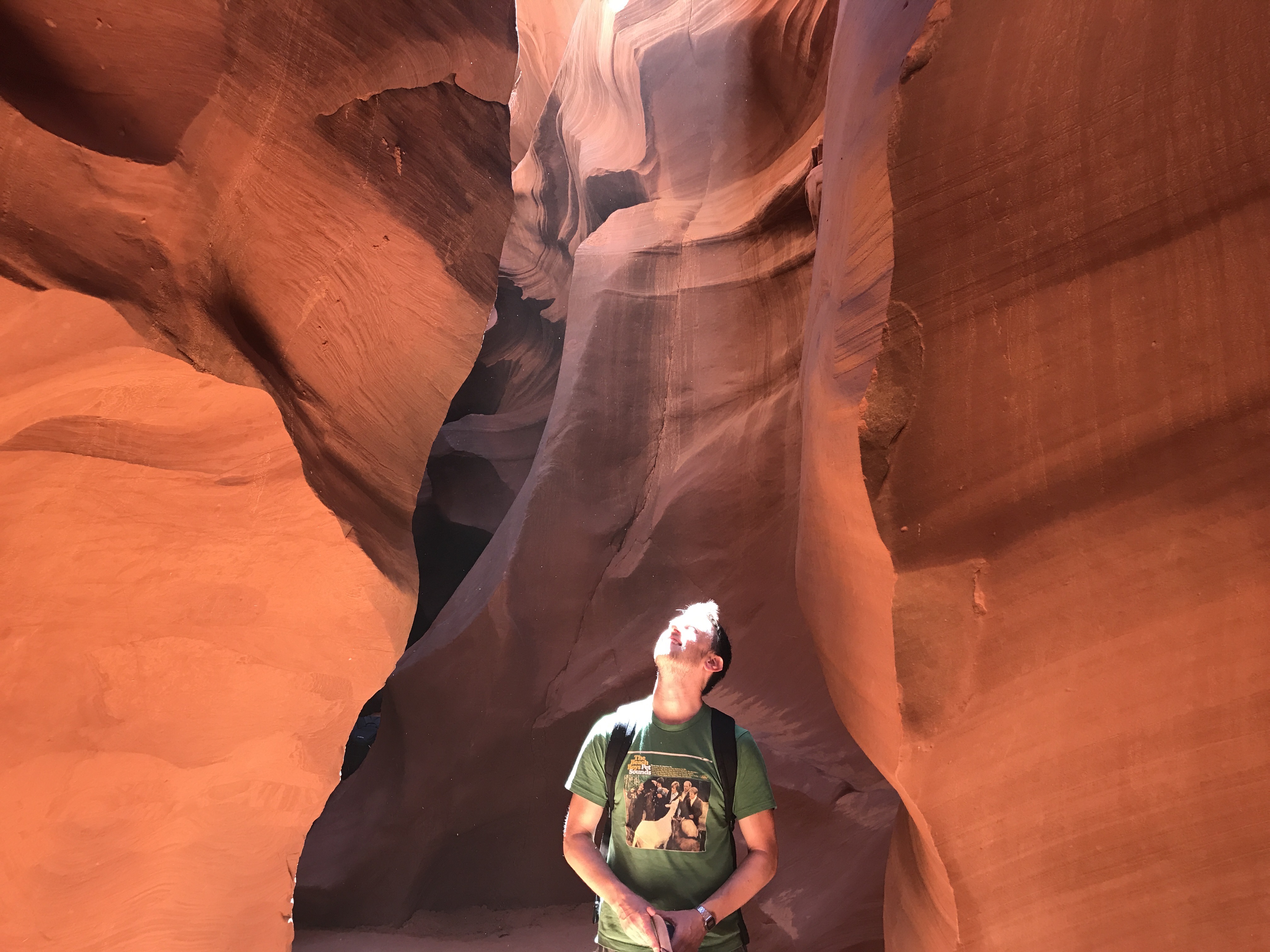
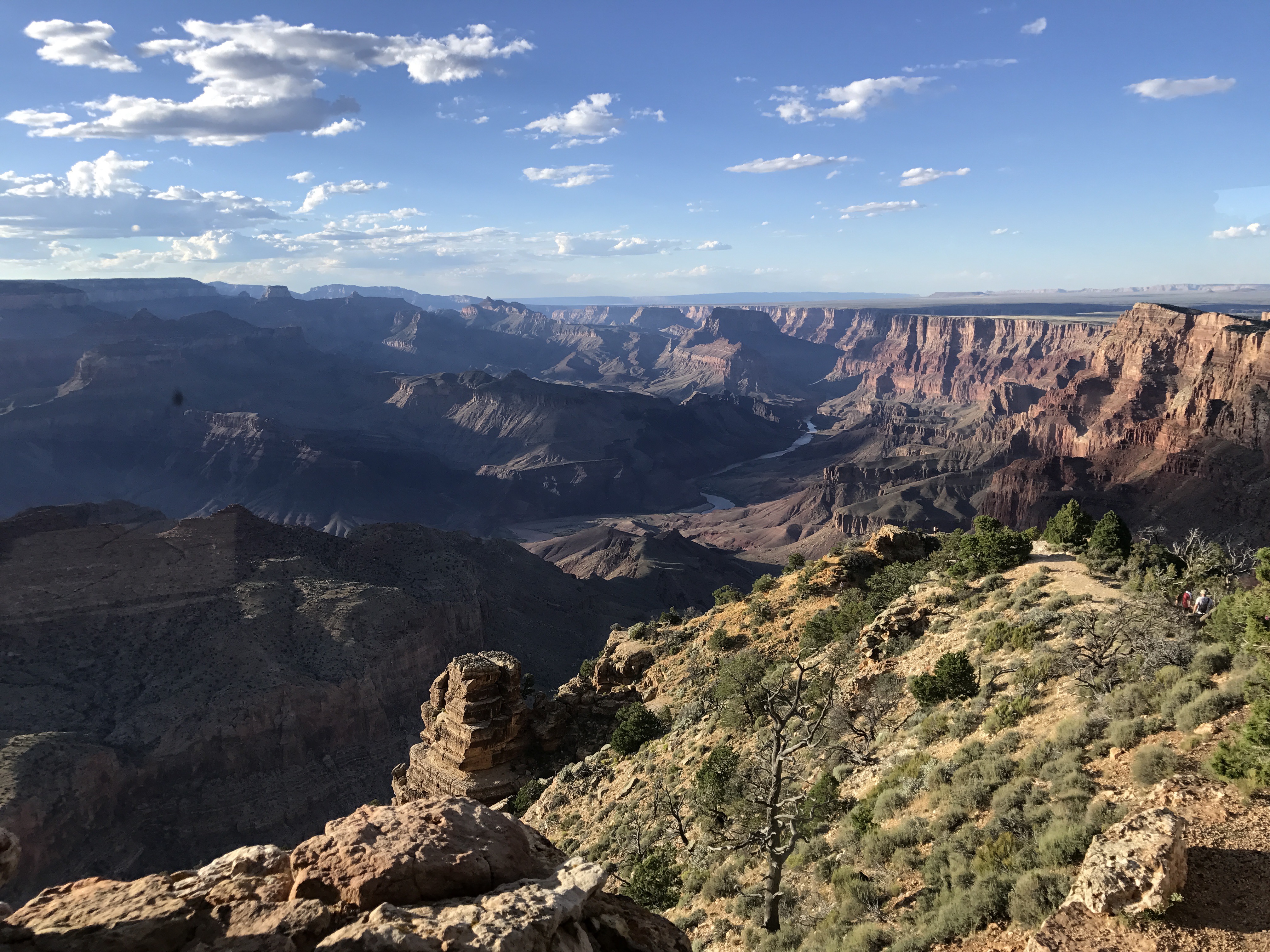
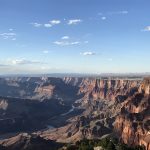
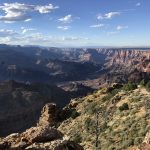
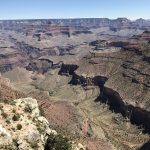
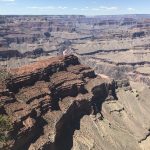
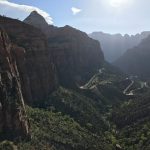
Every day or two we would be greeted by ever more stunning views as we toured around the border between Utah and Arizona, from Zion National Park and Bryce Canyon National Park to Lake Powell, Horseshoe Bend, Antelope Canyon in the Navajo Nation Territories and finally the Grand Canyon before heading back to Los Angeles via Las Vegas.

America’s National Parks

Think what you like about the USA, I mean, there are plenty of things that aren’t appealing, like.. Pop Tarts – they’re disgusting aren’t they? Say what you like about the country, you can’t deny that it has some truly breathtaking spots of natural beauty.

Thankfully, most of these places were protected by the National Parks project, which was initially set up at the end of the 19th century and then was fully put into force in the early 20th century by the president at the time, Theodore “Teddy” Roosevelt.

The whole area that we were driving around and visiting basically features canyons and cliffs that form what is known as The Grand Staircase. Imagine a big staircase made out of rock, but it’s all spread out over hundreds of miles. In different locations you can see different layers of rock that are exposed because the rock layers have been uplifted, tilted, and eroded. It’s a series of colourful cliffs stretching between Bryce Canyon (in the north of that area) and the Grand Canyon (in the south, basically). Zion is sort of between the two.

The bottom layer of rock at Bryce Canyon is the top layer at Zion, and the bottom layer at Zion is the top layer at the Grand Canyon. So, in terms of the staircase, Bryce is at the top, then Zion in the middle of the staircase and the Grand Canyon at the bottom.

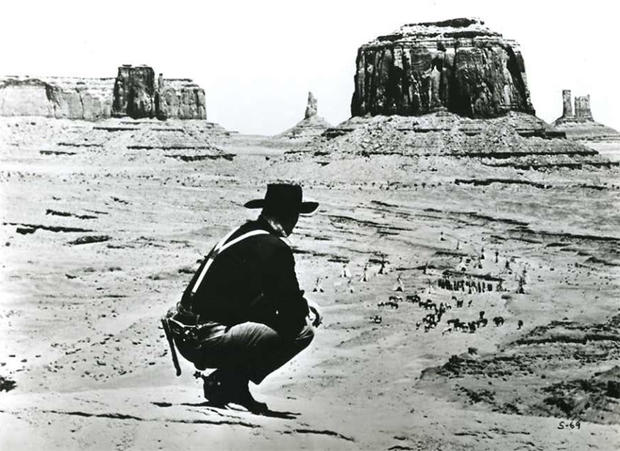
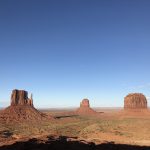
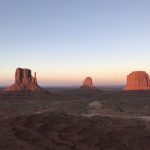
If you were a massive giant, you could start at the riverbed at the bottom of the Grand Canyon and go up the stair case (some of the stairs are huge plateaus of course and moving across them you can visit places like Lake Powell or Monument Valley, where there are eroded tables, platforms and columns that stick up all around you) and walk up the cliffs, the stairs, and pass through Zion and keep going until you get up to Bryce Canyon at the top. On your walk you would ascend through about 40 identified layers of rock, and about 2000 million years of history. The oldest sedimentary rock at the bottom of the staircase is 2 billion years old. The rock at the top is about 40-30 million years old.

So, driving around the area we were going up and then back down this staircase, travelling through hundreds and hundreds and million of years worth of time as well as hundreds of miles of distance.

This is one of the only places in the world where this much of the earth’s history is exposed to us, and because of that – because so much old rock is exposed in this area, it is one of the most studied geological areas in the world.

These 40 layers of rock are full of evidence that show us what happened in this area in the past, and that allow us to understand a lot about what happened in history – way before humans even existed. The story is told in the rock, including fossils of many dinosaurs.

As well as that, it’s just amazing to look at. The layers of rock have different colours. Some are rust coloured, some yellow, some pink, some white, some grey, some a deep blood red. The different colours are caused by different chemical reactions in the rock – things like the presence of iron which oxidises and changes colour – a bit like the way an old bicycle will go rusty as the metal reacts with the water.

So our entry point into this grand staircase was Zion National Park. We spent a day and a half there and did a fairly easy hike up the side of the canyon to a viewpoint. We were very careful and cautious of course, this time.

Then we drove in a northerly direction to BRYCE CANYON.

Bryce Canyon

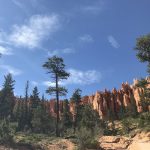
Bryce Canyon is the highest point in the grand staircase. We drove up towards an elevated point on one side of the canyon. The usual thing to do there is to drive to the end of this point and then drive back, stopping at certain viewing points on the way.

So at Rainbow point we stopped the car and walked to the edge, where there are barriers and information points and so on.

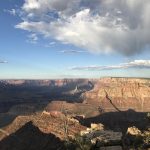
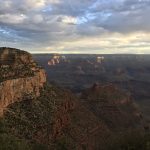
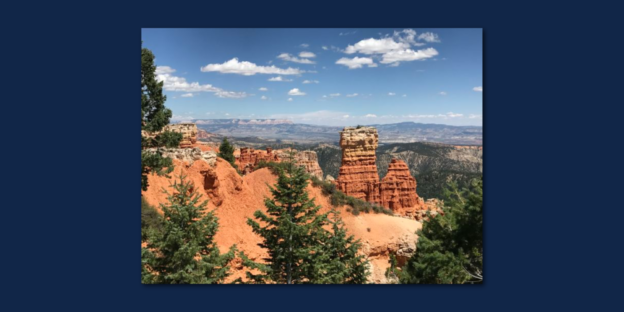
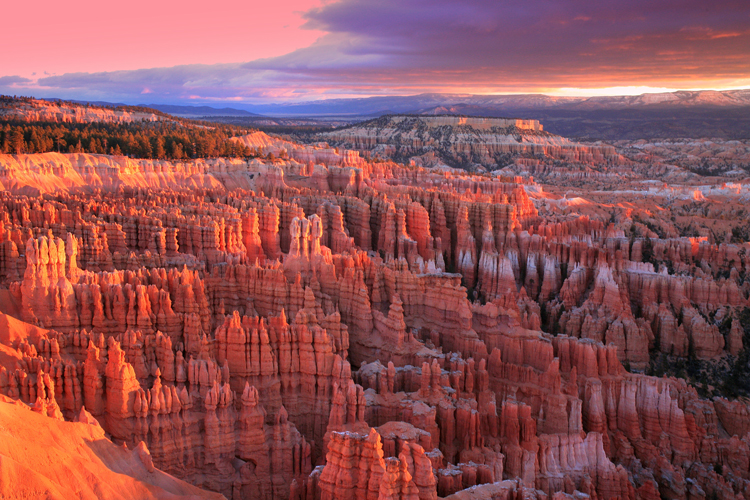
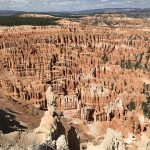
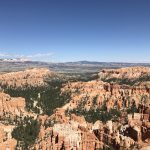
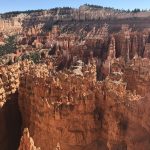
Imagine standing on the edge of some cliffs and in front of you there’s a huge canyon – a massive area where the ground goes down quite sharply and there are thousands of bits of rock that stick up on top of huge blocks of rock of different colours and they look a bit like huge statues and there are river beds in there at the bottom and trees growing up from the bottom, and big bits of rock that stretch out into the canyon, and way way over on the other side (almost on the horizon) is the other side of the canyon. So you’re standing on the edge of a plateau, it all goes down, and then the plateau continues again way over on the other side. You can see the layers of rock – all different colours.

Now, this is all caused by erosion and the rocks that stick up in the canyon are all really weird shapes. It’s really stunning and weird too. It’s like an alien landscape. I’ll give you some more details in a moment.

At rainbow point we saw a guide explaining all of it and how it fits into the grand staircase.

He was doing a great job of telling the massive story of the place and enthusiastically putting himself into it.

This helped us understand a lot of the geology of the whole area.

I’ve already told you some stuff about the grand staircase, and it’s pretty difficult to explain but I’d like to try and give you some more details of the story of how all of this happened. This is what I understood from the ranger – this guy employed by the park, wearing a green outfit and a wide brimmed hat.

So this is ancient history and geology.

By geology I mean the study of the Earth’s structure, surface, and origins.

So, we’ve had space, we’ve had belief systems, and now the history of the earth itself. I told you I had a lot of stuff to get off my chest in this series of podcasts!

I’m talking about the history of the earth.

A Short History of the Earth (according to the Big Bang Theory)

How about we start right at the start? The Big Bang theory – not the TV show, but the account of how the universe began, which is based on a lot of study and a lot of analysis of evidence and understandings of the way the universe works – the collaborative work of many people over many years, people analysing the evidence, creating hypotheses, testing them, coming up with theories that get adapted and improved and disproved and further changed. The big bang theory is the best we have at the moment.

So, at one point the universe was all compressed into a space about the size of a pin head. All matter that exists now in the universe, all of it was at one point contained in a tiny little spot, a singularity. An extremely high density and high temperature singularity.

Physicists are undecided whether this means the universe began from a singularity, or that current knowledge is insufficient to describe the universe at that time… Detailed measurements of the expansion rate of the universe place the Big Bang at around 13.8 billion years ago, which is thus considered the age of the universe. After the initial expansion, the universe cooled sufficiently to allow the formation of subatomic particles, and later simple atoms. Giant clouds of these primordial elements later coalesced through gravity in halos of dark matter, eventually forming the stars and galaxies visible today.(Wikipedia)

This is just what we know today. There’s still a lot we don’t know – like exactly what ‘dark matter’ is. But that’s the point of science – we don’t have to be able to explain it all at once, we’re working it out bit by bit.

So after all that matter came together through gravity and the stars were created (over an incredibly long period of time by the way, and it’s still going on now) earth also formed from matter that was basically left over from when the sun was created – we’re talking about cloud and dust particles containing all the elements that make up the building blocks of everything on earth.

This stuff coalesced into this ball due to the force of gravity. In the early days the earth was very hot and was basically molten lava, and was hit by lots of other lumps of rock that were still flying around the galaxy. A lot of this rock, left over from the sun’s creation still exists in space  and is orbiting our sun too. Most of it is in the asteroid belt which is  located between the orbits of Mars and Jupiter.  There are also loads of asteroids which are not in this belt, just flying around our solar system on different orbits around the sun. We’re pretty sure that one or two of them hit the earth in the past and probably wiped out the dinosaurs – because if a huge asteroid hits the earth it creates an explosion which is like loads of nuclear bombs all going off at the same time, and that tends to make life on earth a little bit tricky, like for example when the sun gets blocked out by dust or when the atmosphere is filled with poisonous gas from the explosion.

One might hit us one day too, which would be pretty bad news as I’m sure you can imagine, but if we’re clever we’d be able to prevent it by sending Bruce Willis up there to blow it up before it hits us.

After earth cooled down, the molten rock on the surface cooled down to become the earth’s crust. THat’s a bit like if you leave some soup out for ages and the top becomes a thick layer and if you leave it out for ages (like you go away travelling for a few months and don’t do the washing up before you leave) eventually it’ll dry out and form a hard crust.

So the surface of the earth was this crust, made up of a number of different plates. It’s not all one single crust, because underneath it’s all still molten rock – you know, because as you go deeper underground eventually it get really hot and ooh magma! Lava is the stuff that spews out of the top of volcanoes. It’s amazing but it’s not very friendly.

So the earth’s crust is made up of a number of plates that sit on top of this magma. On top of these plates you have land with different features. Some of it is covered in grass, some of it is covered in water, some of it is just rock, etc etc.

Different types of rock

Igneous rock – this is the stuff that is formed when magma cools down. Sometimes it cools down when it’s in the ground and sometimes it cools down on the surface after being spewed out of volcanoes as lava.

Metamorphic rock – this is the stuff that is formed when magma cools under the ground but in certain conditions, like when there’s massive amounts of pressure or heat and the rock gets compressed and it changes quite drastically – for example it becomes crystal or the rock has layers of crystal in it. It’s often extremely hard rock and it can be shiny, or striped with layers of crystal in it. E.g. diamond is metamorphic rock because it has changed from pure carbon (or coal – a sedimentary rock) into diamond.

Sedimentary rock – this is the stuff that usually forms on or very near the surface. It’s made of particles of sand, shells, pebbles (little stones) and other fragments of material. Imagine you have a fish bowl with some fish in it and you go away travelling for 3 months and you forget about it. Eventually the water in that fish bowl will get dirty.

First there are the little stones at the bottom, then there might be dust from the room that lands in the water and of course there’s the fish poo and the green algae that might build up inside there and the water gets cloudy and dirty and eventually the fish will probably die (I know it’s a sad story) and over time all that stuff in the water will settle on the bottom of the tank – that’s sediment. Imagine that over millions of years. Now imagine it’s the ocean which is washing over the surface of rocks and eroding them, creating more sand, and also think of all the sediment – sand and little stones that get washed into the ocean from rivers. All that stuff is sediment and it finds its way to the bottom of the ocean and gets compressed.

Oceans or lakes don’t last forever and they sometimes dry out, exposing all the compressed sedimentary rock. That might get blown by winds into big sand dunes, which then eventually compress, or at least the sand that was once at the bottom of the ocean or lake dries out and over time it compresses more until it becomes rock.

This is not just useful for describing types of rock. The word ‘sediment’ is used in other situations too, like we get sediment at the bottom of a bottle of wine sometimes, or in fruit juices – any stuff that has settled at the bottom of liquid.

Also ‘metamorphic’ is in the same word family as ‘metamorphosis’ – the process of when something changes into something else.

e.g.

the metamorphosis of a caterpillar into a butterfly
She had undergone an amazing metamorphosis from awkward schoolgirl to beautiful woman.

(Oxford dictionary)

Igneous – not useful outside this subject. It’s just for rocks, except that it’s formed from the latin ‘ignus’ which means ‘fire’ and from ‘ignus’ you also get the English word ‘ignite’ and that’s a good word. It means ‘start to burn’ or ‘make something start to burn’.

E.g. “Gas ignites very easily”, or “the hot weather made it much more likely that the forest would ignite.”

It can also be used as a metaphor, especially with words like “controversy” or “debate”.

“Donald Trump’s words ignited controversy for the 2nd time this week…”

So that’s igneous rock, metamorphic rock and sedimentary.

Terrible Jokes

I’ve got a (terrible) pun for you.

Sherlock Holmes and Dr Watson are on a geology field trip, walking near a lake. Watson spots something interesting and says “Holmes, what kind of rock is this?”

Holmes says “Sedimentary, my dear Watson”.

Rubbish isn’t it. Obviously, it’s because Holmes is famous for saying “Elementary my dear Watson”. It’s a pretty easy joke to adapt.

Holmes and Watson are wondering through a weird alien land where everything is made of chocolate. Watson says “what’s this massive tree with red and yellow sweets on it?”

“M&M tree, my dear Watson.”

I challenge you to come up with a pun for igneous and metamorphic rock…

Anyway…

How do you know what kind of rock is which?

If it’s got little bubbles in it? Igneous

Got some little crystals in it, or some little bits seem shiny? Igneous (e.g. granite – that hard grey rock which is used to build really good quality things – like a really solid good quality wall outside a bank, or an impressive modern monument in the centre of town)

Got some lines or bands in it (not musical bands, unless it’s Dinosaur Jnr, lol) It’s igneous

Has it got fossils in it? Dead animals that got compressed, preserved and petrified? Sedimentary

Sand or pebbles in it? It’s sedimentary

Breaks apart fairly easily? It’s sedimentary

Looks like it was formed in layers? It’s sedimentary

Glassy surface and sharp edges, like flint? ? It’s metamorphic

A big beautiful crystal? It’s metamorphic

Diamonds? It’s mine. It’s fine, just give it to me.

Continuing the story…

The atmosphere in earth is made from gasses that were released from the bubbling cauldron of magma under the surface and which were ejected into the air through volcanoes. All that gas created our atmosphere and we’re lucky in that this combination of gasses is just right for sustaining life.

So all the land and sea and all that stuff is on the surface of these tectonic plates. All the land masses on the top which are exposed above the water layer – these are the continents, countries, islands etc. Now, the tectonic plates under the ground move around all the time – very slowly from our perspective, but they do move over time.

Let’s say that at one point the countries we all live on were in different positions, because the tectonic plates that underpin everything on earth were in different places.

The land on top of those plates is made up of the outpourings of volcanoes and also layers of sedimentary rock which is the result of erosion of different kinds. Rock that is spewed out of volcanoes gets eroded over time and the sediments are carried into the ocean or lakes from glaciers at the top of mountains down through rivers and out into the sea.

The sediments then become sand at the bottom of oceans and lakes.

There was a big ocean over these parts of the USA many many millions of years ago. That ocean dried up in the sun and revealed the sediments at the bottom.

The part of the USA where Bryce Canyon is located now has occupied different points of latitude over the years. Basically, that area in Arizona used to be further south. At one point it was equatorial (on the equator), and as the tectonic plates shifted the continent moved and it went north and became sub-equatorial, which is that part just above or below the equator (above in this case) that tends to be super hot and dry – deserts like the Sahara are sub-equatorial.

As this ocean dried up and the sandy sediment was exposed to the sun in sub-equatorial conditions like that it became a huge desert covered with sand dunes being blown around by the wind.

Those dunes built up and up and over millions of years the pressure of their own weight solidified them into sandstone rock.

The heat of the sun baked it and traces of iron in the stone reacted with moisture causing this rust coloured rock you can see everywhere (like the way rust appears on an old bike).

So, imagine a huge plateau of sandstone rock, baked by the sun. A massive plateau that covers an area of hundreds of square kilometres.

I’m sorry I’m not sure of the time frame here but we’re talking about stuff that happened hundreds of millions of years ago and changes that occurred over that period, give or take a few hundred million years. I can’t even imagine that much time, but it’s a really really long time. Even longer than this episode of the podcast.

By the way, here I am talking to you about geology. I’m just an English teacher remember. There might be some of you out there who are actual geologists and I don’t want you to feel like I’m, what, teaching my grandmother to suck eggs (that’s an old expression which means – teaching something to someone who already knows it).

Anyway, I’m just trying to give some context. About 3.5 billion years of context. Ha!

This is stuff that I read about when I was there because it helped us to understand the significance of the place that we were visiting.

So, tectonic plates are moving under the surface all the time. Sometimes the plates push against each other or rub over each other, causing the land on the surface to rise.

That activity creates mountain ranges and sometimes volcanoes. The mountain ranges then eventually get glaciers forming on top as moisture collects there, it snows and the snow gets ever more compact and turns into lakes of ice – glaciers. Those glaciers slowly move down the mountain because of gravity and they scrape and crush all the rock from the mountains, carving out valleys as they go. As the glaciers get lower and they melt their rivers carry stones and rock sediments out to sea.

These are the sediments needed to make these big sandstone plateaus which are exposed when an ocean dries up. In this case these mountains are the rocky mountains to the north – that’s where all the sediment originally came from.

These tectonic plates move everything on the surface around over millions of years so that Bryce Canyon and the whole Grand Staircase has kind of shifted north from an equatorial zone, to a sub-equatorial zone to its present location.

Also volcanic activity underground can push the land up – not just forming mountains, but whole areas can be lifted up. You might end up with a whole plateau rising up over many years, turning it into high ground – not a sudden mountain, but a gradual swell over hundreds of miles, so that what was once the bed of the ocean becomes a huge plateau that’s at quite a high altitude.

That’s what happened at Bryce and the surrounding areas.

The whole thing that used to be this ocean floor and a lake basin, got pushed upwards to form this high plateau of sandstone. A lot of it is also limestone from deposits of things like shells or animal matter that was in the water. There are loads of fossils in this area and you can track the evolution of animals by comparing evidence from each stage in the staircase. It’s like a time ladder or something – it tells you the story of life.

So this sandstone with a limestone layer on top becomes a high plateau. Like I said before, remember, if you stand on the edge of Bryce Canyon (which is not actually a canyon because there’s no significant river at the bottom – unlike the Grand Canyon which has the Colorado river running through it) If you stand on the edge, like my wife and I did, you can see in the distance, on the horizon the other part of this plateau, but in the middle now there’s a huge series of canyons with massive bits of rock that stick up in ridges, and on the top of each ridge there are tall towers of rock in all sorts of weird shapes, and they have different lines of colour depending on what layer in the staircase they are from.

This whole place was formed from that plateau.

Here’s how that happened.

Basically, cracks formed in the top of the plateau as it rose. A bit like when cracks appear on the top of a cake as it rises.

Over millions of years these cracks were subject to erosion – the movement of things like water or ice and maybe wind.

At the top of the plateau moisture freezes in winter to become ice. The ice sits like a layer on top of everything. During the day it melts a bit and then flows into the cracks. At night it freezes again, and we know that water expands when it freezes (imagine leaving a bottle of beer or wine in the freezer – it cracks the glass because the liquid has expanded as it froze) so as the water trickles into existing cracks in the rock and then freezes again and expands it cracks the rock.

The water/ice works its way down, cracking the rock as it goes. Some of the rock is harder than other parts so not all of it gets cracked – not all of it disintegrates. So these creepy looking towers are left behind by the erosion of the ice and water.

It’s like the ice, the water and just the passage of time have worked on these towers of rock, sculpting them into different shapes that stand like statues above the open space of the canyon below them.

Below that the trickling water and wind smooth out these gullies and creek beds that go down and down into the canyon.

So you can walk down into these little riverbeds, down the sides of the canyon and walk around looking up at the towers of rock.

You commune with the rock formations.

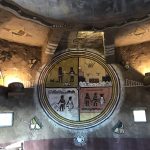
To the native Americans who used to live here, these places were very sacred and special and they believed that spirits lived in the rocks. In fact they saw the faces of loads of different spirits and gods in the stones when they looked at them.

As you see all these abstract shapes your mind attempts to make sense of it and it’s easy to see  faces, animals and even little stories in the formations.  You know when you see big clouds in the sky and sometimes they look like things – like, “that one looks like a dog!” or “that one looks like a face” or “That one looks like Donald Trump and Kim Jong Un kissing” or something, there are hundreds of faces in the rocks. It’s stunning to look at.

Actually, ‘seeing faces or shapes in rocks or clouds’ is a recognised phenomenon called

Pareidolia (/pærɪˈdliə) is a psychological phenomenon in which the mind responds to a stimulus, usually an image or a sound, by perceiving a familiar pattern where none exists (e.g., in random data). 

Common examples are perceived images of animals, faces, or objects in cloud formations, the Man in the Moon, the Moon rabbithidden messages within recorded music played in reverse or at higher- or lower-than-normal speeds, and hearing indistinct voices in random noise such as that produced by air conditioners or fans.[1] (Wikipedia)

Basically, when your mind is presented with a stimulus – like a pattern or just random sounds, it tries to make sense of it and often will kind of read the stimulus as something familiar. This probably accounts for the way people can see ghosts in swirling mist, or they can see images of Jesus in toast or something. Either that or Jesus is trying to tell us something and putting his face in toast is the only way he can do it.

These towers in Bryce Canyon are called “Hoodoos” (sounds a bit like voodoo doesn’t it) and some of them have very human forms. They look a bit like old Roman statues, worn away be the rain. Or they look like architecture by Gaudi the guy who designed various buildings in Barcelona, like the Sagrada Familia cathedral.

In any case they look like spooky, ghostly statues standing in these huge auditoriums made from the erosion of rocks over millions of years.

It’s incredible and a lot more powerful than any of the art we saw in Los Angeles.

Genuinely breathtaking stuff.

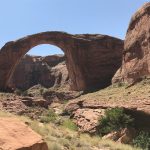
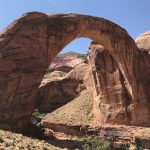
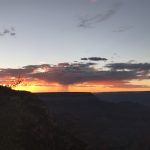
After an afternoon of being wowed by the spectacle of Hoodoos and a big naturally occurring bridge in the rock we did a moderate hike into the canyon. This was late afternoon so the whole place got flooded with this incredible orangey pinkish rust coloured light. It was absolutely amazing.

A MOUNTAIN RANCH

Buffalo in the field (though we can’t see them), chickens running around.

Cows and horses.

Slept in a little wooden cabin.

Absolutely insane stars in the night sky. The milky way is incredible. No light pollution. It’s like someone has poured milk into black coffee.

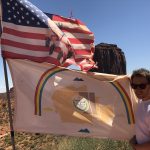
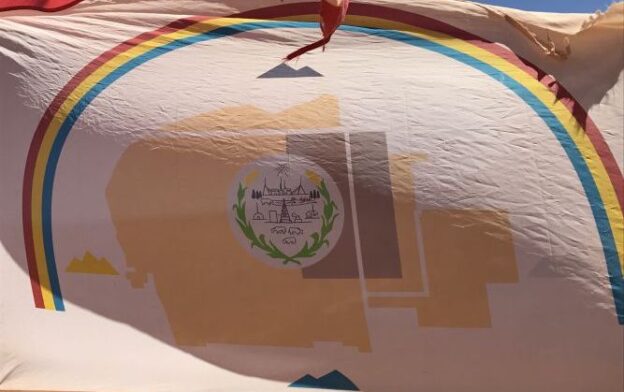
At this point we enter the Navajo Nation.

To be continued!

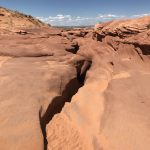
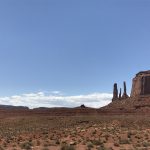
Photos

478. Holiday Diary (Part 5) An Encounter with The Church of Scientology

More thoughts and comments inspired by things that happened during my recent holiday. In this one I’m discussing stories about the Church of Scientology and the claims that it is a cult. Listen to find out what happened in this part of my trip. Check the episode page for the vocabulary.


Small Donate Button[DOWNLOAD]

This episode includes information and claims about Scientology which I saw and heard in various interviews and documentaries. It should be noted that the Church of Scientology disagrees with those claims. They state that critics of the church are seeking to make money or gain attention from their claims and their associations. I am presenting the information in this episode because I believe it makes an interesting episode of my podcast and is therefore an opportunity for my listeners to improve their English.


Vocabulary

Here is a list of vocabulary that you can learn from this episode. (definitions are in brackets)

  • a modern kind of dogma (a belief system that is imposed on people, e.g. through rules or writings which tell you what to do, or not to do)
  • a self-help system (a set of practices that can help people deal with their problems)
  • theology (a set of religious beliefs)
  • to ascend the hierarchy of the church (to rise up through the different levels)
  • the principles that underpin the religion (support, are the foundations of)
  • these guys were checking us out (looking at us, observing us)
  • minding their own business (not paying attention to other people or things, just focusing on their own things)
  • it’s not subject to scrutiny because Scientology is officially recognised as a religion (careful observation)
  • hostile behaviour (showing strong disagreement, sometimes aggressively)
  • to be shunned by your family, or shunned by the church (rejected, ostracised, ignored)
  • he was suffering from mental illness at the time – he was having a bipolar episode (a period of mental illness symptomatic of bipolar disorder, e.g. a period of mania or psychosis)
  • conventional psychology, psychiatry or psychotherapeutic practices (psychology = the scientific study of the mind and its processes / psychiatry = medicine and medical care for mental illness / psychotherapy or psychotherapeutic practices = the use of psychological practices and not drugs in the treatment of mental illness)
  • psychosomatic illness (physical illness caused by the mind, not by the body)
  • a placebo (a ‘fake drug’, a substance with no effect which is used as part of the testing process for medicines)
  • the placebo effect (the fact that a person’s health might show improvement after taking a placebo because they believe it to be a genuine drug, a kind of psychosomatic effect)
  • Freud’s ideas about the ego, super-ego and the id (super-ego = the part of your mind which understands right and wrong and imposes society’s rules on yourself / the id = the primitive instincts which exist in your unconscious mind / the ego = the conscious mind, aware of itself, in balance or conflict between the motivations of the super-ego and id / all concepts developed by Sigmund Freud)
  • It’s a doctrine written by one man (a set of religious beliefs)
  • L Ron Hubbard – the founder (the person who set up or founded something)
  • they rejected it as pseudoscience (fake science)
  • Some people have called him a visionary (someone with an original and inspiring vision of something new), other people have called him an outright fraud (an open or obvious liar and deceiver)
  • spirits that were sent to earth by a celestial being (a person, creature or life-form from outer-space)
  • was he making it all up (creating it) on purpose and developing a sort of cult of personality (a small and strange group devoted to one individual) around himself as a narcissistic power trip? (narcissistic = self obsessed and in love with himself / power trip = an obsessive or extreme use or abuse of power)
  • someone with bipolar disorder (a mental illness, previously called ‘manic depression) suffering a manic episode 
  • the guy was crawling the walls (going crazy). He was delusional (not in touch with reality), hallucinating (seeing things that aren’t there), in the grips of (being severely affected by) a full-on (intense) bipolar manic episode
  • a device for displaying and/or recording the electrodermal activity (electrical activity on the skin) (EDA) of a human being
  • the Church of Scientology now publishes disclaimers in its books and publications declaring that the E-meter “by itself does nothing” and that it is used specifically for spiritual purposes (a statement that they are not responsible for something)
  • a small arm, like on a watch, that moves or twitches sometimes because of stimulus from the metal tubes (moves quickly or suddenly)
  • described by some critics as a typical example of a “Bait and switch fraud” (a type of deception in which someone thinks they’re buying one thing but it is replaced for something else)
  • a term used usually to describe fraud in a retail context (relating to shops)
  • The court ruling was upheld ( ruling = a decision by a court or judge  / upheld = was not changed or overturned, was maintained)
  • an appeal in a court (a request for another court decision or judgement)
  • The fraud conviction (when someone is found guilty of a crime in court) criminal was upheld in the appeal court

Documentaries

Leah Remini: Scientology and the Aftermath

“Going Clear: The Prison of Belief”

“Louis Theroux: My Scientology Movie”

https://www.youtube.com/watch?v=sNAYFB1YFmA

Paul Haggis, Oscar winning Canadian film maker who used to be in the church but left. Also, the story of ‘Xenu’ (from Going Clear)

https://www.youtube.com/watch?v=jHej53puqK0

Longer videos – full conversations about scientology

Louis Theroux – full conversation on Joe Rogan’s podcast

https://www.youtube.com/watch?v=kqRP7yJfgog

Leah Rimini – full conversation on Joe Rogan’s podcast

Find out what happened two years ago when I first visited the Scientology Centre in Los Angeles

292. California Road Trip (Part 5) Scientology / Meeting a Bear in Yosemite / The Trek Gone Wrong! 

472. Andy Johnson at The London School (Part 2) Why Andy runs marathons

Talking to Andy about why he runs marathons, including vocabulary relating to doing exercise, health, fitness, technique, injuries and medical care.

[DOWNLOAD]

Intro Transcript

Here’s the next part of my conversation with Andy Johnson, recorded at The London School of English a few days ago.

Andy is an English teacher, a father of 2 kids, and also a regular runner. He’s done at least one marathon and a few half marathons, and I thought since many of you listening to this podcast will also be runners (in fact some people will be running right now while listening to this) that it might be interesting to hear Andy talking about his reasons for running, the way he does it, the benefits, the difficulties and all the rest of it. So here’s a conversation about running.

If you’re not into running I would still recommend that you listen to this. You might be surprised at how personal it gets when Andy explains his reasons for training for the London marathon 10 years ago. It turns out that running has special significance for Andy and that running the London marathon was a key moment in his life as it marked a significant milestone for him – and running acts as a regular reminder of a particularly difficult experience Andy had when he was younger.

So, this episode is about running, but it’s also about much more than that. I’d like to thank Andy again for taking part in another episode of the podcast and for sharing so much of his story.

Vocab hunters: Watch out for vocabulary relating to doing exercise, health, fitness, technique, injuries and medical care.

So, without further ado you can now listen to our conversation about running.


Outtro Transcript

I just want to thank Andy again for coming on the podcast and telling us about his story. It was a very interesting conversation and I think the closest we’ve come to having tears on the podcast – it was a moving story but no tears this time! I wonder if you held it together out there in podcast land, or did you start welling up at any moment?

Don’t forget that Andy would like you to take his survey about self-directed learning. You can find a link to that on the page for this episode. Andy just wants to know about how you learn English on your own, outside of the classroom environment, and that includes how you use LEP to help with your English.

TAKE ANDY’S SURVEY ABOUT LEARNING

Click the link, the questionnaire will take a couple of minutes and you’ll help Andy with research for his next IATEFL conference talk.

That’s it for this episode. Watch out for some website-only content coming soon. Subscribe to the mailing list to get informed when that is released.

I hope you are continuing to have a good August, if indeed it is August as you listen to this. I’m still on holiday, relaxing and having a lovely time, I hope – I’m actually recording this before I went on holiday, so this is a very weird time situation. Which tense should I be using here, because I’m actually recording right now, in the past, but as I’m talking it’s the future, so my present is your past and your present is my future, so that’s the present past perfect future continuous or something. I am will have been being having a great time and I will have been had been hoped that you will be being having a wonderful time too, in the future.

Thanks for listening to this episode and I’ll speak to you again soon. Bye!

455. David Crystal Interview (Part 2) Questions from Listeners

Talking to the world’s top writer and lecturer on the English language, Professor David Crystal. In this episode, David answers questions from listeners.

[DOWNLOAD]

Episode Introduction

Here’s part two of my interview with the famous linguist Professor David Crystal.

In this one I asked him some questions from my listeners. I didn’t get a chance to ask all the questions I received, so if your question isn’t included then I do apologise. I left out some questions because I think he had already answered them in one way or another, or because we just didn’t have time.

But the questions I did ask him covered quite a wide range of different topics, including the way foreign words get absorbed into English, predictions for the future of English, how to deal with the workload of studying linguistics at university, the nature of English syntax, how languages affect the way we think and see the world, why British people use indirect and polite language, the influence of AI on language learning, the effects of Brexit on English in the world, whether it is appropriate to speak like Ali G, some study tips and some comments on the English of Donald Trump and Barack Obama.

Don’t forget to check out http://www.davidcrystal.com where you can see a reading list of David’s books, read his blog, see videos of him in action and even contact him by email.

I would just like to thank David for his time again, and I hope all of you out there in podcast land enjoy listening to our conversation.


QUESTIONS FROM LISTENERS

Influence of foreign languages on English

Hamid Naveed (Pakistan)
I’m an English language teacher. My question for David Crystal is: www.oald8.com (The Oxford Learners’ Dictionary) has a lot of new words from Urdu such as ‘ badam’ ‘ chai’ ‘ aloo’ ‘ bagh’ ‘ dharna’ and many more. If English keeps on taking words from Urdu or any other language, then what will be the future of English? I mean English will no longer be English. What is your take on this ? Thanks.

The Future

Jilmani
My question for David Crystal is what is the future of the English language? Will it be the same or will it be a little bit different since we know that english has changed over the decades?
How do you think English will develop over the next few years?
How will non-native speakers be part of this?

Tips for students of Linguistics

Jairo Trujillo García (from Tenerife)
I am studying an English and Spanish linguistics ( and philology ) degree , and even though I like it , it can be really hard at times ;
What recommendations would you give me to make the burden of vast information more manageable in the time allotted ?

English Syntax

Cat (Originally from Russia, moved to Germany)
I’m very confused about English syntax. I spent many years studying German grammar and syntax but it is of little use for learning English. German and English appear so similar (especially the words) and yet so different (for example, the sentence structure) at the same time. I just feel that something is completely different, but cannot point out the difference. Could you please tell us a little bit about the sentence structure and logic (the syntax) of English? (Perhaps you could compare it to the syntax of other languages)
As I don’t like doing grammar exercises at all (I’m sorry!), I was wondering, are there some more enjoyable and fun ways to learn English syntax? Maybe some shortcuts and mnemonics what you can offer us? Also what about the punctuation rules between the main and sub clauses? They can be a real pain in the neck for our transcribers. Thank you!
Cat

Language and Psychology

Wesley
I have several questions for Prof. David Crystal. The first is whether people who speak different languages think differently, I mean, if they understand and perceive the world in different ways. For example, I’ve heard that while in some places people perceive two colours and give each of them a name, somewhere else there might be others who perceive those same two colours as only one because they have only one name for them. Another example I have in mind is how we position adjectives in a sentence in English compared to in Romance languages. In English, adjectives usually come before the noun they describe. Romance languages, on the other hand, tend to place adjectives after the noun. So in English we first refer to the characteristics of something before we say what it is, and in Romance languages we start with a noun and then describe it. Does it affect, in any way, the way we think?
If we learn a second language, do we start to think more like the native speakers of that language?
Thank you very much!
Wesley

Language and culture

Mayumi (Japan)
Why do British people tend to use indirect language, hesitate to say “no” and also frequently say “sorry” in various situations? Is there any story from linguistic history?
In my Japanese culture, as far as I know we also find similar tendencies because we’ve lived in this tiny island and if people said whatever they wanted, behaved without caring about other people in this small area, or even argued with each other, they could possibly end up being expelled from this small society. This can be one of the reasons why we have these tendencies as well. This is something stuck in my mind for ages from the university class.
Did British people had similar experience when they established their culture or could it be an absolutely different story?
Cheers!

The Influence of Technology

Antonio (Spain)
My question for David Crystal: Apple, Google, Microsoft and other companies are working on translators in real time based on AI. So we can speak in Spanish with a French person and he will hear French while he speaks in French and we hear Spanish.
Skype has this option for 8 languages.
What do you think about about the AI related to language learning?
Will AI replace our need to learn other languages?

Advice for learners of English

Jack – Origin Unknown
(I don’t know why, but Jack always writes comments on my site in an Ali G dialect. I actually think it’s evidence of how good he is at English, because he can clearly write in normal style, but he chooses to adopt this specific form of English – if he can do that it shows great ability to shift between different registers and dialects – if he can break the rules I presume it means he knows that the rules are there in the first place – for some reason he chooses to write comments in this lingo – are you ready?)
I is not that learned but I also has got questions for Professor David Crystal.
Dear Sir,
Booyakasha, It is a well big honour to have you ere on da podcast, you is da only person me respects in the field of linguists after Norman Chomp The Sky and Stephen The Crasher (Naom Chomsky and Stephen Krashen).
What advice would you give to an English language learner to improve his / her language ability? Should the student focus on form (grammar, vocab etc) or should the student focus on meaning and let the subconscious do the rest?
Well that`s me questions there Big man. I has to say you is the shining crystal in the field of linguistics.
Big up yourself Prof Crystal
Respek, Westside.


Outtro

There was so much interesting content in what David Crystal said in this conversation and so much to take from it. These two episodes are really worth listening to several times so that you can really get a grip on what he said and really absorb it all.

If you sent in a question that I didn’t ask, then I’m sorry about that.
I should do follow-up episode in which I consolidate a lot of what DC said, and highlight various things that you can apply to your whole approach and attitude towards learning English.
Watch out for that.

Check out David’s work at http://www.davidcrystal.com
He’s got books about grammar, spelling, pronunciation, accents, Shakespeare – pretty much any aspect of English – he’s got it and he always writes in a clear and entertaining style.
I’m not selling his work or anything. It’s just genuinely good stuff that I’d like to share with you. This is why I’m so happy to have spoken to DC on the podcast – he’s ace and you should read his work.

Thanks for listening! I invite you to leave your comments below.

453. The 36 Questions that Lead to Love (with Amber & Paul)

Listen to Amber, Paul and me answering questions designed by psychologists to help couples or friends become closer and more intimate.

Small Donate Button
[DOWNLOAD]

Introduction

Hello, welcome back to Luke’s English Podcast, this podcast for learners of English hosted by me Luke Thompson. Hi.

The general idea of this podcast is to help you to improve your English by providing you with content to keep you listening regularly, for longer periods of time, to authentic English as it really is spoken. Sometimes I teach you things on the podcast and other times I play conversations for you to follow, like in this episode.

This episode is entitled 36 Questions that Lead to Love

In this one you’re going to hear the tangential trio of Amber, Paul and me talking about this set of 36 questions, which was compiled by a group of psychologists as part of a study into ‘interpersonal closeness’ or intimacy between people.

Amber first found out about it in a podcast published by the New York Times. Here’s what the NYTimes website says about this study, which is where the 36 questions come from.

The study by the psychologist Arthur Aron (and others) explores whether intimacy between two strangers can be accelerated by having them ask each other a specific series of personal questions. The 36 questions in the study are broken up into three sets, with each set intended to be more probing than the previous one.

The idea is that mutual vulnerability helps to create closeness and intimacy. To quote the study’s authors, “One key pattern associated with the development of a close relationship among peers is sustained, escalating, reciprocal and personal self-disclosure.” Allowing oneself to be vulnerable with another person can be exceedingly difficult, so this exercise forces the issue.

The questions are now used to help build intimacy or personal closeness typically between couples that want to fall in love, but also between anyone looking for ways of finding out more about each other and developing a closer or deeper relationship.

Amber’s going to tell you more about it in a moment.

These 36 questions are available for you to use or read online at NYTimes.com https://www.nytimes.com/interactive/projects/modern-love/36-questions/

In this episode you’ll hear Amber, Paul and me asking each other those questions.

Let’s see what happens.

  • Will the questions bring us closer together?
  • To what extent will the intimacy level rise?
  • Will they make us fall in love with each other?
  • Or will we just learn weird truths about each other that will disturb us, ultimately causing us to drift apart as friends, and then they’ll never appear on this podcast again?
  • Will these questions help you get to know us more?
  • What could be revealed by this set of questions designed by psychologists to become more and more intimate as they go?
  • Is it possible for 3 British friends to take the whole thing seriously enough for the questions to have the intended effect?

Listen on to find out more.

Here we go…


Outtro

OK so if you were counting the questions you’ll see that we skipped some but that’s our choice isn’t it!

I think, on balance, we probably did become slightly closer than before. There were some particularly revealing moments there where Paul was talking about his lack of confidence in social situations, which is a bit of a surprise considering how I often observe him showing no obvious signs of social awkwardness.

Of course, we didn’t take it all completely seriously. For example, you’re supposed to stare into each other’s eyes at the end of the questions, for four minutes, but that wouldn’t have been particularly interesting for you to listen to.

All the questions are available on the NY Times website – here https://www.nytimes.com/interactive/projects/modern-love/36-questions/

So check them out and use them yourselves – either on a date, with friends, or with your language partners or language groups.

They could provide a nice way for you to practise talking about feelings and personal thoughts in English.

And, if you fall in love with someone as a result, that’s a nice bonus isn’t it!?

If you’ve fallen in love with Amber’s voice and you’re wondering when Amber’s podcast is coming out – it’s not ready yet and I will announce it on the podcast as soon as it is online. It takes a long time to get these things ready – getting your head around the technology, writing, recording, working out how to publish, building a website, setting up your podcast feed, getting on the iTunes store and all of that stuff – it takes time and it’s not as easy as you might think, so just hold your horses for a bit, it’s on its way.


418. The Rick Thompson Report: Technology and The Future (January 2017)

Talking to my Dad about developments in technology in the future.

Small Donate Button[DOWNLOAD]

Introduction Transcript

Hello and welcome back to the podcast. Thank you very much for choosing to listen to this episode. How are you? Are you doing alright? Are you ready to listen to some English? You are? Good! (I’m assuming that you all said yes to that) OK, well let’s go then shall we?

It’s the new year period and it’s normal at this time to look forward to the year ahead and to think about the future in general, so in this episode I’m talking to my Dad about technological developments that we can expect to see and read about in the coming months and years and the implications of those developments.

Of course neither of us are experts in this field (my Dad is a broadcast journalist and I’m an English teacher) but we both like to keep fairly up-to-date on technological issues, and since CES happened earlier this month in Las Vegas (that’s the Consumer Electronics Show where all the latest tech products are presented) there’s been quite a lot of coverage in the media about new technology. My Dad has been reading about it, I’ve been reading about it, and maybe you’ve been reading about it so let’s talk about it.

And that’s what we’re going to do and that’s what you’ll hear in this episode – two blokes, talking about technology, including some bits about driverless cars, green energy, drones, virtual reality headsets, augmented reality, and superintelligent computers that talk to you in that slightly threatening and disturbing sounding voice. “Good morning Mr Thompson”, “Did you sleep well?” “I have noticed that you are late with your banking payments Mr Thompson.” “It’s the 3rd time this year.” “I’m afraid I am going to have to turn off your oxygen supply unless you pay the outstanding credit on your account Mr Thompson”.

As I said, we’re not experts but I am sure that I have many tech-minded listeners who know a thing or two about this subject, so if you have anything to add to this conversation then I invite you to write your comments and predictions in the comment section on my website.

From a language point of view, you’re going to hear a lot of terms relating to technology of course, but also the natural conversational English that you’ve come to expect from episodes of this podcast.

If you’re interested in transcribing this episode as part of the Orion Transcription Team, go to my website and click transcripts – the details are all there. The team is growing all the time and it’s a good way to get some intensive language practise while helping to add value to my website by working together with other podcast listeners.

OK, so without any further ado, here’s a conversation with my Dad about technology and the future.

***

Moore’s Law
(n.) Moore’s Law is a computing term which originated in around 1970 based on an observation made in 1965 by Gordon Moore (not Ian Moore), co-founder of Intel. The simplified version of this law states that processor speeds in computers, or overall processing power for computers will double every two years.
So, it starts as 2 and becomes 4, then 8, then 16 – doubling every two years, resulting in massive levels of development at an ever-increasing rate.

Basically: computers are getting more and more advanced all the time and eventually they’ll take over the world and make us their slaves like in The Terminator or The Matrix, maybe.

What is Moore’s Law? Webopedia Definition
www.webopedia.com/TERM/M/Moores_Law.html

How driverless cars could solve our traffic problems

Dad’s footballing predictions (wishful thinking I think!)

Leicester City will win FA Cup
Liverpool will win the Premiership

***

Outtro Script

What do you think? I am sure many of you have interesting things to add to this conversation. There’s bound to be a lot of things that we missed, including things like chatbots, Uberisation and plenty of other things. Get into the comment section to share your thoughts.

Did you understand everything we said in this episode? There’s a lot to be gained from that conversation in terms of vocabulary. Taking part in the transcript collaboration is a way for you to focus on that, but also perhaps I should do another episode just focusing on the language you heard in this one. Just let me know.

Don’t forget to do these things:
Join the mailing list on my website.
Like the Facebook page for LEP and follow me on Twitter. @englishpodcast

If you’re a ninja listener, hiding in the shadows, I invite you to come forward and leave a comment on my website saying who you are and how you found the podcast.

Thanks very much to those of you who have written recently. It’s good to hear from you and to know exactly who is out there downloading my episodes.

Take care and have a good day, etc!

Luke

330. Let’s Play… Grand Theft Auto 5 (and learn some English while doing it)

Hi listeners – this is a multitasking episode in which I record a podcast while doing something else at the same time. In this case I’m playing the classic computer game “Grand Theft Auto 5”. Listen to hear some general discussion of the game, descriptions of what’s happening while playing and some other bits and pieces. Transcripts & Vocabulary Extracts Available. Enjoy :)

Small Donate Button[DOWNLOAD]

Introduction – Men can’t multitask, really?

Here’s another episode in which I talk to you and teach you some English while doing something else at the same time. It’s another multitasking episode. Last time I did this I was cooking dinner while recording the podcast. I’ve done others before in which I was either driving or just walking around somewhere and talking to you at the same time. I’m doing this again today because I hope it will be an interesting episode of the podcast, but also as some sort of ongoing mission to prove that men are in fact able to multitask, unlike the fairly commonly-held view that we actually are not able to do several things at the same time.

I do think men can multi-task, despite the fact that people often say that we can’t. Of course we’re capable of doing two things at the same time. Just think, for example, of David Beckham who must be an expert at multitasking, because not only does he have to play football really well, but he has to look handsome while he’s doing it! Or consider Liam Neeson in the film “Taken” who has to punch people’s teeth down their throat with the edge of his hand, and be a good father at the same time. So, it’s clearly possible.

To be honest, I think that this myth of men not being able to multitask probably comes from the fact that there is one situation in which we definitely can’t do it, and that’s when we try to complete a task while also listening to a wife or girlfriend.

Because when your wife is talking to you, you have to stop everything and focus! We can’t multitask in that situation because if you’re not concentrating and you miss something then it will come back to you later, when she remembers and you forget and then you’re in trouble!

So, “men can’t mulitask” and “men don’t listen” are closely linked to each other I think. It’s not that we can’t multitask, it’s just that listening to you is already a kind of multitasking – because not only do we have to understand what you’re saying, we also have to identify important bits of information which might get dropped into the conversation – clues about what you want for your birthday, indications about how you feel about certain people, basically – anything that could go into the “I told you” category. The “I told you” category is obviously a category of information that your wife or girlfriend has told you, but for which you have absolutely no memory. It could be, for example, like this:
“I’m going to the football tonight babe, ok?”
“But it’s our half anniversary tonight”
“What?”
“It’s our half anniversary”
“Half anniversary for which day? When we met or, when we…?!
“Babe! I told you!”

Now, this might be followed by “You never listen to me”.

For example,
“It’s our half anniversary of six months since our previous anniversary – I told you!”
“Umm, no you didn’t.”
“Yes, I did – you never listen to me!”

“…Sorry, what did you say? I wasn’t listening…”

So, it’s important to listen to your partner to prevent this kind of thing. Which is why women think men can’t multitask. We just can’t listen to you, and do something else at the same time.

For example, you’re doing the shopping, trying to buy the right food so you can prove that you’re able to buy the right food.
Your girlfriend calls you, and you answer the phone because you love her.
She then starts talking to you about nothing in particular.
Stop shopping. Just stop.
Stop what you’re doing.
Put that grapefruit down and listen.
This might seem like a meaningless conversation.
She might just be calling you because she’s finished work and she likes to call you as she’s walking to the bus stop.
She might be speaking to you while buying some bread in the bakery, or even while speaking to a colleague in the street.
But you still have to concentrate on every word she says, or you might miss fluffy the cat’s birthday or something and then you’ll be in trouble.
Because if you continue shopping, and try to make fresh fruit choices while talking to her – either you’ll miss something vital or you’ll seem distant and not fully involved in the conversation and she’ll say “What are you doing?” and you’ll have to say, “I’m buying some grapefruits – you know the pink ones you like” and she’ll say “Can’t you do that and listen to me too?”
NO. Actually.
No I can’t.
And now men can’t multitask.
David Beckham can’t buy fruit and talk to Victoria about the kids at the same time. Neither can Messi or Ronaldo or any of those other over-paid multitaskers.

Even RAF fighter pilots who are the best multitaskers in the world, are probably standing in supermarkets right now not doing anything, on the phone to their wives, because they love them.

So anyway, maybe men can multitask, maybe they can’t. Maybe we’ll find out in this episode.

This could be a series, perhaps called the multitasking series

Last time I cooked a chicken dinner and taught you some words for cooking. That was quite popular and I had a few comments from listeners about it, and even a couple of suggestions for other episodes I could do. For example I had a message from Ethan Lee from South Korea who said on Twitter, “I enjoyed the cooking episode a lot. Why don’t u try another thing like house cleaning? Looking fwd to it! Cheers!”

OK, so now I’m getting requests to do the housework on Twitter as well as at home. Only kidding…

That would be great Ethan because I’d be able to teach you all the language we use for cleaning, like “rub, wipe, rinse” etc – but the only problem is, I’d actually have to do some cleaning, and… I hate doing the housework, but then again maybe that could be a really good way of getting things done – just making mundane acts of housework into episodes of my podcast. There are so many possibilities for new episodes! Luke does the ironing while talking about clothes and fabrics (while trying not to burn the clothes – my wife told me to say that), Luke cleans the windows while teaching you some phrases about glass. Luke builds some IKEA furniture while teaching you some of the most commonly used swear words in the most authentic way possible. So many ideas…

Well, this time, rather than doing the housework, or doing something else useful, I’m playing a game on my new PLayStation 3. I’m going to play Grand Theft Auto 5, and while I’m playing I’m going to just describe everything I’m doing in the game, and also just ramble on about the whole GTA phenomenon (and it is a phenomenon – the series has made over 220 million dollars worldwide, which is quite a lot of money – I think it’s officially a lot of money), and anything else that occurs to me during the episode.

So, in terms of language teaching in this episode

I’ll just see what comes up while I’m playing – you know, I’m just going to kick back and see what happens (really cool English teacher character – yeah, we’ve got no agenda today, so close your book – let’s just stick on GTA5 and see what language stuff happens… yeah, chill out, no homework today – just a DVD…) but I will aim to explain and highlight certain expressions in English as I talk to you.

I expect the language that you’re going to hear in this one will fall into these categories

– General vocabulary for playing a game, with verbs such as ‘start up’, ‘plug in’, ‘unplug’ and so on
– Phrases for describing what is happening, so that means vocabulary of movement, phrases for navigating around the city, travelling, describing dramatic action, accidents, violence, explosions, shootings, murder – just the usual things that happen in a normal game of GTA5
– Exclamations of surprise, shock, anger, tension (yes, there may be some swearing)
– Ways of describing the gaming experience, such as the emotions and feelings you experience while doing it
– Ways of commenting on the game as a cultural phenomenon – so, some fancy language for discussing how games fit into society, and the usual arguments about violent computer games like this

I have done a full episode on computer games before in which I go through a history of gaming and discuss some of the issues around the subject. Click here to check that out.

The microphone should pic up some background noise while I’m doing this, which I hope should provide some context.

So, let’s go!

Things to say

– Explain the point of the game for people who have never played it.
What type of game is it?
What’s the objective?
What’s the story?
What do you actually do?
How does it work?

– It’s many things – a kind of pulp gangster movie, a sandbox game, a collection of mini-games, an online playground, a very controversial franchise and a work of social satire

– The history of the GTA franchise
It’s a British game!
Originally created by DMA Design – a games company based in Edinburgh Scotland!
DMA created Lemmings and some other games like Uniracers and Body Harvest before creating GTA for the PC and PlayStation consoles. DMA was bought by Rockstar Games – another British company based in London. Later Rockstar games was bought by Take-Two games, based in NYC. So, GTA is a British/American production. The games have all been developed by British game developers, and marketed by American companies.
GTA – 1997
GTA London 1999
GTA 2 1999
DMA became Rockstar North when it was acquired by London company Rockstar Games
GTA 3 2001
GTA – Vice City 2002
GTA – San Andreas 2004
Various GTA games for handheld franchises
GTA 4 2008
GTA 5 2013

– Controversy
According to The Guinness World Records 2008 and 2009 Gamer’s Edition, it is the most controversial video game series in history, with over 4,000 articles published about it, which include accusations of glamorising violence, corrupting gamers, and connection to real life crimes.

– The violence in the game. Is it ok? Or is there something wrong with this?

– The satirical elements of the game

– Some fun things to do while playing
* escaping from the cops
* causing total mayhem
* blowing things up
* driving through the hills
* stealing different vehicles
* skydiving
* going up Mount Chiliad
* diving in the sea
* setting challenges for your friends
* starting a gang war

– How it feels to play it for an extended period of time

– What might happen with the GTA franchise in the future (combining this with google maps, Oculous Rift, social networking, bitcoins – we could have a fully immersive, virtual reality earth in which we go round doing whatever we want, with no consequence – a world that has its own currency, but which has almost no boundaries)
gta5

Extracts with Vocabulary For This Episode (Thanks to Jack from the comment section)

They are read out by professional actors.
So why not instead of reading your next book; choose to kick back put your headphones on and let some professional actor read the story to you.
……so essentially it’s a free audio book for you.
Now lets get down to this new episode and here we go !
The microphone sound might be a bit different today because I’m using a different arrangement.
…….unlike the commonly held view that we are actually not able to do several things at the same time.
…..not only does he have to play football really well…..
Or consider liam neeson in the film taken who has to punch people’s teeth down their throat with the edge of his hand and also be a good father at the same time.
Myth
……important bits of information which might get subtly dropped into the conversation……
You are doing the shopping…..
Put that grapefruit down and listen.
If you try to make fresh fruit choices…..
Vital
I’m buying some grapefruits.
Over-paid multitaskers
Even a couple of suggestions for other eoisodes that I could do.
Housework
Rub
Wipe
Rinse
Just making mundane acts of housework into episodes of my podcast….
Iron
Luke builds some IKEA furniture while teaching you some commonly used swear words.
It might be the best game ever created.
The GTA phenomenon
It’s one of the biggest entertainment franchises in the world.
I’ll kind of give you a running commentary…
I’m going to kick back and see what happens.
We’ve got no agenda in the lesson today so close your books let’s just stick on GTA 5 and see what kind of language stuff happens. Chill out no home work today.
……exclamations of surprise or shock or anger…….
I might just spontaneously come out with some swearing.
Pedestrians
I have the microphone resting on the coffee table in front of me and I also have my laptop on the table too so when I type on the laptop you can hear the vibrations coming through the microphone.
The microphone should pick up some background noise while I’m doing this.
……if I tap the table or bump into something (I hope) that that doesn’t disturb you much.
I do hope that the background noise should provide some context to what’s going on in the game as I play it.
I just don’t have the facility to record this.
……stick it in your computer…..
Get a video camera and point it at the TV.
Just make sure my TV is turned on.
OK! Get a grip Luke! Stop dropping the microphone.
I’ve just started up my PlayStation
I’m now going to hit the x button on my gamepad.
That’s just a sound in the background for one of the kind of idents for rockstar games.
To skip through something
Or you have had some experience with this game.
Large open world sand box game.
Usually you start out as low-level crook.
Each one has its own narrative.
Heists
Shoot your way out of the bank
Extravagant way.
……you load up GTA 5
…..follow different missions as part if the narrative of the game.
Ex-gangster
Ex-mafia
Family man
Witness protection
He’s going through therapy
Dragged back into the criminal underworld.
Ghetto
Repossess vehicles
Repo man
He joins up with Michael.
Franklin learns the ropes from Michael.
He’s completely unpredictable.
For 10 years Trevor has thought that Michael is dead.
Trevor lives in the sticks. (Country side)
Trailor park.
Extortion
And to work out what’s going on
I’m not sure how far into the game I’m.
He lives in a nice big mansion in the foothills of Hollywood.
A replica of Hollywood
Based on Los Angeles
You get the downtown areas of los Angeles you get upmarket areas of Beverly hills.
Districts
…….names of celebrities engraved in the ground.
Wilderness
A living breathing city
…..going about their general business.
……all sorts of people just milling around…..
I’ve just got into Michael’s car.
I’m going to switch off the radio so that there is less distraction…..
You can hear general street noises, the engine as it’s driving along.
The sun is just going down.
The level of light changes
Woops! I just crashed into a BMW.
I’m in the middle of setting up a mission.
Trying not to crash into too many people.
I’m going to create some mayhem…..
You can hear the tyres screeching
The skidding sounds of the tyres
I just ran into a pedestrian
Commit some kind of crime.
…. shooting someone from within the car.
Lawsuits
Arguments about this game.
You might have strong feelings about that.
It is horribly violent
The game is very tongue-in-cheek.
Disposability of modern American culture.
Satire
I’m a law-abiding citizen in the real world.
It doesn’t mean we are sick and twisted.
Creative and wholesome
To create music
Grow crops
There are games that are all nice and fluffy…..
Wholesome values
Blow up cars
Drive your motorbike off the bridge.
I’ve dealt with the ethical stuff.
Simulation
The brain is designed with many different sorts of electrical frame works.
It basically operates like a human would operate.
When does AI cease to be an object and when does it start to become a person in its own right….
Interesting philosophical situation
The violence is so colourful; disgusting.
Having very up close and personal fights with the enemy.
Comical
I happen to driving at the moment some dodgy car.
An estate car
Boot
Hatchback
Attract the attention of the police
The police will start to follow you…..
Some police will be searching for you
Helicopters with machine guns
Swat teams with guys wearing armour….
Military
Jeeps
Armed tanks to come and get you down.
If you bump into a police car; they will then chase you down and hunt you down and kill you.
Traffic violations
Over the top
Gun friendly states in the USA
Over reacting
They will be driving after you
Drive after you shooting you with machine guns.
I’m fed up with this family car
I just shot him down in cold blood. That was mean and violent.
I’ll shoot the police car
I’ll go on a rampage
I’m going to shoot up some cars here.
I just shot up a car
They have knocked the bloody door off ! (You are not supposed to knock the bloody doors off of a Jaaaaag. Stupid traffic!)
The Jaguar has been ripped off by an ambulance.
Drive up into the hills
They will now aggressively hunt me down.
They are pretty full on!
They set up police road blocks for you
They put down stingers down on the ground
If you drive over the stingers then the tires on your cars will burst and it will be much harder to drive away.
I’ve just driven off a cliff; luckily I’ve landed on my wheels.
I’ve got helicopter in the sky which is also following me.
To escape from the police
I’m going to get shot.
Driving across the grass in the hills.
The police can’t follow me – They stick to the roads.
The police have lost me.
I’m going to lose the police.
I’m over the top of this hill; the landscape.
It’s a very misty morning
Haze
Silhouettes of the mountains
Stunts
I’m crashing my car down the mountain.
The dynamics in the are amazing.
Physics
The damage mechanics are amazing.
Collisions
The car gets dented.
The windows smash
The doors can fall off
The bumpers can fall off
That is messed up
Could you give me a lift home? I don’t want to walk home on my own.
She is just staying off Signora road
You can pick up people in taxis
Across the hills
It’s pretty weird and humorous.
Social satire
Narsicisst
It’s basically a big piss-take on modern consumer culture
American consumerism
Celebrity culture.
She didn’t seemed to be bothered.
It is a modern phenomenon in popular culture.
Give you a little account to the history of Grand Theft Auto.
DMA designed lemmings.
Unicycle
Original forerunner to the 3D version of Grand Theft Auto.
Police chase videos.
Quite dramatic chases as you see from above.
Sick humour
….. young people feel disenfranchised and powerful and they seek to express themselves by using guns…..
It’s very convenient to point the finger at computer games……
Although saying that maybe there are some individuals who are not very stable…..
Cathartic experience.
Afterwards you feel exhilarated
It put you in London in 1969
They really have their finger on the pulse of modern culture.
We are going to skip through some radio stations
Reggie music station
Cycle through music stations.
Soul music
Rock music
Punk music
RnB gangsta music
Country music and rockabilly
Hip Hop
Turn the volume down on the TV so that it doesn’t disturb us too much.
…….they brought out GTA 2.
……. they had a very ambitious approach to GTA 3.
They really wanted to push it into overdrive.
Some GTA games were brought out for the hand held franchise.
And in 2008 GTA 4 came out which was like another big step because it became a lot more nuanced.
It’s a sprawling gaming world.
……which include accusations of glamorizing violence…..
I don’t like when people give me the finger.
I’m going to have to go closer in order to gun this guy down…..
I’ve got three stars on me; I think it’s time to run away from the police
…. You have got to escape by driving into the tunnel.
I’ve a rocket launcher in my arsenal. In my arsenal.
Arsenal ( collection of weapons)
Police have set up a road block for me.
I got shot in the back by a cop…..
Shit! I have been talking for an hour and twenty seven minutes! That is insane! I had no idea that it had gone on for this long.
I have got the rocket launcher. I’ve pulled it out of my arsenal.
The car that was behind me ran me over.
Heinous acts of ultra violence on the streets of Los Santos.
I’m going to equip my machine gun.
Let’s wait for the cavalry to arrive.
I’m going to drive away as quick as possible.
They chase after you and they try to shoot out your tires.
I’ve crashed into the wall
The front part of my car has fallen off
I’m determined to do it even though I have got only 3 tyres.
There’s a swarm of police on my tail.
You can hear the scraping sound. (Wheel arch hitting the ground)
Mountain lions
I’m going to make a run for it.
I’ve hot wired the car.
I’m driving through the winding country roads…….
Just did a huge jump off the mountain.
Train tracks
I’m going to use the map to find the nearest train tracks.
I can drive the train track into the tunnel………
The car is in terrible condition. It has rolled down the mountain several times.
I need to drive over this hill and then I’ll be able to access train tracks.
A big lump of my car just fell off.
Can you hear some dramatic music?
Just at the mouth of the tunnel I’m going to get out.
I’m now on foot.
I’m going to go out by being run down by a moving train.
I got run over by the train – I think that is a fitting end to this podcast.
I have just walked out of the hospital. Apparently they managed to fix me up.

Thanks Jack!

326. Catching up with Oli (Part 2) Future Predictions

Here’s the second part of the recent chat I had with my cousin Oliver. In this one we talk about becoming a Dad and predictions for the future. What will society be like in the next 10-20 years? What changes will we see in communication, technology, travel and other areas? What kind of world will Oliver’s daughter grow up in? These are all questions we discuss in the episode. Watch out for language related to the future, technology, communication and childcare. Also, listen until the end to hear Oli play a nice tune on the guitar. :)

Small Donate Button[DOWNLOAD]

There is no text related to this episode.  All you have to do is listen. :)

UPDATE – BABY NEWS

Hello everyone – I’m just adding a bit of extra content here after the jingle because I’ve got some good news to tell you! I just wanted to let you know that since I published this episode last week Oliver has become a proud father. Yes, Valentina was born just yesterday. I’m happy to report that both mother and baby are well, and are currently resting, eating, sleeping and generally recovering from the birth. According to Oliver, the baby is not only fit and healthy, but also “perfect”. So, there’s a new Thompson in the world! I can’t wait to meet her. Maybe one day I’ll have her on the podcast. If you want to congratulate Oliver and his wife, you can leave a comment under this episode or even send me an email which I can then pass on to the proud parents. I am sure they are both absolutely delighted. It’s amazing to think that a whole new chapter has just opened in their lives. OK – that’s enough cheese!

However, if you like a bit of cheese, and if you’re wondering what to say when congratulating someone who has had a baby, here are some ideas:

When you meet someone (spoken English)

Hey congratulations (on the new baby)! You must be delighted! That’s fantastic, I’m really happy for you. 

When you write a message (e.g. in a card)

Wishing all the happiness to the new mum and dad! May life be especially sweet for you and your little baby!

You must be sooo happy! Wishing you happy moments with your little girl/boy.

I’m really excited that your little baby has arrived safe and sound! Congratulations on this lovely news.

Congratulations and welcome to the world of parenthood! May little one be blessed with every happiness.

:)

Here’s the Simpsons video I mention in the conversation with Oli.
“So this stuff really works?”
“Certainly does”
“Well, lots of LUCK!”

Oculus Rift

Solar Roadways

A solar roadway sceptic

326pic

325. Catching Up with Oli (Part 1) Past Challenges

Here’s a 2-part episode featuring a conversation with my cousin Oliver in which we talk about first some challenges he faced over the last few years (including dramatic things like a scooter crash, a tropical disease, a burglary and how he completely flooded his own house) and then some more positive things about being a father and predictions for how society will be different in the future. Also, listen for some general news and announcements about Luke’s English Podcast.

Small Donate Button[DOWNLOAD]

Announcements & News

  • I hope you enjoyed the episodes I recorded as a tribute to David Bowie. Unfortunately, so soon after we lost Bowie, the news came that another great person has died – the British actor Alan Rickman, who like Bowie was 69 years old and died from cancer. He’s most famous for playing the part of Severus Snape in the Harry Potter films, and the part of Hans Gruber the bad guy in the film Die Hard with Bruce Willis – both very enjoyable and distinguished performances, but he played many other roles too. Alan Rickman was known for his sardonic humour, his wonderfully rich and unique voice, and for bringing a great amount of weight and humanity as well as humour to his roles. He will be missed too.
  • And, I haven’t even mentioned Lemmy – the lead singer of the group Motorhead, who also died recently. Lemmy played a massive part in the invention of heavy metal music, and was generally a huge personality in the world of British rock. He was on the scene all the way from the 60s until this year when he passed away due to cancer. Lemmy was known for his gravelly voice, his appearance (he looked like a biker dressed in leather with big mutton-chop sideburns and moles on his face – he wasn’t a pretty guy like Bowie by any means), his hard-drinking speed fuelled lifestyle and his bizarre obsession with Nazi regalia – clothing, weapons and so on from the Nazi era. He wasn’t a bad guy, he just liked the designs and imagery from that time – it had nothing to do with the ideology, and at heart he was just committed to playing loud and fast music and living a loud and fast lifestyle – and he will surely go down in history as a true legend of the music world. So, that’s three people, at least. So, can famous British people stop dying please!? If we carry on at this rate there’ll be none left by the end of the year.
  • But let’s not dwell on these dark things any more! I’m glad to present you this episode today because this one is all about the future, and new life because my cousin Oli is going to be a Dad for the first time – his wife is expecting a baby daughter at any time, so let’s look to the future, with new life and positivity and all that stuff! We’ll start that in just a minute, but first – a little bit of admin…
  • The comments issue on the website is fixed. I just needed to do a few updates. You can now post comments on the homepage again. No worries!
  • Email subscribers – are you still receiving emails when I post new episodes? I had a couple of messages from listeners recently who said they hadn’t received emails with new episodes. How about you? If you’re an email subscriber, could you let me know if you received emails for the David Bowie episodes, the episode called With the Thompsons, and the Star Wars spoiler review.
  • Picture comp is finished – so, don’t send me any more photos please! Thank you for the photos I have received in my email account, and, of course, I have loads of pictures. They’ll go up on the website soon and you can pick your favourite. I’m a little bit concerned about how that’s going to work because there are about a billion photos, but I’ll work something out.
  • I’ll be meeting Paul and Amber again soon. Firstly to catch up with them both – because quite a lot has happened since we last spoke on the podcast. Amber went to Costa Rica, and Paul Taylor is now something of a celebrity as his comedy video about kissing in France went super-viral over the last few weeks. His video, “Paul Taylor – La Bise” is about his frustration with the French custom of kissing people when you meet them. It was uploaded onto Robert Hoehn’s YouTube channel French Fried TV on new year’s day and within the space of just a few days it got over 1 million views. He was featured on lots of French websites, radio and TV, and then the video went global on the BBC’s website and more. Paul also has a new solo comedy show every Saturday (as well as the one with me on Thursdays) and it’s completely sold out for the next 10 weeks or something. Wow! Remember when he was on this podcast talking about how he quit his job to do comedy? Remember how difficult it was in Edinburgh? Well, things seem to be working out for him now! Good news!

  • Also, I hope to get Amber and him on this podcast again (if he’ll come on now that he’s such a big celebrity) in order to do that interactive version of the Lying Game – remember that? Listen to “318. The Rematch (Part 2)” to find out the details. Basically, this is a chance for you to get involved in another version of the lying game.  All three of us said some statements, and you now have to write questions in the comments section for episode 318. IN the episode we’ll ask each other your questions, and answer them. Then you can decide if they’re true or lies. Again, listen to 318. The Rematch (Part 2) for all the details (listen until the end).

Introduction to this Episode

As you know at Chrimbo I want back to the UK and stayed with my family, and with my cousin at his home in Bristol. It’s been a while since he was last on the podcast, and quite a lot has changed with him. In our conversation we talk about lots of things and I really think this is an interesting episode, and a very valuable one from a language point of view. The topics we talk about are diverse and quite in-depth and as a result we use lots of different features of grammar and vocabulary. I always encourage you to notice language while listening to native speakers on this podcast, so try to do that in this episode if you can. First we talk about what happened to Oli since the last time he was on the podcast, so watch out for the ways in which we talk about the past – tenses, and other forms. Oli faced a few difficulties and challenges, so watch out for the ways he describes those things. Essentially, he tells me a few anecdotes about some of his difficulties in London, watch out for past tenses and so on. Then we talk about the future, and about various predictions for the next 10-20 years, so naturally you can try to notice the specific language, tenses and modal verbs that we use to describe the future, make predictions and make judgements about the future. As well as that, there’s a lot of vocabulary related to technology, transport and communication.

In my opinion this is a very useful conversation for you to listen to. I loved catching up with Oli and I sincerely hope you enjoy listening to it, and by the way, listen all the way to the end to hear Oli play a bit of guitar – and he’s a really good guitarist.

That’s it!

olipodnew1

314. Luke’s Guided Sleep Meditation (Fall Asleep in English)

Fancy brushing up on some grammar while getting a really good night’s sleep? Yes? Well, this episode is for you. It’s a guided sleep meditation to make you feel all drowsy and relaxed, with added hypnopedia – that’s hypnosis and sleep learning both at the same time. So, kick off your shoes, turn down the lights, lie back, relax and drift off into an ambient dream state, while learning some English in the process. Don’t listen to this while driving. Transcript below. zzzzzzzzzZZZZZzzzzzzZZZZZZzzzzzzz

Small Donate Button[DOWNLOAD]
Transcript
Hello everyone, I’m speaking in a slightly different voice today. I’m close to the microphone and I’m speaking a little more softly and calmly than usual. That’s because this episode of LEP is designed to help you fall asleep while listening. Don’t listen to it while driving or operating heavy machinery. If you listen to this carefully, and follow all the instructions I say, then you should be asleep by the end of the episode.

Some people tell me that they listen to LEP while falling asleep. Apparently I’m so boring that it’s the perfect way to help them doze off at night.

I’m just kidding of course, I don’t get that many messages saying that I’m boring, but I know that some people fall asleep while listening to my podcast. I too like to listen to podcasts at night while lying in bed and it’s a lovely experience to drift off while listening to someone’s words.

Something my wife and I have been doing recently, is to find ways to help ourselves go to sleep. Sometimes we feel a bit stressed because of work or whatever and one thing we’ve been doing is to take turns to guide ourselves through a relaxation meditation with the aim of putting each other into a relaxed state that ensures we get a really good night of sleep.

The guided meditation usually involves giving some instructions for relaxation which you both follow step by step. Simply following the instructions allows you to switch off your mind and allow your body to relax fully, and then you drift off into a truly restful and healing slumber.

I find this really helps me, not just to drift off to sleep at night, but also because it relaxes me generally in my life, and the next day I find I have better concentration and sharpness. In fact this kind of relaxation exercise is said to have a cumulative effect. The more you do it, the more relaxed and stress-free you become long term.

Also, there is a theory that you can learn things subconsciously in your sleep. Listening to things while you drift off and while you are in a sleep state has been said to be a good way to internalise information. Is this true? Apparently research on the subject of sleep-learning or hypnopædia have been inconclusive, but studies have shown that the brain does react to stimulation while we are sleeping.

So, what I’m going to do in this episode is to guide you through a relaxation meditation with the aim of helping you to fall into a comfortable deep sleep. Then, once you’re in that sleep state I’m going to read some grammar rules to you. The aim of that is to either a) help you learn the grammatical rules, and b) ensure that you definitely don’t wake up and that you continue to sleep really well.

So this episode is completely devoted to helping you fall asleep. I’m going to try really hard to help you drift off into a state of nourishing and refreshing rest. So, I advise you to listen to this episode while you are lying in bed, or lying on a sofa, prepared to get a really good night’s sleep, somewhere that you can comfortably sleep for a long time. So, not on the bus or train on the way to work, and certainly not while driving. If you have insomnia, this could really help you. Or if you just want to get the full benefit of a good night’s sleep, then this is also for you.

I suggest that this is one of those episodes that you can listen to over and over again, whenever you feel like you want to relax or get a good night of sleep.

However, if you’re driving, operating heavy machinery or simply in charge of a nuclear power station or something I would warn you not to listen to this because, seriously, I’m going to make you fall asleep.

I’m quite serious. I’ve done lots of reading about suggestion and hypnosis techniques, and I am really going to work quite specifically on making you fall asleep in this episode. So, if you are driving a car or doing something that requires you to be fully awake and aware of your surroundings, do not listen to this episode. I must be clear about that – do not listen to this episode while driving. Wait until you are home or in a hotel room, or at work – some place where you don’t need to be fully conscious –  then put the headphones on, lie back and drift away…

OK. Are you clear what’s going to happen?

I’ll guide you through various stages of relaxation, and then into a sleep state. We’ll go down down down through various levels of meditation until you are hopefully completely asleep, or at least so relaxed that you can’t be bothered to open your eyes and do something else. Then when you’re down in the deeper relaxation zone, I’ll read some grammar rules to you. From that point I will add some hypnotic suggestions to ensure that when you wake up you’ll be in a fully positive and energised state, ready to take on whatever life throws at you that day. At the end the episode will slowly drift away into silence, letting you continue your sleep until the next morning when you will wake up refreshed and positive. The main thing is this: As long as you follow my guidance step by step, you will be asleep by the end of this episode.

OK. So the first thing is to prepare the environment around you.
Make sure you’re in relaxing surroundings. Ideally you’ll be in a tidy place, not too disorganised and messy. Oh, that’s a pity you seem to be in your home and, well, it’s not very tidy. Perhaps you should stop listening to this and just clean up a bit and then carry on. Ok good, you’re back, and the room is much neater now, well done. Oh, I see that some of you didn’t bother to do any tidying up. Ok that’s your choice. It doesn’t really matter that much anyway. It’s still possible to get the full benefit of this relaxation exercise without being in a tidy place. But really though, you should think about being more hygienic, that’s , well that’s just not very civilised, especially all that stuff in the corner, and the dust. And would it kill you to do a bit of laundry sometimes? Seriously.

Anyway. Make sure the ambient temperature is the room right. Not too warm, not too cold. If you live in a very cold place, you might consider moving to a different country. Somewhere with a better climate. Not England. No, go to the Mediterranean or something. If that’s not practical right now, not to worry. Just put on an extra jumper or get a blanket or something.

Make sure that you’re either sitting in a relaxed position or ideally you’re lying down comfortably. The best is to be in bed, or at least on a bed. Next to the bed, or just near a bed isn’t good enough. To get maximum benefit you need to be actually on or ideally in a bed. Your bed, preferably. Don’t just get into someone else’s bed, especially without their permission. People tend not to like that sort of thing, unless they fancy you and then they might be glad. I’d say, to be on the safe side, it’s better if you stick to your own bed, in order to avoid confusion or at worst, violence and strong language. “What the hell are you doing in my bed?” or “Who are you? Why are you in my house?? Get OUT!” “I’m sorry, I… I’m just listening to LEP – Luke told me to. it’s the sleep episode, I’m, I’m sorry!” That kind of conversation is not conducive to a relaxing night of sleep, so stay in your own bed. That’s the best thing to do.

Don’t forget to take off your shoes. That’s right.

You might want to draw the curtains as well.
No, put the pencil down, I don’t mean that. No, draw the curtains means, close the curtains. Yes, it’s a homonym. Oh you already knew that. Well done. Yes, very clever. Now don’t get cocky alright. Ok.

I’d also suggest that you take your mobile phone and put it on silent, and if possible just turn it off, or even better, just throw it out of the window. You shouldn’t be distracted by it. Statistics have shown that we think about touching or looking at our phone every 2.35 seconds. Don’t ask me where I got that information, because, frankly I just made it up now on the spot. But it doesn’t matter. Don’t be distracted by your phone. Also, don’t be distracted by this episode of the podcast. In fact, it’s probably better to just stop listening, take the headphones out of your ears and do something else. Me talking to you is probably just going to distract you from the relaxation exercise and keep you awake to be honest.

Only joking. Don’t stop listening that would defeat the purpose of this. But do try to reduce the number of distractions that you have around you. Put your phone on silent and put it on the side, out of the way. Obviously if you’re using your phone to listen to this, it’s better if you keep it near you. Turn down the lights. Maybe light a few candles.

OK so now you’ve prepared the room you’re ready to fall asleep.
get into a comfortable position. I quite like lying on my back with my arms and legs spread out like a star fish. Or sometimes I lie in a straight line with my arms by my sides like a penguin, or perhaps curled up like a snake on my side, or just generally spread out along the bed like some sort of slug. Whatever animal you’d like to copy that’s just great. Animals sleep too and that’s the point of this whole exercise after all isn’t it! Yes it is.

So now you’re comfortable, I’ll start leading you through the initial relaxation stage. I hope you’re not too sleepy yet because we haven’t started properly. If you’re already drifting off then perhaps you should get up and have a bit of a walk around the building or drink a black coffee – we haven’t started yet, so wake up a bit, you don’t want to miss the more important bits do you?

OK let’s begin the initial relaxation stage.

The first thing to do is to fully tighten all the muscles in your body. Clench all the muscles together. That’s it. Pull them all tight so you’re stiff like a board. Hold it! Keep holding it!

Oh, wait, ow! I think I’ve got cramp. OW! Cramp, in my foot… hold on…

Sorry about that I got a bit of cramp.

OK, so hold your muscles tight and then gradually relax them all. Not yet! I haven’t said the magic word, which is “release”. So, keep holding, keep those muscles tight! Don’t relax yet I haven’t said “release”. That wasn’t it by the way… Ok keep holding, and then gradually “releeeeeeeease”.

Good.

Let’s do that again. Tighten all your muscles like you’re made of wood or something. Hold them tight, and then gradually, “releeeeeeease”.

Don’t forget to breathe, that’s very important.
You need to breathe in order to supply oxygen to all your vital organs, especially the brain. And you need oxygen in order to be alive. This isn’t going to work if you’re not alive. So breathe.

In fact, let’s concentrate on your breathing.

Take a deep breath through your nose. Breathe deep into your lungs, and then slowly release it through your mouth, like you’re smoking a big spliff with Bob Marley. Gwan take a deep hit o dat sensimelia man, tek it deep into ya lungs rude bwoy, da ‘erb gwan relax ya mind and tek ya into a deep state a meditation and relaxation maaan, rude bwoy bombaclart rasta, jah, ire feelin jah know, I and I know dat all dem yoot are gonna witness the day that babylaaan gwan faaaaalllll.

Sorry, I just went to Jamaica for a moment. Of my own accord.

Anyway, when you breathe deeply, focus on breathing from your diaphragm. That’s a muscle that sits below your lungs, dividing the thorax from the abdomen. Focus on breathing from there, or from your stomach. That’s the key to drawing in the maximum amount of breath into your body. Don’t just let the ribcage rise, focus on letting your stomach swell first, then the ribs. You’ll find you’re pulling more oxygen deep into your lungs that way, and it will relax you more.

Do this a few times. Take a deep breath in, from the diaphragm, through your nose. Then slowly exhale through the mouth.
Deep breath in… exhale through the mouth.

Now you can continue normal breathing, but for a moment I’d like you to just be aware of the air passing slowly through your nose and then out through your mouth. Don’t force it to go at a particular pace. Just let it happen, being aware of the sensation of the cool air moving in and then out of your face. In, and then out of your face. In, and then out of your face. In and then out again.

Let any thoughts that appear in your mind go by, without attempting to control them or focus on them. Just let your mind be like an open window and the thoughts are like a cool breeze flowing through in a relaxed way. Just observe the feeling of the air passing through your mouth, and the thoughts just drifting through your head, without any need to stop them. Let them continue on their way, just like a breeze through an open window. The window is like your mind. Open, peaceful. There’s blue sky, and the sun is lazily setting in the distance, as the curtains sway in the breeze. They’re slightly old curtains. You’ll need to change them before long.. but never mind that now… just let yourself breathe slowly and allow your mind to wander without feeling the need to control it. Just let yourself go completely…

Now, let’s take you further into a state of relaxation.

*the relaxing every body part bit (even obscure body parts that they might not know, including the area behind the knees that doesn’t really have a name)
Your toenails, your toes, the arch of your foot, your heel, the Achilles heel, your ankle, your uncle, your shins, your calf muscle, your knee cap, your knee in general, the space at the back of your leg behind the knee that nobody has a name for, your thighs, your quadriceps, your groin, your private parts, your bum (both cheeks), the private area of your bum (between the cheeks), your waist, your hips, your navel, your tummy button (the same thing as your navel), your stomach, your abdominal muscles, your solar plexus, your sides, the small of your back, your spine from bottom to top, all your ribs, your chest, your nipples, your arm pits, your shoulder blades, your shoulders in general, your biceps and triceps, your forearms, your wrists, the backs of your hands, the palms of your hands, your knuckles, your fingers, your thumbs, your fingernails, the bits of skin next to your fingernails that you might bite if you get nervous, the cuticles (Those are those bits at the base of your fingernails that women scrape off when they get a manicure), your fingertips, your fingerprints, the back of your neck, your throat, your jaw, your cheeks, your teeth (molars, canines, incisors) your gums, your tongue, your alveolar ridge, your philtrum, your nostrils, the bridge of your nose, the tip of your nose, your nasal hair, your cheekbones, your ears (including your ear lobes and your ear drums) the bit behind your ears that your parents always remind you to wash, your temples, your eyebags, your eyeballs, your eyebrows, your eyelids, your eyelashes, your retinas, your pupils, your optic nerve, your forehead, your monobrow if you’ve got one, your hairline, your scalp, your follicles, your hair, your crown, and last but not least – your brain. It’s all totally relaxed…

* I’d like you to imagine that you are slowly walking down a long corridor towards some steps, and with every step you’re getting more and more sleepy.
* Eventually you walk through a doorway. The door says the word SLEEP on it in blue letters. It’s all fluffy and made of cotton wool. You pass through the door and into the realm of sleep.
*This is where your brain goes when you’re sleeping
*It’s all made of cotton wool clouds under your feet. Everything’s blue and white and smells of fresh blankets.
*Up in the sky you see the clouds twinkling in the distance. It’s a perfectly calm night. Under your feet there are lovely soft blankets, pillows and duvets. You could lie down anywhere and sleep like a baby, but you keep moving, looking for the perfect spot.
*You see some sheep made of cotton wool. “Baaa” one of them says. “Baaa” you say in return. The sheep lazily approach a gate and begin to leap over it, but instead of landing on the other side, these fluffy sheep just continue drifting up into the sky, eventually becoming little fluffy clouds that slowly drift across the night sky into the distance. “Baaa” you hear one go in the distance.
*Every step takes you deeper and deeper into a restful slumber.
*You come across a river – dark, black water. Just going near it makes you drowsy. You lean over to take a drink, and take a couple of drops into your mouth, and slowly you drift off as the water envelopes you, pulling you down into the cool dark waters of deep sleep. As you slowly enter the water each part of you from head to toe enters a deep restful sleep. Under you go, with the lazy fish drifting by, and an old boot on the bottom and a tin can. It’s nice down here, and there’s a blanket which you wrap around you. You can breathe down here. In fact it’s a lot easier to breathe than it was before. Even though you’re safe under the water the air is fresh and healthy, but the water makes you drowsy. There’s a sand bank that looks comfortable with a bunch of clean pillows piled up next to it.
*Next to the sand bank on the bottom the bottom of the river you find a door and you pass through it. It’s wonderfully warm and protective inside. It’s an old school classroom with windows at the top of the walls, and wooden panelling and old wooden desks. The room is surrounded by old radiators that make the room really warm and comfy. All the kids have hung their jackets and coats on the wall and their sitting at their desks, wearing wooden jumpers, shirts and ties. There’s an old man at the front of the school classroom. He invites you to sit. It’s early morning, so early that it’s not light yet and you sit at the old desk. You’re so sleepy that you can hardly stay awake. It’s like when you were a kid and you couldn’t stop falling asleep in those very early morning classes in winter when the room was so warm and you were still sleepy from your night. You sit next to one of the old radiators which keeps your lovely and cosy. It’s safe here. You’re here to learn English from this old man in a tweed suit, with a beard. He looks a bit like god, or father christmas, or the guy at the end of The Matrix Reloaded, or Colonel Sanders from KFC.

He tells you and the other children to take some notes as he reads you some grammar rules. You hold a pencil in your hand and try to write notes in a notebook, but your head is nodding and you just want to lie down on the floor there next to the radiator where it’s lovely and warm, but you can’t. You have to hold this pencil and listen to the wise words of this old teacher. Your eyes are rolling in your head and your head is tipping forwards and backwards as you try to listen to the teacher. The room seems to be spinning. You just want to put your head down and sleep. Your eyes sting, and they feel better when you close them. It would be better if you could just keep your eyes closed and you could just fly away to total peaceful sleep. You manage to look at the other kids. They’re all asleep with their heads on the desks, their eyes firmly closed, breathing deeply. They look so peaceful. You turn your attention to the teacher again and despite your desperate desire to put your head on the table to sleep a sleep of the ancient kings, you try to listen and take notes. This is what the teacher says…

Boring grammar: Relative clauses https://en.wikipedia.org/wiki/Relative_clause

Finally, at the end of the lecture, the teacher says to the class “You may now put down your pencil, put your head on your book, and go to sleep, but make sure your head goes on your book so the words can go in and stay there forever, because every word you have heard in this episode of Luke’s English Podcast, you will remember forever as you sleep, sleep, sleep.

As he’s saying this you manage to look up at the teacher, but he’s sitting back in his chair, his head back, fast asleep and no doubt dreaming of his bed.

Now, finally it’s the time for you to get the rest you desired. You kick off your shoes and curl up on the warm floor next to the radiator. There’s a small mattress and a blanket. It’s so comfortable, better than you ever expected.

And as you feel yourself breathe slowly, and you feel the warmth of the bed you’re lying on, you feel yourself drifting back into a deep sleep again, deeper and deeper, more and more relaxed, and as you listen to these words you know that this is a sleep which will allow you to fully rest, with nothing but slow deep energy growing inside you as you breathe the oxygen in, deeper and deeper, and let it out again without thinking, the fresh air nourishing your warm body as you go further and further into a sleep, and when you wake up in the morning on the other side you will be so refreshed and so healed by this sleep that your brain will be so bright and ready to speak English with total clarity and you’ll remember all the words and all the grammar and all the structures and all the rhythm and all the intonation and pronunciation and vocabulary and expressions will be stored in your mind forever and ever and will always be ready for you to use at any time wherever you are whenever you open the window, and open your mouth and let the words come out like a mountain river on a clear blue day, as the water flows on and on and you sleep steadily, deeper and deeper, longer and longer, letting yourself go further and further into this state of wonderful nourishing and healing sleeeep. Thanks for listening to another episode of Luke’s English Podcast. Good night, and good bye bye bye bye bye!
dreamy-night