Category Archives: Advice

230. Can You Learn a Language in 6 Months?

Small Donate ButtonThis episode is based on a TEDx presentation by Chris Lonsdale, who claims that any normal adult can learn a language within 6 months. Is that really possible? What method of learning does Chris propose? How does this relate to listening to Luke’s English Podcast? You can see the video of Chris Lonsdale’s talk, with a transcript below. [Download]

[socialpoll id=”2230442″]
Chris Lonsdale’s TEDx Talk (transcript below)

Transcript of Chris Lonsdale’s Presentation
How to learn any language in six months: Chris Lonsdale
Have you ever held a question in mind for so long that it becomes part of how you think? Maybe even part of who you are as a person? Well I’ve had a question in my mind for many, many years and that is: how can you speed up learning? Now, this is an interesting question because if you speed up learning you can spend less time at school. And if you learn really fast, you probably wouldn’t have to go to school at all. Now, when I was young, school was sort of okay but I found quite often that school got in the way of learning, so I had this question in mind: how do you learn faster? And this began when I was very, very young, when I was about eleven years old I wrote a letter to researchers in the Soviet Union, asking about hypnopaedia, this is sleep learning, where you get a tape recorder, you put it beside your bed and it turns on in the middle of the night when you’re sleeping, and you’re supposed to be learning from this. A good idea, unfortunately it doesn’t work. But, hypnopaedia did open the doors to research in other areas and we’ve had incredible discoveries about learning that began with that first question.
I went on from there to become passionate about psychology and I have been involved in psychology in many ways for the rest of my life up until this point. In 1981 I took myself to China and I decided that I was going to be native level in Chinese inside two years. Now, you need to understand that in 1981, everybody thought Chinese was really, really difficult and that a westerner could study for ten years or more and never really get very good at it. And I also went in with a different idea which was: taking all of the conclusions from psychological research up to that point and applying them to the learning process. What was really cool was that in six months I was fluent in Mandarin Chinese and took a little bit longer to get up to native. But I looked around and I saw all of these people from different countries struggling terribly with Chinese, I saw Chinese people struggling terribly to learn English and other languages, and so my question got refined down to: how can you help a normal adult learn a new language quickly, easily and effectively? Now this a really, really important question in today’s world. We have massive challenges with environment we have massive challenges with social dislocation, with wars, all sorts of things going on and if we can’t communicate we’re really going to have difficulty solving these problems. So we need to be able to speak each other’s languages, this is really, really important. The question then is how do you do that. Well, it’s actually really easy. You look around for people who can already do it, you look for situations where it’s already working and then you identify the principles and apply them. It’s called modelling and I’ve been looking at language learning and modelling language learning for about fifteen to twenty years now. And my conclusion, my observation from this is that any adult can learn a second language to fluency inside six months. Now when I say this, most people think I’m crazy, this is not possible. So let me remind everybody of the history of human progress, it’s all about expanding our limits.
In 1950 everybody believed that running one mile in four minutes was impossible and then Roger Bannister did it in 1956 and from there it’s got shorter and shorter. 100 years ago everybody believed that heavy stuff doesn’t fly. Except it does and we all know this. How does heavy stuff fly? We reorganise the material using principles that we have learned from observing nature, birds in this case. And today we’ve gone ever further, so you can fly a car. You can buy one of these for a couple hundred thousand US dollars. We now have cars in the world that can fly. And there’s a different way to fly that we’ve learned from squirrels. So all you need to do is copy what a flying squirrel does, build a suit called a wing suit and off you go, you can fly like a squirrel. Now, most people, a lot of people, I wouldn’t say everybody but a lot of people think they can’t draw. However there are some key principles, five principles that you can apply to learning to draw and you can
actually learn to draw in five days. So, if you draw like this, you learn these principles for five days and apply them and after five days you can draw something like this. Now I know this is true because that was my first drawing and after five days of applying these principles that was what I was able to do. And I looked at this and I went ‘wow,’ so that’s how I look like when I’m concentrating so intensely that my brain is exploding.
So, anybody can learn to draw in five days and in the same way, with the same logic, anybody can learn a second language in six months. How? There are five principles and seven actions. There may be a few more but these are absolutely core. And before I get into those I just want to talk about two myths, dispel two myths. The first is that you need talent. Let me tell you about Zoe. Zoe came from Australia, went to Holland, was trying to learn Dutch, struggling extremely … a great deal and finally people were saying: ‘you’re completely useless,’ ‘you’re not talented,’ ‘give up,’ ‘you’re a waste of time’ and she was very, very depressed. And then she came across these five principles, she moved to Brazil and she applied them and within six months she was fluent in Portuguese, so talent doesn’t matter. People also think that immersion in a new country is the way to learn a language. But look around Hong Kong, look at all the westerners who’ve been here for ten years, who don’t speak a word of Chinese. Look at all the Chinese living in America, Britain, Australia, Canada have been there ten, twenty year and they don’t speak any English. Immersion per se does not work. Why? Because a drowning man cannot learn to swim. When you don’t speak a language you’re like a baby and if you drop yourself into a context which is all adults talking about stuff over your head, you won’t learn.
So, what are the five principles that you need to pay attention to? First: four words, attention, meaning, relevance and memory, and these interconnect in very important ways. Especially when you’re talking about learning. Come with me on a journey through a forest. You go on a walk through a forest and you see something like this. Little marks on a tree, maybe you pay attention, maybe you don’t. You go another fifty metres and you see this. You should be paying attention. Another fifty metres, if you haven’t been paying attention, you see this. And at this point, you’re paying attention. And you’ve just learned that this is important, it’s relevant because it means this, and anything that is related, any information related to your survival is stuff that you’re going to pay attention to and therefore you’re going to remember it. If it’s related to your personal goals then you’re going to pay attention to it, if it’s relevant you’re going to remember it.
So, the first rule, the first principle for learning a language is focus on language content that is relevant to you. Which brings us to tools. We master tools by using tools and we learn tools the fastest when they are relevant to us. So let me share a story. A keyboard is a tool. Typing Chinese a certain way, there are methods for this. That’s a tool. I had a colleague many years ago who went to night school; Tuesday night, Thursday night, two hours each night, practicing at home, she spent nine months, and she did not learn to type Chinese. And one night we had a crisis. We had forty- eight hours to deliver a training manual in Chinese. And she got the job, and I can guarantee you in forty-eight hours, she learned to type Chinese because it was relevant, it was meaningful, it was important, she was using a tool to create value. So the second tool for learning a language is to use your language as a tool to communicate right from day one. As a kid does. When I first arrived in China I didn’t speak a word of Chinese, and on my second week I got to take a train ride overnight. I spent eight hours sitting in the dining care talking to one of the guards on the train, he took an interest in me for some reason, and we just chatted all night in Chinese and he was drawing pictures and making movements with his hands and facial expressions and piece by piece by piece I understood more and more. But what was really cool, was two weeks later, when people were talking Chinese around me, I was understanding some of this and I hadn’t even made any effort to learn that. What had happened, I’d absorbed it that night on the train, which brings us to the third principle. When you first understand the message, then you will acquire the language unconsciously. And this is really, really well documented now, it’s something called comprehensible input and there’s twenty or thirty years of research on this, Stephen Krashen, a leader in the field has published all sorts of these different studies and this is just from one of them. The purple bars show the scores on different tests for language. The purple people were people who had learned by grammar and formal study, the green ones are the ones who learned by comprehensible input. So, comprehension works. Comprehension is key and language learning is not about accumulating lots of knowledge. In many, many ways it’s about physiological training. A woman I know from Taiwan did great at English at school, she got A grades all the way through, went through college, A grades, went to the US and found she couldn’t understand what people were saying. And people started asking her: ‘Are you deaf?’ And she was. English deaf. Because we have filters in our brain that filter in the sounds that we are familiar with and they filter out the sounds of languages we’re not. And if you can’t hear it, you won’t understand it and if you can’t understand it, you’re not going to learn it. So you actually have to be able to hear these sounds. And there are ways to do that but it’s physiological training. Speaking takes muscle. You’ve got forty-three muscles in your face, you have to coordinate those in a way that you make sounds that other people will understand. If you’ve ever done a new sport for a couple of days, and you know how your body feels? It hurts. If your face is hurting you’re doing it right.
And the final principle is state. Psycho-physiological state. If you’re sad, angry, worried, upset, you’re not going to learn. Period. If you’re happy, relaxed, in an Alpha brain state, curious, you’re going to learn really quickly, and very specifically you need to be tolerant of ambiguity. If you’re one of those people who needs to understand 100% every word you’re hearing, you will go nuts, because you’ll be incredibly upset all the time, because you’re not perfect. If you’re comfortable with getting some, not getting some, just paying attention to what you do understand, you’re going to be fine, you’ll be relaxed and you’ll be learning quickly. So based on those five principles, what are the seven actions that you need to take?
Number one: listen a lot. I call it Brain Soaking. You put yourself in a context where you’re hearing tons and tons of a language and it doesn’t matter if you understand it or not. You’re listening to the rhythms, you’re listening to things that repeat, you’re listening to things that stand out. So, just soak your brain in this.
The second action: is that you get the meaning first, even before you get the words. You go “Well how do I do that, I don’t know the words?” Well, you understand what these different postures mean. Human communication is body language in many, many ways, so much body language. From body language you can understand a lot of communication, therefore, you’re understanding, you’re acquiring through comprehensible input. And you can also use patterns that you already know. If you’re a Chinese speaker of Mandarin and Cantonese and you go Vietnam, you will understand 60% of what they say to you in daily conversation, because Vietnamese is about 30% Mandarin, 30% Cantonese.
The third action: start mixing. You probably have never thought of this but if you’ve got ten verbs, ten nouns and ten adjectives you can say one thousand different things. Language is a creative process. What do babies do? Okay: Me. Bat(h). Now. Okay, that’s how they communicate. So start mixing, get creative, have fun with it, it doesn’t have to be perfect, it just has to work. And when you’re doing this you focus on the core. What does that mean? Well with every language there is high frequency content. In English, 1000 words covers 85% of anything you’re ever going to say in daily communication. 3000 words gives you 98% of anything you’re going to say in daily conversation. You got 3000 words, you’re speaking the language. The rest is icing on the cake. And when you’re just beginning with a new language start with the tool box. Week number one in your new language you say things like: ‘how do you say that?’ ‘I don’t understand,’ ‘repeat that please,’ ‘what does that mean,’ all in your target language. You’re using it as a tool, making it useful to you, it’s relevant to learn other things about the language. By week two that you should be saying things like: ‘me,’ ‘this,’ ‘you,’ ‘that,’ ‘give,’ you know, ‘hot,’ simple pronouns, simple nouns, simple verbs, simple adjectives, communicating like a baby. And by the third or fourth week, you’re getting into what I call glue words. ‘Although,’ ‘but,’ ‘therefore,’ these are logical transformers that tie bits of a language together, allowing you to make more complex meaning. At that point you’re talking. And when you’re doing that, you should get yourself a language parent. If you look at how children and parents interact, you’ll understand what this means. When a child is speaking, it’ll be using simple words, simple combinations, sometimes quite strange, sometimes very strange pronunciation and other people from outside the family don’t understand it. But the parents do. And so the kid has a safe environment, gets confidence. The parents talk to the children with body language and with simple language they know the child understands. So we have a comprehensible input environment that’s safe, we know it works otherwise none of you would speak your mother tongue. So you get yourself a language parent, who’s somebody interested in you as a person who will communicate with you essentially as an equal, but pay attention to help you understand the message. There are four rules of a language parent. Spouses by the way are not very good at this, okay? But the four rules are, first of all, they will work hard to understand what you mean even when you’re way off beat. Secondly, they will never correct your mistakes. Thirdly they will feedback their understanding of what you are saying so you can respond appropriately and get that feedback and then they will use words that you know.
The sixth thing you have to do, is copy the face. You got to get the muscles working right, so you can sound in a way that people will understand you. There’s a couple of things you do. One is that you hear how it feels, and feel how it sounds which means you have a feedback loop operating in your face, but ideally, if you can look at a native speaker and just observe how they use their face, let your unconscious mind absorb the rules, then you’re going to be able to pick it up. And if you can’t get a native speaker to look at, you can use stuff like this: [slides].
And the final idea here, the final action you need to take is something that I call “direct connect.” What does this mean? Well most people learning a second language sort of take the mother tongue words and take the target words and go over them again and again in their mind to try and remember them. Really inefficient. What you need to do is realise that everything you know is an image inside your mind, it’s feelings, if you talk about fire you can smell the smoke you can hear the crackling, you can see the flames. So what you do, is you go into that imagery and all of that memory and you come out with another pathway. So I call it ‘same box, different path.’ You come out of that pathway, you build it over time you become more and more skilled at just connecting the new sounds to those images that you already have, into that internal representation. And over time you even become naturally good at that process, that becomes unconscious.
So, there are five principles that you need to work with, seven actions, if you do any of them, you’re going to improve. And remember these are things under your control as the learner. Do them all and you’re going to be fluent in a second language in six months.
Thank you.

Comments Thread from YouTube

sorin86yt

Incredible stupid ideas. An incredible collection of sophisms. A stupid guy who has no idea about language learning. And it is supported by “studies”. Of course, you can “speak” Chinese in 10 days, but that will be “hello” and “thank you”. This video is a mockery. This moron cannot even understand the role of grammar. Grammar is not some torture that you sadistically apply to students. Grammar is the short(est)cut to make students understand how that language works: This moron doesn’t even know that there are a lot of people who can’t even speak their mother tongue properly. But “EVERYBODY” will learn a foreign language in 6 months. Will they go to their jobs in the mean time? Take care of their family matters? Sleep? Follow his advice and you’ll speak that language the way lowly-educated immigrants do.


Marcus T Anthony

Have you considered the possibility that you don’t understand the subject matter? What would happen if, instead of opposing ideas which contradict yours, you tried embracing them?


Radouane Rabei

I don’t know how or where you get the nerve to be able to say something like ‘Incredible stupid ideas’ and ‘A stupid guy who has no idea about language learning.’ when everything you say after that proves, you actually know absolutely nothing about language learning. How many languages did you have to learn other than English?


If it takes you 10 days to learn “hello” and “thank you” in Chinese, or any other language for that matter, that’s called a learning disability, you might wanna have that checked.


I learnt to speak English a while back in less than six months, but English is not the best example because it is such a practical language (you use 30% less words in general to say something in English than you would if you say it in French), I honestly think it is one of, if not the easiest language to pick up, I love it


Here is another genius statement


‘Grammar is the short(est)cut to make students understand how that language works’


I was perfectly fluent in French before I knew anything about French grammar, and in fact for French that would be the long(est)cut, French is a very impractical language, with ridiculous grammar rules.


This man in the video talks a lot of sense, if you really apply everything he says it would take the average person less than six months to speak any language pretty well, I have done it myself twice, and seen it done countless times with friends I grew up with .


Does this mean we should all start fires at our local libraries, and ban language classes, no of course not


Are you gonna be perfect in that language in six months, no, but it will be much easier for you to learn grammar after if you still really want to.


sorin86yt

+Marcus T Anthony Actually, no, I haven’t. I have 20+ years of experience in language tutoring. I tried some of the new stupid fast-food methods and they are what they are: deceptions. All these fast-food ways have appeared for commercial reasons. They fool potential clients that learning can be miraculously shortened, and also that any moron can learn a foreign language. This way language teaching businesses attract more clients willing to take short-cuts. There are also a lot morons exited by “revolutionary” ideas, like teenagers, and really believe that the man who will live 300 years is already born.


Jaime Benito de Valle Ruiz

For your information, Chris is almost native-like in Mandarin (I’ve heard him), so I am sure he knows a thing or two about learning a difficult foreign language well, regardless of what is trying to sell us. How about you? I guess you must have mastered dozens of languages to make your claims about how stupid these methods are, right? What he is saying overlaps a lot with the advice I’ve heard from others polyglots, so I don’t think it is as silly as you think… unless you are the indisputable king of languages, that is.


By the way, while I first had a placement in a language school, I saw a few students becoming reasonably fluent in other languages within 4 months, to my surprise, and a lot of them within 6 months, and I don’t mean saying hello and goodbye, but maintaining a fluent conversation for hours on topics as complex as politics or sociology, or discussing their cultural or banking problems, as well as being able to read a newspaper without effort and comfortably watching movies without subtitles. Granted, some occasional mistakes here and there sometimes, but good enough to function efficiently in a professional working environment (where they also say hello and goodbye too).


One last thing: almost no native speaker in any language has any conscious knowledge of their own grammar. Grammar is great for understanding how a language works, if that is what you want, but it won’t even guarantee that you’ll be able to speak or even understand the language. Grammar is to languages a bit like a book of human physiology is to playing a sport. And I know because I am a grammar freak.


Paul Coffey

+sorin86yt Given your 20+ years of tutoring experience, I’m curious to hear what alternative methods you would propose.  Like many of the people who have left comments here, my lived experience of getting to fluency in two new languages (Mandarin Chinese and Cantonese Chinese) matches very closely the methods that Chris is talking about.


For example, he talked about acquiring the language based on prior understanding (i.e. the comprehensible input approach).  Based on my experience in China, I found that watching movies in their original English, and then repeatedly watching them with the Chinese audio dubbing, was very useful to me.    Watching them in English allowed me to first understand the story, and then re-watching them in Chinese enabled me to take advantage of the comprehensible input environment.


Having said that, I’ve only got my own personal experience to go by.  Clearly, your own experience is somewhat at odds with what Chris is saying.  Could you share a little more about what has worked for you?


Truthseeker1961

People like ”sorin86yt” who have been deeply entrenched in their respective fields ALWAYS have knee-jerk reactions to new ideas and new methods because THEIR way is the ONLY way, and they don’t want to hear anything about it outside of their norm, and the 6 people who ”liked” his comment are staunch defenders of the status quo no matter what advances are introduced now, or anytime in the future.


sorin86yt

I kinda knew I was going to stir up such comments from delusional people. However, Youtube comments is not the right place for scientific debates.


Almost each minutes of this video contains something stupid. We can only try to point out some of the cheats. The most obvious one is the arbitrary duration: 6 months! Why 6 months and not 6m and 1w? Or 5m and 2w? What exactly does that person do during those 6 months? Only travelling by train in that country? Do they sleep? Do they have a job? Do they see after their family? Are they healthy?


Any competent language teacher will tell you that “6 months” is meaningless. The learning process is estimated by professionals in HOURS!!!! Take my intermediate-level English course. The “average” student (“average” – another approximation that kills the idea of a fixed time) will need about 80 hours of instruction with the teacher, and then about the double in individual study (homework, practice, listening etc). A rough total of 240 hours. What is that in calendar time? Nobody can foresee!! If the student happens to have a lot of time to dedicate to the foreign language, let’s say 6 hours/day, we calculate 40 days, which happens to be about 5 times faster that the moron in the video claims. :)  (Not mentioning that 240 hours mathematically equals 10 full days!). However, this doesn’t happen in real time. That “average” student has a job, a family, a hobby, (a disease maybe?), he has to sleep, to eat, to drive… Eventually, it comes down to about 6 hours/week (2 in class and 4 outside), which suggests 40 weeks (a little more than 9 months, not bad, huh?). However, that too rarely happens in real life. In a nine months’ time both the student and the teacher will have holidays, or business travels, or sick leaves… It may go up to 1 year and beyond. BUT the orientation line is always the number of hours. Not X months.

The next level of deception in this video is about the student. Who is that student? Whoever has ever taught anything knows students are of various “speeds” (because of talent (of course, talent matters hugely, morons!), previous knowledge, motivation, practice environment, how serious the student is about learning….). What is “6 months” for a student might be “3 months” for another one or “12 months” for another one (or even “never”!).


This video looks just like a stupid teleshopping presentation where they want to make us believe that the kitchen knife is the most spectacular invention of mankind.


224. Pronunciation: Verb Tenses & Connected Speech

This episode focuses on how sentences are pronounced quickly by native speakers. This is invaluable knowledge which will help you to take your listening and your pronunciation to the next level! Right-click here to download.

Small Donate ButtonThis is the episode I promised to record at the end of episode 176. In that episode I focused on the major verb tenses in English and I explained their meaning and uses. This episode is the sequel to that one, and it focuses specifically on the pronunciation of sentences containing a range of verb tenses.

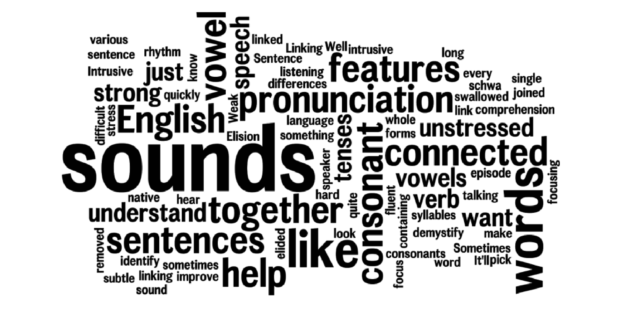
You know when you hear a native speaker talking quite quickly? It sounds like all the words are joined together, or some of the words are being swallowed or something. It’s difficult to understand them, or to pick out every single word. Sometimes it’s hard to identify subtle differences between verb tenses. Well, just like in any language, English has features of connected speech which make it sound like whole sentences are just long words with all the sounds connected together. I want to help to demystify this for you. I want to help you to understand connected speech in English. It’ll help your listening comprehension, and it will improve your pronunciation too. So, let’s look at these features of fluent English pronunciation, focusing on sentences containing various verb tenses.

Here are the features of pronunciation I focus on in this episode
– Linking (consonant to consonant, consonant to vowel and vowel to vowel linking)
– Elision of sounds (some sounds are ‘elided’ or removed when consonants link together)
– Intrusive sounds (sometimes vowels are linked to other vowels with intrusive sounds like /j/ or /w/)
– Weak forms and ‘schwa’ sounds /ə/ (in unstressed syllables and unstressed words in sentences)
– Sentence stress (the rhythm of a sentence)

Here are the sentences I repeat in this episode
Listen carefully, and try to repeat them after me. Try to focus on the natural way I say the sentences, and try to notice the features of connected speech I’m highlighting. Don’t forget the meaning of the sentences. For an episode which deals with the meaning & use of these different tenses, click here to listen to episode 176.

Present simple
I teach English at a university, and I’m teaching first year students of law at the moment.

Present continuous
I’m from London, but at the moment I’m living in Paris.
I teach English at a university, and I’m teaching first year students of law at the moment.

Past simple
(for) I lived in West London for a long time.
(sequence of finished actions) My Dad was promoted and got a job in the midlands, so we moved there, and stayed for many years. I went to university in Liverpool and lived there for 4 years, and then I moved back to Warwickshire.

Past continuous
I’d finished uni and I was working in a pub, not really going anywhere.
It was while I was living in London that I came up with the idea of launching an amazing podcast for learners of English
.
I was walking down the street and this guy came up to me and started talking, but I couldn’t understand him

Used to do vs.
Get used to doing
– It used to be quite difficult, because I couldn’t speak the language but I’m getting used to it now.

Present perfect
I’ve been up the Eiffel Tower. I’ve visited Notre Dame. I’ve been to Shakespeare and Company. I’ve tried lots of delicious French wine, but I still haven’t done everything.
Today I’ve drunk a bit too much coffee so I’m pretty hyperactive. Normally I drink tea, but more recently I’ve been drinking coffee. I’ve had about 9,000 cups already today.

Present perfect continuous
I’ve been doing lots of comedy. I’ve been doing lots of gigs.
I’ve been working at the university.
I’ve been recording episodes of the podcast
I’ve hardly had time to sit down and just read my book in silence.

Past perfect
That’s when I decided to become an English teacher.
I’d finished uni and I was working in a pub, not really going anywhere.
When I first came here, I’d never visited Paris before, but my girlfriend had told me a lot about it, so I was kind of prepared.
Past perfect continuous
As well as studying at university and college, I’d also been playing in lots of bands over the past few years, but it hadn’t really worked out, so I needed to think of something else to do.

Going to / present continuous
We’re going to visit New York next month
– I might do a special report from New York
– We’re going to stay in an AirBnB apartment that we’ve found
– We’re planning the trip at the moment.
– We’re flying there in the middle of April. It’s going to be good.

Future with will (not plans, but judgements, opinions, predictions)
Who knows, maybe the LEPPERS will one day rise up.
Hopefully it’ll last. Hopefully they’ll take me on again.
England will probably win.
We probably won’t win. I imagine it will be someone like Spain or Brazil.
1st Conditional
We probably won’t get to the final, but if we do it’ll be amazing.
Who knows what I’ll be doing
Hopefully I’ll still be recording episodes of LEP

Future perfect
Hopefully, I will have done many more episodes of LEP and perhaps I will have expanded my work online in some way.
Future perfect continuous (in a 1st Conditional structure, no less!)
If I’m still doing Luke’s English Podcast , I will have been doing LEP for 15 years.

Future perfect continuous passive!
I will have been being listened to for 10 years (!!!)

200. New Competition: “Your English Podcast”

Details of a new competition for you to enter, how it feels to complete 200 episodes of the podcast, jingles, a message from Alex & Paul, and more! Right click here to download.

Small Donate Button
Introduction
Hello! And welcome to the podcast. This is a very special episode, because it’s the 200th one! Wow, I made it to 200! Amazing! Obviously I’m delighted about that. This is the 200th anniversary of LEP, and before I tell you all about how that feels, I’d like to begin this episode by telling you about a new competition I’m launching today, which I’d love you to take part in. So first I’m going to tell you all about the competition, and then I’ll celebrate 200 episodes of LEP with you. OK, so let’s get started.

This is the 200th episode of Luke’s ENGLISH Podcast and to celebrate this momentous occasion I’ve decided to launch another LEP competition in which you can send me your audio recordings. I did a similar competition over 2 years ago, and now I’m doing another one. This one’s called “Your English Podcast”. Why? Because I’d like you to imagine you are recording 5 minutes of your own English podcast. Just record and send your 5 minutes (or less) to me, I’ll play your recordings on the podcast and then listeners can vote for their favourite. I will count all the votes and announce the winner. The prize for the winner is to be interviewed on an episode of Luke’s English Podcast.

Doesn’t that sound exciting? It should do!

I did my first competition 2 years ago and it was amazing to hear the voices of my listeners. Camila Andrade from Brazil won that one. She got a very special prize – a phrasal verb dictionary.
Since then, the podcast has gone from strength to strength and I’ve picked up new listeners, old listeners have improved their English, I’ve dealt with many more topics and events on the podcast. It’s time for us to hear what the LEPPERS have to say for themselves. This is your chance to have your voice heard on Luke’s English Podcast. And ultimately, if you win, you could become famous around the world as you are interviewed on the podcast via Skype. If you’re shy, I understand – I’m nice, I’ll make sure you’re okay, and so will the listeners – because the great thing about the LEP community is that my listeners are good people. I can’t wait to hear from you, and to give you a platform to say what you’ve got to say to the world.

The Competition in a nutshell
Record yourself talking about whatever you want for 5 minutes, send the recording to me, I’ll feature all your recordings on special episodes of the podcast, listeners can vote for their favourite and the one with the most votes gets featured on an episode of the podcast in a Skype call with me.
BUT there are some rules to make sure this competition is fair and is not impossible for me to manage in my limited time!
Please carefully observe the following rules. If you don’t follow the rules, you might be disqualified from the competition. It’s important to establish some rules because otherwise this competition could be really difficult for me to manage. So, rules are rules, and here are those rules:

Rules for the Competition
– Opening date: NOW! The competition is now open so get started!

– Closing date for entries: 31 August 2014. After that I will collect all your audio recordings and take time to prepare episodes in which I showcase your competition entries. People can then vote by leaving comments on teacherluke.co.uk. I’ll give you more information about voting later on.

– Time: You’ve got 5 minutes, maximum. You can talk for less than 5 minutes if you like, but please make sure you don’t exceed the 5 minute limit.

– What to say: You can say whatever you want! This is 5 minutes of YOUR podcast. If you like, you can imagine you have your own English podcast, called “Jose’s English Podcast” or whatever your name happens to be. If you like, you can welcome listeners to your podcast at the start by saying “Hello and welcome to Jose’s English Podcast”, and say goodbye to your listeners at the end. It’s completely up to you what you say, and how you say it. This is your English podcast.

– Name & Country: Remember to tell us your name and where you come from. This will help people to remember you and vote for you.

– Voting: I will collect all the audio files which are sent to me, and I’ll play them all in one episode (or more) of LEP, in alphabetical order by name. Listeners can then vote by leaving comments.

– Audio files: Send your audio file to podcastcomp@gmail.com only. I will only accept entries which are sent to that email address. Please do not send me competition entries on Facebook or to my Hotmail account. podcastcomp@gmail.com is the only email address I will accept.

– I’m only accepting audio files – not text entries this time.

– I’ll give you more information about voting later. For now, you can start preparing your competition entries!

So in summary:
– The competition is now open. Send your audio files (max 5 minutes) to podcastcomp@gmail.com. The closing date is 31 August 2014. After that I will upload showcase episodes of LEP and you can vote for your favourite entry. More information will follow in later episodes…

Some Bits of Advice
When recording your entry, try to make the sound quality as good as possible. Most phones and computers will allow you to record your voice pretty easily, but try to be in a quiet room in your house, away from noisy windows, washing machines or other people.

You can send me audio in a variety of file formats: wav, mp3, mp4, avi etc. I prefer mp3 as it is quicker to process.

If you want you can include a jingle, sound effects or even background music, but you’ll find this is pretty time-consuming and complicated. Ultimately, people just want to hear your voice clearly, so focus on that.

It’s normal to be a bit stressed or nervous when recording yourself. Don’t let that stop you. Try to enjoy it! Enthusiasm is a very attractive quality. LEPers are all lovely people so don’t worry – you’re among friends and I’m sure people are going to be very welcoming and enthusiastic about hearing what you have to say.

Try not to read out a script which you have prepared earlier. You can do this if you like, but I think it sounds more natural if you’re not reading from a pre-written script, and ultimately it’s better for your spoken English. Writing notes is a good idea – just write the main points you want to make, but don’t write it out word for word – just write enough to help you remember.

You should practise your speech a few times until you’re comfortable.

Try to bring your speech to life and put your personality into it if possible.

If you prefer, you can just improvise the whole thing without any practice – in fact, that might be even more exciting or engaging if you do that, but it will also be slightly more challenging too.

Ultimately, just have fun and enjoy taking part in the competition. Don’t stress too much – it should be enjoyable and a fun way to practise your spoken English. I’m sure that everyone will be fascinated to hear short messages from LEPers all around the world! Personally, I can’t wait.

If you don’t know what to say and you need inspiration, perhaps you could respond to something you’ve heard on Luke’s English Podcast, or even (as a joke) you could parody my style of talking on LEP, a bit like this (from Alex Love & Paul Langton). It’s totally up to you. I’m really looking forward to receiving your audio entries at podcastcomp@gmail.com, so get started!

And now some chat about the 200th Anniversary of Luke’s English Podcast with English Robot 3000
Why did you start LEP?
When did you start LEP?
Did you ever expect to get to this point? (200 episodes, and nearly 1.5million downloads in 9 months)
What’s your objective with LEP?
What level is the podcast for?
Are you ever going to stop LEP?
What’s your favourite thing about doing LEP?
Are you happy doing LEP?
Does it ever make you unhappy? Is there anything frustrating or even scary about doing LEP?
What do you expect from your listeners? Small Donate Button
Do you ever get any negative comments, hate mail, or trolling?
Are you rich yet? How rich are you now?
What do your friends and family think of LEP?
Has LEP helped you in your life?
How does it feel to be so famous?
How much time does it take to do an episode of LEP?
Why don’t you do more videos?
How about arranging an event so that you can meet LEPPERS?
Why don’t you have your girlfriend/fiancee on the podcast?
How’s your French?
Someone told me that you have a new job? Is it true?
Do you have anything else to say to the people of the world?

Song Lyrics
P.S. The song I sing at the end of this episode is called “Always Look on the Bright Side of Life” by Eric Idle and comes from the soundtrack to the film “The Life of Brian” by Monty Python’s Flying Circus. Buy the film on iTunes here: https://itunes.apple.com/au/movie/monty-pythons-life-of-brian/id294661981

    Always Look on the Bright Side of Life – Monty Python

Am D G Em
Some things in life are bad they can really make you mad
Am D G
Other things just make you swear and curse
Am D
When you’ve chewing an life’s gristle
G Em
Don’t grumble give a whistle
Am D7
And this’ll help things turn out for the best

G Em Am D7 G Em Am D7
And always look on the bright side of life
G Em Am D7 G Em Am D7
Always look on the light side of life

Am D G Em
If life seems jolly rotten there’s something you’ve forgotten
Am D G
and that’s to laugh and smile and dance and sing.
Am D G Em
When you’ve feeling in the dumps don’t be silly chumps
Am D7
Just purse your lips and whistle – that’s the thing

G Em Am D7 G Em Am D7
And always look on the bright side of life
G Em Am D7 G Em Am D7
Come on always look on the bright side of life

Am D G Em
For life is quite absurd and death’s the final word
Am D G
you must always face the curtain with a bow
Am D G Em
Forget about your sin – give the audience a grin
Am D7
Enjoy it – it’s your last chance anyhow.

G Em Am D7 G Em Am D7
So always look on the bright side of death
G Em Am D7 G Em Am D7
just before you draw your terminal breath

Am D G Em
Life’s a pice if shit when you look at it
Am D G
Life’s a laugh and death’s a joke it’s true
Am D
You’ll see it’s all a show
G Em
keep’em laughing as you go
Am D7
just remember that the last laugh is on you

G Em Am D7 G Em Am D7
And always look on the bright side of life
G Em Am D7 G Em Am D7
Always look on the right side of life
(Come on guys, cheer up)
A F# Bm E7 A F# Bm E7
Always look on the right side of life
A F# Bm E7 A F# Bm E7
Always look on the right side of life ….
Episode 200 podpic

191. Culture Shock: The 4 Stages

Are you living in a foreign country, or planning to live abroad for a while? This episode will be vital listening for you! Listen for some key bits of wisdom to avoid being affected by cultural differences. In this episode I talk about 4 common phases of culture shock that anyone could experience when living in a new environment, and how to make sure you get the best out of a cross-cultural experience. Right-click here to download this episode.

Small Donate Button
What is culture shock?
It’s the disorientation that a person feels when they move to or visit a new place. It’s how you feel when you are dealing with a change of environment and an unfamiliar lifestyle. It’s usually associated with adjusting to life in a foreign country but t could also happen if you join a new company, or just move to a different local area.

The Four Phases of Culture Shock
It is generally held that culture shock affects people in a variety of ways, and that there are different stages of adaptation to a new environment. Let’s look at the four stages that are often talked about.

1. The Honeymoon phase
Differences are seen in a romantic light.
You tend to see everything through ‘rose tinted glasses’.
It’s fun to identify differences between your culture and the new culture.
It can be possible to make friends based on the shared joy of experiencing someone from another culture.
It’s probably the experience most of us have as tourists in the new place. In fact, as tourists we manage to avoid or overlook the challenges of existing in a new culture, as it’s all part of the fun of a holiday experience.

*I think there’s another phase which may occur at the beginning – and that’s the FEAR phase! This is what happens when the new culture is overwhelmingly different, causing you to feel shell shocked. You might be too scared to do anything, because of the risk of getting out of your depth, or getting lost or hurt or something. This can cause you to stay inside a lot and just hide from the world! This is how I felt when I first moved to Japan. I was very concerned about getting the wrong bus, or making a big mistake because I didn’t know what I was doing. It was quite stressful, but I was also having an amazing adventure (part of the honeymoon period).

I couldn’t remember as word while recording this episode. The word I couldn’t remember is INTOXICATING, which means that something is so exciting that you feel a bit drunk on the experience.

2. The Negotiation Phase
Here the differences between you and the host culture become obvious and problematic. This could result in frustration, anger, loneliness and homesickness. Unfavourable things make you feel like the host culture is strange and offensive. This is usually brought on by a bad experience that brings you back down to earth, such as a break up. At this point the culture can seem weird, different, stupid, or confusing. It might make you think, “how can these people live like this?”
This might also involve environmental things, like your body dealing with weather changes, light cycles or levels of bacteria. It might result in you feeling tired, irritable or sick. Language and body language can play a large part in this too. It’s important to avoid jumping to false conclusions about your host culture because your limited ability to understand them can cause you to assume certain things about them. E.g. you might assume that people don’t have a sense of humour – but it’s just that you aren’t noticing their jokes.

3. The Adjustment Phase
This is when you manage to develop an effective working routine in the new place. You develop your own problem solving skills and strategies for getting by in the new country. The issues that confused you before are now more understandable as you’ve developed a finer appreciation of the way of life in this new place. You understand the people more deeply, and this allows you to enjoy and appreciate their culture more. You might suddenly realise, “Wow, these people are really clever! Their way of life totally makes sense now!”.

4. The Mastery Stage
This is when you are able to operate in the culture without any problems at all. In fact, you’ve become completely naturalised while also maintaining your original culture too. What happens is that you become bi-cultural – the sort of cosmopolitain person who is able to adapt to different cultural contexts. You might have developed a ‘best of both worlds’ approach to your lifestyle, in which you incorporate the most effective aspects of your culture and the other culture. You’re open minded enough to realise that no culture is perfect, and that you can lose aspects of your own culture and replace them with more beneficial aspects of the other culture.

The Outcomes of Culture Shock
There are a few possible ways to react to living in a new culture. You can become one of three people (although I expect it is probably more nuanced and subtle than just 3 possibilities).

So, when faced with culture shock experiences people can become:
1. Rejectors
These people are unable to adapt to the new culture, and instead become isolated. They can’t integrate, they live in their own communities, they have lots of bad experiences with the locals and they find that the local culture is hostile. They might not even realise that they’re experiencing culture shock and just jump to lots of negative conclusions about the host culture, which then prevents them from really enjoying and adjusting to life. This may also be due to prejudice on either side, for example racism on the part of the host culture towards those who have moved there. It’s often due to a lack of awareness of culture shock and the causes of it. Ironically, these people have an even harder time re-entering their own culture, because they’re not aware of how much they’ve changed.

2. Adopters
These people integrate fully and lose their original identity. They will probably live in the country forever. Ironically, they might become “more English than the English” (if they’ve moved to England, for example), becoming excessively proud and defensive of what they perceive to be true values of the host culture, in an attempt to fully integrate.

3. Masters
These are the cosmopolitain types who adapt and learn to be flexible, moving between cultures, creating a unique blend of “the best of both worlds”. They remain open minded and have a tolerant and flexible approach to change. They might become nomadic, as moving to new places becomes the norm.

That’s it for this episode. Thanks very much for listening! Please share your culture shock experiences. Have you ever experienced culture shock? Where were you, and what happened? Please leave your comments below.
CultureShock2PODPIC

186. Understanding Culture Shock – with Lindsay & Gabby

This episode is all about culture shock and culture shock experiences and I’m glad to be joined by Lindsay & Gabby from the All Ears English podcast. Right-click here to download the episode.

Small Donate Button
Lindsay & Gabby from All Ears EnglishLindsay McMahon and Gabby Wallace are well-qualified and well-experienced teachers of English from Boston, USA. They’re also the girls from the All Ears English Podcast. Last month I was a guest on their podcast and we talked about being funny and telling jokes in English. So, I returned the favour a few days ago and invited them onto LEP. Lindsay & Gabby have plenty of experience of not only meeting & teaching foreign visitors to the USA but also of travelling abroad and living in foreign countries. In this episode I talk to the girls about our experiences related to culture shock. Listen to the episode to find out more!

At the end of this episode, Lindsay & Gabby mentioned an eBook which they’ve written and is available for you to download. It’s full of useful advice on how to integrate into a new English-speaking culture. Click this link for more information, and to download the eBook: http://allearsenglish.com/luke

In this episode
We talk about:
Lindsay & Gabby’s teaching experiences.
Our travelling experiences, and instances of ‘culture shock’ that we have experienced in different countries.
Examples of culture shock experienced by visitors to the USA & UK.
Some reflections and conclusions on how to understand and deal with culture shock when it happens to you.

Thanks for listening, and look out for some more episodes about culture shock coming soon to LEP.

182. Learning English with Yacine Belhousse

This episode is all about the relationship between language, successful communication, stand-up comedy and learning English! It features an interview with the one-and-only Yacine Belhousse, who is a professional stand-up comedian in his native language and now in English too. A year and a half ago, Yacine hardly spoke any English. Now he regularly performs in English and this year he is doing a 1 hour stand-up comedy show at the Edinburgh fringe festival. How does he do it? How does he deal with the challenges of learning English while also making people laugh in English too? Listen and find out!

Download Episode  Small Donate Button
I’m really pleased to present every episode of Luke’s English Podcast, but this one makes me extra pleased. Why? I just think that we come to some particularly useful conclusions during this conversation, especially related to the attitude that you need to learn English effectively. I’m also pleased to present Yacine because he’s got a great attitude towards learning English and because I think he’s really funny.

Conclusions about Learning Language
In summary here are some of the key points about learning English & communication from our conversation:
– To communicate well, you must take responsibility for communicative exchanges.
– Remember when you’re talking to native speakers, you’re just talking to another human. They have no reason to judge you if you’re just trying to communicate to achieve something. In fact, native speakers have the same responsibility for successful communication as you. So don’t feel that you’re totally responsible for any communication breakdown.
– Be confident and don’t worry about making mistakes. If you do make mistakes, you can learn from them and that’s how you improve. If you’re concerned that you can’t be confident – don’t worry. Confidence is something which just happens when you try to do something. If you focus on achieving successful communication, and don’t get upset by failure – confidence will just come naturally. So, don’t worry about confidence. Just focus on trying to achieve things.
– Have an organised approach to learning – mentally store words and phrases you like in the “good things bucket”. Reject bits of communication that didn’t work in the “bad things bucket”. Perhaps revisit the “bad things bucket” to learn from the errors, but enjoy the contents of your “good things bucket” too!
– Repeat words and phrases that you’ve learned. Repeat them lots of times in order to remember them.
– Learn by doing things. Learn to speak by speaking, failing, succeeding and moving on. You have to be active. Use your English. If you don’t use it, you lose it. You’ve got to be in it to win it!
– Be positive!

Listen to the conversation to find out more.

Links
Would you like to play Yacine’s computer game? Click here to visit the game on his website.

Will you be in Edinburgh during the Fringe? You should check out Yacine’s show. Click here for information on Yacine’s Edinburgh show.

Transcript to #182. Learning English with Yacine Belhousse
The introduction to this episode is transcribed below. If you would like to write some more minutes of transcript, click here to visit the google document for this episode.

Introduction
Here is my introduction to this episode of the podcast.

“Normally I have native speakers on this podcast; British people, Americans, Australians and stuff like that. And yet, most of the people who listen to this are non-natives learning the language. I rarely have learners of English giving their voice, which is a pity because everyone has a story to tell and interesting things to share. …

So, in today’s episode I am speaking to a friend of mine called Yacine. He’s not a native speaker. In fact, until quite recently he didn’t speak English at all. By his own admission, his English is not perfect. Sometimes he can’t find the right words, he has some trouble choosing the correct verb forms or pronouncing words naturally. These are all the normal problems faced by people learning English. However, I believe Yacine is quite special and that’s why I’ve brought him onto the podcast, despite not being a native or near-native speaker of English.

But why Luke? Why are you featuring a learner of English in one of your interviews? Well, there are lots of reasons:
– I think Yacine has a really good attitude towards learning, and I want to explore that so we can pick up some good things about language learning.
– Yacine is a professional stand-up comedian in his native language but he is also now performing shows in English. In fact, this year he is doing a regular one hour show at the Edinburgh Fringe Festival, which is perhaps the biggest comedy festival in the world, and he regularly performs comedy with the great & legendary Eddie Izzard, who is considered by many to be one of the greatest stand-ups of his generation. Eddie Izzard is not just an inspiration to stand up comedians, he is also an inspiration to language learners all over the world, and we’ll find out more about that later. Yacine is very influenced by Eddie Izzard, and he often supports Eddie when he does shows in France.

Learning a language is a challenging thing for anyone. You know when you speak you feel shy and embarrassed sometimes because you don’t want to be judged (just like me when I go to the boulangerie). These are normal fears. But, can you imagine going on-stage in front of lots of people, Scottish, English, perhaps a bit drunk because the show is on at 9.30PM, and delivering a full one hour stand-up performance in a language you’re trying to learn?
– It must be very challenging.
– You’d need a lot of self-confidence and self-belief.
– You need to focus very carefully on how to communicate your message.
– You need to be able to deal with any possible breakdown of communication.
– You need to stop worrying about errors, and if you make errors learn from them but don’t let them make you lose confidence.
I want to know how Yacine faces these challenges, but also, for me these are the challenges faced by any learner of English, but they are multiplied by the fact that Yacine is also doing this on-stage while having to make people laugh. It’s impressive and I want to know more.

So, this is what I want to investigate in this episode:
– How he’s learning English.
– Doing comedy in French vs English.
– French audiences vs UK audiences – are they different?
– Is humour universal?
– How is good communication an essential part of comedy? How do you make a successful joke? It’s about successfully communicating an idea.

Footnote: Yacine has only been learning for a few years. He hasn’t attended any courses or lessons. He’s self-taught. My professional opinion is that he’s doing really well. His English is better than it was a year ago, and his English is certainly much better than my French!

Yacine might make errors during the episode, and that’s fine. I’ll help him or even give him corrections (“yes please” – he says). This episode is not a judgement of his English, and it’s not his comedy performance either – that happens in Edinburgh. What this is, is an investigation into his English learning experiences and the relationship between language, communication, comedy and language learning!

Click here to transcribe more of this episode using a google document.

Thanks for listening, and have a good day/evening/night!

Luke

yacine PODPIC

My interview on the All Ears English Podcast

Hi everyone,

Today I am featured as a guest on the All Ears English podcast. In the episode you can hear me talking about comedy, humour and telling jokes in English. Click the picture to listen to the episode on the All Ears English website or use this embedded player.

https://www.podtrac.com/pts/redirect.mp3/pdst.fm/e/chrt.fm/track/CB27B5/traffic.megaphone.fm/ALLE5073533650.mp3?updated=1648593059

Luke Episode 122-2

You might already know All Ears English. It’s a podcast produced by two American girls called Gabby & Lindsay. They’re both English teachers with lots of experience who also do a podcast for learners of English.

Recently I got a tweet from Lindsay asking if I would like to be interviewed for one of their episodes, and I was glad to accept. It’s fun to be featured on someone else’s podcast for a change. Also, it’s good to establish contact with other podcasters. It was pretty exciting to talk to the girls on Skype and find out how we have a lot of things in common even though we are from completely different countries. Because I am a comedian (as well as a teacher) they were interested in hearing my perspective on differences between British & American humour, and some of my tips on telling jokes in English. Of course, there’s a lot to say on that topic so it is something I plan to revisit fully on LEP.

Here’s a summary of my tips on how to tell jokes in English. As I said, I plan to revisit this subject fully on LEP as there is so much to say!

Luke’s advice on how to tell jokes in English:

  • Be careful about telling jokes in social situations
  • Know when it’s appropriate to tell a joke. Sometimes there might be an informal joke-telling situation with your friends. That’s a great time to try your joke.
  • Be careful about the subject of the joke. Don’t make jokes about race, age, weight, gender or sexual orientation (especially in the United States)
  • Try to tell a spontaneous joke rather than a preplanned joke. The joke is more of an attitude than a specific joke. Instead, develop an attitude that is funny and lighthearted.
  • Make sure that you know the joke well when you are telling the joke so that you don’t forget the punchline.
  • Keep it short and sweet.
  • It should sound natural.
  • Don’t laugh too much at your own joke.
    • Be prepared if your joke doesn’t work, but don’t worry about it too much.

Look out for more episodes on humour in social situations in the future!

177. What Londoners Say vs What They Mean

Here are some cliches that you might hear Londoners say, and some explanations of what they really mean.

Download Episode  Small Donate Button
This podcast is based on an article from the trendy/hipster website “Buzzfeed”. It’s about some common things that Londoners say, and what they really mean. It’ll not only teach you some vocabulary, but will allow you to get under the skin of London and find out some real inside knowledge of what it’s like to live there for real.

I’ll go through the list and explain everything for you.

Article originally published on BuzzFeed here.
Photo illustration by Matt Tucker, Dan Kitwood / Getty/paulprescott72/Thinkstock

***Please be aware – there is some rude language and swearing in this episode***

1. “London prices” — Rip-off prices.
2. “Sorry” — I’m not sorry.
3. “Sorry” — You have just trodden on my foot, and I loathe you with every fibre of my being.
4. “Excuse me” — You have paused momentarily at the ticket barrier and I am boiling with rage.
5. “My fault entirely” — Your fault entirely.
6. “I’m fine, thanks” — I am barely managing to conceal a churning maelstrom of emotions.
7. “How are you?” — Fine. Just say fine.
8. “See you Saturday!” — Don’t forget to email me twice to make sure that we’re actually meeting on Saturday.
9. “Let’s have lunch” — Let’s walk to Pret and back as fast as we can.
10. “I’m having a party in Wimbledon, come along” — Please travel for four and a half hours as I live in the middle of bloody nowhere.
11. “Open for business” — Oligarchs welcome.
12. “Centre of global finance” — Money launderers’ paradise.
13. “My commute? It’s not too bad. About average” — It involves three modes of transport, takes hours each day, and is slowly crushing my spirit.
14. “Could you move down a bit please?” — I’m not asking, I’m telling.
15. “Could you move down a bit please?” — I am seconds away from a devastating mental collapse.
16. “Could you move down a bit please?” — If you don’t, I will start killing indiscriminately.
17. “Due to adverse weather conditions” — It was a bit windy earlier.
18. “Due to the wet weather conditions” — A tiny amount of rain has fallen.
19. “Please take care when…” — Don’t you dare blame us if…
20. “We apologise for the inconvenience caused” — Via the medium of this dehumanised pre-recorded message.
21. “Due to a signalling failure…” — Due to an excuse we just made up…
22. “Rail replacement bus service” — Slow, agonising descent into madness.
23. “There is a good service on all London Underground lines” — Though this very much depends how you define “good”.
24. “Planned engineering works” — That’s your weekend plans fucked, then.
25. “Would Inspector Sands please report to the operations room immediately” — Ohgodohgod everybody panic, we’re all about to die.
26. “Annual fare increase” — We’re rinsing you suckers for even more money. Again.
27. “House party in Tooting? See you there!” — South of the river? No fucking chance.
28. “I live in Zone One” — I am unimaginably wealthy.
29. “The area is really up and coming” — Only one tramp shouts at me in the morning.
30. “Vibrant” — Actual poor people live here.
31. “Gentrification” — I am so glad they’re rid of the poor people.
32. “Gentrified” — Oh bollocks now I can’t afford to live here either.
33. “Efficient use of space” — Microscopic.
34. “Studio flat” — Bedsit.
35. “Incredible potential” — Absolute shithole.
36. “Affordable” — Uninhabitable.
37. “Deceptively spacious” — Basically a cupboard.
38. “Good transport links” — There’s a bus stop 10 minutes’ walk away.
39. “Authentic” — Fake.
40. “I just bought a flat” — My parents just helped me buy a flat.
41. “Swift half” — Many, many, many, many halves.
42. “Quick pint” — In the pub until closing time.
43. “We’re going on a date” — We’re getting pissed together.
44. “Picnic” — Daytime piss-up.
45. “Barbecue” — Piss-up in the garden.
46. “South London” — Here be monsters.
47. “West London” — Here be posh people.
48. “East London” — Here be young people.
49. “North London” — Here be newspaper columnists.
50. “Oxford Circus” — Roiling hellscape.
51. “Tech city” — Bunch of start-ups you’ve never heard of.
52. “London has some of the best restaurants in the world” — So how come I always end up at Nandos?
53. “London is full of cultural delights” — Which I never visit.
54. “Gourmet coffee” — Ludicrously overpriced coffee.
55. “Exciting pop-up restaurant” — You guys like queuing, right?
56. “We have a no bookings policy” — We hate our customers.
57. “This pub has character” — This is not a gastropub, and I’m scared.
58. “Traditional boozer” — Pub that does not serve wasabi peas.
59. “What do you do?” — How much do you earn?
60. “He works in finance” — He’s a psycho.
61. “He works in media” — He’a a wanker.
62. “He works in PR” — He’s a bullshitter.
63. “He works in tech” — He’s got a blog.
64. “Working hours” — Waking hours.
65. “Greatest city on earth” — Apart from New York.
66. “You know what they say: He who is tired of London…” — I am so tired of London.

176. Grammar: Verb Tense Review

This episode is all about grammar, specifically verb tenses such as: present simple, present continuous, present perfect simple, present perfect continuous, past perfect, past perfect continuous and different future forms. Part of this episode is transcribed, and part of it is spontaneous.

Download Episode  Small Donate Button
I’m going to go through lots of verb tenses in English. I’ll demonstrate them first, and then go through them with you, explaining their form, use and pronunciation.

It’s been a while since I did an episode on grammar, and so I thought I’d give you a really thorough look at different verb tenses. It’s a bit ambitious to try and cover lots of tenses in one episode, but I’ll try and keep it brief and practical.

This could be a really useful episode, which you could listen to again and again, in order to get the full value.

I don’t normally do many episodes on grammar, because let’s be honest, it’s pretty boring. Unless you’re a grammar geek, it can be pretty mind numbing stuff. In one ear and out the other. The trouble is, that in explaining the basics of grammar you end up using all kinds of complex and abstract language, which makes the whole thing more complex than it really is. For example, if you can’t use the present simple tense correctly, then you’re hardly able to understand the rules that underpin that tense.

We don’t learn a language by learning the rules first and then applying them. Instead we learn by trying to communicate a message in that language. In doing that we learn the limitations and possibilities. But, it does help to get an insight into the structures at work because you can identify areas where you’re making mistakes, or particular tenses that you’re not using.

So listen carefully while I’m talking here and try to notice the different tenses. That’s your task. Notice the different tenses I use, as I’m using them. Like, oh that’s present perfect, or that’s a 1st conditional structure, or that’s the future perfect continuous passive there, I love that one. Etc.

Then I’ll go through it all and explain it at the end. You can read this on my website.

So, let’s start. Listen closely as I tell you a few things about myself. Notice the tenses, and I’ll explain them afterwards. Eventually, the plan is for you to perhaps practise this by talking about yourself in a similar way, using the tenses as I do. Then you’ll be speaking more like a native. Some of this is written down, and some of it is improvised.

OK, it’s grammar time!

Spot the Tenses
m5e8dHello. I’m Luke. I’m from London, but at the moment I’m living in Paris. I’ve been living here for just over a year. It’s great. I’m really enjoying it. You know that originally I’m from England. I was born in a town just outside London, and then I lived in West London for a long time. My Dad was promoted and got a job in the midlands, so we moved there, and stayed for many years. I went to university in Liverpool and lived there for 4 years, and then I moved back to Warwickshire. That’s when I decided to become an English teacher. I’d finished uni and I was working in a pub, not really going anywhere. As well as studying at university and college, I’d also been playing in lots of bands over the past few years, but it hadn’t really worked out, so I needed to think of something to do. I ended up deciding to become a TEFL teacher in 2001 and then I went to Japan and lived there for 2 years. That was an awesome time. had loads of really cool experiences and met loads of people, but I didn’t want to get stuck there, and I was keen to get back to my home country. I moved back to London and I worked there for a long time. It was while I was living in London that I came up with the idea to launch an amazing podcast for learners of English, that would save the world from the forces of evil. That’s when I created the now legendary Luke’s English Podcast, and a new cult of language learners was created. Who knows, maybe the LEPPERS will one day rise up and, just speak really fluently, and then give everyone free ice-cream sandwiches. It’s just a dream maybe, but who knows, it might just happen.

I moved to Paris in 2012. Living in Paris is pretty cool. It used to be quite difficult, because I couldn’t speak the language but I’m getting used to it now. When I first came here, I’d never visited Paris before, but my girlfriend had told me a lot about it, so I was kind of prepared. I’d also been to France quite a lot as a child on holiday. But when I first arrived it was quite hard because I didn’t speak much French. I took some French lessons at school when I was a kid but I don’t remember learning much. In fact most of the time those French lessons were a bit of a doss. So, when I first arrived I couldn’t really communicate, which was not very helpful. It was usually okay because I could get by, but I remember once I was walking down the street and this guy came up to me and started talking, but I couldn’t understand him, and he got angrier and angrier and started following me down the street. It was a bit scary and weird, and I wish I could have understood him and told him to piss off or whatever.

These days things are much easier, and Paris is an amazing place to live in. I’ve seen and done quite a lot of stuff here.

things I’ve done

– I’ve been up the Eiffel Tower. I’ve visited Notre Dame. I’ve been to Shakespeare and Company. I’ve tried lots of delicious French wine.

Things I’ve been doing

– I’ve been doing lots of comedy. I’ve been doing lots of gigs.

– I’ve been working at the university.

– I’ve been recording episodes of the podcast

-learning french

Today I’ve drunk a bit too much coffee so I’m pretty hyperactive. Normally I drink tea, but more recently I’ve been drinking coffee. I’ve had about 9,000 cups already today.

Work

– At the moment I’m working at the university

– I teach English, but I’m teaching at a university at the moment.

The future

– Hopefully it’ll last. Hopefully they’ll take me on again.

– I wonder what’s going to happen in the future.

going to / present continuous

– We’re going to visit New York next month

– I might do a special report from New York

– We’re going to stay in an AirBnB apartment that we’ve found

– We’re planning the trip at the moment.

– We’re flying there in the middle of April. It’s going to be good.

Will

– England will probably win.

– We probably won’t win. I imagine it will be someone like Spain or Brazil.

– It’s going to be a challenge.

– We probably won’t get to the final, but if we do it’ll be amazing.

5 years from now

– Who knows what I’ll be doing

– Hopefully I’ll still be recording episodes of LEP

– I might have had kids by then.

– I’ll probably have children. That’ll be…

– Hopefully, I will have done many more episodes of LEP and perhaps I will have expanded my work online in some way.

10 years from now

– If I’m still doing Luke’s English Podcast , I will have been doing LEP for 15 years.

– I will have been being listened to for 10 years (!!!)

The Tenses

Present simple
– I teach English, but I’m teaching at a university at the moment.

Present continuous
– I’m from London, but at the moment I’m living in Paris.
– At the moment I’m working at the university
– I teach English, but I’m teaching at a university at the moment.

Past simple
– (for) I lived in West London for a long time.
– (sequence of finished actions) My Dad was promoted and got a job in the midlands, so we moved there, and stayed for many years. I went to university in Liverpool and lived there for 4 years, and then I moved back to Warwickshire.

Past continuous
– I’d finished uni and I was working in a pub, not really going anywhere.
– It was while I was living in London that I came up with the idea to launch an amazing podcast for learners of English
– I was walking down the street and this guy came up to me and started talking, but I couldn’t understand him

Used to do vs. Get used to doing
– It used to be quite difficult, because I couldn’t speak the language but I’m getting used to it now.

Present perfect
– I’ve been up the Eiffel Tower. I’ve visited Notre Dame. I’ve been to Shakespeare and Company. I’ve tried lots of delicious French wine.
– Today I’ve drunk a bit too much coffee so I’m pretty hyperactive. Normally I drink tea, but more recently I’ve been drinking coffee. I’ve had about 9,000 cups already today.

Present perfect continuous
– I’ve been doing lots of comedy. I’ve been doing lots of gigs.
– I’ve been working at the university.
– I’ve been recording episodes of the podcast
– I’ve been living here for just over a year.

Past perfect
– That’s when I decided to become an English teacher. I’d finished uni and I was working in a pub, not really going anywhere.
– When I first came here, I’d never visited Paris before, but my girlfriend had told me a lot about it, so I was kind of prepared.

Past perfect continuous
As well as studying at university and college, I’d also been playing in lots of bands over the past few years, but it hadn’t really worked out, so I needed to think of something to do.

Modals to talk about the past
– I wish I could have understood him and told him to piss off or whatever

Going to / present continuous
– We’re going to visit New York next month
– I might do a special report from New York
– We’re going to stay in an AirBnB apartment that we’ve found
– We’re planning the trip at the moment.
– We’re flying there in the middle of April. It’s going to be good.

Future with will (not plans, but judgements, opinions, predictions)
– Who knows, maybe the LEPPERS will one day rise up.
– Hopefully it’ll last. Hopefully they’ll take me on again.
– England will probably win.
– We probably won’t win. I imagine it will be someone like Spain or Brazil.

1st Conditional
– We probably won’t get to the final, but if we do it’ll be amazing.

Future continuous
– Who knows what I’ll be doing
– Hopefully I’ll still be recording episodes of LEP

Future perfect
– Hopefully, I will have done many more episodes of LEP and perhaps I will have expanded my work online in some way.

Future perfect continuous (in a 1st Conditional structure, no less!)
– If I’m still doing Luke’s English Podcast , I will have been doing LEP for 15 years.

Future perfect continuous passive!
– I will have been being listened to for 10 years (!!!)

Modals for the future
– it might just happen.

Test Yourself

Complete the gaps in this text. Scroll up to see the answers.

Hello. I’m Luke. I’m from London, but at the moment I _______________________ (live) in Paris. I _______________________ (live) here for just over a year. It’s great. I’m really enjoying it. You know that originally I’m from England. I _______________________ (born) in a town just outside London, and then I _______________________ (live)  in West London for a long time. My Dad _______________________ (promote) and got a job in the midlands, so we _______________________ (move) there, and _______________________ (stay) for many years. I _______________________ (go) to university in Liverpool and _______________________ (live) there for 4 years, and then I _______________________ (move) back to Warwickshire. That’s when I _______________________ (decide) to become an English teacher. I _______________________ (finish) uni and I (work) in a pub, not really going anywhere. As well as studying at university and college, I _______________________ (also play) in lots of bands over the past few years, but it hadn’t really worked out, so I _______________________ (need) to think of something to do. I _______________________ (end up) deciding to become a TEFL teacher in 2001 and then I _______________________ (go) to Japan and _______________________ (live) there for 2 years. That was an awesome time. I _______________________ (have) loads of really cool experiences and _______________________ (meet) loads of people, but I _______________________ (not want) to get stuck there, and I was keen to get back to my home country. I _______________________ (move) back to London and I _______________________ (work) there for a long time. It was while I _______________________ (live) in London that I _______________________ (come up with) the idea to launch an amazing podcast for learners of English, that would save the world from the forces of evil. That’s when I _______________________ (create) the now legendary Luke’s English Podcast, and a new cult of language learners was created. Who knows, maybe the LEPSTERS _______________________ (rise up one day) and, just speak really fluently, and then give everyone free ice-cream sandwiches. It’s just a dream maybe, but who knows, it might just happen.

I moved to Paris in 2012. Living in Paris is pretty cool. It _______________________ (be) quite difficult, because I couldn’t speak the language but I _______________________ (get used to) it now. When I first came here, I _______________________ (never visit) Paris before, but my girlfriend _______________________ (tell) me a lot about it, so I was kind of prepared. I _______________________ (also go) to France quite a lot as a child on holiday. But when I first _______________________ (arrive) it was quite hard because I _______________________ (not speak) much French. I _______________________ (take) some French lessons at school when I was a kid but I don’t remember learning much. In fact most of the time those French lessons were a bit of a doss. So, when I first arrived I couldn’t really communicate, which was not very helpful. It was usually okay because I could get by, but I remember once I _______________________ (walk) down the street and this guy _______________________ (come) up to me and _______________________ (start) talking, but I couldn’t understand him, and he _______________________ (get) angrier and angrier and _______________________ (start) following me down the street. It was a bit scary and weird, and I wish I could have understood him and told him to piss off or whatever.

These days things are much easier, and Paris is an amazing place to live in. I _______________________ (see and do) quite a lot of stuff here. I _______________________(go )up the Eiffel Tower. I _______________________ (visit) Notre Dame. I _______________________(go) to Shakespeare and Company the bookshop. I _______________________ (try) lots of delicious French wine. It’s great.

Check the top of the page for the answers.

174. How to Learn English with Luke’s English Podcast

This episode contains lots of ideas, advice and suggestions for ways of improving your listening, reading, writing and speaking using Luke’s English Podcast. A transcript is available below. ;)

Download Episode  Small Donate Button
This should be a useful episode. I’m going to go through a whole bunch of ways that you can improve your English with Luke’s English Podcast. You’ll find a list of these points on my website. I’m going to expand on them here.

I’ll be talking about key areas: listening, reading, writing, speaking, grammar, vocabulary, pronunciation and discourse. Much of what I’m saying is written on my website. Just find the episode called “How to Learn English with Luke’s English Podcast”. I’ve written a lot of this down because it contains lots of specific bits of information which I wanted to make sure I included. I try not to do too many episodes in which I read things to you. I promise that the next one will be unscripted. Anyway, I’ll do my best to make this sound as natural as possible, which is an art in itself. Actually, you could use this script to help you practise your pronunciation, you could record yourself reading this too, and compare it to my version. What are the differences in your version and mine? What can you learn from that? Record yourself doing it again, and compare that to your first attempt. It’s bound to sound a lot better. In fact, I guarantee that you’ll sound more natural and convincing with each attempt. More on that later.

For now, here is a list of tips and advice for learning English with LEP. ;)

Just listen
First of all, you don’t really have to do much more than just listen to the episodes. I realised some time ago that a lot of the students of English that I met at school in London did not listen to enough authentic English. They were willing to spend money and travel across the world in order to improve their English, and yet most of them, for some reason, were not prepared to take a bit of time every day to listen to something in English. Why? I think partly this is because they didn’t know what to listen to. A lot of people watch TV and movies in English. Fine. But honestly, that might not be the best way to improve your English. Film is very visual. A lot of what you understand from a movie is the visual storytelling. It’s important to just focus on the audio – on the language. So, a lot of students didn’t know what to listen to. They thought that they didn’t have much choice. Actually, there’s plenty of choice out there. The BBC has plenty of podcasts, there are loads of podcasts on different topics on iTunes – but they’re all made for native speakers. They’re too difficult to listen to, and ultimately, that’s not motivating. There are some podcasts out there which are made for learners of English, but a lot of them are just focused on language learning, at the expense of entertainment. They’re useful, but they’re a bit dull. This is less the case now, because 5 years after starting this podcast, there are more interesting things out there for learners of English, including my podcast. So I decided that I’d try and create something for learners of English to listen to that they would actually want to listen to, beyond just learning English. Ultimately, I think to listen to English for extended periods of time, you have to have an interest in what is being talked about, or you have to find it entertaining. Otherwise, it’s hard to really sustain your concentration and it becomes like a chore. There is real value in listening to English for extended periods of time, but it’s difficult to achieve because you get put off by not understanding things, or because the recording is a bit patronising and dull. I don’t want to blow my own trumpet here too much, because I’m sure that my podcast is not always as entertaining or as engaging as it could be, but I think the only way to get people to keep listening, is to try and make it entertaining as well as informative about English. So, I record this podcast with you in mind, but I try to keep it as authentic as possible. I try to avoid being simplistic. I try not to grade my English too much. I know it might be challenging for you sometimes but I attempt to hold your attention by talking in an enthusiastic way about subjects which I personally find interesting. Hopefully, the result is that you keep listening, and that you feel personally involved in it somehow. Then, by exposing yourself to lots of English in this way, you are able to acquire the language – to pick it up, in a variety of ways.

Stephen Krashen & Language Acquisition Theory
Let me now refer to the language acquisition theory of Stephen Krashen. This theory is very well known among language learning theorists, and it underpins a lot of what we know about learning and teaching English. Krashen believed that there are two ways to develop our language learning skills. One is through language acquisition and the other is through language learning. Language acquisition means that it is possible for adults and children to learn language in a subconscious way – meaning, in a kind of passive way – by simply engaging with the language. The important thing is that you focus on the message in a bit of language. So, when listening to Luke’s English Podcast this means focusing exactly  on what I really mean, rather than just on the specific items of language I’m using. The primary focus is to just understand what I mean (hopefully at a fairly deep level – in order to laugh at something I’ve said, or feel moved by it) and then you kind of ‘pick up’ the language as a result of that. You might not be immediately aware that you’ve learned some new language in this way. In fact, this kind of acquisition probably informs your passive knowledge of the language. According to Krashen, another type of language development is language learning. This is when you focus on learning specific forms  – like studying grammar rules for example. It involves having some instruction by a teacher, perhaps in the form of error correction, or from a grammar book which explains the ‘rules of English’. The downside of this kind of learning is that it is rather dogmatic, can be boring, complex and abstract. It doesn’t necessarily replicate the organic way in which we pick up language as children, and doesn’t quite allow the subconscious acquisition of language that occurs from just engaging with the language in order to understand a message being communicated.

Alright, so how does this apply to the way you can learn English? Well, I think it’s pretty important to get both aspects of language learning into your life. This is what I call “having a balanced diet”. You shouldn’t just study the grammar rules in a dogmatic way, although that is undeniably important. You should also attempt to just engage with the language as it is used in natural, authentic and meaningful situations. How can you do that? Ideally, this would mean going out into the world and doing things in English. In fact, this might be the best way to improve your English. If you get a job that requires you to use English all day you will improve quickly. It’ll be really hard, but you’d be forced to improve. That’s like a boot camp for language acquisition because you’re not really studying the language, you’re just attempting to survive in it. You’re really focusing on the communicative acts you are trying to achieve. You’re really focusing on meaningful messages, and you naturally learn the most direct and effective way to understand and communicate meaningful messages. You might not be able to do that in your life. You might not have access to native speakers in that way. So, my podcast can be a substitute. It’s not really the same as attempting to work in an English speaking environment, but the key point is that you can replicate aspects of that experience by just attempting to follow/keep up with what I’m saying, and do that regularly, over long periods of time, and you’ll pick up massive amounts of English.

So, just listen, try to follow everything I’m saying, try to enjoy it and engage with it, listen regularly, listen for extended periods. This will all contribute to your acquisition of English, as described by Stephen Krashen.

That’s language acquisition, but you can also do more traditional language learning alongside Luke’s English Podcast. First of all, outside of listening to the episodes, you can do your formalised language studying from a book or in class, and use LEP as a companion to that. Study the language, and then try to notice aspects of the language that you’ve studied in episodes of the podcast. For example, if you’ve studied verb tenses, you can listen to a story I’ve told on the podcast and try to notice those verb tenses, how I’m using them, how I’m pronouncing them, and so on. It can back up, confirm or clarify the language study you’ve been doing. You should always refer to authentic language usage as a way of checking language that you’ve studied.

Also, you can study the things I say in the podcast more directly. The podcast can be a study tool. Here are some ways you can do some active language study with the podcast:

Use transcripts
You could read a transcript and check new words in a dictionary as you find them. Pay attention to the way I use the words, including the grammatical context, collocations between words and pronunciation. Any new words or structures you find, make a note of them and practise using them yourself.

You could attempt to write your own transcripts. This reveals a great deal about the gap between the English you know, and the English that I use in the podcast.  Try transcribing a section of one episode. You could do an episode that has already been transcribed. Listen carefully to it, and try to write down every single word. There may be certain utterances that you just can’t identify. Mark them with question marks. Listen again and again. You could just focus on a specific 5 minute section of an episode. Keep listening until you’ve done your best. Now check the proper transcript for that section and compare it to what you wrote. What are the differences? Now you can identify the gap between what you understand, and what I said. Try to close that gap. Check the words you didn’t know. Identify why you missed the pronunciation of something. Think about how I say these words and phrases, and their definitions. Then you can start working them into your English when you speak. We’ll look at ways of developing your speaking in a few minutes.

A note on transcripts. You may be aware that a lot of my episodes have transcripts, which can really help you to study the language (although you shouldn’t read them all the time). But you can also contribute transcriptions to my website. If you fancy transcribing a few minutes of an episode, please send it to me and I’ll be able to correct it and publish it on my website. I have a transcript collaboration going on using Google documents. You might already know about this because I did an episode on that subject a couple of months ago. You can go to my website and click “transcripts” to find out more. Basically, writing transcripts of my episodes is not only a great way to use the podcast to improve your English, it also helps me to provide an even better service to my listeners.

So, Luke’s English Podcast is best consumed as part of a balanced diet. Listen freely and just try to enjoy and understand what I’m saying, and let your mind naturally acquire the language, but also mix this with more formalised language study to get the full 360 degree effect.

You might think the formalised language study part of that is boring and time consuming. That’s fine. You don’t have to do any of that, but as a compromise, what you can do is just be mindful when you’re listening. Your first aim is to focus on the message, but you can also try to notice specific aspects of the language too. Try to identify words, phrases and grammatical structures. You don’t have to formally study them, just notice them as you hear them. Like “oh he’s saying depend on” so it must be “depend on” in English, not “depend of”. Things like that. Just be mindful when listening.

I record different types of episode here. My main aim is to engage you and keep you interested, while presenting English to you in an authentic way. In some episodes I try to draw your attention to the language more specifically. For example, I teach/explain/demonstrate vocabulary items referring to a topic, or bring your attention to an aspect of pronunciation. In those episodes, you can just chill out and follow what I’m saying, but you can be more active, and make notes of the vocabulary, try to remember phrases, listen again and pause the recording to test your memory.

Listen in comfort, and enjoy the experience. Krashen also writes about the affective filter hypothesis. This relates to the conditions in which learning takes place, and how these can have a big effect on the successful acquisition of language. Basically, good conditions for learning are: motivation (the listener really wants to hear what’s being said, and is keen to learn the language), high self-esteem and relaxation. These things allow the flow of acquisition to move freely, without being blocked. Mental blocks occur when the learner is stressed, anxious or feeling bad about themselves. This creates a mental block to the acquisition of language. I guess this relates to one of those situations in which you’re in an unhappy language class. You feel stressed because of pressure from the teacher or from the judgement of your classmates, you feel low self-confidence because you don’t get any positive reinforcement from taking part in a communicative exchange and you’re just not enjoying the experience of being there in the classroom. As a result, there is a kind of mental barrier which really prevents you learning anything. In fact, it might even make it worse because you associate learning English with painful or boring classroom situations. The advantage of Luke’s English Podcast is that the emphasis is on fun, a lot of the time. You have nothing to fear or worry about when you listen to this. In fact, it can be an extremely pleasurable experience. I’m not just bigging myself up here. I know what it’s like to listen to your favourite podcast. It’s quite a personal experience. I listen to Mark Kermode & Simon Mayo’s Film Review Podcast on my way to work, and I can’t begin to explain the joy of listening to it. They’re like my friends, and I’m sharing a really nice conversation with them. I listen to their voices in private, through headphones, while I’m sitting on a smelly underground train with miserable people all around me, but I’m in my comfort zone. In fact, sometimes I’m disappointed when I reach my metro station, because I just want to keep listening to the podcast. Hopefully, listening to Luke’s English Podcast is a similar experience for you. That’s certainly the idea. This should be a personal and enjoyable experience for you, and I invite you to just enjoy being part of the podcast community, and remember that all around the world there are other people like you, listening to me ramble on about stuff. There’s no chance of the affective filter giving you a mental block in this situation because you should be in your comfort zone. That’s the advantage of podcasting. You really can listen to this whenever and wherever you want, and you are free to get as comfortable as you please. As I’ve said before, feel free to listen to this in the bath, on the loo, or as you softly and slowly drift off to sleep at night. Of course, you can also listen at your desk, with a pen in your hand, or while typing, in order to make notes or write transcripts. You can also sit up and read transcripts. It’s up to you. The main thing is to just enjoy yourself and let the English go into your head. Just imagine that my voice is bouncing around inside your mind, and lots of the words, and sounds are sticking in there.

You should certainly listen to episodes more than once. In fact, if you’re interested in really learning English from this podcast, I think it’s vital to listen several times. Once is not enough. In fact, you might only scratch the surface if you listen just once. Listening again and again will allow you to get really familiar with what’s being said. You’ll notice and remember things that you didn’t catch the first time. Repetition is really important as a way of helping your brain notice patterns. After a couple of listens, you’ll remember certain phrases, bits of intonation or responses and they will be reinforced when you listen again. It might be asking too much of you, but you could even start to remember and repeat some of the things you’ve heard on Luke’s English Podcast. I don’t necessarily expect you to repeat everything I say, but perhaps you could memorise the lines of a comedy sketch that I present to you, and then repeat the lines to yourself or your friends, or just while you’re listening again. I’m a bit of a geek and I love Star Wars. When I was a kid I used to watch Star Wars on heavy rotation. I’d watch it again and again. Now I can remember all the lines from the film. In fact, I don’t just remember the lines, I remember the bits of music and sound effects too, as they occur in the film. It’s the same with Monty Python films and sketches. I’ve watched them so many times that I can repeat a lot of the script from memory, and in fact some phrases from those movies have found their way into my vocabulary. You can do that too, by listening to episodes more than once, and listening to some comedy sketches which I present to you many times. Soon I’ll be doing an episode about Monty Python. For some reason, Monty Python’s sketches are very memorable. In fact, there are several generations of people in the UK and America who grew up watching Monty Python films and who are able to recite whole sketches to each other. Again, you can do the same thing, realise that there are some terrifically funny things in English, and use that as a way to pick up language.

There are a number of different areas to focus on with English.
4 skills:
Listening
Reading
Writing
Speaking

Language systems:
Grammar
Vocabulary
Pronunciation
Discourse

Listening
I’ve already talked a lot about the benefit of just listening for fun, or listening in a more active way. I did mention that it’s good to be comfortable when listening. I should add too that I think it’s important to try and listen to things that you don’t completely understand. It’s fine to listen to things that you don’t understand completely, and the general opinion on this seems to be that you should push yourself when you listen, and don’t get put off if there are things you don’t understand. It’s in that challenging experience that your brain is really piecing things together. For example, if you struggled to understand my conversation with Daniel Burt, that’s fine – in fact, that struggle is good. Listen again, and keep trying. Don’t give up. Push through those moments when you don’t understand. Keep going. Don’t let confusion stop you.
Also, try to identify subtle differences between accents. You may only notice little differences at first, but eventually you’ll be more and more aware of the differences between accents. Eventually, you’ll be able to say “this guy is from the north of England”, “This one’s from Australia” or whatever.

Reading
Reading transcripts on my webpage.
Outside of the podcast – read a variety of texts. Again, try to find things that you enjoy. You should also be aware of your purpose for learning the language. What are you going to use English for in the future? You may need to read emails, or business reports. It may be worth reading articles that talk about business trends. Otherwise, just reading any well-written text for enjoyment is a really good way to improve your literacy. I must add a page on my website with recommendations for reading. There’s loads of reading you can do – blogs, newspapers but also books which you can download free online. I haven’t done it yet, but I’m planning to give you a list of some good things to read.

Writing
Again, this is not one of the things that I focus on a lot on Luke’s English Podcast. The focus is mainly on spoken English. However, transcribing podcast episodes can be good for your writing. You could also write your own blog which contains your opinions or your outlook on a topic. Feel free to write a response to episodes of my podcast in the comments section. You should aim to concisely express your opinion, in a structured way, using the most appropriate words you can find (perhaps including some words you’ve picked up from that episode of the podcast). Think about the person reading the comment – make it easy and enjoyable for them to read, and focus on stating very clearly and efficiently exactly what it is you want to say. Considering those ideas can help you to make your writing more effective.
If, however, you need to practise writing for the IELTS test, you will need to do more specifically focused writing practice, probably using an IELTS preparation book, or following an IELTS course of some kind. My podcast can help you with general skills (vocab, etc) but for specific kinds of writing work, you should do some specific writing practice. Practice practice practice. As I said before – to get the best out of Luke’s English Podcast, use it as part of a balanced diet.

Speaking
Perhaps the best way to improve your speaking is to actually practise it in real-life situations. The requirements of that situation will train you to say the right things at the right time, with the right tone. You should certainly be aware of how intonation is important in affecting a message. These are things you can learn from trying to enter into meaningful acts of communication and learning from your mistakes. You might also need a teacher to actively correct your errors. But, you can definitely use Luke’s English Podcast to improve your speaking too. Let’s look at some ways to do that:
Just try to take some aspects of my speech and apply it to your speech. You could just add some words or phrases you’ve heard from me, and use them yourself. Or you can pick up some speech patterns, pronunciation from me and add that to your speech too. If you like, you could use my speaking as a kind of model for your own speech.
More specifically, you could copy and repeat some of my sentences. Listen to a line I say, and then repeat it and try to sound exactly like me. You could listen to phrasal verb episodes, and whenever I present an example sentence, pause the episode and repeat it after me. Keep doing that until you feel you’re version is pretty similar to mine. So, just listen and repeat until you’ve worked out how to make the same sounds as me. Think about vowel & consonant sounds, combinations of consonants and how to make those sounds with your mouth, think about connected speech – what happens when words are pronounced fluently together in a sentence – they might get pronounced differently, certain sounds may be dropped when words are linked, and some sounds may be added when words are linked too. Pay attention to these aspects of pronunciation. I should do a whole episode on connected speech, and it’s one I’ve had in the back of my mind for ages.
Pick an extract from the podcast, with transcript, and record yourself saying it. Compare your version with my version. Then, work on the transcript. Underline the stressed words, add lines to represent pauses for emphasis, identify word links in pronunciation. Listen to me saying that extract again, and check your ‘sound scripted’ transcript. Now record yourself doing it again, this time adding the intonation, pausing and sentence stress. Compare that to the original. This can help you develop awareness, and control of speech patterns.
Record yourself just talking in response to one of my podcast episodes. If I’ve talked about UFOs for example (not yet, but I will!) then you could record yourself talking about UFOs too. Try to include any words I’ve presented to you on that topic. If you like you could leave an audio comment on my Audioboo page, and let the world know how you feel about something.
Or, you could start doing your own podcast, like Zdenek from Zdenek’s English Podcast. He’s not a native speaker, but following a suggestion in one of my episodes he decided to do his own podcast. He now has followers and listeners and he’s really into it. Listening to his episodes I get the sense that his confidence is developing and he’s finding his own voice. It must be very good for his English (which, of course, is already excellent). You could do it too if you want.
The main thing is practice. Use as many opportunities to practise as you can. Join clubs to meet English speakers. Use the internet. Find groups on Meetup.com in which people are doing language exchanges. Put yourself outside your comfort zone. Don’t be shy, give it a try. Take the initiative. No-one can do the speaking for you. There’s no shame in making mistakes. You have to be in it to win it, so open your mouth and get talking. Remember that English is about what you can do, not just about what you know. Be active, find your voice in English. If you’re in a classroom – don’t be one of those quiet students. It’s completely up to you to start talking, and why not do it in the safety of a language class. That’s the whole point! Speak up in class and use that as a safe place to experiment and make mistakes. Experiment! Switch off your editor! Don’t listen to the voice in your head which is telling you to keep quiet, or telling you that you can’t say something because it might be wrong. It does not matter if you’re wrong. Remember that you have to say something wrong about 5 times before you get it right. Get through those 5 times nice and quick, and then you’ll be fine! Sometimes, opening your mouth is the hardest thing to do, but once you’ve started speaking it gets easier. Keep up the momentum. Keep your voice warm. Stay positive, enjoy expressing yourself. Your teacher will love it if you are an active member of class. In fact, you need to prove to your teacher that you’re making an effort. We always like those talkative and positive students. Use that to your advantage – you’ll be more likely to get good grades, and get levelled up. Be nice, be friendly, be talkative. But also listen to others and help them too. That’s a recipe for success for any language learner!
Actually, I just sent Zdenek a message and asked him for his comments on the subject of using LEP to improve your English (particularly speaking) and here are his comments, which I agree with wholeheartedly. In fact, before I read his comments it may be necessary to remind you that Zdenek is a well-qualified teacher of English from the Czech Republic who lived in the UK for a number of years and who has got a master’s degree in English Language. So, he definitely knows what he’s talking about. I’m sure many of you listening to this have similarly good advice and comments on this subject. I am very keen to encourage you to share that information – you can leave text or audio comments under this episode. So here are Zdenek’s comments:
How can listening to LEP improve your speaking skills? It can mainly improve the following skills/subskills:
1) listening (obvious)
2) reading, spelling (reading scripts, additional notes)
3) writing, spelling (script, feedback or thanksgiving emails to Luke),
4) grammar (listening to grammar patterns as part of exposure theory)
5) vocabulary (learning new vocab also guided by the exposure theory),
6) pronunciation (passive listening)
As for the speaking, it is a different question. If you want to improve your speaking through LEP, you have to approach this actively. Not everyone is willing to do this. Some people tend to be shy, have approach anxiety etc…and prefer listening to the podcast as passive recipients. That is fine. However, here are some suggestions on how you can actually improve even your speaking skills.
1) Contact someone via LEP community. There are a lot of interesting people eager to learn English from all around the world. Contact those who have a similar level as you – this way you can both benefit and learn from each other and no one will get bored. Ideally, have an interest in common (sci-fi films, sport, you already have one important topic in common = LEP)…try to befriend these people, add them on facebook, start skype conversations with them or something.
2) Record yourself speaking about a topic. Ask yourself questions related to LEP. Answer these questions or just practice vocabulary Luke teaches you. Listen back to yourself. Try correcting your errors. Re-record. Compare your recordings you made some time later to see your improvements.
3) Record comments in Audioboo (max 3 minutes) –why is everyone so shy? Is everyone afraid that they will be judged? Who cares? Just be friendly and you should be accepted by the community. Luke is a teacher. He deals with mistakes every day. We all make mistakes. Never be afraid to make mistakes. A man who never made mistakes, never made anything. Are you afraid to take on a challenge and face our greatest fear – public humiliation? Well don’t be! If we fight it actively without fear, we can significantly improve our speaking skills this way.
[I just want to add a couple of points here about making a fool of yourself, my experience of speaking French, and of fear of public speaking]
4) Try running your own podcast. Most of you can do it. Again it is only about facing your fears of making mistakes and exposing yourself to the public. This podcast can be just for you and your friends. I make loads of mistakes in my podcast and I am a teacher. I feel ashamed; I have to edit them out. But if you are not teachers, why worry? And even as teachers? You shouldn’t worry.
5) You can always speak to yourself in the mirror and go crazy. Become the next Hamlet. Speaking is not about passivity so move your arse and find some interaction
Note: By following these tips, you will work on your English speaking skills, pronunciation (actively), grammar, vocab (you can focus on trying to use expressions Luke has taught you), listening skills (as you listen to your friends talking for example). There are so many benefits to active speaking practice.

Thank you Zdenek. As I said before, I welcome your comments too. Let’s share our thoughts on this subject together. It’s time for my LEP ninjas to come out of the shadows and deliver some powerful advice! LEP NINJAS – ASSEMBLE!!!

Regarding language systems, I have some things to say about grammar, vocabulary, pronunciation and ‘discourse’.
To be honest, I’ve already spoken enough about grammar & vocab. Let me just remind you of the theory of ‘exposure’. I have talked about this before. The idea is that by listening to lots of English over extended periods, you’re feeding your subconscious with all the patterns of English usage. Your brain is hearing all these patterns of English, including frequent word combinations (like prepositions), tenses, features of pronunciation etc. Ultimately, it all goes into your head, and informs your sense of instinct for the language, so that when you come to do a test in English, you feel the answer. You know that this particular preposition goes with this particular verb, just because you’ve heard it a number of times before and so it feels natural. Feed your head with English. Feel the English rather than knowing it. Use the force young jedi, and remember, the force will be with you… always. Oh, and don’t forget – you’re never too old for this. Language study is a great way to keep your mind fresh and supple. My grandfather is over 90 years old and he’s still really sharp. Perhaps this is because he’s still going to French and Spanish classes on a regular basis.

Regarding pronunciation – a lot of the tips you’ve been given here will help with that. But, I just want to add that improving your listening skills will naturally improve your pronunciation skills too. The two things go hand in hand. The more you’re able to understand natural spoken English, the more you are able to decode the sounds used to make it. Understanding this natural sound code can allow you to start using it too. There is a direct connection between listening and pronunciation, but to fully reap the benefits, you need to need to actively practise pronunciation. The methods I’ve mentioned already in this episode – repeating, recording, re-recording, comparing, speaking in front of the mirror, etc – they’re all good approaches to practising and improving your pronunciation. Don’t be shy, give it a try. You’ve got nothing to lose, just things to gain. Go for it!

As for discourse, this is really about how you structure your speaking. How do you link your ideas up? When you listen, try to notice any specific phrases I use to link my ideas together, move from one topic to another, deal with moments when I don’t know what I’m saying and so on. What are the tools I use to perform certain functions. Can you identify these things and take them on yourself? Try talking about a topic for 5 minutes. See how difficult it is to talk on your feet. Do it again and again until you develop methods of thinking and talking at the same time. Listen to discussions and focus on the ways in which people interrupt, agree, disagree or whatever. Think about the way we use the language to be polite or indirect. How is humour added to what we say? How does intonation affect the hidden meaning behind our words? Explore these ideas when you listen, and then test them out in your speaking.

That’s it for this episode. I hope you have found it motivating, and inspiring. Leave your comments, and I wish you all the very best of luck keeping up your English. I’m sure you’re doing great. Well you must be, because you’re already listening to Luke’s English Podcast – and long may it continue.

BYE!