Category Archives: American & British English

293. California Road Trip (Part 6) San Francisco / AJ Hoge Interview / UK & US English

Welcome to episode 293, which is in fact part 6 in this mini series based around my recent trip to California. There’s still a lot to talk about, and in this episode I’ll tell you about our time spent in San Francisco and that’s going to include these things – my interview with AJ Hoge the well-known online English teacher, more British and American English, earthquakes, a short biography of Robin Williams, a history of the peace & love movement in San Francisco, more descriptions of our trip down the west coast of California, and some more tips about how to talk to waiters and customer service staff.

Small Donate Button[DOWNLOAD]
It seems pretty obvious to me that this is too much for one episode, so I think there will probably be a part 7 to this series, and after that we’ll return to normal podcasting and English teaching, with perhaps some more UK oriented topics in future episodes, and more episodes featuring authentic unscripted conversations with my friends Amber and Paul.

Video
Here’s a video of the Periscope live feed I did while recording this episode. Watch the video for about 20 minutes of extra video content, and to watch me recording this episode.

AJ Hoge Interview

I think I should start this episode with my interview with AJ Hoge. This took place in San Francisco in the lobby of the hotel where we were staying.

Who is AJ? http://ajhoge.com and http://effortlessenglishclub.com
AJ is an American-born English teacher who started his career as a social worker (what’s a social worker?) before going into English language teaching. He taught English abroad in Thailand, Japan, Korea and other places, and at home in San Francisco before becoming an independent self-employed teacher on the internet. He has created his own online English teaching courses and has written a book about learning English, and he sells all those things on his websites (see links above). He’s also a public speaker who has been booked to do conferences, speeches and presentations about learning English, sometimes to thousands of people at a time. He’s probably the most well-known English teacher on the internet (yes – more well-known than me – he’s good at marketing himself!) and I’m sure that you’ve come across him. I’m very impressed by what he’s achieved as an independent teacher and it was really interesting to meet him and find out about his work. I recorded our conversation and I’m going to play it to you right now.

Unfortunately I had a bit of a technical problem during my meeting with AJ. I was using a new portable audio recorder and for some unknown reason it kept turning itself off during our conversation, which was very frustrating indeed. So unfortunately some parts of our conversation are lost. That explains why the conversation cuts out a couple of times, particularly at the end. Fortunately, the main part of our conversation was recorded, so let’s listen to it now!

Part 1 – You’ll hear an introduction, but then the recorder switched itself off after a couple of minutes, which is why the conversation stops abruptly.

Part 2 – I started again after discovering that the recorder in my hand had in fact switched itself off again. We spoke for another 20 minutes or so and then the recorder switched itself off again! This is why the conversation stops abruptly before I had the chance to say thanks and goodbye to AJ. We plan to stay in touch though, and we might talk again via Skype in a future episode of the podcast.

More British and American English Vocabulary (Part 3) – Clothing
Trousers – Pants Clothing
Nappy – Diaper Babycare
Jumper – Sweater Clothing
Tights – Pantyhose Clothing
Waistcoat – Vest Clothing
Trainers – Sneakers Footwear
Braces – Suspenders Clothing
Dinner Jacket – Tuxedo Clothing
Polo neck (sweater) – Turtleneck Clothing
Wellington Boots (Wellies) – Galoshes Footwear

August 14
Let’s go back to the day we left Yosemite, before I met AJ in San Fransisco. Remember that this is after we had our long hike in the mountains and my wife sprained her ankle and had to use crutches to walk down.

In the morning my wife tentatively tries walking a bit on her ankle and thankfully seems ok after all that rest, and because she managed to keep her weight off it during the rest of trek with the help of the crutches. She’ll be able to rest it even more in the car, and take it easy for the whole day as we won’t do much walking.

We drive out of Yosemite. It’s a bit of a pity to be leaving all these huge rock formations like El Capitan and the Half Dome. We’ve got to know them quite well, and it’s always an exciting surprise to see them through the gaps in the trees. They’re like the big celebrities in this park and whenever you see them they dazzle you with their charisma and charm. As we’re driving out of the valley we stop a few times to just stare up at them for a while, particularly El Capitan, which I think is one of the biggest vertical rock faces in the world. Rock climbers enjoy climbing it, but it can take 4-5 days to go up the whole thing. The climbers actually sleep on ledges on the rock face, or they set up beds which hang from hooks in the rock face. Imagine sleeping on a tiny camping bed, hanging from the cliff, with thousands of feet of air below you. I’d never be able to sleep in those conditions! But it must be an incredibly thrilling way to enjoy the place.

We’re going to miss these mountains and rock formations, but it’s time to drive to our next stop – a place we’re looking forward to very much. San Francisco.

As I outlined in the second part of this series when I talked about California’s history, SF was originally a Spanish settlement for missionaries, but then when gold was discovered at almost exactly the same time that California became part of the United States, the city grew really fast to be a gold rush town, with thousands and thousands of people moving into the area, including many Americans, but also Europeans and Asians. That multicultural mix is still evident today.

SF is also known for its earthquakes. There was a big one in 1906 that destroyed large parts of the city, but it rose again, like a phoenix from the ashes. In fact, the flag for San Francisco shows a picture of a rising phoenix to commemorate the city’s recovery. There have been a few big earthquakes here over the years, including another one in 1989. The city is still expecting another really big earthquake to hit at any time, which is a bit of a worrying thought, and one that I suppose the residents of the city don’t think about too much. Does that idea give San Francisco a kind of laid back and open-minded atmosphere? Possibly. I suppose if you know in the back of your mind that everything could be destroyed any minute by a big earthquake, it makes you a bit more philosophical, or it makes you enjoy every moment while it lasts. That feeling does pervade the place a bit. It’s got a peaceful, meditative and bohemian atmosphere which is really refreshing.

San Francisco is also known for being the focal point of the beatnik and hippie movements of the 1960s. Haight Ashbury in particular is the district that was associated with those movements. More on that later.

Long drive to SF.
First views, Bay Bridge.
Obligatory Wholefoods stop.
Our hotel and the area. Polk Street. Home for the next few days.
We’re staying near a place called “Nob Hill”. In fact our area is known as “tender nob”, which I found particularly funny, because ‘tender’ means soft, and a ‘nob’, well, it’s a bit rude – it’s a willy, a penis… So…

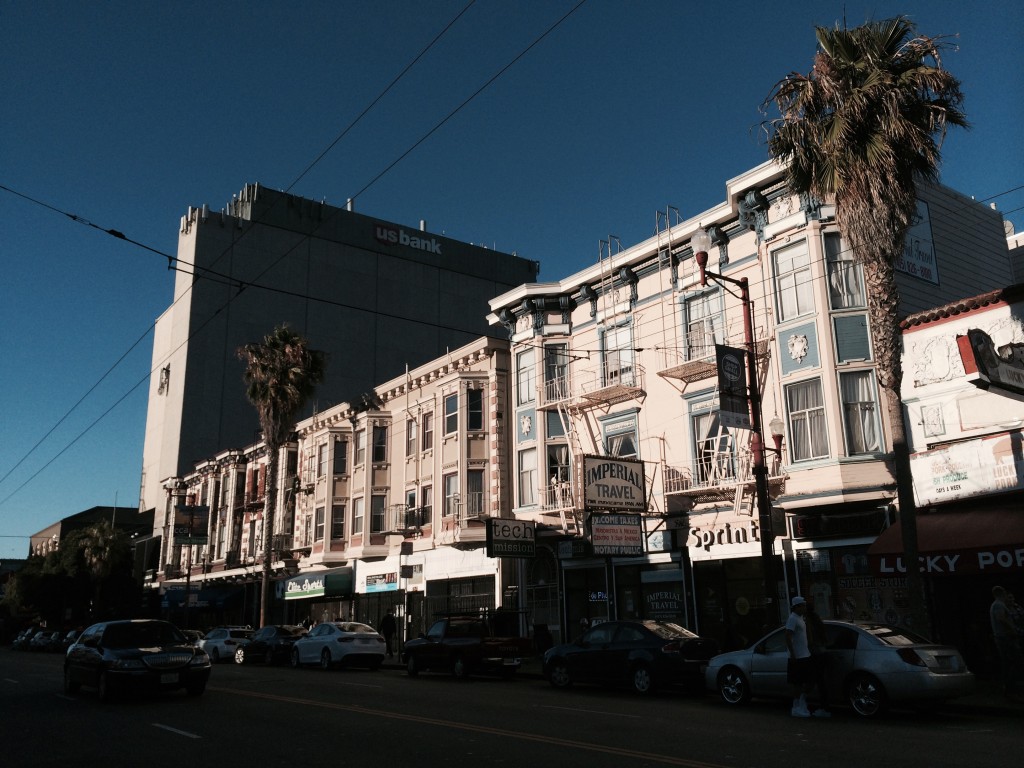
Being in SF was like being back to civilisation, and a really great kind of civilisation. A really bohemian and cool atmosphere, with interesting places, loads of originality, lots of good little shops, cafes and bars with long lists of local beers, coffees, wines and ciders. We pretty instantly fall in love with the whole Russian Hill/Polk Street area. We walk up the street looking for places to have dinner and breakfast the next day.

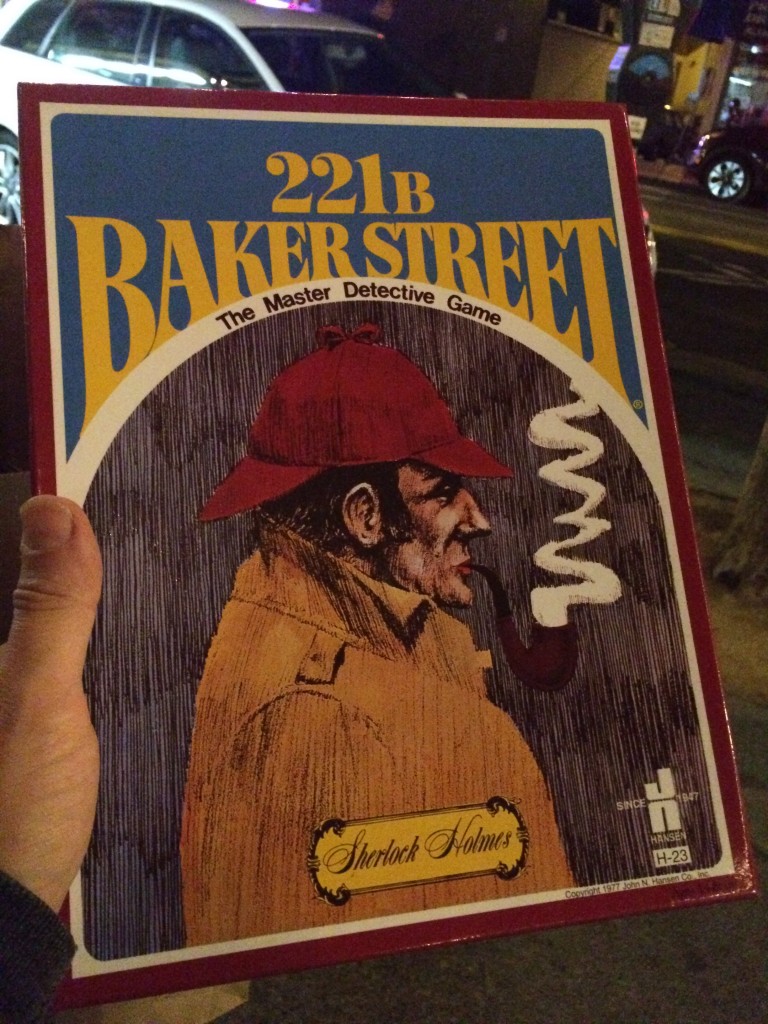
Bookshops, bars, cafes, the boardgames shop (Sherlock Holmes boardgame) and pizza & beer. Settle in nicely.

August 15
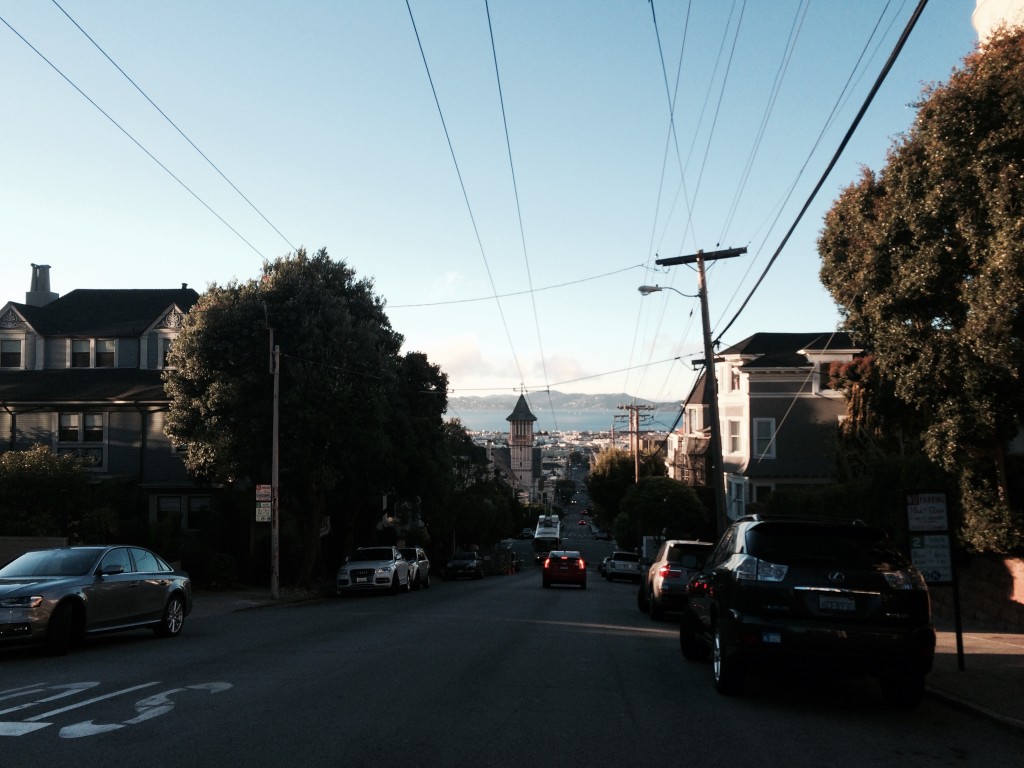
Next day, explore. Russian Hill, Pacific Heights. Those hilly streets and amazing views!

Have breakfast in a place called “Toast” which seems to me like the most American breakfast place ever, and I order a big American breakfast plate loaded with pancakes and fruit, with butter and maple syrup. It’s absolutely delicious, but later that day I feel like my blood-sugar levels are such a mess that I really shouldn’t eat more food like that and decide to try to be more healthy.
Again, I’m reminded of films which are set here, including Dirty Harry and Bullitt.
Beautiful multicolour houses and quirky doorways. Very expensive neighbourhood.
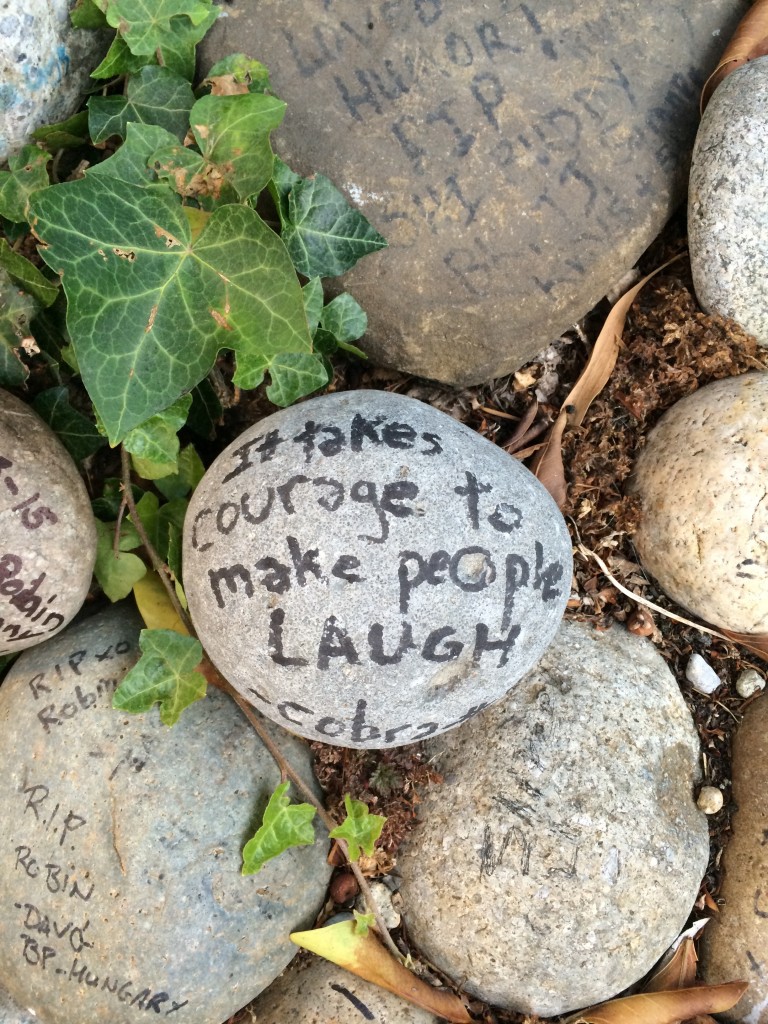
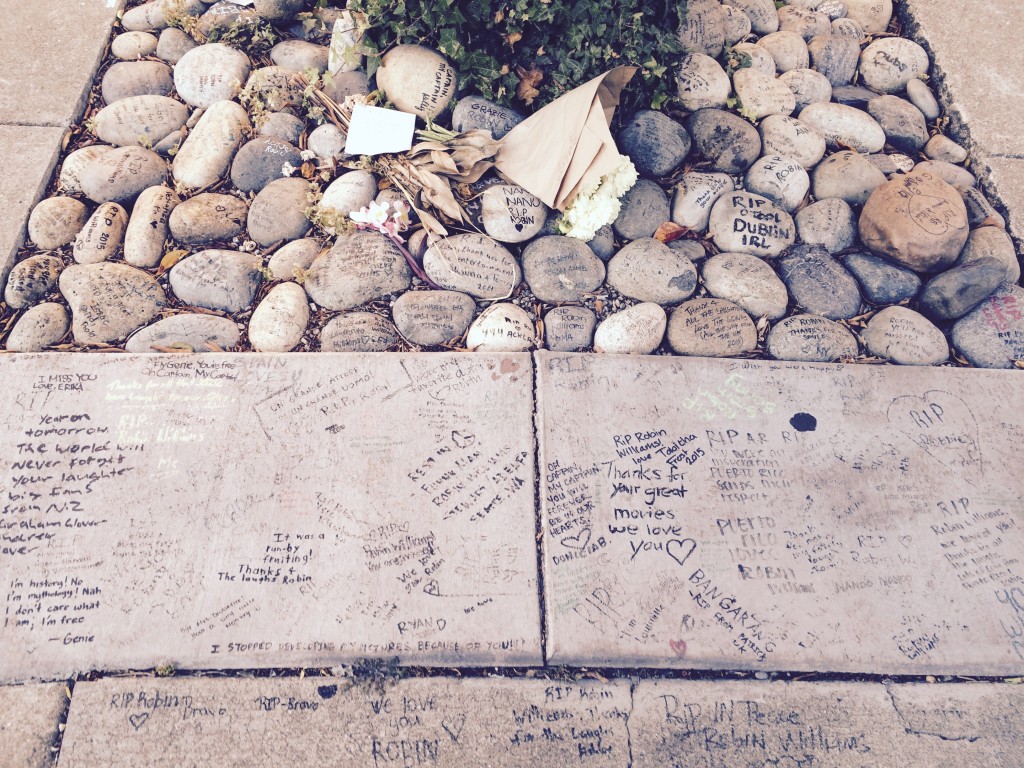
We come across a tribute to Robin Williams outside a house where they filmed Mrs Doubtfire. It’s exactly one year since he died. We hang around there, thinking about Robin Williams.

Who Was Robin Williams, and What Happened to Him?
Let me give you a brief history of the life and death of this great comedian.
Trained at Juilliard School.
Had a particular gift for improvisational comedy.
Became famous in Mork & Mindy.
Also did stand-up.
Had big problems with alcohol and substance addictions, particularly cocaine.
He managed to quit when his first child was born. Lived as a recovering alcoholic.
Went on to do some very popular movies, in both comic and straight roles.
Won an oscar for his role as a psychiatrist in Matt Damon and Ben Affleck’s film Good Will Hunting.
Apparently he was a very sweet, very generous and warm guy, but he was affected by bouts of depression.
As a performer I find him incredibly versatile and animated. His comedy seems almost to be compulsive in its nature. He’s a whirlwind when in front of an audience, full of impressions, different voices and many bizarre tangents which are often dialogues between different characters, all played by him at break-neck speed.
In interviews he seemed to occupy two modes – the first was the extrovert comedian, the other was the sweet and sincere actor. He seemed a bit bipolar. I guess part of his talent was that wildly free sense of instant creativity, but it might have been quite difficult for him to deal with on his own.
He fell off the wagon (began drinking again) in 2006 while filming in Alaska. It’s kind of understandable that he turned to alcohol again considering the circumstances – I mean, he was in Alaska. (just kidding)
He went into Rehab but I think the return to alcohol was a symptom of a difficult time in his life.
He later had heart surgery which involved part of his heart being replaced, and apparently this affected him quite badly as his physical and mental condition seemed to get worse and apparently from that time forwards he suffered from depression, anxiety and paranoia. He was wrongly diagnosed with Parkinson’s too, and given medication and treatment that didn’t help the real condition that he was experiencing, which is called Lewy Body Dementia, a degenerative condition in which nerves cells in the brain are blocked by protein clumps (bodies) that interfere with function. Apparently the Parkinson’s medication made the Lewy Body Dementia worse and may have exacerbated his low state of mind, pushing him to suicide.
He killed himself almost exactly a year ago to the day that we found ourselves at the shrine to his memory on this San Francisco street.

I couldn’t help feeling a bit sad about this because I really enjoyed Robin William’s comedy, but also it’s just such a pity that he had to go through such misery, and that anyone has to go through any kind of misery caused by physical and mental conditions. I hope with more research and the right kinds of treatment, this sort of thing can be prevented in the future.

Anyway, I just wanted to mention Robin Williams there, as a sort of tribute.

SF continued…
Korean Barbecue

End of Part 6 (Oh my goodness, will I ever finish this series!?) Part 7 coming soon…
Robin4

291. California Road Trip (Part 4)  Stars on Hollywood Blvd / Songs & Movies / UK & US English

Hi everyone, here’s part 4 in this road trip mini-series. How are you? Are you keeping up with all these new episodes? I suppose if you’re listening to this it means you are keeping up, but don’t feel rushed. Take your time, listen to them at your leisure, in your own time and at your own speed. I hope you’re finding this series interesting. In this one I’m planning to cover these things: Hollywood Boulevard and celebrity culture, an analysis of the mysterious lyrics to Hotel California by The Eagles, a visit to the extremely wealthy area of Beverley Hills, some more differences between American and British English vocabulary, the church of Scientology and then Yosemite National Park.

Small Donate Button[DOWNLOAD]
Let’s see how much of that I can actually get through in this episode. I expect there will be one or two more in this series before we get back to normal podcasting as usual.

L.A. Continued… Hollywood Boulevard
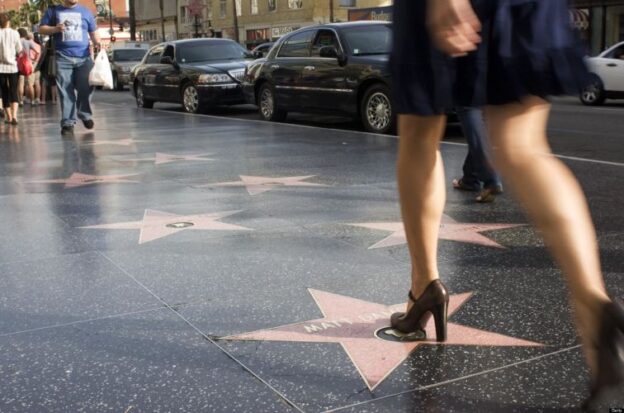
I can’t remember which day this was as I’m losing track of time, but it doesn’t matter. At some point we took a walk along Hollywood Bld – that’s the one with all the stars on the ground and the names of celebrities. If you make it as a celeb, they put a star on the pavement here and you know you’ve made it because hundreds of tourists walk all over you and spill coke and ketchup on you every day. That’s the American Dream isn’t it.

Walking along Hollywood Blvd, and looking at the stars there, I wondered – how do you actually get your name on a star here? (Not that I want to of course) I just wondered – who decides which names are added and how does it happen? Since then I’ve done a bit of research (I read a TIME article based on an interview with a member of the selection committee – you can read it here: http://newsfeed.time.com/2013/07/16/how-to-get-a-star-on-the-hollywood-walk-of-fame/), and so…

How to get your star on Hollywood Boulevard
Essentially anyone can apply, as long as they have $30,000 dollars to spare, but the application will not be accepted unless it meets these criteria:
1. Do some iconic work in entertainment.
This means that you have to have produced something genuinely notable and celebrated in the entertainment world, like made a popular film, done some great acting on TV or in movies or made some music that’s popular enough to have made you famous. The emphasis is on accomplishing some expertise in the entertainment field, which means that reality TV stars are excluded, because it’s not counted as proper work. So that means no Kardashians. But they do accept animals. In fact several animals have their names embedded into the ground there, including Lassie and even fictional animal characters like Kermit the Frog, Mickey Mouse and Donald Duck. Weird. You also need to have been working for at least 5 years. The main point is that this is a tourist attraction for the entertainment industry, so your name needs to be famous enough to attract tourists to come and see it. Apparently it’s working because the street is jam-packed with tourists and it’s almost impossible to actually walk along the street in some places.
2. Promise that you really want a star.
All applications require a signed statement from the applicant saying that they really want one, and that they will come to an unveiling ceremony if the application is a success. Basically, the star selection committee that is in charge of the process wants to make sure the celebrities are fully prepared to come and promote the addition of their star on the pavement. Again, this is to make sure it gets the proper media coverage, and those tourists keep coming with their dollar bills, their mobile phones and their instagram accounts.
3. Pay $30,000.
That’s how much it costs to enter the application process. Usually it’s not a problem for celebrities to pay this because other people pay on their behalf, for example management companies or other sponsors who have an interest in the person become more and more famous. Half of the fee goes to the Hollywood Historic Trust which maintains the whole street. The rest is used to pay for the paving stone with he star embedded in it, and also the security and photographers at the unveiling ceremony. It seems that people’s desire to be recognised as a famous person is what fuels the economy around here.
4. Impress the selection committee.
It’s a bit like a job interview process I suppose. In your application you need to impress the committee and show them what you’ve achieved in your career, proving that you really are a big star.
5. Choose your spot on the Boulevard.
It is possible to choose where your star is placed. The bigger you are as a celebrity, the more control you have over this. Do you want to be placed in front of McDonald’s or in front of the famous Chinese Theatre Cinema where all the premiers happen? Your power to negotiate this depends on your status in Hollywood. Apparently Clint Eastwood, a high ranking member of the Hollywood establishment, was accepted by the committee years ago but never completed his application, but nevertheless they have kept a space free for his star in a prime location – in front of that famous cinema. That’s how much of a star he really is in Hollywood – they’ve kept the best space free for him. Muhammad Ali didn’t want people walking on his name, so the committee agreed to put his star on the wall – the wall of what? You might ask. Ali’s name is on the wall of the Hollywood and Highland Shopping Centre. I wonder if you can buy a George Foreman grill in that shopping centre.

So that’s how you do it, if you’re interested.

What’s it really like there on Hollywood Boulevard?
Essentially, it’s like a bigger version of Oxford Street. It’s full of cheap attractions and huge crowds of tourists, and it’s a bit tacky. You can’t get much decent food there except burgers and pizza. I don’t recommend it really.
As we walk along the street, squeezing between people, we see names of people. Most of them are dead. There are loads that I’ve never ever heard of.
I’m struck by the thought that fame is fleeting. I mean that it doesn’t last. What’s the attraction of fame? To be so well-known that your name is embedded into the ground or onto a monument so people never forget you. Maybe people are attracted by this because they feel like it’s a way to live forever. But true long lasting fame is only gained by a tiny minority and even then it isn’t immortality it’s just a version of yourself that lives on in popular culture. A ghost.

I’ve said it before and I’ll say it again: L.A. is a mysterious place.
I’ve tried to describe this already in this series. It’s just a general feeling that’s hard to put into words.
There’s a lot of light and dark here. Movie stars shine bright, and there’s so much glamour, but there’s also poverty, homelessness and broken dreams. So many young people have come to L.A. and then ended up corrupted by the place, or hurt by their own idealism and naivety. Some of them died young in tragic circumstances. Think of the girl Peg Entwhistle who jumped off the Hollywood sign in 1932, or young movie stars who died or hurt themselves as the result of a dangerous intake of drugs. River Phoenix for example. He was a fresh faced young movie star and musician, who died from an overdose on the doorstep of the Viper Club, which at the time was owned by Johnny Depp. Why so much oblivion?

Also, so much of the writing, films and music – the really good stuff at least, seems to be essentially about some sense of a loss of innocence, the end of the American dream, the darkness under the surface of American values or dealing with vice – particularly in the form of alcohol and drugs, and the dark side of these things. As if California represents the highest attainment of the American Dream, and is also the place that can turn into a grim and empty wilderness of the soul. Think of the detective stories of Chandler, the songs of The Eagles (not as sunny and nice as you expect) and other bands, the writing of Ginsburg, Bukowski, Burroughs, Kerouac, the comics of R Crumb and so on.

I realise that I’m talking about slightly dark themes here, in what you might have expected to be just a description of a romantic honeymoon. Well, we did have some really nice romantic moments together of course, and there was plenty of sunshine and good times, but as well as that we had a really great time getting to know the place and soaking up the atmosphere of the places we visited and one of my aims in these episodes is to get under the skin of California a bit.

Let’s consider some songs that deal with the things I’ve been talking about.

Songs about California
One example is the song Californication by the Red Hot Chili Peppers. Californication Lyrics here.

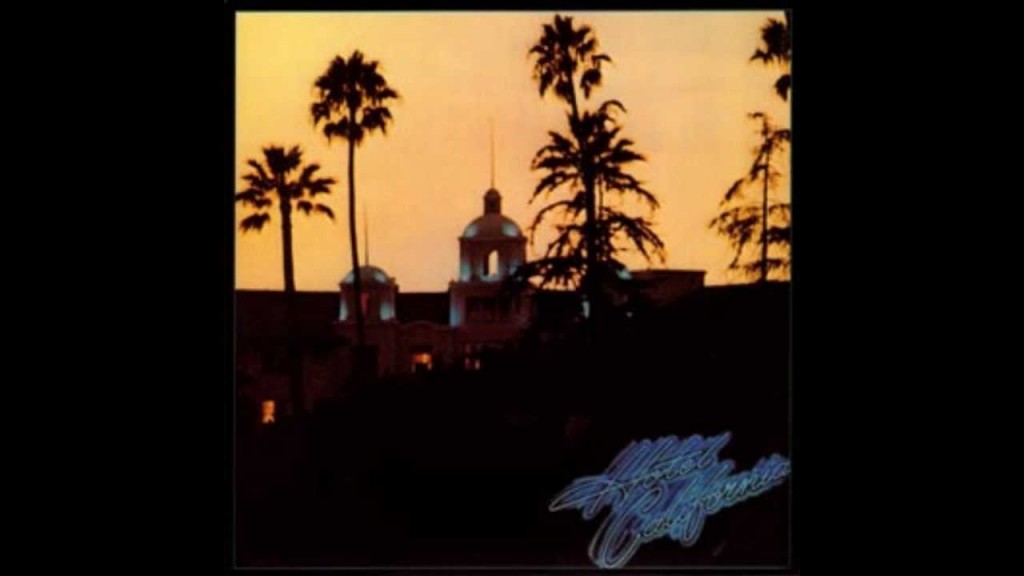
Also, we could go back to “Hotel California” and explore the meaning of the song. In fact, let’s do that.

The Eagles – Hotel California – Song Meaning
Click here for the full lyrics to the song: http://www.azlyrics.com/lyrics/eagles/hotelcalifornia.html

There are loads of interpretations of the meaning of this song, including some pretty far out suggestions that it’s about satanism, drug addiction. I think the latter is far more likely than the former but let’s see.

Here is a summary of the song’s meaning – both the narrative of the lyrics and the themes the song explores. In fact, this song seems to sum up pretty well what I’ve been trying to say about LA and the excesses and dark side of the American Dream.

In this part of the podcast I’m going to read from a page on Shmoop.com. Here’s a citation and a link:
Shmoop Editorial Team. (2008, November 11). Hotel California Meaning. Retrieved August 25, 2015 from http://www.shmoop.com/hotel-california-eagles/meaning.html
So, if you want to follow what I’m saying just click the link above.

LA movies
LA Confidential, The Big Lebowski, Beverly Hills Cop, Pulp Fiction. Any film noir like Chinatown or The Big Sleep.

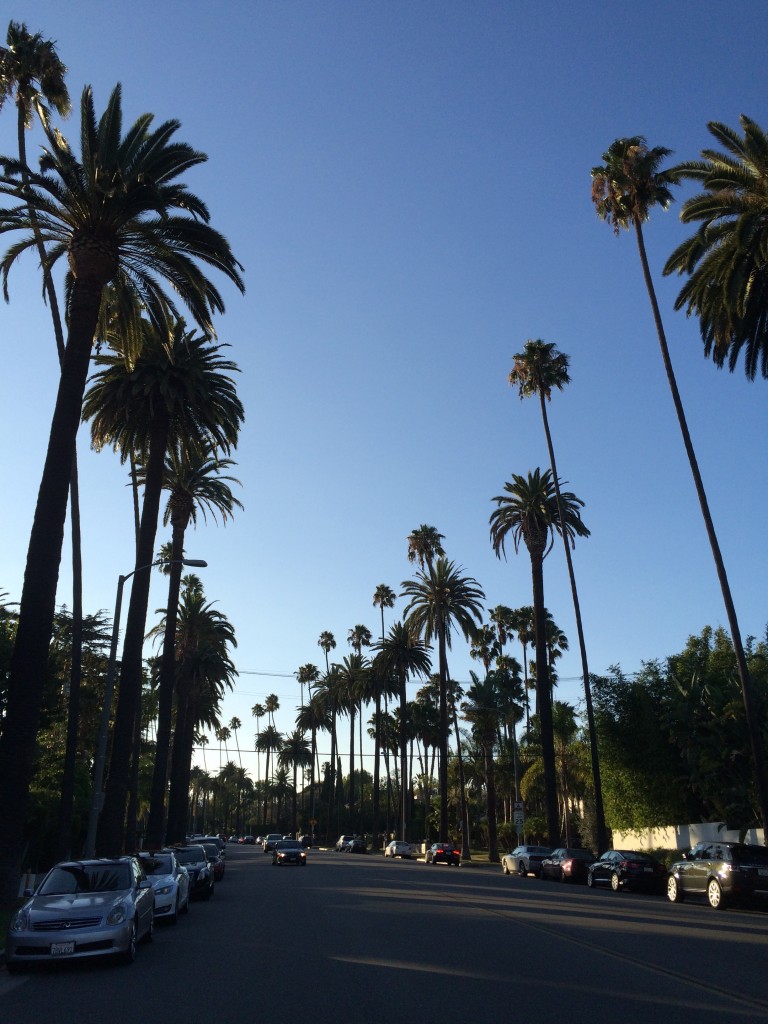
Beverley Hills – this is a really rich town, which is undeniably beautiful and well kept with palm tree lined streets, lovely properties and very smart shopfronts and boutique stores but some parts of it are filled with unbelievably fake looking people with loads of plastic surgery. There are Kim Kardashian clones everywhere with butt implants that mean they can’t walk properly. The streets are full young guys in rented sportscars which self-consciously zoom between sets traffic lights. It’s quite ridiculous and fairly ugly really.

And yes, I did just mention Kim Kardashian.

I always thought I would never mention that family on this podcast because I don’t really like what they do. I mean, I think it’s a bit empty and I don’t know why they’re so popular but if I’m going to talk about celebrity culture in L.A. then how can I do it without mentioning the Kardashians (reluctantly).

Who’s Kim Kardashian?
She’s the daughter of a rich West Coast socialite, and a powerful lawyer. She’s famous for being famous. She’s like Paris Hilton basically. That’s how she first became known in the media, as a friend of Paris Hilton. What a claim to fame! “So what do you do Kim?” “I hang around with someone who doesn’t do anything”. Wow, that’s like being famous for doing even less than nothing! So she’s famous for being friends with someone who’s famous because she’s famous. That’s actually quite impressive. Well done! Maybe that’s the appeal. She makes it look easy. Then in 2003 I think she decided that in order to get even more famous that she would have to actually do something, so she released a sex tape. That’s basically a home made porno. Classy. In my opinion, that may be the quickest and least respectable way to make a name for yourself in Hollywood, but fair play to her – it worked. She then continued to sell off her private life in a reality show called Keeping Up With The Kardashians in which the viewer is invited to follow her and her sisters through their pampered and vacuous every day life.

An example of what happens in a show?
I just had a look on Wikipedia for some show summaries. Here’s what I found from a random entry in series 3 of the show. “Episode 22. Khloé faces pressure about her weight when she decides to do PETA’s “I’d Rather Go Naked Than Wear Fur” campaign. Kris and Kourtney confront Kim about her shopping addiction. Kim gets laser eye surgery after struggling to see herself in a mirror at a dance rehearsal. (I imagine that was a huge crisis – not being able to see herself) Bruce is anxious to talk to Kendall and Kylie about his colonoscopy.”
What’s a colonoscopy? That’s when a doctor inspects your colon by sticking a big camera up your bum. Ok, so you’ve got the general idea.

My problem with the Kardashians is that I don’t get it. I don’t get the appeal. I must be wrong because Kim is one of the most followed people on Twitter and it seems that everyone seems to love her. So, I must be wrong – so if you’re a Kardashian fan, let me know why. I’d love to know the appeal.

Is her reality show popular because we just like to look at the lives of the rich and famous? Is Kim Kardashian a role model? Apparently, for some people she is a woman who has taken careful control of her image and is now rich and successful as a result, like Beyonce or something. But, it helps when you start out rich in the first place, doesn’t it? And at least Beyonce can sing and dance. What can Kim Kardashian do? Well, she can take good selfies. She can use Instagram well. She can market herself well. I suppose that’s it isn’t it.

She married Kanye West, the rapper, which I imagine only happened because Kanye West is not allowed to marry himself. Yes, he loves himself, or that’s what people say anyway. Maybe Kim Kardashian fell in love with him just because she was so impressed by the size of his ego. Surely nobody’s ego is as big as mine, she thought – but then she met Kanye and couldn’t resist his charm, and by that I mean his media status. Good luck to them, I suppose. Maybe I’m being cynical and they just really love each other. Well, if that’s the case – good luck to them! I hope they stay together and prove me wrong, and everyone lives happily ever after.

What do you think? I’d love to know.

More American English & British English
These words are all related to food in some way.
UK word – USA word
Chips – Fries
Crisps – Chips
Biscuit – Cookie
Jelly – Jell-o
Jam – Jelly
Sweets – Candy
Treacle – Molasses
Candy Floss – Cotton Candy
Aubergine – Eggplant
Courgette – Zucchini

ukulele-soprano-debutant“Californication” Lyrics & Chords
http://www.tabs4ukulele.com/bands/red-hot-chili-peppers/californication.html#null

End of part 4. Part 5 coming soon…
Hotel California

290. California Road Trip (Part 3) Venice Beach / UK vs US English – Cars & Driving

Hello, welcome back to the podcast. This is part 3 in what could turn out to be quite a long series about my recent trip around California. Normally I tend to focus on British things in this podcast but every now and then I go travelling somewhere and report back on what happened. This time I went to California on my honeymoon. The itinerary for the trip was to fly to LA, then drive to Yosemite National Park, then across to San Francisco, then down the coast back to LA and then home again. In this series I’m telling you about the trip, but also I’m branching out in order to ramble on about the history and culture of California and some of the differences between British and American English, as well as some other subjects.

Small Donate Button[DOWNLOAD]
At this point in the series I’m still just a few days into the holiday, and there’s plenty more stuff to cover. In this episode I’m hoping to talk about Venice Beach, Baywatch, Segways, the grammar of telling stories and anecdotes in English, some facts about the Hollywood sign, The Red Hot Chili Peppers, British and American English vocabulary related to driving, the dark side of Hollywood and celebrity culture, and an analysis of the lyrics to the song “Hotel California” by The Eagles. That’s a lot of subjects to cover, so I’d better get started right away!

Saturday 8 August
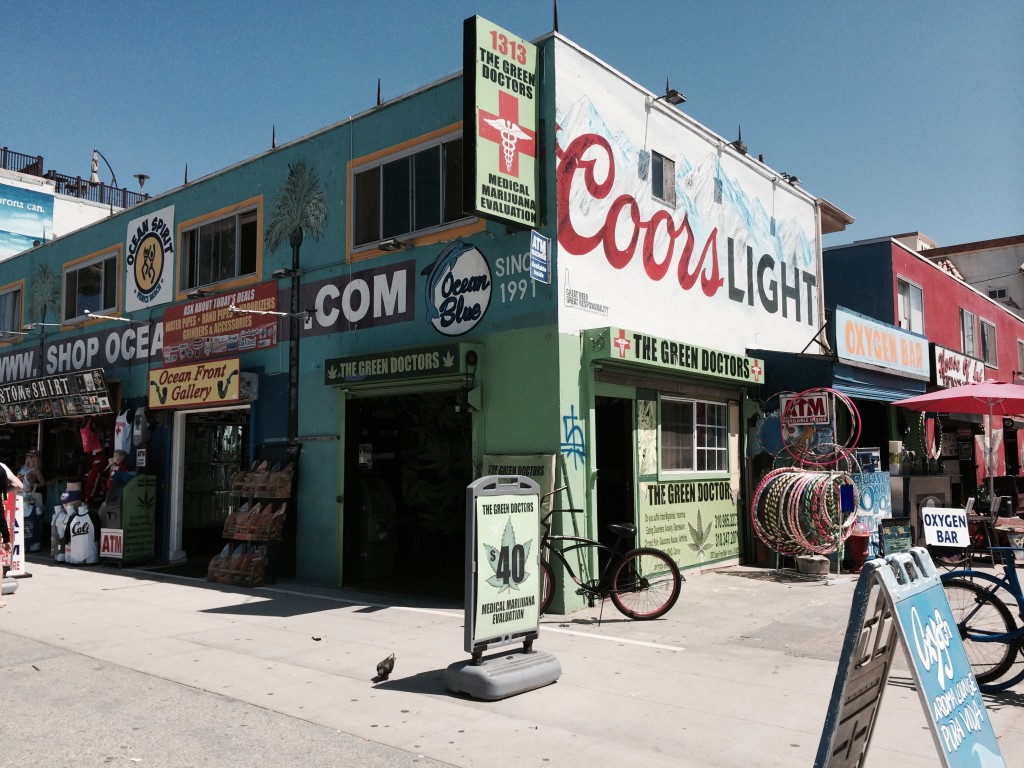
Drove to Venice Beach which is just along from the world famous Baywatch Beach (Santa Monica beach).
Long Boardwalk with lots of shops, cafes and bars.
People performing and busking.
Muscle beach.
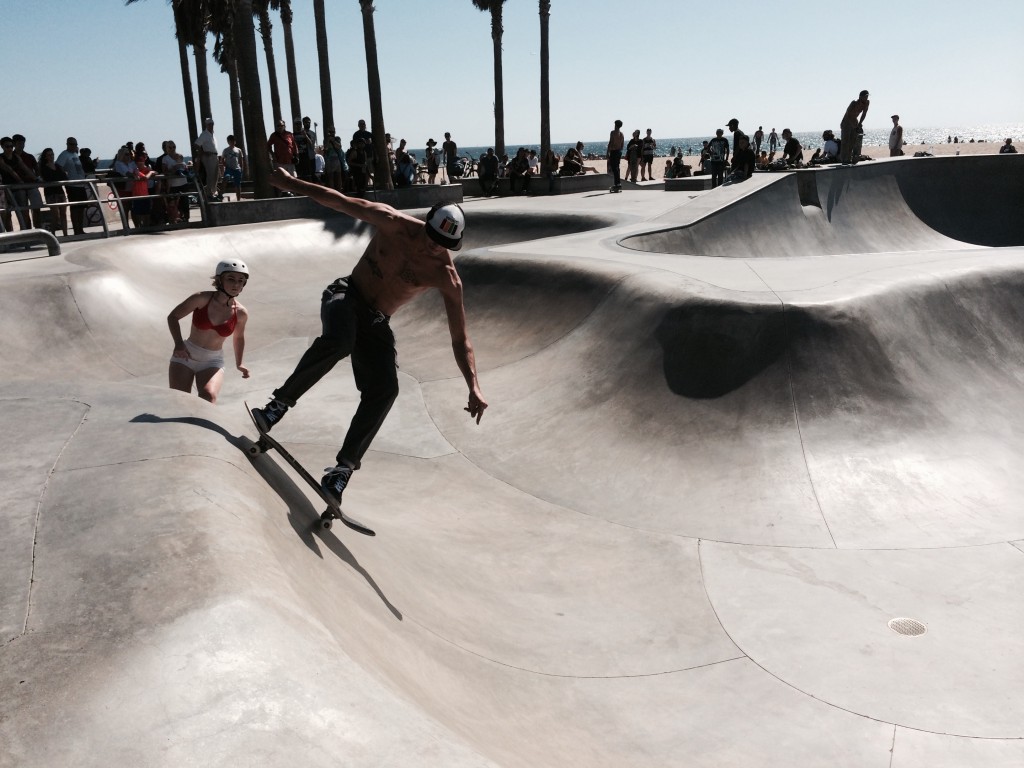
Skate park.
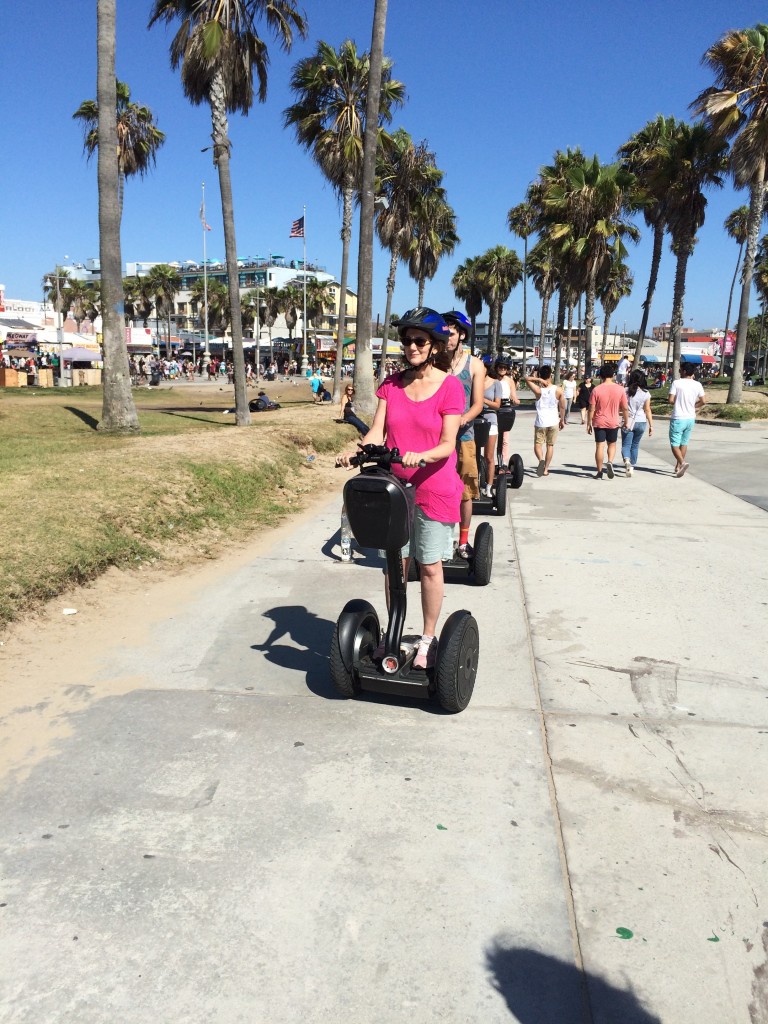
Bikes and segways.
The Segway – the most stupid invention of all time?
What we need is some way of propelling us forwards at just a few miles per hour (you mean like walking speed?), but with the ability to go slightly faster (what, like running speed?) facing forwards so we can see where we’re going, with our hands free so we can hold coffee or mobile phones. How on earth can we do it? (How about our legs sir? We could just walk, jog or run.) Don’t be ridiculous!

And the Segway was born – bringing human laziness to new levels. And you thought escalators and moving walkways were bad enough, now the Segway. It’s very hard to look cool or even dignified on one of these things. I imagine there are some people who cruise around on a Segway all day and then go to the gym to run on a treadmill in order to stay fit. Something doesn’t make sense here. OK, so it doesn’t produce harmful emissions, but neither do your legs. Sure, a person can fart – that’s an emission, but you can still fart on a Segway so it’s the same. Maybe it’s for people with mobility issues, but it seems that in order to use a segway you need the full use of your legs in order to stand on it the whole time, and balance properly. Well, I’m sure it must be useful for something – like maybe doing specific jobs, but it seems a bit silly to use one when you can just use your legs to do exactly the same job. It seems like reinventing the wheel to me. (This is a phrase which means doing something unnecessary – like working hard to do something which is already done by something else)

“Introducing a new innovation in green personal transport – legs!”

Went to the beach or sunbathing. Really huge beach covered in pristine bleached sand.
Swam in the sea. Big waves.
Surfers.
There are lifeguards, exactly like in Baywatch but somehow I expected (or hoped) that it would be more like Baywatch there.
Baywatch: A show which I think was ‘single handedly’ responsible for bringing a whole generation of boys into puberty – no pun intended.

But it was pretty normal, compared to the TV show. I mean, the people looked pretty normal. It wasn’t just hundreds of David Hasselhoffs and Pamela Andersons everywhere, except for me and my wife of course.
Shopping in the huge outlet mall. The place looked like Bowser’s castle from Super Mario Bros. Totally fake modern place that was vaguely like a castle and a huge castle courtyard.
Bargains on jeans. 4 items for the price of one pair of jeans back home.
Seemed incredibly luxurious. Big marble toilets with acres of space.
Yamashiro restaurant in the evening for a romantic candlelit dinner with a stunning view of the city. The restaurant was amazing, with Japanese gardens in the middle and lots of sliding doors – like the scenes from Kill Bill.
Amazing views of the city.
Delicious sushi.

STOP! Grammar Time – A Note on the Tenses Used in this Episode
Usually when you’re describing what happened in the past you use past tenses (past simple, past continuous, past perfect) and so on. So far I’ve been using past tenses in this series of episodes when talking about what we did, but as I’m now reading from the notes I made during the trip, I’ve noticed that I wrote it all in present tenses and it feels tempting to slip into the present tense while reading it. Why? This sometimes happens when we tell stories that we want to make engaging, captivating and in-the-moment. Past tenses accurately report past events, but past tenses can be quite remote. They place the action in a finished time period. When people tell long stories, they sometimes slip into present tenses in order to avoid this remoteness, and make the action and events seem more real and captivating.

Also, using present tenses to tell stories and anecdotes is more common in spoken English. In written English it can be frowned upon (some people don’t like it) but the main thing when writing is that you stick to one perspective (either past tenses or present tenses, throughout). For example, a person at a dinner party might begin telling a story about their holiday using past tenses but then might subconsciously switch to present tenses to make the events more immediate, and that’s considered ok. But if a novelist writes a story and some of it is in past tenses, and other bits are in present tenses, it’s usually considered to be sloppy writing unless it is obviously a stylistic choice. What I’m saying is: you might notice some moments where my tenses move from past tenses to present tenses and this is more acceptable in spoken English than in written English. As my podcast is presented to you as primarily a form of natural spoken English, that should account for this.

Past tense version: So we were sitting in the Japanese restaurant and eating sushi, having a lovely romantic evening, when suddenly loads of ninjas dropped down from the ceiling but I wasn’t worried because I’d spent 3 months in the mountains learning the ways of Chinese kung-fu and so I dealt with them all, and went back to the sushi.

Present tense version: So there we are eating our sushi, having a lovely romantic evening when suddenly loads of ninjas drop down from the ceiling but I’m not worried because I’ve spent 3 months in the mountains learning the ways of Chinese kung-fu, so I deal with them all and then go back to the sushi. (The present tense version is more immediate, and more common in spoken English, although it might sound a bit colloquial).

Slipping into present tenses when telling a story is usually a subconscious thing, rather than a planned thing. I think people just end up using present tenses when they’re recounting events as they actually happened. So, let’s see if it happens to me while I continue to tell you this story.

Another point: This habit of slipping into present tenses that I’m talking about… This doesn’t mean that you don’t need to use past tenses. It’s not a loophole which you can use to avoid making sentences with complex past tenses. This is not a way for you to completely avoid having to deal with irregular verbs and past participles and auxiliary verb conjugations and things. No. If you get a grammar test at school about narrative tenses and you use present tenses, you can’t justify it by saying “But sir I was just using present tenses to make the story more immediate!” Sorry, it doesn’t work like that. You still need to master past tenses before you can abandon them in certain cases. You need to know the rules before you can break them. You need to have full control of the language in order to make these subconscious shifts in tone. So, keep studying those past tenses, practising and being mindful of how you’re using them. If you want to listen to a podcast episode about using past tenses (simple, continuous & perfect) to tell stories, check out episode 29 which is called “Mystery Story / Narrative Tenses”. It’s one of the most commonly listened-to episodes of my podcast. It’s got a short story featuring The Doctor from Dr Who, and a full explanation of how to use narrative tenses properly, pronunciation drills and everything. Click here to check it out: www.teacherluke.co.uk/2009/11/12/mystery-story-narrative-tenses/

So, you can study the tenses directly. Alternatively, don’t worry about it too much and just let the words wash over you and focus on the general meaning of what I’m saying to you, and imagine yourself there and just focus on the meaningful content – the more natural and contextualised English you hear the better it is for your acquisition of grammar at an almost subconscious level, creating that sense of instinct for what is correct or incorrect usage.

Anyway, on with the story…

Sunday 9 August
Breakfast and then took a drive up into the hills for a trek. (Am I using present or past tenses? I’ve become self-conscious now, so I’ll probably stick to past tenses, but I’m sure that if I get carried away with the story I’ll end up using present tenses… we’ll see)
The whole time in LA I felt very bizarre deja vu. This was of course because of the films and movies I’d seen, but more specifically because of Grand Theft Auto 5, which is very accurately modelled on LA, down to lots of small details. I felt exactly like I was in GTA5 a lot of the time. It’s an amazing game.
Stopped off at a pharmacy on the way. Vast.
I think you get the idea – everything in the US is big. Big cars, big buildings, big beds, big meals, big people. Although we didn’t see many of these huge, fat Americans that we all hear about. I think that’s because in California people are generally a lot healthier. Still, people in general are larger than in the UK.
Park the car and begin a trek into the hills around the back of the Hollywood sign.
Very dry. In fact the whole state is on high alert for forest fires. There are fires burning in various parts of the state all the time. California has been experiencing a severe drought for years. In LA they redirect water from hundreds of miles away in the Colorado River Basin. The water then gets used by rich people in Beverley Hills to spray in their gardens to keep their lawns green. Again, pretty crazy right? Welcome to Los Angeles.
L.A. is a city with a little mountain range running through the middle of it (Ok they’re hills not mountains) and if you like hiking a bit then it’s worth going up these hills.
We do get amazing views of the city sprawling away on both sides.
Arranged in lines.
Mild hike behind the sign and then down the right hand side.
Views of the sign.
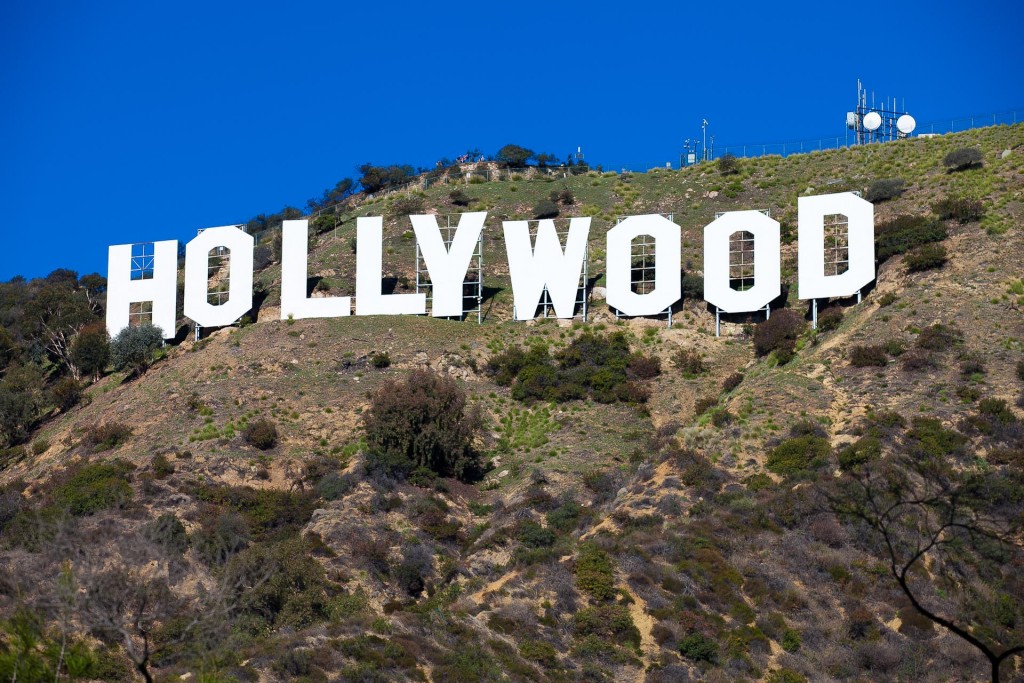
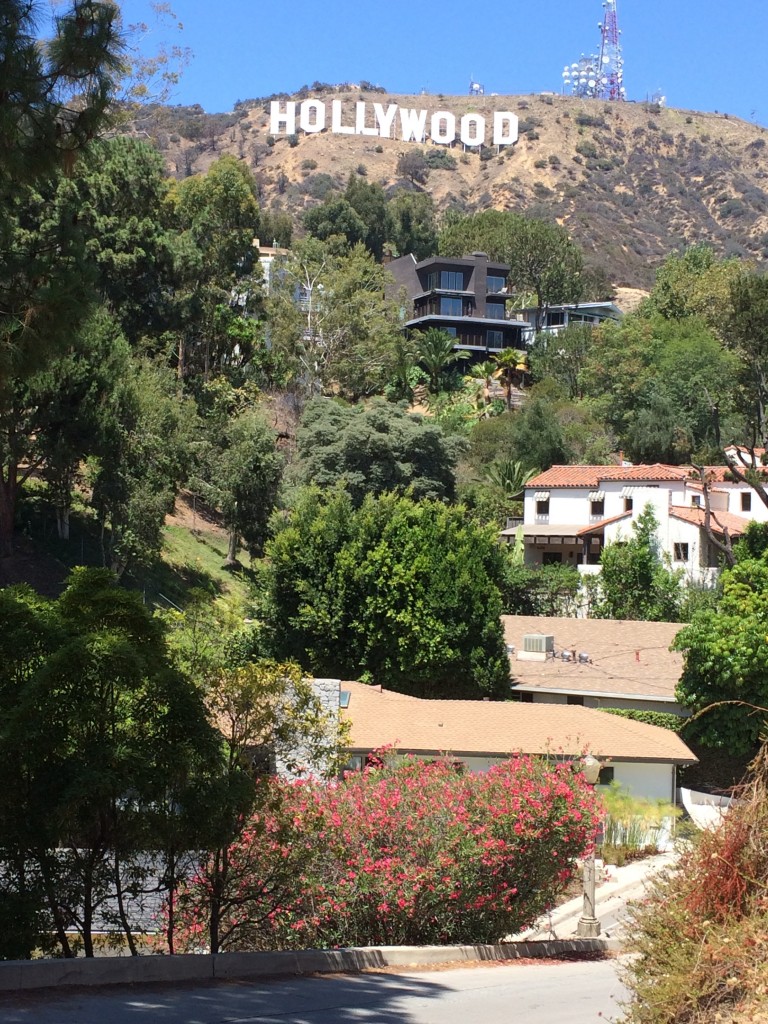
Here are a few quick facts about the Hollywood sign:
– The sign is about 45 feet high and was originally built in 1923 when it was originally put up as an advertisement for a huge real estate company selling top quality real estate in Hollywood. The company was called Hollywoodland. In fact the sign used to say Hollwyoodland, but the ‘land’ part was removed and the sign became an icon of the region of Hollywood, and everything that represents – glamour, movies, fame etc.
– In 1932 a young actress called Peg Entwhistle committed suicide by climbing up the sign and jumping from the letter ‘H’, falling to her death. Apparently she was depressed because she couldn’t make it as an actress in Hollywood. Ironically, her death made her quite famous.
– The sign used to be covered in lightbulbs, which must have looked pretty cool when it was turned on, but the bulbs didn’t last long as they were too expensive.
– The sign was repaired lots of times and almost completely rebuilt in the 40s, but in 1978 it was in such bad condition after the O fell off and tumbled down the hill and also some arsonists set fire to one of the letter Ls. The city decided to repair it and it cost over $250,000 to do that. Who came up with most of the money? Hollywood’s celebrity class. In fact PLayboy owner Hugh Hefner organised a big party at the Playboy Mansion in order to provide the money. Rock star Alice Cooper also provided money to help repair the letter O.
– It was replaced in 1978 and while the work was being done there was no sign there for 3 months.
– The sign is owned and protected by the city of L.A. and there’s quite an advanced security system which monitors the sign 24 hours a day.
In fact you can’t actually get that close to it. There’s a big fence surrounding it, and a big telegraph aerial. You can get around the back, like we did, but you can only really see the letters “HO”. But when you hike around to the front you can see it pretty well, and it looks cool. Again, it’s amazing to actually see something that you’ve seen so many times on television. But it’s not just the power of TV. It is a great location, with some attractive landscape and a really good view of the city below.
We ended up quite far from the car and got lost in the winding streets under the sign. Lots of properties nestled in to the hills. Attractive places and no doubt expensive but not as expensive as other places like Bel Air etx.
No phone reception so kept walking.
Then uber back to the car.

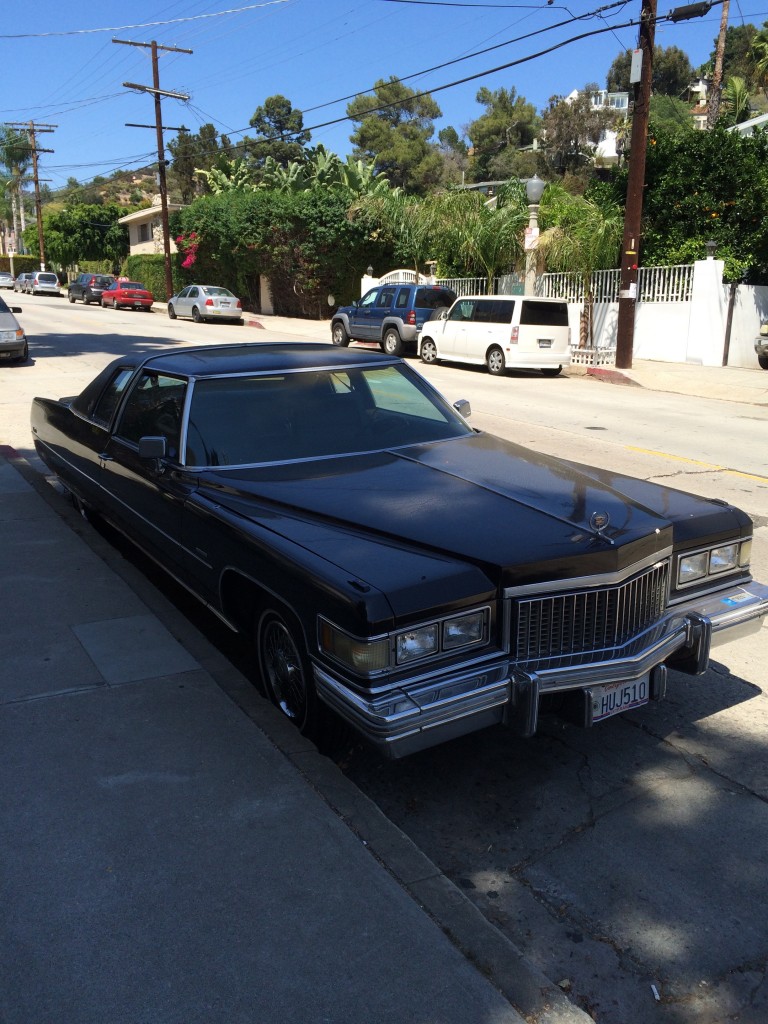
Life in LA is life in a car.

You never drive above about 60mph. I wonder why there are so many powerful sportscars. You never drive over about 50-60 mph. Sums up the place a lot. It’s more about show and image than about practical living – for some people. In fact there are plenty of ordinary people living in LA, who drive ordinary cars, and who do all the ordinary business of life. There also happen to be plenty of rich movie industry people here too, rock stars, and their children. In fact, one of those rock stars is Anthony Keidis from The Red Hot Chili Peppers. He used to live in the Hollywood Hills, and he sang about them too. In fact, I’d now like to recommend another audiobook download for you. So, here’s some more promotion for Audible – that company that provides loads of audiobooks, and they’re giving you the chance to sample their service for 30 days and that includes a free download of any book you like. Here’s another California related book you could get…

Audiobook Download Suggestions
“Scar Tissue” by Anthony Keidis
This is the autobiography of the lead singer of The Red Hot Chili Peppers. The Chili Peppers have an amazing story. They’re from L.A. originally, they’ve been going for about 3 decades, they’ve been through numerous guitarists, ups, downs, deaths and near deaths, epic highs and devastating lows, and yet they’re still going. Anthony himself was a heroin and cocaine addict during much of his career and in this book he tells his own very personal story of growing up in Los Angeles and his experiences of living with his Dad who was basically a drug dealer to the rich and famous. He talks about struggling for years with his experimental band the Chili Peppers – doing intense live performances, sometimes naked on stage, developing their funk-rock sound which ultimately catapulted them onto the world’s stage. You can hear exactly what was like and listen to descriptions of all the complicated things that went along with that stardom. It’s a powerful story, full of sex, drugs and rock and roll but also a genuinely moving and candid account of Anthony’s success, strengths, weaknesses, friendship, personal hardship, the music business, his addiction and his eventual recovery from addiction. The book is an international bestseller and you can download the audiobook version from Audible. Get it free by going to www.audibletrial.com/teacherluke, or click one of the Audible buttons on my website.

American & British English (Part 1) Vocabulary Related to Cars & Driving
*A note on British and American English*
As you are well aware, there are, broadly speaking, two types of English – American English, and good English, I mean British English. (Just joking – I’m not one of those Brits who has a problem with American English) There are other types of English too of course, like English in Australia, South Africa, Ireland, India and so on.

Can Brits and Americans understand each other? Yes, they can – except for some slight misunderstandings sometimes, there’s no problem in understanding each other.

Really the differences are in the accents, vocabulary, spelling, some grammar and the culture or communication style.
There are definitely some differences in vocabulary. Sometimes these cause misunderstandings. E.g. I said “Are you in the queue? ” and the woman just looked at me. Then I worked out the problem and sad “Are you in line?” and bob’s your uncle. The vast majority of the words we use are the same, but there are differences that are worth knowing. These differences may be more obvious when talking about different systems (e.g. our political and legal systems are a bit different so we’ve developed different terms to talk about them) but in general English there is a relatively small group of key words that are different and it’s worth knowing them all. I’m going to go through a lot of those words with you in this series of episodes.

In terms of culture, although we speak the same language, we don’t necessarily think in the same way and this can cause some problems in communication. For example, Brits tend to be more indirect in their use of language as a way of being polite, diplomatic, tactful etc. It can seem to be a more complicated message, but we see it as being more respectful and considerate. We don’t want to seem bossy or aggressive, but the Americans might take it as weak, unclear and even unsincere (not just the Americans) E.g. “I was wondering if you could…” or “I think there might be an issue…” instead of “Could you…?” or “There’s a problem”. I’m not saying all Americans are direct all the time, but in my experience I think there is truth in what I’m saying. If you want more evidence, read this article written by a Brit who’s done a lot of business communication in America http://www.forbes.com/sites/sungardas/2014/08/14/lost-in-translation-overcoming-the-language-barrier-as-a-brit-in-america/ So, there is a bit of a difference in communication style and culture, despite the fact that we speak the same language. The old saying goes “Britain and America are two nations separated by a common language” (which I think was said originally by George Bernard Shaw, an Irish playwright and one of the founders of the LSE – not the London School of English, but the London School of Economics).

Accent or dialect can cause problems, particularly stronger regional accents. To be honest I think this is more of a problem for Americans understanding Brits (and other forms of English like Australians, South Africans, Irish etc) I think the average Brit would probably understand most American dialects and accents, but the average American might have trouble with some local British dialects. For example, in the USA they often require subtitles on TV when someone with a strong non-American accent is speaking (e.g. a local Brit from Liverpool, Glasgow or Newcastle). I’ve seen interviews on US television with actor Colin Farrell that had subtitles to help the Americans to understand what he was saying. He’s Irish and has a fairly strong accent, but it’s not extraordinarily difficult to understand in my opinion but apparently it was necessary to provide subtitles for the American viewers, even though he was speaking English. However, I doubt that a UK audience would need subtitles for an American, even if they have a strong accent from pretty much anywhere in the country. I think this is because in the UK we are exposed to lots of American English from TV and films – even the really colloquial stuff, but British English is comparatively less known in the USA due to lack of exposure.

The Brits and Americans do spell some words differently as I’m sure you’re aware (famous differences are things like colour/color and theatre/theater) and there are some differences in grammatical usage, but that’s less obvious and as a result less problematic.

Anyway, the point is – there are differences between British and American English but the vast majority of the time we can understand each other without any problems at all. If you’re wondering what kind of English you should learn (which you’re probably not wondering to be honest, because if you’re listening to this then you’ve probably decided that you like British English, and you’re right of course – you are wise wise people indeed) But seriously, you can choose to learn British or American English, or a bit of both. In fact, I personally think it’s ok to mix it up a bit as long as people understand what you’re saying.

For your learning of English, I’d say the main things are that you’re able to identify the difference between a British and American accent, and that you know the main differences in vocabulary. For more information about the differences between UK and USA pronunciation, listen to a previous episode I did on this subject – Episode 14 “British and American Pronunciation” https://teacherluke.co.uk/2009/10/19/episode-10-british-and-american-pronunciation/.

The subject of British and American English is really interesting and very relevant so I’d love to come back to it in the future but for now, here are some different British and American words. I’ve chosen ones that are related to driving.

Let’s see how many you know. I’ll define the word first – try to guess it. Did you come up with the British or American version, or both? Let’s see…

British Word – American Word
Petrol – Gas (gasoline)
Petrol/fuel tank – gas tank
Caravan – Trailer
Lorry – Truck
Junction – Intersection
Tyre – Tire
High street – Main street
Windscreen – Windshield
Motorway – Freeway/Highway
Number plate – License plate
Bonnet – Hood
Pavement – Sidewalk
Boot – Trunk

End of part 3. Part 4 coming soon!
California3

289. California Road Trip (Part 2) History of California / Life in L.A. / UK & US English

Here’s the next part of my description of my recent trip around California. This is a description of my honeymoon, but I’m also going to tell you about the cultural, geographical and historical context of the places we went to, and I’ll give you some practical tips and teach you some British and American English too. This is part 2 of the California series. Let’s carry on.

[DOWNLOAD]
In part 1 I told you about the itinerary for our trip, some of our first impressions of arriving in L.A., some notes and advice on customer service and dealing with waiters & staff, some stuff about the car, an audiobook recommendation and California’s marijuana laws. So, let’s carry on in this episode. First of all, I’d like to give you a brief history of California, because it helps to understand what the place is all about when you learn about its history.

A Very Brief History of California Source: http://michaellamarr.com/cahistory.html A paraphrased and reduced version.
California is known as the golden state, because of the sunshine but also because of the gold that was found there in the mid 19th Century. But let’s go further back to consider the first people to have populated California, a long long time ago (but not in a galaxy far far away this time).

Small Donate ButtonPeople arrived in California about 12,000 years ago. They were descendents of the people who travelled across the Bering Strait from the Asian continent about 40,000 years ago. They travelled into North America to follow food – migrating herds of animals probably. At that time it seems that Alaska and what is now Russia were connected by an exposed stretch of land which later was covered over when the sea level rose, separating America and Russia (or the Asian continent). Those people became the first Native Americans. They eventually found their way to the area we now call California. They lived there in various tribes in different parts of the state, undisturbed for a long time.

Then, in the 15th and 16th centuries, Europeans began travelling across the Atlantic and America was ‘discovered’. It was the Spanish, with Hernando Cortez initially, and then other explorers who were the first Europeans to enter the area that we now know as California after fighting the Aztecs and developing a Spanish colony in Mexico. The Spanish attempted to settle in California and find a route they could use to sail their ships from the Atlantic coast to the Pacific coast, but they the failed to find one after lots of attempts, with some competition from Sir Francis Drake who to the English is a great explorer, but to the Spanish is a pirate who raided early Spanish settlements, stealing lots of their silver. The Spanish found it hard to settle in California because of the difficult access from the Atlantic side and because of clashes with the native people so they ignored California for about 150 years, although they had named the areas of America that they’d ‘discovered’ and claimed “New Spain”.

It’s not entirely clear how California got it’s name but it seems that the most popular theory is that it comes from a romantic adventure story by Garcia Ordonez de Montalvo called “Sergas de Esplandian” or “The Adventures of Esplandián” (1510). This story tells of a mythical island called California, which is populated by a race of beautiful and powerful Amazonian warrior women called the Califia who are ruled by the formidable Queen Califia. In the story, which was a very popular and well known one, the Califia were warrior women “of vigorous bodies and strong and ardent hearts and of great strength.” The queen and her warriors would go on adventurous missions, fly around on griffins (griffins are legendary creatures with the body, tail, and back legs of a lion; the head and wings of an eagle; and an eagle’s talons as its front feet) that lived on the island and would capture and kill men they come upon during their travels. Any man found in their domain they would eat. Califia or California in the story is presented as a mythical place near the real world. The island is described as a kind of paradise filled with gold and precious stones.

The original Spanish settlers who came to the area first thought that California was an island, and perhaps it was similar enough to the mythical island in this story that the settlers were inspired to use that name. The story was well known and popular enough, and some believed it was based on an older myth which was part of an oral Spanish tradition. Some people may have believed it was true and this place really existed. Maybe they thought they’d arrived there for real, or maybe they were just inspired by a good story. It’s not entirely clear, but what we do know is that, essentially, California is named after a beautiful and powerful Amazonian warrior queen, who used to fly around on a griffin and eat men for breakfast. Pretty crazy, right? It sounds like something from an Arnold Schwarzenegger film from the 80s or something. It just shows that California has had a fairly long tradition of grand, glamorous and sexy myth making and story telling associated with it.

In 1765 a man named Jose de Galvez, who was an official to the Spanish king decided it was a good idea to have another go at claiming New Spain properly, before the English or the Russians did it. He managed to convince the King to let him go on a mission there, with the intention of claiming the land and spreading the Romain Catholic faith. Although it was a very difficult mission with lots of hardship, ultimately it was successful and several missions (Christian bases) were set up on the Californian coast, including Monterey Bay and San Francisco. The Spanish missionaries managed to convert a number of the local natives into Catholicism, but this was largely due to the threat of violence or because they pacified the natives with offerings of supplies and tools that they’d never seen before, although saying that I’m sure the natives were also genuinely impressed by these new people who had arrived and may have seen them as being sent by god. Again, things didn’t go completely smoothly because there was resistance from the locals who did fight back, but in the end the Spanish were numerous enough and powerful enough to withstand these resistance movements from the Native Americans, even though unfortunately this meant that a lot of native people were killed and severely punished in the process. This is all part of the story of how the Native Americans were eventually almost completely wiped out in the long population of America by Europeans.

The Spanish settlers and missionaries built forts at strategic locations up the California coast. These were basically protected bases which helped them defend their territory against angry natives or possible invasion by other countries wanting to take this beautiful and rich land that they had managed to claim. To provide food for the people in these missions or forts, pueblos were created around them. These were basically towns with farms that could produce food. These places eventually grew and developed to become cities like Los Angeles, Monterey and San Francisco.

Then there was a war of independence in 1810 which ended in 1821. This is a similar story to the war of independence against the British which was fought on the other side of the country. The colonies in New Spain were fed up with the way they were being ruled from Spain and felt they didn’t have enough freedom or independence. The people of New Spain won that war and set themselves up as an independent government under the name of Mexico. The Mexican government took control of New Spain and decided that the missions had too much power, and closed them, freeing up the land previously owned by the missions. The priests in the missions were still allowed to operate churches there, but the land was to be divided between Mexican settlers and the Native Americans. The thing is though, the Native Americans had no real understanding of the concept of land ownership so they either didn’t want the land, didn’t understand that it could be given to them, or didn’t know how to deal with it because they’d been living in the missions so long that they were now dependent on the Spanish and Mexican settlers who ran the place. Some native Americans managed to return to their way of life, and some tribes of natives in California had managed to avoid being captured by the missions so there were still Native Americans in California at the time, but the coastal colonies continued under Mexican control. The Mexicans in California did lots of trade with people from many other places during this period, which enriched the area with the influence of different cultures. Presumably these traders came from Russia, Asia or Europe.

Some people, mainly fur trappers, managed to make the very difficult journey from the East coast by land. Remember that it took me 6 hours to fly from New York to LA? Well in the early 19th century it would have taken years to make the journey and in the beginning only the toughest and wildest people could make the journey, which was essentially a massive exploration into unknown wilderness populated by native tribes and dangerous wildlife like grizzly bears. But, some fur trappers made it to California in the first half of the 19th century. These fur trappers were really tough explorers who travelled west in search of valuable fur pelts – basically the skin and fur of different animals. Beaver was perhaps the most sought after pelt. Why? Because beaver fur was used to make top hats in Europe. You know those tall hats the Victorians used to wear? They were made from beaver fur. It’s light, strong, glossy and warm. Perfect material for a good hat, so there was plenty of demand for beaver fur as well as other animals. The first fur trappers must have been very tough guys who were almost as wild as the natives they met along the way. In fact many trappers got to know the natives and learned a lot of their knowledge to help them survive in the American wilderness. Imagine the challenge of crossing rivers, mountain ranges, deserts, canyons and forests. We’re talking about epic journeys.

By the mid 1800s the independent Nation of the USA was very keen to extend its territory to the west, in order to populate and claim that whole stretch of North America from east to west. In fact the prevailing ideology of the time was a strong feeling that the United States had almost a god given right to claim the land, and that it was the destiny of the USA to do so. This is the idea of manifest destiny – That the USA felt the land was theirs for the taking and that they had the god given right to take it. James Polk was the president at this time and he decided that he wanted to take the lands of Texas, New Mexico and California. Texas was a country in its own right at the time after having broken away from Mexico, and New Mexico and California were still owned by Mexico.

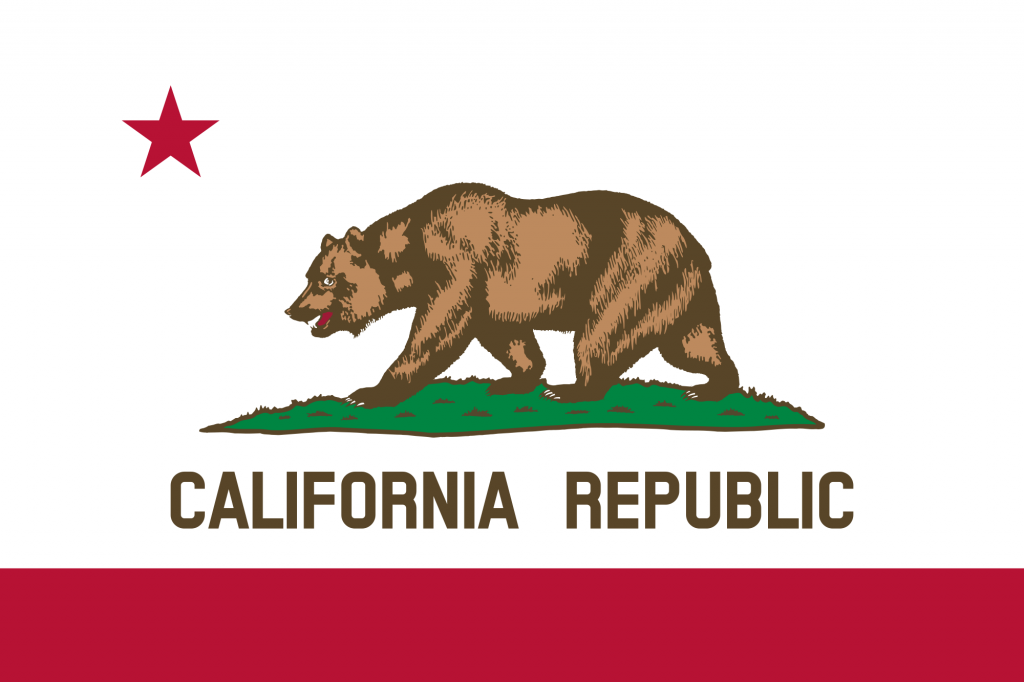
By this time – about 1840. More and more settlers had followed the fur trappers west and had settled in California. This included a man called John C Fremont who was an officer in the US army. He led a brigade of 60 men into California and met Colonel Jose Castro of the Mexican army in Monterey. Castro (no relation to the Cuban leader who came much later, I think) sent the US soldiers out of California, but this army brigade were determined and later re-entered California, gained the support of some of the settlers there and started a revolt in Sonoma, flying the flag with a star and a grizzly bear – the flag of California, and they pronounced it “The California Republic”. This coincided with the general aggressive movement into Texas and New Mexico by President Polk’s US army. Fighting between the USA and Texas had started along the Rio Grande river and this fighting eventually reached California. The bear flag rebels joined the US army during this war and fighting continued into 1848 when when the Treaty of Guadalupe Hidalgo was signed, ending the war. The treaty brought peace to California and also stated that Mexico had to give more than 525,000 square miles of land to the USA. This included the areas between Texas and California, and marked the extension of the USA’s territory from east to west coast.

What happened next was that gold was discovered in California and this changed everything. The first discovery of gold was in 1848 in the Sacramento valley, which is between San Francisco and the Sierra Nevada Mountains, and that caused a few hundred local Californians to move there, and a thousand or so outsiders. A lot of them struck gold and became very rich. Word of this travelled quite far, and fairly quickly. By early 1849 many people around the world had heard the news about gold being discovered in the new world in California and instantly thousands of people were infected with gold fever. “There’s gold in them there hills!”

1849 was the big year for the California gold rush. Something like 100,000 people travelled to California in that year. The people who travelled there are known as the 49ers (which explains the name of the American Football team from San Francisco). About 60% of the 49ers were from America, but the rest came from other countries all around the world and many of them settled in California long term, again adding to the diverse culture of the place. The Chinese certainly moved there in large numbers. Something like 20,000 in total, and many of them settled in the nearest port – San Francisco, which is why there is a large Chinese community there in Chinatown today. 100,000 people is a massive influx in just one year, and the gold rush is certainly one of the most significant moments in American history. By the end of 1849, the non-native population of the California territory was some 100,000 (compared with the pre-1848 figure of less than 1,000). A total of $2 billion worth of precious metal was extracted from the area during the Gold Rush, which peaked in 1852. The non-native population grew by about 1000% in about 18 months following the discovery of gold. This represented a massive injection of culture, development and wealth into California. San Francisco for example, quite quickly became a large metropolis.

What about the native Americans? It wasn’t a good time for them. Essentially, The USA’s expansion west, particularly in search of gold and land just didn’t fit in with the way of the life of the natives. The two cultures just couldn’t live together, and because the American settlers were more numerous, had better technology and weapons, and because the Native Americans were vulnerable to diseases carried by the settlers, the natives just couldn’t hold on to their way of life and were either killed or forced to live in limited areas known as reservations. It’s sad, because the Natives were people who had learned to live in harmony with their environment, and then they basically got wiped out or forced off their land, and treated like animals. It’s heartbreaking really.

By about 1852 even though the surface gold had basically disappeared, lots of people continued to make the journey west in search of their fortune and a better life, and they continued to make that journey for decades as California continued to be seen as a place where people could have a better quality of life.

The 1930s saw another fairly big movement of people into California in search of a better life as a result of the great depression and the dust bowl across the midwest. The dust bowl was basically a huge drought in the early 30s in large farming states from Texas to South Dakota – a big stretch all the way up the middle of the country. There was a huge drought (no water) and so all the crops failed and the earth turned to dust. Within a couple of years there were huge storms that carried the dust into the sky and far along the ground. This made it almost impossible for families to live and grow crops so many of them just left the area and made the arduous journey west towards California in search of a better situation.

Another Audiobook Suggestion
“The Grapes of Wrath” by John Steinbeck
John Steinbeck lived in Monterey, so I thought I’d pick one of his books, and I think this one is probably his most celebrated work. It has a rating of 4.5 out of 5 on audible, which is really high, and the book is widely considered a great classic of American literature. Written in 1939 after the great depression of the 1930s the book follows the story of a family from Oklahoma who are forced to make a long journey across America to live in California. It tells their personal story of the difficulty of the journey, but in doing so it manages to capture the epic narrative of a whole migration of people into the American west. Steinbeck creates a drama that is intensely human yet majestic in its scale and moral vision, tragic but ultimately stirring in its insistence on human dignity. Here’s a quote from a listener’s review: “From start to finish each one of the characters, because they were so well formed and realistic, evoked empathy but never to the point of pity. Every character bore their share of hardship. You walk away from this experience feeling stronger for having been in their company. These were people to be admired.” R. Solomon from New Hampshire.
www.audibletrial.com/teacherluke The Grapes of Wrath by John Steinbeck. Pick the version read by Dylan Baker. It’s unabridged.

A Brief(ish) History of California (continued)
The gold rush was a really important time for America, and the great depression of the 1930s. The migration into the west which was involved in both situations, and to a larger scale across the whole previous century of American history at that point was the embodiment of the American dream. The idea that anyone was free to start from the bottom and if they had the strength and courage they could make their own fortune by driving west, claiming their own plot of land, and delving into the rich American soil to produce shiny gold and riches, or an escape from hardship into liberty! These days people still go west in search for a fortune or some sort of everlasting freedom, but not because of gold, but in search of stardom on the silver screen. Los Angeles and the Hollywood star machine continue to be an attractive goal for many people, although it’s nowhere near the same scale as the original gold rush.

Nevertheless, California maintains its image as the golden state and is still considered to be a golden land where fame and riches can be found. Generations of immigrants have been attracted by the California Dream. California farmers, oil drillers, movie makers, airplane builders, and “dot-com” entrepreneurs like Steve Jobs, Bill Gates and Mark Zuckerberg have each had their boom times in the decades after the Gold Rush. California is also a very popular destination for tourists, holidaymakers and honeymooners, and dreamers. It’s still associated with the American Dream and all that it offers.

But that vision of America may eventually have its downside when you’ve basically made it across the country, you’ve made it to the golden land, the gold has run out and yet the dreams remain. What seems to happen is that people lose it a a little bit, or feel that their idealism and perhaps naivety are challenged by the final frontier – the frontier of inner space or spirituality or just general meaning to life. That may be why people are pretty ‘far out’ here – there’s lots of spiritualism, yoga, new age thinking and so on. Perhaps that’s why they’re into movie making too. It’s the dream factory. Also, there’s plenty of entrepreneurialism in business technology, especially into another frontier – cyberspace, as I mentioned earlier with Facebook and other software and social networking companies. In fact here’s a list of companies in the bay area of San Francisco: Facebook, Pinterest, Tesla, Hewlett Packard, Quora, TuneIn Radio, Google, Skype, PayPal, Logitech, LinkedIn, Groupon, Uber, Android, Intel, Apple, EBay, AOL, Yahoo.

LA Continued…
We drove downtown to have a look around, get some food, get used to the place, take it easy a bit, do some shopping.
Driving in the car in traffic.
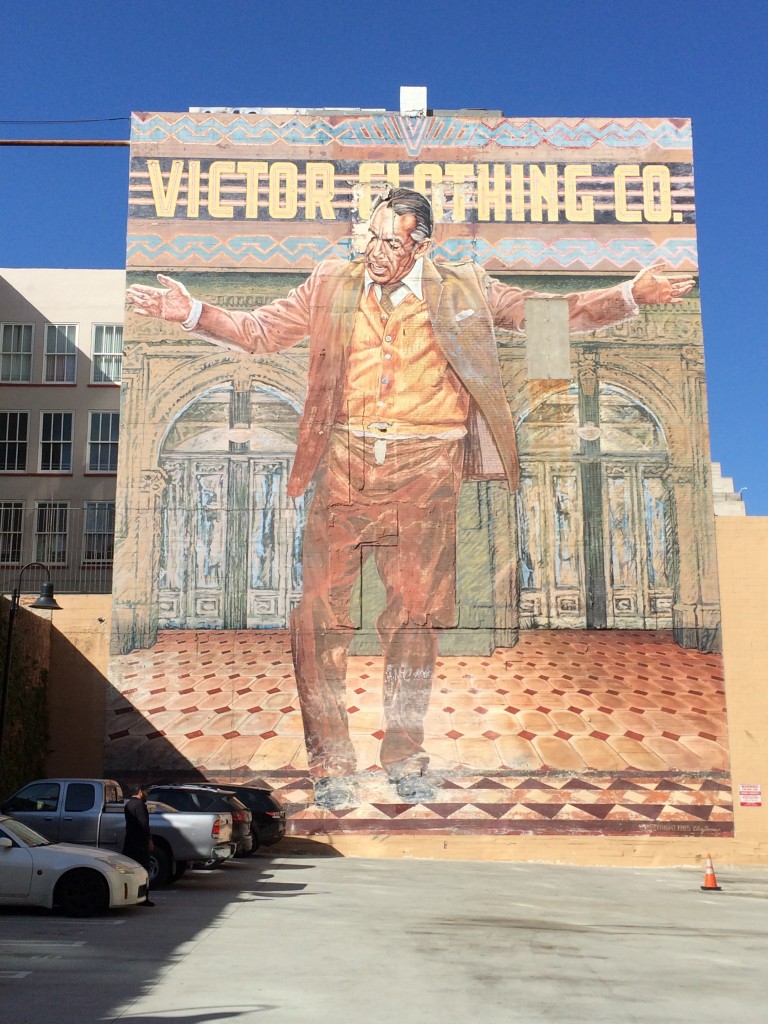
One thing we noticed was the huge paintings and murals on the walls. There’s some really fantastic and very large artwork on the sides of buildings. It’s more sophisticated than graffiti. It’s really excellent. Check out this link to see some of the murals http://www.laweekly.com/arts/10-best-la-street-art-murals-of-2014-5279399
In fact there are murals in many places in California, especially the cities like LA and SF.
Downtown market
Grammy Museum – amazing music exhibition, particularly the interactive screens which allowed you to take a journey though all the interconnected musical genres.
Huge Taylor Swift exhibition, probably because she was due to perform a number of concerts nearby. In fact, Taylor Swift followed us around California. Wherever we arrived she seemed to be doing a concert and we kept hearing her hit song “Shake It Off” all the time, including in the museum shop where it appeared to be playing on a loop, all day. I can’t imagine what that did to the brains of the staff working there. I quite like the song actually. I think it’s a great pop song – and is commercial, super catchy and full of hooks and so on. I’m not sure about Taylor Swift herself. She started out as a country artist, and then recently she sort of switched over into R&B a little bit and it’s worked out for her. I don’t really like any of her other songs, but Shake It Off is just a perfect little pop song.
Hollywood Improv. for comedy + food.
Fighting jet lag.
Back to the hotel to watch a bit of American TV and then pass out.
American TV – just commercial break after commercial break, and many of them are about treatments for health conditions. So many adverts for health insurance and medical solutions. It’s really weird. It’s hard to actually find any content on TV because it feels like about 50% adverts. You flick through the channels and it’s just ad after ad after ad. Still, some of the late night comedy and chat shows are pretty good. FOX News is a total joke. CNN doesn’t seem that much better to be honest. It’s all way too glamorous and just doesn’t feel objective or incisive enough.

There’s a presidential campaign going on. Donald Trump is dominating the news. He’s basically a right-wing free market capitalist who says whatever the hell he likes and appears to be running for president purely because his ego is in overdrive. His skin is more orange than the sun, his hair looks like it should be captured and studied by scientists, and his views on immigration are pretty disgusting. For example, he recently said that Mexican immigrants are rapists and thieves and that if he was president he would start by building a huge wall between the USA and Mexico, and that the Mexican government will have to pay for it. Right. Is this the man we want to be in charge of one of the biggest and most potentially lethal countries in the world. No. Please no. Hilary Clinton will probably win, but I wonder about her connections to all those corporations. Bernie Sanders is a pretty reasonable left-wing candidate. The other Republicans don’t seem to be any different to each other. Jeb Bush is, well, he’s another Bush! But even he seems pretty normal compared to Trump. American politics is fascinating, entertaining and also a little grotesque and a bit scary. What a country.

End of Part 2. Part 3 coming soon…
California Flag

288. California Road Trip (Part 1)

Hello! Welcome back to LEP. This should be episode 288. How are you? I hope you’re doing alright. I’m fine thanks. I got back from my honeymoon in California just a couple of days ago. I’m dealing with jet lag. It’s grey and windy here (can you hear the wind noise in the background?) and my sun tan is fading, but it’s good to be back.

Small Donate Button[DOWNLOAD]
Thanks for lots of recent comments on the last few episodes of this podcast. Thank you sooooo much for all the lovely things so many of you wrote in response to the wedding episode of the podcast that I did recently. It’s really touching to read your comments. My wife also found them very sweet and nice.

This episode is about my recent honeymoon trip to California and I have so much to tell you about it. But before we start, let me just say a few things in the first few minutes of this episode.

First of all, I’d just like to say don’t forget to join the mailing list so you’ll get an email whenever I post a new episode, or other bits of content such as videos or blog posts. Also, you can subscribe to comments on this website too. When you leave a comment on a page, you can tick a box that says “Subscribe to comments”. Then whenever anyone else leaves a comment, including responses to your comments, you’ll get an email notification. It’s a good way to keep up with what other LEPsters are writing on teacherluke.co.uk

Secondly, I would like to say a big hello to YOU – yes, YOU – the one who is listening to this episode, and to say thank you for tuning in, using whatever means – either on the website, on iTunes, on your phone, your iPad, your android device, in your car, on your mp3 player, on your internet radio or just hearing it by chance because someone else is playing it to you, like your English teacher or something. If you’re with other people while listening to this, why not just turn to them and say a friendly, “Hi, how are you? Are you alright?”, just as a gesture of goodwill. There, that feels nice doesn’t it? If you’re a regular listener to LEP, then hi – welcome back. If you’re a long term listener then “hello old friend”. If you’re new to the podcast, then welcome to LEP. I’d just like to say that I strongly recommend that you keep listening to this podcast on a long-term basis, because let’s face it – learning a language is a long-term process, and I record this podcast with that thought in mind. Just listen regularly over a fairly long period and you will see improvements in your English – and that’s just from listening. There are other ways of speeding up the learning process by using my podcast and website as a resource (listen to episode 174 for more information on this) but at the very least, just enjoying listening to this podcast regularly is definitely a great way of keeping your English fresh. People often underestimate the importance of doing lots and lots of listening. It can make a big difference to many other areas of your English, including speaking, pronunciation, vocabulary and grammar. It’s particularly useful if you enjoy what you listen to, and you basically understand most of it, and that you feel that the person you are listening to is speaking to you personally. That’s what I aim to give you in these podcasts. The perfect listening resource to help you improve your English. So, I’d like to say thanks for listening, but I’d also like to say “well done” for listening too, in order to remind you of the benefits that you get from listening to this. Well done, you’re doing the right thing and your English will benefit from it as a result. It’s quite simple really. It’s not rocket science. For more information on this kind of thing, just listen to my other episodes, and have a look at my website which is teacherluke.co.uk. You’ll find loads more information and useful content there.

Introduction
Now, as I mentioned before, this episode is all about my recent trip to California in the USA for my honeymoon! As you probably know, I recently got married and my wife and I decided to go to California, and now I’m back, and my tan is fading, but the memories are still fresh in my mind, and I’d like to share them with you. So, let’s go to the USA in this episode and go on a road trip around California!

Notes & Transcriptions
You will find some notes and some transcriptions on the page for this episode. In fact, if you’re reading them now then you’re reading them now. There they are right in front of your eyes! Just a reminder if you want to find this episode on teacherluke.co.uk – just look in the ALL EPISODES archive for episode 288, or just type in the search bar on the right of the screen the number “288” or the word “California” and you’ll find it easily.

The following words and sentences that you can read on this page are not a full transcription. They’re just notes. Some parts are transcribed, but mostly these are just basic notes, which means that they are not always full sentences. They’re just words and phrases written to help me remember details of the trip.

I wrote these notes on my iPhone during spare moments on holiday, and also when I got back, and I used them to help me record the episode you’re listening to now. I hope you’re listening, and not just reading – remember, this is a podcast and not a blog. It is designed primarily to be listened to.

Here’s what you’re going to get in this episode (or series of episodes)
This is a sort of diary or report of what happened on my honeymoon in California, but it’s not just a description of a honeymoon. It’s more than that, because not only am I going to tell you a few stories about what happened and what we did, but I’ll also explain a bit of cultural and historical information, as well as give you some practical tips, including ways of communicating effectively in various situations.

I’m going to tell you what it’s really like to be in California. It’s a description of the culture, geography, people, history, sights, sounds, smells and more. I’m going to tell you what it’s really like to deal with customer service there, what’s it’s really like to drive in the USA, what it’s like to deal with problems, what some of the linguistic differences are, what the climate is really like, what the food is really like, some of the history and cultural highlights, how to get along with people in the USA, how to develop the right relationship with waiters, hotel staff and other key people. It is a description of my honeymoon, but I also want it to be a lot more than that. I want to take you with me on my holiday, and teach you some things along the way, and it’s all in English of course so not only are you going to join me on a geographical and cultural journey, but also you’re going to plug yourself into a source of natural English spoken from me to you, right here, right now. You can pause it any time you like, you can rewind and listen again, you can slow it down, you can speed it up, you can fall asleep and listen again later, you can transcribe it, you can repeat after me or you can just relax and enjoy listening. So, brew a cup of tea or coffee, get comfortable, get uncomfortable and then get comfortable again, smoke a big cigar, pretend your working on a big excel spreadsheet at work – do whatever you have to do to enjoy the episode. I hope you like it and find it useful.

As usual, I’m not sure how long this episode will be, but I’m pretty sure it will be another mini-series of episodes as I have quite a lot to say about this trip.
You can visit the page for this episode in order to find some of this episode transcribed, some of the notes I wrote in my phone while I was there and other things like links and photographs of the trip.
Now let’s get started with the first part of this story.

Following the tradition, you are going to hear me doing my first recording in a toilet on a plane.

6 August – Recording 1 – In a toilet on a plane again, above the Atlantic Ocean
You’re listening to Luke’s English Podcast
Where am I? I’m in a toilet on a plane again.
This is becoming a tradition – recording podcasts inside toilets on different modes of transport.
We are going to California for our honeymoon.
It’s the land of Hollywood, Baywatch, Coastal Highways, the Golden Gate Bridge, Alcatraz, Yosemite national park, the tallest trees in the world and open top cars etc.
I’m hoping to record short episodes at regular times during the holiday.
I’ll try to teach you something in every location, and I’ll just describe what I’m seeing and what it’s like.
I might even interview a few people that I meet because, you know, they speak English in America too of course – a kind of English.
I’m flying to New York.
What happened?
Flight was overbooked. Flight companies overbook their flights to make sure it’s not a loss of money for them.
We checked in, in person, not online. Why? We were hoping to get upgraded because we’re on our honeymoon.
Everyone told us to mention we’re on our honeymoon, as that would be the key to unlock numerous upgrades, rewards and treasures.
We were hoping to be upgraded to business class or something.
In fact we sort of got downgraded.
Talk about the overbooking process.
Mention the change of route.
It’s not that bad.
All’s well that ends well.
Despite the inconvenience and the delay and the stress we are nevertheless on our way. So all’s well that ends well.
(Let’s hope this ends well and that we do get to our destination ok in one piece)
That’s it – this is Luke Thompson in the toilet signing out.

I originally intended to do recordings while I was there, using my mp3 recorder, including some random interviews with American people, but that didn’t really happen in the end. I mean, it was my honeymoon so the main point was to share a special time with my wife. I wasn’t going around with a microphone the whole time, interviewing people and talking to myself.

However, I did manage to get an interview with one person – and that was perfect and really special, and very appropriate to Luke’s English Podcast, which is primarily for people who are learning English as a foreign language. Who did I manage to speak to? Well, it was the one and only AJ Hoge, who you may well be aware of. He’s the internet’s most famous English teacher. You’ve probably come across him at some point. He has an online teaching programme which he has called Effortless English. He’s made a big success of himself as an independent online English teacher, he’s a native speaker of American English and a resident of California, so he’s the perfect person for me to have spoken to. So, in the end that makes up for the fact that I didn’t speak to any locals on the podcast. I got AJ, so that’s fantastic – it happened in San Francisco so you can expect to hear my conversation with him in that part of the story.

Our California Itinerary
California has so much to offer – climate, different environments, famous sights, shopping, good food, beer, wine, musical history, literary ties, connections to counter culture and it’s the place we’ve seen in so many films and TV shows.

Itinerary: LA – Yosemite – SF – Coastal Highway via Monterey, Carmel, San Luis Obispo, Santa Barbara, Malibu – LA.

We only had two weeks, so there was no way that we could do and see everything. In fact, I think you shouldn’t try to do too much on holiday. I’ve said it before: holidays are like pizzas. Don’t put too many toppings on a pizza. Don’t try to do too many things on a holiday. OK, maybe holidays aren’t that similar to pizzas, but you get the idea.

I’m lucky enough to be able to travel
I generally get the chance to travel somewhere on holiday about once a year. This trip was a bit special because it was my honeymoon and we planned to go on a slightly more expensive trip. Anyway, I’m still lucky to have the opportunity to go to different places, quite far away. Not everyone has that luxury. You might not have that luxury. Admittedly, you might have that luxury – I’m sure many of you are very well travelled. But I also know that plenty of the people who listen to this free podcast don’t have the chance to go on many foreign adventures. So, I hope you enjoy the experience of listening to my account and that I give you an idea of what it’s really like to drive around California for a couple of weeks. And if you have had the luxury of going there, then perhaps you can compare your experiences to my experience. Did you experience similar things and have the same thoughts and feelings? What are some of the the thoughts in your head as you listen to my account on this podcast?
As ever, please leave your comments on the page or pages for this episode series. That’s not just for my reading pleasure, but also so you can share thoughts and ideas with your fellow LEPsters.

California Diary Continued – 6 August/7 August
In the taxi we heard “Hotel California” on the radio, and even though it’s a bit of a cliché, it was a perfect soundtrack to the trip. From the taxi we saw silhouettes of palm trees swaying in the breeze, the shapes of the Hollywood hills in the distance, Spanish style villas, lines of headlights of cars on long highways, the warm temperature outside and the spacious streets and empty sidewalks. Wow, we’re in movieland – LA, is it real or just a jet-lagged dream? This is how it felt at the beginning. We felt a million miles from home, and in a strangely familiar environment – one that we’d seen before in a hundred movies. It was like entering a recurring dream.
LA is a big place, but so is the USA as a whole.
We flew over it for hours and hours. It made me think of the people, years ago, who made that journey on foot or horseback. It took them years and years. They travelled in groups, families etc. People died and were born on the journey. Now we see it as an annoying inconvenience that takes 5-6 hours out of our holiday.
LA, Hollywood
Arrived and went for some dinner.
Service – very personalised. “Hi my name’s Derek, I’ll be looking after you this evening. Can I get you something to drink before we start?” Mammoth sized cups of water and ice arrived. I ordered one beer, I got two because of some kind of special offer I wasn’t even aware of. There’s always some kind of deal, discount or offer available. Already we had way more than we needed.

A Note on Customer Service
Generally, in my experience customer service in the USA is good, despite a couple of negative experiences I had there. There’s a bit more ‘back and forth’ than in the UK (I mean, standard things that you say in general interactions with waiters or staff), and it’s a bit like a little game you have to get used to.
For example:
Hi guys, good morning, how are you today?
Fine thanks, and you?
I’m good thanks for asking. If you need anything at all, my name’s Stacey.
What if we don’t need anything, then what’s your name?
I’m sorry?
You said, if we need anything, you name’s Stacey. What if we don’t need anything, is your name still Stacey? It’s… I’m sorry it’s just a joke.
Oh, I see! You’re joking! Hahahaha!
Sorry, I’m English.
No problem! I love your humour, so dry, right?
Yeah.
Well, just enjoy you guys. Let me know if you need anything.
Thanks for your help Stacey.
Have a nice day now.
You too.
I will, thanks for asking!

Staff tend to be friendly, attentive and professional, probably because quite a large part of their wages comes from tips, so they have to make the right impression. Sometimes though, as a foreigner, it seems a little tricky to get through to the staff if you have particular requests, or perhaps because of the cultural/language barrier. I think this applies to the UK too. Because you’re not local, you don’t know the normal ways of doing things, so you need to make a slightly bigger effort to help bridge the cultural gap. You might think – but this is exclusively the job of the waiter, he/she should make all the effort.

Be realistic, the waiter is a person and they’re not always an expert in cross cultural relations either. If you want to achieve something, and get what you want, you just need to make a bit of extra effort yourself. This means greasing the wheels with some niceness, charm, a smile and a willingness to make things work. So, what’s my advice for getting good customer service when you’re in a foreign country? Just that – try to be clear, positive, friendly and remember that the waiter or whoever it is that’s giving you a service is just a person doing a job. It’s easy to let things break down because of slight cultural differences. It’s important to make an effort to help the person to help you. I say that because I’ve seen people in the UK who got offended by what they perceived was bad service, but was in fact just a slight breakdown in communication. Give your communication a chance and be patient, friendly and helpful, and don’t expect the staff member to understand everything you say the first time around.

L.A. Continued… 7 August
Space.
Coffee & breakfast
Car
Weather
Location
Phrases “you got it” “you’re all set” “I’m good”.
Palm Trees, hotel California, film noir, Raymond chandler, Charles Bukowski, a million movies. The whole place is like a movie set.
This is a movie town – everything is fake and it’s all about veneer. As well as being sunny all the time, there is a mysterious and slightly sinister feeling to the place too, which is perfectly captured by the classic detective stories of Raymond Chandler and other writers, and the movie versions of those stories, collectively part of the film noir movement. I’ll talk more about this mysterious atmosphere in a bit, but first…

Recommended Audiobook Download – The Big Sleep by Raymond Chandler
Let’s take a break from the UK’s favourite books for this series, and look at a few recommendations for California-related audiobooks you could download free by going to www.audibletrial.com/teacherluke
Recommendation #1 – The Big Sleep by Raymond Chandler
This is perhaps THE classic American detective story. It’s set in LA and it is absolutely full of dark and mysterious atmosphere, as well as understated cool humour and sizzling tension. It follows private detective Philip Marlowe as he tries to solve a complex case, while dealing with several dangerous and seductive female characters and some violent murderers. It perfectly captures the atmosphere of a film noir movie set in LA, and it’s really well read by Ray Porter. This is the blueprint for so many other detective stories featuring tough and cool, yet ultimately vulnerable heroes. Imagine films starring Humphrey Bogart for example. It’s glamorous, brutal and extremely well written stuff. www.audibletrial.com/teacherluke The Big Sleep by Raymond Chandler. It’s got an average rating of 4.3 out of 5.

California Diary – LA, Continued…
Nothing is real here. There’s a strange feeling that you’re living in some kind of dream, and I don’t think that is entirely the result of breathing in the marijuana vapours which are floating around in the street in so many places.

It’s hard to date the buildings. They could be old, or they could just be built in an old style. LA doesn’t have the same depth of history as in Europe. There’s evidence of a colonial past, but also so many buildings are new but designed to look like they come from another period, like Spanish villas for example.

It’s all like a movie set, and if you took away the facades of the buildings, it’s just a desert underneath. So, the buildings are a kind of facade. Everything is a bit fake, like in a movie. It’s hard to know what is real. The people also seem a bit distant. They’re sweet, and hippyish, if a bit shallow in some circles. It feels like everyone is high, in fact they probably are, because smoking marijuana is more and more popular.

There’s no evidence of smoke when you walk around, but I’m sure people are ‘vaping’ all over the place. I can smell it. In the corridors of our hotel, in the street outside bars.

California’s Marijuana Laws – An Interesting Legal Conflict
California has an interesting position on marijuana use, and this reveals an interesting conflict between state and federal law in the USA.
Is pot legal in California?
What about smoking tobacco?
Do people smoke in the street?
What is ‘vaping’?
Where do people buy weed in California?
Did you see it or smell it there?

More in part 2 soon…
Hollywood-Sign

281. Misheard Lyrics

Do you ever listen to songs and completely mishear the lyrics? I do it all the time. In fact, everybody does! Let’s listen to some song extracts in which the lyrics don’t quite sound as the singer intended.

Small Donate Button[DOWNLOAD]
Jimi Hendrix – Purple Haze
Sounds like: “Excuse me, while I kiss this guy”
The real lyrics: “Excuse me while I kiss the sky”
The connection of ‘this’ and ‘guy’ makes the /g/ and /k/ sound almost exactly the same. In fact, I think “kiss this guy” and “kiss the sky” are identical.

Do you ever do Karaoke, see the song lyrics on the screen and realise you’ve been hearing all the words wrong, all these years? Or do you wonder if maybe the guy who did the karaoke subtitles didn’t have a perfect command of English and misheard all the lyrics?

Well, if you do often mishear lyrics, worry not – it’s really common and it happens to everyone! There are loads of songs like that for me. For years I thought Sting was singing about sausages in this song. Is it just me or is he singing about salami?

Of course, he’s actually singing “So lonely”.

So, let’s listen to some song extracts and try to understand exactly which words are being sung. Let’s see if you mishear them too, and we’ll consider why they might be easy to get wrong.

Misheard Lyrics

Jimi Hendrix – Purple Haze
Sounds like: “Excuse me, while I kiss this guy”
The real lyrics:
The connection of ‘this’ and ‘guy’ makes the /g/ and /k/ sound almost exactly the same. In fact, I think “kiss this guy” and “kiss the sky” are identical.

Nickleback – How You remind me
Sounds like: “cos little women must have damn near killed you”
The real lyrics: “because livin’ with me must have damn near killed you”
“With me” can sound like “women”. “wi’me”
“Living” can sound like “little” when you remember that the /t/ sounds are often softened in US English.

The Stone Roses – I Wanna Be Adored
Sounds like: “I wanna be a door”
Real lyrics: “I wanna be adored”
He’s really keen to be a door. Because the ending of the word trails off, it’s quite easy to imagine he’s not adding a /d/ sound at the end.

Leona Lewis: “Bleeding Love”. (1min)
Sounds like: “You call me your banana”
The real lyrics: ??

Duffy – Mercy
Sounds like: “You got me begging you for birdseed”
The real lyrics: “You got me begging you for mercy”

Eagles – Hotel California
“What a nice surprise, when your rabbit dies” (3.25)
The real lyrics:

Rolling Stones – Start Me Up
Sounds like: “In Yugoslavia you’ll never starve”
The real lyrics: “If you start me up I’ll never stop”

Sister Sledge – We Are Family
“Just let me staple the vicar”
?
“We’re giving love in a femidom”
?

Bon Jovi – Living on a Prayer
“It doesn’t make a difference if we’re naked or not”
“It doesn’t make a difference if we make it or not”
The /m/ in ‘make it’ can quite easily sound like an /n/ sound, and the /t/ in “make it” sounds like a /d/, so there you go…

Billy Ocean – When The Going Gets Tough
“You can go and get stuffed.”
“When the going gets tough.”
The beginning part of the phrase doesn’t work, but “and get stuffed” sounds pretty good!
“Gets tough” sounds almost exactly like “Get stuff”.

Miley Cyrus – Wrecking Ball
“I came in like a rainbow”
“I came in like a wrecking ball”
I think this is because she doesn’t sing it clearly, and the vowel sounds are the same. Also, when you stretch out a note, it’s usually a vowel sound and the consonant sounds might get shortened. Singing it with passion extends the vowels, and the consonants disappear into a slightly ambitious zone.

*Audible offer* www.audible.com/teacherluke

Creedence – Bad Moon Rising
“There’s a bathroom on the right.”
“There’s a bad moon on the rise.”
All the vowel sounds are the same. The rest is some imagination or perhaps some connected speech.

Deep Purple – Smoke on the water
“Small cousin Walter, is firing this guy.”
“Smoke on the water, fire in the sky”
There’s another example of “the sky” sounding like “this guy”.
“Fire in” sounds a lot like “firing”
“Smoke on the water” – you need a bit of imagination to hear “Small cousin Walter” but it’s there!

The Cars – Drive
“We can’t go on, thinking, nothing’s wrong – pork pie”
No idea what he’s actually singing…

Michael Jackson – You are not alone
“Your burgers are the best”
Again, I have no idea what he’s on about.

Celine Dion – My Heart does Go On
“I believe that the hot dogs go on”
“I believe that the heart does go on”
We use “does” for emphasis, or to insist something. In this case, it makes it sound like she’s singing about junk food.

Led Zep – Stairway to Heaven
“There’s a wino down the road”
“And as we wind on down the road”
The ‘d’ in “wind on” disappears as the /n/ sound and /d/ sounds fuse together with the same tongue movement.

Seal – A Kiss From A Rose
“and my eyes become lager…”
For me, it just sounds like he’s saying “lager”. I expect he wants to say “larger” but I think it’s definitely “lager”.

Air – All I Need
“Have a wank”
“How do I?”
Ok so she’s actually singing, “How do I?” but just a little bit of imagination for the /k/ at the end, and you’ll never be able to hear this song in the same way again.

Brian Adams – Summer of 69
“I got my first real sex dream”
“I got my first real six string”
Sometimes a /dr/ sound can be similar to a /tr/ sound, especially when they follow a /ks/ sound, like in “six”. So, “six string” can sound like “sex dream”.

Alicia Keys – New York
“New York – Concrete Jungle Wet Dream Tomato”
“Concrete jungle what dreams are made of”
It just sounds like “wet dream tomato” to me. Why is she singing that?

Ray Parker Junior
“Who you gonna call? Those bastards!”
“Ghostbusters”
The vowel sounds are pretty similar, and the emphatic way it is said. They all contribute to a funny misunderstanding!

Eiffel 65 – I’m Blue
“I’m blue I will pee on a guy, if I was green I would die.
I think they’re just singing nonsense and the human brain tends to impose order on nonsense, so your brain searches for meaning. This is the closest your brain can come up with. For me, it improves the song immeasurably.

Beastie Boys – Intergalactic
“I’m having a big shit, I’m having a big shit…”
“Another dimension”
The /th/ in “another” can sound like a /v/ sound, and the /shun/ sound in “dimension” can easily sound like “shit”.

Shania Twain – That don’t impress me much (2.20)
“I can’t believe you kiss your cock at night”
“I can’t believe you kiss your car goodnight”
“Car goodnight” can easily sound like “cock at night” because the /g/ of “goodnight” can sound like the /k/ in “cock”, and then “goodnight” sounds like “at night” because of the old /d/ /t/ thing between “good” and “at”.
Anyway, no need to explain it. Just enjoy it!
listen-to-mozart-while-working

276. Q&A Session #5

Hello and welcome to another episode of the podcast. If you’re new to LEP then you should know that this is a long-running podcast for learners of English. The idea is that I provide you with regular content to help you improve your English. My intention is to provide you with listening material that is not only good for your English but also a pleasant and fun experience to listen to. Check out teacherluke.co.uk where you can add your email address to the mailing for new episodes, or find my podcast on iTunes where you can also subscribe. There are lots of transcripts, discussion forums, videos and all kinds of other stuff at teacherluke.co.uk so check it out. If you’re an old listener, then ahoy there! Welcome back to the good ship LEP.

Small Donate Button[DOWNLOAD] [AUDIOBOOK OFFER]

I’m in the skypod again to record another episode and this time I’m responding to more questions from my listeners. These are all questions that found their way to me via the discussion forum or as comments or emails.  This one is Q&A Session #5.

A Spoonful of Mustard – June 13, 2014 at 1:46 pm
Hello Luke,
This particular question has been bothering me for donkey’s years. Even though it may sound a bit silly, I would be most grateful should you answer it seriously. Let me put you in the picture.
Essentially, the question stems from a sci-fi film I watched a couple of years ago. A part of the plot is set on a planet that orbits three stars in a solar system a zillion light years away from the Earth. At some point in the film, a bunch of fugitive inmates gets stranded on the deserted surface of this remote planet. By and by, the presence of the three stars in the sky dawns, literally and figuratively, on the gang, and one of them yells out, unconvincingly acting-wise, ‘it’s got three suns!’
This particular usage of the word ‘sun’ baffles me. Even though it is crystal clear what the protagonist means, it seems to me he should have said, ‘it’s got three stars!’ since ‘sun’ is the name of the star the Earth goes round. On the other hand, another question comes up: if you were on a planet in a different solar system, could you get a suntan or, indeed, go sunbathing? Could you enjoy watching awe-inspiring sunrise over there, or you would have to resort to relishing observing Alpha Centauri-rise or something of the same sort?
Based on your expert knowledge, what do you think of all this?
All the best,
A Spoonful of Mustard

Luke: So, can we call the stars orbited by other planets in the universe “suns”. Yes, I think we can. I would say that a star being orbited by planets is a sun. We call our sun ‘the sun’ because, for us, it’s the only one. We know there are others, but this is the main one for us. It’s like “Let’s go to the pub” – here we mean our local pub, the one that we live near. Any pub can be “the pub” – it depends where you live, or where you are at that time. If you live near The Kings Head – that’s The Pub. If you live near the Golden Lion, that’s “the pub”. Similarly, if you live on earth then the star at the centre of our solar system is “the sun” but I would say that if you live on another planet in another solar system (please leave a comment if you do – we’d love to hear from you) then I think it’s fair to say that you could call your local star, “the sun” too, or perhaps “our sun” or even “suns” if there are several.
“Look at the sun” means our local sun. But if you were on another planet, and that planet orbited a star – I think it would be fair to call it a sun as well.
Luckily, I don’t think this is something that troubles most of you on a daily basis. :)

Anonymous – April 26, 2015 at 2:09 pm – in the comments section of my website.
The difference between can and can’t.
https://www.youtube.com/watch?v=cahVeRxiZBc
I personally found this extremely difficult to catch! I hope this can help somebody.

Luke:
I think there are a few points to deal with for this question. Also, there are several ways of saying the word can, depending on which side of the Atlantic you’re on – there’s the British way and then the wrong way. Haha that’s a joke. No really, Americans and Brits say the words slightly differently. We’ll come to that in a moment. I’m dealing with the UK version of “can” and “can’t”.
1. The difference between the words when they’re not in a sentence. Can /kæn/ can’t /kɑːnt/ – mainly it’s about the vowel sound (can is short, can’t is long) but also that can’t has a /t/ sound at the end.
2. When the words are used in the middle of a sentence, fluently. Firstly, there’s the issue of the weak form of ‘can’ with a schwa sound, and with ‘can’t’ the /t/ sound can disappear, making it sound a bit like ‘car’.
Weak form of ‘can’
Yes, I can do that. Here, can is /kən/
Elision of /t/ in ‘can’t’
Sorry, I can’t do that. I can’t see it. I can’t wait. – in all of those, the /t/ of ‘can’t’ disappears.
It’s normal for /t/ and /d/ sounds to be lost when followed by another /t/ or /d/ sound, but it’s not just then. Frankly, /t/ sounds are often dropped in fluent speech.
Sorry, I can’t eat it.
So, can and can’t sound alarmingly similar sometimes. But they’re not the same. Native speakers can identify the difference. There is a difference, it’s not telepathy, although context may help too (like, tone of voice or body language)
The key thing is that the vowel sound is still long.
“I can meet you at 3.”
“I can’t meet you at 3.”
Can you hear the difference?
How about the tone or intonation of the sentences?
Listen to these sentences, am I saying ‘can’ or ‘can’t’? Sometimes my intonation or other words might help. Repeat the sentences after me.
a. I can be there earlier if you need me to.
b. I just can’t work this one out.
c. I can just do it for you if you want.
d. You can just take the bus, it’s much easier.
e. He can’t get any reception in his room, so he’s going to use the landline.
f. They can just download it and stick it on the laptop.
g. You can’t help me with this can you?
h. I can’t stop thinking about last night.
i. It can be a bit difficult to hear the difference between can and can’t sometimes, can’t it?

3. American English may be a bit different. “can’t” might sound more distinct.

Daniel – June 13, 2014 at 3:06 pm
Hello Luke,
First of all, I want to say I regard your work with podcasts the best I’ve ever seen for ESL learners so far. You show a 100% spontaneous conversation in English that supports listening skills a lot. Thanks mate!
Getting back to my question for you I have to tell you I’m trying to learn how to speak with authentic British accent, but, it seems the process to me is becoming increasingly slow. I’ve been  self-taught for more than 2 years. In fact, I want to sound like you,and, so that, at the moment, I try to mimic you by memorising what you say and then repeating that as many times as possible. Am I in the right technique? I’m not so sure about that!I’d like some guidance from you as regards the pronunciation learning. So,here are  my questions: how could somebody speed up the process of internalising the British accent ? What method you’d suggest to come near faster and effectively to this accent? Thanks in advance for your attention.

Luke: This kind of relates to the question from Edgar. Let’s say you’ve decided to learn to speak with a British accent (Standard Received Pronunciation I imagine – because there are many British accents, as you know). How can you do it? Here are some ideas: Learn the phonemic script. Learn all those sounds and symbols. This is the palette of English. Once you learn all the sounds that are used in English, you’ll be able to identify and hopefully copy the sounds as they are used by people. Learning the phonemic script is like learning the musical theory. Transcribe words and sentences in phonemic script, and then check a dictionary. Yes, do plenty of listening and repetition. Use the BBC’s pronunciation pages for help http://www.bbc.co.uk/worldservice/learningenglish/grammar/pron/ Use a mirror to see the way you are pronouncing words and compare that to the videos on the BBC’s pronunciation page. Listen to loads of British English and just have fun trying to copy it. Think about things other than the vowel sounds – e.g. intonation, certain phrases that are typical, rhythm, the attitude and mentality, body language. These can all be tags to help you learn. But again, the main thing is that you speak clearly and that you are yourself. Don’t fake it too much, except for fun. If possible, spend time with lots of British people – humans are designed to adapt to be similar to those around us (if you just relax and let it happen) and so spending time with Brits is perhaps the best way. Go drinking with British people! If you can’t do that, just keep listening to Luke’s English Podcast, it’s bound to rub off on you.

Naz – June 13, 2014 at 3:59 pm
I just wanted to ask about my personal problem with English . I know many people have some problem with spoken English but some of them are lazy and they don’t study hard and they are often just complaining. But I am not a lazy person and everyday I regularly try to study English.
I’ve been living in London for two years. When I came here I didn’t know any English words except “yes or no” , couldn’t understand what people talk about. But later I discovered your website and another amazing website like yours. I’ve been listening regularly your podcasts. Now My English has evolved without any course. It really helped me and I appreciate and I am really grateful. Thank you very much for this selfless labour.

My problem is that I can’t make a kind of self-confidence about speaking. My personality doesn’t allow me to speak confidently. I can’t say any words in English especially while I am in Turkish communities who are speaking very well. I am a high perfectionist person and my subconscious is ordering me an excellent speech. I feel like I will not speak without having a perfect fluent English and accent. I never will have this perfection but I cannot tell myself it somehow.

Only for this reason I missed many opportunities about my job in the UK.(architecture) I wish I could see my life from a higher level…

I am sure you will give me some advice about my issue.

Thank you very much,

Naz…

Luke: You’ve got to stop judging yourself. Just relax and try. Nobody starts perfect, you have to fail before you get there. People respect bravery. Be brave, make errors, don’t let them bother you, learn from your mistakes and carry on. Nobody is judging you that much! You’re too hard on yourself. People will respect you for making the effort. I’ve seen it time and time again in classes, and I’m guilty of it myself too – the ones who make progress are the ones who don’t care about making mistakes in front of everyone. They speak up, the make some mistakes (not that many really) and they improve, and they move up to the next class. Everybody respects them. Everyone looks up to them like they’re extraordinarily confident. It’s not a magic quality that only some people have, it’s just about having priorities. Prioritise your learning, your progress and your communication. They’re more important than total perfection. Also, do it step by step. Every successful interaction or bit of communication is something to celebrate and feel good about. You need positive reinforcement and stimulation when you’re learning. Be happy about the progress you’ve made. You’ve done well. Now choose to proceed with confidence. It really is a choice.

Phil – June 13, 2014 at 4:41 pm
Dear Teacher Luke,

I just wanted to ask about the subjunctive mood. I’m still quite confused about it and even my English teacher was not able to answer my questions (she is american, from Chicago).

Partly, I think it may be due to the incorrect use of the subjunctive that many native speakers do and partly to the fact that it is actually a hard topic. I’ve read some grammar websites and that just made me even more confused.I understand that there’s a slight difference between BrE and AmE sometimes too.

THANK YOU =D
CHEERS

Luke: Could you give me a more specific response?

Here’s another example from Phil (I asked him for a more specific example)
Phil: Ok =D
All right I know (from Beyoncé) that I am supposed to say ‘if I were a boy'(though I am actually a boy…Well I conveyed the message at least). On a website I read that there’re actually 2 tenses (present and past subjunctive) but only for the verb ‘to be’ there’s a difference (be and were). For all the other verbs there are the present and past tenses that are actually the same (like work and work). here is the website http://www.englishclub.com/grammar/verbs-subjunctive.htm do you think it’s trustful? And I really wonder if this part is really correct (copied and pasted):

Notice that in these structures the subjunctive is always the same. It does not matter whether the sentence is past or present. Look at these examples:

Present: The President requests that they stop the occupation.
Past: The President requested that they stop the occupation.
Present: It is essential that she be present.
Past: It was essential that she be present.

Thank you Teacher Luke =D whichever comment on this matter will receive my deepest gratitude.

Luke: I’ll refer to a couple of web pages for this. This one for a brief explanation of its form and use: https://www.englishclub.com/grammar/verbs-subjunctive.htm (Englishclub.com)
This one has some lists of verbs and expressions which are followed by the subjunctive http://www.englishpage.com/minitutorials/subjunctive.html (englishpage.com)
P.S. in my zombie episode in which I looked at conditionals, I didn’t say “If I were a zombie”, I said “If I was a zombie” – technically not correct, but so many people do it that it’s considered ok if a bit colloquial.
Q&A5

The Bad Haircut Situation (with Amber & Paul) How to use English in sensitive situations

In this episode we’re going to look at how to deal with sensitive situations in English, and that includes ways of delivering bad news or saying negative things. We’re going to consider ways of using language carefully in order to avoid upsetting people or making them angry. You’ll hear a discussion on this topic between Amber, Paul and me and then a few role plays in which we have to deal with some sensitive situations. Watch out for the specific language that we use.
[DOWNLOAD] [FREE AUDIOBOOK OFFER]Small Donate Button
“The Bad Haircut” – Imagine this situation:
You are at work on a Monday morning, and your colleague arrives. Your colleague’s name is Jane. She is a lovely person. She is kind, sensitive, and generous. She has also been a little bit under-confident recently, after she split up with her boyfriend, who she had been going out with for 4 years. The break up left her feeling a bit lonely and upset, but now she is feeling much better about herself and is ready to take control of her life again.

At the weekend Jane had her hair cut and she has chosen a new style. It’s really quite different to her previous style, and to be honest, it doesn’t look good. It doesn’t suit her at all, and it is not really a fashionable style either. Let’s say she’s added a fringe, she’s cut it shorter and she’s changed the colour. You’re thinking: “this is a bad move – she’s taken a step in the wrong direction with this new haircut”. She seems to be a bit unsure of herself, but she’s excited about her new hair, which obviously cost her a lot of money. You are the first person she has seen in the office. She says to you, “So, what do you think of my new hair cut?”

What should you say to her?

Now, think about this situation carefully. Consider these questions before you decide on your reponse.

1. How exactly will you phrase your response?
2. How honest will you be? Will you tell the truth or not?
3. How might your response affect Jane’s feelings?
4. How direct will you be?
5. What is the most normal, usual and common thing you would say to a friend in this situation? How would you say that in English?
6. If you were from a different culture, would that affect your answer?
7. How would an English person answer the question?

Jane: So, what do you think of my new hair cut?

Your answer: ______________________________________________(please leave your suggestion in the comments section)
Amber’s answer: Wow, you’ve completely changed! It’s completely new! It’s completely different! It’s a completely new look! (With a positive tone)
Paul’s answer: (If he noticed) It looks great!

Wrong thing to say: Don’t worry, it’ll grow out.
“it’ll grow out” = in time the hair will grow and the new style will disappear, and it will look better eventually.

Should we always tell the truth to people?
What if they’re a close friend?
Should friends always support you, or should they sometimes disagree with you if it’s necessary?
Does this change when ‘the stakes are high’?
Is this also different between different countries, or is it universal?

The Importance of Language
It’s in these difficult situations that language becomes vital – we need to be diplomatic in order to prevent problems, to keep relationships sweet, and to avoid big arguments or hurt feelings. You need to be able to use language very carefully sometimes – but how? What are the approaches and phrases that you can use to achieve these things? Let’s look into it in this episode. We’re also going to play around and improvise a few scenarios in which people have to deliver some pretty bad news, which should be fun.

Cultural Aspects
– How would different cultures react to the same situation?
– Are British people more awkward (than other countries)?
– Do we have many social codes? What are they?
– Does our language define us? Or do we define our language? (e.g. French has more formality in it – does that make them more aware of formality codes in their behaviour too?)
– Are Americans more relaxed and laid back than the Brits?

Social Codes
According to Amber’s German friend who has lived in the UK and in France: It’s possible to break cultural codes in France and you’ll be forgiven because you’re foreign, whereas in Britain they still have lots of social codes but they pretend they don’t have any! So when foreign people break the codes, even subtle ones that we aren’t aware of, Brits might get offended!
Perhaps this means the French are a lot more frank and open about having social etiquette, whereas the Brits like to think they are informal and relaxed, when actually they have social etiquette too, which you have to be aware of.

What are those behaviour codes in the UK?
There are codes around giving and receiving compliments.
Here’s the wrong way:
Girl 1: Oh those are very nice earrings.
Girl 2: Thank you. [Didn’t say anything else – which comes across as rude and inconsiderate]

It shows that there are lots of codes that most people don’t even realise exist.

Here’s the correct version:
Girl 1: Oh those are very nice earrings you’re wearing. [Paying a compliment]
Girl 2: Oh thanks! Yeah, I just picked them up in a car-boot sale (a market). I love your dress. [Being modest, then returning the compliment]
Girl 1: Oh, this old thing! It’s just been in my wardrobe for ages, and I just threw it on this morning! [Being modest]
It seems to be normal to be very modest about compliments in the UK, certainly for girls. Is it the same for guys?

Is this just the British/English? How do you react in your country when someone compliments you?
Generally speaking, the English tend to be quite self-effacing and modest, and we don’t like people who are arrogant and who show off.

What about the difference between Americans and British people?
Americans tend to sell themselves more.
The British tend to be more self-effacing and modest. Paul doesn’t want to come across as being arrogant.

Do men and women have the same social codes?

Careful and Diplomatic Language
Choosing what to say in situations like this requires diplomacy and careful attention to language.

Difficult Situations
In this episode we’re going to consider the language you would use in situations like this. Here are some categories:

  • Giving some bad news when it’s your fault (admitting to something)
  • Giving some bad news when it’s not your fault (reporting/announcing something)
  • Requesting something that you shouldn’t be requesting
  • Saying no to a request
  • Saying that you can’t do something
  • Explaining something that could cause someone to get upset or angry

Role Plays for Improvisation
How about these difficult situations? What would you say?
Listen to Luke and his friends improvising the situations. Try to notice specific language they used.

1. You agreed to look after your friend’s dog (you didn’t want to do it) and while looking after it, the dog ate your nice handbag. You’re really angry. Tell the friend.
Here’s some language used:
– There was just one thing…
– He’s a bit of a chewer…
– I wouldn’t normally mind, but…
– Oh no!
– I’m so sorry

2. You have to explain to your family or your partner that the internet has to be cut off to save money. Your partner is a total geek who pretty much lives online constantly, and can’t imagine a world without it.
– I think we need to reduce some of the expenditure that we have so we’re not always in debt
– It seems like the biggest expenditure now is the internet
– Why don’t we just potentially cut off the internet in the house
– Maybe you can go out more

BADHAIRCUTPIC

253. Rapping with Fluency MC!

Chatting and rapping with Jason R. Levine aka Fluency MC! [Download]

Small Donate ButtonI’m feeling pretty excited today because I’ve got a bit of a celebrity on the podcast. Jason R. Levine, also known as Fluency MC is something of a legend in the world of online English language teaching. He’s become pretty well known on YouTube in particular for his videos in which he uses hip hop to bring a fresh approach to teaching English. Jason raps his English lessons, and many of those raps have become YouTube sensations – for example “Stick stuck stuck” the past participle rap (over 2.5million views on Youtube), and the present perfect rap which is a full on explanation of the grammar rules for the present perfect tense, delivered in rhyme. But, Jason is not only a teacher who raps – a look at Jason’s CV shows that he is involved in a number of very interesting English teaching projects – he leads workshops, has published material and is an English specialist for the US department of State – which makes him sound like a government agent, and he has a very interesting academic and personal background which has led him to take this fresh new approach to language teaching. On the musical side, Jason raps but he also plays the drums like me, and he DJs and produces his own tunes. There’s so much to ask him and so much to talk about, and hopefully Jason will do some rapping on Luke’s English Podcast too, and who knows – I might even get involved in that as well. You can look forward to all of it in this episode. (In fact, if you listen to the whole episode you will hear both Jason and me rapping on some of my brother’s music)

I’ve never met Jason before, this is the first time I’ve spoken to him in fact. I always thought Jason lived in New York, but a while ago I was on Facebook and I saw a photo of him in Paris and I assumed he’d visited for work or for a holiday, so I sent him a message saying “next time you’re in Paris, how about an interview for LEP” and he wrote back saying “Actually, I live in Paris”. Needless to say I was pretty surprised. What are the chances of that!? So naturally, I thought I’d take the opportunity to hook up with him and interview him for the podcast, and he’s sitting right next to me now so let’s get started…

Links
Click here for Jason’s YouTube Channel
Click here for colloandspark.com Jason’s website
This is FluencyMC’s Facebook page

Questions & Stuff
These are some questions that we covered in this episode of the podcast.
I’m really chuffed to have you on the podcast Jason, because as we heard in my introduction you’re sort of a living legend of English teaching. Are you famous?
What are you most known for?
What other projects are you involved in?
Where are you from?
What did you study at university?
How does psychology come into your teaching method?
How long have you been teaching?
How did you get into it?
When did you first start rapping in the classroom? Was there one particular time when you first did it? What happened?
You travel quite a lot, teaching in different locations. Do you always rap in class?
How would you describe your approach to teaching?
How is rapping a part of that?
What are the reactions of your students to your method?
What’s collo and spark? Can you explain that?
Is it related to mnemonics?

FluencyMC on YouTube
This is the original video of Jason rapping “Stick stuck stuck” – just about 3.5minutes of one of his lessons.

Luke’s Rapping (Lyrics Below)

Here are the lyrics of my rap at the end of this episode!

The Well-Spoken MC (Lyrics)
Microphone check one two one two
Let me introduce myself to you
My name’s Luke
I’m an ordinary dude
I like food, I wear shoes
I like to watch YouTube
I’m just like you,
or maybe Doctor Who
when I’m in a good suit
I’m feeling in the mood

from time to time
I like to unwind
I Drink a bit of wine
and try to write a rhyme
and when I combine
all of this all online
then surely it’s a sign
it’s my time to shine,
cos I like to feel fine
I do it all the time
and in my mind
I’m going to get mine

It’s just a natural fact
and I like it like that
so relax and sit back
and listen to this track
It’s just a natural fact
and I like it like that
so relax and sit back
and listen…

I get dizzy
with a bit of thin Lizzy,
while drinking some fizzy
getting busy with Queen Lizzy
I’m a gentleman
With a lesson plan
I’ll Help you understand it with a diagram
Of different tenses
and complex senses
or ways of saying sentences with different kinds of emphases
Yes
You could say I’m blessed
With a CELTA and a DELTA and my CV’s fresh!
I teach pronunciation
Throughout the nation
To stop alienation
Caused by poor articulation
It’s just a natural fact
and I like it like that
so relax and sit back
and listen to this track

Cos I speak like a native
and I’m here to get creative
and I have already stated
that I’m very qualificated
I’ve got a wide CV
an even wider TV
which I’d like you to see
in Confidentiality
Because between you and me
and the deep blue sea
One day I’m going to be
On the BBC

Because I’ve got that BBC style
The one that makes you think for a little while
about the way most newsreaders speak
It sounds as if they’re trying to repeat
Sentences of information But With crazy intonation
and weird enunciation that’s clearly fascinating
And at the end of every news report
There is a summary of sorts
Of all the main sports, and some afterthoughts
Where the main news anchor
Turns to the camera
And delivers an answer
in the form of a mantra
This is the voice of the BBC,
and while you’re sitting there drinking cups of tea
We’re working away inside your TV
And on the screen you will surely see
that I go by the name of the Well-Spoken MC

Good night
FluencyMCPIC

247. Understanding The USA (with Sebastian Marx)

This episode is an attempt to understand The USA in more detail, getting beyond the made-up version that we see in movies and on TV in order to get a proper understanding of the country, its culture and its people. I’m joined by an American friend of mine called Sebastian Marx, and during our conversation we go through most of the main events in the history of the USA and discuss some of the most important principles in the story of the country. The ultimate aim: to understand The United States of America. [Download]

As well as being a relaxed conversation between friends, this episode is a summary of some of the main ideas and topics that I’ve covered this semester in my university classes, and in fact our conversation deals with some of the most important issues and concepts that will help you to get a proper understanding of the USA – and you’re getting it all for free in this episode! You’re welcome of course… if you fancy making a donation to support my work you can just click this button here! Small Donate Button

Speaking to Sebastian in this episode allows me to check some of the thoughts I had about the USA with a genuine American guy, as a way of getting the inside story. Ideally I would like ask all the people of the USA for their opinions, but as I can’t do that I have decided to just ask one American guy for his input, and he isn’t even in America at the moment – but that’s more than good enough for me!

You probably know Sebastian from previous episodes of LEP. He was in 130. A Cup of Tea with Sebastian Marx and also 183. Luke’s D-Day Diary (Part 1). He’s a stand-up comic who performs a one-man show in English and French, entitled “A New Yorker in Paris”, and he’s a very funny and interesting bloke. For more info on Sebastian go to www.sebmarx.com.

As usual, I would like to know your opinions, so if anything occurs to you, please leave your comments below this episode. I’m actually quite pleased with the outcome of this one because I think there is some genuine insight in this episode, even if it is delivered by two guys just having a chat.

America