Category Archives: Comedy

173. The Curse of The Lambton Worm (Short Story)

Listen to a disturbing story from English folklore about a horrendous and mysterious worm.

Download Episode  Small Donate Button

Introduction
The Lambton Worm is a legend from the north east of England in the UK. The story takes place around the River Wear, in the town of Lambton and at Penshaw Hill which is between Durham and Sunderland in the north east of England. It is one of the area’s most famous pieces of folklore, having been adapted from written and oral tradition into pantomime and song formats, which are still performed to this day. I’m going to keep up that tradition here on Luke’s English Podcast by telling you my version of the story.

The tale is about a man called John Lambton, who was the heir to the Lambton Estate in County Durham, and his battle with a giant worm (dragon) that had been terrorising the local villages. As with most myths, details of the story change with each telling. I’m not from that part of England, but I love this story because I remember reading about it in a book of monsters that my brother used to have when we were kids. Remember before I told you about a ghost book that I used to own when I was a kid? Well, my brother had a similar book, from the same series, and it was all about monsters. I was fascinated by these books (Click this link to read some pages of those books!) So was my brother. I remember there was a picture of John Lambton fighting the worm, and a brief account of the story. It was fascinating, horrific and exciting for me as a kid, and the memory of the story has stayed with me. There’s just something about an old scary story that really excites me. I think this one must be a good one because it has endured for hundreds of years. It dates back to the time of the crusades, so about 1,000 years ago – medieval times. If a story survives that long, being told over and over again and being handed down through the generations, it must mean there must be something in it which interests people.

This is a local legend from country Durham and I expect it’s a strong part of their local culture. There’s an old folk song which tells the story, and it is still sung in old pubs by beer-drinking men with beards and acoustic guitars. I love those old folk songs. It’s proper traditional culture, as performed and told by real local people. I’m not from that part of the country, I’m from the midlands, and the south, but the story means something to me because of the connection I have with it from childhood. Also, I just think that you might like to hear it.

I’m going to tell you the story in my own way. It’s normal for folk tales like this to be changed by the storyteller, and there is no official version of the story – just a general outline. The details get adapted and improvised by each storyteller. So, I’m going to give you my version, which means that I will stick to the main elements of the story, but yes, as usual I will be improvising a lot of other details too. The challenge for me is to try and make it engaging, and entertaining and understandable for you. As well as practising your English, we can also consider what makes a good story. I think it’s about the passion of the storyteller, and the attention to certain details. Your challenge is to follow the story, and perhaps learn it well enough to be able to tell your friends, if you fancy that. Just remember to mention that the roots of this story are in the folklore of the county Durham area, in the North of England. It’s important to remember that this is a bit of local culture. If you’re from that area, and you’re  listening to this – I hope you don’t mind my version of the story, and realise that, really, I love this story too and I’m just adapting it a little bit for the purpose of letting people practise their English listening.

lambton worm pic

Illustration by John Dickson Batten from More English Fairy Tales.

The Main Elements of the Story
Note that I use past tenses to tell my story (past simple, past perfect & past continuous) but below the story is presented using present tenses.
John Lambton is the heir to the Lambton Estate – so he’s a young member of the gentry. A landowner from a fairly rich and well known family in the area.
He’s a rebellious character.
He skips church and he skips school.
He doesn’t care. He just loves fishing. He disrespects his parents.
He skips church one Sunday, and goes fishing.
He meets an old man – an old hermit, who tells him that no good will come of skipping church. He ignores the old man, and yet it puts him in a bit of a bad mood.
He catches nothing all morning.
Then, as the church bells are ringing for the end of service, he gets a bite on his line.
It’s a powerful bite and he has to wrestle hard to bring in the catch. The water crashes around and gets deeply churned up. He fights hard and brings in his catch.
It’s a truly disgusting and horrifying catch.
It’s a slimy and wriggly black worm. It’s dripping slime, it’s writhing and snapping, and it stinks.
He brings it to rest on the soil. It sits there breathing, completely malevolent. It has 9 holes down the side of its mouth, and John can’t really make sense of its other features. It’s really weird, and makes him feel sick.
He pukes, quite hard. What the hell is this thing?
He takes another look at it, and it opens its eye. It’s yellow and red, and it seems to look right into his soul.
This is a life-changing moment, although he doesn’t realise it.
At that moment, the old man reappears, and says with some certainty that he senses the work of the devil, and that Lambton is now responsible for this worm.
Lambton can’t throw it back, so he quickly puts it in his basket, to carry it home.
On the way back, the basket is so heavy and the worm keeps thrashing around inside it, and hissing. Even when it’s still, the basket seems impossible to carry. It’s so heavy, but also, he feels miserable. The good mood he was in at the beginning of the day has been replaced by a very grim feeling of depression. It’s like he’s suddenly aware of all the time he has wasted, and how everything seems quite hopeless, including his family  life.
He can’t take it any more, and feeling desperate, he chucks the worm into a nearby well. The worm struggles quite a lot, but down it goes. Lambton waits to hear the worm hit the bottom, and it does, after a pause, with a splash.
He quickly goes home.
Feeling guilty, and more aware of his responsibilities, he decides to join the army in order to fight in the crusades, as much out of guilt as duty to his family and the church.
He goes to Palestine to fight in the crusades. He’s away for 7 hard years in which he sees many things, makes many friends and sees many friends die in battle. He becomes a man.
Meanwhile, back at home, the worm is still alive in the well. The well becomes infected, and causes anyone who drinks from it to become violently ill, and die, with horrible symptoms.
The worm grows inside the well, and after it has reached a massive size, one moonlit night, it slides out from the well, and it’s massive. It wraps itself around the local Penshaw Hill – several times, and lies there waiting, warming itself in the morning sun. It’s a hideous and vicious creature. It has small legs, with claws on the end, which it uses to scrape and scratch the earth. It is incredibly long, and it slithers like a snake. It’s covered in smooth yet tough scales. Around its head it has a mane of rubbery spikes. The 9 holes that run along the side of its face, under its jaw, ooze a nasty black slime which burns the grass and sends an evil black smoke into the air. It coughs up the bones and remains of the bodies it has eaten, leaving this foul waste on the ground wherever it rests. Its eyes are yellow and deep, and malevolent. It has rows of razor sharp teeth like a shark’s except that they’re black and yellow, and his eyes, like that of a shark, roll back into its head when he takes a bite, leaving him looking white-eyed and blind during its moments of feeding frenzy.
It attacks a local farmer, squeezing him to death after he tries to fight it with his pitchfork. It then eats all his cattle, and his dead body, before returning to the hill.
It then terrorises the area, eating cattle and sheep, and wild animals.
The countryside becomes deathly silent, as it is all scared or killed by the worm. It’s a foul and sickening presence which seems to poison the earth wherever it goes.
Its confidence grows and it enters town.
The town mayor, as an attempt to distract it, empties all the milk supplies from the market into a trough in front of the town hall. The worm eats it all, and returns to the hill, where it sleeps.
The best men of the town get together a fighting force and arm themselves with the best weaponry they can find, and go to attack the worm, but it’s in vain as the worm is very strong and ruthless. Whenever anyone manages to slice the worm, the pieces, shuddering, just grow back together again. The worm seems indestructible.
For the next 7 years, the town gives the worm almost all of its supplies of milk in order to satisfy it. The worm grows bigger, and the town gets more and more exploited, until people are starving to death, and all life is sucked out of the place. When no milk is provided, the worm angrily attacks the residents, killing and eating men, women and children.
John Lambton returns from the crusades a scarred man, but a man nonetheless. He has learned how to fight, and he carries a sword and a suit of armour.
He sees the state of the town, and learns about the worm from his father.
He realises it is the same worm that he discarded all those years ago, and immediately realises that he is responsible for the curse and must fight the worm himself.
He visits a local wise woman for advice. She tells him that the worm has cursed him, his family and the town, and that only he can kill it.
She tells him to visit the blacksmith, and to have spikes and blades fitted to his armour, and that he must  lure the worm into the river Wear before doing battle.
She also tells him that to lift the curse, after killing the worm, he must kill the next living thing that he sees.
Lambton gets his special suit of armour made, and arranges with his father that when he has killed the worm, he will blow a note on his hunting horn as a signal that he has won and that the father must release Lambton’s favourite hunting hound. The hound will run straight  to him and Lambton will kill it, lifting the curse.
He heads towards the hill and finds the worm.
The worm recognises him and uncoils itself from the hill, hissing, puking black bile and generally being hideous.
Lambton realises how difficult this will be because this worm is really big and strong looking. The worm approaches and he backs away.
He walks backwards towards the river, the worm steadily moving nearer and nearer, flanking him. Lambton gets very tired just walking in the armour – which is extra-heavy because of the fittings.
Eventually, he enters the water, which is cold.
The worm slides down the bank and raises itself up to strike.
They fight and whenever the worm attempts to coil itself around Lambton, it gets sliced up on the blades and spikes.
Lambton is so tired that all he can do is just try not to be washed away by the current. He hacks at the worm and struggles to breath. The fumes from the worm are poisonous. Each time parts of the worm are hacked off, they are washed away, and eventually, just a section of the worm is left and Lambton hacks off its head. The pieces can’t join back together and the worm is no more.
Lambton blows a note on his horn, but his father is so happy to hear it that he forgets to release the hound and instead he runs to see John. Lambton sees him , and is dismayed. he can’t bring himself to kill his father, and so the go back to the house and he kills his hound.
The wise woman appears and tells him that despite killing the worm, he failed to lift the curse and that for 9 generations, the Lambtons will not die in their beds.
injured and sick, Lambton collapses.
That’s the end of the story.

What does this all mean? You tell me.

This curse seems to have held true for at least three generations, possibly helping to contribute to the popularity of the story.
1st generation: Robert Lambton, drowned at Newrig.
2nd: Sir William Lambton, a Colonel of Foot, killed at Marston Moor.
3rd: William Lambton, died in battle at Wakefield.
9th: Henry Lambton, died in his carriage crossing Lambton Bridge on 26 June 1761.
(General Lambton, Henry Lambton’s brother, is said to have kept a horse whip by his bedside to ward off violent assaults. He died in his bed at an old age.)

The Old Folk Song
Here is Tony Wilson singing the folk song in the local dialect
[youtube http://www.youtube.com/watch?v=XsO7SeCvgMw&w=500&h=375]
Song Lyrics
Here are the lyrics with some meanings added too. Remember, this is sung in an old dialect. Not many people actually speak in this dialect any more, although there is a distinct accent from that region.

One Sunda morn young Lambton went
A-fishing in the Wear;
An’ catched a fish upon he’s heuk (=caught) (=his hook)
He thowt leuk’t vary queer. (=thought looked very strange)
But whatt’n a kind ov fish it was (=what kind of)
Young Lambton cudden’t tell-
He waddn’t fash te carry’d hyem, (=could not be bothered to carry it home)
So he hoyed it doon a well (=threw it down)
Chorus
Whisht! lads, haad yor gobs, (=Be quiet, boys, shut your mouths)
An’ aa’ll tell ye aall an aaful story, (=I’ll tell you all an awful)
Whisht! lads, haad yor gobs,
An’ Aa’ll tel ye ‘boot the worm. (=about)
Noo Lambton felt inclined te gan (=go)
An’ fight i’ foreign wars.
He joined a troop ov Knights that cared
For nowther woonds nor scars, (=neither wounds)
An’ off he went te Palestine
Where queer things him befel,
An varry seun forgat aboot (=very soon forgot about)
The queer worm i’ tha well.
But the worm got fat an’ grewed an’ grewed,
An’ grewed an aaful size;
He’d greet big teeth, a greet big gob,
An greet big goggly eyes.
An’ when at neets he craaled aboot (=nights) (=crawled around)
Te pick up bits o’ news,
If he felt dry upon the road,
He’d milk a dozen coos. (=cows)
This feorful worm would often feed (=fearful)
On caalves an’ lambs an’ sheep,
An’ swally little bairns alive (=swallow) (=children)
When they laid doon te sleep.
An when he’d eaten aall he cud (=all he could)
An’ he had had he’s fill,
He craaled away an’ lapped he’s tail (=wrapped)
Ten times roond Pensha Hill.
The news ov this myest aaful worm (=most)
An’ his queer gannins on (=goings-on)
Seun crossed the seas, gat te the ears (=soon) (=got to)
Ov brave an’ bowld Sor John.
So hyem he cam an’ catched the beast, (=home he came and caught)
An’ cut ‘im in twe haalves, (=cut him in two-halves)
An’ that seun stopped hes eatin’ bairns
An’ sheep an’ lambs an’ caalves.
So noo ye knaa hoo aall the foaks (=now you know how all the folk)
On byeth sides ov the Wear (=both)
Lost lots o’ sheep an’ lots o’ sleep
An leeved i’ mortal feor. (=And lived in mortal fear)
So let’s hev one te brave Sor John (=let’s drink to brave Sir John)
That kept the bairns frae harm, (=from)
Saved coos an’ calves by myekin’ haalves (=making halves)
O’ the famis Lambton Worm. (=famous)

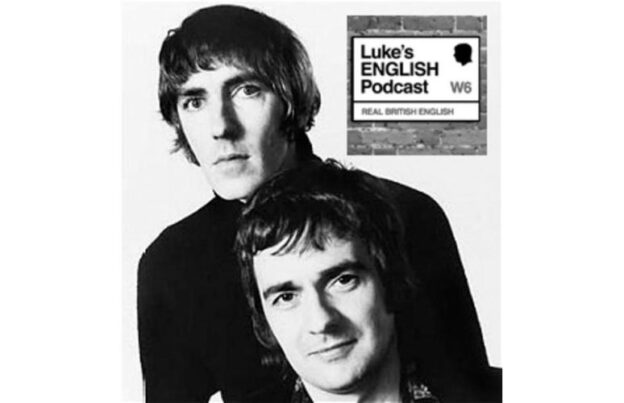
172. British Comedy: Peter Cook & Dudley Moore

Listen to two comedy sketches from the 1960s, learn some popular cultural history, pick up some vocabulary and hear some posh English accents.

Download Episode  Small Donate Button

I highly recommend that you purchase this BBC DVD of The Best of Peter Cook & Dudley Moore. It’s really funny!

Introduction (with transcript)

Hello everyone, welcome to the podcast.
In this episode we’re going to listen to a sketch from a comedy show called “Not only.. but also”, which was first broadcast on the BBC back in the sixties, when TV was in black and white and there were only 3 channels.

I’d love to tell you all about this show, and the people who made it. Peter Cook and Dudley Moore are basically the fathers of modern British TV comedy. I’d love to tell you all about how before Monty Python even existed, Peter Cook & Dudley Moore were doing surreal, satirical and anti-establishment comedy on BBC TV, and getting huge audience ratings, and inspiring generations of people. I’d also love to tell you more about the history of British comedy, because for some reason it’s very important to me. It’s one of my favourite subjects. It just feels significant, and I want to share it with you. Listening to these things is good for your English, but ultimately the reward is even greater than that – you can enjoy listening to something that’s a little bit special. But I also realise that you might not have the same level of slightly fanatical interest in the history of comedy, as I do. I could bang on about some comedians from the 1960s, but you might think “this is interesting Luke, but let’s just listen to some of their work shall we?” So, I’ve decided to just skip through all the stuff about the history of comedy and go straight to a couple of sketches, tell you about them, help you to understand them, and then later in this episode I’ll give you a little history lesson on Peter Cook and Dudley Moore, and their place in the history of pop culture, and then not only will you be able to enjoy their comedy, but you’ll learn more about British cultural history.

So, let’s focus on the sketch. I’m just going to explain the context for you and then you can listen to it, and see if you get what’s going on.

First sketch: Peter Cook & Dudley Moore “A bit of a chat” aka “The facts of life”
In this scene you’ll hear a father talking to his son about a slightly sensitive topic. The scene was written and filmed in the early sixties, probably 1964.

First, just listen (there is a script below, but try listening without it first)
Just listen to this and try and work out what is going on. Then I’ll explain things, and you can hear it again. There’s a script available for this sketch on my webpage.
As you listen you should try to work out what’s happening here. Why is this such a strange conversation? And why is the audience laughing? You might need to “read between the lines” which means look beyond what is just being said in order to discover the hidden meanings or suggestions at work.

How much of that did you understand? Did you get the humorous aspects of it? Let me explain the context, and the main points of the sketch.

*Sketch starts – “A Bit of a Chat”*
(See below for the script)

What happened?

Context
What do you know about Father/Son relationships in the UK in the 1950s & 60s?
They were more formal, especially among upper-class or upper-middle class families. Sons would call their father ‘sir’. They’d be very respectful, as if talking to someone of much higher status. They probably didn’t spend a lot of time together. These days, fathers and sons from normal middle-class families are quite close. They share quite a lot, and are able to talk quite openly about sensitive subjects like relationships or sex education. It might be embarrassing for the boy, but basically, the father feels quite comfortable doing it, and it’s normal and accepted. Back in the 50s or 60s, it wasn’t exactly the same. I suppose British men were less ‘in touch with their feelings’ and found it very awkward to discuss sensitive personal topics openly. Instead they may have dealt with them in the same formalised and distant way as they would talk about other topics. Also, we wonder how much most people really knew about sexual education in those days. Back in the 1950s or early 60s, before the era of sexual liberation, I think that a lot of people were completely in the dark about reproduction and all that kind of thing.
How about now? Are people more comfortable when talking about topics such as reproduction and sex?
Not completely, but certainly more so than 50 years ago.

The Class System & Boarding Schools
A little bit about the class system – particularly the upper class.
Nowardays, most people are middle class. In fact, many people believe that we don’t have a formalised class system these days. 50 years ago, the UK was more divided by class. Lower class (working class), middle class and upper class. Let’s look at traditional upper class culture. The upper class, or upper middle classes were considered to be:
Wealthy, educated, respectable and quite formal. Not liberated sexually, but bound by polite & formal social conventions. They would have been quite prudish about sex, finding it very embarrassing to talk about the subject. Many of the men would have been educated in exclusive, single sex boarding schools, which by all accounts would have been pretty cold, very formal and quite brutal. The boys never mixed with girls and grew up to be pretty clueless about sex. Kids and their parents didn’t spend a lot of time together, because of the boarding schools, and a father was more like a master than a friendly Dad.

Vocabulary
It seems that very posh people, from this period, often don’t really say exactly what they mean. They might make something sound more trivial than it actually is. For example “I had to give someone rather a ticking off” = means “I quite forcefully reprimanded someone for doing something wrong”
rugger – rugby
grubby – dirty / muddy
having a crafty smoke – secretly having a cigarette
give someone rather a ticking off – telling someone off
it’s a filthy habit – it’s a dirty habit
to cope with someone – to deal with someone
to get up to something – to do something (naughty)

Remember – it’s all about reading between the lines. What’s really going on? What really happened?

What does each line of dialogue really mean. E.g. the line about “there’s a cup of tea in here if you’d like one” means – come and sit down because I need to talk to you. The lad doesn’t want to, because, well, it’s probably awkward to talk to the old man, and this sounds like it could be serious.

Let’s listen to it again now, and consider each line, what is going on, and what is funny.

Second Listen

Questions
What does the Father want to talk about?
Why does the Father feel he has to talk about this?
What does the Father mean by “The opposite number?”
Why does the Father talk about sitting on a chair, etc?
Who is Uncle Bertie?
What is Uncle Bertie’s relationship with the boy’s mother?

A Bit Of A Chat (Script)
Roger, aged almost eighteen, arrives home from school, whistling: All Things Bright and Beautiful. His Father wants to have a bit of a chat with him about something. Just, a bit of a chat…
Father: Is that you, Roger?
Roger: Yes, father.
Father: There’s a cup of tea in here, boy, if you’d like one.
Roger: It’s very kind of you, sir, but I’ve just come in from rugger, and I’m a bit grubby. I think I ought to go and have a shower first, sir.
Father: Well pour me a cup, there’s a good chap, would you?
Roger: Certainly sir, yes, of course.
Father: Thank you. How was school today?
Roger: Oh, much as usual, thank you sir, but I caught someone having a crafty smoke behind the wooden building. I had to give him rather a ticking off — such a filthy habit, you know.
Father: It’s a filthy habit, Roger.
Roger: There we are, sir. Now, if you’ll excuse me.
Father: Roger.
Roger: Yes sir?
Father: Er — sit down. Roger, your mother and I were having a bit of a chat the other day, and she thought it might be a good idea if I was to have a bit of a chat with you.
Roger: Er… a bit of a chat, sir?
Father: A bit of a chat, yes, Roger, just…
Roger: Er…
Father: A bit of a chat.
Roger: What about, sir?
Father: Well, there’s nothing to be worried about, Roger, it’s just that, er, well, to be perfectly frank… how old are you?
Roger: Well, to be perfectly frank, sir, I’m coming up to eighteen.
Father: Coming up to eighteen…
Roger: Well, on the verge of…
Father: On the verge of eighteen… Yes, well, I thought it might be a good idea to have a bit of a chat now, because I remember, from my own experience, that it was when I was just, you know, coming up to eighteen…
Roger: On the verge…
Father: …on the verge of it, that I first began to take a serious interest in the – um – in the – er – opposite… the opposite… number. Now I don’t know, Roger, if you know anything about the method whereby you came to be brought about.
Roger: Well, sir, some of the boys at school say very filthy things about it, sir.
Father: This is what I was worried about, and this is why I thought I’d have a bit of a chat, and explain, absolutely frankly and openly, the method whereby you, and everybody in this world, came to be. Roger, in order for you to be brought about, it was necessary for your mother and I to do something. In particular, it was necessary for your mother… it was necessary for your mother – to sit on a chair. To sit on a chair which I had recently vacated, and which was still warm from my body. And then, something very mysterious, rather wonderful and beautiful happened. And sure enough, four years later you were born. There was nothing unhealthy about this, Roger, there’s nothing unnatural. It’s a beautiful thing in the right hands, and there’s no need to think less of your mother because of it. She had to do it – she did it – and here you are.
Roger: Well sir, it’s very kind of you to tell me. One thing, actually, slightly alarms me; um, I was sitting in this very chair yesterday sir, and I vacated it, and the cat sat on it while it was still warm. Should we have it destroyed?
Father: Its a lovely chair, Roger…
Roger: I mean the cat, sir.
Father: Destroy… oh, no Roger, you don’t understand. This thing of which I speak can only happen between two people who are married. And you’re not married.
Roger: Not yet, anyway sir.
Father: Not to the cat, in any case. Well, Roger, now that you have this knowledge about chairs and warmth, I hope – I hope you’ll use it wisely, and take no notice of your school friends, or what Uncle Bertie may say.
Roger: Dirty Uncle Bertie they call him.
Father: Dirty Uncle Bertie – and they’re right, Roger. Bertie’s a dirty, dirty man. He’s been living with us now for forty years, and it does seem a day too much… You know, if it hadn’t been for your mother, Roger, I don’t know where we would have been. She’s the only person who can really cope with Uncle Bertie, she’s the only one who can really deal with him. I don’t know if you realise this, Roger, but your mother even has to sleep in the same bed as Uncle Bertie, to prevent him getting up to anything in the night. If only there were more people like your mother, Roger.
Roger: Well, I’m very pleased that you’ve told me this, sir, because, as I say, I’m very glad I don’t have to believe all those filthy things that the boys at school say, and only yesterday, Uncle Bertie said to me…
Father: Take no notice of Uncle Bertie, Roger! He’s a sick, sick man, and we should feel sorry for him.
Roger: Well, I’ll try, sir… well.. thank you sir. Er – I wonder if I should take a cup of tea up to mother, while…
Father: I – er – I wouldn’t do that, Roger – she’s upstairs at the moment, coping with Uncle Bertie…
Roger: Poor Uncle Bertie…
Father: Poor Uncle Bertie…

And here’s the garden party sketch. It comes from another great BBC TV show called “The Fast Show”, which was Johnny Depp’s favourite British TV show.

The Psychiatrist Sketch (Script)

Braintree: Come in.
[Enter Roger.]
Hullo, Roger.
Roger: Hullo, Dr Braintree.
B: Hullo, come in.
R: I’m sorry I’m late.
B: That’s quite all right – how are you?
R: I’m very well, thank you.
B: Would you like to sit down, or would you prefer to lie.
R: Uhm, I’ll sit, thank you.
B: Right, well, sit down. Tell me, how are you in yourself?
R: I’m feeling just great.
B: Oh, this is terrific.
R: Yes, and it’s more than I expected from our sessions. You know, if anyone had told me that talking to psychiatrists could have help me at all, I would have laughed in their faces.
B: Yes.
R: But I can honestly say that our little chats together have really been of tremendous help to me.
B: I’m so glad, Roger: of course a lot of people are instinctively suspicious of psychiatry, but it can help at times.
R: Well, I really think it can, because you know, I’ve got so much self-confidence now. I’m much less self-conscious in the company of the opposite sex, whichI wasn’t, as you know.
B: Yes, yes, yes, yes. You’re less inhibited, are you?
R: [Suggestively] Oh yes, I should say so.
B: Good, this is terrific.
R: And the wonderful thing about it all is … well, I’m in love.
B: Well, this is wonderful news, Roger – you’re in love. – With a woman?
R: Yes.
B: So much the better – that’s terrific.
R: You know, it’s so wonderful to be in love – I can’t tell you the absolute joy I have. … this girl, this creature
[emotional]
, this goddess …
R: I mean, she’s
B: Yes …
R: She’s so, you know, it’s so right. Everything is so wonderful, you know.
B: Yes, yes – you really click together.
R: Yes. Oh, it’s so marvellous, but – the only trouble is that, apart from this wonderful light-hearted love I have, I seem to be saddled with this tremendous burning sense of guilt.
B: You have guilt as well as love: well, this is unfortunate, Roger. You know, sex is the most wonderful natural, healthy thing in the world. There’s no reason at all to have any guilt about it. I mean,why should you have guilt about sex?
R: Well, it’s not really as simple as that, you know – it’s rather difficult to explain. Uhm, I don’t reallyknow where to start. It’s rather difficult to explain. Uhm, I don’t really know where to start.
B: Well, begin at the beginning. That’s always the best place. What’s the girl’s name.
R: [Pause] Stephanie.
B: Stephanie. That’s a lovely name, isn’t it – well, my wife’s name in fact, isn’t it?
R: Yes, it’s Stephanie.
B: Yes, it’s Stephanie.
R: Yes, it’s Stephanie.
B: No, it’s Stephanie.
R: Yes, it’s Stephanie: it’s your wife.
B: Oh, you’re in love with my wife, Stephanie. Well, this is a perfectly understandable thing, Roger. She’s a very attractive woman – I married her myself. I don’t see why you should feel upset about that.
R: But she’s in love with me.
B: Well, this is again perfectly understandable, Roger. I mean, you’re a perfectly attractive human being, as I’ve told you over the last few weeks. There’s nothing repulsive about you, is there? There’s no reason why a highly sexed woman such as Stephanie shouldn’t fall in love with you. And I must explain to you, Roger, that I’m a very busy man: I have many, many patients to see – I see rather less of my wife perhaps than I should, and I think it’s very understandable she should seek some sort of companionship outside the marriage – I don’t think that’s unreasonable at all.
R: But she’s not seeking anything outside marriage – nor am I. We want to get married.
B: Well, this again is perfectly understandable. After all, you’re two young people in love and you want to express your feelings within the confines of a bourgeois society through marriage. I think it’s very appropriate.
R: The awful thing is, you see – I should feel so grateful to you for what you’ve done. And all I can feel is this burning jealousy – I can’t bear the thought of you touching her.
B: Well, of course, I understand this. One is tremendously possessive about someone one loves … it would be unhealthy not to have this jealous reaction, Roger.
R: But don’t you see – I hate you.
B: Of course you hate me, Roger.
R: I hate you for being so near her.
B: Yes, of course you hate me, Roger. You love to hate the one who loves the one you hate to love the one you hate. This is a very old rule, Roger – there’s nothing to feel ashamed about. It’s absolutely reasonable.
R: Don’t you understand – I want to kill you.
B: Of course you want to kill me. Because by killing me , Roger, you eradicate the one you hate. This is a perfectly natural reaction, Roger.
R: You’re so reasonable, aren’t you.
B: Yes, I am.
R: [Getting cross]
You understand it all so much …you are so logical.
[Gets up to strike him.]
B: Yes, I am – it’s my job.
R: I’m going to have to kill you
now
!
B: Ah – Roger – this is a little inconvenient, because I have another patient a six-thirty and then there’s someone else at seven after that. I wonder if you could make it some time next week.
[Standing over him.]
Could you make it early in the week, say?
R: [Pause – relax] When do you think?
B: How are you fixed on Wednesday morning? Say nine-thirty – would that be convenient?
R: Yes, that’s perfect.
B: Right, well, if you could pop along at nine-thirty and kill me then.
R: Once again, Doctor Braintree, I’m amazed, you know, really. I’m so grateful to you for showing me the way.
B: That’s what I’m here for, Roger.
R: Thank you very much. Thank you.
B: And with a bit of luck, this should be the last time you need to visit me

Comments
I think it’s pretty clear what’s funny about this. The psychiatrist has cured Roger and he feels so happy to be in love, but it turns out that Roger is in love with the Psychiatrist’s wife Stephanie. The psychiatrist doesn’t fly into a jealous rage – in fact he’s ridiculously logical and reasonable about it. This sketch allows us to imagine what the psychiatrist must be like at home – so reasonable all the time, he must be no fun at all. No passion, just plain dedication to his job; the rational understanding of psychology at the expense of natural human emotions and feelings, which is unnatural and ridiculous, as well as frustrating. It could be a wider statement about psychiatry, but let’s not analyse it too much. It’s just funny listening to the reactions, and the nicely written lines.

Vocabulary
There may be some words and expressions that you don’t know, or that could be useful to you. Let’s have a look:

terrific
our little chats together have really been of tremendous help to me
I’m much less self-conscious in the company of the opposite sex, which I wasn’t, as you know.
B: Yes, yes, yes, yes. You’re less inhibited, are you?
you really click together.
I seem to be saddled with this tremendous burning sense of guilt.
There’s nothing repulsive about you
There’s no reason why a highly-sexed woman such as Stephanie shouldn’t fall in love with you
You want to express your feelings within the confines of a bourgeois society through marriage.
I can’t bear the thought of you touching her.
Because by killing me , Roger, you eradicate the one you hate.
If you could pop along at nine-thirty and kill me then.

That’s it! Don’t forget to listen several times to get the full benefit!

Feel free to leave comments and questions below.

Thanks for listening,

Luke

171. A Cup of Tea with Daniel Burt (Part 2)

[2/2] Here’s the second part of my conversation with Daniel Burt, who is a journalist, comedy writer and performer from Melbourne, Australia.

Download Episode  Small Donate Button
In this conversation we talk about these things:
Daniel’s move to London
Aussie pubs in Paris and London
Cliches about Australian people
Australian pronunciation
Typical Australian English phrases
The Australian character and national identity
Australian politicians
The future of Australia & Australia’s image of itself
Sport & competition
Interviewing Benedict Cumberbatch (Sherlock), Martin Freeman (The Hobbit), Matt Smith & David Tennant (Doctor Who)

To contribute a few minutes of transcription for this episode, click here to work on the google document:

If you have any questions, feel free to leave a comment.

All the best,
Luke

Daniel’s Video Showreel
[youtube http://www.youtube.com/watch?v=u9V3cKGvISU&w=500&h=281]

169. A Cup of Tea with Daniel Burt (Part 1)

[1/2] Daniel Burt is a journalist, comedy writer and performer from Melbourne, Australia. He writes for two big newspapers in Australia, he worked as an intern at Late Night with David Letterman, he has his own page on Wikipedia and in his work he has interviewed Matt Smith, David Tennant, Benedict Cumberbatch and Martin Freeman, which means he has met 2 Doctor Whos Sherlock Holmes, Dr Watson and The Hobbit! Wow.  In this episode you can listen to us talking about diverse topics such as Australia’s relationship to The Queen & The Commonwealth, his work as an entertainment journalist, his time living in New York, the David Letterman show, Will Smith, show business, and zombies…

Download Episode  Small Donate Button
I’m very pleased to have Daniel on the podcast for a number of reasons:
a) He is a bright, witty guy with lots of things to say, and he can talk the hind legs off a donkey (not literally, that’s just an idiom which means he can talk and talk!)
b) He is from Australia, so you can listen to his genuine Aussie accent and hear some authentic Australian English.
c) He has met Sherlock Holmes, Bilbo Baggins, Doctor Who and others.

Daniel is noteworthy enough to have his own page on Wikipedia. Click here to read it.

Daniel is a writer so naturally uses a lot of colourful language, descriptive vocabulary and idiomatic expressions. He also speaks pretty quickly in an accent that you might not be familiar with so listen closely. A transcript should arrive before too long but if you have any questions about words or phrases from this episode, please leave them in the comments section, with a time-code. ;)

This is a two part podcast. In part 1, this one, Daniel and I talk about these things:
The Zombie Apocalype
– Is my apartment safe?
– Would Daniel survive a zombie attack? Is he too complacent?
– Are people who like zombies all loners?
– Is Luke a loner?

Daniel’s Coin-dropping Habits
– Why can’t Daniel hold onto coins when shop assistants give him change?
– Why does he always drop coins onto the floor?
– Is it because Australian notes are so shiny and slippery, that the coins just slide off?

– Or is it just because he is socially awkward or nervous for some reason?
The Queen on Australian money
– How does Daniel feel about it?
– What’s the role of The Queen in Australian life?
– Will Australia leave the commonwealth and become fully independent?
Daniel’s work as an entertainment journalist
– Does he really have a Wikipedia page about him?
– What was it like living in New York?
– What was it like working for David Letterman?

Seeing Will Smith in the audience at a Parisian cabaret show
– Did he enjoy the show?
– What was the audience’s reaction to seeing Will Smith in the crowd?
– Did it affect the performance?
– What are the secrets of show business?
-And what does “getting jiggy with it” actually mean?

I’ve divided this into two episodes. So, stay tuned for details about his meeting with Sherlock Holmes, The Hobbit and Doctor Who in part 2.

Our conversation begins pretty quickly after we’d already been talking for about half an hour before turning on the microphone. Let me give you some context so you can hit the ground running.

Before turning on the microphone, we were talking about some of our favourite TV shows. I mentioned that I watch The Walking Dead, which is a show about zombies. I like zombies and that kind of thing, I’m sick and twisted in that way. Daniel doesn’t watch the show, and he isn’t a big zombie fan. He said he thought you’d need to be a bit of an idiot to get bitten by a zombie, because they’re so slow. Surely you’d see the zombie coming, and you’d just get out of the way, quite casually. I disagreed, and explained that getting bitten by a walker is easier than you might expect. Zombies might seem slow, but if you get complacent – over confident and too relaxed, that’s when you might be caught by surprise. If a zombie is walking towards you, he’s pretty slow so you might think you’re safe, but they’re unpredictable. What might happen is that the zombie gets about 3 metres away, and gets excited because he can smell your brains, and he trips slightly and starts to fall forwards. This means that his falling increases his speed and the momentum carries him to you faster than you expected. The next thing you know, you’ve got a zombie on top of you, and while you’re trying to deal with him, another one might have arrived behind you quietly, without you realising, and then you’re bitten, double bitten by two members of the undead. Then, later on, you’re a zombie too. Uhhh brains! Daniel didn’t realise this could happen. I reassured him, by explaining that up in my flat we would be quite safe from zombies because I’m up on the 6th floor, and my door is very strong. But that you still shouldn’t get complacent, even then. You can never be too safe from zombies, because, well, anything can happen. For example, let’s say, on the other side of the city, some guys have managed to escape from a zombie infested building by flying off the roof in a helicopter. “Ooh, that was close – good thing we had this helicopter!” But one of the guys in the chopper has been bitten, and he didn’t tell the others! He was too ashamed, too embarrassed. He kept it secret. Big mistake! Within minutes, he’s turned into a zombie, and he starts attacking the pilot. Trying to eat his brains. Horrible! The pilot gets bitten and he turns into a zombie too. Now you’ve got a zombie flying a helicopter. In the confusion the helicopter crashes onto the roof of my building – the pilot and passengers are all zombies, and they crawl from the wreckage and climb through a hole in the wall, into my living room, and Daniel gets bitten. Not me of course, I’d be ready with a cricket bat or a hammer or something. Maybe a crossbow. It would be tough, but I’d deal with them. Daniel though – he’d be beyond dead at that point, the poor guy. And why? Because he got complacent. Or zombies could manage to get to the 6th floor in a lift, by accident. Or just thousands and thousands of zombies could surround my building, and eventually break in by smashing all the windows and doors. Don’t worry though, it’s very unlikely to happen… or is it?…
So, that’s some context to the conversation I was having with Daniel before starting the recording. Now you can enjoy some chat with my Aussie mate Daniel. Enjoy!

Daniel’s Video Showreel

In part 2:
Daniel’s move to London
Cliches about Australian people
Typical Australian English phrases
Australian pronunciation
The Australian character and national identity
Australian politicians
The future of Australia & Australia’s image of itself
Sport & competition
Interviewing Benedict Cumberbatch (Sherlock), Martin Freeman (The Hobbit), Matt Smith & David Tennant (Doctor Who)

168. Please Vote! (and “stuff” like that)

Please vote for me in the Macmillan Dictionary Awards. Voting closes at midnight GMT on 14 February – so you only have a couple of days! Click here to vote for me. Thanks! If you’ve already voted – thanks a lot! In this episode I shut up about the competition after 9 minutes, and then just improvise, while using the words ‘stuff’ and ‘thing’ as much as possible.

Download Episode  Small Donate Button
I also talk about a few other things in this episode, including quite a lot of stuff about working for the secret service, drinking coffee and setting the world to rights over a few drinks. So, do listen to all of the stuff and things I say in this episode ;) 

Here’s George Carlin talking about stuff (transcript below)

“Stuff” by George Carlin

I would’ve been out here a little bit sooner but they gave me the wrong dressing room and I couldn’t find any place to put my stuff. And I don’t know how you are but I need a place to put my stuff. So, that’s what I’ve been doing back there. Just trying to find a place for my stuff. You know how important it is. That’s the whole… that’s the whole meaning of life, isn’t it? Try and find a place for your stuff. That’s all your house is. Your house is just a place for your stuff. If you didn’t have so much goddamned stuff you wouldn’t need a house. You’d just walk around all the time. That’s all what your house is, that’s a pile of stuff with a cover on it. You see that when you’re taking off in an aeroplane. You look down and you see everybody’s got a little pile of stuff. Everybody’s got their own pile of stuff and if you leave it you’ve got to lock it up. Wouldn’t want somebody to come by and take some of your stuff. They always take the good stuff. They don’t bother with the crap you’re saving and nobody’s interested in your fourth grade arithmetic papers. They’re looking for the good stuff. That’s all your house is, it’s a place you keep your stuff while you go out and get more stuff. Now, sometimes, sometimes you’ve got to move. You’ve got to get a bigger house. Why? Too much stuff! You’ve got to move all your stuff and maybe put some your stuff in storage. I mentioned that. There’s a whole industry based on keeping an eye on your stuff.

Enough about your stuff. Let’s talk about other people’s stuff. Did you ever notice that when you go to somebody else’s house you never quite feel 100%  at home? You know why? No room for your stuff! Somebody else’s stuff is all over the place! And what awful stuff it is. Where did they get this stuff? And if you have to stay overnight at someone’s house, you know, unexpectedly, and they’ll give you a little room to sleep in that they didn’t use that often. Someone died in it eleven years ago and they haven’t moved any of his stuff! Or wherever they give you the sleep usually near the bed there’s a dresser and there’s never any room on a dresser for your stuff. Someone else’s shit is on a dresser. Have you noticed that their stuff is shit and your shit is stuff?! Get that out of there!

Now, sometimes you go on vacation you’ve got to bring some your stuff with you. You can’t bring all your stuff, just the stuff you really like. The stuff that fits you well that month. Let’s say you want to go to Honolulu. You want to go all the way to Honolulu and you’ve got to get two big bags with stuff plus your carry-on stuff plus the stuff in your pockets. You go all the way to Honolulu, you get to the hotel room and you start to put away your stuff. That’s the first thing you do in a hotel room is to put away your stuff. I’ll put some stuff in here. I’ll put some stuff down here. Here’s another place for stuff for you. I’ll put some stuff on here. You put your stuff over there and I’ll put my stuff over here. Here’s another place for the stuff. Hey, we’ve got more places than we’ve got stuff! We’re going to have to buy more stuff! And you put all your stuff away and you know that you’re thousand of miles from home and you don’t quite feel at ease but you know that you must be okay because you do have some your stuff with you. And you relax in Honolulu on that basis. That’s when your friend from Maui calls and says – Hey, why don’t you come over to Maui for the weekend, spend a couple of nights over here? – Aww, shit, no! Now, what stuff do you bring? Right, you’ve got to bring an even  smaller version of your stuff. Just enough stuff for a weekend on Maui. And you get over… And you’re really spread out and now you’ve got your shit all over the world! You’ve got stuff at home, stuff in storage, stuff in Honolulu, stuff in Maui, stuff in your pockets so, supply lines are getting longer and harder to maintain. When you get over to your friend’s house in Maui and they give you a little place to sleep. There’s a little window ledge, some kind of small shelf and there’s not much room up there but it’s okay because you don’t have much stuff now. And you put what stuff you do have up there. You put your important French toenail clippers, your own readers with that 45-day guarantee, your cinnamon flavoured dental floss and your Afrin 12-hour decongestant nasal spray. And you know you ‘re a long way from home. You know that you must be OK because you do have your Afrin 12-hour decongestant nasal spray. And you relax in Maui on that basis. That’s when your friend says – Hey, I think tonight we’ll go over to another side of the island to stay at my friend’s house overnight – Oh, shit, no! NOW, what do you bring?! Now, you just bring the things you know you’re going to need. Money, keys, comb, wallet, lighter, hanky, pen, cigarettes, contraceptives, vaseline, whips, chains, whistles, dildos and a book.

166. The Prawn Story

An undersea tale of identity loss, and shrimp; this is one of those rather ridiculous improvised stories which is loosely based on an old joke. This kind of episode is for listeners who just enjoy listening to some silly fun. Normal educational podcasting will be resumed in due course. Have a good day!

Download Episode  Small Donate Button

To get the joke you have to know this expression: “I’ve found God, and I’m a born again Christian”. That’s not an indication of the plot of this story, it’s just a phrase you should know in order to get the (frankly terrible) punchline at the end of the story. It’s not tale of religious belief, although you can interpret it that way if you want (I’m not sure how!). But anyway, j
ust hold that sentence in the back of your mind while listening to this story. The story is based on an old joke, and should be 2 minutes long but I’m going to make it last about half an hour.

Some of you might not understand this – and that’s okay. You don’t have to get it. I’m not really teaching you anything. I’m just telling you a colourful and silly story, which I’m just making up off the top of my head. I do these episodes from time to time, and they prove very popular with some of my listeners. It’s a challenge for me, because I’ve got no idea how I’m going to make it last an hour, while making sure it makes some sense. Normal podcasting will be resumed very soon, including planned episodes about memory, slang, and more.

If you fancy transcribing this episode, click here to access the google doc.

158. & 159. A Cup of Tea with… Paul Taylor (Parts 1 & 2)

Part-transcript available below
Hello! In this Christmas episode I am joined by Paul Taylor who is that rare thing; an English guy who can speak other languages.

Paul is also a stand-up comedian who specialises in observing funny things about different cultures. He is also really good at doing different accents.

Small Donate ButtonRight-click here to download, or to listen on an iPad.

Part 2

[DOWNLOAD]
A TRANSCRIPT FOR THIS EPISODE IS CURRENTLY BEING PRODUCED BY LISTENERS. CLICK HERE TO HELP FINISH THE TRANSCRIPT OF THIS EPISODE ON A GOOGLE DOCUMENT :)

In the episode we talk about Christmas traditions, his experiences of living in other countries and plenty of other things, including some examples of different accents in English. Enjoy the show!

Here is a video of Paul performing stand-up comedy around the world:
[youtube=http://www.youtube.com/watch?v=7q2Xn6jEsdQ&w=500&h=281]
And here’s one from a performance in Spanish, with English subtitles:
[youtube=http://www.youtube.com/watch?v=O1H5bpbSm30&w=500&h=281]

Here is a link to the Wkikipedia page for Fawlty Towers, which is the sit-com set in Torquay on the south coast of England. And, here’s a clip from the show. It’s old, but it’s a classic ;)
[youtube=http://www.youtube.com/watch?v=H-oH-TELcLE&w=500&h=375]

Merry Christmas everyone!

Luke

TRANSCRIPT FOR EPISODES 158 & 159
Here is a transcript for the first five minutes of episode 158, sent in by a listener called Dmitry, and proofread by me.
Hello ladies and gentlemen.

Welcome to Luke’s English Podcast.

– “What is that sound”, you are probably thinking. Well, that is the sound of Christmas, ladies and gentlemen. It should be the sound of Christmas. It is actually a tambourine.

Paul – Ho, ho, ho!

Luke – Is that Santa?

Paul – Ho, ho, ho!

Luke – It sounds like Santa. It is not actually Santa. It is just my friend Paul Taylor who is joining with me for this episode and it is nearly Christmas, so: Hello, Paul! How are you?

Paul – Hi, Luke! I am doing very well. It is very close to Christmas. 19th of December currently.

Luke – Yes, we’ve just got six days, before Christmas

Paul – I used to be more excited than this…

Luke – Me too.

Paul – …six days, before Christmas. I used to be going crazy.

Luke – Yeah, me too. I used to… I used to get so excited, when I was a kid, about Christmas. You don’t get excited anymore?

Paul – Um, noooooo, I do not know why. It is particularly this year, like I am very unexcited. I have been excited previous years. Um, but just not feeling it this year. I do not know why.

Luke – I used to…, you know, every day, I used to count the days, literally, I used to count down the days until it was Christmas. You know, starting the December I would be – “Only 28 days ’til Christmas”, for example.

Paul – At the beginning of December, when do you have Christmas?

Luke – Yeah, I couldn’t count, I was only four and anyway, I used to get so excited and when it got to Christmas Eve I would be so unbelievably excited that  I wouldn’t be able to sleep. I remember lying in bed on Christmas Eve, I would just trying to force myself to go to sleep, so I could then wake up and open my presents.

Paul – That is scarily similar to how I used to feel. Although, probably, a lot of English people maybe have gone through the same experience. I think, one of the things, that, potentially, I am not excited about or the reason I am not excited about is that I do not have this year an advent calendar. I have noticed that you have a Kinder advent calendar, which I was almost going to buy, but it was  too late and now, you have eaten nineteen chocolates or shared nineteen chocolates.

Luke – It is an advent calendar. What is an advent calendar, Paul?

Paul – An advent calendar – so, “advent” is a term which I do not know where It comes from, but it is the term that depicted for the calendar that usually you open every day. So, there’s twenty-five or some, calendars go up to thirty-one, but most go up to twenty-five in the UK, anyway. Twenty-five days and behind …you open each like a door, each day, and each day, there is something waiting for you. Whether it is a picture… so the kinder calendar you have, em, I presume, has kinder branded chocolates behind, whether it is like a mini egg or whether it is a kinder Bueno. Whether it is whatever else it is. I love kinder.

Luke – You, you are quite familiar with a range of kinder products – Bueno?

Paul – The kinder Bueno and, the kinder Bueno It is like the soft, the soft one is really good. Yeah, that is an advent calendar. I believe an advent – it is something to do with a religious aspect of Christmas.

Luke – Yeah

Paul – But, I can not remember the exact. It is something to do with the date, emmmmmmm.

Luke – Yeah! Exactly! So, when I was a kid, I used to have an advent calendar which, um, was very nice. It had like a religious scene on it, some Christian image on it and you would find, um, there would be a door for each, um, um, day of the month and you would open, you find a door, you open it and behind it there is a picture, like a wise man or something.

Paul – Uhoo.

Luke – Or there would be a picture of, you know, some Christmas related to a Christian thing, a picture of, em, aaaaa, mmmmm, a shepherd, you know, a picture of a church and then, the last picture is always the baby Jesus. There he is. But this one, I have got here, is completely un-Christian, I think it’s… There is nothing religious about this, this Kinder advent calendar at all.

Paul – No, it is, um, it is just full of chocolate. Now, be honest. Well, now, you are probably at the age when it does not really matter, but when you were younger and you had an advent calendars which had chocolate in them

Luke – Yeah

Paul – …did you secretly open, …

Luke – Yeah

Paul – … like… day… twenty-four.. when It was actually the sixteenth and you eat the chocolate and then kind of close it up?

Luke – Yes. I did.

You can help to finish this transcript here, by using a google doc. Click for more information and to collaborate with other listeners. 

156. British Comedy: Ali G

Check it! This is the first in a series of episodes about British comedy. In this one we look at a character called Ali G. In the episode I’ll explain everything you need to know about him, then we’ll listen to an interview from his TV show and I will explain all the language and vocabulary that you hear. In the end, you’ll understand all of it, just like a native speaker innit.


Small Donate ButtonRight-click here to download this episode.
Aiiiight?! So, in this episode you’ll learn about lots of things, including some slang vocabulary, some pronunciation features of a London dialect, and some terms relating to education. You’ll also learn more about British pop culture.

Please be aware that there is some explicit content and rude language in this episode. The audio that you will hear contains some adult content including references to sex and drugs. If you’re easily offended then watch out! If you don’t mind, then great! Let’s have a good time learning some more British English, shall we? Yes Luke! Ok great…

NUFF RESPECT! Below you will find vocabulary definitions and other notes, and a youtube video for the interviews you hear in this episode of the podcast. I recommend that you watch the videos – it will help you to enjoy the comedy more. BOOYAAA!

Vocabulary Definitions and Notes
Here are some bits of language you’ll hear in this episode.
Ali G – Education. An interview with Sir Rhodes Boyson. Slang terms are written in italics.
Corporal punishment = this is a kind of physical punishment which used to be used in schools as a way of instilling discipline into childen
a cane / to cane someone / to get caned / to be caned = a cane is a long, thin stick which is used to hit a child as punishment. The word is also a verb (regular)
to get caned / to be caned = this is also a slang expression which means to get  stoned/high on cannabis/weed/marijuana
my main man = this is a slang expression to refer to someone you like or someone you respect a lot

wicked! = a slang term meaning “brilliant!”
respect = this is said just to show respect to someone – “respect man” “nice one”
you have to have a good cane = in its slang sense, this means you have to smoke a lot of weed
“they have more boning experience than anybody else”
boning = having sex
a boner = an erection
me feelin dat (I’m feeling that) = I understand that, I get that impression
for real = definitely
to deal in ounces, half ounces, quarter ounces, eighths of ounces = in the UK cannabis is usually sold by the ounce, quarter ounce etc
one ounce (1 oz = about 28 grammes)
he’s down for a 40 year stretch = he’s going to prison for 40 years / he’s facing a 40 year prison sentence
“boys would spend all their time chasing muff”
muff = a woman’s ‘private parts’, her genitals, her vagina
“I got an A+ in pounani”
pounani = the same as muff !
you know what I’m getting at = you know what I’m trying to say, you know what I’m suggesting

Video of Ali G interviewing Sir Rhodes Boyson
[youtube=http://www.youtube.com/watch?v=OV1fq75aWtY&w=500&h=375]
Sacha Baron Cohen on Letterman
[youtube=http://www.youtube.com/watch?v=GrBfaUDUlt4&w=500&h=375]
Sacha Baron Cohen won the outstanding achievement to comedy at the British Comedy Awards
[youtube=http://www.youtube.com/watch?v=lcjpP6dKuS0&w=500&h=281]
Fluency MC’s Present Perfect Rap (what do you think?)
[youtube=http://www.youtube.com/watch?v=wDl3T339718&w=500&h=281]

149. Backing Up Into The Cloud

Hello Dear Listeners, I’ve been a little bit quiet recently but I’m still here.

Small Donate ButtonRight-click here to download this episode.

This episode is a chance to explain what’s been going on recently, and to answer some of your questions and comments from Facebook and Twitter. Apologies for the slightly poor sound quality on this one.

Yesterday I devoted over an hour to recording an episode only to be let down by my recording device which ran out of memory space. It was very annoying indeed because I lost all the work that I had done on that recording. I’ve since learned the importance of regularly backing up your work on an external memory card or alternatively “backing up into the cloud”.

I hope you enjoy the episode and more episodes will follow before long, including the continuation of my series on The A – Z of British Slang.

Cheers,
Luke

p.s. Here are videos of Queen’s Bohemian Rhapsody, and Queen performing at Live Aid in 1985. Enjoy!
[youtube=http://www.youtube.com/watch?v=fJ9rUzIMcZQ&w=400&h=300]
[youtube=http://www.youtube.com/watch?v=eQsM6u0a038&w=400&h=300]

139. Hard Driving / Car Vocabulary

One Man. One Car. One Destination. Lots of vocabulary.

Small Donate ButtonRight-Click here to download this episode.
In this episode you join me in a BMW Mini as I attempt to drive across Paris, through some of Europe’s busiest streets, on a very hot July afternoon. My mission is to deliver the car to a car-park while avoiding angry Parisian drivers, pedestrians with prams, and busses full of Japanese tourists. The ultimate goal – a glass of cold beer on the terrace of a cafe, and to save the world through another episode of Luke’s English Podcast, of course.

Do I manage to complete my mission? And what driving-related vocabulary can you learn during this episode?

Listen, and you will find out…

Vocabulary
Here are extracts of the transcript for this episode that contain all the driving-related vocabulary.

  1. Hard Driving – driving vocabulary


[5:42]

The car is on. I’ve got my hand on the handbrake on my right. I’m in the first gear. And I’m going to get moving, so I just lift the handbrake up. I’ve got the clutch. My left foot is on the clutch. I’ve put myself on the first gear. Handbrake is down.

[6:00]


[16:05]

So, [the] vocab is, what I’m holding, what I’ve got in front of me, the wheel. The thing that I’m turning in order to control the direction of the car, that’s the steering wheel, folks. The steering wheel. Turning the steering wheel to go left and right.

[16:27]


[16:45]

The gear stick to control the gears.

[16:51]


[17:32]

Gear stick. First gear, second gear, third gear, fourth gear, fifth gear, sixth gear sometimes and reverse gear, of course. Handbrake, I’ve already mentioned that. That’s the way you can sort of… how you stop the car when you’re on a hill, or you park, you pull the handbrake up. Sometimes, if you’re in a Hollywood movie and you need to like turn the car around very quickly, you might pull the handbrake and do the handbrake turn. It’s very dramatic and exciting. But I’m not going to be doing it today, folks, no! I’m going to try drive safely.

[18:08]


[19:35]

So, the pedals on the floor to…

[19:37]


[20:40]

So, the pedals on floor, the one on the furthest right is the accelerator pedal or the throttle, which is the accelerator.

The accelerator pedal, the brake pedal on the middle and the clutch on the left. OK. I’ve got some switches behind the steering wheel. You can hear the indicator switch, which sounds like this: “Indicator sound” Yeah. This is the indicators, they indicate left and right. And I’ve also got things like headlights, and stuff like that. I’ve got the speedometer in front of me, I’ve got a fuel gauge, rev counter which tells me how I’m revving the engine.

[21:40]


[24:07]

We also have the glove compartment on the right in front of the passenger seat, which never contains gloves. They call it the glove compartment, you know, it’s like a little box that little storage cupboard thing in front of the passenger seat. I don’t know why they… I know why they call it the glove compartment. It’s because traditionally that’s where you keep gloves. I’ve never ever seen a pair of glove in the glove compartment. Usually, it’s just like an old map or some boiled sweets or something like that. Never, never any gloves in the glove compartment.

[24:50]


[25:16]

There’s the horn, which makes the car go “Beep beep beep” this is the horn. The seatbelt, which can obviously save your life if you have a crash. Hopefully, that’ll never happen. You also have mirrors, don’t you? Mirrors, what you can, which allow you to see behind you. You’ve got the wing mirrors on the left and the right. And then you have the rear view mirror.

[25:41]


[37:02]

So, the windows, the window in front of me, we call it the windscreen, in front of me, it’s the big window at the front of the car. The windscreen. In America, they call it the windshield, but we call it the windscreen. Then the other one, it’s just this the window in the back window. It’s just pragmatic. The front part of the car that you open if you want to look at the engine, it’s called the bonnet. But in America, they call it the, what do they call it, the hood, hood, but we call it the bonnet. The front of the car is the bumper. That’s the part which is used to sort of bump other cars.

[37:43]


[53:46]

Summary


I’m just going to run through the vocab of the car that I attempted to teach you during the journey just as a summary.

  1. You got in the car. You’ve got the steering wheel, which you use to turn left or right or to steer the car. You have accelerator pedal, the brake pedal and the clutch pedal. You use the clutch to change the gear. And also you have a stick on the right if you’re in Europe and that’s the gear stick.

You have the seat-belt to keep you safe. If you have a crash, then the airbag will come out and protect you so that you don’t get badly injured in the event of an accident. You have mirrors, the rear view mirror in the middle, the wing mirrors on the left and right. You have the indicator to show which direction you’re going to turn, left or right. Tick, tick, tick, tick, like that. The indicator. You’ve also got things like the windscreen wipers, which are those things that clean the water of your windows or the dead insects after a long journey, you use the windscreen wipers to wipe them off. You also have like jets of water which spray onto the windscreen. And if you angle the jets correctly, you can spray pedestrians as you drive past them, which is quite good fun, isn’t it?


You’ve got the… the back window with a windscreen wiper on it, you’ve got the brake lights, you have bumper at the back, bumper at the front. You’ve got the boot of the car or in Ameri… that’s the back, that’s the storage area at the back of the car. We call it the boot. In American English, they call it the trunk. The front of the car, you’ve got the bonnet, which covers the engine. And in America, they call that the, what do they call it, the hood. That’s right. You’ve got also the petrol cap, which you remove in order to fill a car up with fuel.


Let’s see, what else? So, the number plate on the back and the number plate on the front, they have the registration number of the car. Also the wheels, of course, they’re very important. If you want to actually travel anywhere. You got the wheels… the wheels have, what are do they called it?, alloy covers, often if you’ve got like you know very nice cool car, you might have alloys on the wheels, which look cool. Then you’ve got the rubber bits that go around and they’re filled with air. Those are called tyres [tires in US English], of course. The tyres that go around the wheel. Just the same as a bicycle, in fact. Headlights on the front help to illuminate the road as you’re driving.

[57:23]


[57:27]

There are some verbs we associate with driving, as I mentioned before you. You accelerate. You brake, brake means to stop [or slow down]. You turn left, you turn right, you steer the car. You reverse, I mean, you go backwards. Mirror signal manoeuvre. Mirror, obviously, check the mirror before you move. Signal, that’s to indicate which direction you’re going to go. And manoeuvre, that means to turn or to make some sort of specific movement in the car. A manoeuvre. A manoeuvre might be, for example, a 3-point turn or a U turn or a… if you reverse into a parking space, to parallel park, which is one of the most difficult things that you can do when you’re driving is parallel park. When you’re learning to drive, that’s very difficult. If you have a space in the road and you have to try and park the car in that space. So, that’s nicely positioned, close to the curb, without too much space between the car and the curb and you don’t actually touch either the car in front or the car behind. That’s… if you can master that art, then you should be able to pass your driving test, how to parallel park.

[58:36]


Other vocab:

  • traffic
  • traffic lights
  • zebra crossing
  • satnav
  • petrol

A listener has written a finished transcript of this episode. Click here to read it. Be aware that it hasn’t been fully corrected yet, but is about 90% accurate.