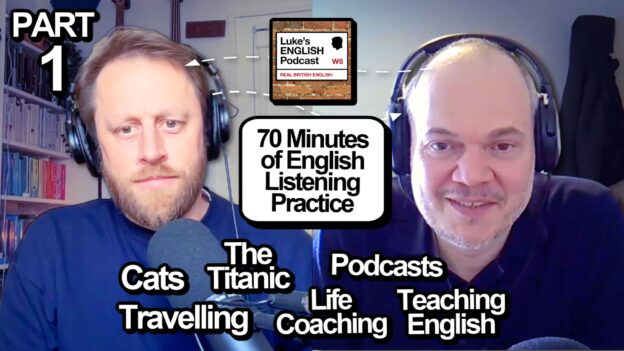
Antony is an English teacher, podcaster, life-coach and writer and he returns to LEP today for a conversation about topics which he has discussed in episodes of his podcast called “Life & Life Only”. Listen to us chat about why cats are good for your health 🐱, what the Titanic disaster tells us about social class 🚢, how losing his backpack while travelling taught Antony a valuable life lesson 🎒, how psychology is involved in English teaching 🧠 and more.
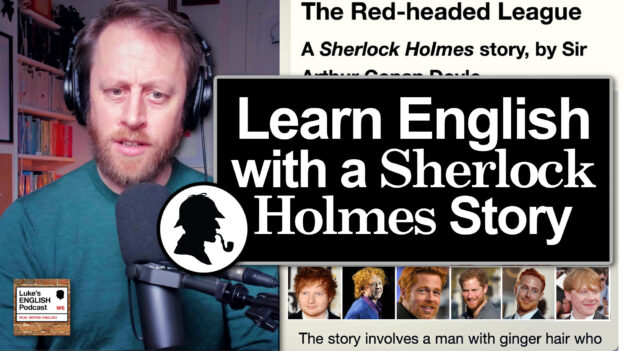
Let me read you a classic Sherlock Holmes detective story, by Sir Arthur Conan Doyle. I’ll read the original text and stop regularly in order to explain what is happening.
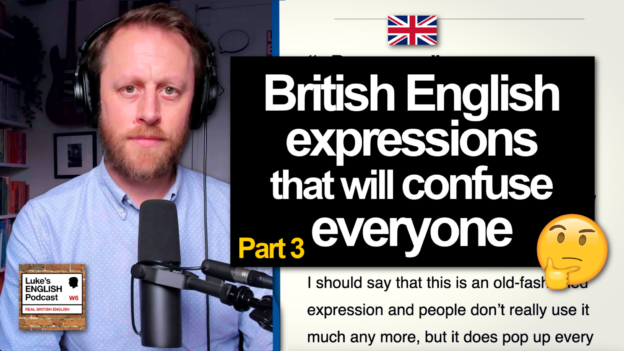
Finally, here is the third part of this series about English slang words and expressions that most British people know, but which will probably confuse almost everyone else! I started this series in 2019. It’s only taken me nearly 4 years to get round to finishing it. Learn loads of slang and culture, plus a bit of British history too.
Hello everyone and welcome back to LEP. This episode is called “88 English Expressions that will confuse everyone (Part 3) and in this episode we’re going to go through some expressions and idioms that, apparently, only British people know, and which confuse everyone else – and that means learners of English but also other native speakers from different countries, particularly the USA. These expressions seem to be unique to the UK for some reason.
Now, this is an episode that has been a long time coming! (Hello Francesco Gaeta!) This is actually part 3 of a series I started bloody ages ago, before COVID came along, and I always intended to finish it off, but never got round to it. So, over 3.5 years and about 200 episodes later it’s time to finish what I started.
Why did it take you so long to finish the series Luke?
I’ve said before that this podcast is a bit like a big ship that’s barreling across the ocean. If I leave something behind (like if someone or something falls overboard) it takes a long time to slow the ship down, turn it around and go back. But anyway, here we are returning to finish this series.
“88 English Expressions that will confuse everyone” – Essentially this is an episode about British slang.
This should be useful for you from a cultural point of view and to help you understand native British English speakers. It should also just be a bit of fun to be honest, so I hope you enjoy it and that you find it interesting to learn about some of our more obscure and weird expressions.
Should you actually use these expressions in your speaking?
This is always an important question when learning slang or idioms. Should you add them to your active vocabulary?
Obviously this is completely up to you, but it’s worth considering what kind of English you should a) be able to understand and b) actually use. This depends on the context in which you are using English. If you want to be able to understand British people when they speak then this is the stuff for you. If you just love English and find it interesting to explore the idiosyncratic aspects of the language, then go for it. But slang isn’t exactly global English (this is the kind of English that most non-native speakers would understand – like the language of international business for example) and so these expressions might just be a bit confusing and weird for other non-native speakers (depending on their level of English).
But again, it is completely up to you, and after all the tagline for this podcast is “Real British English” so here you go. This is the kind of stuff that you might notice in TV shows, song lyrics, books or just the things your English mates say, if you have any, and if you don’t have any, that’s ok, don’t feel bad.
As I said, this is part 3. If you’d like to listen to parts 1 & 2 as well you can find them on the episode page, or just search for episode 624 and 625.
This is based on an article I found on independent.co.uk. You’ll find the link below.
Text in italics has been pasted from the original article (link above).
By the way, there is a video version of this episode on youtube and on the website page. I have been attempting to add more video versions of my episodes recently. I hope you have been enjoying that.
“a Pea-souper”
“It’s a real pea-souper out there tonight!”
A “pea-souper” is a thick fog (or smog), often with a yellow or black tinge, caused by air pollution.
I should say that this is an old-fashioned expression and people don’t really use it much any more, but it does pop up every now and again usually in films and TV series which are set in the past. I think Amber said it on the podcast once too.
The idiom was first used to describe the thick, choking smogs that settled over London, caused by lots of people burning fossil fuels in a close vicinity, as early as 1200. The smogs were compared to pea soup due to their colour and density.
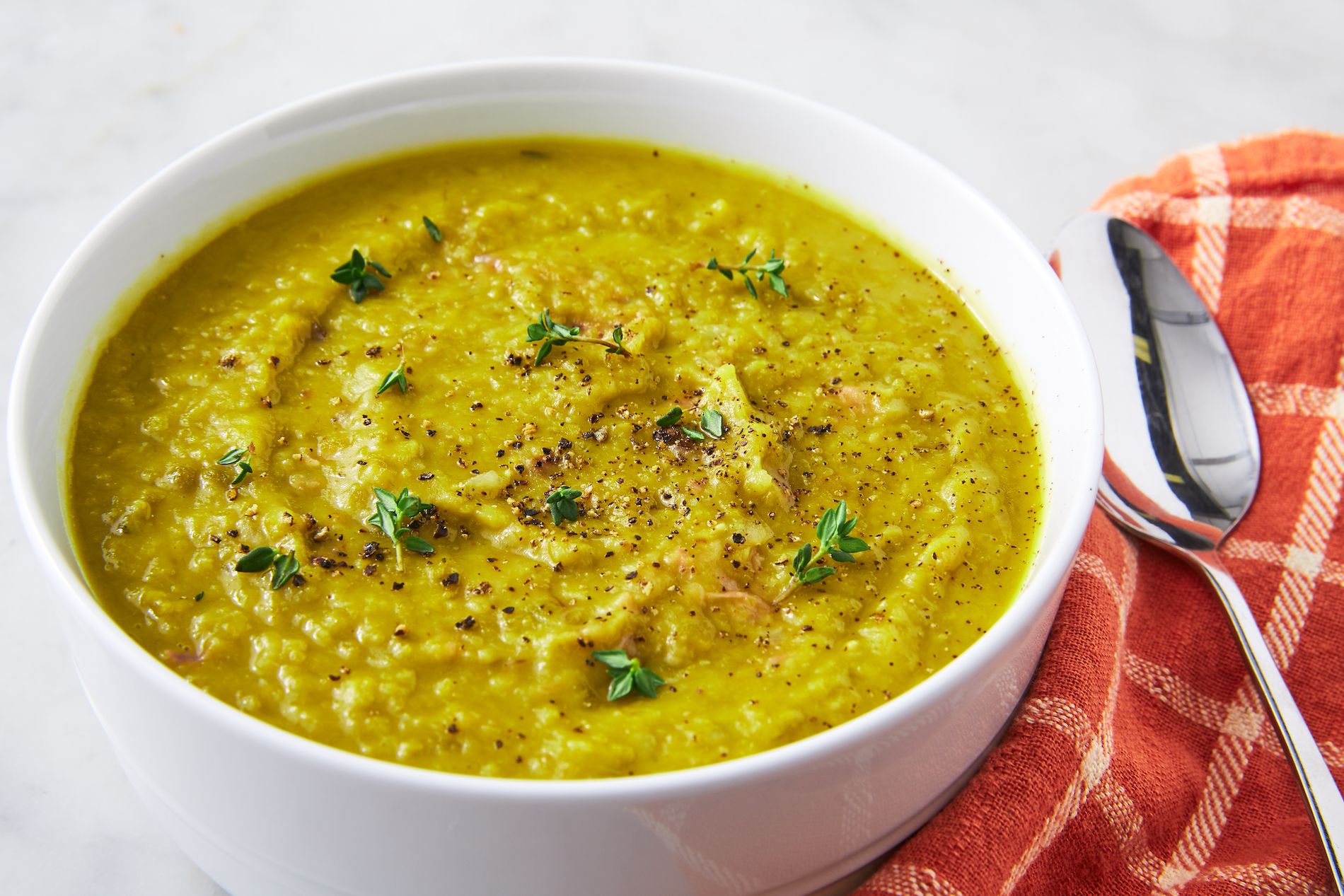
Pea soup is very thick and can be a bit yellow in colour if you’re using dried peas in the recipe, so this is why a fog which is very thick (and even yellow in colour) used to be called a “pea souper”. The fog/smog was so thick that it looked like pea soup. Yuck.
“Be careful when you’re driving — it’s a pea-souper out there.”
I would never actually use this phrase unless I was imitating a London cab driver from the 1950s or 1940s. The expression was much more common in those days because very foggy weather was also much more common. We don’t often get fog like that in London these days really, because the air is much cleaner than it used to be.
This is one of the stereotypes of London – thick fog. It’s the sort of thing that comes up in American TV shows and films. In many American’s minds, London is still this foggy 18th century place full of penniless pickpockets, greedy bank managers and cockney prostitutes, and fog. “Foggy London town”, but it’s not really true any more, well the weather bit – the pickpockets, bank managers and prostitutes – that’s probably still true.
All the google News searching I’ve done for this expression has returned the same results – articles about the great smog of 1952.
So, this is as much a history lesson as it is an English lesson then. What was the great smog of 1952 and how did this “pea souper” expression end up in the language?
Details from Wikipedia
Pea soup fog (also known as a pea souper, black fog or killer fog and also London Particular in the case of pea-soupers in London) is a very thick and often yellowish, greenish or blackish fog caused by air pollution that contains sootparticulates and the poisonous gas sulphur dioxide. This very thick smog occurs in cities and is derived from the smoke given off by the burning of soft coal for home heating and in industrial processes. Smog of this intensity is often lethal to vulnerable people such as the elderly, the very young and those with respiratory problems. The result of these phenomena was commonly known as a London particular or London fog.
The Clean Air Act The worst recorded instance was the Great Smog of 1952, when 4,000 deaths were reported in the city over a couple of days, and a subsequent 8,000 related deaths, leading to the passage of the Clean Air Act 1956 (a law which controlled pollution in London and was vital in changing the air quality of the whole country), which banned the use of coal for domestic fires in some urban areas.[14] The overall death toll from that incident is now believed to be around 12,000.
The phrase has cropped up in various bits of popular culture over the years.
Charles Dickens’ Bleak House – when Esther arrives in London, she asks of the person meeting her “whether there was a great fire anywhere? For the streets were so full of dense brown smoke that scarcely anything was to be seen. ‘O, dear no, miss,’ he said. ‘This is a London particular.’ I had never heard of such a thing. ‘A fog, miss,’ said the young gentleman.”
The Arthur Conan DoyleSherlock Holmes stories describe London fogs, but contrary to popular impression the phrase “pea-soup” is not used; A Study in Scarlet (1887) mentions that “a dun-coloured veil hung over the house-tops”; The Adventure of the Bruce-Partington Plans (1912) describes “a dense yellow fog” that has settled down over London, and later notes “a greasy, heavy brown swirl still drifting past us and condensing in oily drops on the windowpane”; while in The Sign of Four (1890), Holmes soliloquises: “What else is there to live for? Stand at the window here. Was ever such a dreary, dismal, unprofitable world? See how the yellow fog swirls down the street and drifts across the dun-coloured houses”; and, later: “the day had been a dreary one, and a dense drizzly fog lay low upon the great city. Mud-coloured clouds hung over the muddy streets.”
The fog plays a role in Michael Crichton‘s 1975 novel The Great Train Robbery[22] “On the evening of January 9th, a characteristic London ‘pea-soup’ fog, heavily mixed with soot, blanketed the town.
The second chapter of the book The Woman in Black (1983) by Susan Hill is titled “A London Particular” and mentions the thick, dense fog of London, which Arthur Kipps witnesses on his journey to work at his solicitors’ office.
Sections of London Below in Neil Gaiman‘s 1996 novel Neverwhere are still affected by “pea soupers”, remnants of the thick fog in London’s past that got trapped in London Below and remained.
This expression turned up in series 1 of The Crown (The Netflix drama about the Queen & The Royal Family) in episode 4. The events of the 1952 fog-deaths and their political ramifications take up the whole of the episode.
London fog is now a bit of a cliche and we don’t get that much foggy weather since the air is now a lot cleaner, or at least the pollution we have now doesn’t create smog like it used to. So, pea-soupers and “foggy London” are now a thing of the past
How’s the pollution in your city or country? Do you ever get pea-soupers there?
“Pinch punch first of the month”
This is a rhyme that people say on the first day of the month. It’s sort of a good luck tradition, or maybe just an excuse to punch someone on the arm. For some reason we never ever did this in my family and so “Pinch, punch, the first of the month” is almost as foreign to me as it is to you. It’s the sort of annoying thing that a kid in school would say to you while inflicting physical pain on you, by pinching and then punching you in the arm.
“Pinch punch, first of the month. No returns of any kind” is a school playground rhyme often exchanged between friends on the first day of a new calendar month, accompanied by a pinch and a punch to the recipient.
If the joker forgets to say “no returns of any kind,” the recipient can say “a slap and a kick for being so quick,” accompanied by a slap and a kick.
Why on earth would people do this kind of nonsense to each other, you might be asking? To protect everyone from witches, of course.
According to the Metro, the playground ritual originates from the medieval times (when nobody know anything about anything, most people were completely illiterate and education was something only the richest of the rich could afford and even the school were probably full of unscientific superstitious nonsense too) , when a “pinch” of salt was believed to make witches weak, and the “punch” resembled banishing the witches entirely. As a result, “pinch punch, first of the month” was a way of warding off witches and bad luck for the near future.
Nowadays, it’s mostly a way for kids to pull pranks on their friends.
It’s basically an excuse for punching your friends.
“Pinch punch, first of the month!”
“Ha! A slap and a kick for being so quick!”
Do you have any weird little superstitious traditions relating to the first day of the month?
“Pissed”
This is one for the Americans really, and I expect that most long-term LEPsters will be well aware of this.
“Pissed” usually means “angry” in the US. However, in the UK, someone that’s “pissed” is most probably drunk.
“Oh leave him alone, he’s pissed!”
Here’s another expression that means drunk (add it to all those ‘nouns-as-adjective words that posh people might say like trollied, gazeboed, rat-arsed and the other expression which was mortal in Newcastle and probably the surrounding areas – see part 2 of this series).
This word is very common and used a lot. I would definitely use this as a slightly rude alternative to the word drunk.
I’m feeling a bit pissed.
If they started drinking at 6 the’ll all be pissed by now!
Remember, in the US pissed usually means annoyed. The English equivalent is pissed off.
I’m so pissed right now. (Angry – USA)
I’m feeling so pissed off today! (Angry – UK, although I think they sometimes say pissed off in the USA too)
He can’t drive, he’s pissed! (Drunk – UK)
When was the last time you got pissed? Have you ever been pissed?
What pisses you off about life in the place where you live?
*remember, the word “pissed” is quite rude.
“Pop your clogs”
To “pop your clogs” means to die.
This cheery phrase is widely believed to originate from Northern factory workers around the time of the industrial revolution. When they were working on the factory floor, employees had to wear hard clogs to protect their feet.
“Pop” has evolved from “cock,” and when someone “cocked” their clogs, the toes of their clogs pointed up in the air as they lay down dead.
“Did you hear what happened to John’s old man? He popped his clogs, didn’t he…”
Again, there’s an example of how the story of the meaning of the word is more weird than useful, but I suppose people used to die quite frequently in factories and so this phrase became quite common. I’m trying to think of a reasonable situation in which you could use this phrase today. Normally you wouldn’t use a phrase like this if you’re trying to be respectful about a death. Instead this phrase is for situations which are not so serious.
An example from a not-so-serious account of Queen Victoria’s life.
Queen Victoria’s wild royal sex diaries revealed New Zealand Herald-25 May 2019 Sadly, Victoria’s sexual walkabout with Albert ended in 1861 when he popped his clogs and she was heartbroken to have lost her great love.
“Poppycock”
Something that is nonsense, rubbish, or simply untrue might be described as “poppycock.”
This quintessentially British idiom derives from the Dutch “pap” and “kak,” which translate as “soft” and “dung.”
So it means “bullshit” basically.
“What a load of poppycock!”
Having done a bit of research into this, it seems that they do use it in the USA as well, and no-doubt in Canada too, and other English speaking places.
Here are some examples https://youglish.com/pronounce/poppycock/english?
Other words that mean nonsense
We could add “poppycock” to the list of words meaning nonsense which also includes:
For more info, check here https://www.glossophilia.org/?p=2569
Do you also have lots of words for “nonsense” in your language, or does English just have more nonsense than other languages?
“Quids in”
Someone who’s “quids in” has invested in an opportunity which is probably going to benefit them massively.
“Quid” is British slang for “pounds,” eg, “five quid” means £5.
“If it all works out as planned, he’ll be quids in.”
Basically, if you are ‘quids in‘ it means you’ve made some money. It is the sort of thing I might say if I’ve gained some money, like at the end of a comedy show you might say “Ah, quids in!” when someone hands you some cash that has been collected at the door.
“Round”
This is a good one, and important if you’re going to the pub in the UK.
You might buy a “round” of drinks for your friends at the pub, in the understanding that they will each buy you a drink as part of their “rounds” later on.
“Whose round is it? Is it Steve’s?”
“No way, I’ve already bought a round. It’s your round.”
Do you buy drinks in rounds in your country? I expect that you get a bill at the end, rather than having to keep going back to the bar to order more drinks, but let me know in the comment section.
“a Shambles”
A disorganised mess or chaotic environment might be described as a “shambles.”
“What’s happened here? This is a shambles!”
Brexit is a shambles. My first lessons as a teacher were a bit of a shambles. The way England play football in the World Cup is often a bit of a shambles, although they’ve been getting better in recent years. Boris Johnson is a shambles, and so is his government. (oops, a bit of politics)
“Shirty”
Someone short-tempered or irritated might be described as “shirty”, also to get shirty with someone.
The meaning of this slang has been debated at length. The word “shirt” is derived from the Norse for “short,” hence short-tempered. However, other people believe that “shirty” has connotations of being dishevelled (creased, unironed, in a bad mood).
“Don’t get shirty with me, mister.”
When was the last time someone got shirty with you?
Are you a bit short tempered sometimes? Do you get shirty with people? When? In the mornings? Who do you get shirty with?
I got shirty with a guy who jumped ahead of me in the queue, but I can’t argue in French so I couldn’t do anything about it. (What happened Luke?)
“Skew-whiff”
Something that is “skew-whiff” is askew – meaning wonky, not straight.
“Is it just me or is that painting a bit skew-whiff?”
Francois Hollande used to the President of France but it seems he was quite unpopular with French people. I often wondered why. Whenever I asked people about him they would say something about his appearance, or that he’s not presidential enough. I worked out that he was unpopular mainly because he couldn’t wear a tie properly. His tie was always a bit skew-whiff. Clearly, looking Presidential is one of the main qualifications for the job.
Look around the room (if you’re in a room) are any of the pictures or paintings a bit skew-whiff?
“Skive”
to skive off (school)
“Skiving” is the act of avoiding work or school, often by pretending to be ill. Playing truant.
“Skive” is derived from the French “esquiver,” meaning “to slink away” or “to wriggle out of something”.
“He skived off school so we could all go to Thorpe Park on a weekday.”
Did you use to skive off school?
I never skived off at school, but I did a lot at 6th form college. I spent more time in the park next to the college than I did in the college itself.
“Slumped”
Lacking in energy; usually after a long period of exertion.
“Do we have to go to the dinner party tonight? I’m slumped.”
Hmm. I would use slumped but not to mean exhausted. I’d use it to describe someone’s body position.
to be Slumped (over) = to lean, lie or sit so that your body is completely lifeless, as if you have died or just passed out. To be slumped over a desk, to be slumped on the floor, in a corner etc.
I’m sure that in the recent detective story episodes (Episodes 612-614) the word “slumped” came up. You can imagine someone slumped over their desk because they’ve been studying English so hard that they’ve passed out, or they’ve just been listening to an especially long episode of LEP.
The students were all slumped over their desks. The teacher was slumped over his desk. There was even a guy slumped in the corner, holding a grammar book. What happened here? I wondered. Then I realised. It must have been an English grammar lesson.
Is it considered rude to be slumped over your desk in your country?
It always used to alarm me to see my Korean students slumped over the desks during break time, especially if they had their heads on the desks. I thought they had just all given up, but apparently they were just resting. (Or maybe they just couldn’t stand my lessons)
“Smarmy”
Someone that comes across as scheming or untrustworthy might be described as “smarmy.”
He’s such a smarmy bastard.
Although the adjective’s origins remain largely unknown, early documented uses seem to use the word as synonymous with “smear,” further suggesting that someone who is “smarmy” is also “slick” or “slippery.”
“Don’t trust him — he’s a smarmy git.”
Draco Malfoy is a smarmy little git. Jacob Rees Mogg is a really smarmy politician.
James Bond is not smarmy, he’s classy. But there are plenty of blokes who fancy themselves as classy like Bond, but they just come across as smarmy.
Do you know anyone you could describe as smarmy?
Imagine a slippery, maybe slimy, charming but disreputable person.
“Sod’s law”
A British axiom (saying)( that boils down to the idea that: “If anything can go wrong, then it definitely will go wrong.”
“Sod’s law” is often used to explain bad luck or freakish acts of misfortune. This is more commonly known in the US as “Murphy’s law.”
“Of course my toast had to land on the floor butter-side-down. It’s Sod’s law.”
Here are some situations in which would count as sod’s law:
Dropping your toast. It always falls butter side down.
When you have to choose a queue at the bank or at border control. The queue you choose always ends up being longer than the queues you didn’t choose.
In the USA they would probably say “Murphy’s Law”, which could be a bit offensive as it’s an Irish name and so this might count as an ethnic slur – a rude expression which offends a certain ethnic group, in this case the Irish.
“Great, it’s been dry all summer and on our wedding day it decides to pour with rain.” “Sod’s law, isn’t it?”
“a Spanner in the works”
An event that disrupts the natural, pre-planned order of events could be described as a “spanner in the works.”
The phrase describes the mayhem caused when something is recklessly thrown into the intricate gears and workings of a machine.
“By getting pregnant, Mary threw a spanner in the works.”
UK: spanner US: wrench Spanish: an English key (?)
Before the pandemic threw a spanner in the works I was planning a world tour of stand up comedy shows.
“Spend a penny”
To “spend a penny” is a polite euphemism for going to the toilet.
The phrase goes back to Victorian public toilets, which required users to insert a single penny in order to operate the lock.
Although it sounds crude, the phrase is actually considered a polite way of announcing that you are going to visit the bathroom. Historically, only women would announce they were going to “spend a penny,” as only women’s public toilets required a penny to lock. Men’s urinals were free of charge.
“I’m going to spend a penny.”
“I’m just off to spend a penny”
Other euphemisms for urination:
to have/take/go for a slash / whazz
to answer the call of nature
to pee
to piss
“Splash out”
This is nothing to do with the previous expression.
To “splash out” means spending significant amounts of money on a particular item or event.
If you’re “splashing out,” it’s implied that you’re spending money on a treat to mark a special occasion or celebration.
“Wow — you’ve really splashed out on this party!”
Note: to splash out on something
I’ve been working super hard recently, so I decided to treat myself and splash out on a new guitar.
Have you splashed out on anything recently, or are you saving up for something?
“Swot”
Similar to “nerd” or “geek” but less derogatory — someone that takes academic study very seriously might be described as a “swot.”
“Swot” can also be used as a verb.
“I haven’t seen Tom since he started revising for his exams. He’s turned into such a swot!”
“Yeah, he’s been swotting like mad for his Spanish exam.”
“Take the biscuit”
If someone has done something highly irritating or surprising in an exasperating fashion, you might say that they’ve “taken the biscuit.”
“Taking the biscuit” is the equivalent of taking the nonexistent medal for foolishness or incredulity.
“I could just about deal with the dog barking at 5:30a.m., but the lawnmower at 3 a.m. really takes the biscuit.”
“Take the Mickey”
To “take the Mickey” means to take liberties at the expense of others — and can be used in both a lighthearted and an irritated fashion.
“Take the Mickey” is an abbreviation of “taking the Mickey Bliss,” which is Cockney rhyming slang for “take the piss.”
“Hey! Don’t take the Mickey.”
“I’m just taking the Mickey.”
“Tickety-boo”
Something that is “tickety-boo” is satisfactory and in good order.
This classic British idiom may seem stereotypically twee, however, some sources believe that “tickety-boo” in fact derives from the Hindu phrase “ṭhīk hai, bābū,” meaning “it’s alright, sir.”
“Everything’s tickety-boo.”
“I hope everything’s fine, grand, splendid and tickety boo in podcastland”
“Waffle”
When someone makes a great speech while skirting around a subject or saying little of any value, you might say that they’re talking “waffle,” or that they’re “waffling.”
In the 17th century, to “waff” went to yelp, and quickly evolved to mean to talk foolishly or indecisively.
“I wish he’d stop waffling on.”
“What a load of waffle!”
Other words for this: rambling, prattling.
“Wally”
Someone silly or incompetent might be described as a wally.
Although its origins are largely debated, the term’s meaning has evolved over the last 50 years alone.
In the 1960s, someone that was unfashionable might be nicknamed a “wally,” according to dictionary.com.
“Don’t put down a leaking mug on top of the newspaper, you wally!”
“Wangle”
If you’ve “wangled” something, you’ve accomplished or attained something through cunning means.
“I wangled some first-class seats by being nice to the cabin crew!”
“Whinge”
To “whinge” means to moan, groan, and complain in an irritating or whiney fashion.
“Stop whinging!”
“Wind your neck in”
If you want to tell someone to not concern themselves with issues that don’t directly affect them, you might tell them to “wind their neck in.”
This classic phrase is another way of telling someone that their opinion is not appreciated in the given scenario.
“Wind your neck in and stop being so nosy!”
To be honest, I only ever heard this phrase being used by my friends from Northern Ireland and I hadn’t heard it before that.
“Wind-up merchant”
Someone that makes comments just to spark controversy or argument might be labelled a “wind-up merchant.”
The “wind-up merchant” will often claim to be making their comments as a light-hearted jest when the recipients start becoming irritated.
If you’re “winding someone up,” you’re making them tense or irritated, a bit like the way you might wind up a toy.
to wind someone up = to make fun of them, to take the mickey out of them
a wind up merchant = someone who winds people up
“Stop being such a wind-up merchant and be serious for one second!”
“Zonked”
Exhausted; tired.
“I was going to go out tonight but when I finished work I was absolutely zonked.”
Other words for zonked: knackered, worn-out, shattered.
Amber returns to the podcast to tell us some grisly stories about the history of Paris. Amber is a bit of an expert about Paris. She has read pretty much every book about the city and is also a registered tour guide here. A few years ago she set up a podcast called Paname Podcast (Paname is a nickname for Paris). Each episode contains a true story from history, with tales of battle, execution, romance, tragedy and adventure. You can get it where you get your podcasts. In this episode Amber comes onto LEP to share a few stories from her podcast series. Includes a 30-minute ramble at the end of the episodes.
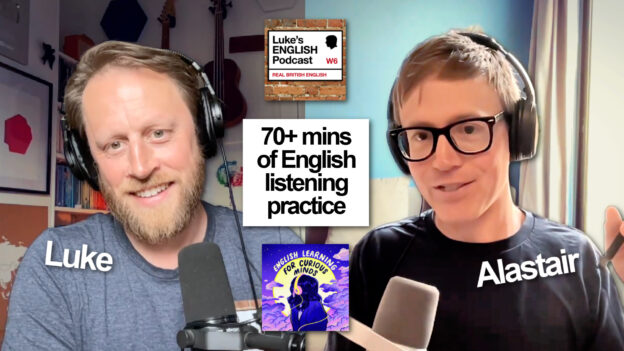
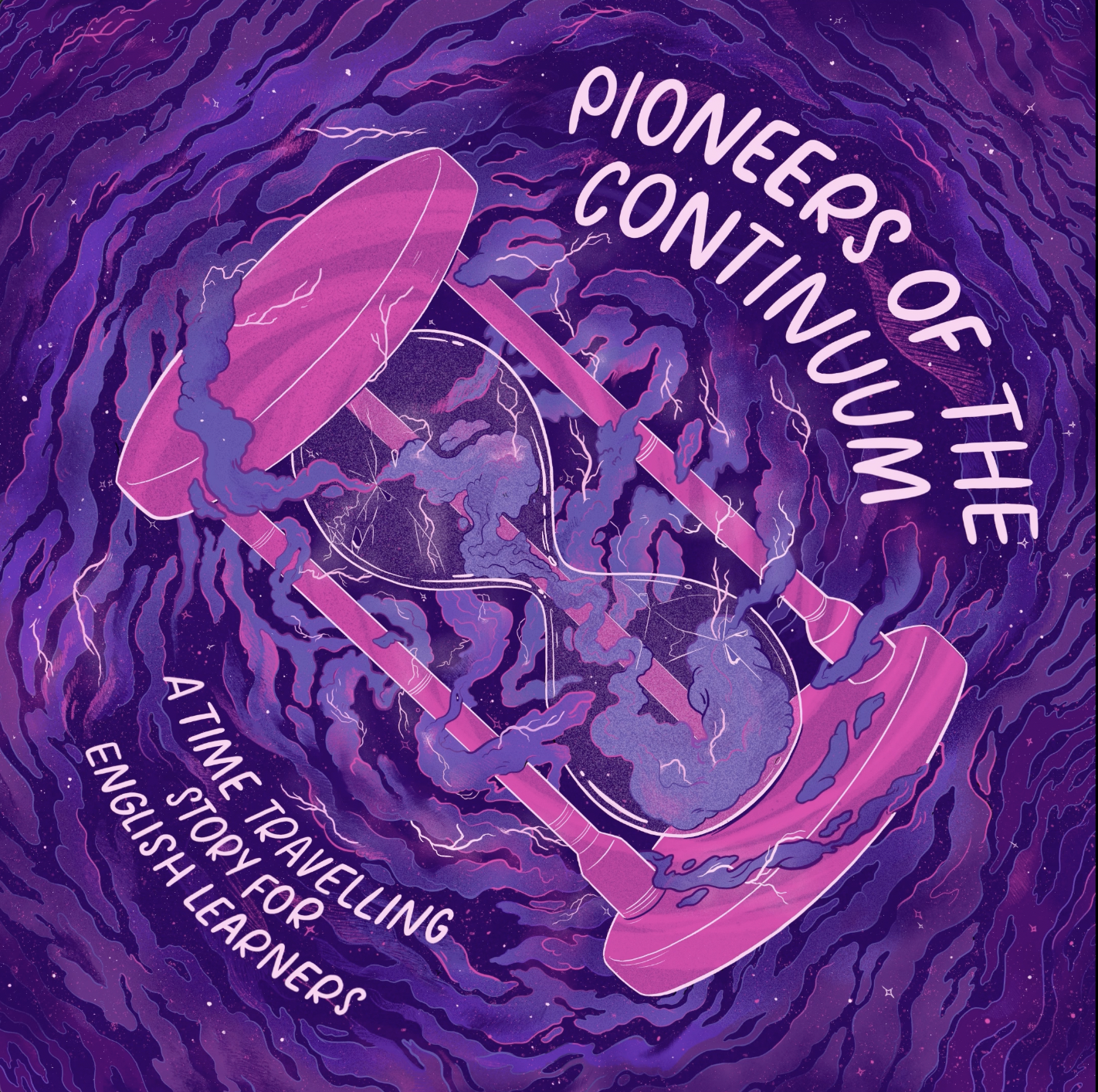
Is that a confusing title? Hopefully not. As you might expect, it’s a little summary of what’s included in the episode. To give you some more details, Alastair Budge is the host of a podcast called “English Learning for Curious Minds” and he has created a new audio drama for English learners called “Pioneers of the Continuum”. It’s a time-travel adventure for English learners, and Alastair asked me to be the narrator for episode 1. In this episode of LEP, we talk about Alastair’s story, living in Malta, learning English by immersion, cliches and complaints from English speakers visiting Paris and Alastair’s story about playing the bagpipes on the streets of Paris. The audio version includes 30+mins of rambling from me at the end. Enjoy!
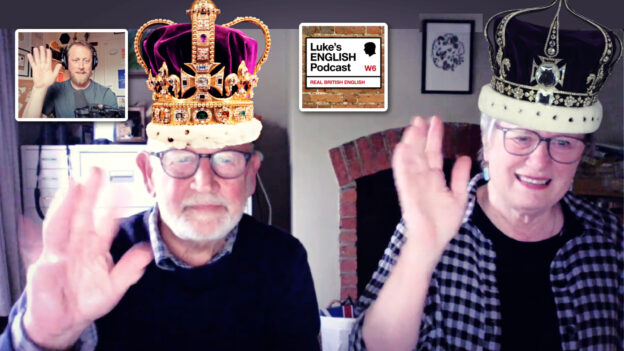
Talking to my parents about the coronation ceremony of King Charles III which happened in Westminster, London on Saturday 6 May. Includes descriptions of the ceremony and discussion of some of the issues related to it, plus a few dodgy jokes along the way 👑.
My dad has written a new book and he’s come on the podcast to tell us about it. The book follows the path of the river Avon as it flows through the middle of England, telling stories of key moments in British history, nature and the current condition of Britain’s rivers.
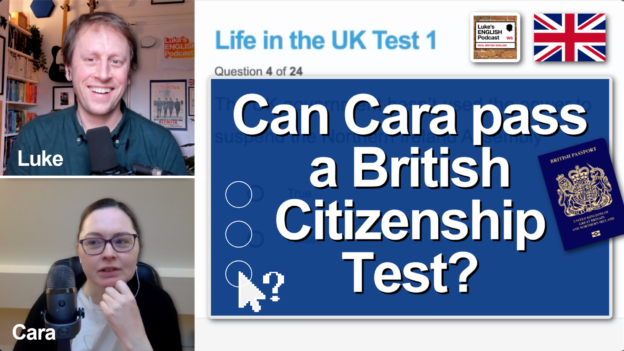
To qualify for British citizenship, one of the requirements is to pass the “Life in the UK” test. Questions cover things like British history, British life & culture, British politics, British geography and principles of modern British life. What do you think? Can you pass the test? Join me as I test online English teacher Cara Leopold (leo-listening.com). How much does she know about her own country of origin? What can you learn about Britain? What IS Britain anyway? Find out in this episode! Video version available.
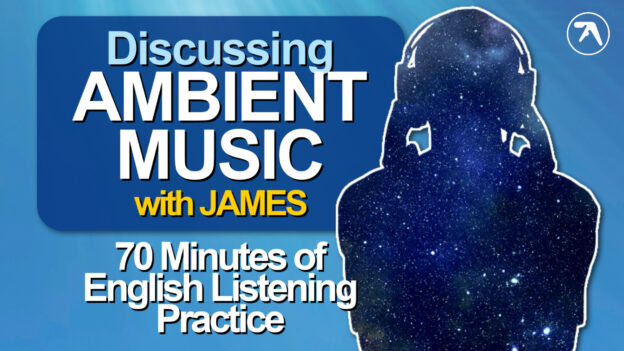
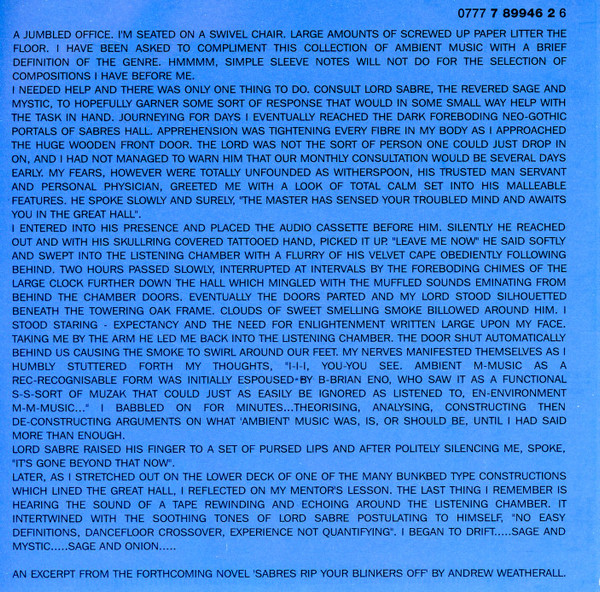
A conversation with my brother about a specific musical genre, “ambient”. We discuss Brian Eno’s inspiration and approach to his first ambient albums, talk about the genre’s origins in French 19th century classical music, jazz and the avant-garde and describe ambient trance music from the 80s and 90s including artists like Aphex Twin, The KLF, The Orb and The Irresistible Force. Enter the ambient zone on LEP.
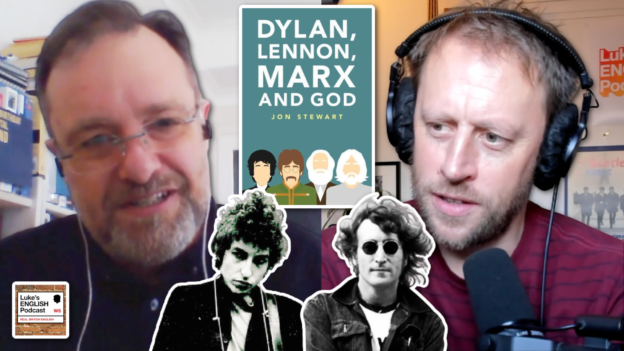
A conversation about two legends of contemporary popular culture – Bob Dylan and John Lennon, with pop-star academic Jon Stewart (guitarist in The Wedding Present and Sleeper).
Jon Stewart is an interesting mix. He is both a university lecturer and a pop star. He runs a Masters Degree course in Music Business and Popular Music Practice at the BIMM Institute in London, and he also plays guitar for legendary British band The Wedding Present, AND classic ‘Britpop’ band Sleeper.
So, Jon knows all about the music business from both a personal and academic point of view. In this conversation I ask Jon about his new book “Dylan, Lennon, Marx and God” which is an amazing dual-biography of John Lennon and Bob Dylan, two of the most significant figures in contemporary popular culture.
Jon talks about the way Dylan and Lennon used language in their work, the references they make to the culture they grew up in, including their spiritual and political views.
Jon also talks about his time as a musician, including working with Elvis Costello and George Michael, and a funny story about John Lennon’s “Imagine piano”.
I hope you find this conversation as fascinating as I did. If you like it, consider getting a copy of Jon’s book!
Flashback to the 1990s! This is Sleeper on Top of the Pops in 1995. Jon is playing guitar on the left of the stage. Great song!
Cookies on teacherluke.co.uk
Click “Accept All”, to consent to the use of all cookies on this website, or visit "Cookie Settings" to control your consent settings.
This website uses cookies to improve your experience while you navigate through the website. Out of these, the cookies that are categorized as necessary are stored on your browser as they are essential for the working of basic functionalities of the website. We also use third-party cookies that help us analyze and understand how you use this website. These cookies will be stored in your browser only with your consent. You also have the option to opt-out of these cookies. But opting out of some of these cookies may affect your browsing experience.
Necessary cookies are absolutely essential for the website to function properly. These cookies ensure basic functionalities and security features of the website, anonymously.
Cookie
Duration
Description
cookielawinfo-checkbox-analytics
11 months
This cookie is set by GDPR Cookie Consent plugin. The cookie is used to store the user consent for the cookies in the category "Analytics".
cookielawinfo-checkbox-functional
11 months
The cookie is set by GDPR cookie consent to record the user consent for the cookies in the category "Functional".
cookielawinfo-checkbox-necessary
11 months
This cookie is set by GDPR Cookie Consent plugin. The cookies is used to store the user consent for the cookies in the category "Necessary".
cookielawinfo-checkbox-others
11 months
This cookie is set by GDPR Cookie Consent plugin. The cookie is used to store the user consent for the cookies in the category "Other.
cookielawinfo-checkbox-performance
11 months
This cookie is set by GDPR Cookie Consent plugin. The cookie is used to store the user consent for the cookies in the category "Performance".
viewed_cookie_policy
11 months
The cookie is set by the GDPR Cookie Consent plugin and is used to store whether or not user has consented to the use of cookies. It does not store any personal data.
Functional cookies help to perform certain functionalities like sharing the content of the website on social media platforms, collect feedbacks, and other third-party features.
Performance cookies are used to understand and analyze the key performance indexes of the website which helps in delivering a better user experience for the visitors.
Analytical cookies are used to understand how visitors interact with the website. These cookies help provide information on metrics the number of visitors, bounce rate, traffic source, etc.
Advertisement cookies are used to provide visitors with relevant ads and marketing campaigns. These cookies track visitors across websites and collect information to provide customized ads.