Category Archives: Humour

183. Luke’s D-Day Diary (Part 1)

Join me on a trip to Normandy for the commemoration of the World War 2 D-Day landings. Podcasting on my feet, some unexpected things happened during this trip.

DOWNLOADSmall Donate Button
Introduction
Friday 6 June this year was the 70th anniversary of the DDay landings in Normandy. My Grandad Dennis was one of the soldiers who landed on the beach that day. Along with thousands of other men he risked his life to fight the Nazis in the 2nd World War. Many of his fellow soldiers did not survive. Last Friday I went to Caen in Northern France to take part in the D-Day commemorations and to see my comedy hero Eddie Izzard performing stand-up in 3 languages. I recorded a podcast during my trip, and some unexpected things happened! Listen to the episode to join me on my adventure.
6 June 1944 – D-Day
D-Day was a very important moment in World War 2. This was when the Allies fought back against the Nazis on the Western European front. It was a key victory for the Allies, but it was also very costly, particularly for the Americans, who lost thousands of men on June 6 alone. For more information about why D-Day was so important, click here to visit the website of the Imperial War Museum in London.

Ultimately, D-Day was a success, but it came with great destruction and loss of human life. The success was due in part to the very careful planning of the Allied forces before the day, but also to the extremely tough fighting in which the Nazis were engaged in the east with the Soviets.

Why was it called D-Day? Click here to find an answer to this question on the BBC Newsround website.

My D-Day Diary
In this episode you’ll join me on my journey to Caen, a town in Normandy that was a very important location during the Normandy campaign in WW2. Caen is where most of the commemorations were taking place (or so I thought). On Friday the town was visited by lots of people including heads of state such as The Queen, Barack Obama, Francoise Hollande, Vladimir Putin and Angela Merkel. They were all very excited to learn that Luke from Luke’s English Podcast was also going to be in town ;)

I was podcasting regularly during the trip. First you hear me on the train, then walking through the streets of Caen on the way to my rented apartment room, then sitting on the steps of a church with my friend Sebastian Marx (from episode 130), then in a car with Yacine, on the street again, and finally in the train on the way home the next day. In the episode I talk about D-Day, my Grandfather’s involvement in D-Day 70 years ago, my experience of seeing Eddie Izzard’s comedy show, the dumbfounding excitement of having dinner with Eddie Izzard. All in all it was quite an emotional experience all round. I hope you enjoy the episode…

My Grandad, Dennis Hallam

Dennis is 94 this year. 70 years ago he was just 24 years old but he was an officer in the army, in charge of 35 young soldiers. It was his responsibility to lead these men off the boat, up the beach and ultimately all the way through France and deep into enemy territory. It was very brave of him, and he fought for my freedom. Without Grandad, I wouldn’t be here today and there would be no Luke’s English Podcast. Thanks Dennis.

Recently my Dad (Dennis’s son-in-law) wrote to Dennis to thank him for what he did on D-Day. Here is a copy of Dennis’s reply, typed onto a computer by my Mum (Dennis’s daughter). Some words are defined below.

Dear Rick,
Thank you for your “Thankyou” card which made me feel both proud and embarrassed – I was only one of thousands.

It was pretty hairy, and for me and many others it started long before we reached the beach. The Channel crossing was vile – I was dreadfully sick. At some point during the night it was my turn to be Duty Army Officer on the bridge and I had to climb up there being sick and miserable. So it was almost a great relief to get onto the beach, even though wet through, having had to wade ashore, and even though there were assorted bits of metal flying around. What amazes and horrifies me is to think that I was just 24 and in charge of and responsible for a platoon of 35 soldiers. If there were privileges attached to commissioned ranks – and there were, of course, I think we deserved them – a lot was asked of us.

However, it was a war that had to be fought, I think, and one simply called on one’s training and did what seemed right at any situation.

I hope the celebrations will go well and it is good to know that what we did is remembered and honoured.

Thank you again – it was very kind of you.

Yours, Dennis.

Thank you too Grandad.

Eddie Izzard
He’s a stand-up comedian from the UK. I’m a huge fan. I won’t write more about him here because I’m planning to do an episode about him soon, in which I’ll play you some of his stand-up comedy. On 6 June he put on a special show, doing 3 performances – one in German, one in English and one in French. That’s really impressive, especially considering he is learning both German and French as second (or third?) languages. I was pretty awestruck to actually meet Eddie on Friday and then sit down to dinner in his company. I still can’t believe it happened because he’s sort of a hero of mine. Listen to the podcast to hear my reactions. I was quite excited.

Here’s some video of Eddie talking about how Anglo-Saxon English evolved, including his version of how English became a non-gendered language, distinct from the gendered French which existed in England at around the same time.

Here is a video showing footage of the D-Day operation. To be honest, the video doesn’t really show us how big the operation was. It was the biggest naval armada the world had ever seen, and has ever seen since. It must have been an overwhelming sight to behold.

War Is Hell

“Some of you young men think that war is all glamour and glory,
but let me tell you, boys, it is all hell!”
-General William T. Sherman

182. Learning English with Yacine Belhousse

This episode is all about the relationship between language, successful communication, stand-up comedy and learning English! It features an interview with the one-and-only Yacine Belhousse, who is a professional stand-up comedian in his native language and now in English too. A year and a half ago, Yacine hardly spoke any English. Now he regularly performs in English and this year he is doing a 1 hour stand-up comedy show at the Edinburgh fringe festival. How does he do it? How does he deal with the challenges of learning English while also making people laugh in English too? Listen and find out!

Download Episode  Small Donate Button
I’m really pleased to present every episode of Luke’s English Podcast, but this one makes me extra pleased. Why? I just think that we come to some particularly useful conclusions during this conversation, especially related to the attitude that you need to learn English effectively. I’m also pleased to present Yacine because he’s got a great attitude towards learning English and because I think he’s really funny.

Conclusions about Learning Language
In summary here are some of the key points about learning English & communication from our conversation:
– To communicate well, you must take responsibility for communicative exchanges.
– Remember when you’re talking to native speakers, you’re just talking to another human. They have no reason to judge you if you’re just trying to communicate to achieve something. In fact, native speakers have the same responsibility for successful communication as you. So don’t feel that you’re totally responsible for any communication breakdown.
– Be confident and don’t worry about making mistakes. If you do make mistakes, you can learn from them and that’s how you improve. If you’re concerned that you can’t be confident – don’t worry. Confidence is something which just happens when you try to do something. If you focus on achieving successful communication, and don’t get upset by failure – confidence will just come naturally. So, don’t worry about confidence. Just focus on trying to achieve things.
– Have an organised approach to learning – mentally store words and phrases you like in the “good things bucket”. Reject bits of communication that didn’t work in the “bad things bucket”. Perhaps revisit the “bad things bucket” to learn from the errors, but enjoy the contents of your “good things bucket” too!
– Repeat words and phrases that you’ve learned. Repeat them lots of times in order to remember them.
– Learn by doing things. Learn to speak by speaking, failing, succeeding and moving on. You have to be active. Use your English. If you don’t use it, you lose it. You’ve got to be in it to win it!
– Be positive!

Listen to the conversation to find out more.

Links
Would you like to play Yacine’s computer game? Click here to visit the game on his website.

Will you be in Edinburgh during the Fringe? You should check out Yacine’s show. Click here for information on Yacine’s Edinburgh show.

Transcript to #182. Learning English with Yacine Belhousse
The introduction to this episode is transcribed below. If you would like to write some more minutes of transcript, click here to visit the google document for this episode.

Introduction
Here is my introduction to this episode of the podcast.

“Normally I have native speakers on this podcast; British people, Americans, Australians and stuff like that. And yet, most of the people who listen to this are non-natives learning the language. I rarely have learners of English giving their voice, which is a pity because everyone has a story to tell and interesting things to share. …

So, in today’s episode I am speaking to a friend of mine called Yacine. He’s not a native speaker. In fact, until quite recently he didn’t speak English at all. By his own admission, his English is not perfect. Sometimes he can’t find the right words, he has some trouble choosing the correct verb forms or pronouncing words naturally. These are all the normal problems faced by people learning English. However, I believe Yacine is quite special and that’s why I’ve brought him onto the podcast, despite not being a native or near-native speaker of English.

But why Luke? Why are you featuring a learner of English in one of your interviews? Well, there are lots of reasons:
– I think Yacine has a really good attitude towards learning, and I want to explore that so we can pick up some good things about language learning.
– Yacine is a professional stand-up comedian in his native language but he is also now performing shows in English. In fact, this year he is doing a regular one hour show at the Edinburgh Fringe Festival, which is perhaps the biggest comedy festival in the world, and he regularly performs comedy with the great & legendary Eddie Izzard, who is considered by many to be one of the greatest stand-ups of his generation. Eddie Izzard is not just an inspiration to stand up comedians, he is also an inspiration to language learners all over the world, and we’ll find out more about that later. Yacine is very influenced by Eddie Izzard, and he often supports Eddie when he does shows in France.

Learning a language is a challenging thing for anyone. You know when you speak you feel shy and embarrassed sometimes because you don’t want to be judged (just like me when I go to the boulangerie). These are normal fears. But, can you imagine going on-stage in front of lots of people, Scottish, English, perhaps a bit drunk because the show is on at 9.30PM, and delivering a full one hour stand-up performance in a language you’re trying to learn?
– It must be very challenging.
– You’d need a lot of self-confidence and self-belief.
– You need to focus very carefully on how to communicate your message.
– You need to be able to deal with any possible breakdown of communication.
– You need to stop worrying about errors, and if you make errors learn from them but don’t let them make you lose confidence.
I want to know how Yacine faces these challenges, but also, for me these are the challenges faced by any learner of English, but they are multiplied by the fact that Yacine is also doing this on-stage while having to make people laugh. It’s impressive and I want to know more.

So, this is what I want to investigate in this episode:
– How he’s learning English.
– Doing comedy in French vs English.
– French audiences vs UK audiences – are they different?
– Is humour universal?
– How is good communication an essential part of comedy? How do you make a successful joke? It’s about successfully communicating an idea.

Footnote: Yacine has only been learning for a few years. He hasn’t attended any courses or lessons. He’s self-taught. My professional opinion is that he’s doing really well. His English is better than it was a year ago, and his English is certainly much better than my French!

Yacine might make errors during the episode, and that’s fine. I’ll help him or even give him corrections (“yes please” – he says). This episode is not a judgement of his English, and it’s not his comedy performance either – that happens in Edinburgh. What this is, is an investigation into his English learning experiences and the relationship between language, communication, comedy and language learning!

Click here to transcribe more of this episode using a google document.

Thanks for listening, and have a good day/evening/night!

Luke

yacine PODPIC

My interview on the All Ears English Podcast

Hi everyone,

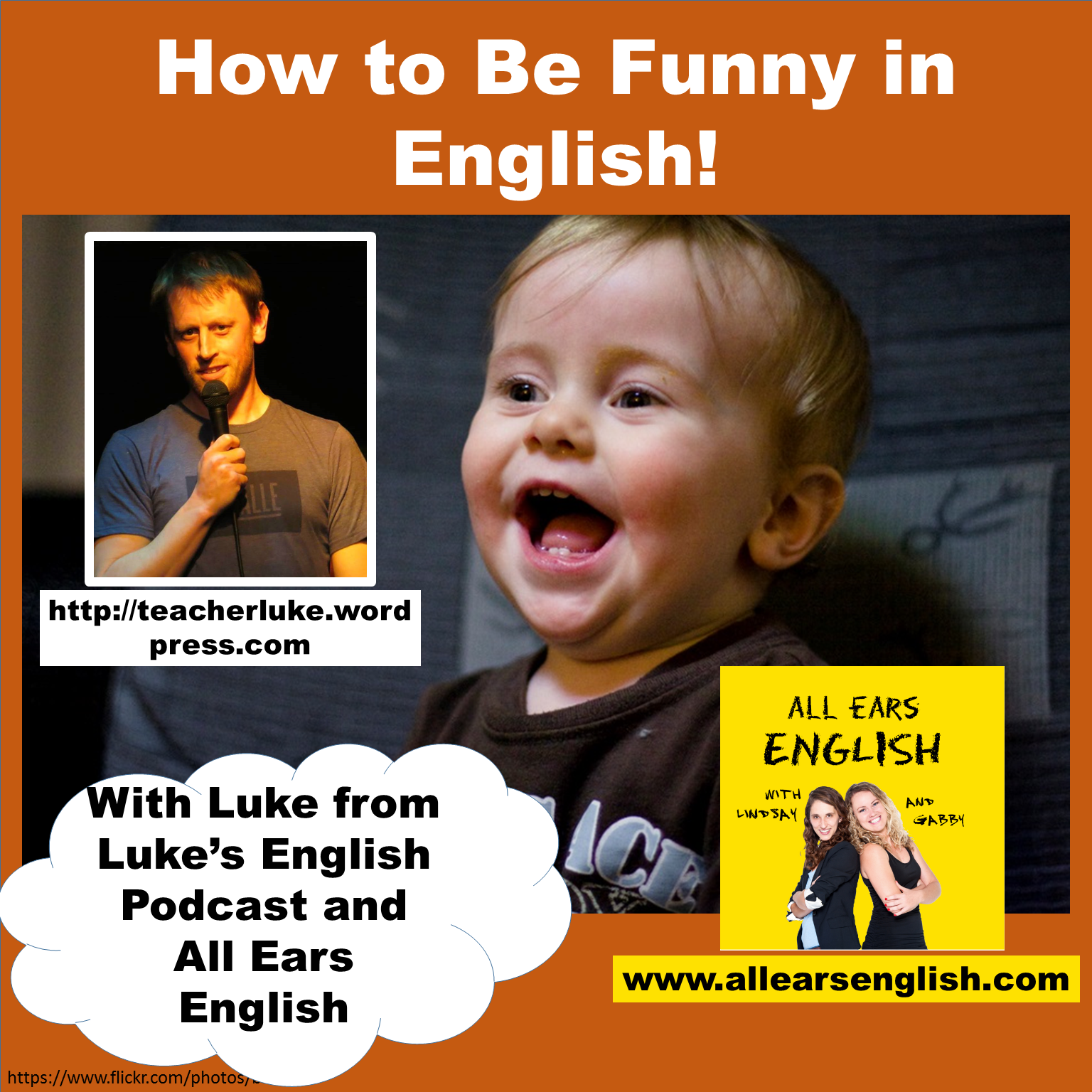
Today I am featured as a guest on the All Ears English podcast. In the episode you can hear me talking about comedy, humour and telling jokes in English. Click the picture to listen to the episode on the All Ears English website or use this embedded player.

https://www.podtrac.com/pts/redirect.mp3/pdst.fm/e/chrt.fm/track/CB27B5/traffic.megaphone.fm/ALLE5073533650.mp3?updated=1648593059

Luke Episode 122-2

You might already know All Ears English. It’s a podcast produced by two American girls called Gabby & Lindsay. They’re both English teachers with lots of experience who also do a podcast for learners of English.

Recently I got a tweet from Lindsay asking if I would like to be interviewed for one of their episodes, and I was glad to accept. It’s fun to be featured on someone else’s podcast for a change. Also, it’s good to establish contact with other podcasters. It was pretty exciting to talk to the girls on Skype and find out how we have a lot of things in common even though we are from completely different countries. Because I am a comedian (as well as a teacher) they were interested in hearing my perspective on differences between British & American humour, and some of my tips on telling jokes in English. Of course, there’s a lot to say on that topic so it is something I plan to revisit fully on LEP.

Here’s a summary of my tips on how to tell jokes in English. As I said, I plan to revisit this subject fully on LEP as there is so much to say!

Luke’s advice on how to tell jokes in English:

  • Be careful about telling jokes in social situations
  • Know when it’s appropriate to tell a joke. Sometimes there might be an informal joke-telling situation with your friends. That’s a great time to try your joke.
  • Be careful about the subject of the joke. Don’t make jokes about race, age, weight, gender or sexual orientation (especially in the United States)
  • Try to tell a spontaneous joke rather than a preplanned joke. The joke is more of an attitude than a specific joke. Instead, develop an attitude that is funny and lighthearted.
  • Make sure that you know the joke well when you are telling the joke so that you don’t forget the punchline.
  • Keep it short and sweet.
  • It should sound natural.
  • Don’t laugh too much at your own joke.
    • Be prepared if your joke doesn’t work, but don’t worry about it too much.

Look out for more episodes on humour in social situations in the future!

181. Vocabulary & Expressions from Episode 180

Did you find it hard to follow the Skype call with my bro in the previous episode? Would you like to learn some vocabulary and phrases from the conversation? How about specific words to describe accidents, bones, muscles and other things? Listen to this episode to find out more.

 Download Episode  Small Donate Button
I listened back to my Skype call with James and thought that I needed to clarify and explain some things, so that’s what I’ve done in this episode.

Listen and you’ll hear me explain words, phrases and expressions from the first 15 minutes of the conversation in episode 180. The sentences I’m explaining are provided below for your reference. You’re welcome!

Vocabulary List (the first 15 minutes of the interview with James in episode 180)
Listen to the next episode of the podcast to hear me explain all these things in more detail.
First of all – sorry for my brother’s fiddling and fidgeting!
I’m not too bad thanks, considering…
The day before yesterday I came a cropper on my skateboard and dislocated my shoulder
The arm popped out of its socket
I feel a bit, sort of, run down, I suppose would be the word. A bit tired and achy.
Just the twatty landlord using the garden as some sort of rubbish tip as usual.
I was skating a block-sort of-bar thing. “Skating the block“, not “skating on the block“. (The difference is quite important if you’re a skater)
I was doing a board slide on it but it kept sticking.
I leant back a little bit more.
As I was coming off the block I landed fine but slightly on the tail of the board. (Nose, tail, wheels, trucks, grip tape, bearings – skateboard parts).
Slightly off-balance.
I put my hand down to stop myself falling but I carried on sliding out. My feet slid underneath me and I overextended my arm behind my head, and kind of slammed down on my body. My weight came down on my arm.
I immediately jumped up and it felt really really weird.
I felt a shelf where the shoulder-blade (he means collar bone I think) stopped and then there was a 2 inch gap and then the arm. (ouch!)
I knew at that point that I’d dislocated my shoulder. (Past perfect tense)
To start with there wasn’t any pain, the pain came a few minutes in.
I don’t normally get an ambulance for a self-inflicted injury. (what a tough and modest guy he is!)
I normally get a bus or a taxi to A&E but this time I thought it warranted it because I couldn’t move at all.
[It was] extreme muscular pain, like when you tear ligaments or sprain an ankle.
They were going “ooh” which makes you feel uncomfortable if someone’s wincing, you know.
They tried to get a needle into me for a drip. They couldn’t get a vein to bleed properly. (they couldn’t find a vein)
They put some intravenous paracetamol into me, which didn’t really do anything.
It’s an over-the-counter pain-relief pill.
Why are there no aspirins in the jungle? Because the parrots eat them all (the ‘paracetamol’ – yes, it’s a terrible joke)
I gritted my teeth and tried to ignore what was going on.
They drove me with the ‘woo-woos’ on.
(I tell James to stop fiddling… and he says…) I can’t remember where we were now.
They wheeled me into the hospital. (I attempt to highlight the irony of getting injured on a wheeled vehicle and then being taken into a hospital on another wheeled vehicle – it’s an unsuccessful joke, but never mind)
An Indian-looking doctor looked at me.
You can relax a bit when the doctor seems quite in-control.
He told me exactly what was going to happen. I’d need an x-ray to check that nothing was broken, then if nothing was broken then they’d give me some more drugs and then put it back in, and then they’d give me another x-ray to check that nothing had broken while they were putting it back in, which kind of made me think it might be quite a painful process having it set back.
They gave me some morphine, and it didn’t seem to do anything and I was, like, grimacing a bit, so they gave me some more.
They gave you morphine and they gave you nitrous oxide?
You’re breaking up a little bit.
Do you find that breaking up is very hard to do? (This was probably quite confusing, but it’s my brother’s attempt at a sardonic joke – referring to a famous song which uses the same phrase, but with a different meaning)
“You’re breaking up” (your phone/skype signal is not clear)
“Breaking up is hard to do” (Separating, splitting up with your boyfriend or girlfriend – there are two songs that use this phrase, “Make it easy on yourself” by The Walker Brothers & written by Burt Bacharach, and “Breaking Up is Hard to Do” by Neil Sedaka. You can listen to those original songs below. Sorry about my singing.
(James receives a phone call from his girlfriend because she wants to check that he’s okay. How sweet.)
She was a bit worried about me because I was a bit sort of groggy yesterday.
I feel a bit sort of run down, a bit beaten up, but fine.
Good thing you didn’t hit your head.
I didn’t shatter my collar bone or something like that, that would have been horrible.
It could have been something worse.
You don’t need a cast. Nothing’s broken.

That’s as much as I’m able to do at this moment. You’ll just have to listen to the rest of the conversation unaided and try to work out exactly what we’re saying. It’ll be good for your English!

Now listen to episode 180 again. I promise you will understand much more a second time. Click here to listen to & download “Episode 180. Dislocated Shoulder”.

Song
Here are the lyrics (and chords) to My Girl by Madness.

Madness – My Girl

Bm G
My girl’s mad at me
Bm Em
I didn’t wanna see the film tonight
Bm G
I found it hard to say
Bm Em
She thought I’d had enough of her

Chorus
D A Bm
Why can’t she see
Em D A
She’s lovely to me?
D A Bm
But I like to stay in
D G D Em
And watch t.v. on my own
G A
Every now and then

Bm G
My girl’s mad at me
Bm Em
Been on the telephone for an hour
Bm G
We hardly said a word
Bm Em
I tried and tried but I could not be heard

D A Bm
Why can’t I explain?
Em D A
Why do I feel this pain?
D A Bm
‘Cos everything I say
D G
She doesn’t understand
D Em
She doesn’t realise
G A
She takes it all the wrong way

Bm G
My girl’s mad at me
Bm Em
We argued just the other night
Bm G
I thought we’d got it straight
Bm Em
We talked and talked until it was light

D A Bm
I thought we’d agreed
Em D A
I thought we’d talked it out
D A Bm
Now when I try to speak
D G
She says that I don’t care
D Em
She says I’m unaware
G A
And now she says I’m weak

Here’s the original video by Madness.

181PODPIC3

175. The Phrasal Verb Chronicles #1

This is both a phrasal verb review, and a random made-up story. 50 phrasal verbs reviewed within the context of a completely improvised comedy story. Click here for The Phrasal Verb Chronicles #2.

Download Episode  Small Donate Button

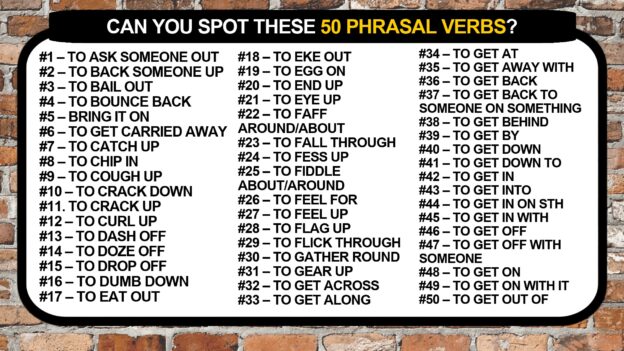
I decided to do this episode as a way to remind you of the first 50 phrasal verbs I’ve taught you in my Phrasal Verb a Day series of mini-episodes. When I’ve reached 100 phrasal verb episodes, I’ll do another episode of The Phrasal Verb Chronicles, to help you remember #51-100.

Here are the phrasal verbs I use in this episode. Can you notice how I use them in my weird story? You could also attempt to make up your own story using these phrasal verbs. You don’t have to do all 50. Try just using 5, then 10, then 20 and so on. Eventually you should be able to make meaningful sentences using all the phrases.

I wonder what you think of the idea of “Story Time Club with Luke from Luke’s English Podcast”? Let me know ;)

Extracts with Vocabulary from this Episode (thanks to Jack from the comment section)

I’ve been meaning for a while to go through these phrasal verbs…..
Check them out.
Chronicles
To make up a story off the top of my head.
Try and jog your memories regarding these phrases.
A make up story / situation.
Try and spot the phrasal verbs.
Think also about the grammatical context I’m using them in.
But the aim is for me to try and use these phrasal verbs in this weird long drawn out situation.
I’m gonna try and ask her out.
Sorry you sound a little bit sarcastic.
I’m not up for it any more.
How am I gonna bail out of this?
I walked back over to the other side of the pub with my mates and I felt devasted!
I really thought that we were going to get on with each other.
We might start going out with each other.
But she was annoyingly sarcastic and I don’t know if I can take it.
You usually bounch back from this kind of situation.
If I get flung into a corner I just bounce back
So bring it on
Don’t get carried away
It’s all cool and groovy brother.
Come on catch up!
Can I just chip in?
Bizarre
Look! Never mind that!
It’s twenty quid. Come on cough up
I overheard a guy in the pub.
I listened in and he was going……
I think the police need to crack down on crime.
Do you mind if I just chip in?
I get the impression that nothing is occurring at this moment because you can’t work out what kind of crime it is that police should be cracking down on.
You are actually buying time so that you can think of a funny crime so that then you can use the expression to crack up.

You are very intuitive.
Get on with it!
Schizophrenic
May be I’m cracking up – I’m losing it.
Curl up on the sofa
I’ve got to dash off
I’ve got to doze off
I got on the bus.
I started to drop off to sleep.
I turned on the TV. The commercials were on.
It’s the dumbing down of modern culture.
I’ve got to get out now.
I’ll treat myself to a meal in a nice restaurant.
I’m going to eat out in a lovely restaurant.
I have just a very meagre salary which I have to eek out over the whole year.
Hold your horses Luke! Don’t get carried away.
What I probably should do is work out how to move this story forward.
To hell with my savings!
I started building myself up.
I was really egging myself on.
I went out – I had a really nice time.
I could help noticing that she was eyeing me up.
I’ve had enough of faffing about.
I’m going to take her out for dinner.
You are just kind of ironic.
I’m gonna fess up at this point.
I was devastated.
I had my pint glass, I was just fiddling with a glass in my hand.
Do you want to feel me up or something?
I’m just flagging this up! You shouldn’t say that kind of thing.
I wonder if my listeners are managing to keep up with all these phrasal verbs……
I grabbed the newspaper.
I sat there flicking through the newspaper.
A story which has no drama……
Just biding my time……
I started gearing myself up to kind of announce to the pub that it was story time.
How I’m going to get through this idea.
Get this message across
Gather around in a group and really get on with each other.
No one will be getting at each other.
You wonder if I’ll get away with this because they might not go along with it.
It’s a crazy idea but I might just get away with it.
I’d probably better just check with him if it’s OK.
You want to set up a story club?
I’ll get back to you.
Nothing, nada, zero, zip, zilch.
Summon them up like Spanish
What have you got back to me with?
Nought (nothing)
Don’t get down about it.
They’ll be caught up in the spirit of things.
They’ll be forced to drink in order to down their sorrows.
In which case, you put on the music and every one gets down.
Yes! Get in! I would love to start tonight.
I wanna get in on this!
Because that story time club is where it’s at.
Everyone will have to take their shirts off.
I think we should just get on with this.
I’m gonna go for it.
Old traditional folk tales.
Put your mobile phones away.
Bloke
My dreams were dashed onto the floor of a traditional club.
I mean there was a vague notion of a story line.

173. The Curse of The Lambton Worm (Short Story)

Listen to a disturbing story from English folklore about a horrendous and mysterious worm.

Download Episode  Small Donate Button

Introduction
The Lambton Worm is a legend from the north east of England in the UK. The story takes place around the River Wear, in the town of Lambton and at Penshaw Hill which is between Durham and Sunderland in the north east of England. It is one of the area’s most famous pieces of folklore, having been adapted from written and oral tradition into pantomime and song formats, which are still performed to this day. I’m going to keep up that tradition here on Luke’s English Podcast by telling you my version of the story.

The tale is about a man called John Lambton, who was the heir to the Lambton Estate in County Durham, and his battle with a giant worm (dragon) that had been terrorising the local villages. As with most myths, details of the story change with each telling. I’m not from that part of England, but I love this story because I remember reading about it in a book of monsters that my brother used to have when we were kids. Remember before I told you about a ghost book that I used to own when I was a kid? Well, my brother had a similar book, from the same series, and it was all about monsters. I was fascinated by these books (Click this link to read some pages of those books!) So was my brother. I remember there was a picture of John Lambton fighting the worm, and a brief account of the story. It was fascinating, horrific and exciting for me as a kid, and the memory of the story has stayed with me. There’s just something about an old scary story that really excites me. I think this one must be a good one because it has endured for hundreds of years. It dates back to the time of the crusades, so about 1,000 years ago – medieval times. If a story survives that long, being told over and over again and being handed down through the generations, it must mean there must be something in it which interests people.

This is a local legend from country Durham and I expect it’s a strong part of their local culture. There’s an old folk song which tells the story, and it is still sung in old pubs by beer-drinking men with beards and acoustic guitars. I love those old folk songs. It’s proper traditional culture, as performed and told by real local people. I’m not from that part of the country, I’m from the midlands, and the south, but the story means something to me because of the connection I have with it from childhood. Also, I just think that you might like to hear it.

I’m going to tell you the story in my own way. It’s normal for folk tales like this to be changed by the storyteller, and there is no official version of the story – just a general outline. The details get adapted and improvised by each storyteller. So, I’m going to give you my version, which means that I will stick to the main elements of the story, but yes, as usual I will be improvising a lot of other details too. The challenge for me is to try and make it engaging, and entertaining and understandable for you. As well as practising your English, we can also consider what makes a good story. I think it’s about the passion of the storyteller, and the attention to certain details. Your challenge is to follow the story, and perhaps learn it well enough to be able to tell your friends, if you fancy that. Just remember to mention that the roots of this story are in the folklore of the county Durham area, in the North of England. It’s important to remember that this is a bit of local culture. If you’re from that area, and you’re  listening to this – I hope you don’t mind my version of the story, and realise that, really, I love this story too and I’m just adapting it a little bit for the purpose of letting people practise their English listening.

lambton worm pic

Illustration by John Dickson Batten from More English Fairy Tales.

The Main Elements of the Story
Note that I use past tenses to tell my story (past simple, past perfect & past continuous) but below the story is presented using present tenses.
John Lambton is the heir to the Lambton Estate – so he’s a young member of the gentry. A landowner from a fairly rich and well known family in the area.
He’s a rebellious character.
He skips church and he skips school.
He doesn’t care. He just loves fishing. He disrespects his parents.
He skips church one Sunday, and goes fishing.
He meets an old man – an old hermit, who tells him that no good will come of skipping church. He ignores the old man, and yet it puts him in a bit of a bad mood.
He catches nothing all morning.
Then, as the church bells are ringing for the end of service, he gets a bite on his line.
It’s a powerful bite and he has to wrestle hard to bring in the catch. The water crashes around and gets deeply churned up. He fights hard and brings in his catch.
It’s a truly disgusting and horrifying catch.
It’s a slimy and wriggly black worm. It’s dripping slime, it’s writhing and snapping, and it stinks.
He brings it to rest on the soil. It sits there breathing, completely malevolent. It has 9 holes down the side of its mouth, and John can’t really make sense of its other features. It’s really weird, and makes him feel sick.
He pukes, quite hard. What the hell is this thing?
He takes another look at it, and it opens its eye. It’s yellow and red, and it seems to look right into his soul.
This is a life-changing moment, although he doesn’t realise it.
At that moment, the old man reappears, and says with some certainty that he senses the work of the devil, and that Lambton is now responsible for this worm.
Lambton can’t throw it back, so he quickly puts it in his basket, to carry it home.
On the way back, the basket is so heavy and the worm keeps thrashing around inside it, and hissing. Even when it’s still, the basket seems impossible to carry. It’s so heavy, but also, he feels miserable. The good mood he was in at the beginning of the day has been replaced by a very grim feeling of depression. It’s like he’s suddenly aware of all the time he has wasted, and how everything seems quite hopeless, including his family  life.
He can’t take it any more, and feeling desperate, he chucks the worm into a nearby well. The worm struggles quite a lot, but down it goes. Lambton waits to hear the worm hit the bottom, and it does, after a pause, with a splash.
He quickly goes home.
Feeling guilty, and more aware of his responsibilities, he decides to join the army in order to fight in the crusades, as much out of guilt as duty to his family and the church.
He goes to Palestine to fight in the crusades. He’s away for 7 hard years in which he sees many things, makes many friends and sees many friends die in battle. He becomes a man.
Meanwhile, back at home, the worm is still alive in the well. The well becomes infected, and causes anyone who drinks from it to become violently ill, and die, with horrible symptoms.
The worm grows inside the well, and after it has reached a massive size, one moonlit night, it slides out from the well, and it’s massive. It wraps itself around the local Penshaw Hill – several times, and lies there waiting, warming itself in the morning sun. It’s a hideous and vicious creature. It has small legs, with claws on the end, which it uses to scrape and scratch the earth. It is incredibly long, and it slithers like a snake. It’s covered in smooth yet tough scales. Around its head it has a mane of rubbery spikes. The 9 holes that run along the side of its face, under its jaw, ooze a nasty black slime which burns the grass and sends an evil black smoke into the air. It coughs up the bones and remains of the bodies it has eaten, leaving this foul waste on the ground wherever it rests. Its eyes are yellow and deep, and malevolent. It has rows of razor sharp teeth like a shark’s except that they’re black and yellow, and his eyes, like that of a shark, roll back into its head when he takes a bite, leaving him looking white-eyed and blind during its moments of feeding frenzy.
It attacks a local farmer, squeezing him to death after he tries to fight it with his pitchfork. It then eats all his cattle, and his dead body, before returning to the hill.
It then terrorises the area, eating cattle and sheep, and wild animals.
The countryside becomes deathly silent, as it is all scared or killed by the worm. It’s a foul and sickening presence which seems to poison the earth wherever it goes.
Its confidence grows and it enters town.
The town mayor, as an attempt to distract it, empties all the milk supplies from the market into a trough in front of the town hall. The worm eats it all, and returns to the hill, where it sleeps.
The best men of the town get together a fighting force and arm themselves with the best weaponry they can find, and go to attack the worm, but it’s in vain as the worm is very strong and ruthless. Whenever anyone manages to slice the worm, the pieces, shuddering, just grow back together again. The worm seems indestructible.
For the next 7 years, the town gives the worm almost all of its supplies of milk in order to satisfy it. The worm grows bigger, and the town gets more and more exploited, until people are starving to death, and all life is sucked out of the place. When no milk is provided, the worm angrily attacks the residents, killing and eating men, women and children.
John Lambton returns from the crusades a scarred man, but a man nonetheless. He has learned how to fight, and he carries a sword and a suit of armour.
He sees the state of the town, and learns about the worm from his father.
He realises it is the same worm that he discarded all those years ago, and immediately realises that he is responsible for the curse and must fight the worm himself.
He visits a local wise woman for advice. She tells him that the worm has cursed him, his family and the town, and that only he can kill it.
She tells him to visit the blacksmith, and to have spikes and blades fitted to his armour, and that he must  lure the worm into the river Wear before doing battle.
She also tells him that to lift the curse, after killing the worm, he must kill the next living thing that he sees.
Lambton gets his special suit of armour made, and arranges with his father that when he has killed the worm, he will blow a note on his hunting horn as a signal that he has won and that the father must release Lambton’s favourite hunting hound. The hound will run straight  to him and Lambton will kill it, lifting the curse.
He heads towards the hill and finds the worm.
The worm recognises him and uncoils itself from the hill, hissing, puking black bile and generally being hideous.
Lambton realises how difficult this will be because this worm is really big and strong looking. The worm approaches and he backs away.
He walks backwards towards the river, the worm steadily moving nearer and nearer, flanking him. Lambton gets very tired just walking in the armour – which is extra-heavy because of the fittings.
Eventually, he enters the water, which is cold.
The worm slides down the bank and raises itself up to strike.
They fight and whenever the worm attempts to coil itself around Lambton, it gets sliced up on the blades and spikes.
Lambton is so tired that all he can do is just try not to be washed away by the current. He hacks at the worm and struggles to breath. The fumes from the worm are poisonous. Each time parts of the worm are hacked off, they are washed away, and eventually, just a section of the worm is left and Lambton hacks off its head. The pieces can’t join back together and the worm is no more.
Lambton blows a note on his horn, but his father is so happy to hear it that he forgets to release the hound and instead he runs to see John. Lambton sees him , and is dismayed. he can’t bring himself to kill his father, and so the go back to the house and he kills his hound.
The wise woman appears and tells him that despite killing the worm, he failed to lift the curse and that for 9 generations, the Lambtons will not die in their beds.
injured and sick, Lambton collapses.
That’s the end of the story.

What does this all mean? You tell me.

This curse seems to have held true for at least three generations, possibly helping to contribute to the popularity of the story.
1st generation: Robert Lambton, drowned at Newrig.
2nd: Sir William Lambton, a Colonel of Foot, killed at Marston Moor.
3rd: William Lambton, died in battle at Wakefield.
9th: Henry Lambton, died in his carriage crossing Lambton Bridge on 26 June 1761.
(General Lambton, Henry Lambton’s brother, is said to have kept a horse whip by his bedside to ward off violent assaults. He died in his bed at an old age.)

The Old Folk Song
Here is Tony Wilson singing the folk song in the local dialect
[youtube http://www.youtube.com/watch?v=XsO7SeCvgMw&w=500&h=375]
Song Lyrics
Here are the lyrics with some meanings added too. Remember, this is sung in an old dialect. Not many people actually speak in this dialect any more, although there is a distinct accent from that region.

One Sunda morn young Lambton went
A-fishing in the Wear;
An’ catched a fish upon he’s heuk (=caught) (=his hook)
He thowt leuk’t vary queer. (=thought looked very strange)
But whatt’n a kind ov fish it was (=what kind of)
Young Lambton cudden’t tell-
He waddn’t fash te carry’d hyem, (=could not be bothered to carry it home)
So he hoyed it doon a well (=threw it down)
Chorus
Whisht! lads, haad yor gobs, (=Be quiet, boys, shut your mouths)
An’ aa’ll tell ye aall an aaful story, (=I’ll tell you all an awful)
Whisht! lads, haad yor gobs,
An’ Aa’ll tel ye ‘boot the worm. (=about)
Noo Lambton felt inclined te gan (=go)
An’ fight i’ foreign wars.
He joined a troop ov Knights that cared
For nowther woonds nor scars, (=neither wounds)
An’ off he went te Palestine
Where queer things him befel,
An varry seun forgat aboot (=very soon forgot about)
The queer worm i’ tha well.
But the worm got fat an’ grewed an’ grewed,
An’ grewed an aaful size;
He’d greet big teeth, a greet big gob,
An greet big goggly eyes.
An’ when at neets he craaled aboot (=nights) (=crawled around)
Te pick up bits o’ news,
If he felt dry upon the road,
He’d milk a dozen coos. (=cows)
This feorful worm would often feed (=fearful)
On caalves an’ lambs an’ sheep,
An’ swally little bairns alive (=swallow) (=children)
When they laid doon te sleep.
An when he’d eaten aall he cud (=all he could)
An’ he had had he’s fill,
He craaled away an’ lapped he’s tail (=wrapped)
Ten times roond Pensha Hill.
The news ov this myest aaful worm (=most)
An’ his queer gannins on (=goings-on)
Seun crossed the seas, gat te the ears (=soon) (=got to)
Ov brave an’ bowld Sor John.
So hyem he cam an’ catched the beast, (=home he came and caught)
An’ cut ‘im in twe haalves, (=cut him in two-halves)
An’ that seun stopped hes eatin’ bairns
An’ sheep an’ lambs an’ caalves.
So noo ye knaa hoo aall the foaks (=now you know how all the folk)
On byeth sides ov the Wear (=both)
Lost lots o’ sheep an’ lots o’ sleep
An leeved i’ mortal feor. (=And lived in mortal fear)
So let’s hev one te brave Sor John (=let’s drink to brave Sir John)
That kept the bairns frae harm, (=from)
Saved coos an’ calves by myekin’ haalves (=making halves)
O’ the famis Lambton Worm. (=famous)

168. Please Vote! (and “stuff” like that)

Please vote for me in the Macmillan Dictionary Awards. Voting closes at midnight GMT on 14 February – so you only have a couple of days! Click here to vote for me. Thanks! If you’ve already voted – thanks a lot! In this episode I shut up about the competition after 9 minutes, and then just improvise, while using the words ‘stuff’ and ‘thing’ as much as possible.

Download Episode  Small Donate Button
I also talk about a few other things in this episode, including quite a lot of stuff about working for the secret service, drinking coffee and setting the world to rights over a few drinks. So, do listen to all of the stuff and things I say in this episode ;) 

Here’s George Carlin talking about stuff (transcript below)

“Stuff” by George Carlin

I would’ve been out here a little bit sooner but they gave me the wrong dressing room and I couldn’t find any place to put my stuff. And I don’t know how you are but I need a place to put my stuff. So, that’s what I’ve been doing back there. Just trying to find a place for my stuff. You know how important it is. That’s the whole… that’s the whole meaning of life, isn’t it? Try and find a place for your stuff. That’s all your house is. Your house is just a place for your stuff. If you didn’t have so much goddamned stuff you wouldn’t need a house. You’d just walk around all the time. That’s all what your house is, that’s a pile of stuff with a cover on it. You see that when you’re taking off in an aeroplane. You look down and you see everybody’s got a little pile of stuff. Everybody’s got their own pile of stuff and if you leave it you’ve got to lock it up. Wouldn’t want somebody to come by and take some of your stuff. They always take the good stuff. They don’t bother with the crap you’re saving and nobody’s interested in your fourth grade arithmetic papers. They’re looking for the good stuff. That’s all your house is, it’s a place you keep your stuff while you go out and get more stuff. Now, sometimes, sometimes you’ve got to move. You’ve got to get a bigger house. Why? Too much stuff! You’ve got to move all your stuff and maybe put some your stuff in storage. I mentioned that. There’s a whole industry based on keeping an eye on your stuff.

Enough about your stuff. Let’s talk about other people’s stuff. Did you ever notice that when you go to somebody else’s house you never quite feel 100%  at home? You know why? No room for your stuff! Somebody else’s stuff is all over the place! And what awful stuff it is. Where did they get this stuff? And if you have to stay overnight at someone’s house, you know, unexpectedly, and they’ll give you a little room to sleep in that they didn’t use that often. Someone died in it eleven years ago and they haven’t moved any of his stuff! Or wherever they give you the sleep usually near the bed there’s a dresser and there’s never any room on a dresser for your stuff. Someone else’s shit is on a dresser. Have you noticed that their stuff is shit and your shit is stuff?! Get that out of there!

Now, sometimes you go on vacation you’ve got to bring some your stuff with you. You can’t bring all your stuff, just the stuff you really like. The stuff that fits you well that month. Let’s say you want to go to Honolulu. You want to go all the way to Honolulu and you’ve got to get two big bags with stuff plus your carry-on stuff plus the stuff in your pockets. You go all the way to Honolulu, you get to the hotel room and you start to put away your stuff. That’s the first thing you do in a hotel room is to put away your stuff. I’ll put some stuff in here. I’ll put some stuff down here. Here’s another place for stuff for you. I’ll put some stuff on here. You put your stuff over there and I’ll put my stuff over here. Here’s another place for the stuff. Hey, we’ve got more places than we’ve got stuff! We’re going to have to buy more stuff! And you put all your stuff away and you know that you’re thousand of miles from home and you don’t quite feel at ease but you know that you must be okay because you do have some your stuff with you. And you relax in Honolulu on that basis. That’s when your friend from Maui calls and says – Hey, why don’t you come over to Maui for the weekend, spend a couple of nights over here? – Aww, shit, no! Now, what stuff do you bring? Right, you’ve got to bring an even  smaller version of your stuff. Just enough stuff for a weekend on Maui. And you get over… And you’re really spread out and now you’ve got your shit all over the world! You’ve got stuff at home, stuff in storage, stuff in Honolulu, stuff in Maui, stuff in your pockets so, supply lines are getting longer and harder to maintain. When you get over to your friend’s house in Maui and they give you a little place to sleep. There’s a little window ledge, some kind of small shelf and there’s not much room up there but it’s okay because you don’t have much stuff now. And you put what stuff you do have up there. You put your important French toenail clippers, your own readers with that 45-day guarantee, your cinnamon flavoured dental floss and your Afrin 12-hour decongestant nasal spray. And you know you ‘re a long way from home. You know that you must be OK because you do have your Afrin 12-hour decongestant nasal spray. And you relax in Maui on that basis. That’s when your friend says – Hey, I think tonight we’ll go over to another side of the island to stay at my friend’s house overnight – Oh, shit, no! NOW, what do you bring?! Now, you just bring the things you know you’re going to need. Money, keys, comb, wallet, lighter, hanky, pen, cigarettes, contraceptives, vaseline, whips, chains, whistles, dildos and a book.

166. The Prawn Story

An undersea tale of identity loss, and shrimp; this is one of those rather ridiculous improvised stories which is loosely based on an old joke. This kind of episode is for listeners who just enjoy listening to some silly fun. Normal educational podcasting will be resumed in due course. Have a good day!

Download Episode  Small Donate Button

To get the joke you have to know this expression: “I’ve found God, and I’m a born again Christian”. That’s not an indication of the plot of this story, it’s just a phrase you should know in order to get the (frankly terrible) punchline at the end of the story. It’s not tale of religious belief, although you can interpret it that way if you want (I’m not sure how!). But anyway, j
ust hold that sentence in the back of your mind while listening to this story. The story is based on an old joke, and should be 2 minutes long but I’m going to make it last about half an hour.

Some of you might not understand this – and that’s okay. You don’t have to get it. I’m not really teaching you anything. I’m just telling you a colourful and silly story, which I’m just making up off the top of my head. I do these episodes from time to time, and they prove very popular with some of my listeners. It’s a challenge for me, because I’ve got no idea how I’m going to make it last an hour, while making sure it makes some sense. Normal podcasting will be resumed very soon, including planned episodes about memory, slang, and more.

If you fancy transcribing this episode, click here to access the google doc.

153. The Talking Dog Story

Another funny improvised story to entertain you while you do more English listening practice.

Right-click here to download this episode.

In this episode I decided to improvise another story for you. A lot of listeners really liked episode 125. The Pink Gorilla Story (full transcript available), which I improvised into a microphone earlier this year. I received some very nicely written messages from people saying they’d like more of that kind of story on Luke’s English Podcast, so here is another one in a similar style. You’re a fan of Lukes English Podcast which means you must be a bright minded person, so I’m sure you’ll get a kick out of The Talking Dog Story!

The story is based on an old joke about a talking dog. The joke is usually just a minute long, but I decided to extend the joke into a longer story. Most of the details in this episode are just improvised while I talk. I’m just making it up off the top of my head. As a learner of English, your challenge is to keep up with me. Can you follow what is going on? Do you get the self-referential elements and the surreal or ironic humour? Can you identify the punch-line to the joke? I’m sure you can if you listen! As you are a fan of Luke’s English Podcast you are probably the kind of person who understands and appreciates this kind of  humourous story telling. So, get stuck in!

Keep listening to the end, because you’ll hear the short version of the story told by someone else. If you fancy it, why not have a go at transcribing some of this. It’s a really good way to develop your English in an intensive way.

Enjoy the story. You can listen to it by clicking “play” on the embedded player at the top of this page. You can download it by right clicking on the ‘download’ text, also at the top of this page.

All the best, and have a great day.

Luke

151. Google Questions

Luke answers some common auto-completed questions from Google.

Small Donate ButtonRight-click here to download this episode.

Hi listeners. Do you know what “Google auto-complete” is?
You know when you start to google something, like maybe ‘why is Luke’s English Podcast so awesome?’ and when you type ‘why is’, Google completes your question with lots of options? Those options are ‘auto-completes’. It’s when Google predicts your search based on frequently asked searches. Try typing “why is” into Google. It will give you some options, like “why is the sky blue?”

Some auto-completes are quite fascinating, because they make you think “why are people asking these crazy questions?” or “that’s a good question – what’s the answer?” Some Google auto-completes are really deep, if you take the time to consider them.

Have a look at this graphic, which was produced by xkcd http://xkcd.com/1256/ It is a montage of auto-completed questions from Google. I also posted the image on Facebook recently, here.
Here’s a link to the Adweek.com article about women’s rights I mentioned too.

In this episode I decided to try giving my answers to these Google auto-complete questions.

You can listen to my answers in this episode, but I’m also interested in your opinions and your findings from google searches.

Your task while listening to this is to Google the questions and check the results. Are my answers correct? Leave a comment below to give me your opnions.

I hope you enjoy the episode.

Cheers,
Luke