
Category Archives: Native Speaker

534. Sugar Sammy Interview (Part 2) Language & Comedy

Part 2 of my chat with Canadian stand-up comedian Sugar Sammy, talking about his 4 languages, TV shows from our childhood, copying Indian accents, language-related controversy in Quebec, Sammy’s crowd-work skills, stories of difficult gigs in the UK, and our thoughts on recent Star Wars films. At the end of the episode you can hear my spoiler-free review of “Solo: A Star Wars Story”. Transcriptions and notes available.

Small Donate Button[DOWNLOAD]

Sugarsammy.com – for news of Sammy’s live shows 

Introduction Transcript

Hello, welcome back to the podcast. Here is part 2 of my conversation with Canadian multilingual stand up comedy sensation Sugar Sammy.

In our conversation we’re talking mainly about language and comedy, and here’s an overview of the main points that come up in this episode:

  • First of all we talk about the 4 languages that Sammy speaks
    There’s a tangent about American TV shows that we both used to watch when we were children, and which actually helped Sammy to learn English when he was young.
  • Two of those American TV shows we mention include Knight Rider (the one in which David Hasselhoff drives around in a super cool black talking car) and The Dukes of Hazzard (the one about two brothers who live on a farm in Georgia who drive around Georgia in an orange Dodge Charger, being chased by stupid local police officers, doing lots of jumps and stunts in the car).
  • We talk about accents and copying accents: Specifically the question of whether I should do an impression of an Indian accent on stage, or if that would be inappropriate or unacceptable for some reason.
  • We discuss a language controversy that Sammy was involved in in Quebec, Canada – which included him receiving lots of criticism and even a death threat, essentially for performing a popular show in languages other than French – in Quebec (they are very protective of the French language there) It was quite scandal at the time.
  • We talk about what Sammy does on stage, especially his crowd-work, which is that skill of improvising moments of comedy by talking directly to members of the audience. This is something that Sammy is known for because he does it very well.
  • Sammy talks about some tough comedy gigs he has had in the UK over the years and tells us a story of how he once got heckled by an aggressive audience in Northern Ireland. Heckling is when audience members shout things at you while you’re performing. For a comedian it can be pretty difficult when you’re being heckled, but good comics are able to react and respond with funny “heckle put downs”, funny responses that turn an aggressive comment into a funny moment.
  • Then there’s a bit about Star Wars at the end – because like me, Sammy is a big fan.
    We talk briefly about Sammy’s favourite episode of Star Wars, what he thought of The Last Jedi and whether he is interested in seeing the new Han Solo film. When I recorded this interview I hadn’t seen Solo, but since recording it I have, so I will talk about the Han Solo movie briefly at the end of this episode, giving my non-spoiler review.

Don’t forget that Sammy will be touring parts of Asia soon – this year probably. He has gigs coming up in Malaysia and Singapore and will be organising dates in China and Japan. He also intends to visit Russia and South America to do shows at some point. So Sammy might be performing near you soon and you must go and see him. To get news of Sammy’s shows so you don’t miss him – visit sugarsammy.com and join his mailing list.

Now without any further ado, let’s continue listening to my conversation with the super cool multilingual comedian from Canada – Sugar Sammy.


Sugarsammy.com


Knight Rider

The Dukes of Hazzard

Peter Sellers in The Party (an English actor performing as an Indian character – it would be offensive but Seller’s impression is spot on according to Sammy)


Solo: A Star Wars Story (No-Spoiler Review)

Notes & Transcriptions

For those of you who are Star Wars fans – I’m now going to talk about the latest film, which in English is called “SOLO” – released last month.

This is a “star wars story” – not part of the Skywalker narrative.
It’s an origins story.
I was sceptical about the film.
Production for the film seemed troubled, which is usually not a good sign – but it’s not necessarily a guarantee of a bad film.
The original directors were fired by Kathleen Kennedy (head of Lucasfilm) because they took the film in a comedic direction and there was too much improvisation.
Ron Howard was brought in (a more conventional, reliable Hollywood guy) to fix it and bring it back in line.

Also there were doubts about the ability of Alden Ehrenreich to pull off the performance of a character who we loved so much, largely because of Harrison Ford’s star power.

I kept my expectations pretty low. I just thought – I’d like to see what happens, I just want to enter the world of Star Wars again and see what it’s like. I was ready to be disappointed though.

The film has underperformed at the box office. I’m not sure of the exact figures, but it’s taken less than it should have and might be considered as a financial failure, possibly even losing money for the studio in the short to medium term. It’s bound to make money eventually, long term, but the general feel is that it didn’t do as well as the studio hoped. Perhaps we’ve all had enough of Star Wars now. Star Wars fatigue, or maybe the fanbase has gone a bit weird. Star Wars has always been seen as an indestructible franchise. But the Last Jedi divided audiences, with quite a lot of fans absolutely hating it. Maybe Solo has suffered from the so-called Star Wars backlash.

But Solo isn’t really like The Last Jedi. It doesn’t have the same subtext of progressive politics, or themes that seem to subvert the core ideas of Star Wars. It’s pretty conventional and straightforward stuff.

What I liked

  • The performance by Alden Ehrenreich. He was charismatic, swashbuckling but also had a vulnerable side – the key things that Harrison Ford brought to the role originally. Han Solo has swagger and he’s really cool, but there’s something a bit vulnerable and loveable about him. He’s quite goofy and adorable, but also capable of being quite a ruthless fighter when necessary. It’s an interesting character and the actor did a good job of hitting those points. It’s not just a Harrison Ford impression. He seems to have got the spirit of Han Solo.
  • The dirty, gritty world.
  • Visual effects were incredible (although the whole film was very murky – intentional? Bad cinematography? I personally like that. I don’t need everything to be brightly lit like in the prequels. I like Clint Eastwood films that are full of shadow and darkness and you don’t see everything in bright contrast.)
  • The absence of Jedi and light sabres – it made a nice change. This was all about just having a good blaster at your side, knowing who to trust. It was like Rogue One in that sense. You got the idea that people could die – they weren’t immortal cartoon characters with superhuman abilities.
  • The train robbery scene was amazing, particularly the explosion at the end. I’m not sure why the empire needs to transport goods by train, considering they totally have spaceships, but it made for a good scene and made me think of old action movies and westerns that have action scenes on trains. The film was full of this kind of thing – standard movie tropes but in a Star Wars universe and I liked that. It was appealingly old school.
  • It was a slightly smaller story and that was appealing too. Sometimes you don’t want it to be about the huge Star Wars narrative about destiny and the force. Just a small, compact story about low-level gangsters is all you need.
  • Not too many geeky references to other films. There were some, but they were *fairly* subtle…
  • Nice chemistry between Solo and Chewbacca.
  • There are a couple of jokes which were not bad and pretty much in the spirit of the original films. They didn’t go overboard on the humour like in The Last Jedi, which a lot of the fans hated. I think the original directors probably had a lot more humour in it and after seeing the audience response to the humour in TLJ perhaps Kathleen Kennedy decided to replace them for a more serious director. There is a moment when Han Solo speaks Chewbacca’s language which was a bit over the top (if he speaks Wookie, why did he never do it in the other films – seems like a cheap trick, but it didn’t ruin the film for me.
  • Chewy has some badass moments.
  • Qu’ira’s character is interesting as a femme fatale. Emilia Clarke is very easy on the eye and I found her character to be interesting because I never knew where her loyalties were and there was always this sense that she was going to betray Han, and Han was sort of obsessed with her. It’s a bit like your first love – when, as a younger guy, you fall in love with a girl who might be slightly out of your league and you know she’s always going to break your heart.
  • Just really enjoyable. Woody Harrelson was a dependable screen presence as ever.

What I didn’t like

  • The cheesy musical score running through a lot of the scenes, as if we needed to be told how to feel and to make sure we didn’t get bored or anything
    Some cheesy clichés, which I can’t really remember now – but a lot of typical movie tropes and “yeah, right” moments.
  • There are probably some plot holes and things that didn’t make sense, but I can’t remember what they are. Well, there’s a moment when one character dies and I thought “why did that happen, it seemed completely unnecessary”
  • Some of the moments when they tried to link this film with the wider Star Wars universe – like linking it to some plot points in Rogue One – or just trying to include some of the large Star Wars themes – the birth of the rebellion. It seemed forced, and shoehorned – I mean, like they forced certain big themes into the film (no pun intended). It would have been better to make it a completely self-contained film without having to connect it to the broader world of Star Wars, the birth of the rebellion and all that.
  • Classic westerns like Sergio Leone’s dollar trilogy (spaghetti westerns) are just about those characters in an isolated story. It would have been good to do something like that. Let the audience use their imagination to fit it in with the larger universe.
  • Also, it feels a little bit like Star Wars is pushing an ideological position these days, and I’m not sure how I feel about it. I suppose it always was – the rebellion, the empire. It was basically about the struggle of local groups of freedom fighters against a vastly more powerful military dictatorship. But that message was usually delivered a bit more subtly in the original films. These days it’s like Star Wars needs to push this message a bit harder for some reason.

I can’t go into it in more detail without spoiling the film.

Anyway, those were my thoughts about Solo: A Star Wars Story. If you’ve seen it, let me know what you thought.

And I just talked about it there because it’s something Sammy and I discussed.

Let me remind you – sugarsammy.com to get news of his upcoming shows – possibly in a city near you soon.

Thanks for listening.

Other news

The World Cup is going on. I really want to talk about that a lot, like I did in 2014 – but I have so many episodes to upload! And I’m working on LEP Premium – basically making some episodes to upload soon and then I’ll launch it properly.

I usually worry when I have too much content to upload. I tend to think – if I upload too much (like loads of World Cup episodes) then people won’t be able to listen to it all and then they might just stop listening completely… they’ll think “Oh I can’t keep up and I don’t really like The World Cup so I’ll just move on to something else” and…

So, expect some WC episodes coming soon during the tournament, but if that’s not your cup of tea (or World Cup of Tea) then I suppose you can just skip them and know that it’s not all going to be about football forever.

Speak to you soon. Bye!

Luke
533. Sugar Sammy Interview (Part 1) Multilingual Comedian

Sugar Sammy is a very popular and famous comedian from Canada. He’s often described as Montreal’s #1 stand up comedian. He speaks 4 languages, he has performed comedy in lots of countries. He might be coming to your country soon to make you laugh. Ladies and gentlemen – meet the wonderful Sugar Sammy!


Small Donate Button[DOWNLOAD]

Join Sugar Sammy’s Mailing List – for news of his international shows

Introduction Transcript

Hi everyone. This is quite a special episode because of today’s guest. I’m talking to a really famous comedian, so it was quite a thrill for me and I really hope that it translates into a good listening experience for you too and that it grabs your attention and not just because it’s a chance to practise your listening in English.

You know that as well as being an English teacher and a podcaster, I’m a stand up comedian, which means that I go onstage in front of audiences and try to make them laugh – by telling jokes, telling stories and doing voices. Stand up comedy is huge as a form of entertainment, and arguably as an art form – particularly in the English speaking world. In Paris, where I live, there is a stand up comedy scene in English. It’s pretty small – there are not that many English speaking comedians and shows in English, and in some ways that’s actually really cool because I get to meet and hang around with some pretty famous people who come here to do comedy. For example there are the professional French comedians who also perform in English, and I’m talking about people like Gad Elmaleh (the biggest French speaking comedian in the world) who I have kind of met (I said hello to him and we performed on the same show) and other French comics like Yacine Belhousse and Noman Hosni (who have been on this podcast), but also comedians who come here from other places like the UK, the USA or Canada to perform their comedy in English or maybe in French – people like Eddie Izzard, Ian Moore and so on. Basically, because it’s a small scene I get to meet and hang out with some really great comedy stars.

That’s how I met today’s guest – Sugar Sammy who comes from Canada.

Sugar Sammy

Sugar Sammy is a genuine star of comedy. He’s probably the biggest name I’ve ever had on this podcast. I had David Crystal of course – the famous linguist. You know I’m interested in language and language teaching, so David Crystal was a big guest for that reason but I’m also obsessed with stand up comedy and Sammy is massively famous in the world of stand-up especially in Canada, and I’m lucky to be friendly enough with him to get him on this podcast.

Some information on Sammy
In terms of his background, he was born and grew up in Montreal, Canada – a bilingual city. The official language there is French but everyone can speak English too.
In total he speaks 4 languages – English, French, Punjabi and Hindi – and he does stand up comedy in all of them.

He is of Indian origin. I’m not sure of the details but I’m guessing that his parents or maybe even his grandparents moved to Canada from India at some point. Anyway, this is why he can speak Punjabi and Hindi – both Indian languages.

He has a list of accomplishments and awards as long as your arm. I don’t know how long your arm is, but I’m assuming it’s very long because so is this list.

(A list as long as your arm – it’s just a phrase meaning “a long list”)

A quick look at his Wikipedia page tells you about his achievements:

He’s done sold out one man shows, HBO comedy specials, his own TV shows, he’s opened for Dave Chappelle, he gets featured in newspapers and photographed by paparazzi.

One of his main accomplishments is that he was the first to perform a successful bilingual show in Quebec – a place which is notorious for how it protects French as the official language, so performing in English, Punjabi and Hindi there was actually a very controversial thing to do.
He once performed in front of over 115,000 people at the end of a 420 show tour at the Just For Laughs festival in 2016.

Sammy has performed all around the world in the United States, Canada, France, Belgium, England, Australia, Germany, Ireland, the Netherlands, Hong Kong, Thailand, the Philippines, China, India, Bahrain, Jordan, Qatar, Egypt, Kuwait, Abu Dhabi, Lebanon, Singapore, Malaysia, Saudi Arabia, Bahrain, Northern Ireland, Dubai, Haiti[12] New Zealand and South Africa, where his one-man show sold 15,000 tickets.[13]

And that’s just in English. He also has a successful comedy career in French.

As a stand up comedian I would describe him as confident, charming, very sharp, good at imitating different accents, good at playing with cultural stereotypes, excellent at exploiting people’s cultural assumptions and very very quick when it comes to doing crowd work – improvising off the interactions he has with members of the audience.

His shows always include a lot of improvisation in which he talks to the people on the front row and always manages to turn the interactions into very funny moments of comedy.

If you want information on how to see Sammy on stage, go to his website sugarsammy.com

You can see him performing in French in Paris at the Alhambra theatre, and later this year he is going to tour internationally – and he has plans to visit parts of Asia – including Malaysia, Singapore, China and Japan and potentially even more places. So, seriously – watch out for Sugar Sammy doing shows in your country soon and I really recommend that you get out and see him.

Sugar Sammy is a world-class comedian and a really cool guy and I’m pleased to have him on the podcast.

In terms of his English and his accent – he is a Canadian native speaker of English, so he has a typical Canadian accent, which for many people is indistinguishable from a sort of standard American accent. I can usually hear the difference between Canadian and American accents I think, but it’s a very subtle difference. Basically, in many cases Canadian English is very close to American English.

Our conversation focuses on comedy, language and various issues relating to both of those things.

I’ve divided the conversation into two parts, which should make it easier for you to listen to. Our conversation moves pretty quickly. It might be difficult to follow – depending on your level of English. You can see as you listen to it. Part 2 will be available soon.

I think we’re lucky to be able to listen to Sammy on this podcast. I feel very grateful to have been able to sit down and talk to him for over an hour. As you are all learners of English I hope that this provides you with the interesting, engaging and authentic English listening practice that you’re looking for. I won’t say any more in the introduction here. It’s time to just start listening to my chat with Sugar Sammy.


Ending Transcript

I’m stopping the conversation there. The rest will come in part 2.

Sammy is excited about new people… and win them over.

That could be you!

sugarsammy.com

So, I wonder how this is for you. How is this for you so far?

I said already that for me it was a thrill to record this conversation – partly because Sammy is a top comedian and it feels like a privilege to be able to interview him, but also because it’s just loads of fun to talk to him and hang out with him.

But how’s it going for you? Are you alright? I certainly hope you’re enjoying this as much as you actually should be enjoying it. Because, just in case you didn’t realise, you really should be enjoying this quite a lot.

I expect you are enjoying it like I am, but it’s probably a bit hard to follow in places. It’s probably been quite difficult to follow everything, – but of course it depends on your level of English, you listening skills.

But if it is hard to follow sometimes, then I’m not surprised! First of all, you’re probably listening to this because you’re learning English, in which case, if it’s hard to follow everything in a native-level conversation like this then that makes total sense and is completely normal. You’re not a native speaker so it’s bound to be more difficult. What I’d say to you is – keep listening, keep practising. You can understand conversations like this 100%. It takes time and practice, and motivation and positivity, but you can definitely do it.

Also, let’s not forget that in episodes of this podcast I often play you natural conversations between friends that are not graded. Nobody’s trying to simplify their English or anything. It’s also spontaneous and fast like a normal conversation. So, I am not surprised if it’s difficult sometimes. That’s normal. This is not a listening exercise in a coursebook published by Oxford University Press. The recordings you get in those publications are usually scripted, and graded to make them easier to understand – even at advanced levels. For example, Headway Upper Intermediate and Headway Advanced.

They’re easier, aren’t they? Don’t get me wrong, they’re good publications, but they go for a different approach. They grade their listening materials. My conversations aren’t graded. In fact I specifically ask my guests to speak naturally – because I want them to be natural and I want them to still be funny and relaxed because for me what we might lose in terms of intelligibility we gain in authenticity and in humour, basically.

Right. So listening to this conversation with Sugar Sammy is the real thing, so it’s normal if it’s pretty tough, but for me this is a good strong way to work on your English. It’s a bit like high-altitude training – when people train high in the mountains where there’s less oxygen. It’s hard, it’s strenuous, it’s challenging, but when you go back down to lower altitude levels where there’s more oxygen, you’re suddenly much more effective and the training really pays off.

Anyway, speaking for myself, this was a really fun episode to do and if I were you I would listen to it several times to squeeze maximum enjoyment out of it – because I promise you that if you listen again you’ll understand and therefore enjoy it even more, and then you can also get stuck into part 2 which may already be available for you.

Come on people. Seriously, you’re getting more than your money’s worth here are you not?

Check out the page on the website for some more details, including a transcription of my intro and ending to this episode, a video of Sammy improvising on stage talking to an Iraqi guy in the audience who has moved to Texas, also you can see video of Bill Hicks and his routine about being asked “What are you reading for?” and a video of the extraordinary Russian singer Vitas doing his song 7th Element.

Thanks for listening. Get my app from the app store to get all my episodes on your phone plus loads of bonus content and access to premium episodes when they are available.

Speak to you again in part two.

Bye!

Sugar Sammy & The Happy Iraqi in Texas

Bill Hicks – “What are you reading for?”

Vitas – 7th Element

Rosanne Barr Controversy

Court Jesters

https://www.historyextra.com/period/medieval/what-was-life-like-for-a-court-jester/

531. Crime Vocabulary Quiz (with Moz)

Test yourself and learn various verbs and nouns related to crime. Features some amusing chat and anecdotes with Moz from the Murder Mile True Crime Podcast. Transcripts and vocabulary available.

Small Donate Button[DOWNLOAD]

Introduction Transcript

This episode is a chance for you to test your knowledge and probably learn some new vocabulary relating to crime.

In the last episode I talked to my friend Moz who, as we know, does a true crime podcast and organises murder-themed walking tours in London.

I thought that since we’ve been talking about crime, that I’d prepare a crime vocabulary quiz and use it to test Moz’s knowledge of different types of crime.

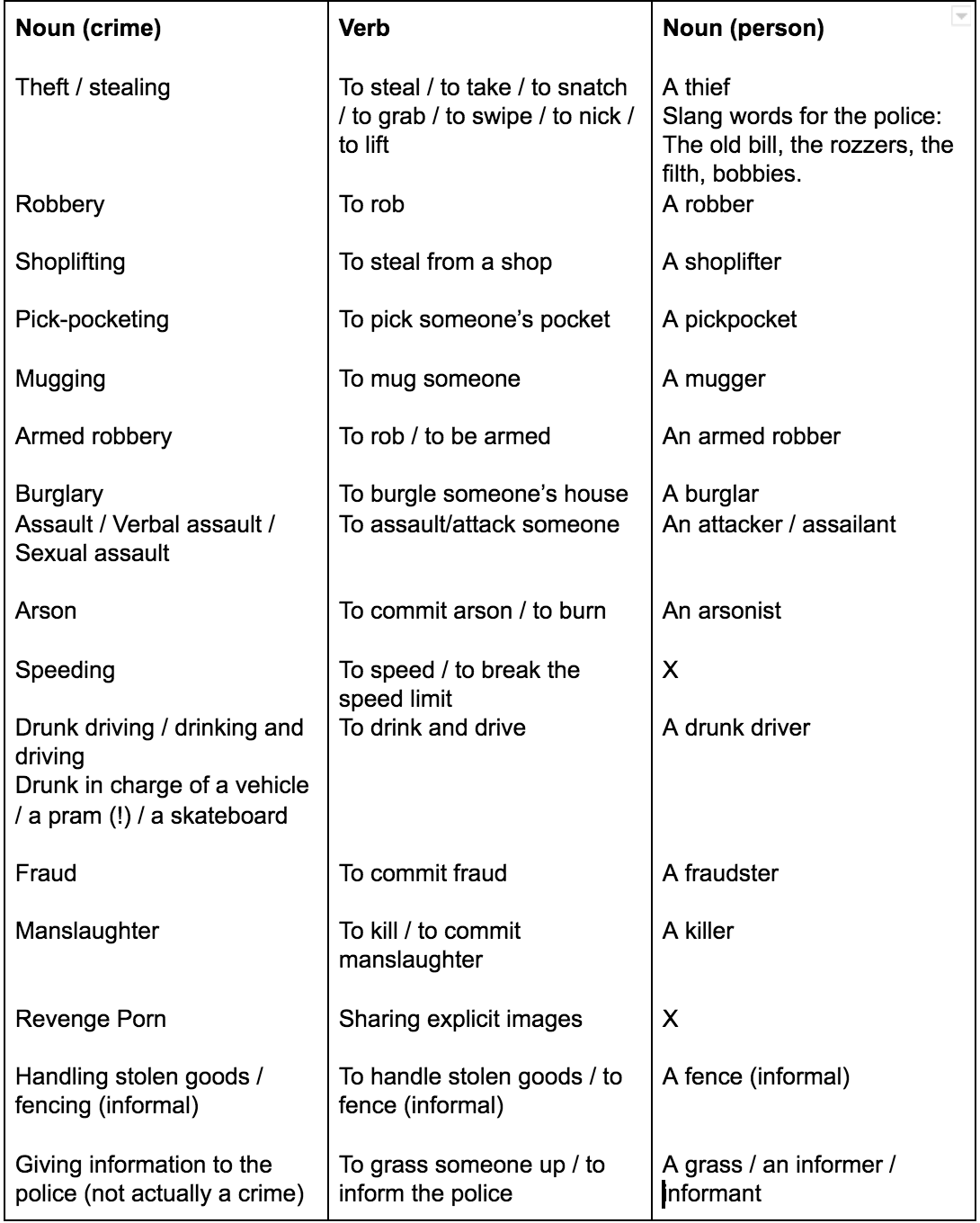
I’ve created a word list with nouns and verbs – names of crimes, the verbs associated with them and also what we call people who commit those crimes.

You can see the word list on the page for this episode if you want to have a look.

Otherwise, you can just listen on and see if you can guess the names of these crimes as well as their associated verbs and nouns.

This episode contains some swearing but none of the explicit imagery that we had in the last episode.

I’m focusing on general English here – the kinds of words that people generally use to talk about crimes. When talking about crime and crime there’s a wide range of vocabulary that exists. Some of it is the sort of official language used by the police or by the justice system, and some are slang words used by ordinary people.

The main aim here is to present the vocabulary that I think most people know and that most people use when talking about crime in general life. There is a lot more vocabulary on this topic of course, so there’s always more which I can cover in later episodes.

But let’s start now and you can see how many of these words you know, and don’t forget to check out the website if you want to see the list of crime words that come up in this episode. You can check their spelling, add them to your word lists and so on.

Right then – let’s get started!

Vocabulary List

Table

The words are also written in lists below so you can copy+paste.

Nouns (crime names)

  1. Theft / stealing
  2. Robbery
  3. Shoplifting
  4. Pick-pocketing
  5. Mugging
  6. Armed robbery
  7. Burglary
  8. Assault / Verbal assault / Sexual assault
  9. Arson
  10. Speeding
  11. Drunk driving / drinking and driving
    Drunk in charge of a vehicle / a pram (!) / a skateboard
  12. Fraud
  13. Manslaughter
  14. Revenge Porn
  15. Handling stolen goods / fencing (informal)
  16. Giving information to the police (not actually a crime)

VERBS

  1. To steal / to take / to snatch / to grab / to swipe / to nick / to lift
  2. To rob
  3. To steal from a shop
  4. To pick someone’s pocket
  5. To mug someone
  6. To rob / to be armed
  7. To burgle someone’s house
  8. To assault/attack someone
  9. To commit arson / to burn
  10. To speed / to break the speed limit
  11. To drink and drive
  12. To commit fraud
  13. To kill / to commit manslaughter
  14. Sharing explicit images
  15. To handle stolen goods / to fence (informal)
  16. To grass someone up / to inform the police

Noun (person)

  1. A thief
  2. A robber
  3. A shoplifter
  4. A pickpocket
  5. A mugger
  6. An armed robber
  7. A burglar
  8. An attacker / assailant
  9. An arsonist
  10. X
  11. A drunk driver
  12. A fraudster
  13. A killer
  14. X
  15. A fence (informal)
  16. A grass / an informer / an informant

Slang words for the police

The old bill, the rozzers, the filth, bobbies.

Useful links

Types of crime


https://www.met.police.uk/stats-and-data/crime-type-definitions/

530. More Murder Stories (with Moz)

My friend Moz (Michael J. Buchanan-Dunne) from the Murder Mile True Crime Podcast tells us some more true stories about murders from London’s past. Contains some gruesome details and explicit descriptions, and some fascinating and unbelievable true stories! Intro and outtro transcripts available. *Adults only: Contains gory details and explicit descriptions*

Small Donate Button[DOWNLOAD]

Introduction Transcript

This episode features another conversation with one of my friends for you to listen to as part of your learning English diet, and yes let’s imagine that learning English is a bit like having a diet plan, but instead of limiting your intake like you do with a food diet, with this English diet the plan is just to consume as much English as possible and really enjoy it. Just binge on English as much as you like – yum yum yum yum yum.

So yes, here is some more natural English conversation for you to indulge in.

The friend I’m talking to in this episode is my mate Moz, who has been on the podcast a couple of times before. You can find all his episodes in the archive. Just search for Moz – m o z. The long-term listeners will know Moz but if you’re fairly new around here, here is a 2-minute summary of what you need to know about him.

I met Moz (whose real name is actually Mike or in fact Michael J Buchanan-Dunne) doing stand-up comedy back when I was living in london a few years ago.

He lives on a canal boat, spending most of his time in London where there is a canal network that crosses the city.

Moz gives guided walking tours around parts of central London – especially Soho. The theme of these walking tours is murder, and Moz takes groups of visitors to different locations and then describes real murders that happened in those places. The tour includes stories of serial killers, crimes of passion and mysteries that have never been solved. Quite a lot of my listeners have actually taken his tour when visiting London and you can do it too if you’re in town. Just go to murdermiletours.com to get the details and to book a tour. It’s a really different way to explore parts of central London with a local person. It’s much more interesting than the normal boring tourist walks, and it has a 5-star rating on TripAdvisor. Not bad.

Moz also has his own podcast called the Murder Mile True Crime Podcast in which he describes, in plenty of detail, the stories that he tells briefly on his walking tours, and more. He started the podcast just 7 months ago and since then it’s gone from strength to strength. It got a nomination in this year’s British Podcast Awards in the True Crime category.

So Moz is something of a specialist when it comes to describing the stories of true crimes in London. His stories are painstakingly researched using court and police records from the national archives, and Moz is a well-experienced and enthusiastic storyteller.

And it’s the storytelling that I’m interested in here, as much as anything else, because stories can be really great resources for learning English, especially when the storyteller is enthusiastic and the content of the story is gripping. They help to draw you in, make you focus on the details and just get more English into your ears, which is so important, as we know!

Well, Moz is certainly keen to describe the events in his stories and you have to agree that there is something fascinating about the subject of murder. Of course it’s horrible and tragic – especially for the victims and their families of course – these are often appalling crimes, but at the same time it’s hard not to wonder about the motivations of murderers, the lives they led, the conditions in which it could be possible for one person to take the life of another.

This is why crime and mystery novels, TV shows and documentaries are so popular. Apparently we can’t get enough of this kind of thing. So, although their subject matter is dark and quite explicit, I think that these stories are compelling and well-told and that is reason enough for me to present them to you in this episode.

Now, as I usually say when Moz comes onto the podcast and talks about murder – I think I should warn you here – Moz’s accounts often contain some very graphic and explicit descriptions of some truly horrible acts of violence and moments of horror.

So, if you’re sensitive to this kind of thing – if you don’t like blood and violent imagery – if you’re squeamish – you might want to proceed with caution. If you’re playing this with children around, like if you’re in the car and the kids are listening – you should probably pick another episode. My episodes are usually aimed at adults anyway, but this one in particular is not suitable for children. So, that should be clear – if you don’t like gory details, proceed with caution, if kids are present, listen to this later when they’re not around.

Ok we’re very nearly ready to begin here.

A coot – “as bald as a coot”

At the beginning, you’re going to hear Moz’s quick report from the British Podcast Awards ceremony which he attended just a couple of weeks ago and then he goes on to tell us about some of the murder stories he’s been researching over the last year or so.

So, without further ado, let’s go!


“Outtro” Transcript

Moz is getting very good at telling these stories isn’t he?

If you enjoyed this conversation, let me recommend Moz’s podcast – just in case you’re looking for more stuff to listen to in English. As he said it is available on all the usual platforms that you use to get your podcasts. Search for Murder Mile True Crime Podcast. Quite a lot of you already listen to his show, which is great.

The next episode is going to include a Vocabulary Quiz focusing on the language of crime – different nouns and verbs for various types of crime. So vocab hunters, watch out for that.

Well done for listening to the end. Good luck with your English. Keep it up!

Leave your comments on the website as usual. Join the conversation and practise doing some writing in English.

Download the app for convenient access to the whole archive of episodes and some bonus content.

Speak to you again soon!

Bye bye bye!


Links

Murder-Mile Walking Tours

Murder-Mile True Crime Podcast


Listen to serial killer Dennis Nilsen Speaking

529. The “M” Word (with Andy Johnson)

Friend of the podcast Andy Johnson returns to give us some news and tell some stories all related to things that begin with the letter “M”. Intro & outtro transcripts available.

Small Donate Button[DOWNLOAD]

Introduction Transcript

Hello! Hello! Welcome back to the podcast. I hope you’re doing well out there in podcast land.

I was thinking the other day… I’ve been working as an English teacher for nearly 17 years now. I often ask my students and have always asked them throughout my career, what they do in English outside class – like, what they read or watch or listen to, how they continue to work on their English when I’m not in front of them, and I’ve always been surprised at how people just don’t do enough listening… and I’ve always thought that if my learners – or learners of English in general, listened to more things in English, regularly – often just for enjoyment rather than as some kind of obligation, how this would make a big difference to their skills. A lot of my students, even the ones at B2 level or above (and I’m talking about all the students I’ve met – including ones from around the world when I was working in London – so not just my French students in Paris) A lot of them admit that they just hardly ever listen to English things outside class.

Yes, a lot of people say that they watch films and TV shows in English “with English subtitles”, but I don’t often hear people telling me that just listen to things, like radio shows, online interviews and podcasts. Of course there are reasons why people don’t listen enough, although if you’re really serious about learning a language you’ll know that these reasons are just excuses really. But there are reasons – like people say they find it hard to find the time, or they don’t really understand how podcasts work, or because they don’t really know what to listen to. That’s one of the main things.

Even if there is a lot of content out there, people don’t quite know what to listen to, they might not know how to listen (from a technical side) and they just don’t take the initiative to do it. They don’t go out of their way to find audio content and make listening to it part of their lifestyle, which is a pity because it can make a massive difference to your oral English. How can anyone expect to be able to operate in English as a spoken language without investing time in just listening to the language on a regular basis.

Perhaps this is a symptom of learning English in a classroom – you sign up to the course, you pay your money and that’s it – the time you spend in class is the time you spend on putting English in your life. But we know, don’t we – everyone knows, that to get real progress you have to bring English into your life on a more regular basis, in a more personal way, long term, connecting with the language as often as possible, reading it, listening to it, using it in speaking and in writing – and dealing with the kind of English that people actually use – the living English, rather than just reading grammar rules, doing translations, doing pre-prepared exercises with no context and none of the real nitty gritty of language being used to communicate ideas between people, and that’s one of the reasons I started this podcast. I wanted learners of English to just listen to more English – and real conversations with language occurring spontaneously – all given within a sort of personal context – like you’re sitting down with some friends in a cafe or pub – almost like being there yourself – but done with learners of English in mind, not native speakers of English. So the idea has always been to encourage people to just listen to English, regularly – using content that’s designed for you, with you in mind.

So that’s one of the reasons why I do this podcast.

I could explain it in a complex way, talking about language acquisition or intake vs input, or other methods, theories and approaches to learning with audio – but to keep it simple, the principle is: just listening to English being spoken and doing it regularly, for longer periods of time can show real improvement as a consequence – in terms of how you notice language, how you absorb vocabulary and features of pronunciation, how the language can become like a sort of voice that runs through your head and how this can transfer into your speaking and pronunciation. It’s about connecting with the English language as a living force.

OK this is starting to sound like Star Wars now, so I’ll move on. I just wanted to give you encouragement here to keep listening and to remind you that there is method to the madness here. I’m a professional. I know what I’m doing and you can trust me, I’m an English teacher…

So let me tell you about what you can hear on the podcast today.

In this episode I’m talking to Andy Johnson who I expect you already know from previous episodes. If you don’t know Andy then it would be a good idea to check out his past appearances on the podcast. You can search the episode archive on the website for episodes with Andy.

Here’s a quick tip about searching the episode archive that some of you may already know, but that I’m sure others aren’t aware of.

If you want to search my episode archive (which you can find at teacherluke.co.uk/archive ) for a certain keywords, like “grammar” or “Andy” or “Amber” or “idioms” or something, here’s what you can do – and this will work on any website page on the internet.

On a Mac – press “command + f” then type the word you’re looking for in the little search bar that appears. Let’s say you search for “Andy”. Instances of “Andy” will be highlighted on your screen and you can switch between them using the arrows that will appear on your browser.

On a PC (not a Mac) it’s “ctrl + f” and then search…

All the times the word “Andy” is on that page will be highlighted, making it easy to find episodes with Andy.

Now, why is this episode called “The M Word”? Any idea?

What could that M stand for?

If you’ve heard previous episodes with Andy – we always seem to talk about roughly the same things every time! There are just certain themes that usually come up in my conversations with Andy. Do you know what they are? Coincidentally enough they all begin with the letter M.

So what has Andy mentioned before on this podcast, that starts with an M?

Have a listen, because Andy has a few stories to share with you, all of them relating in some way to the letter M.

So now, without any further ado, let’s get started with some more English listening practice.


London Marathon Fancy Dress

Michael Phelps vs Shark (1)

Michael Phelps vs Shark (2)

Ending Transcript

So that was Andy telling us a few stories.

I would just like to say at the end of this episode – thank you very much if you sent me a message recently to wish me a happy birthday. I received messages in my inbox, on FB, Twitter and in the comment section. That is very nice of you, thank you! If you didn’t realise it was my birthday and you’d like to wish me a happy birthday, you can write “Happy Belated Birthday!” which is what you write when you’re late.

Happy Belated Birthday!

Belated means “happening later than expected” or “later than when something was supposed to happen”

E.g.
A belated apology
A belated attempt to do something (when you try to do something but it’s too late, or later than it should have been). “He made a belated attempt to apologise but didn’t help”
Belated recognition (e.g. when an artist receives recognition for their work, but it’s too late – perhaps they’re dead by the time they get the recognition they deserve)

Also:
Overdue – for more work-related things like a report or payment that comes in too late. An overdue payment.

Anyway, thanks for the birthday wishes. I had a lovely day with my wife and daughter and received some very nice gifts.

So little time, so many things to talk about. I managed to get to the cinema to see Avengers: Infinity War. In a nutshell I was blown away by it. I don’t know how they managed to include so many characters with their own complex storylines into one single film and make it work. I really enjoyed it. It made me laugh, I enjoyed the character development of the bad guy – weirdly we kind of understand where he is coming from in terms of his motivations and I think that helped the plot, the performances of the actors, some of the weird moments, I liked the action sequences and I was quite stunned by the ending – I’m not giving away any spoilers, but let’s say it didn’t end in the way these kinds of action movies usually end and I can’t wait for the next part of the story to come out next year.

I also saw Deadpool 2 which made me laugh a lot, especially in the way it makes fun of the typical tropes of superhero action films. It’s very funny and extremely violent.

I’m yet to see the new Star Wars film. Yes, there is another new Star Wars film out. This one is called Solo and it’s a kind of origins story of Han Solo. I wasn’t expecting much from it because honestly, how can it be possible to make a film about such a beloved character as Han Solo without Harrison Ford that doesn’t disappoint everyone. It’s bound to be a disappointment because Han Solo can’t really be separated from Harrison Ford, but I haven’t seen it yet and actually the trailer looks pretty good. It looks like a smaller story – more like a gangster film or a heist film or something, but set in the Star Wars universe. I have the impression that the critics don’t like it, but I’ve been avoiding the reviews because I don’t want to spoil it. I’m going to see it when I can.

Anyway, that’s enough talking! Thank you for listening.

If you listen to my podcast on iTunes or you use the Apple Podcasts app you might see that you don’t have access to the back catalogue of episodes. You’ll see that some older episodes are missing.

If you want all those episodes, plus more bonus content – get the Luke’s English Podcast app. It’s available free for Apple and Android phones from the app store.

That’s it – speak to you again soon! BYE!

528. The Royal Wedding (with Mum)

Talking to my mum about the royal wedding between Prince Harry & Meghan Markle. Describing the ceremony, the guests and the dress, and discussing the place of the monarchy in modern British life. Some transcriptions and vocabulary available below.

Small Donate Button


[DOWNLOAD]

Introduction Transcript

Hello folks, welcome to this new episode.

How are you doing? I’m recording this in the middle of a thunderstorm. I don’t know if you can hear it. It’s quite dramatic. There’s been hail, there’s been lightning, there’s been thunder.

Here’s a new episode and it’s a conversation with my Mum about the Royal Wedding between Prince Harry and Meghan Markle which happened last Saturday.

I also have some things to say about the British Podcast Awards and I know that I’ve spoken about this, probably too much, recently but I expect this will be the last I will say on the matter. The results came in at the weekend, and so I just want to explain what happened.

Some of you already know the results and that this year, unfortunately, I didn’t win one of the medals. No Bronze, Silver or Gold. However – I was in the top 10. I don’t know where (if I was 4 or 5 or 6 or whatever – but I was in the top 10, which actually is amazing considering the competition I was up against.

So, even though I didn’t get bronze, silver or gold – I do feel happy so thank you for your votes.

I’ll talk more about it at the end of the podcast, ok? OK

This morning I spoke to my Mum on FaceTime and we chose to talk about the royal wedding between Prince Harry & Meghan Markle which happened this weekend on Saturday. I expect you were aware of that – it was probably covered in the media and online. You might have watched it. I think it was live streamed on many channels and networks.

I don’t know what you think of the royal wedding – you might be fascinated by it, but equally you might be completely fed up with it. I don’t know where you stand! But since one of the purposes of this podcast is to provide you with authentic speech to listen to as part of your learning English routine, and we take a special interest in British things on this podcast (of course) the royal wedding seems like a logical thing for me to talk about, right? How could I not cover this?

Also, I have received a number of requests from listeners asking for me to talk about that. So, that’s what you’re going to get in this episode – a chat with my Mum all about the royal wedding, and hopefully we’ll cover it in a fairly broad way, dealing with things like the wider issues of monarchy in the modern age, some of the unconventional aspects of the ceremony and the different attitudes to the royal family that people in the UK have. Not everyone is a flag waving royalist – some people don’t really like the monarchy and see big weddings like this to be a waste of taxpayers money (although it’s not entirely clear how much of this was paid for by the taxpayer – as we established in the previous episode I did about Prince Harry & Meghan Markle, the royal family gets its money from a combination of public and private sources, and I think a lot of the costs of this wedding were privately covered) – anyway, plenty of people disagree with the wedding for various reasons. But also there are people, like me, who aren’t completely sure how to feel about the monarchy one way or the other, but are interested in events like the royal wedding just as a fascinating spectacle and something that reveals many aspects of life in our country, for good or bad.

I don’t need to do any more introducing at this point. Let’s just start listening to my conversation with my Mum and you can hear our descriptions of the wedding and what we both think about it all.

SOME BITS OF VOCAB

  • Staid
  • Traditional
  • High-bound
  • Stuffy
  • Worthy
  • Hushed and reverent
  • Solemn
  • Reserved
  • Stiff upper lip
  • Soberly
  • Animated
  • Gesticulating
  • vague, ambiguous and weird
  • Incoherent

Harry lifts Meghan’s veil and they say their vows

Reactions to Michael Curry’s Address


527. Can Paul Taylor Pass The UK Citizenship Test?

Testing Paul Taylor’s knowledge of British life, history and culture and discussing the “Life in the UK” citizenship test. Practise listening to British English natural speech, learn facts about the UK and have a laugh as Paul gets angry about this test for people who want to become UK citizens. Will Paul actually pass the test? Listen to find out what happens. Transcriptions and notes available.


[DOWNLOAD] [ITALKI OFFER]

This episode’s guest Paul Taylor is a British stand up comedian, living in France. Check out his YouTube channel here and Twitter here. 

Introduction Transcript

In this episode you’re going to listen to my friend Paul Taylor attempting to pass the UK citizenship test.

Every year thousands and thousands of people choose to become British citizens, for various reasons. This year one of those people is Meghan Markle, who is moving to Britain to marry Prince Harry – as everyone knows because it’s all over the news, probably all around the world. In fact the wedding is happening tomorrow! By the time you listen to this they will probably be married. I hope everything goes well for them.

Anyway, there are lots of complicated requirements for becoming “naturalised” as a British citizen, including the fact that you need to prove that your English is at B1 level or above, and you have to pass the Life in the UK Test. This test is supposed to make sure that you have sufficient knowledge of life in the UK in order to integrate into British life. The assumption is that if you can pass this test then you know enough about life in the UK to be considered worthy of being a British citizen.

By the way, quite a lot of people fail this test. I was looking for specific data. I found that in 2016 about 36% of people failed the test. Just over a third.

  • What is the content of this test?
  • Do you think you have enough knowledge of “Life in the UK” to pass it?
  • What kinds of questions do you expect to find in this test?
  • Is the average British person able to pass the test? You would imagine so, right?
  • What can you, my listeners, learn from this in terms of “essential British knowledge” and useful British English vocabulary?
  • And can my mate Paul Taylor, who was born in the UK and has spent much of his life living there, pass this test?

Let’s find out as we take the British Citizenship Test in this episode.

A Long Episode!

This is a long episode, but there is absolutely loads of stuff that you can gain from this in terms of historical and cultural knowledge – both from the past and present, as well as vocabulary and general listening practice and also just the pure enjoyment of listening to Paul becoming increasingly angry about the content of the questions in this test.

Also, there is quite a lot of swearing in this one, and by swearing I mean rude words that you normally shouldn’t use in polite company because they can be very offensive. So, watch out for those rude words – either because you don’t like that sort of thing, or because you love to hear how people swear in British English. In either case – you have been informed – there is rude language in this episode.

So I suggest that you do listen to the entire thing, perhaps in several sections – when you press pause your podcasting app should remember where you stopped listening so you can carry on later. There are notes and scripts for the intro and outro to this episode on the website – so check them out.

Now, without any further ado, let’s get started…


THE “LIFE IN THE UK” CITIZENSHIP TEST

The test is computer based. Applicants coming in from outside the UK need a certain level of English and they need to take this test.

Requirements for British citizenship https://www.gov.uk/becoming-a-british-citizen

⬇Click the link below to take the same test we did⬇

https://lifeintheuktestweb.co.uk/test-1/

Criticisms of the Test

A summary of criticisms and comments on how the test needs to be reformed https://www.theguardian.com/commentisfree/2018/mar/01/british-citizenship-test-meghan-markle-brexit-reform

The criticisms in a nutshell:

  • While it’s obviously good to know facts about a country’s history – what is the true purpose of a citizenship test? It’s to ensure that people understand the values of that country, and practical knowledge of daily life in order to help them integrate
  • The questions seem arbitrary and inconsistent
  • Fair enough, there are questions about certain key moments in our history and in our political system but a lot of important things are missing (e.g. the number of elected representatives in the devolved parliaments, but not the number of MPs in commons? The height of the London Eye?)
  • They won’t help people integrate, and they won’t help people just get by on a daily basis
  • It also doesn’t educate people about history – there’s no interpretation of why these things are important. If anything it will just piss people off.
  • What might be more helpful would be:
    • Teaching people social rules (e.g. how to order a drink in a pub)
    • Teaching people about common culture so they know what the hell British people are talking about half the time
    • Teaching people the essential basics of how to live – like, bank holidays, how to phone for an ambulance, how most Brits are shocked by things like animal rights or racial or sexist jokes

But it’s all wrapped up in politics and perhaps the people who wrote the test didn’t do it to help migrants – the opposite, maybe.

What would you include in the citizenship test?

The “Real” Citizenship test

This is an alternative test based on suggestions by British people on Twitter

http://realcitizenshiptest.co.uk/


‘Outro’ Transcript

I don’t want to extend this episode a lot more but I do want to say “nice one” for getting to the end of this one. I say that because I know it can be hard to follow about 90 minutes of native level speech in English, and Paul does speak pretty quickly as a few of you mentioned to me after hearing the previous episode with him.

I’ve said it before and I’ve said it again – the more you listen, the better, and sometimes listening to fairly quick speaking can be really good training for you. It’s important to mix it up – sometimes listening to content that you understand without too much trouble, and sometimes listening to more challenging things. There is value in both, and basically the important thing is to keep going and not give up. If you’re listening to this it means you didn’t give up even if you didn’t understand everything. Nice one.

Then again, some of you might be thinking – Luke, it was a pleasure and I wish there was more! Well, in that case – great! I agree. This was a fun one.

There’s more to be said on the UK citizenship test so I might be doing another episode on this soon.

But for now – that’s it! Download the LEP App from the app store. Check out the extra content you can find there.

Have a great day, night, morning, afternoon or evening wherever you are in the world and whatever you’re doing. Speak to you again on the podcast soon, but for now… bye!

Luke

526. Being a Tourist (with Paul Taylor) + video

Catching up with Paul Taylor and talking about his recent trips to Japan & Barcelona, the pros and cons of being a tourist and some recommendations for people visiting London and Paris as tourists. Video available on the website and in the LEP app. 

Audio Version

<
[DOWNLOAD AUDIO]

Video Version

Paul’s Vlog #12

Last chance to vote for LEP in the British Podcast Awards before Thursday 17 May

Introduction

This is a rambling chat that I recorded with friend of the podcast and one of the original POD PALS) Paul Taylor on the rooftop of my flat on a nice sunny day recently. I filmed this one too and the video version is available on the website and in the LEP app. So, if you’d like to watch us in conversation on a nice sunny day, check the Videos category in the app, or the page for this episode on my website.

This conversation covers a few things, including what Paul has been up to recently, his new vlog which you can find on YouTube (search for Paul Taylor on YouTube), his recent holidays in Japan and Barcelona, and then we go on to focus on travel and tourism, including the good and bad points about being a tourist and a few of our recommendations if you’re thinking of travelling to Paris and/or London as a tourist.

Questions

  • What do you think about being a tourist?
  • When you visit a new place, do you always see the typical tourist spots?
  • What are the good and bad points about being visiting another country and wanting to have a special experience there?
  • How can you make sure you have a good tourist experience when you visit a new city or country?

Have a think about those things, and listen to hear what Paul and I have to say on the topic.

Enjoy!

Another episode with Paul will be arriving soon…

Luke

525. Ninja August / Podcast Corrections / Useful Japanese Cat (Listener Comments & Questions)

Responding to more comments and questions from listeners, including some rambling about public holidays in France, why May is like ‘ninja August’, some corrections to what I said about bats and Stephen Hawking on the podcast and the story of an amazing useful cat from Japan.


[DOWNLOAD]

Transcript (not 100% complete – listen to the episode to hear everything, including improvised moments)

In this episode I’m going to continue going through a list of comments and questions from listeners, while using those comments and questions as a springboard to ramble about this and that. Some of the questions are related to language, others are related to topics I’ve covered on the podcast recently.

I’ve got one hour before I have to go and pick up my daughter from day care, so let’s see what I can do in an hour. Let’s go!

LEP Premium is coming soon, but it’s not ready yet. Please don’t register until I announce it.

LEP Premium is not ready yet – I’ve had a few questions about this. Some listeners have found a sign-up form for it, but there’s not content available yet – so don’t sign up until I have made a proper announcement.
I have not uploaded any premium content yet – I’m working on the first episodes at the moment, but it’s coming soon.
So, wait until I say “GO” before you sign up.

I’ve got loads of work to do and I’m hoping to produce quite a lot of content this month, but it’s proving to be quite hard to get work done so far this month.

Public Holidays in France – “May is like the ninja August”

It’s May and in France and there are loads of public holidays – 4 in total, which is wonderful but it also makes things a bit complicated. It’s hard to get things done.

Doing the bridge, or “Le Pont”.

When public holidays land on a Tuesday or a Thursday it can really break up the week, and you have to squeeze all your work into just a few days. The first 2 weeks of May contain 4 holidays and this year the’ve all landed mid-week.

In the UK all our public holidays are moved to the nearest Monday.

In France they just land on the same dates every year and stay there.

This can work in your favour or against you. It’s a gamble!

In France people are very protective of public holidays and workers’ rights. In the past people had to fight very hard to get public holidays and they hold that right very seriously and protect it. Holidays have become an important part of French life (although people work very hard here too, despite the myth that people are lazy).

But the culture is different to, let’s say Japan, where people are given fewer holidays than France.

For example, it’s pretty normal for many people here to take the entire month of August off.

It’s difficult to get anything done, business wise, unless you’re a tourism company or you run a hotel for tourists or something.

So, in August nothing happens (it feels like). Back in the UK people still work – the kids are on holiday and you might take 2 weeks off during the summer but you still work during August. Things slow down a bit, but in France it’s much more noticeable. Certainly Paris changes a lot.

May in France is like ninja August.


I’m going to carry on responding to some questions and comments from listeners, like I started in the last one and we’ll see where this takes us.

So let’s carry on.

British Podcast Awards

First of all, I’d like to remind you to please consider voting for Luke’s English Podcast in the British Podcast Awards. I need as many votes as I can get if I’m going to stand a chance of competing with some of the big names in UK podcasting. I’ve been a UK podcaster for ages and ages and it would be cool to get some recognition from the UK podcast community. It would also be ace to get a TEFL podcast into a winning position in order to represent the learning English community and the teaching community. So, please vote!
www.britishpodcastawards.com/vote or click the vote button on my website :)

www.britishpodcastawards.com/vote

Shout out to Jack

Thanks Jack for adding lists of vocab under episodes, including many of the episodes in the archive. Check the comment section for Jack’s lists.

Jack always pesters me for a gift, sometimes for no apparent reason, but I suppose this time he deserves something for adding these useful vocab lists to the pages.

So Jack, on my recent trip back to the UK I picked something up for you. I know you’re into cars, so let me hand you the keys to a 1975 Rolls Royce Silver Shadow. This is the ultimate in classic British luxury motoring, at the time it was released this was absolutely the top of the range in terms of comfort, style and quality and remains to this day a symbol of British class and sophistication. It doesn’t get better than this. With its massive V8 engine delivering 190BHP , steel frame, vacuum assisted brakes, power steering, manual 3 speed gearbox and top speed of 106mph this is a precision machine from the golden age of British motoring. Admittedly this 43 year old vehicle is no longer top of the range and can’t compete with modern day equivalents such as the high performance luxury models produced by Bentley, but for a leisurely drive through the British countryside in the most quintessentially British manner this has to be the number 1 choice. They don’t make them like this any more. The engine delivers a powerful, stately and commanding sense of control and the ride is so utterly smooth and poised that you can enjoy afternoon tea and cake with guests in the back without spilling a drop on the leather upholstery. It oozes charm, it breathes refinery, it is the epitome of retro British eccentricity. The Rolls Royce Silver Shadow.

Here are the keys Jack… just the keys I’m afraid. I can’t actually pin down the car itself… It’s somewhere… it’s definitely somewhere…

Podcast Corrections

As Blind as a Bat

Message:

Hi Luke,

In episode 516 with Beatle Paul you explain the following idiom:
as blind as a bat = totally blind
I’m as blind as a bat without my glasses!
(Bats are often thought to be blind, but in fact their eyes are as good as ours – but they use their ears more at night than their eyes.)

That’s not quite true:
The following two phrases are from the English Wikipedia and explain the vision of bats
1. The eyes of most microbat species are small and poorly developed, leading to poor visual acuity, but no species is blind.
2. Megabat species often have eyesight as good as, if not better than, human vision. Their eyesight is adapted to both night and daylight vision, including some colour vision.[84]

So what you state is true only for the subspecies megabat, whereas microbats are nearly as blind as a bat, but not quite.

Greetings from good old Germany, Heiner

Ah, thanks for the clarification. In my defence we don’t have many megabats in the UK. The majority of our bats are microbats, so perhaps that explains how the phrase entered common parlance, because in our experience our bats usually have poor eyesight, although to say that they are blind is actually not true.
But the correction still stands.

I said bats actually have good eyesight. But that only applies to megabats, whereas microbats actually do have relatively poor eyesight (although they aren’t actually blind).

Apologies to the microbat or megabat community for getting that one wrong!

No, but seriously, it’s good to get corrections like this in order to prevent the spread of misinformation, which happens every day.

Stephen Hawking

ALSO a correction about Stephen Hawking from FB, probably more important than the bat one to be honest!

Hi, Luke, how are you? How’s your family?

I’m fine, thanks for asking. :)
I’m a med student in Brazil and as I was listening to the episode you did on Stephen Hawking, I couldn’t help but clarify some things you said about his disease. I hope you don’t mind, but since I know you are curious about almost anything, I’m sure you won’t.
You said that his kind of motor neurone disease affects the brain. It actually affects neurons outside the brain. These neurons are responsible for making our muscles produce movements (that’s why it is called a motor neurone disease). This disease is also known as ALS, which stands for amyotrophic lateral sclerosis.
You also said that his disease affected his central nervous system, but it actually affected his peripheral motor system. We have neurons throughout our bodies. Everything in the brain and in the spinal cord is our central nervous systems. Neurons outside these structures belong to the peripheral nervous system.
Do you remember the Ice Bucket Challenge? It was created to increase the awareness of ALS. And it worked! Donations coming from the challenge helped researchers at the University of Massachusetts Medical School to find out one gene that is involved in the disease. This finding can help in future therapy development.
I hope my explanation was useful and not too boring. Thank you so much for all your work in making this podcast.

Cheers,
Klenisson

Useful Japanese Cat

Dear Luke, how are you? This is Yuko, a Japanese expatriate living in New York,
and suffering from an incurable condition – “anglophilia” (Luke: an obsession or fondness for all things English).
In the episode “talking about pets”, your brother repeatedly mentioned the unusefulness of cats as opposed to dogs. (Luke: Yes, I was wondering if people would be bothered by the things that were said in that episode. James seemed to pick on small dog breeds and also vegan dog owners for some reason, and we also suggested that cats were essentially self-interested animals who somehow have managed to make us their slaves, suggesting that dogs perform far more useful roles in society in general… but…)

I just wanted to show you the exceptions.
There are some cats who worked as a station master in a Japanese train station.

https://en.m.wikipedia.org/wiki/Tama_(cat)

Are they not amazing?
Yuko


Thanks for listening!!

LEPSTERS – ASSEMBLE!

523. Tips for Learning English with Films & TV Shows (with Cara Leopold)

Talking to a fellow English teacher about advice for using TV shows and films to learn English, both with and without subtitles.

Small Donate Button[DOWNLOAD]

Intro Transcript

Today on the podcast I’m talking to Cara Leopold who is an English teacher from the UK, living in France – like me.

Cara is an online teacher, who has her own podcast and other resources for learners of English on her website leo-listening.com.

One of the main things she focuses on is learning English through listening – especially using TV and films as a resource.

She’s got some tips to share on that subject – many of which come from her personal experiences of learning French, and so I’d like to talk to her about that,

But first I’d like to just get to know Cara a bit because we’ve never actually spoken before. So listeners, instead of hearing me talking to someone I already know (which is the way it normally goes on this podcast) you can now hear me having a conversation with someone I haven’t met before – so you can hear how that might happen in English.


Cara’s Website

www.leo-listening.com

Films and TV shows mentioned

Red Dwarf
BBC TV Comedy

The Orville
Seth MacFarlane
Based on Star Trek

Thor: Ragnarok
Directed by Taika Waititi, who also directed Flight of the Conchords.


Learning English with Films & TV – Summary of Advice Given

Here’s a summary of the main points made about using TV and films for learning English, with and without subtitles.

  • There are no hard and fast rules about using subtitles.
  • Using subtitles can help you understand what you’re hearing, especially when you realise that spoken English and written English can be very different. Subtitles can help bridge the gap between how words and sentences sound, and how they are written.
  • But be aware that only watching with subtitles might not help you develop real listening skills, because you’re basically just reading while you watch. Experiment with switching the subtitles on and off.
  • You can watch a film several times, especially if you enjoy it or already know it. Some films improve with multiple viewings. So, try watching certain films several times, perhaps first with subtitles in your language, then in English and then with no subtitles at all.
  • You can alternate between watching episodes of your TV show with and without subtitles.
  • Using TV and films for learning English is not just a simple or easy way to learn. In your first language you might just switch on a film or show and then kind of veg out while watching it – without really concentrating. This won’t work in English. Be prepared to focus and perhaps be more active while watching.
  • Watch certain scenes several times, with and without the subtitles.
  • Test yourself on what you heard and check with the subtitles.
  • Search for certain new bits of vocabulary when they come up.
  • Don’t worry too much about certain specific cultural details.
  • Try transcribing certain scenes – especially if you thought it contained really cool dialogue.
  • Then watch again with the subtitles to check your transcription.
  • Before you watch a film or TV show, check online reviews or summaries to help prepare yourself.
  • Be a little selective in your choice – pick stuff that you’d normally enjoy, and remember that films and TV shows can contain very “mumbly” dialogue, and even just “grunting” during long fight scenes. Try to pick films that are pretty simple and perhaps comedies that focus on the dialogue.
  • Don’t worry too much if you don’t understand 100%. Even in our first languages we don’t always understand what’s going on in films. So, don’t beat yourself up if you’re not able to understand it all.