Category Archives: Vocabulary

734. The War of the Worlds by H.G. Wells [Part 1] Learn English with Stories

Luke reads extracts from The War of the Worlds by H.G. Wells. This is a classic bit of science fiction writing from the Victorian era, with some thrilling passages and scary descriptions. It’s one of my favourite books of all time and I hope you enjoy it too and learn some English from it. Full transcript available and YouTube version too.

Audio Version

Small Donate Button

[DOWNLOAD AUDIO]

Video Version

Click here for part 2

Click here for part 3

Full Episode Transcript (starts after the jingle)

Hello listeners,

It’s story time in this episode because I’m going to tell you a classic English science fiction story.

The story is called War of the Worlds by H.G. Wells the classic storyteller who also wrote The Invisible Man and The Time Machine, and you have probably heard of War Of The Worlds because it is definitely one of the most famous and most influential science fiction stories ever written.

Now, I know that science fiction is not everyone’s cup of tea, but I do hope you stick around and listen to this story because I think this is just particularly good writing and the story is very exciting, immersive and memorable so it should be a really enjoyable way to pick up some more English.

I won’t be reading the whole book of course but I will be reading some selected extracts and giving you a summary of the key details in the first part of the story.

The aims of this episode

To entertain you with a really engaging story in English.
Stories are a great way to get more English into your head and if they are exciting and immersive, then that’s even better.

To show you a slightly old-fashioned version of English, which is really rich in descriptive language and more formal in style than today’s English.
It’s good to be exposed to diverse versions of the language.
Old fashioned English is much more like modern formal English, so it’s a good lesson in style.
This can really strengthen your English in various ways.

To help you notice some nice bits of vocabulary along the way.
Having a broad range of vocabulary is essential in achieving truly advanced English. This story is very rich in descriptive language.

To inspire you perhaps to read the rest of the book.
Reading is such an important thing to do for your English, and maybe you’re looking for interesting books to read. You could consider this one. It’s not too long.

This is also available as a video episode on YouTube and if you watch you can see me recording the podcast with the text on the screen next to my face. So you can listen and read at the same time and see me telling the story.

You can read the entire text I am reading from on the page for this episode at teacherluke.co.uk.

Context of the story and the writing style

War of the Worlds has been adapted lots of times – in films (most famously the 2005 Stephen Spielberg film with Tom Cruise – which you might have seen) and another film version in the 1950s set in Los Angeles, an audiobook musical version read by Richard Burton and an infamous dramatised radio series by Orson Welles.

This is the original alien invasion story. This book was one of the very first stories to ever explore these themes and to describe these kinds of things in such a realistic way.

This is the one that has inspired so many others and in my opinion, none of the other versions of this story or copies of this story can compare to this original version from 1897.

The writing is very realistic and journalistic in style, written from the first person perspective of a guy just experiencing the events as they happened and describing everything in great detail.

A note about the language and the writing style

The language is pretty old fashioned (1897) but it’s really well written and it should be interesting for you and useful for your English to explore another version of this language. Exposure to different types of English makes your English stronger I think.

As we go through this I will point out particular words or phrases as we go and perhaps compare this to normal modern plain English.

Comparing the styles of languages actually gives you more perspective on normal modern English and how formal written English today still retains some aspects of old fashioned language.

There is quite a lot of language you might find in legal documents or other very formal situations.

Words like therein, hereby, forthwith and things like that are quite common, as well as certain structures, longer sentences and choices of words which mark this out in a particular style.

This is very descriptive literary language from over 100 years ago. It’s more complex than today’s English, more formal than today’s English and very specific in its descriptions.

This will probably be a challenge for you but I’m here to help and I will explain things as we go.

This is quite scary stuff

I have to add actually, that having re-read some of this story in preparation for this episode, I hadn’t realised just how terrifying this story is.

Personally I really enjoy the thrills you get from a story like this, but if you are feeling a bit force-sensitive today you might want to get a pillow or hide behind the sofa or something.

Useful Links & Sources

Here are a couple of links I have found useful in making this episode.

Project Gutenberg
I have several paperback copies of this book, but I also found it on www.gutenberg.org – a website which shares stories and books which are now in the public domain.

Link to War of the Worlds html version
https://www.gutenberg.org/files/36/36-h/36-h.htm

CourseHero Study Notes
Also there’s a website called coursehero.com which has useful summaries of the story and other useful information.
https://www.coursehero.com/lit/The-War-of-the-Worlds/

Summarising the opening chapters

These are the opening paragraphs of the book, which set the scene in which the events take place. Note the sombre tone and specific choice of language.

Main Character

The story is told by an unnamed narrator.

He is a middle-class educated man who writes philosophical papers and is interested in science. That’s all we know. The story is written in the past tense, as if he is looking back on those events and has written a full account of what happened.

I.
THE EVE OF THE WAR.

No one would have believed in the last years of the nineteenth century that this world was being watched keenly and closely by intelligences greater than man’s and yet as mortal as his own; that as men busied themselves about their various concerns they were scrutinised and studied, perhaps almost as narrowly as a man with a microscope might scrutinise the transient creatures that swarm and multiply in a drop of water. [one sentence!]

With infinite complacency men went to and fro over this globe about their little affairs, serene in their assurance of their empire over matter. It is possible that the infusoria under the microscope do the same.

No one gave a thought to the older worlds of space as sources of human danger, or thought of them only to dismiss the idea of life upon them as impossible or improbable.

It is curious to recall some of the mental habits of those departed days. At most, terrestrial men fancied there might be other men upon Mars, perhaps inferior to themselves and ready to welcome a missionary enterprise.

Yet across the gulf of space, minds that are to our minds as ours are to those of the beasts that perish, intellects vast and cool and unsympathetic, regarded this earth with envious eyes, and slowly and surely drew their plans against us.

And early in the twentieth century came the great disillusionment.

Summary of the story up until Chapter 4: The Cylinder Opens

That opening chapter describes how a species of intelligent creatures on Mars had been observing us for many years before the events of this story. The opening chapter goes on to explain that the Martians were planning to invade earth because their home planet was steadily getting cooler year after year due to the fact that it is further from the sun than the earth. They faced extinction on their own planet, and so they set their sights on their nearest neighbour – Earth – with its warmer atmosphere and closer position to the sun, and with their superior mathematical knowledge and technology they decided they would colonise earth in order to survive. They spent years observing us and planning the invasion.

Note: I am using present tenses from now on to describe this story. This is a normal way to retell the plot of a book, film, or play. It’s because the events of the story are permanent because they never change, they are written that way. So we can use present tenses to summarise the story of a book or film.

Ogilvy the Astronomer

The narrator has a friend called Ogilvy who is a respected astronomer. He has a telescope and uses it to observe the night sky, including the surface of Mars, our nearest neighbour.

So Ogilvy is our friend and he’s an astronomer.

6 years before the main events of the story Ogilvy invites the narrator to an observatory to study Mars after another astronomer reported a dramatic explosion of gas on the surface of the planet, which seems to be directed toward Earth. The narrator observes a similar explosion as he watches through the telescope.

Ogilvy doubts the existence of life on Mars and speculates the phenomenon may be related to meteorites or volcanoes. Many other people witness the phenomenon, which repeats itself at midnight over a total of 10 days.

Nobody at the time is concerned or worried about the explosions on Mars.

6 years later some people see a falling star – a meteorite which flies through the night sky with a bright green flash and lands nearby on Horsell Common – a large area of grass, meadows and trees. Again, nobody assumes there is anything weird going on. Ogilvy the astronomer is interested in the meteorite and finds it on the common.

As it has landed it has formed a large crater of sand. So the object is lying at the bottom of a kind of large sand pit in the middle of an open area of grassland surrounded by buildings and trees.

The meteorite that he finds is quite odd. It’s in a cylindrical shape – like a long can of coke, but he thinks its made of rock as it is covered in a kind of crusty layer. It’s also extremely hot and he can’t get near it, but he notices there are weird sounds coming from inside it. He assumes these are noises caused by the object cooling, but as he continues to observe it he realises that something funny is going on.

The crusty layer is slowly falling off as the object cools, revealing a kind of metallic surface underneath, and even weirder than that, the end of the cylinder appears to be turning, as if it is unscrewing very slowly. Ogilvy suddenly assumes that the cylinder has people inside it and decides to get help, but nobody believes him.

Eventually he finds a journalist who is willing to check the cylinder. A crowd of people begins to gather as word spreads about “men from space stuck inside a cylinder on the common”. People don’t quite realise what’s going on but they are incredibly curious. Normal life continues, with people stopping by to have a look at the object in the sand pit, before continuing their normal routines.

The narrator goes down to Horsell Common to check out what’s going on. A larger crowd has gathered there. He manages to squeeze through the crowd which is getting more and more excited and agitated. A small group of scientists, including the narrator’s friend Ogilvy are in the pit attempting to work out what is happening.

The narrator observes what is going on and comments on how most people are not really educated about this kind of thing and they haven’t worked out what’s going on, but he assumes that the cylinder must be extra-terrestrial. He observes the end of the cylinder moving and as it turns it’s revealing a kind of shining metal thread.

The next chapter describes what happens when the end of the cylinder finally drops off, revealing what is inside.

Reading chapters 4 and 5 with comments and explanations

The narrator approaches the pit containing the cylinder.
Crowds of people are all around the pit, trying to see what’s happening. They’re pushing each other a bit, and things are quite tense. (You know, when a large crowd forms, people start pushing and shoving and it’s stressful)
Ogilvy and some other scientists are in the pit.

IV.
THE CYLINDER OPENS.
The crowd about the pit had increased, and stood out black against the lemon yellow of the sky—a couple of hundred people, perhaps. There were raised voices, and some sort of struggle appeared to be going on about the pit. Strange imaginings passed through my mind. As I drew nearer I heard Stent’s voice:
“Keep back! Keep back!”
A boy came running towards me.
“It’s a-movin’,” he said to me as he passed; “a-screwin’ and a-screwin’ out. I don’t like it. I’m a-goin’ ’ome, I am.”
I went on to the crowd. There were really, I should think, two or three hundred people elbowing and jostling one another, the one or two ladies there being by no means the least active.
“He’s fallen in the pit!” cried some one.
“Keep back!” said several.
The crowd swayed a little, and I elbowed my way through. Every one seemed greatly excited. I heard a peculiar humming sound from the pit.
“I say!” said Ogilvy; “help keep these idiots back. We don’t know what’s in the confounded thing, you know!”
I saw a young man, a shop assistant in Woking I believe he was, standing on the cylinder and trying to scramble out of the hole again. The crowd had pushed him in.
The end of the cylinder was being screwed out from within. Nearly two feet of shining screw projected. Somebody blundered against me, and I narrowly missed being pitched onto the top of the screw. I turned, and as I did so the screw must have come out, for the lid of the cylinder fell upon the gravel with a ringing concussion. I stuck my elbow into the person behind me, and turned my head towards the Thing again. For a moment that circular cavity seemed perfectly black. I had the sunset in my eyes.
I think everyone expected to see a man emerge—possibly something a little unlike us terrestrial men, but in all essentials a man. I know I did. But, looking, I presently saw something stirring within the shadow: greyish billowy movements, one above another, and then two luminous disks—like eyes. Then something resembling a little grey snake, about the thickness of a walking stick, coiled up out of the writhing middle, and wriggled in the air towards me—and then another.
A sudden chill came over me. There was a loud shriek from a woman behind. I half turned, keeping my eyes fixed upon the cylinder still, from which other tentacles were now projecting, and began pushing my way back from the edge of the pit. I saw astonishment giving place to horror on the faces of the people about me. I heard inarticulate exclamations on all sides. There was a general movement backwards. I saw the shopman struggling still on the edge of the pit. I found myself alone, and saw the people on the other side of the pit running off, Stent among them. I looked again at the cylinder, and ungovernable terror gripped me. I stood petrified and staring.
A big greyish rounded bulk, the size, perhaps, of a bear, was rising slowly and painfully out of the cylinder. As it bulged up and caught the light, it glistened like wet leather.
Two large dark-coloured eyes were regarding me steadfastly. The mass that framed them, the head of the thing, was rounded, and had, one might say, a face. There was a mouth under the eyes, the lipless brim of which quivered and panted, and dropped saliva. The whole creature heaved and pulsated convulsively. A lank tentacular appendage gripped the edge of the cylinder, another swayed in the air.
Those who have never seen a living Martian can scarcely imagine the strange horror of its appearance. The peculiar V-shaped mouth with its pointed upper lip, the absence of brow ridges, the absence of a chin beneath the wedgelike lower lip, the incessant quivering of this mouth, the Gorgon groups of tentacles, the tumultuous breathing of the lungs in a strange atmosphere, the evident heaviness and painfulness of movement due to the greater gravitational energy of the earth—above all, the extraordinary intensity of the immense eyes—were at once vital, intense, inhuman, crippled and monstrous. There was something fungoid in the oily brown skin, something in the clumsy deliberation of the tedious movements unspeakably nasty. Even at this first encounter, this first glimpse, I was overcome with disgust and dread.
[It’s a bit like if you spend any length of time staring at a nasty looking insect, or even just staring at a picture of one]
Suddenly the monster vanished. It had toppled over the brim of the cylinder and fallen into the pit, with a thud like the fall of a great mass of leather. I heard it give a peculiar thick cry, and forthwith another of these creatures appeared darkly in the deep shadow of the aperture.
I turned and, running madly, made for the first group of trees, perhaps a hundred yards away; but I ran slantingly and stumbling, for I could not avert my face from these things.
There, among some young pine trees and furze bushes, I stopped, panting, and waited further developments. The common round the sand-pits was dotted with people, standing like myself in a half-fascinated terror, staring at these creatures, or rather at the heaped gravel at the edge of the pit in which they lay. And then, with a renewed horror, I saw a round, black object bobbing up and down on the edge of the pit. It was the head of the shopman who had fallen in, but showing as a little black object against the hot western sun. Now he got his shoulder and knee up, and again he seemed to slip back until only his head was visible. Suddenly he vanished, and I could have fancied a faint shriek had reached me. I had a momentary impulse to go back and help him that my fears overruled.
Everything was then quite invisible, hidden by the deep pit and the heap of sand that the fall of the cylinder had made. Anyone coming along the road from Chobham or Woking would have been amazed at the sight—a dwindling multitude of perhaps a hundred people or more standing in a great irregular circle, in ditches, behind bushes, behind gates and hedges, saying little to one another in short, excited shouts, and staring, staring hard at a few heaps of sand. A barrow of ginger beer stood, a queer derelict, black against the burning sky, and in the sand-pits was a row of deserted vehicles with their horses feeding out of nosebags or pawing the ground.

Summary of Chapter 4

As the sun sets, the narrator returns to the pit, where a few hundred people have gathered.
A boy warns the narrator that the end of the cylinder has unscrewed itself, and the narrator forces his way to the front of the crowd to get a better view.
Ogilvy warns the people to stay away and reminds them of its unknown contents.
One man is pushed into the pit by the jostling of the crowd.
The end of the cylinder comes off and falls into the pit.
The narrator and the crowd are horrified by the grotesque octopus-like appearance of an alien who slowly and painstakingly emerges from the cylinder. They seem heavy and struggling to breathe in the atmosphere.
The narrator and the crowd run away from the pit, but many, including the narrator, stop to watch the aliens from the nearby tree line.
The sun sets, leaving enough light to just see the silhouette of the shopkeeper as he tries and fails to get out of the pit alive.

To be continued in part 2…

732. Christian from Canguro English returns

Talking to Christian again about some of the themes and controversial opinions he talks about in his YouTube videos, plus some bits about men wearing thongs on the beach, an obsession with rabbits and if Christian was the Donald Trump of English teaching. Video version available.

Audio Version

Small Donate Button

[DOWNLOAD AUDIO]

Video Version

Introduction Transcript

Hello listeners,

How are you today? You are now listening to episode 732, and in this one I am talking again to Christian Saunders from Canguro English.

This is the second time I’m talking to him on the podcast. I previously interviewed Christian in episode 686 last year and got to know him a bit, but I wanted to talk to him again after having seen some of his most recent videos on YouTube about language and language learning.

In his videos Christian often challenges certain assumptions and myths about language learning, and so I thought it might be interesting to talk to him about those things, so I came up with some questions about language, learning language and teaching English on the internet.

There is a video version of this conversation on my YouTube channel too, so don’t forget to check it out and of course to like and subscribe while you’re there.

There’s no more for me to add here in the introduction. I hope you enjoy this conversation and get some good things from it. Once again, Christian’s YouTube channel is called Canguro English and his website is canguroenglish.com

Let’s get started.


So that was Christian from Canguro English. Thanks again to Christian.

And here we are, at the end of yet another episode. I wonder what you thought of the points which came up in that conversation? Feel free to let us know in the comment section or perhaps under the YouTUbe version of this. Where do you stand on things like comprehensible input, workbooks and clickbait titles? Let us know.

For me, this is one of the last episodes I’m recording before officially starting my summer holiday. As usual I have loads of stuff to record and publish before I go away, and I might end up recording some of it while I am back in the UK. But here’s a little overview of what’s in the pipeline right now.

  • A Summer Ramble
  • War of the Worlds
  • P31

So I have my work cut out.

In terms of holiday – we’re going back to the UK to stay at my parents’ place and we will have to deal with the whole quarantine thing, and the day 2 and day 8 testing process and all that. It’s quite annoying. But after we quarantine we will be going to a posh camp site for some “glamping” and generally spending a couple of weeks in the UK.

Meanwhile our new flat in Paris is being demolished (on the inside) and remade to our specifications. Let’s hope that all goes according to plan.

I’ll talk more about this stuff in that rambling episode which is coming up.

In any case, I will speak to you again soon.

But for now, it’s time to say, good bye bye bye…

731. Beatles Song Lyrics / Idioms & Expressions (with Antony Rotunno)

Learn English with The Beatles as we explore lyrics from Beatles songs and pick out some idioms, descriptive language and other vocabulary for you to learn. Featuring Antony Rotunno from the Glass Onion: On John Lennon podcast.

Small Donate Button

[DOWNLOAD]

Introduction Transcript

Hello everyone,

In this episode you can learn English with The Beatles as we look at specific bits of English which appear in the lyrics of their songs.

I’m joined again by Antony Rotunno from the Glass Onion on John Lennon Podcast. Antony is also an English teacher and something of a John Lennon expert. He is also a musician, and a lot of the credit for this episode goes to him, because he did most of the preparation, going through lyrics of Beatles songs and picking out specific use of English, including certain phrases and idioms.

This is like a quiz actually. Can you name the songs when Antony plays them? 

Can you beat me?

Can you name the songs from the lyrics and from the music?

There are a few references to The Rutles and Neil Innes of course, but for us those songs are all part of The Beatles extended universe.

I’ll chat to you again at the end of the episode and will sum up some of the bits of language that come up, but now let’s get started.


Phrases / Vocabualry

  • Using lots of pronouns, me, you, us, I etc
  • Using more imagery in the lyrics
  • I’m going to love her until the cows come home
  • A chip on my shoulder
  • My heart went boom when I crossed that room
  • Buzz, hum, boom (Onomatopoeia)
  • It won’t be long ‘til I belong to you
  • I don’t know why she’s riding so high
  • To be on your high horse
  • I’ll make a point of taking her away from you
  • I sat on her rug biding my time, drinking her wine
  • This bird has flown
  • Please don’t spoil my day, I’m miles away, and after all, I’m only sleeping
  • If she’s gone I can’t go on, feeling two foot small
  • Feeling 10 foot tall
  • Ouch, you’re breaking my heart
  • To upset the applecart
  • Where there’s a will there’s a way
  • He was like a wolf in sheep’s clothing
  • Or an iron hand in a velvet glove
  • Working like a dog
  • Sleeping like a log
  • Sleeping like a baby
  • If you need a shoulder to cry on
  • To give someone a shoulder to cry on
  • To open up the doors
  • My independence seems to vanish in the haze
  • It was another string to their bow

Colours

  • There is a place, where I can go, when I feel low, when I feel blue
  • To feel blue
  • Everybody’s green because I’m the one who won your love
  • Green = 1. Jealous 2. inexperienced 
  • Oh dear what can I do, baby’s in black and I’m feeling blue

Imagery

  • When the sun shines they slip into the shade, and sip their lemonade
  • With tangerine trees and marmalade skies, cellophane flowers of yellow and green
  • No-one I think is in my tree
  • Nobody is on my wavelength
  • Semolina pilchard climbing up the Eiffel Tower
  • The clouds will be a daisy chain, so let me see you smile again
  • Her hair of floating sky is shimmering, glimmering, in the sun
  • My mother was of the sky, my father was of the earth but I am of the universe and you know what it’s worth
  • Words are flowing out like endless rain into a paper cup
  • Pools of sorrow, waves of joy
  • Don’t need a gun to blow your mind
  • No longer riding on the merry go round, I just had to let it go
  • Mother, you had me, but I never had you

Links to Antony’s Podcasts

Glass Onion: On John Lennon

Film Gold

Life and Life Only

729. TOEFL and the Duolingo English Test (with Josh MacPherson from TSTPrep.com)

Talking to Josh MacPherson about tips and advice for taking TOEFL and the Duolingo English Test. YouTube version also available.

Audio Version

Small Donate Button

[DOWNLOAD AUDIO]

Video Version

Introduction Transcript

Hello listeners, here is an episode about English Tests like TOEFL and the Duolingo English Test which I hope will still be an interesting episode even for those who have no plans to take one of these tests. I’m joined by online English teacher Josh MacPherson. I guess you have heard of TOEFL, and the Duolingo English Test is a test made by Duolingo, that company which helps you learn languages on your phone, and which seems to be managed by a green cartoon owl, who is some kind of master of learning English. They make a test now, and it’s getting really big.

Some time is spent describing the tests but we don’t just spend an hour describing TOEFL. Most of the time we are doing samples from the test, commenting on my performance in a TOEFL speaking task, discussing testing methods in general and giving comments on ways to perform well, particularly in the speaking parts of a test like TOEFL and IELTS.

Also, tests should be reliable and having genuinely good English skills should (of course) cause you to get decent results, so a lot of the tips relating to getting a better score are also generally good tips for improving your level of English, so even if you’re not planning to take one of these tests, the tips and advice here should be applicable to your English anyway.

There is a video version of this episode on YouTube and you can see Josh’s screen and can observe our conversation as if you are taking part in a Zoom call with us. You can find the video on the page for this episode or on my YouTube channel.

Again, the audio is not tip top this time round and that was caused by things like microphone echo, which I have managed to fix, but in any case I think you can still hear everything clearly.

That’s it, I hope you enjoy it and you will find all the links you need on the page for this episode on my website.

Let’s get started

I am joined today by Josh MacPherson from TSTPrep.com and the TST Prep YouTube channel.

Josh is an English teacher who specialises in helping learners of English prepare for English tests, particularly TOEFL and also the fairly new DuoLingo English Test.

I thought I’d interview Josh to find out more about these tests and to get some tips from him about how to get the best result that you can.

Also, we’re going to do some test questions during this interview, so we can see how well I perform in these tests too.

Links

  • TST Prep website www.tstprep.com
  • TST Prep Youtube channel – https://www.youtube.com/channel/UCL0ZOT3eKp4RvKcQyBZJ4bw
  • How to think or reasons for your opinion document – https://drive.google.com/file/d/1NpEhd9BLNVKOuOO08LpJ6lA2NSLOZgJO/view?usp=sharing
  • Duolingo English practice test – https://englishtest.duolingo.com/home
  • Duolingo English test list of institutions – https://englishtest.duolingo.com/institutions
  • Duolingo Research articles – https://englishtest.duolingo.com/research

Ending Transcript

Thanks again to Josh for his contribution to this episode.

Don’t forget, links are available on the page for this episode for all the things Josh mentioned there including test practice, sample answers, tips and videos.

Thank you as ever for listening all the way up to this point.

There’s not much more for me to add here. I haven’t played the guitar on the podcast lately, but I will be coming back to that soon, but for now I will just wish you a fond farewell and until next time, good bye bye bye bye bye

727. Describing John Lennon / Adjectives of Personality J-Z (with Antony Rotunno)

The second part of my conversation with Antony Rotunno (John Lennon podcaster, English teacher) in which we discuss adjectives of personality, with John Lennon as a case study. Vocabulary list available.

Small Donate Button

[DOWNLOAD]

Introduction Transcript

Hello listeners,

Welcome to this brand new episode of Luke’s English Podcast. Here it is, another episode of my podcast, from me to you, in which I help you try to learn this wonderful language that we call English, and I am here to try to help you do it, in ways that I hope you will find interesting and motivating.

So, how are you doing out there in podcastland today? I hope things are pretty good all things considered.

You are now listening to the fourth in my Beatles mini-series and the second part of this double episode I’m doing about describing John Lennon using various adjectives of personality.

I’m assuming here that you have heard the first part of this. If you haven’t heard the first part of this double episode then you need to go and listen to that. It’s probably the previous episode to this one, ok?

I’m still talking to Antony Rotunno from the Glass Onion: On John Lennon podcast. Antony is also an English teacher with plenty of experience. So I think he’s the perfect guest for this podcast series, and let’s continue going through this list of adjectives we compiled, and let’s see if we can use them to discuss John Lennon’s life, his psychology, his personality.

In the last episode we covered adjectives from A to I. It’s a sort of a rough A-Z, and we did A to I last time so let’s do the rest of the alphabet, more or less.

We might skip a few letters here and there but I’m sure that you’ll forgive us.

Just before we continue, let me read out the list of adjectives. Like last time, we don’t go into full detail about all of these, but have a listen and consider these things: whether you know these words, whether you don’t know them, whether you use them and whether you don’t and also what’s the word stress for these adjectives? How many syllables are there and which syllables are the stressed ones? It can also be useful to consider what the noun or verb forms of these adjectives are, if they have them, and sometimes you’ll hear us using the different forms of these words in these word families as well.

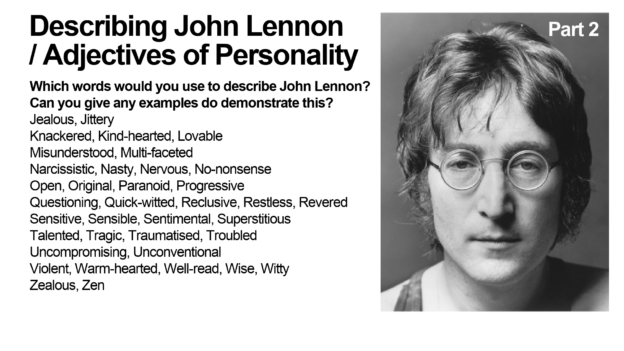
Adjectives of Personality J-Z

O o o <—- these symbols show the number of syllables and word stress in a word. For example, “podcast” = O o (two syllables, the first syllable is stressed)

  • Jealous O o, Jittery O o o (Also: to have the jitters, to be on edge, to be nervous, to be anxious)
  • Knackered O o, Kind-hearted o O o
  • Lovable O o o
  • Misunderstood o o o O, Multi-faceted o o O o o
  • Narcissistic o o O o, Nasty O o, Nervous O o, No-nonsense o O o
  • Open O o, Original o O o o
  • Paranoid O o o, Progressive o O o
  • Questioning O o o, Quick-witted O- O o (Also: to have the gift of the gab)
  • Reclusive o O o, Restless O o, Revered o O
  • Sensitive O o o, Sensible O o o, Sentimental o o O o, Superstitious o o O o
  • Talented O o o, Tragic O o, Traumatised O o o, Troubled O o
  • Uncompromising o O o o o, Unconventional o o O o o
  • Violent O o
  • Warm-hearted o O o, Well-read o O, Wise, Witty O o
  • (not) Xenophobic o o O o (this is the only adjective I could think of that begins with an X!) (xylophone and x-ray are other words beginning with x – but they’re not adjectives of personality)
  • Yellow O o / Yellow-bellied O o – O o (cowardly), Youthful O o
  • Zealous O o, Zen

Also: Childish O o / childlike O o

We also cover a few common false friends in this episode, so listen out for those.

False friends

  • Embarrassed o O o
  • Suburbs O o / slums
  • Sensitive O o o / sensible O o o

That entire list is available for you to see on the page for this episode on my website. The link is in the description.

Now, I read that list of adjectives pretty quickly. If you didn’t catch the word stress, or in fact if you feel you need to explore these words more slowly, you can always just check the word list on the website page … and copy+paste them into an online dictionary, where you’ll see phonemic transcriptions of the words (so you’ll know how they are pronounced, including word stress) you’ll be able to hear someone say the words, and you’ll get definitions and examples and so on.

OK, so – I always encourage you to check words that you discover in episodes of this podcast in your own time, and I refer you back to episode 720 for more information about how to do that.

OK, so without any further ado, let’s jump back into my conversation with Antony about John Lennon, and here we go.


Ending Transcript

Thank you again to Antony for his contribution to this episode.

Let me suggest again that you check out Antony’s podcast if you’d like to hear more in depth discussions about John Lennon. It’s called Glass Onion: On John Lennon and you can get it wherever you get your podcasts. I must say, it is an excellent listen.

Right, so that’s not quite it for Beatle-themed episodes. The last in the series is with Antony too, and that’s where we turn to look at the music (or should I say listen to the music?) In any case, the next part of this series is all about the music and lyrics, especially the lyrics and Antony is going to guide us through a little exploration of words and phrases in Beatles songs, looking at nice idioms, uses of metaphor and other features that you should find interesting from a language learning point of view. And Antony got his guitar out for that too, so we also get treated to little snippets of songs as we go.

So, you can look forward to the final episode in the series, coming soon.

I say final episode, there’s nothing stopping me from doing more episodes with Beatle themes in the future, and I do plan to do that actually. I’d like to do some specific song breakdowns in which I could explore the story behind a particular song, then play the song for you and analyse the lyrics. That could be great.

Anyway, thank you for listening as usual! I hope this has been interesting and useful, and I will speak to you very soon in the next episode of this podcast. BUt for now it’s time to say, good bye bye bye bye bye.

726. Describing John Lennon / Adjectives of Personality A-I (with Antony Rotunno)

Learn useful adjectives for describing personality traits with John Lennon as a case study. Episode 3/5 in my Beatles series, with returning guest Antony Rotunno from the podcast “Glass Onion: On John Lennon”. 

Small Donate Button

[DOWNLOAD]

Introduction Transcript

Hello listeners and welcome back to LEP.

Here is the next episode in my Beatles season, and this is where we look at some language too.

In this episode I’m joined again by Antony Rotunno who is a podcaster and English teacher from England. Antony’s main podcast is called Glass Onion: On John Lennon and as the title suggests it is all about John Lennon, particularly his psychology and his life story. Antony’s other podcasts are called Film Gold, a film review series and Life & Life Only which is about personal development and psychology, so Antony knows a thing or two about psychology and John Lennon, and of course as an English teacher he’s well experienced in helping learners to conquer this language of English.

In this one we’re going through a big list of adjectives which I prepared earlier. All the adjectives are words you could use to describe someone’s personality. We have loads of these adjectives, so Antony and I made a list of words which could be used to describe John Lennon. It’s an ABC in fact. Now we didn’t manage to talk about every single adjective in the list, but we certainly had a good go at them, and what you’re going to get in this episode is a sort of English lesson with John Lennon as a case study.

Here are the adjectives (I’m going to read them out)

  • Consider which ones you know
  • Which ones you use
  • Which ones you don’t know
  • Which ones you don’t use
  • Word stress

Adjectives of Personality

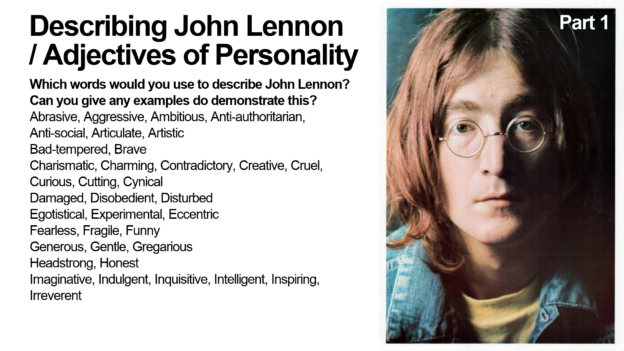
  • Abrasive, Aggressive, Ambitious, Anti-authoritarian, Anti-social, Articulate, Artistic
  • Bad-tempered, Brave
  • Charismatic, Charming, Contradictory, Creative, Cruel, Curious, Cutting, Cynical
  • Damaged, Disobedient, Disturbed
  • Egotistical, Experimental, Eccentric
  • Fearless, Fragile, Funny
  • Generous, Gentle, Gregarious (sometimes!)
  • Headstrong, Honest
  • Imaginative, Indulgent, Inquisitive, Intelligent, Inspiring, Irreverent

I’ll let you discover which ones we actually talk about in detail in this episode. The rest of the list will come up in the next part.

Also, I’ve collected a set of other expressions from this conversation, not using adjectives of personality, but just useful expressions and examples of language you could use, and I’m planning to use that set in an upcoming premium episode.

teacherluke.co.uk/premiuminfo if you want to sign up to LEP Premium to get all the premium content unlocked.

Now, let’s consider John Lennon’s personality, things he did and said in his life and try to work out what kind of person he was, with a few useful adjectives in the process.

Links to Antony’s Podcasts

Glass Onion: On John Lennon

Film Gold

Life and Life Only

Ending Notes

Thank you again to Antony. 

We will be back in the next part of this series. I’m not sure when that’s going to arrive. 

It might be the next episode, or it might arrive in a short while.

Let me know your thoughts in the comment section.

Don’t be a ninja. 

If you were a ninja and then you left 1 comment, and went back to being a ninja, you’re 2nd level ninja now, ok?

1st level ninjas are the ones who never comment

2nd level ninjas are ones that commented and then disappeared

You don’t want to know what makes a 3rd level ninja.

I will speak to you soon but now it’s time to say goodbye…

724. The Mountain (Learn English with a Short Story)

Reading an emotional short story, with vocabulary explanations and differences between British and American English.

Audio Version

Small Donate Button[DOWNLOAD AUDIO]

Video Version

via Commaful

Read the story on Commaful here https://commaful.com/play/aknier/the-mountain/

Introduction Transcript

Hello listeners, welcome back to my podcast. I hope you’re doing well and that you’re ready to learn some more English with me in this new episode.

This one is called The Mountain and I’m going to read you a short story and then use it to teach you some English.

There is a video version of this available on YouTube with the text on the screen, so you can read and listen at the same time and you can see my face while I’m recording this, if that’s what you’d like to see. You can find that video on the page for this episode on my website or on my YouTube channel – Luke’s English Podcast on YouTube, don’t forget to like and subscribe of course.

Stories are great for learning English, and I’m always searching for various stories that I could read out on the podcast. I’ve found a few stories and texts, both online and in books that I have on my bookshelves, so you can expect more story episodes like this coming in the future as I read things in different styles, from different texts, including some well-known published work and some independently published stuff and fan fiction that is available online. 

Stories make ideal material for language learning. They are compelling and often the text of the story is also available which makes it extra useful for language learning because it works as a transcript for what you are listening to.

Today I googled “Free short stories online” and I ended up on a website called commaful.com 

This website is described as the largest library of multimedia stories online. Commaful.com 

On Commaful you can read and share stories written by users of the site, fan fiction, poetry and comics, and they have a picturebook format, which means that their stories are presented in a slightly different way, which makes them a bit more pleasant to read online or on mobile devices – more pleasant than just reading text on a screen, which is never a pleasant way to read literature. So rather than just presenting their texts on screen, they put each line of the story on top of an image of some kind (like a picture of a lake or a landscape or something) and you can swipe from one image to the next, reading each line of the story as you go, which is quite nice.

When reading these stories out loud the format encourages you to pause as you read each line, which is quite a good habit. Pausing is a good presentation skill.

It can be a good discipline to practise because pausing can add some space for the audience to think and can change the atmosphere slightly, adding extra weight to each line that you say. So pausing and taking your time can be good presentation skills to practise.

First I’m just going to read the story to you. You can just follow along and try to understand what’s going on.

Then I’ll read it again and I will stop to explain some bits of English that come up, and there are various nice bits of English in here – phrasal verbs, expressions and other nice bits of vocabulary mainly.

The story is written in American English, which is mostly the same as British English really, but I will point out any differences and will give you the UK English equivalents, so this can be a chance to learn some British and American English equivalents.

I’ll do a vocabulary and language summary at the end too.

As I said, there will be some pauses between the lines of the story, because of the way the story is presented to me on the website. I don’t normally pause like this when doing this podcast, but it could be useful because it might help you absorb what I’m saying and you can use those pauses to repeat after me if you like. This will be easier if you can read the lines with me, and again you can do that by watching the youtube video, or visiting the story on commaful.com. 

Or you can try repeating without seeing the lines if you want an extra challenge.

And of course you can simply enjoy listening to the story without worrying about repeating or anything like that. 

The story is about 10 minutes long, just to let you know what to expect.

The rest of this episode is me explaining and describing the language in the story.

By the way, this story was posted on commaful.com by a user called Aknier and I am assuming that Aknier is the author of this, so credit goes to him or her for writing it.

Follow the link in the description to access the story and you can leave comments there if you like.

I hope you enjoy it!

But now let’s begin the story…

Ending Transcript

OK so that is where the video ends, but I’m adding a bit more here to the audio version in order to do a quick language summary of the bits of vocabulary that came up in that. 

How was that for you? Did you enjoy the story? As I said, there weren’t many narrative elements. It was more an emotional story, but quite an interesting one.

Again, I do recommend that you try reading the story out loud, either by repeating after me or not.

Now let me recap some of the vocabulary items and British and American English differences that you heard there, just to sum up and help you remember what you’ve just heard. I’ll be as brief as I can while jogging your memory here.

You can find this vocabulary list on the page for this episode on my website of course.

Vocabulary List

  • I hardly cried (I didn’t cry a lot)
  • To work hard / to hardly work
  • To fuss / to make a fuss (Fuss = anxious or excited behaviour which serves no useful purpose. “What’s all the fuss about?” “Everyone’s talking about this Meghan & Harry interview. What’s all the fuss about?” “Why don’t you complain?” “Well, I don’t want to make a fuss”)
  • To make a scene = do something which attracts a lot of attention, like angrily shouting at staff in an airport terminal or hotel lobby
  • Siblings (brothers and sisters)
  • To bet that something will/would happen (to be sure it will/would happen) “I bet that England get knocked out of the World Cup on penalties” or “I bet it rains this afternoon”.
  • To shrug your shoulders
  • To grit your teeth = (literally) clench your jaw so your teeth are held tightly together (idiom) to decide to do something even though you don’t want to “I had to tell my dad that I’d crashed his car, so I just gritted my teeth and told him”)
  • A cast / a plaster cast 
  • To be able to afford something  “We couldn’t afford it” “We can’t afford it” (use ‘be able to’ after modal verbs when you can’t use ‘can’ – “We won’t be able to afford it”)
  • A cripple (offensive word)
  • To get picked on
  • To get teased
  • To make fun of someone
  • To get bullied
  • To get catcalled
  • To flash a smile
  • A blinding smile
  • To take that as a yes
  • To get upset
  • To get fired
  • To skip lunch
  • A scholarship
  • To be stunned
  • To soften your voice
  • To talk back
  • To sneak into the kitchen
  • To sneak money back into your wallet
  • Fight – fought – fought
  • Buy – bought – bought
  • To cheat on someone
  • To freak someone out
  • To make it up to someone
  • To raise your voice
  • To shout
  • To scream
  • To cave (in)
  • Emotional outbursts
  • To melt
  • To punch someone in the jaw
  • To stare blankly
  • Stand up for yourself
  • A mess
  • Serene
  • Tranquil
  • Deadly / the deadliest

American English / British English

  • Fifth grade – Fifth year
  • Pants – trousers
  • Mad – angry
  • To figure something out – to work something out
  • To yell – to shout
  • A jerk  – an idiot
  • To take out the trash – to take the rubbish out
  • Chores – housework
  • To punch someone in the jaw – to punch someone in the face

721. Collins Dictionary Word Quizzes / Confusing Words with Fred Eyangoh

This is the second part of my recent conversation with Fred Eyangoh about learning new vocabulary. This one includes a word quiz with homophones and commonly confused words from the Collins Dictionary website.

Small Donate Button

[DOWNLOAD]

Introduction Transcript

Hello listeners, how are you doing today? I trust that all is well in podcastland.

This is the second part of a double episode about learning vocabulary with one of my friends Fred Eyangoh. 

In the last episode you heard about how Fred has been using a spelling game to discover new words, and this led to a discussion about what to do when you come across new bits of vocabulary, including how using online dictionaries can be a really good way to expand your knowledge of words, and also about how just staying curious about new words is very beneficial, and how learning one word leads you to another word and before you know it your vocabulary has expanded exponentially. It certainly works for Fred, whose vocabulary is really strong.

And at the end of the last episode, Fred and I were on the Collins Dictionary website and we were about to do one of the word quizzes that you can find there. The one we chose was about easily confused words. Words that sound the same but are in fact different.

So that’s what happening in this episode. Listen to Fred and me doing a quiz about some homophones – words which have different spelling, different meanings and yet the same pronunciation. So there’s vocabulary, pronunciation and spelling to learn here as we go through various words, but also there are the usual tangents, little jokes and things like that. I hope you learn some things from it and that you have fun while listening.

I will recap the various bits of vocabulary you’ll hear on the other side of this conversation, and it’s a list of at least 30 vocabulary items. I’ll go through that list at the end of the episode to make sure you’ve got it. You’ll see the word list on the page for this episode on my website.

But now, I will let you rejoin my chat with Fred about learning vocabulary, using online dictionaries and a word quiz about homophones.


Click here for Collins Dictionary word quizzes https://www.collinsdictionary.com/quiz/en


Ending Transcript & Vocabulary List

OK so that was Fred and me doing a word quiz about easily confused words on the Collins Dictionary website.

I certainly hope you found that useful, and perhaps you could consider checking out those word quizzes as well on the Collins Dictionary website – again, they don’t sponsor this podcast, but maybe they should. I’ve even got the perfect line for the advert, “Are you confused about which word to use? Just think, ‘What would Colin say?’ and go to collinsdictionary.com”

It’s not actually Colin’s dictionary by the way, a dictionary owned by a man named Colin. “Hello, I’m Colin. This is my dictionary. It’s got lots of words in it.” No, I think that Collins is a surname (double L), like Phil Collins. In fact, the name comes from William Collins, an industrialist from Glasgow who set up a printing press in the 1820s, and in the early 1840s he started printing illustrated dictionaries, and the rest, as they say, is history. The publishing company is now known as HarperCollins, and in fact they are based in Hammersmith in the W6 postcode of London, which is where I was living when I first started my podcast. That’s why there’s a W6 on my logo by the way. It’s because that’s my London postcode. 

So, wow! That’s interesting isn’t it!? In any case, you can find more of those word quizzes and things at www.collinsdictionary.com 

Vocabulary Re-cap

Right, so just like the previous episode about the New York Times spelling bee, there are a few words that I feel I should re-cap at the end here. 

Let me just quickly go through some of those words again, just to make sure you got them.

Words

  • A miner
  • To mine
  • A coal miner
  • A minor (person)
  • Minor key
  • Major key
  • Bleak
  • Evocative – “The minor key is so much more evocative”
  • Seller / Buyer
  • Cellar  (a room below the house for storage)
  • Basement (an underground floor which could be furnished – more common in US English)
  • Attic
  • Loft
  • Steaks
  • Stakes
  • The stakes are high
  • That terrible joke:
A man walks into a butcher’s shop and inquires of the butcher: “Are you a gambling man?” The butcher says yes, so the man says: “I bet you £50 that you can’t reach up and touch that meat hanging on the hooks up there.” The butcher says “I’m not betting on that”, “But I thought you were a gambling man” the man retorts. “Yes I am” says the butcher “but the steaks are too high!”.
  • Bridal
  • Bridle
  • Baby shower
  • Hen do
  • Hen party
  • Bachelorette party
  • Bridal shower
  • Mussels
  • Muscles
  • Molluscs
  • Shellfish (molluscs and crustaceans that we eat)
  • Seafood (food that includes fish, octopus, squid, crab, lobster, shellfish etc)
  • Moolah (a slang word meaning cash)
  • Herbs
  • Thyme / Time

You also heard us talking briefly about Wandavision at the end there. Wandavision is a new-ish TV series by Marvel Studios. We also mentioned The Madalorian, which is a Star Wars TV series. I really must talk about all this new pop culture at some point on the podcast. There’s new Star Wars TV stuff, Marvel TV stuff (like Falcon & The Winter Soldier which I’ve also been watching) and even Zack Snyder’s Justice League, but it’s all going to have to wait I’m afraid. There are so many things to talk about and do on this podcast but there are only so many hours in the day. Also, I have quite a big backlog of episodes in the pipeline at the moment, so I’ll have to publish all of those before I can think about new stuff.

New episodes arriving soon…

720. How Fred Learns Vocabulary with the New York Times Spelling Bee (with Fred Eyangoh)

Fred often plays spelling games on his phone during his lunch break, and he has discovered lots of new words as a result. In this episode I talk to Fred about his process of discovering and understanding new words and I talk about learning vocabulary with online dictionaries.

Small Donate Button

[DOWNLOAD]

Introduction Transcript

Hello listeners, 

I hope you are doing well out there in all the various parts of LEPland. Are you ready for a new episode? Yes, you are? That’s why you’re listening to this? Yes, that makes sense. It would be pretty weird if you had pressed play on this episode and thought “Wait wait! I’m not ready! I must immediately reasses my life choices. What am I doing?” I’m assuming you’re ready for this episode, and that you are fully on-board and prepared mentally, physically and spiritually for another dose of English.

This episode is called How Fred Learns Vocabulary with the New York Times Spelling Bee.

Fred Eyangoh is my guest for this one and he is a returning guest, as some longer-term listeners might remember. Fred has been on the podcast a few times before. Basically, I know Fred from doing stand-up comedy at English language comedy shows in Paris. He’s a stand up comedian, like me. Fred is also a bit of a movie geek and he loves to talk about films of various kinds. His last appearance on this podcast was when we talked about Avengers Endgame a couple of years ago.

But this episode is not about films. We decided instead to talk about how Fred expands his vocabulary in English using the New York Times Spelling Bee. 

Do you know what a spelling bee is? It’s not an insect that is good at spelling words and making honey. No. A spelling bee is basically a spelling competition. Often spelling bees are done in the USA in schools. 

But the New York Times Spelling Bee is basically just a spelling game that they publish in their daily newspaper, and it’s for adults or students, not children. It’s the sort of thing you can do on your lunch break or while commuting to work or college or something and it involves trying to spell as many words as possible from a limited number of letters.

In case you’re wondering, the ‘bee’ part in ‘spelling bee’ is nothing to do with the insects that make honey. The word bee here is actually derived from the middle-English word ‘bene’ (spelled B E N E, and middle-English is not used any more of course) which basically meant when neighbours get together to do an activity that helps someone. A sort of group activity in which everyone gets together to help someone in the community. Somehow along the way this word became associated only with these competitions designed to help kids improve their spelling, and the word ended up being spelled “bee”. As far as I know, there are no other uses of the word “bee” like this. So, you can just learn the phrase “spelling bee” to mean a spelling competition.

So, this episode is all about ways to expand your vocabulary. Recently Fred has found that this little spelling game has introduced him to various new words, and this has been an inroad into English for him, so we decided to talk about it on the podcast.

The overall point here is that there are many ways to expand your vocabulary. You can come across words while reading books or articles, you can find them by listening to podcasts, you can find them by checking transcripts and by using subtitles, by playing computer games, by checking song lyrics, or by playing word games. There are probably other ways that you can think of. There are many ways to come across new words.

I should say that as well as doing these word games, Fred is also a big reader of books and a film nerd. He watches loads of films and TV series in English and investigates the English he hears (or sees if he has the subtitles on) and when he came to the flat to record this episode he had a copy of Alice In Wonderland by Lewis Caroll which he had been reading, and that book is full of word play, poetry and little jokes. So, there are many ways that Fred gets English into his life, but in this episode we’re focusing on how Fred uses this particular little spelling game.

This leads to some discussion about the steps I think you should take when discovering new words, and this relates to one of the recommendations made by Michael from Poland which was to use certain online monolingual English/English dictionaries because they help you to find not only definitions of new words, examples and correct pronunciation but also plenty of synonyms and as you explore the definitions of words you end up discovering other words and it all expands outwards like the branches of a tree.

So this is the overall point – find words in whichever way that you enjoy, but try to go a bit further and explore those words using good English/English dictionaries. Notice how one word leads to another, notice what kind of words they are (nouns, adjectives, verbs etc) and how they fit into a sentence (including which other words they usually go with or collocate with, like certain prepositions, and if they are followed by certain forms like -ing verbs or infinitive verbs), notice how the words are pronounced and if there are several acceptable ways to say them, make note of the spelling and watch out for discrepancies between the spelling and pronunciation, consider if the words are from a specific register (e.g. medical language, legal language, old-fashioned literary language or just general English), if they tend to be from American English or British English. All that information is available from a good dictionary. Also, perhaps consider recording your new words in a notebook or a flashcard app like anki, try to use new words yourself and then try to notice the words again and again as you keep listening and reading. That’s the overall point of this episode.

This is a conversation between two people and so you are going to hear the usual moments when we get sidetracked and there are various conversational tangents, little jokes and things as we make each other laugh. So, it might be a bit tricky to keep up with it all, so just bear that in mind and get ready. 

As you will notice, quite a lot of specific items of vocabulary come up during this conversation and it might be a little difficult for you to keep track of them all, but I will be repeating them at the end of the episode, and they’re also written on the episode page on my website if you’d like to take a look.

Right, so I hope you can keep up with all of this. There will be a part 2 of this conversation, where we explore some word quizzes about commonly confused words in English, but now let’s listen to Fred talking about how he uses the New York Times Spelling Bee to expand his vocabulary, and here we go.


Try the New York Times Spelling Bee here (although you need to register to keep playing) https://www.nytimes.com/puzzles/spelling-bee

Ending Transcript

So, that was Fred Eyangoh talking about how the New York Times Spelling Bee has helped with his vocabulary, which in turn helps with things like pronunciation and improving your pronunciation helps with your speaking and also your listening skills, and improving your listening skills helps to improve your ability to understand people, and the more you understand people the more you’re able to notice more language that people are using and the cycle continues, and all the while your confidence is improving. This is the idea anyway. Certain habits or at least certain mindsets can help to put you in a positive cycle of language acquisition.

You also heard at the end there how we were about to start a word quiz on the Collins Dictionary website. In part 2 of this conversation we will continue where we stopped. So the next episode will be another one with Fred, exploring some commonly confused words, most of which are homophones – words which sound the same but are spelled differently. So check out that episode too when it arrives. There should be more learning opportunities for you there, and also some silly jokes and tangents too from Fred and me.

Let me now recap some specific things from the conversation you’ve just heard.

My 5 favourite dictionaries again

Look beyond just the definition. These are resources designed specifically to help you build your vocabulary.

Some of them have other resources too, like vocabulary quizzes based on things like idioms, synonyms and commonly confused words, and you’ll hear more about that in part 2 of this conversation as I just said.

Macmillan Sounds App – helps you learn the phonemic script. Download it from the Macmillan website https://www.macmillaneducationapps.com/soundspron/ 

Words & phrases mentioned

Repeat the word stress and give an example of each.

Admittedly (adv) (use this when you are saying something that weakens the importance or force of what you have just said) “Daily practice is so important in language learning, although admittedly, I don’t follow my own advice when it comes to working on my French”

Horrendous (adj) (something unpleasant or shocking, horrific, appalling, awful, ghastly) “Getting sick in a foreign country can be an absolutely horrendous experience”

Severe (adj) (very intense or serious) “I had to stop working because I had a severe headache”

Word stress

  • Embarrassed 
  • Important 
  • Necessary
  • Accessory

Umbrella terms (all these ones are nouns)

  • Invertebrate
  • Arthropod (invertebrates that include arachnids, insects and crustaceans)
  • Insect (types of arthropod)
  • Flea (types of insect)
  • Arachnid (aka spiders – types of arthropod, but not insects)
  • Crustacean (also types of arthropod which are neither insects or spiders – includes crabs, lobsters, shrimp)

Chitin (what insects’ exoskeletons are made of)

Worms 

Elated (adj) (synonyms – joyful, delighted, excited, proud)

Heart bypass (noun)  – According to the NHS A coronary artery bypass graft (CABG) is a surgical procedure used to treat coronary heart disease. It diverts blood around narrowed or clogged parts of the major arteries to improve blood flow and oxygen supply to the heart. We laughed about the fact that the guy in the example had two heart bypasses, but of course this is a serious procedure that a lot of people have to have. 

To take something with a pinch of salt (UK) – this means to be sceptical about something, or to not completely believe everything that someone says. “Take online medical advice with a pinch of salt. Sometimes it’s not completely accurate.”

To take something with a grain of salt (US)
Allele (noun) (a specific scientific term from genetic biology, pronounced “uh leal” – I remember this word coming up in my biology A level lessons when I was 17, but I haven’t heard it since, until this conversation. I failed that A level by the way.)

Pelf (noun) (money, especially if it has been illegally obtained – this word is hardly ever used today, so don’t worry about it. Collins is the only dictionary that lists it) Synonyms might be swag, booty – but those words aren’t really used either, unless it’s some pirate adventure story set in the 18th century)  

Pilfer (verb) (a slang word meaning to steal – it’s still used but I would probably go for the words “nick” or “pinch” instead) “Someone’s nicked my wallet!” “I pilfered some biscuits from my flatmate’s cupboard.” “Someone’s pinched my mobile phone”.

Quid (noun) (slang word meaning pounds, it’s both the singular and plural form) “A pint of beer in a pub can cost over 7 quid these days. It’s daylight robbery!”

That’s it for this episode then. Part 2 should arrive soon, and it will be called something like Learning Vocabulary with Collins Dictionary Word Quizzes (with Fred Eyangoh) Commonly Confused Words.

So, sit tight until that one arrives!

I hope all is well in LEPland. Don’t be a ninja – write something in the comment section, and by the way, writing one comment like “I’m writing a comment, so I’m not a ninja any more” this doesn’t completely revoke your ninja status, because you have to stay out of the shadows you know!

Speak to you soon, but for now – bye bye bye bye bye

707. [2/2] Let’s Play Another Text Adventure Game – “Zombolocaust” by Peter Carlson

Continuing the text adventure game about the zombie apocalypse from episode 706, with text on the screen so you can read with me while you listen. Video version available. Play the game with me – follow the links below. [Part 2 of 2] Listen to part 1 first!

Small Donate Button

AUDIO VERSION

[DOWNLOAD AUDIO]

VIDEO VERSION

Works best on full-screen mode. Don’t forget to like & subscribe folks! 👍

Links

Play “Zombolocaust” by Peter Carlson https://textadventures.co.uk/games/view/5kjlubyvzuitox6z52xipq/zombolocaust

Text Adventures website http://www.textadventures.co.uk

Part 1 of this episode https://wp.me/p4IuUx-oBr

Part 1 on YouTube