Category Archives: Vocabulary

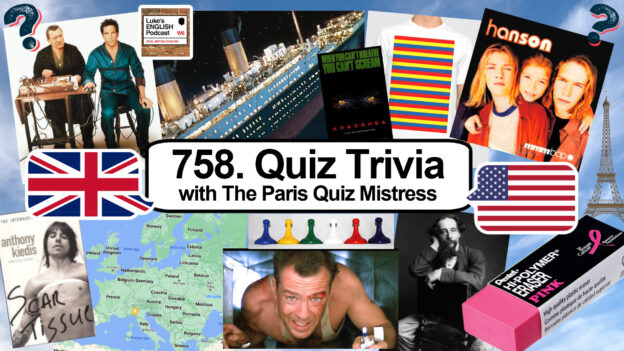
758. Pub Quiz Trivia with Sarah The Paris Quiz Mistress

Chatting to pub quiz host Sarah Toporoff about her love of trivia, and asking each other quiz questions about history, geography, literature, language & pop culture. Can you answer the questions and follow the conversation?

[DOWNLOAD]

Links

Introduction Transcript & Notes

Hello listeners! I hope you’re well. Welcome back to my podcast for learners of English around the world. That’s you, I assume. You are a learner of English and you are around the world. 

Welcome to another episode of my podcast. This is where you can get English into your life in the form of some regular listening practise. This time you’re going to hear me in conversation with a guest and the guest in this episode is my friend Sarah Toporoff who also goes by the name The Paris Quiz Mistress.

This is the first time she’s been on the show and that means this one will probably be a little more difficult for you to follow, but that’s alright – it’s all good practice. 

Sarah is originally from the USA (so you will be hearing an American accent from her, and a British accent from me in the same conversation – and yes, we actually understand each other of course) Anyway, Sarah is from the states, but these days she lives in Paris like me and basically – Sarah loves pub quizzes. In fact, she loves them so much that she decided to run her own pub quiz nights here in Paris, in English, which she does every Sunday evening. 

She writes questions and reads them out in a local pub for teams of people to answer in competition with each other. Sarah also has her own podcast in which she quizzes her friends on various bits of trivia relating to their interests. Her podcast is called The Paris Quiz Mistress Podcast.

So, in this episode I thought I would chat to Sarah about her love of quizzes, and then we could quiz each other with some fun questions, and you can see if you know the answers and generally try to keep up with the conversation and develop your English in the process.

So that’s what you’re going to get – and this is a swapcast, which means that both Sarah and I are publishing this on our respective podcasts. 

Before we continue I think I should give you a little bit of support before I throw you into the deep end and make you listen to this fairly fast conversation between two native speakers. 

So, let me just clarify a couple of bits of vocabulary and some culture which are key concepts for this episode, and I also have a few questions for you to consider, in order to help you prepare to understand this episode more easily.

Some words and concepts

A quiz

(Forgive me if I am stating the obvious here) A quiz is a fun game or competition in which someone tests your knowledge by asking you questions and you compete with others to answer those questions. Quizzes are usually done just for fun, unlike tests or exams for example, which are done not for fun. They usually involve questions relating to trivia…

Trivia (noun) / Trivial (adjective)

…and trivia basically means trivial information or facts which are interesting or amusing but not really presented for a specific purpose. “Oh, that’s quite interesting isn’t it?” ← that’s usually as deep as it gets. That’s trivia.

It’s just random bits of general knowledge, just for fun – facts and figures, names, dates, places, moments in history, pop culture and so on.

A pub quiz 

As the name suggests, a pub quiz is a quiz done in a pub. Big surprise there. But pub quizzes are a very common feature of normal life in the UK where any good pub will have a quiz night. If you’ve ever spent time living in the UK you might have noticed this. Perhaps on a weekday evening in the local pub you might see teams of people sitting at tables competing against each other to answer questions which are read out by a host who might be speaking into a microphone. It’s sort of an excuse to just be in the pub and have a few drinks, but it’s also a really fun way to spend an evening with other people.

A good host will prepare some tricky but achievable questions that make you think and that could spark some conversation later in the evening, and the host might throw in some funny comments here and there just to keep things light. The questions are often quite convoluted and might sound more difficult than they actually are. At the end, the answer sheets from each team are marked and the winning team wins a prize, typically a bottle of wine or something like that. Pub quizzes are also known as trivia nights in some places. 

Does that sound familiar? This is the world of the pub quiz. Are they a common feature in your country? Do they happen in pubs? Do you have pubs? Do you have questions? Do you have facts where you live? Are there other people? I don’t know where you are. 

Fun quizzes like this also take place in other situations – and I’m talking about the UK and other English speaking places too and often things are similar in our cultures. I’m sure it’s the same for you, but is it? I don’t know. Anyway, where I’m from quizzing is sort of part of our DNA. Any excuse for a quiz – in pubs but also at family get togethers, at school or even at work Christmas parties and things like that. 

Sorry for rambling here but seriously – thinking about this stuff might help you to focus your attention on the topic of this conversation  bit more closely and follow things more easily, and therefore learn more English from this and as a result get a feeling of accomplishment which you carry with you in your life, bringing extra positivity and confidence which ultimately helps to make you a more successful and fulfilled person in your life, which then impacts on other people in similar ways and the benefits spread out from you in concentric circles improving the lives of other people around you and they start smiling a bit more and ultimately the world becomes that bit better which makes all the difference to the global balance of everything and basically I save the world with my podcast. That’s all I’m trying to do, so don’t stand in my way, ok? The fate of the world depends on this, alright?

Now, just in case this introduction wasn’t long enough, I am now going to quickly read out the questions that Sarah and I are going to ask each other in this episode, just to give you a chance to understand them in advance so you don’t get lost in the conversation.

You see, I am COMMITTED to helping you learn English and that means I am willing to make these episode introductions at least 3 minutes longer than they should be in order to give you a helping hand in understanding fast-paced and naturalistic dialogues between native speakers of English. That is how much I care. 

Quiz Questions in this Episode

So listen to these questions, understand them, can you answer them? You’ll be more prepared. Listen to the episode to get the answers.

  • How many countries make up the UK and can you name those countries?
  • Which Eastern European country shares zero of the same borders with countries that it shared borders with in 1989 although its physical borders have not moved? (note: I hope you don’t mind the term “Eastern European country”)

Sarah’s Questions for me

These might seem a bit random, but Sarah is a great quiz mistress and there is a link between all the answers to these questions, and it’s a link that is tailored to me somehow. 

  1. For which film did the MPAA refuse to allow use of Ben Stiller’s character’s last name in the title, unless filmmakers could find an actual person with that last name?
  2. What 2nd novel by English author Charles Dickens is alternately titled “The Parish Boy’s Progress?”
  3. What film series began in 1988 and stars Bruce Willis as John McClane?
  4. In British English it means “eraser”, in American it means “condom”. What is it?
  5. What is the type of gun that features as a weapon in the board game “Cluedo”?
  6. “Scar Tissue” is the name of Anthony Keidis’ autobiography as well as one of his hits, with which band?
  7. PD James, Edgar Allan Poe and Gaston Leroux are all writers specialising in what genre? 
  8. The flags of Romania, Colombia and Moldova all primarily feature which 3 colours?
  9. The first episode of what television drama opens with the news that that RMS Titanic has sunk?

Luke’s Questions for Sarah

My questions are really quite stupid and in fact I am not listing them here because they are too silly and I will let you discover them in all their glory as you listen to the episode. So just listen on if you want to hear my questions for Sarah – but to give you a heads up they focus on music, movies (well, one movie) and British English slang, so there is definitely some vocabulary to learn here!

MMMBop by Hanson

Mmm Bop – Lyrics

Can you tell me any of the lyrics from the first verse?

Answers:

You have so many relationships in this life

Only one or two will last

You go through all the pain and strife

Then you turn your back and they’re gone so fast

Oh yeah (so much wisdom from someone so young)

And they’re gone so fast, yeah

Oh, so hold on the ones who really care

In the end they’ll be the only ones there

And when you get old and start losing your hair

Can you tell me who will still care (Hair was important to them)

Can you tell me who will still care? (interesting discussion point)

Oh care

Mmmbop, ba duba dop

Ba du bop, ba duba dop

Ba du bop, ba duba dop

Ba du, oh yeah

Mmmbop, ba duba dop

Ba du bop, ba du dop

Ba du bop, ba du dop

Ba du, yeah

Said oh yeah

In an mmmbop they’re gone

Yeah yeah

Yeah yeah

Plant a seed, plant a flower, plant a rose

You can plant any one of those

Keep planting to find out which one grows

It’s a secret no one knows

It’s a secret no one knows (Is it really a secret?)

Oh, no one knows

MMMM MMMM MMMM MMMM by Crash Test Dummies

Anaconda – 1997 (Trailer)

Luke’s British Slang Questions

  • If you describe something as pants, how do you feel about it?

“That film was pants. Total pants.”

Answer: bad

  • How would you feel if you’d run out of bog roll?

You’d feel gutted of course.

Answer: Bog roll means toilet paper

  • Can you give me a reason why you might feel “chuffed”?

Answer: chuffed means pleased, delighted, happy

  • What would a British person probably say if they wanted to claim something, like perhaps a chocolate biscuit or a comfortable chair?

Answer: Bagsee!

  • If someone needed to get some kip, how would they probably feel?

Answer: You’d feel sleepy or tired, because kip means sleep (noun)

  • What F word is used to say that someone is physically attractive? (It’s like saying “hot”)

Answer: fit

  • What L word is a generic sickness – like the flu or a bad cold? (a pre-covid expression)

Answer: The lurgy

  • Where do you put suitcases in a car in the UK?

Answer: in the boot

  • What about the engine?

Under the bonnet

In any case, whether you can answer these questions or not, I hope you enjoy listening to this conversation about trivia and that you manage to keep up with it all and pick up some English. I will chat to you again very very briefly at the end, but it’s now time to get started properly and here we go…

Listen to the episode to get all the answers to the questions!

In other news…

My pod-room still isn’t ready but it should be connected to electricity and internet in a couple of weeks.

I’m still waiting to get a WIFI internet connection at home.

My shelves haven’t fallen down yet :)

I am working on LEP Premium series 33 parts 3 and 4 and they should be uploaded soon.

Video versions of episodes will return when I have a decent internet connection (and a new computer which is coming too…)

757. Setting up my new Pod-Room / DIY (Do It Yourself) Vocabulary & Expressions

Describing how I am setting up my new pod-room with a couple of stories and plenty of vocabulary for talking about DIY and doing improvements to your home. Vocabulary list available.

Small Donate Button

[DOWNLOAD AUDIO]

Episode Notes & Transcript

Hello listeners, welcome to LEP#757. In this one I am going to talk to you about how I am setting up my new podcasting room (is it an office, is it a studio?) and I’m going to teach you some vocabulary related to doing practical work with your hands at home.

Just before we start I just want to say hello properly to everyone in LEPland and deal with a little bit of podcast admin. 

Hello

I hope you’re doing well. It’s been over 2 weeks since I published the last episode because of the house move (I moved house a few weeks ago). If you’re wondering how that’s going – I’ll talk about it a bit in this episode, but let’s just say that the phrase my wife and I have been using over and over is “it’s coming along” which means we are making progress, bit by bit, slowly but surely – unpacking our stuff from boxes, setting up the new place, getting things sorted out such as an internet connection at home and the important appliances like a cooker, a washing machine etc. Things are getting slightly less chaotic every day. Also I was ill for week (not COVID thankfully) which didn’t help. Anyway, if you’ve been waiting patiently for a new episode – thanks for waiting. If you’ve been waiting impatiently, I’ll still say thanks for waiting. Things are still up in the air so I can’t get back into the usual podcasting routine yet, which means there might be another delay after I publish this episode, but when I have my new podcast room set up and have done lots of other things that need doing, normal podcasting will resume. Hopefully this slowdown has allowed a lot of you to catch up with me.

3 of announcements and bits of admin before we start properly:

  1. Premium subscribers – I am currently working (when I can) on P33 parts 3 & 4 which are turning into quite substantial episodes. Part 3 is all about word families, parts of speech and word stress patterns. That means how word stress patterns can change from the noun form of a word to the adjective, verb and adverb forms etc. (Politics – politician – political – politically, Economics – economist – economic – economically, architecture – architect – architectural – architecturally, etc) Part 4 will be pronunciation drills with full sentences, not just words on their own. So that’s coming soon to LEP Premium. If you want to sign up to LEP Premium to get all those episodes – go to teacherluke.co.uk/premiuminfo to get all the info. If you ever have problems with the registration process – try using other browsers, and not on a mobile phone.
  2. Spotify listeners – hello! Recently loads of my episodes disappeared on Spotify. I don’t know if you noticed but episodes 1-664 just disappeared. Well, they should be back now or soon. It was just an automatic update which changed some settings, but those settings have now been reset. So everything should be normal, the episodes should be available again and you should be able to listen on Spotify as usual. In any case you can always get all the episodes in the LEP App which you can download free from the app store on your phone (just search for Luke’s English Podcast App). That’s the whole episode archive, plus about 10 bonus episodes which are only available in the app, all the mini phrasal verb episodes, some music and videos and access to the premium content too if you have a subscription.
  3. OPP – If you’re looking for other things to listen to while waiting for new episodes of LEP at the moment, you could check out my appearances on several other podcasts. Recently several of my podcast friends reached milestone episodes and they both chose to invite me as a guest as a way of marking the occasion. Apparently I am the pod-father. First of all, Rock n’ Roll English hosted by Martin Johnston – he reached episode 250 recently and invited me on to have a chat about the ins and outs of making podcasts for learners of English and it’s a typically funny and unfiltered conversation. That’s episode 250 of Rock n’ Roll English. Also Zdenek’s English Podcast reached episode 400 recently and Zdenek invited me as a guest. I love the way Zdenek and Martin decided to pay their dues to the podfather in this way! I had an epic chat with Zdenek about loads of things including how his podcast has been inspired by mine in some ways and about the development of him as a teacher and podcaster. I think it’s a good conversation with insights about various things including what it’s like making podcast content and how confidence develops, the creative process and generally another inside look into podcasting for learners of English. Check them out – you will find links on the page for this episode. 2 other episodes of other people’s podcasts you could check out.


This is an episode about DIY – or Do It Yourself

This is not an episode about how you can teach yourself English, although I could talk about that a bit, later in the episode.

DIY is a common expression in English, meaning Do It Yourself and it relates to doing practical work at home. 

People talk about doing DIY. We say things like “I’m going to do some DIY this weekend” “I’ve been doing some DIY”, “I did a bit of DIY at the weekend”,  “I’m no good at doing DIY” “My husband does all the DIY in our house” “My wife tends to handle all the DIY because I’m rubbish at it, etc etc”. 

DIY (Do It Yourself) means all the practical work that you might do at home from time to time – the things we do in order to make improvements to our home. I’m talking about things like putting up shelves, painting & decorating, fixing things and other similar work that you do to improve your own home without having to call someone in to do it for you, like a plumber, carpenter, decorator or electrician. You don’t call someone in to do it, you do it yourself. DIY.

It’s the sort of thing you might do at the weekend. Putting up shelves seems to be the most common example of DIY as far as I can tell. Putting up shelves – that thing that seems so simple on paper, but in reality is the sort of thing that can bring a person to their knees – and I don’t mean kneeling down in order to do some work, but to kneel down in a desperate plea to the gods of (what – wood? Screwdrivers?) in order to beg for mercy because your attempt to put up the shelves is proving to be too difficult a task. What do you mean, Luke? I mean, doing DIY, for example, putting up shelves can be a nightmare if you don’t know what you’re doing. 

As I said, on paper it doesn’t seem that bad, but to do it right you have to do it properly. You have to read up on how to put up shelves, maybe watch some tutorials online, then plan a specific time to do it, go to the hardware shop or DIY shop to get all the right materials and tools. You put on some old clothes, maybe prepare an area of the home where you’re going to do your work and make sure no pets or children go anywhere near it, you get the stepladder out, and then you try and actually put some shelves on the wall, or build something or whatever, and if you’re not very good at it, if you’re not a practical person, it can be stressful and you end up making a total mess of it, and you hit your thumb with a hammer and then you start swearing and maybe break something and fall off the ladder, and have an argument with your spouse or something and then just give up and go to the pub or something. It depends how handy you are, how practical you are or not. For many of you, this isn’t a problem and the idea of putting up shelves being diffiult is laughable to you. I don’t know your life. 

But I do know, that DIY is a very common thing in life and surely this is something that unites all of us to some degree. Either because we all have to do DIY sometimes, or at least we know someone who has to do DIY and it’s just a thing that happens in our lives. Do you know all the English that you need to talk about DIY? The tools, the verbs, the specific phrases for all of it? That’s what I’m dealing with here. 

The reason I’m doing this episode right now might be obvious for those of you who are regular listeners. I have just moved into a new flat and also I’m setting up a new office/studio for myself and this is involving a lot of this kind of work. 

In fact, this is what is taking up most of my time at the moment, which is why the podcast has been a bit delayed recently. When I’m not teaching English classes at the British Council or spending time with my wife and daughter doing family things, I’m working on the flat and working the office. 

What I’m going to do in this episode, then, is:

  1. Describe exactly what I’ve been doing in the office and talk about how I’m trying to set it up as a good base for my podcast work. I’m going to describe the DIY I’ve been doing.
  2. Go through a vocabulary list of various words and phrases for talking about the fascinating subject of DIY.

Setting Up The Pod-Room

  • What is it?
  • Where is it?
  • What does it look like?
  • What does it need to be?
  • What are you doing with it?

Tell us about the shelves you put up, in as much detail as possible.

Vocabulary – DIY

Putting up shelves

  • Tape measure – to measure things (length, depth, width, height, distance from x to y etc)
  • Spirit level – to check that things are level (horizontally or vertically)
  • Pencil – to mark lines or crosses/spots 
  • A drill – to drill holes (into thing)
  • A cordless drill
  • Battery / battery pack – charge it regularly
  • Drill bits (different bits for different materials) – to drill holes of the right size / to drill (into)
  • Types of material – masonry (stone and brick), wood panels (MDF, chipboard, wood (pine, oak etc)
  • Wall plugs / Rawlplugs – to hold screws in place and prevent damage to the walls (you push them into the holes and then when you screw in the screw, the plug expands inside the hole and grips the inside of the hole, preventing the screw from falling out) they ensure a tight and secure fit for screws in material which is brittle or porous.
  • Screws – screw them into the wall or into wood to attach things
  • Nails – hammer them into the wall or wood to attach things
  • Screwdriver – to screw in screws, or unscrew screws
  • Electric screwdriver / power screwdriver – a convenient way to screw screws
  • Hammer – to hammer nails or pull nails out of walls
  • Mallet / rubber mallet – to hammer other things, without causing damage. You can use a mallet to hammer rawl plugs into the holes, for example.
  • Pliers – to hold things firmly, to grip things
  • A saw – to saw wood (handsaw, hacksaw, etc)
  • Sandpaper – to sand things and make them smooth or take off rough edges – like wood, dried filler or rough patches of paint
  • A plane – to remove layers of wood
  • File – to rub against wood (usually) and change the shape, remove layers (e.g. if a door sticks and doesn’t close properly)
  • Rags – to wipe things, clean things, dust things (remove dust)
  • Dustpan and brush – to clean up dust and other bits and pieces
  • A multi-tool – a convenient thing to help you do lots of things, including cut your arm off if it gets trapped under a rock in the desert 

Painting

  • Paint – to cover surfaces, to coat surfaces, to add colour, to make things look nice
  • Layers of paint or coat:
  • Primer – to prepare the wood by covering dark colours or patches, prevents things from leaking through (like some oil or sap which comes from knots in the wood) and makes the surface smooth (MDF is absorbent so the primer helps to stop the MDF from absorbing all your paint – it also causes wood fibres to stand up, so you can then sand them down) etc 
  • Sealer – seals the wood and creates a watertight layer
  • Undercoat 
  • Topcoat
  • Types of paint, with different appearances:
  • Matt (flat surface, low “sheen”, not reflective, harder to wash, prone to marks and scuffs, easy to add other coats without showing up brush strokes) 
  • Eggshell / satin (higher level of “sheen” than matt, easier to wipe than matt, more durable than matt)
  • Gloss (highly reflective, has a very high “sheen” level, sometimes used in kitchens because it can be wiped clean and is therefore a bit more hygienic)
  • Oil-based paint
  • Water-based paint
  • A brush – to apply paint to things 
  • A roller – to apply paint evenly and conveniently to large surfaces
  • A tin/tub of paint – the containers the paint comes in
  • Masking tape – to cover parts which you don’t want to paint, like skirting boards, windows, handles etc
  • Plastic sheets – to cover and protect the floor from drops of paint

That’s it!

When the pod-room is set up and I have a proper internet connection (and maybe a new computer) I will be doing podcasts with videos like in 2021 and you will be able to see the amazing and inspiring work I did on the shelves 😂

Speak to you soon! Bye bye bye…

750. An Unedited Ramble / How to talk about Being Busy in English

In this unedited episode I share some of the thoughts that have been running through my head, talk about being busy and look at some vocabulary to describe busy times in your life. Video version available.

Audio Version

[DOWNLOAD AUDIO]

Video Version

Vocabulary Notes

How to talk about being busy in English

1. The word “busy”

Pronunciation

/bɪzi/ “Bizzy” – like “business”

Not “Buzzy”

Collocations

  • A busy time
  • To be extremely busy
  • To be busy with something
  • To be busy +ing
  • To be too busy + infinitive
  • awfully, extremely, really, terribly, very | exceptionally, particularly | desperately, frantically | a bit, fairly, pretty, quite, rather | constantly

2. Expressions for when you have too many things to do and you don’t have time for everything

  • To have a lot to do (It’s possessive have, so don’t put it in the continuous form)
  • To have an awful lot to do, to have a hell of a lot to do
  • To have a lot of things to doTo have loads of things to do
  • To have tons of things to do
  • To have a lot on
  • To have a lot going on
  • To be rushed off your feet = Always in a hurry because you have so many things to do
  • To be up to your ears/neck in work, admin, marking, assessments
  • To be under a lot of pressure
  • To work well under pressure
  • To be snowed under (with something)
  • To be swamped (with)
  • To be overwhelmed
  • To have your hands full
  • To have a lot on your plate

A busy time

  • A full day/month/year
  • Hectic
  • It’s all go (go go)
  • Things are a bit mad/crazy/hectic/Full-on
  • (to be in) a mad rush

3. Expressions for when being busy is good, because having time on your hands and doing nothing is bad

  • To keep yourself busy
  • I’m keeping myself busy

That’s all for this episode. Speak to you next time! Bye bye bye…

748. Karl Pilkington’s 3-Minute Wonders / Manchester Accent [Part 2]

Understand more of Karl Pilkington’s rambling as we learn about the Manchester accent and pick up vocabulary along the way. Video version available on YouTube.

Audio Version

Small Donate Button

[DOWNLOAD AUDIO]

Video Version

Episode Transcript

Introduction

Hello everyone. Welcome back to LEP. This is part 2 of a double Karl Pilkington themed episode. I would recommend that you listen to part 1 of this first – it contains important context about who Karl is plus more details about Karl’s pronunciation and accent. 

Listening to that first will help a great deal in understanding this one.

I got plenty of good responses to part 1 of this, so let’s carry on.

In this part we are going to continue as we did before – listening to Karl Pilkington talking about various subjects, understanding exactly what he says, looking at features of his Manchester accent and picking up vocabulary along the way.

Karl is basically just a normal bloke from Manchester and his accent is fairly typical for people from that area so this episode aims to help you understand his accent and pick up vocabulary too.

Some responses to part 1

I disagree with Karl on most things.

Is he arrogant?

I just enjoy the way he puts things. He speaks like a comedian in the way that he expresses a point of view and has a certain way with words, but he’s not a comedian.

This is the enigma of Karl Pilkington – is he really just being himself, or is he playing a comedy character, and in real life he’s a lot more erudite.

I actually think it’s the former not the latter and that he’s just being himself. He just happens to have a funny way of putting his opinions across. 

Sometimes the best comedy comes from someone sharing a specific opinion. I think this is what I enjoy about this, rather than the opinions he is expressing, and as I said I disagree with Karl about most things, and some things he says are quite laughable – especially stuff he’s said on the Ricky Gervais podcast, like his Monkey News stories.

One other thing – apparently it is possible to be choked by a live octopus as you eat it. What I meant was that it would be impossible for an octopus to strangle you from the inside, as strangling means choking from the outside of the throat, with your hands for example, but of course a live octopus could choke you from within, by sticking its arms up into your throat or your windpipe. So, fair enough, it is possible for an octopus to choke you.

Also, in the UK we do eat oysters – which are raw seafood, so I think raw fish are generally ok in the UK but most other raw things would be considered a bit strange for us.

Quick Pronunciation Recap

In part 1 we listened to Karl talk about life, health and food and in terms of his accent I talked about H-drops

  • I’m 32, I think I’ve got the hang of it.
  • Look, how many do you need?

glottal stops 

  • I’ll have a look at the meteorites.
  • If you’re going to eat a live animal, don’t eat one that’s got eight arms that can get hold of your neck.

The ‘bath/trap’ split 

  • podcast/podcast
  • laugh/laugh
  • path/path
  • bath/bath

/ʊ/ not /ʌ/

Do you go to the gym much? 

Topics: Holidays & Karl’s Fridge

This time he’s going to talk about holidays and his fridge and we will look at more features of his accent.

There’s a video version of this on youtube with text on the screen, plus you will find all the text presented on the page for this episode on my website. 

Just one more thing before we start – I have premium episodes in the pipeline for these two episodes of LEP. The Premium episodes will be a chance to review and remember the vocabulary that comes up in these episodes, and then pronunciation drills too. So, I’ll do a sort of memory quiz with you to see how much vocab you remember and then the usual pronunciation drills – but in my accent, not Karl’s. 

Sign up to LEP Premium

www.teacherluke.co.uk/premiuminfo 


#4 Karl on Holidays

(not Karl on Holiday)

Karl is on a camping holiday, sitting in a tent and moaning. 

  1. Why does Karl think holidays are stressful?
  2. What does Karl think of Lanzarote’s nickname?
  3. What did Karl do on his holiday there?
  4. What’s the problem with holidays in the UK?
  5. What did he think of the seal sanctuary he went to?
  6. What’s the best place Karl has been? Why?
  7. What does Karl think of holidays to the moon?

Vocabulary

You’ve got free time on your hands which you’re not used to.

We ended up walking around this seal sanctuary. 14 quid. £

They were just floating about, hardly moving.

I’m not having a go, but don’t charge me to come in, or at least let me see them again when they’re better.

The coliseum, they don’t do it up.

There’s no overheads.

That’s a mess. Get it knocked down.

At the end of the day the moon is just a big rock. You may/might as well go to Lanzarote.


PRONUNCIATION #3

Nasal

Alright so I went on holiday and it was great and all that.

  • I’ll have a look at the meteorites.
  • If you’re going to eat a live animal, don’t eat one that’s got eight arms that can get hold of your neck.
  • When’s the last time you heard about a tortoise having a heart attack?

Works well with glottal stops.

Nasal sound in /aʊ/ and /ai/ sounds

/aʊ/ in words like about and now sounds more nasal.

What’s he going on about now?

If there were dinosaurs about now and that.

If we’ve run out we need to go outside and get some more.

Nasal sound in /ai/ sound

The /ai/ sound in words like alive, inside, survive, fighting, riot and dying sounds more nasal.

You’re not supposed to eat them alive.

We’ve got to stay inside if we want to survive.

If they were running about fighting and dying and that.

Running riot (sounds like “roonin raiyut”)


#5 Karl on his fridge

Karl’s fridge is broken and he called out a guy to fix it. 

Naturally he’s moaning about workmen who come to your house to do different jobs.

  1. Why does the guy charge £80?
  2. What is Karl’s main problem with engineers, plumbers, workers who have to come to his house?
  3. What advice does the fridge guy give to Karl?
  4. What’s the problem with Karl’s new fridge?

Vocabulary

The fella turned up, right.

Yeah, it’s broke. (broken)

That’s why I called you out.

That’s 80 quid

I said, “you what?” 

An 80 quid callout charge.

I tell you. They wind me up.

I had a fella come round to do the tiling

Turned up late with a carrier bag.

A pot noodle

A copy of the Daily Mirror

A crossword book

He was asking what the pub was like across the road. “What is …. like?”

Having a laugh

When did you last vac it out

Vacuum cleaner

You’re meant to vac them out, because dust and that gets in.

Can’t afford any food to put in it.

It needs wiring in. It’s got one of those fancy plug things.


PRONUNCIATION #4

A lot of other vowel sounds are nasal too.

Turn the corner /ɔː/

They becomes thee

It depends what they do with it.

Why have they only just found that? 

How did they miss that?

Also, he adds little fillers like:

(Do you) know what I mean?

Right? (just sounds like a nazal grunt, almost)

… and that

Like that

And whatnot

And stuff like that

Do you know what I mean?

I tell ya…

Watch out for those things if you like.


Ending

Ladies and gentlemen, this brings us to the end of this episode, as we now prepare to exit the world of Karl Pilkington and re-emerge blinking into the light of the normal world.

Welcome back to yourself, your own attitudes and your own personality again.

I urge you to (just wanted to use that phrase) check the page for this episode on my website where you will find a downloadable full transcript, the audio file for download in mp3 format, a text video version of this episode where you can read the entire thing as you listen and it’s all presented in a rather majestic looking font before your very eyes and of course there’s the comment section where you can share your thoughts not to mention the episode archive with all the previous episodes plus lots of bonus extra stuff. 

Teacherluke.co.uk

LEP Premium 
LEP App
LEP Merch
Have a good one and I will speak to you again soon, bye!

747. Social Awkwardness / Very British Problems (with Michael Lavers from Level Up English)

Talking to Michael Lavers from the Level Up English Podcast about learning Japanese, embarrassing moments in language learning, social awkwardness and some “very British problems”. Are you as socially awkward as a British person? Let’s see how you and Michael would respond to some quiz questions that will test your British awkwardness to the max. Video version available.

Audio Version

Small Donate Button

[DOWNLOAD AUDIO]

Video Version

Introduction Transcript

Hello listeners and video viewers,

Today on the podcast I am talking to Michael Lavers who is an English teacher from Cornwall in the South West of England. Michael also has a podcast for learners of English. It’s called The Level Up English Podcast – you might want to check it out if you haven’t already done so. It’s available wherever you get your podcasts.

As well as being an English teacher, Michael is also a language learner himself and in his podcast episodes he often talks with guests about experiences of learning other languages, including those embarrassing or awkward moments that happen when you feel shy or you make mistakes. Also, Michael has described himself as a socially awkward person who lacks a certain amount of confidence in himself. In fact, he says that one of the reasons he started his podcast was to try and gain some confidence by going out of his comfort zone.

So this is what I thought I would ask Michael about: his language learning experiences and those awkward and embarrassing moments, and then I’d like to chat about social awkwardness and whether this is a uniquely British thing. And we’re going to go into some specific examples of how this so-called British awkwardness manifests itself.

That’s the plan, so now, let’s meet Michael Lavers from the Level Up English Podcast.


Awkward Situations – Very British Problems

Here are some questions based on some tweets by the popular Twitter account, Very British Problems. Each one describes a specific problem that British people typically experience in social situations. They seem to sum up the experience of being a British person. We’re socially awkward – I don’t know why.

Let’s see how you respond to these questions. And listeners, I want you to consider your answers to these questions too, then we’ll see what Michael says, and then we’ll see the original tweets and we can see if they match up.

Questions & Tweets

How do you feel when you walk through the “nothing to declare” gate at an airport?
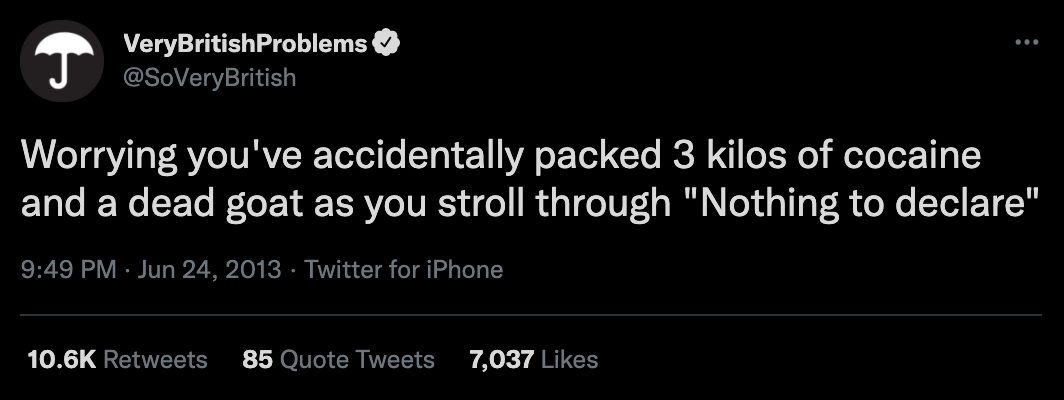
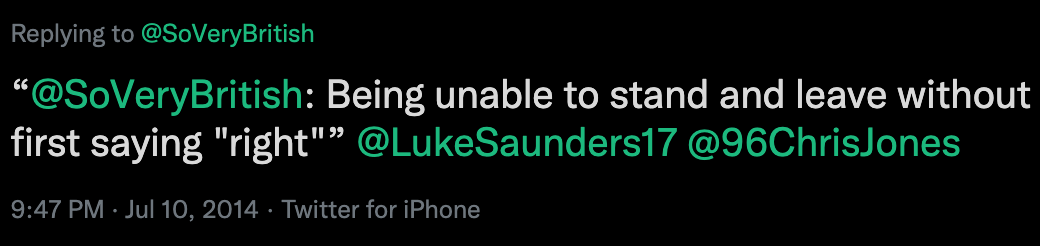
You’re sitting with a group of people. It’s time for you to leave. What do you say as you kind of slap your hands on your knees and stand up?
If someone says something to you but you don’t hear it, how many times are you willing to ask them to repeat themselves?

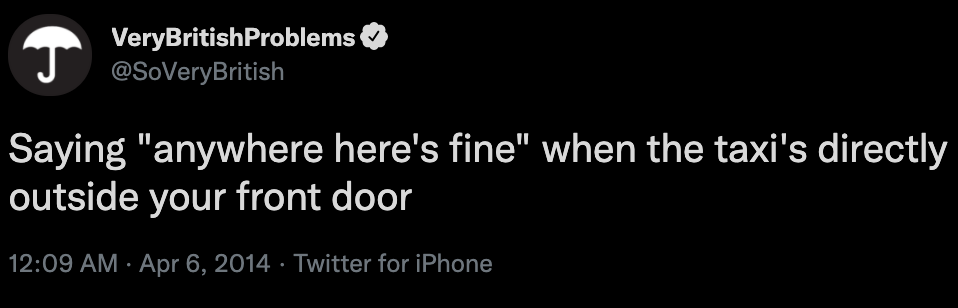
What do you say to your taxi driver as they approach the point where you want to get out of the cab?
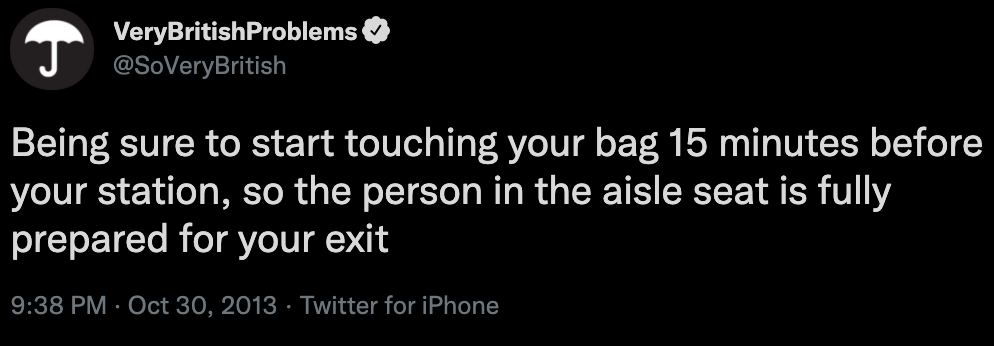
If you’re on a train, sitting in the window seat with a passenger next to you, and your stop is approaching, what do you do to signal to the passenger in the aisle seat that you will need to get up?
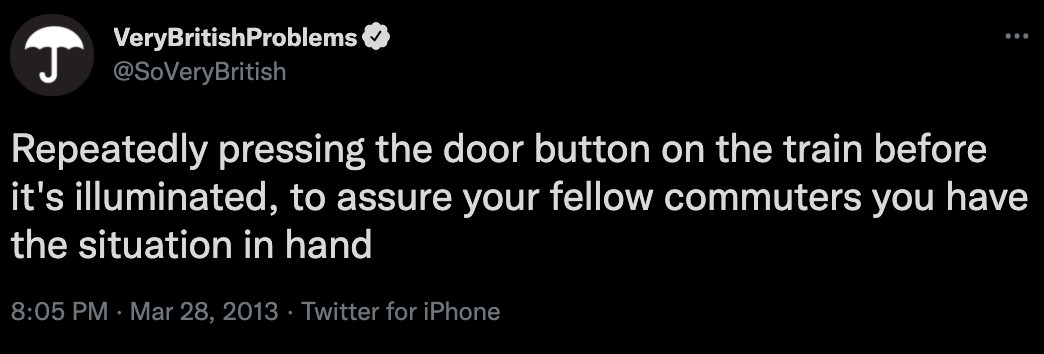
You’re standing at the exit door of the train as it is pulling into the station, slowly coming to a stop, and there is a crowd of other passengers right behind you, eager to get off the train. The “Open door” button isn’t yet illuminated. What do you do? Do you press the button?
How do you feel when the ticket inspector inspects your perfectly valid ticket?

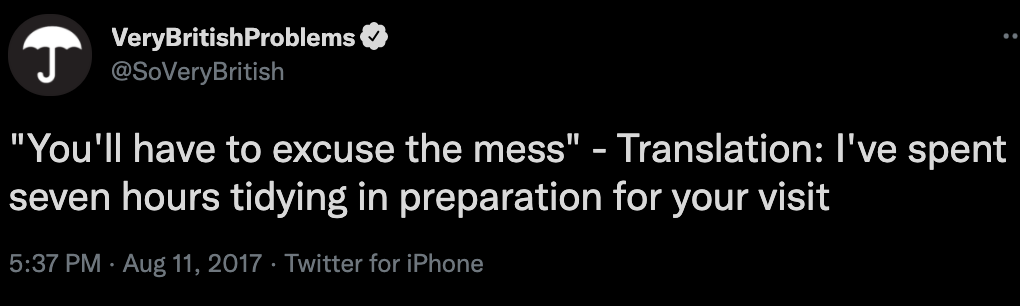
What do you say, modestly, to guests arriving in your home, even though you spent some time before their arrival, tidying things up?
There’s one last roast potato on the table at Sunday lunch. You want to eat it. How do you achieve this?

  1. Just take it and eat it
  2. Ask if you can eat it
  3. Offer it to everyone else first

Do you ever tell your housemates or family that you are “off to bed” but then just stare at your phone in bed for an hour?

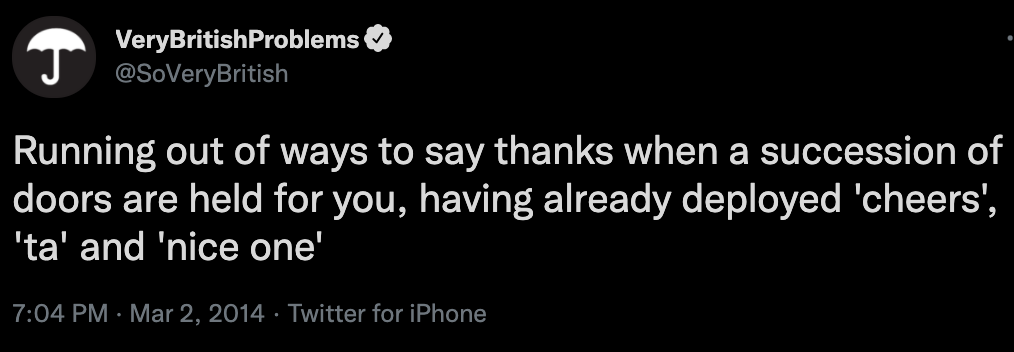
Imagine you are walking through a hallway with lots of doors in it, like in a library or something and you’re walking just behind a stranger who keeps having to hold the doors for you. How many different ways of saying “thanks” can you think of?
How do you end an email? Is there a subtly less friendly difference between kind regards and just regards?

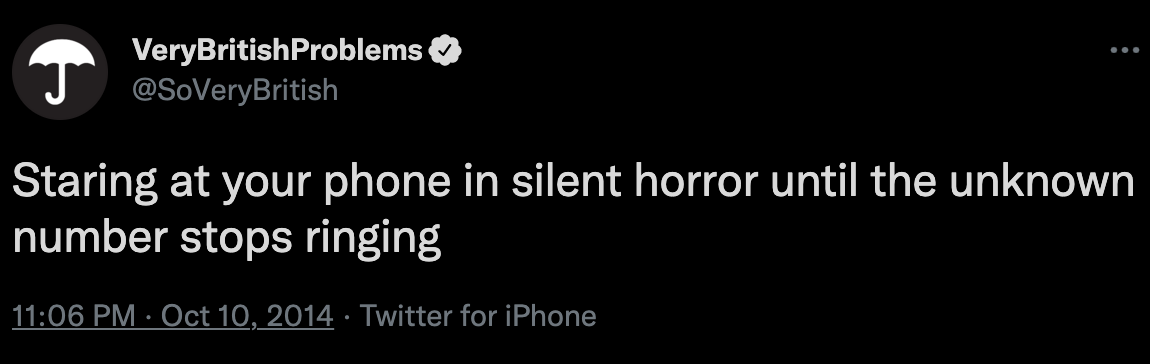
What do you do when you get an incoming call from an unknown number?
How good are you at overtaking someone on foot?

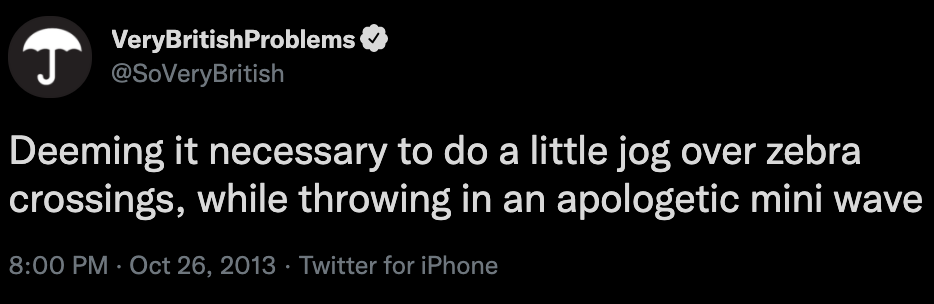
Do you feel it necessary to speed up at all, when walking over a zebra crossing?
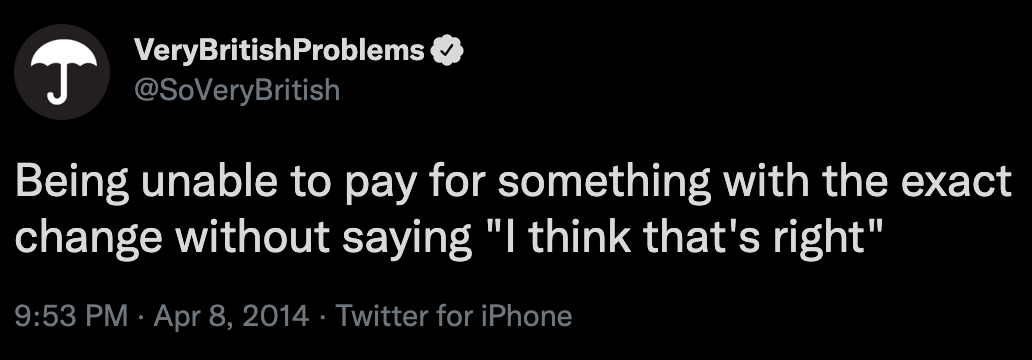
If you pay for something with exactly the right change, and you know it’s exactly the right change, do you wait for the cashier to count the money?

Links

www.ewmichael.com

www.levelupenglish.school

A reminder of the LEP Design Competition

I have had some entries already. If you’ve sent me something, then thank you. Please send your designs to podcastcomp@gmail.com and my brother and I will review the entries we receive, talk about them on the podcast and pick at least one to be featured in the LEP Merch store.
  • Think of a t-shirt that LEPsters would want to wear
  • PRIZE: The winning design will be put on t-shirts, mugs and other merch, and the winner will also win £80!
  • SPECS: A high-resolution transparent .PNG at 150dpi.  Minimum dimensions of at least 1500px by 1995px (not including outer transparent pixels).
  • CLOSING DATE: 22 October 2021
  • Send your t-shirt designs to podcastcomp@gmail.com

746. Karl Pilkington’s 3-Minute Wonders / Manchester Accent

Understand English as it is spoken by native speakers. Let’s listen to Karl Pilkington rambling about life, the universe & everything, and see what we can understand and learn. Karl is from Manchester, so we’ll be looking at some features of his accent, picking up plenty of vocabulary and having a bit of a laugh along the way.

Audio Version

Small Donate Button

[DOWNLOAD AUDIO]

Video Version

Full Episode Transcript

Hello LEPsters,

Welcome back to the podcast. How are you doing today? 

In this episode we’re going to do some intensive listening and use it as a chance to learn some vocabulary and pronunciation.

This episode should be a bit of a laugh as we’re going to take a deep dive into the world of Karl Pilkington and listen to his thoughts on some big issues like health, food, animals, holidays and just existence itself.

We’ll be looking at the different features of his Manchester accent, and there will be lots of vocabulary to pick up too as we are covering a range of different topics. You can also consider this as a little intensive listening test, as I will be setting questions that you have to find answers to, then going through each clip in detail and breaking it all down for language.

We last heard about Karl Pilkington on my podcast in episode 656 in which we listened to a couple of his Monkey News stories about a chimp that works on a building site and another chimp that pilots a space rocket. 

Do you remember that? If you don’t, then get the LEP app and listen to episode 656. It was a very popular episode and it should make you laugh out loud on a bus maybe. 

That was pretty funny stuff, and Karl is very funny even though he’s not actually a comedian.

Who is Karl Pilkington?

To be honest, Karl Pilkington was most well-known about 10 years ago
and these days he’s not in the public eye as much as he used to be,
but he’s still a fairly well-known person in the UK, especially for Ricky Gervais fans.

Karl is just an ordinary bloke from Manchester who met comedians Ricky Gervais and Stephen Merchant when he worked for them as a radio producer in London. 

Later, Ricky invited Karl to be on his podcast in order to broadcast his weird ideas and inane ramblings to the whole world, and the rest is history. 

The Ricky Gervais Podcast became a world record-breaker with over 300,000,000 downloads.

In episodes, Ricky, Steve & Karl would talk about big topics like religion, evolution, philosophy, nature, birth and death and Karl would often say some bizarre and hilarious things, apparently without intending to be funny.

Ricky was always slightly obsessed with Karl, and he always described him as “an idiot with a perfectly round head like an orange”. 

After being on Ricky’s podcast, Karl went on to become a fairly well-known figure in the UK, doing more podcasts with Ricky, then TV shows, books and documentaries like “An Idiot Abroad”.

Karl is known for his funny and slightly odd musings and observations about life. 

He comes from a working class background in the Manchester area, and his accent has many of the features that you would expect from that. 

Accent / Pronunciation

We will be going into the specific features of his accent in more detail as we go and this kind of follows on from episode 682 which was all about common features of pronunciation in England which are different to RP.

Which accent should you have?

So this episode is about one of the UK’s regional accents.

You might be thinking – Luke, by doing this episode are you saying that we should all learn to speak like Karl?

I’m not saying that. You can choose your accent, and many learners choose a neutral accent to learn, but it’s not all about learning an accent, it’s also about learning to understand different accents, and learning about the varieties of English that are out there.

So, you might not want to speak like Karl, but I certainly want you to understand Karl and the many millions of other people who speak English in a non-standard way.

So this episode is all about understanding an accent, rather than copying it. But of course you can copy Karl’s Mancunian accent if you like.

Vocabulary

There will also be plenty of vocabulary coming up too as we pick apart the things that Karl says and the way he says them.

You’ll find it listed on the screen on the video version and also presented in text form on the page for this episode on my website.

Video

We’re going to be using a series available on youtube in which Karl ponders certain big questions in just 3 minutes of video, originally broadcast on Channel 4 in the UK as part of their “3 Minute Wonders” series. 

These are short videos in which Karl talks about his fridge, health, food, animals and holidays, covering each topic with his usual ramblings, all delivered in that Manchester accent, know what I mean?

I have about 6 recordings, which are about 3 minutes each (this could become two episodes).

Before I play the recording I’ll give you a little bit of context and I’ll set some questions. 

Then you listen and try to get the answers. 

Then I’ll break it down – listening to each bit again, with some explanations if necessary.

We’ll also pay attention to pronunciation – specifically his Mancunian accent. I’m going to break that down too, exploring the main features of that particular accent.

And I’ll sum up some of the vocab from each clip before moving on to the next one.


#1 Karl on Life

Karl goes around a museum looking at meteorites, dinosaur skeletons and endangered animals (stuffed ones or models) and muses about life in general medical science.
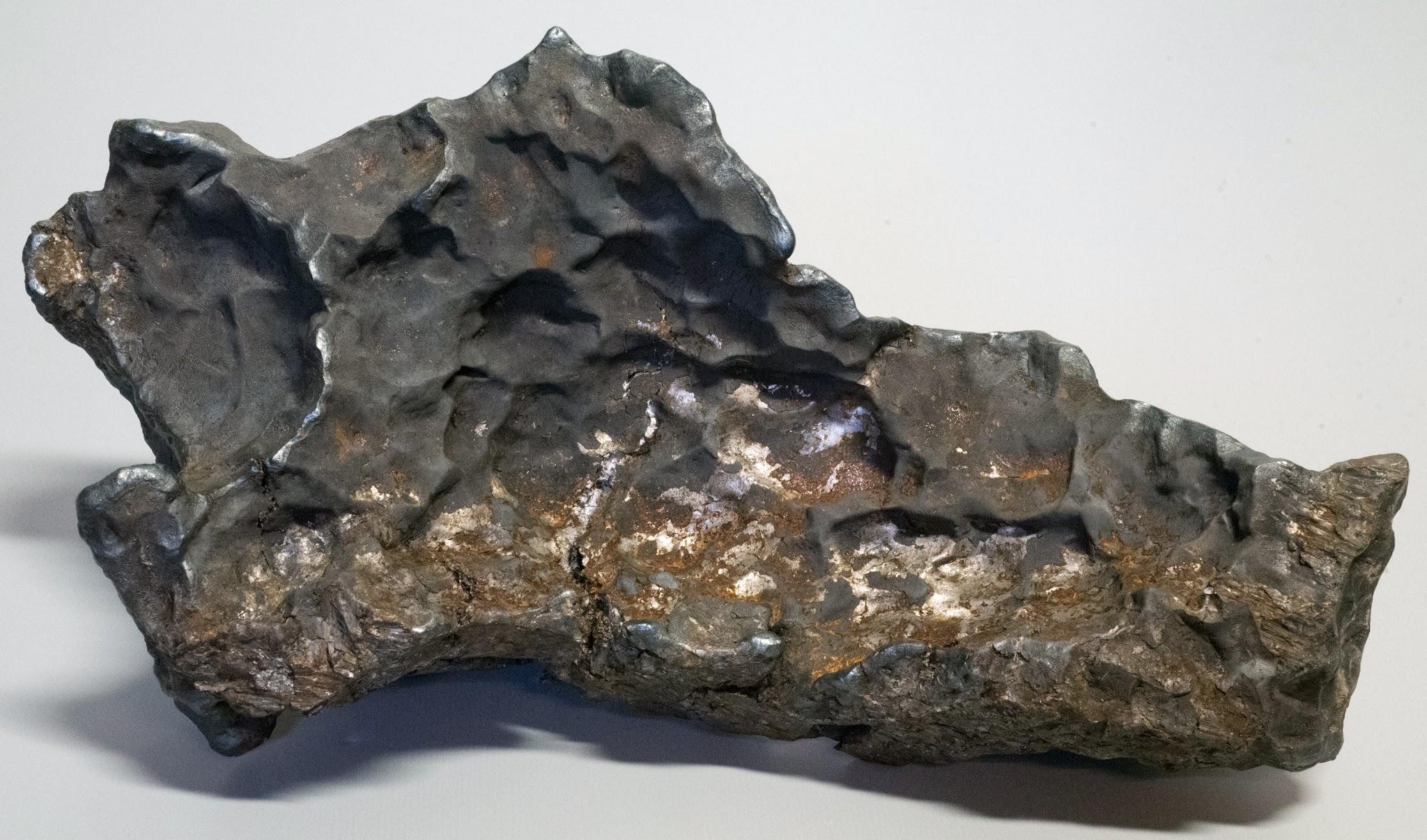
  1. What does Karl wonder about the big bang?
  2. What makes the meteorite room a bit disappointing?
  3. What’s Karl’s main criticism of humanity today?
  4. What does Karl think would happen if a dinosaur got loose and started to “run riot”?
  5. What’s Karl’s main point?

Vocabulary

  • The big bang
  • Did it only seem big because there was no other noise to drown it out at the time?
  • Meteorites (on earth)
  • Meteors (flying in earth’s atmosphere)
  • Asteroids (flying in space)
  • The edge is taken off it because that isn’t the only one.
  • I’m not surprised they went extinct, they’re all in here.
  • Enough’s enough. If your body is that done in, call it a day.
  • The more we know, the more we interfere.
  • Don’t interfere with nature and that.
  • Even if it was going round running riot they’d go “We don’t want it to go extinct
  • The panda is dying out.

Notes on Karl’s accent

Here’s a summary of the main points regarding Karl’s Manchester accent. 

Many of these features are common in people from the Manchester area, although not all people from Manchester will speak like this, and there are different degrees of it. 

This is certainly Karl’s Manchester accent in any case. 

A lot of what I’m about to say will include things brought up in the episode I did about Key Features of English accents, episode 682.

PRONUNCIATION #1

H dropping

  • Look, how many do you need?
  • I’m not surprised they went extinct, they’re all in here.
  • She’d had a new lung, a new heart
  • He puts his hand in and goes “Yep, it’s broke”
  • They weren’t doing anything. They weren’t jumping through hoops. (talking about animals in a zoo)
  • I don’t know if it’s cruel or not, to have them in there.
  • I’m 32, I think I’ve got the hang of it.

Glottal stops (/t/ sounds get replaced by /ʔ/ )

  • I’ll have a look at the meteorites.
  • If you’re going to eat a live animal, don’t eat one that’s got eight arms that can get hold of your neck.
  • Let me see them again when they’re better.

Go back to my episode called 682. Features of English Accents, Explained to find out more about glottal stops.


#2 Karl on Health

Karl recounts a conversation he had with a woman about going to the gym.

  1. Does Karl go to the gym?
  2. What does he think of the idea of breathing classes?
  3. What does he think of drinking 7 pints of water a day?
  4. What’s Karl’s argument for not going to the gym? Heart beats, tortoise

Vocabulary

  • I know what’s probably putting you off – the fact that it’s hard work.
  • Breathing classes – I’m 32 I think I’ve got the hang of it
  • My Dad’s like 60-odd. I’ve never seen him drink a pint of water, yet they’re telling us we should have, like, 7 pints a day or something, and then they wonder why there’s a water drought on.
  • They keep coming up with daft ways of keeping fit.
  • Chucking paint at each other. 

PRONUNCIATION #2

/æ/ not /ɑː/ (the “bath/trap split”, again)

Short A sound /æ/ in bath, podcast 

(gas and glass have the same vowel sound in Karl’s Manchester accent).

This is normal across all northern accents, and many accents in the midlands. I would use /ɑː/ because although I lived in the midlands for many years (half my childhood), my accent is mostly from the south because I’ve lived there more and my parents don’t have strong regional accents.

Come to my class. We do breathing classes.

/ʊ/ not /ʌ/

The U sound in but, enough and much.

I pronounce it /ʌ/ but Karl pronounces it more like /ʊ/

Do you go to the gym much? 


#3 Karl on Food

Karl talks about a new trend – eating things which shouldn’t be eaten. 

Coming from England, Karl thinks it’s weird to eat certain things that might be eaten in other cultures, like live octopus, insects, frogs, snails, probably raw meat, raw fish and sushi.

  1. What is the danger of eating a live octopus?
  2. What’s Karl’s issue with kids and food today?
  3. What does Karl think about eating dog?

Vocabulary

  • They choke you. Why would you want to eat that?
  • If we’re eating octopuses, why are dogs getting away with it?

END OF PART 1 – TO BE CONTINUED IN PART 2

741. Top Jokes from Edinburgh Fringe 2021, Explained

Learn English from some jokes in this episode as we go through 9 jokes chosen as the best of the Edinburgh Festival Fringe stand up comedy scene this year (2021). Let me tell you the jokes, see if you understand them, and then I will break them down for language learning opportunities. Video version available.

Audio Version

Small Donate Button

[DOWNLOAD AUDIO]

Video Version

Episode Transcript / Notes

Top Jokes from Edinburgh Fringe 2021, Explained

Hello listeners, hello video viewers. How are you? How is the world treating you today? Not too badly I hope. 

Here’s a new episode. So stick with me. Listen closely. Pay attention. You can definitely learn some new English from this. Let’s get started.

Introduction

It’s time to dissect the frog again as we look at some of the most popular jokes from the Edinburgh Festival Fringe of this year 2021. I’m going to read them to you and then explain them so you can understand them fully and also learn some new vocabulary in the process. 

This is something I’ve been doing every year at the end of the Ediburgh Festival when the list of the most popular jokes is published in the newspapers. 

Last year I didn’t do one of these episodes because Ed Fringe got cancelled due to Covid-19. 

But the festival was back this year, so here we go again. Let’s find some popular jokes told by comedians at the fringe and use them to learn English.

Edinburgh Festival Fringe

Just in case you don’t know, the Edinburgh Fringe (full name: The Edinburgh Festival Fringe) is a huge comedy festival that happens every August in Edinburgh, the capital city of Scotland.

Sometimes it’s called The Edinburgh Festival Fringe, Edinburgh Fringe, The Edinburgh Comedy Festival, Ed Fringe, just The Fringe or simply Edinburgh.

It’s one of the biggest comedy festivals in the world, and every August comedians travel to the city in order to perform comedy to the large crowds of people who travel there. 

For comedians August in Edinburgh is a huge opportunity to get exposure and experience, but it is very tough, especially at the beginning when you have to drum up an audience of people to come to your shows every day.

Just in case you didn’t know, stand-up is a form of entertainment that involves one comedian standing on stage with a microphone telling stories and jokes in an effort to make the audience laugh. It is an extremely popular form of entertainment in the English speaking world.

This episode is about specific jokes told by comedians during the fringe this year, but stand-up comedians don’t really just go up and tell individual jokes one after the other (except in the case of some specific comedians), rather they fit their jokes into stories, observations about the world or confessions about themselves.

However, this list of the “best jokes from the fringe” just picks simple one or two line jokes from people’s performances.

Lower Your Expectations Now 😅

I expect that taking these jokes away from their original performances will not help the jokes. 

They will probably be less funny outside the comedy show that they came from because we’re going to remove the context of the joke, the attitude and personality of the comedian who told the joke and what was happening in the room that particular evening. All those elements have a huge impact on how funny the joke will be.

So, it’s not very fair to judge these jokes on their own like this, outside of their original context, but this is still an interesting experiment in learning English, so here we go.

Here’s how we’re going to do this

  1. First I will read each joke one by one. 
  • There are 9 jokes in total. 
  • How many jokes do you “get”?
  • If you “get” a joke, it means you understand why it is funny.
  • Ideally you will laugh, but you can also groan.
  • If you don’t understand it you need to say “I don’t get it!
  • The main thing is: You have to notice and acknowledge that a joke has been told to you.

So, listen to the jokes, do you get them all?

  1. Then I will go through each joke one by one and I will break them all down, explaining exactly how they work, showing you double meanings, explaining any specific vocabulary or cultural reference points and giving you all the information you need to be able to understand these jokes properly.

There is a lot of vocabulary to be learned from this, which I will highlight as we go through and recap at the end.

So, get ready, it’s time to dissect the frog again.

Of course, I have to say the quote: 

Explaining a joke is like dissecting a frog. You can learn something from it, but the frog dies in the process.

I expect I will be killing all these jokes by explaining them. 

You’re not meant to explain jokes, and if you do, the joke suddenly becomes less funny. 

Most jokes work by surprise. 

Getting the double meaning instantly is usually the only way to find a joke funny. 

So I can’t guarantee that you will laugh at these jokes, but this is certainly going to be good for your English in any case.

Joke types

A lot of these jokes use 

  • synonyms (different words with a similar meaning),
  • common fixed expressions and sayings
  • homophones (different words that sound the same)
  • similies (finding similarities between otherwise different things), 
  • pull back & reveal (revealing extra information to change the situation)

Top Jokes from Edinburgh Fringe 2021

I’m getting this list from the website Chortle.co.uk which is the UK’s number 1 comedy website.

https://www.chortle.co.uk/news/2021/08/22/49087/masai_graham_wins_the_dave%2A_joke_of_the_fringe

1. “I thought the word ‘Caesarean’ began with the letter ‘S’ but when I looked in the dictionary, it was in the ‘C’ section.”

– Masai Graham 

2. “My therapist told me, ‘A problem shared, is a hundred quid’.” 
– Ivor Dembina

3. “Me and my ex were into role play. I’d pretend to be James Bond and she’d pretend she still loved me.” 

-Tom Mayhew

4. “The roman emperor’s wife hates playing hide and seek because wherever she goes Julius Caesar.”

– Adele Cliff

5. “Marvin Gaye used to keep a sheep in my vineyard. He’d herd it through the grapevine.”

– Leo Kearse

6 “My grandparents were married for forty years, but everything took longer back then.”

– Will Mars

7. “I think Chewbacca is French because he understands English but refuses to speak it.” 

– Sameer Katz

8. “I don’t know what you call a small spillage from a pen but I have an inkling.” 

– Rich Pulsford

9. “People say zoos are inhumane. But that’s because they’re for animals.” 

– Sameer Katz

Vocabulary Focus

Now let’s go through those jokes again and break them down so you can understand them fully, picking up bits of vocabulary along the way.

Broken down versions (sorry frogs)

1. “I thought the word ‘Caesarean’ began with the letter ‘S’ but when I looked in the dictionary, it was in the ‘C’ section.” 

– Masai Graham

Vocabulary

A caesarean

A C-section


2. “My therapist told me, ‘A problem shared, is a hundred quid’.” – Ivor Dembina

Vocabulary

Common phrase: “A problem shared is a problem halved.”

Quid

Halved (verb)


3. “Me and my ex were into role play. I’d pretend to be James Bond and she’d pretend she still loved me.” – Tom Mayhew

Vocabulary

To be into role play

Role play – pretending to be someone else, often during sex to make it more interesting.

To pretend to be someone / to do something

He pretended he was James Bond

She pretended she still loved him.


4. “The Roman emperor’s wife hates playing hide and seek because wherever she goes Julius Caesar.” – Adele Cliff

This is a pun – a word joke and it’s just that one thing sounds like something else.

“Julius Caesar” sounds like Julius sees her, which is why his wife hates playing hide and seek because Julius always sees her. Julius Caesar. I think you get it.

Vocabulary

To play hide and seek

5. “Marvin Gaye used to keep a sheep in my vineyard. He’d herd it through the grapevine.” – Leo Kearse

Oooh, this is a bit of a groaner. That’s where you go Oooooh like it almost hurts. 

“Heard it through the grapevine” is one of Marvin Gaye’s most famous songs.

“Herd” can mean to move a group of animals in a certain direction, like sheep or cows. You herd your sheep into a field.

Marvin used to keep a sheep in my vineyard. A vineyard is a place where you grow grapes for wine. 

The grapevine is where the grapes grow, but there’s also an idiom “through the grapevine” meaning when you hear people gossiping about something, or you over hear people talking about something. 

In the case of the song, he hears that his girlfriend is cheating on him and he hears it through the grapevine. 

He heard it through the grapevine. He heard rumours or gossip about it.

He’d herd it through the grapevine. He attempted to move the sheep around through the grapevines of the plants in the vineyard.

Vocabulary

To herd sheep

To hear something on/through the grapevine

Vinyard

This is too much of a stretch and if you get the joke please let me know. Write a comment in the comment section – do you get the Marvin Gaye joke?


6. “My grandparents were married for forty years, but everything took longer back then.” – Will Mars

This is quite a clever little joke. Everything took longer in the past – travelling, communicating etc. 

Marriages seemed to last longer, but everything took longer back then.


7. “I think Chewbacca is French because he understands English but refuses to speak it.” – Sameer Katz

This is quite funny and of course it hits two of my favourite notes, well three in fact: Star Wars, France and speaking English. 

There is a common misconception that French people arrogantly refuse to speak English in Paris let’s say, 

but I find that French people are more willing to speak English than it seems, and in fact they’re a bit more shy than arrogant, and if a French person in Paris speaks French to you, that’s quite normal as you are in France. 

Also, rather than being arrogant, a lot of French people just feel quite self conscious about their accent and certain common mistakes that French people often make. They also might have bad memories from English lessons at school which knocked all the confidence out of them, and they’re afraid to be judged by each other. So it’s more likely to be shyness than arrogance.


8. “I don’t know what you call a small spillage from a pen but I have an inkling.” – Rich Pulsford

This is a clever little joke. 

To have an inkling means to have a suspicion or an idea of something.

“I don’t know who stole the last biscuit, but I have an inkling. Or I have an inkling of an idea who took that biscuit, and I think it was you!”

But an inkling does sound like a small spillage of ink from a pen. A small puddle of ink, or ink on your hand. An inkling. 

What do we call that? I don’t know, but I have an inkling!”

Vocabulary

To have an inkling

A spillage


9. “People say zoos are inhumane. But that’s because they’re for animals.” – Sameer Katz

I’m not sure I have to explain that, do I?

Being humane means treating people in reasonable and humanistic manner. 

Treating people with respect, dignity, justice. 

Inhumane is the opposite – and although it includes the word human, we do use this word to refer to the cruel treatment of animals.

Keeping animals in a cage is inhumane. 

Even though they’re animals, we still use the word inhumane, and this is just a funny little thing that can make you laugh when you notice it.

Vocabulary

Humane

Inhumane

Vocabulary Review

  • A caesarean
  • A C-section
  • “A problem shared is a problem halved.”
  • Quid
  • Halve (verb)
  • To be into role play
  • To pretend to be someone / to do something
  • To play hide and seek
  • To herd sheep
  • To hear something on/through the grapevine
  • Vinyard
  • To have an inkling
  • A spillage
  • Humane
  • Inhumane 

739. The Escaped Man by CT Platt (Learn English with Short Stories)

Reading a short story presented on Commaful.com. The Escaped Man is a mystery full of tension and intrigue. Listen closely as I break it all down and explain the vocabulary fully. YouTube video version also available.

Audio Version

Small Donate Button

[DOWNLOAD AUDIO]

Video Version

Introduction Transcript & Links

Hello listeners and video viewers,

It’s time to do another story on the podcast. This time I’m going to be reading a story called The Escaped Man which was written by CT Platt and is presented on the Commaful website.

Commaful.com is a website where you can find short stories, fan fiction and other reading texts and it’s all presented in quite a nice and easy-to-read format.

I’m going to read the story to you once and all you have to do is follow it, and hopefully enjoy it. I have a couple of questions for you to help you stay focused on your listening.

Then I’ll read through the story again and break it down line by line, explaining, pointing out and teaching you bits of vocabulary and grammar as I go.

Learning English through stories is a great idea and tends to work because it places language in a vivid context and is generally quite entertaining and fun.

So listen to the story and then let me break all the language down for you bit by bit.

Just before I read the story, here are a couple of questions for you.

Where does the story take place? How do you know?
Is this American English or British English? How do you know?
What is going to happen next?

OK, let’s start.

https://commaful.com/play/lisa/the-escaped-man/

Full Script of the Story

https://www.wattpad.com/543021670-suspense-stories-the-escaped-man-c-t-platt-2017
736. The War of the Worlds by H.G. Wells [Part 3] Learn English with Stories

The final part of this series in which I am reading from the classic story The War of the Worlds by H.G. Wells, while explaining and clarifying the English which comes up. Full transcript available and YouTube video version too.

Audio Version

Small Donate Button

[DOWNLOAD AUDIO]

Video Version

Full Transcript

Please watch parts 1 and 2 before watching this. Links in the description.

Click here for part 1

Click here for part 2

Recap of the story so far

Without realising it, the people of earth have been attacked by an aggressive alien species from Mars, with the intention of colonising our planet while escaping their home planet which has become uninhabitable.

The Martians are vastly superior to us in terms of their intelligence and technology. They are also unfriendly. Very unfriendly. Humans are now reduced to mere animals or insects in the presence of these things.

Human society has quickly turned to chaos and destruction as the Martians begin their campaign to take our planet.

The aliens first landed in a cylinder which fell from space with a green flash. After the cylinder opened, revealing the visitors to be awkward and clumsy in our atmosphere, their technology proved to be devestatingly powerful. They are armed with a heat-ray which they have used to clear out all life surrounding the fallen cylinder.

The narrator of the story witnessed the Martians emerging from their cylinder and the ruthless destructive power of their heat ray, but still does not yet realise the full scale of the invasion. He decides to escape the area and travel in the direction of London.

During the night, he sees another cylinder landing, and then sees the first Martian tripods striding over the countryside. These are the vehicles the Martians use and they are colossal and formidable. Suddenly the clumsy Martians are mobile and far more physically powerful than in their normal, naked form.

Reading an extract from chapter 12 (action packed stuff)

Summary of Chapter 11 (next part of the story)
From the upstairs window of his study the narrator observes the destruction of his village and the fires all around the common, as well as the outlines of three creatures moving in the pit, which he can see from a distance.

He hardly recognizes his surroundings. The narrator begins to comprehend that the creatures from the cylinder operate the tripods, comparing them to a human-driven steam engine.

He invites a soldier outside the house to hide inside. The man recounts the futile military efforts against the Martians, who easily destroyed both companies and their weaponry before emerging as tripods from the pit and destroying the railway station and a train. The artilleryman managed to escape.

The two men look again from the window to see three tripods at the pit. As the sun comes up the narrator sees destruction “so indiscriminate and so universal” as to be unprecedented in human warfare.

HG Wells describes the horrific feeling of realising that these Martians are far more powerful than humans. Each cylinder contains at least three tripods, and each tripod is armed with a heat ray. Later we learn more about the martians and their technology as the narrator manages to observe them more, but they are still completely mysterious.

Meanwhile, people have become like refugees from a warzone and there is general chaos as people attempt to escape, get resources, look after themselves etc.

Shepperton Station has become a target for the Martians in their tripods and they have been destroying it, the railway lines and trains. This is especially poignant because they are targeting our infrastructure and our technology seems infinitely primitive to that of the Martians, and we are often compared to animals, insects, bugs or even microorganisms in comparison to our alien visitors.

HG Wells makes a point of observing how society reacts to a moment like this and how fragile it is, while also contrasting the familiar cosy surroundings of the English home counties, with the bizarre, grotesque and strange images of these very bad aliens from Mars.

The narrator and the soldier he met choose to leave the house. The soldier wants to go to London and the narrator wants to go back to his wife in Leatherhead.

They end up in Weybridge which a town just on the river Thames, with London to the east and the Thames Valley to the west.

This is a place where the Thames meets The Wey, another river. It’s a sort of port where you can get a ferry across to the other side. Crowds of people are gathered there, hoping to get on a ferry. The army have placed rows of large artillery guns behind some trees as they expect the tripods to come from a nearby town that is currently under attack. This all happens close to the edge of the water and is full of really precise and specific vocabulary to describe the action that takes place.

XII.
WHAT I SAW OF THE DESTRUCTION OF WEYBRIDGE AND SHEPPERTON. (extract)

We remained at Weybridge until midday, and at that hour we found ourselves at the place near Shepperton Lock where the Wey and Thames join. Part of the time we spent helping two old women to pack a little cart. The Wey has a treble mouth, and at this point boats are to be hired, and there was a ferry across the river. On the Shepperton side was an inn with a lawn, and beyond that the tower of Shepperton Church rose above the trees.

Here we found an excited and noisy crowd of fugitives. As yet the flight had not grown to a panic, but there were already far more people than all the boats going to and fro could enable to cross. People came panting along under heavy burdens; one husband and wife were even carrying a small outhouse door between them, with some of their household goods piled thereon. One man told us he meant to try to get away from Shepperton station.

There was a lot of shouting, and one man was even jesting. The idea people seemed to have here was that the Martians were simply formidable human beings, who might attack and sack the town, to be certainly destroyed in the end. Every now and then people would glance nervously across the Wey, at the meadows towards Chertsey, but everything over there was still.

Across the Thames, except just where the boats landed, everything was quiet, in vivid contrast with the Surrey side. The people who landed there from the boats went tramping off down the lane. The big ferryboat had just made a journey. Three or four soldiers stood on the lawn of the inn, staring and jesting at the fugitives, without offering to help. The inn was closed, as it was now within prohibited hours.

“What’s that?” cried a boatman, and “Shut up, you fool!” said a man near me to a yelping dog. Then the sound came again, this time from the direction of Chertsey, a muffled thud—the sound of a gun.

The fighting was beginning. Almost immediately unseen batteries across the river to our right, unseen because of the trees, took up the chorus, firing heavily one after the other. A woman screamed. Everyone stood arrested by the sudden stir of battle, near us and yet invisible to us. Nothing was to be seen save flat meadows, cows feeding unconcernedly for the most part, and silvery pollard willows motionless in the warm sunlight.

“The sojers’ll stop ’em,” said a woman beside me, doubtfully. A haziness rose over the treetops.

Then suddenly we saw a rush of smoke far away up the river, a puff of smoke that jerked up into the air and hung; and forthwith the ground heaved under foot and a heavy explosion shook the air, smashing two or three windows in the houses near, and leaving us astonished.

“Here they are!” shouted a man in a blue jersey. “Yonder! D’yer see them? Yonder!”

Quickly, one after the other, one, two, three, four of the armoured Martians appeared, far away over the little trees, across the flat meadows that stretched towards Chertsey, and striding hurriedly towards the river. Little cowled figures they seemed at first, going with a rolling motion and as fast as flying birds.

Then, advancing obliquely towards us, came a fifth. Their armoured bodies glittered in the sun as they swept swiftly forward upon the guns, growing rapidly larger as they drew nearer. One on the extreme left, the remotest that is, flourished a huge case high in the air, and the ghostly, terrible Heat-Ray I had already seen on Friday night smote towards Chertsey, and struck the town.

At sight of these strange, swift, and terrible creatures the crowd near the water’s edge seemed to me to be for a moment horror-struck. There was no screaming or shouting, but a silence. Then a hoarse murmur and a movement of feet—a splashing from the water. A man, too frightened to drop the portmanteau he carried on his shoulder, swung round and sent me staggering with a blow from the corner of his burden. A woman thrust at me with her hand and rushed past me. I turned with the rush of the people, but I was not too terrified for thought. The terrible Heat-Ray was in my mind. To get under water! That was it!

“Get under water!” I shouted, unheeded.

I faced about again, and rushed towards the approaching Martian, rushed right down the gravelly beach and headlong into the water. Others did the same. A boatload of people putting back came leaping out as I rushed past. The stones under my feet were muddy and slippery, and the river was so low that I ran perhaps twenty feet scarcely waist-deep. Then, as the Martian towered overhead scarcely a couple of hundred yards away, I flung myself forward under the surface.

The splashes of the people in the boats leaping into the river sounded like thunderclaps in my ears. People were landing hastily on both sides of the river. But the Martian machine took no more notice, for the moment, of the people running this way and that, than a man would of the confusion of ants in a nest against which his foot has kicked.

When, half suffocated, I raised my head above water, the Martian’s hood pointed at the batteries that were still firing across the river, and as it advanced it swung loose what must have been the generator of the Heat-Ray.

In another moment it was on the bank, and in a stride wading halfway across. The knees of its foremost legs bent at the farther bank, and in another moment it had raised itself to its full height again, close to the village of Shepperton.

Forthwith the six guns which, unknown to anyone on the right bank, had been hidden behind the outskirts of that village, fired simultaneously. The sudden near concussion, the last close upon the first, made my heart jump. The monster was already raising the case generating the Heat-Ray as the first shell burst six yards above the hood.

I gave a cry of astonishment. I saw and thought nothing of the other four Martian monsters; my attention was riveted upon the nearer incident. Simultaneously two other shells burst in the air near the body as the hood twisted round in time to receive, but not in time to dodge, the fourth shell.

The shell burst clean in the face of the Thing. The hood bulged, flashed, was whirled off in a dozen tattered fragments of red flesh and glittering metal.

“Hit!” shouted I, with something between a scream and a cheer.
I heard answering shouts from the people in the water about me. I could have leaped out of the water with that momentary exultation.

The decapitated colossus reeled like a drunken giant; but it did not fall over. It recovered its balance by a miracle, and, no longer heeding its steps and with the camera that fired the Heat-Ray now rigidly upheld, it reeled swiftly upon Shepperton. The living intelligence, the Martian within the hood, was slain and splashed to the four winds of heaven, and the Thing was now but a mere intricate device of metal whirling to destruction. It drove along in a straight line, incapable of guidance. It struck the tower of Shepperton Church, smashing it down as the impact of a battering ram might have done, swerved aside, blundered on and collapsed with tremendous force into the river out of my sight.

A violent explosion shook the air, and a spout of water, steam, mud, and shattered metal shot far up into the sky. As the camera of the Heat-Ray hit the water, the latter had immediately flashed into steam. In another moment a huge muddy tidal wave, almost scaldingly hot, came sweeping round the bend upstream. I saw people struggling shorewards, and heard their screaming and shouting faintly above the seething and roar of the Martian’s collapse.

For a moment I heeded nothing of the heat, forgot the patent need of self-preservation. I splashed through the tumultuous water, pushing aside a man in black to do so, until I could see round the bend. Half a dozen deserted boats pitched aimlessly upon the confusion of the waves. The fallen Martian came into sight downstream, lying across the river, and for the most part submerged.

Thick clouds of steam were pouring off the wreckage, and through the tumultuously whirling wisps I could see, intermittently and vaguely, the gigantic limbs churning the water and flinging a splash and spray of mud and froth into the air. The tentacles swayed and struck like living arms, and, save for the helpless purposelessness of these movements, it was as if some wounded thing were struggling for its life amid the waves. Enormous quantities of a ruddy-brown fluid were spurting up in noisy jets out of the machine.

My attention was diverted from this death flurry by a furious yelling, like that of the thing called a siren in our manufacturing towns. A man, knee-deep near the towing path, shouted inaudibly to me and pointed. Looking back, I saw the other Martians advancing with gigantic strides down the riverbank from the direction of Chertsey. The Shepperton guns spoke this time unavailingly.

At that I ducked at once under water, and, holding my breath until movement was an agony, blundered painfully ahead under the surface as long as I could. The water was in a tumult about me, and rapidly growing hotter.

When for a moment I raised my head to take breath and throw the hair and water from my eyes, the steam was rising in a whirling white fog that at first hid the Martians altogether. The noise was deafening. Then I saw them dimly, colossal figures of grey, magnified by the mist. They had passed by me, and two were stooping over the frothing, tumultuous ruins of their comrade.

The third and fourth stood beside him in the water, one perhaps two hundred yards from me, the other towards Laleham. The generators of the Heat-Rays waved high, and the hissing beams smote down this way and that.

The air was full of sound, a deafening and confusing conflict of noises—the clangorous din of the Martians, the crash of falling houses, the thud of trees, fences, sheds flashing into flame, and the crackling and roaring of fire. Dense black smoke was leaping up to mingle with the steam from the river, and as the Heat-Ray went to and fro over Weybridge its impact was marked by flashes of incandescent white, that gave place at once to a smoky dance of lurid flames. The nearer houses still stood intact, awaiting their fate, shadowy, faint and pallid in the steam, with the fire behind them going to and fro.

For a moment perhaps I stood there, breast-high in the almost boiling water, dumbfounded at my position, hopeless of escape. Through the reek I could see the people who had been with me in the river scrambling out of the water through the reeds, like little frogs hurrying through grass from the advance of a man, or running to and fro in utter dismay on the towing path.

Then suddenly the white flashes of the Heat-Ray came leaping towards me. The houses caved in as they dissolved at its touch, and darted out flames; the trees changed to fire with a roar. The Ray flickered up and down the towing path, licking off the people who ran this way and that, and came down to the water’s edge not fifty yards from where I stood. It swept across the river to Shepperton, and the water in its track rose in a boiling weal crested with steam. I turned shoreward.

In another moment the huge wave, well-nigh at the boiling-point had rushed upon me. I screamed aloud, and scalded, half blinded, agonised, I staggered through the leaping, hissing water towards the shore. Had my foot stumbled, it would have been the end. I fell helplessly, in full sight of the Martians, upon the broad, bare gravelly spit that runs down to mark the angle of the Wey and Thames. I expected nothing but death.

I have a dim memory of the foot of a Martian coming down within a score of yards of my head, driving straight into the loose gravel, whirling it this way and that and lifting again; of a long suspense, and then of the four carrying the debris of their comrade between them, now clear and then presently faint through a veil of smoke, receding interminably, as it seemed to me, across a vast space of river and meadow. And then, very slowly, I realised that by a miracle I had escaped.

Summary (AKA – what the hell just happened?)

The two men reach a chaotic scene in Weybridge as people crowd the railway station and the ferry in an effort to leave.
Suddenly they hear gunfire and a large explosion, and four tripods come into view across the river.
The narrator hides in the river.
Six guns hidden in the woods fire on the nearest tripod.
One shell strikes the tripod and gruesomely kills the Martian inside.
Unguided but still moving, the tripod smashes into a church and falls into the river.
The other Martians come to the fallen tripod, shooting their Heat-Rays at the village and destroying the opposition.
The Heat-Ray from the fallen tripod heats the water in the river and scalds the narrator before he manages to escape.

Final comments and analysis

It’s possible to see various interpretations of this story, or subtexts to the story.

Here are some.

The complacency of humans
As the dominant species on earth for hundreds of thousands of years, we have become complacent about our position in the natural hierarchy, and this is a mistake. Humans could easily be removed from this dominant position by things we aren’t even aware of. In the story this means intelligent creatures from another planet. In reality this could be something like the coronavirus or just something else we don’t usually think about.

How would human society cope with a crisis like this?
This is a common theme in disaster movies, zombie films, science fiction etc. All it takes is for something to disrupt our carefully organised society and things can descend into chaos quite easily, and this often brings out the worst in people. Normal citizens can quickly become immoral and do bad things, when the structure of society collapses and we end up having to fight for our survival.

Treatment of Animals
The story makes us think about the way we treat animals, which are below us in the power hierarchy on earth. Perhaps we should be more compassionate and kind to animals. In fact this is one of the only conclusions the narrator reaches in this story, as he suddenly understands what it means to be ruled over by a superior species.

The bigger they come, the harder they fall.

Microorganisms and viruses might be the most powerful forces on earth.

More themes here including technology, fear, power, and Familiar versus Strange
https://www.coursehero.com/lit/The-War-of-the-Worlds/themes/

A sample from coursehero.com
Technology
The benefits, possibilities, and potential threats of technology—represented in the Martian tripods—make technology a pervasive theme in the novel. Following the Industrial Revolution, technology changed society dramatically—from travel, to work, to communication. Virtually no part of life was untouched by new inventions. The benefits provided by these new machines meant people could accomplish tasks faster, easier, and often independently.

But as ever with modern science fiction stories, there is an element of fear regarding advancements in technology and how we may ultimately be surpassed by technological innovations.

This is where we’re going to stop.


I seriously hope you enjoyed this!

If you’re still listening or watching, then “hello”. Thanks for sticking with this. I guess it must mean you’ve been enjoying it.

I’m sure it’s been challenging at times, but to be honest I also feel this is difficult to follow when I read it. There’s a sense that things are just beyond your imagination, and that your mind has to do quite a lot of work to understand the fairly complex descriptions being given. This is not quite the same as watching a film where everything is shown. Or maybe it’s like watching a really well-directed film where you never quite see clearly what is happening, and this adds to the drama and excitement.

Anyway – thank you for sticking with this and listening all the way through.

Let me know what you think of this, and I highly recommend reading the rest of the story. There’s a lot more action and a few more close encounters with the Martians and their tripods, and of course the ending is very clever. I won’t spoil it. The book is better than the film though, I assure you!

In terms of English, I hope you have found it interesting to hear some samples of old fashioned English from the 19th century. I would say it is broadly modern English, but with a more formal style. It’s really enjoyable though. I love the descriptiveness and the general command over the language is a joy to behold.

Don’t forget you can get the full text for this episode printed right there on the page for this episode, and there’s the YouTube video version as well to enjoy where you can see text on the screen as you read it.

Listen to LEP wherever you get your podcasts. Don’t forget to like and subscribe.

Leave a positive review on iTunes and check out my free app.

And consider signing up to LEP Premium to get specific lessons on vocabulary, pronunciation and grammar. teacherluke.co.uk/premiuminfo

Thanks for listening.

All the best,

Bye bye bye bye

735. The War of the Worlds by H.G. Wells [Part 2] Learn English with Stories

Continuing to read extracts from this fantastic science fiction story from the 19th century. Follow the plot and pick up some English in the process. Full transcript available, and a YouTube version too.

Audio Version

Small Donate Button

[DOWNLOAD AUDIO]

Video Version

Full Transcript

Watch PART 1 before you watch this! Links in the description.

Click here for part 1

Click here for part 3

Recap of the story so far

6 years prior to the main events of the story, explosions are observed on the surface of Mars, but scientists assume they are gas or volcanic eruptions and are nothing to worry about.

Then, one night, a meteor falls to earth in green flash. The astronomer who finds the fallen meteorite in a pit of sand in a nearby common discovers that the object is a cylinder, is making strange noises and is even beginning to open and assumes there must be people inside it.

A crowd gathers, including the narrator of this story. The cylinder opens slowly and people are shocked and horrified to see the hideous and frightening creatures inside. They seem slow and heavy, as if earth’s atmosphere makes things difficult for them. Their appearance is a huge shock to everyone.

One person has fallen into the pit and it’s possible that they have been killed.

The narrator, although terrified, is also intensely curious about these visitors, as are the other witnesses at the sand pits where the cylinder has landed.

V.
THE HEAT-RAY.
After the glimpse I had had of the Martians emerging from the cylinder in which they had come to the earth from their planet, a kind of fascination paralysed my actions. I remained standing knee-deep in the heather, staring at the mound that hid them. I was a battleground of fear and curiosity.
I did not dare to go back towards the pit, but I felt a passionate longing to peer into it. I began walking, therefore, in a big curve, seeking some point of vantage and continually looking at the sand-heaps that hid these new-comers to our earth. Once a leash of thin black whips, like the arms of an octopus, flashed across the sunset and was immediately withdrawn, and afterwards a thin rod rose up, joint by joint, bearing at its apex a circular disk that spun with a wobbling motion. What could be going on there?
Most of the spectators had gathered in one or two groups—one a little crowd towards Woking, the other a knot of people in the direction of Chobham. Evidently they shared my mental conflict. There were few near me. One man I approached—he was, I perceived, a neighbour of mine, though I did not know his name—and accosted. But it was scarcely a time for articulate conversation.
“What ugly brutes!” he said. “Good God! What ugly brutes!” He repeated this over and over again.
“Did you see a man in the pit?” I said; but he made no answer to that. We became silent, and stood watching for a time side by side, deriving, I fancy, a certain comfort in one another’s company. Then I shifted my position to a little knoll that gave me the advantage of a yard or more of elevation and when I looked for him presently he was walking towards Woking.
The sunset faded to twilight before anything further happened. The crowd far away on the left, towards Woking, seemed to grow, and I heard now a faint murmur from it. The little knot of people towards Chobham dispersed. There was scarcely an intimation of movement from the pit.
It was this, as much as anything, that gave people courage, and I suppose the new arrivals from Woking also helped to restore confidence. At any rate, as the dusk came on a slow, intermittent movement upon the sand-pits began, a movement that seemed to gather force as the stillness of the evening about the cylinder remained unbroken. Vertical black figures in twos and threes would advance, stop, watch, and advance again, spreading out as they did so in a thin irregular crescent that promised to enclose the pit in its attenuated horns. I, too, on my side began to move towards the pit.
Then I saw some cabmen and others had walked boldly into the sand-pits, and heard the clatter of hoofs and the gride of wheels. I saw a lad trundling off the barrow of apples. And then, within thirty yards of the pit, advancing from the direction of Horsell, I noted a little black knot of men, the foremost of whom was waving a white flag.
This was the Deputation. There had been a hasty consultation, and since the Martians were evidently, in spite of their repulsive forms, intelligent creatures, it had been resolved to show them, by approaching them with signals, that we too were intelligent.
Flutter, flutter, went the flag, first to the right, then to the left. It was too far for me to recognise anyone there, but afterwards I learned that Ogilvy, Stent, and Henderson were with others in this attempt at communication. This little group had in its advance dragged inward, so to speak, the circumference of the now almost complete circle of people, and a number of dim black figures followed it at discreet distances.
Suddenly there was a flash of light, and a quantity of luminous greenish smoke came out of the pit in three distinct puffs, which drove up, one after the other, straight into the still air.
This smoke (or flame, perhaps, would be the better word for it) was so bright that the deep blue sky overhead and the hazy stretches of brown common towards Chertsey, set with black pine trees, seemed to darken abruptly as these puffs arose, and to remain the darker after their dispersal. At the same time a faint hissing sound became audible.
Beyond the pit stood the little wedge of people with the white flag at its apex, arrested by these phenomena, a little knot of small vertical black shapes upon the black ground. As the green smoke arose, their faces flashed out pallid green, and faded again as it vanished. Then slowly the hissing passed into a humming, into a long, loud, droning noise. Slowly a humped shape rose out of the pit, and the ghost of a beam of light seemed to flicker out from it.
Forthwith flashes of actual flame, a bright glare leaping from one to another, sprang from the scattered group of men. It was as if some invisible jet impinged upon them and flashed into white flame. It was as if each man were suddenly and momentarily turned to fire.
Then, by the light of their own destruction, I saw them staggering and falling, and their supporters turning to run.
I stood staring, not as yet realising that this was death leaping from man to man in that little distant crowd. All I felt was that it was something very strange. An almost noiseless and blinding flash of light, and a man fell headlong and lay still; and as the unseen shaft of heat passed over them, pine trees burst into fire, and every dry furze bush became with one dull thud a mass of flames. And far away towards Knaphill I saw the flashes of trees and hedges and wooden buildings suddenly set alight in the distance.
It was sweeping round swiftly and steadily, this flaming death, this invisible, inevitable sword of heat. I perceived it coming towards me by the flashing bushes it touched, and was too astounded and stupefied to stir. I heard the crackle of fire in the sand-pits and the sudden squeal of a horse that was as suddenly stilled. Then it was as if an invisible yet intensely heated finger were drawn through the heather between me and the Martians, and all along a curving line beyond the sand-pits the dark ground smoked and crackled. Something fell with a crash far away to the left where the road from Woking station opens out on the common. Forth-with the hissing and humming ceased, and the black, dome-like object sank slowly out of sight into the pit.
All this had happened with such swiftness that I had stood motionless, dumbfounded and dazzled by the flashes of light. Had that death swept through a full circle, it must inevitably have slain me in my surprise. But it passed and spared me, and left the night about me suddenly dark and unfamiliar.
The undulating common seemed now dark almost to blackness, except where its roadways lay grey and pale under the deep blue sky of the early night. It was dark, and suddenly void of men. Overhead the stars were mustering, and in the west the sky was still a pale, bright, almost greenish blue. The tops of the pine trees and the roofs of Horsell came out sharp and black against the western afterglow. The Martians and their appliances were altogether invisible, save for that thin mast upon which their restless mirror wobbled. Patches of bush and isolated trees here and there smoked and glowed still, and the houses towards Woking station were sending up spires of flame into the stillness of the evening air.
Nothing was changed save for that and a terrible astonishment. The little group of black specks with the flag of white had been swept out of existence, and the stillness of the evening, so it seemed to me, had scarcely been broken.
It came to me that I was upon this dark common, helpless, unprotected, and alone. Suddenly, like a thing falling upon me from without, came—fear.
With an effort I turned and began a stumbling run through the heather.
The fear I felt was no rational fear, but a panic terror not only of the Martians, but of the dusk and stillness all about me. Such an extraordinary effect in unmanning me it had that I ran weeping silently as a child might do. Once I had turned, I did not dare to look back.
I remember I felt an extraordinary persuasion that I was being played with, that presently, when I was upon the very verge of safety, this mysterious death—as swift as the passage of light—would leap after me from the pit about the cylinder, and strike me down.

Summary of Chapter 5: The Heat Ray

The narrator finds himself irresistibly drawn back toward the crater to see more.
He observes a long pole with a circular disc on its end rising from the pit.
Other people linger, seemingly rooted to the spot in a mix of horror and curiosity.
Heartened by a lack of alien movement for a period, onlookers begin to slowly advance toward the pit.
The Deputation (group of scientists) walks toward the pit with a white flag.
The narrator later learns Ogilvy, Stent, and Henderson were part of the group.
A flash of light, three puffs of green smoke, a hissing sound, and a dome-like object rise from the pit.
With a droning noise, the group of men suddenly burst into flame.
As the “invisible, inevitable sword of heat” rotates, everything it touches turns to flame, including grass on the common and trees in the distance.
The rotating Heat-Ray stops before it reaches the narrator, and he realizes he was “helpless, unprotected and alone.”
He flees in fear with the disturbing feeling he is “being played with.”

Although the Martians seem quite weak and immobile, their technology is far superiour to ours, especially the technology we had in the late 19th century (guns, horse drawn, cannons, pre World War 1 weapons). The heat ray is absolutely devestating. It burns or melts everything it touches instantly and can reach long distances.

Summary of the next few chapters

Nobody understands the technology the Martians are using. Whatever the heat ray points at, bursts into flame.

Plenty of people around the pit have been killed and there are burned remains of their bodies lying around. Horses have also been killed as well as numerous trees and buildings set on fire.

The group of scientists are all dead.

After the Martian attack with the heat ray the crowd of people stampeded in horror and a few people were crushed to death in the panic.

The Martians stay in the pit, and appear to be working on something as little puffs of green smoke can be seen rising from the hole, and there’s noise of work inside.

The narrator runs away in fear and eventually gets himself under control and then goes home, still not completely aware of what’s going on. He comforts himself with the knowledge that the military are now going to step in, and that one shell or bomb landing in the sand pit will be enough to stop the Martians. He sees his wife and has dinner.

The news of the Martians travels slowly. People seem sceptical of the stories they’ve heard. Even the newspaper editor chooses not to print the story as he doesn’t believe the account and it hasn’t been confirmed by any enough witnesses yet. So, news travels slowly. Meanwhile, the Martians still seem to be working on something within the pit.

Some people are still curious about what’s going on in the sand pit, but as they approach it they are instantly killed by the heat ray.

The narrator compares the cylinder ominously to a poison dart, whose poison “was scarcely working yet.”

That night several companies of soldiers with large artillery guns approach the pit.

During the night, a second cylinder falls nearby.

The next day is suspenseful. The military surround the aliens in their sand pit. The narrator is not allowed to go back onto the common. Soldiers tell him that nobody is allowed into the area.

That afternoon there are sounds of gunfire and explosions. The Martians keep using their heat ray which appears to be clearing out all obstacles in its path, creating a wider and wider circle of destruction and a bigger area that nobody can enter.

The narrator is at home with is wife and at one point a big explosion nearby causes him to go outside to check. He sees the top of the nearby church sliding off and crashing to the ground, the tops of nearby trees on fire and in fact the chimney stack of his own house falling to the ground. He realises that his house is nearly in range of the heat ray, which has taken out trees and buildings between the house and the sand pit.

The narrator and his wife decide to leave, and pack a horse drawn cart with as many possessions as possible they head in the direction of London, to Leatherhead. As they travel there is fire and smoke behind them and the sound of weapons. The Martians are burning everything within range of their heat ray.

The narrator’s wife is deeply concerned about the situation, but the narrator assures her that the Martians are severely disadvantaged by their weight and inability to move quickly or breathe properly in our atmosphere. They arrive in Leatherhead and have dinner.

Then the narrator has to go back to Woking in order to return the horse and cart that he borrowed (what a good guy).

As night falls a storm comes in with rain and lightning. As the narrator is travelling through the darkness he sees a third cylinder fall from the sky in a green flash. The horse is very spooked and is hard to control.

Then in the darkness and rain, lit up by the occasional flash of lightning from the storm he sees something monstrous that causes him to loose control of the horse and crash by the side of the road.

Extract from Chapter 10: In the Storm

X.
IN THE STORM. (extract)

At first I regarded little but the road before me, and then abruptly my attention was arrested by something that was moving rapidly down the opposite slope of Maybury Hill. At first I took it for the wet roof of a house, but one flash following another showed it to be in swift rolling movement. It was an elusive vision—a moment of bewildering darkness, and then, in a flash like daylight, the red masses of the Orphanage near the crest of the hill, the green tops of the pine trees, and this problematical object came out clear and sharp and bright.

And this Thing I saw! How can I describe it? A monstrous tripod, higher than many houses, striding over the young pine trees, and smashing them aside in its career; a walking engine of glittering metal, striding now across the heather; articulate ropes of steel dangling from it, and the clattering tumult of its passage mingling with the riot of the thunder. A flash, and it came out vividly, heeling over one way with two feet in the air, to vanish and reappear almost instantly as it seemed, with the next flash, a hundred yards nearer. Can you imagine a milking stool tilted and bowled violently along the ground? That was the impression those instant flashes gave. But instead of a milking stool imagine it a great body of machinery on a tripod stand.

Then suddenly the trees in the pine wood ahead of me were parted, as brittle reeds are parted by a man thrusting through them; they were snapped off and driven headlong, and a second huge tripod appeared, rushing, as it seemed, headlong towards me. And I was galloping hard to meet it! At the sight of the second monster my nerve went altogether. Not stopping to look again, I wrenched the horse’s head hard round to the right and in another moment the dog cart had heeled over upon the horse; the shafts smashed noisily, and I was flung sideways and fell heavily into a shallow pool of water.

I crawled out almost immediately, and crouched, my feet still in the water, under a clump of furze. The horse lay motionless (his neck was broken, poor brute!) and by the lightning flashes I saw the black bulk of the overturned dog cart and the silhouette of the wheel still spinning slowly. In another moment the colossal mechanism went striding by me, and passed uphill towards Pyrford.

Seen nearer, the Thing was incredibly strange, for it was no mere insensate machine driving on its way. Machine it was, with a ringing metallic pace, and long, flexible, glittering tentacles (one of which gripped a young pine tree) swinging and rattling about its strange body. It picked its road as it went striding along, and the brazen hood that surmounted it moved to and fro with the inevitable suggestion of a head looking about. Behind the main body was a huge mass of white metal like a gigantic fisherman’s basket, and puffs of green smoke squirted out from the joints of the limbs as the monster swept by me. And in an instant it was gone.

So much I saw then, all vaguely for the flickering of the lightning, in blinding highlights and dense black shadows.

As it passed it set up an exultant deafening howl that drowned the thunder—“Aloo! Aloo!”—and in another minute it was with its companion, half a mile away, stooping over something in the field. I have no doubt this Thing in the field was the third of the ten cylinders they had fired at us from Mars.

For some minutes I lay there in the rain and darkness watching, by the intermittent light, these monstrous beings of metal moving about in the distance over the hedge tops. A thin hail was now beginning, and as it came and went their figures grew misty and then flashed into clearness again. Now and then came a gap in the lightning, and the night swallowed them up.

I was soaked with hail above and puddle water below. It was some time before my blank astonishment would let me struggle up the bank to a drier position, or think at all of my imminent peril.

Summary of Chapter 10 extract

On his way he notices a red glow in the sky and then a green streak, which happens to be the third cylinder.

It begins to storm.

The narrator suddenly encounters “a monstrous tripod, higher than many houses,” smashing through the woods next to the road.

As soon as it vanishes into the woods, another tripod appears heading right for the narrator.

He tries to change direction, but the cart overturns and the horse is killed.

The tripod passes by.

The narrator describes the two tripods bending over something in the distance, which he believes is the third cylinder.

He continues on foot with difficulty, happening upon the landlord’s dead body before he reaches home.

End of part 2

To be continued in part 3. 

Like & Subscribe to get more stuff like this.

Listen to Luke’s English Podcast – over 700 episodes of interesting content for learners of English.