Author Archives: Luke Thompson

About Luke Thompson

I've been teaching English for over 20 years in London, Japan and France. I also do an award-winning podcast for learners of English called "Luke's English Podcast". In my free time I'm a stand-up comedian who regularly performs shows in English in Paris and sometimes London.

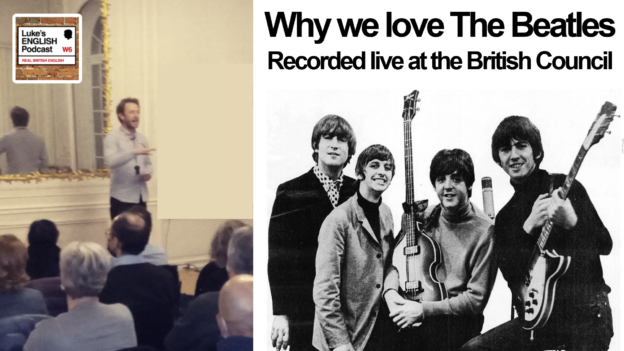
761. Why we love The Beatles (Recorded Live at The British Council) + Public Speaking Tips

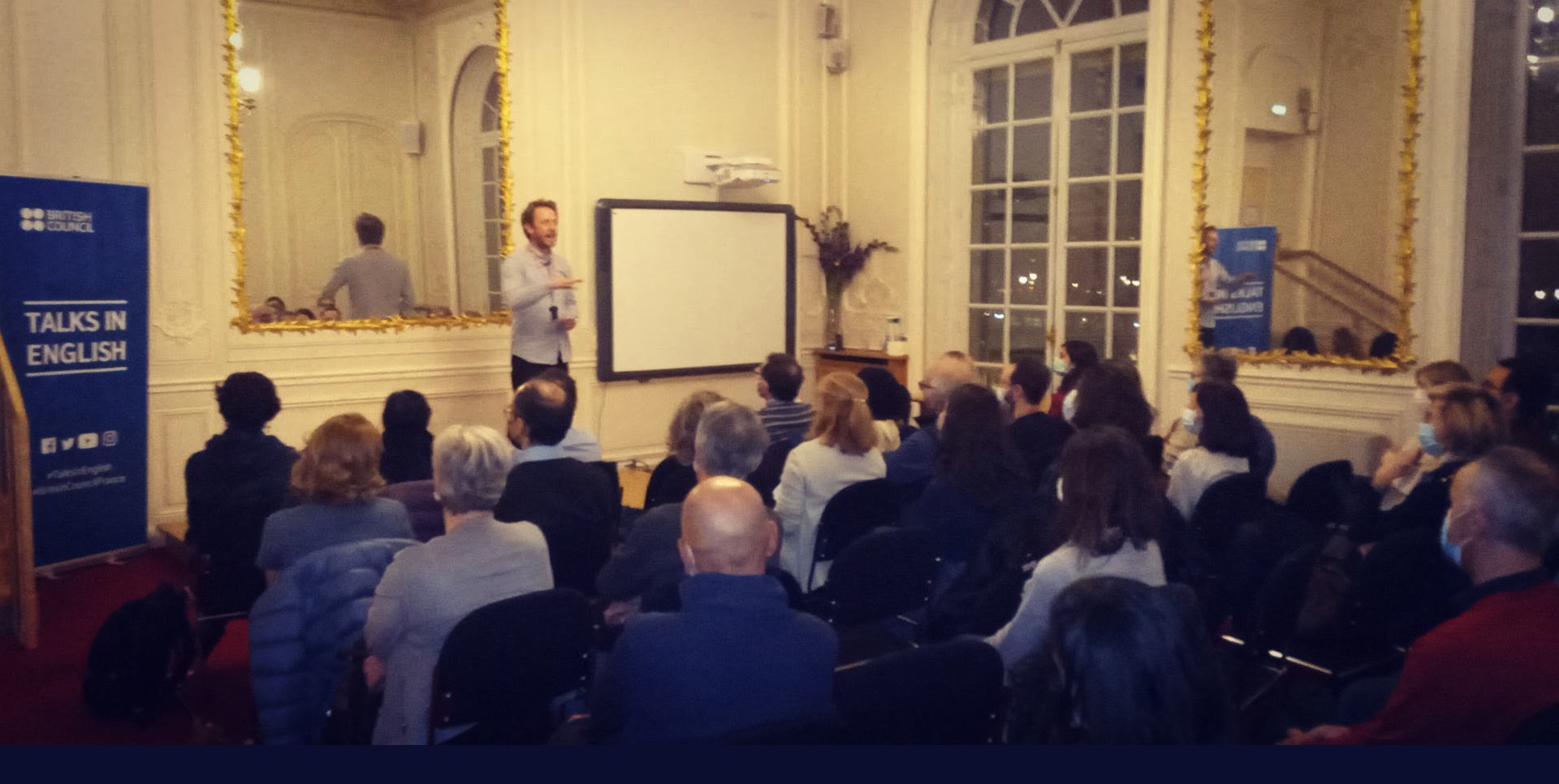
This is a presentation I did at the British Council in Paris recently, in front of a live audience. First I talk about public speaking and my approach to doing presentations and then you can hear the recording of my talk. The Beatles were a global phenomenon when they first appeared in the 1960s and their appeal continues to this day. The world still loves The Beatles. But why is this? Join me as I take a deeper look at the social, cultural and psychological factors that make The Beatles story so compelling even after all these years.

Small Donate Button

[DOWNLOAD]

Introduction & Ending Transcripts

Hello listeners,

Another day, another new podcast episode. Let’s keep calm and carry on, shall we?

This is episode 761 and most of this one was recorded live at the British Council in Paris in front of an audience of people. I think it is the first podcast I’ve ever recorded with a live audience there and it sounds a bit different because you can hear the audience reacting to things I’m saying and there are some moments of interaction with the crowd and some jokes and stuff. I hope you enjoy it.

As you may know, I teach English to classes of adults at the BC in Paris but also we have some extra events there in the evening. The talk you can hear me doing in this episode was one of those extra events. I’m hoping to do more of this kind of thing in the future – podcasting in front of a live audience. 

Private Online English Lessons with the British Council

Just before we start properly I want to tell you something about taking English lessons with the British Council, which is something that you can do online. Did you realise that?

Are you interested in having private English lessons online with a British Council teacher? Because you can. 

Sometimes people ask me if I am available for private lessons, and unfortunately my answer to that question is usually no. I just spend my time making episodes of my podcast and teaching group classes in the real world so if you wanted lessons with me you’d need to be in Paris and you’d need to become a student at the BC there using the normal registration process and just hope that you end up in one of my classes. 

But, other British Council teachers are available and they are online.

So if you are looking for an English teacher for private lessons, I just want to let you know that the British Council does offer this service now – personalised one to one lessons with a British Council teacher online

And this is great because you can do it anywhere in the world, you can choose the date and time for lessons, it’s totally flexible, you can choose the teacher and you can basically have classes which are designed around your needs completely, whenever and wherever you want, basically.

Want to practise your speaking and have your errors corrected – you can.

Want to work on your grammar and vocabulary. You can.

Want to develop your pronunciation to be a clearer speaker or to work on a more British-sounding accent if you like. You can do that too.

Also, you can have lessons for specific purposes such as for exams, for job interviews, for specific work arrangements, to prepare for IELTS. It’s all possible with these private online lessons because they’re all based around what you want to do and the British Council teachers will design the lessons based on your priorities.

I’ve always said that listening to my podcast regularly (or any podcast for that matter) is an important part of your learning process – the 5 Ls – listening, listening, listening, listening, listening but of course you need to be doing plenty of speaking too and to practise all the other things – the other language systems and skills.

One to one lessons are a really great way to achieve that and doing them online with an actual human teacher face to face is now a completely normal, tried and tested way to do this. All you need is just the right service.

And the British Council does offer that service. 

It’s called British Council English Score Tutors. (Click the pic below for the details)

It’s the official 1 to 1 tutoring service from the British Council.

It’s quite new but they already have 12,500 learners of English using the platform.

There are currently over 150 teachers there.

The tutors on English Score have an average rating of 4.9 stars (out of 5), which is reassuring.

The teachers are all British Council approved and a lot of them are in the UK but there are also British Council teachers living in other countries all over the world so you can find teachers in most time zones, which means, basically, there are teachers available 24/7. So you’ll be able to find someone to match your timetable.

So, why not go ahead and find a teacher for you and book some lessons to really push your English further and gain more confidence. There’s an offer for you because you listen to this podcast by the way – I’ll tell you about it in a moment.

Maybe you listen to me regularly and you’re happy that you can understand me or that you’ve got to the stage where you’re understanding most of what I say, which is a very good sign – why not build on that and get your speaking up to a similar standard. 

If you’re working on your listening and making progress, there’s a good chance you can convert that to speaking and make progress there too. Activate your English.

Work on your fluency and accuracy and clarity and general confidence. 

The 5 Ss  – speaking speaking speaking speaking speaking.

You’re asking – What about that special offer for us Luke?
Yes.

The BC is offering you a first introductory session for just $1, just so you can see if you like it.

So the first session is just $1. 

You can try it and see if you like it.

There’s no pressure or obligation to continue after that.

But if you do choose to buy a pack of lessons (normally about 20 hours or something) the BC will throw in a free lesson for you because you’re a LEPster.

So, the first lesson is just $1. 

If you like it you can buy a pack of lessons with a teacher, and get a free lesson included because you’re a LEPster.

Sounds pretty good right?

This could be your way to really work on your speaking as well as your listening.

Think about it. Could be a really good move.

Young learners – they do young learners too. There are classes available for 13-17 year olds and you get the same deal.

To find out more and to get that special offer of the free lesson go to teacherluke.co.uk/english or click the PRIVATE LESSONS button on my website menu.

The link is also in the description of this episode.

You’ll only get that free lesson if you enter the website through my link though.

So, obviously, do that then.

teacherluke.co.uk/english

All right then. Let’s begin the episode properly. Here’s the jingle.


761. Why we love The Beatles (Recorded Live at The British Council)

Hello listeners! Welcome back to the podcast. Let’s get back to some normal podcasting, shall we? OK then.

This is #761 Why we love The Beatles (Recorded Live at The British Council).

As you can tell from the title, this episode was recorded live at The British Council in front of an actual audience of people, as I mentioned earlier. 

I’ll play the recording to you in a few minutes. First I want to tell you about the talk I did and how I prepared for it in order to perhaps share some personal tips I have about public speaking. This might seem like another one of my epically long introductions, but it’s not. In fact, let’s imagine that the introduction is over now and here we are in the main body of the episode, and I’m giving you some comments and advice about how to speak to an audience of people – public speaking.

Public speaking is a slightly different skill to normal podcast recording and so it might be interesting for you to hear me doing it in this episode. 

Here’s some context.

The British Council in Paris, where I work part-time, is essentially a language school in a nice building not far from the Eiffel Tower. We teach classes to adults and children and there’s also a exam centre for the IELTS test.

The BC in Paris also offers some special evening events including regular Talks In English. This is when a guest is invited to come and talk about a specific topic at the school in one of our nice big rooms on the 2nd floor. 

Everyone is invited to attend at that means students at the school but anyone else too – friends, staff in the school, other teachers, just anyone who’s interested in attending. 

The speaker does their talk and afterwards there’s a chance to socialise, drink some wine and talk in English together. 

Our marketing manager Phil is always on the lookout for people to do one of these Talks in English, and a couple of months ago he asked me if I’d like to do a talk about anything. I immediately thought of The Beatles, because it’s one of my favourite topics and it’s a very British topic, relevant to British culture and it’s the sort of thing that would probably attract some people. Also the series produced by Peter Jackson called “Get Back” had just been released on Disney+. Phil happily agreed and we put it in the diary.

I decided the title of my talk would be Why We Love The Beatles and basically I wanted to try and explain why The Beatles were and still are so popular. What is the appeal of this group? Why are they so adored by people even 60 years after they first came onto the scene? 

I also decided I’d try and record it as an episode of this podcast.

Now, I know this is another episode about The Beatles and some of you might not be that interested or keen. My talk is called Why We Love The Beatles – but some of you probably don’t Love The Beatles that much, or you just don’t know. That’s totally fine of course. I get it. I’m not here to convince you that they’re the best band. Music is subjective. It’s a question of personal taste.

But I still hope you listen to this, because I might be able to help you understand why people love them.

Public Speaking – Talking to an Audience (Some tips and comments)

I’m now going to give some tips and comments about public speaking and how I prepared for my presentation but if you’d rather just skip straight to the recording of my Beatles talk, then you can move forward to 30:00 (the 30 minute mark).

Let’s think about public speaking then, and doing a presentation to an audience. I just want to mention a couple of things about how I prepared to do this talk. 

Maybe this can help you learn a little bit about public speaking.

So I had to prepare to talk to a room full of people for about 45 minutes. 

It was a fairly small audience to be fair – about 50 people.

Is that a small number or a big number? I don’t know. I’ll let you decide.

Imagine you had to do that. 

  • What would you be thinking? 
  • How would you do it? 
  • How would you prepare? 
  • What are the important things to consider?

I knew the audience would be a mix of adult learners of English (mostly French people and maybe some other nationalities) with an English level at intermediate and above and also some native English speakers.

I didn’t want to write a script, because I wanted to keep the presentation spontaneous. I find that if I write a script then I just get stressed during the talk because I’m trying to remember everything I’ve written and that’s impossible, and reading from a script can take the life out of a presentation. It can take away a certain spark, especially if the person is actually reading from the script on paper and they have to keep glancing up at the room but not really connecting with anyone. 

It depends, of course. Sometimes you need a script because in some cases every single word is vital, and you might have a prompter or something (that’s a screen which shows you your script without the audience seeing it – like in those big political speeches) or maybe if you are doing a best man’s speech at a wedding it can help to have the script in your hand. It depends on the situation of course. But for me, I decided that I didn’t want a script.

Also I didn’t want to use presentation slides on a screen with lots of words or information on them. Slides can be good, but they can also be very distracting. It’s human nature for the audience to just stare at the slides and then you lose the connection with them, and an old rule from stand-up comedy is: if it’s not adding anything, then it’s taking something away. 

Sometimes slides are not really adding anything to your talk, and so they just take away the focus from you and cause the audience to get distracted, especially when there’s lots of text and they end up reading rather than listening to you. No thanks.

Nothing is better than just trying to establish a good connection with the people in front of you. So I decided to do it without a script and without any slides, just like in a stand-up comedy who.

Doing it without a script can seem a bit daunting though, because you think “How can I get it right? How can I be sure that I’m going to say the right things?” 

Basically, in my experience, you have to just try to get to know your subject really well, create a simple structure for your talk, practice a lot and then trust yourself to be able to do it. So that’s what I tried to do. (I’m talking like I’m some expert public speaker here – I’m not, but I do have some experience from teaching and from doing comedy, so I’m just trying to share my experience with you).

In the weeks leading up to the talk I just thought about it a lot, thought about the specific focus of the talk “Why do people love The Beatles?” wrote some ideas down when they came to me, asked friends and family for their advice, talked out loud to myself a bit, imagining I was doing the talk and eventually worked out a general plan for what the content and structure should be. I did write some things down as a script but then I boiled it all down to a list of simple one or two word prompts. I then printed those prompts on some cards which I held in my hands during the talk. The idea was that I could just glance at the card in my hand and then ramble on that topic, hopefully remembering the main things I wanted to say. I also wanted to leave myself room to improvise and respond to what was happening in the room because in my experience, that’s the best way to keep things entertaining and to stop the audience falling asleep at all. 

I also wrote a few other things on the cards in pencil. Just some names, dates and quotes in case I forgot them while talking.

So that’s what I did as preparation and in a moment you can hear how it went.

Let me just say a couple of very basic facts about The Beatles for listeners who are new to the subject, just so you don’t get lost. 

The people in the room for my talk were probably already fans of The Beatles, but you might be new to them.

The Beatles

They were a group of musicians (a band) from Liverpool in England who recorded and released music together from 1962 to 1970 more or less. 

Members:

  • John Lennon (guitar & vocals)
  • Paul McCartney (bass guitar & vocals)
  • George Harrison (lead guitar & vocals)
  • Ringo Star (drums & vocals sometimes)

Pete Best and Stuart Sutcliffe were members of the band before they became really famous.

They formed in the late 1950s and played live concerts together from the early days in Liverpool and Hamburg until the year 1966 when they were playing stadiums and huge theatres around the world. Then they stopped performing live and concentrated on making music in the studio.

The band broke up officially in 1970 and went their separate ways.

John Lennon was killed in 1980 meaning that the four members could never reunite again as a band.

The Beatles were not just commercially successful. They represented a huge cultural shift and also were groundbreaking in many ways beyond just their influence on popular music. They were also just very funny, stylish and charming and their message was ultimately one of peace and love.

So, “Why we love The Beatles” that’s the title of my talk, that’s what I talked about a couple of weeks ago, and that’s what you can hear now in this first episode of LEP recorded in front of a live audience. I hope you enjoy it…


Ending

So, there you have it. That was my talk about The Beatles at The British Council. 

I am not completely sure if I managed to answer the question of why people love them so much, but ultimately I think I managed to entertain my small audience and everyone seemed to enjoy themselves and maybe that’s the most important thing at the end of the day, and the beginning of the day, and the middle of the day…

I wonder how that was for you listening in podcastland.

A couple of questions for you. 

  1. Did I manage to tell you something new about The Beatles that you didn’t know before?
  2. If you’re not a fan of the band, did I give you a sense of why people love them so much, including the fact that it’s not just about the music, and there’s more to them than just Yellow Submarine, Yesterday, Hey Jude and Let It Be?
  3. What was it like listening to a podcast episode that was recorded live in front of an audience, and should I do more episodes like that in the future?

Actually, I have sort of already decided that I would like to do more stuff like this in the future and I would like to do talks at the British Council that can also be published as podcasts. 

One idea is that I re-record some old episodes but in front of an audience, especially episodes which are essentially stories. For example, I would love to do the Sick In Japan story because I think it’s long enough, has enough funny moments and drama in it and it’s been a long time since I published the episode (10 years in fact – omg).  

So look out for more stuff like this in the future and maybe a live version of Sick In Japan or something like that. We will see.

Anyway, let me know how it was listening to this as a podcast episode.

Thank you for listening all the way until the end.

If you got this far, let’s think of a code word you could use to show that you’ve listened until the end. Let’s say that if you got this far, you have to use the word “LOVE” in your comment, especially in a Beatles lyric such as “Love is all you need” or “All you need is love” or “The love you take is equal to the love you make” – or in fact, quote ANY Beatles lyric in the comments to show that you have listened all the way until the end, and if you mention that a semolina pilchard was climbing up the Eiffel Tower during the episode, you will get bonus points. More than just 10.

Thank you for listening.

More podcast episodes will be coming towards your ears soon.

Just a reminder – Private Lessons with British Council English Score Tutors

If you’re looking for private one-to-one lessons online with a teacher, check out British Council English Score Tutors.

At least 150 BC Approved teachers to choose from.

Classes adapted to your needs.

All from the comfort of your own home.

$1 for the first lesson so you can check it out.

Then if you pay for a pack of lessons, you’ll get one lesson free because you’re a LEPster.

For the details and to get the offer – https://www.teacherluke.co.uk/english

Link in the episode description.

Nice one.

Thank you for listening! I hope you loved this episode. 

My pod room is nearly ready, for goodness sake. There’s still no electricity connection! A guy came to fit plugs around the room, and to connect it to the earth. He just needs to come back to do a bit of paperwork but of course he keeps texting saying it’s not possible today and then the next day, then he says he can come on Friday afternoon which is a full week after he actually did the main part of the job. Why does everything take so bloody long? Then it’s just a few clicks and switches and I need another hard working motivated guy to come and connect the room to the fibre optic internet and then I will be able to actually get installed and start working properly again. Damn, I can’t wait! I’m buying a second-hand desk from a local company tomorrow (it was supposed to be today but yep – she had to cancel and postpone). I’m looking for a decent office chair at a good price. I will podcast standing up if I have to!

Speak to you soon but for now it’s just time to say, good bye bye bye bye bye bye

760. The Rick Thompson Report: Ukraine

Talking to my dad about the situation in Ukraine on 28 February 2022.

[DOWNLOAD]

Episode Introduction

Hello listeners

I’m recording this on 28 February 2022.

In this episode I’m going to talk about what’s going on in Ukraine.

I have LEPsters in both Ukraine and in Russia. 

The main thing I want to say is that I just hope that my listeners are able to stay safe – although that sounds hollow because of course some of them won’t be able to stay safe, and many people are being forced to choose not to stay safe.

I know it’s not simple, and there are various factions with different motivations. It’s not completely black and white but most people just want to be able to live their lives and live the best they can, but this war is making that impossible, and for what exactly?

In any case, I’m thinking of my listeners in Ukraine right now, and it seems that a lot of the rest of the world is also thinking of Ukraine at the moment, and sending their messages of support – and I’m talking about ordinary people here, right? Not the leaders or the regimes. 

But I also want to say that I am also thinking of my Russian listeners too because it’s not just as simple as the Ukranians being the good guys and the Russians being the bad guys. 

Russian people are facing their own difficulties at this moment too, because plenty of Russian people are not in favour of a war in Ukraine – a war which could only make things worse for everyone. There are no winners in war. 

So, I’ve decided that I am going to talk about the situation in Ukraine.

So, just to be clear I am talking about it because: 

a) I want to show some support for my listeners who are directly involved in this and to echo the message of millions of others around the world right now that this is not what we want. 

b) I want to just talk about the situation from our perspective here in the UK.

Some will say “You’re not getting the full story. Putin is just responding to NATO aggression.” Or “Putin is defending the rights of groups within Ukraine who want independence and who are being repressed”. That’s certainly the way he’s trying to justify this. 

Some might say “Why don’t you speak about other acts of violence in the world, or times when other nations violate the sovereignty of other nation states?” 

Some people might say “What about the UK’s aggression against other countries, including invasions which were dressed up as peacekeeping missions?” Don’t assume that because I’m British I support the actions of my government.

We should also not assume that Russian people automatically support the actions of their government. 

The people of a country and the governments or regimes in control of that country are not one and the same thing.

759. Life is what happens while you’re busy making other plans

Join me as I walk around my local streets in Paris, go to the laundrette and ramble about what’s going on in LEPland at the moment.

[DOWNLOAD]

Other podcast recommendations

Some other things you could listen to while waiting for new episodes of LEP.

Film Gold: Monty Python & The Holy Grail

I was invited by Antony Rotunno onto one of his podcasts last week to discuss this British comedy classic.

My appearances on ZEP and RNR English at the end of last year

Episode 759 – Notes

I thought I would quickly record an episode to let you know that I’m still alive, LEP still exists, and I just want to give you a bit of an update on what’s going on and have a bit of a ramble.

I have other episodes in the pipeline and I was hoping to upload one of them this week, but for one reason or another, that’s not going to be possible so I’ve decided to record this one quickly and upload it quickly.

Again, I’m just recording this on my handheld recorder but I’m not at home because I can’t record at home, so I’m just in the street, reading some notes from my phone. 

Why aren’t you recording this at home Luke?

There are guys working on the flat above ours now.

We are now experiencing what our downstairs neighbours experienced when we did work on our place.

Our flat and the flat upstairs were sold at the same time. 

etc…

You can just imaging you are hanging out with me (in the streets of Paris) while I’m recording this. I’m just going walk around the neighbourhood while recording, trying to avoid noise, and trying to avoid the weird stares I might get from people in the street. 

It’s been more than 3 weeks since I uploaded an episode and this is only the 4th episode in about 2 months I think. 

I told you that the podcast would be delayed and disrupted, right? So it shouldn’t be a surprise. 

Why haven’t there been any episodes for almost a month?

Time flies!

Time races by.

“Life is what happens to you while you’re busy making other plans” (John Lennon)

I always wondered what John Lennon meant by that.

I guess he is expressing a kind of paradox that many of us live with.

While making plans for the future, real life just happens in the meantime, day by day, moment by moment. 

We aim for the future, we set our sights on things we would like to achieve, and make plans for those things.

But the fact is, life is really lived in the present, and while we are making plans, life just continues to happen to us in the present moment. 

I guess he is saying that we mustn’t forget to live in the moment and enjoy the moment.

I suppose for me at the moment, I mean that while making plans for this podcast, mainly the space in which I’m going to record it, real life has just been happening day by day. 

In fact, real life and the day to day tasks and challenges of it have been dominating my time recently, preventing me from being able to actually get to do the things I have been planning.

I’ve had a goal in mind for ages – sitting in my new podcast room which is more or less ready, with all my stuff arranged in a fairly tidy way (things on shelves, in drawers, guitars on walls, pictures or posters on the walls, a working internet connection, a decent desk, a comfy chair (which I might spend most of my life sitting on) the right kind of lights, a kettle, a backdrop for videos that looks pleasing to the eye, a computer which actually works and which allows me to record and edit audio and video properly, and so on and so forth, a kettle and cups of tea, another chair or two for guests… you know) but that goal or vision just keeps getting put back and put back.

Why? I can’t really even explain it – just general stuff has been getting in the way. I think a lot of people manage to move house and get back to their normal lives quite quickly, but this just seems to be taking ages and it’s because of lots of little things.

Here are some reasons why things are taking so long.

My daughter got sick with covid and I had to stay at home to look after her. My wife was also sick at the same time (not covid, mysteriously) and so I was off work looking after them. That was a week.

Teaching at the BC three mornings a week.

Wednesday afternoons with my daughter.

Not a massive amount of time. Normally it’s enough – in normal conditions, but these aren’t normal conditions.

I got sick – a couple of times actually. The first was a virus (not covid-19 – maybe covid-18 or one of the other covids). The second was a really bad back which caused loads of discomfort and a migraine. I couldn’t move, basically! Probably because of general stress but also the fact that I hadn’t sat on a comfortable chair for weeks. No sofa.

Washing machine delivered, but then broken – laundrette

Meeting with guy to fit radiators

Meeting with guy to get quotes for lots of other stuff at home, like making fitted shelves (beyond my skills) and other bits of carpentry

Meeting a guy for a quote for electricity at my office

Meeting guy who came to connect internet

Many other deliveries and things

The list goes on!

Now it’s the school holidays and we’re travelling tomorrow to the UK.

I might be able to record an RT Report or a Gill’s Book Club or something with my brother, but equally, I might not. Maybe we’ll just want to relax and have a holiday. I don’t know. I will see. 

Oh, and there are guys working on the flat upstairs, and guys working on the building opposite us. It’s like the entire city is under construction at the moment.

This is just what is going on in my small corner of the universe.

I am not complaining at all. I have a nice life and I’m very happy. But I’m feeling quite impatient and a bit frustrated at not being able to do the things I would like to do, and the fact that my goal keeps slipping further away from me. I will get there eventually! It’s like being in a car and using GPS, and the arrival time keeps changing and getting later and later as the GPS recalculates your route with delays and traffic and so on.

So, basically:

Bear with me

Hold on

If you’re impatient – hang in there

It’s a bit interminable – all this waiting around

But good things come to those who wait.

https://twitter.com/EnglishPodcast/status/1496159882013290499

The podcast will be back again, properly, and I will be recording, producing and publishing audio & video episodes and premium episodes at the usual rhythm soon.

Maybe this is a good chance to catch up on episodes, or listen to episodes from the archive…

Speak to you on the podcast soon!

758. Pub Quiz Trivia with Sarah The Paris Quiz Mistress

Chatting to pub quiz host Sarah Toporoff about her love of trivia, and asking each other quiz questions about history, geography, literature, language & pop culture. Can you answer the questions and follow the conversation?

[DOWNLOAD]

Links

Introduction Transcript & Notes

Hello listeners! I hope you’re well. Welcome back to my podcast for learners of English around the world. That’s you, I assume. You are a learner of English and you are around the world. 

Welcome to another episode of my podcast. This is where you can get English into your life in the form of some regular listening practise. This time you’re going to hear me in conversation with a guest and the guest in this episode is my friend Sarah Toporoff who also goes by the name The Paris Quiz Mistress.

This is the first time she’s been on the show and that means this one will probably be a little more difficult for you to follow, but that’s alright – it’s all good practice. 

Sarah is originally from the USA (so you will be hearing an American accent from her, and a British accent from me in the same conversation – and yes, we actually understand each other of course) Anyway, Sarah is from the states, but these days she lives in Paris like me and basically – Sarah loves pub quizzes. In fact, she loves them so much that she decided to run her own pub quiz nights here in Paris, in English, which she does every Sunday evening. 

She writes questions and reads them out in a local pub for teams of people to answer in competition with each other. Sarah also has her own podcast in which she quizzes her friends on various bits of trivia relating to their interests. Her podcast is called The Paris Quiz Mistress Podcast.

So, in this episode I thought I would chat to Sarah about her love of quizzes, and then we could quiz each other with some fun questions, and you can see if you know the answers and generally try to keep up with the conversation and develop your English in the process.

So that’s what you’re going to get – and this is a swapcast, which means that both Sarah and I are publishing this on our respective podcasts. 

Before we continue I think I should give you a little bit of support before I throw you into the deep end and make you listen to this fairly fast conversation between two native speakers. 

So, let me just clarify a couple of bits of vocabulary and some culture which are key concepts for this episode, and I also have a few questions for you to consider, in order to help you prepare to understand this episode more easily.

Some words and concepts

A quiz

(Forgive me if I am stating the obvious here) A quiz is a fun game or competition in which someone tests your knowledge by asking you questions and you compete with others to answer those questions. Quizzes are usually done just for fun, unlike tests or exams for example, which are done not for fun. They usually involve questions relating to trivia…

Trivia (noun) / Trivial (adjective)

…and trivia basically means trivial information or facts which are interesting or amusing but not really presented for a specific purpose. “Oh, that’s quite interesting isn’t it?” ← that’s usually as deep as it gets. That’s trivia.

It’s just random bits of general knowledge, just for fun – facts and figures, names, dates, places, moments in history, pop culture and so on.

A pub quiz 

As the name suggests, a pub quiz is a quiz done in a pub. Big surprise there. But pub quizzes are a very common feature of normal life in the UK where any good pub will have a quiz night. If you’ve ever spent time living in the UK you might have noticed this. Perhaps on a weekday evening in the local pub you might see teams of people sitting at tables competing against each other to answer questions which are read out by a host who might be speaking into a microphone. It’s sort of an excuse to just be in the pub and have a few drinks, but it’s also a really fun way to spend an evening with other people.

A good host will prepare some tricky but achievable questions that make you think and that could spark some conversation later in the evening, and the host might throw in some funny comments here and there just to keep things light. The questions are often quite convoluted and might sound more difficult than they actually are. At the end, the answer sheets from each team are marked and the winning team wins a prize, typically a bottle of wine or something like that. Pub quizzes are also known as trivia nights in some places. 

Does that sound familiar? This is the world of the pub quiz. Are they a common feature in your country? Do they happen in pubs? Do you have pubs? Do you have questions? Do you have facts where you live? Are there other people? I don’t know where you are. 

Fun quizzes like this also take place in other situations – and I’m talking about the UK and other English speaking places too and often things are similar in our cultures. I’m sure it’s the same for you, but is it? I don’t know. Anyway, where I’m from quizzing is sort of part of our DNA. Any excuse for a quiz – in pubs but also at family get togethers, at school or even at work Christmas parties and things like that. 

Sorry for rambling here but seriously – thinking about this stuff might help you to focus your attention on the topic of this conversation  bit more closely and follow things more easily, and therefore learn more English from this and as a result get a feeling of accomplishment which you carry with you in your life, bringing extra positivity and confidence which ultimately helps to make you a more successful and fulfilled person in your life, which then impacts on other people in similar ways and the benefits spread out from you in concentric circles improving the lives of other people around you and they start smiling a bit more and ultimately the world becomes that bit better which makes all the difference to the global balance of everything and basically I save the world with my podcast. That’s all I’m trying to do, so don’t stand in my way, ok? The fate of the world depends on this, alright?

Now, just in case this introduction wasn’t long enough, I am now going to quickly read out the questions that Sarah and I are going to ask each other in this episode, just to give you a chance to understand them in advance so you don’t get lost in the conversation.

You see, I am COMMITTED to helping you learn English and that means I am willing to make these episode introductions at least 3 minutes longer than they should be in order to give you a helping hand in understanding fast-paced and naturalistic dialogues between native speakers of English. That is how much I care. 

Quiz Questions in this Episode

So listen to these questions, understand them, can you answer them? You’ll be more prepared. Listen to the episode to get the answers.

  • How many countries make up the UK and can you name those countries?
  • Which Eastern European country shares zero of the same borders with countries that it shared borders with in 1989 although its physical borders have not moved? (note: I hope you don’t mind the term “Eastern European country”)

Sarah’s Questions for me

These might seem a bit random, but Sarah is a great quiz mistress and there is a link between all the answers to these questions, and it’s a link that is tailored to me somehow. 

  1. For which film did the MPAA refuse to allow use of Ben Stiller’s character’s last name in the title, unless filmmakers could find an actual person with that last name?
  2. What 2nd novel by English author Charles Dickens is alternately titled “The Parish Boy’s Progress?”
  3. What film series began in 1988 and stars Bruce Willis as John McClane?
  4. In British English it means “eraser”, in American it means “condom”. What is it?
  5. What is the type of gun that features as a weapon in the board game “Cluedo”?
  6. “Scar Tissue” is the name of Anthony Keidis’ autobiography as well as one of his hits, with which band?
  7. PD James, Edgar Allan Poe and Gaston Leroux are all writers specialising in what genre? 
  8. The flags of Romania, Colombia and Moldova all primarily feature which 3 colours?
  9. The first episode of what television drama opens with the news that that RMS Titanic has sunk?

Luke’s Questions for Sarah

My questions are really quite stupid and in fact I am not listing them here because they are too silly and I will let you discover them in all their glory as you listen to the episode. So just listen on if you want to hear my questions for Sarah – but to give you a heads up they focus on music, movies (well, one movie) and British English slang, so there is definitely some vocabulary to learn here!

MMMBop by Hanson

Mmm Bop – Lyrics

Can you tell me any of the lyrics from the first verse?

Answers:

You have so many relationships in this life

Only one or two will last

You go through all the pain and strife

Then you turn your back and they’re gone so fast

Oh yeah (so much wisdom from someone so young)

And they’re gone so fast, yeah

Oh, so hold on the ones who really care

In the end they’ll be the only ones there

And when you get old and start losing your hair

Can you tell me who will still care (Hair was important to them)

Can you tell me who will still care? (interesting discussion point)

Oh care

Mmmbop, ba duba dop

Ba du bop, ba duba dop

Ba du bop, ba duba dop

Ba du, oh yeah

Mmmbop, ba duba dop

Ba du bop, ba du dop

Ba du bop, ba du dop

Ba du, yeah

Said oh yeah

In an mmmbop they’re gone

Yeah yeah

Yeah yeah

Plant a seed, plant a flower, plant a rose

You can plant any one of those

Keep planting to find out which one grows

It’s a secret no one knows

It’s a secret no one knows (Is it really a secret?)

Oh, no one knows

MMMM MMMM MMMM MMMM by Crash Test Dummies

Anaconda – 1997 (Trailer)

Luke’s British Slang Questions

  • If you describe something as pants, how do you feel about it?

“That film was pants. Total pants.”

Answer: bad

  • How would you feel if you’d run out of bog roll?

You’d feel gutted of course.

Answer: Bog roll means toilet paper

  • Can you give me a reason why you might feel “chuffed”?

Answer: chuffed means pleased, delighted, happy

  • What would a British person probably say if they wanted to claim something, like perhaps a chocolate biscuit or a comfortable chair?

Answer: Bagsee!

  • If someone needed to get some kip, how would they probably feel?

Answer: You’d feel sleepy or tired, because kip means sleep (noun)

  • What F word is used to say that someone is physically attractive? (It’s like saying “hot”)

Answer: fit

  • What L word is a generic sickness – like the flu or a bad cold? (a pre-covid expression)

Answer: The lurgy

  • Where do you put suitcases in a car in the UK?

Answer: in the boot

  • What about the engine?

Under the bonnet

In any case, whether you can answer these questions or not, I hope you enjoy listening to this conversation about trivia and that you manage to keep up with it all and pick up some English. I will chat to you again very very briefly at the end, but it’s now time to get started properly and here we go…

Listen to the episode to get all the answers to the questions!

In other news…

My pod-room still isn’t ready but it should be connected to electricity and internet in a couple of weeks.

I’m still waiting to get a WIFI internet connection at home.

My shelves haven’t fallen down yet :)

I am working on LEP Premium series 33 parts 3 and 4 and they should be uploaded soon.

Video versions of episodes will return when I have a decent internet connection (and a new computer which is coming too…)

757. Setting up my new Pod-Room / DIY (Do It Yourself) Vocabulary & Expressions

Describing how I am setting up my new pod-room with a couple of stories and plenty of vocabulary for talking about DIY and doing improvements to your home. Vocabulary list available.

Small Donate Button

[DOWNLOAD AUDIO]

Episode Notes & Transcript

Hello listeners, welcome to LEP#757. In this one I am going to talk to you about how I am setting up my new podcasting room (is it an office, is it a studio?) and I’m going to teach you some vocabulary related to doing practical work with your hands at home.

Just before we start I just want to say hello properly to everyone in LEPland and deal with a little bit of podcast admin. 

Hello

I hope you’re doing well. It’s been over 2 weeks since I published the last episode because of the house move (I moved house a few weeks ago). If you’re wondering how that’s going – I’ll talk about it a bit in this episode, but let’s just say that the phrase my wife and I have been using over and over is “it’s coming along” which means we are making progress, bit by bit, slowly but surely – unpacking our stuff from boxes, setting up the new place, getting things sorted out such as an internet connection at home and the important appliances like a cooker, a washing machine etc. Things are getting slightly less chaotic every day. Also I was ill for week (not COVID thankfully) which didn’t help. Anyway, if you’ve been waiting patiently for a new episode – thanks for waiting. If you’ve been waiting impatiently, I’ll still say thanks for waiting. Things are still up in the air so I can’t get back into the usual podcasting routine yet, which means there might be another delay after I publish this episode, but when I have my new podcast room set up and have done lots of other things that need doing, normal podcasting will resume. Hopefully this slowdown has allowed a lot of you to catch up with me.

3 of announcements and bits of admin before we start properly:

  1. Premium subscribers – I am currently working (when I can) on P33 parts 3 & 4 which are turning into quite substantial episodes. Part 3 is all about word families, parts of speech and word stress patterns. That means how word stress patterns can change from the noun form of a word to the adjective, verb and adverb forms etc. (Politics – politician – political – politically, Economics – economist – economic – economically, architecture – architect – architectural – architecturally, etc) Part 4 will be pronunciation drills with full sentences, not just words on their own. So that’s coming soon to LEP Premium. If you want to sign up to LEP Premium to get all those episodes – go to teacherluke.co.uk/premiuminfo to get all the info. If you ever have problems with the registration process – try using other browsers, and not on a mobile phone.
  2. Spotify listeners – hello! Recently loads of my episodes disappeared on Spotify. I don’t know if you noticed but episodes 1-664 just disappeared. Well, they should be back now or soon. It was just an automatic update which changed some settings, but those settings have now been reset. So everything should be normal, the episodes should be available again and you should be able to listen on Spotify as usual. In any case you can always get all the episodes in the LEP App which you can download free from the app store on your phone (just search for Luke’s English Podcast App). That’s the whole episode archive, plus about 10 bonus episodes which are only available in the app, all the mini phrasal verb episodes, some music and videos and access to the premium content too if you have a subscription.
  3. OPP – If you’re looking for other things to listen to while waiting for new episodes of LEP at the moment, you could check out my appearances on several other podcasts. Recently several of my podcast friends reached milestone episodes and they both chose to invite me as a guest as a way of marking the occasion. Apparently I am the pod-father. First of all, Rock n’ Roll English hosted by Martin Johnston – he reached episode 250 recently and invited me on to have a chat about the ins and outs of making podcasts for learners of English and it’s a typically funny and unfiltered conversation. That’s episode 250 of Rock n’ Roll English. Also Zdenek’s English Podcast reached episode 400 recently and Zdenek invited me as a guest. I love the way Zdenek and Martin decided to pay their dues to the podfather in this way! I had an epic chat with Zdenek about loads of things including how his podcast has been inspired by mine in some ways and about the development of him as a teacher and podcaster. I think it’s a good conversation with insights about various things including what it’s like making podcast content and how confidence develops, the creative process and generally another inside look into podcasting for learners of English. Check them out – you will find links on the page for this episode. 2 other episodes of other people’s podcasts you could check out.


This is an episode about DIY – or Do It Yourself

This is not an episode about how you can teach yourself English, although I could talk about that a bit, later in the episode.

DIY is a common expression in English, meaning Do It Yourself and it relates to doing practical work at home. 

People talk about doing DIY. We say things like “I’m going to do some DIY this weekend” “I’ve been doing some DIY”, “I did a bit of DIY at the weekend”,  “I’m no good at doing DIY” “My husband does all the DIY in our house” “My wife tends to handle all the DIY because I’m rubbish at it, etc etc”. 

DIY (Do It Yourself) means all the practical work that you might do at home from time to time – the things we do in order to make improvements to our home. I’m talking about things like putting up shelves, painting & decorating, fixing things and other similar work that you do to improve your own home without having to call someone in to do it for you, like a plumber, carpenter, decorator or electrician. You don’t call someone in to do it, you do it yourself. DIY.

It’s the sort of thing you might do at the weekend. Putting up shelves seems to be the most common example of DIY as far as I can tell. Putting up shelves – that thing that seems so simple on paper, but in reality is the sort of thing that can bring a person to their knees – and I don’t mean kneeling down in order to do some work, but to kneel down in a desperate plea to the gods of (what – wood? Screwdrivers?) in order to beg for mercy because your attempt to put up the shelves is proving to be too difficult a task. What do you mean, Luke? I mean, doing DIY, for example, putting up shelves can be a nightmare if you don’t know what you’re doing. 

As I said, on paper it doesn’t seem that bad, but to do it right you have to do it properly. You have to read up on how to put up shelves, maybe watch some tutorials online, then plan a specific time to do it, go to the hardware shop or DIY shop to get all the right materials and tools. You put on some old clothes, maybe prepare an area of the home where you’re going to do your work and make sure no pets or children go anywhere near it, you get the stepladder out, and then you try and actually put some shelves on the wall, or build something or whatever, and if you’re not very good at it, if you’re not a practical person, it can be stressful and you end up making a total mess of it, and you hit your thumb with a hammer and then you start swearing and maybe break something and fall off the ladder, and have an argument with your spouse or something and then just give up and go to the pub or something. It depends how handy you are, how practical you are or not. For many of you, this isn’t a problem and the idea of putting up shelves being diffiult is laughable to you. I don’t know your life. 

But I do know, that DIY is a very common thing in life and surely this is something that unites all of us to some degree. Either because we all have to do DIY sometimes, or at least we know someone who has to do DIY and it’s just a thing that happens in our lives. Do you know all the English that you need to talk about DIY? The tools, the verbs, the specific phrases for all of it? That’s what I’m dealing with here. 

The reason I’m doing this episode right now might be obvious for those of you who are regular listeners. I have just moved into a new flat and also I’m setting up a new office/studio for myself and this is involving a lot of this kind of work. 

In fact, this is what is taking up most of my time at the moment, which is why the podcast has been a bit delayed recently. When I’m not teaching English classes at the British Council or spending time with my wife and daughter doing family things, I’m working on the flat and working the office. 

What I’m going to do in this episode, then, is:

  1. Describe exactly what I’ve been doing in the office and talk about how I’m trying to set it up as a good base for my podcast work. I’m going to describe the DIY I’ve been doing.
  2. Go through a vocabulary list of various words and phrases for talking about the fascinating subject of DIY.

Setting Up The Pod-Room

  • What is it?
  • Where is it?
  • What does it look like?
  • What does it need to be?
  • What are you doing with it?

Tell us about the shelves you put up, in as much detail as possible.

Vocabulary – DIY

Putting up shelves

  • Tape measure – to measure things (length, depth, width, height, distance from x to y etc)
  • Spirit level – to check that things are level (horizontally or vertically)
  • Pencil – to mark lines or crosses/spots 
  • A drill – to drill holes (into thing)
  • A cordless drill
  • Battery / battery pack – charge it regularly
  • Drill bits (different bits for different materials) – to drill holes of the right size / to drill (into)
  • Types of material – masonry (stone and brick), wood panels (MDF, chipboard, wood (pine, oak etc)
  • Wall plugs / Rawlplugs – to hold screws in place and prevent damage to the walls (you push them into the holes and then when you screw in the screw, the plug expands inside the hole and grips the inside of the hole, preventing the screw from falling out) they ensure a tight and secure fit for screws in material which is brittle or porous.
  • Screws – screw them into the wall or into wood to attach things
  • Nails – hammer them into the wall or wood to attach things
  • Screwdriver – to screw in screws, or unscrew screws
  • Electric screwdriver / power screwdriver – a convenient way to screw screws
  • Hammer – to hammer nails or pull nails out of walls
  • Mallet / rubber mallet – to hammer other things, without causing damage. You can use a mallet to hammer rawl plugs into the holes, for example.
  • Pliers – to hold things firmly, to grip things
  • A saw – to saw wood (handsaw, hacksaw, etc)
  • Sandpaper – to sand things and make them smooth or take off rough edges – like wood, dried filler or rough patches of paint
  • A plane – to remove layers of wood
  • File – to rub against wood (usually) and change the shape, remove layers (e.g. if a door sticks and doesn’t close properly)
  • Rags – to wipe things, clean things, dust things (remove dust)
  • Dustpan and brush – to clean up dust and other bits and pieces
  • A multi-tool – a convenient thing to help you do lots of things, including cut your arm off if it gets trapped under a rock in the desert 

Painting

  • Paint – to cover surfaces, to coat surfaces, to add colour, to make things look nice
  • Layers of paint or coat:
  • Primer – to prepare the wood by covering dark colours or patches, prevents things from leaking through (like some oil or sap which comes from knots in the wood) and makes the surface smooth (MDF is absorbent so the primer helps to stop the MDF from absorbing all your paint – it also causes wood fibres to stand up, so you can then sand them down) etc 
  • Sealer – seals the wood and creates a watertight layer
  • Undercoat 
  • Topcoat
  • Types of paint, with different appearances:
  • Matt (flat surface, low “sheen”, not reflective, harder to wash, prone to marks and scuffs, easy to add other coats without showing up brush strokes) 
  • Eggshell / satin (higher level of “sheen” than matt, easier to wipe than matt, more durable than matt)
  • Gloss (highly reflective, has a very high “sheen” level, sometimes used in kitchens because it can be wiped clean and is therefore a bit more hygienic)
  • Oil-based paint
  • Water-based paint
  • A brush – to apply paint to things 
  • A roller – to apply paint evenly and conveniently to large surfaces
  • A tin/tub of paint – the containers the paint comes in
  • Masking tape – to cover parts which you don’t want to paint, like skirting boards, windows, handles etc
  • Plastic sheets – to cover and protect the floor from drops of paint

That’s it!

When the pod-room is set up and I have a proper internet connection (and maybe a new computer) I will be doing podcasts with videos like in 2021 and you will be able to see the amazing and inspiring work I did on the shelves 😂

Speak to you soon! Bye bye bye…

756. Learn English with LEP in 2022 / A New Year Ramble

In this episode I’m going to wish you a Happy New Year, ramble a little bit about what’s going on in LEPland, restate some of my aims and objectives for this podcast, and give a few comments on how you can use the podcast to improve your English, with reference to some recommended episodes from the archive.

Small Donate Button

[DOWNLOAD]

Episode Notes & Links

Happy New Year everyone! (new listeners, long-term listeners, mid-term listeners and anyone else who happens to be listening)

All the best for 2022. Try to keep up your motivation for learning English throughout the year. I hope I can help. That is my aim.

How was your Christmas/New Year? Did you have a holiday? What did you do?
What’s the situation Luke, as you record this? (summarise the last couple of weeks, and what’s going on around you)

I might not be able to upload episodes regularly for the next few weeks. If LEP goes quiet – I am still here and still working, but not able to record or upload because of all the different disruptions. My life is like a puzzle at the moment and I am putting all the pieces back together.

LUKE’S ENGLISH PODCAST – AIMS

  • To provide a resource of authentic speech for learners of English.

Episode suggestions
All of them! Especially ones which are unscripted. 

  • To inform my audience about methods and strategies for improving their English.

Episode suggestions
174. How to learn English with Luke’s English Podcast

251. Welcome to LEP / 16 Things You Should Know About LEP

669. How to Learn English

  • To educate my listeners about the English language by explaining or providing examples of grammar.

Episode suggestions
Premium episodes www.teacherluke.co.uk/premiuminfo (articles, sentence structure, present perfect tense, narrative tenses, modal verbs about the past, quantifiers and more) but also a lot of episodes in the archive deal with grammar. Here’s a selection.

19. Passive Verb Forms

29. Mystery Story / Narrative Tenses

44. Telling Anecdotes

53. Discussing Grammar with My Brother

69. Common Errors / Typical Mistakes

176. Grammar: Verb Tense Review (should be premium really!)

263. Past, Present & Future A chance to really understand the tenses in English, with lots of context.

372. The Importance of Anecdotes in English / Narrative Tenses / Four Anecdotes This episode has a bit of everything: useful tips for telling anecdotes, a review of narrative verb tenses, some authentic spoken anecdotes by members of my family and some vocabulary explanations.

406. Grammar (Past Continuous Tense) / UK Media Bias / Brazil Football Tragedy A review of the differences between past continuous tense and past simple tense

518. Grammar Questions (Part 1) Present Perfect Continuous / Future Continuous / Language of Newspaper Headlines – Answering grammar questions from listeners, with details about verb tenses (including present continuous vs present perfect continuous & future continuous vs going to) and the language of newspaper headlines.

518b is in the LEP app – [App-only Episode] 518b Grammar Questions (Part 2) Hope vs Wish / Relative Clauses (an overview) / Prepositions

  • To enrich the vocabulary of my listeners by presenting and teaching natural English usage in context.

Suggested episodes
Check the archive here
https://teacherluke.co.uk/archive-of-episodes-1-149/ and try doing a command+F search for vocabulary, or search for the word vocabulary in the app.

  • To entertain my audience by producing fun and interesting content specifically targeted at learners of English as a second language.

  • To highlight particular aspects of English (language) culture including themes about Britishness, accounts of key moments in history, politics and the arts, with a particular focus on comedy and film.

Suggested episodes
Search the archive for the words British and comedy
The Rick Thompson Report, Film Club, British Comedy, Luke’s D-Day Diary, and more…

  • To raise awareness of many features of British English pronunciation and provide practice of repeating certain phrases or constructions.

Suggested episodes
All premium episode series have dedicated pronunciation episodes. Also, these ones:

224. Pronunciation: Verb Tenses & Connected Speech Learn how native speakers really pronounce sentences in different tenses.

485 & 486. Difficult Words to Pronounce in English (with Paul Taylor) (Parts 1 & 2) + video This is a double episode with two audio episodes on one page, and it’s all about difficult pronunciation in English. 

682. Key Features of English Accents, Explained – Exploring the main differences between standard English pronunciation (RP) and non-standard regional or colloquial accents. 

And various episodes about accents…

  • To keep my audience engaged in the listening process long term, by providing a resource to help them laugh while they learn.

  • To make people laugh out loud on public transport while listening to the podcast!

  • To dominate the world with an army of LEP ninjas equipped with biscuits and good English. …Ok, one of my listeners asked me to add this as an aim for my podcast, ha ha! (Thanks Chriss Benitez)

Those episodes can be found in the LEP app or via the episode archive. Most good podcasting apps will have the entire archive, but I think iTunes or Apple Podcasts doesn’t show all episodes. YouTube doesn’t show all episodes either. Only some of my episodes are on YT. I’d like them all to be there (just the audio) eventually.

HOW TO USE LUKE’S ENGLISH PODCAST TO IMPROVE YOUR ENGLISH

People from all over the world use my podcasts to improve their English, and lots of people email me to tell me how much they love the podcast and find it useful. Some of you might be wondering how you can improve your English by using the podcast. I’ll tell you more about this in a moment, but let me first recommend a couple of podcast episodes you could listen to.

Click here to listen to an episode with lots of advice and suggestions for improving your English with L.E.P. It has a transcript too. (Episode 174)

Click here for an episode called “16 things you should know about LEP”. (Episode 251)

Many people tell me they are completely addicted to the show. Usually they say that they found the podcast via one episode in particular and then start listening to all the others before becoming completely hooked. I have quite a hard-core following. The podcast won the Macmillan Dictionary Award four times and was nominated for a British Council ELTon award, so I must be doing something right!

L.E.P combines English teaching with plenty of entertaining conversation, humour and genuine insight into the culture of the English language. My methodology and approach are based on the idea that language is acquired by engaging with it in authentic form, over longer periods of time. Although this is not the only way to improve your English, listening to natural authentic speech over quite long periods of time can greatly improve your listening skills, pronunciation and vocabulary. This goes on to improve your spoken English, and your general instinct for grammar. I try to balance this approach by regularly recording episodes in which I directly teach you vocabulary, pronunciation or grammar.

Good grammatical awareness is based on instinct as much as on active knowledge of the rules of English. When you take an English exam you have to answer questions that test your knowledge and use of grammar or vocabulary. For example, consider this question:
FILL THE GAP IN THE SENTENCE WITH THE APPROPRIATE WORD
“I just can’t rely __ this car any more. It keeps breaking down. I need a new one.”

1. with          2. from        3. on          4. to

The answer is ‘3. on’, of course.
How did you know the answer? Really think about it. How did you know that ‘on’ was right? Do you remember learning ‘rely on’ in a book, or in a class? Maybe you did. But, for many of you, the answer just felt correct. Your instinct just said ‘on’. Well, this instinct is what you develop when you read or listen to the language a lot. Your brain builds up a kind of memory bank of all the words you have seen and heard. So, when you see ‘rely ___’ you automatically feel that ‘on’ is the right answer. Why? Because you’ve seen/heard ‘rely on’ lots of times!

The point is, that listening to English a lot can really help you to get a ‘feel’ for the language. You learn grammar rules by the frequency in which you hear patterns. You learn about good pronunciation by hearing the language a lot. You develop an ‘ear’ for English.

It’s just like when you live in a foreign country to learn English. It’s the best way to learn a language. Just live in that country and get completely surrounded by the language every day. Eventually you pick it up and learn it well. That’s because you’re hearing it so much and you’re getting used the rhythm and intonation. Every language has a beat. You can learn the beat of English by hearing it a lot.

So, you can use Luke’s English Podcast to do this. It’s like living in another country. You can listen a lot, pick up bits of vocabulary, get a ‘feel’ for the language, understand pronunciation and all kinds of cultural stuff. Not only that, but many listeners tell me the best thing about the podcast is simply that it makes them laugh out loud.

So, enjoy the podcasts and good luck with your English.

CLICK HERE FOR ThE ARCHIVE OF ALL THE EPISODES OF LUKE’S ENGLISH PODCAST.

754. Learning & Teaching English in The Metaverse / The Mandalorian (with Andy Johnson)

Andy Johnson returns to talk about more “M” words – this time it’s The Metaverse and The Mandalorian. The Metaverse is an immersive and interactive 3D online environment. How can it be used for learning and teaching English? Andy’s new job is with a company that offers English learning in the metaverse, so let’s chat about it. Also, we finally talk about The Mandalorian on LEP after waiting nearly a year! This is probably the last episode of LEP in 2021 – so Merry Christmas everyone and I hope you have a Happy New Year!

Audio version (with a meta-themed introduction and a ramble about December)

Small Donate Button

[DOWNLOAD AUDIO]

Video Versions (just the conversation with Andy, in two parts)

Find out more about learning English in the metaverse using Fluent Worlds Academy here https://academy.fluentworlds.com/

Introduction Transcript

Hello listeners, how are you? How’s December going for you so far? (I’m recording this in December of course, which is why I just said that – it’s the middle of December) How’s December for you? 

It can be a weird month December – it’s pretty much the middle of winter and if you celebrate Christmas then December becomes a bit stressful because the Christmas holiday is coming and you have to make sure you’ve got presents for everyone, and you have to sort out your travel plans and work out how much time you are willing or able to spend with your different family members and it all gets a bit stressful, and of course everyone else is going through the same thing so generally people seem a bit stressed out at this time. If you’re late with your Christmas shopping then that becomes a mad rush and the shops are full of desperate people like in that film with Arnold Shwarzenegger…

plus work commitments seem a bit heavy because everyone’s trying to get things done before the Christmas break and so things get a bit much. 

It’s certainly true here for me, because as you know (because I’ve been banging on about it since the summer) we are moving house and having work done on the new place and that’s making things so much more complicated. 

Actually, I think this might be the last episode of the year, but I am not sure. I have a couple of other ones in the pipeline but time is running out very quickly, so this might be the final episode of Luke’s English Podcast for 2021. 

Merry Christmas everyone – if you celebrate Christmas of course and if you don’t celebrate Christmas I will just say seasons greetings. If you don’t get more podcasts after this until January some time, then you can imagine that I’ve had to pack up all my podcast gear, switched off the internet and moved all our stuff to a new flat, which will probably be full of boxes, and maybe no internet connection, meanwhile I’ll be at my parents place in England (COVID permitting) just doing the usual Christmas things, and the podcast will return in January, probably, but we will see. I might be able to upload more before the new year, but there’s no guaranteeing that. So I will say Seasons Greetings and Happy New Year to you now. 

Anyway, let me talk about this episode then. It’s an interview episode and this time Andy Johnson is back on the podcast after a long absence. If you don’t know him because you haven’t heard his episodes, or if you have heard those episodes and your memory is not working to its full capacity – Andy is a friend and former colleague of mine. I won’t say more because we talk about all of that at the start of the conversation. All will become clear as you listen.

The title of this one is something like this: Learning & Teaching English in the Metaverse / The Mandalorian (with Andy Johnson)

So there are two topics here. The Metaverse and The Mandalorian. This is one single audio episode with this introduction but the video version is in two parts – one which is just our chat about the metaverse, and another one which is just our chat about The Mandalorian. 

In this audio version, let’s start with The Metaverse. 

Again, Andy is going to explain this himself, but to be clear The Metaverse (or maybe a metaverse – because there is more than one) is essentially a 3D open world online. A metaphysical space which exists on the internet where people can go and interact and do all sorts of things. It’s a bit like a primitive version of The Matrix from the film The Matrix, but the graphics aren’t as good, yet, and it’s not quite as scary and evil, yet.

As these sorts of open online worlds become more and more sophisticated and as we learn how to use them, we will probably all find ourselves operating within them more and more, for various things – especially for creating virtual workspaces for people working from home or working from different locations but part of a team. Currently we use things like Zoom calls with breakout rooms and screensharing, Microsoft Teams and other platforms. But eventually these shared online spaces will probably become more immersive, opening up so many possibilities for team work which perhaps are more natural and intuitive because they simulate the real world more directly, but with so much more control – we’re talking about 3D environments in which you can move anywhere, manipulate the environment and so on.

These metaverses can seem a little bit scary when you consider the frightening visions of this kind of thing we’ve had from films like The Matrix, but on the other hand they should allow us to work, collaborate and also play together in more productive and enjoyable ways than the current methods we have. Of course, many people are already using them especially for gaming. 

There’s a lot to discuss regarding these sorts of new online spaces, and I say “new” but they’re not really that new – remember Second Life – the immersive 3D online world? And of course there are all the online multiplayer games that people play – including things like GTA online. 

The metaverse has been around for years in various forms. So, there’s a lot to discuss here in terms of what the metaverse is, how it could be used and the philosophical ramifications of it all but what Andy and I are going to focus on in this conversation is how the metaverse could be used as an environment in which to learn and teach English, and what the advantages of that could be.

So that’s the main focus of our chat really. Then after that, we have a chat about the Star Wars TV series The Mandalorian. This is quite long overdue on this podcast as I wanted to talk about it in an episode or two at the start of 2021 when The Mandalorian season 2 was first streamed on Disney+ and it was all fresh in people’s minds. Quite a few listeners got in touch to ask me to share my thoughts on it on the podcast – so, finally here we go. There’s about 25 minutes of chat about The Mandalorian, including spoilers for the end of season 2. 

Now, I know that not everyone is a Star Wars fan, which is totally fine of course, so it might not be for all of you, but it’s at the end of this conversation so hopefully the Star Wars fans will be happy to hear us discuss it (quite briefly I must say) and the non-Star Wars fans can feel free just to take it or leave it. In any case, keep listening if you want to hear me talking about The Mandalorian, finally.

We’re nearly ready to start but I think I should also add something about the lexicology of the word “Meta”, since we are talking about The Metaverse here.

I would say that metaverse is something of a portmanteau word because it’s a bit like a new word which has been made by sticking together two other words: meta and universe. 

The verse part is from universe of course, and also have multiverse is a trending word at the moment because of the new Spiderman film and the upcoming Doctor Strange film “Doctor Strange and the Multiverse of Madness” Multiverse means a system of many interconnected universes or parallel worlds and I think now in phase 4 of the Marvel Cinematic Universe we have many different alternate realities all converging, which should be entertaining and quite confusing as well, potentially. But multiverse is not the word we’re dealing with here – that’s another episode for another time.

So let me just refocus on metaverse. So we know what the -verse part of that means – universe.

But what about meta?

This word (or prefix) is currently being used more than ever.

You probably saw the recent news that Facebook changed its name to Meta. Actually the social network will still be called Facebook as far as I know. The company behind it though, will be called Meta.

So what is the word meta? Is it even a word, or just a prefix? Let’s see.

The word or prefix “meta” comes from Ancient Greek and essentially means “beyond” or “about”. 

There are many uses of the word. In some cases the it’s an adjective – “That’s very meta” and some cases it’s a prefix to a noun, like in metaphysical or metaverse.

Essentially, meta refers to going beyond something or going outside something, and becoming self aware.

In the case of the metaverse, which is a metaphysical online universe, this means going beyond the normal physical limitations of the real world, and entering a world which is somehow outside that reality – a world, like The Matrix, which is free from the limitations of the real world. So that’s an example of when meta means “beyond”.

Sometimes meta means “about”, and for me this is like going outside of something and then looking back at the thing you have transcended and commenting on it, talking about it and so on. 

For example, a film might be described as meta when the the film becomes self-aware and starts commenting the medium of film itself. This is hard to explain. 

Let’s say this – the TV series Friends was not very meta, I think. The characters lived in their world and lived their lives and there was never a sense that they knew they were living in a fictional made up place. But, if at any point the characters in the film started commenting on their world but from an outside view, then that would be meta. For example, if Chandler and Joey started commenting on how their apartment building wasn’t real or that they lived inside a TV show, or if Rachel said something like “I’m a waitress, so how can I afford to live in this nice big apartment in Manhattan??” maybe even looking at the camera while doing it, then that would be quite meta – if the show started to realise it was just a show, and in fact was commenting on that. Then the show would be outside of itself and commenting on itself – self aware.

So that’s meta the adjective, meaning self-referential, or self-aware – the “about” part of that old Greek meaning.

Another example of meta.

In learning English we talk about metacognitive strategies. These are ways of thinking about how you learn, and the way you think about learning. You go outside of your normal learning behaviour, observe it, consider it and think about it, perhaps creating new ways to think about and approach your learning habits. For example, many of the things that Bahar from Iran talked about in her episode of the WISBOLEP competition this year – these were metacognitive strategies. Her first approach to learning English didn’t work, so she actually stepped out of her position, reconsidered her whole approach, and created other ways of thinking and learning, and the results worked well. She applied some metacognitive strategies to her learning of English.

Meta can also be a noun, in gaming especially. People talk about a meta while gaming. I’m not completely sure about this because I’m not really a gamer, but as far as I can tell, a “meta” is the best strategy to use in order to win a game. I’ve even read that it’s an acronym –  the “Most Effective Tactics Available”. That’s a bit specific and only for the L33T gamers out there.

There are also other uses of the word meta, but they’re very specific and relate to things like different mathematical and scientific systems. But I think that’s probably enough about the word or prefix meta at this stage.

Let’s now go back to the metaverse again, and consider how immersive 3D online worlds can help us learn and teach English. That’s the main aim for this conversation. 

You’re probably fully primed for some metaverse and Mandalorian chat now, but of course  there is about 10 minutes of general chat and catching up with Andy before we get into the topic properly. That’s just the way things are done on LEP. This is the way.

OK, so now that you’re prepared for the episode, let’s get started!


Learn English in the metaverse with Fluent Worlds Academy here https://academy.fluentworlds.com/


Ending

How many M words came up in this episode? 

  • Millenials
  • Marathons
  • Moving
  • Moby
  • Metaverse
  • Multiverse
  • Metaphysical
  • Mandalorian
  • Marvel
  • Matrix

It’s like Andy and I only exist in a parallel universe where everything begins with an M. 

Bonus points for any listeners who can find any other significant M words in this conversation. 

(I found one: metacognitive strategies)

This might be the last episode of LEP in 2021. I’m now moving to the new apartment and the new office, and spending some time in the UK for Christmas. Speak to you in 2022 (unless I manage to squeeze out another episode during the Christmas break)!

Bye bye bye!

753. Visiting the Louvre Museum with Amber & Paul

Join Amber, Paul and me as we take a tour of the famous Louvre museum in Paris and describe some of the world’s most amazing artwork and artefacts, including stunning Greek sculptures like Venus de Milo, fascinating renaissance paintings by Leonardo da Vinci such as the Mona Lisa and many more incredible pieces. The video version has photos of all the work being described. Photos are also shown on the website page.

Audio Version

Small Donate Button

[DOWNLOAD AUDIO]

Video Version with Photos of all the artwork in the episode

Introduction Transcript

Hello dear listeners and welcome back to the podcast!

Let me just say a few words before we begin. This is not going to be a massive introduction, but I do need to say a couple of things before we start, in order to prepare you for what you are going to hear in this episode, so you can understand it better and really make the most of it.

The pod-pals Amber & Paul are back! Just in case you don’t know – Amber Minogue and Paul Taylor are my English comedian friends who also live in Paris. They’ve been on the podcast many times in the past, but not since May this year. But now they’re back. 

This episode was recorded a couple of weeks ago, not in my flat as usual, but on location at one of the world’s most famous museums – The Louvre in Paris. You probably know it. “The Louvre” – that’s how we say it in English. In French it sounds like this *Mme Google says the word*. 

During the episode you will hear the three of us walking around parts of the museum, describing the the things we are looking at, including some very famous pieces that you will definitely know. 

The art that we talk about comes from 4 main periods. There are marble sculptures from the Hellanistic period of Ancient Greece (about 2000 years ago), some French medieval paintings (from about 1000 years ago), and then some Reneissance-era paintings (from about 500 years ago) mainly by Italian artists – including a certain portrait by Leonardo da Vinci – I think you know which one I mean – The Mona Lisa of course – and yes, we will be talking about that painting in some detail. We mention it briefly as we walk past it, but then we come back to talk about it more – so keep listening for that. We also talk about some impressive French paintings from the early 19th century too (about 100 years ago).

So, watch out for descriptive language and also general knowledge about the various periods of art on display, the ways they were created, what they mean and how they fit into history. 

This might be challenging for you, depending on your level of English, so be prepared!

It all goes quite quickly, we talk quite fast, there’s background noise and also references to specific art work that you can’t see unless you’re looking at them too. 

If you’d like to see the sculptures and paintings, then have a look at the episode page where I’ve added photos, or the video version. It’s not a full video – I didn’t have a camera, but I’ve added photos into the video, which will appear as you listen.

I do recommend looking at pictures of the work we are describing. It’ll help you understand this and will help you contextualise the language we’re using, which is obviously important.

Some strong language and swearing

Also, watch out – There is some strong language – I mean, some swearing – rude words. Of course – it’s an Amber & Paul episode! There’s usually a bit of swearing. Most of you are fine with that because you know it’s what happens when friends chat together, but, if you are sensitive to strong language, or you’re listening to this with a group of young learners maybe – be warned, there is some strong language ahead, including at least one use of the C word. If you’re not sure what that is, listen to episode 83 of my podcast, which is a complete guide to swearing in English.

Thanks to Amber & Paul

I must say thanks to the podpals for their involvement here, especially Amber who was our tourguide for this trip, and she brings a lot to the table here as she has a lot of knowledge about this museum and the artefacts that can be found there.

Check out Amber’s podcast – panamepodcast.com

Just a reminder – if you like Amber’s voice and want to listen to her talking more about the history of Paris, you’re in luck because she has her own podcast. It’s called Paname Podcast (spell it) and each episode is about a different aspect of Parisian history. There are loads of fascinating stories and atmospheric sound effects and it’s all written and recorded by Amber herself. Paname Podcast is the name and the website is www.panamepodcast.com 

Also, if you want more Amber, Paul and Luke action – then check out Paul Taylor’s Happy Hour Live – specifically the episode recorded on Monday 6 December. This is Paul’s weekly YouTube livestream, and on Monday 6 December, his guests were Amber and me. 

Paul Taylor’s Happy Hour Live from Monday 6 December. Watch it here.

You will be able to see the replay on Paul’s channel (and here).

OK that’s enough from me now, except that I really hope you enjoy coming with us on this cultural trip, that you are able to follow it, and that like Paul and me, you learn some things from the experience.

I’ll chat to you again briefly at the end, but now, let’s head down to The Louvre – just a 10 minute bike ride from my flat here in Paris, to meet up with Amber & Paul, and here we go. 

Vocabulary Definitions added during the episode

A fresco is a type of wall painting. The term comes from the Italian word for fresh because plaster is applied to the walls while still wet. (National Gallery website definition)

A sculpture is a work of art that is produced by carving or shaping stone, wood, clay, or other materials (CollinsDictionary.com)

A sculpture which is atteched to a flat piece of stone which can be displayed on a wall – that’s a relief.

Phew, that is a relief, I mean – I’m glad we cleared that up.

Photos of Artwork

Here are pictures of almost all the things we described in this episode. The YouTube video version also contains these images.

Ending Transcript

Well, there you are. That was a whirlwind tour wasn’t it! There was a lot packed into that one. I hope you enjoyed it and maybe learned one or two things.

Remember, you can see pictures of everything (I think) that we saw and talked about – you can see all those pictures on the page for this episode on my website and also on the YouTube version. Don’t forget to whack that like button with a hammer.

Thank you again to the pod-pals. It’s always great to have them on the show.

Now, if you liked this, then you must listen to Amber’s Podcast, which she is still doing by the way. It’s called Paname Podcast and you can get it wherever you get your podcasts. Also, her website is panamepodcast.com

In her episodes you can hear Amber telling some fascinating stories about the history of Paris. Check it out!

Amber and I were on Paul Taylor’s Happy Hour Live – Monday 6 December. (Video available above

Thank you for joining us. Let me know your thoughts, comments and responses to this episode. 

Speak to you soon, but for now – good bye bye bye  bye bye!

752. Creating Award-Winning Books for Children (with Penny Dale)

Author and illustrator Penny Dale talks about the process of creating successful books for children, including some of her most popular books such as Ten In The Bed and the Dinosaur series. Video version available. Audio version has 30mins extra rambling.

Audio Version (with 30mins extra rambling at the end)

Small Donate Button

[DOWNLOAD AUDIO]

Video Version

www.pennydale.co.uk

Episode Introduction

Hi listeners, welcome back to the podcast.

Just before I introduce the episode properly, I have some Amber & Paul news for you. First of all, Amber and Paul will be back on the podcast very soon. It’s been a while since they made an appearance, but probably the next episode will be with them, which is nice. But also, Amber and I will be on Paul’s YouTube live show on Monday 6 December at 8pm Paris time.

Every Monday Paul does a live show called Paul Taylor’s Happy Hour Live – you can find that by searching for it on YouTube. In the show he features guests and they respond to comments from the audience and generally talk and have fun. His next guests will be Amber and me (finally – we’re both going to be on it together) and that’s on Monday 6 December at 8pm Paris time. If you’re listening to this after that date and you’ve already missed it or if you can’t watch it live, you will be able to see the replay on Paul’s YouTube channel.

OK? So, if you’re keen for more Amber, Paul and Luke action – check out Paul Taylor’s Happy Hour Live on Monday 6 December at 8pm, either live or on replay.

Another thing – my merch stores are currently offering discounts, so if you’d like to get an LEP t-shirt or mug or hoodie or something – for yourself or as a Christmas present for another LEPster, now might be a good time because of discounts. Just go to www.teacherluke.co.uk/merch to find the merch stores.

Also, I hope you enjoyed the previous episode of this podcast – also with Penny Dale. I just wanted to let Premium LEPsters know that there is a premium episode in the pipeline, which will be called “What did Penny say?” and that’s going to cover vocabulary from our conversation about the Bath Arts Workshop. So, that’s coming. For all the info about LEP Premium, go to www.teacherluke.co.uk/premiuminfo

~ Jingle ~

Hello, so, let me tell you about his episode, briefly. In this one I am talking again to Penny Dale. This time we focus on her work as an author and illustrator of children’s books – and she’s had a very successful career doing that, which is quite rare.

I think this conversation is absolutely lovely – and I hope you agree. It’s just nice listening to Penny talking about her work, especially as the work itself is so thoughtful and done with a lot of care and attention, and it’s all for children.

Just to give you an overview, you are going to hear Penny talking about these things:

  • The process of creating successful books for children
  • Collaborating with editors and other writers 
  • Adapting an old nursery rhyme into one of her most popular books
  • Inspiration vs craft
  • Managing to create a coherent story which would appeal to children (and publishers) within just 12 page spreads (usually)
  • Applying her fine art training to her work
  • The way language is used in children’s books – incorporating rhythm, rhyme, repetition, storytelling and perspectives – the point of view from which the story is told.
  • How she uses models in her illustration process to create the hyperreal and very detailed style that she is known for – in fact, several of the models she has used in the past are toys that she borrowed from a certain bedroom in a certain house.

This conversation includes references to some of her most popular titles, including Ten In The Bed, Dinosaur Dig, Dinosaur Farm and Dinosaur Rocket.

The video version includes some pictures – that’s mostly Penny showing pages from her books, but she describes the images in some detail so even without the video version you should still get you a good idea of what her work actually looks like. But you can see the work in the video version. The audio version of this, which you listening to now, has more content in it – this introduction and there will an ending ramble from me of some kind too, so – take your pick. Video version on YouTube, audio podcast version, or both!

OK then, without any further ado, let’s find out about how Penny has created successful books for children.

Ending Ramble

Luke rambles about some upcoming content, the new Beatles documentary, and a few other things.

Amber & Paul on location in a famous museum – talking about some amazing works of art from various periods, including the Mona Lisa – that famous portrait by Leonardo da Vinci.

Don’t forget Paul Tayor’s Happy Hour Live (watch the replay if you missed the live stream) Monday 6 December at 8PM CET.

Andy Johnson will be back on the podcast soon (long term listeners might remember Andy)

I’m desperate to talk about the new Beatles documentary, and I think I will – when I get the chance!

Talks in English at the British Council in Paris – “Why we love The Beatles” <– my talk, which is scheduled for Thursday 27 January 2022 – 19.00

Link to reserve your seat https://www.britishcouncil.fr/en/events/talks-english-beatles or just go to britishcouncil.fr and then What’s On.

If you’re in Paris – come along to that. I’m going to record a podcast while doing it, I hope.

I’ve still got a lot on my plate! I will upload as regularly as possible, but we will see if the podcast gets disrupted by the move which is still yet to happen. New pod-room.

LEP Merch – Christmas present ideas? All the designs, including competition winners – they’re all there. Watch out for discounts in the merch stores.

751. Bath Arts Workshop: Counterculture in the 1970s (with Penny Dale)

Chatting to English author & illustrator Penny Dale about her involvement in a counterculture arts movement from the 1970s, the Bath Arts Workshop. Video version and vocabulary list available.

Audio Version (with 30mins extra ramble at the end)

Small Donate Button

[DOWNLOAD AUDIO]

Video Version

Transcripts and Vocabulary Notes

Intro 1 (audio – pre jingle)

Hello everyone and welcome back to Luke’s English Podcast – a podcast for people learning English. British English in this case. My name is Luke. Welcome.

Here is a brand new episode for you. I hope you enjoy it! There’s a video version too on YouTube.

Yes, hello listeners! You might be able to hear my computer’s fan. There’s hiss in the background because my computer is working hard to encode the video version of this. *Luke rambles for a few sentences* 

“Luke you’re rambling again!”

This is an interview episode with a guest. I should say that this might be a difficult one, depending on your level of English of course! My guest and I are talking about a specific artistic and cultural movement that happened in England in the 1970s. I say specific, but it included many different types of art, theatre performance, music and community work – all packaged together in one movement, a movement which was quite revolutionary at the time, but revolutionary in the nicest possible way. That should become clear as you listen to this. Anyway – an alternative, subversive, counterculture arts movement. 

The reasons I think this might be difficult for you to follow are: language (there’s a lot of vocabulary used to describe and discuss art & culture of various kinds) also the fact that there are references to things you might not know about already, including the names of artists, poets, musicians and specific locations in England (obviously, if you don’t know those reference points then things might get confusing), and simply the fact that this is  quite a difficult arts movement to understand for anyone – native and non native speakers alike. Also, my guest and I aren’t really grading our English or slowing down a lot, and I’m aware of that. I am presenting this to you as a piece of authentic listening practise, which, can be really good for your English if you’re willing to tolerate the bits you don’t fully understand.

So it might be tricky to follow, but I do hope you persevere. I think that as you continue to listen, the concepts and events we are discussing will become clearer to you and really exploring things that you might not be familiar with can be a great way to pick up new language

So, this should be a chance to learn about culture and by extension the words we use to describe that culture. 

The video version has some annotations on the screen (with vocabulary and pictures), and the notes on the website will also include a vocabulary list, which will help you if you check it.

Right,  let’s get straight into it then. There will be another little introduction from me, but that’s what I do isn’t it? I’m only trying to help. 

Leave your thoughts and responses in the comment section. I will chat to you again near the end of this conversation, but now it’s time for the jingle, and here it is.

JINGLE

Intro 2 😂 (after the jingle) 

Hello listeners, hello video viewers,

As you know, in episodes of my podcast I often talk about language learning, and I often I teach you specific things such as vocabulary, grammar or pronunciation (especially in Premium episodes), but also on this podcast I do episodes which are not specifically about the English language or about learning or teaching English. I also like to present you with things that I hope are simply interesting to listen to, or episodes which focus on culture rather than language, and this episode is one of those. This is a conversation which focuses on British culture and art and it is an interview about an artistic movement which took place in England in the 1970s. So, it’s not about English, but it is all in English of course and I’m presenting it to you as part of your regular English listening practice.

This is an interview with artist, illustrator and author Penny Dale, who was one of the members of the Bath Arts Workshop.

Let me give you some context to explain how this interview was set up. This will not take 15 minutes, I promise. 

First of all, there is a new book available – it’s just been published. It’s called “Bath Arts Workshop – Counterculture in the 1970s” and as the title suggests it is all about a counterculture arts movement which took place in the South West of England in the 1970s. We’ll explain what a counterculture arts movement means in a few minutes.

One of the people involved in that artistic movement, and also involved in the publishing of this book is Penny Dale. Penny is an illustrator and also an author of children’s books – an award-winning author, I might add. She’s illustrated and written some very popular kids’ books in the UK and we have a lot of them at home – my daughter loves them, but back in the 1970s she hadn’t begun that part of her career yet and was involved in this conceptual and subversive arts movement – The Bath Arts Workshop. 

Penny is a friend of the family. She is a very good friend of my mum and dad, and in fact it was my mum who suggested that Penny could be a good person for me to interview and that both the Bath Arts Workshop and her career as a childrens’ author would be interesting things to ask her about.

So that’s the plan. This will be two separate episodes I think – one about the arts movement, and another one about the writing of childrens’ books. Part 1 and part 2. This is part 1 of course, so let’s focus on the Bath Arts Workshop.

And by the way – Bath is a town in the South West of England – we’re not talking about bath tubs where you go to wash yourself and play with yellow rubber ducks and little boats. No, this isn’t an art movement that involved people sitting in bathtubs – but then again it was the 1970s so that isn’t completely far-fetched.

Ok that’s probably enough of an introduction from me. Let’s now meet Penny and start the interview properly.

Vocabulary list for the Interview

[A premium episode about this language is in the pipeline]

  • Counterculture
  • A workshop
  • Inclusion / inclusivity
  • Countering the elitism of modern art
  • A hub for alternative technology, alternative art, alternative artists
  • Students had grants that they didn’t have to pay back
  • There was time and breathing space
  • Being critical of the current state of affairs
  • It was open to everyone, accessible. That was the ethos
  • Inclusivity was the thing.
  • The workshop had sprung out of the London Arts Lab.
  • He’d written letters to councils from all over the uk.
  • Bath is a medium- size, fairly touristy city but full of incredible Georgian architecture.
  • People coalesced really quickly
  • Some finance was eventually achieved through grants from the local council
  • The first event had been rained off
  • We encountered these events before we knew what the workshop were (yes, “were” for a workshop – a collective noun, like team, government, group, police)
  • A pastiche group
  • I went along to a gig, just to help with costumes and props ostensibly and it was an eye-popping experience.
  • It was a really tight outfit (a band, not clothes)
  • Really glittery clothes
  • You brushed shoulders with the likes of Roxy Music
  • Conventional / unconventional
  • We made domes out of scaffolding. Geodesic domes. https://en.wikipedia.org/wiki/Geodesic_dome 
  • Windmills, solar panels.
  • Allen Ginsburg came and he was a real trooper.
  • A pivotal figure in what came to be known as the counterculture.
  • I’m flagging up these names that are well known, but there were also… the breadth of the programme in these festivals was huge.
  • A wide variety of different things
  • It seems like quite a large and complex organism. It can seem like a chaotic kind of thing. It’s all a bit vague and nebulous.
  • It was potentially quite chaotic, but it wasn’t. It was quite a strong, central hub for arts and community. 
  • One thing was – premises. We had a really good premises for a while, that was a rehearsal space were you could cook and have an office and everything. 
  • premises = the building and land used by a business or organisation
    – It is always wrtten with an S
    – ⚠️ People say “a premises“, 
    – “the premises is” or “the premises are
    – All☝️are considered correct
  • I found the music part the bit I was most intrigued by, myself.
  • It was very all-consuming and busy, but fun.
  • Maybe we can talk about impact. What about the impact of the BAW?
  • Legacy is the word now, isn’t it?

Ending (with a bonus ramble in the audio version)

[This is a transcript of some of the things I said, but there’s a lot of extra, spontaneous talking in the audio version.]

So that was Penny Dale talking about the Bath Arts Workshop. Thanks again to Penny for that. I found it very interesting and it makes me think about my parents’ generation and the approach many of them had to things. That whole baby boom generation and the counterculture movement in general which I suppose includes things like the beat poets, hippies and all that stuff. I especially think of the music and the general ethos, which was that they could change the world with love. Were they idealistic and naive? Or not? I don’t see what’s wrong with a bit of peace, love and understanding myself. Love is all you need, right? Yes, but a bit of cash, a nice car, a decent apartment and maybe a new computer, and to have someone fix our washing machine, oh and a pair of shoes that fit me just right and don’t squeeze the sides of my toes – all those things would definitely help. I don’t know really, but I do think that the Bath Arts Workshop sounds like quite a beautiful venture, if you ask me, and it sounds like they had some great fun while doing it, and so on and so forth. I could go on.

You can leave your comments in the comment section as usual, if you have them. 

Hello there! You’re still listening to the podcast. Nice one! Did you manage to follow this conversation? 

Remember I said at the beginning that I’d put a vocabulary list on the website page for this episode. Well, I’ve done that, with some words or phrases that I think might have been hard, or which are worth picking up from the conversation. 

I’m planning to do a premium episode in which I fly though them, just clarifying them a bit. 

Sometimes I think I might go into too much detail in those premium episodes, and it’s ok to just say a few things about each bit of target language each time. So I will aim to do a kind of express premium episode as a way to recap and highlight some nice language from this conversation. 

Let’s have a mini ramble here – and this is one of those times when I’m doing a written ramble – writing things down which I will record when the time is right. I like to mix up spontaneous speech and pre-written speech on this podcast. There are good and bad points of both. Mainly – the advantage of spontaneous speech is that it’s more natural and authentic and therefore a bit more human and engaging, but the advantage of pre-written stuff is that I can get some more control over what I’m saying. Anyway, I am still rambling here – pre-written or not.

My computer has stopped making that loud noise – it failed to encode the video, because there wasn’t enough storage space left on the hard drive. I’m sure you know the problem. Hard drive storage just gets eaten up so easily. Not only do I have to keep my flat tidy and organised, I also have to keep my computer tidy and organised and free of clutter, and my phone too for that matter! This is the world we live in. I will try encoding the video again later, after throwing a load of unwanted files into the trash – or rubbish bin as it should be called, if computers were British.

What’s going on in podcastland? Well, I’m recording this late on a Friday evening – maybe because I’ve got nothing better to do! Well, I could be watching TV or reading a book, playing the guitar or something else, but my wife and daughter are both asleep downstairs and so I thought I’d take this opportunity to catch up on a bit of podcasting.

I’m recording this probably before recording episode 750. This is episode 751 I think, which I will upload after 750, because that’s how numbers work, but I haven’t recorded 750 yet. 

Does that make sense?  I have a vague plan for episode 750 – probably something about being busy.

I like to record and publish in the same order, so there’s at least some sense of continuity. I know some podcasters will record something and then leave it for ages and kind of publish things in a different order to how they recorded, but I prefer to just publish and record as soon as possible.

I don’t know what I will say in episode 750, which means I don’t know what you have already heard me say, because even though right now I haven’t recorded that episode yet, there’s a good chance you are listening to this later and in your world you might have listened to episode 750 – I wonder what I said in that episode, or should that be, I wonder what I will say, or even, I wonder what I will have said? I’m in that weird limbo land where all those different verb tenses are possible. (Some people are confused now – even more confused than they were earlier). 

Anyway, I think I will call it a day here. In a moment. I said before that things are a bit intense in my life at the moment – I am certainly not complaining, not at all, but I have a lot on my plate which means I’ve got less time for recording, editing etc. This means that I have lots of ideas building up in my head – podcast ideas – they sort of come to me at various moments, like when I’m teaching or when I’m walking to work, but then I can’t really turn those ideas into podcasts because of time constraints, but I’m trying to note them down for later. 

I expect I’m repeating myself here, because I have a vague idea that I’ll talk about being busy and having things on your plate in episode 750. So, no need to continue at the risk of repeating myself, which is obviously a shocking crime that must be met with the harshest of punishments. 

OK, the next episode will also be with Penny and it’s all about how she creates books for children, and this is actually a bit of a scoop because Penny is a really successful author of children’s books. They have won awards. They are in all the bookshops. One of her books was read out on BBCTV by Rob Delaney – a popular comedian. And her work is really great. Her illustrations in particular are absolutely lovely – very cute and adorable. So in episode 752 we can hear her talk about her process of creating these books, and it’s a nice cosy topic and I think it should be of interest to most LEPsters. So that’s something to look forward to.

So, I think this is a good moment to stop. Thank you so much for listening!

Speak to you again soon, but now it’s time to say good bye bye bye!