Category Archives: Advice

155. A Cup of Coffee with… Sarah Donnelly (Part 1)

In this episode I am joined by the lovely Sarah Donnelly, who is also an English teacher and stand-up comedian, like me. She is originally from the USA and is now living in France. In the episode we respond to questions which listeners posted on the Luke’s English Podcast Facebook page. Enjoy!

Small Donate ButtonRight-click here to download this episode.
Here are some topics we discuss in this Euro/American episode:
Coffee making techniques
Differences between English and French
Regional Accents of the UK
Shakespearian English
Learning French
Teaching English
And plenty more…!

There is a second part to this episode, which I will upload soon. :)

Sarah performs stand-up comedy regularly in Paris, and sometimes in other European cities, as well as in the USA when she is back there. Click here for details of her show “Girls Gone Funny” which she performs every Thursday, along with Phyllis Wang.

Links
Here are some links to things we mention in this episode.
BBC Learning English Pronunciation (a great way to understand and practice British English pronunciation)
The British Library – Sounds Familiar (a very in-depth study of British English dialects and accents – you can listen to recordings of different accents from all over the UK)
David Sedaris, Kurt Vonnegut (two of Sarah’s favourite American writers) www.meetup.com (a service which you can use to socialise with people in your local area – it’s a good way to meet English speaking people)
Roald Dhal (one of our favourite British authors – he’s actually Welsh, with Norwegian parents)
Nacho Libre (a film which is not too difficult to understand – it uses pretty simple English, although with a slight Mexican accent)

Any questions? Feel free to leave a comment below.

149. Backing Up Into The Cloud

Hello Dear Listeners, I’ve been a little bit quiet recently but I’m still here.

Small Donate ButtonRight-click here to download this episode.

This episode is a chance to explain what’s been going on recently, and to answer some of your questions and comments from Facebook and Twitter. Apologies for the slightly poor sound quality on this one.

Yesterday I devoted over an hour to recording an episode only to be let down by my recording device which ran out of memory space. It was very annoying indeed because I lost all the work that I had done on that recording. I’ve since learned the importance of regularly backing up your work on an external memory card or alternatively “backing up into the cloud”.

I hope you enjoy the episode and more episodes will follow before long, including the continuation of my series on The A – Z of British Slang.

Cheers,
Luke

p.s. Here are videos of Queen’s Bohemian Rhapsody, and Queen performing at Live Aid in 1985. Enjoy!
[youtube=http://www.youtube.com/watch?v=fJ9rUzIMcZQ&w=400&h=300]
[youtube=http://www.youtube.com/watch?v=eQsM6u0a038&w=400&h=300]

132. Pronouncing ~ed Endings (with Added Romance and Horror)

Some pronunciation, a story, some vocabulary, some romance and a little bit of horror-movie gore in this episode.

Small Donate ButtonRight-click here to download this episode.

Hi everyone, I decided to teach you some essential language this time. Here’s what to expect from this episode:

The first part is about the pronunciation of ~ed endings (e.g. agED, beggED or wastED, etc)
The second part involves some -ed adjectives.
Then I teach you some idioms and very natural expressions.
The episode also includes a romantic story with sentences you can repeat, and a little bit of horror movie violence, just in case you were bored of all the ‘romance’.

For vocabulary notes, see below.

You can make donations by clicking PayPal donate buttons on my site. It’s my birthday next Wednesday. Just saying…

VOCABULARY NOTES AND TRANSCRIPT FOR THE FIRST PART OF THE EPISODE
In this episode I’m going to teach you some really useful things. It’s been a while since I taught you things, or focused on language. Recent episodes have been interviews, which are really useful because you can listen to authentic English as it really is spoken, but I also think it’s important for us to look closely at some features of language too: either vocabulary, pronunciation or grammar (even though grammar is usually pretty boring unless you’re a grammar geek).

So, in this episode we’re going to focus on a few things.
First we’re going to look at pronunciation of –ed endings. That’s often a tricky area for many people around the world. We’re going to practice that a bit.
There will also be some vocab – some regular verbs that you might find useful, but also some –ed adjectives.

If that sounds a little basic, then worry not because I’m also going to throw in some more idiomatic language as we continue, and anyway this is Luke’s English Podcast. It’s always really fun and entertaining anyway. Darn it, I will make this entertaining as well as useful, if it’s the last thing I do!

There are language notes related to all of this on the website. I still have two websites; teacherluke.podomatic.com and teacherluke.wordpress.com.

-ED ENDINGS
So first; let’s look at ed endings.
They’re tricky for many people (particularly Brazilians)
They’re very common, so you really should be able to pronounce them all correctly
There are 3 ways to pronounce them
/t/ /d/ or /id/
Examples: asked agreed wanted
How do you know the correct pronunciation? It depends on the sound at the end of the word, before you add the –ed part.
If it’s an unvoiced sound then the –ed is pronounced /t/
If it’s a voiced sound then the –ed is pronounced /d/
If it’s a t or d sound then you add a syllable by using the /id/ sound
It’s hard to remember and process those rules during fluent speech, so don’t worry about it too much.
What you should do is practice repeating the words in sentences with correct pronunciation so you get used to saying them correctly.
For many of you this will involve unlearning many years of speaking in your native language, or many years of saying the words wrong (becquse you read the words from a page, or because no-one told you otherwise)
If you’re young then congratulations you stand a better chance of fixing this potentially fossilized error.

The verbs: Listen to the episode to hear the pronunciation of them. They’re all regular verbs ending in -ed.
touch / stop / stroll / suggest / walk / want / agree / ask / arrive / beg / blush / chat / decide / drop / enjoy / explain / gaze / grab / jump / knock / look / miss / open / phone / pick / recommend / reply / seem / scream / shock / show / skip / smile / squeeze / start

The Complete Story
1. I was sitting alone in my office when someone knocked on the door, and I stopped working.
2. The door opened, and a pretty woman walked in.
3. When she looked at me, my heart jumped. She was very beautiful. I gazed back at her for a moment.
4. My heart started beating faster. I couldn’t help noticing that she seemed nervous too. She blushed slightly when I looked at her.
5. “Are you Mr Thompson?”, she asked me.
6. “Yes, I am”, I replied. “How can I help you?”
7. “Sorry to bother you” she said. She smiled sweetly. “I’m the new girl in the office, I just arrived yesterday”
8. “Yes, I missed you yesterday, I was out of the office.”, I explained.
9. “Oh, it’s no problem, I phoned you, but you weren’t in. I just wanted to say that I’m really glad to be working with you. I’ve heard a lot about you.”
10. I blushed. She was being so nice. I decided to stop working, so I could show her around the office.
11. We strolled through the building, and I showed her around. As we chatted, we connected on a deep, meaningful level.
12. She asked me if I knew any nice restaurants in the area. I recommended a really good English one near the station.
13. She said she wanted a coffee, so I used the new machine to make her one. When I gave it to her, our hands touched briefly and my heart skipped a beat.
14. After a moment, I suggested that we go to the English restaurant together, for a romantic meal of fish and chips.
15. She agreed, and inside I was delighted. Later that evening, I picked her up on my scooter. As we rode through the bumpy streets, she squeezed my waist to hold on. When I sped up to 32mph she screamed with excitement!
16. We enjoyed a wonderful evening together. She was amazing! When I dropped her off at her house, I made a quick decision. “Will you… marry me?” I asked.
17. “…get …married?” she said, shocked. “The thing is… I can’t…”
18. “Why not?!” I begged. “I love you! Please marry me!!”
19. She grabbed my arm, and said. “I love you too, but I can’t marry you, because…”
What happened next? Leave a comment to give your opinion.

-ED ADJECTIVES AND SOME IDIOMATIC ALTERNATIVES
Confused
I didn’t know what was going on
I couldn’t get my head around it
It really messed with my head

Disappointed
I was gutted
I felt really let down
I felt really dejected

Terrified
I was absolutely petrified
I nearly shat myself (very rude!)
I was shit scared (very rude!)

Embarrassed
I just wanted the ground to swallow me up
I felt like such an idiot

Delighted
I was so chuffed
I was over the moon
I felt amazing
I couldn’t believe it

Interested
I was riveted
It was absolutely fascinating
I was on the edge of my seat

Excited
I’m well up for it (enthusiastic)
I’m stoked
I’m buzzing

Exhausted
I’m knackered
I’m shattered
I just want to crash out

Shocked
It was like a slap in the face
I was stunned
I couldn’t believe my ears/eyes

Surprised
I jumped out of my skin

Nervous doesn’t mean angry or annoyed.
It means stressed and scared (like before the dentist).
Dentist: nervous
If someone is playing loud music, or clicking a pen: annoyed or angry.

That’s it!

131. Rickipedia / Listener Q&A with Rick Thompson

A conversation with my Dad, Rick Thompson. We answer various questions sent to us by listeners on Facebook.

Small Donate ButtonRight-click here to download this episode.

Rick is a journalist who worked for the BBC for about 30 years. He now runs his own media training company, called T-Media. He’s also been my Dad for 35 years. In my family we consider him to be like Wikipedia, the online encyclopedia. His knowledge is pretty encyclopedic. If I have a question, he is usually able to give quite an extended answer to it, although sometimes the facts can be a little bit unreliable. That’s why I’ve started to call him “Rickipedia”.

In this episode I ask my Dad various questions which were sent in by fans of Luke’s English Podcast on Facebook. To visit and like the facebook page, click here.

What do you think of my Dad’s answers? Leave your comments below.

My Dad and I both hope you enjoy this episode, and find it interesting and useful as a way of practising your English listening.

Questions from Listeners
Here are the questions that some of my listeners sent in via Facebook.

[4:47] Tuan Do Sir What’s the difference between UK today and UK 30 years ago?

[12:25] André Domen What does it feel like to be British these days?

[13:52] Bruno Alves Which team is going to win UEFA Champions League this season?

[16:35] Stefano Pierini I’d like to know what he thinks about Eastern Europe, especially the South-Eastern part (Serbia and bordering states)… I know he worked there sometimes.

[21:56] Hiroshi Maruyama Why did you (Rick) get the good idea to present dram set to your sons for Christmas many years ago?

[25:45] Hiroshi Maruyama Have you ever had Tetrisitis?

[27:34] Hiroshi Maruyama Please tell me about the pleasure of bird watching. In Kumamoto, my home town, we have a lake and lots of birds come. I sometime go to watch them.

[31:16] Francesco Moscato Good afternoon Mr. Thompson. A few months ago Luke uploaded an episode about the Maya people and their prophecy about the end of the world. What do you think about them?

[32:25] Romain Bsn Hi Luke’s Dad, I’d like to know what are your thoughts about French people (it can be about any topics)?

[35:54] Lucianna Liveira Ask him if he can speak Portuguese or whatever language?

[37:09] Garoina De Vergerach Hi Mr.Thompson! What dou you think about the Spanish bullfighting?

[39:55] Стефан Слободяну Hi, Luke! Please ask him what he thinks about life in the UK! What are the best and the worst things? :)

[47:10] Claudio Natale Hi Luke! According to your dad, which are the most common stereotypes about Italy and Italians.

[50:12] Claudio Natale What’s his favorite food?

[50:37] Khazan Anna Hi Luke! Please ask your dad what his favourite dishes are. What does he think about English food. What does he have for breakfast, lunch, dinner, etc.?  Does he have high tea?

[57:05] Mariana Ramirez Hey Luke. Does he have any funny anecdotes or stories of you and your brother when you were children.

[1:00:35] Ubiratan Silva Silva Why 2 + 2 = 4?

[1:02:10] Jairo Trujillo García Well, we could ask the Oprah’s legendary: “What are you sure of?” as a final question maybe.

Click here to see the transcript.

103. The Queen and The Royal Family

Opinions, facts and gossip about The Royal Family, as The Queen celebrates her Diamond Jubilee this weekend.

Small Donate ButtonRight-click here to download the episode. 
Listen to Luke have a conversation with English Robot 4000 about The Royal Family. We talk about everything you need to know about the Royals, including the shocking rumour about Prince Harry (listen to find out more).
Thanks for listening, and remember your donations make this podcast possible.
Luke

100. Going To The Pub (with James)

This is your complete guide to how to go to the pub in the UK, including what to say, what to do, and how to get served at the bar.

Small Donate ButtonRight-click here to download this episode.

Contents

In this episode you’ll learn everything you need to know about going to the pub, including:
– what does a pub look like?
– types of pub
– are you welcome?
– opening times
– how to order
– where to stand
– how to get served
– the order of being served
– buying drinks for others
– tipping
– what to say to the barman
– making conversation with locals
– types of drink
– useful phrases
– what you will find in the pub
– places to sit
– things to do
– smoking
– food
– trouble
– locals
– banter
– football
– pub lunch
– after work drinks
– night out
– beer garden
– What NOT to do
– binge drinking
– getting drunk
– words for ‘drunk’
– the pub in British culture – films, tv shows
If you find the podcast useful, why not donate some money to help me pay for website costs, etc. It’s very simple to do and you can use your PayPal account for other things like online shopping. It’s completely safe and trustworthy.

The pub in English films and TV shows, and other videos:
*Comedy is difficult to understand sometimes, especially in another language. If you don’t find any of this funny, never mind!*
This is a scene from classic comedy show Only Fools and Horses. People describe this scene as “the bit when Del Boy falls through the bar”
[youtube http://www.youtube.com/watch?v=63rcdLeXiU8&w=400&h=301]
This is a useful guide to the different kinds of pub you can find in London. Here’s a quick summary: Tourist Pubs – they’re bad because they’re really big, fake, the beer is flat, the food is stodgy. Old Man Pubs (often found in Soho or Mayfair, but anywhere in London really) are great because they’re quite small, authentic, have interesting interior design, friendly people (usually), cheaper, more relaxing, a good place to buy good ale, a good place for banter or intelligent conversation with locals. Hipster Hangouts (typical trendy pubs in East London) are where you find fashionable cutting-edge cool young people. Family Pubs can be found in quieter parts of London, e.g. the suburbs or areas near the river for example near Hammersmith Bridge, which is my neighbourhood. The Dove in Hammersmith that’s my local, and a great pub!
[youtube http://www.youtube.com/watch?v=tMrBcc5kdSE&w=560&h=315]
This is a home-made video. The commentator sounds like a cockney. See what happens when an American goes to a pub in the UK. He makes a few mistakes, the muppet. (‘Muppet’ is a cockney slang word meaning ‘idiot’ – it’s an affectionate insult)
[youtube http://www.youtube.com/watch?v=-XHyze2trng&w=420&h=315]
This is Al Murray The Pub Landlord. He is a comedy character based on the cliche of British pub landlords. He’s patriotic, small minded and ridiculous. He’s a horrible, stupid guy and that is the joke (yes, it’s weird British humour). One thing I should say – this character is a criticism of this kind of stupid character but also a kind of celebration too. It’s complicated.
[youtube http://www.youtube.com/watch?v=DyGgL_omNbI&w=420&h=315]
This clip is from a disgusting, rude and hilarious (in my opinion) BBC comedy called “Bottom”. The show is about two characters called Richie and Eddie. They are both sad lonely perverts who live in London. They are desperate to pick up some girls and ‘have it off’ with them, but they have absolutely no charm whatsoever. They have no luck with women. This is because they are stupid, sex-obsessed, completely unsophisticated and downright rude. In this episode they have bought some ‘sex spray’. This is a chemical which they believe will make them irresistibly attractive towards women. They go to the pub to try and pick up some ‘birds’. In fact, the spray doesn’t work at all. It only attracts dogs, which chase them through the street outside the pub. All their pathetic attempts to seduce the women fail miserably. Richie and Eddie are played by actors Rik Mayall and Ade Edmonson, who are two of the UK’s favourite TV comedy actors. Enjoy the clip, but watch out if you’re easily offended by very crass humour. It’s a rude show, but I love it.
[youtube http://www.youtube.com/watch?v=8uVWlbh30HM&w=400&h=301]
A nostalgic and slightly sad documentary film about the decline of the pub in Britain.
[youtube http://www.youtube.com/watch?v=-ASxxiuCAcA&w=400&h=301]
Barack Obama drinks a pint of Guinness in a pub in Ireland (the best place to drink good Guinness). You might here them saying Slainte (pronounced Slanche), which what they say in Ireland before having a drink (like ‘cheers’ in the UK). Enjoy – and doesn’t it make you want a pint of Guinness?
[youtube http://www.youtube.com/watch?v=5206QjFWmAk&w=400&h=233]

88. How To Play The Drums (Describing Music)

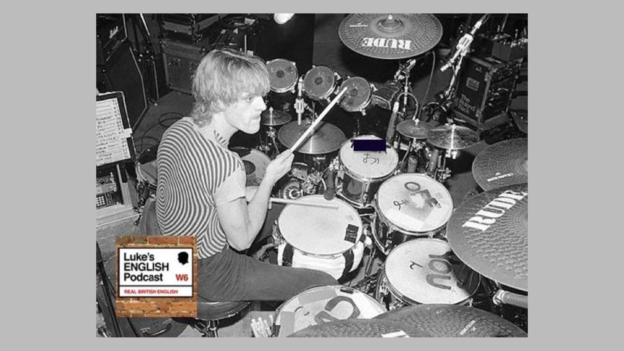
Learn how to be a rock star in this episode. I’ll teach you a bit about music and about how to play the drums. Also you can listen to various famous drummers talking about their technique. See below for some vocabulary.

Small Donate ButtonRight-click here to download this episode.

Vocabulary & Notes
Here are some notes containing some of the words and expressions used in this episode.
People sometimes say that one of the best ways to learn English is to learn how to do something else in English, like flower arranging or a new sport. So that’s why in this episode I’m going to teach you how to play the drums. I’m going to teach you about the drums too. This is quite an ambitious episode because I’ve never taught someone how to play the drums before.

I’ve been playing drums since I was 13, so about 22 years now. I was lucky because we got a drum kit for Christmas. We had a garage separate from the house and we put the drum kit there. We lived in the countryside and our neighbours were not too close so they didn’t hear the noise. That’s the advantage of the countryside. My Dad used to play the drums. It was the best gift ever. I had learned the piano and I played bass later. My brother learned the drums because he loved punk rock music. Then I played the drums too. I used to play for an hour a day at least. I’d try to copy other drummers that I liked such as Mitch Mitchell, Stewart Copeland and Ringo (yes, Ringo).

I played in a lot of bands. I was in a band in Liverpool and 2 bands in Japan. I had a CD in the shops in Japan. I basically taught myself to play drums.

Music basically has 3 elements: rhythm, melody and harmony. Rhythm is the first element. It’s the foundation. We all have rhythm inside us because of our heartbeat. There are other rhythms too like the days, the years, walking, repetitive tasks, the sound of a train or a horse. African music used rhythm. The drum was the first instrument. It was used as a communication tool.

English has a rhythm. All languages do. A sentence can be like a drum beat.

So, how do you play drums? It’s just a series of objects to hit in the right order to get a beat. You punctuate the beats with rolls. Most music has a time signature. Usually 4/4. That’s 4 beats in a bar. 1 2 3 4. That’s what you count when you play. You place beats on different numbers. There are sub beats too. 1 and 2 and 3 and 4 and.

We’ll come back to beats. Let me tell you about the kit. You have drums and cymbals, and sticks. The big drum on the floor is the bass drum. It has a deep sound. Attached to the top of that there are two tom-toms. You have another tom-tom on the floor and that makes three. Just in front of you, between your legs is the snare. It’s high pitched and it has a metal coil under the bottom skin. This gives it a sharp sound. Then, cymbals. On the left with a pedal you have the hi-hat. This is two cymbals, one up one down. Press the pedal and the top one comes down. Hold your foot down and you close the hi-hats. Then hit it with the stick on the 1 and 2 and 3 and 4 and beats. Bass drum on 1  3 Snare on 2   4 That’s a basic rock beat!

83. How to Swear in British English – VERY RUDE CONTENT (with James)

Warning: Explicit Content. Do not listen to this if you are easily offended. This episode contains lots of very rude words and offensive content. You can read all the swear words, and watch some videos below.

Small Donate Button

Right-click here to download.

Introduction

This is an overview of all the swear words in British English. The aim of this episode is to explain how to swear. Please remember that swearing is very offensive and is almost always inappropriate. Please do not swear regularly! It doesn’t sound good.

In this episode I am joined by my brother James and we explain all the main swear words in English, their meaning, their use and how offensive they are. You can read the list of swear words below. Please remember that they are very rude indeed!

I do not intend to cause offence with this episode, just to educate people about language.

VOCABULARY

Here is a list of all the swear words. The * represents how rude or offensive the word is in my opinion.

*damn
*blast
*hell
*damn it
*damn it to hell
*damn you
*bloody hell
**bugger / bugger it / it’s buggered / you daft bugger
***piss / piss off / what a pisser / it’s pissing it down / I’m pissed off
***sod / sod it / you sod
***arse / you arsehole
***prick / you prick / you dick / you dickhead / you cock
***crap / that’s crap / that’s a load of crap / don’t talk crap
****bastard
*****bollocks / that’s a load of bollocks / never mind the bollocks / that’s the (dog’s) bollocks
***balls
*nuts
*****bitch
*****you bellend
*****wank / you wanker
***you tosser
******shit / to do, take, have a shit / that’s shit / that’s the shit / to have the shits / are you shitting me? / I shit you not / he’s a shit / this is good shit / shit head / shit face / shitty / bullshit / I’m shitting myself / I was shitting it / I don’t give a shit / shit – shat – shat / I was shit scared / I don’t give a shit / when the shit hits the fan / to be shitfaced
*******fuck / to fuck something / fuck off / fuck you / shut the fuck up / fucking hell / I’m fucked / that’s fucked up / what are you fucking doing in my bed? / what are you doing fucking in my bed? / what the fuck? / no fucking way! / what the fuck are you doing? / who the fuck is he? / un-fucking-believable / abso-fucking-lutely / you fuck / you fucker / for fuck’s sake / I don’t give a fuck
********mother-fucker
*********cunt / he’s such a cunt / I felt like an absolute cunt / you stupid cunt / you fucking cunt

All those words are offensive, but the following are the very taboo words which genuinely cause a lot of offence. They’re mainly used as racist abuse: nigger (often heard in hop-hop records as black American people sometimes use this word to refer to themselves) and paki – which was used as a term of racist abuse against people of asian origin living in the UK in the 70s and 80s. It’s associated with hate crimes and racism, so of course I think it’s a very offensive word.

So that’s it. It seems that swear words used to be religious in nature “damn”etc, then they became about sex or the body, “fuck” “shit” etc, but are they really that offensive? Not in comparison with words used in racial abuse. Perhaps it is the reasons for which words are used which are offensive, and not the words themselves. What is in a word? Offensive words can be powerful so think twice before using them.

VIDEOS

Here are some videos that feature lots examples of swearing.

George Carlin’s Classic Bit about Rude Language

http://www.youtube.com/watch?v=p25SdQEnhHI

http://www.youtube.com/watch?v=4Kf4kyQabwQ

76. Mind The Gap – How to use the London Underground (with Oli & Pasquale)

In this episode you’ll listen to a conversation between me, my cousin Oli and our friend Pasquale from Canada. We give some useful advice for using the tube, and have a good laugh at the same time.

Small Donate ButtonRight-click here to download the episode.
How to use this episode to improve your English
You should:
Try to follow the conversation between 3 native speakers
Notice any differences in accent (Oli and I are from London, Pasquale is originally from Montreal in Canada)
Try to notice specific bits of language, phrases, expressions which are used.
There’s a lot of humour in the conversation – do you find it funny? Why? Why not?

If you like, you can transcribe some parts of the conversation. You’ll find this really focusses your listening and allows you to pick up phrases, vocabulary and features of pronunciation more effectively.

Advice for using the Tube
Here is a summary of the advice given in the episode:
1. Keep moving! Don’t stop! Don’t hold up the passengers behind you. Don’t block the corridors or the platforms.
2. Top up your Oyster card before you travel. Don’t waste time searching through your pockets or your handbag (ladies!)
3. Stand on the right of the escalators. Let people walk past on the left.
4. When you reach the platform, move down to the end.
5. If the platform is crowded, stand near the platform exit – more people will get off the train there and it will be easier to find space in the carriage.
6. To get on the train first you need to find out where the doors will stop. Do this by looking at the yellow line on the platform. Find the places where the paint is worn down and then wait there. The paint gets worn away by people who step off the train onto the yellow line. Where the paint is worn down is where the doors will stop!
7. Let other people get off the train first.
8. When you get on, move down inside the carriage. Don’t be shy!
9. If you’re wearing a back-pack or a rucksack, take it off. It will use up too much space.
10. Take care of your personal hygiene. Use some deodorant so you don’t smell of BO (body odour)
11. Give up your seat for elderly, disabled, injured or pregnant passengers.
12. Don’t talk too loudly or be anti-social
13. Don’t play your music too loud
14. Don’t feel you need to talk to everyone. People don’t want to be disturbed. They just want to get from A to B.
15. Chill out and read a book!

That’s it. Enjoy! Any questions, email me: luketeacher@hotmail.com

Your donations make this podcast possible. Feel free to donate any amount you consider appropriate.

Transcript for the introduction to “Mind the Gap – The London Underground”

Mind the Gap, Ladies and Gentleman, because this episode is all about the London Underground and in this episode you’re going to listen to a conversation between me, my cousin Oliver and our friend Pasquale as we talk about using the London Underground and giving you some particularly good, and very useful advice on exactly how you should use the Underground effectively.

Now in London basically there are two …, well, there is about 7 million people living in London, and as well as that we get millions of tourists visiting the city every year. Particularly next year 2012, because of the Olympic Games, there will be an estimated, something like, something ridiculous, like another 6 million people are gonna come to the city, so we thought, it would be very important to give some advice, share some tips on how you should use the Underground to make sure it doesn’t get blocked and it doesn’t get too crowded.

Now, for like Londoners, for people, who live in London, there are basically two types of tourist, now: on one hand you’ve got the bad tourists, now these are the ones, who come to the city in large numbers, and they don’t know how to operate, they don’t know, they don’t realise, that they are visiting a city, which is full of people, who need to get from A to B as quickly as possible, because they need to do their job, right, so these tourists: they come, because they are on holiday, they don’t realize and they just come, and they might, for example, just stand around on the street in large groups, just blocking the street, or they would get into the underground system, and just, sort of stop in a passage way and look at their tourist maps, because they are trying to work out where to go, and all of the time, they’re just blocking people, getting in the way, making life difficult for the ordinary Londoners who have to get from A to B in order to do their work, right? So that’s the bad tourists, those are the ones that are just, sort of like, standing around in the street, just going: ‘oh, la, la, la la la, I’m just having a lovely holiday’ and meanwhile, the rest of London gets blocked behind them.

Then, on the other hand you’ve got the good tourists, and these are the ones, who kind of do a little bit of research before they come to the city and they realize, they’re not just going on a holiday to a city, but they also becoming part of a very complicated system of people moving around, right, and they realize that really to appreciate the city properly, they’ve got to sort of think about using the Underground system or the buses or whatever, they’ve just got to think about moving around as if they were real Londoners, so they realize that they’re in a city, which is full of people moving around and they just keep cool, they go to the cool places and they don’t get in the way too much and they see what London is really like, rather than just living in some sort of dreamworld holiday, kinda thing, right.

So now in this episode, hopefully, you’ll get some advice which will allow you to be one of those good tourists, one of those cool tourists. I don’t know maybe you already live in London, maybe you’re learning English here and you live here in London, in which case you probably use the Underground every day and so you should definitely follow this advice, it will really help you, and, or maybe you’re not even learning English, maybe you’re just like a teacher of English or just someone who enjoys listening to this podcast and maybe you live in London too, well you use the Underground as well so why don’t you listen to this as well? And use it to kind of, you know, give you a few ideas of maybe how you can get on that crowded train that you keep missing, or how you can just get a seat if you usually can’t find a seat. There’s an art in using the underground, and you’re going to learn about it in this episode.

Now, let me just give you a few facts about the London underground, well, basically there’re, as I said, more than 7 millions residents in London, everyday millions of people use the Underground, it’s the oldest Underground railway in the world, it was first opened in 1890. Londoners called it ‘the Tube’, or ‘the Tube’ (different pronunciation), that’s because the shape of the tunnels is a bit like a tube. I call it ‘the Tube’, right, or the Underground In France in Paris, they call it ‘the Metro’, that’s the Paris metro, is their underground system, in New York the underground system is called ‘the Subway’, and then here in London it’s called the Underground or the Tube. And it’s an international icon for London, you probably know that the logo for the London underground is blue circle with the red horizontal line, you probably know, the London underground map, because that’s also a kind of cultural icon, which represents London. It’s a design classic-the London underground map, and it was developed with many different stages and it’s now very famous, the London underground map. There’re 270 stations on the underground, and 402km of track. Each year more than 1 billion individual journeys are made, it’s the 3rd biggest metro system in Europe, after Moscow and Paris, and it’s the 2nd biggest, sorry, it’s the 3rd busiest metro system in Europe, after Moscow and Paris, and it’s the 2nd biggest metro system in the world after Shanghai.

So, what else can I tell you about this episode, well, you’re going to get some advice, like I said. The conversation, you’re going to hear, is between me and my cousin Oli (Oliver). Now Oli is a very, very close friend of mine and my cousin, we are basically the same age, he is 2 years older, no, he is 2 weeks older than me, Pasquale is a friend of both of ours, and he is from Montreal in Canada, but he’s been living in London for 3 years. Now Oli has been using the underground to get to work every day for 10 years. Everyday he spends 2 hours on the underground, that’s one hour to get to work and one hour to get back. Two hours every day for 10 years, that pretty much makes him a kind of an expert on the London underground, in my opinion. He knows all the secrets, he knows how to get a seat, he knows the best ways to make sure that you don’t block the corridors and that you can find the exit points easily. He’s a master of using the Underground; he’s got some very advanced tips to give you. Pasquale has been living in London for 3 years, even though, originally he is from Canada, you’ll be able to hear his Canadian accent, in fact. But he’s been living in London for 3 years, he doesn’t really like using the Underground, because he thinks it’s too crowded, and it’s not very healthy, he prefers to cycle, which is even more dangerous in my opinion. If you cycle on the streets of London, you’ve got to be some sort of crazy adrenaline junkie or something, but, I guess, that’s what he likes to do. It gets him from A to B, so you’re going to listen to us talking.

Now, the conversation is pretty quick, because there’s 3 of us, and so we give bits of advice. Now I thought I’d summarize the advice for you, just to make it useful, so you can just hear the advice basically from me now, and the you can listen to the conversation and enjoy it, and you’ll know basically what we are talking about. So it should help you to understand the conversation. Let me just summarize the advice now.

Now, this advice really comes from Oli, because he’s the heavy user of the underground, right. He says 1st thing: you’ve got to keep moving, don’t stop, OK? Keep moving, so when you get to the gate you must have your oyster card ready. An oyster card is an electronic ticket, and you can top up the oyster card with credit, so you put money on it, before you travel, and then, when you go through the gates you beep your oyster card: beep, like that on a sensor. You beep it and that automatically takes some credit away from your card, OK, so you don’t need to keep paying for a ticket every time you travel. You top up at the beginning of the week and then you just beep in and beep out, so you must have your oyster card ready, don’t sort of, don’t block everyone by going through your pockets, trying to find your oyster card. Women, get your oyster card ready, because there’s nothing more time consuming than waiting for you to find your oyster card in your handbag, because we know that a handbag is a bit like a, it’s like the Tardis, you know, from Doctor Who, it’s, they look small, but inside there’s massive amount of space. So get your oyster card out of your handbag, before you get to the gate. Then you won’t block everyone, you won’t waste time that way, OK? Next thing, when you’re using the escalators, the escalators, by the way are those electronic stairs, the stairs, that kind of automatically take you down or up the escalators. When you’re using the escalators in London, you must stand on the right, and let passengers walk past you, on the left. It’s one of the worst things, that tourists do, the thing that annoys Londoners the most. It’s when tourists get onto the escalator, and they just stop. They stand in the middle and they block it and people can’t get past.

So if you’re lazy and you don’t wanna walk up or down the escalator you must make sure you’re standing on the right, and that there’s enough space on the left. So stand on the right of the escalator. When you reach the station platform, don’t stop there, oh, no, no, no. You must keep moving. Move down the platform. The same goes, when you get onto the train. Don’t just stop when you get onto the train, you must move down inside the car, move down inside the carriage, because you’ve got to remember, there’s million Londoners behind you, who wanna get on that train, so you must make space. Don’t be shy, move down inside the carriage, right? Now, here is some tips for getting on the train, when it’s really crowded. Now these are some advanced level tips. And Oliver will tell you more about them during the conversation you’re going listen to. So here’s one tip: you should find the exit from the platform and stand there. Because when the train comes in, all of the clever travellers will have got onto that car near where the exit will be. And they will all exit the train at that point, and then you’ll just stand to one side, let them all exit and then you can slip into the train. And there is going definitely be space, because everyone got off near the exit right? That’s some pretty clever advanced level stuff. The other thing is:how do you know where the doors will stop? It’s difficult to know where the doors will stop. In Japan there’re markings on the platform, that tell you exactly, where the doors will stop. That’s not the case in London. So how do you know where the doors will stop? The one thing you could do is look at the yellow line. There’s one yellow line on the platform that you should stand behind so that you’re safe. Look at that yellow line and where the paint has worn down, where the pant has worn down, you’ll know that’s when the doors open. People get off the train there and they step on the yellow line and they wear down the paint. Then you know if you can see that the paint has been worn down, you know that’s where the doors are gonna open. So you stand there. Clever, isn’t? Clever stuff. Stand near where the paint has been worn away, coz that’s where the doors will be. Then the doors will open, right, near you, you let people get off first, then you can get on the train. Bingo! You’ve got a seat, you can relax, you can chill out, you can read a book, or you just chill, whatever you wanna do, right? Because you’ve managed to find that most coveted prize on the London Underground. And that’s a seat Ladies and Gentleman, that’s right. So next thing, that you’re gonna hear about is etiquette. Now etiquette basically means things that you should do or things you shouldn’t do in a social situation. Etiquette, right. So let’s see etiquette when you get…,err, etiquette, let’s see, etiquette you should get out of the way. So if you’re gonna stop on the platform, make sure you get out of the way, so you can let people pass. It’s common sense really. Next thing is, when the train stops and the doors open let the passengers off the train first, allow, give them space to get off that train and I know there’s 100 people on the platform and they all want to get onto the train. They all wanna get a seat, but you still got to be polite, you must make space. Let the passengers off the train first and then get on and then move down inside the carriage, right? Now, if you’re wearing a backpack, wearing a rucksack, a big bag on your back, you should take that off, because otherwise you’re going to use up a lot of space. Take the bag off your back, put it down by your feet. It creates more space. When you’re…, you must pay attention to your personal hygiene. That’s basically, you’re got to be, try stay clean, coz it’s horrible, if there’s BO. Do you know what BO means? Well, it’s body odour, right? BO. BO can be horrible on the Underground. If you’re trapped next to a guy, who’s got a BO, oh, it can make you feel really sick. It can destroy your day and put you in a really bad mood. So before you get on the Underground, check the BO situation, OK? Make sure you’re using some nice deodorant, yeah? Keep yourself clean (laugh).
Next thing, don’t listen to music too loud on your iPod, right, because otherwise you’ll distract and irritate the other passengers. So there’s nothing more annoying that (imitated techno music sounds) throughout your journey. It’s just really annoying. Secondly, if you’ve got a mobile phone that plays music, use some headphones. Don’t just play the music out loud; no one cares about your music. So use some headphones and don’t play the music too loud, OK? Don’t eat smelly food, that’s disgusting. Don’t go onto the…, err, don’t take your McDonald’s onto the train, unless you have to, unless you’re dying of hunger or something. Don’t bring the McDonald’s, or the pizza or the kebab onto the train, it’s disgusting, right? Eat first, travel second, something like that. Some kind of a rule there. Don’t bring smelly food onto the Underground. If you see an elderly person, an old person, if you see a disabled person, an injured person or a pregnant woman. You’re very unlikely to see a pregnant man, so don’t worry about that. So a pregnant woman, a pregnant person. If you see any of those things, please consider giving up your seat for that person. That’s just politeness and it’s also one of the rules of etiquette on the Underground. If you don’t give up your seat, you’re gonna look like a nasty, horrible person. And there’s nothing, nothing worse than being a nasty, horrible person, is there? Oh, no. There isn’t. So give up your seat to elderly, injured, disabled or pregnant people.
Don’t talk too loudly, don’t shout on the Underground. It’s not a social club. Keep it, keep it peaceful, if you can. Or you’ll Stuck it on, one of these trains underground, it’s not the most fantastic experience, don’t spoil it by shouting across the train at your friends. It’s just antisocial. Be a bit, be a bit considerate. OK? So: no antisocial behaviour. That’s pretty much it, that’s pretty much the…, pretty much the basic advice that we give. Now you could listen to the conversation between me and Oli, and Pasquale. And enjoy it. Do enjoy the conversation. And you’ll be able to listen to more episodes from ‘Luke’s English Podcast’ very soon. That’s it. Enjoy the conversation. Bye.
Mind the Gap. OK, let me start then by introducing my two guests here on the podcast today. To my right I have Mr Oliver Thompson.
– Hello
– Hello Oliver and Oliver is my cousin, is that true?
– That’s correct. My father is your father’s brother.
– My father is…. No, your father is my father’s brother?
– Yes.
– That’s not confusing at all, is it?
– No.
– So my Dad and his Dad are brothers, which pretty much makes us cousins. It does in fact.
– First cousins.
– First cousins exactly. And to my left I have Mr Pasquale Tro…., right?
– That sounds good.
– And so Pasquale. Where are you from exactly, in fact.
– I’m originally from Montreal, Canada. And I’ve been living in London for last three years now.
– OK. Right. I see. How’s London?
– Hmm, its amazing. I don’t know its difficult to sum up in a few words, but it’s a very busy city, it’s got lots of people, and lots of activities and I don’t know it’s up there in terms of cool things, cool places to live. Definitely
-Yeah, it’s one of the cool… No, lets face it, it’s one of the best places in the world.
– On planet Earth.
– Well, no. Just in the universe.
– In the universe.
– Yeah, better than. I mean apparently some of the planets that orbit Jupiter are pretty good, but I think none of them really compares to …
– Capital city like London.
– West London, specifically.
– Yeah.
– It’s better than everywhere else. So I thought that we would today talk about travelling around London because Oliver first of all, I know that you travel in the Underground a lot.
– I do.I’ve spent for the last 6 years. I’ve spent 2 hours a day on the London Underground. And I’ve got to know it very well indeed. And I have some top tips how to navigate and some etiquette about how one should behave on the London Underground.
– Yeah, yeah, yeah. OK. So I thought then we could just share those tips and look at, exactly what it’s really like travelling on the Underground. Pasquale, do you use the Underground much?
– Actually, I try to avoid it as much as possible, to be honest. But I do have some tips as well.
-Yeah?
– Mainly: don’t use it.
-Really? Why? How come?
– Well, I have to say, it’s really hot, there’s too many people on it and it breaks down a lot.
-Yeah?
– So you know, so instead I cycle.
– Right.
– Which means I save a lot of money too.
– Can you read when you’re cycling?
– No, coz you’ve got to concentrate so you don’t get run over by London’s crazy drivers.
– London’s buses, the other public transport.
– Yeah.
-Yeah, that’s right.
– But the best tip I have for cyclist would be for them to take up the entire lane. So that buses or vehicles can’t squeeze by you.
– How do you take up the entire lane on the bike?
– Just ride in the middle of the lane. And if they honk at you, tough.
– Like, so if you get (honking sound) then you kind of go like: So what? What are you going to do: run me over?
– Yeah, especially, in the best parts when they’re honking at you, and they’re rushing to get somewhere, right?
-Yeah.
– But they’re just rushing to the queue of the traffic, so when they have to stop and wait at the traffic light, because it’s already traffic. That’s when you stop and you have to ask them: where are you rushing to? This spot right here, where you have to actually stop, can actually consume more gas. That’s when you flip them the bird and cycle away.
– Flip them the bird? What do you mean?
– Oh, that means giving them the middle finger.
– You give them your middle finger?
– No, as like a gesture.
– Right.
– Like you show them your hand and then you fold away all your fingers except for the middle one.
– Right, and that’s …
– That’s flipping the bird.
– Right you’re giving the bird sometimes
– Giving the bird.
– Giving the bird, yeah.
– Showing the bird.
– It’s an international gesture I think.
– I think yeah.
– I think it’s rude, I think it’s pretty much everywhere.
– Yes, certainly is, yeah.
– But you have to be able… The one thing, though, is you just don’t do it to anybody.
– Right. Who should you do it to?
– Old people coz you can get away from them faster.
– Children.
– Bus drivers coz they can’t get out of their cage.
– I don’t know, I’ve seen bus drivers get out of their little bus driver cage.
– Really?
– Yeah. They can leap out of those cages pretty quickly.
– They can flip everybody, every bus driver is basically on the edge.
– Yeah. Oh, who’s telephone is that? That’s my telephone, isn’t it?
– It’s your friend- Emina.
– It’s Emina calling me. OK. I’m gonna have to pause the podcast. Pause.
– OK, so we’re back. I paused the podcast, but if you’re listening you couldn’t have noticed. It’s the magic of editing. So then, can I just, maybe, we’ll just start again in a way coz we got caught up in a …tangent, didn’t we? So
– We went over-ground. That’s what happened.
– We did. We got lost on a bicycle. So Oliver, just let us know again how often do you use the Underground?
– So, I use, I live in Tooting which is where the Northern line in the south London and I have to travel to White City, which is on the Central line in West London. So I have to use the Northern Line and Victoria Line and the Central Line everyday . And that’s a journey of about 45 mins on a very good day. On a bad day, it could be hours, it could take all day.
– Right, and you work at the BBC, don’t you?
– I work at the BBC yeah, that’s right.
– I thought I’d add that. It sounds good.
– Give you some kind of credibility.
– Yeah, that,s right. And you Pasquale work at the BBC, too, don’t you?
– I just happen to yes.
– Wow, so two genuine actual BBC people on a free podcast.
– That’s right. That’s value for money.
– It is. It’s definitely.
– That’s your license fee and a little bit extra.
– That’s right. Pasquale you don’t use the Underground very often.
– No, I really try to avoid it actually. I’m lucky though. I work in White City as well and I live in the West London in Fulham by Chelsea stadium, the Old Stanford Bridge. So, because I live in West London I choose to cycle, which means a 20-minute cycle ride as opposed to an hour on a Tube of Death.
– But the cycling can be quite …
– The vessel of contagion?
– Right vessel of contagion
– The lymphatic cancer of, yes
– Of London
– Yes
– So you’re not a fan of the Underground
– No, but I have to con… with it so I have some tips on my own.
– Ok so lets focus on those tips, shall we?
– Ok
– So we’re going, in this podcast, you’re going to listen to us basically giving you some very important advice on how to use the Underground effectively, and how to not only survive your journey, but maybe enjoy it a little bit too.
– That’s right. This could be the key to your, to enjoying your London experience.
– Ok.
– Conquer the transport and you conquer the London.
– Ok, can I just also add here that we’re eating chocolate while recording this podcast. It’s probably not such a good idea to eat, to talk with your mouth full.
– True
– That’s not a coincidence, is it?
– You’re not supposed to talk with your mouth full in England, no.
– But that’s the beauty of radio
– Why?
– Coz you can’t see
– Yeah but you can certainly hear, it sounds like talking, like this: yeah(breaking a piece of choc off), well (munch) what I think, obviously, using the Underground.that’s not necessarily going to sounds good, is it?
– An excuse to eat some chocolate.
– You know what I am going to do?
– Take it away
– I’m going to take the chocolate away here.
– No.
– Its your fault, you brought it.
– I brought it in as a gift, but I’m taking that gift away from you now. You can have more chocolate when we finish. Right as like a…
– Like a dog, do your trick
– Yeah, yeah
– You’ll reward me with chocolate.
– I’ll give you a chocolate reward when it’s finished.
– Ok
– Right, so. Let’s just start by listing some bits of advice. So Oliver
– So some key advice: there’s two ticket option on the London Underground, so you can either have a paper ticket which you buy in the station and that takes time, you’re going to slot it into a little ticket hole in the gate and collect it at the other side and it holds up the flow with the passengers. So what you should do is buy an Oyster card, which is a plastic card and all you have to do is touch it at the gate and the gate is open. But before you get to the station, there’s two things you should do: you should make sure that you’ve got some money on your Oyster card, you can top up online and add money to your account, to your Oyster card account. And also make sure you’ve got it out of your pocket before you get to the gate, because otherwise you’ll get to the gate and you’ll have a queue of people behind you just crushing you slowly at the gate, as you’re trying to get out your Oyster card out of your pocket.
– Right, so yeah, go on.
– I don’t wanna be sexist but this particularly applies to women, who can spend 3 or 4 hrs going through their handbag, looking for their Oyster card at the gate, I’ve found.
– so can I just briefly summarize what you’ve just said? It might be useful to people listening to this, right? So we got two ways to buy the tickets: one os to buy paper ticket, one is to buy; paper ticket is a bit old fashioned now, isn’t it?
– It is.

73. Steve Jobs


Small Donate ButtonRight-click here to download this episode.
Listen to Steve Jobs’ famous speech to graduates of Stanford University, read the transcript, notice some useful features of English, and learn some important lessons about life.

Tributes to Steve Jobs from Reuters News Feed
(Reuters) – President Barack Obama was among the many people who paid tribute to Steve Jobs, calling the Apple co-founder a visionary and great American innovator.

“Steve was among the greatest of American innovators — brave enough to think differently, bold enough to believe he could change the world, and talented enough to do it,” Obama said of Jobs, who died on Wednesday.

“The world has lost a visionary. And there may be no greater tribute to Steve’s success than the fact that much of the world learned of his passing on a device he invented.”

The president was joined by political, technology, entertainment and business leaders around the world in paying tribute to Jobs. A selection:

BILL GATES, MICROSOFT CO-FOUNDER AND CHAIRMAN

“Steve and I first met nearly 30 years ago, and have been colleagues, competitors and friends over the course of more than half our lives. The world rarely sees someone who has had the profound impact Steve has had, the effects of which will be felt for many generations to come. For those of us lucky enough to get to work with him, it’s been an insanely great honor.”

STEPHEN ELOP, NOKIA CEO

“The world lost a true visionary today. Steve’s passion for simplicity and elegance leaves us all a legacy that will endure for generations. Today, my thoughts, and those of everyone at Nokia, are with the friends and family that he leaves behind.”

FRENCH PRESIDENT NICOLAS SARKOZY ON FACEBOOK

“His capacity to revolutionize entire sectors of the economy by the power of imagination and technology is a source of inspiration for millions of engineers and entrepreneurs across the world. His efforts to render new technologies more attractive and simple to use have made a success of businesses that have changed the world of computing, the distribution of cultural content, telecommunications and even animated cinema.”

RUPERT MURDOCH, CEO OF NEWS CORP

“Today, we lost one of the most influential thinkers, creators and entrepreneurs of all time. Steve Jobs was simply the greatest CEO of his generation.”

Full Reuters Article Here: http://mobile.reuters.com/article/idUSTRE7950GT20111006?irpc=932

Steve Jobs’ Stanford University Speech
This is a prepared text of the Commencement address delivered by Steve Jobs, CEO of Apple Computer and of Pixar Animation Studios, on June 12, 2005.

I am honored to be with you today at your commencement from one of the finest universities in the world. I never graduated from college. Truth be told, this is the closest I’ve ever gotten to a college graduation. Today I want to tell you three stories from my life. That’s it. No big deal. Just three stories.

The first story is about connecting the dots.

I dropped out of Reed College after the first 6 months, but then stayed around as a drop-in for another 18 months or so before I really quit. So why did I drop out?

It started before I was born. My biological mother was a young, unwed college graduate student, and she decided to put me up for adoption. She felt very strongly that I should be adopted by college graduates, so everything was all set for me to be adopted at birth by a lawyer and his wife, except that when I popped out they decided at the last minute that they really wanted a girl. So my parents, who were on a waiting list, got a call in the middle of the night asking: “We’ve got an unexpected baby boy; do you want him?” They said: “Of course.” My biological mother later found out later that my mother had never graduated from college and that my father had never graduated from high school. She refused to sign the final adoption papers. She only relented a few months later when my parents promised that I would go to college. This was the start, in my life.

And 17 years later I did go to college. But I naively chose a college that was almost as expensive as Stanford, and all of my working-class parents’ savings were being spent on my college tuition. After six months, I couldn’t see the value in it. I had no idea what I wanted to do with my life and no idea how college was going to help me figure it out. And here I was spending all of the money my parents had saved their entire life. So I decided to drop out and trust that it would all work out OK. It was pretty scary at the time, but looking back it was one of the best decisions I ever made. The minute I dropped out I could stop taking the required classes that didn’t interest me, and begin dropping in on the ones that looked far more interesting.

It wasn’t all romantic. I didn’t have a dorm room, so I slept on the floor in friends’ rooms, I returned coke bottles for the 5¢ deposits to buy food with, and I would walk the 7 miles across town every Sunday night to get one good meal a week at the Hare Krishna temple. I loved it. And much of what I stumbled into by following my curiosity and intuition turned out to be priceless later on. Let me give you one example:

Reed College at that time offered perhaps the best calligraphy instruction in the country. Throughout the campus every poster, every label on every drawer, was beautifully hand calligraphed. Because I had dropped out and didn’t have to take the normal classes, I decided to take a calligraphy class to learn how to do this. I learned about serif and san serif typefaces, about varying the amount of space between different letter combinations, about what makes great typography great. It was beautiful, historical, artistically subtle in a way that science can’t capture, and I found it fascinating.

None of this had even a hope of any practical application in my life. But ten years later, when we were designing the first Macintosh computer, it all came back to me. And we designed it all into the Mac. It was the first computer with beautiful typography. If I had never dropped in on that single course in college, the Mac would have never had multiple typefaces or proportionally spaced fonts. And since Windows just copied the Mac, it’s likely that no personal computer would have them. If I had never dropped out, I would have never dropped in on this calligraphy class, and personal computers might not have the wonderful typography that they do. Of course it was impossible to connect the dots looking forward when I was in college. But it was very, very clear looking backwards ten years later.

Again, you can’t connect the dots looking forward; you can only connect them looking backwards. So you have to trust that the dots will somehow connect in your future. You have to trust in something — your gut, destiny, life, karma, whatever. Because believing that the dots will connect down the road will give you the confidence to follow your heart, even when it leads you off the well worn path, and that will make all the difference.

My second story is about love and loss.

I was lucky — I found what I loved to do early in life. Woz and I started Apple in my parents’ garage when I was 20. We worked hard, and in 10 years Apple had grown from just the two of us in a garage into a $2 billion company with over 4000 employees. We had just released our finest creation — the Macintosh — a year earlier, and I had just turned 30. And then I got fired. How can you get fired from a company you started? Well, as Apple grew we hired someone who I thought was very talented to run the company with me, and for the first year or so things went well. But then our visions of the future began to diverge and eventually we had a falling out. When we did, our Board of Directors sided with him. So at 30 I was out. And very publicly out. What had been the focus of my entire adult life was gone, and it was devastating.

I really didn’t know what to do for a few months. I felt that I had let the previous generation of entrepreneurs down – that I had dropped the baton as it was being passed to me. I met with David Packard and Bob Noyce and tried to apologize for screwing up so badly. I was a very public failure, and I even thought about running away from the valley. But something slowly began to dawn on me — I still loved what I did. The turn of events at Apple had not changed that one bit. I had been rejected, but I was still in love. And so I decided to start over.

I didn’t see it then, but it turned out that getting fired from Apple was the best thing that could have ever happened to me. The heaviness of being successful was replaced by the lightness of being a beginner again, less sure about everything. It freed me to enter one of the most creative periods of my life.

During the next five years, I started a company named NeXT, another company named Pixar, and fell in love with an amazing woman who would become my wife. Pixar went on to create the worlds first computer animated feature film, Toy Story, and is now the most successful animation studio in the world. In a remarkable turn of events, Apple bought NeXT, I returned to Apple, and the technology we developed at NeXT is at the heart of Apple’s current renaissance. And Laurene and I have a wonderful family together.

I’m pretty sure none of this would have happened if I hadn’t been fired from Apple. It was awful tasting medicine, but I guess the patient needed it. Sometimes life’s going to hit you in the head with a brick. Don’t lose faith. I’m convinced that the only thing that kept me going was that I loved what I did. You’ve got to find what you love. And that is as true for your work as it is for your lovers. Your work is going to fill a large part of your life, and the only way to be truly satisfied is to do what you believe is great work. And the only way to do great work is to love what you do. If you haven’t found it yet, keep looking. Don’t settle. As with all matters of the heart, you’ll know when you find it. And, like any great relationship, it just gets better and better as the years roll on. So keep looking. Don’t settle.

My third story is about death.

When I was 17, I read a quote that went something like: “If you live each day as if it was your last, someday you’ll most certainly be right.” It made an impression on me, and since then, for the past 33 years, I have looked in the mirror every morning and asked myself: “If today were the last day of my life, would I want to do what I am about to do today?” And whenever the answer has been “No” for too many days in a row, I know I need to change something.

Remembering that I’ll be dead soon is the most important tool I’ve ever encountered to help me make the big choices in life. Because almost everything — all external expectations, all pride, all fear of embarrassment or failure – these things just fall away in the face of death, leaving only what is truly important. Remembering that you are going to die is the best way I know to avoid the trap of thinking you have something to lose. You are already naked. There is no reason not to follow your heart.

About a year ago I was diagnosed with cancer. I had a scan at 7:30 in the morning, and it clearly showed a tumor on my pancreas. I didn’t even know what a pancreas was. The doctors told me this was almost certainly a type of cancer that is incurable, and that I should expect to live no longer than three to six months. My doctor advised me to go home and get my affairs in order, which is doctor’s code for prepare to die. It means to try to tell your kids everything you thought you’d have the next 10 years to tell them in just a few months. It means to make sure everything is buttoned up so that it will be as easy as possible for your family. It means to say your goodbyes.

I lived with that diagnosis all day. Later that evening I had a biopsy, where they stuck an endoscope down my throat, through my stomach and into my intestines, put a needle into my pancreas and got a few cells from the tumor. I was sedated, but my wife, who was there, told me that when they viewed the cells under a microscope the doctors started crying because it turned out to be a very rare form of pancreatic cancer that is curable with surgery. I had the surgery and thankfully I’m fine now.

This was the closest I’ve been to facing death, and I hope it’s the closest I get for a few more decades. Having lived through it, I can now say this to you with a bit more certainty than when death was a useful but purely intellectual concept:

No one wants to die. Even people who want to go to heaven don’t want to die to get there. And yet death is the destination we all share. No one has ever escaped it. And that is as it should be, because Death is very likely the single best invention of Life. It is Life’s change agent. It clears out the old to make way for the new. Right now the new is you, but someday not too long from now, you will gradually become the old and be cleared away. Sorry to be so dramatic, but it is quite true.

Your time is limited, so don’t waste it living someone else’s life. Don’t be trapped by dogma — which is living with the results of other people’s thinking. Don’t let the noise of others’ opinions drown out your own inner voice. And most important, have the courage to follow your heart and intuition. They somehow already know what you truly want to become. Everything else is secondary.

When I was young, there was an amazing publication called The Whole Earth Catalog, which was one of the bibles of my generation. It was created by a fellow named Stewart Brand not far from here in Menlo Park, and he brought it to life with his poetic touch. This was in the late 1960’s, before personal computers and desktop publishing, so it was all made with typewriters, scissors, and polaroid cameras. It was sort of like Google in paperback form, 35 years before Google came along: it was idealistic, and overflowing with neat tools and great notions.

Stewart and his team put out several issues of The Whole Earth Catalog, and then when it had run its course, they put out a final issue. It was the mid-1970s, and I was your age. On the back cover of their final issue was a photograph of an early morning country road, the kind you might find yourself hitchhiking on if you were so adventurous. Beneath it were the words: “Stay Hungry. Stay Foolish.” It was their farewell message as they signed off. Stay Hungry. Stay Foolish. And I have always wished that for myself. And now, as you graduate to begin anew, I wish that for you.

Stay Hungry. Stay Foolish.

Thank you all very much.

© Stanford University. All Rights Reserved. Stanford, CA 94305. (650) 723-2300.
Watch a video of the speech here:
[youtube http://www.youtube.com/watch?v=UF8uR6Z6KLc&w=480&h=360]