Category Archives: Entertainment

320. A Christmas Carol by Charles Dickens

It’s Christmas! So in this episode I’m going to read you a classic Christmas story – A Christmas Carol by Charles Dickens. You can read the story as well as listen because the whole thing is included on the page for this episode.

Small Donate Button[DOWNLOAD]

Welcome to this special Christmas edition of Luke’s English podcast. I’m feeling very Christmassy here. All my shopping has been done and I’m looking forward to getting together with my family tomorrow. I’m just here with a lovely warm fire, and I’ve managed to find the time to tell you a story in this episode.

But first I’d just like to say Merry Christmas to all of you around the world. I hope you’re spending a pleasant time full of yuletide cheer and festive spirit, even if Christmas isn’t something you celebrate. I usually like to do a special Christmas themed episode of Luke’s English Podcast at this time of year. In the past I’ve done other Christmas episodes and you can check them out if you haven’t already done that.

78. Christmas – It’s all about Family

158. A Cup of Tea with Paul Taylor (Part 1)

159. A Cup of Tea with Paul Taylor (Part 2)

160. The A to Z of Christmas

245. Merry Christmas! (+ Other News) + Video!

What are you doing for Christmas this year? Are you doing anything special? As usual I’m going back to my parents’ place for a few days. They live in Warwick, which is in the midlands not far from Stratford Upon Avon, where Shakespeare was born. I expect we’ll be doing the usual Christmas things: eating loads of food, playing lots of games and giving each other presents. I might record a few podcasts with my family too, if we get a break from all the festivities at any time.

In this episode we’re going to eat a nice big slice of Christmas podcast cake, in the form of a classic story by Charles Dickens – “A Christmas Carol”. It’s a story that many people know and is firmly associated with the general sentiment of Christmas in modern Britain, and other parts of the world no doubt – the idea that Christmas is a time of generosity, of stopping your work and focusing on the important things in life, like your family. I’m going to read you a version of this story, which you can find reproduced on the page for this episode if you’d like to read with me. In fact, this episode is almost 100% transcribed.

I found this version on a website called Family Christmas Online. Just go to familychristmasonline.com to find more Christmas themed stuff. Credit should go to Theresa Race Hoffman who edited this version for public readings. http://familychristmasonline.com/stories_other/a_christmas_carol/a_christmas_carol.htm

It’s a reduced version and I’ve also modified it slightly to make some of the language more up-to-date but generally the style is quite similar to the original which was written by Charles Dickens in 1843.

Before I read the story to you, here’s a preface about how A Christmas Carol Made Charles Dickens One of England’s Best-Loved Writers

Preface

Sometime in 1843, Dickens decided to publish a quality Christmas book that would reach people in two ways:
It would use a very original story to plead for compassion for the poor, and
It would be affordable, bringing quality literature in a well-made book to a wide audience.

Dickens’ publisher didn’t believe in the project, so Dickens ended up financing the book himself. He spent money on a quality leather binding and on many quality illustrations, several of which were hand-tinted, an expensive process. As a result, the first printing of A Christmas Carol made very little money, but it rapidly became Dickens’ most popular work. The book was soon reprinted and was adapted for the stage. In later years Dickens often read a shortened version of the story aloud. A Christmas Carol has never faded from popularity since. IN fact there have been a few different film versions of the story, including A Muppets Christmas Carol, starring Michael Caine – which is acually a touching and beautiful telling of the story.

How A Christmas Carol Helped Change the Way We Think About Christmas

By the time A Christmas Carol was published, Christmas in Britain had disintegrated into an excuse for a week of year-end partying. Not only had Christ become absent from English Christmases, but so had compassion, a virtue that Dickens believed that the poor greatly needed, especially at the onset of cold weather each year. A Christmas Carol helped the English, and eventually the people of many countries, gain a new appreciation for Christmas and for the plight of the poor. Perhaps the greatest change was the growing importance of family Christmas celebrations in a culture where the wealthy had often sent their children to the nursery early on Christmas so they could better enjoy their dances and parties. As an example, author Tim Hallinan* claims that December sales of toys rose dramatically in the decades following A Christmas Carol’s publication. Today, many people in the world tend to think of Victorian England as a time and place where Christmas was “done right.” But without the influence of Dickens and this story, such hearty celebrations of good will may never have occurred.

Preface to A Christmas Carol, by Charles Dickens

I have endeavoured in this Ghostly little book, to raise the Ghost of an Idea, which shall not put my readers out of humour with themselves, with each other, with the season, or with me. May it haunt their houses pleasantly, and no one wish to lay it. Their faithful Friend and Servant, C.D.
December, 1843.

So, let’s begin the story. Here it is. A Christmas Carol, by Charles Dickens.

PART 1 – Marley’s Ghost

MARLEY was dead: to begin with. Old Marley was as dead as a door-nail. This must be understood, or this story will mean nothing to anybody. So, we start with the fact that Scrooge’s business partner Marley had snuffed it, he was pushing up the daisies, he was an ex-partner, he’d carked it. He was a goner. He was dead. Scrooge now carried on the moneylending business alone.

He never painted out Old Marley’s name on the door of the office, even though his old partner was – definitely – dead. The company was known as Scrooge and Marley. Sometimes people called Scrooge Scrooge, and sometimes they called him Marley, but he answered to both names. It was all the same to him.

Oh! Scrooge was a selfish old git! He was as cold as a freezing winter night, and he didn’t thaw one degree at Christmas. He hated Christmas and everything it stood for. No ‘season of goodwill’ – for him it was just another excuse to grumble and moan, and stay at home counting his money.

One dark Christmas Eve, old Scrooge sat busy in his counting-house. It was biting, foggy weather.

Scrooge had a very small fire in his office. But next door in his clerk’s office the poor fire was even smaller and barely warm. His poor clerk, called Bob Cratchit had worked for Scrooge for years, and yet had never received a pay rise. Scrooge always paid him the minimum wage.

“Merry Christmas, uncle!” said Scrooge’s nephew Fred coming into the room.

“Bah!” said Scrooge, “Humbug!”

“Christmas a humbug, uncle?” he said. “You don’t mean that do you?”

“If I could work my will,” said Scrooge indignantly, “every idiot who goes about with ‘Merry Christmas’ on his lips, should be boiled with his own pudding, and buried with a stake of holly through his heart!”

The nephew answered, “Don’t be angry, uncle. Come to our place for Christmas tomorrow.”

“Bah, humbug! Christmas! Don’t talk to me about Christmas. It’s all just a big jumped up shopping spree invented by the Americans. The whole thing is just invented to get your money out of your pocket! Well, not mine – I’m keeping mine. You do Christmas your way, and I’ll do it my way. Here on my own, just like every other day, thanks very much!”

“Suit yourself Uncle, but we’ll miss you this year, again” said Scrooge’s nephew. “Merry Christmas, uncle!”

“Good afternoon!” said Scrooge.

His nephew even stopped to wish “Merry Christmas” to the clerk.

The poor, cold clerk, Bob Cratchit, managed a thin smile and a weak “merry Christmas” in return as Scrooge’s nephew left.

As he left, Fred let two other people in. They entered and bowed to Scrooge.

“Mr. Scrooge, or Mr. Marley?” said one of the gentlemen.

“Mr. Marley,” Scrooge replied, “died seven years ago, this very night.”

“Oh, sorry for your loss” said one of the men.

“What do you want?” snapped Scrooge.

“Mr. Scrooge,” said the gentleman, “It looks like it’s going to be an especially freezing winter this year. A few of us are going to buy some meat and drink for the Poor, and some blankets to keep them warm this Christmas. What would you like to give?”

“Nothing,” said Scrooge. “If they’ve got no money they can borrow it, or failing that go to the debtors’ prisons.”

“Many would rather die.”

“If they would rather die,” said Scrooge, “they had better do it, and decrease the surplus population. Good afternoon, gentlemen!”

Scrooge went back to his work.

Meanwhile the fog and darkness and biting cold thickened. Some carol singers walked by Scrooge’s office. One cold young boy stooped down at Scrooge’s keyhole to sing a Christmas carol:

“God bless you, merry gentleman!
May nothing you dismay!”

As soon as he heard it Scrooge jumped up so that the singer fled in terror, leaving the keyhole to the fog.

At length the hour of shutting up arrived. Scrooge nodded to the clerk Mr Cratchit, who instantly snuffed his candle out, and put on his hat.

“You’ll want all day off tomorrow, I suppose?” said Scrooge.

“Yes please Mr Scrooge. It is only once a year after all”

“A poor excuse for picking a man’s pocket every twenty-fifth of December!” said Scrooge. “No day off for you. I expect you to be here extra early next morning.”

Scrooge went home to his gloomy house. The yard was dark and the fog and frost hung about the place.

Now, the knocker on his door was very large and ordinary. But tonight it looked like – Marley’s face.

Marley’s face. The eyes were wide open, and its grayish colour made it horrible in the half light.

As Scrooge looked, it became a knocker again. He did look carefully, but the knocker was still a knocker.

“Load of old nonsense!” said Scrooge to himself.

He closed his door and double-locked himself in. He walked through his rooms to see that all was right and sat by the fire.

“Humbug!” he said. “Stupid Christmas. I’ll be glad when it’s all over and people start acting normally again.”

And then he heard it – a clanking noise, from the cellar, as if some person were dragging a heavy chain.

Scrooge tried to ignore it, and opened his paper.

Then he heard the sound again. The noise of heavy chains being dragged, and a faint sound of moaning.

Scrooge suddenly sat upright in his chair. The noise was real, and it was getting louder.

Suddenly the cellar-door flew open with a booming sound, and then he heard the noise coming up the stairs; then straight towards his door.

Quickly it came on through the heavy door, and passed into the room before his eyes.

It was Marley, back from the dead. The chain Marley pulled was long, and made of cash-boxes, keys, padlocks, and purses. His body was transparent; so that Scrooge could see the two buttons on his coat hanging on the door behind.

“What do you want with me?” said Scrooge. “Who are you?”

“In life I was your partner, Jacob Marley.”

“Humbug, I tell you! humbug!”

At this the spirit raised a frightful cry, and shook its chain. Scrooge fell upon his knees.

Asked the Ghost, “Do you believe in me or not?”

“I do,” said Scrooge. “I do! But why do spirits walk the earth, and why do they come to me?”

“It is required of every man,” the Ghost returned, “that the spirit within him should walk abroad among his fellow men; and if that spirit does not go forth in life, it is condemned to do so after death!”

“You are chained,” said Scrooge, trembling. “Tell me why?”

“I wear the chain I forged in life and by the very work I did, with you,” replied the Ghost. “I made it link by link, and yard by yard; and of my own free will I wore it.” Scrooge trembled more and more.

“Do you know,” pursued the Ghost, “your chain was as heavy as this, seven Christmas Eves ago? You have made it longer, since then.”

“But you were always a good man of business, Jacob,” faltered Scrooge.

“Business!” cried the Ghost, wringing its hands again. “Mankind was my business. Greed was my business! I spent my life on this earth obsessing over money and mistreating the poor and wretched to fill my pocket. Old Scrooge,  I am  condemned to walk the earth for eternity never to find rest or peace.”

“I am here to-night to warn you,” pursued the Ghost. You will be haunted by Three Spirits.”

“I—I think I’d rather not,” said Scrooge.

“They will come to teach you a lesson. Expect the first to-morrow,” said the Ghost, “when the bell tolls One.”

“Expect the second on the next night at the same hour. The third upon the next night at the last stroke of Twelve.”

When it had said these words, the spectre floated out upon the bleak, dark night.

The air was filled with moaning phantoms, and every one of them wore chains like Marley’s Ghost. They faded away. Scrooge closed the window, and examined the door by which the Ghost had entered. It was still as he had double-locked, with his own hands. He tried to say “Humbug!” but stopped. And he went straight to bed and fell asleep upon the instant.

PART 2 – The First of the Three Spirits

WHEN Scrooge awoke, it was dark. The chimes of a neighbouring church struck the hour, with a single deep, melancholy note.

Light flashed up in the room, and the curtains of his bed were drawn aside by a hand. And Scrooge found himself face to face with the unearthly visitor who drew them, right in front of his face.

It was a strange figure—like a child, or an old man. Its white hair hung about its neck and down its back, and yet the face had not a wrinkle in it. Its legs and feet were bare. It wore a white tunic with a shining belt. It held a branch of fresh green holly in its hand; and had its dress trimmed with summer flowers

“Are you the Spirit whose coming was foretold to me?” asked Scrooge.

The voice was soft and gentle. “I am the Ghost of Christmas Past.”

“Long Past?” inquired Scrooge.

“No. Your past.”

It put out its strong hand and clasped him gently by the arm.

“Rise! and walk with me!”

They passed through the wall, and stood upon an open country road. Now it was a clear, cold, winter day, with snow upon the ground.

“Good Heavens!” said Scrooge. “I was a boy in this place!” He wiped away a tear and begged the Ghost to lead him.

“You recollect the way?” inquired the Spirit.

“Remember it!” cried Scrooge. “I could walk it blindfolded.”

They walked along the road, Scrooge recognizing every gate and tree; until a little town appeared in the distance. Some shaggy ponies trotted towards them with boys upon their backs. All these boys shouted to each other merrily. Scrooge knew and named them every one. “These are but shadows of the things that have been,” said the Ghost. “They do not see us.”

But why was he filled with gladness when he heard them tell each other Merry Christmas, as they parted! What was Merry Christmas to Scrooge? What good had it ever done to him?

“The school is not quite deserted,” said the Ghost. “A lonely child, neglected by his friends, is there still.”

Scrooge said he knew it. And he cried.

They soon approached a large house, its windows broken, and the many rooms cold, and bare of food.

They went, the Ghost and Scrooge, to the back of the house, and a room with desks. At one of these a lonely boy was reading near a feeble fire; and Scrooge sat down, beside his poor forgotten self as he used to be. He said “Poor boy!” and cried again.

“I wish,” Scrooge muttered, after drying his eyes with his cuff: “but it’s too late now.”

“What is the matter?” asked the Spirit.

“Nothing,” said Scrooge. “Nothing. There was a boy singing a Christmas Carol at my door last night. I should have given him something: that’s all.”

The Ghost smiled thoughtfully, and waved its hand: saying as it did so, “Let us see another Christmas!”

And there he was, alone again, when all the other boys had gone home for the holidays.

The door opened; and a little girl came darting in, and put her arms about his neck.

“I have come to bring you home, dear brother!” said the child. “We’re to be together all the Christmas long, and have the merriest time in all the world.”

“Your sister,” said the Ghost. “Always a delicate creature. But she had a large heart!”

“So she had,” cried Scrooge. “You’re right, Spirit!”

“She died a woman,” said the Ghost, “and had, I think, one child – your nephew”

Scrooge answered sadly, “Yes.”

All at once they were in a busy city. Here too it was Christmas time again; but it was evening, and the streets were lighted up.

The Ghost stopped at a warehouse door, and asked Scrooge if he knew it.

“Know it!” said Scrooge. “I was apprenticed here!”

At sight of an old gentleman, behind a high desk, Scrooge cried in great excitement:

“Why, bless his heart; it’s Fezziwig alive again! My old boss!”

Scrooge’s former self, now a young man, came in, beside his fellow apprentice.

Old Fezziwig laid down his pen, and looked up at the clock. He rubbed his hands and called out in a rich voice:

“No more work to-night, my boys!” said Fezziwig. “Christmas Eve, Dick. Christmas, Ebenezer! Clear away, lads!”

It was done in a minute. The floor was swept, the lamps were trimmed, fuel was heaped upon the fire; and the warehouse became a snug, warm, and bright ball-room.

In came a fiddler with a music-book. In came Mrs. Fezziwig, and the three Miss Fezziwigs,. In came all the young men and women employed in the business, the housemaid, the baker, the cook, the milkman. Away they all went, twenty couples at once!

There were dances, and games, and there was cake, and Roast Beef, and mince-pies, and plenty of ale.

During all this time, Scrooge had acted like a man out of his wits. He enjoyed everything. Now that he remembered the Ghost, he became conscious that it was looking full upon him.

“A small matter,” said the Ghost, “to make these silly folks so full of gratitude.”

“Small!” echoed Scrooge. “It isn’t that, Spirit. He has the power to make our work a pleasure or a toil. The happiness he gives, is quite as great as if it cost a fortune.”

He stopped.

“What is the matter?” asked the Ghost.

“Nothing particular,” said Scrooge.

“Something, I think?” the Ghost insisted.

“No,” said Scrooge, “No. I should like to be able to say a word or two to my clerk just now. That’s all.”

Scrooge and the Ghost again stood in the open air.

“My time grows short,” observed the Spirit. “Quick!”

Again Scrooge saw himself. He was older now. He was not alone, but sat by a pretty young girl: in her eyes there were tears.

“It matters little to you,” she said, softly. “Another idol has taken my place. It is the love of money. Good-bye. May you be happy in the life you have chosen!”

“Spirit!” cried Scrooge, “show me no more! I cannot bear it! Leave me! Take me back. Haunt me no longer!”

He was conscious of being exhausted, and of being in his own bedroom. He had barely time to reel to bed, before he sank into a heavy sleep.

PART 3 – The Second of the Three Spirits

Scrooge waited again.

Now, when the Bell struck One, he saw a ghostly light coming from the next room. He shuffled to the door.

A strange voice called him by his name, and bade him enter.

The room was hung with holly and mistletoe, and a mighty blaze went roaring up the chimney. Heaped up like a throne were geese, pies, plum-puddings, chestnuts, oranges, pears, cakes, and punch. Upon this food couch, there sat a jolly Giant, who held a glowing torch high up, to shed its light on Scrooge.

“Come in!” exclaimed the Ghost, “and know me better, man!” Scrooge entered timidly, and hung his head.

“I am the Ghost of Christmas Present,” said the Spirit. “Look upon me!”

Scrooge reverently did so. It was clothed in a green robe, bordered with white fur. Its feet were bare; and on its head it wore a holly wreath, set here and there with shining icicles.

“You have never seen the like of me before!” exclaimed the Spirit.

“Spirit,” said Scrooge, “conduct me where you will. I went forth last night and I learnt a lesson which is working now. To-night, if you have anything to teach me, let me profit by it.”

“Touch my robe!”

Feast, fire, room all vanished instantly and they stood in the city streets on a snowy Christmas morning.

The sky was gloomy, and yet was there an air of cheerfulness like a summer day.

Soon the steeples called the people to church, and away they came, flocking through the streets in their best clothes, and with their happiest faces.

The good Spirit led him straight to Scrooge’s clerk’s, holding on to his robe; and at the door the Spirit smiled, and stopped to bless Bob Cratchit’s dwelling. Think of that! Bob had but fifteen shillings a-week himself; and yet the Ghost of Christmas Present blessed his little house!

Then up rose Mrs. Cratchit, dressed poorly in a worn dress.

“What has ever got your precious father then?” said Mrs. Cratchit to the little Cratchits. “And your brother, Tiny Tim.”

In came Bob, the father, in his threadbare clothes; and Tiny Tim upon his shoulder. Sadly, Tiny Tim held a little crutch!

“And how did little Tim behave?” asked Mrs. Cratchit.

“As good as gold,” said Bob. “He told me, that he hoped the people saw him in the church, because he was a cripple, and it might be pleasant to them to remember upon Christmas Day, who made lame beggars walk, and blind men see.”

At last the dishes were set on, and grace was said. Bob said he didn’t believe there ever was such a goose cooked. Mrs. Cratchit brought in the pudding, like a speckled cannon-ball, blazing with brandy, and with Christmas holly stuck into the top. A wonderful pudding!

Bob proposed a toast:

“A Merry Christmas to us all, my dears. God bless us!”

“God bless us every one!” said Tiny Tim, the last of all.

He sat very close to his father’s side upon his little stool. Bob held his withered little hand in his, as if he loved the child, and wished to keep him by his side, and dreaded that he might be taken from him.

“Spirit,” said Scrooge, with an interest he had never felt before, “tell me if Tiny Tim will live.”

“I see a vacant seat,” replied the Ghost, “in the corner, and a crutch without an owner, carefully preserved. If these shadows remain unaltered by the Future, the child will die.”

“No, no,” said Scrooge. “Oh, no, kind Spirit! say he will be spared.”

“If these shadows remain unaltered by the Future, he will die this year,” repeated the Ghost. “What then? If he is going to die, he had better do it, and decrease the surplus population.”

Scrooge hung his head, ashamed to hear his own words.

“Man,” said the Ghost, “will you decide what men shall live, what men shall die? It may be, that in the sight of Heaven, you are more worthless and less fit to live than millions like this poor man’s child!”

But now Scrooge heard his own name.

“Mr. Scrooge!” toasted Bob; “I’ll give you Mr. Scrooge, the Founder of the Feast!”

“The Founder of the Feast indeed!” cried Mrs. Cratchit, reddening.

“My dear,” was Bob’s mild answer, “Christmas Day.”

“I’ll drink to his health, for your sake and the Day’s,” said Mrs. Cratchit, “Long life to him! A merry Christmas and a happy new year!”

The children drank the toast after her, but they didn’t care for it. Scrooge was the Ogre of the family. The mention of his name cast a dark shadow on the party.

By-and-bye they had a song from Tiny Tim, who had a sweet little voice, and sang it very well indeed.

They were not a handsome family; they were not well dressed. But, they were happy, grateful, pleased with one another, and contented with the time. Scrooge watched them, and especially on Tiny Tim, until the last.

And now, they traveled through coal miners’ homes, past ships on the dark sea. And everywhere they went, no matter how poor, every person hummed a Christmas tune, or had a Christmas thought. And every person, good or bad, had a kind word for another on that day.

Scrooge heard a hearty laugh and recognised it as his own nephew’s. He found himself in a bright, gleaming room, with the Spirit standing smiling by his side.

“Ha, ha!” laughed Scrooge’s nephew. “He said that Christmas was a humbug, as I live! He believed it too!”

“More shame for him, Fred!” said Scrooge’s niece, indignantly.

“He’s a comical old fellow,” said Scrooge’s nephew, “and not so pleasant as he might be. However, his offences carry their own punishment, and I am sorry for him. Who suffers by his ill temper! Himself, always.”

They had some music and played at games; for it is good to be children sometimes, and never better than at Christmas.

They all played and sang, and so did Scrooge, singing quite loud. He begged like a boy to be allowed to stay until the guests departed. But this the Spirit said could not be done.

Much they saw, and far they went, and everywhere the Spirit went he left his blessing. It was a long night, and Scrooge noticed that the Ghost grew older, and he noticed that its hair was grey.

“Are spirits’ lives so short?” asked Scrooge.

“My life upon this globe, is very brief,” replied the Ghost. “It ends to-night at midnight. Listen! The time is drawing near.”

The bell struck twelve. And the Spirit disappeared. As the last stroke ceased to vibrate, he remembered the prediction of old Jacob Marley, and lifting up his eyes, beheld a solemn Phantom, draped and hooded, coming, like a mist along the ground, towards him.

PART 4 – The Last of the Spirits

THE Phantom approached, in a deep black garment, which left nothing of it visible save one boney hand.

“I am in the presence of the Ghost of Christmas Yet To Come?” said Scrooge. “You are about to show me shadows of the things that will happen. Is that so, Spirit?”

Scrooge’s legs trembled beneath him.

“Ghost of the Future!” he exclaimed, “I fear you more than any spectre I have seen. But I know your purpose is to do me good, and I am prepared to bear you company, and do it with a thankful heart. Will you not speak to me?”

It gave him no reply. The hand was pointed straight ahead.

“Lead on!” said Scrooge. “Lead on! The night is precious time to me, I know. Lead on, Spirit!”

The Phantom moved away.

They were in the heart of the city; amongst the merchants; who hurried up and down, and chinked the money in their pockets, as Scrooge had seen them often.

The Spirit stopped beside one little knot of business men, pointing to them, Scrooge advanced to listen to their talk.

“No,” said a great fat man with a monstrous chin, “I don’t know much about it. I only know he’s dead.”

“When did he die?” inquired another.

“Last night, I believe.”

“What has he done with his money?”

“I haven’t heard,” said the man with the large chin, yawning. “It’s likely to be a very cheap funeral, for I don’t know of anybody to go to it.”

“I don’t mind going if a lunch is provided,” laughed one gentleman.

Scrooge knew the men, and looked towards the Spirit for an explanation.

Scrooge fancied that the Unseen Eyes of the ghost were looking at him closely. It made him shudder, and feel very cold.

They went into a dirty part of town where the shops and houses reeked with filth and misery.

There was a shop where greasy junk was bought. Scrooge and the Phantom came into this shop of Old Joe’s, just as two women and a man carried in bundles, laughing.

The man produced his plunder first. A pencil-case and a brooch were all. Old Joe added up his prices, upon the wall.

“I know those things,” Scrooge said. “They are just like mine – and they are worth much more than this man is paying!”

“Who’s next?” said Joe.

Mrs. Dilber was next. Sheets and towels, two old-fashioned silver teaspoons, a pair of sugar-tongs, and a few boots. Her account was stated on the wall in the same manner. “I paid two shillings ten for teaspoons just like those,” Scrooge objected.

“And now undo my bundle, Joe,” said the next woman.

Joe dragged out a large and heavy roll of some dark stuff, the same fabric and color as Scrooge’s bed curtains..

“Bed-curtains!” said Joe. “You don’t mean to say you took ’em down, rings and all, with him lying there dead?”

“Yes I do,” replied the woman. “Why not?”

“His blankets too?” asked Joe.

“Whose else’s do you think?” replied the woman. “And that’s the best shirt he had, and a fine one too. They’d have wasted it, if it hadn’t been for me. Putting it on him to be buried in,” she laughed. “But I took it off again.”

Scrooge looked at a shirt just like his own shirt and listened in horror.

“Ha, ha!” laughed the same woman, when old Joe paid the three out. “This is the end of it, you see! He frightened every one away from him when he was alive, to profit us when he was dead!”

“Spirit!” said Scrooge, shuddering from head to foot. “I see, I see. The case of this unhappy man might be my own. – Merciful Heaven, what is this!”

He recoiled in terror, for the scene had changed, and now he almost touched a bed: a bare, uncurtained bed: on which, beneath a ragged sheet, there lay the body of this man.

He lay, in the dark empty house, with no one to tell his story or mourn his death. “Spirit!” Scrooge said, “this is a fearful place. Let us go!”

The Ghost conducted him to poor Bob Cratchit’s house; and found the mother and the children seated round the fire.

Very quiet. The little Cratchits were as still as statues in one corner, with Peter, who had a book before him. The mother and her daughters were sewing. But surely they were very quiet!

The mother laid her work upon the table, and put her hand up to her face. “ It must be past your father’s time,” she said .

Peter said, shutting up his book. “But I think he has walked a little slower than he used, these few last evenings, mother.”

At last she said, “He used to walk with Tiny Tim upon his shoulder, very fast indeed. But he was very light to carry, and his father loved him so. Ah – there is your father at the door!”

She hurried out to meet him. Bob broke down all at once and cried. He couldn’t help it.

They drew about the fire, and talked. Bob told them of the extraordinary kindness of Mr. Scrooge’s nephew, whom he had scarcely seen but once. “‘I am heartily sorry for it, Mr. Cratchit,’ Fred had said, ‘and sorry for your good wife.’ I am sure we shall none of us forget poor Tiny Tim—shall we?”

“Never, father!” cried they all.

“Spectre,” said Scrooge, “tell me what man that was whom we saw lying dead?”

The Ghost of Christmas Yet To Come did not answer, but led him straight on, until they reached an iron gate.

A churchyard. Here, then; the wretched man whose name he had now to learn, lay underneath the ground

“Answer me one question,” said Scrooge. “Are these the shadows of the things that Will be, or are they shadows of things that May be, only?” The Spirit stood among the graves, and pointed down to one. Scrooge followed the finger, and read upon the stone of the grave his own name, EBENEZER SCROOGE.

The finger pointed from the grave to him, and back again.

“No, Spirit! Oh no, no!”

The finger still was there.

“Spirit!” he cried, tightly clutching at its robe, “hear me! I am not the man I was. Why show me this, if I am past all hope!”

For the first time the hand appeared to shake.

“Good Spirit,” he pursued, “I will honour Christmas in my heart, and try to keep it all the year. I will live in the Past, the Present, and the Future. The Spirits of all Three shall strive within me. I will not shut out the lessons that they teach. Oh, tell me I can sponge away the writing on this stone!”

In his agony, he caught the spectral hand. The Phantom’s hood and dress shrunk, collapsed, and dwindled down into a bedpost.

PART 5 – The End of it

YES! and the bedpost was his own. The bed was his own, the room was his own. Best and happiest of all, the Time before him was his own, to make amends in!

“I will live in the Past, the Present, and the Future!” Scrooge repeated, as he scrambled out of bed. “The Spirits of all Three shall strive within me. Oh Jacob Marley! Heaven, and the Christmas Time be praised for this! I say it on my knees, old Jacob; on my knees!”

His face was wet with tears.

“They are not torn down,” cried Scrooge, folding one of his bed-curtains in his arms, “they are not torn down, rings and all. They are here—I am here—the shadows of the things that would have been, may be dispelled. They will be. I know they will!”

“I don’t know what to do!” cried Scrooge, laughing and crying in the same breath. “I am as light as a feather, I am as happy as an angel, I am as merry as a schoolboy. I am as giddy as a drunken man. A merry Christmas to everybody! A happy New Year to all the world.”

He had frisked into the sitting-room, and was now standing there.

“There’s the door, by which the Ghost of Jacob Marley entered!” cried Scrooge, starting off again, and going round the fireplace. “There’s the corner where the Ghost of Christmas Present, sat! There’s the window where I saw the wandering Spirits! It’s all right, it’s all true, it all happened. Ha ha ha!”

Really, for a man who had been out of practice for so many years, it was a splendid laugh.

“I don’t know what day of the month it is!” said Scrooge. “I don’t know how long I’ve been among the Spirits. I don’t know anything. Never mind. I don’t care!”

The churches began ringing out louder and clearer than he had ever heard. Clash, clang, hammer; ding, dong, bell. What a glorious, glorious sound!

Running to the window, he opened it, and put out his head. No fog, no mist; clear, bright, cold. Golden sunlight; Heavenly sky; sweet fresh air; merry bells. What a glorious Glorious day!

“What’s to-day!” cried Scrooge, calling downward to a boy in Sunday clothes.

“EH?” returned the boy.

“What’s to-day, my fine fellow?” said Scrooge.

“To-day!” replied the boy. “Why, it’s CHRISTMAS DAY sir.”

“It’s Christmas Day!” said Scrooge to himself. “I haven’t missed it. The Spirits have done it all in one night. They can do anything they like. Of course they can. Of course they can. Hello, my fine fellow!”

“Hello!” returned the boy.

“Do you know the poultry shop, in the next street, at the corner?” Scrooge inquired.

“I certainly do,” replied the lad.

“An intelligent boy!” said Scrooge. “A remarkable boy! Do you know whether they’ve sold the prize Turkey that was hanging up there?—Not the little prize Turkey: the big one?”

“What, the one as big as me?” returned the boy.

“What a delightful boy!” said Scrooge. “Yes, yes!”

“It’s hanging there now,” replied the boy.

“Is it?” said Scrooge. “Go and buy it.”

“What!” exclaimed the boy.

“I am in earnest,” said Scrooge. “Go and tell ’em to bring it here, that I may give them the direction where to take it. Come back with the man, and I’ll give you a shilling. Come back with him in less than five minutes and I’ll give you half-a-crown!”

The boy was off like a shot.

“I’ll send it to Bob Cratchit’s!” whispered Scrooge, rubbing his hands, and splitting with a laugh. “He sha’n’t know who sends it. It’s twice the size of Tiny Tim!”

He wrote the address somehow, and went down-stairs to open the street door, ready for the coming of the poulterer’s man. As he stood there, waiting his arrival, the knocker caught his eye.

“I shall love it, as long as I live!” cried Scrooge, patting it with his hand. “It’s a wonderful knocker!— Here’s the Turkey! Hello again! Merry Christmas!”

It was a Turkey!

“Why, it’s impossible to carry that to Camden Town,” said Scrooge. “You must have a cab.”

The chuckle with which he said this, and the chuckle with which he paid for the Turkey, and the chuckle with which he paid for the cab, and the chuckle with which he paid the boy, were only to be exceeded by the chuckle with which he sat down breathless in his chair again, and chuckled till he cried.

He dressed himself up “all in his best,” and at last got out into the streets. The people were by this time pouring forth, as he had seen them with the Ghost of Christmas Present; and Scrooge regarded every one with a delighted smile. Three or four good-humoured fellows said, “Good morning, sir! A merry Christmas to you!” And Scrooge said often afterwards, that of all the happy sounds he had ever heard, those were the happiest in his ears.

He had not gone far, when coming on towards him he beheld the gentleman, who had walked into his counting-house the day before. It sent a pang across his heart to think how this old gentleman would look upon him when they met; but he knew what path lay straight before him, and he took it.

“My dear sir,” said Scrooge, quickening his pace, and taking the old gentleman by both his hands. “How do you do? I hope you succeeded yesterday. It was very kind of you. A merry Christmas to you, sir! Allow me to ask your pardon. And will you have the goodness to allow me to give you” —here Scrooge whispered in his ear.

“Goodnss me!” cried the gentleman, as if his breath were taken away. “My dear Mr. Scrooge, are you serious?”

“If you please,” said Scrooge. “Not a farthing less. A great many back-payments are included in it, I assure you. Will you do me that favour?”

“My dear sir,” said the other, shaking hands with him. “I don’t know what to say—”

“Don’t say anything, please,” retorted Scrooge. “Will you come and see me?”

“I will!” cried the old gentleman. And it was clear he meant to do it.

“Thank you,” said Scrooge. “I am much obliged to you. I thank you fifty times and god bless you!”

He went to church, and walked about the streets, and watched the people hurrying to and fro, and patted children on the head, and found that everything could give him pleasure. He had never dreamed that anything could give him so much happiness. In the afternoon he turned his steps towards his nephew’s house.

He passed the door a dozen times, before he had the courage to go up and knock. But he made a dash, and did it:

“Is your master at home, my dear?” said Scrooge to the girl.

“Yes, sir.”

“Where is he, my love?” said Scrooge.

“He’s in the dining-room, sir, along with mistress. I’ll show you up-stairs, if you please.”

“He knows me,” said Scrooge, with his hand already on the dining-room lock. “I’ll go in here myself, my dear.”

“Fred!” said Scrooge. “Why bless my soul!” cried Fred, “who’s that?”

“It’s I. Your uncle Scrooge. I have come to dinner. Will you let me in, Fred?”

Let him in? It is a mercy he didn’t shake his arm off. He was at home in five minutes. Nothing could be heartier. Wonderful party, wonderful games, won-der-ful happiness!

But he was early at the office next morning. If he could only be there first, and catch Bob Cratchit coming late! That was the thing he had set his heart upon.

And he did it; yes, he did! The clock struck nine. No Bob. A quarter past. No Bob. He was full eighteen minutes and a half behind his time. Scrooge sat with his door wide open, that he might see him come into the Tank.

His hat was off, before he opened the door. He was on his stool in a jiffy; driving away with his pen, as if he were trying to overtake nine o’clock.

“Hello!” growled Scrooge, in his accustomed voice, as near as he could feign it. “What do you mean by coming here at this time of day?”

“I am very sorry, sir,” said Bob. “I am behind my time.”

“You are?” repeated Scrooge. “Yes. I think you are. Step this way, sir, if you please.”

“It’s only once a year, sir,” pleaded Bob, appearing from the Tank. “It shall not be repeated. I was making rather merry yesterday, sir. Ive got a bit of a hangover to be honest, but I’m good for work I promise.”

“Now, I’ll tell you what, my friend,” said Scrooge, “I am not going to stand this sort of thing any longer. And therefore,” he continued, “and therefore I am about to raise your salary!”

Bob trembled. He had a momentary idea of knocking Scrooge down, holding him, and calling to the people in the hospital for help and a strait-jacket.

“A merry Christmas, Bob!” said Scrooge, with an earnestness that could not be mistaken, as he clapped him on the back. “A merrier Christmas, Bob, my good fellow, than I have given you, for many a year! I’ll raise your salary, and endeavour to assist your struggling family, and we will discuss your affairs this very afternoon, Bob! Make up the fires, and buy another coal-scuttle before you dot another i, Bob Cratchit!”

Scrooge was better than his word. He did it all, and infinitely more; and to Tiny Tim, who did NOT die, he was a second father. He became as good a friend, as good a master, and as good a man, as the good old city knew, or any other good old city, town, or borough, in the good old world. Some people laughed to see the alteration in him, but he let them laugh. His own heart laughed: and that was quite enough for him.

He had no further meetings with Spirits ever afterwards; and it was always said of him, that he knew how to keep Christmas well, if any man alive possessed the knowledge. May that be truly said of us, and all of us! And so, as Tiny Tim observed, God bless Us, Every One!

christmas

318. The Lying Game 2: The Rematch (Part 2) with Amber & Paul

Welcome back to The Lying Game 2: The Rematch (Part 2). In this episode you can hear Amber, Paul and me continue our competitive game. Who’s going to win this time? Will it be Paul, finally? Listen to find out what happens, and for details of the next version of the lying game which will be interactive.

Small Donate Button[DOWNLOAD]

Spoiler alert! The scores and results of the games in this episode are displayed below!

Current scores
Luke – 1 / 0 /
Paul – 0 / 2 /
Amber – 1 / 0 /

Amber: I have recurring dreams about fish in distress

Score
Luke – 1 / 0 / 1
Paul – 0 / 2 / 0
Amber – 1 / 0 / 1

Tie break round:
Luke: I have a large scar on my knee.
Paul: I once nearly stabbed myself in the eye with a kitchen knife.
Amber: I went for a job interview as a lapdancer.

Final scores
Luke – 1 / 0 / 1 / 1 / 0 / 0 Total = 3
Paul – 0 / 2 / 0 / 0 / 1 / 0 Total = 3
Amber – 1 / 0 / 1 / 1 / 1 / 2 Total = 6

Amber wins again!

Next Lying Game – The Interactive Version

Listen to Luke, Paul and Amber say statements.
You have to ask the questions.
So, read the statements below and think of some questions.
Write your questions in the comments section of this episode.
When we record again we’ll ask your questions.
Then, eventually, you can vote on whether you think the statements are true or lies.

Luke: I accidentally knocked down a wall in a friend’s house in Japan.
Paul: I used to get bullied by Guy Berryman, the bass player from Coldplay.
Amber: I helped in the making of the film “Something’s Got To Give”.

Write your questions in the comments section for the next episode of The Lying Game!

317. The Lying Game 2: The Rematch (Part 1) with Amber & Paul

Welcome to LEP. I hope you’re well, I hope you’re fine. This episode of the podcast is a rematch of the lying game with Amber, Paul and me. Check below for show notes and other links.

Small Donate Button[DOWNLOAD]
A couple of announcements before we go further.
Thanks for your photos for the LEP photo competition. This is a chance for you to send in your photos for a chance to win some LEP merchandise including mugs, t-shirts and bags. You can still send your photos to podcastcomp@gmail.com, until 15 January 2016. Your photo should show the environment in which you listen to LEP. Feel free to get creative. The only rule is that there has to be some evidence that you’re listening. E.g. a headphone in the photo somewhere. The idea is for us all to see the different situations that people are in while they listen. Once all the photos have been sent in I’ll display them in a mural on the website and you can pick the one you like the most.

Please do take my business English survey.
Just go to the menu and you’ll find it under the contacts button.

A note on subscribing by email.
On the right under the logo you’ll see a field that says SUBSCRIBE BY EMAIL. Put your email address in and click subscribe. Then check your inbox to confirm the subscription. Then you’ll receive an email every time I publish a new episode, and you’ll get direct access to the page for the episode, with all the show notes, videos, transcripts and other stuff.

Thanks also for different comments I’ve had recently. It’s awesome to hear from you all. You now have the option to send me voice messages. There’s a button on the side. Click it, get your mic ready and send me a message. It could be a comment or a question. I’ll receive it in my inbox and I might play it in an episode of the podcast, especially if you ask a good question.

OK, so now let’s get down to business.

This episode is called “The Rematch”.

It’s one of those episodes that involves a competitive game between Amber, Paul and me. In the last one of these, called The Lying Game, this happened:
The scores were level between Luke and Paul.
Even stevens.
They then played a tie-breaker.
Luke told a story about the tooth fairy.
Paul talked about burning down his house.
Luke identified it.

Since then, it has come to light that I may have cheated. I swear that I didn’t, but some clever listeners noted that a story Paul told in The Lying Game was one he’d already told on the podcast before. So, I admit that a rematch is necessary, and here it is. This is The Lying Game 2: The Rematch.

Do you remember the rules of The Lying Game? They go like this:
One person says a statement, it can be true or a lie. Then the others ask lots of questions to investigate the story. Then they decide if they think it’s a lie or the truth, justifying their responses. Then the truth is revealed. If a competitor gets it right, they get a point. If a competitor gets it wrong a point is awarded to the storyteller.

So, this is the rematch. We’re going to play another round of The Lying Game. Listen carefully to the stories and the questions and try to predict if they are lies or the truth.

Also, listen all the way to the end of the second episode to hear about a new interactive version of the lying game that we plan to play next time, and that will involve your input. We’ll tell you about that at the end of part 2.

At the beginning of this episode you’ll hear us chatting a bit about our recent news including a couple of stories about doing comedy shows, Amber shares something about an interesting podcast she listened to, and Paul tells a story about how a girl lost one of her teeth on stage during a comedy performance recently. After our little ramble chat we then get properly into the lying game, which will continue in part 2 of this episode.

So, yes I am glad to say that Amber and Paul are on another episode of the podcast, so let’s get started, here we go.

*Jingle*

Round 1: Statements
Luke: I once hit a teacher when I was at school.
Paul: I nearly died in a car accident.
Amber: (story in part 2)

Scores at the end of part 1:

Luke – 1 / 0 /
Paul – 0 / 2 /
Amber – 1 / 0 /

Paul is winning as we end the episode.

Listen to part 2 to find out what happens next.

316. British Comedy: Tim Vine (Part 2)

Listen to Luke explain the rest of Tim Vine’s stand up routine from the video “One Night Stand”. Learn some natural phrases and bridge the linguistic and cultural gap between you and native speakers of English. Click here to listen to part 1 of this episode. Watch the video below.

Small Donate Button[DOWNLOAD]
Photo Competition
Send your photos to podcastcomp@gmail.com

Business English Survey
Click here to take the survey.

British Comedy: Tim Vine (part 2)
In episode 313 I played you part of a ten minute stand up routine by Tim Vine, who is a much loved British stand up comedian who specialises in telling one liners – those are very short jokes which usually involve some kind of word-play.
I played you 3 minutes of Tim’s routine.
I expect you didn’t get all the jokes.
I explained them all for you.
I expect you still didn’t find them all funny because explaining a joke often kills the humour of the joke.
BUT at least you learned a lot of language in the process.

I’ve said it before and I’ll say it again: it’s difficult to understand jokes in another language. You might go to a comedy show or watch it on TV and everyone else laughs but you’re the only one who has no clue what’s going on. This is because there’s a linguistic and cultural gap between you and everyone else who gets the jokes. Maybe it’s hard for you to hear exactly what’s been said as the lines of a joke are usually delivered quickly and with naturalistic speech patterns. Also, there’s the general cultural difference, which includes certain reference points but also the general mindset of British humour, like the fact that we enjoy laughing at ourselves, and we also enjoy the ironic fun of self-consciously bad jokes. I’m interested in closing that linguistic and cultural gap. The result, I hope, will be that you’ll learn some key bits of language and culture, and you’ll be a few steps closer to understanding natural British English like a native speaker.

In episode 313 I promised that I’d play you all of Tim Vine’s routine and explain it all. In fact, I only managed to get through 3 minutes in that episode. You might be wondering – what about the rest of Tim Vine’s routine? I want to understand that too! Well, that’s what I’m going to do now. In fact, I had one Japanese listener in particular who was very keen to hear me explain the rest of the routine. I’m sorry – I can’t remember your name or how you got in contact with me – it could have been an email, a FB message, a comment on the website, a tweet or some other way. I can’t keep up with the different ways people contact me sometimes – so if you don’t get a reply, I’m very sorry. My email address and other inboxes are often completely swamped by different notifications and messages. I do read everything, but then I don’t always get the chance to immediately respond, and then the message just gets forgotten about. So, I’m sorry if you have contacted me and I haven’t replied.

Anyway, this particular listener was quite desperate to understand the rest of Tim Vine’s routine, so here we go.

Bear in mind that there are some visual jokes in the routine and you’ll have to watch the video to really get them. I’ll explain it all for you step by step in just a moment. This routine is about 10 minutes in total. We’ll start by listening to the first 3 minutes again, which should work as a reminder of what you heard before. Then I’ll let you listen to the next 3 minutes, then I’ll pause it and explain everything before letting you hear the rest of the routine with my explanations.

OK? Got it? OK, let’s go. And remember, if you don’t understand anything at all – just hang in there because all will be explained in the fullness of time.

Let’s go. Ladies and Gentlemen, please welcome onto the stage again, the one and only, Mr Tim Vine – let’s hear it for Tim Vine everybody! Take it away Tim!!!

Full video: Tim Vine – One Night Stand

313. British Comedy: Tim Vine (Part 1) + LEP Photo Competition

In this episode we’re going to listen to some stand-up comedy by a popular British comedian called Tim Vine, which should be pretty challenging because he tells lots of puns and fast jokes.

But before that, I just want to tell you about a new competition that I’m launching today for listeners to this podcast. This is the Luke’s English Podcast photo competition. See below for all the details, to download this episode and to watch a video of Tim Vine.

[DOWNLOAD] [LISTEN TO PART 2]
The LEP Photo Competition
It’s been a great year for Luke’s English Podcast with loads of new episodes. All kinds of things have happened this year and I’ve talked about a lot of them on the podcast. I’ve had lots of responses from you my listeners and the podcast is still going from strength to strength in terms of audience numbers.

One of the things that’s made it great for me is that I have such awesome listeners all over the planet. It’s great for me to imagine people listening to my podcast in different situations, in different places all over the world. But I’d like to do more than imagine those situations, I’d love to actually see them. I think it would be really cool if you, the listeners of this podcast, could all share photos of your surroundings while listening to LEP.

Maybe you’re on a bus or train, maybe in your car, maybe just walking around, maybe you’re at home with your pets or a cup of tea, maybe you’re climbing a mountain, maybe you’re on the international space station orbiting the earth or something.

Whoever you are, wherever you are, whatever you’re doing – send me your photos. I want you to take a photo that shows the situation you’re in while you listen. Now, you might think “Nah, you don’t want to see a picture of my surroundings…” Yes, I do! Even if you think it’s boring – I want to see it. If you’re on the bus, take a pic of the bus or your view from the window. If you’re walking along a street, take a pic of the street so we can see what it looks like. If you’re on an alien spaceship listening to this from outside the earth’s atmosphere, send me a photo of the spaceship or your view of earth from a distance. Just take a picture of what you can see while you’re listening.

There’s just one rule – the photo has to contain something that shows you’re listening – so include in the photo the LEP logo or some headphones or a screen with the logo on it or some other indication that you’re listening. You don’t have to include a picture of yourself, but you can if you want to. It’s up to you. The main thing is – I want you to show us something that you can see in your surroundings while you listen to LEP and your photo should contain something that proves you’re listening. So if you’re taking a photo of the street, or the view from your hike in the mountains, make sure there’s a headphone in the photo or the LEP logo or even you listening. Yes, just a headphone in the photo is enough for me.

Send your photos by email to podcastcomp@gmail.com. Closing date for photos is Friday 15 January at midnight London time.

When I’ve collected all the photos, I’ll put them all up on the website and you all the LEPsters can vote for their favourite. Then I’ll pick 3 winners. The top winner will get an LEP mug plus another gift of their choice (another mug, a t-shirt or a bag). The two runners up will get LEP mugs. 

OK, so start taking some photos to show us what it’s like where you are while you’re listening to the podcast. Feel free to get creative! Just make sure you insert something in the photo to show that you’re listening. I want it to be a real picture, not a faked one. OK!

Mailing list
From messages I receive it seems that some of my listeners just can’t wait for me to upload new  episodes and they keep going to my page to see if there’s new content there. You should join the mailing list and then you’ll get an email whenever I post a new episode on the website. On my website near the top on the right there’s a field that says “Subscribe by email” just enter your email address there and click confirm.

Top 10 countries this week (number of ‘plays’ in the last 7 days)

Russia 12254
Japan 10443
China 10428
Spain 7434
United Kingdom 6175
Germany 5588
Poland 4740
United States 4570
Italy 4068
South Korea 3038

Do you want your country to go up in the list? Tell your friends!

British Comedy: Tim Vine
Tim Vine is a British stand up comedian who is famous for doing lots of one-liners. He’s one of the UK’s favourite stand-up comedians. His jokes are all clean and family friendly with no rude language or explicit content. He’s a self-deprecating cheeky chappie who makes everyone laugh. The thing that makes Tim Vine different to other comedians is that he always does a succession of one line jokes in his performances. It’s just joke after joke after joke and often they don’t relate to each other at all, it’s just a relentless and rapid stream of unrelated gags and puns.  British audiences love him, but I wonder what you’ll think of his comedy.

I think to an extent, his comedy is quite challenging for non-native speakers of English. By that I mean that he’s the sort of guy that, if you’re a learner of English, you’ll be watching TV with a group of native English speakers, and Tim Vine will come on TV, and all the native speakers (let’s say youre with an English family or some English friends) all of them will suddenly say, “Oh, I love Tim Vine, he’s soooo funny, you’ve got to check this out, you’ll love this, all his jokes are so clever – they’re all based on double meanings and word play, you’ll love it.” You then watch his set, and he tells joke after joke after joke, the audience on TV is loving it, the other people in the room are all laughing, but to you he’s just saying lots of really quick little sentences without pronouncing the words properly, and he’s acting like a total amateur, and he looks all shy and apologetic on stage, and you think – I can’t believe these English people find this guy so funny, what’s wrong with everyone. Or, what’s wrong with me?

There’s nothing wrong with anyone of course, it’s just a language and culture gap that might stop you from enjoying his jokes, and it’s a big pity because there is a lot of joy and pleasure to be gained from watching Tim Vine do comedy.

So, in this episode I’m going to do something a bit ambitious – I’m going to try to help you understand and enjoy one of Tim Vine’s comedy performances. We’re going to listen to about 10 minutes of Tim Vine’s act, and then I’ll break it down and help you understand exactly what he’s saying and why the audience is laughing. If you laugh at his jokes too – fantastic, that’s wonderful. If laughter happens, then success has been achieved. If laughter doesn’t happen – no problem, we’ll still have success because I will explain the language and you’ll learn some really natural English.

I expect that while we listen to Tim Vine some of you will start thinking – this just isn’t funny. Well, let me just say – Tim Vine definitely is funny and many many people agree with that. In fact, I think that  The only reason someone won’t find him funny is because they just don’t get the jokes. He’s not offensive, he’s not rude, he’s a lovely man who just wants to make people laugh. There’s no other reason for not liking him other than the fact that you don’t understand his jokes.

A few facts to prove my point: Tim Vine is the holder of the Guiness World Record for most jokes told in an hour. He told 499 jokes. The criteria for the record is that the jokes received a laugh from the audience. So, 499 jokes got laughs in one hour. That’s over 8 jokes a minute.

He has won the “Joke of the Year” award twice. That’s the prize for the best joke at the Edinburgh Fringe Festival.

My Mum and Dad are both huge fans of Tim. They went to see one of his live shows, and absolutely loved it. And, you should know that my parents have exceptional taste in most things.

Now, if those three things don’t convince you that Tim Vine is funny, then I don’t know what will.

Alright, so now we have agreed that Tim Vine is definitely funny, and that if you don’t find him funny then it’s almost certainly because of the language and cultural gap – let’s listen to Tim telling some jokes and then we’ll work on closing that linguistic and cultural gap. Hopefully the result will be that your understanding of English will be significantly raised in the process, even if it requires a bit of work. In fact, this could be the perfect test – teach – test model for learning English.

I’m not saying that you’re not going to understand any of this – I’m sure many of you will get a lot of the jokes without any problem, but honestly I think that if you’re not proficient at English you’ll struggle to get them. And watch out – don’t assume you’ve understood the joke because you understand the words. There’s always a double meaning.

So, let’s go.

Let’s now listen to the first 3 minutes of Tim Vine’s stand up routine from a show called One Night Stand, which is a popular stand-up comedy show on a British TV channel called Dave.

Stop listening after Tim’s song called “It’s easy”.

Then go back through the jokes one by one. If you already got these jokes, then sorry if I’m telling things you already know.

Cultural point: Tim knows, and the audience knows, that the jokes are pretty stupid and crap. On their own they have pretty much no value. But when the jokes come one by one, relentlessly, so fast they build into a rhythm. You don’t get a chance to think about how silly they are, you just laugh at the pun and the next one comes along immediately. That  part of the enjoyment – and if you don’t understand them, or if you think about the individual jokes too much, that can kill the fun. So, analysing the jokes like this is probably the best way to KILL the humour, but anyway…

Now, you should watch the whole video on the page for this episode. You should do that so you can actually see Tim performing the jokes, including the expressions on his face and everything.

That’s it! Remember – don’t give up even if it’s difficult.

And, remember, the force will be with you, always…

Tim Vine – One Night Stand

The video is no longer available – it was removed from YouTube. :(

Tim Vine’s jokes – explained

A listener called Viviane sent me a list of all the jokes in this episode, with explanations. Here they are.

1. Let’s hear it for my internal organs,
let’s hear it for = invite the audience to applaud
Tim plays his body as you hear the sound of an organ. “organ” has two meanings – something in your body (e.g. your liver or kidneys) and a musical instrument.

2. This bloke said to me: “I’m gonna dress up as a small island off the coast of Italy.”
I said: “Don’t be so silly. (Don’t be Sicilly.)”

3. I think a parachute jump is the scariest thing that I have ever, ever… refused to do.
(You expect him to say “that I’ve ever, ever done.”)
Actually I once did the parachute jump. They got you attached to the instructor, and you jumped out of it together. So in this airplane, they attached me to this bloke, and we jumped out, and it was really frightening, because half way down, he asked me “how long have you been an instructor?”

4. But we’ve all heard the theory that people look like their pets. Well tonight I’m going to test this theory out. You, sir, have you got a llama(秘鲁 骆马)?
The suggestion is that the person looks like a llama.
Just so you know, whoever sitting there I always say “have you got a llama?”, I just got lucky tonight.

5. I went to Sooty’s barbecue, and had a Sweep steak.
hand puppet bear, Sweep is Sooty’s best friend. He’s a dog.
a sweepstake = a sort of bet in which you can win all the money
The suggestion is that Tim ate Sooty’s best friend. This joke isn’t very good because the situation doesn’t make sense. Why would he have a sweepsteak at a barbecue?

6. I met the man who invented the window sills, what a ledge! (what a ledge/legend)
A window sill is a type of ledge.
“What a ledge!” is a way to say that you think someone is brilliant, or a legend.

7. This antique dealer came up to me. He said, What do you think of the Chinese Dynasty? I said, it was very badly dubbed.(配音)
Dynasty: a famous American TV show during the 1980s.
This is because most of the Chinesr movies, for example, kungfu movies from the 80s were always very badly dubbed, so the movement of the person’s mouth and the voice you’ll hear would be completely out of synchronization.

8. I said, I would open a shop in Saudi Arabia. He said, Dubai? (Do you buy?) I said, yeah, and sell!

9. My grandfather was a very controversial artist, he designed the lion in Trafalgar Square. It doesn’t sound very cutting edge, but at the time, it really put the cat amongst the pigeons.
Cutting edge: innovative
Put the cat amongst the pigeons: totally upset the situation.
Trafalgar Square is famous for having lots of pigeons.

10. Someone said to this New Zealand bloke, I’m going to a Swidish furniture shop. He said, Does it look like I care?(IKEA)
“I care” and “IKEA” sound quite similar in a Kiwi accent.

11. I’m going to buy some furniture polish (comes in an aerosal can).
He said, “Pledge?”
I said, “I will give you my word.”
pledge: a brand name. It also means  = to promise

12. You probably think this was all very well, but when do we get to sing with you Tim? The answer is now.
I might be totally deaf, I never thought I’d hear myself say that! (“I never thought I’d hear myself say that” means “I’m surprised that I’m saying that” but it also means that he’s surprised to actually hear himself saying it because he might be deaf.

~It’s easy.~ (It sounds like the introduction to the song, but then you realize that that’s the song. Songs typically will lay down a theme, the introduction will probably be about 4 bars long)

13. This song is called Subtraction, take it away! (What you say in a performance before a song, Let’s start the song!) Hit the music please!
“subtraction” is also the act of subtracting numbers in maths, or ‘taking things away’.

14. ~It’s easy~
Blimey that was hard work, wasn’t it? (so, it wasn’t actually easy)

15. Bnag! That’s bang out of order.
“That’s bang out of order” is what you say when someone is behaving in an unacceptable way.
He’s also talking about the word “BNAG” which is the word “BANG” but with the letters in the wrong order.

16. I don’t know why I put myself through this. (Tim has taken a piece of cardboard, and put his head through the hole.)
To put yourself through something = force yourself to have a difficult experience
He is also literally putting himself through a piece of cardboard.

17. Hello, My name is Bruce Willis, and I was in a diehard film, I shoot people and people shoot back at me. Yes, I am BruceWillis, I was in The Sixth Sense, I am a film star. I’m Bruce Willis. Sorry, I think I might give you the wrong impression.
To give someone the wrong impression = to make someone think the wrong thing about you.
Also “to do an impression” means to copy the voice of someone.
In this joke he has copied Bruce Willis, but with the wrong voice. He’s given us the wrong impression.

18. So I went to the binocular shop. I’ll tell you what, they saw me coming.(“They saw him coming” = They gave him a bad price, they ripped him off – but they literally saw him coming because of the binoculars)

19. Of course, binoculars is plural, and the singular is — telescope!

20. But I love language.
Does every sentence have to contain a vegetable?
I said, “Not nece-celery.”
“Necessarily” can sound like it contains the word “celery”, which is a vegetable.

21. And then there is the word “mortar” 石灰/迫击炮. Mortar has two different meanings, as I discovered when the house I bought exploded.
Mortar = the stuff that attaches the bricks to each other. “bricks and mortar”
Mortar also means a kind of weapon which launches a grenade into the air.

22. So I went down to the local pub.
“Do you like the local jokes?”
“Yeah, me too. They are right up my street.”

affirmative: It’s right up my street. = It’s my kind of thing.
Negative: It’s not my cup of tea.

23. I walked in, there was a very drunk man slumped in a chair. He looked at me and said what do you do for a living? I said, comedian. He said, “I admire anyone who can stand up…”(leave it hanging)

We expect him to say that he admires anyone who can stand up and try and make people laugh, but this man is drunk and he just admires anyone who can just stand up.

24.I said, “I bet you can’t name a single subject I don’t have a joke about.”
You said, “Beavers.”
I said, “Damn” (Dam = a house made by a beaver on a river)

25. I did a gig the other day, and it went very badly. Yeah cheers. And I walked out of stage, and all I could hear was one person clapping. And then I remembered, I was wearing flip-flops 人字拖.

26. I did a gig the night before to a whole bunch of reindeers, and I slayed them!

In comedy, when you make the audience laugh, you can say you kill/slay/smash the audience.
A slay is also a kind of large sled or vehicle that a reindeer would pull, like the kind of thing that Santa uses. So “slay” has two meanings.

27. But you know, the first job I’ve ever had was playing the back part of a pantomime Wasp, and I thought I was the bee’s knees.
the bee’s knees = fantastic
He also thought he was literally the bee’s knees (because he was wearing the back part of a wasp costume, and wasps look like bees)

28. Do you know the other day I got lost in the jungle. Luckily I had a compass 罗盘/圆规 with me, so I was able to draw a perfect circle with a pencil.
“compass” has two meanings – a device for navigation, and a device for drawing perfect circles.

29. A small blue garden bird made of mahogony! It’d be great if I had a related joke, wouldn’t it? (wooden tit)
Tit is the most common kind of garden bird in the UK. (Look at the tits!)

30. ~Waiting can sometimes be lots of fun~ (Every time you expect him to sing, he doesn’t.)
~But not always~

31. Do you know I have a friend who always takes the mickey out of me for having a “pay as you go” phone, who’s always go like “~You’ve got a pay as you go phone~” So eventually I took out a contract, and had him killed.

In the UK, you’ve got two kinds of phone contract: pay as you go (lower status people who don’t have much money), and monthly contract (don’t need to top up your credit)
take out a contract: to ask an assassin to kill sb.

32. So I said to this bloke: “Me and some friends were just talking about you.”
He said, “You disgust (discussed) me.”
I said, “Yes we did.”

33. He said, “Next time you are asleep I’m going to wake you up!”
I said, “That’s disturbing.”
disturbing his sleep, but also disturbing in an emotional way meaning worrying.

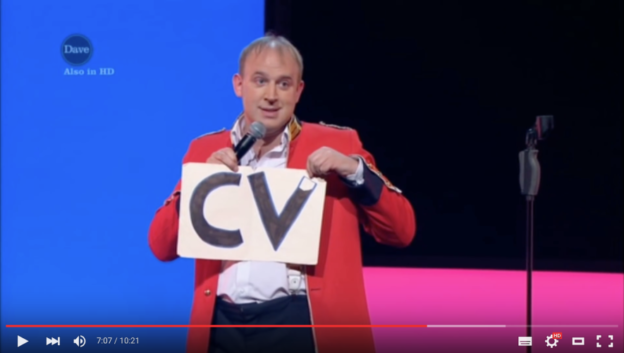
34. (visual joke) I’ve nearly finished filling in my CV, it’s got a little bit there.
fill in a CV = complete your CV
fill in = fill something with colour

35. I think my worst invention was this rubber band wind chime 风铃. All right, pipe down.

36. Ladies and gentlemen, I will leave you with this. (meaning “I will say this and then I will leave”. But as he said that, he had his hand on the microphone stand) Because I’ll be honest with you, it doesn’t belong to me, I don’t bring it with me.

37. I was standing on the beach, I walked into the wave holding a tub of Taramasalata ( a kind of dip), and a man said, “What are you doing?” I said, “I’m taking a dip in the sea.”
take a dip: take a short swim
a dip also means a sort of sauce

38. I was steering a yacht with my stomach muscles — ab sailing!
abseiling means climbing down a mountain backwards via a rope

39. This farmer came up to me and said, “I got 68 sheep, can you round them up for me?” I said, “Sure, 70.”
to round up some sheep = to collect all the sheep together into a group
to round up a number = to raise or lower the number to the nearest round number. E.g. 4.9 – round it up to 5

40. But I’m going to be honest with you, ladies and gentlemen, I don’t think I’m going to do this job for much longer. (the audience goes “aahhhh” in sympathy and disappointment) Not enough of you and too long a pause. But what concerns me is that one day, I’ll wind up an old man… and he’ll attack me.

I’ll wind up an old man = I’ll end up being an old man
I’ll wind up an old man = I’ll make an old man angry


312. The Words of the Year (Part 3) with Amber & Paul

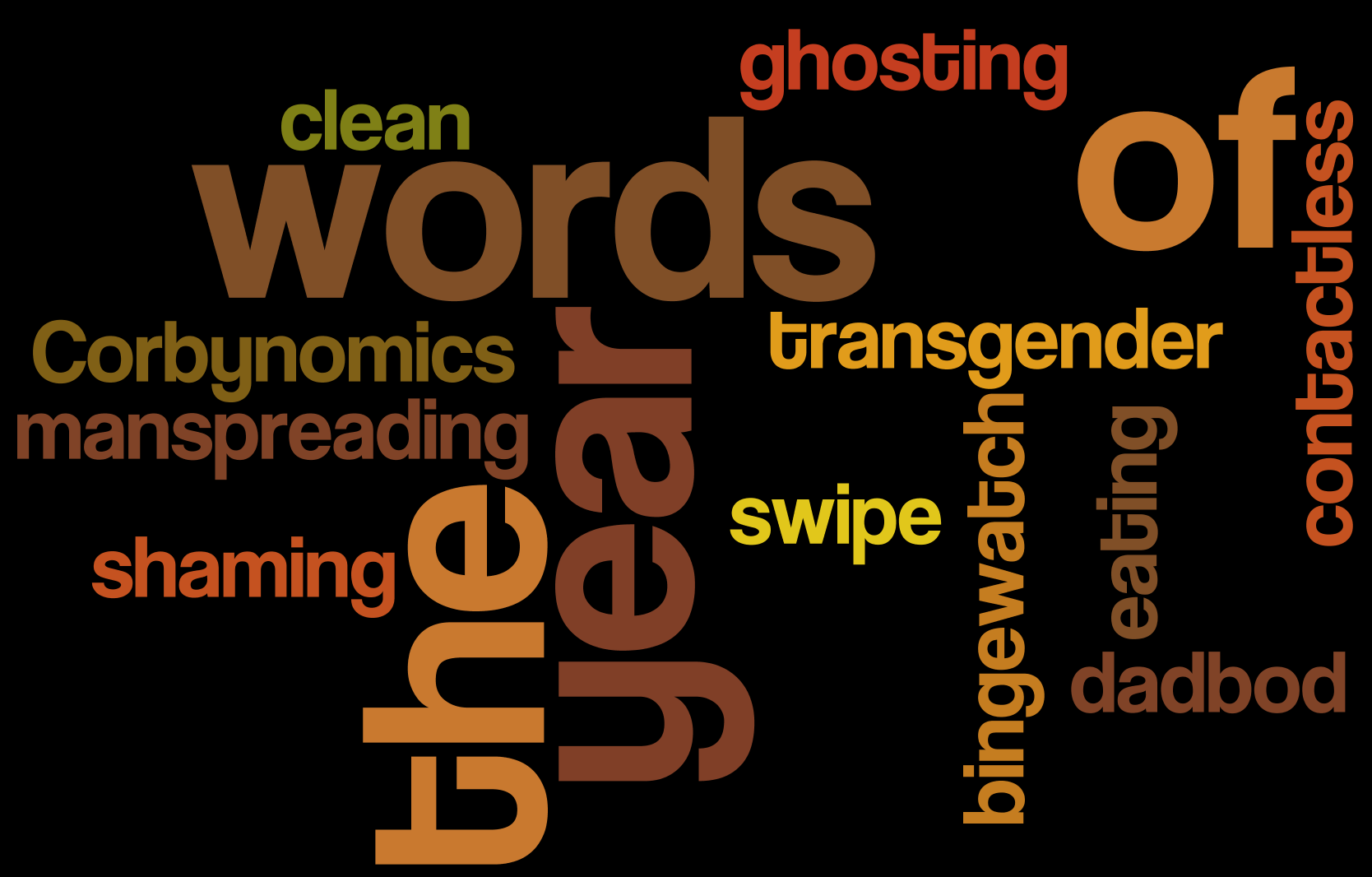
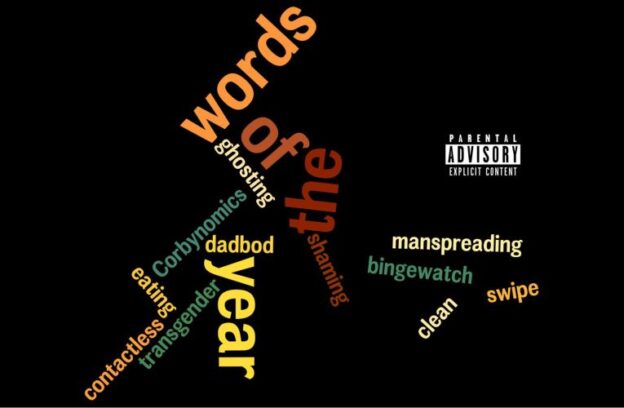
Here’s the third part in this series about the Collins Dictionary Words of the Year 2015. Listen to the episode to hear Amber, Paul and me discuss the rest of the words in the list. I’ll also explain and clarify some vocabulary, grammar and pronunciation from our discussion. There are vocabulary notes below.

Small Donate Button[DOWNLOAD]
Welcome back to another episode of LEP. We’re still talking about the Collins Dictionary Words of the Year.
This is the third episode on the series, and we still have about 7 words to deal with.
I think we can wrap this up inside one episode, but let’s see.
I’m going to keep this intro as short as possible because recently my introductions have got out of control.
So, let me keep it short and simple.
This is the 3rd part in a mini-series about The Collins Dictionary New Words of the Year.
I’m joined by Amber and Paul and we’re talking about this list of new words that Collins are putting into their dictionary this year.
These are new words and their use in both spoken and written form has increased significantly over the last 12 months.
Collins consider them worthy of addition into the dictionary.
But what are these words? What do they mean? And why have we been using them a lot lately?
Amber, Paul and I are going to explain them for you and just ramble on a bit as well.
I’ll play you all of our conversation but every now and then I’ll pause the podcast to explain things you’ve heard in our conversation.
That way you get the best of both worlds: you can listen to us talking to each other naturally, but also you can pick up a lot of new language when I break it down and explain it to you.
Alright, so without any further ado, let’s get started, and here’s word 7 in this list of 10 new words.

Word 7 – “manspreading”
manspreading (noun): the act or an instance of a male passenger in a bus or train splaying his legs in a way that denies space to the passenger sitting next to him
To take up space
well-contained within my seat allocated space
Not spilling over
You’re obliged to sit there, coyly, between his legs
Splaying his legs
You’re sitting there, minding your own business, not taking up much space…
His leg is pressing up against your leg.
If they were a bit too scary I probably wouldn’t say anything. I’d probably just cower.
He went out into the, whatchacallit, into the corridor.
whatchacallit
whatsisname
a thingamajig
a thingamybob
a widget
The corridor in the bus (or the aisle)
Suddenly the bus put the brakes on and he went flying.
Small kids, the metro stops suddenly or people get on and they crush them, they don’t even notice them, so they stand on them.
Children aren’t that strong holding on.
They’re hyperactive. They want to, like, run around.
A grumpy tired child is not good for anyone.

Word 6 – “ghosting”
Ghosting
The act or an instance of ending a romantic relationship by not responding to attempts to communicate by the other party
You’re not manning up or womaning up if you do that (to ‘man up’ = to be strong and act like a real man, or woman)
We got jiggy with it (like the Will Smith song, but in this case it means that we’d had sex, or ‘sexy time’)
Ghosting someone as a way of finishing a relationship is lame. All it takes is a bit of honesty.
It did do my head in for a while. (expression)

Word 5 – “dadbod”
Dadbod
An untoned and slightly plump male physique, especially one considered attractive
Broad shoulders
well-toned muscles
six-pack
I’m a bit more laid back
Comparatively, you’ll feel all saggy and not attractive
Landscape gardener
“Don’t all rush out at once!” (Sarcasm – Paul’s saying that nobody’s going to come. This is a typical way to be sarcastic. E.g. “Don’t all rush out at once!” or “Don’t sound too enthusiastic!” or “Don’t get over excited” or “Don’t everyone rush to my help or anything”)

Word 4 – “corbynomics”
Corbynomics
The economic policies advocated by Jeremy Corbyn, leader of the UK Labour Party from 2015
Reaganomics

Word 3 – “contactless”
Contactless
Referring to payment systems which use RFID technology and do not require the customer’s signature or pin number
To type in a pin or sign
contactless payment
Card details
We’ll be floating around in pods
It’s all going to become fingerprint eyeball scanning, thing.
That’s probably what’s going to happen

Word 2 – “clean eating”
Clean eating
The practice of following a diet that contains only natural foods, and is low in sugar, salt, and fat
If the WHO comes up with it
Audiobook recommendation: Salt Sugar Fat by Michael Moss

Word 1 – “binge-watch”
Binge-watch
To watch a large number of television programmes (especially all the shows from one series) in succession
I can’t help myself
Flipping heck
Flippin’ ‘eck
I find myself pushing the pram around
YOu’re so tired you can barely stay awake to watch it!
Jack Bauer’s Power Hour (what does this mean? N.Irish accent)
The Beatles book – hefty, fat, an extremely large tome, an exhaustive book,
How much of it have I actually read? (pron – weak form of ‘have’)
I finished the whole thing in no time
Audiobook recommendations: David Copperfield by Charles Dickens, read by Martin Jarvis, The Beatles – Tune In: All These Years, by Mark Lewisohn, The Dummies Guide to British History and You Say Potato by David & Ben Crystal.
(stop after I mention “You Say Potato” )

Add some negative comments from The Guardian’s comment section
Here’s a comment from a Guardian reader who basically disagrees with the implied suggestion that there’s some guilt involved in watching many episodes of a TV show back-to-back. RayMullan (pointing out the negative association with the word ‘binge’)
Given that I spent most of my free time last weekend working my way through A Brief History of Seven Killings by Marlon James, was I binge–reading? Of course not. That’s the only way to enjoy a good book. The beauty of bulk access to serialised film and television productions is that we can view an interesting programme in much the same way.
The requirement to follow a serial at a fixed point in the day over several weeks or months are long gone, thankfully. I was barely able to follow the broadcast of Wolf Hall last year, missing one and a half episodes quite simply because I had other things to do. In fact I’m sorry I didn’t just wait for the DVD release and enjoy the production in my own good time — no “binging” about it even if I choose to watch all six parts in a single evening.
Collins should really take a leaf from le livre de l’Académie française and exploit some discretion when it comes to faddish language patterns of teenagers and inarticulate young adults. Most of these new “terms” reflect lazy intellects blunted by the networked chatter of buzzfeeds and will amount to little but crude embarrassment a couple of years from now.

But I think that’s the point – Collins will see if we’re still using these words in 2018 when the printed dictionary comes out. Some of them might survive, some of them might fall away. It depends on what we’re all doing in a few years.

Listen to the post-chat – You’ll hear a quick memory test for the words. Can you remember them all? See if you can guess them from memory.

OK I’M GOING TO STOP NOW! :)

Final thing: I’ve done a lot of explaining in this episode. I want to know if you like that or not. You know I think it’s useful but I want to know what you think.
So, a couple of quick questions:
[socialpoll id=”2311146″]
[socialpoll id=”2311147″]
[socialpoll id=”2311148″]

I will take your comments into account, but in the end it’s Luke’s English Podcast – I’m the boss and I have the final word!

Thanks for listening to the end, you are a wonderful human being and the universe is smiling on you right now.

Remember, the force will be with you… always…

Bye

Here’s some other stuff you heard in the final part of our conversation:
I’m a bloody bloke (bloody – just an old swear word for emphasis, and a bloke is a man of course)
To nationalise the railways (when the state buys something which is privately owned, like the railways for example. The opposite is to privatise something)
Some more chat about drinking games you could play while binge watching, if you want to binge drink and binge watch at the same time (not recommended).
What’s a drinking game? It’s just a fun way to get drunk. There are various games with different rules. I dread drinking games these days because I can’t drink much alcohol any more. People sometimes play drinking games while watching films or TV shows. E.g. taking a drink every time a character in the TV show does something in particular. We mention House of Cards (Frank talks to the camera), Homeland (Claire Danes’ character cries), The X-Files (Scully expresses scepticism etc) and The Walking Dead (when someone kills a zombie, or when you see certain kinds of zombie).
One of the last phrases you’ll hear is “and on that bombshell!” (this is how a comedy character called Alan Partridge ended one of his shows, and then it was taken by Top Gear presenter Jeremy Clarkson as the way to end a TV show. It is used as a sensational end to a broadcast. A bombshell is a sensational moment – for example, a sudden piece of news or a shocking moment. POW! And that’s the end!
words of the year 3

311. The Words of the Year (Part 2) *contains some rude language

Welcome to part two of this series about the Collins Dictionary Words of the year 2015. In this episode you’ll hear me discuss these words with Amber and Paul. I’ll also explain and clarify a lot of the things you’ll hear in our conversation. You can listen to the episode, download and also read vocabulary notes below.

Small Donate Button[DOWNLOAD]
***This episode contains some rude language and explicit content.***
Recently I had Amber and Paul over to the flat and we talked about this list of new words that Collins are introducing into their online dictionary this year. These are all new words we’ve been using a lot this year. Collins have judged them to be worthy of recording in the dictionary. They all relate to new trends in our culture over the last year.
In this series I’m playing you chunks of the conversation with Amber and Paul, and then pausing that and clarifying some of the grammar, vocabulary and pronunciation that you heard.
So, you’re getting to hear some natural conversation, but also you’re getting some intensive language teaching too. Hopefully this is the best of both worlds for you as a listener.

Now, without any further ado, let’s carry on. Let me now play you the next conversation chunk. Here it is – this is word 10 in the list of 10 words. Here we go…

Word 10 – “transgender”
transgender (adjective): of or relating to a person whose gender identity does not fully correspond to the sex assigned to them at birth
He’s transgender.
She’s transgender.
Transgender issues.
He was held up as a great example of an American athlete. (to be held up as something)
He identified as female. (to identify as – this is the expression used to say that someone feels like they have a particular identity, particularly in relation to ethnicity, gender etc – e.g. the case of Rachel Dolezal, who worked as a civil rights leader in Washington. She was criticised in the media (shamed) for lying about her ethnicity – she basically tried to pass herself off as black while campaigning for equal rights issues – but she was actually white. Even her parents were in the media saying “yeah, she’s caucasian”. Pretty weird thing to do, and lots of people got angry saying “you can’t just say you’re black and pretend to be a victim of discrimination, when you’re blatantly white!” When criticised for this, she just said “I identify as black” – not “I am black”. This was also a trending story this year. http://www.buzzfeed.com/claudiakoerner/a-civil-rights-leader-has-disguised-herself-as-black-for-yea#.tiM247b0q
Transvestism / Transvestite (a transvestite is different to a transgender person. Transgender = a man who identifies as a woman even though physically he’s a man – or the other way around, and a transvestite is a person who enjoys dressing as a member of the opposite sex, for whatever reason – usually this is a man who likes dressing as a woman. For some reason this is far more shocking than a woman dressing in male clothes, which nobody seems bothered about)
3 positions (basically): 1. It’s a good thing 2. It’s a bad thing 3. I don’t really care either way.
She’s old school (Germaine Greer). She’s an old school feminist. (old fashioned)
Her position about what feminism should be and how we should address it was important but it has changed and I think she’s not changed with it.
(I talk over Paul quite a lot when he’s talking about same-sex marriage – sorry Paul)
Cisgender (adj)
To misgender someone (not some sort of transgender competition, it’s a verb which means ‘to wrongly gender someone’)
Mx (Mr, Mrs, Miss, Ms and now Mx)

Word 9 – “to swipe” (there’s some rude language and rude content here)
swipe (verb): to move a finger across a touchscreen on a mobile phone in order to approve (swipe right) or dismiss (swipe left) an image
Swipe was already a word, but this is the specific use of ’swipe right or swipe left’ to mean “accept or reject someone on a dating app”.
Tinder (app)
“Tinder” (“TINder??” pronunciation with surprise and disdain)
to sign up
The unwritten rule
To make a match
I will “do” anything (“do” here means “have sex with”)
Naughty pictures.
Dick-pics
Tit-pic?
‘Pussy’-pic?
Don’t go there.
You’re going there.
He’s dipping his toe in.
He’s taken pictures of his phallus. (other words for a penis. Medical/clinical words: penis, phallus. Informal but not rude: willy. Suggestive but not swear words: tadger, member, private part(s). Rude words: prick, cock, dick.)

Jon Ronson - So You've Been Publicly Shamed
Word 8 – “shaming”
shaming (noun): attempting to embarrass a person or group by drawing attention to their perceived offence, especially on social media
To be publicly shamed
She was trying to be funny by awkwardly implying that it’s very unfair.
There is this massive problem in Africa, and it’s less of a problem in Europe.
If you put that on Twitter the chances are people are going to misunderstand and they’re going to have a knee-jerk reaction, and they will respond in a very angry way.
An Über driver got beaten up by an executive of Taco Bell.
He was completely wasted and completely off his face.
He was slurring his words (remember that one?)
There’s something un-just about it.
You’re making a judgement call on the way someone looks, or what someone does.
You know there was that whole thing about slut shaming.

Book recommendation: Jon Ronson “So You’ve Been Publicly Shamed” www.audibletrial.com/teacherluke
His voice is a bit off-putting at the beginning but he really draws you into the story.
[socialpoll id=”2310152″]
End of Part 2
words of the year 2

309. The Lying Game (Part 2) with Amber & Paul

Welcome back to the second part of this double episode. In part 1 you heard me playing a speaking game with Paul & Amber. Go back to part 1 for the details of the game, including the rules. Part 1 ended on a cliffhanger, with the scores even at 2-2-2. Even stevens! Listen to this episode to find out more. TEACHERS: At the end there’s a 15 minute section in which I explain exactly how to use this game in your English classes. You can download a simple .pdf worksheet (below) which you can use in your classes (just tell your students about LEP, or send me a little donation). Listen until the end of the episode to get my full instructions on how to use this awesome game to teach your students grammar, pronunciation, vocabulary and speaking skills in a really awesome way.

Small Donate Button[DOWNLOAD]
The Lying Game Part 2

Amber: I used to be a performer at The Rocky Horror Picture Show at Prince Charles Cinema in Soho.

Tie-break round:
Luke: I used to be afraid of the tooth fairy.
Paul: I almost set fire to my parents’ house as a kid.

Final scores:
Luke – 2 / 0 / 1 / 2 / 1 Total = 6 points

Amber – 1 / 1 / 0 / x / x Total = 2 points

Paul – 0 / 2 / 1 / 0 / 0 Total = 3 points

Here’s an example of a Rocky Horror Picture Show Shadowcast (below)

For Teachers – How to use The Lying Game in class

Small Donate ButtonClick here to download a .pdf worksheet to use in Class – The Lying Game Worksheet for Teachers by Luke Thompson teacherluke.co.uk

Listen to the last 15 minutes of this episode of LEP (The Lying Game Part 2) to hear me give detailed instructions on how to use the game in class, including details of the level, procedure, specific language and skills work you can do with students. I can get about 2 hours of class time out of this game, and it’s useful for teaching grammar, pronunciation and vocabulary.

In fact, here are the last 15 minutes of the episode  if you’d like to listen to them again or download for later. :) [DOWNLOAD]

308. The Lying Game (Part 1) with Amber & Paul

Hello, welcome back to LEP. This episode is called the lying game, and it’s one of those ones in which I play a speaking game with my friends Amber and Paul. A transcript for the first 15-20 minutes is available here on the page for this episode. In the introduction you’ll hear me welcome new listeners, talk a bit about my speaking speed on the podcast, mention the importance of listening to native speakers of English (even if it’s a bit difficult to understand every word) and explain some of the content of the conversation you’ll hear between Amber, Paul and me. Then, the speaking game begins properly. I really hope you have as much fun listening to this as we did recording it, because we really enjoyed ourselves! In part 2 (coming soon) you’ll hear the conclusion of the game and I’ll explain how I use this activity with my students in my English classes.

Small Donate Button[DOWNLOAD]
Introduction Transcript Starts Here (+ more information below)
Hello, welcome to LEP. This episode is called the lying game, and it’s one of those ones in which I play a speaking game with my friends Amber and Paul.

Before you listen to that, I’d like to just say a few things here at the beginning of the episode. Firstly, hello to all my regular listeners, the LEPsters as they are sometimes known. How are you all? I hope you’re fine and having a lovely day or night or evening or morning or whatever time of day it is. Thanks for recent comments on my website. It’s always nice to read your messages. Recently I did episodes about The Battle or Britain and Back To The Future, and I’m feeling a lot of love in the comments section – particularly from my Polish listeners because of things I said in episode 303, which is really great. It’s very motivating to read the positive things you have to say in response to my episodes. I do think about my podcast a lot, and I always hope that you’re enjoying it and finding it useful. So, your comments are valuable bits of encouragement. Thanks also to those of you who have never left a comment on my website in your life – you’re my ninja listeners, and I think there are a lot of you out there, choosing to remain silent in the shadows, but listening to everything.

Secondly, just in case you’re new to LEP, let me just quickly introduce myself. My name is Luke Thompson and I’m an English language teacher from England, which is in Britain, which is in the UK, which is in Europe, sort of. I’m originally from London (in the south-east) but I went to university in Liverpool (in the north-west) and I also spent many years growing up in Warwickshire which is near Birmingham, which is in the midlands, which is in England, which is in Britain, which is in Europe, which is on Earth… etc. OK, I’ve been teaching English for nearly 15 years, wow has it been that long? Time flies when you’re having fun, and I do enjoy my job. I’m DELTA qualified, and in my career I have taught English to adults and children from many different countries, at many different levels, at many different times of the day – morning, afternoon, evening and at night sometimes, in any season, in all weather conditions – rain, snow, hail, wind, lightning, and even during a couple of earthquakes. I’ve taught courses in general English, business English, academic English, English for exams, English for doctors, English for pharmacists, English for engineers, English for lawyers, English for HR, English for secretaries of state, English for journalists, English for unemployed people, English for retired people and English for people who haven’t chosen what to do with their lives yet. Basically, if you need English, I’m your man. If I was a superhero for English teaching, you could call me Englishman! Which is appropriate, because I am an English man. Haha, I’m just joking, I’m not a superhero, I’m just an ordinary humble man, well as you can hear from this introduction I may not be that humble, but I am a man – definitely, I checked this morning. I am proud to be an English teacher – a profession which includes many bright and brilliant people all around the world, who have either chosen this vocation, or just ended up doing it because they didn’t know what else to do with their lives. As well as being an English teacher, I’m also a stand-up comedian, and I’m a podcaster. I do a podcast for learners of English called Luke’s English Podcast. You should listen to it. It’s quite popular and I have lots of downloads these days. I’m happy to say that I have a lovely community of people around the world who regularly listen to my podcast episodes in order to improve their English, but also (hopefully) because they just enjoy listening to each episode I produce. Did I mention that the podcast has won a few awards? No. Ok, well, the podcast has won a few awards. Am I sounding a bit arrogant? I hope not. I don’t mean to sound full of myself, I really don’t – it’s just that sometimes I think I should try and sell myself on the podcast, just a little bit, to remind you who I am. I don’t mean to just go on about myself a lot because it’s a bit self-indulgent isn’t it? But I do think it’s important to convince you that listening to this is very good for your English, and that you should keep doing it. It’s not just me who says that, I also have lots of testimonies from listeners of my podcast who have commented on my website, saying some very positive and nice things indeed, like this one which arrived just a couple of days ago, from someone called “Teddy WS” who simply wrote Screen Shot 2015-11-04 at 18.02.11“Thank God I find this page.” He sounds a bit desperate maybe, like he’s been walking through some kind of English teaching desert, and my website is like an oasis for him, where he can drink from this refreshing wellspring of natural English. It’s certainly a positive endorsement.

Thanks Teddy, that’s nice. Now, admittedly, Teddy did make a mistake in his comment – he wrote  “Thank God I find this page” and it should be “Thank God I found this page” but to be fair, he has only just found the page, and he has been walking through a desert for days and days, and he probably hasn’t listened to many of the episodes yet. I expect if Teddy writes on the page again in a few months, after he’s listened to more episodes and refreshed himself, he won’t make a mistake like that. I certainly hope so. Teddy, if you’re listening – don’t feel bad about making that mistake – mistakes are an essential part of the learning experience. Just brush it off, carry on and try not to do it again. By the way Teddy, I’m looking forward to reading another comment from you on my site in the future.

The main philosophy of my podcast is to give learners of English the chance to listen to authentic British English as it is really spoken. Sometimes it’s just me talking, sometimes I have interviews and conversations with friends, family or other interesting people. I try to keep it real – meaning I try not to adapt my language level too much. I don’t want to talk to you in a very simple way because that’s not how people usually speak in the real world. I think I speak clearly on the podcast, but at a fairly normal speed. I believe, ultimately, that’s better for your English.

So, it’s better for your English in the long run, but in the short-term, you might find it difficult to understand every single word I say, or every single word my friends say. So, I often remind you, that if you don’t understand what I’m saying or if you get lost during conversations on the podcast – keep listening! Keep going! Don’t be put off when you lose the thread of the conversation. Persevere, don’t give up. In the long run, it will be better for your English. So don’t stop.

If you want to pay close attention to every single word, and study those words, you can. Many of my episodes have transcripts, or at least some notes which you can read. You can then study the words and phrases I’m using and improve your English that way. Or, you can simply relax and listen to the episodes wherever you are in the world – just find a comfortable place, or even an uncomfortable place – it doesn’t matter that much, but comfortable is better, just put your headphones in, or turn your speakers on, and just listen for fun. It should be enjoyable to listen to English. It doesn’t have to be a boring study exercise. So, I invite you to just relax, kick off your shoes, make a cup of tea, listen to my episodes, and enjoy doing it. :)

This episode is entitled The Lying Game. The title of the episode has absolutely no connection to the things I’ve just said to you in the opening minutes of this introduction.

No, the reason this episode is called The Lying Game, is because in a few moments you’re going to listen to my friends and me playing a speaking game which involves either lying or telling the truth. It’s just a fun guessing game that involves some lying. So that’s why this episode has that title.

So let me tell you what you can expect from this 2-part episode of LEP.

What’s The Lying Game? This is a speaking activity I play with my students in my English language classes. In this episode you’ll hear me playing this game with my friends Amber and Paul, who are native speakers of English.

In a few minutes the episode is going to start (we haven’t started yet, this is still the introduction). I just wanted to say right now, that this was a very fun conversation for Amber, Paul and me. We really enjoyed talking and playing the game. I hope you enjoy it too. The thing is, we got pretty excited during the game and so we speak pretty quickly and sometimes we speak over each other. That might make it difficult for you to understand everything that’s being said. Still, like I said a few moments ago – keep listening anyway, even if you don’t understand everything. OK, I think I’ve made my point about that now!

The recording begins mid conversation. Let me just tell you a few things to help you understand what we’re saying, right from the beginning.

You’ll hear me say to Paul, “Do you really think I change the way I speak?” This is because Paul thought I sometimes change my voice when I’m recording the podcast. Like, I have a podcast voice that comes on when I start recording. We agree that it’s quite normal as a way of catching the attention of the audience from the beginning, or “pulling people in” as Paul says.

Just a couple of other things that will help you understand the beginning of the conversation:

Paul starts whispering subliminal messages into his microphone. This is because just the other day he was on a “film shoot” and he did that to the sound man – he whispered into the microphone and only the sound man could hear him. Just for fun.

I make a (lame) joke about something Amber says about it being a grey day. I thought she said ‘grade A’, referring to the sofa she was sitting on. A grade A sofa would be a top quality sofa. My sofa on the other hand is not that good, so it’s more likely to be a grade B or grade C sofa.

Then we make a few references to things you won’t know about, like my stand up routine, and a joke I made earlier about Philips lightbulbs, you know the technology company called “Philips”. Watch out for that. We found is hilarious. You might be confused by it. Let me know.

Then I realise that we’re having too much fun, and that could be annoying, like my favourite film critic Mark Kermode says that comedy is hard work. If people say they had fun making a comedy you’ll know it’s not funny.

It looks like they had a lot of fun making it which is always a recipe for disaster, when it comes to comedy. Because most really funny comedies are not fun to make – On reviewing Mortdecai 23 Jan 2015 show

So I hope that is not the case for this episode.

So, after that Mark Kermode reference, we settle down a bit, the conversation continues, we talk a bit about lying, and we start playing the game.

OK, I’m now going to stop explaining everything before it’s happened, and just let you listen to the episode. So, here we go!

Intro 2 (This is the second introduction which I say at the beginning of the conversation with Amber & Paul!)
Sometimes I play a fluency speaking game with my students, which involves telling lies. I call it The Lying Game. It’s an imaginative title. It’s just a fun game to practice giving information, and forming questions. I’ve been using it in class for years and it’s always a pretty popular exercise. This time on the podcast I thought I’d play the game with some native speakers. When you listen you can focus on noticing these things: question forms, how people describe events in the past (tenses and pronunciation of ed endings), how people describe present habits (verb forms and adverbs – not just present simple tense) and also the intonation that we use when asking questions in a suspicious, open or challenging way.

With me I have Paul Taylor & Amber Minogue.

How are you?
Do you think you’re good liars? Are you gullible?
Do you ever lie in your life?
Is it wrong to lie? Is it ever ok?
Are you ready to play the game?

Rules

  1. Tell us something – it could be something that happened in the past, a habit, someone you’ve met – anything about you that we don’t already know. Try to make it interesting – partly ridiculous, partly believable.
  2. We will then interrogate you about it, asking you all sorts of questions to investigate your statement. You can expand on it. This is the hilarious bit where we’re not sure if you’re lying or not. Ha ha ha.
  3. Then, when we’ve run out of questions we will say if we think you’re lying or telling the truth, justifying why we think so.
  4. Then, reveal if you were lying or not. It’ll be dramatic and entertaining.
  5. Points: For everyone who guesses wrong, you get two points. Every person who guesses correctly gets 1 point.
  6. Everyone has a go, and at the end we count the scores to see not only who is the best liar, but also who is the most gullible or untrusting person. If you’re gullible, you won’t score much. If you’re too trusting, you won’t score much either. If you’re a bad liar you won’t score much, if you don’t appear trustworthy you won’t score well either. So, the winner of this game will be some kind of psychopath, basically. Or, the winner will be a good liar and good at detecting lies too.

Luke, Paul and Amber’s Statements from the Game

Luke: I once met Dave Grohl (drummer from Nirvana, singer in Foo Fighters) at a buddhist temple in Japan.

Paul: I once spent Valentine’s Day with Elijah Wood and John Hurt.

End of part 1! You can hear Amber’s turn in the next episode, where you will find out what happens and who wins the game in the end! (exciting)

Scores at the end of part 1
At this stage, the scores are like this:

Luke – 2 / 0   Total = 2 points

Amber – 1 / 1   Total = 2 points

Paul – 0 / 2   Total = 2 points

So it’s even stevens!

Listen to part 2 (coming soon) in order to hear Amber’s story, and to see who wins.

The photo of Dave Grohl that I took on my J-Phone:
Dave Grohl

:) Thanks for listening!

The Invention of Lying – Film by Ricky Gervais

Woman with crossed fingers

304. Film Club: Back To The Future (Part 1)

Hello listeners, welcome to Luke’s Film Club, this is one of those episodes of Luke’s English podcast in which we focus on a classic moment from the movies. This one is an episode about Back to the Future, which is one of my all time favourite films and I’m not alone because it’s one of the most popular films of the last few decades, all over the world. It’s a really entertaining and fun film, which also contains some sub-texts related to the complexities of time travel as well as a few visions of the future. Also, in the film’s sequel, the main characters Marty McFly and Doc Brown end up travelling into the future – and to what date? October 21, 2015. That’s today (when recording this). So it seems to be the perfect moment to do an episode of Luke’s Film Club, devoted to this modern classic. This is basically international Back to the Future day, and there’s only one! So, this has to be the day on which I record this episode.

Small Donate Button[DOWNLOAD]
In this episode I’m going to talk about these things:

  1. When I first saw it and what it means to me
  2. The plot of the film (quite a challenge actually)
  3. Themes of the film and lessons we can learn from the story
  4. Some bits of info or things you might not have known about the film
  5. The films predictions of 2015 – how many are correct?
  6. How does the DeLorean time machine work?
  7. Is time travel possible?
  8. What about paradoxes created by the film’s time travelling story?

Ironically, time will definitely be a factor in this episode, because it will be hard to squeeze all of that into an hour. Let’s see what happens. It’s probably going to be another 2 part episode or something. But Back To The Future is a great film isn’t it? Come on, it’s great. It’s really popular all over the world, it’s really fun and interesting. Let’s talk about Back to The Future, however long it takes.

UPDATE: In part 1 of this episode I only talked about points 1 and 2 in the agenda above. The plot of Back To The Future 1-3 is pretty complicated and takes some time to describe! The rest is covered in the next episode.

SPOILER ALERT!
I’m going to mention some parts of the plot in this film. So, if you haven’t seen it before then I will probably give away some of the surprises in the story. I’m assuming that the vast majority of you have seen this film. It’s one of the most popular films of the last few decades, but I’m sure some of you haven’t seen it. Just be aware that I will probably reveal some fairly big plot details in this episode, so you might want to watch the film before listening to this episode.

Saying that though, I think it’s quite hard to truly spoil the film, just because there are many things about it that make it exciting. I’ve seen it (and the sequels) lots of times, and I enjoy it more and more every time, even though I know exactly what’s going to happen next. It’s so well-directed that it’s always exciting. But anyway – watch out, there are spoilers ahead.

I’ve been trying so hard for ages to find a way to properly cover the subject of this film in a podcast. It’s very hard! There’s so much to say! The storyline of the film is pretty complex, and the themes of time-travel, family, future technologies and controlling your destiny are really big things that deserve a lot of attention. So, I’m not sure I can squeeze it into just 1 hour of chat. This may end up being two episodes – but you don’t mind do you? Why would you mind? This could be a 5 minute video on YouTube, like “The 5 best moments from Back to the Future” but I want to go into more depth, and get sidetracked by themes of technology and time travel, so it will just take as long as it needs. In fact it’s a bit ironic that I’m talking about time limitations when this is a film about time travel, and the complexities which surround it. Essentially, I’m going to focus on the subject first, and if that means it’s a long episode, then so be it. In fact, since this is a podcast you have some control over time and you can skip forwards in the episode, backwards in the episode or simply freeze time completely by pressing the pause button, and then start it again later. You’re in control of time, essentially. I’ll just focus on making the content and you can choose how to listen to it. :)

Also, there are other films/books I could have talked about: HG Wells: The Time Machine, The Terminator, Looper, Bill & Ted’s Excellent Adventure, Interstellar. But, this one is all about BTTF! So let’s go.

1. When did I first see it and why do I like it?
– As a kid, with my Dad.
– I was 8 years old, my brother 10.
– We saw lots of really great films in the Ealing cinema around this time, including Return of the Jedi, Indiana Jones & The Temple of Doom, Flight of the Navigator, Back to the Future, The Goonies, E.T. and more…
– I actually managed to understand what was going on, and I found it incredibly fun and exciting.
– Cereal box, with the picture. I remember staring at it.
– Since then I’ve seen it on video and on TV countless times, and every time I watched it I understood more of the subtleties and intricacies of the complex plot, and also just enjoyed the pure fun of the franchise.

2. What’s the plot of the film (this could be complicated and long – and SPOILERS!)
Marty is an average yet pretty cool teenager, struggling slightly to make the transition to adulthood. Essentially he cares about his parents, his girlfriend Jennifer, playing guitar in his band, skateboarding, and his friend Doctor Emmet Brown, an eccentric and ambitious physicist. Marty’s parents are sweet, but his Father in particular is a bit of a loser. He has no leadership skills and he still gets picked on by the school bully, who hangs around the house because he still has a crush on Marty’s Mum, Lorraine. Marty’s Dad still gets bullied by Biff, who is a total jerk. Marty hates Biff with a passion but there’s not much he can do about him. Seeing his Dad all weak, even though Marty’s mum obviously loves him, is quite painful for Marty and you get the impression that family life isn’t very happy for Marty. Perhaps this is why he has trouble concentrating at school, and perhaps it’s also why Marty cares more about playing the guitar in a band, or hanging around with his weird scientist friend Doc Brown than he does doing his studies. Marty also has a really awesome girlfriend called Jennifer, and the two of them are very sweet together. Jennifer knows that Marty is a really cool guy with a lot of potential, and I guess this is why she loves him. We know that Marty feels pretty bad about his family situation.

Marty is friends with the local mad scientist, Doctor Emmet Brown, and associating with Doc Brown is going to propel Marty on an incredible adventure through time.
Doc Brown is the classic eccentric scientist. He has bug eyes, crazy Einstein hair, and lots of inventions and madcap ideas.
Marty also has a weak point – being called chicken. He absolutely can’t stand being called chicken (coward) and this will be important later on.
One day, Marty gets a message from Doc Brown to meet him in the car park near the mall. He has something amazing to show him.
Marty turns up on his skateboard and the Doc reveals his latest invention. Inspired by HG Wells, he has created a time machine. The cool thing about it is that it is housed inside a DeLorean sports car. DeLorean was a car manufacturer that is completely stuck in the 80s. They went out of business before the decade was over, but their car is immortalised in this film. One has to admit, it does have a certain UFO futuristic look that suits its use as a time travelling device. The key component in the device is the flux capacitor, which Doc Brown thought of during a dream. I don’t know how it works, but that’s the main thing.
The way the time machine works is that you programme the precise date you’d like to travel to, and the accelerate the car to 88 mph, at which point you’re transported through time. He demonstrates it with his pet dog, Einstein.
Amazing – it actually works!
Doc arranges for Marty to film him presenting the time machine on home video, but at this point some very angry Iranian terrorists turn up in a VW camper van. Apparently Doc Brown stole some nuclear plutonium from them, which he used to power the flux capacitor and they want it back. They seemingly shoot Doc Brown dead in the car park, which is shocking because we’ve grown to like this character very much in the short time he’s been on-screen, and then they go after Marty, who escapes in the DeLorean time machine. There’s a short chase around the car park, during which a date is accidentally added into the machine – 30 years previous. October 26 1955. During Marty’s escape from the terrorists, the DeLorean gets up to 88mph and Marty is whipped away, back to the past of 1955, where he finds himself driving though an open field – this is the location of the mall car park. The mall hasn’t been built yet! Marty crashes into a barn and the drama is over.
What happens next is that Marty explores Hill Valley in 1955, and gets caught up in the lives of his young parents, which interferes with the space time continuum, threatening to change the future, his normal life, forever. He then has to try and make sure his parents fall in love, like before, ensuring that his existence is secured in the future. As well as that, Marty plans to find a way to save the life of his best friend Doc Brown, who was shot to death by terrorists back in 1985.
Essentially, what happens with the parents is that instead of his Mum meeting and falling in love with his Dad, Marty interrupts that meeting, and weirdly his Mum falls for him instead. This is so weird, and yet a very compelling plot device!
In 1955 Marty has to deal with a few challenges.
Everything is different because it’s the past, and he’s a fish out of water.
His Mum has a big crush on him and he has to try and avoid her.
His Mum and Dad haven’t met as they should have, and so he has to engineer their relationship from nothing, against all odds.
He has to try and avoid the town bully – Biff, who is interested in Marty’s Mum too, and is also out to get him.
As well as this he has a couple of run-ins with Mr Strickland, who amusingly is exactly the same as he is in 1985. He doesn’t appear to have aged at all.

Marty, cleverly, manages to track down the only man who can help him – the younger version of Doc Brown. He convinces him that his story is true, and introduces him to the DeLorean and the flux capacitor. One of the cool things about this is that by introducing the Doc to his own invention, Marty ensures that the flux capacitor gets invented in the first place.

The two hatch a plan to get the parents back together to stop Marty from disappearing from existence, and also work out a way to utilise the power of a lightning strike to get the DeLorean up to 88 so Marty can go back to the future. The cool thing here is that Marty knows exactly when lightning will strike the clock tower in Hill Valley Square, because it is a famous event from local history.

We see Marty attempting to get his parents back together, which fails most of the time. The bully Biff gets involved and there’s a dramatic scene in which the cowardly George decides to stand up to him, winning Mary’s affections and securing Marty’s future.

In the process, Marty manages to invent rock and roll music by playing some Chuck Berry during the school prom.

Marty is also desperate to tell Doc that in 1985 he’ll be killed by Libyan terrorists, but Doc refuses to listen, saying that it’s very dangerous to know anything about your own future. He’s worried that the knowledge will haunt him, or that it will create some kind of time paradox. Nevertheless Marty writes him a note warning him of the shooting. Doc cuts it into pieces, refusing to read it. This is alarming because we know that Doc’s going to get shot in the future. It’s not dealt with any further.

There’s yet more drama as Marty and the Doc attempt to hook up a cable to the clock tower, to make sure they harness the electrical power from the lightning strike. At the last moment, the Doc manages to connect the cables, allowing Marty to get the DeLorean to 88, and he goes back to the future!

Back in 1985, things are a little different, in fact they seem to be a lot better. Since things went a little different;y in 1955, and George stood up to Biff – George is a different man. Much more confident and successful, and Biff is now far more subservient to him. The family is richer, the parents’ marriage is better, and Marty looks in the garage to discover his dream car, waiting for him. Jennifer is also there. She’s the same of course, because she was already perfect, and they kiss. At that moment, Doc Brown suddenly turns up in the DeLorean, saying that both Marty and Jennifer have to come with him on a matter of urgency, as it involves their children in the future! They all get into the DeLorean, ready to take it up to 88 and travel into the future. Marty says “Doc, don’t we need more road to get up to 88?” and the Doc says, “Marty, where we’re going, we don’t need roads” and the car takes off into the air! It’s a flying car! They then race off into the sky and disappear into the future!

Wow, what a rip-roaring and exciting ride. For me, it’s an almost perfect film and always keeps me entertained. I love the complexities of the story, the dramatic set pieces, the eccentric and cartoonish performances by all the actors and the fun the film has by playing around with the differences in culture between 1955 and 1985. There are lots of self referential jokes and small details to notice, including little similarities and consequences between the two time periods.

Back to the Future Part 2
This is when things get complicated!

Doc Brown knows that Marty’s son, who looks just like Marty but is a total loser, is going to get caught up in a robbery and will get arrested and thrown in jail. Doc decides to form a plan in which Marty will pretend to be his son, and will prevent his involvement in the robbery, making everything all right. Essentially, they prevent the crime and during this early scene we see Hill Valley in the future. In one of many similar scenes from the previous film, Marty wanders around the town square and we see how different everything is. Cars look futuristic, droids do basic service jobs, there’s a holographic animated advertisement for a Jaws sequel, people have self drying clothes, shoes with automatic laces, and clothes which automatically adjust their size to fit the person they’re wearing. Also, crucially, kids now ride ‘hover boards’ which are like skateboards except that they hover a few inches about the ground, somehow.

Marty manages to replace his son and say no to “Griff” – played by the same actor who plays “Biff” in the previous film. But in the process, Marty gets into a fight with Griff who is the 2015 town bully, complete with physical implants, an advanced hoverboard and a really bad attitude.

Marty gets away from Griff, and gets back to the Doc. We learn that Marty, while in the futuristic version of Hill Valley has picked up a Sports Almanac (a summary of sports results of the last 60 years), which he plans to use as a way to get rich. When Doc Brown discovers this he gets furious with Marty, demanding that Marty throw away the almanac because it’s far too dangerous to mess with the space time continuum. The results could be catastrophic. What they don’t realise is that the old Biff from episode 1 has overheard their conversation, has realised that Doc Brown has invented a time machine. Biff steals the almanac from the bin, and plans to somehow use the time machine to go back to 1955 to give the almanac to the young Biff, so he can make money from gambling.

Meanwhile, the police have picked up the young Jennifer, who had been turned unconscious by Doc to protect her and left in a doorway. They identify her using her fingerprint (which is the same, despite being young) and decide to take her home. Doc realises this could be disastrous – if young Jennifer meets old Jennifer, it could create a paradox in time which could unravel the very fabric of the space time continuum, destroying the whole universe in the process, which is generally a bad thing. The follow the police back to the McFly household in order to prevent young Jennifer meeting her older self.

We see the older McFly household. They’re a bunch of misfits and losers again! The children are stupid and foolish, and something has gone wrong with Marty. It seems that at some point in his later youth, he was involved in a car accident which injured his hand. As a result he wasn’t able to pursue his dream career – that of a rock guitarist. So, he’s ended up in a dead end job which he hates, and which he gets fired from. What a disaster.

The car accident is pretty important – it happens a bit later, after the events of BTTF1. Marty is driving his cool new pickup truck with Jennifer, when he gets challenged to a race by the local bully (a bit like Biff). Marty declines, and the bully says “What’s the matter McFly, chicken?” We know from countless other occasions that Marty can’t stand being called a coward, and he loses his judgement, taking on the drag race challenge, but he crashes, and injures his hand. He’ll never be a guitarist, and he’ll end up in a job he hates, and the future will be unhappy.

Marty realises that he has to avoid the car crash which seems bound to happen sometime later in 1985.

Doc worries that they are having too much impact on the future and that this is going to create a paradox of some kind… The car crash scenario that jeopardises the future is left open at the moment, and is resolved at the end of episode 3 (I think).

Little do they realise that while they’re at Marty’s future house, old Biff has broken into the DeLorean and travelled back in time to give the sports almanac to his younger self. Biff, exhausted by his efforts struggles to get out of the car, breaking his walking stick in the process. A part of the stick is left in the car, which later will show to Doc Brown & Marty that Biff stole the car.

So, Doc Brown delivers Marty back to the past in 1985, but everything is horribly different! It turns out that because of the book, Biff has become the richest and most powerful man in Hill Valley. In fact, his influence extends all the way into Marty’s family life as Biff is now married to Marty’s mother, and Marty is forced to live under Biff’s roof. Biff is a hugely powerful bad guy now. It turns out also, that he may have had Marty’s father killed. This is terrible. Under Biff’s influence, Hill Valley has become a lawless wasteland with crime everywhere.

Marty goes to get Doc Brown’s help, and he explains what has happened.

When Biff went back in time to give the Almanac to young Biff, he created a completely new version of time, in which Biff is rich and influential, and Hill Valley is a hell hole. What Marty needs to do is prevent that from ever happening, in order to ensure that the normal version of the present is created, not this twisted version.

I could go into more detail about different theories of time at this point but it’s a bit too confusing.

In a simple way, I guess there are two versions.
The first version says there’s just one universe with one time narrative. Big events can significantly change the course of history, and when it does, all the other possible versions of history just get erased from existence, with one version of time remaining. For example, when Biff gives the sports almanac to his younger self this causes a whole new branch of time to happen, in which everything is terrible, and I guess the other version of time just gets erased from existence. Or when Marty goes back and changes the past so that his parents grow up happy and successful, that erases the less happy version of events. There’s a paradox here though, which is that if the other version of history disappeared, then surely our version Marty would disappear too. If Biff changed the past, so that the events of BTTF1 never happened, then our Marty would surely cease to exist and in fact BTTF1 would never have happened. But that’s not the case – in the film we have many different versions of history, and Marty & Doc travel from one of those versions across to other versions. There are in fact 3 versions of 1985. The first one (a bit crap – George is a loser, Lorraine is an alcoholic) the second one (everything’s great) the third one (Biff is in charge and it’s absolutely terrible). Marty from version 1 appears in all versions.

So I suppose BTTF proposes some sort of multi-universe theory, which is the idea that whenever anything happens, different versions of history branch off from that moment, creating another parallel universe. For example, when Biff gets the sports almanac, a new parallel universe is created.

But isn’t it possible by that logic that at any moment there are so many possibilities, that there’s a parallel universe being created in which each possible event happened, with all its consequences after it? And that would mean that an infinite number of parallel universes are being created with every passing of time, basically creating infinite possibilities across infinite parallel versions of reality? Why is it that just a big event like a kiss, or a sports almanac coming into your possession changes time? If it’s a small change does time just carry on? Too complex? Probably. Don’t worry if that’s not clear – that’s the point.

Back to the Future goes for the more simplistic version, stating that basically there’s just one or two planes of existence, and big significant events can cause them to happen, influencing the future. Having access to all the sports results is one of these big events. Again, this is the genius of the film – it manages to skate around these big problematic questions while dipping into the science at certain moments to give enough depth to the story while keeping the energy, entertainment up.

So Marty and the Doc go back to 1955 with their flying DeLorean in order to stop Biff getting the almanac.

We see really cool scenes in which Marty runs around in Hill Valley 1955 at the same time (by coincidence) that he was there in BTTF1, trying to save his parents’ marriage. We see scenes from BTTF1 but from different angles. Marty has to save his other self, without them meeting. It’s really brilliant.

There are lots of situation in which history repeats itself.

So, in the end, Marty manages to prevent Biff getting the Sports Almanac, saving the future again. Marty burns the almanac, and Doc Brown turns up again (we’re still in 1955) to collect Marty and deliver him safely in 1985. It’ll be the good version of 1985 because as we saw, Marty in BTTF1 was successful and managed to save his future, and Doc managed to send him back with the lightning strike.

But, as Doc is about to pick him up, the DeLorean gets struck by lightning from the storm and this causes the time machine to malfunction, sending Doc accidentally to an unknown place and time. Wow! Great Scott! Where did he go? Is Marty stuck in 1955?

Immediately, a postman arrives with a letter for Marty. Apparently the letter has been held at the post office since 1885 with strict instructions for it to be delivered to Marty at this precise moment.

It’s a letter from Doc. He’s stuck in 1885, when Hill Valley was a cowboy town.

Marty realises the only person who can help him save the Doc is the Doc himself – the 1955 Doc who just risked life and limb sending Marty back to the future in a lightning powered DeLorean.

Marty runs to find Doc in the town square, and he even sees himself go back to the future. Doc is standing there, exhausted and delighted. Then, our Marty taps him on the shoulder. Doc turns round and promptly passes out “But, I just sent you back to the future? What are you doing here” – unable to comprehend that Marty is now back again and needs his help.

Back to the Future 3
After Doc has woken up and worked out what’s going on, he decides the only thing he can do is to send Marty back to 1885 in order to save him. But where’s the DeLorean? Both versions just disappeared – one to 1985 and the other to 1885. How come there are two DeLoreans? How is this possible? You can multiply things by travelling in time? Anyway…

The fact is, 1885 Doc has left the DeLorean in an abandoned mine, and has given Marty and 1955 Doc instructions on how to find it. They do that, and send Marty back.

To make a long story very slightly less long, Marty goes back to 1885, finds Doc and they attempt to create a plan for how to get them both back. The problem is, the DeLorean is damaged. It’s run out of fuel and there’s no petrol in 1885! They decide they can get a locomotive train to travel at 88mph, so the train is going to push the DeLorean up to 88 and then the DeLorean will travel back to 1985, and the train will crash.

Things get complicated though, because Doc Brown ends up falling head over heels in love with a woman called Delores. She ends up getting tangled in the time travel attempt, and Doc saves her life but stays in the past, as Marty goes back to 1985.

There, the DeLorean is finally destroyed, ironically as it appears on the train tracks that still exist in the same spot in 1985. It’s destroyed by an oncoming train. Boom. End of DeLorean – this happens after the original trip to 1955, so the DeLorean has been erased (I guess for the moment).

Marty finds Jennifer and they’re reunited. Then, finally, Doc dramatically arrives at the end with Delores. This time he’s created a time machine made from a train, using steam technology to power a flux capacitor. It’s not clear how he does this, but with all the knowledge he’s gained, he managed to do it, creating a sort of steam-punk time machine. He and Delores then travel off together, with their two children named Jules and Verne.

It’s a happy ending. But there’s still one loose end. Marty has to make sure that he doesn’t have that car accident. He needs to prevent that unhappy future in which he injures his hand and his dreams of being a guitarist go up in smoke, and he’s forced into a soul destroying job he hates.

Marty and Jennifer drive away in Marty’s cool truck. They stop at a junction. The bully pulls up beside them and challenges Marty to a drag race. Marty declines, and the bully calls him “chicken” but this time Marty has the strength of character to resist the challenge and in fact the bully is the one who crashes.

Marty and Jennifer’s future is secured, and they all lived happily ever after.

End of Part 1 …
back-to-the-future-time-circuit-board