Hi, this is the second part of a two part episode in which I’m telling you a few things about recent trending news stories, some anecdotes and other things that are in my head at the moment. There’s no specific language focus this time. Instead I’m focusing on general cultural information. Last time I talked about David Cameron and the pig, a story of a bad gig, and who the hell is Ronnie Pickering? In this one I’m going to ramble on about a bad trip to the dentist, some rising excitement about the new Star Wars film, Adam Buxton’s new podcast, some music that has been bouncing around inside my head, some news about a new jingle which is in the pipeline and how I want to hunt Jarvis Cocker for my podcast but I don’t know how to do it! If you don’t really understand those things, then listen on! All will be explained! All you have to do is listen. :)
[DOWNLOAD] In the previous episode:
1. The UK political situation, and trending news relating to it – this is less boring than you might expect because it seems from recent reports that our Prime Minister David Cameron once had sex with a dead pig. Seriously. (Did PM David Cameron really have sex with a pig? What’s all this about Jeremy Corbyn? What’s going on?)
2. “Sorry, we’re English”
3. Tell a story or anecdote about something.
4. Who is Ronnie Pickering?
In this episode:
5. A trip to the dentist in Paris.
6. Star Wars Episode VII: The Force Awakens – I can hardly contain my excitement, but I am attempting to avoid the hype.
7. OPP: The Adam Buxton Podcast
8. In my headphones recently: The Juan MacLean “A Simple Design”, The Who: “Who Are You?”, Erland Oye: “Lies become part of who you are”, DJ Krush & Ronny Jordan: “Bad Brothers”, Leyla McCalla: “Heart of Gold”. (Plus, the intro song: “Groove Holmes” by Beastie Boys)
9. Jingle news: Possible new jingle in the pipeline
10. Jarvis Cocker
11. That’s probably it, isn’t it?
[socialpoll id=”[socialpoll id=”2301102″]
Welcome back to this landmark episode of the podcast. In this one we’re going to carry on listening to messages from guests I’ve featured on the podcast over the years, then we’ll hear messages from some extra-special celebrity fans, as well as some of imitations of me sent in by lepsters.
[DOWNLOAD] Messages from Former Guests (continued)
Ben Fisher – 136. Cycling from London to Paris, Cycling from Coast to Coast
Rob Hoehn – 143. A Cup of Tea with Robert Hoehn
Paul Taylor – 158. A Cup of Christmas Tea with Paul Taylor, Catching Up with Paul & Amber, The Bad Haircut Situation, Fixed Expressions, Vocab Battle, The Bank Robbery.
Amber – 161. She’s Having a Baby, Catching Up with Paul & Amber, The Bad Haircut Situation, Vocab Battle, The Bank Robbery.
James Simpson – 165. Premier League Football
Daniel Burt – 169. A Cup of Tea with Daniel Burt
Lindsay – 168. Culture Shock
Peter – 203. The Flatmate from Japan
Noman – 210. A Cup of Tea with Noman Hosni
Corneliu – 220. A Cup of Tea with Corneliu Dragomirescu
Edgar – 223. YEP Competition Winners
Mike – 243. A Life Changing Teaching Experience in Ghana
Jason Levine, aka Fluency MC – 253. Rapping With Fluency MC
Markus – 277. Markus Keeley/Northern Ireland
AJ – 292. California Road Trip (Part 5)
Jessica – 297. Using Humour in the IELTS Speaking Test
Messages from Special Celebrity Fans
David Beckham
Darth Vader
The Queen
Churchill
Elvis
Al Pacino
Robert DeNiro
Gandalf The Grey
Miles Davis
R2D2
Jeff
Gollum
George Harrison
Daniel Lazenby Smythe
Chewbacca
Michael Caine
Roger Moore
Obi Wan Kenobi
Batman
Liam Gallagher
Clint Eastwood
Paddy Considine
Paul McCartney
Yoda
Your impressions of me
A few episodes ago I invited you to send me your impressions of me. Here are the results!
Listen to the podcast to hear them, and my feedback.
Messages from listeners on Facebook Yury Morozov May the Force be with you, Luke.
Rajesh Vt Thank you so much , Master Luke for all the wonderful podcasts. You are and you will be a great teacher for all the learners of English around the world. I think many generations continue to reap the benefits of your hard work in the years to come. You are a unique teacher with full of kindness and passion for helping the learners and making them learn English effortlessly and joyfully. We thank your parents for giving this world an amazing teacher. May u continue this work for many more years with the support of LEPSTERS.
Freddy Luna Leon Uuuuuuur Ahhhrrr Uhrrrr Ahhhhrrr Arrghh- Chewbacca
Pyae Phyo Kyaw looking forward to hear it soon……keep on going teacher luke …………………….you`re a tremendous teacher for me ……………………………………………i always listening each and every one of your Podcast since you are uploaded in ……..may god bless you ……………………….
Vitaliy Hrechko I say it in Ukranian: “Vitayu!” (it means “Congratulations!” smile emoticon ) and add it in Russian “Pozdravlyayu!” smile emoticon
Vasile Şi Diana Vaganov Thanks Luke for the podcast. It’s unique and special for me. I am looking forward to the 3000 podcast. It’s only the beginning… smile emoticon
Yumiko Okada Congratulations for the 300th episode, Luke! My listening skill has been improved a lot since I took up your podcast. Thank you very much for that and keep going on for us English learners, until it gets 3000th! I really love your voice
Cristina Ricciardo Congratulations Luke, your Podcast makes the difference! Beware of imitations you out there smile emoticon
Jorge Henrique Congrats mate , I still do recall many of the old episodes as well , even your youtube videos asking people what are they thoughts about London, You have done so much towards us ,Incredible.
Jorge Henrique I wonder , How do all your people who have made episodes with you look like. For instance the guys who you have gone with To Brighton when you were performing your gigs, or that lady who made some episodes with you in the very begning , like in this Episode you talked about British expressions , and she talked about Paul mccarney that he had let himself go or something, hehe do you Recall this one Mr Thompson I wonder
Hien Nguyen Hi Luke. I am very happy to welcome episode 300. I recall the first time I have heard your voice, I didn’t understand even one word but I fancy the rhythm of your podcasts. Hope we can keep listening more and more your podcasts in the future and be one of your guests. Many thanks for what you have done, Luke. Congrats
Ivan Korjavin Message:
It’s Luke and there will be 300 more podcats soon.
Daulet Kunadilov Thank you very much teacher Luke for your an uniqiue podcasts!!!!!!!!!!
Aritz Jauregi Oh, 300 episodes!! I still can´t believe what are you doing for us Luke! I think we all should give you a donation the day you upload the 300th episode. That´s my message to all the listeners. And I wonder when I´m going to have the chance to come across with you here in London and get you a beer! tongue emoticon
مختار طلعت Hi Luke,
I am Mokhtar from Egypt. After this large number of episodes, did you achieve one of your goals, or do you want to move to another level in your career?. What are the principles of a happy marriage as you are a husband now?
Yuki Kozakai Dear Luke!
‘m Yuki from Japan. Congratulation for the 300 episodes on Luke’s English podcast. Before listening to your podcast, I have wanted to study abroad to the US. However, your brilliant accent has changed my life. I am actually studying at Keele University in England now because I fell in love with British accent and British culture that you have mentioned in your podcast. Your podcast is very informative, and your podcast is the best one in the entire world smile emoticon Thank you very much!
Hi from Keele Uni smile emoticon From Yuki
Mollie Tai 300 ! 300 ! 300 ! A BIG Milestone ! LEP IS KING !
Francesco Paolo Castiglione People of the world, surrender to the podcasting power of luke’s podcast
Crampo Crampo The best thing is that every time i listen to your new podcast it s like having a chat with an old friend!
Luke’s English Podcast I’m not that old!
Ana Lupan Hi Luke!you are the coolest podcaster on our planet and perhaps in the whole univers :)you are doing great job for us,your lepsters:)thanks a lot!
Petra Dvořáková I love Luke and Luke’s English podcast! Petra from the Czech Republic.
Kwan Kawasemi Luke’s English Podcast is my daily dose of joy. Without you, I can’t imagine how boring my life would be. Thank you teacher Luke. smile emoticon – paquan
Antoinette Santamaria Give thanks, men! To King LukeThompson, and the brave 300! To victory! smile emoticon
Francesco Allen Gaeta Just start randomly swearing out loud!
Mao Tsukeyanagi Hi Luke! I just want to say thank you for everything you’ve done for us and congratulations on your amazing podcast! I really like your style of podcasting:unscripted and rambling on…it’s actually a lot of fun to listen to you getting sidetracked.
Mao from Japan:)
Sergio Téllez I want to say Thank you!! for share with us all of your talent. I discovered this podcast first on you tube, with your videos about ‘what’s London really like?’ And the first episode I heard was ‘sick in Japan’ which is also my favorite. Your podcast is the best!!! it’s really ace!! thank you again.
Dentudix Estalrich The sound of your voice for me is like a good wine and a great meal with a good friend . Thank you so much for your company, it’s been 1 year since I’ve been listening to your podcast and everyday it’s better. Great job.XoXo
René Krsnadasa I can’t get enough of your podcast… Is a bit like Street Fighter 4 for you, do you remember? Hahaha. Have a nice day, mate.
Juan Andrés Congratulations and thankyou, Luke! Your podcast is all and more of what I expected to get. You diserve being well paid for doing it. Big hug!
Eje Carlos Navarro Congratulations! Thank you for sharing your knowledge with us. It is always a pleasure listening to your new stories! One of my favourite features is the length of the episodes because it fits perfectly with my running time!
Congratulation for the 300 episodes on Luke’s English podcast! Saludos desde Barcelona!
Fatoum Azri <3 ur podcasts
Yaron Aharonov My message to the world is that it doesn’t matter what is your first religion, you must acquire also “Lepotheism” as your second religion.
Christian Paga Hey Mr. Puke…erm Luck…erm Luke ;) Wow, 300 episodes!!! That’s a flippin’ lot of episodes! Thank you so much for all your efforts, your dedication, and for teaching us all that important stuff in your own special way. In a perfect world, you should be able to make a living from podcasting – but trust me, as long as you keep up the great work, payday will come. Stay ninja, mate *some random ninja sounds*
Venkatesh Venky Congratulations, master Luke. We love you and your podcasts so much. We wish you all the good luck, prosperity and joy. Your podcasts changed my English a lot and i thank you from the bottom of my heart for that. May you continue this good work for many more years to help learners like me. Once again , thank you so much for all the special podcasts you have made.
Hideki Kanazawa Hello, Luke. Congratulations for 300th episodes! Your podcast is very very interesting and fun, I love it. I was lucky to find your podcast.
Thank you very much for this wonderful podcast. Looking forward to listen 400th episodes!
Thank you to everyone for listening, commenting on the podcast and sharing these episodes. I have the best audience ever.
If you feel like donating, you can do it by clicking this little button. :)
This episode features a conversation with my friend Paul Taylor, who you already know from previous episodes of LEP. Paul is back from the Edinburgh fringe, where he was performing for the whole of August in a comedy show, and a couple of days ago he came over to the flat for a cup of tea and a bit of a chat. We started talking about the Edinburgh fringe and how it went for him. It was his first time and I think he found it very challenging because the audiences were hard to please, apparently they had some tough shows where nobody laughed, and he realised that the standard of stand-up comedy in the UK is much higher than he expected, but it was a learning experience. Then we ended up talking about the similarity between learning how to do stand-up comedy and learning a language. During the conversation I quickly decided to record our thoughts so that I could make it into an episode of my podcast. We wrote down a few brief ideas and then went upstairs to start recording. You can now listen to that conversation here in full. Also, listen to the end to hear some funny out-takes from this episode.
The conversation is a little bit rambling, but that is a good thing
It’s a slightly disorganised chat because we didn’t plan fully in advance, but that for me is a strength because it means that you can listen to some authentic English conversation, meaning that it is natural – not scripted. This is English conversation as it happens in the real world. We’re not acting out a dialogue, and this is exactly the sort of conversation that you should try to follow, because ultimately it’s better for your English. It might be harder to hear and understand everything we say, but that’s not a bad thing. It’s good to get used to following a conversation in which you don’t understand or hear every single word.
Conclusions about Language Learning
During our slightly rambling conversation, we do come to some very good conclusions about language learning, which are written below. So, pay attention to the conversation because I think it does contain some good advice. As ever, please add your thoughts to our conversation by leaving a comment below. What do you think about our conclusions for learning a language? Can you add and ideas of your own?
Also, listen carefully in this episode because I will share some of my experiences of learning French, which is something people have been asking me about recently. You’ll see I’m a bit shy about this subject, but I’ll let you listen to the episode to find out why.
Can You Copy The Way I Speak? – Send Me Your Recordings!
In this episode Paul and I ask you to send me recordings of you copying the way I speak. So, please send me about 1 minute of audio of you doing an impression of me.
You can download my jingle here: Download LEP Jingle
Send your 1 minute (or less) impression of Luke from Luke’s English Podcast here: podcastcomp@gmail.com
I can’t wait to hear you copy my voice and my typical introductions.
Also, if you listen all the way until the end of the episode, you’ll hear some fun extra content that I added. So, our conversation lasts about 1 hour, and then you’ll hear some fun extra stuff afterwards.
Conclusions about Learning Languages & Learning Comedy
It’s not what you know, it’s what you can do. You can know lots of vocabulary, you can know methods of learning – but you actually have to do it.
Surround yourself with people who are better than you.
Throw yourself in at the deep end.
Accept that you might have to be a slightly different person.
E.g. as a comedy performer you might need to exaggerate aspects of your person, or play a role.
When speaking English, it’s normal that you might feel like a different person with a different personality. Own the person you are in another language.
Learn from failure and don’t be afraid to fail.
Failure is not the problem. How you react to failure is more important. Don’t let failures bring you down. Learn from them. Embrace failure and don’t let the fear of failure hold you back.
Don’t take it too personally!
Be ready to take criticism, and try to look for critical feedback. It will help you to be better.
Cheat and cut corners!
In comedy it helps to arrange the situation to your advantage. For example, prepare some responses for audience interaction – these can make the audience think you’re better than you are.
Similarly in English, focus on having good pronunciation and people will think your English is great, even if your vocabulary or grammar are not perfect. If your voice sounds pretty good on the surface, this will impress people more than perfect accuracy or range of vocabulary.
Be confident, or at least be determined to fake it.
Hi everyone, here’s part 4 in this road trip mini-series. How are you? Are you keeping up with all these new episodes? I suppose if you’re listening to this it means you are keeping up, but don’t feel rushed. Take your time, listen to them at your leisure, in your own time and at your own speed. I hope you’re finding this series interesting. In this one I’m planning to cover these things: Hollywood Boulevard and celebrity culture, an analysis of the mysterious lyrics to Hotel California by The Eagles, a visit to the extremely wealthy area of Beverley Hills, some more differences between American and British English vocabulary, the church of Scientology and then Yosemite National Park.
[DOWNLOAD]
Let’s see how much of that I can actually get through in this episode. I expect there will be one or two more in this series before we get back to normal podcasting as usual.
L.A. Continued… Hollywood Boulevard
I can’t remember which day this was as I’m losing track of time, but it doesn’t matter. At some point we took a walk along Hollywood Bld – that’s the one with all the stars on the ground and the names of celebrities. If you make it as a celeb, they put a star on the pavement here and you know you’ve made it because hundreds of tourists walk all over you and spill coke and ketchup on you every day. That’s the American Dream isn’t it.
Walking along Hollywood Blvd, and looking at the stars there, I wondered – how do you actually get your name on a star here? (Not that I want to of course) I just wondered – who decides which names are added and how does it happen? Since then I’ve done a bit of research (I read a TIME article based on an interview with a member of the selection committee – you can read it here: http://newsfeed.time.com/2013/07/16/how-to-get-a-star-on-the-hollywood-walk-of-fame/), and so…
How to get your star on Hollywood Boulevard
Essentially anyone can apply, as long as they have $30,000 dollars to spare, but the application will not be accepted unless it meets these criteria:
1. Do some iconic work in entertainment.
This means that you have to have produced something genuinely notable and celebrated in the entertainment world, like made a popular film, done some great acting on TV or in movies or made some music that’s popular enough to have made you famous. The emphasis is on accomplishing some expertise in the entertainment field, which means that reality TV stars are excluded, because it’s not counted as proper work. So that means no Kardashians. But they do accept animals. In fact several animals have their names embedded into the ground there, including Lassie and even fictional animal characters like Kermit the Frog, Mickey Mouse and Donald Duck. Weird. You also need to have been working for at least 5 years. The main point is that this is a tourist attraction for the entertainment industry, so your name needs to be famous enough to attract tourists to come and see it. Apparently it’s working because the street is jam-packed with tourists and it’s almost impossible to actually walk along the street in some places.
2. Promise that you really want a star.
All applications require a signed statement from the applicant saying that they really want one, and that they will come to an unveiling ceremony if the application is a success. Basically, the star selection committee that is in charge of the process wants to make sure the celebrities are fully prepared to come and promote the addition of their star on the pavement. Again, this is to make sure it gets the proper media coverage, and those tourists keep coming with their dollar bills, their mobile phones and their instagram accounts.
3. Pay $30,000.
That’s how much it costs to enter the application process. Usually it’s not a problem for celebrities to pay this because other people pay on their behalf, for example management companies or other sponsors who have an interest in the person become more and more famous. Half of the fee goes to the Hollywood Historic Trust which maintains the whole street. The rest is used to pay for the paving stone with he star embedded in it, and also the security and photographers at the unveiling ceremony. It seems that people’s desire to be recognised as a famous person is what fuels the economy around here.
4. Impress the selection committee.
It’s a bit like a job interview process I suppose. In your application you need to impress the committee and show them what you’ve achieved in your career, proving that you really are a big star.
5. Choose your spot on the Boulevard.
It is possible to choose where your star is placed. The bigger you are as a celebrity, the more control you have over this. Do you want to be placed in front of McDonald’s or in front of the famous Chinese Theatre Cinema where all the premiers happen? Your power to negotiate this depends on your status in Hollywood. Apparently Clint Eastwood, a high ranking member of the Hollywood establishment, was accepted by the committee years ago but never completed his application, but nevertheless they have kept a space free for his star in a prime location – in front of that famous cinema. That’s how much of a star he really is in Hollywood – they’ve kept the best space free for him. Muhammad Ali didn’t want people walking on his name, so the committee agreed to put his star on the wall – the wall of what? You might ask. Ali’s name is on the wall of the Hollywood and Highland Shopping Centre. I wonder if you can buy a George Foreman grill in that shopping centre.
So that’s how you do it, if you’re interested.
What’s it really like there on Hollywood Boulevard?
Essentially, it’s like a bigger version of Oxford Street. It’s full of cheap attractions and huge crowds of tourists, and it’s a bit tacky. You can’t get much decent food there except burgers and pizza. I don’t recommend it really.
As we walk along the street, squeezing between people, we see names of people. Most of them are dead. There are loads that I’ve never ever heard of.
I’m struck by the thought that fame is fleeting. I mean that it doesn’t last. What’s the attraction of fame? To be so well-known that your name is embedded into the ground or onto a monument so people never forget you. Maybe people are attracted by this because they feel like it’s a way to live forever. But true long lasting fame is only gained by a tiny minority and even then it isn’t immortality it’s just a version of yourself that lives on in popular culture. A ghost.
I’ve said it before and I’ll say it again: L.A. is a mysterious place.
I’ve tried to describe this already in this series. It’s just a general feeling that’s hard to put into words.
There’s a lot of light and dark here. Movie stars shine bright, and there’s so much glamour, but there’s also poverty, homelessness and broken dreams. So many young people have come to L.A. and then ended up corrupted by the place, or hurt by their own idealism and naivety. Some of them died young in tragic circumstances. Think of the girl Peg Entwhistle who jumped off the Hollywood sign in 1932, or young movie stars who died or hurt themselves as the result of a dangerous intake of drugs. River Phoenix for example. He was a fresh faced young movie star and musician, who died from an overdose on the doorstep of the Viper Club, which at the time was owned by Johnny Depp. Why so much oblivion?
Also, so much of the writing, films and music – the really good stuff at least, seems to be essentially about some sense of a loss of innocence, the end of the American dream, the darkness under the surface of American values or dealing with vice – particularly in the form of alcohol and drugs, and the dark side of these things. As if California represents the highest attainment of the American Dream, and is also the place that can turn into a grim and empty wilderness of the soul. Think of the detective stories of Chandler, the songs of The Eagles (not as sunny and nice as you expect) and other bands, the writing of Ginsburg, Bukowski, Burroughs, Kerouac, the comics of R Crumb and so on.
I realise that I’m talking about slightly dark themes here, in what you might have expected to be just a description of a romantic honeymoon. Well, we did have some really nice romantic moments together of course, and there was plenty of sunshine and good times, but as well as that we had a really great time getting to know the place and soaking up the atmosphere of the places we visited and one of my aims in these episodes is to get under the skin of California a bit.
Let’s consider some songs that deal with the things I’ve been talking about.
Songs about California
One example is the song Californication by the Red Hot Chili Peppers. Californication Lyrics here.
Also, we could go back to “Hotel California” and explore the meaning of the song. In fact, let’s do that.
The Eagles – Hotel California – Song Meaning
Click here for the full lyrics to the song: http://www.azlyrics.com/lyrics/eagles/hotelcalifornia.html
There are loads of interpretations of the meaning of this song, including some pretty far out suggestions that it’s about satanism, drug addiction. I think the latter is far more likely than the former but let’s see.
Here is a summary of the song’s meaning – both the narrative of the lyrics and the themes the song explores. In fact, this song seems to sum up pretty well what I’ve been trying to say about LA and the excesses and dark side of the American Dream.
In this part of the podcast I’m going to read from a page on Shmoop.com. Here’s a citation and a link:
Shmoop Editorial Team. (2008, November 11). Hotel California Meaning. Retrieved August 25, 2015 from http://www.shmoop.com/hotel-california-eagles/meaning.html
So, if you want to follow what I’m saying just click the link above.
LA movies
LA Confidential, The Big Lebowski, Beverly Hills Cop, Pulp Fiction. Any film noir like Chinatown or The Big Sleep.
Beverley Hills – this is a really rich town, which is undeniably beautiful and well kept with palm tree lined streets, lovely properties and very smart shopfronts and boutique stores but some parts of it are filled with unbelievably fake looking people with loads of plastic surgery. There are Kim Kardashian clones everywhere with butt implants that mean they can’t walk properly. The streets are full young guys in rented sportscars which self-consciously zoom between sets traffic lights. It’s quite ridiculous and fairly ugly really.
And yes, I did just mention Kim Kardashian.
I always thought I would never mention that family on this podcast because I don’t really like what they do. I mean, I think it’s a bit empty and I don’t know why they’re so popular but if I’m going to talk about celebrity culture in L.A. then how can I do it without mentioning the Kardashians (reluctantly).
Who’s Kim Kardashian?
She’s the daughter of a rich West Coast socialite, and a powerful lawyer. She’s famous for being famous. She’s like Paris Hilton basically. That’s how she first became known in the media, as a friend of Paris Hilton. What a claim to fame! “So what do you do Kim?” “I hang around with someone who doesn’t do anything”. Wow, that’s like being famous for doing even less than nothing! So she’s famous for being friends with someone who’s famous because she’s famous. That’s actually quite impressive. Well done! Maybe that’s the appeal. She makes it look easy. Then in 2003 I think she decided that in order to get even more famous that she would have to actually do something, so she released a sex tape. That’s basically a home made porno. Classy. In my opinion, that may be the quickest and least respectable way to make a name for yourself in Hollywood, but fair play to her – it worked. She then continued to sell off her private life in a reality show called Keeping Up With The Kardashians in which the viewer is invited to follow her and her sisters through their pampered and vacuous every day life.
An example of what happens in a show?
I just had a look on Wikipedia for some show summaries. Here’s what I found from a random entry in series 3 of the show. “Episode 22. Khloé faces pressure about her weight when she decides to do PETA’s “I’d Rather Go Naked Than Wear Fur” campaign. Kris and Kourtney confront Kim about her shopping addiction. Kim gets laser eye surgery after struggling to see herself in a mirror at a dance rehearsal. (I imagine that was a huge crisis – not being able to see herself) Bruce is anxious to talk to Kendall and Kylie about his colonoscopy.”
What’s a colonoscopy? That’s when a doctor inspects your colon by sticking a big camera up your bum. Ok, so you’ve got the general idea.
My problem with the Kardashians is that I don’t get it. I don’t get the appeal. I must be wrong because Kim is one of the most followed people on Twitter and it seems that everyone seems to love her. So, I must be wrong – so if you’re a Kardashian fan, let me know why. I’d love to know the appeal.
Is her reality show popular because we just like to look at the lives of the rich and famous? Is Kim Kardashian a role model? Apparently, for some people she is a woman who has taken careful control of her image and is now rich and successful as a result, like Beyonce or something. But, it helps when you start out rich in the first place, doesn’t it? And at least Beyonce can sing and dance. What can Kim Kardashian do? Well, she can take good selfies. She can use Instagram well. She can market herself well. I suppose that’s it isn’t it.
She married Kanye West, the rapper, which I imagine only happened because Kanye West is not allowed to marry himself. Yes, he loves himself, or that’s what people say anyway. Maybe Kim Kardashian fell in love with him just because she was so impressed by the size of his ego. Surely nobody’s ego is as big as mine, she thought – but then she met Kanye and couldn’t resist his charm, and by that I mean his media status. Good luck to them, I suppose. Maybe I’m being cynical and they just really love each other. Well, if that’s the case – good luck to them! I hope they stay together and prove me wrong, and everyone lives happily ever after.
What do you think? I’d love to know.
More American English & British English
These words are all related to food in some way.
UK word – USA word
Chips – Fries
Crisps – Chips
Biscuit – Cookie
Jelly – Jell-o
Jam – Jelly
Sweets – Candy
Treacle – Molasses
Candy Floss – Cotton Candy
Aubergine – Eggplant
Courgette – Zucchini
aka “Vocabulary Game with Amber & Paul” or “Fifteen Fixed Expressions” (less exciting titles)
Learn more English expressions in this episode by listening to another vocabulary game with Amber Minogue and Paul Taylor.
The series of episodes featuring ‘fixed expressions’ and vocabulary games continues in this episode. The previous ones, entitled “Ten Fixed Expressions” (283) and “Ten More Fixed Expressions” (285) featured me testing Paul’s knowledge of multi-word expressions in English. He did better in the second episode than the first, although maybe that’s because of the way I explained the expressions rather than because of Paul’s lack of vocabulary. Nevertheless, the wider aim of these episodes is to teach you, my listeners, some vocabulary in the form of multi-word expressions.
[DOWNLOAD] [AUDIOBOOK OFFER] What is a ‘fixed expression’?
Essentially, a fixed expression (according to me) is a vocabulary item comprising of a few words that always go together. That includes idioms, sayings, phrasal verbs, well-known quotes and collocations. All these things are lexical items which are included in the catch-all title of ‘fixed expressions’. The words are fixed together. They’re not just individual words combined, but they are discrete items of vocabulary in their own right.
So, fixed expressions are essentially ‘lexical chunks’. They’re not types of shelf unit or ikea furniture or anything like that. They’re just phrases in English. That should be clear.
I realise that the more I explain, the more confusing it is, so I’ll stop explaining now and we can start playing the game.
Let’s Play the Game
This time Amber is involved.
All three of us have short lists of five expressions.
We’re going to do three rounds of this game.
Round 1: Amber vs Paul (Luke is the Question Master)
Round 2: Paul vs Luke (Amber is the Question Master)
Round 3: Luke vs Amber (Paul is the Question Master)
Rules of the Game
The Question Master defines an expression without using the words in the expression.
The QM can also give little hints if necessary.
The two competitors race to guess the expression.
A point is awarded to the one who guesses the question right. If both competitors guess the expression at the same time, they both get a point.
Listeners can try to guess the expressions too. Did you guess them? Did you beat us?
If you don’t know the expression, listen carefully because we will explain, repeat and give examples.
So, it’s a fun game and a learning opportunity too, in one Great British package.
The Expressions in the Game
Here you’ll find lists of the fixed expressions in this episode. Listen to the episode to get the full definitions and examples, or search for the definitions online.
Luke’s Expressions
1. to be hard up
2. to be in the loop / to stay in the loop / to keep someone in the loop
3. “been there, done that, got the t-shirt”
4. to bend over backwards (for someone) (to do something)
5. to give someone the benefit of the doubt
Amber’s Expressions
1. to get your foot in the door
2. to show your true colours
3. over my dead body
4. in mint condition
5. to bite the bullet
Paul’s Expressions – Theme: Body Parts
1. to have two left feet
2. to be/fall head over heels in love with someone
3. (to do something) by the skin of your teeth
4. (give it some) elbow grease / (put some) elbow grease (into it)
5. to put your foot in your mouth
There are plenty of other expressions in this episode, so if you notice any other good ones please add them in the comments section below.
Enjoy!
p.s. I’m going on my honeymoon in a couple of days so there will be no new episodes for a couple of weeks, but LEP will be back :)
It’s been about one month since I last uploaded an episode of the podcast, but now LEP is back! Where have I been? Well, I got married (expect a podcast about that soon) and took some time off after that, and then I had lots of work commitments, comedy commitments and honeymoon-organising commitments and I didn’t have enough time to record an episode, but of course I’ve been waiting for an opportunity to speak into the microphone, and that opportunity came today. So here it is.
[DOWNLOAD] [AUDIOBOOK OFFER] Introduction Paul Taylor is with me for this one and we’re going to do another round of our vocabulary game, just like we did in episode 283.
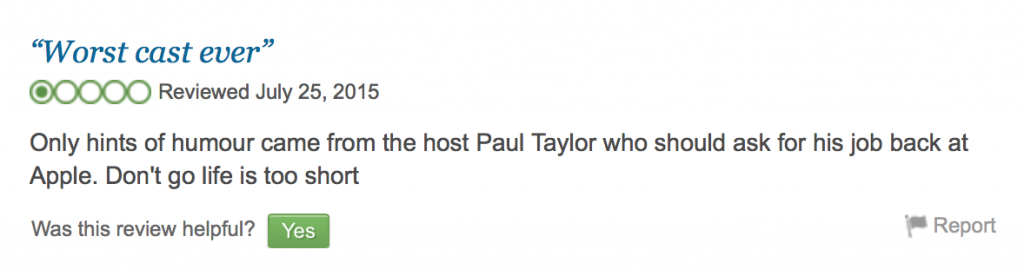
That episode was called “Ten Fixed Expressions” but that now seems to be quite a dull title. Certainly, we did teach 10 expressions but the title seems a bit boring don’t you think? I’m wondering what to call this episode and I still can’t decide as I’m writing this. I always think that titles of my episodes should describe what is in each episode, and should also be fun and interesting enough to catch your attention. In this case Paul and I teach you ten expressions again, but we also have a chat about our recent news, and get very sidetracked by a negative review on TripAdvisor of one of our recent comedy shows.
The main aim of the episode is to play the vocabulary game and let you understand the meaning of ten English expressions but it also is a chance for us to mess around a bit and talk about other things if we feel like it, especially if it is entertaining or interesting for you.
So, should I call this episode “Another Ten Natural Expressions” or “Ten More Natural Expressions” or “Ten Natural Expressions (Part 2)”? Maybe “Vocabulary Game with Paul Taylor (#2)” is a better title? I can’t decide. I’ll choose the title when I’ve finished writing this and editing the episode together, and whatever title you see at the top of this page is the one I finally went for. I suppose you’ll probably be thinking – “Luke, the title doesn’t really matter. It’s the content that counts.” That’s true of course, but I do think the title is quite important for attracting new listeners to the podcast, and because it helps you to identify the main content of the episode. Let me know what you think about the title of this episode by leaving a comment below.
In This Episode
Anyway, regardless of my indecisiveness about the episode title, here’s what you can expect in this episode.
1. Hi Paul, hi Luke, etc. :)
2. Conditions are almost exactly the same as in the recoding of episode 283. It’s boiling hot. I’m with Paul Taylor. We’re sitting in the shade, mostly, except for my leg which is in direct sunlight again. We’re going to play a vocabulary guessing game like last time we did this (episode 283).
3. What’s new Paul? He’s been doing more comedy gigs. We got a bad review for one of our comedy shows, and we talk about it a little bit. The wording of the review bothers us a bit (also the fact that it’s so negative of course). Here’s a picture of the review (below). What do you think of the description? Ignore the lack of a full-stop at the end of the second sentence. Is the comment slightly ambiguous? What does it really mean? Look at the review and then choose option a) or b).
[socialpoll id=”2286338″]
One thing’s for sure, this person did NOT enjoy our show! You can’t please all the people all the time, and bad reviews are just a part of putting on comedy shows. So, never mind!
Anyway, in our conversation we use the negative review as a chance to talk about the importance of being dedicated, motivated and positive as a way of pushing through a barrier of resistance that you might experience if you want to really achieve something in life, like becoming a really funny comedian or learning another language to an advanced level.
4. The Ten Fixed Expressions & Vocabulary Guessing Game
The rules of this game are the same as last time. I’ll explain an expression to Paul and he has to guess which one I’m talking about. Listen to my explanations – can you guess the expressions before Paul does?
Here are the ten expressions I explain in the episode. Listen to the episode to get definitions and examples, or just google them for online definitions.
1 all’s well that ends well
2 an eye for an eye (and a tooth for a tooth)
3 and Bob’s your uncle
4 and pigs will fly!
5 that’s another kettle of fish
6 as cheap as chips
7 to ask for trouble
8 to be away with the fairies
9 to be back to square one
10 to be all ears
That’s it!
Listen all the way to the end of the episode to hear some out-takes of my introduction to this episode. What are out-takes? They’re the mistakes that are edited out of the final version of a film, song recording, or in this case a podcast episode. Sometimes it takes me a few attempts to get the introduction right. I might do nearly 10 failed introductions before I finally get it right and continue with the rest of the recording. They’re not normally intended for publication, but sometimes they’re pretty funny so I shared them with you at the end of this episode.
Don’t forget to leave your comments below this episode! Thanks for being awesome listeners and LEPsters and all that. You’re the best. Look forward to more episodes coming soon…
Do you ever listen to songs and completely mishear the lyrics? I do it all the time. In fact, everybody does! Let’s listen to some song extracts in which the lyrics don’t quite sound as the singer intended.
[DOWNLOAD]
Jimi Hendrix – Purple Haze
Sounds like: “Excuse me, while I kiss this guy”
The real lyrics: “Excuse me while I kiss the sky”
The connection of ‘this’ and ‘guy’ makes the /g/ and /k/ sound almost exactly the same. In fact, I think “kiss this guy” and “kiss the sky” are identical.
Do you ever do Karaoke, see the song lyrics on the screen and realise you’ve been hearing all the words wrong, all these years? Or do you wonder if maybe the guy who did the karaoke subtitles didn’t have a perfect command of English and misheard all the lyrics?
Well, if you do often mishear lyrics, worry not – it’s really common and it happens to everyone! There are loads of songs like that for me. For years I thought Sting was singing about sausages in this song. Is it just me or is he singing about salami?
Of course, he’s actually singing “So lonely”.
So, let’s listen to some song extracts and try to understand exactly which words are being sung. Let’s see if you mishear them too, and we’ll consider why they might be easy to get wrong.
Misheard Lyrics
Jimi Hendrix – Purple Haze
Sounds like: “Excuse me, while I kiss this guy”
The real lyrics:
The connection of ‘this’ and ‘guy’ makes the /g/ and /k/ sound almost exactly the same. In fact, I think “kiss this guy” and “kiss the sky” are identical.
Nickleback – How You remind me
Sounds like: “cos little women must have damn near killed you”
The real lyrics: “because livin’ with me must have damn near killed you”
“With me” can sound like “women”. “wi’me”
“Living” can sound like “little” when you remember that the /t/ sounds are often softened in US English.
The Stone Roses – I Wanna Be Adored
Sounds like: “I wanna be a door”
Real lyrics: “I wanna be adored”
He’s really keen to be a door. Because the ending of the word trails off, it’s quite easy to imagine he’s not adding a /d/ sound at the end.
Leona Lewis: “Bleeding Love”. (1min)
Sounds like: “You call me your banana”
The real lyrics: ??
Duffy – Mercy
Sounds like: “You got me begging you for birdseed”
The real lyrics: “You got me begging you for mercy”
Eagles – Hotel California
“What a nice surprise, when your rabbit dies” (3.25)
The real lyrics:
Rolling Stones – Start Me Up
Sounds like: “In Yugoslavia you’ll never starve”
The real lyrics: “If you start me up I’ll never stop”
Sister Sledge – We Are Family
“Just let me staple the vicar”
?
“We’re giving love in a femidom”
?
Bon Jovi – Living on a Prayer
“It doesn’t make a difference if we’re naked or not”
“It doesn’t make a difference if we make it or not”
The /m/ in ‘make it’ can quite easily sound like an /n/ sound, and the /t/ in “make it” sounds like a /d/, so there you go…
Billy Ocean – When The Going Gets Tough
“You can go and get stuffed.”
“When the going gets tough.”
The beginning part of the phrase doesn’t work, but “and get stuffed” sounds pretty good!
“Gets tough” sounds almost exactly like “Get stuff”.
Miley Cyrus – Wrecking Ball
“I came in like a rainbow”
“I came in like a wrecking ball”
I think this is because she doesn’t sing it clearly, and the vowel sounds are the same. Also, when you stretch out a note, it’s usually a vowel sound and the consonant sounds might get shortened. Singing it with passion extends the vowels, and the consonants disappear into a slightly ambitious zone.
*Audible offer* www.audible.com/teacherluke
Creedence – Bad Moon Rising
“There’s a bathroom on the right.”
“There’s a bad moon on the rise.”
All the vowel sounds are the same. The rest is some imagination or perhaps some connected speech.
Deep Purple – Smoke on the water
“Small cousin Walter, is firing this guy.”
“Smoke on the water, fire in the sky”
There’s another example of “the sky” sounding like “this guy”.
“Fire in” sounds a lot like “firing”
“Smoke on the water” – you need a bit of imagination to hear “Small cousin Walter” but it’s there!
The Cars – Drive
“We can’t go on, thinking, nothing’s wrong – pork pie”
No idea what he’s actually singing…
Michael Jackson – You are not alone
“Your burgers are the best”
Again, I have no idea what he’s on about.
Celine Dion – My Heart does Go On
“I believe that the hot dogs go on”
“I believe that the heart does go on”
We use “does” for emphasis, or to insist something. In this case, it makes it sound like she’s singing about junk food.
Led Zep – Stairway to Heaven
“There’s a wino down the road”
“And as we wind on down the road”
The ‘d’ in “wind on” disappears as the /n/ sound and /d/ sounds fuse together with the same tongue movement.
Seal – A Kiss From A Rose
“and my eyes become lager…”
For me, it just sounds like he’s saying “lager”. I expect he wants to say “larger” but I think it’s definitely “lager”.
Air – All I Need
“Have a wank”
“How do I?”
Ok so she’s actually singing, “How do I?” but just a little bit of imagination for the /k/ at the end, and you’ll never be able to hear this song in the same way again.
Brian Adams – Summer of 69
“I got my first real sex dream”
“I got my first real six string”
Sometimes a /dr/ sound can be similar to a /tr/ sound, especially when they follow a /ks/ sound, like in “six”. So, “six string” can sound like “sex dream”.
Alicia Keys – New York
“New York – Concrete Jungle Wet Dream Tomato”
“Concrete jungle what dreams are made of”
It just sounds like “wet dream tomato” to me. Why is she singing that?
Ray Parker Junior
“Who you gonna call? Those bastards!”
“Ghostbusters”
The vowel sounds are pretty similar, and the emphatic way it is said. They all contribute to a funny misunderstanding!
Eiffel 65 – I’m Blue
“I’m blue I will pee on a guy, if I was green I would die.
I think they’re just singing nonsense and the human brain tends to impose order on nonsense, so your brain searches for meaning. This is the closest your brain can come up with. For me, it improves the song immeasurably.
Beastie Boys – Intergalactic
“I’m having a big shit, I’m having a big shit…”
“Another dimension”
The /th/ in “another” can sound like a /v/ sound, and the /shun/ sound in “dimension” can easily sound like “shit”.
Shania Twain – That don’t impress me much (2.20)
“I can’t believe you kiss your cock at night”
“I can’t believe you kiss your car goodnight”
“Car goodnight” can easily sound like “cock at night” because the /g/ of “goodnight” can sound like the /k/ in “cock”, and then “goodnight” sounds like “at night” because of the old /d/ /t/ thing between “good” and “at”.
Anyway, no need to explain it. Just enjoy it!
100 episodes ago I recorded The Phrasal Verb Chronicles #1 – remember that? The point of that episode was to improvise a made-up story as a way of reviewing the first 50 phrasal verbs from my other podcast which is called A Phrasal Verb A Day. I had to just come up with a random story, and add in a load of phrasal verbs. Your task was to try and spot the phrasal verbs as I used them, while also following the story. It’s time to do it again because I’ve done over 100 episodes of A Phrasal Verb A Day. So now, in this episode I’m going to attempt to improvise another story using phrasal verbs #51-100. Click here to listen to The Phrasal Verb Chronicles #1.
A quick note about A Phrasal Verb a Day
Do you know about my other podcast? It’s a real thing, there are currently about 107 episodes available free for you. You can find all the details, every episode and the RSS feed and iTunes links on teacherluke.co.uk. Just click “A Phrasal Verb a Day” in the menu. You can also find it in iTunes. I started it at the beginning of last year and my aim was to record an episode every day. I managed to keep up that rhythm of one a day for the first few months, but then I found that I couldn’t keep doing them every day. So, the recording and uploading of APVAD has become very sporadic as my daily routine has been really hectic (as usual). But, it is still alive and kicking and I plan to go back to it regularly to upload more episodes. Eventually, the plan is to hit 365 episodes and then it will be finished. In each episode I teach you a different phrasal verb, give you explanations and provide loads of examples of the different meanings and other things you should know. There are also transcripts for all 104 episodes (to date). Phrasal verbs are a vitally important part of fluent and natural sounding English, and are often one of the hardest aspects of the language to learn. You can use my series as a way to get a grip on this difficult aspect of English. Listening to my short phrasal verb episodes regularly can make a really big difference to your English learning, so if you haven’t already done so I recommend that you check it out today. Teacherluke.co.uk and then click A PHRASAL VERB A DAY in the menu, or just google “A Phrasal Verb a Day”. You can subscribe to it in iTunes, download them, listen to them on my website or whatever is most convenient for you – just like episodes of Luke’s English Podcast.
Now, back to this episode.
It’s important to review vocabulary – it’s vital to go over language again and again and we also know that it’s important to get vivid and meaningful connections to words to help you remember them. Hopefully this story will help that process.
I’ve already gone through meanings and explanations of all these phrases in each phrasal verb episode. If you want to go back and study them in more detail, you can just go back to those individual little episodes – the links to all of them are available on the page for this episode. You’ll see a list, and you can click on each phrasal verb to listen to that episode.
In this episode let’s focus on you just noticing these phrases as they are used in natural speech within the context of a story. You’re going to play a game of Vocab Hunter! (exciting) Does that help to make it interesting? If you need extra excitement you can imagine you’re shooting the vocab from the sky whenever you hear it. You can even do a hand gesture, like you’re shooting a gun, like ‘pow’ every time you hear one. Obviously, watch out if you do that on public transport. People tend to be a bit funny about people pretending to shoot imaginary words that only they can see, while on a bus surrounded by people – but on the plus side, you’ll probably get an empty seat next to you and plenty of space to stretch out and really relax while you listen to this episode and play vocab hunter.
Anyway, as I was saying, it’s important to get used to noticing language as it is being used in context, rather than just being spoon fed vocabulary bit by bit, by a teacher, in a slightly mechanical way. Ultimately, it really helps you pick up language when you actually hear it being used to serve a communicative purpose. So your challenge in this episode is just to try to follow the story while noticing 50 phrasal verbs as they’re being used. The phrasal verbs will appear in alphabetical order. In fact, there may be more than 50 as I’m sure other phrasal verbs will just naturally crop up in my speech (there was one already – to crop up).
My challenge is just try try and make this a coherent story, while including all the phrasal verbs. I have no idea where my story is going to go! I just hope that it all makes sense and that I find a way to use every single phrasal verb in order.
It’s going to be difficult, it’s going to be fun and I hope you enjoy the story. I will go through the list when I’ve finished so you will know which ones you should have noticed. Remember, the list of these phrasal verbs, with mini podcast episodes explaining each one, is available on the page for this episode.
So, let’s begin the phrasal verb chronicles, episode two – phrasal verbs 51-100.
(Longest title ever?)
In the last episode, Amber, Paul and I talked about giving compliments, sharing bad news, and generally saying negative things in a careful and diplomatic way. We then did a couple of role play improvisations to help you notice specific language. In this episode we continue with the improvisations. You can see some samples of language used in those improvisations below. [DOWNLOAD] [AUDIBLE AUDIOBOOK OFFER]
I hope you enjoy this episode. As ever, please leave your comments below!
The Role-Plays and Language
3. You go to your friend’s house and they show you their new living room which took months to decorate and cost hundreds of pounds, but it looks awful.
– It’s different to how I imagined
– Normally I love the smell of fresh paint
– …very human
– You’ve really made a statement
– …ah, so it’s finished!
4. Last year you lent your iPod to a friend while he was in hospital. Now he’s better and he’s been out of the hospital for quite a few months but he’s still using your iPod all the time. Demand that he gives it back to you, but do not be rude to your friend!
– You look so great / so nice to see you (positive)
– I was woooooondering
– Did I lend you my iPod?
– I can show you a website
– I was thinking, if I could possibly get back that iPod
– I was thinking possibly if I could have it back
– You don’t mind?
5. You are the manager of a small office. Staff members in the office have complained to you that a member of the team has serious BO (body odour) issues. You’re the one who has to tell him about it, and suggest some solutions. But don’t hurt his feelings!
Language
– Take a seat
– How are you?
– I wanted to have a chat
– essentially
– Let me start again
– Unfortunately, it seems…
– Specifically
– Being frank
– What can I do for you? (resolving the issue)
– I understand. That’s fine.
– Here’s the issue
– What Mr Taylor was trying to say was…
6. You’re the boss of a school. You have to inform one of your teachers that they’re going to be replaced by a Japanese teaching robot.
– No language recorded (I was too involved in the role play).
Today I’m joined by my mates Paul Taylor and Amber Minogue, both of whom have been on the podcast before. Let’s catch up with them and see what they’ve been doing. Listen to the episode to hear a completely unscripted and authentic chat between 3 native speakers from England, as we talk about having babies, pedestrian crossings, having ginger hair, the difficulties of being English in the sunshine, and some of our favourite TV shows and films. [DOWNLOAD] [FREE AUDIOBOOK OFFER] Amber Click here to listen to Amber’s previous interview on LEP, in which she talked about having a baby.
How was the birth?
You said you would go with a natural birth before. Did you?
What’s it like being a mum?
Best things? Worst things?
Sleep? Nappies?
Topics in this Episode We talk about various things including:
– Amber’s baby, the birth and what it’s like to be a Mum
– Paul’s news, including his short YouTube videos called Taylor’s Top Tips (started on Instagram, then moved it to YouTube).
– The sound effects from my terrace (the sounds of the street, the sounds of people stepping in dog poo in the street)
– Pedestrian crossings in Paris vs Dog poo
– The dangers of crossing the road in Paris
– The difficulties of being English in the sunshine
– Struggling with a folding chair while avoiding a spider
– Ginger people / having a ginger beard / being a ‘ginger ninja’
– Are Italian people obsessed with ginger people?
– Game of Thrones and other TV shows like Breaking Bad, Suits, Dexter, The Walking Dead, Lost, House of Cards etc.
– TV series vs Films
– J.J. Abrams the director of the new Star Wars film, and his love of lens flare.
– Amber doesn’t like ‘wiggly camera’ – shaky, handheld camera effects – like in the Jason Bourne films and the Taken films.
– The film Cloverfield (directed by J.J. Abrams)
– The Blair Witch Project (1999)
– Recommended TV series (plural – series, singular – series). Amber: Game of Thrones and The Wrong Man’s, Paul: Fawlty Towers, Luke: Louie.
– Vocabulary: A TV series (e.g. Game of Thrones) – not a serie, a season (e.g. season 1, season 2 etc – in the UK we used to say ‘series’ not ‘season’ but now most people say ‘season’)
– Serial? It’s an adjective to describe a series of things – e.g. a serial publication. In my opinion we don’t say a ‘TV serial’, we say a ‘TV series’. Amber and Paul don’t agree.
– Criticisms of French television (a bit of French bashing here? or genuinely valid criticisms of French TV?)
– Summarising the conversation: Jumping into gingers (“Don’t jump into anyone too quickly, you have to give them fair warning in advance”), we detoured into TV, the escapade/debacle with the chair, spending time in the sun
– Orphan Black (TV show)
Taylor’s Top Tips
For the Geeks: What is lens flare?
The trailer for Cloverfield
Directed by J.J. Abrams. Lots of shaky, handheld camera (or ‘wiggly camera’ as Amber described it)
Orphan Black trailer
Cookies on teacherluke.co.uk
Click “Accept All”, to consent to the use of all cookies on this website, or visit "Cookie Settings" to control your consent settings.
This website uses cookies to improve your experience while you navigate through the website. Out of these, the cookies that are categorized as necessary are stored on your browser as they are essential for the working of basic functionalities of the website. We also use third-party cookies that help us analyze and understand how you use this website. These cookies will be stored in your browser only with your consent. You also have the option to opt-out of these cookies. But opting out of some of these cookies may affect your browsing experience.
Necessary cookies are absolutely essential for the website to function properly. These cookies ensure basic functionalities and security features of the website, anonymously.
Cookie
Duration
Description
cookielawinfo-checkbox-analytics
11 months
This cookie is set by GDPR Cookie Consent plugin. The cookie is used to store the user consent for the cookies in the category "Analytics".
cookielawinfo-checkbox-functional
11 months
The cookie is set by GDPR cookie consent to record the user consent for the cookies in the category "Functional".
cookielawinfo-checkbox-necessary
11 months
This cookie is set by GDPR Cookie Consent plugin. The cookies is used to store the user consent for the cookies in the category "Necessary".
cookielawinfo-checkbox-others
11 months
This cookie is set by GDPR Cookie Consent plugin. The cookie is used to store the user consent for the cookies in the category "Other.
cookielawinfo-checkbox-performance
11 months
This cookie is set by GDPR Cookie Consent plugin. The cookie is used to store the user consent for the cookies in the category "Performance".
viewed_cookie_policy
11 months
The cookie is set by the GDPR Cookie Consent plugin and is used to store whether or not user has consented to the use of cookies. It does not store any personal data.
Functional cookies help to perform certain functionalities like sharing the content of the website on social media platforms, collect feedbacks, and other third-party features.
Performance cookies are used to understand and analyze the key performance indexes of the website which helps in delivering a better user experience for the visitors.
Analytical cookies are used to understand how visitors interact with the website. These cookies help provide information on metrics the number of visitors, bounce rate, traffic source, etc.
Advertisement cookies are used to provide visitors with relevant ads and marketing campaigns. These cookies track visitors across websites and collect information to provide customized ads.

 [DOWNLOAD]




 “Californication” Lyrics & Chords