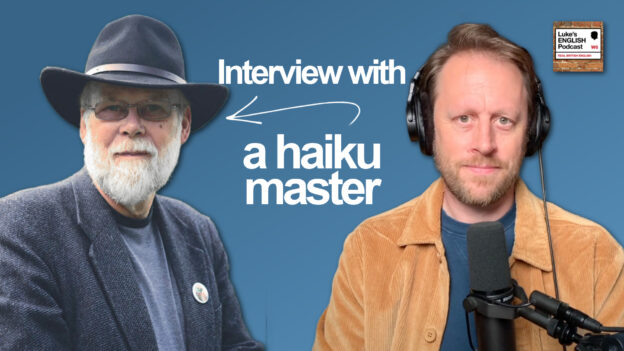
Practise your listening in English with a fascinating conversation with a writer of haiku poetry in English. John Stevenson is one of the world’s leading English language haiku poets, and in this episode I had the pleasure of talking to him for an hour. John taught me more about haiku and senryu poetry, revealed how he first became interested in haiku, and then was willing to discuss various haiku poems he has written over the years, giving details of what real events inspired them, what they mean and more about his process of writing haiku in English. I hope this episode is fascinating and inspiring. Keep listening because it becomes more and more revealing as it continues. John was a pleasure to talk to and I think this is the perfect conclusion to the trilogy of episodes I have done on this subject on the podcast recently.
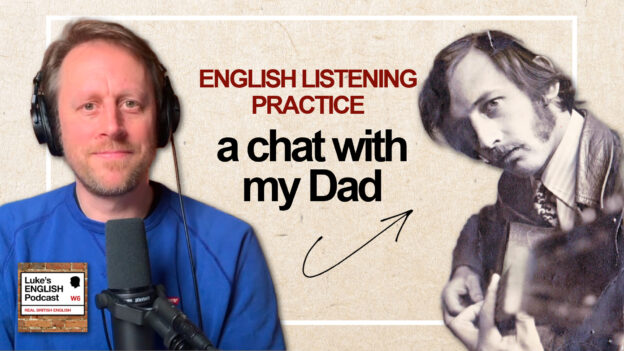
Following my chat with my mum last week, now it’s my dad’s turn! In this episode my plan was to ask my dad lots of questions about his life, and to listen to him talking about the various choices, moments and experiences he has had. The result is another deep chat about family history, and my dad’s life story. I hope you enjoy listening to it as much as I enjoyed recording it. Full transcript available.
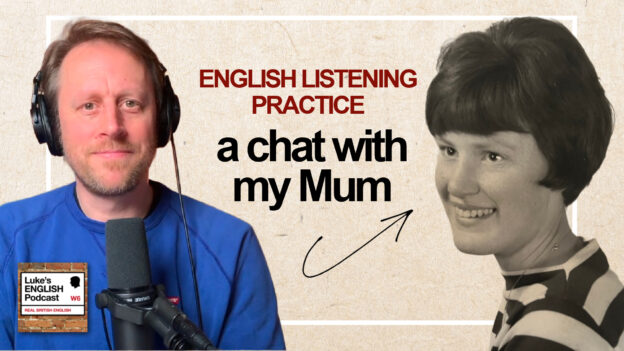
[977] Recently I visited my parents at their home, and while I was there I took the time to record conversations with them both. This first one is with my mum. I asked her questions about her life story, our family history, her memories of growing up and so many other things that I was curious about. The result is this recording. I hope you will find that it is not only good for your English listening practice, but also fascinating and absorbing as a piece of personal history. Full transcript available.
[976] Here’s an epic rambling episode in which I talk about learning English with BBC Radio and TV 📻 expressions with the word ‘thumb’ 👍 the story of how I became a taxi driver on the streets of Paris 🚖 the grammar of Yoda 🐸 fantastic haikus written by my listeners ✍️ and getting pecked in the face by a swan 🦢. 3h30min+ of English from me to you.
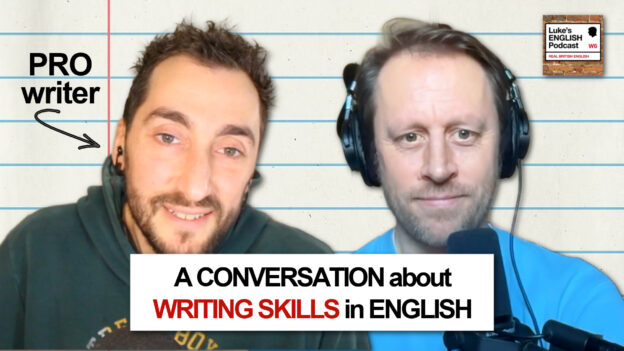
What skills are involved in being a good writer? What makes a good piece of writing? How is writing different to speaking? What are the challenges faced by learners of English who want to write well, and what are some solutions to these challenges? How can AI help develop writing skills? And, what does it take to write your own book in English? These are all questions which I talk about in this episode, with the help of professional writer and returning guest Fabio Cerpelloni.
Summary of Key Insights About Writing (for Learners of English) in our conversation 👇
1. Writing is permanent — and that’s why it feels scary
Unlike speaking, writing doesn’t disappear. Once it’s written, it’s there. That can make learners nervous, but it’s also what makes writing powerful: you have time to shape, revise, and improve your message.
2. Good writing is about impact, not perfection
A good piece of writing:
makes sense
does the job it’s meant to do
connects with the reader
Grammar and vocabulary matter, but effect on the reader matters more than sounding impressive or “advanced”.
3. Simpler language is often more effective than flashy language
Using complex vocabulary, idioms, or “advanced” expressions just to sound native can:
feel unnatural
distract the reader
reduce clarity
Clear, simple language often has more impact than complicated language.
4. Writing is about connection and self-expression
Beyond exams and emails, writing is a powerful tool for:
expressing ideas
sharing experiences
motivating or moving the reader
Even imperfect English can work well if the message connects emotionally.
5. Structure and organisation help the reader
Good writing:
has a clear beginning, middle, and end
is easy to follow
makes its purpose obvious
Organisation, coherence, and clarity all serve the reader — and improve impact.
6. Writing helps you clarify your thinking
Writing isn’t just about communicating ideas — it creates ideas. If something feels hard to write, it often means the idea isn’t clear yet. The struggle is part of the thinking process.
7. Cutting “fluff” is a key writing skill
Strong writing often comes from removing, not adding:
repeated ideas
vague sentences
unnecessary words
“Less is more” — especially in emails and practical writing.
8. Reading is essential if you want to write better
As Stephen King famously said:
“If you want to be a good writer, you must read a lot and write a lot.”
Reading helps you:
absorb natural structures
notice effective style
understand what works and why
If you want to write emails, read emails. If you want to write stories, read stories.
9. Writing a diary counts as real writing
You don’t need to publish or be famous to be a writer. Writing for yourself:
builds fluency
develops clarity
strengthens your connection with the reader (even if that reader is you)
A writer is simply someone who writes.
10. Exams focus on communication, not just accuracy
In exams like Cambridge English, accuracy is only one criterion. Higher priorities include:
communicative achievement
task completion
effect on the reader
Everything in your writing should serve the purpose of the task.
11. AI can help — if you use it wisely
AI tools are useful for:
checking grammar doubts
exploring word choices
finding synonyms
clarifying meaning
But they shouldn’t replace your thinking or your voice. Beware of letting AI do your writing for you – your own skills will not develop, and you will come across as unoriginal, indistinct and probably even lazy. Often, your reader wants to get the sense there is a person on the other side. Don’t be seduced by the dark side of the force. Sorry. I mean, don’t be seduced by the fact that ChatGPT will write flawlessly – with no errors. People can usually tell when something has been written by AI, and it doesn’t give a good impression of you.
Also, you need to question and evaluate what AI produces.
12. Dictionaries still matter
AI can make mistakes. A reliable dictionary — like the Oxford Learner’s Dictionaries — remains the final authority for:
Meaning of words
Examples of real usage
collocations
register
13. Writing improves confidence through small wins
Writing doesn’t have to mean a 300-page book. Small, achievable projects (emails, blog posts, short texts, “tiny books”) build:
confidence
momentum
motivation
Success encourages more writing. If you want to write well, write regularly.
14. Writing is hard — even for experienced writers
Struggling with a paragraph doesn’t mean you’re bad at writing. It usually means:
the idea needs refining
the purpose isn’t clear yet
Difficulty is normal and productive.
15. Ultimately, writing is about purpose
Before writing, ask:
Who is this for?
What do I want the reader to feel, know, or do?
What is the core idea?
When purpose is clear, language choices become much easier.
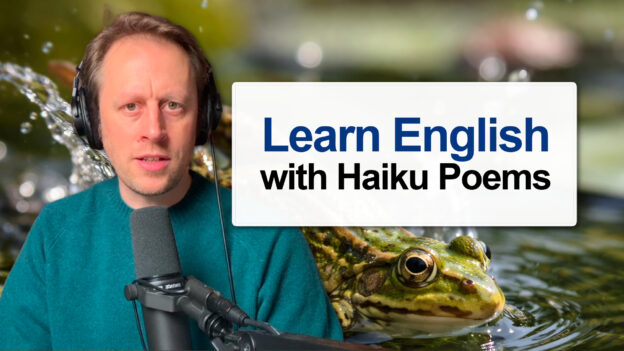
[974] In this episode I read out lots of haiku poems, explain their meaning, discuss what they make me think and feel, and use them to teach you some vocabulary. The haikus I read include some traditional Japanese ones translated into English, plus more modern ones written in English by writers from around the world. Some of these haikus are meditative, some are sad, some are funny and some find a way to capture feelings that are otherwise difficult to put into words.
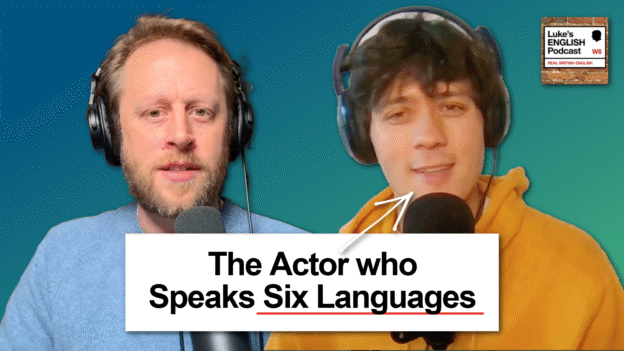
[972] I talk with multilingual actor Ivan Doan about his multicultural background, his learning of languages and his work as an actor. Ivan shares his insights and experiences of learning English, dealing with different accents in film & TV roles, and the importance of mindset and discipline in his life. There are plenty of language learning insights in this episode, which I summarise at the end. Full transcript available.
An 11-point list of practical advice for learning English inspired by this conversation.
1. Learning through doing, not just studying
Use English for real things. Ivan’s English really improved when he started making projects in English (web series, acting work, talking to people), not just studying grammar.
Make English the tool, not the subject. Start a small project: a vlog, a diary, an Instagram account, a DnD group, movie scene re-enactments – anything that requires English.
Theory helps, but it’s not the engine. Grammar explanations are useful, but they’re not what makes you fluent. Real communication is.
2. Multimodal learning: use your whole body & brain
Don’t reduce English to rules + word lists. When Ivan was with the Mormons or on set, he learned from body language, tone of voice, facial expressions, rhythm, context, not just words.
Watch people, not just subtitles. When you watch something in English, pay attention to:
how people look at each other
when they pause
what their hands/face are doing when they say something important
Combine skills. Listen + read + speak + move. For example, repeat a line while copying the actor’s body language and facial expression.
3. Listening & repetition are superpowers
Re-listen on purpose. Take a podcast episode or YouTube clip and:
Listen once for general meaning.
Listen again and note unknown words/phrases.
Look them up.
Listen a third time and catch those items in context.
Notice “repeat offenders”. If a word or chunk keeps appearing, it’s a sign: you probably need it. Put it on a list.
Make targeted vocab lists. Like Ivan did for filmmaking, you can make lists for your world: tech, business, medicine, design, gaming, etc.
4. Discipline beats talent
You don’t need to be “gifted at languages”. Ivan’s message is clear: people think he’s “special”, but in reality, discipline and repetition are doing most of the work.
Be stubborn. Let it bother you (in a good way) that you don’t understand a phrase yet. Go back to it. Again. And again.
Small, realistic goals. For example:
“I want to be able to have a 10-minute small-talk conversation without switching to my language.”
“I want to understand one specific podcast episode without subtitles.”
“I want to tell one story about my life in English clearly.”
Basic conversation – you can talk about everyday things.
More advanced conversation – opinions, stories, feelings, more nuance.
Improvisation – you can react in real time with no preparation.
6. Accents, rhythm & sounding natural
First: learn to hear the accent. You can’t produce what you can’t hear. Choose one accent (e.g. London, General American) and really listen to it.
Find your “accent twin”. Pick a native speaker:
similar age
same gender
whose voice feels close to your natural voice Use them as your model.
Create an “accent map”. Notice:
Which vowels are different from yours?
How do they stress words?
What is the rhythm (fast/slow, chunky/smooth)?
Rhythm & word stress are often more important than perfect vowels. BAna-na vs baNAna can be the difference between confusion and clarity.
Shadowing works. Play 1–2 sentences, then:
say them with the speaker,
match their timing, stress, and melody,
repeat several times until it feels comfortable.
7. It’s okay to exaggerate (caricature as a training tool)
Overdo it first, then calm it down. Like an actor, you can:
exaggerate the British or American intonation
really push the stress and melody Then slowly bring it back to something natural.
This is not “fake”; it’s training. As with acting, you push beyond your comfort zone, then refine.
8. Identity, culture & letting yourself change
To speak like an English speaker, you must allow yourself to “borrow” a new identity. That might feel weird: “This isn’t me.” But that flexibility is part of real fluency.
Different cultures, different communication rules. British politeness isn’t necessarily “fake”; Russian directness isn’t necessarily “rude”. They’re different systems.
Adapting ≠ betraying your culture. You can still be 100% you and also learn to play by local rules when you’re speaking English.
9. Talk to yourself – a lot
Self-talk is powerful, not crazy. Walk around your flat narrating what you’re doing in English, or:
rehearse future conversations,
re-tell a story you heard,
argue with yourself about something.
The goal is to stop translating. Like Ivan said, it’s like changing gears in a car: once you’re “in English gear”, you just drive.
10. Treat English like a role you inhabit
Think like an actor. When you speak English:
step into the “role” of an English-speaking version of you,
use your voice, but with English rhythm and intonation,
add the body language and facial expressions that match.
Use emotion. Don’t just say the words; feel them. This makes you remember the language and sound more authentic.
11. Inspiration: you can do this
Messages implied by Ivan’s story:
You can start with school English that isn’t great and end up working in English internationally.
You don’t need a perfect method; you need consistent action, curiosity, and the courage to interact.
Being “from somewhere else” is not a weakness; it’s often your superpower – a different perspective, more empathy, and a richer identity.
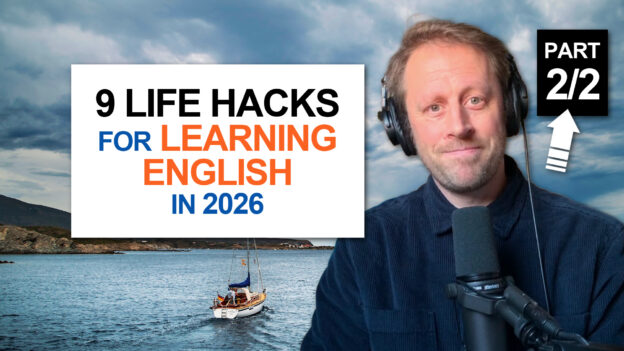
[971] Part 2 of 2. Here is the continuation of last week’s episode about changes you can make to your lifestyle, mindset and habits in order to become a better learner of English in 2026. Each of these tips is backed up by scientific research from the fields of psychology and psycholinguistics, with insights into human behaviour and thinking processes that result in better learning. Full PDF available.
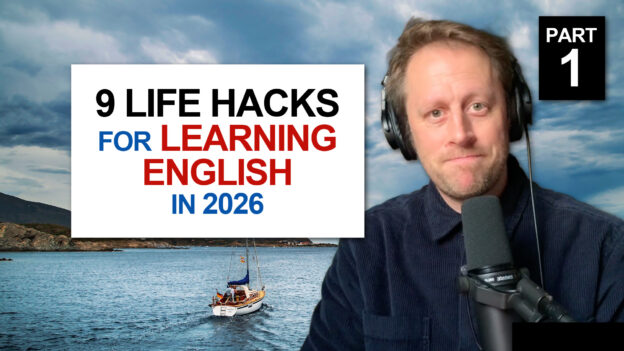
[970] Part 1 of 2. This episode deals with some simple habits you can introduce in your life, to make sure you are in top condition for learning English all year long. It is all backed up by scientific research into how our brains work, and how little changes in our behaviour can help us perform better and achieve more in the time we are given. Includes top advice for preparing yourself to be a great learner of English in 2026. Part 2 will be available next week.
[969] It’s time for the annual World News Quiz with 20 questions about some of the curious news stories of 2025. Stephen Devincenzi from the SEND7 podcast is the quizmaster. Can you I improve on my poor performance from last year? Can you beat me? Take a trip through some news highlights from this year. Full transcript available as usual.
🎧 📰 Listen to Stephen’s podcast “Simple English News Daily” wherever you get your podcasts https://pod.link/1505603790
Quiz Questions (answers provided below)
January
1. Starting in the US, Donald Trump became president for a second time in January, and roped in his friend, the richest person in the world , Elon Musk, to run a new government agency. The aim of this new agency was to save the US government lots of money. What was the name of that new government agency?
2. Also in January, a Chinese artificial intelligence chatbot surprised the industry with how good it was, and AI tech stocks lost billions of dollars (although they’ve come back up since then). What is the name of the Chinese AI chatbot, or the company which creates it, which has the same name.
3. Throughout January massive wild fires destroyed homes and businesses in a coastal city in the United States, destroying over 18,000 homes and buildings, and causing an estimated 50 billion dollars worth of damage. Which city were the fires mostly based around?
April
4. On the 28th April, why did people have to be evacuated from trains in Spain and Portugal?
5. Also in April, an all-female spaceflight took place using Jeff Bezos’s private space company, Blue Origin. Which pop star was on board?
6. Also on the 28th April, Canada had a general election. Liberal leader Justin Trudeau had resigned a couple of months after polls showed the Liberals way below the Conservative party in the polls. However, somehow the Liberals did win that election. What is the name of the leader that took over from Justin Trudeau, and is now Canada’s Prime Minister?
7. Which Asian city, overtook Tokyo to become the most populous city in the world, according to the United Nations?
May
8. On the 8th May Pope Leo was chosen as the new pope after the death of Pope Francis. Which of these is NOT true about Pope Leo:
– He is the first pope from The United States
– He is the first pope to hold Peruvian nationality
– He is the first pope born in the Americas
– He is the first pope with modern English as a first language (second if you include old English)
July
9. In July, Switzerland held the women’s Euro football championship. Which teams were in the final?
10. In Australia, after months of a highly watched court case. A woman, Erin Patterson, was found guilty of killing three of her in-laws and the attempted murder of her estranged husband. The case received so much interest that many podcasts were made about it, and her sentencing was the first to broadcast live. How is Patterson accused of killing her in-laws?
August
11. In Sweden, something surprising happened to a 113 year old church in August. What was it?
September
12. In September, a painting which was stolen by Nazis during world war 2 was discovered in Argentina. How did a Dutch newspaper discover the painting?
October
13. Continuing the church theme – a church in Spain’s Second largest city of Barcelona became the tallest church in the world this year, over 140 years after its construction was started. What is the name of that church?
14. What is the name that has been given to a series of protests around the world in 2025? The name was actually first used in Bangladesh in 2024, and the same name has been given particularly to anti-government protests in Nepal, Indonesia, The Philippines, Madagascar, Peru and some other countries.
15. In Paris thieves stole eight priceless pieces of the crown jewels from the Louvre in October. How did the thieves get into the building?
16. In October Maria Corina Machado was awarded the Nobel Peace Prize “for her tireless work promoting demoractic rights for the people of ______________ and for her struggle to achieve a just and peaceful transition to democracy”. What country is she from?
17. Which of these countries has had their first ever female leader since October 2025?
Japan
Thailand
Taiwan
Malaysia
November
18. What is the name of the brand of collectible dolls which originated in Hong Kong, that look like cuddly monsters, which became particularly popular all over the world in 2025?
December
19. This month, Australia has become the first country in the world to introduce one specific new rule about social media. What exactly is the new rule?
20. It was finalized in 2025 that on the 1st day of 2026 there will be a new country using the euro. Which country, will become the 21st member of the eurozone on the 1st January?
Answers
DOGE – Department of Government Efficiency.
Deepseek
Los Angeles
Power cuts
Katy Perry
Mark Carney
Jakarta
He is the first pope born in the Americas
Spain and England. England won on penalties. Spain were the world champions and England were European champions form 4 years earlier.
Mushrooms
It was picked up and moved 5 kilometers away. A specially designed trolly with 224 wheels was used.
Found in a Real estate image / website selling the house
Sagrada Familia (reached 163 metres when a part of its central tower was lifted into place, passing the Ulm Minster church in Germany.)
Gen z / Generation z
Window / ladder
Venezuela
Japan
Labubu
No under 16s
Bulgaria will become the 21st country Already using Euro – Austria, Belgium, Croatia, Cyprus, Estonia, Finland, France, Germany, Greece, Ireland, Italy, Latvia, Lithuania, Luxembourg, Malta, the Netherlands, Portugal, Slovakia, Slovenia, and Spain
Luke’s scores so far
2022 – 15/20 (“a respectable score”)
2023 – 16/20 (apparently I beat my previous year)
2024 – 8.5/20 (I dropped below the “general dignity level of 50%” and into the “F range,” while Stephen admitted that he may have made the quiz more difficult than in previous years)
2025 (this year) – 12/20 (I scraped a pass with quite a lot of help from little clues from Stephen)
Cookies on teacherluke.co.uk
Click “Accept All”, to consent to the use of all cookies on this website, or visit "Cookie Settings" to control your consent settings.
This website uses cookies to improve your experience while you navigate through the website. Out of these, the cookies that are categorized as necessary are stored on your browser as they are essential for the working of basic functionalities of the website. We also use third-party cookies that help us analyze and understand how you use this website. These cookies will be stored in your browser only with your consent. You also have the option to opt-out of these cookies. But opting out of some of these cookies may affect your browsing experience.
Necessary cookies are absolutely essential for the website to function properly. These cookies ensure basic functionalities and security features of the website, anonymously.
Cookie
Duration
Description
cookielawinfo-checkbox-analytics
11 months
This cookie is set by GDPR Cookie Consent plugin. The cookie is used to store the user consent for the cookies in the category "Analytics".
cookielawinfo-checkbox-functional
11 months
The cookie is set by GDPR cookie consent to record the user consent for the cookies in the category "Functional".
cookielawinfo-checkbox-necessary
11 months
This cookie is set by GDPR Cookie Consent plugin. The cookies is used to store the user consent for the cookies in the category "Necessary".
cookielawinfo-checkbox-others
11 months
This cookie is set by GDPR Cookie Consent plugin. The cookie is used to store the user consent for the cookies in the category "Other.
cookielawinfo-checkbox-performance
11 months
This cookie is set by GDPR Cookie Consent plugin. The cookie is used to store the user consent for the cookies in the category "Performance".
viewed_cookie_policy
11 months
The cookie is set by the GDPR Cookie Consent plugin and is used to store whether or not user has consented to the use of cookies. It does not store any personal data.
Functional cookies help to perform certain functionalities like sharing the content of the website on social media platforms, collect feedbacks, and other third-party features.
Performance cookies are used to understand and analyze the key performance indexes of the website which helps in delivering a better user experience for the visitors.
Analytical cookies are used to understand how visitors interact with the website. These cookies help provide information on metrics the number of visitors, bounce rate, traffic source, etc.
Advertisement cookies are used to provide visitors with relevant ads and marketing campaigns. These cookies track visitors across websites and collect information to provide customized ads.