Hang out with me for an unscripted and unedited ramble about things like engaging moments while English teaching, how it feels to be about to become a father again, a funny new recording of my daughter speaking English, some recent films I’ve seen, and a recording of me doing stand-up comedy in front of an audience recently.
Here is a list of curious mysteries, jokes and observations about the English language and life in general. I talk about each interesting point, give some funny comments and explain bits of English vocabulary in the process. Expect to learn a few things, and have a bit of a laugh in the process.
4. Who knew what time it was, when the first clock was made?
*Well, try this now*
Ambiguities of the English Language! Enjoy.!!!
😀
1. I wonder why the word “Funeral” starts with FUN?
Saderall would be better, because you’re all sad.
2. Why isn’t a Fireman called a Water-man?
3. How come Lipstick doesn’t do what it says?
Lipstick – it’s a stick for your lips
It’s not stuff that “sticks to your lips”.
Also, it isn’t a stick made of lips. That would be weird.
4. If money doesn’t grow on trees, how come Banks have Branches?
5. If a Vegetarian eats vegetables, what does a Humanitarian eat?
6. How do you get off a non-stop Flight?
7. Why are goods sent by *ship* called CARGO, and those sent by *truck* SHIPMENT?
ChatGPT has the answer (smartypants)
Goods that are shipped by boat are called cargo because the word “cargo” comes from the Spanish word “cargar,” which means “to load.” This makes sense because when goods are shipped by boat, they are loaded onto the vessel.
In contrast, goods that are shipped by truck are called a shipment because they are being shipped from one place to another. The word “shipment” comes from the Old French word “envoiement,” which means “the act of sending.” So, a shipment is a collection of goods that are being sent from one place to another, regardless of the mode of transportation.
8. Why do we put cups in the “Dishwasher” and the dishes in the “Cupboard“?
The word “cupboard” originated in the Middle English word “cubbert,” which came from the Old French word “couvert,” meaning “covered.” A cupboard is a type of cabinet or closet with shelves or drawers for storing household items.
The name “cupboard” likely comes from the fact that these types of storage units were originally used to store cups and other dishware. Over time, the meaning of the word “cupboard” has expanded to include any type of cabinet or closet used for storage. (yes, ChatGPTagain)
9. Why do doctors “practise” medicine?
I don’t want a doctor who practises medicine, I want one who has learned how to do it!
10. Why is it called “Rush Hour” when traffic moves at its slowest at that time?
11. How come noses run and feet smell?
Shouldn’t it be the other way around?
12. Why do they call it a TV ‘set’ when there is only one?
The know-it-all ChatGPT has the answer *yawn*
The word “set” in this context refers to a complete television system, not just the physical television itself. A television set includes the television, as well as any additional components or accessories that are required to receive and display television signals.
In the past, television sets often included components such as a VCR, DVD player, or cable box, and these additional components were often referred to as “attachments.” Even though most modern televisions are self-contained and do not require additional components, the term “television set” is still used to refer to the entire system.
13. What are you vacating when you go on a “vacation“?
We can never find the answers
Can we❓
If you have the *Spirit* of understanding everything in a positive manner – You’ll enjoy every moment in LIFE, whether it’s *PRESSURE or PLEASURE*
So just enjoy the PUN and FUN of the English language.
😂🤣😂
Enjoy and have fun.😘👍
Hana Fakhoury Hajeer, PhD.
A Note about the words “STUFF” and “THINGS”
Also, just at the end here I thought I could explain a couple of points about the words “stuff” and “thing(s)”.
So, here is a note about that.
Of course you are aware of these words. People use them all the time. They certainly came up in this episode.
For example, at the beginning of the episode I said “Let’s talk about some stuff. Here’s some more stuff to help you learn English” and I think the episode is in fact going to be called
“Things that make you go ‘Hmmm’.”
So what about these words? I often notice that my learners of English don’t use them very much, but I think they are very useful.
Of course you shouldn’t overdo it and use them all the time, when a more specific word is appropriate, but still, they are useful and very common.
The main thing here, the main point, is that the word thing is a countable noun, and the word stuff is uncountable.
That’s the only difference really.
In English, countable and uncountable nouns have different rules regarding their usage. Here’s a general overview.
Countable Nouns
1. Countable nouns refer to items that can be counted as individual units.
2. They can be used in both singular and plural forms.
3. Singular countable nouns are typically preceded by an article (a/an) or a specific determiner (e.g., this, that, my).
4. Plural countable nouns usually take an “s” at the end, but irregular plural forms exist as well.
5. Countable nouns can be quantified using numbers or words like “many,” “few,” “some,” etc.
6. They can be used with “a few,” “several,” or “many” to indicate a specific quantity.
Example sentences
– “I have two cats.”
– “She bought some books.”
– “He needs a new car.”
– “There are many students in the classroom.”
Uncountable Nouns
1. Uncountable nouns refer to substances, concepts, or ideas that cannot be counted as separate units.
2. They are typically singular and do not have a plural form.
3. Uncountable nouns do not usually take an indefinite article (a/an) but can take a definite article (the) when specified.
4. They cannot be quantified directly with numbers, but words like “some,” “a little,” “a lot of,” etc., can be used.
5. To express a specific quantity, you can use measurement words like “a cup of,” “a bottle of,” “a piece of,” etc.
Example sentences
– “I need to buy some milk.”
– “She has a lot of experience.”
– “Could you pass me the salt, please?”
– “He drank a glass of water.”
It’s important to note that some nouns can be both countable and uncountable, depending on the context. For example, “water” can be uncountable (as in “I need water”) or countable (as in “There are three waters on the table”).
Just as a quick test, which word would you use to complete these sentences?
Thing / things or stuff?
There is just one _______ I need to tell you before you go.
Can you pass me one of those _______ on that box over there?
Can I have some more of that _______? It was really good.
Ugh, what’s all that sticky _______ on the table?
I need to go into town to buy one or two _______ for dinner, would you like to come?
Your bag is so heavy. How many _______ do you have in here?
There’s too much _______ in the back of the car. I can’t see out of the window.
How much _______ did you bring with you? You don’t need all of those _______.
Sit down, we have some important _______/_______ to tell you.
Answers
There is just one thing I need to tell you before you go.
Can you pass me one of those things on that box over there?
Can I have some more of that stuff? It was really good.
Ugh, what’s all that sticky stuff on the table?
I need to go into town to buy one or two things for dinner, would you like to come?
Your bag is so heavy. How many things do you have in here?
There’s too much stuff in the back of the car. I can’t see out of the window.
How much stuff did you bring with you? You don’t need all of those things.
Sit down, we have some important things/stuff to tell you.
Errors
❌There are some amazing stuff in this shop. ✅There are some amazing things / There is some amazing stuff
❌Can you pass me that stuff on the table? (talking about one object) ✅Can you pass me that thing on the table?
❌We need to get some more stuffs from the shop. ✅We need to get some more stuff… ✅We need to get some more things…
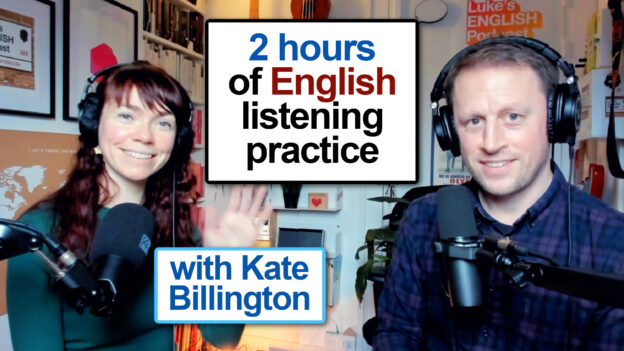
Kate Billington returns for her 4th appearance on LEP to create some fun English conversation for you to listen to. We talk about lots of things, as usual, including her cycling trip to Berlin and a nasty accident she had on her bicycle in Paris earlier this year. Expect tangents, vocab, idioms, jokes, stories, cups of tea and some very “professional” podcast eating.
This is the longest episode of LEP so far, and it’s a solo ramble. Relax, follow my words, hang out with me for 3 hours, get stranded on a desert island of the imagination, and then get rescued. Includes a haircut, a sleep and a t-shirt change during the episode.
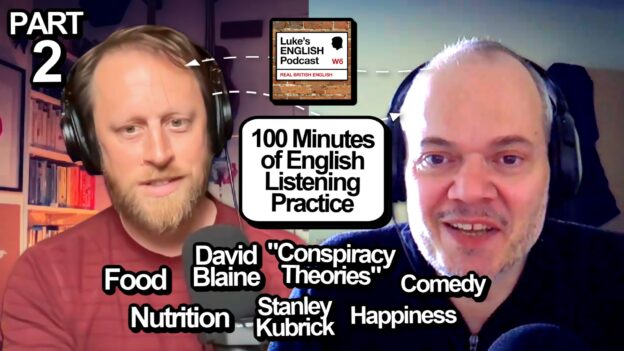
Since recording part 1 of this conversation, Antony caught COVID-19 and lost a bit of weight, but he managed to talk for about 100 minutes here about more topics he has previously covered in episodes of his podcast “Life & Life Only”. Here we discuss diverse things, including the extraordinary feats of endurance by David Blaine 🕴🏻, food and dieting 🍔, Stanley Kubrik’s film “The Shining” 🪓, the term “conspiracy theory” 🤫, the ways that comedy shows can reveal the truth 🎭, and the complex art of happiness 🙂.
Join me as I read through a bizarre online game. Have you ever wondered what it would be like to be a lemon? No? Well, neither had I, until I played this game. Can I escape the kitchen, become human again and avoid being chopped up and turned into a juice! Watch out for some descriptive language and some funny moments along the way! Story by Daniel Champion on www.textadventures.co.uk
Kate Billington returns to LEP for the third time, to drink tea, talk about my pod-room, learning the bassoon, exam results, learning Chinese, responding to listener comments and talking about her videos on TikTok.
Welcome back to Luke’s English Podcast. I hope you are doing fine out there in podcast land.
Kate Billington is back on the podcast today. Of course, you remember her from episodes 689 and 705.
If you heard those episodes I’m sure you will remember Kate and I know that a lot of you out there will be very happy that she is back again and yes, Kate’s return to this podcast is long overdue. She was a very popular guest when she was on the show before. So it’s great to have her back.
Some of you don’t know Kate because you haven’t heard those episodes but there’s no need for me to introduce her fully now in the intro because I kind of do that again during the conversation, except that Kate is an English teacher from England and we work together at the British Council.
People sometimes ask if Kate has her own podcast or YouTube channel or something, because they want to hear more from her.
Well, recently she started making videos for TikTok. We do talk about this during the episode, but that’s not until the end of the conversation, so I just wanted to give you a heads up about that right now at the start.
Kate is part of a team of teachers making content for the British Council’s channel on TikTok. You’ll see that they are making shorter videos (certainly shorter than mine) about things like British English idioms, culture and other entertaining bits and pieces. So, check it out – @BritishCouncilEnglish on TikTok. The link is on the page for this episode on my website.
So, what you are about to hear is another long and rambling conversation with a guest on my podcast. Hopefully you will stay engaged and entertained throughout while practising your English listening in the process.
All you have to do as you listen to this is keep up with the changes and tangents, and enjoy this conversational journey into things like how Kate helped me with the shelves in my pod-room, how Kate doesn’t agree with the way I arrange my books on those shelves, how it feels to be filmed while talking (and yes there is a video version of this on YouTube), we talk about Kate’s academic successes and failures (or maybe I should say “failure” because it seems there’s only been one, and I’m still not sure it counts as a failure), the Chinese classes that Kate has been taking recently, quite a lot of stuff about Korea (hello Korean listeners), our blood types and what they mean, how we both feel about getting older, and how we feel about certain other English teaching video content that you might find on TikTok, Instagram or YouTube. All that, and much more, starting… now.
An unedited conversation with Amber & Paul about toilet habits, Titanic (1997), weird videos on TikTok & YouTube and plenty more. Advanced level listening practice with the POD-PALs. Video version available.
The audio version ☝️ has about 15 minutes of extra rambling by Luke at the end, not included in the video version 👇
Introduction Transcript
Hello, listeners, I hope you’re doing well today. Welcome back to my podcast. This is where you can do plenty of listening in order to improve your English. Because listening is a vital part of the process. You have to listen, listen, listen and generally get used to hearing natural English as it is spoken and my podcast can help you to do that.
In this episode Amber & Paul are back on the podcast. In case you don’t know, Amber Minogue and Paul Taylor are my friends who have been regular guests on this show for many years. They are both stand-up comedians from the UK, living in Paris, like me.
A couple of weeks ago, before I had a haircut, the three of us got together here in my room and had a conversation for this podcast. We didn’t plan the topic in advance. So you’re going to hear a lot of spontaneous natural speaking. We’re not slowing down or trying to use the easy words. This is just how we speak normally when we’re together. As you will notice, I try to explain things or clarify things as we go, in order to help you a bit, but still, it might be difficult, depending on your English level.
If you like you can think of this as a kind of listening test. Can you follow what we’re saying and keep up with all the changes in the conversation?
You’ll see that the episode title is Toilets, Titanic and TikTok which gives you a general idea of what we talk about.
We didn’t have a lot of time, so I just pressed record, and then quite quickly we found ourselves talking about toilets first of all.
So there’s a good 45 minutes of us talking about toilets.
By the way, in British English the word toilet means both the room and the thing in the room that you sit on.
In American English the toilet is just the thing you sit on, and the room in American English would probably be called the restroom or the bathroom, although when we go there we’re not resting or having a bath, but anyway… This is a conversation about toilets.
We talk about what people do in the toilet, on the toilet, near the toilet and even above the toilet in some cases.
So, be ready for some rather specific and possibly disgusting details about this topic.
I don’t know how you feel about this subject. Personally I find it quite fascinating to learn about this very private thing that we don’t always talk about, except maybe when we’re together with close friends like this.
For example, any women listening – do you know what happens in men’s public toilets? And men, do you know what goes on in women’s public toilets? I think we know what basically happens, but what about certain, other, unknown things?
For example, why is there usually a much bigger queue at the women’s loo (“loo” is UK English for “toilet”).
Do men always stand up when they pee or do they sometimes do it sitting down? And which one is actually easier or better?
How do other people deal with public toilets, which can be dirty or messy? And in fact, why are they so messy, especially in the toilet cubicles? What are people doing in there?
And have you ever argued, with someone you live with, about leaving the toilet seat up?
Women often get frustrated with men who leave the toilet seat up.
Toilet seat up? toilet seat down? What’s going on here? Why is that annoying? And who is right?
That’s just a sample of the kinds of things we’re talking about, OK?
So, brace yourself – toilet talk is coming, with some specific references to hygiene and cleanliness too.
Then, somehow we go from the toilet, to the film Titanic, and that will be generally less disgusting and problematic I think, although arguably what happened on the Titanic is much much worse than what normally happens in the toilet, but I don’t know your habits, I don’t know your life.
Then things get a bit more graphic again at the end of the conversation as we talk about some weird, disgusting and yet strangely satisfying videos we like to watch on TikTok and YouTube.
So here is an unedited talk full of tangents about tea, toilets, Titanic, TikTok trends and more, and here we go…
Ending Transcript (These are the things I say at the end of the audio version + a few spontaneous bits)
OK audio people, how was that for you?
Did you manage to keep up?
Did you learn anything new?
Do you have anything to add to this conversation?
Congratulations for making it this far. You just entered over 1 hour of English into your head. Think of the people who didn’t do that. They now have 1 hour less of English exposure.
As I said at the start, this conversation was fast (as usual) and there were probably things you missed.
I started the recording before we were ready to begin, that’s because I just needed to get started because we didn’t have a lot of time (Amber had to leave at about 3.30 as usual). So I just hit record.
Paul asked about which audience is bigger – the video viewers or the audio listeners. I said the audio listeners outnumbered the video viewers and so Paul said he wouldn’t do too many visual things, like visual jokes.
Then he pretended to take his trousers off (I guess this was in order to make a visual joke). In fact, he unzipped his jeans, but didn’t actually unbuckle his belt.
This led to Paul commenting that men only unbuckle their belt or fully undo their trousers twice each day, and then we were off and the topic turned to the topic of men undoing their trousers in the toilet, and we asked Amber about what it’s like for women to use the toilet when they are wearing a one-piece outfit, like a jump suit. Isn’t that complicated?
And that’s how it all started, you see. I guess if you’re still listening to this, you got that. I wonder how many people just gave up after the first 5 or 10 minutes.
Anyway, that’s enough waffle at the end.
Like I said before, leave your comments (if you have a comment section where you are listening – use my website if you can. The link for the relevant page for this episode is in the show notes for this – check your podcast app of choice. The notes will be there, including a link to the website page)
Actually, could you do me a quick favour? If you enjoy my episodes, give me a rating and a quick review – on the Apple Podcasts page or Google Podcasts page – wherever you listen to this podcast. If you’re able to leave a quick review and a rating, that would really help the podcast.
If you don’t want to help the podcast, then never mind. But if you’d like to help even in a small way – spread the word, leave a review, leave a rating and all that good stuff.
Of course you can also go further and send a donation to help support the show – there’s a PayPal donate button on my website.
And if you have sent me a donation recently – thank you very very much. YOu make this podcast possible and you allow this show to exist. Seriously.
And then there are the premium subscribers. More premium content is coming soon I promise. As I always say, it does take some time for me to produce the premium content because it requires a lot more preparation due to the more rigorous approach that I take to those episodes, with their PDFs and everything. I’m working on more Story episodes for the premium content. I’ve been writing and re-writing some stories about my life – childhood tales and more. That’s coming soon. Thank you if you are a premium subscriber – again you are keeping the show alive.
If you have questions about LEP Premium, including “How do I get the PDFs? How do I find all the episodes?” and more – check my website. All those questions are answered there – www.teacherluke.co.uk/premiuminfo All the frequently asked questions are there.
Thank you for your support everyone! Let’s keep this thing going.
Take care out there in LEPland. Keep your chin up, keep a smile on your face if you can. Be good to yourself, be excellent to each other, have another lovely morning, afternoon, evening or night and I will speak to you in the next instalment, coming soon. Good bye bye bye bye bye!
Call me a photoshop master
What do you think listeners? Leave your comments below 👇
James Harris is a writer, comedian, English teacher and language learner (French, German, Chinese) from England. In this funny chat, we talk about learning Chinese, being married to a Chinese woman and his semi-autobiographical book, “Midlands” which tells several funny and touching stories about two ex-pats living in Germany; Stuart, who is a stand-up comedian trying to understand the Germans, and Doug who gets involved in a love affair. James reads several passages from the book during the episode.
Stuart describes his early days in Germany, learning German.
Then a chance meeting in a pub had earned him an invitation to Berlin. Laura, Danish and short, was staying there for the summer, rummaging around in the archives for information about a particular Jewish family who had gone on to achieve cultural success in post-war Denmark;
Laura, a snub-nosed Danish girl with glasses who loved Israel and wheat beer. Stuart didn’t care much about her interests but did enjoy spending the days reading on her balcony and socializing with university friends at night;
by the end of the summer his hair had lengthened and his German increased fifty-fold, meaning he now knew about a hundred words. ‘Hallo!’ he would say, then ‘Weltschmerz’ and following a further pause ‘Auf Wiedersehen,’ saying a final farewell to people he would see again the next day.
He also hadn’t yet learnt to ask whether something was sugar or salt, leading to an evening eating some very sweet chips. But even speechless he wasn’t, at last, uneasy in Berlin – it seemed to him a gentle city, where the trains slid in and out and the open spaces pacified tourists drunker and rowdier elsewhere.
It was like the Germans had become one of the peaceful races in Star Trek, the ones introduced by an insert screen of their orderly, verdant planet, Bajorans, say, or some other species permanently threatened by obliteration; and what a change after the tiny cubicles and traffic-jam living of the English, who could only ever be the Borg.
Surrounded by pacifists, Stuart revelled in the license of Englishness, his ability to voice the odd mildly aggressive opinion or wildly over-celebrate during that summer’s football tournament, until England lost. He swam in lakes, and bought a bicycle, and gradually stopped thinking of England and the ashes it had fed him.
In Oxford, where he had been President of the University sketch revue, people had printed gossip about him in the student newspapers, asked him to leave parties, dealt with him as the man who had committed that deepest and most unforgivable of Oxford crimes: failure.
He had failed, as a comedian and a young man, and now publicly; his country had rejected him. He had been humiliated in front of an audience of his contemporaries and sent into an internal exile.
Afterwards, many of these young dilettantes, at the time apparently picturing future lives as bereft of unforeseen distress as possible, lives composed of simply an endless procession of success, successes occurring within a network of contacts which they had built up at University and which would continue to provide them with unstinting support throughout their adult lives, never violating the simple and essential principle that all was permissible as long as it did well – did not want his name on their social CV.
From Chapter 14
Stuart is on-stage doing stand up in Germany.
‘Don’t you sometimes get the feeling,’ said Stuart, years before on the stage in Heidelberg, ‘that if Barack Obama had been German it wouldn’t have been “Yes We Can” but ”Nein das geht nicht”? No you can’t.
‘Everyone would have been chanting it – No you can’t! No you can’t! Of course in this version Obama would not have been black.’
Stuart was closing in on the kill. ‘And this very lack of optimism,’ he said, treading across the stage, limbering, into the really good stuff now, ‘is actually built into the German language itself.
Like for example, when you’re really happy in English, you say “I’m on Cloud Nine.” But in Germany you say, “I’m on Cloud Seven.”
Does this mean that even in their happiest moments the Germans are two clouds less happy than English-speaking people?’
And after developing that bit, which meant moving into a depiction of an exemplary German, Hannes, in his German heaven, with an allotment, board games, juice and an Autobahn heading directly to Mallorca, he noting, somewhat wistfully, the celebratory Anglophones on Cloud Nine who were dancing to ‘Video Killed the Radio Star’, which was an excuse to sing it, following which they – the Anglophones – called down to Cloud Eight “Hey Hannes man! Come and join us here on Cloud Nine” and Hannes replying “No thank you. Everything on Cloud Seven is perfectly satisfactory” then moving on to speculation as to the occupants of the other clouds, the French on Cloud Eight living it up, their motor scooters floating off the cloud and down to Cloud Zero where the Greeks were and below them the Cypriots who’d had to sell the cloud, and were just falling – after all these and other jokes, Stuart had them where he wanted them.
‘Isn’t it funny that, since the Second World War, the Germans have been like’, change voice, German accent, ‘”We Germans. We have done so many things wrong and there is no way we can ever put them right.”
And now Greece is like,’ pause, turn of the head, “Well, actually…”’
They laughed, and laughed, and laughed. They got it.
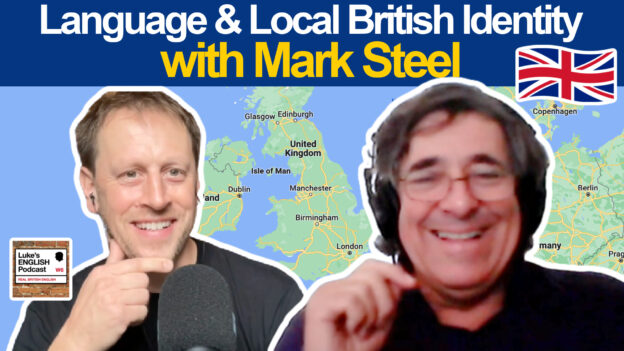
Special Guest Mark Steel joins me to discuss cultural and linguistic differences between the UK and France, plus accents in the UK and a little tour of some places in the UK that you don’t know about. Also includes a discussion of swearing and rude language in Britain. What is the R word which you should never say in a specific part of the UK? Listen on to find out. Video version available.
This website uses cookies to improve your experience while you navigate through the website. Out of these, the cookies that are categorized as necessary are stored on your browser as they are essential for the working of basic functionalities of the website. We also use third-party cookies that help us analyze and understand how you use this website. These cookies will be stored in your browser only with your consent. You also have the option to opt-out of these cookies. But opting out of some of these cookies may affect your browsing experience.
Necessary cookies are absolutely essential for the website to function properly. These cookies ensure basic functionalities and security features of the website, anonymously.
Cookie
Duration
Description
cookielawinfo-checkbox-analytics
11 months
This cookie is set by GDPR Cookie Consent plugin. The cookie is used to store the user consent for the cookies in the category "Analytics".
cookielawinfo-checkbox-functional
11 months
The cookie is set by GDPR cookie consent to record the user consent for the cookies in the category "Functional".
cookielawinfo-checkbox-necessary
11 months
This cookie is set by GDPR Cookie Consent plugin. The cookies is used to store the user consent for the cookies in the category "Necessary".
cookielawinfo-checkbox-others
11 months
This cookie is set by GDPR Cookie Consent plugin. The cookie is used to store the user consent for the cookies in the category "Other.
cookielawinfo-checkbox-performance
11 months
This cookie is set by GDPR Cookie Consent plugin. The cookie is used to store the user consent for the cookies in the category "Performance".
viewed_cookie_policy
11 months
The cookie is set by the GDPR Cookie Consent plugin and is used to store whether or not user has consented to the use of cookies. It does not store any personal data.
Functional cookies help to perform certain functionalities like sharing the content of the website on social media platforms, collect feedbacks, and other third-party features.
Performance cookies are used to understand and analyze the key performance indexes of the website which helps in delivering a better user experience for the visitors.
Analytical cookies are used to understand how visitors interact with the website. These cookies help provide information on metrics the number of visitors, bounce rate, traffic source, etc.
Advertisement cookies are used to provide visitors with relevant ads and marketing campaigns. These cookies track visitors across websites and collect information to provide customized ads.