Last week a very special guest visited one of our comedy shows in Paris. I was given a ticket to the show, so I decided to record a podcast while riding through the streets on the way to the show, wondering if I might be able to interview this guest on LEP. Listen to find out what happened, and to hear some rambling and atmospheric sounds of Paris streets at night.
Can you guess if these “facts” about the UK are true or false? James and Luke read out the facts and then discuss them one by one. Learn some odd things about the UK, pick up some vocabulary about laws and customs, and try not to laugh on the bus.
Video Version (with facts written on the screen) Try activating automatic subtitles
Episode Introduction
Hello everybody, before I play this episode I think I should give a kind of disclaimer about the content. I just want to say two things.
So this is an episode about Britain recorded with my brother in August, which is obviously before we all got the news that The Queen had been taken ill and had died, and we do talk about The Queen a few times during the episode, but of course she is no longer with us and now we have King Charles III.
So, firstly, the things we say about The Queen will be a bit anachronistic now as you listen to it – anachronistic, meaning belonging to the past, and a bit out of step with the present. So that’s the first thing – this was recorded when the Queen was still alive and when she was the head of state, which is now obviously no longer the case, so there are a few little anachronisms and we refer to The Queen in the present tense.
And secondly, when we do mention The Queen and a lot of other things, it’s done in a humorous way – and I’m aware that some people might find that inappropriate, but we aren’t really mocking her harshly or specifically. We copy her voice a bit and parts of the episode are just a bit silly and funny, but our intentions are decent. I don’t think we could be indicted for treason or anything like that. So, I hope you take it all in the spirit of good natured British humour, which is our intention, and let’s remember that The Queen has been praised a lot over the last week or so for her good sense of humour, so hopefully she would see the funny side (but who knows) In any case, I think it’s ok and I’ve decided to publish this. I hope you enjoy it, and actually I hope you see it as a sort of celebration of British stuff, for what it’s worth.
Alright then, now I have said that. Let’s start the episode properly. Here we go.
— Jingle —
50 Random British Facts (True or False Quiz) with James [Part 1]
Hello listeners, welcome back to my podcast.
Are you ready to do some more listening, to improve your English?
If the answer to that question is “Yes” then, good! Keep listening!
Here is a new episode featuring James, my older brother. This is a 2 part episode actually, and you’re listening to part 1.
In this one you’re going to hear James and me discussing various facts about the UK, that’s the United Kingdom of Great Britain and Northern Ireland, of course. England, Scotland, Wales and Northern Ireland.
A few weeks ago, James and I came up with a list of 50 facts about British life, customs, laws, history and culture, which we could talk about on this podcast. We thought you might find it interesting.
So that’s what you’ll hear. But the thing is – some of these facts are true and some of them are not true. They’re false, completely made up, invented by James and me.
So the game is, can you guess which of these facts are true and which ones are false?
Here’s how this is going to work.
First, you’ll hear us reading out our list of so-called facts and you can decide if you think they’re true or not
and then we will discuss each fact, we’ll reveal if they are true or not and we’ll explain some bits of language and culture along the way.
On the subject of vocabulary, two things:
You will find a list of all the “facts” on the page for this episode on my website. They’re all written there for you, so you can go and read them if you like. If you hear a word and you’re not sure what it is, you can check all the sentences there. Also, I recommend trying to read those sentences out loud. All the facts – try reading them out loud. It’s quite good pronunciation practice. You can then compare your version to the the way James and I read the sentences, and perhaps you can shadow us, or repeat the sentences after us. Some of them are actually quite challenging, quite difficult to say clearly as you’ll see. That’s just something you could try doing. There are always other ways to push your English with these podcasts beyond just listening, or if you prefer not really doing any extra practice or anything you can just sit back, listen, enjoy and eat a chocolate biscuit.
Some of the facts presented here are about UK laws, and you might hear a few different words to describe laws – things like this:
A rule
A law
Legislation
To Ban / to be banned
An act of parliament
Provisions in an act
A royal decree
An initiative
A custom / to be customary
I’ll go through those words briefly at the end of the episode, giving you a little tiny taste of LEP Premium, with definitions, explanations and a couple of examples, just to make sure you understood the full meaning and difference between them, because lots of words like that will just pop up in this episode and you might think “Hold on, how many words for laws and rules are there? What’s the difference between a law, an act, a decree and legislation?
If that’s you – just listen on until end of this part to hear some vocabulary explanations from me, which no doubt will just be really helpful.
This is an audio-only episode, but if you are listening on YouTube you will see that the facts are written on the screen with a few pictures to illustrate them in most cases, which again should help you not only understand everything but also to notice vocabulary, with your eyes, and your brain.
And you can always switch on the automatic subtitles in English on YouTube, which are surprisingly accurate these days.
But now, that’s enough waffle. Let’s get started with part 1 of this, recorded at my parents’ home in England a couple of weeks ago, during the summer holidays, just after we’d eaten a large lunch with the whole family.
OK, so, this is part 1 of 50 Random British Facts, with James.
Let’s go.
Random British Facts 1 – 25
True or False? 👉 Listen to the episode to find out the answers.
Section 1
In a recent poll by The BBC, 71% of British people said that British food was the best in the world. Examples given included curry and lasagne.
8% of British people live in London.
Work meetings in the UK often commence with a short joke before people get down to business. The joke is usually printed on slips of paper or distributed in advance by email.
All pubs must have a picture of the Queen displayed somewhere behind the bar.
Another way to say “thanks” in the UK is to say “Ta”
Big Ben is the nickname of a large clock tower in Westminster.
British people drink 100,000,000 cups of tea a day.
Cockfighting is illegal, but heron fighting is still commonly practiced in rural areas.
During the Second World War a fake “mock up” of London was built in the Kent countryside with an intricate system of lights, to confuse German bomber pilots during nighttime air-raids.
Every year on the 5th November children burn an effigy of a Catholic terrorist who once attempted to blow up the Houses of Parliament during the King’s visit.
Every year the Mayor of London is given a dozen oxen as part of his annual pay packet. The livestock are usually donated to a charity of the Mayor’s choice, or slaughtered.
A recent excavation of the site of Shakespeare’s former home in London turned up a number of clay pipes containing the residue of cannabis resin or “hashish”.
Section 2
In the UK, by law, if one man’s dog gets bitten by another man’s dog, the owner of the dog that did the biting must buy the other man a pub lunch, or something else of equivalent value.
If the UK flag is flying at Buckingham Palace it means the Queen is in the building. FALSE – It’s the Royal standard.
If you live to be 100 years old you will receive a personal letter from The Queen in the post.
In 2020, English winemakers Langham Wine Estate of Dorset won the International Wine & Spirit Competition Sparkling Wine Producer of the Year, which is one of the most prestigious awards a winemaker can win. They beat every top French Champagne brand in the competition.
In 1976 a huge rat was discovered in the London sewer system. The police lost 2 dogs in their attempt to capture and destroy the animal.
In the UK we drive on the left side of the road, but in 1987 the UK government introduced plans to switch from driving on the left to driving on the right, to bring the country in line with European standards. The initiative, which was eventually scrapped, was to be phased in over a period of 6 months, with heavy goods vehicles and buses switching first, followed by cars and then motorbikes and bicycles.
It is always raining, somewhere in the UK.
It is customary to buy a packet of crisps to be shared while having a drink in a pub, and the crisp packet is often ripped open in a certain way to allow everyone to take crisps from the bag. (crisps, not chips)
It is customary to make tea for any tradesmen (plumbers, decorators) who visit your house.
When going to the pub with friends or colleagues, it is customary to order drinks in rounds.
It is illegal in the UK to be drunk in charge of a horse.
It is illegal in the UK to be drunk on licensed premises (a pub).
It is illegal to carry a plank of wood along a road in the city of London.
To be continued in part 2…
Ending Transcript
So, that is the end of part 1. How many did you get right?
You are keeping track of your score, right?
It might be tricky to keep track of your score, which is fine of course.
To be honest, I don’t expect you to do that really. But I wonder if you generally managed to guess which of those things were true and which ones were bollocks.
Did anything surprise you? Did anything amuse you?
Let us know by leaving your comments in the comment section.
That was only the first 25 facts of course. We’re not done yet. This will all continue in part 2 when we look at facts 26-50, in the same way. I guess you can just look forward to that. It will require all your patience to do so, but I believe in you. You can do it.
Vocabulary
Now, let me go through some vocabulary, as I said I would earlier.
A lot of these facts deal with things like laws, government actions and also traditions or customs and so I thought I would just clarify some words which relate to those things. Yet again I am doing this on the free podcast as a little taste of the kind of thing you usually get in episodes of LEP Premium these days.
The words I’m going to talk about now are:
A rule
A law
Legislation / to legislate
To ban / to be banned
An act of parliament
Provisions in an act
A royal decree
An initiative
A custom / customary
Words for different types of law or government action
A rule (countable noun)
A rule is just something which says whether you are allowed or not allowed to do something. The difference between a rule and a law is that the word rule is more general and is used in all sorts of situations, not just by governments and the police etc.
Schools have rules (e.g. no chewing gum in the classroom), people’s homes have rules (e.g. no mobile phones at the dinner table).
Also, sports and games have rules, like the offside rule in football.
A law (countable noun)
Laws are the rules which determine wether things are legal or illegal. They are made and introduced by the government and enforced by the police and justice system.
To break a law
We also have the word “law” (opposed to “a law”) which means the whole system of rules which determine what is allowed, not allowed, what people have the right and don’t have the right to do or have.
Legislation (uncountable noun)
Legislation is another word for law, but it is uncountable.
Here are some sentences which basically mean the same thing:
The government created legislation banning the possession of handguns.
The government created a law (or laws) banning the possession of handguns.
So it’s the same as the word law, but we don’t say “a legislation” because it’s uncountable. Instead we would say “a piece of legislation”.
The government introduced new legislation banning the use of diesel cars in urban areas.
The government introduced a new law banning the use of diesel cars in urban areas.
Legislate is a verb
To legislate for or against something – which means to create laws to oblige people to do things, or to prohibit certain things.
The government in 2007 legislated against smoking in indoor public places.
To ban something (verb)
This means to prohibit or stop something and it’s usually used in reference to government laws which make something prohibited.
Smoking was banned in public spaces in 2007.
The government banned smoking in 2007.
Sometimes the word ban is used in situations outside the legal system, for example –
Mobile phones are banned in the classroom.
A person can also be banned from a certain place, for example,
Dave has been banned from the golf club for starting a fight last week.
It can be a noun or a verb.
The smoking ban. There’s a ban on smoking.
The government banned smoking.
An act of parliament
An act is a specific piece of legislation which creates law.
When politicians make laws, for example in the House of Commons in London, there’s a certain process and we use different words for that legislation during the process.
First the law is introduced by a member of parliament as a bill which is a written proposal for a law. The bill is discussed by the MPs in the House of Commons and the House of Lords and is voted on, and when that bill has been approved (including being given the Royal Assent by the Queen) it is written into law in the form of an act.
This act defines the law. It’s kind of like a contract. Each act, which contains various laws, has a name. For example, The Treason Felony Act 1848, which makes it an offence to do any action with the intention of deposing the monarch. This makes it illegal to plan or try to remove The Queen from the throne (or in fact to remove the crown from The Queen) and this includes planning and devising things in written form, spoken form and with the use of images etc. So that’s the Treason Felony Act, which was created in 1848, which makes it against the law to try to depose the monarch.
Another example is the The Data Protection Act 2018, which controls how your personal information is used by organisations, businesses or the government. The Data Protection Act 2018 is the UK’s implementation of the General Data Protection Regulation (GDPR).
And another example is the Homicide Act 1957, which makes it illegal to kill someone, or commit murder. By the way, it says 1957, but of course murder wasn’t legal before 1957, it’s just that in 1957 the law relating to murder or homicide would have been redefined somehow, and a new act was created, which contained provisions relating to all acts of homicide.
This is like a specific section of an act of parliament, or a specific detail in an act of parliament. You also get provisions in contracts between people.
A (royal) decree
A decree is an order that something must be done. A royal decree is when the king or queen orders that something must be done. These days it doesn’t happen in the UK, so royal decrees are only heard about when referring to history.
King Edgar in 957 decreed that all settlements (towns) in England were restricted to having only one “alehouse” per settlement. This was a law to try to control the number of pubs or places selling ale across the country. The decree lasted until after the Norman conquest of England in 1066 after which more and more alehouses, inns and pubs started arriving.
Here’s an example from The Bible, of a decree by a Roman Emperor.
The Gospel According to Luke, Chapter 2 Verse 1
And it came to pass in those days, that there went out a decree from Caesar Augustus that all the world should be taxed.
And all went to be taxed, every one into his own city.
And Joseph also went up from Galilee, out of the city of Nazareth, into Judaea, unto the city of David, which is called Bethlehem; (because he was of the house and lineage of David). To be taxed with Mary, his espoused wife, being great with child.
And so it was, that, while they were there, the days were accomplished that she should be delivered.
And she brought forth her first-born son, and wrapped him in swaddling clothes, and laid him in a manger; because there was no room for them in the inn.
Comparing British and American English vocabulary with a fun online quiz. My guest today is American comedian Sarah Donnelly. Video version (of the conversation) available.
Video Version (images and text on scree, but no intro or ending comments & summary)
Introduction Transcript
Hello dear listeners,
Hello to all LEPsters in LEPland,
How’s your summer going? OK? I’m on holiday at the moment, but I recorded this earlier and I’ve managed to publish it now. That’s clever, isn’t it? Anyway, I hope your summer is going well and if it’s not summer where you are, I hope that your not-summer is also going well.
Welcome back to LEP.
In this episode, Sarah Donnelly is back on the podcast again.
You might remember Sarah from the other times she’s been on the show, if you are a long-term listener.
Sarah Donnelly is from the circle of friends I have here in Paris who all met each other doing stand up comedy, and that includes Amber and Paul, Sebastian Marx, Fred Eyangoh, Molly Martinez, Sarah Toporoff the Paris Quiz Mistress and plenty of others, many of whom have made appearances on this podcast over the years.
Sarah is originally from North Carolina in the USA. She’s been living in Paris exactly the same length of time as me. We both moved here in September 2012 – by coincidence I mean – we didn’t move here together. But when we did meet, we realised we had both moved here at exactly the same time, which is something we have in common.
The return of Sarah on this podcast is long overdue. As a theme for this episode I thought we could explore the topic of American and British English and so you’ll hear us discussing some of the vocabulary differences while doing a fun online quiz.
We start our conversation by referring to the fact that in my podcastle (the building here where I have my pod-room) there are lots of stairs, because I am on the top floor and also there is a shared toilet in the corridor, which is an old fashioned toilet, meaning it is basically a hole in the ground, rather than a thing you sit on. It’s not a sit down toilet, it’s more of a squatting toilet. That’s probably too much information for you, but there it is. I don’t know if it helps for you to know what kind of toilet we have here at the podcastle. Does that help, to know that? Does that help with your English? I’m telling you that to give you context at the start, so you don’t feel lost.
Anyway, it’s fine. The toilet, I mean. It works. It’s ok. But Sarah calls it a Turkish toilet for some reason (maybe that’s an American thing) whereas in the UK we’re more likely to call that kind of toilet a “French campsite toilet”. Anyway, I thought I’d just clarify that before you listen and wonder what’s going on.
After a bit of rambling about toilets, recording podcasts while sitting on the toilet, different types of toilet, old fashioned toilets and so on. After that toilet talk, Sarah and I get into that online quiz about British and American English.
So the main thing here is to compare some vocabulary differences between British and American English. You can learn some different vocab, and also just listen and compare these two varieties of English.
Listen carefully to hear our specific comments and to learn the subtleties of these differences. You’ll know some of them already, because some of these differences are very well known, but I bet there will also be some new things for you to pick up too.
I’ll sum up at the end of the conversation by the way – I’ll quickly summarise the vocab and the differences, and I will also give some comments about whether you should learn British or American English (which variety to choose). You will find notes and a transcript for the intro part and parts of the ending on the page for this episode on my website. You’re welcome.
I don’t need to say much more here, except that there is a video version of this on YouTube with the quiz questions shown on the screen. You could watch that too, but of course on YouTube you don’t get this wonderful introduction that you’re hearing now, or the bit where I ramble at the end. So there. That’s the advantage of being an audio LEPster in audioland (which is the most populated region of LEPland by the way). You get more.
Now, I will let you listen to my conversation with Sarah Donnelly, let you compare some American and British English and I will talk to you again a bit on the other side of this conversation, with a summary and some more comments.
But now, let’s get started…
The BuzzFeed quiz we did in this episode, focusing on British and American English
“I’m 99% Positive We Can Guess If You’re American Or British Based On This Word Test”
But I think a cookie and a biscuit are slightly different. A cookie is bigger and often has chocolate chips in it. Typically American. A biscuit is often smaller and a bit harder or with more crunch to it, and they are usually sold in a tube. Biscuits like that are very popular in the UK and we like to eat them as a snack with a cup of tea or coffee. Popular biscuits are things like the digestive biscuit or rich tea biscuit. In some parts of the USA a biscuit is something else entirely, and is larger and more like a scone (or scone) and is a savoury food eaten with gravy. We don’t have those kinds of biscuit in the UK.
Basically – a cookie is larger and a bit softer and very common in the USA. We have cookies in the UK too, but biscuits are more common.
UK: Petrol
USA: Gas / gasoline
The fuel that we put in our cars. In the UK we call it petrol. In the USA they commonly call it gas or gasoline. They’re wrong. Haha.
UK: Crisps
USA: (Potato) chips
Those snacks made from thin slices of potato which have been roasted and are sold in bags. Those are crisps in the UK and chips in the USA.
But, confusingly, chips in the UK are more like American french fries, but not the same because chips (like with fish and chips) are thicker and chunkier. We have fries in the UK too, but they are thin and the sort of thing you get with a burger at a McDonald’s or something.
Fun fact, french fries originally came from Belgium, so really we should all call them Belgian fries. As far as I know, that is true, but for some reason my spider sense is telling me that right at this moment Jean-Pierre is blowing the dust off his fingers in order to correct me. French people, if I’m wrong about that, feel free to correct me. I’m pretty sure it’s right though.
UK: Flat
USA: Apartment
Generally speaking in the UK we do refer to a home which is part of a larger building, as a flat, although we often use the word apartment too.
The building itself might be a block of flats (especially if it is more modern and contains lots of flats) or a tenement (I think more common in American English and perhaps associated with poorer communities) a condominium is a fairly common word in American English and refers to a block of flats but probably a more expensive one. We also might just say an apartment building.
Of course a house is one single property which has one owner or tenant. A house in the UK can be detached (on its own) semi-detached (with another house attached to it) or terraced (part of a terrace of attached houses in one long row, sometimes the whole street).
The word “home” is just used to refer to a place where someone lives. Anything can be your home – an apartment, a house, a cave, a hole in the ground, a boat, etc…
UK: Sweets
USA: Candy
One thing to note here is that the word “sweets” is plural and countable. So you can have a sweet or some sweets, or “how many sweets?” whereas candy is both countable and uncountable. So you can say “How much candy do you want?” and also “I want some candy” and “Do you want a candy?”.
UK: “The city centre”, the “town centre” or “the centre of town”
USA: Downtown
Downtown can be an adjective “A downtown address” or “in downtown Los Angeles” or an adverb (so you can do something downtown) “I’m going downtown” “An incident happened downtown yesterday”.
Also, that TV show about posh people living in a big house in England with their servants 100 years ago – that’s Downton Abbey and not Downtown Abbey.
UK: The greengrocers / the shop / the local shop
USA: The grocery store
The greengrocers in the UK is a small shop that just sells fruit and vegetables.
For a generic shop that sells lots of things including some fruit and veg maybe, but certainly drinks, snacks, milk, beer, bread etc, a kind of convenience store, we might just call it “the shop” or “the corner shop” or “a convenience store” or a “newsagent” (although that mainly sells newspapers and magazines) or “the local shop”.
A supermarket is a place that sells all kinds of food, including fruit and veg.
UK: Swimming costume
USA: Swimsuit
The clothes you wear when you go swimming. I think British people might also say swimsuit.
Those things that float in the water, probably attached to a rope or cable under the water – perhaps a large plastic ball – that’s a buoy, pronounced “boy” in British English and just pronounced all wrong and weird in American English like “boooeeee”, like David Booooeeee or something.
Bed sheets and stuff
It seems we use more or less the same words for this.
From floor to the top, here are the things on a bed:
The bed frame
The mattress
A fitted sheet which goes over the mattress
You
The top sheet which goes between you and
The duvet, which has a duvet cover on it
Also: a pillow and a pillow case
A blanket might be made of thick wool and could be added on the top to give an extra layer of warmth in the winter or something.
According to Sarah, a comforter in the USA is a kind of duvet that doesn’t have a cover on it.
That’s all I’ll say for that.
UK: a fringe
USA: bangs
In the UK the word fringe is singular. “I was thinking about getting a fringe. Shall I get a fringe? I think I’ll get a fringe.” In the USA “bangs” is a plural word. “I was thinking about getting bangs. Shall I get bangs? I think I’ll get bangs”.
UK: Peppers (red, green, yellow, orange)
USA: Bell peppers
Other vegetable names which are different:
UK: Courgette
USA: Zucchini
UK: Aubergine
USA: Egg plant (again they’re completely wrong on this. Eggs don’t have plants. What are they thinking? Egg plant. Eggs don’t grow on plants, they come out of chickens’ bums.)
UK: Trousers
USA: Pants
This is a well-known one, and I’ve talked about it plenty of times before.
It’s hilarious, isn’t it, because in the UK pants are our underwear. So funny. 😐
UK: The pavement
USA: The sidewalk
This is the place next to the road where pedestrians walk, and where those people on electric scooters endanger everyone’s lives.
Which version of English should I choose? British or American?
To be honest British and American English are not massively different. It’s mainly just little differences that might seem big when you get into very specific situations – especially if you are a British English speaker who goes to live in the USA or vice versa. So, first of all, don’t worry about it too much because the two versions of the language are mostly the same.
But there are differences – certain vocabulary (hopefully episodes like this can help), but also some spelling and grammar differences. There’s another episode for another time – although I did cover some of the pronunciation differences in an early episode 14. English Mania / British and American English
Also, pronunciation. The accents are fairly different and also certain words can be quite different (like buoy, aluminium, and so on).
The more you listen to spoken English from different places, the more you get a sense of the different sounds.
Feel free to choose whichever one that you like.
If you’re going to live in the USA, learning American English would make sense.
If you’re going to most other places where English is spoken including Canada, Australia, Ireland, New Zealand, South Africa, India and other places – British English spelling and grammar standards are used.
But, American English is probably more widespread than British English because there are just more American people in the world (300,000,000 of them) and because the popular culture is everywhere too – films, TV series, music etc.
So, I suppose it’s up to you.
But at the end of the day – the answer is. Learn British English, it’s just better.
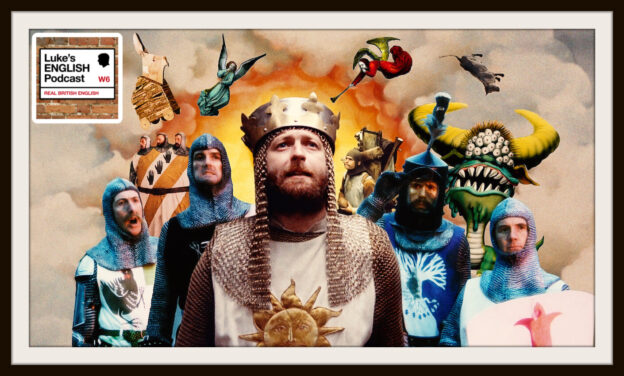
Talking to Antony Rotunno about a classic British comedy film which makes fun of the legend of King Arthur (and everything else!) Originally published by Antony on his Film Gold podcast earlier this year.
Hello listeners, welcome back to Luke’s English Podcast!
This episode is called Film Club: Monty Python & The Holy Grail (revisited) with Antony Rotunno [LEP / Film Gold SwapCast].
I think the best way to give an introduction to this is just to explain the title. So let me do that.
I will try to keep this short, and I will probably fail.
Film Club
As you may know, from time to time I do these film club episodes in which I talk about films that I love. The idea is that I want to introduce you to films in English which I think are great, and which you might enjoy too and watching films can help with your learning of English as I have discussed before. You can watch these films in English with or without the English subtitles. I recommend doing a bit of both. Sometimes with subtitles, and sometimes without.
The idea is that you can listen to this episode and get to know the film through our comments and descriptions, then watch the film and hopefully understand and appreciate it a bit better, or just listen to this without watching the film at all if you prefer. There are a few audio clips from the film included, for educational purposes of course, so you will be able to hear some moments and scenes.
Some of you will know the film already ← and if that is the case, congratulations – you get bonus points. If you know the film already, hopefully we will still be able to tell you something new about it, because there is a lot to say.
I hope you can get access to the film somehow. There’s always the DVD or BlueRay version if you still have a player, and at the time of recording this, I can see that Monty Python & The Holy Grail is available on Netflix, with subtitles in various languages and everything. I’ve also found the entire film on YouTube and it’s been there for 3 years, so you might be able to watch it there. I’ll include a link to that on the page for this episode, where you can also read this whole introduction transcript if you want.
https://youtu.be/N8edjriU3is
Monty Python & The Holy Grail
The film we’re talking about here is a British comedy film from 1975, by Monty Python’s Flying Circus. Just in case you don’t know, Monty Python’s Flying Circus is a group of comedians who did a TV series, some films, some stage shows and some audio albums, mostly in the 1960s and 1970s.
The members are/were John Cleese, Graham Chapman, Michael Palin, Terry Jones, Terry Gilliam and Eric Idle. Sadly, Graham Chapman and Terry Jones are no longer with us.
They are/were all British, except for Terry Gilliam who is originally from the USA.
This film is a ridiculous but very clever comedy adventure story about King Arthur and the Knights of the Round Table. This fits in quite nicely with the recent episode with my dad about Sir Gawain and the Green Knight as I will say in a moment.
King Arthur is a mythical king from British history. We think he’s mythical, but there might have been a real King Arthur once upon a time who the myths are based on, but we’re not sure.
But certainly there are various stories about Arthur in British culture, including legends about him searching for the Holy Grail – the cup which Jesus drank from during the Last Supper, which may or may not have found its way to the British isles at some point, and also stories of how Arthur first became King by either pulling a magic sword, called Excalibur, out of a rock, or by being given the sword by The Lady of the Lake – a magical enchantress or fairy – a supernatural woman who, in these old stories emerged from a lake to give the sword to Arthur, signifying that he had a god given right and duty to be the King and to unite the whole country. It’s sort of an origin story of the Royal Family, kind of, but also just a romantic tale which has been told again and again and again, particularly in England for many centuries.
With this film, the Monty Python team decided to make a comedy version of the story of King Arthur’s quest to find the Holy Grail, set in medieval times.
The connection to the episode about Sir Gawain and the Green Night with my dad is that that is also a folklore story from the Arthurian legends – the set of stories associated with King Arthur and his Knights (that’s knights with a K).
Monty Python & The Holy Grail, although a comedy, does also contain many of the same themes that are present in Sir Gawain & The Green Knight. There is honour, there is a quest into the unknown, there are games and challenges from various characters and beasts along the way, there is a temptation scene, there is an enchantress, there are duels with mysterious and deadly enemies but of course this film is a parody of all those idea – a joke version, making fun of all those tropes of medieval romantic adventures. The film is an affectionate parody of that whole story archetype. It also makes fun of plenty of other things as we will discuss.
Revisited
I am revisiting this film on the podcast with this episode (talking about it again). I say that because I did an episode about this film on the podcast in 2014. Long-term listeners should remember that. It is in the archive if you want to check it out – episode 202.
In that one I focused on just one scene from the film, in a lot of detail, breaking down all the language bit by bit, to help you understand it all. If you haven’t heard that – let me recommend it. It should be a good addition to this episode and you will hear me fully dissecting all the language and comedy in what is probably my favourite scene in the film. We also talk about that scene a little bit in this episode.
This time though, we’re dealing with the whole film, discussing it and giving an overview of the entire thing, how it was made, what it all means (if it means anything), and what happens in the story scene by scene.
With Antony Rotunno
The other person you will hear in this episode is Antony Rotunno. You’ve heard Antony a few times on this podcast now, most recently in the episode about Meditation. Antony is an English teacher, a podcaster and a musician from England.
LEP / Film Gold Swapcast
A swapcast is when two podcasts publish the same audio recording. So, this recording was first published by Antony on his film podcast earlier this year. His film podcast is called Film Gold. He edited this episode and published it in February. Antony said I could publish it on my podcast too so here you go.
No doubt this episode will be epically long, which I think is totally fine I must say. I’ve said it before and I’ll say it again – you don’t have to listen to it in one go. If you are using a podcast app on your phone you can pause any time, go and live your life for a while, and when you come back to the episode your podcast app will remember where you stopped. So, here’s a nice long episode for you to enjoy in your own time.
One note: If you are listening to this on YouTube and you want to activate the automatic subtitles, I have a suspicion that they won’t be available. I always activate the automatic subtitles on my YouTube videos, but sometimes YouTube just says “no”. I suspect that might be the case this time, which is a pity. So you might just have to survive without subtitles this time and focus on your listening skills rather than your reading skills. If it’s any consolation, my other episode about this film (ep 202) does have plenty of notes and scripts, which you will find on my website.
So in a moment LEP is going to transform into Film Gold, hosted by Antony with me as his guest. I must say thank you to Antony for doing all the editing and production work and allowing me to publish this here for my audience to enjoy.
I would like to recommend Antony’s other podcasts to you again. He’s got three. You can find them wherever you get your podcasts.
Life & Life Only (all about self-development, life coaching, discussions about society and the search for inner and outer truth) by the way I was recently a guest on this too, talking about a documentary called The Corporation.
Right then. In a moment you’re going to hear the pleasant sounds of Antony’s Film Gold intro music and then lots of sound effects, fanfares and crazy madness for a minute or two.
If you wonder what that is, it’s the audio from the original movie trailer for Monty Python & The Holy Grail.
As you will hear, one of the jokes in the trailer is that the person doing the voice over keeps being fired and replaced. We start with a cheesy American announcer, then we get a couple of English guys who can’t really read very well and finally the voice over is done by a person speaking what I think is Chinese (although I’m not sure exactly what variety of Chinese it is – please feel free to confirm or deny in the comment section).
The trailer is typically crazy, and there are lots of little clips from the film and sound effects. If you’re wondering what’s going on, basically you are being transported into the madcap world of Monty Python, and then you will hear Antony’s voice and you’ll know that you are in the comfortable surroundings of the Film Gold podcast.
Right, so without any further ado, let’s stop my introduction so you can hear another introduction to this introduction to the introduction to the film of Monty Python & The Holy Grail.
My brother James comes back onto the podcast for a conversation about the hot weather, tricky WordPress updates, the Obi-Wan Kenobi series, Rock Music concert movies, Alan Partridge’s live show, Irish/British relations and plenty more.
Video Version on YouTube (try activating automatic subtitles)
Introduction Transcript (the audio version might be slightly different)
Hello listeners,
I hope you are doing fine today, and I mean that and I sincerely hope that you’re doing ok and that my podcast brings you some level of comfort.
You know my main aim is to help you with your English with these episodes by either teaching you language directly or by just providing you with a natural source of spoken English with my content, but also I hope to give you some enjoyment, and if that is any kind of remedy for the more serious and difficult things going on, then I’m glad.
Recently I was in London, wasn’t I, staying at my brother James’ place for a long weekend. You might remember that. In the episode we recorded together on the Friday, about the Royal Family, I mentioned that I was planning to record two conversations with James, one about the Royals, and another episode about whatever we felt like talking about. You heard the one about the Royals of course, but we didn’t actually get round to doing the second one.
But a few listeners got in touch wondering about the second conversation with James. It seems he has a bit of a fan club out there, which is no surprise I would say.
So just the day before yesterday I sent James a Whatsapp message to see when he might be free to record another episode, online this time, and he immediately wrote back saying “I can do it now if you want”.
I had about 1 hour before I had to go and get my daughter from school so I wrote back saying “Yes, great – let’s do it!” And a few minutes later we were recording a conversation, and that’s what you’re going to hear in this episode.
Now, my intention with episodes like this is to let you listen to a natural conversation in English, with all the usual features of spontaneous speaking. If you like you can imagine that you’re just in the room with James and me as we have a bit of a chat.
Now, conversations like this, between friends (or in this case brothers) usually go in lots of different directions, don’t they? They don’t usually just stick to just one topic. They move from one thing to the other, they wind this way and that, there are tangents, serious moments, funny moments. That’s how informal conversations work. We’re rambling, basically. I mean, I’m rambling right now too. I’m rambling about how this episode features plenty of rambling. It’s like rambling on the top of rambling – or like Inception for rambling.
So, here’s a run down of the topics that come up in this conversation. I’m saying this to give you a kind of road map – as if to say “here is the main route or path of this journey today. We’re going to go here, then here, then there, then here and so on” – just in order to give you an overview of the conversation which might help your comprehension. Instead of presenting you with a slow, scripted conversation I am throwing you in at the deep end, but also throwing you a rubber ring, so you have at least a fighting chance of not drowning.
Topics (A mix of serious stuff and not-serious stuff)
We start with the recently hot weather in Europe, and when that turns to the slightly depressing but important subject of the climate crisis we transition to a different subject, because we’re trying to keep it light – and we talk about what we both had for lunch and about eating habits and the challenge of eating 5 portions of fruit and vegetables a day, plus the pros and cons of eating salmon on a regular basis. That’s /sæmən/ not /sælmɒn/.
Then James shares what he was doing before I called him – trying to update a website using WordPress php and we talk about horrible moments when you get error messages when working on a computer.
During my lunch that day I was watching the new Obiwan Kenobi Star Wars TV series on Disney+ and we talk about that – just a few brief comments really. Not a full review. See if you can spot the vocabulary that James uses to describe the show.
This leads us to wonder about Jawas from Star Wars (side characters that appear in the SW universe), and the mystery of what they really look like under their brown hoods. Don’t worry – the SW chat is kept to a minimum.
Then we turn to the subject of rock music concerts and Neil Young’s live concert video called Rust Never Sleeps, which appears to feature some jawas, which is odd.
We also talk about some other classic rock music festival movies including Woodstock, Rolling Stones at Altamont and The Last Waltz. So get your denim jacket ready.
We describe Jimi Hendrix’s historic version of the Star Spangled Banner performed at Woodstock, which also became an astounding statement against the Vietnam war.
We give some responses to comments from listeners on our recent conversation about The Royal Family, and also questions about why James doesn’t appear on video in my episodes.
James describes his recent experience of seeing the Alan Partridge live comedy stage show, called “Stratagem” at the O2 Arena in London recently. He gives a kind of review of the show and the venue, and describes a fight between two guys which happened in the bar afterwards.
We dissect some frogs – specifically several jokes from the Alan Partridge show featuring an Irish character also played by Steve Coogan.
This leads us back to more serious matters and the subject of Irish protest songs associated with the IRA (Irish Republican Army) which would normally never be played on the BBC but it happened in an episode of the Alan Partridge TV show. That was quite a surprising and fairly significant moment in the history of the BBC. You might learn a little bit about Irish and British relations there, and you can hear a clip of an Irish accent too.
There are some other bits and pieces too, but I’ll say no more here in this introduction. I think that’s probably enough. I hope you can keep up with the conversation – I will chat to you again a little bit at the end, but now, let’s chat to James, or as my daughter calls him: Jamie.
Ending Notes / Script
Thanks again to James. If you want to buy him a pint by the way, or just to show your appreciation or support – the best way is to visit his page on bandcamp.com and buy some of his music. https://jimthompson.bandcamp.com/ YOu know what, don’t tell anyone, but you might be able to see a photo of him there. And while you’re doing that, check out his music. He makes mostly electronic music, some ambient, some techno, some hip hop. You can buy his music and most of the money (if not all of it) will go directly to him. You can support him like that and also you can get some of his “choons” too, which are getting better all the time by the way. https://jimthompson.bandcamp.com/
I’m going to ramble now for some minutes.
Some changes to premium content and how it is delivered to you.
If you’re wondering why it’s been a while since I uploaded new stuff, it’s because I am working behind the scenes to make a few changes to the way I deliver premium content to you. I have also been making a series of premium episodes but I’m holding onto them until I know exactly what is happening. That is the storytime series which I’d been meaning to do for ages. I finally got down to it and wrote about 15 stories – all true stories from my life, which I can use to teach you grammar, vocabulary and pronunciation. That’s coming up on LEP Premium. Don’t worry, I am still working on that and have no intention of stopping or anything.
Remember if you need any information about your premium account – any questions about it, go to www.teacherluke.co.uk/premiuminfo because I have put answers to all the frequently asked questions about the premium sub there.
I also just want to say to all of you – especially the premium subscribers and people who have donated but also to those of you who listen until the end of episodes like this and leave comments and so on – thank you for supporting my show. There are always so many episodes I want to make, things I want to say and do – including different topics, different techniques, more language-focused content, returning guests, new guests – and all the things that people often request or suggest.
There are only so many hours in a day and days in the week though. It’s tricky to do everything – and I don’t want to overload you or myself.
These are not complaints I am making by the way – nor are they excuses. I’m just attempting to have a bit of transparency here at LEP.
It’s hot! It’s now the day after the day after I recorded this conversation with my brother. It’s Friday late afternoon as I record this and the current temperature is 34 with a “feels like” temperature of 36. So it’s 36 degrees basically. I’m flippin hot, but my pod room is not too bad. The podcastle withstands the heat quite well and I don’t get any direct sunlight in my window which helps. Another thing that helps is that if I open a window in the corridor outside my room, and open the window in my room (of course) and then prop open the door of my room just a bit (if I keep it ajar by propping it open with an object – in this case a retro plastic skateboard) then I get a slight breeze blowing through the room and this really helps to keep me cool. That’s a little tip I picked up in Japan. It’s common sense of course, but it was one of the little things I used to do to try and deal with the hot summer weather there. Always try to keep the air circulating if possible, by giving the air somewhere to come from and somewhere to go. Oops, nearly got back into cotton eye joe there. Sorry for the earworm listeners.
OK, that’s enough now. I hope you’ve enjoyed this episode. Leave your comments about these things:
The Obiwan Kenobi series – do you agree with James and me that it’s lacklustre, or not?
Do you always get your 5 portions of fruit and vegetables a day, and how?
How is the weather where you are and how do you manage to cope with it? Do you have any good tips for keeping cool? Maybe you just have air conditioning, but what if you don’t?
What is your favourite rock concert film? We mentioned Neil Young, Rolling Stones at Altamont, The Last Waltz and Woodstock, but there are so many others. Which is your favourite? Maybe you’ve never seen one. Actually, my all-time favourite concert film is probably Stop Making Sense by Talking Heads. Amazing film.
That’ll probably do actually!
Have a nice day, night, morning, evening etc, keep cool and I will speak to you soon.
Videos
Jimi Hendrix – “Star Spangled Banner” at Woodstock
https://www.youtube.com/watch?v=ezI1uya213I
Santana – “Soul Sacrifice” at Woodstock
Alan Partridge meets his Irish lookalike Martin Brennan (This Time With Alan Partridge, BBC1)
Alan Partridge talks to Martin Brennan during the live “Stratagem” show
This is an unedited monologue in which I talk about some things which are on my mind at the moment, including how my hair is stopping me from learning French (and vice versa), virtuous and vicious circles, how English is like a shark (or a river – or maybe a shark in a river), some comments about recent episodes and a visit from a friendly bat at my podcastle.
Video Version (try activating the automatic subtitles)
Some vocabulary extracts
I have been deliberating about which microphone to choose
Geeky microphone chat
I have a plethora of microphones
People who have just stumbled across this and are wondering what this is all about
Perhaps you’re in transit somewhere, maybe you’re doing some housework, maybe you’re listening to this in a classroom while your teacher takes a well-earned break, or maybe you are lying in a floatation tank or in zero gravity in the international space station
Stick with me, and enjoy being a LEPster
Here’s a run-down of some of the things I’d like to talk about.
How my hair is stopping me from learning French, and vice versa – how my French is stopping me from getting a hair cut (virtious and viciouscircles)
How my summer is looking, what my plans are and what that might mean for the podcast (busy – difficult to record podcasts in July and August – what’s new?)
Thoughts on recent episodes like Sick in Japan and Spinal Tap
Some metaphors and similes for language learning and teaching
That’s probably plenty!
I’ve been just sweeping it (my hair) back over my head
Maybe I’m being a bit precious about this but I can’t help feeling self-conscious
Taking initiative is very important but it can be hard.
It can just be taking the initiative to speak, to make an effort to communicate with someone, to risk looking a bit stupid, going out of your comfort zone.
But if you take that tiny little risk, it can pay off in various ways.
You need to keep the English moving through you like a river or the water of your English will become stagnant. We all know this.
But without that little impetus to speak, you won’t do it.
If you don’t take initiative, you don’t put yourself into situations in which your confidence can develop.
Starting a virtuous circle is a matter of taking small steps in the right direction.
Micro-decisions or micro-steps.
Now I have to go out of my way to walk to the hairdresser.
Some people commented that the crowd were quiet. Well-behaved maybe.
I should have:
Hyped the crowd up more
Done more stand up at the start
Warmed them up by getting them to make noise.
“French people make some noise!” Etc
I should have done more crowd work.
Spinal Tap – maybe not everyone’s cup of tea, but at the end of the day I am the one who decides what happens in these episodes.
I find that with my learners it’s not just listening skills or vocabulary, but just “being on the same wavelength” and that includes things like little references to culture, or just having a certain sense of humour.
It’s also important that I do stuff that I am personally invested in, or this whole thing just won’t happen. So there.
I love teaching but sometimes I get a bit frustrated because it can be a bit like banging your head against a wall.
You can bring a horse to water, but you can’t make it drink.
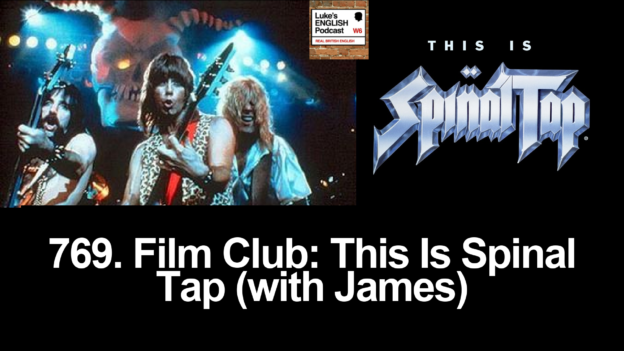
A return to Luke’s Film Club with the classic comedy This Is Spinal Tap, a “mockumentary” about a fictitious rock band from the 1980s. This time I am joined by my brother James and we discuss what was once voted “Funniest comedy film of all time”. Learn some famous quotes from the film, listen to some scenes and understand the comedy with help from James and me.
Two hours of PodPal action for your enjoyment. This one has a bit of everything. Some audience questions, an idioms game, some dodgy jokes, accents, impressions and more. Video version available.
I’ve got a full two hours of Amber & Paul lined up for you here. Actually, it’s about an hour and twenty mins of Amber & Paul and maybe 45 minutes of just Paul as Amber had to leave to pick up her kids.
There’s a bit of everything in this one. It’s just the usual rambling from the podpals but we answer some listener questions, do a few accents, tell some stories and dodgy jokes and Paul and I play an idioms game at the end. It’s a pretty goofy episode which shouldn’t be taken too seriously. There is a video version on YouTube as well.
Just an announcement for any LEPsters in the Paris area. I am doing a live podcast recording and storytelling show at the British Council on 19 May at 7pm. It’s free, everyone’s welcome and all you need to do is sign up to reserve a seat. All the details are available at www.britishcouncil.fr and then click on EVENTS or événements. I’ll be telling the story of how I ended up in a Japanese hospital scared out of my wits. It’s a story of culture shock, comedy and misadventure. If you can’t come, you should be able to listen to it on the podcast, if the recording comes out ok and the show isn’t a complete flop!
Right, so let’s get back to this podpals episode. I want to point out a stupid slip that I make right at the very start. I wanted to say “Hi, I’m Luke and I need a haircut” but for some reason it came out “Hi, I’m Luke and I’m need a haircut”. I suppose it just shows that native speakers make language errors from time to time, although this was more of a slip than an error. A slip is when you make a mistake even though you know the rule. It just comes out wrong accidentally. An error is when you make a mistake because you don’t know something about the language.
Anyway, I will let you enjoy my language mistake and then settle into over 2 hours of Amber and Paul in the podcastle.
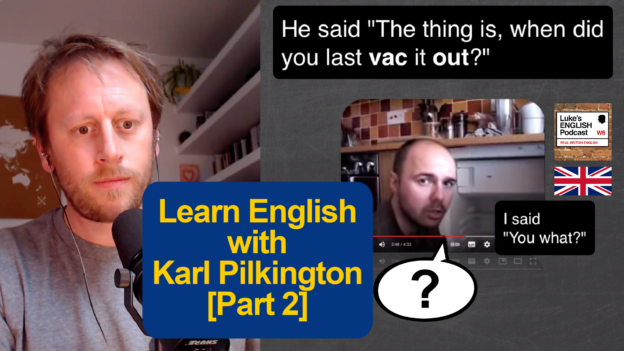
Understand more of Karl Pilkington’s rambling as we learn about the Manchester accent and pick up vocabulary along the way. Video version available on YouTube.
Hello everyone. Welcome back to LEP. This is part 2 of a double Karl Pilkington themed episode. I would recommend that you listen to part 1 of this first – it contains important context about who Karl is plus more details about Karl’s pronunciation and accent.
Listening to that first will help a great deal in understanding this one.
I got plenty of good responses to part 1 of this, so let’s carry on.
In this part we are going to continue as we did before – listening to Karl Pilkington talking about various subjects, understanding exactly what he says, looking at features of his Manchester accent and picking up vocabulary along the way.
Karl is basically just a normal bloke from Manchester and his accent is fairly typical for people from that area so this episode aims to help you understand his accent and pick up vocabulary too.
Some responses to part 1
I disagree with Karl on most things.
Is he arrogant?
I just enjoy the way he puts things. He speaks like a comedian in the way that he expresses a point of view and has a certain way with words, but he’s not a comedian.
This is the enigma of Karl Pilkington – is he really just being himself, or is he playing a comedy character, and in real life he’s a lot more erudite.
I actually think it’s the former not the latter and that he’s just being himself. He just happens to have a funny way of putting his opinions across.
Sometimes the best comedy comes from someone sharing a specific opinion. I think this is what I enjoy about this, rather than the opinions he is expressing, and as I said I disagree with Karl about most things, and some things he says are quite laughable – especially stuff he’s said on the Ricky Gervais podcast, like his Monkey News stories.
One other thing – apparently it is possible to be choked by a live octopus as you eat it. What I meant was that it would be impossible for an octopus to strangle you from the inside, as strangling means choking from the outside of the throat, with your hands for example, but of course a live octopus could choke you from within, by sticking its arms up into your throat or your windpipe. So, fair enough, it is possible for an octopus to choke you.
Also, in the UK we do eat oysters – which are raw seafood, so I think raw fish are generally ok in the UK but most other raw things would be considered a bit strange for us.
Quick Pronunciation Recap
In part 1 we listened to Karl talk about life, health and food and in terms of his accent I talked about H-drops
I’m 32, I think I’ve got the hang of it.
Look, how many do you need?
glottal stops
I’ll have a look at the meteorites.
If you’re going to eat a live animal, don’t eat one that’s got eight arms that can get hold of your neck.
The ‘bath/trap’ split
podcast/podcast
laugh/laugh
path/path
bath/bath
/ʊ/ not /ʌ/
Do you go to the gym much?
Topics: Holidays & Karl’s Fridge
This time he’s going to talk about holidays and his fridge and we will look at more features of his accent.
There’s a video version of this on youtube with text on the screen, plus you will find all the text presented on the page for this episode on my website.
Just one more thing before we start – I have premium episodes in the pipeline for these two episodes of LEP. The Premium episodes will be a chance to review and remember the vocabulary that comes up in these episodes, and then pronunciation drills too. So, I’ll do a sort of memory quiz with you to see how much vocab you remember and then the usual pronunciation drills – but in my accent, not Karl’s.
Karl is on a camping holiday, sitting in a tent and moaning.
Why does Karl think holidays are stressful?
What does Karl think of Lanzarote’s nickname?
What did Karl do on his holiday there?
What’s the problem with holidays in the UK?
What did he think of the seal sanctuary he went to?
What’s the best place Karl has been? Why?
What does Karl think of holidays to the moon?
Vocabulary
You’ve got free time on your hands which you’re not used to.
We ended up walking around this seal sanctuary. 14 quid. £
They were just floating about, hardlymoving.
I’m not having a go, but don’t charge me to come in, or at least let me see them again when they’re better.
The coliseum, they don’t do it up.
There’s no overheads.
That’s a mess. Get it knocked down.
At the end of the day the moon is just a big rock. You may/might as well go to Lanzarote.
PRONUNCIATION #3
Nasal
Alright so I went on holiday and it was great and all that.
I’ll have a look at the meteorites.
If you’re going to eat a live animal, don’t eat one that’s got eight arms that can get hold of your neck.
When’s the last time you heard about a tortoise having a heart attack?
Works well with glottal stops.
Nasal sound in /aʊ/ and /ai/ sounds
/aʊ/ in words like about and now sounds more nasal.
What’s he going on about now?
If there were dinosaurs about now and that.
If we’ve run out we need to go outside and get some more.
Nasal sound in /ai/ sound
The /ai/ sound in words like alive, inside, survive, fighting, riot and dying sounds more nasal.
You’re not supposed to eat them alive.
We’ve got to stay inside if we want to survive.
If they were running about fighting and dying and that.
Running riot (sounds like “roonin raiyut”)
#5 Karl on his fridge
Karl’s fridge is broken and he called out a guy to fix it.
Naturally he’s moaning about workmen who come to your house to do different jobs.
Why does the guy charge £80?
What is Karl’s main problem with engineers, plumbers, workers who have to come to his house?
What advice does the fridge guy give to Karl?
What’s the problem with Karl’s new fridge?
Vocabulary
The fellaturnedup, right.
Yeah, it’s broke. (broken)
That’s why I called you out.
That’s 80 quid.
I said, “you what?”
An 80 quid callout charge.
I tell you. They windmeup.
I had a fella come round to do the tiling.
Turned up late with a carrier bag.
A pot noodle
A copy of the Daily Mirror
A crossword book
He was asking what the pub was like across the road. “What is …. like?”
Having a laugh
When did you last vac it out?
Vacuum cleaner
You’re meant to vac them out, because dustand that gets in.
Can’t afford any food to put in it.
It needswiringin. It’s got one of those fancy plug things.
PRONUNCIATION #4
A lot of other vowel sounds are nasal too.
Turn the corner /ɔː/
They becomes thee
It depends what they do with it.
Why have they only just found that?
How did they miss that?
Also, he adds little fillers like:
(Do you) know what I mean?
Right? (just sounds like a nazal grunt, almost)
… and that
Like that
And whatnot
And stuff like that
Do you know what I mean?
I tell ya…
Watch out for those things if you like.
Ending
Ladies and gentlemen, this brings us to the end of this episode, as we now prepare to exit the world of Karl Pilkington and re-emerge blinking into the light of the normal world.
Welcome back to yourself, your own attitudes and your own personality again.
I urge you to (just wanted to use that phrase) check the page for this episode on my website where you will find a downloadable full transcript, the audio file for download in mp3 format, a text video version of this episode where you can read the entire thing as you listen and it’s all presented in a rather majestic looking font before your very eyes and of course there’s the comment section where you can share your thoughts not to mention the episode archive with all the previous episodes plus lots of bonus extra stuff.
Teacherluke.co.uk
LEP Premium LEP App LEP Merch
Have a good one and I will speak to you again soon, bye!
Cookies on teacherluke.co.uk
Click “Accept All”, to consent to the use of all cookies on this website, or visit "Cookie Settings" to control your consent settings.
This website uses cookies to improve your experience while you navigate through the website. Out of these, the cookies that are categorized as necessary are stored on your browser as they are essential for the working of basic functionalities of the website. We also use third-party cookies that help us analyze and understand how you use this website. These cookies will be stored in your browser only with your consent. You also have the option to opt-out of these cookies. But opting out of some of these cookies may affect your browsing experience.
Necessary cookies are absolutely essential for the website to function properly. These cookies ensure basic functionalities and security features of the website, anonymously.
Cookie
Duration
Description
cookielawinfo-checkbox-analytics
11 months
This cookie is set by GDPR Cookie Consent plugin. The cookie is used to store the user consent for the cookies in the category "Analytics".
cookielawinfo-checkbox-functional
11 months
The cookie is set by GDPR cookie consent to record the user consent for the cookies in the category "Functional".
cookielawinfo-checkbox-necessary
11 months
This cookie is set by GDPR Cookie Consent plugin. The cookies is used to store the user consent for the cookies in the category "Necessary".
cookielawinfo-checkbox-others
11 months
This cookie is set by GDPR Cookie Consent plugin. The cookie is used to store the user consent for the cookies in the category "Other.
cookielawinfo-checkbox-performance
11 months
This cookie is set by GDPR Cookie Consent plugin. The cookie is used to store the user consent for the cookies in the category "Performance".
viewed_cookie_policy
11 months
The cookie is set by the GDPR Cookie Consent plugin and is used to store whether or not user has consented to the use of cookies. It does not store any personal data.
Functional cookies help to perform certain functionalities like sharing the content of the website on social media platforms, collect feedbacks, and other third-party features.
Performance cookies are used to understand and analyze the key performance indexes of the website which helps in delivering a better user experience for the visitors.
Analytical cookies are used to understand how visitors interact with the website. These cookies help provide information on metrics the number of visitors, bounce rate, traffic source, etc.
Advertisement cookies are used to provide visitors with relevant ads and marketing campaigns. These cookies track visitors across websites and collect information to provide customized ads.

 [DOWNLOAD]