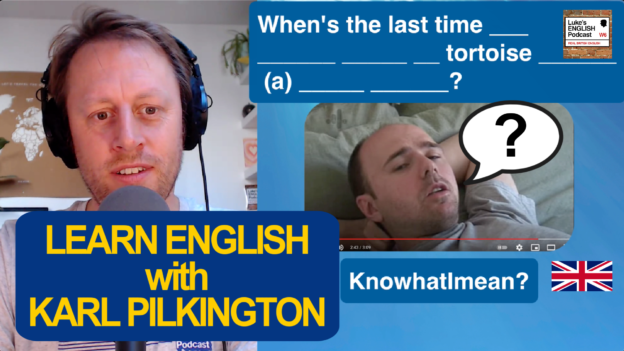
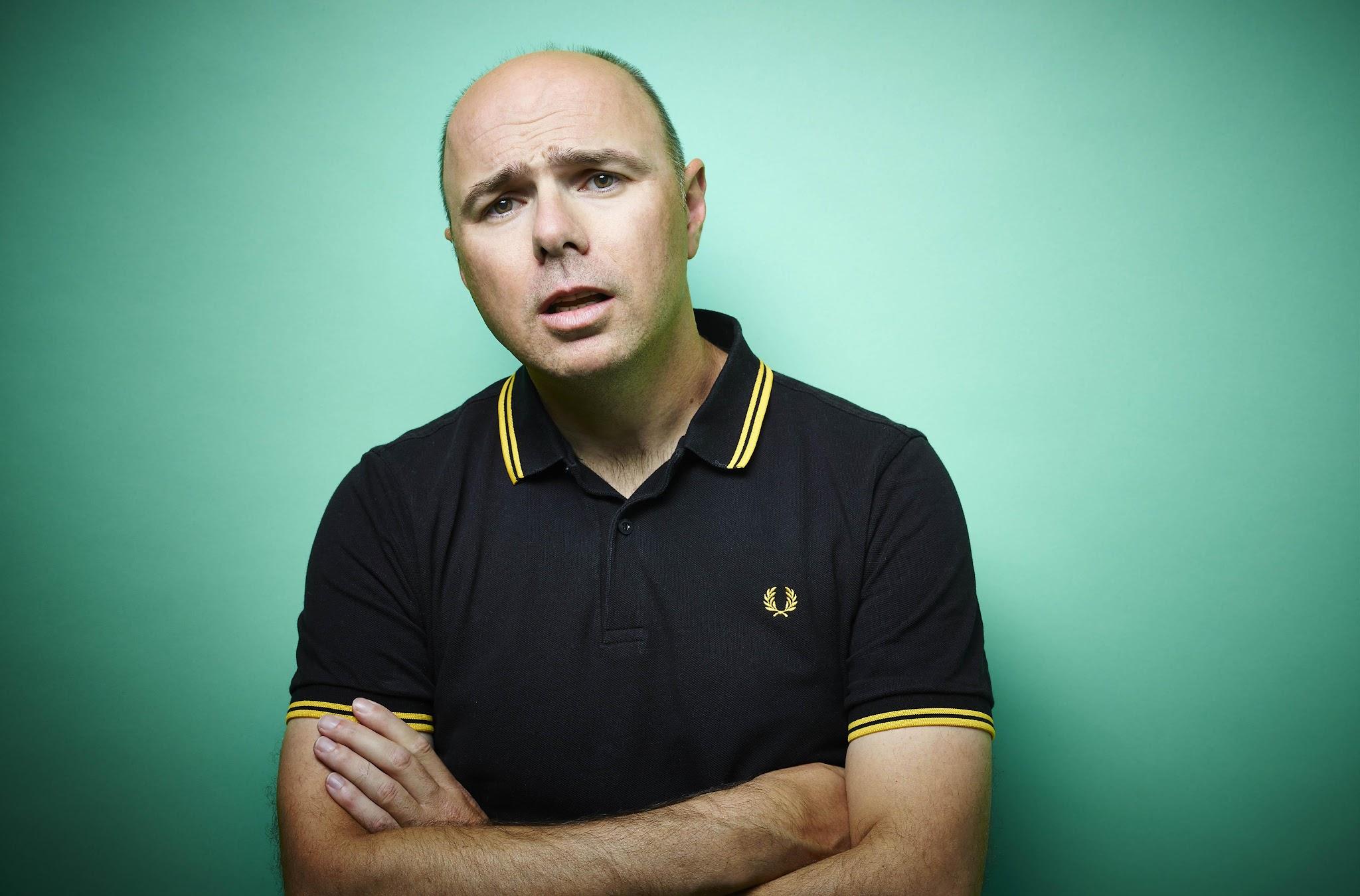
Understand English as it is spoken by native speakers. Let’s listen to Karl Pilkington rambling about life, the universe & everything, and see what we can understand and learn. Karl is from Manchester, so we’ll be looking at some features of his accent, picking up plenty of vocabulary and having a bit of a laugh along the way.
Welcome back to the podcast. How are you doing today?
In this episode we’re going to do some intensive listening and use it as a chance to learn some vocabulary and pronunciation.
This episode should be a bit of a laugh as we’re going to take a deep dive into the world of Karl Pilkington and listen to his thoughts on some big issues like health, food, animals, holidays and just existence itself.
We’ll be looking at the different features of his Manchester accent, and there will be lots of vocabulary to pick up too as we are covering a range of different topics. You can also consider this as a little intensive listening test, as I will be setting questions that you have to find answers to, then going through each clip in detail and breaking it all down for language.
We last heard about Karl Pilkington on my podcast in episode 656 in which we listened to a couple of his Monkey News stories about a chimp that works on a building site and another chimp that pilots a space rocket.
Do you remember that? If you don’t, then get the LEP app and listen to episode 656. It was a very popular episode and it should make you laugh out loud on a bus maybe.
That was pretty funny stuff, and Karl is very funny even though he’s not actually a comedian.
Who is Karl Pilkington?
To be honest, Karl Pilkington was most well-known about 10 years ago and these days he’s not in the public eye as much as he used to be, but he’s still a fairly well-known person in the UK, especially for Ricky Gervais fans.
Karl is just an ordinary bloke from Manchester who met comedians Ricky Gervais and Stephen Merchant when he worked for them as a radio producer in London.
Later, Ricky invited Karl to be on his podcast in order to broadcast his weird ideas and inane ramblings to the whole world, and the rest is history.
The Ricky Gervais Podcast became a world record-breaker with over 300,000,000 downloads.
In episodes, Ricky, Steve & Karl would talk about big topics like religion, evolution, philosophy, nature, birth and death and Karl would often say some bizarre and hilarious things, apparently without intending to be funny.
Ricky was always slightly obsessed with Karl, and he always described him as “an idiot with a perfectly round head like an orange”.
After being on Ricky’s podcast, Karl went on to become a fairly well-known figure in the UK, doing more podcasts with Ricky, then TV shows, books and documentaries like “An Idiot Abroad”.
Karl is known for his funny and slightly odd musings and observations about life.
He comes from a working class background in the Manchester area, and his accent has many of the features that you would expect from that.
Accent / Pronunciation
We will be going into the specific features of his accent in more detail as we go and this kind of follows on from episode 682 which was all about common features of pronunciation in England which are different to RP.
Which accent should you have?
So this episode is about one of the UK’s regional accents.
You might be thinking – Luke, by doing this episode are you saying that we should all learn to speak like Karl?
I’m not saying that. You can choose your accent, and many learners choose a neutral accent to learn, but it’s not all about learning an accent, it’s also about learning to understand different accents, and learning about the varieties of English that are out there.
So, you might not want to speak like Karl, but I certainly want you to understand Karl and the many millions of other people who speak English in a non-standard way.
So this episode is all about understanding an accent, rather than copying it. But of course you can copy Karl’s Mancunian accent if you like.
Vocabulary
There will also be plenty of vocabulary coming up too as we pick apart the things that Karl says and the way he says them.
You’ll find it listed on the screen on the video version and also presented in text form on the page for this episode on my website.
Video
We’re going to be using a series available on youtube in which Karl ponders certain big questions in just 3 minutes of video, originally broadcast on Channel 4 in the UK as part of their “3 Minute Wonders” series.
These are short videos in which Karl talks about his fridge, health, food, animals and holidays, covering each topic with his usual ramblings, all delivered in that Manchester accent, know what I mean?
I have about 6 recordings, which are about 3 minutes each (this could become two episodes).
Before I play the recording I’ll give you a little bit of context and I’ll set some questions.
Then you listen and try to get the answers.
Then I’ll break it down – listening to each bit again, with some explanations if necessary.
We’ll also pay attention to pronunciation – specifically his Mancunian accent. I’m going to break that down too, exploring the main features of that particular accent.
And I’ll sum up some of the vocab from each clip before moving on to the next one.
#1 Karl on Life
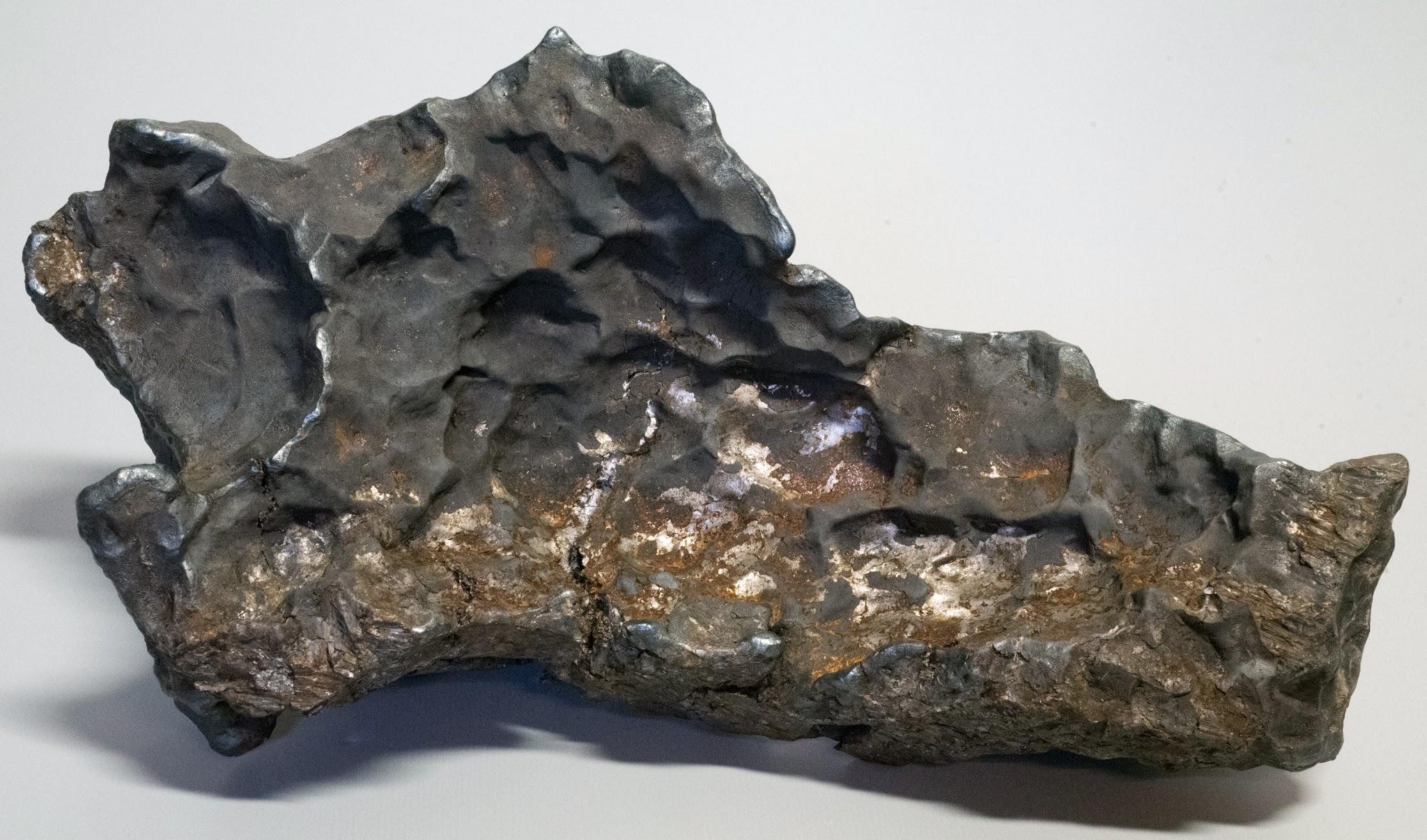
Karl goes around a museum looking at meteorites, dinosaur skeletons and endangered animals (stuffed ones or models) and muses about life in general medical science.
What does Karl wonder about the big bang?
What makes the meteorite room a bit disappointing?
What’s Karl’s main criticism of humanity today?
What does Karl think would happen if a dinosaur got loose and started to “run riot”?
What’s Karl’s main point?
Vocabulary
The big bang
Did it only seem big because there was no other noise to drown it out at the time?
Meteorites (on earth)
Meteors (flying in earth’s atmosphere)
Asteroids (flying in space)
The edge is taken off it because that isn’t the only one.
I’m not surprised they went extinct, they’re all in here.
Enough’s enough. If your body is that done in, call it a day.
The more we know, the more we interfere.
Don’t interfere with nature and that.
Even if it was going round running riot they’d go “We don’t want it to go extinct”
The panda is dying out.
Notes on Karl’s accent
Here’s a summary of the main points regarding Karl’s Manchester accent.
Many of these features are common in people from the Manchester area, although not all people from Manchester will speak like this, and there are different degrees of it.
This is certainly Karl’s Manchester accent in any case.
A lot of what I’m about to say will include things brought up in the episode I did about Key Features of English accents, episode 682.
PRONUNCIATION #1
H dropping
Look, how many do you need?
I’m not surprised they went extinct, they’re all in here.
She’d had a new lung, a new heart
He puts his hand in and goes “Yep, it’s broke”
They weren’t doing anything. They weren’t jumping through hoops. (talking about animals in a zoo)
I don’t know if it’s cruel or not, to have them in there.
I’m 32, I think I’ve got the hang of it.
Glottal stops (/t/ sounds get replaced by /ʔ/ )
I’ll have a look at the meteorites.
If you’re going to eat a live animal, don’t eat one that’s got eight arms that can get hold of your neck.
Let me see them again when they’re better.
Go back to my episode called 682. Features of English Accents, Explained to find out more about glottal stops.
#2 Karl on Health
Karl recounts a conversation he had with a woman about going to the gym.
Does Karl go to the gym?
What does he think of the idea of breathing classes?
What does he think of drinking 7 pints of water a day?
What’s Karl’s argument for not going to the gym? Heart beats, tortoise
Vocabulary
I know what’s probably putting you off – the fact that it’s hard work.
Breathing classes – I’m 32 I think I’ve got the hang of it.
My Dad’s like 60-odd. I’ve never seen him drink a pint of water, yet they’re telling us we should have, like, 7 pints a day or something, and then they wonder why there’s a water drought on.
They keep coming up withdaft ways of keeping fit.
Chucking paint at each other.
PRONUNCIATION #2
/æ/ not /ɑː/ (the “bath/trap split”, again)
Short A sound /æ/ in bath, podcast
(gas and glass have the same vowel sound in Karl’s Manchester accent).
This is normal across all northern accents, and many accents in the midlands. I would use /ɑː/ because although I lived in the midlands for many years (half my childhood), my accent is mostly from the south because I’ve lived there more and my parents don’t have strong regional accents.
Come to my class. We do breathing classes.
/ʊ/ not /ʌ/
The U sound in but, enough and much.
I pronounce it /ʌ/ but Karl pronounces it more like /ʊ/
Do you go to the gym much?
#3 Karl on Food
Karl talks about a new trend – eating things which shouldn’t be eaten.
Coming from England, Karl thinks it’s weird to eat certain things that might be eaten in other cultures, like live octopus, insects, frogs, snails, probably raw meat, raw fish and sushi.
What is the danger of eating a live octopus?
What’s Karl’s issue with kids and food today?
What does Karl think about eating dog?
Vocabulary
They choke you. Why would you want to eat that?
If we’re eating octopuses, why are dogs getting away with it?
Chatting to my family about some old anecdotes and stories from the past. Listen for some enjoyable chat, memories, descriptions and tales from days gone by.
In this episode I am happy to present to you a conversation with my mum, dad and brother all about old family stories and anecdotes from the past.
The episode is called Do you remember…? And that’s the title of the activity I chose for this episode. The idea is that we could generate some stories about things that happened in the past and you can follow along and see if you can pick up some English in the process, or simply enjoy a bit of storytelling on the podcast.
So you’re going to hear stories of little accidents, moments when James and I got into trouble, learning to drive and failed driving tests, how my parents first met each other and how my bottom lip was always left trembling at the end of every story.
We recorded this in my parents’ living room, sitting around after dinner and if you like you can imagine that you’re there too, listening into the conversation – not taking part though. For some reason you’re not allowed to speak, you can only listen like a weird audience in our living room just lurking in the background. Anyway, you can imagine that you’re there if you like, if it helps you to tune into the conversation and follow along more easily.
I will now leave you to enjoy this relaxed conversation, follow the stories and little jokes and I will speak to you again at the end of this episode.
Ending Transcript
So, that was my family, recorded in the living room recently while I was on holiday in England. I hope you enjoyed that.
Apologies if we repeated any stories you had heard before (perhaps all of them?) but then again it can be really helpful to hear the same stories over and over when learning English. You could even try to tell the stories yourself, and then compare your story to the recorded version.
If you want other, similar episodes from the archive, check out these ones.
79. Family Arguments & Debates (Debating things like language and politics)
But for now I will leave you to go back to your life, unless you choose to listen to another episode which you will find in the archive.
Don’t forget to check out LEP Premium. P31 parts 4,5, 6 are on their way and may have already been published by the time you listen to this.
But in the meantime, be excellent to each other, have a lovely day, morning, afternoon, evening or night and I will chat to you later but now it’s just time to say good bye bye bye bye bye.
Luke reads extracts from The War of the Worlds by H.G. Wells. This is a classic bit of science fiction writing from the Victorian era, with some thrilling passages and scary descriptions. It’s one of my favourite books of all time and I hope you enjoy it too and learn some English from it. Full transcript available and YouTube version too.
It’s story time in this episode because I’m going to tell you a classic English science fiction story.
The story is called War of the Worlds by H.G. Wells the classic storyteller who also wrote The Invisible Man and The Time Machine, and you have probably heard of War Of The Worlds because it is definitely one of the most famous and most influential science fiction stories ever written.
Now, I know that science fiction is not everyone’s cup of tea, but I do hope you stick around and listen to this story because I think this is just particularly good writing and the story is very exciting, immersive and memorable so it should be a really enjoyable way to pick up some more English.
I won’t be reading the whole book of course but I will be reading some selected extracts and giving you a summary of the key details in the first part of the story.
The aims of this episode
To entertain you with a really engaging story in English. Stories are a great way to get more English into your head and if they are exciting and immersive, then that’s even better.
To show you a slightly old-fashioned version of English, which is really rich in descriptive language and more formal in style than today’s English. It’s good to be exposed to diverse versions of the language. Old fashioned English is much more like modern formal English, so it’s a good lesson in style. This can really strengthen your English in various ways.
To help you notice some nice bits of vocabulary along the way. Having a broad range of vocabulary is essential in achieving truly advanced English. This story is very rich in descriptive language.
To inspire you perhaps to read the rest of the book. Reading is such an important thing to do for your English, and maybe you’re looking for interesting books to read. You could consider this one. It’s not too long.
This is also available as a video episode on YouTube and if you watch you can see me recording the podcast with the text on the screen next to my face. So you can listen and read at the same time and see me telling the story.
You can read the entire text I am reading from on the page for this episode at teacherluke.co.uk.
Context of the story and the writing style
War of the Worlds has been adapted lots of times – in films (most famously the 2005 Stephen Spielberg film with Tom Cruise – which you might have seen) and another film version in the 1950s set in Los Angeles, an audiobook musical version read by Richard Burton and an infamous dramatised radio series by Orson Welles.
This is the original alien invasion story. This book was one of the very first stories to ever explore these themes and to describe these kinds of things in such a realistic way.
This is the one that has inspired so many others and in my opinion, none of the other versions of this story or copies of this story can compare to this original version from 1897.
The writing is very realistic and journalistic in style, written from the first person perspective of a guy just experiencing the events as they happened and describing everything in great detail.
A note about the language and the writing style
The language is pretty old fashioned (1897) but it’s really well written and it should be interesting for you and useful for your English to explore another version of this language. Exposure to different types of English makes your English stronger I think.
As we go through this I will point out particular words or phrases as we go and perhaps compare this to normal modern plain English.
Comparing the styles of languages actually gives you more perspective on normal modern English and how formal written English today still retains some aspects of old fashioned language.
There is quite a lot of language you might find in legal documents or other very formal situations.
Words like therein, hereby, forthwith and things like that are quite common, as well as certain structures, longer sentences and choices of words which mark this out in a particular style.
This is very descriptive literary language from over 100 years ago. It’s more complex than today’s English, more formal than today’s English and very specific in its descriptions.
This will probably be a challenge for you but I’m here to help and I will explain things as we go.
This is quite scary stuff
I have to add actually, that having re-read some of this story in preparation for this episode, I hadn’t realised just how terrifying this story is.
Personally I really enjoy the thrills you get from a story like this, but if you are feeling a bit force-sensitive today you might want to get a pillow or hide behind the sofa or something.
Useful Links & Sources
Here are a couple of links I have found useful in making this episode.
Project Gutenberg I have several paperback copies of this book, but I also found it on www.gutenberg.org – a website which shares stories and books which are now in the public domain.
Link to War of the Worlds html version https://www.gutenberg.org/files/36/36-h/36-h.htm
CourseHero Study Notes Also there’s a website called coursehero.com which has useful summaries of the story and other useful information. https://www.coursehero.com/lit/The-War-of-the-Worlds/
Summarising the opening chapters
These are the opening paragraphs of the book, which set the scene in which the events take place. Note the sombre tone and specific choice of language.
Main Character
The story is told by an unnamed narrator.
He is a middle-class educated man who writes philosophical papers and is interested in science. That’s all we know. The story is written in the past tense, as if he is looking back on those events and has written a full account of what happened.
I. THE EVE OF THE WAR.
No one would have believed in the last years of the nineteenth century that this world was being watched keenly and closely by intelligences greater than man’s and yet as mortal as his own; that as men busied themselves about their various concerns they were scrutinised and studied, perhaps almost as narrowly as a man with a microscope might scrutinise the transient creatures that swarm and multiply in a drop of water. [one sentence!]
With infinite complacency men went to and fro over this globe about their little affairs, serene in their assurance of their empire over matter. It is possible that the infusoria under the microscope do the same.
No one gave a thought to the older worlds of space as sources of human danger, or thought of them only to dismiss the idea of life upon them as impossible or improbable.
It is curious to recall some of the mental habits of those departed days. At most, terrestrial men fancied there might be other men upon Mars, perhaps inferior to themselves and ready to welcome a missionary enterprise.
Yet across the gulf of space, minds that are to our minds as ours are to those of the beasts that perish, intellects vast and cool and unsympathetic, regarded this earth with envious eyes, and slowly and surely drew their plans against us.
And early in the twentieth century came the great disillusionment.
Summary of the story up until Chapter 4: The Cylinder Opens
That opening chapter describes how a species of intelligent creatures on Mars had been observing us for many years before the events of this story. The opening chapter goes on to explain that the Martians were planning to invade earth because their home planet was steadily getting cooler year after year due to the fact that it is further from the sun than the earth. They faced extinction on their own planet, and so they set their sights on their nearest neighbour – Earth – with its warmer atmosphere and closer position to the sun, and with their superior mathematical knowledge and technology they decided they would colonise earth in order to survive. They spent years observing us and planning the invasion.
Note: I am using present tenses from now on to describe this story. This is a normal way to retell the plot of a book, film, or play. It’s because the events of the story are permanent because they never change, they are written that way. So we can use present tenses to summarise the story of a book or film.
Ogilvy the Astronomer
The narrator has a friend called Ogilvy who is a respected astronomer. He has a telescope and uses it to observe the night sky, including the surface of Mars, our nearest neighbour.
So Ogilvy is our friend and he’s an astronomer.
6 years before the main events of the story Ogilvy invites the narrator to an observatory to study Mars after another astronomer reported a dramatic explosion of gas on the surface of the planet, which seems to be directed toward Earth. The narrator observes a similar explosion as he watches through the telescope.
Ogilvy doubts the existence of life on Mars and speculates the phenomenon may be related to meteorites or volcanoes. Many other people witness the phenomenon, which repeats itself at midnight over a total of 10 days.
Nobody at the time is concerned or worried about the explosions on Mars.
6 years later some people see a falling star – a meteorite which flies through the night sky with a bright green flash and lands nearby on Horsell Common – a large area of grass, meadows and trees. Again, nobody assumes there is anything weird going on. Ogilvy the astronomer is interested in the meteorite and finds it on the common.
As it has landed it has formed a large crater of sand. So the object is lying at the bottom of a kind of large sand pit in the middle of an open area of grassland surrounded by buildings and trees.
The meteorite that he finds is quite odd. It’s in a cylindrical shape – like a long can of coke, but he thinks its made of rock as it is covered in a kind of crusty layer. It’s also extremely hot and he can’t get near it, but he notices there are weird sounds coming from inside it. He assumes these are noises caused by the object cooling, but as he continues to observe it he realises that something funny is going on.
The crusty layer is slowly falling off as the object cools, revealing a kind of metallic surface underneath, and even weirder than that, the end of the cylinder appears to be turning, as if it is unscrewing very slowly. Ogilvy suddenly assumes that the cylinder has people inside it and decides to get help, but nobody believes him.
Eventually he finds a journalist who is willing to check the cylinder. A crowd of people begins to gather as word spreads about “men from space stuck inside a cylinder on the common”. People don’t quite realise what’s going on but they are incredibly curious. Normal life continues, with people stopping by to have a look at the object in the sand pit, before continuing their normal routines.
The narrator goes down to Horsell Common to check out what’s going on. A larger crowd has gathered there. He manages to squeeze through the crowd which is getting more and more excited and agitated. A small group of scientists, including the narrator’s friend Ogilvy are in the pit attempting to work out what is happening.
The narrator observes what is going on and comments on how most people are not really educated about this kind of thing and they haven’t worked out what’s going on, but he assumes that the cylinder must be extra-terrestrial. He observes the end of the cylinder moving and as it turns it’s revealing a kind of shining metal thread.
The next chapter describes what happens when the end of the cylinder finally drops off, revealing what is inside.
Reading chapters 4 and 5 with comments and explanations
The narrator approaches the pit containing the cylinder. Crowds of people are all around the pit, trying to see what’s happening. They’re pushing each other a bit, and things are quite tense. (You know, when a large crowd forms, people start pushing and shoving and it’s stressful) Ogilvy and some other scientists are in the pit.
IV. THE CYLINDER OPENS. The crowd about the pit had increased, and stood out black against the lemon yellow of the sky—a couple of hundred people, perhaps. There were raised voices, and some sort of struggle appeared to be going on about the pit. Strange imaginings passed through my mind. As I drew nearer I heard Stent’s voice: “Keep back! Keep back!” A boy came running towards me. “It’s a-movin’,” he said to me as he passed; “a-screwin’ and a-screwin’ out. I don’t like it. I’m a-goin’ ’ome, I am.” I went on to the crowd. There were really, I should think, two or three hundred people elbowing and jostling one another, the one or two ladies there being by no means the least active. “He’s fallen in the pit!” cried some one. “Keep back!” said several. The crowd swayed a little, and I elbowed my way through. Every one seemed greatly excited. I heard a peculiar humming sound from the pit. “I say!” said Ogilvy; “help keep these idiots back. We don’t know what’s in the confounded thing, you know!” I saw a young man, a shop assistant in Woking I believe he was, standing on the cylinder and trying to scramble out of the hole again. The crowd had pushed him in. The end of the cylinder was being screwed out from within. Nearly two feet of shining screw projected. Somebody blundered against me, and I narrowly missed being pitched onto the top of the screw. I turned, and as I did so the screw must have come out, for the lid of the cylinder fell upon the gravel with a ringing concussion. I stuck my elbow into the person behind me, and turned my head towards the Thing again. For a moment that circular cavity seemed perfectly black. I had the sunset in my eyes. I think everyone expected to see a man emerge—possibly something a little unlike us terrestrial men, but in all essentials a man. I know I did. But, looking, I presently saw something stirring within the shadow: greyish billowy movements, one above another, and then two luminous disks—like eyes. Then something resembling a little grey snake, about the thickness of a walking stick, coiled up out of the writhing middle, and wriggled in the air towards me—and then another. A sudden chill came over me. There was a loud shriek from a woman behind. I half turned, keeping my eyes fixed upon the cylinder still, from which other tentacles were now projecting, and began pushing my way back from the edge of the pit. I saw astonishment giving place to horror on the faces of the people about me. I heard inarticulate exclamations on all sides. There was a general movement backwards. I saw the shopman struggling still on the edge of the pit. I found myself alone, and saw the people on the other side of the pit running off, Stent among them. I looked again at the cylinder, and ungovernable terror gripped me. I stood petrified and staring. A big greyish rounded bulk, the size, perhaps, of a bear, was rising slowly and painfully out of the cylinder. As it bulged up and caught the light, it glistened like wet leather. Two large dark-coloured eyes were regarding me steadfastly. The mass that framed them, the head of the thing, was rounded, and had, one might say, a face. There was a mouth under the eyes, the lipless brim of which quivered and panted, and dropped saliva. The whole creature heaved and pulsated convulsively. A lank tentacular appendage gripped the edge of the cylinder, another swayed in the air. Those who have never seen a living Martian can scarcely imagine the strange horror of its appearance. The peculiar V-shaped mouth with its pointed upper lip, the absence of brow ridges, the absence of a chin beneath the wedgelike lower lip, the incessant quivering of this mouth, the Gorgon groups of tentacles, the tumultuous breathing of the lungs in a strange atmosphere, the evident heaviness and painfulness of movement due to the greater gravitational energy of the earth—above all, the extraordinary intensity of the immense eyes—were at once vital, intense, inhuman, crippled and monstrous. There was something fungoid in the oily brown skin, something in the clumsy deliberation of the tedious movements unspeakably nasty. Even at this first encounter, this first glimpse, I was overcome with disgust and dread. [It’s a bit like if you spend any length of time staring at a nasty looking insect, or even just staring at a picture of one] Suddenly the monster vanished. It had toppled over the brim of the cylinder and fallen into the pit, with a thud like the fall of a great mass of leather. I heard it give a peculiar thick cry, and forthwith another of these creatures appeared darkly in the deep shadow of the aperture. I turned and, running madly, made for the first group of trees, perhaps a hundred yards away; but I ran slantingly and stumbling, for I could not avert my face from these things. There, among some young pine trees and furze bushes, I stopped, panting, and waited further developments. The common round the sand-pits was dotted with people, standing like myself in a half-fascinated terror, staring at these creatures, or rather at the heaped gravel at the edge of the pit in which they lay. And then, with a renewed horror, I saw a round, black object bobbing up and down on the edge of the pit. It was the head of the shopman who had fallen in, but showing as a little black object against the hot western sun. Now he got his shoulder and knee up, and again he seemed to slip back until only his head was visible. Suddenly he vanished, and I could have fancied a faint shriek had reached me. I had a momentary impulse to go back and help him that my fears overruled. Everything was then quite invisible, hidden by the deep pit and the heap of sand that the fall of the cylinder had made. Anyone coming along the road from Chobham or Woking would have been amazed at the sight—a dwindling multitude of perhaps a hundred people or more standing in a great irregular circle, in ditches, behind bushes, behind gates and hedges, saying little to one another in short, excited shouts, and staring, staring hard at a few heaps of sand. A barrow of ginger beer stood, a queer derelict, black against the burning sky, and in the sand-pits was a row of deserted vehicles with their horses feeding out of nosebags or pawing the ground.
Summary of Chapter 4
As the sun sets, the narrator returns to the pit, where a few hundred people have gathered. A boy warns the narrator that the end of the cylinder has unscrewed itself, and the narrator forces his way to the front of the crowd to get a better view. Ogilvy warns the people to stay away and reminds them of its unknown contents. One man is pushed into the pit by the jostling of the crowd. The end of the cylinder comes off and falls into the pit. The narrator and the crowd are horrified by the grotesque octopus-like appearance of an alien who slowly and painstakingly emerges from the cylinder. They seem heavy and struggling to breathe in the atmosphere. The narrator and the crowd run away from the pit, but many, including the narrator, stop to watch the aliens from the nearby tree line. The sun sets, leaving enough light to just see the silhouette of the shopkeeper as he tries and fails to get out of the pit alive.
Learn English with The Beatles as we explore lyrics from Beatles songs and pick out some idioms, descriptive language and other vocabulary for you to learn. Featuring Antony Rotunno from the Glass Onion: On John Lennon podcast.
In this episode you can learn English with The Beatles as we look at specific bits of English which appear in the lyrics of their songs.
I’m joined again by Antony Rotunno from the Glass Onion on John Lennon Podcast. Antony is also an English teacher and something of a John Lennon expert. He is also a musician, and a lot of the credit for this episode goes to him, because he did most of the preparation, going through lyrics of Beatles songs and picking out specific use of English, including certain phrases and idioms.
This is like a quiz actually. Can you name the songs when Antony plays them?
Can you beat me?
Can you name the songs from the lyrics and from the music?
There are a few references to The Rutles and Neil Innes of course, but for us those songs are all part of The Beatles extended universe.
I’ll chat to you again at the end of the episode and will sum up some of the bits of language that come up, but now let’s get started.
Phrases / Vocabualry
Using lots of pronouns, me, you, us, I etc
Using more imagery in the lyrics
I’m going to love her until the cows come home
A chip on my shoulder
My heart went boom when I crossed that room
Buzz, hum, boom (Onomatopoeia)
It won’t be long ‘til I belong to you
I don’t know why she’s riding so high
To be on your high horse
I’ll make a point of taking her away from you
I sat on her rug biding my time, drinking her wine
This bird has flown
Please don’t spoil my day, I’m miles away, and after all, I’m only sleeping
If she’s gone I can’t go on, feeling two foot small
Feeling 10 foot tall
Ouch, you’re breaking my heart
To upset the applecart
Where there’s a will there’s a way
He was like a wolf in sheep’s clothing
Or an iron hand in a velvet glove
Working like a dog
Sleeping like a log
Sleeping like a baby
If you need a shoulder to cry on
To give someone a shoulder to cry on
To open up the doors
My independence seems to vanish in the haze
It was anotherstring to their bow
Colours
There is a place, where I can go, when I feel low, when I feel blue
To feel blue
Everybody’s green because I’m the one who won your love
Green = 1. Jealous 2. inexperienced
Oh dear what can I do, baby’s in black and I’m feeling blue
Imagery
When the sun shines they slip into the shade, and sip their lemonade
With tangerinetrees and marmaladeskies, cellophane flowers of yellow and green
No-one I think is in my tree
Nobody is on my wavelength
Semolina pilchard climbing up the Eiffel Tower
The clouds will be a daisy chain, so let me see you smile again
Her hair of floating sky is shimmering, glimmering, in the sun
My mother was of the sky, my father was of the earth but I am of the universe and you know what it’s worth
Words are flowing out like endless rain into a paper cup
Pools of sorrow, waves of joy
Don’t need a gun to blow your mind
No longer riding on the merry go round, I just had to let it go
The second part of my conversation with Antony Rotunno (John Lennon podcaster, English teacher) in which we discuss adjectives of personality, with John Lennon as a case study. Vocabulary list available.
Welcome to this brand new episode of Luke’s English Podcast. Here it is, another episode of my podcast, from me to you, in which I help you try to learn this wonderful language that we call English, and I am here to try to help you do it, in ways that I hope you will find interesting and motivating.
So, how are you doing out there in podcastland today? I hope things are pretty good all things considered.
You are now listening to the fourth in my Beatles mini-series and the second part of this double episode I’m doing about describing John Lennon using various adjectives of personality.
I’m assuming here that you have heard the first part of this. If you haven’t heard the first part of this double episode then you need to go and listen to that. It’s probably the previous episode to this one, ok?
I’m still talking to Antony Rotunno from the Glass Onion: On John Lennon podcast. Antony is also an English teacher with plenty of experience. So I think he’s the perfect guest for this podcast series, and let’s continue going through this list of adjectives we compiled, and let’s see if we can use them to discuss John Lennon’s life, his psychology, his personality.
In the last episode we covered adjectives from A to I. It’s a sort of a rough A-Z, and we did A to I last time so let’s do the rest of the alphabet, more or less.
We might skip a few letters here and there but I’m sure that you’ll forgive us.
Just before we continue, let me read out the list of adjectives. Like last time, we don’t go into full detail about all of these, but have a listen and consider these things: whether you know these words, whether you don’t know them, whether you use them and whether you don’t and also what’s the word stress for these adjectives? How many syllables are there and which syllables are the stressed ones? It can also be useful to consider what the noun or verb forms of these adjectives are, if they have them, and sometimes you’ll hear us using the different forms of these words in these word families as well.
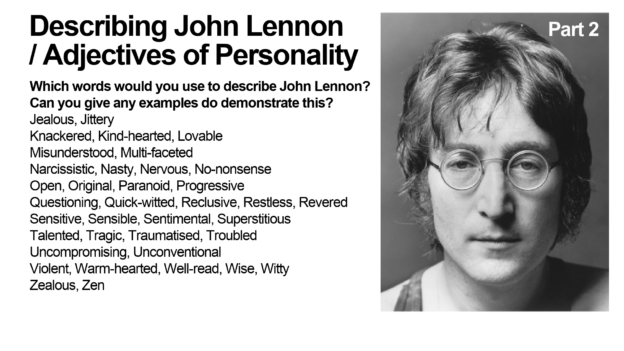
Adjectives of Personality J-Z
O o o <—- these symbols show the number of syllables and word stress in a word. For example, “podcast” = O o (two syllables, the first syllable is stressed)
Jealous O o, Jittery O o o (Also: to have the jitters, to be on edge, to be nervous, to be anxious)
Knackered O o, Kind-heartedo O o
LovableO o o
Misunderstood o o o O, Multi-facetedo o O o o
Narcissistic o o O o, Nasty O o, Nervous O o, No-nonsenseo O o
Open O o, Originalo O o o
Paranoid O o o, Progressiveo O o
Questioning O o o, Quick-witted O- O o (Also: to have the gift of the gab)
Reclusive o O o, Restless O o, Reveredo O
Sensitive O o o, Sensible O o o, Sentimental o o O o, Superstitious o o O o
Talented O o o, Tragic O o, Traumatised O o o, TroubledO o
Uncompromising o O o o o, Unconventionalo o O o o
ViolentO o
Warm-hearted o O o, Well-read o O, Wise, WittyO o
(not) Xenophobic o o O o (this is the only adjective I could think of that begins with an X!) (xylophone and x-ray are other words beginning with x – but they’re not adjectives of personality)
Yellow O o / Yellow-bellied O o – O o (cowardly), YouthfulO o
Zealous O o, Zen
Also: Childish O o / childlike O o
We also cover a few common false friends in this episode, so listen out for those.
False friends
Embarrassed o O o
Suburbs O o / slums
Sensitive O o o / sensible O o o
That entire list is available for you to see on the page for this episode on my website. The link is in the description.
Now, I read that list of adjectives pretty quickly. If you didn’t catch the word stress, or in fact if you feel you need to explore these words more slowly, you can always just check the word list on the website page … and copy+paste them into an online dictionary, where you’ll see phonemic transcriptions of the words (so you’ll know how they are pronounced, including word stress) you’ll be able to hear someone say the words, and you’ll get definitions and examples and so on.
OK, so – I always encourage you to check words that you discover in episodes of this podcast in your own time, and I refer you back to episode 720 for more information about how to do that.
OK, so without any further ado, let’s jump back into my conversation with Antony about John Lennon, and here we go.
Ending Transcript
Thank you again to Antony for his contribution to this episode.
Let me suggest again that you check out Antony’s podcast if you’d like to hear more in depth discussions about John Lennon. It’s called Glass Onion: On John Lennon and you can get it wherever you get your podcasts. I must say, it is an excellent listen.
Right, so that’s not quite it for Beatle-themed episodes. The last in the series is with Antony too, and that’s where we turn to look at the music (or should I say listen to the music?) In any case, the next part of this series is all about the music and lyrics, especially the lyrics and Antony is going to guide us through a little exploration of words and phrases in Beatles songs, looking at nice idioms, uses of metaphor and other features that you should find interesting from a language learning point of view. And Antony got his guitar out for that too, so we also get treated to little snippets of songs as we go.
So, you can look forward to the final episode in the series, coming soon.
I say final episode, there’s nothing stopping me from doing more episodes with Beatle themes in the future, and I do plan to do that actually. I’d like to do some specific song breakdowns in which I could explore the story behind a particular song, then play the song for you and analyse the lyrics. That could be great.
Anyway, thank you for listening as usual! I hope this has been interesting and useful, and I will speak to you very soon in the next episode of this podcast. BUt for now it’s time to say, good bye bye bye bye bye.
Learn useful adjectives for describing personality traits with John Lennon as a case study. Episode 3/5 in my Beatles series, with returning guest Antony Rotunno from the podcast “Glass Onion: On John Lennon”.
Here is the next episode in my Beatles season, and this is where we look at some language too.
In this episode I’m joined again by Antony Rotunno who is a podcaster and English teacher from England. Antony’s main podcast is called Glass Onion: On John Lennon and as the title suggests it is all about John Lennon, particularly his psychology and his life story. Antony’s other podcasts are called Film Gold, a film review series and Life & Life Only which is about personal development and psychology, so Antony knows a thing or two about psychology and John Lennon, and of course as an English teacher he’s well experienced in helping learners to conquer this language of English.
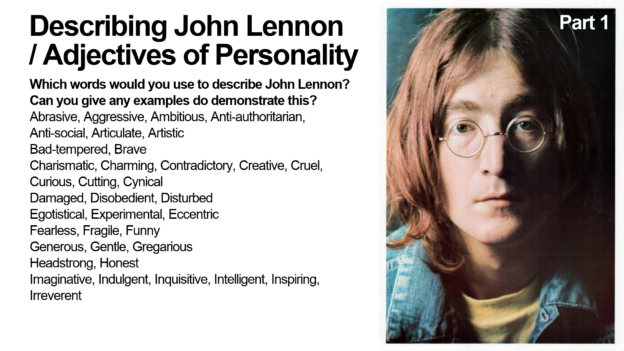
In this one we’re going through a big list of adjectives which I prepared earlier. All the adjectives are words you could use to describe someone’s personality. We have loads of these adjectives, so Antony and I made a list of words which could be used to describe John Lennon. It’s an ABC in fact. Now we didn’t manage to talk about every single adjective in the list, but we certainly had a good go at them, and what you’re going to get in this episode is a sort of English lesson with John Lennon as a case study.
Here are the adjectives (I’m going to read them out)
I’ll let you discover which ones we actually talk about in detail in this episode. The rest of the list will come up in the next part.
Also, I’ve collected a set of other expressions from this conversation, not using adjectives of personality, but just useful expressions and examples of language you could use, and I’m planning to use that set in an upcoming premium episode.
teacherluke.co.uk/premiuminfo if you want to sign up to LEP Premium to get all the premium content unlocked.
Now, let’s consider John Lennon’s personality, things he did and said in his life and try to work out what kind of person he was, with a few useful adjectives in the process.
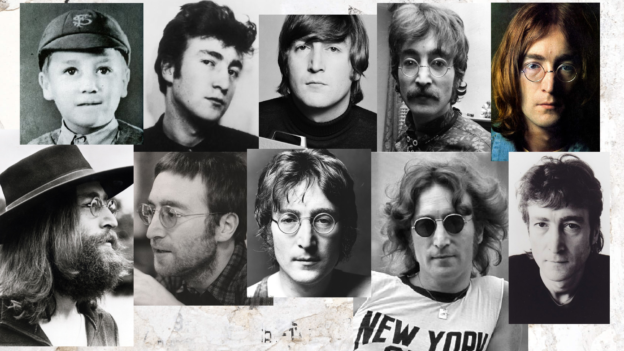
The second in a short series about The Beatles, this one focuses on the life of John Lennon, with an overview of his life story, some thoughts about his psychology and some rambling discussion questions about this iconic British musician, with podcaster, English teacher and musician Antony Rotunno.
Hello listeners, I hope you’re doing well today and that you are ready for this new episode of my podcast. You join me here in my pod-room as the rain falls down above my head. Conditions are perfect for learning British English. Let’s get started.
This is a continuation of this short series of episodes I’m doing about The Beatles and this one focuses mostly on John Lennon. If you’ve ever wanted to know more about this iconic British musician then this episode is for you. Also, if you’re already a Beatles fan or a John Lennon fan then I’m sure you’ll be glad to hear this conversation too.
My guest for this episode is Antony Rotunno from England and Antony is very knowledgeable about John Lennon and his life. In fact I feel like I couldn’t have found a better person to talk to about this subject.
One of the reasons for that is that Antony is also an English teacher. He’s been teaching English as a foreign language to adults for over 18 years, and for obvious reasons it’s always useful to have a guest who has experience of working with learners of English.
Antony is also a podcaster so he is used to talking to audiences over the internet from his home in England. Antony’s podcast is all about John Lennon.
And he probably knows all there is to know about John Lennon because he’s read everything out there on the subject and for his podcast he has interviewed lots of people connected to Lennon, including authors and people who actually knew John himself – people with first-hand accounts of meeting him.
So Antony really knows a lot about John Lennon.
And we had a really good, really long conversation for this podcast, covering various things like John Lennon’s life story. This is the first part of that conversation.
Let me just explain my reasons for doing this series of episodes about the Beatles. I probably don’t need to explain this, but allow me to give my reasons.
So, this is a 5 part series actually. I published the first part with my mum in episode 717, which was a review of a book about The Beatles, followed by a general Beatles ramble.
The rest of the series will be this conversation I had with Antony divided into 4 parts. But it’s not just going to be us rambling on about Lennon for all that time. I’ve also decided to employ some of Antony’s English teaching skills in order to cover some language too, specifically in parts 3, 4 and 5 of this series as we focus on descriptive adjectives for describing personality traits, and then some analysis of the lyrics from Beatles songs, with various nice phrases and idioms to learn. So there should be plenty of English learning opportunities to take from this whole series.
John Lennon is a hugely significant person in terms of modern history, and of course being English he is very much part of our culture, and as we move forwards in time it seems that the significance of the Beatles and everyone’s interest in them is not waning. If anything, they continue to grow in stature.
And even if you’re not into the Beatles, hopefully this can be a chance to learn some new things about this band that is held in such high esteem by so many people.
I promise you – I’m willing to say I promise you here, that if you listen to this, you will know more about John Lennon than before you listened to it.
And if you’re wondering when we’re going to get to the music, part 5 will be all about Beatles lyrics and there will be some guitar playing as well.
First we will get to know Antony a bit and ask him about his podcasts, and then you’ll hear him talk about how he got into The Beatles and John Lennon in particular, then Antony is going to give a brief overview of John’s life and career and finally I’m going to ask Antony a few John Lennon discussion questions.
Let’s get started.
Ending Transcript
So that was episode 2 in this 5 part Beatles mini series, all about John Lennon.
Thanks again to Antony for his expertise.
The other John Lennon episodes will follow over the next few weeks.
Do you feel that you know more about John Lennon than you did before you listened to this?
I hope so.
I wonder what new things you learned from this. Feel free to leave your comments below.
I won’t say much more here, except that it’s been really interesting to talk to Antony and I look forward to the next few episodes in which we go into teacher mode and look at some descriptive adjectives and then song lyrics.
But that’s it for this episode. Thanks for listening. Be excellent to each other and I will speak to you soon.
Talking to pod-pals Amber & Paul about diverse topics including organ harvesting (yes), favourite fruits (exciting), accent challenges, guess the punchline, British Citizenship tests, What the “great” in Great Britain really means, and Amber’s son Hugo’s astonishing fluency in English.
Hello listeners and welcome back to my podcast for learners of English. How are you doing today? Doing ok?
I won’t talk at great length at the start here, suffice to say that as the title of this episode suggests, Amber & Paul are on the podcast again, after a one year absence.
Yes, the tangential trio are at it again.
I’ve been wondering What on earth I should call this episode. As you will hear, the options I had for a snappy title for this one were a bit tricky because our conversation covers some pretty diverse topics, including some quite dark themes, some potentially controversial moments and the usual fun rambling nonsense. It’s hard to sum it up in one pithy clickbait title. I think I’m just calling it “Amber & Paul are on the Podcast” but that does seem like a bit of a cop out. Anyway, we will see what I ultimately choose as a name for this episode.
Here’s a quick hint of the diverse topics which we explore.
Organ harvesting – yes, that’s right, organ harvesting. To get this, you will need to have listened to the previous episode of this podcast (#718), which was a conversation with Michael the hitchhiking shaman from Poland. In that episode Michael explained how, when hitchhiking once, he almost got kidnapped by several people who he suspected were organ harvesters – people involved in the illegal trade of human internal organs. Amber heard that podcast and was sceptical.
This prompted nearly 30 minutes of conversation about the ins and outs of organ harvesting, including how, where, why and who would do this.
Then we go on to do various random questions & challenges from my list of random questions and challenges, so you will get some accent fun, a thrilling discussion of Amber’s favourite fruit and vegetables, a story about Amber’s son Hugo and his surprising articulacy in English, a joke about Spanish firemen, some British citizenship questions about Easter holidays, British overseas territories and why Great Britain is actually called Great Britain, and plenty more besides. So, other than organ harvesting, there isn’t just one theme for this episode, hence the rather generic title.
It’s a thrill ride of an episode which has everything you could expect from a a conversation with Amber & Paul. I hope you enjoy it. Nothing more needs to be said except that you are about to hear a rapid conversation between friends and it might be difficult to follow, so strap in, hold on tight and let the tangential chat commence…
Episode Ending Transcript
Well, there you have it. Amber & Paul reunited on the podcast once more. We’d been waiting for ages for that to happen, and I hope you were not disappointed.
Just in case you were wondering what “tangential” means (and you’re not a long-term listener)
A tangent or a conversational tangent is when someone starts talking about something that is unrelated from the main topic of the conversation. To go off on a tangent.
Tangential is the adjective and it refers to something different from the subject you were talking about. This is typical of all my podcast conversations, but especially those ones with Amber & Paul, and so we are the tangential trio.
As ever I am curious to know what you think about all of this.
Sometimes our conversations become quite rude and inappropriate, but I’m just presenting you a natural conversation between friends, and this sort of thing is normal when socialising in English.
Here are some questions for your consideration:
What do you think of Michael’s organ harvesting story? Do you believe it? Is it possible?
What is your favourite fruit or vegetable?
Why is Great Britain called Great Britain?
Did you hear about the Spanish fireman and his two sons?
Let us know your thoughts and comments in the comment section.
I’ve got a ton of episodes in the pipeline which will be coming out over the next few weeks and months.
Here’s a little taster of things to come:
Bahar from Iran
A couple of episodes about expanding your vocabulary using word quizzes and dictionaries with a returning guest
More episodes in the vague Beatles season including some stuff about the psychology of John Lennon, adjectives for describing personality traits and some analysis of Beatle song lyrics, with a sort of expert guest.
Various stories which I have been searching for and then reading out on the podcast, with YouTube versions (this is because the recent Roald Dahl story I read out was a popular one)
More special guests for interviews and collaborations, more bits of comedy analysed and broken down, and plenty of other things too…
I am still waiting for my shiny thing from YouTube but when it arrives I will be doing another YouTube live stream. Who knows, I might do one before it arrives, but I will let you know.
Premium subscribers, I have the rest of the “What did Rick say” series coming up, and then a similar series called “What did Gill say?” focusing on language from my recent conversation with my mum about The Beatles, following a suggestion from a listener.
So, new premium content is either being published, written or recorded all the time, so watch out for new episodes. www.teacherluke.co.uk/premiuminfo if you’d like to find out more.
I will be back soon with more episodes, but for now it’s time to say goodbye…
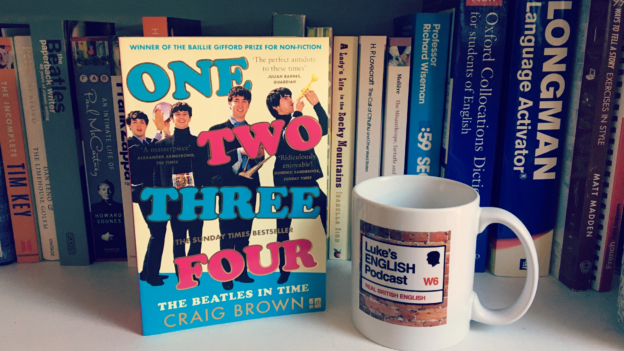
Talking to my mum about a book which you could read as part of your English learning routine. The book tells the story of The Beatles and their impact on society. We review the book and then discuss many aspects of The Beatles story, especially the four Beatles themselves.
This is a new episode of Gill’s Book club and I’m talking again to my mum, Gill Thompson about a specific book which you might want to read as part of your English learning routine.
Hello Mum, how are you?
Introduction
The book this time is all about The Beatles, which is a band from England that you *might* have heard of.
You could read this book, and if you did I’m sure you would learn plenty of things both in terms of language and general knowledge, but there’s no pressure to do so. If you like, you can just listen to this conversation with my mum and hopefully this will be interesting and useful enough on its own.
But if you are looking for a good book to read in English, then this one could be a good choice, and hopefully this conversation will help you to understand the whole thing a bit more, which in turn should help you pick up more English from it. So, my advice is: listen to this conversation with my mum and if you’re inspired, get a copy of the book and read it, or if you prefer, just listen to us without feeling any pressure to read the book at all. Hopefully this will still be enjoyable and interesting even if you haven’t read the book and have no plans to do so.
Over 700 episodes and 12 years ago, in the 3rd episode of this podcast, I interviewed my mum about her memories of seeing The Beatles performing live on stage in the 1960s, which she did, twice.
Now, we’re going to talk about the band again, this time focusing on a book which is all about the Beatles phenomenon and their place in history. The plan is to review the book as a text for learners of English, and then have a deeper discussion about The Beatles.
You probably know that I’m a big fan of The Beatles and grew up with their music, as my parents were (and still are) fans too. For years I’ve been thinking about doing more episodes about The Beatles story, and mentally preparing myself for it, but I have never actually got round to recording anything, mainly because the topic is just too big and there’s too much to say! But finally I have actually recorded some episodes that might scratch the surface of this topic a bit, and hopefully will give you something insightful and interesting to listen to, whether you are a fan of this band or whether you know almost nothing about them at all.
So this is going to be the first in a series of episodes in which I talk about Beatle-related things. There’s this one with my mum and then a few episodes with another guest who is an English teacher and something of an expert on The Beatles, and John Lennon in particular.
So, Beatle episodes are coming. I suppose, for some of you, episodes about The Beatles are like busses. You wait ages for one and then loads of them arrive at the same time.
And by the way, I am certainly not forgetting the main focus of this podcast, which is all about helping you learn English. I think The Beatles can help you learn English, reading is very important in learning English, and so why not do some reading about The Beatles?
Plus, later in this Beatles series there will be some language-focused episodes, using The Beatles as a context – focusing on some specific descriptive vocabulary and also some analysis of the Beatles’ song lyrics.
Maybe you’re not a fan of The Beatles. This is fine. I’m not going to try to convince you that you should like their music. That’s a matter of taste. But I do think that their story is something else entirely. I think it is hard to deny the fact that the story of these 4 individuals, the things that happened to them and the impact they had on the world – this is all simply fascinating. It’s an epic story. So, even if you don’t like the music, I hope you stay just for the story.
Now, let’s start this episode of Gill’s Book Club, talking about a recently published book about The Beatles.
Length – Is it a long book?
It’s long (642 pages) but the chapters are short, so it’s possible to read it in little chunks.
It’s available in audiobook and Kindle versions.
Appropriacy for Learners of English
The language is modern and plain in style. It’s quite literary of course, because it is a book and not a screenplay or something, but generally speaking it is clearly written and should be readable for learners with an Upper Intermediate level or above, although there will be some difficult words of course, but that’s good. I would say that overall the style is modern, neutral and definitely the kind of English that I would recommend as a good model of English for my listeners.
The short chapters make the whole thing quite easy to digest. It’s in bitesize chunks.
You can dip into it and you don’t necessarily have to read it in order. It’s almost like a collection of essays.
Audiobook version
The audiobook version on Audible is good – different voices and voice actors doing different accents, including pretty good impressions of the main people involved.
Why is it called “One Two Three Four”?
This is the first thing you hear on the first song on side 1 of The Beatles’ first album “Please Please Me”, released in early 1963 – You can hear Paul McCartney counting the band in at the start of the song by saying “1, 2 , 3 , 4”. Also, there were four Beatles, so…
Ending
So there you have it, after more than 700 episodes I finally returned to the topic of The Beatles with my mum and I think it’s fair to say that we went into quite a lot more depth than we did in episode 3 back in 2009, although episode 3 does include stuff we didn’t mention here, specifically my mum’s account of actually seeing The Beatles perform live, twice. So check out episode 3 if you haven’t done so.
Also you could check out that episode in which I asked my uncle Nic to tell us about the time he met Paul McCartney. He told the story in episode 414, and not only has he met Paul, he’s also played football with the members of Pink Floyd and hung out with The Who backstage at one of their concerts, and more. So check that one out too. Links for those episodes are on the page for this one on my website of course.
I really hope you enjoyed listening to this episode. I must admit that although I feel compelled to talk about this subject at length, part of me is concerned that this is all too much for my audience but I suppose those people who aren’t into this can just skip this stuff. It’s completely up to you. But do let me know what you think.
Remember, any time you have any thoughts about what you are hearing on this podcast, if you have responses or comments in your head as you listen, you can express them in English and I will read those comments, and so will many other LEPsters. The best place to leave your comments is on the page for the relevant episode on my website. Go to EPISODES in the menu and find the relevant episode page, scroll to the bottom and that’s where you will find the comment section. I am curious to see what you think. Any Beatle fans, get in touch. Non Beatle fans, I want to know what you’re thinking. Remember, sometimes doing this podcast is a bit like talking into the void and not quite knowing what people are thinking while I’m doing it.
I won’t talk much more at the end here, except that of course there are millions of things I wish I could have mentioned or talked about in this conversation.
We didn’t talk enough about Ringo!
There are also loads of other people and events that I wanted to mention.
I hope I didn’t talk too much.
Just in case this wasn’t quite enough rambling about The Beatles on this podcast, remember there are four (count them) four more episodes on The Beatles to come, but hopefully those episodes will be different enough to justify this series.
Anyway, 4 more Beatle related episodes are coming up.
One is a discussion about John Lennon.
Another two are language focused and we’ll be talking about adjectives for describing personality traits.
And the last one is about Beatles song lyrics and little phrases and idioms that you can learn from them.
So it’s not just rambling about The Beatles, although that will be part of it too.
Thanks again to mum for her great contribution to this episode, and yes I am lucky to have a mum who is this cool. I appreciate that and I’m really glad to get her voice on the podcast along with my other guests.
And thank you as ever for listening all the way to the end, you are the best.
Take care, look after yourselves and each other and I will speak to you again soon. I think the next episode will be Michael from Poland. But until then it’s time to say good bye bye bye bye bye.
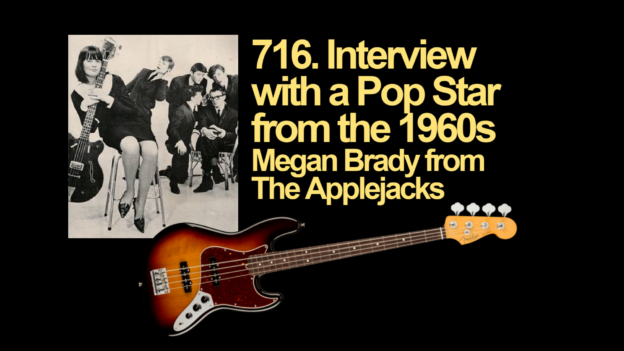
An interview with Megan Brady, who was the bass player in The Applejacks – a pop band from Birmingham in the 1960s who had a top 5 record, met The Beatles and performed on TV shows and at concerts in the UK.
Hello listeners. In this episode you’re going to listen to me in conversation with Megan Brady who was a pop star in the 1960s. Yes, a proper pop star. She was in a band which had a top 10 single, she was on the radio, she appeared on a lot of the music TV shows, she met loads of other pop stars of the moment including the Beatles – yes she met The Beatles, and in fact John Lennon and Paul McCartney gave her band a song which they recorded – their second single actually, the band were featured in the music magazines and no doubt many teenagers all over the country had her photo on their bedroom walls. Yeah, proper pop star stuff. So this is the story of Megan’s career in music in the 1960s.
You might be thinking – which band was Megan in? Well the band was called The Applejacks – you might not have heard of them. They’re not one of the big bands that we now think of when we look back at the 1960s, and they didn’t really reach fame on an international level but they were certainly part of the scene, and were well known at the time. My mum was a fan of The Applejacks, for example.
Of course we know about The Beatles and The Rolling Stones but there was a whole wave of other groups from all over the UK who were playing a new form of music and so many young people were really into it, and that includes The Applejacks who were from the Birmingham area.
The 1960s was a really fruitful period in terms of modern British culture and I am proud of that part of our history. I find it fascinating, I like the music and I like the stories of the people involved, and I hope you do too.
My guest is Megan Brady (although she was known as Megan Davies in those days) Megan was the bass guitar player in the band, and at the time it was quite uncommon to have a female musician in a group. We’re talking about the early to mid 1960s. There were female singers, but you hardly ever saw girls actually playing instruments in bands, and so that was one of the unique things about The Applejacks.
So, yes, you’re going to hear Megan talking about all of this, as well as other details like her other career as a clinical physiologist in neurophysiology in the National Health Service (that basically involves studying people’s brain waves) and just stuff about playing the bass guitar, how she’s still working on her technique and things like that.
I know Megan because I’m mates with one of her sons, Jake – or Jacob as she calls him. I met Jake at sixth form college and we played music together in bands over the years.
I was always really impressed by the fact that his parents were both professional musicians, or had been professional musicians at various times because I was so into music from the 60s and 70s including a lot of the artists that Jake’s Mum and Dad had worked with or brushed shoulders with over the years.
For example, I was really into Jimi Hendrix when I was 16 or 17 and I remember talking to Jake about Hendrix and he told me that they actually had Jimi Hendrix’s wah-wah pedal at their home somewhere. A wah-wah pedal is a kind of guitar pedal. Jake wasn’t bragging really, he thought it was cool too, and he just wanted to share it with me and I believed him! “Hey, you like Jimi Hendrix – check this out, we’ve got Jimi Hendrix’s wah-wah pedal at home! Come over I’ll show it to you!” Whaaat? Etc.
Also, I went to Jake’s house one day and I was hanging out in his bedroom listening to some of his music, and his mum’s bass guitar was sitting there – a nice Fender Jazz bass – and I picked it up and played it a little bit, and Jake said to me “Oh yeah, Jimi Hendrix played that bass once!” I couldn’t believe it! Hendrix played the same bass that was actually in my hands. It turned out that Jake’s mum knew Hendrix a bit, back in the old days and he once had a little go on her bass guitar – the same one that was in Jake’s bedroom that time.
Eventually I learned more and my parents told me more about Megan and that she had played bass in The Applejacks in the 60s and they were one of the popular groups of the time.
So that’s how I know Megan. I am friends with her son, and now I’ve finally taken the initiative to interview her on this podcast. Megan is lovely and she was happy to do this, which I really appreciate.
Vocabulary
Before we start, I need to just explain a few words that you’ll hear but you might now know.
The Scouts / The Scout Association / Cub Scouts / Girl Guides / Brownies – The Scouts is a worldwide movement for young people (it used to be just boys, but these days it’s for boys and girls I think), founded as the Boy Scouts in England in 1908 by Lord Baden-Powell with the aim of developing character and responsibility. My brother and I used to be Scouts and so did my dad. What kinds of things did we do?Megan was in the Scouts and so were most of the other members of The Applejacks. That’s how they met.
Gang show
Cub mistress
Scout hut
Skiffle
Skiffle numbers (songs)
The Shadows
A cruise / a cruise ship / Cunard Cruises
The Queen Mary and the QE2
Top of the Pops
Great Ormond Street Hospital – a famous hospital in London specialising in pediatric care (medical care for children) Where Megan has worked since the late 1990s.
Bass guitar stuff – Just a heads up – things will get a bit geeky and specific sometimes in this conversation as we talk about playing the bass guitar, different types of bass guitar and Megan’s bass playing technique. During lockdown she’s been practising with an online bass guitar teacher called Scott Divine from Scott’s Bass Lessons. I didn’t want to cut those parts out of the conversation because I personally find those things really interesting, Megan was enthusiastic about them and so who’s to say that you won’t find them interesting too?
Parts of a guitar – The head, the machine heads & tuning pegs, the neck, the body, the pickups, the scratchplate (or pickguard), the pick, the bridge.
Fender Jazz Bass vs Fender Precision Bass
Right, without any further ado then, let’s listen to Megan Brady talking about playing the bass guitar and her story of being a pop star in the 1960s.
And to lead us into this I’m going to play a little sample of The Applejack’s first and most successful single which was called Tell Me When, released in 1964…
Ending
Ending song – Baby Jane by The Applejacks
Thanks again to Megan for taking the time to talk to us about all of that.
You might be wondering why I didn’t get Megan to play some bass for us, which would have been really nice of course.
I didn’t want to put her on the spot, plus for us to hear it properly she’d need to plug it into something like an amplifier and connecting an electric guitar to a computer and playing the sound during a call is a bit tricky too, so it wasn’t really possible at that particular moment.
But you can hear songs by The Applejacks on Spotify and YouTube.
I’ll be sharing some bits and pieces on the page for this episode, including a video filmed in 1964 I think, of Megan performing with The Applejacks, which is a great little sample of the time and you can see her playing I think her Hohner semi-acoustic bass.
The super-long introduction that I recorded but didn’t use – you’ll find it as bonus audio in the app. I go into more details about how I first met Megan’s son Jake and also some other ramblings about The Applejacks…
Tell Me When (Their biggest hit)
Like Dreamers Do (by Lennon/McCartney)
https://youtu.be/FB7lbucimhI
I Go To Sleep (by Ray Davies of The Kinks)
Baby Jane
The Applejacks on Spotify
Cookies on teacherluke.co.uk
Click “Accept All”, to consent to the use of all cookies on this website, or visit "Cookie Settings" to control your consent settings.
This website uses cookies to improve your experience while you navigate through the website. Out of these, the cookies that are categorized as necessary are stored on your browser as they are essential for the working of basic functionalities of the website. We also use third-party cookies that help us analyze and understand how you use this website. These cookies will be stored in your browser only with your consent. You also have the option to opt-out of these cookies. But opting out of some of these cookies may affect your browsing experience.
Necessary cookies are absolutely essential for the website to function properly. These cookies ensure basic functionalities and security features of the website, anonymously.
Cookie
Duration
Description
cookielawinfo-checkbox-analytics
11 months
This cookie is set by GDPR Cookie Consent plugin. The cookie is used to store the user consent for the cookies in the category "Analytics".
cookielawinfo-checkbox-functional
11 months
The cookie is set by GDPR cookie consent to record the user consent for the cookies in the category "Functional".
cookielawinfo-checkbox-necessary
11 months
This cookie is set by GDPR Cookie Consent plugin. The cookies is used to store the user consent for the cookies in the category "Necessary".
cookielawinfo-checkbox-others
11 months
This cookie is set by GDPR Cookie Consent plugin. The cookie is used to store the user consent for the cookies in the category "Other.
cookielawinfo-checkbox-performance
11 months
This cookie is set by GDPR Cookie Consent plugin. The cookie is used to store the user consent for the cookies in the category "Performance".
viewed_cookie_policy
11 months
The cookie is set by the GDPR Cookie Consent plugin and is used to store whether or not user has consented to the use of cookies. It does not store any personal data.
Functional cookies help to perform certain functionalities like sharing the content of the website on social media platforms, collect feedbacks, and other third-party features.
Performance cookies are used to understand and analyze the key performance indexes of the website which helps in delivering a better user experience for the visitors.
Analytical cookies are used to understand how visitors interact with the website. These cookies help provide information on metrics the number of visitors, bounce rate, traffic source, etc.
Advertisement cookies are used to provide visitors with relevant ads and marketing campaigns. These cookies track visitors across websites and collect information to provide customized ads.