Category Archives: Interview

483. A Rambling Chat with Moz

The second part of my conversation with my friend Moz, this time covering subjects such as podcasting vs YouTube, bathing naked in a Japanese spa, sharing personal information online (like a story of bathing naked in a Japanese spa), the role of artificial intelligence & social media, murdering mosquitoes and meeting a crack addict on the streets of London. Vocabulary list and quiz available below.

[DOWNLOAD]

Introduction Transcript

Hi everyone, Here’s the second part of my conversation with my friend Moz that was recorded a few weeks ago.

After talking about murder in the last episode, Moz and I kept talking for about another 45 minutes, just rambling on and going off on a few tangents and you can listen to that conversation in this episode as part of your ongoing mission to improve your English by listening to real conversations that actually happened, between actual people who actually said some actual things and actually recorded them and uploaded them for you to actually listen to.

Things that we actually talked about (in the form of questions)

  • What goes into making and publishing a podcast?
  • Who is my audience and where are they (that’s you)?
  • What’s it like to meet members of my audience?
  • What’s the difference between doing audio podcasts and making videos for YouTube?
  • Should native speakers adapt their speech when talking to non-native speakers of English?
  • Does the word ‘cack’ in English relate to similar words in other languages?
  • What does ‘cack’ mean? (it means poo, by the way)
  • How much of our personal information should we be sharing online?
  • How much of my personal information should I be sharing in episodes of this podcast?
  • Should you post pictures of your children on social media?
  • What are the effects of social media and artificial intelligence on our lives? How might this change in the future?
  • How could you fight against a robot invasion using an umbrella and software updates?
  • How much do we hate mosquitoes and what happens when you kill them?
    and
  • How can you identify different drug addicts that you might meet on the streets of London, just based on how they smell?

I think they all sound like perfectly good questions for discussion, don’t you? I can even imagine some of them cropping up in the speaking section of a Cambridge English exam. Some of them. Maybe not the one about cack, or the one about drug addicts, but who knows?

Listen on to find out how we talk about all of those points.

If you’re a vocabulary hunter, check the page for this episode on my website because there you’ll find a list of words and phrases that come up in this conversation.

That list is available in order to help you to use this episode to expand your vocabulary and to develop a more natural form of English.

There is a bit of rude language and some slightly graphic content in this conversation. Just to let you know…

But now it’s time for you to hear the rest of my chat with Moz.

And here we go.


Vocabulary List

  • These days I’m a lot more devoted to it than I used to be
  • When the inspiration struck me
  • I try to be a bit more organised and rigorous about it
  • There are some teachers on YouTube who are getting phenomenal views
  • There are also various young, hip, fresh-faced YouTubers
  • I’m sticking with podcasting because it works for me
  • Technology has moved on so fast that we can do these things ourselves
  • A digital SLR with a boom mic attached to it (or a shotgun mic)
  • Those are the ingredients for making a hit youtube channel
  • Libsyn is my hosting site and I’m about to sign up with iTunes
  • I had to replace all of the embedded players on my website
  • A ‘hell of a lot of stuff’ that had to be done
  • Libsyn have various different filters that they apply to the data
  • The internet is basically this huge network with all these different sub-stations
  • My podcast is big in Wisconsin. It is the home of Ed Gein, the murderer
  • A lot of internet servers are based in that part of America
  • There’s some sort of internet sub-station or routing station in Virginia
  • If people are using VPNs or proxy servers that counts as coming from the USA
  • I’m trying to use an element of scepticism when I’m reading my stats
  • Lots of people are getting my podcast from bit-torrenting sites
  • I tell you what, a good way of working out how many listeners you get…
  • Every now and then someone comes out of the woodwork
  • I used to have the word ‘whittle (down)’ in my tour
  • You get a piece of wood but you slowly etch away pieces of wood to make it into something else
  • People whittle a stick down to a spike or something
  • You whittle the evidence down until you get the bare bones of the case
  • It’s helped me work out the kind of phrases that only English people use
  • Some aspects of our pronunciation or idioms are a barrier to the global community
  • Communication is a two-way street
  • I’ve just come away from dog-sitting with my brother [your brother is a dog??]
  • They were brummie (from Birmingham)
  • Their brummie was so strong that I couldn’t understand my own language
  • It was only when she came nearer that I could grasp what she was talking about
  • Do you curb your language, or do you hone the way that you speak on this podcast?
  • If they’re not careful they swing too far in the other direction and it becomes unnatural
  • It’s a balancing act between trying to be understandable and trying to be natural
  • “Oui, oui” = “yes, yes” in French
  • Wee wee = unrine (pee pee in French)
  • Poo poo = excrement
  • “Caca” = “poo” in French
  • Cack (another English word for poo)
  • Input = just the language you hear when listening
  • Intake = the language you are really focusing on when listening
  • The more personal they (podcasts) are, the more I get engaged
  • Stiff upper lip and all that, hopefully the lip will be the only thing that’s stiff
  • The pianist stops playing
  • I felt like everyone broke off their conversations
  • Naked guys lounging around, chatting
  • The first guy who walks past me is a midget
  • It did occur to me to check him out and see if it was in proportion
  • I don’t necessarily want to open up the doors of my house
  • We don’t really want to post lots of pictures of the baby on Facebook
  • She has remained true to her word

How much of the vocabulary can you remember from the list?

Take the quiz below to find out. Not all the vocabulary is in the quiz, just a selection.

[os-widget path=”/lukethompson2/vocab-quiz-for-483-a-rambling-chat-with-moz” of=”lukethompson2″ comments=”false”]

That’s all folks!

Don’t forget – Moz’s podcast, called “Murder Mile True Crime Podcast” is available now on iTunes and at www.murdermiletours.com.

Moz’s links:

www.murdermiletours.com

www.murdermiletours.com/podcast

482. The Murder Mile True Crime Podcast (with Moz) More Creepy Stories of Murders in London

My friend Moz, who runs a murder-themed tour company in London, is back on the podcast to talk about some more creepy stories of crimes from London’s history and his new podcast. Vocabulary list and quiz available below.


Small Donate Button
[DOWNLOAD]

Links

www.murdermiletours.com

www.murdermiletours.com/podcast

Notes and Introduction Transcript

Moz (aka Michael Buchanan-Dunne) has appeared on the podcast a number of times before, for example in the Brighton Fringe Festival episodes, the drunk episode, the episode recorded on Moz’s narrowboat and also the episode from last year called “Murder Mile Tours”.

337. MURDER MILE WALKS: Stories of London’s Most Infamous & Shocking Murders [Some Explicit Content + Swearing] with Moz

If you haven’t heard those episodes, let me bring you up to speed as it might help you understand some of the things we talk about in this conversation.

I first met Moz and made friends with him about 8 years ago while doing stand-up comedy in London.

He used to work for the BBC, making comedy television programmes, but then a few years ago he decided to set up a tourism company and bought a narrowboat which he now lives on. Narrowboats are boats that can be used on the UK’s canal system. They’re long and narrow and they’re boats, hence the name “narrowboats”.

Moz now lives on his boat which he usually moors at different locations throughout London’s canal network (there are lots of canals running through London).

He also runs a successful tour company in London, called “Murder Mile Tours”.
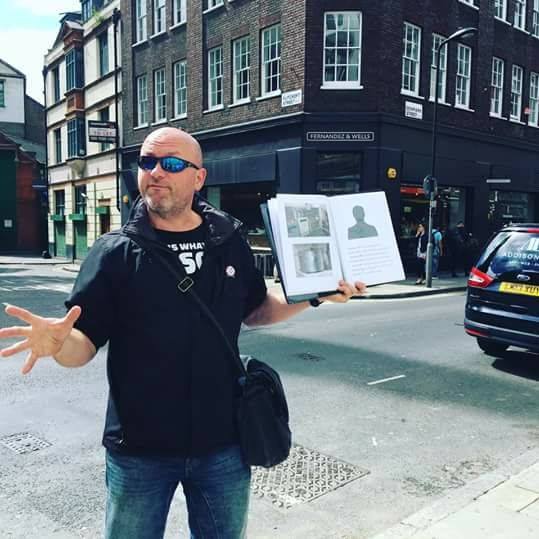
His most popular tour is called the “Murder Mile Walk” which currently takes place in Soho in central London every week. The walk takes in various sites where murders have actually occurred. Some of those murders were the work of serial killers and they all have gruesome stories connected with them, stories which Moz has painstakingly researched by looking up lots of archived material including court records from courtrooms in London.

Last year I invited him onto the podcast to tell us some of those stories. That proved to be one of the most downloaded episodes of the podcast last year. Since then his tours have gone from strength to strength – not directly a result of being on this podcast of course, although that has helped because quite a lot of LEPsters have been on the murder mile walk with Moz, no, the tour seems to be going really well because it seems really fun, it’s original, the stories are fascinating, and the tour has had loads of 5 star reviews on Trip Advisor.

In fact just recently Murder Mile Tours received a TripAdvisor certificate of excellence, which is a really great achievement. TripAdvisor describe it as one of the 150 best things to do in London and Time Out Magazine described it as one of the top 3 themed tours in the city.

Now Moz has decided to start up his own podcast in which he will regularly share some of the stories he has discovered while doing his research. His podcast, called “The Murder Mile True Crime Podcast” will be available from 1 October (you’ll be able to find it on iTunes – or just check https://www.murdermiletours.com/podcast).

So, I’ve invited Moz to come back onto the podcast to talk about all of this.

Moz and I are friends, so this isn’t just an interview, it’s also a light-hearted informal conversation and a chance for the two of us to catch up on each other’s personal news and just have a bit of fun while we’re doing it, and you are invited to join us.

You should know that this episode contains some graphic content and explicit language
including some fairly detailed descriptions of violence and murder
and some other things that you might find disturbing or disgusting.

I feel I should let you know that in advance, just in case you’re squeamish and you don’t like that sort of thing – but to be honest the content of this episode is no worse than what you would see in the average episode of a TV show like CSI or Game of Thrones.

But still – there are some creepy and gruesome details in this episode, so – you have been warned.

By the way, if you’re interested in some of the items of vocabulary that you can hear in this conversation, you should check out the page for this episode on my website. You’ll see a list of words and phrases there which you learn in order to add real strength and depth to your English.

OK so here is part one of my conversation with Moz, the guy from Murder Mile Tours.

murder mile tours

Vocabulary List

  • “Sacre bleu!” (French – used to express surprise or amazement)
  • “There’s lovely” (this is what Welsh people apparently say a lot – it means “that’s nice”)
  • “Zoot alors!” (an old-fashioned French phrase – it’s used to express surprise, shock etc)
  • More excuses for my lack of improvement in French. [absence of]
  • I’ve got to pull my socks up, pull my finger out and turn over a new leaf. [all these phrases are ways of saying “improve my attitude and approach”]
  • I don’t have long to get the French up to scratch. [improve it to an acceptable level]
  • Rutting [when animals, such as deer, have sex – but also when the male deer fight with each other during the mating season]
  • A deer [an animal with big antlers – click here find out more on Wikipedia]
  • Wild boar [a sort of wild pig – more info]
  • “During the rutting season the male boars have terrible mating battles”
  • It’s a scratchy howl [a howl is the sound an animal makes – usually a dog or wolf at night, e.g. ‘to howl at the moon’. ‘Scratchy’ describes the rough sound of the howl]
  • Foxes, when they’re mating, make a high-pitched scream which sounds like someone being murdered
  • I’m not registered for council tax [tax you pay when you live in a house or flat]
  • I’ve got a P.O. Box [a post office box where you can have post delivered if you don’t have a fixed address]
  • I’m not condoning mass murder [promoting it, saying I agree with it]
  • The police had sectioned off the walkway [used plastic tape to prevent people from accessing that part of the walkway]
  • Someone may commit suicide and the body floats down (the canal) [commit suicide = kill yourself / float = not sink, but stay on the surface of the water]
  • Grisly details [unpleasant, involving death or violence]
  • People think that a canal is a good place to dispose of a body [to get rid of a dead person]
  • The canal has been used for dumping rubbish, but also corpses [dumping = throwing away, getting rid of, disposing / corpses = dead bodies]
  • They decided to take this guy’s card and start withdrawing money [taking money out of the bank]
  • The culprits were found guilty of ‘denial of a proper burial’ [culprits = people who committed a crime / ‘denial of a proper burial’ = a criminal charge which is given in a court – it means when someone didn’t bury a dead person properly, or perhaps didn’t dispose of the body in the legal way]
  • That was the main charge that they could definitely pin on them [a statement by prosecutors in court that someone committed a crime]
  • Eastenders is a soap opera that’s been on TV for years [a TV drama which is about ordinary people, shown on television on a regular basis]
  • “My auntie’s brother’s sister left me 10% of this pub in her will!” [a will = a document which explains who should receive someone’s property when they die]
  • He smoked skunk all the time [a strong and smelly form of marijuana]
  • He had an argument with her, killed her, chopped up the body [cut the body into pieces] and then wrapped up [put inside a sheet or some clothing] her limbs [arms and legs] and her torso [the body, but without the arms or legs], put them in a suitcase and dumped [threw away, disposed of] them in the canal
  • He bought loads of bin bags [bags for rubbish] and saws [tools for cutting something up]
  • Things got out of hand, they had an argument [things got out of control]
  • He dragged her down to the canal [pulled her along the ground]
  • The suitcase floated for about two miles [didn’t sink]
  • Poking out of the top of the suitcase was hair [you could see part of it coming out of the top of the suitcase]
  • I like having a good poke around [looking and investigating, perhaps by looking into something and moving things around] different streets and digging into [going deep into something] murders
  • Most murders are just men having fights, but occasionally you come across [find] a really good one
  • Don’t worry, we’re hung over! [feeling sick because they drank alcohol the night before]
  • I was a cannibal, [someone who eats human flesh] I’d eaten my girlfriend and her body was slowly working its way through my bowel (yuk!) [moving slowly through the lower part of the digestive system] yuk yuk!
  • It was one of the darkest jokes I’ve ever pulled off [managed to succeed bit it was difficult]
  • It didn’t get a laugh it just got a gasp [a shocked sound when people breathe in suddenly
    😱] and for me that was enough
  • It certainly got the evening off to a different start [to get something off to a start = to make something start]

  • Often the murderers are like slapstick movie idiots [a form of comedy involving funny physical movements, like people falling over or hitting each other]

Can you remember the vocabulary in the list?

Were you listening carefully? Take the quiz to find out.

[os-widget path=”/lukethompson2/vocabulary-quiz-for-episode-482-murder-stories-with-moz” of=”lukethompson2″ comments=”false”]


Links

Murder Mile Tours Website www.murdermiletours.com

Murder Mile True Crime Podcast www.murdermiletours.com/podcast

You can also follow Moz on Twitter @mmiletours

Part 2 (with more rambling tangents) coming soon…

[Website content] Luke on the RealLife English Podcast

I was on the RealLife English Podcast and we talked about why I became an English teacher, doing James Bond impressions and also comedy & how to use humour in learning English. You can listen to it here. More details about Real Life English below. Enjoy!

Last week I was featured in an episode of the Real Life English podcast and I just wanted to share it with you here on my website.

Check out the RealLife English website.

On their website you can:

  • Download this episode
  • Check out other episodes of the Real Life English podcast + more
  • See a vocabulary list with definitions
  • Check out their other learning English resources

#161: How to Be Funny in English (Special Guest: Luke’s English Podcast)

Have you heard of RealLife English?

RealLife English is an online community with a mission to inspire, empower, and connect the world through English, both online and in-person.  

It’s run by three English teachers, Justin (USA), Ethan (USA) and Chad (Australia) and they do a podcast, write blog articles, create YouTube videos and also host an online community for social learning. A lot like LEP, they believe in teaching English to the world in a fun, personal and inspiring way.

Recently I spoke to Ethan on the Real Life English podcast (and also recorded an episode of LEP) and we talked about lots of things, including British & American comedy shows, and how to use humour (and alcohol) in learning English. Listen to it above, or on the Real Life English website. I’m sure they’d appreciate some comments from friendly LEPsters.

I’ll be speaking to Ethan in an episode of LEP soon. You can look forward to that in the next few weeks.

Cheers!

Luke

473. Explaining the Rules of Cricket (with Dad)

Everything you need to know about the world’s 2nd most popular spectator sport, cricket. I’m joined by my Dad, Rick Thompson and we describe the rules, the appeal of the game and also some expressions in English that come from cricket.


[DOWNLOAD]

It’s summer in the UK and at this time of year there are various sounds that you might hear in a typical English village, the sound of bees buzzing, kids playing in the playground, an ice-cream van and perhaps the smack of leather on willow (the sound of a cricket ball – a hard, heavy ball covered in leather, being hit by a wooden cricket bat made of willow) those sounds coming from a game of cricket on the local village green.

Also, the sounds of cricket make their way into your home during the summer months as people listen on the radio or watch the coverage on TV.

International test match cricket is a feature of the summertime in England and is somehow deeply rooted into English life. It’s one of those cliches of rural England – sandwiches, afternoon tea and cricket on the green.

But for many foreign people who don’t play cricket it can seem like a weird antiquated slow game with rules that nobody understands. People are surprised that a game of cricket can last several days. Americans are often horrified to discover that games often end in a draw with no winner at the end.

The fact is, cricket is a fantastic game which requires strategy but there are many moments of dramatic action and great skill and ability shown by the players.

My Dad is a big fan of cricket. He used to play it when he was younger and has always followed the matches on the radio. I’ve been threatening for a while to do an episode about cricket, to somehow achieve the impossible and explain cricket to the world, and my Dad is going to join me.

So sit back, have a cup of tea and some cake, and try to get your head around this wonderful game.

And stay tuned for some nice idiomatic expressions which we use in English and which originally came from the game of cricket.


Well, that was a valiant effort by us. I hope you agree! But I wonder if you managed to keep up with all of it! If you are listening all the way to the end and you’re still alive – well done!

You may have got lost at some point along the way, or did you follow all of it? Let me know.

In any case I hope you got something out of that conversation, even if it is a sense that cricket is worth getting enthusiastic about even if you don’t fully understand it, and that it’s a big thing in the UK and many other countries around the world.

I recommend that you have a look at some cricket being played. There are videos showing you different aspects of cricket on the page for this episode, so check them out.

Also, there was that vocabulary.

Let me just go through the vocabulary again here, just to make it clear.

Vocabulary

  • On a sticky wicket = in a difficult situation (We’re on a bit of a sticky wicket here because of the result of the EU referendum) (NYTimes “It’s a sticky wicket for Obama,” said Bruce Buchanan, a political science professor at the University of Texas at Austin, saying any aggressive move on such a high-profile question would be seen as “a slap in the face to his supporters right after they’ve just handed him a chance to realize his presidential dreams.”)
  • To have a good innings = to have a good long life (How old was he when he died? 94? Oh, so he had a good innings)
  • It’s just not cricket = it’s not fair! (Getting queue jumped, it’s just not cricket, is it?)
  • It hit me for six = it surprised, shocked and stunned you. (When my ex-girlfriend told me she was getting married to my best friend it really hit me for six)
  • I was absolutely bowled over = I was really surprised and amazed (“Bowled over” actually comes from bowling not cricket – when a pin is knocked over by the ball) (We were really bowled over by your presentation, you did a fantastic job!)
  • I’m completely stumped. You’ve stumped me there. = I’m unable to answer that question because it’s too complicated. (I did ok in the listening part, but I was completely stumped by the grammar questions)
  • You’ve caught me out there. = You’ve asked me a difficult question which has shown that I’ve made a mistake. (What about the outstanding tax payments on your public accounting report? There’s 300 pounds missing! – Oh, you’ve caught me out there, hah, yes I forgot to include them!)

Videos

Stephen Fry explains LBW in cricket

Shane Warne from Australia – the greatest spin bowler ever

Great bowling

Excellent batting

https://www.youtube.com/watch?v=4zAsa_HFkVw

Amazing catches

https://www.youtube.com/watch?v=TdOoiR_EDiE

Thanks for listening!

472. Andy Johnson at The London School (Part 2) Why Andy runs marathons

Talking to Andy about why he runs marathons, including vocabulary relating to doing exercise, health, fitness, technique, injuries and medical care.

[DOWNLOAD]

Intro Transcript

Here’s the next part of my conversation with Andy Johnson, recorded at The London School of English a few days ago.

Andy is an English teacher, a father of 2 kids, and also a regular runner. He’s done at least one marathon and a few half marathons, and I thought since many of you listening to this podcast will also be runners (in fact some people will be running right now while listening to this) that it might be interesting to hear Andy talking about his reasons for running, the way he does it, the benefits, the difficulties and all the rest of it. So here’s a conversation about running.

If you’re not into running I would still recommend that you listen to this. You might be surprised at how personal it gets when Andy explains his reasons for training for the London marathon 10 years ago. It turns out that running has special significance for Andy and that running the London marathon was a key moment in his life as it marked a significant milestone for him – and running acts as a regular reminder of a particularly difficult experience Andy had when he was younger.

So, this episode is about running, but it’s also about much more than that. I’d like to thank Andy again for taking part in another episode of the podcast and for sharing so much of his story.

Vocab hunters: Watch out for vocabulary relating to doing exercise, health, fitness, technique, injuries and medical care.

So, without further ado you can now listen to our conversation about running.


Outtro Transcript

I just want to thank Andy again for coming on the podcast and telling us about his story. It was a very interesting conversation and I think the closest we’ve come to having tears on the podcast – it was a moving story but no tears this time! I wonder if you held it together out there in podcast land, or did you start welling up at any moment?

Don’t forget that Andy would like you to take his survey about self-directed learning. You can find a link to that on the page for this episode. Andy just wants to know about how you learn English on your own, outside of the classroom environment, and that includes how you use LEP to help with your English.

TAKE ANDY’S SURVEY ABOUT LEARNING

Click the link, the questionnaire will take a couple of minutes and you’ll help Andy with research for his next IATEFL conference talk.

That’s it for this episode. Watch out for some website-only content coming soon. Subscribe to the mailing list to get informed when that is released.

I hope you are continuing to have a good August, if indeed it is August as you listen to this. I’m still on holiday, relaxing and having a lovely time, I hope – I’m actually recording this before I went on holiday, so this is a very weird time situation. Which tense should I be using here, because I’m actually recording right now, in the past, but as I’m talking it’s the future, so my present is your past and your present is my future, so that’s the present past perfect future continuous or something. I am will have been being having a great time and I will have been had been hoped that you will be being having a wonderful time too, in the future.

Thanks for listening to this episode and I’ll speak to you again soon. Bye!

471. Andy Johnson at The London School (Part 1) Lego, Self-directed learning, accents

Talking to Andy about stepping on Lego, Andy’s job, self-directed language learning, accent, and British/American English.

[DOWNLOAD]

Intro Transcript

Today on the podcast I’m talking to Andy Johnson my friend and former colleague from the London School of English, who also looks a bit like Moby if you remember.

Andy has been on this podcast 4 or 5 times before so if you’re a regular listener you’ll know his voice already.

Andy is an English teacher, a marathon runner and a father of two children – in fact his second son was born very recently.

In this conversation you will hear us talking about:

  • The pain of stepping on Lego
  • Recording the podcast in what used to be the boss’s office at The London School of English
  • Developments in Andy’s job and his career
  • Andy’s next conference talk about self-directed learning
  • Where Andy comes from and his accent, including the ways we both say certain words like “Bath, grass, laugh, podcast, ask and after.”
  • The time when my Dad visited The London School of English
  • British and American people speaking English

This is part one of a two part conversation.

Without any further ado, here is part 1.


Andy’s survey

At the next IATEFL conference Andy is planning on doing a presentation about self-directed learning. You heard him talking about it in this episode.

Andy would like some help from you in preparing for the talk. He needs to do some research and he’d like to ask you a few questions about your English learning, particularly how you use this podcast, my website and any other resources for learning English.

He’s created a quick questionnaire and you can find it on the page for this episode. Click the link, answer the questions and you’ll help Andy a lot in his next presentation.

CLICK HERE TO TAKE ANDY’S SURVEY

It basically asks how useful LEP / teacherluke.co.uk and other sites are for learning English and how you find these sites. Andy also asks whether you pay for – or would pay for – additional language tuition. He’s trying to investigate why people are choosing LEP over traditional language courses (if indeed they are).

Stay tuned for the next episode, coming soon, in which you will hear Andy talk about his very personal reasons for training to run the London marathon – and I have to say that the conversation was much more surprising than I had expected and was also quite moving for a few reasons, so check that one out when it arrives.

Don’t forget to join the mailing list so that you’ll get email notifications whenever new episodes are uploaded over the coming days and weeks, and don’t forget to watch out for some website-only content coming soon too.

Thanks for listening and have a great morning, afternoon, evening, night or day whichever part of the world you’re in and whatever you’re up to.

Bye!
Andy and Luke

468. Punk – Music & Culture (with James)

Talking about punk music and culture from the UK with James.


Small Donate Button
[DOWNLOAD]

A bit of pop culture history in this episode, talking about the musical movement of punk and the social situation in which it happened.

This year we have several anniversaries in British music.

50th anniversary of Sgt Pepper by The Beatles

40th anniversary of Never Mind the Bollocks by The Sex Pistols

A lot changed in British music between the release of those two albums. 1967 was the height of the peace and love movement but 10 years later music was much more gritty, cynical and realistic. In this episode we’re looking at the whole punk movement, understanding what it was all about, what the music was like, who was involved and how the whole thing has now become a sort of pop culture myth.

I’m joined by my brother James who has been a fan of punk music ever since he borrowed a tape of The Sex Pistols from a chef when he was a teenager (I don’t think the fact it was a chef has any significance to the story, but I just like saying he borrowed the tape from a chef. I can imagine a man in a chef’s hat giving James a tape. Just me? Ok) So he discovered punk music later, in the early 90s. He wasn’t actually there at the time the music was made in 1977, he was too young, but he’s collected a lot of records by punk bands, read all the books, seen all the documentaries and even played drums in a few punk bands himself. I think he knows more about punk than anyone else I know, so I think he’s a good person to talk to.

Check out the page for the episode where you’ll see video playlists chosen by James and also a musical punk mix that he did from his vinyl record collection.

But without any further ado, you can now listen to my conversation with James about punk rock music and culture.


Conversation Notes

  • 40 years since Never Mind the Bollocks by The Sex Pistols was released. Is that the seminal punk album?
  • Why are we talking about punk in this episode?
  • What gives you any authority on the subject? Why should we listen to you?
  • Importance of punk for understanding culture
  • What is punk?
  • Origins of U.K. Punk
  • Youth subculture
  • Musical context
  • Political context – state of the country
  • American punk
  • Main bands
    • The Damned
      The Slits
      X-Ray Specs
  • What was the era like / music scene of the time
  • Spirit of punk
  • Purpose of punk music
  • Reaction to punk – tabloids
  • Punk art / design / fashion
  • 2nd wave / post punk / punk influence
  • Reality vs legend / absorption into the culture / establishment

Some Words & Phrases

  • Subculture
  • Subversive
  • Anarchy
  • DIY – Do It Yourself
  • Back to basics

From the archives: Other episodes you might like

134. The Story of Salvo

115. A Chat About Music (with James)

234. Making “Choons” with My Brother

Leave us your thoughts

  • Is or was punk popular in your country?
  • Is or was there a punk movement where you come from?
  • When did it happen?
  • What was it all about?
  • What was the music like?
  • How did they dress?
  • Is it similar or different to British punk?
  • Are British punk bands popular where you’re from? Which ones?

End song clip: 17 by the Sex Pistols

Videos

Sex Pistols on Bill Grundy (the unedited version)

Sex Pistols Christmas 1977 – A must see to show what a weird time / place England was in 1977 – click the video, it should work.

The gig that changed the world (24 Hour Party People)

https://www.youtube.com/watch?v=1vvGp_VPeLI

Classic Albums – Never Mind The Bollocks

https://www.youtube.com/watch?v=Jf50NIjAcsQ&t=64s

The Filth and the Fury trailer

The Sex Pistols absorbed into the mainstream establishment

Brilliant documentary about Joy Division

Cliched memories of punk (parody)

The Damned – New Rose (typical punk song)

Jim’s punk mix

Jim’s Punk Mix

461. 25 Deceptively Difficult Questions (with Amber, Paul & Sarah)

An episode about the tricky little questions that we use when socialising. What are the appropriate answers? What are the subtle differences? How do native speakers use these questions? Can you take the test and get all the right responses to my list of deceptively difficult questions?


Small Donate Button
[DOWNLOAD]

25 Deceptively Difficult Questions – Proper Introduction Transcript!

Hi everyone,

This is an episode about social English, the kind of English you use when you’re socialising, particularly the little things you say when you greet someone or at the beginning of a conversation.

There are many ways to say “hi” and also lots of ways to say “how are you?” or “what are you doing?” The tricky thing is being able to judge the subtle differences in the questions with the presence of auxiliary verbs or modals which change the meaning slightly from the past, to the present to the future or with slightly different levels of formality.

I’d like to do a test in this episode today. I am going to test you, so get ready.

A Test

Here’s what’s going to happen.

I’ve prepared a list of 25 questions. I’m going to read them to you in a moment.

As I say each question, what I want you to do is to think really quickly and really naturally about the first thing you would normally say when you hear that question. What’s the first answer that comes into your mind?

Let’s see if you answer correctly.

To find out the proper answers we’re going to listen to me directing those questions at Amber, Paul and Sarah. Then you can listen out for how they answer them and the comments we make afterwards, which should explain these tricky little bits of English.

Not only can you learn some essential social English in this episode, you can also hear plenty of humorous conversation between the four of us.

Sarah’s baby is also there in the background. I’m sorry if this bothers anyone. I’ve removed some of those noises but a few are still there. I think it sounds fine and adds a bit of atmosphere and after all she is a very cute baby.

So, the test. Let’s get started.

Are you ready? Just give the first answer that comes to mind.

Also, you should know that some of the questions are intentionally incorrect. So, if you hear a question which is grammatically wrong or just not used ever, you can say “wrong”.

Ok, so, your quick answer to the question, or “wrong” if it’s incorrect.

I’ll say the question once quickly, once slowly and once again quickly.

Some of these questions may seem extremely simple – the point of this is the pragmatics of social English and how you should give certain stock answers to some questions. They get a bit harder as they go along.

Also, you can try to repeat the questions too.

They’re going to come pretty quick, so use the pause button if you want.

Here we go. You might think these are easy, but that’s why this is called ‘deceptively’ difficult questions.

*4 questions are intentionally incorrect. Can you spot them?

  1. What are you doing?
  2. How are you doing?
  3. How’s it going?
  4. How are you going?
  5. What’s happening?
  6. What’s going on?
  7. What’s going down?
  8. What’s going up?
  9. What’s up?
  10. How do you do?
  11. How are you?
  12. How have you been?
  13. How have you been up to?
  14. What are you up to?
  15. What have you been up to?
  16. How long has it been?
  17. Can I use your phone?
  18. I can’t use your phone, can I?
  19. Do you mind if I open the window?
  20. You don’t mind if I open the window, do you?
  21. What are your plans for later?
  22. What are you up to later?
  23. Can you tell me where is the best bar in town?
  24. Do you know how long is it going to be?
  25. Would you be prepared to give me a 5% discount?

Ta = thanks

You’re now going to hear all those questions and how Amber, Paul and Sarah will respond to them. See if you got them right or wrong!

I’ll go through them again quickly at the end.

Listen to the whole episode for all the correct answers and explanations.

Don’t be a ninja! Let me know your thoughts in the comment section.

Cheers!

Luke

I was on The Rock n’ Roll English Podcast and The Earful Tower Podcast this week

Some news of Other People’s Podcasts

This week I’m featured in episodes of The Rock N Roll English Podcast and The Earful Tower Podcast.

The Rock n’ Roll English Podcast


This one is presented by English teacher Martin Johnston, who lives in Italy. It’s a learning English podcast for intermediate students who want to listen to people talking about normal things like sex, drugs and rock and roll, all of which are completely normal things!

Martin makes an effort to teach the vocabulary that comes up in his conversations that cover fun and interesting topics. It should be easy to understand this one as Martin grades his English a bit so that intermediate students can understand him.

In this episode Martin presented me with some very awkward social situations and we discussed my choices for each one. Often the best option was to just jump into a lake. Listen to the episode above to find out more and visit Martin’s website here.

The Earful Tower


This one was recorded a few weeks ago and has been published now. The Earful Tower podcast is run by Oilver Gee and their goal is to figure out France with the help of a new guest each week – from cooks and comedians to TV hosts and tour guides.

In the past they’ve interviewed Paul Taylor and this week it was my turn. The topic was how French people learn English.

You’ll hear three voices. Oliver Gee the host, who is half Australian and speaks with a bit of an Aussie accent and James his co-host who is half French but speaks English like a native, and me.

This one might be a little difficult to follow as Oliver has a bit of an Australian accent and the three of us talk pretty quickly.

This was a fun discussion about the ways French people approach learning English. There’s one thing I regret saying here and that is that French teachers of English aren’t good at English. What I meant was that this is always what French people say as a kind of excuse for why their English “isn’t good enough”.

It was lots of fun being on The Earful Tower. You can listen to it above and check out their website here and Facebook page here.

Thanks for reading and listening! New episodes of the podcast will be available soon. Hope you’ve been enjoying the Rick Thompson report!

Bye bye bye bye bye

Luke

457. Conclusions about Language Learning from the David Crystal Interview (Part 2)

A follow-up to episode 455 consolidating the insights of Professor David Crystal including various pearls of wisdom about language learning.

[DOWNLOAD]

Notes & Transcriptions

Hamid
If English keeps taking on words from other languages, will it stop being English?
This is the story of English.
English is a vacuum cleaner of a language.
Something like 300-600 languages have influenced English with words. If you look at English today. Where are the germanic words? They’re only about 20%. The other 80% is from French, Spanish, latin and others.
There is no single dominating influence on English today.
How many Urdu words have gone into English? Maybe 100. But English has over 1,000,000 words. No new cluster of words coming in is going to come in all at once (tidal wave) they come in drip drip drip.
New words are assimilated to reflect a need – e.g. for new types of food.
This is no threat to English.
In fact it’s evidence of the power of English, that it absorbs so many other influences from other languages and cultures. It’s like the blob!

Jilmani
What’s the future of English?
Unpredictable! Absolutely an unanswerable question. You should never try to predict the future of a language. It’s all about events which just happen, e.g. the Norman invasion, Trump or Brexit.
Will Brexit reduce the influence of English in EU?
Not much. But it will change its character because it won’t be used by so many native speakers, so there will be more developments “Euro English” (I think it has emerged a bit).
But English will continue to change and diversify.

Jairo wants help managing the workload of studies.
Learning about language is a huge burden.
Learning about a language you have to learn about the history, society and events of the time to understand why people were using language in those particular ways.
What was it like to be an old norse speaker?
But most philologists don’t have a psycholinguistic background to their studies.
Philology can be a bit dry.
David prefers the socially aware approach to the history of language which doesn’t just ask “what happened and when” but “why?” – let’s explore the nature of the people who made it happen. This should ease the process.

Cat
English syntax – can you explain it?
Come on you’re asking for a book here!
English has a simple morphology compared with German (or French).
How many possible word endings are there for a verb in English?
The difference between English and German is morphological but also syntactic.
English and German are quite close. They only diverged 2000 years ago.
Word order is a bit different.
Everyone understood David when he went to Germany and spoke German with the wrong word order.
There aren’t that many differences, although the few differences are noticeable.
Cat, why are you worried about local areas of syntactic difference between English and German. Why has this become an issue?
It usually comes down to identity. German English (used by people who have learned it really well) still is distinctively German English.
The point is, don’t be too concerned about micro differences in syntax between your language and English. As long as we understand you that’s the main thing, although obviously style is important so I imagine you want to write in the style of a native speaker (but which one though!) You might have to accept that it’s important to find your own voice in English, which might be influenced a bit by who you are (it is your own voice after all) – which is someone who lives in Germany. That’s not to say your English can be totally different and like German with English words – that would probably be unintelligible and a bit ridiculous. But micro differences aren’t such a big deal.
Don’t sweat the small stuff, it’s just small stuff.

Wesley
Do people who speak different languages think differently?
It’s difficult to translate words sometimes because there are some words which don’t directly translate because there isn’t an equivalent word. 10-15% of the words might be untranslateable. But in Chinese it’s a lot more.
But when you do psycholinguistic experiments we discover that people can see the different concepts, but having those specific words makes it easier to talk about those things. You can see the colours but you might not have the language for describing it.
Different languages might not have the same word for something but it doesn’t mean they think about them any differently.
E.g. in English we don’t have a word for a certain thing in Japanese – natsukashii for example. But we find other ways of describing it. Ah, it takes me back or “good old” or “it feels nostalgic” or “it’s good to be back”.
So it doesn’t seem to be the case that languages affect or reflect different perception of the world.
*But I reckon there might be something to it Wesley. E.g. sense of humour, patterns of understatement, all contribute towards expressing a sardonic outlook on life (UK) rather than a direct attitude in the mediterranean for example.
The fallacy is that it’s words that translate, but it’s not it’s sentences. A group of words together are what hold meaning. So even if there’s no single word equivalent, you put some words together and make a sentence and that’s how the language transcribes.
“Snow that you use to build an igloo with” – he can still express that thing with a sentence and you can see that kind of snow.

Learn the vocabulary of a new language and you’ll see the cultural things that it reflects. It shows that to learn the language properly you should learn about the culture too – the mindset, the reference points and so on. You can see all those things too, but having certain words and expressions makes it easier to talk about them.
The result is that in languages it’s easier to talk about commonly occurring cultural phenomena because the language has the tools to do it, but people are all still basically the same, we might just take a bit longer to talk about a concept that in your language is very normal.

Mayumi
Why do Brits use indirect language?
It’s just a cultural difference. It’s the British temperament. The reason for that is hard to say. Maybe it’s because the UK is an island and the psychogeographic factors might affect that kind of language use.
Pragmatics – the study of why people are using specific bits of language.
Language norms reflect the cultural context – that’s the identity argument.
But why does the UK use this polite language? We don’t really know! You have to ask why British people want to be polite. (obviously it’s because we’re such nice people)
You just have to accept the cultural differences. Learn about them and accept them. “That’s who we are.” should be a good enough answer.
As ever, you must accept cultural differences. They’re not weird, they’re just different. It’s a good bit of advice for anyone coming into contact with another culture. You can speculate about why people behave the way they do, but ultimately you’ve just got to accept it and move on, like the way you often have to accept in English that “this is just what people say in this language” and that’s it.

Synchronic not diachronic method.

Wikipedia:
Synchrony and diachrony are two different and complementary viewpoints in linguistic analysis. A synchronic approach (from Greek συν- “together” and χρόνος “time”) considers a language at a moment in time without taking its history into account. Synchronic linguistics aims at describing a language at a specific point of time, usually the present. By contrast, a diachronic approach (from δια- “through” and χρόνος “time”) considers the development and evolution of a language through history. Historical linguistics is typically a diachronic study.

DC says we should use a synchronic approach to understanding these things – why is this particular person choosing to say it in this way, right now?
Some more modern dictionaries now contain essays about usage and pragmatics, which help us to identify how culture affects language. It’s worth reading the extra comments and information pages you find in many dictionaries.
Also, consider reading cultural guides as well as purely linguistic ones.

Antonio
Will AI replace the need for language learning?
Babel fish (Hitchhiker’s Guide)
In 100 years it’ll probably be perfect.
(I’ve seen auto subs have improved recently).
Imagine a situation where the babelfish is operating perfectly. It would solve lots of problems, but identity hasn’t been addressed. I still want to “be French” and the AI might not include those differences. People will still hold onto their languages in order to express their identity. It won’t affect language diversity.
But it might mean that AI might make the need for a global language redundant. Maybe AI will replace English. Why bother learning an international language?
But there are various answers to that – tech might let you down so people might not choose to constantly rely on it – some conditions in which there is no electricity.
Will AI manage to be perfect like a human, with the ability to translate with a view to expressing the culture?
Human translators choose between different competing nuances. I could say it this way, or this other way. We make those decisions based on complex social and psychological factors. A computer might not have that cultural sensitivity, maybe only in the long term.
The number of people learning languages might be reduced, but it’s also ignoring another factor in learning another language – the want to become aware of the culture, history and literature of the other language. There’s a personal satisfaction in learning another language and enjoy the pleasant things about it. People learn languages because they want to not because they need to. It’s a pleasure.
There are many reasons to want to continue to learn, it’s not just about intelligibility.
For the forseeable future he can’t see that it would be economically viable to create that technological solution for language when the traditional methods are the best way to foster relationships.

Jack – I don’t know where you come from.
First of all, David doesn’t mind being addressed in the Ali G dialect.
“Me” instead of “I”.
“Me wants to know…”
“I is well impressed…”
Subject verb agreement. “I is…”
“Booyakasha”
“It is a well big honour”
It’s quite a skill to be able to switch between registers. Sometimes we break the rules as a stylistic choice, like with the expression “If it ain’t broke, don’t fix it.”
It’s important to be able to switch between different styles and registers but you also have to know when it is appropriate to do it.
I’m not bothered by it in the comment section of my site, but you should be aware that some other people might find it weird or inappropriate, like for example if you write that in forums on other websites, in the comment section of Amber’s new podcast about Paris history, or in some business meeting. It’s going to seem really weird. So, you need to seriously think about the appropriacy of the things you’re doing and that means the style of English you’re using, or the decision to post dodgy pictures of cakes on my website.
Should the listeners learn the rules of grammar, or should they just focus on meaning, and let the rules look after themselves?
Both but in a structured sort of way.
In communicative teaching the structured side was a bit lost.
Just listening and working things out by being dropped in at the deep end is a bit of a big step – it takes a while.
It’s also important to do some structure work, but also to expose the learners to things that illustrate the language point being used in a functional way.
So it’s not just about form, but also about function and trying to balance the two.
So, as we’ve said before – do both. Some structured language work, combined with exposure in which you are really focused on following the meaning of what’s being communicated. Then probably some more reflection on the way it was done. Moving between grammar and pure meaning all the time. Juggling.

Back to the conversation with friends recently.

People get upset by failing standards in English.

Again, David doesn’t mind – as long as the language is intelligible then it’s a sign of changing identities – a sigh of the times.

Are we better at communicating than we used to be?

It is possible to measure, but not possible to give a simple answer. It depends on the situation.
Book: “The Gift of the Gab” How eloquence works.

Eloquence standards do vary from generation to generation, circumstances, individual to individual. E.g. Obama and Trump – differences in eloquence. Is Trump incoherent? Is Obama a better communicator? Some people say Trump is incoherent and inarticulate. But it’s not necessarily true considering Trump’s ability to communicate with his core voters.
People cite various things as examples of falling eloquence standards, e.g. using “like” but often these aren’t really examples of falling standards, it’s just a question of style.

How do we use “like”?
As long as it doesn’t get in the way, it’s just a question of style.
Again, people see language changes and they equate it with decline. It’s not.
Usually, people are giving examples of things that are just a different type of eloquence (again, change not death).

Trump’s English has a style with its own values. He avoids the rhetorical style of Obama with balanced, complex sentences. Trump uses everyday conversational strategies. “Look, believe me folks..” Every day conversational strategies. He doesn’t use carefully crafted sentences, he changes direction even mid sentence. These are all features of informal American speech.
Semantically it can be extremely difficult to understand what he really means. But adopting that style allows him to appeal to certain people.

These days he might have become a bit more formal, but during the campaign he was noticeably less formal and more colloquial than Clinton and the other candidates. As a result he clearly stood out from the crowd, during a climate of dissatisfaction with the traditional political class. People were fed up with the type of boring politician speaking in that boring old way. They thought they were out of touch with ordinary people, and part of a crooked system. Trump got in by presenting himself as an alternative to this established political system and the way he used English was a big part of that.

Thanks for listening! I hope that helps!