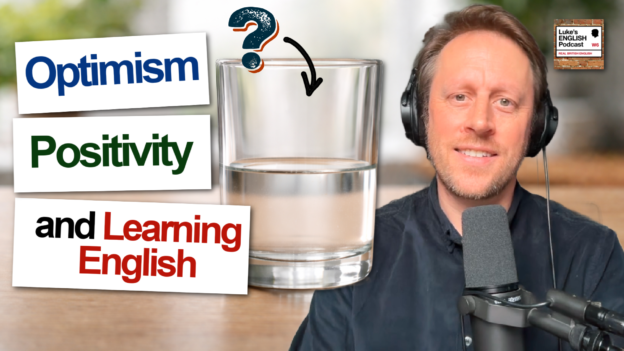
In this episode I discuss optimism and pessimism, what forms our outlook on life, which is healthier, how we talk about optimism and pessimism in English and which perspective helps you learn English more effectively. Expect some discussion, science, vocabulary, advice for learning English and a few jokes thrown in for good measure. PDF available.
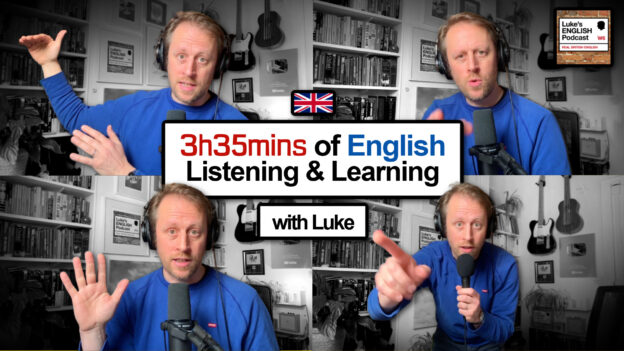
[976] Here’s an epic rambling episode in which I talk about learning English with BBC Radio and TV 📻 expressions with the word ‘thumb’ 👍 the story of how I became a taxi driver on the streets of Paris 🚖 the grammar of Yoda 🐸 fantastic haikus written by my listeners ✍️ and getting pecked in the face by a swan 🦢. 3h30min+ of English from me to you.
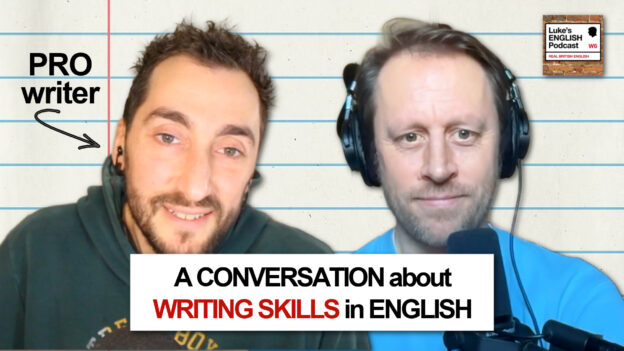
What skills are involved in being a good writer? What makes a good piece of writing? How is writing different to speaking? What are the challenges faced by learners of English who want to write well, and what are some solutions to these challenges? How can AI help develop writing skills? And, what does it take to write your own book in English? These are all questions which I talk about in this episode, with the help of professional writer and returning guest Fabio Cerpelloni.
Summary of Key Insights About Writing (for Learners of English) in our conversation 👇
1. Writing is permanent — and that’s why it feels scary
Unlike speaking, writing doesn’t disappear. Once it’s written, it’s there. That can make learners nervous, but it’s also what makes writing powerful: you have time to shape, revise, and improve your message.
2. Good writing is about impact, not perfection
A good piece of writing:
makes sense
does the job it’s meant to do
connects with the reader
Grammar and vocabulary matter, but effect on the reader matters more than sounding impressive or “advanced”.
3. Simpler language is often more effective than flashy language
Using complex vocabulary, idioms, or “advanced” expressions just to sound native can:
feel unnatural
distract the reader
reduce clarity
Clear, simple language often has more impact than complicated language.
4. Writing is about connection and self-expression
Beyond exams and emails, writing is a powerful tool for:
expressing ideas
sharing experiences
motivating or moving the reader
Even imperfect English can work well if the message connects emotionally.
5. Structure and organisation help the reader
Good writing:
has a clear beginning, middle, and end
is easy to follow
makes its purpose obvious
Organisation, coherence, and clarity all serve the reader — and improve impact.
6. Writing helps you clarify your thinking
Writing isn’t just about communicating ideas — it creates ideas. If something feels hard to write, it often means the idea isn’t clear yet. The struggle is part of the thinking process.
7. Cutting “fluff” is a key writing skill
Strong writing often comes from removing, not adding:
repeated ideas
vague sentences
unnecessary words
“Less is more” — especially in emails and practical writing.
8. Reading is essential if you want to write better
As Stephen King famously said:
“If you want to be a good writer, you must read a lot and write a lot.”
Reading helps you:
absorb natural structures
notice effective style
understand what works and why
If you want to write emails, read emails. If you want to write stories, read stories.
9. Writing a diary counts as real writing
You don’t need to publish or be famous to be a writer. Writing for yourself:
builds fluency
develops clarity
strengthens your connection with the reader (even if that reader is you)
A writer is simply someone who writes.
10. Exams focus on communication, not just accuracy
In exams like Cambridge English, accuracy is only one criterion. Higher priorities include:
communicative achievement
task completion
effect on the reader
Everything in your writing should serve the purpose of the task.
11. AI can help — if you use it wisely
AI tools are useful for:
checking grammar doubts
exploring word choices
finding synonyms
clarifying meaning
But they shouldn’t replace your thinking or your voice. Beware of letting AI do your writing for you – your own skills will not develop, and you will come across as unoriginal, indistinct and probably even lazy. Often, your reader wants to get the sense there is a person on the other side. Don’t be seduced by the dark side of the force. Sorry. I mean, don’t be seduced by the fact that ChatGPT will write flawlessly – with no errors. People can usually tell when something has been written by AI, and it doesn’t give a good impression of you.
Also, you need to question and evaluate what AI produces.
12. Dictionaries still matter
AI can make mistakes. A reliable dictionary — like the Oxford Learner’s Dictionaries — remains the final authority for:
Meaning of words
Examples of real usage
collocations
register
13. Writing improves confidence through small wins
Writing doesn’t have to mean a 300-page book. Small, achievable projects (emails, blog posts, short texts, “tiny books”) build:
confidence
momentum
motivation
Success encourages more writing. If you want to write well, write regularly.
14. Writing is hard — even for experienced writers
Struggling with a paragraph doesn’t mean you’re bad at writing. It usually means:
the idea needs refining
the purpose isn’t clear yet
Difficulty is normal and productive.
15. Ultimately, writing is about purpose
Before writing, ask:
Who is this for?
What do I want the reader to feel, know, or do?
What is the core idea?
When purpose is clear, language choices become much easier.
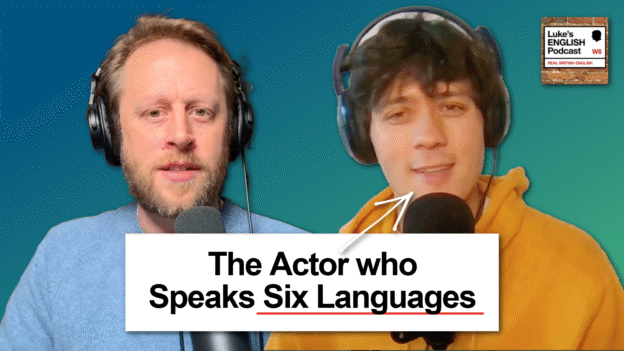
[972] I talk with multilingual actor Ivan Doan about his multicultural background, his learning of languages and his work as an actor. Ivan shares his insights and experiences of learning English, dealing with different accents in film & TV roles, and the importance of mindset and discipline in his life. There are plenty of language learning insights in this episode, which I summarise at the end. Full transcript available.
An 11-point list of practical advice for learning English inspired by this conversation.
1. Learning through doing, not just studying
Use English for real things. Ivan’s English really improved when he started making projects in English (web series, acting work, talking to people), not just studying grammar.
Make English the tool, not the subject. Start a small project: a vlog, a diary, an Instagram account, a DnD group, movie scene re-enactments – anything that requires English.
Theory helps, but it’s not the engine. Grammar explanations are useful, but they’re not what makes you fluent. Real communication is.
2. Multimodal learning: use your whole body & brain
Don’t reduce English to rules + word lists. When Ivan was with the Mormons or on set, he learned from body language, tone of voice, facial expressions, rhythm, context, not just words.
Watch people, not just subtitles. When you watch something in English, pay attention to:
how people look at each other
when they pause
what their hands/face are doing when they say something important
Combine skills. Listen + read + speak + move. For example, repeat a line while copying the actor’s body language and facial expression.
3. Listening & repetition are superpowers
Re-listen on purpose. Take a podcast episode or YouTube clip and:
Listen once for general meaning.
Listen again and note unknown words/phrases.
Look them up.
Listen a third time and catch those items in context.
Notice “repeat offenders”. If a word or chunk keeps appearing, it’s a sign: you probably need it. Put it on a list.
Make targeted vocab lists. Like Ivan did for filmmaking, you can make lists for your world: tech, business, medicine, design, gaming, etc.
4. Discipline beats talent
You don’t need to be “gifted at languages”. Ivan’s message is clear: people think he’s “special”, but in reality, discipline and repetition are doing most of the work.
Be stubborn. Let it bother you (in a good way) that you don’t understand a phrase yet. Go back to it. Again. And again.
Small, realistic goals. For example:
“I want to be able to have a 10-minute small-talk conversation without switching to my language.”
“I want to understand one specific podcast episode without subtitles.”
“I want to tell one story about my life in English clearly.”
Basic conversation – you can talk about everyday things.
More advanced conversation – opinions, stories, feelings, more nuance.
Improvisation – you can react in real time with no preparation.
6. Accents, rhythm & sounding natural
First: learn to hear the accent. You can’t produce what you can’t hear. Choose one accent (e.g. London, General American) and really listen to it.
Find your “accent twin”. Pick a native speaker:
similar age
same gender
whose voice feels close to your natural voice Use them as your model.
Create an “accent map”. Notice:
Which vowels are different from yours?
How do they stress words?
What is the rhythm (fast/slow, chunky/smooth)?
Rhythm & word stress are often more important than perfect vowels. BAna-na vs baNAna can be the difference between confusion and clarity.
Shadowing works. Play 1–2 sentences, then:
say them with the speaker,
match their timing, stress, and melody,
repeat several times until it feels comfortable.
7. It’s okay to exaggerate (caricature as a training tool)
Overdo it first, then calm it down. Like an actor, you can:
exaggerate the British or American intonation
really push the stress and melody Then slowly bring it back to something natural.
This is not “fake”; it’s training. As with acting, you push beyond your comfort zone, then refine.
8. Identity, culture & letting yourself change
To speak like an English speaker, you must allow yourself to “borrow” a new identity. That might feel weird: “This isn’t me.” But that flexibility is part of real fluency.
Different cultures, different communication rules. British politeness isn’t necessarily “fake”; Russian directness isn’t necessarily “rude”. They’re different systems.
Adapting ≠ betraying your culture. You can still be 100% you and also learn to play by local rules when you’re speaking English.
9. Talk to yourself – a lot
Self-talk is powerful, not crazy. Walk around your flat narrating what you’re doing in English, or:
rehearse future conversations,
re-tell a story you heard,
argue with yourself about something.
The goal is to stop translating. Like Ivan said, it’s like changing gears in a car: once you’re “in English gear”, you just drive.
10. Treat English like a role you inhabit
Think like an actor. When you speak English:
step into the “role” of an English-speaking version of you,
use your voice, but with English rhythm and intonation,
add the body language and facial expressions that match.
Use emotion. Don’t just say the words; feel them. This makes you remember the language and sound more authentic.
11. Inspiration: you can do this
Messages implied by Ivan’s story:
You can start with school English that isn’t great and end up working in English internationally.
You don’t need a perfect method; you need consistent action, curiosity, and the courage to interact.
Being “from somewhere else” is not a weakness; it’s often your superpower – a different perspective, more empathy, and a richer identity.
[971] Part 2 of 2. Here is the continuation of last week’s episode about changes you can make to your lifestyle, mindset and habits in order to become a better learner of English in 2026. Each of these tips is backed up by scientific research from the fields of psychology and psycholinguistics, with insights into human behaviour and thinking processes that result in better learning. Full PDF available.
[970] Part 1 of 2. This episode deals with some simple habits you can introduce in your life, to make sure you are in top condition for learning English all year long. It is all backed up by scientific research into how our brains work, and how little changes in our behaviour can help us perform better and achieve more in the time we are given. Includes top advice for preparing yourself to be a great learner of English in 2026. Part 2 will be available next week.
Here is a super-long seasonal rambling episode to listen to while wrapping presents, finishing some last-minute gift shopping, or (if you don’t celebrate Christmas) just doing whatever you normally do in December. It’s long, but the more you listen, the more it will help your English 💪🎅.
I chat to you about LEPster listening habits in 2025 (Spotify Wrapped) 🎧, funny messages and emails from listeners📧, bits of grammar & vocab teaching ✍️, ChatGPT’s questionable teaching skills 🤖🤔, AI hallucinations, dreaming in English, responses to recent episodes, twelve jokes in the Comedy Corner, more funny comments from my daughter 👧, and another dramatic Hollywood-style action movie screenplay 🎥 Plus it all finishes with a vocabulary quiz covering the whole episode. Think of this as a Christmas stocking full of English practice, complete with cosy log-fire sounds 🔥 in the background.
People keep asking me in comments, “How can I learn English with your podcast?” so in this episode I am answering that question as simply, directly and efficiently as possible. Expect advice about improving your English across the 4 skills of listening, reading, speaking and writing, and the language systems of grammar, vocabulary, pronunciation and discourse management. PDF available.
If you have ever wondered what happens in premium episodes, this episode will show you. I’ll play you some clips from the latest series (P71) including some vocabulary explanations, memory quiz questions, pronunciation practice and discussion questions for speaking practice. For the rest of the series, and all the other episodes of LEP Premium (now over 250, each with PDF worksheets and video versions) sign up and become a Premium LEPster today 🏆 https://www.teacherluke.co.uk/premium
How many words are there in English? How many do you really need to know? And how many words have I spoken on this podcast? 🧐 Also, what is shadowing, and how should you do it? Can you do episodes about different English accents? What are your top 10 countries for this podcast? In this episode of Luke’s English Podcast, I answer listener questions about vocabulary size, English accents, the shadowing technique and more bits & bobs. PDF available with transcript and vocabulary list.
This website uses cookies to improve your experience while you navigate through the website. Out of these, the cookies that are categorized as necessary are stored on your browser as they are essential for the working of basic functionalities of the website. We also use third-party cookies that help us analyze and understand how you use this website. These cookies will be stored in your browser only with your consent. You also have the option to opt-out of these cookies. But opting out of some of these cookies may affect your browsing experience.
Necessary cookies are absolutely essential for the website to function properly. These cookies ensure basic functionalities and security features of the website, anonymously.
Cookie
Duration
Description
cookielawinfo-checkbox-analytics
11 months
This cookie is set by GDPR Cookie Consent plugin. The cookie is used to store the user consent for the cookies in the category "Analytics".
cookielawinfo-checkbox-functional
11 months
The cookie is set by GDPR cookie consent to record the user consent for the cookies in the category "Functional".
cookielawinfo-checkbox-necessary
11 months
This cookie is set by GDPR Cookie Consent plugin. The cookies is used to store the user consent for the cookies in the category "Necessary".
cookielawinfo-checkbox-others
11 months
This cookie is set by GDPR Cookie Consent plugin. The cookie is used to store the user consent for the cookies in the category "Other.
cookielawinfo-checkbox-performance
11 months
This cookie is set by GDPR Cookie Consent plugin. The cookie is used to store the user consent for the cookies in the category "Performance".
viewed_cookie_policy
11 months
The cookie is set by the GDPR Cookie Consent plugin and is used to store whether or not user has consented to the use of cookies. It does not store any personal data.
Functional cookies help to perform certain functionalities like sharing the content of the website on social media platforms, collect feedbacks, and other third-party features.
Performance cookies are used to understand and analyze the key performance indexes of the website which helps in delivering a better user experience for the visitors.
Analytical cookies are used to understand how visitors interact with the website. These cookies help provide information on metrics the number of visitors, bounce rate, traffic source, etc.
Advertisement cookies are used to provide visitors with relevant ads and marketing campaigns. These cookies track visitors across websites and collect information to provide customized ads.