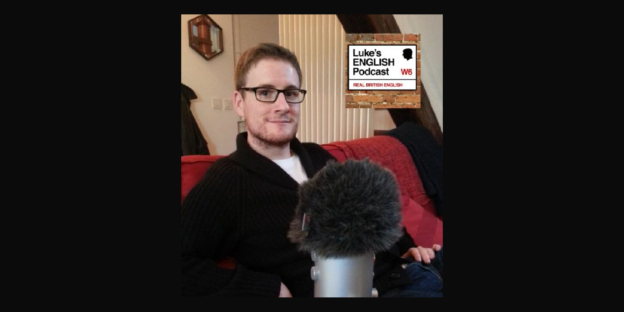
Today I am featured as a guest on the All Ears English podcast. In the episode you can hear me talking about comedy, humour and telling jokes in English. Click the picture to listen to the episode on the All Ears English website or use this embedded player.
You might already know All Ears English. It’s a podcast produced by two American girls called Gabby & Lindsay. They’re both English teachers with lots of experience who also do a podcast for learners of English.
Recently I got a tweet from Lindsay asking if I would like to be interviewed for one of their episodes, and I was glad to accept. It’s fun to be featured on someone else’s podcast for a change. Also, it’s good to establish contact with other podcasters. It was pretty exciting to talk to the girls on Skype and find out how we have a lot of things in common even though we are from completely different countries. Because I am a comedian (as well as a teacher) they were interested in hearing my perspective on differences between British & American humour, and some of my tips on telling jokes in English. Of course, there’s a lot to say on that topic so it is something I plan to revisit fully on LEP.
Here’s a summary of my tips on how to tell jokes in English. As I said, I plan to revisit this subject fully on LEP as there is so much to say!
Luke’s advice on how to tell jokes in English:
Be careful about telling jokes in social situations
Know when it’s appropriate to tell a joke. Sometimes there might be an informal joke-telling situation with your friends. That’s a great time to try your joke.
Be careful about the subject of the joke. Don’t make jokes about race, age, weight, gender or sexual orientation (especially in the United States)
Try to tell a spontaneous joke rather than a preplanned joke. The joke is more of an attitude than a specific joke. Instead, develop an attitude that is funny and lighthearted.
Make sure that you know the joke well when you are telling the joke so that you don’t forget the punchline.
Keep it short and sweet.
It should sound natural.
Don’t laugh too much at your own joke.
Be prepared if your joke doesn’t work, but don’t worry about it too much.
Look out for more episodes on humour in social situations in the future!
Did you find it hard to follow the Skype call with my bro in the previous episode? Would you like to learn some vocabulary and phrases from the conversation? How about specific words to describe accidents, bones, muscles and other things? Listen to this episode to find out more.
Download Episode I listened back to my Skype call with James and thought that I needed to clarify and explain some things, so that’s what I’ve done in this episode.
Listen and you’ll hear me explain words, phrases and expressions from the first 15 minutes of the conversation in episode 180. The sentences I’m explaining are provided below for your reference. You’re welcome!
Vocabulary List (the first 15 minutes of the interview with James in episode 180) Listen to the next episode of the podcast to hear me explain all these things in more detail.
First of all – sorry for my brother’s fiddling and fidgeting!
I’m not too bad thanks, considering…
The day before yesterday I came a cropper on my skateboard and dislocated my shoulder
The arm popped out of its socket
I feel a bit, sort of, run down, I suppose would be the word. A bit tired and achy.
Just the twatty landlord using the garden as some sort of rubbish tip as usual.
I was skating a block-sort of-bar thing. “Skating the block“, not “skating on the block“. (The difference is quite important if you’re a skater)
I was doing a board slide on it but it kept sticking.
I leant back a little bit more.
As I was coming off the block I landed fine but slightly on the tail of the board. (Nose, tail, wheels, trucks, grip tape, bearings – skateboard parts).
Slightly off-balance.
I put my hand down to stop myself falling but I carried on sliding out. My feet slid underneath me and I overextended my arm behind my head, and kind of slammed down on my body. My weight came down on my arm.
I immediately jumped up and it felt really really weird.
I felt a shelf where the shoulder-blade (he means collar bone I think) stopped and then there was a 2 inch gap and then the arm. (ouch!)
I knew at that point that I’d dislocated my shoulder. (Past perfect tense)
To start with there wasn’t any pain, the pain came a few minutes in.
I don’t normally get an ambulance for a self-inflicted injury. (what a tough and modest guy he is!)
I normally get a bus or a taxi to A&E but this time I thought it warranted it because I couldn’t move at all.
[It was] extreme muscularpain, like when you tear ligaments or sprain an ankle.
They were going “ooh” which makes you feel uncomfortable if someone’s wincing, you know.
They tried to get a needle into me for a drip. They couldn’t get a vein to bleed properly. (they couldn’t find a vein)
They put some intravenousparacetamol into me, which didn’t really do anything.
It’s an over-the-counter pain-relief pill.
Why are there no aspirins in the jungle? Because the parrots eat them all (the ‘paracetamol’ – yes, it’s a terrible joke)
I grittedmyteeth and tried to ignore what was going on.
They drove me with the‘woo-woos’ on.
(I tell James to stop fiddling… and he says…) I can’t remember where we were now.
They wheeled me into the hospital. (I attempt to highlight the irony of getting injured on a wheeled vehicle and then being taken into a hospital on another wheeled vehicle – it’s an unsuccessful joke, but never mind)
An Indian-looking doctor looked at me.
You can relax a bit when the doctor seems quite in-control.
He told me exactly what was going to happen. I’d need an x-ray to check that nothing was broken, then if nothing was broken then they’d give me some more drugs and then put it back in, and then they’d give me another x-ray to check that nothing had broken while they were putting it back in, which kind of made me think it might be quite a painful process having it set back.
They gave me some morphine, and it didn’t seem to do anything and I was, like, grimacing a bit, so they gave me some more.
They gave you morphine and they gave you nitrous oxide? You’re breaking up a little bit.
Do you find that breaking up is very hard to do? (This was probably quite confusing, but it’s my brother’s attempt at a sardonic joke – referring to a famous song which uses the same phrase, but with a different meaning)
“You’re breaking up” (your phone/skype signal is not clear)
“Breaking up is hard to do” (Separating, splitting up with your boyfriend or girlfriend – there are two songs that use this phrase, “Make it easy on yourself” by The Walker Brothers & written by Burt Bacharach, and “Breaking Up is Hard to Do” by Neil Sedaka. You can listen to those original songs below. Sorry about my singing.
(James receives a phone call from his girlfriend because she wants to check that he’s okay. How sweet.)
She was a bit worried about me because I was a bit sort of groggy yesterday.
I feel a bit sort of run down, a bit beaten up, but fine.
Good thing you didn’t hit your head.
I didn’t shatter my collar bone or something like that, that would have been horrible.
It could have been something worse.
You don’t need a cast. Nothing’s broken.
That’s as much as I’m able to do at this moment. You’ll just have to listen to the rest of the conversation unaided and try to work out exactly what we’re saying. It’ll be good for your English!
Now listen to episode 180 again. I promise you will understand much more a second time. Click here to listen to & download “Episode 180. Dislocated Shoulder”.
Song
Here are the lyrics (and chords) to My Girl by Madness.
Madness – My Girl
Bm G
My girl’s mad at me
Bm Em
I didn’t wanna see the film tonight
Bm G
I found it hard to say
Bm Em
She thought I’d had enough of her
Chorus
D A Bm
Why can’t she see
Em D A
She’s lovely to me?
D A Bm
But I like to stay in
D G D Em
And watch t.v. on my own
G A
Every now and then
Bm G
My girl’s mad at me
Bm Em
Been on the telephone for an hour
Bm G
We hardly said a word
Bm Em
I tried and tried but I could not be heard
D A Bm
Why can’t I explain?
Em D A
Why do I feel this pain?
D A Bm
‘Cos everything I say
D G
She doesn’t understand
D Em
She doesn’t realise
G A
She takes it all the wrong way
Bm G
My girl’s mad at me
Bm Em
We argued just the other night
Bm G
I thought we’d got it straight
Bm Em
We talked and talked until it was light
D A Bm
I thought we’d agreed
Em D A
I thought we’d talked it out
D A Bm
Now when I try to speak
D G
She says that I don’t care
D Em
She says I’m unaware
G A
And now she says I’m weak
This episode is just a chance for me to say “hi” and to inform you that I’m still here and that normal podcasting will continue soon. In this episode I give you some news, and then you can listen to a conversation I had with my friend David. Enjoy!
This episode is all about grammar, specifically verb tenses such as: present simple, present continuous, present perfect simple, present perfect continuous, past perfect, past perfect continuous and different future forms. Part of this episode is transcribed, and part of it is spontaneous.
Download Episode I’m going to go through lots of verb tenses in English. I’ll demonstrate them first, and then go through them with you, explaining their form, use and pronunciation.
It’s been a while since I did an episode on grammar, and so I thought I’d give you a really thorough look at different verb tenses. It’s a bit ambitious to try and cover lots of tenses in one episode, but I’ll try and keep it brief and practical.
This could be a really useful episode, which you could listen to again and again, in order to get the full value.
I don’t normally do many episodes on grammar, because let’s be honest, it’s pretty boring. Unless you’re a grammar geek, it can be pretty mind numbing stuff. In one ear and out the other. The trouble is, that in explaining the basics of grammar you end up using all kinds of complex and abstract language, which makes the whole thing more complex than it really is. For example, if you can’t use the present simple tense correctly, then you’re hardly able to understand the rules that underpin that tense.
We don’t learn a language by learning the rules first and then applying them. Instead we learn by trying to communicate a message in that language. In doing that we learn the limitations and possibilities. But, it does help to get an insight into the structures at work because you can identify areas where you’re making mistakes, or particular tenses that you’re not using.
So listen carefully while I’m talking here and try to notice the different tenses. That’s your task. Notice the different tenses I use, as I’m using them. Like, oh that’s present perfect, or that’s a 1st conditional structure, or that’s the future perfect continuous passive there, I love that one. Etc.
Then I’ll go through it all and explain it at the end. You can read this on my website.
So, let’s start. Listen closely as I tell you a few things about myself. Notice the tenses, and I’ll explain them afterwards. Eventually, the plan is for you to perhaps practise this by talking about yourself in a similar way, using the tenses as I do. Then you’ll be speaking more like a native. Some of this is written down, and some of it is improvised.
OK, it’s grammar time!
Spot the Tenses Hello. I’m Luke. I’m from London, but at the moment I’m living in Paris. I’ve been living here for just over a year. It’s great. I’m really enjoying it. You know that originally I’m from England. I was born in a town just outside London, and then I lived in West London for a long time. My Dad was promoted and got a job in the midlands, so we moved there, and stayed for many years. I went to university in Liverpool and lived there for 4 years, and then I moved back to Warwickshire. That’s when I decided to become an English teacher. I’d finished uni and I was working in a pub, not really going anywhere. As well as studying at university and college, I’d also been playing in lots of bands over the past few years, but it hadn’t really worked out, so I needed to think of something to do. I ended up deciding to become a TEFL teacher in 2001 and then I went to Japan and lived there for 2 years. That was an awesome time. had loads of really cool experiences and met loads of people, but I didn’t want to get stuck there, and I was keen to get back to my home country. I moved back to London and I worked there for a long time. It was while I was living in London that I came up with the idea to launch an amazing podcast for learners of English, that would save the world from the forces of evil. That’s when I created the now legendary Luke’s English Podcast, and a new cult of language learners was created. Who knows, maybe the LEPPERS will one day rise up and, just speak really fluently, and then give everyone free ice-cream sandwiches. It’s just a dream maybe, but who knows, it might just happen.
I moved to Paris in 2012. Living in Paris is pretty cool. It used to be quite difficult, because I couldn’t speak the language but I’m getting used to it now. When I first came here, I’d never visited Paris before, but my girlfriend had told me a lot about it, so I was kind of prepared. I’d also been to France quite a lot as a child on holiday. But when I first arrived it was quite hard because I didn’t speak much French. I took some French lessons at school when I was a kid but I don’t remember learning much. In fact most of the time those French lessons were a bit of a doss. So, when I first arrived I couldn’t really communicate, which was not very helpful. It was usually okay because I could get by, but I remember once I was walking down the street and this guy came up to me and started talking, but I couldn’t understand him, and he got angrier and angrier and started following me down the street. It was a bit scary and weird, and I wish I could have understood him and told him to piss off or whatever.
These days things are much easier, and Paris is an amazing place to live in. I’ve seen and done quite a lot of stuff here.
things I’ve done
– I’ve been up the Eiffel Tower. I’ve visited Notre Dame. I’ve been to Shakespeare and Company. I’ve tried lots of delicious French wine.
Things I’ve been doing
– I’ve been doing lots of comedy. I’ve been doing lots of gigs.
– I’ve been working at the university.
– I’ve been recording episodes of the podcast
-learning french
Today I’ve drunk a bit too much coffee so I’m pretty hyperactive. Normally I drink tea, but more recently I’ve been drinking coffee. I’ve had about 9,000 cups already today.
Work
– At the moment I’m working at the university
– I teach English, but I’m teaching at a university at the moment.
The future
– Hopefully it’ll last. Hopefully they’ll take me on again.
– I wonder what’s going to happen in the future.
going to / present continuous
– We’re going to visit New York next month
– I might do a special report from New York
– We’re going to stay in an AirBnB apartment that we’ve found
– We’re planning the trip at the moment.
– We’re flying there in the middle of April. It’s going to be good.
Will
– England will probably win.
– We probably won’t win. I imagine it will be someone like Spain or Brazil.
– It’s going to be a challenge.
– We probably won’t get to the final, but if we do it’ll be amazing.
5 years from now
– Who knows what I’ll be doing
– Hopefully I’ll still be recording episodes of LEP
– I might have had kids by then.
– I’ll probably have children. That’ll be…
– Hopefully, I will have done many more episodes of LEP and perhaps I will have expanded my work online in some way.
10 years from now
– If I’m still doing Luke’s English Podcast , I will have been doing LEP for 15 years.
– I will have been being listened to for 10 years (!!!)
The Tenses
Present simple
– I teach English, but I’m teaching at a university at the moment.
Present continuous
– I’m from London, but at the moment I’m living in Paris.
– At the moment I’m working at the university
– I teach English, but I’m teaching at a university at the moment.
Past simple
– (for) I lived in West London for a long time.
– (sequence of finished actions) My Dad was promoted and got a job in the midlands, so we moved there, and stayed for many years. I went to university in Liverpool and lived there for 4 years, and then I moved back to Warwickshire.
Past continuous
– I’d finished uni and I was working in a pub, not really going anywhere.
– It was while I was living in London that I came up with the idea to launch an amazing podcast for learners of English
– I was walking down the street and this guy came up to me and started talking, but I couldn’t understand him
Used to do vs. Get used to doing
– It used to be quite difficult, because I couldn’t speak the language but I’m getting used to it now.
Present perfect
– I’ve been up the Eiffel Tower. I’ve visited Notre Dame. I’ve been to Shakespeare and Company. I’ve tried lots of delicious French wine.
– Today I’ve drunk a bit too much coffee so I’m pretty hyperactive. Normally I drink tea, but more recently I’ve been drinking coffee. I’ve had about 9,000 cups already today.
Present perfect continuous
– I’ve been doing lots of comedy. I’ve been doing lots of gigs.
– I’ve been working at the university.
– I’ve been recording episodes of the podcast
– I’ve been living here for just over a year.
Past perfect
– That’s when I decided to become an English teacher. I’d finished uni and I was working in a pub, not really going anywhere.
– When I first came here, I’d never visited Paris before, but my girlfriend had told me a lot about it, so I was kind of prepared.
Past perfect continuous
As well as studying at university and college, I’d also been playing in lots of bands over the past few years, but it hadn’t really worked out, so I needed to think of something to do.
Modals to talk about the past
– I wish I could have understood him and told him to piss off or whatever
Going to / present continuous
– We’re going to visit New York next month
– I might do a special report from New York
– We’re going to stay in an AirBnB apartment that we’ve found
– We’re planning the trip at the moment.
– We’re flying there in the middle of April. It’s going to be good.
Future with will (not plans, but judgements, opinions, predictions)
– Who knows, maybe the LEPPERS will one day rise up.
– Hopefully it’ll last. Hopefully they’ll take me on again.
– England will probably win.
– We probably won’t win. I imagine it will be someone like Spain or Brazil.
1st Conditional
– We probably won’t get to the final, but if we do it’ll be amazing.
Future continuous
– Who knows what I’ll be doing
– Hopefully I’ll still be recording episodes of LEP
Future perfect
– Hopefully, I will have done many more episodes of LEP and perhaps I will have expanded my work online in some way.
Future perfect continuous (in a 1st Conditional structure, no less!)
– If I’m still doing Luke’s English Podcast , I will have been doing LEP for 15 years.
Future perfect continuous passive!
– I will have been being listened to for 10 years (!!!)
Modals for the future
– it might just happen.
Test Yourself
Complete the gaps in this text. Scroll up to see the answers.
Hello. I’m Luke. I’m from London, but at the moment I _______________________ (live) in Paris. I _______________________ (live) here for just over a year. It’s great. I’m really enjoying it. You know that originally I’m from England. I _______________________ (born) in a town just outside London, and then I _______________________ (live) in West London for a long time. My Dad _______________________ (promote) and got a job in the midlands, so we _______________________ (move) there, and _______________________ (stay) for many years. I _______________________ (go) to university in Liverpool and _______________________ (live) there for 4 years, and then I _______________________ (move) back to Warwickshire. That’s when I _______________________ (decide) to become an English teacher. I _______________________ (finish) uni and I (work) in a pub, not really going anywhere. As well as studying at university and college, I _______________________ (also play) in lots of bands over the past few years, but it hadn’t really worked out, so I _______________________ (need) to think of something to do. I _______________________ (end up) deciding to become a TEFL teacher in 2001 and then I _______________________ (go) to Japan and _______________________ (live) there for 2 years. That was an awesome time. I _______________________ (have) loads of really cool experiences and _______________________ (meet) loads of people, but I _______________________ (not want) to get stuck there, and I was keen to get back to my home country. I _______________________ (move) back to London and I _______________________ (work) there for a long time. It was while I _______________________ (live) in London that I _______________________ (come up with) the idea to launch an amazing podcast for learners of English, that would save the world from the forces of evil. That’s when I _______________________ (create) the now legendary Luke’s English Podcast, and a new cult of language learners was created. Who knows, maybe the LEPSTERS _______________________ (rise up one day) and, just speak really fluently, and then give everyone free ice-cream sandwiches. It’s just a dream maybe, but who knows, it might just happen.
I moved to Paris in 2012. Living in Paris is pretty cool. It _______________________ (be) quite difficult, because I couldn’t speak the language but I _______________________ (get used to) it now. When I first came here, I _______________________ (never visit) Paris before, but my girlfriend _______________________ (tell) me a lot about it, so I was kind of prepared. I _______________________ (also go) to France quite a lot as a child on holiday. But when I first _______________________ (arrive) it was quite hard because I _______________________ (not speak) much French. I _______________________ (take) some French lessons at school when I was a kid but I don’t remember learning much. In fact most of the time those French lessons were a bit of a doss. So, when I first arrived I couldn’t really communicate, which was not very helpful. It was usually okay because I could get by, but I remember once I _______________________ (walk) down the street and this guy _______________________ (come) up to me and _______________________ (start) talking, but I couldn’t understand him, and he _______________________ (get) angrier and angrier and _______________________ (start) following me down the street. It was a bit scary and weird, and I wish I could have understood him and told him to piss off or whatever.
These days things are much easier, and Paris is an amazing place to live in. I _______________________ (see and do) quite a lot of stuff here. I _______________________(go )up the Eiffel Tower. I _______________________ (visit) Notre Dame. I _______________________(go) to Shakespeare and Company the bookshop. I _______________________ (try) lots of delicious French wine. It’s great.
[2/2] Here’s the second part of my conversation with Daniel Burt, who is a journalist, comedy writer and performer from Melbourne, Australia.
Download Episode In this conversation we talk about these things: Daniel’s move to London Aussie pubs in Paris and London Cliches about Australian people Australian pronunciation Typical Australian English phrases The Australian character and national identity Australian politicians The future of Australia & Australia’s image of itself Sport & competition Interviewing Benedict Cumberbatch (Sherlock), Martin Freeman (The Hobbit), Matt Smith & David Tennant (Doctor Who)
To contribute a few minutes of transcription for this episode, click here to work on the google document:
If you have any questions, feel free to leave a comment.
All the best,
Luke
Daniel’s Video Showreel
[youtube http://www.youtube.com/watch?v=u9V3cKGvISU&w=500&h=281]
I won the competition again! I got a hat-trick! Thanks for your votes. I’d like to teach you some expressions related to success and failure in this episode.
In this episode
I’m just going to talk about it for a little bit, but I’m not just going to bask in this moment of glory, I’m also going to present and then teach some phrases to you. The phrases are all associated with success and failure. I’ll also teach you some really common things you can say to someone who has won, or lost something.
Phrases related to success or failure
So, I’m going to bask in my moment of glory for a few minutes, and talk about winning this competition. I’m going to use about 40 expressions. Yes 40! See if you can notice them. Which phrases or expressions are the ‘target language’ of this episode? Listen carefully, and I’ll explain them properly in a few minutes.
So, I came in first place in the competition, in my category, and I’m really pleased.
This year the competition was a bit different. I had no idea of the vote count.
For all I knew, I could have been in the lead, or neck and neck with the others, or falling behind. I had no idea.
I had my doubts of course.
Lots of people reassured me. “It’s in the bag mate”, “no worries” “it’s a sure thing” “it’s a dead cert” “You’re bound to win”.
But I had no idea if it was a sure thing or not. I didn’t think it was a dead cert or anything. I knew there was some stiff competition.
In fact I was thinking, well, every dog has its day. Maybe I’ve peaked. Maybe that’s it. For all I know, most people are fed up with me now. Maybe I won’t get three. It’ll be a fall from grace – from the heights of winning it two years in a row, maybe I’ll just fall flat this year. Perhaps this podcast is just a flash in the pan, and it’s all going to the dogs now. Perhaps my plans for Luke’s English Podcast will just go up in smoke. Maybe everyone’s just fed up with me now, after all this time. Maybe I’m yesterday’s news.
It turns out that I had quite a considerable lead. I didn’t realise, but I was the front runner in this competition. I was ahead of the pack by quite a lot of votes.
The results came through by email, and everything came up roses.
I won and in the end, in fact I smashed it.
I knocked the ball right out of the park.
I won by about 700 votes, which is a clear majority. It was a landslide victory.
And I owe it to you my listeners.
It’s pretty simple – if you hadn’t voted for me, to the tune of 1017 votes, I wouldn’t have won.
I guess, the reason that you voted for me is not just that you’re generous people, but those people were expressing their appreciation of the podcast. So, that’s very satisfying. It’s a win-win situation.
I guess what I should do now, as has always been the case, is take advantage of this win, and use it as a springboard for more exposure and success. Now I’ve got a foot in the door, so to speak, I could perhaps get more listeners, and attract sponsors and things like that. I’m getting about 4,000 page views a day (which is incredible – and I guess this means that not all the people visiting my page voted for me – in fact, just a fraction did – I wonder why. Maybe some people just don’t realise how incredible Luke’s English Podcast really is. Or perhaps, voting is not why they came to the website.)
so the podcast is coming on in leaps and bounds.
Sometimes I must admit that I feel at a bit of a low ebb. I mean, sometimes I feel a bit low. It can be hard to achieve everything you want, and I think that I’m putting lots of time into this without reaping the benefits (although it’s nice to get comments and recognition), but I usually bounce back from that, and most of the time I’m just really chuffed to have an audience, and the opportunity to talk to people around the world.
Other doubts are that I’m just not getting anywhere, and that I’ve missed the boat somehow – meaning that I should have cashed in on this earlier, and that the opportunity to make this into a profitable venture has already passed, somehow. Sometimes I think that I’ll have to pack it in eventually, like if I have kids, because I won’t be able to devote as much time to it, but then again I think I’ll always be doing something related to Luke’s English Podcast. I’m certainly not planning to throw in the towel any time soon. I have too many ideas that I’d like to create.
At the moment though, I’m riding high. You could say that I’m on cloud 9, because I’m just over the moon to have won. You’re probably fed up with hearing me go on about it now, but at the moment I’m top dog, so I feel I deserve my moment of glory! You’ll just have to bear with me for a few more minutes, and then it’ll be business as usual again, and I won’t bask in the glow of victory any longer. I’ll just focus on teaching you useful things. At the moment it feels like things are on the up and up, and I’ve got the world at my feet. Thanks to everybody for rising to the occasion and showing your support. You’re the best.
Vocabulary
Let’s look again at some of the vocabulary I just used
a hat-trick
to bask in this moment of glory
I came in first place in the competition
be in the lead
be neck and neck with
falling behind
It’s in the bag mate”, “no worries” “it’s a sure thing” “it’s a dead cert”
You’re bound to win
stiff competition
every dog has its day
Maybe I’ve peaked
It’ll be a fall from grace
maybe I’ll just fall flat this year
Perhaps this podcast is just a flash in the pan
and it’s all going to the dogs now
Perhaps my plans for Luke’s English Podcast will just go up in smoke
I was the front runner
I was ahead of the pack
everything came up roses
I smashed it
I knocked the ball right out of the park
It was a landslide victory
if you hadn’t voted for me, to the tune of 1017 votes, I wouldn’t have won
It’s a win-win situation.
use it as a springboard
Now I’ve got a foot in the door
the podcast is coming on in leaps and bounds
I must admit that I feel at a bit of a low ebb
without reaping the benefits
but I usually bounce back from that
I’m just really chuffed to have an audience
I’m just not getting anywhere
I’ve missed the boat
I should have cashed in on this earlier
I think that I’ll have to pack it in
I’m certainly not planning to throw in the towel any time soon
I’m riding high
I’m on cloud 9
I’m just over the moon to have won
at the moment I’m top dog
it’s business as usual
things are on the up and up
I’ve got the world at my feet
Thanks to everybody for rising to the occasion
What to say if someone wins:
Well done!
CongratulationS (don’t forget the ‘s’ at the end of that)
Nice one
Good job!
That’s great news.
I’m really happy for you.
You deserve it.
You’ve done really well (sounds patronising!)
I’m proud of you.
You must be chuffed to bits.
I’m really glad for you.
What to say if someone loses:
Commiserations
Bad luck mate
Sorry to hear that
That’s a pity
Chin up
Oh well, you did your best
Never mind
Don’t let it get you down
Better luck next time
Don’t beat yourself up
I have a few questions for you: -How are the phrasal verb episodes? Are you listening to them? Are they useful? I just want to make sure it’s worth me doing them regularly. -Which episodes have you liked best recently? -How was my conversation with Daniel Burt? Did you find it hard to understand him? -How do you listen to the podcast? What context are you in? -How’s my website at the moment?
Do leave other comments too and let me know what’s going on where you are.
Please vote for me in the Macmillan Dictionary Awards. Voting closes at midnight GMT on 14 February – so you only have a couple of days! Click here to vote for me. Thanks! If you’ve already voted – thanks a lot! In this episode I shut up about the competition after 9 minutes, and then just improvise, while using the words ‘stuff’ and ‘thing’ as much as possible.
Download Episode I also talk about a few other things in this episode, including quite a lot of stuff about working for the secret service, drinking coffee and setting the world to rights over a few drinks. So, do listen to all of the stuff and things I say in this episode ;)
Here’s George Carlin talking about stuff (transcript below)
“Stuff” by George Carlin
I would’ve been out here a little bit sooner but they gave me the wrong dressing room and I couldn’t find any place to put my stuff. And I don’t know how you are but I need a place to put my stuff. So, that’s what I’ve been doing back there. Just trying to find a place for my stuff. You know how important it is. That’s the whole… that’s the whole meaning of life, isn’t it? Try and find a place for your stuff. That’s all your house is. Your house is just a place for your stuff. If you didn’t have so much goddamned stuff you wouldn’t need a house. You’d just walk around all the time. That’s all what your house is, that’s a pile of stuff with a cover on it. You see that when you’re taking off in an aeroplane. You look down and you see everybody’s got a little pile of stuff. Everybody’s got their own pile of stuff and if you leave it you’ve got to lock it up. Wouldn’t want somebody to come by and take some of your stuff. They always take the good stuff. They don’t bother with the crap you’re saving and nobody’s interested in your fourth grade arithmetic papers. They’re looking for the good stuff. That’s all your house is, it’s a place you keep your stuff while you go out and get more stuff. Now, sometimes, sometimes you’ve got to move. You’ve got to get a bigger house. Why? Too much stuff! You’ve got to move all your stuff and maybe put some your stuff in storage. I mentioned that. There’s a whole industry based on keeping an eye on your stuff.
Enough about your stuff. Let’s talk about other people’s stuff. Did you ever notice that when you go to somebody else’s house you never quite feel 100% at home? You know why? No room for your stuff! Somebody else’s stuff is all over the place! And what awful stuff it is. Where did they get this stuff? And if you have to stay overnight at someone’s house, you know, unexpectedly, and they’ll give you a little room to sleep in that they didn’t use that often. Someone died in it eleven years ago and they haven’t moved any of his stuff! Or wherever they give you the sleep usually near the bed there’s a dresser and there’s never any room on a dresser for your stuff. Someone else’s shit is on a dresser. Have you noticed that their stuff is shit and your shit is stuff?! Get that out of there!
Now, sometimes you go on vacation you’ve got to bring some your stuff with you. You can’t bring all your stuff, just the stuff you really like. The stuff that fits you well that month. Let’s say you want to go to Honolulu. You want to go all the way to Honolulu and you’ve got to get two big bags with stuff plus your carry-on stuff plus the stuff in your pockets. You go all the way to Honolulu, you get to the hotel room and you start to put away your stuff. That’s the first thing you do in a hotel room is to put away your stuff. I’ll put some stuff in here. I’ll put some stuff down here. Here’s another place for stuff for you. I’ll put some stuff on here. You put your stuff over there and I’ll put my stuff over here. Here’s another place for the stuff. Hey, we’ve got more places than we’ve got stuff! We’re going to have to buy more stuff! And you put all your stuff away and you know that you’re thousand of miles from home and you don’t quite feel at ease but you know that you must be okay because you do have some your stuff with you. And you relax in Honolulu on that basis. That’s when your friend from Maui calls and says – Hey, why don’t you come over to Maui for the weekend, spend a couple of nights over here? – Aww, shit, no! Now, what stuff do you bring? Right, you’ve got to bring an even smaller version of your stuff. Just enough stuff for a weekend on Maui. And you get over… And you’re really spread out and now you’ve got your shit all over the world! You’ve got stuff at home, stuff in storage, stuff in Honolulu, stuff in Maui, stuff in your pockets so, supply lines are getting longer and harder to maintain. When you get over to your friend’s house in Maui and they give you a little place to sleep. There’s a little window ledge, some kind of small shelf and there’s not much room up there but it’s okay because you don’t have much stuff now. And you put what stuff you do have up there. You put your important French toenail clippers, your own readers with that 45-day guarantee, your cinnamon flavoured dental floss and your Afrin 12-hour decongestant nasal spray. And you know you ‘re a long way from home. You know that you must be OK because you do have your Afrin 12-hour decongestant nasal spray. And you relax in Maui on that basis. That’s when your friend says – Hey, I think tonight we’ll go over to another side of the island to stay at my friend’s house overnight – Oh, shit, no! NOW, what do you bring?! Now, you just bring the things you know you’re going to need. Money, keys, comb, wallet, lighter, hanky, pen, cigarettes, contraceptives, vaseline, whips, chains, whistles, dildos and a book.
The following is a transcript of this episode of the podcast.
Hello, and welcome to the podcast. Today, we are going to take a journey into the palace of the mind! We are going to venture into the deepest parts of your brain, and in the process we’re going to clean it up, brighten it up, sweep out the cobwebs and make it a much more effective place for learning and remembering English. Have a glass of water, take a deep breath and get ready for a brain upgrade because this episode of the podcast is all about memory, mnemonics and learning English!
Recently I’ve been doing a series of mini podcast episodes called “A Phrasal Verb a Day”. It’s quite a popular series, which is great. Lots of people have been listening to it, and I’m updating it every day. You can find a link to the episodes on my webpage https://audioboo.fm/LukeThompson. I’m hoping to do 365 phrasal verbs this year, that’s one a day, which may be a little ambitious but we’ll see. 365, that’s a large number of phrases for me to teach, but also a large number for you to remember. You might be thinking – this is great Luke. 365 phrasal verbs, all explained by you with examples and transcripts, but how am I going to remember them all? Well, you don’t have to remember all of them, but you definitely can. Your brain is an amazing thing. It’s capable of remembering massive amounts of information. It’s just a question of how you get the information in there.
English has one of the largest vocabularies of any language in the world, which is quite an overwhelming prospect for those of you who are trying to learn all of those words, even just a portion of them – like the commonly used ones. But it’s not just the words, it’s the phrases, the idioms, the spelling, the rules of grammar. It’s a challenge, but you can do it. The question is: How? Well, let’s look into it.
In this episode we’ll be looking at ways to improve your memory and some specific mnemonic devices for remembering English vocabulary and spelling. So strap in, this is going to be a useful one. With the methods in this episode, you’ll be able to remember massive amounts of vocabulary, and you’ll be able to remember the spelling for loads of difficult-to-write English words. There’s also a transcript for this which you can read at www.teacherluke.wordpress.com. You’re welcome.
The techniques I talk about here are well-known methods, used by lots of people including some of the most famous brains in the world. The illusionist Derren Brown is an example. He’s famous for being able to remember vast sequences of information, and uses this technique in his magic shows. Then, there’s the world famous detective Sherlock Holmes. I know he’s not a real person, but in the modern TV adaptation called “Sherlock” starring Benedict Cumberbatch, he uses a mnemonic device known as a mind palace in order to remember all kinds of information, which allows him to solve deeply complex criminal cases. You can create your own mind palace too, or just use memory techniques to help your remember names of people at a party, business contacts, telephone numbers, lists of phrasal verbs or the way English words and spelled and pronounced. We’ll be looking at all these things in this episode.
These are tried and tested techniques and I invite you to try them for yourself, even if you’ve never considered the idea of improving your memory. They’re a lot of fun and surprisingly useful, and you don’t need to try very hard to just play along. I don’t want to go on about it too much, but if you just listen – it’ll be quite entertaining, but you’ll get the most benefit from actually trying these things yourself, and if you do that – if you try to apply the memory techniques in this episode, it could transform your English learning in a really exciting way.
You might need a pen and paper, so you can join in with some activities. Don’t forget you can read everything I’m saying by visiting teacherluke.wordpress.com.
Let me give you a run-down of the systems I’m going to talk about here:
1. Firstly I’ll talk about some advice for learning English more effectively, based on mnemonic devices. I’ll give you a summary of what I’ve learned from reading about this subject.
2. Then I’ll outline some specific systems for remembering lists of things such as a shopping list, people’s names, the order of adjectives in English, or lists of vocabulary.
3. Then, we’ll go through some specific mnemonics for remembering English spelling, which can help you to improve your spelling massively.
Just to explain, a mnemonic is a method of remembering something. It’s a memorising technique. Mnemonic has slightly weird spelling. It’s spelled M-N-E-M-O-N-I-C but the first M is silent. So that’s pronounced “NEMONIC”. There is a mnemonic device for learning the spelling for the ‘mnemonics’. It goes like this Mnemonics Now Erase Man’s Oldest Nemesis, Insufficient Cerebral Storage. The first letters of the first words in that phrase all spell “mnemonics”. Say it again… Mnemonics Now Erase Man’s Oldest Nemesis, Insufficient Cerebral Storage. Again, you can read that on the webpage, and you can check out words like insufficient (not enough), cerebral (of the brain) and storage (where things are stored, or kept.
I’ve discovered while reading about this subject that the key aspect of mnemonics seems to be that you have to push the thing you’re trying to remember deep into your mind, and make links to things you already remember well. The more personal the the connection to that word, the more likely you are to remember it. How do we do it? This means creating an image in your head and making it as vivid and clear as possible, attaching some kind of narrative or story to it or connecting it to an already existing deep memory. I guess this is because in your brain there are electrical pathways – the brain is like an electrical system. Each electrical pathway is a connection to that word. It’s a way for your brain to access that particular bit of information. So, the more electrical pathways, or connections you have to something in your brain, the more likely are to be able to access that thing later, and remember it.
How does this relate to learning English? Let’s see if you this confirms that you are already learning in the right way, or if there are some new approaches that you can pick up.
First, you should really engage with the learning process. Don’t let information just go in one ear and come out the other. It has to go deeply into the brain. So, as a learner, you need to put yourself and your personality right into it, and become an active member of your class (if you’re studying in a class) with a sense of independent responsibility for your own learning. Remember that the stuff you’re studying (like vocab or grammar) is not just abstract information but something that involves you in a very personal and specific way.
So we’re talking about personalising new words. Think of examples or definitions of new vocabulary in a way that is meaningful specifically to you or your life. Put yourself into the examples of vocabulary you use. Imagine that you’re living these words and phrases somehow. Picture yourself acting it out. If I teach you a phrase like “to doze off”, meaning to go to sleep, just imagine a time when you’re really tired and can hardly keep your eyes open, even though you want to stay awake. Then imagine yourself reacting to that by saying “oh god I keep dozing off!”. Imagine people you know in your examples of new grammar or vocabulary. Vividly picture something familiar to you when you’re trying to remember the words. Bring the language to life in your own head. Create stories with the new language. Involve you, your friends or family in those stories, and make them really vivid, colourful and dramatic – like my Pink Gorilla story for example. Make your own pink gorilla story and aim to include lots of new language in it.
When you’re trying to practice using new grammar or vocabulary, don’t just make a random sentence. Make a sentence which you really feel or really mean. Obviously, this is not always possible – for example if you’re doing an exam practice exercise in a book or if you just have to play with the grammatical structure of a phrase quickly – in that case you might have to just dash off a quick sentence with the phrase in it, for structural purposes. But at some point you should aim to use the phrase to express something meaningful and personal to you.
This works for teachers as well. When explaining new words, try to give vivid examples. Bring the expression to life. The more vivid and colourful, the better. If you can, try to attach some personal element to it. Put yourself into the example perhaps. If you need to use the 3rd person, pick a real person, like a famous person or someone in the class, rather than just a name. I know it’s not always possible to think up these vivid examples, or you can’t always share personal details, but just remember – the more lively and vivid the example, the easier it is for the students to internalise. It also might encourage them to personalise the language enthusiastically too, when it’s their turn to use the language.
New words can be quite abstract, so try making them familiar by attaching them to things you already know. For example, maybe the English word looks like a word in your language, or perhaps it reminds you of somebody’s name. You can then associate the English word with that name, and it sticks in your mind more effectively. For example, the Japanese word for apple is ‘ringo’. I always remember this because Ringo is one of the Beatles and the Beatles’ record label is called Apple, so now I think of an apple, and I think of The Beatles, and Ringo. This method is common sense really, but we often just don’t apply these techniques to remembering things as much as we could. Instead we just try to cram information into our head, without doing it in a meaningful way, and as a result we just fail to remember things.
It works with names as well. I have to remember lots of names in my classes. At the moment at university I have over 200 names to remember. Sometimes the only way I can do it is to make an association to something. For example, I had a Saudi student once called Faisa. It can be difficult for me to remember Arabic names, because they’re quite foreign to me. We don’t have many Arabic names in English. So, Faisa was quite a difficult one to remember at first, and it’s important to remember names in class because referring to someone by their name helps get their attention, but it’s also a nice way to establish rapport with that person. So, Faisa – F-A-S-I-A. In English, we have a similar sounding word, which is ‘phaser’, spelled p-h-a-s-e-r. A phaser is a kind of laser-gun, like the guns they have in Star Trek. “Set phasers to stun!” for example. I imagine the old Star Trek TV series, in which they used these laser guns, with cheesy special effects and sounds. In the classic 1960s version of Star Trek which I used to watch on TV during the 80s and 90s there was always a scene in which Spock and James T Kirk went to an alien planet, and they took their phasers with them. So, I just imagined my student Faisa, in Star Trek, beaming down onto an alien planet (England?) with her phaser set to stun. It didn’t take long – just that image of Faisa in Star Trek, with a phaser, maybe shooting an alien. I didn’t tell her this. She had no idea she was in Star Trek, but it helped me to remember her name. This could work for anybody, at a party for example – when you’re introduced to someone, as soon as you get their name, make a point of connecting that name to something you know well. For example, if the person’s name is John – imagine him with John Lennon, or imagine him wearing John Lennon glasses, walking across Abbey Road. JOHN. Perhaps you have another friend called John. Imagine the new John and the other John together, perhaps having a fight – like Street Fighter 2. John vs John. “Round 1 – fight!!! Hello John, hello John! PERFECT… John, wins….” You won’t forget it. Do that with everyone at the party, or everyone at the business conference. You’ll remember their names, and you’ll have fun doing it. Just remember not to tell them. For example, if you get drunk a bit later, don’t go up to John and say “Hey John! How’s John Lennon?? How are all the other Beatles. When’s the new album coming out?? JOHN! I love you John… ” Don’t do that.
Sometimes it works against me though. I have a student called Charles, and to me he looks just like Roger Federer, the tennis player. Sometimes I call him Roger by mistake, and he has no idea why I keep calling him Roger. I haven’t explained that I think he looks like Roger Federer, and that’s because he doesn’t look enough like Federer for everyone else to agree with me. They’d probably just think I was weird, and I’m supposed to be a professor, y’know. Anyway, there’s just something Federer-ish about this student. So, I mistakenly call him Roger sometimes, even though his name is Charles. What I need to do is imagine Federer meeting Prince Charles, and perhaps being knighted by Prince Charles for being such a great tennis player. Roger Federer and Prince Charles. – that should help. You might think that remembering all these connections is more complex than remembering the individual words or names themselves, but it’s not true. We’re just making connections to things that already exist in our heads. The more connections there are, the more likely you are to remember the words. Words that exist with no connections at all, are just lost in space, in your brain. Disconnected and missing. Words like to hang out with other words. They’re all connected in some way. It’s worth remembering that, and people often draw mind-maps to create visual representations of the connections between words. This is a good vocabulary learning strategy.
Also, it can help people to learn new words when they find out the origin of those words. There are lots of TEDed videos which explain the origins of many words. You can find TEDed’s youtube channel online. Again, go to my page and I’ll give you a link. Here is the link to the TEDed YouTube channel: http://ed.ted.com/series/mysteries-of-vernacular
So, in all these mnemonic devices, the words that come up a lot seem to be these ones: vivid, personal, funny and weird. So, when you’re linking a word to an image – make it vivid, personal, funny and weird. That’s how you really lodge the word deep in your brain. You could probably create a mnemonic to remember that! Vivid – meaning bright and clear, personal – meaning related to yourself or something you know personally, funny – just something that makes you laugh, and weird – something bizarre, out of the ordinary and strange. I’m just imagining The Simpsons, like Homer Simpson, just glowing! They’re vivid because they’re bright yellow and have big bulging eyes. They’re funny, obviously. At its best The Simpsons is one of the funniest shows on TV (in English – I’m not convinced it’s as funny in other languages, but in English it is generally hilarious sometimes). They’re personal because it’s about a family, we know them well, we’ve grown up watching them on TV. Homer, Marge, Bart, Lisa and Maggie. They’re weird – because they’re yellow, that’s strange. They only have 4 fingers, and the sense of humour in the show is pretty bizarre. Also, they’ve been on TV for 20 years and yet they’ve always stayed the same age. Bart has never grown up. That’s pretty weird. So, vivid, funny, personal and weird. Those are the key qualities for mnemonic images.
So, I’ve just given you some quick memory techniques for learning English, as they occurred to me, but let’s have a closer look at some specific tried and tested memory techniques and mnemonic devices.
Some specific memory systems
These might seem like pretty weird techniques, but as I said earlier, if you just listen to this you won’t get the full benefit. You’ll just enjoy listening to it as entertainment. So I invite you to try them for yourself, because only then will you realise just how effective these things are. It can make a huge difference to your life.
Let’s listen to a short presentation from The University of Western Sydney. This video is available on YouTube and also on my website. This video is about 5 minutes long and it clearly explains some mnemonic systems. The guy in the video speaks with an Australian accent. It’s not a strong one, but you might be able to notice the way he says some words, like numbers 1 – 9 for example.
So, that’s Acronyms (a word – each letter represents something, eg. ROY GBIV), Acrostics (a sentence in which the first letter of each word spells out the thing you need to remember), The Peg System (words represent numbers, and you can then create an image using those words), Image Mnemonics (I’ve talked about this with the John Lennon example), Chunking – grouping individual bits of info together to make them easier to remember (This helps with vocab because words are often grouped together – so you should not just remember a word, but remember a whole group or chunk of words – for example if that word is followed by a particular preposition or verb form), Mind Maps (we talked about this – but you can make your mind maps as personal as you like – create any kind of connection between words that will help you remember them)
At my university course, I have to remember some details of the assessment procedure. Students often ask me. For some reason, they can’t remember it themselves so they’re always asking me. They should remember, and I definitely have to remember. Basically the grading system was continual assessment which included lots of different criteria, like their development through the course, their English in a presentation, their attendance, absences and the way they took part in class. To be honest, it was hard to remember those 5 items, but I managed to group it together as “the 5 Ps” – progress, presentation, presence, punctuality and participation. Knowing that there were 5 things, and that they all began with a P, allowed me to quickly recall and summarise the assessment type, in the middle of a lesson.
Let’s consider the linking system. This can help you to remember lists of apparently unrelated items. It could be a list of nouns, or it could be a shopping list. I’ve taken this explanation from a book actually. It’s a really great book called “Tricks of the Mind” by Derren Brown, who, in my opinion, is one of the world’s best illusionists, and a bit of an expert into mind control techniques, hypnotism and mentalism. If you’re interested in the subject, I suggest you get a copy of Tricks of the Mind by Derren Brown. He deals with the subject in a very common-sense and scientific way, without all the mysticism that often accompanies this subject. So, let’s try an experiment.
Mind Palace
This is what Sherlock Holmes uses in the TV show. It’s an amazing idea – apparently you can remember massive amounts of information if you create your own memory palace. That’s a massive space, in your own head, where you keep memories. It works by making connections to a place you know really well. It could be your house, for example, or the route you take to work (if you know it well) or a part of a city that you know well, or your school building or something. You imagine you’re walking around this place, and in key spots you plant a vivid image of each thing you’re trying to remember. Then, all you need to do is imagine walking around the place, and you’ll be able to remember everything. Also, when you’re doing it you can say “Hold on, let me go into my mind palace” which sounds pretty cool – especially if you’re a Sherlock Holmes fan.
Let’s hear Derren Brown explaining how he uses his mind palace.
[youtube http://www.youtube.com/watch?v=3WPY3I8yTkY&w=500&h=281]
Spelling Mnemonics
I may have left the best until last here, because now we’re going to look at lots of common mnemonics for learning difficult spelling in English. Don’t forget you can read all this on my website, which is teacherluke.wordpress.com
Let’s get started. I’ve taken this list from Wikipedia, and added some of my own as well.
Characteristic sequence of letters
I always comes before E (but after C, E comes before I)
In most words like friend, field, piece,pierce, mischief, thief, tier, it is “i“ which comes before “e“. But on some words with c just before the pair of e and i, like receive, perceive, “e“ comes before “i“. This can be remembered by the following mnemonic,
I before E, except after C
But this is not always obeyed as in case of weird and weigh,weight,height,neighbor etc. and can be remembered by extending that mnemonic as given below
I before E, except after C
Or when sounded “A” as in neighbor, weigh and weight
Or when sounded like “eye” as in height
And “weird” is just weird
Another variant, which avoids confusion when the two letters represent different sounds instead of a single sound, as in atheist or being, runs
When it says ee
Put i before e
But not after c
Where ever there is a Q there is a U too
Most frequently u follows q. e.g.: Que, queen, question, quack, quark, quartz, quarry, quit, Pique, torque, macaque, exchequer. Hence the mnemonic:
When two vowels go walking the first does the talking
For words like “oat” or “eat”, here the second letter a is silent and first letter o and e respectively are pronounced in the examples
Letters of specific syllables in a word
BELIEVE
Do not believe a lie.
SECRETARY
A secretary must keep a secret
PRINCIPAL
The principal is your pal.
TEACHER
There is an ache in every teacher.
MEASUREMENT
Be sure of your measurements before you start work.
FRIEND
A friend is always there when the end comes.
Fri the end of your friend
When Friday ends, you go out with your friends.
SPECIAL
The CIA have special agents
BEAUTIFUL
Big Elephants Are Ugly
SLAUGHTER
Slaughter is laughter with an S at the beginning.
PIECES
Pieces of a pie
ASSUME
When you assume, you make an ass of u and me.
SEPARATE
Always smell a rat when you spell separate
There was a farmer named Sep and one day his wife saw a rat. She yelled, “Sep! A rat – E!!!”
Distinguishing between similar words
Difference between Advice & Advise, Practice & Practise, Licence & License etc.
Advice, Practice, Licence etc. (those with c) are nouns and Advise, Practise, License etc. are verbs.
One way of remembering this is that the word ‘noun’ comes before the word ‘verb’ in the dictionary; likewise ‘c’ comes before ‘s’, so the nouns are ‘practice,licence,advice’ and the verbs are ‘practise,license,advise’.
Here or Hear
We hear with our ear.
Complement and Compliment
complement adds something to make it enough
compliment puts you in the limelight
Principle and Principal
Your principal is your pal
A rule can be called a principle
Sculpture and Sculptor
A sculpture is a kind of picture
Stationary and stationery
Stationery contains er and so does paper; stationary (not moving) contains ar and so does car
A for “at rest”, e for envelope
First letter mnemonics of spelling
DIARRHOEA
Dashing In ARush, Running Harder Or Else Accident!
Dining In ARough Restaurant: Hurry, Otherwise Expect Accidents!
Diarrhoea Is AReally Runny Heap Of Endless Amounts
ARITHMETIC
ARat In The House May Eat The Ice Cream
ARed Indian Thought He Might Eat Tulips In Class
NECESSARY
Not Every Cat Eats Sardines (Some Are Really Yummy)
Never Eat Crisps, Eat Salad Sandwiches, And Remain Young!
BECAUSE
Big Elephants Can Always Understand Small Elephants
Big Elephants Cause Accidents Under Small Elephants
Big Elephants Can’t Always Use Small Exits
Big Elephants Can’t Always Use Small Entrances
MNEMONICS
Mnemonics Now Erase Man’s Oldest Nemesis, Insufficient Cerebral Storage
GEOGRAPHY
George’s Elderly Old Grandfather Rode APig Home Yesterday.
TOMORROW
Trails Of My Old Red Rose Over Window
RHYTHM
Rhythm Helps Your Two Hips Move
So, there we are. The transcript ends here! OH BY THE WAY – CAN YOU REMEMBER THE LIST OF WORDS IN THE MEMORY TEST? I BET YOU CAN!
Do you love this subject, and want more? Here’s a fascinating TED Talk about amazing feats of memory that anyone can do:
[youtube http://www.youtube.com/watch?v=U6PoUg7jXsA&w=500&h=281]
Oh, and here’s another one! This one is about mind mapping, which is particularly important in recording new vocabulary.
[youtube http://www.youtube.com/watch?v=nMZCghZ1hB4&w=500&h=281]
Part-transcript available below
Hello! In this Christmas episode I am joined by Paul Taylor who is that rare thing; an English guy who can speak other languages.
Paul is also a stand-up comedian who specialises in observing funny things about different cultures. He is also really good at doing different accents.
In the episode we talk about Christmas traditions, his experiences of living in other countries and plenty of other things, including some examples of different accents in English. Enjoy the show!
Here is a video of Paul performing stand-up comedy around the world:
[youtube=http://www.youtube.com/watch?v=7q2Xn6jEsdQ&w=500&h=281]
And here’s one from a performance in Spanish, with English subtitles:
[youtube=http://www.youtube.com/watch?v=O1H5bpbSm30&w=500&h=281]
Here is a link to the Wkikipedia page for Fawlty Towers, which is the sit-com set in Torquay on the south coast of England. And, here’s a clip from the show. It’s old, but it’s a classic ;)
[youtube=http://www.youtube.com/watch?v=H-oH-TELcLE&w=500&h=375]
Merry Christmas everyone!
Luke
TRANSCRIPT FOR EPISODES 158 & 159 Here is a transcript for the first five minutes of episode 158, sent in by a listener called Dmitry, and proofread by me. Hello ladies and gentlemen.
Welcome to Luke’s English Podcast.
– “What is that sound”, you are probably thinking. Well, that is the sound of Christmas, ladies and gentlemen. It should be the sound of Christmas. It is actually a tambourine.
Paul – Ho, ho, ho!
Luke – Is that Santa?
Paul – Ho, ho, ho!
Luke – It sounds like Santa. It is not actually Santa. It is just my friend Paul Taylor who is joining with me for this episode and it is nearly Christmas, so: Hello, Paul! How are you?
Paul – Hi, Luke! I am doing very well. It is very close to Christmas. 19th of December currently.
Luke – Yes, we’ve just got six days, before Christmas
Paul – I used to be more excited than this…
Luke – Me too.
Paul – …six days, before Christmas. I used to be going crazy.
Luke – Yeah, me too. I used to… I used to get so excited, when I was a kid, about Christmas. You don’t get excited anymore?
Paul – Um, noooooo, I do not know why. It is particularly this year, like I am very unexcited. I have been excited previous years. Um, but just not feeling it this year. I do not know why.
Luke – I used to…, you know, every day, I used to count the days, literally, I used to count down the days until it was Christmas. You know, starting the December I would be – “Only 28 days ’til Christmas”, for example.
Paul – At the beginning of December, when do you have Christmas?
Luke – Yeah, I couldn’t count, I was only four and anyway, I used to get so excited and when it got to Christmas Eve I would be so unbelievably excited that I wouldn’t be able to sleep. I remember lying in bed on Christmas Eve, I would just trying to force myself to go to sleep, so I could then wake up and open my presents.
Paul – That is scarily similar to how I used to feel. Although, probably, a lot of English people maybe have gone through the same experience. I think, one of the things, that, potentially, I am not excited about or the reason I am not excited about is that I do not have this year an advent calendar. I have noticed that you have a Kinder advent calendar, which I was almost going to buy, but it was too late and now, you have eaten nineteen chocolates or shared nineteen chocolates.
Luke – It is an advent calendar. What is an advent calendar, Paul?
Paul – An advent calendar – so, “advent” is a term which I do not know where It comes from, but it is the term that depicted for the calendar that usually you open every day. So, there’s twenty-five or some, calendars go up to thirty-one, but most go up to twenty-five in the UK, anyway. Twenty-five days and behind …you open each like a door, each day, and each day, there is something waiting for you. Whether it is a picture… so the kinder calendar you have, em, I presume, has kinder branded chocolates behind, whether it is like a mini egg or whether it is a kinder Bueno. Whether it is whatever else it is. I love kinder.
Luke – You, you are quite familiar with a range of kinder products – Bueno?
Paul – The kinder Bueno and, the kinder Bueno It is like the soft, the soft one is really good. Yeah, that is an advent calendar. I believe an advent – it is something to do with a religious aspect of Christmas.
Luke – Yeah
Paul – But, I can not remember the exact. It is something to do with the date, emmmmmmm.
Luke – Yeah! Exactly! So, when I was a kid, I used to have an advent calendar which, um, was very nice. It had like a religious scene on it, some Christian image on it and you would find, um, there would be a door for each, um, um, day of the month and you would open, you find a door, you open it and behind it there is a picture, like a wise man or something.
Paul – Uhoo.
Luke – Or there would be a picture of, you know, some Christmas related to a Christian thing, a picture of, em, aaaaa, mmmmm, a shepherd, you know, a picture of a church and then, the last picture is always the baby Jesus. There he is. But this one, I have got here, is completely un-Christian, I think it’s… There is nothing religious about this, this Kinder advent calendar at all.
Paul – No, it is, um, it is just full of chocolate. Now, be honest. Well, now, you are probably at the age when it does not really matter, but when you were younger and you had an advent calendars which had chocolate in them
Luke – Yeah
Paul – …did you secretly open, …
Luke – Yeah
Paul – … like… day… twenty-four.. when It was actually the sixteenth and you eat the chocolate and then kind of close it up?
This website uses cookies to improve your experience while you navigate through the website. Out of these, the cookies that are categorized as necessary are stored on your browser as they are essential for the working of basic functionalities of the website. We also use third-party cookies that help us analyze and understand how you use this website. These cookies will be stored in your browser only with your consent. You also have the option to opt-out of these cookies. But opting out of some of these cookies may affect your browsing experience.
Necessary cookies are absolutely essential for the website to function properly. These cookies ensure basic functionalities and security features of the website, anonymously.
Cookie
Duration
Description
cookielawinfo-checkbox-analytics
11 months
This cookie is set by GDPR Cookie Consent plugin. The cookie is used to store the user consent for the cookies in the category "Analytics".
cookielawinfo-checkbox-functional
11 months
The cookie is set by GDPR cookie consent to record the user consent for the cookies in the category "Functional".
cookielawinfo-checkbox-necessary
11 months
This cookie is set by GDPR Cookie Consent plugin. The cookies is used to store the user consent for the cookies in the category "Necessary".
cookielawinfo-checkbox-others
11 months
This cookie is set by GDPR Cookie Consent plugin. The cookie is used to store the user consent for the cookies in the category "Other.
cookielawinfo-checkbox-performance
11 months
This cookie is set by GDPR Cookie Consent plugin. The cookie is used to store the user consent for the cookies in the category "Performance".
viewed_cookie_policy
11 months
The cookie is set by the GDPR Cookie Consent plugin and is used to store whether or not user has consented to the use of cookies. It does not store any personal data.
Functional cookies help to perform certain functionalities like sharing the content of the website on social media platforms, collect feedbacks, and other third-party features.
Performance cookies are used to understand and analyze the key performance indexes of the website which helps in delivering a better user experience for the visitors.
Analytical cookies are used to understand how visitors interact with the website. These cookies help provide information on metrics the number of visitors, bounce rate, traffic source, etc.
Advertisement cookies are used to provide visitors with relevant ads and marketing campaigns. These cookies track visitors across websites and collect information to provide customized ads.


 Hello. I’m Luke. I’m from London, but at the moment I’m living in Paris. I’ve been living here for just over a year. It’s great. I’m really enjoying it. You know that originally I’m from England. I was born in a town just outside London, and then I lived in West London for a long time. My Dad was promoted and got a job in the midlands, so we moved there, and stayed for many years. I went to university in Liverpool and lived there for 4 years, and then I moved back to Warwickshire. That’s when I decided to become an English teacher. I’d finished uni and I was working in a pub, not really going anywhere. As well as studying at university and college, I’d also been playing in lots of bands over the past few years, but it hadn’t really worked out, so I needed to think of something to do. I ended up deciding to become a TEFL teacher in 2001 and then I went to Japan and lived there for 2 years. That was an awesome time. had loads of really cool experiences and met loads of people, but I didn’t want to get stuck there, and I was keen to get back to my home country. I moved back to London and I worked there for a long time. It was while I was living in London that I came up with the idea to launch an amazing podcast for learners of English, that would save the world from the forces of evil. That’s when I created the now legendary Luke’s English Podcast, and a new cult of language learners was created. Who knows, maybe the LEPPERS will one day rise up and, just speak really fluently, and then give everyone free ice-cream sandwiches. It’s just a dream maybe, but who knows, it might just happen.