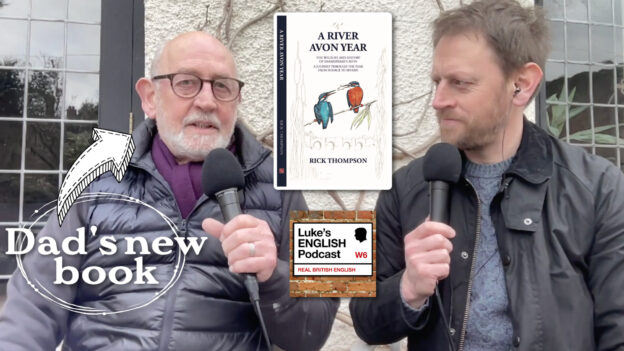
My dad has written a new book and he’s come on the podcast to tell us about it. The book follows the path of the river Avon as it flows through the middle of England, telling stories of key moments in British history, nature and the current condition of Britain’s rivers.
James Harris is a writer, comedian, English teacher and language learner (French, German, Chinese) from England. In this funny chat, we talk about learning Chinese, being married to a Chinese woman and his semi-autobiographical book, “Midlands” which tells several funny and touching stories about two ex-pats living in Germany; Stuart, who is a stand-up comedian trying to understand the Germans, and Doug who gets involved in a love affair. James reads several passages from the book during the episode.
Stuart describes his early days in Germany, learning German.
Then a chance meeting in a pub had earned him an invitation to Berlin. Laura, Danish and short, was staying there for the summer, rummaging around in the archives for information about a particular Jewish family who had gone on to achieve cultural success in post-war Denmark;
Laura, a snub-nosed Danish girl with glasses who loved Israel and wheat beer. Stuart didn’t care much about her interests but did enjoy spending the days reading on her balcony and socializing with university friends at night;
by the end of the summer his hair had lengthened and his German increased fifty-fold, meaning he now knew about a hundred words. ‘Hallo!’ he would say, then ‘Weltschmerz’ and following a further pause ‘Auf Wiedersehen,’ saying a final farewell to people he would see again the next day.
He also hadn’t yet learnt to ask whether something was sugar or salt, leading to an evening eating some very sweet chips. But even speechless he wasn’t, at last, uneasy in Berlin – it seemed to him a gentle city, where the trains slid in and out and the open spaces pacified tourists drunker and rowdier elsewhere.
It was like the Germans had become one of the peaceful races in Star Trek, the ones introduced by an insert screen of their orderly, verdant planet, Bajorans, say, or some other species permanently threatened by obliteration; and what a change after the tiny cubicles and traffic-jam living of the English, who could only ever be the Borg.
Surrounded by pacifists, Stuart revelled in the license of Englishness, his ability to voice the odd mildly aggressive opinion or wildly over-celebrate during that summer’s football tournament, until England lost. He swam in lakes, and bought a bicycle, and gradually stopped thinking of England and the ashes it had fed him.
In Oxford, where he had been President of the University sketch revue, people had printed gossip about him in the student newspapers, asked him to leave parties, dealt with him as the man who had committed that deepest and most unforgivable of Oxford crimes: failure.
He had failed, as a comedian and a young man, and now publicly; his country had rejected him. He had been humiliated in front of an audience of his contemporaries and sent into an internal exile.
Afterwards, many of these young dilettantes, at the time apparently picturing future lives as bereft of unforeseen distress as possible, lives composed of simply an endless procession of success, successes occurring within a network of contacts which they had built up at University and which would continue to provide them with unstinting support throughout their adult lives, never violating the simple and essential principle that all was permissible as long as it did well – did not want his name on their social CV.
From Chapter 14
Stuart is on-stage doing stand up in Germany.
‘Don’t you sometimes get the feeling,’ said Stuart, years before on the stage in Heidelberg, ‘that if Barack Obama had been German it wouldn’t have been “Yes We Can” but ”Nein das geht nicht”? No you can’t.
‘Everyone would have been chanting it – No you can’t! No you can’t! Of course in this version Obama would not have been black.’
Stuart was closing in on the kill. ‘And this very lack of optimism,’ he said, treading across the stage, limbering, into the really good stuff now, ‘is actually built into the German language itself.
Like for example, when you’re really happy in English, you say “I’m on Cloud Nine.” But in Germany you say, “I’m on Cloud Seven.”
Does this mean that even in their happiest moments the Germans are two clouds less happy than English-speaking people?’
And after developing that bit, which meant moving into a depiction of an exemplary German, Hannes, in his German heaven, with an allotment, board games, juice and an Autobahn heading directly to Mallorca, he noting, somewhat wistfully, the celebratory Anglophones on Cloud Nine who were dancing to ‘Video Killed the Radio Star’, which was an excuse to sing it, following which they – the Anglophones – called down to Cloud Eight “Hey Hannes man! Come and join us here on Cloud Nine” and Hannes replying “No thank you. Everything on Cloud Seven is perfectly satisfactory” then moving on to speculation as to the occupants of the other clouds, the French on Cloud Eight living it up, their motor scooters floating off the cloud and down to Cloud Zero where the Greeks were and below them the Cypriots who’d had to sell the cloud, and were just falling – after all these and other jokes, Stuart had them where he wanted them.
‘Isn’t it funny that, since the Second World War, the Germans have been like’, change voice, German accent, ‘”We Germans. We have done so many things wrong and there is no way we can ever put them right.”
And now Greece is like,’ pause, turn of the head, “Well, actually…”’
They laughed, and laughed, and laughed. They got it.
Let’s do another text adventure mystery story by Peter Carlson. Listen to me read the story and make choices to solve the mystery. You can read the story with me (link below) or do the game yourself later. This is the first in a series of 3 stories from Peter’s “Victorian Detective Interlude” game on textadventures.co.uk
Hello website visitors! I hope you’re doing ok. Did you have a good Christmas (if you celebrate it)?
These three “Victorian Detective Interlude” episodes will be the last episodes of 2022. What a year it’s been! For me, the year started in our new apartment, and everything was a disorganised mess! I had no pod-room where I could record episodes in peace, and our apartment was so noisy that I even had to record a podcast outside in the street. I talked about it in episode 759. Then I managed to set up my new studio/office in a tiny room in a nearby building. I was quite proud of myself because I put up all the shelves (more difficult than you might think!), painted the room, fitted a desk, procured a free office chair and then carried all my books, equipment and other stuff to the room (up 6 flights of stairs, no less). I talked about all that “DIY” in episode 757. After a looooong time the room finally got electricity and an internet connection, I got a new computer (the old one was kaput) and was able to get back to normal podcasting.
Oh yes, then I changed podcast host in June and everything got incredibly complicated again, especially for premium subscribers! But thankfully we all survived all the stress and I was able to record some episodes that I am very happy with, and LEP Premium continued on Acast+ with more and more new episodes.
If you have recently subscribed to LEP Premium – www.teacherluke.co.uk/premium The best way to use LEP Premium is to add the episodes to a normal podcast app on your phone (not the LEP App, it’s not updating any more 😢, and not Spotify because it isn’t “normal”). Read this page for some important information to help you get started https://teacherluke.co.uk/premium/how-to-add-lep-premium-to-a-podcast-app-on-your-phone-with-acast/
Luke’s English Podcast continues to be the thing I love doing, and I’m lucky to get some income from this work now. I’m happy to say that the podcast continues to go from strength to strength. This year the audio podcast hit 800 episodes, 100,000,000+ downloads in total (incredible), 100+ premium episodes, and my YouTube channel passed 400,000 subscribers (wow!). But maybe the most satisfying thing is that I have received so many messages from listeners with positive things to say about their experiences of learning English with my content.
Thank you for choosing LEP in 2022. Thank you if you left your comments on my episodes. Thank you if you sent me messages of encouragement. Thank you if you sent donations to support this project. Thank you if you signed up to LEP Premium.
I hope you have enjoyed learning English with me in 2022. Here’s to more episodes in 2023! I have lots of plans for more content on a variety of topics – some serious, some funny, but all designed to help you to get more English into your life.
Happy New Year everyone!! 🥂
Luke
Episode 803 “The Wraith” will be published tomorrow, probably!
Learn English with another short story. In fact, this episode contains two stories. Listen until the end for the 2nd one. Repeat after me to practise your pronunciation. Learn some vocabulary & grammar in the second half of the episode, with an explanation of modal verbs of deduction in the past and present. Video version available.
It is published by OUTPOST 19 and it was put together by the team behind the website, including Grant Faulkner, Lynn Mundell and Joshua Michael Stewart.
It is available for you to purchase and I recommend it if you are looking for bite size stories to use for learning or teaching English.
Reading out loud can have lots of surprising benefits for our memory and our mental health. How can it also help with your English? In this episode I read an article to you, help you understand it and give comments on the importance of reading, both quietly in your head, and out loud. Video version and full transcript available.
Welcome to this new episode. This one is about reading and the power of reading aloud (reading out loud) and I think it can definitely help you with your English in various ways. Stick with me, there’s a lot to discover here.
I found an article the other day on the BBC’s website and I thought it was really interesting and definitely something I could turn into an episode of this podcast.
I am going to read the article to you in this episode. You can read it with me if you like. The link for the article is in the description, or if you are watching the video version you will see the text on the screen.
I’ll help you understand it all, we’ll consider the main points being made by the writer, I’ll give my thoughts on how this all relates to learning English and I’ll point out some bits of vocabulary for you to learn along the way.
Reading out loud ← what does this mean?
Normally when we read, we read silently. We read in our heads. 📖👀
But when we read out loud we actually say the words we are reading with our voice so that other people can hear you. 🗣️ That’s what out loud means.
Aloud and out loud are synonyms.
To read out loud (I had to read out loud in front of my class during my French lesson and it was a bit embarrassing)
To say something out loud (Don’t say that out loud, it’s supposed be a secret!)
To think out loud (What are you talking about? Oh, sorry, never mind, I’m just thinking out loud really)
To laugh out loud (LOL)
The Article
The title of the article I found is The Surprising Power of Reading Aloud, and I found it in the “Future” section of the BBC’s website.
BBC Future is a section of the BBC website where you can read some really interesting articles about lots of different subjects.
The articles are written in an academic style (so we are looking at academic English here to an extent), but these articles are very readable and they are exactly the type of reading text that you might find in an IELTS reading test. You often find academic texts about scientific subjects, or history, or psychology in IELTS tests.
So, it would be really good practice for you to read articles like this on a regular basis, whether you are preparing for IELTS or you’re just interested in developing your English generally. The articles on BBC Future are quite advanced – they are for native English speakers, but with a good dictionary and a bit of motivation, they could really help your English.
I’m going to help you do that in this episode with this particular article. I’ll take you through it and will explain things.
Let’s get started.
Before we start reading, I’ve got two tasks for you (and they’re important)
1st task: Consider some questions
Here are some questions to get you thinking 🧐🤔💭
I want you to consider these questions because this will get you in the right mental space to understand the article we’re going to read. It’s important to do this because this is how you get your mind ready before you read. So, consider these questions (below).
If you like you can pause this episode after I say these questions in order to actually answer them, in your own head or out loud.
Saying your answers out loud would be the best thing to do – to practise your speaking and putting your thoughts into words. So, if you can do that, do that, right now, with these questions.
Questions to consider before reading
When was the last time you read something in English? What was it, and why did you read it?
When you read in English or in your first language, do you usually read silently in your head or do you read out loud? Why?
In what situations do people sometimes read out loud?
Do you think reading out loud is more or less common these days than it used to be? Do people read out loud more these days, or did they do that more in the past? Why could this be?
Can you remember a time when someone read something out loud to you? What was the situation? How did it make you feel?
How about when you were a child? Can you remember any moments when someone read out loud to you? How do you feel about those memories?
What do you think is better for your English – reading texts silently in your head, reading texts out loud, or listening to other people read out loud to you? Why?
2nd task: Read the text 📖
Here’s a reading task for you
Before I read this article to you, I want you to read it yourself. Twice.
🔗 link in the description 🔗
First, read the text silently, then try reading it out loud.
You don’t have to read the whole thing. Maybe just do the first few paragraphs if you prefer.
But try it. Go on.
Read it silently first, then read it out loud.
Try not to sound like a robot 🤖
Put some life into the reading ❤️🔥
If/When you read it out loud, consider these questions. you .
Where are the pauses? Where should you pause when you read?
Which words in each line should be stressed (emphasised)?
Where does the voice go up and where does the voice go down?
How would you read it out like a TV presenter or a university lecturer?
Imagine you are reading this out for an audience.
It might affect the way you read it. 🗣️
You can do that now. The link to the article is in the description.
Read it – first silently, and then out loud like a presenter.
I’ll let you pause the episode right now and do that. I’ll continue speaking to you again in a moment.
– – – –
This is where you pause to read the article
– – – –
OK, welcome back. I know some of you didn’t pause the episode and read the text, which is totally fine.
But some of you did. Nice one.
I wonder how it was for you.
Was difficult or not?
Was it difficult to read the text?
It’s a different experience isn’t it, reading it out loud.
It has its own challenges.
Unknown vocabulary, difficult pronunciation, understanding the overall flow and structure of the text.
Now, let me read the article to you. You can read it with me too, or just listen. It’s up to you.
I’ve broken the text into sections. I’ll read a section of the article, then paraphrase what I read, add my comments and explain some words. Then we’ll move to the next section.
Whenever there’s a break in the text like this, it’s the end of a section.
– – – – – – – – –
When that happens, I’ll stop and explain things, then we’ll move on to the next section.
You’ll see some words highlighted in bold. These are words that you might not know, so I’ll explain them as we go.
Try reading aloud with me to work on your pronunciation if you like.
Most adults retreat into a personal, quiet world inside their heads when they are reading, but we may be missing out on some vital benefits when we do this.
For much of history, reading was a fairly noisy activity. On clay tablets written in ancient Iraq and Syria some 4,000 years ago, the commonly used words for “to read” literally meant “to cry out” or “to listen”.
“I am sending a very urgent message,” says one letter from this period. “Listen to this tablet. If it is appropriate, have the king listen to it.”
Only occasionally, a different technique was mentioned: to “see” a tablet – to read it silently.
Today, silent reading is the norm. The majority of us bottle the words in our heads as if sitting in the hushed confines of a library. Reading out loud is largely reserved for bedtime stories and performances.
But a growing body of research suggests that we may be missing out by reading only with the voices inside our minds. The ancient art of reading aloud has a number of benefits for adults, from helping improve our memories and understand complex texts, to strengthening emotional bonds between people. And far from being a rare or bygone activity, it is still surprisingly common in modern life. Many of us intuitively use it as a convenient tool for making sense of the written word, and are just not aware of it.
– – – – – 1/10 – – – – –
Colin MacLeod, a psychologist at the University of Waterloo in Canada, has extensively researched the impact of reading aloud on memory. He and his collaborators have shown that people consistently remember words and texts better if they read them aloud than if they read them silently. This memory-boosting effect of reading aloud is particularly strong in children, but it works for older people, too. “It’s beneficial throughout the age range,” he says.
MacLeod has named this phenomenon the “production effect”. It means that producing written words – that’s to say, reading them out loud – improves our memory of them.
– – – – – 2/10 – – – – –
The production effect has been replicated in numerous studies spanning more than a decade.
In one study in Australia, a group of seven-to-10-year-olds were presented with a list of words and asked to read some silently, and others aloud. Afterwards, they correctly recognised 87% of the words they’d read aloud, but only 70% of the silent ones.
In another study, adults aged 67 to 88 were given the same task – reading words either silently or aloud – before then writing down all those they could remember. They were able to recall 27% of the words they had read aloud, but only 10% of those they’d read silently. When asked which ones they recognised, they were able to correctly identify 80% of the words they had read aloud, but only 60% of the silent ones. MacLeod and his team have found the effect can last up to a week after the reading task.
MacLeod says one reason why people remember the spoken words is that “they stand out, they’re distinctive, because they were done aloud, and this gives you an additional basis for memory”.
We are generally better at recalling distinct, unusualevents, and also, events that require active involvement.
For instance, generating a word in response to a question makes it more memorable, a phenomenon known as the generation effect.
Similarly, if someone prompts you with the clue “a tiny infant, sleeps in a cradle, begins with b”, and you answer baby, you’re going to remember it better than if you simply read it, MacLeod says.
– – – – – 4/10 – – – – –
Another way of making words stick is to enact them, for instance by bouncing a ball (or imagining bouncing a ball) while saying “bounce a ball”.
This is called the enactment effect. Both of these effects are closely related to the production effect: they allow our memory to associate the word with a distinct event, and thereby make it easier to retrieve later.
– – – – – 5/10 – – – – –
The production effect is strongest if we read aloud ourselves. But listening to someone else read can benefit memory in other ways. In a study led by researchers at the University of Perugia in Italy, students read extracts from novels to a group of elderly people with dementia over a total of 60 sessions. The listeners performed better in memory tests after the sessions than before, possibly because the stories made them draw on their own memories and imagination, and helped them sort past experiences into sequences. “It seems that actively listening to a story leads to more intense and deeper information processing,” the researchers concluded.
Reading aloud can also make certain memory problems more obvious, and could be helpful in detecting such issues early on.
In one study, people with early Alzheimer’s disease were found to be more likely than others to make certain errors when reading aloud.
– – – – – 6/10 – – – – –
There is some evidence that many of us are intuitively aware of the benefits of reading aloud, and use the technique more than we might realise.
Sam Duncan, an adult literacy researcher at University College London, conducted a two-year study of more than 500 people all over Britain during 2017-2019 to find out if, when and how they read aloud. Often, her participants would start out by saying they didn’t read aloud – but then realised that actually, they did.
“Adult reading aloud is widespread,” she says. “It’s not something we only do with children, or something that only happened in the past.”
Some said they read out funny emails or messages to entertain others. Others read aloud prayers and blessings for spiritual reasons. Writers and translators read drafts to themselves to hear the rhythm and flow. People also read aloud to make sense of recipes, contracts and densely written texts.
“Some find it helps them unpack complicated, difficult texts, whether it’s legal, academic, or Ikea-style instructions,” Duncan says. “Maybe it’s about slowing down, saying it and hearing it.”
– – – – – 7/10 – – – – –
For many respondents, reading aloud brought joy, comfort and a sense of belonging. Some read to friends who were sick or dying, as “a way of escaping together somewhere”, Duncan says. One woman recalled her mother reading poems to her, and talking to her, in Welsh. After her mother died, the woman began reading Welsh poetry aloud to recreate those shared moments. A Tamil speaker living in London said he read Christian texts in Tamil to his wife. On Shetland, a poet read aloud poetry in the local dialect to herself and others.
“There were participants who talked about how when someone is reading aloud to you, you feel a bit like you’re given a gift of their time, of their attention, of their voice,” Duncan recalls. “We see this in the reading to children, that sense of closeness and bonding, but I don’t think we talk about it as much with adults.”
– – – – – 8/10 – – – – –
If reading aloud delivers such benefits, why did humans ever switch to silent reading? One clue may lie in those clay tablets from the ancient Near East, written by professional scribes in a script called cuneiform /ˈkjuːnɪˌfɔːm/.
Over time, the scribes developed an ever faster and more efficient way of writing this script. Such fast scribbling has a crucial advantage, according to Karenleigh Overmann, a cognitive archaeologist at the University of Bergen, Norway who studies how writing affected human brains and behaviour in the past. “It keeps up with the speed of thought much better,” she says.
Reading aloud, on the other hand, is relatively slow due to the extra step of producing a sound.
“The ability to read silently, while confined to highly proficient scribes, would have had distinct advantages, especially, speed,” says Overmann. “Reading aloud is a behaviour that would slow down your ability to read quickly.”
– – – – – 9/10 – – – – –
In his book on ancient literacy, Reading and Writing in Babylon, the French assyriologist Dominique Charpin quotes a letter by a scribe called Hulalum that hints at silent reading in a hurry. Apparently, Hulalum switched between “seeing” (ie, silent reading) and “saying/listening” (loud reading), depending on the situation. In his letter, he writes that he cracked open a clay envelope – Mesopotamian tablets came encased inside a thin casing of clay to prevent prying eyes from reading them – thinking it contained a tablet for the king.
“I saw that it was written to [someone else] and therefore did not have the king listen to it,” writes Hulalum.
Perhaps the ancient scribes, just like us today, enjoyed having two reading modes at their disposal: one fast, convenient, silent and personal; the other slower, noisier, and at times more memorable.
In a time when our interactions with others and the barrage of information we take in are all too transient, perhaps it is worth making a bit more time for reading out loud. Perhaps you even gave it a try with this article, and enjoyed hearing it in your own voice?
– – – – – 10/10 – – – – –
Conclusion
As a language practice exercise, try reading texts out loud.
You don’t have to do it all the time, but simply trying to read a text out loud as if you are reading it to some people, can be a good exercise.
Research suggests that it could help you remember words more effectively. The production effect means – producing words (saying them out loud) makes a difference to your ability to remember them later. Even just mouthing words when you read them helps them to go into your brain.
So, read aloud and mouth words when you read them.
Also, being prompted with a clue helps you remember words. This is called the generation effect. This encourages me a lot, because it confirms things I have been doing as a teacher, including in LEP Premium episodes when I use little prompts to help you recall words. For you, you could always create your own clues to help you remember words or phrases, or play word games in English in which you define words and then have to guess which words they are. Do this with new vocabulary. Of course, you would need friends or language partners to play with.
Acting words out, or linking them to physical movements also helps you remember words. So, when trying to remember words, add a physical element somehow, even if it means imagining yourself doing the word or being in a certain physical space when thinking of new words. For example if the expression is “to be wary of doing something” – put your hand to your chin and pretend you are being nervous about something or reluctant to do it. Make a sound like “Naaaaaaah, I’m a bit wary of doing that”. Perhaps imagine yourself at the end of a dark street and say “I’m a bit wary of going down there on my own. I think I’ll take the main road.”
Listening to other people read to you also helps a lot. So, the conclusion here is just keep listening to LEP of course! I am sure this works when someone is just speaking to you as well, especially if you are involved and caught up in what they are saying. That’s what I’ve always thought and I am sure scientific research would suggest that it’s true. My hypothesis is that people will remember more L2 words when they are presented in a meaningful context. It’s pretty obvious really.
Reading aloud might be good for your mental health. It seems that the exercise can reveal signs of dementia. Maybe reading aloud does require quite a lot of brain work – not only are you reading and decoding the words, but your brain is involved in some motor exercise too – meaning, muscle work, movement work. Surely, making your brain multi-task like this can only be good as a way of keeping it active. Brain training, basically.
It’s a good way to keep your brain young.
Reading aloud also makes you feel quite good, especially if you do it with others. It could be a good exercise with other learners of English, or with your English teacher. Of course, don’t only read aloud, but include it as part of your regular English practice. It’s especially enjoyable if you are reading out some interesting texts, and try to mix it up – some non-fiction stuff and also some stories and so on.
When you read aloud, consider where you need to chunk the text, pause, emphasise and use intonation.
Reading texts out loud is something I often do with my students in class. I ask my students to work out where the pauses should be, which words to emphasise and where the voice goes up or down.
This exercise reveals things about the text, including the structure and the real meanings and intentions of the writer.
Try reading aloud from time to time. Also try reading out loud with me, at the same time as me sometimes (if there is a transcript with the episode). It might help you notice more aspects of the language in the text, help you remember it more, and help you practice your pronunciation as well as your reading. It might also just make you feel good.
What do you think?
Leave your comments below.
What have you been thinking while listening to this?
Has it given you any ideas about learning English?
Do you have anything to add?
Put your thoughts into English in the comment section.
A Premium Series
I’m also publishing a 3-part premium series all about the language in this episode. It’ll be available soon or maybe it’s already available now. I’m going to record them right away in fact. They are the next things I’m going to record.
In those premium episodes I will go through the vocabulary which I highlighted in the text again, and I’ll expand things with slightly more detailed explanations and examples, then I’ll test your memory of those words and phrases (with some prompts and some sentences with missing words) and give you a chance to practise pronouncing all the words in sentences.
There will also be an episode where we practise reading aloud some of the paragraphs from the text, with advice about where to pause, which words to emphasise and so on, with sentences to repeat after me.
To get those episodes, sign up to LEP Premium on Acast+. You can add the premium episodes to your podcasting app, and also access PDFs and video versions that way. www.teacherluke.co.uk/premium for the premium series focusing on the language in this episode.
That’s it for this episode, but I will be back soon with more things for you to listen to, including more stories which I would like to read to you, and conversations with guests, and all the other types of episode I like to present to you on my show.
Thanks for listening, but for now – good bye bye bye!
My mum returns to the podcast to answer some questions from listeners about books, cooking, her relationship with Luke and her granddaughter, the war in Ukraine, the song Imagine by John Lennon, family games, the time she fell off a horse & more…
Today I am joined by my mum and we’re going to spend the episode chatting about this and that, and responding to some questions from LEPsters on Twitter.
I hope you enjoy the episode everyone, Stick with us, and as usual you’ll find that the more you listen, the better it is for your English.
Hi Mum, how are you today?
Where are we?
It’s been ages since you’ve been on the podcast, with your own episode (April 2021 – 717. Gill’s Book Club).
We were doing Gill’s Book Club (we did 3 or 4 of those) and every now and then we talk about doing another one, but we have found it a bit tricky to choose books that
Most other people probably have read
That I have read too
That would appeal to enough people
That we remember clearly
Plus you somehow got out of the habit of reading every day.
Anyway, it’s nice to be able to have you on the podcast again.
My aim for this is mainly to let people just listen to your voice, listen to your words and it sort of doesn’t matter too much what we talk about, as long as we just let the conversation flow and let the English happen naturally. We decided not to limit ourselves to any one specific topic here, preferring instead to cast our net quite wide in terms of things to talk about.
Yesterday evening, I Tweeted this:
Very late notice, but I'm going to record a podcast with my mum tomorrow morning. Any questions for her?
Not a very original one but a classic: what book(s) did she enjoyed recently? I’m looking forward to listening to you two, it’s always such a treat. Please give your mum my best and as always, thanks for the podcast!
So happy so hear for your mother ! I would like to know what is she currently reading of course. And if she thought you would become a journalist like your father ? When I listen to the Rick reports, I realise that journalism is not so far from your podcast… Many thanks !
Yes.I’ve one maybe too personal. So you couldn’t take in account. How she feels as a Brit nanny ? Any special food for her niece as a British grandmother?
I use both English and Portuguese when talking to my niece. I speak Portuguese, she answers in English and vice-versa. I wonder if she fears not being able to have a fluent comprehensible conversation with her granddaughter in future. That was my main motivation to study English.
How is her cooking? What is her signature dish? Any secret family recipes?
Is it true that English people in general are not good cook? Gordon Ramsay is a great chef but he usually cook Asian food, his restaurant in London is Asian restaurant.
Luke: Ramsay has 53 restaurants (according to the list on his website, and they serve a variety of things – French fine dining, rustic English food, burgers, pizza, asian food and more…)
In an interview with David Sheff for Playboy Magazine, shortly before his death in December 1980, Lennon shared that Dick Gregory had given him and Ono a Christian Prayer-book which had inspired him to write the track. “The concept of positive prayer…If you can imagine a world at peace, with no denominations of religion – not without religion but without this my God-is-bigger-than-your-God thing – then it can be true.”
The Beatle continued, “The World Church called me once and asked, “Can we use the lyrics to ‘Imagine’ and just change it to ‘Imagine one religion’?” That showed [me] they didn’t understand it at all. It would defeat the whole purpose of the song, the whole idea.”
Well then listeners, that was my mum in her own episode again, but hold on, we’re not done yet, there’s more.
As you just heard at the end, my wife and daughter just came back from the market so we thought we should stop recording and get ready to have lunch with everyone.
But then my daughter did come into the garden and she picked up the microphone, so here is a little interview with her. So you get 3 generations of the family in one episode. A cross generational podcast for you.
So, I asked my daughter to describe what she had done at the market and before I managed to press record on my recorder, she started talking about how they had gone into the local museum in the town square, where they have various items including a large stuffed bear (a real one, stuffed – it’s quite odd and quite interesting), as well as other things, and I asked if she found the bear frightening or if she’d been traumatised by the bear, and then I asked her about the word traumatised, and she ended up describing how she’d been traumatised by a loud automatic hand dryer in a public toilet once (you know those hand dryers which you get on the wall in public toilets?), and that is where this 10 minute clip begins.
So here we go with a bonus bit of chat with youngest member of the Thompson family.
Ending
There you go listeners.
A bit of wisdom there from the voice of the future.
Don’t fight.
You have to love each other.
You have to love le world.
Be excellent to each other.
Party on.
And sign up to LEP Premium on Acast+ for ad-free content and of course many many extra episodes in which I help you with your vocabulary, grammar and pronunciation 😅
Well, I hope you agree listeners, that that was a real treat, especially if you listened all the way until the end.
I really enjoyed that – being able to ask my mum those questions and get her responses, while sitting in the very nice surroundings of her garden, and I hope you enjoyed it too.
I must say I love making these recordings – in order to publish them for your listening pleasure and for your English listening practice (hopefully both) but also just as a record of family life – the voices of my family and my friends, stories, thoughts, memories, opinions and so on. How nice.
I’m very grateful to my mum for this episode and generally for all my guests who contribute so much.
Send us your comments. It’s nice to read them and to get some human responses to our words.
Sorry if you weren’t able to send in a question. I put up the request on Twitter without much notice. I do that sometimes, in order to get opinions or podcast questions from my audience.
If you want to follow me on Twitter, please go ahead. @EnglishPodcast
I’m also on Instagram but I hardly ever use it. In fact, at the moment I only use it to help me book and promote stand up comedy shows (because some of the comedy nights use Instagram to communicate with comedians), but I am there @lukesenglish
Thank you again for listening and for supporting the podcast.
Do me a favour:
Like and subscribe
Leave a positive review on Apple Podcasts
Tell you friends
Support the show by becoming a premium lepster (and oh you’ll get all the premium content too and no ads) www.teacherluke.co.uk/premium
I will speak to you again soon. I have loads of episode ideas and so many things I want to record, but I mustn’t overwhelm you.
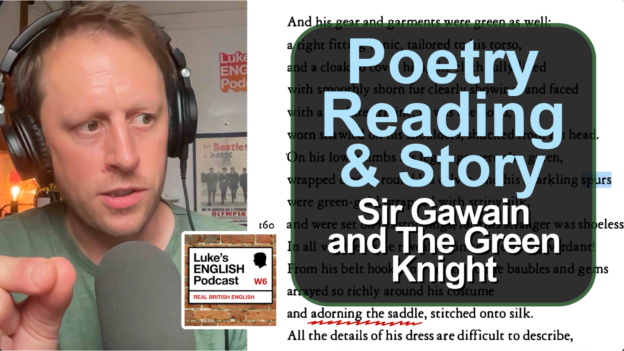
Luke reads verses from a modernised version of this medieval poem, considered one of the masterpieces of Middle English literature. Listen to hear the rhyme and rhythm of the poetry, the descriptive vocabulary and details of the story, with vocabulary explanations and comments from Luke. This is part 2 of a double episode about this story. Video version available with on-screen text.
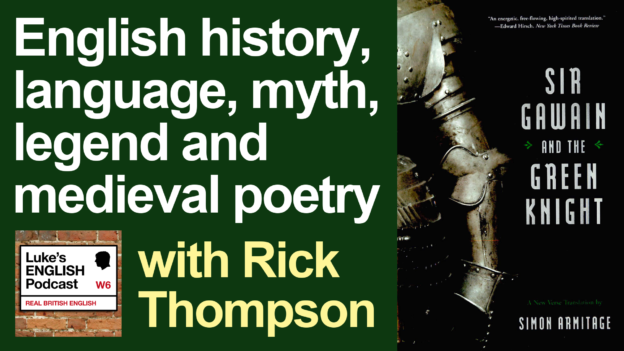
Sir Gawain and The Green Knight by Simon Armitage, published by W. W. Norton & Company (available in all good bookshops)
Introduction Transcript
Hello listeners,
Welcome to episode 779 of my podcast for learners of English. This is in fact part 2 of a 2-part episode.
In part 1 of this (episode 778), I talked to my dad about an old poem from the medieval period in Britain.
The poem is basically a really mysterious and wonderfully descriptive adventure about a knight from King Arthur’s table at Camelot.
King Arthur was a mythical king of Britain who people told and wrote stories about, many centuries ago.
We’re not sure if he really existed, if the stories about him are all fictional, or some combination of those two things.
Anyway, the Arthurian legends, or stories of King Arthur and his Knights from Camelot are full of magic, chivalry and adventure.
Chivalry means the rules that all honourable knights had to follow – a code of honour.
Anyway, the poem I talked about with my dad in the last episode is about one of Arthur’s knights who accepts a strange and dangerous challenge. The poem is called Sir Gawain and The Green Knight.
If you listened to episode 778, you heard my dad describing the story of the poem, the linguistic style and how it fits into British history and the history of the English language.
At the end of that episode I read some verses from a modernised version of the poem, by Simon Armitage.
In this episode I’d like to read some more verses from the poem, but this time I’d like to explain some of the vocabulary and other aspects of the language while I am doing it.
So here you will be able to hear part of a medieval poem written in middle English, which has been updated into modern English, with explanations and comments from me.
Again, the poem is called Sir Gawain and The Green Knight.
It was probably written in England in the 14th century (probably around the year 1370).
Since this text was discovered it has been studied and translated and is now considered one of the greatest works of medieval English literature.
Modernised versions have been published, including one by JRR Tolkein and another one more recently by Simon Armitage.
The one I’m going to read from here is the modernised version by Simon Armitage, which is available as a book from W. W. Norton & Company – you can get it in any good bookshop.
I do recommend it. It has a really interesting introduction and it presents both the modernised version and the original text, side by side.
In terms of language, there are three main things to notice.
These linguistic features or poetic devices were all present in the original version and Simon Armitage has done a great job of replicating them in this modern version.
Alliteration This is when the same sounds are used at the beginnings of words.
It creates a kind of rhythm or music to the lines.
Examples:
a fearful form appeared, framed in the door
a mountain of a man, immeasurably high,
a hulk of a human from head to hips,
so long and thick in his loins and his limbs
I should genuinely judge him to be a half giant,
or a most massive man, the mightiest of mortals.
The “Bob and Wheel”. This is a poetic device which can be found in poems from this era.
Each “stanza” (group of lines) ends with two syllables (the bob) and then four flowing lines which follow (the wheel)
So listen a little while to my tale if you will
and I’ll tell it as it’s told in the town where it trips from
the tongue;
and as it has been inked
in stories bold and strong,
through letters which, once linked,
have lasted loud and long.
Descriptive vocabulary The poem is full of vivid descriptions, and Simon Armitage has managed to modernise the vocabulary so most of the language used here is up-to-date and still used by people today.
So, let’s get into the poem.
I’ll read each verse one by one, and then I’ll go back through and explain the language.
You could try to repeat the lines of the poem after me. That would be a good way to practise your pronunciation.
I’m going to start reading from line 130.
Just to bring you up to speed with the story, here’s what happens between lines 1 and 129.
The poem begins by referring to Greek mythology. It briefly describes the fall of Troy and the foundation of Rome, and it makes a clear connection between King Arthur of Britain and those heroes from Greek and Roman mythology.
It’s Christmas in Camelot and King Arthur is celebrating with a big feast (a big meal which lasts for a long time).
The poem describes the celebrations, the food, the games they’ve been playing, the decorations, the seating arrangement with all the knights, ladies and their guests. King Arthur’s wife Guinevere is there, and the poem describes how beautiful she is.
They are just about to start eating, when the celebration is interrupted by something extraordinary.
Luke reads lines 130 – 466 from the Simon Armitage version of the poem.
A conversation with my dad about a great medieval adventure story originally written in middle English and updated and translated into modern English by Simon Armitage. Dad talks about the origin of this story, its connection to the history of the English language, and the poetic devices used in the writing. In the second half I read a summarised version of the story and some verses from Armitage’s modernised version.
[DOWNLOAD]
Introduction Script
Hello there, how are you? Hope you’re well. Just before we start – a quick bit of news.
So, my full time teaching schedule at school has ended now and I have about 1 week to work on LEP content, and upload it before the August summer holiday begins. I’m not sure if I will be able to work during August, because “hello” it’s holiday season – my daughter is off school, we’re going on holiday in France and in the UK, and I might not bring my computer with me and so on. So I might upload loads of content this week, which you can listen to during the summer. I don’t want to overload you, but also I don’t want to underload you (is that a word).
In any case, it’ll be like waiting for a bus again – you wait ages and then 3 come at the same time. This includes premium content. An update about LEP Premium: New episodes will be arriving very soon, including P35 part 2, which is full of pronunciation practice. As you may know, LEP Premimum is still in a transition from Libsyn to Acast and during this time I can’t upload episodes because of a slight issue relating to transferring 6 and 12 month subscriptions, but this is going to be solved very soon, and as soon as it is solved, new premium content will arrive. If you are a premium subscriber on Libsyn (the old system) with a 6 or 12 month subscription, and you’re keen to move to Acast – I will be contacting you soon with a solution to the situation. Just hold on. If you don’t understand what’s happening, check my website for updates. But mainly – just hold on.
If you are new to LEP Premium, you can go ahead and and sign up through Acast+ – it’s www.teacherluke.co.uk/premium or click the link in the description. If you do that you will be supporting this whole project and in return you will get access to all the LEP Premium episodes (well over 100 vocabulary, pronunciation and grammar practice lessons) PDFs, videos and also you get ad-free episodes of LEP. If you’re wondering how it all works, have a look at my website where you will find all the information you need, including how to access the PDFs and how to add LEP Premium episodes to your podcasting app of choice.
— Jingle —
Hello everyone,
In this episode, my dad is back, but it’s not the Rick Thompson Report, so no politics this time. Instead we’re doing an episode that we have been hoping to do since Christmas last year.
In this one, Dad is going to tell us about an old story from the Arthurian legends – that’s a set of stories about the mythical King Arthur and his Knights of the Round Table. British legends and folklore.
The story we’re talking about is in the form of a poem called Sir Gawain & The Green Knight. This long poem was probably first written down in the 14th century by an unknown poet, but the story is probably much older than that, and part of a long oral storytelling tradition.
What Dad is going to do is describe the significance of this story, give us a summary of the plot and also he will make some comments about the history of the English language, and the rhythmic and rhyming style used in the original 14th century version, which was written in what we now call middle English. My dad studied English literature at university in the 1960s and this was one of the texts that he studied, and so he knows it quite well.
Recently the old 14th century version of this poem was updated by a modern poet called Simon Armitage (the current poet laureate in the UK). Armitage has managed to write a modern version of this poem using modern English vocabulary, but it retains many of the linguistic and poetic devices of the original, including certain forms of rhyme and rhythm that made the poem so effective.
My dad got that version for Christmas and that’s what inspired us to do this episode.
It should be interesting for you to hear the story, hear my dad’s comments about it and learn how this fits into the history of the English language.
In the second half of the episode I will read you a summarised version of the full story just to make sure you get to hear an uninterrupted version, plus I will read out a few verses of the Simon Armitage version of them poem, again, to give you a good chance to hear some the rhythm and rhyme of it uninterrupted.
So, if you are sitting comfortably, let’s begin.
Ending Script
Well, how was that?
You might be keen to hear more of the story and to hear more samples of the poem. That’s what I’d like to do in this ending part.
I’m going to do a couple of readings for you now.
I thought it would be useful for you to hear a brief version of the whole story, just to give you an overview and to make sure you’ve understood the whole thing. Then I’ll read a few of verses from the Simon Armitage version, in order to give you a flavour of the poetry with its distinctive style: wonderfully descriptive language and a particular rhythm, which was originally used in the 14th century version, as my dad described.
A Summary of the Story
This is a version of the story, from a TED Ed video by Dan Kwartler.
Credit for this version goes to Dan Kwartler and there’s an animated version of it here https://youtu.be/SaQImmPev2o I have adapted this version slightly.
This doesn’t have the rhythmic style of the original poem, or the richly descriptive language.
But it does tell the story quite briefly. I’m not going to explain all the words here. I might do that in part 2 (If there is a part 2).
It was Christmas time in Camelot
and King Arthur was throwing a party.
The entire court was invited,
except for the evil sorceress Morgan le Fay.
The food and drink flowed freely.
But in the midst of all the revelry,
the castle doors suddenly split open.
A tall knight riding an emerald horse
burst into the room,
stunning the court into silence.
He was green from head to toe,
including his skin, hair and clothes.
Even his horse was green.
Then, in a deep bellowing voice, he proposed a game.
The Green Knight declared that he would allow
the bravest warrior present
to attack him with his own axe.
If they could strike him down, they would win his powerful weapon.
However, the knight would be allowed to return that blow
in one year and one day.
Arthur and his knights were baffled.
No man could survive such a strike.
How would the Green Knight be able to return the blow in a year’s time?
The Green Knight began to mock their leader’s hesitance,
and Arthur stood up to defend his honour.
But as soon as he gripped the axe,
another person leapt up to take his place.
It was Arthur’s nephew,
Sir Gawain,
who decided he could not let the king be drawn into such a macabre game.
Keen to prove himself as a worthy hero,
Sir Gawain took the weapon instead.
The Green Knight knelt down to receive the blow from the axe,
even moving his hair away to expose the naked green skin of his neck.
With one swift strike, Sir Gawain beheaded the knight.
But the moment his skull hit the ground, it began to laugh.
The Green Knight bent down,
collected his head
and mounted his horse.
As he rode off,
his severed head reminded Gawain of their contract
and told him to seek the Green Chapel
one year and one day from that moment.
In the months that followed, Gawain tried to forget this bizarre vision.
But despite the strangeness of the knight’s game,
Sir Gawain was determined to act honourably and fulfil his promise.
When the following winter approached,
he set out —
enduring foul weather
and encounters with dangerous beasts
in his quest to find the mysterious Green Chapel.
Finally, on Christmas Eve, he saw a shimmering castle on the horizon.
The castle’s lord and lady were thrilled to help such an honourable guest,
and informed him that the Green Chapel was only a short ride away.
They implored Gawain to rest at their home until his meeting with the Green Knight.
Thrilled at this news, Gawain happily accepted their offer.
However, in exchange for this hospitality,
the lord made a strange request.
Over the next three days, he would go hunting
and every night he would share whatever he caught with Gawain.
In return, Gawain must give him whatever he’d gained during his day at the castle.
At first, Gawain was perplexed by these strange terms.
But the lord’s meaning became quite clear the next day,
when his wife tried to seduce Gawain.
To rebuff the lady’s advances without offending her honour,
Gawain allowed one kiss —
which he then passed on to her husband in exchange for a slain deer.
The next day, Gawain allowed two kisses,
which he gave to the lord for a dead boar.
But on the third day,
the lady offered more than just three kisses.
She presented a magical sash that would protect Gawain
from the Green Knight’s blade.
Gawain accepted immediately,
but that evening,
when the lord returned,
Gawain offered only three kisses and did not mention the enchanted gift which he had received.
The next morning,
Gawain rode out to the Green Chapel—
a simple mound of earth
where the Green Knight was waiting and ominously sharpening his axe.
With the sash’s protection,
Gawain approached stoically —
determined to honour his agreement.
He bowed his head for the deadly blow.
He flinched twice,
but then with a massive swing,
the Green Knight cut Gawain’s neck —
but inflicted nothing more than a flesh wound.
Once more, Gawain was bewildered.
Why hadn’t the sash protected him?
And why hadn’t the knight killed him?
Bursting into laughter,
the Green Knight revealed himself to be the castle’s lord,
and that he’d been working with the sorcoress Morgan Le Fay
to test the honour and bravery of Arthur’s knights.
He was impressed with Gawain’s behavior,
and he’d planned to spare his neck entirely —
until Gawain concealed the sash,
and this is when the Green Knight chose to inflict the fleshwound upon him.
Filled with shame, Gawain returned to Camelot.
But to his surprise, his companions absolved him of blame
and celebrated his valor.
Struggling to understand this strange journey,
it seemed to Gawain that perhaps the whole world was playing a game —
with rules more wild and bewildering than any man could understand.
Ok, so that’s the story.
It’s a bit confusing and mysterious.
(Luke gives a quick summary again)
Reading Verses from the Simon Armitage version of Sir Gawain and The Green Knight
What you don’t get from that story summary (above) is the beautiful language.
Wonderfully descriptive vocabulary
Alliteration (the repetition of rhyming consonant sounds at the start of words)
The “Bob and Wheel” (a rhythmic device which ends each verse)
There are some extracts from the Simon Armitage version available in the preview of the book on Amazon (other bookshops are available)
Let me read a couple of those initial pages.
The way the Armitage version of this poem is presented is that it gives one page of the modernised version, and then on the next page you have the equivalent original text, so you can compare them side by side.
I won’t read any of the original text because the English is so old fashioned that I frankly wouldn’t be able to pronounce it all. And before you fall out of your chair in disbelief that I don’t know my own language – hardly anyone is able to pronounce sentences written in middle English. Only academic experts can do that, and a lot of them disagree about how middle English should be pronounced. So, that’s not for us. Middle English is almost like another language, so there’s no need for me to read it to you.
The modern version of this poem on the other hand, is much more appropriate for us, and Simon Armitage has done a fantastic job because as my dad said, his version of the poem manages to keep the same alliteration, the same rhythm, and the bob & wheel – that structural device where after a few lines the verse comes to an end with a distinctive two syllable break (the bob) and then four lines which follow it (the wheel). You’ll have a chance to listen to examples of that again in a moment.
Simon Armitage, while managing to keep a lot of these literary and poetic devices from the original poem, has updated it using normal modern English words. So this is still written in a literary and poetic style, but these are words that are still regularly used by people today, more or less.
Listen carefully to the rhythm and sounds of this and you’ll see what I mean.
I’m now going to read the first few verses to you. This is very rich in terms of language. Again, I am not going to stop and explain everything here, or analyse the text. I’m just going to read it to you.
I do plan to do another separate episode in which I just read out some of these verses again and then break them down for language. Hopefully I will be able to make a video version of that too. Perhaps it will be the next episode. We will see. If not, I will do my best to get it done at a later date.
But now, for your listening pleasure, have a listen to this.
Extracts from Sir Gawain & The Green Knight, by Simon Armitage.
This is a free sample of LEP Premium, available for everyone. In this episode I’ll tell you about my technique for learning English with stories and transcripts, with full details about how to improve your English with my stories. Then I’ll tell you a story about a time I had an encounter with a bear, and then I’ll give you some language practice exercises for your grammar and vocabulary, and some pronunciation drills to let you repeat after me. Full PDF transcript available + video version available too.
🏆 LEP Premium is a series of bonus episodes from Luke’s English Podcast in which I teach you vocabulary, grammar and pronunciation. LEP Premium is now available on Acast+ Episodes are usually in audio format (with some bonus videos), and you can listen to them in any normal podcast app.
Listen to Luke reading a text adventure story set in a summer camp. You can read the story at the same time as you listen, or just relax and have fun following this action packed horror story, and read do text adventure later. Includes some vocabulary explanations, differences between British & American English and some very dodgy jokes. Video version available.
This website uses cookies to improve your experience while you navigate through the website. Out of these, the cookies that are categorized as necessary are stored on your browser as they are essential for the working of basic functionalities of the website. We also use third-party cookies that help us analyze and understand how you use this website. These cookies will be stored in your browser only with your consent. You also have the option to opt-out of these cookies. But opting out of some of these cookies may affect your browsing experience.
Necessary cookies are absolutely essential for the website to function properly. These cookies ensure basic functionalities and security features of the website, anonymously.
Cookie
Duration
Description
cookielawinfo-checkbox-analytics
11 months
This cookie is set by GDPR Cookie Consent plugin. The cookie is used to store the user consent for the cookies in the category "Analytics".
cookielawinfo-checkbox-functional
11 months
The cookie is set by GDPR cookie consent to record the user consent for the cookies in the category "Functional".
cookielawinfo-checkbox-necessary
11 months
This cookie is set by GDPR Cookie Consent plugin. The cookies is used to store the user consent for the cookies in the category "Necessary".
cookielawinfo-checkbox-others
11 months
This cookie is set by GDPR Cookie Consent plugin. The cookie is used to store the user consent for the cookies in the category "Other.
cookielawinfo-checkbox-performance
11 months
This cookie is set by GDPR Cookie Consent plugin. The cookie is used to store the user consent for the cookies in the category "Performance".
viewed_cookie_policy
11 months
The cookie is set by the GDPR Cookie Consent plugin and is used to store whether or not user has consented to the use of cookies. It does not store any personal data.
Functional cookies help to perform certain functionalities like sharing the content of the website on social media platforms, collect feedbacks, and other third-party features.
Performance cookies are used to understand and analyze the key performance indexes of the website which helps in delivering a better user experience for the visitors.
Analytical cookies are used to understand how visitors interact with the website. These cookies help provide information on metrics the number of visitors, bounce rate, traffic source, etc.
Advertisement cookies are used to provide visitors with relevant ads and marketing campaigns. These cookies track visitors across websites and collect information to provide customized ads.