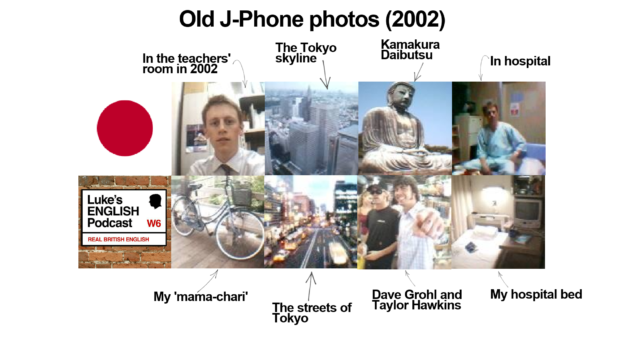
My story about how I ended up in a Japanese hospital bed, scared out of my brain. Recorded live in front of an audience at the British Council in Paris.
[DOWNLOAD]
My story about how I ended up in a Japanese hospital bed, scared out of my brain. Recorded live in front of an audience at the British Council in Paris.
[DOWNLOAD]
An episode with my friend Moz from the Murder Mile True Crime Podcast. Moz returns to tell us some true stories of crimes in the London area. Expect some smalltalk about living on a boat, some murder stories and an interactive detective game in which we have to solve a murder.
[DOWNLOAD]
https://www.penguin.co.uk/articles/children/2018/murder-most-unladylike-quiz.html
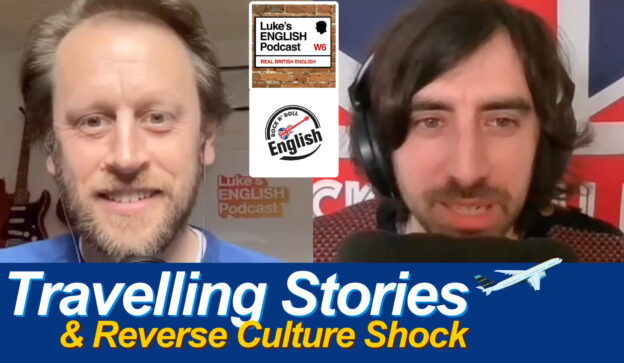
Martin joins Luke to talk about moving back to the UK, his fundraiser for Ukrainian refugees and some funny stories about travelling experiences.
[DOWNLOAD]
Hello listeners,
In this episode I am talking to Martin Johnston from the Rock n Roll English Podcast. Do you know the Rock N Roll English Podcast? This is where Martin and his Rock N Roll friends and family do podcasts for learners of English that are unfiltered and frequently involve discussions of taboo subjects, but also plenty of other stuff as well. It’s very funny and bound to be good for your English and general cultural knowledge. Martin featured me in episode 250 of RnR English and we talked about what it’s really like being an English teacher with a podcast. That was a funny chat with lots of memories and funny moments. Episode 250.
In this episode though, we’re going to have a rambling chat about moving to different countries, Martin’s fundraiser for Ukrainian refugees and then some stories of travelling and getting stuck in tricky situations while abroad.
Martin has recently moved back to England after living in Italy for a number of years, so I thought I would ask him about his experiences of feeling like a foreigner in his own country, and some of his culture shock experiences both abroad and at home. Because this is a thing – reverse culture shock. When you feel like a foreigner in your own country after living abroad for a long time.
Martin has also recently launched a fundraiser for Ukrainian refugees. Basically it is a learning pack with 25 stories, and transcripts and exercises. All the proceeds go to help Ukrainian refugees. You can find out more at www.rocknrollenglish.com/stories
So this is a very good cause. We know that several millions of people have been forced to flee their homes as a result of this war, invasion, operation – whatever you want to call it. This violence and aggression has separated families and made civilians homeless as well as killing thousands. This is a horrendous thing to be happening on our doorstep and so the least we can do is try to provide support in some way, so I call upon all of you to go ahead and get that PDF with those 25 stories and all the money will go towards helping these refugees. Martin talks about it during the episode if you want more details. But let’s help out some fellow citizens of LEPland here. Plus, of course, you get tons of stories with audio versions and everything. It sounds like a win win to me.
So we chat about the project a bit, which is all about learning English with stories and this then leads us to have a story-off. This is a sort of battle of stories where Martin and I trade different anecdotes and we see who comes out on top. So there are 4 or 5 funny stories of travelling experiences we’ve had, in the second half of this episode. I hope you enjoy them.
That’s it for the introduction. There is a video version on YouTube. Don’t forget to smash that like button.
I should say there is some fairly explicit content in this episode, which means fairly graphic descriptions of things like nudity, sex and bodily functions, which is completely normal for an episode of Rock n Roll English to be honest.
I’ll speak to you again briefly at the end, but now, let’s get started.
So there you are, that was Martin Johnston. I hope you enjoyed our stories.
Don’t forget, if you want to get that pack of 25 stories by the RNR English family, go to www.rocknrollenglish.com/stories It costs just 10dollars or pounds, and all the proceeds go to help Ukrainian refugees.
This is obviously a very good cause as so many people have been displaced, made homeless and so on and these people need our help.
If you enjoyed our stories in this episode, you could check out some of the episodes with those stories told in full.
Check out 118 Sick in Japan (although I should be doing a live version of that next month) and also Holiday in Thailand
or A Rambling Chat with Moz for more of the spa story
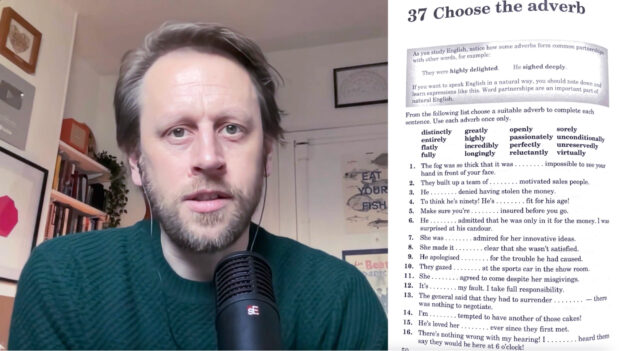
This is a chance for me to just let loose and have a ramble while inviting you to this kind of housewarming party (or perhaps just the first part of the party) in my new pod-room. In this one I am going to welcome you into the new room and do a ramble challenge in which I am restricted to only talking about things inside the room, plus reading from some random books on my shelves. Grammar rules, adverbial collocations and a game show story.
[DOWNLOAD]
Private Lessons with British Council English Score Tutors https://www.teacherluke.co.uk/english Episode page
LEP Premium https://www.teacherluke.co.uk/premiuminfo
LEP T-Shirts & Merch https://www.teacherluke.co.uk/merch
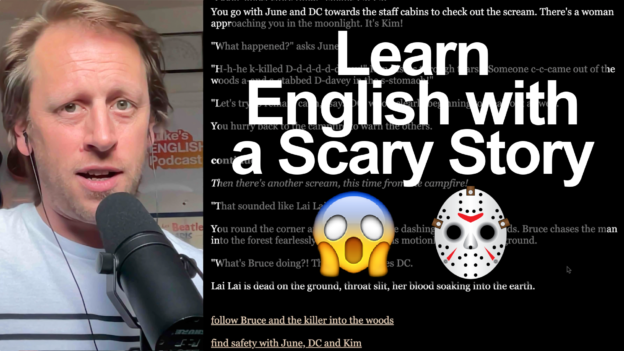
Reading a short story presented on Commaful.com. The Escaped Man is a mystery full of tension and intrigue. Listen closely as I break it all down and explain the vocabulary fully. YouTube video version also available.
Hello listeners and video viewers,
It’s time to do another story on the podcast. This time I’m going to be reading a story called The Escaped Man which was written by CT Platt and is presented on the Commaful website.
Commaful.com is a website where you can find short stories, fan fiction and other reading texts and it’s all presented in quite a nice and easy-to-read format.
I’m going to read the story to you once and all you have to do is follow it, and hopefully enjoy it. I have a couple of questions for you to help you stay focused on your listening.
Then I’ll read through the story again and break it down line by line, explaining, pointing out and teaching you bits of vocabulary and grammar as I go.
Learning English through stories is a great idea and tends to work because it places language in a vivid context and is generally quite entertaining and fun.
So listen to the story and then let me break all the language down for you bit by bit.
Just before I read the story, here are a couple of questions for you.
Where does the story take place? How do you know?
Is this American English or British English? How do you know?
What is going to happen next?
OK, let’s start.
https://commaful.com/play/lisa/the-escaped-man/
Full Script of the Story
https://www.wattpad.com/543021670-suspense-stories-the-escaped-man-c-t-platt-2017
Chatting to my family about some old anecdotes and stories from the past. Listen for some enjoyable chat, memories, descriptions and tales from days gone by.
[DOWNLOAD]
Hello and welcome back to the podcast.
In this episode I am happy to present to you a conversation with my mum, dad and brother all about old family stories and anecdotes from the past.
The episode is called Do you remember…? And that’s the title of the activity I chose for this episode. The idea is that we could generate some stories about things that happened in the past and you can follow along and see if you can pick up some English in the process, or simply enjoy a bit of storytelling on the podcast.
So you’re going to hear stories of little accidents, moments when James and I got into trouble, learning to drive and failed driving tests, how my parents first met each other and how my bottom lip was always left trembling at the end of every story.
We recorded this in my parents’ living room, sitting around after dinner and if you like you can imagine that you’re there too, listening into the conversation – not taking part though. For some reason you’re not allowed to speak, you can only listen like a weird audience in our living room just lurking in the background. Anyway, you can imagine that you’re there if you like, if it helps you to tune into the conversation and follow along more easily.
I will now leave you to enjoy this relaxed conversation, follow the stories and little jokes and I will speak to you again at the end of this episode.
So, that was my family, recorded in the living room recently while I was on holiday in England. I hope you enjoyed that.
Apologies if we repeated any stories you had heard before (perhaps all of them?) but then again it can be really helpful to hear the same stories over and over when learning English. You could even try to tell the stories yourself, and then compare your story to the recorded version.
If you want other, similar episodes from the archive, check out these ones.
79. Family Arguments & Debates (Debating things like language and politics)
https://teacherluke.co.uk/2012/01/23/family-arguments-and-debates/
322. With the Thompsons (Answering random conversation questions)
https://teacherluke.co.uk/2016/01/07/322-with-the-thompsons/
372. The Importance of Anecdotes in English / Telling 4 Family Anecdotes
413. With The Family 1 Talking about cooking christmas dinner
414. With The Family 2 – My Uncle Met a Rock Star – Nic tells stories of meeting famous musicians including Paul McCartney
https://teacherluke.co.uk/2017/01/05/414-with-the-family-part-2-my-uncle-met-a-rock-star/
415. With The Family 3- Meeting Famous People – We tell stories of meeting famous people and what happened
https://teacherluke.co.uk/2017/01/10/415-with-the-family-part-3-more-encounters-with-famous-people/
542. Talking Rubbish & Having Fun with The Thompsons (More random topics and fun)
https://teacherluke.co.uk/2018/08/21/542-talking-rubbish-just-having-fun-with-the-thompsons/
554. ODD News Stories with Mum & Dad (Speculating about and discussing some weird news stories)
https://teacherluke.co.uk/2018/10/18/554-odd-news-stories-with-mum-dad/
605. Unexpected Road Trip (The story of a road trip that went horribly wrong, wth James as my co-pilot)
https://teacherluke.co.uk/2019/07/18/605-unexpected-road-trip-with-james/
But for now I will leave you to go back to your life, unless you choose to listen to another episode which you will find in the archive.
Don’t forget to check out LEP Premium. P31 parts 4,5, 6 are on their way and may have already been published by the time you listen to this.
But in the meantime, be excellent to each other, have a lovely day, morning, afternoon, evening or night and I will chat to you later but now it’s just time to say good bye bye bye bye bye.
The final part of this series in which I am reading from the classic story The War of the Worlds by H.G. Wells, while explaining and clarifying the English which comes up. Full transcript available and YouTube video version too.
Please watch parts 1 and 2 before watching this. Links in the description.
Without realising it, the people of earth have been attacked by an aggressive alien species from Mars, with the intention of colonising our planet while escaping their home planet which has become uninhabitable.
The Martians are vastly superior to us in terms of their intelligence and technology. They are also unfriendly. Very unfriendly. Humans are now reduced to mere animals or insects in the presence of these things.
Human society has quickly turned to chaos and destruction as the Martians begin their campaign to take our planet.
The aliens first landed in a cylinder which fell from space with a green flash. After the cylinder opened, revealing the visitors to be awkward and clumsy in our atmosphere, their technology proved to be devestatingly powerful. They are armed with a heat-ray which they have used to clear out all life surrounding the fallen cylinder.
The narrator of the story witnessed the Martians emerging from their cylinder and the ruthless destructive power of their heat ray, but still does not yet realise the full scale of the invasion. He decides to escape the area and travel in the direction of London.
During the night, he sees another cylinder landing, and then sees the first Martian tripods striding over the countryside. These are the vehicles the Martians use and they are colossal and formidable. Suddenly the clumsy Martians are mobile and far more physically powerful than in their normal, naked form.
Summary of Chapter 11 (next part of the story)
From the upstairs window of his study the narrator observes the destruction of his village and the fires all around the common, as well as the outlines of three creatures moving in the pit, which he can see from a distance.
He hardly recognizes his surroundings. The narrator begins to comprehend that the creatures from the cylinder operate the tripods, comparing them to a human-driven steam engine.
He invites a soldier outside the house to hide inside. The man recounts the futile military efforts against the Martians, who easily destroyed both companies and their weaponry before emerging as tripods from the pit and destroying the railway station and a train. The artilleryman managed to escape.
The two men look again from the window to see three tripods at the pit. As the sun comes up the narrator sees destruction “so indiscriminate and so universal” as to be unprecedented in human warfare.
HG Wells describes the horrific feeling of realising that these Martians are far more powerful than humans. Each cylinder contains at least three tripods, and each tripod is armed with a heat ray. Later we learn more about the martians and their technology as the narrator manages to observe them more, but they are still completely mysterious.
Meanwhile, people have become like refugees from a warzone and there is general chaos as people attempt to escape, get resources, look after themselves etc.
Shepperton Station has become a target for the Martians in their tripods and they have been destroying it, the railway lines and trains. This is especially poignant because they are targeting our infrastructure and our technology seems infinitely primitive to that of the Martians, and we are often compared to animals, insects, bugs or even microorganisms in comparison to our alien visitors.
HG Wells makes a point of observing how society reacts to a moment like this and how fragile it is, while also contrasting the familiar cosy surroundings of the English home counties, with the bizarre, grotesque and strange images of these very bad aliens from Mars.
The narrator and the soldier he met choose to leave the house. The soldier wants to go to London and the narrator wants to go back to his wife in Leatherhead.
They end up in Weybridge which a town just on the river Thames, with London to the east and the Thames Valley to the west.
This is a place where the Thames meets The Wey, another river. It’s a sort of port where you can get a ferry across to the other side. Crowds of people are gathered there, hoping to get on a ferry. The army have placed rows of large artillery guns behind some trees as they expect the tripods to come from a nearby town that is currently under attack. This all happens close to the edge of the water and is full of really precise and specific vocabulary to describe the action that takes place.
The two men reach a chaotic scene in Weybridge as people crowd the railway station and the ferry in an effort to leave.
Suddenly they hear gunfire and a large explosion, and four tripods come into view across the river.
The narrator hides in the river.
Six guns hidden in the woods fire on the nearest tripod.
One shell strikes the tripod and gruesomely kills the Martian inside.
Unguided but still moving, the tripod smashes into a church and falls into the river.
The other Martians come to the fallen tripod, shooting their Heat-Rays at the village and destroying the opposition.
The Heat-Ray from the fallen tripod heats the water in the river and scalds the narrator before he manages to escape.
It’s possible to see various interpretations of this story, or subtexts to the story.
Here are some.
The complacency of humans
As the dominant species on earth for hundreds of thousands of years, we have become complacent about our position in the natural hierarchy, and this is a mistake. Humans could easily be removed from this dominant position by things we aren’t even aware of. In the story this means intelligent creatures from another planet. In reality this could be something like the coronavirus or just something else we don’t usually think about.
How would human society cope with a crisis like this?
This is a common theme in disaster movies, zombie films, science fiction etc. All it takes is for something to disrupt our carefully organised society and things can descend into chaos quite easily, and this often brings out the worst in people. Normal citizens can quickly become immoral and do bad things, when the structure of society collapses and we end up having to fight for our survival.
Treatment of Animals
The story makes us think about the way we treat animals, which are below us in the power hierarchy on earth. Perhaps we should be more compassionate and kind to animals. In fact this is one of the only conclusions the narrator reaches in this story, as he suddenly understands what it means to be ruled over by a superior species.
The bigger they come, the harder they fall.
Microorganisms and viruses might be the most powerful forces on earth.
More themes here including technology, fear, power, and Familiar versus Strange
https://www.coursehero.com/lit/The-War-of-the-Worlds/themes/
A sample from coursehero.com
Technology
The benefits, possibilities, and potential threats of technology—represented in the Martian tripods—make technology a pervasive theme in the novel. Following the Industrial Revolution, technology changed society dramatically—from travel, to work, to communication. Virtually no part of life was untouched by new inventions. The benefits provided by these new machines meant people could accomplish tasks faster, easier, and often independently.
But as ever with modern science fiction stories, there is an element of fear regarding advancements in technology and how we may ultimately be surpassed by technological innovations.
This is where we’re going to stop.
I seriously hope you enjoyed this!
If you’re still listening or watching, then “hello”. Thanks for sticking with this. I guess it must mean you’ve been enjoying it.
I’m sure it’s been challenging at times, but to be honest I also feel this is difficult to follow when I read it. There’s a sense that things are just beyond your imagination, and that your mind has to do quite a lot of work to understand the fairly complex descriptions being given. This is not quite the same as watching a film where everything is shown. Or maybe it’s like watching a really well-directed film where you never quite see clearly what is happening, and this adds to the drama and excitement.
Anyway – thank you for sticking with this and listening all the way through.
Let me know what you think of this, and I highly recommend reading the rest of the story. There’s a lot more action and a few more close encounters with the Martians and their tripods, and of course the ending is very clever. I won’t spoil it. The book is better than the film though, I assure you!
In terms of English, I hope you have found it interesting to hear some samples of old fashioned English from the 19th century. I would say it is broadly modern English, but with a more formal style. It’s really enjoyable though. I love the descriptiveness and the general command over the language is a joy to behold.
Don’t forget you can get the full text for this episode printed right there on the page for this episode, and there’s the YouTube video version as well to enjoy where you can see text on the screen as you read it.
Listen to LEP wherever you get your podcasts. Don’t forget to like and subscribe.
Leave a positive review on iTunes and check out my free app.
And consider signing up to LEP Premium to get specific lessons on vocabulary, pronunciation and grammar. teacherluke.co.uk/premiuminfo
Thanks for listening.
All the best,
Bye bye bye bye
Continuing to read extracts from this fantastic science fiction story from the 19th century. Follow the plot and pick up some English in the process. Full transcript available, and a YouTube version too.
Watch PART 1 before you watch this! Links in the description.
Recap of the story so far
6 years prior to the main events of the story, explosions are observed on the surface of Mars, but scientists assume they are gas or volcanic eruptions and are nothing to worry about.
Then, one night, a meteor falls to earth in green flash. The astronomer who finds the fallen meteorite in a pit of sand in a nearby common discovers that the object is a cylinder, is making strange noises and is even beginning to open and assumes there must be people inside it.
A crowd gathers, including the narrator of this story. The cylinder opens slowly and people are shocked and horrified to see the hideous and frightening creatures inside. They seem slow and heavy, as if earth’s atmosphere makes things difficult for them. Their appearance is a huge shock to everyone.
One person has fallen into the pit and it’s possible that they have been killed.
The narrator, although terrified, is also intensely curious about these visitors, as are the other witnesses at the sand pits where the cylinder has landed.
The narrator finds himself irresistibly drawn back toward the crater to see more.
He observes a long pole with a circular disc on its end rising from the pit.
Other people linger, seemingly rooted to the spot in a mix of horror and curiosity.
Heartened by a lack of alien movement for a period, onlookers begin to slowly advance toward the pit.
The Deputation (group of scientists) walks toward the pit with a white flag.
The narrator later learns Ogilvy, Stent, and Henderson were part of the group.
A flash of light, three puffs of green smoke, a hissing sound, and a dome-like object rise from the pit.
With a droning noise, the group of men suddenly burst into flame.
As the “invisible, inevitable sword of heat” rotates, everything it touches turns to flame, including grass on the common and trees in the distance.
The rotating Heat-Ray stops before it reaches the narrator, and he realizes he was “helpless, unprotected and alone.”
He flees in fear with the disturbing feeling he is “being played with.”
Although the Martians seem quite weak and immobile, their technology is far superiour to ours, especially the technology we had in the late 19th century (guns, horse drawn, cannons, pre World War 1 weapons). The heat ray is absolutely devestating. It burns or melts everything it touches instantly and can reach long distances.
Nobody understands the technology the Martians are using. Whatever the heat ray points at, bursts into flame.
Plenty of people around the pit have been killed and there are burned remains of their bodies lying around. Horses have also been killed as well as numerous trees and buildings set on fire.
The group of scientists are all dead.
After the Martian attack with the heat ray the crowd of people stampeded in horror and a few people were crushed to death in the panic.
The Martians stay in the pit, and appear to be working on something as little puffs of green smoke can be seen rising from the hole, and there’s noise of work inside.
The narrator runs away in fear and eventually gets himself under control and then goes home, still not completely aware of what’s going on. He comforts himself with the knowledge that the military are now going to step in, and that one shell or bomb landing in the sand pit will be enough to stop the Martians. He sees his wife and has dinner.
The news of the Martians travels slowly. People seem sceptical of the stories they’ve heard. Even the newspaper editor chooses not to print the story as he doesn’t believe the account and it hasn’t been confirmed by any enough witnesses yet. So, news travels slowly. Meanwhile, the Martians still seem to be working on something within the pit.
Some people are still curious about what’s going on in the sand pit, but as they approach it they are instantly killed by the heat ray.
The narrator compares the cylinder ominously to a poison dart, whose poison “was scarcely working yet.”
That night several companies of soldiers with large artillery guns approach the pit.
During the night, a second cylinder falls nearby.
The next day is suspenseful. The military surround the aliens in their sand pit. The narrator is not allowed to go back onto the common. Soldiers tell him that nobody is allowed into the area.
That afternoon there are sounds of gunfire and explosions. The Martians keep using their heat ray which appears to be clearing out all obstacles in its path, creating a wider and wider circle of destruction and a bigger area that nobody can enter.
The narrator is at home with is wife and at one point a big explosion nearby causes him to go outside to check. He sees the top of the nearby church sliding off and crashing to the ground, the tops of nearby trees on fire and in fact the chimney stack of his own house falling to the ground. He realises that his house is nearly in range of the heat ray, which has taken out trees and buildings between the house and the sand pit.
The narrator and his wife decide to leave, and pack a horse drawn cart with as many possessions as possible they head in the direction of London, to Leatherhead. As they travel there is fire and smoke behind them and the sound of weapons. The Martians are burning everything within range of their heat ray.
The narrator’s wife is deeply concerned about the situation, but the narrator assures her that the Martians are severely disadvantaged by their weight and inability to move quickly or breathe properly in our atmosphere. They arrive in Leatherhead and have dinner.
Then the narrator has to go back to Woking in order to return the horse and cart that he borrowed (what a good guy).
As night falls a storm comes in with rain and lightning. As the narrator is travelling through the darkness he sees a third cylinder fall from the sky in a green flash. The horse is very spooked and is hard to control.
Then in the darkness and rain, lit up by the occasional flash of lightning from the storm he sees something monstrous that causes him to loose control of the horse and crash by the side of the road.
On his way he notices a red glow in the sky and then a green streak, which happens to be the third cylinder.
It begins to storm.
The narrator suddenly encounters “a monstrous tripod, higher than many houses,” smashing through the woods next to the road.
As soon as it vanishes into the woods, another tripod appears heading right for the narrator.
He tries to change direction, but the cart overturns and the horse is killed.
The tripod passes by.
The narrator describes the two tripods bending over something in the distance, which he believes is the third cylinder.
He continues on foot with difficulty, happening upon the landlord’s dead body before he reaches home.
To be continued in part 3.
Like & Subscribe to get more stuff like this.
Listen to Luke’s English Podcast – over 700 episodes of interesting content for learners of English.
Luke reads extracts from The War of the Worlds by H.G. Wells. This is a classic bit of science fiction writing from the Victorian era, with some thrilling passages and scary descriptions. It’s one of my favourite books of all time and I hope you enjoy it too and learn some English from it. Full transcript available and YouTube version too.
Hello listeners,
It’s story time in this episode because I’m going to tell you a classic English science fiction story.
The story is called War of the Worlds by H.G. Wells the classic storyteller who also wrote The Invisible Man and The Time Machine, and you have probably heard of War Of The Worlds because it is definitely one of the most famous and most influential science fiction stories ever written.
Now, I know that science fiction is not everyone’s cup of tea, but I do hope you stick around and listen to this story because I think this is just particularly good writing and the story is very exciting, immersive and memorable so it should be a really enjoyable way to pick up some more English.
I won’t be reading the whole book of course but I will be reading some selected extracts and giving you a summary of the key details in the first part of the story.
To entertain you with a really engaging story in English.
Stories are a great way to get more English into your head and if they are exciting and immersive, then that’s even better.
To show you a slightly old-fashioned version of English, which is really rich in descriptive language and more formal in style than today’s English.
It’s good to be exposed to diverse versions of the language.
Old fashioned English is much more like modern formal English, so it’s a good lesson in style.
This can really strengthen your English in various ways.
To help you notice some nice bits of vocabulary along the way.
Having a broad range of vocabulary is essential in achieving truly advanced English. This story is very rich in descriptive language.
To inspire you perhaps to read the rest of the book.
Reading is such an important thing to do for your English, and maybe you’re looking for interesting books to read. You could consider this one. It’s not too long.
This is also available as a video episode on YouTube and if you watch you can see me recording the podcast with the text on the screen next to my face. So you can listen and read at the same time and see me telling the story.
You can read the entire text I am reading from on the page for this episode at teacherluke.co.uk.
War of the Worlds has been adapted lots of times – in films (most famously the 2005 Stephen Spielberg film with Tom Cruise – which you might have seen) and another film version in the 1950s set in Los Angeles, an audiobook musical version read by Richard Burton and an infamous dramatised radio series by Orson Welles.
This is the original alien invasion story. This book was one of the very first stories to ever explore these themes and to describe these kinds of things in such a realistic way.
This is the one that has inspired so many others and in my opinion, none of the other versions of this story or copies of this story can compare to this original version from 1897.
The writing is very realistic and journalistic in style, written from the first person perspective of a guy just experiencing the events as they happened and describing everything in great detail.
A note about the language and the writing style
The language is pretty old fashioned (1897) but it’s really well written and it should be interesting for you and useful for your English to explore another version of this language. Exposure to different types of English makes your English stronger I think.
As we go through this I will point out particular words or phrases as we go and perhaps compare this to normal modern plain English.
Comparing the styles of languages actually gives you more perspective on normal modern English and how formal written English today still retains some aspects of old fashioned language.
There is quite a lot of language you might find in legal documents or other very formal situations.
Words like therein, hereby, forthwith and things like that are quite common, as well as certain structures, longer sentences and choices of words which mark this out in a particular style.
This is very descriptive literary language from over 100 years ago. It’s more complex than today’s English, more formal than today’s English and very specific in its descriptions.
This will probably be a challenge for you but I’m here to help and I will explain things as we go.
This is quite scary stuff
I have to add actually, that having re-read some of this story in preparation for this episode, I hadn’t realised just how terrifying this story is.
Personally I really enjoy the thrills you get from a story like this, but if you are feeling a bit force-sensitive today you might want to get a pillow or hide behind the sofa or something.
Here are a couple of links I have found useful in making this episode.
Project Gutenberg
I have several paperback copies of this book, but I also found it on www.gutenberg.org – a website which shares stories and books which are now in the public domain.
Link to War of the Worlds html version
https://www.gutenberg.org/files/36/36-h/36-h.htm
CourseHero Study Notes
Also there’s a website called coursehero.com which has useful summaries of the story and other useful information.
https://www.coursehero.com/lit/The-War-of-the-Worlds/
These are the opening paragraphs of the book, which set the scene in which the events take place. Note the sombre tone and specific choice of language.
Main Character
The story is told by an unnamed narrator.
He is a middle-class educated man who writes philosophical papers and is interested in science. That’s all we know. The story is written in the past tense, as if he is looking back on those events and has written a full account of what happened.
That opening chapter describes how a species of intelligent creatures on Mars had been observing us for many years before the events of this story. The opening chapter goes on to explain that the Martians were planning to invade earth because their home planet was steadily getting cooler year after year due to the fact that it is further from the sun than the earth. They faced extinction on their own planet, and so they set their sights on their nearest neighbour – Earth – with its warmer atmosphere and closer position to the sun, and with their superior mathematical knowledge and technology they decided they would colonise earth in order to survive. They spent years observing us and planning the invasion.
Note: I am using present tenses from now on to describe this story. This is a normal way to retell the plot of a book, film, or play. It’s because the events of the story are permanent because they never change, they are written that way. So we can use present tenses to summarise the story of a book or film.
Ogilvy the Astronomer
The narrator has a friend called Ogilvy who is a respected astronomer. He has a telescope and uses it to observe the night sky, including the surface of Mars, our nearest neighbour.
So Ogilvy is our friend and he’s an astronomer.
6 years before the main events of the story Ogilvy invites the narrator to an observatory to study Mars after another astronomer reported a dramatic explosion of gas on the surface of the planet, which seems to be directed toward Earth. The narrator observes a similar explosion as he watches through the telescope.
Ogilvy doubts the existence of life on Mars and speculates the phenomenon may be related to meteorites or volcanoes. Many other people witness the phenomenon, which repeats itself at midnight over a total of 10 days.
Nobody at the time is concerned or worried about the explosions on Mars.
6 years later some people see a falling star – a meteorite which flies through the night sky with a bright green flash and lands nearby on Horsell Common – a large area of grass, meadows and trees. Again, nobody assumes there is anything weird going on. Ogilvy the astronomer is interested in the meteorite and finds it on the common.
As it has landed it has formed a large crater of sand. So the object is lying at the bottom of a kind of large sand pit in the middle of an open area of grassland surrounded by buildings and trees.
The meteorite that he finds is quite odd. It’s in a cylindrical shape – like a long can of coke, but he thinks its made of rock as it is covered in a kind of crusty layer. It’s also extremely hot and he can’t get near it, but he notices there are weird sounds coming from inside it. He assumes these are noises caused by the object cooling, but as he continues to observe it he realises that something funny is going on.
The crusty layer is slowly falling off as the object cools, revealing a kind of metallic surface underneath, and even weirder than that, the end of the cylinder appears to be turning, as if it is unscrewing very slowly. Ogilvy suddenly assumes that the cylinder has people inside it and decides to get help, but nobody believes him.
Eventually he finds a journalist who is willing to check the cylinder. A crowd of people begins to gather as word spreads about “men from space stuck inside a cylinder on the common”. People don’t quite realise what’s going on but they are incredibly curious. Normal life continues, with people stopping by to have a look at the object in the sand pit, before continuing their normal routines.
The narrator goes down to Horsell Common to check out what’s going on. A larger crowd has gathered there. He manages to squeeze through the crowd which is getting more and more excited and agitated. A small group of scientists, including the narrator’s friend Ogilvy are in the pit attempting to work out what is happening.
The narrator observes what is going on and comments on how most people are not really educated about this kind of thing and they haven’t worked out what’s going on, but he assumes that the cylinder must be extra-terrestrial. He observes the end of the cylinder moving and as it turns it’s revealing a kind of shining metal thread.
The next chapter describes what happens when the end of the cylinder finally drops off, revealing what is inside.
The narrator approaches the pit containing the cylinder.
Crowds of people are all around the pit, trying to see what’s happening. They’re pushing each other a bit, and things are quite tense. (You know, when a large crowd forms, people start pushing and shoving and it’s stressful)
Ogilvy and some other scientists are in the pit.
As the sun sets, the narrator returns to the pit, where a few hundred people have gathered.
A boy warns the narrator that the end of the cylinder has unscrewed itself, and the narrator forces his way to the front of the crowd to get a better view.
Ogilvy warns the people to stay away and reminds them of its unknown contents.
One man is pushed into the pit by the jostling of the crowd.
The end of the cylinder comes off and falls into the pit.
The narrator and the crowd are horrified by the grotesque octopus-like appearance of an alien who slowly and painstakingly emerges from the cylinder. They seem heavy and struggling to breathe in the atmosphere.
The narrator and the crowd run away from the pit, but many, including the narrator, stop to watch the aliens from the nearby tree line.
The sun sets, leaving enough light to just see the silhouette of the shopkeeper as he tries and fails to get out of the pit alive.
Reading an emotional short story, with vocabulary explanations and differences between British and American English.
Read the story on Commaful here https://commaful.com/play/aknier/the-mountain/
Hello listeners, welcome back to my podcast. I hope you’re doing well and that you’re ready to learn some more English with me in this new episode.
This one is called The Mountain and I’m going to read you a short story and then use it to teach you some English.
There is a video version of this available on YouTube with the text on the screen, so you can read and listen at the same time and you can see my face while I’m recording this, if that’s what you’d like to see. You can find that video on the page for this episode on my website or on my YouTube channel – Luke’s English Podcast on YouTube, don’t forget to like and subscribe of course.
Stories are great for learning English, and I’m always searching for various stories that I could read out on the podcast. I’ve found a few stories and texts, both online and in books that I have on my bookshelves, so you can expect more story episodes like this coming in the future as I read things in different styles, from different texts, including some well-known published work and some independently published stuff and fan fiction that is available online.
Stories make ideal material for language learning. They are compelling and often the text of the story is also available which makes it extra useful for language learning because it works as a transcript for what you are listening to.
Today I googled “Free short stories online” and I ended up on a website called commaful.com
This website is described as the largest library of multimedia stories online. Commaful.com
On Commaful you can read and share stories written by users of the site, fan fiction, poetry and comics, and they have a picturebook format, which means that their stories are presented in a slightly different way, which makes them a bit more pleasant to read online or on mobile devices – more pleasant than just reading text on a screen, which is never a pleasant way to read literature. So rather than just presenting their texts on screen, they put each line of the story on top of an image of some kind (like a picture of a lake or a landscape or something) and you can swipe from one image to the next, reading each line of the story as you go, which is quite nice.
When reading these stories out loud the format encourages you to pause as you read each line, which is quite a good habit. Pausing is a good presentation skill.
It can be a good discipline to practise because pausing can add some space for the audience to think and can change the atmosphere slightly, adding extra weight to each line that you say. So pausing and taking your time can be good presentation skills to practise.
First I’m just going to read the story to you. You can just follow along and try to understand what’s going on.
Then I’ll read it again and I will stop to explain some bits of English that come up, and there are various nice bits of English in here – phrasal verbs, expressions and other nice bits of vocabulary mainly.
The story is written in American English, which is mostly the same as British English really, but I will point out any differences and will give you the UK English equivalents, so this can be a chance to learn some British and American English equivalents.
I’ll do a vocabulary and language summary at the end too.
As I said, there will be some pauses between the lines of the story, because of the way the story is presented to me on the website. I don’t normally pause like this when doing this podcast, but it could be useful because it might help you absorb what I’m saying and you can use those pauses to repeat after me if you like. This will be easier if you can read the lines with me, and again you can do that by watching the youtube video, or visiting the story on commaful.com.
Or you can try repeating without seeing the lines if you want an extra challenge.
And of course you can simply enjoy listening to the story without worrying about repeating or anything like that.
The story is about 10 minutes long, just to let you know what to expect.
The rest of this episode is me explaining and describing the language in the story.
By the way, this story was posted on commaful.com by a user called Aknier and I am assuming that Aknier is the author of this, so credit goes to him or her for writing it.
Follow the link in the description to access the story and you can leave comments there if you like.
I hope you enjoy it!
But now let’s begin the story…
OK so that is where the video ends, but I’m adding a bit more here to the audio version in order to do a quick language summary of the bits of vocabulary that came up in that.
How was that for you? Did you enjoy the story? As I said, there weren’t many narrative elements. It was more an emotional story, but quite an interesting one.
Again, I do recommend that you try reading the story out loud, either by repeating after me or not.
Now let me recap some of the vocabulary items and British and American English differences that you heard there, just to sum up and help you remember what you’ve just heard. I’ll be as brief as I can while jogging your memory here.
You can find this vocabulary list on the page for this episode on my website of course.