Category Archives: Culture

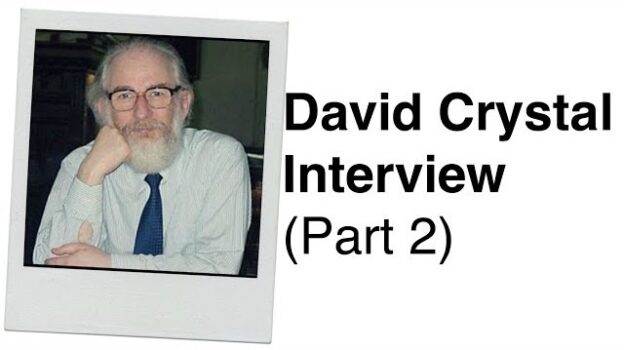
455. David Crystal Interview (Part 2) Questions from Listeners

Talking to the world’s top writer and lecturer on the English language, Professor David Crystal. In this episode, David answers questions from listeners.

[DOWNLOAD]

Episode Introduction

Here’s part two of my interview with the famous linguist Professor David Crystal.

In this one I asked him some questions from my listeners. I didn’t get a chance to ask all the questions I received, so if your question isn’t included then I do apologise. I left out some questions because I think he had already answered them in one way or another, or because we just didn’t have time.

But the questions I did ask him covered quite a wide range of different topics, including the way foreign words get absorbed into English, predictions for the future of English, how to deal with the workload of studying linguistics at university, the nature of English syntax, how languages affect the way we think and see the world, why British people use indirect and polite language, the influence of AI on language learning, the effects of Brexit on English in the world, whether it is appropriate to speak like Ali G, some study tips and some comments on the English of Donald Trump and Barack Obama.

Don’t forget to check out http://www.davidcrystal.com where you can see a reading list of David’s books, read his blog, see videos of him in action and even contact him by email.

I would just like to thank David for his time again, and I hope all of you out there in podcast land enjoy listening to our conversation.


QUESTIONS FROM LISTENERS

Influence of foreign languages on English

Hamid Naveed (Pakistan)
I’m an English language teacher. My question for David Crystal is: www.oald8.com (The Oxford Learners’ Dictionary) has a lot of new words from Urdu such as ‘ badam’ ‘ chai’ ‘ aloo’ ‘ bagh’ ‘ dharna’ and many more. If English keeps on taking words from Urdu or any other language, then what will be the future of English? I mean English will no longer be English. What is your take on this ? Thanks.

The Future

Jilmani
My question for David Crystal is what is the future of the English language? Will it be the same or will it be a little bit different since we know that english has changed over the decades?
How do you think English will develop over the next few years?
How will non-native speakers be part of this?

Tips for students of Linguistics

Jairo Trujillo García (from Tenerife)
I am studying an English and Spanish linguistics ( and philology ) degree , and even though I like it , it can be really hard at times ;
What recommendations would you give me to make the burden of vast information more manageable in the time allotted ?

English Syntax

Cat (Originally from Russia, moved to Germany)
I’m very confused about English syntax. I spent many years studying German grammar and syntax but it is of little use for learning English. German and English appear so similar (especially the words) and yet so different (for example, the sentence structure) at the same time. I just feel that something is completely different, but cannot point out the difference. Could you please tell us a little bit about the sentence structure and logic (the syntax) of English? (Perhaps you could compare it to the syntax of other languages)
As I don’t like doing grammar exercises at all (I’m sorry!), I was wondering, are there some more enjoyable and fun ways to learn English syntax? Maybe some shortcuts and mnemonics what you can offer us? Also what about the punctuation rules between the main and sub clauses? They can be a real pain in the neck for our transcribers. Thank you!
Cat

Language and Psychology

Wesley
I have several questions for Prof. David Crystal. The first is whether people who speak different languages think differently, I mean, if they understand and perceive the world in different ways. For example, I’ve heard that while in some places people perceive two colours and give each of them a name, somewhere else there might be others who perceive those same two colours as only one because they have only one name for them. Another example I have in mind is how we position adjectives in a sentence in English compared to in Romance languages. In English, adjectives usually come before the noun they describe. Romance languages, on the other hand, tend to place adjectives after the noun. So in English we first refer to the characteristics of something before we say what it is, and in Romance languages we start with a noun and then describe it. Does it affect, in any way, the way we think?
If we learn a second language, do we start to think more like the native speakers of that language?
Thank you very much!
Wesley

Language and culture

Mayumi (Japan)
Why do British people tend to use indirect language, hesitate to say “no” and also frequently say “sorry” in various situations? Is there any story from linguistic history?
In my Japanese culture, as far as I know we also find similar tendencies because we’ve lived in this tiny island and if people said whatever they wanted, behaved without caring about other people in this small area, or even argued with each other, they could possibly end up being expelled from this small society. This can be one of the reasons why we have these tendencies as well. This is something stuck in my mind for ages from the university class.
Did British people had similar experience when they established their culture or could it be an absolutely different story?
Cheers!

The Influence of Technology

Antonio (Spain)
My question for David Crystal: Apple, Google, Microsoft and other companies are working on translators in real time based on AI. So we can speak in Spanish with a French person and he will hear French while he speaks in French and we hear Spanish.
Skype has this option for 8 languages.
What do you think about about the AI related to language learning?
Will AI replace our need to learn other languages?

Advice for learners of English

Jack – Origin Unknown
(I don’t know why, but Jack always writes comments on my site in an Ali G dialect. I actually think it’s evidence of how good he is at English, because he can clearly write in normal style, but he chooses to adopt this specific form of English – if he can do that it shows great ability to shift between different registers and dialects – if he can break the rules I presume it means he knows that the rules are there in the first place – for some reason he chooses to write comments in this lingo – are you ready?)
I is not that learned but I also has got questions for Professor David Crystal.
Dear Sir,
Booyakasha, It is a well big honour to have you ere on da podcast, you is da only person me respects in the field of linguists after Norman Chomp The Sky and Stephen The Crasher (Naom Chomsky and Stephen Krashen).
What advice would you give to an English language learner to improve his / her language ability? Should the student focus on form (grammar, vocab etc) or should the student focus on meaning and let the subconscious do the rest?
Well that`s me questions there Big man. I has to say you is the shining crystal in the field of linguistics.
Big up yourself Prof Crystal
Respek, Westside.


Outtro

There was so much interesting content in what David Crystal said in this conversation and so much to take from it. These two episodes are really worth listening to several times so that you can really get a grip on what he said and really absorb it all.

If you sent in a question that I didn’t ask, then I’m sorry about that.
I should do follow-up episode in which I consolidate a lot of what DC said, and highlight various things that you can apply to your whole approach and attitude towards learning English.
Watch out for that.

Check out David’s work at http://www.davidcrystal.com
He’s got books about grammar, spelling, pronunciation, accents, Shakespeare – pretty much any aspect of English – he’s got it and he always writes in a clear and entertaining style.
I’m not selling his work or anything. It’s just genuinely good stuff that I’d like to share with you. This is why I’m so happy to have spoken to DC on the podcast – he’s ace and you should read his work.

Thanks for listening! I invite you to leave your comments below.

454. David Crystal Interview (Part 1) Professor of Linguistics

Talking about language with one of the world’s top linguists, Professor David Crystal.

Small Donate Button[DOWNLOAD]

Introduction

Hello everyone, thank you for choosing to listen to this episode of my podcast. I am particularly pleased to be able to present this episode to you. It is, in fact, a privilege for me to say that today on the podcast I am talking to Professor David Crystal.

I’m now going to give a quick introduction just to make sure that you are all fully aware of the calibre of this guest and to emphasise to you just how lucky we are to have him on the podcast today.

According to The Guardian newspaper, David Crystal is the world’s foremost writer and lecturer on the English language.

He isn’t an English teacher, but he is an expert on linguistics. That’s the study of language and all the issues relating to it.

David Crystal

David Crystal has a worldwide reputation and has published something in the region of 120 books including numerous academic reference works and encyclopedias of language, and books for the general reader covering topics such as English grammar, spelling, punctuation, accents, connections to Shakespeare, the influence of technology and the development of language throughout history.

He is currently patron of the International Association of Teachers of English as a Foreign Language (IATEFL) and the Association for Language Learning (ALL), president of the Society for Editors and Proofreaders and the UK National Literacy Association, and honorary vice-president of both the Institute of Linguists and the Royal College of Speech and Language Therapists.

He is honorary professor of linguistics at the University of Wales and in 1995 he was on the Queen’s honours list when he was awarded the Order of the British Empire (the OBE) for services to the English language. The OBE is the second highest honour which you can receive from The Queen – the highest being the knighthood or damehood.

So he’s Britain’s favourite language expert and he regularly makes appearances at literary festivals and teaching conferences, appears on British radio and television, writes articles for newspapers and magazines and researches all kinds of language-related topics.

But the main thing he does is to write books…

David’s Books

Some of his most popular books include:

  • The Cambridge Encyclopedia of the English Language
  • The Oxford Illustrated Shakespeare Dictionary
  • The Story of English in 100 Words
  • You Say Potato: The Story of English Accents (written with his son Ben)
  • Wordsmiths and Warriors: The English-Language Tourist’s Guide to Britain (Written with his wife Hilary)
  • Txting: The Gr8 Db8
  • Pronouncing Shakespeare: The Globe Experiment – a fascinating project investigating how English was pronounced by the original actors in the Globe Theatre when Shakespeare was alive
  • Spell It Out: The Curious, Enthralling and Extraordinary Story of English Spelling
  • Just A Phrase I’m Going Through: My Life in Language (which is both his autobiography and a highly accessible introduction to the field of linguistics)
  • And from this year “Making Sense: The Glamorous Story of English Grammar”

Many of those titles can be purchased as ebooks from David Crystal’s website – www.davidcrystal.com or from any good bookseller. There are also audiobook versions which are read out by the man himself.

David Crystal’s writing is clear, entertaining, informative and simply a pleasure to experience. The same can be said about his public speaking. I’m always impressed by his ability to take a complex academic subject like linguistics and turn it into the sort of thing that anyone can understand and enjoy.

I met David once at a teaching conference where he presented Andy Johnson and me with an award for a presentation we did. I had a chat with him afterwards and was delighted to discover how down-to-earth and friendly he is and I’ve always wanted to interview him for this podcast, but it’s only recently that I actually plucked up the courage to ask him. Thankfully he agreed.

David Crystal is a nothing short of a national treasure and I can’t believe I’m talking to him on my podcast.

Right – I think you get the idea now – he’s kind of a big deal for anyone interested in language and language teaching and so without further introduction, here is my conversation about language with Professor David Crystal.


Questions for David Crystal

Grammar

Your recent book from this year is called Making sense: the glamorous story of English grammar.

Is grammar really ‘glamourous’?

In my experience, a lot of learners of English feel a bit bored or intimidated by grammar, leading some teachers out there to say that you can learn English without grammar – learn English without thinking, etc.

Do you think it’s possible to learn English as a second language without studying grammar?
I know you’re not actually an English teacher, but do you have any tips for learners of English who want to improve their grammar?

You recently wrote a political history of grammar in the UK as a supplement to your book “Making Sense”.

What relationship does the average Brit have with grammar today, in your experience?
Has this attitude changed over the years? How has it changed?

Language Decline

I was recently having a conversation about language with a couple of friends on this podcast and we arrived at several questions that we couldn’t really answer. I thought you might be able to help.

People often complain about the so-called decline of the English language – citing things like poor grammar, punctuation, spelling, acronyms or text-speak as evidence that standards of English are slipping. Do you agree with that? Are standards of English declining? How do we even measure that?

People seem to be afraid that what they see as falling standards will result in “the death of the English language”. Has a language ever completely “died out” due to declining standards? What causes languages to die?

Are we better or worse at communicating than we used to be? (answered later)

‘Right’ and ‘Wrong’

Are you bothered by those so-called ‘errors’ in English that make some people angry?

Non-native speakers influence on English

My mate Paul says (as a bit of a joke) that because there are more non-native speakers of English in the world than native speakers, we’re actually the ones who are using the language incorrectly. E.g. because more Chinese people pronounce some English words in a certain way, it’s the native speakers who are pronouncing those words wrong.
Does he have a point or is he talking nonsense like he usually does?

French Pronunciation example

My French students often feel bad about their pronunciation because it’s so ‘French’. We understand everything that they say, but they’re really hung up on the fact that they sound so French – e.g. they can’t pronounce TH sounds in words like strengths, clothes, thirty three etc and it seems to be impossible to fix it.
Do they need to feel so bad about it?

How should my listeners feel about their relationship with English, and the version of English that they speak?


End of part 1

That’s the end of part 1. The conversation will continue in part 2 where you’ll hear me asking some questions sent in by listeners, and there were some really great questions including predictions about English in the future, the role of AI in language learning, the impact of Brexit on English in the world, and the way Donald Trump and Barack Obama use English.

I hope you’re enjoying listening to this, and that you’re able to follow some of the slightly complex points being made.

David gave so many really interesting answers and made some very important and useful points, and he continues to do that in part 2.

I think David speaks very clearly, with that slightly Welsh or Scouse twang in his voice. He lives in Hollyhead, in Northern Wales, not far from Liverpool, and he lived in Liverpool for a while as a child, which accounts for the slight accent that he has, if you noticed that.

As he said, his accent is a mix of different things, caused by the time he has spent living in different places and interacting with different people – RP speakers in the south east, locals in Wales and Liverpool and so on. It all contributes to the way he speaks. He also happens to be very articulate and I really admire the way he expresses his thoughts so clearly.

I hope you agree that we really are rather lucky to have David Crystal on the podcast and I think it’s worth listening to this episode several times so you can really absorb everything he’s saying because he really does know what he’s talking about and there’s a lot of knowlege there.

I think I should do a follow-up episode to this in which I just restate the main points that he made, just to consolidate it all, and I plan to do that. I could also talk about some of the questions which I didn’t have a chance to ask David.

I also hope you noticed that David Crystal helped to clear up some of the things I was discussing with Amber and Paul in episode 452. I should go over those things again if I do a follow-up episode, just to make it “crystal clear” – pun intended. I totally intended to make that joke and I think you should know it’s a brilliant joke which nobody has ever made before and this is sarcasm but it also isn’t.

Don’t forget to check out www.davidcrystal.com for all his work, his blog, videos of him speaking publicly and more information, including the opportunity to send him a message if you want to.

I strongly recommend getting some of his books, which should be available from any good bookseller. You could try “Making Sense: The Glamorous Story of English Grammar” for example.

Also, don’t forget that you can get audiobook versions of his work.

For example, I listened to You Say Potato – the one about accents in the UK and I think the audiobook is better than the printed book because you can actually hear his son Ben doing all the accents. You could get that as part of a trial with Audible – and remember I have that deal with them – you can get a free audiobook if you go to www.audibletrial.com/teacherluke or click an audible logo on my site. They’ve got a lot of DC’s work there. Start a trial, download your audiobook, listen to it using the Audible app on your phone and you can cancel the membership and not pay anything, or continue your membership for about $15 dollars per month and get another free book next month and so on…

So, that’s the end of part 1. Part 2 should be available for you very soon and you can hear David answering questions from listeners, and that’s brilliant because the questions were very diverse and David Crystal answers them – what more do I need to say? I still can’t believe I spoke to him on the podcast. I need to contact other awesome people for interviews now I think.

Thank you very much for listening to this. Don’t forget to join the mailing list to keep up with every new episode and to get convenient access to the page for each one where you’ll find various bits of supporting information, transcriptions, links, videos and the comment section. Just visit teacherluke.co.uk and pop your email address in the subscription form and Bob’s your uncle.

I look forward to reading your comments in the comment section.

Reminders

LEPsters are still getting together and spending time socialising in English.
In Moscow there is a group that hangs out every Sunday. Their FB group is called “Conversational English for Free – Moscow LEP Club”. https://www.facebook.com/groups/734996946664425/

Also in St Petersburg there is a similar group which gets together on Sundays. You can find them on FB by searching for “SPB LEPsters Conversational Club” – I understand they have get togethers on Sundays. Kristina from Russia who won the LEP Anecdote Competition last year often takes part – friendly people, speaking English, playing games, hanging out. https://www.facebook.com/spbenglishLEPclub/

LEPsters in Tokyo have got together a number of times, and I attended one in April to do some stand up – you can hear all about that in my Trip to Japan episodes (part 2).

Also, recently a group got together in Prague in the Czech Republic – in fact you can hear their conversation because it was recorded and published on Zdenek’s English Podcast.

Again I’m flattered because they talked mainly about LEP – including, shock horror, their least favourite or “worst” episodes of the podcast.

Listen to both episodes below.

Also, if you’re in Spain I have heard rumour that there will be at least one meetup group getting together there, somewhere, sometime soon.

If you’re thinking of setting up something similar, let me know because I can publicise it on the podcast and get the word out.

Speak to you in the next episode!

Luke

I was invited onto the “English Across The Pond” Podcast

Hi podcast people,

I was recently invited to appear on another podcast for learners of English, called English Across The Pond presented by Dan (UK) and Jennifer (USA).

You can listen to the episode below and check out their website at www.englishacrossthepond.com

[soundcloud url=”https://api.soundcloud.com/tracks/324515648″ params=”auto_play=false&hide_related=false&show_comments=true&show_user=true&show_reposts=false&visual=true” width=”100%” height=”450″ iframe=”true” /]

Dan and Jen produce quite a lot of extra material to help you learn English from their episodes. Check out this link where you can get a vocabulary list, comprehension questions or just download the full episode guide from their website.

Dan and Jen are really friendly and both have lots of English teaching experience. You might enjoy listening to their podcast too.

Cheers!

Luke

452. A Conversation About Language (with Amber & Paul)

Discussing language with Amber & Paul, including issues such as errors made by native speakers, language change, whether language standards are declining, the effects of technology on language and how to cut an avocado without injuring yourself.

[DOWNLOAD]

Click here to check out italki and get your $10 voucher

Introduction

The other day Amber and Paul came over to my flat do a podcast. We were having tea, chatting and getting ready to record something, and we just started talking about language, I think because Paul said that he found it weird that even though he can speak 3 languages really well, he knows nothing about language – he doesn’t know the grammatical terms, the rules of what makes something right or wrong or somewhere in between, and we were talking about it, and I quickly managed to press the record button and ended up recording about 50 minutes of us rambling on about language – all totally unplanned and spontaneous.

You’re about to listen to it. This is an Amber & Paul episode so you’re going to hear an unscripted and natural chat between friends so there might be a bit of swearing.

Before you listen to us discussing language-related issues, consider these questions, which are at the heart of our conversation.

  • What are some common errors native English speakers make in English?
  • How do native English speakers feel about mistakes in English, particularly mistakes made by other native speakers?
  • Are some errors worse than others?
  • How does a language evolve? Are errors a part of that process?
  • Has your language, or English, changed much in the last 100, 200, 300 years?
  • Is your language, or English, getting worse than before? Are standards of language declining?
  • Has a language ever totally broken down and died due to falling standards?
  • Why did latin die out as a language?
  • On a slight tangent, what’s the safest way to cut an avocado?
  • Back on track, how does Charles Darwin relate to language development?
  • What effect is technology having on our language? Is it making us better or worse at communicating?
  • Are we better at communicating than we used to be? Are we getting better at communicating? How do you even measure that?
  • Do you know more about English grammar and so on than most native speakers of English?
  • Do you know more about English grammar and so on than Paul Taylor?
  • Are you better at cooking than Paul Taylor?

Watch out for answers, and general rambling on the subject of those questions as you now listen to our conversation about language.


That’s it! Leave your comments below.

So there you are, that was our conversation about language.

I invite you to take part in the conversation by getting into the comment section.

Let me remind you of those questions from the beginning. (see above)

There were a few unanswered questions in there, and I think I might be asking David Crystal about some of them.

Remember that? I’m going to interview the world’s leading voice on language – Professor David Crystal. It’ll be a chance to ask him various questions about language. I’ve already collected some questions from my listeners, and I have loads to ask him too, but feel free to offer up a question or two and if I get a chance I’ll ask him.

Actually, I’ve already interviewed David Crystal, so it’s too late to send me your questions! Episode coming soon.

450. Comments & Questions

In this episode I’m going to go through some questions from the comment section and give a bit of news. There will be some grammar, some vocab, some reactions to recent episodes and some bits relating to how you can continue to push your English with this podcast.

[DOWNLOAD]

Episode notes

The comment section is buzzing with chat. Photos are being shared of people’s running routes and shots of gorgeous spring flowers and blossoms in full bloom. A listener called Sylvia is doing an illustration for every single episode and posting it in the comment section. Regular commenters are having some long and funny conversations – they’re very friendly and like a laugh so get stuck into the comment section and see what all the fuss is about.

The usual commenters are: Cat, Nick, Jack, Agnes, Marta, Antonio, Eri, Hiro, Euoamo, Sylvia, Jilmani, Mayumi, Ethan, Syntropy and more people I have probably forgotten about!

Cat is the top commenter with a total of 2795 COMMENTS
Nick is in 2nd place with 1851 COMMENTS
Jack is in 3rd place with 963 COMMENTS

David Crystal

Bit of news: I’ll be interviewing Prof. David Crystal on the podcast soon.

David Crystal is the foremost writer and lecturer on the English language, with a worldwide reputation and over 100 books to his name. He is honorary professor of linguistics at the University of Wales, Bangor, and in 1995 was awarded the OBE for services to the English language.

I met him in 2012 when he gave me an award (with Andy Johnson). He’s really nice and I’ve always wanted to have him on the podcast.

And I am interviewing him soon, which is a serious treat.

This is the guy who knows everything there is to know about language and I’m going to interview him.

Honestly, I have millions of questions I could ask him, and I could easily fill up several episodes with him just asking all the questions in my head.

But I’d also like to give you a chance to ask a few questions. So leave your questions for David Crystal in the comment section. I can’t guarantee I’ll ask him all of them, but if there are some particularly good ones I’ll ask them.

Otherwise, I might be able to answer some of the questions myself.

Recent Comments on the Website

Here are some comments which arrived recently.

Cat – in reply to the British Humour episode
Hi Luke and Amber, thanks for your lovely chat! It was a most enjoyable and also educational episode.
I’ve got two questions:
1. You mentioned “NHS” (?) as something that each Brit is proud of. What is it exactly?
2. During the dissection of the Hugh Grant’s quote you said that he was “public school”. What does it mean?
Thanks for explanations!

IMG_4148Oil painting by Sasha Sokolova

Thanks for the oil painting! – www.sashasokolova.com


JAPANESE LEPSTER GIFT VIDEO ~ I need to do this!

Paul
Congratulations, teacher Luke, for the podium! Great job and another great podcast, thanks!
“It’s time for me to leave Audioboom.com” = LUKEXIT!!!!!

Amber’s podcast – Paname – it’s not available yet, but soon!

Orion Transcription Team

Just a reminder about the Orion transcription team – they continue to produce transcripts, mainly under the management of Antonio from Spain, and they are always on the lookout for new recruits. Antonio regularly posts messages in the comment section saying “Episode blah blah is now available for transcription” and with a google link. E.g. the latest one is episode 444. The Rick Thompson Report.

Remember, it can be really good for your English so check it out! Transcribe just 3 or 5 minutes. It doesn’t have to be a massive commitment. If you do it regularly you’ll see that it allows you to focus your attention on what you’re hearing and you’ll be surprised at how much that focus allows you to examine the language up close. You could also try repeating out loud some of the things you’re hearing as you transcribe, that could be a good way to convert the process into a speaking exercise.

Turning Input into Intake

Here’s some vaguely academic stuff about Turning input into intake to increase your language acquisition. There’s language input, and there’s language acquisition. Between those two things, there’s intake. Intake is the stuff we really learn from.

This from the University of Austin Texas
The term “input” referred to all the exposure to a foreign language that is around us. However, as years went on, researchers realized that input was not enough. If the learners were not noticing or concentrating on the incoming flow of language, comprehension would be limited. So today, researchers in second language acquisition commonly make a distinction between input and intake. Simply put, input is all the written and spoken target language that a learner encounters, whether it is fully comprehended or not. Intake is limited to the comprehended input that impacts the learner’s developing linguistic system. For our purposes, we suggest that technology provides ways to increase the foreign language input that learners are exposed to and enhances the process of how input is converted into intake.

Without getting too fancy, let’s say that to really learn from the things you hear you need to convert what you’re hearing from input into intake.

This means listening to content which is comprehensible – i.e. basically understandable even though there may be some things you don’t get. A mix of things you already know (this is your foundation that allows you to work out the bits you don’t know) and some things you don’t know or don’t understand.

It also means sometimes really focusing and giving all your attention to certain bits of what you’re hearing. Some things might kind of pass you by a bit, but it’s important while you listen to be sort of emotionally involved in it and to interact with it while listening – to really think and feel in response to what you’re hearing. Apparently this helps turn input into intake.

Transcribing pushes this to the max. It forces you to turn everything from mere input into intake – which is the good stuff. I think it’s backed up by not just academic research but by the experiences of transcribers. It helps push your English, and remember you can just do a short chunk, you don’t have to do a whole episode, that’s crazy!

In summary – focusing all your attention on 3-5 minutes of an episode can really help turn input into intake and can maximise your learning potential with this podcast, or any audio resource.

Yuko – language question “shall”
Dear Luke, my name is Yuko. I have been a ninja listener of your pod cast for a long time, and I am originally from Japan, which makes my ninja status more authentic, doesn’t it? I am living in New York, but really fond of British English.
I have a question. When it comes to the usage of ‘shall’, it is rarely used here except for those two occasions: to suggest something, for example, “shall I do this for you?”, and to use following “Let’s”‘ for example, “let’s go, shall we”. Back in Japan, I learned that shall is also used interchangeably with will for describing the things or action in the future, but, here, all American friends said that shall is never used in daily life except for the examples above, and that if I used shall instead will, it would sound quite archaic.
However, I have a sense that sometimes I catch “shall” as description of future in bbc or British dramas even in modern setting. Would you mind telling the use of “shall” in today’s British English? Thank you very much. I always enjoy and admire your witty, and sophisticated subjects, not to mention it was quite honoring that you chose my country as the destination of your latest trip. I hope all is well and both of you and your wife have enjoyed it.

Yuko, all the right info is in your question.
You’re just not sure about it and you need confirmation.
OK then!
Shall – for suggestions (shall I? Shall we?) – after Let’s…
Shall for future (like ‘will’ – yes, old-fashioned and a bit posh, but some people still do it, like my Mum “I shan’t be coming to the cinema.” or “I expect I shall be exhausted by the end of the day!”
Also in contracts for obligations
That’s it!

Agnes – Sport
I’m just curious whether Luke is taking some exercise or not, he looks sporty and I suppose that he does some sport activities:-)) I usually jog before going work, early morning – the best time for burning calories.

Anna Mrozek
I had an English class today and my classmate asked me “how the hell do you know all these words?!”, so…
Thank you Luke, because you deserve the credit for that. :)

Leonid
Hi there everyone! Does someone know the accurate meaning of the phrase “to be on E”? Thanks in advance!

Great comment from Cat
Just keep listening to Luke’s English Podcast. And try to listen to episodes more than once. It is on the second listen that we start to notice the language consciously and start learning. After some time, you can listen to the episode for the third time. And there you will see how much you have learned in the meanwhile. Do it with your favourite episodes. And try to listen to OPPs as well. And use the same technique. It’s very effective. Also listening during a physical exercise speeds up the learning process. Because your brain is working at 5x of it’s performance capability. So use such shortcuts, especially if you are a bit lazy like I am! ;))

I would add that you can also do some transcribing, or check out previously written transcriptions – either the unproofread ones in google docs, or episodes with published scripts. That can help you notice language too.

Film Club: Touching the Void

Hope you enjoyed the “Touching the Void” episodes. I have had a few comments indicating that it moved a few people. but my stats show the episode hasn’t been listened to as much as normal episodes.

I often worry about uploading too much, but there’s always someone who says “we want more!”
I recorded an episode about Alien Covenant the other day. It’s about an hour of rambling about the Alien franchise. I’m a bit wary of uploading it straight away because it would be 3 film club episodes in a row and this isn’t strictly a film podcast. I probably shouldn’t think about it all that much.

But I’ve been quite productive lately and I have some episodes in the pipeline – Alien, 2 Amber & Paul episodes, one about music and culture with James.

Anyway, going back to Touching the Void, I’m glad to see those of you who have listened to it seemed to enjoy it.

Agnes
Have been listening to this story based on facts for the second time today I felt an incredible chill down my back and my hair stood up on both of my hands.
Luke, telling us this story, you made me be there, with them, I saw this horribly broken leg, I saw as Joe dropped down, I saw everything, even though I haven’t watched the documentary yet.
just thank you

Ethanwlee
One step at a time – this is my biggest takeaway from this episode. At the end of the day, that’s the mantra that keeps us going, staying focused. This story leaves me lots of food for thought. Thanks Luke!

Jilmani
Thank you so much Luke! It’s an amazing episode I can’t express how amazing it is. I want to tell you my personal story about climbing. My parents are both climbers and they had a club for climbers. They worked there a lot to train and coach also they took a lot of people in trips for camping. And I always went with them when I was a child. I liked climbing and adventurous trips more than anything else. I had always climbed and camped before I had an accident in 2014 in Lebanon. I was terribly injured and they expected that I’d die. Luckily I managed to survive. I needed a lot of eye surgeries because my cornea was damaged. Now I can’t climb at all not because I’m afraid of it, but my doctor prevented me. I got rid of all my pictures and anything that might remind me of climbing or my adventures. I haven’t climbed since that day, but I skydived a lot. Climbing always helped me to relax and forget about the troubles that we have in the Middle East. Also I’m a religious person it always made me feel happy and close to God. My doctor told me that I will be able to climb again when he removes the stitches. Thanks again Luke. I’ll watch the episode tonight luckily I have a Netflix subscription and I love documentaries a lot. Waiting for the next episode!

Luke: Be careful if you climb again! Be like me, just stay at home and watch other people do it on YouTube, it’s safer (except maybe I should do more exercise)

daav
Wow! Thank you, Luke! I really appreciate the topic you’ve chosen for a new episode. The film is pretty good and the book as well. I’ve got one in my bookcase. I have just little experience with high mountains because after my wedding I decided to bury my climbing gear to the very bottom of my wardrobe and since that day I’ve been “only” a hiker. But anyone, who has ever spent some time in the mountains without any support, just with a climbing mate on the other end of the rope, an ice axe in hands and a pair of crampons knows, that the fact Joe Simpson survived the Siula Grande ordeal is a …. real miracle, nothing else than a real miracle…
If someone wants to buy a book I recommend Bookdepository instead of Amazon. They offer free worldwide delivery which is a real bargain in my opinion. I buy books from them regularly (from The Czech Rep.) and it works well.

Cat
Daav, but why did you put away your climbing gear?! It’s like giving up on a part of your true self. Can you be happy with that for long?

daav
Hi Cat. At first I must admit I was never a climbing machine. I used to climb few times a year. Let’s say just few weekends and one or two trips to the Tatra Mountains or to the Alps. So it wasn’t so difficult to give up. In the Czech Rep. climbing is very popular and there are many people who spend every possible moment climbing a piece of rock in their surrounding area. So I can’t say I was a climber. I usually say that I have done some climbing :c) One day I considered that my wife meant a lot more to me than climbing. She had never asked me to stop climbing. She had even climbed with me once. But any time I had packed my climbing gear I had seen the same wish in her eyes – please, stay alive. During my last climbing trip I had a minor accident I have never told my wife about. Fortunately nothing comparable to Joe and Simon :c) But I realized that I was being very selfish. I enjoyed it, I liked it, but my parents and other people who truly love me were frightened to death every time I left them with a rope in my bag. Now I know that it wasn’t the climbing that I liked. It was mainly a peaceful and calm space around me. It was the fact I can leave all my daily routine behind me. Now i know it’s not adrenalin that I need. It’s just some kind of feeling I am alone, just on my own in some remote area. So today, long distance hiking is an activity that gives me everything I need. I just pack my rucksack, a tent, a fuel stove, some food, maps and a compass and I just walk. It’s different to climbing. It’s definitely not so dangerous. However it provides me the same pleasure. Unfortunately the Alps are full of people and there are so many huts. But some parts of the Pyrenees are amazing, the western part of Ukraine as well and the Andes are a dream for any hiker. I have many dreams, CDT in USA is one of them as well as many others around the world. The only disadvantage of long distance walking is that it’s very time-consuming compared to climbing. Are you a climber Cat?

Cat
Daav, if I were Luke, I would read your comment out in the next episode. It is deeply felt and full of love. :)

daav
Thank you Cat. But I’ve noticed that some people don’t like long episodes. And my comment is so long that Luke would have to record an extra episode just to read it out :c)

Success story from Erick in Brazil
Hello Luke,
This is Erick from Brazil.
Today when I was listening to your #429 podcast while running, I felt encouraged to share my listening experience with you.
I have been listening to you for about 1,5 years usually when I go running, so you have been my partner twice or three times a week. Strange, but I feel as if I have known you for a long time…
I actually think your podcast is more than just a teaching one, but it is more like a variety show with news, entertainment, fun stuff, etc. I really enjoy your ‘long talks’ which can be just some information, funny talk or more deep issues which are very good for getting immersed into the English language.
It is gratifying to hear other points of view of the various subjects on the media agenda especially when you bring guests to your show, like your Father, Amber and Paul, etc.
Sometimes it can be very hard for me to understand, but I took your advice, I keep going, listening to some episodes more than once, trying to get as much as I can.
Now I can say that I broke through the language barrier and I can really understand and talk in English because of you! So, I just have to thank you for all the material that you provide for free and especially for your success in making your podcast so popular and genuine!
Cheers from Brazil,
Erick Takada

I didn’t share that just to remind you of how wonderful I am, but also to just remind you that if you find it difficult to follow everything you hear on this podcast that you should keep going and battle through the moments of difficulty and you’ll find that bit by bit you build your understanding.
I can’t understand how anyone could expect to learn English properly without listening to a lot of it. I think it’s vital.

Do me a favour!

If you know someone who might like this podcast, share it with them! Recommend it to that person. It’s a good way to spread the word.

Another thing you could do is to write a nice review on iTunes – that’s really good for the podcast because it helps things like algorithms and getting my podcast featured in the ‘recommended’ section on iTunes. Also it looks good when new people check it on iTunes, and it would just make me feel good and put a smile on my face, which ultimately will feed back into the podcast.

Subscribe to the mailing list.

Watch this space for news of a potential LEP app for your phone or tablet which could include some bonus app-only content!

447. What is this, British Humour? (with Amber Minogue)

What is British Humour? Is it funny? Does it even exist? How does it relate to our communication style and culture? In this episode I go through the main points of my British Council Teacher Talk about British Humour. Amber and I discuss the definition of British humour, the way it works, how it’s different or similar to other humour in other places, and some examples of typical humour in the UK.

[DOWNLOAD]

Introduction

Last week I did a Teacher Talk at the British Council in Paris. Teacher Talks are when the BC invites guests to an event involving a talk on a specific topic and then drinks afterwards. All teachers are invited to talk at these events and this time I thought I’d have a go. The topic was completely up to me, so I chose to talk about British humour because it’s always something I’m thinking about and I thought it might also be a way to promote English language comedy in Paris.

The talk was sold out and went well. I was hoping to upload the recording of the talk here but it’s not good enough. It just sounds very echoey and muffled. Next time I will mic myself up properly. So I’m not going to play the recording, which is a big pity because there were some moments of interaction with the audience and some funny things. But it’s just not clear enough on the recording so I’m not publishing it. The room at the BC where we do these talks is a big high ceiling place with mirrors on the back wall and high windows and walls so the sound bounces around a lot.

Anyway, I’ve still got all the ideas in my head so I’m going to put them into this episode, recorded in the normal way. So, I went to Amber’s place and decided I’d discuss all the points in my talk with her, since I think she’s probably got some interesting things to say on the subject. We both have experiences of living in other countries and we both do stand up so we think about humour quite a lot.

So you’re going to hear us attempting to answer questions like: what is British humour, what’s it like?, is it funny? Does it even exist? How does it relate to our communication style? What does it say about us as a culture?

The main aim is just to describe and demystify humour in Britain. You’ll see that I don’t subscribe to the idea that British humour is somehow better than other forms of humour. In fact, in many ways it is very similar to humour in plenty of other places.

But as I describe it here, just think about whether this kind of behaviour is likely to be found in the culture or cultures that you know, and consider the role that humour plays in people’s daily lives where you are from. You might notice differences or similarities.

Let’s now go to Amber’s place and get to the bottom of this.


Main points covered:

British Humour doesn’t exist

OK, it does exist, but we don’t really use any different types of humour than anyone else. We don’t have a monopoly on humour or anything, but we do value it highly.

British Humour isn’t funny

It’s not always designed to make everyone laugh. Instead, humour is used in our interactions to avoid being too serious, keep things light and make you seem like a normal person.

Self-deprecation

This means making fun of yourself. It’s a bit of a crime to take yourself too seriously in the UK, so people make fun of themselves to show that they’re not above everyone else.

Understatement

This is where you make a strong statement sound less strong. E.g. “It’s raining outside is it?” “Yeah, just a bit”

Deadpan delivery

This is where humourous statements are delivered with a straight face, making it hard for some people to notice that a joke has happened.

Sarcasm/Irony

This is where you say one thing but you mean the opposite. It’s used for insults, for disappointments or to make fun of everything in general.

Innuendo

This is when one innocent statement can also mean something quite rude. Innuendo often happens by accident and other people say something to reveal the dirty second meaning.

E.g. “I like the taste of a cox” (apple)   … “I bet you do!”


Other things I didn’t cover

Puns

These are just word jokes. They work when one word means two things at the same time, connecting two previously unrelated ideas together in one statement. The brain explodes because one thing means two things at the same time.

They’re best when they are instant responses to something, rather than pre-planned jokes.

Here are some examples of pre-planned ones

How does Bob Marley like his donuts?
Wi’ jam in.

For more, check out my episodes about telling jokes in English.

Vocabulary
We have a wide variety of synonyms, homonyms which make it easy to say one thing that sounds like another, creating endless opportunities for word jokes (puns) and euphemisms.

Pisstaking
This means making fun of each other. We do this all the time.
Perhaps it’s because we’re incapable of expressing genuine emotions and we tend to avoid sincerity because it makes us feel uncomfortable, so we interact with our loved ones by teasing them, poking fun at them, mocking them and so on.

We’re emotionally crippled, basically.

E.g. I’ll always poke fun at my brother when I see him.
Like, oh my god what have you done to your hair?
Nice of you to have made an effort today.

Pisstaking has two functions:
To express affection
To knock someone down to size if they’re getting too big for their boots

You need to be able to take a joke in the UK. You’ve got to be able to both take a joke and dish it out when necessary.

If you can, you’re alright.

Surreal humour
Essentially surreal humour involves making fun of absolutely everything around you. It makes fun of existence itself. It means making absurd statements to highlight the absurdity in life. It’s about subverting boring reality. Maybe this is something to do with our weather (it’s dull, generally) or it’s a form of indirect anarchy or something.

Inappropriate humour
Although we use humour all the time, it’s worth noting that it can get you into trouble if you do it badly.
If you use self-deprecating humour, you have to be sure that everyone else gets it.
Be careful who/what is the target of your humour. It’s very politically incorrect to make jokes about certain groups in society – particularly groups that are lower status than you. So, these kinds of jokes are generally outlawed: ethnic jokes, sexist jokes. It’s very bad taste and old-fashioned and not cool at all.

Comedy

British comedy shows, the difference with American comedy, some recommended shows…

This is another episode for the future.

Thanks for listening to this episode. I look forward to reading your comments!

443. The Trip to Japan (Part 2)

Describing my recent trip to Japan and exploring the culture of the Land of the Rising Sun.

Small Donate Button[DOWNLOAD]

*I’m just an English guy trying to understand Japanese culture. Please forgive me if I get anything wrong! :) ❤️ 🇯🇵

Food & Drink

It’s simply delicious and I don’t know why! What’s the secret, Japan? Why is your food so delicious?

Communication style & language (but I’m planning a whole other episode about English)
Location?
Saying “no”
Politeness
Constant sounds of “gozaimasu”
Heeeee, hoooooo etc
Certain words you always hear and could use: arigato gozaimasu (levels of politeness) doitashimashite, sumimasen, onegaishimasu, nama biru no futatsu onegaishimasu, kawaii, sugoi, gaijin, chotto, dekimasu, desu, desu ka, hai, so desu ka, ne, so desu ne.

Weird and scary things that people don’t often talk about
Natural disasters
North Korea
Some weird sexual stuff
No need to dwell on anything else. Every country has its dark side. I guess that it seems a bit more interesting in Japan because there’s so much emphasis on the cute, childish things. Also, because of the slightly ambiguous religion in Japan it makes you wonder where the moral lines are. A lot of that stuff seems a bit vague, probably because I come from a christian culture where morality is written down in the form of rules – very clear lines which we’re always aware of.

Godzilla
Before coming my brother was staying with me and we watched the new Godzilla film – not the Hollywood version directed by Gareth Edwards, but the recent Japanese one directed by Hideaki Anno, Shinji Higuchi.
Shin Godzilla

What does Godzilla mean? What does it tell us about Japanese culture?
He’s created by nuclear tests in the ocean. He kind of represents the consequences of nuclear testing on nature, or the destructive power of nuclear weapons in Japan, or simply the vast destructive power of nature. At one time or another Japan has been subject to massive levels of destruction from either natural disasters or nuclear weapons. The nuclear attacks are obvious of course – but there were also nuclear tests by the US army after WW2 in waters affecting Japanese fishermen etc. The metaphor of natural disasters is easy to see. The 2011 earthquake and tsunami which affected Fukushima’s nuclear power plant – lots of scenes of destruction similar to what you see in the films. Godzilla kind of represents all of that. It’s interesting that Godzilla has been accepted as a sort of mascot in Japan. They love Godzilla, and in fact he’s sort of a protector of Japan, which I see as them owning this destructive power and turning it into something positive and uniquely Japanese.

The film also portrays the government as very inefficient and unable to make decisions quickly. So many people at various levels of status – all asking for second and third opinions and approval from above before making a decision. Some say this is a comment about the way the government responded to the Fukushima situation – slow to react, a lack of transparency, an inability to make the right decision quickly enough.

Mystery
I don’t have all the answers about this place. There are a lot of mysteries. I think of all the sliding doors, the silence, the shadow, the ambiguity of the religious aspects of life, the weird things in Japanese cartoons that I just don’t understand, and simply wondering what Japanese people are really thinking behind their exterior which is hard to read, and the polite manners. Part of me believes there is just open space inside people, which is a kind of peaceful place where there’s no judgement, where there is no dogma, but there’s a kind of natural balance, like the space between rocks in a zen garden. But maybe I’m romanticising it just a little bit! I expect Japanese people are just as mysterious as the rest of us, because ultimately who does understand the secrets at the heart of the human soul?

Friendship
One thing I can say is cool – I have made friends with some Japanese people in a more sincere way than many others I have met, and I’ve had moving connections with Japanese people that I don’t tend to have with others. I don’t know why. My Japanese friend for example, he said some moving things to me on my wedding day, and on the day I left Japan that seemed to come from some deep place of ancient Japanese wisdom. Yoda stuff, basically.

What did you do?

The basics of where we went and what we did.
Met by our friend, drove to Asakusa, sushi place. Food, beer.
Kamakura – drive – Tokyo skyline etc. Back in Kamakura – “natsukashii” – ‘good old’ or ‘Wow, it feels amazing to be back!’. Cherry blossom in the hills. Time with Moto’s family. Dinner at Matchpoint.

Karaoke
What is special about Karaoke?
Perfect way to have a party. There are whole buildings devoted to it in Tokyo. There are girls in the street who are like karaoke room dealers. You speak to them, book a little room. Go to the building and usually there are loads of drunken salary men pouring out of it. You get into your room – somewhere on the 9F of a big building. They bring you beer and food, direct to the room. There’s a computer database with thousands of songs on it. They’ve got everything. Everyone becomes a performer with their favourite song. It doesn’t matter if you can’t sing, the machine helps you a bit. Some people are brilliant. Everyone comes out of themselves a bit. It’s just you and your friends. Favourite songs get everyone in the mood. Singing is amazing fun. The videos on the machine are hilarious too – totally nothing to do with the lyrics of the song. Usually it’s a couple of people on a date in a random city. Often the lyrics are completely wrong too. We sang a lot of British pop and rock. David Bowie, Oasis and Pulp. My Japanese friend dances like Jarvis Cocker and really gets into the performance. He’s a “plastic gallagher”.

A day in Kamakura – Daibutsu, Cherry blossom avenue, noodles for lunch. Hookokuji temple & bamboo forest. Car drive to Ishiiki beach in Hayama with views of Mt Fuji. Yakitori restaurant in the evening, then another dinner of Japanese barbecue after that! Taxi ride back to the guesthouse – pristine taxi, automatic door.

Travel to Kyoto on Shinkansen. Bento boxes. Arrive in Kyoto. Kyoto was the capital of Japan during many important periods and was also the base of Buddhism. Also there are plenty of Shinto temples there since it was such an important place. Impossible to see everything in just a couple of days. More yakitori that evening and a lovely stroll by the river in the dark.

Kyoto shrine day. Early start and then these temples: Ninna-ji (beautiful rock gardens and pools, plus tons of cherry blossom everywhere. Interesting buildings – It is the head temple of the Omuro School of the Shingon sect of Buddhism and was founded in 888 by the reigning emperor. Various interesting buildings including the Goten, the former residence of the head priest in the southwestern corner of the temple complex. Built in the style of an imperial palace, the graceful buildings are connected with each other by covered corridors, feature elegantly painted sliding doors (fusuma) and are surrounded by beautiful rock and pond gardens.
Then to Ryoanji Temple – with its amazing rock garden.
Then Kinkakuji – the golden temple.
Lunch at a convenience store – just rice balls!
Then across town to Ginkakuji – where there is an amazing sand garden with a kind of replica of Mt Fuji. It’s bizarre. Crowded.
Philosopher’s Walk – cherry blossom everywhere. Also crowded :(
Some shopping for Yukata – found a place selling second-hand yukata in perfect condition. One for me, one for the wife. Lovely patterns. Not too expensive. Met a friend from London, dinner. Matsusaka beef! Apparently it’s more tender because it comes from virgin cows. What, less trauma because the cow had never had sex? How does that work? I remember being distinctly more relaxed after sex (and not just immediately after) but perhaps for cows it’s more traumatic, anyway…
Hot bath at the guesthouse in the communal area. Far less “public” than my experience in Thailand.
Tiny room.

Next day – early start for Fushimi Inari Shrine, an important Shinto shrine in southern Kyoto. It is famous for its thousands of red torii gates, which cover a network of trails behind its main buildings. The trails lead into the wooded forest of the sacred Mount Inari, which stands at 233 meters and belongs to the shrine grounds.

Fushimi Inari is the most important of several thousands of shrines dedicated to Inari, the Shinto god of rice. Foxes are thought to be Inari’s messengers, resulting in many fox statues across the shrine grounds. Fushimi Inari Shrine has ancient origins, predating the capital’s move to Kyoto in 794.

Basically there are these trails that go up to the top of a hill and most of the way is covered by these red gates. The red tori gates are common in the entrance to shrines and represent your movement from the normal world into the spirit world. They’re beautiful and this shrine with rows of thousands of red gates is stunning. The gates are donated by local businesses.

Then more walking around and some shopping for gifts and souvenirs. Shinkansen back to Shinagawa station – meet our friend again. Hotel in the Meguro area.
Gig that evening.

How was the comedy show in Tokyo?

I didn’t know what to expect.
No people, loads of people? Not sure.
Arrived, place was already totally packed. Got upstairs, room goes “huuuuuuu!” as I enter. People are going “luku? Luku? Heeeeee~!” Gasps etc.
Upstairs with other comics, introduce myself etc. We chat. People are surprised and going – can’t you stay? Let’s arrange other shows!
There’s a scene there but mostly for expats in English. This room was full of Japanese people (and a few others) and they’re all here for me!
I walk around upstairs trying to get myself ready, trying to decide what to do.
Audience is lovely, but I think they’re mainly waiting for me.
Apparently some people can’t get in the place. There are people in the stairs just listening.
I did about 45 minutes. Lovely audience of course. They’re lepsters. Interesting to see what worked and what didn’t work. The bits that didn’t work were some of the film references – e.g. Ratatouille, and surprisingly Taken
A lot of my routine is for a French audience. Taken is actually quite specific to a French crowd because the film is set in Paris.
Some bits the audience took on face value – like they took it as being true. E.g. some bits in my star wars routine about how my Dad is an evil strict overbearing tyrant like Darth Vader – not true, but just full of parallels about my life and Star Wars.
Especially the bits about Japan. I’ll play you some extracts later.
A few requests:
The jingle. The italki promo. Some impressions, Obama, Hobson’s Choice!
I wish I’d gone bye bye bye at the end!
Then after the show there was a massive queue of people who wanted to get my autograph. So bizarre.
Also, selfies, handshakes, talking to each person. Gifts.
It was actually an incredible experience meeting each person and hearing about how they listen to my podcast and how it obviously means a lot to them. I’m very glad to know that as always, because I put a lot into it myself.
It was bizarre – I was a celebrity for that evening, with people staring at me and taking my photo and stuff.

*This is where the episode ends, but feel free to read the rest of my notes which I didn’t read out*

Rest of the trip – in Tokyo. Hanging out in Meguro avenue, Daikanyama, Shibuya, Shinjuku. Shopping, sightseeing, eating tasty food. Taking photos. Just enjoying the sunshine.
Dinner at The New York Grill – where Lost In Translation was filmed.
Another day in the Ginza area – shopping for some more gifts like tableware and stuff from Muji which is my wife’s favourite shop. Driving around the imperial palace. Views of Tokyo tower – like The Eiffel Tower but sort of misshapen and not quite as beautiful but iconic in its own way. Went up the World Trade Centre for amazing views of the sunset. Everyone on a date.
Visited a couple of friends – including one at a super cool photography studio that allows you to take 3D photos.
Shabu shabu dinner in Shinjuku with Peter who I used to live with. He was featured in this episode actually (below)

203. A Cup of Tea with Peter Sidell (The Flatmate from Japan)

Visited Asakusa temple – one of the biggest in the Tokyo area and very crowded.
Airport and home! So quick!

Song

You Are Here by John Lennon
https://www.bananachords.co.za/john-lennon-chords-you-are-here

Photos & Video

Gets!

https://www.youtube.com/watch?v=MvICpPv1WiM


442. The Trip to Japan (Part 1)

Describing some thoughts about Japan after my recent visit. Exploring the culture and lifestyle in the Land of the Rising Sun.

Small Donate Button[DOWNLOAD]

As you know I just came back from a little holiday in Japan that I had with my wife last week. We spent about 8 days there in total and I’m going to talk about it here because I thought you might like to know about the trip. You know, sometimes I do these episodes about travelling experiences that I’ve had and they seem to be quite popular. For example, I’ve done ones about going to India, Vietnam, Indonesia, New York, different parts of France, California and Thailand. In this episode (or these episodes) I’m going to do another one, this time it’s all about my recent trip to Japan from last week.

So, here’s another travel episode with a few stories, some descriptions of places, culture and experiences and other general ramblings about my reflections on the time spent in the land of the rising sun.

For the dedicated language learners and orion team transcribers, a lot of what I’m saying is written in the form of notes and I’ll put these notes on the page for this episode. So, you can read them and check any new words you hear, or if you’re transcribing this you can use my notes, copy them into your google doc and then just fill in the blanks – the bits where I improvise details and speak “off script” which I will probably do as I go along.

No idea how long this is going to take, but it’ll take as long as it takes. I’ll divide it into several episodes if it gets too long.

I’ve done at least one episode all about Japan before. That’s number 118 “Sick in Japan”(Full transcript)

118. Sick in Japan

It tells the story of how I ended up sick in a hospital bed in Japan more than 15 years ago, feeling physically terrible and mentally very panicked, not knowing what was wrong with me. Do you remember? If you haven’t heard it, I recommend listening – you might enjoy it! Basically, I got very sick there and spent two weeks (even before I went to hospital) essentially lying on my bed in my apartment at home getting more and more ill, unable to eat, unable to sleep even though I was very tired, in a lot of pain from a horrible infection. Eventually I got to a doctor who agreed to treat me and after taking a blood test he informed me in slightly broken English that I had liver damage, I needed to go to hospital and I needed an operation. To be honest, his diagnosis was a bit lost in translation and it wasn’t as bad as I thought but I assumed the worst! I thought I needed a liver transplant because I had some sort of weird liver disease! I remember the first night in the hospital bed feeling like I was going to die or something, not knowing what was wrong with me, thinking that I was going to be given an operation to get a liver transplant and the worst thing was that I worrying that they would give me a Japanese liver! For some reason this scared me because I thought “Maybe it won’t work with my body and maybe I won’t be able to drink beer like I could before!” That was the worst thing – I won’t be able to drink beer! Even if I survive! Weird paranoia and fear and ridiculousness. Naturally, it turned out ok in the end, and in fact it all turned out to be part of a really great adventure. That was one experience I had during the two years I spent in Japan in 2002 and 2003. To hear the whole story listen to episode 118. It also explains a lot of the reasons I went to live in Japan in the first place and what happened to me while I was there, especially the difficulties, even though the majority of my experiences were really great.

This episode

  • Why did you go?
  • What’s it like in Japan? Let’s explore the culture, the people, the way of life and the mentality etc.
  • What did you do, where did you go and what did you see?
  • How was your gig? Tell us about the comedy show you did.

Why did you go to Japan?

You might be thinking, “Why didn’t you come to my country Luke? My country is a wonderful place with many fantastic things to offer. Come, Drink our favourite drinks, eat our national dishes, let me sing you the song of my people!” I’d love to visit everywhere all the time of course! But this time, it was Japan – a place where I used to live and which I’ve always wanted to return to, for my own personal reasons.

I have a connection to the place. 2 years of my life there. I made strong friendships and became attached to some specific places and things. It was hard to break away from it when I left years ago. It was an important period so I still have a connection with Japan. When I originally left Japan I thought I would never go back. I remember looking around at the places I used to go and I’d think – I may never come here ever again. That’s a strange feeling actually. When I first went to Japan I was a bit depressed and lost to be honest. When I returned I felt much more confident and positive in many areas, including work, how to live, how to connect to people, even how to perform etc. When I arrived I was feeling that there wasn’t much I could do. Everything was negative and a bit difficult. When I left I felt like I could do whatever I wanted! The place really lifted me up. Also I learned about the kindness of people and about how to relax and look after myself in the middle of chaotic stress. It was a good time and a place where things changed for me a bit, so naturally I have a soft spot for the place.

Now it’s 15 years later and I’m married. My wife loves Japanese things, she loves travelling, and I love her so I wanted to show her this important place. That was quite important to me.
Birthday – my wife wanted us to celebrate, anniversary. It was a special occasion.

What’s it like in Japan?

In no particular order, here are some reflections on the culture, lifestyle, psychology and general feeling of life in Japan, especially Tokyo.

Crowded
About 130,000,000 people – more than double the number of people in the UK or France. Just under the number of people in Russia – but consider the relative space. Greater Tokyo has about 40,000,000 people, making it the most populated city metropolis in the world. But they make it work. Despite the large number of people, the place functions very efficiently. There’s not a lot of space but it’s amazing how interiors are designed to make the most of the space they have, and how everyone manages to keep everything peaceful and tidy.

Geography
The place is 70% mountain, so a lot of people are crammed into the city areas where it’s more practical to build. Also, the country sits on a whole series of fault lines which means there are regular earthquakes, more than a thousand in a year. Not all of them are noticeable, but many of them are. Mount Fuji is the biggest mountain in the country and it looms in the distance – sometimes visible from Tokyo, much more visible from areas in Kanagawa where you can see it from the beach or you get glimpses when travelling on the train, especially in winter when the air is clear and mountain is covered in snow. It’s a spectacular and beautiful sight – symmetrical, powerful, peaceful and majestic. It’s also an active volcano, which makes it seem a little threatening and powerful. If it erupted – it would be pretty devastating. https://qz.com/236129/what-would-happen-if-mount-fuji-right-next-to-tokyo-erupted-for-the-first-time-in-207-years/

I’m sure this has an effect on life there, but it’s kind of below the surface. I don’t know if Japanese people really think about it a lot, or whether it bothers them when they’re alone. I don’t really know. But there’s always this feeling of “the big one could come at any time” perhaps that contributes to the uniqueness, the energy, the weird zen-like feeling of the place.
Queueing and other forms of social order. Coming from France, where public moments of conflict are very common, Japan seems incredibly orderly considering the number of people living in quite a small space. I suppose this comes from necessity – that people need to be able to get along in order for the whole system to work. Generally, people respect each other’s personal space, there’s a lot of effort made to maintain the common good. It’s almost a subconscious duty to make sure you do your bit – don’t drop litter, don’t make loud noise, don’t take up too much space, be respectful to those around you. There’s a real sense of collective consciousness in Japan. In the UK, I remember coming back from Japan feeling that everyone seemed so individualistic and ego-centric. Also I was surprised by the way some of my friends behaved in an anti-social way – speaking loudly in public places, dropping cigarette buts outside doorways and so on. People also seemed to do a lot of talking about themselves. In Japan that seems to happen less, and it’s distasteful to talk about yourself too much. These are just observations I’ve had – I might be wrong about it all, and please correct me if I am, but I feel like Japan has more of a sense of collective consciousness, and collective duty and less individualism – that’s not to say people aren’t individuals, of course they are, but people seem to just pay more attention to things that will be for the good of everyone, and as a result the place is efficient, clean, tidy and peaceful.

The charisma man
I thought I’d talk about this now, since I’m on the subject of some differences between JPN and let’s say ‘western culture’. There’s this idea of the charisma man, which used to be a comic strip popular in the expat community. It’s quite interesting and a little bit controversial but it does tell us something about the way western people (especially men) can be treated in Japan, or at least one phenomenon which can occur (not necessarily every time with everyone). What’s a charisma man?

Wikipedia: Concept of the Charisma Man
“Charisma Man” manipulates the superhero genre to ridicule the often unjustified self–confidence of some foreign men in Japan. Although something of a loser in his home country Canada—the home of Charisma Man’s creator—when around Japanese people the central character transforms from a skinny nerd into a muscle-bound hunk, extremely attractive to women and admired by men. Like other superheroes, however, Charisma Man has one major weakness: “Western Woman”. Whenever in the presence of western females his powers disappear and he becomes an unattractive, skinny wimp once more.[2]
“Charisma Man” is thus a statement on the relationships between Japanese and non-Japanese in Japan. According to Rodney:
“The Japanese seem to see Westerners through some kind of filter. An obvious example was all the geeks I saw out there walking around with beautiful Japanese girls on their arms. These guys were probably social misfits in their home countries, but in Japan the geek factor didn’t seem to translate.
“The dichotomy between the perception of these guys in their home countries and in Japan was amazing to me. This made me think of Superman; on his home planet of Krypton, Superman was nobody special, and he certainly didn’t have superpowers. But when he arrived on earth — well, you know the rest.
“He was somebody — that was the whole premise of the first strip.”
— Larry Rodney, in a 2003 interview with the Japan Times

I still see Charisma men in Japan quite a lot. Imagine some western guy who is acting a bit arrogant and self-important when really he’s not that great. The inflated ego of a western man getting attention from Japanese women. Partly it’s a bit unfair to Japanese women, that’s what some people say. It shows two things – one being that there is a certain filter through which some Japanese people will view western men – i.e. that they see them as more impressive and charismatic than they really are (or perhaps they’re just being polite) but the other thing is the way some western guys react to the attention they get in Japan. Some blokes let it go to their heads and they end up being tiresome egomaniac would-be alpha males who let all the adulation go to their heads. This is probably why they’re not that popular in their own countries – they’re just not that nice or charming, and it becomes more obvious in Japan when you see the way these guys become smug, arrogant self-important guys with an inflated sense of ego.
It’s just interesting to note the way in which people’s perceptions of themselves and each other can change depending on the cultural context. On one hand this is kind of a bad thing, but on the other hand it’s what makes Japan so special – people do treat you well, it’s really nice to have people show interest in you and to be genuinely impressed by where you come from and to be impressed by the differences. E.g. when we told people we were from Paris and London – this seemed to be impressive information. It’s nice! I’d rather have that than be met with indifference. Even if it’s even a little bit fake (which I’m not sure it is actually – I think people are genuinely curious) even if it’s slightly fake, it’s better than genuine rudeness. So it’s a double-edged sword – it’s lovely to be considered as slightly special because you’re different, but that can go to some people’s heads and make them act a bit arrogant, it can also get a little tiring after a while when you just want to be considered as a normal person like everyone else. I remember that I used to get a little fed up with people immediately being impressed by me when they first met me. Like, “where are you from?” “I’m from London” “Oh you are so cool guy! You are a gentleman!” and I thought “Well, I’m not really. I’m just a bloke – not all that cool really, just normal, and not that much of a gentleman really.” In the UK we tend to be a little bit wary of those big compliments and in fact when you really get to know someone you tend to just take the piss out of them, even when you don’t know them and first meet them, you might take the piss quite a lot – it’s a form of bonding and friendship building.

Quietness & “zen” feeling
Japan is officially a peaceful country.
But it’s more than that. The place can be incredibly peaceful. I’m not sure where this comes from to be honest!

Service
Excellent – the customer is god. Polite in the extreme. Attentive. Generally everything is of high quality and you’re looked after well. Can be a bit robotic though, and I find that there’s a certain kind of high-pitched woman’s voice that you hear everywhere, from machines and announcements. Also there was an actual robot at the airport.

Cleanliness
You could eat your dinner off the floor. The metro is shiny and reflective. Many indoor places ask you to remove your shoes and this is an excellent idea.
There are no bins anywhere! But also no litter on the streets. Very few cigarette butts. They all go in little cigarette butt bins, or people put them in their own little portable ashtrays.

Aesthetics
A lot of natural forms. Not as robotic and futuristic as you might expect. There’s a lot of wood, lots of stone. Natural forms – imperfect shapes combined with symmetrical lines. Patterns, textures and surfaces which are imperfect. E.g. the texture of stone, or wood, or rough surfaces with random patterns and textures. The same kinds you find in nature, often combined – stone, wood, moss, water. Different textures next to each other, with natural lines, shapes very neatly presented. It’s extremely satisfying and peaceful, relaxing – Zen.

Cherry Blossom
This is one of Japan’s big moments in the year. There are cherry trees everywhere, especially in certain spots and when the blossom comes out in early April it’s a beautiful sight to see. It’s a delicate pink colour and it looks like snow all over the branches. It contrasts beautifully with the blue sky and when the wind blows the blossom falls from trees again like snow. It lands on the ground carpeting it and also on rivers. It’s fleeting, transient beauty of the highest order. Japanese people celebrate it by having little picnics and parties in the park in cherry blossom areas. Lovely.

Cuteness – “Fluffy bunny land”
Cuteness rules – “kawaii”
Examples: Everything has a cute logo, everything is anthropomorphised with a cute little face – bread, chicken shops, cash machines, safety rules. Everything has a cute melody – constant little melodies like the music that plays when the green pedestrian light shines, bus doors, bus stops, cash machines, some streets just play music from the lamp posts. It’s like Super Mario Land, it really is.

Everyone has cute bags, badges, pencil cases. Even the people are adorably cute. They’re quite small, sweet, laugh and giggle easily, are self-contained (neat and tidy) quite easily scared (I mean, a bit socially awkward and shy) often have quite big fluffy hair, round faces. Extremely cute and adorable, especially the kids. Basically, Japanese people – you’re like cartoon characters to me, or ewoks or teddy bears.

Is that fair? I don’t know. I don’t mean to sound patronising, but Japanese people can come across as cute in those ways. But are Japanese people like Ewoks? Maybe. I’m sure Japanese people are perfectly capable of being mean, nasty, cruel, selfish and everything like that – I’m sure I’m just applying a filter to them just like they might apply a filter to me. Who knows… But I quite like the Ewok metaphor. Ewoks are cute and loyal, but they can also be deadly can’t they! When you think about it – the ewoks are perhaps the most dangerous creatures in the Star Wars universe. They basically stopped the Galactic Empire and helped the rebels destroy the second death star. You wouldn’t want to have to fight against them would you, even if they do look like cute little fluffy bears. Also, if you remember, in Return of the Jedi the ewoks were originally planning to eat Luke Skywalker, Princess Leia, Han Solo and Chewbacca, until C-3P0 stopped them. They were going to eat Luke Han and Leia. They’re vicious carnivores! Don’t underestimate them. Anyway, what I originally planned to say was simply that Japanese people seem very cute to me and cuteness or (kawaii seems to have an important role in Japanese life).

Why is everything so damn cute??? Why is cuteness so important in the culture?
Paul Ratner from BigThink.com
While you may dismiss cuteness as a regional peculiarity, there is science to back up the unexpected usefulness of kawaii in life. A study by researchers from the University of Hiroshima did several experiments on students and found that their performance on a variety of tasks like fine motor dexterity and non-visual searches improved after viewing cute images of puppies and kittens. The scientists concluded that this is due to the increase in narrowing attentional focus that resulted from viewing the cute images. They advocated the use of cute images and objects in work spaces to improve productivity.

I often wonder how Japan manages to be so efficient, and I’ve always thought that there was just something in the air here which means that people find the most convenient stress free ways of getting on with things. Partly that atmosphere is created by just focusing on certain pleasing things and trying to stay calm at all times. I guess it’s similar to the way the Brits just keep calm and carry on and try not to let emotions stop you from just getting things done. In Japan they seem to emphasise the cuteness just because it makes you feel good, makes you feel protected, reduces stress and allows you to be more productive. Perhaps that’s because Japan is quite a stressful place when you think about it – the potential for natural disaster is quite high. If you think about it too much you could freak out a bit – tsunami, earthquakes, volcanoes, typhoons, Godzilla – they could all wipe everything out! Cute stuff helps you deal with that. Perhaps also the Japanese worship nature, like animals and so on – Shintoism believes in the gods of every creature or object, and you feel this level of respect in everyday life, kind of. It’s as if everything has it’s own Pokemon character which is both cute and potentially powerful and the Japanese are just in tune with all of that.

So, objects, animals and so on are given this cute personality just because this is the level of kind of respect that Japanese people attribute to things that in our culture would be basically meaningless. Maybe I’m wrong about that, if so – let me know what you think. Why are the Japanese preoccupied by cuteness? Are they the only ones?

Yumi Nakata from GaijinPot.com – 3 reasons

Reason 1: Kawaii usually refers to small children, babies and small animals. They are helpless and need to be cared for. In a culture that values youth, both men and woman are attracted to anything youthful. Women want to appear youthful and Japanese men are attracted to young girls, just look at the popularity of bands like AKB48.

Reason 2: Japanese people work very long hours and they are under enormous social pressure. Cuteness is the total opposite of Japan’s harsh reality. My sister who works in IT says she enjoys going to stores full of cute products especially after working long overtime hours. Cuteness is cool and soothing for Japanese people and allows them an escape from the realities of their life.

Reason 3: Japan is collectively a society with a 12 year old’s mentality and for many there is a strong resistance to grow out of this prepubescent stage. As adults Japanese people are expected to conform to strict social norms and expectations. However as I mentioned above, children are always taken care of in Japanese society. Therefore to cope with the harsh realities of adulthood, many Japanese people seek the comfort of cuteness.

End of part 1 – Part 2 coming soon.

The Robot in the Airport

Photos coming in part 2…

440. This Pile of Books on my Desk

In this episode I just want to talk to you about this pile of 16 books I have on my desk. These are (mostly) books I haven’t read yet but which I picked up recently. I have lots of piles of books like this lying around and I must read them all but I can’t find the time! Anyway, I think they’re really interesting. I either received them as presents, was recommended them by friends and family or I bought them for myself when visiting book shops over the last year or two. I love books, and browsing bookshops is one of my favourite things. If only I was a faster reader!

Small Donate Button[DOWNLOAD]

Part of the reason I’m doing this is because I just want to encourage you to read more and I would like to arouse your interest in books. Perhaps I can give you some encouragement to read a copy of one of these books, or perhaps this will encourage you to pick up a book (in English) from the pile of books that you probably have in your home too, and start reading it.

In any case, I hope you join me on this little exploration through this pile of books I have on my desk.

Here’s the list of books I talk about in this episode (also in the picture)

The Xenephobe’s Guide to The English, The French, The Japanese
The British Empire: A Very Short Introduction by Ashley Jackson
:59 Seconds by Professor Richard Wiseman
William Shakespeare: A Very Short Introduction by Stanley Wells
Meditations by Marcus Aurelius
Mo Meta Blues by Ahmir “Questlove” Thompson
The Call of the Cthulu and Other Weird Stories by H.P. Lovecraft
The Girl on the Train by Paula Hawkins
Sartori in Paris by Jack Kerouac
David Bowie: The Last Interview Various journalists and publications
The Ultimate Star Wars and Philosophy: You Must Unleard What You Have Learned
Terminator and Philosophy: I’ll Be Back Therefore I Am
The Girls by Emma Cline
The Valley of Fear (Sherlock Holmes graphic novel)

books

435. Catching Up With Amber & Paul #5 [Video]

Amber & Paul are back on the podcast in this episode as we respond to some questions and comments from the website and social media. Video available. Some swearing and rude language.

Audio


[DOWNLOAD]

Video

Amber Minogue

  • Amber is from London in England, but she’s been living in France for ages and she speaks fluent French.
  • She has the loveliest voice in the known universe, causing hundreds of thousands of listeners from around the world to melt as soon as she begins talking.
  • She has a son called Hugo who makes dinosaur noises and poos under tables (well, once).
  • She sometimes has nightmares about fish.
  • She loves listening to audiobooks and BBC Radio 4.
  • She sometimes works as a teacher with kids, but also has a background in theatre. In fact she studied mime for 2 years (actually it’s “physical theatre”)
  • She is a tour guide in Paris sometimes. In fact she is very well read and knows a lot about the history of this great city.
  • One of these days she’s going to produce her own podcast about the history of Paris and everyone is waiting for it expectantly. No pressure.
  • She recently learned the words burlap, gaslighting and Hobson’s choice. Listen to episode 431 for more details.
  • She’s probably more intelligent than either of us.

Paul Taylor

  • Paul is from Canterbury in England, which is in Britain, which is in the UK, which is in Europe (sort of).
  • He’s from England but also spent some time growing up in France where, as a child, he once nearly burned down his house and stabbed himself in the face with a kitchen knife while pretending to be one of the teenage ninja turtles.
  • He has a funny, infectious laugh which causes my listeners to make fools of themselves on public transport when they can’t help laughing too (which is one of the aims of this podcast)
  • He has naive eyes (a reference to a comment by a listener called Olga a couple of years ago).
  • He doesn’t know any words. (kidding of course)
  • He speaks French with “no accent”.
  • He also speaks Spanish, and has a bit of a talent for doing accents in English.
  • He used to work for Apple but quit his job to do comedy. It’s going pretty well.
  • He does his one man stand up show #Franglais twice a week to sold out audiences and his TV show “WTF France?” is a hit on YouTube and Canal+
  • He used to do a podcast called “Becoming a Comedian” which was all about the challenges of becoming a comedian, but now he’s become a comedian so the “Becoming a Comedian Podcast” is now redundant!

Comments & Questions from Listeners

Nick (on our recent ‘restaurants’ episode)
I was missing Paul’s laugh while listening to this…

Anonymous (on an episode from few months ago)
Amber’s voice seduced me

Eri
No!!!!!
I just found this comment now…
Oh, dear… [thinking it’s too late]
If I could add some message for both Amber and Paul…
☆To Amber
I am looking forward to listening to your podcast with the most lovely voice in the world!!!
☆To Paul
I have been checking all video of “What The Fuck France” and can not wait next episodes and other videos on YouTube!!!
And please join in LEP sometime when you have time…

Alexandr Shnaider
Hi, Luke. I wonder when we should expect the release of Amber’s podcast and how we can find it.

Sylvia
I am looking forward to Amber’s podcast. I love her.

Naomi
Hello,Luke,Amber and Paul! How are you doing?
My questions are
1.You are very funny. Did you use to make jokes in the classroom when you were students?
2. If you could have a special power, what would it be?
3. What food would you bring to a desert island?
Sorry for my silly questions.
Have a nice recording. I’m looking forward to listening to the Pod Pals!
And I can’t wait for Amber’s podcast!

Pavel Rybalko
Do you guys have favorite YouTubers?

Paul: JaackMaate (angry rants by a British guy in a shed)

Amber: Diane Love (not really a YouTuber but she does have some lovely hula-hooping videos)

Luke: Nerdwriter1 (Brainy video essays)

Jairo Trujillo García
Good luck for the show tonight!!! 👍
Question : What do you admire the most about the people you are sitting with right now ?
and why ?

oksipuskya (Comment on the TripAdvisor episode – episode 431)
One day about 10 years ago I’d a supper with my future husband and his father in a roadside cafe on the way home. The waiter brought my meal and we three noticed a small insect lying on the plate. In spite of this I ate all the supper. Then my husband’s father said that his son had to marry me. If I hadn’t been frightened to eat it I wouldn’t be struck by family routine. (?)

This image from Chris Benitez for fans of the Russian Joke (don’t know where it was originally posted)

Screen Shot 2017-03-24 at 15.10.20
Boy Trent (On YouTube)
Are you the same luke english who bid on a PS4 PRO system on ebay at the last minute? Then. Didn’t pay or leave me with any information as to what was going on? Ebay are now going to issue you with a non payment mark on the 19th March. 2017.
I should state that many honest people were bidding on this item and strangely – you appeared out of nowhere at the very last minute. After I had blocked bids from the usual eastern european fraudsters et al.
I am a person of integrity and honesty and am really sick and tired of people making false bids on items. Destroying the core purpose of ebay and leaving me with an unsold item and without £300 from the honest bidder you dishonestly won over.
Yes. I am angry. etcetc…

Sorry mate – you got the wrong guy! I’m not Luke English, my name’s Luke Thompson!

Wesley
Hello Luke, Amber, and Paul,
Are you doing all right? As the French presidential election is drawing nearer, I was wondering what the three of you think about the candidates. After Brexit and the Italian constitutional referendum result, Marine Le Pen being the next French President could be the final blow for the European Union. In your opinion, does she stand a good chance to win the election? In this so-called ‘post-truth era’, do you consider opinion polls to be reliable enough?
All the best,
Wesley