Everything you need to know about the world’s 2nd most popular spectator sport, cricket. I’m joined by my Dad, Rick Thompson and we describe the rules, the appeal of the game and also some expressions in English that come from cricket.
It’s summer in the UK and at this time of year there are various sounds that you might hear in a typical English village, the sound of bees buzzing, kids playing in the playground, an ice-cream van and perhaps the smack of leather on willow (the sound of a cricket ball – a hard, heavy ball covered in leather, being hit by a wooden cricket bat made of willow) those sounds coming from a game of cricket on the local village green.
Also, the sounds of cricket make their way into your home during the summer months as people listen on the radio or watch the coverage on TV.
International test match cricket is a feature of the summertime in England and is somehow deeply rooted into English life. It’s one of those cliches of rural England – sandwiches, afternoon tea and cricket on the green.
But for many foreign people who don’t play cricket it can seem like a weird antiquated slow game with rules that nobody understands. People are surprised that a game of cricket can last several days. Americans are often horrified to discover that games often end in a draw with no winner at the end.
The fact is, cricket is a fantastic game which requires strategy but there are many moments of dramatic action and great skill and ability shown by the players.
My Dad is a big fan of cricket. He used to play it when he was younger and has always followed the matches on the radio. I’ve been threatening for a while to do an episode about cricket, to somehow achieve the impossible and explain cricket to the world, and my Dad is going to join me.
So sit back, have a cup of tea and some cake, and try to get your head around this wonderful game.
And stay tuned for some nice idiomatic expressions which we use in English and which originally came from the game of cricket.
Well, that was a valiant effort by us. I hope you agree! But I wonder if you managed to keep up with all of it! If you are listening all the way to the end and you’re still alive – well done!
You may have got lost at some point along the way, or did you follow all of it? Let me know.
In any case I hope you got something out of that conversation, even if it is a sense that cricket is worth getting enthusiastic about even if you don’t fully understand it, and that it’s a big thing in the UK and many other countries around the world.
I recommend that you have a look at some cricket being played. There are videos showing you different aspects of cricket on the page for this episode, so check them out.
Also, there was that vocabulary.
Let me just go through the vocabulary again here, just to make it clear.
Vocabulary
On a sticky wicket = in a difficult situation (We’re on a bit of a sticky wicket here because of the result of the EU referendum) (NYTimes “It’s a sticky wicket for Obama,” said Bruce Buchanan, a political science professor at the University of Texas at Austin, saying any aggressive move on such a high-profile question would be seen as “a slap in the face to his supporters right after they’ve just handed him a chance to realize his presidential dreams.”)
To have a good innings = to have a good long life (How old was he when he died? 94? Oh, so he had a good innings)
It’s just not cricket = it’s not fair! (Getting queue jumped, it’s just not cricket, is it?)
It hit me for six = it surprised, shocked and stunned you. (When my ex-girlfriend told me she was getting married to my best friend it really hit me for six)
I was absolutely bowled over = I was really surprised and amazed (“Bowled over” actually comes from bowling not cricket – when a pin is knocked over by the ball) (We were really bowled over by your presentation, you did a fantastic job!)
I’m completely stumped. You’ve stumped me there. = I’m unable to answer that question because it’s too complicated. (I did ok in the listening part, but I was completely stumped by the grammar questions)
You’ve caught me out there. = You’ve asked me a difficult question which has shown that I’ve made a mistake. (What about the outstanding tax payments on your public accounting report? There’s 300 pounds missing! – Oh, you’ve caught me out there, hah, yes I forgot to include them!)
Videos
Stephen Fry explains LBW in cricket
Shane Warne from Australia – the greatest spin bowler ever
This episode was originally recorded in February 2017 and is being uploaded in August 2017. In this episode I’m going to answer several questions from listeners about accents, including how regional accents occur in the UK and why there are so many accents there. Video available.
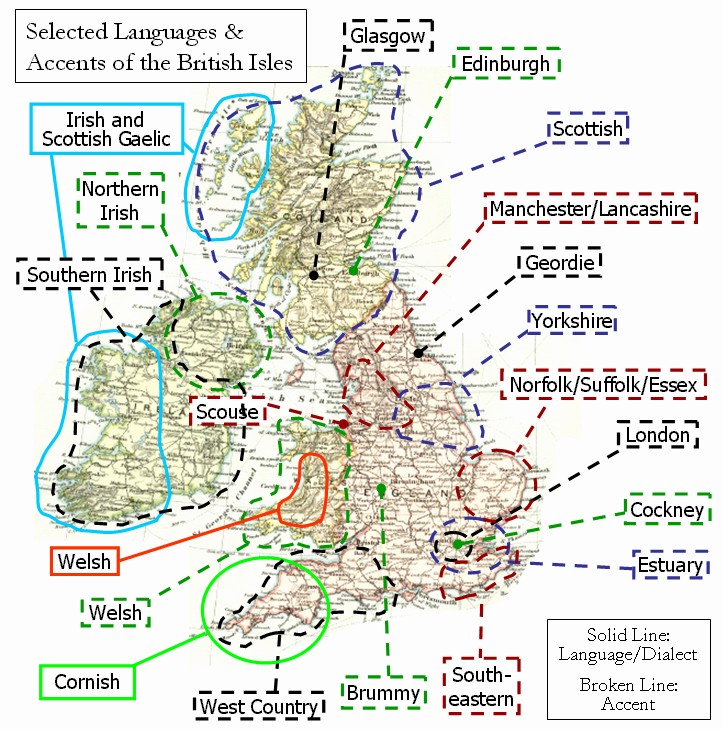
There is a very wide variety of accents in the UK (not to mention the accents you find in other English-speaking countries like Ireland, Canada, the USA, South Africa, Australia, New Zealand and more. English is a hugely diverse language and in my experience foreign learners of English don’t usually know a lot about the different accents – particularly all the regional varieties in the UK, and they often just find it difficult to understand them, and as a result learners of English can’t enjoy the great variety of sounds in English and the sheer diversity of character and personality you get from the different varieties of English, and therefore it’s worth talking about on the podcast.
This is such a big subject that to do it justice would require me to write a whole book about it. Instead I just do episodes about accents fairly regularly in an effort to cover as much of the topic as possible. For example, I recently did some episodes about British accents that you hear in the Lord of the Rings films, which gave me a chance to talk about the different associations we have with different accents in the UK and how those associations were used to provide some colour and character to the movie versions of Tolkein’s Lord of the Rings stories. I also did episodes about the accents you might hear in Glasgow and I spoke to Korean Billy about regional dialects and accents too.
Since uploading those episodes I’ve noticed a few comments from listeners wondering why there are so many accents in the UK, so I’ve prepared this episode which I hope will help you understand that a bit more.
The plan, in this episode (or episodes) is to talk about these things
Why there are so many accents in the UK
How our accents develop as part of a natural psychological process
What this means for learners of English and teachers of English
Also, we’ll listen to someone speaking in a Liverpool accent and I’ll help you understand it
So, this episode is about the way people speak, but it’s also about history, psychology, how to learn English, what my friends sound like, and how to understand a football player from Liverpool.
How are all those things connected? Listen on and you’ll find out!
Why do we have so many accents in the UK? (Communication Accommodation Theory)
One of the things I said in those episodes about LOTR was that there is a really wide variety of accents in the UK, and that your accent reveals lots of things about you such as where in the country you’re from and what social background you come from.
Remember, when I say “Accent” this means simply the way that you pronounce the words you’re using.
If you remember, one of the things I mentioned in one of those episodes was a quote from George Bernard Shaw, which said “It is impossible for an Englishman to open his mouth without making some other Englishman hate or despise him”, George Bernard Shaw.
This gives the impression that we all hate each other of course, and I don’t agree. The point which is made by this quote is that we all have prejudices about each other’s accent and this is an expression of the class system probably. That middle class people probably look down on people with strong regional accents and resent people who speak with very posh accents and so on…
Here’s a comment from Nick in response to those episodes.
Nick 2 hours ago – [These bits in brackets are Luke’s comments] What a complicated life there in the UK… Everybody resents each other because of their accents… [we don’t resent each other really, but we do judge each other a bit – we also love each others accents too] Wow I never thought that accents in the UK had such an important role in people’s lives. [Yes, they’re very important indicators of our identity – but they’re also a source of great fun, joy, amusement and celebration] Luke, thanks for this episode. You opened up the UK in a new way for me. Even though I knew about different accents in the UK (and from your podcast too) I somehow didn’t realize the deep meaning of accents in English life. But I don’t really understand how it happened that you have so many accents in quite a small area. I can understand that different levels of society may have different words in their vocabulary, but why they should have SUCH different accents especially when they live in one city or region… maybe it was people’s desire to make something with the language, or at least with pronunciation in order to be somehow unique from others. Like different groups of people or subcultures dress in different clothes or different nations have their own folk costumes.
This is a really good question and there are so many interesting aspects to the answer. I’m now going to try and deal with that question.
Why do we have so many accents in the UK?
It could be explained by “Communication Accommodation Theory” or CAT for short.
Collins dictionary: “Accommodation” – countable noun Accommodation is a kind of agreement between different people which enables them to exist together without trouble. (not a written agreement, but a social or psychological tendency to come closer to each other and form communities based on shared behaviour)
Communication Accommodation Theory suggests that the way we communicate is an expression of our desire or natural tendency to become part of a social group.
Why there are so many different accents associated with different regions in the UK
For example, why people in Liverpool speak differently to people in Manchester, or why the ‘cockney’ dialect came about (more on this kind of thing in a bit)
Why we naturally change the way we speak depending on the people around us
Why speaking to a diverse range of people is very good for your accent
Why native English speakers sometimes change the way they speak when talking to foreigners – e.g. when travelling or meeting a foreign person.
The tendency is to unconsciously adapt.
I’m going to try and deal with all these things, but not quite in that order!
Why native speakers sometimes adapt their language when talking to foreigners
According to Scott Thornbury (a well-known teacher and author of teaching materials and a bit of a legend in the world of English teaching) there are two versions – ‘caretaker talk’ and ‘foreigner talk’.
“This is especially obvious in the way we talk to children and non-native speakers, [using] forms of talk called ‘caretaker talk’ and ‘foreigner talk’, respectively. Both varieties are characterized by considerable simplification, although there are significant differences. Caretaker talk is often pitched higher and is slower than talk used with adults, but, while simpler, is nearly always grammatically well-formed. Foreigner talk, on the other hand, tolerates greater use of non-grammatical, pidgin-like forms, as in ‘me wait you here’, or ‘you like drink much, no?’”
I’ve seen this happening to some English teachers. They adapt their speech to the students, speaking this weird form of English that’s easy for foreigners to understand but might not be helping them learn.
It’s really difficult to judge it correctly as a teacher. How much do you grade your language, and how do you do it? It’s important to speak correctly – meaning in the sort of full English that you normally would use and in the same way that most native speakers talk to each other, while making sure it’s comprehensible. If you’re too ‘natural’ your students won’t understand you. But if you simplify your English too much, you end up doing this ‘foreigner talk’ which is just not a good model of the language.
I guess this is part of being a good teacher; knowing how to strike the balance between being comprehensible and yet also realistic and natural.
I always try to keep these things in mind when I speak. It’s probably why my voice becomes more and more like standard RP, which I think is just generally accepted to be clearest version of the language, and that’s how I was brought up to speak by my parents. That’s not to say other versions of the language aren’t correct of course, and as I’ve said many times before I love the different accents.
Do I accommodate when I talk to native speakers with different accents?
Yes I do – a bit – I mean, only to accents that are a part of me. I have a few slightly different accents in me and my speech slides in slightly different directions depending on who I am with. They’re not radical changes because I’m still being myself, but my speech does change a little bit. When I’m back in Birmingham my speech becomes a bit more Brummie. When I’m in London it does the same. Only a little bit of course. This is totally normal.
It’s also why it’s important to speak to other people on this podcast because it’s in the interaction with others that language really becomes most alive and natural. When I’m talking to you on my own I speak in my neutral voice, but when I’m in conversation with others you might hear my voice changing slightly. You might not notice to be honest because it’s a pretty mild change. Perhaps it doesn’t happen that much because I am still aware that I’m being listened to by my audience.
For example, when I spoke to Rob Ager from Liverpool about movies last year, my accent didn’t change that much. But maybe if I’d spent the weekend in Liverpool, just hanging out and talking, my accent might have changed a little bit.
When I lived in Japan I spent a lot of time working with people from Australia and apparently I picked up some of that accent – particularly the rising intonation pattern (my friends at home commented on it when I returned to England). So, the conclusion – I do accommodate a bit, but usually to an accent that I have personal history with, and only if I’m exposed to it for fairly long periods of time and when I’m feeling self-conscious it happens less.
Certainly when I’m back in Birmingham my accent changes a bit, because that’s where I spent a lot time when I was younger.
Cat’s question: What are Paul and Amber’s accents?
Amber & I are pretty similar. It’s just RP. Paul speaks RP too but with a bit more local influence. He’s from Kent so he speaks with some traces of a Kentish accent – e.g. glottal stops. “Native speaker” “Excited” Maybe some “th” sounds sound a bit like “d” or “v” sounds.
Some people seem to think that his voice is influenced by French. It isn’t.
That kind of influence would only happen if French was Paul’s first language, and he’d learned English as a second language in adulthood.
That’s not the case – in fact to an extent he learned both languages while growing up. He’s certainly native level in English, and he probably is native level in French too. He certainly sounds it. So, because he’s got, basically, two native level languages, they exist independently in his head and therefore don’t influence each other much in terms of accent. Every now and then it influences his vocabulary but he instantly recognises it and self-corrects. You might have heard him do it on the podcast sometimes.
Paul speaks very clearly, which is evident in the way people always tell him that they can understand what he’s saying. His English accent is influenced more by where he grew up in the south-east of England and by the wide variety of people he’s spoken to in his life. He spent many years travelling with Apple, studying and living in different parts of the UK. RP again is probably the default setting for someone like Paul, when trying to speak clearly, but those glottal stops and some dropped consonant sounds reveal that his most formative time for English was in Canterbury, and he is also not the sort of person to listen to a lot of BBC Radio 4.
Paul is also a natural mimic. He’s able to hold different accents in his head at the same time and switch between them. He’s something of a chameleon in that way. Put him in with a bunch of Scottish people for a long time and he’d probably emerge with traces of that accent I expect. Anyway, when he’s with Amber and me his accent is pretty much like ours but with traces of his Kentish background, which is why he says “Native speaker” like that.
So, that’s a bit about ‘accommodation theory’ in relation to my friends and me.
What about Nick’s original question about the diversity of accents in the UK? I’m going to talk more specifically about that in a moment.
But first let’s check out a funny example of a professional footballer from Liverpool who moved to France to play for Olympique de Marseille football club.
Now this is an example of an English person accommodating to French people around him, and we see that this is certainly not happening to Paul Taylor
Joey Barton’s weird French accent
An example of Communication Accommodation Theory in action.
Who is Joey Barton? What was the situation? (Barton is from Liverpool and usually has a Liverpool accent but in this video he is speaking to a room full of French journalists and so he unconsciously accommodates his English so it sounds French. It’s funny.)
Joey Barton speaking with this weird French voice
He was heavily criticised for this – a lot of people mocked him and called him stupid.
He’s definitely not stupid. Maybe he wasn’t aware of the different ways he could have changed his voice – e.g. speaking with RP probably just wasn’t something that would occur to him. This lad is a scouser through and through. He’s not going to start speaking RP – he’s going to accommodate to the French instead.
The reason he’s doing it, as explained by accommodation theory, is to make it easier for the French journalists to understand him. His Scouse accent is difficult for the French to understand. He was just trying to be intelligible and he ended up accommodating to their speech.
Also he did it to win social approval. I imagine being the only English guy there, in front of all those French journalists, with the pressure of playing for this big club and not speaking French, he wanted to win their approval.
This probably happens in Football quite a lot because of the emphasis on teamwork. I expect during training and while bantering with other players and staff, Barton had to very quickly adapt his speech to be part of the team. I imagine speaking Scouse English more clearly wouldn’t help the French.
(Joey Barton talks about the French accent incident)
It’s not just speech – it’s also non-verbal communication. Barton does a couple of typically French things, including the kind of ‘sigh’ or blowing of air through the lips which is really common (among French people).
According to research we are naturally wired to copy the speech and behavioural patterns of the people we’re talking to. It’s a natural, neurological process that humans engage in when they want to communicate, be understood and be accepted by others.
Significance for Learning English
For learning English this suggests some of the most important ways to improve your English pronunciation and your English in general are to
a) actually communicate with people in real conversations about real things
b) have the desire to understand others and really be understood by others
c) have the desire to share things (info) with the people you’re communicating with
d) have the desire to be socially accepted by the people you’re talking to.
So, spend time talking naturally with English speakers because you want to! Or at least, practise communicating in English not just because you think it’s important for your career or for your English, but because you are genuinely interested in sharing ideas, finding out about people and the world, and broadening the scope of your identity. The more motivated you are by these things, the more you’re opening yourself up to the natural neurological conditions for language learning.
Got it? Talking to different people with good English and who come from diverse origins about things you are interested in, really helps your English and your accent in particular!
Being engaged in genuine communication because you care about sharing ideas is going to help your brain in a natural process of language learning.
Other work helps too – like studying the phonemic chart, analysing the physical ways we pronounce different sounds, how speech is connected and all that stuff, and doing plenty and plenty of mechanical, physical practice. It’s important too, but certainly this theory suggests that our brains are wired to adapt our speech patterns in the right conditions as part of a social process.
But also, it may be vital for you to learn how to accommodate yourself to the English of the people you’re talking to. This from Scott Thornbury:
So, what are the implications for language teaching? In the interests both of intelligibility and establishing ‘comity’, Joey Barton’s adaptive accent strategy may be the way to go. For learners of English, whose interlocutors may not themselves be native speakers, this may mean learning to adapt to other non-native speaker accents. As Jenkins (2007: 238) argues, ‘in international communication, the ability to accommodate to interlocutors with other first languages than one’s own… is a far more important skill than the ability to imitate the English of a native speaker.’
So, when you’re chatting to other non-native speakers in English, how should you make yourself more intelligible in order to establish good relations? Do you suddenly start sounding like Luke Thompson, or do you accommodate to their way of speaking, following the rule of accommodation theory?
What do you think? Feel free to either agree with accommodation theory here, or disagree with it, but do give a good reason why.
But why are there so many accents in the UK?
It’s a really complex question which probably needs to be answered by someone with a PhD on the subject, but here’s my answer!
It’s probably a big mix of geography, culture, politics, history and human nature.
Tribalism
Perhaps it’s because we’re a small nation with quite a high population.
Geography
We’re an island (a group of islands actually) so that creates a clear land border – meaning that we’re a bit more ‘penned in’ than some other cultures.
The class system
RP was the standardised version, but ordinary folk spoke in their own way and weren’t expected to speak RP because they knew their place. They could never break away from that. We never had a revolution proclaiming everyone as equal, so working people didn’t take on the standard form of English.
Irregular spelling & pronunciation
The irregular relationship between the written word (spelling) and the spoken version means that the spoken version is perhaps more open to interpretation than others. Our written language is not phonetic, therefore the pronunciation is not tied down. There’s no solid rule book on how to pronounce English. There’s the phonetic chart, but that is based on RP and that’s where the class system comes into it. RP is associated with a certain class of people and then identity politics come into play.
Perhaps the multicultural ‘mongrel’ nature of the Brits has something to do with it. We’re a mongrel nation. Maybe the diversity of accents is the result of this patchwork or melting pot of different people and languages. E.g. Celtic, Nordic, Germanic, Norman French, Gallic French, Latin, Irish Celtic, Scots Celtic, Commonwealth nations like Jamaica, India & Pakistan – especially Jamaica which has had a massive influence the way young people in London speak, and now media, like American and Australian English that we hear on a daily basis.
Our islands have been visited, invaded, populated and influenced by migrating people and their voices for many many years. This goes deep into the past and continues to this day, even though the official version of history will suggest that we have one unbroken family line (The Royal Family that we all learn about in school). There’s a lot more diversity than this narrative would suggest. This could result in a wide variety of influences, creating diversity which is not obvious just by looking at people.
It’s also interesting to me that the narrative of the ‘unbroken line of history’ which we get from the monarchy, is also aligned with a certain way of speaking – this old-fashioned RP which is the standard form. Underneath that standard form, or next to it, there is a lot more variety and diversity.
There was a long period before the emergence of the single unifying monarchy in which the country was essentially split up into different, independent areas, ruled by competing monarchs. Tribalism was seriously important. Think: Game of Thrones. Community, loyalty, rejection of others – these were vitally important principles. It was the breeding ground for different local versions of a language. It must be the same in many other countries.
This relates to aspects of the accommodation theory.
Convergence is when people pull together in a community and naturally speak in the same way to express this shared identity. At the same time there is divergence – pulling away from other communities which could be rivals or whatever. If you’re part of one community you’ll speak like them and you won’t speak like the others. Either you’re in one or the other.
This could account for why people in Liverpool and Manchester speak differently even though the two cities are pretty close. Just look at the football fans to see how much of a rivalry there is between the two cities.
I expect a number of other factors have come together to cause the UK to have this wide diversity. But perhaps we’re just a lot more aware of the diversity because the place is really connected. It’s a pretty small island and we’re all squeezed in together with a clear natural border of the sea, and the industrial revolution happened there bringing the train – mass transport which suddenly brought everyone much closer together, making us a lot more aware of our different versions of English. I imagine if you examined other countries you would find similar differences in accent. The USA, for example, has definite differences, and it’s quite a young country in comparison. So, I expect many countries have similar diversity in accent and dialect. Perhaps we’re just a lot more aware of it in the UK.
We also have the class system which has added another dividing line – another factor which pushes communities together (convergence) or pushes them apart (divergence). Perhaps working class communities held onto their accents as a way of expressing their sense of local identity as a contrast to the less region-specific upper classes, who seemed to be less fixed geographically. E.g. The Royal Family has its own geography, which moves between international borders and not just across domestic community borders. I mean, Prince Phillip for example was born in Greece. The Queen’s ancestors were German. Despite the fact that they are the figureheads for the UK, they are not really fixed to local areas within the country.
This also would apply to the nobility – the proper upper classes, who probably owned land that perhaps their families hadn’t lived on for centuries. I expect one area of England for example was ruled by one family for a period, then another family became the rulers – either by conquest, trade, marriage etc. The ruling class probably were quite mobile. The people who lived and worked on the land, were of that land for generations.
So, working class people have stronger regional accents than upper class people. It’s absolutely nothing to do with so-called “lazy pronunciation”. It’s more to do with identity – strengthening local communities by having their own version of the language. Power, identity and economics.
No governing body to standardise English
Powerful people through their influence have guided the narrative that RP is the standard form – this also happens to be the English that the educated, wealthy class use.
So, that’s my fairly long and rambling answer, Nick.
We’re not finished with accents though. I’ve just talked about how C.A.T. might explain why we have so many accents in the UK, and also what the theory can tell us about things like my accent, the accents of my friends and also how you can work on your accent too. I still plan to spend some more time focusing on specific accents and playing around.
Now, I would like to ask all of you a few questions
How many different accents can you identify in your country?
Are accents in your country related to geography?
Is there a standard accent? Is that accent associated with a particular region?
What attitudes do people have about accents where you come from?
In English, which accent do you prefer? If you don’t know a region, can you think of an individual person whose accent you like? Feel free to say Amber Minogue of course.
If you’ve been shipwrecked and you get washed up on a remote island populated by a local tribe of native people who seem to use English as their main language and yet look like they might be hostile, or hungry, or both, what’s the best way to get into their good books? Speak like me, or speak like them? Or get back in the sea and swim?
Helping you to understand and appreciate the Liverpool accent and Scouse English, featuring clips of comedy a short history of Liverpool and interviews with famous footballers, actors and musicians.
Hello listeners – how are you doing? In the last episode we listened to some comedy routines by Scouse comedian John Bishop and I said we’d take a closer look at the Liverpool accent, break it down, listen to some more samples and also learn some typical words you might hear being used in Liverpool. So that’s the plan in this episode. All about the Liverpool accent.
There’s nowhere in the UK quite like Liverpool. You probably know it as where The Beatles came from, or because of the football clubs LFC and EFC. Perhaps some of you have visited it or studied there are students, because it’s a big university town.
I lived there for 4 years as a student.
My feelings when I moved there:
It’s definitely in the north! Up north.
First time I lived in the north, and there is a north/south divide in the UK
Climate is different
People are different to the people anywhere else – they’re cheeky, chatty, tough, humourous, a bit tricky sometimes, proud and also quite sentimental and sensitive about the city.
The place has a particular history that isn’t shared by other towns in England. Its cultural mix is different to the rest of the country. The accent in particular is very distinctive, and it’s confined to just the local Liverpool area – a relatively small space when you consider the accent diversity in other larger countries where the same accent may be heard for many miles, like for example in Texas. In England our accents are very specific and very local. Travel 30 minutes by car from Liverpool to neighbouring Manchester and the accent is very different and this is largely because of the history of Liverpool as an international port and the rich diversity of influences.
This is a corner of the country with a strong character and a recognisable accent to go along with it.
Scousers, or people from Liverpool are instantly recognisable by their accent. The sound of a Liverpool accent instantly conjures up certain images, certain cliches, certain reference points and a certain history which is unique to that part of the country.
In this episode the plan is to investigate the Liverpool accent, and to some extent the dialect, listen to some samples, find out some of the pronunciation features, and consider a little bit of Liverpool’s history and culture. We’ll listen to a few different people speaking in a Liverpool accent and I’ll help you to understand it all, and I’m sure you’ll pick up some nice vocabulary on the way – and not just local slang words but words that everybody in the country uses but which the Scousers might just pronounce in their own way.
The aim is to broaden your horizons, broaden your exposure to different accents and to help you get a full appreciation of English in all its forms.
The Milk Advert on TV
Let’s start with an advert that used to be on the TV and which millions of British people watched many times – The famous milk advert.This is what the whole nation (of my generation) might think of as a sample of Scouse English. Many of us heard it lots of times growing up and a lot of us even learned it. I used to be able to recite it word for word when I was a kid.
Picture two children from Liverpool who have been playing football in the garden. They come into the house to get something refreshing to drink from the fridge (or should that be “fridge”). One asks for lemonade, the other one chooses to drink milk because it’s “what Ian Rush drinks”.
Ian Rush was a famous footballer in the 80s. He played for Liverpool for years and scored many goals for them. He was Welsh. By the way, you should also know that there is a place in England called “Accrington” (north of Manchester) and their football team (Accrington Stanley) aren’t very good – so Accrington Stanley is a reference for an unknown football team that nobody wants to play for.
Audio sample 1 – The Milk Advert
Lee Mack making fun of the Scouse accent
Features of the Liverpool Accent
Let’s now take a closer look at the Liverpool accent, considering some of the main features that make Scouse English different to the kind of RP that I speak. Then we’ll listen to some more samples of Scouse speech and you can see if you understand them.
Consonant sounds
/k/ can become /x/ like in “loch” “Accrington Stanley” “milk” “Lee Mack”
/r/ sounds – alveolar tap “accrington stanley” “I’m afraid I’m not from round here” “alright”
/t/ can sound like /s/ “butter” “I’m going to go into town later, do you want something” “Come on then mate, let’s start. Come ed, Let’s get started.”
/g/ is pronounced not just with the /ŋ/ but all the way to a /g/ sound “sing” “singer” “Ere mate are you a singer? You gonna sing us a song?”
And yet sometimes it’s completely dropped like in “Eh mate what are you doing?” – “what are yew dewin? What are youse doing coming over here like that?” “Milk, that’s disgusting”
/h/ sounds are often dropped “That has never happened to be honest”
/d/ sounds instead of /th/ sounds – “They do though don’t they though?”
Vowel sounds
/ɜː/ like “bird” becomes [ɛː] like “air” – “work”, “first”, “bird” “Are you always the first one to get to work in the morning”
/a:/ sounds in the south are like /æ/ in the north (normal in the north generally) “bath” “grass” “laugh”
But sometimes it goes wider like aaaa in “card” or “pokemon cards”
/ʊ/ in book sounds like /u:/ “book” (but not every time – sometimes they say it like me, and words like ‘took’ and ‘look’ are often pronounced. I don’t know why it’s “book”)
/-er/ sounds at the ends of words normally pronounced with schwa sound are pronounced with an /e/ sound “computer” “teacher” “fitter” “singer”
/ʌ/ becomes like /ʊ/ or /ɒ/ “but erm… shut up” “shut up will ya”
“Errrm“
/eə/ sometimes becomes /ɜː/ – “hair” “over there”
All those features are interesting, but there’s a good chance that all just went over your head. Really the best way to get used to hearing scouse English is just to listen to some people using it.
Audio Sample 2 – Jamie Carragher “Butchers” the English Language
Just listen and tell me these things:
Who is he?
What’s he talking about? (general subject)
https://www.youtube.com/watch?v=nDaTTVR2JXY
Audio sample 3 – Stephen Gerrard, former England captain
What is he looking forward to?
Is he worried about the regime change with Fabio Cappello (known for being a discipinarian)
Does he have a message of hope for England fans?
What would it mean to David Beckham to achieve 100 caps?
https://www.youtube.com/watch?v=6cph2TnHW4Y
Audio Sample 4 – Wayne Gerrard – a spoof of Scouse footballers by Paul Whitehouse
Wayne Gerrard (spoof)
Language:
Just get my head down
Let my feet do the talking
Very pleased for the fans
Very pleased for the manager
One game at a time
Keep my head down
Let my football do the talking
A short history of Liverpool
Liverpool is in the north west of England. It’s a port town on the river Mersey, just where the north coast of Wales meets the west coast of England.
Liverpool started as a small trading port probably in the 13th or 14th centuries.
By the 17th and 18th centuries it was the primary port for trade with Ireland. There was lots of trade with Ireland, and also ships coming from Norway and Sweden or other scandinavian countries.
The industrial revolution, globalisation and Britain’s colonialism meant that Liverpool became a hugely important port for British ships heading to the Americas in the 19th century.
As a result by the mid 19th century, Liverpool was a hugely important city for trading with the new world.
The population of the city grew quickly with amazing diversity – everyone from around the world was there, including large numbers of Irish and Welsh workers, scandinavian sailors but also Chinese workers, Caribbean workers associated with the slave trade.
Liverpool was one of the most important and most impressive cities in the world at this time.
It was sometimes called the New York of Europe, and you can see evidence of that in some of the buildings – parts of the city resemble some of the style of New York buildings, especially in the old part of town and by the docks.
The diverse history is still evident in the cultural make-up of the city. There is still a large Chinese community and also many families of Caribbean origin in parts of Liverpool.
The biggest influences though were the Welsh and certainly the Irish communities who moved in for the manual work that was available there in the 19th century. Liverpool is heavily influenced by the Irish, and it was described as the capital of Ireland just because so many Irish people lived there.
All of these influences can be heard in the Liverpool accent – some Irish, some features of Welsh (which is a totally different language to English) and also some scandinavian influences and many others that make Liverpool so different. That’s also combined with the local Lancashire accent too. All of it combines to create this particularly rich and vibrant form of English.
The city was very rich and very important during the industrial revolution, but conditions for many people were appalling – living squeezed into dirty and dangeous slums.
Gradually Britain’s position as the global industrial imperial power started slipping, and the two world wars sped up that process. Many young men were killed in World War 1, and between the two wars Liverpool was partly redesigned with many residential areas being built around the outskirts of the city, and lots of the people who previously lived in the slums being relocated there. This changed the nature of the city, with large outlying residential areas with row upon row of terraced houses.
World War 2 was devastating to Liverpool as it was the target of bombing raids by the Luftwaffe. Like many cities in the UK, Liverpool got pounded by bombs night after night and lots of buildings were destroyed, and they stayed destroyed for many years.
When the Beatles were growing up in Liverpool in the 1950s it was common for children to play in bombsites – in the remains of buildings destroyed by bombs, and even when I was living there in the 1990s I saw lots of empty spaces in residential streets where buildings used to exist but still hadn’t been replaced since the war.
With the end of the industrial revolution, Liverpool’s importance slipped and basically since WW2 Liverpool has been a rather tough place to live, with various social problems, unemployment, poverty, and perhaps the sense that the city has been somewhat ignored or forgotten by the country which used to rely on it so much.
These days the city is known for The Beatles, the football clubs and players, some cultural things such as the vibrant art scene and just the scouse people themselves who are known for their humour and their unique character.
Here’s a female voice – Jennifer Ellison, an actress from Liverpool.
Audio sample 5 – Jennifer Ellison “Mum of the Year Awards 2013”
Vocabulary
Here are some bits of the dialect or just typical sounding words.
To be honest, you hear most of these things in many parts of the country, but listen out for how scousers would say these things.
‘Me’ not ‘my’ – “You’ve broken all me biccies!”
‘You’ (plural) – ‘youse’ “Youse are all a bunch of bleedin eejits”
Adding “me” at the end of a sentence starting with ‘I’. “I’m dead hungry, me.”
“Boss” – That’s boss that. Have you played FIFA. It’s boss.”
“made up”
“Eeeerm”
“Eh!”
“Alright?”
“Laa”
“Ta-raa”
“See ye later”
“Come ed”
“Go ed” “g’wed”
“Alright! Calm daaaawn!” (cliche)
“Bevvies”
“Nice one son”
“Gutted”
“Scran”
“bevvie”
“Bacon barm” – “two bacon barms please”
“brekkie”
“Chocka block”
“Like” – “I was like, walking down the Scotty road and I seen these two like students.”
Lots of people in the UK got to know Scouse very well from watching Brookside, a soap opera that started in the 80s. It was about middle class and working class life in Liverpool and it often showed scenes of social problems including frequent arguments between the main characters. This helped to build the stereotype that Scousers are argumentative and prone to social problems.
Audio sample 6 – Brookside argument
Summary
3 people – Barry, Barry’s mum and Billy
Barry wants his money
But the account is £500 short
Because his Mum lent it to someone else (Billy)
So, let’s cut out the middle man, give us the money
He hasn’t got it – he needed it to pay the mortgage and the car
Barry gets angry with Billy saying “you’ve got it made here”
Barry is angry with Billy because he’s borrowing money from his Mum
“I’m going to have to go back to the car fella, tell him I can’t have the car”
You’ve screwed up our Christmas!
Then he pushes him.
Cliche
This cliche of argumentative Scousers was summed up in a series of sketches on a comedy TV show called Harry Enfield’s TV Programme.
This cemented the stereotype of Scousers as:
Argumentative & violent – often fighting and infighting
From large families with lots of brothers
Always wearing shellsuits
Unemployed – around the house all day
With mustaches and curly permed hair
Audio sample 7 – Harry Enfield – The Scousers (the cliched view)
https://www.youtube.com/watch?v=6k2YEc6dozA
Language:
Alright, calm down calm down.
Are you telling me to calm down?
Alright you two, break it up!
What’s going on here eh?
Friggin
Do you have to make such a friggin fuss about it?
Just keep out of it Barry.
Are you telling me to keep out of it?
The Beatles
The Beatles are also famously from Liverpool, but nobody seems to really speak like them any more. The accent has become more nazal and harsher. The Beatles spoke in this kind of “Beatle voice” which you don’t hear so much any more.
You can hear the scouse in their voices though if you listen carefully.
Audio sample 8 – Beatles
Audio Sample 9 – Local documentary on YouTube
Mini doc https://www.youtube.com/watch?v=yIcPTpWq5jY
There’s going to be a meetup of some London-based LEPsters this coming Sunday 30th July at 7pm at the Fitzroy Tavern on Charlotte Street. It’s just north of Soho and to the west of Tottenham Court Road. There should also be a Facebook link soon.
The Fitzroy Tavern
6 Charlotte St, Fitzrovia, London W1T 2LY, UK
Sunday 30th July 7pm Fitzroy Tavern on Charlotte Street.
Zdenek Lukas of Zdenek’s English podcast will be there with any other London-based LEPsters that choose to come out. The plan is to have conversation, a beer or two and perhaps play some board games, because Zdenek is bringing some board games too. So head on down to practise your English, meet some like-minded people in a cool part of central London.
Episode Notes & Transcripts
Introduction
Hello dear listeners, welcome to the podcast. This is one of those episodes in which I go through some British comedy and help you to understand it. We will cover some vocabulary and also some cultural stuff too.
This is also chance to for you to listen to some Scouse English – the kind of English you might hear in Liverpool.
Scouse – that means from Liverpool. A Scouser is a person from Liverpool, and in that area people speak with a Scouse accent. In fact you find that accent in many parts of Merseyside – which means, Liverpool and its surrounding areas.
I’m going to tell you briefly about a popular stand up comedian from Merseyside (the Liverpool area) called John Bishop, who is often on the TV and on stage across the UK. I think he’s probably one of the most famous scousers in the UK these days. We’re going to listen to one or two of his routines which you can find on YouTube, we’ll understand them and notice some features of his Liverpool accent.
By the end of this episode I expect that you’ll have broadened your vocabulary, you’ll have become more familiar with the way people speak English in Liverpool and you’ll have learned some cultural details about family life in the UK. Also, you’re going to be introduced to the comedy of John Bishop, who you might enjoy. There are various John Bishop videos on YouTube and you can can buy his comedy DVDs which are very popular in the UK. If you like what you hear in this episode, you could get one of those DVDs and use it for both learning English and for your own general amusement.
John Bishop – some info on him
To cut a long story short, he was born in Liverpool and has lived in the Merseyside area for most of his life.
Where is Liverpool? Why is it called Merseyside?
People in Liverpool – amongst other things they are known for having a particular accent which people say is a kind of mix between Irish, Welsh (a lot of Irish and Welsh workers moved into the city during it’s time as a major industrial port in the 19th century), Lancashire and even Scandinavian influences. The accent is instantly recognisable to anyone in the UK.
So, John Bishop was born in Liverpool and has lived in the area for most of his life.
In his 20s he had what seems to have been a fairly boring and ordinary career selling pharmaceuticals. By the age of 30 he was married and had a baby son but he wasn’t particularly happy. He ended up getting separated from his wife and they were going to get divorced. He started doing stand-up during this period because he says it stopped him staying at home on his own in the evenings and drinking. It got him out of the house. The thing is, he found that he was good at it and eventually he quit his job to do stand-up full-time. Basically stand-up saved him and it rescued his marriage too – because one day his wife (who was divorcing him at the time) happened to see him on stage during a show and she went up to him afterwards and said “that was the man I fell in love with years ago” and they got back together. Since then his stand-up comedy career has taken off, and how he’s one of the most popular and well-known comedians in the UK. He’s often on the TV and his stand-up comedy DVDs are very popular.
Now he’s got quite a big family with 3 kids – all of them boys. In his comedy he talks a lot about family life and being a father – the typical frustrations, difficulties and experiences that many parents go through.
He’s definitely a mainstream comedian. I mean, his routines are not political, they’re not particularly challenging or controversial. They’re not super intellectual. It’s just straight forward observational comedy and storytelling. He’s not my #1 favourite, but I just love stand-up and I definitely enjoy his work even if he’s not my absolute favourite. But he is very successful. I think his appeal is that he’s an ordinary guy and his stories and routines are very relatable – people enjoy them because they can relate to them.
Scousers have a reputation in the UK for a few things – one of them is for being funny. This maybe a cliché or a stereotype, but I do think it’s quite true, having lived in Liverpool for 4 years. I met lots of Scousers who were very funny – just characters with stories to tell and who had the gift of the gab and good comic timing.
John Bishop is a good example of that. Partly it’s to do with the Liverpool accent which has so much character and I think helps the delivery of his routines. He tells endearing stories in a relaxed way. He wears a suit and tie so he’s well-presented. He is quite handsome and charming, but in an average kind of way. He’s like the ‘boy next door’ kind of guy. Just a normal bloke. His delivery is quite casual and easy-going, he keeps it pretty short and simple with pauses in the right places which is always a good approach to storytelling.
His attitude on stage is quite dry or deadpan (Wikipedia defines “dry” or “deadpan” like this: Deadpan or dry humor/wit describes the deliberate display of a lack of or no emotion, commonly as a form of comedic delivery to contrast with the ridiculousness of the subject matter. The delivery is meant to be blunt, sarcastic or apparently unintentional).
~
Usually his stories allow us to see that his life is actually quite frustrating and ridiculous – just like normal life is for everyone from time to time. Watching observational comedy like this makes you feel good because you totally understand what he’s going through because in fact your life is quite frustrating and ridiculous too. So it’s therapeutic – that’s what’s great about comedy. It lets you laugh at life and realise that you’re not alone and that we all experience these frustrating things.
Let’s listen to John Bishop, with his Liverpool accent, telling a couple of stories of family life from some of the videos on YouTube and let’s pick up some English in the process.
I’m going to play the first clip to you in just a moment.
As you listen, I wonder what you will be thinking. We’ve done this before, listening to English with different regional accents. You might feel that you can’t understand him completely – I think he speaks pretty clearly, delivering stories in a slow but punctuated way, but the accent might be hard for you to understand. You might think “Oh his accent is too strong”. I wouldn’t be at all surprised. But remember, English is a very diverse language. You might not want to speak like John Bishop (or maybe you do I don’t know) but you certainly should try to understand him. English comes in many different forms – many different accents – and even if you’re not familiar with those accents, they are normal and perfectly valid forms of the language which everyone can not only understand but appreciate.
It would be a pity for you to only understand one standard form of English. It would mean your English was limited. Anyone with a decent sense of English should be exposed to different accents. David Crystal said it, we all know it’s true. So let’s listen to some Scouse English. And please, do not think “Oh god his English is bad”. That’s not fair and it’s simply not true. I understand all of it, so do his audiences. British people do not struggle to understand him at all, quite the opposite – he’s very understandable and relatable. He draws in very large crowds of people to his shows all across the country. All those people understand and enjoy the things he says. His Liverpool accent is a very important part of his charm. If it’s hard to understand him I think it would be wise to consider that maybe you’re just not familiar with his accent, and that you just need to broaden your exposure to English a bit, and that this is a chance for you to do that.
Anyway, maybe you won’t have trouble understanding him at all and you’ll just enjoy listening to his story. Let’s see.
Video
Here’s John talking about going on holiday with teenage kids (I wonder what teenagers are like in your country.)
You’re going to hear him say that he had a massive tour one year and he was away from home a lot so he wanted to spend some quality time with his kids – in a kind of nostalgic way – like he imagines it used to be when he was a kid – go somewhere in the countryside where there’s no internet so he can spend some quality time with his teenage sons, spending a sort of idyllic Christmas and New Year’s Eve sitting around the fireplace playing board games, like it was in the good old days. But, his kids are modern British teenage boys who are addicted to the internet – so that might make things difficult…
You’ll also hear a few sound effects from the video, which you can see on the page for this episode.
Holidays with the kids (video 1)
https://www.youtube.com/watch?v=HMHYtGPpyko
White trainers, growing up, puberty, hormones and getting your head kicked in by your own son. (video 2)
John Bishop gets a new fridge and takes his old one to the dump (video 3)
https://www.youtube.com/watch?v=N9yAJKcIVxk
Language Learned
Here is some of the vocabulary you could learn from this episode.
Going on holiday with the kids (video 1)
Scouse
Scouser
Nostalgic
Quality time
Idyllic christmas
Sitting around a log fire playing board games
Teenagers
Addicted to the internet
Sound effects
A reconstruction
A cottage
It’s on the border between Scotland, england and Narnia
Internet, it’s Berwick son, we haven’t even got ceefax
We turned up at the cottage
In the middle of nowhere
Youse three, go in the living room, put the telly on
Looking at the past through rose-tinted glasses
In the middle of nowhere
White trainers (video 2)
You don’t realise how much of a cock you are
They do your (bleedin) head in don’t they?
Going through puberty
You have a week off school for half term (holiday)
You do P.E. (physical education)
You walk into the showers all self-conscious
Some kid walks in with a beard and bollocks by his knees!
Your voice breaks and that’s when you don’t get control over your voice
The hormones just come flying in and you’ve got no control over them
It’s the funniest thing on the planet bar none
I’m not asking you, I’m telling you!
Get up them (those) stairs and take them off.
Make me
It’s like the little lion is taking on the big line and all the other lions are running around going “it’s kicking off here!”
We’re stood toe to toe
I can take you!
There’s a chance he can take me here.
Thinking you’re going to get your head kicked in with your shoes
Taking the fridge to the dump (video 3)
The fridge
The freezer
The dump
To get rid of some stuff
It’s health and safety gone mad
It’s political correctness gone mad
A silver fridge that’s the size of a bungalow
A bungalow
That hasn’t half changed our lives (that has changed our lives a lot)
Put it next to the sink
I’m saving meself (myself) a yard of walking
We had a spare fridge
I turned up at the dump
There’s a fella there with a yellow vest and a clipboard
He’s done an NVQ in clipboard management
You can’t just dump a fridge now
You’ll have to phone us up
Then we come and get it
Who do I ring?
The phone in his hut rang
A hut
I’m outside dickhead!
A bit of pop culture history in this episode, talking about the musical movement of punk and the social situation in which it happened.
This year we have several anniversaries in British music.
50th anniversary of Sgt Pepper by The Beatles
40th anniversary of Never Mind the Bollocks by The Sex Pistols
A lot changed in British music between the release of those two albums. 1967 was the height of the peace and love movement but 10 years later music was much more gritty, cynical and realistic. In this episode we’re looking at the whole punk movement, understanding what it was all about, what the music was like, who was involved and how the whole thing has now become a sort of pop culture myth.
I’m joined by my brother James who has been a fan of punk music ever since he borrowed a tape of The Sex Pistols from a chef when he was a teenager (I don’t think the fact it was a chef has any significance to the story, but I just like saying he borrowed the tape from a chef. I can imagine a man in a chef’s hat giving James a tape. Just me? Ok) So he discovered punk music later, in the early 90s. He wasn’t actually there at the time the music was made in 1977, he was too young, but he’s collected a lot of records by punk bands, read all the books, seen all the documentaries and even played drums in a few punk bands himself. I think he knows more about punk than anyone else I know, so I think he’s a good person to talk to.
Check out the page for the episode where you’ll see video playlists chosen by James and also a musical punk mix that he did from his vinyl record collection.
But without any further ado, you can now listen to my conversation with James about punk rock music and culture.
Conversation Notes
40 years since Never Mind the Bollocks by The Sex Pistols was released. Is that the seminal punk album?
Why are we talking about punk in this episode?
What gives you any authority on the subject? Why should we listen to you?
Importance of punk for understanding culture
What is punk?
Origins of U.K. Punk
Youth subculture
Musical context
Political context – state of the country
American punk
Main bands
The Damned
The Slits
X-Ray Specs
What was the era like / music scene of the time
Spirit of punk
Purpose of punk music
Reaction to punk – tabloids
Punk art / design / fashion
2nd wave / post punk / punk influence
Reality vs legend / absorption into the culture / establishment
In this episode I talk to you about one of my favourite stand up comedians from the UK. We’re going to hear some of his comedy and use it to learn English.
I’ve always been a big fan of Bill Bailey since I first saw him on telly in the 1990s, and I’m glad to say I once saw him performing stand-up in Hammersmith, which is where Bill lives and I used to live too.
Who is Bill Bailey?
Bill Bailey (born 24 February 1964) is an English comedian, musician, actor, TV and radio presenter and author. Bailey is well known for his role in the TV show Black Books in which he plays the part of Mani, and for his appearances on Never Mind the Buzzcocks, Have I Got News for You, and QI as well as his extensive stand-up work, including his DVD specials such as “Part Troll” and “Dandelion Mind”.
Bailey was listed by the Observer newspaper as one of the 50 funniest acts in British comedy in 2003. In 2007 and again in 2010, he was voted the seventh greatest stand-up comic on Channel 4’s 100 Greatest Stand-Ups.
In this episode
This episode
In this episode we’re going to listen to some of Bill’s comedy and we’re going to understand it all so that you can hopefully enjoy it as much as a native speaker. So, lots of language, lots of listening and all the usual stuff.
Obviously, your enjoyment of comedy is subjective and what’s funny to one person isn’t funny to another, but the vast majority of what goes into appreciating a comedian is being able to actually understand the things they are saying. So, don’t judge it until you fully understand it.
I hope there’s a lot for you to learn from this episode and that you also enjoy it and find out about a very funny comedian, who has a lot of videos on YouTube and DVDs that you can buy and enjoy over and over again.
Let’s talk a little bit more about Bill Bailey and then hear some of his comedy.
Here are a few little things that you should know that might help you appreciate his humour a bit more.
Bill’s Appearance
He’s got quite a funny appearance. He looks like an old hippy (even though he associates more with the punk movement) – he has boggly eyes, a bald forehead, long straggly hair, a round face. That sounds almost mean, my description, but Bill is also a lovely person, quite sort of cuddly and is amusing just to look at. He uses his appearance well, making himself look like a crazy person. It helps gain laughs I think. Inside he is a very down to earth guy with a good sense of humour.
Type of comedy
A bit weird, a bit surreal, quite cerebral and intelligent, considering the stranger aspects of life. He’s the sort of comic that some people would say was “random” – meaning he is a bit strange and tends to look at life from a different angle. He doesn’t just do ordinary observational comedy, but instead his work is full of musical parodies and existential thoughts.
Music – parodies, mixing different styles together, observations about musical tropes.
Left-wing politics – He’s a member of the Labour party and his political views come into his comedy in various ways as he tends to make fun of capitalist culture and the establishment.
Drugs – they come into it sometimes when he makes reference to weed and generally it seems that Bill has probably taken a few drugs in his time, as is evident in his surreal style and his existential musings.
Hammersmith – this is where he’s from. It’s in West London where I used to live, but Bill also grew up in the West Country – so he has a slight west country accent, and Wales too. Generally though, he speaks a kind of RP with a West Country or London twang.
So let’s now listen to a few clips, and then I’m going to explain what you hear. There are so many clips on YouTube and I basically like all of them, but I’m going to play you probably about 5 things taken from various TV appearances and live shows over the years. You can find the embedded videos on the page for this episode.
Most of these videos showcase his musical talents as well as his comedy, his story telling and so on.
Let’s get started.
Beethoven loses a penny
Some vocabulary and language
A lot of institutions had to merge due to funding cuts
I attended the Bovington Gurney School of Performing Arts and Owl Sanctuary
I studied Beethoven.
A fascinating character.
A very lonely embittered man, a very drunken man, slovenly, covered in dust, and filth and beer. He was a very unpleasant man. He was prone to dark fits of temper. He would hurl stuff around the house and then scrawl sonatas on big blocks of cheese and then eat them to spite the world.
He channeled his anger into his work.
Rage Over A Lost Penny – inspired by an argument he had with his cleaning lady.
You know when you lose something… how frustrating.
Have you seen my penny?
Can you think where you last had it?
No I can’t remember where it is!
Have you checked your pockets?
Of course I have you stupid b*tch!
Starsky & Hutch and the jazz news
Things you need to know about Starsky & Hutch – it was a show about two cops in the 1970s with groovy music
Dramatic cop action, sometimes they were on a stakeout, they drove a cool fast car, they had an informant called Huggy Bear, sometimes they’d have fights with criminals, mafia guys etc, they’d often have car chases and they’d always drive down alleyways with lots of cardboard boxes and they’d drive through the boxes because it looked good on TV.
An episode about the tricky little questions that we use when socialising. What are the appropriate answers? What are the subtle differences? How do native speakers use these questions? Can you take the test and get all the right responses to my list of deceptively difficult questions?
This is an episode about social English, the kind of English you use when you’re socialising, particularly the little things you say when you greet someone or at the beginning of a conversation.
There are many ways to say “hi” and also lots of ways to say “how are you?” or “what are you doing?” The tricky thing is being able to judge the subtle differences in the questions with the presence of auxiliary verbs or modals which change the meaning slightly from the past, to the present to the future or with slightly different levels of formality.
I’d like to do a test in this episode today. I am going to test you, so get ready.
A Test
Here’s what’s going to happen.
I’ve prepared a list of 25 questions. I’m going to read them to you in a moment.
As I say each question, what I want you to do is to think really quickly and really naturally about the first thing you would normally say when you hear that question. What’s the first answer that comes into your mind?
Let’s see if you answer correctly.
To find out the proper answers we’re going to listen to me directing those questions at Amber, Paul and Sarah. Then you can listen out for how they answer them and the comments we make afterwards, which should explain these tricky little bits of English.
Not only can you learn some essential social English in this episode, you can also hear plenty of humorous conversation between the four of us.
Sarah’s baby is also there in the background. I’m sorry if this bothers anyone. I’ve removed some of those noises but a few are still there. I think it sounds fine and adds a bit of atmosphere and after all she is a very cute baby.
So, the test. Let’s get started.
Are you ready? Just give the first answer that comes to mind.
Also, you should know that some of the questions are intentionally incorrect. So, if you hear a question which is grammatically wrong or just not used ever, you can say “wrong”.
Ok, so, your quick answer to the question, or “wrong” if it’s incorrect.
I’ll say the question once quickly, once slowly and once again quickly.
Some of these questions may seem extremely simple – the point of this is the pragmatics of social English and how you should give certain stock answers to some questions. They get a bit harder as they go along.
Also, you can try to repeat the questions too.
They’re going to come pretty quick, so use the pause button if you want.
Here we go. You might think these are easy, but that’s why this is called ‘deceptively’ difficult questions.
*4 questions are intentionally incorrect. Can you spot them?
What are you doing?
How are you doing?
How’s it going?
How are you going?
What’s happening?
What’s going on?
What’s going down?
What’s going up?
What’s up?
How do you do?
How are you?
How have you been?
How have you been up to?
What are you up to?
What have you been up to?
How long has it been?
Can I use your phone?
I can’t use your phone, can I?
Do you mind if I open the window?
You don’t mind if I open the window, do you?
What are your plans for later?
What are you up to later?
Can you tell me where is the best bar in town?
Do you know how long is it going to be?
Would you be prepared to give me a 5% discount?
Ta = thanks
You’re now going to hear all those questions and how Amber, Paul and Sarah will respond to them. See if you got them right or wrong!
I’ll go through them again quickly at the end.
Listen to the whole episode for all the correct answers and explanations.
Don’t be a ninja! Let me know your thoughts in the comment section.
Conversation and language analysis with the podpals and guest Sarah. Hear some conversation about being married to a foreign person, bringing up kids to be bilingual, and learn some slang in Australian and Northern Irish English. Vocabulary is explained at the end.
This episode is choc-a-block with natural conversation and language.
Yesterday I had Amber and Paul over to the flat, and I also invited Sarah Donnelly, a friend of the podcast. Sarah also brought her baby who she had since she was last on the podcast. There’s no relation by the way between her being on the podcast and having a baby. Purely coincidental. Anyway, the four of us sat around the table yesterday in the blistering heat to record some podcast material and that’s what you’re going to hear.
Sometimes you can hear the baby screaming and gurgling in the background but I don’t think it spoils the recording really. She hasn’t learned to talk yet, but who knows being on the podcast might help a little bit in some way.
The conversation is a bit chaotic because there are 4 people, sometimes talking over each other. If you like you can imagine you’re in a business meeting. A business meeting in which no business actually takes place, nobody observes the rules of formality and where the participants just chat with each other. So, not much like a business meeting really, but anyway a meeting of sorts, and this is the kind of thing you might have to deal with in the future if you go to a meeting in English and there are a number of people discussing things and you have to keep up. It’s good practice to listen to this kind of thing to help you prepare for that kind of situation.
This recording was slightly shorter than the usual full-on ramble that we have together. But I’m going to do a bit of language analysis at the end. I’ll pick out a few words and phrases and will clarify them after the conversation has finished.
Also there’s another language-related episode coming soon with Amber, Paul and Sarah.
Here now is a discussion between podpals Amber and Paul, also featuring Sarah Donnelly the American with Irish roots who has been on this podcast before, most recently talking about the US Presidential Elections with Sebastian Marx.
Things we all have in common:
We’re all English speaking expats in France
We are all with French partners, either married or “paxed”
We’re all comedians on the stand up scene too
In this chat we discuss a few things, such as the complexities of being with a foreign partner, bringing up a child in a foreign country to be fully bilingual, getting married and what it feels like for the bride and groom on the big day, Amber’s podcast which was recently released online, Paul’s upcoming gig in Australia, Sarah’s Irish roots and some English slang from New Zealand, Australia and Northern Ireland.
Questions
Here are some questions for you to consider as you listen. This can help you to focus on the content.
Are you or have you ever been with a foreign person in a relationship? What are the difficulties of that?
What’s the best way to bring up a child to be bilingual? Is it possible to raise a bilingual child when only one of you speaks one of the target languages to the child?
Are you married? How did it feel for you on the big day? Did you cry? Have you ever been a guest at a wedding, and did you cry?
Have you heard Amber’s podcast, which is called Paname? It’s now available at panamepodcast.com
Can you identify different English accents and dialects from around the world? How about American vs British, or different areas of the UK? How about Ireland and Northern Ireland? What about Australia and New Zealand? Do you know what their English sounds like?
Right. Consider those questions as you listen to this conversation and hold on until later when I’ll explain some of the vocabulary and some cultural stuff too, maybe touching on different accents, wedding vocabulary and more.
But now you can listen to Amber, Paul, Sarah and me, melting in my boiling hot apartment.
Vocabulary and other language points – Explained
It’s really hot
It’s hot as hell
It’s boiling
It’s sweltering
It’s baking
It’s blisteringlyhot
Being partnered with a French person is hard work.
I have one hour’s worth of material on this. One hour’s worth of something 5 minutes’ worth of something
We’ve got 3 days’ worth of food left
I’ve got about 10 minutes’ worth of battery left
Bringing Up Children
Bringing up a baby in a foreign country with a foreign partner – will they speak English? Bring up a baby Raise a child Be raised in / to Grow up
Do you have experience of bringing up a baby to be bilingual? Let us know.
If just one parent speaks English, and the rest of the time it’s French with school, friends and everything else – will the kid be bilingual?
Anglophone
Francophone
Condone/Condemn I don’t condone the hitting of a child (stupid thing to say actually – but that’s what happens when you joke – sometimes you go over the line a bit – obvs I didn’t mean it)
Condone / condemn
Paul’s Wedding
An out of body experience
We were so stressed out
Crying To cry
To be in tears
To well up
To choke up
Neither of us cried
I thought everybody would be in tears
I welled up a bit
I was choking up
Walk down the aisle
The altar
Her parents aren’t with her any more. They passed away.
Paul’s dad gave her away. “It was so sweet that it was your dad that was giving her away.”
I’m left-handed
I can’t grip it like I like to grip it. (innuendo)
He’s jumped ahead. (he’s gone to the innuendo before we realised it)
Some ninjas came out of the woodwork. (to come out of the woodwork) to appear after having been hidden or not active for a long time: After you’ve been in a relationship for a while all sorts of little secrets start to come out of the woodwork. Mildly disapproving. From Cambridge Dictionary Online.
They feel like they’re going to do mistakes. Makemistakes.
Aussie slang http://mentalfloss.com/article/61847/25-awesome-australian-slang-terms
G’day mate, how are you going?
Arvo: afternoon
Barbie: barbeque
Bogan
Chockers
Fair Dinkum
Fuckin’ oath!
Sweet as
Strewth! (Cliche)
Kiwi slang
The slang is pretty similar to Aussie or UK slang, but the accent is different. For years I couldn’t differentiate it from Aussie, but the more you hear the more you realise how different it is. Watch Flight of the Conchords to hear lots of it. Episode in the pipeline.
In this episode I’m just sitting in the sunshine and I just want to ramble with absolutely no preparation. I’ve been doing quite a lot of fairly serious episodes about language, and politics and there’s more to come. But in this one I don’t want to feel obliged to make any serious points at all. Instead I’d much rather just be light hearted and talk about whatever comes into my head in an effort to just relax and have fun.
Nothing is written down. I have literally no idea what I’m going to talk about. I’ve got loads of episodes in the pipeline but for this one, it’s just turn on the microphone and let’s go. It might be pretty inane and stupid. Don’t take too much of it seriously. But who knows what kind of vocab or idioms will pop up, and maybe some other bits.
So – expectations should be a full on ramble with no particular language aim than to just follow the English as it accompanies my stream of consciousness.
Let’s go through 9facts.co.uk. I have no idea if they are actually facts, but it’ll give me a springboard to just ramble about whatever I come across.
http://9facts.co.uk/en/
Images and “facts” from www.9facts.co.uk
Song
The Kinks – Sunny Afternoon https://tabs.ultimate-guitar.com/t/the_kinks/sunny_afternoon_crd.htm
What do you think?
What are your thoughts on the topics that came up doing this episode?
Leave your comments below.
This week I’m featured in episodes of The Rock N Roll English Podcast and The Earful Tower Podcast.
The Rock n’ Roll English Podcast
This one is presented by English teacher Martin Johnston, who lives in Italy. It’s a learning English podcast for intermediate students who want to listen to people talking about normal things like sex, drugs and rock and roll, all of which are completely normal things!
Martin makes an effort to teach the vocabulary that comes up in his conversations that cover fun and interesting topics. It should be easy to understand this one as Martin grades his English a bit so that intermediate students can understand him.
In this episode Martin presented me with some very awkward social situations and we discussed my choices for each one. Often the best option was to just jump into a lake. Listen to the episode above to find out more and visit Martin’s website here.
The Earful Tower
This one was recorded a few weeks ago and has been published now. The Earful Tower podcast is run by Oilver Gee and their goal is to figure out France with the help of a new guest each week – from cooks and comedians to TV hosts and tour guides.
In the past they’ve interviewed Paul Taylor and this week it was my turn. The topic was how French people learn English.
You’ll hear three voices. Oliver Gee the host, who is half Australian and speaks with a bit of an Aussie accent and James his co-host who is half French but speaks English like a native, and me.
This one might be a little difficult to follow as Oliver has a bit of an Australian accent and the three of us talk pretty quickly.
This was a fun discussion about the ways French people approach learning English. There’s one thing I regret saying here and that is that French teachers of English aren’t good at English. What I meant was that this is always what French people say as a kind of excuse for why their English “isn’t good enough”.
It was lots of fun being on The Earful Tower. You can listen to it above and check out their website here and Facebook page here.
Thanks for reading and listening! New episodes of the podcast will be available soon. Hope you’ve been enjoying the Rick Thompson report!
Bye bye bye bye bye
Luke
Cookies on teacherluke.co.uk
Click “Accept All”, to consent to the use of all cookies on this website, or visit "Cookie Settings" to control your consent settings.
This website uses cookies to improve your experience while you navigate through the website. Out of these, the cookies that are categorized as necessary are stored on your browser as they are essential for the working of basic functionalities of the website. We also use third-party cookies that help us analyze and understand how you use this website. These cookies will be stored in your browser only with your consent. You also have the option to opt-out of these cookies. But opting out of some of these cookies may affect your browsing experience.
Necessary cookies are absolutely essential for the website to function properly. These cookies ensure basic functionalities and security features of the website, anonymously.
Cookie
Duration
Description
cookielawinfo-checkbox-analytics
11 months
This cookie is set by GDPR Cookie Consent plugin. The cookie is used to store the user consent for the cookies in the category "Analytics".
cookielawinfo-checkbox-functional
11 months
The cookie is set by GDPR cookie consent to record the user consent for the cookies in the category "Functional".
cookielawinfo-checkbox-necessary
11 months
This cookie is set by GDPR Cookie Consent plugin. The cookies is used to store the user consent for the cookies in the category "Necessary".
cookielawinfo-checkbox-others
11 months
This cookie is set by GDPR Cookie Consent plugin. The cookie is used to store the user consent for the cookies in the category "Other.
cookielawinfo-checkbox-performance
11 months
This cookie is set by GDPR Cookie Consent plugin. The cookie is used to store the user consent for the cookies in the category "Performance".
viewed_cookie_policy
11 months
The cookie is set by the GDPR Cookie Consent plugin and is used to store whether or not user has consented to the use of cookies. It does not store any personal data.
Functional cookies help to perform certain functionalities like sharing the content of the website on social media platforms, collect feedbacks, and other third-party features.
Performance cookies are used to understand and analyze the key performance indexes of the website which helps in delivering a better user experience for the visitors.
Analytical cookies are used to understand how visitors interact with the website. These cookies help provide information on metrics the number of visitors, bounce rate, traffic source, etc.
Advertisement cookies are used to provide visitors with relevant ads and marketing campaigns. These cookies track visitors across websites and collect information to provide customized ads.