This is not a full episode of Luke’s English Podcast, which is why the episode doesn’t have a number. In fact this one should appear in your RSS feed between episodes 276 and 277. This is just a quick chance for me to say hello to you, and to tell you about a quick survey that I’d like you to complete on my website. I’d like to encourage you to visit my website and give me a very quick bit of feedback regarding the type of episodes of this podcast that you prefer. If you find the page for this episode, entitled “Survey: What kind of episodes of LEP do you prefer” you’ll see a multiple choice survey. It’ll take you just a couple of minutes to do, and it will give me some really valuable feedback regarding episodes of Luke’s English Podcast.
[DOWNLOAD] I’ve been doing LEP for over 6 years now. Most of my ideas come from my own inspiration, but I’ve always thought it was important to listen to my audience, to know your needs/preferences, and try to give you content that you really like and that meets your needs and interests.
I do various types of episode on this podcast, I like to keep it varied and I’m curious to know which ones you prefer. This can help me to maintain the standards of the podcast, keeping it useful and relevant to you as much as possible. Of course, I know that I can’t please all the people all the time, I can only please some of the people some of the time, and I believe that the first person I have to please is me – if I’m not happy with what I’m doing then it’s not worth doing at all. But, you’re the listeners, you’re my audience and you’re the most important part of this whole thing. So, your feedback is really significant to me and it would help me a lot if you completed my survey.
You can find the multiple choice survey at teacherluke.co.uk – in the archive between episodes 276 and 277. It’s really easy to complete. All the options are types of episode that I do on this podcast. Just click the options that represent the types of episode you like, and you can add your own option if you want as well.
Once you’ve selected all the types of episode that you like you can click “vote” and then you’ll see what other people have voted too, you’ll get all the results so far and you can see what other people think. You can change your votes if you want to, and as I said you can also add your own options to the survey, which other people will then be able to agree with too.
I will consider your feedback carefully and it will help me to plan future episodes of Luke’s English Podcast, but of course I still reserve the freedom to do exactly what I want on this podcast! It is, ultimately, Luke’s English Podcast – and I’m the one who chooses the content for this, but I’d like to know what you prefer.
So, here is that list, and don’t forget you can find this survey on the page for this episode – between episodes 276 and 277 in the archive. You can find the archive by mousing over “ALL EPISODES” and then choosing ALL EPISODES – ARCHIVE and you’ll find this survey in the list.
Also, if you want to write to me in more detail, just click on the CONTACT item in the menu and you can send me an email.
Thank you as ever for your attention and your feedback. Long live LEP!
Thanks very much! HI! I’ve just realised that “Other” doesn’t work – whatever you write there will disappear. So, please add your “Other” option as a comment below. Thanks! Luke
[socialpoll id=”2275035″] HI! I’ve just realised that “Other” doesn’t work – whatever you write there will disappear. So, please add your “Other” option as a comment below. Thanks! Luke
Some feedback from Twitter
@EnglishPodcast 1. I like the ones where you just make things up as you go (The Pink Gorilla Story is definitely your best episode!)
Hello and welcome to another episode of the podcast. If you’re new to LEP then you should know that this is a long-running podcast for learners of English. The idea is that I provide you with regular content to help you improve your English. My intention is to provide you with listening material that is not only good for your English but also a pleasant and fun experience to listen to. Check out teacherluke.co.uk where you can add your email address to the mailing for new episodes, or find my podcast on iTunes where you can also subscribe. There are lots of transcripts, discussion forums, videos and all kinds of other stuff at teacherluke.co.uk so check it out. If you’re an old listener, then ahoy there! Welcome back to the good ship LEP.
I’m in the skypod again to record another episode and this time I’m responding to more questions from my listeners. These are all questions that found their way to me via the discussion forum or as comments or emails. This one is Q&A Session #5.
A Spoonful of Mustard – June 13, 2014 at 1:46 pm Hello Luke, This particular question has been bothering me for donkey’s years. Even though it may sound a bit silly, I would be most grateful should you answer it seriously. Let me put you in the picture. Essentially, the question stems from a sci-fi film I watched a couple of years ago. A part of the plot is set on a planet that orbits three stars in a solar system a zillion light years away from the Earth. At some point in the film, a bunch of fugitive inmates gets stranded on the deserted surface of this remote planet. By and by, the presence of the three stars in the sky dawns, literally and figuratively, on the gang, and one of them yells out, unconvincingly acting-wise, ‘it’s got three suns!’ This particular usage of the word ‘sun’ baffles me. Even though it is crystal clear what the protagonist means, it seems to me he should have said, ‘it’s got three stars!’ since ‘sun’ is the name of the star the Earth goes round. On the other hand, another question comes up: if you were on a planet in a different solar system, could you get a suntan or, indeed, go sunbathing? Could you enjoy watching awe-inspiring sunrise over there, or you would have to resort to relishing observing Alpha Centauri-rise or something of the same sort? Based on your expert knowledge, what do you think of all this? All the best, A Spoonful of Mustard
Luke: So, can we call the stars orbited by other planets in the universe “suns”. Yes, I think we can. I would say that a star being orbited by planets is a sun. We call our sun ‘the sun’ because, for us, it’s the only one. We know there are others, but this is the main one for us. It’s like “Let’s go to the pub” – here we mean our local pub, the one that we live near. Any pub can be “the pub” – it depends where you live, or where you are at that time. If you live near The Kings Head – that’s The Pub. If you live near the Golden Lion, that’s “the pub”. Similarly, if you live on earth then the star at the centre of our solar system is “the sun” but I would say that if you live on another planet in another solar system (please leave a comment if you do – we’d love to hear from you) then I think it’s fair to say that you could call your local star, “the sun” too, or perhaps “our sun” or even “suns” if there are several.
“Look at the sun” means our local sun. But if you were on another planet, and that planet orbited a star – I think it would be fair to call it a sun as well.
Luckily, I don’t think this is something that troubles most of you on a daily basis. :)
Anonymous – April 26, 2015 at 2:09 pm – in the comments section of my website. The difference between can and can’t. https://www.youtube.com/watch?v=cahVeRxiZBc I personally found this extremely difficult to catch! I hope this can help somebody.
Luke:
I think there are a few points to deal with for this question. Also, there are several ways of saying the word can, depending on which side of the Atlantic you’re on – there’s the British way and then the wrong way. Haha that’s a joke. No really, Americans and Brits say the words slightly differently. We’ll come to that in a moment. I’m dealing with the UK version of “can” and “can’t”.
1. The difference between the words when they’re not in a sentence. Can /kæn/ can’t /kɑːnt/ – mainly it’s about the vowel sound (can is short, can’t is long) but also that can’t has a /t/ sound at the end.
2. When the words are used in the middle of a sentence, fluently. Firstly, there’s the issue of the weak form of ‘can’ with a schwa sound, and with ‘can’t’ the /t/ sound can disappear, making it sound a bit like ‘car’.
Weak form of ‘can’
Yes, I can do that. Here, can is /kən/
Elision of /t/ in ‘can’t’
Sorry, I can’t do that. I can’t see it. I can’t wait. – in all of those, the /t/ of ‘can’t’ disappears.
It’s normal for /t/ and /d/ sounds to be lost when followed by another /t/ or /d/ sound, but it’s not just then. Frankly, /t/ sounds are often dropped in fluent speech.
Sorry, I can’t eat it.
So, can and can’t sound alarmingly similar sometimes. But they’re not the same. Native speakers can identify the difference. There is a difference, it’s not telepathy, although context may help too (like, tone of voice or body language)
The key thing is that the vowel sound is still long.
“I can meet you at 3.”
“I can’t meet you at 3.”
Can you hear the difference?
How about the tone or intonation of the sentences?
Listen to these sentences, am I saying ‘can’ or ‘can’t’? Sometimes my intonation or other words might help. Repeat the sentences after me.
a. I can be there earlier if you need me to.
b. I just can’t work this one out.
c. I can just do it for you if you want.
d. You can just take the bus, it’s much easier.
e. He can’t get any reception in his room, so he’s going to use the landline.
f. They can just download it and stick it on the laptop.
g. You can’t help me with this can you?
h. I can’t stop thinking about last night.
i. It can be a bit difficult to hear the difference between can and can’t sometimes, can’t it?
3. American English may be a bit different. “can’t” might sound more distinct.
Daniel – June 13, 2014 at 3:06 pm Hello Luke, First of all, I want to say I regard your work with podcasts the best I’ve ever seen for ESL learners so far. You show a 100% spontaneous conversation in English that supports listening skills a lot. Thanks mate! Getting back to my question for you I have to tell you I’m trying to learn how to speak with authentic British accent, but, it seems the process to me is becoming increasingly slow. I’ve been self-taught for more than 2 years. In fact, I want to sound like you,and, so that, at the moment, I try to mimic you by memorising what you say and then repeating that as many times as possible. Am I in the right technique? I’m not so sure about that!I’d like some guidance from you as regards the pronunciation learning. So,here are my questions: how could somebody speed up the process of internalising the British accent ? What method you’d suggest to come near faster and effectively to this accent? Thanks in advance for your attention.
Luke: This kind of relates to the question from Edgar. Let’s say you’ve decided to learn to speak with a British accent (Standard Received Pronunciation I imagine – because there are many British accents, as you know). How can you do it? Here are some ideas: Learn the phonemic script. Learn all those sounds and symbols. This is the palette of English. Once you learn all the sounds that are used in English, you’ll be able to identify and hopefully copy the sounds as they are used by people. Learning the phonemic script is like learning the musical theory. Transcribe words and sentences in phonemic script, and then check a dictionary. Yes, do plenty of listening and repetition. Use the BBC’s pronunciation pages for help http://www.bbc.co.uk/worldservice/learningenglish/grammar/pron/ Use a mirror to see the way you are pronouncing words and compare that to the videos on the BBC’s pronunciation page. Listen to loads of British English and just have fun trying to copy it. Think about things other than the vowel sounds – e.g. intonation, certain phrases that are typical, rhythm, the attitude and mentality, body language. These can all be tags to help you learn. But again, the main thing is that you speak clearly and that you are yourself. Don’t fake it too much, except for fun. If possible, spend time with lots of British people – humans are designed to adapt to be similar to those around us (if you just relax and let it happen) and so spending time with Brits is perhaps the best way. Go drinking with British people! If you can’t do that, just keep listening to Luke’s English Podcast, it’s bound to rub off on you.
Naz – June 13, 2014 at 3:59 pm I just wanted to ask about my personal problem with English . I know many people have some problem with spoken English but some of them are lazy and they don’t study hard and they are often just complaining. But I am not a lazy person and everyday I regularly try to study English. I’ve been living in London for two years. When I came here I didn’t know any English words except “yes or no” , couldn’t understand what people talk about. But later I discovered your website and another amazing website like yours. I’ve been listening regularly your podcasts. Now My English has evolved without any course. It really helped me and I appreciate and I am really grateful. Thank you very much for this selfless labour.
My problem is that I can’t make a kind of self-confidence about speaking. My personality doesn’t allow me to speak confidently. I can’t say any words in English especially while I am in Turkish communities who are speaking very well. I am a high perfectionist person and my subconscious is ordering me an excellent speech. I feel like I will not speak without having a perfect fluent English and accent. I never will have this perfection but I cannot tell myself it somehow.
Only for this reason I missed many opportunities about my job in the UK.(architecture) I wish I could see my life from a higher level…
I am sure you will give me some advice about my issue.
Thank you very much,
Naz…
Luke: You’ve got to stop judging yourself. Just relax and try. Nobody starts perfect, you have to fail before you get there. People respect bravery. Be brave, make errors, don’t let them bother you, learn from your mistakes and carry on. Nobody is judging you that much! You’re too hard on yourself. People will respect you for making the effort. I’ve seen it time and time again in classes, and I’m guilty of it myself too – the ones who make progress are the ones who don’t care about making mistakes in front of everyone. They speak up, the make some mistakes (not that many really) and they improve, and they move up to the next class. Everybody respects them. Everyone looks up to them like they’re extraordinarily confident. It’s not a magic quality that only some people have, it’s just about having priorities. Prioritise your learning, your progress and your communication. They’re more important than total perfection. Also, do it step by step. Every successful interaction or bit of communication is something to celebrate and feel good about. You need positive reinforcement and stimulation when you’re learning. Be happy about the progress you’ve made. You’ve done well. Now choose to proceed with confidence. It really is a choice.
Phil – June 13, 2014 at 4:41 pm Dear Teacher Luke,
I just wanted to ask about the subjunctive mood. I’m still quite confused about it and even my English teacher was not able to answer my questions (she is american, from Chicago).
Partly, I think it may be due to the incorrect use of the subjunctive that many native speakers do and partly to the fact that it is actually a hard topic. I’ve read some grammar websites and that just made me even more confused.I understand that there’s a slight difference between BrE and AmE sometimes too.
THANK YOU =D CHEERS
Luke: Could you give me a more specific response?
Here’s another example from Phil (I asked him for a more specific example) Phil: Ok =D All right I know (from Beyoncé) that I am supposed to say ‘if I were a boy'(though I am actually a boy…Well I conveyed the message at least). On a website I read that there’re actually 2 tenses (present and past subjunctive) but only for the verb ‘to be’ there’s a difference (be and were). For all the other verbs there are the present and past tenses that are actually the same (like work and work). here is the website http://www.englishclub.com/grammar/verbs-subjunctive.htm do you think it’s trustful? And I really wonder if this part is really correct (copied and pasted):
Notice that in these structures the subjunctive is always the same. It does not matter whether the sentence is past or present. Look at these examples:
Present: The President requests that they stop the occupation. Past: The President requested that they stop the occupation. Present: It is essential that she be present. Past: It was essential that she be present.
Thank you Teacher Luke =D whichever comment on this matter will receive my deepest gratitude.
Luke: I’ll refer to a couple of web pages for this. This one for a brief explanation of its form and use: https://www.englishclub.com/grammar/verbs-subjunctive.htm (Englishclub.com)
This one has some lists of verbs and expressions which are followed by the subjunctive http://www.englishpage.com/minitutorials/subjunctive.html (englishpage.com)
P.S. in my zombie episode in which I looked at conditionals, I didn’t say “If I were a zombie”, I said “If I was a zombie” – technically not correct, but so many people do it that it’s considered ok if a bit colloquial.
In this episode I’m going to respond to questions that my listeners have asked me in the teacherluke.co.uk discussion forum. I’ll also deal with some other questions I’ve received from listeners in different ways, either on Facebook, twitter, email or as comments posted on my website.
[DOWNLOAD] [AUDIOBOOK OFFER]
So this is a Q&A episode – Q&A, obviously means Question and Answer. It’s not the first time I’ve done this on the podcast before. The first time was Episode 17 “Hello To My Listeners Around the World”, then episode 51 “Luke Answers Your Emails and Questions”, then episode 126 “Your Emails, Comments and Questions” – and that was the last time I did an episode devoted to your questions and comments, although I did do the “Your English Podcast” series which featured lots of comments from listeners, and some Q&A in other episodes like “Rickipedia” with my Dad or “A Cup of Tea with…” with friends like Pierre Gaspard, Sebastian Marx, Sarah Donnelly, where we answered questions from Facebook. But really, this is in fact the 4th episode devoted solely to answering listeners’ questions. That’s why this episode is called Q&A Session #4. This is something I plan to do more regularly. If you’d like to send me questions to be answered in the podcast, listen up and I’ll tell you the best ways to get in touch with me.
So, thanks for attending the LEP Q&A Session for May 2015. Make yourself comfortable. Pull up a chair, there are plenty available. Help yourself to biscuits. Let’s imagine that this virtual meeting is taking place inside a pod which is orbiting the earth. Let’s hope there’s no space debris like in that film Gravity with Sandra Bullock and George Clooney, that could be disastrous, but also entertaining and with great 3D effects. No, there’s no need to worry – during this Q&A meeting, we’re just going to cruise around the atmosphere in total comfort while I carefully respond to different questions and queries which have been sent in to LEP via the matrix, I mean, the internet.
Just before I answer those questions from listeners, I’d like to just mention a few other things – these are some things that I would like to deal with and I think now is an appropriate time. Feel free to use this moment as a chance to just get comfortable, pour yourself some space coffee, get used to the zero gravity conditions, have a power-nap, whatever you’ve got to do.
Recent Episodes
I’m very glad to see that recent episodes of the podcast have been well received by the international community of LEP. Comments have been encouraging, particularly for the ones involving Amber and Paul which I uploaded over the past week or two. Those episodes were a lot of fun and I plan to feature Amber and Paul with their lovely voices, on the podcast again soon, perhaps to do some more improvisation games and language focus.
Audible Sponsorship
You can’t fail to have noticed that most of my episodes now contain mentions of an audiobook offer from Audible.com. There’s usually a pre-show spot of about 1 minute when I remind you to go to audibletrial.com/teacherluke where you can sign up and get a free audiobook. Now, why am I doing that? Well, it’s quite simple really. I’ve arranged to have sponsorship from Audible for several reasons. The main one is that it’s a way for me to monetise this podcast which I spend so much of my time working on. I love doing LEP and I spend quite a lot of my time on it, and I work alone except for bits of assistance from some LEP Ninjas who manage google docs for transcriptions. Basically, I have to be able to justify doing this – if I can’t get some remuneration for my efforts, then why should I keep spending so much time working essentially for free? Obviously, doing the podcast not completely thankless or anything – it’s wonderful and I love it! I receive so many encouraging comments from my listeners, positive responses, and I am able to connect with so many cool people around the world and that is massively rewarding, and I am so grateful for everyone’s support. However, I think it’s time I made a little bit of cash from my efforts, and sponsorship is one of the ways for me to do that. Also, I’d like to keep LEP free for you to download, rather than making everyone pay for episodes. So, how can I generate some income while keeping the podcast free? Well, sponsorship is one of the answers. Loads of other top podcasts have sponsors – Marc Maron, Serial, This American Life – they’re all sponsored by someone. That’s how they make it work. It’s the industry standard for monetising a podcast. Now, my mentions of audible.com might distract you slightly, or perhaps even make you feel that I’ve gone commercial or something. I understand that. But for me, sponsors are just a normal part of any successful podcast. Also, I believe Audible.com is an appropriate sponsor for LEP. Listening to audiobooks can be a great way to get loads of English input. I know there may be free audiobooks available out there – but frankly they’re not recorded using professional actors who can bring these stories to life. Also, Audible has a really wide range of stuff for you to download, or listen to on their website. I use Audible, and generally I’m happy with the service and I used their 30 day trial, got my free book and continue to use them, getting a new audiobook every month as part of my package. This month I downloaded a book by one of my favourite British journalists called Jon Ronson – the book is called “So You’ve Been Publicly Shamed?” and it’s all about the modern phenomenon of public shaming on social networks (e.g. when someone writes something stupid or controversial on Twitter and is then attacked by hundreds of people in a kind of feeding frenzy of public criticism.) Ronson is a brilliantly insightful and humorous writer and he narrates the book himself. Here’s a link to Jon Ronson’s books if you’re interested.
So, I like Audible, even if their iPhone application sucks. I mean, it used to be great, but since a recent update it hasn’t been working properly so I just download the books to my laptop and listen there, or transfer them to my phone using the cable connection.
So, anyway, what I’m trying to say is: The fact that my podcast is sponsored is absolutely a good thing. It’s good for me, it’s good for the podcast and it is good for you, because you can take advantage of their offer and get yourself an audiobook. You’ll just have to put up with me mentioning my sponsors from time to time – but don’t worry, I’ll try to keep those mentions brief, informative, light-hearted and not too intrusive.
Join The Mailing List
Have you done this yet? You should!
teacherluke.co.uk is my base and this is where I post not only episodes of Luke’s English Podcast but also where I post other things that are worth sharing with you my lovely audience – like for example if I’ve been interviewed one someone else’s podcast or even featured on TV! If you join the mailing list you’ll get an email whenever I post a new episode or something like that. Don’t worry though, I definitely won’t spam you or send you loads of unnecessary things that just fill up your inbox. I hate that. You’ll just get an email with new a notification of a new episode or special extras whenever I add them. To join the mailing list just enter your email address in the space provided in the right of this screen.
How To Get In Touch With Me
There are lots of ways to get in touch with me.
LEP is on Facebook and you can leave comments there or send me a private message. Click here for the FB page.
I’m on Twitter, and you can tweet me there. Click here for my twitter (@englishpodcast)
But the best way is to contact me via my website – either publicly by leaving a comment on one of my episodes, or by sending me an email.
You can email me through the website quite simply. Just click on CONTACT in the menu and you can write your message there. It will be sent to me as a private email.
Also, I always welcome your thoughts, questions and suggestions – so please send me your feedback. I’ve set up a feedback form, and you can find it by mousing over the word CONTACT in the menu on my website.
The Discussion Forum
There’s also the discussion forum which is a cool way to chat with other Lepsters and make friends.
Have you seen it yet? – just visit teacherluke.co.uk and click “Discussion Forums” in the menu.
There are various discussions going on there, on different topics and you can add your own topics and pose your own questions. There’s a Skype group too, where people share Skype details and then chat with each other online. That includes the chatcast which is pretty cool. https://teacherluke.co.uk/forums/forum/general-discussion/
Please send me your questions – I will aim to answer them in episodes of the podcast
I haven’t done a Q&A on the podcast for quite a long time, but I love doing it.
In fact, that’s what this episode is all about – answering your questions and queries.
For future reference, you can send me your questions – either in an email via the CONTACT page, or in the discussion forum.
LEP Q&A
In June 2014 I posted this in the forum:
Luke – June 13, 2014 at 12:18 pm
Send me your questions for the podcast https://teacherluke.co.uk/forums/topic/send-me-your-questions-for-the-podcast/
This is where you can ask me questions that you’d like me to answer on the podcast.
Ask me a question here and I’ll answer it on the podcast (probably – I do reserve the right to not answer questions if I want).
Feel free to ask me about ANYTHING.
It could be a question you’d like me to discuss, in order to hear my opinion.
It could be a question about English.
It could be just a fun question that you’d like me to ramble on about.
When there are enough questions here I’ll make a podcast and respond to you.
Let the imagination run wild…
Questions from the Forum & Some Other Places
Here are the questions which were sent to me.
The questions are varied – some things about grammar or vocabulary, some questions asking for my opinion about language teaching or learning, some asking for my opinion or thoughts on other topics, some suggestions for future podcasts, some bits of flattering praise (oh thanks!) and some random far-out philosophical musings.
I may have made a few subtle language corrections to the comments you see below, but some errors may still be present – I mean, I haven’t completely re-written the comments or questions.
There are some questions which were written in the forum or sent to me which I am not including in this episode, either because I’ve covered them in the podcast already, or because they have been answered in another way.
So, let’s talk to the LEP community.
Anonymous (actually via FB messenger)
Hey Luke,
What’s the diference between “Never mind” and “(it) doesn’t matter”?
They both have the same effect, which is to mean “It’s not a problem”, although the two phrases achieve this meaning in slightly different ways.
Never mind = don’t worry about it = it’s not a problem (you should never mind about this = you shouldn’t find it important)
It doesn’t matter = it’s not important = it’s not a problem
A Spoonful of Mustard – June 13, 2014 at 12:19 pm
Greetings comrades,
A friend of mine is absolutely convinced that some animals have accents, so to speak. Being a professional rider, she’s quite au fait with horses. Going by her, an Icelandinc colt neighs in a conspicuously different way from, say, an Italian colt of the same breed. Although it sounds preposterous, I don’t think she’s made that up. What do you make of it? Have you ever noticed that everyday, common animals, pets and suchlike, sound slightly different abroad? If you have, please, tell me what animals exactly were those.
Ta-ta.
Comment on the homepage on 23 May 2015
Hello Luke,
Hope you are having a good day.
Needless to say, this is the best English podcast in the whole universe!
I have a question about pronunciation :-)
Could you enlighten me on the differences in pronunciations (British English) between these: “salt” and “[sult]an”, “haul” and “hole”?
Perhaps it’s my ears, but most of the time I hear them pronounced similarly.
Thanks much in advance!
EDGAR HERNÁNDEZ – June 13, 2014 at 1:18 pm
Alright! Luke. Well I would like to know your opinion about this question. Should non-native speakers try to sound like someone who is native. What I’m getting at is that if it isn’t fake or not. Some people believe that if they do so they will lose their identity. What do you think about. What I think is that it is very good way to improve our English. Cheers!!!!
Luke:
1. Clarity is the most important thing. Can people understand you? Is the message being communicated effectively?
2. Some traces of your original accent can be quite charming, and it shows where you’re from. Ultimately, your variety of English is just as valid as another one, as long as you’re able to communicate effectively with the people you’re talking to.
3. You can choose your own accent – but people might judge you for being inauthentic. Authenticity is quite a big issue. It’s your choice in the end.
4. Copying a British accent is a good way of practising and developing your pronunciation, but be careful of faking it in your normal interactions, or at least – if you do fake it, make sure you fake it really well! In the end, it’s your personal qualities and your humanity that will come through – put that first and people will forgive you for faking an accent. Be a genuine person that people can understand clearly. That’s more important than having a specific accent.
That’s all for this episode. My time ran out really quickly, as usual! But I have loads of other questions from listeners and I will do more Q&A sessions in the future.
Remember, if you want to send me questions, use the CONTACT button in the menu.
Thanks for listening,
Luke
[socialpoll id=”2273700″]
Chords and Lyrics Phil Ochs – “Changes”
G A D Em
Sit by my side, come as close as the air,
G A Bm Em A
Share in a memory of grace, and wander in my words,
D Em A D
Dream about he pictures that I play, of changes.
Verse 2
G A D Em
Green leaves of summer, turn red in the fall,
G A Bm Em A
To brown and to yellow they fade, and then they have to die,
D Em A D
Trapped within the circle time parade, of changes.
Verse 3
G A D Em
Scenes of my young years were warm in my mind,
G A Bm Em A
Visions of shadows that chime, ’til one day I returned, and
D Em A D
found they were the victims of the vines, of changes. The
Verse 4
G A D Em
world spinning madly, it drifts in the dark,
G A Bm Em A
Swings through a hollow of haze, a race around that stars, a
D Em A D
journey through the universe ablaze, with changes.
Verse 5
G A D Em
Moments of magic will glow in the night, all
G A Bm Em A
fears of the forest are gone, and when the moment breaks, They’re
D Em A D
swept away by golden drops of dawn, of changes.
Verse 6
G A D Em
Passions will part, to a strange melody, as
G A Bm Em A
fires will sometimes burn cold, like petals in the wind,
D Em A D
We’re puppets to the silver strings of souls, of changes. Your
Verse 7
G A D Em
tears will be trembling, not here, somewhere else, one
G A Bm Em A
last cup of wine we will pour, and I’ll kiss you one more time
D Em A D
And leave you on the rolling river shore, of changes. So
Verse 8
G A D Em
sit by my side, come as close as the air,
G A Bm Em A
Share in a memory of grace, and wander in my words,
D Em A D
Dream about he pictures that I play, of changes.
Today I’m joined by my mates Paul Taylor and Amber Minogue, both of whom have been on the podcast before. Let’s catch up with them and see what they’ve been doing. Listen to the episode to hear a completely unscripted and authentic chat between 3 native speakers from England, as we talk about having babies, pedestrian crossings, having ginger hair, the difficulties of being English in the sunshine, and some of our favourite TV shows and films. [DOWNLOAD] [FREE AUDIOBOOK OFFER] Amber Click here to listen to Amber’s previous interview on LEP, in which she talked about having a baby.
How was the birth?
You said you would go with a natural birth before. Did you?
What’s it like being a mum?
Best things? Worst things?
Sleep? Nappies?
Topics in this Episode We talk about various things including:
– Amber’s baby, the birth and what it’s like to be a Mum
– Paul’s news, including his short YouTube videos called Taylor’s Top Tips (started on Instagram, then moved it to YouTube).
– The sound effects from my terrace (the sounds of the street, the sounds of people stepping in dog poo in the street)
– Pedestrian crossings in Paris vs Dog poo
– The dangers of crossing the road in Paris
– The difficulties of being English in the sunshine
– Struggling with a folding chair while avoiding a spider
– Ginger people / having a ginger beard / being a ‘ginger ninja’
– Are Italian people obsessed with ginger people?
– Game of Thrones and other TV shows like Breaking Bad, Suits, Dexter, The Walking Dead, Lost, House of Cards etc.
– TV series vs Films
– J.J. Abrams the director of the new Star Wars film, and his love of lens flare.
– Amber doesn’t like ‘wiggly camera’ – shaky, handheld camera effects – like in the Jason Bourne films and the Taken films.
– The film Cloverfield (directed by J.J. Abrams)
– The Blair Witch Project (1999)
– Recommended TV series (plural – series, singular – series). Amber: Game of Thrones and The Wrong Man’s, Paul: Fawlty Towers, Luke: Louie.
– Vocabulary: A TV series (e.g. Game of Thrones) – not a serie, a season (e.g. season 1, season 2 etc – in the UK we used to say ‘series’ not ‘season’ but now most people say ‘season’)
– Serial? It’s an adjective to describe a series of things – e.g. a serial publication. In my opinion we don’t say a ‘TV serial’, we say a ‘TV series’. Amber and Paul don’t agree.
– Criticisms of French television (a bit of French bashing here? or genuinely valid criticisms of French TV?)
– Summarising the conversation: Jumping into gingers (“Don’t jump into anyone too quickly, you have to give them fair warning in advance”), we detoured into TV, the escapade/debacle with the chair, spending time in the sun
– Orphan Black (TV show)
Taylor’s Top Tips
For the Geeks: What is lens flare?
The trailer for Cloverfield
Directed by J.J. Abrams. Lots of shaky, handheld camera (or ‘wiggly camera’ as Amber described it)
This is an unplanned episode which contains some general thoughts on a range of different things. There is no specific agenda or language focus, but it does contain some news, a few film reviews as well as the usual spoken English and natural phrases which you can pick up if you’re listening carefully enough! The overall theme which emerged during the recording was that of being positive and making the most of what you’ve got. [Download]
In this episode I talk about lots of things, including:
Welcome to new listeners.
Getting used to living in Paris.
Going with the flow.
Looking on the bright side.
Seeing where life takes you.
The future is unwritten.
The benefits of staying positive and looking on the bright side.
Don’t let negative thoughts drag you down.
Take responsibility for the good and bad things you do.
Don’t beat yourself up if things go wrong.
See things as learning opportunities. (This is the self-help section of the podcast!)
No regrets.
Is the cup half full or half empty?
Philosophical Conundrums, such as “If a tree falls in the forest and there’s nobody there, does it make a sound?”, “What is the sound of one hand clapping?” and “How long is a piece of string?” What is the word for a philosophical conundrum? I couldn’t think of it, but do you know the word I mean? Leave your comment below.
Macmillan competition news.
Please tell a friend about LEP.
The transcript collaboration.
Thank you to certain Lepsters who have contributed to the podcast – you’re super-special LEP ninjas.
Some quick film reviews: Imitation Game, It Follows and Foxcatcher.
Eulogy for Dennis, my grandfather.
Please do leave your comments here on the page. I look forward to reading your thoughts, conversations and responses.
Luke
p.s. the word I was looking for was… a paradox. Thanks Edgar for jogging my memory.
[socialpoll id=”2252240″]
Chatting and rapping with Jason R. Levine aka Fluency MC! [Download]
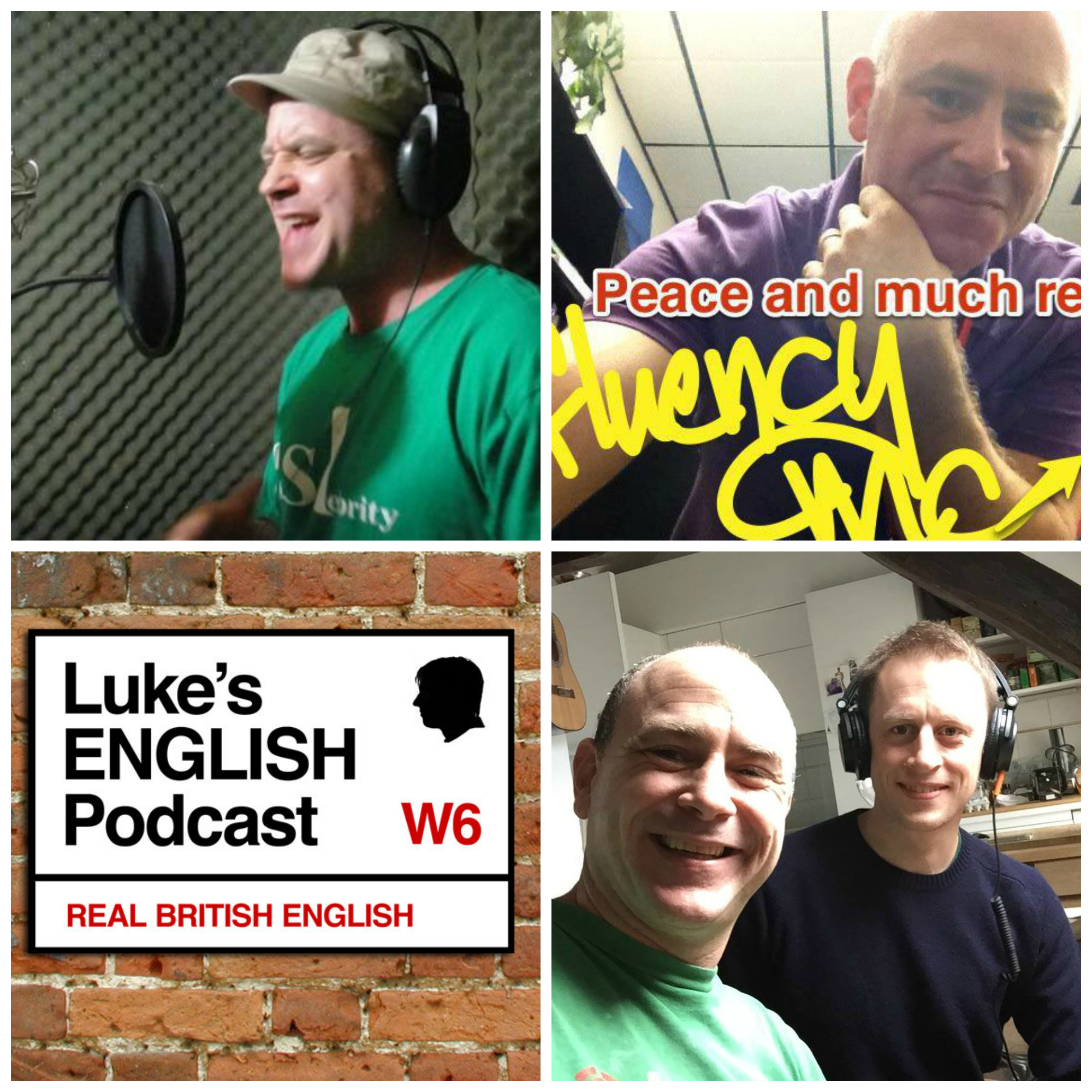
I’m feeling pretty excited today because I’ve got a bit of a celebrity on the podcast. Jason R. Levine, also known as Fluency MC is something of a legend in the world of online English language teaching. He’s become pretty well known on YouTube in particular for his videos in which he uses hip hop to bring a fresh approach to teaching English. Jason raps his English lessons, and many of those raps have become YouTube sensations – for example “Stick stuck stuck” the past participle rap (over 2.5million views on Youtube), and the present perfect rap which is a full on explanation of the grammar rules for the present perfect tense, delivered in rhyme. But, Jason is not only a teacher who raps – a look at Jason’s CV shows that he is involved in a number of very interesting English teaching projects – he leads workshops, has published material and is an English specialist for the US department of State – which makes him sound like a government agent, and he has a very interesting academic and personal background which has led him to take this fresh new approach to language teaching. On the musical side, Jason raps but he also plays the drums like me, and he DJs and produces his own tunes. There’s so much to ask him and so much to talk about, and hopefully Jason will do some rapping on Luke’s English Podcast too, and who knows – I might even get involved in that as well. You can look forward to all of it in this episode. (In fact, if you listen to the whole episode you will hear both Jason and me rapping on some of my brother’s music)
I’ve never met Jason before, this is the first time I’ve spoken to him in fact. I always thought Jason lived in New York, but a while ago I was on Facebook and I saw a photo of him in Paris and I assumed he’d visited for work or for a holiday, so I sent him a message saying “next time you’re in Paris, how about an interview for LEP” and he wrote back saying “Actually, I live in Paris”. Needless to say I was pretty surprised. What are the chances of that!? So naturally, I thought I’d take the opportunity to hook up with him and interview him for the podcast, and he’s sitting right next to me now so let’s get started…
Questions & Stuff
These are some questions that we covered in this episode of the podcast.
I’m really chuffed to have you on the podcast Jason, because as we heard in my introduction you’re sort of a living legend of English teaching. Are you famous?
What are you most known for?
What other projects are you involved in?
Where are you from?
What did you study at university?
How does psychology come into your teaching method?
How long have you been teaching?
How did you get into it?
When did you first start rapping in the classroom? Was there one particular time when you first did it? What happened?
You travel quite a lot, teaching in different locations. Do you always rap in class?
How would you describe your approach to teaching?
How is rapping a part of that?
What are the reactions of your students to your method?
What’s collo and spark? Can you explain that?
Is it related to mnemonics?
FluencyMC on YouTube
This is the original video of Jason rapping “Stick stuck stuck” – just about 3.5minutes of one of his lessons.
Luke’s Rapping (Lyrics Below)
Here are the lyrics of my rap at the end of this episode!
The Well-Spoken MC (Lyrics)
Microphone check one two one two
Let me introduce myself to you
My name’s Luke
I’m an ordinary dude
I like food, I wear shoes
I like to watch YouTube
I’m just like you,
or maybe Doctor Who
when I’m in a good suit
I’m feeling in the mood
from time to time
I like to unwind
I Drink a bit of wine
and try to write a rhyme
and when I combine
all of this all online
then surely it’s a sign
it’s my time to shine,
cos I like to feel fine
I do it all the time
and in my mind
I’m going to get mine
It’s just a natural fact
and I like it like that
so relax and sit back
and listen to this track
It’s just a natural fact
and I like it like that
so relax and sit back
and listen…
I get dizzy
with a bit of thin Lizzy,
while drinking some fizzy
getting busy with Queen Lizzy
I’m a gentleman
With a lesson plan
I’ll Help you understand it with a diagram
Of different tenses
and complex senses
or ways of saying sentences with different kinds of emphases
Yes
You could say I’m blessed
With a CELTA and a DELTA and my CV’s fresh!
I teach pronunciation
Throughout the nation
To stop alienation
Caused by poor articulation
It’s just a natural fact
and I like it like that
so relax and sit back
and listen to this track
Cos I speak like a native
and I’m here to get creative
and I have already stated
that I’m very qualificated
I’ve got a wide CV
an even wider TV
which I’d like you to see
in Confidentiality
Because between you and me
and the deep blue sea
One day I’m going to be
On the BBC
Because I’ve got that BBC style
The one that makes you think for a little while
about the way most newsreaders speak
It sounds as if they’re trying to repeat
Sentences of information But With crazy intonation
and weird enunciation that’s clearly fascinating
And at the end of every news report
There is a summary of sorts
Of all the main sports, and some afterthoughts
Where the main news anchor
Turns to the camera
And delivers an answer
in the form of a mantra
This is the voice of the BBC,
and while you’re sitting there drinking cups of tea
We’re working away inside your TV
And on the screen you will surely see
that I go by the name of the Well-Spoken MC
[Download]
When I get nominated for this competition, I usually have quite a lot of new visitors to the site by people who are checking out the podcast for the first time. So, let me take this opportunity to say hello to any new visitors and to give you an idea of what LEP is all about.
In this episode I’m going to tell you 16 things you need to know about LEP. After listening to this, you should have a better idea of what this podcast is all about!
16 Things You Should Know about Luke’s English Podcast
1. I’m a teacher from London, living in Paris, with about 14 years of experience and both a CELTA and DELTA qualification. I’ve lived in Japan too, and I have experience of teaching adults and children at all levels of English, for general, business or more specific purposes. Students I’ve had in the past include Brazilian world cup winners, Scandinavian heads of state, top business executives and even a porn star. I now teach at The British Council and at a top university in Paris.
2. I started LEP in 2009 after taking a course in podcasting with The Consultants E. At the time I just felt like I wanted to have my own radio show, and I discovered ways of creating podcasts on my new Apple Mac laptop, and realised I could publish them myself on iTunes, and then get the word out using social networking. I started to get really busy producing episodes of the podcast. The aim was always to mix up teaching with general entertainment. I wanted to produce episodes that were instructive but also fun to listen to for their own sake.
3. I’m also a stand-up comedian, and I do try to use those skills in my episodes too, from time to time! I do stand-up comedy regularly in Paris, in English. This may not be obvious from this episode, as I’m not adding any jokes to it! From time to time I share some videos of my comedy on this website, and some of my listeners have come to see me perform my comedy live, which is great!
4. The podcast now has over 250 episodes, and I have a really loyal following. In fact, my listeners have lots of names – the LEPpers (yes, LEP stands for Luke’s English Podcast), LEPsters, LEPaholics, LEP Ninjas, PLEPS (people of Luke’s English Podcast) and so on.
5. Some of my listeners have created podcasts of their own, after being inspired to do so by listening to LEP.
6. There are various types of episode that you can expect on the podcast. Some are about specific aspects of English, for example – episodes about idioms, grammar points, pronunciation, vocabulary, and slang. In some episodes I try to keep my listeners locked-in and entertained by making up improvised stories off the top of my head. In some episodes I feature interviews and conversations with friends, family and special guests. Some episodes involve me just talking directly to my audience about whatever comes into my head. Some episodes are about films, music or popular culture, and some episodes deal with specific aspects of British culture and lifestyle. So the podcast covers a broad range of topics. Ultimately, I love the freedom of being able to talk about anything I like! The main thing is that it creates engaging content that encourages learners of English to do more and more listening!
Here’s a quick list of some of the more popular episodes of this podcast:
1. Introduction – this is the first episode I did back in April 2009 and it outlines my basic approach to LEP.
28. Interview with a Native Speaker: The Weather – this one follows on from a vocabulary episode about British weather and features an authentic interview with a teenager called Chris, and his odd views about foreigners in the UK
29. Mystery Story / Narrative Tenses – this is one of the most visited of my episodes. It teaches you narrative tenses (past simple, past continuous, past perfect) via a short mystery story that features several of the UK’s most beloved popular culture icons. The story is continued in the next episode.
71. The Ice-Cream Episode – an unplanned rant on topics such as: Amazon Kindles, robots & technology in Hollywood films and why we should put down the weapons and pick up an ice-cream instead, man.
83. How to Swear in British English – an indispensable guide to all the rudest words in British English. It’s extremely offensive, but extremely useful.
100. Going to the Pub – the guide to everything you need to know before you step into a pub in the UK.
118. Sick In Japan – the true story of how I ended up sick in a Japanese hospital. It contains loads of medical and health related vocabulary, culture shock and a story which is engaging from start to finish!
125. The Pink Gorilla Story – one of the most popular ever, this is just an improvised story that regularly makes people laugh out loud, and which I really should convert into a one-man-show stage play!
140. Ghost Stories – just some scary true stories to keep you awake at night
167. Memory, Mnemonics and Learning English – revolutionise your learning techniques with these powerful memory devices.
174. How to Learn English with Luke’s English Podcast – this is your guide to improving your English using my podcast.
176. Grammar: Verb Tense Review – this is a very complete guide to all the main tenses in English
192. Culture Shock: Life in London – this episode deals with many of those strange aspects of the English lifestyle that foreigners find so hard to understand.
208. Travelling in Indonesia – one of many episodes about travelling experiences, this one has quite a dramatic beginning.
There are plenty more episodes which are popular with listeners, in fact everyone seems to have a different favourite. But that’s just a selection of some of the most visited pages on my website.
7. Yes, my episodes are quite long, but I always explain it like this: Firstly, all my favourite podcasts are long, and I think that it’s quite normal for podcasts to be about an hour long. Radio shows also tend to be at least an hour long too, so why not my podcast? It’s better for my listeners if they listen for an extended period. Why should listening only last 15 minutes? I can’t achieve very much in just 10-15 minutes, and I want my episodes to have some depth and rigour to them. Also, listeners can just pause the episode when they’ve had enough, and come back to it later!
8. I have a transcript collaboration project on my website, which allows listeners to transcribe sections of episodes and build a whole library of transcripts for other LEPsters to use. This is good for the transcribers because it is a big challenge and a good way to improve their English, and it’s good for the other listeners because we have an ever-growing library of transcripts which they can use to help them understand episodes. The collaboration is hosted on my website and is done using google documents.
9. I have won this award three times before and that is completely thanks to my devoted audience, who every year come out in force to vote for me. I hope to repeat the success this year, but I am up against stiff competition! Whatever the result, I’m just happy to have been nominated again.
10. The podcast has had 3 million listens in just over a year, since moving to a new audio host (audioboom.com) which is amazing!
11. I also have some videos on YouTube and they are pretty hot as well! My channel has had about 2.5 million views in total, but I haven’t uploaded anything for a while. The popular videos are ones I did in 2009 and feature me interviewing members of the public in the centre of London. There’s also a video called “16 Ways to Say I Like It”, which you may have seen too.
12. I launch competitions of my own from time to time, for listeners to take part in. The last one was called “Your English Podcast” and I invited listeners to send me short recordings of them doing their own versions of LEP. I received lots of entries and votes and the winner was interviewed on the podcast as a prize.
13. These days I record episodes of my podcast in a room at the top of my apartment, where I have great views of the rooftops of Paris from the windows. I call it the “SpacePod” or “SkyPod” and it’s the podcast HQ!
14. I have another podcast, called A Phrasal Verb a Day. It’s on iTunes and on my website. That is made up of short episodes devoted to individual phrasal verbs. I give definitions, examples and explanations. It’s a great way to pick up more of those tricky items of vocabulary – phrasal verbs. My goal was to record one a day in 2014. I didn’t reach my goal, but I haven’t given up and I still add episodes to the series when I can.
15. I love playing the drums, guitar, bass and ukulele (but not at the same time) and occasionally at the end of podcast episodes I play a song on the ukulele – but you have to listen all the way to the end of the episode to hear it.
16. I put my heart, soul, time, energy, humour, money and love into making episodes of LEP. It’s become quite a big thing in my life after having done it now for nearly 6 years. I enjoy a close and warm relationship with my listeners, I always welcome new additions to the LEP family, and in the future I plan to build my service more and more until I can perhaps do this for a living somehow. The future’s bright and I hope that many more people will join me on this journey to create authentic, entertaining and interesting content that helps you not only to improve your English but to enjoy yourself while doing it. So, I invite you to start listening today and like thousands of others get addicted to LEP – it’s good for your English!
If you haven’t already done it, I invite you to vote for LEP by clicking here. Thank you for your continuing support!
This is just a chance to wish you all a Merry Christmas and to give you a bit of news. There is a video for this episode, featuring 15 minutes of extra footage which I filmed before recording the audio episode. You can watch it below. [Download audio]
Video – I started recording this 15 minutes before starting the podcast, so you’ll see me preparing myself to start recording, and I show you what it’s like to record a podcast in the slightly cramped (and badly lit) conditions of the ‘spacepod’ or ‘sky pod’! Unfortunately, the batteries in my camera ran out after about 30 minutes! Never mind – the audio podcast is my main focus anyway. :)
3. Nicknames – LEPPERS, LEPSTERS, LEPPISH, PLEPs, LEP Ninjas, LEP FC, The Cult of LEP, LEP United, LEPPARDS, LEPPANS, LEPIANS, LEPANESE, LEPLANDERS, LEPaholics… what do you think? Which nickname do you prefer? Do you need just one nickname or can we use lots of different aliases? I might do a proper survey on this to let you choose your nickname by committee.
4. Emails – I don’t get many opportunities to properly reply to your emails, and I get loads of them. I’ve tried lots of things – putting them in other folders, forwarding to other inboxes etc. The problem is, I just can’t get around to it. The reason is because I can’t really reply to you all individually. I have to just talk to you as one large group. Sorry if you have sent me an email and I haven’t replied. Really – I am very sorry and it hurts a little bit because you’ve gone out of your way. I love to receive emails but I can’t always reply. I haven’t published my email address on the website and I don’t mention it in the podcast (I used to) because I’d rather the correspondence came via teacherluke.co.uk and was public. That way I’m more likely to reply. Correspondence between me and you privately is very rare. So, if you have comments, do leave them on the website. I genuinely love reading your comments and I’m frequently impressed by what a lovely community of people I have listening to this podcast. It’s quite amazing really, so keep doing that – I’m sure I have a large silent majority out there. Most people don’t correspond with me directly. That’s fine. I never send emails to my favourite podcasters (except a text I sent to the Adam & Joe show once, which they read out!) So I understand that most of you have never commented or anything. I would like to hear from you so do get in touch. You could be a long term listener but first time commenter, or whatever. Anyway, I can’t always reply to specific requests which I get sent by email, and I do get a lot. For example, I often get emails with specific requests like giving you help for the IELTS test, asking for advice on visiting France or The UK or whatever. I would honestly love to reply fully to those mails but I can’t justify sitting down to write a full email when that time must be spent on other things.
What I would like to do is publicly read out some emails. I think this is a great way to give you a voice. If you would like to send me emails that I can reply to live on the podcast, please send your emails to podcastreply@gmail.com, that’s podcastreply@gmail.com. I will assume that if you send any email there that you’re happy for me to read it out on the podcast and reply to it orally. I can’t guarantee that all your emails there will be broadcast, but let’s try it. Send emails you’d like me to read out and respond to on LEP to podcastreply@gmail.com.
I realise there’s a forum section for questions you’ve asked me, and in fact several times I’ve attempted to record episodes in response to those forum questions and for one reason or another I had to abandon recording due to technical errors, and time issues. I’m trying to find a system for giving you a voice on the podcast at the moment. Let’s try a few ways until we get the right one. Perhaps the email inbox idea will give me just a little more discretion regarding which emails I reply to.
I am a little wary of giving you the impression that you can make requests for the podcast. One of the ways I can make this podcast work with my time schedule is to have total control over what I put out. It allows me to be flexible, determine my own schedule, motivate me by allowing me to have creative freedom and also it probably gives the podcast a distinctive and original quality. I do get requests that I’m sure would please a lot of people, but they would require a heck of a lot of preparation. Sometimes I do put a lot of time into episodes, but those are the ones I just seem to be particularly driven to produce, out of some urgent sense of creativity. Essentially, the urge to do episodes has to come from me, or they won’t really get done. So, at the end of the day I decide all of the output of the podcast, but it would be nice to feature your input too. Perhaps podcastreply@gmail.com is a good way of doing that. Send your correspondence there and I will aim to stick it into episodes of the podcast, and comment on your questions that way.
5. Lost podcasts. I’ve recorded a few episodes over the years that were not published or got lost due to a hard drive accident. You will probably never hear them and will never know what they were about…
Thank you for listening and Merry Christmas everyone!
For a while now, we’ve been using the word LEPPERS to refer to fans of Luke’s English Podcast. It’s quite a catchy word and people keep using it, including me of course. However, I think it’s quite important that you are aware that the word also has another meaning.
Yesterday I donated money to a charity called Lepra. Their mission is to help people trapped by disease, poverty and prejudice and much of their work focuses on areas in India and Bangladesh where many people suffer from one of the world’s oldest diseases: leprosy. People who suffer from leprosy are traditionally known as lepers. So, that’s the other meaning of that word – a leper is someone who suffers from leprosy.
I just thought you should know that the word has this other, rather serious and sombre meaning.
I’ve always known this, and I always assumed that my listeners knew it too. In fact, I’ve always been pretty sure that I mentioned the meaning of the word leper some time ago on the podcast. In fact, when I first used the word LEPPER I was looking for a catchy title for listeners to the podcast. “Luke’s English Podcast People or LEPPERS” – it made me laugh although I didn’t mean it to be a joke, it was more a coincidence, but the name stuck and now people keep using it all the time, including me.
I never planned it to be a sick joke or anything like that. I’m not making fun of anyone by allowing my listeners to call themselves LEPPERS. I’m not taking the mickey out of you and certainly not out of sufferers of the disease. That’s not what LEP is all about, as you know.
In fact, I think it’s completely appropriate for me to use this opportunity to ask all of my listeners/fans/readers/followers to strongly consider donating to lepra.org.uk. Your donations can help make a huge difference to the lives of many people suffering from not only leprosy but numerous other diseases and hardships. If you’d like to make a donation, it’s simple. Just visit http://lepra.org.uk and click the big yellow “donate” button. You could save lives and make a huge difference. Please consider it.
Also, I don’t think we should stop referring to each others as LEPPERS, but it’s completely up to you. If you’d rather not use it – that’s cool, but if you think it’s okay because it’s actually another word, with a different spelling, then go ahead and keep using it. Personally I think it’s okay as long as you’re aware of the double meaning. I just hope that now you’re all completely clued-up about the other meaning of this word.
That’s it for now. Thanks for reading. Have a nice weekend.
This is another ‘quick’ podcast to let you know that I’m on holiday for a couple of weeks, and also to give you some inspiration for your entries my competition, called “Your English Podcast”.
[DOWNLOAD] 1. I’m going on holiday so I will be away from teacherluke.co.uk for a while. This means I might not be able to respond to comments or messages, and there won’t be any uploads for a while. I think you have enough new material to keep you busy until I get back, right? I’ll be back in a couple of weeks.
2. Competition: I get the impression that a lot of people out there are scratching their heads, thinking “I’d like to take part in Luke’s competition, but what shall I talk about?”
All the details of the competition are in episode 200.
Here are some questions as inspiration for you. Send your audio responses to podcastcomp@gmail.com
(Remember – you don’t have to worry about doing any special sounds or music or anything – just record yourself talking. Also, it doesn’t have to be 5 minutes – you can do less if you want!)
1. Who are you? Tell us about yourself – where are you from? What do you do? What are you doing right now? What’s going on around you as you record your message?
2. How did you discover Luke’s English Podcast?
3. What do you like about LEP? Why do you listen to it?
4. What have you learned from LEP?
5. If you were Luke from LEP, what episode would you record?
6. How do you like to improve your English? Can you give us some tips?
7. What do you find most difficult about learning English?
8. When do you normally listen to LEP? Where do you listen?
9. What’s your favourite episode of LEP? Why do you like that one?
10. What’s your least favourite episode? WHY?
11. If you could ask Luke any question, what would it be?
12. If Luke could interview anyone on the podcast, who would you like him to interview, and why?
13. Think of an episode of the podcast – can you respond to it in some way?
14. Tell us about your country, or the place that you’re living in at the moment. What’s going on there? What do you think of it?
15. What’s the best film you’ve ever seen? Why do you like it so much?
16. What kind of music do you like? Do you have a favourite band or song? Tell us about it.
17. If you won £15 million on the lottery, what would you do with the money?
18. What’s your favourite food? Is it a healthy food? How often do you eat it?
19. If you could speak perfect English, what would you do?
20. If you could have any hairstyle what would you have? Would you have an afro?
21. Would you cut off one your toes for a million pounds? What would you be prepared to do for a million pounds?
22. Would you get a tattoo on your face for a million pounds?
23. Do you think computer games are cool or sad?
24. Have you ever lived in another country, away from your home? Where did you live? How was the experience for you?
25. Have you ever been to the UK? How was it? What were the good and bad things for you?
24. Are you a geek? Why?
25. Have you ever been in a dangerous situation? Tell us about it?
26. Have you ever done a bungee jump? Would you like to do one?
27. Have you ever seen a ghost?
28. How about a UFO, or just something really weird like that?
29. If you could play any musical instrument, which one would you play?
30. If you could be a famous person, who would you be?
31. If there was a movie made about your life, which actor would play you?
31. If you saw a mouse in your house, what would you do? Would you kill it or set it free?
32. Who’s the best?
33. Conspiracy theories?
34. If you could change one thing about the world, what would you change?
35. Do you believe in love at first sight?
36. Do you understand the British sense of humour?
37. What do you think of British weather? What’s the weather like in your country?
38. What do you think of the government in your country?
39. If Superman and Spiderman had a fight, who would win?
40. If Iron Man and Batman had a fight, who would win?
41. Who’s the best – men or women? Why?
42. Can you drive? Are you a good driver? Have you passed your driving test? How many times did you take the test? Is it a difficult test?
43. What is your favourite drink?
44. Are you a tea person or a coffee person?
45. What do you prefer – swimming in the sea or swimming in a swimming pool?
46. Do you like football? Why/why not? Who is your favourite team?
47. What is better – British English or American English?
48. Which culture is better – American culture or Chinese culture?
49. Do you think we should be spending money on space travel or not?
50. Have you got any children? Do you want to have children? How many children would you like to have?
51. Which special power would you prefer – being able to fly, or being able to read people’s minds?
52. Would you like to live forever?
53. If you could marry a celebrity, who would you marry?
54. Have you ever eaten fish and chips? What do you think of it?
55. If you found a bag with £200 in it, what would you do with it?
56. Which accent would you like to have? Scottish? Welsh? Cockney? The Queen’s English? American? Australian? or just your own?
58. Who would you prefer to meet – Sherlock Holmes or James Bond?
59. What is the best book you’ve ever read? Tell us about it.
60. If you could design your own house, what would it be like?
or , pick an episode of Luke’s English Podcast and give us your comments on it.
podcastcomp@gmail.com
Speak to you when I get back from my hols ;)
Luke
Cookies on teacherluke.co.uk
Click “Accept All”, to consent to the use of all cookies on this website, or visit "Cookie Settings" to control your consent settings.
This website uses cookies to improve your experience while you navigate through the website. Out of these, the cookies that are categorized as necessary are stored on your browser as they are essential for the working of basic functionalities of the website. We also use third-party cookies that help us analyze and understand how you use this website. These cookies will be stored in your browser only with your consent. You also have the option to opt-out of these cookies. But opting out of some of these cookies may affect your browsing experience.
Necessary cookies are absolutely essential for the website to function properly. These cookies ensure basic functionalities and security features of the website, anonymously.
Cookie
Duration
Description
cookielawinfo-checkbox-analytics
11 months
This cookie is set by GDPR Cookie Consent plugin. The cookie is used to store the user consent for the cookies in the category "Analytics".
cookielawinfo-checkbox-functional
11 months
The cookie is set by GDPR cookie consent to record the user consent for the cookies in the category "Functional".
cookielawinfo-checkbox-necessary
11 months
This cookie is set by GDPR Cookie Consent plugin. The cookies is used to store the user consent for the cookies in the category "Necessary".
cookielawinfo-checkbox-others
11 months
This cookie is set by GDPR Cookie Consent plugin. The cookie is used to store the user consent for the cookies in the category "Other.
cookielawinfo-checkbox-performance
11 months
This cookie is set by GDPR Cookie Consent plugin. The cookie is used to store the user consent for the cookies in the category "Performance".
viewed_cookie_policy
11 months
The cookie is set by the GDPR Cookie Consent plugin and is used to store whether or not user has consented to the use of cookies. It does not store any personal data.
Functional cookies help to perform certain functionalities like sharing the content of the website on social media platforms, collect feedbacks, and other third-party features.
Performance cookies are used to understand and analyze the key performance indexes of the website which helps in delivering a better user experience for the visitors.
Analytical cookies are used to understand how visitors interact with the website. These cookies help provide information on metrics the number of visitors, bounce rate, traffic source, etc.
Advertisement cookies are used to provide visitors with relevant ads and marketing campaigns. These cookies track visitors across websites and collect information to provide customized ads.
 I’ve been doing LEP for over 6 years now. Most of my ideas come from my own inspiration, but I’ve always thought it was important to listen to my audience, to know your needs/preferences, and try to give you content that you really like and that meets your needs and interests.