This is an unedited monologue in which I talk about some things which are on my mind at the moment, including how my hair is stopping me from learning French (and vice versa), virtuous and vicious circles, how English is like a shark (or a river – or maybe a shark in a river), some comments about recent episodes and a visit from a friendly bat at my podcastle.
Video Version (try activating the automatic subtitles)
Some vocabulary extracts
I have been deliberating about which microphone to choose
Geeky microphone chat
I have a plethora of microphones
People who have just stumbled across this and are wondering what this is all about
Perhaps you’re in transit somewhere, maybe you’re doing some housework, maybe you’re listening to this in a classroom while your teacher takes a well-earned break, or maybe you are lying in a floatation tank or in zero gravity in the international space station
Stick with me, and enjoy being a LEPster
Here’s a run-down of some of the things I’d like to talk about.
How my hair is stopping me from learning French, and vice versa – how my French is stopping me from getting a hair cut (virtious and viciouscircles)
How my summer is looking, what my plans are and what that might mean for the podcast (busy – difficult to record podcasts in July and August – what’s new?)
Thoughts on recent episodes like Sick in Japan and Spinal Tap
Some metaphors and similes for language learning and teaching
That’s probably plenty!
I’ve been just sweeping it (my hair) back over my head
Maybe I’m being a bit precious about this but I can’t help feeling self-conscious
Taking initiative is very important but it can be hard.
It can just be taking the initiative to speak, to make an effort to communicate with someone, to risk looking a bit stupid, going out of your comfort zone.
But if you take that tiny little risk, it can pay off in various ways.
You need to keep the English moving through you like a river or the water of your English will become stagnant. We all know this.
But without that little impetus to speak, you won’t do it.
If you don’t take initiative, you don’t put yourself into situations in which your confidence can develop.
Starting a virtuous circle is a matter of taking small steps in the right direction.
Micro-decisions or micro-steps.
Now I have to go out of my way to walk to the hairdresser.
Some people commented that the crowd were quiet. Well-behaved maybe.
I should have:
Hyped the crowd up more
Done more stand up at the start
Warmed them up by getting them to make noise.
“French people make some noise!” Etc
I should have done more crowd work.
Spinal Tap – maybe not everyone’s cup of tea, but at the end of the day I am the one who decides what happens in these episodes.
I find that with my learners it’s not just listening skills or vocabulary, but just “being on the same wavelength” and that includes things like little references to culture, or just having a certain sense of humour.
It’s also important that I do stuff that I am personally invested in, or this whole thing just won’t happen. So there.
I love teaching but sometimes I get a bit frustrated because it can be a bit like banging your head against a wall.
You can bring a horse to water, but you can’t make it drink.
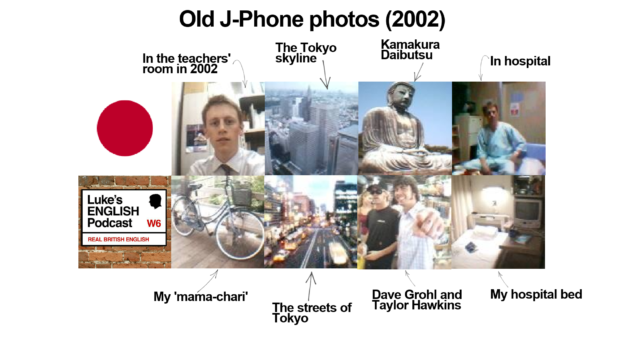
My story about how I ended up in a Japanese hospital bed, scared out of my brain. Recorded live in front of an audience at the British Council in Paris.
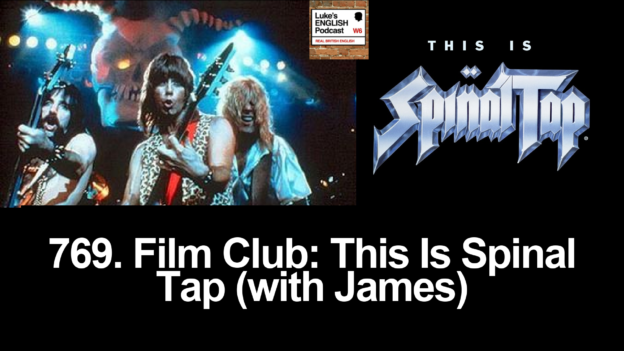
A return to Luke’s Film Club with the classic comedy This Is Spinal Tap, a “mockumentary” about a fictitious rock band from the 1980s. This time I am joined by my brother James and we discuss what was once voted “Funniest comedy film of all time”. Learn some famous quotes from the film, listen to some scenes and understand the comedy with help from James and me.
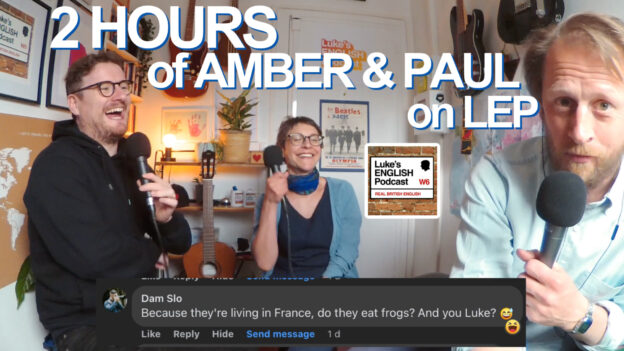
Two hours of PodPal action for your enjoyment. This one has a bit of everything. Some audience questions, an idioms game, some dodgy jokes, accents, impressions and more. Video version available.
I’ve got a full two hours of Amber & Paul lined up for you here. Actually, it’s about an hour and twenty mins of Amber & Paul and maybe 45 minutes of just Paul as Amber had to leave to pick up her kids.
There’s a bit of everything in this one. It’s just the usual rambling from the podpals but we answer some listener questions, do a few accents, tell some stories and dodgy jokes and Paul and I play an idioms game at the end. It’s a pretty goofy episode which shouldn’t be taken too seriously. There is a video version on YouTube as well.
Just an announcement for any LEPsters in the Paris area. I am doing a live podcast recording and storytelling show at the British Council on 19 May at 7pm. It’s free, everyone’s welcome and all you need to do is sign up to reserve a seat. All the details are available at www.britishcouncil.fr and then click on EVENTS or événements. I’ll be telling the story of how I ended up in a Japanese hospital scared out of my wits. It’s a story of culture shock, comedy and misadventure. If you can’t come, you should be able to listen to it on the podcast, if the recording comes out ok and the show isn’t a complete flop!
Right, so let’s get back to this podpals episode. I want to point out a stupid slip that I make right at the very start. I wanted to say “Hi, I’m Luke and I need a haircut” but for some reason it came out “Hi, I’m Luke and I’m need a haircut”. I suppose it just shows that native speakers make language errors from time to time, although this was more of a slip than an error. A slip is when you make a mistake even though you know the rule. It just comes out wrong accidentally. An error is when you make a mistake because you don’t know something about the language.
Anyway, I will let you enjoy my language mistake and then settle into over 2 hours of Amber and Paul in the podcastle.
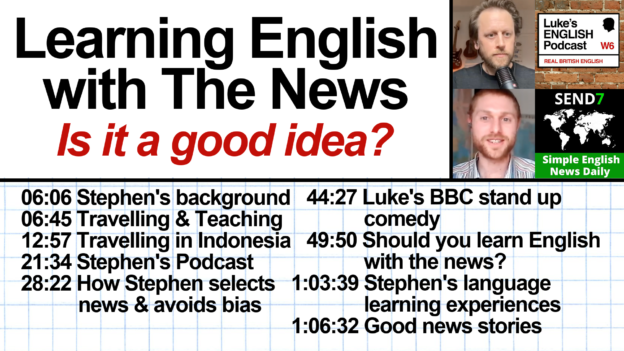
Talking to Stephen from the Simple English News Daily podcast about learning English with the news and whether BBC reporters actually speak like normal humans.
In this episode you are going to listen to a conversation I had with English teacher and podcaster Stephen Devincenzi who does a podcast about learning English with the news.
We recorded a video for this but we had technical problems so only one part of that is available on YouTube. If you go to my YT channel you’ll see it. It’s the part where we discuss the pros and cons of using the news to improve your English. That’s the only video part on YouTube but the audio is fine and you’re listening to it now and this audio will be available everywhere including youTube as usual, and you can check to see if the automatic subtitles are available.
We were plagued by technical difficulties while attempting to do this episode and in fact this is the 3rd time we tried to record. We did this 3 times.
About 3 weeks before this we did another full recording of over an hour which turned out to be unusable because of issues with lag and distorted sound and horrible internet based problems, and then we set up another meeting but had to cancel that due to Stephen’s poor internet connection.
Then Stephen had fibre optic internet set up in his room.
And so did I!
And then I got electricity installed.
But then my fibre optic internet went down (and still is down) but despite the gremlins in the system we managed to record this 3rd version on Zoom with my iphone working as an internet hotspot.
This episode is all about learning English with the news, the pros, the cons, the hows the whys. But is listening to the news a good idea for learners of English? How can you do it? Let’s discuss.
I’ll chat with you again briefly at the end, but now let’s get started.
Ending
THanks for listening. Thanks to Stephen from the SEND7 podcast.
Let us know your thoughts in the comment section as usual. It’s always interesting to read what you have to say.
Have you used the news to learn English?
Did you find it useful?
How do you do it? Do you have a particular method?
Talks in English – British Council Paris – 19 May (Storytelling – Culture Shock & Live Podcast Recording)
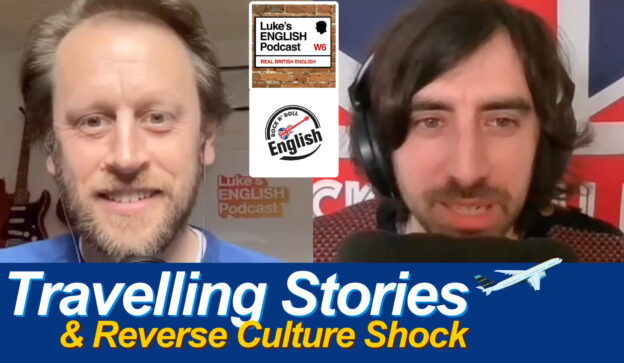
In this episode I am talking to Martin Johnston from the Rock n Roll English Podcast. Do you know the Rock N Roll English Podcast? This is where Martin and his Rock N Roll friends and family do podcasts for learners of English that are unfiltered and frequently involve discussions of taboo subjects, but also plenty of other stuff as well. It’s very funny and bound to be good for your English and general cultural knowledge. Martin featured me in episode 250 of RnR English and we talked about what it’s really like being an English teacher with a podcast. That was a funny chat with lots of memories and funny moments. Episode 250.
In this episode though, we’re going to have a rambling chat about moving to different countries, Martin’s fundraiser for Ukrainian refugees and then some stories of travelling and getting stuck in tricky situations while abroad.
Martin has recently moved back to England after living in Italy for a number of years, so I thought I would ask him about his experiences of feeling like a foreigner in his own country, and some of his culture shock experiences both abroad and at home. Because this is a thing – reverse culture shock. When you feel like a foreigner in your own country after living abroad for a long time.
Martin has also recently launched a fundraiser for Ukrainian refugees. Basically it is a learning pack with 25 stories, and transcripts and exercises. All the proceeds go to help Ukrainian refugees. You can find out more at www.rocknrollenglish.com/stories
So this is a very good cause. We know that several millions of people have been forced to flee their homes as a result of this war, invasion, operation – whatever you want to call it. This violence and aggression has separated families and made civilians homeless as well as killing thousands. This is a horrendous thing to be happening on our doorstep and so the least we can do is try to provide support in some way, so I call upon all of you to go ahead and get that PDF with those 25 stories and all the money will go towards helping these refugees. Martin talks about it during the episode if you want more details. But let’s help out some fellow citizens of LEPland here. Plus, of course, you get tons of stories with audio versions and everything. It sounds like a win win to me.
So we chat about the project a bit, which is all about learning English with stories and this then leads us to have a story-off. This is a sort of battle of stories where Martin and I trade different anecdotes and we see who comes out on top. So there are 4 or 5 funny stories of travelling experiences we’ve had, in the second half of this episode. I hope you enjoy them.
That’s it for the introduction. There is a video version on YouTube. Don’t forget to smash that like button.
I should say there is some fairly explicit content in this episode, which means fairly graphic descriptions of things like nudity, sex and bodily functions, which is completely normal for an episode of Rock n Roll English to be honest.
I’ll speak to you again briefly at the end, but now, let’s get started.
Ending
So there you are, that was Martin Johnston. I hope you enjoyed our stories.
Don’t forget, if you want to get that pack of 25 stories by the RNR English family, go to www.rocknrollenglish.com/stories It costs just 10dollars or pounds, and all the proceeds go to help Ukrainian refugees.
This is obviously a very good cause as so many people have been displaced, made homeless and so on and these people need our help.
If you enjoyed our stories in this episode, you could check out some of the episodes with those stories told in full.
Check out 118 Sick in Japan (although I should be doing a live version of that next month) and also Holiday in Thailand
or A Rambling Chat with Moz for more of the spa story
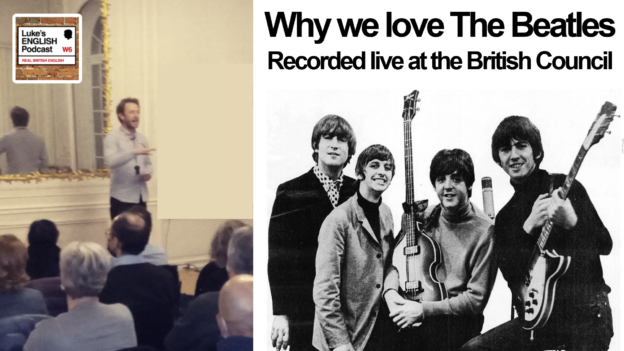
This is a presentation I did at the British Council in Paris recently, in front of a live audience. First I talk about public speaking and my approach to doing presentations and then you can hear the recording of my talk. The Beatles were a global phenomenon when they first appeared in the 1960s and their appeal continues to this day. The world still loves The Beatles. But why is this? Join me as I take a deeper look at the social, cultural and psychological factors that make The Beatles story so compelling even after all these years.
Another day, another new podcast episode. Let’s keep calm and carry on, shall we?
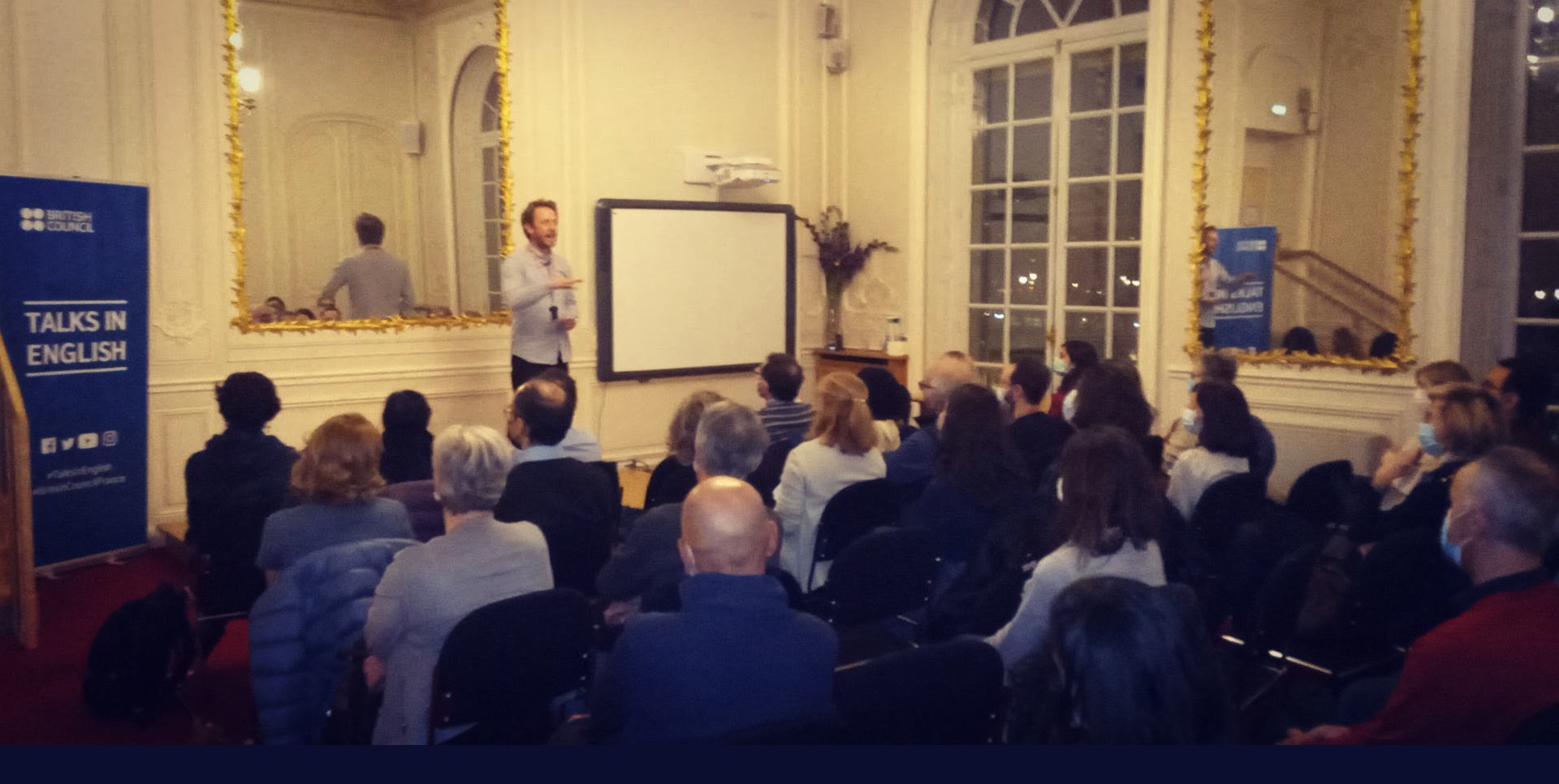
This is episode 761 and most of this one was recorded live at the British Council in Paris in front of an audience of people. I think it is the first podcast I’ve ever recorded with a live audience there and it sounds a bit different because you can hear the audience reacting to things I’m saying and there are some moments of interaction with the crowd and some jokes and stuff. I hope you enjoy it.
As you may know, I teach English to classes of adults at the BC in Paris but also we have some extra events there in the evening. The talk you can hear me doing in this episode was one of those extra events. I’m hoping to do more of this kind of thing in the future – podcasting in front of a live audience.
Private Online English Lessons with the British Council
Just before we start properly I want to tell you something about taking English lessons with the British Council, which is something that you can do online. Did you realise that?
Are you interested in having private English lessons online with a British Council teacher? Because you can.
Sometimes people ask me if I am available for private lessons, and unfortunately my answer to that question is usually no. I just spend my time making episodes of my podcast and teaching group classes in the real world so if you wanted lessons with me you’d need to be in Paris and you’d need to become a student at the BC there using the normal registration process and just hope that you end up in one of my classes.
But, other British Council teachers are available and they are online.
So if you are looking for an English teacher for private lessons, I just want to let you know that the British Council does offer this service now – personalised one to one lessons with a British Council teacher online
And this is great because you can do it anywhere in the world, you can choose the date and time for lessons, it’s totally flexible, you can choose the teacher and you can basically have classes which are designed around your needs completely, whenever and wherever you want, basically.
Want to practise your speaking and have your errors corrected – you can.
Want to work on your grammar and vocabulary. You can.
Want to develop your pronunciation to be a clearer speaker or to work on a more British-sounding accent if you like. You can do that too.
Also, you can have lessons for specific purposes such as for exams, for job interviews, for specific work arrangements, to prepare for IELTS. It’s all possible with these private online lessons because they’re all based around what you want to do and the British Council teachers will design the lessons based on your priorities.
I’ve always said that listening to my podcast regularly (or any podcast for that matter) is an important part of your learning process – the 5 Ls – listening, listening, listening, listening, listening but of course you need to be doing plenty of speaking too and to practise all the other things – the other language systems and skills.
One to one lessons are a really great way to achieve that and doing them online with an actual human teacher face to face is now a completely normal, tried and tested way to do this. All you need is just the right service.
And the British Council does offer that service.
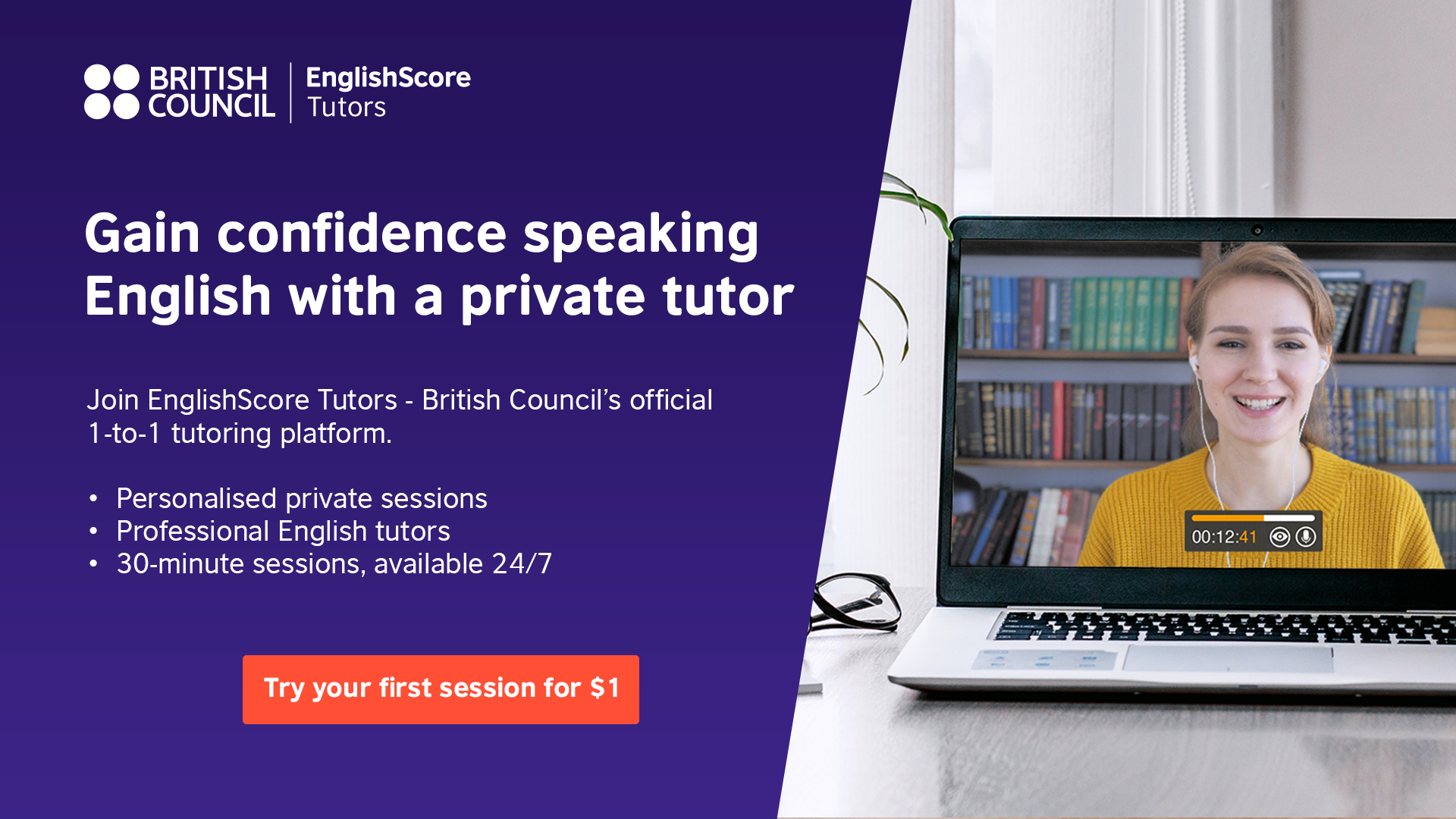
It’s called British Council English Score Tutors. (Click the pic below for the details)
It’s the official 1 to 1 tutoring service from the British Council.
It’s quite new but they already have 12,500 learners of English using the platform.
There are currently over 150 teachers there.
The tutors on English Score have an average rating of 4.9 stars (out of 5), which is reassuring.
The teachers are all British Council approved and a lot of them are in the UK but there are also British Council teachers living in other countries all over the world so you can find teachers in most time zones, which means, basically, there are teachers available 24/7. So you’ll be able to find someone to match your timetable.
So, why not go ahead and find a teacher for you and book some lessons to really push your English further and gain more confidence. There’s an offer for you because you listen to this podcast by the way – I’ll tell you about it in a moment.
Maybe you listen to me regularly and you’re happy that you can understand me or that you’ve got to the stage where you’re understanding most of what I say, which is a very good sign – why not build on that and get your speaking up to a similar standard.
If you’re working on your listening and making progress, there’s a good chance you can convert that to speaking and make progress there too. Activate your English.
Work on your fluency and accuracy and clarity and general confidence.
The 5 Ss – speaking speaking speaking speaking speaking.
You’re asking – What about that special offer for us Luke? Yes.
The BC is offering you a first introductory session for just $1, just so you can see if you like it.
So the first session is just $1.
You can try it and see if you like it.
There’s no pressure or obligation to continue after that.
But if you do choose to buy a pack of lessons (normally about 20 hours or something) the BC will throw in a free lesson for you because you’re a LEPster.
So, the first lesson is just $1.
If you like it you can buy a pack of lessons with a teacher, and get a free lesson included because you’re a LEPster.
Sounds pretty good right?
This could be your way to really work on your speaking as well as your listening.
Think about it. Could be a really good move.
Young learners – they do young learners too. There are classes available for 13-17 year olds and you get the same deal.
To find out more and to get that special offer of the free lesson go to teacherluke.co.uk/english or click the PRIVATE LESSONS button on my website menu.
The link is also in the description of this episode.
You’ll only get that free lesson if you enter the website through my link though.
All right then. Let’s begin the episode properly. Here’s the jingle.
761. Why we love The Beatles (Recorded Live at The British Council)
Hello listeners! Welcome back to the podcast. Let’s get back to some normal podcasting, shall we? OK then.
This is #761 Why we love The Beatles (Recorded Live at The British Council).
As you can tell from the title, this episode was recorded live at The British Council in front of an actual audience of people, as I mentioned earlier.
I’ll play the recording to you in a few minutes. First I want to tell you about the talk I did and how I prepared for it in order to perhaps share some personal tips I have about public speaking. This might seem like another one of my epically long introductions, but it’s not. In fact, let’s imagine that the introduction is over now and here we are in the main body of the episode, and I’m giving you some comments and advice about how to speak to an audience of people – public speaking.
Public speaking is a slightly different skill to normal podcast recording and so it might be interesting for you to hear me doing it in this episode.
Here’s some context.
The British Council in Paris, where I work part-time, is essentially a language school in a nice building not far from the Eiffel Tower. We teach classes to adults and children and there’s also a exam centre for the IELTS test.
The BC in Paris also offers some special evening events including regular Talks In English. This is when a guest is invited to come and talk about a specific topic at the school in one of our nice big rooms on the 2nd floor.
Everyone is invited to attend at that means students at the school but anyone else too – friends, staff in the school, other teachers, just anyone who’s interested in attending.
The speaker does their talk and afterwards there’s a chance to socialise, drink some wine and talk in English together.
Our marketing manager Phil is always on the lookout for people to do one of these Talks in English, and a couple of months ago he asked me if I’d like to do a talk about anything. I immediately thought of The Beatles, because it’s one of my favourite topics and it’s a very British topic, relevant to British culture and it’s the sort of thing that would probably attract some people. Also the series produced by Peter Jackson called “Get Back” had just been released on Disney+. Phil happily agreed and we put it in the diary.
I decided the title of my talk would be Why We Love The Beatles and basically I wanted to try and explain why The Beatles were and still are so popular. What is the appeal of this group? Why are they so adored by people even 60 years after they first came onto the scene?
I also decided I’d try and record it as an episode of this podcast.
Now, I know this is another episode about The Beatles and some of you might not be that interested or keen. My talk is called Why We Love The Beatles – but some of you probably don’t Love The Beatles that much, or you just don’t know. That’s totally fine of course. I get it. I’m not here to convince you that they’re the best band. Music is subjective. It’s a question of personal taste.
But I still hope you listen to this, because I might be able to help you understand why people love them.
Public Speaking – Talking to an Audience (Some tips and comments)
I’m now going to give some tips and comments about public speaking and how I prepared for my presentation but if you’d rather just skip straight to the recording of my Beatles talk, then you can move forward to 30:00 (the 30 minute mark).
Let’s think about public speaking then, and doing a presentation to an audience. I just want to mention a couple of things about how I prepared to do this talk.
Maybe this can help you learn a little bit about public speaking.
So I had to prepare to talk to a room full of people for about 45 minutes.
It was a fairly small audience to be fair – about 50 people.
Is that a small number or a big number? I don’t know. I’ll let you decide.
Imagine you had to do that.
What would you be thinking?
How would you do it?
How would you prepare?
What are the important things to consider?
I knew the audience would be a mix of adult learners of English (mostly French people and maybe some other nationalities) with an English level at intermediate and above and also some native English speakers.
I didn’t want to write a script, because I wanted to keep the presentation spontaneous. I find that if I write a script then I just get stressed during the talk because I’m trying to remember everything I’ve written and that’s impossible, and reading from a script can take the life out of a presentation. It can take away a certain spark, especially if the person is actually reading from the script on paper and they have to keep glancing up at the room but not really connecting with anyone.
It depends, of course. Sometimes you need a script because in some cases every single word is vital, and you might have a prompter or something (that’s a screen which shows you your script without the audience seeing it – like in those big political speeches) or maybe if you are doing a best man’s speech at a wedding it can help to have the script in your hand. It depends on the situation of course. But for me, I decided that I didn’t want a script.
Also I didn’t want to use presentation slides on a screen with lots of words or information on them. Slides can be good, but they can also be very distracting. It’s human nature for the audience to just stare at the slides and then you lose the connection with them, and an old rule from stand-up comedy is: if it’s not adding anything, then it’s taking something away.
Sometimes slides are not really adding anything to your talk, and so they just take away the focus from you and cause the audience to get distracted, especially when there’s lots of text and they end up reading rather than listening to you. No thanks.
Nothing is better than just trying to establish a good connection with the people in front of you. So I decided to do it without a script and without any slides, just like in a stand-up comedy who.
Doing it without a script can seem a bit daunting though, because you think “How can I get it right? How can I be sure that I’m going to say the right things?”
Basically, in my experience, you have to just try to get to know your subject really well, create a simple structure for your talk, practice a lot and then trust yourself to be able to do it. So that’s what I tried to do. (I’m talking like I’m some expert public speaker here – I’m not, but I do have some experience from teaching and from doing comedy, so I’m just trying to share my experience with you).
In the weeks leading up to the talk I just thought about it a lot, thought about the specific focus of the talk “Why do people love The Beatles?” wrote some ideas down when they came to me, asked friends and family for their advice, talked out loud to myself a bit, imagining I was doing the talk and eventually worked out a general plan for what the content and structure should be. I did write some things down as a script but then I boiled it all down to a list of simple one or two word prompts. I then printed those prompts on some cards which I held in my hands during the talk. The idea was that I could just glance at the card in my hand and then ramble on that topic, hopefully remembering the main things I wanted to say. I also wanted to leave myself room to improvise and respond to what was happening in the room because in my experience, that’s the best way to keep things entertaining and to stop the audience falling asleep at all.
I also wrote a few other things on the cards in pencil. Just some names, dates and quotes in case I forgot them while talking.
So that’s what I did as preparation and in a moment you can hear how it went.
Let me just say a couple of very basic facts about The Beatles for listeners who are new to the subject, just so you don’t get lost.
The people in the room for my talk were probably already fans of The Beatles, but you might be new to them.
The Beatles
They were a group of musicians (a band) from Liverpool in England who recorded and released music together from 1962 to 1970 more or less.
Members:
John Lennon (guitar & vocals)
Paul McCartney (bass guitar & vocals)
George Harrison (lead guitar & vocals)
Ringo Star (drums & vocals sometimes)
Pete Best and Stuart Sutcliffe were members of the band before they became really famous.
They formed in the late 1950s and played live concerts together from the early days in Liverpool and Hamburg until the year 1966 when they were playing stadiums and huge theatres around the world. Then they stopped performing live and concentrated on making music in the studio.
The band broke up officially in 1970 and went their separate ways.
John Lennon was killed in 1980 meaning that the four members could never reunite again as a band.
The Beatles were not just commercially successful. They represented a huge cultural shift and also were groundbreaking in many ways beyond just their influence on popular music. They were also just very funny, stylish and charming and their message was ultimately one of peace and love.
So, “Why we love The Beatles” that’s the title of my talk, that’s what I talked about a couple of weeks ago, and that’s what you can hear now in this first episode of LEP recorded in front of a live audience. I hope you enjoy it…
Ending
So, there you have it. That was my talk about The Beatles at The British Council.
I am not completely sure if I managed to answer the question of why people love them so much, but ultimately I think I managed to entertain my small audience and everyone seemed to enjoy themselves and maybe that’s the most important thing at the end of the day, and the beginning of the day, and the middle of the day…
I wonder how that was for you listening in podcastland.
A couple of questions for you.
Did I manage to tell you something new about The Beatles that you didn’t know before?
If you’re not a fan of the band, did I give you a sense of why people love them so much, including the fact that it’s not just about the music, and there’s more to them than just Yellow Submarine, Yesterday, Hey Jude and Let It Be?
What was it like listening to a podcast episode that was recorded live in front of an audience, and should I do more episodes like that in the future?
Actually, I have sort of already decided that I would like to do more stuff like this in the future and I would like to do talks at the British Council that can also be published as podcasts.
One idea is that I re-record some old episodes but in front of an audience, especially episodes which are essentially stories. For example, I would love to do the Sick In Japan story because I think it’s long enough, has enough funny moments and drama in it and it’s been a long time since I published the episode (10 years in fact – omg).
So look out for more stuff like this in the future and maybe a live version of Sick In Japan or something like that. We will see.
Anyway, let me know how it was listening to this as a podcast episode.
Thank you for listening all the way until the end.
If you got this far, let’s think of a code word you could use to show that you’ve listened until the end. Let’s say that if you got this far, you have to use the word “LOVE” in your comment, especially in a Beatles lyric such as “Love is all you need” or “All you need is love” or “The love you take is equal to the love you make” – or in fact, quote ANY Beatles lyric in the comments to show that you have listened all the way until the end, and if you mention that a semolina pilchard was climbing up the Eiffel Tower during the episode, you will get bonus points. More than just 10.
Thank you for listening.
More podcast episodes will be coming towards your ears soon.
Just a reminder – Private Lessons with British Council English Score Tutors
If you’re looking for private one-to-one lessons online with a teacher, check out British Council English Score Tutors.
At least 150 BC Approved teachers to choose from.
Classes adapted to your needs.
All from the comfort of your own home.
$1 for the first lesson so you can check it out.
Then if you pay for a pack of lessons, you’ll get one lesson free because you’re a LEPster.
Thank you for listening! I hope you loved this episode.
My pod room is nearly ready, for goodness sake. There’s still no electricity connection! A guy came to fit plugs around the room, and to connect it to the earth. He just needs to come back to do a bit of paperwork but of course he keeps texting saying it’s not possible today and then the next day, then he says he can come on Friday afternoon which is a full week after he actually did the main part of the job. Why does everything take so bloody long? Then it’s just a few clicks and switches and I need another hard working motivated guy to come and connect the room to the fibre optic internet and then I will be able to actually get installed and start working properly again. Damn, I can’t wait! I’m buying a second-hand desk from a local company tomorrow (it was supposed to be today but yep – she had to cancel and postpone). I’m looking for a decent office chair at a good price. I will podcast standing up if I have to!
Speak to you soon but for now it’s just time to say, good bye bye bye bye bye bye
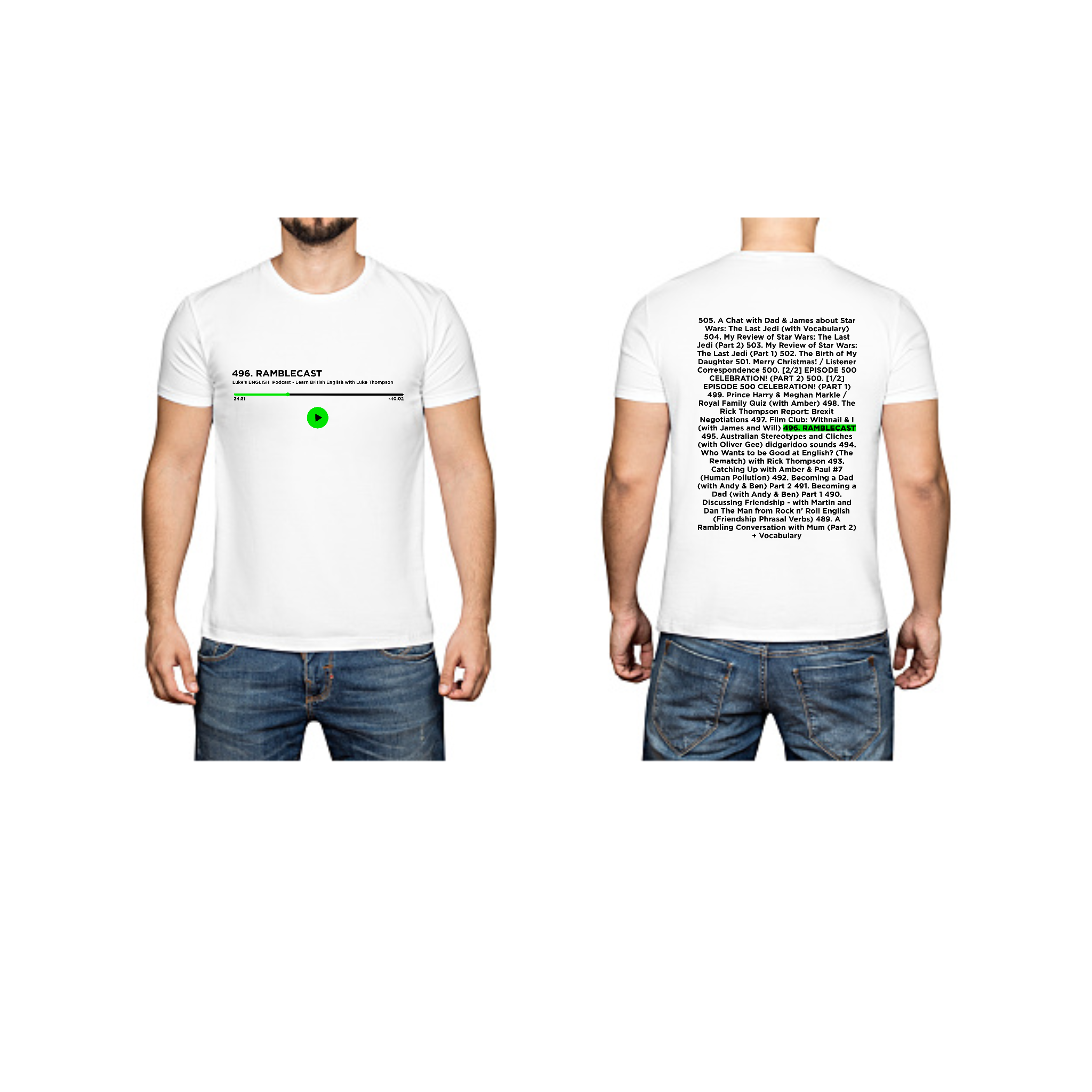
James and Luke discuss designs sent in by listeners, and choose the winner(s). The prize: to have your design featured in the LEP Merch Store, plus an £80 reward! Listen for plenty of descriptive language, diplomatic language and ways of giving positive and feedback in English. Video version also available (with all the designs on screen) below.
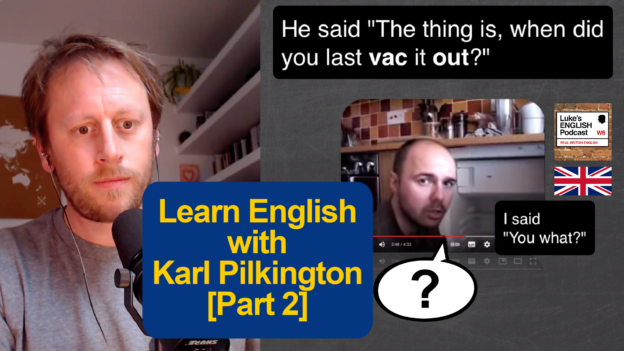
Understand more of Karl Pilkington’s rambling as we learn about the Manchester accent and pick up vocabulary along the way. Video version available on YouTube.
Hello everyone. Welcome back to LEP. This is part 2 of a double Karl Pilkington themed episode. I would recommend that you listen to part 1 of this first – it contains important context about who Karl is plus more details about Karl’s pronunciation and accent.
Listening to that first will help a great deal in understanding this one.
I got plenty of good responses to part 1 of this, so let’s carry on.
In this part we are going to continue as we did before – listening to Karl Pilkington talking about various subjects, understanding exactly what he says, looking at features of his Manchester accent and picking up vocabulary along the way.
Karl is basically just a normal bloke from Manchester and his accent is fairly typical for people from that area so this episode aims to help you understand his accent and pick up vocabulary too.
Some responses to part 1
I disagree with Karl on most things.
Is he arrogant?
I just enjoy the way he puts things. He speaks like a comedian in the way that he expresses a point of view and has a certain way with words, but he’s not a comedian.
This is the enigma of Karl Pilkington – is he really just being himself, or is he playing a comedy character, and in real life he’s a lot more erudite.
I actually think it’s the former not the latter and that he’s just being himself. He just happens to have a funny way of putting his opinions across.
Sometimes the best comedy comes from someone sharing a specific opinion. I think this is what I enjoy about this, rather than the opinions he is expressing, and as I said I disagree with Karl about most things, and some things he says are quite laughable – especially stuff he’s said on the Ricky Gervais podcast, like his Monkey News stories.
One other thing – apparently it is possible to be choked by a live octopus as you eat it. What I meant was that it would be impossible for an octopus to strangle you from the inside, as strangling means choking from the outside of the throat, with your hands for example, but of course a live octopus could choke you from within, by sticking its arms up into your throat or your windpipe. So, fair enough, it is possible for an octopus to choke you.
Also, in the UK we do eat oysters – which are raw seafood, so I think raw fish are generally ok in the UK but most other raw things would be considered a bit strange for us.
Quick Pronunciation Recap
In part 1 we listened to Karl talk about life, health and food and in terms of his accent I talked about H-drops
I’m 32, I think I’ve got the hang of it.
Look, how many do you need?
glottal stops
I’ll have a look at the meteorites.
If you’re going to eat a live animal, don’t eat one that’s got eight arms that can get hold of your neck.
The ‘bath/trap’ split
podcast/podcast
laugh/laugh
path/path
bath/bath
/ʊ/ not /ʌ/
Do you go to the gym much?
Topics: Holidays & Karl’s Fridge
This time he’s going to talk about holidays and his fridge and we will look at more features of his accent.
There’s a video version of this on youtube with text on the screen, plus you will find all the text presented on the page for this episode on my website.
Just one more thing before we start – I have premium episodes in the pipeline for these two episodes of LEP. The Premium episodes will be a chance to review and remember the vocabulary that comes up in these episodes, and then pronunciation drills too. So, I’ll do a sort of memory quiz with you to see how much vocab you remember and then the usual pronunciation drills – but in my accent, not Karl’s.
Karl is on a camping holiday, sitting in a tent and moaning.
Why does Karl think holidays are stressful?
What does Karl think of Lanzarote’s nickname?
What did Karl do on his holiday there?
What’s the problem with holidays in the UK?
What did he think of the seal sanctuary he went to?
What’s the best place Karl has been? Why?
What does Karl think of holidays to the moon?
Vocabulary
You’ve got free time on your hands which you’re not used to.
We ended up walking around this seal sanctuary. 14 quid. £
They were just floating about, hardlymoving.
I’m not having a go, but don’t charge me to come in, or at least let me see them again when they’re better.
The coliseum, they don’t do it up.
There’s no overheads.
That’s a mess. Get it knocked down.
At the end of the day the moon is just a big rock. You may/might as well go to Lanzarote.
PRONUNCIATION #3
Nasal
Alright so I went on holiday and it was great and all that.
I’ll have a look at the meteorites.
If you’re going to eat a live animal, don’t eat one that’s got eight arms that can get hold of your neck.
When’s the last time you heard about a tortoise having a heart attack?
Works well with glottal stops.
Nasal sound in /aʊ/ and /ai/ sounds
/aʊ/ in words like about and now sounds more nasal.
What’s he going on about now?
If there were dinosaurs about now and that.
If we’ve run out we need to go outside and get some more.
Nasal sound in /ai/ sound
The /ai/ sound in words like alive, inside, survive, fighting, riot and dying sounds more nasal.
You’re not supposed to eat them alive.
We’ve got to stay inside if we want to survive.
If they were running about fighting and dying and that.
Running riot (sounds like “roonin raiyut”)
#5 Karl on his fridge
Karl’s fridge is broken and he called out a guy to fix it.
Naturally he’s moaning about workmen who come to your house to do different jobs.
Why does the guy charge £80?
What is Karl’s main problem with engineers, plumbers, workers who have to come to his house?
What advice does the fridge guy give to Karl?
What’s the problem with Karl’s new fridge?
Vocabulary
The fellaturnedup, right.
Yeah, it’s broke. (broken)
That’s why I called you out.
That’s 80 quid.
I said, “you what?”
An 80 quid callout charge.
I tell you. They windmeup.
I had a fella come round to do the tiling.
Turned up late with a carrier bag.
A pot noodle
A copy of the Daily Mirror
A crossword book
He was asking what the pub was like across the road. “What is …. like?”
Having a laugh
When did you last vac it out?
Vacuum cleaner
You’re meant to vac them out, because dustand that gets in.
Can’t afford any food to put in it.
It needswiringin. It’s got one of those fancy plug things.
PRONUNCIATION #4
A lot of other vowel sounds are nasal too.
Turn the corner /ɔː/
They becomes thee
It depends what they do with it.
Why have they only just found that?
How did they miss that?
Also, he adds little fillers like:
(Do you) know what I mean?
Right? (just sounds like a nazal grunt, almost)
… and that
Like that
And whatnot
And stuff like that
Do you know what I mean?
I tell ya…
Watch out for those things if you like.
Ending
Ladies and gentlemen, this brings us to the end of this episode, as we now prepare to exit the world of Karl Pilkington and re-emerge blinking into the light of the normal world.
Welcome back to yourself, your own attitudes and your own personality again.
I urge you to (just wanted to use that phrase) check the page for this episode on my website where you will find a downloadable full transcript, the audio file for download in mp3 format, a text video version of this episode where you can read the entire thing as you listen and it’s all presented in a rather majestic looking font before your very eyes and of course there’s the comment section where you can share your thoughts not to mention the episode archive with all the previous episodes plus lots of bonus extra stuff.
Teacherluke.co.uk
LEP Premium LEP App LEP Merch
Have a good one and I will speak to you again soon, bye!
Cookies on teacherluke.co.uk
Click “Accept All”, to consent to the use of all cookies on this website, or visit "Cookie Settings" to control your consent settings.
This website uses cookies to improve your experience while you navigate through the website. Out of these, the cookies that are categorized as necessary are stored on your browser as they are essential for the working of basic functionalities of the website. We also use third-party cookies that help us analyze and understand how you use this website. These cookies will be stored in your browser only with your consent. You also have the option to opt-out of these cookies. But opting out of some of these cookies may affect your browsing experience.
Necessary cookies are absolutely essential for the website to function properly. These cookies ensure basic functionalities and security features of the website, anonymously.
Cookie
Duration
Description
cookielawinfo-checkbox-analytics
11 months
This cookie is set by GDPR Cookie Consent plugin. The cookie is used to store the user consent for the cookies in the category "Analytics".
cookielawinfo-checkbox-functional
11 months
The cookie is set by GDPR cookie consent to record the user consent for the cookies in the category "Functional".
cookielawinfo-checkbox-necessary
11 months
This cookie is set by GDPR Cookie Consent plugin. The cookies is used to store the user consent for the cookies in the category "Necessary".
cookielawinfo-checkbox-others
11 months
This cookie is set by GDPR Cookie Consent plugin. The cookie is used to store the user consent for the cookies in the category "Other.
cookielawinfo-checkbox-performance
11 months
This cookie is set by GDPR Cookie Consent plugin. The cookie is used to store the user consent for the cookies in the category "Performance".
viewed_cookie_policy
11 months
The cookie is set by the GDPR Cookie Consent plugin and is used to store whether or not user has consented to the use of cookies. It does not store any personal data.
Functional cookies help to perform certain functionalities like sharing the content of the website on social media platforms, collect feedbacks, and other third-party features.
Performance cookies are used to understand and analyze the key performance indexes of the website which helps in delivering a better user experience for the visitors.
Analytical cookies are used to understand how visitors interact with the website. These cookies help provide information on metrics the number of visitors, bounce rate, traffic source, etc.
Advertisement cookies are used to provide visitors with relevant ads and marketing campaigns. These cookies track visitors across websites and collect information to provide customized ads.