Category Archives: language

501. Merry Christmas! / Listener Correspondence

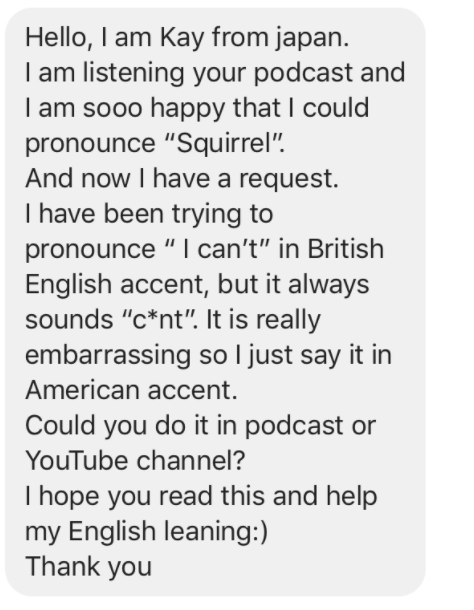
Wishing you a Merry Christmas, giving some news and responding to some messages from listeners about vocabulary lists, pronouncing “can’t” without sounding rude and more…

[DOWNLOAD]

Episode Notes

Hello! Merry Christmas!
Seasons Greetings
Happy Holidays
All the best for the festive season

Here’s episode 501 and really the point of this is that I just want to say “Hi”, wish you all the best, share a bit of news and read through some listener correspondence.

Baby news – still nothing. Both the baby and my wife are fine and in good health, but no signs of labour yet. Apparently this is quite common for a first child. Fingers crossed in any case.

Also, this probably means that our daughter will have her birthday on Christmas Day or boxing day or later, which is not ideal for her (because people don’t care after Christmas, Christmas will overshadow the birthday etc, but it’s possible to make up for it by perhaps having an “official birthday” like the Queen – later in the year).

Listener correspondence

Another message from Jesus. (Not that one)

Original message (read out in episode 500)

Name: Jesus

Message: Hi Luke, I´m one of your ninjas who has decided to come out of the shadows.

My name is Jesus and I´ve been listening regularly to your podcast for three years. I´ve never written something like this before, and forgive me, because I´m not much of a writer.

Your podcast has been the soundtrack of many of my trips, running sessions, moments of ironing, cleaning, and especially cooking. I put my earphones on, and the magic flows in the kitchen.

In a way, you´ve been there in the good moments and also in the bad moments, sadly I´ve been through those lately. Listen to you during that time helped me to move on, and also to improve my understanding of your language and culture.

Now it has also inspired me to work on a new project, it´s something related with cooking. I´m not going to tell you more because the project is still in diapers (got it? pfff I know, it sucks…) I promise you´ll have more news if it gets to something real.

In any case I just want to thank you a lot for all the effort that you put into the podcast and wish you and your wife nothing but the best for the new challenge that you have ahead. You are a great guy, and great people deserve the best.

May the force be with you. Jesus.

Response from Jesus

Name: Jesus

Message: Hi Luke, this is Jesus again.
First off all, I didn’t mind that you read my message. I wasn´t sure that you would read it, since you are very busy these days, but what I wasn´t expecting was you giving me a few minutes in such a special episode.
I know that for you it may be a little thing but it meant a lot to me, in fact, today is my birthday ( that´s right, it´s not the 24th…hehehe), so I´ve considered your gesture as THE birthday present.

I´d like to share something with your audience that it may interest them. You were saying that there are some topics ,like religion, were you have to be careful in order to not offend anybody. Well I think that as long as you are respectful and don´t cross the line with your jokes it´s all right.

Once, I was living in Edinburgh, I went there to learn english, I thought if I go for the hard one the rest would be easy.

Let me tell you that it wasn´t easy but I love the Scots.

In there, everybody had the same reaction that you had when hearing my name, or reading it, because most of the times I had to show my ID for them to believe it.

Thanks to that I wasn´t so nervous when english speakers were talking to me, they were always joking, making me feel more confident and suddenly I was speaking with them.

If you are nervous and trembly when speaking a different language, try to find something funny in common with the other person, if you don´t find anything, whisky helps.
Luke, as I told you before, it´s my birthday. I´m 32, may this be the last one? who knows…just in case I will live it to the maximum.

You said, you don´t get an email from Jesus everyday, well you don´t get to be heard by such an audience like yours everyday either.

I don´t know if you are going to read this, but if you do, this is my birthday present for the world…

Forget your f*cking ego, and use the energy that you use to think of yourself to empathize a little bit with the person next to you. We need to stop all the b*llshit, and work together because the resources are not inexhaustible ( the last part is a message from a friend called Esther, it´s a message inside a message, she also wanted to say something to the world…).

I guess that this is what rumble feels like Luke, I´m kidding, of course.

Merry Christmas, Jesus.

Huxi – Vocabulary Lists

Hi, it’s Huxi.

I absolutely love your Podcast. Thank you for sharing all this info through transcripts and vocab lists.

Talking about lists, Would it be possible to keep posting them? I personally find them incredibly valuable for reviewing, by placing them in Anki as flashcards.

Thanks a lot!

Kristin – Vocabulary Lists

Name: Kristin

Message: Dear Luke,

Before asking a question, I want to give you a big Thank You for providing us learners of English such helpful and valuable material! :-)

I want to relate to episode 496 “Ramblecast”, in which you talk about methods of learning a language and emphasise that just repeating word lists does not make a lot of sense.

Weeell, in fact I have known that, but the problem is that, during the last 2 years, I gathered 117 lists containing 100 words respectively, so about 12,000 words. Until a year or so I managed to revise the words I had until then regularly, but now it’s become too much. To cut a long story short, I am sort of obsessed with learning words, because I just wish to get better, as I love English so so much. Whenever I read an article or a book or watch something on Youtube I kind of feel obliged to look up new words and write down on my lists. It’s depressing, though, that I realize after a few weeks that I just haven’t remembered them.

My question is: Do you know if it’s somehow scientifically confirmed (or what do you personally think about it?) that people learn a language and become more fluent by reading books, listening to audiobooks and watching films without writing down and learning and repeating all the words? I just can’t imagine that I could ever memorise all the new words I pick up by dealing with English material.

Sorry for this long text, but I think I’m going to send it now anyway, because I’m currently at work and have no more time to write it once again in a shorter version.

I would be very grateful and happy if you could send me a little answer whenever you have time.

Thank you so much in advance!

Kristin

Luke’s response

Hi Kristin,

This is a great question. Please don’t think that your efforts in collecting vocabulary has been a waste of time. I’m sure it hasn’t been. I think that your approach to saving words is probably evidence of your motivation to learn and your mindfulness of language while reading and listening. Perhaps just the act of recording the words in a list (words you’ve already encountered in context) could help you acquire them.

But there are other things you could and perhaps should be doing with the words, for example adding meaningful sentences in your list for each word. This can help you remember them. Also consider how you’re revising the word lists. What are you doing as you go through the list? Are you testing yourself and trying to reproduce those words in meaningful ways?

Also, it might be wise to take a selective approach. Instead of recording all the new words you encounter, you could just pick ones that you think are more useful or common. Don’t try to consume too much. Let some words go. You’ll remember more if you try to remember less. Don’t overwhelm yourself.

Also you could try googling those words and looking at the way they are used in the news (select the news tab in google results). That can reinforce the words for you.

As for the scientific studies you asked about. I don’t think there is 100% reliable scientific proof that one particular method works better than another. There are theories, like Language Acquisition Theory by Stephen Krashen and other theories too.

I think the best source of info on this probably comes from successful language learners. You could check out Olly Richard’s Podcast and blog at iwillteachyoualanguage.com He has some good methods and advice for remembering vocabulary. That might help. You could also ask him your question and he might answer it on his Podcast. I would also like to tackle your question on the podcast if I manage to fit it into my upcoming episodes! Your mail is now saved in my to-do list.

I hope my answer helps a bit although I haven’t given a fully fleshed-out response with specific steps you can take.

As a final thought, it seems that your English is really good, with a wide range of vocabulary. So perhaps your method has worked well despite what I said on the Podcast.

In the end, applying yourself to language learning, being motivated and having some kind of system – these are the things that make the difference regardless of what form they take. It doesn’t matter – in language learning all roads lead to Rome. You just have to make sure you’re always moving.

All the best,

Luke

Kristin’s response

Dear Luke,

Thank you so much for your detailed e-mail! I was very blown away by your deep thoughts about my question and I really appreciate your tips. You are probably right, it depends on HOW one tries to learn new words – just by provided lists in a book for students or by self-made lists containing words from specific contexts that one is able to relate to. I also realised that through writing down almost every new word my listening skills have improved a lot, as I’m able to recognise words better. On the other hand, I really SHOULD select at least a little bit, you’re very right in that. Since it is just frustrating to realise that after a few weeks I can’t remember anymore what I learnt.

Olly Richard’s podcast and googling are good tips, thanks for these!
Also, my English language exchange partner from England learns with Memrise nd finds it quite enriching, maybe I’m gonna have a look into it when I find the time (Christmas holidays are approaching ;-) ).

Thank you for the compliment about my English. My written English is quite good I guess, but my spoken English is sadly another story, as the little additional moment to think about the words is missing and I can’t often remember the words in the particular moments.

My dream is to go to England next year in summer for a few months. My New Year’s Resolution let’s say ;-)

Have a great Christmas and all the best to you, your wife and your almost-born baby!

Cheers,

Kristin

Serdar – Becoming a Dad

Name: Serdar

Message: Hello Luke.

I had once contacted you via this form but you didn’t reply. Hope you see this one this time. I have been listening to your podcasts over a year and really enjoying it a lot as well as learning many new vocab. So thanks for your contribution to those who thrive by learning. Recently I listened to a podcast of yours titled becoming dad and found out that you would become dad quite soon. Don’t know when you recorded it so you may even be holding your lovely baby now.

I know you have been told so many times that how difficult parenting is. As a father of 3 year old,I bet you all of it is true but i would like to emphasise how wonderful being a dad is. They used to tell me that my life would completely change after becoming dad and they’d say this change would be positive. Now I totally agree with my friends that there is no such feeling compared to being a dad. It is the greatest thing to happen to a man. I can’t even believe that there are words to express this. I couldn’t do it in my native language either. you must experience it ( maybe you have just started to ) At first weeks you really don’t know what’s happening. You look at a baby but still don’t have any idea about how it feels like a dad. It gradually starts, and this magnificent feeling gets extensive day by day and you finally find yourself and your toddler talking to each other one day. you start enjoying every single day, you rush back home to see them as soon as possible.

I even remember untying my shoe lashes in elevator just to gain few seconds! you look at their pictures when you are away. you keep thinking about them. I don’t know if you have ever fallen in love truly like mad but this overshadows it without doubt. It is much more intense than love. there is no word describing your love for your child. Although some days, especially when you are exhausted, or sleep deprived you will face to the hardest part of parenting, you will still stand up and go for it. even when you have %1 battery left :)
I hope you share your experience in a podcast. If you reply me letting me know about it, I’d be so happy.
Thanks again and good luck :)
Serdar, Istanbul

Message from Kei – Pronouncing “can’t”

Gleidson from Brazil

I’d like to see you online in video conference, would be really interesting. And I suggest you give some links to us practice grammar in sites as British Council, BBC English learning or so on related to the current episode podcast. It’s a great chance for us to practice grammar.

Your accent is really clear for us students. Don’t fear about share something about your personal life, for me, it makes your podcast quite personal and friendly.
This is the positive point for your podcast and a good way to share some vocabulary to a specific occasion, as wedding ceremony, childbirth, baptism, Christmas celebrations and so on

I am living in Ireland for 4 months, but I listen to you since as was living in my country (I have to thanks to a Brazilian friend of mine that shows me your podcast).

I wish all the best to you.
Keep posting your amazing podcasts and thanks again.

Send a warm Hello to all Brazilian that listening to you.

(sorry for English mistakes, I am learning, so I can not write in English as a write in my native language yet).

Kind regards,
See you.

VP – Withnail & I episode.
Hiya everyone! This is my first comment ever. #497 is so cool an episode I couldn’t keep a low profile anymore! First of all, I want to thank you tremendously, Luke, for all you’ve done for us lovers of English. Your podcast means a lot and it’s extremely helpful for me in my effort to keep learning the language all by myself now. I’ve been listening to LEP for quite a while, and it’s always ace but this time that was something special. The thing is, Withnail &I is one of the most hilarious and unique British films I’ve watched. Boy, was I chuffed when I saw the name of a new episode! I guess I found this film after I’d seen Fear and Loathing in Las Vegas, which perhaps has something in common with Withnail&I. Indeed, I failed to enjoy the film from the start, but its dialogues, humour and Richard E.Grant’s superb performance made me grow fond of it finally! By the way, I also like ‘How to Get Ahead in Advertising’ with this actor and am a huge fan of Mike Leigh’s works, ‘Naked’ featuring David Thewlis, for instance. Has any of you LEPsters seen any of those movies, by any chance? I wonder what British people think of Leigh’s films.
P.S. The description of a person who likes Withnail&I was merciless!

Marta KL • 19 days ago
I’ve just downloaded the film (with subtitles – I don’t think I’m able to make it without them) – looking forward to watch it in the next days.
Btw I have just noticed that James’s voice is quite similar to your dad’s voice :)
Thanks for the new episode, cheers!
Luke Thompson
Yep – he’s a chip off the old block
Hope you enjoy the film.
Cat
Could one say ‘He is a chop off the old wood’ as well?
Luke
Nope!

**UPDATE: Technical problems with the website :( **

I’m having some technical problems with my website at the moment. Some pages are not displaying properly and this is also affecting the Disqus comment system, so the comment section might be unavailable. Sorry! I hope to have it fixed soon.

496. RAMBLECAST

Rambling about life, learning English, Star Wars, screwing up paper into a ball and more…


Small Donate Button
[DOWNLOAD]

Here’s a rambling episode with a few bits of news and some tangents.

Episode 500 – Please send me your voice messages

Please send me a 30 second voice message to luketeacher@hotmail.com

Tell me your name, where you’re from and something else.

Don’t be shy, give it a try!

Penguin Readers https://www.pearsonelt.com/tools/readers.html#productComponents

495. Australian Stereotypes and Cliches (with Oliver Gee) ~didgeridoo sounds~

Discussing stereotypes and clichés about Australia with podcaster Oliver Gee who comes from a land down under. Learn about Australian English, Aussie accent, Aussie slang and exactly what you should say whenever you meet a true blue Aussie, mate! Vocabulary list available. Hooroo.


[DOWNLOAD]

Introduction Transcript

Today on the podcast I’m talking to Oliver Gee who comes from Australia.

Oliver lives in Paris these days and is a journalist and podcaster – he does a podcast about Paris for World Radio Paris, which is a sort of radio network in English, based in Paris.

Oliver’s podcast is called The Earful Tower – and it’s available from all good podcasting apps and online at https://theearfultower.com/ 

Click here to listen to Oli’s podcast The Earful Tower

If you are a subscriber to my email list then you’ll know that earlier this year Oliver invited me onto The Earful Tower to talk about French people learning English. You can find conversation on the Earful Tower in the episode archive.

This time I thought I’d invite Oliver on to LEP in order to talk about all things Australian.

Australia is of course a country where English is the first language and Australian English is a thing. It’s definitely a thing. I mean, it’s a major type of English in its own right. Everyone always talks about American English and British English as the two types, but of course there are plenty of other types of English – with their own accents, particular words and so on. Australian English, New Zealand English, Irish English, South African English, Canadian English and more…

But let’s turn our attention in this episode to Australia.

Australian English is it’s own thing basically. Originally it was a form of British English, but like American English it has evolved into its own form of the language, with a distinctive accent and vocabulary that reflects the things you might see, experience or feel if you were living in this place which is very far removed from life in the UK. Australian English is also undoubtedly influenced by American English as well to a certain extent.

Now, let’s consider the land down under before listening to this conversation. I want you to think about Australia.

What do you know about Australia?
Have you ever met an Australian? Or been to Australia itself?
Can you recognise or understand Australian accents?
What does an Aussie accent sound like?
What should you say to an Australian when you meet them, in order to impress them?
What are the stereotypes of Australia? Are they true?
And what are Vegemite, Tim Tams and Thongs anyway?

You can now look for answers to those questions as we now talk to Oliver Gee from Australia… (didgeridoo sounds)

Australian Words, Phrases and Reference Points

  • G’day
  • Mate
  • How ya going?
  • Arvo
  • Bail – to cancel plans
  • Barbie – Barbecue
  • Brekky – Breakfast
  • Brolly – Umbrella
  • Choccy Biccy – Chocolate Biscuit
  • Chrissie – Christmas
  • Ciggy – a Cigarette
  • Dunny – Toilet
  • Good On Ya – Good work
  • Heaps – loads, lots, many
  • Maccas – McDonalds
  • No Worries – it’s Ok
  • Servo Service Station
  • Sickie – a sick day off work
  • Stoked – Happy, Pleased
  • Straya – Australia
  • Thongs – Flip Flops. Do not be alarmed if your new found Australian friend asks you to wear thongs to the beach. They are most likely expressing their concern of the hot sand on your delicate feet.

Other references (some clichés)

  • Crocodiles
  • Spiders
  • Snakes
  • Ugg boots
  • Didgeridoos
  • Boomerangs
  • Flip flops (thongs)
  • Relaxed people
  • Beer drinking
  • Vegemite
  • Selfies
  • Baz Lurhman making a film
  • AC/DC
  • Sydney Opera house
  • Heath Ledger
  • Kylie
  • Koala bears
  • The outback
  • Steve Irwin
  • Hugh Jackman and Chris Hemsworth
  • WI FI
  • Black box recorders
  • Polymer banknotes
  • Wine
  • BBQs
  • Cricket
  • Tim tams
  • Aborigines
  • The spork
  • Coffee

Outtro

So that was Oli Gee from Australia mate.

I hope you enjoyed listening to our conversation.

Remember you can listen to Oli’s episodes of The Earful Tower on iTunes or any other good podcasting service. Find the earful tower episode with me talking about French people learning English by dipping into the episode archive on teacherluke.co.uk and search for Earful Tower.

That brings us to the end of this episode.

Thank you for listening .

Check the page for this episode on the website and you’ll find transcriptions of the intro and outtro and some notes for my conversation with Oli including some of the Australian slang and other specific words.

Join the mailing list.

Episode 500 is coming up and I’m thinking of things to do for it.

Please send me your voice messages for episode 500 – luketeacher@hotmail.com

One idea I had was to collect audio messages from you the audience – short ones, and then put them all up in episode 500. So if you have any messages for me, please send them to luketeacher@hotmail.com

What I’d like you to say is:

  • Your name
  • Where you’re from
  • Something else, like:
    • If you’d like to say something to the audience
    • If you’d like to say something to me
    • If you’d like to ask me a question
    • How you first discovered the podcast
    • How you learn English with the podcast
    • Anything else you’d like to say

Make it no more than 30 seconds. I know that’s short but it’s going to be a montage of all the recordings and it’ll be really cool if they’re all pretty short.

So about 30 seconds and don’t forget to say your name and where you’re from. It’s not a competition this time but more of a celebration. I can’t believe I’ve done 500 episodes and they’re all about an hour each or more.

Anyway, it’s been a lot of fun and I’m very happy to have reached 500 episodes. Why don’t you celebrate with me and send a voice message to luketeacher@hotmail.com

Thanks for listening!

Bye!

Luke

494. Who Wants to be Good at English? (The Rematch) with Rick Thompson

Testing my Dad on his knowledge of English, using words that are frequently confused by native English speakers. Will my dad be able to identify the words, spell them and explain the differences? Listen to learn 20 words and phrases which native English speakers often get wrong. You will also hear Dad and me discussing topics such as catching a squirrel, what he would say to Donald Trump and Paul McCartney if he met them, stories of police drug busts at university, how my dad would deal with a zombie apocalypse, and which one is worse – Brexit or Yoko Ono’s ‘singing’? Vocabulary list with definitions and examples available.


Small Donate Button
[DOWNLOAD]

Introduction Transcript

About 18 months ago my Dad tested me with his evil gameshow, called “Who wants to be good at English”. I say it was an evil gameshow because I think it was designed for me to fail (although arguably, I didn’t fail, OK!?) It was basically a quiz he created in order to highlight some common mistakes that people make (especially journalists) with certain English words.

You can listen to that, and take the test as well, by finding episode 373 in the archive – or just click here https://teacherluke.co.uk/2016/08/10/373-who-wants-to-be-good-at-english/

So I thought we’d play another game of “Who Wants to be Good at English” but this time I’m asking the questions. My questions are based on an article I found on the Indy100 (an online magazine) written by Paul Anthony Jones  which is all about some of the most commonly confused words in English (for native English speakers). Apparently these are some of the words that many English native speakers confuse – meaning they use one word when they should be using another. I wonder if my Dad is able to tell the difference between all of these pairs of words. Let’s see if he really is that clever and articulate. I think he probably is, but let’s see.

As we are playing the game I invite you to join in. Can you guess which words we’re talking about here?

If you don’t know the words, listen carefully because we will define them and then also have a little chat using the words so you can hear them in context.

Also, you’ll hear us talking a little bit about the origin of some of these words, which is quite interesting because it shows how many English words come from latin and in some cases words from other origins like old English and even Turkish.

Check the page for the episode on the website too, where you will see all the words listed with definitions.

https://www.indy100.com/article/ten-of-the-most-commonly-confused-words-in-the-english-language–bJRDKGNwlZ


  • Dad, how are you?
  • Are you confident that you know English better than most other Brits?
  • Did you study latin at school?
  • Does a knowledge of latin help with English?
  • Do you think it will help you in this test?

10 rounds – 10 pairs of words which are commonly confused.

I will ask you questions – you have to tell me the word I am looking for. I will also ask you for the spelling and pronunciation.

ROUND 1

  1. If you’re waiting for something with great anticipation, literally to the point that you are having some trouble breathing – for example you’re desperately waiting for the next episode of Luke’s English Podcast – what expression would you use?
  2. How do you spell that?
  3. If you go fishing, what do you need in order to catch a fish?
  4. How do you spell that?
  5. How are they pronounced?

Answers:

Bate (verb) = abate = become less strong, to suppress. Formal, old fashioned.
The storms had abated by the time they rounded Cape Horn. [VERB]
…a crime wave that shows no sign of abating. [VERB]
To wait with bated breath = to wait eagerly and impatiently

Bait = (noun) – food you put on the end of a fishing line or in a trap in order to catch something

Also – figuratively something which is used in order to catch someone. E.g. ‘clickbait’

(verb) – to put food on a line or in a trap

(verb) If you bait someone, you deliberately try to make them angry by teasing them.

He delighted in baiting his mother. [VERB noun]

Synonyms: tease, provoke, annoy, irritate

According to Oxford Dictionaries, around 1 in every 3 records of the phrase “bated breath” in the Oxford Corpus is spelled incorrectly, as “baited.”
Baited with an I is the same bait that you use when going fishing.
Bated without an I is totally unrelated, and comes from an ancient English word, bate, meaning “to beat down,” “restrain” or “suppress” – it’s the same word we use when we say that a storm has abated – which makes “bated breath” literally “held breath.” (Indy100.com)

Quick Discussion Questions

  • Are you currently waiting for anything with bated breath?
  • What is the best way to catch a squirrel? How about a crab? What kind of bait should you use?

ROUND 2

  1. If you see someone that you don’t want to meet or talk to – perhaps a person who you don’t like, or imagine a drunk man in the street who might bother you or even attack you. You’d walk around him, putting space between you and him. What would you give him?
  2. How do you spell that?
  3. What word is this often confused with? It’s something that generally happens at the beginning of someone’s life.
  4. How do you spell that?
  5. How are they pronounced?

Answers:

Berth (noun) = (nautical term) originally means “sea room” – the room that a boat needs for mooring, but also generally room or space for ships. So, to give a wide berth in terms of shipping – you can imagine needing to go around a rocky point or perhaps another ship with lots of space, to avoid any possible collision.

Give something a wide berth = avoid it, go around it, put distance between you and it.

Birth / Give birth (to someone) = have a baby

Quick Discussion Questions

  • If you saw these people in the street, would you give them a wide berth or would you go up to them?
    • Donald Trump
    • Harvey Weinstein
    • Kim Jong Un
    • Madonna
    • Boris Johnson
    • Paul McCartney
  • Were you there when Mum gave birth to me? What was it like for you?

ROUND 3

  1. What word is a synonym of advice – for example legal advice? It can also be a verb, meaning to give advice. (also another noun – it can mean the lawyer too)
  2. How do you spell that?
  3. What about a group of people brought together to make decisions? E.g. a local administrative group who make decisions about how the local town should be run.
  4. How do you spell that?
  5. How are they pronounced?

Answers:

counsel (noun) = advice
[formal]
He had always been able to count on her wise counsel.
The community requested his counsel on various matters.

counsel (noun – person) = a lawyer
The defence counsel warned that the judge should stop the trial.

counsel (verb) – to give advice

[formal]
If you counsel someone to take a course of action, or if you counsel a course of action, you advise that course of action. 
My advisers counselled me to do nothing. [VERB noun to-infinitive]
The prime minister was right to counsel caution about military intervention.

Council and counsel can both be used as nouns (in the sense of “an assembly of people” and “good advice or direction”) but only counsel with an SE can be used as a verb (“to give advice or direction”).

Both are derived ultimately from Latin, but while council comes from the Latin word calare, meaning “to call or proclaim officially” (which makes it an etymological cousin of calendar), counsel with an S comes from the same root as consult. So while a council is “called” together, you might “consult” someone for their good counsel. (Indy100.com)

Quick Discussion Questions

  • Have you ever needed to take legal counsel for anything work related?
  • Have you ever been asked to provide counsel on any local matters?
  • Is there a local council where you live?

ROUND 4

  1. As a teacher, sometimes it’s necessary to draw out certain language from my students. Often if I’m teaching some words, or doing an introduction, rather than just lecturing them about a subject, it’s a good idea to get them to give me certain words – it tends to keep the students involved and makes them a bit more productive, and it also allows you to see which words they know and don’t know. What verb means to get a piece of information, a word or a reaction from people by asking certain questions?
  2. How do you spell that?
  3. What adjective is a synonym of ‘illegal’ and means ‘not allowed or approved by a rule’.
  4. How do you spell that?
  5. How are they pronounced?

Answers:

Elicit (verb)
Illicit (adjective)

The E of elicit is the prefix ex–, which is here used to form a word bearing some sense of “out” or “from”, like exhale and exterior. The –licit in both words is also entirely unrelated: in illicit it comes from the Latin verb licere, meaning “to allow” (as in licence), whereas in elicit it derives from the Latin lacere, meaning “to lure” (which is also where the word delicious comes from). (indy100.com)

Quick Discussion Questions

  • When you were growing up in the 60s, were you ever given information about illicit drugs? Did many people use illicit substances at that time?
  • The Shakespeare play “Macbeth” – what feelings do you think it elicits in its audience? What’s the main feeling that it elicits?
  • How about films. How do they elicit reactions from the audience? Think of a horror film for example.

ROUND 5

  1. What is the difference between the word ‘affect’ (with an ‘a’) and ‘effect’ (with an ‘e’)?
  2. How are they pronounced?

Answers:

Affect (verb)
Effect (noun)

The root of both is the Latin facere, meaning “to make”, but while the E of effect comes from the same prefix as elicit, ex–, the A of affect comes from the prefix ad–, which is used to form words bearing some sense of “towards”, “on” or “a coming together” like adjoin or ashore. To affect ultimately means to have an effect on something, while an effect is an outcome. (indy100.com)

Quick Discussion Questions

  • How does wine affect you? Does it affect you in the same was as it affects other people?
  • What are the good and bad effects of wine?

ROUND 6

  1. How would you describe someone whose hair is going grey, making them look quite cool and perhaps even quite tough. It’s the sort of word you might use to describe a police detective or a cowboy who is getting older and has had some tough experiences, which you can see in his greying hair – but he’s not really old yet, just experienced.
  2. How do you spell that?
  3. What’s another word for a brown bear? They type of bear you might come across in Yellowstone National Park in the USA. They’re brown but they have some grey-ish hair around the shoulders, head and ears.
  4. How do you spell that?
  5. What adjective would you use to describe the disgusting or explicit details of a murder. Something which is very unpleasant and that would be horrible to look at.
  6. How do you spell that?

Answers:

Grizzled (adj) = going grey (usually used in a literary context)
Grizzly (adj) = also going grey, like ‘grizzled’ but usually ‘grizzly’ is just the word for a type of brown bear
Grisly (adj) = extremely unpleasant and horrible

If something is horrible to look at then it’s grisly, not grizzly. Grizzly with two Zs is a descendent of the French word for “grey”, gris, and comes from the older use of grizzled to mean “grey-haired” (despite grizzly being another name for a brown bear, of course).
Grisly with an S is a descendent of grise, a Middle English word meaning “to shudder with fear”. (Indy100.com)

  • What kind of movie star would you rather watch in a film – a fresh faced young-looking hero or a grizzled hero? Can you think of any examples?
  • Have you ever seen a grizzly bear?
  • Do you think the news should report all the grisly details of a story?

ROUND 7

  1. Imagine there’s going to be a zombie apocalypse. It’s a terrifying thought. It would be a good idea to collect and store lots of food, drink and supplies. To stockpile things, and hide them so that nobody else can find and use them, but you’ll be able to keep them and survive. What verb am I thinking of?
  2. How do you spell that?
  3. Now imagine loads of zombies in a huge group, or in fact many large groups of zombies surrounding your house or out in the street. What noun could you use to describe these groups of the undead. Of course this word could also be used to describe groups of ordinary people too, but it sounds a bit negative – frightening or unpleasant, perhaps.
  4. How do you spell that?
  5. Pronunciation?

Answers:

To hoard something (verb) = If you hoard things such as food or money, you save or store them, often in secret, because they are valuable or important to you.
They’ve begun to hoard food and gasoline and save their money. [VERB noun]
The tea was sweetened with a hoarded tin of condensed milk. [VERB-ed]

A horde of something (noun) = a large group of people, usually considered quite threatening or scary.

This attracts hordes of tourists to Las Vegas. [+ of]
…a horde of people was screaming for tickets.

Around a quarter of all the citations of the word hoard (a noun meaning a store of valuables, or a verb meaning “to accumulate” or “stockpile”) in the Oxford English Corpus are incorrect, and should really be horde (a large group of people).
In English, hoard is the older of the two and derives from an Old English word for treasure – wordhoard was an Old English word for a person’s vocabulary. Horde is completely unrelated, and has an E on the end of it because it comes from an old Turkish word, ordu, for an encampment. (Indy100.com)

Quick Discussion Questions

  • What would you do if you found out that there would be a zombie outbreak? What kinds of things would you hoard?
  • What would you do if your house was surrounded by a horde of zombies?

ROUND 8

  1. Imagine a road which is full of twists and turns. How would you describe it? How about a piece of writing or perhaps a process which is really complicated and time consuming. Which word would you use to describe those things?
  2. How do you spell that?
  3. Which adjective could you use to describe something that causes great pain and suffering?
  4. How do you spell that?
  5. Pronunciation?

Answers:

Tortuous = twisting and turning (road), complex and time consuming (process, writing)
The only road access is a tortuous mountain route.
…these long and tortuous negotiations aimed at ending the conflict.
The parties must now go through the tortuous process of picking their candidates.
Torturous = like torture – very painful and agonising.
This is a torturous, agonizing way to kill someone.

Confusion often arises between these two not only because of their similar spellings, but because something that’s tortuous can often seem torturous.
Tortuous without the extra R means “full of twists and turns”, and is derived from a Latin word, tortus, for a twist, or a twisting, winding route. If something is torturous then it’s akin to torture, hence the extra R. (Indy100.com)

Quick Discussion Questions

  • Would you like to be involved in the Brexit negotiations? Why not?
  • You wrote a book once. How was that experience? Was it tortuous? (complicated) Was it torturous? (painful)
  • How would you describe Yoko Ono’s singing?
  • What about the experience of having your teeth pulled out, by Yoko Ono, while she’s singing? (Torturous, right?)


ROUND 9

  1. Imagine your wife is pregnant (I know!) and you go to a doctor for a scan. You and your wife are very worried about the health of the baby because a previous test suggested that there might be a problem. So, you’re both feeling very worried and nervous, and you really want the doctor to put your worries at rest, but the doctor seems completely insensitive to this and doesn’t even seem to realise that you’re worried. You think, is he being deliberately like this? This word means slow to understand something and also insensitive.
  2. How do you spell that?
  3. How would you describe something that was really complex to understand, abstract, deep, highly intellectual. E.g. a book about abstract existential philosophy, or the rules of cricket.
  4. How do you spell that?
  5. Pronunciation?

Answers:

Obtuse (adj) = mentally slow or emotionally insensitive
“How can you be so obtuse? Is it deliberate?”
Abstruse (adj) = hard to understand because of being extremely complex, intellectually demanding, highly abstract, etc.; deep; recondite
[formal disapproval…fruitless discussions about abstruse resolutions.

How can you be so obtuse? The Shawshank Redemption – Andy discovers evidence that proves he is innocent. The warden seems to choose not to realise how this could get Andy out of prison. Andy says “How can you be so obtuse? (slow to realise the significance of this) Is it deliberate?

No questions, your honour.


ROUND 10

  1. Imagine a long summer evening, long shadows, golden sunlight, a pleasant temperature. You can just relax in a chair and take your time, soaking up the pleasant rays of deep golden light. How would you describe that weather?
  2. How do you spell that?
  3. What about someone who’s a bit crazy and foolish?
  4. Spelling?
  5. Pronunciation?

Answers:

Balmy (adj) = Balmy weather is fairly warm and pleasant.
…a balmy summer evening.

Barmy (adj) = If you say that someone or something is barmy, you mean that they are slightly crazy or very foolish.
[British , informal , disapproval]
Bill used to say I was barmy, and that would really get to me.
This policy is absolutely barmy.
UNITED! BARMY ARMY! UNITED! BARMY ARMY! (football chant)

Is the weather balmy or barmy? It’s balmy with an L if you’re talking about something pleasantly warm—literally, something as pleasant as balm, in the sense of an aromatic, healing lotion or salve.
It’s barmy with an R when you’re talking about something (or someone) foolish or crazy—literally, someone as frothy and as flighty as barm, which is the froth that forms the head of a pint of beer. (Indy100.com)

  • How was the weather in the UK this summer? Did you have any balmy summer evenings?
  • At what time of the year is the weather at its balmiest? What do you like to do when the weather is balmy?
  • What do you think of Brexiteers? Are they a bit barmy or is there something else going on?


Thank you for listening!

Don’t forget to join the mailing list on the website to get an email with every new publication on the website.

Luke

492. Becoming a Dad (with Andy & Ben) Part 2

The second part of this conversation with Andy Johnson and Ben Butler, and we talk about the moment of childbirth and take a quiz about becoming a father. Vocabulary is explained in the second part of the episode. Vocabulary list available.


Small Donate Button
[DOWNLOAD]

Introduction Transcript

Welcome back to part 2 of this double episode called “Becoming a Dad with Andy and Ben” – I may need to rethink that title. It sounds a bit misleading. “Becoming a Dad with Andy & Ben” – It sounds like I’m becoming a Dad with Andy & Ben – as if somehow Andy and Ben are involved. I’m not sure about that idea. I mean, they definitely weren’t involved.

Nevertheless, here is Becoming a Dad with Andy and Ben part 2, in which I am talking to my friends Andy and Ben about their experiences of becoming a father for the first time. I’m trying to learn a few things about what it will be like when I become a Dad in a matter of weeks.

Andy & Ben are like seasoned professionals at this now as they both have two kids.

In part 1 you heard about things like conception, trimesters, epidurals and all sorts of other things.

We left it on a bit of a cliffhanger with me asking Andy & Ben about the moment their first children were born, so we get straight into it here talking about the big day, the moment when it’s time to get to the hospital and all hell breaks loose! Now, this is probably the most crucial moment of the whole process and can also be quite a dangerous day as well, so there is often drama and a lot of nerves. It’s a nerve-wracking experience, and we’ll be talking about it in some detail – so if childbirth is a topic that you are sensitive about, just have a think before embarking on this episode.

I think I’m prepared for the big day (mentally and also in terms of our home) but it’s going to be a big rush to deal with and no doubt quite emotional! Even going for scans is quite a big deal, so it’s a bit hard to imagine what the birth will be like.

Anyway, let’s carry on. See if you can identify the things Andy and Ben are saying and stick around because in the second part I’ll be going through lots of the vocab you’ll be hearing, turning this into a great learning opportunity for you.

—- Conversation Continues —–

So that was my conversation with Andy & Ben. Did you catch everything?

You know what’s happening now, right?

That’s right it’s vocab time.

Let me now go through some vocabulary for you.

Vocabulary List

  1. She told me that she thought her water had broken
  2. I was training someone to fill my role while I was taking paternity leave
  3. The contractions were pretty slow actually
  4. Braxton Hicks
  5. It took her ages to start contracting properly
  6. We went to the hospital after 36 hours of labour
  7. She was already 9cm dilated
  8. My wife was out of it
  9. They just whisked my wife away to the theatre.
  10. I’m not a man for a crisis. I wouldn’t know what to do. I’d be running around like a headless chicken.
  11. My wife developed gestational diabetes.
  12. Too much sugar going through the placenta can make the baby grow too quickly.
  13. We got a cab in and it was great (not a cabin).
  14. The umbilical cord had got wrapped around his neck
  15. They cut the umbilical cord and took him over to the resuscitation table
  16. First of all I saw this massive… junk. Because when babies are born their genitals are swollen. So, first thing I saw was it’s a boy.
  17. That was me finished, I just burst out crying.
  18. And then he weed all over the nurse.
  19. I held it together. I don’t know how I did because I’m quite squeamish.
  20. As soon as I got outside, that’s when I really broke down.
  21. If there are dramas, don’t worry, you’re in safe hands.
  22. You just have to go with the flow and it’s alright in the end.
  23. This is easy, I’ve nailed this parenting lark!
  24. Once they start to wake up, that’s when it kicks in, is it?
  25. If you can manage the people who want to see the baby, who hound you…
  26. I tell you what, I’ve got a little quiz here…
  27. She’s just gone through childbirth so she needs to be pampered
  28. What would the native Americans do? They’d probably use buffalo turds
  29. When the baby is born the mother and father are flooded with a hormone – the happiness hormone.
  30. Your wife is your number 1 person, but she is going to be relegated, and so are you.
  31. They start gurgling and making noises
  32. The youngest, he looks at me and his whole face lights up with a big smile.
  33. You get a good couple of nights’ sleep (in a hotel) and your body remembers and goes “Oh I want more of this” and you end up still being knackered!
  34. Once things have settled down we can have another chat and we can see you with the big bags under your eyes.

Thanks for listening! I look forward to reading your comments.

491. Becoming a Dad (with Andy & Ben) Part 1

A conversation and vocabulary lesson about childbirth and becoming a father, with Andy Johnson and Ben Butler from The London School of English. Listen to Andy and Ben talking about their experiences of becoming parents, how their babies were born and more. Vocabulary is explained in the second half of the episode. Vocabulary list available.


Small Donate Button
[DOWNLOAD]

Introduction Transcript

This episode is all about becoming a Dad.

If you have heard the podcast recently you’ll know that my wife and I are expecting a child… (expecting a child to do what Luke…?) Well, expecting a child to be born… we’re having a baby, well she’s having a baby, as I said before, I will mainly be just standing there, hoping for the best.

“Expecting a child” is just the phrase we use for that – when you’re going to have a baby. We’re going to have a baby daughter in December. Thank you if you have sent me messages saying congratulations, that’s very nice of you.

I don’t plan to talk about children all the time on this podcast. Having a child is a big deal, but I don’t want to sound like a broken record by going on about it all the time, although it’s bound to come into the things I say because it will be major part of my life.

But I thought that it would be worth talking about it in some depth in at least one or two episodes because it is something that a lot of people experience (many of you will have had children, or will go on to have children and if not you then your friends or family – or at least it’s the sort of thing that people talk about a lot) and since this is happening to me I think talking about it could bring some authenticity to an episode, and that can really make it more interesting and therefore more engaging for you to listen to . Also there’s quite a lot of specific vocabulary that will come up that you can learn.

I did record a conversation with Amber nearly 4 years ago when she was pregnant with her son Hugo. She talked about what it was like for her to be pregnant and I did a follow-up episode with vocabulary of the subject too. You can find those two episodes in the episode archive – episodes 161 and 162. That was quite a long time ago, so let’s revisit the subject, and see if any of the same language comes up again.

161. She’s Having a Baby (with Amber Minogue)

162. Having Babies: Vocabulary / A Male Perspective

This time I thought I’d talk to Andy Johnson and Ben Butler about their experiences of becoming parents, to see if they can give me some general advice as I am just about to become a dad for the first time.

They’ve both had several children now, so they’re very experienced at the sort of thing I’m going to start going through in a matter of weeks.

So I’m going to do a lot of listening and learning in this episode, and you can join me too. Let’s see how much we can learn from this.

Watch out for some nice language relating to the whole subject of childbirth, parenting, and so on.

This episode is in two parts – that’s because I’ve decided to spend the second half of each episode explaining some of the vocabulary that comes up in the conversation.

What’s going to happen is that I’ll play you the first part of the conversation in a moment. Just try to follow it. I think it might be difficult for a lot of you. I think that there could be quite a lot of detail that you won’t catch. There are 3 of us, talking on skype, fairly quickly about quite a specific and detailed subject. So, remember, if you don’t understand it all – you should keep listening and hold on because I will be going through a lot of the language and clarifying it afterwards.

That should help you understand more and also turn this into more than just a conversation – it’ll become an English lesson and a chance to learn some natural English expressions. So, don’t worry if you don’t understand it all. I expect to catch a lot of that stuff in the second half.

There’s also a vocabulary list on the page for this episode and the next one.

Now, having children is wonderful and fantastic and all that – but it can also be quite scary – I mean, it’s fairly serious business, especially the moment of birth. I think we’re going to get into some fairly personal details in this conversation, and there will probably be a few descriptions of childbirth experiences which were quite emotional and even frightening at the time so please just bear that in mind if this is a sensitive topic for you for any reason.

Another thing I’m aware of is the fact that there are various cultural differences around childbirth and so the things you will hear about in this conversation might be different to how it is in your country. I’m quite curious to read your comments and to know if things are done at all differently where you are from.

Anyway, let’s now talk to Andy and Ben now and see what they can tell me about becoming a dad, and by the way – this conversation was recorded on Skype. I was at home in Paris and they were in a classroom at the London School of English, which is just next door to where I used to live in my flat in London. In fact, from some of the classrooms there it is possible to see my old flat through the windows. In fact, that’s the first thing that is mentioned in this conversation…

—————————- Part 1 ——————————–

Ok that’s the end of part 1 of the conversation!

What I’m going to do now is go through some of the language you just heard but may have missed. You can hear the rest of the conversation in part 2, which should be available soon.

Now, a lot of the language in this list for this episode is about childbirth and parenting – but not all of this language is about those things. There’s also plenty of vocabulary that you can use to talk about things in general, for example there are a few football analogies that Andy and Ben used as well.

Check out the page for this episode where you’ll see a the word list that I’m going through here. You can take those phrases, put them in your word lists, your flashcard apps, and so on.

Create your own word lists

By the way, it might be a good idea to create a word list of your own. It’s so easy with the internet today. When you find new words online, copy + paste them into a list (maybe on a spreadsheet, a word doc or a google doc or something). Add examples, definitions, pronunciation, even links to podcast episodes or whatever, and also any details that will help you remember the word. That’s so easy to do, right? Just copy + paste and bob’s your uncle. Use an online dictionary like Oxford Dictionary online to get examples and definitions. Then you can keep going back to your list, testing yourself and making sure that you remember these phrases and that you don’t just immediately forget them.

Just a tip there for how you can use word lists, notes or scripts on my website to help expand your active vocabulary with this podcast.

Vocabulary list

  • It’s exciting and slightly nerve-wracking
  • Football expressions (to describe the sequence in which Andy & Ben had kids – as if it was a football match)
    Ben, you went first with your baby and then Andy you came next.
    Andy: I equalised.
    It was 1 – 1.
    It was 1 – 0 (one – nil) and then Andy equalised.
    Then Ben took the lead again.
    Then more recently you drew level again.
    We’re both on a hat trick now but it’s more likely that the match has been abandoned now.
    It’s full time (no more kids!)
    Match abandonedinclement weather.
  • We’re going to call it quits at two.
  • The scans tell us that she’s healthy
  • How am I going to change a nappy?
  • Those kinds of things are easy in hindsight.
  • There was quite a lot of apprehension around the birth.
  • The midwife is talking about the birth in French.
  • Whether you want to have a caesarean section.
  • A natural birth – (in the UK this means a birth in the conventional sense, not a cesarean) but I use it to mean a birth involving no epidural (or pain reducing medication)
    So, here in France, when people say “a natural birth” they mean one with no pain killers.
    In the UK “a natural birth” just means “not a cesarean”.
  • So, will it be a c-section?
  • An epidural – a nerve blocker which goes into the spine
  • She had an epidural and she said it was a game changer
  • We conceived on Valentine’s Day
  • We had IVF so we know exactly when it happened
  • With the second one we were induced
  • My wife would certainly advocate having an epidural because it makes things so much easier
  • A chemical induced state
  • A numb state
  • My wife is pretty hardcore, she’s hard as nails
  • She’s got no qualms about that. She’s happy to just have the epidural.
  • We tried for 3 years and never fell pregnant again
  • In the end we went through IVF
  • They take the eggs out and inseminate them in a test tube and then they go back in
  • Talk about taking the fun out of it! (Talk about… = a way of emphasising something)
  • Our friends were plying us with champagne
  • Did your wives have morning sickness?
  • It’s the first trimester when they get sick
  • She was narcoleptic
  • Her body was generating new cells and it took it out of her
  • When is your due date?
  • You’re almost in the drop zone mate
  • By the time this has been published the sprog might have even arrived
  • Think about your social commitments and try and scale those back

— Part 2 Available Soon —

490. Discussing Friendship – with Martin and Dan The Man from Rock n’ Roll English (Friendship Phrasal Verbs)

Hello! In this episode of the podcast I am talking to Martin Johnston and his mate Dan The Man from the Rock n Roll English Podcast and we’re going to teach you some phrasal verbs and other expressions relating to friendship, while also putting their friendship to the test. Martin and Dan are lifelong friends. They know each other very well but they spend a lot of their time bickering and getting at each other. What’s going on in this friendship? Do they really like each other or not? Let’s find out in this episode and you can learn lots of vocabulary while we’re doing it. Vocabulary list and explanations below.


Small Donate Button
[DOWNLOAD]

The Rock n’ Roll English Podcast

Visit Martin’s website for Rock n’ Roll English here and check out the Rock n’ Roll English Podcast here

Friendship Vocabulary & Questions

Here is a selection of vocabulary, including a lot of phrasal verbs relating to friendship, with definitions and the questions I asked Martin and Dan.

To get on with someone = to have a good, friendly relationship with someone

  • You often bicker with each other, insult each other, tell each other that you’re stupid, boring, generally shit etc.
  • How well do you actually get on with each other?

To hang out with someone = to spend time with someone, socially

  • What’s the maximum amount of time you can actually stand to hang out with each other?

To hit it off = to get on with someone when you first meet them

  • When you met, did you hit it off straight away? (was it love at first sight)

To get to know someone = to learn about someone personally

  • How did you first get to know each other?

To go back years / a long time = to have a long relationship with someone

  • How far back do you go?

To fall out with someone = to stop being friends because of a disagreement or argument

  • Have you ever fallen out with each other?
  • What would it take to fall out with each other, do you think?
  • What would you do in these situations?
    • Dan, you both go to the pub – you buy a round, but when it’s Martin’s turn he doesn’t buy a round, he just gets himself a drink (it’s a half a lager shandy by the way) and then he leaves early
    • Martin, Dan suddenly one day starts saying nice things about you in public
    • Dan, you overhear Martin saying some shit about your nan (grandmother) – he said she was a ‘slag’. (a very rude thing to say about anyone, especially someone’s grandmother – a slag is a woman who has sex with lots of people 😱)
    • Martin, you get a new girlfriend and then when she meets Dan you realise that she actually prefers him
    • Dan, you learn that Martin has asked your sister out on a date
    • Martin, your Dad one day says “Why can’t you be more like Dan?”
    • Dan, you buy some biscuits and Martin eats them all, even the last one

To make up with each other = to become friends again after falling out

  • If you did ever fall out, what would be the best way to make up with each other?
  • Martin, how would you make up with Dan because of the biscuits?

To break up with someone = to end a relationship with your boyfriend or girlfriend, to dump someone

  • Do you think it’s possible to actually break up with a friend, in the same way you can break up with a girl. I’m not saying that you would, I’m just wondering.
  • Have you ever been in a situation where you’ve got a friend (probably quite a new friend – or maybe someone who you knew as a kid who has come back into your life) and you feel like it’s just not working and you feel like you have to break up with him? (it’s in an episode of Seinfeld)

Seinfeld (TV show) – Jerry Breaks Up with a friend (it’s funny because you don’t normally ‘break up with’ a friend, only with a ‘romantic partner’)

To drift apart / To lose touch with someone = when your lives just start going in different directions (drift apart) and you stop contacting the person regularly (lose touch with)

  • You don’t see each other so much any more because you’re in different countries.
    Are you ever worried that you might drift apart, or lose touch with each other completely?
    “How’s Martin?” “Oh, I don’t know we just kind of lost touch”

To enjoy someone’s company = to get on with someone, to enjoy spending time with someone

  • Honestly, how much do you enjoy each other’s company?

To have something in common with someone = to share something similar. E.g. you both like Star Wars.

  • Do you have a lot of things in common? What things do you have in common?

To be in a relationship with someone = to be dating someone, to be romantically involved with someone

  • Martin, how do you feel about the fact that Dan is in a relationship? (is there any jealousy there?)
  • Dan, imagine Martin is going on a date with a girl tonight – what could you say to him as a friend in this situation?

To be on the same wavelength as someone = to have a similar way of thinking as someone

  • Are you on the same wavelength as each other?

To see something in someone (often → …what someone sees in someone) = to like something about someone, to find a good quality in someone

  • What do you actually see in each other?
  • What does Dan’s girlfriend actually see in him?

Other vocabulary you heard (explained at the end of the episode)

  • Martin: That sounds like the most boring introduction in the world. Dan: Actually, I think it’s quite apt.
  • I’ve been trying to get rid of him as a friend for a long time now.
  • Treading in dogshit all day. There’s an abundance of it. I almost tripped up on one the other day.
  • When they hear my terrible French they gladly switch to English, just to rub it in a bit.
  • My Italian’s not bad but I can get by.
  • I did a gig once in London, a charity gig
  • You’re an accomplice now, because you planted that idea. (murder)
  • I’d like to explore the dynamic between you, a dynamic that some might call a bromance.
  • Martin came here at the weekend and 15 hours later we were both sick to death of each other.
  • You fall out, you get over it, you bounce back and then move on.
  • Martin: Dan always says that I’m tight. (mean, tight-fisted, stingy)
  • Dan’s sister: We all know that Dan is a tight bastard.
  • In the UK if someone doesn’t buy a round they are ostracised.
  • Dan: I’m trying to keep you on your toes (by buying Martin Christmas presents)
  • You overhear Martin saying some shit about your nan. He’s saying that she’s a slag
  • I’m digging myself into a hole here.
  • Those awkward conversations that I just can’t handle. I avoid them at all costs.
  • The cross-examination of your friendship is over and I have to say I’m none the wiser about the mysterious dynamic that you have.
  • You can take my answer with a pinch of salt.

Thanks for listening!

Luke

487. Learning Languages and Adapting to New Cultures (with Ethan from RealLife English)

A conversation about travelling and learning languages with Ethan from RealLife English. Ethan is very well-travelled, having lived in at least 6 different countries. He’s also learned a few different languages to a good level as an adult. Let’s talk about his advice for adapting to new cultures and learning languages in adulthood. Vocabulary notes and language test available below. 

Small Donate Button
[DOWNLOAD]

A Summary of what Ethan said

How to adapt to a new culture

  • Arrive with an open mind and be ready to try anything
  • Don’t just hang out with people from your country
  • You have to make an effort to integrate into the country
  • Things might be weird, but you’ll end up having some really memorable experiences
  • Push yourself to live like a local, even if at first you feel like the lifestyle isn’t as good as it is in your country
  • Get over yourself! Get out of your comfort zone
  • Don’t go just to learn English, go somewhere for the whole experience – and if you do that you’ll probably learn English more effectively as a result

Ethan’s advice for learning English on your own

  • Watch a popular TV show with subtitles – it’s important to choose a show that you like.
  • Listen to music and taking the time to look up the lyrics.
  • He just talked to people, even though he was really awkward and shy because he made lots of mistakes.
  • Motivation is key – he fell in love with Catalan and this gave him the motivation to push through the difficult moments, the awkwardness etc. So build and nurture your motivation to learn a language. Realise how good it is for you to come out of your shell and remember that you can get over your barriers if you really want to.
  • Find the right people to talk to, find people who are understanding and sympathetic to your situation (someone who’s learning a language too).
  • Do a language exchange because the other person will be much more likely to tolerate your errors, and will be willing to help you out because you’re going to do the same for them. (you can use italki to find language partners in many countries – http://www.teacherluke.co.uk/talk )
  • Be voraciously curious – cultivate the desire to do more. If you’re listening to music, check the lyrics and look them up. While watching TV use a notepad or an app like Evernote on your phone to note down vocab and then look it up later.
  • Practice by speaking to other non-native speakers of the language you’re learning. Other learners of the language are likely to be more sympathetic, they’ll probably have more in common with you, they might have some good advice, you’re going through a similar experience. Having peers with whom you can share your experience is really important.

Some language from the first part of the conversation (Quiz below)

Listen to this episode to get some definitions and descriptions of this language.

  • Refurbished buildings (made to look new again)
  • You can see some random smokestacks and things sticking up (tall chimneys)
  • Three blocks from the beach. (distance between his place and the beach)
  • I tend to go running there (I usually go running there. Not – I am used to going running there)
  • The weather hasn’t really been beach-appropriate (appropriate for a beach!)
  • We’re just rolling into fall here (entering) (fall = autumn)
  • I enjoy running by the beach, especially because the whole area around the beach is very iconic from when they had the Olympics here (impressive because it’s a famous symbol of something)
  • A modernist humongous whale structure (massive)
  • Every time I look at it I’m just astounded, it’s beautiful. (amazed)
  • Language for describing Ethan’s background (background – narrative tenses, past simple, past continuous, maybe some past perfect)
  • I moved back here (already) two months ago.
  • I was living here two times before, once for a year and a half and once for 3 months. (normally I’d use ‘I lived’ but perhaps he was thinking of it as a temporary thing in both cases)
  • Ways he talks about his current situation – present perfect to describe past events with a connection to now.
  • I’ve come back to stay, probably indefinitely, hopefully for a couple of years. (this is the only example actually)
  • Describing your background and your current situation 

    Describing your background

    You need to use narrative tenses to describe your background story, and you need to learn how to do this in English and to be able to repeat it with some confidence. It might be worth thinking of how you can make your background story quite interesting or entertaining, or at least say how you felt about it. It just helps in social situations.
    Remember:
    Past simple – the main events of the story – the main sequence
    Past continuous – the situation at the time, or longer events which are interrupted by shorter actions
    Past perfect – background events to the main events of the story
    E.g. I went to university in Liverpool and studied Media & Cultural Studies. It was a really interesting degree, but it wasn’t very useful. I stayed in Liverpool for a while and played music in a band but we didn’t make it and I left and moved back in with my parents which was a bit of a nightmare. I didn’t really know what to do with myself for a while, but I decided I wanted to travel and go somewhere quite different, and I‘d always been curious about teaching, so I trained to be an English teacher and I got my first job in Japan. I stayed there for a couple of years, had a great time but decided that I wanted to come back because of family reasons. I taught English in London for 8 years, did my DELTA, got a job in a good school in London and then I met a French girl and I moved to France so we could be together. I’m very romantic. (actually that was almost exclusively past simple, wasn’t it?)Describing your current situation
    Then you also need to talk about your current situation. We do this with present simple (permanent situations) and present continuous (temporary situations) and present perfect to talk about past actions with a connection to now.
    E.g. I live in Paris these days. I’ve been here for about 5 years. I’ve worked for a few different schools, teaching English. These days I teach at The British Council. I’ve been there for about 3 years now. I’m also developing some online courses which I hope to release on my website before too long!
  • I’m from Colorado in the USA. Luke: Oh cool.  (I said cool – because you should say cool when someone tells you where they’re from, or at least you should show some interest or curiosity, and be positive about it.)
  • It’s below Canada and above Mexico, between the Atlantic and Pacific oceans. (my non-specific description of where Colorado is – basically, it’s somewhere in the USA, haha etc)
  • It’s (to the) north east of Arizona, (to the) east of Utah, above New Mexico.
  • What’s the difference between ‘east of London’, ‘to the east of London’ and ‘in the east of London‘?
  • The four corners – it’s just a couple of hours away from the town I grew up in. (how would you put that in your language? “It takes two hours to get there”, “It’s a couple of hours from here”
  • It’s a tourist trap now. You go and put your hand in the middle and you’re in four states at once. (a place that attracts tourists and is probably best avoided)
  • I was born in my house. Durango, Colorado. That’s the town I lived in.
  • When I was 17 I moved to Germany for 6 months.
  • It’s interesting to see that, when you’ve lived in a place for 20 years, how it evolves. (how it changes gradually over time)
  • Colorado is wonderful, it’s spectacular. (magnificent, amazing, breathtaking)
  • We’re so active, we’re always outdoors. There are spectacular hikes you can do.
  • There are 4,000 or 5,000 metre peaks. (summits, mountain tops)
  • It’s very different to Europe because you get that kind of old-west feeling. (from the period of western expansion) (wild west – cowboys and lawlessness)
  • My only criticism is that I lived there for 20 years, which is more than enough. (nice way to start a sentence with something negative in it)…. (more than enough = too much)
  • I’ve never seen a grizzly, and they are dangerous. (grizzly bear)
  • Mountain Lions – if you were by yourself and you encountered one, it might not be a great end for you. You might get eaten alive by a huge cat. (You don’t meet a wild animal, you encounter one.)
  • We have deer and elk and in the north we also have moose, and a lot of, we’d say, critters, like small animals. (deer = animals that look like they have trees growing out of their heads – you know what I mean. Like Santa Claus’ reindeer. Elk = big deer. Moose = really big elk. Critters – little animals like rabbits, squirrels, chipmunks, rats, raccoons, skunks)
  • In the US you drive from city to city and you see endless expanses of mountains and plains. (wide open spaces)
  • That’s a fun question so I’d have to think. (a nice way to buy time for yourself when someone asks you a question, like saying “that’s a good question, let me think”)
  • When I was in high school I did a 6 month exchange in Germany and during that time I also got to live in Poland for 2 weeks. (difference between for and during?)
  • I lived in Spain in Majorca for a year during college, which is when I fell in love with this place.
    Some time expressions to help you tell a story:
  • After that, after school, I moved to Brazil.
  • I joined RealLife English because they had started a few months before I moved there.
  • That’s when I moved to Barcelona. Then I moved to Chile for 6 months. Now finally I‘ve moved back here.
  • After that you can imagine I’m a bit tired of jumping around so much and living out of a back pack. Now I’m here to stay for a while.

Were you listening carefully? Test yourself.

[os-widget path=”/lukethompson2/language-test-for-ethan-s-episode” of=”lukethompson2″ comments=”false”]

Did I mention this? I was recently interviewed on the RealLife English Podcast – you can listen to it here…

We talked about using comedy TV shows and humour in learning English. Check it out below.

#161: How to Be Funny in English (Special Guest: Luke’s English Podcast)

RealLife English – Links

RealLife English Global Website

RealLife English Podcast

487 pic

485. & 486. Difficult Words to Pronounce in English (with Paul Taylor) (Parts 1 & 2) + video

This is a double episode with two audio episodes on one page, and it’s going to be really useful for you because it’s all about difficult pronunciation in English. Listen to Paul Taylor and me discussing the tricky relationship between spelling and pronunciation. There are lots of jokes, impressions, funny accents and useful comments about this important area of the English language. Use this episode to avoid some very common mistakes in English pronunciation, and try not to laugh on the bus while you’re listening! Check this episode page for word lists, transcriptions and my video of 40+ difficult words to pronounce in English.

Part 1

Part 2

[DOWNLOAD PART 1] [DOWNLOAD PART 2]


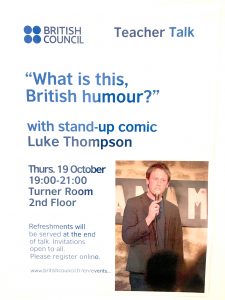
british humour posterLuke’s British Council Teacher Talk – “What is this, British Humour?”

I’m doing another talk on the topic of humour at the British Council in Paris on 19 October. It is also being live-streamed on Facebook. Details below.

Click here to reserve (free) tickets if you’re in Paris.

Click here for the British Council France Facebook Page for the live stream – Thursday 19 October at 19:00 Paris time (CET).


Difficult Words to Pronounce in English: Notes, Word Lists and That Useful Video (below)

  • Focus /fəʊkəs/
  • Fuck us /fʌkʌs/
  • Sting /stɪŋ/
  • Boy George /bɔɪ ʤɔːʤ/
  • Spandau Ballet /spændɑː bæleɪ/

What problems do French people have with pronunciation in English?

  • /h/ sounds
  • /th/ sounds

Part 1 ends here… Part 2 continues below!


  • /r/ sounds
  • Some vowel sounds, particularly certain ‘long’ and ‘short’ sounds, such as…
  • bitch” /i/ and “beach” /i:/
  • shit” /i/  and “sheet” /i:/
  • voiced and unvoiced sounds
  • Paul’s “how to beatbox” with boots and cats

The words & phrases from the TOPITO article – “The Most Difficult Words to Pronounce in English – the hell of /th/ sounds

1. I have a sore throat
2. Squirrel
3. Throughout
4. Bewildered
5. Hierarchy
6. Anaesthetize
7. Threshold
8. Worthlessly
9. Worcestershire
10. William Wordsworth

The TOPITO article (it’s in French by the way) http://www.topito.com/top-trucs-durs-dire-anglais

An academic “focus” on French people speaking English, from Frankfurt University

Phonology
There are some differences in the sound systems of the two languages that can cause French learners problems of comprehension and speech production. Spelling errors may result from the frequent lack of correspondence between the pronunciation of English words and their spelling.

A typical pronunciation problem is the inability to correctly articulate the vowel sounds in minimal pairs such as ship / sheep, live / leave, full / fool. Because the tip of the tongue is not used in speaking French, learners often have problems with words containing the letters th (/θ/ /ð/), such as then, think and clothes.

Another common feature of English spoken by French learners is the omission of the /h/ sound at the beginning of words. This sound does not exist in French and leads to problems such as ‘Ave you ‘eard about ‘arry?, or overcompensation by pronouncing the /h/ in words like hour, honour.
French learners typically have problems with the unpredictable stress patterns of English words, particularly of cognates. (Word stress in French is regular.) Learners may also be unwilling to engage in the prevalent vowel reduction of unstressed syllables in English. Consider, for example, the way that English native speakers swallow the first syllable of the word tomorrow (t’morrow). These problems result in the stereotypical staccato French accent of beginning learners.

From Frankfurt International School Website http://esl.fis.edu/grammar/langdiff/french.htm

TH sounds

/th/ can be voiced [ð] or unvoiced [θ]

A quick guide to producing TH sounds:

  • Stick tongue out slightly
  • Let air pass under/through teeth and over the tongue
  • You don’t need your lips!
  • It’s not /f/ /s/ /d/ /v/ or /z/
  • It’s [ð] (voiced) or [θ] (unvoiced)

Watch my video (below) for more help with /th/ sounds.

More words which learners often find difficult to pronounce

  • Architecture /ˈɑː.kɪ.tek.tʃər/
  • architectural /ˌɑː.kɪˈtek.tʃər.əl/
  • Drawer /drɔː/
  • Colonel /ˈkəːn(ə)l/
  • Comfortable /ˈkʌmftəbəl/
  • Pronunciation /prənʌnsɪˈeɪʃən/
  • Recipe /ˈresɪpi:/
  • Scissors /ˈsɪzəz/
  • Strengths /streŋkθs/
  • Clothes /kləʊðz/
  • Eighth /eɪtθs/
  • Queue /kjuː/
  • Fruit /fruːt/
  • Sixteenth /sɪkˈstiːnθ/
  • Eighteenth /eɪˈtiːnθ/

“Ghoti” is pronounced “fish” (is it?)

This is an old attempt to prove that English spelling makes no sense. Note: David Crystal doesn’t agree.

ghoti

http://www.neatorama.com/trivia/2012/09/09/Ghoti-is-Pronounced-Fish-in-the-English-Language/

David Crystal disagrees with this “ghoti” (See below)

Some Words with Silent Letters

  • bomb
  • climb
  • comb
  • crumb
  • debt
  • doubt
  • government (ok, so the ‘n’ isn’t really silent, but this word has 3 syllables, not 4)

More here: https://mywords.cle.ust.hk/sir/silent_words.php

Also

  • Business /ˈbɪznɪs/ or /ˈbɪznəs/
  • Busy /ˈbɪzi:/
  • Derby (place and a horse race) /ˈdɑːbi:/

L/R (Often difficult for Japanese speakers, or people from East Asia in general)

  • Roller coaster
  • Rarely
  • Red lorry, yellow lorry, red lorry, yellow lorry

My name

  • Luke (correct) /lu:k/
  • not:
  • Look
  • Luck
  • Mr Luck (the most common wrong version, especially in writing)
  • Teacher luck pot cat? (teacher luke podcast)
  • Ruke
  • Ruku
  • Rook
  • Duck??
  • Mr Luke (still not correct – it’s just “Luke” or “Mr Thompson”, although Moz called me Mr Luke as a sort of joke)

Thompson /tɒmpsən/

  • Often pronounced “Tom-sun” in France
  • and pronounced “Tom-pu-son” in Japan

Some rude or funny tongue twisters read by Paul and me

She sells sea shells on the sea shore.
(not rude)

Red lorry yellow lorry red lorry yellow lorry…
(not rude)

I am not the pheasant plucker,
I’m the pheasant plucker’s mate.
I am only plucking pheasants
Because the pheasant plucker’s late.
(don’t say “fucker“)
I slit the sheet, the sheet I slit;
and on the slitted sheet I sit.
(don’t say “shit“)
One smart fellow; he felt smart.
Two smart fellows; they felt smart.
Three smart fellows; they all felt smart.
(don’t say “fart”)
I’m not the fig plucker,
Nor the fig pluckers’ son,
But I’ll pluck figs
Till the fig plucker comes.
(don’t say “pig fucker“)
Fire truck tyres
(repeat it – don’t say “I fuck tyres”)
Mrs Puggy Wuggy has a square cut punt.
Not a punt cut square,
Just a square cut punt.
It’s round in the stern and blunt in the front.
Mrs Puggy Wuggy has a square cut punt.
Six stick shifts stuck shut.
Rubber Baby Buggy Bumpers.

(don’t say “cunt” – really, don’t say that word, it is extremely rude)

She sells seashells by the seashore.
The shells she sells are surely seashells.
So if she sells shells on the seashore,
I’m sure she sells seashore shells.
(not rude)
How much wood would a woodchuck chuck
If a woodchuck could chuck wood?
He would chuck, he would, as much as he could,
And chuck as much as a woodchuck would
If a woodchuck could chuck wood.
(not rude)
Rubber Baby Buggy Bumpers
(not rude)

Betty Botta bought some butter;
“But,” said she, “this butter’s bitter!
If I put it in my batter
It will make my batter bitter.
But a bit o’ better butter
Will make my batter better.”
Then she bought a bit o’ butter
Better than the bitter butter,
Made her bitter batter better.
So it was better Betty Botta
Bought a bit o’ better butter.

(not rude)

http://www.fun-with-words.com/tong_rude.html


Pronunciation practice – repeat after me!

There’s no quiz for this episode – instead I thought I’d make a video so you can practise your pronunciation by repeating after me. Word list with definitions below.

Word List + examples [The definitions are in brackets]

  1. Sore throat – I’ve got a sore throat today [a painful throat, because you have a cold]
  2. Squirrel – I saw three squirrels in the park [cute little animals with bushy tails that live in the park]
  3. Throughout – Squirrels live in this park throughout the year [all the way through]
  4. Bewildered – I was bewildered by all the options [confused]
  5. Hierarchy – There’s a flat hierarchy in our company [a system of levels]
  6. Anaesthetist/Anaesthetise – It’s the job of the anaesthetist  to anaesthetise the patients with an anaesthetic [to give someone an anaesthetic – something which stops you feeling pain]
  7. Threshold – If you earn more than £70,000 you enter the next tax threshold [a level or point where something ends and something else begins]
  8. Worthlessly – I was worthlessly trying to impress her by showing off [in a worthless way – with no worth or no point]
  9. Pass the Worcestershire sauce, would you? [a kind of brown sauce for giving flavour to food]
  10. William Wordsworth was a wonderful writer
  11. live / leave – You have to live a little before you leave this world
  12. ship / sheep – we put all the sheep onto the ship, so the ship was full of sheep
  13. full / fool – The room is full you fool!
  14. Architecture – I love the architecture
  15. Architectural – The architectural style is fascinating
  16. Drawer – The knives and forks are in the top drawer on the left [for example, where you keep the knives and forks in the kitchen]
  17. Colonel – Colonel Sanders founded Kentucky Fried Chicken [a senior officer in the army]
  18. Kernel – Pine kernels can be a delicious addition to a salad [a nut]
  19. Comfortable – Are you comfortable? Would you like a pillow?
  20. Pronunciation is important. You have to pronounce words properly.
  21. Recipe – Can you give me that delicious cake recipe? /  This is a recipe for disaster! [the instructions for how to make certain food]
  22. Scissors – Do you know where the scissors are? [a tool for cutting paper or fabric]
  23. Strengths – What are your strengths and weaknesses? [strong points]
  24. Clothes – I bought some new clothes today.
  25. Months – She’s 18 months old now.
  26. Eighth – Henry the Eighth was a Tudor king of England
  27. Queue – Sorry, are you in the queue? Are you skipping the queue? Sorry, the end of the queue is back there. Yes, we’re all queueing up, we’re not just standing here. Unbelievable. [a line of people waiting for something]
  28. Fruit – Do you have any fresh fruit?
  29. Sixteenth – It’s the sixteenth of October
  30. Eighteenth – It’s the eighteenth of November
  31. Thirteenth – it’s Friday the thirteenth
  32. Thirtieth – it’s the thirtieth of December
  33. Bomb – There was a bomb scare in the station. People were talking about a bombing. I remember when the IRA bombed Oxford Street. [an explosive device]
  34. Climb – Do you want to go climbing with me next weekend? I’m going to climb that mountain on Saturday. You climbed it last year didn’t you? [to go up something steep like a ladder,  a hill or a mountain]
  35. Comb – I’m just combing my hair with a comb. [something that you use to make your hair straight]
  36. Crumb – Why are there lots of bread crumbs on the table? Have you been cutting bread here? There are lots of crumbs everywhere. Can you clean them up please? [little bits of bread or other food]
  37. Debt – (Many students leave university with) thousands of pounds of debt. [money which you have to pay back to someone after you borrow it]
  38. Doubt – There’s no doubt about it. It’s a brilliant film. [something you’re unsure about]
  39. Government (ok, so the ‘n’ isn’t really silent, but this word has 3 syllables, not 4) The government is yet to make a statement.
  40. My name is Luke  (not Mr Luck) Thompson
  41. This is a podcast – not a postcard, or potcard, or pot cast or pot cat. It’s podcast.

 See Paul’s One Man Show #Franglais – http://paultaylorcomedy.com/

By the way, if you’re in France, you really should see Paul’s one man show called #Franglais because it is back in theatres for another run. A lot of the comedy in his show is based around pronunciation differences, including the way people say his name, the way French people say funny things without realising it and more. Check out paultaylorcomedy.com for more information.

Here’s David Crystal’s response to “GHOTI” = FISH

Remember that thing that goes around the internet about how “Fish” should be spelled GHOTI?

Basically David Crystal believes that English spelling is not actually senseless, chaotic or mad. It is complex but it’s not completely random. In fact it is the end result of a fascinating process of development that can tell us a lot about the rich history of the English language.

From a Guardian review of his book “Spell It Out”

‘Crystal shows a brisk impatience with the tradition that likes to pretend that English spelling is senseless. The famous suggestion that you could spell “fish” “ghoti” (gh as in “rough”, o as in “women” and ti as in “motion”) is a witticism often ascribed to George Bernard Shaw but, Crystal says witheringly, has been doing the rounds since the middle of the 19th century. It is, he argues “complete naughtiness. The spelling ti is NEVER used with this sound at the end of a word in English, and the spelling gh is NEVER used with this sound at the beginning of a word.” It doesn’t do, then, to simply throw your hands up and say: “Isn’t our language mad?” The real story is much more interesting than that.’ https://www.theguardian.com/books/2012/sep/14/spell-it-out-david-crystal-review

You can read more about the interesting story of English spelling and what it can teach us about the history of the English language by reading David Crystal’s book “Spell It Out”, which I expect is available from any half-decent book shop.

454. David Crystal Interview (Part 1) Professor of Linguistics

455. David Crystal Interview (Part 2) Questions from Listeners

So, that’s it for this double episode then, thanks for listening!

  • Join the mailing list!
  • Don’t be a ninja hiding in the shadows – write something in the comment section
  • Be excellent to each other and party on!

Luke

483. A Rambling Chat with Moz

The second part of my conversation with my friend Moz, this time covering subjects such as podcasting vs YouTube, bathing naked in a Japanese spa, sharing personal information online (like a story of bathing naked in a Japanese spa), the role of artificial intelligence & social media, murdering mosquitoes and meeting a crack addict on the streets of London. Vocabulary list and quiz available below.

[DOWNLOAD]

Introduction Transcript

Hi everyone, Here’s the second part of my conversation with my friend Moz that was recorded a few weeks ago.

After talking about murder in the last episode, Moz and I kept talking for about another 45 minutes, just rambling on and going off on a few tangents and you can listen to that conversation in this episode as part of your ongoing mission to improve your English by listening to real conversations that actually happened, between actual people who actually said some actual things and actually recorded them and uploaded them for you to actually listen to.

Things that we actually talked about (in the form of questions)

  • What goes into making and publishing a podcast?
  • Who is my audience and where are they (that’s you)?
  • What’s it like to meet members of my audience?
  • What’s the difference between doing audio podcasts and making videos for YouTube?
  • Should native speakers adapt their speech when talking to non-native speakers of English?
  • Does the word ‘cack’ in English relate to similar words in other languages?
  • What does ‘cack’ mean? (it means poo, by the way)
  • How much of our personal information should we be sharing online?
  • How much of my personal information should I be sharing in episodes of this podcast?
  • Should you post pictures of your children on social media?
  • What are the effects of social media and artificial intelligence on our lives? How might this change in the future?
  • How could you fight against a robot invasion using an umbrella and software updates?
  • How much do we hate mosquitoes and what happens when you kill them?
    and
  • How can you identify different drug addicts that you might meet on the streets of London, just based on how they smell?

I think they all sound like perfectly good questions for discussion, don’t you? I can even imagine some of them cropping up in the speaking section of a Cambridge English exam. Some of them. Maybe not the one about cack, or the one about drug addicts, but who knows?

Listen on to find out how we talk about all of those points.

If you’re a vocabulary hunter, check the page for this episode on my website because there you’ll find a list of words and phrases that come up in this conversation.

That list is available in order to help you to use this episode to expand your vocabulary and to develop a more natural form of English.

There is a bit of rude language and some slightly graphic content in this conversation. Just to let you know…

But now it’s time for you to hear the rest of my chat with Moz.

And here we go.


Vocabulary List

  • These days I’m a lot more devoted to it than I used to be
  • When the inspiration struck me
  • I try to be a bit more organised and rigorous about it
  • There are some teachers on YouTube who are getting phenomenal views
  • There are also various young, hip, fresh-faced YouTubers
  • I’m sticking with podcasting because it works for me
  • Technology has moved on so fast that we can do these things ourselves
  • A digital SLR with a boom mic attached to it (or a shotgun mic)
  • Those are the ingredients for making a hit youtube channel
  • Libsyn is my hosting site and I’m about to sign up with iTunes
  • I had to replace all of the embedded players on my website
  • A ‘hell of a lot of stuff’ that had to be done
  • Libsyn have various different filters that they apply to the data
  • The internet is basically this huge network with all these different sub-stations
  • My podcast is big in Wisconsin. It is the home of Ed Gein, the murderer
  • A lot of internet servers are based in that part of America
  • There’s some sort of internet sub-station or routing station in Virginia
  • If people are using VPNs or proxy servers that counts as coming from the USA
  • I’m trying to use an element of scepticism when I’m reading my stats
  • Lots of people are getting my podcast from bit-torrenting sites
  • I tell you what, a good way of working out how many listeners you get…
  • Every now and then someone comes out of the woodwork
  • I used to have the word ‘whittle (down)’ in my tour
  • You get a piece of wood but you slowly etch away pieces of wood to make it into something else
  • People whittle a stick down to a spike or something
  • You whittle the evidence down until you get the bare bones of the case
  • It’s helped me work out the kind of phrases that only English people use
  • Some aspects of our pronunciation or idioms are a barrier to the global community
  • Communication is a two-way street
  • I’ve just come away from dog-sitting with my brother [your brother is a dog??]
  • They were brummie (from Birmingham)
  • Their brummie was so strong that I couldn’t understand my own language
  • It was only when she came nearer that I could grasp what she was talking about
  • Do you curb your language, or do you hone the way that you speak on this podcast?
  • If they’re not careful they swing too far in the other direction and it becomes unnatural
  • It’s a balancing act between trying to be understandable and trying to be natural
  • “Oui, oui” = “yes, yes” in French
  • Wee wee = unrine (pee pee in French)
  • Poo poo = excrement
  • “Caca” = “poo” in French
  • Cack (another English word for poo)
  • Input = just the language you hear when listening
  • Intake = the language you are really focusing on when listening
  • The more personal they (podcasts) are, the more I get engaged
  • Stiff upper lip and all that, hopefully the lip will be the only thing that’s stiff
  • The pianist stops playing
  • I felt like everyone broke off their conversations
  • Naked guys lounging around, chatting
  • The first guy who walks past me is a midget
  • It did occur to me to check him out and see if it was in proportion
  • I don’t necessarily want to open up the doors of my house
  • We don’t really want to post lots of pictures of the baby on Facebook
  • She has remained true to her word

How much of the vocabulary can you remember from the list?

Take the quiz below to find out. Not all the vocabulary is in the quiz, just a selection.

[os-widget path=”/lukethompson2/vocab-quiz-for-483-a-rambling-chat-with-moz” of=”lukethompson2″ comments=”false”]

That’s all folks!

Don’t forget – Moz’s podcast, called “Murder Mile True Crime Podcast” is available now on iTunes and at www.murdermiletours.com.

Moz’s links:

www.murdermiletours.com

www.murdermiletours.com/podcast