Category Archives: Politics

303. The Battle of Britain

This year marks the 75th anniversary of The Battle of Britain, and since this is such a pivotal moment in British history, I thought it would be appropriate to cover it in some way in an episode of this podcast. Also, I was asked recently by a listener in the comments section of my website to talk about the story of the Battle of Britain, specifically the role of one particular group of Polish pilots known as Squadron #303. So, here it is – the story of one of the most important moments in modern British history – The Battle of Britain, and the contribution made by a small group of pilots from Poland.

Small Donate Button[DOWNLOAD]
The Battle of Britain is often cited as a proud moment in British history, particularly by nationalistic Brits who also believe that we shouldn’t let any immigrants into our country. Squadron 303 killed twice as many German fighters as any other squadron, and one pilot in particular became something of a flying legend, with a record number of kills. But the thing is, these heroes of the Battle of Britain weren’t actually British, they were foreigners, fighting in British made Hurricanes and Spitfires. Where did these brave and skilful pilots come from? Poland. So, this episode is not just a history lesson about Britain, but also a bit of a shout-out to my Polish listeners out there – I know there are quite a few of you. If you’re not Polish, then I hope you appreciate the telling of this story of danger, bravery and global warfare.

The Battle of Britain
First of all, this is Churchill speaking, before the battle of Britain begun.
*Churchill speech 1 – “Their finest hour”
So, what was the situation?
It was 7 September 1940.
Northern France was occupied by the Germans, and airfields everywhere were covered in bombers, loaded up and ready to begin bombing raids on strategic targets all over the UK. Hitler was about to take a bit crap all over Britain.
This was a year after Britain had declared war on Germany after Hitler invaded Czechoslovakia and then Poland. It had been a pretty good year for Hitler. He’d basically marched across most of Western Europe and seized it, just like Napoleon and the Romans had done before. Hitler had a pretty effective strategy which we now call Blitzkrieg, or ‘lighting war’ which involved using planes to bomb the crap out of an area before sending in infantry and tank divisions to quickly mop up enemy troops. It was devastatingly effective as it took advantage of speed, mobilised mechanical heavy weapons, surprise and the general disorganisation of the enemy as a result of the air bombing. He used this approach to great effect in the invasion of Poland and then The Netherlands, Belgium, and France. In just one year Hitler’s troops were in control of large parts of mainland Europe.

British forces had been forced to evacuate the continent after effectively being chased away by the Germans. There was a big retreat and escape from France at Dunkirk. It was a military defeat for the Brits who ended up in a pretty desperate situation. The Nazis controlled the continent. The USA wasn’t in the war yet so we couldn’t rely on their full assistance. Britain was basically alone, cut off from the mainland, just separated from the enemy by a few miles of water, waiting to be attacked and invaded by the Germans. Not a good position to be in.

Perversely, this is often the moment that many Brits feel very nostalgic about. As I said, it’s often referred to as our finest hour. I think there may be something in the British consciousness that actually enjoyed the idea of being completely separated from the rest of the continent, as if it clarified the ‘us against them’ attitude of some people. This was perhaps our darkest hour. We faced total oblivion and invasion by the nazis. Certainly, thousands of Brits were going to be killed. Beloved properties and national monuments would be destroyed in the bombing, but for some Brits looking back on the Battle of Britain, this was a moment to be proud of, like it made us a great nation. I suppose the reason people say that is because it was a time when Britain showed some character and spirit. The whole country sort of pulled together and formed a united front. Churchill made his famous speech.
*Churchill Speech 2 – “We shall fight them on the beaches”

It was rousing stuff. Ultimately, Britain survived the invasion attempt. People feel proud of that.
But, it’s ironic that many of the people today who are still nostalgic for that moment are also the ones who preach a certain kind of politics – anti-immigration, nationalistic values, something approaching a kind of English or British fascism. They’re the ones who love that moment when Britain was alone, facing the invading hoards from the continent. It’s ironic because during that battle we were fighting against fascism. Now it seems that it’s the fascists at home who like to remember it.

Anyway, it looked pretty bleak for Britain.
Hitler decided that before attempting any kind of land invasion, he would attempt to thoroughly smash The UK from the sky. He planned to target industrial centres in the big cities, key points of infrastructure and even some national monuments and residential areas. The aim was to cripple the country, both physically and mentally. Ooh, scary stuff.

So, on 7 September 1940 the Luftwaffe were all ready and prepared to launch operation.

Britain at this moment was steadily making weapons from anything they could get their hands on. All heavy metals were being thrown into factories. All the money was being spent on defence and weapons. A lot of Brits felt the squeeze. Obviously it wasn’t as bad as in the occupied countries, I imagine. I don’t know, I wasn’t there. But I imagine having a bunch of nazis from another country marching around your home town making themselves comfortable was rather difficult to take. So the Poles, the Czechs, the Belgians, Dutch and French (well, most of them anyway) were no doubt having a pretty awful time too, not to mention any other nations that I haven’t mentioned. This was a world war of course – so if I don’t mention your country in this episode I am sorry. This is after all the Battle of Britain.

Anyway, Britain was preparing itself for a rather bad time. A lot of planes were being constructed, men were being trained to fly and fight in the air.

The Germans were feeling pretty good about themselves. Morale was high. They’d just walked all over Europe and felt on top of the world. They basically felt absolutely superior. Whipped up by the rhetoric of their charismatic (albeit completely insane) leader, they’d been led to believe that the world was theirs and this was the natural order of things. Wrong.

So, the nazis were pretty chuffed and probably couldn’t wait to have a go at Britain, this global superpower of the time.

This was the biggest aerial attack of World War 2 so far. At 5pm on 7 September the first wave of bombers reached their targets in London. Apparently the sound they made was pretty scary. A kind of low, depressing drone sound. Ominous.

It was a Saturday afternoon in London. When I think of Saturday afternoons back home I think of tea, sandwiches, football with my Dad. I don’t imagine death from above, or death from any direction for that matter. The planes targeted the industrial areas, but a lot of workers lived right next to them and their homes got bombed too.

But that was just the beginning. What followed was a rain of bombs that no other city had ever seen in history. 12 hours of bombing without a break, continuing through the night. A lot of people died, and others were convinced they would follow.

How did the pilots feel? According to interviews they just hoped that they’d hit their targets, but they knew that civilians were probably getting killed. Really, they were a bit cut off from what was happening on the ground. I expect they didn’t feel too proud of themselves.

For the British people, particularly Londoners I think this bombing created hopelessness in some, but also a gritty determination in others, as well as a visceral hatred of the germans.

The fires caused by the bombing lasted for 57 nights, and in fact these fires were more damaging than the bombing raid.

The Nazi strategy was to continue to bomb, terrorise and demoralise the nation. Hitler expected Britain to give up and surrender to Germany, so he could then turn his attention on the East. He knew that it would be unwise to attempt to invade Russia (correction: The USSR) while also fighting on the Western front. So victory in the west was a crucial part of his plan. He expected Britain to surrender. He underestimated us.

It became a battle of wills, embodied by two men – Hitler and Churchill. It was Churchill who rallied the British people. He inspired them to carry on. He echoed the sentiments of the nation, that they would never ever surrender.

*Churchill Speech 3 – The Blitz*

Hitler didn’t expect Churchill to refuse to deal with him. This may have been a bit of a surprise. Britain was not going to be a walkover.

The German air force had already knocked out a lot of our warships in the English channel and planned to launch surprise air attacks on England, but England had a technological advantage: radar. This is now used in airports all over the world. It’s a kind of tracking device to monitor the skies. Radar was used as an early warning system, to let the RAF know if German bombers were on their way to England on missions. This allowed the RAF to scramble fighter planes into the skies in order to engage the German parties in combat. The Luftwaffe had no idea that radar even existed, so when RAF planes suddenly turned up to meet them in the skies it must have been a bit of a surprise. The fighting in the sky was essentially a duel of fighter pilots in single-man planes. Dog fights, one on one battles. Tracers from bullets flying through the sky. Chaos and destruction in the air.

It must have been incredibly frightening for the pilots. So many people were killed. Dogfights lasted seconds. It was a question of being aware of your surroundings and planning your attacks. If you had the right strategy you’d have the advantage and you’d find the enemy in a vulnerable position from which you could open fire and take out the plane. If your strategy was bad, you’d leave yourself open to attack.

The Germans were flying Messerschmitt 109s, the Brits in Hurricanes and Spitfires.

There were so many deaths during these fights that the pilots accepted that they would almost certainly die sooner or later. Everyone just expected to die. Imagine how that felt for these men. Living like that, in the knowledge that tomorrow or the next day, would be your last. What would that do to your mind? I’m sure it was the same for both sides. For the Germans there was the added fear that they would run out of petrol, or that they would be forced to crash land in enemy territory and then taken captive. The German pilots were forced by their superiors to always accompany the bombers, even if their smaller planes were running out of fuel. Sometimes these amounted to suicide missions for the fighter pilots who simply didn’t have enough fuel for the whole mission. Many pilots drowned as they had to bail out of their planes, landing in the English channel, miles away from the land.

Many wives, mothers, sisters and girlfriends lost men who were close to their hearts, again on both sides.

Women didn’t all stay at home worrying though. In the RAF the Women’s Auxiliary Air Force were an integral part of the British defences. They worked in the operations room and helped to coordinate the fighters.

So, in the summer of 1940 the Germans failed to break the RAF. That’s when Hitler decided to launch the large scale bombing attacks on London and other locations, and that was the true beginning of the battle of Britain.

Like on 7 September, waves of German bombers came across the channel, and RAF planes took off to meet them, engaging them in mid-air. The German bombers were well armed with machine guns, and also flanked by fighter planes too, which engaged the RAF in more one-on-one dogfighting. There were a lot of bullets in the air. The German escorts managed to keep the RAF at bay, allowing the bombers to continue to London. Large parts of the city were reduced to rubble. To this day, it remains one of the characteristic things about the city – there are gaps in the old buildings in which more modern buildings have been constructed. It doesn’t have the consistency of a city like Paris, because large parts of the city were completely destroyed during the war and then re-built later. Of course it wasn’t just London. All the main industrial cities took a beating, particularly Coventry in the midlands which got absolutely smashed in a huge bombing raid. It’s very sad. It was a beautiful and proud city with a magnificent cathedral. That’s now gone and is replaced by more modern structures, but something essential was lost, and for years Coventry was like a ghost town for the people growing up there in the aftermath of the war.

Londoners had to hide from the bombing in cellars under houses, or in specially made bomb shelters, even in underground stations like Oval in South London.

Between September and November 1940 London was bombed over 300 times. Thousands of individual bombs were dropped. London’s children were evacuated, meaning they were sent away for their own protection. Most of them went north into the countryside, away from the industrial targets. That must have been a very emotional moment, having to say goodbye to children and parents. I expect many of the parents thought they’d never see their kids again. Some children were taken all the way to Canada from Liverpool, and many were killed when their ship was torpedoed by a German submarine.

Back in London, the RAF with their radar and the brilliant Spitfire fighter plane had something of an advantage in the air, although it was a very slight advantage. Goering the military commander did not achieve the results he’d hoped for and decided to carry out all his bombing raids on London at night. The skies were lit up with fire as London burned, and with the lack of accuracy in the dark many residential areas all around London were hit and many civilians were killed. Nevertheless, Londoners kept their morale and managed to carry on as normally as possible during the day. Clearing up bomb damage but also attempting to go about their daily business. This is one of the things that kept the Germans at bay. The spirit of the people of Britain. Perhaps that’s what makes people so proud and causes them to say that this was Britain’s finest hour.

But the normality of daily life came to a sudden stop at approximately 5pm every day when everyone got into bomb shelters and the raids began again. Even though many people managed to carry on, I’m sure that many of them were basically walking around like zombies, expecting it all to be over by the end of that day. Many of them were ready for surrender, but they didn’t.

*Audiobook recommendation – “The Battle of Britain: From the BBC Archives”

The bombing continued all the way into the next year, until May 1941. Hitler called off the attacks on Britain, choosing instead to focus his attention on the east and Russia (Correction: USSR). However, that proved to be a problem for him because it left him open in the West, and later when America joined the war, Britain became a vitally strategic position for the allies. It was from the south coast of England that the allies launched their major counter attack against the Nazis with a land invasion in Normandy, Northern France which ultimately led to allied forces getting all the way to Berlin. Despite being a hero to the Brits, Churchill didn’t emerge from WW2 completely clean. There were large scale bombing raids on Germany from Britain, including the destruction of Dresden and massive damage to Berlin, largely as a response to the attacks on British cities.

In the east the Nazis struggled through bitterly cold and tough conditions fighting against the Russians (I mean Soviets). Many many Russian (Soviet) lives were lost as well as Germans. Ultimately Hitler couldn’t sustain a war on two fronts. The size and resilience of the Russian army (Red Army) in the east proved too difficult for Hitler, but also his inability to crush the spirit of the Brits left him open on that side too. The Battle of Britain proved to be Hitler’s first major defeat and was a decisive moment in World War 2, representing a turning point in favour of the allies. Nazi soldiers didn’t put a foot on British soil. The invasion never happened.

But that’s not the end of the story, because I’d like to turn my attention to a particular squadron of pilots who made an extraordinary contribution to the Battle of Britain, a contribution that could have made all the difference. During the battle, Britain was hanging on by its fingernails. Every single day of combat, British resources were stretched to their absolute limit. Dozens of pilots and planes were lost every day over British skies. They couldn’t have carried on much longer. If Hitler had continued, he would probably have crushed the British spirit, but he didn’t and Britain managed to hold on just long enough to keep the Germans at bay.

Churchill called it Britain’s finest hour, and famously said that “Never was so much owed by so many to so few”.
*Churchill Speech 4 – “Never was so much owed by so many to so few”

What gave Britain the edge? Well, it was partly radar, partly the brilliantly engineered Spitfire – which was specifically made as a bespoke fighter to keep up with and out-speed the German planes, while holding extra fuel to keep pilots in the air longer. The Spitfire is now a national icon, and it has to be said, is a rather beautifully designed plane, with its rounded and curved wings and fuselage.

But also it was the individual pilots involved in the fighting. There was one squadron which stood out, the 303rd. You might imagine them to be a band of plucky young British gentlemen, but in fact they weren’t. These men who may have saved Britain were in fact foreigners, from Poland.

303 Squadron
303 squadron was one of 16 Polish squadrons who flew with the RAF during the Battle of Britain. They were pilots who had flown against the Germans previously, but who had escaped to England when Poland was invaded. They turned out to be the highest scoring RAF squadron during the Battle of Britain. One of the pilots in particular was not in fact Polish but of Czech origin and was called Josef František. He is perhaps the most famous member of the squadron and is famous for being one of the highest scoring allies in the Battle of Britain.

The squadron chose its own name, The Kościuszko Squadron – named after another flying squadron that had taken part in the Polish/Russian war of the 1920s. In fact the 303 contained some members of that squadron. So they were already a pretty distinguished flying team. It was made up of about 21 pilots and a number of ground staff, and what was the prime reason for their success during these air battles? Anger and a vicious hatred of the nazis. This was like a high-energy fuel for these men, who just couldn’t wait to take down Nazi planes at the earliest opportunity.

But their opportunities were slow to come. The team was based in Northolt in England, and were assigned two RAF officers to look after them. The officers were responsible for training the Polish pilots in RAF protocol, but also in the basic English necessary to follow orders and instructions. So, before the pilots even got a chance to take to the skies, they were forced to sit through weeks of English lessons, and I imagine in those days it was pretty mind numbing stuff! There was no LEP that’s for sure.

Apparently the Polish pilots were so desperate to get at the Germans that during a training flight, when a party of German planes was spotted in the vicinity, one of the Polish pilots, called Ludwik Paszkiewicz, broke formation and tore after the German planes engaging them in combat. He shot down a German Messerschmitt Bf 110. The RAF officers were convinced and the next day the squadron was immediately put into action. This was the beginning of an incredible run of missions in which the 303 squadron scored a record breaking number of kills in the air. Apparently, these guys were absolutely incredible. Again, fuelled by a bitter hatred of the Germans, the pilots just pushed everything that bit further, going out of their way, taking incredible risks to take down as many planes as possible. But also, their use of British Hurricane fighter planes was a big advantage for them too. Previously they’d flown planes that were less powerful and less well-engineered. This had honed their flying skills considerably. IN their previous planes they’d been used to having to fly much closer to the enemy in order to get accurate hits. In the Hurricanes, with their increased speed and firepower the pilots continued to fly very close to enemy planes like they had done before, but this time the results were devastating. The German planes didn’t stand a chance. Later the squad were equipped with Spitfires and this made all the difference.

No. 303 Squadron claimed the largest number of aircraft destroyed of the 66 Allied fighter squadrons engaged in the Battle of Britain, even though it joined the fray two months after the battle had begun.

Josef František was a particularly successful pilot. He was considered by his commanding officers to be ill-disciplined and a danger to other pilots when flying in formation, but he was devastatingly successful at taking down Germans. In the end, he was given the right to break formation and go out on solo missions to pick off as many enemy planes as he wanted. In this way František was able to fight his own private war against the Germans, allowing him to take down at least 18 planes in one month, and was awarded the Distinguished Flying Medal.

Sadly, on 8 October 1940, František’s Hurricane crashed in Ewell, Surrey during a landing approach after a patrol. Reasons for the crash are not known, but according to some theories, he may have been making aerobatic figures to impress his girlfriend, or it might have been a result of battle fatigue and physical exhaustion. So he never lived to see the end of the war.

The success of 303 squadron in combat can be mainly attributed to the years of extensive and rigorous pre-war training many of the long-serving Polish veterans had received in their homeland, far more than many of their younger and inexperienced RAF comrades then being thrown into the battle. Tactics and skill also played a role, as well as a daring commitment to bringing down the enemy; on one occasion, No. 303’s Sgt Stanislaw Karubin resorted to extreme tactics to bring down a German fighter. Following a prolonged air battle, Karubin was chasing a German fighter at treetop level. As he closed in on the tail of the German fighter, Karubin realised that his Hurricane had run out of ammunition. Rather than turning back to base, he closed the distance and climbed right above the German fighter. The German pilot was so shocked to see the underside of the Hurricane within arm’s reach of his cockpit that he instinctively reduced his altitude to avoid a collision and crashed into the ground.

After World War 2, Poland was occupied by Soviet forces and its borders were redrawn as part of the 1945 Potsdam Conference. Poland became enveloped in the Soviet Union (correction: Not the Soviet Union, but the Soviet controlled Eastern Bloc), behind the iron curtain. I’m not sure how many Polish people feel about what happened after world war 2. I understand there is some bitterness at the allies, and probably Britain in particular about this, that perhaps we sold-out the Polish or forgot them, or betrayed them by not securing their freedom. Many sad things happen at an international diplomatic level during or in the aftermath of war. They’re regrettable. I wonder how the Poles generally view Britain these days. Is there resentment there? Or is that just a thing of the past. I hope we can all let bygones be bygones.

Nowadays a lot of Polish people live and make their living in the UK. In London for example there is a very large Polish community. Where I used to live in Hammersmith there is the Polish cultural centre just up the road, and many Polish people live in the area. I guess for many of them it’s a chance to get more opportunities for living in the UK, and I’m pretty proud to be part of a country that offers opportunities for people from other countries, and it’s clear to me that residents from other nations can bring a lot of skills and benefits to the country they move to. I’m not one of these people who complains about immigrants stealing people’s jobs. Immigrants are often skilled people who can contribute a lot, as we saw from the example of the 303 Squadron, who might have given the RAF an edge over the Germans in the Battle of Britain. Maybe they saved the day and helped Britain stay free, allowing us all to indulge in these nostalgic memories about our “finest hour” in which we stood up to the Nazis when all hope was lost.

That is the end of the story and that’s the end of this episode. Please leave your thoughts on the page as usual. Have a good day.

Luke
BR2

7 Reasons Why The Brits Should Love the Poles (Thank you Piotr Perliński)
301. David Cameron & The Pig / Bad Gig Story / Who is Ronnie Pickering? (A rambling episode)

In this episode I’m going to have a bit of a ramble about some stuff that’s in the news at the moment and a few other things that have come into my brain. I’m not going to teach you anything specific in this one, no language anyway – just some bits and pieces about modern day British life. So generally I’m just going to keep you company for a while and talk to you one to one for the duration of the episode. Just you and me, and perhaps a bus load of commuters.

Small Donate Button[DOWNLOAD]
Download “The In Sound from Way Out” by Beastie Boys on iTunes, here.
Here’s a made-up agenda for the episode:

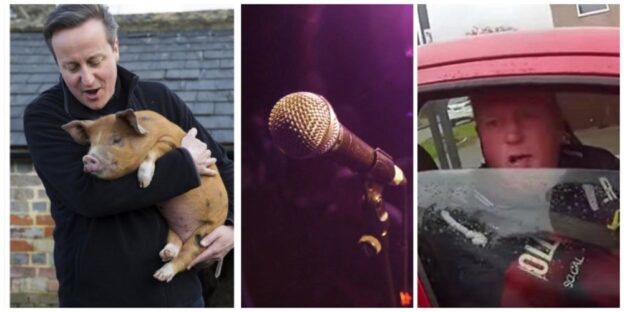
1. The UK political situation, and trending news relating to it – this is less boring than you might expect because it seems from recent reports that our Prime Minister David Cameron once had sex with a dead pig. Seriously. (Did PM David Cameron really have sex with a pig? What’s all this about Jeremy Corbyn? What’s going on?)
2. “Sorry, we’re English”
3. Tell a story or anecdote about something.
4. Who is Ronnie Pickering?

In the next episode:
5. A trip to the dentist in Paris.
6. Star Wars Episode VII: The Force Awakens – I can hardly contain my excitement, but I am attempting to avoid the hype.
7. OPP: The Adam Buxton Podcast
8. In my headphones recently: The Juan MacLean “A Simple Design”, The Who: “Who Are You?”, Erland Oye: “Lies become part of who you are”, DJ Krush & Ronny Jordan: “Bad Brothers”, Leyla McCalla: “Heart of Gold”. (Plus, the intro song: “Groove Holmes” by Beastie Boys)
9. Jingle news: Possible new jingle in the pipeline
10. Jarvis Cocker
11. That’s probably it, isn’t it?
301b
[socialpoll id=”2300547″]


289. California Road Trip (Part 2) History of California / Life in L.A. / UK & US English

Here’s the next part of my description of my recent trip around California. This is a description of my honeymoon, but I’m also going to tell you about the cultural, geographical and historical context of the places we went to, and I’ll give you some practical tips and teach you some British and American English too. This is part 2 of the California series. Let’s carry on.

[DOWNLOAD]
In part 1 I told you about the itinerary for our trip, some of our first impressions of arriving in L.A., some notes and advice on customer service and dealing with waiters & staff, some stuff about the car, an audiobook recommendation and California’s marijuana laws. So, let’s carry on in this episode. First of all, I’d like to give you a brief history of California, because it helps to understand what the place is all about when you learn about its history.

A Very Brief History of California Source: http://michaellamarr.com/cahistory.html A paraphrased and reduced version.
California is known as the golden state, because of the sunshine but also because of the gold that was found there in the mid 19th Century. But let’s go further back to consider the first people to have populated California, a long long time ago (but not in a galaxy far far away this time).

Small Donate ButtonPeople arrived in California about 12,000 years ago. They were descendents of the people who travelled across the Bering Strait from the Asian continent about 40,000 years ago. They travelled into North America to follow food – migrating herds of animals probably. At that time it seems that Alaska and what is now Russia were connected by an exposed stretch of land which later was covered over when the sea level rose, separating America and Russia (or the Asian continent). Those people became the first Native Americans. They eventually found their way to the area we now call California. They lived there in various tribes in different parts of the state, undisturbed for a long time.

Then, in the 15th and 16th centuries, Europeans began travelling across the Atlantic and America was ‘discovered’. It was the Spanish, with Hernando Cortez initially, and then other explorers who were the first Europeans to enter the area that we now know as California after fighting the Aztecs and developing a Spanish colony in Mexico. The Spanish attempted to settle in California and find a route they could use to sail their ships from the Atlantic coast to the Pacific coast, but they the failed to find one after lots of attempts, with some competition from Sir Francis Drake who to the English is a great explorer, but to the Spanish is a pirate who raided early Spanish settlements, stealing lots of their silver. The Spanish found it hard to settle in California because of the difficult access from the Atlantic side and because of clashes with the native people so they ignored California for about 150 years, although they had named the areas of America that they’d ‘discovered’ and claimed “New Spain”.

It’s not entirely clear how California got it’s name but it seems that the most popular theory is that it comes from a romantic adventure story by Garcia Ordonez de Montalvo called “Sergas de Esplandian” or “The Adventures of Esplandián” (1510). This story tells of a mythical island called California, which is populated by a race of beautiful and powerful Amazonian warrior women called the Califia who are ruled by the formidable Queen Califia. In the story, which was a very popular and well known one, the Califia were warrior women “of vigorous bodies and strong and ardent hearts and of great strength.” The queen and her warriors would go on adventurous missions, fly around on griffins (griffins are legendary creatures with the body, tail, and back legs of a lion; the head and wings of an eagle; and an eagle’s talons as its front feet) that lived on the island and would capture and kill men they come upon during their travels. Any man found in their domain they would eat. Califia or California in the story is presented as a mythical place near the real world. The island is described as a kind of paradise filled with gold and precious stones.

The original Spanish settlers who came to the area first thought that California was an island, and perhaps it was similar enough to the mythical island in this story that the settlers were inspired to use that name. The story was well known and popular enough, and some believed it was based on an older myth which was part of an oral Spanish tradition. Some people may have believed it was true and this place really existed. Maybe they thought they’d arrived there for real, or maybe they were just inspired by a good story. It’s not entirely clear, but what we do know is that, essentially, California is named after a beautiful and powerful Amazonian warrior queen, who used to fly around on a griffin and eat men for breakfast. Pretty crazy, right? It sounds like something from an Arnold Schwarzenegger film from the 80s or something. It just shows that California has had a fairly long tradition of grand, glamorous and sexy myth making and story telling associated with it.

In 1765 a man named Jose de Galvez, who was an official to the Spanish king decided it was a good idea to have another go at claiming New Spain properly, before the English or the Russians did it. He managed to convince the King to let him go on a mission there, with the intention of claiming the land and spreading the Romain Catholic faith. Although it was a very difficult mission with lots of hardship, ultimately it was successful and several missions (Christian bases) were set up on the Californian coast, including Monterey Bay and San Francisco. The Spanish missionaries managed to convert a number of the local natives into Catholicism, but this was largely due to the threat of violence or because they pacified the natives with offerings of supplies and tools that they’d never seen before, although saying that I’m sure the natives were also genuinely impressed by these new people who had arrived and may have seen them as being sent by god. Again, things didn’t go completely smoothly because there was resistance from the locals who did fight back, but in the end the Spanish were numerous enough and powerful enough to withstand these resistance movements from the Native Americans, even though unfortunately this meant that a lot of native people were killed and severely punished in the process. This is all part of the story of how the Native Americans were eventually almost completely wiped out in the long population of America by Europeans.

The Spanish settlers and missionaries built forts at strategic locations up the California coast. These were basically protected bases which helped them defend their territory against angry natives or possible invasion by other countries wanting to take this beautiful and rich land that they had managed to claim. To provide food for the people in these missions or forts, pueblos were created around them. These were basically towns with farms that could produce food. These places eventually grew and developed to become cities like Los Angeles, Monterey and San Francisco.

Then there was a war of independence in 1810 which ended in 1821. This is a similar story to the war of independence against the British which was fought on the other side of the country. The colonies in New Spain were fed up with the way they were being ruled from Spain and felt they didn’t have enough freedom or independence. The people of New Spain won that war and set themselves up as an independent government under the name of Mexico. The Mexican government took control of New Spain and decided that the missions had too much power, and closed them, freeing up the land previously owned by the missions. The priests in the missions were still allowed to operate churches there, but the land was to be divided between Mexican settlers and the Native Americans. The thing is though, the Native Americans had no real understanding of the concept of land ownership so they either didn’t want the land, didn’t understand that it could be given to them, or didn’t know how to deal with it because they’d been living in the missions so long that they were now dependent on the Spanish and Mexican settlers who ran the place. Some native Americans managed to return to their way of life, and some tribes of natives in California had managed to avoid being captured by the missions so there were still Native Americans in California at the time, but the coastal colonies continued under Mexican control. The Mexicans in California did lots of trade with people from many other places during this period, which enriched the area with the influence of different cultures. Presumably these traders came from Russia, Asia or Europe.

Some people, mainly fur trappers, managed to make the very difficult journey from the East coast by land. Remember that it took me 6 hours to fly from New York to LA? Well in the early 19th century it would have taken years to make the journey and in the beginning only the toughest and wildest people could make the journey, which was essentially a massive exploration into unknown wilderness populated by native tribes and dangerous wildlife like grizzly bears. But, some fur trappers made it to California in the first half of the 19th century. These fur trappers were really tough explorers who travelled west in search of valuable fur pelts – basically the skin and fur of different animals. Beaver was perhaps the most sought after pelt. Why? Because beaver fur was used to make top hats in Europe. You know those tall hats the Victorians used to wear? They were made from beaver fur. It’s light, strong, glossy and warm. Perfect material for a good hat, so there was plenty of demand for beaver fur as well as other animals. The first fur trappers must have been very tough guys who were almost as wild as the natives they met along the way. In fact many trappers got to know the natives and learned a lot of their knowledge to help them survive in the American wilderness. Imagine the challenge of crossing rivers, mountain ranges, deserts, canyons and forests. We’re talking about epic journeys.

By the mid 1800s the independent Nation of the USA was very keen to extend its territory to the west, in order to populate and claim that whole stretch of North America from east to west. In fact the prevailing ideology of the time was a strong feeling that the United States had almost a god given right to claim the land, and that it was the destiny of the USA to do so. This is the idea of manifest destiny – That the USA felt the land was theirs for the taking and that they had the god given right to take it. James Polk was the president at this time and he decided that he wanted to take the lands of Texas, New Mexico and California. Texas was a country in its own right at the time after having broken away from Mexico, and New Mexico and California were still owned by Mexico.

By this time – about 1840. More and more settlers had followed the fur trappers west and had settled in California. This included a man called John C Fremont who was an officer in the US army. He led a brigade of 60 men into California and met Colonel Jose Castro of the Mexican army in Monterey. Castro (no relation to the Cuban leader who came much later, I think) sent the US soldiers out of California, but this army brigade were determined and later re-entered California, gained the support of some of the settlers there and started a revolt in Sonoma, flying the flag with a star and a grizzly bear – the flag of California, and they pronounced it “The California Republic”. This coincided with the general aggressive movement into Texas and New Mexico by President Polk’s US army. Fighting between the USA and Texas had started along the Rio Grande river and this fighting eventually reached California. The bear flag rebels joined the US army during this war and fighting continued into 1848 when when the Treaty of Guadalupe Hidalgo was signed, ending the war. The treaty brought peace to California and also stated that Mexico had to give more than 525,000 square miles of land to the USA. This included the areas between Texas and California, and marked the extension of the USA’s territory from east to west coast.

What happened next was that gold was discovered in California and this changed everything. The first discovery of gold was in 1848 in the Sacramento valley, which is between San Francisco and the Sierra Nevada Mountains, and that caused a few hundred local Californians to move there, and a thousand or so outsiders. A lot of them struck gold and became very rich. Word of this travelled quite far, and fairly quickly. By early 1849 many people around the world had heard the news about gold being discovered in the new world in California and instantly thousands of people were infected with gold fever. “There’s gold in them there hills!”

1849 was the big year for the California gold rush. Something like 100,000 people travelled to California in that year. The people who travelled there are known as the 49ers (which explains the name of the American Football team from San Francisco). About 60% of the 49ers were from America, but the rest came from other countries all around the world and many of them settled in California long term, again adding to the diverse culture of the place. The Chinese certainly moved there in large numbers. Something like 20,000 in total, and many of them settled in the nearest port – San Francisco, which is why there is a large Chinese community there in Chinatown today. 100,000 people is a massive influx in just one year, and the gold rush is certainly one of the most significant moments in American history. By the end of 1849, the non-native population of the California territory was some 100,000 (compared with the pre-1848 figure of less than 1,000). A total of $2 billion worth of precious metal was extracted from the area during the Gold Rush, which peaked in 1852. The non-native population grew by about 1000% in about 18 months following the discovery of gold. This represented a massive injection of culture, development and wealth into California. San Francisco for example, quite quickly became a large metropolis.

What about the native Americans? It wasn’t a good time for them. Essentially, The USA’s expansion west, particularly in search of gold and land just didn’t fit in with the way of the life of the natives. The two cultures just couldn’t live together, and because the American settlers were more numerous, had better technology and weapons, and because the Native Americans were vulnerable to diseases carried by the settlers, the natives just couldn’t hold on to their way of life and were either killed or forced to live in limited areas known as reservations. It’s sad, because the Natives were people who had learned to live in harmony with their environment, and then they basically got wiped out or forced off their land, and treated like animals. It’s heartbreaking really.

By about 1852 even though the surface gold had basically disappeared, lots of people continued to make the journey west in search of their fortune and a better life, and they continued to make that journey for decades as California continued to be seen as a place where people could have a better quality of life.

The 1930s saw another fairly big movement of people into California in search of a better life as a result of the great depression and the dust bowl across the midwest. The dust bowl was basically a huge drought in the early 30s in large farming states from Texas to South Dakota – a big stretch all the way up the middle of the country. There was a huge drought (no water) and so all the crops failed and the earth turned to dust. Within a couple of years there were huge storms that carried the dust into the sky and far along the ground. This made it almost impossible for families to live and grow crops so many of them just left the area and made the arduous journey west towards California in search of a better situation.

Another Audiobook Suggestion
“The Grapes of Wrath” by John Steinbeck
John Steinbeck lived in Monterey, so I thought I’d pick one of his books, and I think this one is probably his most celebrated work. It has a rating of 4.5 out of 5 on audible, which is really high, and the book is widely considered a great classic of American literature. Written in 1939 after the great depression of the 1930s the book follows the story of a family from Oklahoma who are forced to make a long journey across America to live in California. It tells their personal story of the difficulty of the journey, but in doing so it manages to capture the epic narrative of a whole migration of people into the American west. Steinbeck creates a drama that is intensely human yet majestic in its scale and moral vision, tragic but ultimately stirring in its insistence on human dignity. Here’s a quote from a listener’s review: “From start to finish each one of the characters, because they were so well formed and realistic, evoked empathy but never to the point of pity. Every character bore their share of hardship. You walk away from this experience feeling stronger for having been in their company. These were people to be admired.” R. Solomon from New Hampshire.
www.audibletrial.com/teacherluke The Grapes of Wrath by John Steinbeck. Pick the version read by Dylan Baker. It’s unabridged.

A Brief(ish) History of California (continued)
The gold rush was a really important time for America, and the great depression of the 1930s. The migration into the west which was involved in both situations, and to a larger scale across the whole previous century of American history at that point was the embodiment of the American dream. The idea that anyone was free to start from the bottom and if they had the strength and courage they could make their own fortune by driving west, claiming their own plot of land, and delving into the rich American soil to produce shiny gold and riches, or an escape from hardship into liberty! These days people still go west in search for a fortune or some sort of everlasting freedom, but not because of gold, but in search of stardom on the silver screen. Los Angeles and the Hollywood star machine continue to be an attractive goal for many people, although it’s nowhere near the same scale as the original gold rush.

Nevertheless, California maintains its image as the golden state and is still considered to be a golden land where fame and riches can be found. Generations of immigrants have been attracted by the California Dream. California farmers, oil drillers, movie makers, airplane builders, and “dot-com” entrepreneurs like Steve Jobs, Bill Gates and Mark Zuckerberg have each had their boom times in the decades after the Gold Rush. California is also a very popular destination for tourists, holidaymakers and honeymooners, and dreamers. It’s still associated with the American Dream and all that it offers.

But that vision of America may eventually have its downside when you’ve basically made it across the country, you’ve made it to the golden land, the gold has run out and yet the dreams remain. What seems to happen is that people lose it a a little bit, or feel that their idealism and perhaps naivety are challenged by the final frontier – the frontier of inner space or spirituality or just general meaning to life. That may be why people are pretty ‘far out’ here – there’s lots of spiritualism, yoga, new age thinking and so on. Perhaps that’s why they’re into movie making too. It’s the dream factory. Also, there’s plenty of entrepreneurialism in business technology, especially into another frontier – cyberspace, as I mentioned earlier with Facebook and other software and social networking companies. In fact here’s a list of companies in the bay area of San Francisco: Facebook, Pinterest, Tesla, Hewlett Packard, Quora, TuneIn Radio, Google, Skype, PayPal, Logitech, LinkedIn, Groupon, Uber, Android, Intel, Apple, EBay, AOL, Yahoo.

LA Continued…
We drove downtown to have a look around, get some food, get used to the place, take it easy a bit, do some shopping.
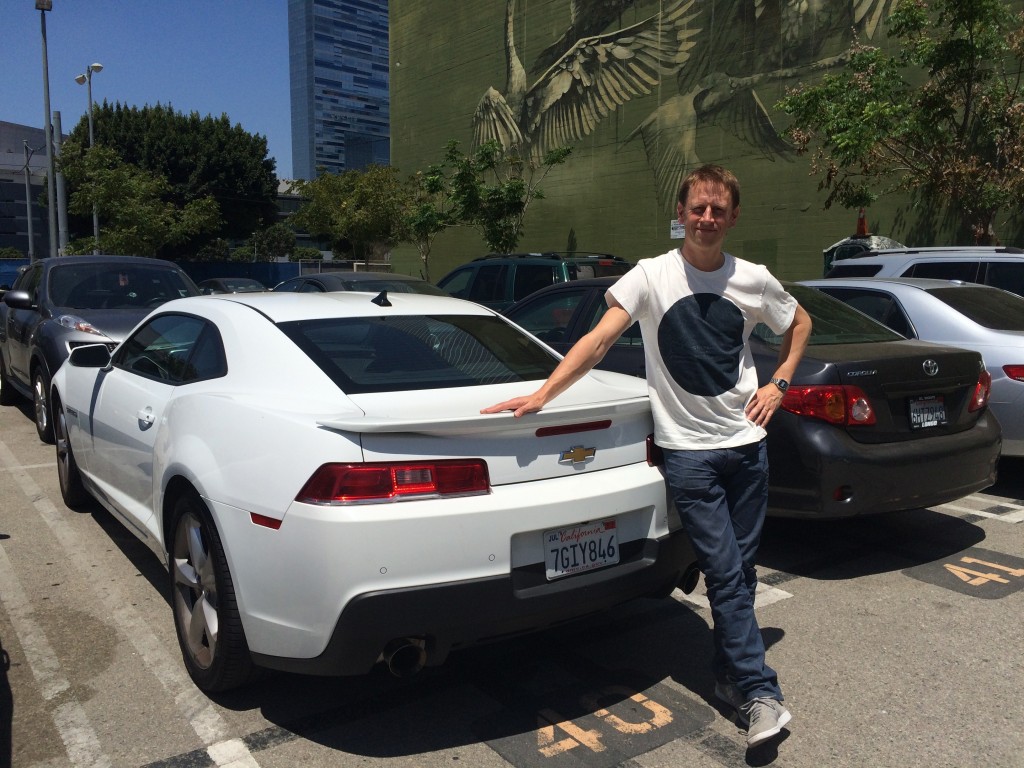
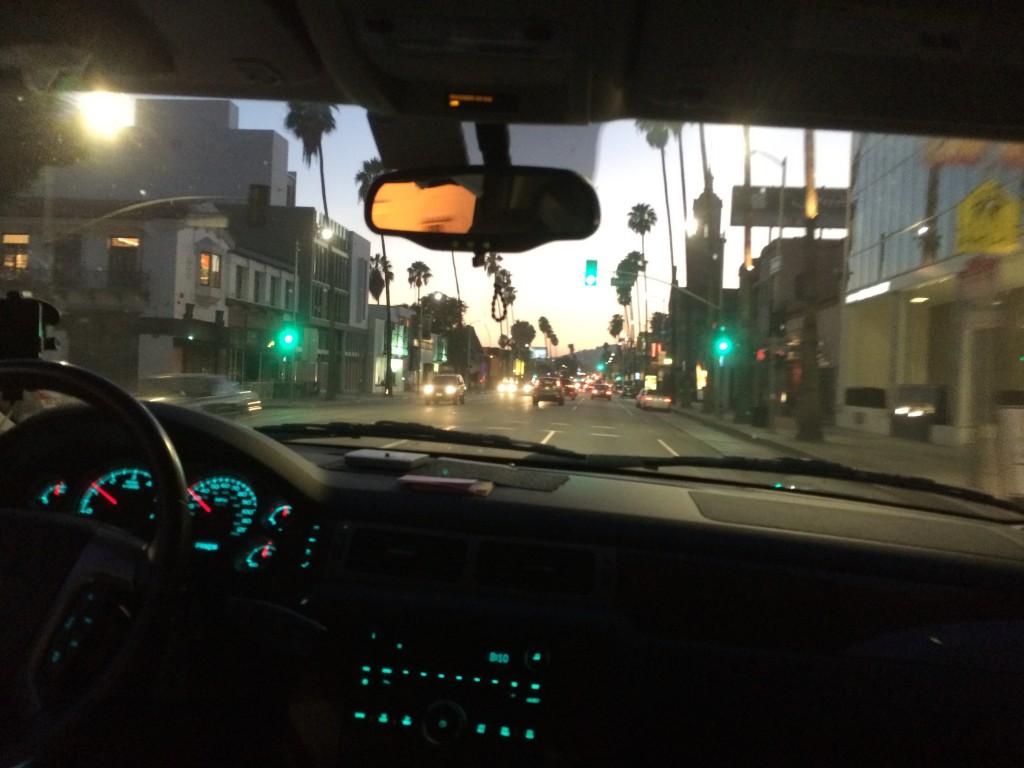
Driving in the car in traffic.
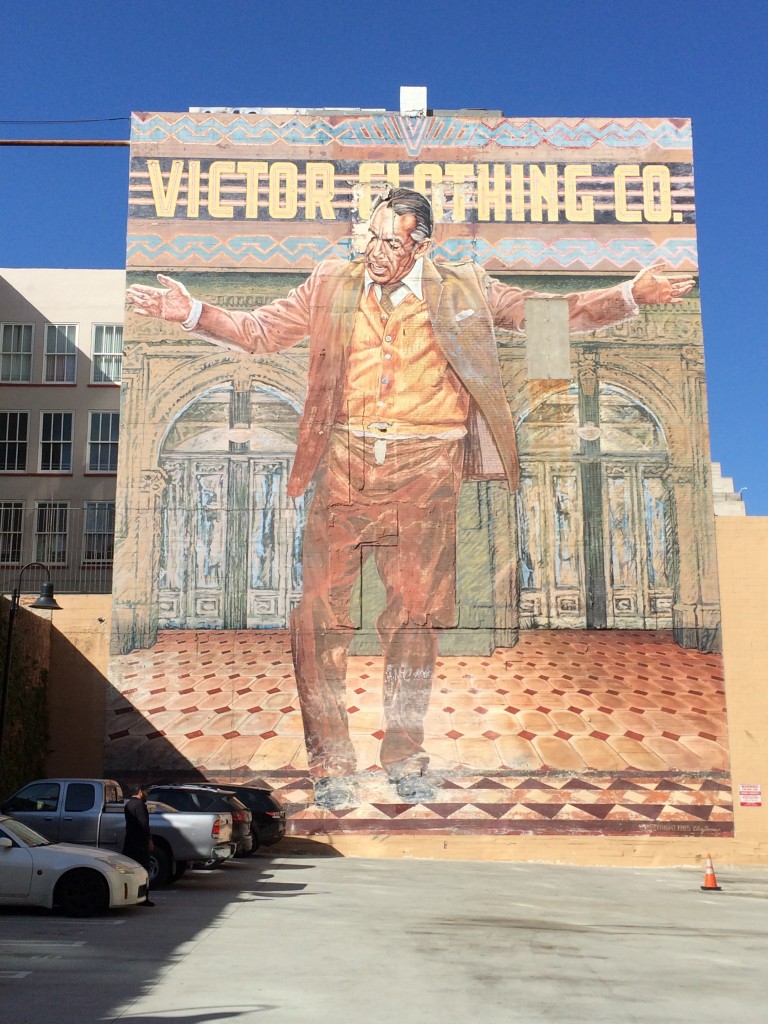
One thing we noticed was the huge paintings and murals on the walls. There’s some really fantastic and very large artwork on the sides of buildings. It’s more sophisticated than graffiti. It’s really excellent. Check out this link to see some of the murals http://www.laweekly.com/arts/10-best-la-street-art-murals-of-2014-5279399
In fact there are murals in many places in California, especially the cities like LA and SF.
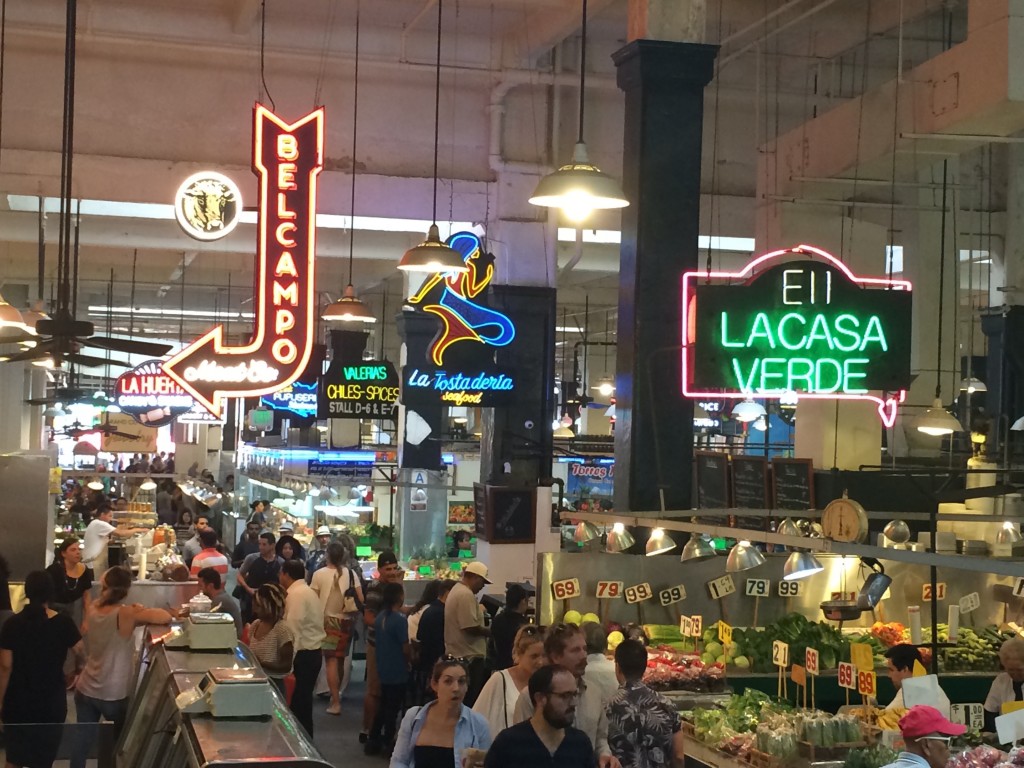
Downtown market
Grammy Museum – amazing music exhibition, particularly the interactive screens which allowed you to take a journey though all the interconnected musical genres.
Huge Taylor Swift exhibition, probably because she was due to perform a number of concerts nearby. In fact, Taylor Swift followed us around California. Wherever we arrived she seemed to be doing a concert and we kept hearing her hit song “Shake It Off” all the time, including in the museum shop where it appeared to be playing on a loop, all day. I can’t imagine what that did to the brains of the staff working there. I quite like the song actually. I think it’s a great pop song – and is commercial, super catchy and full of hooks and so on. I’m not sure about Taylor Swift herself. She started out as a country artist, and then recently she sort of switched over into R&B a little bit and it’s worked out for her. I don’t really like any of her other songs, but Shake It Off is just a perfect little pop song.
Hollywood Improv. for comedy + food.
Fighting jet lag.
Back to the hotel to watch a bit of American TV and then pass out.
American TV – just commercial break after commercial break, and many of them are about treatments for health conditions. So many adverts for health insurance and medical solutions. It’s really weird. It’s hard to actually find any content on TV because it feels like about 50% adverts. You flick through the channels and it’s just ad after ad after ad. Still, some of the late night comedy and chat shows are pretty good. FOX News is a total joke. CNN doesn’t seem that much better to be honest. It’s all way too glamorous and just doesn’t feel objective or incisive enough.

There’s a presidential campaign going on. Donald Trump is dominating the news. He’s basically a right-wing free market capitalist who says whatever the hell he likes and appears to be running for president purely because his ego is in overdrive. His skin is more orange than the sun, his hair looks like it should be captured and studied by scientists, and his views on immigration are pretty disgusting. For example, he recently said that Mexican immigrants are rapists and thieves and that if he was president he would start by building a huge wall between the USA and Mexico, and that the Mexican government will have to pay for it. Right. Is this the man we want to be in charge of one of the biggest and most potentially lethal countries in the world. No. Please no. Hilary Clinton will probably win, but I wonder about her connections to all those corporations. Bernie Sanders is a pretty reasonable left-wing candidate. The other Republicans don’t seem to be any different to each other. Jeb Bush is, well, he’s another Bush! But even he seems pretty normal compared to Trump. American politics is fascinating, entertaining and also a little grotesque and a bit scary. What a country.

End of Part 2. Part 3 coming soon…
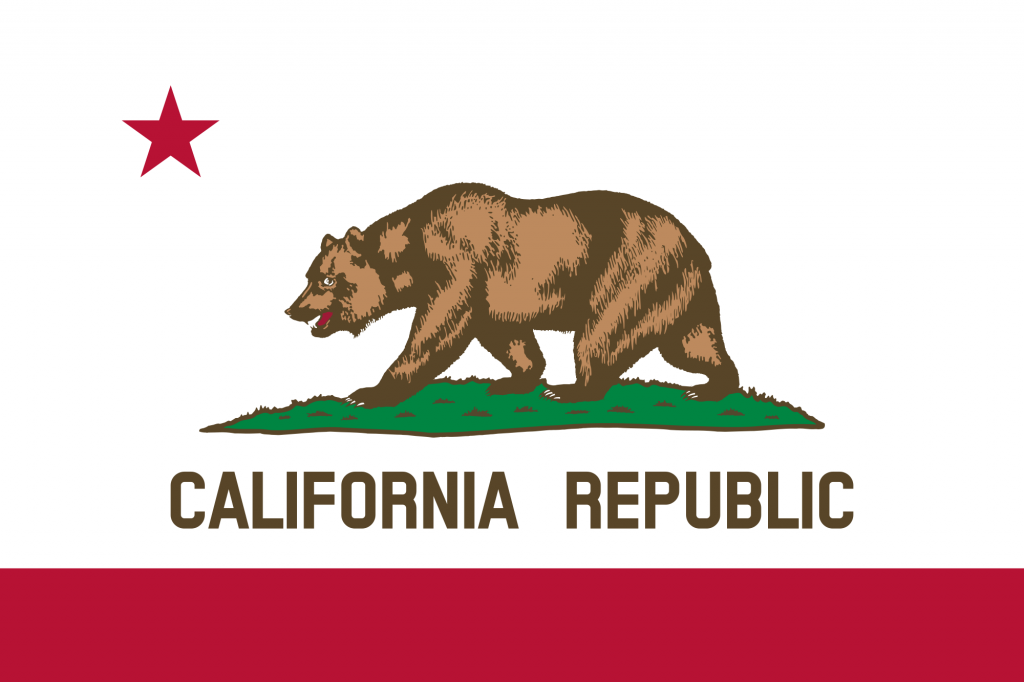
California Flag

278. Marcus Keeley / Northern Ireland (Part 2)

In part 1 of this episode we met Marcus Keeley. In part 2 we are going to talk specifically about Northern Ireland, its culture, the atmosphere there and things you can do if you visit as a tourist. There will be a part 3 of this conversation, which will focus on the accents and dialects in Northern Ireland.

Small Donate Button [DOWNLOAD] [AUDIOBOOK OFFER] [PART 1] [PART 3]
2. Focus on Northern Ireland
My listeners, who are around the world, may not know very much about Northern Ireland. It’s often a bit overlooked – in my experience, a lot of people see the UK as just London, Edinburgh, Oxford & Cambridge, Manchester, Stonehenge and a few other famous spots, perhaps Wales. Northern Ireland is rarely mentioned. The UK is a bit confusing – people aren’t completely sure how Ireland and Northern Ireland fit into it. I expect people are aware that there has been trouble there in the past, with the IRA and the sectarian conflict, but there’s more to it than that. Let’s try and let my listeners know a bit more of what it’s really like to live in Northern Ireland.

– When you meet people from other countries, how much do they know about where you come from? Do you get the same kinds of reactions from people?
– Where is it?
– Capital city?
– What’s it like to live in Belfast? Is it a good place to live?
– What can people do or see if they visit?
– What’s the atmosphere like these days?
– Is there still a sense of trouble?
– Do your generation still hold on to that feeling?
– Do you remember what it used to be like?
– Why was there trouble in the first place?
– How do you see the future in Northern Ireland?
– How do you see The UK?
– What did you think of the election? Where does N. Ireland stand?
– What if The UK left the EU?

Nadine from Girls Aloud “I’m going to give him a bath”

Markus keeley pic copy

277. A Chat with Marcus Keeley from Northern Ireland (Part 1)

This episode is the first part of a conversation I had recently with a friend from Northern Ireland. It’s the first time I’ve had someone from that part of the UK before so it’s a chance to get to know him, his country and the accents you find there. In this one we get to know Marcus and give you a chance to hear his accent. There will be two more parts to this episode. Enjoy!

Small Donate Button[DOWNLOAD] [AUDIOBOOK OFFER] [PART 2] [PART 3]
Just before we start I would just like to say thank you for taking part in the quick survey that I launched on teacherluke.co.uk recently. I asked you to select the types of episode of the podcast that you prefer to listen to. You can still do it of course, by going to my website and finding the page for the survey in the archive of episodes. Just click ARCHIVE in the menu and then ARCHIVE – ALL EPISODES and you’ll find the survey between episodes 276 and 277. The feedback will help me to know what kind of thing you prefer in episodes of LEP. Of course, ultimately I have the final decision because I’m the boss – I’m Luke after all, and this is Luke’s English Podcast and I have the final say, like sometimes I think it’s worth presenting you with something more challenging here, more entertaining there, more topic focused here, more pronunciation focused there and so on. But anyway, take my survey and let me know what your preferences are – your thoughts will combine with mine and it can help me to provide the right content for you. Click here to take the survey.

Quick Quiz
Now, quick quiz – what are the four countries that make up the UK?
England, Scotland, Wales and… Northern Ireland.
How much do you know about Northern Ireland?
What’s the capital city? (Belfast)
Another big city there? (some call it Derry, others call it Londonderry)
Where exactly is it? (well, the clue is in the name because it’s the northern part of the island of Ireland – but it’s not part of The Republic of Ireland politically, it’s part of the UK) It’s not far from parts of Northern England and South Western Scotland.
What else? The Titanic was built there, Game of Thrones is filmed there, unfortunately it’s also known for ‘the troubles’ – violence, civil unrest and terrorism.

It’s home to about 1.8 million members of the UK, and they have their own culture, their own accents and their own particular dialect, and in a recent survey the ‘Northern Irish accent’ was voted the sexiest accent in the UK!

Today on the podcast I’m joined by Marcus Keeley, who is a stand-up comedian, improviser and poet who comes from Belfast in Northern Ireland. I know Marcus from the stand-up comedy scene in Paris, as he likes to come here from time to time to visit and do comedy shows with our team. He’s a friendy, interesting and funny gentleman and this is the first time I’ve had someone from Northern Ireland on this podcast.

So, this is one of those episodes in which I have a guest on the show and we explore a number of different things within the context of an authentic conversation between two native speakers of English. If you like you can imagine that you’re there with us, involved in our conversation. After all, we are speaking to you, and for the attention of you, and you can get involved by sharing your comments on the page for this episode.

What are you going to get in this episode?
– Generally, this conversation is presented for people who are either learning English or who have a particular interest in all things British, or perhaps both.
– First we’ll get to know Marcus a little bit, giving you a chance to train your ear to his accent and way of speaking
– We’ll talk about Northern Ireland, and really get to know this often overlooked part of the UK – including a bit of culture, history, politics, things you can do as a visitor and whatever else comes up in our chat
– You’re going to listen to the Belfast accent of Marcus, and talk a little bit about the variety of accents that you can hear in Northern Ireland
– You can learn a few common phrases from the dialect of English that you hear in Northern Ireland

As ever, you can read notes for this episode at teacherluke.co.uk, so if you want to do some studying, you can.
Also, you may hear bits of rude language in this episode – so, you have been warned.
We covered a lot of ground in this conversation, which lasted nearly two hours so this will be a two part episode I expect.
Please leave any comments or questions on the page for this episode.
That’s it – I hope you enjoy our conversation, and that you experience something you haven’t experienced before.
It might be tricky to follow everything Marcus says in this episode because you’re not familiar with his accent. I encourage you to keep going and just try to follow the general flow of the conversation! Best of luck. Let’s get started…

1. Get to know Markus a bit
Where are you from exactly?
What brings you to Paris?
What do you do?
How long have you been doing comedy?
How would you describe your act?
Stephen Nolan Podcast
Markus keeley pic

270. UK General Election RESULTS

In the last two episodes I went into quite a lot of detail about the context and predictions for the general election in the UK which took place just over a week ago. The results came in on the morning of Friday 8 May and a week later we now have a new government which is already getting itself ready to run the country over the next 5 years, implementing various plans, policies and legislation. Listen to this podcast episode for the full details and read the transcript below in order to follow almost all the words and phrases I use in this episode.

Small Donate Button[DOWNLOAD]
Surprises
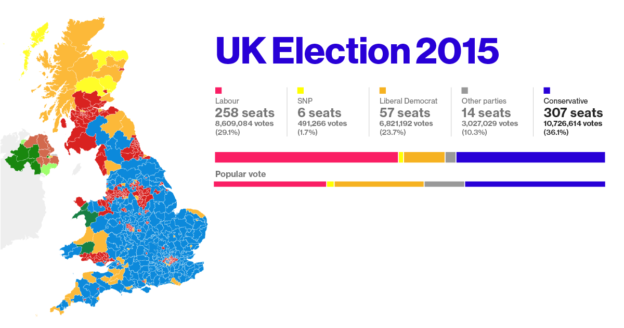
The results were pretty surprising in the end, which was a surprise in itself. Despite the fact that we knew the result would be unpredictable, nobody expected a surprise and for that reason the surprise that we got was pretty surprising. It shouldn’t have been a surprise of course, because we all knew that we didn’t know what was going to happen, and because of that, any result would have been surprising. So, what was the surprise? The Conservatives won an outright majority. There was no hung parliament, no coalition, no negotiations and no deal making. Just 5 more years of a David Cameron led Conservative government without the influence of the Liberal Democrats. Just the Tories running the whole show.

Let’s have a look at what happened, and what we can expect over the next 5 years. Of course my comments here are predictions and speculations and I don’t guarantee that it’s all going to happen as I describe it. As ever, we can’t be completely certain about what the future will bring. So, again, you can expect some more surprises. So, be ready to be surprised, if that is possible. Is that possible? Surely if you’re ready for a surprise, it won’t be a surprise. But according to last Friday’s result, that is possible, because we were all ready for an unpredictable result, and then when the actual result wasn’t predicted, we were all surprised by it. Anyway, enough of all this nonsense about surprises.

Is that confusing? Probably. Don’t worry, I’ll make it a bit clearer in a moment.

What were the predictions?
Although we knew it would be difficult to predict, most people were sure that neither of the two big parties (Con & Lab) would gain enough seats to form a majority government (326) and so we’d have another hung parliament like last time.
So, we expected there to be a period of negotiation in which firstly the Conservatives attempted to make a deal with either the Lib Dems if they won enough seats, or possibly UKIP if they won enough seats. I expected that it would be too difficult for the Tories to do this, they wouldn’t be able to make a coalition deal with anyone and then it would be up to Labour to try and make a coalition with either the Lib Dems (difficult to imagine) or the SNP (also difficult to imagine). In fact, most of the outcomes were difficult to imagine for various reasons – most of them being that the parties had ruled out almost all kinds of coalition deal with each other. So, we expected lots of political manoeuvring during the negotiation period, and then some kind of complex and unsatisfying partnership between parties that didn’t really see eye to eye on everything.

A lot of people expected Ed Miliband to be the next PM as it looked more likely that he’d be able to make a deal with one or more of the other parties.

In the end, despite the fact that we all knew the results would be unpredictable, the outcome was generally surprising for everyone. The Tories won an outright majority, with a win of 331 seats – a small majority.

What were the numbers?
Conservatives won 331 seats (up by 24 seats)
Labour won 232 (down by 26 seats)
Liberal Democrats 8 (down by a huge 47)
SNP 56 (up by a massive 50 seats)
UKIP 1 (up by 1)
Plaid Cymru 3 (no change)
Green 1 (no change)
18 seats went to other parties.

What happened to the leaders & parties?
Conservatives
It probably felt like an amazingly huge victory in comparison to what everyone expected – a hung parliament.
Apparently Cameron was surprised by the result. It must have been exciting for him, but I expect the honeymoon period is wearing off now as he faces a number of challenges as PM.
It will certainly be easier for the Tories without the influence of the Lib Dems, but Cameron faces division within his party, particularly over the EU (some Tories are keen to leave, others not), a powerful SNP who will not only block some of his plans but may also demand a Scottish referendum. He will also have to push forward with more unpopular austerity measures.
He made a speech highlighting the importance of unity. He said he plans to be a ‘one nation PM’ – meaning he hopes to appeal to everyone in the UK. He’s pushing that line because he wants to reach out to all the people who didn’t vote for him, and also he must work hard to make sure the whole of the UK doesn’t break up – mainly as a result of Scotland campaigning for more independence.
It’s quite interesting to note that London Mayor Boris Johnson is now an MP. He was a candidate in a London constituency called Uxbridge and South Ruislip, and he won it. So he’s in the House of Commons now too. That’s interesting because we know he’s ambitious and probably has his eyes on the PM position. It was probably a calculated move by the Tory high command. In the event of a possible negotiation with UKIP the Tories would have needed another option for leadership – someone who is quite Eurosceptic and popular with the electorate and Boris fits the bill quite nicely. But since the Tories won an outright majority, Boris has to keep quiet for the time being. Cameron’s leadership is not in question at this moment. However, he has promised that at the end of this term (5 years) he will stand down. Then I expect it will be time for another leadership race for the Tory party and Boris could be in pole position.

By the way, on Saturday there was already some civil unrest with protests in central London against further spending cuts by the government. People lined up near Whitehall to demonstrate, and a few people were arrested. Plenty of people are unhappy with the Conservatives and their plans to make even bigger cuts to public spending. In fact, Iain Duncan Smith has already stated plans to cut £12 billion from the welfare budget. Welfare – that’s state run programmes to provide money and services to people who need it, like sick people, the elderly, the unemployed, the disabled, single mothers and so on. £12 billion cut from welfare programme.

Labour
Labour lost loads of seats in Scotland. Their hopes of forming a government were dashed.
Ed Miliband resigned/quit/stepped down.
The party also lost a lot of other key MPs including the shadow chancellor Ed Balls. Yes that really is his name.
The party is now leaderless and is ‘licking its wounds’. The next thing for Labour to do is to find a new leader and a new direction. Essentially it’s a question of ‘go left’ or ‘aim for the centre’. Either they pursue a more traditional left wing line, in order to compete with the SNP or Green parties, or they become more populist and centrist, aiming for a similar tactic as Tony Blair in 1997, when he chose the ‘third way’, which basically means adopting some aspects of the left (the socially minded side) and borrowing some from the right (the private sector led, free market economy). It’s going to be difficult for Labour to choose their approach, and their choice of leader is vital.

Why did Labour lose?
It seems that there is a rule in UK elections – no party has ever won when the leader is less popular than his/her rivals and when people don’t fully trust the economic plan. These seem to be the crucial things – a convincing leader with a convincing economic plan. In the end, Ed was not convincing enough, and neither was the Labour plan. Perhaps the Conservative rhetoric worked – “5 years ago we were in a mess because of Labour. They borrowed too much, taxed too much, spent too much and got the country into loads of debt. Then the tories took over and we’ve been following a strict long term plan, and it’s working. Let us finish the job, and don’t let Labour mess it all up again.” In the end that worked out very well for them.

Lib Dems
Liberal Democrats lost loads of seats. It was a terrible night for them. Most of their seats went to the Tories, but also some in Scotland.
Their leader Nick Clegg quit/resigned/stepped down.
They’re now leaderless too, out of government, and suddenly much less influential in government than before.
They also lost a lot of key members.

Why did the Lib Dems lose so many seats?
Essentially, the Tories devoured them. The Lib Dems took the blame for a lot of the failings of the previous government. They didn’t stand out. Their whole message was just “you need us in any arrangement” and it wasn’t really clear what they would do other than prop up another party, and moderate them. This was a compromised position and I suppose voters aren’t fully convinced by that kind of vague rhetoric.

SNP
The SNP won a landslide victory in Scotland, even more than predicted.
They now are in a position to have a big influence on policy, legislation and the way the whole country is run.
For the Scottish, this is generally a good thing. It means more power for Scotland.
For some non-Scottish people, it’s a worrying prospect, for a few reasons.
For the Tories, they’ll have a tough time convincing the SNP to vote in favour of austerity measures. Also, the Scots may demand their influence to demand more public spending in Scotland and other things, including a possible new referendum for Scottish independence. They said they wouldn’t push for that, but there are suggestions that in fact they will. Having such a large presence in the House of Commons means that they’ll be in a much better position to get an independence referendum if they want it. With all the support they seem to have in Scotland, perhaps the result will be YES next time, and Scotland will leave the union. Goodbye the UK. United Kingdom – well, just the Kingdom (not so united) or the Divided Kingdom, or Queendom in fact, because we’ve got a Queen of course.

What’s the Queen been doing?
I expect she’s just been observing, reading the papers, watching the TV, drinking cups of tea, smoking (rumours are that she’s a smoker, but I don’t believe it), getting advice from experts at the Palace. Then, she met David Cameron last week, and since he got the mandate from the people (Well, some of the people) she invited him to form a government, which gives him the authority to run the country.

What about UKIP?
They got one seat. Not that much really. Nigel Farage lost his seat. He wasn’t elected in his constituency. It must have been either a kick in the stomach, or a relief (he’s been campaigning hard). He promptly resigned as leader of the party, suggesting he’d take the summer off before deciding if he’d apply again. The party refused his resignation. So, that’s it – he’s still the leader, even though he’s not an MP.

Why did the leaders resign?
Some people – students, listeners, seem surprised that the leaders of losing parties resigned. That’s normal in the UK. The idea is that the leaders take responsibility for the defeat, and it allows the party to then bounce back, find a new leader and move on. It’s quite common. Also, this time it’s particularly relevant because Ed Miliband and Nick Clegg failed to inspire the electorate. Their popularity is now damaged beyond repair really. It would be hard for them to come back from such a clear defeat, much of it due to them as individuals. They have to go in order to let the parties have a decent chance of succeeding next time. Ultimately, the parties are bigger than their leaders.

Some Vocabulary
(OK, I didn’t have time for this, but here is a list of some words and terms that you heard in the last episodes – do you know them all?)
the political spectrum
constituencies
MP
The House of Commons
Parliament
seat
Cabinet
ministers
ministries
parties
decentralisation
devolution
a landslide victory
voter apathy
candidates
a hung parliament
a coalition government
austerity measures
welfare payments
the welfare state
benefits
allow businesses to flourish
thrive
private sector / public sector
tuition fees
macroeconomic factors
referendum

269. UK General Election 2015 (Part 2)

Welcome back to Part 2 of this episode which is all about the UK general election which is taking place in a couple of days on Thursday 7 May 2015. In this part we’ll hear statements by 7 leaders from 7 of the main parties in this election, we’ll consider exactly what they said, understand some of the vocabulary and key issues, and then look at the possible outcomes and predictions for the result of the election. Most of what you can hear in this episode is written on teacherluke.co.uk. This is episode 269.

Small Donate Button[DOWNLOAD] [PART 1]
The Party Leaders & Their Statements (from a live TV debate)
So, I’ve told you about the context. Let’s now listen to what some of these leaders have to say.
On TV there have been a few live debates between the leaders. They’re fascinating.
I’m going to play you the opening statements of 7 party leaders from one of those televised debates.
Listen to the statements, and just try to follow what they say. I’ll give some comments afterwards to clarify. You can see some transcriptions of these statements on the page for this episode.

You’re going to hear from these people in this order:
Green (Natalie Bennet)
Liberal Democrats (Nick Clegg)
UKIP (Nigel Farage)
Labour (Ed Miliband)
Plaid Cymru (Leanne Wood)
SNP (Nicola Sturgeon)
Conservatives (David Cameron)

You’ll probably notice a couple of different accents in there, in particular Nicola Sturgeon (from Western Scotland) and Leanne Wood (from Rhondda in South Wales). Also, Natalie Bennet (from Australia, living in the UK since 1999). The others speak with standard UK RP accents, although I think David Cameron’s accent is slightly more posh (upper class) than the others.

Don’t forget, I will clarify afterwards, briefly, and you can also read a lot of this on teacherluke.co.uk

Details – full notes
GREEN
Let’s put principles and values first
Determined to deliver a fair economy
Make sure the poor and disadvantaged don’t pay for the fraud of the bankers
Return the NHS back to its founding principles
No public money going into private profits
Take action on climate change
Don’t demonise immigrants and people on benefits
To build a decent and humane society, we start with hope
Vote for change

UKIP
The other leaders are all the same on the big issues.
They all support membership of the EU.
They all support open door immigration.
This is why trust in politics has broken down to the extent that it has.
UKIP believes Britain should be a self-governing nation.
Open door immigration has depressed wages for ordinary people, made buying houses difficult, made it tough to get a GP appointment, and (generally) not been good for this country.
Alternative: A trade deal with EU, cooperate with them as friends,
but make our own laws.
Let’s take back control of our borders and put in place an Australian-style points system so we can choose the quality and quantity of who comes to Britain.
This will give ordinary working people an even break.

UKIP would join Conservatives to block a Labour/SNP coalition, in return for a guaranteed referendum on Europe.

LIB DEMs
Nobody is going to win this election outright.
So you’re going to choose who’s going to have to work with who(m) (coalition).
Nothing is perfect, although the country is in better shape now than it was 5 years ago.
I admit, I’ve made mistakes, and learned from them.
With Lib Dems you’ll get the grit and the resilience to finish the job of balancing the books.
I’ll always act responsibly & fairly – I’ll make sure nobody imposes ideological cuts on hospitals and schools.
I’ll always serve the whole, not the part of the country.

The whole – not just the right, the rich, the white, or one particular region. He’s suggesting he’s a better option to SNP.
Essentially, he’s showing that he’d be a necessary balancing force in coalition with the tories.

SNP
It’s a chance to change the westminster system so it serves you better.
The SNP will always stand up for Scotland’s best interests. They will make Scotland’s voice heard.
But it’s not just people in Scotland who feel let down.
Message to non-Scottish voters = friendship.
She wants Scotland to be independent.
SNP want to work with others of like mind across the UK to deliver positive change.
Wants an alternative to austerity, an end the bedroom tax, a halt to the privatisation of the NHS.
Scarce resources should be invested in the future not in nuclear weapons (get rid of the trident missile system in Scotland)
SNP stands for Scotland, but also for progressive politics.

They’re about Scotland, but also they have slightly more left wing ideas to Labour.
SNP are ready to join Labour.
Labour say they won’t join SNP, but this is mainly a defence against an attack by the Tories. Maybe Labour will have a more informal deal with SNP – i.e. confidence and supply (Labour will support aspects of the SNP agenda, and the SNP will pay them back in the form of votes) but Miliband has ruled this out too!
When the lure of government is there, they’ll change their tune.

CONSERVATIVES
5 years ago the country was ‘on the brink’ – unemployment, and one of the biggest budget deficits. (i.e. this was Labour’s fault)
Over the last 5 years they’ve been working on a long-term economic plan (austerity) and it’s working.
2 million more people in employment.
Investing in NHS as well as reducing the deficit.
Cut taxes for 30 million working people.
Now UK has the fastest growing economy of any western country.
Other leaders will claim lots of things, but they’re wrong, like they were wrong before.
The choice in this election is sticking with the plan that’s working, or going back to the debt-taxes-borrowing-spending that got us in this mess in the first place.
Let’s continue with the plan and not go back to square one.

PLAID CYMRU
Speaking to voters in Wales
Representing Welsh communities
Jobs and services have been cut to the bone – this can’t continue
Offers hope for a decent future for young people, for thriving & successful communities.
In a hung parliament, Plaid Cymru can win for Wales.
Wants to represent Wales’ voice in Westminster.

They want a coalition deal with Labour. Labour have ruled it out – because Miliband wants votes for Labour in Wales – he wants a clear choice between Labour and Tories, not an ambiguous coalition compromise.
Wood has been criticised for being a bit lightweight. “Please vote for us, we’re really nice!”

LABOUR
UK succeeds when working people succeed.
For 5 years, wages haven’t kept up with bills. The NHS has been going backwards. Young people have been fearing they’ll have a worse life than their parents.
If I’m PM I’ll:
Raise the minimum wage to £8 per hour. (Currently £6.50 per hour – 8.8E)
Ban zero hours contracts.
Reward hard work again.
Rescue the NHS, hire more doctors and nurses.
Build a future for all of our young people.
Cut the tuition fee from £9,000 to £6,000.
Cut the deficit every year & balance the books.
This is not as good as it gets (Tories) – UK can do so much better.

The full TV debate on YouTube

What’s going to happen?
Let’s listen to a YouTube video from The Telegraph newspaper. It’s a good summary of the possible outcomes. It’s a bit quick though. Yes, you can find a transcript on my website. Just find the page for this episode in the ARCHIVE.
You can see the video, produced by The Telegraph below.

Transcript/Notes for the Video – The Telegraph: What are the possible outcomes?
What’s the significance of 326?
It’s the number of seats the Tories or Labour need to win in the general election for an outright majority, something neither party managed last time around.

What happened last time?
Tories got just over one third of the vote and were forced into a coalition with the Lib Dems.

Scenario 1: What do the Tories need to get an outright majority? Can they do it?
They would need to gain 24 seats. To do this they’d need to be 7 points ahead in polls. An outright win is in easy grasp, they claim.

Scenario 2: What do Labour need to get a majority? Can they do it?
Labour need to gain 70 seats to take power. Only once have they gained this many seats since WW2: Tony Blair’s landslide in 1997.

What could happen to the other smaller parties?
SNP: Buoyed by the honourable defeat of the referendum could more than double its share of the Scottish vote to 43%.
UKIP could add to their tally of 2 to get perhaps as many as half a dozen or more.
The Greens think they could go from one to three. They’re gunning for Bristol West and Norwich South.

What happens if Tories or Lab don’t get enough votes for an outright majority?
In a hung parliament, the incumbent PM gets the first chance of forming a government. If he cannot he will have to resign and then the opposition can attempt to form a coalition.

Scenario 3: Conservatives & Lib Dems – Details?
One potential scenario is more of the same.
Tory backbenchers wouldn’t like it, the public may be wary of it but if the Lib Dems can hold enough seats, renewing the coalition may be the obvious choice for David Cameron to stay in power.

Scenario 4: Lab-Lib – Details?
Alternatively, a grand left-wing coalition could see Labour govern with the Liberal Democrats.
Voters torn between the two parties may be delighted.
Senior Lib Dems are bitter about the attacks they’ve taken from Labour, and insist they won’t allow Nick Clegg to be forced out as part of any deal.

Scenario 5: Rainbow Coalition – details?
Neither party may wish to settle with the Liberal Democrats, or they may be too small. There then begins a scramble to assemble a rainbow coalition. It’s likely to be an arrangement known as confidence and supply.
The government will sit without a majority but will be propped up on key bills and protected in confidence votes in exchange for specific policies.

What would the SNP do?
The SNP have said that they will prop up Labour but not the Tories, in exchange for more powers for Scotland, not renewing Trident and easing austerity.

What about UKIP?
Nigel Farage has said that UKIP would do a ‘deal with the devil’ to get an early referendum on membership of the EU.
And look at the Ulster Unionists; conservative, patriotic. David Cameron may ask them to keep him in power.
UUP (Ulster Unionist Party)

On balance:
If the minor parties are sufficiently large then the nationalists or Lib Dems will be the kingmaker.

So, basically, what’s going to happen?
Let me sum up the possibilities in that audio, and look at the bookkeeper’s odds (what are they?)
1. A Tory majority.
I don’t think they can get enough seats. They’ll probably get more than Labour, but a majority is unlikely in my opinion. It’s too much of a stretch. Still, the bookies give odds of 11/2 for this (that’s 5.5/1 – if you bet £1 you’ll win £5.50)
2. A Labour majority.
They need 70 seats to get to 326. They just don’t have enough support for that, especially since they’re losing so many seats to SNP in Scotland. The odds are 40/1 (very unlikely).
3. Con-Lib coalition.
It’s possible, if the Lib Dems get enough seats. But it wouldn’t be that popular with some Tories because they don’t want to be held back by the influence of Lib Dems, and the public might not be happy with another 5 years of the same thing. Odds are: 7/2 = 3.5/1) That’s quite likely.
4. Lab-Lib coalition.
If the Tories can’t join the Lib Dems (maybe because the Tories don’t get enough seats, or because they can’t make an agreement for some reason) this could be a possibility. However, Labour have attacked Nick Clegg lots of times over the past 5 years, and they’ve said they would only join the Lib Dems if they got rid of Clegg. The Lib Dems refuse to let another party choose their leader. So, the negotiations would be seriously tough. Odds are: 10/1 (possible)
5. A minority government – either Labour or Conservative, running a ‘rainbow coalition’.
What the hell is a rainbow coalition? It sounds lovely!
This is when a minority government runs, and does individual deals with different parties on a law by law basis. So, instead of a formal coalition, the government would get support votes from some MPs from other parties, in return for certain laws.
It would be messy, and fragile, and unsatisfying.
However, the bookies seem to think it’s possible:
Labour Minority 13/8 = 1.625/1 (you bet 10 you get back 16.25 profit)
Conservative Minority 4/1

The only thing we know, is that we don’t know what’s going to happen.
Nevertheless, here’s my prediction.
The results will come in on Friday morning, and nobody will get a majority. Then the negotiations will begin – and they’ll continue for days and nights. We might not know what our government will look like until sometime the following week. They will make a decision though – it won’t be like in Belgium where they had no government for ages. We’ll get a government, but it might be messy and compromised.
The tories will probably get more votes than Labour, but they won’t be able to form a coalition with anyone because the Lib Dems won’t get enough votes, and neither will UKIP. Maybe they’d join with both, because Nick Clegg says he’d be happy to have a referendum on the EU (which is what UKIP want) but could the Lib Dems really face being in government with right-wingers like UKIP?
So, I reckon Cameron will have to resign because he won’t be able to make a satisfactory agreement.
Then, Ed Miliband will have a go at forming a coalition.
None of his options are particularly easy.
A deal with SNP would be a fairly obvious choice because they’ll have enough seats to help him reach 326. But Ed Miliband has said he definitely wouldn’t do it (but I think he’d change his mind if it got him power). Of course, the SNP would make various demands in return for helping Labour. Those demands would be to get rid of the nuclear weapons defence system called Trident which is based in Scotland, to raise taxes, so spend even more on public services and possibly to demand another independence referendum.
Doing a deal with the Lib Dems is not easy either, as we’ve already stated.
A Labour minority government would be weak and could break down if all the other parties aren’t satisfied.
We might end up having another general election.
And then I’ll have to do another podcast!

Possible constitutional chaos and then zombies
– The Tories join with UKIP, we get a referendum and the UK leaves the EU, but Scotland demands to remain in the EU because they all voted YES in the EU referendum. The UK leaves the EU and splits up in the process. End result: Zombies.
– The SNP demand another referendum, and get it this time. The UK splits up. End result: Zombies.
– Parliament has no confidence in whatever government is chosen, and Parliament is closed while they try and fix it. The UK proceeds with stalemate and no government. The result: Zombies.
– The SNP dominate UK politics, and conservative MPs demand an English council for English laws. The whole constitutional framework of the UK breaks down in confusion and admin. Result: zombies.
Just joking of course ;)

So, what do YOU think?
What’s your opinion from outside the UK (or inside)?
Do you see any similarities with your country?
election2.2

268. UK General Election 2015 (Part 1)

This podcast contains everything you should know about the general election which is happening across the UK this Thursday 7 May 2015. This could be a long episode, but I’m so determined to cover the whole story that I don’t mind how long it takes. I feel it’s worth spending some time to cover this topic in enough detail to make it genuinely interesting and informative. I’m not there in the UK at the moment, so I’m not able to take part in the discussions, or watch all the coverage on the TV, but I care about this a lot and I’ve just got to get this stuff off my chest – which means, I’ve got a lot of things inside that I want to tell you about. This is an important election (like any election) and it’s interesting because we genuinely don’t know what’s going to happen, and the consequences of the different outcomes could be quite drastic. Voting is on May 7, but I’ve already voted – I did it by post (yes, that’s possible in the UK). No, I’m not going to tell you who I voted for – I’ll let you try and work that out if you want.
Small Donate Button[DOWNLOAD] [PART 2]
I was on TV last week talking about this election last week. I wish I had been as prepared then as I am now! It was a live TV debate on France24. They invited me on at the last minute because they needed a guest who was British and was able to talk about the election. I knew a few things about it because I’ve been covering this topic in my classes this year, and last year and so I agreed to go on the show. Also, I think they were interested in having a comedian on the show, and so they ended up with Luke from Luke’s English Podcast in the studio! 2 hours later I was on live television, and yes I did manage to plug Luke’s English Podcast, as well as suggest to President Francois Hollande that he take English lessons with me. So, Francois – if you’re listening, the offer is still open! I did okay in the TV debate, although I was a little unprepared. Now, after having dealt with this subject in class a few times this week already I feel like I am even more prepared, and actually have a good grasp of the situation, good enough to be able to explain it to you, here, in this podcast, clearly and simply.
That is my challenge in this episode – to get across the complex facts and issues relating to this election in an understandable and engaging way. Your challenge is to just try to follow it step by step! The end result should be that you’re more well-informed about this significant moment in British life, and I’m sure you’re going to pick up plenty of language in the process.

You’ll be glad to know that you can read a lot of what I’m saying here on the page for this episode at teacherluke.co.uk. If you want to follow this, read these words, repeat it yourself, check some of vocabulary in a dictionary or whatever studying method you have, you can do it. Not every word is transcribed as I might improvise and go off script from time to time, but the main content is certainly there for you to read. :)

This subject is relevant to you
You might not think this subject is particularly relevant to you, but I’d like to try and persuade you that it is.
The UK remains one of the world’s most important countries. What happens here is in the interests of the whole world.
If you’re in a European country it is particularly relevant, because what happens in this election could dictate the UK’s relationship with the EU, including steps towards our exit from the union.
This election is fascinating because we really don’t know what’s going to happen. Usually, it’s pretty obvious. Not this time.
It could result in big changes to the UK’s constitution, including the our exit from Europe, Scotland’s exit from the UK, a fairly significant social and economic change of direction for the country, and changes to the way our government operates within Parliament. Is this the end of an age in UK politics? Maybe.
So, I think it is relevant to anyone interested in significant events beyond their borders – and I imagine that if you’re a listener to this podcast, you have some curiosity or relationship with the UK, which could make you want to know more about this big moment.

This is the number 1 story in the UK at the moment. There’s a huge buzz about it in the newspapers, on TV, all over the internet. It’s the big story – much bigger than the birth of the second royal baby, which happened on Saturday, and named yesterday (Charlotte Elizabeth Diana). So, in this episode I’ll explain the main details and nuances of this story, specifically for you as a non-native speaker, so you can understand it’s significance.

And as if that wasn’t enough you’ll get plenty of vocabulary, the opportunity to hear the leaders of 7 political parties in the UK. That’s 7 different voices from 7 different key figures in this election, including 1 Scottish accent and 1 Welsh accent. At the end of this episode, you’ll be far more informed about British politics than you were at the beginning, and we all know that knowledge is power. You may be able to impress people with your ability to chat about UK politics. Honestly, I’m often surprised at how little people understand politics, including fellow Brits. I think everyone benefits when we engage in politics. I’m certainly not cynical about this subject, and I definitely do not find it boring. Cynicism about politics is dangerous, because if we don’t care about politics, and ignore the subject – it doesn’t go away, it just gets dominated by people who do care about it – and often that means people with extreme, fringe ideas. So, let’s engage in politics because it’s not only fascinating, but vitally important.

So, are you convinced? I hope so.

The election is on Thursday, just a couple of days away. So, by the time you listen to this, the voting will probably have finished and there will probably be a new government in power. Many of you may be listening to this ages after the event. I still think it’s relevant, even some time after the election, because it’ll give you insight into not only the background story of what happened in May 2015 and the context of what’s going on in the UK at the moment, but it should also help to explain events that are happening in the future.

Context – the last 5 years
Traditionally, the UK has been dominated by two political parties – Conservatives (right) and Labour (left).
Now we’re seeing a much more diverse set of parties who not only represent different positions on the political spectrum, but also different regions in the UK. This is a story of not just right and left, but of England and Scotland, and also Wales & Northern Ireland of course. It could be the end of the two-party system, and the centralisation of Westminster.

Let’s just have a reminder of some basics of politics in the UK
The whole of the UK is divided into constituencies – these are political areas of the country. Each constituency votes for an MP to represent them in The House of Commons, which is in Parliament, which is in Westminster, which is in London, which is in England, which is in Britain, which is in the UK.
Each constituency has a seat in the House of Commons. There are 650 seats for 650 constituencies. So each seat is occupied by an MP who represents his/her constituency, including the Prime Minister, members of the Cabinet (ministers of different ministries, such as the Ministry of Education, etc) members of the opposition etc.
Those MPs represent different parties of course. That includes the main ones – Conservatives (302), Labour (256), Liberal Democrats (56) and also other ones with smaller numbers of seats, particularly parties that represent specific interests of other nations in the UK, such as the Democratic Unionist Party and Sinn Fein from N.Ireland, the SNP from Scotland and Plaid Cymru from Wales.

Those MPs vote on laws that affect the whole of the UK. After the laws have been passed, and given Royal Assent by The Queen (she basically stamps them “Yes, fine” next! I don’t think she actually does it herself), they are applied in England, Wales, Scotland and Northern Ireland. But, thanks to a process of decentralisation of government power called ‘devolution’, Wales, Northern Ireland and Scotland have their own parliaments which have a certain amount of independent power. They can adapt some of the laws from Westminster, and can write some new laws which apply only to those regions. This is particularly true in Scotland. England doesn’t have a devolved parliament like the other countries. We take laws from Westminster, unchanged. This arrangement has been relatively problem free for England, because the number of MPs from the other 3 countries in Westminster has been quite low, so it’s no big deal. But, if the SNP get lots of votes this year, it means the number of SNP MPs could rise by 40-50 seats, and that means that suddenly a lot of English laws are being voted on by Scottish nationalists. That’s making some English MPs freak out a bit. Do you understand that? Don’t worry if it’s a bit complex. It might make more sense later.

Basically, this is going to be a big year from the Scottish National Party and they’ll probably have a much bigger presence in Parliament than ever before, and that’s going to make a big difference to the way that government is run in the UK. The Scots will have much more influence.

What happened in the last election?
To form a majority government, one party needs to get at least 326 seats in Commons. For example, in 1997 Tony Blair’s Labour Party won 418 seats – that’s a big victory. They assembled a majority government that enjoyed a lot of support from the public (at the beginning). Labour won the next election too, but in the end, Blair lost the public’s support, mainly because he chose to get involved in the Iraq war in 2003 against public opinion. People decided that, with George Bush, he’d lied about his intentions for going to war in the middle east. He said it was about weapons of mass destruction, and it became clear that it was more about imperialism and a struggle for oil. Blair stepped down eventually, and was replaced by another Labour MP called Gordon Brown (an imposing Scottish guy who specialised in economics, was a bit more socialist in nature than Blair, had one eye and was unable to fake a smile on live TV) after a damaging power struggle within the party. Basically, Brown and Blair set up New Labour together in the 90s. They had an agreement that Blair would be the leader, and Brown the finance minister, and that after something like 8 years, Blair would step aside and let Brown have a go at leadership. I think Blair didn’t want to give up the leadership (if we can learn one thing from this episode, it’s that power is massively seductive, and when power is within reach people will be willing to change even their most important principles in order to get it). So there was an internal struggle within the party, and Brown won and became PM, but it left the Labour party divided. Blair is now generally disliked. Brown was also pretty unpopular. He didn’t have the charisma or charm of Blair, and he was PM at the time of the economic crash. A lot of people blame him and Labour for that. This is around 2008, 2009. In 2010 it was time for another election.

There was a lot of voter apathy, and there still is. This is the feeling among voters that voting is a waste of time and effort, because all the candidates are basically the same, they all lie, they don’t keep their promises, they’re corrupt and just seek power and don’t really have our interests at heart. That meant that we had a fairly low voter turnout at the election, and also the nation wasn’t particularly passionate about one candidate in particular. The three main candidates were David Cameron of the Conservatives, Gordon Brown of Labour and Nick Clegg of the Liberal Democrats. None of them did particularly well, and neither Conservatives or Labour got the magic 326 seats to form a majority government. So, the negotiations began. What negotiations? The negotiations to form a coalition government. This is when several parties get together and form a joint government. Usually a smaller party will join a bigger one if they can agree on certain policy ideas and an agenda for government. This involves the usual things you would expect from a negotiation – conditions, concessions, trading powers and so on.

The Conservatives
It was the Tories (Conservatives) and Liberal Democrats who made a deal, and formed the Conservative-Lib Dem coalition which has been in government for the last 5 years. They came into power when the UK was suffering a large budget deficit (the country just didn’t have enough money to pay for everything) as a result of the financial crisis. The Conservative solution to this was to introduce sweeping austerity measures – that means spending cuts. This is one of the key policies of The Conservatives, and part of their ideology. Stop spending money on social services. That means cutting welfare payments or cutting benefit given to people in society who need help, or anything that the state pays for. The logic there is that the state can save money by spending less on its people.

At the same time, they wanted to reduce taxes for the rich, and allow businesses to flourish (to be successful), especially the financial sector (the banks, particularly in London). Don’t tax corporations, banks or businesses too much – let them thrive. If businesses are successful, if there is wealth at the top end of society, that will benefit everyone because the money will come trickling down from top to bottom like a magical waterfall, it will lead to job creation, more people will have spending power and everything will be wonderful. This was the Tory plan. Cut public spending, promote the private sector. The Liberal Democrats, in joining the Conservatives, moved to the right (because Conservatives are a bit right-wing, and the Lib Dems were in the centre, to the left of the Tories). So the Lib Dems moved away from the left in order to get into government. Nick Clegg justified this by promising to protect certain key things – like tuition fees for example (that’s the price you have to pay to go to university in the UK). He promised to make sure the tories didn’t raise tuition fees. But he failed his promise and the government did raise tuition fees. In fact, generally, the coalition has been bad for Nick Clegg because he’s had to compromise lots of his principles, and he keeps having to apologise for it.

So, the Conservative-Liberal coalition went ahead with large spending cuts. Lots of people in the UK protested against the cuts, saying it was unfair and that the conservatives only cared about the rich, and didn’t care about ordinary working people, and they had a point. Anyway, ‘austerity’ has been the big word of this government. Spending cuts. For many people, particularly those in working class or poor communities, this was pretty bad news because suddenly they had fewer services, longer hospital waiting times and so on. So, austerity, austerity, austerity. The tories say “we have a long-term plan for the economy – it’s tough, but it’s necessary”.

Maybe they’re right, because according to lots of analysts, the UK’s economy has had more growth than most other countries in Europe. Maybe it’s been working – but it’s unclear if this growth is due to spending cuts, or if it would have happened anyway. Maybe there are macroeconomic factors which are beyond the control of the tories, which mean that the UK’s economy would grow out of recession quickly anyway, and that if they cared more about communities, then people would generally be happier and quality of life better.

Ultimately, it’s a question of values. We’ll come to that later.

This is long isn’t it! But I hope you’re keeping up!!!

So, the most recent government is David Cameron PM, Nick Clegg deputy PM – conservatives and Lib Dems together, with austerity measures their main economic policy.

The Scottish National Party
Then of course last year we had the high profile Scottish independence referendum. As part of a deal agreed by David Cameron some time before, the Scottish were given the choice to be in or out of the UK. I did a podcast about this before, which was very well received by my listeners. There were two camps – the “Yes Scotland” campaign (for independence) and the “Better Together” campaign (against independence). In the end, 55% of people voted “no” for independence. Scotland stayed in the union. Part of the reason people voted “no” was because it was still a pretty good option for them as all the MPs from England (Lab, Lib and Con) all promised to give Scotland more devolved powers as long as they stayed in the union. “We’ll give you more power – but please don’t leave us!” So, the campaign was such a great advert for Scottish political interests in the UK that the SNP have since attracted loads and loads of support in Scotland. All that campaigning for Scottish rights has been wonderfully helpful for Nicola Sturgeon, the leader of SNP. Now, the SNP are probably going to win a landslide victory in Scotland, stealing a lot of seats from Labour. 40-50 extra Scottish MPs are probably going to arrive in Westminster. How’s that going to affect UK politics?

So, tories are in government, pushing spending cuts and being accused of just looking after their rich friends in the banking industry (who appear to have got away with losing/stealing all our money). Lib Dems have been supporting them, but trying to stop them going to far.
SNP have been getting loads of support in Scotland.

What about Labour?
After losing out in the last election they changed their leader. There was a race for leadership, and it ended up being between two brothers. Ed Miliband and David Miliband. In the end, Ed won, but he had to stab his brother in the back to do it (not literally). Basically, he got ruthless and undermined his brother’s campaign, making friends with key Labour supporters, and pushing a more traditional left wing agenda. So, Ed Miliband became the new Labour leader. The thing is, he’s not particularly impressive. His party is more popular than him really. He’s a bit awkward, makes some clumsy mistakes like forgetting important details in speeches, or stumbling over his words sometimes. He also looks a bit odd, like a character from a Wallace and Gromitt cartoon, and he has a nasal sounding voice. Also, he comes from a fairly wealthy background, despite being quite left wing. All those things work against him, but nevertheless he and his party have consistently challenged David Cameron’s government over their position on social and economic issues. He’s emerged as a candidate who actually cares about ordinary people, and who has the guts to take tough decisions and lead the country. So, although he’s not quite as popular as the Labour Party itself, Miliband could be our next PM. It all depends on small details in the voting on Thursday, and whether the tories can make a coalition deal with other parties or not.

Oh, I forgot something important – UKIP and Nigel Farage.
We’ve seen from history that whenever times are tough and there’s a financial crisis, people get scared and insecure, and they look for a scapegoat to blame for all their problems. That scapegoat is often foreign people, immigrants and their damaging effect on a country. UKIP stands for the United Kingdom Independence Party, and they have, in my opinion, some slightly dangerous, reductive and simplistic solutions to the UK’s financial and social problems.
Essentially, for UKIP, all of our problems are caused by our open door policy on immigration. The government doesn’t have enough money – immigration, we’re spending too much on welfare for immigrants. You can’t get an appointment to see a doctor? Immigration. You can’t find a job? Immigration. There’s too much traffic on the road? Immigration. You’ve got a bit of a headache? Immigration. You keep losing socks in the washing machine? Immigration.
Oh and the other problem is the European Union. According to Nigel Farage, the UK needs to leave Europe. If we do that we can choose our own laws, close the open door to immigrants, and save billions of pounds a year.
Farage has quite a high number of very vocal and loyal supporters. Sometimes they’re accused of racism. Sometimes UKIP members and supporters are racist, and then Farage has to make a statement saying “I’m disappointed in this person, they don’t represent the views of UKIP etc”. I’m sure it’s a familiar story to you – I’m sure there are similar parties in your countries that tell us that the source of all our problems is the dirty, criminal, lazy, disease infected influence of ‘other people’ from across our borders. In my opinion it’s small minded, it’s distorted by prejudice, it’s backwards looking (in the mind of Nigel Farage, Britain was at it’s best when fighting against foreign invaders) and it’s dangerous.
Farage wants the UK to have an early referendum on the EU.

There are arguments for leaving the EU – like that it would save us money, and we could be free to choose other trading partners, but I wonder if there’s real truth in them. If we did leave the EU, surely we would lose billions from all the lost business, the companies that would close or pull out of the country, the trade deals we would lose with our biggest market, the bad faith that would develop between the UK and other European nations, etc etc.

But, lots of people seem to agree with him and there’s a chance that if UKIP get enough support in enough places, that they could gain enough seats to be in a position to form a coalition government with the Conservaties, and that is bound to involve one key condition – a referendum on the EU. So, watch this space – Britain’s exit from the EU (or Brexit) is more likely than you might think. Would the conservatives offer an early referendum on EU membership if it guaranteed them power? Yes, I think they would.

There are also other parties, with less influence, but who could be important in any coalition deals. This includes the left-wing Green Party, Plaid Cymru (representing Welsh interests, also quite left wing) and parties from Northern Ireland such as the Ulster Unionists (would support the conservatives).

End of Part 1 – 1hr05min
Click here to for part 2.
election1.1

Luke’s TV Appearance on France 24

If you were watching France24’s English channel yesterday evening, you might have heard a familiar voice during their debate at 19.10 CET.

The subject of the broadcast was the upcoming UK general election. The guests were journalists and specialists in European politics, and me too! They wanted another English voice on the programme, and perhaps someone who could provide a more light-hearted angle – who better than Luke from Luke’s English Podcast?

You can see the videos of the debate by clicking the links below.

VIDEO OF PART TWO – CLICK HERE
VIDEO OF PART ONE – CLICK HERE
Luke France 24

262. What is Britishness? (Part 2)

Welcome back to part 2 of this episode in which we are exploring the subject of Britishness. In this one we are looking at how the Brits define and understand their own national identity. [Download]
Image: Gene Bible http://www.genebible.co.uk
Small Donate ButtonHow do British People define “Britishness”?
When you ask the average British person to define “Britishness” I find that they always give certain ‘stock answers’ to this question too. As we know, it’s hard to truly define this concept, so you end up listing various associations, which don’t fully deal with the whole subject in a satisfyingly complete way.

Video
I found a video on YouTube called “What is Britishness?” by Rebecca Devaraj. It’s a short video exploring Britishness for her final-year university project.
It looks like she spent the morning in a local park, asking passers-by the question “What is Britishness?”
Listen to the audio. Can you guess which answer I think is the best?

Some vocab from the video
Having a stiff upper lip and getting on with things
Being accepting and just getting on with it
Bulldog – it has connotations with Churchill, and the advert… https://www.youtube.com/watch?v=wbz-IsEOCKo
Bad weather – torrents (torrents of rain) ***I’ve just realised that they said “tolerance” not torrents! Did you notice that?***
Progress
We get behind our sports teams
You just are British – that’s it really. If you’re British – you enter the mix.

The best comment?
For me it’s the guy (Professor Jeremy Black, author of “A Short History of Britain”) who says this:
“I would have thought that Britishness defines the characteristics of whoever are the citizens of Britain, whatever their origins at any one time. Ordinarily, we would argue that Britishness is linked to notions of liberty and freedom and in fact the very diversity that makes it difficult to define what Britishness means”.

Wikipedia Definition

Britishness is the state or quality of being British,[2][3] or of embodying British characteristics,[3] and is used to refer to that which binds and distinguishes the British people and forms the basis of their unity and identity,[4] or else to explain expressions of British culture—such as habits, behaviours or symbols—that have a common, familiar or iconic quality readily identifiable with the United Kingdom.[5] Dialogue about the legitimacy and authenticity of Britishness is intrinsically tied with power relations and politics;[6] in terms of nationhood and belonging, expressing or recognising one’s Britishness provokes a range of responses and attitudes, such as advocacy, indifference or rejection.[6] Macphee and Poddar state that although the designation of the two differing terms, Britishness and Englishness, is not simple as they are invariably conflated, they are both tied into the identity of the British Empire and nation, since these last two are altering considerably as Englishness and Britishness do too. Thus the slippage between the two words can be seen as a play between these changing dynamics.[7]

That’s interesting.

So, in summary that means it’s:
– Whatever distinguishes British people and culture from other nations, whatever is unique to the UK.
– It includes habits, behaviours, or symbols that are specific or familiar to the UK
– This conversation usually ends up with references to the power structure of the UK – politics and monarchy.
– Expressing Britishness provokes a range of feelings. For example, waving a British flag might cause people (in the UK) to go “Yey!” or “whatever” or “I find that offensive”.
– “Britishness” and “Englishness” are different things, but they are often used to mean the same thing – Britain from an international point of view, especially as an empire.

So, what’s the difference between Britain, and England? (and indeed Scotland, Wales, Northern Ireland)
Why would it be offensive to wave a British flag?

Generally in England it’s less offensive, but in Scotland, Wales or Northern Ireland you might meet people who put their countries before the union of the UK, and in fact feel that the UK was forced on them in some way.
What about waving an English flag?
In England, the UK flag is associated with unity, inclusion, multiculturalism and so on. The English flag on its own is more associated with English nationalism, which in turn is associated with empire building, colonialisation and also football hooligans. Generally, the English flag is displayed when there’s a football match, and the behaviour that goes along with that.

In terms of how Brits define Britishness… This Guardian Article Sums It Up Rather Well
http://www.theguardian.com/uk-news/guardianwitness-blog/2014/jun/09/scottish-independence-10-things-that-sum-up-britishness

What about the Scots, the Welsh & the Northern Irish?
I’m English, and British, so when I talk about Britishness, I’m also talking about Englishness to a certain extent, but Britain also includes Scotland, Wales and N.Ireland. Do they feel included in all this talk of Britishness?
Not necessarily. Some people in those countries feel strongly about independence and resent being ‘lumped in with England’. They believe their countries have unique identities too, which are not always represented when people talk about Britishness. Some would rather not be part of Britain at all, as we say recently in Scotland with the strong independence movement.
Personally, I think Britishness is quite a flexible term, and it does include Scottishness, Welshness and Northern Irishness, but I can understand they get pissed off that their culture is not always represented in this kind of discussion. Personally, I was born and raised in England, and so many of my British associations are also English. I’d like to get more Scottish, Welsh and Irish people on my podcast.
Also, it’s worth remembering that most people don’t feel all that strongly about it. I reckon most people just want to get on and don’t want too much fuss. I’m proud of that too – usually resentment between countries in the UK does not result in violence these days, although that’s not to say violence has not occurred in the past, particularly regarding terrorist attacks related to the troubles in Northern Ireland, which is a subject that deserves to be covered fully in a podcast in the future.

What I think / What I’m proud of
When my students were brainstorming their British associations, I did too. Here’s my list, of personal British associations (in no particular order).

Tolerance and acceptance (although there seems to be a
Freedom (although this is a growing movement against immigration and about taking back the country from unwelcome foreign visitors – that British identity is being lost due to too many foreigners, and the fact we’re run by the EU. Those are views held by a fairly marginal political party called UKIP, who are having a big effect on voting patterns and the political landscape in the UK)
Fairness -“It’s just not cricket” (but are we really fair?)
Pragmatism – getting things done
Humour
Resolve
Music
Comedy
Literature
The land itself
Cricket, Rugby (football too?)
The diverse accents
The NHS
Diversity & Acceptance of Diversity
Certain inventions
Sherlock Holmes & Dr Watson
Drinking Tea with milk, the proper way
Pretending to be proudly British!
Taking the piss
Pubs
Liverpool, Birmingham, London
A slight sense of guilt about Scotland, Wales, Ireland etc – but knowing that is also nonsense, but it’s there a bit.
Tolkein
Monty Python
Ali G
I could go on…

When I came back from Japan, I saw the UK with fairly fresh and objective eyes. I remember the greenness of the place, the relaxedness, the small mindedness. It was very Tolkienesque.

Some things I’m not proud of, like certain racist or small-minded people, poor public services, corruption and elitism, blind national pride, etc…

All in all, I hope that Brits, and English people too, remember that our countries are diverse places and that is what makes us strong.

Billy Bragg – England, Half English (Live)

Lyrics

My mother was half English and I’m half English too
I’m a great big bundle of culture, tied up in the red white and blue
I’m a fine example of your Essex man
And I’m well familiar with the Hindustan (This is an Indian English-language daily newspaper)
‘Cause my neighbors are half English and I’m half English too

My breakfast was half English and so am I, you know
I had a plate of Marmite soldiers, washed down with a cappuccino
And I have a veggie curry about once a week
The next day I fry it up as bubble and squeak
‘Cause my appetites, half English and I’m half English too

Dance with me to this very English melody
From morris dancing to Morrissey
All that stuff came from across the sea

Britannia, she’s half English, she speaks Latin at home
St. George was born in the Lebanon, how he got here I don’t know
And those three lions on your shirt
They never sprang from England’s dirt
Them lions are half English and I’m half English too

Le-li, umma le-li-ya, le-li Umma le-li-ya
Le-li, umma le-li-ya, bledi g’desh akh! Le-li-ya

Oh, my country, what a beautiful country you are.

The conclusion (of sorts)
Britishness, like any cultural identity, is always changing. These things never stay the same. There is always a sense that the culture is being lost. That’s just the sense of the present order slipping away and being replaced by the new one, at every moment of every minute – things are changing and nothing will stay the same. That brings some sense of fear and panic – the idea that we’re going to lose the good things we have.

People also need a clearly defined culture in order to feel secure, so they know where they are and they can trust the people around them. People tend to prefer the things they know and distrust things they don’t know. It’s quite easy to blame others for that frightening sense that things are changing for the worse.

I think this is why a lot of people have fear and hatred of immigrants and foreigners. They’re scared of the unknown agents of change who look and behave differently. I suppose it’s human nature, but it’s sad and unnecessary when it ends up in violence and suffering. Obviously, we shouldn’t tolerate certain behaviour.

Where am I going with this?

What I mean is – there is no such thing as true “Britishness” unless it is just a snapshot of what is happening right at this moment in Britain. What is going on? What are most people thinking and doing? It’s almost impossible to comprehend the subtlety of what Britishness really is at any moment, because it’s so complex. That’s why the question invites the standard mind-numbing responses, like “It’s The Queen, tea, strawberry jam, Monty Python, a game of cricket, 9 pints of lager and a fight outside the chip shop” – people just list things they associate with the UK because there’s no other way of explaining it. Just a bunch of associations.

Britishness is negotiated
Also, I believe that Britishness is not an absolute concept, it’s something which is negotiated. Everyone has their own version of Britishness, and in fact Britishness changes depending on who is in power, who’s got the money, the influence and the cultural capital. In the end, it doesn’t matter how much you say that Britishness is all about cricket, when hardly anyone plays cricket any more because there’s no money in it.

Britishness is a blanket term which is supposed to incorporate all the diverse elements of multiculturalism.
Britishness means diversity, inclusivity and a celebration of the success and positivity of multiculturalism. So, in that sense, Britishness is something which is supposed to unify us, provide us with a sense of pride and therefore duty and obligation to the country we belong to. We’re less likely to smash the system if we believe in it.

Britishness is a unifying force which just keeps everything together
After the 2005 terror attacks, the government were keen to reinforce national pride, to promote the British brand to its own people, in an effort to fight back against the destructive forces behind the attacks. The idea of a Britishness day was suggested, but it didn’t really go anywhere. What could that be? A day when we argue about what Britishness is? Also, it’s all a bit close to nationalism, and we don’t like that in the UK. Nobody wants to be associated with facism, so often people have a defensive attitude to national pride, usually along the lines of “I think it’s fine to be proud of Britain” or “I AM proud of Britain and there’s nothing wrong with that.” It’s usually that sort of thing.

What about all the bad things done in the name of Britain? Are you proud of them too?
Most people seem quite happy to pick and choose which aspects they are proud of. They usually will ignore the atrocities in our colonial past, proudly declaring their pride in English tea – despite the treatment of India during the colonial era.
I’m wary of being too proud of my country because I know that we’ve done some pretty bad things in the past. Also, I think national pride can be blinding, and ultimately quite destructive. It’s good to be proud of your roots, but there is a more important thing to remember – that there is a bigger picture – and that is that it’s stupid to think that one nationality is intrinsically better than others.

You can be whoever the hell you want to be
It doesn’t matter where you pay your taxes you can just define your own identity as you see fit. Just as long as you don’t go out of your way to hurt others, go ahead and be whatever you like. That’s the main thing. Just try to be a good person. The rest is just fluff.

LEPSTERS – What’s it all about?
Leave your comments, thoughts and opinions in the comments section, and practice your English!

Related Episodes
If you found this episode interesting, check out these ones too:
261. What is Britishness? (Part 1)
128. Luke’s Stand Up Comedy Show – Featuring jokes about British food, weather and our Royal family – Now fully transcribed
131. Rickipedia – Conversation with my Dad, in which we answer various questions from listeners, including some things about British culture.
British Slang (A-C)
British Slang (D-G)
British Slang (H-M)
British Slang (N-Z)
156. British Comedy: Ali G
172. British Comedy: Peter Cook & Dudley Moore
177. What Londoners Say vs What They Mean
192. Culture Shock: Life in London (Part 1)
192. Culture Shock: Life in London (Part 2)
195. British Comedy: Monty Python’s Flying Circus
199. The UK/USA Quiz
202. British Comedy: Monty Python & The Holy Grail
219. Scottish Independence – Key notions of national identity