Category Archives: Ramble

519. Idioms Game & Chat (with Andy Johnson) + 25 Idioms Explained

A conversation with Andy Johnson including loads of idiomatic expressions and their explanations. First you can listen to a rambling chat with Andy and then I’ll explain 25 idioms that came up during the conversation. Part 2 coming soon… Transcriptions, Vocabulary list & Definitions available.


Small Donate Button[DOWNLOAD]

Introduction Transcript

Hello folks – in this episode I’m talking again to Andy Johnson from The London School of English, and while we’re talking we’re going to play an idioms game, so you can practise your listening with this conversation and also learn some natural English expressions in the process.

Alright Andy? I’m going to do the introduction to this episode, with you here. Sometimes I’ll check in on you, just to see if you’re still there and to see if you’re ok with what I’ve said. OK?

Andy’s been on the podcast a couple of times before but if you haven’t heard those episodes here’s some intel on Andy J, to bring you up to speed. This is the Andy Johnson Fact File.

Andy Johnson started out working in marketing before becoming an English teacher. He’s been teaching English for … a number of years (I think it’s about 15 years now). He did the DELTA qualification at the same college as me (name of that college? That’s UCL in London) and has worked for The London School of English for over 10 years, first as a teacher and now as the Director of London School Online – that’s the London School’s online operation, and yes – I’m calling it an operation, which makes it sound either like they’re surgeons, or special agents and perhaps they are somehow a combination of both of those things – but for online English courses. London School Online offer various online courses for learners of English and other things of that nature. Get more details at http://www.londonschoolonline.com

Actually the correct link is www.londonschool.com/lso

Andy is a runner. He runs marathons, which is great considering he nearly lost a leg when he was younger, and when I say “lost” a leg I don’t mean that he just couldn’t find it for a while, like “oh where’s my leg? I put it down a earlier and I can’t find it… Ah, there it is! Oh, I nearly lost a leg there!” no, I mean he nearly had to have it removed permanently, which sounds like it was a very frightening and horrible experience. There’s an emotional and inspirational story that explains what happened, which you can hear if you listen to episode 472 when Andy talked about it.

472. Andy Johnson at The London School (Part 2) Why Andy runs marathons

So, despite an early issue with his leg, Andy is a runner and in fact at the moment he is training for the London Marathon which happens next month.

Andy is married and has two children who are boys. He sometimes steps on pieces of their lego, which I understand is incredibly painful. Lego comes from Denmark but Andy Johnson is half Swedish.

But Sweden and Denmark are both scandinavian countries, so the link still works somehow.

However, this does not lessen the pain he experiences when he steps on Lego.

Andy has a good joke about Swedish military ships having barcodes so that when they come into port they can “scan the navy in”, which sounds like “scandinavian”. It’s a good joke, despite the way I just told it just then.

As an English teacher Andy often attends teaching conferences where he presents talks to other English teaching professionals. Previously we talked about his talk on millennials in the English language classroom which he has done at various conferences including the IATEFL conference, which is like the Glastonbury Festival but for English teaching.

Andy also looks a bit like Moby (the American musician, DJ, record producer, singer, songwriter, photographer and animal rights activist) but a better-dressed version. Sometimes people mistake him for Moby, with hilarious results, as we have heard on the podcast before.

So, Andy is like a better-dressed, half-Swedish half-English English teaching Moby look-a-like who runs marathons, steps on his kids’ lego and talks about teaching English to millennials at conferences. But he’s so much more than that.

Andy Johnson everybody…

Spot the Idioms

As well as having a conversation, in this episode we’ve also decided to play a game as a way of including a language-focus – in this case idioms. You have to spot at least 6 idiomatic phrases in this conversation, although there will definitely be more than 6.

Andy and I have both chosen 3 idioms to include in our conversation.

What are idioms?

Remember – idioms are fixed expressions with a particular meaning – a meaning that might not be obvious when you take them on face value. The meaning of the phrase is different from the words used in the expression. They don’t have a literal meaning.

Really common idioms (which you probably already know) are things like “That was a piece of cake”, meaning “That was easy” or “It’s just not my cup of tea”, meaning “I don’t really like it”. Those two are really common and well-known ones that just happen to involve food. A third example might be “Well, you’ve really hit the nail on the head there” – to hit the nail on the head, which we use when someone has made exactly the right comment – the sort of comment which perfectly explains or sums up the situation. “Well, you’ve really hit the nail on the head there”.

Andy and I have both chosen 3 idioms – but we haven’t told each other what they are yet. We’re going to play a little game while taking part in our conversation.

Idioms Game

The rules of the game are this:

  • We have to seamlessly include the idioms into the conversation. We should find a way to include the idioms in a natural way – so they are used correctly for the context of the conversation, and not too obviously. They shouldn’t stick out like a sore thumb, for example.
  • Both of us have to try and identify which idioms we chose, and when we hear them – write them down.
  • At the end of the conversation we will state which idioms we thought were the the pre-prepared ones. For each correctly identified pre-prepared idiom, we get a point.
    It is possible and indeed encouraged to slip in some other idioms as distractions, but these must not be pre-prepared. They can only be expressions that could naturally have come up in moments during the conversation.

So basically – I have to spot Andy’s 3 pre-prepared idioms, and he has to spot my 3 pre-prepared idioms.

A strategy could be – to insert your pre-prepared idioms into the conversation without them being too obvious, while perhaps attempting to distract each other or tempt each other with other idioms that we just include on the spur of the moment.

You can play too, ladies and gentlemen. Try to spot the 6 idioms we have pre-prepared. Also watch out for any other expressions that might not be on our lists, but which are worth learning too, like for example “to stick out like a sore thumb” or “on the spur of the moment”.

At the end I’ll go through all of the idioms and clarify them.


Conversation begins – and then pauses before Andy tells us about being abused on Twitter.


More Transcript…

Hi everyone,

I’m pausing the conversation right there. Andy is about to tell us about he got abused on Twitter, but you’ll have to wait until part 2 to hear that story and the rest of the conversation and the results of our idioms game.

But Luke, why are you pausing here?

The whole conversation went on for about 90 minutes and this time I thought I’d split it into two episodes – mainly because I want to take a bit of time to highlight certain features of language that you have heard already in the conversation, namely – all the idioms that have come up so far. We’re focusing on idioms in this one.

You know that we’re playing an idioms game in this episode and I wonder if you’ve been paying attention, trying to spot the idiomatic phrases that we prepared in advance.

But as well as the pre-prepared expressions, there are loads of other ones that are just coming up naturally.

So I’d like to highlight all the idioms which have come up so far. I’ve listened back to the conversation and made a list of all the idioms I could hear.

Let me now go through them. I’m not going to tell you which ones are the pre-prepared ones, except to say that only one pre-prepared idiom has been used in the conversation so far. That’s one out of the 6 pre-prepared ones. Only one has been used so far. The other 5 will come up in the next conversation.

So, I’m not telling you which one that is. What I am going to do though, is explain every idiom that has come up in part 1.

Here we go.

Vocabulary List + Definitions

Idioms and Expressions that you can hear in this episode (Part 1)

  • Here is some intel on Andy J to bring you up to speed.
    Intel = intelligence. This is just information but it’s a word used by the secret service. “Our agents have collected some valuable bits of intelligence.” “What’s the intel on the British Prime Minister’s security guards?”
  • To bring someone up to speed = to give someone the latest information so they are as informed as everyone else. “Hi, welcome back. Let me bring you up to speed on where we are with the negotiations.”
  • If Swedes have beef with anybody it’s with the Norwegians
    To have beef with someone = to have a complaint to make about someone/something, or to have a long running resentment or grudge against someone/something. E.g. you hear this a lot in rap music. Let’s say Notorious BIG insulted Tupac (maybe he said something about his mum) and then Tupac had a beef with him. (he also held a grudge against him and had a score to settle with him)
  • You’re holding a grudge against someone = you have an long running bad feeling against probably because of something bad that happened in the past. E.g. Mike stole Dave’s girlfriend, and so Dave’s had a grudge against him ever since. Murray has had a grudge against Nadal ever since he humiliated him in front of the crowds of spectators at Wimbledon a few years ago. Obama made a joke about Trump and so Trump had a grudge against him. He had beef with Obama.
  • You’ve got a score to settle with someone = you need/want to take revenge on someone
    Have you got your idioms Andy? I’ve already used one. I think I might have jumped the gun a bit there.
  • To jump the gun = to do something too quickly. Like runners who start the race before the gun.
  • Swedes use Norwegians as the butt of a joke
    The butt of the joke = the object of the joke. E.g. Years the Irish were the butt of a lot of jokes in England.
  • There’s some bad blood between the two of them.
    Bad blood = a bad feeling between two people because of something that happened in the past
  • A meaning that might not be obvious if you take them on face value.
    Take something on/at face value = you just accept something as the way it is, without realising there is a deeper meaning, or another aspect to it. E.g. if you take an idiom on face value, you might take it literally without realising it has another meaning. Or you might take a joke on face value, and not realise it’s a joke – take it literally.
  • That was a piece of cake = easy
  • It’s just not my cup of tea = I don’t really like it
  • You’ve really hit the nail on the head there = you said exactly the right thing at exactly the right moment
  • The idioms shouldn’t stick out like a sore thumb = to be very obvious or different from the surroundings or other things
  • You shouldn’t shoehorn them in = force them in unnaturally
  • To include some unprepared idioms on the spur of the moment = on impulse, without planning in advance
  • The Notting Hill Carnival goes on just on the doorstep of the London School = very close to a building
  • The guy was clearly half-cut = drunk
  • He was sitting on the barrel, two sheets to the wind = drunk (also – 3 sheets to the wind)
    https://www.phrases.org.uk/meanings/three-sheets-to-the-wind.html
  • Did you ever have those socks with the days of the week on? Oh man, that was a minefield.
    A minefield = a very difficult situation in which failure or problems are very likely to happen so you need to take great care.
  • Wait, what’s a street walker? You’re going to have to spell it out.
    A street walker / A lady of the night = a prostitute
    To spell it out = to make it absolutely clear
    It made her look like a lady of the night.
  • What’s amazing is how many trolls creep out of the woodwork on international women’s day.
    to creep out of the woodwork = (a negative expression) when people who are previously hidden or silent, reveal themselves or their opinions.
  • If you’re feeling a bit peckish and you eat your thumb, the thumb will grow back.
    Peckish = a bit hungry
  • It’s jaw-dropping the amount of misogyny that comes out on days like this
  • It’s really eye-opening.
    Jaw-dropping = surprising and amazing. It makes your jaw drop open. Wow!
    Eye-opening = surprising and you learn something new from it
  • For him to shine a spotlight on these people and to call them out for their ignorance and their general dickish behaviour, while still raising money and raising awareness for the cause, I just thought it was really really good.
    to shine a spotlight on someone = bring attention to someone. Like pointing a theatre spotlight on someone on stage.
    To call someone out for something = to publicly bring attention to someone’s bad actions (Hey everybody – this guy criticised millennials!!)
  • Who is this guy to slag off a whole generation?
    To slag someone off = to criticise someone in a really unpleasant way. (a slightly rude expression)

Now that’s the end of the idioms in this episode.

There are more in part 2 and there should also be a bit at the end where I explain the vocabulary too.

I think this is really useful when I do this. What would really help you now is if you listened to the conversation again. Now that I’ve highlighted the idioms, listen to the conversation again and I 100% promise you that you will notice them more easily and you are also far more likely to remember them and be able to notice them again.

Listening to conversations I have on my podcast with my guests is definitely important, but I think that just highlighting some of the language you’ve heard by picking out certain phrases, repeating and explaining them – this can make a crucial difference in your ability to really learn English from my episodes.

It’s something I think is valuable and I’m looking at ways of introducing this sort of thing more permanently.

For example – an idea I’m thinking of and I’m nearly ready to do it – would be to introduce a paid premium service for just a few Euros a month, where you’d get regular language review episodes where I go through language you’ve heard in episodes. The episodes would be available to premium subscribers in the app and online via a computer.

Preparing language reviews is time consuming for me and adds a lot more work than just preparing a conversation, recording it, editing it and publishing it as a free podcast. I have to listen again carefully, note certain language features and then spend time clarifying them on the podcast.

A paid premium subscription option would allow me to do it more properly and regularly and would mean my time and work is being rewarded, and you’d get really valuable episodes in which I explain the language you’ve heard but might have missed in episodes.

Let me know what you think. From your end, it would be like this. You could sign up for LEP premium online via my host Libsyn. You’d need to pay a little bit of money per month, not that much – probably just the price of a pint of beer per month for me. Then you’d be able to sign into my app and get access to a certain number of premium episodes. Those episodes would be primarily about language. I do various types of episode on LEP – some of them don’t involve language teaching or a language focus although of course it’s all good for your English because you’re getting valuable exposure to the language and I’m here to help. BUt the premium episodes would all be about language and mostly they’d involve me explaining, clarifying and demonstrating English that you’d heard occuring naturally in normal episodes of LEP. So they’d be like Language Review episodes. You’d be able to listen to normal episodes of LEP and then several Premium episodes too which would explain, clarify and expand on the vocab, grammar or pronunciation you’d heard in the normal episodes.

I’m also planning to include other things for the premium package – including finishing off APVAD. I think the only way I can continue the phrasal verb episodes is if they’re part of a premium package.

And don’t worry – if you can’t get the LEP app, you’d still be able to access premium content from a computer on the premium page.

Anyway, this is in the pipeline. Things move a bit slowly here at LEPHQ but I’m getting there.

In the meantime, get the LEP app. More free extra stuff keeps popping up there. I recently uploaded Episode 518b which is part 2 of the grammar questions episode. Check it out.

Also, sign up to the mailing list on the website if you haven’t already done that.

Time to go now!

Speak to you again with Andy in part 2 of this episode where you’ll learn some more idioms and also find out what happens in our idioms game.

Cheers!

Bye.

Luke

513. General Ramble / News / Comments

A general ramble about things like: dishwasher sounds, online clickbait, updates to the LEP app, my recent appearances on some OPP (other people’s podcasts), LEPster meetups and some responses to recent comments on the website. Notes, links & videos available below.


[DOWNLOAD]

Notes, Links & Videos etc

First, some stuff about clickbait and dishwashers… and then…

News, etc

This will be the last episode I upload until March.

Actually, that’s not such a big deal is it because February is short and so March is less than a week away… anyway…

Why is it the last episode until March?

Upload limit reached!

Why?

The LEP App

 iPhone/iPad – APPLE APP STORE |ANDROID – GOOGLE PLAY STORE 📱

I’ve been filling up the LEP app, with:

  • Videos (some stuff from my YouTube channel including some videos from nearly 10 years ago when I was younger, single and living in my London flat and I had a terrible haircut) and some more recent videos that are not on YouTube and are only available in the app.
  • A Phrasal Verb a Day (40 episodes uploaded so far)
  • App-only episodes (a recent new one with Lindsay from AEE – more info in a moment)

Check out the app if you haven’t done so already. I’m going to be adding more stuff there all the time. It’s more than just a place to listen to LEP. It’s a place to get loads of content from me straight to your phone.

APP CATEGORIES – ANDROID?

Other stuff

I’ve been on some other people’s podcasts recently

I was on All Ears English in their app 

Search the app store for All Ears English Listening, or click the link below.

All Ears English Listening for iOS

I was on Becoming Maman – Amber & Sarah’s new podcast.

Search iTunes and all other podcast places for Becoming Maman, or check the episode archive on teacherluke.co.uk – I posted it there too.

[Website-only] I was on the “Becoming Maman” podcast with Amber Minogue & Sarah Donnelly

In December I was on The Earful Tower talking about the Paris Metro, on the Paris Metro.

Search iTunes and all other podcast places for The Earful Tower – but also it’s in the episode archive.

Observations on the Paris Metro… from Inside the Metro (Listen to my appearance on Oliver Gee’s podcast “The Earful Tower”)

Upcoming episodes of LEP

  • A chat with Amber & Sarah about the complications of raising kids in another country
  • A chat with comedian friends about a bunch of things
  • Planning an episode about raising bilingual kids because people keep asking “Which language will your daughter speak? Are you going to speak French to her or English? How do kids learn two languages at the same time?

Also I really want to just have some stupid fun on the podcast.

I haven’t been doing a lot of comedy recently, because of the baby. I’ve taken a step back because of lack of time etc, except for opening Paul’s show sometimes.

I miss doing comedy – when a show goes well it is an amazing feeling, but also I feel like I’d like to refresh my material.

One of the things I love about doing comedy is coming up with new stuff, improvising.

Also, on the podcast – I’ve always enjoyed just messing around being a bit stupid and having some fun doing voices, or just improvising some nonsense. Haven’t done that for a while.

So, I should, right? OK then.

LEPSTER Meetups

LEPSTERS IN Nizhniy Novgorod

There’s a Meetup happening on Sunday 11 March 18:00 Time Cafe Geronimo in the centre of Nizhniy Novgorod.

Everyone is welcome!!

FB page: The “Nizhniy Novgorod LEP Club” on Facebook

From Nick Wooster

Hi Luke!

How are you? I can’t even imagine how busy you are now with all those parent activities! You must be very happy, anyway :))

It’s been more than a year since we first established the LEP Club in Moscow. Also, last spring we launched our second Club in Saint Petersburg. Both clubs have become very popular and are now visited by a lot of people. For example, in January we had 9 meet ups and in each one there were 5 to 25 people!

Luke, do you remember we also tried to arrange a LEP Club in Nizhniy Novgorod last Summer?
(Note: In English, this means “Lower Newtown”)
We failed then because of the huge flood. Anyway, our LEP Nizhniy Novgorod page on Facebook has been quite popular recently. So, we are going to try again to organize the first meetup of LEPsters there.

The meeting will take place on March 11 at the time cafe Geronimo right in the center of Nizhniy Novgorod.

WOULD YOU PLEASE ANNOUNCE IT ON THE PODCAST? it would be great if you also shared it on FB (here is the link https://www.facebook.com/Conversational-English-for-Free-Nizhniy-Novgorod-LEP-Club-1929010714048755/?fref=ts)

BTW, Luke, we are wondering if it is possible to place a link to all your Meet-Up groups (Tokyo, MSC, SPB) in the Podcast – it would help LEP ninjas to find like-minded friends easier!
Thank you, Luke!

New LEP Meetup page in the website

LEPSTER MEETUPS

Some recent comments

About “The Birth of my Daughter”

Kristina Fadeeva • a month ago
Hi Luke, congratulations to your lovely family! And thank you for sharing this wonderful story, for your genuine emotions and authenticity, for being brave enough to talk about something so private.
I absolutele love the ideas of comprehensible input and storytelling in language learning that you mentioned. I was listening to that episode of Olly Richards’ podcast with Stephen Krashen a couple of weeks ago thinking “If only we had a Luke’s English podcast for every language!” I think, content like this is why I enjoy learning languages in the first place – it’s a door to a different world where you can meet people, learn what they are thinking and feeling, how they live their lives and what they value. It’s an endless world of stories that you can experience. With every language you learn, you are getting a glimpse into another life, another point of view, another culture, and that is priceless.
Have the best of luck, joy and happiness in your new journey! And please invite your wife more often, she has the loveliest voice :)

About my frustrations with French

Sebestyén Balázs
The longer I learn English, the more I think that this whole problem is more about psychology and social skills rather than grammar or vocabulary. We need more a good therapist than a teacher. My therapist is you, Luke, and this episode was a pretty successful session.
My understanding and speaking have improved over the years, but very slowly. More importantly, my attitude has changed. I don’t care anymore if I don’t understand something, or can’t express something accurately. If I can avoid high expectations from others and from myself, language learning is just learning anything else, like chemistry, literature or math. You would never say that you are frustrated because of your lack of knowledge in chemistry. So why should I frustrate myself because of the language? Yes, my English is rubbish, but my chemistry also, and on the other hand, I have a lot of other skills and values that can base my self-esteem.

Wesley
Hello Luke,
Are you doing all right? It’s been a long time since I last commented on your website. I listened to the reasons you’ve listed to explain why you’ve not reached a level of French where you would feel comfortable to get by and I believe they make sense.
As I see it, with all due respect, you’re another victim of the sway that the English language holds worldwide. English has developed to become such a powerful language that it is a no-brainer which language non-native speakers should learn other than their own. Non-native speakers have clearly a lot to gain, both professionally and culturally, from learning English. That decision has already been made for them.
However, when it comes to its monolingual native speakers, English is both a blessing and a curse. Native speakers don’t have to spend years of their lives worrying about getting very good at another language if they want to succeed in business, entertainment or academia. They’ve got the grammar, the vocabulary, the pronunciation, basically the whole package by a strike of what many English learners think is luck.
English speakers are just as good language learners as everyone else, but they carry a curse that is often overlooked. This curse is their own language. For a start, I don’t believe it is that straightforward for most teenagers living in the UK, the US or any other English speaking country which second language they should choose to learn. Is it Spanish, French, German or Mandarin? There’s enough research in psychology that backs the idea that when confronted with too many options, people will make poor decisions. After making their choice, people feel they have to stay motivated and overcome all the challenges that the new language poses: difficult grammar, tricky phonemes, unintelligible sounds. When any of those barriers makes itself seem insurmountable, there’s often the option to switch back to English. So, why learn another language if English enables them to get by?
Another factor is that the cultural industry in English floods the whole world with its productions. By doing so, it is the richest worldwide and, consequently, they have the money available to invest in expensive projects and sell them afterwards. This is a vicious circle that stifles low-budget local productions and makes them unattractive. Take Hollywood as an example. Although people all over the globe can be creative enough to match (and surpass) the quality of Hollywood, the sheer output of expensive blockbusters guarantees that there is little to no competition from films in other languages. Why would any native-English speaker learn another language if the biggest hits of the moment are in English?
Among other things, the answers to both questions I raised in the two last paragraphs constitute what motivates any English speaker to learn a second language: So, why learn another language if English enables them to get by? Why would any native-English speaker learn another language if the biggest hits of the moment are in English? While there’s good cause for some, for others there might be none.
Luke, I believe there are only two ways for you to overcome the frustration of learning French and to stop making (your very good) excuses. The first is to drop the idea of learning it entirely and face the consequences. I know it seems quite harsh, but we cannot deliberately motivate ourselves to do something we don’t feel like doing. We either feel it or we don’t, that’s the way it is.
The other way is to learn French once and for all. Even though I said in the previous paragraph that we cannot pretend to be motivated, sometimes we have to do things with no motivation at all. Humankind would be under serious threat if parents had to feel eager every time they woke up at night to check on the crying baby. And they recognise afterwards that the effort paid off. We will never do anything if we wait for the perfect conditions to fall into place – we live in a imperfect world after all.
I would also consider whether the material you’re using is suitable for your needs. I know you’re an English teacher with many years of experience, but I think we should take every material we use with a pinch of salt. Do the books you have meet your current needs? I’m saying this because most beginner materials I’ve used to learn English and other languages seem to hinder conversation. They postpone far too much things like conditionals, subordinate clauses, how to use ‘but’ and ‘because’. If I do not learn those things early on, I’ll not be able to show reasoning and, consequently, I’ll the dumbest person there can be speaking that language. Feeling dumb is one of the biggest confidence killers for language learners.
By the look of what you have told us, I would go for improving my conversation skills if I were you. This is what will give you the confidence boost you need to soldier on. You need to find someone who takes a professional approach to teaching conversational French and allows you to speak freely. Maybe a teacher on Italki, I don’t know, but definitely someone outside your social sphere. That way, you’ll be able to keep French learning issues and personal matters apart. The last thing you need here is to listen to judgemental people who don’t know what they are talking about. Please make as many mistakes as you can because Luke version 2.0 will not develop without them. Do a 30-day challenge of learning French and record yourself speaking every day to keep track of your progress.
I hope I might have been helpful somehow.
Best wishes for the whole family,
Wesley

506. One of Britain’s Favourite Poems

506. One of Britain’s Favourite Poems

Elena • a month ago
I absolutely loved and enjoyed it! Thank you, Luke! And I do feel like an imposter now. I’ve decided to take a CAE preparation course. I passed the test which gave me the right to take the course but I can’t stop feeling that l’m much worse than others who is doing it🙈 but I hope that I’ll survive and get better!

507. UK comedy shows

507. Learning English with UK Comedy TV Shows


Hi Luke and everybody else,

that was another really good subject for an episode and I imagine that many of the listeners are comedy fans as well.
You mentioned some of my favourite British comedy characters, like David Brent and Alan Partridge. Only last year I discovered and particularly enjoyed some actors (and writers) from the IT Crowd’s cast, like Chris Morris, Matt Berry and Richard Ayoade, who I found out is also a quite talented director – I recommend ‘Submarine’.
I hope you’ll make a similar episode about interesting not-necessarily-comedy British radio shows, because I’m having some trouble finding any.

Also, I’d like to listen to you talk about the Flight of the Conchords and the kiwi accent sometime.

(About “Life’s Too Short” with Ricky Gervais) I’ve never watched a full episode of the show but I’ve seen this video an infinite number of times over the last 2 weeks and I can’t help laughing really hard every single time.

That clip of Liam Neeson on Life’s Too Short

508. 6 True Crime Stories from Victorian England (with Dad)

508. Six True Crime Stories from Victorian England, Told by My Dad

Jack
King, convey my regards to uncle Rick, please. And tell him that he is a very consummate and eloquent speaker and presenter.

509. What’s it all about? Philosophy & Language Learning

509. What’s it all about? (Philosophy and Language Learning)

Jose Miguel Carrizo • 20 days ago
I´m glad you chose philosophy as subjet of your podcast. Besides, you made it really amusing. Basically you talked about “how should we live?”. I prefer another topic: “know yourself”. Maybe it could be interesting for another podcast in the future. Cheers from Spain!
By the way, if you could hear my neighbour´s laugh, I bet it would change your mind about the most annoying laugh in the world. And besides he is actually crazy.

510. Philosophy Quiz with Amber & Paul

510. Philosophy Quiz (with Amber & Paul)

Eri
No episode is boring,Luke.
Thank you PodPALs, I enjoyed listening and playing same test with you.
I ended up with the same philosophical school of thought, “scepticism”.
When I first listened the episode 509, I was confused and I felt even if it was Japanese, I think I would struggle to understand.
But after the episode 510, 509 is more interesting to listen and I feel easier to understand.
WE NEED both FUN and SERIOUS episodes!

500. EPISODE 500 CELEBRATION! (PARTS 1 & 2)

Celebrating 500 episodes of LEP with a mega-ramble featuring lots of messages from listeners, expressions of gratitude, a cool announcement for all my listeners, some singing, some talk of becoming a dad, the future of the podcast, Star Wars, and loads of fun and good times. Thank you for listening! Parts 1 & 2 are both available on this page.

Small Donate Button

[DOWNLOAD PART 1] [DOWNLOAD PART 2]

Thank you to everyone who took part in episode 500 by sending me a message.

This became a massive celebration. I didn’t expect to receive so many messages. Thank you for all of your kind words, support, and joyful sentiments. I really appreciate it!

Thank you for listening to my podcast all these years. It means a lot to me. I’m looking forward to making more episodes in the future. Seasons greetings for the festive period and have a Happy New Year!

The Luke’s English Podcast APP is NOW AVAILABLE

Get the app on your phone. Download links below.

This is the best way to keep up with episodes of the podcast and get access to special app-only content.

All episodes of LEP are available in the app – every archived episode, all new releases and some exclusive app-only content. Also, check out the bonus gifts and easter eggs, pdfs and more…

Download Luke’s English Podcast App from the Apple App Store, the Google Play Store or the Microsoft App Store. Links below.

 iPhone/iPad – APPLE APP STORE |ANDROID – GOOGLE PLAY STORE 📱

Description

This is the most convenient way to access all episodes of Luke’s English Podcast on your iPhone, including special bonus episodes only available in the app.

This app gives you complete access to Luke’s English Podcast and if you’re a fan of the show you will not want to live without it!

The app contains the following features:
* Option to stream or download all episodes for offline listening
* Access to exclusive app-only episodes and pdfs
* Episode notes and transcripts available in the app
* Always updated with the latest episodes – and the full episode archive
* You can *star* your favourite episodes and save them to a list in order to easily enjoy them over and over again
* Speed control so you can listen faster or slower if you want
* Skip forwards or backwards by 30 seconds if you missed something
* Sleep timer so you can fall asleep to my voice without missing anything!
* Playback resume (when interrupted by a call or other distraction)
* Quick access to all the contact methods for Luke like email, website, Facebook and Twitter. Don’t be a ninja! Send me an email through the app whenever you want.

Thank you for downloading this app and supporting the show!

Luke

Luke’s English Podcast is a free audio podcast for learners of English as a foreign language, hosted by Luke Thompson – a comedian and English teacher from London, UK. Listen, learn and have fun while picking up natural British English as it really is spoken.

496. RAMBLECAST

Rambling about life, learning English, Star Wars, screwing up paper into a ball and more…


Small Donate Button
[DOWNLOAD]

Here’s a rambling episode with a few bits of news and some tangents.

Episode 500 – Please send me your voice messages

Please send me a 30 second voice message to luketeacher@hotmail.com

Tell me your name, where you’re from and something else.

Don’t be shy, give it a try!

Penguin Readers https://www.pearsonelt.com/tools/readers.html#productComponents

493. Catching Up with Amber & Paul #7 (Human Pollution)

Amber and Paul are back on the podcast as we catch up with their recent news and the conversation goes off on many tangents covering subjects such as: pollution and fog in Paris, a possible new word – ‘pog’, other potential new words of the year, Harvey Weinstein, wanking in the office, ‘human pollution in the swimming pool’, Paul’s recent showbiz news, seeing The Rolling Stones on stage and a slightly worrying email from a LEPster. Includes a cameo appearance by young Hugo, saying his first words on the podcast.


Small Donate Button
[DOWNLOAD]

Episode Notes

This is quite a disgusting episode at certain moments. There’s talk of masturbation and poo. Please prepare yourself accordingly.

  • The pollution and fog in Paris.
  • Potential new words of the year for 2017.
  • The Harvey Weinstein sex abuse scandal.
  • The Comedian’s Comedian Podcast with Stuart Goldsmith (and Reginald D Hunter)
  • Wanking (masturbating) in the Office (Big Train) https://www.youtube.com/watch?v=VKH9ECC_Qa4
  • What’s Amber been doing?
  • A play date
  • “Human pollution” in the swimming pool.
  • Having to wear “speedos” or “budgie smugglers” in the swimming pool in France
  • How to fix technical issues:
    • Blow on it
    • Take the batteries out and put them back in again
    • Turn it off and turn it back on again
    • Leave it for a bit
  • Blowing at a hairdryer (they do get a bit clogged up at the back)
  • “Poo-l-lution”
  • What’s Paul been doing?
  • Touring around different cities in France
  • Making episodes of What’s Up France?
  • PHOTO OF PAUL’S SOCK
  • Seeing The Rolling Stones on their European Tour

A slightly worrying email from a LEPster

iñaki Sanchez
I really hate you and your podcast lucky Luke. Let me explain it please. I usually listen to certain podcasts like culips, vaughan radio etc. Those are very good podcasts and I have lived happily with them for quite a long time. I do not know yet how it came to my mind to find something else and here you are. Finally I found you….. or I´d better say I found your podcast. It seemed to be nice and I started using it. After a while I got hooked and started downloading all your podcasts.
It was then that I became horrified by the fact that there are around 500 episodes. I have to recognize they are quite good, to be honest they are very good…. Let´s say the truth they are awesome and that is the bad thing. I discover myself listening your episodes from the very beginning. As I cannot listen to more than 1 episode a day I reckon I will be doing it for good….. or maybe for bad because you are going to be the cause of my divorce.
My wife has begun accusing me of a lack of attention. Even my cat is angry with me now.
My neighbours look at me strangely, and I don´t know if I have to say I hate you or I love you. What do you recommend me Luke? Tell me the truth, because I trust you. Should I get divorced or just keep on listening to your marvelous podcasts. In the meantime here I am on the fence waiting impatiently for your answer. Could I ask you please not to do so well so that I can hook off [unhook from, or just “get off” if it’s a drug or “clean up”] and come back to life?
I think I am going bananas and this letter is the evidence. Help me Si´l vous plait and do not do it so well, because your podcast is driving me mad.
Cheers
Iñaki from the Basque Country

Luke Thompson
Just get divorced.
Either that, or you try to convert your wife to the podcast. Have you tried that?
Try it, and if it doesn’t work – divorce.
;) :) :)

489. A Rambling Conversation with Mum (Part 2) + Vocabulary

Here’s part 2 of this conversation with my Mum in which you can hear us wittering on about the bookshop where Mum works, some of the books she’s read recently, and some of her podcast and film recommendations. Vocabulary is explained at the end, and there’s a vocabulary list with definitions available below.


Small Donate Button
[DOWNLOAD]

Vocabulary List

  • we’re proud of our shop, we take a great pride in it (or ‘take pride in it‘)
    • to be proud of something / to take pride in something. ‘To take a pride in something’ is less common.
  • Alan Bennett and Geoff Boycott impressions (quite bad ones)
  • Talking about Beyond The Fringe – a comedy group from Cambridge and Oxford Universities
  • second-hand books / used book
  • We get a lot of cook books books with recipes in them
  • A lot of celebrity biographies and autobiographies
    • a biography = the story of someone’s life, written by someone else
    • an autobiography = the story of someone’s life, written by that person
  • A lot of the books I’ve been reading are quite obscure
    • obscure = known only by a few people
  • The Citadel by A J Cronin
  • A lot of problems were caused by infrastructure, like the sewers
    • infrastructure = the basic facilities such as transportcommunications, power supplies, and buildings, which enable a town, city or country to function. (Collins Dictionary)
    • sewers = the underground tunnels that carry all the toilet waste (i.e. the piss and shit) away
  • Lots of enteric diseases
    • enteric diseases = diseases caused by unclean water
  • Entirely preventable diseases, but not easily treated
    • to prevent a disease = to ensure that a disease never infects people
    • to treat someone / to treat a disease = to give treatment to people who are suffering from a disease
    • to cure someone = to make a disease disappear completely, through treatment
  • They find the sewer and they blow it up so the authorities have to replace it
    • to blow something up = make something explode
  • How did they blow it up? With a bomb? With some sticks of dynamite.
    • a bomb = an explosive device
    • sticks of dynamite =  things that look a bit like candles but they explode because they’re made of nitroglycerine (not wax) and have a fuse (not a wick)
  • It starts out with this man who starts out being incredibly idealistic and wanting to improve things and he gradually gets worn down by the system and ends up becoming one of these quacks who gets himself popular with people who have lots of money and treats them for things they haven’t really got, before he’s finally brought up short

    • to start out = to start from the very beginning
    • to be idealistic = to base your behaviour on certain ‘ideals’ or ‘principles’ even if it’s impractical or unrealistic. It’s a bit similar to ‘naive’.
    • to get worn down by something = to become weaker because of difficult experiences over time
    • a quack = a fake doctor
    • to bring someone up short = to suddenly stop someone doing something, often with a surprise
    • to be brought up short (passive version) = to suddenly be stopped (by something) in what you are doing, often with a surprise
  • It’s quite moving = makes you feel a strong emotion
  • There’s this character arc of this guy who starts out innocent and gets seduced by the money
    • a character arc = a narrative or storyline for a particular character which changes from the start to the finish
  • There’s lots of parallels (with today)
    • parallels = similarities
    • there’s a lot of parallels / there’re a lot of parallels
  • It espouses socialist ideas
    • to espouse something = to support it (usually a way of life)
  • Mothering Sunday by Graham Swift
  • This one is very short. It’s a novella.
    • a novella = a short novel
  • It’s a tiny book but it contains a heck of a lot
    • a heck of a lot (of something) = a lot (but emphasised with ‘a heck of’ – also ‘a hell of a lot’)
  • It’s about class, it’s about post-traumatic stress after the First World War, it’s about families losing sons
    • PTSD or post traumatic stress disorder = emotional distress or shock which continues in your life after experiencing extreme danger or stress. It’s common in soldiers who have experienced the shock of combat in war.
  • If English is your second language it can be a bit of a slog sometimes to keep going (reading)
    • a slog = a long, difficult and tiring experience
  • The Old Man and The Sea by Ernest Hemmingway is a short book
  • Tinker Tailor Soldier Spy (film) – it’s not really about spying (says Mark Kermode)
  • The Adam Buxton Podcast (especially episodes with Louis Theroux)
  • People say he (Louis Theroux) is faux naive. He comes across as innocent so he has to ask questions to find out what’s going on.
    • to be faux naive = ‘fake’ naive – pretending to be naive
    • to come across as something = to give an impression of something – e.g. he comes across as a really nice guy (he gives the impression of being a nice guy). Tom Cruise comes across as being a really friendly, fun and hardworking person. I wonder if he is like that in real life. I expect he is hardworking, but I wonder if he really is that friendly and fun all the time.
  • He looks a bit dorky, goofy, geeky.
    • All these are words to describe someone who is not cool. They’re very similar yet slightly different in meaning.
    • dorky = unfashionable, awkward, not socially relaxed and laid back, a bit uptight and uncool.
    • goofy = just a bit ridiculous, but also in appearance – perhaps with teeth that are sticking out or big glasses, big ears – ridiculous looking features. Think of Goofy from the Disney animations.
    • geeky = interested (maybe obsessed) by things like computers, comics, science fiction rather than people. (Louis Theroux definitely isn’t a geek, but he comes across as geeky)
  • He’s quite tall. He’s a bit gangly. His arms and legs are very long.
    • gangly = a description of physical appearance – tall and thin with an awkward appearance and a clumsy manner
  • He’s got this awkward Britishness.
    • Awkward is a word that comes up a lot in my conversations. I often say that British people seem awkward, that I felt awkward in a situation, or that a particular situation was awkward. Louis Theroux can be described as having awkward Britishness.
    • Awkward = uncomfortable, not completely relaxed and loose, a bit embarrassing, a bit shy
  • Do you fancy him?
    • to fancy someone = to find someone physically attractive, in a sexual way (but this is the sort of word that teenagers use)
  • He’d spend time with all sorts of weird fringe groups
    • fringe = edge
    • fringe groups = groups that exist on the edge of society, e.g. cults, religious sects, conspiracy theorists, extremists etc
  • His naive awkward English friendliness is very disarming and as a result people open up to him
    • to be disarming (adj) = to make people less hostile or aggressive, perhaps by being charming.
    • to open up (to someone) = to become more open and revealing with people, e.g. to start talking about personal things
  • The Year of Reading Dangerously by Andrew Miller
  • He’d lost the knack of being able to read for pleasure
    • the knack of doing something = a particular and skillful way of doing something. E.g. There is a certain knack to closing the bedroom door silently in my flat. You have to pull the handle down, pull the door in slowly, let the handle go back and then pull the end of the handle until you hear a little ‘click’. There’s a knack to doing it. In this case, my dad has lost the knack of being able to read for pleasure. ‘to lose the knack of doing something’ is a common way to say that you have lost the specific ability to do a certain thing.
  • Steve Earle – I’ll Never Get Out of This World Alive (book)
  • (It’s about) a doctor in the 1960s who was a junkie
    • a junkie = a drug addict (especially heroin)
  • It was a redemptive tale, a story of redemption
    • to redeem yourself = to change from a life of sin/evil/immorality to a life of good
    • redemption = the process of being redeemed
    • a redemptive tale = a tale of redemption
  • Trainspotting 2 (actually called T2: Trainspotting)
  • They’re all addicted to heroin, and it’s really grim.
    • grim (adj) = unpleasant and depressing
  • It’s directed by… whatsisname, whatdoyoucallim, whojumaflip… Danny Boyle!
    • these are all words for when you can’t remember someone’s name
  • His style – it’s very in-your-face, intense, visceral
    • in-your-face = bold, direct, aggressive, assertive, intense
    • visceral = relating to strong feelings, emotions
  • I was streaming with tears by the end of it
    • streaming with tears = tears were running (streaming) down her face
  • Book: Trainspotting by Irvine Welsh (written in a dialect)
  • When there’s no more time:
  • The time is getting on and we really ought to draw it to a close
  • We’ve run out of time

Those author, comedy, book, film and podcast recommendations again

488. A Rambling Conversation with Mum (Part 1) + Vocabulary

A conversation with my (lovely) mum in which we generally witter on about a number of different things including some British history, ways of describing rain, different expressions for talking (like rambling and wittering), my mum’s accent, what she thinks of this podcast and some of her podcast recommendations. Vocabulary is explained after the conversation and there is a vocabulary list available below.

Small Donate Button
[DOWNLOAD]

Introduction Transcript

Today on the podcast, you’re going to listen to a conversation with my Mum and I’m going to explain some of the vocabulary that comes up naturally in that conversation.

Here are some of the topics that we talked about:

  • a bit of British history from the Regency period (that’s the Jane Austen period of British History) including descriptions of ballroom dances and men in tight trousers
  • some descriptions of how we talk about rain in British English
  • a few expressions related to ways of talking such as the words ‘rambling’ ‘wittering’ and ‘bickering’
  • what my mum thinks of my podcast
  • some of mum’s podcast recommendations – her favourite podcasts that she listens to and how she likes to listen to them
  • and various other things that you can discover as you listen to the conversation in full

At the end I will be going through some of the vocabulary that you are going to hear, which should help you to learn some really nice, natural English phrases, the kind of English that my mum speaks.


Vocabulary List

I’ve highlighted some words and phrases in bold and there are definitions and comments [in brackets].

  • I typed up the minutes of a meeting of a volunteer group I belong to.
    [typed up = converted handwritten notes into a document on a computer]
    [minutes of a meeting = the notes describing what happened in the meeting, usually written, typed up and then kept as a record of what happened]
  • It’s a very tedious job but someone has to do it.
    [tedious = boring]
  • Did you volunteer to do that or did someone delegate that responsibility to you?
    [to delegate something to someone = to give someone a responsibility]
  • *Mum bangs the microphone and apologises* Mum: Oh, sorry I think I just banged the microphone and made a noise. Luke: Flagging it up like that may have just made it worse than it would have been.
    [to flag something up = to bring it to everybody’s attention]
  • The fact that you brushed against the microphone slightly.
    [to brush against something = to touch something a little bit as you move past it, make contact with something as you move past it, probably by accident] [brush up on something also means to improve your skill, e.g. to brush up on your English – but that’s the idiomatic version of the phrase]
  • The building had a complete renovation which was funded by the Heritage Lottery Fund.
    [a renovation = the appearance was changed in order to make the building look new again. The building had a renovation. It was renovated.]
    [it was funded by = it was paid for by the Heritage Lottery Fund. A fund = a collection of money which is collected for a particular purpose. Verb – to fund something = to provide the money for something]
  • One of the conditions was that the town council would stage community events.
    [verb – to stage an event = to organise and present an event. Noun – a stage – a platform where performances happen, e.g. in a theatre]
  • It dates back to the 18th century some time.
    [dates back to = it comes from that time, it originates from that time. E.g. this building dates back to the late 1700s]
  • It was used as a petty sessions court.
    [petty sessions = court sessions or court procedures which are for petty crimes]
  • Petty crimes
    [less serious crimes, also called “summary offences” in legal English. The serious ones are called “indictable offences”]
  • Just fairly petty, trivial offences, like drunkenness etc.
    [trivial = another word for ‘not very important or serious’]
  • We have a lovely Regency ballroom.
    [a ballroom = a fancy looking room where formal dances are staged.
    Regency = a period of British history including the very end of the 18th century and the beginning of the 19th century]
  • Going to the ball was a very good way of meeting people.
    [a ball = a dance]
  • The dances were danced en-masse, like a folk dance.
    [en-masse = in a group, together. It’s a French phrase that we use in English]
    [a folk dance = folk here refers to the traditions and culture of ordinary people, not upper class people or nobility. When I think of ‘folk’ I think of the countryside, farming communities, acoustic instruments, simple clothing and group dances that involve old traditions]
  • Men would be wearing these kinds of frilly shirts and tight trousers, and neckties.
    [ frilly = a design of a shirt that has fabric with lots of folds in it – see the pic]
  • Regency style clothing (from the BBC TV series Pride and Prejuduce) The men wore frilly shirts with neckties. The women wore dresses that were fitted 'under the bust'.

    Regency style clothing (from the BBC TV series Pride and Prejuduce) The men wore frilly shirts with neckties. The women wore dresses that were fitted ‘under the bust’.

    Heaving bosoms (!)
    [ a bosom = a woman’s breasts or ‘bust’. Heaving = full and pushed up]

  • The dresses were fitted under the bust.
    [ the bust = the breasts. “bust” is a singular noun used to describe the whole area of the breasts. It’s a woman’s chest, basically]
  • What with the men’s legs and the ladies’ busts, it was quite interesting! [What with (all the) + noun . This is a way to say “because of” but you put the noun at the beginning of the sentence. E.g. It was difficult to hear him because of all the noise. What with all the noise, it was difficult to hear him. It was quite interesting because of the men’s legs and the ladies’ busts. What with the men’s legs and the ladies’ busts, it was quite interesting!]
  • In common parlance we talk about the Regency era.
    [common parlance = the things that people usually say]
  • If it starts pissing down (with rain)
    [raining heavily – a slightly rude but very common expression]
  • It’s raining cats and dogs
    [raining heavily – an idiom that we don’t really use much any more]
  • It’s bucketing (it) down
    [raining heavily – a common, informal expression]
  • It’s “shuttering” down
    [what my Gran used to say, but nobody else said it I think!]
  • Episode 135 – “Raining Animals” https://teacherluke.co.uk/2013/06/17/135-raining-animals – an episode I did about the subject of heavy rain and whether animals ever do rain down from the sky
  • To ramble / To ramble on
    [to talk for a fairly long time in quite an unfocused way. It’s sometimes annoying because someone doesn’t get to the point. Note – not rumble.]
    [to ramble on  means to continue rambling] to ramble on + about + something
  • To witter / To witter on
    [it’s similar to ‘ramble’. To ‘witter’ means to talk without really saying anything important. It can be used in a negative way, as in “Stop wittering on!”]
    [to witter on = to continue wittering] to witter on + about + something
  • “A ramble chat” as Adam Buxton would say.
    [Adam Buxton calls his conversations ‘ramble chats’ on his podcast]
  • What on earth do people want to hear me wittering on for?
    [what… for? = why. e.g. Why did you do that? What did you do that for?]
  • Why (on earth) do people want to hear me wittering on?
    [Do you enjoy listening to my Mum wittering on? Let us know in the comment section]
  • The kind of English that Jacob Reese Mogg would speak.
    [A Conservative politician who is very posh and upper class, and speaks with an obvious heightened RP accent. My mum doesn’t like him]
  • Don’t go there! Don’t even go there!
    [Don’t start talking about that!]
  • Luke: I think you speak RP. Gill: Yep, I’d go along with that.
    [I’d go along with that = I agree]
  • Some of them are a bit rambly and go on a bit but most of them are excellent.
    [rambly = the adjective for the verb ‘ramble’]
    [to go on a bit = to talk for a bit too long]
  • Backlisted podcast – They do a podcast every fortnight, talking about backlisted books, which are books that are mainly out of print or aren’t popular in bookshops.
    [a fortnight = two weeks – just UK English]
    [backlisted books = books which are out of print – I don’t need to explain that, do I? Still, nice language]
  • They’re so knowledgeable and yet they’re not academic, they’re not stuffy.
    [knowledgeable = knows a lot about things, has a lot of knowledge. Can you say it? He knows a lot. He has lots of knowledge of the subject. He’s very knowledgeable about it.]
    [stuffy = formal and old-fashioned, a negative and disapproving word]
  • The Curious Incident of the Dog in the Night Time by Mark Haddon – it’s written from the point of view of an autistic child.
    [autistic = suffering from autism. Autism = a developmental disorder characterized by impaired social interaction, difficulties in communicating, problems with seeing and hearingrepetitive behavior, etc.]
  • We just peruse the different shelves and tables.
    [to peruse = to browse, read, investigate in a relaxed and casual manner]
  • James is Whatsapping us while we’re on the podcast. How dare he?
    [Whatsapp = a messaging app on your phone. To ‘whatsapp’ someone = to send someone a message on Whatsapp.]
    [How dare he? – usually How dare you? – It’s used when you’re shocked or unhappy with someone’s behaviour]
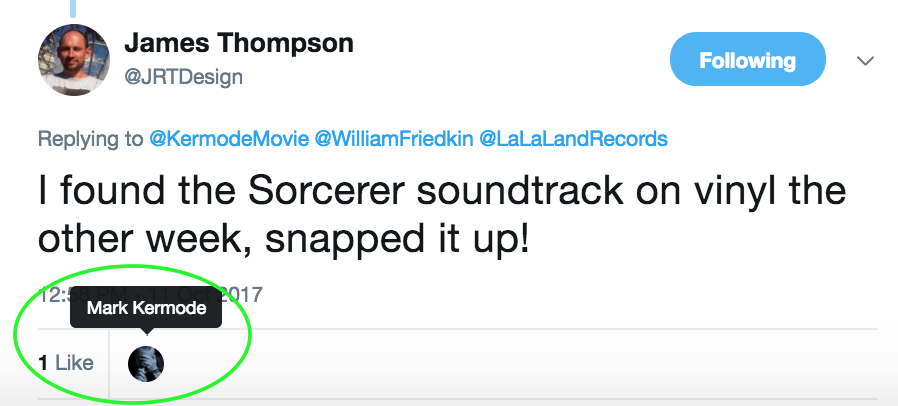
  • James tweeted to Mark Kermode (Mark had tweeted that he was listening to a couple of soundtrack albums for films by William Friedkin, and James replied saying he’d “snapped up” the soundtrack to a Friedkin film called Sorcerer. Mark is a big fan of Friedkin, especially Sorcerer, and he liked the tweet.)
    [snapped up = took quickly, like a crocodile would take something]Screen Shot 2017-10-16 at 18.39.04
  • The Frank Skinner Podcast (Absolute Radio)
  • (Frank Skinner) He’s very witty, very articulate, very quick witted.
    [witty = funny, able to make quick jokes. Quick witted = with a fast brain for making jokes or quick comments]
  • He’s from our neck of the woods. He’s from West Bromwich. It’s in The Black Country. It’s part of the midlands.
    [our neck of the woods = the area where we live]
    [The Black Country is a region of the West Midlands in England, west of Birmingham, and commonly refers to all or part of the four Metropolitan Boroughs of Dudley, Sandwell, Walsall and Wolverhampton. It’s called the Black Country because in the mid 19th century there were many iron working foundries and forges that produced a lot of black smoke and because of the coal mines that produced the black rock and dust from under the ground.
  • People say people from Birmingham sound untrustworthy.
    [untrustworthy = can’t be trusted]
  • Mark Kermode and Simon Mayo’s Film Review (aka The Wittertainment Podcast) @Wittertainment
  • (Mark and Simon) They seem to be on the same wavelength, but they play this game of being irritated with each other all the time.
    [On the same wavelength = they think in the same way]
    [to be irritated with someone = to be annoyed by someone]
  • They just witter away with each other.
    [to witter away = to witter on]
  • They bicker with each other. Bickering, getting at each other, a bit like an old married couple.
    [to bicker with someone = to argue but not very seriously]
    [to get at someone = to criticise someone again and again]
  • As far as I can gather, most of my listeners listen when they’re on public transport.
    [gather = to understand. Gather can also mean ‘collect’, e.g. to gather firewood. Here it means ‘gather information’ or just ‘understand’]

There’s no language quiz this time. The reason for that is that it takes absolutely ages to create them and I wonder how many of you are actually using them! Let me know if you have used the language quizzes that I’ve done for recent episodes of the podcast. If there is enough demand for language quizzes, I can try and bring them back.

Give me your feedback – I need to know what you think.

Podcast and Book Recommendations from Mum

Also mentioned:

There will be more talk of reading books, listening to podcasts and watching films in part 2 of this episode.

484. Try not to Laugh on the Bus (with Paul Taylor)

A conversation with Paul Taylor involving several cups of tea, recipes for French crepes, our terrible rap skills, a funny old comedy song about English workmen drinking tea, some improvised comedy role plays and a very angry Paul ranting about bad customer service in France! Your challenge is to listen to this episode in public without laughing out loud, especially in the second half of the episode. Good luck, may the force be with you. Vocabulary list, song lyrics, definitions and a quiz available below.

Small Donate Button
[DOWNLOAD]

Episode Introduction (Transcript)

I’m going to keep this intro as brief as possible so we can get straight into it!

This one is a conversation with friend of the podcast, Paul Taylor. It was lots of fun to record, I hope it’s also lots of fun to listen to.

There are links, videos, word lists and song lyrics with vocabulary and definitions on the episode page on the website that can help you to understand and learn more English from our conversation.

There is some swearing in this episode – some rude words and things. Just to let you know in advance.

Try not to laugh on the bus while listening to this. That might be embarrassing. That is a challenge from me to you. Try not to giggle – because everyone will look at you and will feel either jealous or confused at your public display of the joy which will be bursting forth from your heart as you listen to Paul’s infectious laughter. No giggling or cracking up in public please. Get a grip on yourself for goodness sake.

Where’s Amber? All will be revealed.

Keep listening until the end of the episode for more additional extra bonus fun.

Alrighty then, that’s all for the intro, let’s go!


Vocabulary List

  • A crepe = a thin french pancake made from flour, milk and egg – all whisked together and then cooked in a pan
  • To whisk = to mix ingredients quickly with a fork or a whisk
  • To knead dough to make bread
  • To knead = to work/press/mix/fold dough with your hands when making bread
  • Dough = flour, water, yeast combined to make a soft paste, used for making bread
  • Cats go to the litter box, shit and then lick their paws
  • The litter box = the tray or box in your house that cats use as a toilet. It’s full of small stones, sand or something similar.
  • Paws = the hands and feet of a cat (or similar animals)
  • The Luke’s English Podcast Challenge – if you don’t know what a crepe is, leave a comment! You *might* get a picture of Paul as a prize.
  • Talking bollocks* = talking nonsense ( *bollocks is a rude word meaning testicles, or bullshit)
  • owzit gaan? = How’s it going?
  • It’s the first day back at school in France so everyone’s going mental
  • Going mental = going crazy, getting stressed
  • Anti-nuclear pens? = I suppose these are pens which somehow resist the effects of a nuclear attack. They don’t exist, I think.
  • https://www.youtube.com/watch?v=geEVwslL-YY
    • Losing your friends when they have kids – How having kids is like the zombie apocalypse (according to Paul)
    • “To put the kibosh on something” = phrase
      If someone or something puts the kibosh on your plans or activities, they cause them to fail or prevent them from continuing.
      [mainly US , informal]
      E.g. “Rattray, however, personally showed up at the meeting to try and put the kibosh on their plans.”
      “…software that puts the kibosh on pop-up ads if a user doesn’t want them.”
    • https://www.collinsdictionary.com/dictionary/english/put-the-kibosh-on
      Origin: Unknown origin :)
    • I’ll be tutoring my child in the ways of righteousness
    • A voice-over = some recorded speech used in advertising, TV, radio etc.

“Right said Fred” by Bernard Cribbins

A 1960s comedy record featuring some cockney workmen moving a heavy object and drinking lots of tea.

Lyrics [vocab explained in brackets]
“Right,” said Fred, “Both of us together
One each end and steady as we go.” [be careful, do it steadily]
Tried to shift it, couldn’t even lift it [move it]
We was getting nowhere [yes, it’s grammatically incorrect]
And so we had a cuppa tea and [ a cup of tea]

“Right,” said Fred, “Give a shout for Charlie.”
Up comes Charlie from the floor below.
After straining, heaving and complaining [making lots of physical effort] [complaining]
We was getting nowhere [also grammatically incorrect]
And so we had a cuppa tea.

And Charlie had a think, and he thought we ought to take off all the handles
And the things what held the candles.
But it did no good, well I never thought it would

“All right,” said Fred, “Have to take the feet off
To get them feet off wouldn’t take a mo(ment).” [those]
Took its feet off, even took the seat off
Should have got us somewhere but no!
So Fred said, “Let’s have another cuppa tea.”
And we said, “right-o.”

“Right,” said Fred, “Have to take the door off
Need more space to shift the so-and-so.” [the thing]
Had bad twinges taking off the hinges [sharp pains] [metal parts that attach the door to the wall]
And it got us nowhere
And so we had a cuppa tea and

“Right,” said Fred, “Have to take the wall down,
That there wall is gonna have to go.”
Took the wall down, even with it all down
We was getting nowhere
And so we had a cuppa tea.

And Charlie had a think, and he said, “Look, Fred,
I got a sort of feelin’
If we remove the ceiling
With a rope or two we could drop the blighter through.” [an annoying person or thing]

“All right,” said Fred, climbing up a ladder
With his crowbar gave a mighty blow. [a heavy metal tool]
Was he in trouble, half a ton of rubble landed on the top of his dome. [broken pieces of rock] [head]
So Charlie and me had another cuppa tea
And then we went home.

(I said to Charlie, “We’ll just have to leave it
Standing on the landing, that’s all [the hallway on an upper floor]
You see the trouble with Fred is, he’s too hasty [in a hurry, rushing ;) ]
You’ll never get nowhere if you’re too hasty.”)

  • Getting queue jumped and dealing with unhelpful staff = when people skip ahead of you in a queue [a line of people waiting]
  • Luke struggles to understand how to deal with waiters and shop assistants who say “c’est pas possible” (French = it’s not possible)

Listen to Alexander Van Walsum talk to Luke about how to deal with “c’est pas possible” in this episode from the archive

391. Discussing Language, Culture & Comedy with Alexander van Walsum


Were you listening carefully?

[os-widget path=”/lukethompson2/vocabulary-quiz-for-episode-484-try-not-to-laugh-on-the-bus” of=”lukethompson2″ comments=”false”]

Episode Outtro

That’s nearly the end of the episode, I hope you enjoyed it and you managed not to laugh out loud on the bus.

Don’t forget, you can see a list of vocabulary and expressions from this episode all on the website, including the lyrics to that song that you heard. There’s also a YouTube video of the song if you want to hear it again and make sure you’ve understood all of it. So check that out.

By the way, the mobile version of my site has now been improved thanks to a helpful listener called Sergei who gave me some CSS coding advice. So if you check the site on your phone now it should look much better than it did before, which will make it easier for you to check vocab lists, transcriptions and other content from your mobile device. Try it now – teacherluke.co.uk. You will find the link for this episode and all the others in the episode archive – just click on the menu button and then EPISODE ARCHIVE.

Don’t forget to join the mailing list on the website so you can get a link to each new episode page in your inbox when it’s published.

As I said, it’s nearly the end of the episode – but it’s not actually the end yet. There’s more. In fact, I’ve decided to give you a bonus bit at the end here, because I’m nice.

So, what’s the bonus bit?

The Bonus Bit – “The Expat Sketch Show”

On the day that Paul and I recorded this episode (and in fact the next one too) we also recorded ourselves improvising a short comedy sketch. I’m now going to play you that sketch.

The idea of the sketch is that I work in an office in Paris and my job is to interview ex-pats (foreign people who have moved to Paris) – I interview ex-pats for a position on a kind of scholarship programme where we subsidise their living expenses and help them integrate into the Parisian community and in return they contribute something to community in terms of work, taking part in cultural events or making any contribution that will benefit the cultural mix of Paris.

Paul plays 3 different ex-pats who have come into my office for an interview, and let’s just say that they’re not exactly the ideal candidates.

The whole thing was completely improvised, it’s full of rude language and it’s all just a bit of a laugh so here is the Ex-pat Sketch show with Paul. Have fun!


Thanks for listening to the episode everyone.

Have a good day, night, morning, afternoon or evening!

Luke

483. A Rambling Chat with Moz

The second part of my conversation with my friend Moz, this time covering subjects such as podcasting vs YouTube, bathing naked in a Japanese spa, sharing personal information online (like a story of bathing naked in a Japanese spa), the role of artificial intelligence & social media, murdering mosquitoes and meeting a crack addict on the streets of London. Vocabulary list and quiz available below.

[DOWNLOAD]

Introduction Transcript

Hi everyone, Here’s the second part of my conversation with my friend Moz that was recorded a few weeks ago.

After talking about murder in the last episode, Moz and I kept talking for about another 45 minutes, just rambling on and going off on a few tangents and you can listen to that conversation in this episode as part of your ongoing mission to improve your English by listening to real conversations that actually happened, between actual people who actually said some actual things and actually recorded them and uploaded them for you to actually listen to.

Things that we actually talked about (in the form of questions)

  • What goes into making and publishing a podcast?
  • Who is my audience and where are they (that’s you)?
  • What’s it like to meet members of my audience?
  • What’s the difference between doing audio podcasts and making videos for YouTube?
  • Should native speakers adapt their speech when talking to non-native speakers of English?
  • Does the word ‘cack’ in English relate to similar words in other languages?
  • What does ‘cack’ mean? (it means poo, by the way)
  • How much of our personal information should we be sharing online?
  • How much of my personal information should I be sharing in episodes of this podcast?
  • Should you post pictures of your children on social media?
  • What are the effects of social media and artificial intelligence on our lives? How might this change in the future?
  • How could you fight against a robot invasion using an umbrella and software updates?
  • How much do we hate mosquitoes and what happens when you kill them?
    and
  • How can you identify different drug addicts that you might meet on the streets of London, just based on how they smell?

I think they all sound like perfectly good questions for discussion, don’t you? I can even imagine some of them cropping up in the speaking section of a Cambridge English exam. Some of them. Maybe not the one about cack, or the one about drug addicts, but who knows?

Listen on to find out how we talk about all of those points.

If you’re a vocabulary hunter, check the page for this episode on my website because there you’ll find a list of words and phrases that come up in this conversation.

That list is available in order to help you to use this episode to expand your vocabulary and to develop a more natural form of English.

There is a bit of rude language and some slightly graphic content in this conversation. Just to let you know…

But now it’s time for you to hear the rest of my chat with Moz.

And here we go.


Vocabulary List

  • These days I’m a lot more devoted to it than I used to be
  • When the inspiration struck me
  • I try to be a bit more organised and rigorous about it
  • There are some teachers on YouTube who are getting phenomenal views
  • There are also various young, hip, fresh-faced YouTubers
  • I’m sticking with podcasting because it works for me
  • Technology has moved on so fast that we can do these things ourselves
  • A digital SLR with a boom mic attached to it (or a shotgun mic)
  • Those are the ingredients for making a hit youtube channel
  • Libsyn is my hosting site and I’m about to sign up with iTunes
  • I had to replace all of the embedded players on my website
  • A ‘hell of a lot of stuff’ that had to be done
  • Libsyn have various different filters that they apply to the data
  • The internet is basically this huge network with all these different sub-stations
  • My podcast is big in Wisconsin. It is the home of Ed Gein, the murderer
  • A lot of internet servers are based in that part of America
  • There’s some sort of internet sub-station or routing station in Virginia
  • If people are using VPNs or proxy servers that counts as coming from the USA
  • I’m trying to use an element of scepticism when I’m reading my stats
  • Lots of people are getting my podcast from bit-torrenting sites
  • I tell you what, a good way of working out how many listeners you get…
  • Every now and then someone comes out of the woodwork
  • I used to have the word ‘whittle (down)’ in my tour
  • You get a piece of wood but you slowly etch away pieces of wood to make it into something else
  • People whittle a stick down to a spike or something
  • You whittle the evidence down until you get the bare bones of the case
  • It’s helped me work out the kind of phrases that only English people use
  • Some aspects of our pronunciation or idioms are a barrier to the global community
  • Communication is a two-way street
  • I’ve just come away from dog-sitting with my brother [your brother is a dog??]
  • They were brummie (from Birmingham)
  • Their brummie was so strong that I couldn’t understand my own language
  • It was only when she came nearer that I could grasp what she was talking about
  • Do you curb your language, or do you hone the way that you speak on this podcast?
  • If they’re not careful they swing too far in the other direction and it becomes unnatural
  • It’s a balancing act between trying to be understandable and trying to be natural
  • “Oui, oui” = “yes, yes” in French
  • Wee wee = unrine (pee pee in French)
  • Poo poo = excrement
  • “Caca” = “poo” in French
  • Cack (another English word for poo)
  • Input = just the language you hear when listening
  • Intake = the language you are really focusing on when listening
  • The more personal they (podcasts) are, the more I get engaged
  • Stiff upper lip and all that, hopefully the lip will be the only thing that’s stiff
  • The pianist stops playing
  • I felt like everyone broke off their conversations
  • Naked guys lounging around, chatting
  • The first guy who walks past me is a midget
  • It did occur to me to check him out and see if it was in proportion
  • I don’t necessarily want to open up the doors of my house
  • We don’t really want to post lots of pictures of the baby on Facebook
  • She has remained true to her word

How much of the vocabulary can you remember from the list?

Take the quiz below to find out. Not all the vocabulary is in the quiz, just a selection.

[os-widget path=”/lukethompson2/vocab-quiz-for-483-a-rambling-chat-with-moz” of=”lukethompson2″ comments=”false”]

That’s all folks!

Don’t forget – Moz’s podcast, called “Murder Mile True Crime Podcast” is available now on iTunes and at www.murdermiletours.com.

Moz’s links:

www.murdermiletours.com

www.murdermiletours.com/podcast

481. Holiday Diary (Final Part) “Endeavour to Persevere”

The final part of the holiday diary series. This one is about visiting the Navajo Nation, meeting some Navajo people, seeing more natural wonders at Monument Valley and The Grand Canyon,  a couple of film recommendations our experience of the solar eclipse and a few more anecdotes about the rest of our road trip.


[DOWNLOAD]

MEXICO EARTHQUAKE APPEAL

Please consider making a donation to help people in the affected areas

Organizations like UNICEF Mexico https://www.donaunicef.org.mx/ are looking for monetary donations.

There’s a big need for clothes, water, and food. Giving to places like the Red Cross Mexico https://www.cruzrojamexicana.org.mx/ , Oxfam Mexico www.oxfammexico.org , and Save the Children Mexico http://www.savethechildren.org/  is a way to get resources flowing.

Notes and Transcript for this Episode

Some rambling about how much it rains in Paris…

Then…

So here is the final episode in this series about the things I saw and did on my summer holiday this year. I’ve tried to make this more than just a description of a holiday. It’s also been a chance for me to talk about some topics that I hope are as interesting for you as they were for me when I found out about them.

In the last episode I talked to you about our road trip around the so-called Grand Staircase – a huge area of land where about 2 billion years’ worth of rock are exposed by tectonic activity and erosion, creating canyons and rock formations that are awe-inspiring but also revealing of the earth’s geological history.

In this episode I’d like to bring the series to a close by telling you a few more anecdotes and describing the rest of the trip.

Then, after this episode we’ll be back to normal podcasting with some upcoming episodes featuring conversations with guests.

So, after visiting Zion and Bryce Canyons in Utah in the last episode, we drove South East and across the state border into Arizona and also crossed into the area known as the Navajo Nation Reservation – an area of land that includes parts of Arizona, Utah and New Mexico.

I already knew a few things about native Americans, or American Indians, or just the Navajo tribe, but I sort of hadn’t realised we would be entering their territory and staying there for a few days.

In fact, I didn’t even really know that the Navajo Nation existed.

I knew a bit about the Navajo. I knew that many Indians were moved from the areas they used to inhabit onto reservations in the 19th century.

I knew that many Indian tribes like the Navajo had been forced, in the late 1800s, by the US army to move onto reservations, which in many cases were basically just prisons on inhospitable land, just because the United States government didn’t really know what else to do with them and which, by today’s standards, would be considered a violation of basic human rights.

I also knew that the Navajo’s population had been decimated by these changes and that this was the same story with many Indian tribes across the country.

But I didn’t realise that the Navajo had been given a whole area of land – much bigger than their original reservation, that they could govern themselves, with their own elected president and other official posts.

It’s worth saying a few things about the Navajo Nation because I learned some stuff I didn’t know before.

They’re a sovereign nation with their own elected President.

The land which includes parts of Arizona, New Mexico and Utah is about 27,000 square KM – and on that land you can find various sites of great cultural and spiritual significance to the Navajo. There are over 300,000 people living there.

So, for a few days we were living on Navajo land and met quite a lot of Navajo people who work in the hotels, restaurants and as tour guides to some of the natural monuments.

These days the Navajo are modern people of course, and they don’t live exactly like their ancestors did but the brief bits of contact I had with some of them was interesting. It was really cool for me to chat with some people, particularly a tour guide we met at Antelope Canyon and just realise that although our ancestors were worlds apart (mine would have been English families raised as Anglican Christians in towns in the North of England, theirs lived on this land and hunted for deer and fish, lived in earthen houses called Hogans, fought with the US army) – so although our great grandparents lived utterly different lives, we shared some surprising things in common.

A Short history of the Navajo

They used to live in the Arizona area – living on and the land in simple wood and earth structures, hunting for animals, performing their rituals, living by their beliefs in the importance of living in harmony with the supernatural powers of nature, but as settlers from Europe began moving west and populating more and more land, they clashed with the Navajo, making life difficult for the settlers and prospectors moving through, so they were forced by the American government and the US army to move 300 miles to the east into New Mexico, and they had to walk there, in winter. Everyone. Hundreds of them died on the way and generally the population was nearly wiped out by the general upheaval – the consequences of the move, and the way their whole way of life became severely limited and impossible, by the way they were treated and their reduction in population is now often referred to as a genocide.

It wasn’t until much later, that the remaining Navajo were not only allowed to go back to their land, and claim it again, but they were allowed to govern themselves.

Essentially, during that period of western expansion, native people were considered less than human and were treated that way. Many Indians were killed or simply left to die.

They were just not included in the grand narrative of western expansion that built the USA of the modern age, despite being the original American people. Usually the American Indians are just represented as savage bad guys in western movies, although this has changed in the last few decades when their stories have been told more respectfully.

Also I learned that the Navajo played a really important part in World War 2. When the US was at war with Japan after Pearl Harbour, one of the most important things for the US navy was being able to communicate secretly. They created loads of codes, but the Japanese codebreakers were so clever and sophisticated that pretty much any code the Americans came up with got broken, and this was costing the US army a lot of lives. In the end, they employed bilingual Navajo people to create a code based on the Navajo language, and it was incredibly effective. The Japanese couldn’t break the code because of the nature of the Navajo language. Many words in Navajo can have multiple meanings but it depends how they are pronounced, using different tones. Some words can mean 4 totally different things depending on the tone used when saying them. I suppose in that way it’s like Mandarin Chinese or other tonal languages.

The Navajo people employed by the government to translate messages into code, based on their language, are known as the Navajo Code Talkers and they have been recognised as heroes and given numerous awards by the US government.

It’s a fascinating story of how this American Indian tribe suddenly became vital to American interests and greatly helped the country win the war.

We met a few native people while we were there and I wondered what life is like for them and how they feel they fit into life in the US.

They seem like nice people (but who knows) with a sense of humour. I mean, they could be vindictive and bitter, but they don’t seem to be. In fact the people we met seemed to be quite level-headed and humourous. I think the fact that they govern themselves helps to give them a sense of pride and independence.

Being in this part of the world, seeing the different landscapes and people, this made me think of some films – these are often my reference points because I’ve watched a lot of films over the years.

The Outlaw Josey Wales – Chief Dan George (not a Navajo but an interesting scene)

One particular film I thought of is The Outlaw Josey Wales – directed by and starring Clint Eastwood. It’s about a civil war fugitive who is running from the Union army. At the start of the film he’s a peaceful farmer, but soldiers come and burn his house down, and kill his wife and child. He’s so consumed by revenge that he becomes an outlaw – a sort of avenging ghost (the typical Clint Eastwood western character) and on his way he sort of picks up these odd group of companions and it becomes something of an unconventional family. It was filmed in some of the locations that we visited, and there’s an Indian character in the movie played by an Indian actor called Chief Dan George. The actor isn’t Navajo and neither is his character – his character is a Cherokee – but the Cherokee experienced similar displacement to the Navajo, and they were ordered to walk hundreds of miles away from their land into reservations where and it basically destroyed their whole way of life – a way of life that had developed over many many years and was in harmony with the land, the wildlife and the natural environment in general.

There’s one scene in the film when this character played by Chief Dan George mentions the trail of tears and how him and other members of his tribe actually went to Washington to meet with the Secretary of the Interior to negotiate. They were all proud and wore suits and hats like Abraham Lincoln – because they were naive, but they were simply told to “endeavour to persevere” which basically means “just try to survive”. They were basically told “nope, we’re not going to help you, we’re still moving you into reservations, you’ll just have to try to survive”. The Indian chiefs went away thinking they had achieved something because the language sounded so respectful and important and because they’d been impressed by the posh surroundings in Washington. It wasn’t until later that they thought about those words “Endeavour to persevere” and realised that nothing had changed and they were being left in appalling conditions with nothing other than “try to survive” from Washington – on reservations built on land that wouldn’t yield anything for them. Once they’d thought about it, they declared war on the Union.

I like this scene because Dan George delivers the story with dry humour. It’s funny but also a bit tragic. It’s also a chance to hear English spoken by an American Indian.

Context: Chief Dan George’s character emerges from his home because he thinks someone is approaching. In fact it’s Clint Eastwood’s character just moving through the area. Dan George (Lone Watie) emerges from the house, trying to get an edge (an advantage) on the intruder but Clint’s character manages to sneak up on him. Then he talks about how the white man has been sneaking up on him and his tribe for years. Then he talks about the frock coat he’s wearing – the same coat he wore when he went to Washington, and a top hat like Abraham Lincoln used to wear. Then he tells the story of meeting the Secretary of the Interior and being told to endeavour to persevere.

“Indians vow to ‘Endeavor to Persevere'”

It’s a great performance by Chief Dan George and shows dignity, sadness and humour.

It’s hard not to see the irony when you see Americans today on Twitter complaining about immigrants coming and stealing their land and not assimilating to the culture.

Saw horseshoe bend – a huge natural bend in a river.

Lower Antelope Canyon (more pics at the bottom of the page)

IMG_6234
(Not looking directly at the sun, by the way)

Video (below) – an example of a Flash flood – the sort of thing that created Antelope Canyon with erosion (this is a scene from 127 Hours, not actually filmed at Antelope Canyon, but just an example of a flash flood)

The tour company is run by the Navajo.

Examples of their dry sense of humour.

We arrived for our 12.20 tour about 30 minutes early because we thought there would be crowds.

We noticed that quite a lot of the tourists were being quite rude with the staff – just being a bit impolite and demanding, which is a pity.

In fact I noticed that the couple in front of us, who weren’t very nice, were demanding to go on the 11.50 tour when theirs was at 12.20 because there wasn’t an air conditioned waiting room (everyone was waiting in the shade in a covered waiting area) but the girl behind the counter told them that there was no space on the 11.50 tour and they just had to wait.

Sure, there wasn’t an air conditioned room, but this particular bit of land is not supposed to have lots of buildings on it and after all this is the desert, what did you expect, etc etc.

It was our turn and we made an effort to be nice.
“Hello! We’ve got a canyon tour booked”
Which tour?
12.20
It’s already gone, sorry.
My wife: What??
The girl just had a straight face.
Then I realised she was joking.
No, I’m just joking, ha ha. You can join the 11.50 one if you want.

I have some time for that attitude. I’ve worked in bars, restaurants, shops, lots of customer service positions. You have to have a sense of humour because people can treat you so badly and they feel that they can be so rude to you.

Meeting Brian Yazzie our tour guide

We were joined by a group of about 10 tourists.

I think that people might be at their worst when in tourist groups. I don’t know why, but groups of tourists can act so rudely, pushing in front of each other, showing no respect to the guide, showing no deference to the incredibly significant monument which they are visiting and also doing stupid and dangerous things – like leaning over cliffs to take selfies or wandering off the path to take photos and stepping on a snake or being stung by a scorpion or something.

Brian dealt with all of this by using some seriously dry humour

Brian’s funny jokes

Can’t remember them? He told us 11 people had been bitten by snakes this week, that a woman fell off a ladder and you can still see the bloodstains if you look carefully, and he also said “travelling thousands of miles to walk through some cracks in the ground, kind of crazy right?”

He knew Penn & Teller and even Derren Brown.

Videos of Brian on YouTube

Some sleight of hand card magic inside Antelope Canyon

Brian tries some tricks on a few French tourists

The chimneys you see in the background of that video are the local power station which provides the whole area (and other states) with electricity. It’s part-owned by the Navajo.

As we were walking to the canyon he told us that his Grandmother used to say that you shouldn’t go down there, because it’s “the home of the winds”.

“So this is sacred ground?” I asked him.

“My grandma thought so”.

“Well, I’m sure everyone appreciates the beauty of it.” I said, but I couldn’t help feeling like we shouldn’t be walking there.

But Brian seemed ok with it.

Monument Valley

Monument Valley in the film Fort Apache

Monument Valley in the film Fort Apache

Hotel is run by the Navajo.

It has views of the valley and the big rock formations.

It’s also a trading post and a place to eat.

It’s quite neatly built into a piece of high ground at the end of the canyon. It doesn’t stand out too much.

Each room has a view of the valley and there’s a big terrace with full views.

Incredible views. Describe the view.

Again, mad abstract shapes on a clear blue and rust coloured background.

Shadows stretching out across hundreds of metres of land. Amazing huge monoliths with faces in them and old names given by the Navajo.

Sunset.

Movie on the wall with view from our room. We sat, ate our packed dinner and watched the film.

It was called Fort Apache – directed by John Ford, starring John Wayne and Henry Fonda. It features scenes filmed in Monument Valley.

In fact, Monument Valley is famous for being in westerns.

It was amazing to watch the film and then literally turn your head and see the exact same environment just there in front of you.

Also, it was interesting to me that the Navajo chose to screen the film, because usually westerns present rather a bad image of Native Americans as the bad guys.

But this one was different. It was made just after WW2 and the general tone of it is about how foolish leadership and the so-called glory of war usually just leads good young men to die and how the American military misunderstood the complex culture of the native Americans and also underestimated their military strength.

The natives are presented as brave, civilised and great strategists.

All the native American parts (Apache indians) are played to great effect by local Navajo, and the end of the film sees them defeat a garrison of American soldiers.

So it’s pretty clear why the locals like the film. And it’s a really good one. John Ford was a masterful director.

That night, like most nights out in the desert we couldn’t sleep. Not because of jet-lag but I think because we’re quite blown away by all the stimulation. It’s quite hard to take it all in!

So, that night we both lay in our bed trying to sleep, but feeling wide awake, with this incredible and powerful landscape just outside the window.

In the morning we drove down into the valley to see the huge monoliths a bit closer. Again, there were lots of faces and forms seemed to be in the rocks as you look at them. You can imagine how the native Americans must have stared at these rocks and seen all sorts of visions in them.

They are truly inspiring places.

Out of the Navajo Nation and into the national parks again.

The Grand Canyon

We drive there just before sunset and get to see some incredible early sights of the canyon.

It is just the biggest thing I’ve ever seen.

Grand Canyon

(A small corner of) The Grand Canyon

From you to the horizon, a huge network of different canyons, jutting rocks, cracks diving deep into rivers down below.

Imagine seeing 300 canyons all at the same time, all part of one much larger one which bends around the corner. It’s like that.

Saw the sunset and driving home catch views of elk by the side of the road.

Insomnia

We couldn’t sleep (again).

I felt a million and one thoughts come to me while I was lying there wide awake.

Some thoughts were my fears and my worries. My whole life flashing before my eyes.

You know when you can’t sleep and your mind insists on playing back some memories…

But also thoughts of positivity and joy about the future.

It’s weird how sometimes when you can’t sleep your mind just takes off and you have to hold on for the ride. You know when you can’t sleep and your mind races around to different things, and you just can’t stop it? You really want to just sleep and switch off, but you can’t. Normally you have ordinary things to deal with that occupy, like remembering to iron your shirt in the morning and dealing with little work-related problems and things like that.

But being away from it all, your thoughts become untethered.

Basically, it’s called “taking stock” and this is what we often do on holiday isn’t it?

I reflected and tried to work things out somehow, while also just trying to get a good night’s sleep.

For example, I am trying to stop worrying about small things because they’re just small things…

I can get quite caught up on details and I can blow small concerns out of proportion. I can make mountains out of molehills, just like we all do, and that causes anxiety and so on. We all do it, right?

But we can’t afford to do that. We can’t put significance onto every little thing. It’s best to let some things slide and to focus on the big stuff. You’ve got to prioritise.

I was also thinking about the whole universe and remembering random episodes from my life, and thinking about starting a family and what it means, also thinking about this podcast and how I’m doing it.

Like, what is it that my audience really wants from me and from this podcast? How can I continue to provide the sort of content that will really benefit people while allowing me to pursue the things I want in life?

There were a lot of strands running through my head, man. But I think I worked a few things out.

From the Grand Canyon we drove down into the lower ground of the desert, back towards Las Vegas – where we would take our quick flight back to Los Angeles for the final part of the trip.

We spent a night an unremarkable in a town called Kingman, and the next day set off by car to Vegas.

This day was all about the eclipse.

The Solar Eclipse

I guess you all know what a solar eclipse is.

It’s when the moon passes in front of the sun and fully eclipses it – hiding it for a few moments before the sun reappears again.

Have you ever experienced one?

It’s seriously weird and amazing.

Firstly, seeing these celestial bodies crossing past each other is like a ballet of cosmic proportions.

This is another thing that makes you realise how small you really are in the grand scheme of things.

It’s also extraordinary that this happens.

Some ancient cultures thought they were extremely significant events.

It’s easy to see why. Everything goes dark like it’s night time. The birds stop singing. Animals behave strangely. The sun is like a black dot in the sky with a shining halo around it.

Then everything goes back to normal.

If you didn’t know it was coming, and you already worshipped the sun, you’d undoubtedly read massive significance into it.

It also looks amazing. You’re not supposed to look directly at it of course, because then you’re basically staring right at the sun which will blind you if you do it for long enough. The light will scorch your retinas.

You have to use special filtering glasses to see it, and on the news they were repeatedly telling everyone not to look at the sun because it could blind you.

Trump looked directly at it of course, as we know. I’m not sure why he did that.

Anyway, the eclipse was visible in certain spots along the breadth of the country. On the road to Vegas we didn’t get the full eclipse, just a partial one and we were in the middle of driving to the airport to catch a plane so we didn’t stop to check it out.

But in any case we wouldn’t have been able to see anything because there was cloud cover.

We did experience a murky half light at the time of the eclipse and everything went spooky.

On the journey there were large black clouds collecting in the distance and some lighter cloud cover over our heads. We started fairly early so the sun was quite low in the sky and with the clouds the light was quite dim.

But as the eclipse happened overhead everything went a murky, dark yellow colour, cars put their headlights on. There were freaky flash rainstorms with massive raindrops.

For about 10 minutes there was a strange end of the world type feeling as the darkening sky was lit up by flashes of lightning in the distance and we saw forked lightning striking rock formations up on our left at the top of a shallow canyon.

We came into Vegas and just went straight to the airport. No need to stop there again.

Arriving in LA had a much better car rental experience.

Within minutes we were in the garage choosing our car.

“Which one would you like? A Japanese one? An American? Hatchback or saloon?”

My wife said “The red one”.

That’s her criteria. Colour.

It turned out to be a Chevrolet Cruze and it was a great car. About the size of a Ford Focus and extremely smooth and responsive.

Maybe this is just how it felt after driving a Jeep for a week.

Compared to that this one felt like a sports car.

Topanga Canyon

Topanga is an awesome place.

Along the coastal highway and up into the hills overlooking the coast.

In those hills are leafy little canyons with communities of people who’ve set up their homes on the hillsides. Topanga was a really cool scene to be part of in the early 1970s and lots of musicians hung out in that area writing their songs. This included people like Neil Young and Crosby, Stills & Nash.

I’m particularly a fan of Neil Young and I’d read his autobiography, so I knew a lot of the stories of the music he wrote and recorded here, and I always thought it sounded amazing. A peaceful retreat among oak trees with sunlight shining through the canopy with wood cabins and cafes serving pie and coffee.

It’s still a lot like that.

We stayed in an AirBnB which was basically a single room wooden cabin with a shower. THe place was extremely well put together. Very tasteful and it felt new. Everything was made of oak with a fantastic and huge stove for cooking. I cooked some food there and drank local beer from bottles. We enjoyed hanging around on the deck outside and lying on the sun lounger looking up at the sky through the leaves and branches of the trees.

We only had a couple of days in this peaceful part of LA so we didn’t do a lot, where you can get lunch and watch people surfing.

Generally it was a pleasure to stay in Topanga and we did not want to leave our cabin and come back to reality.

At night there were coyotes outside the cabin. They make a really strange noise – a kind of whooping, howling and whistling that sounds both ridiculous and scary.

One evening we came back at night and as we drove down the driveway to the cabin there were coyotes hanging around outside the door of the cabin.

These are wild dogs, a bit smaller than wolves.

My wife freaked out a bit so I had to go out of the car, open the door of the cabin and then get her in quickly.

I must admit it was a bit offputting when I heard the coyotes go crazy when they could smell me standing just a few metres away and I heard them all running around in the darkness just beyond my vision making a hell of a racket. I kept telling myself that they were more scared than me, but I didn’t fully convince myself.

I rushed my wife into the house and locked the door! Thankfully we both didn’t get eaten alive by wild dogs because, well, that would have been a pity.

That was a bit scary but we had a good laugh about it!

All in all, this holiday was amazing.

Throughout our trip people were polite, friendly, helpful and often interesting and funny.

We saw some really cool stuff, had a chance to enjoy each other’s company as a couple before the arrival of our child.

The trip also took me by surprise a bit. I didn’t expect to be so moved by the things we saw, particularly out in the desert, at those canyons and in the Navajo Nation.

It was a bit emotional too, watching my wife’s belly get bigger, reflecting on things, not sleeping.

It all felt very real at the time and it was a welcome bit of clarity even if it all happened too quickly.

Now I’m back in Paris amongst all my stuff and all the things that keep me tethered on earth and it’s hard to somehow recreate on a podcast how it really felt to be face to face with the hand of nature creating its mysterious art over billions of years.

I’m not sure it’s possible to, in words, recreate the experience of discovering such beauty, wonder and mystery all through the eyes of people who haven’t slept.

In any case, I hope I’ve managed to communicate to you some of how it felt and that you’ve picked up some more English in the process.

You might have been to the same places as me? What were your thoughts?

Thank you for listening to my Holiday Diary series.

Luke

Neil Young – Tell Me Why (Lyrics)

https://tabs.ultimate-guitar.com/n/neil_young/tell_me_why_ver2_crd.htm

Photos