A conversation with English-teaching stand-up comedian Elspeth Graty, which covers lots of different topics including Elspeth’s background in England, teaching English, cultural differences, “French-bashing”, old-fashioned telephones and The Tellytubbies. Enjoy!
This podcast is made possible thanks to donations from lovely listeners (click a yellow PayPal button on the website if you’re feeling generous) and also the premium subscription, which costs, per month, slightly less than a pack of 80 Yorkshire Gold Teabags from Sainsbury’s. So if you would like to make sure I never run out of tea, then consider signing up.
There are now well over 100 audio and video episodes in the premium archive and you can access them all, plus new ones that are coming. That’s what you get when you become a premium lepster. To get all the information, including how it works and exactly how wonderfully reasonable the prices are – go to www.teacherluke.co.uk/premiuminfo
Introduction Transcript
Hello listeners,
How are you today? Doing alright all things considered? I do hope you’re managing to keep calm and carry on during this weird and difficult period of history that we are all experiencing.
Shall we start the episode? OK.
Here’s the second in a series of interviews I’ve been doing lately featuring people I’ve been meaning to talk to on the podcast for quite a while (quite a while — is that a short time or a long time? Quick answer: It means a long time.)
I just wanted to record natural conversations with some new guests so you can hear their voices, their stories, their thoughts so you can notice bits of language and practise your English listening as usual.
The first of these recent interviews was with Marie Connolly from Australia, which was the last episode of course. I hope you all enjoyed it.
This conversation is with a friend of mine called Elspeth who is from England.
Elspeth is an English teacher and she also does stand-up comedy in the evenings, which is how we met each other. Yep, she’s another English-teaching comedian friend of mine.
Explaining this episode’s title
The title of this episode is “Chasing the Tangent Train with Elspeth”.
The title is just a metaphor – please don’t expect a conversation about train travel!
It’s just a metaphor to explain the fact that this conversation is full of tangents and I hope you can keep up with it. In fact, it’s mainly tangents.
What is “a tangent”? Long term listeners should know this, but plenty of people won’t know so let me explain.
In a conversation, a tangent is when the topic changes to something quite different and seemingly not related to the main point of that conversation.
It’s when you digress from the main point, go away from the main point or get sidetracked.
“To go off on a tangent”
There are lots of tangents in this conversation. So, for the title of the episode, I was trying to think of a way to describe the experience that you will have of just following the changes in direction in a conversation and seeing where it goes.
I ended up with “chasing the train”, which is not actually an expression you will find in the dictionary – I made it up.
Let’s imagine, then, that this conversation is a train and it’s going down the tracks and every now and then it switches to new tracks and continues for a while, then it switches to another new track and then does it again, and again and so on. Can you keep up with the train? I think you get the idea.
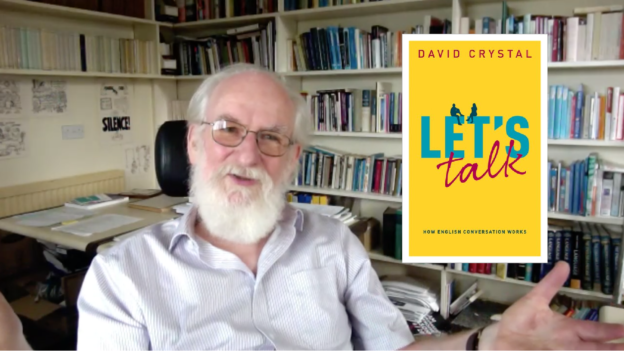
My overall aim for this interview was mainly to get to know Elspeth in more depth and to capture an authentic conversation to help you learn English. That is the destination for this train journey. But as I said, the topics move around a bit, which is totally normal in a conversation. Just ask David Crystal, he wrote a book all about it and he’s a professor and definitely knows what he’s talking about.
What I’m getting at is that this might be hard for you to follow – depending on your level of English.
So you’ll have to focus.
Nevertheless, I can help you keep up with this if I let you know what the main changes will be in advance.
So I’m now going to give you a quick overview of the main changes in topic in this chat.
The main points in this conversation are, thus: (these aren’t spoilers)
We talk about
Where Elspeth comes from originally, and how her family moved around parts of England
Being the daughter of a vicar (that’s her, not me obviously) A vicar is a priest in the Anglican church – the church of England. The cliche of the typical English vicar is that they wear black with a little white collar, they’re often softly-spoken grey haired men with glasses who ride bicycles around their parish and love drinking tea, eating cake and generally worshipping god.
Our accents, which are not strongly affected by the region where we grew up (we actually come from the same general area in England)
Having harvest festivals at church when we were children
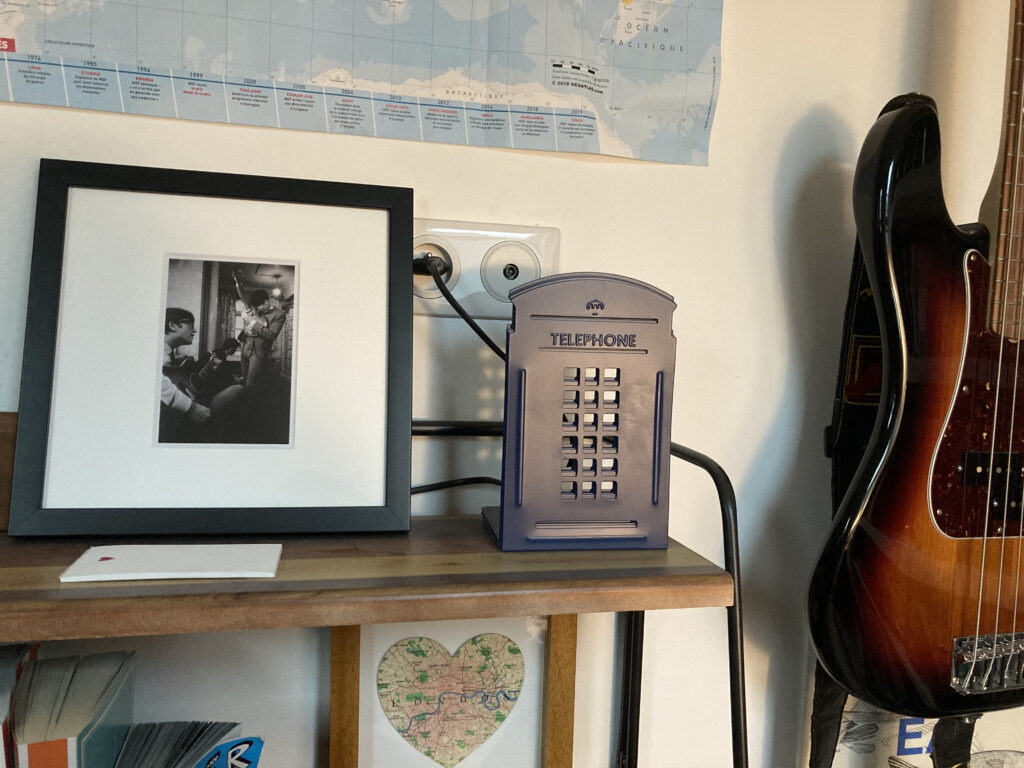
Then there’s a big, random tangent → Remembering the old dial telephones we had in our houses when we were children. Remember them? You had to put your finger in and turn numbers around a dial, and it went went kkkkkkkkk. You don’t remember? That must be because you’re young, or you’re old and you’ve lost your memory.
Services you could get on the old analogue telephones, like the operator (a person who you could speak to and who would deal with your telephone-related enquiries) and the talking clock (a recorded voice that was constantly telling the time and you could call a number and listen to it)
Coventry Cathedral in Coventry, which was almost destroyed during World War 2 but was rebuilt and is now definitely worth a visit if you’re in the city
Elspeth’s life in France, her French, and whether or not she feels French or English after living here for quite a long time
Some of the cultural differences between England and France that frustrate us a bit, like the usual things – being punctual, walking down the street and in particular, queueing – standing in line to wait for things in public
Teaching English to young engineers, and the challenges that French students have when learning English
Some of Elspeth’s experiences of learning French
How Elspeth can behave slightly differently in English and in French, especially when doing stand-up comedy in the two languages
Elspeth’s thoughts on her own clothing choices and fashion sense, and how people react to it, especially the Nike Air Max trainers that she wears
Teaching English online using Zoom – and what that is like
Doing stand-up (going on stage and telling people jokes and stories to make them laugh) and Elspeth’s favourite and least favourite things about doing that Where her inspiration for comedy material comes from and “flow activities” or being in a “flow state”
If there is a connection between stand-up and English teaching
A little story about The Tellytubbies that Elspeth uses in her English lessons, which makes the students laugh (The Tellytubbies is a children’s TV show) The story involves The Tellytubbies, William Shakespeare, the county of Warwickshire in England and April Fool’s Day. Basically, the county council of Warwickshire played an April fool’s trick on the people of Warwickshire, and it involved The Tellytubbies and Shakespeare, and people didn’t like it.
Why English people get into rages – like road rage, or trolly rage in the supermarket
The concept of French-bashing (criticising or making fun of the French and French culture) and why Parisians seem to complain about each other’s behaviour quite a lot (Parisians are people living in Paris)
How people’s behaviour in public in Paris compares to behaviour in the UK and in Tokyo
Things we love about France – because there’s a lot to love about this country too
Finally, a bit at the end where we both conclude that Paul Taylor is basically a cake – a delicious British cake.
Actually, reading out that list – it doesn’t seem like there are that many tangents, but there are tangents ok? What I’ve just given you there is the main flow of the conversation.
Right. Now that you have an overview of the track layout, let’s get this train rolling.
Let’s just get started. Here is my conversation with Elspeth, and here we go.
Luke’s fuddy-duddy slippers (a Christmas present from a couple of years ago)
Ending Transcript
Right, so that was my conversation with Elspeth. I enjoyed it a lot, especially because we have quite a lot in common, not least because we are from the same neck of the woods (a local area where someone lives).
How did you get on? Did you manage to follow it ok? Well, you must have done, because you made it. You’ve caught up with the train. You can have a rest now. Well done for keeping up.
I expect you’re getting out your phone now. If that’s what you’re doing, open up Instagram on your phone and check out Elspeth’s page, which is @elslostinfrance which I now realise would have been the perfect name for this episode, right?
I could do a lot of rambling on now, about all sorts of things, like what’s been going on and the WISBOLEP competition (which is now closed by the way – no more entries please. The deadline has passed, unless maybe you’re in a part of the world where it is still the 15th October – in which case, you have until midnight).
I’ve received loads of entries and let me tell you – it is going to be difficult to choose just one winner. There are so many really interesting recordings and stories of how people learned English and all kids of other things. It will be hard to pick just one person. Also I’m now wondering how I’m going to manage the whole thing. I’ve had nearly 90 entries. I don’t know why I didn’t expect to get so many. Each entry is about two minutes long and so – 180 minutes, even without my comments (and I really want to make even very short comments).
Shall I play them all on the podcast? That’s a lot, isn’t it?
I think the best way to do it might be to make a YouTube video of all the audio (if that makes sense) and then I can add time stamps for each person, which will make it much easier for everyone to find each recording.
In any case, I will find a way to manage this. It could take a while though, so be patient.
I do want to re-state that it has been amazing listening to all the recording (I’ve had brief listens to most of the recordings sent). There are some awesome people in my audience. I just want to give a shout out to anyone who sent in a recording. Well done for plucking up the courage to do that. The competition is going to be a bit of a celebration of my audience from around the world.
Not much more to add here, except the usual mention of LEP Premium which you can find out more about by going to www.teacherluke.co.uk/premiuminfo I’ve been getting some very positive feedback about it. There are now over 100 episodes of LEPP now in audio and video form. Check it out to see what you’ve been missing.
I’ll be back again soon with another episode, perhaps one in which I just ramble on about all the stuff that I’ve been meaning to say on the podcast for a while, a few listener emails, some songs perhaps and more…
Let me say thank you again to Elspeth for her contribution to this episode. Thank you Elspeth.
Everyone: Hang in there. Keep your chin up.
Hey, do you want some anti-covid funk music to cheer you up? (Yeah)
OK. This is something that I recorded this morning. I probably should have been doing some work but after dropping off my daughter at school I suddenly felt compelled to play some bass, and one thing led to another and I ended up recording a little 2-minute funk groove. The drums are from a youtuber called Dimitri Fantini (link on the episode page). I needed a 90bpm 16-beat funk groove and he delivered. Credit to Dimitri for the drum track. I’ve added bass using my Mexican-made Fender P-Bass, some rhythm guitar with my Fender Stratocaster (also made in Mexico) as well as some string sounds which are from my Yamaha P-45 electric piano.
I called the track Funk in the Kitchen, because it’s supposed to make you dance in your kitchen, or indeed in any other location.
Brace yourselves – music is coming… In 5, 4, 3, 2, 1, let the funk commence…
Marie Connolly is an Australian stand-up comedian and TEFL teacher who has written a book of short stories about times when men (from various countries) have flirted with her. In this episode Marie shares some of those stories, tells us about English men vs French men vs Australian men and much more.
[DOWNLOAD]
Transcripts & Vocabulary Notes for this episode (promos, introduction, ending)⤵
LEP Premium Promo
Before we start – a quick mention about LEP Premium. Premium LEPsters, I just want to let you know that P24 is now finished and uploaded. It is an epic series – homophones, jokes, building your vocabulary (which is so important) and also working on your pronunciation. I’ve also uploaded P25 which contains pronunciation drills for the previous free episode (LEP682) which was all about English accents. I said I’d do a pronunciation episode for that, and I’ve done it. You can practise saying the sentences with my normal accent, and also with several regional accents too. The aim being to strengthen both your listening skills and your speaking skills.
WISBOLEP Competition
Second thing – the WISBOLEP competition deadline is 15 October. Is that clear? Originally I said 31 October but the date has changed! The deadline is now the 15 October 2020. If you don’t know what the competition is, check out episode 681.
But this is episode 683, and I’m keen to get started, so let’s go…
Introduction
Hello and welcome back to LEP. It’s new episode time again!
This is an episode with a guest. So you’re going to be listening to another authentic conversation at natural speed in English which can be difficult to follow but is good training for your English.
Before going any further, let me explain the title of this episode. “683. Feelgood Stories of Flirting with Marie Connolly”
Feelgood is an adjective (one word) which we use to describe anything that makes you feel good! For example we can say a feelgood film, feelgood food and or feelgood stories, which would be stories that will make you feel good.
Feelgood stories of flirtingFlirting means interacting with someone in a way that shows that you fancy them, find them attractive, and are probably interested in perhaps getting ‘romantically involved’ with them, let’s say. Synonyms include ‘chatting someone up’ , ‘hitting on someone’ or perhaps ‘trying to pick someone up’. A person can be a flirt, and the adjective is flirtatious.
Feelgood stories of flirting with Marie Connolly
And Marie Connolly is my guest in this episode.
Marie Connolly
Marie is a stand-up comedian, a ski-instructor, an English teacher and writer. Her latest book is full of short stories about flirting with the opposite sex.
Before we meet Marie, let me give you some context to help you understand this conversation, which can ultimately help you learn more English from it.
Marie is from Australia but she has lived in a few different countries. It’s a bit of a stereotype that Aussies like to travel away from Australia (this is called Going on Walkabout), but in this case it’s true. Marie has spent time in various places including Brisbane, Syndey, London, Liverpool, The French Alps and now Paris.
Marie was born in Australia but her dad was from Liverpool and her mum was from El Savlador in central America, which is quite an interesting combination.
For those of you who are interested in accents and pronunciation – Marie has a slight Australian accent because that’s where she grew up. It’s not super strong, but you should be able to notice it a bit.
Here are the main things you’re going to hear us talking about:
As you might expect we chat a bit about stand-up comedy, what it’s like dealing with tough moments on stage and reasons why it can be hard to do stand-up in front of audiences of non-native speakers.
I’m afraid to say that the infamous Russian Joke story makes yet another appearance, which is my fault because as you’ll hear, I’m the one who brings it up. I know, I know. I can’t believe I’m still talking about the Russian Joke, and some of you are now saying “Wait, what’s the Russian Joke?” Long-term listeners will know all about this. Clearly I have deep mental scars from this experience which still haven’t healed. Either that or I secretly love telling this story.
If you don’t know what I’m talking about, just keep listening because I am going to tell the story once more. Yes, I know.
Marie gives some thoughts on Liverpool where some of her cousins live, and her favourite English shops for buying clothes, which leads to some chat about Marks & Spencer – the quintessentially English clothing and food shop, which also has branches in Paris where you can buy proper tea. (not property, no – they don’t sell flats and houses, no I mean “proper tea” good quality tea)
….I’m now pausing for laughter…
Marie tells us about her time living and partying hard in London, and then her decision to move to France to work as a ski instructor at a ski resort in the Alps, while making trips to Paris to perform comedy gigs.
You’ll hear some details of Marie’s comedy shows in English and French in Paris.
At the moment she is doing her own one-woman show in English called “Sydney, London, Paris, Darling”. You can see it if you’re in town, COVID permitting of course. At the moment, in France, Theatres are still allowed to open and Marie’s show is in a theatre so it’s still on. If you’re in town why not come and check it out? She is very funny and has some great stories to share.
Then we move on to talk about the latest book that Marie has written, called “40 Frenchie Feelgood Flirts”. It contains 40 short stories. This is yet another book recommendation on the podcast. I think it could be a really good thing to read, if this is your cup of tea. Short stories are perfect for learners of English, because they’re short – do I need to say more?
It’s chick-lit, which means books primarily for women that usually include romantic themes.
The stories in Marie’s book are all cute anecdotes about times when men have flirted with her, hit on her, or chatted her up. There’s no explicit sexual stuff in Marie’s book. As Marie says it’s just innocent fun. So it’s less “40 Shades of Grey” and more “40 Shades of Hey, How are you doing?”
— I’m now pausing for more laughter and applause, thank you —
The rest of the episode is mainly Marie sharing some of her stories of flirty moments with men who she has encountered.
She also talks a bit about how French men are different to Australian or English men.
What do you think the differences might be? What do you think Marie is going to say about the way a French man will approach her, compared to an English or Australian man?
Hmmm, have I piqued your interest? I hope so. Listen on to find out the details.
VOCABULARY
Vocab hunters – Here is some language which you can simply notice as you listen. When you hear these things, take a mental note.
I know you are keen to get to the conversation, but bear with me. This will be useful for your English, and that’s what this is all about at the end of the day (and the beginning of the day, and the middle of the day, etc) Trust me, I am a professional.
I’m not explaining this all now, I’m just saying it so you can notice it yourself when it comes up naturally. If you don’t understand these phrases, don’t worry. I will explain it later in the episode. But you might be able to work it out from context as you listen.
*There is some swearing*
To backtrack – “You can’t backtrack” [this one comes up twice]
To stick in someone’s craw – “It stuck in my craw. It bothered me.”
To be over it – “Maybe I’m not over it”
Deep scars – “Maybe there are deep scars”
To wilt – “I wilted in front of them”
To be sick to your stomach – “I was sick to my stomach”
To be swallowed up – “Can I please be swallowed up?”
A halterneck top (an item of women’s clothing that is quite revealing) “I was wearing a halterneck top”
To snuggle under the duvet – “If I could have, I would have snuggled under the duvet and just stayed in bed for a year.”
______ by name, ______ by nature – “Alex Love, our mutual friend; lovely by name and lovely by nature.”
A coping strategy – “Every comedian has their own coping strategy”
To rectify – “Get back on stage as soon as possible and rectify”
Dainty / pastries – “I’m not used to French dainty pastries, I prefer the big fat Australian ones”
Self-soothing
To pay through the nose – “I will pay through the nose. I just want the best tea I can get.”
A hub / antipodeans – “It was a hub for antipodeans”
To be up shit creek (without a paddle) – “Because of Brexit I’m up shit creek.”
A snapshot of something – “It’s a snapshot of life in France”
To be hit on / to be picked up / to be complimented – “40 times I’ve been hit on, picked up or complimented by men”
Abs – “One was very white but he had super-fit abs”
White vs Pale (to describe a person)
Calf muscles
A sand castle
To blush – “He would blush and I would feel amazing.”
The contents (of a book) / to pique someone’s interest – “Can I read through the contents to pique people’s interest?”
To mime – “He started swimming with his hands. He was miming and I was laughing.”
A man bun – “He had long hair up in a man bun. I called him Mr Man bun.”
Chick-lit
Ok so try to notice those things, maybe try to guess what they mean and I’ll be explaining them on the other side of the conversation.
But mainly, I hope you just enjoy listening to this chat.
Now, get ready because things are going to speed up a bit, as we meet Marie Connolly…
Ending
Thank you again to Marie. After finishing the recording, we realised there were other stories we’d forgotten to tell, including the time Jerry Seinfeld turned up at one of our little comedy shows in Paris and performed in front of about 20 people including Marie and me, and how it was just a little bit awkward, but still amazing and quite surreal. Jerry Seinfeld at one of our shows? What are the odds? So Marie will have to come back for another episode in which we can describe that experience for you.
Just a reminder about Marie’s comedy show (if you’re in Paris) and her books (which you can get anywhere in both paperback and Kindle versions).
The One-Woman Comedy Show
“Sydney Paris London Darling” you need to check her Facebook page – Marie Connolly Comedy.
https://www.facebook.com/marieconnollycomedy/
Marie’s books, including “40 Frenchie Feelgood Flirts”
Marie’s page on Amazon where you can find her books. The main one we talked about is “40 Frenchie Feelgood Flirts”. She writes under the pseudonym Muddy Frank (read the titles of the books available)
Explaining the Vocabulary
Let’s go through that vocabulary again, from the beginning of the episode.
Did you notice any of the words and phrases I listed before? Did you get a sense of what they mean?
Let me go through them again, and I’m going to clarify them as quickly as possible. I’m not giving these phrases the full LEP Premium treatment (because I like to go into lots of detail in those episodes) I might put them into an upcoming episode of LEP Premium so I can make sure you learn the vocabulary properly and we can do the usual memory tests and pronunciation drills as well. But now, this is the sort of quick version. Let’s call it the 10 peso version.
The vocabulary is already listed above ⤴️
Still not sure about the meanings? Try using www.oxforddictionaries.com to check them out. Other online dictionaries are available.
And that is the end of this episode.
What’s coming up in the future? Who knows – nobody can predict the future, except weather forecasters.
As usual I have more episode ideas than time, but I do have a few interviews lined up, including some more friends you might not have heard on the podcast before, and some regular guests that you’re probably waiting to hear from too [yes episodes with Amber & Paul are in the pipeline, it’s just a bit tricky to find times when we are all free].
Basically – more conversations with guests are coming up as well as the usual episodes on my own on various topics. So, it’s going to be more of what you normally get with LEP!
Right, I will let you go now.
Thank you for listening.
Check the episode page on my website where you’ll find transcripts for 95% of what I’m saying in the introduction and ending parts of this episode, plus other things like a photo of Marie and me (oh Luke, a photo!?) plus the comment section and things like that. I often put other things on the website page for you to check out as well, including little YouTube videos relating to the episode or other bits and pieces.
I look forward to reading your comments on the website.
Follow me on Twitter @englishpodcast which is where I am also quite active.
Tweets by EnglishPodcast
Sign up to LEP Premium to access all the other episodes I make, all focused on helping you build your English in various ways. www.teacherluke.co.uk/premiuminfo
Have a good one. Be excellent to each other, and party on in your own sweet way.
Professor David Crystal returns to talk about his latest books, and more. The first book is all about the art of conversation in English, and the second one is a spy thriller inspired by real events. David Crystal is one of the world’s leading linguists and an expert on the English language. He is also a national treasure and it’s a treat to be able to talk to him in this episode. Video version also available on the Luke’s English Podcast YouTube channel.
The Cambridge Encyclopedia of the English Language
The Oxford Illustrated Shakespeare Dictionary
The Story of English in 100 Words
You Say Potato: The Story of English Accents (written with his son Ben)
Wordsmiths and Warriors: The English-Language Tourist’s Guide to Britain (Written with his wife Hilary)
Txting: The Gr8 Db8
Pronouncing Shakespeare: The Globe Experiment – a fascinating project investigating how English was pronounced by the original actors in the Globe Theatre when Shakespeare was alive
Spell It Out: The Curious, Enthralling and Extraordinary Story of English Spelling
Just A Phrase I’m Going Through: My Life in Language (which is both his autobiography and a highly accessible introduction to the field of linguistics)
Making Sense: The Glamorous Story of English Grammar
Many of those titles can be purchased as ebooks from David Crystal’s website – www.davidcrystal.com or from any good bookseller. There are also audiobook versions which are read out by the man himself.
Hello and welcome to Luke’s English Podcast. This episode is number 669 and it’s called How To Learn English.
That’s quite a bold title but this really is a lot of what I have to say about learning English. If you really want to learn this language, this is my advice.
I’ve been teaching for about 20 years, podcasting for over 11 years now and I keep finding out more about learning a language through teaching it, getting feedback from listeners and also through my experiences of trying to learn French.
This episode is a distillation of many of my thoughts and advice on how to learn English. It’s not going to cover absolutely every aspect of it, because language learning is a huge subject that encompasses so many different things and you could talk about it all day, but I have decided to talk about learning English, breaking it down into the 4 skills, and giving you as much advice as I can in this single podcast episode. I hope you enjoy it and find it useful.
For those of you who are not so familiar with me and my work. My name is Luke Thompson, I think I am the 4th most famous Luke Thompson in the world. I’m an English teacher, a podcaster, a comedian, a husband and a dad. I am from England but these days I live in France. My podcast is free and is downloaded all over the world. I also have a premium subscription in which I focus specifically on improving your vocab, grammar and pronunciation. To find out more about that go to teacherluke.co.uk/premiuminfo
I expect you want to learn English, right? That’s the main reason you’re listening to this I expect. You want to learn English.
Well, good news! It’s definitely possible. You can learn English and you will if you put in the time and the effort. It’s important to remember that.
What do I mean by “learn English”, though? I mean that you can learn to speak English fluently, clearly and with confidence, expressing yourself with shades of meaning, adapting your English for the situation both in speaking and in writing, knowing and being able to use a wide variety of vocabulary and accurate grammar and ultimately being yourself in the language and developing beneficial relationships with others based on effective communication. Yes, you can. Where there’s a will, there’s a way.
That’s it, just a positive and encouraging message at the start. It’s important to always remember that making progress in your learning is a realistic prospect and will happen when you put in the time and effort, and more good news: the more you enjoy it, the easier it is.
I hope this podcast helps you to enjoy getting English into your life on a regular basis, which is a key part of learning the language effectively.
But what else should you be doing in order to improve your English overall?
In this episode I’d like to talk in some detail about learning English and how you can do it.
This episode is a sort of “come to Jesus moment”, which I feel I should do regularly, just to remind everyone listening that there is a method or approach at work here and that it’s not just you listening to people talking.
A “come to Jesus moment” in the world of business is when someone does a passionate speech or event in which fundamental priorities and/or beliefs are reassessed, or reaffirmed. It’s like when Jesus gathers his disciples around him in order to reaffirm their belief in what he’s preaching or to say some deep stuff which strengthens their faith.
This is a come to Jesus moment for me.
Not that I’m comparing myself to Jesus. No, not at all. Not even a little bit, and anyway that’s not for me to say, that’s for other people to point out isn’t it, not me. Anyway…
I’ve said it before and I’ll say it again. There is a method to the madness.
In my podcast episodes, I’m always teaching you, using my particular set of professional skills, but rather than presenting it all as a lesson I usually try to present it more like a radio show or a comedy show even.
So, amidst the episodes about music, comedy, interviews and so on, I thought it would be worth restating the core values of LEP, which I seem to do about once every 6 months or so.
I’m going to give loads of advice here, and this is all based on what I’ve learned from:
Teaching for about 20 years
Meeting thousands of learners of English, some of them successful, some of them not, working directly with them as their teacher and listening to them talk about their studying habits and experiences
The academic studies I’ve done, especially the DELTA which involved extensive reading and writing on various aspects of how people learn and teach English
Doing my podcast and getting testimonies over the years from many listeners who told me about how they’ve used it to improve their English
There’s also my own personal experience of working on my French
Anyway, the plan is to talk about learning English with a focus on the 4 skills: listening, speaking, reading and writing.
I have talked about these points quite a few times before on this podcast, and have given tons of specific advice about working on your English, including in episodes like 174 (and others)
So I will probably repeat myself a bit. But I still get asked to talk about “how to learn English” very regularly and I think it’s important for me to talk about learning English on this podcast on a regular basis. Obviously, that is what this podcast is about, first and foremost, even though a lot of the time in my episodes you’ll hear me and my guests talking about all sorts of other things.
Learning English is the main aim of this podcast
Essentially the thinking is that you should listen to natural conversation on a variety of topics and it’s simply listening to things in English (not just listening to things about English) that’s going to help you learn this language, especially if you enjoy the content.
I’ll probably talk about this again in a bit, but let’s say that ultimately the plan with the free episodes is to help you listen to English regularly, for longer periods of time, long term. The more, the better. If the content is enjoyable, that should just make it easier for you to achieve that. In fact, if you’re really into what you’re listening to, you don’t really even notice the time passing.
Then there’s the premium content, which is an effort to push your learning beyond the gains you get from all the exposure and input you get from just listening. The premium content is designed to let you get the benefit of my experience and teaching skills in order to cut out a lot of work that you would otherwise have to do yourself, so I can essentially take you by the hand and lead you through some intensive practice to work on your English more directly.
So that’s my content, but let’s talk now about learning English as a whole then.
Learning English is a holistic thing. It encompasses many aspects and skills that are connected as a whole.
There are receptive skills like listening and reading, productive skills like speaking and writing, language systems like grammar, spelling, vocabulary and phonology, social and psychological factors that come into play when we use language when interacting with others, then there are other factors that come into play like identity issues, body language, culture, literature, pragmatics and all sorts of other things. It’s hard to know where to start when talking about it.
You need to learn it to the point where you don’t even think about it any more.
The more you talk and think about it, the more it starts to sound like the force from Star Wars.
Stretch out with your feelings.
Do or do not, there is no try.
Do not think, feel.
Let go, let the English flow through you.
I am your father (oh wait)
It’s about learning how to do something which goes right to the core of who you are in fact.
It’s a holistic thing. It incorporates many aspects as part of a whole process and so it’s quite tricky to know where to start.
Let’s put it like this. Language goes in, and language comes out. (I told you it sounds like The Force)
Language is within you and language is without you. It flows through you. It binds the galaxy together.
There are receptive skills (this is how language goes in)
And there are productive skills (this is how language goes out)
There’s the written language
And there’s the spoken language
This is our system.
Think of it like a table with two categories on the horizontal axis and two on the vertical axis, so it’s like a grid with 4 squares in it.
On the horizontal access we have receptive and productive skills.
On the vertical we have written and spoken English.
Within the table we have 4 skills – the 4 squares.
So in the box marked “written” and “receptive” we have reading.
Below that in the “spoken” and “receptive” categoriy we have listening.
On the right in the “written” and “productive” side we have writing.
And then in the “spoken” and “productive” side we have speaking.
Those are your four skills. Reading, writing, listening and speaking.
The 4 skills are connected in various ways.
Reading and writing deal with the written word of course.
Reading helps you to write. It helps you to see how the language is built, how words are spelled and how sentences, paragraphs and texts are put together with grammar and textual conventions.
Listening and speaking deal with the spoken word.
Listening helps you to learn how English actually sounds, how words join together in sentences or longer utterances, it helps you get familiar with the speed, rhythm, flow and intonation of the language. It helps you get used to natural pronunciation which in turn helps you produce English in the same way.
Words exist in visual form, and in spoken form.
But reading and listening are connected too because they’re both receptive skills. They provide us with input which is the essential foundation of language learning.
And speaking and writing are connected because they’re productive skills.
These are the skills you need to use when using language for various purposes. This is where you are more active in the sense that you are constructing language and putting it down visually in the form of writing, or using your body to produce it orally.
Let’s talk about those receptive skills and input.
The reading thing there is something we’ll come back to in the section about reading.
This is the academic who is always mentioned in this context, when talking about how to learn English these days. Krashen was one in a long line of linguists who came up with theories about how language is learned and should be taught.
Arguably, we still don’t really know how people learn languages, but various academics over the years have put forward different hypotheses to explain it and these have been the backbone of our understanding of language learning that has informed the way we all learn and teach languages over the years.
Krashen though is the one that people often talk about today, including all the many YouTubers who regularly post videos about the best ways to learn, the only ways to learn, the secrets of learning and all that sort of thing. Krashen is usually brought up because his ideas fit in quite nicely to a model of language learning for today. I mean, it involves a lot of consumption of content in English – plenty of listening and reading and that sort of content is in plentiful supply online, like for example episodes of Luke’s English Podcast.
In his input hypothesis in which he makes the case for the importance of comprehensible input for language learning, he states that in fact the only way we can successfully increase our underlying linguistic competence. This is our system of linguistic knowledge or let’s say that “language instinct” that you have, which even subconsciously gives us a sense of when language is right or wrong. I suppose it could be active in that you know a certain grammar rule and can see when it’s been broken, or passive in that you just feel that something is right or wrong but can’t necessarily explain it.
I would say the passive knowledge is the vital one because ultimately you just want to be able to feel that language is right or wrong without thinking about it.
But that being said, your active knowledge can be really useful when doing things like avoiding common errors as a result of your first language, or consciously pushing yourself to create language which is normal.
Anyway, Krashen says the only way to increase your linguistic competence is through comprehensible input, meaning reading and listening to things that we mostly understand and that with the context of what you do understand, you are able to work out the bits that you don’t know. This is how we acquire new languages.
So basically, we learn a language when we understand it. So, naturally, according to Krashen, the receptive skills come first.
I think this makes a lot of sense to me. I think it’s bound to be true that we learn language by listening to it and reading it. But what about those moments when you have to speak or write, what about learning the grammar and all the rest of it?
Krashen would say that we learn the grammar, vocabulary and pronunciation of a language by listening to it or reading it, and that it’s a natural process and part of how we decode language through comprehensible input.
So, don’t worry about grammar rules and all the rest of it, just listen and do your best to keep up and work out what’s going on, and do it regularly.
Again, I am sure this is true but I also think it’s worth studying the language a bit too, breaking it down a bit, seeing how it works, actively trying to learn more vocabulary, checking up on the rules of grammar and doing some controlled practice. Working on your pronunciation by copying and training your mouth and brain to cooperate with each other, like the way we practise certain movements in sport or musical parts on an instrument.
I do believe that controlled practice and conscious learning like that must also be beneficial because I’ve seen it happen. Doing some active studying can be like a fast track of English learning. It can cut out a lot of time by helping you realise certain things about the language quickly, and I think if you then notice it again while listening and reading that only reinforces what you’ve learned.
Of course, you shouldn’t get blinded by grammar or pronunciation rules and so on, to the point that you can’t see the wood for the trees.
Try not to get hung up on grammar, because it can make you process language in an unnatural and contrived way. It can get stuck in your head and block you a bit. Instead, try to notice patterns and incorporate them into your use of English. Try to see grammar study as a way of confirming things you’ve already noticed, or a way of consulting with a reference book as you also just absorb English more naturally. If you only study English with the grammar, it’s going to be a weird abstract process for learning the language. It’s better to focus on consuming English in the form of messages which you are trying to understand, and then perhaps check your grammar later to straighten things out.
The premium subscription is where I help you with that sort of thing, hopefully combining with the free content to give you all the stuff you need to attack English from several angles.
How can you learn this language if you haven’t heard it and read it a lot?
Read and listen to things that are slightly above your level, so you can understand 60-80%. You need to be able to understand that much for your brain to work out the remaining 20-40% that you don’t know. Meaningful context is vital.
Basically, listen x5 and read x5.
It’s largely a question of finding the right stuff to listen to.
There’s this podcast of course. Others are available.
Watch TV and films with and without subtitles.
Hopefully you’ll find content that you actually want to listen to, not just for studying English. So if you do get addicted to a Netflix series and you can’t wait to find out what happens next, that’s good! That means you will get more comprehensible input and you will be much more focused and involved in it, which is great for your English. Or maybe you want to hear another stupid and funny conversation with my friends just because it makes you laugh and you feel some sort of connection to it. All of that is great because it will help you listen more, listen longer and listen long term.
Reading
This one is also a pleasure to talk about because it’s a pleasure to do and there are lots of great things to read.
Let’s hear from Krashen again as he is the master of the whole input model.
This is again from Wikipedia, which I think is fine usually for the basics like this.
Extensive reading, free reading, book flood, or reading for pleasure is a way of language learning, including foreign language learning, through large amounts of reading. As well as facilitating acquisition of vocabulary, it is believed to increase motivation through positive affective benefits. It is believed that extensive reading is an important factor in education. Proponents such as Stephen Krashen (1989) claim that reading alone will increase encounters with unknown words, bringing learning opportunities by inferencing. The learner’s encounters with unknown words in specific contexts will allow the learner to infer and thus learn those words’ meanings.
Of course that system is disputed because this is the academic arena we’re dealing with and people are always putting forward ideas, defending them, disputing them and so on. It’s how we move forwards and learn about this stuff.
So this is extensive reading which is different to the sort of intensive reading you do in English lessons, where you spend ages on just one page of text, break it down into tiny chunks, understanding every single morsel. With extensive reading it’s all about just getting as much English into your head as you can by reading as much as you can, and you focus on reading enjoyable things, especially stories and you don’t stop too much to analyse the language or even check words, you just keep trying to follow what you’re reading. The more involved in it you are, the better.
Again, this point about input is that it feeds your instinct for the language. You get a subconscious sense of what is right or wrong, which comes in very handy for when you’re doing those nasty sentence transformations and use of English tasks in a Cambridge exam like CAE. What you really want in those situations is to know exactly which preposition or auxiliary verb is missing, or to be able to manipulate sentences in a variety of forms. I reckon it helps to do a bit of language practice as well, with a few controlled exercises but the idea is that it should all go in naturally giving you this sense of language competence.
It’s important though to choose texts which are not too difficult for you. You need to be able to understand enough to be able to get a grip on the rest of the language.
So which books do you choose?
We’ve talked about the importance of choosing stuff that’s interesting to you, that reflects the type of English you might need.
Genre isn’t an issue. People assume you need to read or listen to the news but as we’ve already established they don’t really talk like normal people on the news, and they also write in a certain “newsy” style. Funnily enough it might be more useful to read the tabloid papers as they write in a more conversational style, but I think it’s worthwhile looking beyond the news.
Basically, read whatever you want.
Even comic books or graphic novels as they’re known for adults.
Graphic novels can be brilliant because they support your understanding with the images and often the English is in the form of speech so you learn really directly how to apply that stuff to real life. I love graphic novels in French. It’s my favourite way to work on the language.
You could consider the current bestsellers. If other people like the books then why shouldn’t you? Look in the fiction and non-fiction categories.
Or try graded readers, which are an excellent and underused resource. I really recommend them if you’re not a strong reader. They’re previously published books, and often some of the great classics and modern classics in English, but they’re republished with English that is graded for certain levels. The number of words is reduced, it’s truncated and essentially it’s a way to increase the percentage you do understand, and decrease the amount you don’t understand, getting to that 80/20 spot where you can maximise your language learning.
There are lots of titles to choose from and various publishers. Check these ones out
But your English may well be good enough now to have a go at a book for native speakers. So go for it. You have loads of options. Just make sure you enjoy reading on a regular basis.
I would also add that it’s important to choose texts which are written in modern style and perhaps about an area that you are particularly interested in. Perhaps think of it like this – what is the kind of English you want printed on the back of your head (on the inside)? Odd question, but I mean, what is your target English. Perhaps it’s the involving and descriptive storytelling of fiction, or it’s the matter-of-fact world of non-fiction. I reckon non-fiction is probably better because it reflects the kind of English you are more likely to be writing, especially if it’s things like academic work or reports at work, because they’re all about presenting you with information, data, commenting on what’s going on, describing how to do things and that’s probably the sort of thing you’ll need to use English for, especially in writing.
This might be a bit dry but it will really show you loads of examples of emails with full explanations, so you can read and learn.
David Crystal
The Story of English in 100 Words
Anything by David Crystal is fantastic, but this non-fiction book will teach you the entire story of the English language through 100 words and there are some great words in there like
Loaf, Street, Riddle, Arse, Jail, Wicked, Matrix and Skunk, to name but a few.
So you’re bound to learn tons from that.
Biography
Le Freak: An Upside Down Story of Family, Disco and Destiny By Nile Rodgers
Fiction
The War of the Worlds by HG Wells
The writing is a bit old fashioned. I have to be honest, but it’s mostly modern in style and I think it’s worth it because the story is amazing and it’s not too long. It’s wonderfully descriptive and much better than any movie version could be. Definitely one of my favourite books of all time.
Productive skills / output
This is where we get to the more nebulous world of productive skills. It’s like an alien land where monsters roam, a bit like war of the worlds maybe.
OK I’m exaggerating here but I mean that productive skills are a bit harder to pin down because even more psychological and social factors come into play. You have the public aspect of it, the fact that you’re trying to manipulate the language and get your ideas across in the right way, being coherent and cohesive and in the right style with the right level of politeness with the correct conventional replies and requests and on and on it goes!
Again, I’m making it sound tricky, but I mean that you are involved so much more because you’re making the language and actually using it. This is exciting because you get to express yourself which is the most wonderful and gratifying thing you can do in another language, and when it slides out quite fluidly and you’re not too blocked by who knows what, then it’s all gravy. But sometimes it just doesn’t seem to work out that way and you get mixed up and it doesn’t come out right at all. There’s a sense of performance in productive skills, and a sense that you have to be aware of the right way to conduct yourself, and to be able to utter things in English instantly, following what the other person is saying, it’s all done in a sort of unconscious blur and thinking about grammar in that situation is a killer.
So it’s about getting a level of ease, a level of comfort, a platform from which you can bob and weave your way through the conversation, finding other ways to say things and switching correctly between tenses and situations. I think you get what I mean.
So how do you work on these things?
Ease – a voice, fluency
Control – grammar, vocab, pronunciation
Range – a wide range of language for a wide range of things
Coherence – does it all make sense? Can people follow you easily?
Cohesion – particularly in writing, how does the whole text make sense as a whole?
Social factors – knowing how to put things and how to manage relationships through language
Again, the idea is that this language is just built into you from all that exposure and input.
I would say that there’s a great deal of other stuff you can do to improve your productive skills beyond reading and listening a lot, of course.
In both writing and speaking the first thing to remember is you need to engage in it as much as possible. Real writing and real speaking.
Ultimately this means trying to use language to communicate a message in some way and that’s what you should be focusing on. Meaningful interactions, especially ones in which you have something to offer or something to gain, such as negotiations or even information gap situations in which you’re telling someone something they don’t know. Also social interactions involving being polite or building relations with people. Ultimately, doing it for real is the best workshop in which you can work, rolling with the punches and trying to keep track of what you’re learning.
This is why people learn English best when they’re forced to do it because of their surroundings. They learn by being a waiter in London for a year or working in an office with native speakers, or being plunged into a foreign university for a year, or moving to a new country and having to cope with all the challenges that brings and in a second language. I suppose this is immersion, but it;s more than that. I recommend actually conversing with people to just practise. It’s the 5 Ps.
It’s like going to the gym. Fluency is like physical fitness in your mind and also in your body because you’re using your mouth, your breathing and your head and hands to communicate too.
It applies to writing too. You can observe the way other people write their emails and kind of copy their style, you have to really think about what you’re saying and doubtless you will end up writing emails with requests, with information, with questions and with complaints and so on, so you will have to learn on the job. Being thrown in at the deep end, or if you just have to use English at work it could either be a big stress for you or a huge opportunity to just go for it.
Anyway, let’s talk about specific productive skills – writing and reading, and how to work on them.
Let’s say you’re not actually in a situation where you can talk to people or have correspondence with people, or have to write things which other people will ultimately have to read. Unless you find a tutor on italki for example then that person could be your practice point for speaking and writing, giving you feedback as you go. But let’s say for the purposes of this episode, it’s just you and the English language, facing each other off in a kind of wild west fashion.
How can you practise on your own?
Writing
Obviously you need to write. But what are you going to write and who is going to read it?
Firstly – just write, write regularly, write meaningfully and write with a reader in mind, even if nobody reads it. This is important because it will help you get used to simply putting your ideas into words. It’s a creative process and also a mechanical process to an extent. Building sentences is a sort of art or a craft. You have to practise it in order to get some level of comfort with it. Let’s imagine there’s a muscle in your head (this is not scientific at all) which, if you never exercise it, will be quite weak and underdeveloped. But if you exercise that muscle regularly it will be strong, reactive and quick. I expect there is a part of the brain responsible for creating written language, and a sub-section for creating written English. Keep that part of your brain fresh by writing English as much as you can. That’s as scientific as I can get here.
So, here are some things you could write
What to write
Anything
A diary
Email an imaginary person (spooky?) or yourself (think outside the box here ok?)
Academic writing – text types
Emails – email types and conventions
Reports – same!
Formal and informal letters – same!
Applications – same same!
Basically – Whatever you have to write, you should try to find some samples of these texts and aim to copy them. Copy the style, the arrangement, the language they use and reproduce it yourself. Texts that you write will invariably be very practical so it’s about reporting information and asking questions. Look at the sample texts and copy them.
It helps if you have a specific workbook. I recommend Email English by Paul Emmerson. It’s a simple workbook that helps you work on almost all those things and I’m not even sponsored by Macmillan or anything, it’s genuinely a great book.
They also have downloadable email writing tasks on the Macmillan website or here
Ideally you’ll have a teacher to proofread your work, correct you and give you feedback.
If this isn’t possible, it’s still a good idea to write.
Other ideas
A diary (just describe things that happened, or make it more personal and really explore your thoughts and feelings. If the words don’t come, just use basic words. If you feel unable to express yourself perfectly, express yourself imperfectly but try to express yourself.
Writing is not just sentences, it’s paragraphs and pages. The thing you are writing will define how you write it. This means – conventions of certain texts, formality level of the language.
Specific exam tasks → IELTS, FCE, CAE, CPE, BEC higher and vantage
These will often push you to learn the conventions of different types of text, so it could be a good idea to take a Cambridge exam if you want to work on your writing.
Vocabulary Notes
You might write some notes on vocab and I would recommend here that you take a more extensive approach to doing this. Don’t just have one word per line. I want to see one word or phrase at the top of the page, and then loads of text underneath full of examples and your own examples with the language. You can then come back and cover up some of the words and try to remember. Alternatively you can use my PDFs with the notes and memory tests if you’re a premium subscriber. Little plug there for my other podcast.
But making more extensive vocabulary notes with plenty of examples means that not only are you recording vocabulary, you’re practising using it in writing too.
Speaking
I mentioned italki before and you can find tutors, teachers and conversation partners there for regular practice and I do recommend doing that.
Otherwise, let’s look at some ways you can work on your speaking other than in actual spoken practice with others. Developing your speaking on your own.
This is quite a tricky thing to do because normally speaking is an instantly interactive form of communication. It also involves a lot of listening and then being able to produce English instantly and without hesitating too much.
It’s also quite physical as it involves using your mouth to produce words and sentences in the right way.
And of course there are all those cultural things to think about too.
But really speaking should just be your attempt to find your own voice in English, with fluency and with a specific tone. Of course it comes through a lot of practice, of having conversations in which you’re not really thinking about what you’re saying on a grammatical level but it’s pouring out of you due to necessity and not being able to really think a lot. Doing that regularly helps your brain map out the extent of the English you have and increase it, keeping it sort of fresh. That’s not scientific but more a metaphor of what I think speaking can do. It activates something in you that you have to maintain and keep active or those parts of the brain go dull.
So practice x5
But with who?
The fact is, it just helps to talk to other people and that’s the best and most basic advice I can give. Outside of that, you have to manipulate your surroundings and use your imagination to practise speaking on your own.
Talking on your own (and even in your head)
This might sound a bit odd, but it’s a surprisingly effective way to activate English that is in your head. You essentially talk to yourself, out loud, in English, describing what’s going on, what you’re doing, what you’re thinking about, say it all in English. Alternatively you can just do it in your own head and just think the sentences. This also keeps that system of language production in your head fresh.
Listen and repeat
You can use certain audio and play a bit, pause, repeat what you heard, rewind, repeat again and keep going until you’ve got it, and then check the transcript or subtitles to see if you’re correct, check any new words and carry on. Always find ways to vocalise the things you are learning and that means saying them out loud even to yourself.
You can also practise different speaking scenarios.
Preparing for a Cambridge exam you can find past papers with speaking part preparation and practise. Find out what’s required in the different parts, watch videos of people taking the speaking part on YouTube, practise answering common questions about yourself, practise speaking on a topic for a minute or two, practise discussing your opinion on the issues of the day. Those are all specific speaking skills that you can practise on your own. I particularly recommend listen and repeat, especially when you have to take quite a long utterance in English, hold it in your head and repeat it like it’s one word? It’s like going to the gym in English. It involves a lot of things: Understanding the clip, identifying the words and grammar, being able to remember it all, being able to produce it in a similar way. That’s a whole punch of different kinds of practice. And if you repeat the sentence straight away, and again, you might notice certain little errors you’re making and correct them. So repeat over and over again, a bit like practising boxing combinations in the ring before the big fight.
In reality, the 4 skills are often mashed up together and you find you are doing things like listening and speaking at the same time, while also taking notes, looking at visuals and so on. It all gets very messy when language is actually applied to real communication in the real world.
A little note about pronunciation and a sort of disclaimer.
The disclaimer
I think there are probably plenty of other things I have not mentioned in this episode, such as not talking about specific memory techniques (done that) or specific features of pronunciation (done that) or exactly how to read a book to learn English (done) or plenty of other things probably. To be honest this is just a podcast episode that I wanted to make about the 4 skills and it expanded into an episode all about learning English as a holistic process.
Anyway, the note about pronunciation
It is worth learning the phonemic script
It is worth getting the sounds app on your phone
It is worth doing drills and practising different features
It’s worth getting a book called Ship or Sheep or other books of that nature.
It’s worth remembering that if you have an accent when you speak that is fine and it’s part of who you are, the main thing is that you speak clearly, not which regional accent you have. Clarity is the thing to achieve. Also, it’s extremely difficult to “lose” your accent in English. Hardly anyone does it. But you can still be fine with your accent. English is quite open like that. Everyone’s welcome.
But there you have it. That was quite a comprehensive look at how I think learning English is best when you combine two things: comprehensible input, and a clever studying routine.
I think it can work wonders for your English.
And that’s what I try to do with this podcast. Give you all the input in the free episodes and then do some more focused studying in the premium content. Hopefully, together those two channels can boost your English to the max.
Thanks for listening.
To sign up to lep premium go to https://www.teacherluke.co.uk/premiuminfo for all the details.
A lockdown Zoom call with my friends Alex, Paul and Moz which should be a fun but challenging listening exercise. Intro & ending transcripts available.
Hello dear listeners and welcome back to the podcast. This episode features a 4-way conversation between three of my friends and me, recorded on Zoom recently (other video conferencing platforms are available), and it’s basically us asking each other questions in a sort of 4-way interview scenario. I think it should be a fun conversation to listen to but I also think it will probably be a challenge for your listening skills. That is what I expect but I will let you find out for yourself.
Upcoming YouTube Live Stream
Before we get started on that, I just want to remind you about the YouTube live stream I’m doing on Wednesday 10 June at 3PM CET.
Did you hear the announcement episode I published at the weekend? Well, if you did, then you’ll know all about this.
I’m doing another YouTube Live Stream on Wednesday 10 June at 3PM Paris time, and you are invited to join me. I’m going to be messing around, answering questions from listeners in the chat, maybe singing a couple of songs with the guitar, and generally just hanging out with my audience on YouTube.
If you can’t make it, the video (and audio) will be published later so you will still be able to watch it or hear it. I’m doing it at 3PM on a Wednesday because my daughter will be in the nursery (or creche as they call it in France – the daycare centre) and so I’m free to get up to some online antics, and at the weekend it’s family time – so, midweek and in the afternoon (my time) is just the right time for me to do it.
Anyway, join me on Wednesday 10 June at 3PM for a YouTube Live “Ask Me Anything / Hang Out with Luke”. To find the specific location on YouTube, check the show notes for this episode and you’ll find a YouTube link or just subscribe to my YouTube channel – that’s Luke’s English Podcast and click the bell icon to receive a notification when I go live.
OK, so that’s that…
This is number 667, and here is my introduction…
This intro is quite long but I’ve done that on purpose to help you understand what I think will be a difficult episode, but if you really prefer, you can skip forward to approximately 22mins but of course if you skip forward you won’t know what you’ve missed and you’ll live the rest of your life thinking “I wonder what Luke said in that introduction to episode 667? What did I miss? And when you’re old and grey and near the end of your life and you’re asked by a grandchild one day, “Do you have any regrets?” you might manage to say “If I have one regret, it’s that I skipped that introduction to episode 667, that’s …that is my only regret in life. I skipped the introduction and I didn’t fully understand that conversation with his friends. I didn’t have sufficient context. A lot of jokes went over my head. Oh, it was confusing and I just gave up on learning English. And that’s when it all went wrong for me. I’m sorry children. It still haunts me to this day. What did he say? What did I miss…? I suppose I’ll never know.” So, if you want that to be you, just skip ahead to 22mins now.
Ok so you’re still with me. You didn’t skip ahead. Excellent choice. You’ll be fine now, for the rest of your life. Everything in your life is just going to slot into place now, just right. It’s going to be perfect from now on. You’ll have no regrets and it’s all going to be roses. Just remember though, when you are sipping cocktails on your own private yacht somewhere in the future. Just remember to thank me, OK.
Introduction
One of the only good things about the coronavirus pandemic lockdown confinement social distancing isolation situation is that it has encouraged people to get in contact with each other more than they normally would. Maybe this is because we’re unable to get together physically (if you know what I mean), so we’re making up for it by calling each other more, or we’re just aware that it’s important to stay connected during this weird time, in order to make ourselves feel a bit better.
I don’t know if it’s the same for you but I’ve been in touch with friends and family more than usual during this time, including my mates Paul Langton, Alex Love and Moz. We’ve had a few Zoom calls together recently just to have fun chatting and also to generally keep our spirits up. Paul, Alex and Moz have all been on the podcast before so I thought it might be fun during one of our Zoom calls for us to reunite on the podcast again, for the first time in years. And that’s what you’re going to hear today. This episode was recorded during the lockdown with me in Paris and the others in their homes in England.
This was recorded 2 or 3 weeks ago when the lockdown was fully in place both in France and the UK.
The four of us first recorded podcasts together at the Brighton Fringe Festival in episodes 104, 105 and 106, then there was the Slightly Drunk Episode (ep 109) and On a Boat (ep226), recorded on Moz’s narrow boat. I wonder if you’ve heard those episodes? Let me know if you remember Paul, Alex, Moz and me sitting on the beach in Brighton and the creation of Luke Johnson, my evil clone. Do you remember us sharing beers inside Moz’s boat one summer evening and talking nonsense in my flat and other weird moments from deep in the episode archive?
Super-duper long term listeners will remember those episodes, but for those that don’t know here is a quick summary of some background context to help you understand this episode a lot more.
Forgive me for rambling on in this introduction (as usual). I know this is long but this kind of context is essential to help language learners understand a conversation between four friends, and listening to a group of friends chatting can be really hard in another language.
So this is all necessary context to help you piece together what you’re going to hear in this episode which will help you enjoy it more and learn more from listening to it.
Background Context
We all first met each other doing comedy in London in 2009 when we did the Amused Moose stand up comedy course run by Logan Murray, which I have mentioned before. That was a series of comedy workshops designed to help us develop basic skills for doing stand up comedy.
After doing that course, we did various comedy gigs together in London and also shows at the Brighton Fringe Festival from 2010 to 2012. That’s a comedy festival in Brighton, a bit like the Edinburgh Fringe but smaller, and in Brighton. Paul, Alex and I were in a show together called Snigger Happy, and Moz did his own shows, in the same venue as us.
Here’s some intel on each person in this conversation.
Paul Langton Paul was born and brought up in central London and has a London accent. As a stand up comedian in London, Paul used to regularly MC one of London’s best open mic comedy shows, called “Comedy Virgins” at the Cavendish Arms in Stockwell, South London, and he was also the host of one of the first live-streamed comedy/music shows that I know of, which was called Teaserama (and that was at least 10 years ago), but more recently Paul decided to stop doing stand up comedy. He made a fairly big career move and became a police officer for London’s Metropolitan Police Service, which is what he now does on a full time basis, working on London’s streets, fighting crime, a bit like Robocop, if Robocop was actually an Irish man called Rob O’Cop who liked drinking lots of Guinness during his time off.
Paul was on the podcast on his own in episode 349 talking about Marvel and DC superheroes, as he is something of an expert in that kind of thing – basically, he’s a tall police geek with a London accent and a penchant for Guinness.
Alex Love Alex grew up near Stroud, which is in Gloucestershire, which is in The Cotswolds, which is in the south west midlands, in England. As well as working as a freelance journalist writing articles for newspapers, Alex continues to do stand-up comedy (although not during the lockdown of course). Recently he has been doing a successful show called “How to Win a Pub Quiz” which he has performed at the Edinburgh Festival Fringe to sold out rooms in recent years. Unfortunately Edinburgh is cancelled this year, leaving Alex with a huge August sized gap in his summer. I say Edinburgh is cancelled. I mean the festival, not the city. The city still exists as far as I’m aware. Alex has also brought his pub quiz show to various other places including a recent trip to Australia and New Zealand. He managed to get back home to Stroud in England just before New Zealand closed its borders because of the coronavirus outbreak. This sounded like quite a dramatic escape, which I imagine was pretty much as exciting as that moment in The Empire Strikes Back when Han Solo manages to escape from the belly of a huge space worm just before it closes its mouth. Remember that scene? I’m sure taking off in a plane from New Zealand in the nick of time, was exactly like that.
Alex has been on the podcast a few times before, talking about his Edinburgh show, doing a pub quiz with me, and talking about Queen the rock band.
Moz Moz used to work for the BBC as a producer of comedy TV shows, and he worked on various shows including one memorable flop called Horne and Corden, a sketch show with James Corden who you might know these days as the presenter of The Late Late Show with James Corden on TV in America. A few years ago Moz changed career a bit and became a writer, podcaster and tour guide, setting up Murder Mile Walks and the Murder Mile True Crime Podcast, both of which are about real murders which occurred in various parts of London. On his tours he takes people round various parts of the city and tells them true stories of grisly murders that happened there in the past. You might remember his previous appearances on this podcast telling the gruesome stories of some of those killings. Moz does loads of research into these crimes using court and police records, in order to describe what really happened in proper detail. This level of research is one of the things that makes Moz’s work unique. The other things are of course Moz’s animal magnetism and his captivating storytelling abilities.
You can hear these stories by listening to the Murder Mile True Crime Podcast (link in the show notes) or by going on one of Moz’s walking tours of London (link also in the show notes). More recently Moz started doing storytelling shows on stage in front of live audiences (rather than dead audiences) that’s until COVID-19 came along of course, putting a stop to those live shows, but his podcast continues. Moz also used to do stand-up comedy with Alex, Paul and me, but his performances were a bit different. In stand up it is normal to be yourself on stage. But Moz always performed in character. He also used a lot of pre-recorded audio. He would record an audio track beforehand and then while the audio played through speakers he would stand on stage in costume and mime his performance without speaking, except maybe for a few noises here and there. One of the characters he used to do was called Sloppy Party Bottom, who was a sort of surreal clown (in the proper French clowning tradition) but that description doesn’t really do it justice at all. It was very funny and very weird. These days Moz lives on a narrow boat on London’s canal network, and yes, he does have a toilet and a shower on his boat, which I assume he uses. I hope he uses them anyway.
Luke I think you know who I am, but I should remind you that I also do stand-up comedy, although not as regularly as I should and not at all since COVID-19 came along of course. I performed at the Brighton Fringe Festival 3 years running with Alex and Paul in a show that we called Snigger Happy. In 2010 our show was reviewed by Steve Bennet, who is probably the UK’s most well-known comedy reviewer, certainly among comedians. I had a good gig and got quite a good review. Bennet said I had a promising future. Ooh, exciting. 2 years later Bennet unexpectedly reviewed our show again, but I had a truly awful gig that day and died on my arse in front of him and the rest of the audience. Naturally, his 2nd review was not positive at all, quite the opposite. This still stings to this day, when I think about. I promised Steve Bennet that I would have a bright future as a stand up comedian, and I then two years later when the future arrived I spectacularly failed to deliver on that promise. I think I have told the story of what happened during that awful performance before, so I won’t explain it now. Perhaps I’ll tell the story again some time. Suffice to say, it was bad, and I will never really live it down, meaning, it is an embarrassing comedy failure that may haunt me for years to come, especially if Alex, Paul and Moz keep reminding me of it, which they often do, because it amuses them.
I wanted to interview Alex, Paul and Moz all at the same time so what we’re going to do in this episode is take turns to be interviewed by each other. We’re all going to be cross examined by each other one by one. It’s a bit hard to explain this idea, but you’ll see.
Basically you’ll hear us talking about a variety of topics like our lives, our comedy stuff, how our careers have been affected by coronavirus, regrets we have about our pasts, little anecdotes, criticisms we’ve faced over the years and of course the occasional bit of toilet humour.
What’s the purpose for learning English, you might ask? Well, just the usual thing, which is that it’s vital to regularly listen to authentic conversations in English. It’s this kind of immersion, exposure and input which can make a crucial difference to your learning of English. Obviously the episode is long but I’ve said it before and I’ll say it again, you don’t have to listen to this in one go. Pause, take a break, come back and your podcast app will remember where you stopped.
One issue – audio quality
This episode was recorded online via Zoom and despite my best efforts I couldn’t get any of the others to use proper USB microphones. I even sent one by international post to Alex, but unfortunately his laptop is basically kaput so he had to use his phone. Not everyone is a teched up podcaster with a plethora of microphones at his disposal you know. So if you struggle to understand this conversation, then you can blame them for not having state of the art microphones, or blame me for choosing to do this whole project in the first place, or blame your old English teachers at school who didn’t give you enough listening practice, or blame yourself, or just don’t blame anyone. Probably the last one would be best.
Anyway, the main difficulty that I expect you will have with this is the sound quality. It’s going to sound like it was recorded online during a 4-way Zoom call, and that’s because it was recorded online during a 4-way Zoom call, and because there are 4 of us and you might not know Alex, Paul and Moz that well, and because nobody is speaking super slowly to help you understand them, this could definitely be a challenging episode. So, brace yourself. But then again, for all I know, this will be fine for you.
Some of you will be fine with that, but others will find it tricky. But, rarely in the real world do we get the luxury of perfect sound conditions, especially when doing video conferencing which is becoming more and more commonplace during these times.
OK, I don’t want to waffle on any longer. Instead I will say now that it’s time to join me as I chat with my friends. I hope you enjoy it.
Your tasks are:
a) to be able to identify who is talking (basically, can you differentiate between Paul, Moz and Alex’s voices and
b) can you actually understand what we’re all talking about?
c) Can you use your imagination a little bit and imagine that the whole coronavirus thing isn’t actually happening and that we’re all in fact all sitting around a table sharing a beer or soft drink in the pub and you’re there with us and everything is fine in the world.
OK, that is all. Now let’s get started, and here we go!
Questions
Round 1
What is your name?
What do you do?
How has that been affected by the coronavirus?
Round 2
Questions for Paul
Luke: When questioning a suspect in the police station, have you ever thrown a chair against a wall or slapped a cigarette out of someone’s mouth?
Alex: What is your biggest regret from your time doing comedy?
Moz: Why do you love Rick Mayall?
Questions for Alex
Luke: In the episode we recorded together about the rock band Queen, one listener said “I don’t understand any words in this conversation. This guy speaks like alien.” How do you respond to this claim?
Moz: What advice would you give to 8-year old Alex Love?
Paul: As the only one of us who regularly still gigs, what advice would you give to your younger self just before you got on stage many moons ago?
Questions for Luke
Paul: What do you most miss about London?
Moz: What part of your body annoys you the most and why?
Alex: You were once predicted a bright future in comedy? What happened?
Questions for Moz
Luke: You live on a narrowboat on the canal network. What’s the most annoying behaviour that you’ve observed and experienced from others on the canal network?
Alex: In your time at the BBC, what’s the worst TV show you worked on and why?
Paul: Have you ever been tempted to get back on stage as one of your old characters?
Round 3
Questions for Paul
Alex: How close have you been to pooing your pants on duty as a police officer?
Moz: If you had to go shopping at the supermarket right now, what would you buy?
Luke: What’s the best way to talk to a police officer, to avoid being arrested? (inspired by this Adam & Joe video – below)
Questions for Moz
Alex: You did a lot of pre-taped audio tracks with your comedy. Why did you never do stand up as yourself?
Paul: You do your murder mile walks in London. What is the funniest crack-head story you have from your tours?
Luke: What’s the wettest you’ve ever been?
Questions for Luke
Alex: When you were young, what job did you want to do when you grew up?
Paul: What is the most surreal review or comment you’ve received in the 10 years you’ve been doing this podcast?
Questions for Alex
Moz: Why would you make a great or a shit astronaut?
Luke: What is the worst or best gig you’ve ever had?
Paul: What’s the worst heckle you’ve received on stage?
At the end: Some stories of awful gigs, including stories of weird audience members – a woman with a glass eye, a deaf man, a poor man who had a seizure during a show, another poor man who was a burns victim, a scouser who just didn’t like me and more…
Ending
OK everyone, that’s it. I would just like to thank Paul, Moz and Alex for being on the podcast today. I hope you enjoyed joining us on our Zoom call. I know the audio quality might have made it a bit tricky for you to follow all of it. Let me know. I expect someone will comment that my friends sound like alien or something. But they don’t to me.
Remember, check out Moz’s podcast. It’s called The Murder Mile True Crime Podcast and it’s available on all good podcast apps.
Alex doesn’t have a podcast but he is still writing a blog, which you can find at alexlove.co.uk
If you want to find Paul, just commit a crime in the London area and he will probably find you and then you might end up having a one on one sit down interview with him in a police station. There’s an interesting approach to finding ways to talk to native speakers – just get arrested! The police will ask you lots of questions, and you’ll have lots of people to talk to in prison too! Yey!
By the way, I did have a lovely birthday, thank you for asking. I’m recording this bit about a week after doing the call, so yes I had a nice birthday and thank you for those of you who sent me birthday wishes. That was very nice of you. Those of you who didn’t, I will still accept your birthday messages quite gladly, and I am still open to gifts, flowers, chocolate, gold bullion and cash donations in most currencies but especially pounds sterling. If you don’t know my age, I wonder how old you think I am, perhaps just based on the sound of my voice.
If you’re wondering about my gifts, I got some new trainers from my wife and also I got a multi-track recorder for making music. If I actually have any time, I plan to record some music so I got a digital muti-track which will allow me to record guitar, bass, keyboards, vocals. Now, all I need is some actual musical talent and I might be able to create something half-decent. We will see.
I was also treated to a birthday cake of pancakes in bed – that’s a cake made of pancakes, with honey – a pancake cake, with candles and decorations and the candles set the decorations on fire and so they were fully ablaze by the time the cake got to me, so essentially my wife brought me a fire hazard directly to my bed first thing in the morning, which was actually very funny and not as dangerous as it sounds. Anyway I had a nice birthday, if you’re interested.
How about you? Are you ok? I sincerely wonder how this episode was for you. I really enjoyed getting together with Paul, Moz and Alex again on the podcast, and I hope you did too, but I expect it was difficult to follow. Let me know in the comment section.
You know, difficult to follow isn’t necessarily a bad thing. That’s the sort of episode that challenges you a bit and pushes your English skills a bit further, in theory anyway.
Well, in any case, it’s time to draw this all to a close. Thanks for listening and speak to you soon, but for now — good bye!
Hello, are you a learner of English? Would you like something to listen to to develop your listening skills and by extension all other aspects of your English and your life? Well, you could listen to this. That’s the idea. Learning English through listening. Learning through listening. Listening through learning. Listening while learning. Listening and learning. Living and learning.
Anyway, welcome to this episode of my podcast.
This is part 2 of episode 666 in which my brother James and I are talking about scary things, horror, evil and general moodiness.
I uploaded part 1 of this a few days ago and so far there has almost been radio silence from the LEPsters. Just the sound of crickets in the comment section and on social media, despite the fact that I was regularly receiving messages from people before publishing episode 666 asking about what I was planning to do for this episode with an apparently significant number. There have been one or two comments, but I feel it’s less than usual. What’s going on. Have you been spooked by the subject matter? Are you all freaked out by the number 666? It’s possibly because the episode got blocked on YouTube and YouTube is normally where the first comments come in because it’s easier to comment on YouTube. So nothing from YouTube. I don’t know. The download numbers have been good. Maybe you’re just superstitious but like Stevie Wonder once said “Superstition ain’t the way”.
In any case, let me introduce this properly. This is part 2 and there are 3 parts to this episode. James and I recorded all this a couple of weeks ago – him in London, me in Paris (we did it online of course, we didn’t just shout really loud) and we chatted for about 4 hours I think. I’ve edited that down, but still, this was a marathon recording, just because we had a lot of stuff we wanted to talk about.
In part 1 we talked about why the number 666 is associated with the devil, and then we talked about the devil in music with a little history lesson from James’ friend Kate Arnold who is an expert in medieval music and then there was some rambling from James and me about some of our favourite scary music – mostly the band Black Sabbath who are probably the first band to really make a name for themselves by being quite frightening, but also some death metal, some hip hop and some Aphex Twin. Apologies to those of you who were expecting us to talk more about Iron Maiden and also other genres like black metal and so on.
So that was part 1, but here in part 2 James and I are going to move on from music and instead share a few anecdotes of genuinely scary experiences we’ve had in our lives, scary things that have actually happened to us. So, a bit of storytelling in this one.
Then in part 3 of this we’re going to talk about scary films and horror movies, and then that will be it for episode 666.
I recorded this conversation with James remotely over video conferencing software and for some reason James’ microphone kept cutting out at various times. You might be able to hear it sometimes. He talks and then some of his sentences get cut in half or he suddenly goes silent a bit. I managed to fix this in most cases, but sometimes you will hear his voice cutting out and some words are missing or half pronounced. It was quite frustrating at the time, because of course I want you to be able to hear everything. It becomes a bit more obvious in the second half of this episode, and I hope you don’t find it too distracting. Hopefully you won’t even notice, although obviously you will now because I’ve mentioned it.
OK, so without any further ado, let’s jump back into episode 666 with some scary stories of real-life experiences from James and me, and here we go!
What is sleep paralysis?
https://www.nhs.uk/conditions/Sleep-paralysis/
Sleep paralysis (32 scary experiences from Reddit users)
OK listeners, that is where we are going to stop part 2, but this marathon episode will continue in part 3 in which James and I are going to talk about scary films and some other bits and pieces on this theme.
If you liked hearing our stories, you could check out some other episodes from the archive, which are similar. Here they are (just two of them).
Episode 140 is the one I mentioned earlier. That’s the ghost stories episode in which I tell 4 weird and disturbing stories from my life. Just a heads up: There’s quite a long and waffling introduction to that episode (what a surprise), so if you’d like to skip that and get straight to the stories, you should fast forward to about 17 minutes into the episode. Start listening from 17 minutes in if you want to get straight to the stories. You’ll hear The Scary Clock story again, plus 3 other weird anecdotes. That’s episode 140, starting 17 minutes into the episode.
Also there’s episode 372 which was called The Importance of Anecdotes in English, and that one contains 4 true stories told by my mum, my dad, James and me. At least 3 of them are quite frightening, including the time James got stranded in Hastings and ended up sleeping on a stranger’s sofa and it got a bit weird. My dad had a confrontation with a taxi driver in Greece when he was a student and I had a taste of the violent underworld crime scene in Liverpool when I used to live there. That perhaps sounds worse than it is – basically one evening a poor guy who had been kidnapped by drug dealers ended up at our front door and my housemates and I took him in without really realising what was happening, and the next thing we knew we had a bleeding traumatised stranger in our house and potentially some armed drug dealers outside looking for him. That was fun. Oh such lovely days as a student in Liverpool in the 90s.
Anyway, that’s an episode with 4 anecdotes told by my family and it is episode 372. There’s some language teaching about narrative tenses and how to tell anecdotes in that one, but if you want to skip straight to the stories again you’ll need to jump ahead to the 34 minute mark. Episode 372, 34 minutes in.
This episode features a chinwag (that’s a conversation by the way) with Sebastian Marx – a friend of mine who is originally from New York (he’s an American) but who has been living in France for the last 15 years. Long term listeners might remember him from his past appearances on this podcast. You’ll see links to those episodes on the page for this episode.
Sebastian is a stand up comedian who performs both in English and French, and he was the one who first started doing stand up in English in Paris. So all of us comedians who perform on stage here in English, including Amber, Paul, Sarah Donnelly and others – we all have Sebastian to thank for originally giving us that opportunity as he is the one who got the whole scene started in the first place with the New York Comedy Night which he set up years ago.
I invited Seb onto the podcast just for a bit of a chat, but also to test his knowledge of British English slang. I’m always interested to see how much my American friends know about my version of English.
The Chinwag
In terms of the general chinwag – we talk for the first 25 minutes or so about a few topics, including:
What he thinks of the Trump presidency
His learning of French
Speaking French or English to French people, like waiters in cafes
Then, after about 25 minutes of jibber-jabber, we decide to focus on language and you’ll hear me testing Seb’s knowledge of British English slang – informal spoken English phrases that most Brits know but which Americans are probably unfamiliar with.
This is slang so you should know that things get a bit rude later in the episode with some references to sexual acts – you know, sexual stuff, and also a few other fairly lewd and crude things like bodily functions and so on.
Some of you are probably delighted to hear that and have no problem with it at all but I feel I should give you a heads up about rude content, just in case you’re a teacher listening to this in class or something (I can imagine getting a message from a teacher who’s heard it, or perhaps even having a conversation, like this: Luke, I used an episode of your podcast in my young learners’ class the other day and oh, you started talking about… arseholes and chests, it was quite awkward — Oh dear I’m terribly sorry Mrs Crawly, I should have provided a warning of some kind. I trust that this will not affect my daughter’s entry into the Royal Academy in September. Perhaps you should come for tea and we can discuss it at length. I have one or two things to say to you about your conduct and how this is affecting your reputation among the staff at Downton. Oh, I’m terribly sorry to put you out Lady Crawley… etc… Sorry, I accidentally slipped into an episode of Downton Abbey there. Papa and Mama would be awfully disappointed, and we’ve just received a telegram that the first world war has started and we’re all terribly worried about how this might affect life at Downton and blah blah blah).
I dunno, maybe you’re a teacher or you’re listening to this with children, or maybe you just don’t like rude things of that nature. Basically – there’s some rude stuff in the second half of this episode. Alright? No big deal.
*it’s ok Luke – we fucking love rude stuff, don’t worry*
Alright, steady on…
OK, I promised myself I wouldn’t ramble too much at the start of this one so let’s crack on now, and here is the jingle….
The Slang you can hear in the episode
(listen to hear the full descriptions, examples and American English equivalents)
✔️= Sebastian knew it or guessed it correctly ❌= Sebastian didn’t know it or guessed it wrong
❌“Pants” (adjective) “That film was pants” = not great, rubbish ✔️“Knackered” (adjective”) “I’m absolutely knackered today” = exhausted, really tired / American English equivalent: “beat” ❌”Gobsmacked” (adjective) “I was absolutely gobsmacked” = shocked, surprised Also: “shut your gob” = shut up, stop talking (gob = mouth) ✔️“a slash” (noun) “Hold on, I’m going for a slash” = I’m going to go and urinate ❌“On the lash” (prepositional phrase) “I’m going out on the lash tonight” = to go out drinking alcohol ✔️“To pull” (verb) “Hopefully I’m going to pull” = to score, get lucky, to get laid, to have sex with someone “On the pull” = trying to ‘get lucky’ with someone “To go out on the pull” “To chat someone up” = to talk to someone to make them like you (sexually) to try to pull someone by talking ❌“To get off with someone” (phrasal verb) “I got off with her” = to kiss passionately on the lips (USA: to make out with someone) “To get on with someone” = to have a good relationship with someone, to “hit it off with someone” ✔️“A plonker” (noun) “You are such a plonker” (not a swear word) = an idiot ❌”A tosser” (noun) “Stop being such a tosser” (synonym of “wanker” but less rude) an idiot, a person you don’t like “a wanker” is a mean nasty unpleasant man that you’re angry with “To wank” = to masturbate “Asshole” (US English) “Arsehole” (UK English) ✔️“A fag” (noun) “I’m just having a fag” = a cigarette (in US English it’s a very rude term of abuse meaning a homosexual) ❌“A wind up” (noun) “He’s a wind up merchant” “Is this a wind up?” = a joke, a piss-take, teasing, making fun of someone, playing a trick on someone, a con, a prank, lying to someone as a joke “To wind someone up” = to annoy someone ❌“whingeing / to whinge” (verb) “Stop whingeing! You’re always whingeing.” = to complain, to moan, to whine, in an annoying way ✔️“Smart” (adjective) “You’re looking smart today. What’s the big occasion?” = to be well dressed, to be wearing formal clothing, to look clean and tidy (opposite = casual) (USA: smart = intelligent) ❌“Lush” (adjective) “Oh that’s lush” “Those trainers are lush” “Oh she is lush isn’t she?” = good, attractive (for a person), cool, great, awesome ❌“Grotty” (adjective) “I smoked a cigarette earlier and I’m feeling dead grotty now.” = unpleasant, dirty, feeling a bit unwell or under the weather ❌“Ta” (exclamation) “Could you pass me the sugar? Ta.” = thanks ✔️”A chinwag” (noun) “We’ve had a good chinwag” = conversation ❌“It’s all gone pear shaped” (idiom) “We did a Zoom call but everything went pear shaped because of technical problems” = to go wrong
Schlep (verb – US slang, from Yiddish) to carry something with difficulty, to carry something heavy – “I’ve been schlepping this bag around all day” Schlep (noun – US slang, from Yiddish) a long and arduous journey – “I work on the other side of town and getting there is a real schlep!”
50 British phrases that Americans just don’t understand (MatadorNetwork) https://matadornetwork.com/notebook/50-british-phrases-americans-just-dont-understand/
Ending
Music: Sippin’ Gin by Jim Thompson
Righty-ho, that was Sebastian Marx (thanks Sebastian) and 18 bits of British English slang.
How many did he get right? He predicted 50% I think. Well, out of 18 he identified 7. And my criteria for getting it right was whether he knew the word or phrase already or if he worked it out correctly, first guess, from my example. 7 out of 18. What’s that as a percentage? Some of the mathematicians are already on that, but I need a calculator to work that one out, unless you want to listen to me working that out in my head. Trust me, you don’t want to listen to that. I don’t think I can do it. Anyway, the result is… 38.88888888889 Let’s round that up to 39% which is a clear fail I think everyone can agree.
What does this mean? I’m not sure, except that it proves something about American and British culture and language. Sebastian made the point during the episode and I think I’ve said it before previously, like in that slang game I did with Jennifer from English Across the Pond last year.
Brits are way more familiar with American English than Americans (and of course I mean people from the USA) are with British English because we are exposed to a lot more American culture through TV and film than Americans are exposed to British culture.
America produces tons of TV and film of course and exports a massive amount too, but it doesn’t import as much TV and film as it exports. Basically, most Americans don’t get exposed to that much British English, certainly not the kind of local informal slang stuff that we touched on in this episode. Big surprise eh! Not really! We know this about the USA – big place, quite loud on the world’s stage, exports a lot of stuff, but to a large extent doesn’t look beyond its own borders all that much, relatively speaking. We all knew that though didn’t we!
Anyway, never mind all that geo-political stuff. I just enjoyed chatting with Sebastian in this episode and sharing some of my version of English with him. That is more interesting and fun for me.
What about you? How much of the slang in this episode did you know? I’ve definitely talked about some of those things before, but I bet there were one or two new things in there too. But how much of it did you know and how much did you learn from me in previous episodes? And if you didn’t get it from me, where have you learned British slang? Let us know in the comment section!
Also, feel free to add other bits of British slang that you think is especially, quintessentially British in the comment section.
All the slang I tested Seb on is listed on the page for this episode on the website, so check it out. That’s where you can see specific spellings of words and phrases, and you can check some example sentences and definitions that I’ve given for you.
Talking of British English expressions – I must finish that series I started last autumn – 88 English expressions that will confuse everyone. Remember that? I still have about 25 expressions left to cover I think! I must get round to doing that.
My podcast is a bit like a big, slow moving ship. Sometimes I miss something or forget something and kind of sail past it, but for some reason it’s very hard to stop the ship or turn it round and go back. So, if I don’t do a specific episode I was planning to do at one point, general momentum keeps pushing me forwards and it’s difficult to turn the ship around and go back. I’m not sure why this is.
Stuff to mention at the end
Lovely comments from listeners on the last episode (in different locations like YouTube, website, twitter, email) My wife said that the comments were cute and lovely.
Something evil this way comes… Episode 666 is next.
666 → often described as the number of the beast. The mark of the devil.
Lots of people have been asking if I’m planning anything special for that.
Hello listeners, how are you doing out there in podcastland? What’s going on with you then, eh? Where are you? Who are you? What are you doing right now? Where are you listening to this? How are you listening to this? Have you got headphones on? Are you in a car or something? In public? Are you allowed out at the moment? Have you got a mask on? I mean, a medical face mask, not a metaphorical mask, but maybe you’re wearing one of them too, hmmm….?
Anyway, enough weird nonsense. I just want to give you a hearty welcome at the start here and to make sure you’re really with me here as you listen to this episode of my podcast, which is designed to help you with your English. You see, it helps if you’re fully engaged and listening carefully. It helps with your English, if you’re really paying attention while you listen.
On the podcast today, you’re going to listen to a conversation between me and my wife. Yep, my wife is back on the podcast for the third time now. The 1st time was just after our daughter was born, in episode 502 (just to be clear: my daughter wasn’t born in episode 502 of course, I mean that was the first time my wife was on the podcast and it was just after our daughter was born) The 1st time my wife was on the podcast was just after our daughter was born, in episode 502, and the 2nd appearance by Mrs Thompson was in a premium episode series in which we taught you loads of phrases that my wife has learned from me and that we use all the time (That’s P08 by the way – www.teacherluke.co.uk/premium )
The conversation you’re about to hear took place in our living room late in the evening last week, after we’d finally got our daughter to sleep and had eaten our dinner. We’d been talking about doing another podcast for a while and then finally we managed to record ourselves chatting about our experiences of living in lockdown and also to respond to some questions that listeners asked in the past.
Here are some of those questions…
What is it like to be with an English guy? Some people have wondered about this and asked me to talk to my wife about it. What about the differences in culture between us? How does this affect our relationship? We mainly talk about communication style here, and I’d like to refer back to a recent episode – #643, called The Intercultural Communication Dance with Sherwood Fleming, as it touches on some similar points. So, what does my wife like or dislike about being with an English bloke? That’s what we deal with first.
What have you been doing on lockdown with your daughter? Then we talk about living in lockdown with our daughter, including what we’ve been doing to keep her busy and how we’ve been able to observe her development more closely during this period. I should say, there’s quite a lot of conversation about our daughter in this episode. After the recording we both were concerned that it’s just two parents going on about their child. Again, if you have children, you’ll probably relate to what we’re saying. If you don’t have kids, I don’t know what you’ll think. You might not be into that stuff. Often, parents talking about children bores the pants of single people. But this has always been quite a personal podcast and a conversation with my wife is bound to include stuff about our daughter – I mean we’ve been locked up with her for about 7 or 8 weeks, so there you go. Just a little heads up – there’s more kid-chat in this episode.
How are we raising our daughter to be bilingual? The third main thing we talk about is the bilingualism of our daughter and our approach to that. How are we making sure that she learns English as well as French? What are the main ways of doing this and what are the main factors to bear in mind when raising a child to speak two languages?
There’s also some chat about other things, like some comments from listeners, going to visit the castle near where my parents live, and whether my wife likes Star Wars and The Beatles.
Listening back, I noticed that sometimes I was speaking really fast during this episode, especially in the second half. I have mixed feelings about this, about fast speech on this podcast. For some listeners, this will be great news because some of you want to listen to fast natural conversation. For others this will be challenging.
I think I speak quickly in this conversation because my wife and I are very close (we’re married, you see) and she has no qualms about interrupting me and so I have to raise my speaking speed in order to prevent that happening. It’s a bit like when I’m with my brother. There’s this feeling that we’re going to talk over each other so we end up speaking more quickly as we try to get our ideas out before we get cut off.
I suppose ultimately this is good for you to listen to, because this is how people really speak to each other. They interrupt, they finish each other’s sentences, they make false starts and correct themselves and they don’t always finish the points they are making. It is good to listen to that kind of speaking because it’s how people really speak, unlike the kind of contrived listening you get in textbooks where everything is written in advance and read out fairly awkwardly by actors. I’m not having a go at English course books – they can be incredibly useful, but at the same time they aren’t very realistic.
My Wife’s English (actually she’s French)
You might be curious about my wife’s English, and her background with English.
Just in case you don’t know, my wife is French, and English is not her first language. She had some lessons at school and at university like most French kids but mostly she learned her English in adulthood. We speak English at home together. Sometimes we speak in French together, but as anyone with experience of this will tell you, it’s quite hard to shift the language of your couple once it has been set, and our relationship definitely started in English and my wife’s English is better than my French, so English is the language of our couple. We sometimes speak French together, but in French I am quite incompetent – I am a lot like Mr Bean, and when she married me, that’s not what she signed up, so, English is how we communicate, and there it is.
Ok then so now I would like to invite you into the living room of our flat in Paris. Would you like a glass of wine? Maybe a cup of tea? Take a seat. Don’t speak, you can’t actually speak, you can only listen (this is a bit weird), but you can write some notes to us after we’ve finished – I mean, you can share your thoughts in the comment section under this episode if you wish. Otherwise, can just sit in the corner there and listen to us talking, if it’s not too awkward.
All right, that’s enough of an introduction. Let’s get on with it, here is my lovely wife, here is her lovely voice and here we go!
Ending
So here is that bit at the end where I talk to you for a while before the episode finishes.
I hope you liked that conversation. Did you think I was talking a bit quickly at some points or did you not notice? I wonder what you think of my wife? It’s a bit weird publishing these conversations with my family sometimes. I wonder if I’m giving away too much of my personal life, but it’s not like I’m doing a reality show or anything is it? Maybe I’m being precious about it. Who knows.
Anyway, I hope you’ve enjoyed spending a bit of time in our flat during this episode, but I’m afraid we’ve got to go to bed now, so err…. would you like me to call you a taxi or…?
Nah, I’m joking of course hahaha, but please do leave now, thank you.
Actually I do have a couple of things to say.
Push notifications for the app are not currently working, which is a drag. Sometimes things take ages to get done around here, but I’m working on fixing the issue. As a result, app users and premium users might not know that I’ve been uploading premium episodes. I’m now onto premium series 22 and I recently uploaded parts 4, 5, 6 in that series. Check them out, they’re in the app in the premium category. You can also get them online at www.teacherluke.co.uk/premium That’s just a heads up in case you didn’t realise they were there.
Hello ladies and gents, welcome back to the podcast. Are you ready for your regular dose of English listening practice? Here we go.
This is episode number 663 and it is another Lying Game with Amber & Paul, this time recorded remotely during the lockdown, fairly late in the evening, recently.
The Lying Game is something Amber, Paul and I have been playing for years on this podcast. Basically it involves us telling each other stories about our lives, but we can choose to either tell the truth or tell a lie. The others then have to ask questions about those stories and then try to guess if they are made up or not. Points can be won or lost accordingly.
Before we start I just want to point out some bits of language for you to notice while you listen.
Grammar: Watch out for the narrative Tenses
Essentially this game is about storytelling and most of the time the stories take place in the past, so there are lots of descriptions of past events and questions in past tenses. If you wanted to, you could look out for things like the grammatical tenses being used.
Past simple tense is definitely the most common one (“I jumped into the water” “I didn’t jump into the water” or “Did you jump into the water?” or “Why did you jump into the water?” ) , but also watch out for instances of the other narrative tenses that we know and love – past continuous and past perfect and how they’re used in combination with past simple to build a narrative.
Past perfect (had + past participle –> I was going to Ireland becauseAlice had invited me to stay) is used to show that certain things happened before the main events of the story. It doesn’t just mean “things that happened a long time ago” (a common mistake) but rather it’s used to show background events – things that happened before the main events of the story. It’s not as common as past simple or past continuous but it is definitely used, although it can be quite hard to hear the ‘had’ part.
Also, we use past continuous (was/were +ing –> I was living in Brighton at the time) to show the situation or context at the time the main events happened, or to show things that happened over and over again.
For example, watch out for these sentences in the episode. (these ones mainly contain past perfect) Watch out also for the pronunciation. Can you hear the “had” in these sentences?
“[We went to Greece.] It was the first time that we’d ever been on holiday together.” [First time in their lives at that point. No previous trip to Greece before then.]
“We’d never been together outside the UK or Paris.”
“[At the time] I was living in Brighton, it was the summer holidays and Alice had invited me to stay with her in Ireland which is where she is from.” [Alice invited Amber earlier than the main events of this story]
“Alice had already gone home for the holidays and I was joining her.” [Alice went home before the main events of this story]
“They were making us drink cocktails that I’d never heard of before” [Never before in our lives at that point]
So if you are up for it you can listen out for bits of grammar like that but you can also just listen to the stories without worrying about grammar and play the game with us. Do you think these stories are true or are they untrue? Are they fact or fiction? All real events, or completely made up? Try and work it out as you listen. You get one point for every story you guess correctly. That’s a maximum of 3 points for you. For us playing the game, the points system is equally simple for some reason we always manage to get a bit confused by it.
The stories this time all involve drunken nights out. There’s also some swearing in this, which you might want to bear in mind if you’re using this in class or something.
Vocabulary
I want to just highlight some vocab in advance, just to help you a bit. These are things you might not know but which are pretty important for understanding the stories.
a stag do / a stag party = a party a man has before he gets married, usually involving going out with best friends – one of whom will be the best man at the wedding, lots of drinking, a trip to another city or country, some humiliation of the groom-to-be, maybe a trip to a strip club. “I was on my cousin’s stag do” – you heard me mention my cousin’s stag do in a recent episode, when the two of us were dressed as a pantomime horse. It’s called a bachelor party in the USA.
a hen do / a hen party = (not mentioned in the story, but if you learn stag do you’ve got to learn hen do as well, they go together as a pair) basically a hen do is the same as a stag do but for girls – it usually involves going out with a big group of girls, including the bridesmaids, but they’ve got fancy dress on or they’re all wearing angel wings or something, or special T shirts with the bride’s face on, lots of drinking and fairly lewd behaviour, and maybe a male stripper. Stag dos and hen dos, that’s the kind of rich, deep cultural heritage which makes me proud to be an Englishman. “It’s Emma’s hen do at the weekend.” Bachelorette party in US English.
What the Fuck France! This a comedy TV show that Paul Taylor made on French TV, which made him quite famous among the French (French people).
Boxers / boxer shorts = a kind of men’s underwear, similar to those worn by boxers.
To get whacked – to get assassinated by the mafia (this is Italian American slang that you might hear in a Martin Scorsese film)
Frolicking – playing, jumping, dancing around –> frolicking around in the water
Lax = not caring enough about security or rules, being lazy about security, a lax approach to air travel, very lax security at the hotel
A maze = Something you might find in the garden of an old English stately home. Imagine the garden of an English stately home – an old house in the countryside, like Downton Abbey or Hampton Court or something. In a maze there are hedges which have been grown to form a series of interconnected paths, and for fun you have to find your way from one end to the other or find the middle, without getting lost.
I will let you discover what actually happens in the stories and how all that language is actually featured.
So that’s it for the introduction and a little pre-teaching of language. Now you can just sit back and listen on as we let the game begin!
Outtro
So that was the late night lockdown lying game with Amber and Paul. I hope you enjoyed it.
I think I’ve found the cure for hiccups.
Happy Hour with Paul Taylor – 6PM CET weekdays on YouTube and Facebook.
There are lots of other lying game episodes in the archive. Head over to teacherluke.co.uk and do a search of the archive for “lying game”. You can also search in the app that way. I’ve lost count of how many times we’ve done this on the podcast now. We’ve had stories about working on Keanu Reeves films, being bullied by members of Coldplay, meeting rock stars at buddhist temples, seeing famous French film stars on my roof, working as a pole dancer in Paris, stabbing yourself in the face accidentally, rolling cars on country roads, knocking down walls in Japanese apartments, getting offered threesomes, and all kinds of other things. It could be a whole podcast of its own.
Chatting to Amber Minogue & Paul Taylor about dealing with confinement at home with children, the birth of Amber’s baby, tongue twisters, weird children’s TV series and more.
Hello. Welcome back to LEP. I’m talking to you again as the rain falls on the roof above my head.
I hope you are surviving out there in Podcastland. There’s been a little delay since the last free episode, because I’ve been making and uploading content for the premium subscribers. Premium people will know that I am in the middle of premium series #22 which is a vocabulary builder series which also has examples from films and TV shows. I’m halfway through that series, and I’ll be uploading the remaining episodes after I’ve published this episode (this is 662) and the next episode (663) of LEP. If you want to sign up to LEP Premium to get all those other episodes I publish, just go to www.teacherluke.co.uk/premium
But here we are. This is episode 662, called Catching Up with Amber & Paul #10, the first of two Amber and Paul episodes. The podpals Amber Minogue and Paul Taylor are back again, this time on Zoom – the lockdown videoconferencing software of choice.
Obviously we are social distancing and so we couldn’t record in the same room. The result is that the sound quality is not up to the usual standard. You’re probably used that now, I expect – talking to people online via Zoom and other software has become the new normal, so it’s probably no big deal really to hear a conversation recorded on Zoom, but you might find the audio quality makes things a bit more difficult to follow. For example, sometimes Paul in this episode sounds a bit like a robot alien or an Aphex Twin remix – you know they way people’s voices distort sometimes in videoconferences? Anyway…
The subtitle of the episode is “Surviving Lockdown with Kids”.
A bit of a heads up here at the start. This is quite a child-heavy episode because all three of us have got kids and so naturally this is dominating our experience during the lockdown. We couldn’t do a “catching up” episode without talking about our children. They’re there all the time, you see. We’re not complaining, it’s wonderful. But it is what it is.
Those of you with children will know exactly what this is like. Those of you with no children might not be fully on board with all the kid-chat. I don’t know. Anyway, you can expect quite a lot of conversation about being locked up with our children in this episode, including things like how to keep them busy all the time, how their languages are coming along, which childrens’ TV we choose to watch, and which shows we like, don’t like or find really weird, including programmes like Paw Patrol, Puffin Rock, Peppa Pig and Tellytubbies, which can be found on Netflix, YouTube or Cbeebies the childrens’ BBC channel.
There’s also other stuff, including a tangent about a French tongue twister which is “ton tonton tond ton thon” which translates as “Your uncle mows your tuna”, which doesn’t actually mean anything really. To mow is to cut grass with a mower, like you would mow the lawn in your garden or mow the grass on a cricket pitch or something. Tuna is a fish, as you know. So, if you say “Your uncle mows your tuna” in French, it sounds pretty funny – “Ton tonton tond ton thon”. The words sound the same but are spelled differently. It’s just one of those funny things in French.
I’m mentioning this because we talk about it for a few minutes and there’s a good chance that if you don’t speak French you’ll get lost at that point. So I’m just trying to prepare you.
Paul also mentions an English tongue twister, which is “English can be a difficult language. It can be understood through tough thorough thought, though”. When you see that written down, the words have very similar spelling – THROUGH TOUGH THOROUGH THOUGHT THOUGH, but they are pronounced quite differently. You can see that written on the page for this episode on the website.
These tongue twisters came up in one of Paul’s recent YouTube live videos, because he’s doing YouTube Lives every day during the lockdown. He can’t do stand up shows at this time, so YouTube live is how he is keeping in touch with his audience. His YouTube lives are called “Happy Hour with Paul Taylor” and basically at 6PM CET every weekday Paul opens a beer and talks to his audience, answering questions and generally having a laugh for about an hour. Just search for Paul Taylor on YouTube and don’t forget to smash that like button and subscribe. Hit the bell icon to get the notifications for when Paul is going live, and represent the LEPsters in Paul’s comment section.
Anyway, as well as a few tangents and things, there is quite a lot of stuff about living in lockdown with kids, but this episode is not for kids, it’s not really suitable for children because there’s swearing. The F bomb gets dropped here and there, and some others, so you might want to bear that in mind if you’ve got kids in the room –> either because you don’t want your kids hearing those words, or because you do want your kids to hear those words in order to for them to learn them and you might want to turn up the volume. I don’t know, it’s up to you. The main thing is: There is swearing in the episode.
I’d like to just make a quick note about swearing on the podcast actually because I was having this conversation in the comment section today.
For me, swearing on its own isn’t always bad – it depends on the situation and the intention behind using swear words.
I include swear words on the podcast sometimes because I want the podcast to be authentic and when I am talking to my close friends and family, swear words do come up. But I’m not saying you should use them all the time.
There’s a difference between saying a swear word to emphasise something, like for example (and I’m going to swear now) “That film was fucking awful” That is different to swearing at someone in order to insult them, like “You’re a fucking twat mate”, which is something I don’t really want to condone.
I’m saying that because I want it to be clear that although I have swearing on the podcast sometimes, I’m not saying that I’m a huge advocate for swearing all the time and I’m not trying to teaching people to swear at each other.
Was that a patronising thing to say? I’m not sure. I am a teacher after all so I feel I need to say things like that sometimes.
Anyway, we talk about children a bit in this episode, but it’s not really for children and after this one, there is another Amber & Paul episode coming (ep 663) with no conversation about our children at all, so there you go.
But the main thing is – Amber & Paul are back on the podcast, which is great. So let’s get started. I will talk to you again at the end of the episode but now – here is the jingle!
Free 30 Day Trial with Audible + One Free Audiobook Download
www.audibletrial.com/teacherluke
TV shows
Tiger King
Better Call Saul
Puffin Rock (for children)
Podcasts
Phoebe Reads a Mystery
Criminal
This is Love
Paul’s YouTube channel – Happy Hour with Paul Taylor – Weekdays 6PM CET
https://www.youtube.com/user/paultaylorcomedy
Cookies on teacherluke.co.uk
Click “Accept All”, to consent to the use of all cookies on this website, or visit "Cookie Settings" to control your consent settings.
This website uses cookies to improve your experience while you navigate through the website. Out of these, the cookies that are categorized as necessary are stored on your browser as they are essential for the working of basic functionalities of the website. We also use third-party cookies that help us analyze and understand how you use this website. These cookies will be stored in your browser only with your consent. You also have the option to opt-out of these cookies. But opting out of some of these cookies may affect your browsing experience.
Necessary cookies are absolutely essential for the website to function properly. These cookies ensure basic functionalities and security features of the website, anonymously.
Cookie
Duration
Description
cookielawinfo-checkbox-analytics
11 months
This cookie is set by GDPR Cookie Consent plugin. The cookie is used to store the user consent for the cookies in the category "Analytics".
cookielawinfo-checkbox-functional
11 months
The cookie is set by GDPR cookie consent to record the user consent for the cookies in the category "Functional".
cookielawinfo-checkbox-necessary
11 months
This cookie is set by GDPR Cookie Consent plugin. The cookies is used to store the user consent for the cookies in the category "Necessary".
cookielawinfo-checkbox-others
11 months
This cookie is set by GDPR Cookie Consent plugin. The cookie is used to store the user consent for the cookies in the category "Other.
cookielawinfo-checkbox-performance
11 months
This cookie is set by GDPR Cookie Consent plugin. The cookie is used to store the user consent for the cookies in the category "Performance".
viewed_cookie_policy
11 months
The cookie is set by the GDPR Cookie Consent plugin and is used to store whether or not user has consented to the use of cookies. It does not store any personal data.
Functional cookies help to perform certain functionalities like sharing the content of the website on social media platforms, collect feedbacks, and other third-party features.
Performance cookies are used to understand and analyze the key performance indexes of the website which helps in delivering a better user experience for the visitors.
Analytical cookies are used to understand how visitors interact with the website. These cookies help provide information on metrics the number of visitors, bounce rate, traffic source, etc.
Advertisement cookies are used to provide visitors with relevant ads and marketing campaigns. These cookies track visitors across websites and collect information to provide customized ads.