Category Archives: Social English

309. The Lying Game (Part 2) with Amber & Paul

Welcome back to the second part of this double episode. In part 1 you heard me playing a speaking game with Paul & Amber. Go back to part 1 for the details of the game, including the rules. Part 1 ended on a cliffhanger, with the scores even at 2-2-2. Even stevens! Listen to this episode to find out more. TEACHERS: At the end there’s a 15 minute section in which I explain exactly how to use this game in your English classes. You can download a simple .pdf worksheet (below) which you can use in your classes (just tell your students about LEP, or send me a little donation). Listen until the end of the episode to get my full instructions on how to use this awesome game to teach your students grammar, pronunciation, vocabulary and speaking skills in a really awesome way.

Small Donate Button[DOWNLOAD]
The Lying Game Part 2

Amber: I used to be a performer at The Rocky Horror Picture Show at Prince Charles Cinema in Soho.

Tie-break round:
Luke: I used to be afraid of the tooth fairy.
Paul: I almost set fire to my parents’ house as a kid.

Final scores:
Luke – 2 / 0 / 1 / 2 / 1 Total = 6 points

Amber – 1 / 1 / 0 / x / x Total = 2 points

Paul – 0 / 2 / 1 / 0 / 0 Total = 3 points

Here’s an example of a Rocky Horror Picture Show Shadowcast (below)

For Teachers – How to use The Lying Game in class

Small Donate ButtonClick here to download a .pdf worksheet to use in Class – The Lying Game Worksheet for Teachers by Luke Thompson teacherluke.co.uk

Listen to the last 15 minutes of this episode of LEP (The Lying Game Part 2) to hear me give detailed instructions on how to use the game in class, including details of the level, procedure, specific language and skills work you can do with students. I can get about 2 hours of class time out of this game, and it’s useful for teaching grammar, pronunciation and vocabulary.

In fact, here are the last 15 minutes of the episode  if you’d like to listen to them again or download for later. :) [DOWNLOAD]

308. The Lying Game (Part 1) with Amber & Paul

Hello, welcome back to LEP. This episode is called the lying game, and it’s one of those ones in which I play a speaking game with my friends Amber and Paul. A transcript for the first 15-20 minutes is available here on the page for this episode. In the introduction you’ll hear me welcome new listeners, talk a bit about my speaking speed on the podcast, mention the importance of listening to native speakers of English (even if it’s a bit difficult to understand every word) and explain some of the content of the conversation you’ll hear between Amber, Paul and me. Then, the speaking game begins properly. I really hope you have as much fun listening to this as we did recording it, because we really enjoyed ourselves! In part 2 (coming soon) you’ll hear the conclusion of the game and I’ll explain how I use this activity with my students in my English classes.

Small Donate Button[DOWNLOAD]
Introduction Transcript Starts Here (+ more information below)
Hello, welcome to LEP. This episode is called the lying game, and it’s one of those ones in which I play a speaking game with my friends Amber and Paul.

Before you listen to that, I’d like to just say a few things here at the beginning of the episode. Firstly, hello to all my regular listeners, the LEPsters as they are sometimes known. How are you all? I hope you’re fine and having a lovely day or night or evening or morning or whatever time of day it is. Thanks for recent comments on my website. It’s always nice to read your messages. Recently I did episodes about The Battle or Britain and Back To The Future, and I’m feeling a lot of love in the comments section – particularly from my Polish listeners because of things I said in episode 303, which is really great. It’s very motivating to read the positive things you have to say in response to my episodes. I do think about my podcast a lot, and I always hope that you’re enjoying it and finding it useful. So, your comments are valuable bits of encouragement. Thanks also to those of you who have never left a comment on my website in your life – you’re my ninja listeners, and I think there are a lot of you out there, choosing to remain silent in the shadows, but listening to everything.

Secondly, just in case you’re new to LEP, let me just quickly introduce myself. My name is Luke Thompson and I’m an English language teacher from England, which is in Britain, which is in the UK, which is in Europe, sort of. I’m originally from London (in the south-east) but I went to university in Liverpool (in the north-west) and I also spent many years growing up in Warwickshire which is near Birmingham, which is in the midlands, which is in England, which is in Britain, which is in Europe, which is on Earth… etc. OK, I’ve been teaching English for nearly 15 years, wow has it been that long? Time flies when you’re having fun, and I do enjoy my job. I’m DELTA qualified, and in my career I have taught English to adults and children from many different countries, at many different levels, at many different times of the day – morning, afternoon, evening and at night sometimes, in any season, in all weather conditions – rain, snow, hail, wind, lightning, and even during a couple of earthquakes. I’ve taught courses in general English, business English, academic English, English for exams, English for doctors, English for pharmacists, English for engineers, English for lawyers, English for HR, English for secretaries of state, English for journalists, English for unemployed people, English for retired people and English for people who haven’t chosen what to do with their lives yet. Basically, if you need English, I’m your man. If I was a superhero for English teaching, you could call me Englishman! Which is appropriate, because I am an English man. Haha, I’m just joking, I’m not a superhero, I’m just an ordinary humble man, well as you can hear from this introduction I may not be that humble, but I am a man – definitely, I checked this morning. I am proud to be an English teacher – a profession which includes many bright and brilliant people all around the world, who have either chosen this vocation, or just ended up doing it because they didn’t know what else to do with their lives. As well as being an English teacher, I’m also a stand-up comedian, and I’m a podcaster. I do a podcast for learners of English called Luke’s English Podcast. You should listen to it. It’s quite popular and I have lots of downloads these days. I’m happy to say that I have a lovely community of people around the world who regularly listen to my podcast episodes in order to improve their English, but also (hopefully) because they just enjoy listening to each episode I produce. Did I mention that the podcast has won a few awards? No. Ok, well, the podcast has won a few awards. Am I sounding a bit arrogant? I hope not. I don’t mean to sound full of myself, I really don’t – it’s just that sometimes I think I should try and sell myself on the podcast, just a little bit, to remind you who I am. I don’t mean to just go on about myself a lot because it’s a bit self-indulgent isn’t it? But I do think it’s important to convince you that listening to this is very good for your English, and that you should keep doing it. It’s not just me who says that, I also have lots of testimonies from listeners of my podcast who have commented on my website, saying some very positive and nice things indeed, like this one which arrived just a couple of days ago, from someone called “Teddy WS” who simply wrote Screen Shot 2015-11-04 at 18.02.11“Thank God I find this page.” He sounds a bit desperate maybe, like he’s been walking through some kind of English teaching desert, and my website is like an oasis for him, where he can drink from this refreshing wellspring of natural English. It’s certainly a positive endorsement.

Thanks Teddy, that’s nice. Now, admittedly, Teddy did make a mistake in his comment – he wrote  “Thank God I find this page” and it should be “Thank God I found this page” but to be fair, he has only just found the page, and he has been walking through a desert for days and days, and he probably hasn’t listened to many of the episodes yet. I expect if Teddy writes on the page again in a few months, after he’s listened to more episodes and refreshed himself, he won’t make a mistake like that. I certainly hope so. Teddy, if you’re listening – don’t feel bad about making that mistake – mistakes are an essential part of the learning experience. Just brush it off, carry on and try not to do it again. By the way Teddy, I’m looking forward to reading another comment from you on my site in the future.

The main philosophy of my podcast is to give learners of English the chance to listen to authentic British English as it is really spoken. Sometimes it’s just me talking, sometimes I have interviews and conversations with friends, family or other interesting people. I try to keep it real – meaning I try not to adapt my language level too much. I don’t want to talk to you in a very simple way because that’s not how people usually speak in the real world. I think I speak clearly on the podcast, but at a fairly normal speed. I believe, ultimately, that’s better for your English.

So, it’s better for your English in the long run, but in the short-term, you might find it difficult to understand every single word I say, or every single word my friends say. So, I often remind you, that if you don’t understand what I’m saying or if you get lost during conversations on the podcast – keep listening! Keep going! Don’t be put off when you lose the thread of the conversation. Persevere, don’t give up. In the long run, it will be better for your English. So don’t stop.

If you want to pay close attention to every single word, and study those words, you can. Many of my episodes have transcripts, or at least some notes which you can read. You can then study the words and phrases I’m using and improve your English that way. Or, you can simply relax and listen to the episodes wherever you are in the world – just find a comfortable place, or even an uncomfortable place – it doesn’t matter that much, but comfortable is better, just put your headphones in, or turn your speakers on, and just listen for fun. It should be enjoyable to listen to English. It doesn’t have to be a boring study exercise. So, I invite you to just relax, kick off your shoes, make a cup of tea, listen to my episodes, and enjoy doing it. :)

This episode is entitled The Lying Game. The title of the episode has absolutely no connection to the things I’ve just said to you in the opening minutes of this introduction.

No, the reason this episode is called The Lying Game, is because in a few moments you’re going to listen to my friends and me playing a speaking game which involves either lying or telling the truth. It’s just a fun guessing game that involves some lying. So that’s why this episode has that title.

So let me tell you what you can expect from this 2-part episode of LEP.

What’s The Lying Game? This is a speaking activity I play with my students in my English language classes. In this episode you’ll hear me playing this game with my friends Amber and Paul, who are native speakers of English.

In a few minutes the episode is going to start (we haven’t started yet, this is still the introduction). I just wanted to say right now, that this was a very fun conversation for Amber, Paul and me. We really enjoyed talking and playing the game. I hope you enjoy it too. The thing is, we got pretty excited during the game and so we speak pretty quickly and sometimes we speak over each other. That might make it difficult for you to understand everything that’s being said. Still, like I said a few moments ago – keep listening anyway, even if you don’t understand everything. OK, I think I’ve made my point about that now!

The recording begins mid conversation. Let me just tell you a few things to help you understand what we’re saying, right from the beginning.

You’ll hear me say to Paul, “Do you really think I change the way I speak?” This is because Paul thought I sometimes change my voice when I’m recording the podcast. Like, I have a podcast voice that comes on when I start recording. We agree that it’s quite normal as a way of catching the attention of the audience from the beginning, or “pulling people in” as Paul says.

Just a couple of other things that will help you understand the beginning of the conversation:

Paul starts whispering subliminal messages into his microphone. This is because just the other day he was on a “film shoot” and he did that to the sound man – he whispered into the microphone and only the sound man could hear him. Just for fun.

I make a (lame) joke about something Amber says about it being a grey day. I thought she said ‘grade A’, referring to the sofa she was sitting on. A grade A sofa would be a top quality sofa. My sofa on the other hand is not that good, so it’s more likely to be a grade B or grade C sofa.

Then we make a few references to things you won’t know about, like my stand up routine, and a joke I made earlier about Philips lightbulbs, you know the technology company called “Philips”. Watch out for that. We found is hilarious. You might be confused by it. Let me know.

Then I realise that we’re having too much fun, and that could be annoying, like my favourite film critic Mark Kermode says that comedy is hard work. If people say they had fun making a comedy you’ll know it’s not funny.

It looks like they had a lot of fun making it which is always a recipe for disaster, when it comes to comedy. Because most really funny comedies are not fun to make – On reviewing Mortdecai 23 Jan 2015 show

So I hope that is not the case for this episode.

So, after that Mark Kermode reference, we settle down a bit, the conversation continues, we talk a bit about lying, and we start playing the game.

OK, I’m now going to stop explaining everything before it’s happened, and just let you listen to the episode. So, here we go!

Intro 2 (This is the second introduction which I say at the beginning of the conversation with Amber & Paul!)
Sometimes I play a fluency speaking game with my students, which involves telling lies. I call it The Lying Game. It’s an imaginative title. It’s just a fun game to practice giving information, and forming questions. I’ve been using it in class for years and it’s always a pretty popular exercise. This time on the podcast I thought I’d play the game with some native speakers. When you listen you can focus on noticing these things: question forms, how people describe events in the past (tenses and pronunciation of ed endings), how people describe present habits (verb forms and adverbs – not just present simple tense) and also the intonation that we use when asking questions in a suspicious, open or challenging way.

With me I have Paul Taylor & Amber Minogue.

How are you?
Do you think you’re good liars? Are you gullible?
Do you ever lie in your life?
Is it wrong to lie? Is it ever ok?
Are you ready to play the game?

Rules

  1. Tell us something – it could be something that happened in the past, a habit, someone you’ve met – anything about you that we don’t already know. Try to make it interesting – partly ridiculous, partly believable.
  2. We will then interrogate you about it, asking you all sorts of questions to investigate your statement. You can expand on it. This is the hilarious bit where we’re not sure if you’re lying or not. Ha ha ha.
  3. Then, when we’ve run out of questions we will say if we think you’re lying or telling the truth, justifying why we think so.
  4. Then, reveal if you were lying or not. It’ll be dramatic and entertaining.
  5. Points: For everyone who guesses wrong, you get two points. Every person who guesses correctly gets 1 point.
  6. Everyone has a go, and at the end we count the scores to see not only who is the best liar, but also who is the most gullible or untrusting person. If you’re gullible, you won’t score much. If you’re too trusting, you won’t score much either. If you’re a bad liar you won’t score much, if you don’t appear trustworthy you won’t score well either. So, the winner of this game will be some kind of psychopath, basically. Or, the winner will be a good liar and good at detecting lies too.

Luke, Paul and Amber’s Statements from the Game

Luke: I once met Dave Grohl (drummer from Nirvana, singer in Foo Fighters) at a buddhist temple in Japan.

Paul: I once spent Valentine’s Day with Elijah Wood and John Hurt.

End of part 1! You can hear Amber’s turn in the next episode, where you will find out what happens and who wins the game in the end! (exciting)

Scores at the end of part 1
At this stage, the scores are like this:

Luke – 2 / 0   Total = 2 points

Amber – 1 / 1   Total = 2 points

Paul – 0 / 2   Total = 2 points

So it’s even stevens!

Listen to part 2 (coming soon) in order to hear Amber’s story, and to see who wins.

The photo of Dave Grohl that I took on my J-Phone:
Dave Grohl

:) Thanks for listening!

The Invention of Lying – Film by Ricky Gervais

Woman with crossed fingers

299. The Bank Robbery (Part 2) with Amber, Paul & Sebastian

Welcome back to this special double episode in which we are planning a bank robbery as part of a communication game. I strongly recommend that you listen to the previous episode because it will help to make this one much easier to understand. In part 1 I explained the rules of this communication game, which involves a team coming up with a plan to rob a bank. I gave you all the key information which the team has to share, I clarified some useful language that you’ll hear and then we listened to the first part of the bank robbery meeting, with our team of Amber, Paul and Sebastian. In this episode you’re going to hear the rest of the meeting, and then we’ll find out exactly what happens to them, and the full solution to the whole puzzle.

Small Donate Button[DOWNLOAD]
To read all the key information for this bank robbery, go back to episode 298. You can read all the important details there.

Below you can read about the different outcomes of each possible plan, including which plans will get you the most money, and which plans will result in you being caught or killed.

The purpose of these bank robbery episodes is to highlight certain key language for problem solving in meetings, and to enjoy simulating a big bank heist, like in the movies!

Outcomes
When the group have finished planning, and presenting their plans, use this information to find out what will happen as a result of the plan.

Which day?
Monday – The gold will not have been delivered yet! You will get no gold and no diamonds on Monday. Just the cash (£20,000)
Tuesday – If you rob the bank after 11.10AM then you’ll be able to get the gold and cash but not the diamonds.
Wednesday – The diamonds will not be delivered until the evening so robbing the bank on Wednesday means you’ll only get gold and cash, and no diamonds.
Thursday – This is the best day to steal the gold, cash and diamonds.
Friday – This is a bad day because the extra security guards will delay your exit and you’ll be caught in a fire-fight. You’ll either be arrested or killed if you rob the bank on Friday. If you have The Shooter, you won’t be killed (because he’ll kill the cops), but you will be arrested.
Saturday & Sunday – The bank is closed so you can’t go in the front door.

If you choose to enter by tunnel you must rent the shop on Monday and start digging with The Tunnel Expert on Tuesday. Then you can take the gold from the vault on Sunday 8th and escape before anyone notices anything. However, you will only be able to keep the gold. The cash and diamonds won’t be there any more. So, just £100,000,000 – half the money.

What time?
In the morning – Robbing the bank in the morning will delay the cops by an extra five minutes (because of traffic and donuts) so you’ll be able to leave before they arrive. However, you will find it too hard to escape by car because of bad traffic and eventually you’ll be caught.

In the afternoon – The police will arrive in 15 minutes, and your robbery will take 15 minutes so you will meet the police as you leave the bank. If you have guns you’ll be able to provide covering fire to help you escape. If you have The Shooter he will shoot some police and allow you to escape. If you have The Driver you will be able to escape. However, in the afternoon witnesses will see the car chase and will report your number plate to the police. You will be caught eventually.

In the dark (between 6PM and 8PM) – This is the best time to do the robbery. It will take the police 15 minutes to respond. Your robbery will last 15 minutes and you’ll meet the police as you leave the bank. If you have guns you’ll be able to provide covering fire to help you escape. If you have The Shooter he will kill some police officers and help you escape. If you have the inside man he will delay the alarm and the cops by an extra 5 minutes and you don’t need to have a gun fight at all. If you have The Driver he will help you escape the police and get to the safehouse, and it’ll be too dark for witnesses to see your number plate.

 Who to take:
The Shooter – If you have chosen to enter the bank by the front door he can help you to escape the bank if the cops arrive as you are leaving. However he will probably kill police officers and possibly some hostages too, and you want to avoid unnecessary killings. If you are caught eventually, your prison sentence will be far more severe.

The Inside Man – You need him to find the correct entry point in the vault for the tunnel. Without the Inside Man your tunnel will not find the vault and you won’t get any of the money. Also, if you enter by the front door he will delay the alarm and the police by an extra 5 minutes. This means you don’t need to have a gun fight and no killing will be necessary.

The Driver – If you choose to enter the bank by the front door you will definitely need the driver to escape from the cops by car. If you raid the bank by front door without The Driver you will be caught or shot. If you have The Shooter and The Driver – you’ll definitely be shot. It’ll be a bloodbath.

The Safe Cracker – He is unnecessary as you can either dig into the vault or persuade a member of staff to let you in. You don’t need The Safe Cracker and you will fail if you pick him (because the other people are more useful)

Jimmy The Informant – Don’t trust Jimmy The Informant. He’s made a deal with the police to keep him out of prison. He will tell you nothing useful about the police. In fact, he will just tell the police everything about your plans. The police will already be there, undercover, and you’ll be either arrested or killed.

The Tunnel Expert – You need his skills and expertise if you plan to enter the bank by tunnel. If you tunnel into the bank without him it will take 7 days and that is too late.

How to enter the bank
By the front door – You will need to employ The Driver and either The Inside Man or The Shooter to help you deal with the police when you leave. If you enter by the front door without The Driver and one of the other guys then you will fail.

By tunnel – You’ll need to rent the shop on Monday so you can start digging on Tuesday. You must bribe the shop owner so he doesn’t tell the police your real name (so, deduct £5m). You need The Inside Man to tell you how to find the vault. You need The Tunnel Expert to dig the tunnel in 5 days. If you start digging on Tuesday then you can enter the vault on Sunday and take the gold without anyone noticing. However, if you do this you’ll only take the gold and no diamonds or cash. Total amount: £95m in gold.

Masks or no masks?
With masks – The staff will immediately realise it is a robbery. Then they will raise the alarm. You’ll have 15 minutes before the police arrive. That is enough time, especially if you use The Inside Man to delay the alarm.

Without masks – Your face will be captured by the CCTV cameras and you will eventually be caught by the police, even years later.

You don’t need masks if you choose to enter by tunnel.

Guns or no guns?
Guns – You can use them to persuade a staff member to open the vault, so you don’t need The Safe Cracker. Using guns will make the punishment more serious, but who cares!

No guns – This will reduce your prison sentence if you get caught. You will need The Safe Cracker to get into the vault because you won’t be able to persuade someone to do it for you in time. You won’t be able to fight the police and escape. You will need guns for this robbery. You should definitely take some guns. Without guns you will fail the robbery.

How will you enter the vault?
If you have chosen guns then you can persuade someone to let you into the vault. If you are tunnelling, then you need The Inside Man to help you find the location of the vault.

What will you steal?
This depends when and how you plan to enter the bank. The best option is to steal all the gold, cash and diamonds but you can only do this on Thursday after 6PM by entering through the front door (see Thursday above). If you tunnel in and arrive on Sunday you can only steal the gold.

The BEST plan
Rob the bank on Thursday between 6-8pm when it is dark. Wear masks and carry guns. The Inside Man will delay the alarm, delaying the cops by 5 key minutes. You can use a gun to persuade someone to open the vault. You can get the gold, cash and diamonds into the van in 15 minutes and drive away without being spotted at all. The police will arrive 5 minutes late because of the delayed alarm. The police will have no idea who robbed the bank, you will not have to kill anyone and you can get maximum money this way.
People: The Driver and The Inside Man

Another good plan: Rent the shop on Monday. Bribe the shop owner and give a fake name for the rental records. Start digging on Tuesday. The Inside Man will tell you where to dig the tunnel. The Tunnel Expert will help you to dig it properly. Finish digging on Sunday. Move the gold out of the vault before Monday morning. Take the gold to the shop through the tunnel. Drive the van to the safehouse. No one will ever know who did it. …however, there is a weak link here – the shop owner. He has to pretend that he had no idea about the plan, and he has to be very discreet about the money. If the police threaten him, he might give in under pressure and describe your appearances.
People: The Inside man and The Tunnel Expert.

The Plan Chosen by Amber, Paul and Sebastian
Go in with masks but no guns, on Thursday evening at 6.30. The alarm goes off. The police are on their way. Use the safe cracker to open the vault in 2 minutes. Fill your bags with gold, cash and diamonds, in 10 minutes. You’re out and in the car about 3 minutes before the police arrive. You manage to escape with all the money! It’s a bit risky because it’s a bit tight because you’re leaving just 3 minutes of escape time, but with the getaway driver you can do it because there isn’t too much traffic on the streets, due to the big international football game between England and France, which is on the TV.
[socialpoll id=”2296562″]
mccall1

298. The Bank Robbery (Part 1)

Hello listeners, welcome to Luke’s English Podcast. In this episode we’re going to plan a bank robbery. Not a real one – if any police are listening to this I should say it’s just a simulation, I’m not actually going to rob a bank, so relax… eat another donut. This is the bank robbery episode and I hope that it involve the usual magic ingredients of a good episode of LEP – authentic spoken English, native speakers communicating naturally, presentation of some specific language in context, the voices of some of my friends, a sense of fun and imagination. That’s the idea anyway. I hope that you will stay engaged throughout the episode. I suggest that you imagine what you would say and do if you were there in the room with us. As ever, you can leave your comments on the page for this episode at teacherluke.co.uk

Small Donate Button[DOWNLOAD]

Introduction
Basically, in this episode you’re going to hear a group of my friends do a communication game in which they have to plan a bank robbery. We’ll listen to the whole meeting, hear their plan come together and then find out what happens in their version of the robbery. We’ll also consider some of the language used in the planning process. If it makes it more exciting, let me tell you that the stakes are very high in this episode – the team could get away with about £200 million in gold, cash and diamonds, or die trying.

What’s going to happen? How will the team organise the perfect bank heist? What language will emerge during the process? Will the team survive and escape with the money, or will they get caught red handed by the police in a dramatic shootout situation.? Listen, and you’ll find out… because this, is the bank robbery episode…

What is “The Bank Robbery”?
Sometimes in my classes at school, I give my students big communication tasks. These are like team building exercises which test the communicative competence of the group.

This episode is based on one of the games that I created, called “The Bank Robbery”.
The game is all about sharing information and working together as a group to come up with the right plan. It’s all about successful communication. If the team members share the information well, they’re more likely to plan a successful robbery. If they don’t communicate properly, they’ll probably miss some vital details, and they’ll get arrested or even worse, killed by the police.

Of course no one actually gets killed, it’s just a simulation. But if it helps to bring more drama to this episode – then yes you can imagine that there is real money involved, and real cops and real guns and bullets and all that kind of stuff.
The bank robbery game gives students the chance to practise speaking in a scenario that’s like a typical business meeting but with a fun twist. They can also get some feedback on their communication skills.
I find it fascinating to see how students deal with this game, especially from a language point of view, but also from a behavioural point of view, and I’ve always wondered how a group of native speakers would handle it.
And that’s what you’re going to get in this episode.

Here’s what’s going to happen
You’ll hear me explain the scenario of the game, I’ll go through some specific language that you might hear them use, then you’ll listen to them plan the robbery, and then they’ll present their plan. After that, based on their plan I will tell them exactly what happens in their robbery – we’ll see if they manage to get away with any money, or if the whole thing goes horribly wrong and they end up in jail or worse – in a body bag!
So, Ladies and Gentlemen, let’s meet the team…

The Team
Who is this team that I have assembled?
We have none other than: Paul Taylor (Daniel Radcliffe, or Tom Hardy), Amber Minogue (played by Audrey Tatou, or Anne Hathaway perhaps) , and Sebastian Marx (Woody Allen, or maybe Ryan Gosling).
Thank you for coming to this meeting. I have brought you together today because you have a very specific set of skills… skills that allow you to communicate effectively in English… skills that could be utilised in order to plan something as a group, like a buffet dinner bank robbery for example…. skills that I take a keen interest in, as a teacher of English as a foreign language… and skills that my listeners (the lepsters) enjoy observing through their ears via the medium of Luke’s English Podcast, which has won a number of awards for being the best blog for learners of English even though it’s not a blog it’s a podcast. OK?
Basically, what I’m getting at is that I’ve brought you all together this afternoon in order to record you doing a communication exercise because I think it will be really interesting for my listeners to hear. OK? I might be wrong, it could be dull as hell, and that kind of depends on you, but let’s see…
You are going to do an exercise in which you have to work together as a team in order to achieve a shared objective. Your success in the task depends on your management of information and effective communication between each other.
The stakes are particularly high in this simulation because you are going to organise a bank robbery. If you succeed you could escape with millions of pounds in gold, cash and diamonds. Sounds nice doesn’t it?
If you fail you could spend the rest of your life in jail, or be killed or badly wounded by police. It all depends on how well you and your team plan the robbery.

The situation
You are a gang of specialist bank robbers – think Oceans 11, George Clooney, Brad Pitt, that kind of thing. You have identified a small bank in West London (not as glamourous as Las Vegas, but anyway…) a bank which you know is about to receive a delivery of £100m in gold bullion. The bank also has cash reserves of £20m in its vault. There may also be some diamonds in the bank which you could take as well. Why not, if there are diamonds too, take the diamonds.
So you could make upwards of £120 million – £40m each – not to be sniffed at.
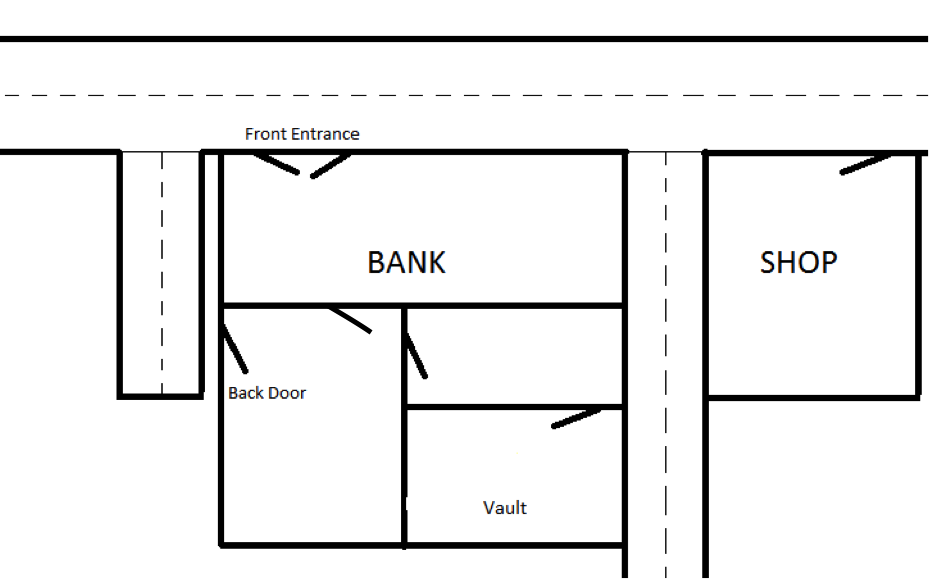
Anyway, the bank is situated on a street corner. It has one main entrance (that’s a glass double door) and a smaller secutiry entrance on the side (that’s a solid, protected security door). It’s quite a small bank with a main room for doing business with customers, and a small back office on the ground floor, and a medium sized vault in the basement. The money (gold, cash, diamonds) is kept in the vault, which is protected by a solid locked door. Imagine a solid metal door with a huge lock on it.
You 3 are the core members of the team, but you can’t do this alone. You’ll need some assistance – especially from people with very special skills, specific to organised theft like this. Luckily you have a few connections in the criminal underworld. You can choose a maximum of 2 other specialists to help you.

Here’s a list of the other gang members you could employ. You’ll get more information about them during the game.
The Driver
The Shooter
The Inside Man
The Safe Cracker
The Tunnel Expert
Jimmy The Informant

You (the team) are going to plan to steal that money.

Have a meeting to decide these points
• VALUABLES – What exactly is available and what will you steal?
• DAY – The day on which you will do the robbery
• TIME – The time of the robbery
• GANG MEMBERS – Which two extra gang members you will employ for the job (you can employ two other people)
• ENTRANCE – How you will enter the bank
• MASKS – Will you wear masks or not?
• GUNS – Will you use guns or not?
• VAULT – How will you get into the vault?

Today is Saturday 1 October
You’re planning to rob the bank next week – that’s the week starting on Monday, because that’s when the gold and other money will be in the bank. You’ve left it a bit late to be honest.

But you’ve all spent quite a lot of time watching the bank, and collecting information to help you plan the perfect crime.
(I’ve written this information on small pieces of paper and I’ll deal it out to you all randomly, in a minute)
You will need to share the information in order to pool your knowledge. Please don’t let each other read the info you have. You’ll have to do it all by spoken communication.

When you are ready, present your plan to Luke (that’s me) and the listeners (Lepsters). Then I will tell you the final result of your bank robbery. We’ll find out what happens in the robbery, based on your plan.

There are a few different ways to complete the task and steal the money, but only one of those approaches will allow you to get away with the most money possible. Some options will get you arrested, some options will get you killed. Some options will allow you to escape with only some of the money. Only one option (I think) will allow you all to escape with the maximum amount of money, with no loss of life or jail time. (Which is at least £120,000,000 – 30m each)

I am the gamesmaster – I’m just going to sit back and let you get on with it. I might give you bits of guidance and advice at times. I’m like Obiwan Kenobi or something. “Paul… use the crow-bar Paul…” that kind of thing.

You can ask me questions if you want – I might help, or I might be a bit mysterious and say something like “That is a question which only the sands of time may reveal” or “Sorry, I can’t answer that”.

OK, is everything clear? Do you have any questions at this point?

Key Information
While the team are reading the information I’ve just handed out to them, I’d like to talk to you about a few things, to help you follow the meeting more easily.

So, the team is looking at various key information which is on small pieces of paper. The information relates to these things:
• Info about the money – What exactly is available, and when it’s available. There is only one particular period next week when the gold, cash and diamonds are in the bank at the same time.
• Info about the DAY & TIME – when the bank is open, when the money is in the bank, and other information about the best time and day to do the robbery, including things like traffic, extra security in the bank and hours of daylight.
• GANG MEMBERS – Info about the 5 other team members they could employ for the robbery. They can pick two. Certain gang members are crucial for the robbery. Other gang members will cause your robbery to go horribly wrong.
• ENTRANCE – Different ways to enter the bank and get into the vault. Basically, it’s either through the front door, through a side door when the gold is delivered, or through an underground tunnel directly into the vault.
• MASKS – Will you wear masks or not? With masks on, the team’s identities will be protected from CCTV, but everyone will instantly know it’s a robbery.
• GUNS – Will you use guns or not? Guns will allow the team to persuade the bank staff to do things, but could be dangerous.

I’m now going to read to you all the information they have in their hands. Then you’ll know everything they know, and it should help you to follow their meeting more easily.

Also, it might allow you to work out your own plan. BTW, all this information is on the page for this episode at teacherluke.co.uk

So now, listen to all the relevant information. I’ll try to make it clear for you. Listen carefully and try to make your own plan. Think about the best day and time.

THE INFORMATION WHICH THE TEAM HAS TO SHARE
Here is all the info which the team members have on small pieces of paper.
You can also download this information as a Word document, which you can then print and then cut up. Click the link below to download the Word doc. (Thanks to Zdenek Lukas for preparing the doc)
THE-BANK-ROBBERY-speaking-activity-by-Luke-Thompson.

  • The bank will receive the gold bullion at 11AM on Tuesday 4 October.
  • The gold will be removed from the vault on Monday 10 October at 8AM.
  • When gold is delivered at the bank, two security guards always take it through a back door and down the stairs into the vault. This takes 5 minutes.
  • The gold is easiest to steal when the security guards are taking it from the van to the vault.
  • The gold and cash are fitted with anti-theft devices such as paint and a tracking device.
  • These are removed when the money has been safely delivered into the vault.
  • The £20m in cash will be removed from the vault on Friday evening.
  • You have just discovered that the vault will also contain £80m of diamonds next week! They arrive on Wednesday evening but they will be removed on the evening of Friday 7 October.
  • It takes approximately 10 minutes to fill your bags with gold, cash and any other valuables.
  • The bank is open from 8AM to 8PM, Monday to Friday. The bank is closed on Saturday and Sunday.
  • When the bank is closed the doors are very securely sealed and protected. It is impossible to break in when the bank is closed.
  • The side door of the bank is reinforced and cannot be opened from the outside.
  • The bank is unstaffed at night. Nobody is in the bank after 8pm.
  • The sun goes down at 6PM. The sun comes up at 6AM.
  • A robbery in the morning will be more of a surprise, and the police tend to be slower in the morning as they are usually eating donuts and drinking coffee.
  • You are much more likely to be identified by witnesses during daylight hours.
  • A robbery in the dark is more likely to be a success because the roads are quieter. It will be easier to escape by car in the dark.
  • There is less traffic on the street at night.
  • No-one goes into the bank at the weekend. After leaving the bank on Friday evening, the next member of staff to come back is the security guard. He arrives on Monday morning at 7AM.
  • Friday is the busiest day in the bank. The bank employs two extra security guards armed with Remington shotguns on this day. They stay in the bank from 8AM to 8PM.
    You will find it very difficult to get away from the bank quickly in the morning because of bad traffic.
  • You can enter the bank by the front door but you will appear on the CCTV cameras in the front entrance.
  • When the bank alarm is set off, the police are automatically called. They will take approximately 15 minutes to arrive at the bank.
  • The police will take an extra 5 minutes to arrive at the bank in the morning, because of busy traffic and because they’ll be eating donuts and drinking coffee in a local diner.
  • It will take approximately 5 minutes to persuade a staff member to open the vault for you.
  • If you have guns you will quickly be able to persuade the staff to open the vault for you.
  • Robbery with guns is more serious than robbery without guns, and therefore carries a much stricter prison sentence. Also, the police are more likely to open fire on you if you are armed.
  • You can use masks to hide your identity. They will prevent you from being identified during the robbery, but if you enter the bank wearing masks, the staff and customers will immediately know it is a robbery and the alarm will be set off.
  • There is a disused shop opposite the bank. The shop has a basement with an earthen floor, and vacant space for soil in the yard. The shop is available for rental.
  • It will take 5 full days and 5 full nights to dig a tunnel from the shop to the bank vault.
  • It will take 24 hours to arrange rental of the shop opposite the bank. The rental office is closed on Saturdays and Sundays.
  • To rent the shop opposite the bank you need to provide your name, ID number and address. The shop owner might accept a fake name if you bribe him with at least £5m.
  • The Driver is an excellent getaway driver. He is a professional stunt driver and he can escape from anyone, traffic permitting.
  • The Shooter is an expert with a shotgun. His speciality is crowd control and hostage situations. He has just spent 10 years in prison after his last bank job went wrong. He absolutely hates the police, because they killed his brother.
  • The Safe-Cracker can open any lock in just 2 minutes.
    The Inside Man works in the bank as a clerk. He knows about everything that goes on inside the bank. He can delay the alarm by 5 minutes. Also, he can give you blueprints of the vault.
  • His knowledge of the vault is essential if you plan to tunnel in. You need him to tell you where to enter the vault by tunnel.
  • Jimmy the Informant has a close relationship with the police and for the right price he will tell you everything that the police know about your bank job. He wants £10m for this information. He is not particularly loyal to anyone – either you, or the cops.
  • The Tunnel Expert is brilliant at digging tunnels. Without him it will take you 7 days and 7 nights to dig the tunnel, and even then it might not reach the bank vault correctly.

Now you know all the information they have, so in fact, you know more than the team as a whole now.

Perhaps you have some ideas about a plan of your own. If you were paying attention and you’re clever, you could work out the best plan already.

In a moment, you’ll listen to them sharing the information and they’ll start building their plan.

USEFUL LANGUAGE
Before we listen to that I’d like to bring your attention to some language you’re going to hear.

Here are some things you will hear. Watch out for these things.

Essentially, you’ll hear them
– sharing information – giving info and asking for info
– evaluating that information and making conclusions,
– rejecting irrelevant information,
– making suggestions,
– interrupting each other,
– agreeing

Summarising and Rephrasing
This shows that you’re listening, that you’ve understood, clarifies and establishes the information which has been presented.
You summarise your point (intro), give details, then summarise it again (conclusion).
E.g. “I think tunnelling in is not such a good idea, because if we tunnel in we can only get half the money. So tunnelling is not an option.”
Summarise what the other person said. Rephrase to show you understand.

Giving information – Signpost the point you’re making
Can I just say one thing about time? It fits in.
Timing-wise, the 20m in cash will be removed …
So, speaking of Remingtons…
More things regarding time here…

Ask for information
What have you got?
What else have you got in terms of timing?
Is that all you’ve got for timing?
Do we know when the bank is open?
Who are the other people that could help us?
When’s the gold going to be delivered?

Making Conclusions
So, we can’t do it on Monday. (“So” is a word that signposts that you’re making a conclusion)
So, this means, we have to do it on Thursday.
Tunnelling isn’t really an option.
Thursday seems like a good spot right now.
It seems like it’s closed at the weekend.
Wednesday doesn’t seem to be a good day.

Clarifying, or when you don’t hear something
Sorry, 8AM to…?
Sorry, I missed what you just said.
Let me say that again.

Magic Words
Sorry – interrupt or repeat
Hold on – make someone wait
So – make a conclusion
Seems – for facts that look true but you’re not sure

Rejecting Information
We can disregard this because it doesn’t matter.

Make suggestions
I wonder if we should do this…
Let’s…
Shall we say no guns?
Let’s think about how we can get in the back door.
I would say after 6pm is best.

Conditionals – 0, 1st & 2nd
0 conditionals – the speakers think they’re absolute facts – definitely will happen.
“So if we do it on Monday the gold is gone.”
“If we want to get everything, we can’t tunnel in.”
“If we tunnel, we can get some stuff, but we’re aiming for all of it.”
“If we go in with masks, everyone knows right away.”
“If we have the safe cracker we don’t need to persuade anyone.”
1 conditionals – the speakers think they’re realistic – will probably happen.
“If you go in with masks, they’ll know.”
2 conditionals – the speakers think they’re unlikely – just hypothetical things.
“The inside man would save us more time…”

I hope you can keep up with all of that.

Let’s now listen to the rest of the meeting. How do native speakers manage information in a meeting? Also, will they come up with the right plan?

Here we go…

MAP
bank map
TO FIND OUT WHAT HAPPENS NEXT, YOU’LL HAVE TO WAIT FOR “THE BANK ROBBERY PART 2”!

What do you think is the best plan?
Please leave your comments below. :)
[socialpoll id=”2296567″]
Gold-robberies
Image: http://therealasset.co.uk/gold-robberies/

295. California Road Trip (Final Part) Customer Service / Highway 101 / UK vs US English

Hi and welcome back to LEP. This is episode 295, and it will be the final part of this 8-part series which is inspired by my trip to the west coast of the US recently. I’m going to talk about the final part of our journey from San Francisco, down the coast via Monterey, Carmel, Big Sur, San Luis Obispo and back to LA. I’ll also talk some more about customer service and give you some tips on how to make complaints in English and how to talk to strangers in slightly sensitive situations, like when you want a person sitting behind you to stop talking because you can’t sleep. You can expect to hear those things and more in this episode.

Small Donate Button[DOWNLOAD]
I started this series on 26 August, which is just under two weeks ago. So, in less than two weeks I’ve uploaded about 8 episodes and each one is about 1 hour 15 minutes long. I realise that’s a lot of content for you to listen to, and I think a lot of my listeners are quite busy catching up with all this new content. I certainly hope that this sudden arrival of 8 new episodes hasn’t put anyone off. I know from experience that when I listen to a podcast and there are lots of episodes that I haven’t heard, that it seems harder to get back into it, like you’re falling behind and it’s difficult to catch up. So, I expect that some listeners are a little overwhelmed by the number of episodes that have arrived. Not you of course! If you’re listening to this I expect it means that you’re keeping up with the series without any problems! If you’re a new listener, then welcome to my podcast. It’s for learners of English. Visit teacherluke.co.uk for more information.

Anyway, I shouldn’t be worrying about anything because I have had lots of encouraging comments on episodes in this series and I’d like to read some out and respond to them here – not all of them, just a selection.

Comments from Listeners
One piece of correspondence from a listener in the USA, called “Lea”, which is worth mentioning:
Leah: “I’ve very much enjoyed hearing all about your trip. But I need to tell you that nobody in the U.S. ever says “galoshes”, lol !! Really it’s true. I do remember when I was in school (grade school & high school), in French class, and in language text books I would see this word.
We just say “boots”, sometimes more specific like, “rain boots”, “snow boots”, “hiking boots”, “riding boots” … But NEVER “galoshes”.
Did you hear someone in California use that term??
Anyhoo, I love the podcast!!! Thank you!”

Luke: “Thanks for the correction. I feel like I should now edit the podcast to include what you said! I might do it actually.”

Leah: “Ha! Just to check myself, I asked my 14 year old son if he knew what “galoshes” were. He said “No”, but he had heard the term used in a cartoon once. He further said that he got that they meant something like, “rain boots” through the context.”

So, I just wanted to agree with Lea and emphasise that it’s not galoshes in the USA, but in fact “rain boots”. In the UK it’s ‘wellies’ or ‘wellington boots’.
Google search results:
“Galoshes”: 454,000 results
“rain boots”: 2,090,000 results

Perhaps in the USA wellies are less a part of the every day culture, and so a well-known nickname hasn’t come up. Whatever the reason, it’s ‘rain boots’ rather than galoshes.

Perhaps it’s not that important that you know the correct term for rain boots in the USA, but who knows – perhaps it could be useful. Maybe in some emergency situation, like a flood or something. “Quick we need some wellies!” “What?” “I mean, we need some galoshes! Quick!” “Sorry, I… I have no idea what you’re talking about. Are you British? I love your accent :)” “This is an emergency flood situation we need galoshes!” “Sorry – that means nothing to me. Have a nice day now, alrighty then, sorry about all this rain, but I guess you must be used to it because you’re British, right?”
“No, you don’t understand, we need rubber boots to protect us from the water, right now!! Boots, for the rain!” “Oh you mean rain boots? Why didn’t you just say?” etc.

Chriss Benitez
September 3, 2015 at 12:13 am
I love craft beer and california is the most famous place for breweries. Hoped you had lots of good Californian beers and American IPA.

I´m waiting for the Camaro photos :P, you get used to it don’t worry. I don’t have one but my Mustang is almost the same.

Great episode!!

ptholome/Antonio
August 29, 2015 at 11:38 am
WOW, WOW, WOW, WOOOOW

Hello Luke, This is a very great work you are presenting to us. I thank you for this huge effort you are doing to teach English to people all around the world.

I would say a lot about your new podcasts but even if I knew the adjectives you deserve I can only say that “Je suis resté sans voix” reading your four incredible podcasts.

I am waiting for the next podcast as impatient as people are waiting for the sixth book of the Game of Thrones.

I really only can say “BRAVO!” AND “CHAPEAU BAS MESSIEURS” (This means “hats off” or “well done!”)

Big Hug Luke

p.s. Why don’t you make a periscope each time you are going to work on a podcast?

Because watching AJ’s Periscopes for several weeks, I am surprised seeing myself waving the hand and saying bye when AJ finishes every Periscope video. I finally have the feeling that he is in front of me. It is a strange feeling, but it is really present.

Try it and be sure you are going to enjoy it, because you are going to have a real direct contact with your students. You have nothing to lose and a lot to find mainly our love and admiration.

See you

mollietai10@yahoo.com
August 27, 2015 at 3:06 pm
FANTASTIC journey with so much to offer . You give us amazing luxury through your account . What a romantic way of teaching English . WELCOME BACK ! Keep it up ! Million thanks !

petrokl
August 27, 2015 at 9:40 am
Dear Luke! Thanks for two very interesting and cognitive episodes. I found out a lot of new stuff about the US.

paquan
Hi Luke, this’s just a trivial comment, but I want to tell you that I like your jelly’s wobbling around noise making. It’s funny and cute. 😀

Rasul Ksirov
September 5, 2015 at 7:56 pm
The Eagles are single-handedly responsible for lots of people in my country mispronouncing the English word hotel as /’houtel/ – i.e. with the stress on the first syllable instead of the second. Which is funny, given that we have the same word in our own languages (Russian/Ukrainian – well, the Russian one lacks the initial h) – and it is stressed on the second syllable. But even fact is overlooked as a clue for correct pronunciation, against the popularity of the Eagles’ hit and its damaging influence on the unsuspecting English learner.

Explain yourself, I hear you say. All right, I will.

The musical metre (or rhythmic structure) employed in the chorus of “Hotel California” dictates that the word “hotel” is stressed on the first syllable thus overriding the actual word stress. Indeed, they do seem to be singing “welcome to the hOtel /’hou.tel/california” in the chorus.

This, coupled with the general notion that English learners tend to have about most two-syllable English words being stressed on the first syllable, gave rise to the infamous pronunciation error.

Myself, I was lucky enough to hear Elvis’s “Heartbreak Hotel” first, before the Eagles had led me astray with their confusing stress patterns.

Thanks for your comments everybody. Now let’s carry on with this series!

The Road Trip Continues – San Francisco
Dinner in Liholiho – an amazing Hawaiian influenced place

Liholiho
We’d never tasted food like this before. Some kind of battered and fried chicken, with fried broccoli and kale with cashew nuts. The broccoli in particular was amazing. Apparently they marinade it overnight and then deep fry it in soy infused oil, and the result is an amazing crunchiness combined with juiciness. We just made loads of noises during the dinner and couldn’t stop raving about the taste. Of course, we ordered way too much because we underestimated the size of the portions and ended up completely stuffed.

In fact, there’s quite a lot of Hawaiian influence in SF. It’s amazing to think that across the ocean there’s Hawaii and then Japan. It’s cool to be on the Pacific Coast. I’m more used to being near the Atlantic myself.

August 18
Extend our time in SF.
More acai bowls.
Lombard Street.

Grab some coffee in one of the many great looking coffee places on Polk Street.

Comments about annoyingly rude customer service, which happened a couple of times
Generally speaking, the customer service we experienced in California was really amazing and impressive, and maybe we got used to it because when we had bad service it seemed really obvious and annoying. This was usually from young people doing jobs they probably believed were below them, causing them to treat you with a kind of cool disdain, as if to say “I’m above this”. For example, we had a bad experience in a coffee shop in San Francisco. Two trendy girls who were far too cool, in their minds, to be serving people coffee, served us coffee in a really snooty and dismissive manner and it sort of spoiled my morning a little bit (I can’t stand unnecessary rudeness – it really gets my back up and bothers me a lot). I don’t know why. Perhaps it was my accent. Perhaps it was the fact we were tourists. Maybe it’s because it was Monday. Maybe the cafe management treats them so badly that they put in zero effort, maybe it’s the slightly specific coffee request I made, or maybe it’s just because I didn’t order the coffee just right. Maybe I’m making a big deal of it, when in the end it really doesn’t matter at all! In fact I’m probably reading way too much into this encounter and thinking about it too much. But anyway, here’s what happened:

We stood there talking about what we wanted, and there was nobody in the queue behind us. I stepped forward to make my order. There are two girls behind the counter and they’re standing back a bit, having their own private conversation. I notice that the girls are talking about us, and not nicely. They’re sort of talking under their breaths and glancing at us. I wonder what we’ve done wrong and try to ignore it. Time to get the coffee. I wait a little bit for the girl to come over. I feel like I’m annoying her. I start talking to the girl at the cash register.
Her: “Can I help you?”
Me: “Hi, can I have one black coffee of the day…”
Her: *sighs* “So, you mean one regular dark coffee?” (she says, putting the order into the till. There’s probably a button that says “dark coffee” but no button that says “black coffee”)
Me: “Ok, sure. And an espresso, with…”
Her: “And a single espresso”
Me: Yes please, with just a little bit of hot water added.”
Her: *Sighs again and gives her friend a look*
Me: *Thinks: what the f*ck is going on here?*
Her: That’s gonna be 5.25.
Me: OK, here you are.
Her: “Your coffee will be delivered over there”
Me: “Thanks”
Her: No response. She’s already turned away from me. The transaction is finished.
The other girl then shouts “Single espresso with hot water!” even though there are no other customers around and she heard the entire transaction and I’m just standing right there, and puts the coffee on the top.
I go to pick up the coffee from her, and I say thanks, but she’s not looking at me. She’s turned away and is doing something else. I feel totally unwelcome and I don’t know why. Did I just destroy the environment again without realising it? What did I do wrong?
This really ‘did my head in’ for some reason. What happened? Did I order the coffee slightly wrong? Is it because of my accent? Why is it necessary to serve me my coffee in a miserable way because you feel that you’re above this job?
Maybe I’m way too sensitive, and after all it’s just a couple of coffees but this put a downer on me for about an hour until I got over it. (My wife got over it instantly, but I had a little dark cloud over my head for about an hour as a result of it) As we walked around I speculated about why they seemed so rude.

It reminded me of a routine by Louis CK about exactly this topic. I might play it to you right now because you might find it amusing, but there are some swear words that I’ll edit out because I’d like this episode to be a clean one. So, I think I’m going to play that to you, or at least just embed the video on the page for this episode. We’ll see…

So, in the end, there’s no excuse for being so rude!

How to make the right impression on a waiter
I just want to reiterate something I said in an earlier episode about dealing with waiters and other staff, because this struck me as being quite important, and as I was a foreigner in an English-speaking country it made me realise how important this is.
Remember that staff are just doing their job and you can help make it a little easier for them by showing that you understand that.

So, help them to do their job, don’t make it extra hard for them.
Smile, be friendly and respectful. Don’t have the attitude that this person is your own private slave for the evening and they should have infinite patience and they have no right to complain or be unhappy about your behaviour. This is unrealistic and rude. The waiter is a human being and they might be tempted to spit in your salad.
So, smile and be nice.
When the waiter asks how you are, respond positively, and ask how they are too.
Don’t forget to say please and thank you. Definitely show your appreciation if a waiter has done something special for you.

If in doubt, tell them it’s your honeymoon.

-How to ask for an upgrade in a hotel (this worked for us a few times)
Tell them it’s your honeymoon.

-How to make small requests

Certain phrases are useful.
“Is there any chance you could…?”

Tell them it’s your honeymoon.

E.g. “Is there anything you can do or recommend in order to make our stay even more special? It’s our honeymoon, and we want this to be a really special and memorable stay.”

We got a few hotel room upgrades, and also some free fruit and wine, and in one place they wrote a special message on our mirror, and another place gave us a card. One guy gave us some free bottles of water because it was the only thing he could offer. Everyone seemed genuinely happy for us and it broke the ice quite nicely.

California Diary Continued… 18 August
Union Square.
Drive to Monterey.
Another Japanese restaurant!

August 19
Next it’s Monterey. Beautiful coastal town, but not much more than the aquarium.
Touristy place near the old cannery, where the aquarium is now.
I visit, and the wife goes to the beach.
Wildlife from the waterfront (whales, otters, sea elephant “it’s a whale!”)
Then to Carmel.
Beautiful sunset on the beach with whales and dolphins in the water.
All about Carmel.

August 20
Another day there, including the beach.
17 Mile Drive.
This is an incredibly beautiful and rugged area with stunning coastline. It’s also right next to the Pebble Beach golf course, which you might know.
More whales and dolphins seen. It’s quite touristy, but nice.
By this time we’ve had lots of sun, sand and sea air and we feel like we’ve really absorbed the atmosphere of the place, so we’re feeling very relaxed and cool.

Highway 1 (coastal highway) through Big Sur. Epic views. One of the most stunning and attractive drives ever. Many romantic moments and photos on the way, with the sunset.
San Luis Obispo – the happiest town in America?

Audiobook recommendations
I just wanted to remind you about the audiobooks I’ve recommended in this series. Here are those titles again, just in case you wanted to check them out. Remember you can get a free audiobook if you sign up to a trial membership with Audible.com, which is the internet’s top provider of downloadable audiobooks. They have hundreds of thousands of audiobooks available. Go to audibletrial.com/teacherluke – you can try it out for 30 days, download an audiobook free, and if you don’t like the service just cancel your membership but keep the audiobook. All the details are on my website. Audibletrial.com/teacherluke or click a button on my site that says Audible.
Let’s just re-cap the titles I’ve recommended so far.
The Big Sleep by Raymond Chandler
The Grapes of Wrath by John Steinbeck
Scar Tissue by Anthony Kiedis
The “For Dummies” series – e.g. English History for Dummies
On The Road by Jack Kerouac
One Flew Over The Cuckoo’s Nest by Ken Kesey

August 21
Next day…
Slight miscalculation of distance and a satnav error and we end up missing Malibu and getting stuck in a huge traffic jam in LA.

Last evening – super trendy vegetarian restaurant with a live jazz band. Huge place.

August 22
The problem with the rental car.
Getting fobbed off by Avis.
Fixing it the next day. Describing the story, being clear about what the problem is, taking emotions out of the equation, being clear about what you expect, showing that you’re not happy…
Explaining what happened is very important.
Making sure the person knows exactly what the point is, is very important.

How to make a complaint. (After the Avis situation)
Say that you’d like to register a complaint. Many companies have official channels and ways of dealing with complaints, that might include some rectification. Be clear from the beginning that you are making a complaint, or the staff might just try to fob you off.
Ask to speak to a manager. This shows that you mean business.
Ask for the names of the people involved and write them down. Again, you mean business.
Ask for evidence of anything important – e.g. a print out of a new rental agreement with a price adjustment. Don’t take anyone’s word for it. You’re in a legal area here, so you need paper evidence!
Explain the background story quickly and simply. They need to know what happened.
Be firm and confident and businesslike. Don’t get too personal or emotional.
Explain what you want.
Remember that these people are just doing their jobs.
Tell them it’s your honeymoon.

How to ask people to stop talking on a plane. (During the return flight)
Remember that the people doing the talking are probably going to take it really badly or personally. How would you react if someone told you to be quiet on a plane?
Do not bring all your anger and frustration to the first comment. Be utterly reasonable, giving them no choice but to respect your wishes. If they don’t like you or find you unreasonable, they won’t want to comply.
Say things like “I don’t want you to stop talking, but…”
Explain why you would like them to stop.
Again, don’t get emotional, aggressive or angry, but you can say it firmly without being aggressive.
“I’m really sorry to bother you, I don’t want you to stop talking, but could you please try to do have your conversation more quietly? It’s just that nobody else is talking, and we all need to rest and I can hear every word you are saying!”
It would be pretty hard not to say “Oh, sorry!” in response to this.
If you just turn round angrily and say “shhhhh!” then I’m sure they’d be less willing to comply – remember, they’re not aware of all the anger and frustration that’s been building up inside you, so you’ll just look like an insane person, and you’ll have a couple of enemies on the flight.
Final tip: Tell them it’s your honeymoon.

American English Vocabulary vs British English Vocabulary
This is a mix of things like games, job titles and household items.

Wardrobe – Closet Furniture
Plaster – Band-Aid Personal Care
Ladybird – Ladybug Insect
Noughts and Crosses – Tic Tac Toe Game
Draughts – Checkers Game
Flat – Apartment Housing
Tap – Faucet Furniture (sink)
Lift – Elevator Housing (in a building)
Torch – Flashlight Household Item
Football – Soccer Game
Estate Agent – Realtor Job
Rubber – Eraser Stationery
C.V. (Curriculum Vitae) – Résumé Job
Spanner – Wrench Tool
Autumn – Fall Season
Holiday – Vacation
Canteen – Cafeteria Room

In Conclusion
We had an absolutely fantastic time travelling around California. It has so many things to offer, including lots of things that we didn’t get to see. Two weeks are not enough, and the time went by so fast that it was almost over before it had started! It is a wonderful place for a honeymoon, and in fact for all types of holiday – for single people, honeymooners or families. I would definitely recommend it, although it is a bit expensive in some areas, particularly San Francisco and the coast. All in all the people were really friendly, the weather is fantastic and there are loads of impressive and entertaining things to see and do. There is plenty of really amazing food, which is a contrast to the stereotype of USA with its unhealthy food culture. The landscape is varied and beautiful and there’s a lot of shopping to be done as well. We’d love to go back one day and see lots of other things we missed. We shared a really special two weeks that we’ll remember forever.

I really hope you’ve not only enjoyed this account of my trip, but that you’ve also learned some things too. My intention has been to not just share our travelling experience with you, but also to just invite you to think about the culture, history and geography of the place along the way, as well as teach you some English.

I’m going to upload photos of our California trip on this page, or on each page in this series. Check them out – it might help to bring some of my descriptions to life a bit.

As ever, leave your comments on the pages for these episodes with your thoughts, feelings and questions. Join the conversation at www.teacherluke.co.uk

That’s it for now, until the next episode.

Take it easy.
Luke

17 Mile Drive

288. California Road Trip (Part 1)

Hello! Welcome back to LEP. This should be episode 288. How are you? I hope you’re doing alright. I’m fine thanks. I got back from my honeymoon in California just a couple of days ago. I’m dealing with jet lag. It’s grey and windy here (can you hear the wind noise in the background?) and my sun tan is fading, but it’s good to be back.

Small Donate Button[DOWNLOAD]
Thanks for lots of recent comments on the last few episodes of this podcast. Thank you sooooo much for all the lovely things so many of you wrote in response to the wedding episode of the podcast that I did recently. It’s really touching to read your comments. My wife also found them very sweet and nice.

This episode is about my recent honeymoon trip to California and I have so much to tell you about it. But before we start, let me just say a few things in the first few minutes of this episode.

First of all, I’d just like to say don’t forget to join the mailing list so you’ll get an email whenever I post a new episode, or other bits of content such as videos or blog posts. Also, you can subscribe to comments on this website too. When you leave a comment on a page, you can tick a box that says “Subscribe to comments”. Then whenever anyone else leaves a comment, including responses to your comments, you’ll get an email notification. It’s a good way to keep up with what other LEPsters are writing on teacherluke.co.uk

Secondly, I would like to say a big hello to YOU – yes, YOU – the one who is listening to this episode, and to say thank you for tuning in, using whatever means – either on the website, on iTunes, on your phone, your iPad, your android device, in your car, on your mp3 player, on your internet radio or just hearing it by chance because someone else is playing it to you, like your English teacher or something. If you’re with other people while listening to this, why not just turn to them and say a friendly, “Hi, how are you? Are you alright?”, just as a gesture of goodwill. There, that feels nice doesn’t it? If you’re a regular listener to LEP, then hi – welcome back. If you’re a long term listener then “hello old friend”. If you’re new to the podcast, then welcome to LEP. I’d just like to say that I strongly recommend that you keep listening to this podcast on a long-term basis, because let’s face it – learning a language is a long-term process, and I record this podcast with that thought in mind. Just listen regularly over a fairly long period and you will see improvements in your English – and that’s just from listening. There are other ways of speeding up the learning process by using my podcast and website as a resource (listen to episode 174 for more information on this) but at the very least, just enjoying listening to this podcast regularly is definitely a great way of keeping your English fresh. People often underestimate the importance of doing lots and lots of listening. It can make a big difference to many other areas of your English, including speaking, pronunciation, vocabulary and grammar. It’s particularly useful if you enjoy what you listen to, and you basically understand most of it, and that you feel that the person you are listening to is speaking to you personally. That’s what I aim to give you in these podcasts. The perfect listening resource to help you improve your English. So, I’d like to say thanks for listening, but I’d also like to say “well done” for listening too, in order to remind you of the benefits that you get from listening to this. Well done, you’re doing the right thing and your English will benefit from it as a result. It’s quite simple really. It’s not rocket science. For more information on this kind of thing, just listen to my other episodes, and have a look at my website which is teacherluke.co.uk. You’ll find loads more information and useful content there.

Introduction
Now, as I mentioned before, this episode is all about my recent trip to California in the USA for my honeymoon! As you probably know, I recently got married and my wife and I decided to go to California, and now I’m back, and my tan is fading, but the memories are still fresh in my mind, and I’d like to share them with you. So, let’s go to the USA in this episode and go on a road trip around California!

Notes & Transcriptions
You will find some notes and some transcriptions on the page for this episode. In fact, if you’re reading them now then you’re reading them now. There they are right in front of your eyes! Just a reminder if you want to find this episode on teacherluke.co.uk – just look in the ALL EPISODES archive for episode 288, or just type in the search bar on the right of the screen the number “288” or the word “California” and you’ll find it easily.

The following words and sentences that you can read on this page are not a full transcription. They’re just notes. Some parts are transcribed, but mostly these are just basic notes, which means that they are not always full sentences. They’re just words and phrases written to help me remember details of the trip.

I wrote these notes on my iPhone during spare moments on holiday, and also when I got back, and I used them to help me record the episode you’re listening to now. I hope you’re listening, and not just reading – remember, this is a podcast and not a blog. It is designed primarily to be listened to.

Here’s what you’re going to get in this episode (or series of episodes)
This is a sort of diary or report of what happened on my honeymoon in California, but it’s not just a description of a honeymoon. It’s more than that, because not only am I going to tell you a few stories about what happened and what we did, but I’ll also explain a bit of cultural and historical information, as well as give you some practical tips, including ways of communicating effectively in various situations.

I’m going to tell you what it’s really like to be in California. It’s a description of the culture, geography, people, history, sights, sounds, smells and more. I’m going to tell you what it’s really like to deal with customer service there, what’s it’s really like to drive in the USA, what it’s like to deal with problems, what some of the linguistic differences are, what the climate is really like, what the food is really like, some of the history and cultural highlights, how to get along with people in the USA, how to develop the right relationship with waiters, hotel staff and other key people. It is a description of my honeymoon, but I also want it to be a lot more than that. I want to take you with me on my holiday, and teach you some things along the way, and it’s all in English of course so not only are you going to join me on a geographical and cultural journey, but also you’re going to plug yourself into a source of natural English spoken from me to you, right here, right now. You can pause it any time you like, you can rewind and listen again, you can slow it down, you can speed it up, you can fall asleep and listen again later, you can transcribe it, you can repeat after me or you can just relax and enjoy listening. So, brew a cup of tea or coffee, get comfortable, get uncomfortable and then get comfortable again, smoke a big cigar, pretend your working on a big excel spreadsheet at work – do whatever you have to do to enjoy the episode. I hope you like it and find it useful.

As usual, I’m not sure how long this episode will be, but I’m pretty sure it will be another mini-series of episodes as I have quite a lot to say about this trip.
You can visit the page for this episode in order to find some of this episode transcribed, some of the notes I wrote in my phone while I was there and other things like links and photographs of the trip.
Now let’s get started with the first part of this story.

Following the tradition, you are going to hear me doing my first recording in a toilet on a plane.

6 August – Recording 1 – In a toilet on a plane again, above the Atlantic Ocean
You’re listening to Luke’s English Podcast
Where am I? I’m in a toilet on a plane again.
This is becoming a tradition – recording podcasts inside toilets on different modes of transport.
We are going to California for our honeymoon.
It’s the land of Hollywood, Baywatch, Coastal Highways, the Golden Gate Bridge, Alcatraz, Yosemite national park, the tallest trees in the world and open top cars etc.
I’m hoping to record short episodes at regular times during the holiday.
I’ll try to teach you something in every location, and I’ll just describe what I’m seeing and what it’s like.
I might even interview a few people that I meet because, you know, they speak English in America too of course – a kind of English.
I’m flying to New York.
What happened?
Flight was overbooked. Flight companies overbook their flights to make sure it’s not a loss of money for them.
We checked in, in person, not online. Why? We were hoping to get upgraded because we’re on our honeymoon.
Everyone told us to mention we’re on our honeymoon, as that would be the key to unlock numerous upgrades, rewards and treasures.
We were hoping to be upgraded to business class or something.
In fact we sort of got downgraded.
Talk about the overbooking process.
Mention the change of route.
It’s not that bad.
All’s well that ends well.
Despite the inconvenience and the delay and the stress we are nevertheless on our way. So all’s well that ends well.
(Let’s hope this ends well and that we do get to our destination ok in one piece)
That’s it – this is Luke Thompson in the toilet signing out.

I originally intended to do recordings while I was there, using my mp3 recorder, including some random interviews with American people, but that didn’t really happen in the end. I mean, it was my honeymoon so the main point was to share a special time with my wife. I wasn’t going around with a microphone the whole time, interviewing people and talking to myself.

However, I did manage to get an interview with one person – and that was perfect and really special, and very appropriate to Luke’s English Podcast, which is primarily for people who are learning English as a foreign language. Who did I manage to speak to? Well, it was the one and only AJ Hoge, who you may well be aware of. He’s the internet’s most famous English teacher. You’ve probably come across him at some point. He has an online teaching programme which he has called Effortless English. He’s made a big success of himself as an independent online English teacher, he’s a native speaker of American English and a resident of California, so he’s the perfect person for me to have spoken to. So, in the end that makes up for the fact that I didn’t speak to any locals on the podcast. I got AJ, so that’s fantastic – it happened in San Francisco so you can expect to hear my conversation with him in that part of the story.

Our California Itinerary
California has so much to offer – climate, different environments, famous sights, shopping, good food, beer, wine, musical history, literary ties, connections to counter culture and it’s the place we’ve seen in so many films and TV shows.

Itinerary: LA – Yosemite – SF – Coastal Highway via Monterey, Carmel, San Luis Obispo, Santa Barbara, Malibu – LA.

We only had two weeks, so there was no way that we could do and see everything. In fact, I think you shouldn’t try to do too much on holiday. I’ve said it before: holidays are like pizzas. Don’t put too many toppings on a pizza. Don’t try to do too many things on a holiday. OK, maybe holidays aren’t that similar to pizzas, but you get the idea.

I’m lucky enough to be able to travel
I generally get the chance to travel somewhere on holiday about once a year. This trip was a bit special because it was my honeymoon and we planned to go on a slightly more expensive trip. Anyway, I’m still lucky to have the opportunity to go to different places, quite far away. Not everyone has that luxury. You might not have that luxury. Admittedly, you might have that luxury – I’m sure many of you are very well travelled. But I also know that plenty of the people who listen to this free podcast don’t have the chance to go on many foreign adventures. So, I hope you enjoy the experience of listening to my account and that I give you an idea of what it’s really like to drive around California for a couple of weeks. And if you have had the luxury of going there, then perhaps you can compare your experiences to my experience. Did you experience similar things and have the same thoughts and feelings? What are some of the the thoughts in your head as you listen to my account on this podcast?
As ever, please leave your comments on the page or pages for this episode series. That’s not just for my reading pleasure, but also so you can share thoughts and ideas with your fellow LEPsters.

California Diary Continued – 6 August/7 August
In the taxi we heard “Hotel California” on the radio, and even though it’s a bit of a cliché, it was a perfect soundtrack to the trip. From the taxi we saw silhouettes of palm trees swaying in the breeze, the shapes of the Hollywood hills in the distance, Spanish style villas, lines of headlights of cars on long highways, the warm temperature outside and the spacious streets and empty sidewalks. Wow, we’re in movieland – LA, is it real or just a jet-lagged dream? This is how it felt at the beginning. We felt a million miles from home, and in a strangely familiar environment – one that we’d seen before in a hundred movies. It was like entering a recurring dream.
LA is a big place, but so is the USA as a whole.
We flew over it for hours and hours. It made me think of the people, years ago, who made that journey on foot or horseback. It took them years and years. They travelled in groups, families etc. People died and were born on the journey. Now we see it as an annoying inconvenience that takes 5-6 hours out of our holiday.
LA, Hollywood
Arrived and went for some dinner.
Service – very personalised. “Hi my name’s Derek, I’ll be looking after you this evening. Can I get you something to drink before we start?” Mammoth sized cups of water and ice arrived. I ordered one beer, I got two because of some kind of special offer I wasn’t even aware of. There’s always some kind of deal, discount or offer available. Already we had way more than we needed.

A Note on Customer Service
Generally, in my experience customer service in the USA is good, despite a couple of negative experiences I had there. There’s a bit more ‘back and forth’ than in the UK (I mean, standard things that you say in general interactions with waiters or staff), and it’s a bit like a little game you have to get used to.
For example:
Hi guys, good morning, how are you today?
Fine thanks, and you?
I’m good thanks for asking. If you need anything at all, my name’s Stacey.
What if we don’t need anything, then what’s your name?
I’m sorry?
You said, if we need anything, you name’s Stacey. What if we don’t need anything, is your name still Stacey? It’s… I’m sorry it’s just a joke.
Oh, I see! You’re joking! Hahahaha!
Sorry, I’m English.
No problem! I love your humour, so dry, right?
Yeah.
Well, just enjoy you guys. Let me know if you need anything.
Thanks for your help Stacey.
Have a nice day now.
You too.
I will, thanks for asking!

Staff tend to be friendly, attentive and professional, probably because quite a large part of their wages comes from tips, so they have to make the right impression. Sometimes though, as a foreigner, it seems a little tricky to get through to the staff if you have particular requests, or perhaps because of the cultural/language barrier. I think this applies to the UK too. Because you’re not local, you don’t know the normal ways of doing things, so you need to make a slightly bigger effort to help bridge the cultural gap. You might think – but this is exclusively the job of the waiter, he/she should make all the effort.

Be realistic, the waiter is a person and they’re not always an expert in cross cultural relations either. If you want to achieve something, and get what you want, you just need to make a bit of extra effort yourself. This means greasing the wheels with some niceness, charm, a smile and a willingness to make things work. So, what’s my advice for getting good customer service when you’re in a foreign country? Just that – try to be clear, positive, friendly and remember that the waiter or whoever it is that’s giving you a service is just a person doing a job. It’s easy to let things break down because of slight cultural differences. It’s important to make an effort to help the person to help you. I say that because I’ve seen people in the UK who got offended by what they perceived was bad service, but was in fact just a slight breakdown in communication. Give your communication a chance and be patient, friendly and helpful, and don’t expect the staff member to understand everything you say the first time around.

L.A. Continued… 7 August
Space.
Coffee & breakfast
Car
Weather
Location
Phrases “you got it” “you’re all set” “I’m good”.
Palm Trees, hotel California, film noir, Raymond chandler, Charles Bukowski, a million movies. The whole place is like a movie set.
This is a movie town – everything is fake and it’s all about veneer. As well as being sunny all the time, there is a mysterious and slightly sinister feeling to the place too, which is perfectly captured by the classic detective stories of Raymond Chandler and other writers, and the movie versions of those stories, collectively part of the film noir movement. I’ll talk more about this mysterious atmosphere in a bit, but first…

Recommended Audiobook Download – The Big Sleep by Raymond Chandler
Let’s take a break from the UK’s favourite books for this series, and look at a few recommendations for California-related audiobooks you could download free by going to www.audibletrial.com/teacherluke
Recommendation #1 – The Big Sleep by Raymond Chandler
This is perhaps THE classic American detective story. It’s set in LA and it is absolutely full of dark and mysterious atmosphere, as well as understated cool humour and sizzling tension. It follows private detective Philip Marlowe as he tries to solve a complex case, while dealing with several dangerous and seductive female characters and some violent murderers. It perfectly captures the atmosphere of a film noir movie set in LA, and it’s really well read by Ray Porter. This is the blueprint for so many other detective stories featuring tough and cool, yet ultimately vulnerable heroes. Imagine films starring Humphrey Bogart for example. It’s glamorous, brutal and extremely well written stuff. www.audibletrial.com/teacherluke The Big Sleep by Raymond Chandler. It’s got an average rating of 4.3 out of 5.

California Diary – LA, Continued…
Nothing is real here. There’s a strange feeling that you’re living in some kind of dream, and I don’t think that is entirely the result of breathing in the marijuana vapours which are floating around in the street in so many places.

It’s hard to date the buildings. They could be old, or they could just be built in an old style. LA doesn’t have the same depth of history as in Europe. There’s evidence of a colonial past, but also so many buildings are new but designed to look like they come from another period, like Spanish villas for example.

It’s all like a movie set, and if you took away the facades of the buildings, it’s just a desert underneath. So, the buildings are a kind of facade. Everything is a bit fake, like in a movie. It’s hard to know what is real. The people also seem a bit distant. They’re sweet, and hippyish, if a bit shallow in some circles. It feels like everyone is high, in fact they probably are, because smoking marijuana is more and more popular.

There’s no evidence of smoke when you walk around, but I’m sure people are ‘vaping’ all over the place. I can smell it. In the corridors of our hotel, in the street outside bars.

California’s Marijuana Laws – An Interesting Legal Conflict
California has an interesting position on marijuana use, and this reveals an interesting conflict between state and federal law in the USA.
Is pot legal in California?
What about smoking tobacco?
Do people smoke in the street?
What is ‘vaping’?
Where do people buy weed in California?
Did you see it or smell it there?

More in part 2 soon…
Hollywood-Sign

287. VOCAB BATTLE!!! WITH AMBER & PAUL (exciting title)

aka “Vocabulary Game with Amber & Paul” or “Fifteen Fixed Expressions” (less exciting titles)
Learn more English expressions in this episode by listening to another vocabulary game with Amber Minogue and Paul Taylor.
The series of episodes featuring ‘fixed expressions’ and vocabulary games continues in this episode. The previous ones, entitled “Ten Fixed Expressions” (283) and “Ten More Fixed Expressions” (285) featured me testing Paul’s knowledge of multi-word expressions in English. He did better in the second episode than the first, although maybe that’s because of the way I explained the expressions rather than because of Paul’s lack of vocabulary. Nevertheless, the wider aim of these episodes is to teach you, my listeners, some vocabulary in the form of multi-word expressions.

Small Donate Button[DOWNLOAD] [AUDIOBOOK OFFER]
What is a ‘fixed expression’?
Essentially, a fixed expression (according to me) is a vocabulary item comprising of a few words that always go together. That includes idioms, sayings, phrasal verbs, well-known quotes and collocations. All these things are lexical items which are included in the catch-all title of ‘fixed expressions’. The words are fixed together. They’re not just individual words combined, but they are discrete items of vocabulary in their own right.

So, fixed expressions are essentially ‘lexical chunks’. They’re not types of shelf unit or ikea furniture or anything like that. They’re just phrases in English. That should be clear.

I realise that the more I explain, the more confusing it is, so I’ll stop explaining now and we can start playing the game.

Let’s Play the Game
This time Amber is involved.
All three of us have short lists of five expressions.
We’re going to do three rounds of this game.
Round 1: Amber vs Paul (Luke is the Question Master)

Round 2: Paul vs Luke (Amber is the Question Master)
Round 3: Luke vs Amber (Paul is the Question Master)

Rules of the Game
The Question Master defines an expression without using the words in the expression.
The QM can also give little hints if necessary.
The two competitors race to guess the expression.
A point is awarded to the one who guesses the question right. If both competitors guess the expression at the same time, they both get a point.
Listeners can try to guess the expressions too. Did you guess them? Did you beat us?
If you don’t know the expression, listen carefully because we will explain, repeat and give examples.

So, it’s a fun game and a learning opportunity too, in one Great British package.

The Expressions in the Game
Here you’ll find lists of the fixed expressions in this episode. Listen to the episode to get the full definitions and examples, or search for the definitions online.

Luke’s Expressions
1. to be hard up
2. to be in the loop / to stay in the loop / to keep someone in the loop
3. “been there, done that, got the t-shirt”
4. to bend over backwards (for someone) (to do something)
5. to give someone the benefit of the doubt

Amber’s Expressions
1. to get your foot in the door
2. to show your true colours
3. over my dead body
4. in mint condition
5. to bite the bullet

Paul’s Expressions – Theme: Body Parts
1. to have two left feet
2. to be/fall head over heels in love with someone
3. (to do something) by the skin of your teeth
4. (give it some) elbow grease / (put some) elbow grease (into it)
5. to put your foot in your mouth

There are plenty of other expressions in this episode, so if you notice any other good ones please add them in the comments section below.

Enjoy!

p.s. I’m going on my honeymoon in a couple of days so there will be no new episodes for a couple of weeks, but LEP will be back :)
VOCABBATTLE

285. Ten More Fixed Expressions (with Paul Taylor)

It’s been about one month since I last uploaded an episode of the podcast, but now LEP is back! Where have I been? Well, I got married (expect a podcast about that soon) and took some time off after that, and then I had lots of work commitments, comedy commitments and honeymoon-organising commitments and I didn’t have enough time to record an episode, but of course I’ve been waiting for an opportunity to speak into the microphone, and that opportunity came today. So here it is.

Small Donate Button[DOWNLOAD] [AUDIOBOOK OFFER]
Introduction
Paul Taylor is with me for this one and we’re going to do another round of our vocabulary game, just like we did in episode 283.
That episode was called “Ten Fixed Expressions” but that now seems to be quite a dull title. Certainly, we did teach 10 expressions but the title seems a bit boring don’t you think? I’m wondering what to call this episode and I still can’t decide as I’m writing this. I always think that titles of my episodes should describe what is in each episode, and should also be fun and interesting enough to catch your attention. In this case Paul and I teach you ten expressions again, but we also have a chat about our recent news, and get very sidetracked by a negative review on TripAdvisor of one of our recent comedy shows.

The main aim of the episode is to play the vocabulary game and let you understand the meaning of ten English expressions but it also is a chance for us to mess around a bit and talk about other things if we feel like it, especially if it is entertaining or interesting for you.

So, should I call this episode “Another Ten Natural Expressions” or “Ten More Natural Expressions” or “Ten Natural Expressions (Part 2)”? Maybe “Vocabulary Game with Paul Taylor (#2)” is a better title? I can’t decide. I’ll choose the title when I’ve finished writing this and editing the episode together, and whatever title you see at the top of this page is the one I finally went for. I suppose you’ll probably be thinking – “Luke, the title doesn’t really matter. It’s the content that counts.” That’s true of course, but I do think the title is quite important for attracting new listeners to the podcast, and because it helps you to identify the main content of the episode. Let me know what you think about the title of this episode by leaving a comment below.

In This Episode
Anyway, regardless of my indecisiveness about the episode title, here’s what you can expect in this episode.

1. Hi Paul, hi Luke, etc. :)

2. Conditions are almost exactly the same as in the recoding of episode 283. It’s boiling hot. I’m with Paul Taylor. We’re sitting in the shade, mostly, except for my leg which is in direct sunlight again. We’re going to play a vocabulary guessing game like last time we did this (episode 283).

3. What’s new Paul? He’s been doing more comedy gigs. We got a bad review for one of our comedy shows, and we talk about it a little bit. The wording of the review bothers us a bit (also the fact that it’s so negative of course). Here’s a picture of the review (below). What do you think of the description? Ignore the lack of a full-stop at the end of the second sentence. Is the comment slightly ambiguous? What does it really mean? Look at the review and then choose option a) or b).
Screen Shot 2015-08-03 at 15.20.45
[socialpoll id=”2286338″]

One thing’s for sure, this person did NOT enjoy our show! You can’t please all the people all the time, and bad reviews are just a part of putting on comedy shows. So, never mind!

Anyway, in our conversation we use the negative review as a chance to talk about the importance of being dedicated, motivated and positive as a way of pushing through a barrier of resistance that you might experience if you want to really achieve something in life, like becoming a really funny comedian or learning another language to an advanced level.

4. The Ten Fixed Expressions & Vocabulary Guessing Game
The rules of this game are the same as last time. I’ll explain an expression to Paul and he has to guess which one I’m talking about. Listen to my explanations – can you guess the expressions before Paul does?

Here are the ten expressions I explain in the episode. Listen to the episode to get definitions and examples, or just google them for online definitions.

1 all’s well that ends well
2 an eye for an eye (and a tooth for a tooth)
3 and Bob’s your uncle
4 and pigs will fly!
5 that’s another kettle of fish
6 as cheap as chips
7 to ask for trouble
8 to be away with the fairies
9 to be back to square one
10 to be all ears

That’s it!

Listen all the way to the end of the episode to hear some out-takes of my introduction to this episode. What are out-takes? They’re the mistakes that are edited out of the final version of a film, song recording, or in this case a podcast episode. Sometimes it takes me a few attempts to get the introduction right. I might do nearly 10 failed introductions before I finally get it right and continue with the rest of the recording. They’re not normally intended for publication, but sometimes they’re pretty funny so I shared them with you at the end of this episode.

Don’t forget to leave your comments below this episode! Thanks for being awesome listeners and LEPsters and all that. You’re the best. Look forward to more episodes coming soon…

Luke ;)
[socialpoll id=”2286331″]
tenmoreexpressions

279. Marcus Keeley / Northern Ireland / Accent (Part 3)

Welcome back to part 3 of this short series. In parts 1 and 2 we got to know my guest a bit, and talked about Northern Ireland. Now in part 3 we are going to have a good listen to Marcus’s Northern Irish accent, compare the way he and I speak, and also learn a few common phrases and slang from Northern Ireland. Enjoy!

Small Donate Button[DOWNLOAD] [AUDIOBOOK OFFER] [PART 1] [PART 2]
3. Belfast accent (Check out this page on English in Northern Ireland from the fantastic British Library website)
I want my listeners to at least be aware of the accent(s) in Northern Ireland. Ideally they’ll be able to recognise it, or even copy it (just for fun). I also would like to find out about some of the specific phrases that are used in that part of the English speaking world.
– Is there a variety of accents in Northern Ireland?
– What is Ulster Scots?
– How would you describe your accent?
– Do people judge each other on their accents?
– What do you think of other accents from the UK? What do you assume about a person when you hear their accents? Is it fair to judge people by their accent?
Say some specific things: (These may be stereotypes)
“How now brown cow”
“Sit down”
“How are you?”
“I’m feeling a lot better now thank you”
“This is the first farm in the whole country to produce such excellent cheeses”
“She wanted to pull me into the pool”
“Can’t you see that the lift is completely full, you fool!”
“I can’t get this boot on my foot”
“I love coming to Paris because of the good food”
“I’m from Northern Ireland”
“I took the ferry to Derry and it just cost a penny”

How would you say these things, with specific phrases? (Check out this page with a list of common phrases spoken in Northern Ireland)
– Alright mate?
– I’m going to the shop, do you want anything.
– It’s a really hot day, isn’t it?
– I’m going to bed.
– Oh, go on!
– Look at her face! She’s got a weird looking face.
– Yes. (like, “yes, I’ll have a pint if you’re buying”)
– Come on, now.
– “Get a hold of yourself!”, “Wise up!”
– That film was really great. (or just, That was really great wasn’t it?)
– I agree, totally, good, etc. E.g. “Come on, this isn’t working. Let’s go to the pub” – “Yeah, totally”
– You stupid idiot!
– Could you give me a fag/cigarette?
– The police.
– Have you finished (your tea)?
– Are you mad?
– OK, I’m going home for dinner.
– Good, fine, great, etc. (dead on, cracker, sound)
– Alright, let’s have a little drink.
– Can you lot keep the noise down? I’m trying to sleep in here!
– She looks like your mum.
– What’s “spotty dog” (great) and “wind your neck in?”

Nadine from Girls Aloud “I’m going to give him a bath”

Frostbit Boy (The strongest Northern Irish accent I’ve ever heard!) Basically he’s talking about the difficulty of walking to school in the very cold weather.

Why are there so many accents in Northern Ireland?

Markus keeley pic copy 2

278. Marcus Keeley / Northern Ireland (Part 2)

In part 1 of this episode we met Marcus Keeley. In part 2 we are going to talk specifically about Northern Ireland, its culture, the atmosphere there and things you can do if you visit as a tourist. There will be a part 3 of this conversation, which will focus on the accents and dialects in Northern Ireland.

Small Donate Button [DOWNLOAD] [AUDIOBOOK OFFER] [PART 1] [PART 3]
2. Focus on Northern Ireland
My listeners, who are around the world, may not know very much about Northern Ireland. It’s often a bit overlooked – in my experience, a lot of people see the UK as just London, Edinburgh, Oxford & Cambridge, Manchester, Stonehenge and a few other famous spots, perhaps Wales. Northern Ireland is rarely mentioned. The UK is a bit confusing – people aren’t completely sure how Ireland and Northern Ireland fit into it. I expect people are aware that there has been trouble there in the past, with the IRA and the sectarian conflict, but there’s more to it than that. Let’s try and let my listeners know a bit more of what it’s really like to live in Northern Ireland.

– When you meet people from other countries, how much do they know about where you come from? Do you get the same kinds of reactions from people?
– Where is it?
– Capital city?
– What’s it like to live in Belfast? Is it a good place to live?
– What can people do or see if they visit?
– What’s the atmosphere like these days?
– Is there still a sense of trouble?
– Do your generation still hold on to that feeling?
– Do you remember what it used to be like?
– Why was there trouble in the first place?
– How do you see the future in Northern Ireland?
– How do you see The UK?
– What did you think of the election? Where does N. Ireland stand?
– What if The UK left the EU?

Nadine from Girls Aloud “I’m going to give him a bath”

Markus keeley pic copy