Last week a very special guest visited one of our comedy shows in Paris. I was given a ticket to the show, so I decided to record a podcast while riding through the streets on the way to the show, wondering if I might be able to interview this guest on LEP. Listen to find out what happened, and to hear some rambling and atmospheric sounds of Paris streets at night.
[Part 2 of 2] James and Luke discuss some more “facts” about the UK, but can you guess if they are true or false? Learn some interesting trivia about life in Britain, and improve your vocabulary in the process.
Video Version with facts on the screen – Automatic Subtitles Available
Introduction Transcript
Hello listeners, and welcome back to the podcast.
This is part 2 of a two-part episode called 50 Random British Facts (True or False Quiz) with James.
This is part 2 – so if you haven’t heard part 1, go back and listen to that. It’s the previous episode.
In this one we’re going to go through the rest of the random facts about Britain which my brother and I put together earlier this year.
Just a reminder, of the way this works:
First, James and I will read out some more random facts about the UK
Some of the facts are true, and other facts are not true – they were completely made up by James and me.
You have to decide which facts you think are true and which ones are false
Then, after reading out the facts, James and I will reveal the answers and we will also discuss each fact a little bit.
Hopefully you can learn some odd and interesting bits of information about the UK, spot some useful English vocabualry, generally practise your listening skills and have a bit of fun in the process.
If you’d like to work on your pronunciation, here’s a challenge. Try reading the facts out loud, like James and I did. When you read them out, try to say them clearly and fluently, emphasising the right words, connecting parts of the sentence and adding pauses and intonation in the right places. It’s actually quite difficult but a good exercise. You can read the facts on the page for this episode on my website, or you will see them on the screen if you are watching the YouTube version. You could compare the way you say the sentences to the way James and I say them, and perhaps try to copy us, or shadow us. That could be a good way to push your English a bit further with this episode.
As I said at the beginning of the 1st part of this double episode, James and I recorded this in August 2022 and that was before the Queen died in September, and so this is a bit anachronistic as we talk about The Queen in the present tense as she was still alive and the head of state of the country at the time we recorded this. So just keep that in mind while you are listening to this I guess.
Oh and by the way, listen out for a cameo appearance by my daughter somewhere in the middle of the episode.
Now, are you ready to keep calm and carry on?
OK then, here we go with more random British facts – are they true or are they false?
Random British Facts 26 – 50 [True or False?] Listen to find out the answers
Section 3
26. In 1657, England’s puritanical leader Oliver Cromwell passed a law making it illegal to serve richly flavoured food, believing it to be a pathway to sin.
27. It is illegal to enter the Houses of Parliament wearing a suit of armour.
28. It is illegal to put a stamp with the queen’s head on it upside down on an envelope (it’s considered treason).
29. It’s customary to let out a little bit of gas when you accept something which has been offered to you. A small fart or a burp. Keep some gas in reserve for moments like this. This is why English people eat beans.
30. Loch Ness is the largest body of freshwater in Britain by volume. It also keeps a temperature of 6°C all year round, not even freezing in the coldest Scottish winters.
31. More than half of the London Underground network in fact runs above ground.
32. There are 6 official ‘native’ languages in the UK.
33. Queen Elizabeth II was born in the same room that Charles Dickens died in.
34. Recent studies found that skin from British people was more resistant to water compared to that of continental people, due to higher levels of wax residue found on the skin surface.
35. The Glasgow accent is so strong that people there often have trouble understanding each other when they speak.
36. Taxis are obliged to carry a bale of hay in the boot, thanks to old laws regarding the feeding of horses.
37. The Queen doesn’t have a passport.
38. The Queen owns all the swans in the UK, and as a result it is illegal to kill or eat them.
Section 4
39. The department store Harrods sold cocaine until 1916.
40. The name of the UK’s flag is the Union Jack.
41. The word soccer originally comes from the UK.
42. There are 6 ravens which live at the Tower of London and an old royal decree from the reign of King Charles II states that if one of them leaves, the kingdom will fall.
43. During the time of Henry III (mid 13th century), a live polar bear was kept in the moat at the Tower of London.
44. There are more than 70 beaches in the UK.
45. There are now more parakeets in London than pigeons.
46. There’s a secret underground tunnel which runs directly from Buckingham Palace to Number 10 Downing Street.
47. Under the Salmon Act of 1986, it is an offence to handle a salmon ‘suspiciously’.
48. Until the late 70s it was common practice for doctors to recommend that pregnant women drink Guinness because the high iron content was thought to be beneficial for the pregnancy.
49. Until 1968 tobacco was commonly included in a child’s packed lunch along with bread, fat drippings, and tripe.
50. Until 1982 all buses and taxis were legally obliged to carry a bottle of brandy to revive any passengers taken ill during the journey.
Ending Transcript
That’s it listeners.
Thank you for listening.
Don’t forget, you can read all those facts on the page for this episode on my website. That could be a good way to just check some of the words and phrases that you heard in this episode.
I’m sure there’s some new vocabulary in there.
Here’s a selection (just read through them)
Puritanical
Richly-flavoured
A pathway to sin
A suit of armour
Gas / wind / a fart
To keep something in reserve
A body of water
A bail of hay
A muzzle / to keep an animal muzzled
To handle something (two meanings)
Fat drippings
Tripe
To be taken ill
To revive someone
That’s just a selection. I’m not going into it all now, but you could pursue that vocabulary and research it and try to remember it and use it, or at least try to notice it again as you listen, read and generally come into contact with English.
Some of them are more frequently used than others. I don’t know how often you will talk about tripe or bails of hay in your life, but that’s the thing about pushing your vocabulary beyond the intermediate plateau. You have to go beyond the limits of the vocabulary that you come across on a daily basis and go into the more uncharted areas of English in order to open things out and expand.
Also, I explained some vocabulary at the end of part 1. I don’t know if you heard that, but I went into various words relating to laws, rules, regulations, government legislation and so on, as quite a lot of those things came up in the 50 facts. So go back and listen to the last 30 mins of part 1, if you haven’t already done so.
You see, it pays to listen to episodes all the way until the end.
Can you guess if these “facts” about the UK are true or false? James and Luke read out the facts and then discuss them one by one. Learn some odd things about the UK, pick up some vocabulary about laws and customs, and try not to laugh on the bus.
Video Version (with facts written on the screen) Try activating automatic subtitles
Episode Introduction
Hello everybody, before I play this episode I think I should give a kind of disclaimer about the content. I just want to say two things.
So this is an episode about Britain recorded with my brother in August, which is obviously before we all got the news that The Queen had been taken ill and had died, and we do talk about The Queen a few times during the episode, but of course she is no longer with us and now we have King Charles III.
So, firstly, the things we say about The Queen will be a bit anachronistic now as you listen to it – anachronistic, meaning belonging to the past, and a bit out of step with the present. So that’s the first thing – this was recorded when the Queen was still alive and when she was the head of state, which is now obviously no longer the case, so there are a few little anachronisms and we refer to The Queen in the present tense.
And secondly, when we do mention The Queen and a lot of other things, it’s done in a humorous way – and I’m aware that some people might find that inappropriate, but we aren’t really mocking her harshly or specifically. We copy her voice a bit and parts of the episode are just a bit silly and funny, but our intentions are decent. I don’t think we could be indicted for treason or anything like that. So, I hope you take it all in the spirit of good natured British humour, which is our intention, and let’s remember that The Queen has been praised a lot over the last week or so for her good sense of humour, so hopefully she would see the funny side (but who knows) In any case, I think it’s ok and I’ve decided to publish this. I hope you enjoy it, and actually I hope you see it as a sort of celebration of British stuff, for what it’s worth.
Alright then, now I have said that. Let’s start the episode properly. Here we go.
— Jingle —
50 Random British Facts (True or False Quiz) with James [Part 1]
Hello listeners, welcome back to my podcast.
Are you ready to do some more listening, to improve your English?
If the answer to that question is “Yes” then, good! Keep listening!
Here is a new episode featuring James, my older brother. This is a 2 part episode actually, and you’re listening to part 1.
In this one you’re going to hear James and me discussing various facts about the UK, that’s the United Kingdom of Great Britain and Northern Ireland, of course. England, Scotland, Wales and Northern Ireland.
A few weeks ago, James and I came up with a list of 50 facts about British life, customs, laws, history and culture, which we could talk about on this podcast. We thought you might find it interesting.
So that’s what you’ll hear. But the thing is – some of these facts are true and some of them are not true. They’re false, completely made up, invented by James and me.
So the game is, can you guess which of these facts are true and which ones are false?
Here’s how this is going to work.
First, you’ll hear us reading out our list of so-called facts and you can decide if you think they’re true or not
and then we will discuss each fact, we’ll reveal if they are true or not and we’ll explain some bits of language and culture along the way.
On the subject of vocabulary, two things:
You will find a list of all the “facts” on the page for this episode on my website. They’re all written there for you, so you can go and read them if you like. If you hear a word and you’re not sure what it is, you can check all the sentences there. Also, I recommend trying to read those sentences out loud. All the facts – try reading them out loud. It’s quite good pronunciation practice. You can then compare your version to the the way James and I read the sentences, and perhaps you can shadow us, or repeat the sentences after us. Some of them are actually quite challenging, quite difficult to say clearly as you’ll see. That’s just something you could try doing. There are always other ways to push your English with these podcasts beyond just listening, or if you prefer not really doing any extra practice or anything you can just sit back, listen, enjoy and eat a chocolate biscuit.
Some of the facts presented here are about UK laws, and you might hear a few different words to describe laws – things like this:
A rule
A law
Legislation
To Ban / to be banned
An act of parliament
Provisions in an act
A royal decree
An initiative
A custom / to be customary
I’ll go through those words briefly at the end of the episode, giving you a little tiny taste of LEP Premium, with definitions, explanations and a couple of examples, just to make sure you understood the full meaning and difference between them, because lots of words like that will just pop up in this episode and you might think “Hold on, how many words for laws and rules are there? What’s the difference between a law, an act, a decree and legislation?
If that’s you – just listen on until end of this part to hear some vocabulary explanations from me, which no doubt will just be really helpful.
This is an audio-only episode, but if you are listening on YouTube you will see that the facts are written on the screen with a few pictures to illustrate them in most cases, which again should help you not only understand everything but also to notice vocabulary, with your eyes, and your brain.
And you can always switch on the automatic subtitles in English on YouTube, which are surprisingly accurate these days.
But now, that’s enough waffle. Let’s get started with part 1 of this, recorded at my parents’ home in England a couple of weeks ago, during the summer holidays, just after we’d eaten a large lunch with the whole family.
OK, so, this is part 1 of 50 Random British Facts, with James.
Let’s go.
Random British Facts 1 – 25
True or False? 👉 Listen to the episode to find out the answers.
Section 1
In a recent poll by The BBC, 71% of British people said that British food was the best in the world. Examples given included curry and lasagne.
8% of British people live in London.
Work meetings in the UK often commence with a short joke before people get down to business. The joke is usually printed on slips of paper or distributed in advance by email.
All pubs must have a picture of the Queen displayed somewhere behind the bar.
Another way to say “thanks” in the UK is to say “Ta”
Big Ben is the nickname of a large clock tower in Westminster.
British people drink 100,000,000 cups of tea a day.
Cockfighting is illegal, but heron fighting is still commonly practiced in rural areas.
During the Second World War a fake “mock up” of London was built in the Kent countryside with an intricate system of lights, to confuse German bomber pilots during nighttime air-raids.
Every year on the 5th November children burn an effigy of a Catholic terrorist who once attempted to blow up the Houses of Parliament during the King’s visit.
Every year the Mayor of London is given a dozen oxen as part of his annual pay packet. The livestock are usually donated to a charity of the Mayor’s choice, or slaughtered.
A recent excavation of the site of Shakespeare’s former home in London turned up a number of clay pipes containing the residue of cannabis resin or “hashish”.
Section 2
In the UK, by law, if one man’s dog gets bitten by another man’s dog, the owner of the dog that did the biting must buy the other man a pub lunch, or something else of equivalent value.
If the UK flag is flying at Buckingham Palace it means the Queen is in the building. FALSE – It’s the Royal standard.
If you live to be 100 years old you will receive a personal letter from The Queen in the post.
In 2020, English winemakers Langham Wine Estate of Dorset won the International Wine & Spirit Competition Sparkling Wine Producer of the Year, which is one of the most prestigious awards a winemaker can win. They beat every top French Champagne brand in the competition.
In 1976 a huge rat was discovered in the London sewer system. The police lost 2 dogs in their attempt to capture and destroy the animal.
In the UK we drive on the left side of the road, but in 1987 the UK government introduced plans to switch from driving on the left to driving on the right, to bring the country in line with European standards. The initiative, which was eventually scrapped, was to be phased in over a period of 6 months, with heavy goods vehicles and buses switching first, followed by cars and then motorbikes and bicycles.
It is always raining, somewhere in the UK.
It is customary to buy a packet of crisps to be shared while having a drink in a pub, and the crisp packet is often ripped open in a certain way to allow everyone to take crisps from the bag. (crisps, not chips)
It is customary to make tea for any tradesmen (plumbers, decorators) who visit your house.
When going to the pub with friends or colleagues, it is customary to order drinks in rounds.
It is illegal in the UK to be drunk in charge of a horse.
It is illegal in the UK to be drunk on licensed premises (a pub).
It is illegal to carry a plank of wood along a road in the city of London.
To be continued in part 2…
Ending Transcript
So, that is the end of part 1. How many did you get right?
You are keeping track of your score, right?
It might be tricky to keep track of your score, which is fine of course.
To be honest, I don’t expect you to do that really. But I wonder if you generally managed to guess which of those things were true and which ones were bollocks.
Did anything surprise you? Did anything amuse you?
Let us know by leaving your comments in the comment section.
That was only the first 25 facts of course. We’re not done yet. This will all continue in part 2 when we look at facts 26-50, in the same way. I guess you can just look forward to that. It will require all your patience to do so, but I believe in you. You can do it.
Vocabulary
Now, let me go through some vocabulary, as I said I would earlier.
A lot of these facts deal with things like laws, government actions and also traditions or customs and so I thought I would just clarify some words which relate to those things. Yet again I am doing this on the free podcast as a little taste of the kind of thing you usually get in episodes of LEP Premium these days.
The words I’m going to talk about now are:
A rule
A law
Legislation / to legislate
To ban / to be banned
An act of parliament
Provisions in an act
A royal decree
An initiative
A custom / customary
Words for different types of law or government action
A rule (countable noun)
A rule is just something which says whether you are allowed or not allowed to do something. The difference between a rule and a law is that the word rule is more general and is used in all sorts of situations, not just by governments and the police etc.
Schools have rules (e.g. no chewing gum in the classroom), people’s homes have rules (e.g. no mobile phones at the dinner table).
Also, sports and games have rules, like the offside rule in football.
A law (countable noun)
Laws are the rules which determine wether things are legal or illegal. They are made and introduced by the government and enforced by the police and justice system.
To break a law
We also have the word “law” (opposed to “a law”) which means the whole system of rules which determine what is allowed, not allowed, what people have the right and don’t have the right to do or have.
Legislation (uncountable noun)
Legislation is another word for law, but it is uncountable.
Here are some sentences which basically mean the same thing:
The government created legislation banning the possession of handguns.
The government created a law (or laws) banning the possession of handguns.
So it’s the same as the word law, but we don’t say “a legislation” because it’s uncountable. Instead we would say “a piece of legislation”.
The government introduced new legislation banning the use of diesel cars in urban areas.
The government introduced a new law banning the use of diesel cars in urban areas.
Legislate is a verb
To legislate for or against something – which means to create laws to oblige people to do things, or to prohibit certain things.
The government in 2007 legislated against smoking in indoor public places.
To ban something (verb)
This means to prohibit or stop something and it’s usually used in reference to government laws which make something prohibited.
Smoking was banned in public spaces in 2007.
The government banned smoking in 2007.
Sometimes the word ban is used in situations outside the legal system, for example –
Mobile phones are banned in the classroom.
A person can also be banned from a certain place, for example,
Dave has been banned from the golf club for starting a fight last week.
It can be a noun or a verb.
The smoking ban. There’s a ban on smoking.
The government banned smoking.
An act of parliament
An act is a specific piece of legislation which creates law.
When politicians make laws, for example in the House of Commons in London, there’s a certain process and we use different words for that legislation during the process.
First the law is introduced by a member of parliament as a bill which is a written proposal for a law. The bill is discussed by the MPs in the House of Commons and the House of Lords and is voted on, and when that bill has been approved (including being given the Royal Assent by the Queen) it is written into law in the form of an act.
This act defines the law. It’s kind of like a contract. Each act, which contains various laws, has a name. For example, The Treason Felony Act 1848, which makes it an offence to do any action with the intention of deposing the monarch. This makes it illegal to plan or try to remove The Queen from the throne (or in fact to remove the crown from The Queen) and this includes planning and devising things in written form, spoken form and with the use of images etc. So that’s the Treason Felony Act, which was created in 1848, which makes it against the law to try to depose the monarch.
Another example is the The Data Protection Act 2018, which controls how your personal information is used by organisations, businesses or the government. The Data Protection Act 2018 is the UK’s implementation of the General Data Protection Regulation (GDPR).
And another example is the Homicide Act 1957, which makes it illegal to kill someone, or commit murder. By the way, it says 1957, but of course murder wasn’t legal before 1957, it’s just that in 1957 the law relating to murder or homicide would have been redefined somehow, and a new act was created, which contained provisions relating to all acts of homicide.
This is like a specific section of an act of parliament, or a specific detail in an act of parliament. You also get provisions in contracts between people.
A (royal) decree
A decree is an order that something must be done. A royal decree is when the king or queen orders that something must be done. These days it doesn’t happen in the UK, so royal decrees are only heard about when referring to history.
King Edgar in 957 decreed that all settlements (towns) in England were restricted to having only one “alehouse” per settlement. This was a law to try to control the number of pubs or places selling ale across the country. The decree lasted until after the Norman conquest of England in 1066 after which more and more alehouses, inns and pubs started arriving.
Here’s an example from The Bible, of a decree by a Roman Emperor.
The Gospel According to Luke, Chapter 2 Verse 1
And it came to pass in those days, that there went out a decree from Caesar Augustus that all the world should be taxed.
And all went to be taxed, every one into his own city.
And Joseph also went up from Galilee, out of the city of Nazareth, into Judaea, unto the city of David, which is called Bethlehem; (because he was of the house and lineage of David). To be taxed with Mary, his espoused wife, being great with child.
And so it was, that, while they were there, the days were accomplished that she should be delivered.
And she brought forth her first-born son, and wrapped him in swaddling clothes, and laid him in a manger; because there was no room for them in the inn.
Comparing British and American English vocabulary with a fun online quiz. My guest today is American comedian Sarah Donnelly. Video version (of the conversation) available.
Video Version (images and text on scree, but no intro or ending comments & summary)
Introduction Transcript
Hello dear listeners,
Hello to all LEPsters in LEPland,
How’s your summer going? OK? I’m on holiday at the moment, but I recorded this earlier and I’ve managed to publish it now. That’s clever, isn’t it? Anyway, I hope your summer is going well and if it’s not summer where you are, I hope that your not-summer is also going well.
Welcome back to LEP.
In this episode, Sarah Donnelly is back on the podcast again.
You might remember Sarah from the other times she’s been on the show, if you are a long-term listener.
Sarah Donnelly is from the circle of friends I have here in Paris who all met each other doing stand up comedy, and that includes Amber and Paul, Sebastian Marx, Fred Eyangoh, Molly Martinez, Sarah Toporoff the Paris Quiz Mistress and plenty of others, many of whom have made appearances on this podcast over the years.
Sarah is originally from North Carolina in the USA. She’s been living in Paris exactly the same length of time as me. We both moved here in September 2012 – by coincidence I mean – we didn’t move here together. But when we did meet, we realised we had both moved here at exactly the same time, which is something we have in common.
The return of Sarah on this podcast is long overdue. As a theme for this episode I thought we could explore the topic of American and British English and so you’ll hear us discussing some of the vocabulary differences while doing a fun online quiz.
We start our conversation by referring to the fact that in my podcastle (the building here where I have my pod-room) there are lots of stairs, because I am on the top floor and also there is a shared toilet in the corridor, which is an old fashioned toilet, meaning it is basically a hole in the ground, rather than a thing you sit on. It’s not a sit down toilet, it’s more of a squatting toilet. That’s probably too much information for you, but there it is. I don’t know if it helps for you to know what kind of toilet we have here at the podcastle. Does that help, to know that? Does that help with your English? I’m telling you that to give you context at the start, so you don’t feel lost.
Anyway, it’s fine. The toilet, I mean. It works. It’s ok. But Sarah calls it a Turkish toilet for some reason (maybe that’s an American thing) whereas in the UK we’re more likely to call that kind of toilet a “French campsite toilet”. Anyway, I thought I’d just clarify that before you listen and wonder what’s going on.
After a bit of rambling about toilets, recording podcasts while sitting on the toilet, different types of toilet, old fashioned toilets and so on. After that toilet talk, Sarah and I get into that online quiz about British and American English.
So the main thing here is to compare some vocabulary differences between British and American English. You can learn some different vocab, and also just listen and compare these two varieties of English.
Listen carefully to hear our specific comments and to learn the subtleties of these differences. You’ll know some of them already, because some of these differences are very well known, but I bet there will also be some new things for you to pick up too.
I’ll sum up at the end of the conversation by the way – I’ll quickly summarise the vocab and the differences, and I will also give some comments about whether you should learn British or American English (which variety to choose). You will find notes and a transcript for the intro part and parts of the ending on the page for this episode on my website. You’re welcome.
I don’t need to say much more here, except that there is a video version of this on YouTube with the quiz questions shown on the screen. You could watch that too, but of course on YouTube you don’t get this wonderful introduction that you’re hearing now, or the bit where I ramble at the end. So there. That’s the advantage of being an audio LEPster in audioland (which is the most populated region of LEPland by the way). You get more.
Now, I will let you listen to my conversation with Sarah Donnelly, let you compare some American and British English and I will talk to you again a bit on the other side of this conversation, with a summary and some more comments.
But now, let’s get started…
The BuzzFeed quiz we did in this episode, focusing on British and American English
“I’m 99% Positive We Can Guess If You’re American Or British Based On This Word Test”
But I think a cookie and a biscuit are slightly different. A cookie is bigger and often has chocolate chips in it. Typically American. A biscuit is often smaller and a bit harder or with more crunch to it, and they are usually sold in a tube. Biscuits like that are very popular in the UK and we like to eat them as a snack with a cup of tea or coffee. Popular biscuits are things like the digestive biscuit or rich tea biscuit. In some parts of the USA a biscuit is something else entirely, and is larger and more like a scone (or scone) and is a savoury food eaten with gravy. We don’t have those kinds of biscuit in the UK.
Basically – a cookie is larger and a bit softer and very common in the USA. We have cookies in the UK too, but biscuits are more common.
UK: Petrol
USA: Gas / gasoline
The fuel that we put in our cars. In the UK we call it petrol. In the USA they commonly call it gas or gasoline. They’re wrong. Haha.
UK: Crisps
USA: (Potato) chips
Those snacks made from thin slices of potato which have been roasted and are sold in bags. Those are crisps in the UK and chips in the USA.
But, confusingly, chips in the UK are more like American french fries, but not the same because chips (like with fish and chips) are thicker and chunkier. We have fries in the UK too, but they are thin and the sort of thing you get with a burger at a McDonald’s or something.
Fun fact, french fries originally came from Belgium, so really we should all call them Belgian fries. As far as I know, that is true, but for some reason my spider sense is telling me that right at this moment Jean-Pierre is blowing the dust off his fingers in order to correct me. French people, if I’m wrong about that, feel free to correct me. I’m pretty sure it’s right though.
UK: Flat
USA: Apartment
Generally speaking in the UK we do refer to a home which is part of a larger building, as a flat, although we often use the word apartment too.
The building itself might be a block of flats (especially if it is more modern and contains lots of flats) or a tenement (I think more common in American English and perhaps associated with poorer communities) a condominium is a fairly common word in American English and refers to a block of flats but probably a more expensive one. We also might just say an apartment building.
Of course a house is one single property which has one owner or tenant. A house in the UK can be detached (on its own) semi-detached (with another house attached to it) or terraced (part of a terrace of attached houses in one long row, sometimes the whole street).
The word “home” is just used to refer to a place where someone lives. Anything can be your home – an apartment, a house, a cave, a hole in the ground, a boat, etc…
UK: Sweets
USA: Candy
One thing to note here is that the word “sweets” is plural and countable. So you can have a sweet or some sweets, or “how many sweets?” whereas candy is both countable and uncountable. So you can say “How much candy do you want?” and also “I want some candy” and “Do you want a candy?”.
UK: “The city centre”, the “town centre” or “the centre of town”
USA: Downtown
Downtown can be an adjective “A downtown address” or “in downtown Los Angeles” or an adverb (so you can do something downtown) “I’m going downtown” “An incident happened downtown yesterday”.
Also, that TV show about posh people living in a big house in England with their servants 100 years ago – that’s Downton Abbey and not Downtown Abbey.
UK: The greengrocers / the shop / the local shop
USA: The grocery store
The greengrocers in the UK is a small shop that just sells fruit and vegetables.
For a generic shop that sells lots of things including some fruit and veg maybe, but certainly drinks, snacks, milk, beer, bread etc, a kind of convenience store, we might just call it “the shop” or “the corner shop” or “a convenience store” or a “newsagent” (although that mainly sells newspapers and magazines) or “the local shop”.
A supermarket is a place that sells all kinds of food, including fruit and veg.
UK: Swimming costume
USA: Swimsuit
The clothes you wear when you go swimming. I think British people might also say swimsuit.
Those things that float in the water, probably attached to a rope or cable under the water – perhaps a large plastic ball – that’s a buoy, pronounced “boy” in British English and just pronounced all wrong and weird in American English like “boooeeee”, like David Booooeeee or something.
Bed sheets and stuff
It seems we use more or less the same words for this.
From floor to the top, here are the things on a bed:
The bed frame
The mattress
A fitted sheet which goes over the mattress
You
The top sheet which goes between you and
The duvet, which has a duvet cover on it
Also: a pillow and a pillow case
A blanket might be made of thick wool and could be added on the top to give an extra layer of warmth in the winter or something.
According to Sarah, a comforter in the USA is a kind of duvet that doesn’t have a cover on it.
That’s all I’ll say for that.
UK: a fringe
USA: bangs
In the UK the word fringe is singular. “I was thinking about getting a fringe. Shall I get a fringe? I think I’ll get a fringe.” In the USA “bangs” is a plural word. “I was thinking about getting bangs. Shall I get bangs? I think I’ll get bangs”.
UK: Peppers (red, green, yellow, orange)
USA: Bell peppers
Other vegetable names which are different:
UK: Courgette
USA: Zucchini
UK: Aubergine
USA: Egg plant (again they’re completely wrong on this. Eggs don’t have plants. What are they thinking? Egg plant. Eggs don’t grow on plants, they come out of chickens’ bums.)
UK: Trousers
USA: Pants
This is a well-known one, and I’ve talked about it plenty of times before.
It’s hilarious, isn’t it, because in the UK pants are our underwear. So funny. 😐
UK: The pavement
USA: The sidewalk
This is the place next to the road where pedestrians walk, and where those people on electric scooters endanger everyone’s lives.
Which version of English should I choose? British or American?
To be honest British and American English are not massively different. It’s mainly just little differences that might seem big when you get into very specific situations – especially if you are a British English speaker who goes to live in the USA or vice versa. So, first of all, don’t worry about it too much because the two versions of the language are mostly the same.
But there are differences – certain vocabulary (hopefully episodes like this can help), but also some spelling and grammar differences. There’s another episode for another time – although I did cover some of the pronunciation differences in an early episode 14. English Mania / British and American English
Also, pronunciation. The accents are fairly different and also certain words can be quite different (like buoy, aluminium, and so on).
The more you listen to spoken English from different places, the more you get a sense of the different sounds.
Feel free to choose whichever one that you like.
If you’re going to live in the USA, learning American English would make sense.
If you’re going to most other places where English is spoken including Canada, Australia, Ireland, New Zealand, South Africa, India and other places – British English spelling and grammar standards are used.
But, American English is probably more widespread than British English because there are just more American people in the world (300,000,000 of them) and because the popular culture is everywhere too – films, TV series, music etc.
So, I suppose it’s up to you.
But at the end of the day – the answer is. Learn British English, it’s just better.
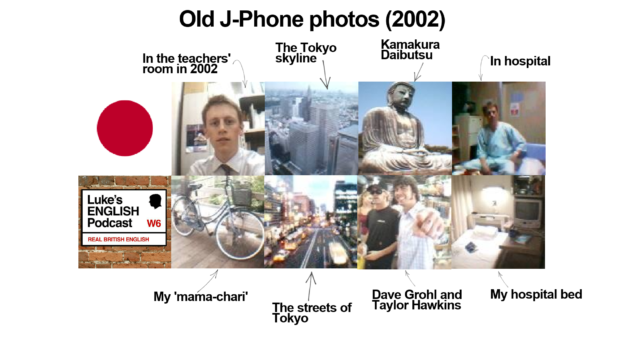
My story about how I ended up in a Japanese hospital bed, scared out of my brain. Recorded live in front of an audience at the British Council in Paris.
In this episode I am talking to Martin Johnston from the Rock n Roll English Podcast. Do you know the Rock N Roll English Podcast? This is where Martin and his Rock N Roll friends and family do podcasts for learners of English that are unfiltered and frequently involve discussions of taboo subjects, but also plenty of other stuff as well. It’s very funny and bound to be good for your English and general cultural knowledge. Martin featured me in episode 250 of RnR English and we talked about what it’s really like being an English teacher with a podcast. That was a funny chat with lots of memories and funny moments. Episode 250.
In this episode though, we’re going to have a rambling chat about moving to different countries, Martin’s fundraiser for Ukrainian refugees and then some stories of travelling and getting stuck in tricky situations while abroad.
Martin has recently moved back to England after living in Italy for a number of years, so I thought I would ask him about his experiences of feeling like a foreigner in his own country, and some of his culture shock experiences both abroad and at home. Because this is a thing – reverse culture shock. When you feel like a foreigner in your own country after living abroad for a long time.
Martin has also recently launched a fundraiser for Ukrainian refugees. Basically it is a learning pack with 25 stories, and transcripts and exercises. All the proceeds go to help Ukrainian refugees. You can find out more at www.rocknrollenglish.com/stories
So this is a very good cause. We know that several millions of people have been forced to flee their homes as a result of this war, invasion, operation – whatever you want to call it. This violence and aggression has separated families and made civilians homeless as well as killing thousands. This is a horrendous thing to be happening on our doorstep and so the least we can do is try to provide support in some way, so I call upon all of you to go ahead and get that PDF with those 25 stories and all the money will go towards helping these refugees. Martin talks about it during the episode if you want more details. But let’s help out some fellow citizens of LEPland here. Plus, of course, you get tons of stories with audio versions and everything. It sounds like a win win to me.
So we chat about the project a bit, which is all about learning English with stories and this then leads us to have a story-off. This is a sort of battle of stories where Martin and I trade different anecdotes and we see who comes out on top. So there are 4 or 5 funny stories of travelling experiences we’ve had, in the second half of this episode. I hope you enjoy them.
That’s it for the introduction. There is a video version on YouTube. Don’t forget to smash that like button.
I should say there is some fairly explicit content in this episode, which means fairly graphic descriptions of things like nudity, sex and bodily functions, which is completely normal for an episode of Rock n Roll English to be honest.
I’ll speak to you again briefly at the end, but now, let’s get started.
Ending
So there you are, that was Martin Johnston. I hope you enjoyed our stories.
Don’t forget, if you want to get that pack of 25 stories by the RNR English family, go to www.rocknrollenglish.com/stories It costs just 10dollars or pounds, and all the proceeds go to help Ukrainian refugees.
This is obviously a very good cause as so many people have been displaced, made homeless and so on and these people need our help.
If you enjoyed our stories in this episode, you could check out some of the episodes with those stories told in full.
Check out 118 Sick in Japan (although I should be doing a live version of that next month) and also Holiday in Thailand
or A Rambling Chat with Moz for more of the spa story
Discussing meditation, meditation techniques, how it can help in our lives and improve us as language learners. Antony Rotunno is my guest and listen out for stories, advice, tangents and maybe one or two revelations.
This episode is called Meditation & Learning English, and as the title suggests, this is about the topic of meditation and how it can help us in our lives in various ways, including with our learning of languages.
My guest this time is podcaster and English teacher Antony Rotunno. Antony is back on the podcast after being on the podcast a few times last year when we did a series of episodes about John Lennon.
Antony has a few podcasts of his own and you might remember that recently I said that I’d listened to a couple of Antony’s episodes which were all about meditation.
They were called “The Joys and Wonders of Meditation”
I listened to them late last year, during quite a stressful period when we were having work done on our new flat, and I really felt like they helped me to find ways to keep my stress under control and get a bit of mental clarity during all of that chaos.
I definitely recommend those episodes to everyone.
That’s Episodes 4 & 5 of “Life & Life Only”. You will find links on the page for this episode.
While listening to those two episodes I immediately thought I should invite Antony back onto my podcast for an interview, this time about meditation.
I think there’s a lot of stuff to learn from them, a lot of benefits to gain from it all and some interesting ideas to consider about learning English.
Antony Rotunno
As I said just a moment ago, Antony was on my podcast a few times last year talking about John Lennon and he’s always an insightful, articulate and thoughtful guest so it’s nice to have him back.
Just a reminder – Antony is an English teacher like me, he’s from England, he is a musician and also a podcaster. He has three podcasts in fact. You might want to check them out if you’re looking for more stuff to listen to.
“Life & Life Only” in which he explores themes of self-development, philosophy and the search for inner and outer truth. This is the one with the episodes about meditation.
“Glass Onion: On John Lennon” in which Antony goes into fascinating depth about many aspects of John Lennon’s life and related topics.
“Film Gold”, which is basically a chance for Antony to discuss some of his favourite films with different guests. I was a guest in a recent episode of Film Gold in fact. We talked about one of our favourite British comedy films of all time – Monty Python and the Holy Grail. If you want to listen to Antony and me chatting about that film, then check out Film Gold episode 15.
Those are Antony’s podcasts and they are available wherever you get your podcasts. You’ll also find links in the description and on the page for this episode on my website.
There you go, lots of other things for you to listen to there! But you might be thinking “Hold on Luke, I’m already listening to this episode about mediation!”
Ok, well, when you’ve finished this, if you’re still hungry for more, you could listen to Antony and me talking about Monty Python in episode 15 of Film Gold or Antony’s original meditation episodes from Life & Life Only, or anything else that takes your fancy.
But now let’s get back to this episode that you are listening to right now and the topic of meditation.
Meditation
What is it, exactly?
How does it work?
How do you do it?
Is it just the same as relaxation?
What can the benefits be?
What can Antony tell us about his experiences of finding out about it and doing it, including going on several silent meditation retreats?
What are some simple meditation techniques that you can apply to your daily life?
And can meditation help you to be a better learner of English?
Those are the talking points. There are some tangents of course as we end up talking about some other bits and pieces along the way and there are also a few quick meditation exercises, or spot meditations, which you can do while you listen, if you like.
In fact, to give you an idea of what that means – what a spot meditation is – let’s do a very quick spot meditation exercise right now just before the interview starts, to help you focus.
I’m making this one up myself of course and I’m not a meditation instructor but I’m willing to give it a shot.
A quick meditation before listening – to help you focus
Just follow my instructions for a moment and it might put you in the right frame of mind to really concentrate on our conversation.
First – consider your body position while you are listening to this.
Just take a moment to be aware of your body and any feelings of tension that you might have.
Are your shoulders tense? Are you sitting upright or are you perhaps slumped in some way? Are you tied up in a knot? Are you standing unevenly on one leg or leaning to one side? Is your jaw clenched?
Take a moment to find those tensions in your body and release them. Just let them relax.
Take a few deep breaths from your diaphragm and feel the sensation of the air going in and coming out, and your stomach going up and down.
Now focus on my voice.
Focus on the shape of the words, the different kinds of sounds that are included in each syllable of each word.
Notice the rhythm of the sentences I’m saying – where the stresses are, where the pauses are, and any times my voice goes up or down.
Just try to follow it very carefully without letting your mind get distracted by other things.
If you feel your mind wandering off, if you get distracted or if you feel like saying “Come on Luke stop rambling, we don’t want another 15 minute introduction, just get on with it please” or something – if you feel your mind wandering at all, then just guide it back and as you listen to this conversation between Antony and me, keep going with that approach.
So that was just a very brief spot meditation to help you focus your attention a bit.
OK, so now let’s start the episode properly and here we go.
Meditation and Learning English with Antony Rotunno.
Luke & Antony Discuss Monty Python & The Holy Grail
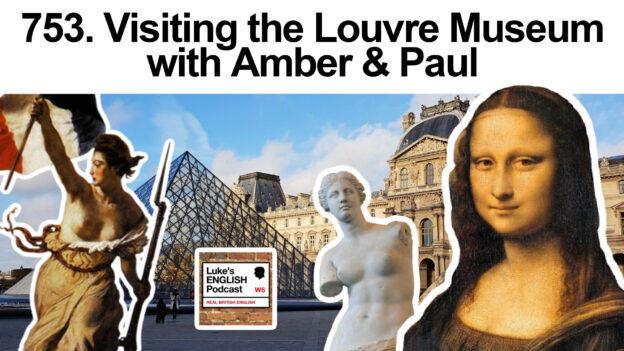
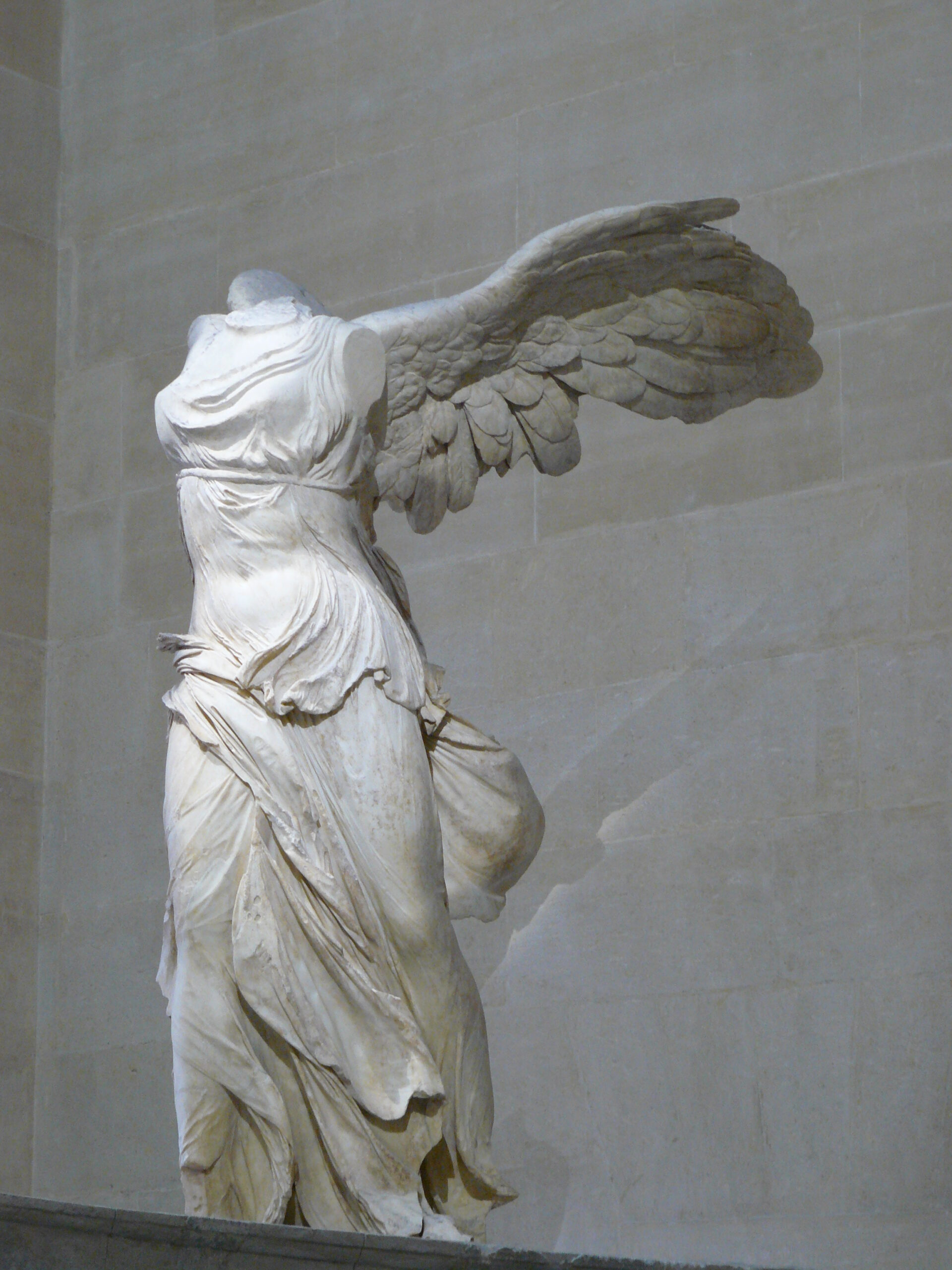
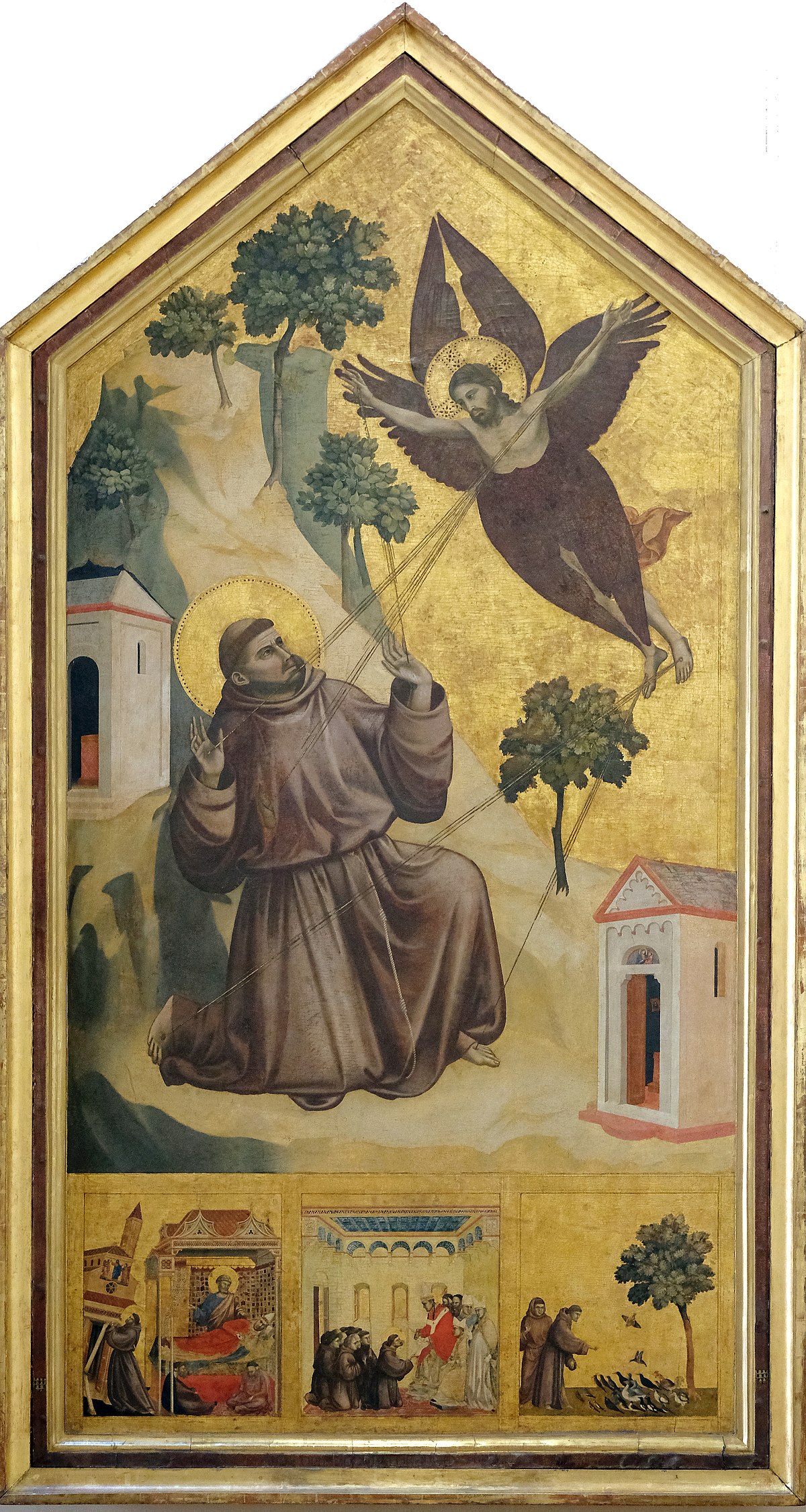
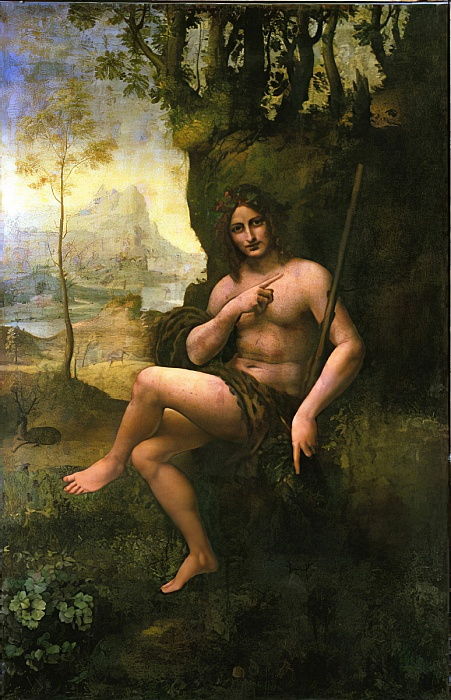
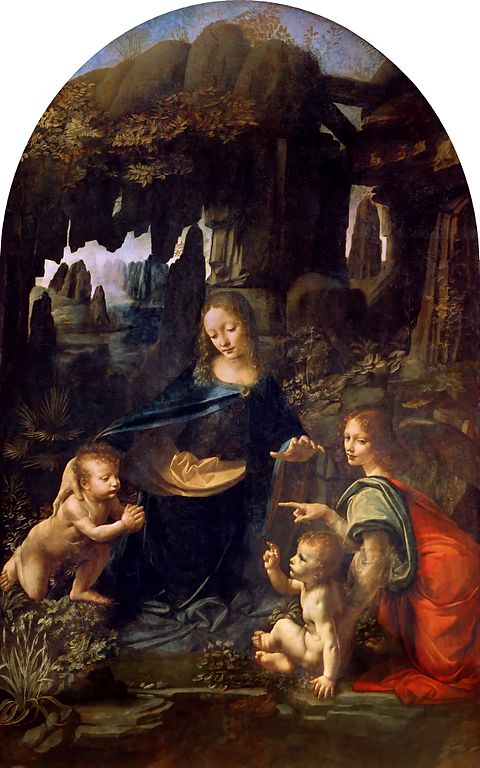
Join Amber, Paul and me as we take a tour of the famous Louvre museum in Paris and describe some of the world’s most amazing artwork and artefacts, including stunning Greek sculptures like Venus de Milo, fascinating renaissance paintings by Leonardo da Vinci such as the Mona Lisa and many more incredible pieces. The video version has photos of all the work being described. Photos are also shown on the website page.
Video Version with Photos of all the artwork in the episode
Introduction Transcript
Hello dear listeners and welcome back to the podcast!
Let me just say a few words before we begin. This is not going to be a massive introduction, but I do need to say a couple of things before we start, in order to prepare you for what you are going to hear in this episode, so you can understand it better and really make the most of it.
The pod-pals Amber & Paul are back! Just in case you don’t know – Amber Minogue and Paul Taylor are my English comedian friends who also live in Paris. They’ve been on the podcast many times in the past, but not since May this year. But now they’re back.
This episode was recorded a couple of weeks ago, not in my flat as usual, but on location at one of the world’s most famous museums – The Louvre in Paris. You probably know it. “The Louvre” – that’s how we say it in English. In French it sounds like this *Mme Google says the word*.
During the episode you will hear the three of us walking around parts of the museum, describing the the things we are looking at, including some very famous pieces that you will definitely know.
The art that we talk about comes from 4 main periods. There are marble sculptures from the Hellanistic period of Ancient Greece (about 2000 years ago), some French medieval paintings (from about 1000 years ago), and then some Reneissance-era paintings (from about 500 years ago) mainly by Italian artists – including a certain portrait by Leonardo da Vinci – I think you know which one I mean – The Mona Lisa of course – and yes, we will be talking about that painting in some detail. We mention it briefly as we walk past it, but then we come back to talk about it more – so keep listening for that. We also talk about some impressive French paintings from the early 19th century too (about 100 years ago).
So, watch out for descriptive language and also general knowledge about the various periods of art on display, the ways they were created, what they mean and how they fit into history.
This might be challenging for you, depending on your level of English, so be prepared!
It all goes quite quickly, we talk quite fast, there’s background noise and also references to specific art work that you can’t see unless you’re looking at them too.
If you’d like to see the sculptures and paintings, then have a look at the episode page where I’ve added photos, or the video version. It’s not a full video – I didn’t have a camera, but I’ve added photos into the video, which will appear as you listen.
I do recommend looking at pictures of the work we are describing. It’ll help you understand this and will help you contextualise the language we’re using, which is obviously important.
Some strong language and swearing
Also, watch out – There is some strong language – I mean, some swearing – rude words. Of course – it’s an Amber & Paul episode! There’s usually a bit of swearing. Most of you are fine with that because you know it’s what happens when friends chat together, but, if you are sensitive to strong language, or you’re listening to this with a group of young learners maybe – be warned, there is some strong language ahead, including at least one use of the C word. If you’re not sure what that is, listen to episode 83 of my podcast, which is a complete guide to swearing in English.
Thanks to Amber & Paul
I must say thanks to the podpals for their involvement here, especially Amber who was our tourguide for this trip, and she brings a lot to the table here as she has a lot of knowledge about this museum and the artefacts that can be found there.
Just a reminder – if you like Amber’s voice and want to listen to her talking more about the history of Paris, you’re in luck because she has her own podcast. It’s called Paname Podcast (spell it) and each episode is about a different aspect of Parisian history. There are loads of fascinating stories and atmospheric sound effects and it’s all written and recorded by Amber herself. Paname Podcast is the name and the website is www.panamepodcast.com
Also, if you want more Amber, Paul and Luke action – then check out Paul Taylor’s Happy Hour Live – specifically the episode recorded on Monday 6 December. This is Paul’s weekly YouTube livestream, and on Monday 6 December, his guests were Amber and me.
Paul Taylor’s Happy Hour Live from Monday 6 December. Watch it here.
You will be able to see the replay on Paul’s channel (and here).
OK that’s enough from me now, except that I really hope you enjoy coming with us on this cultural trip, that you are able to follow it, and that like Paul and me, you learn some things from the experience.
I’ll chat to you again briefly at the end, but now, let’s head down to The Louvre – just a 10 minute bike ride from my flat here in Paris, to meet up with Amber & Paul, and here we go.
Vocabulary Definitions added during the episode
A fresco is a type of wall painting. The term comes from the Italian word for fresh because plaster is applied to the walls while still wet. (National Gallery website definition)
A sculpture is a work of art that is produced by carving or shaping stone, wood, clay, or other materials (CollinsDictionary.com)
A sculpture which is atteched to a flat piece of stone which can be displayed on a wall – that’s a relief.
Phew, that is a relief, I mean – I’m glad we cleared that up.
Photos of Artwork
Here are pictures of almost all the things we described in this episode. The YouTube video version also contains these images.
00:09:06 In the entrance hall of The Louvre
The entrance hall
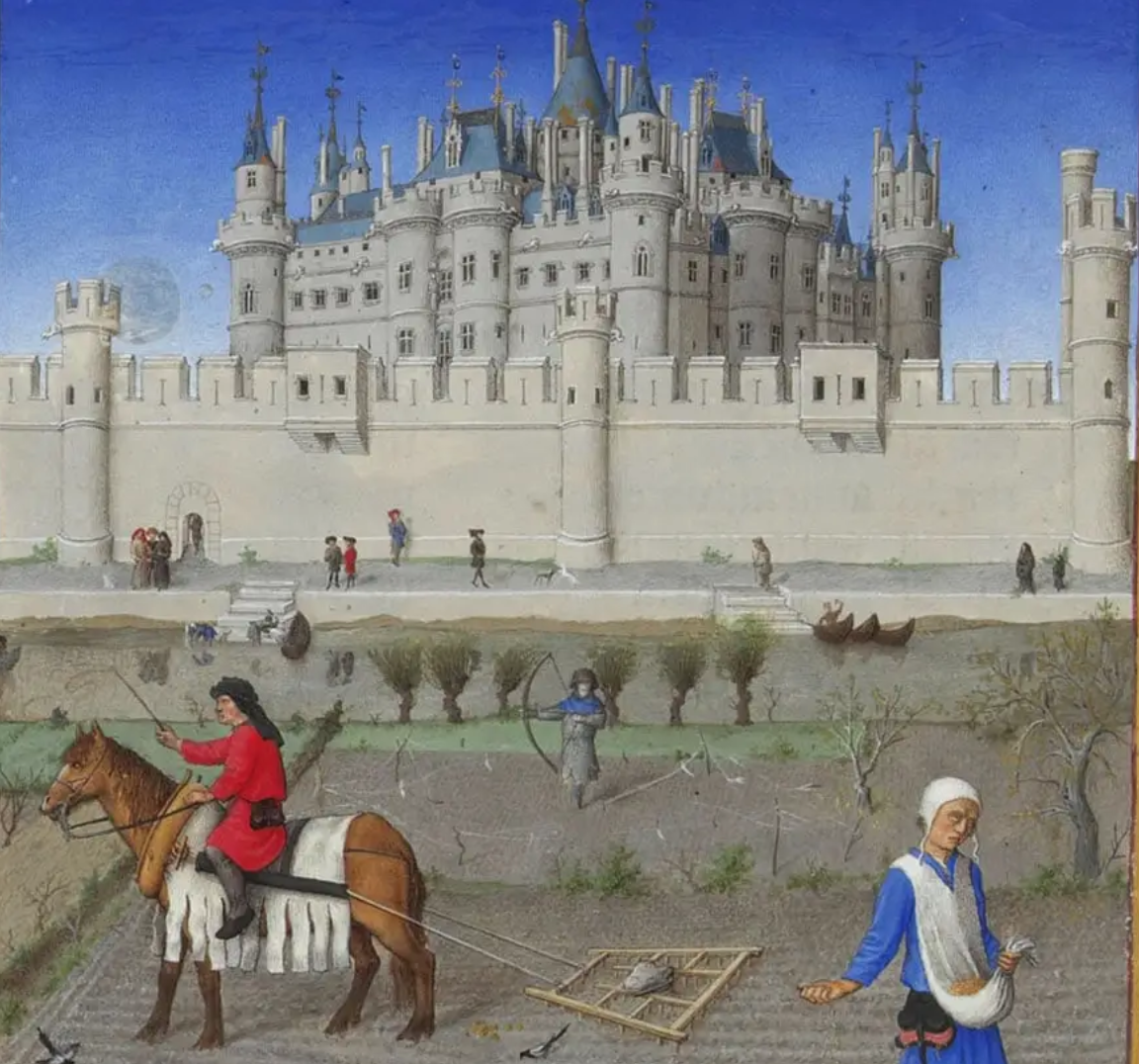
00:09:06 Overview of The Louvre
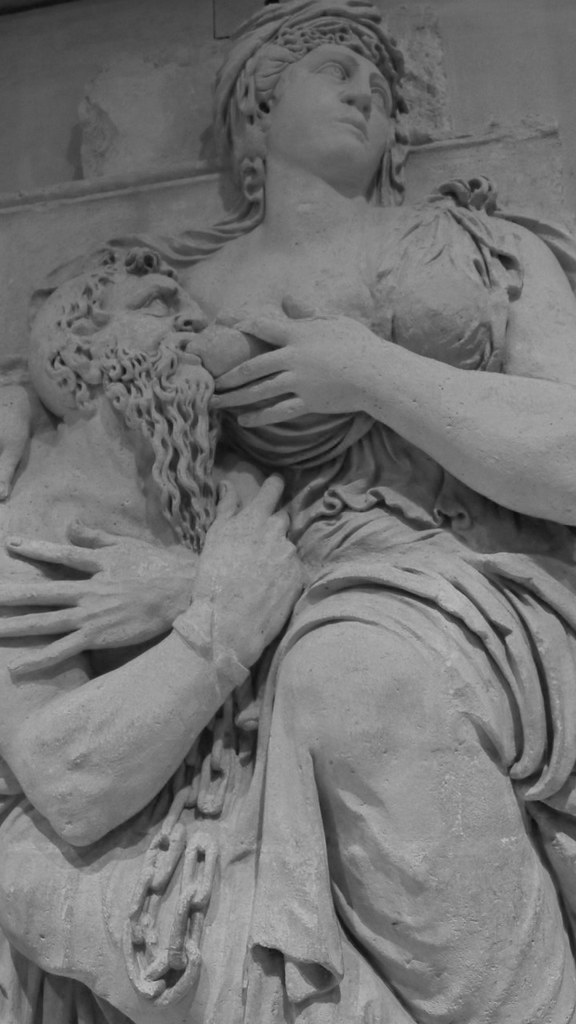
00:18:11 Greek statue of the breastfeeding bearded man
00:19:35 The medieval walls of the original fortress
00:26:42 Paul’s recent trip to Egypt / Skydiving over the pyramids at Giza
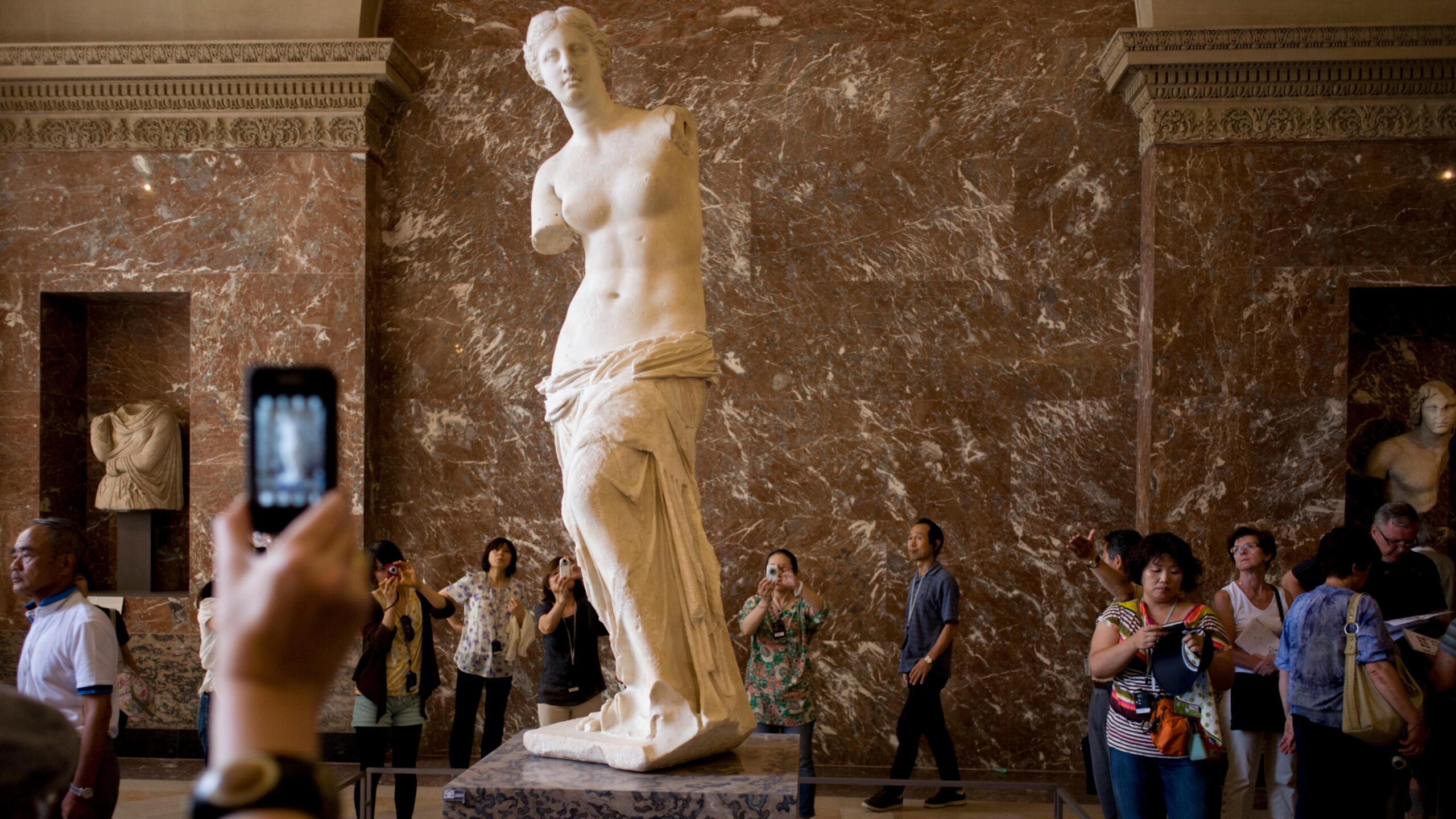
00:30:36 Venus de Milo
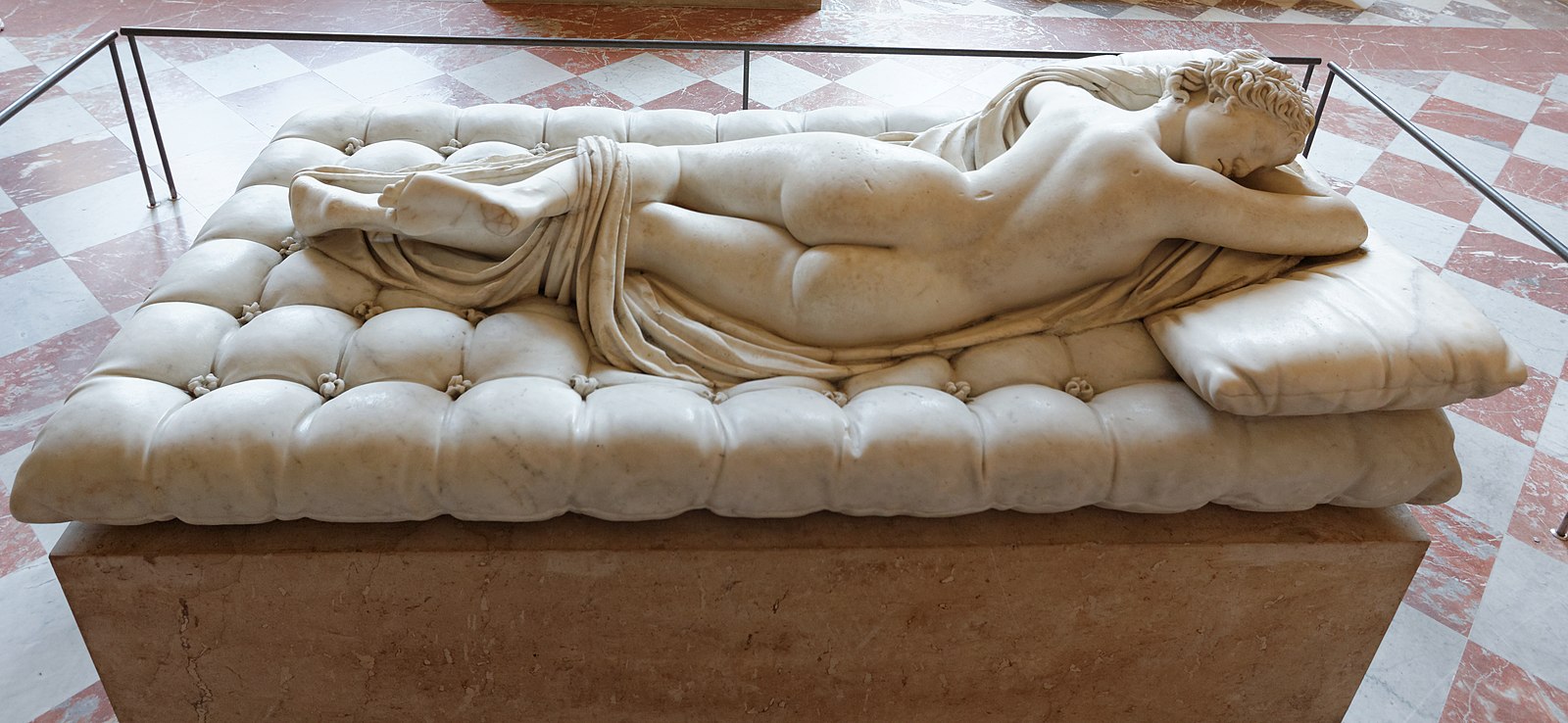
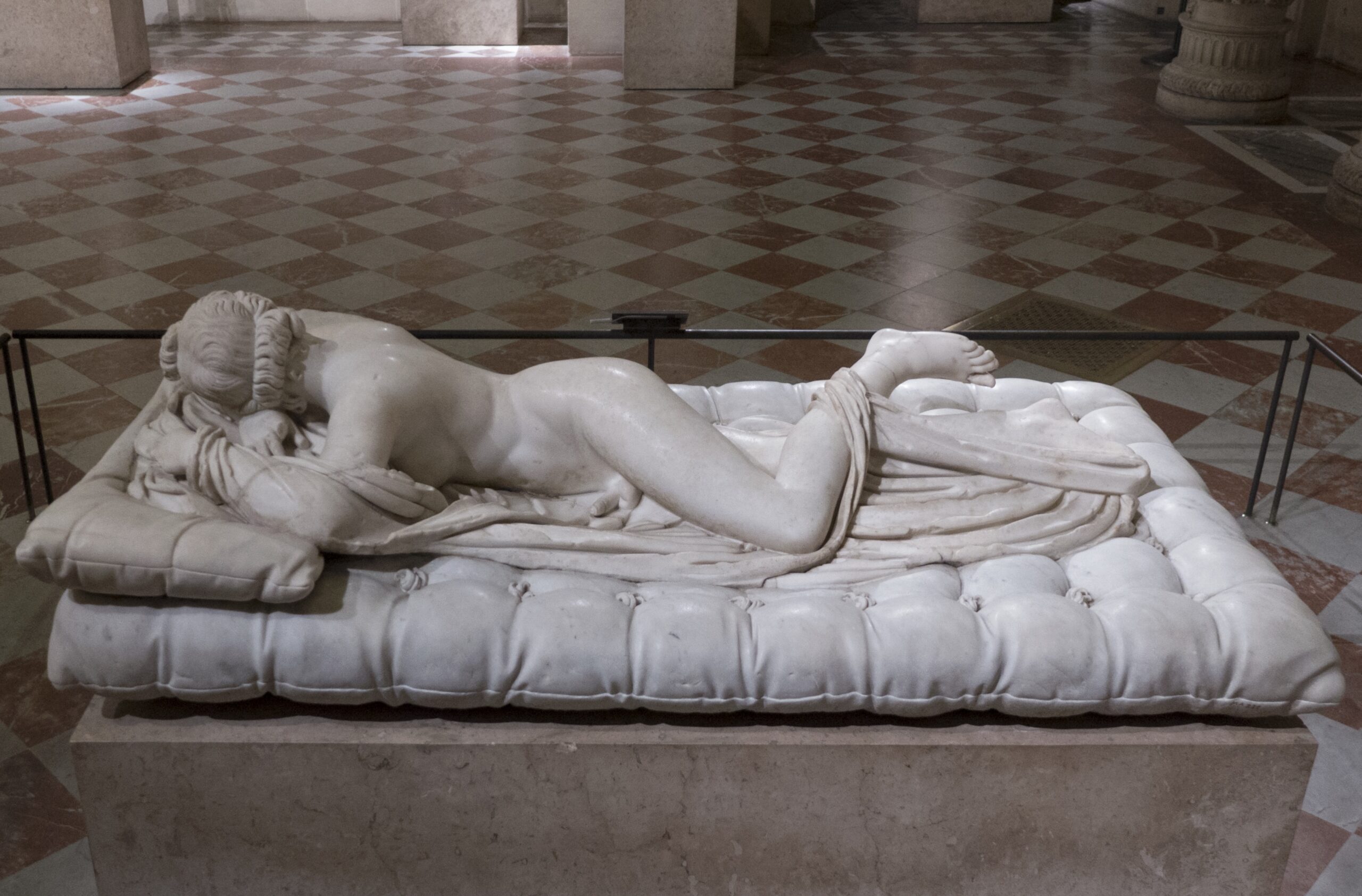
00:40:22 The Sleeping Hermaphroditus sculpture
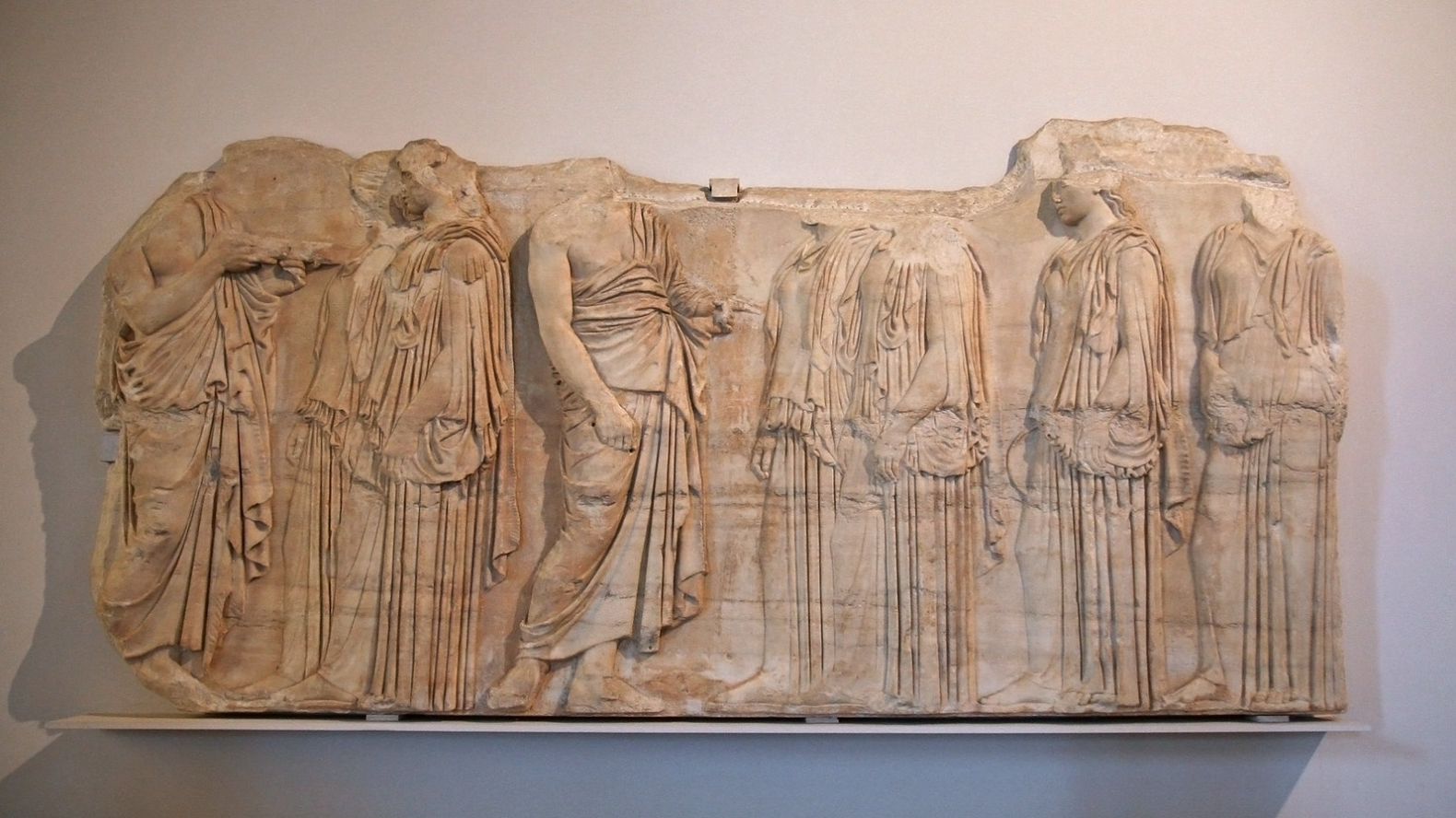
00:44:51 Remains of the Parthenon Frieze / Elgin Marbles
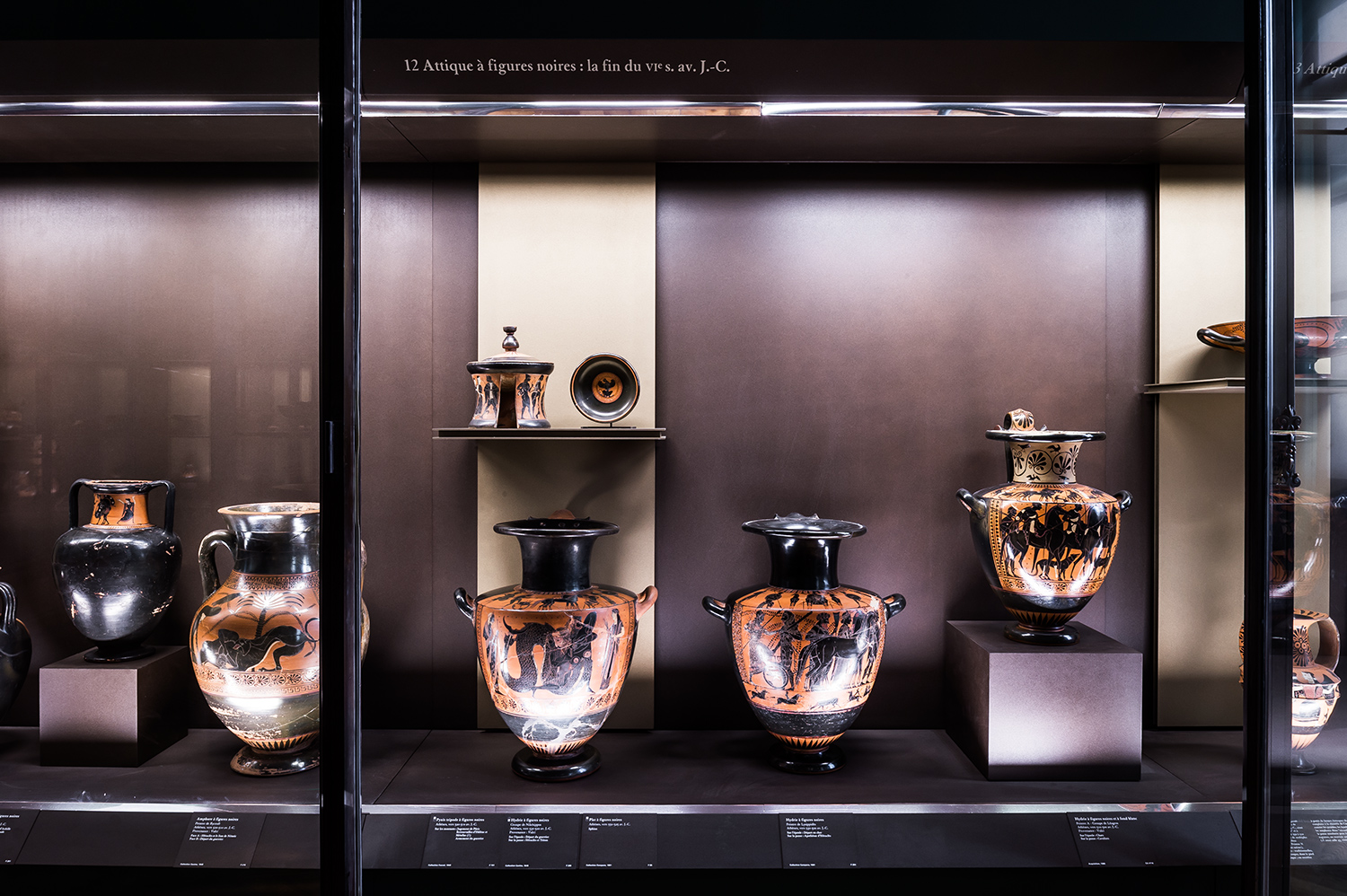
00:46:54 The Marquis’ Greek vases
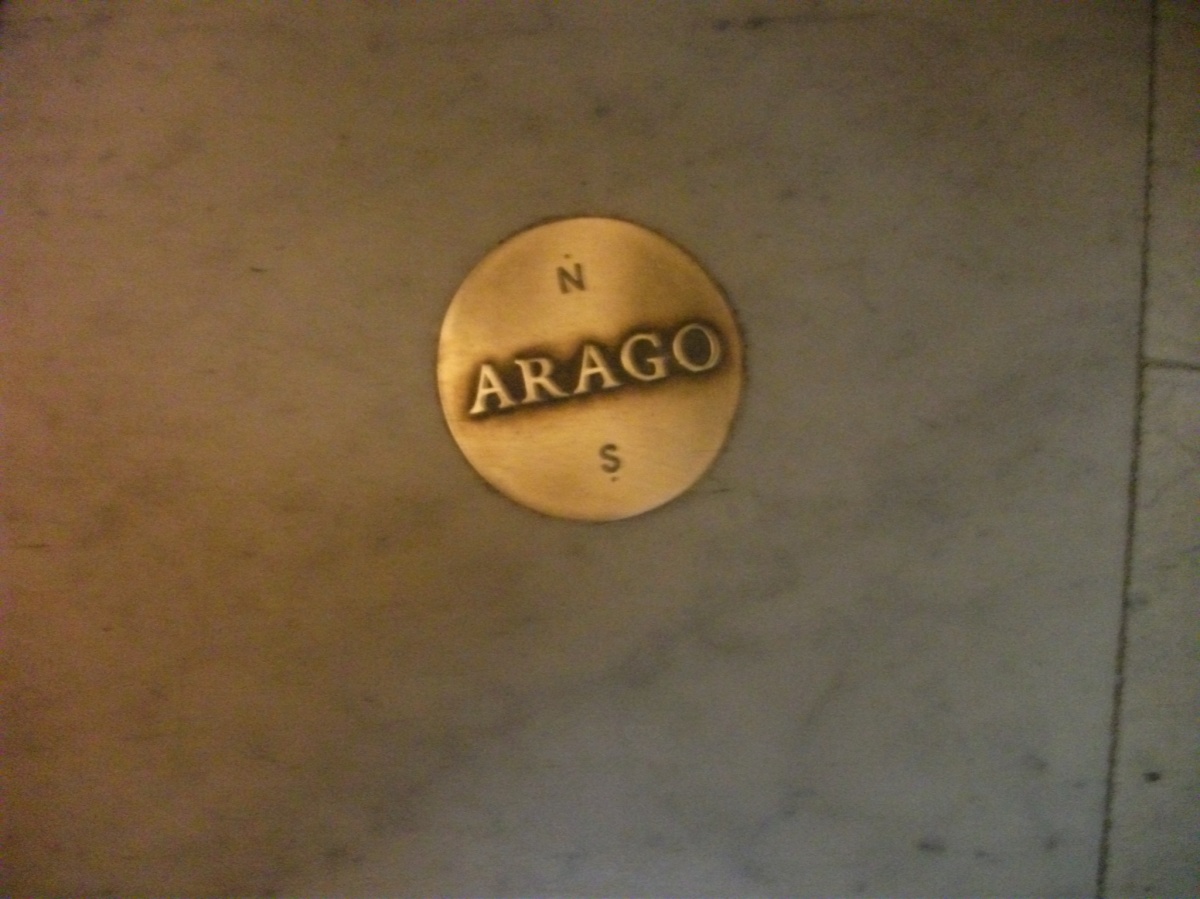
00:47:21 Arago Medallion / The Paris Meridian
00:49:46 The Winged Victory of Samothrace / The Goddess Niké (Victory)
00:55:14 Saint Francis Receiving the Stigmata (Giotto)
00:59:21 Bacchus – Saint John the Baptist (Leonardo da Vinci)
00:59:44 Madonna of the Rocks / Virgin of the Rocks
01:02:45 La Belle Ferronnière (Leonardo da Vinci)
01:03:43 The Virgin and Child with Saint Anne (Leonardo da Vinci)
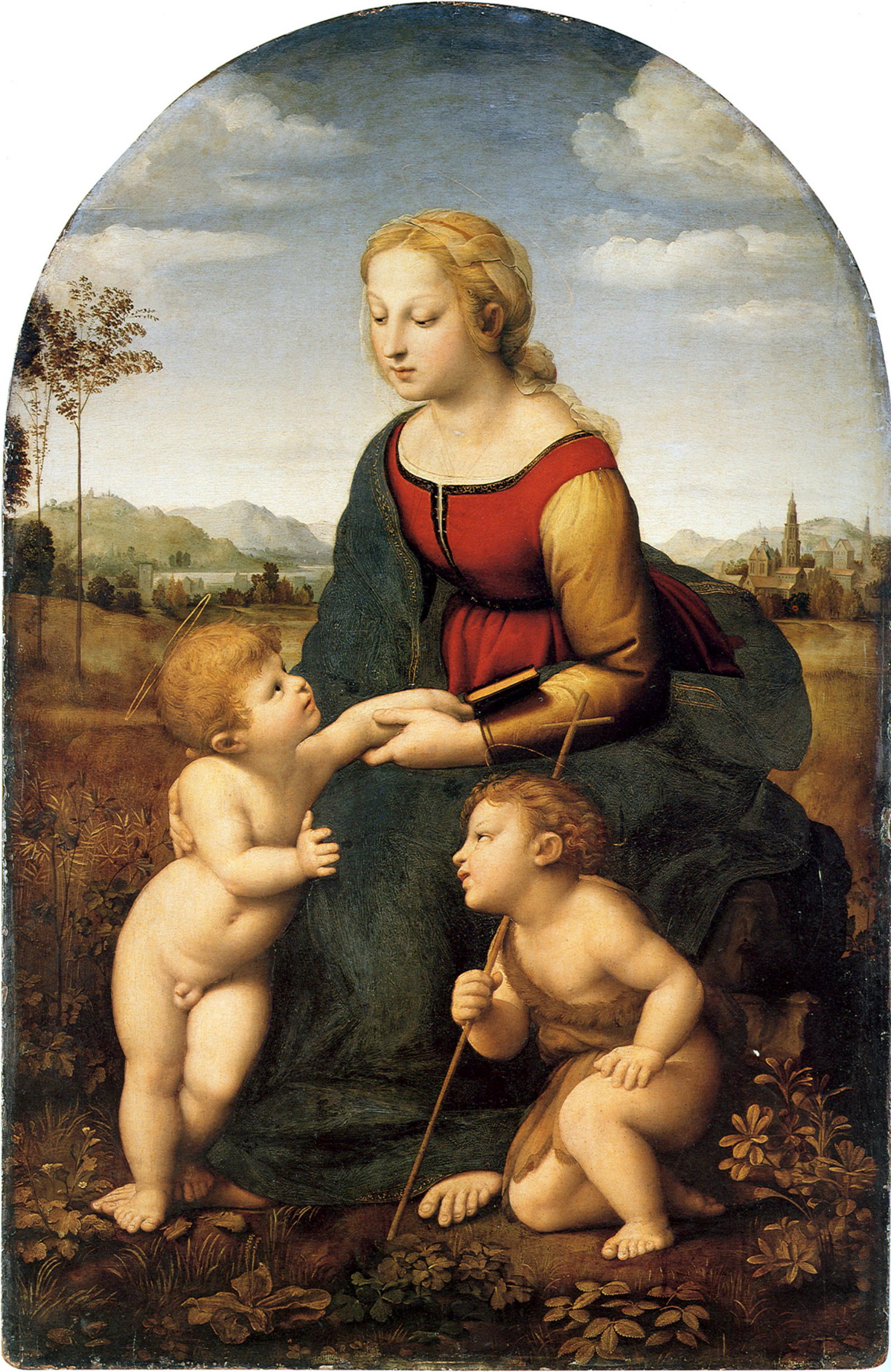
01:04:47 La belle jardinière (Raphael)
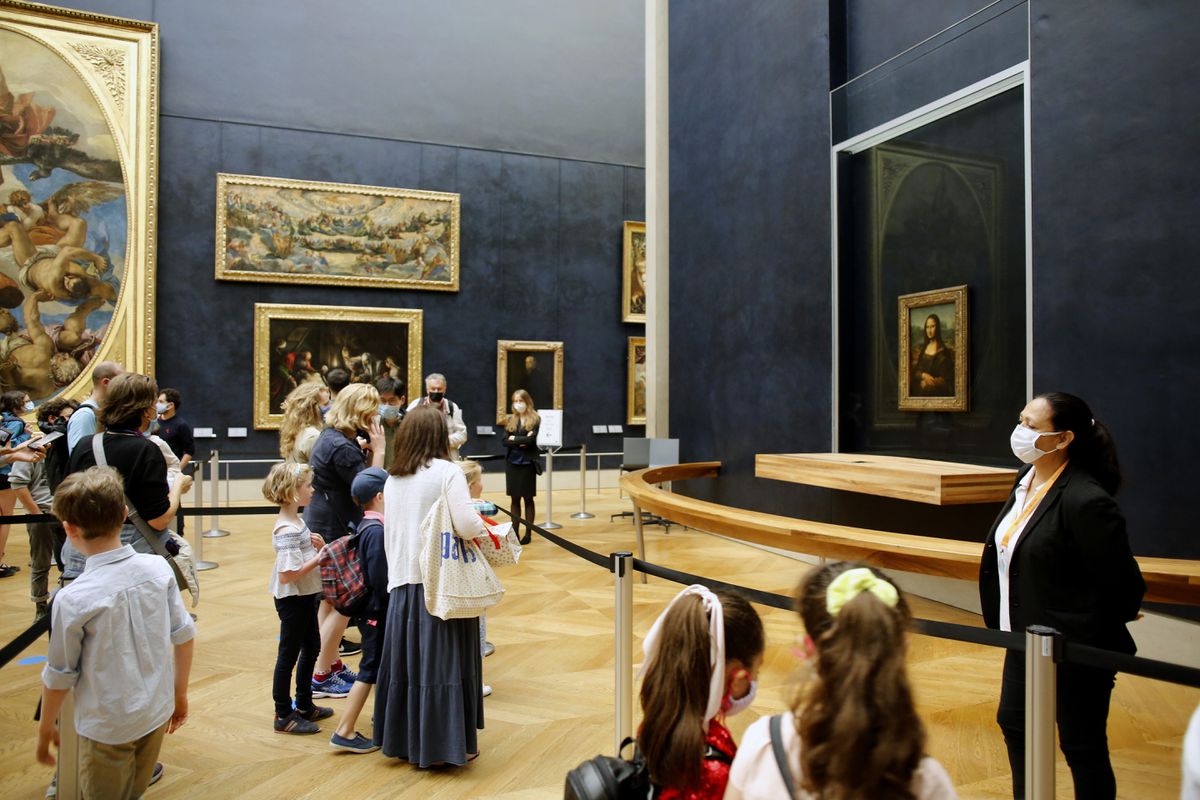
01:07:45 The Salle des États (Mona Lisa room)
01:08:42 The Mona Lisa
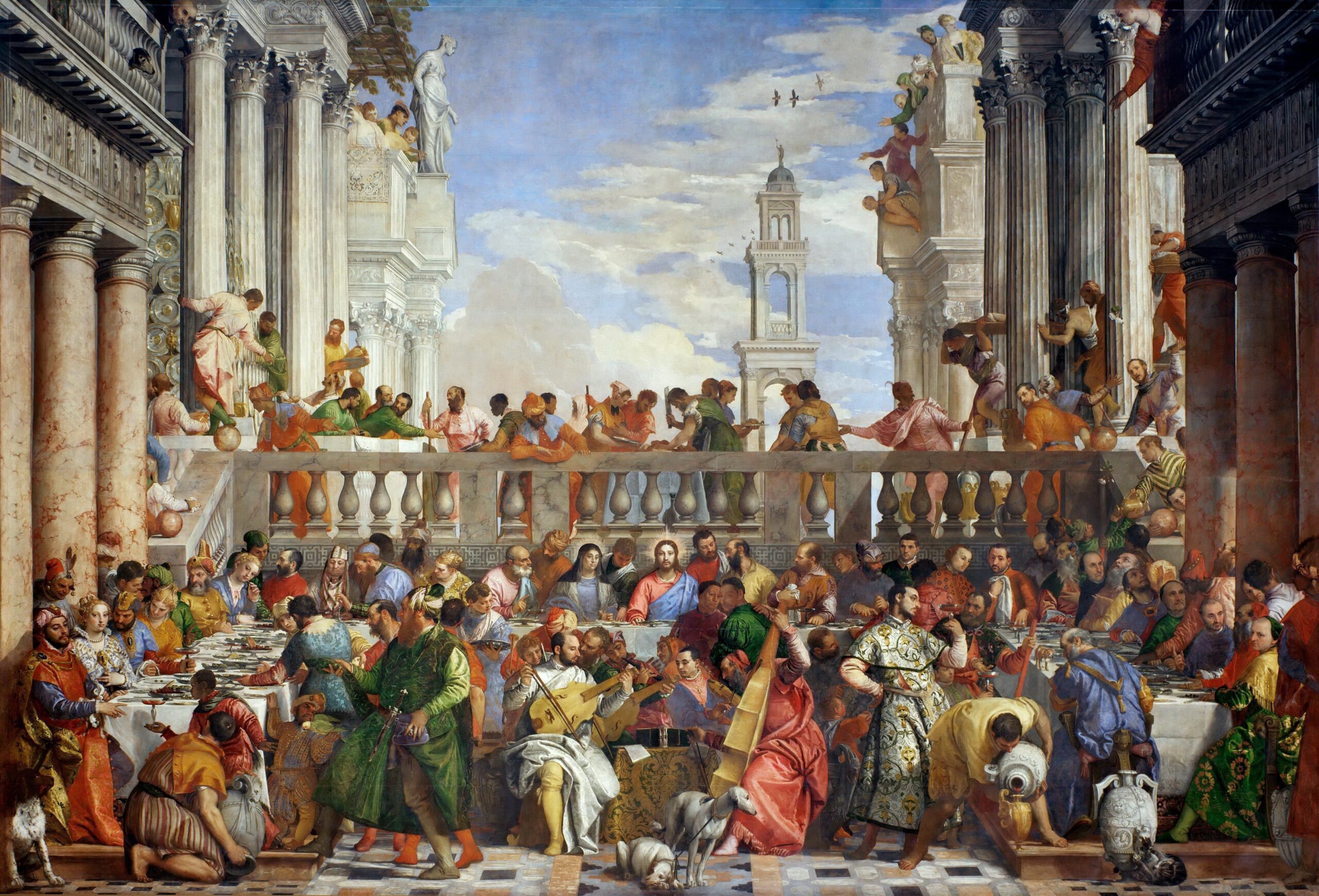
01:17:28 The Wedding Feast at Cana (Nozze di Cana, 1563), by Paolo Veronese
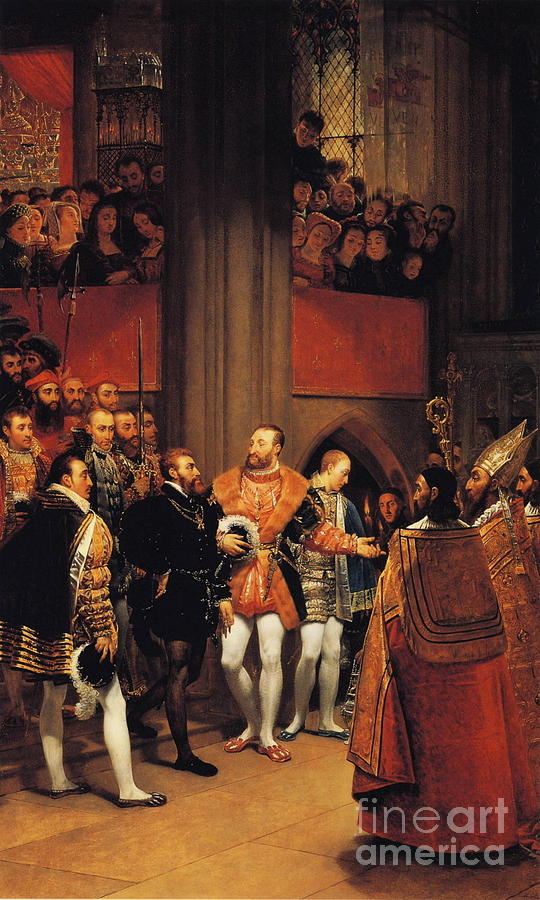
01:24:50 François I and Charles V Visiting the Church of Saint Denis (Antoine-Jean Gros) / Mona Lisa cameo
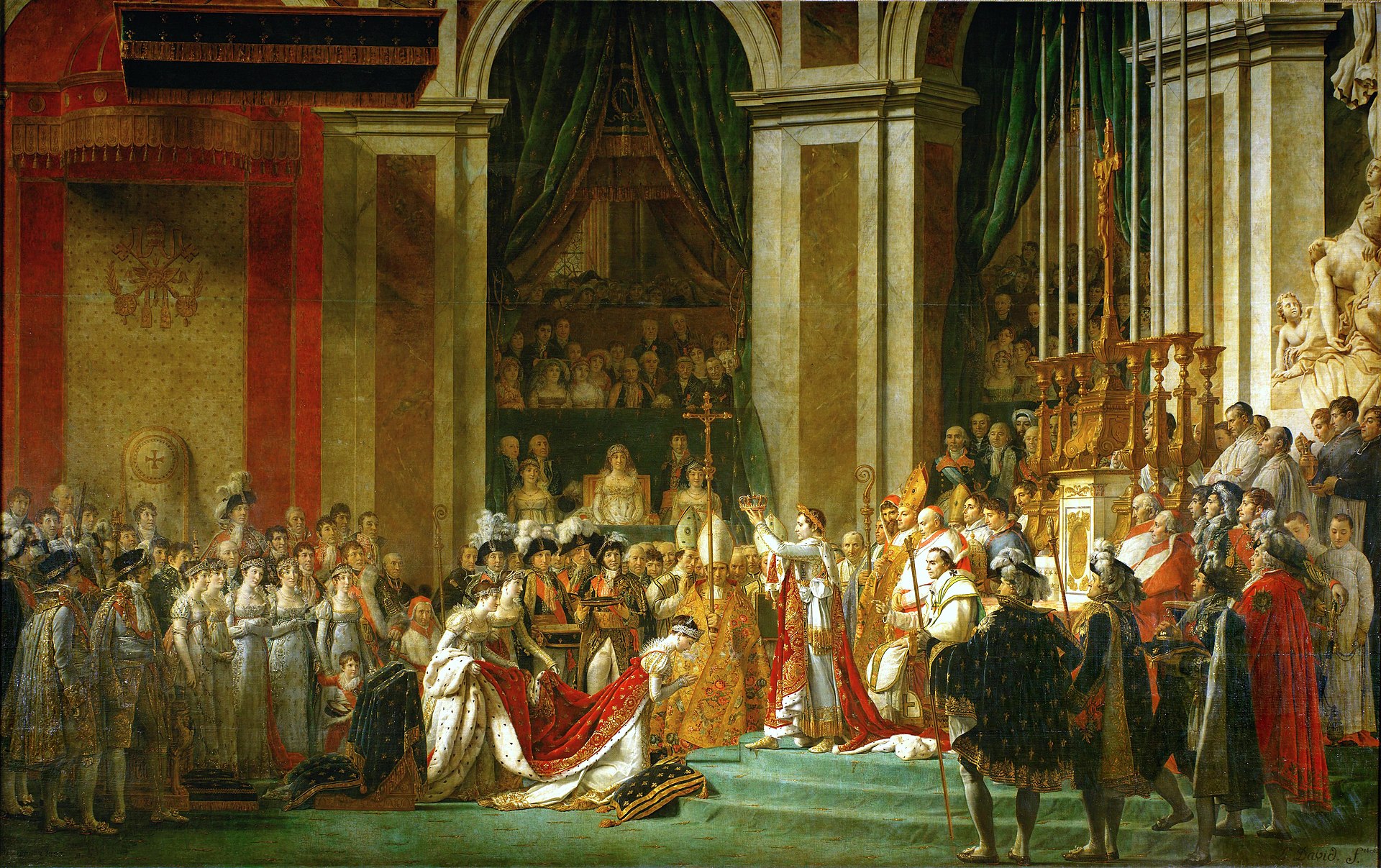
01:25:27 The Coronation of Napoleon (1807, Jacques-Louis David)
01:27:01 La Balsa de la Medusa (Géricault)
01:31:11 Liberty Leading the People is a painting (Delacroix)
Ending Transcript
Well, there you are. That was a whirlwind tour wasn’t it! There was a lot packed into that one. I hope you enjoyed it and maybe learned one or two things.
Remember, you can see pictures of everything (I think) that we saw and talked about – you can see all those pictures on the page for this episode on my website and also on the YouTube version. Don’t forget to whack that like button with a hammer.
Thank you again to the pod-pals. It’s always great to have them on the show.
Now, if you liked this, then you must listen to Amber’s Podcast, which she is still doing by the way. It’s called Paname Podcast and you can get it wherever you get your podcasts. Also, her website is panamepodcast.com
In her episodes you can hear Amber telling some fascinating stories about the history of Paris. Check it out!
Amber and I were on Paul Taylor’s Happy Hour Live – Monday 6 December. (Video available above
Thank you for joining us. Let me know your thoughts, comments and responses to this episode.
Speak to you soon, but for now – good bye bye bye bye bye!
Understand more of Karl Pilkington’s rambling as we learn about the Manchester accent and pick up vocabulary along the way. Video version available on YouTube.
Hello everyone. Welcome back to LEP. This is part 2 of a double Karl Pilkington themed episode. I would recommend that you listen to part 1 of this first – it contains important context about who Karl is plus more details about Karl’s pronunciation and accent.
Listening to that first will help a great deal in understanding this one.
I got plenty of good responses to part 1 of this, so let’s carry on.
In this part we are going to continue as we did before – listening to Karl Pilkington talking about various subjects, understanding exactly what he says, looking at features of his Manchester accent and picking up vocabulary along the way.
Karl is basically just a normal bloke from Manchester and his accent is fairly typical for people from that area so this episode aims to help you understand his accent and pick up vocabulary too.
Some responses to part 1
I disagree with Karl on most things.
Is he arrogant?
I just enjoy the way he puts things. He speaks like a comedian in the way that he expresses a point of view and has a certain way with words, but he’s not a comedian.
This is the enigma of Karl Pilkington – is he really just being himself, or is he playing a comedy character, and in real life he’s a lot more erudite.
I actually think it’s the former not the latter and that he’s just being himself. He just happens to have a funny way of putting his opinions across.
Sometimes the best comedy comes from someone sharing a specific opinion. I think this is what I enjoy about this, rather than the opinions he is expressing, and as I said I disagree with Karl about most things, and some things he says are quite laughable – especially stuff he’s said on the Ricky Gervais podcast, like his Monkey News stories.
One other thing – apparently it is possible to be choked by a live octopus as you eat it. What I meant was that it would be impossible for an octopus to strangle you from the inside, as strangling means choking from the outside of the throat, with your hands for example, but of course a live octopus could choke you from within, by sticking its arms up into your throat or your windpipe. So, fair enough, it is possible for an octopus to choke you.
Also, in the UK we do eat oysters – which are raw seafood, so I think raw fish are generally ok in the UK but most other raw things would be considered a bit strange for us.
Quick Pronunciation Recap
In part 1 we listened to Karl talk about life, health and food and in terms of his accent I talked about H-drops
I’m 32, I think I’ve got the hang of it.
Look, how many do you need?
glottal stops
I’ll have a look at the meteorites.
If you’re going to eat a live animal, don’t eat one that’s got eight arms that can get hold of your neck.
The ‘bath/trap’ split
podcast/podcast
laugh/laugh
path/path
bath/bath
/ʊ/ not /ʌ/
Do you go to the gym much?
Topics: Holidays & Karl’s Fridge
This time he’s going to talk about holidays and his fridge and we will look at more features of his accent.
There’s a video version of this on youtube with text on the screen, plus you will find all the text presented on the page for this episode on my website.
Just one more thing before we start – I have premium episodes in the pipeline for these two episodes of LEP. The Premium episodes will be a chance to review and remember the vocabulary that comes up in these episodes, and then pronunciation drills too. So, I’ll do a sort of memory quiz with you to see how much vocab you remember and then the usual pronunciation drills – but in my accent, not Karl’s.
Karl is on a camping holiday, sitting in a tent and moaning.
Why does Karl think holidays are stressful?
What does Karl think of Lanzarote’s nickname?
What did Karl do on his holiday there?
What’s the problem with holidays in the UK?
What did he think of the seal sanctuary he went to?
What’s the best place Karl has been? Why?
What does Karl think of holidays to the moon?
Vocabulary
You’ve got free time on your hands which you’re not used to.
We ended up walking around this seal sanctuary. 14 quid. £
They were just floating about, hardlymoving.
I’m not having a go, but don’t charge me to come in, or at least let me see them again when they’re better.
The coliseum, they don’t do it up.
There’s no overheads.
That’s a mess. Get it knocked down.
At the end of the day the moon is just a big rock. You may/might as well go to Lanzarote.
PRONUNCIATION #3
Nasal
Alright so I went on holiday and it was great and all that.
I’ll have a look at the meteorites.
If you’re going to eat a live animal, don’t eat one that’s got eight arms that can get hold of your neck.
When’s the last time you heard about a tortoise having a heart attack?
Works well with glottal stops.
Nasal sound in /aʊ/ and /ai/ sounds
/aʊ/ in words like about and now sounds more nasal.
What’s he going on about now?
If there were dinosaurs about now and that.
If we’ve run out we need to go outside and get some more.
Nasal sound in /ai/ sound
The /ai/ sound in words like alive, inside, survive, fighting, riot and dying sounds more nasal.
You’re not supposed to eat them alive.
We’ve got to stay inside if we want to survive.
If they were running about fighting and dying and that.
Running riot (sounds like “roonin raiyut”)
#5 Karl on his fridge
Karl’s fridge is broken and he called out a guy to fix it.
Naturally he’s moaning about workmen who come to your house to do different jobs.
Why does the guy charge £80?
What is Karl’s main problem with engineers, plumbers, workers who have to come to his house?
What advice does the fridge guy give to Karl?
What’s the problem with Karl’s new fridge?
Vocabulary
The fellaturnedup, right.
Yeah, it’s broke. (broken)
That’s why I called you out.
That’s 80 quid.
I said, “you what?”
An 80 quid callout charge.
I tell you. They windmeup.
I had a fella come round to do the tiling.
Turned up late with a carrier bag.
A pot noodle
A copy of the Daily Mirror
A crossword book
He was asking what the pub was like across the road. “What is …. like?”
Having a laugh
When did you last vac it out?
Vacuum cleaner
You’re meant to vac them out, because dustand that gets in.
Can’t afford any food to put in it.
It needswiringin. It’s got one of those fancy plug things.
PRONUNCIATION #4
A lot of other vowel sounds are nasal too.
Turn the corner /ɔː/
They becomes thee
It depends what they do with it.
Why have they only just found that?
How did they miss that?
Also, he adds little fillers like:
(Do you) know what I mean?
Right? (just sounds like a nazal grunt, almost)
… and that
Like that
And whatnot
And stuff like that
Do you know what I mean?
I tell ya…
Watch out for those things if you like.
Ending
Ladies and gentlemen, this brings us to the end of this episode, as we now prepare to exit the world of Karl Pilkington and re-emerge blinking into the light of the normal world.
Welcome back to yourself, your own attitudes and your own personality again.
I urge you to (just wanted to use that phrase) check the page for this episode on my website where you will find a downloadable full transcript, the audio file for download in mp3 format, a text video version of this episode where you can read the entire thing as you listen and it’s all presented in a rather majestic looking font before your very eyes and of course there’s the comment section where you can share your thoughts not to mention the episode archive with all the previous episodes plus lots of bonus extra stuff.
Teacherluke.co.uk
LEP Premium LEP App LEP Merch
Have a good one and I will speak to you again soon, bye!
Talking to Michael Lavers from the Level Up English Podcast about learning Japanese, embarrassing moments in language learning, social awkwardness and some “very British problems”. Are you as socially awkward as a British person? Let’s see how you and Michael would respond to some quiz questions that will test your British awkwardness to the max. Video version available.
Today on the podcast I am talking to Michael Lavers who is an English teacher from Cornwall in the South West of England. Michael also has a podcast for learners of English. It’s called The Level Up English Podcast – you might want to check it out if you haven’t already done so. It’s available wherever you get your podcasts.
As well as being an English teacher, Michael is also a language learner himself and in his podcast episodes he often talks with guests about experiences of learning other languages, including those embarrassing or awkward moments that happen when you feel shy or you make mistakes. Also, Michael has described himself as a socially awkward person who lacks a certain amount of confidence in himself. In fact, he says that one of the reasons he started his podcast was to try and gain some confidence by going out of his comfort zone.
So this is what I thought I would ask Michael about: his language learning experiences and those awkward and embarrassing moments, and then I’d like to chat about social awkwardness and whether this is a uniquely British thing. And we’re going to go into some specific examples of how this so-called British awkwardness manifests itself.
That’s the plan, so now, let’s meet Michael Lavers from the Level Up English Podcast.
Awkward Situations – Very British Problems
Here are some questions based on some tweets by the popular Twitter account, Very British Problems. Each one describes a specific problem that British people typically experience in social situations. They seem to sum up the experience of being a British person. We’re socially awkward – I don’t know why.
Let’s see how you respond to these questions. And listeners, I want you to consider your answers to these questions too, then we’ll see what Michael says, and then we’ll see the original tweets and we can see if they match up.
Questions & Tweets
How do you feel when you walk through the “nothing to declare” gate at an airport?
You’re sitting with a group of people. It’s time for you to leave. What do you say as you kind of slap your hands on your knees and stand up?
If someone says something to you but you don’t hear it, how many times are you willing to ask them to repeat themselves?
What do you say to your taxi driver as they approach the point where you want to get out of the cab?
If you’re on a train, sitting in the window seat with a passenger next to you, and your stop is approaching, what do you do to signal to the passenger in the aisle seat that you will need to get up?
You’re standing at the exit door of the train as it is pulling into the station, slowly coming to a stop, and there is a crowd of other passengers right behind you, eager to get off the train. The “Open door” button isn’t yet illuminated. What do you do? Do you press the button?
How do you feel when the ticket inspector inspects your perfectly valid ticket?
What do you say, modestly, to guests arriving in your home, even though you spent some time before their arrival, tidying things up?
There’s one last roast potato on the table at Sunday lunch. You want to eat it. How do you achieve this?
Just take it and eat it
Ask if you can eat it
Offer it to everyone else first
Do you ever tell your housemates or family that you are “off to bed” but then just stare at your phone in bed for an hour?
Imagine you are walking through a hallway with lots of doors in it, like in a library or something and you’re walking just behind a stranger who keeps having to hold the doors for you. How many different ways of saying “thanks” can you think of?
How do you end an email? Is there a subtly less friendly difference between kind regards and just regards?
What do you do when you get an incoming call from an unknown number?
How good are you at overtaking someone on foot?
Do you feel it necessary to speed up at all, when walking over a zebra crossing?
If you pay for something with exactly the right change, and you know it’s exactly the right change, do you wait for the cashier to count the money?
I have had some entries already. If you’ve sent me something, then thank you. Please send your designs to podcastcomp@gmail.com and my brother and I will review the entries we receive, talk about them on the podcast and pick at least one to be featured in the LEP Merch store.
Think of a t-shirt that LEPsters would want to wear
PRIZE: The winning design will be put on t-shirts, mugs and other merch, and the winner will also win £80!
SPECS: A high-resolution transparent .PNG at 150dpi. Minimum dimensions of at least 1500px by 1995px (not including outer transparent pixels).
CLOSING DATE: 22 October 2021
Send your t-shirt designs to podcastcomp@gmail.com
Cookies on teacherluke.co.uk
Click “Accept All”, to consent to the use of all cookies on this website, or visit "Cookie Settings" to control your consent settings.
This website uses cookies to improve your experience while you navigate through the website. Out of these, the cookies that are categorized as necessary are stored on your browser as they are essential for the working of basic functionalities of the website. We also use third-party cookies that help us analyze and understand how you use this website. These cookies will be stored in your browser only with your consent. You also have the option to opt-out of these cookies. But opting out of some of these cookies may affect your browsing experience.
Necessary cookies are absolutely essential for the website to function properly. These cookies ensure basic functionalities and security features of the website, anonymously.
Cookie
Duration
Description
cookielawinfo-checkbox-analytics
11 months
This cookie is set by GDPR Cookie Consent plugin. The cookie is used to store the user consent for the cookies in the category "Analytics".
cookielawinfo-checkbox-functional
11 months
The cookie is set by GDPR cookie consent to record the user consent for the cookies in the category "Functional".
cookielawinfo-checkbox-necessary
11 months
This cookie is set by GDPR Cookie Consent plugin. The cookies is used to store the user consent for the cookies in the category "Necessary".
cookielawinfo-checkbox-others
11 months
This cookie is set by GDPR Cookie Consent plugin. The cookie is used to store the user consent for the cookies in the category "Other.
cookielawinfo-checkbox-performance
11 months
This cookie is set by GDPR Cookie Consent plugin. The cookie is used to store the user consent for the cookies in the category "Performance".
viewed_cookie_policy
11 months
The cookie is set by the GDPR Cookie Consent plugin and is used to store whether or not user has consented to the use of cookies. It does not store any personal data.
Functional cookies help to perform certain functionalities like sharing the content of the website on social media platforms, collect feedbacks, and other third-party features.
Performance cookies are used to understand and analyze the key performance indexes of the website which helps in delivering a better user experience for the visitors.
Analytical cookies are used to understand how visitors interact with the website. These cookies help provide information on metrics the number of visitors, bounce rate, traffic source, etc.
Advertisement cookies are used to provide visitors with relevant ads and marketing campaigns. These cookies track visitors across websites and collect information to provide customized ads.