I've been teaching English for over 20 years in London, Japan and France. I also do an award-winning podcast for learners of English called "Luke's English Podcast". In my free time I'm a stand-up comedian who regularly performs shows in English in Paris and sometimes London.
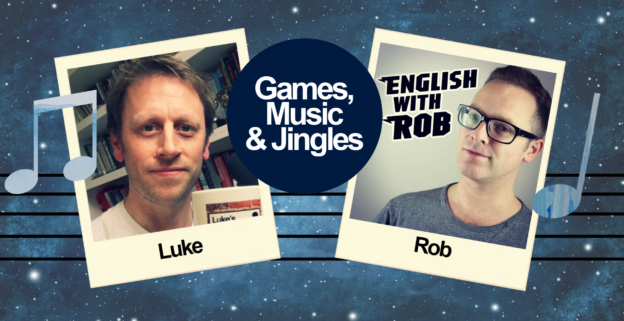
My guest today is Rob from English with Rob (podcast/YouTube). Rob is an English teacher, musician from England, and my former colleague. This episode includes lots of musical fun, some chatting about how we make our podcasts, fun word games and much more. Video version also available on YouTube.
In this episode I’m talking to Robert Dylan Walker, aka Rob from English with Rob – the podcast and YouTube channel.
Rob and I already know each other in fact as we used to be colleagues at the British Council, until Rob moved to Germany.
Basically – Rob is an English teacher, a YouTuber and a podcaster. He’s also a musician who likes to make music for his podcast, a photographer and video maker, who likes to use various special effects in his videos, and he’s into jokes and films and things like that, so he’s an ideal guest for me to talk to on this podcast.
The plan is to have a bit of a ramble chat, focusing on things like how we both make our podcasts, especially how we include bits of music in our episodes – and later in this episode we will be playing some of our podcast jingles, breaking them down a bit, explaining how we made them, and we had homework for this episode – to record jingles for each other’s podcasts, but I think that we both ended up recording songs rather than jingles.
So stick around to hear some of our music and generally to get to know Rob a bit, and find out about his podcast and YouTube channel, which you might want to check out as a good resource to help you in your continuing journey to improve your English.
Ending
That was an epic one. Thanks again to Rob for his contribution. Don’t forget to check out English with Rob wherever you get your podcasts and on YouTube.
I hope you enjoyed the bits about music and making jingles and that you didn’t get too exhausted by the length. Hopefully you just got carried away and enjoyed getting a nice big dose of English listening into your week.
If you’re interested in more stuff about jingles, then check out the Luke’s English Podcast App – free in the app store. It has a category called Jingles where you can hear most of the jingles I’ve made for the podcast, like the Amber & Paul jingle and more. There’s also that full app-only episode in which I break down every single sample from the LEP Jingle Megamix.
And on the subject of music, you can check out my recent tunes, like the English with Rob song that I did for this podcast and some other little bits of music I’ve been making recently – you can check them out on my soundcloud page.
The last one is a link to the music page on my website where you can find all the Korg Kaossilator tunes I’ve ever made, and also old music mixes I’ve made with my brother and a few comedy tracks too with James.
So, plenty of music stuff to get into.
I hope you enjoyed this episode. I will speak to you again on the podcast soon, but for now it’s time to say good bye…
The second part of my conversation with Antony Rotunno (John Lennon podcaster, English teacher) in which we discuss adjectives of personality, with John Lennon as a case study. Vocabulary list available.
Welcome to this brand new episode of Luke’s English Podcast. Here it is, another episode of my podcast, from me to you, in which I help you try to learn this wonderful language that we call English, and I am here to try to help you do it, in ways that I hope you will find interesting and motivating.
So, how are you doing out there in podcastland today? I hope things are pretty good all things considered.
You are now listening to the fourth in my Beatles mini-series and the second part of this double episode I’m doing about describing John Lennon using various adjectives of personality.
I’m assuming here that you have heard the first part of this. If you haven’t heard the first part of this double episode then you need to go and listen to that. It’s probably the previous episode to this one, ok?
I’m still talking to Antony Rotunno from the Glass Onion: On John Lennon podcast. Antony is also an English teacher with plenty of experience. So I think he’s the perfect guest for this podcast series, and let’s continue going through this list of adjectives we compiled, and let’s see if we can use them to discuss John Lennon’s life, his psychology, his personality.
In the last episode we covered adjectives from A to I. It’s a sort of a rough A-Z, and we did A to I last time so let’s do the rest of the alphabet, more or less.
We might skip a few letters here and there but I’m sure that you’ll forgive us.
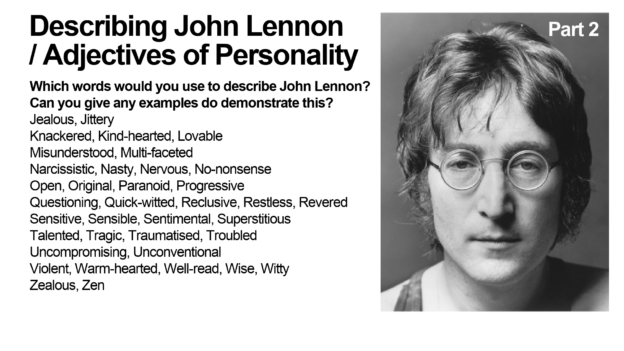
Just before we continue, let me read out the list of adjectives. Like last time, we don’t go into full detail about all of these, but have a listen and consider these things: whether you know these words, whether you don’t know them, whether you use them and whether you don’t and also what’s the word stress for these adjectives? How many syllables are there and which syllables are the stressed ones? It can also be useful to consider what the noun or verb forms of these adjectives are, if they have them, and sometimes you’ll hear us using the different forms of these words in these word families as well.
Adjectives of Personality J-Z
O o o <—- these symbols show the number of syllables and word stress in a word. For example, “podcast” = O o (two syllables, the first syllable is stressed)
Jealous O o, Jittery O o o (Also: to have the jitters, to be on edge, to be nervous, to be anxious)
Knackered O o, Kind-heartedo O o
LovableO o o
Misunderstood o o o O, Multi-facetedo o O o o
Narcissistic o o O o, Nasty O o, Nervous O o, No-nonsenseo O o
Open O o, Originalo O o o
Paranoid O o o, Progressiveo O o
Questioning O o o, Quick-witted O- O o (Also: to have the gift of the gab)
Reclusive o O o, Restless O o, Reveredo O
Sensitive O o o, Sensible O o o, Sentimental o o O o, Superstitious o o O o
Talented O o o, Tragic O o, Traumatised O o o, TroubledO o
Uncompromising o O o o o, Unconventionalo o O o o
ViolentO o
Warm-hearted o O o, Well-read o O, Wise, WittyO o
(not) Xenophobic o o O o (this is the only adjective I could think of that begins with an X!) (xylophone and x-ray are other words beginning with x – but they’re not adjectives of personality)
Yellow O o / Yellow-bellied O o – O o (cowardly), YouthfulO o
Zealous O o, Zen
Also: Childish O o / childlike O o
We also cover a few common false friends in this episode, so listen out for those.
False friends
Embarrassed o O o
Suburbs O o / slums
Sensitive O o o / sensible O o o
That entire list is available for you to see on the page for this episode on my website. The link is in the description.
Now, I read that list of adjectives pretty quickly. If you didn’t catch the word stress, or in fact if you feel you need to explore these words more slowly, you can always just check the word list on the website page … and copy+paste them into an online dictionary, where you’ll see phonemic transcriptions of the words (so you’ll know how they are pronounced, including word stress) you’ll be able to hear someone say the words, and you’ll get definitions and examples and so on.
OK, so – I always encourage you to check words that you discover in episodes of this podcast in your own time, and I refer you back to episode 720 for more information about how to do that.
OK, so without any further ado, let’s jump back into my conversation with Antony about John Lennon, and here we go.
Ending Transcript
Thank you again to Antony for his contribution to this episode.
Let me suggest again that you check out Antony’s podcast if you’d like to hear more in depth discussions about John Lennon. It’s called Glass Onion: On John Lennon and you can get it wherever you get your podcasts. I must say, it is an excellent listen.
Right, so that’s not quite it for Beatle-themed episodes. The last in the series is with Antony too, and that’s where we turn to look at the music (or should I say listen to the music?) In any case, the next part of this series is all about the music and lyrics, especially the lyrics and Antony is going to guide us through a little exploration of words and phrases in Beatles songs, looking at nice idioms, uses of metaphor and other features that you should find interesting from a language learning point of view. And Antony got his guitar out for that too, so we also get treated to little snippets of songs as we go.
So, you can look forward to the final episode in the series, coming soon.
I say final episode, there’s nothing stopping me from doing more episodes with Beatle themes in the future, and I do plan to do that actually. I’d like to do some specific song breakdowns in which I could explore the story behind a particular song, then play the song for you and analyse the lyrics. That could be great.
Anyway, thank you for listening as usual! I hope this has been interesting and useful, and I will speak to you very soon in the next episode of this podcast. BUt for now it’s time to say, good bye bye bye bye bye.
Learn useful adjectives for describing personality traits with John Lennon as a case study. Episode 3/5 in my Beatles series, with returning guest Antony Rotunno from the podcast “Glass Onion: On John Lennon”.
Here is the next episode in my Beatles season, and this is where we look at some language too.
In this episode I’m joined again by Antony Rotunno who is a podcaster and English teacher from England. Antony’s main podcast is called Glass Onion: On John Lennon and as the title suggests it is all about John Lennon, particularly his psychology and his life story. Antony’s other podcasts are called Film Gold, a film review series and Life & Life Only which is about personal development and psychology, so Antony knows a thing or two about psychology and John Lennon, and of course as an English teacher he’s well experienced in helping learners to conquer this language of English.
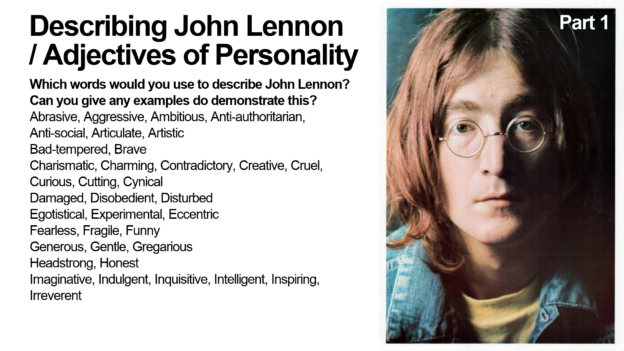
In this one we’re going through a big list of adjectives which I prepared earlier. All the adjectives are words you could use to describe someone’s personality. We have loads of these adjectives, so Antony and I made a list of words which could be used to describe John Lennon. It’s an ABC in fact. Now we didn’t manage to talk about every single adjective in the list, but we certainly had a good go at them, and what you’re going to get in this episode is a sort of English lesson with John Lennon as a case study.
Here are the adjectives (I’m going to read them out)
I’ll let you discover which ones we actually talk about in detail in this episode. The rest of the list will come up in the next part.
Also, I’ve collected a set of other expressions from this conversation, not using adjectives of personality, but just useful expressions and examples of language you could use, and I’m planning to use that set in an upcoming premium episode.
teacherluke.co.uk/premiuminfo if you want to sign up to LEP Premium to get all the premium content unlocked.
Now, let’s consider John Lennon’s personality, things he did and said in his life and try to work out what kind of person he was, with a few useful adjectives in the process.
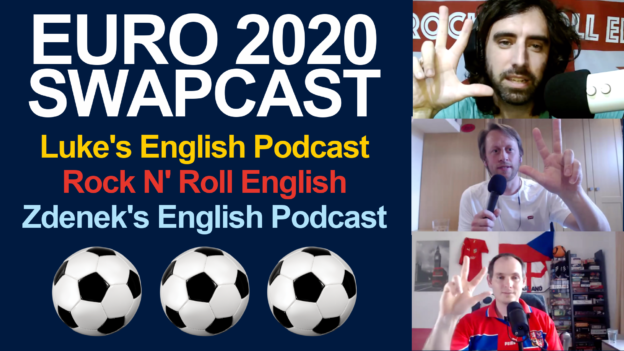
A fun chat about the UEFA Euro2020 Football Championship, with Luke Thompson (Luke’s English Podcast), Martin Johnston (Rock N’ Roll English) and Zdenek Lukas (Zdenek’s English Podcast), with a special prize giveaway in which you can win prizes from all 3 of us. Non-football fans, feel free to skip this, of course!Video version available.
Martin is an English teacher from England, now living in Italy. In his podcast, he has unfiltered conversations with friends with funny & embarrassing stories – all to help you learn English. Find out more on his website, including details of his community – The Rock N’ Roll English Family. https://rocknrollenglish.com/
Zdenek is an English teacher from the Czech Republic. He’s a private English teacher and podcaster. He loves to teach English with board games, he loves football and he has a special course for learning English with role plays. Visit his website for more information https://www.teacherzdenek.com/
Luke Thompson – Luke’s English Podcast
I think you probably know me already, right LEPsters? Check out LEP Premium to access all the audio (and video) lessons I make specifically to help you learn vocabulary, grammar and pronunciation. https://www.teacherluke.co.uk/premiuminfo
Giveaway Competition details. Prizes to be won!
The competition is now closed – winners were announced in part 2 of this conversation.
The prizes
Martin’s prize: Free access to the Rock & Roll English Family for 1 month.
Zdenek’s prize: Free entry to Zdenek’s English through Role Plays course.
In this episode I am talking to Vickie Kelty from vickiekelty.com about playing games for learning and teaching English.
Vickie is an English teacher from the USA, currently living in Spain, and she absolutely loves games. She loves playing word games, speaking games, card games, board games. She is nuts about games and she really enjoys using various games in her English lessons.
So in this episode Vickie and I are going to talk about games that you can play that can be a fun way to practise your speaking, or practise different bits of grammar or vocabulary.
You could consider using these games both for learning and teaching English, and Vickie and I are going to be playing the games during this episode, so you’ll hear how they work and you’ll be able to play along too.
The theme for this episode is celebrities, or famous people, so as well as us playing these guessing and describing games, you will hear plenty of celebrity and movie star rambling and gossip too.
Here’s a list of the games we play and mention.
Games to mention
Uno
Scattergories
Games we played
20 Questions
Password
Catchphrase
Taboo
The Lying Game (which is why this episode is so long)
If you want to find out more about Vickie, including some of the online courses she has to offer, just go to vickiekelty.com
OK, so this episode is long so I don’t want to add anything else here, except that I really hope you enjoy this episode and find it fun. I will talk to you again briefly at the end, but now let’s meet Vickie and play some fun games for learning English.
Consider using some of these games in your speaking practice or in your lessons if you are a teacher. They can be a great way to add some fun and some communicative incentives to your learning or teaching.
There’s nothing more for me to add here, except to say that I will speak to you again on the podcast soon, but for now it’s time to say, goodbye bye bye bye bye.
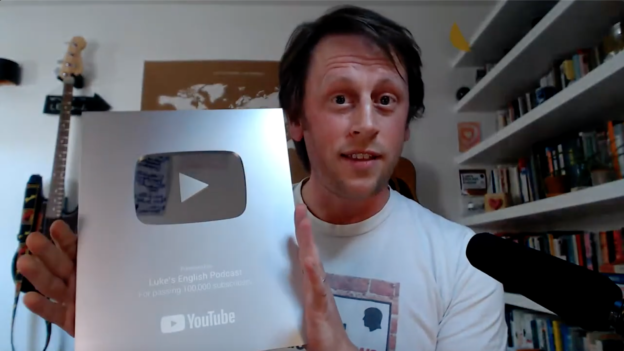
YouTube sent me an award for reaching a subscriber milestone, so I opened the box live on video, answered some questions from the audience and played a song on the guitar. Audio and video versions available here.
Hello listeners, welcome back to my podcast. I hope you’re doing well and that you’re ready to learn some more English with me in this new episode.
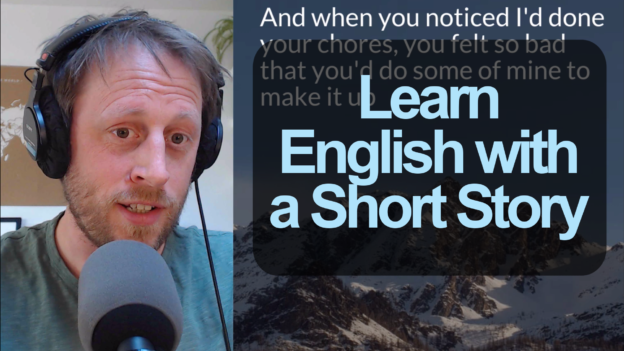
This one is called The Mountain and I’m going to read you a short story and then use it to teach you some English.
There is a video version of this available on YouTube with the text on the screen, so you can read and listen at the same time and you can see my face while I’m recording this, if that’s what you’d like to see. You can find that video on the page for this episode on my website or on my YouTube channel – Luke’s English Podcast on YouTube, don’t forget to like and subscribe of course.
Stories are great for learning English, and I’m always searching for various stories that I could read out on the podcast. I’ve found a few stories and texts, both online and in books that I have on my bookshelves, so you can expect more story episodes like this coming in the future as I read things in different styles, from different texts, including some well-known published work and some independently published stuff and fan fiction that is available online.
Stories make ideal material for language learning. They are compelling and often the text of the story is also available which makes it extra useful for language learning because it works as a transcript for what you are listening to.
Today I googled “Free short stories online” and I ended up on a website called commaful.com
This website is described as the largest library of multimedia stories online. Commaful.com
On Commaful you can read and share stories written by users of the site, fan fiction, poetry and comics, and they have a picturebook format, which means that their stories are presented in a slightly different way, which makes them a bit more pleasant to read online or on mobile devices – more pleasant than just reading text on a screen, which is never a pleasant way to read literature. So rather than just presenting their texts on screen, they put each line of the story on top of an image of some kind (like a picture of a lake or a landscape or something) and you can swipe from one image to the next, reading each line of the story as you go, which is quite nice.
When reading these stories out loud the format encourages you to pause as you read each line, which is quite a good habit. Pausing is a good presentation skill.
It can be a good discipline to practise because pausing can add some space for the audience to think and can change the atmosphere slightly, adding extra weight to each line that you say. So pausing and taking your time can be good presentation skills to practise.
First I’m just going to read the story to you. You can just follow along and try to understand what’s going on.
Then I’ll read it again and I will stop to explain some bits of English that come up, and there are various nice bits of English in here – phrasal verbs, expressions and other nice bits of vocabulary mainly.
The story is written in American English, which is mostly the same as British English really, but I will point out any differences and will give you the UK English equivalents, so this can be a chance to learn some British and American English equivalents.
I’ll do a vocabulary and language summary at the end too.
As I said, there will be some pauses between the lines of the story, because of the way the story is presented to me on the website. I don’t normally pause like this when doing this podcast, but it could be useful because it might help you absorb what I’m saying and you can use those pauses to repeat after me if you like. This will be easier if you can read the lines with me, and again you can do that by watching the youtube video, or visiting the story on commaful.com.
Or you can try repeating without seeing the lines if you want an extra challenge.
And of course you can simply enjoy listening to the story without worrying about repeating or anything like that.
The story is about 10 minutes long, just to let you know what to expect.
The rest of this episode is me explaining and describing the language in the story.
By the way, this story was posted on commaful.com by a user called Aknier and I am assuming that Aknier is the author of this, so credit goes to him or her for writing it.
Follow the link in the description to access the story and you can leave comments there if you like.
I hope you enjoy it!
But now let’s begin the story…
Ending Transcript
OK so that is where the video ends, but I’m adding a bit more here to the audio version in order to do a quick language summary of the bits of vocabulary that came up in that.
How was that for you? Did you enjoy the story? As I said, there weren’t many narrative elements. It was more an emotional story, but quite an interesting one.
Again, I do recommend that you try reading the story out loud, either by repeating after me or not.
Now let me recap some of the vocabulary items and British and American English differences that you heard there, just to sum up and help you remember what you’ve just heard. I’ll be as brief as I can while jogging your memory here.
You can find this vocabulary list on the page for this episode on my website of course.
Vocabulary List
I hardly cried (I didn’t cry a lot)
To work hard / to hardly work
To fuss / to make a fuss (Fuss = anxious or excited behaviour which serves no useful purpose. “What’s all the fuss about?” “Everyone’s talking about this Meghan & Harry interview. What’s all the fuss about?” “Why don’t you complain?” “Well, I don’t want to make a fuss”)
To make a scene = do something which attracts a lot of attention, like angrily shouting at staff in an airport terminal or hotel lobby
Siblings (brothers and sisters)
To bet that something will/would happen (to be sure it will/would happen) “I bet that England get knocked out of the World Cup on penalties” or “I bet it rains this afternoon”.
To shrug your shoulders
To grit your teeth = (literally) clench your jaw so your teeth are held tightly together (idiom) to decide to do something even though you don’t want to “I had to tell my dad that I’d crashed his car, so I just gritted my teeth and told him”)
A cast / a plaster cast
To be able to afford something “We couldn’t afford it” “We can’t afford it” (use ‘be able to’ after modal verbs when you can’t use ‘can’ – “We won’t be able to afford it”)
A cripple (offensive word)
To get picked on
To get teased
To make fun of someone
To get bullied
To get catcalled
To flash a smile
A blinding smile
To take that as a yes
To get upset
To get fired
To skip lunch
A scholarship
To be stunned
To soften your voice
To talk back
To sneak into the kitchen
To sneak money back into your wallet
Fight – fought – fought
Buy – bought – bought
To cheat on someone
To freak someone out
To make it up to someone
To raise your voice
To shout
To scream
To cave (in)
Emotional outbursts
To melt
To punch someone in the jaw
To stare blankly
Stand up for yourself
A mess
Serene
Tranquil
Deadly / the deadliest
American English / British English
Fifth grade – Fifth year
Pants – trousers
Mad – angry
To figure something out – to work something out
To yell – to shout
A jerk – an idiot
To take out the trash – to take the rubbish out
Chores – housework
To punch someone in the jaw – to punch someone in the face
This is the final episode in the WISBOLEP competition series, speaking to Bahar from Iran about the 7-step method she used to improve her English and develop a British-sounding accent. Bahar used to be a terrible student who hated English, but then she made a decision to focus on her English in her own way. Listen to her explain how she did it.
Hello listeners, this is the final episode in the WISBOLEP series – Why I Should Be On Luke’s English Podcast. As you probably know, this was a competition I launched last year in which listeners chose other listeners who they would like to be interviewed in an episode of the podcast, and so far we’ve had 5 people, all of whom have managed to improve their English to a proficient level, while living in a non-English speaking environment for the most part, without having English speaking people in their family or close friends. So these have been stories of English learning success, which I seriously hope have been inspiring and interesting for you to listen to.
This conversation is with Bahar from Iran. Bahar actually came 5th in the competition, but she happened to be the last person I interviewed.
As you will hear, Bahar’s English is excellent but that wasn’t always the case. In fact, according to her she used to be a terrible student who hated English and who couldn’t string a sentence together. But now it’s a completely different story. She is proficient in English, she has a lovely clear accent and is confident and talkative, and loves this language. So how did she do it?
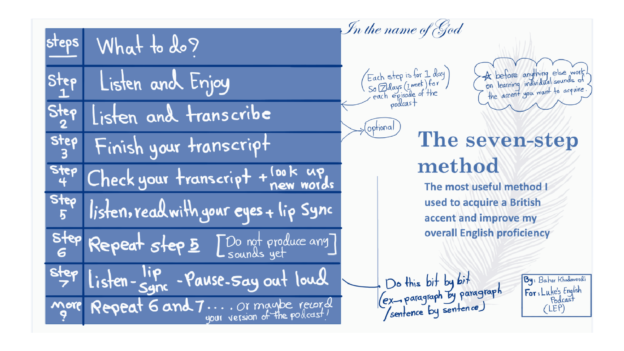
That is the main focus of this episode. Bahar tells us the story of her English journey, and she outlines her 7-step method for improving her English, especially her pronunciation.
Yes, she has come up with a 7-step method. To be clear, she defined this method in retrospect, meaning that having improved her English to a good level she then looked back at what she had done and consolidated her approach into 7 clear steps, and she’s going to go through the entire thing in this episode.
Now, you can try to follow Bahar’s method, but one of the main points here is that you can actually come up with your own method for improving your English as long as you maintain certain key principles in your learning.
There’s no need for me to add much more here really, except that you will find links to the various resources Bahar mentions during this conversation. Those are resources that she has found to be especially useful. You’ll find links to those things on the page for this episode on my website.
So now I will let you meet Bahar from Iran, currently living in Italy and here we go.
Ending Transcript
So that was Bahar from Iran. Thanks again to Bahar for her contribution. She definitely put a lot of effort into preparing herself for this conversation, coming up with some clearly defined steps and thinking about how she could go into some specific details about the things that worked for her. So, thanks Bahar for doing that.
You will see the hand drawn infographic that Bahar created to show her 7 steps – you’ll see it on the page for this episode on my website, and as the image for this episode on YouTube.
Perhaps the main point is that you can create your own method for learning English. Just go with whatever works for you. There isn’t one single best approach. You just have to make sure you are working with English on a regular basis, that you do things which bring you some joy (there’s no point slogging away with something that you just don’t like doing), you should attempt to maintain a positive and beneficial cycle in your approach to English, try to find your own personal motivation for learning the language, say to yourself “I’m going to do this and I’m going to do it my way” and then just put the time in.
Also, don’t underestimate the importance of just spending plenty of time listening and don’t apply too much pressure to yourself. Let it happen naturally and in its own time. I hope my podcast helps to make this easier.
Again, check the page for this episode on my website where you’ll find links to things that Bahar mentioned, including the BBC Sounds of English pronunciation course, British Council Elementary Podcasts and so on.
That’s for this episode. Thank you for listening. Leave your comments and feedback in the comment section and have a fantastic day, night, morning, afternoon or evening and I will speak to you soon.
But now it’s time to say, good bye bye bye bye bye.
The second in a short series about The Beatles, this one focuses on the life of John Lennon, with an overview of his life story, some thoughts about his psychology and some rambling discussion questions about this iconic British musician, with podcaster, English teacher and musician Antony Rotunno.
Hello listeners, I hope you’re doing well today and that you are ready for this new episode of my podcast. You join me here in my pod-room as the rain falls down above my head. Conditions are perfect for learning British English. Let’s get started.
This is a continuation of this short series of episodes I’m doing about The Beatles and this one focuses mostly on John Lennon. If you’ve ever wanted to know more about this iconic British musician then this episode is for you. Also, if you’re already a Beatles fan or a John Lennon fan then I’m sure you’ll be glad to hear this conversation too.
My guest for this episode is Antony Rotunno from England and Antony is very knowledgeable about John Lennon and his life. In fact I feel like I couldn’t have found a better person to talk to about this subject.
One of the reasons for that is that Antony is also an English teacher. He’s been teaching English as a foreign language to adults for over 18 years, and for obvious reasons it’s always useful to have a guest who has experience of working with learners of English.
Antony is also a podcaster so he is used to talking to audiences over the internet from his home in England. Antony’s podcast is all about John Lennon.
And he probably knows all there is to know about John Lennon because he’s read everything out there on the subject and for his podcast he has interviewed lots of people connected to Lennon, including authors and people who actually knew John himself – people with first-hand accounts of meeting him.
So Antony really knows a lot about John Lennon.
And we had a really good, really long conversation for this podcast, covering various things like John Lennon’s life story. This is the first part of that conversation.
Let me just explain my reasons for doing this series of episodes about the Beatles. I probably don’t need to explain this, but allow me to give my reasons.
So, this is a 5 part series actually. I published the first part with my mum in episode 717, which was a review of a book about The Beatles, followed by a general Beatles ramble.
The rest of the series will be this conversation I had with Antony divided into 4 parts. But it’s not just going to be us rambling on about Lennon for all that time. I’ve also decided to employ some of Antony’s English teaching skills in order to cover some language too, specifically in parts 3, 4 and 5 of this series as we focus on descriptive adjectives for describing personality traits, and then some analysis of the lyrics from Beatles songs, with various nice phrases and idioms to learn. So there should be plenty of English learning opportunities to take from this whole series.
John Lennon is a hugely significant person in terms of modern history, and of course being English he is very much part of our culture, and as we move forwards in time it seems that the significance of the Beatles and everyone’s interest in them is not waning. If anything, they continue to grow in stature.
And even if you’re not into the Beatles, hopefully this can be a chance to learn some new things about this band that is held in such high esteem by so many people.
I promise you – I’m willing to say I promise you here, that if you listen to this, you will know more about John Lennon than before you listened to it.
And if you’re wondering when we’re going to get to the music, part 5 will be all about Beatles lyrics and there will be some guitar playing as well.
First we will get to know Antony a bit and ask him about his podcasts, and then you’ll hear him talk about how he got into The Beatles and John Lennon in particular, then Antony is going to give a brief overview of John’s life and career and finally I’m going to ask Antony a few John Lennon discussion questions.
Let’s get started.
Ending Transcript
So that was episode 2 in this 5 part Beatles mini series, all about John Lennon.
Thanks again to Antony for his expertise.
The other John Lennon episodes will follow over the next few weeks.
Do you feel that you know more about John Lennon than you did before you listened to this?
I hope so.
I wonder what new things you learned from this. Feel free to leave your comments below.
I won’t say much more here, except that it’s been really interesting to talk to Antony and I look forward to the next few episodes in which we go into teacher mode and look at some descriptive adjectives and then song lyrics.
But that’s it for this episode. Thanks for listening. Be excellent to each other and I will speak to you soon.
This is the second part of my recent conversation with Fred Eyangoh about learning new vocabulary. This one includes a word quiz with homophones and commonly confused words from the Collins Dictionary website.
Hello listeners, how are you doing today? I trust that all is well in podcastland.
This is the second part of a double episode about learning vocabulary with one of my friends Fred Eyangoh.
In the last episode you heard about how Fred has been using a spelling game to discover new words, and this led to a discussion about what to do when you come across new bits of vocabulary, including how using online dictionaries can be a really good way to expand your knowledge of words, and also about how just staying curious about new words is very beneficial, and how learning one word leads you to another word and before you know it your vocabulary has expanded exponentially. It certainly works for Fred, whose vocabulary is really strong.
And at the end of the last episode, Fred and I were on the Collins Dictionary website and we were about to do one of the word quizzes that you can find there. The one we chose was about easily confused words. Words that sound the same but are in fact different.
So that’s what happening in this episode. Listen to Fred and me doing a quiz about some homophones – words which have different spelling, different meanings and yet the same pronunciation. So there’s vocabulary, pronunciation and spelling to learn here as we go through various words, but also there are the usual tangents, little jokes and things like that. I hope you learn some things from it and that you have fun while listening.
I will recap the various bits of vocabulary you’ll hear on the other side of this conversation, and it’s a list of at least 30 vocabulary items. I’ll go through that list at the end of the episode to make sure you’ve got it. You’ll see the word list on the page for this episode on my website.
But now, I will let you rejoin my chat with Fred about learning vocabulary, using online dictionaries and a word quiz about homophones.
OK so that was Fred and me doing a word quiz about easily confused words on the Collins Dictionary website.
I certainly hope you found that useful, and perhaps you could consider checking out those word quizzes as well on the Collins Dictionary website – again, they don’t sponsor this podcast, but maybe they should. I’ve even got the perfect line for the advert, “Are you confused about which word to use? Just think, ‘What would Colin say?’ and go to collinsdictionary.com”
It’s not actually Colin’s dictionary by the way, a dictionary owned by a man named Colin. “Hello, I’m Colin. This is my dictionary. It’s got lots of words in it.” No, I think that Collins is a surname (double L), like Phil Collins. In fact, the name comes from William Collins, an industrialist from Glasgow who set up a printing press in the 1820s, and in the early 1840s he started printing illustrated dictionaries, and the rest, as they say, is history. The publishing company is now known as HarperCollins, and in fact they are based in Hammersmith in the W6 postcode of London, which is where I was living when I first started my podcast. That’s why there’s a W6 on my logo by the way. It’s because that’s my London postcode.
So, wow! That’s interesting isn’t it!? In any case, you can find more of those word quizzes and things at www.collinsdictionary.com
Vocabulary Re-cap
Right, so just like the previous episode about the New York Times spelling bee, there are a few words that I feel I should re-cap at the end here.
Let me just quickly go through some of those words again, just to make sure you got them.
Words
A miner
To mine
A coal miner
A minor (person)
Minor key
Major key
Bleak
Evocative – “The minor key is so much more evocative”
Seller / Buyer
Cellar (a room below the house for storage)
Basement (an underground floor which could be furnished – more common in US English)
Attic
Loft
Steaks
Stakes
The stakes are high
That terrible joke:
A man walks into a butcher’s shop and inquires of the butcher: “Are you a gambling man?” The butcher says yes, so the man says: “I bet you £50 that you can’t reach up and touch that meat hanging on the hooks up there.” The butcher says “I’m not betting on that”, “But I thought you were a gambling man” the man retorts. “Yes I am” says the butcher “but the steaks are too high!”.
Bridal
Bridle
Baby shower
Hen do
Hen party
Bachelorette party
Bridal shower
Mussels
Muscles
Molluscs
Shellfish (molluscs and crustaceans that we eat)
Seafood (food that includes fish, octopus, squid, crab, lobster, shellfish etc)
Moolah (a slang word meaning cash)
Herbs
Thyme / Time
You also heard us talking briefly about Wandavision at the end there. Wandavision is a new-ish TV series by Marvel Studios. We also mentioned The Madalorian, which is a Star Wars TV series. I really must talk about all this new pop culture at some point on the podcast. There’s new Star Wars TV stuff, Marvel TV stuff (like Falcon & The Winter Soldier which I’ve also been watching) and even Zack Snyder’s Justice League, but it’s all going to have to wait I’m afraid. There are so many things to talk about and do on this podcast but there are only so many hours in the day. Also, I have quite a big backlog of episodes in the pipeline at the moment, so I’ll have to publish all of those before I can think about new stuff.
New episodes arriving soon…
Cookies on teacherluke.co.uk
Click “Accept All”, to consent to the use of all cookies on this website, or visit "Cookie Settings" to control your consent settings.
This website uses cookies to improve your experience while you navigate through the website. Out of these, the cookies that are categorized as necessary are stored on your browser as they are essential for the working of basic functionalities of the website. We also use third-party cookies that help us analyze and understand how you use this website. These cookies will be stored in your browser only with your consent. You also have the option to opt-out of these cookies. But opting out of some of these cookies may affect your browsing experience.
Necessary cookies are absolutely essential for the website to function properly. These cookies ensure basic functionalities and security features of the website, anonymously.
Cookie
Duration
Description
cookielawinfo-checkbox-analytics
11 months
This cookie is set by GDPR Cookie Consent plugin. The cookie is used to store the user consent for the cookies in the category "Analytics".
cookielawinfo-checkbox-functional
11 months
The cookie is set by GDPR cookie consent to record the user consent for the cookies in the category "Functional".
cookielawinfo-checkbox-necessary
11 months
This cookie is set by GDPR Cookie Consent plugin. The cookies is used to store the user consent for the cookies in the category "Necessary".
cookielawinfo-checkbox-others
11 months
This cookie is set by GDPR Cookie Consent plugin. The cookie is used to store the user consent for the cookies in the category "Other.
cookielawinfo-checkbox-performance
11 months
This cookie is set by GDPR Cookie Consent plugin. The cookie is used to store the user consent for the cookies in the category "Performance".
viewed_cookie_policy
11 months
The cookie is set by the GDPR Cookie Consent plugin and is used to store whether or not user has consented to the use of cookies. It does not store any personal data.
Functional cookies help to perform certain functionalities like sharing the content of the website on social media platforms, collect feedbacks, and other third-party features.
Performance cookies are used to understand and analyze the key performance indexes of the website which helps in delivering a better user experience for the visitors.
Analytical cookies are used to understand how visitors interact with the website. These cookies help provide information on metrics the number of visitors, bounce rate, traffic source, etc.
Advertisement cookies are used to provide visitors with relevant ads and marketing campaigns. These cookies track visitors across websites and collect information to provide customized ads.