Category Archives: Cross Cultural Understanding

711. William from France 🇫🇷 (WISBOLEP Runner-UP)

William started learning English at 12 years old and continued at university and beyond, spending a couple of years in England as a teaching assistant and then returning to France to work as a school teacher, in some pretty tough classrooms and less-than-perfect teaching conditions. William talks about how he continues to maintain his English, the importance of finding good language exchange partners, and more.

Small Donate Button

[DOWNLOAD]

Notes for the Introduction and Ending Monologues (not a 100% complete transcript)

Hello listeners, I hope you’re doing well. In this episode you’re going to listen to a conversation with another LEPster picked by other LEPsters for an appearance on this podcast. This time it’s the turn of William from France who came joint 3rd in the competition – it was a tie between William and Robin from Hamburg, and Robin will be on the podcast soon as well.

Right so this episode is the latest in the WISBOLEP series and WISBOLEP means Why I Should Be On Luke’s English Podcast and it was a competition I launched last year in which listeners sent in short recordings to persuade members of the audience to vote for them to be chosen for an interview on my podcast. So far I have spoken to the winner – Walaa from Syria and the 2nd place contender Tasha from China. Let’s now return to Europe and talk to William who lives in France. Shout out to all the French LEPsters. Salut les francais, et les francophone, ca va? 

I think these WISBOLEP interviews are really interesting and there is a lot to gain from listening to them.

Sure, there will be some people who will decide that they just can’t listen to another learner of English and only native speakers of English are worth listening to. I can understand that to an extent, but I do think that completely dismissing non-native speakers of English like that is a mistake. 

Learning English is a complex and personal process and I think there is a great deal to be gained from listening to other learners describe their experiences and methods of learning English. This can give you inspiration in terms of specific things you can do to improve your learning, and generally it can give you a lot of perspective about what it really means to be a learner of English or a speaker of English as a second language, what proficiency really is, what fluency really means, how important perfection is compared to having the initiative to just go out there and start using English. Also it can give you a sense of camaraderie with other fellow learners, and it’s very healthy to know that you are part of a community of similar language learners around the world, all of whom are trying to work on their English level in various ways. Some people are better than others, but everyone is going through a similar process.

We are all learners of English in a way, including me, and it’s wrong to think that learning English has a specific end point or conclusion to it. It’s a never ending process and there are always things to learn and ways to improve in terms of how we use this tool to communicate with people more effectively.

Perfection is not necessarily the thing to expect from yourself or others. It’s a high ideal to strive towards but if you only accept perfect English, then prepare to be disappointed, both by yourself and by others. Setting perfection as your ultimate goal is quite unrealistic and doesn’t really reflect the nature of English as a pragmatic language. When you’re using English in the real world, it’s not necessarily about having flawless English but about the results that you achieve with your English. It’s “connection not perfection” as the girls from AEE always say. 

This doesn’t mean that you shouldn’t be ambitious or that you shouldn’t try to do your very best in English. It’s important to try to be better at English of course. But little mistakes are inevitable, holes in your knowledge of English are inevitable and you should not let these things stop you on your journey with this language. We have to try to accept that we will make mistakes and we have to learn from them. You have to be philosophical about it. 

Another idea that strikes me as I listen to these WISBOLEP episodes is that curiosity and a willingness to take a few risks are really important. It seems to help your progress in English if you are willing to go out of your comfort zone a bit and throw yourself into situations that will ultimately help your English to develop. Be curious all the time and keep moving forwards in your quest to know more, learn more and get more control over the language, even if you never really get to the end – in fact there isn’t really an end point. Be patient and don’t let little obstacles get in your way.

I could bang on about this kind of stuff all day, but I will conclude by saying that it’s up to you to find your own motivation to keep going with English. There is no “one perfect way”. Everyone has to find their own path, and I think it’s a long-term thing. At the very least, certainly for the next hour or so I hope you simply enjoy listening to William and me talking about his experiences, with an open mind and a sense of curiosity, and don’t underestimate the value of listening to fellow learners of English. 

I would say, try not to compare yourself to others too much, and equally, don’t judge others too harshly. Just try to take inspiration from other people’s stories and examples.

This brings us to William from France, and in fact this conversation demonstrates a lot of those ideas that I just mentioned. 

Just a little bit of background info on William before we start, just to give you a sense of the context from which he learned English.

William is from a town just outside Paris, called Combs de Ville. His parents are from the French West Indies and more specifically from an island called Guadeloupe, which is a French overseas department and region of France in the Caribbean. So his parents were from there originally and they moved to France in their twenties. William was born in France. He grew up learning French as his first language, but his parents did still speak Creole (the local language from Guadeloupe – but no English. In his own words “Creole and French were the main languages used at home but my parents didn’t want me to use Creole. We were in France so French was the only language I was allowed to use. So it was a bit strange to be able to understand a language without being able to use it.” 

As you’ll hear, English didn’t come into William’s life until he started learning it at school like everyone else in France at the time, at about the age of 12. But he took to it and liked it. I wonder if having several languages in the household growing up had anything to do with that. It’s possible. But in any case, William didn’t get a head start on his peers in terms of English.

I’m not going to explain in advance all the main points in our conversation. Instead, I will let you discover it as you go. What I will say is that I really enjoyed this chat, and you will find that it gets more focused, more specific and more insightful as it goes on. 

That’s it from me now. I will speak to you again on the other side of this conversation with a few reflections and thoughts, but now, let’s hear from William from France, who came joint 3rd in the WISBOLEP competition.

Oh one other thing, before I forget. William wanted me to add something at the start of this episode – and that is to say a big thank you to all the people who voted for him in the competition, giving him the chance to be featured in an episode of the podcast. So, thanks from William.

——-

Ending

So that was William from France. I really enjoyed talking to him. He’s a lovely guy and here are some of the things I took away from this. Here are some thoughts and reflections.

  • English is a journey not a destination.
  • There’s no end point in terms of learning English. It’s like being a musician or a sports player. There’s always training to be done and room to improve in terms of technique, general fitness and fluency and so on. You have to practise all the time and there are always ways in which you can gain more control and more efficiency in how you use English to express ideas. This is true for native speakers of the language as well, including me. I see myself as a work in progress too, in terms of how effective I am as a speaker or writer of English.
  • Finding language partners for language exchanges can be a great way to get regular practice into your life, but you have to find the right person, and this can take a long time, but don’t let that stop you – keep searching, keep talking to different people until you find someone who is right for you. This could be true of one to one teachers as well. Sometimes you need to shop around a bit. Remember, like William you can find language exchange partners, conversation partners and English teachers on italki. Italki is both a sort of marketplace for online teachers, but also a social network which you can use to find other language learners, and that could include fluent English speakers who want to learn your language, and like William you could just informally set up conversations with these people and spend some time speaking English and some time speaking in your language, and if you get the right person that can be an invaluable source of practice for you. To sign up for italki you can still use my link, which is www.teacherluke.co.uk/talk and if you access italki that way and then buy some lessons with a teacher, italki will send you a discount voucher worth 10 dollars which you can use next time.
  • BUt the point there is → be patient, be dedicated, keep searching, don’t give up and you could find someone who you can practise your English with on a regular basis in a mutually beneficial way. It could be a way to make new friends as well.
  • Finally – stay curious, about English – especially in terms of learning about how the language works in order to work on your grammar in a sort of organic way – just trying to work out how the language works, referring to grammar books (a tip could be Practical English Usage by Michael Swan – a good reference book for English grammar and usage) and also stay curious about other people, because this is really important in developing good communication skills. It’s not just about how well you can speak and express yourself, it’s about how well you interact with other people and listening to others is a big part of that. So, be curious about the language, but just be curious about people you meet and be interested in other people when you talk to them and you’ll find that your communication skills will thrive as a result of that. I feel that that’s something William does – he is interested in other people and that’s a strength of his. It’s one reason why he communicates well. 

OK, just some thoughts that occurred to me at the end of this episode here.

Feel free to share your thoughts too in the comment section.

I would also like to say that talking to William gave me a little boost. He said some nice and sincere things about this podcast, about how it has helped him and how I might be helping other people and I appreciated it. So good luck to you William and all the listeners who are still listening all the way up to this point in the episode. 

That’s it from me,

I will speak to you in the next episode. Again – a reminder that I am also working on Premium series 29 – What did Rick Say? And so premium subscribers – look out for new episodes in that series arriving very soon. teacherluke.co.uk/premiuminfo for more details and to sign up.

Have a lovely day, morning, evening, night! Stay safe! Stay positive! Stay curious!

Speak to you soon.

Bye bye bye bye bye.

Song: Don’t Let Me Down by The Beatles

Lyrics here https://www.azlyrics.com/lyrics/beatles/dontletmedown.html

Podcast Image: Cork Map by “Miss Woods” in Barcelona https://misswood.eu/fr/collections/mapas-de-corcho

P.S. I think I found my meme 👇

708. Tasha Liu from China (WISBOLEP Runner-Up) 🇨🇳

This conversation with competition runner-up Tasha Liu is a way to get to know Chinese culture in a more personal way including the story of how Tasha’s father gave up drinking alcohol, and other interesting details about real life in the world’s most populated country.

Small Donate Button[DOWNLOAD]

Introduction Transcript (after the jingle)

Hello everybody,

How are you doing? Thanks for choosing to listen to my podcast today. I hope you enjoy it.

In this episode you’re going to hear me in conversation with Tasha Liu from China, the listener of this podcast who came 2nd in the WISBOLEP competition.

Let me explain quickly what the WISBOLEP competition is, for that one person who doesn’t know.

If that’s you, and you don’t know what WISBOLEP is → Hello! I’m now going to explain it to you in one single sentence. You’re welcome.

Here it is. The competition, summarised in one single sentence.

WISBOLEP stands for Why I Should Be On Luke’s English Podcast and is a competition I ran at the end of last year in which the prize was to be interviewed by me in an episode, the winner of the competition being the one who received the most votes from listeners after I played all of the 2-minute recordings sent in by the competitors in episode 692 of this podcast.

There you go.

Walaa Mouma from Syria was the overall winner. You may have heard her episode. It was published last month. If you haven’t heard it, I highly recommend that you do so! It’s episode 703 and Walaa explained in some detail how she improved her English to a good level, despite the hardships that she faced in her life. It was an inspiring episode, to say the least. We focused on Walaa’s approach to learning English – both her attitude and specific things she has done and continues to do to improve her skills. So the focus was definitely on learning English.

The conversation in this episode though, focuses mostly on cross cultural understanding.

Walaa is quite a hard act to follow, but we’re not comparing here. It’s not a competition you know! Wait, it is a competition, isn’t it? It totally is competition, isn’t it. It was a competition anyway. But for me, the competition part is done, and now it’s just a case of listening to LEPsters who were chosen by the people who voted in this competition.

And the spirit of this competition was always about this: Finding some interesting guests to talk to on the podcast and letting some LEPsters speak a bit and share their experiences. Let’s see what insights we can learn from other learners of English around the world. And let’s celebrate the citizens of LEPland! Everyone has a story to tell. We can all learn things from each other. All we have to do is just listen.

So, now that I have said that, here’s a brief overview of the content of this chat.

  • There’s a bit of “getting to know you”, as this is the first time I’ve ever spoken to Tasha, so we talk a bit about her studies, where she lives and so on.
  • Then we move onto the things she hinted at during her competition recording – and overall these things are ways to get to know China and Chinese culture a little bit more, in a personal way. So this is a cross-cultural exchange here and a chance to get beyond the stereotypes and cliches and find out some real things about life in the most populated country in the world.
  • There’s the story of how her father managed to stop drinking, which might tell us some things about family life in China.
  • Then we talk about some of the commonly-held beliefs about China (particularly beliefs held in the west) such as the way Chinese people eat (do they, as the saying goes, “eat anything with 4 legs except the table, and everything that flies except planes”? (and helicopters I suppose), or are they more discerning in their eating habits than that? Another assumption that people might have is that China is quite undeveloped in certain ways compared to the west, or how it could be ahead of the west in various ways too, like the way technology is used – payment systems for example, and the idea of the cashless society.

And there’s more detail about what it’s really like living in China today.

Just a heads up: There were some technical difficulties during the recording, due to a slightly poor internet connection between the two of us. This meant that sometimes we couldn’t hear each other properly or the connection just failed. I think I’ve saved it in the edit, but there may be a few moments where the bad connection affects our conversation. It shouldn’t be too bad, but I thought I’d mention it anyway.

OK, now I’ve done my introduction, let’s get started properly, and here we go!


Ending Transcript

So that was Tasha Liu from China. It was really interesting to talk to her and I got that amazing feeling that you get when you actually talk to someone who lives in a completely different part of the world and in a different culture but you just connect as human beings.

That’s always special – talking to people from other places and getting a glimpse of how they live their lives and the fact that although we’re different in many ways, we’re also really similar in the fact that we’re still having human experiences ultimately.

It’s easy to forget but I feel like as humans we have many more things in common than differences. We’re all humans living on earth (as far as I know – you might be an alien on another planet as far as I know) but we’re all having a human experience ultimately, and so there are many more things that unite us than divide us, aren’t there?

I’m sounding a bit pretentious there, possibly, but hopefully you know what I mean.

Here are some reflections – just things that I thought about after having that conversation.

These are reflections about cross cultural understanding.

When we think about other cultures or experience them, there is a tendency to not fully understand those other cultures, and as a result we jump to conclusions about them, probably based on the fact that we’ve never had proper experiences of those cultures, never met or talked to those people properly and never observed things from their point of view. This is normal I suppose because we can’t always be everywhere and see everything.

We end up with limited views of other cultures, which might also be informed by other people’s attitudes, like “these people are just unsophisticated” or “it’s such a backward society” and this could be in any direction. It could be, in a broad sense – the west looking at the east, or the east looking at the west, and not just east and west, any culture thinking about another culture – we often don’t see the whole picture. We are all humans, but there are all sorts of complicated reasons why we behave or live slightly differently.

We are all the same, but our contexts are different.

That’s it really. I could ramble on more, but I think I’ve said enough.

I wonder what your thoughts are, now that you’ve listened to this conversation.
What reflections do you have?

I found it really interesting to talk to Tasha, and I just want to thank her again for telling us her stories, and for being willing to share her comments about her country. Also, congratulations to her! 2nd place is certainly nothing to be sniffed at.

Right then. More competition runners up will appear on the podcast in due course.

Next up in the WISBOLEP series will be William from France. That will probably arrive in a couple of episodes’ time. I had a really nice conversation with him, which I think was just as insightful as the other WISBOLEP conversations we’ve had so far. If you’ve enjoyed this conversation with Tasha and the one with Walaa, then I think you’ll like hearing William’s story as well.

That’s coming up on the podcast soon.

I’m working on new content all the time, including new Premium episodes which will arrive in the LEP app before too long.

LEP Premium https://www.teacherluke.co.uk/premiuminfo

LEP App https://teacherluke.co.uk/how-to-download/get-the-lep-app/

690. Urban vs Rural / Living Abroad / Cultural Differences (with Cara Leopold)

A conversation with Cara Leopold about the differences between life in Paris and life in provincial France, plus how it feels to live abroad away from your home country.

[DOWNLOAD]

Sign up to LEP Premium to watch my stand-up comedy performance in London https://www.teacherluke.co.uk/premiuminfo

Ending Transcript (The last part of the episode)

That was Cara Leopold from leo-listening.com. Thanks again to Cara.

I’m curious to read your comments and responses to this conversation in light of the things I said in the introduction.

I would like to say again – if you have ANY questions about behaviour, customs or culture in the UK which you don’t understand or find frustrating – please write them in the comment section. I would be glad to try and answer your questions both in the comment section and potentially in a whole podcast episode.

Actually, I have done episodes about culture shock in the UK before, because I think, to be honest, I’ve probably heard all the comments, complaints, grumbles, gripes, questions and criticisms before – and so I have dealt with a lot of that stuff in previous episodes, but nevertheless I am very curious to see if I have any listeners who have experienced British culture shock. Ask me your questions and I will try my best to explain my country and my culture. This is my job, to an extent! So go ahead.

By the way, the specific episodes I did in the past about culture shock in England are episodes 192 and 193 – entitled “Culture Shock London” (focusing mainly on life in the capital city actually) and to give you an idea of the things I talked about in those episodes, here’s a little list. This is a list of some of the most common questions and complaints I have heard from foreign visitors in my country.

Questions / Complaints I have heard about London/The UK

  • Why do you have two separate taps in the bathroom rather than one single mixer tap? (This question has haunted me for many years actually)
  • Why don’t you have electrical sockets in the bathroom? I want to dry my hair with my hair dryer or use my hair straighteners but there’s no plug in the bathroom. How do British people manage this? How do you live like this??
  • Why is your food so plain and unhealthy?
  • Why is your weather quite miserable?
  • Why do you drive on the left? It’s like you do everything differently here.
  • Your trains are often late, delayed, overcrowded and too expensive. Why is this?
  • Why are there so many foreigners in London? I haven’t met a “real English person” yet.
  • Why are the houses and flats in London so old and draughty, with windows that don’t keep out the cold and yet the rent is so expensive?
  • Why don’t people talk to each other on the Underground, it’s like everyone’s ashamed or something, and it’s really hard to make friends with people. English people are so reserved. It’s like they’re impossible to make friends with.
  • Why don’t people carry umbrellas all the time, even when it’s raining?
  • The internet is too slow here.
  • You just don’t make any effort to speak other languages here. It’s just ENGLISH, and that’s it. Also, people don’t make any effort to help me when I’m trying my best to talk to them in their language. 
  • Why oh why do the pubs close at 11PM!?? I’m just getting ready to go out at 11!
  • Why do you eat dinner so early?
  • Why do English people go to the pub after work and just drink and drink and drink, standing up, without eating. It’s not very civilised.
  • Cigarettes are ridiculously expensive.
  • When English people do the washing up (the dishes), they use too much soap and then don’t rinse the soap off when they’ve finished. That’s like leaving chemicals all over your plates.
  • Why do you have carpet everywhere – even in the toilet sometimes, that seems unhygienic.
  • Why don’t you take your shoes off when you enter a house? That’s like bringing the dirt from the street into your home!
  • The British have a weird sense of humour. “What is this? British humour?” 

If those are some of the complaints or questions in your head, then you might want to listen to episodes 192 and 193 to hear my full responses.

But also, feel free to write new questions or indeed any responses you have in the comment section.

That’s pretty much it for this episode.

Cara’s chat with a Spanish friend attempting to adapt to life in the USA

Some reminders

New LEP Premium content is coming soon – I keep saying this, but I just want to reassure you. If you want to unlock all the premium episodes and also help me pay the rent, go to www.teacherluke.co.uk/premiuminfo

Download my app to get the entire episode archive on your phone, including loads of bonus content and access to LEP Premium episodes – search for Luke’s English Podcast App in the app store – you can do it right now! It’s completely free!

If you are listening to this on YouTube don’t forget to like and subscribe and leave a comment, it helps the algorithm to promote my episodes. Also, if I reach 100,000 subscribers YouTube will send me a nice glass thing which would be lovely, wouldn’t it. I am currently on about 76,000 so do subscribe to the channel to help that happen.

Follow me on Twitter @EnglishPodcast, and like the page on Facebook

Tell your friends about Luke’s English Podcast and also 

be excellent to each other, stay safe, stay healthy, stay positive and keep working on your English.

I will speak to you again on the podcast soon, but for now it’s time to say goodbye!

684. Chasing the Tangent Train with Elspeth Graty

A conversation with English-teaching stand-up comedian Elspeth Graty, which covers lots of different topics including Elspeth’s background in England, teaching English, cultural differences, “French-bashing”, old-fashioned telephones and The Tellytubbies. Enjoy!

Small Donate Button

[DOWNLOAD]

LEP Premium Promo

This podcast is made possible thanks to donations from lovely listeners (click a yellow PayPal button on the website if you’re feeling generous) and also the premium subscription, which costs, per month, slightly less than a pack of 80 Yorkshire Gold Teabags from Sainsbury’s. So if you would like to make sure I never run out of tea, then consider signing up.

There are now well over 100 audio and video episodes in the premium archive and you can access them all, plus new ones that are coming. That’s what you get when you become a premium lepster. To get all the information, including how it works and exactly how wonderfully reasonable the prices are – go to www.teacherluke.co.uk/premiuminfo

Introduction Transcript

Hello listeners,

How are you today? Doing alright all things considered? I do hope you’re managing to keep calm and carry on during this weird and difficult period of history that we are all experiencing.

Shall we start the episode? OK.

Here’s the second in a series of interviews I’ve been doing lately featuring people I’ve been meaning to talk to on the podcast for quite a while (quite a while — is that a short time or a long time? Quick answer: It means a long time.)

I just wanted to record natural conversations with some new guests so you can hear their voices, their stories, their thoughts so you can notice bits of language and practise your English listening as usual.

The first of these recent interviews was with Marie Connolly from Australia, which was the last episode of course. I hope you all enjoyed it.

This conversation is with a friend of mine called Elspeth who is from England.

Elspeth is an English teacher and she also does stand-up comedy in the evenings, which is how we met each other. Yep, she’s another English-teaching comedian friend of mine.

Explaining this episode’s title

The title of this episode is “Chasing the Tangent Train with Elspeth”.

The title is just a metaphor – please don’t expect a conversation about train travel!

It’s just a metaphor to explain the fact that this conversation is full of tangents and I hope you can keep up with it. In fact, it’s mainly tangents.

What is “a tangent”?
Long term listeners should know this, but plenty of people won’t know so let me explain.

In a conversation, a tangent is when the topic changes to something quite different and seemingly not related to the main point of that conversation.

It’s when you digress from the main point, go away from the main point or get sidetracked.

“To go off on a tangent”

There are lots of tangents in this conversation. So, for the title of the episode, I was trying to think of a way to describe the experience that you will have of just following the changes in direction in a conversation and seeing where it goes.

I ended up with “chasing the train”, which is not actually an expression you will find in the dictionary – I made it up.

Let’s imagine, then, that this conversation is a train and it’s going down the tracks and every now and then it switches to new tracks and continues for a while, then it switches to another new track and then does it again, and again and so on. Can you keep up with the train? I think you get the idea.

My overall aim for this interview was mainly to get to know Elspeth in more depth and to capture an authentic conversation to help you learn English. That is the destination for this train journey. But as I said, the topics move around a bit, which is totally normal in a conversation. Just ask David Crystal, he wrote a book all about it and he’s a professor and definitely knows what he’s talking about.

What I’m getting at is that this might be hard for you to follow – depending on your level of English.

So you’ll have to focus.

Nevertheless, I can help you keep up with this if I let you know what the main changes will be in advance.

So I’m now going to give you a quick overview of the main changes in topic in this chat.

The main points in this conversation are, thus: (these aren’t spoilers)

We talk about

  • Where Elspeth comes from originally, and how her family moved around parts of England
  • Being the daughter of a vicar (that’s her, not me obviously) A vicar is a priest in the Anglican church – the church of England. The cliche of the typical English vicar is that they wear black with a little white collar, they’re often softly-spoken grey haired men with glasses who ride bicycles around their parish and love drinking tea, eating cake and generally worshipping god.
  • Our accents, which are not strongly affected by the region where we grew up (we actually come from the same general area in England)
  • Having harvest festivals at church when we were children
  • Then there’s a big, random tangent → Remembering the old dial telephones we had in our houses when we were children. Remember them? You had to put your finger in and turn numbers around a dial, and it went went kkkkkkkkk. You don’t remember? That must be because you’re young, or you’re old and you’ve lost your memory.
  • Services you could get on the old analogue telephones, like the operator (a person who you could speak to and who would deal with your telephone-related enquiries) and the talking clock (a recorded voice that was constantly telling the time and you could call a number and listen to it)
  • Coventry Cathedral in Coventry, which was almost destroyed during World War 2 but was rebuilt and is now definitely worth a visit if you’re in the city
  • Elspeth’s life in France, her French, and whether or not she feels French or English after living here for quite a long time
  • Some of the cultural differences between England and France that frustrate us a bit, like the usual things – being punctual, walking down the street and in particular, queueing – standing in line to wait for things in public
  • Teaching English to young engineers, and the challenges that French students have when learning English
  • Some of Elspeth’s experiences of learning French
  • How Elspeth can behave slightly differently in English and in French, especially when doing stand-up comedy in the two languages
  • Elspeth’s thoughts on her own clothing choices and fashion sense, and how people react to it, especially the Nike Air Max trainers that she wears
  • Teaching English online using Zoom – and what that is like
  • Doing stand-up (going on stage and telling people jokes and stories to make them laugh) and Elspeth’s favourite and least favourite things about doing that
    Where her inspiration for comedy material comes from and “flow activities” or being in a “flow state
  • If there is a connection between stand-up and English teaching
  • A little story about The Tellytubbies that Elspeth uses in her English lessons, which makes the students laugh (The Tellytubbies is a children’s TV show) The story involves The Tellytubbies, William Shakespeare, the county of Warwickshire in England and April Fool’s Day. Basically, the county council of Warwickshire played an April fool’s trick on the people of Warwickshire, and it involved The Tellytubbies and Shakespeare, and people didn’t like it.
  • Why English people get into rages – like road rage, or trolly rage in the supermarket
  • The concept of French-bashing (criticising or making fun of the French and French culture) and why Parisians seem to complain about each other’s behaviour quite a lot (Parisians are people living in Paris)
  • How people’s behaviour in public in Paris compares to behaviour in the UK and in Tokyo
  • Things we love about France – because there’s a lot to love about this country too
  • Finally, a bit at the end where we both conclude that Paul Taylor is basically a cake – a delicious British cake.

Actually, reading out that list – it doesn’t seem like there are that many tangents, but there are tangents ok? What I’ve just given you there is the main flow of the conversation.

Right. Now that you have an overview of the track layout, let’s get this train rolling.

Let’s just get started. Here is my conversation with Elspeth, and here we go.


Luke’s fuddy-duddy slippers (a Christmas present from a couple of years ago)

Ending Transcript

Right, so that was my conversation with Elspeth. I enjoyed it a lot, especially because we have quite a lot in common, not least because we are from the same neck of the woods (a local area where someone lives).

How did you get on? Did you manage to follow it ok? Well, you must have done, because you made it. You’ve caught up with the train. You can have a rest now. Well done for keeping up.

I expect you’re getting out your phone now. If that’s what you’re doing, open up Instagram on your phone and check out Elspeth’s page, which is @elslostinfrance which I now realise would have been the perfect name for this episode, right?

Elspeth on Instagram

https://www.instagram.com/elslostinfrance/

I could do a lot of rambling on now, about all sorts of things, like what’s been going on and the WISBOLEP competition (which is now closed by the way – no more entries please. The deadline has passed, unless maybe you’re in a part of the world where it is still the 15th October – in which case, you have until midnight).

I’ve received loads of entries and let me tell you – it is going to be difficult to choose just one winner. There are so many really interesting recordings and stories of how people learned English and all kids of other things. It will be hard to pick just one person. Also I’m now wondering how I’m going to manage the whole thing. I’ve had nearly 90 entries. I don’t know why I didn’t expect to get so many.
Each entry is about two minutes long and so – 180 minutes, even without my comments (and I really want to make even very short comments).

Shall I play them all on the podcast? That’s a lot, isn’t it?

I think the best way to do it might be to make a YouTube video of all the audio (if that makes sense) and then I can add time stamps for each person, which will make it much easier for everyone to find each recording.

In any case, I will find a way to manage this. It could take a while though, so be patient.

I do want to re-state that it has been amazing listening to all the recording (I’ve had brief listens to most of the recordings sent). There are some awesome people in my audience. I just want to give a shout out to anyone who sent in a recording. Well done for plucking up the courage to do that. The competition is going to be a bit of a celebration of my audience from around the world.

Not much more to add here, except the usual mention of LEP Premium which you can find out more about by going to www.teacherluke.co.uk/premiuminfo I’ve been getting some very positive feedback about it. There are now over 100 episodes of LEPP now in audio and video form. Check it out to see what you’ve been missing.

I’ll be back again soon with another episode, perhaps one in which I just ramble on about all the stuff that I’ve been meaning to say on the podcast for a while, a few listener emails, some songs perhaps and more…

Let me say thank you again to Elspeth for her contribution to this episode. Thank you Elspeth.

Everyone: Hang in there. Keep your chin up.

Hey, do you want some anti-covid funk music to cheer you up? (Yeah)

OK. This is something that I recorded this morning. I probably should have been doing some work but after dropping off my daughter at school I suddenly felt compelled to play some bass, and one thing led to another and I ended up recording a little 2-minute funk groove. The drums are from a youtuber called Dimitri Fantini (link on the episode page). I needed a 90bpm 16-beat funk groove and he delivered. Credit to Dimitri for the drum track. I’ve added bass using my Mexican-made Fender P-Bass, some rhythm guitar with my Fender Stratocaster (also made in Mexico) as well as some string sounds which are from my Yamaha P-45 electric piano.

I called the track Funk in the Kitchen, because it’s supposed to make you dance in your kitchen, or indeed in any other location.

Brace yourselves – music is coming… In 5, 4, 3, 2, 1, let the funk commence…

Thanks for listening… Speak to you again soon… Bye!!

683. Feelgood Stories of Flirting with Marie Connolly

Marie Connolly is an Australian stand-up comedian and TEFL teacher who has written a book of short stories about times when men (from various countries) have flirted with her. In this episode Marie shares some of those stories, tells us about English men vs French men vs Australian men and much more. Small Donate Button[DOWNLOAD]

Transcripts & Vocabulary Notes for this episode (promos, introduction, ending)⤵

LEP Premium Promo

Before we start – a quick mention about LEP Premium. Premium LEPsters, I just want to let you know that P24 is now finished and uploaded. It is an epic series – homophones, jokes, building your vocabulary (which is so important) and also working on your pronunciation. I’ve also uploaded P25 which contains pronunciation drills for the previous free episode (LEP682) which was all about English accents. I said I’d do a pronunciation episode for that, and I’ve done it. You can practise saying the sentences with my normal accent, and also with several regional accents too. The aim being to strengthen both your listening skills and your speaking skills.

WISBOLEP Competition

Second thing – the WISBOLEP competition deadline is 15 October. Is that clear? Originally I said 31 October but the date has changed! The deadline is now the 15 October 2020. If you don’t know what the competition is, check out episode 681. But this is episode 683, and I’m keen to get started, so let’s go…

Introduction

Hello and welcome back to LEP. It’s new episode time again! This is an episode with a guest. So you’re going to be listening to another authentic conversation at natural speed in English which can be difficult to follow but is good training for your English. Before going any further, let me explain the title of this episode. “683. Feelgood Stories of Flirting with Marie Connolly” Feelgood is an adjective (one word) which we use to describe anything that makes you feel good! For example we can say a feelgood film, feelgood food and or feelgood stories, which would be stories that will make you feel good. Feelgood stories of flirting Flirting means interacting with someone in a way that shows that you fancy them, find them attractive, and are probably interested in perhaps getting ‘romantically involved’ with them, let’s say. Synonyms include ‘chatting someone up’ , ‘hitting on someone’ or perhaps ‘trying to pick someone up’. A person can be a flirt, and the adjective is flirtatious. Feelgood stories of flirting with Marie Connolly And Marie Connolly is my guest in this episode.

Marie Connolly

Marie is a stand-up comedian, a ski-instructor, an English teacher and writer. Her latest book is full of short stories about flirting with the opposite sex. Before we meet Marie, let me give you some context to help you understand this conversation, which can ultimately help you learn more English from it. Marie is from Australia but she has lived in a few different countries. It’s a bit of a stereotype that Aussies like to travel away from Australia (this is called Going on Walkabout), but in this case it’s true. Marie has spent time in various places including Brisbane, Syndey, London, Liverpool, The French Alps and now Paris. Marie was born in Australia but her dad was from Liverpool and her mum was from El Savlador in central America, which is quite an interesting combination. For those of you who are interested in accents and pronunciation – Marie has a slight Australian accent because that’s where she grew up. It’s not super strong, but you should be able to notice it a bit. Here are the main things you’re going to hear us talking about: As you might expect we chat a bit about stand-up comedy, what it’s like dealing with tough moments on stage and reasons why it can be hard to do stand-up in front of audiences of non-native speakers. I’m afraid to say that the infamous Russian Joke story makes yet another appearance, which is my fault because as you’ll hear, I’m the one who brings it up. I know, I know. I can’t believe I’m still talking about the Russian Joke, and some of you are now saying “Wait, what’s the Russian Joke?” Long-term listeners will know all about this. Clearly I have deep mental scars from this experience which still haven’t healed. Either that or I secretly love telling this story. If you don’t know what I’m talking about, just keep listening because I am going to tell the story once more. Yes, I know. Marie gives some thoughts on Liverpool where some of her cousins live, and her favourite English shops for buying clothes, which leads to some chat about Marks & Spencer – the quintessentially English clothing and food shop, which also has branches in Paris where you can buy proper tea. (not property, no – they don’t sell flats and houses, no I mean “proper tea” good quality tea) ….I’m now pausing for laughter… Marie tells us about her time living and partying hard in London, and then her decision to move to France to work as a ski instructor at a ski resort in the Alps, while making trips to Paris to perform comedy gigs. You’ll hear some details of Marie’s comedy shows in English and French in Paris. At the moment she is doing her own one-woman show in English called “Sydney, London, Paris, Darling”. You can see it if you’re in town, COVID permitting of course. At the moment, in France, Theatres are still allowed to open and Marie’s show is in a theatre so it’s still on. If you’re in town why not come and check it out? She is very funny and has some great stories to share. Then we move on to talk about the latest book that Marie has written, called “40 Frenchie Feelgood Flirts”. It contains 40 short stories. This is yet another book recommendation on the podcast. I think it could be a really good thing to read, if this is your cup of tea. Short stories are perfect for learners of English, because they’re short – do I need to say more? It’s chick-lit, which means books primarily for women that usually include romantic themes. The stories in Marie’s book are all cute anecdotes about times when men have flirted with her, hit on her, or chatted her up. There’s no explicit sexual stuff in Marie’s book. As Marie says it’s just innocent fun. So it’s less “40 Shades of Grey” and more “40 Shades of Hey, How are you doing?” — I’m now pausing for more laughter and applause, thank you — The rest of the episode is mainly Marie sharing some of her stories of flirty moments with men who she has encountered. She also talks a bit about how French men are different to Australian or English men. What do you think the differences might be? What do you think Marie is going to say about the way a French man will approach her, compared to an English or Australian man? Hmmm, have I piqued your interest? I hope so. Listen on to find out the details.

VOCABULARY

Vocab hunters – Here is some language which you can simply notice as you listen. When you hear these things, take a mental note. I know you are keen to get to the conversation, but bear with me. This will be useful for your English, and that’s what this is all about at the end of the day (and the beginning of the day, and the middle of the day, etc) Trust me, I am a professional. I’m not explaining this all now, I’m just saying it so you can notice it yourself when it comes up naturally. If you don’t understand these phrases, don’t worry. I will explain it later in the episode. But you might be able to work it out from context as you listen. *There is some swearing*
  • To backtrack – “You can’t backtrack” [this one comes up twice]
  • To stick in someone’s craw – “It stuck in my craw. It bothered me.”
  • To be over it – “Maybe I’m not over it”
  • Deep scars – “Maybe there are deep scars”
  • To wilt – “I wilted in front of them”
  • To be sick to your stomach – “I was sick to my stomach”
  • To be swallowed up – “Can I please be swallowed up?”
  • A halterneck top (an item of women’s clothing that is quite revealing) “I was wearing a halterneck top”
  • To snuggle under the duvet – “If I could have, I would have snuggled under the duvet and just stayed in bed for a year.”
  • ______ by name, ______ by nature – “Alex Love, our mutual friend; lovely by name and lovely by nature.”
  • A coping strategy – “Every comedian has their own coping strategy”
  • To rectify – “Get back on stage as soon as possible and rectify”
  • Dainty / pastries – “I’m not used to French dainty pastries, I prefer the big fat Australian ones”
  • Self-soothing
  • To pay through the nose – “I will pay through the nose. I just want the best tea I can get.”
  • A hub / antipodeans – “It was a hub for antipodeans”
  • To be up shit creek (without a paddle) – “Because of Brexit I’m up shit creek.”
  • A snapshot of something – “It’s a snapshot of life in France”
  • To be hit on / to be picked up / to be complimented – “40 times I’ve been hit on, picked up or complimented by men”
  • Abs – “One was very white but he had super-fit abs”
  • White vs Pale (to describe a person)
  • Calf muscles
  • A sand castle
  • To blush – “He would blush and I would feel amazing.”
  • The contents (of a book) / to pique someone’s interest – “Can I read through the contents to pique people’s interest?”
  • To mime – “He started swimming with his hands. He was miming and I was laughing.”
  • A man bun – “He had long hair up in a man bun. I called him Mr Man bun.”
  • Chick-lit
Ok so try to notice those things, maybe try to guess what they mean and I’ll be explaining them on the other side of the conversation. But mainly, I hope you just enjoy listening to this chat. Now, get ready because things are going to speed up a bit, as we meet Marie Connolly…

Ending

Thank you again to Marie. After finishing the recording, we realised there were other stories we’d forgotten to tell, including the time Jerry Seinfeld turned up at one of our little comedy shows in Paris and performed in front of about 20 people including Marie and me, and how it was just a little bit awkward, but still amazing and quite surreal. Jerry Seinfeld at one of our shows? What are the odds? So Marie will have to come back for another episode in which we can describe that experience for you. Just a reminder about Marie’s comedy show (if you’re in Paris) and her books (which you can get anywhere in both paperback and Kindle versions). The One-Woman Comedy Show “Sydney Paris London Darling” you need to check her Facebook page – Marie Connolly Comedy. https://www.facebook.com/marieconnollycomedy/ Marie’s books, including “40 Frenchie Feelgood Flirts” Marie’s page on Amazon where you can find her books. The main one we talked about is “40 Frenchie Feelgood Flirts”. She writes under the pseudonym Muddy Frank (read the titles of the books available)

Explaining the Vocabulary

Let’s go through that vocabulary again, from the beginning of the episode. Did you notice any of the words and phrases I listed before? Did you get a sense of what they mean? Let me go through them again, and I’m going to clarify them as quickly as possible. I’m not giving these phrases the full LEP Premium treatment (because I like to go into lots of detail in those episodes) I might put them into an upcoming episode of LEP Premium so I can make sure you learn the vocabulary properly and we can do the usual memory tests and pronunciation drills as well. But now, this is the sort of quick version. Let’s call it the 10 peso version. The vocabulary is already listed above ⤴️ Still not sure about the meanings? Try using www.oxforddictionaries.com to check them out. Other online dictionaries are available.
And that is the end of this episode. What’s coming up in the future? Who knows – nobody can predict the future, except weather forecasters. As usual I have more episode ideas than time, but I do have a few interviews lined up, including some more friends you might not have heard on the podcast before, and some regular guests that you’re probably waiting to hear from too [yes episodes with Amber & Paul are in the pipeline, it’s just a bit tricky to find times when we are all free]. Basically – more conversations with guests are coming up as well as the usual episodes on my own on various topics. So, it’s going to be more of what you normally get with LEP! Right, I will let you go now. Thank you for listening. Check the episode page on my website where you’ll find transcripts for 95% of what I’m saying in the introduction and ending parts of this episode, plus other things like a photo of Marie and me (oh Luke, a photo!?) plus the comment section and things like that. I often put other things on the website page for you to check out as well, including little YouTube videos relating to the episode or other bits and pieces. I look forward to reading your comments on the website. Follow me on Twitter @englishpodcast which is where I am also quite active. Sign up to LEP Premium to access all the other episodes I make, all focused on helping you build your English in various ways. www.teacherluke.co.uk/premiuminfo Have a good one. Be excellent to each other, and party on in your own sweet way.

Speak to you soon. Bye bye bye…

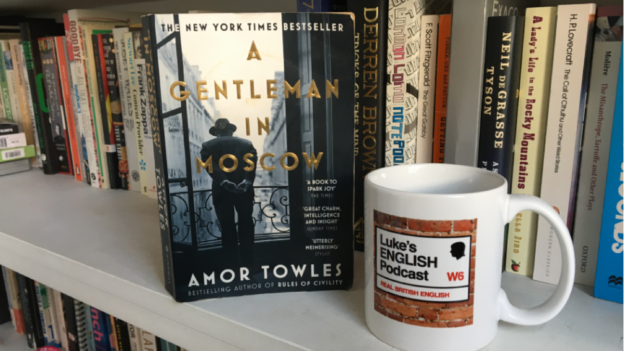
679. Gill’s Book Club: A Gentleman In Moscow

Talking to my mum again about her latest book recommendation. A Gentleman In Moscow is about a Russian Count who is put under house arrest in 1922 in the beautiful Metropol Hotel in Moscow. 

[DOWNLOAD]

LEP Premium Promo

This episode is sponsored by LEP Premium. With Luke’s English Podcast I have two podcasts in fact. There’s the free episodes, which feature monologues, conversations with guests or specific topics. That’s where you get to listen to natural English on a regular basis, presented to you, for you. Then the premium episodes are all about language. Often I take samples from free episodes, then break them down for target language which I teach to you, help you remember and pronounce correctly. So the double whammy is to listen to LEP and also be a premium subscriber, to get the maximum benefit from my work. To get started with LEPP go to www.teacherluke.co.uk/premiuminfo for more info.

Introduction Transcript

Welcome to Gill’s Book Club, on Luke’s English Podcast.

This is the second Gill’s Book Club episode and this is where I talk to my mum, Gill Thompson, about books that she’s enjoyed.

My mum loves books, she’s a voracious reader, a member of a book club with her friends and she works in a second hand bookshop.

She gets through loads of books, and so this is naturally a topic that we can explore together on the podcast.

How does this work?

We pick a book a few months in advance, give people a chance to read it, then talk about it on the podcast, including some of the main plot points (no spoilers) characters, context and details.

Do you have to read the book too?

No. We’ll explain the main plot points without giving away any spoilers.
But you can read the book if you like, or get the audiobook version.

You could read the book first, then listen. Or listen first, then read the book, or just listen without reading the book at all, and enjoy hearing my mum talking about it, the characters, the story and so on. There might also be some nice vocabulary coming up which you can notice as we go along. As usual, check the episode page on my website to see some vocabulary notes and transcripts.

For other episodes I’ve done with advice on reading books to improve your English, check the episode archive.

I said earlier this year that the book we’d be talking about is A Gentleman In Moscow, by Amor Towles, and so that’s the main topic of conversation here.

A Gentleman in Moscow is a 2016 novel by Amor Towles. It is his second novel, following the release of the New York Times bestselling novel Rules of Civility. The novel concerns Count Alexander Ilyich Rostov, a man ordered by a Bolshevik tribunal to spend the rest of his life in a luxury hotel in the heart of Moscow. Wikipedia

There’s a bit of smalltalk at the beginning, and then we get stuck into the book.

I’ll talk to you again on the other side of this conversation, but now, let’s listen to my mum talking about her latest book recommendation.

——

Vocabulary Notes & Questions

Can you comment on these things with reference to the characters and events in the book?
Manners
Integrity
Loyalty
Vocabulary
Class

Do these words apply to Count Alexander Rostov?
Witty
Likeable
Standoffish
Spoiled
Privileged
Glass half full / Glass half empty

Does he change during the book?

House arrest
Did this book make you think of the lockdown?
If you had to be on house arrest, but you can choose any building you like, which building would you choose?
Which building would you choose to be locked inside? (not your own home)

Book club
What did the women from the book club think of it?

Book recommendation
The Year of Reading Dangerously by Andy Miller

Picture of Ivan the Terrible
https://booksyo.files.wordpress.com/2015/01/repin_ivan_terribleivan.jpg

Ivan the Terrible and His Son Ivan on 16 November 1581 is a painting by Russian realist artist Ilya Repin made between 1883 and 1885.

Ivan the Terrible and His Son Ivan on 16 November 1581 is a painting by Russian realist artist Ilya Repin made between 1883 and 1885.

Ending Transcript

So there you are. That was my lovely mum talking about a lovely book and it was all lovely lovely lovely.

Again, check out the page for this episode on my website for vocabulary notes, and the names of the different books and things that we mentioned, plus the chance to see that painting of Ivan the Terrible and more.

I’m still deep inside P24, having published 9 out of 12 parts. More coming for premium subscribers soon…

Later today I’m interviewing my dad.

I don’t like to talk on the podcast about stuff I’m going to do, because I’ve learned that often things don’t go as you expect and it’s unwise to make the listeners think that something is coming when it actually can’t happen because of a technical issue or a scheduling problem or something.

So, who knows, we might not be able to actually do the recording, but the plan is to talk to my dad later today, also about a book. But this isn’t a book that he’s read, written by someone else, it’s actually a book he’s written himself. Yep, he wrote a book during the lockdown. What’s with all these books!? About 5 people I know have written books during the lockdown, including my dad. So stay tuned to LEP in order to (hopefully) listen to a conversation with Rick Thompson about his new book.

Thanks again to my mum for her contribution to this episode.

I hope you all enjoyed listening to it and as ever I look forward to reading your comments and responses to this episode in the comment section on my website, but also on YouTube where you can find all my episodes, and you can keep in touch on social media, my favourite being Twitter and my handle is @EnglishPodcast

Take care everyone. I’ll speak to you again soon, but for now, good bye…

676. David Crystal: Let’s Talk – How English Conversation Works

Professor David Crystal returns to talk about his latest books, and more. The first book is all about the art of conversation in English, and the second one is a spy thriller inspired by real events. David Crystal is one of the world’s leading linguists and an expert on the English language. He is also a national treasure and it’s a treat to be able to talk to him in this episode. Video version also available on the Luke’s English Podcast YouTube channel.

[DOWNLOAD]

YouTube Video Version

Recommended books

Some of his most popular books include:

  • The Cambridge Encyclopedia of the English Language
  • The Oxford Illustrated Shakespeare Dictionary
  • The Story of English in 100 Words
  • You Say Potato: The Story of English Accents (written with his son Ben)
  • Wordsmiths and Warriors: The English-Language Tourist’s Guide to Britain (Written with his wife Hilary)
  • Txting: The Gr8 Db8
  • Pronouncing Shakespeare: The Globe Experiment – a fascinating project investigating how English was pronounced by the original actors in the Globe Theatre when Shakespeare was alive
  • Spell It Out: The Curious, Enthralling and Extraordinary Story of English Spelling
  • Just A Phrase I’m Going Through: My Life in Language (which is both his autobiography and a highly accessible introduction to the field of linguistics)
  • Making Sense: The Glamorous Story of English Grammar

Many of those titles can be purchased as ebooks from David Crystal’s website – www.davidcrystal.com or from any good bookseller. There are also audiobook versions which are read out by the man himself.

Previous LEP episodes with David Crystal


670. Language Learning with James Harris

Talking to writer and comedian James Harris about life as a writer, going to Oxford Uni, being an international Brit and learning German, French and Chinese as an adult.

Small Donate Button

[DOWNLOAD]

Transcript

Hello folks and welcome to the podcast. I hope you are doing fine on this particular day. This episode features a conversation, recorded a couple of weeks ago now, with a comedian and writer from the UK about various things, as you’ll see. Your task is to follow along and see what you can pick up and what bits of language learning wisdom you can glean from this conversation.

I don’t really know James that well. I’ve only actually met him once in fact.

He’s a comedian and a writer, he speaks several languages and his twitter feed is good value. He tweets about politics, learning languages, the issues of the day, comedy and various other things. We share a mutual friend – that’s Dharmander Singh from Birmingham, who I used to be in a band with and who is now a stand up comedian in Berlin. The time I met James was in Berlin when I was there on holiday, and I did some stand up on the same show as him.

So why have I invited him on the podcast? Well, it’s mainly because of Twitter. As I said his Twitter feed is interesting. He takes a moderate and balanced view of things, and his interests are pretty wide-ranging, including the fact that he’s very international. He’s married to a Chinese girl, he’s lived abroad, he used to work as a tour guide in several countries, he used to be an English teacher like me, he speaks very good German and French, he’s working on his Chinese, he works as a translator and he’s generally an articulate and interesting guy and so I just thought that he could be worth talking on the podcast.

The language learning thing is obviously very appropriate and I’m always interested in finding out as much as possible about how someone has learned a second language to a very decent level in adulthood, and that is something that we talk about for at least 50% of this conversation. The first half of our chat is basically me getting to know James properly, talking about his work, his studies, his experiences of going to Oxford University, why he chose to move to Germany, being married to a Chinese girl. Then we get into the details of how he learned German mainly, but also French and now how he’s working on his Chinese.

No need to say much more except that I hope you manage to follow the conversation clearly all the way through. Let me know how it was for you and I will speak to you again on the other side of this conversation, probably with some background music going over the top.


Thank you to James for being on the podcast today. Look him up online to read some of his stuff, follow him on social media and help him out by keeping him fuelled up on coffee.

Follow James on Twitter @JamesHarrisNow
Writing, Mini Screenplays https://shoeleatherexpress.org/
BUY A COFFEE FOR JAMES HARRIS https://t.co/8AAQ6P33wJ?amp=1

So, how are you listeners?

Did you pick up any useful nuggets from that conversation? I think there was some pretty good advice there especially the stuff about reading and noting down certain words, being a bit rigorous about your studying and believing that you can do it, really helps.

665. A Chinwag with Sebastian Marx / 18+ British slang phrases that Americans don’t understand

Chatting to Sebastian Marx from New York and testing his knowledge of British English slang phrases. Slang vocabulary list available below.

Small Donate Button

[DOWNLOAD]

Introduction

This episode features a chinwag (that’s a conversation by the way) with Sebastian Marx – a friend of mine who is originally from New York (he’s an American) but who has been living in France for the last 15 years. Long term listeners might remember him from his past appearances on this podcast. You’ll see links to those episodes on the page for this episode.

Sebastian is a stand up comedian who performs both in English and French, and he was the one who first started doing stand up in English in Paris. So all of us comedians who perform on stage here in English, including Amber, Paul, Sarah Donnelly and others – we all have Sebastian to thank for originally giving us that opportunity as he is the one who got the whole scene started in the first place with the New York Comedy Night which he set up years ago.

I invited Seb onto the podcast just for a bit of a chat, but also to test his knowledge of British English slang. I’m always interested to see how much my American friends know about my version of English.

The Chinwag

In terms of the general chinwag – we talk for the first 25 minutes or so about a few topics, including:

  • What he thinks of the Trump presidency
  • His learning of French
  • Speaking French or English to French people, like waiters in cafes

Then, after about 25 minutes of jibber-jabber, we decide to focus on language and you’ll hear me testing Seb’s knowledge of British English slang – informal spoken English phrases that most Brits know but which Americans are probably unfamiliar with.

This is slang so you should know that things get a bit rude later in the episode with some references to sexual acts – you know, sexual stuff, and also a few other fairly lewd and crude things like bodily functions and so on.

Some of you are probably delighted to hear that and have no problem with it at all but I feel I should give you a heads up about rude content, just in case you’re a teacher listening to this in class or something (I can imagine getting a message from a teacher who’s heard it, or perhaps even having a conversation, like this: Luke, I used an episode of your podcast in my young learners’ class the other day and oh, you started talking about… arseholes and chests, it was quite awkward — Oh dear I’m terribly sorry Mrs Crawly, I should have provided a warning of some kind. I trust that this will not affect my daughter’s entry into the Royal Academy in September. Perhaps you should come for tea and we can discuss it at length. I have one or two things to say to you about your conduct and how this is affecting your reputation among the staff at Downton. Oh, I’m terribly sorry to put you out Lady Crawley… etc… Sorry, I accidentally slipped into an episode of Downton Abbey there. Papa and Mama would be awfully disappointed, and we’ve just received a telegram that the first world war has started and we’re all terribly worried about how this might affect life at Downton and blah blah blah).

I dunno, maybe you’re a teacher or you’re listening to this with children, or maybe you just don’t like rude things of that nature. Basically – there’s some rude stuff in the second half of this episode. Alright? No big deal.

*it’s ok Luke – we fucking love rude stuff, don’t worry*

Alright, steady on…

OK, I promised myself I wouldn’t ramble too much at the start of this one so let’s crack on now, and here is the jingle….

The Slang you can hear in the episode

(listen to hear the full descriptions, examples and American English equivalents)

✔️= Sebastian knew it or guessed it correctly
❌= Sebastian didn’t know it or guessed it wrong

❌“Pants” (adjective) “That film was pants” = not great, rubbish
✔️“Knackered” (adjective”) “I’m absolutely knackered today” = exhausted, really tired / American English equivalent: “beat”
❌”Gobsmacked” (adjective) “I was absolutely gobsmacked” = shocked, surprised
Also: “shut your gob” = shut up, stop talking (gob = mouth)
✔️“a slash” (noun) “Hold on, I’m going for a slash” = I’m going to go and urinate
❌“On the lash” (prepositional phrase) “I’m going out on the lash tonight” = to go out drinking alcohol
✔️“To pull” (verb) “Hopefully I’m going to pull” = to score, get lucky, to get laid, to have sex with someone
On the pull” = trying to ‘get lucky’ with someone
To go out on the pull
To chat someone up” = to talk to someone to make them like you (sexually) to try to pull someone by talking
❌“To get off with someone” (phrasal verb) “I got off with her” = to kiss passionately on the lips (USA: to make out with someone)
To get on with someone” = to have a good relationship with someone, to “hit it off with someone”
✔️“A plonker” (noun) “You are such a plonker” (not a swear word) = an idiot
❌”A tosser” (noun) “Stop being such a tosser” (synonym of “wanker” but less rude) an idiot, a person you don’t like
a wanker” is a mean nasty unpleasant man that you’re angry with
To wank” = to masturbate
Asshole” (US English)
Arsehole” (UK English)
✔️“A fag” (noun) “I’m just having a fag” = a cigarette (in US English it’s a very rude term of abuse meaning a homosexual)
❌“A wind up” (noun) “He’s a wind up merchant” “Is this a wind up?” = a joke, a piss-take, teasing, making fun of someone, playing a trick on someone, a con, a prank, lying to someone as a joke
To wind someone up” = to annoy someone
❌“whingeing / to whinge” (verb) “Stop whingeing! You’re always whingeing.” = to complain, to moan, to whine, in an annoying way
✔️“Smart” (adjective) “You’re looking smart today. What’s the big occasion?” = to be well dressed, to be wearing formal clothing, to look clean and tidy (opposite = casual) (USA: smart = intelligent)
❌“Lush” (adjective) “Oh that’s lush” “Those trainers are lush” “Oh she is lush isn’t she?” = good, attractive (for a person), cool, great, awesome
❌“Grotty” (adjective) “I smoked a cigarette earlier and I’m feeling dead grotty now.” = unpleasant, dirty, feeling a bit unwell or under the weather
❌“Ta” (exclamation) “Could you pass me the sugar? Ta.” = thanks
✔️”A chinwag” (noun) “We’ve had a good chinwag” = conversation
❌“It’s all gone pear shaped” (idiom) “We did a Zoom call but everything went pear shaped because of technical problems” = to go wrong

Schlep (verb – US slang, from Yiddish) to carry something with difficulty, to carry something heavy – “I’ve been schlepping this bag around all day”
Schlep (noun – US slang, from Yiddish) a long and arduous journey – “I work on the other side of town and getting there is a real schlep!”

50 British phrases that Americans just don’t understand (MatadorNetwork)
https://matadornetwork.com/notebook/50-british-phrases-americans-just-dont-understand/

Ending

Music: Sippin’ Gin by Jim Thompson

Righty-ho, that was Sebastian Marx (thanks Sebastian) and 18 bits of British English slang.

How many did he get right? He predicted 50% I think. Well, out of 18 he identified 7. And my criteria for getting it right was whether he knew the word or phrase already or if he worked it out correctly, first guess, from my example. 7 out of 18. What’s that as a percentage? Some of the mathematicians are already on that, but I need a calculator to work that one out, unless you want to listen to me working that out in my head. Trust me, you don’t want to listen to that. I don’t think I can do it. Anyway, the result is… 38.88888888889 Let’s round that up to 39% which is a clear fail I think everyone can agree.

What does this mean? I’m not sure, except that it proves something about American and British culture and language. Sebastian made the point during the episode and I think I’ve said it before previously, like in that slang game I did with Jennifer from English Across the Pond last year.

Brits are way more familiar with American English than Americans (and of course I mean people from the USA) are with British English because we are exposed to a lot more American culture through TV and film than Americans are exposed to British culture.

America produces tons of TV and film of course and exports a massive amount too, but it doesn’t import as much TV and film as it exports. Basically, most Americans don’t get exposed to that much British English, certainly not the kind of local informal slang stuff that we touched on in this episode. Big surprise eh! Not really! We know this about the USA – big place, quite loud on the world’s stage, exports a lot of stuff, but to a large extent doesn’t look beyond its own borders all that much, relatively speaking. We all knew that though didn’t we!

Anyway, never mind all that geo-political stuff. I just enjoyed chatting with Sebastian in this episode and sharing some of my version of English with him. That is more interesting and fun for me.

What about you? How much of the slang in this episode did you know? I’ve definitely talked about some of those things before, but I bet there were one or two new things in there too.
But how much of it did you know and how much did you learn from me in previous episodes? And if you didn’t get it from me, where have you learned British slang? Let us know in the comment section!

Also, feel free to add other bits of British slang that you think is especially, quintessentially British in the comment section.

All the slang I tested Seb on is listed on the page for this episode on the website, so check it out. That’s where you can see specific spellings of words and phrases, and you can check some example sentences and definitions that I’ve given for you.

Talking of British English expressions – I must finish that series I started last autumn – 88 English expressions that will confuse everyone. Remember that? I still have about 25 expressions left to cover I think! I must get round to doing that.

My podcast is a bit like a big, slow moving ship. Sometimes I miss something or forget something and kind of sail past it, but for some reason it’s very hard to stop the ship or turn it round and go back. So, if I don’t do a specific episode I was planning to do at one point, general momentum keeps pushing me forwards and it’s difficult to turn the ship around and go back. I’m not sure why this is.

Stuff to mention at the end

Lovely comments from listeners on the last episode (in different locations like YouTube, website, twitter, email) My wife said that the comments were cute and lovely.

Something evil this way comes… Episode 666 is next.

666 → often described as the number of the beast. The mark of the devil.

Lots of people have been asking if I’m planning anything special for that.

Well, you’ll have to wait and see…

Previous episodes with Sebastian

130. A Cup of Tea with… Sebastian Marx

183. Luke’s D-Day Diary (Part 1)

247. Understanding The USA (with Sebastian Marx)

298. The Bank Robbery (Part 1)

299. The Bank Robbery (Part 2) with Amber, Paul & Sebastian

388. US Presidential Election 2016 – Trump vs Clinton (with Sarah & Sebastian) Part 1

389. US Presidential Election 2016 – Trump vs Clinton (with Sarah & Sebastian) Part 2

664. Lockdown Ramble with My Wife

Chatting to my wife late one evening last week about what it’s like to be with an English guy, raising our daughter to be bilingual and more…

[DOWNLOAD]

Introduction

Hello listeners, how are you doing out there in podcastland? What’s going on with you then, eh? Where are you? Who are you? What are you doing right now? Where are you listening to this? How are you listening to this? Have you got headphones on? Are you in a car or something? In public? Are you allowed out at the moment? Have you got a mask on? I mean, a medical face mask, not a metaphorical mask, but maybe you’re wearing one of them too, hmmm….?

Anyway, enough weird nonsense. I just want to give you a hearty welcome at the start here and to make sure you’re really with me here as you listen to this episode of my podcast, which is designed to help you with your English. You see, it helps if you’re fully engaged and listening carefully. It helps with your English, if you’re really paying attention while you listen.

On the podcast today, you’re going to listen to a conversation between me and my wife. Yep, my wife is back on the podcast for the third time now. The 1st time was just after our daughter was born, in episode 502 (just to be clear: my daughter wasn’t born in episode 502 of course, I mean that was the first time my wife was on the podcast and it was just after our daughter was born) The 1st time my wife was on the podcast was just after our daughter was born, in episode 502, and the 2nd appearance by Mrs Thompson was in a premium episode series in which we taught you loads of phrases that my wife has learned from me and that we use all the time (That’s P08 by the way – www.teacherluke.co.uk/premium )

The conversation you’re about to hear took place in our living room late in the evening last week, after we’d finally got our daughter to sleep and had eaten our dinner. We’d been talking about doing another podcast for a while and then finally we managed to record ourselves chatting about our experiences of living in lockdown and also to respond to some questions that listeners asked in the past.

Here are some of those questions…

  1. What is it like to be with an English guy?
    Some people have wondered about this and asked me to talk to my wife about it. What about the differences in culture between us? How does this affect our relationship? We mainly talk about communication style here, and I’d like to refer back to a recent episode – #643, called The Intercultural Communication Dance with Sherwood Fleming, as it touches on some similar points.
    So, what does my wife like or dislike about being with an English bloke? That’s what we deal with first.
  2. What have you been doing on lockdown with your daughter?
    Then we talk about living in lockdown with our daughter, including what we’ve been doing to keep her busy and how we’ve been able to observe her development more closely during this period. I should say, there’s quite a lot of conversation about our daughter in this episode. After the recording we both were concerned that it’s just two parents going on about their child. Again, if you have children, you’ll probably relate to what we’re saying. If you don’t have kids, I don’t know what you’ll think. You might not be into that stuff. Often, parents talking about children bores the pants of single people. But this has always been quite a personal podcast and a conversation with my wife is bound to include stuff about our daughter – I mean we’ve been locked up with her for about 7 or 8 weeks, so there you go. Just a little heads up – there’s more kid-chat in this episode.
  3. How are we raising our daughter to be bilingual?
    The third main thing we talk about is the bilingualism of our daughter and our approach to that. How are we making sure that she learns English as well as French? What are the main ways of doing this and what are the main factors to bear in mind when raising a child to speak two languages?

There’s also some chat about other things, like some comments from listeners, going to visit the castle near where my parents live, and whether my wife likes Star Wars and The Beatles.

Listening back, I noticed that sometimes I was speaking really fast during this episode, especially in the second half. I have mixed feelings about this, about fast speech on this podcast. For some listeners, this will be great news because some of you want to listen to fast natural conversation. For others this will be challenging.

I think I speak quickly in this conversation because my wife and I are very close (we’re married, you see) and she has no qualms about interrupting me and so I have to raise my speaking speed in order to prevent that happening. It’s a bit like when I’m with my brother. There’s this feeling that we’re going to talk over each other so we end up speaking more quickly as we try to get our ideas out before we get cut off.

I suppose ultimately this is good for you to listen to, because this is how people really speak to each other. They interrupt, they finish each other’s sentences, they make false starts and correct themselves and they don’t always finish the points they are making. It is good to listen to that kind of speaking because it’s how people really speak, unlike the kind of contrived listening you get in textbooks where everything is written in advance and read out fairly awkwardly by actors. I’m not having a go at English course books – they can be incredibly useful, but at the same time they aren’t very realistic.

My Wife’s English (actually she’s French)

You might be curious about my wife’s English, and her background with English.

Just in case you don’t know, my wife is French, and English is not her first language. She had some lessons at school and at university like most French kids but mostly she learned her English in adulthood. We speak English at home together. Sometimes we speak in French together, but as anyone with experience of this will tell you, it’s quite hard to shift the language of your couple once it has been set, and our relationship definitely started in English and my wife’s English is better than my French, so English is the language of our couple. We sometimes speak French together, but in French I am quite incompetent – I am a lot like Mr Bean, and when she married me, that’s not what she signed up, so, English is how we communicate, and there it is.

Ok then so now I would like to invite you into the living room of our flat in Paris. Would you like a glass of wine? Maybe a cup of tea? Take a seat. Don’t speak, you can’t actually speak, you can only listen (this is a bit weird), but you can write some notes to us after we’ve finished  – I mean, you can share your thoughts in the comment section under this episode if you wish. Otherwise, can just sit in the corner there and listen to us talking, if it’s not too awkward.

All right, that’s enough of an introduction. Let’s get on with it, here is my lovely wife, here is her lovely voice and here we go!


Ending

So here is that bit at the end where I talk to you for a while before the episode finishes.

I hope you liked that conversation. Did you think I was talking a bit quickly at some points or did you not notice? I wonder what you think of my wife? It’s a bit weird publishing these conversations with my family sometimes. I wonder if I’m giving away too much of my personal life, but it’s not like I’m doing a reality show or anything is it? Maybe I’m being precious about it. Who knows.

Anyway, I hope you’ve enjoyed spending a bit of time in our flat during this episode, but I’m afraid we’ve got to go to bed now, so err…. would you like me to call you a taxi or…?

Nah, I’m joking of course hahaha, but please do leave now, thank you.

Actually I do have a couple of things to say.

Push notifications for the app are not currently working, which is a drag. Sometimes things take ages to get done around here, but I’m working on fixing the issue. As a result, app users and premium users might not know that I’ve been uploading premium episodes. I’m now onto premium series 22 and I recently uploaded parts 4, 5, 6 in that series. Check them out, they’re in the app in the premium category. You can also get them online at www.teacherluke.co.uk/premium That’s just a heads up in case you didn’t realise they were there.