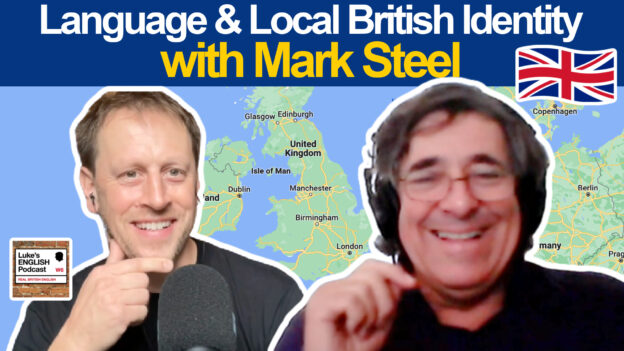
Special Guest Mark Steel joins me to discuss cultural and linguistic differences between the UK and France, plus accents in the UK and a little tour of some places in the UK that you don’t know about. Also includes a discussion of swearing and rude language in Britain. What is the R word which you should never say in a specific part of the UK? Listen on to find out. Video version available.
Learn English with another short story. In fact, this episode contains two stories. Listen until the end for the 2nd one. Repeat after me to practise your pronunciation. Learn some vocabulary & grammar in the second half of the episode, with an explanation of modal verbs of deduction in the past and present. Video version available.
It is published by OUTPOST 19 and it was put together by the team behind the website, including Grant Faulkner, Lynn Mundell and Joshua Michael Stewart.
It is available for you to purchase and I recommend it if you are looking for bite size stories to use for learning or teaching English.
This is a free sample of LEP Premium, available for everyone. In this episode I’ll tell you about my technique for learning English with stories and transcripts, with full details about how to improve your English with my stories. Then I’ll tell you a story about a time I had an encounter with a bear, and then I’ll give you some language practice exercises for your grammar and vocabulary, and some pronunciation drills to let you repeat after me. Full PDF transcript available + video version available too.
🏆 LEP Premium is a series of bonus episodes from Luke’s English Podcast in which I teach you vocabulary, grammar and pronunciation. LEP Premium is now available on Acast+ Episodes are usually in audio format (with some bonus videos), and you can listen to them in any normal podcast app.
Gabriel Clark from clarkandmiller.com joins me to discuss a short history of teaching methodology in the world of TEFL. The direct method, the grammar translation method, The Audio Lingual Method, the Structural Approach, Suggestopedia, Total Physical Response, Communicative Language Teaching (CLT), The Silent Way, Community Language Learning, Task Based Language Learning, The Lexical Approach and dogme style – all these get described and discussed. Learn how English teachers teach you English!
Any listeners in the Paris area – This is just a reminder about the talk I am doing at the British Council at the Invalides centre in Paris on Thursday 19 May at 7pm. I will be doing some storytelling in front of a live audience and you can be there if you want. It’ll be sort of a mix of stand up, storytelling and podcasting at the same time as well as a social gathering afterwards, all in English of course.
I will be on the stage telling the story of how I ended up sick in a Japanese hospital bed, scared out of my mind because I thought I was going to die or something – now, that sounds quite scary but the idea is to make it funny and entertaining.
It is a true, personal story of travelling, living in another country, and how things can sometimes get completely lost in translation, leading to some rather dramatic experiences.
If you want to come and be part of the audience – you can. It’s free. Everyone is invited. I will be recording it for the podcast, but if you want to actually be there in the room and have a drink afterwards, socialise in English and so on – then you are welcome. You need to book a seat though, and you can do that at britishcouncil.fr and then click evenements – my event is the one called Talks in English : Le choc culturel – humoriste
This is a chance for me to just let loose and have a ramble while inviting you to this kind of housewarming party (or perhaps just the first part of the party) in my new pod-room. In this one I am going to welcome you into the new room and do a ramble challenge in which I am restricted to only talking about things inside the room, plus reading from some random books on my shelves. Grammar rules, adverbial collocations and a game show story.
In this episode I’m going to wish you a Happy New Year, ramble a little bit about what’s going on in LEPland, restate some of my aims and objectives for this podcast, and give a few comments on how you can use the podcast to improve your English, with reference to some recommended episodes from the archive.
Happy New Year everyone! (new listeners, long-term listeners, mid-term listeners and anyone else who happens to be listening)
All the best for 2022. Try to keep up your motivation for learning English throughout the year. I hope I can help. That is my aim.
How was your Christmas/New Year? Did you have a holiday? What did you do?
What’s the situation Luke, as you record this? (summarise the last couple of weeks, and what’s going on around you)
I might not be able to upload episodes regularly for the next few weeks. If LEP goes quiet – I am still here and still working, but not able to record or upload because of all the different disruptions. My life is like a puzzle at the moment and I am putting all the pieces back together.
LUKE’S ENGLISH PODCAST – AIMS
To provide a resource of authentic speech for learners of English.
Episode suggestions
All of them! Especially ones which are unscripted.
To inform my audience about methods and strategies for improving their English.
To educate my listeners about the English language by explaining or providing examples of grammar.
Episode suggestions
Premium episodes www.teacherluke.co.uk/premiuminfo (articles, sentence structure, present perfect tense, narrative tenses, modal verbs about the past, quantifiers and more) but also a lot of episodes in the archive deal with grammar. Here’s a selection.
To entertain my audience by producing fun and interesting content specifically targeted at learners of English as a second language.
To highlight particular aspects of English (language) culture including themes about Britishness, accounts of key moments in history, politics and the arts, with a particular focus on comedy and film.
Suggested episodes
Search the archive for the words British and comedy. The Rick Thompson Report, Film Club, British Comedy, Luke’s D-Day Diary, and more…
To raise awareness of many features of British English pronunciation and provide practice of repeating certain phrases or constructions.
Suggested episodes
All premium episode series have dedicated pronunciation episodes. Also, these ones:
To keep my audience engaged in the listening process long term, by providing a resource to help them laugh while they learn.
To make people laugh out loud on public transport while listening to the podcast!
To dominate the world with an army of LEP ninjas equipped with biscuits and good English. …Ok, one of my listeners asked me to add this as an aim for my podcast, ha ha! (Thanks Chriss Benitez)
Those episodes can be found in the LEP app or via the episode archive. Most good podcasting apps will have the entire archive, but I think iTunes or Apple Podcasts doesn’t show all episodes. YouTube doesn’t show all episodes either. Only some of my episodes are on YT. I’d like them all to be there (just the audio) eventually.
HOW TO USE LUKE’S ENGLISH PODCAST TO IMPROVE YOUR ENGLISH
People from all over the world use my podcasts to improve their English, and lots of people email me to tell me how much they love the podcast and find it useful. Some of you might be wondering how you can improve your English by using the podcast. I’ll tell you more about this in a moment, but let me first recommend a couple of podcast episodes you could listen to.
Many people tell me they are completely addicted to the show. Usually they say that they found the podcast via one episode in particular and then start listening to all the others before becoming completely hooked. I have quite a hard-core following. The podcast won the Macmillan Dictionary Award four times and was nominated for a British Council ELTon award, so I must be doing something right!
L.E.P combines English teaching with plenty of entertaining conversation, humour and genuine insight into the culture of the English language. My methodology and approach are based on the idea that language is acquired by engaging with it in authentic form, over longer periods of time. Although this is not the only way to improve your English, listening to natural authentic speech over quite long periods of time can greatly improve your listening skills, pronunciation and vocabulary. This goes on to improve your spoken English, and your general instinct for grammar. I try to balance this approach by regularly recording episodes in which I directly teach you vocabulary, pronunciation or grammar.
Good grammatical awareness is based on instinct as much as on active knowledge of the rules of English. When you take an English exam you have to answer questions that test your knowledge and use of grammar or vocabulary. For example, consider this question:
FILL THE GAP IN THE SENTENCE WITH THE APPROPRIATE WORD
“I just can’t rely __ this car any more. It keeps breaking down. I need a new one.”
1. with 2. from 3. on 4. to
The answer is ‘3. on’, of course.
How did you know the answer? Really think about it. How did you know that ‘on’ was right? Do you remember learning ‘rely on’ in a book, or in a class? Maybe you did. But, for many of you, the answer just felt correct. Your instinct just said ‘on’. Well, this instinct is what you develop when you read or listen to the language a lot. Your brain builds up a kind of memory bank of all the words you have seen and heard. So, when you see ‘rely ___’ you automatically feel that ‘on’ is the right answer. Why? Because you’ve seen/heard ‘rely on’ lots of times!
The point is, that listening to English a lot can really help you to get a ‘feel’ for the language. You learn grammar rules by the frequency in which you hear patterns. You learn about good pronunciation by hearing the language a lot. You develop an ‘ear’ for English.
It’s just like when you live in a foreign country to learn English. It’s the best way to learn a language. Just live in that country and get completely surrounded by the language every day. Eventually you pick it up and learn it well. That’s because you’re hearing it so much and you’re getting used the rhythm and intonation. Every language has a beat. You can learn the beat of English by hearing it a lot.
So, you can use Luke’s English Podcast to do this. It’s like living in another country. You can listen a lot, pick up bits of vocabulary, get a ‘feel’ for the language, understand pronunciation and all kinds of cultural stuff. Not only that, but many listeners tell me the best thing about the podcast is simply that it makes them laugh out loud.
So, enjoy the podcasts and good luck with your English.
Talking to Michael Lavers from the Level Up English Podcast about learning Japanese, embarrassing moments in language learning, social awkwardness and some “very British problems”. Are you as socially awkward as a British person? Let’s see how you and Michael would respond to some quiz questions that will test your British awkwardness to the max. Video version available.
Today on the podcast I am talking to Michael Lavers who is an English teacher from Cornwall in the South West of England. Michael also has a podcast for learners of English. It’s called The Level Up English Podcast – you might want to check it out if you haven’t already done so. It’s available wherever you get your podcasts.
As well as being an English teacher, Michael is also a language learner himself and in his podcast episodes he often talks with guests about experiences of learning other languages, including those embarrassing or awkward moments that happen when you feel shy or you make mistakes. Also, Michael has described himself as a socially awkward person who lacks a certain amount of confidence in himself. In fact, he says that one of the reasons he started his podcast was to try and gain some confidence by going out of his comfort zone.
So this is what I thought I would ask Michael about: his language learning experiences and those awkward and embarrassing moments, and then I’d like to chat about social awkwardness and whether this is a uniquely British thing. And we’re going to go into some specific examples of how this so-called British awkwardness manifests itself.
That’s the plan, so now, let’s meet Michael Lavers from the Level Up English Podcast.
Awkward Situations – Very British Problems
Here are some questions based on some tweets by the popular Twitter account, Very British Problems. Each one describes a specific problem that British people typically experience in social situations. They seem to sum up the experience of being a British person. We’re socially awkward – I don’t know why.
Let’s see how you respond to these questions. And listeners, I want you to consider your answers to these questions too, then we’ll see what Michael says, and then we’ll see the original tweets and we can see if they match up.
Questions & Tweets
How do you feel when you walk through the “nothing to declare” gate at an airport?
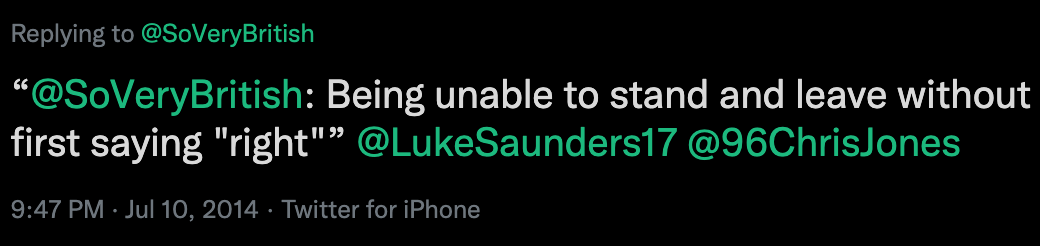
You’re sitting with a group of people. It’s time for you to leave. What do you say as you kind of slap your hands on your knees and stand up?
If someone says something to you but you don’t hear it, how many times are you willing to ask them to repeat themselves?
What do you say to your taxi driver as they approach the point where you want to get out of the cab?
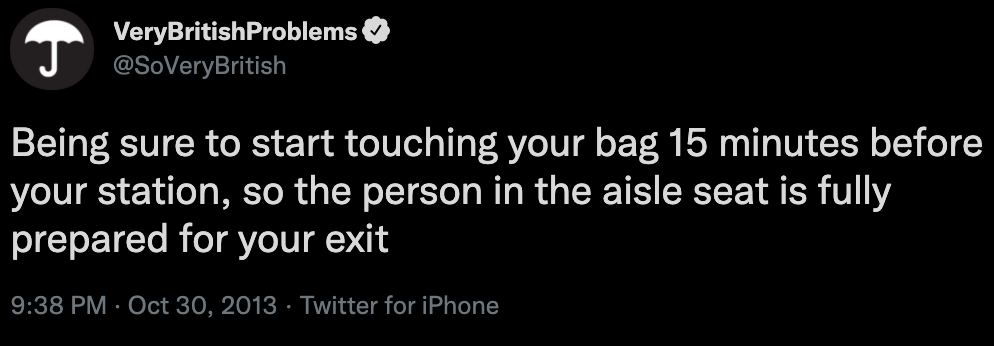
If you’re on a train, sitting in the window seat with a passenger next to you, and your stop is approaching, what do you do to signal to the passenger in the aisle seat that you will need to get up?
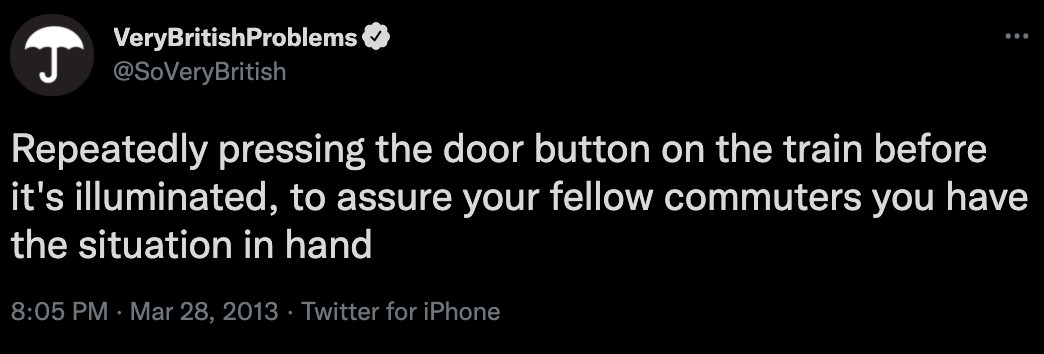
You’re standing at the exit door of the train as it is pulling into the station, slowly coming to a stop, and there is a crowd of other passengers right behind you, eager to get off the train. The “Open door” button isn’t yet illuminated. What do you do? Do you press the button?
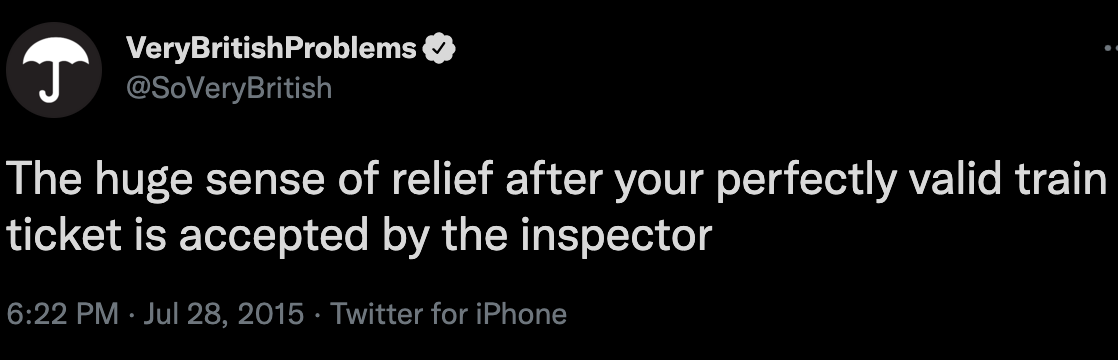
How do you feel when the ticket inspector inspects your perfectly valid ticket?
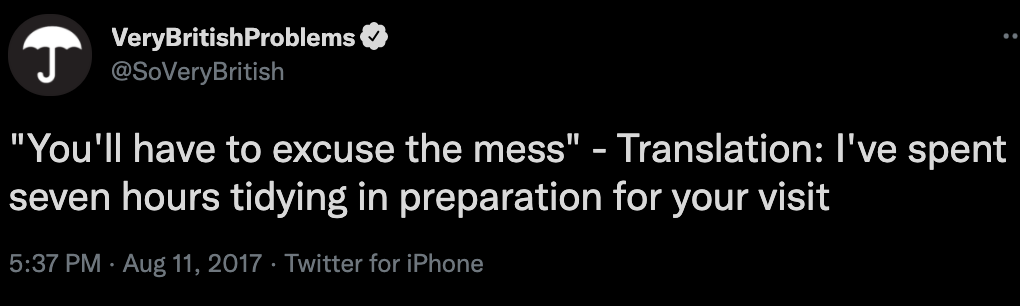
What do you say, modestly, to guests arriving in your home, even though you spent some time before their arrival, tidying things up?
There’s one last roast potato on the table at Sunday lunch. You want to eat it. How do you achieve this?
Just take it and eat it
Ask if you can eat it
Offer it to everyone else first
Do you ever tell your housemates or family that you are “off to bed” but then just stare at your phone in bed for an hour?
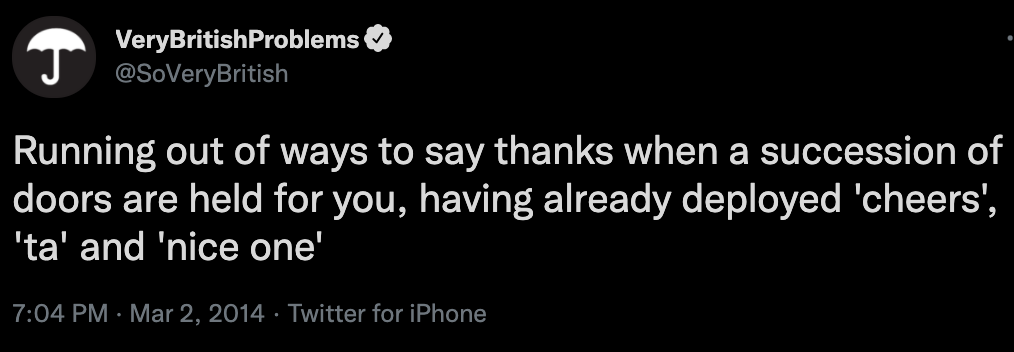
Imagine you are walking through a hallway with lots of doors in it, like in a library or something and you’re walking just behind a stranger who keeps having to hold the doors for you. How many different ways of saying “thanks” can you think of?
How do you end an email? Is there a subtly less friendly difference between kind regards and just regards?
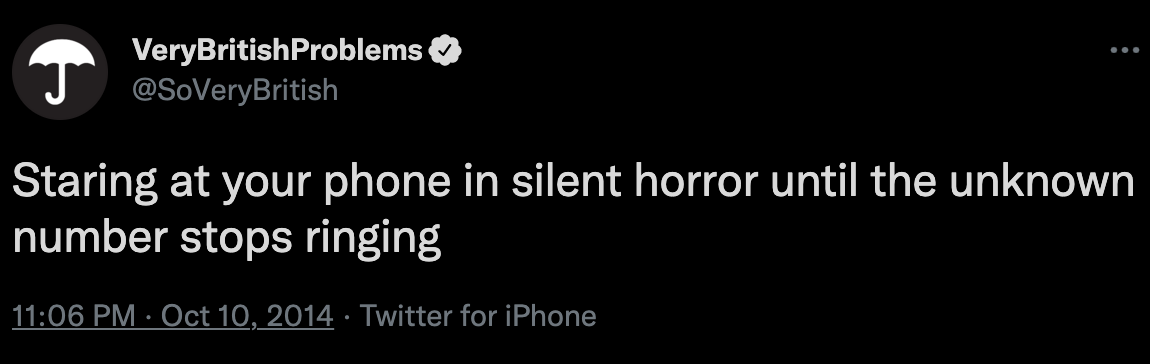
What do you do when you get an incoming call from an unknown number?
How good are you at overtaking someone on foot?
Do you feel it necessary to speed up at all, when walking over a zebra crossing?
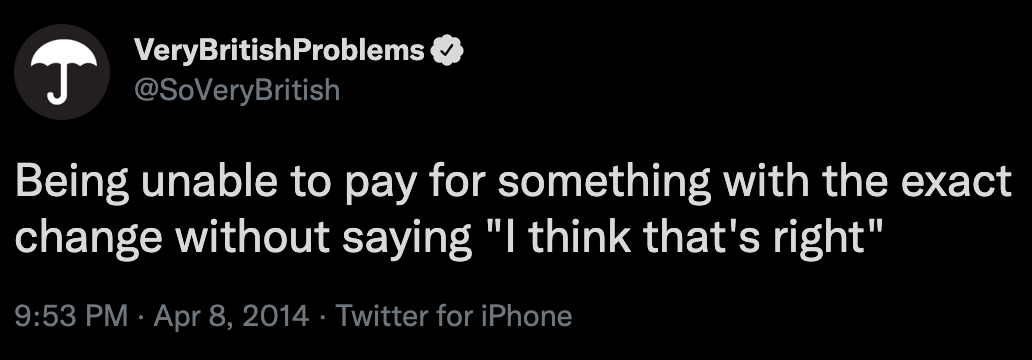
If you pay for something with exactly the right change, and you know it’s exactly the right change, do you wait for the cashier to count the money?
I have had some entries already. If you’ve sent me something, then thank you. Please send your designs to podcastcomp@gmail.com and my brother and I will review the entries we receive, talk about them on the podcast and pick at least one to be featured in the LEP Merch store.
Think of a t-shirt that LEPsters would want to wear
PRIZE: The winning design will be put on t-shirts, mugs and other merch, and the winner will also win £80!
SPECS: A high-resolution transparent .PNG at 150dpi. Minimum dimensions of at least 1500px by 1995px (not including outer transparent pixels).
CLOSING DATE: 22 October 2021
Send your t-shirt designs to podcastcomp@gmail.com
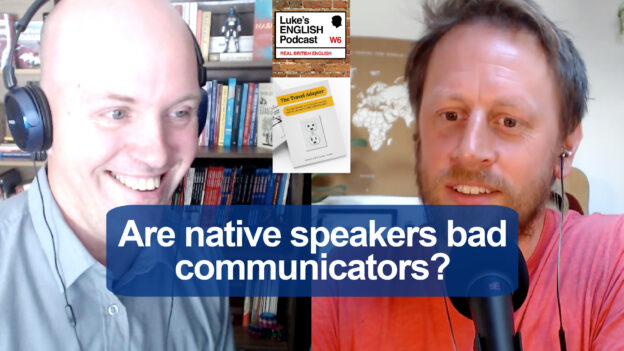
Talking to English teacher Matt Halsdorff about a project to train native English speakers how to communicate better with non-natives. We talk about the reasons why native speakers are often bad at communicating with non-natives, what they should do to fix this and the wider issues relating to this project. Video version available.
Hello listeners and video viewers, how are you doing today?
In this episode you’re going to listen to me in conversation with Matt Halsdorff who is an English teacher with many years of teaching experience, and we’re going to be discussing the question of whether native English speakers are in fact the worst communicators in an international English environment.
Matt is currently working on a project with Christian Saunders from Canguro English. I think the project sounds really interesting and raises a few good questions about how native speakers of English and non-native speakers communicate with each other, what non-natives really struggle with in this language, and whether native speakers can do anything to help.
If you saw my latest video interview with Christian from Canguro English and you watched until the end you might remember us discussing this project briefly. If you remember, Christian mentioned a training course in communication in English – but the twist is that it’s for native speakers – more specifically it is for native English speakers who need to communicate internationally.
Because, It’s not just learners of English who need training in this language. Apparently – It’s native speakers too.
English is a global language, and everyone is using it for business and also for travel purposes. Everyone needs to use this language to communicate successfully so the world can continue spinning.
Everyone uses English, and everyone has to work on the way they use it, in the same way that we all have to work on our email writing and IT skills to make them as efficient and effective as possible.
As a non-native speaker of English, of course you’ve got to work on the entire system – you need vocabulary, you need correct grammar, you need clear pronunciation, fluency, confidence and so on – obviously, that’s what’s involved in trying to use another language.
You learn as you go and try to do your best and you almost certainly feel a great deal of responsibility, pressure, and challenge when communicating in English. You are probably keenly aware of your performance in English and sensitive about any kind of failure in communication and how that might be your fault.
But do native speakers share a similar sense of responsibility?
In fact here are a number of other questions which arise when thinking about this topic.
Do native English speakers do all they can in international situations to make sure they are understood clearly, just like everyone else does?
Are native speakers aware of what it is like to operate in a second language?
Might there be other reasons why native English speakers don’t adapt the way they speak in order to improve shared communication?
Who is responsible for the success of any act of communication? Just one side, or both?
Should native speakers adapt their English? Or is it up to the non-natives to do all the heavy lifting in this situation?
And if native speakers should adapt their English, how should they do it?
What kind of English should they avoid and what kind is likely to be the most successful?
And what about other considerations and questions, such as what happens to the English language when it is being adapted in this way?
Well, I am interviewing Matt today in order to discuss these things and find out about this project in general. First we’re just going to take a few minutes to get to know him, and then we’re going to dive into this training project for native speakers, which is called The Travel Adaptor by the way. We’re going to find out about the project, about what native speakers do and say which can be so confusing, how native speakers can facilitate communication with non-natives, and the wider issue of global English and successful international communication.
As well as getting into the specifics of this conversation, you can certainly learn about some of the major obstacles that non-native speakers have when understanding natives.
So there’s plenty to pick up from this. There is a YouTube version too just in case you need to see our faces as well as listen to us.
Well, that was Matt Halsdorff talking about The Travel Adapter – a training course for native-speakers of English, to help them communicate better globally.
So, what do you think? I’m very keen to read your comments and I am sure you had things popping into your head during this conversation. Why not express them in English here in the comment section?
Do you have experiences of communicating with native speakers in English? What was it like? Did they adapt their speech? What was difficult?
Do you think native speakers should adapt their speech when talking to non-natives, or not? Why?
But that’s it for now. Thank you for listening and I will speak to you again soon. I’ve got a little announcement coming in the next few weeks that’s pretty cool, plus the usual free episodes and premium episodes on their way as usual.
Speak to you soon, but for now – goodbye bye bye bye bye bye bye!
Reading a short story presented on Commaful.com. The Escaped Man is a mystery full of tension and intrigue. Listen closely as I break it all down and explain the vocabulary fully. YouTube video version also available.
It’s time to do another story on the podcast. This time I’m going to be reading a story called The Escaped Man which was written by CT Platt and is presented on the Commaful website.
Commaful.com is a website where you can find short stories, fan fiction and other reading texts and it’s all presented in quite a nice and easy-to-read format.
I’m going to read the story to you once and all you have to do is follow it, and hopefully enjoy it. I have a couple of questions for you to help you stay focused on your listening.
Then I’ll read through the story again and break it down line by line, explaining, pointing out and teaching you bits of vocabulary and grammar as I go.
Learning English through stories is a great idea and tends to work because it places language in a vivid context and is generally quite entertaining and fun.
So listen to the story and then let me break all the language down for you bit by bit.
Just before I read the story, here are a couple of questions for you.
Where does the story take place? How do you know? Is this American English or British English? How do you know? What is going to happen next?
Talking to Christian again about some of the themes and controversial opinions he talks about in his YouTube videos, plus some bits about men wearing thongs on the beach, an obsession with rabbits and if Christian was the Donald Trump of English teaching. Video version available.
How are you today? You are now listening to episode 732, and in this one I am talking again to Christian Saunders from Canguro English.
This is the second time I’m talking to him on the podcast. I previously interviewed Christian in episode 686 last year and got to know him a bit, but I wanted to talk to him again after having seen some of his most recent videos on YouTube about language and language learning.
In his videos Christian often challenges certain assumptions and myths about language learning, and so I thought it might be interesting to talk to him about those things, so I came up with some questions about language, learning language and teaching English on the internet.
There is a video version of this conversation on my YouTube channel too, so don’t forget to check it out and of course to like and subscribe while you’re there.
There’s no more for me to add here in the introduction. I hope you enjoy this conversation and get some good things from it. Once again, Christian’s YouTube channel is called Canguro English and his website is canguroenglish.com
Let’s get started.
So that was Christian from Canguro English. Thanks again to Christian.
And here we are, at the end of yet another episode. I wonder what you thought of the points which came up in that conversation? Feel free to let us know in the comment section or perhaps under the YouTUbe version of this. Where do you stand on things like comprehensible input, workbooks and clickbait titles? Let us know.
For me, this is one of the last episodes I’m recording before officially starting my summer holiday. As usual I have loads of stuff to record and publish before I go away, and I might end up recording some of it while I am back in the UK. But here’s a little overview of what’s in the pipeline right now.
A Summer Ramble
War of the Worlds
P31
So I have my work cut out.
In terms of holiday – we’re going back to the UK to stay at my parents’ place and we will have to deal with the whole quarantine thing, and the day 2 and day 8 testing process and all that. It’s quite annoying. But after we quarantine we will be going to a posh camp site for some “glamping” and generally spending a couple of weeks in the UK.
Meanwhile our new flat in Paris is being demolished (on the inside) and remade to our specifications. Let’s hope that all goes according to plan.
I’ll talk more about this stuff in that rambling episode which is coming up.
In any case, I will speak to you again soon.
But for now, it’s time to say, good bye bye bye…
Cookies on teacherluke.co.uk
Click “Accept All”, to consent to the use of all cookies on this website, or visit "Cookie Settings" to control your consent settings.
This website uses cookies to improve your experience while you navigate through the website. Out of these, the cookies that are categorized as necessary are stored on your browser as they are essential for the working of basic functionalities of the website. We also use third-party cookies that help us analyze and understand how you use this website. These cookies will be stored in your browser only with your consent. You also have the option to opt-out of these cookies. But opting out of some of these cookies may affect your browsing experience.
Necessary cookies are absolutely essential for the website to function properly. These cookies ensure basic functionalities and security features of the website, anonymously.
Cookie
Duration
Description
cookielawinfo-checkbox-analytics
11 months
This cookie is set by GDPR Cookie Consent plugin. The cookie is used to store the user consent for the cookies in the category "Analytics".
cookielawinfo-checkbox-functional
11 months
The cookie is set by GDPR cookie consent to record the user consent for the cookies in the category "Functional".
cookielawinfo-checkbox-necessary
11 months
This cookie is set by GDPR Cookie Consent plugin. The cookies is used to store the user consent for the cookies in the category "Necessary".
cookielawinfo-checkbox-others
11 months
This cookie is set by GDPR Cookie Consent plugin. The cookie is used to store the user consent for the cookies in the category "Other.
cookielawinfo-checkbox-performance
11 months
This cookie is set by GDPR Cookie Consent plugin. The cookie is used to store the user consent for the cookies in the category "Performance".
viewed_cookie_policy
11 months
The cookie is set by the GDPR Cookie Consent plugin and is used to store whether or not user has consented to the use of cookies. It does not store any personal data.
Functional cookies help to perform certain functionalities like sharing the content of the website on social media platforms, collect feedbacks, and other third-party features.
Performance cookies are used to understand and analyze the key performance indexes of the website which helps in delivering a better user experience for the visitors.
Analytical cookies are used to understand how visitors interact with the website. These cookies help provide information on metrics the number of visitors, bounce rate, traffic source, etc.
Advertisement cookies are used to provide visitors with relevant ads and marketing campaigns. These cookies track visitors across websites and collect information to provide customized ads.